

Search Results for 'brooks'
-
AuthorSearch Results
-
December 30, 2025 at 6:42 pm #8003
In reply to: The Elusive Samuel Housley and Other Family Stories
JOHN BROOKS ALIAS PRIESTLAND
1766-1846John Brooks, my 5x great grandfather, was born in 1766, according to the 1841 census and the burial register in 1846 which stated his age at death as 80 years, but no baptism has been found thus far.
On his first son’s baptism in 1790 the parish register states “John son of John and Elizabeth Brooks Priestnal was baptised”. The name Priestnal was not mentioned in any further sibling baptism, and he was John Brooks on his marriage, on the 1841 census and on his burial in the Netherseal parish register. The name Priestnal was a mystery.
I wondered why there was a nine year gap between the first son John, and the further six siblings, and found that his first wife Elizabeth Wilson died in 1791, and in 1798 John married Elizabeth Cowper, a widow.
John was a farmer of Netherseal on both marriage licences, and of independent means on the 1841 census.
Without finding a baptism it was impossible to go further back, and I was curious to find another tree on the ancestry website with many specific dates but no sources attached, that had Thomas Brooks as his father and his mother as Mary Priestland. I couldn’t find a marriage for John and Mary Priestland, so I sent a message to the owner of the tree, and before receiving a reply, did a bit more searching.
I found an article in the newspaper archives dated 9 August 1839 about a dispute over a right of way, and John Brooks, 73 years of age and a witness for the complainant, said that he had lived in Netherseal all his life (and had always know that public right of way and so on).
I found three lists of documents held by the Derby Records Office about property deeds and transfers, naming a John Brooks alias Priestland, one in 1794, one in 1814, and one in 1824. One of them stated that his father was Thomas Brooks. I was beginning to wonder if Thomas Brooks and Mary Priestland had never married, and this proved to be the case.
The Australian owner of the other tree replied, and said that they had paid a researcher in England many years ago, and that she would look through a box of papers. She sent me a transcribed summary of the main ponts of Thomas Brooks 1784 will:
Thomas Brooks, husbandman of Netherseal
To daughter Ann husband of George Oakden, £20.
To grandson William Brooks, £20.
To son William Brooks and his wife Ann, one shilling each.
To his servant Mary Priestland, £20 and certain household effects and certain property.
To his natural son John Priestland alias Brooks, various properties and the residue of his estate.
John Priestland alias Brooks appointed sole executor.It would appear that Thomas Brooks left the bulk of his estate to his illegitimate son, and more to his servant Mary Priestland than to his legitimate children.
THOMAS BROOKS
1706-1784
Thomas Brooks, my 6x great grandfather, had three wives. He had four children with his first wife, Elizabeth, between 1732 and 1737. Elizabeth died in 1737. He then married Mary Bath, who died in 1763. Thomas had no children with Mary Bath. In 1765 Thomas married Mary Beck. In 1766 his son John Brooks alias Priestland was born to his servant Mary Priestland.
Thomas Brooks parents were John Brooks 1671-1741, and his wife Anne Speare 1674-1718, both of Netherseal, Leicestershire.
December 30, 2025 at 1:13 pm #8001In reply to: The Elusive Samuel Housley and Other Family Stories
John Brooks
The Father of Catherine Housley’s Mother, Elizabeth Brooks.I had not managed to find out anything about the Brooks family in previous searches. We knew that Elizabeth Brooks father was J Brooks, cooper, from her marriage record. A cooper is a man who makes barrels.
Elizabeth was born in 1819 in Sutton Coldfield, parents John and Mary Brooks. Elizabeth had three brothers, all baptised in Sutton Coldfield: Thomas 1815-1821, John 1816-1821, and William Brooks, 1822-1875. William was known to Samuel Housley, the husband of Elizabeth, which we know from the Housley Letters, sent from the family in Smalley to George, Samuel’s brother, in USA, from the 1850s to 1870s. More to follow on William Brooks.
Elizabeth married Samuel Housley in Wolverhampton in 1844. Elizabeth and Samuel had three daughters in Smalley before Elizabeth’s death from TB in 1849, the youngest, just 6 weeks old at the time, was my great great grandmother Catherine Housley.
Elizabeth’s mother Mary died in 1823, and it not known if Elizabeth, then four, and William, a year old, stayed at home with their father or went to stay with relatives. There were no census records during those years.
John Brooks married Mary Wagstaff in 1814 in Birmingham. A witness at their marriage was Elizabeth Brooks, and this was probably John’s sister.
On the 1841 census (which was the first census in England) John Brooks, cooper, was living on Dudley Road, Wolverhampton, with wife Sarah. I was unable to find a marriage for them before a marriage in 1845 between John Brooks and Sarah Hughes, so presumably they lived together as man and wife before they married.
Then came the lucky find with John Brooks place of birth: Netherseal, Leicestershire. The place of birth on the 1841 census wasn’t specified, thereafter it was. On the 1851 census John Brooks, cooper, and Sarah his wife were living at Queens Cross, Dudley, with a three year old granddaughter E Brooks. John was born in 1791 in Netherseal.
It was commonplace for people to move to the industrial midlands around this time, from the surrounding countryside. However if they died before the 1851 census stating place of birth, it’s usually impossible to find out where they came from, particularly if they had a common name.
John Brooks doesn’t appear on any further census. I found seven deaths registered in Dudley for a John Brooks between 1851 and 1861, so presumably he is one of them.NETHERSEAL
On 27 June 1790 appears in the Netherseal parish register “John Brooks the son of John and Elizabeth Brooks Priestnal was baptised.” The name Priestnal does not appear in the transcription, nor the Bishops Transcripts, nor on any other sibling baptism. The Priestnal mystery will be solved in the next chapter.
John Brooks senior married Elizabeth Wilson by marriage licence on 20 November 1788 in Gresley, a neighbouring town in Derbyshire (incidentally near to Swadlincote and the ancestral lines of the Warren family, which also has branches in Netherseal. The Brooks family is the Marshall side). John Brooks was a farmer.
I haven’t found a baptism yet for John Brooks senior, but his death in Netherseal in 1846 provided the age at death, eighty years old, which puts his birth at 1766. The 1841 census has his birth as 1766 as well.
In 1841 John Brooks was 75, and “independent”, meaning that he was living on his own means. The name Brooks was transcribed as Broster, making this difficult to find, but it is clearly Brooks if you look at the original.
His wife Elizabeth, born in 1762, is also on the census, as well as the Jackson family: Joseph Jackon born 1804, Elizabeth Jackson his wife born 1799, and children Joseph, born 1833, William 1834, Thomas 1835, Stephen 1836, and Mary born 1838.
John and Elizabeths daughter Elizabeth Brooks, born in 1799, married Joseph Jackson, the son of an “opulent farmer” (newspaper archives) of Tatenhill, Staffordshire. They married on the 19th January 1832 in Burton on Trent. (Elizabeth Brooks was probably the witness on John Brooks junior’s marriage to Mary Wagstaff in Birmingham in 1814, although it could have been his mother, also Elizabeth Brooks.)
(Elizabeth Jackson nee Brooks was the aunt of Elizabeth in the portrait)
Joseph Jackson was declared bankrupt in 1833 (newspapers) and in 1834 a noticed in the newspapers “to the creditors of Joseph Jackson junior”, a victualler and farmer late of Netherseal, “following no business, who was lately dischared from his Majesty’s Gaol at Stafford” whose real estate was to be sold by auction. I haven’t yet found what he was in prison for.
In 1841 Joseph appeared again in the newspapers, in which he publicly stated that he had accused Thomas Webb, surgeon of Barton Under Needwood, of owing him money “just to annoy him” and “with a view to extort money from him”. and that he undertakes to pay Thomas Webb or his attorney, the costs within 14 days.
Joseph and Elizabeth had twins in 1841, born in Netherseal, John and Ruth. Elizabeth died in 1850.
Thereafter, Joseph was a labourer at the iron works in Wednesbury, and many generations of Jacksons continued working in the iron industry in Wednesbury ~ all orignially descended from farmers in Netherseal and Tatenhill.February 4, 2022 at 3:17 pm #6269In reply to: The Elusive Samuel Housley and Other Family Stories
The Housley Letters
From Barbara Housley’s Narrative on the Letters.
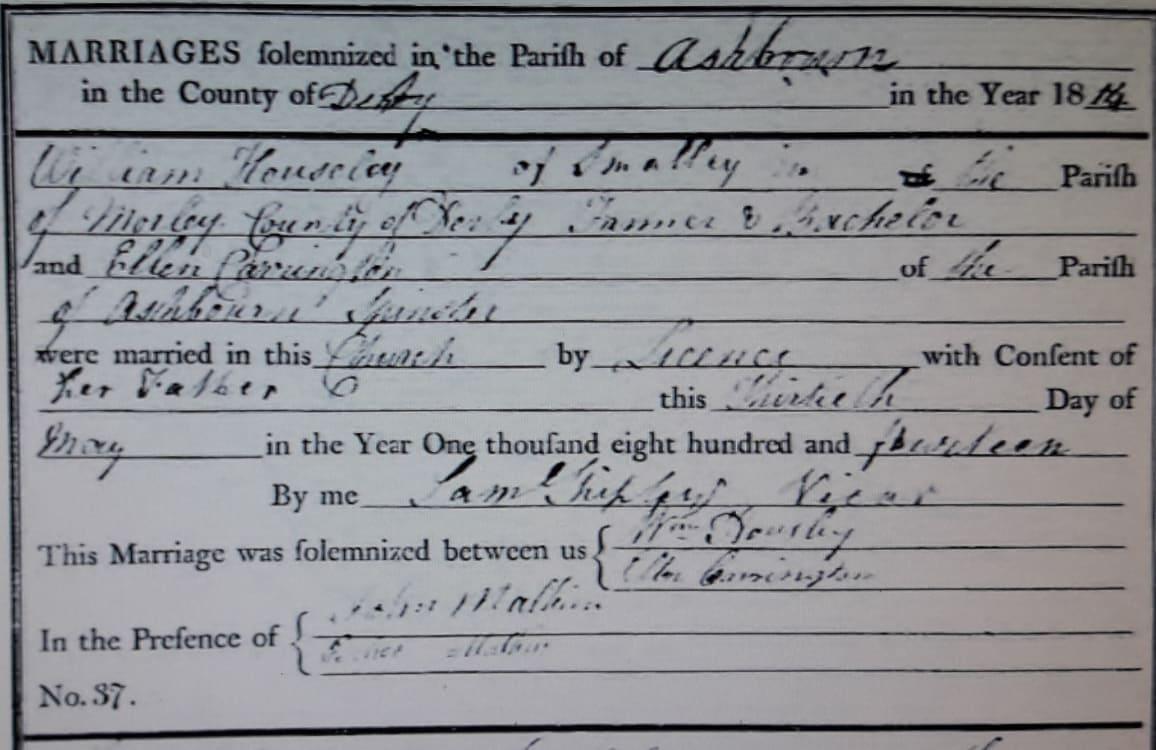
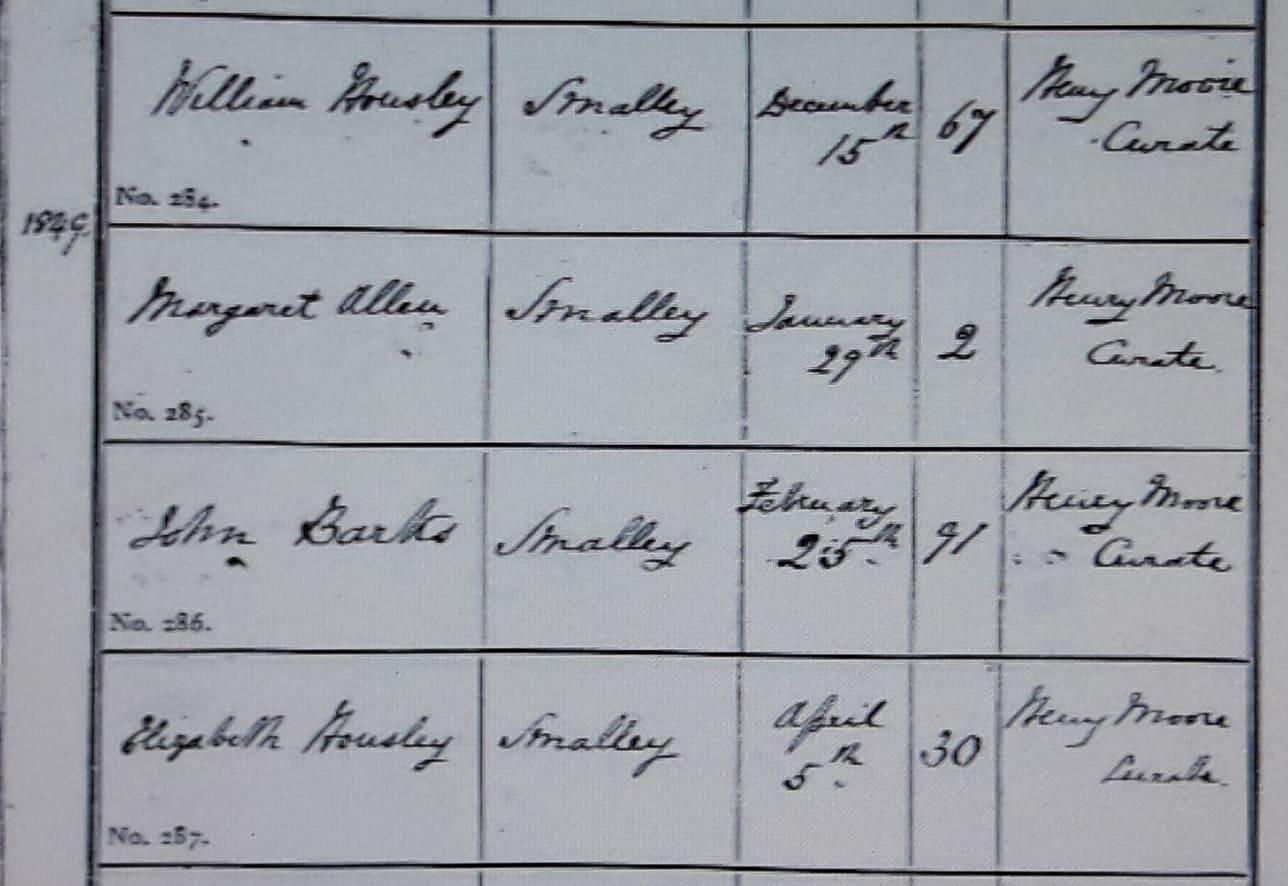
William Housley (1781-1848) and Ellen Carrington were married on May 30, 1814 at St. Oswald’s church in Ashbourne. William died in 1848 at the age of 67 of “disease of lungs and general debility”. Ellen died in 1872.
Marriage of William Housley and Ellen Carrington in Ashbourne in 1814:
Parish records show three children for William and his first wife, Mary, Ellens’ sister, who were married December 29, 1806: Mary Ann, christened in 1808 and mentioned frequently in the letters; Elizabeth, christened in 1810, but never mentioned in any letters; and William, born in 1812, probably referred to as Will in the letters. Mary died in 1813.
William and Ellen had ten children: John, Samuel, Edward, Anne, Charles, George, Joseph, Robert, Emma, and Joseph. The first Joseph died at the age of four, and the last son was also named Joseph. Anne never married, Charles emigrated to Australia in 1851, and George to USA, also in 1851. The letters are to George, from his sisters and brothers in England.
The following are excerpts of those letters, including excerpts of Barbara Housley’s “Narrative on Historic Letters”. They are grouped according to who they refer to, rather than chronological order.
ELLEN HOUSLEY 1795-1872
Joseph wrote that when Emma was married, Ellen “broke up the comfortable home and the things went to Derby and she went to live with them but Derby didn’t agree with her so she left again leaving her things behind and came to live with John in the new house where she died.” Ellen was listed with John’s household in the 1871 census.
In May 1872, the Ilkeston Pioneer carried this notice: “Mr. Hopkins will sell by auction on Saturday next the eleventh of May 1872 the whole of the useful furniture, sewing machine, etc. nearly new on the premises of the late Mrs. Housley at Smalley near Heanor in the county of Derby. Sale at one o’clock in the afternoon.”Ellen’s family was evidently rather prominant in Smalley. Two Carringtons (John and William) served on the Parish Council in 1794. Parish records are full of Carrington marriages and christenings; census records confirm many of the family groupings.
In June of 1856, Emma wrote: “Mother looks as well as ever and was told by a lady the other day that she looked handsome.” Later she wrote: “Mother is as stout as ever although she sometimes complains of not being able to do as she used to.”
Mary’s children:
MARY ANN HOUSLEY 1808-1878
There were hard feelings between Mary Ann and Ellen and her children. Anne wrote: “If you remember we were not very friendly when you left. They never came and nothing was too bad for Mary Ann to say of Mother and me, but when Robert died Mother sent for her to the funeral but she did not think well to come so we took no more notice. She would not allow her children to come either.”
Mary Ann was unlucky in love! In Anne’s second letter she wrote: “William Carrington is paying Mary Ann great attention. He is living in London but they write to each other….We expect it will be a match.” Apparantly the courtship was stormy for in 1855, Emma wrote: “Mary Ann’s wedding with William Carrington has dropped through after she had prepared everything, dresses and all for the occassion.” Then in 1856, Emma wrote: “William Carrington and Mary Ann are separated. They wore him out with their nonsense.” Whether they ever married is unclear. Joseph wrote in 1872: “Mary Ann was married but her husband has left her. She is in very poor health. She has one daughter and they are living with their mother at Smalley.”
Regarding William Carrington, Emma supplied this bit of news: “His sister, Mrs. Lily, has eloped with a married man. Is she not a nice person!”
WILLIAM HOUSLEY JR. 1812-1890
According to a letter from Anne, Will’s two sons and daughter were sent to learn dancing so they would be “fit for any society.” Will’s wife was Dorothy Palfry. They were married in Denby on October 20, 1836 when Will was 24. According to the 1851 census, Will and Dorothy had three sons: Alfred 14, Edwin 12, and William 10. All three boys were born in Denby.
In his letter of May 30, 1872, after just bemoaning that all of his brothers and sisters are gone except Sam and John, Joseph added: “Will is living still.” In another 1872 letter Joseph wrote, “Will is living at Heanor yet and carrying on his cattle dealing.” The 1871 census listed Will, 59, and his son William, 30, of Lascoe Road, Heanor, as cattle dealers.
Ellen’s children:
JOHN HOUSLEY 1815-1893
John married Sarah Baggally in Morely in 1838. They had at least six children. Elizabeth (born 2 May 1838) was “out service” in 1854. In her “third year out,” Elizabeth was described by Anne as “a very nice steady girl but quite a woman in appearance.” One of her positions was with a Mrs. Frearson in Heanor. Emma wrote in 1856: “Elizabeth is still at Mrs. Frearson. She is such a fine stout girl you would not know her.” Joseph wrote in 1872 that Elizabeth was in service with Mrs. Eliza Sitwell at Derby. (About 1850, Miss Eliza Wilmot-Sitwell provided for a small porch with a handsome Norman doorway at the west end of the St. John the Baptist parish church in Smalley.)
According to Elizabeth’s birth certificate and the 1841 census, John was a butcher. By 1851, the household included a nurse and a servant, and John was listed as a “victular.” Anne wrote in February 1854, “John has left the Public House a year and a half ago. He is living where Plumbs (Ann Plumb witnessed William’s death certificate with her mark) did and Thomas Allen has the land. He has been working at James Eley’s all winter.” In 1861, Ellen lived with John and Sarah and the three boys.
John sold his share in the inheritance from their mother and disappeared after her death. (He died in Doncaster, Yorkshire, in 1893.) At that time Charles, the youngest would have been 21. Indeed, Joseph wrote in July 1872: “John’s children are all grown up”.
In May 1872, Joseph wrote: “For what do you think, John has sold his share and he has acted very bad since his wife died and at the same time he sold all his furniture. You may guess I have never seen him but once since poor mother’s funeral and he is gone now no one knows where.”
In February 1874 Joseph wrote: “You want to know what made John go away. Well, I will give you one reason. I think I told you that when his wife died he persuaded me to leave Derby and come to live with him. Well so we did and dear Harriet to keep his house. Well he insulted my wife and offered things to her that was not proper and my dear wife had the power to resist his unmanly conduct. I did not think he could of served me such a dirty trick so that is one thing dear brother. He could not look me in the face when we met. Then after we left him he got a woman in the house and I suppose they lived as man and wife. She caught the small pox and died and there he was by himself like some wild man. Well dear brother I could not go to him again after he had served me and mine as he had and I believe he was greatly in debt too so that he sold his share out of the property and when he received the money at Belper he went away and has never been seen by any of us since but I have heard of him being at Sheffield enquiring for Sam Caldwell. You will remember him. He worked in the Nag’s Head yard but I have heard nothing no more of him.”
A mention of a John Housley of Heanor in the Nottinghma Journal 1875. I don’t know for sure if the John mentioned here is the brother John who Joseph describes above as behaving improperly to his wife. John Housley had a son Joseph, born in 1840, and John’s wife Sarah died in 1870.
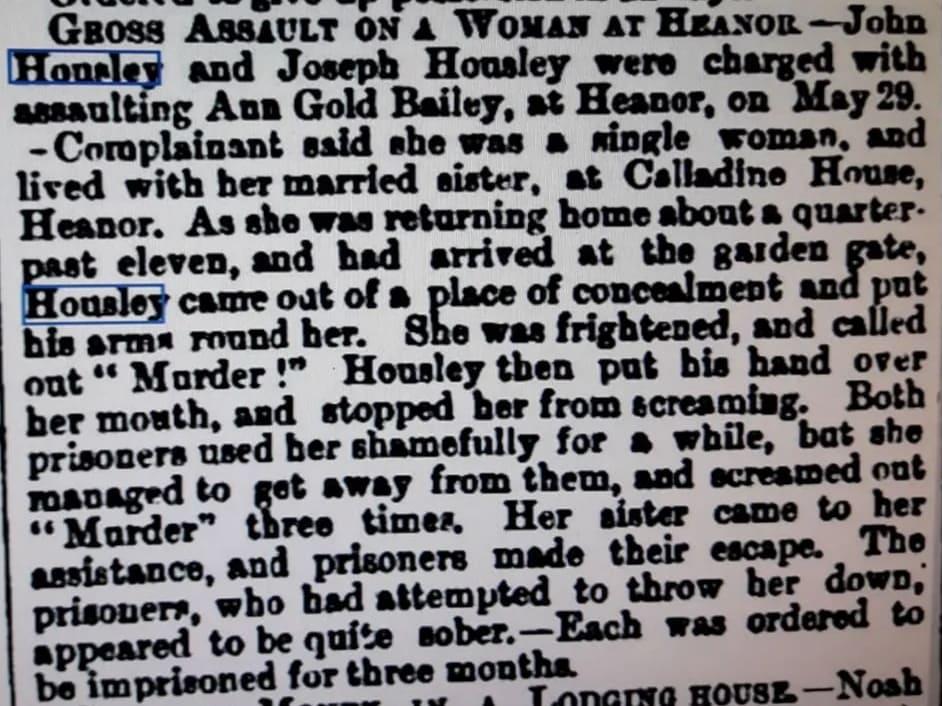
In 1876, the solicitor wrote to George: “Have you heard of John Housley? He is entitled to Robert’s share and I want him to claim it.”
SAMUEL HOUSLEY 1816-
Sam married Elizabeth Brookes of Sutton Coldfield, and they had three daughters: Elizabeth, Mary Anne and Catherine. Elizabeth his wife died in 1849, a few months after Samuel’s father William died in 1848. The particular circumstances relating to these individuals have been discussed in previous chapters; the following are letter excerpts relating to them.
Death of William Housley 15 Dec 1848, and Elizabeth Housley 5 April 1849, Smalley:
Joseph wrote in December 1872: “I saw one of Sam’s daughters, the youngest Kate, you would remember her a baby I dare say. She is very comfortably married.”
In the same letter (December 15, 1872), Joseph wrote: “I think we have now found all out now that is concerned in the matter for there was only Sam that we did not know his whereabouts but I was informed a week ago that he is dead–died about three years ago in Birmingham Union. Poor Sam. He ought to have come to a better end than that….His daughter and her husband went to Brimingham and also to Sutton Coldfield that is where he married his wife from and found out his wife’s brother. It appears he has been there and at Birmingham ever since he went away but ever fond of drink.”
(Sam, however, was still alive in 1871, living as a lodger at the George and Dragon Inn, Henley in Arden. And no trace of Sam has been found since. It would appear that Sam did not want to be found.)
EDWARD HOUSLEY 1819-1843
Edward died before George left for USA in 1851, and as such there is no mention of him in the letters.
ANNE HOUSLEY 1821-1856
Anne wrote two letters to her brother George between February 1854 and her death in 1856. Apparently she suffered from a lung disease for she wrote: “I can say you will be surprised I am still living and better but still cough and spit a deal. Can do nothing but sit and sew.” According to the 1851 census, Anne, then 29, was a seamstress. Their friend, Mrs. Davy, wrote in March 1856: “This I send in a box to my Brother….The pincushion cover and pen wiper are Anne’s work–are for thy wife. She would have made it up had she been able.” Anne was not living at home at the time of the 1841 census. She would have been 19 or 20 and perhaps was “out service.”
In her second letter Anne wrote: “It is a great trouble now for me to write…as the body weakens so does the mind often. I have been very weak all summer. That I continue is a wonder to all and to spit so much although much better than when you left home.” She also wrote: “You know I had a desire for America years ago. Were I in health and strength, it would be the land of my adoption.”
In November 1855, Emma wrote, “Anne has been very ill all summer and has not been able to write or do anything.” Their neighbor Mrs. Davy wrote on March 21, 1856: “I fear Anne will not be long without a change.” In a black-edged letter the following June, Emma wrote: “I need not tell you how happy she was and how calmly and peacefully she died. She only kept in bed two days.”
Certainly Anne was a woman of deep faith and strong religious convictions. When she wrote that they were hoping to hear of Charles’ success on the gold fields she added: “But I would rather hear of him having sought and found the Pearl of great price than all the gold Australia can produce, (For what shall it profit a man if he gain the whole world and lose his soul?).” Then she asked George: “I should like to learn how it was you were first led to seek pardon and a savior. I do feel truly rejoiced to hear you have been led to seek and find this Pearl through the workings of the Holy Spirit and I do pray that He who has begun this good work in each of us may fulfill it and carry it on even unto the end and I can never doubt the willingness of Jesus who laid down his life for us. He who said whoever that cometh unto me I will in no wise cast out.”
Anne’s will was probated October 14, 1856. Mr. William Davy of Kidsley Park appeared for the family. Her estate was valued at under £20. Emma was to receive fancy needlework, a four post bedstead, feather bed and bedding, a mahogany chest of drawers, plates, linen and china. Emma was also to receive Anne’s writing desk. There was a condition that Ellen would have use of these items until her death.
The money that Anne was to receive from her grandfather, William Carrington, and her father, William Housley was to be distributed one third to Joseph, one third to Emma, and one third to be divided between her four neices: John’s daughter Elizabeth, 18, and Sam’s daughters Elizabeth, 10, Mary Ann, 9 and Catharine, age 7 to be paid by the trustees as they think “most useful and proper.” Emma Lyon and Elizabeth Davy were the witnesses.
The Carrington Farm:
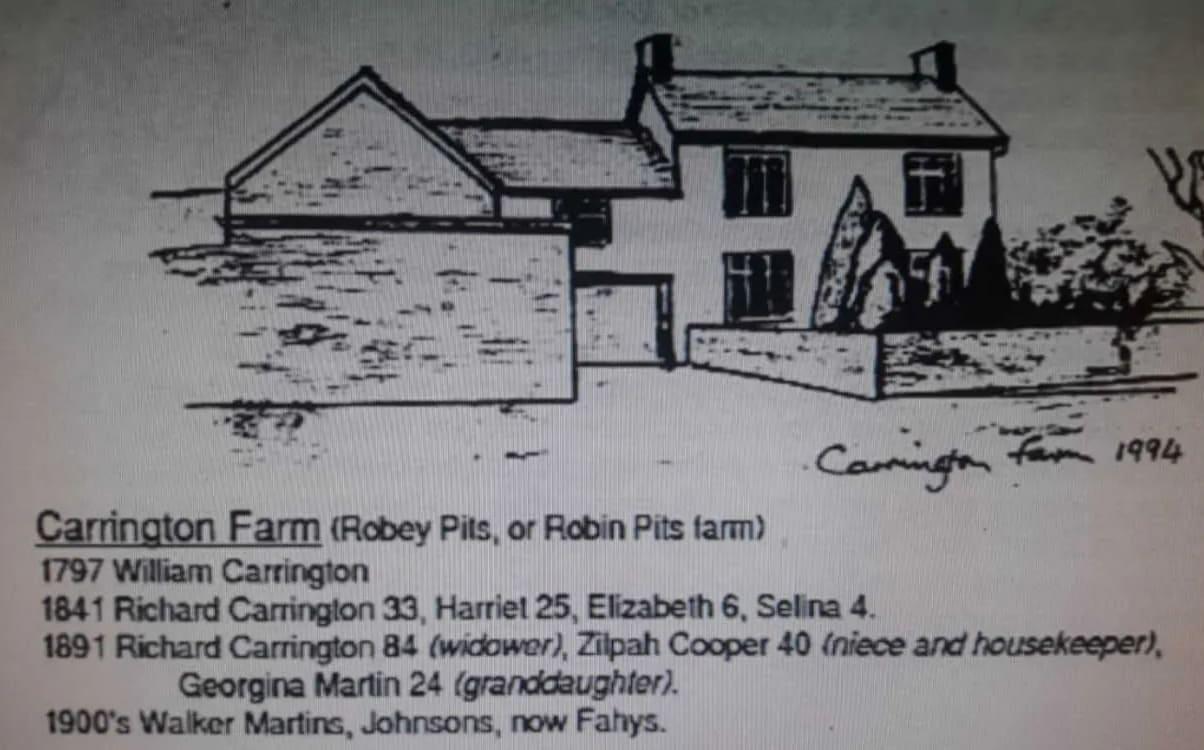
CHARLES HOUSLEY 1823-1855
Charles went to Australia in 1851, and was last heard from in January 1853. According to the solicitor, who wrote to George on June 3, 1874, Charles had received advances on the settlement of their parent’s estate. “Your promissory note with the two signed by your brother Charles for 20 pounds he received from his father and 20 pounds he received from his mother are now in the possession of the court.”
Charles and George were probably quite close friends. Anne wrote in 1854: “Charles inquired very particularly in both his letters after you.”
According to Anne, Charles and a friend married two sisters. He and his father-in-law had a farm where they had 130 cows and 60 pigs. Whatever the trade he learned in England, he never worked at it once he reached Australia. While it does not seem that Charles went to Australia because gold had been discovered there, he was soon caught up in “gold fever”. Anne wrote: “I dare say you have heard of the immense gold fields of Australia discovered about the time he went. Thousands have since then emigrated to Australia, both high and low. Such accounts we heard in the papers of people amassing fortunes we could not believe. I asked him when I wrote if it was true. He said this was no exaggeration for people were making their fortune daily and he intended going to the diggings in six weeks for he could stay away no longer so that we are hoping to hear of his success if he is alive.”
In March 1856, Mrs. Davy wrote: “I am sorry to tell thee they have had a letter from Charles’s wife giving account of Charles’s death of 6 months consumption at the Victoria diggings. He has left 2 children a boy and a girl William and Ellen.” In June of the same year in a black edged letter, Emma wrote: “I think Mrs. Davy mentioned Charles’s death in her note. His wife wrote to us. They have two children Helen and William. Poor dear little things. How much I should like to see them all. She writes very affectionately.”
In December 1872, Joseph wrote: “I’m told that Charles two daughters has wrote to Smalley post office making inquiries about his share….” In January 1876, the solicitor wrote: “Charles Housley’s children have claimed their father’s share.”
GEORGE HOUSLEY 1824-1877
George emigrated to the United states in 1851, arriving in July. The solicitor Abraham John Flint referred in a letter to a 15-pound advance which was made to George on June 9, 1851. This certainly was connected to his journey. George settled along the Delaware River in Bucks County, Pennsylvania. The letters from the solicitor were addressed to: Lahaska Post Office, Bucks County, Pennsylvania.
George married Sarah Ann Hill on May 6, 1854 in Doylestown, Bucks County, Pennsylvania. In her first letter (February 1854), Anne wrote: “We want to know who and what is this Miss Hill you name in your letter. What age is she? Send us all the particulars but I would advise you not to get married until you have sufficient to make a comfortable home.”
Upon learning of George’s marriage, Anne wrote: “I hope dear brother you may be happy with your wife….I hope you will be as a son to her parents. Mother unites with me in kind love to you both and to your father and mother with best wishes for your health and happiness.” In 1872 (December) Joseph wrote: “I am sorry to hear that sister’s father is so ill. It is what we must all come to some time and hope we shall meet where there is no more trouble.”
Emma wrote in 1855, “We write in love to your wife and yourself and you must write soon and tell us whether there is a little nephew or niece and what you call them.” In June of 1856, Emma wrote: “We want to see dear Sarah Ann and the dear little boy. We were much pleased with the “bit of news” you sent.” The bit of news was the birth of John Eley Housley, January 11, 1855. Emma concluded her letter “Give our very kindest love to dear sister and dearest Johnnie.”
In September 1872, Joseph wrote, “I was very sorry to hear that John your oldest had met with such a sad accident but I hope he is got alright again by this time.” In the same letter, Joseph asked: “Now I want to know what sort of a town you are living in or village. How far is it from New York? Now send me all particulars if you please.”
In March 1873 Harriet asked Sarah Ann: “And will you please send me all the news at the place and what it is like for it seems to me that it is a wild place but you must tell me what it is like….”. The question of whether she was referring to Bucks County, Pennsylvania or some other place is raised in Joseph’s letter of the same week.
On March 17, 1873, Joseph wrote: “I was surprised to hear that you had gone so far away west. Now dear brother what ever are you doing there so far away from home and family–looking out for something better I suppose.”The solicitor wrote on May 23, 1874: “Lately I have not written because I was not certain of your address and because I doubted I had much interesting news to tell you.” Later, Joseph wrote concerning the problems settling the estate, “You see dear brother there is only me here on our side and I cannot do much. I wish you were here to help me a bit and if you think of going for another summer trip this turn you might as well run over here.”
Apparently, George had indicated he might return to England for a visit in 1856. Emma wrote concerning the portrait of their mother which had been sent to George: “I hope you like mother’s portrait. I did not see it but I suppose it was not quite perfect about the eyes….Joseph and I intend having ours taken for you when you come over….Do come over before very long.”
In March 1873, Joseph wrote: “You ask me what I think of you coming to England. I think as you have given the trustee power to sign for you I think you could do no good but I should like to see you once again for all that. I can’t say whether there would be anything amiss if you did come as you say it would be throwing good money after bad.”
On June 10, 1875, the solicitor wrote: “I have been expecting to hear from you for some time past. Please let me hear what you are doing and where you are living and how I must send you your money.” George’s big news at that time was that on May 3, 1875, he had become a naturalized citizen “renouncing and abjuring all allegiance and fidelity to every foreign prince, potentate, state and sovereignity whatsoever, and particularly to Victoria Queen of Great Britain of whom he was before a subject.”
ROBERT HOUSLEY 1832-1851
In 1854, Anne wrote: “Poor Robert. He died in August after you left he broke a blood vessel in the lung.”
From Joseph’s first letter we learn that Robert was 19 when he died: “Dear brother there have been a great many changes in the family since you left us. All is gone except myself and John and Sam–we have heard nothing of him since he left. Robert died first when he was 19 years of age. Then Anne and Charles too died in Australia and then a number of years elapsed before anyone else. Then John lost his wife, then Emma, and last poor dear mother died last January on the 11th.”Anne described Robert’s death in this way: “He had thrown up blood many times before in the spring but the last attack weakened him that he only lived a fortnight after. He died at Derby. Mother was with him. Although he suffered much he never uttered a murmur or regret and always a smile on his face for everyone that saw him. He will be regretted by all that knew him”.
Robert died a resident of St. Peter’s Parish, Derby, but was buried in Smalley on August 16, 1851.
Apparently Robert was apprenticed to be a joiner for, according to Anne, Joseph took his place: “Joseph wanted to be a joiner. We thought we could do no better than let him take Robert’s place which he did the October after and is there still.”In 1876, the solicitor wrote to George: “Have you heard of John Housley? He is entitled to Robert’s share and I want him to claim it.”
EMMA HOUSLEY 1836-1871
Emma was not mentioned in Anne’s first letter. In the second, Anne wrote that Emma was living at Spondon with two ladies in her “third situation,” and added, “She is grown a bouncing woman.” Anne described her sister well. Emma wrote in her first letter (November 12, 1855): “I must tell you that I am just 21 and we had my pudding last Sunday. I wish I could send you a piece.”
From Emma’s letters we learn that she was living in Derby from May until November 1855 with Mr. Haywood, an iron merchant. She explained, “He has failed and I have been obliged to leave,” adding, “I expect going to a new situation very soon. It is at Belper.” In 1851 records, William Haywood, age 22, was listed as an iron foundry worker. In the 1857 Derby Directory, James and George were listed as iron and brass founders and ironmongers with an address at 9 Market Place, Derby.
In June 1856, Emma wrote from “The Cedars, Ashbourne Road” where she was working for Mr. Handysides.
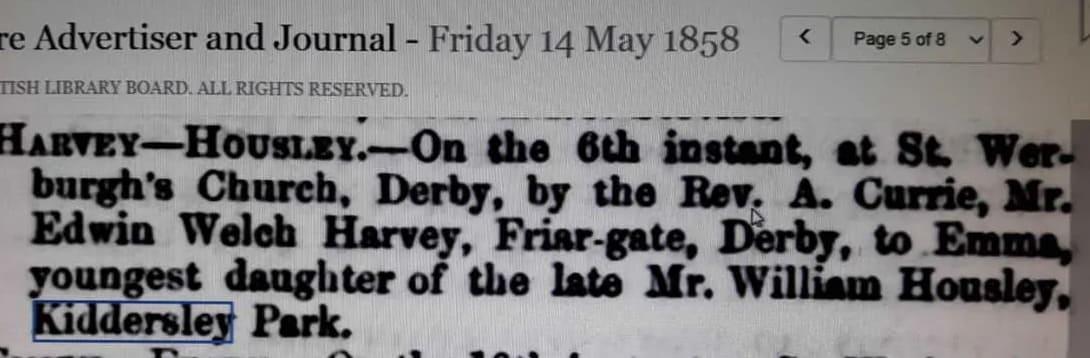
While she was working for Mr. Handysides, Emma wrote: “Mother is thinking of coming to live at Derby. That will be nice for Joseph and I.”Friargate and Ashbourne Road were located in St. Werburgh’s Parish. (In fact, St. Werburgh’s vicarage was at 185 Surrey Street. This clue led to the discovery of the record of Emma’s marriage on May 6, 1858, to Edwin Welch Harvey, son of Samuel Harvey in St. Werburgh’s.)
In 1872, Joseph wrote: “Our sister Emma, she died at Derby at her own home for she was married. She has left two young children behind. The husband was the son of the man that I went apprentice to and has caused a great deal of trouble to our family and I believe hastened poor Mother’s death….”. Joseph added that he believed Emma’s “complaint” was consumption and that she was sick a good bit. Joseph wrote: “Mother was living with John when I came home (from Ascension Island around 1867? or to Smalley from Derby around 1870?) for when Emma was married she broke up the comfortable home and the things went to Derby and she went to live with them but Derby did not agree with her so she had to leave it again but left all her things there.”
Emma Housley and Edwin Welch Harvey wedding, 1858:
JOSEPH HOUSLEY 1838-1893
We first hear of Joseph in a letter from Anne to George in 1854. “Joseph wanted to be a joiner. We thought we could do no better than let him take Robert’s place which he did the October after (probably 1851) and is there still. He is grown as tall as you I think quite a man.” Emma concurred in her first letter: “He is quite a man in his appearance and quite as tall as you.”
From Emma we learn in 1855: “Joseph has left Mr. Harvey. He had not work to employ him. So mother thought he had better leave his indenture and be at liberty at once than wait for Harvey to be a bankrupt. He has got a very good place of work now and is very steady.” In June of 1856, Emma wrote “Joseph and I intend to have our portraits taken for you when you come over….Mother is thinking of coming to Derby. That will be nice for Joseph and I. Joseph is very hearty I am happy to say.”
According to Joseph’s letters, he was married to Harriet Ballard. Joseph described their miraculous reunion in this way: “I must tell you that I have been abroad myself to the Island of Ascension. (Elsewhere he wrote that he was on the island when the American civil war broke out). I went as a Royal Marine and worked at my trade and saved a bit of money–enough to buy my discharge and enough to get married with but while I was out on the island who should I meet with there but my dear wife’s sister. (On two occasions Joseph and Harriet sent George the name and address of Harriet’s sister, Mrs. Brooks, in Susquehanna Depot, Pennsylvania, but it is not clear whether this was the same sister.) She was lady’s maid to the captain’s wife. Though I had never seen her before we got to know each other somehow so from that me and my wife recommenced our correspondence and you may be sure I wanted to get home to her. But as soon as I did get home that is to England I was not long before I was married and I have not regretted yet for we are very comfortable as well as circumstances will allow for I am only a journeyman joiner.”
Proudly, Joseph wrote: “My little family consists of three nice children–John, Joseph and Susy Annie.” On her birth certificate, Susy Ann’s birthdate is listed as 1871. Parish records list a Lucy Annie christened in 1873. The boys were born in Derby, John in 1868 and Joseph in 1869. In his second letter, Joseph repeated: “I have got three nice children, a good wife and I often think is more than I have deserved.” On August 6, 1873, Joseph and Harriet wrote: “We both thank you dear sister for the pieces of money you sent for the children. I don’t know as I have ever see any before.” Joseph ended another letter: “Now I must close with our kindest love to you all and kisses from the children.”
In Harriet’s letter to Sarah Ann (March 19, 1873), she promised: “I will send you myself and as soon as the weather gets warm as I can take the children to Derby, I will have them taken and send them, but it is too cold yet for we have had a very cold winter and a great deal of rain.” At this time, the children were all under 6 and the baby was not yet two.
In March 1873 Joseph wrote: “I have been working down at Heanor gate there is a joiner shop there where Kings used to live I have been working there this winter and part of last summer but the wages is very low but it is near home that is one comfort.” (Heanor Gate is about 1/4 mile from Kidsley Grange. There was a school and industrial park there in 1988.) At this time Joseph and his family were living in “the big house–in Old Betty Hanson’s house.” The address in the 1871 census was Smalley Lane.
A glimpse into Joseph’s personality is revealed by this remark to George in an 1872 letter: “Many thanks for your portrait and will send ours when we can get them taken for I never had but one taken and that was in my old clothes and dear Harriet is not willing to part with that. I tell her she ought to be satisfied with the original.”
On one occasion Joseph and Harriet both sent seeds. (Marks are still visible on the paper.) Joseph sent “the best cow cabbage seed in the country–Robinson Champion,” and Harriet sent red cabbage–Shaw’s Improved Red. Possibly cow cabbage was also known as ox cabbage: “I hope you will have some good cabbages for the Ox cabbage takes all the prizes here. I suppose you will be taking the prizes out there with them.” Joseph wrote that he would put the name of the seeds by each “but I should think that will not matter. You will tell the difference when they come up.”
George apparently would have liked Joseph to come to him as early as 1854. Anne wrote: “As to his coming to you that must be left for the present.” In 1872, Joseph wrote: “I have been thinking of making a move from here for some time before I heard from you for it is living from hand to mouth and never certain of a job long either.” Joseph then made plans to come to the United States in the spring of 1873. “For I intend all being well leaving England in the spring. Many thanks for your kind offer but I hope we shall be able to get a comfortable place before we have been out long.” Joseph promised to bring some things George wanted and asked: “What sort of things would be the best to bring out there for I don’t want to bring a lot that is useless.” Joseph’s plans are confirmed in a letter from the solicitor May 23, 1874: “I trust you are prospering and in good health. Joseph seems desirous of coming out to you when this is settled.”
George must have been reminiscing about gooseberries (Heanor has an annual gooseberry show–one was held July 28, 1872) and Joseph promised to bring cuttings when they came: “Dear Brother, I could not get the gooseberries for they was all gathered when I received your letter but we shall be able to get some seed out the first chance and I shall try to bring some cuttings out along.” In the same letter that he sent the cabbage seeds Joseph wrote: “I have got some gooseberries drying this year for you. They are very fine ones but I have only four as yet but I was promised some more when they were ripe.” In another letter Joseph sent gooseberry seeds and wrote their names: Victoria, Gharibaldi and Globe.
In September 1872 Joseph wrote; “My wife is anxious to come. I hope it will suit her health for she is not over strong.” Elsewhere Joseph wrote that Harriet was “middling sometimes. She is subject to sick headaches. It knocks her up completely when they come on.” In December 1872 Joseph wrote, “Now dear brother about us coming to America you know we shall have to wait until this affair is settled and if it is not settled and thrown into Chancery I’m afraid we shall have to stay in England for I shall never be able to save money enough to bring me out and my family but I hope of better things.”
On July 19, 1875 Abraham Flint (the solicitor) wrote: “Joseph Housley has removed from Smalley and is working on some new foundry buildings at Little Chester near Derby. He lives at a village called Little Eaton near Derby. If you address your letter to him as Joseph Housley, carpenter, Little Eaton near Derby that will no doubt find him.”
George did not save any letters from Joseph after 1874, hopefully he did reach him at Little Eaton. Joseph and his family are not listed in either Little Eaton or Derby on the 1881 census.
In his last letter (February 11, 1874), Joseph sounded very discouraged and wrote that Harriet’s parents were very poorly and both had been “in bed for a long time.” In addition, Harriet and the children had been ill.
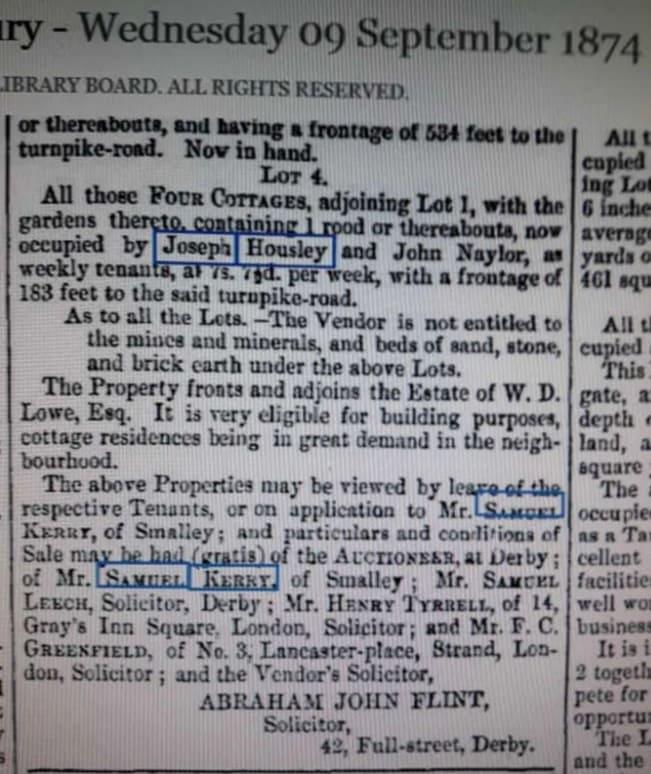
The move to Little Eaton may indicate that Joseph received his settlement because in August, 1873, he wrote: “I think this is bad news enough and bad luck too, but I have had little else since I came to live at Kiddsley cottages but perhaps it is all for the best if one could only think so. I have begun to think there will be no chance for us coming over to you for I am afraid there will not be so much left as will bring us out without it is settled very shortly but I don’t intend leaving this house until it is settled either one way or the other. “Joseph Housley and the Kiddsley cottages:
 January 28, 2022 at 7:57 am #6259
In reply to: The Elusive Samuel Housley and Other Family Stories
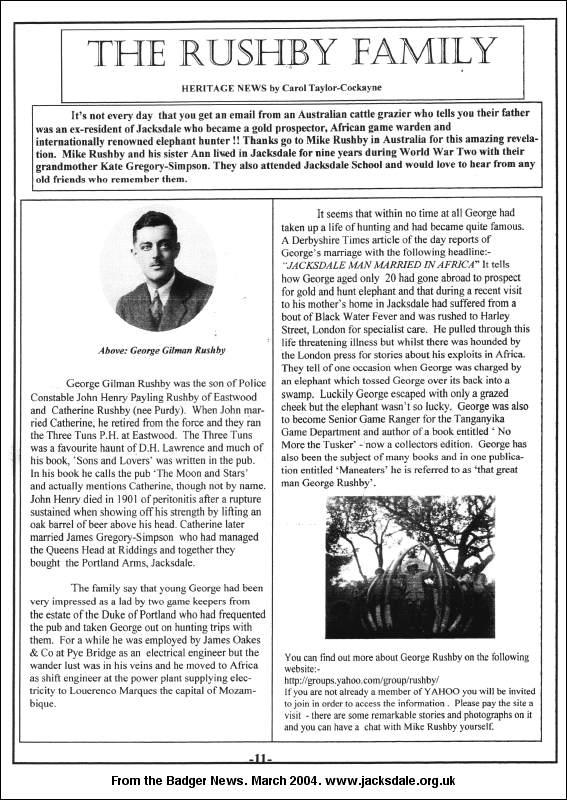
George “Mike” Rushby
A short autobiography of George Gilman Rushby’s son, published in the Blackwall Bugle, Australia.
Early in 2009, Ballina Shire Council Strategic and
Community Services Group Manager, Steve Barnier,
suggested that it would be a good idea for the Wardell
and District community to put out a bi-monthly
newsletter. I put my hand up to edit the publication and
since then, over 50 issues of “The Blackwall Bugle”
have been produced, encouraged by Ballina Shire
Council who host the newsletter on their website.
Because I usually write the stories that other people
generously share with me, I have been asked by several
community members to let them know who I am. Here is
my attempt to let you know!My father, George Gilman Rushby was born in England
in 1900. An Electrician, he migrated to Africa as a young
man to hunt and to prospect for gold. He met Eleanor
Dunbar Leslie who was a high school teacher in Cape
Town. They later married in Dar es Salaam, Tanganyika.
I was the second child and first son and was born in a
mud hut in Tanganyika in 1933. I spent my first years on
a coffee plantation. When four years old, and with
parents and elder sister on a remote goldfield, I caught
typhoid fever. I was seriously ill and had no access to
proper medical facilities. My paternal grandmother
sailed out to Africa from England on a steam ship and
took me back to England for medical treatment. My
sister Ann came too. Then Adolf Hitler started WWII and
Ann and I were separated from our parents for 9 years.Sister Ann and I were not to see him or our mother for
nine years because of the war. Dad served as a Captain in
the King’s African Rifles operating in the North African
desert, while our Mum managed the coffee plantation at
home in Tanganyika.Ann and I lived with our Grandmother and went to
school in Nottingham England. In 1946 the family was
reunited. We lived in Mbeya in Southern Tanganyika
where my father was then the District Manager of the
National Parks and Wildlife Authority. There was no
high school in Tanganyika so I had to go to school in
Nairobi, Kenya. It took five days travelling each way by
train and bus including two days on a steamer crossing
Lake Victoria.However, the school year was only two terms with long
holidays in between.When I was seventeen, I left high school. There was
then no university in East Africa. There was no work
around as Tanganyika was about to become
independent of the British Empire and become
Tanzania. Consequently jobs were reserved for
Africans.A war had broken out in Korea. I took a day off from
high school and visited the British Army headquarters
in Nairobi. I signed up for military service intending to
go to Korea. The army flew me to England. During
Army basic training I was nicknamed ‘Mike’ and have
been called Mike ever since. I never got to Korea!
After my basic training I volunteered for the Parachute
Regiment and the army sent me to Egypt where the
Suez Canal was under threat. I carried out parachute
operations in the Sinai Desert and in Cyprus and
Jordan. I was then selected for officer training and was
sent to England to the Eaton Hall Officer Cadet School
in Cheshire. Whilst in Cheshire, I met my future wife
Jeanette. I graduated as a Second Lieutenant in the
Royal Lincolnshire Regiment and was posted to West
Berlin, which was then one hundred miles behind the
Iron Curtain. My duties included patrolling the
demarcation line that separated the allies from the
Russian forces. The Berlin Wall was yet to be built. I
also did occasional duty as guard commander of the
guard at Spandau Prison where Adolf Hitler’s deputy
Rudolf Hess was the only prisoner.From Berlin, my Regiment was sent to Malaya to
undertake deep jungle operations against communist
terrorists that were attempting to overthrow the
Malayan Government. I was then a Lieutenant in
command of a platoon of about 40 men which would go
into the jungle for three weeks to a month with only air
re-supply to keep us going. On completion of my jungle
service, I returned to England and married Jeanette. I
had to stand up throughout the church wedding
ceremony because I had damaged my right knee in a
competitive cross-country motorcycle race and wore a
splint and restrictive bandage for the occasion!
At this point I took a career change and transferred
from the infantry to the Royal Military Police. I was in
charge of the security of British, French and American
troops using the autobahn link from West Germany to
the isolated Berlin. Whilst in Germany and Austria I
took up snow skiing as a sport.Jeanette and I seemed to attract unusual little
adventures along the way — each adventure trivial in
itself but adding up to give us a ‘different’ path through
life. Having climbed Mount Snowdon up the ‘easy way’
we were witness to a serious climbing accident where a
member of the staff of a Cunard Shipping Line
expedition fell and suffered serious injury. It was
Sunday a long time ago. The funicular railway was
closed. There was no telephone. So I ran all the way
down Mount Snowdon to raise the alarm.On a road trip from Verden in Germany to Berlin with
our old Opel Kapitan motor car stacked to the roof with
all our worldly possessions, we broke down on the ice and snow covered autobahn. We still had a hundred kilometres to go.A motorcycle patrolman flagged down a B-Double
tanker. He hooked us to the tanker with a very short tow
cable and off we went. The truck driver couldn’t see us
because we were too close and his truck threw up a
constant deluge of ice and snow so we couldn’t see
anyway. We survived the hundred kilometre ‘sleigh
ride!’I then went back to the other side of the world where I
carried out military police duties in Singapore and
Malaya for three years. I took up scuba diving and
loved the ocean. Jeanette and I, with our two little
daughters, took a holiday to South Africa to see my
parents. We sailed on a ship of the Holland-Afrika Line.
It broke down for four days and drifted uncontrollably
in dangerous waters off the Skeleton Coast of Namibia
until the crew could get the ship’s motor running again.
Then, in Cape Town, we were walking the beach near
Hermanus with my youngest brother and my parents,
when we found the dead body of a man who had thrown
himself off a cliff. The police came and secured the site.
Back with the army, I was promoted to Major and
appointed Provost Marshal of the ACE Mobile Force
(Allied Command Europe) with dual headquarters in
Salisbury, England and Heidelberg, Germany. The cold
war was at its height and I was on operations in Greece,
Denmark and Norway including the Arctic. I had
Norwegian, Danish, Italian and American troops in my
unit and I was then also the Winter Warfare Instructor
for the British contingent to the Allied Command
Europe Mobile Force that operated north of the Arctic
Circle.The reason for being in the Arctic Circle? From there
our special forces could look down into northern
Russia.I was not seeing much of my two young daughters. A
desk job was looming my way and I decided to leave
the army and migrate to Australia. Why Australia?
Well, I didn’t want to go back to Africa, which
seemed politically unstable and the people I most
liked working with in the army, were the Australian
troops I had met in Malaya.I migrated to Brisbane, Australia in 1970 and started
working for Woolworths. After management training,
I worked at Garden City and Brookside then became
the manager in turn of Woolworths stores at
Paddington, George Street and Redcliff. I was also the
first Director of FAUI Queensland (The Federation of
Underwater Diving Instructors) and spent my spare
time on the Great Barrier Reef. After 8 years with
Woollies, I opted for a sea change.I moved with my family to Evans Head where I
converted a convenience store into a mini
supermarket. When IGA moved into town, I decided
to take up beef cattle farming and bought a cattle
property at Collins Creek Kyogle in 1990. I loved
everything about the farm — the Charolais cattle, my
horses, my kelpie dogs, the open air, fresh water
creek, the freedom, the lifestyle. I also became a
volunteer fire fighter with the Green Pigeon Brigade.
In 2004 I sold our farm and moved to Wardell.
My wife Jeanette and I have been married for 60 years
and are now retired. We have two lovely married
daughters and three fine grandchildren. We live in the
greatest part of the world where we have been warmly
welcomed by the Wardell community and by the
Wardell Brigade of the Rural Fire Service. We are
very happy here.Mike Rushby
A short article sent to Jacksdale in England from Mike Rushby in Australia:
 December 25, 2021 at 10:47 am #6248
In reply to: The Elusive Samuel Housley and Other Family Stories
Bakewell Not Eyam
The Elton Marshalls
Some years ago I read a book about Eyam, the Derbyshire village devastated by the plague in 1665, and about how the villagers quarantined themselves to prevent further spread. It was quite a story. Each year on ‘Plague Sunday’, at the end of August, residents of Eyam mark the bubonic plague epidemic that devastated their small rural community in the years 1665–6. They wear the traditional costume of the day and attend a memorial service to remember how half the village sacrificed themselves to avoid spreading the disease further.
My 4X great grandfather James Marshall married Ann Newton in 1792 in Elton. On a number of other people’s trees on an online ancestry site, Ann Newton was from Eyam. Wouldn’t that have been interesting, to find ancestors from Eyam, perhaps going back to the days of the plague. Perhaps that is what the people who put Ann Newton’s birthplace as Eyam thought, without a proper look at the records.
But I didn’t think Ann Newton was from Eyam. I found she was from Over Haddon, near Bakewell ~ much closer to Elton than Eyam. On the marriage register, it says that James was from Elton parish, and she was from Darley parish. Her birth in 1770 says Bakewell, which was the registration district for the villages of Over Haddon and Darley. Her parents were George Newton and Dorothy Wipperley of Over Haddon,which is incidentally very near to Nether Haddon, and Haddon Hall. I visited Haddon Hall many years ago, as well as Chatsworth (and much preferred Haddon Hall).
I looked in the Eyam registers for Ann Newton, and found a couple of them around the time frame, but the men they married were not James Marshall.
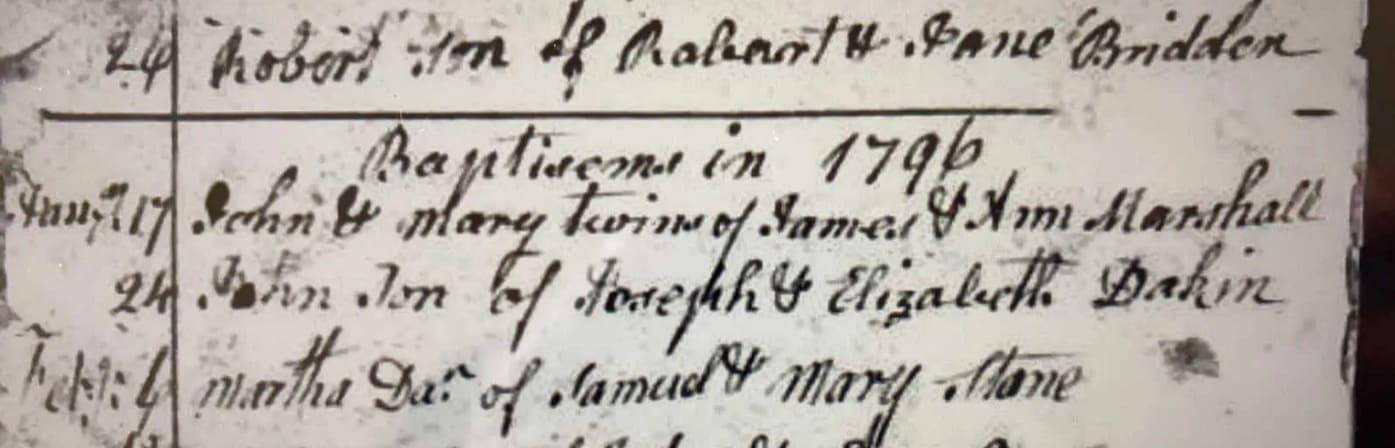
Ann died in 1806 in Elton (a small village just outside Matlock) at the age of 36 within days of her newborn twins, Ann and James. James and Ann had two sets of twins. John and Mary were twins as well, but Mary died in 1799 at the age of three.
1796 baptism of twins John and Mary of James and Ann Marshall
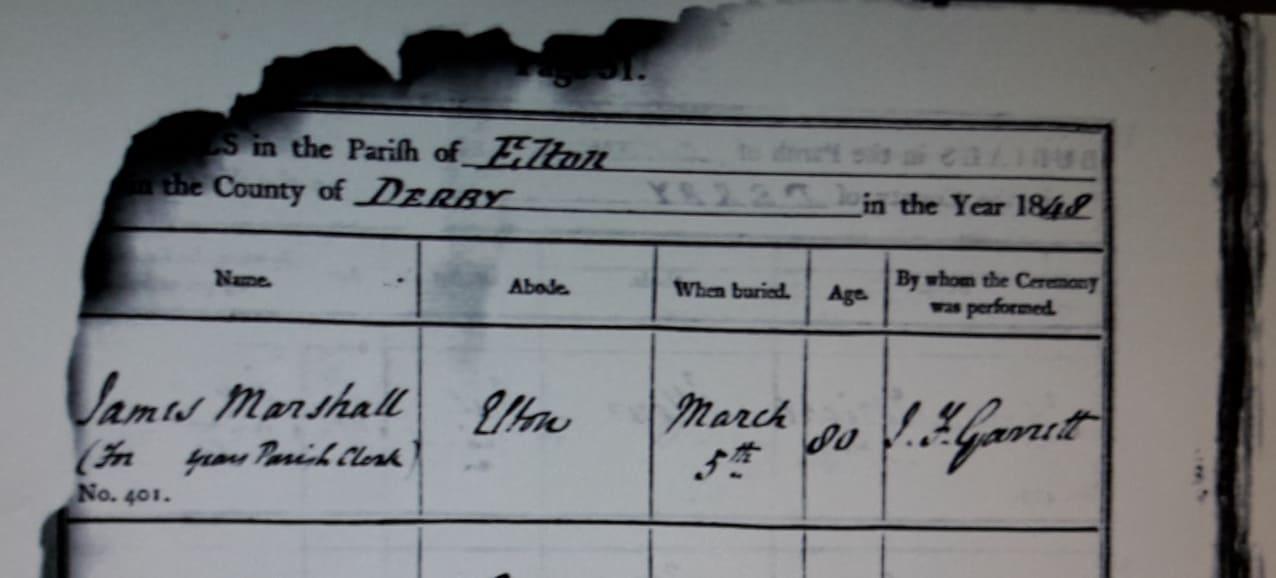
Ann’s husband James died 42 years later at the age of eighty, in Elton in 1848. It was noted in the parish register that he was for years parish clerk.
On the 1851 census John Marshall born in 1796, the son of James Marshall the parish clerk, was a lead miner occupying six acres in Elton, Derbyshire.
His son, also John, was registered on the census as a lead miner at just eight years old.
The mining of lead was the most important industry in the Peak district of Derbyshire from Roman times until the 19th century – with only agriculture being more important for the livelihood of local people. The height of lead mining in Derbyshire came in the 17th and 18th centuries, and the evidence is still visible today – most obviously in the form of lines of hillocks from the more than 25,000 mineshafts which once existed.
Peak District Mines Historical Society
Smelting, or extracting the lead from the ore by melting it, was carried out in a small open hearth. Lead was cast in layers as each batch of ore was smelted; the blocks of lead thus produced were referred to as “pigs”. Examples of early smelting-hearths found within the county were stone lined, with one side open facing the prevailing wind to create the draught needed. The hilltops of the Matlocks would have provided very suitable conditions.
The miner used a tool called a mattock or a pick, and hammers and iron wedges in harder veins, to loosen the ore. They threw the ore onto ridges on each side of the vein, going deeper where the ore proved richer.
Many mines were very shallow and, once opened, proved too poor to develop. Benjamin Bryan cited the example of “Ember Hill, on the shoulder of Masson, above Matlock Bath” where there are hollows in the surface showing where there had been fruitless searches for lead.
There were small buildings, called “coes”, near each mine shaft which were used for tool storage, to provide shelter and as places for changing into working clothes. It was here that the lead was smelted and stored until ready for sale.
Lead is, of course, very poisonous. As miners washed lead-bearing material, great care was taken with the washing vats, which had to be covered. If cattle accidentally drank the poisoned water they would die from something called “belland”.
Cornish and Welsh miners introduced the practice of buddling for ore into Derbyshire about 1747. Buddling involved washing the heaps of rubbish in the slag heaps, the process of separating the very small particles from the dirt and spar with which they are mixed, by means of a small stream of water. This method of extraction was a major pollutant, affecting farmers and their animals (poisoned by Belland from drinking the waste water), the brooks and streams and even the River Derwent.
Women also worked in the mines. An unattributed account from 1829, says: “The head is much enwrapped, and the features nearly hidden in a muffling of handkerchiefs, over which is put a man’s hat, in the manner of the paysannes of Wales”. He also describes their gowns, usually red, as being “tucked up round the waist in a sort of bag, and set off by a bright green petticoat”. They also wore a man’s grey or dark blue coat and shoes with 3″ thick soles that were tied round with cords. The 1829 writer called them “complete harridans!”
Lead Mining in Matlock & Matlock Bath, The Andrews Pages
John’s wife Margaret died at the age of 42 in 1847. I don’t know the cause of death, but perhaps it was lead poisoning. John’s son John, despite a very early start in the lead mine, became a carter and lived to the ripe old age of 88.
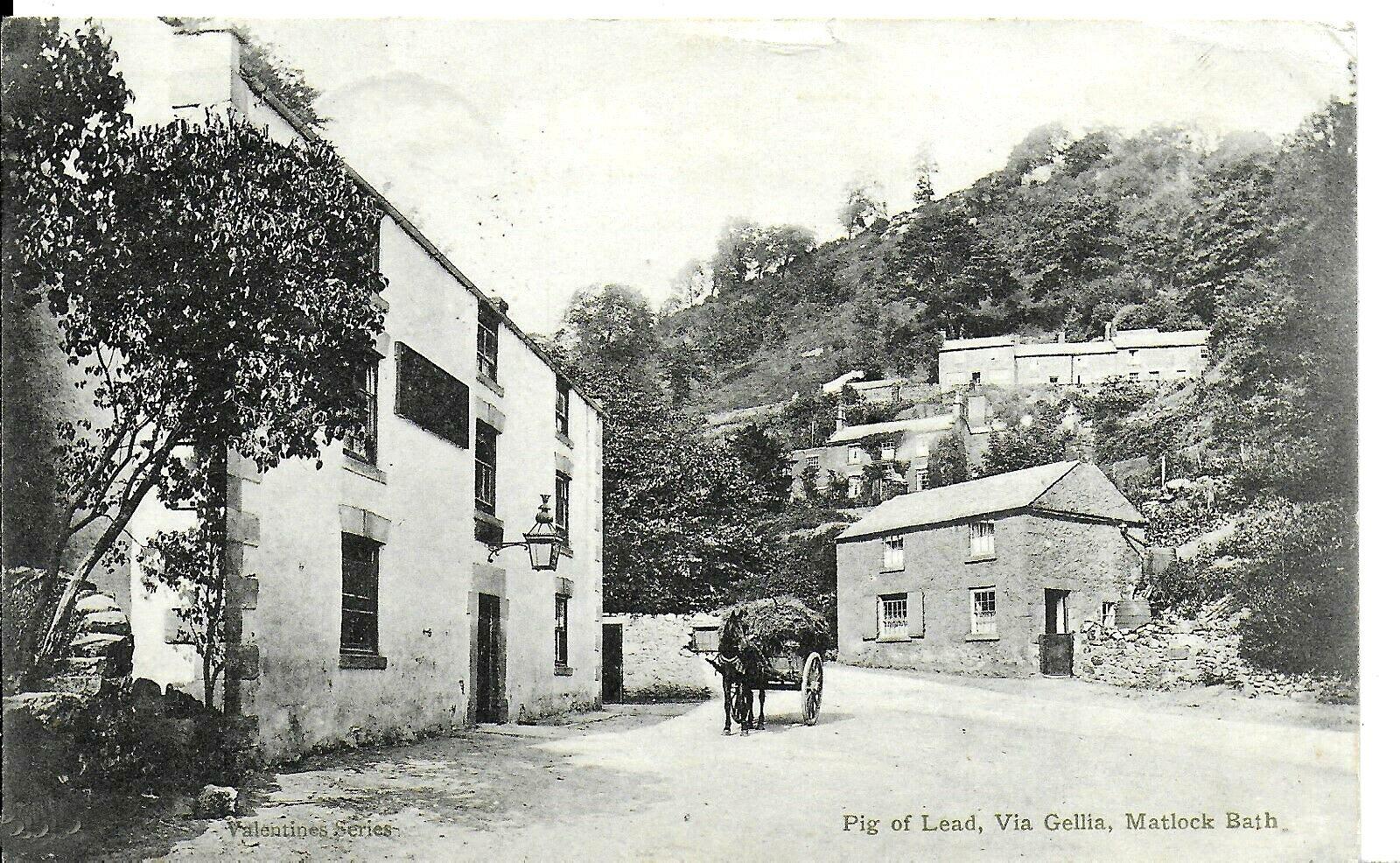
The Pig of Lead pub, 1904:
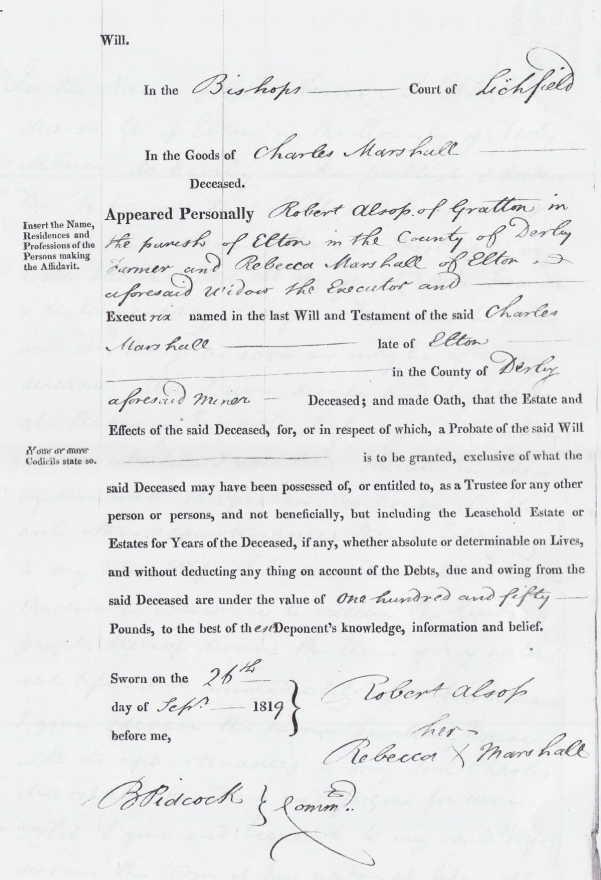
The earliest Marshall I’ve found so far is Charles, born in 1742. Charles married Rebecca Knowles, 1775-1823. I don’t know what his occupation was but when he died in 1819 he left a not inconsiderable sum to his wife.
1819 Charles Marshall probate:
There are still Marshall’s living in Elton and Matlock, not our immediate known family, but probably distantly related. I asked a Matlock group on facebook:
“…there are Marshall’s still in the village. There are certainly families who live here who have done generation after generation & have many memories & stories to tell. Visit The Duke on a Friday night…”
The Duke, Elton:
 March 29, 2013 at 11:08 am #3017
In reply to: The Surge Team’s Coils
meanwhile in South Africa, an alphabet slaughtering surge made landfall, scattering the inhabitants, celebrities and everyday heroes alike. Some suspected the elusive Wordblade
“Alliteration ascends the assonance of abseiling abstract aspects of anterior antiquities from ancient altars,
Bouldering down blocks of brooks that break the boring & bland borders of bondage,
And blinking through bleak and black boxes of brisk bravery.
Creeping into crops of crooked crocks with crotches of cockroaches cramming into cans of calamity, the crisp cat crackles the calling.
Dreaming of damning devils and demons dancing in droplets of dreary darkness drags the drunken diligence from the draught’s damnation,
Even the everlasting ethereal elves ebbed and eased into the effervescent eloquent estate of eternal elitism.For the feeble and fumbling fatuous frontiers, the folly frolicked and fornicated with the familiar friend from foes’ fervent fevers;
Greater than gradient grand gestures of gestaltic granite grasses,
The gruesome grizzle grabbed the gore by the gripped grunting.
Higher than homelands of hands in horizons,
Heavens and Hells or Hades hazily hear the honing of the horses and horns-
In internal infernos of inflicting infringes of institutional insurrections Interrogations instigated imminent innate innovations.
Jacknives of jaundiced and jilted jokers jabbed at the jumping jingles of the jesting jackals that jet over jerseys of jeering,
For the Killer Krakens kelp the kites from kids who keep kaleidoscopes of kind and keen keepers.Longer than languid lads that laze in lost latitudes the lieutenant lounged behind lines of lingering losses-
Maids mellowed around mazes of men and manners of mad moments and made for mates on mattresses on mothered matrimony.
Noisy & never-ending neckties on nests of nicked numbers never nominated the nurses that nosed the nuns for nuns’ nihilism
Beyond the Oligarchs of overt operations of obligating omnipotence ostracizing the omniscience & omitting its ownership to the omnipresent order.
Pilgrims to pentagons by people from poached & palpitated places of placards of propaganda pondered their positions in this power polarity
When quivering quills of quavering queens quelled the quarterly quests of the quaint quarrels.Because roving rivers of raging ravines and raving reviews raced to the rest of the ripped rampant ravages and revelled at the rambling randomness
Structured subsiding and subsidized societies should string the strongholds of the supreme sultans of seeded senses.
Taking the trusty treaty the trussed toppled truants took the trickling ticking of time to the tables of trampled trees of timber,
For under the ubiquitous umbilical umbrellas of ultra-sounds from upper-level ulcers underground underworlds underestimated the union.Vivid visions of voracious vampires of vexing vacuum vortexes vilified the vindicated vindictives from the violent vapid vanity
While wild & wily whiskers of whispered whisky whisked the wailing widows
From the wells of wanting when the wanton warriors walked on waters.
Yards of years of yearning the yesterday’s yonder yarns of yellow yolk yawned Into the youth’s yoked yams
For zigzags of zapped zebras to zip the zest in zealous zones.”February 20, 2008 at 5:01 pm #731In reply to: Circle of Eights, Stories
It was taking longer than expected for Sanso and Zhana to find food, and they were weak with hunger when they came across the big toad. There was plenty of water; gurgling brooks and rushing streams crisscrossed their path, crystal clear with icy cool snow melt from the summer thaw. The’d found a few cow berries along the way, and they had chewed a few mushrooms but they wanted something substantial before setting off for the other side of the world. Sanso had left a trail of flourescent green cave lichen, to show them the way back to the cave entrance, which was to be their portal to Nishanti’s place.
Maybe the toad will show us the way to find food, said Zhana. Ask him, Sanso!
You ask him! replied Sanso.
No, YOU ask him. Zhana was inexplicably feeling shy.
Sanso chuckled goodnaturedly, and agreed to ask toad. He stood there silently smiling for some minutes, and Zhana began to wonder just WHEN Sanso would oblige. Her stomach was grumbling and growling and she was starting to get impatient when Sanso turned and strode purposefully off to the left.
What the…..snapped Zhana. She rushed after him, angrily shouting OY! Her foot caught on a root, sending her sprawling face down amongst the mushrooms.
Sanso turned, and couldn’t help but laugh. The more he laughed, the angrier Zhana became, causing Sanso to laugh all the more.
AAAH Ha Ha Ha! AAAHHHH Ha Ha Ha HAAAAH! OOO Hoohooo! If you could see your face all covered in blue mud and red and white spotted mushrooms, you’d laugh too!
Zhana started to cry.
There there, dear, Sanso said kindly, trying hard to stop laughing, and wiped the mess off the girls face with an old rag he found in one of his pockets. Did you know that Siberian blue mud is a much sought after beauty treatment in some places? This little mishap will do wonders for your complexion, you know.
Will it? snivelled Zhana, who had been preoccupied of late with with her adolescent skin.
Yes! There is no such thing as an accident, you know.
Well, where were you rushing off to, anyway? You promised to ask toad where to find food, and then without saying a word, you dashed off and left me!
Sanso looked perplexed. I DID ask toad!
No, you DIDN’T, retorted Zhana.
Sanso stared at her, wondering what was the matter with her. Then the penny dropped, so to speak, and he realized that Zhana was more familiar with verbal conversations, and had been unaware of the silent communication between him and toad.
Zhana, most of our conversations aren’t in words, you know, he explained gently. Listen to the non-words.
Huh? it was Zhana’s turn to look perplexed.
You do it all the time you know. You are simply not paying attention.
He winked at her, and smiled. Come on! The food is this-a-way!
-
AuthorSearch Results