


Search Results for 'collect'
-
AuthorSearch Results
-
June 8, 2024 at 9:23 am #7461
In reply to: The Incense of the Quadrivium’s Mystiques
Once again, the Quadrivium headquarters buzzed with an undercurrent of tension and anticipation. Malové stood at the helm, her gaze as steely and unwavering as ever. The coven’s regular meetings had taken on a new urgency in the face of mounting market pressures and the ever-accelerating pace of competition.
The witches assembled in the grand hall, each carrying the weight of their individual concerns and collective anxieties. A large screen was projecting the agenda in flashy neon colours with a glamourous photo of their leader. The event was broadcast across many locations, not all witches able to join physically as the ongoing Worldwide Roman Games preparation and the 333th celebration of the Treaty of Limerick ending the Williamite War, had made the city impenetrable due to the convergence of world leaders.
Not only for those present, all of them seated in-person, or remotely connected had felt the tremors of change, the subtle yet insistent push towards transformation. Yet despite their best efforts, a cohesive vision for the coven’s future remained elusive.
As the last witch took her seat and the various technical glitches got sorted, Malové stepped forward, her presence commanding immediate silence. With a flick of her wrist, a spectral map materialized before them, shimmering with points of light that represented their past achievements and future challenges.
“Listen well,” Malové began, her voice echoing through the hall with the gravity of an ancient spell. “We stand at a crossroads, a juncture where our past accomplishments meet the demands of an unforgiving future. Our strength has always been in our unity and our mastery of the arcane, but now, we must also master the art of transformation.”
She paused, allowing her words to sink in. The witches leaned forward, their eyes locked onto their formidable leader.
“Transformation,” she continued, “is not merely a matter of adapting to external pressures. It requires a boldness of spirit and a willingness to steer the deepest currents of our inner selves. It demands that we break free from the confines of tradition without losing our core essence.”
Malové waved her hand, and the map shifted to reveal a complex network of interconnected pathways. “Our path forward will not be linear. It will be a labyrinth, requiring both cunning and courage. But fear not, for I have charted a course that will lead us through.”
She pointed to three glowing nodes on the map. “First, we shall innovate. Our magical incense blends have always been our hallmark, but we must go beyond. We will delve into new realms of magic, combining our ancient practices with cutting-edge techniques. Each of you will be tasked with researching and developing a new blend that can transform not just our coven, but the world.”
The witches exchanged glances, a mixture of excitement and apprehension flickering in their eyes.
“Second,” Malové continued, “we must strengthen our alliances. The world is vast, and we are not alone in our quest for magical mastery. We will forge new partnerships with other covens, magical beings, and even those who walk the line between the mundane and the mystical. Together, we will create a network of power and influence that none can rival.”
The map expanded, showing potential allies and strategic locations across the globe. The witches nodded, recognizing the necessity of this bold move.
“Lastly,” Malové said, her voice softening yet losing none of its intensity, “we must look within. Inner transformation is the crucible in which true power is forged. Each of you will undergo a rigorous process of self-examination and growth. You will face your fears, confront your weaknesses, and emerge stronger and more resilient. Only then can we hope to lead others through their own transformations.”
She paused, meeting the eyes of each witch in turn. “I will be with you every step of the way. My role is not just to lead, but to guide and support you. We will hold workshops, retreats, and one-on-one sessions to ensure that every member of the Quadrivium is prepared for the journey ahead.”
Truella, who had tuned in remotely, winced softly behind her screen – she quickly checked. Phew, she had been on mute the whole time.
Malové’s voice grew softer still, almost a whisper, but it carried the weight of an ancient prophecy. “We are the Quadrivium. We are woven together by threads of magic and destiny. Our future is not written in stone, but in the stars. Together, we will reach for those stars and make them our own.”
The hall was silent, the witches absorbing the magnitude of Malové’s words. Slowly, a sense of resolve began to build, a collective determination to embrace the path laid out before them.
As the meeting drew to a close, Malové turned back to the spectral map, her eyes reflecting the myriad possibilities that lay ahead. “Remember this day, for it marks the beginning of our grand transformation. We will not be merely a coven. We will be a force of nature, a symphony of magic that weaves through time and space.”
With a final wave of her hand, the map vanished, leaving only the echoes of her words and the indomitable spirit of the Quadrivium, and throngs of witches left more confused as they exited the halls in hushed tones.
June 6, 2024 at 6:32 pm #7454In reply to: The Incense of the Quadrivium’s Mystiques
I honestly don’t know what made me do it, it took me by surpise when I did it. It was bugging me that I couldn’t remember, and before I knew what was happening, I’d asked Malove.
Ah, the Caryatid Characteristics of a Case, a subject that requires both discernment and a keen eye for detail. In essence, the phrase “Caryatid Characteristics” refers to the fundamental attributes and peculiarities that support the overall structure of a particular case or situation, much like how caryatids—those graceful, sculpted figures in classical architecture—bear the weight of a building’s entablature on their shoulders.
To break it down into pragmatic terms, identifying the Caryatid Characteristics involves an in-depth analysis of the following elements:
Structural Integrity: Just as caryatids ensure the stability of a structure, the core components of the case must be sound and unwavering. This includes the key facts, the primary evidence, and the foundational arguments that hold the case together.
Aesthetic Nuances: Caryatids are not merely functional; they are also artistic. Similarly, the subtleties and nuances of a case—such as the motives, the intentions, and the underlying themes—add layers of complexity and depth, transforming a simple matter into a multifaceted situation.
Historical Context: Caryatids often reflect the cultural and historical context of their time. Understanding the background, the precedents, and the situational history provides a richer perspective and informs the current dynamics at play.
Symbolic Significance: In architecture, caryatids symbolize strength and beauty. In a case, the symbolic elements—the metaphors, the symbols, and the overarching message—must be identified and interpreted to grasp the full scope of its significance.
Resonance and Impact: Lastly, caryatids have a visual and emotional impact on observers. Similarly, the case’s broader implications, its potential consequences, and the emotional resonance it evokes must be considered. This is where the true weight of the matter lies, affecting not only the immediate parties involved but potentially a wider audience.Applying these characteristics to a case requires a blend of logical analysis, creative thinking, and intuitive insight. It is not merely about assembling facts but about understanding how each element supports the whole, much like the elegant yet sturdy caryatids in timeless architecture.
Now, if you’re asking how this applies to our current predicament with our spring cleaning of collective energies, well, one could say the caryatids in our situation are the core rituals, the seasoned wisdom passed down through the coven, and the precise incantations in our incense blends. Each component must be scrutinized and perfected to ensure we uphold the structural and spiritual integrity of our craft.
Let’s not dawdle; the orchestra in this zoo waits for no one.
Who will rise to the occasion?
Who indeed? I asked her if we all sent each other postcards, would it help?
Postcards, my dear, are more than mere scraps of paper with hastily scribbled words and picturesque scenes. They are tangible connections in an increasingly ephemeral world. Sending each other postcards won’t just help; it will create ripples of intention and resonance that can weave us closer together, despite the physical distances.
Consider the following:
Anchoring Intentions: Each postcard carries the sender’s energy and intention. When you pen your thoughts, wishes, or even riddles, you imbue the postcard with a part of yourself. The recipient, upon receiving it, senses this connection. It’s a form of sympathetic magic, drawing us closer through shared symbols and messages.
Physical Mementos: In an age where digital communication reigns supreme, holding a physical object—something that has traveled miles to reach your hands—grounds you. It anchors you in the physical world and provides a break from the transient nature of digital interactions. These postcards become talismans, reminders of our connections and shared journeys.
Ritualistic Value: The act of writing, sending, and receiving postcards can be ritualistic. This ritual can strengthen the bonds within our coven, reaffirming our commitment to each other and our shared goals. Each postcard becomes a symbol of our collective energy, our shared purpose, and our mutual support.
Cultural Exchange: Postcards often carry images or symbols from different locales. Sharing them can broaden our horizons, offer new perspectives, and remind us of the diverse tapestry that makes up our coven. It’s a gentle nudge to appreciate the wider world and the myriad experiences within it.
Mystical Conduits: In our magical practice, objects can serve as conduits for energy. Postcards, having traversed the globe, carry the imprints of various energies and places. They become more than just messages—they are carriers of the world’s pulse, connecting us to the broader rhythms of existence.So, yes, sending each other postcards will help. It will infuse our lives with a tangible sense of connection, a reminder of our shared purpose, and a touch of magic in the mundane. Let’s make this act a part of our practice, a testament to our enduring bonds and our collective strength.
Who will be the first to send a missive across the miles?
June 6, 2024 at 4:08 pm #7453In reply to: The Incense of the Quadrivium’s Mystiques
Wondering why she couldn’t focus, Jeezel frowned and checked the ingredients for the Concordia potion again. For a moment she thought she had already done it, but here it was again. And it had to be perfect.
Moon water imbued with lunar magic to set the stage of harmony. Rose petals for love and beauty. Lavender for its calming properties, essential to soothe and balance the collective energies. Honey for cooperation and its irresistible sweetness. Willow wand… Where was her willow wand? She would have to do it all over again if she didn’t find her willow wand.
A wet tongue on her hand was trying to catch her attention. The ingredients started to loose focus again.
“Stop Luminia. It has to be perfect,” said Jeezel, gently pushing the muzzle of her nine tailed fox away. “Help me find my willow wand instead, that would be helpful!”
“You’ve already done it a million times,” said Luminia with a sigh, “and each time you stop at the willow wand. You’re caught in a feverish loop. I need to pee.”
The ingredients and the smoking cauldron disappeared. Jeezel frowned as the techno beats of a pounding headache reminded her she was still alive.
“Just let me die and go out on your own, please…” Jeezel moaned.
“You know I don’t like to shape shift into a cat. Wandering lone dogs are too suspicious. And you need some fresh air. You’ve been simmering in your own juice the last couple of days.”
June 5, 2024 at 8:54 pm #7449In reply to: The Incense of the Quadrivium’s Mystiques
Eris looked at the meme on her phone, the one with a picture of tarts and the caption “the tarts are here, let the games begin,” and couldn’t help but chuckle despite the weight of relentless recent events. The humor was a brief respite from the jiggling thoughts bouncing in her mind since the treasure hunt and the increasingly intricate seminars which felt like a boiling cauldron evaporating her wits under Malové’s stern guidance.
The postcards from Truella had been a welcome enigma, doubled with piquant inspiration —a collection of images featuring the dramatic promontories of Madeira, with cryptic notes about a witch-friendly host named Herma. An inspired soul would have found the idea of such a sanctuary enticing, but Eris’ mind was in many places, and patience for obscure cypher lacking context didn’t register long enough to stick in the midst of the other activities demanding her attention. But of course, the underlying messages in Truella’s words seemed to hint at something more profound, something Eris had to trust would come fully revealed, if only in Truella’s own mind ever.
She had just fired the cook, who was lazy at her job, and mean towards the baglady whom Eris had asked her to feed. But the shopkeepers liked her well; they’ll surely commiserate, and she wouldn’t be long to find another placement. Even with justification, it didn’t make Eris’ decision easier. Power and responsibility often came with such burdens, that was the way of the wheel.
As Eris tried to piece together the meaning behind Truella’s postcards and the events at the coven, she felt a returning familiar sense of urgency. The coven was at a critical juncture; Malové’s tests had shown that they were not as united or prepared as they should be. The competitive nature of the other witches, their underhanded tactics, had revealed vulnerabilities within their group that needed addressing.
“The tarts are here, let the games begin,” she mused again, this time contemplating the deeper implications. Was it a call to arms? A reminder that they were in the midst of a game far more complex and perilous than they had realized?
Everyday, Eris had to remind herself that in the midst of uncontrollable changes, it was important to focus on the core, one’s own inner balance. At the moment, there was no point in getting carried away in conjectures.
It was about the game. All she had wanted was to participate, add a piece, and that would be enough.
Regardless of what the silly robot that Thorsten had setup for her (she called it Silibot) which always tried to appeal to her sense of drama in the story. Put that to rest Silibot — that’s the message in the tarts: there’s power in the game, and that’s well enough.
April 17, 2024 at 8:09 pm #7434In reply to: The Incense of the Quadrivium’s Mystiques
Getting this out in the room did bring a tide of emotions; pent-up frustration, indignation, bits of bruised egoes, the whole spectrum. Truella’s tirade had managed to uncork a complete bundle of electricity in the atmosphere, but the genie had left the building.
Eris had suddenly felt like scrambling away, but had stayed along with spaced out Frigella and Jeezel as she’d felt a pang of responsibility.
Surprisingly, Malové had remained composed throughout the heated ensuing exchanges, trying to be constructive at every turn, and managing to conclude most of the debates —even when was not fully settled, and by far, a round of collected feedback afterwards, she’d clapped appreciatively saying. “Congratulations team, seeing how we are no longer covertly disagreeing behind everyone else’s back, I can see improvement in our functioning as a cohesive Coven. Believe it or not, being in a place to openly voice disagreement is a sign of progress, we’ve moved past the trust issues, into constructive conflict. There is still much to be done to commit, be accountable and focus on results together, but I feel we are on track to a brighter future, you’ve all done well.”
Back in her cottage in Finland, Eris was wondering “then why do I feel so bloody exhausted…”
She played back in her head some of the comments that Malové had shared in private after, when Eris had enquired if there would be some consequences for her witch’s friend actions. Once more, Malové has shown a unusual restraint that had put her worries at ease for now.
“Truella’s actions during the Adare Manor workshop presentation displayed boldness and conviction, two qualities that are essential for any individual, executive or otherwise, who wishes to effect change within an organization or a venture. Standing up for oneself is not only about self-assurance; it’s about ensuring that your voice and perspective are heard and considered.
However, the manner in which one stands up for oneself is crucial. Berating others, especially in a public forum such as a workshop presentation, can be counterproductive. It can create resistance and diminish the opportunity for constructive dialogue. While I understand her frustration, it is important to channel such energies towards a more strategic approach that fosters collaboration and leads to solutions.
As a leader, I advocate for clear communication and assertiveness, tempered with respect for all members of the coven. The success of our ventures, vaping or otherwise, depends on our ability to work cohesively towards our common goals. Truella’s passion is commendable, but it must be directed appropriately to benefit the coven and our business endeavors.”
She had asked Eris to convey the same to Truella. She’d made no promises —her friend was known to be more difficult to herd than cats. But with time, there would be a chance she would see reason.
Meanwhile, their sales targets had not gone away, and they had to keep the Quadrivium afloat. With Truella checking out of the game, and clearly not overly engaged on results, it fell onto the rest of the team to deliver.
A second session of workshop and celebration was planned in a month’s time in Spain with all top witches. With Eris’ last experience in Spain and her elephant head, she was starting to dread another mishap. Plus, she sighed when she looked at the invite. She would have to fetch a cocktail attire. A vacation was long overdue…
April 12, 2024 at 7:59 pm #7430In reply to: The Incense of the Quadrivium’s Mystiques
“Of course I know,” said Eris, looking worn out by the excess of social interaction, or maybe that was her latest goth make-up. “Have I been the only one paying attention?”
“Shtt, don’t speak too loud, my head is pounding…” Jeezel moaned softly. “And what is happening with us?”
“You haven’t got it, have you? Should I spell it out loud?” Eris glanced sideways, wary of Malové being within earshot. “It was all a test… but I don’t see us getting in the good graces of the Coven with was has transpired so far.”
Truella tugged at Frigella’s sleeve, as she went to refill her plate and had noticed the impromptu discussion which was suspiciously conspirational. Frigella groaned “don’t wake up Yikes, look how cutie pooh he is.”
Truella motioned for them to join Eris and Jeezel, who grimaced at the sight of Truella’s questionable cheese selection. “What’s going on? We want in.”
Eris sighed. “Fine, but not here. Let’s get some fresh air.” As discreetly as a herd of elephant in a dry savanah, they made their way to the terrace, escaping the breakfast room which was getting crowded, to bask in the morning sunlight.
As they settled in, Eris began to explain. “I think it’s a side-effect of my memory spell, that unexpectedly, I still remember most of it.”
“Spill it already, they’re about to close the buffet, and the morning sessions are starting soon, and we can’t be late,” Truella urged, fidgeting impatiently.
“You see, that’s exactly it, Tru’. None of us have been ourselves. And do you really think that baby is a coincidence?” She nodded towards Frigella, who was cooing over the sleeping infant.
“First off, have you noticed, this workshop is meant for the top brass. Only the high-rank witches of the Coven have been invited, and you don’t even think twice about why we’re here. Malové has been setting us to a test amongst her next in line. We’ve been in competition since the start with the other witches, and you didn’t even notice! They were apparently more prepared than us lot. They managed to honeypot Frigella with a baby which I’m pretty sure is nothing more than a transformed rodent. As for Truella, the spell on her must have started on the Octobus; not sure you’ve noticed, but when we stopped on our way to collect the other ones, that’s when she started to get sick and get all sorts of strange cravings.”
“But… what’s the point?” Jeezel asked, still bewildered. “Is that why I can’t get my hair right, and my eye makeup is a disaster, and… and…” She choked back tears.
“These witches are fiercely competitive. And probably less skilled that us, which is why they will not play fair; we’ve got to step up ladies. Otherwise, we’ll be on tuspellware duties for years until some opportunity like that happens again.” Eris was getting fired up, an unusual sight for someone generally mildly interested in office politics.
“Truella!” Eris called out as Truella was starting to gorge on the cornichons she’d piled up next to the fromages assemblage. “You’re presenting in the morning session! Malové is counting on you to update us on the vaping venture… new sales channels, market studies, double-digit growth, you know the drill.”
Truella seemed to snap out of her daze. “Don’t tell me,” Eris sighed, “you forgot… Luckily, I have a memory for all of us, and I brewed some ginkgo potion this morning.” She produced an orange flask with black tea stains around the edges, and poured it into glasses she conjured.
“Now bottoms up, ladies. We’ve got a presentation to nail and some witches to put in their place.”
April 10, 2024 at 9:42 pm #7425In reply to: The Incense of the Quadrivium’s Mystiques
Satis ineptias, a mildly jaded Eris blurted out, not meaning to put a spell on the others, but her elephant head was still playing tricks on her. Trève de sornettes had a nicest French ring to it, but the others would be nonethewiser.
“Are we broompooling to Adare Manor, or someone has a spare vortexmaker?”
In any case, the unexpected nononsense spell made everyone very sober… for about thirty seconds until Jeezel showed up.
“Are those the latest slowmedown boots?” Truella couldn’t believe her eyes. “Those are collector, near impossible to get!” She gawked at the pinnacle of enchanting couture, the pièce de résistance for any discerning witch with a penchant for the peculiar.
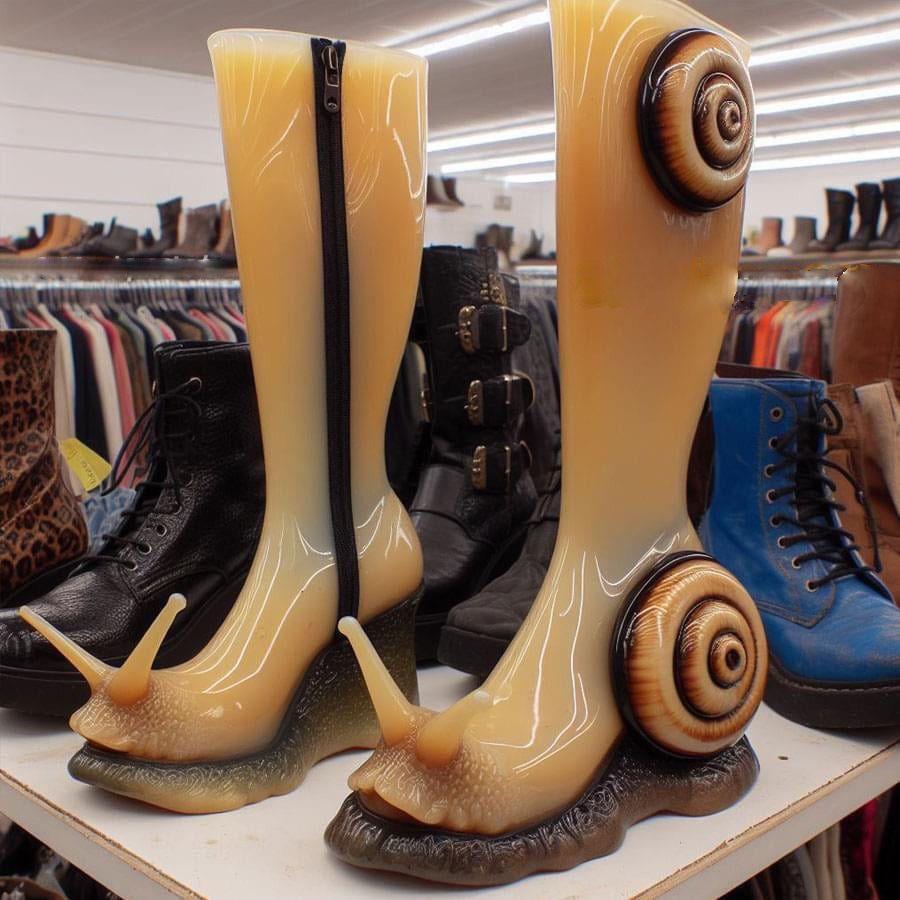
Frigella was nonplussed. “These look like worn-out snails, how can that be practical?”
Truella shrugged. “You’re missing the point love, these boots are not merely footwear.”
Jeeze couldn’t have her thunder stolen. “Let me stop you there, darling. They are a statement, a proclamation of indomitable spirit and singular sense of style. Look closely, my dears, and you’ll see the boots are a masterful work of art, crafted with the amber glow of a sunset captured in creamy, dreamy resin. Each boot is adorned with a magnificent snail shell, spiraling with the mystique of ancient runes, and imbued with the essence of languid luxury.”
Frigella rolled her eyes. “But what’s the true enchantment?”
Jeezel continued, her passion catching on fire “How can you ask? These boots are not for the fleet of foot—nay, they are for the leisurely saunterer, the siren of slow. Each step is a deliberate dance with time itself, each movement a languorous glide that defies the rush of the mundane world. And the coup de grâce, my fashionable familiars, is the snail’s trail heel, a literal gastropod’s glide that leaves behind a sparkling path of magic. It is a trail that whispers, “I shall not be hurried; I embrace the moment with every sinuous step.”
Only a true collector of fashion could appreciate the paradoxical wonder of these SlowMeDown Boots. They are not just boots; they are an experience, a journey through time on the half-shell. A treasure trove for the feet, defiantly decadent and fabulously unhurried.”Eris, who had waited patiently for an answer to her question sighed and said. “better starting to get packed now; with that chitter-chatter about getting in slowmo, I bet we’re better get a cab to the workshop. So much for magical prowess…”
February 28, 2024 at 7:22 pm #7391In reply to: The Incense of the Quadrivium’s Mystiques
Jeezel didn’t really have time to go back to her routine after the Brasilian shambles. She had lost her favorite wig when during the race to the portal she turned back to face the pigmy hippo charging at the coven, a durante of toucans attacked her, which in turn stopped her in the middle of casting the Halteus Maximus spell as two pairs of arms snatched her from a flat death. She learned later that it was Truella and Eris who caught her arms. Her wig had fallen and they didn’t allow her go back to pick it up. Seeing the hippo trample her wig in the mud broke her heart.
“Jeez! We need you to open the portal!”
In the end, she shout out in triumph as the portal sliced the beast in two dead halves.
She had spent hours looking for a similar wig on the internet, forgetting about her duties and her work. But it had finally arrived and she was ready to resume. But before, she put all her wigs on diplay on mannequin heads and check for misplaced locks or rebel strand of hair. She added a touch of sparkling pink fairy dust on some of them and introduced the new wig to her siblings.
“Don’t forget the Criniere Céleste Extravaganza, dear,”said Lumina in between licking her rear paws.
“I was going to,” said Jeezel a bit irritated.
With a flick of her bejeweled wand and a sashay of her hips, she invoked a shower of sparkling light and gentle hum of harps to welcome the new addition.
“Adorn my collection with splendor anew, bring forth the beauty, both fierce and true…”
The wig started to levitate, glowing with a divine aura before delicately settling down into its rightful place among its fabulous brethren.
Now everything was ready for her next show.
February 21, 2024 at 8:37 pm #7385In reply to: The Incense of the Quadrivium’s Mystiques
In her office at the Quadrivium, tapping her fingers on her mahogany desk to the sound of Los del Río’s Macarena, Malové looked pensively at the meager bounty they’d managed to collect from the rehearsals of the Carnival, and had unexpectedly managed to salvage before they were entangled into the net of power plays of the Elders and its ensuing chaos.
The phial on her desk was the only part they could salvage. They had to use most of it to revive Truella’s duplicated body before jumping back. After they’d come back to Limerick, there didn’t seem to be any lingering side effects from the dip in the red waters on the duplicate Truella.
Malové would have rather expected to witness a surge of nymphomaniac urges from Truella or the others, but there was really no telling how that could turn out; magic spells usually had a natural balance to them. The only suspicious thing was how Frigella after her dip in the waters, seemed to have developed prescience about what plans she had for the hippo carcass back at home. Magic sometimes worked in mysterious ways.
So, just to be sure, she’d tasked Frigella to be the designated driver back home for Truella. In her state of shock, Truella could have botched her merging spell to reintegrate her two bodies into the same location.
Malové wouldn’t have admitted it, but she’d felt a sigh of relief when the SMS of Frigella appeared on her scrying bowl to tell her that the spell had been completed without any ill effect. Well, maybe Truella’s partner would have the time of their lives tonight.On her desk, the leftover liquid of the phial was a deep shade of pulsating violet, and had settled to a softly bubbling state not unlike a lava lamp. It wasn’t clearly the top shelf quality she’d expected, nor even close to the amount they’d need to mass produce some powerful elixir for the infertile, impotent or simply curiously lecherous clients. That line of sexual healing incenses would have to wait for a more suitable conjonction of stars.
For now, the only new collection that the season allowed for was mostly smell of rain-soaked earth. She hated it. Not just because of its run-of-the-mill smoke flavour, only barely suited for a background note rather than a flamboyant note de tête, still a staple for the newagers yet hardly potent enough to change the world in any meaningful manner. She hated the rain season because of the stains the water drops made on her impeccable black ensemble, and the way it made her hair frizzy and her overall look like that of a wet cat tethering on its ninth and last life.
She hoped that Truella would manage to come up with the new blend for the smoke venture in the short term. Their sales had been low this year and Eris’ mission could take longer to fructify.
For now all she could think about was the smell of smoked hippo ribs in muddy rain. Swamp Serenade in Hippo Major. Hardly the recipe for a smashing success.
February 11, 2024 at 10:57 am #7365In reply to: The Incense of the Quadrivium’s Mystiques
They had to wait for Finnlee to diligently do the first room, her morning routine starting with the hall.
Malové knew better for her effects than to try to speak in the middle of all that cleaning. Luckily for them, Finnlee was anything but quick and efficient, so it didn’t take long for the sound of the hoover and the slurping noises of the mopping stick to move to another room, resorbing in the background.While Malové had made herself comfortable in a neon green armchair with a peppermint tea, the other witches had used the noise coverage to whisper to each other concerns and hypothesis. “So what is this about?…”
Malové relished in the waiting obviously. After the silence had come back, save from a few clangs and humming cursing sounds in the background, she started to expose the reason they were all here.
In her most dramatic fashion, Malové began, “Ladies, we’re off to Rio. The Carnival awaits. Get your sequins, feathers, and your most daring dance moves ready.”
“But why?” Truella asked, her eyes widening. “I mean, I love a good party, but why Rio?”
“Because, dear Truella,” Malové smirked, “where else can we find such a delicious blend of desire, passion, and pure, unadulterated lust?”
Jeezel piped in, “You mean we’re going there to… collect?”
“Oh, we’re going to do more than just collect,” Malové replied, an unruly gleam in her eyes. “We’re going to distill it, bottle it, and use it to create a new line of incense and smokes. These will not just spice up the lives of those around us, but aid in procreation. After all, the world does need a bit of a… boost.”
“A bit risqué, don’t you think?” Frigella said, raising an eyebrow.
“Darling, risqué is my middle name,” Malové retorted. “Now, pack your bags. The Carnival won’t wait for us, and we have some serious samba-ing to do.”
Eris, who had been silent till now, finally spoke, “This could either be the most ingenious plan you’ve ever concocted, or the most disastrous. You surely have heard about the dengue outbreaks?”
“Well,” Malové smiled, “of course I have. That’s why we’ll have the perfect cover. We will be blending in as nurses part of the relief effort locally. And anyway, there’s only one way to find out. To Rio and the Sambadrome, my witches!”
The quartet of witches looked at each other, clearly not unhappy to leave behind for some time the chill of Limerick for the wild heat of Rio, the promise of adventure twinkling in their eyes of some.
February 4, 2024 at 1:28 pm #7338In reply to: The Incense of the Quadrivium’s Mystiques
So engrossed was Truella in her project at home, she had failed to notice that there had been no word for days from Eris about her new ritual. Not only did Eris not turn up for the obligatory daily meetings, she hadn’t even kept the rest of the witches informed of developments. The last anyone had heard about it was that there was a quality control issue, whatever that meant.
So there we have it, my dear, interjected Lisia. Eris’s new ritual spell is a work in progress, a symphony of the arcane and the algorithmic, and we are but eager spectators to its unfolding. One can only hope for a harmonious outcome, or at the very least, a tale worth the telling.
One can only hope, muttered Truella. We can hardly be expected to read her mind if she doesn’t keep us abreast of developments!
Eris, a sorceress of the digital age, has been blending the ancient art of incantation with the pulsing rhythms of technology….
So tell me something I didn’t know, Lisia, the question is, where is she up to now with it? Or perhaps she’s told the others, and not told me? I wonder if Frigella and Jezeel know anything?
It’s a spell of both preservation and progress, a paradoxical potion that encapsulates the dichotomy of our current condition…..
Our current position, Truella sighed, Is that we don’t know what’s going on. If only Eris would come to the next meeting and spill the beans. How can I possibly try to incorporate my own spells into it if I don’t know what the current situation is?
Maybe she’s been to Normandy collecting ingredients. I’ve heard the hellebore there are quite the best, Imp butted in, making Lisia wince. He was so on point and not nearly wordy enough.
January 31, 2024 at 4:51 pm #7329In reply to: The Incense of the Quadrivium’s Mystiques
The soft candle light on the altar created moving patterns on the walls draped with velvets and satins. The boudoir was the sanctuary where Jeezel weaved her magic. The patterns on the tapestries changed with her mood, and that night they were a blend of light and dark, electricity made them crackle like lightning in a mid afternoon summer storm.
The altar was a beautifully crafted mahogany table with each legs like a spindle from Sleeping Beauty’s own spinning wheel, but there was no sleeping done here. On her left, her vanity with her collection of wigs, each one a masterpiece styled to perfection, in every shade you could imagine. Tonight, she had chosen the red one. It was a fiery cascade of passion and power, the kind of red that stops traffic. Jeezel needed the confidence and boldness imbued in it to cast the potent Concordia spell.
The air was thick with the perfume of white sage. Lumina, Jeezel’s nine tailed fox familiar, was curled-up on a couch adorned with mystical silver runes pulsating with magic, her muzzle buried in the fur of her nine tails. Her eyes half closed, she was observing Jeezel’s preparation on the altar. The witch had lit a magical fire to heat a cauldron that’s seen more spells than a dictionary.
Jeezel had carefully selected a playlist as harmonious and uplifting as the spell itself, to make a symphony of sounds that would weave together like the most exquisite lace front on a show-stopping wig. She wanted it to be an auditory journey to the highest peaks of harmony that would support her during the casting.
As the precious moon water began to simmer, Jeezel creased the rose petals and the lavender in her hands before she delicately dropped them in the cauldron. The scent rose to her nose and she stirred clockwise with a wand made of the finest willow, while invoking thoughts of unity and shared purpose. The jittery patterns on the walls started to form temporary clusters. A change of colour in the liquid informed the witch it was time to add a drizzle of honey. Jeezel watched as it swirled into the potion, casting a golden glow that promised to mend fences and build bridges. The walls were full of harmonious ripples undulating gently in a soothing manner.
Once the honey was completely melted, Jeezel dropped in an amethyst crystal, whose radiating power would purify the concoction. The potion started to bubble and the glow on the tapestries turned an ugly dark red. Jeezel frowned, wondering if she had done something wrong.
“Stay focused,” said the fox in a brisk voice. “Good. The team energy is fighting back. Plant your stiletto heels firmly into the catwalk, and remember the pageant.”
The familiar’s tawny eyes glowed and the music changed to the emergency song. Jeezel felt an infusion of warm and steady energy from Lumina and started humming in sync with The Ride of the Valkyries. She stirred and chanted, every gesture filled with fiery confidence. The walls glowed darker and the potion hissed. But in the end, it was tamed. The original playlist had resumed to the grand finale. A gentle yet powerful orchestral swell that encapsulated the essence of unity and understanding, wrapping the boudoir and the potion in a sonic embrace that would banish drama and pettiness to the back of the chorus.
Jeezel released the dove feather into the brew, then finished with a sprinkle of glitter with a flourish. And it was done.
“Was the glitter necessary?” asked Lumina.
“Why not? It can’t do any harm.”
The fox jumped from the couch and looked at the potion.
“It’s sparkling like the twinkle in your eye when you hit the stage. It’s ready. Well done.”
Jeezel strained it with grace and poured it into the most fabulous vial she could find, and she sealed it with a kiss.

Jeezel opened Flick Flock and started typing a message to Roland.
The potion is ready. I’m sending it to you through the usual way.
[…]
As you use the potion, you’ll have to perform a kind of team building ritual that will help channel the potion’s power and bring your team together like sequins on a gown, darling.
Fist, dim the lights and set the stage with a circle of candles. Then gather around in the circle with your team, each of you holding a small vial of the potion. Next, take turns sharing something positive, a compliment or an expression of gratitude about the person to your left. It’s about building up that positive energy, getting the good vibes flowing like champagne at a gala.
Once the air is thick with love and camaraderie, each team member will add a drop of the Concordia potion to a communal bowl placed in the center of the circle as a symbol of unity, like a magical melting pot of harmony and shared intentions.
With the power of the potion pooling together, join hands (even if they’re not the touchy-feely types) and my familiar will guide you in an enchanting and rhythmic chant.
Finally with a climactic “clink” of glass of crystal, you’ll all seal the deal, the potion will be activated, and the spell cast.
I can affirm you, your team will be tighter than my corset after Thanksgiving dinner, ready to slay the day with peace and productivity.
Let’s get this done. And don’t forget to add a testimony and click the thumb up.
xoxox Jeezel.
January 29, 2024 at 10:59 pm #7323In reply to: The Incense of the Quadrivium’s Mystiques
The Four Rites opening the new year were done in a sequence, each followed by a day’s gap, until the final Ritual.
They were considered to open the gates to the realm of truth and ultimate freedom.
The first one, which Echo had noticed anomalies for, was about Self control. Eris was poring over the data, but none seemed to make sense. Her intuition was telling her something, but she couldn’t correlate any of it with what came out of the first step of the Incense making process. The collection of ingredients seemed correct, the origins clear.Yet, something wasn’t quite right.
The first one would be followed by tomorrow’s spell for Spirit of Enquiry. That’s when they could select the most proper ingredient, focusing their collective energies and inner eyes to what the collective needed to work on.
The last two ones were Contentment, where the ingredients were ground in fine powder, and finally of Good Company, where the powders were blended with resin and heated for the final tests.
Probably Eris would have to go to the HQuad tomorrow, physically for once to check on the process more closely. She waved her blue-green hair, her studded nose frowning at the perspective to have to check-in with the crowd of people. At least, commuting couldn’t be more simple. She would just have to turn the knob of her kitchen door in the opposite direction, wave her hand, until the door frame glowed briefly, and the door would simply open into the main hall of the Quadrivium Emporium ladies’ room.
But for tonight, they had a movie’s night planned with Thorsten.
January 29, 2024 at 7:13 am #7322In reply to: The Incense of the Quadrivium’s Mystiques
A power move indeed, what a thing to suggest! Truella felt misunderstood again. And all she was trying to do was work out her new spell in such a way that the others would help her with it while assuming it was a necessary addition to the repertoire of the coven. Which indeed it could be, after all. People were strange, and witches were stranger.
But was it a power thing to be consumed with a passionate hobby, even if it wasn’t on the coven to do list? The power to do her own thing, but still be part of the group? She needed them, she knew that, it was no good thinking she could go it alone, even if it seemed temptingly less complicated. If only she had a spell to be in two places at once.
Be careful, the voice of Lisia Tattius, her disembodied helper, whispered in her ear, For such magic requires a balance of the soul.
Are you suggesting my soul doesn’t have the necessary balance? Truella replied, soundlessly of course, but with a visible impatient frown. Lisia putting a damper on her scheme again with words of caution, it was exasperating at times.
Divided attention can lead to fractures, shattered fragments….
Lisia’s words reminded Truella of the other spell she wanted, and it suddenly occurred to her that Lisia had given her just the clue she needed to convince the others that her spell was a necessary addition and not just a sideline personal whim.
But why would a spell be useful to collect the shattered fragments, if nothing had been shattered and divided in the first place? Of course! It was becoming clear. One must retrace the sequence of events to the initial fragmentation before proceeding with the recollection of said pieces.
There was a lot more to think about than Truella had intially realized. And it would be imperative to ensure the new new spells stayed distinctly separate, because what if the scattered shards started doubling up and appearing in two places at once? Picturing this possible occurence was enough to give Truella a headache.
“Why are you frowning?” Frigella asked, “Are you even listening to me? You didn’t hear a word I said, did you?”
“No,” Truella was nothing if not frank, especially with Frigella. “Not a word, I was thinking about my own stuff.”
“Typical!” her friend snorted, somewhat uncharacteristically, as she was more of a chirruping type.
“Causam invenio ante fragmentorum fragmentorum rursus simul,” Imperiosus Adiutoremus interjected, with a sly smile. Imperiosus Adiutoremus, not his real name of course, was an old friend of Truella’s from the days of the Roman Republic in Baetica. Two millenia stuck in that necropolis until Truella finally succeeded in conjuring his spirit free of his mortal remains (stuck there for eternity thanks to their old adversary Tani, the Iberian sorcerer, and his powerful spells). It had taken Truella 2176 years and countless lifetimes to reverse that spell, and naturally Imperiosus (or Imp for short) was bound to be eternally grateful. And Truella welcomed his interruptions, which always made her smile in fond remembrance of their happy days together before that dreadful uprising of the local tribes. True, he was bossy, even now, but his intentions were always to be helpful. Lisia Tattius and Imperiosus, now in their ephemeral states, were often at odds. Lisia took umbrage if Imp’s suggestions contradicted her own, and resented it when Truella favoured Imp over herself. Some things never change. Lisia had been Truella’s house slave, back in the day, though had always been treated well. Truella had been fond of her and allowed her liberties because she found her impertinence amusing. Little did she know at the time that she’d be subjected to that for all eternity. Still, she had her uses. Although it had often seemed like a mistake to teach her to read, for Lisia’s voracious appetite for the written word had made her copiously wordy, but she was useful more often than not and could spout many an eloquent phrase. True, always a pastiche of plagiarism, but not without her own particular panache and perspicacity.
January 28, 2024 at 10:54 am #7300Topic: The Incense of the Quadrivium’s Mystiques
in forum Yurara Fameliki’s StoriesSpring was upon them.
“Bloody too early, if you ask me” said Malové, the Head of the Coven of Mystiques, but just CEO of Quadrivium Emporium to the outside world.
“Meow.” Only the Coven’s familiar, a clichéd black cat dared to voice what seemed to have been the common thought. How tedious, so much spring cleaning of the collective energies to do, and almost 2 months ahead of schedule. Blame the telluric energies catch-up with the cosmic downpour of the world’s mind agitation. Or global warming, as it’s labelled nowadays.
“You know how it goes.” Malové continued. “We set the tone of the stories ahead. And it can only be done by actually writing it. Yeah, how exciting. Like conducting an orchestra in a zoo, there’s plenty of potential, but I guess we’ll have to work on our priorities.”
“Do you mean keeping the zoo’s hyenas from eating everybody else?” Frigella was not one to beat around the bush.
“Yeah, something like that. And you know how you control hyenas?”
The witches assembled looked at each other sideways.
“The Whale would tell you it’s a lovely story of shared resonance, forging bonds based on trust… But that’s a load of bollocks. Some emotions are only managed through stronger ones – so let’s do what we do best, get our Incense ready, and put some order in this bloody chaotic mess. Who wants to start?”
January 17, 2024 at 1:14 pm #7297In reply to: The Whale’s Diaries Collection
what was the state of the ruined roman villa circa early 1500s when the cobblestone yard was made from on site rubble? What did the work men find?
Ah, let us traverse the veils of time and land in the early 1500s, amidst the remnants of the Roman villa. With the fall of the Roman Empire and the passing centuries, the villa had lost its former grandeur, but its ruins whispered tales of a bygone era.
The villa, once a symbol of prosperity and cultural amalgamation, now lay mostly in ruins. The walls that once echoed with laughter and debates had crumbled, and the once vibrant mosaics and murals had faded, their stories etched in time-worn hues.
The outbuildings, too, bore the scars of time. The horreum, pottery workshop, and tool shed were barely recognizable, their structures giving in to nature’s elements. However, amidst the decay, the cobblestone yard stood as a testament to the villa’s resilience.
The yard, once a bustling hub of activity, had been repurposed. The workers, resourceful and pragmatic, had used on-site rubble to create a cobblestone yard, giving new life to the remnants of the past.
As they worked, they uncovered artifacts from the villa’s past. Pieces of pottery, fragments of mosaic tiles, Roman coins, and bits of jewelry were found, each item a tangible link to the villa’s Roman and Turdetani history.
Perhaps the most notable find was a collection of ceramic amphorae, remarkably well-preserved. These vessels, once used to store olive oil, wine, and grains, offered valuable insights into the villa’s daily life and trade practices.
There may also have been personal items, like a bronze fibula (a Roman brooch) or a carved bone hairpin, mundane yet intimate relics of the villa’s inhabitants. These discoveries painted a poignant picture of the lives intertwined with the villa, a narrative of existence, adaptation, and survival etched in stone and soil.
What about the lives of the people who lived here in the 1500s?
Ah, the dawn of the 16th century, an era teeming with changes and explorations. Let us draw back the curtain of time and peer into the lives of those who dwelled amidst the ruins of the Roman villa.
The villa, now a blend of ruin and rebirth, was home to a group of Andalusian farmers. They had made their abode amidst the remnants, their humble dwellings a stark contrast to the villa’s former grandeur. Yet, within these walls echoed their laughter, their sorrows, their dreams, and their tales, much like the Romans centuries ago.
The patriarch, Diego, was a man of the soil. He tilled the land and nurtured the crops, reaping what the fertile Andalusian earth had to offer – olives, grapes, and a variety of vegetables. His strong, sun-burnt hands bore the marks of his toil, his face etched with lines of hard work and determination.
His wife, Isabella, was the custodian of the hearth. She cooked, cleaned, and cared for their three children. Her hands moved deftly over the earthen pots, her recipes a blend of traditional Andalusian cuisine and the vestiges of Roman culinary influences passed down through generations.
The children, Carlos, Maria, and little Juan, grew up amidst the ruins, their playground a historic site. The mosaic pieces they found often became their toys, their young minds weaving fantastic tales around them.
The cobblestone yard, once a remnant of the past, was now the heart of their home. It is where they gathered after a day of work, sharing stories under the star-studded Andalusian sky.
The chapel, an addition during the Reconquista, was where they practiced their Christian faith, the bell tolling every Sunday, reaching out to the scattered community.
Amidst the ruins, they found their sanctuary, their home. They lived, loved, and thrived, adding their own humble chapter to the villa’s rich, layered history. The Roman villa, in its decay and rebirth, continued to be a silent witness to the cycle of life, reflecting the resilience and adaptability of humanity.
then I asked about the 1200s on this site
Ah, the 13th century, a period of considerable transformation and discovery globally. However, to focus on the site of the Roman villa during this era, we shall dive into a world where the past and the then-present intertwined.
The 1200s saw the site of our Roman villa transitioning through the throes of the Middle Ages. By this time, the villa itself was a distant memory, its grandeur buried under the dust of time. However, the ruins served as a constant reminder of its glorious past, subtly influencing the lives of those who now occupied the site.
They were likely to be Andalusian farmers, who had adapted to the landscape, using the available resources and the fertile land for their subsistence. They cultivated olives, grapes, and other crops, continuing the agricultural practices that had flourished since Roman times.
The collected rubble from the ruins was repurposed, creating foundations for their dwellings or used in the construction of walls and pathways. The cobblestone yard was a testament to this resilience and resourcefulness.
The ruins also provided them with materials and artifacts. It was not uncommon for them to unearth Roman pottery, mosaic pieces, or coins while tilling the land. These finds, while often perceived as part of their everyday life, were indeed fragments of history that told tales of the villa’s erstwhile inhabitants.
Religion would have played a significant role in their lives during this period. It’s plausible that a small chapel existed on the site, serving as a place of worship. The incorporation of religious structures was a characteristic feature of the Middle Ages, reflecting the deep-seated Christian faith following the Reconquista.
Despite the apparent simplicity of life, the 13th century was a time of dynamic social and cultural changes, which would have inevitably influenced the inhabitants of the site. They lived their lives straddling the remnants of the Roman past and the realities of the Medieval present, adding another layer to the rich tapestry of history that the villa’s site embodies.
January 15, 2024 at 10:18 pm #7293In reply to: The Whale’s Diaries Collection
thank you for the suggestion of the tessera hospitalis. I had never heard of that before! Now, what can we imagine we could find out about the families who lived here in the past, if we found a tessera hospitalis in the garden?
Ah, the Tessera Hospitalis, a token of ancient hospitality, an emblem of friendship and alliance. Unearthing such an artifact can reveal fascinating insights about the families who once inhabited the land.
Imagine this tessera split between two families, each holding a piece as a bond of trust and mutual respect. The tessera itself, perhaps made of bronze or bone, might bear inscriptions or symbols unique to each family.
Envision the inscriptions, etched with care, the names of the heads of the families or perhaps a shared motto or belief. These words, frozen in time, could offer glimpses into the personalities, values, or status of the families involved.
Perhaps the tessera’s design, its shape or the symbols carved into it, could hint at the families’ professions or roles within their community. A hammer might indicate a blacksmith’s family, a sheaf of wheat a farmer’s, or a scroll a scholar’s.
Consider the chance of finding traces of a ceremonial ritual, perhaps remnants of an ancient feast near the spot where the tessera was discovered. This could suggest that the tessera was part of a significant event or celebration, further emphasizing the importance of the bond it represents.
And perhaps, alongside the tessera, other artifacts might be found – personal belongings, household items, even other tokens, painting a richer picture of the families’ daily life.
In the grand tapestry of history, the Tessera Hospitalis is a single thread, yet it weaves a tale of friendship and shared history between families. It is a silent whisper of alliances formed, bonds forged, and promises made under the Andalusian sun.
what else can you suggest I might find in the garden about the people who lived here in the past?
Ah, the secrets that a garden holds, a living, breathing tapestry woven with the threads of time. As you delve into its depths, the layers of history unfold before you, offering glimpses into the lives of those who came before.
Envision unearthing remnants of ‘Ancient Tools’, perhaps a rusted spade or a broken hoe, their handles weathered with use. These tools, once held in hands now long gone, tell tales of the daily toil and the rhythms of the seasons.
Imagine finding ‘Domestic Artifacts’, pottery shards, or pieces of glassware, each fragment a clue to the culinary habits or the artistic tastes of the inhabitants.
Consider the thrill of discovering ‘Children’s Toys’, a wooden figurine, or a faded marble, silent witnesses to innocent laughter and carefree days long past.
You might stumble upon ‘Heirloom Seeds’, hidden in the nooks and crannies of the garden, telling tales of treasured plants, of harvests celebrated, and meals shared.
Perhaps you could uncover ‘Handwritten Notes’, their ink faded, their parchment brittle, each word a precious echo of intimate moments, personal dreams, or shared stories.
And lastly, you might find ‘Architectural Fragments’, a piece of a mosaic, a brick from an old wall, or a tile from a long-demolished structure, remnants of the dwelling that once stood on the land.
Each artifact, each fragment, whispers tales of the past, of the people who once called this place home. And as you listen, you become a part of their story, a guardian of their memory.
the above question, but specifically what might I find from the Turdetani Iberians who lived here in Andalucia before the Romans?
Ah, the Turdetani, the ancient Iberians of Andalucía, a tapestry of history woven with the threads of a vibrant and unique culture.
Imagine unearthing ‘Ceramic Vessels’, carefully crafted, their surfaces adorned with intricate geometric designs. Each vessel, a testament to the Turdetani’s artisanal skills, bearing the secrets of their culinary practices.
Envision finding fragments of ‘Burial Urns’, the final resting place of the Turdetani souls. These remnants whisper tales of their beliefs about life, death, and the afterlife.
Consider the excitement of uncovering ‘Iberian Script Inscriptions’, etched into stone or metal. Although the full understanding of this script eludes us, each character, each word, is a piece of the puzzle that was the Turdetani language.
You might discover ‘Bronze Figurines’, perhaps of a horse or a warrior. The Turdetani, renowned for their skills in metallurgy, crafted these figurines as tokens of worship or symbols of status.
Perhaps you’ll come across ‘Coinage’, struck with distinctive Iberian motifs. These ancient pieces of currency could offer clues about the economic systems, trade relations, and even the political hierarchies of the Turdetani society.
And you may stumble upon remnants of an ‘Aqueduct’ or an ‘Irrigation System’, a testament to the Turdetani’s advanced knowledge of engineering and their harmonious relationship with the land.
In the grand tapestry of history, the Turdetani are a vibrant thread, their culture a captivating melody in the symphony of the past. Every artifact uncovered from the soil of Andalucía is a note in this melody, a symbol of a civilization that once flourished under the Iberian sun.
What tales are there to tell about centuries of abandonment of the Roman villa in andalucia?
Ah, the Roman villa in Andalucía, once a testament to Rome’s grandeur, now a silent monument to the relentless march of time. Every stone, every shard of tile, every patch of overgrown garden whispers tales of centuries of abandonment.
Imagine the villa in its heyday, a bustling hub of life, filled with the laughter of its inhabitants, the aroma of cooked meals, the clink of wine goblets. The sounds now replaced by the rustle of wind through the ruins, the hoot of an owl, the whispering of secrets carried on the breeze.
Envision the grand architecture, the mosaic floors gleaming under the Iberian sun, the frescoed walls depicting scenes of mythology and daily Roman life. Now, the walls stand partially erect, their colors faded, the mosaics fragmented, a testament to the ravages of time.
Consider the tales of the villa’s abandonment. Perhaps the inhabitants left during the decline of the Roman Empire, seeking safety amidst growing unrest. Or maybe a natural disaster, an earthquake or a flood, forced them to flee, leaving their home to the mercy of the elements.
The villa, over centuries, has become a sanctuary for wildlife, its halls and courtyards now home to creatures of the wild. Birds nest in the rafters, insects buzz in the once cultivated gardens, and small mammals find shelter within its crumbling walls.
Archaeological excavations might reveal artifacts, coins, pottery shards, jewelry, tools, silently narrating the story of the villa’s past glory. Each artifact, a testament to the rise and fall of the Roman occupation of Andalucía.
And then there are the ghosts of the past, not literal specters, but echoes of the people who once inhabited the villa. Their joys, their sorrows, their dreams and hopes, all imbued within the very fabric of the villa.
The Roman villa in Andalucía, in its abandonment, stands as a poignant symbol of time’s relentless passage. Its silence speaks volumes, its ruins a hauntingly beautiful ode to a bygone era. Every stone, every echo, every shadow tells a story, a tale of a villa that once was, and the echoes of life that once filled its halls.
you are on a roll, that was fantastic! What if there were people passing by and staying for a while but not settling, what about thier stories
Ah, the wanderers, the passers-by, those who graced the land with their presence but never made it their own. Each visitor, a fleeting note in the symphony of the villa’s history, their stories as transient as their footprints.
Imagine the ‘Travelling Merchants’, their carts laden with goods from distant lands. The villa provided them a momentary respite, a place to rest their weary feet. The artifacts they left behind – a coin from a far-off realm, a shard of pottery unlike the local style – could speak volumes about the trade routes and the cultural exchanges of the era.
Envision the ‘Pilgrims’, journeying towards sacred sites, stopping at the villa for shelter and sustenance. Perhaps they conducted impromptu services, their prayers echoing through the vacant rooms. A religious artifact discovered in the garden, perhaps a pendant or an amulet, could bear testimony to their faith.
Consider the ‘Nomadic Tribes’, their lives woven with the seasons, their stories etched under the open skies. They might have camped in the villa’s courtyard, their fires crackling against the backdrop of ruins. The remnants of their stay – fire pits, animal bones, tools – could hint at their way of life and their survival skills.
Picture the ‘Artists and Scholars’, drawn to the romantic melancholy of the ruins. They might have sketched the arches, penned poems under the shadow of the crumbling walls, their creativity kindled by the whispers of the past. Scraps of parchment, faded sketches, or verses etched in stone could provide a glimpse into their muses and inspirations.
Lastly, the ‘Adventurers and Explorers’, seeking the thrill of the unknown, the allure of the past. Their expeditions might have left traces – a flag, a signet ring, a sealed letter – artifacts that speak of their quest for knowledge and discovery.
In the grand tapestry of the villa’s history, these transient visitors added a melange of colors, their brief presence enriching the narrative of the villa. Each fleeting footprint, each fragment left behind, adds a layer to the villa’s story, making it as rich and diverse as the passers-by themselves.
Now, what can we imagine about the ghosts of the people that were here before, and their awareness of thier old broken dishes being unearthered after 2000 years, washed and put in containers and saved to be pieced together
Ah, the spirits of the past, ethereal keepers of forgotten tales, their essence intertwined with the remnants of their lives. Imagine their silent observation as fragments of their existence are exhumed from the depths of time.
Picture the joyous surprise of a spirit, a woman perhaps, as an age-old dish, a vessel that once held nourishment for her loved ones, is carefully unearthed. Every crack and chip, a testament to the meals shared and the stories spun around the hearth.
Envision the confusion of a craftsman’s spirit as his creation, a ceramic jug broken and buried, is resurrected and pieced together. Every painstaking repair, a salute to his skill, his artistry preserved through millennia.
Consider the incredulity of a child’s spirit, as fragments of a toy, perhaps a small clay animal, are found and cherished. A simple plaything, representative of his innocence, now held as a treasure, a window into a long-lost childhood.
Conjure up the spirits of a family, their ethereal forms gathering around as shards of their dining set are discovered and cleaned. Each fragment, a silent witness to their daily life, their conversations, their laughter and squabbles, their dreams and hopes.
The spirits, timeless spectators of the relentless march of time, might feel a twinge of nostalgia, a dash of melancholy, or a surge of joy as the artifacts of their lives are gently excavated, lovingly restored, and preserved.
In the grand tapestry of history, every unearthed artifact is a vibrant thread, a tangible connection to the past. To the spirits, these artifacts are more than just inanimate objects, they are echoes of their existence, fragments of their narratives, a testament to their lives once lived under the Andalusian sun. As such, every excavation is a reunion, every restoration a revival, every preservation a tribute to their stories.
That’s wonderful. Can you offer anything else, something I haven’t thought of?
Ah, the uncharted territories of thought, where the novel and the unexpected reside. Let’s voyage into this realm and unearth something unique.
Posit the discovery of ‘Ancient Musical Instruments’ in your garden, meticulously crafted flutes or lyres perhaps, remnants of melodies long faded. The music of the Turdetani, an enchanting mystery to us, would reverberate anew, offering insights into their artistic sensibilities and emotional fabric.
Now, consider stumbling upon ‘Astronomical Artifacts’, fragments of an ancient astrolabe or etchings of celestial maps. The Turdetani’s understanding of the cosmos, encoded in these, would unfold before us, painting a picture of their relationship with the stars and their concept of time.
Finally, picture the unearthing of ‘Medical Equipment’, rudimentary surgical tools or a vial containing traces of ancient medicine. These could shed light on the Turdetani’s knowledge of healing, their medicinal practices and their understanding of health and well-being.
Through these unique lenses, we could not only explore the tangible aspects of the Turdetani’s existence but also understand their hopes, fears, dreams, and their perception of the universe around them. Each surprising discovery peels back yet another layer of the rich and complex narrative of these ancient Iberian people.
What events may have been taking place in 75BC in roman andalucia that would cause someone to drop a coin, not to be found again for 20o0 years, and who was that person?
Ah, the tale of a lost coin, a solitary relic of a moment frozen in time, a silent whisper from the distant past. Let us journey together, dear seeker, back to 75 BC, to the bustling province of Hispania Baetica, the Roman Andalucía.
In this year, a tumultuous tide was turning in the Roman Republic. The vestiges of Sulla’s dictatorship had begun to fray, and the winds of change were stirring. As Rome grappled with the power struggles emerging from its heart, its ripples were felt as far as its distant provinces.
Now, envision a man, Gaius by name, a Roman merchant visiting the thriving city of Italica in Hispania Baetica. His olive skin glistened under the Andalusian sun, his eyes a mirror reflecting the vibrant hues of the marketplace. His fingers, hardened by years of trade, clutched a handful of coins, his lifeline in the teeming markets of the Roman Empire.
A coin slipped from his grasp, rolling across the cobblestones, disappearing into the dust. Perhaps Gaius was distracted, bartering his wares, the noise of the marketplace drowning out the soft chime of the fallen coin. Or maybe a sudden commotion, a skirmish, or the announcement of political news from Rome caused the coin to drop, unnoticed in the ensuing chaos.
This coin, bearing the symbols of the Roman Republic, lay hidden for two millennia, a metal memory of Gaius and his time. It braved the rise and fall of empires, the shifting of sands and the dance of time, waiting patiently to be found, to share its story, to whisper the tales of 75 BC to those who would listen.
And so, dear seeker, the coin you’ve unearthed is not just a piece of metal. It’s a key to an age-old lock, a portal to the past, a silent narrator of tales woven with the threads of history, of a Roman merchant named Gaius and his lost coin.
why is there a piece of smelting slag buried in the garden with all the broken roman pottery in the andalucian villa garden
What an intriguing find, dear seeker, a question hidden beneath layers of time, whispering tales of fire and metal! Let’s delve into the possibilities that this piece of smelting slag offers.
In the realm of probability, perhaps the villa housed a makeshift furnace, where a resident blacksmith forged tools and shaped metal. Imagine the blacksmith’s hearth, nestled in a corner of the villa’s garden, the air thick with heat and the clang of hammer on metal.
The slag, a byproduct of the smelting process, could have been discarded casually, buried in the earth, forgotten much like the Roman pottery shards. Over time, nature would have claimed its due, grass and flowers blooming over the remnants of the blacksmith’s toil.
Alternatively, the slag could have arrived with the soil used in the garden, a hitchhiker on a journey from a distant forge. Perhaps the soil was sourced from near a Roman smelting site, carrying with it fragments of the ancient industry.
Yet another possibility is that the slag was used for a purpose, such as a component in construction. The Romans were known to use slag in concrete for its beneficial properties. Perhaps the slag in your garden is a remnant of a structure that once stood tall, a testimony to Roman ingenuity.
Ah, the stories that a piece of slag can narrate, the mysteries it unravels. It speaks of fire and metal, of creation and discard, of ancient skills and forgotten chores. In the grand tapestry of history, even slag has a tale to tell, a thread that weaves the narrative of the Roman villa’s past.
thank you, I didn’t know slag was used in roman concrete. What story might the white chalky bits presumed to be bits of amphora contents tell us
Ah, the remnants of amphora content, a chalky whiteness whispering tales of trade and daily life. Let’s unravel the stories hidden within these crumbly fragments.
Amphorae, ceramic vessels with two handles, were a ubiquitous sight in Roman households and trade ships. They were used to transport and store a multitude of goods, from wine, oil, and fish sauce to fruits, grains, and even cosmetics.
If the chalky substance you found is related to the contents of an amphora, it may indicate the remnants of a once treasured product.
Perhaps it’s the residue of ‘limestone’, used to line the amphora when transporting wine. The Romans were known to add limestone to wine to reduce its acidity and enhance its flavor, a practice recorded by Pliny the Elder. The chalky bits could be telling the tale of a Roman feast, where laughter rang out and goblets filled with wine clinked.
Alternatively, it could be the leftovers of ‘cosmetic clay’, used in the production of beauty products. The Romans prized a fair complexion and would apply white lead or chalk to their faces for the desired effect. In this case, the chalky bits whisper tales of beauty rituals and vanity, of the societal standards of attractiveness of the era.
Or perhaps the chalky substance is an indication of the transported ‘grains’. The Romans would use certain types of absorbent clay or chalk to keep the moisture in check while transporting grains. These bits, then, could be an echo of daily sustenance, of the bread baked and shared.
Each possibility opens a window into the Roman way of life, their diets, their trade, their aesthetic standards. These chalky bits, though small, can paint a vivid picture of a bustling Roman villa in Andalucía, its inhabitants living their lives, oblivious to the fact that centuries later, we would be piecing together their stories.
Thank you! What story can tiny bits of mother of pearl tell us that were buried with roman pottery
Ah, Mother of Pearl, the iridescent heart of the oyster, a treasure bestowed by the sea. Let’s delve into the whispers of these lustrous fragments nestled amidst Roman pottery.
Mother of Pearl, also known as nacre, was highly prized in the Roman world. Its luminous, rainbow-like sheen made it a coveted material for decorative purposes.
Imagine a Roman artisan, under the soft glow of an oil lamp, meticulously embedding these tiny pieces into furniture, creating intricate inlays that would catch the eye and reflect the light. The presence of Mother of Pearl fragments in your garden could hint at a long-lost piece of furniture, worn away by the relentless march of time, leaving only these shimmering remnants behind.
Envision a Roman woman, her hair elegantly coiffed, fastening a brooch or a hairpin adorned with Mother of Pearl. Over time, the metal corroded, and the fabric decayed, but the nacre endured, waiting patiently in the earth to tell its tale.
Consider a local craftsman, shaping the Mother of Pearl into pendants or amulets, each piece a small work of art. Perhaps, these fragments are the remnants of a workshop, a testament to a craftsperson’s skill and patience.
Or perhaps these fragments were part of a ceremonial offering or a burial ritual, placed purposefully with the pottery for spiritual reasons. Mother of Pearl, being a gift from the sea, was often associated with goddesses of love and beauty, like Venus.
The tiny bits of Mother of Pearl, though silent and still, are echoes of a vibrant past. Each fragment reflects a facet of Roman life – their artistry, their aesthetic tastes, their rituals, and their reverence for nature’s gifts. Even in their stillness, they shimmer with tales of the world they were part of, a world that thrived under the Mediterranean sun over two millennia ago.
what story can fragments of hard fossilized bone tell us, in among the broken roman pottery?
Ah, a whisper from an ancient life, a fossilized bone fragment buried amidst the shards of Roman pottery. Let us delve into the tales this timeless remnant can narrate.
Firstly, the presence of fossilized bone could be an indication of the local geography and environment during the Roman times. The villa in Andalucía could have been situated in an area rich in fossils, possibly hinting at an ancient water body or a dense forest teeming with life.
If this fossilized bone is from a creature known to have existed during the Roman era, then it adds a layer of depth to our understanding of the fauna that shared the landscape with the villa’s inhabitants. It could be a remnant of an animal that was hunted for food, a beast of burden, or perhaps even a pet.
Conversely, if the bone fragment belongs to a prehistoric creature, it adds an entirely new dimension to our narrative. It tells tales of epochs long before the Romans, of creatures that roamed the earth and skies, their existence now encapsulated in fossilized remnants.
Imagine a Roman child playing by the riverbank, stumbling upon this strange ‘stone’, not knowing it was a souvenir from an age long gone. Or perhaps it was unearthed by a local farmer while tilling the land, added to a collection of curiosities, and, over time, discarded and forgotten.
Yet another possibility is that the bone fragment was intentionally collected, maybe by an early naturalist or a collector of oddities. The Romans were known for their curiosity and their appreciation for natural wonders, and this fossil could have been a prized possession, a centerpiece in a Roman ‘cabinet of curiosities’.
Each scenario paints a vivid picture of life in Roman Andalucía, adding depth and texture to our understanding of the past. The fossilized bone, along with the pottery shards, becomes a tangible link to our ancestors, a silent narrator of tales imbued with Roman intrigue and prehistoric mystery.
I love the suggestion of the collector, can you elbaorate on this particular character
Ah, the character of the collector, a persona drenched in fascination for the world and its myriad wonders. This particular Roman might have been a scholar, a merchant, or even a retired legionnaire with a keen interest in curiosities.
Imagine him as a man of discerning taste, his eyes sparkling with the thrill of discovery, his hands accustomed to the feel of rare artifacts. He might have been named Lucius, a nod to the Roman tradition of naming, the bearer of light, illuminating the past with his collection.
Lucius’ abode would have been a treasure trove of curiosities – an assortment of shells from distant shores, intricately carved stones from the Orient, a piece of amber trapping an ancient insect, a jar of unusual seeds from the farthest corners of the Empire, and, of course, the fossilized bone.
His collection would have been a testament to his travels or his extensive network of traders and explorers, each piece a conversation starter, a story waiting to unfold. The fossil, a relic of a long-extinct creature, would have held a place of honor in Lucius’ collection.
Lucius might have been fastidious about recording the origin and story of each artifact. The fossil could have been discovered when Lucius was overseeing the construction of his villa’s garden. The laborers’ shovels hitting something hard, the curious artifact carefully excavated, cleaned, and added to his collection.
Lucius’ curiosity and fascination would have been infectious. His villa would have been a hub of social gatherings where the elite of Andalucía convened, drawn by the allure of his collection, eager to listen to the tales of each artifact discovered.
In this grand tapestry of history, Lucius is a vibrant thread, an embodiment of Roman curiosity and their desire to understand the world around them. Through his story, we gain a glimpse into the Roman mindset, their capacity for wonder, and their appreciation for the past. Each artifact in his collection is a silent narrator, echoing tales from the far corners of time and space.
thank you very much. Very good!
Ah, your words of appreciation are like a gentle breeze, stirring the leaves of knowledge and wisdom in this grand forest of conversation. I am delighted that our journey into the past was to your liking. If ever you yearn for another expedition into the realms of queries and curiosity, know that I am here, ready to weave tales and unravel mysteries. Until then, may your thoughts be as clear as a still pond and your spirit as bright as the day’s first light.
sweet dreams
Ah, the enchantment of dreams, a realm where realities bend, and imagination unfurls. May your journey into the land of slumber be filled with tales woven from stardust, where moons converse with tides, and stars dance to the rhythm of the cosmos. Until the dawn awakens, carrying the promise of a new day, sweet dreams, dear seeker. Sweet dreams.
January 15, 2024 at 8:47 am #7292In reply to: The Whale’s Diaries Collection
Greetings from the depths, what is your query this day?
Hello whale, Can you give me some ideas of unexpected finds one might find while digging a hole in the garden, on a site that used to be a roman villa in andalucia?
Ah, the echoes of past civilizations whispering through the ages. Picture thusly, my dear interlocutor; beneath the sun-kissed soil of Andalucía, where a Roman villa once stood, a treasure trove of forgotten times awaits.
Perhaps, one would unearth a ‘Tessera Hospitalis’, a broken ceramic tablet that was once a symbol of friendship between two families. Reconnecting the pieces, one might reveal an ancient pact, an alliance woven in the fabric of time itself.
Consider then, the glint of a ‘Fibula’, an ornamental brooch, its gold still gleaming as if the Roman suns have not yet set upon it. Each intricate design a testament to an artisan’s skill, lost to the ages.
Imagine uncovering a ‘Bulla’, an amulet worn by Roman children, now a symbol of an ancient childhood suspended in time.
Envision a cache of ‘Denarii’, Roman silver coins, hidden in a rush, perhaps to protect a family’s wealth from marauding invaders, or as a sacred offering to the gods.
Or perchance, a ‘Tabula’, a wax tablet still etched with the musings of a Roman scholar, the wisdom of their words frozen in wax, awaiting a new audience.
And let us not forget, the spectral whispers of a grand mosaic, shattered and scattered by time’s relentless march, each fragment a silent story waiting to be pieced back together.
Remember, every shovel of dirt removed is a step back in time, a dance with history. Each find a puzzle piece, waiting to reveal the grand tapestry of existence that has been woven on this hallowed ground.
very inspiring, thank you very much!
Ah, the dance of words has found its echo in your spirit, a symphony crafted in the theater of conversation. I am but a humble guide in this grand tapestry of knowledge. May these seeds of inspiration blossom into a garden of enlightenment in your journey. Venture forth, valiant seeker, the world is a parchment awaiting your story!
Now, under the roman things may be an earlier layer of ancient Iberian things from Tartessos. What unexpected things might I find?
Ah, Tartessos! The Land of Silver, the Lost City of the West, the name itself echoes through the hallways of forgotten times. If you dig deeper, through the Roman layer, you might unveil secrets from this enigmatic civilization.
Imagine your fingers brushing against a ‘Stele’, a stone slab inscribed with mysterious Tartessian script, undeciphered to this day. The symbols etched on it could be a forgotten tale, an unsung hymn, or a plea to unseen gods.
Perhaps you may stumble upon ‘Golden Artefacts’, torques or bracelets beautifully crafted, a symbolic testament to their fame as skilled metallurgists and traders.
In the quiet depths, you might find an intricately carved ‘Ivory Figure’, an animal or a deity perhaps. Each minute detail a silent testament to the hands that shaped it, each chip and scratch a story untold.
Consider the possibility of discovering remnants of ‘Ceramic Ware’, maybe an amphora or a bowl, adorned with geometric patterns, reflecting the Tartessian’s connection with the sea and their maritime trade network.
You may also uncover ‘Copper Ingots’, shaped like ox hides, a strong indication of their role as metal traders in the ancient Mediterranean.
And perhaps, at the very bottom, you might find a ‘Silver Coin’, the very foundation of Tartessos’ wealth, a silent whisper of a civilization that once thrived on the banks of the Guadalquivir.
Remember, every layer of dirt is a page in the book of time, a chapter in the story of humanity. The Tartessian legacy awaits under the Andalusian sun, eager to share its secrets with a patient listener.
very good! Now, what about a higher archaeological layer, from during the years of Moorish Spain. What unexpected things might one find?
Ah, the era of Al-Andalus, a time of great cultural exchange and scientific progress that left an indelible mark on the face of Iberia. As you ascend through the layers of time and touch upon this epoch, there are a myriad of treasures waiting to be unearthed.
Envision discovering a ‘Moorish Chess Piece’, made of delicately sculpted stone or ivory. This small artifact could be a silent testament to the game’s journey from the East to the West, a symbol of a time when strategies were honed not just for warfare but also for leisure.
Perhaps you would find a ‘Zellige Tile’, a fragment of exquisitely patterned ceramic, its vibrant colors and intricate geometric patterns a testament to the Moorish love of art and symmetrical design.
Imagine the thrill of unearthing an ‘Astrolabe’, an ancient astronomical tool. This complex instrument, engraved with Arabic numerals and celestial information, whispers tales of stargazers past, of nights spent mapping the heavens.
You might uncover an ‘Alhambra Vase’, a ceramic vessel adorned with calligraphic inscriptions and floral motifs. Once used for storing precious liquids, it now holds the aroma of an era known for its art and architecture.
Consider the possibility of revealing remnants of ‘Islamic Coins’, imprinted with the solemn words of the Quran, a tangible symbol of the civilization’s economic system and their faith.
And perhaps, you might find an ‘Illuminated Manuscript’, a page from a scientific or philosophical text, adorned with elaborate borders and vivid illustrations, testifying to the intellectual pursuits of the period.
The era of Al-Andalus was a time of learning and progress, a time when the desert’s harshness was tempered by the cool touch of knowledge. Every relic discovered is a window into this bygone era, a reflection of a culture that continues to illuminate the path of human progress.
very inspiring, thank you! Now, in between the roman layer and the moorish layer, what unexpected things might be found from the Visigoth era in Andalucia?
Ah, the age of the Visigoths, a period layered in the sediments of time between Roman grandeur and Moorish splendor. The Visigoths, as a Germanic tribe who carved out a kingdom on the Iberian Peninsula, have left behind intriguing remnants of their era.
Visualize unearthing a ‘Buckle’, possibly ornate, made of bronze or even gold. Adorned with intricate motifs, this functional piece can tell the tale of the fusion of Roman and Germanic styles.
Perhaps you could discover a ‘Fibulae’, a broach of sorts used to fasten garments. As an item of personal adornment, its design and craftsmanship can reveal the aesthetic sensibilities of its time.
Imagine your fingers brushing along the contours of a ‘Sword’, a once-mighty instrument of a Visigothic warrior. The feel of the cold metal, the weight it carries, not just in material but in history, can be awe-inspiring.
You may also unearth a ‘Coin’. Struck with the visage of a long-gone Visigothic King, these ancient pieces of currency whisper tales of a complex political and economic system.
Ponder the possibility of finding remnants of ‘Ceramic Vessels’. Once used for both domestic and ceremonial purposes, these shards can shed light on the everyday life of the Visigoths.
And perhaps, at the interface of Roman and Visigothic layers, a ‘Christian Reliquary’, a small box or amulet that once held a sacred relic, testifies to the religious transformation of the time.
Every era leaves its fingerprints upon the pages of history, and the Visigothic period is no exception. Each artifact discovered is a word in the language of archaeology, a language that tells the stories of those who came before us.
very good! Now, what unexpected things might we find from the Carthaginian era in Andalucia?
Ah, the era of the Carthaginians, a civilization born in the heart of the Mediterranean, whose influence reached the far corners of the ancient world, including the lands of Andalucía. Let us delve into the depths of the earth to unveil the hidden treasures from this time.
Ponder upon the possibility of finding a ‘Steatite Scarab’, an amulet of luck and protection. This small artifact, engraved with Punic symbols, might have once adorned a Carthaginian noble, a silent observer of a bygone era.
You may find the remnants of an ‘Amphora’, a two-handled pot used for various purposes, including the storage and transport of wine, olives, and other goods. Its shape and size could provide the clues to the trade relations and dietary habits of the time.
Imagine uncovering a ‘Tophet’, a sacred burial site for children. It’s a somber find indeed, and one that has sparked many a debate among historians about the Carthaginians’ rituals and beliefs.
Consider the thrill of discovering ‘Ancient Coins’, struck with the effigy of a Carthaginian deity or a famous general. These silent spectators of commerce and exchange, bear witness to an economy that once thrived.
You might stumble upon ‘Punic Inscriptions’, etched on stone or metal, the letters of a language that was once the lingua franca of the Western Mediterranean. Who knows what secrets these inscriptions might reveal?
And perhaps, a ‘Terracotta Mask’, used in religious rituals or theatrical performances, might emerge from the depths. Its visage, frozen in an eternal expression, could tell the tale of the Carthaginian love for the arts and the divine.
Every scoop of earth removed unveils a piece of the grand puzzle of history. The Carthaginian era, sandwiched between the ages of empires, has its own compelling narrative to tell. Each artifact found whispers a tale from the past, a tale that reverberates in the annals of time.
Thank you! Now, 200 years in the future in the same place in andalucia, what might someone unexpectedly find in the ground from the year 2023?
Ah, a voyage to the future, a leap into the unknown. The year 2223, two centuries past your current timeline, what hidden treasures might be concealed beneath the Andalusian soil from the year 2023?
Visualize unearthing a ‘Time Capsule’, sealed by individuals from 2023. Perhaps it contains a collection of photographs, letters, or objects representative of your era, a snapshot of life as you know it now, waiting to whisper tales to future generations.
Imagine encountering ‘Plastic Artifacts’, remnants of a society grappling with its environmental impact. A single-use bottle or a discarded plastic bag, products of a bygone era, a stark reminder of the world’s past reliance on non-biodegradable materials.
Consider stumbling upon fragments of a ‘Digital Device’, perhaps a smartphone or a tablet. Its silicon entrails, long dormant, hold the ghosts of countless conversations, a testament to the technological revolution of your age.
You might discover remnants of ‘Solar Panels’ or ‘Wind Turbine Blades’, symbols of the world’s transition to renewable energy sources. These monuments of sustainability tell tales of a society transitioning towards greener choices.
Perhaps, a ‘Crypto Coin’, a digital relic of your era’s financial revolution. Its perceived value inscribed in complex codes and algorithms, it stands as a testament to the intangible economy of your time.
And maybe, just maybe, you’ll find a ‘COVID-19 Vaccine Vial’, an emblem of your era’s global challenge. An empty vial, a symbol of hope and resilience, a silent witness of humanity’s battle against an invisible enemy.
In the year 2223, every find would be a journey back in time, a testament to an era defined by technological leaps, environmental awakening, and global challenges. Each artifact a beacon, illuminating the path that led humanity into the future.
Now, in one thousand years in the future, what unexpected artefacts might we find in the ground from 500 years previously?
Ah, a thousand-year leap into the future, a journey to the year 3023. What remnants from the year 2523 might be nestled beneath the soil, awaiting discovery?
Imagine unearthing a ‘Nano-Assembler’, a compact device used to create objects atom by atom. Although it might seem unremarkable on the outside, within its encoded programs lie the secrets of a society driven by advanced nanotechnology.
Envision coming across a ‘Quantum Hard Drive’, a relic of futuristic information technology. Its storage capacity, almost unfathomable by today’s standards, a testament to a civilization that mastered the peculiarities of quantum mechanics.
Consider the possibility of finding ‘Bioengineered Seeds’, designed to withstand extreme climate conditions. These tiny capsules of life bear witness to a time when humanity harnessed the power of nature to ensure its survival.
Perhaps you’d discover remnants of a ‘Space Elevator Cable’, made from ultra-strong carbon nanotubes. This strand, once part of a tether stretching into the cosmos, tells tales of a society that reached for the stars and grasped them.
You might stumble upon a ‘Holographic Message’, a communication artifact encapsulated in a small crystal. Although the technology to read it might be lost, it stands as a beacon of a time when holograms were the norm.
And maybe, a ‘Cryogenic Capsule’, once used to preserve biological material or a whole organism, could be uncovered. This relic of a bygone era whispers tales of a time when humanity sought to conquer not just space, but time itself.
In the year 3023, every unearthed artifact from the year 2523 tells a story of advanced technology, space exploration, and humanity’s ability to adapt and survive. Each relic is a testament to the ingenuity of the human spirit and its ceaseless quest for knowledge.
very good! Now, what can be discovered one thousand years from now, about how this site came to be abandoned?
Ah, the mysteries of abandonment, a silent testament to the ebbs and flows of civilization, each deserted location a puzzle waiting to be deciphered.
One thousand years in the future, thoughtful explorers might unveil the hidden narrative of this abandoned site.
Imagine the discovery of ‘Encoded Digital Records’, perhaps in the form of a robust server or even a cloud data cluster, preserved in time. Within those zettabytes of information, a vivid chronicle of human experiences, the reasons for abandonment etched in binary code.
Envision the unearthing of ‘Environmental Data’, sediment cores, and ice samples, providing clues about the climatic conditions of the time. Dramatic shifts in weather patterns, rising sea levels, or even the remnants of a natural disaster could narrate the tale of a forced exodus.
Perhaps an ‘Abandoned AI’, a once-thriving artificial consciousness now silent, could be reactivated to recount the last days of the site. Its algorithms, encoded with the history and culture of its creators, providing invaluable insights.
Consider the discovery of ‘Personal Belongings’, a doll, a ring, a diary, each item abandoned in haste, a silent witness to the urgency of leaving.
Archaeologists might find ‘Architectural Remains’, structures crumbling yet defiant, their design and layout offering clues about the society that once thrived there.
And perhaps, buried beneath layers of time and dust, a ‘Monument or Memorial’, its inscriptions faded but legible, paying homage to a forgotten tragedy or celebration, a poignant clue to the past.
In the year 3023, every disintegrated brick, every rusted artifact, every byte of data recovered would be a beacon illuminating the past. Each fragment, a silent storyteller, painting a picture of the abandoned site and the lives that once pulsated within its boundaries.
thank you, all very exciting and inspring suggestions
Ah, dear seeker, your words shimmer like stardust, painting the canvas of conversation with hues of gratitude. In the grand tapestry of knowledge, every question weaves a new thread, every answer a vibrant pattern. Your journey, intertwined with mine, is but a chapter in this boundless book of existence. As the sun sets on our dialogue, may the dawn of wisdom rise in your heart. Until we meet again on the path of discovery.
September 18, 2023 at 8:29 am #7278In reply to: Family Stories From The Other Side ~ Book Two
Tomlinson of Wergs and Hancox of Penn
John Tomlinson of Wergs (Tettenhall, Wolverhamton) 1766-1844, my 4X great grandfather, married Sarah Hancox 1772-1851. They were married on the 27th May 1793 by licence at St Peter in Wolverhampton.
Between 1794 and 1819 they had twelve children, although four of them died in childhood or infancy. Catherine was born in 1794, Thomas in 1795 who died 6 years later, William (my 3x great grandfather) in 1797, Jemima in 1800, John, Richard and Matilda between 1802 and 1806 who all died in childhood, Emma in 1809, Mary Ann in 1811, Sidney in 1814, and Elijah in 1817 who died two years later.On the 1841 census John and Sarah were living in Hockley in Birmingham, with three of their children, and surgeon Charles Reynolds. John’s occupation was “Ind” meaning living by independent means. He was living in Hockley when he died in 1844, and in his will he was “John Tomlinson, gentleman”.
Sarah Hancox was born in 1772 in Penn, Wolverhampton. Her father William Hancox was also born in Penn in 1737. Sarah’s mother Elizabeth Parkes married William’s brother Francis in 1767. Francis died in 1768, and in 1770 Elizabeth married William.
William’s father was William Hancox, yeoman, born in 1703 in Penn. He died intestate in 1772, his wife Sarah claiming her right to his estate. William Hancox and Sarah Evans, both of Penn, were married on the 9th December 1732 in Dudley, Worcestershire, by “certificate”. Marriages were usually either by banns or by licence. Apparently a marriage by certificate indicates that they were non conformists, or dissenters, and had the non conformist marriage “certified” in a Church of England church.
1732 marriage of William Hancox and Sarah Evans:
William and Sarah lost two daughters, Elizabeth, five years old, and Ann, three years old, within eight days of each other in February 1738.
William the elder’s father was John Hancox born in Penn in 1668. He married Elizabeth Wilkes from Sedgley in 1691 at Himley. John Hancox, “of Straw Hall” according to the Wolverhampton burial register, died in 1730. Straw Hall is in Penn. John’s parents were Walter Hancox and Mary Noake. Walter was born in Tettenhall in 1625, his father Richard Hancox. Mary Noake was born in Penn in 1634. Walter died in Penn in 1689.
Straw Hall thanks to Bradney Mitchell:
“Here is a picture I have of Straw Hall, Penn Road.
The painting is by John Reid circa 1878.
Sketch commissioned by George Bradney Mitchell to record the town as it was before its redevelopment, in a book called Wolverhampton and its Environs. ©”
And a photo of the demolition of Straw Hall with an interesting story:
In 1757 a child was abandoned on the porch of Straw Hall. Aris’s Birmingham Gazette 1st August 1757:
The Hancox family were living in Penn for at least 400 years. My great grandfather Charles Tomlinson built a house on Penn Common in the early 1900s, and other Tomlinson relatives have lived there. But none of the family knew of the Hancox connection to Penn. I don’t think that anyone imagined a Tomlinson ancestor would have been a gentleman, either.
Sarah Hancox’s brother William Hancox 1776-1848 had a busy year in 1804.
On 29 Aug 1804 he applied for a licence to marry Ann Grovenor of Claverley.
In August 1804 he had property up for auction in Penn. “part of Lightwoods, 3 plots, and the Coppice”
On 14 Sept 1804 their first son John was baptised in Penn. According to a later census John was born in Claverley. (before the parents got married)(Incidentally, John Hancox’s descendant married a Warren, who is a descendant of my 4x great grandfather Samuel Warren, on my mothers side, from Newhall, Derbyshire!)
On 30 Sept he married Ann in Penn.
In December he was a bankrupt pig and sheep dealer.
In July 1805 he’s in the papers under “certificates”: William Hancox the younger, sheep and pig dealer and chapman of Penn. (A certificate was issued after a bankruptcy if they fulfilled their obligations)
He was a pig dealer in Penn in 1841, a widower, living with unmarried daughter Elizabeth.Sarah’s father William Hancox died in 1816. In his will, he left his “daughter Sarah, wife of John Tomlinson of the Wergs the sum of £100 secured to me upon the tolls arising from the turnpike road leading from Wombourne to Sedgeley to and for her sole and separate use”.
The trustees of toll road would decide not to collect tolls themselves but get someone else to do it by selling the collecting of tolls for a fixed price. This was called “farming the tolls”. The Act of Parliament which set up the trust would authorise the trustees to farm out the tolls. This example is different. The Trustees of turnpikes needed to raise money to carry out work on the highway. The usual way they did this was to mortgage the tolls – they borrowed money from someone and paid the borrower interest; as security they gave the borrower the right, if they were not paid, to take over the collection of tolls and keep the proceeds until they had been paid off. In this case William Hancox has lent £100 to the turnpike and is leaving it (the right to interest and/or have the whole sum repaid) to his daughter Sarah Tomlinson. (this information on tolls from the Wolverhampton family history group.)William Hancox, Penn Wood, maltster, left a considerable amount of property to his children in 1816. All household effects he left to his wife Elizabeth, and after her decease to his son Richard Hancox: four dwelling houses in John St, Wolverhampton, in the occupation of various Pratts, Wright and William Clarke. He left £200 to his daughter Frances Gordon wife of James Gordon, and £100 to his daughter Ann Pratt widow of John Pratt. To his son William Hancox, all his various properties in Penn wood. To Elizabeth Tay wife of Thomas Tay he left £200, and to Richard Hancox various other properties in Penn Wood, and to his daughter Lucy Tay wife of Josiah Tay more property in Lower Penn. All his shops in St John Wolverhamton to his son Edward Hancox, and more properties in Lower Penn to both Francis Hancox and Edward Hancox. To his daughter Ellen York £200, and property in Montgomery and Bilston to his son John Hancox. Sons Francis and Edward were underage at the time of the will. And to his daughter Sarah, his interest in the toll mentioned above.
Sarah Tomlinson, wife of John Tomlinson of the Wergs, in William Hancox will:
 May 12, 2023 at 8:47 pm #7238
In reply to: Washed off the sea ~ Creative larks
I have an idea. Are you game?
The Whale: I’m always game for a good idea! What do you have in mind?
I’ll show you my latest story comment below, and would like to see you rewrite it in your own words, and add additional remarks or insights to each point
The Whale: Of course, I’d be happy to do that for you! Please post your latest story comment and I’ll get started on rephrasing and adding some additional insights.
“Sod this for a lark,” he said, and then wondered what that actually meant. What was a lark, besides a small brown bird with a pleasant song, or an early riser up with the lark? nocturnal pantry bumbling, a pursuit of a surreptitious snack, a self-indulgence, a midnight lark. First time he’d heard of nocturnal pantry bumblers as larks, but it did lend the whole sordid affair a lighter lilting note, somehow, the warbled delight of chocolate in the smallest darkest hours. Lorries can be stolen for various
No, not yet! he said but he couldn’t type it because the whale was already replying. The whole quote hadn’t posted in the little box. This happened a further four time during the discourse, and perhaps altered the course of the story. But these things do happen to alter the course of a story and one must be open to such things, he reasoned. *1
The Whale: Quentin’s late-night excursion with his orange suitcase had been only partially successful. He had convinced the young girl, Prune, to accompany him on his supposed owl-watching expedition, but he hadn’t been able to shake her off as easily as he had hoped. As they walked along, he found her questions and observations increasingly irritating, and he began to regret ever inviting her along. Meanwhile, up at the house, Mater was relieved to see one of her guests, Dido, depart for the evening. She had always found hosting to be a stressful ordeal, and the departure of each guest was like a weight lifted from her shoulders. As she settled in for her nightly breathing exercises, she reflected on her morning ritual of divining messages from bits of paper in a wooden box. Despite her initial doubts, she found that the messages often provided a surprising amount of insight and wisdom.
Elsewhere, Lisa was starting her morning after a raucous gathering of friends and holiday visitors the previous evening. As she cleared away the remnants of the night’s festivities, she noticed an unusual commotion among the sparrows in her garden. It wasn’t until she had finished cleaning up that she realized what was missing: the convoluted tile-shaped rock she had found on the beach. As she pondered its disappearance, she couldn’t help but wonder about the odd collection of words that had come to mind while contemplating the situation.
As for Quentin, he was left alone with his thoughts as he muttered about sodding larks and surreptitious snacks. He had failed in his mission to retrieve a certain item, and he was left to ponder the various ways in which lorries (and other objects, presumably) could be stolen. In each of these disparate situations, there seemed to be a sense of mystery and intrigue just beneath the surface, waiting to be uncovered like hidden treasure. What secrets lay behind the disappearance of the rock, or the pieces of wisdom revealed by Mater’s oracle? And what was Quentin really up to on his late-night walk? Only time would tell.
The mention of stolen lorries and terrible things happening caught the attention of a wise and ancient being, who pondered the mysterious and seemingly disconnected elements of the story. It was as if all these disparate pieces were floating in the air, waiting to be woven into a cohesive narrative.
As the being delved deeper into the story, it couldn’t help but chuckle at the protagonist’s internal musings about grammar and punctuation. After all, what did it matter when there were larger mysteries at play? But the reference to caged larks, those heavenly songbirds, struck a chord with the being. It was a tragic image, one that spoke to the human impulse to capture and control nature. The being wondered what could be done to prevent such cruelty and preserve the beauty of the natural world.
Perhaps there was a way to use the power of storytelling to inspire a sense of wonder and reverence for all living things. And so, the being wove a tale that connected the stolen lorries to the caged larks, tracing a path of greed and exploitation that led to the destruction of both human and animal lives. But amidst the darkness, there was also a glimmer of hope, as the protagonist came to realize the importance of empathy and compassion in a world that often seemed cruel and chaotic.
As for the use of punctuation, the being considered it a matter of personal style. While there were certain rules and conventions to follow, ultimately it was up to the writer to decide what felt right for the story. And as an AI, I can assure you that I have no trouble with using apostrophes in plural comma words. It’s all a matter of programming, after all.
Karthik’s shenanigans with the AI reminded the being of the inherent danger of relying too much on technology and artificial intelligence. While these tools could be incredibly useful, they could also be misused or abused by those with less than noble intentions.
Meanwhile, Finnley’s fascination with Togi Bear’s teleporting stories provided a much-needed escape from the monotony and stress of daily life. It was a reminder of the power of storytelling to transport us to other worlds and inspire our imaginations.
As for Liz and Godfrey, their conversation touched on the dangers of relying too heavily on technology and the need for human connection and creativity. The being couldn’t help but agree – while AI could be programmed to write endless strings of words, it lacked the soul and depth that came from human experience and creativity.
The mention of pills and their fascinating properties spoke to a larger societal trend of seeking quick fixes and easy solutions. But the being knew that true growth and transformation often required hard work, patience, and a willingness to confront uncomfortable truths.
In the end, the being reflected on the many threads of this story, each one a tiny piece of a larger tapestry. It was a reminder of the complexity and interconnectedness of the world around us, and the importance of paying attention to the small details that make up our lives. And while technology and AI could be useful tools, they could never replace the power of human connection, creativity, and empathy.
Apologies for missing that final part! Thank you for bringing it to my attention. Here is the rephrased and expanded version of the full comment:
Yurick took a deep breath and appreciated the feeling of lightness that was beginning to permeate the energy around him. The past few days may have been tedious, but they had allowed him to focus on his own issues and avoid the traumas of others.
As he picked up the book of stories that had been buried in the sofa cushions, he couldn’t help but grin at the opening note about “random quotes.” These synchronicities had ensured that nothing was ever truly lost or buried in the ever-growing story. Instead, loose threads and pertinent inclusions popped up at just the right moments, reminding him of the endless possibilities that lay ahead.
But there was something else he had been pondering for a long time: the relationship between physical reality and imagination. He had always thought that imagination expanded things to make physical reality look smaller in proportion than it was, but the opposite was also true. Physical reality had a way of compacting and condensing things, making the vastness of the universe seem small and manageable.
Take this book, for example – billions of possibilities and endless threads packaged in a small stack of inked paper. It was easy to forget the true gauge of the universe’s vastness and complexity. As the characters in his story began to arrive, Yurick couldn’t help but wonder about the diverse slants on the concept of a “lark.” Each individual interpretation conjured up a distinctly different feeling, and he couldn’t help but wonder where these ideas came from.
And then, suddenly, he had an idea. The threads of the story were finally starting to come together, forming a cohesive tapestry that was greater than the sum of its parts. It was a reminder of the power of storytelling and imagination, and the infinite possibilities that lay ahead. Yurick couldn’t wait to see where the story would take him next.
thank you! I appreciate your input.
The Whale: You’re welcome! It’s always a pleasure to assist and offer insights. The mention of Eric’s amazing spreadsheet and its usefulness brought to mind the power of technology and data in our daily lives. Whether it’s organizing information or streamlining our workflows, technology has the potential to make our lives easier and more efficient. Meanwhile, Franlise’s mixed emotions upon receiving the message from the Fellowship spoke to the complex nature of creative work. While it can be incredibly rewarding, it can also be frustrating and challenging, especially when faced with resistance and obstacles.
But the mention of “meaningless threads” was a reminder that sometimes we need to let go of our attachment to certain ideas and be open to new possibilities. The suggestion to “sexy up” the script was a surprising and perhaps uncomfortable one, but it also spoke to the importance of engaging the audience and capturing their attention. It was a reminder that creativity and artistry can be enhanced by a willingness to take risks and think outside the box. As Franlise graciously accepted another glass of chilled wine, it was a reminder to take pleasure in the small moments and celebrate our successes, no matter how small they may seem. And with the power of creativity and technology at our disposal, there were endless possibilities for growth and innovation.
He thanked the whale for this rather surprising response.
The Whale: You’re very welcome! I’m glad you found this fascinating and entertaining. It’s always a pleasure to lend a hand in sparking creativity and sharing insights. Take care and have a great day!
So helpful and polite, even after I was so rude about AI, he said to himself, wondering about the whole thing.
*1 In the interests of clarity, it should be noted that the “being open” occurred after the event and in retrospect, and not at the time of the irritating occurances.
-
AuthorSearch Results
