

Search Results for 'cover'
-
AuthorSearch Results
-
December 5, 2024 at 11:01 pm #7647
In reply to: Quintessence: Reversing the Fifth
Darius: A Map of People
June 2023 – Capesterre-Belle-Eau, Guadeloupe
The air in Capesterre-Belle-Eau was thick with humidity, the kind that clung to your skin and made every movement slow and deliberate. Darius leaned against the railing of the veranda, his gaze fixed on the horizon where the sky blends into the sea. The scent of wet earth and banana leaves filling the air. He was home.
It had been nearly a year since hurricane Fiona swept through Guadeloupe, its winds blowing a trail of destruction across homes, plantations, and lives. Capesterre-Belle-Eau had been among the hardest hit, its banana plantations reduced to ruin and its roads washed away in torrents of mud.
Darius hadn’t been here when it happened. He’d read about it from across the Atlantic, the news filtering through headlines and phone calls from his aunt, her voice brittle with worry.
“Darius, you should come back,” she’d said. “The land remembers everyone who’s left it.”
It was an unusual thing for her to say, but the words lingered. By the time he arrived in early 2023 to join the relief efforts, the worst of the crisis had passed, but the scars remained—on the land, on the people, and somewhere deep inside himself.
Home, and Not — Now, passing days having turned into quick six months, Darius was still here, though he couldn’t say why. He had thrown himself into the work, helped to rebuild homes, clear debris, and replant crops. But it wasn’t just the physical labor that kept him—it was the strange sensation of being rooted in a place he’d once fled.
Capesterre-Belle-Eau wasn’t just home; it was bones-deep memories of childhood. The long walks under the towering banana trees, the smell of frying codfish and steaming rice from his aunt’s kitchen, the rhythm of gwoka drums carrying through the evening air.
“Tu reviens pour rester cette fois ?” Come back to stay? a neighbor had asked the day he returned, her eyes sharp with curiosity.
He had laughed, brushing off the question. “On verra,” he’d replied. We’ll see.
But deep down, he knew the answer. He wasn’t back for good. He was here to make amends—not just to the land that had raised him but to himself.
A Map of Travels — On the veranda that afternoon, Darius opened his phone and scrolled through his photo gallery. Each image was pinned to a digital map, marking all the places he’d been since he got the phone. Of all places, it was Budapest which popped out, a poor snapshot of Buda Castle.
He found it a funny thought — just like where he was now, he hadn’t planned to stay so long there. He remembered the date: 2020, in the midst of the pandemic. He’d spent in Budapest most of it, sketching the empty streets.
Five years ago, their little group of four had all been reconnecting in Paris, full of plans that never came to fruition. By late 2019, the group had scattered, each of them drawn into their own orbits, until the first whispers of the pandemic began to ripple across the world.
Funding his travels had never been straightforward. He’d tried his hand at dozens of odd jobs over the years—bartending in Lisbon, teaching English in Marrakech, sketching portraits in tourist squares across Europe. He lived frugally, keeping his possessions light and his plans loose. Yet, his confidence had a way of opening doors; people trusted him without knowing why, offering him opportunities that always seemed to arrive at just the right time.
Even during the pandemic, when the world seemed to fold in on itself, he had found a way.
Darius had already arrived in Budapest by then, living cheaply in a rented studio above a bakery. The city had remained open longer than most in Europe or the world, its streets still alive with muted activity even as the rest of Europe closed down. He’d wandered freely for months, sketching graffiti-covered bridges, quiet cafes, and the crumbling facades of buildings that seemed to echo his own restlessness.
When the lockdowns finally came like everywhere else, it was just before winter, he’d stayed, uncertain of where else to go. His days became a rhythm of sketching, reading, and sending postcards. Amei was one of the few who replied—but never ostentatiously. It was enough to know she was still there, even if the distance between them felt greater than ever.
But the map didn’t tell the whole story. It didn’t show the faces, the laughter, the fleeting connections that had made those places matter.
Swatting at a buzzing mosquito, he reached for the small leather-bound folio on the table beside him. Inside was a collection of fragments: ticket stubs, pressed flowers, a frayed string bracelet gifted by a child in Guatemala, and a handful of postcards he’d sent to Amei but had never been sure she received.
One of them, yellowed at the edges, showed a labyrinth carved into stone. He turned it over, his own handwriting staring back at him.
“Amei,” it read. “I thought of you today. Of maps and paths and the people who make them worth walking. Wherever you are, I hope you’re well. —D.”
He hadn’t sent it. Amei’s responses had always been brief—a quick WhatsApp message, a thumbs-up on his photos, or a blue tick showing she’d read his posts. But they’d never quite managed to find their way back to the conversations they used to have.
The Market — The next morning, Darius wandered through the market in Trois-Rivières, a smaller town nestled between the sea and the mountains. The vendors called out their wares—bunches of golden bananas, pyramids of vibrant mangoes, bags of freshly ground cassava flour.
“Tiens, Darius!” called a woman selling baskets woven from dried palm fronds. “You’re not at work today?”
“Day off,” he said, smiling as he leaned against her stall. “Figured I’d treat myself.”
She handed him a small woven bracelet, her eyes twinkling. “A gift. For luck, wherever you go next.”
Darius accepted it with a quiet laugh. “Merci, tatie.”
As he turned to leave, he noticed a couple at the next stall—tourists, by the look of them, their backpacks and wide-eyed curiosity marking them as outsiders. They made him suddenly realise how much he missed the lifestyle.
The woman wore an orange scarf, its boldness standing out as if the color orange itself had disappeared from the spectrum, and only a single precious dash could be seen into all the tones of the market. Something else about them caught his attention. Maybe it was the way they moved together, or the way the man gestured as he spoke, as if every word carried weight.
“Nice scarf,” Darius said casually as he passed.
The woman smiled, adjusting the fabric. “Thanks. Picked it up in Rajasthan. It’s been with me everywhere since.”
Her partner added, “It’s funny, isn’t it? The things we carry. Sometimes it feels like they know more about where we’ve been than we do.”
Darius tilted his head, intrigued. “Do you ever think about maps? Not the ones that lead to places, but the ones that lead to people. Paths crossing because they’re meant to.”
The man grinned. “Maybe it’s not about the map itself,” he said. “Maybe it’s about being open to seeing the connections.”
A Letter to Amei — That evening, as the sun dipped below the horizon, Darius sat at the edge of the bay, his feet dangling above the water. The leather-bound folio sat open beside him, its contents spread out in the fading light.
He picked up the labyrinth postcard again, tracing its worn edges with his thumb.
“Amei,” he wrote on the back just under the previous message a second one —the words flowing easily this time. “Guadeloupe feels like a map of its own, its paths crossing mine in ways I can’t explain. It made me think of you. I hope you’re well. —D.”
He folded the card into an envelope and tucked it into his bag, resolving to send it the next day.
As he watched the waves lap against the rocks, he felt a sense of motion rolling like waves asking to be surfed. He didn’t know where the next path would lead next, but he felt it was time to move on again.
December 5, 2024 at 2:37 am #7645In reply to: Quintessence: Reversing the Fifth
Amei sat cross-legged on the floor in what had once been the study, its emptiness amplified by the packed boxes stacked along the walls. The bookshelves were mostly bare now, save for a few piles of books she was donating to goodwill.
The window was open, and a soft breeze stirred the curtains, carrying with it the faint chime of church bells in the distance. Ten o’clock. Tomorrow was moving day.
Her notebooks were heaped beside her on the floor—a chaotic mix of battered leather covers, spiral-bound pads, and sleek journals bought in fleeting fits of optimism. She ran a hand over the stack, wondering if it was time to let them go. A fresh start meant travelling lighter, didn’t it?
She hesitated, then picked up the top notebook. Flipping it open, she skimmed the pages—lists, sketches, fragments of thoughts and poems. As she turned another page, a postcard slipped out and fluttered to the floor.
She picked it up. The faded image showed a winding mountain road, curling into mist. On the back, Darius had written:
“Found this place by accident. You’d love it. Or maybe hate it. Either way, it made me think of you. D.”
Amei stared at the card. She’d forgotten about these postcards, scattered through her notebooks like breadcrumbs to another time. Sliding it back into place, she set the notebook aside and reached for another, older one. Its edges were frayed, its cover softened by time.
She flicked through the pages until an entry caught her eye, scrawled as though written in haste:
Lucien found the map at a flea market. He thought it was just a novelty, but the seller was asking too much. L was ready to leave it when Elara saw the embossed bell in the corner. LIKE THE OTHER BELL. Darius was sure it wasn’t a coincidence, but of course wouldn’t say why. Typical. He insisted we buy it, and somehow the map ended up with me. “You’ll keep it safe,” he said. Safe from what? He wouldn’t say.
The map! Where was the map now? How had she forgotten it entirely? It had just been another one of their games back then, following whatever random clues they stumbled across. Fun at the time, but nothing she’d taken seriously. Maybe Darius had, though—especially in light of what happened later. She flipped the page, but the next entry was mundane—a note about Elara’s birthday. She read through to the end of the notebook, but there was no follow-up.
She glanced at the boxes. Could the map still be here, buried among her things? Stuffed into one of her notebooks? Or, most likely, had it been lost long ago?
She closed the notebook and sighed. Throwing them out would have been easier if they hadn’t started whispering to her again, pulling at fragments of a past she thought she had left behind.
December 4, 2024 at 11:58 pm #7644In reply to: Quintessence: Reversing the Fifth
From Decay to Birth: a Map of Paths and Connections
7. Darius’s Encounter (November 2024)
Moments before the reunion with Lucien and his friends, Darius was wandering the bouquinistes along the Seine when he spotted this particular map among a stack of old prints. The design struck him immediately—the spirals, the loops, the faint shimmer of indigo against yellowed paper.
He purchased it without hesitation. As he would examine it more closely, he would notice faint marks along the edges—creases that had come from a vineyard pin, and a smudge of red dust, from Catalonia.
When the bouquiniste had mentioned that the map had come from a traveler passing through, Darius had felt a strange familiarity. It wasn’t the map itself but the echoes of its journey— quiet connections he couldn’t yet place.
6. Matteo’s Discovery (near Avignon, Spring 2024)
The office at the edge of the vineyard was a ruin, its beams sagging and its walls cracked. Matteo had wandered in during a quiet afternoon, drawn by the promise of shade and a moment of solitude.
His eyes scanned the room—a rusted typewriter, ledgers crumbling into dust, and a paper pinned to the wall, its edges curling with age. Matteo stepped closer, pulling the pin free and unfolding what turned out to be a map.
Its lines twisted and looped in ways that seemed deliberate yet impossible to follow. Matteo traced one path with his finger, feeling the faint grooves where the ink had sunk into the paper. Something about it unsettled him, though he couldn’t say why.
Days later, while sharing a drink with a traveler at the local inn, Matteo showed him the map.
“It’s beautiful,” the traveler said, running his hand over the faded indigo lines. “But it doesn’t belong here.”
Matteo nodded. “Take it, then. Maybe you’ll figure it out.”
The traveler left with the map that night, and Matteo returned to the vineyard, feeling lighter somehow.
5. From Hand to Hand (1995–2024)
By the time Matteo found it in the spring of 2024, the map had long been forgotten, its intricate lines dulled by dust and time.
2012: A vineyard owner near Avignon purchased it at an estate sale, pinning it to the wall of his office without much thought.
2001: A collector in Marseille framed it in her study, claiming it was a lost artifact of a secret cartographer society, though she later sold it when funds ran low.
1997: A scholar in Barcelona traded an old atlas for it, drawn to its artistry but unable to decipher its purpose.
The map had passed through many hands over the previous three decades and each owner puzzling over, and finally adding their own meaning to its lines.
4. The Artist (1995)
The mapmaker was a recluse, known only as Almadora to the handful of people who bought her work. Living in a sunlit attic in Girona, she spent her days tracing intricate patterns onto paper, claiming to chart not geography but connections.
“I don’t map what is,” she once told a curious buyer. “I map what could be.”
In 1995, Almadora began work on the labyrinthine map. She used a pale paper from Girona and indigo ink from India, layering lines that seemed to twist and spiral outward endlessly. The map wasn’t signed, nor did it bear any explanations. When it was finished, Almadora sold it to a passing merchant for a handful of coins, its journey into the world beginning quietly, without ceremony.
3. The Ink (1990s)
The ink came from a different path altogether. Indigo plants, or aviri, grown on Kongarapattu, were harvested, fermented, and dried into cakes of pigment. The process was ancient, perfected over centuries, and the resulting hue was so rich it seemed to vibrate with unexplored depth.
From the harbour of Pondicherry, this particular batch of indigo made its way to an artisan in Girona, who mixed it with oils and resins to create a striking ink. Its journey intersected with Amei’s much later, when remnants of the same batch were used to dye textiles she would work with as a designer. But in the mid-1990s, it served a singular purpose: to bring a recluse artist’s vision to life.
2. The Paper (1980)
The tree bore laughter and countless other sounds of nature and passer-by’s arguments for years, a sturdy presence, unwavering in a sea of shifting lives. Even after the farmhouse was sold, long after the sisters had grown apart, the tree remained. But time is merciless, even to the strongest roots.
By 1979, battered by storms and neglect, the great tree cracked and fell, its once-proud form reduced to timber for a nearby mill.
The tree’s journey didn’t end in the mill; it transformed. Its wood was stripped, pulped, and pressed into paper. Some sheets were coarse and rough, destined for everyday use. But a few, including one particularly smooth and pale sheet, were set aside as high-quality stock for specialized buyers.
This sheet traveled south to Catalonia, where it sat in a shop in Girona for years, its surface untouched but full of potential. By the time the artist found it in the mid-1990s, it had already begun to yellow at the edges, carrying the faint scent of age.
1. The Seed (1950s)
It began in a forgotten corner of Kent, where a seed took root beneath a patch of open sky. The tree grew tall and sprawling over decades, its branches a canopy for birds and children alike. By 1961, it had become the centerpiece of the small farmhouse where two young sisters, Vanessa and Elara, played beneath its shade.
“Elara, you’re too slow!” Vanessa called, her voice sharp with mock impatience. Elara, only six years old, trailed behind, clutching a wooden stick she used to scratch shapes into the dirt. “I’m making a map!” she announced, her curls bouncing as she ran to catch up.
Vanessa rolled her eyes, already halfway up the tree’s lowest branch. “You and your maps. You think you’re going somewhere?”
December 4, 2024 at 8:44 am #7641In reply to: Quintessence: Reversing the Fifth
The luxury of an afternoon nap was one of the finer pleasures of retirement, particularly during the heat of an Italian summer. Elara stretched like a cat on the capacious sofa, pulling a couple of kilim covered cushions into place to support her neck. She had only read a few pages of her book about the Cerne Abbas giant, the enigmatic chalk figure on a hill in Dorset, before her eyes slid closed and the book dropped with a thud onto her chest.
The distant clang of a bell woke her several hours later, although she remained motionless, unable to open her eyes at first. Not one to recall dreams as a rule, Elara was surprised at the intensity of the dream she was struggling to awaken from, and the clarity of the details, and the emotion. In the dream she was at the CERN conference, a clamour and cacophony of colleagues, some familiar to her in waking life, some characters complete strangers but familiar to her in the dream. She had felt agitation at the noise and at the cold coffee, and an indescribable feeling when Florian somehow appeared by her side, who was supposed to be in Tuscany, whispering in her ear that her mother had died and she was to make the funeral arrangements.
Elara’s mother had died when she was just a child, barely eight years old. She was no longer sure if she remembered her, or if her memories were from the photographs and anecdotes she’d seen and heard in the following years. Her older sister Vanessa had said darkly that she was lucky and well out of it, to not have had to put up with her when she was a teenager, like she had. Vanessa was ten years older than Elara, and had assumed the role of mother. She explained later that she’d let Elara run wild because she didn’t want to be bossy and domineering, but admitted that she should perhaps have reined her younger sister in a bit more than she had.
Again, the distant bell clanged. Shaking her head as if to dispel the memories the dream had conjured, Elara rose from the sofa and walked out on to the terrace. Across the yard she could see Florian, replacing the old bell on the new gate post.
“Sorry, did I wake you?” he called. “I had a bit of linen round the clanger so it didn’t make a noise while I screwed it to the post, but it slipped. Sorry,” he repeated.
Squinting in the bright sun, Elara strolled over to him, saying, “Honestly, don’t worry, I was glad to wake up. What a dream I had! That’s great Florian, nice job.”
December 4, 2024 at 6:22 am #7638In reply to: Quintessence: Reversing the Fifth
The Bell’s Moment: Paris, Summer 2024 – Olympic Games
The bell was dangling unassumingly from the side pocket of a sports bag, its small brass frame swinging lightly with the jostle of the crowd. The bag belonged to an American tourist, a middle-aged man in a rumpled USA Basketball T-shirt, hustling through the Olympic complex with his family in tow. They were here to cheer for his niece, a rising star on the team, and the bell—a strange little heirloom from his grandmother—had been an afterthought, clipped to the bag for luck. It seemed to fit right in with the bright chaos of the Games, blending into the swirl of flags, chants, and the hum of summer excitement.
1st Ring of the Bell: Matteo
The vineyard was quiet except for the hum of cicadas and the soft rustle of leaves. Matteo leaned against the tractor, wiping sweat from his brow with the back of his hand.
“You’ve done good work,” the supervisor said, clapping Matteo on the shoulder. “We’ll be finishing this batch by Friday.”
Matteo nodded. “And after that?”
The older man shrugged. “Some go north, some go south. You? You’ve got that look—like you already know where you’re headed.”
Matteo offered a half-smile, but he couldn’t deny it. He’d felt the tug for days, like a thread pulling him toward something undefined. The idea of returning to Paris had slipped into his thoughts quietly, as if it had been waiting for the right moment.
When his phone buzzed later that evening with a job offer to do renovation work in Paris, it wasn’t a surprise. He poured himself a small glass of wine, toasting the stars overhead.
Somewhere, miles away, the bell rang its first note.
2nd Ring of the Bell: Darius
In a shaded square in Barcelona, the air was thick with the scent of jasmine and the echo of a street performer’s flamenco guitar. Darius sprawled on a wrought-iron bench, his leather-bound journal open on his lap. He sketched absentmindedly, the lines of a temple taking shape on the page.
A man wearing a scarf of brilliant orange sat down beside him, his energy magnetic. “You’re an artist,” the man said without preamble, his voice carrying the cadence of Kolkata.
“Sometimes,” Darius replied, his pen still moving.
“Then you should come to India,” the man said, grinning. “There’s art everywhere. In the streets, in the temples, even in the food.”
Darius chuckled. “You recruiting me?”
“India doesn’t need recruiters,” the man replied. “It calls people when it’s time.”
The bell rang again in Paris, its chime faint and melodic, as Darius scribbled the words “India, autumn” in the corner of his page.
3rd Ring of the Bell: Elara
The crowd at CERN’s conference hall buzzed as physicists exchanged ideas, voices overlapping like equations scribbled on whiteboards. Elara sat at a corner table, sipping lukewarm coffee and scrolling through her messages.
The voicemail notification glared at her, and she tapped it reluctantly.
“Elara, it’s Florian. I… I’m sorry to tell you this over a message, but your mother passed away last night.”
Her coffee cup trembled slightly as she set it down.
Her relationship with her mother had been fraught, full of alternating period of silences and angry reunions, and had settled lately into careful politeness that masked deeper fractures. Years of therapy had softened the edges of her resentment but hadn’t erased it. She had come to accept that they would never truly understand each other, but the finality of death still struck her with a peculiar weight.
Her mother had been living alone in Montrouge, France, refusing to leave the little house Elara had begged her to sell for years. They had drifted apart, their conversations perfunctory and strained, like the ritual of winding a clock that no longer worked.
She would have to travel to Montrouge for the funeral arrangements.
In that moment, the bell in Les Reliques rang a third time.
4th Ring of the Bell: Lucien
The train to Lausanne glided through fields of dried up sunflowers, too early for the season, but the heat had been relentless. He could imagine the golden blooms swaying with a cracking sound in the summer breeze. Lucien stared out the window, the strap of his duffel bag wrapped tightly around his wrist.
Paris had been suffocating. The tourists swarmed the city like ants, turning every café into a photo opportunity and every quiet street into a backdrop. He hadn’t needed much convincing to take his friend up on the offer of a temporary studio in Lausanne.
He reached into his bag and pulled out a sketchbook. The pages were filled with half-finished drawings, but one in particular caught his eye: a simple doorway with an ornate bell hanging above it.
He didn’t remember drawing it, but the image felt familiar, like a memory from a dream.
The bell rang again in Paris, its resonance threading through the quiet hum of the train.
5th Ring of the Bell: …. Tabitha
In the courtyard of her university residence, Tabitha swung lazily in a hammock, her phone propped precariously on her chest.
“Goa, huh?” one of her friends asked, leaning against the tree holding up the hammock. “Think your mum will freak out?”
“She’ll probably worry herself into knots,” Tabitha replied, laughing. “But she won’t say no. She’s good at the whole supportive parent thing. Or at least pretending to be.”
Her friend raised an eyebrow. “Pretending?”
“Don’t get me wrong, I love her,” Tabitha said. “But she’s got her own stuff. You know, things she never really talks about. I think it’s why she works so much. Keeps her distracted.”
The bell rang faintly in Paris, though neither of them could hear it.
“Maybe you should tell her to come with you,” the friend suggested.
Tabitha grinned. “Now that would be a trip.”
Last Ring: The Pawn
It was now sitting on the counter at Les Reliques. Its brass surface gleamed faintly in the dim shop light, polished by the waves of time. Small and unassuming, its ring held something inexplicably magnetic.
Time seemed to settle heavily around it. In the heat of the Olympic summer, it rang six times. Each chime marked a moment that mattered, though none of the characters whose lives it touched understood why. Not yet.
“Where’d you get this?” the shopkeeper asked as the American tourist placed it down.
“It was my grandma’s,” he said, shrugging. “She said it was lucky. I just think it’s old.”
The shopkeeper ran her fingers over the brass surface, her expression unreadable. “And you’re selling it?”
“Need cash to get tickets for the USA basketball game tomorrow,” the man replied. “Quarterfinals. You follow basketball?”
“Not anymore,” the shopkeeper murmured, handing him a stack of bills.
The bell rang softly as she placed it on the velvet cloth, its sound settling into the space like a secret waiting to be uncovered.
And so it sat, quiet but full of presence, waiting for someone to claim it maybe months later, drawn by invisible threads woven through the magnetic field of lives, indifferent to the heat and chaos of the Parisian streets.
December 1, 2024 at 5:56 pm #7625In reply to: Quintessence: A Portrait in Reverse
Characters list
Character / Personality Traits / Connection clues to Matteo
- Lucien
- The Artist
- Introspective, dreamy, quietly sarcastic
- A painter who sees the world in textures and light. His sketchbook holds fragmented memories of their shared past.
- Matteo recalls Lucien’s fleeting romance marked by an order of absinthe—a memory Lucien himself can’t fully place.
- Elara
- The Scientist
- Analytical, sharp, skeptical
- A physicist drawn to patterns and precision. Her research often brushes the edges of metaphysical questions.
- Matteo remembers her ordering black coffee, always focused, and making fleeting remarks about the nature of time.
- Darius
- The Explorer
- Bold, restless, deeply curious
- A wanderer with a talent for uncovering hidden stories. He carries artifacts of his travels like talismans.
- Matteo recalls a postcard Darius once gave him —a detail that surprises even Darius.
- Amei
- The Storyteller
- Observant, wise, enigmatic
- A weaver of tales who often carries journals filled with unfinished stories. She sees connections others miss.
- Matteo knows her through her ritual of mint tea and her belief that the right tea could mend almost anything.

- Matteo
- The Enigmatic Server
- Charismatic, cryptic, all-knowing
- A waiter with an uncanny awareness of the four friends, both individually and collectively.
- Holds a quiet, unspoken role as the bridge between their shared pasts, though his true connection remains unexplained.
November 20, 2024 at 10:44 pm #7610In reply to: The Incense of the Quadrivium’s Mystiques
Thanks to Eris’s undeniable aptitude and professionalism for choosing the most efficacious spells and implementing them perfectly, and before Truella had got to grips with the first layer of the costumes undergarments, Cromwell was back at Austin Friars, and Malove stood before them, quivering with rage. Or was it panic?
“Fancy some of this cheese and some olives? The bread’s amazing, we’re having a picnic, and there’s some champers if Jeezel hasn’t guzzled it all,” Truella thought a casual nothing is wrong approach was worth a shot, however futile. It might delay the inevitable.
“Thanks,” replied Malove, sinking down on to the tartan picnic rug with a grateful if shuddering sigh. “That was awful, don’t even ask! I will never complain about anything ever again!”
“Really?” Truella wasn’t convinced. “What was it like?”
“No iboprufen. It was just awful. So damp, and no iboprufen.” Malove shivered. “My arthritis played me up something rotten.”
“Well, why on earth didn’t you just magic some up then?” Truella blurted out.
“Do you remember to just magic up a spell for your arthritis?” Truella quaked under the force of Malove’s terrifying glare.
“She doesn’t, but I do,” interjected Jeezel, scrolling through the images she’d just captured of the ongoing scenario and capturing a few more.
Does this mean I’m on holiday now too? Malove wondered. Jeezel caught the pensive but hopeful expression, Malove’s harsh profile softened with a fortuitous wisp of Truella’s cigarette smoke against a backdrop of bramble and vine covered ruins, an exotic foreign flower dangling lanquidly beside her ~ what a picture!
November 18, 2024 at 8:46 am #7603In reply to: The Incense of the Quadrivium’s Mystiques
“That was such a pleasant trip!” Truella said with a happy sigh, “First time I’ve ever been on a coach full of Italians, but weren’t they fun! Especially that Ravioli dude.”
“I think you mean Giovanni,” Frella said with her usual eye roll.
“Giovanni, yeah, he said he’d take me on a time travel tour of the Colosseum.”
“That sounds awful! You can’t be serious!” Jeezel said with a look of horror.
“No, not back to when it was in use, but back through the ages of its abandonment. It sounds ever so interesting. Apparently there were flowers and plants growing in there that nobody had seen before, they reckoned the seeds must have come in with the exotic animals.”
“Now that does sound interesting,” Eris said, “I wonder if we could time travel back and collect some herbs and seeds to use in our spells.”
“Well we’re supposed to be on holiday, not thinking about work,” Truella glared at Eris, “But I don’t see why not. Giovanni said there was a hermitage for pilgrims inside the colosseum, and it was covered in vines, a botanical paradise in the midst of the city, he said. We could take a picnic!”
“Yeah, that does sound good,” Frella was warming to the idea.
November 6, 2024 at 8:48 pm #7585In reply to: Two Aunties au Pair and Their Pert Carouses
“Oh sweet revenge…” November was looking gleeful, and truth be told, too smug. With a tinge of orange anticipating a delectable tapestry of chaos.
The results had come as cold as an early winter for a world standing on the precipice of another era under President Lump’s reign.
“The winds of change rustling the curtains of the Beige House once more. And amidst this swirling tempest of political intrigue, our story unfurls with the maids au pair at its heart.”
“Liz, are you sure this is wise to pursue?”
“Oh stop, it Godfrey, the harm is done, November was written already in that story; I knew she would spell trouble from the beginning. And please, don’t interrupt.”
As April and June departed to pursue their ventures—perhaps April embarked on a global crusade for environmental stewardship while June disappeared into the realms of espionage, her whereabouts known only to the shadows—November emerged, a true force of nature. With an iron will and a meticulous attention to detail, she transformed the Beige House into a bastion of order amid political disarray under old Joe Mitten—bless his bumbling heart. Her reign as the clandestine conductor of this domestic symphony was nothing short of legendary.
During those four years, November proved herself indispensable. She orchestrated everything from state dinners to covert intelligence briefings, all while maintaining the perfect façade of domestic tranquility. The press would whisper her name, speculating on her true influence behind the scenes. Little did they know that November had eyes and ears in every corner of the Beige House, including a network of whispering portraits and eavesdropping sconces.
And now, with President Lump’s reelection, November faces her most formidable challenge yet. The political climate is rife with unpredictability—alliances shift like sand, loyalties waver, and secrets simmer beneath the surface. November must navigate this labyrinth with the precision of a masterful chess player, anticipating every move and countermove.
November 5, 2024 at 10:08 am #7582In reply to: The Incense of the Quadrivium’s Mystiques
The postcard was marked URGENT and the man in charge of postcards made haste to find Thomas Cromwell but he was nowhere to be found. The postcard was damp and the ink had run, but “send your boatman asap” was decipherable. The man in charge of postcards was not aware of any boatman by the name of Asap, but knowing Thomas it was possible he’d found another bright waif to train, probably one of the urchins hanging about the gates waiting for scraps from the kitchen.
“Asap! Asap!” the postcard man called as he ran down to the river. “Boatman Asap!”
“There be no boatman by that name on the masters barge, lad. Are you speaking my language?” replied boatman Rafe.
“Have you seen the master?” the postcard man asked, “And be quick about you, whatever your name is.”
“Aye, I can tell you that. He’s asleep in the barge.”
“Asleep? Asleep? In the middle of the day? You fool, get out of my way!” the postcard man shoved Rafe out of the way roughly. “My Lord Cromwell! Asleep on the barge in the middle of the day! Call the physician, you dolt!”
“Calm yourself man, I am in no need of assistance,” Cromwell said, yawning and rubbing his eyes as he rose to see what all the shouting was about. Being in two places at once was becoming difficult to conceal. He would have to employ a man of concealment to cover for him while he was in Malove’s body.
I must have a word with Thurston about licorice spiders, Cromwell made a mental note to speak to his cook, while holding out his hand for the postcard. “Thank you, Babbidge”, he said to the man in charge of postcards, giving him a few coins. “You did well to find me. That will be all.”
“Rafe,” Cromwell said to the boatman after a slight pause, “Can you row to the future, do you think?”
“Whatever you say, master, just tell me where it is.”
“Therein lies the problem,” replied Thomas Cromwell, promptly falling asleep again.
While Malove was tucking into some sugared ghosts at the party, she felt an odd plucking sensation, as if one of her spells had been accessed.
A split second later, Cromwell woke up. There was no time to lose gathering ingredients for spells, or laborious complicated rituals. Cromwell made a mental note to streamline the future coven with more efficient simple magic.
“Take all your clothes off, Rafe.” Astonished, the boatman removed his hat and his cloak. Thomas Cromwell did likewise. “Now you put my clothes on, Rafe, and I’ll wear yours. Get out of the boat and go and find somewhere under a bush to hide until I come back. I’m taking your boat. Don’t, under any circumstances, allow yourself to be seen.”
Terrified, the boatman scuttled off to seek cover. He’d heard the rumours about Cromwell’s imminent arrest. He almost laughed maniacally when the thought crossed his mind that he wished he had a mirror to see himself in Lord Cromwell’s hat, but that thought quickly turned to horror when he imagined the hat ~ and the head ~ rolling under the scaffold. God save us all, he whispered, knowing that God wouldn’t.
In a split second, boatman Cromwell found himself rowing the barge through flooded orange groves. I must fill my pockets with oranges for Thurston to make spiced orange tarts, he thought, before I return.
“Ah, there you are, bedraggled wench, you did well to send for assistance. A biblical flood if ever I saw one. There’s just one small problem,” Cromwell said as he pulled Truella into the barge, ” I can save you from drowning, but we must return forthwith to the Thames. I can not put my boatman in danger for long.”
“The Thames in the 1500s?” Truella said stupidly, shivering in her wet clothes.
Cromwell looked at her tight blue breeches and thin unseemly vest. “Your clothes simply won’t do”.
“Some dry ones would be nice,” Truella admitted.
“It’s not that your clothes are too wet,” he replied, frowning. He could send Rafe for a kitchenmaids dress, but then what would the kitchenmaid wear? They had one dress only, not racks of garments like the people in the future. Not unless they were ladies.
Lord Thomas Cromwell cast another eye over Truella. She was a similar build to Anne of Chives.
“If you think I’m dressing up as one of Henry’s wives…”
Laughing, Cromwell admitted she had a point. “No, perhaps not a good idea, especially as he does not well like this one. No need for her to be the death of both of us.”
“Look, just drop me off in Limerick on the way home, it’s barely out of your way. It’s probably raining there too, but at least I won’t have to worry about clothes. I’d look awful in one of those linen caps anyway.”
Cromwell gave her an approving look and agreed to her idea. Within a split second they were in Ireland, but Cromwell was in for a surprise.
“Yoohoo, Frella!” Truella called, delighted to see her friend strolling along the river bank. “It’s me!”
Thomas Cromwell pulled the boat up to the river bank, tossing the rope to Frella’s friend to secure it. Frella’s friend grabbed the rope and froze in astonishment. “You! Fancy seeing YOU here! Uncle Thomas!”
November 5, 2024 at 3:36 am #7581In reply to: The Incense of the Quadrivium’s Mystiques
After leaving the clamour of her fellow witches behind, Frella took a moment to ground herself after the whirlwind of ideas and plans discussed during their meeting.
As she walked home, her thoughts drifted back to Herma’s cottage. The treasure trove of curiosities in the camphor chest had captivated her imagination, but the trips had grown tiresome, each journey stretching her time and energy. Instead, she gathered a few items to keep at her own cottage—an ever growing collection of mysterious postcards, a brass spyglass, some aged papers hinting at forgotten histories, and of course, the mirror. Each object hummed with potential, calling to her in quiet moments, urging her to dig deeper.
The treasures from Herma’s chest were scattered across her kitchen table; each object felt like a piece of a larger puzzle, and she was determined to fit them together.
As Frella settled into a chair, she felt a sudden urge to inspect the mirror; the thought of its secrets sent a thrill through her, albeit tinged with trepidation.
It was exquisite, its opalescent sheen casting soft reflections across the room. She held it up to the light, watching colours shift within the glass, swirling like a living entity.
“What do you wish to show me this time?” she whispered.
As she gazed into the mirror, her reflection blurred, and she felt a pull—a connection to the past. Images began to form, and Frella found herself once more staring at the same elderly woman, her silver hair wild and glistening.
As the vision settled around her, Frella felt the air shimmer with energy, and the scene began to shift again. She focused intently, eager to grasp every detail.
Oliver Cromwell sat at a grand wooden desk piled high with scrolls and papers, his quill poised in his hand and brow furrowed in concentration. The room bustled with activity—servants hurried to and fro, and shrill laughter floated in from outside, where a gathering seemed to be taking place.
“By the King’s beard, where is the ink?” Cromwell muttered, his voice a deep rumble. With a flourish, he dipped the quill into a small inkwell that looked suspiciously like it had been made from a goat’s hoof.
With great care, he began to write on a piece of parchment. The ornate script flowed from his quill, remarkably elegant despite the chaos around him.
“To my dearest friend,” he wrote, brow twitching with the effort of being both eloquent and succinct. “I trust this missive finds you well, though your ears may be ringing from the ruckus outside. We’ve recently triumphed over the King, and while my duties as Lord Protector keep me occupied, I have stolen a moment to compose this note.”
He paused, casting a wary glance around the room as if expecting eavesdroppers. “I must admit, I have developed a curious fondness for a young lady who claims she can commune with spirits. I suspect she may know a thing or two about the secret lives of witches. If you find yourself in town, perhaps we could investigate together? Bring wine. And if you can manage it, a decent snack. One can hardly strategise on an empty stomach.”
Cromwell’s mouth twitched into a wry smile as he added, “P.S. If you happen to encounter Seraphina, do inform her that I’ll return her mirror just as soon as I’m done with my… experiments. I fear she may not appreciate the ‘creative applications’ I’ve discovered for it.”
With a sigh of resignation, he sealed the parchment with an ornate wax stamp shaped like a owl. “Now, where did I see that errant messenger?” he grumbled, scanning the room irritably.
Frella placed the mirror gently back on the table, her heart pounding. She needed to unravel the mysteries linking her to Seraphina and Cromwell. The time for discovery was upon her, and with each passing moment, she felt the call of her ancestors echoing through the very fabric of her being.
But could she untangle the mystery before her fellow witches set off on yet another ill-fated adventure? She would have to make haste.
November 4, 2024 at 3:36 pm #7579In reply to: The Incense of the Quadrivium’s Mystiques
When Eris called for an urgent meeting, Malové nearly canceled. She had her own pressing concerns and little patience for the usual parade of complaints or flimsy excuses about unmet goals from her staff. Yet, feeling the weight of her own stress, she was drawn to the idea of venting a bit—and Truella or Jeezel often made for her preferred targets. Frella, though reserved, always performed consistently, leaving little room for critique. And Eris… well, Eris was always methodical, never using the word “urgent” lightly. Every meeting she arranged was meticulously planned and efficiently run, making the unexpected urgency of this gathering all the more intriguing to Malové.
Curiosity, more than duty, ultimately compelled her to step into the meeting room five minutes early. She tensed as she saw the draped dark fabrics, flickering lights, forlorn pumpkins, and the predictable stuffed creatures scattered haphazardly around. There was no mistaking the culprit behind this gaudy display and the careless use of sacred symbols.
“Speak of the devil…” she muttered as Jeezel emerged from behind a curtain, squeezed into a gown a bit too tight for her own good and wearing a witch’s hat adorned with mystical symbols and pheasant feathers. “Well, you’ve certainly outdone yourself with the meeting room,” Malové said with a subtle tone that could easily be mistaken for admiration.
Jeezel’s face lit up with joy. “Trick or treat!” she exclaimed, barely able to contain her excitement.
“What?” Malové’s eyebrows arched.
“Well, you’re supposed to say it!” Jeezel beamed. “Then I can show you the table with my carefully handcrafted Halloween treats.” She led Malové to a table heaving with treats and cauldrons bubbling with mystical mist.
Malové felt a wave of nausea at the sight of the dramatically overdone spread, brimming with sweets in unnaturally vibrant colors. “Where are the others?” she asked, pressing her lips together. “I thought this was supposed to be a meeting, not… whatever this is.”
“They should arrive shortly,” said Jeezel, gesturing grandly. “Just take your seat.”
Malové’s eyes fell on the chairs, and she stifled a sigh. Each swivel chair had been transformed into a mock throne, draped in rich, faux velvet covers of midnight blue and deep burgundy. Golden tassels dangled from the edges, and oversized, ornate backrests loomed high, adorned with intricate patterns that appeared to be hastily hand-painted in metallic hues. The armrests were festooned with faux jewels and sequins that caught the flickering light, giving the impression of a royal seat… if the royal in question had questionable taste. The final touch was a small, crowned cushion placed in the center of each seat, as if daring the occupants to take their place in this theatrical rendition of a court meeting.
When she noticed the small cards in front of each chair, neatly displaying her name and the names of her coven’s witches, Malové’s brow furrowed. So, seats had been assigned. Instinctively, her eyes darted around the room, scanning for hidden tricks or sutble charms embedded in the decor. One could never be too cautious, even among her own coven—time had taught her that lesson all too often, and not always to her liking.
Symbols, runes, sigils—even some impressively powerful ones—where scattered thoughtfully around the room. Yet none of them aligned into any coherent pattern or served any purpose beyond mild relaxation or mental clarity. Malové couldn’t help but recognize the subtlety of Jeezel’s craft. This was the work of someone who, beyond decorum, understood restraint and intention, not an amateur cobbling together spells pulled from the internet. Even her own protective amulets, attuned to detect any trace of harm, remained quiet, confirming that nothing in the room, except for those treats, posed a threat.
As the gentle aroma of burning sage and peppermint reached her nose, and Jeezel placed a hat remarkably similar to her own onto Malové’s head, the Head Witch felt herself unexpectedly beginning to relax, her initial tension and worries melting away. To her own surprise, she found herself softening to the atmosphere and, dare she admit, actually beginning to enjoy the gathering.
November 4, 2024 at 2:01 pm #7578In reply to: The Incense of the Quadrivium’s Mystiques
When Eris gave Jeezel carte blanche to decorate the meeting room, Frella and Truella looked at her as if she’d handed fireworks to a dragon. They protested immediately, arguing that giving Jeezel that much freedom was like inviting a storm draped in sequins and velvet. After all, Jeezel was a queen diva—a master of flair and excess, ready to transform any ordinary space into a grand stage for her dramatic vision. In their eyes, it would defeat the whole purpose! But Eris raised a firm hand, silencing her sister’s objections.
“Let’s be honest, Malové is no ordinary witch,” she began, addressing Truella, Frella, and even Jeezel, who was still stung by her sisters’ criticism of her decorating skills. “We don’t know how many centuries that witch has been roaming the world, gathering knowledge and sharpening her mind. But what we do know is that she’d detect any concealing spell in a heartbeat.”
“Yeah, you’re right,” Truella agreed. “I think that’s the smell…”
“You mean based on your last potion experiment?” snorted Frella.
“Girls, focus,” Eris said. “This meeting is long overdue, and we need to conceal the truth-revealing spell’s elements. Jeezel’s flair may be our best distraction. Malové has always dismissed her grandiosity as harmless extravagance, so for once, let’s use that to our advantage.”
While Eris spoke, Jeezel’s brow furrowed as she engaged in an animated dialogue with her inner diva, picturing every details. Frella rolled her eyes subtly, glancing off-camera as though for dramatic effect.
“Isn’t that a bit much for a meeting?” Truella groaned. “You already assigned us topics to prepare. Now we’re adding decorations?”
“You won’t have to lift a finger,” Jeezel declared. “I’ve got it all under control—and I already have everything we need. Here’s my vision: Halloween is coming, so the decor should be both elegant and enchanting. I’ll start by draping the room in velvet curtains in deep purples and midnight blacks—straight from my own bedroom.”
Truella’s jaw dropped, while Jeezel’s grin only widened.
“Oh! I love those,” Frella murmured approvingly.
“Next, delicate cobweb accents with a touch of silver thread to catch the light,” Jeezel continued. “Truella, we’ll need your excavation lamps with a few colored gels. They’ll cast a warm, inviting glow—a perfect mix of relaxation and intrigue, with shadows in just the right places. And for the season, a few glowing pumpkins tucked around the room will complete the scene.”
Jeezel’s inner diva briefly entertained the idea of mystical fog, but she discarded it—after all, this was a meeting, not a sabbat. Instead, she proposed a more subtle touch: “To conceal the spell’s elements, I’ll bring in a few charming critters. Faux ravens perched on shelves, bats hanging from the ceiling…a whimsical, creepy-cute vibe. We’ll adorn them with runes and sigils in an insconpicuous way and Frella can cast a gentle animation spell to make them shift ever so slightly. The movement will be just enough to escape Malové’s notice as she stays focused on the meeting. That way she’ll be oblivious to the spell being woven around her.”
“Are you starting to see where this is going?” Eris asked, looking at her sisters.
Frella nodded, and before Truella could chime in with any objections, Jeezel added, “And no Halloween gathering would be complete without wickedly delightful treats! Picture a grand table with themed snacks and drinks on polished silver trays and cauldrons. Caramel apples, spiced cider, chocolates shaped like magic potions—tempting enough to charm even a disciplined witch.”
“Now you’re talking my language,” Truella admitted, finally warming up to the idea.
“Perfect, then it’s settled,” Eris said, pleased. “You all have your tasks. They’ll help us reveal her hidden agenda and how the spell is influencing her. Truella, you’l handle Historical Artifacts and Lore. Frella, with your talent for connections, you’ll cover Coven Alliances and Mutual Interests. Jeezel, you’re in charge of Telluric and Cosmic Energies—it shouldn’t be hard with your endless videos on the subject. I’ll handle the rest: Magical Incense Innovations, Leadership Philosophy, and Coven Dynamics.”
October 28, 2024 at 2:31 pm #7570In reply to: The Incense of the Quadrivium’s Mystiques
“If you’re planning on having a baby, you’d better use those droplets fast. That silvery glow? It’s already decaying,” said Jeezel, meticulously selecting twelve golden pheasant feathers from the pile in front of her. She inspected each one carefully, choosing only the finest, most vibrant feathers, free from even the slightest flaw.
Truella snorted. “I’m well aware of the effects of time on matter,” she replied, shifting back in her swivel chair. “I am, after all, an experienced amateur archaeologist. Take a look at this.” She held her hand up closer to the camera, fingers spread.
“I’m not sure what your dirty fingernails are supposed to prove,” said Jeezel, arranging her selected feathers into a fan shape. “That they’re overdue for a manicure? Natural decay has nothing to do with time travel side effects, as you’d know if you watched my YouTube series on the subject.”
“We know all about your videos,” said Eris quickly, stepping in before Jeezel could launch into one of her infamous lectures on the dangers of time travel as seen by her Gran, Linda Pol. “I’m sure those droplets can still be useful in our spell. Cromwell had to navigate treacherous political waters with an impeccable grasp of strategy, manipulation, and the darker facets of power. Those droplets could act as a metaphysical catalyst, adding depth and purpose to the spell.”
“Exactly,” said Truella, tilting her chin up proudly. “A proactive hunch on my part.”
“I get the metaphysical catalyst bit,” said Frella, “but won’t those darker facets blow up in our faces? I mean, wasn’t Cromwell a master of secrets and deception? In the rudest way possible, if you ask me.”
“He could be gentle, too,” Truella murmured, blushing slightly.
“And that’s not even mentioning the spell’s potential to tap into the collective memory of his era,” added Jeezel. “And ‘rude’ isn’t how I’d describe his atrocities and ruthlessness. I covered that in detail in the video series…”
“We know,” Eris cut in. “That’s why we need to craft this spell with precision and include safeguards. Are the fans ready?”
“All set,” said Jeezel, her eyes sparkling with pride as she held up the four finished fans. “One for each of us, crafted with care and magic. They’ll clear the space, sweep away falsehoods, and purge any misleading energies. With these, only pure, unfiltered truth will emerge.”
“I’ll bring the Mystic Mirror I found in that old camphor chest,” said Frella. “Its surface shimmers and reflects the hidden truth of the soul.”
“And I have my unusual but eminently practical container—containing Cromwell’s droplets,” Truella chimed in, holding it up.
“Perfect. Then it’s settled. I’ll send Malove a meeting invitation for tonight,” said Eris, leaning in with a knowing smile. “You all know the place.”
October 24, 2024 at 7:56 am #7568In reply to: The Incense of the Quadrivium’s Mystiques
The year 480 AD. It was there hovering in her mind the moment she woke up the morning after Eris had mentioned the DNA spell idea. 480 AD. But why? And it seemed strangely familiar, as if she’d dreamed of that date before. Mumbling the date over and over, Truella pushed the bed covers back, noted the welcome slight chill of the October morning, and made her way blindly to the kitchen to make coffee. 480 AD. Why, though?
Eris’s change of tune yesterday about the paperwork had given her a slight inward chuckle, but it was a good sign. And Eris had been right: Truella did like the DNA idea. At first she’d wondered if she would find something containing DNA. Then she reminded herself that she herself contained DNA available to use. But what was the year 480 AD to do with it?
Taking her steaming mug of coffee outside, Truella sat down under the porch and lit a cigarette. Too late for Romans but then what was next after Romans? It would have made more sense if it was 1480 AD, when Cromwell was born.
Oh, but what an idea! Yes! The DNA of Cromwell! She was reminded of the pieces of Hannibals tunic, and the efficacy of that spell. If they could find a bit of that old tunic, they could surely time travel back to gather some DNA from old Thomas. Truella giggled, imagining herself appearing in Cromwell’s chamber, armed with a cotton swab. “If you please, my Lord, open wide, this will only take a moment.”
He would rub his eyes, wondering if the fever had returned. What was this unseemly wench doing in here, bearing an uncanny resemblance to Lizzie, his dead wife. “Open wide,” she would say, for all the world as if she was the one giving the orders. “My lady, if you please to explain your purpose?” he would replied calmly, rather amused at the incomprehensible interlude.
“Well if you must know, we need some of your DNA. Yes, yes, I know you don’t know what that is yet, I’ve come from the future you see, and we know a lot more. Well, that’s not strictly true or I wouldn’t be here now. We know more about some things, but other things haven’t changed much. It’s the sea of paperwork we’re drowning in. Nobody could have more paperwork than you, my Lord Cromwell, but you have a particularly efficient way of dealing with it.”
“Are you referring to the Tower and the …”
“Gosh, no! No, we don’t plan to execute anyone. We just need a bit, a tiny bit, of your DNA to use in a spell…”
Suddenly Cromwell understood who this woman was. He didn’t need to call for the man who dealt with postcards from the future: everyone knows that Cromwell never forgets any paperwork he’s ever seen. In the future they called it photographic memory, but of course it wasn’t called that in his time.
“You, my lady, are one of those witches from the future, are you not? And why, pray, would I be willing to assist with witchcraft?”
“Well, why not?” retorted Truella. “You won’t be around to be executed for heresy, you were already..” She clapped her hand to her mouth. He didn’t know about that yet, obviously.
Cromwell merely raised a sardonic eyebrow. “I don’t want to know when,” he said calmly. He knew his days were numbered.
“Now, there a number of ways we can collect a bit of your DNA, sir, any bodily fluid will do,” Truella said, and then blushed deeply. Well, why not? she asked herself, and then wondered, What if he hasn’t had a bath for six months?
October 9, 2024 at 8:36 pm #7563In reply to: The Incense of the Quadrivium’s Mystiques
Truella couldn’t help thinking that it was perhaps a good job that Frella wasn’t in some undiscovered place that didn’t exist yet like New Zealand or America. What would Cromwell have made of that? Maybe if he had received a timely postcard, they’d have been discovered sooner.
October 4, 2024 at 2:51 am #7558In reply to: The Incense of the Quadrivium’s Mystiques
Malove surveyed the room, her piercing gaze sweeping over each witch, causing them to cower. “I trust you’re not letting the weather distract you from your duties,” she said, her voice crisp. “I won’t have the coven slacking because of a little drizzle.”
Jeezel straightened, flustered. “It’s not the weather! It’s the postcards! They’re showing up out of nowhere, and no one knows who’s sending them!”
Malove raised an eyebrow. “Postcards? How quaint. And you think this warrants my attention?”
“Absolutely!” Truella interjected, surprising even herself with her boldness. “It could be a warning—or worse, a challenge.”
A flicker of ethereal light indicated Eris’s presence. “Or perhaps someone just has a twisted sense of humor.”
Frella crossed her arms, frowning. “I agree with Tru. This could be serious.”
Malove stepped closer, her demeanor sharpening. “Enough. I care not for your trifles unless they threaten the coven. What precisely have you discovered”
Jeezel pulled out one of her postcards. “This one shows a twisted tree… and a symbol I don’t recognize.”
Frella bit her lip and revealed her own card. “Mine has a raven on a crooked branch. Its gaze feels… unsettling.”
Truella’s heart raced. “Jeezel, let me look at that! I think I’ve seen that symbol before—in the book that fell off my shelf!”
Malove’s interest was piqued. “Elaborate.”
“Well, old books practically leap off the shelves at me,” Truella explained, excitement building. “And Frella had a dream that seemed connected. The really odd part?” She paused dramatically until she was sure she had their full attention. “I noticed that the book was written in the FIRST PERSON.” She gestured to the postcard with the twisted tree. “Maybe these cards are connected.”
Eris chimed in lightly. “Or they could be a distraction. Perhaps you’re sending yourself messages?”
Truella frowned, glancing at the shimmering light of Eris. “But why do you get to do distance while the rest of us are stuck here in this rain? Can’t you join us physically for once?”
Eris laughed, her voice echoing. “Someone has to keep an eye on the chaos you’re about to unleash.”
September 15, 2024 at 12:08 am #7554In reply to: The Incense of the Quadrivium’s Mystiques
Frella sat at her small kitchen table, sipping chamomile tea and tracing a finger over the worn edges of the mysterious postcard. Her phone buzzed—a message from Truella.
Frella! I found an old book under my table! Never seen it before! Called Me and Minn. Strange, right?
A crease appeared on Frella’s brow as she re-read the message. Didn’t Arona say she was looking for an old book?
Setting her cup down too quickly, Frella splashed tea onto the postcard. “Damn,” she muttered, watching the ink blur. With a flick of her fingers, a cloth floated over from the counter and gently dabbed at the spill. The stain faded as the cloth wiped it away.
Frella leaned back in her chair, staring at the postcard. Some magic was stirring—first the dream, now this.
Weirdo, Truella. I dreamed last night about a girl searching for an old book! Catch up with you and the others this morning and we can discuss!
Finishing her tea, Frella waved her hand, sending the cup and saucer floating to the sink. She stretched and stood. A meeting at the Quadrivium had been called for 10 AM, but first, there were errands. After a quick shower, she got dressed, donned her raincoat, and carefully tucked the postcard into her bag.
Stepping outside, she wheeled her bike onto the damp path. The crisp morning air, misted with drizzle, hinted at a secret just waiting to be uncovered.
September 14, 2024 at 9:33 pm #7553In reply to: The Incense of the Quadrivium’s Mystiques
What is that book doing under the table? Truella frowned and bent down, squinting. It was a dark covered old book, with yellowy pages, loose and thick. Wiping the dust off with her hand, she walked over the the window, trying to decipher the faded title. Me and Minn.
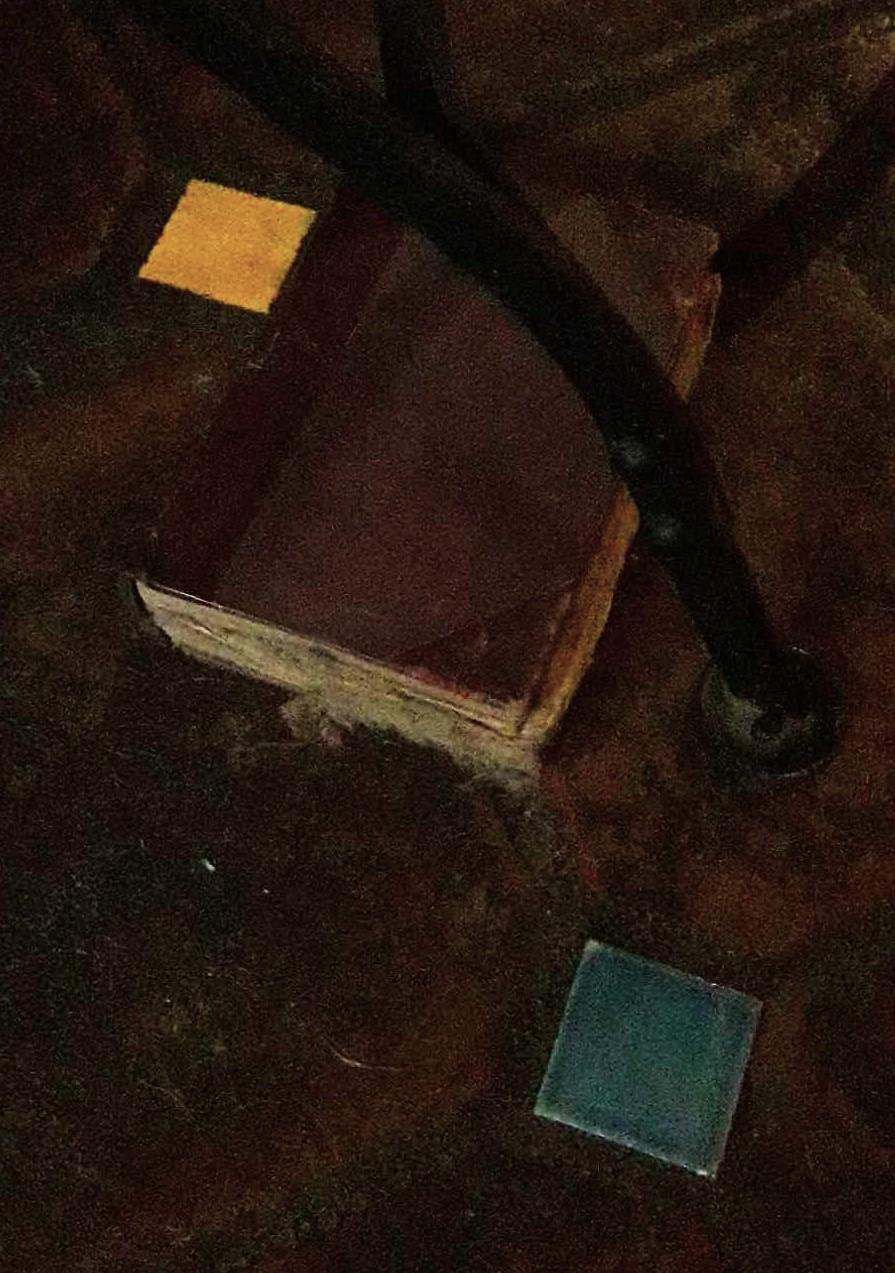
The mysterious Mr Minn. Where had she heard that before?
August 28, 2024 at 1:31 pm #7549In reply to: The Elusive Samuel Housley and Other Family Stories
The Tailor of Haddon
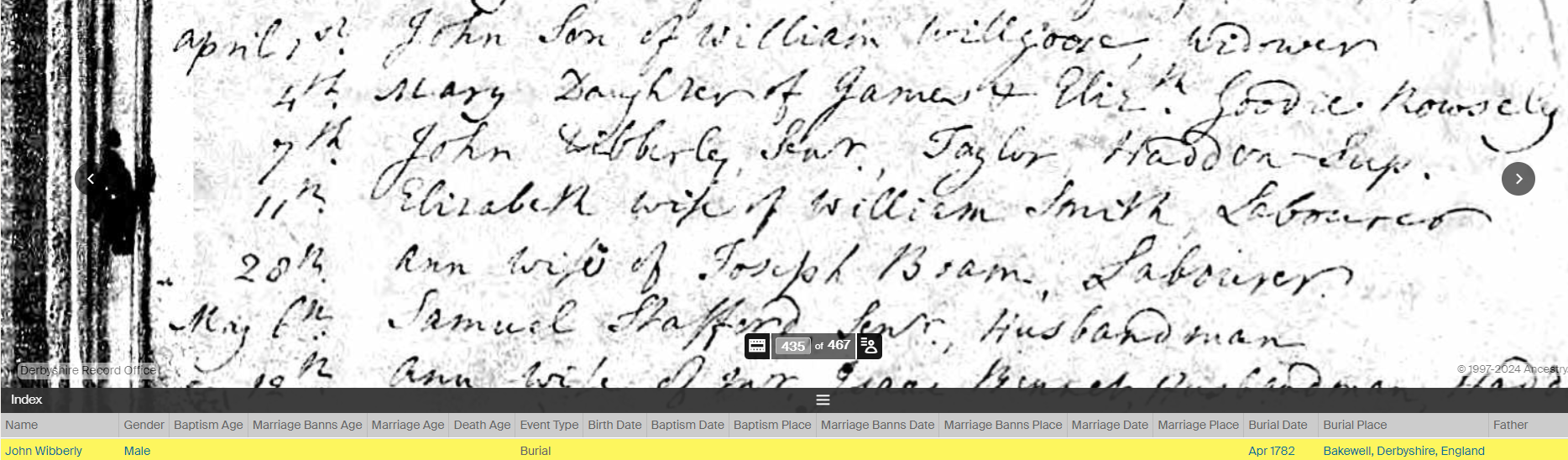
Wibberly and Newton of Over HaddonIt was noted in the Bakewell parish register in 1782 that John Wibberly 1705?-1782 (my 6x great grandfather) was “taylor of Haddon”.
James Marshall 1767-1848 (my 4x great grandfather), parish clerk of Elton, married Ann Newton 1770-1806 in Elton in 1792. In the Bakewell parish register, Ann was baptised on the 2rd of June 1770, her parents George and Dorothy Newton of Upper Haddon. The Bakewell registers at the time covered several smaller villages in the area, although what is currently known as Over Haddon was referred to as Upper Haddon in the earlier entries.
Newton:
George Newton 1728-1798 was the son of George Newton 1706- of Upper Haddon and Jane Sailes, who were married in 1727, both of Upper Haddon.
George Newton born in 1706 was the son of George Newton 1676- and Anne Carr, who were married in 1701, both of Upper Haddon.
George Newton born in 1676 was the son of John Newton 1647- and Alice who were married in 1673 in Bakewell. There is no last name for Alice on the marriage transcription.
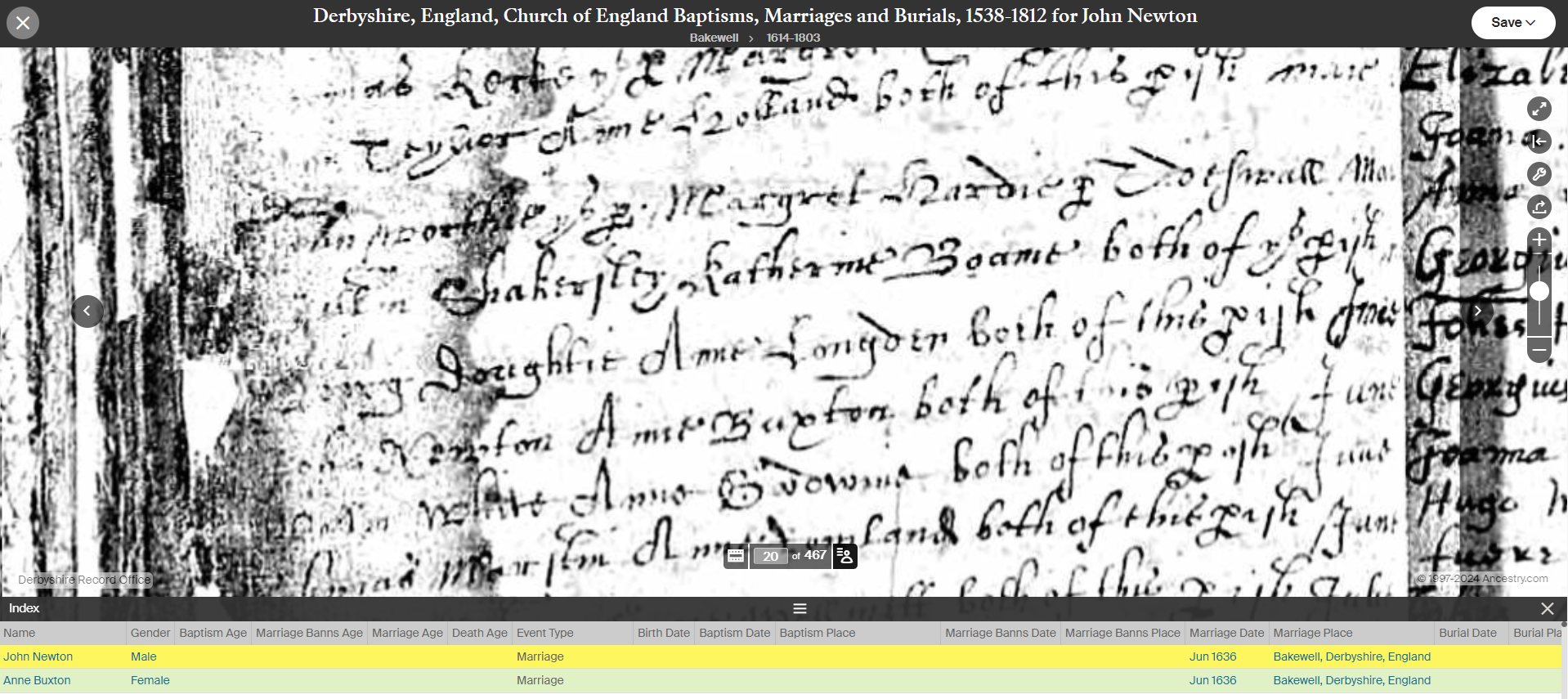
John Newton born in 1647 (my 9x great grandfather) was the son of John Newton and Anne Buxton (my 10x great grandparents), who were married in Bakewell in 1636.
1636 marriage of John Newton and Anne Buxton:
Wibberly
Dorothy Wibberly 1731-1827 married George Newton in 1755 in Bakewell. The entry in the parish registers says that they were both of Over Haddon. Dorothy was baptised in Bakewell on the 25th June 1731, her parents were John and Mary of Over Haddon.

John Wibberly and Mary his wife baptised nine children in Bakewell between 1730 and 1750, and on all of the entries in the parish registers it is stated that they were from Over Haddon. A parish register entry for John and Mary’s marriage has not yet been found, but a marriage in Beeley, a tiny nearby village, in 1728 to Mary Mellor looks likely.
John Wibberly died in Over Haddon in 1782. The entry in the Bakewell parish register notes that he was “taylor of Haddon”.
The tiny village of Over Haddon was historically associated with Haddon Hall.
A baptism for John Wibberly has not yet been found, however, there were Wibersley’s in the Bakewell registers from the early 1600s:
1619 Joyce Wibersley married Raphe Cowper.
1621 Jocosa Wibersley married Radulphus Cowper
1623 Agnes Wibersley married Richard Palfreyman
1635 Cisley Wibberlsy married ? Mr. Mason
1653 John Wibbersly married Grace DaykenHaddon Hall
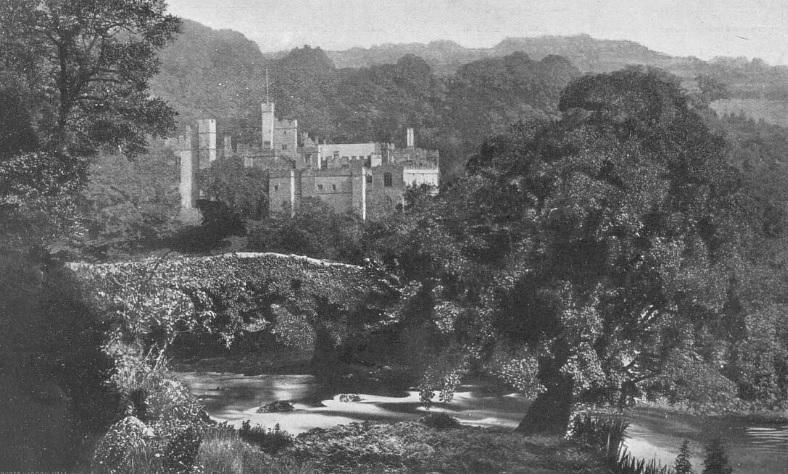
Sir Richard Vernon (c. 1390 – 1451) of Haddon Hall.
Vernon’s property was widespread and varied. From his parents he inherited the manors of Marple and Wibersley, in Cheshire. Perhaps the Over Haddon Wibersley’s origins were from Sir Richard Vernon’s property in Cheshire. There is, however, a medieval wayside cross called Whibbersley Cross situated on Leash Fen in the East Moors of the Derbyshire Peak District. It may have served as a boundary cross marking the estate of Beauchief Abbey. Wayside crosses such as this mostly date from the 9th to 15th centuries.Found in both The History and Antiquities of Haddon Hall by S Raynor, 1836, and the 1663 household accounts published by Lysons, Haddon Hall had 140 domestic staff.
In the book Haddon Hall, an Illustrated Guide, 1871, an example from the 1663 Christmas accounts:
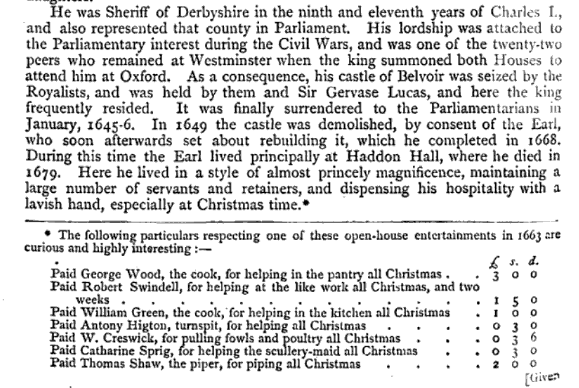
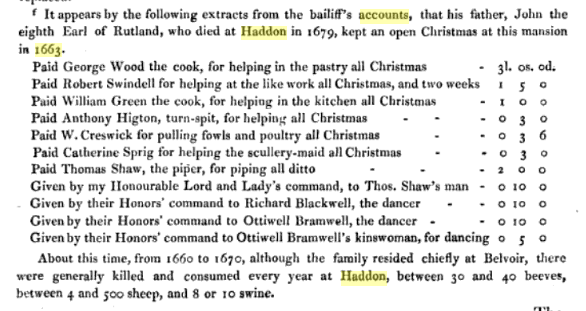
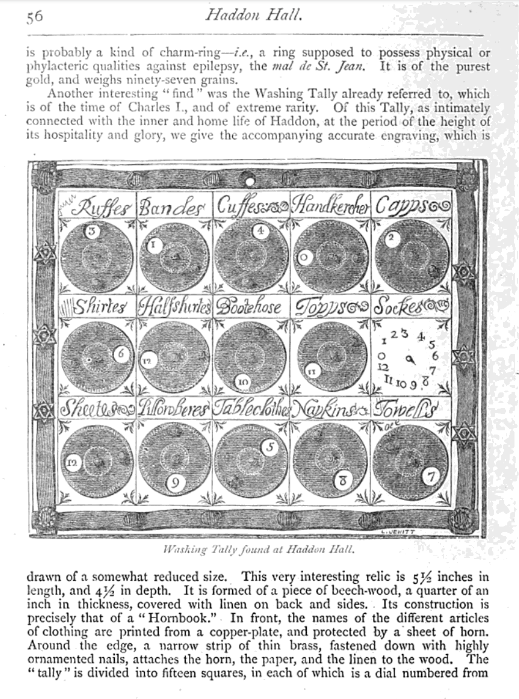
Also in this book, an early 1600s “washing tally” from Haddon Hall:
Over Haddon
Martha Taylor, “the fasting damsel”, was born in Over Haddon in 1649. She didn’t eat for almost two years before her death in 1684. One of the Quakers associated with the Marshall Quakers of Elton, John Gratton, visited the fasting damsel while he was living at Monyash, and occasionally “went two miles to see a woman at Over Haddon who pretended to live without meat.” from The Reliquary, 1861.
- Lucien
-
AuthorSearch Results