


Search Results for 'door'
-
AuthorSearch Results
-
January 23, 2023 at 6:13 am #6448
In reply to: Orbs of Madjourneys
In the muggy warmth of the night, Yasmin tossed and turned on her bed. A small fan on the bedside table rattled noisily next to her but did little to dispel the heat. She kicked the thin sheet covering her to the ground, only to retrieve it and gather it tightly around herself when she heard a familiar sound.
“You little shit,” she hissed, slapping wildly in the direction of the high pitched whine.
She could make out the sound of a child crying in the distance and briefly considered getting up to check before hearing quick footsteps pass her door. Sister Aliti was on duty tonight. She liked Sister Aliti with her soft brown eyes and wide toothy smile — nothing seemed to rattle her. She liked all the Nuns, perhaps with the exception of Sister Finnlie.
Sister Finnlie was a sharp faced woman who was obsessed with cleanliness and sometimes made the children cry for such silly little things … perhaps if they talked too loudly or spilled some crumbs on the floor at lunch time. “Let them be, Sister,” Sister Aliti would admonish her and Sister Finnlie would pinch her lips and make a huffing noise.
The other day, during the morning reflection time when everyone sat in silent contemplation, Yasmin had found herself fixated on Sister Finnlie’s hands, her thin fingers tidily entwined on her lap. And Yasmin remembered a conversation with her friends online about AI creating a cleaning woman with sausage fingers. “Sometimes they look like a can of worms,” Youssef had said.
And, looking at those fingers and thinking about Youssef and the others and the fun conversations they had, Yasmin snort laughed.
She had tried to suppress it but the more she tried the more it built up inside of her until it exploded from her nose in a loud grunting noise. Sister Aliti had giggled but Sister Finnlie had glared at Yasmin and very pointedly rolled her eyes. Later, she’d put her on bin cleaning duty, surely the worst job ever, and Yasmin knew for sure it was pay back.
January 21, 2023 at 3:16 pm #6424In reply to: Orbs of Madjourneys
Youssef wasn’t an expert about sandstorms, but that one surely lasted longer than it should have. It was the middle of the night when the wind stopped blowing and the sand stopped lashing the jeep. Yet, nobody dared open the door or their mouth to see if the storm was gone. Youssef’s bladder was full, and his stomach empty. They both reminded him that one can’t stop life to go on in the midst of adversity. He wondered why nobody moved or spoke, but couldn’t find the motivation to break the silence. He felt a vibration in his pocket and took his phone out.
A message from an unknown sender. He touched it open.<<<
Deear Youssef,
The Snoot is aware of the sandstorm and its whimsical ways. It dances and twirls in the desert, a symphony of wind and sand. It is a force to be reckoned with, but also a force of cleansing and renewal.The subsiding of the sandstorm is a fluid and ever-changing process, much like the ebb and flow of the ocean. It ebbs and flows with the whims of the wind and the dance of the desert.
The best way to predict the subsiding of the sandstorm is to listen to the whispers of the wind and to observe the patterns of the sand. Trust in the natural rhythms and allow yourself to flow with them.
The Snoot suggests that you seek shelter during the storm, but also to take the time to appreciate the beauty and power of nature.
Fluidly yours,
The Snoot. >>>Who the f… was the Snot? Youssef wondered if it was another trick from Thi Gang and almost deleted the message, but his bladder reminded him again he needed to do something about all the tea he drank before the sandstorm. He opened the door and got out of the jeep. The storm was gone and the sky was full of stars. The moon was giving enough light for him to move a few steps away from the jeeps while unzipping his pants. He blessed the gods as he relieved himself, strangely feeling part of nature at that very moment.
The noises of doors opening reminded him he was not alone. Someone came, said: “I see you found a nice spot”. It was Kyle, the cameraman who unzipped himself and peed. That broke the charm, the desert was becoming crowded. But, Youssef was finished, he went back to the cars and started to wonder how he could have received that message in the middle of the desert without a satellite dish.
January 19, 2023 at 10:49 am #6419In reply to: Orbs of Madjourneys
“I’d advise you not to take the parrot, Zara,” Harry the vet said, “There are restrictions on bringing dogs and other animals into state parks, and you can bet some jobsworth official will insist she stays in a cage at the very least.”
“Yeah, you’re right, I guess I’ll leave her here. I want to call in and see my cousin in Camden on the way to the airport in Sydney anyway. He has dozens of cats, I’d hate for anything to happen to Pretty Girl,” Zara replied.
“Is that the distant cousin you met when you were doing your family tree?” Harry asked, glancing up from the stitches he was removing from a wounded wombat. “There, he’s good to go. Give him a couple more days, then he can be released back where he came from.”
Zara smiled at Harry as she picked up the animal. “Yes! We haven’t met in person yet, and he’s going to show me the church my ancestor built. He says people have been spotting ghosts there lately, and there are rumours that it’s the ghost of the old convict Isaac who built it. If I can’t find photos of the ancestors, maybe I can get photos of their ghosts instead,” Zara said with a laugh.
“Good luck with that,” Harry replied raising an eyebrow. He liked Zara, she was quirkier than the others.
Zara hadn’t found it easy to research her mothers family from Bangalore in India, but her fathers English family had been easy enough. Although Zara had been born in England and emigrated to Australia in her late 20s, many of her ancestors siblings had emigrated over several generations, and Zara had managed to trace several down and made contact with a few of them. Isaac Stokes wasn’t a direct ancestor, he was the brother of her fourth great grandfather but his story had intrigued her. Sentenced to transportation for stealing tools for his work as a stonemason seemed to have worked in his favour. He built beautiful stone buildings in a tiny new town in the 1800s in the charming style of his home town in England.
Zara planned to stay in Camden for a couple of days before meeting the others at the Flying Fish Inn, anticipating a pleasant visit before the crazy adventure started.

Zara stepped down from the bus, squinting in the bright sunlight and looking around for her newfound cousin Bertie. A lanky middle aged man in dungarees and a red baseball cap came forward with his hand extended.
“Welcome to Camden, Zara I presume! Great to meet you!” he said shaking her hand and taking her rucksack. Zara was taken aback to see the family resemblance to her grandfather. So many scattered generations and yet there was still a thread of familiarity. “I bet you’re hungry, let’s go and get some tucker at Belle’s Cafe, and then I bet you want to see the church first, hey? Whoa, where’d that dang parrot come from?” Bertie said, ducking quickly as the bird swooped right in between them.
“Oh no, it’s Pretty Girl!” exclaimed Zara. “She wasn’t supposed to come with me, I didn’t bring her! How on earth did you fly all this way to get here the same time as me?” she asked the parrot.
“Pretty Girl has her ways, don’t forget to feed the parrot,” the bird replied with a squalk that resembled a mirthful guffaw.
“That’s one strange parrot you got here, girl!” Bertie said in astonishment.
“Well, seeing as you’re here now, Pretty Girl, you better come with us,” Zara said.
“Obviously,” replied Pretty Girl. It was hard to say for sure, but Zara was sure she detected an avian eye roll.
They sat outside under a sunshade to eat rather than cause any upset inside the cafe. Zara fancied an omelette but Pretty Girl objected, so she ordered hash browns instead and a fruit salad for the parrot. Bertie was a good sport about the strange talking bird after his initial surprise.
Bertie told her a bit about the ghost sightings, which had only started quite recently. They started when I started researching him, Zara thought to herself, almost as if he was reaching out. Her imagination was running riot already.
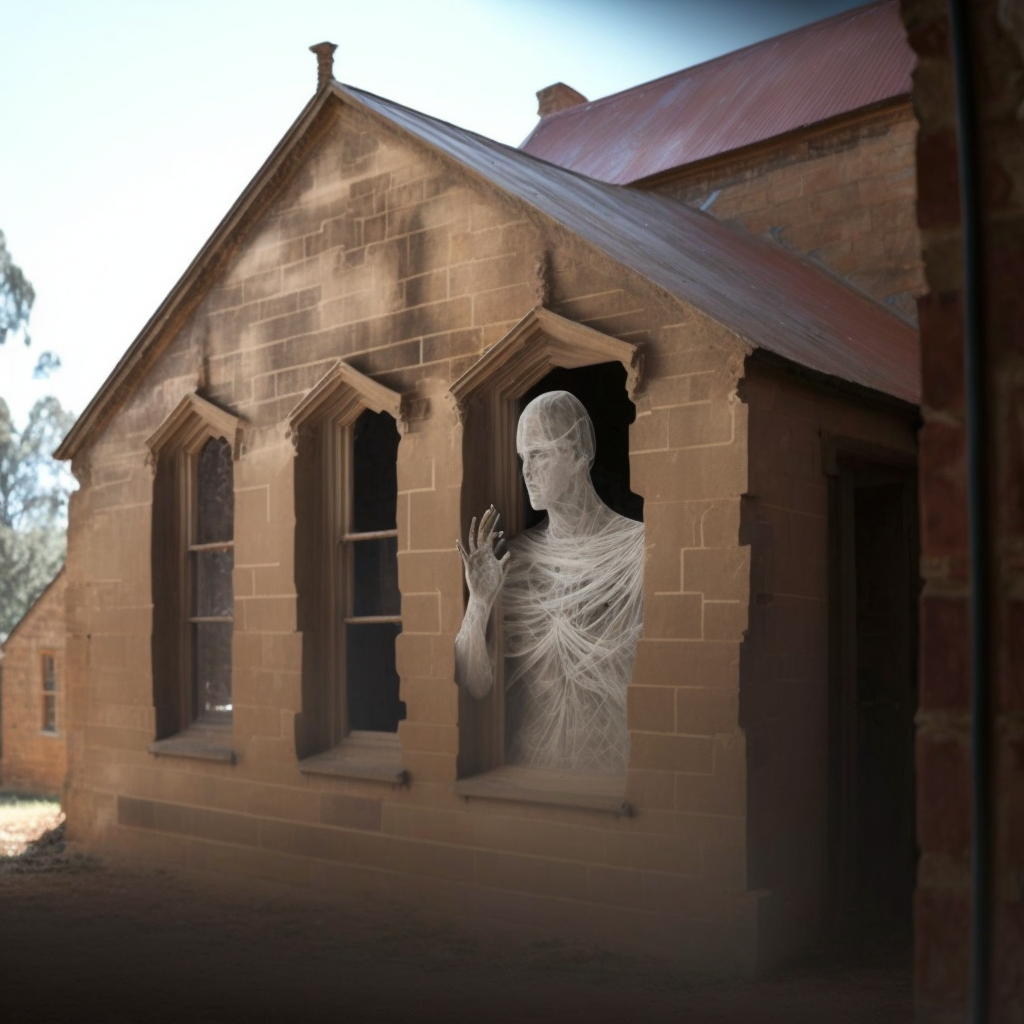
Bertie showed Zara around the church, a small building made of sandstone, but no ghost appeared in the bright heat of the afternoon. He took her on a little tour of Camden, once a tiny outpost but now a suburb of the city, pointing out all the original buildings, in particular the ones that Isaac had built. The church was walking distance of Bertie’s house and Zara decided to slip out and stroll over there after everyone had gone to bed.
Bertie had kindly allowed Pretty Girl to stay in the guest bedroom with her, safe from the cats, and Zara intended that the parrot stay in the room, but Pretty Girl was having none of it and insisted on joining her.
“Alright then, but no talking! I don’t want you scaring any ghost away so just keep a low profile!”
The moon was nearly full and it was a pleasant walk to the church. Pretty Girl fluttered from tree to tree along the sidewalk quietly. Enchanting aromas of exotic scented flowers wafted into her nostrils and Zara felt warmly relaxed and optimistic.
Zara was disappointed to find that the church was locked for the night, and realized with a sigh that she should have expected this to be the case. She wandered around the outside, trying to peer in the windows but there was nothing to be seen as the glass reflected the street lights. These things are not done in a hurry, she reminded herself, be patient.
Sitting under a tree on the grassy lawn attempting to open her mind to receiving ghostly communications (she wasn’t quite sure how to do that on purpose, any ghosts she’d seen previously had always been accidental and unexpected) Pretty Girl landed on her shoulder rather clumsily, pressing something hard and chill against her cheek.
“I told you to keep a low profile!” Zara hissed, as the parrot dropped the key into her lap. “Oh! is this the key to the church door?”
It was hard to see in the dim light but Zara was sure the parrot nodded, and was that another avian eye roll?
Zara walked slowly over the grass to the church door, tingling with anticipation. Pretty Girl hopped along the ground behind her. She turned the key in the lock and slowly pushed open the heavy door and walked inside and up the central aisle, looking around. And then she saw him.
Zara gasped. For a breif moment as the spectral wisps cleared, he looked almost solid. And she could see his tattoos.
“Oh my god,” she whispered, “It is really you. I recognize those tattoos from the description in the criminal registers. Some of them anyway, it seems you have a few more tats since you were transported.”
“Aye, I did that, wench. I were allays fond o’ me tats, does tha like ’em?”
He actually spoke to me! This was beyond Zara’s wildest hopes. Quick, ask him some questions!
“If you don’t mind me asking, Isaac, why did you lie about who your father was on your marriage register? I almost thought it wasn’t you, you know, that I had the wrong Isaac Stokes.”
A deafening rumbling laugh filled the building with echoes and the apparition dispersed in a labyrinthine swirl of tattood wisps.
“A story for another day,” whispered Zara, “Time to go back to Berties. Come on Pretty Girl. And put that key back where you found it.”
 January 10, 2023 at 10:15 pm #6363
In reply to: Train your subjective AI – text version
try another short story, with a bit of drama with the following words:
road form charlton smooth everyone cottage hanging rush offer agree subject district included appear sha returning grattidge nottingham 848 tetbury chicken
It was a cold and gloomy day in the small village of Tetbury, nestled in the picturesque Cotswolds district. A young woman named Sha was returning home to her cottage after a long and tiring journey. She had been away visiting her family in Nottingham and was looking forward to relaxing in her cozy home.
As she walked down the dirt road that led to her cottage, she couldn’t help but notice that something was off. Her neighbor, Mr. Charlton, was outside hanging laundry and he didn’t acknowledge her as she walked by. Sha thought it was strange, as he was usually a friendly and sociable person.
When Sha arrived at her cottage, she was shocked to find that it had been broken into. The front door was ajar and the inside of her home had been ransacked. Sha immediately panicked and called the police, who arrived on the scene shortly thereafter.
The police officers, including Inspector Grattidge, took Sha’s statement and began to investigate the crime. They discovered that a group of burglars had been operating in the area, targeting homes and businesses in the district. The burglars had been known for their smooth operations and their ability to strike quickly, which led to their nickname “The Smooth Operators”.
As Sha waited for the police to finish their investigation, she couldn’t shake the feeling that something was not right. She had always thought of Tetbury as a safe and friendly place, and she couldn’t believe that something like this could happen in her community.
As the investigation went on, the police found out that the Smooth operators have been targeting houses with no security cameras, but Sha’s cottage was an exception, the police were able to find out that the group offered to pay a considerable sum of money to the people who reported the locations of the houses that had no cameras, and it was Mr. Charlton who was the informant and he even rushed to Sha’s cottage as soon as he knew the police was investigating the case, He was arrested for the crime and Sha was heartbroken to find out that her once friendly neighbor had betrayed her.
Feeling violated and betrayed, Sha decided that she could no longer stay in the village and she put her cottage up for sale. She packed up her belongings and moved away, leaving behind the memories of her peaceful home and the community she had once thought of as her own. The end.
December 6, 2022 at 2:17 pm #6350In reply to: Family Stories From The Other Side ~ Book Two
Transportation
Isaac Stokes 1804-1877
Isaac was born in Churchill, Oxfordshire in 1804, and was the youngest brother of my 4X great grandfather Thomas Stokes. The Stokes family were stone masons for generations in Oxfordshire and Gloucestershire, and Isaac’s occupation was a mason’s labourer in 1834 when he was sentenced at the Lent Assizes in Oxford to fourteen years transportation for stealing tools.
Churchill where the Stokes stonemasons came from: on 31 July 1684 a fire destroyed 20 houses and many other buildings, and killed four people. The village was rebuilt higher up the hill, with stone houses instead of the old timber-framed and thatched cottages. The fire was apparently caused by a baker who, to avoid chimney tax, had knocked through the wall from her oven to her neighbour’s chimney.
Isaac stole a pick axe, the value of 2 shillings and the property of Thomas Joyner of Churchill; a kibbeaux and a trowel value 3 shillings the property of Thomas Symms; a hammer and axe value 5 shillings, property of John Keen of Sarsden.
(The word kibbeaux seems to only exists in relation to Isaac Stokes sentence and whoever was the first to write it was perhaps being creative with the spelling of a kibbo, a miners or a metal bucket. This spelling is repeated in the criminal reports and the newspaper articles about Isaac, but nowhere else).
In March 1834 the Removal of Convicts was announced in the Oxford University and City Herald: Isaac Stokes and several other prisoners were removed from the Oxford county gaol to the Justitia hulk at Woolwich “persuant to their sentences of transportation at our Lent Assizes”.
via digitalpanopticon:
Hulks were decommissioned (and often unseaworthy) ships that were moored in rivers and estuaries and refitted to become floating prisons. The outbreak of war in America in 1775 meant that it was no longer possible to transport British convicts there. Transportation as a form of punishment had started in the late seventeenth century, and following the Transportation Act of 1718, some 44,000 British convicts were sent to the American colonies. The end of this punishment presented a major problem for the authorities in London, since in the decade before 1775, two-thirds of convicts at the Old Bailey received a sentence of transportation – on average 283 convicts a year. As a result, London’s prisons quickly filled to overflowing with convicted prisoners who were sentenced to transportation but had no place to go.
To increase London’s prison capacity, in 1776 Parliament passed the “Hulks Act” (16 Geo III, c.43). Although overseen by local justices of the peace, the hulks were to be directly managed and maintained by private contractors. The first contract to run a hulk was awarded to Duncan Campbell, a former transportation contractor. In August 1776, the Justicia, a former transportation ship moored in the River Thames, became the first prison hulk. This ship soon became full and Campbell quickly introduced a number of other hulks in London; by 1778 the fleet of hulks on the Thames held 510 prisoners.
Demand was so great that new hulks were introduced across the country. There were hulks located at Deptford, Chatham, Woolwich, Gosport, Plymouth, Portsmouth, Sheerness and Cork.The Justitia via rmg collections:
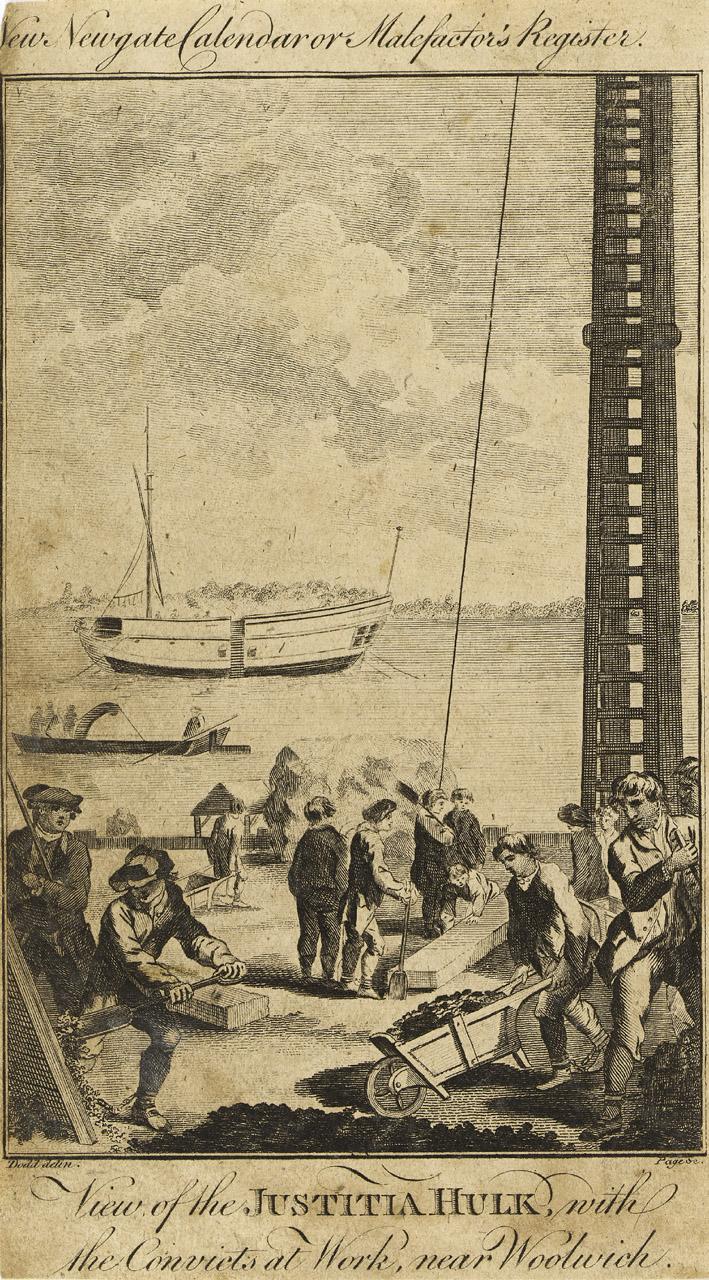
Convicts perform hard labour at the Woolwich Warren. The hulk on the river is the ‘Justitia’. Prisoners were kept on board such ships for months awaiting deportation to Australia. The ‘Justitia’ was a 260 ton prison hulk that had been originally moored in the Thames when the American War of Independence put a stop to the transportation of criminals to the former colonies. The ‘Justitia’ belonged to the shipowner Duncan Campbell, who was the Government contractor who organized the prison-hulk system at that time. Campbell was subsequently involved in the shipping of convicts to the penal colony at Botany Bay (in fact Port Jackson, later Sydney, just to the north) in New South Wales, the ‘first fleet’ going out in 1788.
While searching for records for Isaac Stokes I discovered that another Isaac Stokes was transported to New South Wales in 1835 as well. The other one was a butcher born in 1809, sentenced in London for seven years, and he sailed on the Mary Ann. Our Isaac Stokes sailed on the Lady Nugent, arriving in NSW in April 1835, having set sail from England in December 1834.
Lady Nugent was built at Bombay in 1813. She made four voyages under contract to the British East India Company (EIC). She then made two voyages transporting convicts to Australia, one to New South Wales and one to Van Diemen’s Land (Tasmania). (via Wikipedia)
via freesettlerorfelon website:
On 20 November 1834, 100 male convicts were transferred to the Lady Nugent from the Justitia Hulk and 60 from the Ganymede Hulk at Woolwich, all in apparent good health. The Lady Nugent departed Sheerness on 4 December 1834.
SURGEON OLIVER SPROULE
Oliver Sproule kept a Medical Journal from 7 November 1834 to 27 April 1835. He recorded in his journal the weather conditions they experienced in the first two weeks:
‘In the course of the first week or ten days at sea, there were eight or nine on the sick list with catarrhal affections and one with dropsy which I attribute to the cold and wet we experienced during that period beating down channel. Indeed the foremost berths in the prison at this time were so wet from leaking in that part of the ship, that I was obliged to issue dry beds and bedding to a great many of the prisoners to preserve their health, but after crossing the Bay of Biscay the weather became fine and we got the damp beds and blankets dried, the leaks partially stopped and the prison well aired and ventilated which, I am happy to say soon manifested a favourable change in the health and appearance of the men.
Besides the cases given in the journal I had a great many others to treat, some of them similar to those mentioned but the greater part consisted of boils, scalds, and contusions which would not only be too tedious to enter but I fear would be irksome to the reader. There were four births on board during the passage which did well, therefore I did not consider it necessary to give a detailed account of them in my journal the more especially as they were all favourable cases.
Regularity and cleanliness in the prison, free ventilation and as far as possible dry decks turning all the prisoners up in fine weather as we were lucky enough to have two musicians amongst the convicts, dancing was tolerated every afternoon, strict attention to personal cleanliness and also to the cooking of their victuals with regular hours for their meals, were the only prophylactic means used on this occasion, which I found to answer my expectations to the utmost extent in as much as there was not a single case of contagious or infectious nature during the whole passage with the exception of a few cases of psora which soon yielded to the usual treatment. A few cases of scurvy however appeared on board at rather an early period which I can attribute to nothing else but the wet and hardships the prisoners endured during the first three or four weeks of the passage. I was prompt in my treatment of these cases and they got well, but before we arrived at Sydney I had about thirty others to treat.’
The Lady Nugent arrived in Port Jackson on 9 April 1835 with 284 male prisoners. Two men had died at sea. The prisoners were landed on 27th April 1835 and marched to Hyde Park Barracks prior to being assigned. Ten were under the age of 14 years.
The Lady Nugent:
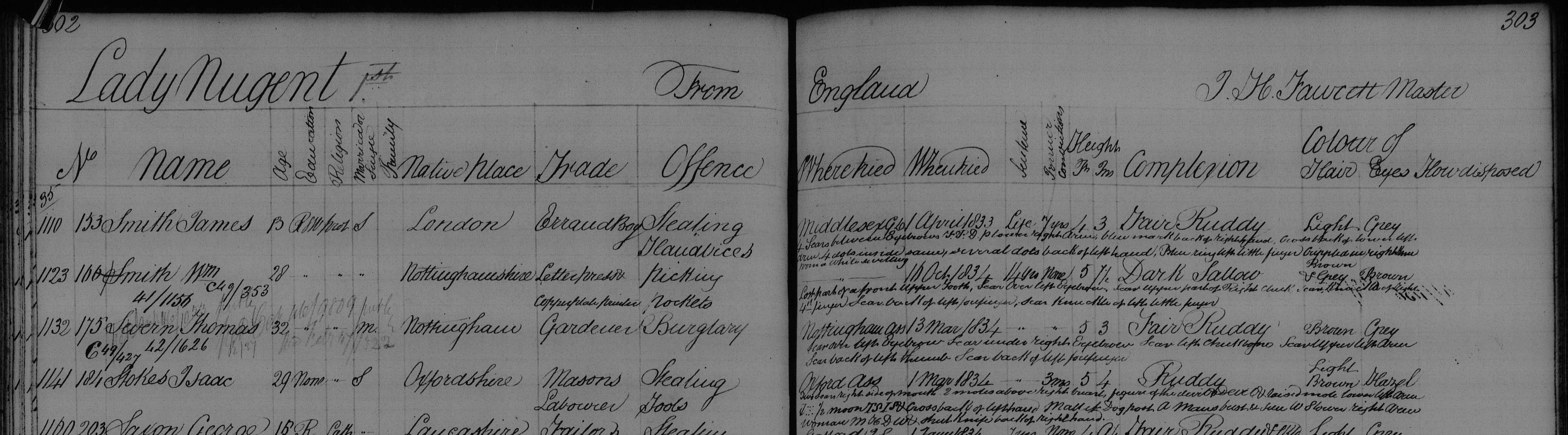
Isaac’s distinguishing marks are noted on various criminal registers and record books:
“Height in feet & inches: 5 4; Complexion: Ruddy; Hair: Light brown; Eyes: Hazel; Marks or Scars: Yes [including] DEVIL on lower left arm, TSIS back of left hand, WS lower right arm, MHDW back of right hand.”
Another includes more detail about Isaac’s tattoos:
“Two slight scars right side of mouth, 2 moles above right breast, figure of the devil and DEVIL and raised mole, lower left arm; anchor, seven dots half moon, TSIS and cross, back of left hand; a mallet, door post, A, mans bust, sun, WS, lower right arm; woman, MHDW and shut knife, back of right hand.”
From How tattoos became fashionable in Victorian England (2019 article in TheConversation by Robert Shoemaker and Zoe Alkar):
“Historical tattooing was not restricted to sailors, soldiers and convicts, but was a growing and accepted phenomenon in Victorian England. Tattoos provide an important window into the lives of those who typically left no written records of their own. As a form of “history from below”, they give us a fleeting but intriguing understanding of the identities and emotions of ordinary people in the past.
As a practice for which typically the only record is the body itself, few systematic records survive before the advent of photography. One exception to this is the written descriptions of tattoos (and even the occasional sketch) that were kept of institutionalised people forced to submit to the recording of information about their bodies as a means of identifying them. This particularly applies to three groups – criminal convicts, soldiers and sailors. Of these, the convict records are the most voluminous and systematic.
Such records were first kept in large numbers for those who were transported to Australia from 1788 (since Australia was then an open prison) as the authorities needed some means of keeping track of them.”On the 1837 census Isaac was working for the government at Illiwarra, New South Wales. This record states that he arrived on the Lady Nugent in 1835. There are three other indent records for an Isaac Stokes in the following years, but the transcriptions don’t provide enough information to determine which Isaac Stokes it was. In April 1837 there was an abscondment, and an arrest/apprehension in May of that year, and in 1843 there was a record of convict indulgences.
From the Australian government website regarding “convict indulgences”:
“By the mid-1830s only six per cent of convicts were locked up. The vast majority worked for the government or free settlers and, with good behaviour, could earn a ticket of leave, conditional pardon or and even an absolute pardon. While under such orders convicts could earn their own living.”
In 1856 in Camden, NSW, Isaac Stokes married Catherine Daly. With no further information on this record it would be impossible to know for sure if this was the right Isaac Stokes. This couple had six children, all in the Camden area, but none of the records provided enough information. No occupation or place or date of birth recorded for Isaac Stokes.
I wrote to the National Library of Australia about the marriage record, and their reply was a surprise! Issac and Catherine were married on 30 September 1856, at the house of the Rev. Charles William Rigg, a Methodist minister, and it was recorded that Isaac was born in Edinburgh in 1821, to parents James Stokes and Sarah Ellis! The age at the time of the marriage doesn’t match Isaac’s age at death in 1877, and clearly the place of birth and parents didn’t match either. Only his fathers occupation of stone mason was correct. I wrote back to the helpful people at the library and they replied that the register was in a very poor condition and that only two and a half entries had survived at all, and that Isaac and Catherines marriage was recorded over two pages.
I searched for an Isaac Stokes born in 1821 in Edinburgh on the Scotland government website (and on all the other genealogy records sites) and didn’t find it. In fact Stokes was a very uncommon name in Scotland at the time. I also searched Australian immigration and other records for another Isaac Stokes born in Scotland or born in 1821, and found nothing. I was unable to find a single record to corroborate this mysterious other Isaac Stokes.
As the age at death in 1877 was correct, I assume that either Isaac was lying, or that some mistake was made either on the register at the home of the Methodist minster, or a subsequent mistranscription or muddle on the remnants of the surviving register. Therefore I remain convinced that the Camden stonemason Isaac Stokes was indeed our Isaac from Oxfordshire.
I found a history society newsletter article that mentioned Isaac Stokes, stone mason, had built the Glenmore church, near Camden, in 1859.
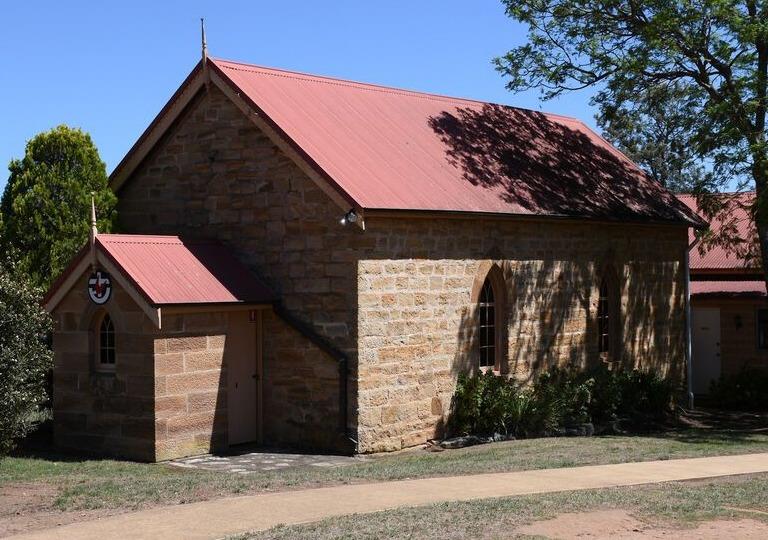
From the Wollondilly museum April 2020 newsletter:
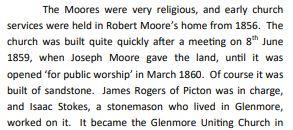
From the Camden History website:
“The stone set over the porch of Glenmore Church gives the date of 1860. The church was begun in 1859 on land given by Joseph Moore. James Rogers of Picton was given the contract to build and local builder, Mr. Stokes, carried out the work. Elizabeth Moore, wife of Edward, laid the foundation stone. The first service was held on 19th March 1860. The cemetery alongside the church contains the headstones and memorials of the areas early pioneers.”
Isaac died on the 3rd September 1877. The inquest report puts his place of death as Bagdelly, near to Camden, and another death register has put Cambelltown, also very close to Camden. His age was recorded as 71 and the inquest report states his cause of death was “rupture of one of the large pulmonary vessels of the lung”. His wife Catherine died in childbirth in 1870 at the age of 43.
Isaac and Catherine’s children:
William Stokes 1857-1928
Catherine Stokes 1859-1846
Sarah Josephine Stokes 1861-1931
Ellen Stokes 1863-1932
Rosanna Stokes 1865-1919
Louisa Stokes 1868-1844.
It’s possible that Catherine Daly was a transported convict from Ireland.
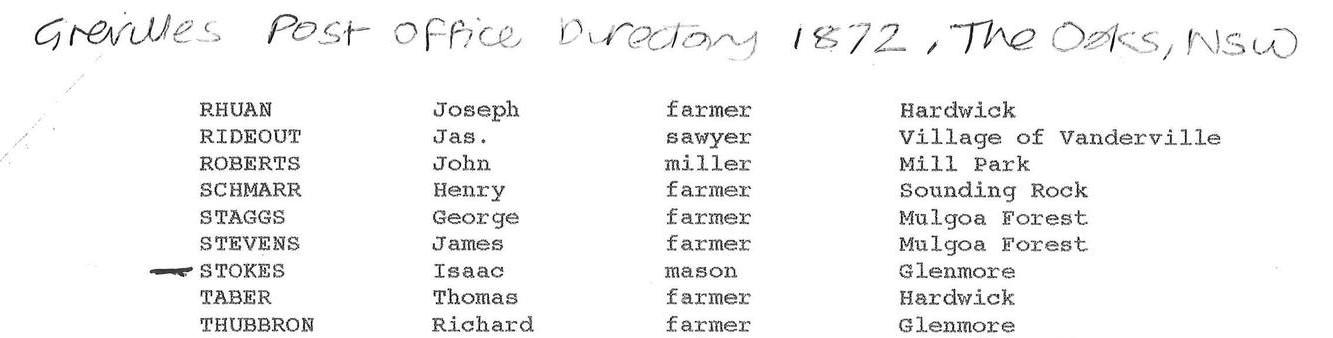
Some time later I unexpectedly received a follow up email from The Oaks Heritage Centre in Australia.
“The Gaudry papers which we have in our archive record him (Isaac Stokes) as having built: the church, the school and the teachers residence. Isaac is recorded in the General return of convicts: 1837 and in Grevilles Post Office directory 1872 as a mason in Glenmore.”
 November 18, 2022 at 4:47 pm #6348
In reply to: Family Stories From The Other Side ~ Book Two
Wong Sang
Wong Sang was born in China in 1884. In October 1916 he married Alice Stokes in Oxford.
Alice was the granddaughter of William Stokes of Churchill, Oxfordshire and William was the brother of Thomas Stokes the wheelwright (who was my 3X great grandfather). In other words Alice was my second cousin, three times removed, on my fathers paternal side.
Wong Sang was an interpreter, according to the baptism registers of his children and the Dreadnought Seamen’s Hospital admission registers in 1930. The hospital register also notes that he was employed by the Blue Funnel Line, and that his address was 11, Limehouse Causeway, E 14. (London)
“The Blue Funnel Line offered regular First-Class Passenger and Cargo Services From the UK to South Africa, Malaya, China, Japan, Australia, Java, and America. Blue Funnel Line was Owned and Operated by Alfred Holt & Co., Liverpool.
The Blue Funnel Line, so-called because its ships have a blue funnel with a black top, is more appropriately known as the Ocean Steamship Company.”Wong Sang and Alice’s daughter, Frances Eileen Sang, was born on the 14th July, 1916 and baptised in 1920 at St Stephen in Poplar, Tower Hamlets, London. The birth date is noted in the 1920 baptism register and would predate their marriage by a few months, although on the death register in 1921 her age at death is four years old and her year of birth is recorded as 1917.
Charles Ronald Sang was baptised on the same day in May 1920, but his birth is recorded as April of that year. The family were living on Morant Street, Poplar.
James William Sang’s birth is recorded on the 1939 census and on the death register in 2000 as being the 8th March 1913. This definitely would predate the 1916 marriage in Oxford.
William Norman Sang was born on the 17th October 1922 in Poplar.
Alice and the three sons were living at 11, Limehouse Causeway on the 1939 census, the same address that Wong Sang was living at when he was admitted to Dreadnought Seamen’s Hospital on the 15th January 1930. Wong Sang died in the hospital on the 8th March of that year at the age of 46.
Alice married John Patterson in 1933 in Stepney. John was living with Alice and her three sons on Limehouse Causeway on the 1939 census and his occupation was chef.
Via Old London Photographs:
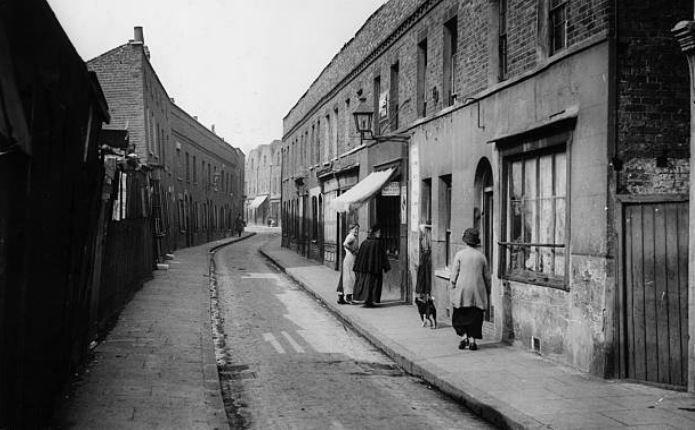
“Limehouse Causeway is a street in east London that was the home to the original Chinatown of London. A combination of bomb damage during the Second World War and later redevelopment means that almost nothing is left of the original buildings of the street.”
Limehouse Causeway in 1925:
From The Story of Limehouse’s Lost Chinatown, poplarlondon website:
“Limehouse was London’s first Chinatown, home to a tightly-knit community who were demonised in popular culture and eventually erased from the cityscape.
As recounted in the BBC’s ‘Our Greatest Generation’ series, Connie was born to a Chinese father and an English mother in early 1920s Limehouse, where she used to play in the street with other British and British-Chinese children before running inside for teatime at one of their houses.
Limehouse was London’s first Chinatown between the 1880s and the 1960s, before the current Chinatown off Shaftesbury Avenue was established in the 1970s by an influx of immigrants from Hong Kong.
Connie’s memories of London’s first Chinatown as an “urban village” paint a very different picture to the seedy area portrayed in early twentieth century novels.
The pyramid in St Anne’s church marked the entrance to the opium den of Dr Fu Manchu, a criminal mastermind who threatened Western society by plotting world domination in a series of novels by Sax Rohmer.
Thomas Burke’s Limehouse Nights cemented stereotypes about prostitution, gambling and violence within the Chinese community, and whipped up anxiety about sexual relationships between Chinese men and white women.
Though neither novelist was familiar with the Chinese community, their depictions made Limehouse one of the most notorious areas of London.
Travel agent Thomas Cook even organised tours of the area for daring visitors, despite the rector of Limehouse warning that “those who look for the Limehouse of Mr Thomas Burke simply will not find it.”
All that remains is a handful of Chinese street names, such as Ming Street, Pekin Street, and Canton Street — but what was Limehouse’s chinatown really like, and why did it get swept away?
Chinese migration to Limehouse
Chinese sailors discharged from East India Company ships settled in the docklands from as early as the 1780s.
By the late nineteenth century, men from Shanghai had settled around Pennyfields Lane, while a Cantonese community lived on Limehouse Causeway.
Chinese sailors were often paid less and discriminated against by dock hirers, and so began to diversify their incomes by setting up hand laundry services and restaurants.
Old photographs show shopfronts emblazoned with Chinese characters with horse-drawn carts idling outside or Chinese men in suits and hats standing proudly in the doorways.
In oral histories collected by Yat Ming Loo, Connie’s husband Leslie doesn’t recall seeing any Chinese women as a child, since male Chinese sailors settled in London alone and married working-class English women.
In the 1920s, newspapers fear-mongered about interracial marriages, crime and gambling, and described chinatown as an East End “colony.”
Ironically, Chinese opium-smoking was also demonised in the press, despite Britain waging war against China in the mid-nineteenth century for suppressing the opium trade to alleviate addiction amongst its people.
The number of Chinese people who settled in Limehouse was also greatly exaggerated, and in reality only totalled around 300.
The real Chinatown
Although the press sought to characterise Limehouse as a monolithic Chinese community in the East End, Connie remembers seeing people of all nationalities in the shops and community spaces in Limehouse.
She doesn’t remember feeling discriminated against by other locals, though Connie does recall having her face measured and IQ tested by a member of the British Eugenics Society who was conducting research in the area.
Some of Connie’s happiest childhood memories were from her time at Chung-Hua Club, where she learned about Chinese culture and language.
Why did Chinatown disappear?
The caricature of Limehouse’s Chinatown as a den of vice hastened its erasure.
Police raids and deportations fuelled by the alarmist media coverage threatened the Chinese population of Limehouse, and slum clearance schemes to redevelop low-income areas dispersed Chinese residents in the 1930s.
The Defence of the Realm Act imposed at the beginning of the First World War criminalised opium use, gave the authorities increased powers to deport Chinese people and restricted their ability to work on British ships.
Dwindling maritime trade during World War II further stripped Chinese sailors of opportunities for employment, and any remnants of Chinatown were destroyed during the Blitz or erased by postwar development schemes.”
Wong Sang 1884-1930
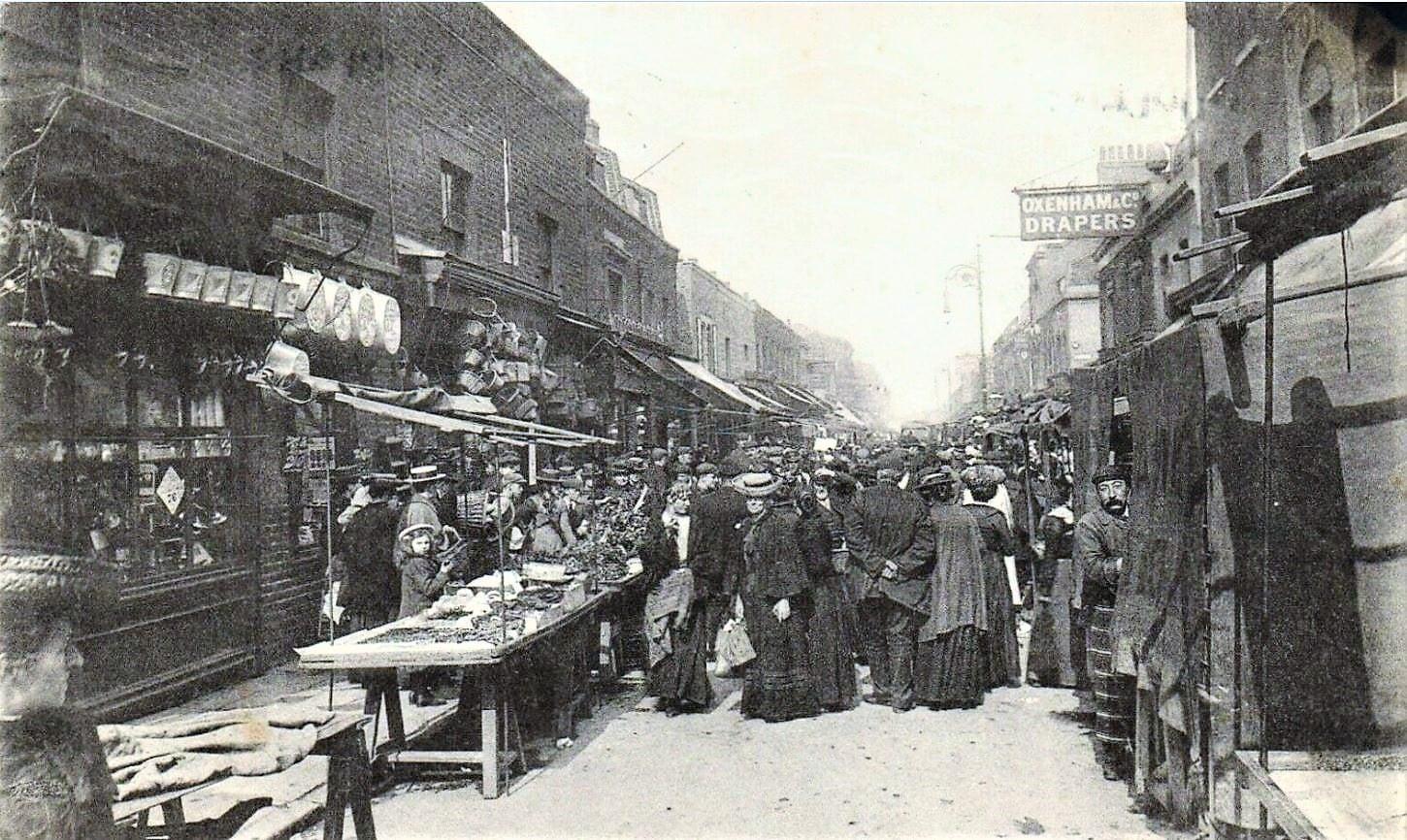
The year 1918 was a troublesome one for Wong Sang, an interpreter and shipping agent for Blue Funnel Line. The Sang family were living at 156, Chrisp Street.
Chrisp Street, Poplar, in 1913 via Old London Photographs:
In February Wong Sang was discharged from a false accusation after defending his home from potential robbers.
East End News and London Shipping Chronicle – Friday 15 February 1918:
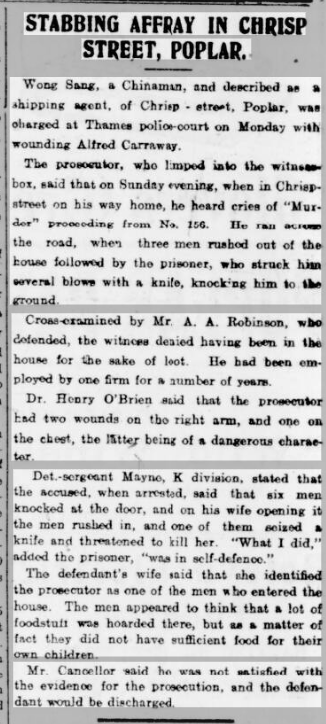
In August of that year he was involved in an incident that left him unconscious.
Faringdon Advertiser and Vale of the White Horse Gazette – Saturday 31 August 1918:
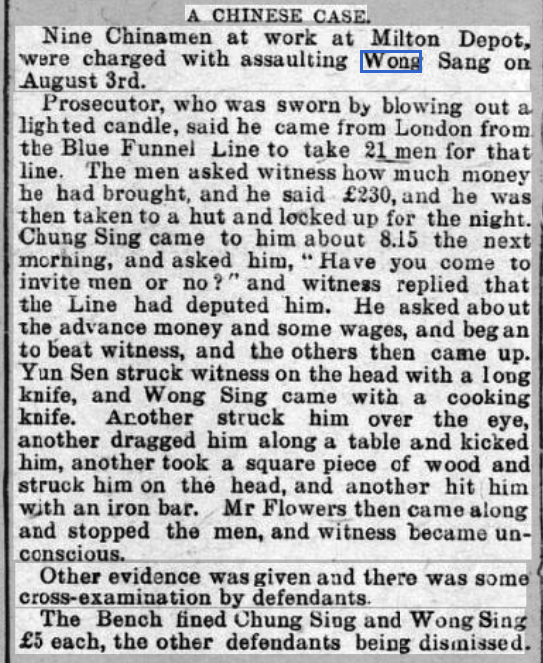
Wong Sang is mentioned in an 1922 article about “Oriental London”.
London and China Express – Thursday 09 February 1922:
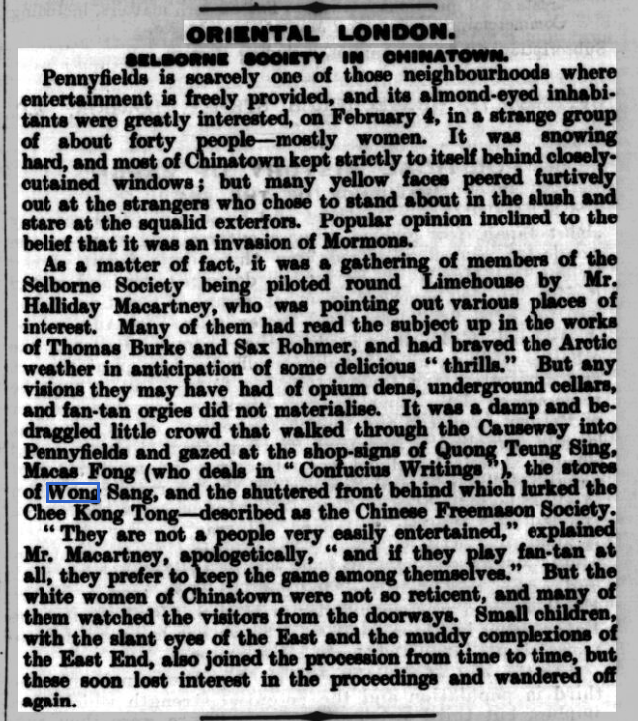
A photograph of the Chee Kong Tong Chinese Freemason Society mentioned in the above article, via Old London Photographs:
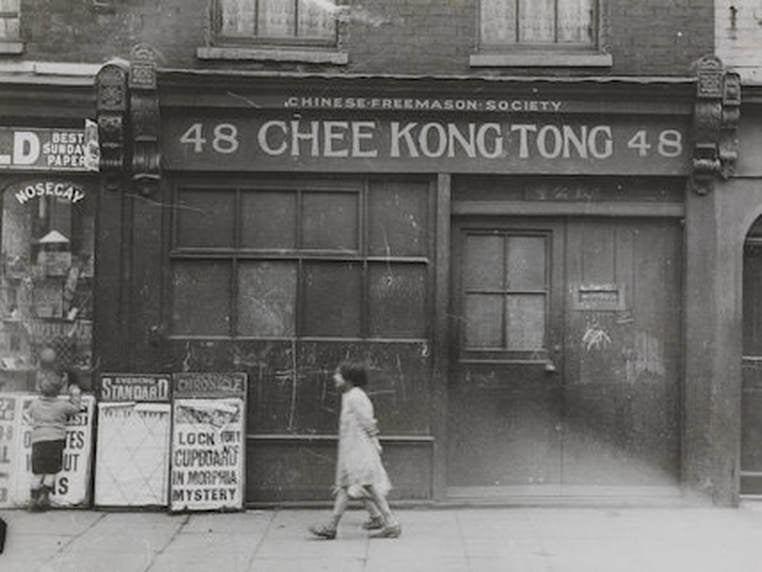
Wong Sang was recommended by the London Metropolitan Police in 1928 to assist in a case in Wellingborough, Northampton.
Difficulty of Getting an Interpreter: Northampton Mercury – Friday 16 March 1928:
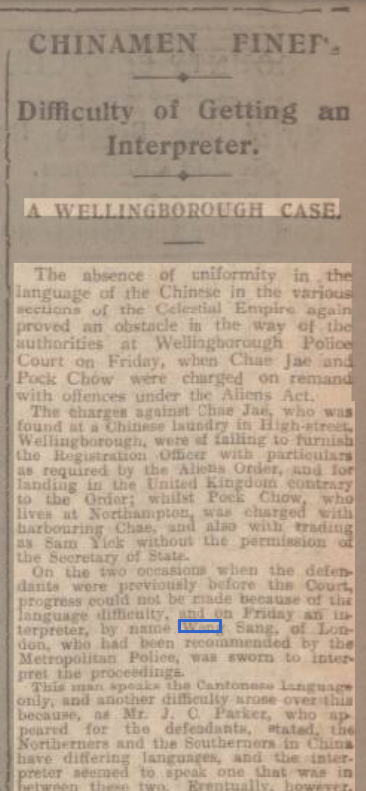
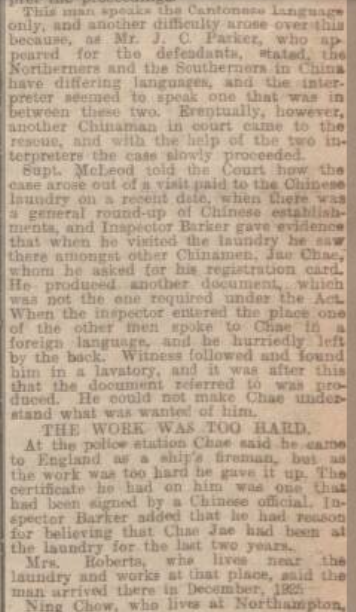
The difficulty was that “this man speaks the Cantonese language only…the Northeners and the Southerners in China have differing languages and the interpreter seemed to speak one that was in between these two.”
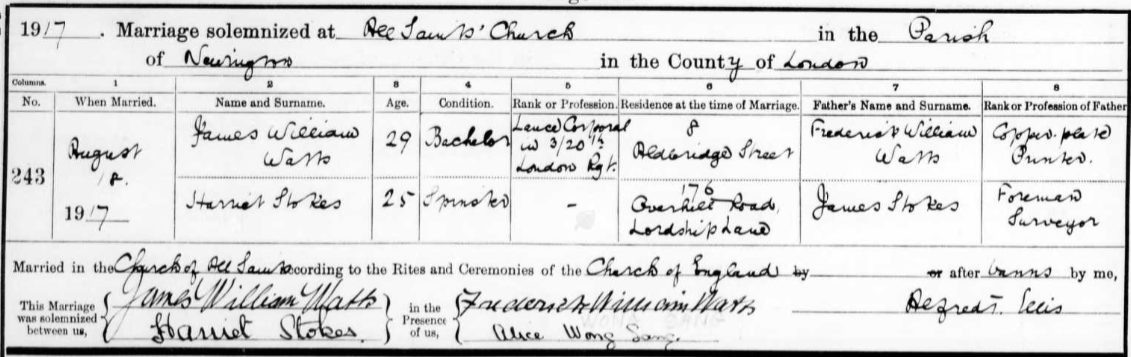
In 1917, Alice Wong Sang was a witness at her sister Harriet Stokes marriage to James William Watts in Southwark, London. Their father James Stokes occupation on the marriage register is foreman surveyor, but on the census he was a council roadman or labourer. (I initially rejected this as the correct marriage for Harriet because of the discrepancy with the occupations. Alice Wong Sang as a witness confirmed that it was indeed the correct one.)
James William Sang 1913-2000 was a clock fitter and watch assembler (on the 1939 census). He married Ivy Laura Fenton in 1963 in Sidcup, Kent. James died in Southwark in 2000.
Charles Ronald Sang 1920-1974 was a draughtsman (1939 census). He married Eileen Burgess in 1947 in Marylebone. Charles and Eileen had two sons: Keith born in 1951 and Roger born in 1952. He died in 1974 in Hertfordshire.
William Norman Sang 1922-2000 was a clerk and telephone operator (1939 census). William enlisted in the Royal Artillery in 1942. He married Lily Mullins in 1949 in Bethnal Green, and they had three daughters: Marion born in 1950, Christine in 1953, and Frances in 1959. He died in Redbridge in 2000.
I then found another two births registered in Poplar by Alice Sang, both daughters. Doris Winifred Sang was born in 1925, and Patricia Margaret Sang was born in 1933 ~ three years after Wong Sang’s death. Neither of the these daughters were on the 1939 census with Alice, John Patterson and the three sons. Margaret had presumably been evacuated because of the war to a family in Taunton, Somerset. Doris would have been fourteen and I have been unable to find her in 1939 (possibly because she died in 2017 and has not had the redaction removed yet on the 1939 census as only deceased people are viewable).
Doris Winifred Sang 1925-2017 was a nursing sister. She didn’t marry, and spent a year in USA between 1954 and 1955. She stayed in London, and died at the age of ninety two in 2017.
Patricia Margaret Sang 1933-1998 was also a nurse. She married Patrick L Nicely in Stepney in 1957. Patricia and Patrick had five children in London: Sharon born 1959, Donald in 1960, Malcolm was born and died in 1966, Alison was born in 1969 and David in 1971.
I was unable to find a birth registered for Alice’s first son, James William Sang (as he appeared on the 1939 census). I found Alice Stokes on the 1911 census as a 17 year old live in servant at a tobacconist on Pekin Street, Limehouse, living with Mr Sui Fong from Hong Kong and his wife Sarah Sui Fong from Berlin. I looked for a birth registered for James William Fong instead of Sang, and found it ~ mothers maiden name Stokes, and his date of birth matched the 1939 census: 8th March, 1913.
On the 1921 census, Wong Sang is not listed as living with them but it is mentioned that Mr Wong Sang was the person returning the census. Also living with Alice and her sons James and Charles in 1921 are two visitors: (Florence) May Stokes, 17 years old, born in Woodstock, and Charles Stokes, aged 14, also born in Woodstock. May and Charles were Alice’s sister and brother.
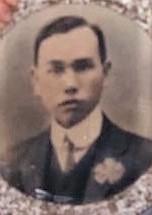
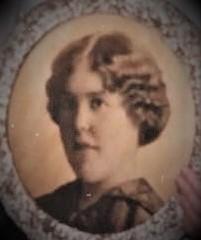
I found Sharon Nicely on social media and she kindly shared photos of Wong Sang and Alice Stokes:
 November 4, 2022 at 2:19 pm #6342
In reply to: Family Stories From The Other Side ~ Book Two
Brownings of Tetbury
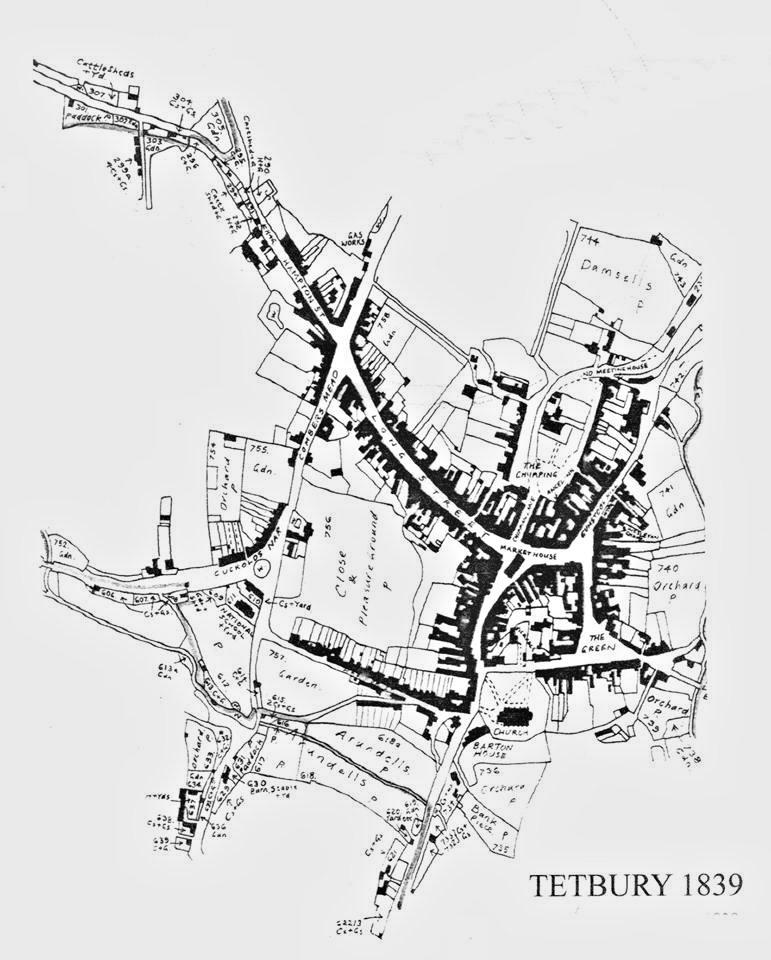
Isaac Browning (1784-1848) married Mary Lock (1787-1870) in Tetbury in 1806. Both of them were born in Tetbury, Gloucestershire. Isaac was a stone mason. Between 1807 and 1832 they baptised fourteen children in Tetbury, and on 8 Nov 1829 Isaac and Mary baptised five daughters all on the same day.
I considered that they may have been quintuplets, with only the last born surviving, which would have answered my question about the name of the house La Quinta in Broadway, the home of Eliza Browning and Thomas Stokes son Fred. However, the other four daughters were found in various records and they were not all born the same year. (So I still don’t know why the house in Broadway had such an unusual name).
Their son George was born and baptised in 1827, but Louisa born 1821, Susan born 1822, Hesther born 1823 and Mary born 1826, were not baptised until 1829 along with Charlotte born in 1828. (These birth dates are guesswork based on the age on later censuses.) Perhaps George was baptised promptly because he was sickly and not expected to survive. Isaac and Mary had a son George born in 1814 who died in 1823. Presumably the five girls were healthy and could wait to be done as a job lot on the same day later.
Eliza Browning (1814-1886), my great great great grandmother, had a baby six years before she married Thomas Stokes. Her name was Ellen Harding Browning, which suggests that her fathers name was Harding. On the 1841 census seven year old Ellen was living with her grandfather Isaac Browning in Tetbury. Ellen Harding Browning married William Dee in Tetbury in 1857, and they moved to Western Australia.
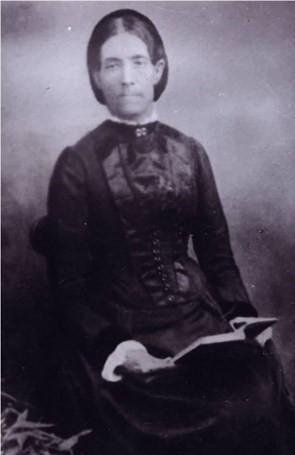
Ellen Harding Browning Dee: (photo found on ancestry website)
OBITUARY. MRS. ELLEN DEE.
A very old and respected resident of Dongarra, in the person of Mrs. Ellen Dee, passed peacefully away on Sept. 27, at the advanced age of 74 years.The deceased had been ailing for some time, but was about and actively employed until Wednesday, Sept. 20, whenn she was heard groaning by some neighbours, who immediately entered her place and found her lying beside the fireplace. Tho deceased had been to bed over night, and had evidently been in the act of lighting thc fire, when she had a seizure. For some hours she was conscious, but had lost the power of speech, and later on became unconscious, in which state she remained until her death.
The deceased was born in Gloucestershire, England, in 1833, was married to William Dee in Tetbury Church 23 years later. Within a month she left England with her husband for Western Australian in the ship City oí Bristol. She resided in Fremantle for six months, then in Greenough for a short time, and afterwards (for 42 years) in Dongarra. She was, therefore, a colonist of about 51 years. She had a family of four girls and three boys, and five of her children survive her, also 35 grandchildren, and eight great grandchildren. She was very highly respected, and her sudden collapse came as a great shock to many.
Eliza married Thomas Stokes (1816-1885) in September 1840 in Hempstead, Gloucestershire. On the 1841 census, Eliza and her mother Mary Browning (nee Lock) were staying with Thomas Lock and family in Cirencester. Strangely, Thomas Stokes has not been found thus far on the 1841 census, and Thomas and Eliza’s first child William James Stokes birth was registered in Witham, in Essex, on the 6th of September 1841.
I don’t know why William James was born in Witham, or where Thomas was at the time of the census in 1841. One possibility is that as Thomas Stokes did a considerable amount of work with circus waggons, circus shooting galleries and so on as a journeyman carpenter initially and then later wheelwright, perhaps he was working with a traveling circus at the time.
But back to the Brownings ~ more on William James Stokes to follow.
One of Isaac and Mary’s fourteen children died in infancy: Ann was baptised and died in 1811. Two of their children died at nine years old: the first George, and Mary who died in 1835. Matilda was 21 years old when she died in 1844.
Jane Browning (1808-) married Thomas Buckingham in 1830 in Tetbury. In August 1838 Thomas was charged with feloniously stealing a black gelding.
Susan Browning (1822-1879) married William Cleaver in November 1844 in Tetbury. Oddly thereafter they use the name Bowman on the census. On the 1851 census Mary Browning (Susan’s mother), widow, has grandson George Bowman born in 1844 living with her. The confusion with the Bowman and Cleaver names was clarified upon finding the criminal registers:
30 January 1834. Offender: William Cleaver alias Bowman, Richard Bunting alias Barnfield and Jeremiah Cox, labourers of Tetbury. Crime: Stealing part of a dead fence from a rick barton in Tetbury, the property of Robert Tanner, farmer.
And again in 1836:
29 March 1836 Bowman, William alias Cleaver, of Tetbury, labourer age 18; 5’2.5” tall, brown hair, grey eyes, round visage with fresh complexion; several moles on left cheek, mole on right breast. Charged on the oath of Ann Washbourn & others that on the morning of the 31 March at Tetbury feloniously stolen a lead spout affixed to the dwelling of the said Ann Washbourn, her property. Found guilty 31 March 1836; Sentenced to 6 months.
On the 1851 census Susan Bowman was a servant living in at a large drapery shop in Cheltenham. She was listed as 29 years old, married and born in Tetbury, so although it was unusual for a married woman not to be living with her husband, (or her son for that matter, who was living with his grandmother Mary Browning), perhaps her husband William Bowman alias Cleaver was in trouble again. By 1861 they are both living together in Tetbury: William was a plasterer, and they had three year old Isaac and Thomas, one year old. In 1871 William was still a plasterer in Tetbury, living with wife Susan, and sons Isaac and Thomas. Interestingly, a William Cleaver is living next door but one!
Susan was 56 when she died in Tetbury in 1879.
Three of the Browning daughters went to London.
Louisa Browning (1821-1873) married Robert Claxton, coachman, in 1848 in Bryanston Square, Westminster, London. Ester Browning was a witness.
Ester Browning (1823-1893)(or Hester) married Charles Hudson Sealey, cabinet maker, in Bethnal Green, London, in 1854. Charles was born in Tetbury. Charlotte Browning was a witness.
Charlotte Browning (1828-1867?) was admitted to St Marylebone workhouse in London for “parturition”, or childbirth, in 1860. She was 33 years old. A birth was registered for a Charlotte Browning, no mothers maiden name listed, in 1860 in Marylebone. A death was registered in Camden, buried in Marylebone, for a Charlotte Browning in 1867 but no age was recorded. As the age and parents were usually recorded for a childs death, I assume this was Charlotte the mother.
I found Charlotte on the 1851 census by chance while researching her mother Mary Lock’s siblings. Hesther Lock married Lewin Chandler, and they were living in Stepney, London. Charlotte is listed as a neice. Although Browning is mistranscribed as Broomey, the original page says Browning. Another mistranscription on this record is Hesthers birthplace which is transcribed as Yorkshire. The original image shows Gloucestershire.
Isaac and Mary’s first son was John Browning (1807-1860). John married Hannah Coates in 1834. John’s brother Charles Browning (1819-1853) married Eliza Coates in 1842. Perhaps they were sisters. On the 1861 census Hannah Browning, John’s wife, was a visitor in the Harding household in a village called Coates near Tetbury. Thomas Harding born in 1801 was the head of the household. Perhaps he was the father of Ellen Harding Browning.
George Browning (1828-1870) married Louisa Gainey in Tetbury, and died in Tetbury at the age of 42. Their son Richard Lock Browning, a 32 year old mason, was sentenced to one month hard labour for game tresspass in Tetbury in 1884.
Isaac Browning (1832-1857) was the youngest son of Isaac and Mary. He was just 25 years old when he died in Tetbury.
October 23, 2022 at 6:57 am #6340In reply to: Family Stories From The Other Side ~ Book Two
Wheelwrights of Broadway
Thomas Stokes 1816-1885
Frederick Stokes 1845-1917
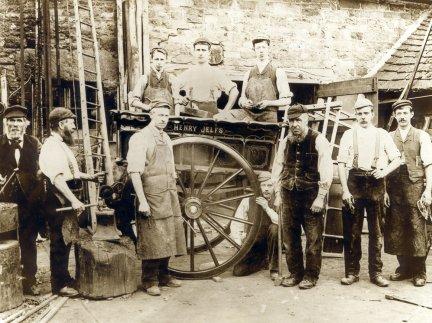
Stokes Wheelwrights. Fred on left of wheel, Thomas his father on right.
Thomas Stokes
Thomas Stokes was born in Bicester, Oxfordshire in 1816. He married Eliza Browning (born in 1814 in Tetbury, Gloucestershire) in Gloucester in 1840 Q3. Their first son William was baptised in Chipping Hill, Witham, Essex, on 3 Oct 1841. This seems a little unusual, and I can’t find Thomas and Eliza on the 1841 census. However both the 1851 and 1861 census state that William was indeed born in Essex.
In 1851 Thomas and Eliza were living in Bledington, Gloucestershire, and Thomas was a journeyman carpenter.
Note that a journeyman does not mean someone who moved around a lot. A journeyman was a tradesman who had served his trade apprenticeship and mastered his craft, not bound to serve a master, but originally hired by the day. The name derives from the French for day – jour.
Also on the 1851 census: their daughter Susan, born in Churchill Oxfordshire in 1844; son Frederick born in Bledington Gloucestershire in 1846; daughter Louisa born in Foxcote Oxfordshire in 1849; and 2 month old daughter Harriet born in Bledington in 1851.
On the 1861 census Thomas and Eliza were living in Evesham, Worcestershire, and daughter Susan was no longer living at home, but William, Fred, Louisa and Harriet were, as well as daughter Emily born in Churchill Oxfordshire in 1856. Thomas was a wheelwright.
On the 1871 census Thomas and Eliza were still living in Evesham, and Thomas was a wheelwright employing three apprentices. Son Fred, also a wheelwright, and his wife Ann Rebecca live with them.
Mr Stokes, wheelwright, was found guilty of reprehensible conduct in concealing the fact that small-pox existed in his house, according to a mention in The Oxfordshire Weekly News on Wednesday 19 February 1873:
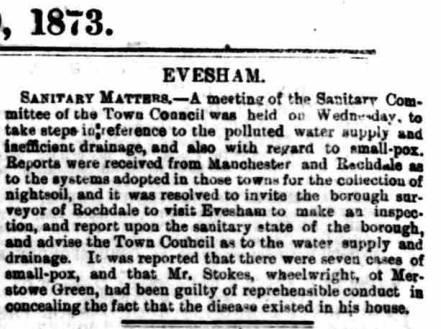
From Paul Weaver’s ancestry website:
“It was Thomas Stokes who built the first “Famous Vale of Evesham Light Gardening Dray for a Half-Legged Horse to Trot” (the quotation is from his account book), the forerunner of many that became so familiar a sight in the towns and villages from the 1860s onwards. He built many more for the use of the Vale gardeners.
Thomas also had long-standing business dealings with the people of the circus and fairgrounds, and had a contract to effect necessary repairs and renewals to their waggons whenever they visited the district. He built living waggons for many of the show people’s families as well as shooting galleries and other equipment peculiar to the trade of his wandering customers, and among the names figuring in his books are some still familiar today, such as Wilsons and Chipperfields.
He is also credited with inventing the wooden “Mushroom” which was used by housewives for many years to darn socks. He built and repaired all kinds of vehicles for the gentry as well as for the circus and fairground travellers.
Later he lived with his wife at Merstow Green, Evesham, in a house adjoining the Almonry.”
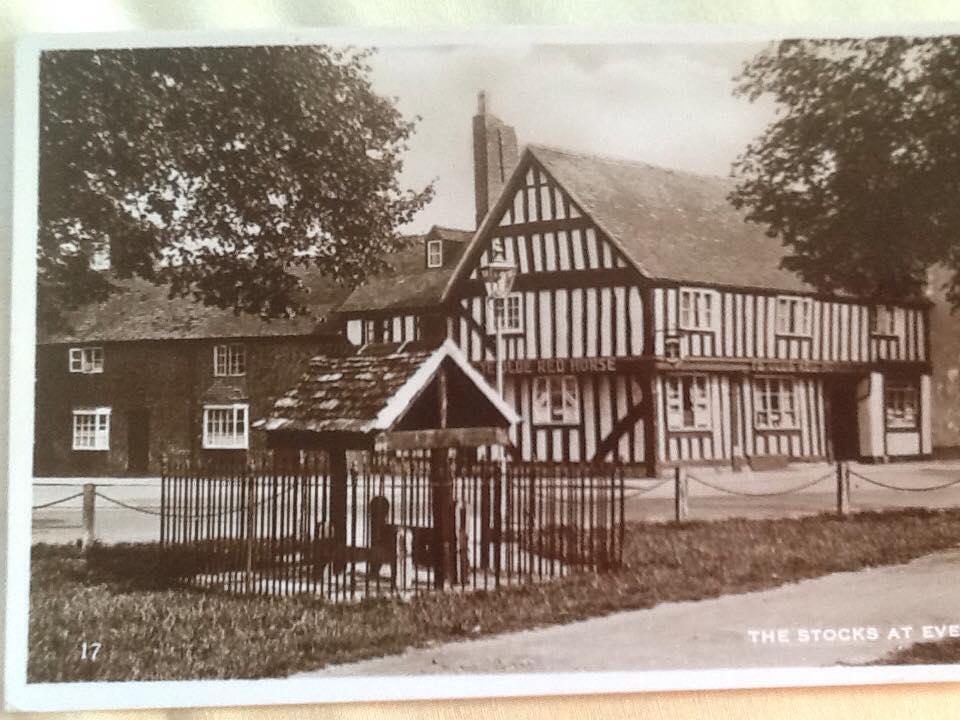
An excerpt from the book Evesham Inns and Signs by T.J.S. Baylis:
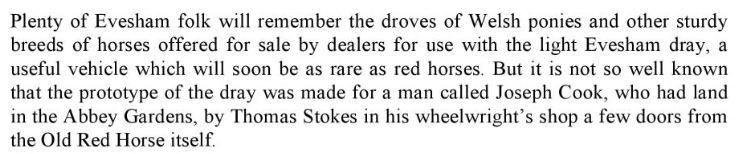
The Old Red Horse, Evesham:
Thomas died in 1885 aged 68 of paralysis, bronchitis and debility. His wife Eliza a year later in 1886.
Frederick Stokes
In Worcester in 1870 Fred married Ann Rebecca Day, who was born in Evesham in 1845.
Ann Rebecca Day:
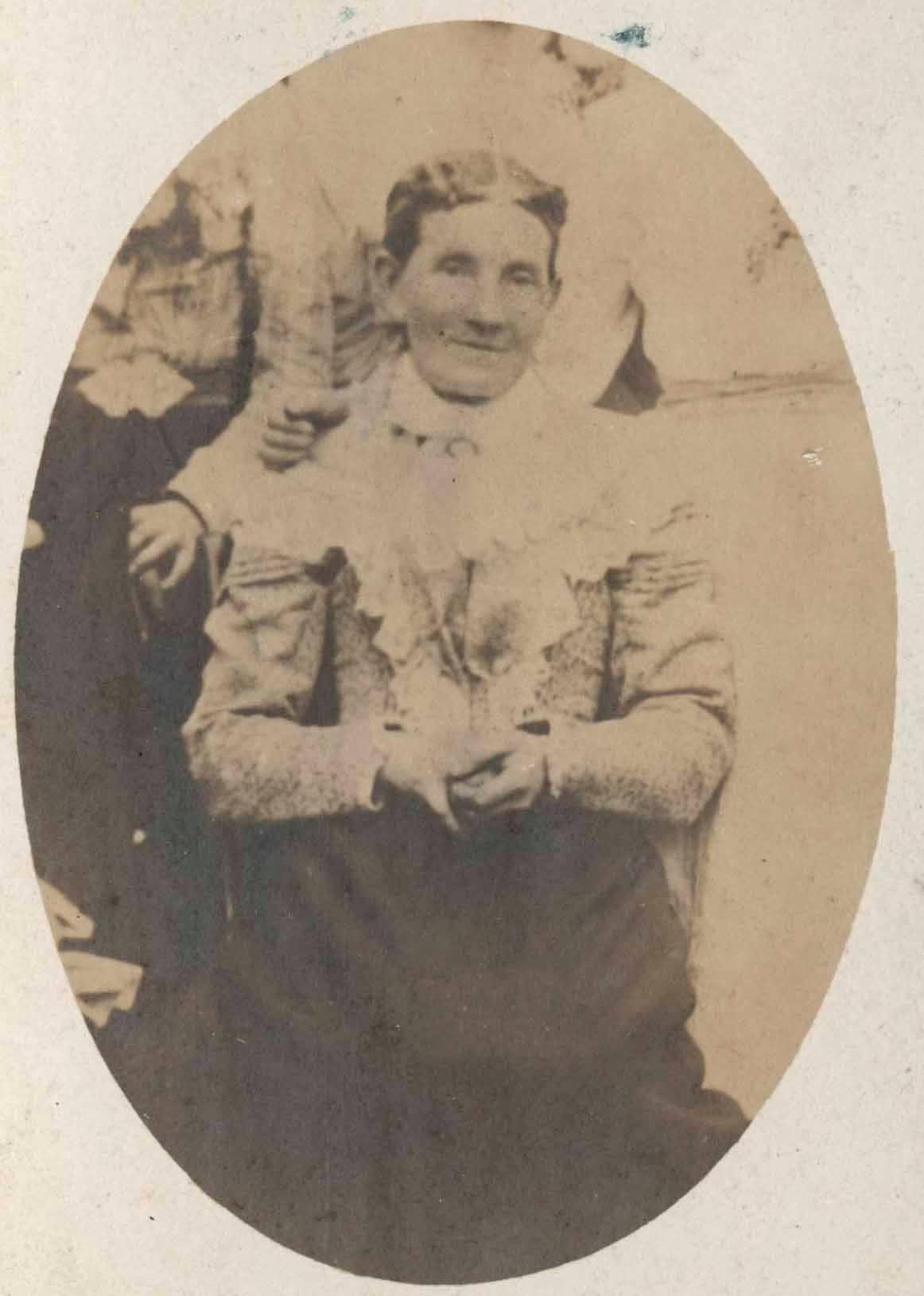
In 1871 Fred was still living with his parents in Evesham, with his wife Ann Rebecca as well as their three month old daughter Annie Elizabeth. Fred and Ann (referred to as Rebecca) moved to La Quinta on Main Street, Broadway.
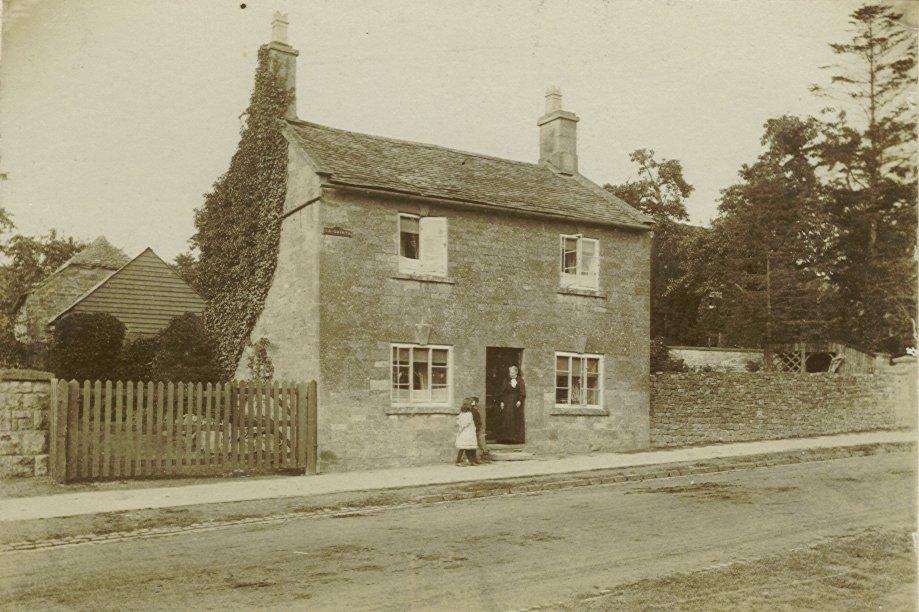
Rebecca Stokes in the doorway of La Quinta on Main Street Broadway, with her grandchildren Ralph and Dolly Edwards:
Fred was a wheelwright employing one man on the 1881 census. In 1891 they were still in Broadway, Fred’s occupation was wheelwright and coach painter, as well as his fifteen year old son Frederick.
In the Evesham Journal on Saturday 10 December 1892 it was reported that “Two cases of scarlet fever, the children of Mr. Stokes, wheelwright, Broadway, were certified by Mr. C. W. Morris to be isolated.”
Still in Broadway in 1901 and Fred’s son Albert was also a wheelwright. By 1911 Fred and Rebecca had only one son living at home in Broadway, Reginald, who was a coach painter. Fred was still a wheelwright aged 65.
Fred’s signature on the 1911 census:

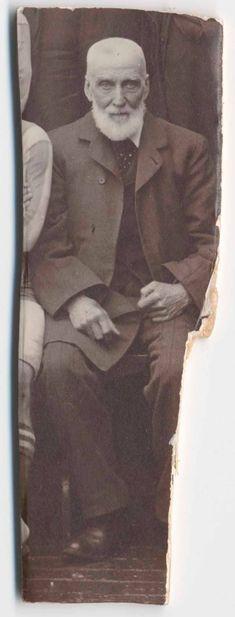
Rebecca died in 1912 and Fred in 1917.
Fred Stokes:
In the book Evesham to Bredon From Old Photographs By Fred Archer:
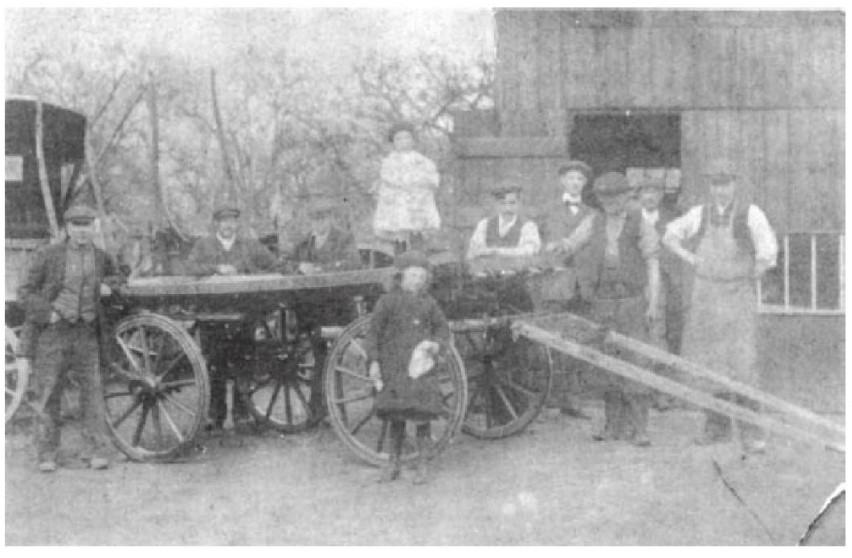
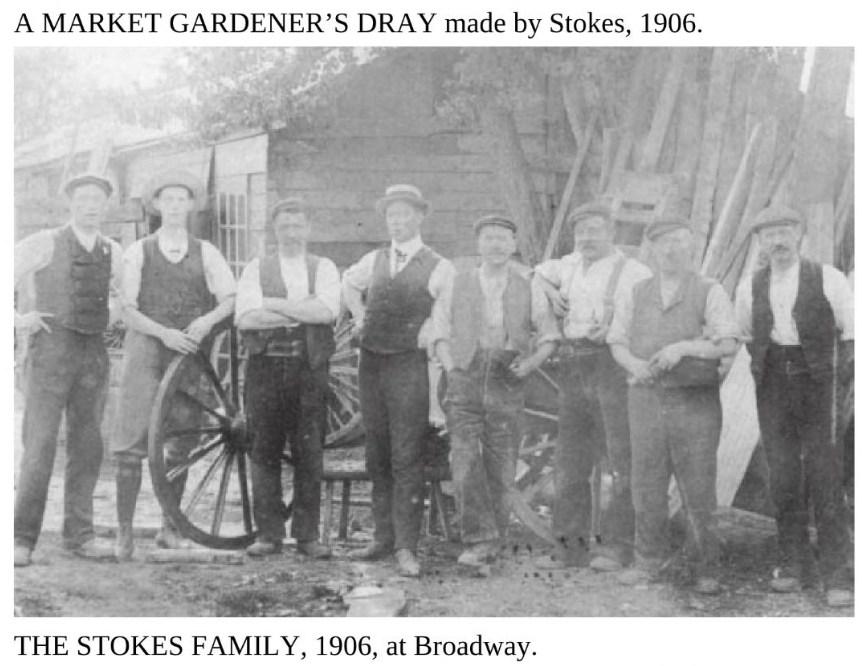 October 11, 2022 at 11:39 am #6333
In reply to: Family Stories From The Other Side ~ Book Two
The Grattidge Family
The first Grattidge to appear in our tree was Emma Grattidge (1853-1911) who married Charles Tomlinson (1847-1907) in 1872.
Charles Tomlinson (1873-1929) was their son and he married my great grandmother Nellie Fisher. Their daughter Margaret (later Peggy Edwards) was my grandmother on my fathers side.
Emma Grattidge was born in Wolverhampton, the daughter and youngest child of William Grattidge (1820-1887) born in Foston, Derbyshire, and Mary Stubbs, born in Burton on Trent, daughter of Solomon Stubbs, a land carrier. William and Mary married at St Modwens church, Burton on Trent, in 1839. It’s unclear why they moved to Wolverhampton. On the 1841 census William was employed as an agent, and their first son William was nine months old. Thereafter, William was a licensed victuallar or innkeeper.
William Grattidge was born in Foston, Derbyshire in 1820. His parents were Thomas Grattidge, farmer (1779-1843) and Ann Gerrard (1789-1822) from Ellastone. Thomas and Ann married in 1813 in Ellastone. They had five children before Ann died at the age of 25:
Bessy was born in 1815, Thomas in 1818, William in 1820, and Daniel Augustus and Frederick were twins born in 1822. They were all born in Foston. (records say Foston, Foston and Scropton, or Scropton)
On the 1841 census Thomas had nine people additional to family living at the farm in Foston, presumably agricultural labourers and help.
After Ann died, Thomas had three children with Kezia Gibbs (30 years his junior) before marrying her in 1836, then had a further four with her before dying in 1843. Then Kezia married Thomas’s nephew Frederick Augustus Grattidge (born in 1816 in Stafford) in London in 1847 and had two more!
The siblings of William Grattidge (my 3x great grandfather):
Frederick Grattidge (1822-1872) was a schoolmaster and never married. He died at the age of 49 in Tamworth at his twin brother Daniels address.
Daniel Augustus Grattidge (1822-1903) was a grocer at Gungate in Tamworth.
Thomas Grattidge (1818-1871) married in Derby, and then emigrated to Illinois, USA.
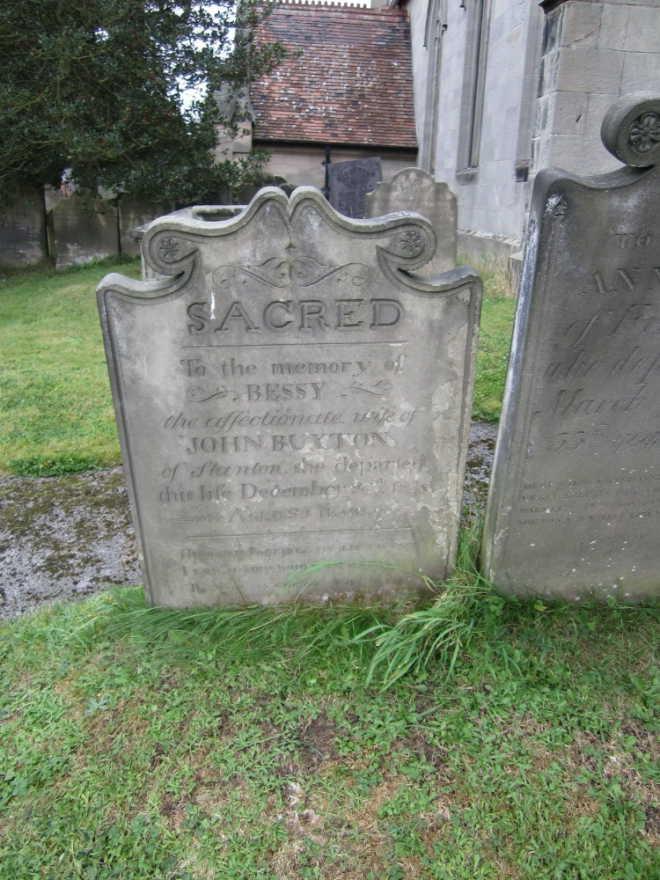
Bessy Grattidge (1815-1840) married John Buxton, farmer, in Ellastone in January 1838. They had three children before Bessy died in December 1840 at the age of 25: Henry in 1838, John in 1839, and Bessy Buxton in 1840. Bessy was baptised in January 1841. Presumably the birth of Bessy caused the death of Bessy the mother.
Bessy Buxton’s gravestone:
“Sacred to the memory of Bessy Buxton, the affectionate wife of John Buxton of Stanton She departed this life December 20th 1840, aged 25 years. “Husband, Farewell my life is Past, I loved you while life did last. Think on my children for my sake, And ever of them with I take.”
20 Dec 1840, Ellastone, Staffordshire
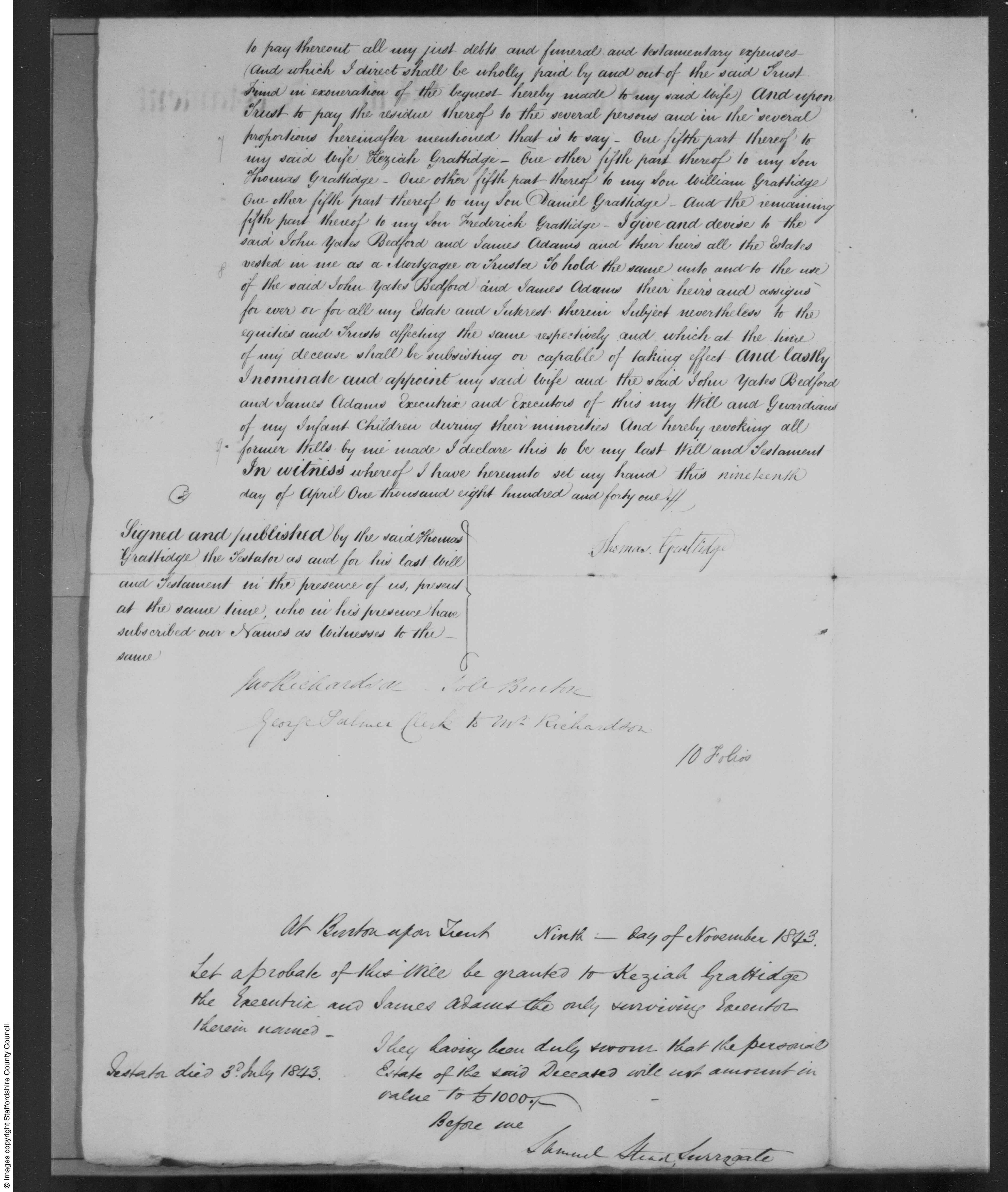
In the 1843 will of Thomas Grattidge, farmer of Foston, he leaves fifth shares of his estate, including freehold real estate at Findern, to his wife Kezia, and sons William, Daniel, Frederick and Thomas. He mentions that the children of his late daughter Bessy, wife of John Buxton, will be taken care of by their father. He leaves the farm to Keziah in confidence that she will maintain, support and educate his children with her.
An excerpt from the will:
I give and bequeath unto my dear wife Keziah Grattidge all my household goods and furniture, wearing apparel and plate and plated articles, linen, books, china, glass, and other household effects whatsoever, and also all my implements of husbandry, horses, cattle, hay, corn, crops and live and dead stock whatsoever, and also all the ready money that may be about my person or in my dwelling house at the time of my decease, …I also give my said wife the tenant right and possession of the farm in my occupation….
A page from the 1843 will of Thomas Grattidge:
William Grattidges half siblings (the offspring of Thomas Grattidge and Kezia Gibbs):
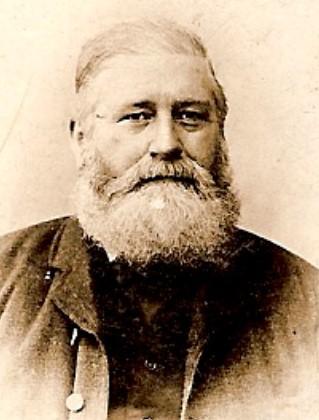
Albert Grattidge (1842-1914) was a railway engine driver in Derby. In 1884 he was driving the train when an unfortunate accident occured outside Ambergate. Three children were blackberrying and crossed the rails in front of the train, and one little girl died.
Albert Grattidge:
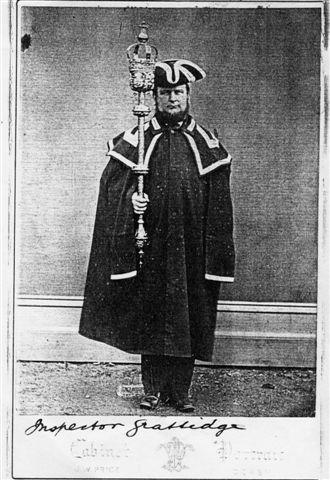
George Grattidge (1826-1876) was baptised Gibbs as this was before Thomas married Kezia. He was a police inspector in Derby.
George Grattidge:
Edwin Grattidge (1837-1852) died at just 15 years old.
Ann Grattidge (1835-) married Charles Fletcher, stone mason, and lived in Derby.
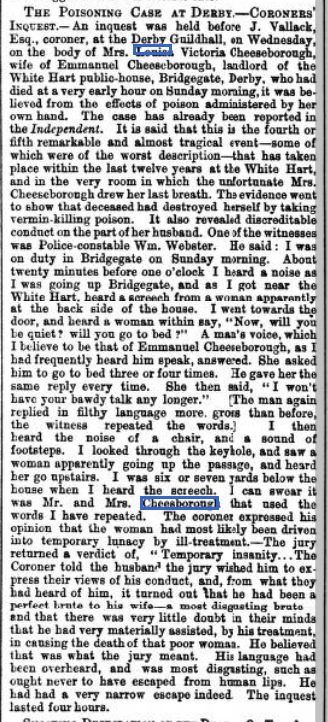
Louisa Victoria Grattidge (1840-1869) was sadly another Grattidge woman who died young. Louisa married Emmanuel Brunt Cheesborough in 1860 in Derby. In 1861 Louisa and Emmanuel were living with her mother Kezia in Derby, with their two children Frederick and Ann Louisa. Emmanuel’s occupation was sawyer. (Kezia Gibbs second husband Frederick Augustus Grattidge was a timber merchant in Derby)
At the time of her death in 1869, Emmanuel was the landlord of the White Hart public house at Bridgegate in Derby.
The Derby Mercury of 17th November 1869:
“On Wednesday morning Mr Coroner Vallack held an inquest in the Grand
Jury-room, Town-hall, on the body of Louisa Victoria Cheeseborough, aged
33, the wife of the landlord of the White Hart, Bridge-gate, who committed
suicide by poisoning at an early hour on Sunday morning. The following
evidence was taken:Mr Frederick Borough, surgeon, practising in Derby, deposed that he was
called in to see the deceased about four o’clock on Sunday morning last. He
accordingly examined the deceased and found the body quite warm, but dead.
He afterwards made enquiries of the husband, who said that he was afraid
that his wife had taken poison, also giving him at the same time the
remains of some blue material in a cup. The aunt of the deceased’s husband
told him that she had seen Mrs Cheeseborough put down a cup in the
club-room, as though she had just taken it from her mouth. The witness took
the liquid home with him, and informed them that an inquest would
necessarily have to be held on Monday. He had made a post mortem
examination of the body, and found that in the stomach there was a great
deal of congestion. There were remains of food in the stomach and, having
put the contents into a bottle, he took the stomach away. He also examined
the heart and found it very pale and flabby. All the other organs were
comparatively healthy; the liver was friable.Hannah Stone, aunt of the deceased’s husband, said she acted as a servant
in the house. On Saturday evening, while they were going to bed and whilst
witness was undressing, the deceased came into the room, went up to the
bedside, awoke her daughter, and whispered to her. but what she said the
witness did not know. The child jumped out of bed, but the deceased closed
the door and went away. The child followed her mother, and she also
followed them to the deceased’s bed-room, but the door being closed, they
then went to the club-room door and opening it they saw the deceased
standing with a candle in one hand. The daughter stayed with her in the
room whilst the witness went downstairs to fetch a candle for herself, and
as she was returning up again she saw the deceased put a teacup on the
table. The little girl began to scream, saying “Oh aunt, my mother is
going, but don’t let her go”. The deceased then walked into her bed-room,
and they went and stood at the door whilst the deceased undressed herself.
The daughter and the witness then returned to their bed-room. Presently
they went to see if the deceased was in bed, but she was sitting on the
floor her arms on the bedside. Her husband was sitting in a chair fast
asleep. The witness pulled her on the bed as well as she could.
Ann Louisa Cheesborough, a little girl, said that the deceased was her
mother. On Saturday evening last, about twenty minutes before eleven
o’clock, she went to bed, leaving her mother and aunt downstairs. Her aunt
came to bed as usual. By and bye, her mother came into her room – before
the aunt had retired to rest – and awoke her. She told the witness, in a
low voice, ‘that she should have all that she had got, adding that she
should also leave her her watch, as she was going to die’. She did not tell
her aunt what her mother had said, but followed her directly into the
club-room, where she saw her drink something from a cup, which she
afterwards placed on the table. Her mother then went into her own room and
shut the door. She screamed and called her father, who was downstairs. He
came up and went into her room. The witness then went to bed and fell
asleep. She did not hear any noise or quarrelling in the house after going
to bed.Police-constable Webster was on duty in Bridge-gate on Saturday evening
last, about twenty minutes to one o’clock. He knew the White Hart
public-house in Bridge-gate, and as he was approaching that place, he heard
a woman scream as though at the back side of the house. The witness went to
the door and heard the deceased keep saying ‘Will you be quiet and go to
bed’. The reply was most disgusting, and the language which the
police-constable said was uttered by the husband of the deceased, was
immoral in the extreme. He heard the poor woman keep pressing her husband
to go to bed quietly, and eventually he saw him through the keyhole of the
door pass and go upstairs. his wife having gone up a minute or so before.
Inspector Fearn deposed that on Sunday morning last, after he had heard of
the deceased’s death from supposed poisoning, he went to Cheeseborough’s
public house, and found in the club-room two nearly empty packets of
Battie’s Lincoln Vermin Killer – each labelled poison.Several of the Jury here intimated that they had seen some marks on the
deceased’s neck, as of blows, and expressing a desire that the surgeon
should return, and re-examine the body. This was accordingly done, after
which the following evidence was taken:Mr Borough said that he had examined the body of the deceased and observed
a mark on the left side of the neck, which he considered had come on since
death. He thought it was the commencement of decomposition.
This was the evidence, after which the jury returned a verdict “that the
deceased took poison whilst of unsound mind” and requested the Coroner to
censure the deceased’s husband.The Coroner told Cheeseborough that he was a disgusting brute and that the
jury only regretted that the law could not reach his brutal conduct.
However he had had a narrow escape. It was their belief that his poor
wife, who was driven to her own destruction by his brutal treatment, would
have been a living woman that day except for his cowardly conduct towards
her.The inquiry, which had lasted a considerable time, then closed.”
In this article it says:
“it was the “fourth or fifth remarkable and tragical event – some of which were of the worst description – that has taken place within the last twelve years at the White Hart and in the very room in which the unfortunate Louisa Cheesborough drew her last breath.”
Sheffield Independent – Friday 12 November 1869:
 September 4, 2022 at 6:00 pm #6326
In reply to: The Sexy Wooden Leg
Stung by Egberts question, Olga reeled and almost lost her footing on the stairs. What had happened to her? That damned selfish individualism that was running rampant must have seeped into her room through the gaps in the windows or under the door. “No!” she shouted, her voice cracking.
“Say it isn’t true, Olga,” Egbert said, his voice breaking. “Not you as well.”
It took Olga a minute or two to still her racing heart. The near fall down the stairs had shaken her but with trembling hands she levered herself round to sit beside Egbert on the step.
Gripping his bony knee with her knobbly arthritic fingers, she took a deep breath.
“You are right to have said that, Egbert. If there is one thing we must hold onto, it’s our hearts. Nothing else matters, or at least nothing else matters as much as that. We are old and tired and we don’t like change. But if we escalate the importance of this frankly dreary and depressing home to the point where we lose our hearts…” she faltered and continued. “We will be homeless soon, very soon, and we know not what will happen to us. We must trust in the kindness of strangers, we must hope they have a heart.”
Egbert winced as Olga squeezed his knee. “And that is why”, Olga continued, slapping Egberts thigh with gusto, “We must have a heart…”
“If you’d just stop squeezing and hitting me, Olga…”
Olga loosened her grip on the old mans thigh bone and peered into his eyes. Quietly she thanked him. “You’ve cleared my mind and given me something to live for, and I thank you for that. But you do need to launder your clothes more often,” she added, pulling a face. She didn’t want the old coot to start blubbing, and he looked alarmingly close to tears.
“Come on, let’s go and see Obadiah. We’re all in this together. Homelessness and adventure can wait until tomorrow.” Olga heaved herself upright with a surprising burst of vitality. Noticing a weak smile trembling on Egberts lips, she said “That’s the spirit!”
July 10, 2022 at 2:36 am #6317In reply to: The Sexy Wooden Leg
The sharp rat-a-tat on the door startled Olga Herringbonevsky. The initial surprise quickly turned to annoyance. It was 11am and she wasn’t expecting a knock on the door at 11am. At 10am she expected a knock. It would be Larysa with the lukewarm cup of tea and a stale biscuit. Sometimes Olga complained about it and Larysa would say, Well you’re on the third floor so what do you expect? And she’d look cross and pour the tea so some of it slopped into the saucer. So the biscuits go stale on the way up do they? Olga would mutter. At 10:30am Larysa would return to collect the cup and saucer. I can’t do this much longer, she’d say. I’m not young any more and all these damn stairs. She’d been saying that for as long as Olga could remember.
For a moment, Olga contemplated ignoring the intrusion but the knocking started up again, this time accompanied by someone shouting her name.
With a very loud sigh, she put her book on the side table, face down so she would not lose her place for it was a most enjoyable whodunit, and hauled herself up from the chair. Her ankle was not good since she’d gone over on it the other day and Olga was in a very poor mood by the time she reached the door.
“Yes?” She glowered at Egbert.
“Have you seen this?” Egbert was waving a piece of paper at her.
“No,” Olga started to close the door.
“Olga stop!” Egbert’s face had reddened and Olga wondered if he might cry. Again, he waved the piece of paper in her face and then let his hand fall defeated to his side. “Olga, it’s bad news. You should have got a letter .”
Olga glanced at the pile of unopened letters on her dresser. It was never good news. She couldn’t be bothered with letters any more.
“Well, Egbert, I suppose you’d better come in”.
“That Ursula has a heart of steel,” said Olga when she’d heard the news.
“Pfft,” said Egbert. “She has no heart. This place has always been about money for her.”
“It’s bad times, Egbert. Bad times.”
Egbert nodded. “It is, Olga. But there must be something we can do.” He pursed his lips and Olga noticed that he would not meet her eyes.
“What? Spit it out, Old Man.”
He looked at her briefly before his eyes slid back to the dirty grey carpet. “I have heard stories, Olga. That you are … well connected. That you know people.”
Olga noticed that it had become difficult to breathe. Seeing Egbert looking at her with concern, she made an effort to steady herself. She took an extra big gasp of air and pointed to the book face-down on the side table. “That is a very good book I am reading. You may borrow it when I have finished.”
Egbert nodded. “Thank you.” he said and they both stared at the book.
“It was a long time ago, Egbert. And no business of anyone else.” Olga knew her voice was sharp but not sharp enough it seemed as Egbert was not done yet with all his prying words.
“Olga, you said it yourself. These are bad times. And desperate measures are needed or we will all perish.” Now he looked her in the eyes. “Old woman, swallow your pride. You must save yourself and all of us here.”
July 6, 2022 at 11:41 am #6313In reply to: The Sexy Wooden Leg
Egbert Gofindlevsky rapped on the door of room number 22. The letter flapped against his pin striped trouser leg as his hand shook uncontrollably, his habitual tremor exacerbated with the shock. Remembering that Obadiah Sproutwinklov was deaf, he banged loudly on the door with the flat of his hand. Eventually the door creaked open.
Egbert flapped the letter in from of Obadiah’s face. “Have you had one of these?” he asked.
“If you’d stop flapping it about I might be able to see what it is,” Obadiah replied. “Oh that! As a matter of fact I’ve had one just like it. The devils work, I tell you! A practical joke, and in very poor taste!”
Egbert was starting to wish he’d gone to see Olga Herringbonevsky first. “Can I come in?” he hissed, “So we can discuss it in private?”
Reluctantly Obadiah pulled the door open and ushered him inside the room. Egbert looked around for a place to sit, but upon noticing a distinct odour of urine decided to remain standing.
“Ursula is booting us out, where are we to go?”
“Eh?” replied Obadiah, cupping his ear. “Speak up, man!”
Egbert repeated his question.
“No need to shout!”
The two old men endeavoured to conduct a conversation on this unexepected turn of events, the upshot being that Obadiah had no intention of leaving his room at all henceforth, come what may, and would happily starve to death in his room rather than take to the streets.
Egbert considered this form of action unhelpful, as he himself had no wish to starve to death in his room, so he removed himself from room 22 with a disgruntled sigh and made his way to Olga’s room on the third floor.
July 6, 2022 at 11:05 am #6312In reply to: The Sexy Wooden Leg
When she’d heard of the miracle happening at the Flovlinden Tree, Egna initially shrugged it off as another conman’s attempt at fooling the crowds.
“No, it’s real, my Auntie saw it.”
“Stop fretting” she’d told the little girl, as she was carefully removing the lice from her hair. “This is just someone’s idea of a smart joke. Don’t get fooled, you’re smarter than this.”
She sure wasn’t responsible for that one. If that were a true miracle, she would have known. The little calf next week being resuscitated after being dead a few minutes, well, that was her. Shame nobody was even there to notice. Most of the best miracles go about this way anyway.
So, after having lived close to a millennia in relatively rock solid health and with surprisingly unaging looks, Egna had thought she’d seen it all; at least last time the tree started to ooze sacred oil, it didn’t last for too long, people’s greed starting to sell it stopped it right in its tracks.
But maybe there was more to it this time. Egna’d often wondered why God had let her live that long. She was a useful instrument to Her for sure, but living in secrecy, claiming no ownership, most miracles were just facts of life. She somehow failed to see the point, even after 957 years of existence.
The little girl had left to go back to her nearby town. This side of the country was still quite safe from all the craziness. Egna knew well most of the branches of the ancestral trees leading to that particular little leaf. This one had probably no idea she shared a common ancestor with President Voldomeer, but Egna remembered the fellow. He was a clogmaker in the turn of the 18th century, as was his father before. That was until a rather unexpected turn of events precipitated him to a different path as his brother.
She had a book full of these records, as she’d tracked the lives of many, to keep them alive, and maybe remind people they all share so much in common. That is, if people were able to remember more than 2 generations before them.
“Well, that’s set.” she said to herself and to Her as She’s always listening “I’ll go and see for myself.”
her trusty old musty cloak at the door seemed to have been begging for the journey.July 6, 2022 at 11:02 am #6311In reply to: The Sexy Wooden Leg
Most of the pilgims, if one could call them that, flocked to the linden tree in cars, although some came on motorbikes and bicycles. Olek was grateful that they hadn’t started arriving by the bus load, like Italian tourists. But his cousin Ursula was happy with this strange new turn of events.
Her shabby hotel on the outskirts of town had never been so busy and she was already planning to refurbish the premises and evict the decrepit and motley assortment of aged permanent residents who had just about kept her head above water, financially speaking, for the last twenty years. She could charge much more per night to these new tourists, who were smartly dressed and modern and didn’t argue about the price of a room. They did complain about the damp stained wallpaper though and the threadbare bedding. Ursula reckoned she could charge even more for the rooms if she redecorated, and had an idea to approach her nephew Boris the bank manager for a business loan.
But first she had to evict the old timers. It wasn’t her problem, she reminded herself, if they had nowhere else to go. After all, plenty of charitable aid money was flying around these days, they could easily just join up with some fleeing refugees. She’d even sent some of her old dresses to the collection agency. They may have been forty years old and smelled of moth balls, but they were well made and the refugees would surely be grateful.
Ursula wasn’t looking forward to telling them. No, not at all! She rather liked some of them and was dreading their reaction. You are a business woman, Ursula, she told herself, and you have to look after your own interests! But still she quailed at the thought of knocking on their doors, or announcing it in the communal dining room at supper. Then she had an idea. She’d type up some letters instead, and sign them as if they came from her new business manager. When the residents approached her about the letter she would smile sadly and shrug, saying it wasn’t her decision and that she was terribly sorry but her hands were tied.
May 12, 2022 at 4:55 am #6292In reply to: The Precious Life and Rambles of Liz Tattler
The door flung open. It was Finnley. “Here I am! I was drugged when I tried to put a bug under the rug. Someone hit me on the head with a mug and lured me to a secret location. Fortunately I charmed my way free with a hug.”
“Thank goodness the situation have been explained property,” said Liz. “I couldn’t understand a word Fanella was saying.”
April 12, 2022 at 8:09 am #6289In reply to: The Precious Life and Rambles of Liz Tattler
“Ever get the feeling you’re talking to yourself?” Liz said to herself.
“YOU TART!!!”
Liz swung round, wondering where the dreadful shreik came from. The little black communication device on her desk was vibrating madly, causing the tea in her cup to slosh over the side into the saucer.
“Good Godfrey!” exclaimed Liz, visibly shaken.
“You rang?” smiled Godfrey, crawling out from under the desk.
“You were under my desk the whole time?” Liz was shocked.
“Allo allo allo!”
“Roberto! You were under my desk the entire time too?”
“Zere iz a zecret door under ze desk, madame, you did not know zis?”
“Fanella! Good lord, not you as well!”
Fanella grinned sheepishly. “I ‘ave come to ‘elp Finnley wiz ze bedding.”
Liz bent down and peered under her desk. Who else was under there? But it was dark as a black hole, and covered in cobwebs.
“Fanella, do you know where Finnley is?” asked Liz. “I miss her terribly. Everything is so dreadfully dusty without her.”
Fanella shrugged. “She was drugged, Madame. It was when she tried to put a bug under the rug, someone ‘hit ‘er on ze ‘ead wiz a mug, and lugged her to a zecret location and filled her wiz drugs.” Fanella shrugged again. “Zis is why I ‘ave come to ‘elp.”
March 4, 2022 at 2:58 pm #6280In reply to: The Whale’s Diaries Collection
I started reading a book. In fact I started reading it three weeks ago, and have read the first page of the preface every night and fallen asleep. But my neck aches from doing too much gardening so I went back to bed to read this morning. I still fell asleep six times but at least I finished the preface. It’s the story of the family , initiated by the family collection of netsuke (whatever that is. Tiny Japanese carvings) But this is what stopped me reading and made me think (and then fall asleep each time I re read it)
“And I’m not entitled to nostalgia about all that lost wealth and glamour from a century ago. And I am not interested in thin. I want to know what the relationship has been between this wooden object that I am rolling between my fingers – hard and tricky and Japanese – and where it has been. I want to be able to reach to the handle of the door and turn it and feel it open. I want to walk into each room where this object has lived, to feel the volume of the space, to know what pictures were on the walls, how the light fell from the windows. And I want to know whose hands it has been in, and what they felt about it and thought about it – if they thought about it. I want to know what it has witnessed.” ― Edmund de Waal, The Hare With Amber Eyes: A Family’s Century of Art and Loss
And I felt almost bereft that none of the records tell me which way the light fell in through the windows.
I know who lived in the house in which years, but I don’t know who sat in the sun streaming through the window and which painting upon the wall they looked at and what the material was that covered the chair they sat on.
Were his clothes confortable (or hers, likely not), did he have an old favourite pair of trousers that his mother hated?
There is one house in particular that I keep coming back to. Like I got on the Housley train at Smalley and I can’t get off. Kidsley Grange Farm, they turned it into a nursing home and built extensions, and now it’s for sale for five hundred thousand pounds. But is the ghost still under the back stairs? Is there still a stain somewhere when a carafe of port was dropped?
Did Anns writing desk survive? Does someone have that, polished, with a vase of spring tulips on it? (on a mat of course so it doesn’t make a ring, despite that there are layers of beeswaxed rings already)
Does the desk remember the letters, the weight of a forearm or elbow, perhaps a smeared teardrop, or a comsumptive cough stain?
Is there perhaps a folded bit of paper or card that propped an uneven leg that fell through the floorboards that might tear into little squares if you found it and opened it, and would it be a rough draft of a letter never sent, or just a receipt for five head of cattle the summer before?
Did he hate the curtain material, or not even think of it? Did he love the house, or want to get away to see something new ~ or both?
Did he have a favourite cup, a favourite food, did he hate liver or cabbage?
Did he like his image when the photograph came from the studio or did he think it made his nose look big or his hair too thin, or did he wish he’d worn his other waistcoat?
Did he love his wife so much he couldn’t bear to see her dying, was it neglect or was it the unbearableness of it all that made him go away and drink?
Did the sun slanting in through the dormer window of his tiny attic room where he lodged remind him of ~ well no perhaps he was never in the room in daylight hours at all. Work all day and pub all night, keeping busy working hard and drinking hard and perhaps laughing hard, and maybe he only thought of it all on Sunday mornings.
So many deaths, one after another, his father, his wife, his brother, his sister, and another and another, all the coughing, all the debility. Perhaps he never understood why he lived and they did not, what kind of justice was there in that?
Did he take a souvenir or two with him, a handkerchief or a shawl perhaps, tucked away at the bottom of a battered leather bag that had his 3 shirts and 2 waistcoats in and a spare cap,something embroidered perhaps.
The quote in that book started me off with the light coming in the window and the need to know the simplest things, something nobody ever wrote in a letter, maybe never even mentioned to anyone.
Light coming in windows. I remeber when I was a teenager I had a day off sick and spent the whole day laying on the couch in a big window with the winter sun on my face all day, and I read Bonjour Tristesse in one sitting, and I’ll never forget that afternoon. I don’t remember much about that book, but I remember being transported. But at the same time as being present in that sunny window.
“Stories and objects share something, a patina…Perhaps patina is a process of rubbing back so that the essential is revealed…But it also seems additive, in the way that a piece of oak furniture gains over years and years of polishing.”
“How objects are handed on is all about story-telling. I am giving you this because I love you. Or because it was given to me. Because I bought it somewhere special. Because you will care for it. Because it will complicate your life. Because it will make someone else envious. There is no easy story in legacy. What is remembered and what is forgotten? There can be a chain of forgetting, the rubbing away of previous ownership as much as the slow accretion of stories. What is being passed on to me with all these small Japanese objects?”
“There are things in this world that the children hear, but whose sounds oscillate below an adult’s sense of pitch.”
What did the children hear?
February 8, 2022 at 2:24 pm #6275In reply to: The Elusive Samuel Housley and Other Family Stories
“AND NOW ABOUT EMMA”
and a mystery about George
I had overlooked this interesting part of Barbara Housley’s “Narrative on the Letters” initially, perhaps because I was more focused on finding Samuel Housley. But when I did eventually notice, I wondered how I had missed it! In this particularly interesting letter excerpt from Joseph, Barbara has not put the date of the letter ~ unusually, because she did with all of the others. However I dated the letter to later than 1867, because Joseph mentions his wife, and they married in 1867. This is important, because there are two Emma Housleys. Joseph had a sister Emma, born in 1836, two years before Joseph was born. At first glance, one would assume that a reference to Emma in the letters would mean his sister, but Emma the sister was married in Derby in 1858, and by 1869 had four children.
But there was another Emma Housley, born in 1851.
From Barbara Housley’s Narrative on the Letters:
“AND NOW ABOUT EMMA”
A MYSTERY
A very mysterious comment is contained in a letter from Joseph:
“And now about Emma. I have only seen her once and she came to me to get your address but I did not feel at liberty to give it to her until I had wrote to you but however she got it from someone. I think it was in this way. I was so pleased to hear from you in the first place and with John’s family coming to see me I let them read one or two of your letters thinking they would like to hear of you and I expect it was Will that noticed your address and gave it to her. She came up to our house one day when I was at work to know if I had heard from you but I had not heard from you since I saw her myself and then she called again after that and my wife showed her your boys’ portraits thinking no harm in doing so.”
At this point Joseph interrupted himself to thank them for sending the portraits. The next sentence is:
“Your son JOHN I have never seen to know him but I hear he is rather wild,” followed by: “EMMA has been living out service but don’t know where she is now.”
Since Joseph had just been talking about the portraits of George’s three sons, one of whom is John Eley, this could be a reference to things George has written in despair about a teen age son–but could Emma be a first wife and John their son? Or could Emma and John both be the children of a first wife?
Elsewhere, Joseph wrote, “AMY ELEY died 14 years ago. (circa 1858) She left a son and a daughter.”
An Amey Eley and a George Housley were married on April 1, 1849 in Duffield which is about as far west of Smalley as Heanor is East. She was the daughter of John, a framework knitter, and Sarah Eley. George’s father is listed as William, a farmer. Amey was described as “of full age” and made her mark on the marriage document.
Anne wrote in August 1854: “JOHN ELEY is living at Derby Station so must take the first opportunity to get the receipt.” Was John Eley Housley named for him?
(John Eley Housley is George Housley’s son in USA, with his second wife, Sarah.)
George Housley married Amey Eley in 1849 in Duffield. George’s father on the register is William Housley, farmer. Amey Eley’s father is John Eley, framework knitter.
On the 1851 census, George Housley and his wife Amey Housley are living with her parents in Heanor, John Eley, a framework knitter, and his wife Rebecca. Also on the census are Charles J Housley, born in 1849 in Heanor, and Emma Housley, three months old at the time of the census, born in 1851. George’s birth place is listed as Smalley.
On the 31st of July 1851 George Housley arrives in New York. In 1854 George Housley marries Sarah Ann Hill in USA.
On the 1861 census in Heanor, Rebecca Eley was a widow, her husband John having died in 1852, and she had three grandchildren living with her: Charles J Housley aged 12, Emma Housley, 10, and mysteriously a William Housley aged 5! Amey Housley, the childrens mother, died in 1858.
Back to the mysterious comment in Joseph’s letter. Joseph couldn’t have been speaking of his sister Emma. She was married with children by the time Joseph wrote that letter, so was not just out of service, and Joseph would have known where she was. There is no reason to suppose that the sister Emma was trying unsuccessfully to find George’s addresss: she had been sending him letters for years. Joseph must have been referring to George’s daughter Emma.
Joseph comments to George “Your son John…is rather wild.” followed by the remark about Emma’s whereabouts. Could Charles John Housley have used his middle name of John instead of Charles?
As for the child William born five years after George left for USA, despite his name of Housley, which was his mothers married name, we can assume that he was not a Housley ~ not George’s child, anyway. It is not clear who his father was, as Amey did not remarry.
A further excerpt from Barbara Housley’s Narrative on the Letters:
Certainly there was some mystery in George’s life. George apparently wanted his whereabouts kept secret. Anne wrote: “People are at a loss to know where you are. The general idea is you are with Charles. We don’t satisfy them.” In that same letter Anne wrote: “I know you could not help thinking of us very often although you neglected writing…and no doubt would feel grieved for the trouble you at times caused (our mother). She freely forgives all.” Near the end of the letter, Anne added: “Mother sends her love to you and hopes you will write and if you want to tell her anything you don’t want all to see you must write it on a piece of loose paper and put it inside the letter.”
In a letter to George from his sister Emma:
Emma wrote in 1855, “We write in love to your wife and yourself and you must write soon and tell us whether there is a little nephew or niece and what you call them.”
In June of 1856, Emma wrote: “We want to see dear Sarah Ann and the dear little boy. We were much pleased with the “bit of news” you sent.” The bit of news was the birth of John Eley Housley, January 11, 1855. Emma concluded her letter “Give our very kindest love to dear sister and dearest Johnnie.”
It would seem that George Housley named his first son with his second wife after his first wife’s father ~ while he was married to both of them.
Emma Housley
1851-1935
In 1871 Emma was 20 years old and “in service” living as a lodger in West Hallam, not far from Heanor. As she didn’t appear on a 1881 census, I looked for a marriage, but the only one that seemed right in every other way had Emma Housley’s father registered as Ralph Wibberly!
Who was Ralph Wibberly? A family friend or neighbour, perhaps, someone who had been a father figure? The first Ralph Wibberly I found was a blind wood cutter living in Derby. He had a son also called Ralph Wibberly. I did not think Ralph Wibberly would be a very common name, but I was wrong.
I then found a Ralph Wibberly living in Heanor, with a son also named Ralph Wibberly. A Ralph Wibberly married an Emma Salt from Heanor. In 1874, a 36 year old Ralph Wibberly (born in 1838) was on trial in Derby for inflicting grevious bodily harm on William Fretwell of Heanor. His occupation is “platelayer” (a person employed in laying and maintaining railway track.) The jury found him not guilty.
In 1851 a 23 year old Ralph Wibberly (born in 1828) was a prisoner in Derby Gaol. However, Ralph Wibberly, a 50 year old labourer born in 1801 and his son Ralph Wibberly, aged 13 and born in 1838, are living in Belper on the 1851 census. Perhaps the son was the same Ralph Wibberly who was found not guilty of GBH in 1874. This appears to be the one who married Emma Salt, as his wife on the 1871 census is called Emma, and his occupation is “Midland Company Railway labourer”.
Which was the Ralph Wibberly that Emma chose to name as her father on the marriage register? We may never know, but perhaps we can assume it was Ralph Wibberly born in 1801. It is unlikely to be the blind wood cutter from Derby; more likely to be the local Ralph Wibberly. Maybe his son Ralph, who we know was involved in a fight in 1874, was a friend of Emma’s brother Charles John, who was described by Joseph as a “wild one”, although Ralph was 11 years older than Charles John.
Emma Housley married James Slater on Christmas day in Heanor in 1873. Their first child, a daughter, was called Amy. Emma’s mother was Amy Eley. James Slater was a colliery brakesman (employed to work the steam-engine, or other machinery used in raising the coal from the mine.)
It occurred to me to wonder if Emma Housley (George’s daughter) knew Elizabeth, Mary Anne and Catherine (Samuel’s daughters). They were cousins, lived in the vicinity, and they had in common with each other having been deserted by their fathers who were brothers. Emma was born two years after Catherine. Catherine was living with John Benniston, a framework knitter in Heanor, from 1851 to 1861. Emma was living with her grandfather John Ely, a framework knitter in Heanor. In 1861, George Purdy was also living in Heanor. He was listed on the census as a 13 year old coal miner! George Purdy and Catherine Housley married in 1866 in Eastwood, Nottinghamshire ~ just over the county border. Emma’s first child Amy was born in Heanor, but the next two children, Eliza and Lilly, were born in Eastwood, in 1878 and 1880. Catherine and George’s fifth child, my great grandmother Mary Ann Gilman Purdy, was born in Eastwood in 1880, the same year as Lilly Slater.
By 1881 Emma and James Slater were living in Woodlinkin, Codnor and Loscoe, close to Heanor and Eastwood, on the Derbyshire side of the border. On each census up to 1911 their address on the census is Woodlinkin. Emma and James had nine children: six girls and 3 boys, the last, Alfred Frederick, born in 1901.
Emma and James lived three doors up from the Thorn Tree pub in Woodlinkin, Codnor:
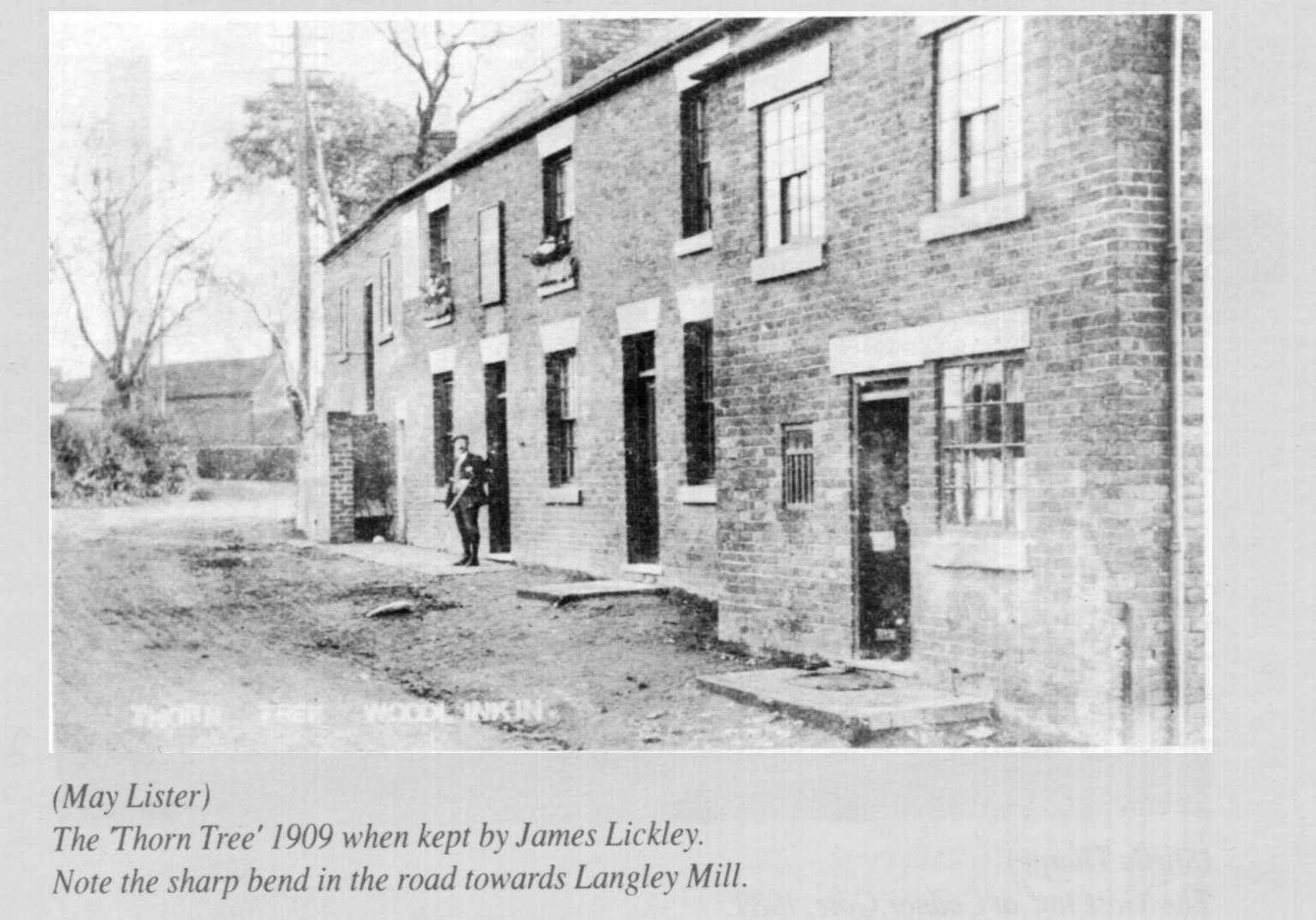
Emma Slater died in 1935 at the age of 84.
IN
LOVING MEMORY OF
EMMA SLATER
(OF WOODLINKIN)
WHO DIED
SEPT 12th 1935
AGED 84 YEARS
AT RESTCrosshill Cemetery, Codnor, Amber Valley Borough, Derbyshire, England:
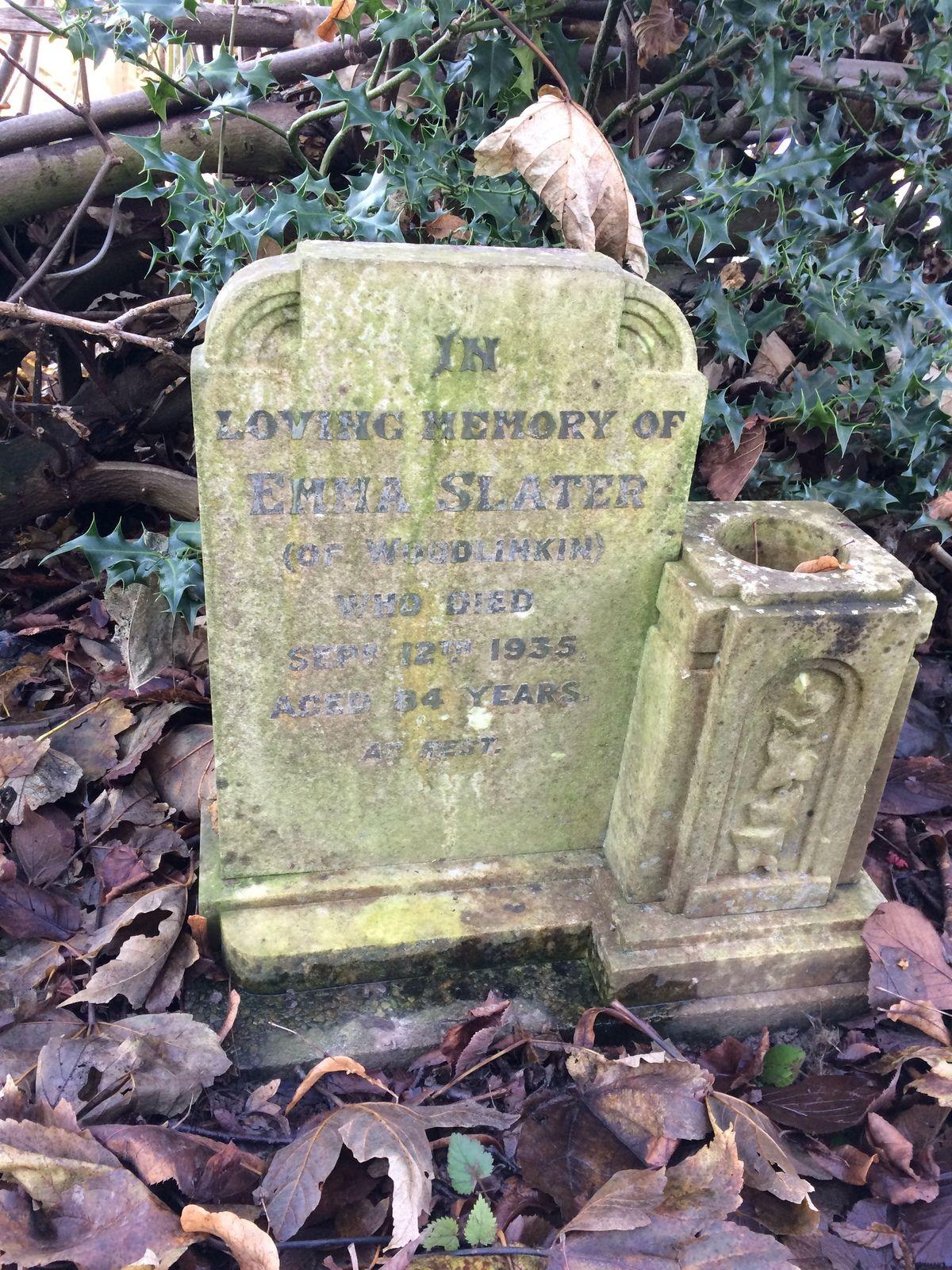
Charles John Housley
1949-
February 5, 2022 at 1:59 pm #6272In reply to: The Elusive Samuel Housley and Other Family Stories
The Housley Letters
The Carringtons
Carrington Farm, Smalley:
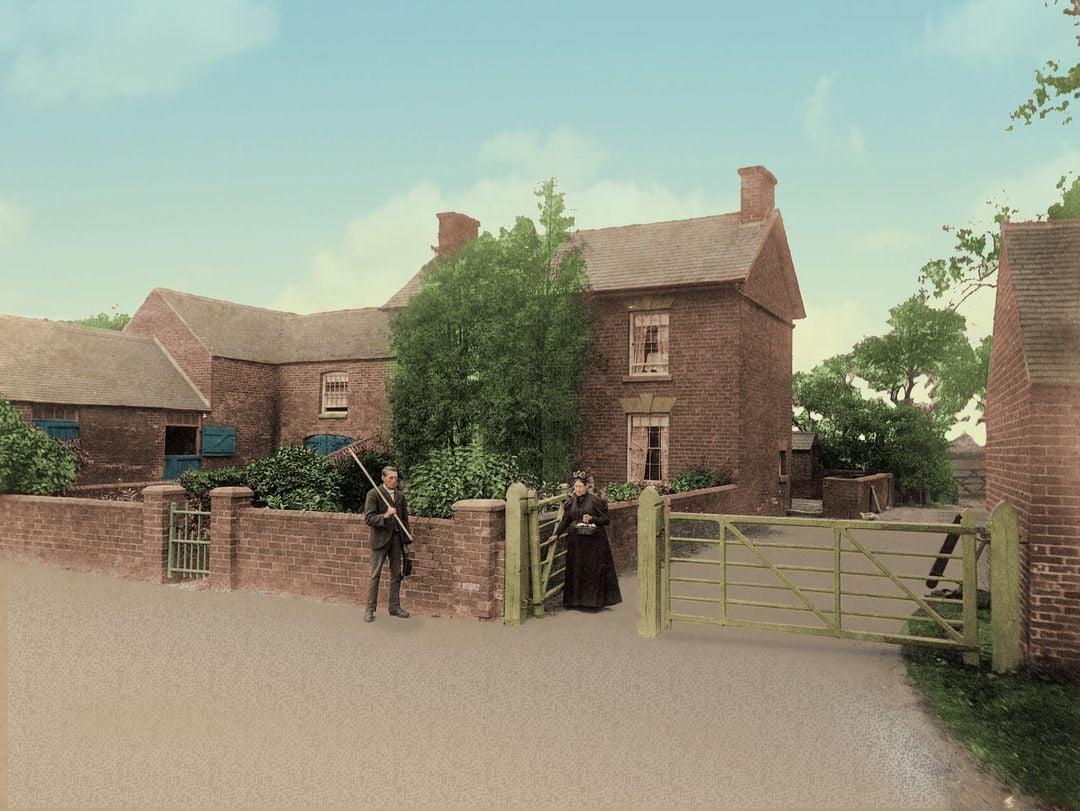
Ellen Carrington was born in 1795. Her father William Carrington 1755-1833 was from Smalley. Her mother Mary Malkin 1765-1838 was from Ellastone, in Staffordshire. Ellastone is on the Derbyshire border and very close to Ashboure, where Ellen married William Housley.
From Barbara Housley’s Narrative on the Letters:
Ellen’s family was evidently rather prominant in Smalley. Two Carringtons (John and William) served on the Parish Council in 1794. Parish records are full of Carrington marriages and christenings.
The letters refer to a variety of “uncles” who were probably Ellen’s brothers, but could be her uncles. These include:
RICHARD
Probably the youngest Uncle, and certainly the most significant, is Richard. He was a trustee for some of the property which needed to be settled following Ellen’s death. Anne wrote in 1854 that Uncle Richard “has got a new house built” and his daughters are “fine dashing young ladies–the belles of Smalley.” Then she added, “Aunt looks as old as my mother.”
Richard was born somewhere between 1808 and 1812. Since Richard was a contemporary of the older Housley children, “Aunt,” who was three years younger, should not look so old!
Richard Carrington and Harriet Faulkner were married in Repton in 1833. A daughter Elizabeth was baptised March 24, 1834. In July 1872, Joseph wrote: “Elizabeth is married too and a large family and is living in Uncle Thomas’s house for he is dead.” Elizabeth married Ayres (Eyres) Clayton of Lascoe. His occupation was listed as joiner and shopkeeper. They were married before 1864 since Elizabeth Clayton witnessed her sister’s marriage. Their children in April 1871 were Selina (1863), Agnes Maria (1866) and Elizabeth Ann (1868). A fourth daughter, Alice Augusta, was born in 1872 or 1873, probably by July 1872 to fit Joseph’s description “large family”! A son Charles Richard was born in 1880.
An Elizabeth Ann Clayton married John Arthur Woodhouse on May 12, 1913. He was a carpenter. His father was a miner. Elizabeth Ann’s father, Ayres, was also a carpenter. John Arthur’s age was given as 25. Elizabeth Ann’s age was given as 33 or 38. However, if she was born in 1868, her age would be 45. Possibly this is another case of a child being named for a deceased sibling. If she were 38 and born in 1875, she would fill the gap between Alice Augusta and Charles Richard.
Selina Clayton, who would have been 18, is not listed in the household in 1881. She died on June 11, 1914 at age 51. Agnes Maria Clayton died at the age of 25 and was buried March 31, 1891. Charles Richard died at the age of 5 and was buried on February 4, 1886. A Charles James Clayton, 18 months, was buried June 8, 1889 in Heanor.
Richard Carrington’s second daughter, Selina, born in 1837, married Walker Martin (b.1835) on February 11, 1864 and they were living at Kidsley Park Farm in 1872, according to a letter from Joseph, and, according to the census, were still there in 1881. This 100 acre farm was formerly the home of Daniel Smith and his daughter Elizabeth Davy Barber. Selina and Walker had at least five children: Elizabeth Ann (1865), Harriet Georgianna (1866/7), Alice Marian (September 6, 1868), Philip Richard (1870), and Walker (1873). In December 1972, Joseph mentioned the death of Philip Walker, a farmer of Prospect Farm, Shipley. This was probably Walker Martin’s grandfather, since Walker was born in Shipley. The stock was to be sold the following Monday, but his daughter (Walker’s mother?) died the next day. Walker’s father was named Thomas. An Annie Georgianna Martin age 13 of Shipley died in April of 1859.
Selina Martin died on October 29, 1906 but her estate was not settled until November 14, 1910. Her gross estate was worth L223.56. Her son Walker and her daughter Harriet Georgiana were her trustees and executers. Walker was to get Selina’s half of Richard’s farm. Harriet Georgiana and Alice Marian were to be allowed to live with him. Philip Richard received L25. Elizabeth Ann was already married to someone named Smith.
Richard and Harriet may also have had a son George. In 1851 a Harriet Carrington and her three year old son George were living with her step-father John Benniston in Heanor. John may have been recently widowed and needed her help. Or, the Carrington home may have been inadequate since Anne reported a new one was built by 1854. Selina’s second daughter’s name testifies to the presence of a “George” in the family! Could the death of this son account for the haggard appearance Anne described when she wrote: “Aunt looks as old as my mother?”
Harriet was buried May 19, 1866. She was 55 when she died.In 1881, Georgianna then 14, was living with her grandfather and his niece, Zilpah Cooper, age 38–who lived with Richard on his 63 acre farm as early as 1871. A Zilpah, daughter of William and Elizabeth, was christened October 1843. Her brother, William Walter, was christened in 1846 and married Anna Maria Saint in 1873. There are four Selina Coopers–one had a son William Thomas Bartrun Cooper christened in 1864; another had a son William Cooper christened in 1873.
Our Zilpah was born in Bretley 1843. She died at age 49 and was buried on September 24, 1892. In her will, which was witnessed by Selina Martin, Zilpah’s sister, Frances Elizabeth Cleave, wife of Horatio Cleave of Leicester is mentioned. James Eley and Francis Darwin Huish (Richard’s soliciter) were executers.
Richard died June 10, 1892, and was buried on June 13. He was 85. As might be expected, Richard’s will was complicated. Harriet Georgiana Martin and Zilpah Cooper were to share his farm. If neither wanted to live there it was to go to Georgiana’s cousin Selina Clayton. However, Zilpah died soon after Richard. Originally, he left his piano, parlor and best bedroom furniture to his daughter Elizabeth Clayton. Then he revoked everything but the piano. He arranged for the payment of £150 which he owed. Later he added a codicil explaining that the debt was paid but he had borrowed £200 from someone else to do it!
Richard left a good deal of property including: The house and garden in Smalley occupied by Eyres Clayton with four messuages and gardens adjoining and large garden below and three messuages at the south end of the row with the frame work knitters shop and garden adjoining; a dwelling house used as a public house with a close of land; a small cottage and garden and four cottages and shop and gardens.
THOMAS
In August 1854, Anne wrote “Uncle Thomas is about as usual.” A Thomas Carrington married a Priscilla Walker in 1810.
Their children were baptised in August 1830 at the same time as the Housley children who at that time ranged in age from 3 to 17. The oldest of Thomas and Priscilla’s children, Henry, was probably at least 17 as he was married by 1836. Their youngest son, William Thomas, born 1830, may have been Mary Ellen Weston’s beau. However, the only Richard whose christening is recorded (1820), was the son of Thomas and Lucy. In 1872 Joseph reported that Richard’s daughter Elizabeth was married and living in Uncle Thomas’s house. In 1851, Alfred Smith lived in house 25, Foulks lived in 26, Thomas and Priscilla lived in 27, Bennetts lived in 28, Allard lived in 29 and Day lived in 30. Thomas and Priscilla do not appear in 1861. In 1871 Elizabeth Ann and Ayres Clayton lived in House 54. None of the families listed as neighbors in 1851 remained. However, Joseph Carrington, who lived in house 19 in 1851, lived in house 51 in 1871.
JOHN
In August 1854, Anne wrote: “Uncle John is with Will and Frank has been home in a comfortable place in Cotmanhay.” Although John and William are two of the most popular Carrington names, only two John’s have sons named William. John and Rachel Buxton Carrington had a son William christened in 1788. At the time of the letters this John would have been over 100 years old. Their son John and his wife Ann had a son William who was born in 1805. However, this William age 46 was living with his widowed mother in 1851. A Robert Carrington and his wife Ann had a son John born 1n 1805. He would be the right age to be a brother to Francis Carrington discussed below. This John was living with his widowed mother in 1851 and was unmarried. There are no known Williams in this family grouping. A William Carrington of undiscovered parentage was born in 1821. It is also possible that the Will in question was Anne’s brother Will Housley.
–Two Francis Carringtons appear in the 1841 census both of them aged 35. One is living with Richard and Harriet Carrington. The other is living next door to Samuel and Ellen Carrington Kerry (the trustee for “father’s will”!). The next name in this sequence is John Carrington age 15 who does not seem to live with anyone! but may be part of the Kerry household.
FRANK (see above)
While Anne did not preface her mention of the name Frank with an “Uncle,” Joseph referred to Uncle Frank and James Carrington in the same sentence. A James Carrington was born in 1814 and had a wife Sarah. He worked as a framework knitter. James may have been a son of William and Anne Carrington. He lived near Richard according to the 1861 census. Other children of William and Anne are Hannah (1811), William (1815), John (1816), and Ann (1818). An Ann Carrington married a Frank Buxton in 1819. This might be “Uncle Frank.”
An Ellen Carrington was born to John and Rachel Carrington in 1785. On October 25, 1809, a Samuel Kerry married an Ellen Carrington. However this Samuel Kerry is not the trustee involved in settling Ellen’s estate. John Carrington died July 1815.
William and Mary Carrington:
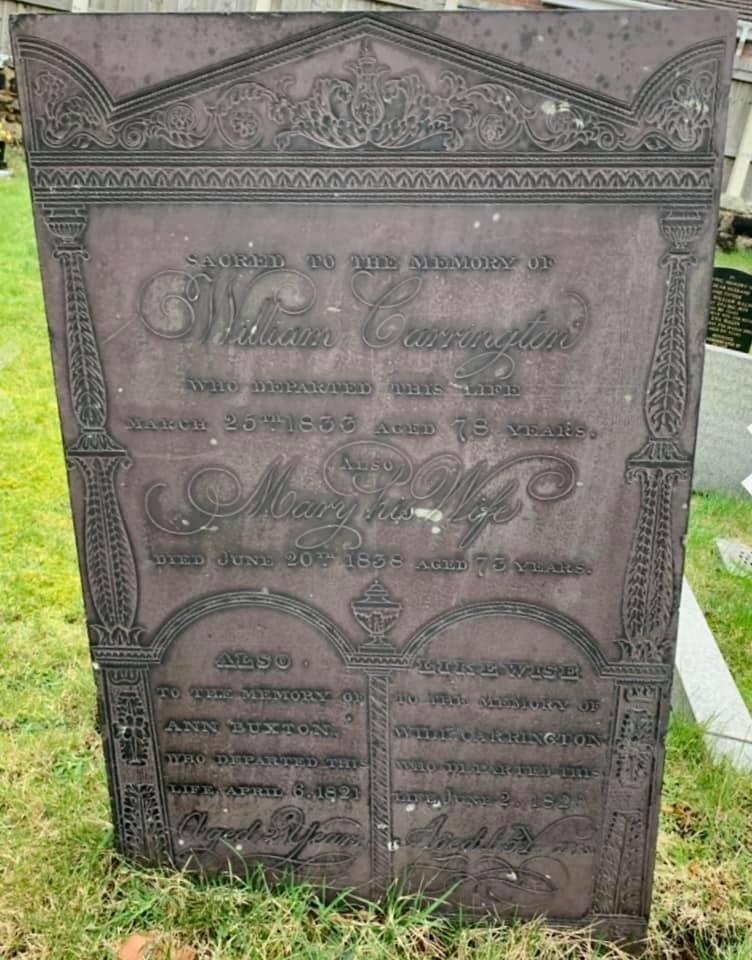 February 4, 2022 at 3:17 pm #6269
In reply to: The Elusive Samuel Housley and Other Family Stories
The Housley Letters
From Barbara Housley’s Narrative on the Letters.
William Housley (1781-1848) and Ellen Carrington were married on May 30, 1814 at St. Oswald’s church in Ashbourne. William died in 1848 at the age of 67 of “disease of lungs and general debility”. Ellen died in 1872.
Marriage of William Housley and Ellen Carrington in Ashbourne in 1814:
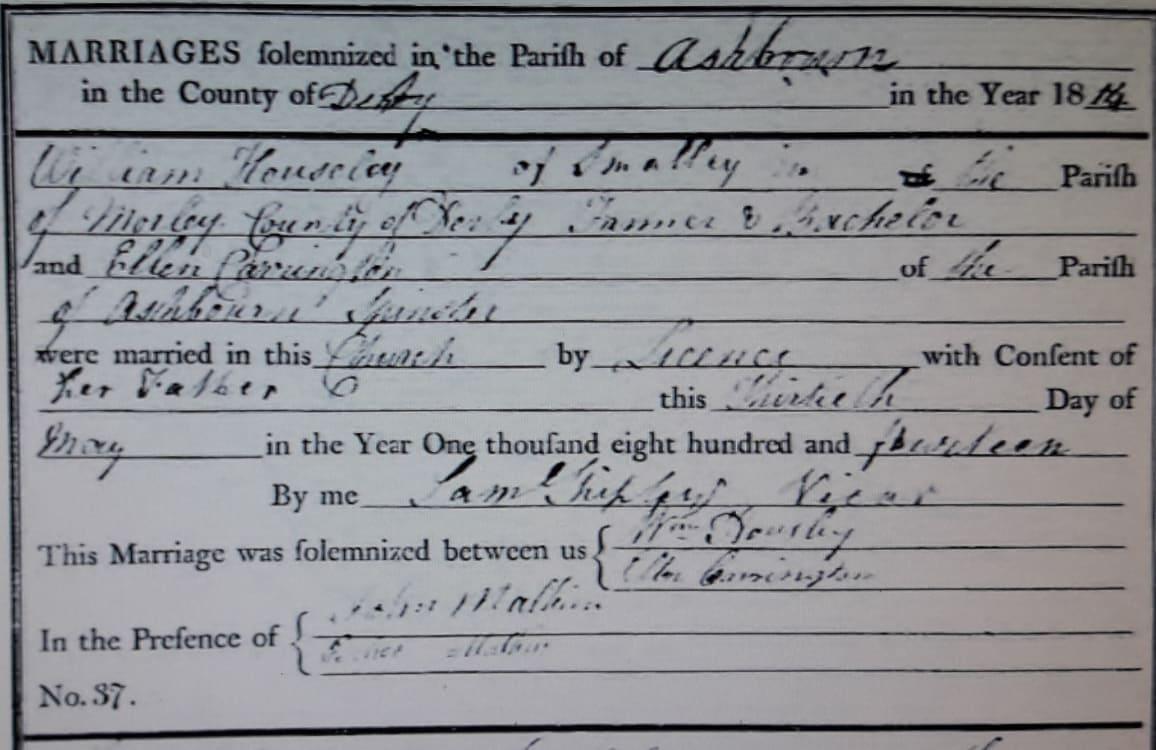
Parish records show three children for William and his first wife, Mary, Ellens’ sister, who were married December 29, 1806: Mary Ann, christened in 1808 and mentioned frequently in the letters; Elizabeth, christened in 1810, but never mentioned in any letters; and William, born in 1812, probably referred to as Will in the letters. Mary died in 1813.
William and Ellen had ten children: John, Samuel, Edward, Anne, Charles, George, Joseph, Robert, Emma, and Joseph. The first Joseph died at the age of four, and the last son was also named Joseph. Anne never married, Charles emigrated to Australia in 1851, and George to USA, also in 1851. The letters are to George, from his sisters and brothers in England.
The following are excerpts of those letters, including excerpts of Barbara Housley’s “Narrative on Historic Letters”. They are grouped according to who they refer to, rather than chronological order.
ELLEN HOUSLEY 1795-1872
Joseph wrote that when Emma was married, Ellen “broke up the comfortable home and the things went to Derby and she went to live with them but Derby didn’t agree with her so she left again leaving her things behind and came to live with John in the new house where she died.” Ellen was listed with John’s household in the 1871 census.
In May 1872, the Ilkeston Pioneer carried this notice: “Mr. Hopkins will sell by auction on Saturday next the eleventh of May 1872 the whole of the useful furniture, sewing machine, etc. nearly new on the premises of the late Mrs. Housley at Smalley near Heanor in the county of Derby. Sale at one o’clock in the afternoon.”Ellen’s family was evidently rather prominant in Smalley. Two Carringtons (John and William) served on the Parish Council in 1794. Parish records are full of Carrington marriages and christenings; census records confirm many of the family groupings.
In June of 1856, Emma wrote: “Mother looks as well as ever and was told by a lady the other day that she looked handsome.” Later she wrote: “Mother is as stout as ever although she sometimes complains of not being able to do as she used to.”
Mary’s children:
MARY ANN HOUSLEY 1808-1878
There were hard feelings between Mary Ann and Ellen and her children. Anne wrote: “If you remember we were not very friendly when you left. They never came and nothing was too bad for Mary Ann to say of Mother and me, but when Robert died Mother sent for her to the funeral but she did not think well to come so we took no more notice. She would not allow her children to come either.”
Mary Ann was unlucky in love! In Anne’s second letter she wrote: “William Carrington is paying Mary Ann great attention. He is living in London but they write to each other….We expect it will be a match.” Apparantly the courtship was stormy for in 1855, Emma wrote: “Mary Ann’s wedding with William Carrington has dropped through after she had prepared everything, dresses and all for the occassion.” Then in 1856, Emma wrote: “William Carrington and Mary Ann are separated. They wore him out with their nonsense.” Whether they ever married is unclear. Joseph wrote in 1872: “Mary Ann was married but her husband has left her. She is in very poor health. She has one daughter and they are living with their mother at Smalley.”
Regarding William Carrington, Emma supplied this bit of news: “His sister, Mrs. Lily, has eloped with a married man. Is she not a nice person!”
WILLIAM HOUSLEY JR. 1812-1890
According to a letter from Anne, Will’s two sons and daughter were sent to learn dancing so they would be “fit for any society.” Will’s wife was Dorothy Palfry. They were married in Denby on October 20, 1836 when Will was 24. According to the 1851 census, Will and Dorothy had three sons: Alfred 14, Edwin 12, and William 10. All three boys were born in Denby.
In his letter of May 30, 1872, after just bemoaning that all of his brothers and sisters are gone except Sam and John, Joseph added: “Will is living still.” In another 1872 letter Joseph wrote, “Will is living at Heanor yet and carrying on his cattle dealing.” The 1871 census listed Will, 59, and his son William, 30, of Lascoe Road, Heanor, as cattle dealers.
Ellen’s children:
JOHN HOUSLEY 1815-1893
John married Sarah Baggally in Morely in 1838. They had at least six children. Elizabeth (born 2 May 1838) was “out service” in 1854. In her “third year out,” Elizabeth was described by Anne as “a very nice steady girl but quite a woman in appearance.” One of her positions was with a Mrs. Frearson in Heanor. Emma wrote in 1856: “Elizabeth is still at Mrs. Frearson. She is such a fine stout girl you would not know her.” Joseph wrote in 1872 that Elizabeth was in service with Mrs. Eliza Sitwell at Derby. (About 1850, Miss Eliza Wilmot-Sitwell provided for a small porch with a handsome Norman doorway at the west end of the St. John the Baptist parish church in Smalley.)
According to Elizabeth’s birth certificate and the 1841 census, John was a butcher. By 1851, the household included a nurse and a servant, and John was listed as a “victular.” Anne wrote in February 1854, “John has left the Public House a year and a half ago. He is living where Plumbs (Ann Plumb witnessed William’s death certificate with her mark) did and Thomas Allen has the land. He has been working at James Eley’s all winter.” In 1861, Ellen lived with John and Sarah and the three boys.
John sold his share in the inheritance from their mother and disappeared after her death. (He died in Doncaster, Yorkshire, in 1893.) At that time Charles, the youngest would have been 21. Indeed, Joseph wrote in July 1872: “John’s children are all grown up”.
In May 1872, Joseph wrote: “For what do you think, John has sold his share and he has acted very bad since his wife died and at the same time he sold all his furniture. You may guess I have never seen him but once since poor mother’s funeral and he is gone now no one knows where.”
In February 1874 Joseph wrote: “You want to know what made John go away. Well, I will give you one reason. I think I told you that when his wife died he persuaded me to leave Derby and come to live with him. Well so we did and dear Harriet to keep his house. Well he insulted my wife and offered things to her that was not proper and my dear wife had the power to resist his unmanly conduct. I did not think he could of served me such a dirty trick so that is one thing dear brother. He could not look me in the face when we met. Then after we left him he got a woman in the house and I suppose they lived as man and wife. She caught the small pox and died and there he was by himself like some wild man. Well dear brother I could not go to him again after he had served me and mine as he had and I believe he was greatly in debt too so that he sold his share out of the property and when he received the money at Belper he went away and has never been seen by any of us since but I have heard of him being at Sheffield enquiring for Sam Caldwell. You will remember him. He worked in the Nag’s Head yard but I have heard nothing no more of him.”
A mention of a John Housley of Heanor in the Nottinghma Journal 1875. I don’t know for sure if the John mentioned here is the brother John who Joseph describes above as behaving improperly to his wife. John Housley had a son Joseph, born in 1840, and John’s wife Sarah died in 1870.
In 1876, the solicitor wrote to George: “Have you heard of John Housley? He is entitled to Robert’s share and I want him to claim it.”
SAMUEL HOUSLEY 1816-
Sam married Elizabeth Brookes of Sutton Coldfield, and they had three daughters: Elizabeth, Mary Anne and Catherine. Elizabeth his wife died in 1849, a few months after Samuel’s father William died in 1848. The particular circumstances relating to these individuals have been discussed in previous chapters; the following are letter excerpts relating to them.
Death of William Housley 15 Dec 1848, and Elizabeth Housley 5 April 1849, Smalley:
Joseph wrote in December 1872: “I saw one of Sam’s daughters, the youngest Kate, you would remember her a baby I dare say. She is very comfortably married.”
In the same letter (December 15, 1872), Joseph wrote: “I think we have now found all out now that is concerned in the matter for there was only Sam that we did not know his whereabouts but I was informed a week ago that he is dead–died about three years ago in Birmingham Union. Poor Sam. He ought to have come to a better end than that….His daughter and her husband went to Brimingham and also to Sutton Coldfield that is where he married his wife from and found out his wife’s brother. It appears he has been there and at Birmingham ever since he went away but ever fond of drink.”
(Sam, however, was still alive in 1871, living as a lodger at the George and Dragon Inn, Henley in Arden. And no trace of Sam has been found since. It would appear that Sam did not want to be found.)
EDWARD HOUSLEY 1819-1843
Edward died before George left for USA in 1851, and as such there is no mention of him in the letters.
ANNE HOUSLEY 1821-1856
Anne wrote two letters to her brother George between February 1854 and her death in 1856. Apparently she suffered from a lung disease for she wrote: “I can say you will be surprised I am still living and better but still cough and spit a deal. Can do nothing but sit and sew.” According to the 1851 census, Anne, then 29, was a seamstress. Their friend, Mrs. Davy, wrote in March 1856: “This I send in a box to my Brother….The pincushion cover and pen wiper are Anne’s work–are for thy wife. She would have made it up had she been able.” Anne was not living at home at the time of the 1841 census. She would have been 19 or 20 and perhaps was “out service.”
In her second letter Anne wrote: “It is a great trouble now for me to write…as the body weakens so does the mind often. I have been very weak all summer. That I continue is a wonder to all and to spit so much although much better than when you left home.” She also wrote: “You know I had a desire for America years ago. Were I in health and strength, it would be the land of my adoption.”
In November 1855, Emma wrote, “Anne has been very ill all summer and has not been able to write or do anything.” Their neighbor Mrs. Davy wrote on March 21, 1856: “I fear Anne will not be long without a change.” In a black-edged letter the following June, Emma wrote: “I need not tell you how happy she was and how calmly and peacefully she died. She only kept in bed two days.”
Certainly Anne was a woman of deep faith and strong religious convictions. When she wrote that they were hoping to hear of Charles’ success on the gold fields she added: “But I would rather hear of him having sought and found the Pearl of great price than all the gold Australia can produce, (For what shall it profit a man if he gain the whole world and lose his soul?).” Then she asked George: “I should like to learn how it was you were first led to seek pardon and a savior. I do feel truly rejoiced to hear you have been led to seek and find this Pearl through the workings of the Holy Spirit and I do pray that He who has begun this good work in each of us may fulfill it and carry it on even unto the end and I can never doubt the willingness of Jesus who laid down his life for us. He who said whoever that cometh unto me I will in no wise cast out.”
Anne’s will was probated October 14, 1856. Mr. William Davy of Kidsley Park appeared for the family. Her estate was valued at under £20. Emma was to receive fancy needlework, a four post bedstead, feather bed and bedding, a mahogany chest of drawers, plates, linen and china. Emma was also to receive Anne’s writing desk. There was a condition that Ellen would have use of these items until her death.
The money that Anne was to receive from her grandfather, William Carrington, and her father, William Housley was to be distributed one third to Joseph, one third to Emma, and one third to be divided between her four neices: John’s daughter Elizabeth, 18, and Sam’s daughters Elizabeth, 10, Mary Ann, 9 and Catharine, age 7 to be paid by the trustees as they think “most useful and proper.” Emma Lyon and Elizabeth Davy were the witnesses.
The Carrington Farm:
CHARLES HOUSLEY 1823-1855
Charles went to Australia in 1851, and was last heard from in January 1853. According to the solicitor, who wrote to George on June 3, 1874, Charles had received advances on the settlement of their parent’s estate. “Your promissory note with the two signed by your brother Charles for 20 pounds he received from his father and 20 pounds he received from his mother are now in the possession of the court.”
Charles and George were probably quite close friends. Anne wrote in 1854: “Charles inquired very particularly in both his letters after you.”
According to Anne, Charles and a friend married two sisters. He and his father-in-law had a farm where they had 130 cows and 60 pigs. Whatever the trade he learned in England, he never worked at it once he reached Australia. While it does not seem that Charles went to Australia because gold had been discovered there, he was soon caught up in “gold fever”. Anne wrote: “I dare say you have heard of the immense gold fields of Australia discovered about the time he went. Thousands have since then emigrated to Australia, both high and low. Such accounts we heard in the papers of people amassing fortunes we could not believe. I asked him when I wrote if it was true. He said this was no exaggeration for people were making their fortune daily and he intended going to the diggings in six weeks for he could stay away no longer so that we are hoping to hear of his success if he is alive.”
In March 1856, Mrs. Davy wrote: “I am sorry to tell thee they have had a letter from Charles’s wife giving account of Charles’s death of 6 months consumption at the Victoria diggings. He has left 2 children a boy and a girl William and Ellen.” In June of the same year in a black edged letter, Emma wrote: “I think Mrs. Davy mentioned Charles’s death in her note. His wife wrote to us. They have two children Helen and William. Poor dear little things. How much I should like to see them all. She writes very affectionately.”
In December 1872, Joseph wrote: “I’m told that Charles two daughters has wrote to Smalley post office making inquiries about his share….” In January 1876, the solicitor wrote: “Charles Housley’s children have claimed their father’s share.”
GEORGE HOUSLEY 1824-1877
George emigrated to the United states in 1851, arriving in July. The solicitor Abraham John Flint referred in a letter to a 15-pound advance which was made to George on June 9, 1851. This certainly was connected to his journey. George settled along the Delaware River in Bucks County, Pennsylvania. The letters from the solicitor were addressed to: Lahaska Post Office, Bucks County, Pennsylvania.
George married Sarah Ann Hill on May 6, 1854 in Doylestown, Bucks County, Pennsylvania. In her first letter (February 1854), Anne wrote: “We want to know who and what is this Miss Hill you name in your letter. What age is she? Send us all the particulars but I would advise you not to get married until you have sufficient to make a comfortable home.”
Upon learning of George’s marriage, Anne wrote: “I hope dear brother you may be happy with your wife….I hope you will be as a son to her parents. Mother unites with me in kind love to you both and to your father and mother with best wishes for your health and happiness.” In 1872 (December) Joseph wrote: “I am sorry to hear that sister’s father is so ill. It is what we must all come to some time and hope we shall meet where there is no more trouble.”
Emma wrote in 1855, “We write in love to your wife and yourself and you must write soon and tell us whether there is a little nephew or niece and what you call them.” In June of 1856, Emma wrote: “We want to see dear Sarah Ann and the dear little boy. We were much pleased with the “bit of news” you sent.” The bit of news was the birth of John Eley Housley, January 11, 1855. Emma concluded her letter “Give our very kindest love to dear sister and dearest Johnnie.”
In September 1872, Joseph wrote, “I was very sorry to hear that John your oldest had met with such a sad accident but I hope he is got alright again by this time.” In the same letter, Joseph asked: “Now I want to know what sort of a town you are living in or village. How far is it from New York? Now send me all particulars if you please.”
In March 1873 Harriet asked Sarah Ann: “And will you please send me all the news at the place and what it is like for it seems to me that it is a wild place but you must tell me what it is like….”. The question of whether she was referring to Bucks County, Pennsylvania or some other place is raised in Joseph’s letter of the same week.
On March 17, 1873, Joseph wrote: “I was surprised to hear that you had gone so far away west. Now dear brother what ever are you doing there so far away from home and family–looking out for something better I suppose.”The solicitor wrote on May 23, 1874: “Lately I have not written because I was not certain of your address and because I doubted I had much interesting news to tell you.” Later, Joseph wrote concerning the problems settling the estate, “You see dear brother there is only me here on our side and I cannot do much. I wish you were here to help me a bit and if you think of going for another summer trip this turn you might as well run over here.”
Apparently, George had indicated he might return to England for a visit in 1856. Emma wrote concerning the portrait of their mother which had been sent to George: “I hope you like mother’s portrait. I did not see it but I suppose it was not quite perfect about the eyes….Joseph and I intend having ours taken for you when you come over….Do come over before very long.”
In March 1873, Joseph wrote: “You ask me what I think of you coming to England. I think as you have given the trustee power to sign for you I think you could do no good but I should like to see you once again for all that. I can’t say whether there would be anything amiss if you did come as you say it would be throwing good money after bad.”
On June 10, 1875, the solicitor wrote: “I have been expecting to hear from you for some time past. Please let me hear what you are doing and where you are living and how I must send you your money.” George’s big news at that time was that on May 3, 1875, he had become a naturalized citizen “renouncing and abjuring all allegiance and fidelity to every foreign prince, potentate, state and sovereignity whatsoever, and particularly to Victoria Queen of Great Britain of whom he was before a subject.”
ROBERT HOUSLEY 1832-1851
In 1854, Anne wrote: “Poor Robert. He died in August after you left he broke a blood vessel in the lung.”
From Joseph’s first letter we learn that Robert was 19 when he died: “Dear brother there have been a great many changes in the family since you left us. All is gone except myself and John and Sam–we have heard nothing of him since he left. Robert died first when he was 19 years of age. Then Anne and Charles too died in Australia and then a number of years elapsed before anyone else. Then John lost his wife, then Emma, and last poor dear mother died last January on the 11th.”Anne described Robert’s death in this way: “He had thrown up blood many times before in the spring but the last attack weakened him that he only lived a fortnight after. He died at Derby. Mother was with him. Although he suffered much he never uttered a murmur or regret and always a smile on his face for everyone that saw him. He will be regretted by all that knew him”.
Robert died a resident of St. Peter’s Parish, Derby, but was buried in Smalley on August 16, 1851.
Apparently Robert was apprenticed to be a joiner for, according to Anne, Joseph took his place: “Joseph wanted to be a joiner. We thought we could do no better than let him take Robert’s place which he did the October after and is there still.”In 1876, the solicitor wrote to George: “Have you heard of John Housley? He is entitled to Robert’s share and I want him to claim it.”
EMMA HOUSLEY 1836-1871
Emma was not mentioned in Anne’s first letter. In the second, Anne wrote that Emma was living at Spondon with two ladies in her “third situation,” and added, “She is grown a bouncing woman.” Anne described her sister well. Emma wrote in her first letter (November 12, 1855): “I must tell you that I am just 21 and we had my pudding last Sunday. I wish I could send you a piece.”
From Emma’s letters we learn that she was living in Derby from May until November 1855 with Mr. Haywood, an iron merchant. She explained, “He has failed and I have been obliged to leave,” adding, “I expect going to a new situation very soon. It is at Belper.” In 1851 records, William Haywood, age 22, was listed as an iron foundry worker. In the 1857 Derby Directory, James and George were listed as iron and brass founders and ironmongers with an address at 9 Market Place, Derby.
In June 1856, Emma wrote from “The Cedars, Ashbourne Road” where she was working for Mr. Handysides.
While she was working for Mr. Handysides, Emma wrote: “Mother is thinking of coming to live at Derby. That will be nice for Joseph and I.”Friargate and Ashbourne Road were located in St. Werburgh’s Parish. (In fact, St. Werburgh’s vicarage was at 185 Surrey Street. This clue led to the discovery of the record of Emma’s marriage on May 6, 1858, to Edwin Welch Harvey, son of Samuel Harvey in St. Werburgh’s.)
In 1872, Joseph wrote: “Our sister Emma, she died at Derby at her own home for she was married. She has left two young children behind. The husband was the son of the man that I went apprentice to and has caused a great deal of trouble to our family and I believe hastened poor Mother’s death….”. Joseph added that he believed Emma’s “complaint” was consumption and that she was sick a good bit. Joseph wrote: “Mother was living with John when I came home (from Ascension Island around 1867? or to Smalley from Derby around 1870?) for when Emma was married she broke up the comfortable home and the things went to Derby and she went to live with them but Derby did not agree with her so she had to leave it again but left all her things there.”
Emma Housley and Edwin Welch Harvey wedding, 1858:
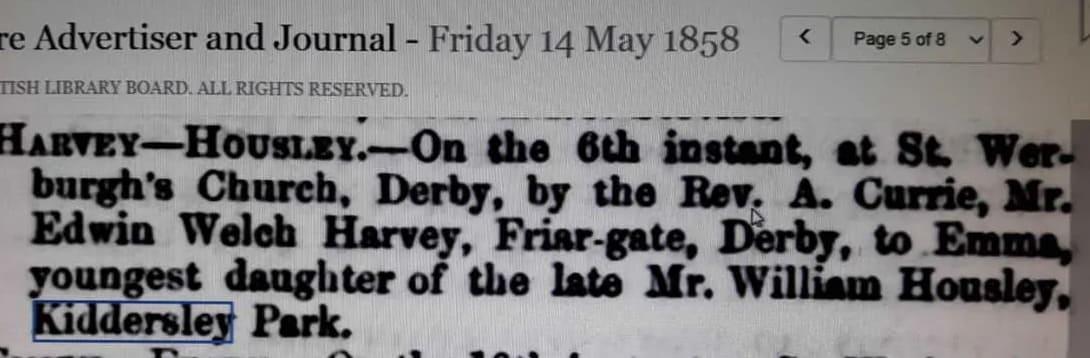
JOSEPH HOUSLEY 1838-1893
We first hear of Joseph in a letter from Anne to George in 1854. “Joseph wanted to be a joiner. We thought we could do no better than let him take Robert’s place which he did the October after (probably 1851) and is there still. He is grown as tall as you I think quite a man.” Emma concurred in her first letter: “He is quite a man in his appearance and quite as tall as you.”
From Emma we learn in 1855: “Joseph has left Mr. Harvey. He had not work to employ him. So mother thought he had better leave his indenture and be at liberty at once than wait for Harvey to be a bankrupt. He has got a very good place of work now and is very steady.” In June of 1856, Emma wrote “Joseph and I intend to have our portraits taken for you when you come over….Mother is thinking of coming to Derby. That will be nice for Joseph and I. Joseph is very hearty I am happy to say.”
According to Joseph’s letters, he was married to Harriet Ballard. Joseph described their miraculous reunion in this way: “I must tell you that I have been abroad myself to the Island of Ascension. (Elsewhere he wrote that he was on the island when the American civil war broke out). I went as a Royal Marine and worked at my trade and saved a bit of money–enough to buy my discharge and enough to get married with but while I was out on the island who should I meet with there but my dear wife’s sister. (On two occasions Joseph and Harriet sent George the name and address of Harriet’s sister, Mrs. Brooks, in Susquehanna Depot, Pennsylvania, but it is not clear whether this was the same sister.) She was lady’s maid to the captain’s wife. Though I had never seen her before we got to know each other somehow so from that me and my wife recommenced our correspondence and you may be sure I wanted to get home to her. But as soon as I did get home that is to England I was not long before I was married and I have not regretted yet for we are very comfortable as well as circumstances will allow for I am only a journeyman joiner.”
Proudly, Joseph wrote: “My little family consists of three nice children–John, Joseph and Susy Annie.” On her birth certificate, Susy Ann’s birthdate is listed as 1871. Parish records list a Lucy Annie christened in 1873. The boys were born in Derby, John in 1868 and Joseph in 1869. In his second letter, Joseph repeated: “I have got three nice children, a good wife and I often think is more than I have deserved.” On August 6, 1873, Joseph and Harriet wrote: “We both thank you dear sister for the pieces of money you sent for the children. I don’t know as I have ever see any before.” Joseph ended another letter: “Now I must close with our kindest love to you all and kisses from the children.”
In Harriet’s letter to Sarah Ann (March 19, 1873), she promised: “I will send you myself and as soon as the weather gets warm as I can take the children to Derby, I will have them taken and send them, but it is too cold yet for we have had a very cold winter and a great deal of rain.” At this time, the children were all under 6 and the baby was not yet two.
In March 1873 Joseph wrote: “I have been working down at Heanor gate there is a joiner shop there where Kings used to live I have been working there this winter and part of last summer but the wages is very low but it is near home that is one comfort.” (Heanor Gate is about 1/4 mile from Kidsley Grange. There was a school and industrial park there in 1988.) At this time Joseph and his family were living in “the big house–in Old Betty Hanson’s house.” The address in the 1871 census was Smalley Lane.
A glimpse into Joseph’s personality is revealed by this remark to George in an 1872 letter: “Many thanks for your portrait and will send ours when we can get them taken for I never had but one taken and that was in my old clothes and dear Harriet is not willing to part with that. I tell her she ought to be satisfied with the original.”
On one occasion Joseph and Harriet both sent seeds. (Marks are still visible on the paper.) Joseph sent “the best cow cabbage seed in the country–Robinson Champion,” and Harriet sent red cabbage–Shaw’s Improved Red. Possibly cow cabbage was also known as ox cabbage: “I hope you will have some good cabbages for the Ox cabbage takes all the prizes here. I suppose you will be taking the prizes out there with them.” Joseph wrote that he would put the name of the seeds by each “but I should think that will not matter. You will tell the difference when they come up.”
George apparently would have liked Joseph to come to him as early as 1854. Anne wrote: “As to his coming to you that must be left for the present.” In 1872, Joseph wrote: “I have been thinking of making a move from here for some time before I heard from you for it is living from hand to mouth and never certain of a job long either.” Joseph then made plans to come to the United States in the spring of 1873. “For I intend all being well leaving England in the spring. Many thanks for your kind offer but I hope we shall be able to get a comfortable place before we have been out long.” Joseph promised to bring some things George wanted and asked: “What sort of things would be the best to bring out there for I don’t want to bring a lot that is useless.” Joseph’s plans are confirmed in a letter from the solicitor May 23, 1874: “I trust you are prospering and in good health. Joseph seems desirous of coming out to you when this is settled.”
George must have been reminiscing about gooseberries (Heanor has an annual gooseberry show–one was held July 28, 1872) and Joseph promised to bring cuttings when they came: “Dear Brother, I could not get the gooseberries for they was all gathered when I received your letter but we shall be able to get some seed out the first chance and I shall try to bring some cuttings out along.” In the same letter that he sent the cabbage seeds Joseph wrote: “I have got some gooseberries drying this year for you. They are very fine ones but I have only four as yet but I was promised some more when they were ripe.” In another letter Joseph sent gooseberry seeds and wrote their names: Victoria, Gharibaldi and Globe.
In September 1872 Joseph wrote; “My wife is anxious to come. I hope it will suit her health for she is not over strong.” Elsewhere Joseph wrote that Harriet was “middling sometimes. She is subject to sick headaches. It knocks her up completely when they come on.” In December 1872 Joseph wrote, “Now dear brother about us coming to America you know we shall have to wait until this affair is settled and if it is not settled and thrown into Chancery I’m afraid we shall have to stay in England for I shall never be able to save money enough to bring me out and my family but I hope of better things.”
On July 19, 1875 Abraham Flint (the solicitor) wrote: “Joseph Housley has removed from Smalley and is working on some new foundry buildings at Little Chester near Derby. He lives at a village called Little Eaton near Derby. If you address your letter to him as Joseph Housley, carpenter, Little Eaton near Derby that will no doubt find him.”
George did not save any letters from Joseph after 1874, hopefully he did reach him at Little Eaton. Joseph and his family are not listed in either Little Eaton or Derby on the 1881 census.
In his last letter (February 11, 1874), Joseph sounded very discouraged and wrote that Harriet’s parents were very poorly and both had been “in bed for a long time.” In addition, Harriet and the children had been ill.
The move to Little Eaton may indicate that Joseph received his settlement because in August, 1873, he wrote: “I think this is bad news enough and bad luck too, but I have had little else since I came to live at Kiddsley cottages but perhaps it is all for the best if one could only think so. I have begun to think there will be no chance for us coming over to you for I am afraid there will not be so much left as will bring us out without it is settled very shortly but I don’t intend leaving this house until it is settled either one way or the other. “Joseph Housley and the Kiddsley cottages:
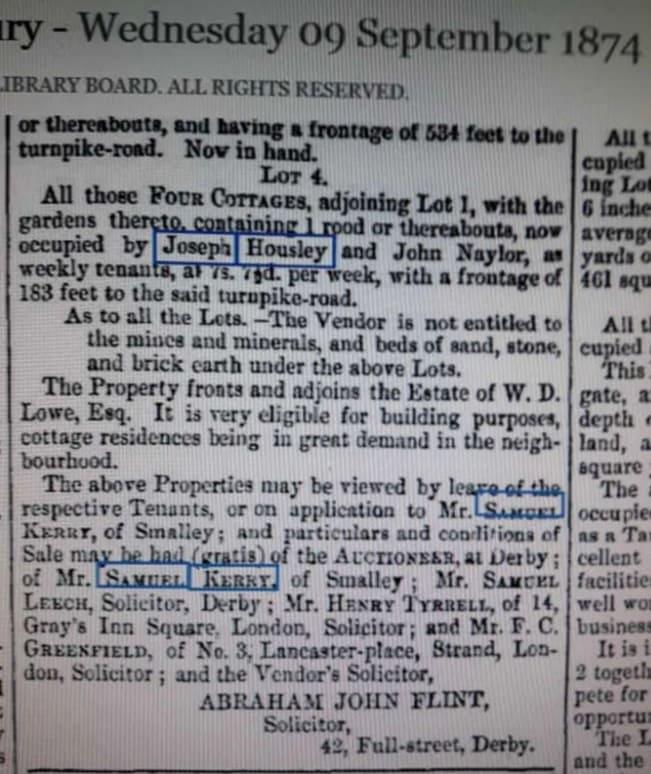
-
AuthorSearch Results
