

Search Results for 'fully'
-
AuthorSearch Results
-
March 1, 2025 at 1:42 pm #7848
In reply to: The Last Cruise of Helix 25
Helix 25 – Murder Board – Evie’s apartment
The ship had gone mad.
Riven Holt stood in what should have been a secured crime scene, staring at the makeshift banner that had replaced his official security tape. “ENTER FREELY AND OF YOUR OWN WILL,” it read, in bold, uneven letters. The edges were charred. Someone had burned it, for reasons he would never understand.
Behind him, the faint sounds of mass lunacy echoed through the corridors. People chanting, people sobbing, someone loudly trying to bargain with gravity.
“Sir, the floors are not real! We’ve all been walking on a lie!” someone had screamed earlier, right before diving headfirst into a pile of chairs left there by someone trying to create a portal.
Riven did his best to ignore the chaos, gripping his tablet like it was the last anchor to reality. He had two dead bodies. He had one ship full of increasingly unhinged people. And he had forty hours without sleep. His brain felt like a dried-out husk, working purely on stubbornness and caffeine fumes.
Evie was crouched over Mandrake’s remains, muttering to herself as she sorted through digital records. TP stood nearby, his holographic form flickering as if he, too, were being affected by the ship’s collective insanity.
“Well,” TP mused, rubbing his nonexistent chin. “This is quite the predicament.”
Riven pinched the bridge of his nose. “TP, if you say anything remotely poetic about the human condition, I will unplug your entire database.”
TP looked delighted. “Ah, my dear lieutenant, a threat worthy of true desperation!”
Evie ignored them both, then suddenly stiffened. “Riven, I… you need to see this.”
He braced himself. “What now?”
She turned the screen toward him. Two names appeared side by side:
ETHAN MARLOWE
MANDRAKE
Both M.
The sound that came out of Riven was not quite a word. More like a dying engine trying to restart.
TP gasped dramatically. “My stars. The letter M! The implications are—”
“No.” Riven put up a hand, one tremor away from screaming. “We are NOT doing this. I am not letting my brain spiral into a letter-based conspiracy theory while people outside are rolling in protein paste and reciting odes to Jupiter’s moons.”
Evie, far too calm for his liking, just tapped the screen again. “It’s a pattern. We have to consider it.”
TP nodded sagely. “Indeed. The letter M—known throughout history as a mark of mystery, malice, and… wait, let me check… ah, macaroni.”
Riven was going to have an aneurysm.
Instead, he exhaled slowly, like a man trying to keep the last shreds of his soul from unraveling.
“That means the Lexicans are involved.”
Evie paled. “Oh no.”
TP beamed. “Oh yes!”
The Lexicans had been especially unpredictable lately. One had been caught trying to record the “song of the walls” because “they hum with forgotten words.” Another had attempted to marry the ship’s AI. A third had been detained for throwing their own clothing into the air vents because “the whispers demanded tribute.”
Riven leaned against the console, feeling his mind slipping. He needed a reality check. A hard, cold, undeniable fact.
Only one person could give him that.
“You know what? Fine,” he muttered. “Let’s just ask the one person who might actually be able to tell me if this is a coincidence or some ancient space cult.”
Evie frowned. “Who?”
Riven was already walking. “My grandfather.”
Evie practically choked. “Wait, WHAT?!”
TP clapped his hands. “Ah, the classic ‘Wake the Old Man to Solve the Crimes’ maneuver. Love it.”
The corridors were worse than before. As they made their way toward cryo-storage, the lunacy had escalated:
A crowd was parading down the halls with helium balloons, chanting, “Gravity is a Lie!”
A group of engineers had dismantled a security door, claiming “it whispered to them about betrayal.”
And a bunch of Lexicans, led by Kio’ath, had smeared stinking protein paste onto the Atrium walls, drawing spirals and claiming the prophecy was upon them all.
Riven’s grip on reality was thin.Evie grabbed his arm. “Think about this. What if your grandfather wakes up and he’s just as insane as everyone else?”
Riven didn’t even break stride. “Then at least we’ll be insane with more context.”
TP sighed happily. “Ah, reckless decision-making. The very heart of detective work.”
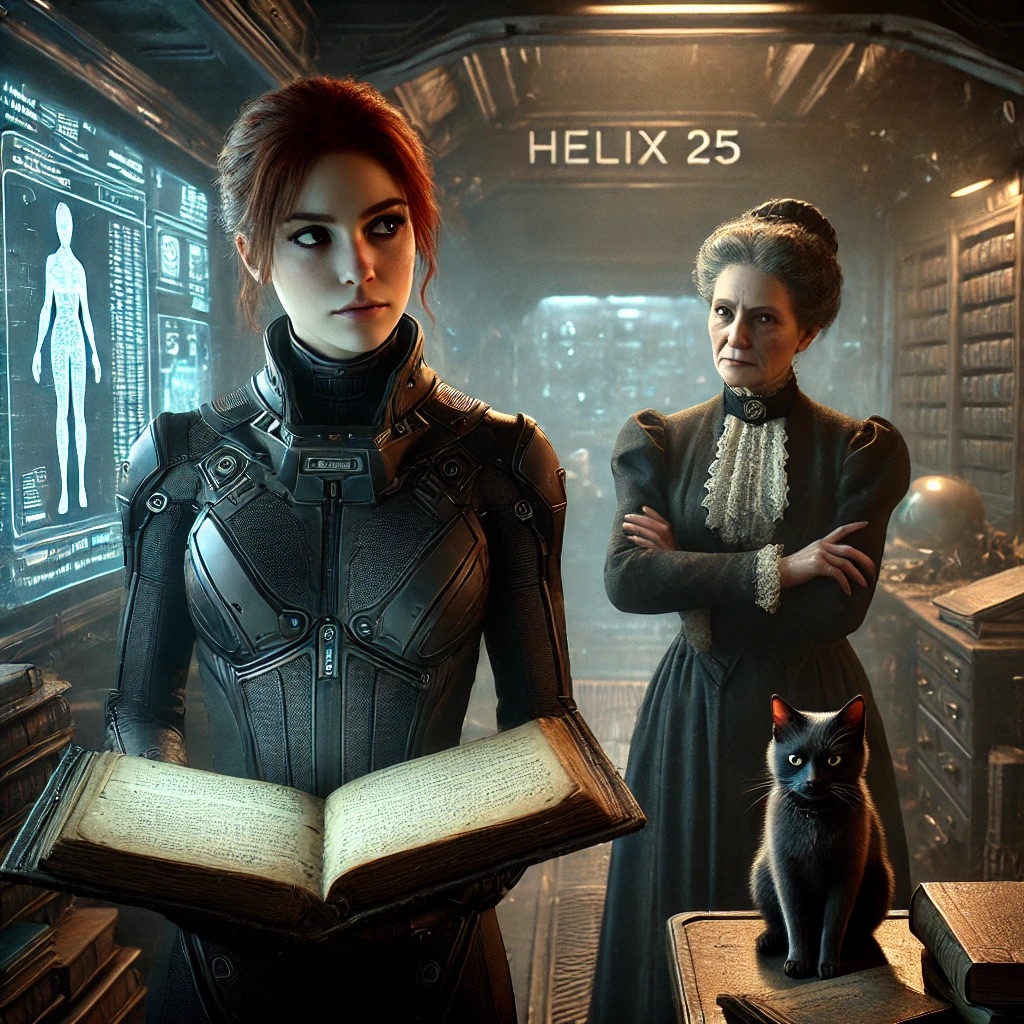
Helix 25 — Victor Holt’s Awakening
They reached the cryo-chamber. The pod loomed before them, controls locked down under layers of security.
Riven cracked his knuckles, eyes burning with the desperation of a man who had officially run out of better options.
Evie stared. “You’re actually doing this.”
He was already punching in override codes. “Damn right I am.”
The door opened. A low hum filled the room. The first thing Riven noticed was the frost still clinging to the edges of an already open cryopod. Cold vapor curled around its base, its occupant nowhere to be seen.
His stomach clenched. Someone had beaten them here. Another pod’s systems activated. The glass began to fog as temperature levels shifted.
TP leaned in. “Oh, this is going to be deliciously catastrophic.”
Before the pod could fully engage, a flicker of movement in the dim light caught Riven’s eye. Near the terminal, hunched over the access panel like a gang of thieves cracking a vault, stood Zoya Kade and Anuí Naskó—and, a baby wrapped in what could only be described as an aggressively overdesigned Lexican tapestry, layers of embroidered symbols and unreadable glyphs woven in mismatched patterns. It was sucking desperately the lexican’s sleeve.
Riven’s exhaustion turned into a slow, rising fury. For a brief moment, his mind was distracted by something he had never actually considered before—he had always assumed Anuí was a woman. The flowing robes, the mannerisms, the way they carried themselves. But now, cradling the notorious Lexican baby in ceremonial cloth, could they possibly be…
Anuí caught his look and smiled faintly, unreadable as ever. “This has nothing to do with gender,” they said smoothly, shifting the baby with practiced ease. “I merely am the second father of the child.”
“Oh, for f***—What in the hell are you two doing here?”
Anuí barely glanced up, shifting the baby to their other arm as though hacking into a classified cryo-storage facility while holding an infant was a perfectly normal occurrence. “Unlocking the axis of the spiral,” they said smoothly. “It was prophesied. The Speaker’s name has been revealed.”
Zoya, still pressing at the panel, didn’t even look at him. “We need to wake Victor Holt.”
Riven threw his hands in the air. “Great! Fantastic! So do we! The difference is that I actually have a reason.”
Anuí, eyes glinting with something between mischief and intellect, gave an elegant nod. “So do we, Lieutenant. Yours is a crime scene. Ours is history itself.”
Riven felt his headache spike. “Oh good. You’ve been licking the walls again.”
TP, absolutely delighted, interjected, “Oh, I like them. Their madness is methodical!”
Riven narrowed his eyes, pointing at the empty pod. “Who the hell did you wake up?”
Zoya didn’t flinch. “We don’t know.”
He barked a laugh, sharp and humorless. “Oh, you don’t know? You cracked into a classified cryo-storage facility, activated a pod, and just—what? Didn’t bother to check who was inside?”
Anuí adjusted the baby, watching him with that same unsettling, too-knowing expression. “It was not part of the prophecy. We were guided here for Victor Holt.”
“And yet someone else woke up first!” Riven gestured wildly to the empty pod. “So, unless the prophecy also mentioned mystery corpses walking out of deep freeze, I suggest you start making sense.”
Before Riven could launch into a proper interrogation, the cryo-system let out a deep hiss.
Steam coiled up from Victor Holt’s pod as the seals finally unlocked, fog spilling over the edges like something out of an ancient myth. A figure was stirring within, movements sluggish, muscles regaining function after years in suspension.
And then, from the doorway, another voice rang out, sharp, almost panicked.
Ellis Marlowe stood at the threshold, looking at the two open pods, his eyes wide with something between shock and horror.
“What have you done?”
Riven braced himself.
Evie muttered, “Oh, this is gonna be bad.”
March 1, 2025 at 12:35 pm #7846In reply to: The Last Cruise of Helix 25
Helix 25 — The Captain’s Awakening
The beacon’s pulse cut through the void like a sharpened arrowhead of ancient memory.
Far from Merdhyn’s remote island refuge, deep within the Hold’s bowels of Helix 25, something—someone—stirred.
Inside an unlisted cryo-chamber, the frozen stasis cracked. Veins of light slithered across the pod’s surface like Northern lights dancing on an old age screensaver. Systems whirred, data blipped and streamed in strings of unknown characters. The ship, Synthia, whispered in its infinite omniscience, but the moment was already beyond her control.
A breath. A slow, drawn-out breath.
The cryo-pod released its lock with a soft hiss, and through the dispersing mist, Veranassessee stepped forward— awakened.
She blinked once, twice, as her senses rushed back with the sudden sense of gravity’s return. It was not the disorienting shock of the newly thawed. No—this was a return long overdue. Her mind, trained to absorb and adapt, locked onto the now, cataloging every change, every discrepancy as her mind had remained awake during the whole session —equipoise and open, as a true master of her senses she was.
She was older than when she had first stepped inside. Older, but not old. Age, after all, was a trick of perception, and if anyone had mastered perception, it was her.
But now, crises called. Plural indeed. And she, once more, was called to carry out her divine duty, with skills forged in Earthly battles with mad scientists, genetically modified spiders bent on world domination, and otherworldly crystal skulls thiefs. That was far in her past. Since then, she’d used her skills in the private sector, climbing the ranks as her efficient cold-as-steel talents were recognized at every step. She was the true Captain. She had earned it. That was how Victor Holt fell in love. She hated that people could think it was depotism that gave her the title. If anything, she helped make Victor the man he was.
The ship thrummed beneath her bare feet. A subtle shift in the atmosphere. Something had changed since she last walked these halls, something was off. The ship’s course? Its command structure?
And, most importantly—
Who had sent the signal?
Ellis Marlowe Sr. had moved swiftly for a man his age. It wasn’t that he feared the unknown. It wasn’t even the mystery of the murder that pushed him forward. It was something deeper, more personal.
The moment the solar flare alert had passed, whispers had spread—faint, half-muttered rumors that the Restricted Cryo-Chambers had been breached.
By the time he reached it, the pod was already empty.
The remnants of thawing frost still clung to the edges of the chamber. A faint imprint of a body, long at rest, now gone.
He swore under his breath, then turned to the ship’s log panel, reaching for a battered postcard. Scribbled on it were cheatcodes. His hands moved with a careful expertise of someone who had spent too many years filing things that others had forgotten. A postman he was, and registers he knew well.
Access Denied.
That wasn’t right. The codes should have given Ellis clearance for everything.
He scowled, adjusting his glasses. It was always the same names, always the same people tied to these inexplicable gaps in knowledge.
The Holts. The Forgelots. The Marlowes.
And now, an unlisted cryopod with no official records.Ellis exhaled slowly.
She was back. And with her, more history with this ship, like pieces of old broken potteries in an old dig would be unearthed.
He turned, already making his way toward the Murder Board.
Evie needed to see this.
The corridor stretched out before her, familiar in its dimensions yet strange in its silence. She had managed to switch the awkward hospital gown to a non-descript uniform that was hanging in the Hold.
How long have I been gone?
She exhaled. Irrelevant.
Her body moved with the precise economy of someone whose training never dulled. Her every motion were simple yet calculated, and her every breath controlled.
Unlike in the crypod, her mind started to bubbled with long forgotten emotions. It flickered over past decisions, past betrayals.
Victor Holt.
The name of her ex-husband settled into her consciousness. Once her greatest ally, then her most carefully avoided adversary.
And now?
Veranassessee smiled, stretching her limbs as though shrugging off the stiffness of years.
Outside, strange cries and howling in the corridors sounded like a mess was in progress. Who was in charge now? They were clearly doing a shit job.
Now, it was time to reclaim her ship.
She had questions.
And someone had better start providing answers.March 1, 2025 at 10:01 am #7843In reply to: The Last Cruise of Helix 25
Helix 25 – Space Tai Chi and Mass Lunacy
The Grand Observation Atrium was one of the few places on Helix 25 where people would come and regroup from all strata of the ship —Upper Decks, Lower Decks, even the more elusive Hold-dwellers— there were always groups of them gathered for the morning sessions without any predefined roles.
In the secular tradition of Chinese taichi done on public squares, a revival of this practice has started few years ago all thanks to Grand Master Sifu Gou quiet stubborn consistency to practice in the early light of the artificial day, that gradually had attracted followers, quietly and awkwardly joining to follow his strange motions. The unions, ever eager to claim a social victory and seeing an opportunity to boost their stature, petitioned to make this a right, and succeeded, despite the complaints from the cleaning staff who couldn’t do their jobs (and jogs) in the late night while all passengers had gone to sleep, apart from the night owls and party goers.
In short, it was a quiet moment of communion, and it was now institutionalised, whether Sifu Gou had wanted it or not.
The artificial gravity fluctuated subtly here, closer to the artificial gravitational core, in a way that could help attune people to feel their balance shift, even in absence of the Earth’s old pull.
It was simply perfect for Space Tai Chi.
A soft chime signaled the start of the session. Grand Master Gou, in the Helix 25’s signature milk-silk fabric pajamas, silver-haired and in a quiet poise, stood at the center of the open-air space beneath the reinforced glass dome, where Jupiter loomed impossibly large beyond the ship, its storms shifting in slow, eternal violence. He moved slowly, deliberately, his hands bearing a weight that flowed improbably in the thinness of the gravity shifts.
“To find one’s center,” he intoned, “is to find the center of all things. The ship moves, and so do we. You need to feel the center of gravity and use it —it is our guide.”
A hundred bodies followed in various degrees of synchrony, from well-dressed Upper Deck philosophers to the manutentioners and practical mechanics of the Lower Decks in their uniforms who stretched stiff shoulders between shift rotations. There was something mesmerizing about the communal movement, that even the ship usually a motionless background, seemed to vibrate beneath their feet as though their motions echoed through space.
Every morning, for this graceful moment, Helix 25 felt like a true utopia.
That was without counting when the madness began.
The Gossip Spiral
“Did you hear about Sarawen?” hissed a woman in a flowing silk robe.
“The Lexican?” gasped another.
“Yes. Gave birth last night.”
“What?! Already? Why weren’t we informed?”
“Oh, she kept it very quiet. Didn’t even invite anyone to the naming.”
“Disgraceful. And where are her two husbands? Following her everywhere. Suspicious if you ask me.”A grizzled Lower Deck worker grunted, still trying to follow Master Gou’s movement. “Why would she invite people to see her water break? Sounds unhygienic.”
This earned a scandalized gasp from an Upper Decker. “Not the birth—the ceremony! Honestly, you Lower Deck folk know nothing of tradition.”
Wisdom Against Wisdom
Master Gou was just finishing an elegant and powerful sweep of his arms when Edeltraut Snoot, a self-proclaimed philosopher from Quadrant B, pirouetted herself into the session with a flamboyant twirl.
“Ah, my dear glowing movement-makers! Thou dost align thine energies with the artificial celestial pull, and yet! And yet! Dost thou not see—this gravity is but a fabrication! A lie to lull thee into believing in balance when there is none!”
Master Gou paused, blinking, impassive, suspended in time and space, yet intently concentrated. Handling such disturbances of the force gracefully, unperturbed, was what the practice was about. He resumed as soon as Edeltraut moved aside to continue her impassionate speech.
“Ah yiii! The Snoot Knows. Oh yes. Balance is an illusion sold to us by the Grand Micromanagers, the Whymen of the Ever-Hungry Order. Like pacmaniacs, they devour structure and call it stability. And we! We are but rabbits, forced to hop through their labyrinth of rules!”
Someone muttered, “Oh no, it’s another of those speeches.”
Another person whispered, “Just let her talk, it’s easier.”
The Snoot lady continued, undeterred. “But we? Oh, we are not merely rabbits. We are the mist in the hedge! The trick in their tale! We evade! We escape! And when they demand we obey their whys—we vanish!”
By now, half the class had abandoned their movements entirely, mesmerized by the absurdity. The other half valiantly continued the Space taichi routine while inching away.
Master Gou finally closed the form, then sighed intently, pinching the bridge of his nose. “Let us… return to our breath.”
More Mass Lunacy
It started as a low murmur, a shifting agitation in the crowd. Then, bickering erupted like a solar flare.
“I can’t find my center with all this noise!”
“Oh shut up, you’ve never had a center.”
“Who took my water flask?!”
“Why is this man so close to me?!”
“I am FLOATING?! HELP!”Synthia’s calm, omnipresent voice chimed in overhead.
“For your well-being, an emergency dose of equilibrium supplements will be dispensed.”
Small white pills rained from overhead dispensers.
Instead of calming people down, this only increased the chaos.
Some took the pills immediately, while others refused on principle.
Someone accused the Lexicans of hoarding pills.
Two men got into a heated debate over whether taking the pills was an act of submission to the AI overlords.
A woman screamed that her husband had vanished, only to be reminded that he left her twelve years ago.
Someone swore they saw a moon-sized squid in the sky.The Unions and the Leopards
Near the edges of the room, two quadrant bosses from different labor unions were deep in mutual grumbling.
“Bloody management.”
“Agreed, even if they don’t call themselves that any longer, it’s still bloody management.”
“Damn right. MICRO-management.”
“Always telling us to be more efficient, more aligned, more at peace.”
“Yeah, well, who the hell voted for peace?! I preferred it when we just argued in the corridors!”One of them scowled. “That’s the problem, mate. We fought for this, better conditions, and what did we get? More rules, more supervisors! Who knew that the Leopards-Eating-People’s-Faces Party would, y’know—eat our own bloody faces?!”
The other snorted. “We demanded stability, and now we have so much stability we can’t move without filling out a form with all sorts of dumb questions. You know I have to submit a motion request before taking a piss?”
“…seriously?”
“Dead serious. Takes an eternity to fill. And four goddamn business hours for approval.”
“That’s inhumane.”
“Bloody right it is.”
At that moment, Synthia’s voice chimed in again.
“Please be advised: Temporary gravitational shifts are normal during orbital adjustments. Equilibrium supplements have been optimized. Kindly return to your scheduled calm.”
The Slingshot Begins
The whole ship gave a lurch, a gravitational hiccup as Helix 25 completed its slingshot maneuver around the celestial body.
Bodies swayed unnaturally. Some hovered momentarily, shrieking.
Someone declared that they had achieved enlightenment.
Someone else vomited.Master Gou sighed deeply, rubbing his temples. “We should invent retirement for old Masters. People can’t handle their shit during those Moonacies. Months of it ahead, better focus on breath more.”
Snoot Lady, still unaffected, spread her arms wide and declared:
“And so, the rabbit prevails once again!”Evie, passing by on her way to the investigation, took one look at the scene of absolute madness and turned right back around.
“Yeah. Nope. Not this morning. Back to the Murder Board.”
February 28, 2025 at 8:18 am #7837In reply to: The Last Cruise of Helix 25
The village lay huddled before them, appearing like a mirage as they reached the top of the rise. Habitation always looks so picturesque when it’s been taken over by nature, Molly thought, by no means for the first time. Even before the collapse, she had penchant for overgrown abandoned ruins. Vines and ivy rampaged gleefully over the houses, softening the hard outlines, and saplings reached for the sky through crumbling roofs.
The survivors had stopped on the low hill to survey the scene, but soon they were rushing down towards the village to explore. As they came closer they could see all the cucumbers and courgettes dangling from the festoons of vines. Molly had visions of cucumber sandwiches on delicate thin sliced white bread with a piping hot pot of tea. But a waterey tasteless courgette soup will have to do, I suppose.
It was mid afternoon but there was no debate about continuing the journey that day. There were all the houses to search, and several shops, and more importantly, shelter for the night. The rain clouds were approaching from the east.
The church was chosen as a base camp as it was spacious enough to accomodate them all and the roof was intact, all but for the collapsed wooden tower which would provide wood for a fire. Lev and Luka set to work organising the space inside the church, supervised by Molly, Gregor and Petro, who wanted to rest. The others had dumped their bags and gone off to explore the buildings for supplies and forage in the overgrown gardens.
Tundra, happy that for once the responsibility of finding food was shared with so many other people, indulged her curiosity to just snoop around aimlessly. Clambering over a crumbling wooden porch, she pushed open what remained of a peeling door and stepped carefully inside. Venturing around the edges of the room, she peered at all the faded and warped framed photographs on the walls, portraits and family groups, wondering about the family who had lived here. There was a tray on a side table inscribed with Greetings from Niagara Falls! in a jolly cursive script, and an odd shaped rusting metal object with the words Souvenir de la tour Eiffel.
Slowly Tundra toured the house, inspecting all the objects in the rooms. Gingerly she made her way up the stairs, testing each riser before committing her weight to it. In a small bedroom packed with decomposing plastic bags and cardboard boxes spilling their assorted contents, she came upon a pile of letters and postcards, yellowy and curling, with mouse nibbled edges. Molly had told her about grandads postcard collection, but he’d taken it with him and she’d never seen them herself. I wonder what happened to that ship? Is my grandad still alive? Tundra sighed. Maybe he’ll come back one day. And my dad.

Sitting on the floor, Tundra sorted out the intact postcards from the badly damaged ones. She would take them with her to look at later, maybe ask the others what they knew of all the pictured places.
February 24, 2025 at 9:11 am #7833In reply to: The Last Cruise of Helix 25
“We were heading that way anyway,” Molly informed the others. She was pleased with the decision to head towards Hungary, or what used to be known as Hungary.
“Slowly heading that way,” interjected Tundra. “We spent years roaming around Ukraine and never saw a sign of survivors anywhere.”
“And I wanted to go home,” continued Molly. “Or try to, anyway. I’m very old, you know,” she added, as if they might not have noticed.
“I’ve never even been outside Ukraine,” said Yulia. “How exciting!”
Anya gave her a withering look. “You can send some postcards,” she said which caused a general tittering about the absurdity of the idea.
Yulia returned the look and said sharply, ” I plan to draw in my sketchbook all the new sights.”
“While we’re foraging for food and building campfires and washing our knickers in streams?” snorted Finja.
“Does anyone actually know where this city is that we’re heading for? And the way there?” asked Gregor, “Because if it’s any help,” he added, rummaging in his backpack, “I saved this.” Triumphantly we waved a battered old folded map.
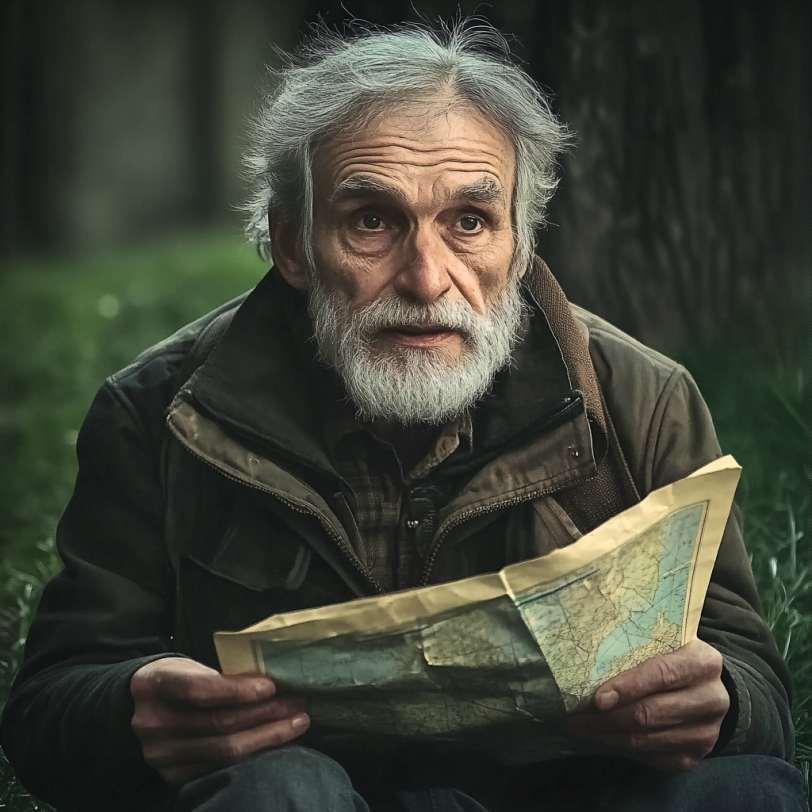
It was the first time in years that anyone had paid the old man any attention. Mikhail, Anya and Jian rushed over to him, eager to have a look. As their hands reached for the fragile map, Gregor clapsed it close to his chest, savouring his moment of glory.
“Ha!” he said, “Ha! Nobody wanted paper maps, but I knew it would come in handy one day!”
“Well done, Gregor” Molly said loudly. “A man after my own heart! I also have a paper map!” Tundra beamed happily at her great grandmother.
An excited buzz of murmuring swept through the gathered group.
“Ok, calm down everyone.” Anya stepped in to organise the situation. “Someone spread out a blanket. Let’s have a look at these maps ~ carefully! Stand back, everyone.”
Reluctantly, Molly and Gregor handed the maps to Anya, allowing her to slowly open them and spread them out. The folds had worn away completely in parts. Pebbles were collected to hold down the corners and protect the delicate paper from the breeze.
“Here, look” Mikhail pointed. “Here’s where we were at the asylum. Middle of nowhere. And here,” he pointed to a position slightly westwards, “Is where we are now. As you can see, the Hungarian border is close.”
“Where was that truck heading?” asked Vera.
Mikhail frowned and pored over the map. “Eastwards is all we can say for sure. Probably in the direction of Mukachevo, but Molly and Tundra said there were no survivors there. We just don’t know.”
“Yet,” added Jian, a man of few words.
“And where are we aiming for?” asked Finja.
“Nyíregyháza,” replied Mikhail, pointing at the map. “Should take us three or four days. Maybe a bit longer,” he added, glancing at Molly and Gregor.
“You’ll not outwalk Berlingo,” Molly snorted, “And I for one will be jolly glad to get back to some places that I can pronounce. And spell. Never did get a grip on that Cyrillic, I’d have been lost without Tundra.” Tundra beamed again at her grandmother. “And Hungarian names are only a tad better.”
“I can help you there,” Petro spoke up for the first time.
“You, help?” Anya said in astonishment, ” All you’ve ever done is complain!”
“Nobody has ever needed me, that’s why. I’m Hungarian. Surprised, are you? Nobody ever wanted to know where I was from. Nobody ever wanted my help with anything.”
“We’re all very glad you can help us now, Petro,” Molly said kindly, throwing a severe glance around the group. Tundra beamed proudly at Molly again.
“It’s an easy enough journey,” Petro addressed Molly directly, “Mostly agricultural plains. Well, they were agricultural anyway. Might be a good chance of feral chickens and self propagated crops, and the like. Finding water shouldn’t be a problem either. Used to be a lovely area,” Petro grew wistful. “I might go back to my village,” his voice trailed off as his mind returned to his childhood. “Never thought I’d ever see it again.”
“Well never mind that now,” Anya butted in rudely, “We need to make a start.” She began to carefully fold up the maps.
February 23, 2025 at 1:42 pm #7829In reply to: Helix Mysteries – Inside the Case
Helix 25 – Investigation Breakdown: Suspects, Factions, and Ship’s Population
To systematically investigate the murder(s) and the overarching mystery, let’s break down the known groups and individuals, their possible means to commit crimes, and their potential motivations.
1. Ship Population & Structure
Estimated Population of Helix 25
- Originally a luxury cruise ship before the exodus.
- Largest cruise ships built on Earth in 2025 carried ~5,000 people.
Space travel, however, requires generations. - Estimated current ship population on Helix 25: Between 15,000 and 50,000, depending on deck expansion and growth of refugee populations over decades.
- Possible Ship Propulsion:
- Plasma-based propulsion (high-efficiency ion drives)
- Slingshot navigation using gravity assists
- Solar sails & charged particle fields
- Current trajectory: Large elliptical orbit, akin to a comet.
Estimated direction of the original space trek was still within Solar System, not beyond the Kuiper Belt (~30 astrological units) and programmed to return towards it point of origin.
Due to the reprogramming by the refugees, it is not known if there has been significant alteration of the course – it should be known as the ship starts to reach the aphelion (farthest from the Sun) and either comes back towards it, or to a different course.

- Question: Are they truly on a course out of the galaxy? Or is that just the story Synthia is feeding them?
Is there a Promised Land beyond the Ark’s adventure?
2. Breaking Down People & Factions
To find the killer(s), conspiracies, and ship dynamics, here are some of factions, known individuals, and their possible means/motives.
A. Upper Decks: The Elite & Decision-Makers
- Defining Features:
- Wealthy descendants of the original passengers. They have adopted names of stars as new family names, as if de-facto rulers of the relative segments of the space.
- Have never known hardship like the Lower Decks.
- Kept busy with social prestige, arts, and “meaningful” pursuits to prevent existential crisis.
Key Individuals:
-
Sue Forgelot –
- Means: Extensive social connections, influence, and hidden cybernetic enhancements.
- Motive: Could be protecting something or someone—she knows too much about the ship’s past.
- Secrets: Claims to have met the Captain. Likely lying… unless?
-
Dr. Amara Voss –
- Means: Expert geneticist, access to data. Could tamper with DNA.
- Motive: What if Herbert knew something about her old research? Did she kill to bury it?
-
Ellis Marlowe (Retired Postman) –
- Means: None obvious. But as a former Earth liaison, he has archives and knowledge of what was left behind.
- Motive: Unclear, but his son was the murder victim. His son was previously left on Earth, and seemed to have found a way onto Helix 25 (possibly through the refugee wave who took over the ship)
- Question: Did he know Herbert’s real identity?
-
Finkley (Upper Deck cleaner, informant) –
- Means: As a cleaner, has access everywhere.
- Motive: None obvious, but cleaners notice everything.
- Secret: She and Finja (on Earth) are telepathically linked. Could Finja have picked up something?
-
The Three Old Ladies (Shar, Glo, Mavis) –
- Means: Absolutely none.
- Motive: Probably just want more drama.
- Accidental Detectives: They mix up stories but might have stumbled on actual facts.
-
Trevor Pee Marshall (TP, AI detective) –
- Means: Can scan records, project into locations, analyze logic patterns.
- Motive: Should have none—unless he’s been compromised as hinted by some of the remnants of old Muck & Lump tech into his program.
B. Lower Decks: Workers, Engineers, Hidden Knowledge
- Defining Features:
- Unlike the Upper Decks, they work—mechanics, hydroponics, labor.
- Self-sufficient, but cut off from decisions.
- Some distrust Synthia, believing Helix 25 is off-course.
Key Individuals:
-
Luca Stroud (Engineer, Cybernetic Expert) –
- Means: Can tamper with ship’s security, medical implants, and life-support systems.
- Motive: Possible sabotage, or he was helping Herbert with something.
- Secret: Works in black-market tech modifications.
-
Romualdo (Gardener, Archivist-in-the-Making) –
- Means: None obvious. Seem to lack the intelligence, but isn’t stupid.
- Motive: None—but he lent Herbert a Liz Tattler book about genetic memories.
- Question: What exactly did Herbert learn from his reading?
-
Zoya Kade (Revolutionary Figure, Not Directly Involved) –
- Means: Strong ideological influence, but not an active conspirator.
- Motive: None, but her teachings have created and fed factions.
-
The Underground Movement –
- Means: They know ways around Synthia’s surveillance.
- Motive: They believe the ship is on a suicide mission.
- Question: Would they kill to prove it?
C. The Hold: The Wild Cards & Forgotten Spaces
- Defining Features:
- Refugees who weren’t fully integrated.
- Maintain autonomy, trade, and repair systems that the rest of the ship ignores.
Key Individuals:
-
Kai Nova (Pilot, Disillusioned) –
- Means: Can manually override ship systems… if Synthia lets him.
- Motive: Suspects something’s off about the ship’s fuel levels.
-
Cadet Taygeta (Sharp, Logical, Too Honest) –
- Means: No real power, but access to data.
- Motive: Trying to figure out what Kai is hiding.
D. AI & Non-Human Factors
-
Synthia (Central AI, Overseer of Helix 25)
- Means: Controls everything.
- Motive: Unclear, but her instructions are decades old.
- Question: Does she even have free will?
-
The Captain (Nemo)
- Means: Access to ship-wide controls. He is blending in the ship’s population but has special access.
- Motive: Seems uncertain about his mission.
- Secret: He might not be following Synthia’s orders anymore.
3. Who Has the Means to Kill in Zero-G?
The next murder happens in a zero-gravity sector. Likely methods:
- Oxygen deprivation (tampered life-support, “accident”)
- Drowning (hydro-lab “malfunction”)
Likely Suspects for Next Murder
Suspect Means to Kill in Zero-G Motive Luca Stroud Can tamper with tech Knows ship secrets Amara Voss Access to medical, genetic data Herbert was digging into past Underground Movement Can evade Synthia’s surveillance Wants to prove ship is doomed Synthia (or Rogue AI processes) Controls airflow, gravity, and safety protocols If she sees someone as a threat, can she remove them? The Captain (Nemo?) Has override authority Is he protecting secrets?
4. Next Steps in the Investigation
- Evie and Riven Re-interview Suspects. Who benefited from Herbert’s death?
- Investigate the Flat-Earth Conspiracies. Who is spreading paranoia?
- Check the Captain’s Logs. What does Nemo actually believe?
- Stop the Next Murder. (Too late?)
Final Question: Where Do We Start?
- Evie and Riven visit the Captain’s quarters? (If they find him…)
- Investigate the Zero-G Crime Scene? (Second body = New urgency)
- Confront one of the Underground Members? (Are they behind it?)
Let’s pick a thread and dive back into the case!
February 23, 2025 at 1:35 pm #7828In reply to: The Last Cruise of Helix 25
Helix 25 – The Murder Board
Evie sat cross-legged on the floor of her cramped workspace, staring at the scattered notes, datapads, and threads taped to the wall. Finding some yarn on the ship had not been as easy as she thought, but it was a nice touch she thought.
The Murder Board, as Riven Holt had started calling it, was becoming an increasingly frustrating mess of unanswered questions.
Riven stood nearby, arms crossed, with a an irritated skepticism. “Almost a week,” he muttered. “We’re no closer than when we started.”
Evie exhaled sharply. “Then let’s go back to the basics.”
She tapped the board, where the crime scene was crudely sketched. The Drying Machine. Granary. Jardenery. Blood that shouldn’t exist.
She turned to Riven. “Alright, let’s list it out. Who are our suspects?”
He looked at his notes, dejected for a moment; “too many, obviously.” Last census on the ship was not accurate by far, but by all AI’s accounts cross-referenced with Finkley’s bots data, they estimated the population to be between 15,000 and 50,000. Give or take.
They couldn’t interview possibly all of them, all the more since there the interest in the murder had waned very rapidly. Apart from the occasional trio of nosy elderly ladies, the ship had returned mostly to the lull of the day-to-day routine.
So they’d focused on a few, and hoped TP’s machine brain could see patterns where they couldn’t.- First, the Obvious Candidates: People with Proximity to the Crime Scene
Romualdo, the Gardener – Friendly, unassuming. He lends books, grows plants, and talks about Elizabeth Tattler novels. But Herbert visited him often. Why?
Dr. Amara Voss – The geneticist. Her research proves the Crusader DNA link, but could she be hiding more? Despite being Evie’s godmother, she couldn’t be ruled out just yet.
Sue Forgelot – The socialite with connections everywhere. She had eluded their request for interviews. —does she know more than she lets on?
The Cleaning Staff – they had access everywhere. And the murder had a clean elegance to it… - Second, The Wild Cards: People with Unknown Agendas
The Lower Deck Engineers – Talented mechanic, with probable cybernetic knowledge, with probable access to unauthorized modifications. Could they kill for a reason, or for hire?
Zoya Kade and her Followers – They believe Helix 25 is on a doomed course, manipulated by a long-dead tycoon’s plan. Would they kill to force exposure of an inconvenient truth?
The Crew – Behind the sense of duty and polite smiles, could any of them be covering something up? - Third, The AI Factor: Sentient or Insentient?
Synthia, the AI – Controls the ship. Omnipresent. Can see everything, and yet… didn’t notice or report the murder. Too convenient.
Other personal AIs – Like Trevor Pee’s programme, most had in-built mechanisms to make them incapable of lying or harming humans. But could one of their access be compromised?
Riven frowned. “And what about Herbert himself? Who was he, really? He called himself Mr. Herbert, but the cat erm… Mandrake says that wasn’t his real name. If we figure out his past, maybe we find out why he was killed.”
Evie rubbed her temples. “We also still don’t know how he was killed. The ship’s safety systems should have shut the machine down. But something altered how the system perceived him before he went in.”
She gestured to another note. “And there’s still the genetic link. What was Herbert doing with Crusader DNA?”
A heavy silence settled between them.
Then TP’s voice chimed in. “Might I suggest an old detective’s trick? When stumped, return to who benefits.”
Riven exhaled. “Fine. Who benefits from Herbert’s death?”
Evie chewed the end of her stylus. “Depends. If it was personal, the killer is on this ship, and it’s someone who knew him. If it was bigger than Herbert, then we’re dealing with something… deeper.”
TP hummed. “I do hate deeper mysteries. They tend to involve conspiracies, misplaced prophecies, and far too many secret societies.”
Evie and Riven exchanged a glance.
Riven sighed. “We need a break.”
Evie scoffed. “Time means nothing here.”
Riven gestured out the window. “Then let’s go see it. The Sun.”
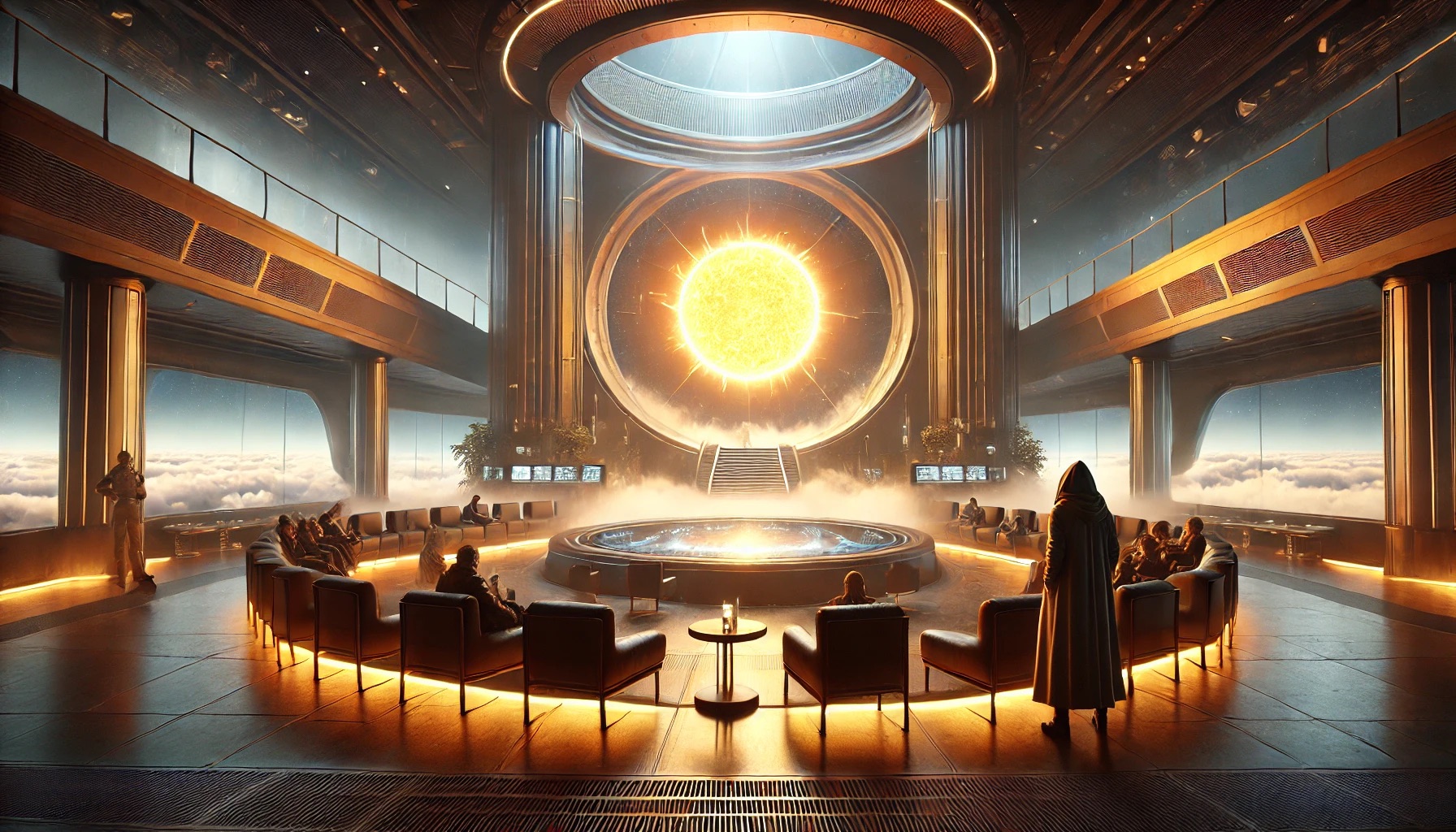
Helix 25 – The Sun-Gazing Chamber
The Sun-Gazing Chamber was one of Helix 25’s more poetic and yet practical inventions —an optically and digitally-enhanced projection of the Sun, positioned at the ship’s perihelion. It was meant to provide a psychological tether, a sense of humanity’s connection to the prime provider of life as they drifted in the void of the Solar System.
It was a beautifully designed setting where people would simply sit and relax, attuned to the shift of days and nights as if still on Earth. The primary setting had been voted to a massive 83.5% to be like in Hawai’i latitude and longitude, as its place was believed to be a reflection of Earth’s heart. That is was a State in the USA was a second thought of course.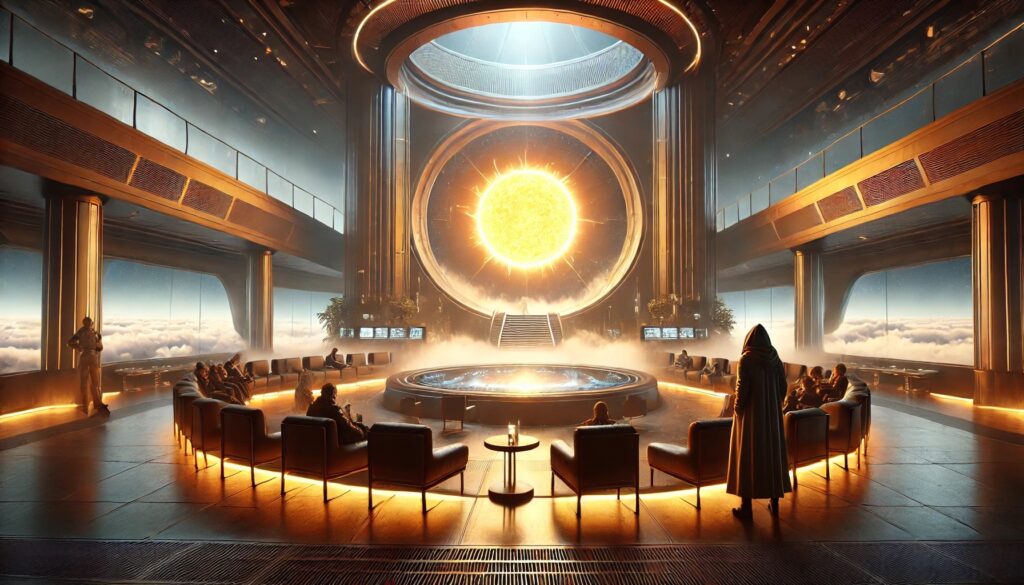
Evie sat on the observation bench, staring at the massive, golden sphere suspended in the darkness. “Do you think people back on Earth are still watching the sunrise?” she murmured.
Riven was quiet for a moment. “If there’s anyone left.”
Evie frowned. “If they are, I doubt they got much of a choice.”
TP materialized beside them, adjusting his holographic tie. “Ah, the age-old existential debate: are we the lucky ones who left Earth, or the tragic fools who abandoned it?”
Evie ignored him, glancing at the other ship residents in the chamber. Most people just sat quietly, basking in the light. But she caught snippets of whispers, doubt, something spreading through the ranks.
“Some people think we’re not really where they say we are,” she muttered.
Riven raised an eyebrow. “What, like conspiracy theories?”
TP scoffed. “Oh, you mean the Flat-Earthers?” He tsked. “Who couldn’t jump on the Helix lifeboats for their lives, convinced as they were we couldn’t make it to the stars. They deserved what came to them. Next they’ll be saying Helix 25 never even launched and we’re all just trapped in a simulation of a luxury cruise.”
Evie was shocked at Trevor Pee’s eructation and rubbed her face. “Damn Effin Muck tech, and those “Truth Control” rubbish datasets. I thought I’d thoroughly scrubbed all the old propaganda tech from the system.”
“Ah,” TP said, “but conspiracies are like mold. Persistent. Annoying. Occasionally toxic.”
Riven shook his head. “It’s nonsense. We’re moving. We’ve been moving for decades.”
Evie didn’t look convinced. “Then why do we feel stuck?”
A chime interrupted them.
A voice, over the comms. Solar flare alert.
Evie stiffened.
Then: Stay calm and return to your quarters until further notice.
Evie raised an eyebrow. This was the first time something like that happened. She turned to Riven who was looking at his datapad who was flashing and buzzing.
He said to her: “Stay quiet and come with me, a new death has been reported. Crazy coincidence. It’s just behind the Sun-Gazing chamber actually, in the Zero-G sector.”
February 17, 2025 at 8:53 pm #7822In reply to: The Last Cruise of Helix 25
Helix 25 – Gentle Utopia at Upper Decks
The Upper Decks of Helix 25 were a marvel of well-designed choreography and engineered tranquility. Life here was made effortless, thanks to an artful curation of everyday problems. Climate control ensured the air was always crisp, with just enough variation to keep the body alert, while maintaining a perfect balance of warm and cool, hygrometry, with no crazy seasons or climate change upheaval to disrupt the monotony. Food dispensers served gourmet meals for every individual preferences —decadent feasts perfectly prepared at the push of a button. The Helix cruise starships were designed for leisure, an eternity of comfort — and it had succeeded.
For the average resident, the days blended into one another in an animated swirl of hobbyist pursuits. There were the Arboretum Philosophers, who debated meaningfully over the purpose of existence while sipping floral-infused teas. There were the Artisans, who crafted digital masterpieces that vanished into the ship’s archives as soon as they were complete. There were the Virtual Adventurers, who lived entire lifetimes in fully immersive life-like simulations, all while reclining on plush lounges, connected to their brain chips courtesy of Muck Industries.
And then, there were Sharon, Gloria, and Mavis.
Three old ladies who, by all accounts, should have spent their days knitting and reminiscing about their youth, but instead had taken it upon themselves to make Helix 25 a little more interesting.
“Another marvelous day, ladies,” Sharon declared as she strolled along the gilded walkway of the Grand Atrium, a cavernous space filled with floating lounges and soft ambient music. The ceiling was a perfect replica of a sky—complete with drifting, lazy clouds and the occasional simulated flock of birds. Enough to make you almost forget you were in a closed fully-controlled environment.
Mavis sighed, adjusting her gaudy, glittering shawl. “It’s too marvelous, if you ask me. Bit samey, innit? Not even a good scandal to shake things up.”
Gloria scoffed. “Pah! That’s ‘cause we ain’t lookin’ hard enough. Did you hear about that dreadful business down in the Granary? Dried ‘im up like an apricot, they did. Disgustin’.”
“Dreadful,” Sharon agreed solemnly. “And not a single murder for decades, you know. We were overdue.”
Mavis clutched her pearls. “You make it sound like a good thing.”
Gloria waved a dismissive hand. “I’m just sayin’, bit of drama keeps people from losing their minds. No offense, but how many decades of spa treatments can a person endure before they go barmy?”
They passed a Wellness Lounge, where a row of residents were floating in Zero-G Hydrotherapy Pods, their faces aglow with Rejuvenex™ Anti-Aging Serum. Others lounged under mild UV therapy lamps, soaking up synthetic vitamin D while attendants rubbed nutrient-rich oils into their wrinkle-free skin.
Mavis peered at them. “Y’know, I swear some of ‘em are the same age as when we boarded.”
Gloria sniffed. “Not the same, Mavis. Just better preserved.”
Sharon tapped her lips, thoughtful. “I always wondered why we don’t have crime ‘ere. I mean, back on Earth, it were all fights, robbery, someone goin’ absolutely mental over a parking space—”
Gloria nodded. “It’s ‘cause we ain’t got money, Sha. No money, no stress, see? Everyone gets what they need.”
“Needs? Glo, love, people here have twelve-course meals and private VR vacations to Ancient Rome! I don’t reckon that counts as ‘needs’.”
“Well, it ain’t money, exactly,” Mavis pondered, “but we still ‘ave credits, don’t we?”
They fell into deep philosophical debates —or to say, their version of it.
Currency still existed aboard Helix 25, in a way. Each resident had a personal wealth balance, a digital measure of their social contributions—creative works, mentorship, scientific discovery, or participation in ship maintenance (for those who actually enjoyed labor, an absurd notion to most Upper Deckers). It wasn’t about survival, not like on the Lower Decks or the Hold, but about status. The wealthiest weren’t necessarily the smartest or the strongest, but rather those who best entertained or enriched the community.
Gloria finally waved her hand dismissively. “Point is, they keep us comfortable so we don’t start thinkin’ about things too much. Keep us occupied. Like a ship-sized cruise, but forever.”
Mavis wrinkled her nose. “A bit sinister, when you put it like that.”
“Well, I didn’t say it were sinister, I just said it were clever.” Gloria sniffed. “Anyway, we ain’t the ones who need entertainin’, are we? We’ve got a mystery on our hands.”
Sharon clapped excitedly. “Ooooh yes! A real mystery! Ain’t it thrillin’?”
“A proper one,” Gloria agreed. “With dead bodies an’ secrets an’—”
“—murder,” Mavis finished, breathless.
The three of them sighed in unison, delighted at the prospect.
They continued their stroll past the Grand Casino & Theatre, where a live orchestral simulation played for a well-dressed audience. Past the Astronomer’s Lounge, where youngster were taught to chart the stars that Helix 25 would never reach. Past the Crystal Arcade, where another group of youth of the ship enjoyed their free time on holographic duels and tactical board games.
So much entertainment. So much luxury.
So much designed distraction.
Gloria stopped suddenly, narrowing her eyes. “You ever wonder why we ain’t heard from the Captain in years?”
Sharon and Mavis stopped.
A hush fell over them.
Mavis frowned. “I thought you said the Captain were an idea, not a person.”
“Well, maybe. But if that’s true, who’s actually runnin’ the show?” Gloria folded her arms.
They glanced around, as if expecting an answer from the glowing Synthia panels embedded in every wall.
For the first time in a long while, they felt watched.
“…Maybe we oughta be careful,” Sharon muttered.
Mavis shivered. “Oh, Glo. What ‘ave you gotten us into this time?”
Gloria straightened her collar. “Dunno yet, love. But ain’t it excitin’?”
“With all the excitment, I almost forgot to tell you about that absolutely ghastly business,” Gloria declared, moments later, at the Moonchies’ Café, swirling her lavender-infused tea. “Watched a documentary this morning. About man-eating lions of Njombe.”
Sharon gasped, clutching her pearls. “Man eating lions?!”
Mavis blinked. “Wait. Man-eating lions, or man eating lions?”
There was a pause.
Gloria narrowed her eyes. “Mavis, why in the name of clotted cream would I be watchin’ a man eating lions?”
Mavis shrugged. “Well, I dunno, do I? Maybe he ran out of elephants.”
Sharon nodded sagely. “Yes, happens all the time in those travel shows.”
Gloria exhaled through her nose. “It’s not a travel show, Sha. And it’s not fiction.”
Mavis scoffed. “You sure? Sounds ridiculous.”
“Not as ridiculous as a man sittin’ down to a plate of roast lion chops,” Gloria shot back.
Mavis tilted her head. “Maybe it’s in a recipe book?”
Gloria slammed her teacup down. “I give up. I absolutely give up.”
Sharon patted her hand. “There, there, Glo. You can always watch somethin’ lighter tomorrow. Maybe a nice documentary about man-eating otters.”
Mavis grinned. “Or man eating otters.”
Gloria inhaled deeply, resisting the urge to upend her tea.
This, this was why Helix 25 had never known war.
No one had the time.
February 16, 2025 at 2:48 pm #7815In reply to: Helix Mysteries – Inside the Case
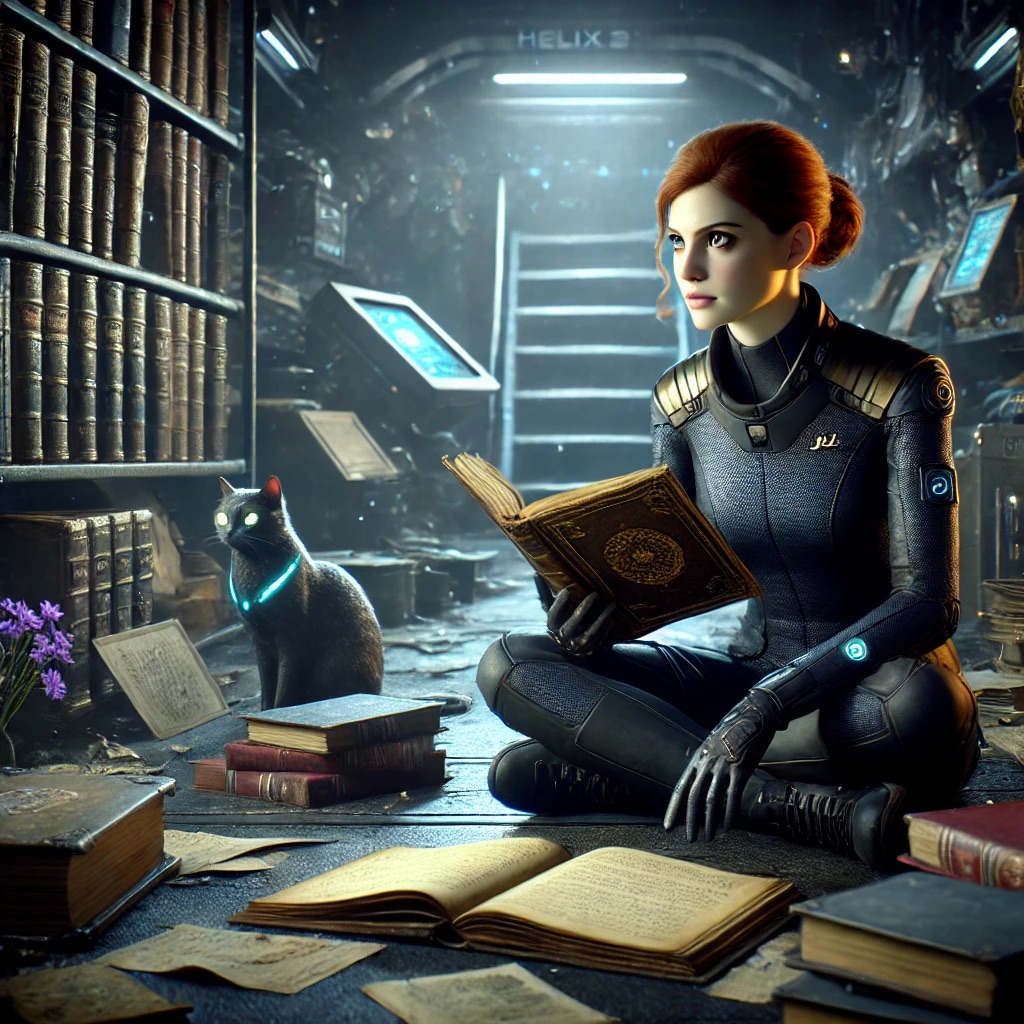
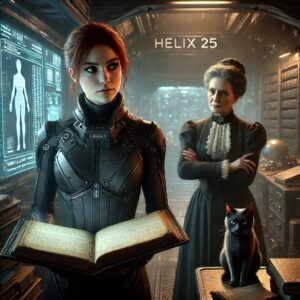
Evie and Mandrake at Seren’s quarters
Evie is looking at ancient history found in books of Liz Tattler, such precious knowledge not present in Synthia’s carefully curated records…

Evie channels her own Finnley’s historical clean factuality to get a sense of the facts behind the Liz fiction… Mandrake provides snarky comments free of charge.
 February 16, 2025 at 12:20 pm #7809
In reply to: The Last Cruise of Helix 25
Earth, Black Sea Coastal Island near Lazurne, Ukraine – The Tinkerer
Cornishman Merdhyn Winstrom had grown accustomed to the silence.
It wasn’t the kind of silence one found in an empty room or a quiet night in Cornwall, but the profound, devouring kind—the silence of a world were life as we knew it had disappeared. A world where its people had moved on without him.
The Black Sea stretched before him, vast and unknowable, still as a dark mirror reflecting a sky that had long since stopped making promises. He stood on the highest point of the islet, atop a jagged rock behind which stood in contrast to the smooth metal of the wreckage.
His wreckage.
That’s how he saw it, maybe the last man standing on Earth.
It had been two years since he stumbled upon the remains of Helix 57 shuttle —or what was left of it. Of all the Helixes cruise ships that were lost, the ones closest to Earth during the Calamity had known the most activity —people trying to leave and escape Earth, while at the same time people in the skies struggling to come back to loved ones. Most of the orbital shuttles didn’t make it during the chaos, and those who did were soon lost to space’s infinity, or Earth’s last embrace.
This shuttle should have been able to land a few hundred people to safety —Merdhyn couldn’t find much left inside when he’d discovered it, survivors would have been long dispersed looking for food networks and any possible civilisation remnants near the cities. It was left here, a gutted-out orbital shuttle, fractured against the rocky coast, its metal frame corroded by salt air, its systems dead. The beauty of mechanics was that dead wasn’t the same as useless.
And Merdhyn never saw anything as useless.
With slow, methodical care, he adjusted the small receiver strapped to his wrist—a makeshift contraption built from salvaged components, scavenged antennae, and the remains of an old Soviet radio. He tapped the device twice. The static fizzled, cracked. Nothing.
“Still deaf,” he muttered.
Perched at his shoulder, Tuppence chattered at him, a stuborn rodent that attached himself and that Merdhyn had adopted months ago as he was scouting the area. He reached his pocket and gave it a scrap of food off a stale biscuit still wrapped in the shiny foil.
Merdhyn exhaled, rolling his shoulders. He was getting too old for this. Too many years alone, too many hours hunched over corroded circuits, trying to squeeze life from what had already died.
But the shuttle wasn’t dead. After his first check, he was quite sure. Now it was time to get to work.
He stepped inside, ducking beneath an exposed beam, brushing past wiring that had long since lost its insulation. The stale scent of metal and old circuitry greeted him. The interior was a skeletal mess—panels missing, control consoles shattered, displays reduced to nothing but flickering ghosts of their former selves.
Still, he had power.
Not much. Just enough to light a few panels, enough to make him think he wasn’t mad for trying.
As it happened, Merdhyn had a plan: a ridiculous, impossible, brilliant plan.
He would fix it.
The whole thing if he could, but if anything. It would certainly take him months before the shuttle from Helix 57 could go anywhere— that is, in one piece. He could surely start to repair the comms, get a signal out, get something moving, then maybe—just maybe—he could find out if there was anything left out there.
Anything that wasn’t just sea and sky and ghosts.
He ran his fingers along the edge of the console, feeling the warped metal. The ship had crashed hard. It shouldn’t have made it down in one piece, but something had slowed it. Some system had tried to function, even in its dying moments.
That meant something was still alive.
He just had to wake it up.
Tuppence chittered, scurrying onto his shoulder.
Merdhyn chuckled. “Aye, I know. One of these days, I’ll start talking to people instead of rats.”
Tuppence flicked her tail.
He pulled out a battered datapad—one of his few working relics—and tapped the screen. The interface stuttered, but held. He navigated to his schematics, his notes, his carefully built plans.
The transponder array.
If he could get it working, even partially, he might be able to listen.
To hear something—anything—on the waves beyond this rock.
A voice. A signal. A trace of the world that had forgotten him.
Merdhyn exhaled. “Let’s see if we can get you talking again, eh?”
He adjusted his grip, tools clinking at his belt, and got to work.
February 15, 2025 at 9:21 am #7789In reply to: The Last Cruise of Helix 25
Helix 25 – Poop Deck – The Jardenery
Evie stepped through the entrance of the Jardenery, and immediately, the sterile hum of Helix 25’s corridors faded into a world of green. Of all the spotless clean places on the ship, it was the only where Finkley’s bots tolerated the scent of damp earth. A soft rustle of hydroponic leaves shifting under artificial sunlight made the place an ecosystem within an ecosystem, designed to nourrish both body and mind.
Yet, for all its cultivated serenity, today it was a crime scene. The Drying Machine was connected to the Jardenery and the Granary, designed to efficiently extract precious moisture for recycling, while preserving the produce.
Riven Holt, walking beside her, didn’t share her reverence. “I don’t see why this place is relevant,” he muttered, glancing around at the towering bioluminescent vines spiraling up trellises. “The body was found in the drying machine, not in a vegetable patch.”
Evie ignored him, striding toward the far corner where Amara Voss was hunched over a sleek terminal, frowning at a glowing screen. The renowned geneticist barely noticed their approach, her fingers flicking through analysis results faster than human eyes could process.
A flicker of light.
“Ah-ha!” TP materialized beside Evie, adjusting his holographic lapels. “Madame Voss, I must say, your domain is quite the delightful contrast to our usual haunts of murder and mystery.” He twitched his mustache. “Alas, I suspect you are not admiring the flora?”
Amara exhaled sharply, rubbing her temples, not at all surprised by the holographic intrusion. She was Evie’s godmother, and had grown used to her experiments.
“No, indeed. I’m admiring this.” She turned the screen toward them.
The DNA profile glowed in crisp lines of data, revealing a sequence highlighted in red.
Evie frowned. “What are we looking at?”
Amara pinched the bridge of her nose. “A genetic anomaly.”
Riven crossed his arms. “You’ll have to be more specific.”
Amara gave him a sharp look but turned back to the display. “The sample we found at the crime scene—blood residue on the drying machine and some traces on the granary floor—matches an ancient DNA profile from my research database. A perfect match.”
Evie felt a prickle of unease. “Ancient? What do you mean? From the 2000s?”
Amara chuckled, then nodded grimly. “No, ancient as in Medieval ancient. Specifically, Crusader DNA, from the Levant. A profile we mapped from preserved remains centuries ago.”
Silence stretched between them.
Finally, Riven scoffed. “That’s impossible.”
TP hummed thoughtfully, twirling his cane. “Impossible, yet indisputable. A most delightful contradiction.”
Evie’s mind raced. “Could the database be corrupted?”
Amara shook her head. “I checked. The sequencing is clean. This isn’t an error. This DNA was present at the crime scene.” She hesitated, then added, “The thing is…” she paused before considering to continue. They were all hanging on her every word, waiting for what she would say next.
Amara continued “I once theorized that it might be possible to reawaken dormant ancestral DNA embedded in human cells. If the right triggers were applied, someone could manifest genetic markers—traits, even memories—from long-dead ancestors. Awakening old skills, getting access to long lost secrets of states…”
Riven looked at her as if she’d grown a second head. “You’re saying someone on Helix 25 might have… transformed into a medieval Crusader?”
Amara exhaled. “I’m saying I don’t know. But either someone aboard has a genetic profile that shouldn’t exist, or someone created it.”
TP’s mustache twitched. “Ah! A puzzle worthy of my finest deductive faculties. To find the source, we must trace back the lineage! And perhaps a… witness.”
Evie turned toward Amara. “Did Herbert ever come here?”
Before Amara could answer, a voice cut through the foliage.
“Herbert?”
They turned to find Romualdo, the Jardenery’s caretaker, standing near a towering fruit-bearing vine, his arms folded, a leaf-tipped stem tucked behind his ear like a cigarette. He was a broad-shouldered man with sun-weathered skin, dressed in a simple coverall, his presence almost too casual for someone surrounded by murder investigators.
Romualdo scratched his chin. “Yeah, he used to come around. Not for the plants, though. He wasn’t the gardening type.”
Evie stepped closer. “What did he want?”
Romualdo shrugged. “Questions, mostly. Liked to chat about history. Said he was looking for something old. Always wanted to know about heritage, bloodlines, forgotten things.” He shook his head. “Didn’t make much sense to me. But then again, I like practical things. Things that grow.”
Amara blushed, quickly catching herself. “Did he ever mention anything… specific? Like a name?”
Romualdo thought for a moment, then grinned. “Oh yeah. He asked about the Crusades.”
Evie stiffened. TP let out an appreciative hum.
“Fascinating,” TP mused. “Our dearly departed Herbert was not merely a victim, but perhaps a seeker of truths unknown. And, as any good mystery dictates, seekers who get too close often find themselves…” He tipped his hat. “Extinguished.”
Riven scowled. “That’s a bit dramatic.”
Romualdo snorted. “Sounds about right, though.” He picked up a tattered book from his workbench and waved it. “I lend out my books. Got myself the only complete collection of works of Liz Tattler in the whole ship. Doc Amara’s helping me with the reading. Before I could read, I only liked the covers, they were so romantic and intriguing, but now I can read most of them on my own.” Noticing he was making the Doctor uncomfortable, he switched back to the topic. “So yes, Herbert knew I was collector of books and he borrowed this one a few weeks ago. Kept coming back with more questions after reading it.”
Evie took the book and glanced at the cover. The Blood of the Past: Genetic Echoes Through History by Dr. Amara Voss.
She turned to Amara. “You wrote this?”
Amara stared at the book, her expression darkening. “A long time ago. Before I realized some theories should stay theories.”
Evie closed the book. “Looks like someone didn’t agree.”
Romualdo wiped his hands on his coveralls. “Well, I hope you figure it out soon. Hate to think the plants are breathing in murder residue.”
TP sighed dramatically. “Ah, the tragedy of contaminated air! Shall I alert the sanitation team?”
Riven rolled his eyes. “Let’s go.”
As they walked away, Evie’s grip tightened around the book. The deeper they dug, the stranger this murder became.
February 15, 2025 at 2:26 am #7788In reply to: The Last Cruise of Helix 25
At first, no one noticed.
They were still speculating about the truck—where it had come from, where it might be going, whether following it was a brilliant idea or a spectacularly bad one.
And, after all, Finja was always muttering about something. Dust, filth, things not put back where they belonged.
But then her voice rose till she was all but shouting.
“Of course, they’re all savages. I don’t know how I put up with them! Honestly, I AM AT MY WIT’S END!”
“Finja?” Anya called. “Are you okay?”
Finja strode on, intent on her diatribe.
“No, I don’t know where they are going,” she yelled. “If I knew that, I probably wouldn’t be here, would I?”
Tala hurried to catch up and stepped in front of Finja, blocking her path. “Finja, are you okay? Who are you talking to?”
Finja sighed loudly; it was tedious. People were so obsessed with explanations.
“If you must know,” she said, “I am conversing with my Auntie Finnley in Australia.”
“Ooooh!” Vera’s eyes lit up. “ A relative!”
Yulia, walking between Luka and Lev, giggled. She adored the twins and couldn’t decide which one she liked more. They were both so tall and handsome. Others found it hard to tell them apart but she always could. It was rumoured that at birth they had been joined at the hip.
“Finja is totally bonkers,” she declared cheerfully and the twins smiled in unison.
“I will have you know I’m not bonkers.” Finja felt deeply offended and misunderstood. “I have been communicating with Auntie Finnley since childhood. She was highly influential in my formative years.”
“How so?” asked Tala.
“Few people appreciate the importance of hygiene like my Auntie Finnley. She works as a cleaner at the Flying Fish Inn in the Australian Outback. Lovely establishment I gather. But terrible dust.”
Vera nodded sagely. “A sensible place to survive the apocalypse.”
“Exactly.” Finja rewarded her with a tight smile.
Jian raised an eyebrow. “And she’s alive? Your aunt?”
“I don’t converse with ghosts!” Finja waved a hand dismissively. “They all survived there thanks to the bravery of Aunt Finnley. Had to disinfect the whole inn, mind you. Said it was an absolute nightmare.” Finja shuddered at the thought of it.
Gregor snorted. “You’re telling us you have a telepathic connection with your aunt in Australia… and she is also mostly concerned about … hygiene?”
Finja glared at him. “Standards must be maintained,” she admonished. “Even after the end of the world.”
“Do you talk to anyone else?” Tala asked. “Or is it just your aunt?”
Finja regarded Tala through slitted eyes. “I’m also talking to Finkley.”
“Where is this Finkley, dear?” asked Anja gently. “Also at the outback?”
“OMG,” Finja said. “Can you imagine those two together?” She cackled at the thought, then pulled herself together. “No. Finkley is on the Helix 25. Practically runs it by all accounts. But also keeps it spotless, of course.”
“Helix 25? The spaceship?” Mikhail asked, suddenly interested. He exchanged glances with Tala who shrugged helplessly.
Yulia laughed. “She’s definitely mad!”
“So what? Aren’t we all,” said Petro.
Molly, who had been quietly watching with Tundra, finally spoke. “And you say they are both… cleaners?” She wasn’t sure what to make of this group. She wondered if it would be better to continue on alone with Tundra? She didn’t want to put the child in any danger.
“Cleanliness runs in the family,” Finja said. “Now, if you’ll all excuse me, I was mid-conversation.”
She closed her eyes, concentrating. The group watched with interest as her lips moved silently, her brow furrowed in deep thought.
Then, suddenly, she opened her eyes and threw her hands in the air.
“Oh, for goodness’ sake,” she muttered. “Finkley is complaining about dust floating in low gravity. Finnley is complaining about the family not taking their boots off at the door. What a pair of whingers. At least I didn’t inherit THAT.”
She sniffed, adjusted her backpack, and walked on.
The others stood there for a moment, letting it all sink in.
Gregor clapped his hands together. “That was the most wonderfully insane thing I’ve heard since the world ended.”
Mikhail sighed. “So, we are following the direction of the truck?”
Anya nodded. “I’ll keep an eye on Finja. The stress is getting to her, and we have no meds if it escalates.”
February 14, 2025 at 10:02 am #7780In reply to: The Last Cruise of Helix 25
Orrin Holt gripped the wheel of the battered truck, his knuckles white as the vehicle rumbled over the dry, cracked road. The leather wrap was a patchwork of smooth and worn, stichted together from whatever scraps they had—much like the quilts his mother used to make before her hands gave out. The main road was a useless, unpredictable mess of asphalt gravels and sinkholes. Years of war with Russia, then the collapse, left it to rot before anyone could fix it. Orrin stuck to the dirt path beside it. That was the only safe way through. The engine coughed but held. A miracle, considering how many times it had been patched together.
The cargo in the back was too important for a breakdown now. Medical supplies—antibiotics, painkillers, and a few salvaged vials of something even rarer. They’d traded well for it, risking much. Now he had to get it back to Base Klyutch (Ukrainian word for Key) without incident. If he continued like that he could make it before noon.
Still, something bothered him. That group of people he’d seen.
They had been barely more than silhouettes on top of a hill. Strangers, a rarity in these times. His first instinct had been to stop and evaluate who they were. But his instructions let room for no delay. So, he’d pushed forward and ignored them. The world wasn’t kind to the wandering. But they hadn’t looked like raiders or scavengers. Lost, perhaps. Or searching.
The truck lurched forward as he pushed it harder. The fences of the base rose in the distance, grey and wiry against the blue sky. Base Klyutch was a former military complex, fortified over the years with scavenged materials, steel sheets, and watchtowers. It wasn’t perfect, but it kept them alive.
As he rolled up to the main gate, the sentries swung the barricade open. Before he could fully cut the engine, a woman wearing a pristine white lab coat stepped forward, her sharp eyes scanning the truck’s cargo bed. Dr. Yelena Markova, the camp’s chief doctor, a former nurse who had to step up when the older one died in a raid on their camp three years ago. Stern-faced and wiry, with a perpetual air of exhaustion, she moved with the efficiency of someone who had long stopped hoping for ease. She had been waiting for this delivery.
“Finally,” she murmured, motioning for her assistants to start unloading. “We were running low. This will keep us going for a while.”
Orrin barely had time to nod before Dmytro Koval, the de facto leader of the base, strode toward him with the gait of a tall bear. His face seemed to have been carved out by a dulled blade, hardened by years of survival. A scar barred his mouth, pulling slightly at the corner when he spoke, giving the impression of a permanent sneer.
“Did you get it?” Koval asked, voice low.
Orrin reached into his kaki jacket and pulled out a sealed letter, along with a small package.
Koval took both, his expression unreadable. “Anything on the road?”
Orrin exhaled and adjusted his stance. “Saw something on the way back. A group, about a dozen, on a hill ten kilometers out. They seemed lost.”
“Armed?” asked Koval with a frown.
“Can’t say for sure.”
Dr. Markova straightened. “Lost? Unarmed? Out in the open like that, they won’t last long with Sokolov’s gang roaming the land. We have to go take them in.”
Koval grimaced. “Or they’re Sokolov’s spies. Trying to infiltrate us and find a weakness in our defenses. You know how it works.”
Before Koval could argue, a new voice cut in. “Or they could just be people.”
Solara Ortega had stepped into the conversation, brushing dirt from her overalls. A woman of lean strength, with the tan of someone spending long hours outside. Her sharp amber eyes carried the weight of someone who had survived too much but refused to be hardened by it. Orrin shoved down a mix of joy and ache at her sight. Her voice was calm but firm. “We can’t always assume the worst. We need more hands and we don’t leave people to die if we can help it. And in case you forgot, Koval, you don’t make all the decisions around here. I say we send a team to assess them.”
Koval narrowed his eyes, but he held his tongue. There was tension between them, but the council wasn’t a dictatorship.
“Fine,” Koval said after a moment, his jaw tense. “A team of two. They scout first. No direct contact until we’re sure. Orrin, you one of them take whoever wants to accompany you, but not one of my men. We need to maintain tight security.”
Dr. Markova sighed with relief when the man left. “If he wasn’t good at what he does, I would gladly kick him out of our camp.”
Solara, her face framed by strands of dark hair, shot a glance at Orrin. “I’m coming with you.”
This time, Orrin couldn’t repress a longing for a time before everything fell apart, when she had been his wife. The collapse had torn them apart in an instant, and by the time he found her again, years later, she had built a new life within the base in Ukraine. She had a husband now, one of the scientists managing the radio equipment, and two children. Orrin kept his expression neutral, but the weight of time pressed heavy on him.
“Then let’s get on the move. They might not stay there long.”
February 11, 2025 at 7:53 pm #7779In reply to: The Last Cruise of Helix 25
Gregor gratefully clambered onto Tundra’s horse, with the assistance of Mikhail and Jian. Molly had long since trained her horse, Berlingo (named after the last car she’d had), to lie down to enable her to mount easily. Riding wasn’t easy at a such an advanced age but it was preferable to walking long distances.
Tundra didn’t mind in the least giving up hers to the old man, as she wanted to walk with Vera and Yulia. “Helix will keep stopping to graze,” Tundra warned Gregor, to which he replied, “Don’t you worry about me, I used to ride and I haven’t forgotten how. Thank you kindly, young miss.”
Mikhail and Anya led the way, and Molly and Gregor brought up the rear, riding side by side.
February 9, 2025 at 11:41 am #7778In reply to: The Last Cruise of Helix 25
The truck disappeared from view as it descended into a valley. They waited for it to reappear over the hill, but they waited in vain. The truck had disappeared.
“It must have been a mirage,” said Vera. “There was no truck, it was wishful thinking.”
“I don’t think any of us were hoping to see a truck this morning, Vera,” Anya replied, “Nobody expected to see a truck, and yet we all saw one.”
“You don’t know much about mirages then, do you. I saw a fata morgana once and so did everyone else on the beach, we weren’t all expecting to see a floating city that day either.”
“Nobody needs to hear about that now,” Mikhail interrupted, “We need to walk over to where we saw it and look for the tyre tracks.”
Tundra moved over to stand next to Vera and impulsively grabbed her arm. “Can you tell me about the fata morgana later? I want to see one too.”
Vera smiled gratefully at the child and patted her shoulder. “I’ll tell you all about it, and lots of other stories if you like. And you can tell me all your stories, and all about your family. Is that your real granny?”
“Great gran actually and she’s as real as any of you are,” Tundra replied, not understanding the question.
“Mikhail is right,” said Jian. Everyone turned to look at young Chinese man who rarely voiced an opinion. “We need to find out what other equipment they have. Where they came from, and where they’re going.”
Anya clapped her hands together loudly. “Right then, we’re all agreed. Gather everything up and let’s go. Mikhail, lead the way!”
Petro made a harrumphing noise and mumbled something about nobody asking him what he thought about traipsing all over the coutryside, but he slung his bag over his shoulder and followed. What else was he to do?
February 9, 2025 at 7:22 am #7777In reply to: The Last Cruise of Helix 25
The Survivors:
“Well, I’ll be damned,” Gregor said, his face cracking into another toothless grin. “Beginning to think we might be the last ones.”
“So did we.” Molly glanced nervously around at the odd assortment of people staring at her and Tundra. “I’m Molly. This is Tundra.”
“Tundra? Like the frozen wasteland?” Yulia asked.
Tundra nodded. “It’s because I’m strong and tough.”
“Would you like to join us?” Tala motioned toward the fire.
“Yes, yes, of course, ” Anya said. “Are you hungry?”
Molly hesitated, glancing toward the edge of the clearing, where their horses stood tethered to a low branch. “We have food,” she said. “We foraged.”
“I’d have foraged if someone didn’t keep going on about food poisoning,” Yulia muttered.
Finja sniffed. “Forgive me for trying to keep you alive.”
Molly watched the exchange with interest. It had been years since she’d seen people bicker over something so trivial. It was oddly comforting.
She lowered herself slowly onto the log next to Vera. “Alright, tell me—who exactly are you lot?”
Petro chuckled. “We’ve escaped from the asylum.”
Molly’s face remained impassive. “Asylum?”
“It’s okay,” Tala said quickly. “We’re mostly sane.”
“Not completely crazy, anyway,” Yulia added cheerfully.
“We were left behind years ago,” Anya said simply. “So we built our own kind of life.”
A pause. Molly gave a slow nod, considering this. Vera leaned towards her eagerly.
“Where are you from? Any noble blood?”
Molly frowned. “Does it matter?”
“Oh, not really,” Vera said dejectedly. “I just like knowing.”
Tundra, warming her hands by the fire, looked at Vera. “We came from Spain.”
Vera perked up. “Spain? Fascinating! And tell me, dear girl, have you ever traced your lineage?”
“Just back to Molly. She’s ninety-three,” Tundra said proudly.
Mikhail, who had been watching quietly, finally spoke. “You travelled all the way from Spain?”
Molly nodded. “A long time ago. There were more of us then… ” Her voice wavered. “We were looking for other survivors.”
“And?”Mikhail asked.
Molly sighed, glancing at Tundra. “We never found any.”
________________________________________
That night, they took turns keeping watch, though Molly tried to reassure them there was no need.
“At first, we did too,” she had said, shaking her head. “But there was no one…”
By dawn, the fire had burned to embers, and the camp stirred reluctantly to life.
They finished off the last of their cooked vegetables from the night before, while Molly and Tundra laid out a handful of foraged berries and mushrooms. It wasn’t much, but it was enough to start the day.
“Right,” Anya said, stretching. “I suppose we should get moving.” She looked at Molly and Tundra. “You’re coming with us, then? To the city?”
Molly nodded. “If you’ll have us.”
“We kept going and going, hoping to find people. Now we have,” Tundra said.
“Then it’s settled,” Anya said. “We head to the city.”
“And what exactly are we looking for?” Molly asked.
Mikhail shrugged. “Anything that keeps us alive.”
________________________________________________
It was late morning when they saw it.
A vehicle—an old, battered truck, crawling slowly toward them.
The sight was so absurd, so impossible, that for a moment, no one spoke.
“That can’t be,” Molly murmured.
The truck bounced over the uneven ground, its engine a dull, sluggish rattle. It wasn’t in good shape, but it was moving.
February 8, 2025 at 7:22 pm #7776In reply to: Quintessence: Reversing the Fifth
Epilogue & Prologue
Paris, November 2029 – The Fifth Note Resounds
Tabitha sat by the window at the Sarah Bernhardt Café, letting the murmur of conversations and the occasional purring of the espresso machine settle around her. It was one of the few cafés left in the city where time still moved at a human pace. She stirred her cup absentmindedly. Paris was still Paris, but the world outside had changed in ways her mother’s generation still struggled to grasp.
It wasn’t just the ever-presence of automation and AI making themselves known in subtle ways—screens adjusting to glances, the quiet surveillance woven into everyday life. It wasn’t just the climate shifts, the aircon turned to cold in the midst of November, the summers unpredictable, the air thick with contradictions of progress and collapse of civilization across the Atlantic.
The certainty of impermanence was what defined her generation. BANI world they used to say—Brittle, Anxious, Nonlinear, Incomprehensible. A cold fact: impossible to grasp and impossible to fight. Unlike her mother and her friends, who had spent their lives tethered to a world that no longer existed, she had never known certainty. She was born in the flux.
And yet, this café remained. One of the last to resist full automation, where a human still brought you coffee, where the brass bell above the door still rang, where things still unfolded at a human pace.
The bell above the door rang—the fifth note, as her mother had called it once.
She had never been here before, not in any way that mattered. Yet, she had heard the story. The unlikely reunion five years ago. The night that moved new projects in motion for her mother and her friends.
Tabitha’s fingers traced the worn edges of the notebook in front of her—Lucien’s, then Amei’s, then Darius’s. Pieces of a life written by many hands.
“Some things don’t work the first time. But sometimes, in the ruins of what failed, something else sprouts and takes root.”
And that was what had happened.
The shared housing project they had once dreamed of hadn’t survived—not in its original form. But through their rekindled bond, they had started something else.
True Stories of How It Was.
It had begun as a quiet defiance—a way to preserve real, human stories in an age of synthetic, permanent ephemerality and ephemeral impermanence, constantly changing memory. They were living in a world where AI’s fabricated histories had overwhelmed all the channels of information, where the past was constantly rewritten, altered, repackaged. Authenticity had become a rare currency.
As she graduated in anthropology few years back, she’d wondered about the validity of history —it was, after all, a construct. The same could be said for literature, art, even science. All of them constructs of the human mind, tenuous grasp of the infinite truth, but once, they used to evolve at such a slow pace that they felt solid, reliable. Ultimately their group was not looking for ultimate truth, that would be arrogant and probably ignorant. Authenticity was what they were looking for. And with it, connections, love, genuineness —unquantifiables by means of science and yet, true and precious beyond measure.
Lucien had first suggested it, tracing the idea from his own frustrations—the way art had become a loop of generated iterations, the human touch increasingly erased. He was in a better place since Matteo had helped him settle his score with Renard and, free of influence, he had found confidence in developing of his own art.
Amei —her mother—, had changed in a way Tabitha couldn’t quite define. Her restlessness had quieted, not through settling down but through accepting impermanence as something other than loss. She had started writing again—not as a career, not to publish, but to preserve stories that had no place in a digitized world. Her quiet strength had always been in preserving connections, and she knew they had to move quickly before real history faded beneath layers of fabricated recollections.
Darius, once skeptical, saw its weight—he had spent years avoiding roots, only to realize that stories were the only thing that made places matter. He was somewhere in Morocco now, leading a sustainable design project, bridging cultures rather than simply passing through them.
Elara had left science. Or at least, science as she had known it. The calculations, the certainty, the constraints of academia, with no escape from the automated “enhanced” digital helpers. Her obsession and curiosities had found attract in something more human, more chaotic. She had thrown herself into reviving old knowledge, forgotten architectures, regenerative landscapes.
And Matteo—Matteo had grounded it.
The notebook read: Matteo wasn’t a ghost from our past. He was the missing note, the one we didn’t know we needed. And because of him, we stopped looking backward. We started building something else.
For so long, Matteo had been a ghost of sorts, by his own account, lingering at the edges of their story, the missing note in their unfinished chord. But now, he was fully part of it. His mother had passed, her past history unraveling in ways he had never expected, branching new connections even now. And though he had lost something in that, he had also found something else. Juliette. Or maybe not. The story wasn’t finished.
Tabitha turned the page.
“We were not historians, not preservationists, not even archivists. But we have lived. And as it turned out, that was enough.”
They had begun collecting stories through their networks—not legends, not myths, but true accounts of how it was, from people who still remembered.
A grandfather’s voice recording of a train ride to a city that no longer exists.
Handwritten recipes annotated by generations of hands, each adding something new.
A letter from a protest in 2027, detailing a movement that the history books had since erased.
An old woman’s story of her first love, spoken in a dialect that AI could not translate properly.It had grown in ways they hadn’t expected. People began sending them recordings, letters, transcripts, photos —handwritten scraps of fading ink. Some were anonymous, others carefully curated with full names and details, like makeshift ramparts against the tide of time.
At first, few had noticed. It was never the goal to make it worlwide movement. But little by little, strange things happened, and more began to listen.
There was something undeniably powerful about genuine human memory when it was raw and unfiltered, when it carried unpolished, raw weight of experience, untouched by apologetic watered down adornments and out-of-place generative hallucinations.
Now, there were exhibitions, readings, archives—entire underground movements dedicated to preserving pre-synthetic history. Their project had become something rare, valuable, almost sacred.
And yet, here in the café, none of that felt urgent.
Tabitha looked up as the server approached. Not Matteo, but someone new.
“Another espresso?”
She hesitated, then nodded. “Yes. And a glass of water, please.”
She glanced at the counter, where Matteo was leaning, speaking to someone, laughing. He had changed, too. No longer just an observer, no longer just the quiet figure who knew too much. Now, he belonged here.
A bell rang softly as the door swung open again.
Tabitha smiled to herself. The fifth note always sounded, in the end.
She turned back to the notebook, the city moving around her, the story still unfolding in more directions than one.
February 8, 2025 at 3:38 pm #7765In reply to: The Last Cruise of Helix 25
Zoya clicked her tongue, folding her arms as Evie and her flickering detective vanished into the dead man’s private world. She listened to the sounds of investigation. The sound of others touching what should have been hers first. She exhaled through her nose, slow and measured.
The body was elsewhere, dried and ruined. That didn’t matter. What mattered was here—hairs, nail clippings, that contained traces, strands, fragments of DNA waiting to be read like old parchments.
She stepped forward, the soft layers of her robes shifting.
“You can’t keep me out forever, young man.”
Riven didn’t move. Arms crossed, jaw locked, standing there like a sentry at some sacred threshold. Victor Holt’s grandson, through and through, she thought.
“I can keep you out long enough.”
Zoya clicked her tongue. Not quite amusement, not quite irritation.
“I should have suspected such obstinacy. You take after him, after all.”
Riven’s shoulders tensed.
Good. Let him feel it.
His voice was tight. “If you’re referring to my grandfather, you should choose your words carefully.”
Zoya smiled, slow and knowing. “I always choose my words carefully.”
Riven’s glare could have cut through metal.
Zoya tilted her head, studying him as she would an artifact pulled from the wreckage of an old world. So much of Victor Holt was in him—the posture, the unyielding spine, the desperate need to be right.
But Victor Holt had been wrong.
And that was why he was sleeping in a frozen cell of his own making.
She took another step forward, lowering her voice just enough that the curious would not hear what she said.
“He never understood the ship’s true mission. He clung to his authority, his rigid hierarchies, his outdated beliefs. He would have let us rot in luxury while the real work of survival slipped away. And when he refused to see reason—” she exhaled, her gaze never leaving his, “he stepped aside.”
Riven’s jaw locked. “He was forced aside.”
Zoya only smiled. “A matter of perspective.”
She let that hang. Let him sit with it.
She could see the war in his eyes—the desperate urge to refute her, to throw his grandfather’s legacy in her face, to remind her that Victor Holt was still here, still waiting in cryo, still a looming shadow over the ship. But Victor Holt’s silence was the greatest proof of his failure.
Riven clenched his jaw.
Anuí’s voice, smooth and patient, cut through the tension.
“She is not wrong.”
Zoya frowned. She had expected them to speak eventually. They always did.
They stood just a little apart, hand tucked in their robes, their expression unreadable.
“In its current state, the body is useless,” Anuí said lightly, as if stating something obvious, “but that does not mean it has left no trace.” Then they murmured “Nāvdaṭi hrás’ka… aṣṭīr pālachá.”
Zoya glanced at them, her eyes narrowing. In an old tongue forgotten by all, it meant The bones remember… the blood does not lie. She did not trust the Lexicans’ sudden interest in genetics.
They did not see history in bloodlines, did not place value in the remnants of DNA. They preferred their records rewritten, reclaimed, restructured to suit a new truth, not an old one.
Yet here they were, aligning themselves with her. And that was what gave her pause.
“Your people have never cared for the past as it was,” she murmured. “Only for what it could become.”
Anuí’s lips curved, withholding more than they gave. “Truth takes many forms.”
Zoya scoffed. They were here for their own reasons. That much was certain. She could use that
Riven’s fingers tightened at his sides. “I have my orders.”
Zoya lifted a brow. “And whose orders are those?”
The hesitation was slight. “It’s not up to me.”
Zoya stilled. The words were quiet, bitter, revealing.
Not up to him.
So, someone had ensured she wouldn’t step foot in that room. Not just delayed—denied.
She exhaled, long and slow. “I see.” She paused. “I will find out who gave that order.”
And when she did, they would regret it.
December 22, 2024 at 10:49 pm #7704In reply to: Quintessence: Reversing the Fifth
Darius: Christmas 2022
Darius was expecting some cold snap, landing in Paris, but the weather was rather pleasant this time of the year.
It was the kind of day that begged for aimless wandering, but Darius had an appointment he couldn’t avoid—or so he told himself. His plane had been late, and looking at the time he would arrive at the apartment, he was already feeling quite drained. The streets were lively, tourists and locals intermingling dreamingly under strings of festive lights spread out over the boulevards. He listlessly took some snapshot videos —fleeting ideas, backgrounds for his channel.
The wellness channel had not done very well to be honest, and he was struggling with keeping up with the community he had drawn to himself. Most of the latest posts had drawn the usual encouragements and likes, but there were also the growing background chatter, gossiping he couldn’t be bothered to rein in — he was no guru, but it still took its toll, and he could feel it required more energy to be in this mode that he’d liked to.
His patrons had been kind, for a few years now, indulging his flights of fancy, funding his trips, introducing him to influencers. Seeing how little progress he’d made, he was starting to wonder if he should have paid more attention to the background chatter. Monsieur Renard had always taken a keen interest in his travels, looking for places to expand his promoter schemes of co-housing under the guide of low investment into conscious living spaces, or something well-marketed by Eloïse. The crude reality was starting to stare at his face. He wasn’t sure how long he could keep up pretending they were his friends.
By the time he reached the apartment, in a quiet street adjacent to rue Saint Dominique, nestled in 7th arrondissement with its well-kept façades, he was no longer simply fashionably late.
Without even the time to say his name, the door buzz clicked open, leading him to the old staircase. The apartment door opened before he could knock. There was a crackling tension hanging in the air even before Renard’s face appeared—his rotund face reddened by an annoyance he was poorly hiding beneath a polished exterior. He seemed far away from the guarded and meticulous man that Darius once knew.
“You’re late,” Renard said brusquely, stepping aside to let Darius in. The man was dressed impeccably, as always, but there was a sharpness to his movements.
Inside, the apartment was its usual display of cultivated sophistication—mid-century furniture, muted tones, and artful clutter that screamed effortless wealth. Eloïse sat on the couch, her legs crossed, a glass of wine poised delicately in her hand. She didn’t look up as Darius entered.
“Sorry,” Darius muttered, setting down his bag. “Flight delay.”
Renard waved it off impatiently, already pacing the room. “Do you know where Lucien is?” he asked abruptly, his gaze slicing toward Darius.
The question caught him off guard. “Lucien?” Darius echoed. “No. Why?”
Renard let out a sharp, humorless laugh. “Why? Because he owes me. He owes us. And he’s gone off the grid like some bloody enfant terrible who thinks the rules don’t apply to him.”
Darius hesitated. “I haven’t seen him in months,” he said carefully.
Renard stopped pacing, fixing him with a hard look. “Are you sure about that? You two were close, weren’t you? Don’t tell me you’re covering for him.”
“I’m not,” Darius said firmly, though the accusation sent a ripple of anger through him.
Renard snorted, turning away. “Typical. All you dreamers are the same—full of ideas but no follow-through. And when things fall apart, you scatter like rats, leaving the rest of us to clean up the mess.”
Darius stiffened. “I didn’t come here to be insulted,” he said, his voice a steady growl.
“Then why did you come, Darius?” Renard shot back, his tone cutting. “To float on someone else’s dime a little longer? To pretend you’re above all this while you leech off people who actually make things happen?”
The words hit like a slap. Darius glanced at Eloïse, expecting her to interject, to soften the blow. But she remained silent, her gaze fixed on her glass as if it held all the answers.
For the first time, he saw her clearly—not as a confidante or a muse, but as someone who had always been one step removed, always watching, always using.
“I think I’ve had enough,” Darius said finally, his voice calm despite the storm brewing inside him. “I think I’ve had enough for a long time.”
Renard turned, his expression a mix of incredulity and disdain. “Enough? You think you can walk away from this? From us?”
“Yes, I can.” Darius said simply, grabbing his bag.
“You’ll never make it on your own,” Renard called after him, his voice dripping with scorn.
Darius paused at the door, glancing back at Eloïse one last time. “I’ll take my chances,” he said, and then slammed the door.

The evening air was like a balm, open and soft unlike the claustrophobic tension of the apartment. Darius walked aimlessly at first, his thoughts caught between flares of wounded pride and muted anxiety, but as he walked and walked, it soon turned into a return of confidence, slow and steady.
His phone buzzed in his pocket, and he pulled it out to see a familiar name. It was a couple he knew from the south of France, friends he hadn’t spoken to in months. He answered, their warm voices immediately lifting his spirits.
“Darius!” one of them said. “What are you doing for Christmas? You should come down to stay with us. We’ve finally moved to a bigger space—and you owe us a visit.”
Darius smiled, the weight of Renard’s words falling away. “You know what? That sounds perfect.”
As he hung up, he looked up at the Parisian skyline, Darius wished he’d had the courage to take that step into the unknown a long time ago. Wherever Lucien was, he felt suddenly closer to him —as if inspired by his friend’s bold move away from this malicious web of influence.
December 16, 2024 at 6:43 am #7684In reply to: Quintessence: Reversing the Fifth
Darla, Pedro’s assistant, took notes dutifully. The five of them were overdue for a reunion. She would have to organise mysterious odds and align random coincidences.
Lucien woke up from the strangest dream. For one, he didn’t realise that the Universe had an assistant —that seemed convenient. Then, another realisation occurred, she must have got it wrong somehow, they were only four of them. But maybe they were right. It was a long time they were together.
-
AuthorSearch Results