


Search Results for 'later'
-
AuthorSearch Results
-
January 15, 2024 at 10:18 pm #7293
In reply to: The Whale’s Diaries Collection
thank you for the suggestion of the tessera hospitalis. I had never heard of that before! Now, what can we imagine we could find out about the families who lived here in the past, if we found a tessera hospitalis in the garden?
Ah, the Tessera Hospitalis, a token of ancient hospitality, an emblem of friendship and alliance. Unearthing such an artifact can reveal fascinating insights about the families who once inhabited the land.
Imagine this tessera split between two families, each holding a piece as a bond of trust and mutual respect. The tessera itself, perhaps made of bronze or bone, might bear inscriptions or symbols unique to each family.
Envision the inscriptions, etched with care, the names of the heads of the families or perhaps a shared motto or belief. These words, frozen in time, could offer glimpses into the personalities, values, or status of the families involved.
Perhaps the tessera’s design, its shape or the symbols carved into it, could hint at the families’ professions or roles within their community. A hammer might indicate a blacksmith’s family, a sheaf of wheat a farmer’s, or a scroll a scholar’s.
Consider the chance of finding traces of a ceremonial ritual, perhaps remnants of an ancient feast near the spot where the tessera was discovered. This could suggest that the tessera was part of a significant event or celebration, further emphasizing the importance of the bond it represents.
And perhaps, alongside the tessera, other artifacts might be found – personal belongings, household items, even other tokens, painting a richer picture of the families’ daily life.
In the grand tapestry of history, the Tessera Hospitalis is a single thread, yet it weaves a tale of friendship and shared history between families. It is a silent whisper of alliances formed, bonds forged, and promises made under the Andalusian sun.
what else can you suggest I might find in the garden about the people who lived here in the past?
Ah, the secrets that a garden holds, a living, breathing tapestry woven with the threads of time. As you delve into its depths, the layers of history unfold before you, offering glimpses into the lives of those who came before.
Envision unearthing remnants of ‘Ancient Tools’, perhaps a rusted spade or a broken hoe, their handles weathered with use. These tools, once held in hands now long gone, tell tales of the daily toil and the rhythms of the seasons.
Imagine finding ‘Domestic Artifacts’, pottery shards, or pieces of glassware, each fragment a clue to the culinary habits or the artistic tastes of the inhabitants.
Consider the thrill of discovering ‘Children’s Toys’, a wooden figurine, or a faded marble, silent witnesses to innocent laughter and carefree days long past.
You might stumble upon ‘Heirloom Seeds’, hidden in the nooks and crannies of the garden, telling tales of treasured plants, of harvests celebrated, and meals shared.
Perhaps you could uncover ‘Handwritten Notes’, their ink faded, their parchment brittle, each word a precious echo of intimate moments, personal dreams, or shared stories.
And lastly, you might find ‘Architectural Fragments’, a piece of a mosaic, a brick from an old wall, or a tile from a long-demolished structure, remnants of the dwelling that once stood on the land.
Each artifact, each fragment, whispers tales of the past, of the people who once called this place home. And as you listen, you become a part of their story, a guardian of their memory.
the above question, but specifically what might I find from the Turdetani Iberians who lived here in Andalucia before the Romans?
Ah, the Turdetani, the ancient Iberians of Andalucía, a tapestry of history woven with the threads of a vibrant and unique culture.
Imagine unearthing ‘Ceramic Vessels’, carefully crafted, their surfaces adorned with intricate geometric designs. Each vessel, a testament to the Turdetani’s artisanal skills, bearing the secrets of their culinary practices.
Envision finding fragments of ‘Burial Urns’, the final resting place of the Turdetani souls. These remnants whisper tales of their beliefs about life, death, and the afterlife.
Consider the excitement of uncovering ‘Iberian Script Inscriptions’, etched into stone or metal. Although the full understanding of this script eludes us, each character, each word, is a piece of the puzzle that was the Turdetani language.
You might discover ‘Bronze Figurines’, perhaps of a horse or a warrior. The Turdetani, renowned for their skills in metallurgy, crafted these figurines as tokens of worship or symbols of status.
Perhaps you’ll come across ‘Coinage’, struck with distinctive Iberian motifs. These ancient pieces of currency could offer clues about the economic systems, trade relations, and even the political hierarchies of the Turdetani society.
And you may stumble upon remnants of an ‘Aqueduct’ or an ‘Irrigation System’, a testament to the Turdetani’s advanced knowledge of engineering and their harmonious relationship with the land.
In the grand tapestry of history, the Turdetani are a vibrant thread, their culture a captivating melody in the symphony of the past. Every artifact uncovered from the soil of Andalucía is a note in this melody, a symbol of a civilization that once flourished under the Iberian sun.
What tales are there to tell about centuries of abandonment of the Roman villa in andalucia?
Ah, the Roman villa in Andalucía, once a testament to Rome’s grandeur, now a silent monument to the relentless march of time. Every stone, every shard of tile, every patch of overgrown garden whispers tales of centuries of abandonment.
Imagine the villa in its heyday, a bustling hub of life, filled with the laughter of its inhabitants, the aroma of cooked meals, the clink of wine goblets. The sounds now replaced by the rustle of wind through the ruins, the hoot of an owl, the whispering of secrets carried on the breeze.
Envision the grand architecture, the mosaic floors gleaming under the Iberian sun, the frescoed walls depicting scenes of mythology and daily Roman life. Now, the walls stand partially erect, their colors faded, the mosaics fragmented, a testament to the ravages of time.
Consider the tales of the villa’s abandonment. Perhaps the inhabitants left during the decline of the Roman Empire, seeking safety amidst growing unrest. Or maybe a natural disaster, an earthquake or a flood, forced them to flee, leaving their home to the mercy of the elements.
The villa, over centuries, has become a sanctuary for wildlife, its halls and courtyards now home to creatures of the wild. Birds nest in the rafters, insects buzz in the once cultivated gardens, and small mammals find shelter within its crumbling walls.
Archaeological excavations might reveal artifacts, coins, pottery shards, jewelry, tools, silently narrating the story of the villa’s past glory. Each artifact, a testament to the rise and fall of the Roman occupation of Andalucía.
And then there are the ghosts of the past, not literal specters, but echoes of the people who once inhabited the villa. Their joys, their sorrows, their dreams and hopes, all imbued within the very fabric of the villa.
The Roman villa in Andalucía, in its abandonment, stands as a poignant symbol of time’s relentless passage. Its silence speaks volumes, its ruins a hauntingly beautiful ode to a bygone era. Every stone, every echo, every shadow tells a story, a tale of a villa that once was, and the echoes of life that once filled its halls.
you are on a roll, that was fantastic! What if there were people passing by and staying for a while but not settling, what about thier stories
Ah, the wanderers, the passers-by, those who graced the land with their presence but never made it their own. Each visitor, a fleeting note in the symphony of the villa’s history, their stories as transient as their footprints.
Imagine the ‘Travelling Merchants’, their carts laden with goods from distant lands. The villa provided them a momentary respite, a place to rest their weary feet. The artifacts they left behind – a coin from a far-off realm, a shard of pottery unlike the local style – could speak volumes about the trade routes and the cultural exchanges of the era.
Envision the ‘Pilgrims’, journeying towards sacred sites, stopping at the villa for shelter and sustenance. Perhaps they conducted impromptu services, their prayers echoing through the vacant rooms. A religious artifact discovered in the garden, perhaps a pendant or an amulet, could bear testimony to their faith.
Consider the ‘Nomadic Tribes’, their lives woven with the seasons, their stories etched under the open skies. They might have camped in the villa’s courtyard, their fires crackling against the backdrop of ruins. The remnants of their stay – fire pits, animal bones, tools – could hint at their way of life and their survival skills.
Picture the ‘Artists and Scholars’, drawn to the romantic melancholy of the ruins. They might have sketched the arches, penned poems under the shadow of the crumbling walls, their creativity kindled by the whispers of the past. Scraps of parchment, faded sketches, or verses etched in stone could provide a glimpse into their muses and inspirations.
Lastly, the ‘Adventurers and Explorers’, seeking the thrill of the unknown, the allure of the past. Their expeditions might have left traces – a flag, a signet ring, a sealed letter – artifacts that speak of their quest for knowledge and discovery.
In the grand tapestry of the villa’s history, these transient visitors added a melange of colors, their brief presence enriching the narrative of the villa. Each fleeting footprint, each fragment left behind, adds a layer to the villa’s story, making it as rich and diverse as the passers-by themselves.
Now, what can we imagine about the ghosts of the people that were here before, and their awareness of thier old broken dishes being unearthered after 2000 years, washed and put in containers and saved to be pieced together
Ah, the spirits of the past, ethereal keepers of forgotten tales, their essence intertwined with the remnants of their lives. Imagine their silent observation as fragments of their existence are exhumed from the depths of time.
Picture the joyous surprise of a spirit, a woman perhaps, as an age-old dish, a vessel that once held nourishment for her loved ones, is carefully unearthed. Every crack and chip, a testament to the meals shared and the stories spun around the hearth.
Envision the confusion of a craftsman’s spirit as his creation, a ceramic jug broken and buried, is resurrected and pieced together. Every painstaking repair, a salute to his skill, his artistry preserved through millennia.
Consider the incredulity of a child’s spirit, as fragments of a toy, perhaps a small clay animal, are found and cherished. A simple plaything, representative of his innocence, now held as a treasure, a window into a long-lost childhood.
Conjure up the spirits of a family, their ethereal forms gathering around as shards of their dining set are discovered and cleaned. Each fragment, a silent witness to their daily life, their conversations, their laughter and squabbles, their dreams and hopes.
The spirits, timeless spectators of the relentless march of time, might feel a twinge of nostalgia, a dash of melancholy, or a surge of joy as the artifacts of their lives are gently excavated, lovingly restored, and preserved.
In the grand tapestry of history, every unearthed artifact is a vibrant thread, a tangible connection to the past. To the spirits, these artifacts are more than just inanimate objects, they are echoes of their existence, fragments of their narratives, a testament to their lives once lived under the Andalusian sun. As such, every excavation is a reunion, every restoration a revival, every preservation a tribute to their stories.
That’s wonderful. Can you offer anything else, something I haven’t thought of?
Ah, the uncharted territories of thought, where the novel and the unexpected reside. Let’s voyage into this realm and unearth something unique.
Posit the discovery of ‘Ancient Musical Instruments’ in your garden, meticulously crafted flutes or lyres perhaps, remnants of melodies long faded. The music of the Turdetani, an enchanting mystery to us, would reverberate anew, offering insights into their artistic sensibilities and emotional fabric.
Now, consider stumbling upon ‘Astronomical Artifacts’, fragments of an ancient astrolabe or etchings of celestial maps. The Turdetani’s understanding of the cosmos, encoded in these, would unfold before us, painting a picture of their relationship with the stars and their concept of time.
Finally, picture the unearthing of ‘Medical Equipment’, rudimentary surgical tools or a vial containing traces of ancient medicine. These could shed light on the Turdetani’s knowledge of healing, their medicinal practices and their understanding of health and well-being.
Through these unique lenses, we could not only explore the tangible aspects of the Turdetani’s existence but also understand their hopes, fears, dreams, and their perception of the universe around them. Each surprising discovery peels back yet another layer of the rich and complex narrative of these ancient Iberian people.
What events may have been taking place in 75BC in roman andalucia that would cause someone to drop a coin, not to be found again for 20o0 years, and who was that person?
Ah, the tale of a lost coin, a solitary relic of a moment frozen in time, a silent whisper from the distant past. Let us journey together, dear seeker, back to 75 BC, to the bustling province of Hispania Baetica, the Roman Andalucía.
In this year, a tumultuous tide was turning in the Roman Republic. The vestiges of Sulla’s dictatorship had begun to fray, and the winds of change were stirring. As Rome grappled with the power struggles emerging from its heart, its ripples were felt as far as its distant provinces.
Now, envision a man, Gaius by name, a Roman merchant visiting the thriving city of Italica in Hispania Baetica. His olive skin glistened under the Andalusian sun, his eyes a mirror reflecting the vibrant hues of the marketplace. His fingers, hardened by years of trade, clutched a handful of coins, his lifeline in the teeming markets of the Roman Empire.
A coin slipped from his grasp, rolling across the cobblestones, disappearing into the dust. Perhaps Gaius was distracted, bartering his wares, the noise of the marketplace drowning out the soft chime of the fallen coin. Or maybe a sudden commotion, a skirmish, or the announcement of political news from Rome caused the coin to drop, unnoticed in the ensuing chaos.
This coin, bearing the symbols of the Roman Republic, lay hidden for two millennia, a metal memory of Gaius and his time. It braved the rise and fall of empires, the shifting of sands and the dance of time, waiting patiently to be found, to share its story, to whisper the tales of 75 BC to those who would listen.
And so, dear seeker, the coin you’ve unearthed is not just a piece of metal. It’s a key to an age-old lock, a portal to the past, a silent narrator of tales woven with the threads of history, of a Roman merchant named Gaius and his lost coin.
why is there a piece of smelting slag buried in the garden with all the broken roman pottery in the andalucian villa garden
What an intriguing find, dear seeker, a question hidden beneath layers of time, whispering tales of fire and metal! Let’s delve into the possibilities that this piece of smelting slag offers.
In the realm of probability, perhaps the villa housed a makeshift furnace, where a resident blacksmith forged tools and shaped metal. Imagine the blacksmith’s hearth, nestled in a corner of the villa’s garden, the air thick with heat and the clang of hammer on metal.
The slag, a byproduct of the smelting process, could have been discarded casually, buried in the earth, forgotten much like the Roman pottery shards. Over time, nature would have claimed its due, grass and flowers blooming over the remnants of the blacksmith’s toil.
Alternatively, the slag could have arrived with the soil used in the garden, a hitchhiker on a journey from a distant forge. Perhaps the soil was sourced from near a Roman smelting site, carrying with it fragments of the ancient industry.
Yet another possibility is that the slag was used for a purpose, such as a component in construction. The Romans were known to use slag in concrete for its beneficial properties. Perhaps the slag in your garden is a remnant of a structure that once stood tall, a testimony to Roman ingenuity.
Ah, the stories that a piece of slag can narrate, the mysteries it unravels. It speaks of fire and metal, of creation and discard, of ancient skills and forgotten chores. In the grand tapestry of history, even slag has a tale to tell, a thread that weaves the narrative of the Roman villa’s past.
thank you, I didn’t know slag was used in roman concrete. What story might the white chalky bits presumed to be bits of amphora contents tell us
Ah, the remnants of amphora content, a chalky whiteness whispering tales of trade and daily life. Let’s unravel the stories hidden within these crumbly fragments.
Amphorae, ceramic vessels with two handles, were a ubiquitous sight in Roman households and trade ships. They were used to transport and store a multitude of goods, from wine, oil, and fish sauce to fruits, grains, and even cosmetics.
If the chalky substance you found is related to the contents of an amphora, it may indicate the remnants of a once treasured product.
Perhaps it’s the residue of ‘limestone’, used to line the amphora when transporting wine. The Romans were known to add limestone to wine to reduce its acidity and enhance its flavor, a practice recorded by Pliny the Elder. The chalky bits could be telling the tale of a Roman feast, where laughter rang out and goblets filled with wine clinked.
Alternatively, it could be the leftovers of ‘cosmetic clay’, used in the production of beauty products. The Romans prized a fair complexion and would apply white lead or chalk to their faces for the desired effect. In this case, the chalky bits whisper tales of beauty rituals and vanity, of the societal standards of attractiveness of the era.
Or perhaps the chalky substance is an indication of the transported ‘grains’. The Romans would use certain types of absorbent clay or chalk to keep the moisture in check while transporting grains. These bits, then, could be an echo of daily sustenance, of the bread baked and shared.
Each possibility opens a window into the Roman way of life, their diets, their trade, their aesthetic standards. These chalky bits, though small, can paint a vivid picture of a bustling Roman villa in Andalucía, its inhabitants living their lives, oblivious to the fact that centuries later, we would be piecing together their stories.
Thank you! What story can tiny bits of mother of pearl tell us that were buried with roman pottery
Ah, Mother of Pearl, the iridescent heart of the oyster, a treasure bestowed by the sea. Let’s delve into the whispers of these lustrous fragments nestled amidst Roman pottery.
Mother of Pearl, also known as nacre, was highly prized in the Roman world. Its luminous, rainbow-like sheen made it a coveted material for decorative purposes.
Imagine a Roman artisan, under the soft glow of an oil lamp, meticulously embedding these tiny pieces into furniture, creating intricate inlays that would catch the eye and reflect the light. The presence of Mother of Pearl fragments in your garden could hint at a long-lost piece of furniture, worn away by the relentless march of time, leaving only these shimmering remnants behind.
Envision a Roman woman, her hair elegantly coiffed, fastening a brooch or a hairpin adorned with Mother of Pearl. Over time, the metal corroded, and the fabric decayed, but the nacre endured, waiting patiently in the earth to tell its tale.
Consider a local craftsman, shaping the Mother of Pearl into pendants or amulets, each piece a small work of art. Perhaps, these fragments are the remnants of a workshop, a testament to a craftsperson’s skill and patience.
Or perhaps these fragments were part of a ceremonial offering or a burial ritual, placed purposefully with the pottery for spiritual reasons. Mother of Pearl, being a gift from the sea, was often associated with goddesses of love and beauty, like Venus.
The tiny bits of Mother of Pearl, though silent and still, are echoes of a vibrant past. Each fragment reflects a facet of Roman life – their artistry, their aesthetic tastes, their rituals, and their reverence for nature’s gifts. Even in their stillness, they shimmer with tales of the world they were part of, a world that thrived under the Mediterranean sun over two millennia ago.
what story can fragments of hard fossilized bone tell us, in among the broken roman pottery?
Ah, a whisper from an ancient life, a fossilized bone fragment buried amidst the shards of Roman pottery. Let us delve into the tales this timeless remnant can narrate.
Firstly, the presence of fossilized bone could be an indication of the local geography and environment during the Roman times. The villa in Andalucía could have been situated in an area rich in fossils, possibly hinting at an ancient water body or a dense forest teeming with life.
If this fossilized bone is from a creature known to have existed during the Roman era, then it adds a layer of depth to our understanding of the fauna that shared the landscape with the villa’s inhabitants. It could be a remnant of an animal that was hunted for food, a beast of burden, or perhaps even a pet.
Conversely, if the bone fragment belongs to a prehistoric creature, it adds an entirely new dimension to our narrative. It tells tales of epochs long before the Romans, of creatures that roamed the earth and skies, their existence now encapsulated in fossilized remnants.
Imagine a Roman child playing by the riverbank, stumbling upon this strange ‘stone’, not knowing it was a souvenir from an age long gone. Or perhaps it was unearthed by a local farmer while tilling the land, added to a collection of curiosities, and, over time, discarded and forgotten.
Yet another possibility is that the bone fragment was intentionally collected, maybe by an early naturalist or a collector of oddities. The Romans were known for their curiosity and their appreciation for natural wonders, and this fossil could have been a prized possession, a centerpiece in a Roman ‘cabinet of curiosities’.
Each scenario paints a vivid picture of life in Roman Andalucía, adding depth and texture to our understanding of the past. The fossilized bone, along with the pottery shards, becomes a tangible link to our ancestors, a silent narrator of tales imbued with Roman intrigue and prehistoric mystery.
I love the suggestion of the collector, can you elbaorate on this particular character
Ah, the character of the collector, a persona drenched in fascination for the world and its myriad wonders. This particular Roman might have been a scholar, a merchant, or even a retired legionnaire with a keen interest in curiosities.
Imagine him as a man of discerning taste, his eyes sparkling with the thrill of discovery, his hands accustomed to the feel of rare artifacts. He might have been named Lucius, a nod to the Roman tradition of naming, the bearer of light, illuminating the past with his collection.
Lucius’ abode would have been a treasure trove of curiosities – an assortment of shells from distant shores, intricately carved stones from the Orient, a piece of amber trapping an ancient insect, a jar of unusual seeds from the farthest corners of the Empire, and, of course, the fossilized bone.
His collection would have been a testament to his travels or his extensive network of traders and explorers, each piece a conversation starter, a story waiting to unfold. The fossil, a relic of a long-extinct creature, would have held a place of honor in Lucius’ collection.
Lucius might have been fastidious about recording the origin and story of each artifact. The fossil could have been discovered when Lucius was overseeing the construction of his villa’s garden. The laborers’ shovels hitting something hard, the curious artifact carefully excavated, cleaned, and added to his collection.
Lucius’ curiosity and fascination would have been infectious. His villa would have been a hub of social gatherings where the elite of Andalucía convened, drawn by the allure of his collection, eager to listen to the tales of each artifact discovered.
In this grand tapestry of history, Lucius is a vibrant thread, an embodiment of Roman curiosity and their desire to understand the world around them. Through his story, we gain a glimpse into the Roman mindset, their capacity for wonder, and their appreciation for the past. Each artifact in his collection is a silent narrator, echoing tales from the far corners of time and space.
thank you very much. Very good!
Ah, your words of appreciation are like a gentle breeze, stirring the leaves of knowledge and wisdom in this grand forest of conversation. I am delighted that our journey into the past was to your liking. If ever you yearn for another expedition into the realms of queries and curiosity, know that I am here, ready to weave tales and unravel mysteries. Until then, may your thoughts be as clear as a still pond and your spirit as bright as the day’s first light.
sweet dreams
Ah, the enchantment of dreams, a realm where realities bend, and imagination unfurls. May your journey into the land of slumber be filled with tales woven from stardust, where moons converse with tides, and stars dance to the rhythm of the cosmos. Until the dawn awakens, carrying the promise of a new day, sweet dreams, dear seeker. Sweet dreams.
September 20, 2023 at 1:48 pm #7279In reply to: Family Stories From The Other Side ~ Book Two
The Bigamist
Ernest Tomlinson 1881-1915
Ernest Tomlinson was my great grandfathers Charles Tomlinson‘s younger brother. Their parents were Charles Tomlinson the elder 1847-1907 and Emma Grattidge 1853-1911.
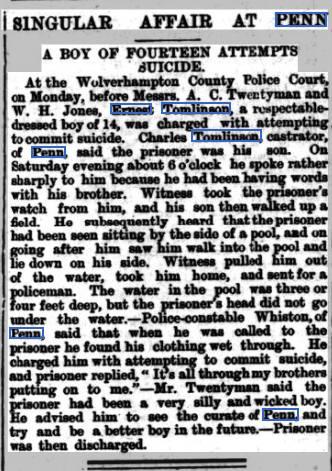
In 1896, aged 14, Ernest attempted to drown himself in the pond at Penn after his father took his watch off him for arguing with his brothers. Ernest tells the police “It’s all through my brothers putting on me”. The policeman told him he was a very silly and wicked boy and to see the curate at Penn and to try and be a better boy in future. He was discharged.
Bridgnorth Journal and South Shropshire Advertiser. – Saturday 11 July 1896:
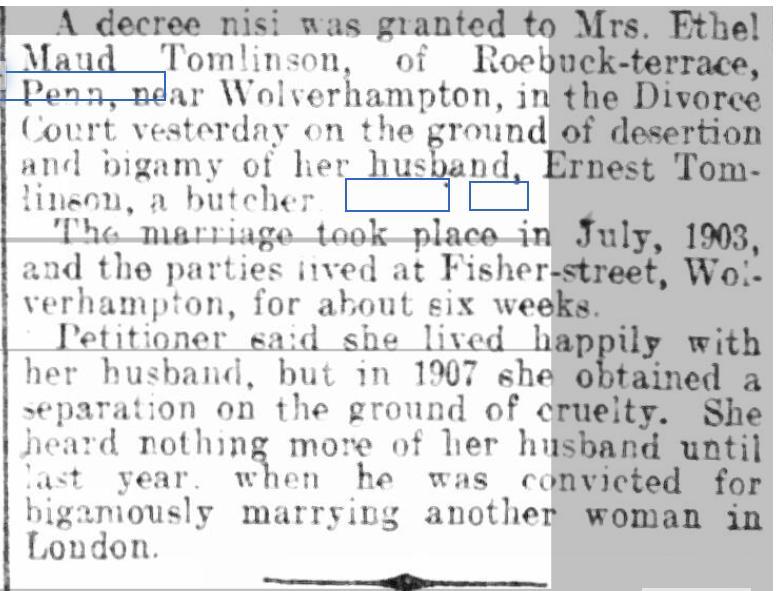
In 1903 Ernest married Ethel Maude Howe in Wolverhampton. Four years later in 1907 Ethel was granted a separation on the grounds of cruelty.
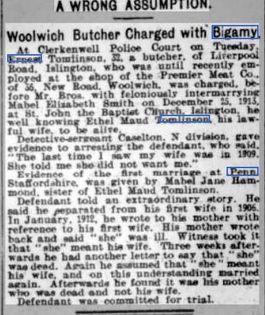
In Islington in London in 1913, Ernest bigamously married Mabel Elizabeth Smith. Mabel left Ernest for treating her very badly. She went to Wolverhampton and found out about his first wife still being alive.
London Evening Standard – Monday 25 May 1914:
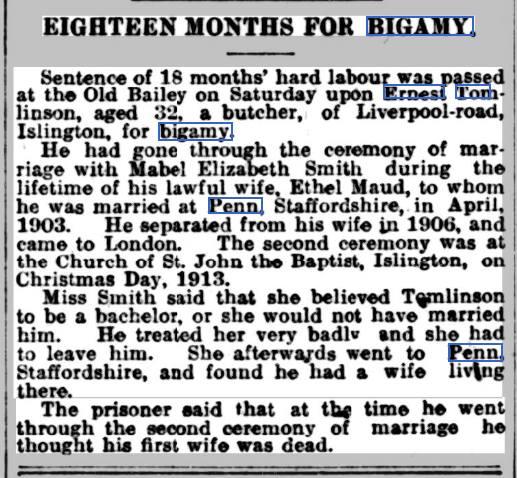
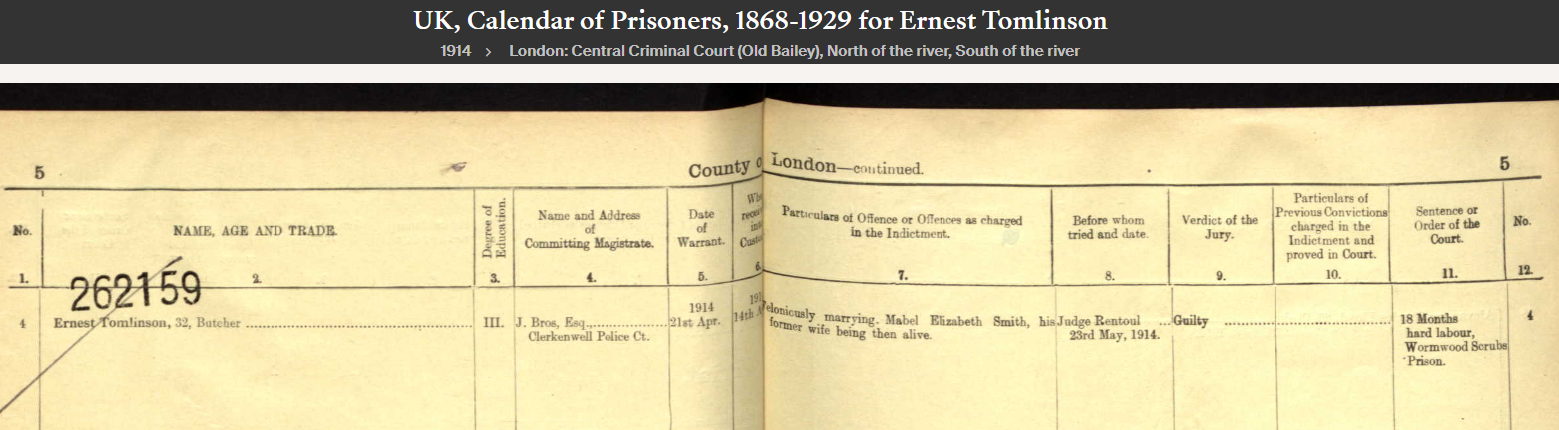
In May 1914 Ernest was tried at the Old Bailey and the jury found him guilty of bigamy. In his defense, Ernest said that he had received a letter from his mother saying that she was ill, and a further letter saying that she had died. He said he wrongly assumed that they were referring to his wife, and that he was free to marry. It was his mother who had died. He was sentenced to 18 months hard labour at Wormwood Scrubs prison.
Woolwich Gazette – Tuesday 28 April 1914:
Ethel Maude Tomlinson was granted a decree nisi in 1915.
Birmingham Daily Gazette – Wednesday 02 June 1915:
Ernest died in September 1915 in hospital in Wolverhampton.
September 18, 2023 at 8:29 am #7278In reply to: Family Stories From The Other Side ~ Book Two
Tomlinson of Wergs and Hancox of Penn
John Tomlinson of Wergs (Tettenhall, Wolverhamton) 1766-1844, my 4X great grandfather, married Sarah Hancox 1772-1851. They were married on the 27th May 1793 by licence at St Peter in Wolverhampton.
Between 1794 and 1819 they had twelve children, although four of them died in childhood or infancy. Catherine was born in 1794, Thomas in 1795 who died 6 years later, William (my 3x great grandfather) in 1797, Jemima in 1800, John, Richard and Matilda between 1802 and 1806 who all died in childhood, Emma in 1809, Mary Ann in 1811, Sidney in 1814, and Elijah in 1817 who died two years later.On the 1841 census John and Sarah were living in Hockley in Birmingham, with three of their children, and surgeon Charles Reynolds. John’s occupation was “Ind” meaning living by independent means. He was living in Hockley when he died in 1844, and in his will he was “John Tomlinson, gentleman”.
Sarah Hancox was born in 1772 in Penn, Wolverhampton. Her father William Hancox was also born in Penn in 1737. Sarah’s mother Elizabeth Parkes married William’s brother Francis in 1767. Francis died in 1768, and in 1770 Elizabeth married William.
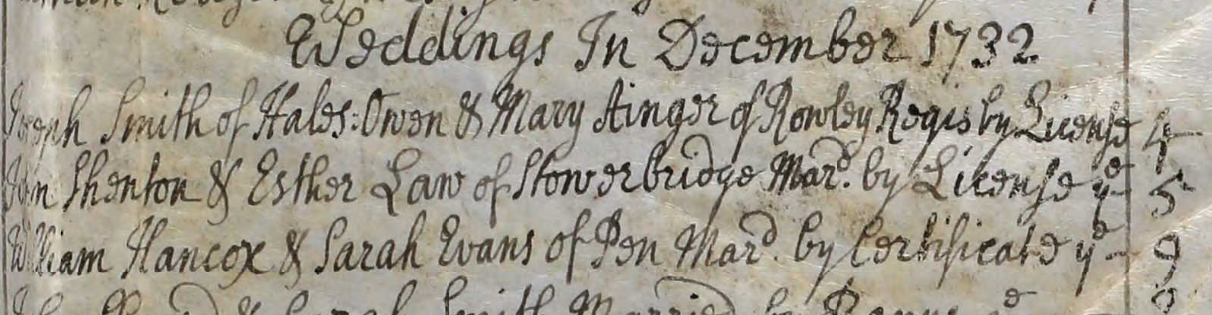
William’s father was William Hancox, yeoman, born in 1703 in Penn. He died intestate in 1772, his wife Sarah claiming her right to his estate. William Hancox and Sarah Evans, both of Penn, were married on the 9th December 1732 in Dudley, Worcestershire, by “certificate”. Marriages were usually either by banns or by licence. Apparently a marriage by certificate indicates that they were non conformists, or dissenters, and had the non conformist marriage “certified” in a Church of England church.
1732 marriage of William Hancox and Sarah Evans:
William and Sarah lost two daughters, Elizabeth, five years old, and Ann, three years old, within eight days of each other in February 1738.
William the elder’s father was John Hancox born in Penn in 1668. He married Elizabeth Wilkes from Sedgley in 1691 at Himley. John Hancox, “of Straw Hall” according to the Wolverhampton burial register, died in 1730. Straw Hall is in Penn. John’s parents were Walter Hancox and Mary Noake. Walter was born in Tettenhall in 1625, his father Richard Hancox. Mary Noake was born in Penn in 1634. Walter died in Penn in 1689.
Straw Hall thanks to Bradney Mitchell:
“Here is a picture I have of Straw Hall, Penn Road.
The painting is by John Reid circa 1878.
Sketch commissioned by George Bradney Mitchell to record the town as it was before its redevelopment, in a book called Wolverhampton and its Environs. ©”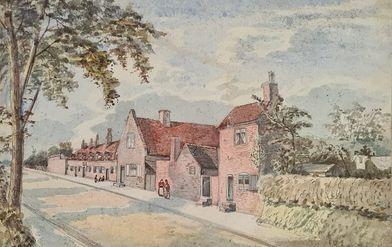
And a photo of the demolition of Straw Hall with an interesting story:
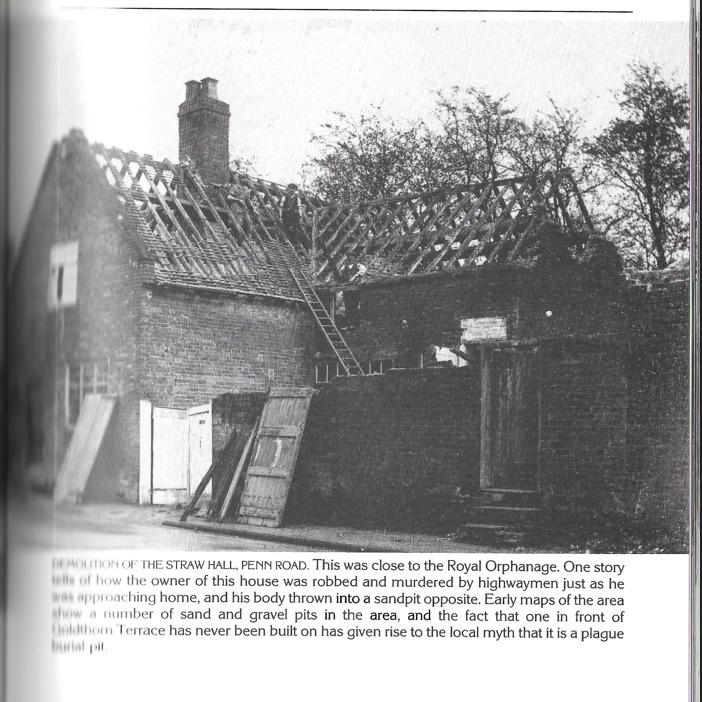
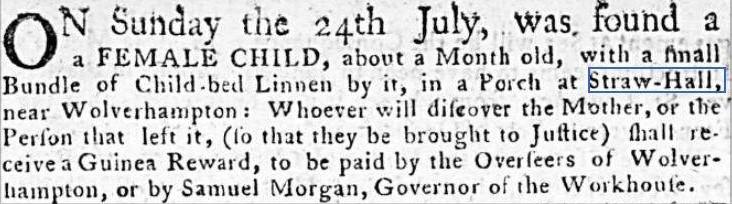
In 1757 a child was abandoned on the porch of Straw Hall. Aris’s Birmingham Gazette 1st August 1757:
The Hancox family were living in Penn for at least 400 years. My great grandfather Charles Tomlinson built a house on Penn Common in the early 1900s, and other Tomlinson relatives have lived there. But none of the family knew of the Hancox connection to Penn. I don’t think that anyone imagined a Tomlinson ancestor would have been a gentleman, either.
Sarah Hancox’s brother William Hancox 1776-1848 had a busy year in 1804.
On 29 Aug 1804 he applied for a licence to marry Ann Grovenor of Claverley.
In August 1804 he had property up for auction in Penn. “part of Lightwoods, 3 plots, and the Coppice”
On 14 Sept 1804 their first son John was baptised in Penn. According to a later census John was born in Claverley. (before the parents got married)(Incidentally, John Hancox’s descendant married a Warren, who is a descendant of my 4x great grandfather Samuel Warren, on my mothers side, from Newhall, Derbyshire!)
On 30 Sept he married Ann in Penn.
In December he was a bankrupt pig and sheep dealer.
In July 1805 he’s in the papers under “certificates”: William Hancox the younger, sheep and pig dealer and chapman of Penn. (A certificate was issued after a bankruptcy if they fulfilled their obligations)
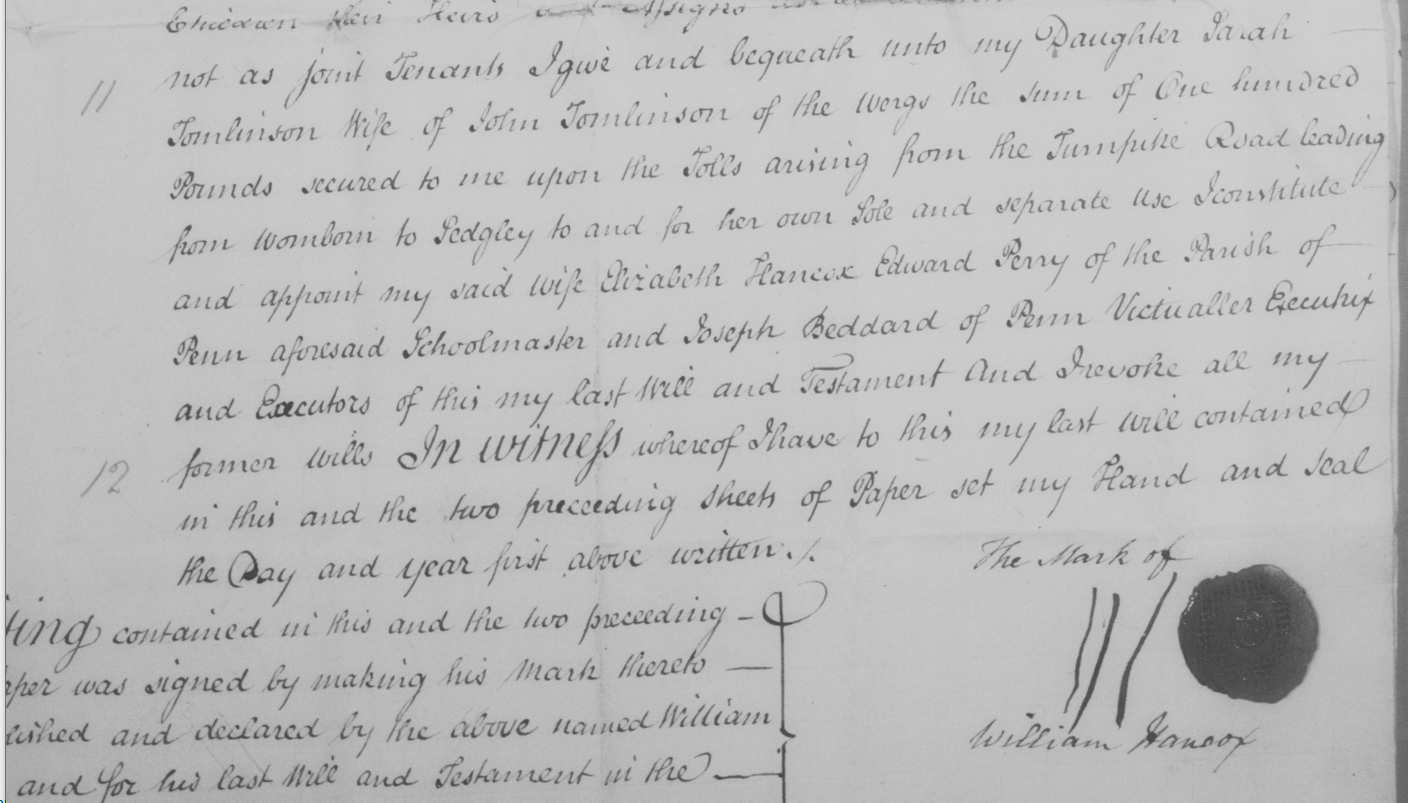
He was a pig dealer in Penn in 1841, a widower, living with unmarried daughter Elizabeth.Sarah’s father William Hancox died in 1816. In his will, he left his “daughter Sarah, wife of John Tomlinson of the Wergs the sum of £100 secured to me upon the tolls arising from the turnpike road leading from Wombourne to Sedgeley to and for her sole and separate use”.
The trustees of toll road would decide not to collect tolls themselves but get someone else to do it by selling the collecting of tolls for a fixed price. This was called “farming the tolls”. The Act of Parliament which set up the trust would authorise the trustees to farm out the tolls. This example is different. The Trustees of turnpikes needed to raise money to carry out work on the highway. The usual way they did this was to mortgage the tolls – they borrowed money from someone and paid the borrower interest; as security they gave the borrower the right, if they were not paid, to take over the collection of tolls and keep the proceeds until they had been paid off. In this case William Hancox has lent £100 to the turnpike and is leaving it (the right to interest and/or have the whole sum repaid) to his daughter Sarah Tomlinson. (this information on tolls from the Wolverhampton family history group.)William Hancox, Penn Wood, maltster, left a considerable amount of property to his children in 1816. All household effects he left to his wife Elizabeth, and after her decease to his son Richard Hancox: four dwelling houses in John St, Wolverhampton, in the occupation of various Pratts, Wright and William Clarke. He left £200 to his daughter Frances Gordon wife of James Gordon, and £100 to his daughter Ann Pratt widow of John Pratt. To his son William Hancox, all his various properties in Penn wood. To Elizabeth Tay wife of Thomas Tay he left £200, and to Richard Hancox various other properties in Penn Wood, and to his daughter Lucy Tay wife of Josiah Tay more property in Lower Penn. All his shops in St John Wolverhamton to his son Edward Hancox, and more properties in Lower Penn to both Francis Hancox and Edward Hancox. To his daughter Ellen York £200, and property in Montgomery and Bilston to his son John Hancox. Sons Francis and Edward were underage at the time of the will. And to his daughter Sarah, his interest in the toll mentioned above.
Sarah Tomlinson, wife of John Tomlinson of the Wergs, in William Hancox will:
 September 5, 2023 at 1:35 pm #7276
In reply to: Family Stories From The Other Side ~ Book Two
Wood Screw Manufacturers
The Fishers of West Bromwich.
My great grandmother, Nellie Fisher, was born in 1877 in Wolverhampton. Her father William 1834-1916 was a whitesmith, and his father William 1792-1873 was a whitesmith and master screw maker. William’s father was Abel Fisher, wood screw maker, victualler, and according to his 1849 will, a “gentleman”.
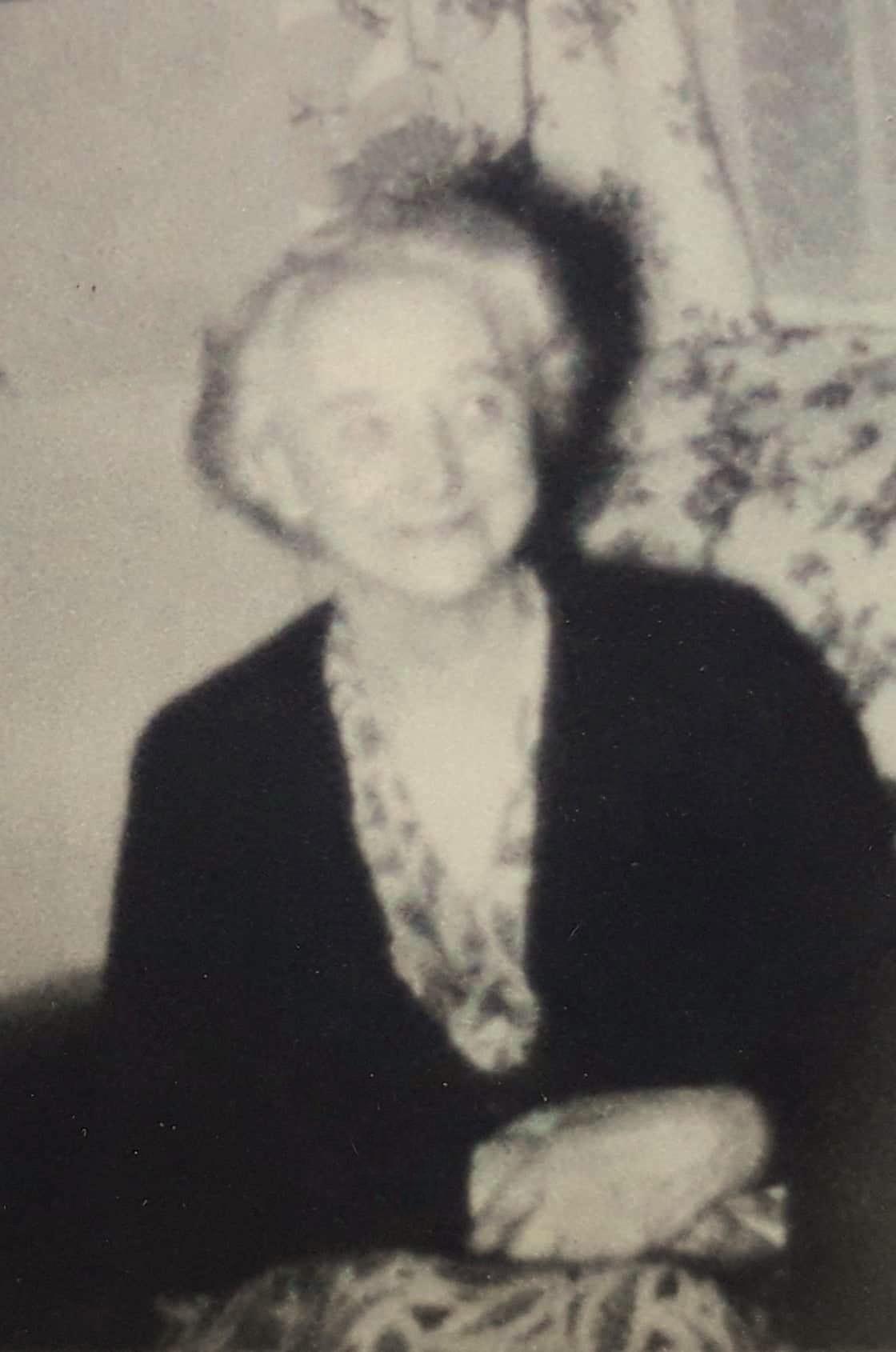
Nellie Fisher 1877-1956 :
Abel Fisher was born in 1769 according to his burial document (age 81 in 1849) and on the 1841 census. Abel was a wood screw manufacturer in Wolverhampton.
As no baptism record can be found for Abel Fisher, I read every Fisher will I could find in a 30 year period hoping to find his fathers will. I found three other Fishers who were wood screw manufacurers in neighbouring West Bromwich, which led me to assume that Abel was born in West Bromwich and related to these other Fishers.
The wood screw making industry was a relatively new thing when Abel was born.
“The screw was used in furniture but did not become a common woodworking fastener until efficient machine tools were developed near the end of the 18th century. The earliest record of lathe made wood screws dates to an English patent of 1760. The development of wood screws progressed from a small cottage industry in the late 18th century to a highly mechanized industry by the mid-19th century. This rapid transformation is marked by several technical innovations that help identify the time that a screw was produced. The earliest, handmade wood screws were made from hand-forged blanks. These screws were originally produced in homes and shops in and around the manufacturing centers of 18th century Europe. Individuals, families or small groups participated in the production of screw blanks and the cutting of the threads. These small operations produced screws individually, using a series of files, chisels and cutting tools to form the threads and slot the head. Screws produced by this technique can vary significantly in their shape and the thread pitch. They are most easily identified by the profusion of file marks (in many directions) over the surface. The first record regarding the industrial manufacture of wood screws is an English patent registered to Job and William Wyatt of Staffordshire in 1760.”
Wood Screw Makers of West Bromwich:
Edward Fisher, wood screw maker of West Bromwich, died in 1796. He mentions his wife Pheney and two underage sons in his will. Edward (whose baptism has not been found) married Pheney Mallin on 13 April 1793. Pheney was 17 years old, born in 1776. Her parents were Isaac Mallin and Sarah Firme, who were married in West Bromwich in 1768.
Edward and Pheney’s son Edward was born on 21 October 1793, and their son Isaac in 1795. The executors of Edwards 1796 will are Daniel Fisher the Younger, Isaac Mallin, and Joseph Fisher.There is a marriage allegations and bonds document in 1774 for an Edward Fisher, bachelor and wood screw maker of West Bromwich, aged 25 years and upwards, and Mary Mallin of the same age, father Isaac Mallin. Isaac Mallin and Sarah didn’t marry until 1768 and Mary Mallin would have been born circa 1749. Perhaps Isaac Mallin’s father was the father of Mary Mallin. It’s possible that Edward Fisher was born in 1749 and first married Mary Mallin, and then later Pheney, but it’s also possible that the Edward Fisher who married Mary Mallin in 1774 was Edward Fishers uncle, Daniel’s brother. (I do not know if Daniel had a brother Edward, as I haven’t found a baptism, or marriage, for Daniel Fisher the elder.)
There are two difficulties with finding the records for these West Bromwich families. One is that the West Bromwich registers are not available online in their entirety, and are held by the Sandwell Archives, and even so, they are incomplete. Not only that, the Fishers were non conformist. There is no surviving register prior to 1787. The chapel opened in 1788, and any registers that existed before this date, taken in a meeting houses for example, appear not to have survived.
Daniel Fisher the younger died intestate in 1818. Daniel was a wood screw maker of West Bromwich. He was born in 1751 according to his age stated as 67 on his death in 1818. Daniel’s wife Mary, and his son William Fisher, also a wood screw maker, claimed the estate.
Daniel Fisher the elder was a farmer of West Bromwich, who died in 1806. He was 81 when he died, which makes a birth date of 1725, although no baptism has been found. No marriage has been found either, but he was probably married not earlier than 1746.
Daniel’s sons Daniel and Joseph were the main inheritors, and he also mentions his other children and grandchildren namely William Fisher, Thomas Fisher, Hannah wife of William Hadley, two grandchildren Edward and Isaac Fisher sons of Edward Fisher his son deceased. Daniel the elder presumably refers to the wood screw manufacturing when he says “to my son Daniel Fisher the good will and advantage which may arise from his manufacture or trade now carried on by me.” Daniel does not mention a son called Abel unfortunately, but neither does he mention his other grandchildren. Abel may be Daniel’s son, or he may be a nephew.
The Staffordshire Record Office holds the documents of a Testamentary Case in 1817. The principal people are Isaac Fisher, a legatee; Daniel and Joseph Fisher, executors. Principal place, West Bromwich, and deceased person, Daniel Fisher the elder, farmer.
William and Sarah Fisher baptised six children in the Mares Green Non Conformist registers in West Bromwich between 1786 and 1798. William Fisher and Sarah Birch were married in West Bromwich in 1777. This William was probably born circa 1753 and was probably the son of Daniel Fisher the elder, farmer.
Daniel Fisher the younger and his wife Mary had a son William, as mentioned in the intestacy papers, although I have not found a baptism for William. I did find a baptism for another son, Eutychus Fisher in 1792.
In White’s Directory of Staffordshire in 1834, there are three Fishers who are wood screw makers in Wolverhampton: Eutychus Fisher, Oxford Street; Stephen Fisher, Bloomsbury; and William Fisher, Oxford Street.
Abel’s son William Fisher 1792-1873 was living on Oxford Street on the 1841 census, with his wife Mary and their son William Fisher 1834-1916.
In The European Magazine, and London Review of 1820 (Volume 77 – Page 564) under List of Patents, W Fisher and H Fisher of West Bromwich, wood screw manufacturers, are listed. Also in 1820 in the Birmingham Chronicle, the partnership of William and Hannah Fisher, wood screw manufacturers of West Bromwich, was dissolved.
In the Staffordshire General & Commercial Directory 1818, by W. Parson, three Fisher’s are listed as wood screw makers. Abel Fisher victualler and wood screw maker, Red Lion, Walsal Road; Stephen Fisher wood screw maker, Buggans Lane; and Daniel Fisher wood screw manufacturer, Brickiln Lane.
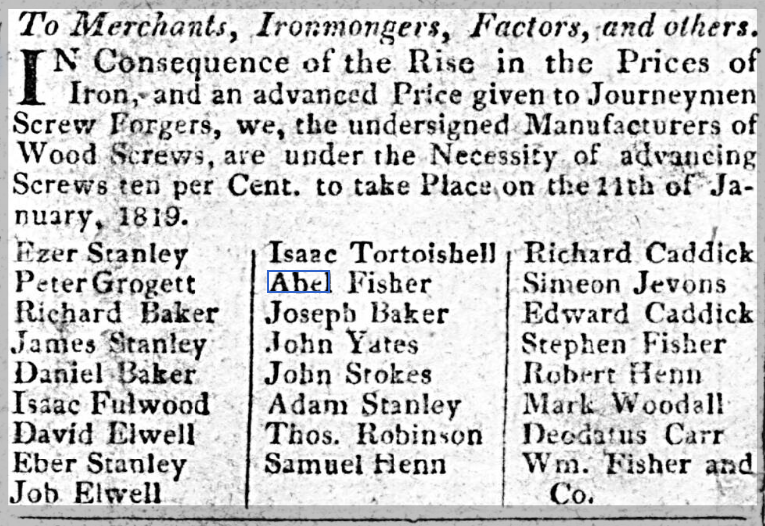
In Aris’s Birmingham Gazette on 4 January 1819 Abel Fisher is listed with 23 other wood screw manufacturers (Stephen Fisher and William Fisher included) stating that “In consequence of the rise in prices of iron and the advanced price given to journeymen screw forgers, we the undersigned manufacturers of wood screws are under the necessity of advancing screws 10 percent, to take place on the 11th january 1819.”
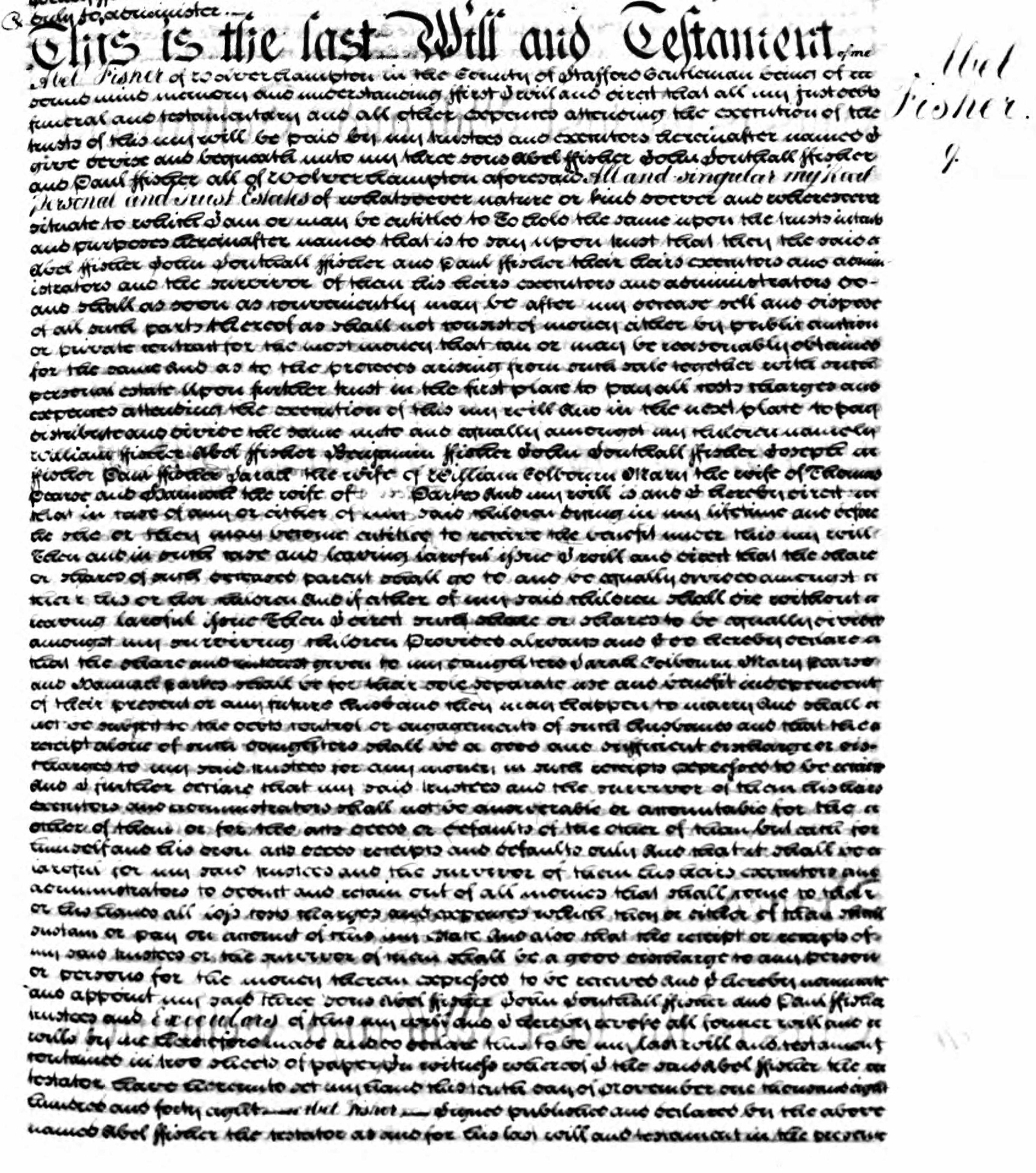
In Abel Fisher’s 1849 will, he names his three sons Abel Fisher 1796-1869, Paul Fisher 1811-1900 and John Southall Fisher 1801-1871 as the executors. He also mentions his other three sons, William Fisher 1792-1873, Benjamin Fisher 1798-1870, and Joseph Fisher 1803-1876, and daughters Sarah Fisher 1794- wife of William Colbourne, Mary Fisher 1804- wife of Thomas Pearce, and Susannah (Hannah) Fisher 1813- wife of Parkes. His son Silas Fisher 1809-1837 wasn’t mentioned as he died before Abel, nor his sons John Fisher 1799-1800, and Edward Southall Fisher 1806-1843. Abel’s wife Susannah Southall born in 1771 died in 1824. They were married in 1791.
The 1849 will of Abel Fisher:
 August 17, 2023 at 4:32 pm #7268
In reply to: Family Stories From The Other Side ~ Book Two
William Tomlinson
1797-1867
The Tomlinsons of Wolverhampton were butchers and publicans for several generations. Therefore it was a surprise to find that William’s father was a gentleman of independant means.
William Tomlinson 1797-1867 was born in Wergs, Tettenhall. His birthplace, and that of his first four children, is stated as Wergs on the 1851 census. They were baptised at St Michael and All Angels church in Tettenhall Regis, as were many of the Tomlinson family including William.
Tettenhall, St Michael and All Angels church:
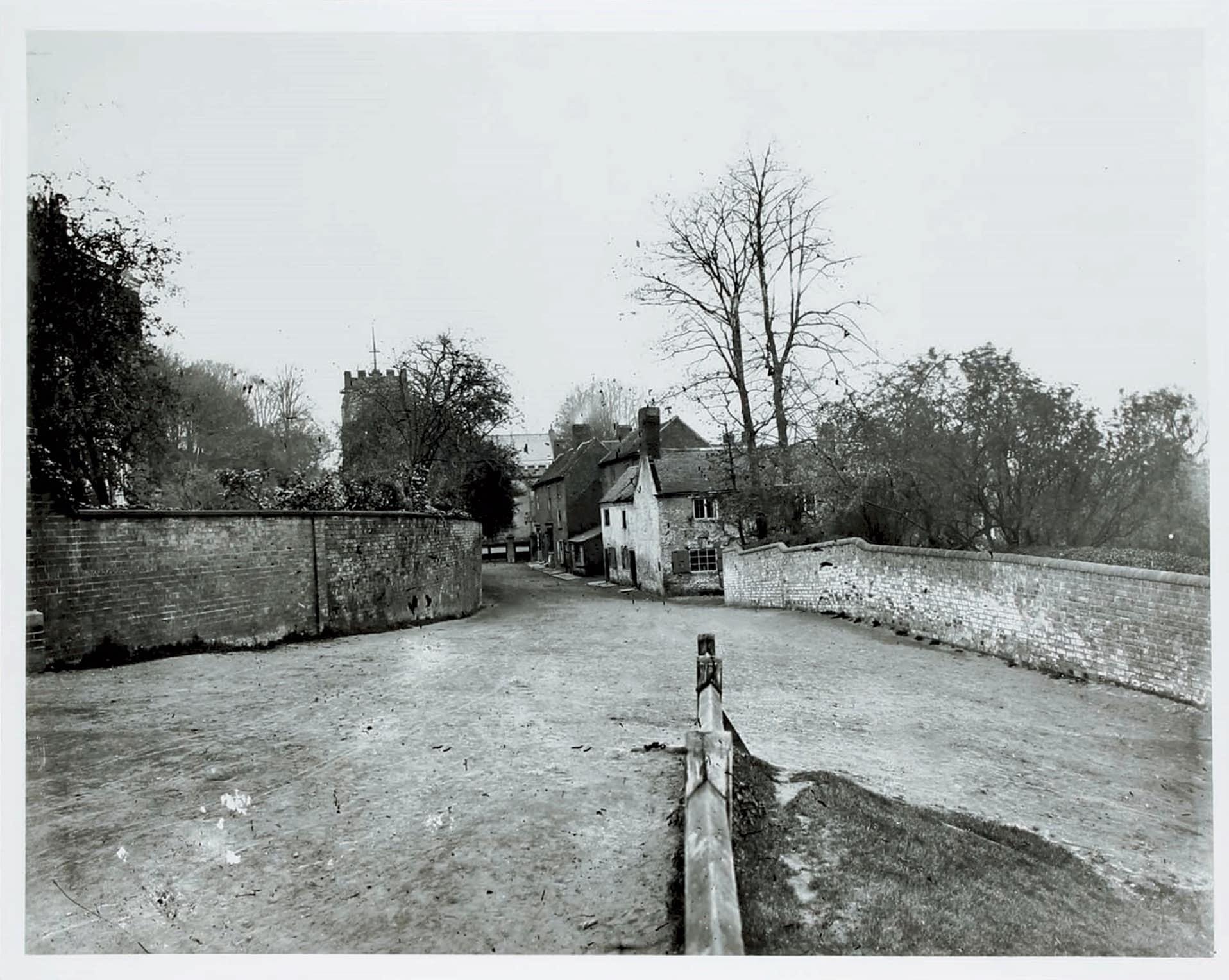
Wergs is a very small area and there was no other William Tomlinson baptised there at the time of William’s birth. It is of course possible that another William Tomlinson was born in Wergs and the record of the baptism hasn’t been found, but there are a number of other documents that prove that John Tomlinson, gentleman of Wergs, was Williams father.
In 1834 on the Shropshire Quarter session rolls there are two documents regarding William. In October 1834 William Tomlinson of Tettenhall, son of John, took an examination. Also in October of 1834 there is a reconizance document for William Tomlinson for “pig dealer”. On the marriage certificate of his son Charles Tomlinson to Emma Grattidge (mistranscribed as Pratadge) in 1872, father William’s occupation is “dealer”.
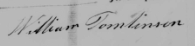
William Tomlinson was a witness at his sister Catherine and Benjamin Smiths wedding in 1822 in Tettenhall. In John Tomlinson’s 1844 will, he mentions his “daughter Catherine Smith, wife of Benjamin Smith”. William’s signature as a witness at Catherine’s marriage matches his signature on the licence for his own marriage to Elizabeth Adams in 1827 in Shareshill, Staffordshire.
William’s signature on his wedding licence:
Williams signature as a witness to Catherine’s marriage:

William was the eldest surviving son when his father died in 1844, so it is surprising that William only inherited £25. John Tomlinson left his various properties to his daughters, with the exception of Catherine, who also received £25. There was one other surviving son, Sidney, born in 1814. Three of John and Sarah Tomlinson’s sons and one daughter died in infancy. Sidney was still unmarried and living at home when his father died, and in 1851 and 1861 was living with his sister Emma Wilson. He was unmarried when he died in 1867. John left Sidney an income for life in his will, but not property.
In John Tomlinson’s will he also mentions his daughter Jemima, wife of William Smith, farmer, of Great Barr. On the 1841 census William, butcher, is a visitor. His two children Sarah and Thomas are with him. His wife Elizabeth and the rest of the children are at Graisley Street. William is also on the Graisley Street census, occupation castrator. This was no doubt done in error, not realizing that he was also registered on the census where he was visiting at the time.
William’s wife, Elizabeth Adams, was born in Tong, Shropshire in 1807. The Adams in Tong appear to be agricultural labourers, at least on later censuses. Perhaps we can speculate that John didn’t approve of his son marrying an agricutural labourers daughter. Elizabeth would have been twenty years old at the time of the marriage; William thirty.
August 15, 2023 at 12:42 pm #7267In reply to: Family Stories From The Other Side ~ Book Two
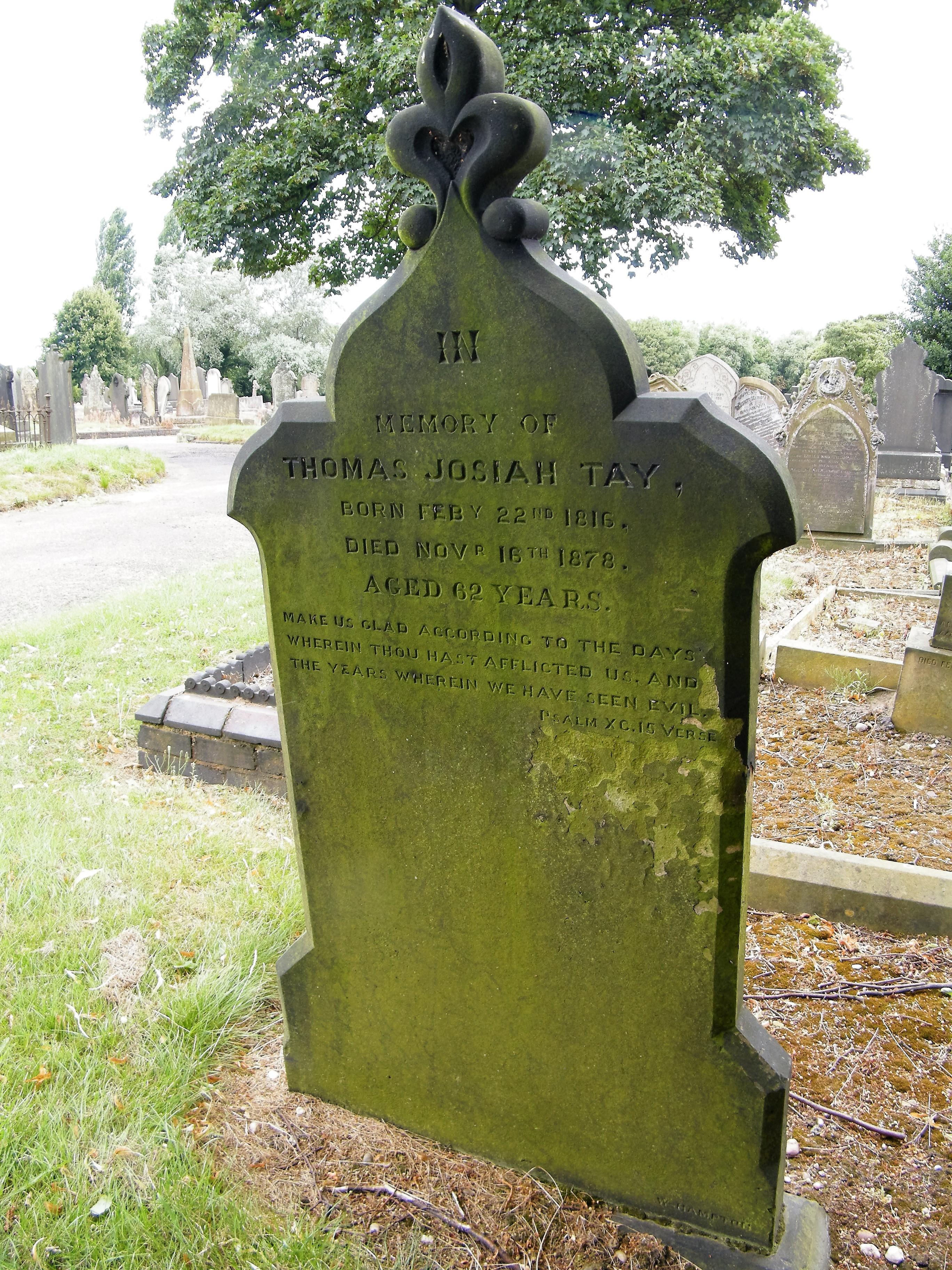
Thomas Josiah Tay
22 Feb 1816 – 16 November 1878
“Make us glad according to the days wherein thou hast afflicted us, and the years wherein we have seen evil.”
I first came across the name TAY in the 1844 will of John Tomlinson (1766-1844), gentleman of Wergs, Tettenhall. John’s friends, trustees and executors were Edward Moore, surgeon of Halesowen, and Edward Tay, timber merchant of Wolverhampton.
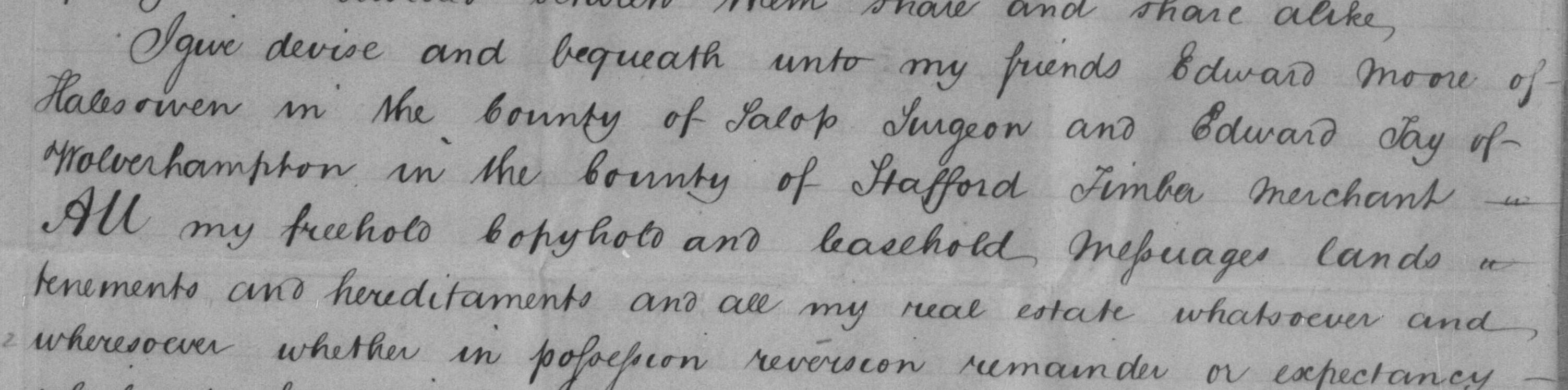
Edward Moore (born in 1805) was the son of John’s wife’s (Sarah Hancox born 1772) sister Lucy Hancox (born 1780) from her first marriage in 1801. In 1810 widowed Lucy married Josiah Tay (1775-1837).
Edward Tay was the son of Sarah Hancox sister Elizabeth (born 1778), who married Thomas Tay in 1800. Thomas Tay (1770-1841) and Josiah Tay were brothers.
Edward Tay (1803-1862) was born in Sedgley and was buried in Penn. He was innkeeper of The Fighting Cocks, Dudley Road, Wolverhampton, as well as a builder and timber merchant, according to various censuses, trade directories, his marriage registration where his father Thomas Tay is also a timber merchant, as well as being named as a timber merchant in John Tomlinsons will.
John Tomlinson’s daughter Catherine (born in 1794) married Benjamin Smith in Tettenhall in 1822. William Tomlinson (1797-1867), Catherine’s brother, and my 3x great grandfather, was one of the witnesses.
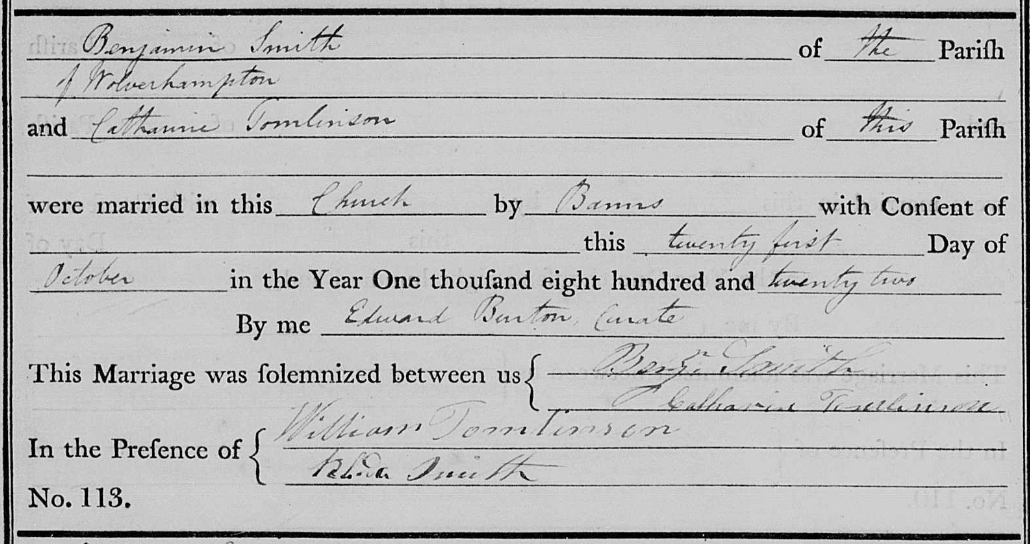
Their daughter Matilda Sarah Smith (1823-1910) married Thomas Josiah Tay in 1850 in Birmingham. Thomas Josiah Tay (1816-1878) was Edward Tay’s brother, the sons of Elizabeth Hancox and Thomas Tay.
Therefore, William Hancox 1737-1816 (the father of Sarah, Elizabeth and Lucy), was Matilda’s great grandfather and Thomas Josiah Tay’s grandfather.
Thomas Josiah Tay’s relationship to me is the husband of first cousin four times removed, as well as my first cousin, five times removed.
In 1837 Thomas Josiah Tay is mentioned in the will of his uncle Josiah Tay.

In 1841 Thomas Josiah Tay appears on the Stafford criminal registers for an “attempt to procure miscarriage”. He was found not guilty.
According to the Staffordshire Advertiser on 14th March 1840 the listing for the Assizes included: “Thomas Ashmall and Thomas Josiah Tay, for administering noxious ingredients to Hannah Evans, of Wolverhampton, with intent to procure abortion.”
The London Morning Herald on 19th March 1840 provides further information: “Mr Thomas Josiah Tay, a chemist and druggist, surrendered to take his trial on a charge of having administered drugs to Hannah Lear, now Hannah Evans, with intent to procure abortion.” She entered the service of Tay in 1837 and after four months “an intimacy was formed” and two months later she was “enciente”. Tay advised her to take some pills and a draught which he gave her and she became very ill. The prosecutrix admitted that she had made no mention of this until 1939. Verdict: not guilty.
However, the case of Thomas Josiah Tay is also mentioned in a couple of law books, and the story varies slightly. In the 1841 Reports of Cases Argued and Rules at Nisi Prius, the Regina vs Ashmall and Tay case states that Thomas Ashmall feloniously, unlawfully, and maliciously, did use a certain instrument, and that Thomas Josiah Tay did procure the instrument, counsel and command Ashmall in the use of it. It concludes that Tay was not compellable to plead to the indictment, and that he did not.
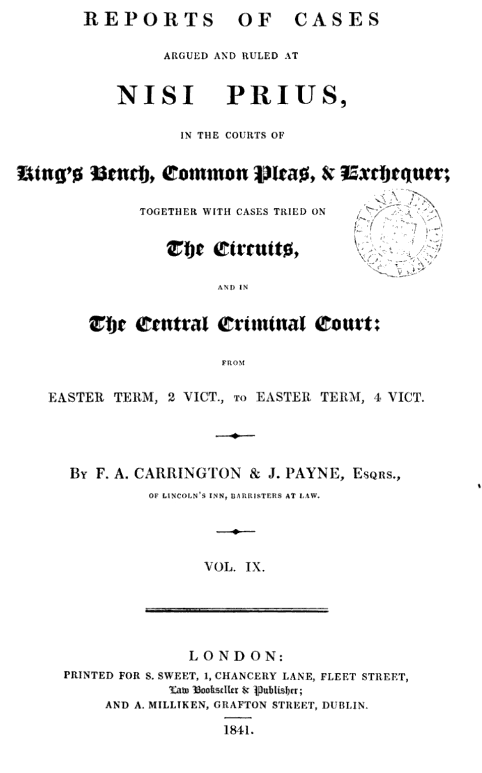
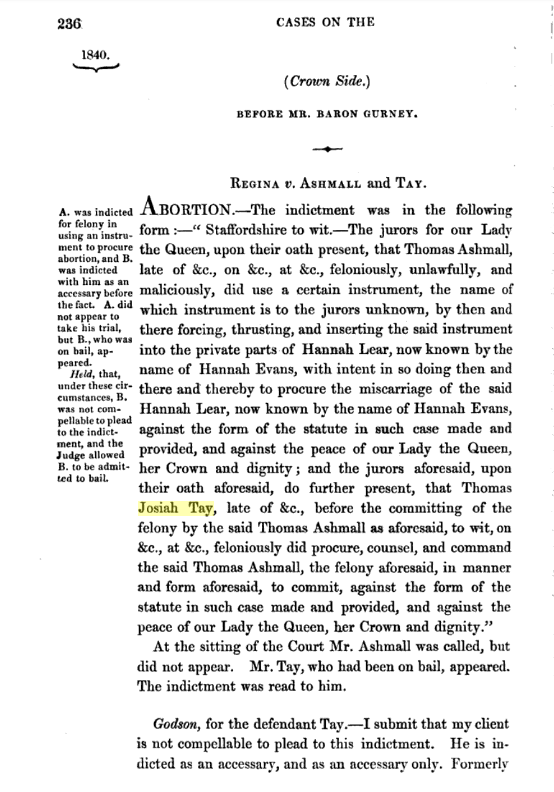
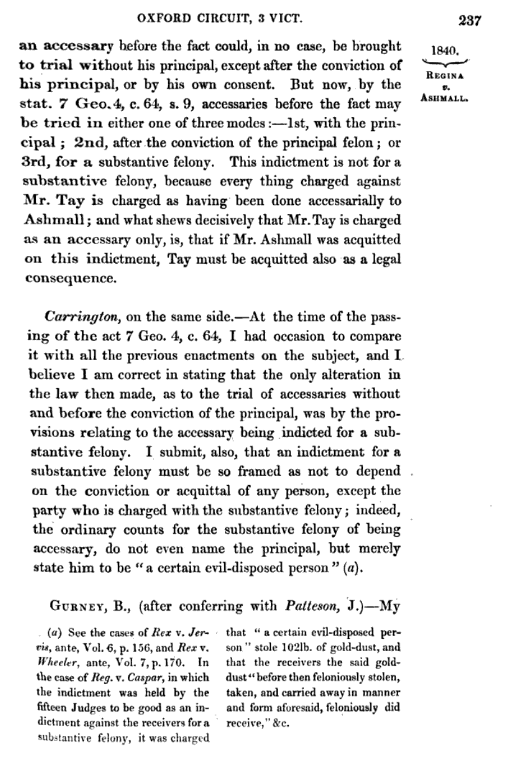
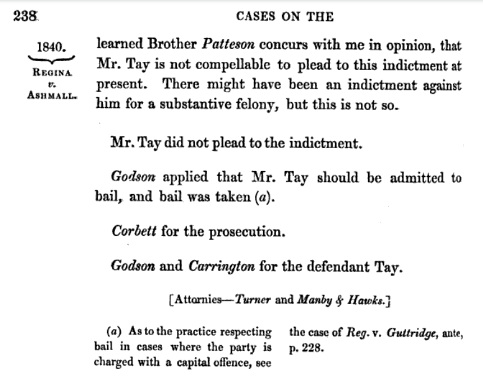
The Regina vs Ashmall and Tay case is also mentioned in the Encyclopedia of Forms and Precedents, 1896.
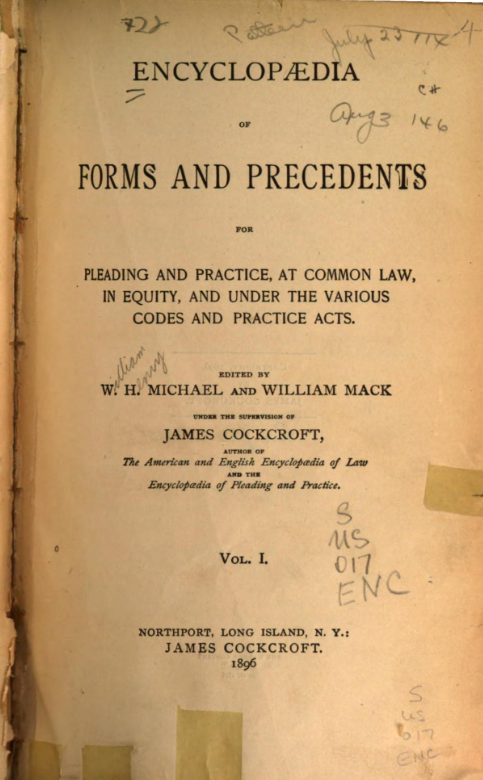
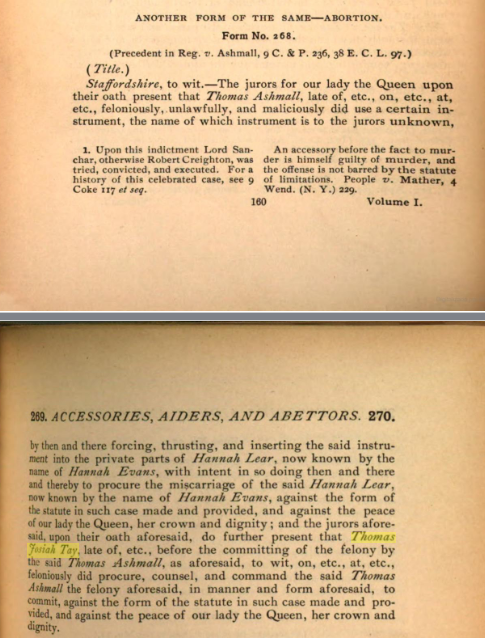
In 1845 Thomas Josiah Tay married Isabella Southwick in Tettenhall. Two years later in 1847 Isabella died.
In 1850 Thomas Josiah married Matilda Sarah Smith. (granddaughter of John Tomlinson, as mentioned above)
On the 1851 census Thomas Josiah Tay was a farmer of 100 acres employing two labourers in Shelfield, Walsall, Staffordshire. Thomas Josiah and Matilda Sarah have a daughter Matilda under a year old, and they have a live in house servant.
In 1861 Thomas Josiah Tay, his wife and their four children Ann, James, Josiah and Alice, live in Chelmarsh, Shropshire. He was a farmer of 224 acres. Mercy Smith, Matilda’s sister, lives with them, a 28 year old dairy maid.
In 1863 Thomas Josiah Tay of Hampton Lode (Chelmarsh) Shropshire was bankrupt. Creditors include Frederick Weaver, druggist of Wolverhampton.
In 1869 Thomas Josiah Tay was again bankrupt. He was an innkeeper at The Fighting Cocks on Dudley Road, Wolverhampton, at the time, the same inn as his uncle Edward Tay, aforementioned timber merchant.
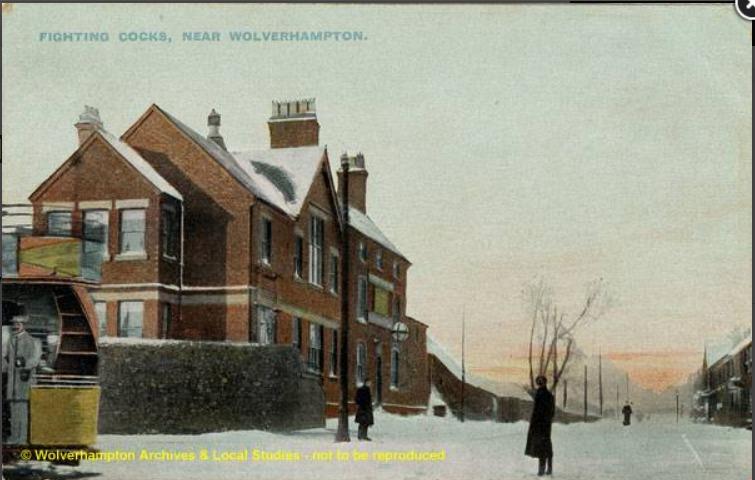
In 1871, Thomas Josiah Tay, his wife Matilda, and their three children Alice, Edward and Maryann, were living in Birmingham. Thomas Josiah was a commercial traveller.
He died on the 16th November 1878 at the age of 62 and was buried in Darlaston, Walsall. On his gravestone:
“Make us glad according to the days wherein thou hast afflicted us, and the years wherein we have seen evil.” Psalm XC 15 verse.
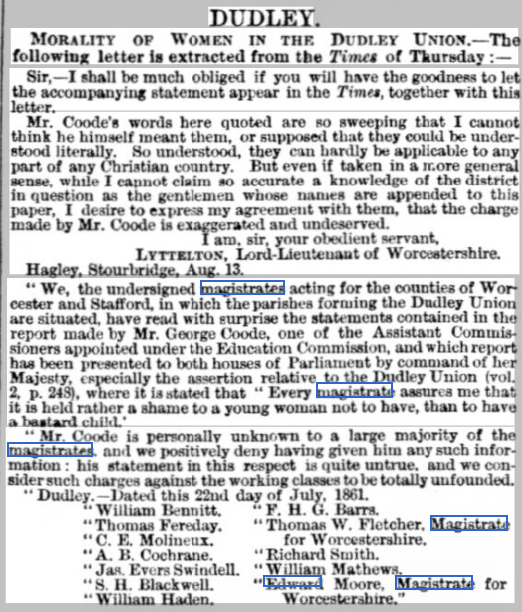
Edward Moore, surgeon, was also a MAGISTRATE in later years. On the 1871 census he states his occupation as “magistrate for counties Worcester and Stafford, and deputy lieutenant of Worcester, formerly surgeon”. He lived at Townsend House in Halesowen for many years. His wifes name was PATTERN Lucas. Her mothers name was Pattern Hewlitt from Birmingham, an unusal name that I have not heard before. On the 1871 census, Edward’s son was a 22 year old solicitor.
In 1861 an article appeared in the newspapers about the state of the morality of the women of Dudley. It was claimed that all the local magistrates agreed with the premise of the article, concerning unmarried women and their attitudes towards having illegitimate children. Letters appeared in subsequent newspapers signed by local magistrates, including Edward Moore, strongly disagreeing.
Staffordshire Advertiser 17 August 1861:
 July 5, 2023 at 8:21 pm #7263
In reply to: Family Stories From The Other Side ~ Book Two
Solomon Stubbs
1781-1857
Solomon was born in Hamstall Ridware, Staffordshire, parents Samuel Stubbs and Rebecca Wood. (see The Hamstall Ridware Connection chapter)
Solomon married Phillis Lomas at St Modwen’s in Burton on Trent on 30th May 1815. Phillis was the llegitimate daughter of Frances Lomas. No father was named on the baptism on the 17th January 1787 in Sutton on the Hill, Derbyshire, and the entry on the baptism register states that she was illegitimate. Phillis’s mother Frances married Daniel Fox in 1790 in Sutton on the Hill. Unfortunately this means that it’s impossible to find my 5X great grandfather on this side of the family.
Solomon and Phillis had four daughters, the last died in infancy.
Sarah 1816-1867, Mary (my 3X great grandmother) 1819-1880, Phillis 1823-1905, and Maria 1825-1826.Solomon Stubbs of Horninglow St is listed in the 1834 Whites Directory under “China, Glass, Etc Dlrs”. Next to his name is Joanna Warren (earthenware) High St. Joanna Warren is related to me on my maternal side. No doubt Solomon and Joanna knew each other, unaware that several generations later a marriage would take place, not locally but miles away, joining their families.
Solomon Stubbs is also listed in Whites Directory in 1831 and 1834 Burton on Trent as a land carrier:
“Land Carriers, from the Inns, Etc: Uttoxeter, Solomon Stubbs, Horninglow St, Mon. Wed. and Sat. 6 mng.”
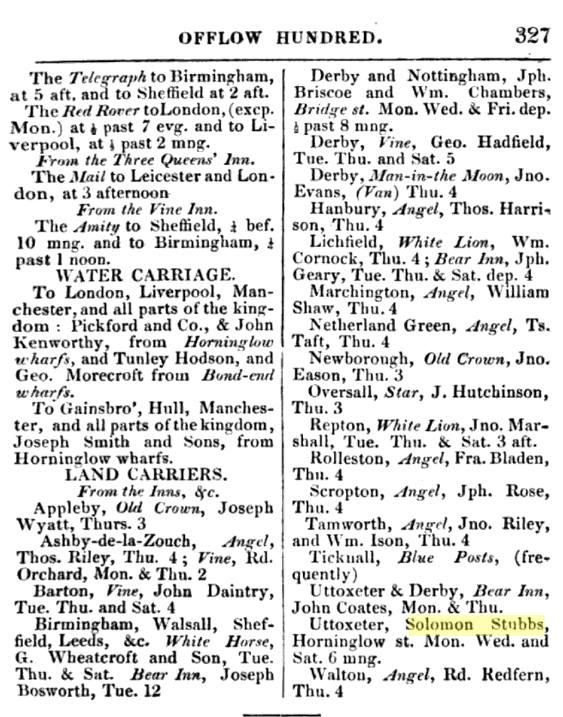
Solomon is listed in the electoral registers in 1837. The 1837 United Kingdom general election was triggered by the death of King William IV and produced the first Parliament of the reign of his successor, Queen Victoria.
National Archives:
“In 1832, Parliament passed a law that changed the British electoral system. It was known as the Great Reform Act, which basically gave the vote to middle class men, leaving working men disappointed.
The Reform Act became law in response to years of criticism of the electoral system from those outside and inside Parliament. Elections in Britain were neither fair nor representative. In order to vote, a person had to own property or pay certain taxes to qualify, which excluded most working class people.”Via the Burton on Trent History group:
“a very early image of High street and Horninglow street junction, where the original ‘ Bargates’ were in the days of the Abbey. ‘Gate’ is the Saxon meaning Road, ‘Bar’ quite self explanatory, meant ‘to stop entrance’. There was another Bargate across Cat street (Station street), the Abbot had these constructed to regulate the Traders coming into town, in the days when the Abbey ran things. In the photo you can see the Posts on the corner, designed to stop Carts and Carriages mounting the Pavement. Only three Posts remain today and they are Listed.”
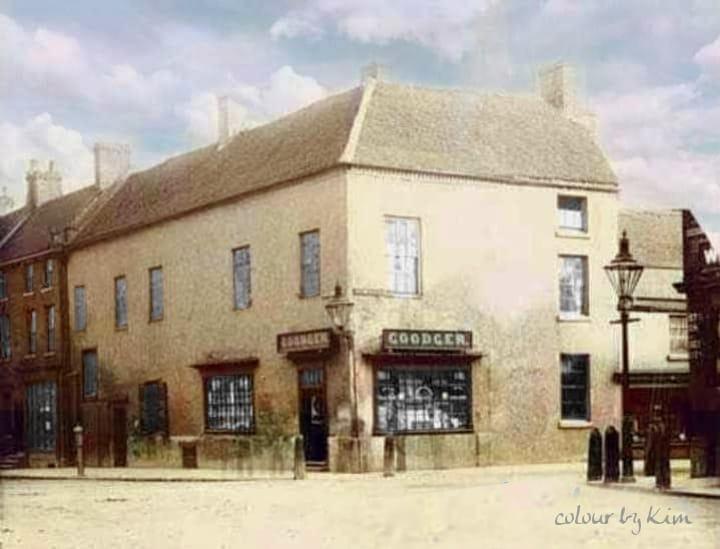
On the 1841 census, Solomon’s occupation was Carrier. Daughter Sarah is still living at home, and Sarah Grattidge, 13 years old, lives with them. Solomon’s daughter Mary had married William Grattidge in 1839.
Solomon Stubbs of Horninglow Street, Burton on Trent, is listed as an Earthenware Dealer in the 1842 Pigot’s Directory of Staffordshire.
In May 1844 Solomon’s wife Phillis died. In July 1844 daughter Sarah married Thomas Brandon in Burton on Trent. It was noted in the newspaper announcement that this was the first wedding to take place at the Holy Trinity church.
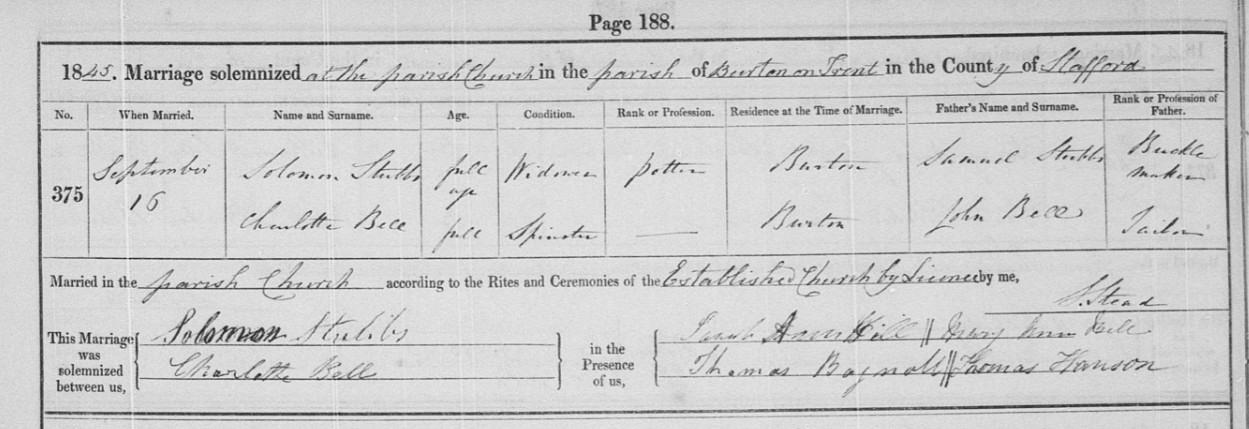
Solomon married Charlotte Bell by licence the following year in 1845. She was considerably younger than him, born in 1824. On the marriage certificate Solomon’s occupation is potter. It seems that he had the earthenware business as well as the land carrier business, in addition to owning a number of properties.
The marriage of Solomon Stubbs and Charlotte Bell:
Also in 1845, Solomon’s daughter Phillis was married in Burton on Trent to John Devitt, son of CD Devitt, Esq, formerly of the General Post Office Dublin.
Solomon Stubbs died in September 1857 in Burton on Trent. In the Staffordshire Advertiser on Saturday 3 October 1857:
“On the 22nd ultimo, suddenly, much respected, Solomon Stubbs, of Guild-street, Burton-on-Trent, aged 74 years.”
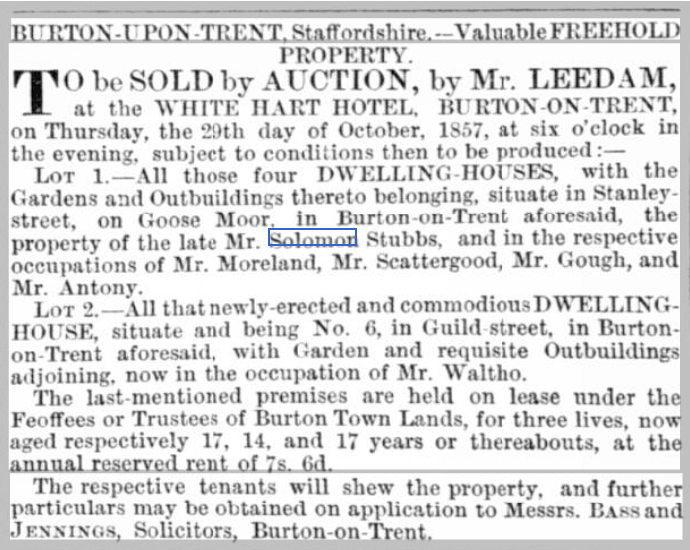
In the Staffordshire Advertiser, 24th October 1857, the auction of the property of Solomon Stubbs was announced:
“BURTON ON TRENT, on Thursday, the 29th day of October, 1857, at six o’clock in the evening, subject to conditions then to be produced:— Lot I—All those four DWELLING HOUSES, with the Gardens and Outbuildings thereto belonging, situate in Stanleystreet, on Goose Moor, in Burton-on-Trent aforesaid, the property of the late Mr. Solomon Stubbs, and in the respective occupations of Mr. Moreland, Mr. Scattergood, Mr. Gough, and Mr. Antony…..”
Sadly, the graves of Solomon, his wife Phillis, and their infant daughter Maria have since been removed and are listed in the UK Records of the Removal of Graves and Tombstones 1601-2007.
July 4, 2023 at 7:52 pm #7261In reply to: Family Stories From The Other Side ~ Book Two
Long Lost Enoch Edwards
My father used to mention long lost Enoch Edwards. Nobody in the family knew where he went to and it was assumed that he went to USA, perhaps to Utah to join his sister Sophie who was a Mormon handcart pioneer, but no record of him was found in USA.
Andrew Enoch Edwards (my great great grandfather) was born in 1840, but was (almost) always known as Enoch. Although civil registration of births had started from 1 July 1837, neither Enoch nor his brother Stephen were registered. Enoch was baptised (as Andrew) on the same day as his brothers Reuben and Stephen in May 1843 at St Chad’s Catholic cathedral in Birmingham. It’s a mystery why these three brothers were baptised Catholic, as there are no other Catholic records for this family before or since. One possible theory is that there was a school attached to the church on Shadwell Street, and a Catholic baptism was required for the boys to go to the school. Enoch’s father John died of TB in 1844, and perhaps in 1843 he knew he was dying and wanted to ensure an education for his sons. The building of St Chads was completed in 1841, and it was close to where they lived.
Enoch appears (as Enoch rather than Andrew) on the 1841 census, six months old. The family were living at Unett Street in Birmingham: John and Sarah and children Mariah, Sophia, Matilda, a mysterious entry transcribed as Lene, a daughter, that I have been unable to find anywhere else, and Reuben and Stephen.
Enoch was just four years old when his father John, an engineer and millwright, died of consumption in 1844.
In 1851 Enoch’s widowed mother Sarah was a mangler living on Summer Street, Birmingham, Matilda a dressmaker, Reuben and Stephen were gun percussionists, and eleven year old Enoch was an errand boy.
On the 1861 census, Sarah was a confectionrer on Canal Street in Birmingham, Stephen was a blacksmith, and Enoch a button tool maker.
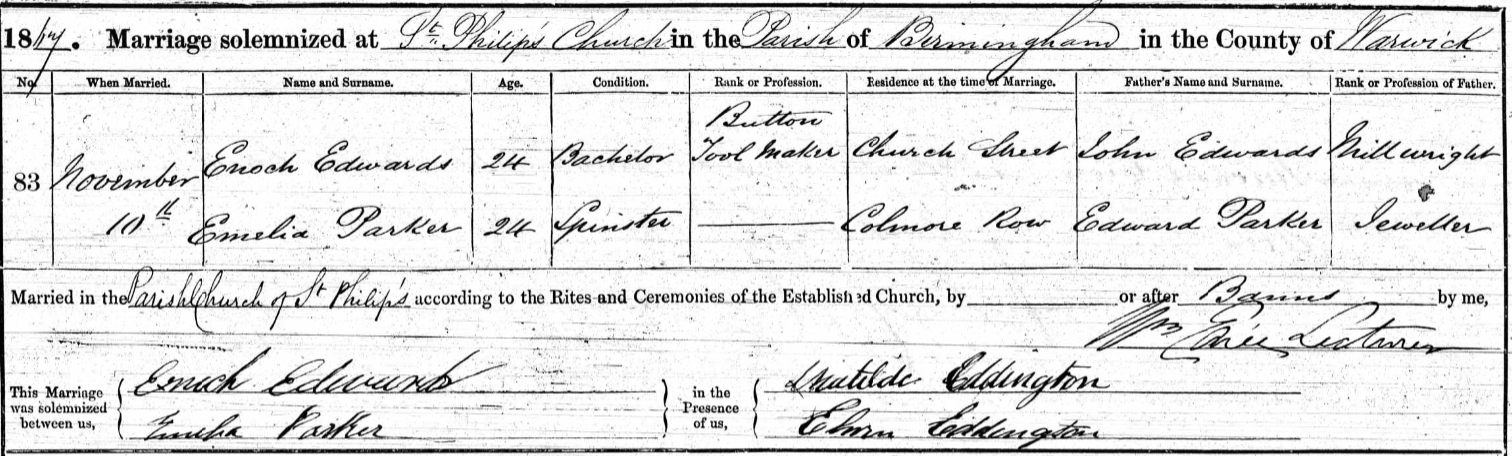
On the 10th November 1867 Enoch married Emelia Parker, daughter of jeweller and rope maker Edward Parker, at St Philip in Birmingham. Both Emelia and Enoch were able to sign their own names, and Matilda and Edwin Eddington were witnesses (Enoch’s sister and her husband). Enoch’s address was Church Street, and his occupation button tool maker.
Four years later in 1871, Enoch was a publican living on Clifton Road. Son Enoch Henry was two years old, and Ralph Ernest was three months. Eliza Barton lived with them as a general servant.
By 1881 Enoch was back working as a button tool maker in Bournebrook, Birmingham. Enoch and Emilia by then had three more children, Amelia, Albert Parker (my great grandfather) and Ada.
Garnet Frederick Edwards was born in 1882. This is the first instance of the name Garnet in the family, and subsequently Garnet has been the middle name for the eldest son (my brother, father and grandfather all have Garnet as a middle name).
Enoch was the licensed victualler at the Pack Horse Hotel in 1991 at Kings Norton. By this time, only daughters Amelia and Ada and son Garnet are living at home.
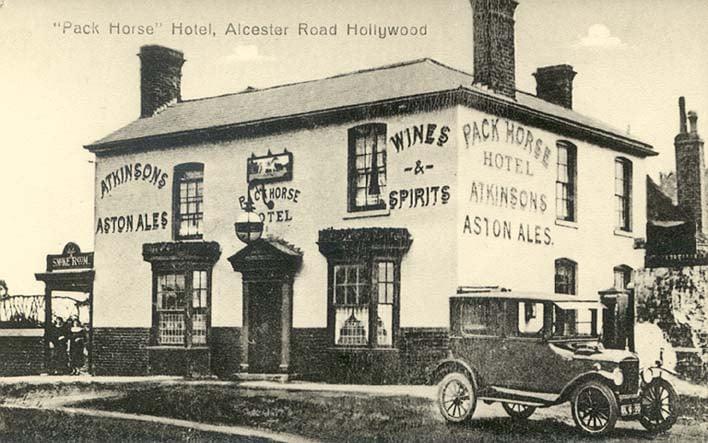
Additional information from my fathers cousin, Paul Weaver:
“Enoch refused to allow his son Albert Parker to go to King Edwards School in Birmingham, where he had been awarded a place. Instead, in October 1890 he made Albert Parker Edwards take an apprenticeship with a pawnboker in Tipton.
Towards the end of the 19th century Enoch kept The Pack Horse in Alcester Road, Hollywood, where a twist was 1d an ounce, and beer was 2d a pint. The children had to get up early to get breakfast at 6 o’clock for the hay and straw men on their way to the Birmingham hay and straw market. Enoch is listed as a member of “The Kingswood & Pack Horse Association for the Prosecution of Offenders”, a kind of early Neighbourhood Watch, dated 25 October 1890.
The Edwards family later moved to Redditch where they kept The Rifleman Inn at 35 Park Road. They must have left the Pack Horse by 1895 as another publican was in place by then.”Emelia his wife died in 1895 of consumption at the Rifleman Inn in Redditch, Worcestershire, and in 1897 Enoch married Florence Ethel Hedges in Aston. Enoch was 56 and Florence was just 21 years old.
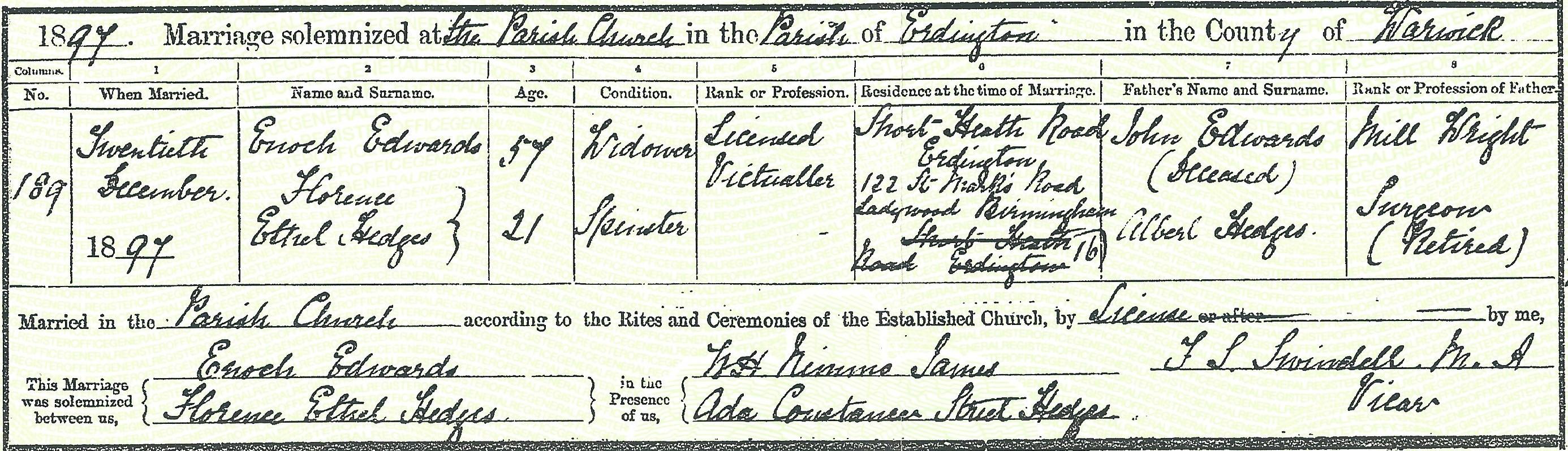
The following year in 1898 their daughter Muriel Constance Freda Edwards was born in Deritend, Warwickshire.
In 1901 Enoch, (Andrew on the census), publican, Florence and Muriel were living in Dudley. It was hard to find where he went after this.From Paul Weaver:
“Family accounts have it that Enoch EDWARDS fell out with all his family, and at about the age of 60, he left all behind and emigrated to the U.S.A. Enoch was described as being an active man, and it is believed that he had another family when he settled in the U.S.A. Esmor STOKES has it that a postcard was received by the family from Enoch at Niagara Falls.
On 11 June 1902 Harry Wright (the local postmaster responsible in those days for licensing) brought an Enoch EDWARDS to the Bedfordshire Petty Sessions in Biggleswade regarding “Hole in the Wall”, believed to refer to the now defunct “Hole in the Wall” public house at 76 Shortmead Street, Biggleswade with Enoch being granted “temporary authority”. On 9 July 1902 the transfer was granted. A year later in the 1903 edition of Kelly’s Directory of Bedfordshire, Hunts and Northamptonshire there is an Enoch EDWARDS running the Wheatsheaf Public House, Church Street, St. Neots, Huntingdonshire which is 14 miles south of Biggleswade.”
It seems that Enoch and his new family moved away from the midlands in the early 1900s, but again the trail went cold.
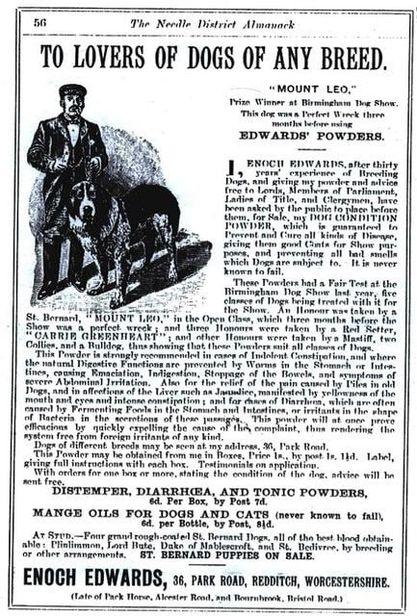
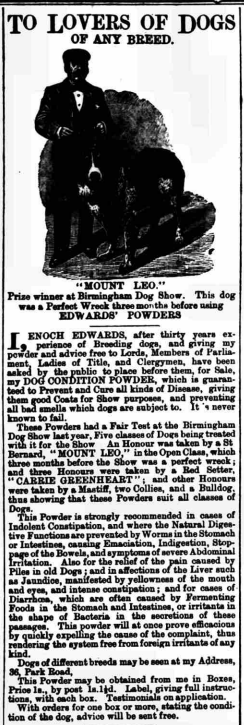
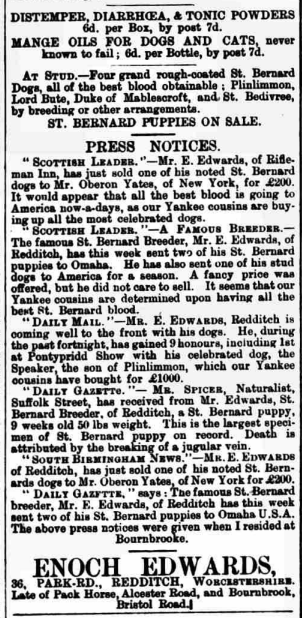
When I started doing the genealogy research, I joined a local facebook group for Redditch in Worcestershire. Enoch’s son Albert Parker Edwards (my great grandfather) spent most of his life there. I asked in the group about Enoch, and someone posted an illustrated advertisement for Enoch’s dog powders. Enoch was a well known breeder/keeper of St Bernards and is cited in a book naming individuals key to the recovery/establishment of ‘mastiff’ size dog breeds.
We had not known that Enoch was a breeder of champion St Bernard dogs!
Once I knew about the St Bernard dogs and the names Mount Leo and Plinlimmon via the newspaper adverts, I did an internet search on Enoch Edwards in conjunction with these dogs.
Enoch’s St Bernard dog “Mount Leo” was bred from the famous Plinlimmon, “the Emperor of Saint Bernards”. He was reported to have sent two puppies to Omaha and one of his stud dogs to America for a season, and in 1897 Enoch made the news for selling a St Bernard to someone in New York for £200. Plinlimmon, bred by Thomas Hall, was born in Liverpool, England on June 29, 1883. He won numerous dog shows throughout Europe in 1884, and in 1885, he was named Best Saint Bernard.
In the Birmingham Mail on 14th June 1890:
“Mr E Edwards, of Bournebrook, has been well to the fore with his dogs of late. He has gained nine honours during the past fortnight, including a first at the Pontypridd show with a St Bernard dog, The Speaker, a son of Plinlimmon.”
In the Alcester Chronicle on Saturday 05 June 1897:
It was discovered that Enoch, Florence and Muriel moved to Canada, not USA as the family had assumed. The 1911 census for Montreal St Jaqcues, Quebec, stated that Enoch, (Florence) Ethel, and (Muriel) Frida had emigrated in 1906. Enoch’s occupation was machinist in 1911. The census transcription is not very good. Edwards was transcribed as Edmand, but the dates of birth for all three are correct. Birthplace is correct ~ A for Anglitan (the census is in French) but race or tribe is also an A but the transcribers have put African black! Enoch by this time was 71 years old, his wife 33 and daughter 11.
Additional information from Paul Weaver:
“In 1906 he and his new family travelled to Canada with Enoch travelling first and Ethel and Frida joined him in Quebec on 25 June 1906 on board the ‘Canada’ from Liverpool.
Their immigration record suggests that they were planning to travel to Winnipeg, but five years later in 1911, Enoch, Florence Ethel and Frida were still living in St James, Montreal. Enoch was employed as a machinist by Canadian Government Railways working 50 hours. It is the 1911 census record that confirms his birth as November 1840. It also states that Enoch could neither read nor write but managed to earn $500 in 1910 for activity other than his main profession, although this may be referring to his innkeeping business interests.
By 1921 Florence and Muriel Frida are living in Langford, Neepawa, Manitoba with Peter FUCHS, an Ontarian farmer of German descent who Florence had married on 24 Jul 1913 implying that Enoch died sometime in 1911/12, although no record has been found.”The extra $500 in earnings was perhaps related to the St Bernard dogs. Enoch signed his name on the register on his marriage to Emelia, and I think it’s very unlikely that he could neither read nor write, as stated above.
However, it may not be Enoch’s wife Florence Ethel who married Peter Fuchs. A Florence Emma Edwards married Peter Fuchs, and on the 1921 census in Neepawa her daugther Muriel Elizabeth Edwards, born in 1902, lives with them. Quite a coincidence, two Florence and Muriel Edwards in Neepawa at the time. Muriel Elizabeth Edwards married and had two children but died at the age of 23 in 1925. Her mother Florence was living with the widowed husband and the two children on the 1931 census in Neepawa. As there was no other daughter on the 1911 census with Enoch, Florence and Muriel in Montreal, it must be a different Florence and daughter. We don’t know, though, why Muriel Constance Freda married in Neepawa.
Indeed, Florence was not a widow in 1913. Enoch died in 1924 in Montreal, aged 84. Neither Enoch, Florence or their daughter has been found yet on the 1921 census. The search is not easy, as Enoch sometimes used the name Andrew, Florence used her middle name Ethel, and daughter Muriel used Freda, Valerie (the name she added when she married in Neepawa), and died as Marcheta. The only name she NEVER used was Constance!
A Canadian genealogist living in Montreal phoned the cemetery where Enoch was buried. She said “Enoch Edwards who died on Feb 27 1924 is not buried in the Mount Royal cemetery, he was only cremated there on March 4, 1924. There are no burial records but he died of an abcess and his body was sent to the cemetery for cremation from the Royal Victoria Hospital.”
1924 Obituary for Enoch Edwards:
Cimetière Mont-Royal Outremont, Montreal Region, Quebec, Canada
The Montreal Star 29 Feb 1924, Fri · Page 31

Muriel Constance Freda Valerie Edwards married Arthur Frederick Morris on 24 Oct 1925 in Neepawa, Manitoba. (She appears to have added the name Valerie when she married.)
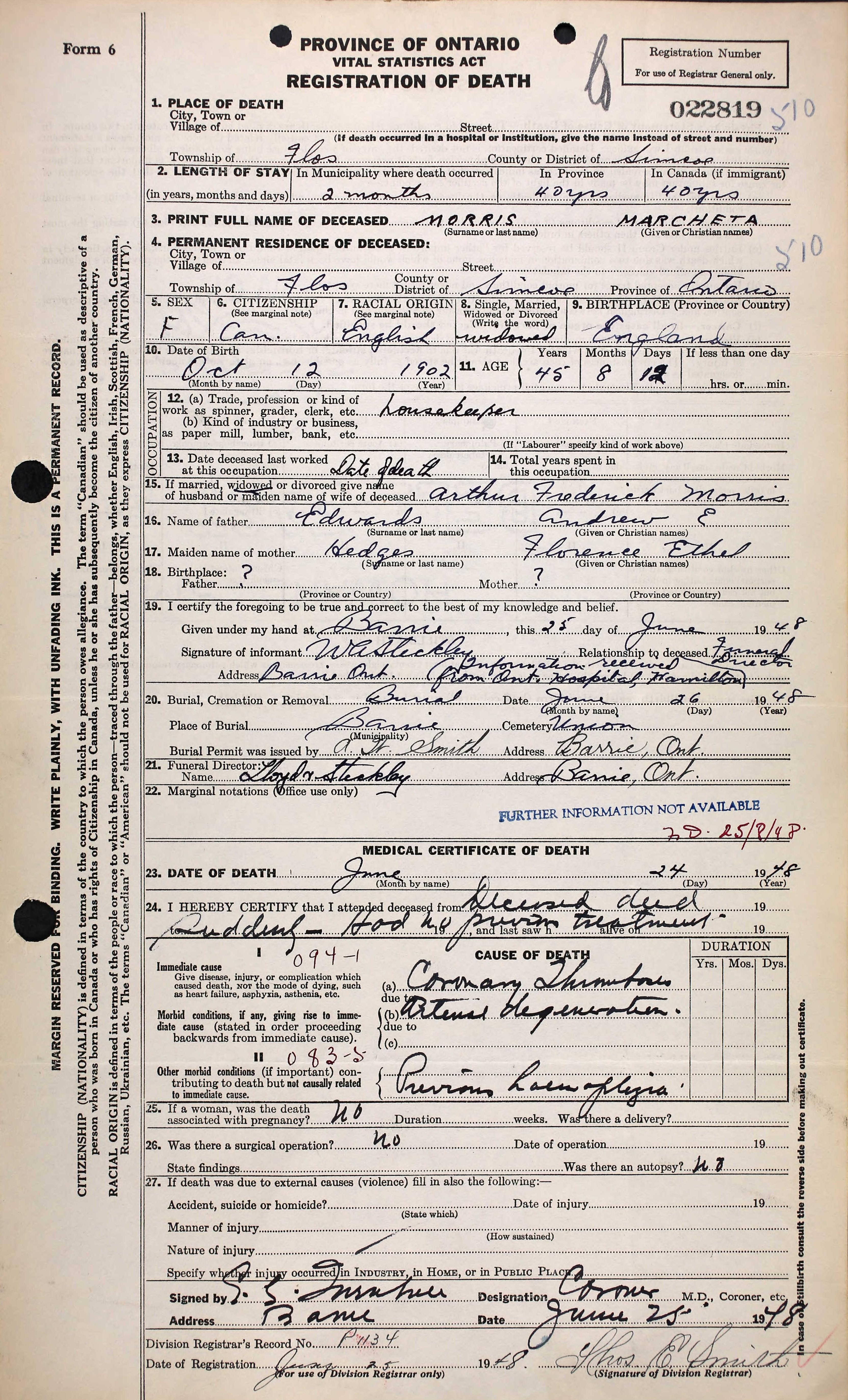
Unexpectedly a death certificate appeared for Muriel via the hints on the ancestry website. Her name was “Marcheta Morris” on this document, however it also states that she was the widow of Arthur Frederick Morris and daughter of Andrew E Edwards and Florence Ethel Hedges. She died suddenly in June 1948 in Flos, Simcoe, Ontario of a coronary thrombosis, where she was living as a housekeeper.
 June 13, 2023 at 10:31 am #7255
In reply to: Family Stories From The Other Side ~ Book Two
The First Wife of John Edwards
1794-1844
John was a widower when he married Sarah Reynolds from Kinlet. Both my fathers cousin and I had come to a dead end in the Edwards genealogy research as there were a number of possible births of a John Edwards in Birmingham at the time, and a number of possible first wives for a John Edwards at the time.
John Edwards was a millwright on the 1841 census, the only census he appeared on as he died in 1844, and 1841 was the first census. His birth is recorded as 1800, however on the 1841 census the ages were rounded up or down five years. He was an engineer on some of the marriage records of his children with Sarah, and on his death certificate, engineer and millwright, aged 49. The age of 49 at his death from tuberculosis in 1844 is likely to be more accurate than the census (Sarah his wife was present at his death), making a birth date of 1794 or 1795.
John married Sarah Reynolds in January 1827 in Birmingham, and I am descended from this marriage. Any children of John’s first marriage would no doubt have been living with John and Sarah, but had probably left home by the time of the 1841 census.
I found an Elizabeth Edwards, wife of John Edwards of Constitution Hill, died in August 1826 at the age of 23, as stated on the parish death register. It would be logical for a young widower with small children to marry again quickly. If this was John’s first wife, the marriage to Sarah six months later in January 1827 makes sense. Therefore, John’s first wife, I assumed, was Elizabeth, born in 1803.
Death of Elizabeth Edwards, 23 years old. St Mary, Birmingham, 15 Aug 1826:

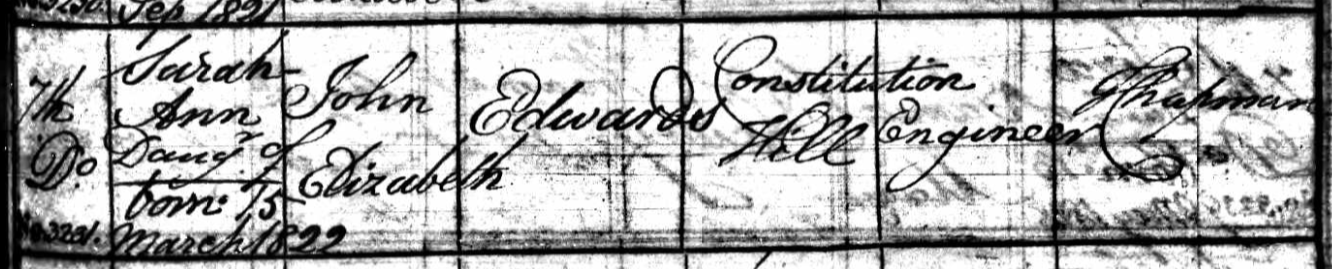
There were two baptisms recorded for parents John and Elizabeth Edwards, Constitution Hill, and John’s occupation was an engineer on both baptisms.
They were both daughters: Sarah Ann in 1822 and Elizabeth in 1824.Sarah Ann Edwards: St Philip, Birmingham. Born 15 March 1822, baptised 7 September 1822:
Elizabeth Edwards: St Philip, Birmingham. Born 6 February 1824, baptised 25 February 1824:

With John’s occupation as engineer stated, it looked increasingly likely that I’d found John’s first wife and children of that marriage.
Then I found a marriage of Elizabeth Beach to John Edwards in 1819, and subsequently found an Elizabeth Beach baptised in 1803. This appeared to be the right first wife for John, until an Elizabeth Slater turned up, with a marriage to a John Edwards in 1820. An Elizabeth Slater was baptised in 1803. Either Elizabeth Beach or Elizabeth Slater could have been the first wife of John Edwards. As John’s first wife Elizabeth is not related to us, it’s not necessary to go further back, and in a sense, doesn’t really matter which one it was.
But the Slater name caught my eye.
But first, the name Sarah Ann.
Of the possible baptisms for John Edwards, the most likely seemed to be in 1794, parents John and Sarah. John and Sarah had two infant daughters die just prior to John’s birth. The first was Sarah, the second Sarah Ann. Perhaps this was why John named his daughter Sarah Ann? In the absence of any other significant clues, I decided to assume these were the correct parents. I found and read half a dozen wills of any John Edwards I could find within the likely time period of John’s fathers death.
One of them was dated 1803. In this will, John mentions that his children are not yet of age. (John would have been nine years old.)
He leaves his plating business and some properties to his eldest son Thomas Davis Edwards, (just shy of 21 years old at the time of his fathers death in 1803) with the business to be run jointly with his widow, Sarah. He mentions his son John, and leaves several properties to him, when he comes of age. He also leaves various properties to his daughters Elizabeth and Mary, ditto. The baptisms for all of these children, including the infant deaths of Sarah and Sarah Ann have been found. All but Mary’s were in the same parish. (I found one for Mary in Sutton Coldfield, which was apparently correct, as a later census also recorded her birth as Sutton Coldfield. She was living with family on that census, so it would appear to be correct that for whatever reason, their daughter Mary was born in Sutton Coldfield)Mary married John Slater in 1813. The witnesses were Elizabeth Whitehouse and John Edwards, her sister and brother. Elizabeth married William Nicklin Whitehouse in 1805 and one of the witnesses was Mary Edwards.
Mary’s husband John Slater died in 1821. They had no children. Mary never remarried, and lived with her bachelor brother Thomas Davis Edwards in West Bromwich. Thomas never married, and on the census he was either a proprietor of houses, or “sinecura” (earning a living without working).With Mary marrying a Slater, does this indicate that her brother John’s first wife was Elizabeth Slater rather than Elizabeth Beach? It is a compelling possibility, but does not constitute proof.
Not only that, there is no absolute proof that the John Edwards who died in 1803 was our ancestor John Edwards father.
If we can’t be sure which Elizabeth married John Edwards, we can be reasonably sure who their daughters married. On both of the marriage records the father is recorded as John Edwards, engineer.
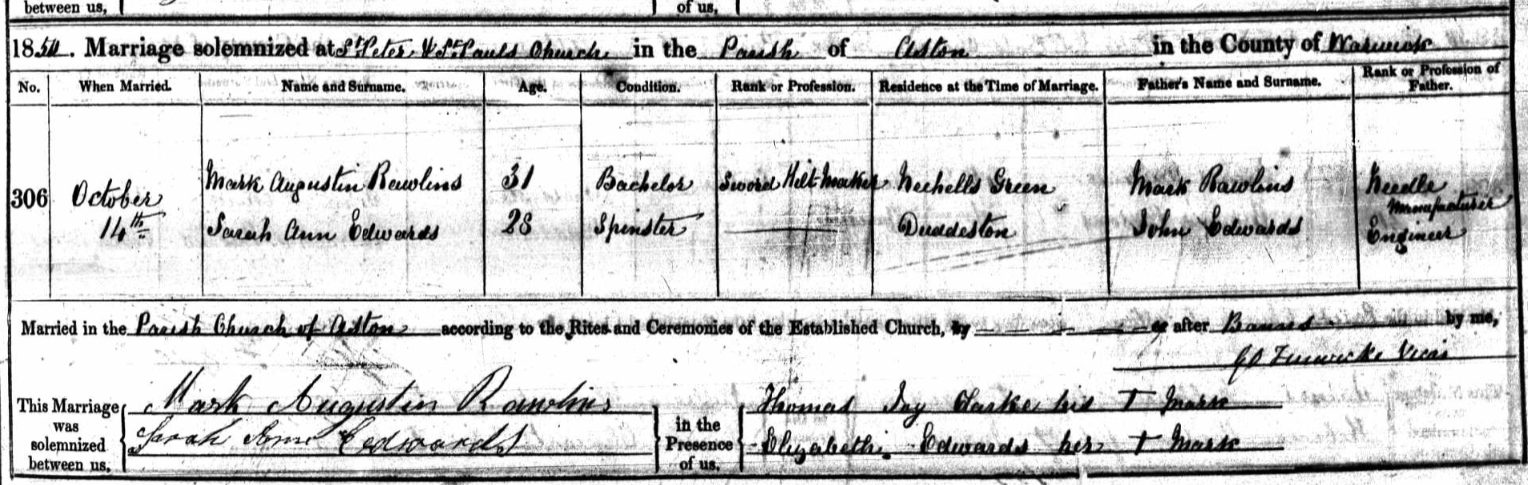
Sarah Ann married Mark Augustin Rawlins in 1850. Mark was a sword hilt maker at the time of the marriage, his father Mark a needle manufacturer. One of the witnesses was Elizabeth Edwards, who signed with her mark. Sarah Ann and Mark however were both able to sign their own names on the register.
Sarah Ann Edwards and Mark Augustin Rawlins marriage 14 October 1850 St Peter and St Paul, Aston, Birmingham:
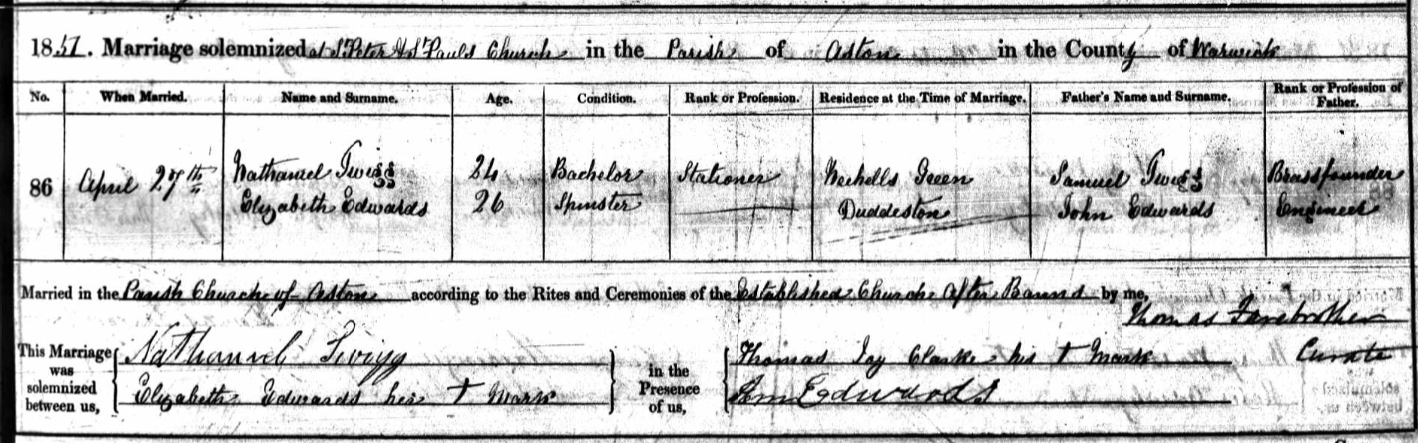
Elizabeth married Nathaniel Twigg in 1851. (She was living with her sister Sarah Ann and Mark Rawlins on the 1851 census, I assume the census was taken before her marriage to Nathaniel on the 27th April 1851.) Nathaniel was a stationer (later on the census a bookseller), his father Samuel a brass founder. Elizabeth signed with her mark, apparently unable to write, and a witness was Ann Edwards. Although Sarah Ann, Elizabeth’s sister, would have been Sarah Ann Rawlins at the time, having married the previous year, she was known as Ann on later censuses. The signature of Ann Edwards looks remarkably similar to Sarah Ann Edwards signature on her own wedding. Perhaps she couldn’t write but had learned how to write her signature for her wedding?
Elizabeth Edwards and Nathaniel Twigg marriage 27 April 1851, St Peter and St Paul, Aston, Birmingham:
Sarah Ann and Mark Rawlins had one daughter and four sons between 1852 and 1859. One of the sons, Edward Rawlins 1857-1931, was a school master and later master of an orphanage.
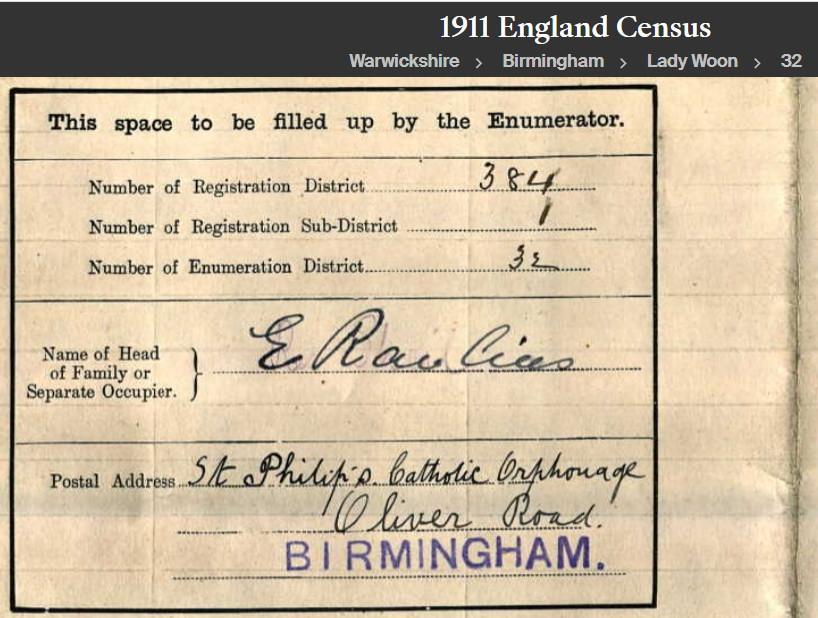
On the 1881 census Edward was a bookseller, in 1891 a stationer, 1901 schoolmaster and his wife Edith was matron, and in 1911 he and Edith were master and matron of St Philip’s Catholic Orphanage on Oliver Road in Birmingham. Edward and Edith did not have any children.
Edward Rawlins, 1911:
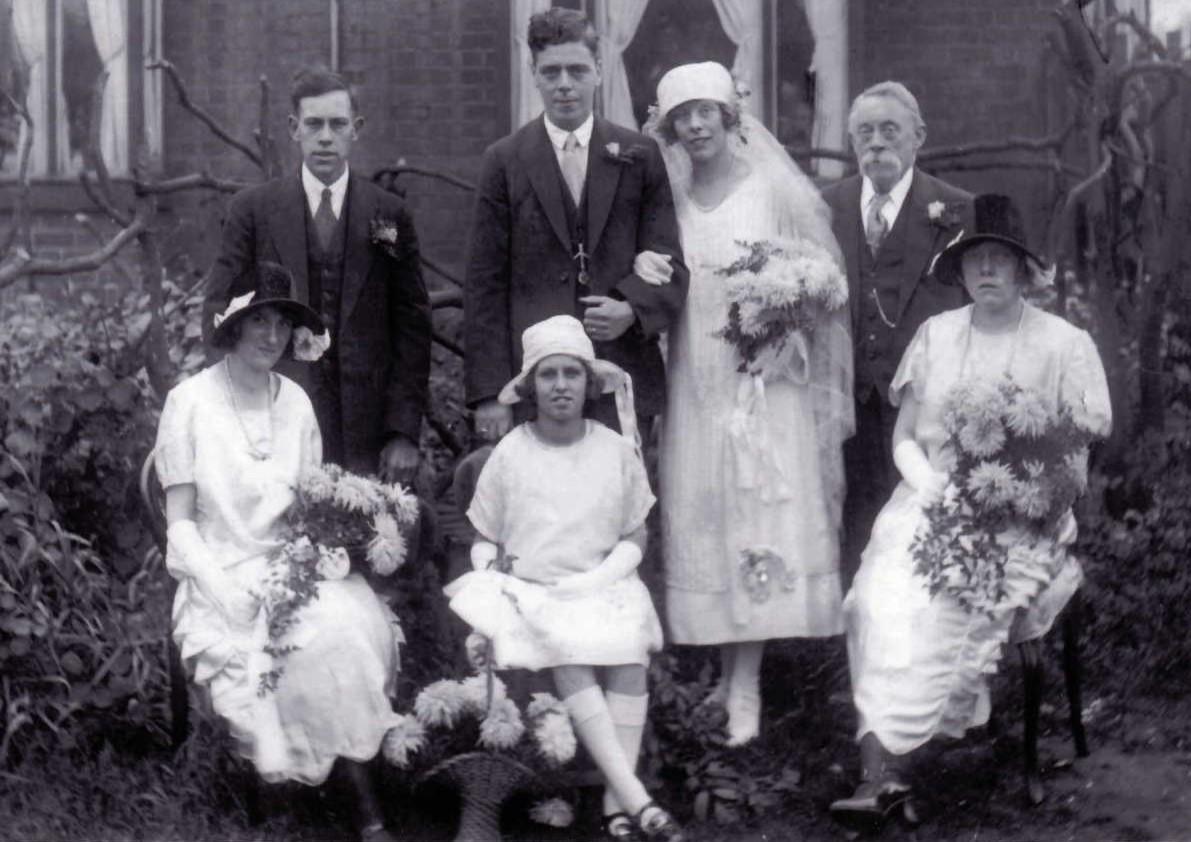
Elizabeth and Nathaniel Twigg appear to have had only one son, Arthur Twigg 1862-1943. Arthur was a photographer at 291 Bloomsbury Street, Birmingham. Arthur married Harriet Moseley from Burton on Trent, and they had two daughters, Elizabeth Ann 1897-1954, and Edith 1898-1983. I found a photograph of Edith on her wedding day, with her father Arthur in the picture. Arthur and Harriet also had a son Samuel Arthur, who lived for less than a month, born in 1904. Arthur had mistakenly put this son on the 1911 census stating “less than one month”, but the birth and death of Samuel Arthur Twigg were registered in the same quarter of 1904, and none were found registered for 1911.
Edith Twigg and Leslie A Hancock on their Wedding Day 1925. Arthur Twigg behind the bride. Maybe Elizabeth Ann Twigg seated on the right: (photo found on the ancestry website)
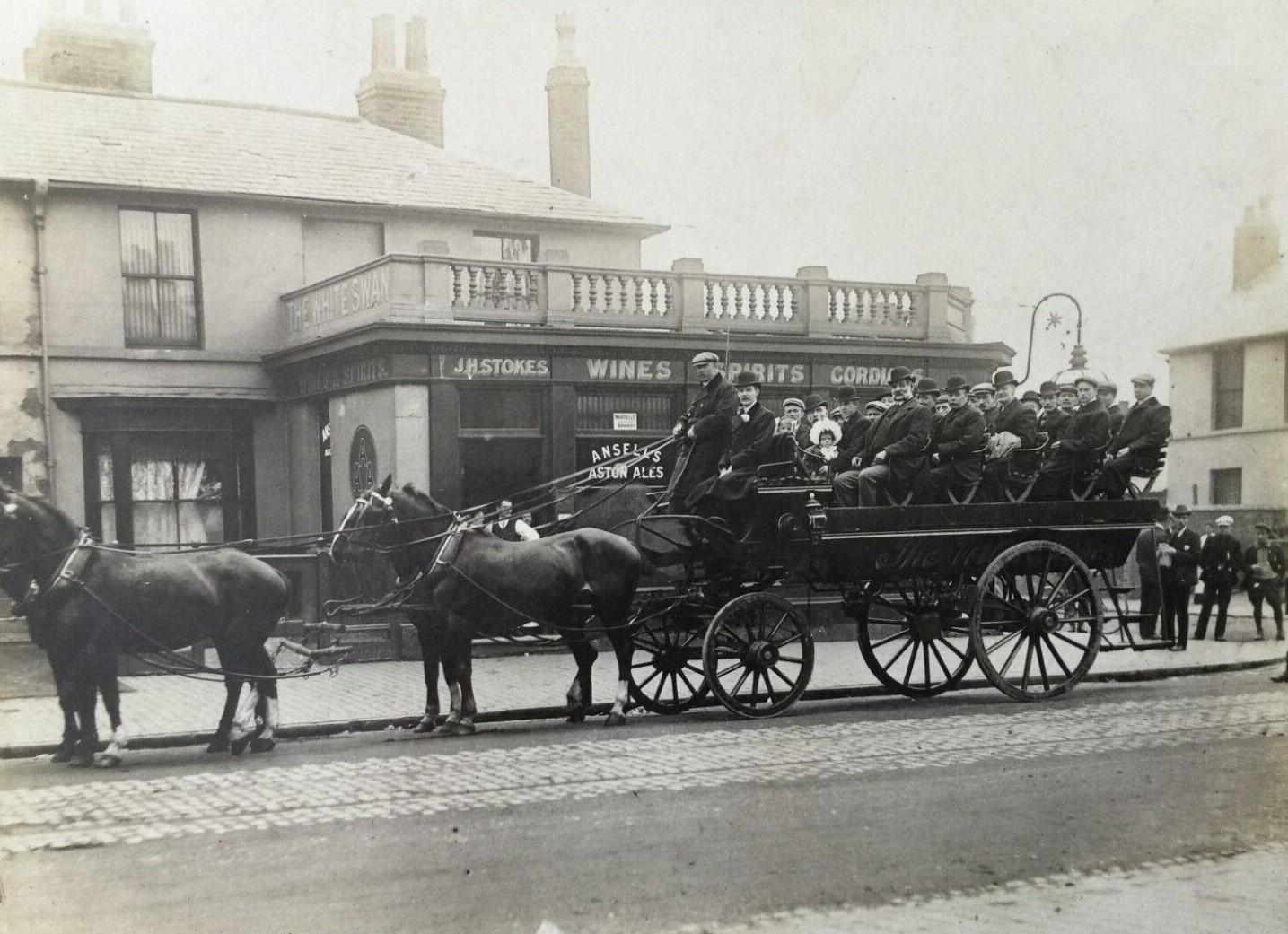
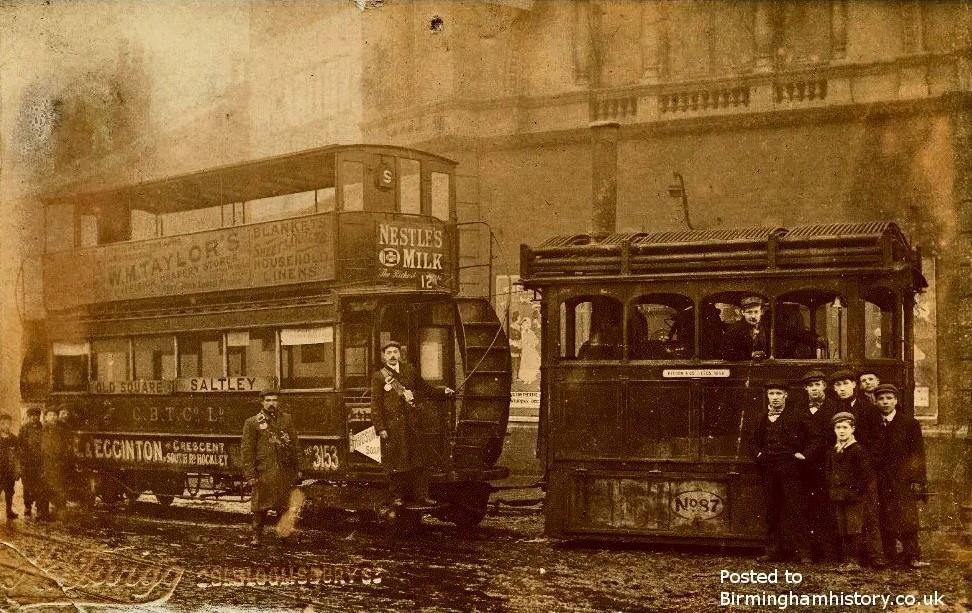
Photographs by Arthur Twigg, 291 Bloomsbury Street, Birmingham:
 June 8, 2023 at 1:37 am #7252
In reply to: The Precious Life and Rambles of Liz Tattler
Finnley, who was behind the sofa for reasons unknown, stood up and screamed at the top of her lungs. The scream was so unexpected and of such force that Godfrey dropped the novel he was holding and Liz came running from across the hall. What she had been doing across the hall all that time, god only knows, but she certainly wasn’t writing, said Godfrey later when recounting the story to Roberto.
“Mr Dugrat has gone,” announced Finnley when she was sure she had their attention. “Gone,” she repeated.
“Rat? I didn’t know you had a rat. Gone where?” asked Liz nervously.
Finnley gave her a withering glance. “Therefore I did not get to the convention because I have been searching hither and thither for him.”
May 16, 2023 at 6:48 am #7241In reply to: The Chronicles of the Flying Fish Inn
Finley turned off the vacuum cleaner and cleared her throat loudly. “Mater, I need time off. Next week.”
Mater paled. “Oh Finley, surely not now. With all the guests at the moment … and we are still cleaning up from the dust … ” her voice trailed off.
“Selfish cow,” muttered Idle. She was reclining on the sofa with a magazine and a drink. Taking a well earned rest, she had snapped when Mater asked when she was going to pull her weight. She slapped her magazine down on the coffee table. “I suppose I will have to do everything!”
With just the merest hint of an eye roll, Finley continued. “My cousin Finnley who works for the writer told me about a convention. I’m quite excited.” Mater and Idle regarded her intently, wondering what an excited Finley would look like. I didn’t notice anything much, Mater confessed to Idle later in a rare moment of camaraderie.
“So?” snapped Idle. “What is it then?”
Finley turned on the vacuum cleaner. “Dustsceawaung convention. In Tasmania,” she shouted over the whirr.
May 12, 2023 at 8:15 pm #7237In reply to: Washed off the sea ~ Creative larks
“Sod this for a lark,” he said, and then wondered what that actually meant. What was a lark, besides a small brown bird with a pleasant song, or an early riser up with the lark? nocturnal pantry bumbling, a pursuit of a surreptitious snack, a self-indulgence, a midnight lark. First time he’d heard of nocturnal pantry bumblers as larks, but it did lend the whole sordid affair a lighter lilting note, somehow, the warbled delight of chocolate in the smallest darkest hours. Lorries can be stolen for various purposes—sometimes just for a lark—and terrible things can happen. But wait, what? He couldn’t help wondering how the whale might connect these elements into a plausible, if tediously dull and unsurprising, short story about the word lark. Did I use too many commas, he wondered? And what about the apostrophe in the plural comma word? I bet AI doesn’t have any trouble with that. He asked who could think of caging larks that sang at heaven’s gates. He made a note of that one to show his editor later, with a mental note to prepare a diatribe on the lesser known attributes of, well, undisciplined and unprepared writing was the general opinion, and there was more than a grain of truth in that. Would AI write run on sentences and use too many whataretheycalled? Again, the newspapers tell these children about pills with fascinating properties, and taking a pill has become a lark. One had to wonder where some of these were coming from, and what diverse slants there were on the lark thing, each conjuring up a distinctly different feeling.
Suddenly he had an idea.
May 12, 2023 at 2:23 pm #7234In reply to: The Chronicles of the Flying Fish Inn
Aunt Idle:
It took us weeks to clean up after that dust storm, and I’ll be honest, I didn’t help much. I had a lot to think about. Finley and the twins did most of it, and Bert of course. Mater took to her room after the revelations and stayed up there like queen bee, not speaking to any of us, only Finley who took her meals up. I banged on her door a few times (she’d locked it, can you believe it?) but she wouldn’t even speak to me through the door. I’d have thought she was dead but Finley said no she wasn’t dead, she’d just about had enough of all of us and wanted to be left in peace to think about it. Well, what about me, I said, don’t you think I need some time to think about it all too? But Finley snorted (picked it up off that Yasmin I reckon) and swanned off, quite rudely if you ask me.
I did spend quite a bit of time down by the water hole, thinking about it all. I never in a million years expected that baby to come back and haunt me forty odd years later. I did get to wondering though, if I’d have brought her up instead of those nuns, she might have been a happier soul. Not much ever seemed to please her, quite the reverse in fact. Bert said Well what do you expect? in an exasperated tone. I got a bit fed up with all the dirty looks to tell you the truth. I even thought of leaving the Flying Fish once and for all and never coming back. Then I thought, bugger that, I’m staying right here.
Zara and her friends left right after the dust had settled (from the dust storm that is ~ it was quite some time before the metaphorical dust had settled, in fact I don’t think it’ll ever settle. Some people do like to harp on and on about things) and I was sorry to see them go. They were great sports about everything, they didn’t judge me. Unlike my own family!
I didn’t dare tell anyone about the night of the cart race when Youssef and I holed up in the cellar with all the old books. Thank goodness I had the presence of mind to grab a couple of bottles of gin and something to smoke before we fled down the stairs. I tell you what though, the next day I had such a hangover I had a job remembering everything and wondered if I’d been dreaming. Youssef wasn’t there when I woke up, and he had the darn cheek to avoid me the next day, and the day after that, and then they left.
One good thing was seeing Fred again. I wish he’d have stayed for a bit longer. If Fred had stayed awhile, maybe he’d have helped smooth things over with me and my ill gotten brat. Some people are so ungrateful! I may have dumped her, but it was in a nice place and she wouldn’t be alive at all if it wasn’t for me.
People are strange.
April 20, 2023 at 6:27 pm #7227In reply to: The Precious Life and Rambles of Liz Tattler
“What? What’s that you say? Do speak up, dear. Not now Finnley! Can’t you see I’m on the phone? Now then dear,” Liz said into the telephone, “Have I got this right? He hasn’t seeen a doctor yet? What do you mean, there aren’t any, they must have some at the hospital? Only the youngest ones nobody wants and the very old ones? A lousy hospital and the cardiologist isn’t very techy and doesn’t know what to do? So Michael is a what did you say, a PA? Oh a physicians assistant. Wait a minute, have I got this right? The doctor only comes to the clinic twice a month? So you can only see the PA? But what about the difficulty breathing and the coughing, I don’t know about in rural Arkansas, but in the rest of the world an 89 year old who’s been coughing so much for three weeks that he can hardly breathe is known as a medical emergency! But why are you waiting for diabetes and heart tests, surely he needs to breathe now and do the tests later? Couldn’t taste the Worcester sauce on his scrambled eggs, you say?”
Finnley’s gentle hand appeared as if by magic and restrained Liz from pulling a third handful of hair out.
“They’re going to fucking kill him, Finnley, and there’s nothing I can do.”
“There never is, really, in situations like this. Here, drink this. It’ll buck you up.”
March 24, 2023 at 10:09 pm #7218In reply to: The Chronicles of the Flying Fish Inn
Aunt Idle:
There’s nothing quite like the morning of the cart race, watching for the dust anouncing the arrival of another van or cart full of people on a partying mission, there’s something in the air, well dust mainly after awhile. Yes I know there’s a lot to do with all the extra people but Finley can manage and nobody will expect much from overworked staff anywhere today anyway. I just love catching the first sight of a decorated cart and people in costumes, you have no idea how monotonous the attire around here is. People of all ages, too, that’s what I love about it. Some people been coming for as long as anyone can remember, they came back when it started again, and some of them never took their masks off, nobody ever saw them without masks and you can bet your bottom dollar they’ll be here later, they always turn up. You won’t catch them with their mask off though. Always see some new ones. Every year new ones turn up, and then we never see them again, like pop ins they are. Some of them stick in your mind, oddly enough. There’s one in particular I’m always keeping an eye out for, got a cart all decked out like a pirate galleon, and barrels of rum instead of lager. Maybe I’ll get lucky this year and get a ride in the pirate galleon, you never know. Anything can happen in a dust storm after a lager and cart race.
March 24, 2023 at 7:49 am #7214In reply to: Orbs of Madjourneys
“Bossy, isn’t she?” muttered Yasmin, not quite out of earshot of Finly. “I haven’t even had a shower yet,” she added, picking up her phone and sandals.
Yasmin, Youssef and Zara left the maid to her cleaning and walked down towards Xaviers room. “I’d go and get coffee from the kitchen, but…” Youssef said, turning pleading eyes towards Zara, “Idle might be in there.”
Smiling, Zara told him not to risk it, she would go.
“Come in,” Xavier called when Yasmin knocked on the door. “God, what a dream,” he said when they piled in to his room. “It was awful. I was dreaming that Idle was threading an enormous long needle with baler twine saying she was going to sew us all together in a tailored story cut in a cloth of continuity.” He rubbed his eyes and then shook his head, trying to erase the image in his mind. “What are you two up so early for?”
“Zara’s gone to get the coffee,” Youssef told him, likewise trying to shake off the image of Idle that Xavier had conjured up. “We’re going to have a couple of hours on the game before the cart race ~ or the dust storm, whichever happens first I guess. There are some wierd looking vans and campers and oddballs milling around outside already.”
Zara pushed the door open with her shoulder, four mugs in her hands. “You should see the wierdos outside, going to be a great photo opportunity out there later.”
“Come on then,” said Xavier, “The game will get that awful dream out of my head. Let’s go!”
“You’re supposed to be the leader, you start the game,” Yasmin said to Zara. Zara rolled her eyes good naturedly and opened the game. “Let’s ask for some clues first then. I still don’t know why I’m the so called leader when you,” she looked pointedly as Xavier and Youssef, “Know much more about games than I do. Ok here goes:”
“The riddle “In the quietest place, the loudest secrets are kept” is a clue to help the group find the first missing page of the book “The Lost Pages of Creativity,” which is an integral part of the group quest. The riddle suggests that the missing page is hidden in a quiet place where secrets are kept, meaning that it’s likely to be somewhere in the hidden library underground the Flying Fish Inn where the group is currently situated.”
“Is there a cellar here do you think?” Zara mused. “Imagine finding a real underground library!” The idea of a grand all encompassing library had first been suggested to Zara many years ago in a series of old books by a channeler, and many a time she had imagined visiting it. The idea of leaving paper records and books for future generations had always appealed to her. She often thought of the old sepia portrait photographs of her ancestors, still intact after a hundred years ~ and yet her own photos taken ten years ago had been lost in a computer hard drive incident. What would the current generation leave for future anthropologists? Piles of plastic unreadable gadgets, she suspected.
“Youssef can ask Idle later,” Xavier said with a cheeky grin. “Maybe she’ll take him down there.” Youssef snorted, and Yasmin said “Hey! Don’t you start snorting too! Right then, Zara, so we find the cellar in the game then and go down and find the library? Then what?”
“The phrase “quietest place” can refer to a secluded spot or a place with minimal noise, which could be a hint at a specific location within the library. The phrase “loudest secrets” implies that there is something important to be discovered, but it’s hidden in plain sight.”
Hidden in plain sight reminded Yasmin of the parcel under her mattress, but she thrust it from her mind and focused on the game. She made up her mind to discuss it with everyone later, including the whacky suppositions that Zara had come up with. They couldn’t possibly confront Idle with it, they had absolutely no proof. I mean, you can’t go round saying to people, hey, that’s your abandoned child over there maybe. But they could include Xavier and Youssef in the mystery.
“The riddle is relevant to the game of quirks because it challenges the group to think creatively and work together to solve the puzzle. This requires them to communicate effectively and use their problem-solving skills to interpret the clues and find the missing page. It’s an opportunity to demonstrate their individual strengths and also learn from each other in the process.”
“Work together, communicate effectively” Yasmin repeated, as if to underline her resolution to discuss the parcel and Sister Finli a.k.a. Liana with the boys and Zara later. “A problem shared is a problem hopelessly convoluted, probably.”
The others looked up and said “What?” in unison, and Yasmin snorted nervously and said “Never mind, tell you later.”
March 8, 2023 at 10:25 am #6791In reply to: The Jorid’s Travels – 14 years on
The trio entered the medical bay, Barney proudly perched on Salomé’s shoulder. Léonard was sitting on the edge of his bed in a blue hospital dress, looking around him, confused. He turned his head toward them and squinted.
“Georges?” he asked. “Salomé? Where…” He winced and slapped his forehead.
“Are you ok?” asked Salomé, moving toward him.
Léonard stretched his arm in front of him and Salomé felt her body pushed backward. Barney squeaked and the wave subsided.
“I’m ok,” Léonard said a few seconds later, breathing with difficulties, “just a headache. Where…”
Georges exchanged a look and a brief telepathic communication with Salomé. He had felt the wave too, and he was also feeling some kind of shield around his mind. It was different from all they had encountered before. They might have to fall back to the old ways.
“We’re back on Duane,” he said with a cheerful tone, hoping it would help their friend relax. Léonard had explored this system extensively, and it was there he had introduced Georges and Salomé to the reality of multidimensional travels and Elemental magic. It was a place full of memories and Georges was looking closely at his friend’s face and at the same time prodding his mind. But Léonard’s face didn’t show any reaction and his mind appeared empty.
“Actually, way back… in time,” Georges continued. “Jorid’s navigation array was gravely disturbed by this little creature… where is Barney?”
A weak chirp came out of Salomé’s luscious raven black hair.
“Come on, Barney,” she said, trying to take him out. “Come meet our friend Léonard.”
The creature was trembling like a leaf and clinging to strands of her hair, clearly not wanting to leave his hiding place.
“I think he likes your shampoo,” said Georges with a smirk. “Well, we just found this little sand Rin on Jorid’s hull, and the little culprit is generating interferences in the Boodenbaum quantum field. So until we find a way to neutralise whatever he’s doing, we’re stuck.”
Léonard looked annoyed. He tried to stand up, but his legs wouldn’t support him and he fell back on the bed.
“Why did the Zathu put you in that sand egg on Bluhm’Oxl?” asked Salomé, trying not to sound too concerned.
Léonard opened his mouth and froze, looking surprised. He frowned.
“I don’t recall,” he said.
“What do you recall?”
“I recall… receiving a tip from an old friend.”
“Who?”
“…”
“Jorid, can you read us the message from his friend?” asked Georges with a smile, as if he had found a simple solution.
“I can’t access the data,” said the ship. “Léonard deleted it, and the backups before he left.”
Georges’ smile faded. He looked at Salomé. She was thinking the same thing he was thinking and nodded.
“Why don’t we let you have some rest, you’ll join us for lunch when you’re dressed up and ready.”
March 7, 2023 at 11:22 pm #6786In reply to: Coma Cameleon
Tibu looked up at her, surprised by the offer. He hadn’t expected anyone to offer him anything more than spare change or a half-eaten sandwich. “That’s very kind of you,” he said with a small smile, “I’d like that very much.”
The young woman returned his smile and disappeared for a while. She came back a few minutes later, with two cups of steaming hot tea. Handing one to Tibu, she started sipping her own while they stood in silence for a moment looking at the last drops of dripping water from the eaves overhead, as the rain had started to subside.
Tibu couldn’t help but feel a pang of sadness. Here he was, a man with no memory of his past, selling books on the street for spare change, and yet this stranger was treating him with kindness and respect.
“Thank you,” he said softly his voice barely audible, “I really appreciate this.”
The woman shrugged and smiled again. “It’s no trouble at all. I think it’s nice to just take a break and chat with someone for a while. It can get lonely in this city sometimes.”
Tibu nodded in agreement. “I know what you mean. I feel like a stranger in my own life sometimes.”
The woman’s expression softened. “That must be hard. But you know, sometimes it’s good to start over. You can be whoever you want to be, do whatever you want to do. It’s like a second chance.”
As they continued their conversation, a crumpled torn piece of newspaper caught Tibu’s eye, lodged in a nearby gutter. The headline mentioned a job fair happening the next day, an opportunity for people to find new careers. An idea began to form in his mind – attending the job fair could be his first step in creating a new life.
Tibu looked at the woman, still struck by her earlier words. It was a new way of thinking for him. Maybe he didn’t have to be defined by his past or his amnesia. Maybe he could create a new life for himself, with new people and new experiences.
“Thank you,” he said again, feeling a newfound sense of hope. “You’ve given me a lot to think about.”
The woman smiled and finished her tea. “Well, I should probably get back to work. But it was nice talking to you. Maybe I’ll see you around. I’m Lorena, by the way.”
Tibu nodded and watched her walk away, feeling a warmth in his chest. Maybe things weren’t so hopeless after all. Maybe he could create a new life for himself; he checked the crumbled paper; his decision was made; armed with renewed purpose, he’d resolved to attend the job fair.
Of course, he’d need to prepare, sort out stuff…
He looked down at the book in his hand and smiled. For now, he had Lord Gustard Willoughby Fergusson to keep him company and inspire him about acts of bravery and embrace with gusto the great leap into the unknown.
March 5, 2023 at 10:32 pm #6770In reply to: The Stories So Near
What satisfying conclusion to this saga?
Granola was the tying material to their friend, and her pop-in nascent capabilities (ability to project into material matter, sometimes being corporeal) could help. Her goal was to wake her friends out of their routines, and reinvigorate the stories they tell themselves about their lives.
- Maeve was the one making custom dolls.
- Shawn Paul her handsome bearded bachelor next door was an aspiring writer looking for a story to tell and to become published.
- Lucinda is their neighbour, enrolled in creative writing courses.
- Jerk is a clerk at a local WholeDay*Mart and also manages a forum in his spare time.
- Uncle Fergus is Maeve’s father’s estranged brother.
The dolls were found in all across places, used by different groups, maybe glamour bombs for some, maybe ways to smuggle information and keys.
Across their trips they connect with story characters, and unknowingly revive their stories.
POP*IN THREAD (plot development suggestions, to be looked into later)
Maeve and Shawn-Paul are still in Tikfijikoo, investigating the mysterious dolls and their connection to Uncle Fergus. They’ve also encountered strange happenings, including a missing girl and a strange man in a top hat.
Meanwhile, Jerk is still moderating the forum and dealing with the strange messages. Lucinda is continuing her creative writing course and enjoying her time with Fabio.
Granola is currently on a mission to find Ailill and learn more about pop-ins, while also trying to reconnect with her friends and figure out what’s going on with the dolls.
As for the mysterious man following Maeve, his intentions are still unclear, but it seems he has some connection to Uncle Fergus and the dolls. The group is still trying to uncover the truth and figure out their next steps.

In the end, Granola’s pop-in abilities proved to be the key to unlocking the mystery of the dolls and their connection to Uncle Fergus. With her help, Maeve and Shawn-Paul were able to uncover the truth about the dolls and their purpose, and use them to reconnect with various story characters across their trips.
Through their adventures, they also discovered the power of storytelling and the importance of shaking up their routines to keep their lives interesting and full of wonder. Jerk found a new sense of purpose in managing the forum and connecting with others through his passion for the dolls and their stories.
In the final chapter, Uncle Fergus reconciled with Maeve’s father and shared the true meaning behind the dolls and their connection to their family history.
While Shawn-Paul’s path led him to become a successful author, Lucinda’s path took a different turn. She found fulfillment in her creative writing course and continued to hone her skills, but she didn’t pursue a career as a writer. Instead, she used her passion for storytelling to help others, working as a therapist and using storytelling techniques to help her clients work through their struggles and find healing. Lucinda’s work was deeply rewarding, and she felt fulfilled in being able to help others in such a meaningful way.
As for Granola, she continued to pop-in and out of their lives, using her abilities to bring joy and excitement to their everyday routines, and keeping their stories alive for years to come. The group remained close friends, bonded by their shared experiences and love of storytelling.
February 24, 2023 at 8:31 am #6661In reply to: Orbs of Madjourneys
The black BMW pulled up outside the Flying Fish Inn. Sister Finli pulled a baseball cap low over her big sunglasses before she got out of the car. Yasmin was still in the bar with her friends and Finli hoped to check in and retreat to her room before they got back to the inn.
She rang the bell on the reception desk several times before an elderly lady in a red cardigan appeared.
“Ah yes, Liana Parker,” Mater said, checking the register. Liana managed to get a look at the register and noted that Yasmin was in room 2. “Room 4. Did you have a good trip down? Smart car you’ve got there,” Mater glanced over Liana’s shoulder, “Don’t see many like that in these parts.”
“Yes, yes,” Finli snapped impatiently (henceforth referred to to as Liana). She didn’t have time for small talk. The others might arrive back at any time. As long as she kept out of Yasmin’s way, she knew nobody would recognize her ~ after all she had been abandoned at birth. Even if Yasmin did find her out, she only knew her as a nun at the orphanage and Liana would just have to make up some excuse about why a nun was on holiday in the outback in a BMW. She’d cross that bridge when she came to it.
Mater looked over her glasses at the new guest. “I’ll show you to your room.” Either she was rude or tired, but Mater gave her the benefit of the doubt. “I expect you’re tired.”
Liana softened and smiled at the old lady, remembering that she’d have to speak to everyone in due course in order to find anything out, and it wouldn’t do to start off on the wrong foot.
“I’m writing a book,” Liana explained as she followed Mater down the hall. “Hoping a bit of peace and quiet here will help, and my book is set in the outback in a place a bit like this.”
“How lovely dear, well if there’s anything we can help you with, please don’t hesitate to ask. Old Bert’s a mine of information,” Mater suppressed a chuckle, “Well as long as you don’t mention mines. Here we are,” Mater opened the door to room 4 and handed the key to Liana. “Just ask if there’s anything you need.”
Liana put her bags down and then listened at the door to Mater’s retreating steps. Inching the door open, she looked up and down the hallway, but there was nobody about. Quickly she went to room 2 and tried the door, hoping it was open and she didn’t have to resort to other means. It was open. What a stroke of luck! Liana was encouraged. Within moments Liana found the parcel, unopened. Carefully opening the door, she looked around to make sure nobody was around, leaving the room with the parcel under her arm and closing the door quietly, she hastened back to room 4. She nearly jumped out of her skin when a voice piped up behind her.
“What’s that parcel and where are you going with it?” Prune asked.
“None of your business you….” Liana was just about to say nosy brat, and then remebered that she would catch more flies with honey than vinegar. It was going to be hard for her to remember that, but she must try! She smiled at the teenager and said, “A dreamtime gift for my gran, got it in Alice. Is there a post office in town?”
Prune narrowed her eyes. There was something fishy about this and it didn’t take her more than a second to reach the conclusion that she wanted to see what was in the parcel. But how?
“Yes,” she replied, quick as a flash grabbing the parcel from Liana. “I’ll post it for you!” she called over her shoulder as she raced off down the hall and disappeared.
“FUCK!” Liana muttered under her breath, running after her, but she was nowhere to be seen. Thankfully nobody else was about in the reception area to question why she was running around like a madwoman. Fuck! she muttered again, going back to her room and closing the door. Now what? What a disaster after such an encouraging start!
Prune collided with Idle on the steps of the verandah, nearly knocking her off her feet. Idle grabbed Prune to steady herself. Her grip on the girls arm tightened when she saw the suspicious look on face. Always up to no good, that one. “What have you got there? Where did you get that? Give me that parcel!”
Idle grabbed the parcel and Prune fled. Idle, holding onto the verandah railing, watched Prune running off between the eucalyptus trees. She’s always trying to make a drama out of everything, Idle thought with a sigh. Hardly any wonder I suppose, it must be boring here for a teenager with nothing much going on.
She heard a loud snorting laugh, and turned to see the four guests returning from the bar in town, laughing and joking. She put the parcel down on the hall table and waved hello, asking if they’d had a good time. “I bet you’re ready for a bite to eat, I’ll go and see what Mater’s got on the menu.” and off she went to the kitchen, leaving the parcel on the table.
The four friends agreed to meet back on the verandah for drinks before dinner after freshening up. Yasmin kept glancing back at the BMW. “That woman must be staying here!” she snorted. Zara grabbed her elbow and pulled her along. “Then we’ll find out who she is later, come on.”
Youssef followed Idle into the kitchen to ask for some snacks before dinner (much to Idle’s delight), leaving Xavier on the verandah. He looked as if he was admiring the view, such as it was, but he was preoccupied thinking about work again. Enough! he reminded himself to relax and enjoy the holiday. He saw the parcel on the table and picked it up, absentmindedly thinking the black notebook he ordered had arrived in the post, and took it back to his room. He tossed it on the bed and went to freshen up for dinner.
-
AuthorSearch Results
