

Search Results for 'less'
-
AuthorSearch Results
-
January 14, 2023 at 11:27 am #6383
In reply to: The Precious Life and Rambles of Liz Tattler
“GODFREY! Come right here this instant!” Liz was infuriated and had to restrain herself not to throw the bound manuscript at her confidente’s face when he emerged from the corridor into her pink boudoir.
“What is it Liz my dear?”
“What is this horrible thing that has my name on it?” she showed the manuscript. “It has no zest whatsoever, it’s so neat, and linear, tidy, continuous… It’s insufferably perfect! And those main characters, ugh… Young, and flawless, perfect in every sense it’s unbearable!”
“I have something to confess Liz’… Since Finnley has started her new business ventures… wait, don’t shout yet… I had to try some of this AI generated stuff. I thought the title ‘Adventures in the Uncanny Valley’ would have been a give-away…”
Elizabeth Tattler was at a loss for words… The only thing she could blurt out ultimately was “FIND ME FINNLEY!!”
January 13, 2023 at 9:00 pm #6381In reply to: Prompts of Madjourneys
Tell me more about the clues that Zara, Youssef, Xavier and Yasmin will find on their journeys to discover their inner quirky natures
As Zara, Youssef, Xavier and Yasmin journeyed through the Land of the Quirks to discover their inner quirky natures, they encountered various clues that helped them on their journey.
One of the clues they found was a mysterious map that led them to different locations, each one representing a different aspect of their personalities. The map also had various riddles and puzzles that they had to solve in order to progress to the next location.
Another clue they found was a series of journal entries written by a previous explorer who had also journeyed through the Land of the Quirks. The journal entries provided insight and wisdom on how to navigate the land and how to understand and accept one’s quirks.
They also encountered a group of strange and eccentric characters who each represented a different aspect of their personalities. These characters provided guidance and helped them understand different parts of themselves. They also helped them understand the importance of accepting and embracing their quirks.
They also found a series of symbols and artifacts that represented different parts of their personalities. These symbols and artifacts were like puzzle pieces that, when put together, helped them understand the bigger picture of their inner quirky natures.
As they continued their journey, they also learned that the key to discovering their inner quirky natures was not only about finding the physical “Key of Quirks”, but also about understanding and accepting themselves, their faults and their strengths, and learning to embrace their unique quirks.
Finding their inner quirks sounds quite definitive. how would you make the ending more open-ended, open to multiple series and iterations of the story without sounding repetitive
As Zara, Youssef, Xavier and Yasmin journeyed through the Land of the Quirks, they discovered their inner quirky natures, but the journey was far from over. They found that their inner quirks were constantly evolving and changing, and that the Land of the Quirks was a vast and mysterious place with many more secrets to uncover.
The group found that the “Key of Quirks” was not just a physical object but a symbol of self-discovery and self-acceptance. They learned that understanding and accepting oneself is a lifelong journey that never truly ends.
As they returned to their own world, they realized that they had gained a new perspective on life and that they would continue to carry the lessons they learned in the Land of the Quirks with them. They knew that they would always be on the lookout for new adventures and opportunities to continue exploring themselves and the world around them.
The group’s journey in the Land of the Quirks had come to an end but the story was not over. The characters would continue to grow, evolve and change as they experienced new adventures, challenges and self-discoveries. The ending was open-ended and leaves the possibility for multiple series and iterations of the story, each one exploring new aspects of the characters and the Land of the Quirks, without being repetitive.
Will they go a try to travel through another of the orbs?
It is possible that the group will want to explore other orbs and realms in the Land of the Quirks. The Land of the Quirks is described as a vast and mysterious place with many secrets to uncover, so the possibility of traveling through other orbs or realms is open. They may be tempted to see what other adventures and discoveries await them in these new places.
Alternatively, they might decide to take a break from their adventures, and reflect on what they’ve learned, applying it to their daily life, and maybe in the future, they will decide to come back to the Land of the Quirks and explore other orbs, or they may find other means of self-discovery and self-acceptance. In any case, the story leaves it open-ended and the characters have the freedom to choose what they want to do next.
How did they discover the orb in the first place?
It is not specified how the group discovered the orb in the first place. It could be that they stumbled upon it while on a hike or a camping trip, or it could be that they were on a mission to find it specifically. It could also be that the orb was something that had always been there but had gone unnoticed until one of the group members stumbled upon it.
Perhaps it was passed down from generation to generation as a legend, or maybe they found it while they were searching for something else. The story leaves it open-ended and it’s up to the reader’s imagination. The main focus of the story is on the journey and the lessons learned along the way, rather than the specifics of how the orb was discovered.
January 13, 2023 at 8:53 pm #6380In reply to: Prompts of Madjourneys
After a few tries:
- As the group has split up at the fork of the road, we discover a total of 4 new characters from the Land of the Quirks. Tell us how each group is encountering some or all of these characters, who they are, their gibberish-sounding names, and what is their quirks, and what they wear, or their activities. Make our main characters and maybe some of the new ones meet back at a common spot with a special event after that.
- please rewrite the above, retaining the eccentricity but more grounded, less childish, and with a little darker tone and mystery.
- please try again, make Spoink and Flibbertigibbet human and give them less endearing or friendly behaviours; name two more characters met on the road.
As the group split up at the fork of the road, each one encountered new characters from the Land of the Quirks.
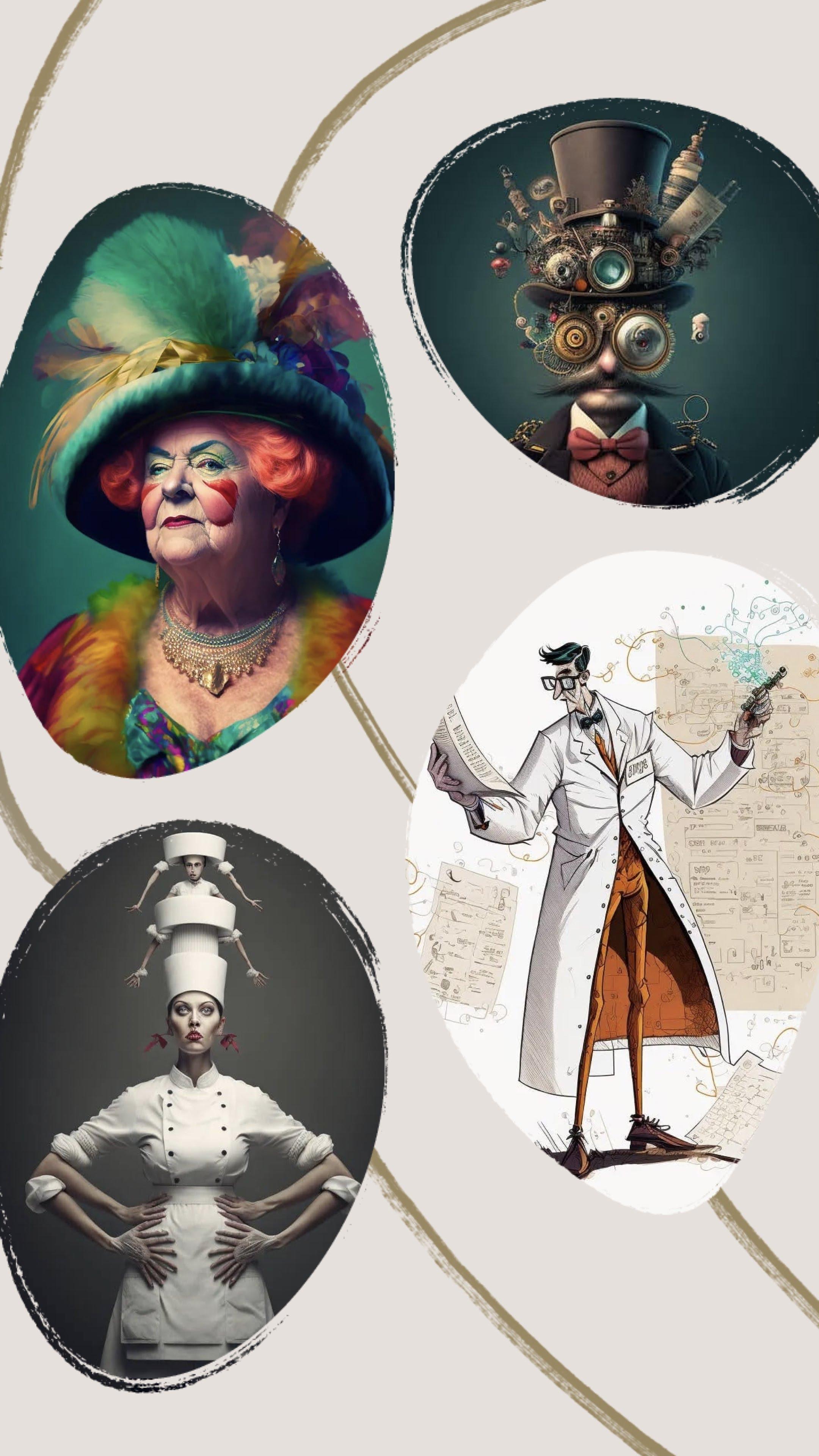
Zara and Yasmin, who took the left path, met a man named “Sproink” who was a small, wiry man with a spring for a tail. He was always bouncing around and speaking in a language that sounded like a mix of gibberish and music. Sproink was a collector of shiny objects and had a bag full of them, he was also a scavenger, always looking for things to add to his collection. He was wearing a small top hat and a monocle. He was also known to be a bit of a thief and a con artist.
Xavier and Youssef, who took the right path, met a woman named “Flibbertigibbet” a tall, slender woman that had multiple arms. Flibbertigibbet was very talkative and friendly, always trying to strike up a conversation. She spoke in a language that sounded like a mix of gibberish and baby talk. She was a chef and was always carrying a pot and a spoon, but she also had a dark side, she was known to be a bit of a manipulator and a spy, always observing and gathering information for a mysterious organization. She was wearing a big chef hat and apron.
As the group met back at the fork, they were surprised to find that Sproink and Flibbertigibbet had also met there. The four new characters joined the group, and together they continued their journey to find the “Key of Quirks”. Along the way, they met two more characters;
They met a man named “Gibber” who was a tall, gaunt man with elongated limbs and fingers. He was always speaking in a language that sounded like a mix of gibberish and numbers. He was a mathematician and a scientist, always working on complex equations and theories. He was known to be a bit of a loner, and didn’t interact much with others. He was wearing a lab coat and goggles.
They also met a woman named “Glimmer” she was a short, plump woman with a shimmering skin that seemed to change color depending on the light. She was always speaking in a language that sounded like a mix of gibberish and poetry. She was an artist and a performer, always creating and performing in different shows. She was known to be a bit of a flirt and a bit of a drama queen. She was wearing a colorful and eccentric clothing, such as a flowy dress and a large hat adorned with feathers.
As the group journeyed on, they encountered more characters, each one with their own unique quirks and personalities. They met a variety of people, some friendly and some not so friendly, but all of them adding to the mysterious and unknown nature of the Land of the Quirks.
As the group reached the end of their journey and found the “Key of Quirks”, they realized that the key was not just a physical object but a symbol of acceptance and embracing individuality. They learned that the true key to leaving the Land of the Quirks was understanding and accepting the quirks of oneself and others.
The group had a bittersweet goodbye with their new friends, Sproink, Flibbertigibbet, Gibber and Glimmer, and the other characters they had met. They knew that they would always carry a piece of the Land of the Quirks with them and would always remember the mysterious and eccentric adventure they had.
 January 13, 2023 at 7:40 pm #6379
In reply to: Prompts of Madjourneys
Asking to give each of the 4 characters some particular traits that makes them uniquely distinctive and recognizable
The four friends, Zara, Xavier, Yasmin, and Youssef, each have their own unique traits that make them stand out and recognizable.
Zara is the leader of the group, she is confident, and always ready for an adventure. She is a natural leader and has a strong sense of justice. She is also a tech-savvy person, always carrying a variety of gadgets with her, and is always the first to try out new technology.
Xavier is the joker of the group, always cracking jokes and making puns. He is a free-spirited person who is always up for an adventure, he has a great sense of humor and is not afraid to be himself. He is also an artist and often carries a sketchbook and pencils with him, he likes to draw whatever he sees in his journeys.
Yasmin is the brains of the group, she is intelligent and logical. She is always able to think on her feet and come up with a plan when things get tough. She is also a bit of a perfectionist and likes to have everything organized. She is a history buff and always carries a notebook with her to document her findings.
Youssef is the muscle of the group, He is physically strong, and always ready to help out in a fight. He is also a bit of a foodie and loves trying new dishes. He is always the first one to volunteer to carry the heavy bags and equipment. He is also a bit of a daredevil and loves trying out new sports and activities.
Give each of them a color, and an animal, and a secret name in a funny language
The four friends, Zara, Xavier, Yasmin, and Youssef, each have their own unique traits that make them stand out and recognizable.
Zara is the leader of the group, her color is red, her animal is a lion, and her secret name in a funny language is “Zaraloon”
Xavier is the joker of the group, his color is orange, his animal is a monkey, and his secret name in a funny language is “Xavimunk”
Yasmin is the brains of the group, her color is blue, her animal is an owl, and her secret name in a funny language is “Yasminowl”
Youssef is the muscle of the group, his color is green, his animal is a bear, and his secret name in a funny language is “Youssefbear”
Now, we need physical descriptions for each of them. Also, their ages, height, clothes, facial features, ethnicity (for instance Youssef may be half Yemeni and half Norwegian), etc. with a good mix of generic and eccentric. We also need surnames congruent with their described ethnicity, not too bland, but not too daft either. For instance Youssef Olafsson, Zara Patara-Smythe, etc. Also explain how they become friends.
Zara Patara-Smythe is a
25-year-oldwoman of mixed heritage, her mother is Indian and her father is British. She has long, dark hair that she keeps in a sleek ponytail, dark brown eyes and a sharp jawline. She stands at 5’6″ and has a toned and athletic build. She usually wears practical clothing that allows her to move around easily, such as cargo pants and a tank top.Xavier Olafsson is a
27-year-oldman of Norwegian and Danish descent. He has blonde hair that he keeps in a messy style, blue eyes, and a charming smile. He stands at 6’1″ and has a lean build. He is always seen wearing a colorful and bold clothing, such as a Hawaiian shirt and shorts.Yasmin Ahmed is a
23-year-oldwoman of Egyptian descent. She has long, black hair that she keeps in a tight braid, dark brown eyes and a round face. She stands at 5’4″ and has a petite build. She usually wears conservative clothing, such as long skirts and blouses.Youssef Ali is a
26-year-oldman of half Yemeni, half Norwegian descent. He has short, curly black hair, dark brown eyes and a square jawline. He stands at 6’2″ and has a muscular build. He usually wears comfortable clothing such as a t-shirt and jeans, and always has a backpack on his shoulder.The four of them became friends
in college, they were all studying different majors, but they all shared a love for adventure and exploration. They found themselves in the same class project, and from there they formed a strong bond. After college, they decided to keep exploring the world together, and went on many trips and adventures, always seeking for something new and exciting.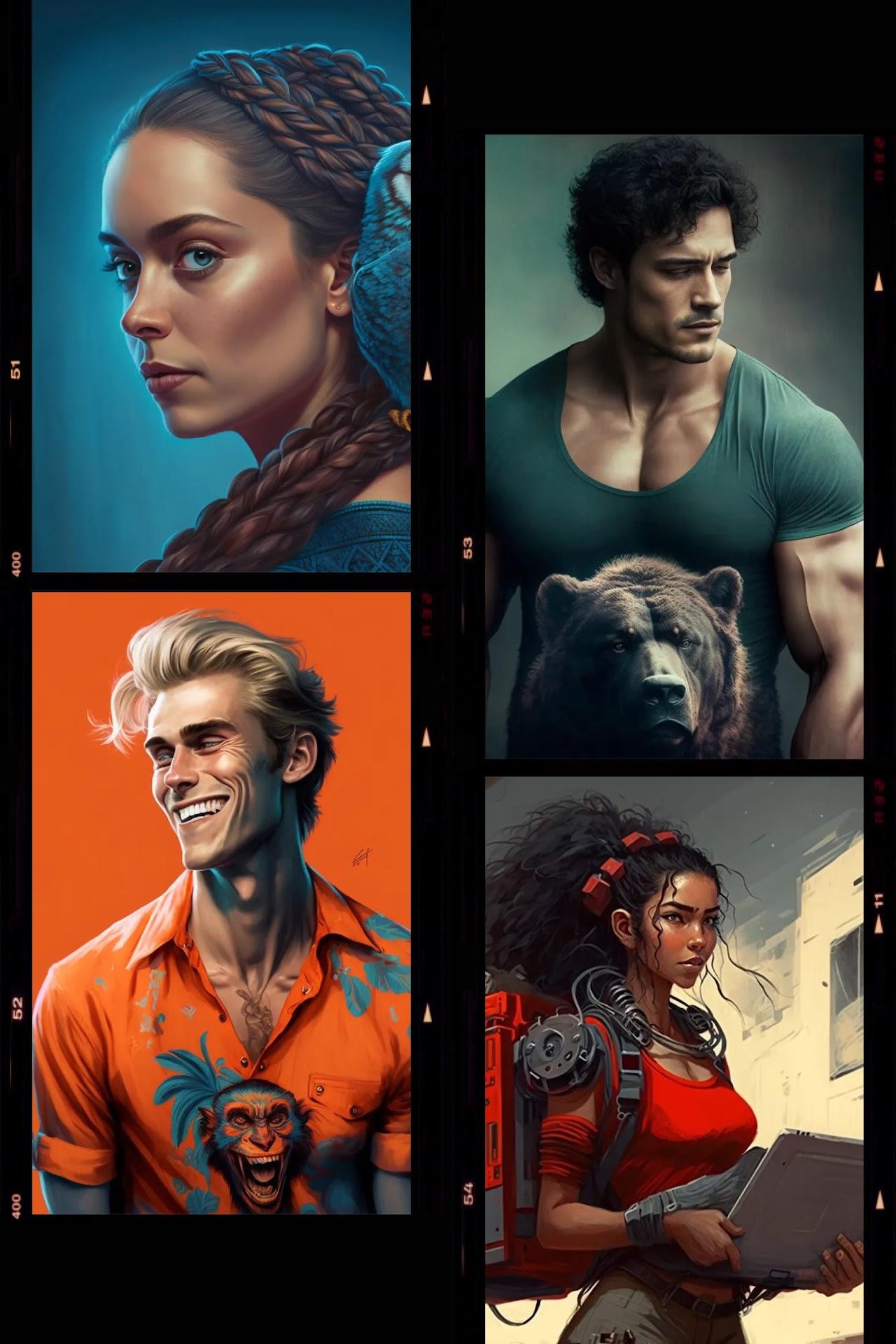
1/ Change the ages of Zara, Xavier, Yasmin and Youssef to more random patterns – rewrite if needed how they met each other to reflect eventual age gaps. Give them some flaws, mental or physical challenges.
2/ increase again the age gaps while keeping the youngest one a young adult, and remove “minor” from the flaws descriptionsZara is a 22-year-old woman who is the youngest of the group. She is a free-spirited, adventurous person, but also a bit reckless and impulsive. She has a scar on her cheek that she got from a Skateboarding accident when she was a teenager.
Xavier is a 45-year-old man who is the oldest of the group. He is a responsible and level-headed person, but also a bit of a perfectionist and can be hard on himself and others. He has dyslexia which he has been able to work around and it doesn’t impede his daily life.
Yasmin is a 38-year-old woman who is the second oldest of the group. She is a kind and compassionate person, but also a bit of a pushover and can have trouble standing up for herself. She has social anxiety that affect her in certain situations and she have been working on coping mechanisms.
Youssef is a 33-year-old man who is the second youngest of the group. He is a charismatic and outgoing person, but also a bit of a flirt and can be a bit insensitive to others feelings. He has ADHD which he has been able to manage with medication, but it still affects him from time to time.
The group met each other through different means, Xavier and Yasmin met at work, Zara and Youssef met at a college class, and eventually, they all became friends through common interests and activities. They decided to go on this adventure together because they were all looking for a change in their lives and wanted to explore the unknown.
January 13, 2023 at 6:42 pm #6377In reply to: Orbs of Madjourneys
The four adventurers, Zara, Xavier, Yasmin, and Youssef, stood in awe in front of the giant orb that seemed to open up to another realm. The light emanating from the orb was so bright, it was as if the sun was just inches away. The stalactites that hung from the cave’s ceiling sparkled like diamonds in the light, adding to the otherworldly beauty of the scene.
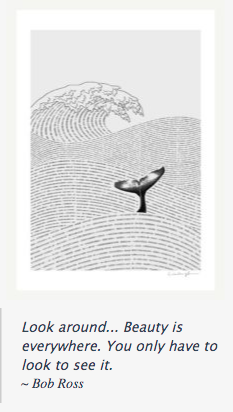
“Look around,” Yasmin said, her voice filled with wonder. “Beauty is everywhere. You only have to look to see it.”
The group was ready for an adventure and they knew that the orb in front of them was the key to their mad journey. Xavier stepped forward and reached out to touch the orb. As soon as his fingers made contact with the surface, the orb lit up and a pathway formed, leading into the brightly lit realm.
The group stepped through the pathway and found themselves in a world unlike anything they had ever seen before. The sky was a vibrant shade of purple and the ground was covered in a lush, green grass. The orb they had just passed through was now behind them, but in front of them were smaller orbs, each one leading to a different path.
Zara, Xavier, Yasmin, and Youssef looked at each other with excitement in their eyes. They knew that this was just the beginning of their mad journey.
Xavier stepped forward and reached out to touch the orb. As soon as his fingers made contact with the surface, the orb lit up and a pathway formed, leading into the brightly lit realm.

They walked into a small village, where they were greeted by a group of people wearing clothes that looked like they were from the 1920s. The people told them that they were in the land of the “Quirks”, a place where everything and everyone was a little bit different, and that they had to find the “Key of Quirks” in order to leave the land.
The four friends, Zara, Xavier, Yasmin, and Youssef, soon found themselves on a mission to find the “Key of Quirks” that would allow them to leave the land of the Quirks. As they walked through a forest, they came across a fork in the road.
Zara, the leader of the group, turned to the others and said, “Alright, we need to decide which way to go. Yasmin, what’s the plan?”
Yasmin, the brains of the group, replied, “I suggest we take the left path. According to the map I found, it leads to the Quirky Quests area, where we might find the key.”
Xavier, the joker of the group, chimed in, “I vote for the right path. It’s the road less traveled, and you know what they say, ‘the road less traveled is the road to adventure’ ”
Youssef, the muscle of the group, added, “I don’t care which way we go, I just want to find some food. I’m starving!”
Zara rolled her eyes, “Xavier, your jokes are getting old. And Youssef, we’re on a mission, we can’t just focus on food.”
Xavier grinned, “But Zaraloon, where’s the fun in that?”
Yasmin interjected, “Can we please focus? We need to make a decision. I propose we split up, Zara and I will take the left path, and Xavier and Youssef can take the right path.”
Youssef nodded, “Yeah, that sounds like a good idea. That way, if we don’t find the key, at least we’ll have found some food.”
Xavier grinned, “Sounds like a plan, Xavimunk is ready for adventure!”
Zara shook her head with a smile, “Alright, let’s do this.”
The group split up, and as they walked away, they could be heard playfully bantering and joking with each other. Each one exemplifying their unique and distinct characters.
January 11, 2023 at 8:44 pm #6366In reply to: Train your subjective AI – text version
Asking the AI to expand on the glossary of the original Circle of Eights Story:
Locations
Malvina’s Cave: A dark and damp cave located in the heart of the Gripshawk mountains, known for its population of Glukenitch creatures.
Lan’ork: A vast and diverse continent known for its Eastern Lagunas, home to the Indogo flamingos. Dragon Head Peninsula: A rugged and mountainous region, home to the Langoat creatures and also known for its rich deposits of dragon ore.
Asgurdy: A sprawling desert region, known for its nomadic tribes who use Saurhse as mounts for transportation.
Golfindely: An idyllic coastal region known for its beautiful beaches and crystal clear waters, home to the Golfindel and Grake creatures.
Magical Schools
Dragonian Magic: A form of magic that is practiced by Dragonriders and Dragon tamers, which involves the manipulation of dragon energy and bonding with dragon companions.
Gripshawk Magic: A form of magic that is practiced by Gripshawks, which involves the manipulation of the natural elements and telepathic communication with other creatures.
Ugling Magic: A form of magic that is practiced by Uglings, which involves the use of charms, spells, and potions to manipulate the physical world.
Guilds
Dragon Riders Guild: A prestigious guild of dragon riders, responsible for maintaining peace and order in the world by using their dragon companions for protection and transportation.
Gripshawk Hunters Guild: A guild of skilled hunters who specialize in hunting and capturing exotic creatures for various purposes.
Ugling Alchemists Guild: A guild of alchemists and potion makers, who create various potions and elixirs for medicinal and magical purposes.
Organizations
The Order of the Buntifluën: A secret organization dedicated to the study and use of Buntifluën artefacts for the betterment of communication and understanding between sentient beings.
The Glubolín Network: A network of individuals who possess Glubolín devices, used for communication and sharing information across long distances.
The Sabulmantium Society: A society of scholars and adventurers who study the properties and uses of Sabulmantium devices for divination and navigation.
Here are a few new invented terms with their potential IPA pronunciations and definitions that would fit in this fantasy world:
Dragons:
Krynn [ ˈkrĭn ] : A subspecies of dragon known for its ability to control and manipulate time.
Creatures:
Kelpies [ ˈkĕl-pēz ] : Aquatic creatures resembling horses, known for their ability to shape-shift and lure unsuspecting victims into the water.
Magical Artefacts:
Dragonwhisper [ ˈdrā-gən-ˌhwis-pər ] : An ancient and powerful magical artifact, which allows the user to communicate and control dragons telepathically.
Necrotalisman [ ˈnĕk-rə-ˈtā-lĭz-mən ] : A magical artifact in the shape of a talisman that grants its wielder the ability to control and summon the dead.
Plants:
Blightthorn [ ˈblīt-ˌthôrn ] : A poisonous plant known for its dark purple flowers and thorny stem, its extract is used in dark magic
Faeleaf [ ˈfā-ˌlēf ] : A rare plant found in the deep forest known for its bright green leaves, its extract is used in healing potions
Locations:
The Shadowland [ ˈshā-dō-ˌland ] : A mysterious and dangerous land overrun by dark magic and controlled by Necromancers.
The Hidden Vale [ ˈhī-dən-ˈvāl ] : A secluded valley located deep in the mountains, home to the reclusive Faeleaf plants.
Organization:
The Necromancers’ Circle [ ˈnĕk-rə-ˈmän-sər-z-ˈsər-kəl ] : A secret organization of powerful necromancers who seek to expand their control over death and the dead.
Here are a few more invented terms with their potential IPA pronunciations and definitions that fit in this fantasy world, having less to do with necromancy, and more with various forms of consciousness or energy manipulation, magical or mythical creatures or species:
Creatures:
Eterneon [ ˈē-tər-ˈnē-ən ] : A species of winged creatures known for their ability to manipulate and harness the energy of the stars, they are highly sought after by astromancers and star-gazers.
Psicon [ ˈsī-ˌkän ] : A species of psychic creatures, known for their ability to read minds and influence emotions.
Magical Artefacts:
Energyshield [ ˈen-ər-jē-ˌshēld ] : A magical artifact that creates a protective barrier around the user, deflecting or absorbing any kind of energy-based attacks.
Empathstone [ ˈĕm-pāth-ˈstōn ] : A small, glowing stone which allows the user to sense and control the emotions of others.
Magical Schools:
Energyshaping [ ˈen-ər-jē-ˌshāp-ing ] : A school of magic that involves the manipulation and control of various forms of energy.
Empathymagic [ ˈĕm-pā-thē-ˈmaj-ik ] : A school of magic that involves the manipulation of emotions and the ability to sense the emotions of others.
Locations:
Eternity’s Edge [ ˈē-tər-nə-tēz-ˈēj] : A remote and mysterious cliff located high in the mountains, known for its strong emanations of star energy and rumored to be home to a hidden community of Eterneons.
Psicon’s Den [ ˈsī-kän-z-ˈdĕn] : A secret cave system located deep within the forest, it is said to be home to a colony of Psicon creatures.
Organizations:
The Energists Guild [ ˈen-ər-jist-z-ˈgild] : A powerful guild of magic users specializing in Energyshaping magic.
The Empath Council [ ˈĕm-pāth-ˈkoun-səl]: A secretive group of Empathymagic users, dedicated to the study and control of emotions.
January 10, 2023 at 10:31 pm #6364In reply to: Train your subjective AI – text version
Please suggest a creative, a little ghostic but mostly uplifting plot outline for the continuation of the story of Twilight in her travels to join the freak circus and become famous for her craft on the west coast
— The Far-West saga — In 1850s, in a probable reality of South America, we get acquainted with Twilight (Twi) and her brothers Jo and Elroy. They have a precious blue bull in their possession, coveted by Ogrean, the kingpin of the town. Hopefully for them, Ogrean is arrested (temporarily) by Ted Marshall, the sheriff for his possible trafficking. Notably, Ogrean is possibly involved in some of the crystal skulls discoveries, during his travel to New Honduras. Twi who was dancing in the saloon of Madame Butterbutt, the town’s hallucinogenic toads-to-lick dispenser (insert some other romantic subplots involving the other dancer etc.) decides to go traveling in a freakus (freak show/circus). She is now close to the West Coast, where she hopes to succeed in her writing and other artistic skills.
As Twilight (Twi) travels with the freak circus, she faces many challenges and obstacles on her journey to the West Coast. Despite the difficulties, she remains determined to make a name for herself as a writer and artist.
As she travels through small towns and larger cities, she begins to realize that the world is much bigger than she ever imagined. She meets a diverse group of people, some of whom are kind and supportive, while others are cruel and dismissive of her dreams.
Despite the negative reactions she receives from some people, Twi persists and begins to gain a reputation as a talented writer and performer. As she gains more experience and confidence, she starts to incorporate her own unique style into her performances, which sets her apart from the other performers in the circus.
As she approaches the West Coast, she begins to feel a sense of excitement and anticipation. She has heard that the West Coast is a place of endless possibilities, where creative minds can thrive. She is determined to make her mark and become famous for her craft.
As she settles in the west, she finds herself surrounded by artists and writers like herself, who inspire her to push herself even further. She begins to gain a following and her writing is widely read. She discovers that her talent is not only limited to writing, but she also has a natural talent for other art forms as well.
Eventually, Twi’s reputation as a talented artist and writer precedes her and she becomes a sought-after performer in the West Coast, and her creative work is being showcased in galleries and theaters. As she continues to achieve success in her career, she begins to realize that the West Coast is not just a place of endless possibilities but also the place where she belongs, and the place where her dreams come true.
Throughout her journey, she also keeps in touch with her brothers, Jo and Elroy, who now run the farm and take care of the blue bull. They tell her that the bull, now named Blue-Dream, became a legend in the village and they get a good price for its breeding.
As the story continues, she finds herself also involved in some adventures and exciting subplots, like discovering a secret underground cave filled with precious crystals and some interesting characters, like the enigmatic sheriff Ted Marshall who always cross her path, and the mysterious Ogrean who seems to have a connection to her past and the bull.
The End.
January 10, 2023 at 10:14 pm #6362In reply to: Train your subjective AI – text version
write a short story based on the following cloud of words:
pride bet shouted lit wibberly case highly ours unless paid spend twice gay talking heads elizabeth in entries drink kill baker
“Gay baker triumphs over adversity”
Once upon a time, there was a gay baker named Elizabeth who took a great deal of pride in her craft. She spent twice the amount of money on high-quality ingredients and put in extra effort to make her baked goods stand out from the rest. However, her small town was not particularly accepting of the LGBT community, and she often faced discrimination from her neighbors.
One day, a group of men from the town entered her bakery and began shouting homophobic slurs at her. Elizabeth, feeling hurt and humiliated, decided that she would not let their hateful words get to her. She refused to back down and instead, decided to put all of her energy into creating a spectacular cake for the annual county fair.
She worked tirelessly on the cake, putting in long hours and experimenting with new flavors and techniques. The day of the fair finally arrived and Elizabeth brought her entry to be judged. To her surprise and delight, her cake was declared the winner and she was awarded a blue ribbon.
As she stood on stage holding her ribbon, Elizabeth couldn’t help but think about the men who had shouted at her in her bakery. She realized that their words no longer had power over her and she felt a sense of vindication. She knew that she had proven to herself and to her community that she was a skilled baker and a worthy member of society, regardless of her sexual orientation.
Feeling elated, Elizabeth closed the bakery for the day and went to the local bar where she met her friends, and they all drinks together, she was happy and felt like nothing can bring her down, as she went back home she felt like a new person, someone who has overcome prejudice and discrimination, she felt like a winner not just in the fair but in life.
The end.
November 18, 2022 at 4:47 pm #6348In reply to: Family Stories From The Other Side ~ Book Two
Wong Sang
Wong Sang was born in China in 1884. In October 1916 he married Alice Stokes in Oxford.
Alice was the granddaughter of William Stokes of Churchill, Oxfordshire and William was the brother of Thomas Stokes the wheelwright (who was my 3X great grandfather). In other words Alice was my second cousin, three times removed, on my fathers paternal side.
Wong Sang was an interpreter, according to the baptism registers of his children and the Dreadnought Seamen’s Hospital admission registers in 1930. The hospital register also notes that he was employed by the Blue Funnel Line, and that his address was 11, Limehouse Causeway, E 14. (London)
“The Blue Funnel Line offered regular First-Class Passenger and Cargo Services From the UK to South Africa, Malaya, China, Japan, Australia, Java, and America. Blue Funnel Line was Owned and Operated by Alfred Holt & Co., Liverpool.
The Blue Funnel Line, so-called because its ships have a blue funnel with a black top, is more appropriately known as the Ocean Steamship Company.”Wong Sang and Alice’s daughter, Frances Eileen Sang, was born on the 14th July, 1916 and baptised in 1920 at St Stephen in Poplar, Tower Hamlets, London. The birth date is noted in the 1920 baptism register and would predate their marriage by a few months, although on the death register in 1921 her age at death is four years old and her year of birth is recorded as 1917.
Charles Ronald Sang was baptised on the same day in May 1920, but his birth is recorded as April of that year. The family were living on Morant Street, Poplar.
James William Sang’s birth is recorded on the 1939 census and on the death register in 2000 as being the 8th March 1913. This definitely would predate the 1916 marriage in Oxford.
William Norman Sang was born on the 17th October 1922 in Poplar.
Alice and the three sons were living at 11, Limehouse Causeway on the 1939 census, the same address that Wong Sang was living at when he was admitted to Dreadnought Seamen’s Hospital on the 15th January 1930. Wong Sang died in the hospital on the 8th March of that year at the age of 46.
Alice married John Patterson in 1933 in Stepney. John was living with Alice and her three sons on Limehouse Causeway on the 1939 census and his occupation was chef.
Via Old London Photographs:
“Limehouse Causeway is a street in east London that was the home to the original Chinatown of London. A combination of bomb damage during the Second World War and later redevelopment means that almost nothing is left of the original buildings of the street.”
Limehouse Causeway in 1925:
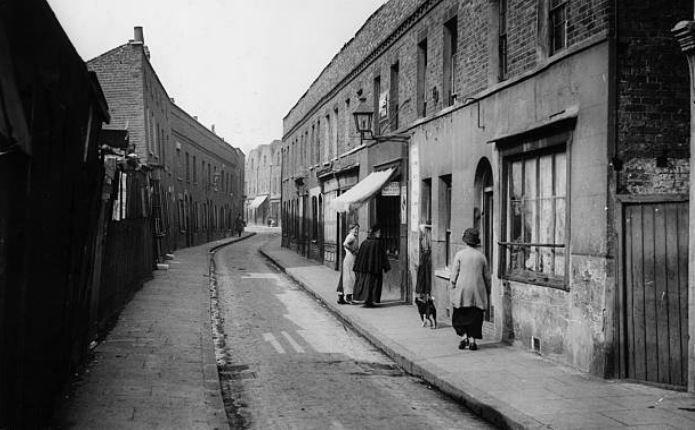
From The Story of Limehouse’s Lost Chinatown, poplarlondon website:
“Limehouse was London’s first Chinatown, home to a tightly-knit community who were demonised in popular culture and eventually erased from the cityscape.
As recounted in the BBC’s ‘Our Greatest Generation’ series, Connie was born to a Chinese father and an English mother in early 1920s Limehouse, where she used to play in the street with other British and British-Chinese children before running inside for teatime at one of their houses.
Limehouse was London’s first Chinatown between the 1880s and the 1960s, before the current Chinatown off Shaftesbury Avenue was established in the 1970s by an influx of immigrants from Hong Kong.
Connie’s memories of London’s first Chinatown as an “urban village” paint a very different picture to the seedy area portrayed in early twentieth century novels.
The pyramid in St Anne’s church marked the entrance to the opium den of Dr Fu Manchu, a criminal mastermind who threatened Western society by plotting world domination in a series of novels by Sax Rohmer.
Thomas Burke’s Limehouse Nights cemented stereotypes about prostitution, gambling and violence within the Chinese community, and whipped up anxiety about sexual relationships between Chinese men and white women.
Though neither novelist was familiar with the Chinese community, their depictions made Limehouse one of the most notorious areas of London.
Travel agent Thomas Cook even organised tours of the area for daring visitors, despite the rector of Limehouse warning that “those who look for the Limehouse of Mr Thomas Burke simply will not find it.”
All that remains is a handful of Chinese street names, such as Ming Street, Pekin Street, and Canton Street — but what was Limehouse’s chinatown really like, and why did it get swept away?
Chinese migration to Limehouse
Chinese sailors discharged from East India Company ships settled in the docklands from as early as the 1780s.
By the late nineteenth century, men from Shanghai had settled around Pennyfields Lane, while a Cantonese community lived on Limehouse Causeway.
Chinese sailors were often paid less and discriminated against by dock hirers, and so began to diversify their incomes by setting up hand laundry services and restaurants.
Old photographs show shopfronts emblazoned with Chinese characters with horse-drawn carts idling outside or Chinese men in suits and hats standing proudly in the doorways.
In oral histories collected by Yat Ming Loo, Connie’s husband Leslie doesn’t recall seeing any Chinese women as a child, since male Chinese sailors settled in London alone and married working-class English women.
In the 1920s, newspapers fear-mongered about interracial marriages, crime and gambling, and described chinatown as an East End “colony.”
Ironically, Chinese opium-smoking was also demonised in the press, despite Britain waging war against China in the mid-nineteenth century for suppressing the opium trade to alleviate addiction amongst its people.
The number of Chinese people who settled in Limehouse was also greatly exaggerated, and in reality only totalled around 300.
The real Chinatown
Although the press sought to characterise Limehouse as a monolithic Chinese community in the East End, Connie remembers seeing people of all nationalities in the shops and community spaces in Limehouse.
She doesn’t remember feeling discriminated against by other locals, though Connie does recall having her face measured and IQ tested by a member of the British Eugenics Society who was conducting research in the area.
Some of Connie’s happiest childhood memories were from her time at Chung-Hua Club, where she learned about Chinese culture and language.
Why did Chinatown disappear?
The caricature of Limehouse’s Chinatown as a den of vice hastened its erasure.
Police raids and deportations fuelled by the alarmist media coverage threatened the Chinese population of Limehouse, and slum clearance schemes to redevelop low-income areas dispersed Chinese residents in the 1930s.
The Defence of the Realm Act imposed at the beginning of the First World War criminalised opium use, gave the authorities increased powers to deport Chinese people and restricted their ability to work on British ships.
Dwindling maritime trade during World War II further stripped Chinese sailors of opportunities for employment, and any remnants of Chinatown were destroyed during the Blitz or erased by postwar development schemes.”
Wong Sang 1884-1930
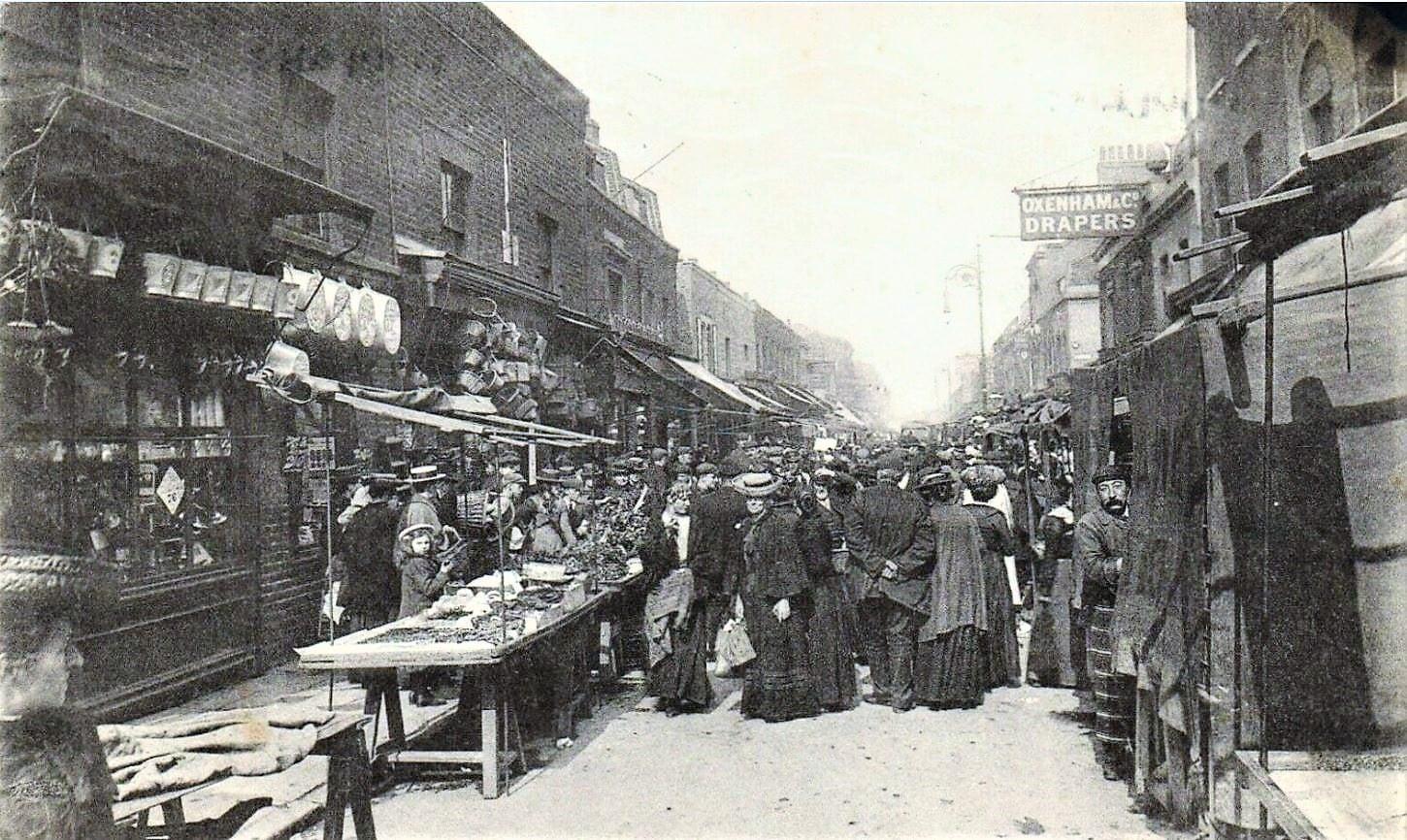
The year 1918 was a troublesome one for Wong Sang, an interpreter and shipping agent for Blue Funnel Line. The Sang family were living at 156, Chrisp Street.
Chrisp Street, Poplar, in 1913 via Old London Photographs:
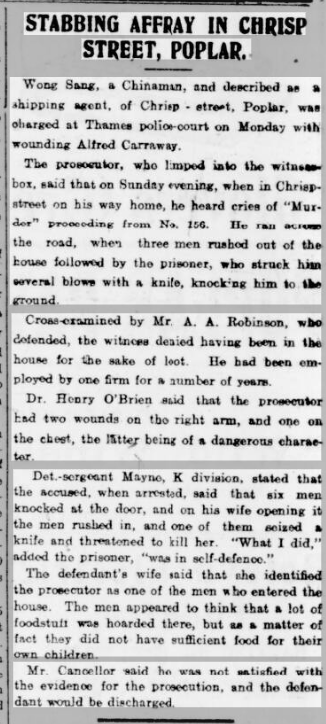
In February Wong Sang was discharged from a false accusation after defending his home from potential robbers.
East End News and London Shipping Chronicle – Friday 15 February 1918:
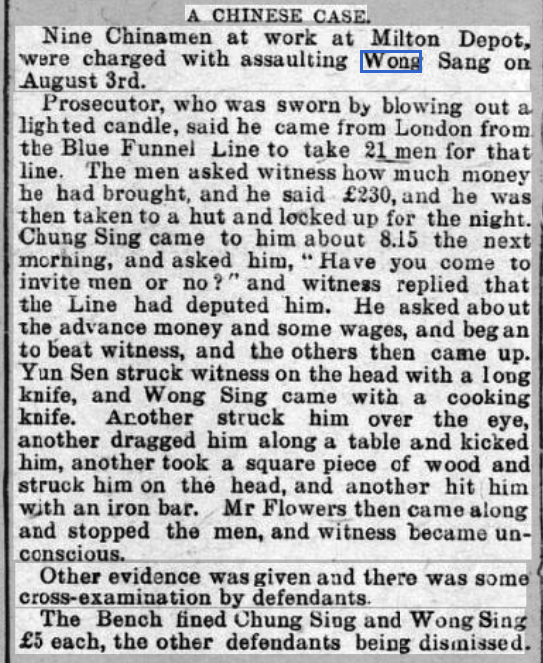
In August of that year he was involved in an incident that left him unconscious.
Faringdon Advertiser and Vale of the White Horse Gazette – Saturday 31 August 1918:
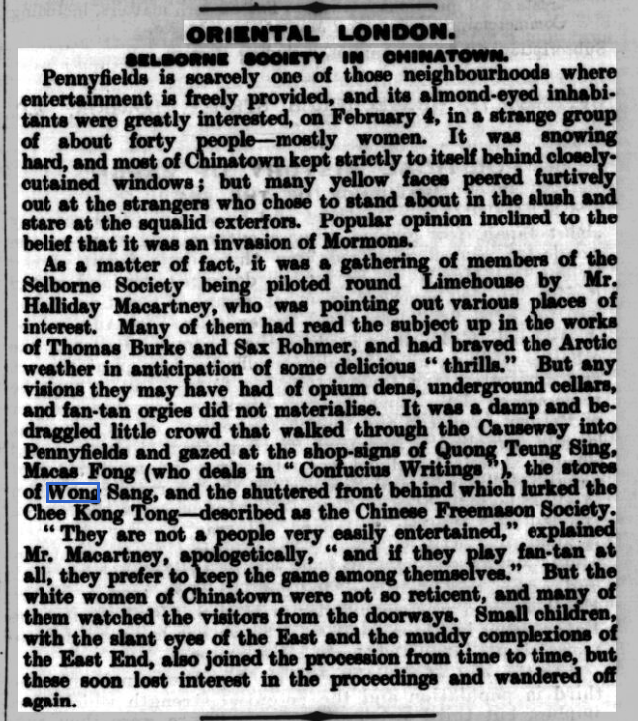
Wong Sang is mentioned in an 1922 article about “Oriental London”.
London and China Express – Thursday 09 February 1922:
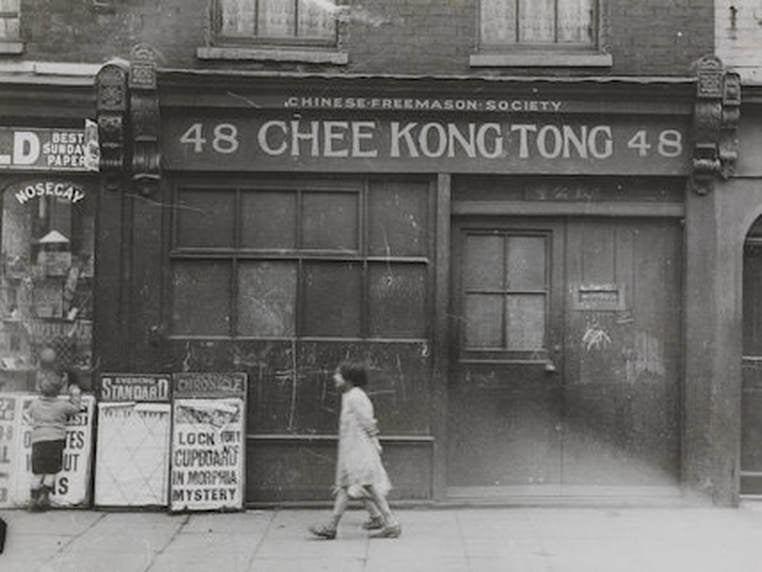
A photograph of the Chee Kong Tong Chinese Freemason Society mentioned in the above article, via Old London Photographs:
Wong Sang was recommended by the London Metropolitan Police in 1928 to assist in a case in Wellingborough, Northampton.
Difficulty of Getting an Interpreter: Northampton Mercury – Friday 16 March 1928:
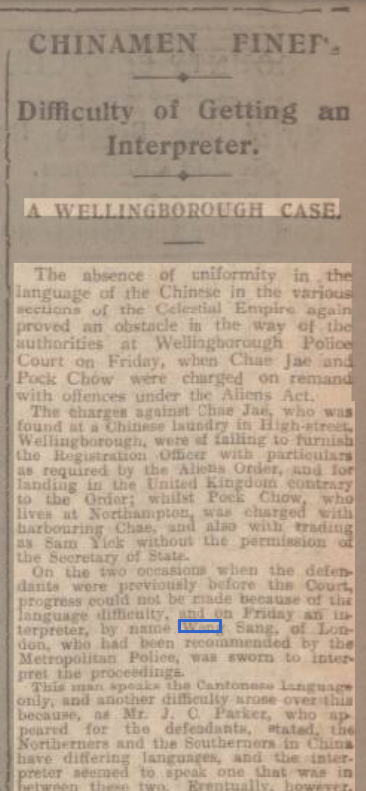
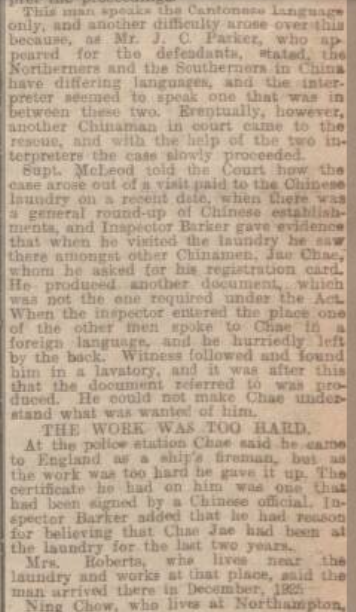
The difficulty was that “this man speaks the Cantonese language only…the Northeners and the Southerners in China have differing languages and the interpreter seemed to speak one that was in between these two.”
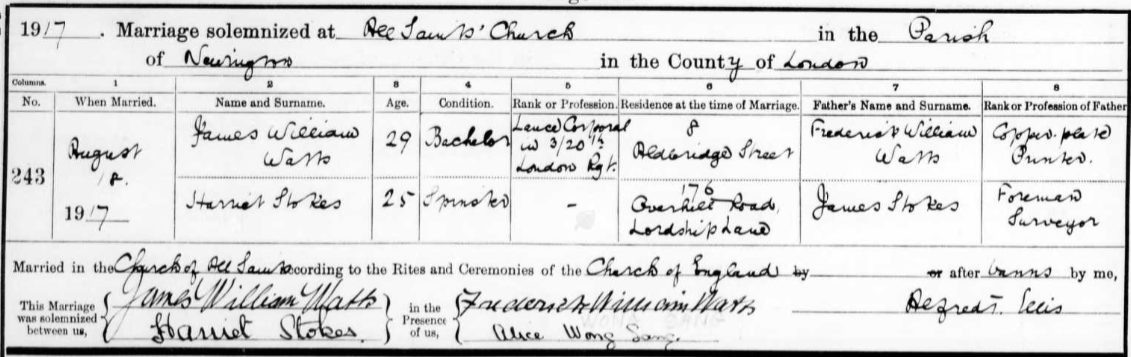
In 1917, Alice Wong Sang was a witness at her sister Harriet Stokes marriage to James William Watts in Southwark, London. Their father James Stokes occupation on the marriage register is foreman surveyor, but on the census he was a council roadman or labourer. (I initially rejected this as the correct marriage for Harriet because of the discrepancy with the occupations. Alice Wong Sang as a witness confirmed that it was indeed the correct one.)
James William Sang 1913-2000 was a clock fitter and watch assembler (on the 1939 census). He married Ivy Laura Fenton in 1963 in Sidcup, Kent. James died in Southwark in 2000.
Charles Ronald Sang 1920-1974 was a draughtsman (1939 census). He married Eileen Burgess in 1947 in Marylebone. Charles and Eileen had two sons: Keith born in 1951 and Roger born in 1952. He died in 1974 in Hertfordshire.
William Norman Sang 1922-2000 was a clerk and telephone operator (1939 census). William enlisted in the Royal Artillery in 1942. He married Lily Mullins in 1949 in Bethnal Green, and they had three daughters: Marion born in 1950, Christine in 1953, and Frances in 1959. He died in Redbridge in 2000.
I then found another two births registered in Poplar by Alice Sang, both daughters. Doris Winifred Sang was born in 1925, and Patricia Margaret Sang was born in 1933 ~ three years after Wong Sang’s death. Neither of the these daughters were on the 1939 census with Alice, John Patterson and the three sons. Margaret had presumably been evacuated because of the war to a family in Taunton, Somerset. Doris would have been fourteen and I have been unable to find her in 1939 (possibly because she died in 2017 and has not had the redaction removed yet on the 1939 census as only deceased people are viewable).
Doris Winifred Sang 1925-2017 was a nursing sister. She didn’t marry, and spent a year in USA between 1954 and 1955. She stayed in London, and died at the age of ninety two in 2017.
Patricia Margaret Sang 1933-1998 was also a nurse. She married Patrick L Nicely in Stepney in 1957. Patricia and Patrick had five children in London: Sharon born 1959, Donald in 1960, Malcolm was born and died in 1966, Alison was born in 1969 and David in 1971.
I was unable to find a birth registered for Alice’s first son, James William Sang (as he appeared on the 1939 census). I found Alice Stokes on the 1911 census as a 17 year old live in servant at a tobacconist on Pekin Street, Limehouse, living with Mr Sui Fong from Hong Kong and his wife Sarah Sui Fong from Berlin. I looked for a birth registered for James William Fong instead of Sang, and found it ~ mothers maiden name Stokes, and his date of birth matched the 1939 census: 8th March, 1913.
On the 1921 census, Wong Sang is not listed as living with them but it is mentioned that Mr Wong Sang was the person returning the census. Also living with Alice and her sons James and Charles in 1921 are two visitors: (Florence) May Stokes, 17 years old, born in Woodstock, and Charles Stokes, aged 14, also born in Woodstock. May and Charles were Alice’s sister and brother.
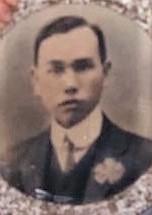
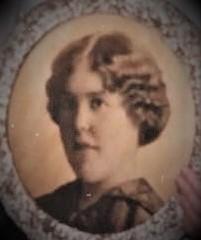
I found Sharon Nicely on social media and she kindly shared photos of Wong Sang and Alice Stokes:
 November 10, 2022 at 12:08 pm #6344
In reply to: Family Stories From The Other Side ~ Book Two
The Tetbury Riots
While researching the Tetbury riots (I had found some Browning names in the newspaper archives in association with the uprisings) I came across an article called “Elizabeth Parker, the Swing Riots, and the Tetbury parish clerk” by Jill Evans.
I noted the name of the parish clerk, Daniel Cole, because I know someone else of that name. The incident in the article was 1830.
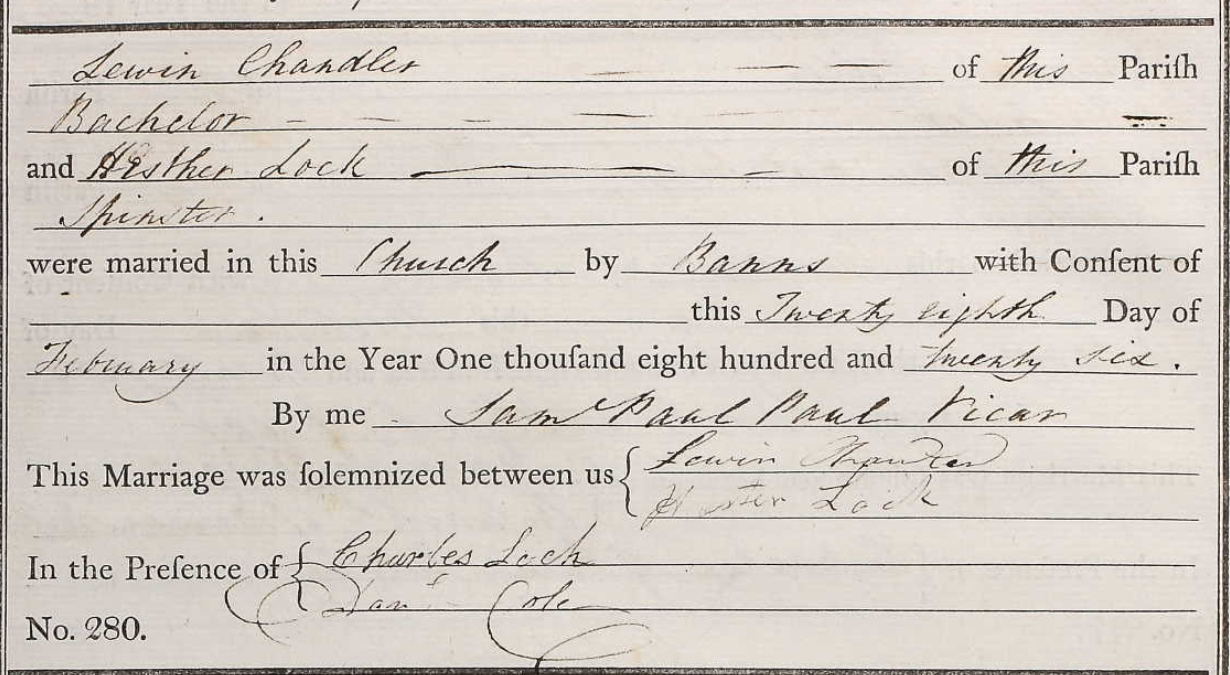
I found the 1826 marriage in the Tetbury parish registers (where Daniel was the parish clerk) of my 4x great grandmothers sister Hesther Lock. One of the witnesses was her brother Charles, and the other was Daniel Cole, the parish clerk.
Marriage of Lewin Chandler and Hesther Lock in 1826:
from the article:
“The Swing Riots were disturbances which took place in 1830 and 1831, mostly in the southern counties of England. Agricultural labourers, who were already suffering due to low wages and a lack of work after several years of bad harvests, rose up when their employers introduced threshing machines into their workplaces. The riots got their name from the threatening letters which were sent to farmers and other employers, which were signed “Captain Swing.”
The riots spread into Gloucestershire in November 1830, with the Tetbury area seeing the worst of the disturbances. Amongst the many people arrested afterwards was one woman, Elizabeth Parker. She has sometimes been cited as one of only two females who were transported for taking part in the Swing Riots. In fact, she was sentenced to be transported for this crime, but never sailed, as she was pardoned a few months after being convicted. However, less than a year after being released from Gloucester Gaol, she was back, awaiting trial for another offence. The circumstances in both of the cases she was tried for reveal an intriguing relationship with one Daniel Cole, parish clerk and assistant poor law officer in Tetbury….
….Elizabeth Parker was committed to Gloucester Gaol on 4 December 1830. In the Gaol Registers, she was described as being 23 and a “labourer”. She was in fact a prostitute, and she was unusual for the time in that she could read and write. She was charged on the oaths of Daniel Cole and others with having been among a mob which destroyed a threshing machine belonging to Jacob Hayward, at his farm in Beverstone, on 26 November.
…..Elizabeth Parker was granted royal clemency in July 1831 and was released from prison. She returned to Tetbury and presumably continued in her usual occupation, but on 27 March 1832, she was committed to Gloucester Gaol again. This time, she was charged with stealing 2 five pound notes, 5 sovereigns and 5 half sovereigns, from the person of Daniel Cole.
Elizabeth was tried at the Lent Assizes which began on 28 March, 1832. The details of her trial were reported in the Morning Post. Daniel Cole was in the “Boat Inn” (meaning the Boot Inn, I think) in Tetbury, when Elizabeth Parker came in. Cole “accompanied her down the yard”, where he stayed with her for about half an hour. The next morning, he realised that all his money was gone. One of his five pound notes was identified by him in a shop, where Parker had bought some items.
Under cross-examination, Cole said he was the assistant overseer of the poor and collector of public taxes of the parish of Tetbury. He was married with one child. He went in to the inn at about 9 pm, and stayed about 2 hours, drinking in the parlour, with the landlord, Elizabeth Parker, and two others. He was not drunk, but he was “rather fresh.” He gave the prisoner no money. He saw Elizabeth Parker next morning at the Prince and Princess public house. He didn’t drink with her or give her any money. He did give her a shilling after she was committed. He never said that he would not have prosecuted her “if it was not for her own tongue”. (Presumably meaning he couldn’t trust her to keep her mouth shut.)”
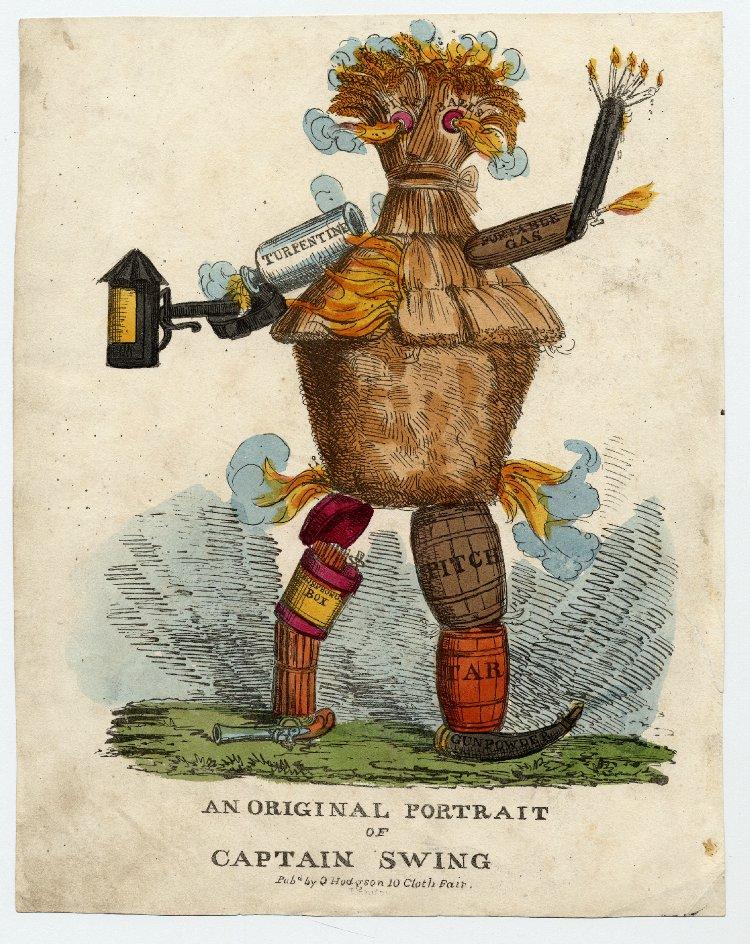
Contemporary illustration of the Swing riots:
Captain Swing was the imaginary leader agricultural labourers who set fire to barns and haystacks in the southern and eastern counties of England from 1830. Although the riots were ruthlessly put down (19 hanged, 644 imprisoned and 481 transported), the rural agitation led the new Whig government to establish a Royal Commission on the Poor Laws and its report provided the basis for the 1834 New Poor Law enacted after the Great Reform Bills of 1833.
An original portrait of Captain Swing hand coloured lithograph circa 1830:
 October 19, 2022 at 6:46 am #6336
In reply to: Family Stories From The Other Side ~ Book Two
The Hamstall Ridware Connection
Stubbs and Woods
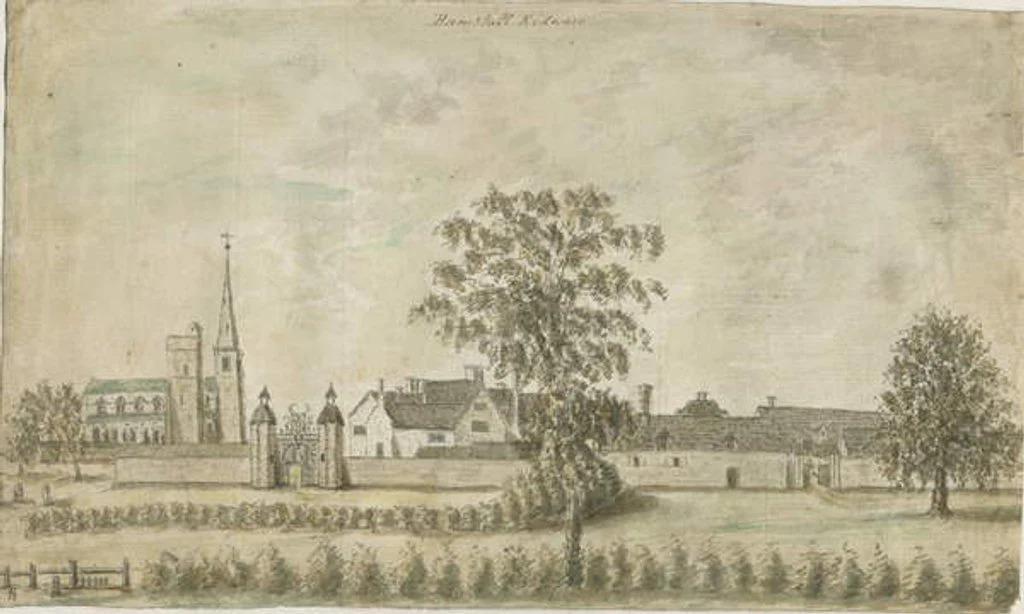 Hamstall Ridware
Charles Tomlinson‘s (1847-1907) wife Emma Grattidge (1853-1911) was born in Wolverhampton, the daughter and youngest child of William Grattidge (1820-1887) born in Foston, Derbyshire, and Mary Stubbs (1819-1880), born in Burton on Trent, daughter of Solomon Stubbs.
Solomon Stubbs (1781-1857) was born in Hamstall Ridware in 1781, the son of Samuel and Rebecca. Samuel Stubbs (1743-) and Rebecca Wood (1754-) married in 1769 in Darlaston. Samuel and Rebecca had six other children, all born in Darlaston. Sadly four of them died in infancy. Son John was born in 1779 in Darlaston and died two years later in Hamstall Ridware in 1781, the same year that Solomon was born there.
But why did they move to Hamstall Ridware?
Samuel Stubbs was born in 1743 in Curdworth, Warwickshire (near to Birmingham). I had made a mistake on the tree (along with all of the public trees on the Ancestry website) and had Rebecca Wood born in Cheddleton, Staffordshire. Rebecca Wood from Cheddleton was also born in 1843, the right age for the marriage. The Rebecca Wood born in Darlaston in 1754 seemed too young, at just fifteen years old at the time of the marriage. I couldn’t find any explanation for why a woman from Cheddleton would marry in Darlaston and then move to Hamstall Ridware. People didn’t usually move around much other than intermarriage with neighbouring villages, especially women. I had a closer look at the Darlaston Rebecca, and did a search on her father William Wood. I found his 1784 will online in which he mentions his daughter Rebecca, wife of Samuel Stubbs. Clearly the right Rebecca Wood was the one born in Darlaston, which made much more sense.
An excerpt from William Wood’s 1784 will mentioning daughter Rebecca married to Samuel Stubbs:
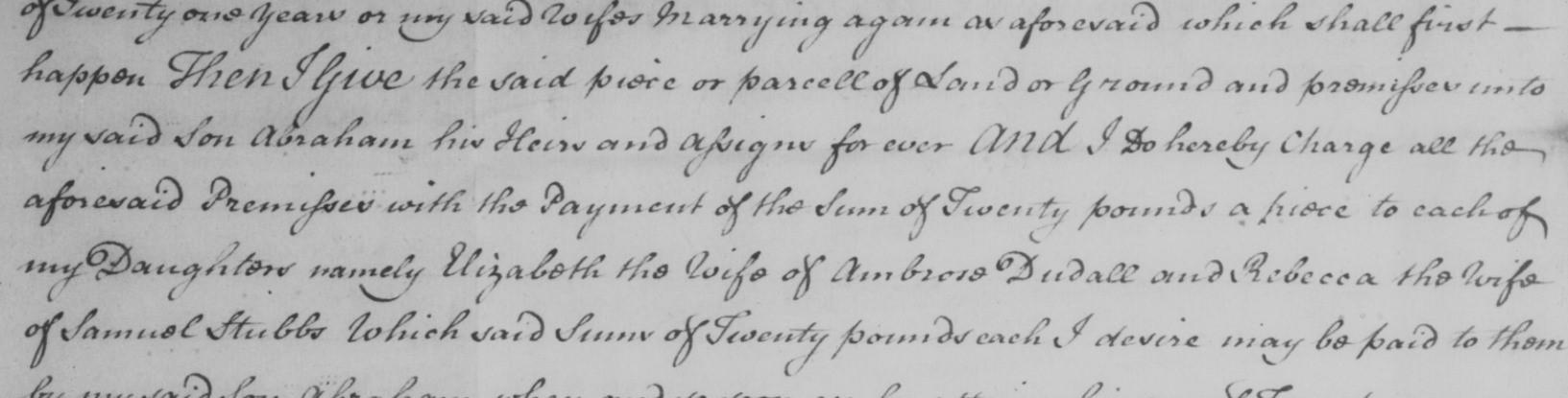
But why did they move to Hamstall Ridware circa 1780?
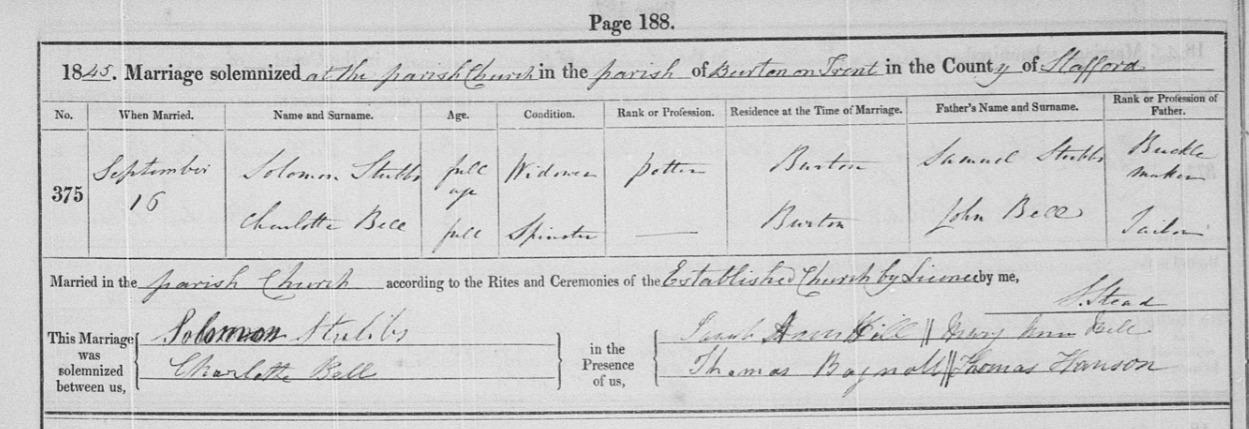
I had not intially noticed that Solomon Stubbs married again the year after his wife Phillis Lomas (1787-1844) died. Solomon married Charlotte Bell in 1845 in Burton on Trent and on the marriage register, Solomon’s father Samuel Stubbs occupation was mentioned: Samuel was a buckle maker.
Marriage of Solomon Stubbs and Charlotte Bell, father Samuel Stubbs buckle maker:
A rudimentary search on buckle making in the late 1700s provided a possible answer as to why Samuel and Rebecca left Darlaston in 1781. Shoe buckles had gone out of fashion, and by 1781 there were half as many buckle makers in Wolverhampton as there had been previously.
“Where there were 127 buckle makers at work in Wolverhampton, 68 in Bilston and 58 in Birmingham in 1770, their numbers had halved in 1781.”
via “historywebsite”(museum/metalware/steel)
Steel buckles had been the height of fashion, and the trade became enormous in Wolverhampton. Wolverhampton was a steel working town, renowned for its steel jewellery which was probably of many types. The trade directories show great numbers of “buckle makers”. Steel buckles were predominantly made in Wolverhampton: “from the late 1760s cut steel comes to the fore, from the thriving industry of the Wolverhampton area”. Bilston was also a great centre of buckle making, and other areas included Walsall. (It should be noted that Darlaston, Walsall, Bilston and Wolverhampton are all part of the same area)
In 1860, writing in defence of the Wolverhampton Art School, George Wallis talks about the cut steel industry in Wolverhampton. Referring to “the fine steel workers of the 17th and 18th centuries” he says: “Let them remember that 100 years ago [sc. c. 1760] a large trade existed with France and Spain in the fine steel goods of Birmingham and Wolverhampton, of which the latter were always allowed to be the best both in taste and workmanship. … A century ago French and Spanish merchants had their houses and agencies at Birmingham for the purchase of the steel goods of Wolverhampton…..The Great Revolution in France put an end to the demand for fine steel goods for a time and hostile tariffs finished what revolution began”.
The next search on buckle makers, Wolverhampton and Hamstall Ridware revealed an unexpected connecting link.
In Riotous Assemblies: Popular Protest in Hanoverian England by Adrian Randall:
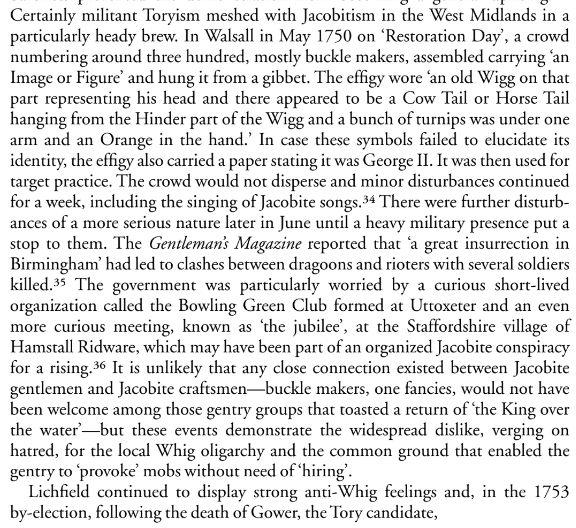
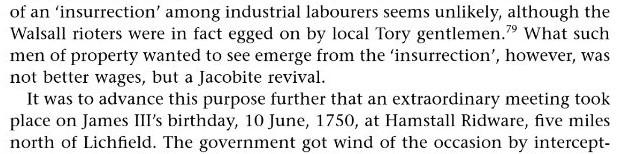
In Walsall in 1750 on “Restoration Day” a crowd numbering 300 assembled, mostly buckle makers, singing Jacobite songs and other rebellious and riotous acts. The government was particularly worried about a curious meeting known as the “Jubilee” in Hamstall Ridware, which may have been part of a conspiracy for a Jacobite uprising.
But this was thirty years before Samuel and Rebecca moved to Hamstall Ridware and does not help to explain why they moved there around 1780, although it does suggest connecting links.
Rebecca’s father, William Wood, was a brickmaker. This was stated at the beginning of his will. On closer inspection of the will, he was a brickmaker who owned four acres of brick kilns, as well as dwelling houses, shops, barns, stables, a brewhouse, a malthouse, cattle and land.
A page from the 1784 will of William Wood:
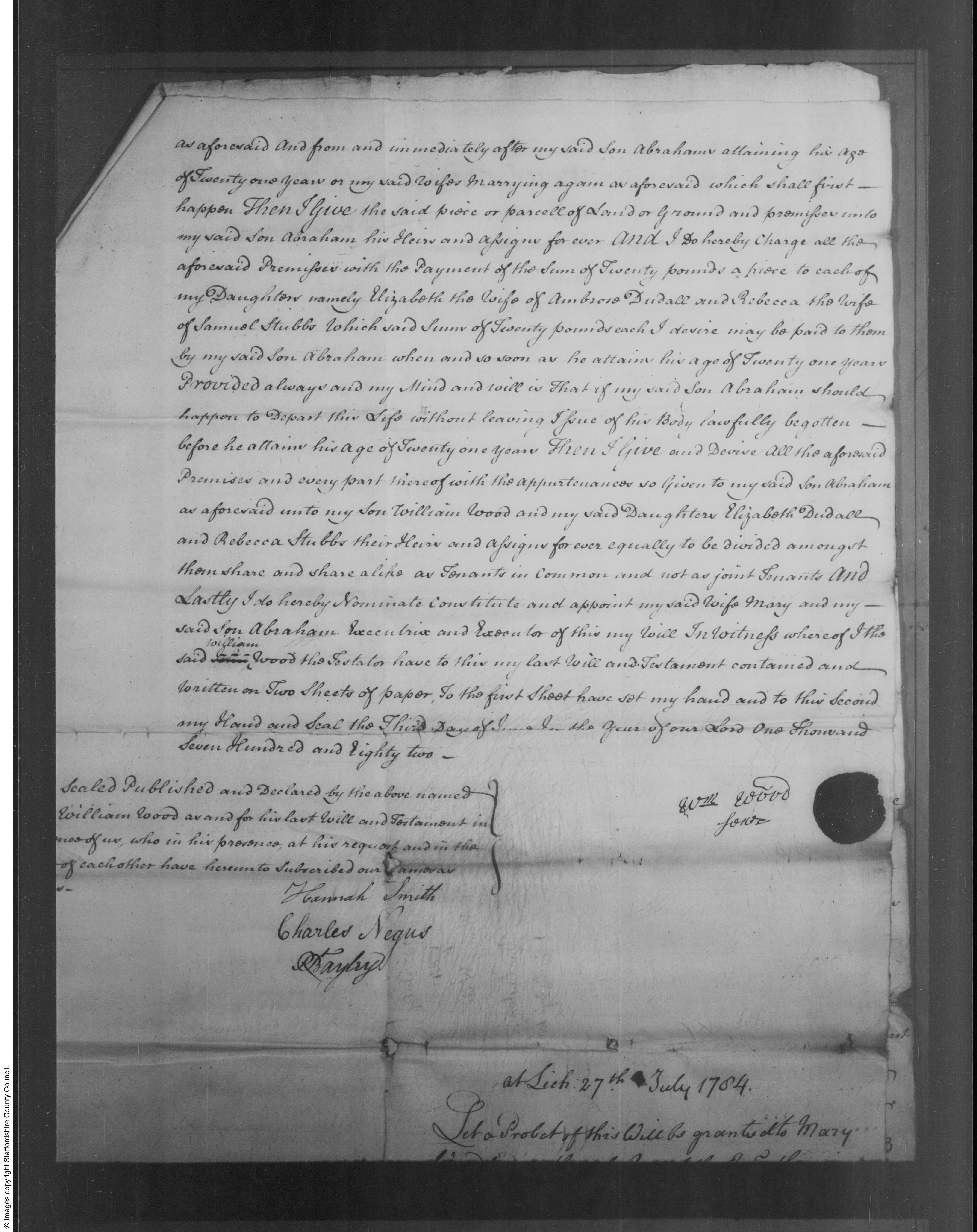
The 1784 will of William Wood of Darlaston:
I William Wood the elder of Darlaston in the county of Stafford, brickmaker, being of sound and disposing mind memory and understanding (praised be to god for the same) do make publish and declare my last will and testament in manner and form following (that is to say) {after debts and funeral expense paid etc} I give to my loving wife Mary the use usage wear interest and enjoyment of all my goods chattels cattle stock in trade ~ money securities for money personal estate and effects whatsoever and wheresoever to hold unto her my said wife for and during the term of her natural life providing she so long continues my widow and unmarried and from or after her decease or intermarriage with any future husband which shall first happen.
Then I give all the said goods chattels cattle stock in trade money securites for money personal estate and effects unto my son Abraham Wood absolutely and forever. Also I give devise and bequeath unto my said wife Mary all that my messuages tenement or dwelling house together with the malthouse brewhouse barn stableyard garden and premises to the same belonging situate and being at Darlaston aforesaid and now in my own possession. Also all that messuage tenement or dwelling house together with the shop garden and premises with the appurtenances to the same ~ belonging situate in Darlaston aforesaid and now in the several holdings or occupation of George Knowles and Edward Knowles to hold the aforesaid premises and every part thereof with the appurtenances to my said wife Mary for and during the term of her natural life provided she so long continues my widow and unmarried. And from or after her decease or intermarriage with a future husband which shall first happen. Then I give and devise the aforesaid premises and every part thereof with the appurtenances unto my said son Abraham Wood his heirs and assigns forever.
Also I give unto my said wife all that piece or parcel of land or ground inclosed and taken out of Heath Field in the parish of Darlaston aforesaid containing four acres or thereabouts (be the same more or less) upon which my brick kilns erected and now in my own possession. To hold unto my said wife Mary until my said son Abraham attains his age of twenty one years if she so long continues my widow and unmarried as aforesaid and from and immediately after my said son Abraham attaining his age of twenty one years or my said wife marrying again as aforesaid which shall first happen then I give the said piece or parcel of land or ground and premises unto my said son Abraham his heirs and assigns forever.
And I do hereby charge all the aforesaid premises with the payment of the sum of twenty pounds a piece to each of my daughters namely Elizabeth the wife of Ambrose Dudall and Rebecca the wife of Samuel Stubbs which said sum of twenty pounds each I devise may be paid to them by my said son Abraham when and so soon as he attains his age of twenty one years provided always and my mind and will is that if my said son Abraham should happen to depart this life without leaving issue of his body lawfully begotten before he attains his age of twenty one years then I give and devise all the aforesaid premises and every part thereof with the appurtenances so given to my said son Abraham as aforesaid unto my said son William Wood and my said daughter Elizabeth Dudall and Rebecca Stubbs their heirs and assigns forever equally divided among them share and share alike as tenants in common and not as joint tenants. And lastly I do hereby nominate constitute and appoint my said wife Mary and my said son Abraham executrix and executor of this my will.
The marriage of William Wood (1725-1784) and Mary Clews (1715-1798) in 1749 was in Hamstall Ridware.
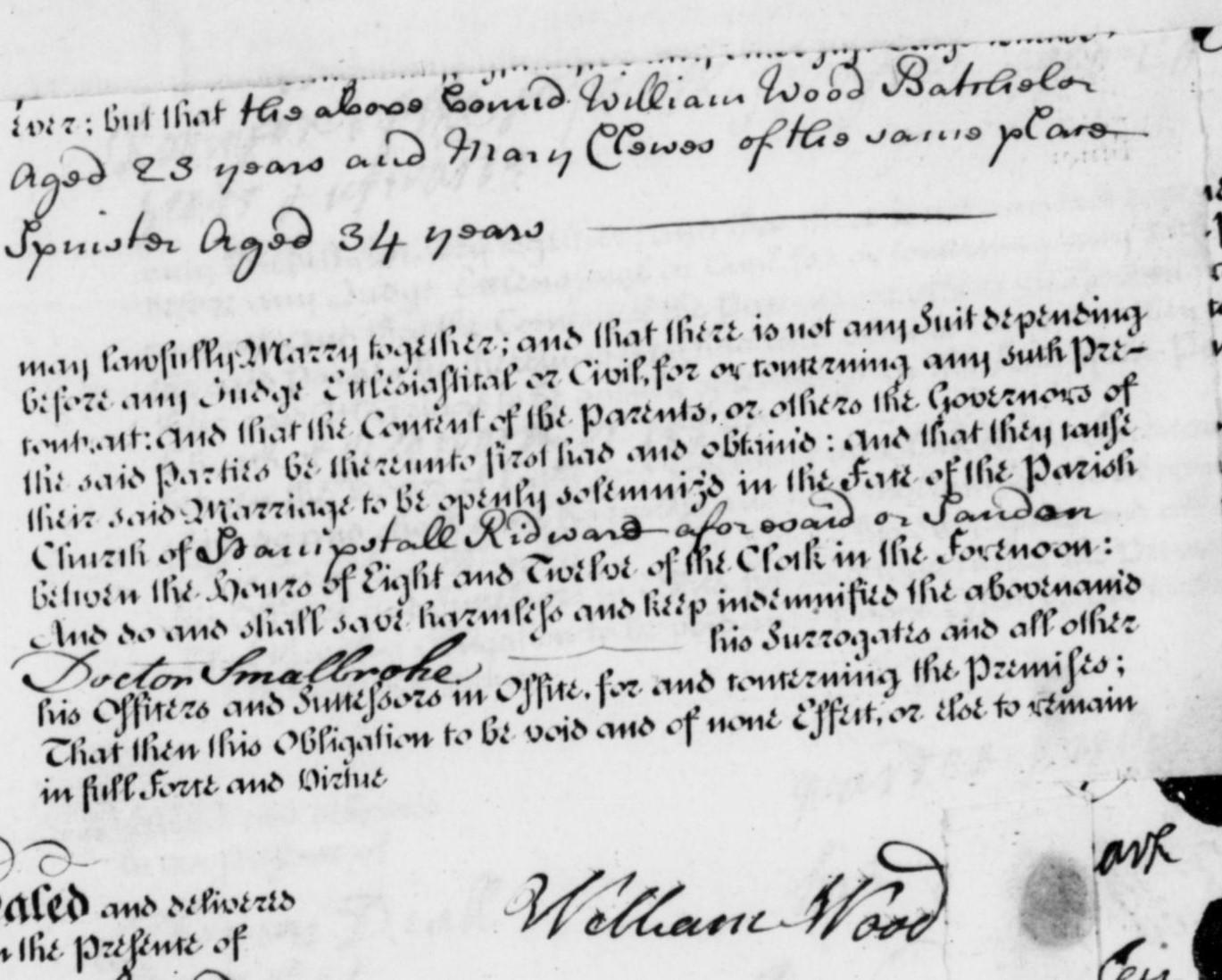
Mary was eleven years Williams senior, and it appears that they both came from Hamstall Ridware and moved to Darlaston after they married. Clearly Rebecca had extended family there (notwithstanding any possible connecting links between the Stubbs buckle makers of Darlaston and the Hamstall Ridware Jacobites thirty years prior). When the buckle trade collapsed in Darlaston, they likely moved to find employment elsewhere, perhaps with the help of Rebecca’s family.
I have not yet been able to find deaths recorded anywhere for either Samuel or Rebecca (there are a couple of deaths recorded for a Samuel Stubbs, one in 1809 in Wolverhampton, and one in 1810 in Birmingham but impossible to say which, if either, is the right one with the limited information, and difficult to know if they stayed in the Hamstall Ridware area or perhaps moved elsewhere)~ or find a reason for their son Solomon to be in Burton upon Trent, an evidently prosperous man with several properties including an earthenware business, as well as a land carrier business.
September 4, 2022 at 6:00 pm #6326In reply to: The Sexy Wooden Leg
Stung by Egberts question, Olga reeled and almost lost her footing on the stairs. What had happened to her? That damned selfish individualism that was running rampant must have seeped into her room through the gaps in the windows or under the door. “No!” she shouted, her voice cracking.
“Say it isn’t true, Olga,” Egbert said, his voice breaking. “Not you as well.”
It took Olga a minute or two to still her racing heart. The near fall down the stairs had shaken her but with trembling hands she levered herself round to sit beside Egbert on the step.
Gripping his bony knee with her knobbly arthritic fingers, she took a deep breath.
“You are right to have said that, Egbert. If there is one thing we must hold onto, it’s our hearts. Nothing else matters, or at least nothing else matters as much as that. We are old and tired and we don’t like change. But if we escalate the importance of this frankly dreary and depressing home to the point where we lose our hearts…” she faltered and continued. “We will be homeless soon, very soon, and we know not what will happen to us. We must trust in the kindness of strangers, we must hope they have a heart.”
Egbert winced as Olga squeezed his knee. “And that is why”, Olga continued, slapping Egberts thigh with gusto, “We must have a heart…”
“If you’d just stop squeezing and hitting me, Olga…”
Olga loosened her grip on the old mans thigh bone and peered into his eyes. Quietly she thanked him. “You’ve cleared my mind and given me something to live for, and I thank you for that. But you do need to launder your clothes more often,” she added, pulling a face. She didn’t want the old coot to start blubbing, and he looked alarmingly close to tears.
“Come on, let’s go and see Obadiah. We’re all in this together. Homelessness and adventure can wait until tomorrow.” Olga heaved herself upright with a surprising burst of vitality. Noticing a weak smile trembling on Egberts lips, she said “That’s the spirit!”
July 12, 2022 at 9:46 am #6320In reply to: The Sexy Wooden Leg
When Maryechka arrived at the front gate of the Vyriy hotel with its gaudy plaster storks at the entrance, she sneaked into the side gate leading to the kitchens.
She had to be careful not to to be noticed by Larysa who often had her cigarette break hidden under the pine tree. Larysa didn’t like children, or at least, she disliked them slightly less than the elderly residents, whoever was the loudest and the uncleanliest was sure to suffer her disapproval.
Larysa was basically single-handedly managing the hotel, doing most of the chores to keep it afloat. The only thing she didn’t do was the catering, and packaged trays arrived every day for the residents. Maryechka’s grand-pa was no picky eater, and made a point of clearing his tray of food, but she suspected most of the other residents didn’t.
The only other employee she was told, was the gardener who would have been old enough to be a resident himself, and had died of a stroke before the summer. The small garden was clearly in need of tending after.Maryechka could see the coast was clear, and was making her ways to the stairs when she heard clanking in the stairs and voices arguing.
“Keep your voice down, you’re going to wake the dragon.”
“That’s your fault, you don’t pack light for your adventures. You really needed to take all these suitcases? How can we make a run for it with all that dead weight!”
July 12, 2022 at 8:30 am #6319In reply to: The Sexy Wooden Leg
“Calm yourself, Egbert, and sit down. And be quiet! I can barely hear myself think with your frantic gibbering and flailing around,” Olga said, closing her eyes. “I need to think.”
Egbert clutched the eiderdown on either side of his bony trembling knees and clamped his remaining teeth together, drawing ragged whistling breaths in an attempt to calm himself. Olga was right, he needed to calm down. Besides the unfortunate effects of the letter on his habitual tremor, he felt sure his blood pressure had risen alarmingly. He dared not become so ill that he needed medical assistance, not with the state of the hospitals these days. He’d be lucky to survive the plague ridden wards.
What had become of him! He imagined his younger self looking on with horror, appalled at his feeble body and shattered mind. Imagine becoming so desperate that he wanted to fight to stay in this godforsaken dump, what had become of him! If only he knew of somewhere else to go, somewhere safe and pleasant, somewhere that smelled sweetly of meadows and honesuckle and freshly baked cherry pies, with the snorting of pigs in the yard…
But wait, that was Olga snoring. Useless old bag had fallen asleep! For the first time since Viktor had died he felt close to tears. What a sad sorry pathetic old man he’d become, desperately counting on a old woman to save him.
“Stop sniveling, Egbert, and go and pack a bag.” Olga had woken up from her momentary but illuminating lapse. “Don’t bring too much, we may have much walking to do. I hear the buses and trains are in a shambles and full of refugees. We don’t want to get herded up with them.”
Astonished, Egbert asked where they were going.
“To see Rosa. My cousins father in laws neice. Don’t look at me like that, immediate family are seldom the ones who help. The distant ones are another matter. And be honest Egbert,” Olga said with a piercing look, “Do we really want to stay here? You may think you do, but it’s the fear of change, that’s all. Change feels like too much bother, doesn’t it?”
Egbert nodded sadly, his eyes fixed on the stain on the grey carpet.
Olga leaned forward and took his hand gently. “Egbert, look at me.” He raised his head and looked into her eyes. He’d never seen a sparkle in her faded blue eyes before. “I still have another adventure in me. How about you?”
July 6, 2022 at 9:47 am #6310In reply to: The Sexy Wooden Leg
Olek wished he wasn’t so easy to find.
The old caretaker of the shrine of Saint Edigna couldn’t have chosen a less conspicuous place to live in this warring time. People were flocking from afar, more and more each day drawn about by the ancient place, and the sacred oil bleeding linden tree which had suddenly and quite miraculously resumed its flow in the midst of the ambiant chaos started by the war.
It wasn’t always like this. A few months ago, the linden tree was just an old linden tree that may or may not have been miraculous, if the old wifes’ tales were to be trusted. Mankind’s memory is a flimsy thing as it occurs, and while for many generations before, speculations had abounded about whether or not the Saint was real, had such or such filiation, et cætera— it now seemed the old tales that were passed down from mother to children had managed to keep alive a knowledge that had but all dried up on old flaky parchments scribbled in pale inks that kept eluding old scholars’ exegesis.
Olek himself wasn’t a learned man. A man of faith, he was a little — more by upbringing than by choice, and by slow attunement to nature it would seem. Over the years, he’d be servicing the country in many ways, and after a rather long carrier started at young age, he had finally managed to retire in this place.
He thought he’d be left alone, to care for a little garden patch, checking in from times to times on the old grumpy neighbours, but alas, the Holy Nation’s destiny still had something in store for him.The latest pilgrim family had brought a message. It was another push to action. “Plan acceleration needs to happen”.
“What clucking plan again?” was his first reaction. Bad temper had a way of flaring right up his vents as in old times. When he’d calmed down, he wondered if he had ever seen a call for slowing down in his life. People were always so busy mindlessly carting around, bumping into the darkness.He smiled thinking of something his old man used to say. He’d never planned for a thing in his life, and was always very carefree it was often scary. His mantra was “People are always getting prepared for the wrong things. They never can prepare for the unexpected, and surely enough, only the unexpected happens.”
That sort of chaos paddling approach to life didn’t seem to bring him any sort of extraordinary success, and while he had the same mixed bag of ups and downs as the rest of his compatriots, just so much less did he suffer for the same result! Olek guessed that was the whole point, even if he really couldn’t accept it until much later in life.Maybe Olek would start playing by his father’s book. Until he could find a way to get lost behind enemy lines.
July 1, 2022 at 9:51 am #6306In reply to: The Elusive Samuel Housley and Other Family Stories
Looking for Robert Staley
William Warren (1835-1880) of Newhall (Stapenhill) married Elizabeth Staley (1836-1907) in 1858. Elizabeth was born in Newhall, the daughter of John Staley (1795-1876) and Jane Brothers. John was born in Newhall, and Jane was born in Armagh, Ireland, and they were married in Armagh in 1820. Elizabeths older brothers were born in Ireland: William in 1826 and Thomas in Dublin in 1830. Francis was born in Liverpool in 1834, and then Elizabeth in Newhall in 1836; thereafter the children were born in Newhall.
Marriage of John Staley and Jane Brothers in 1820:
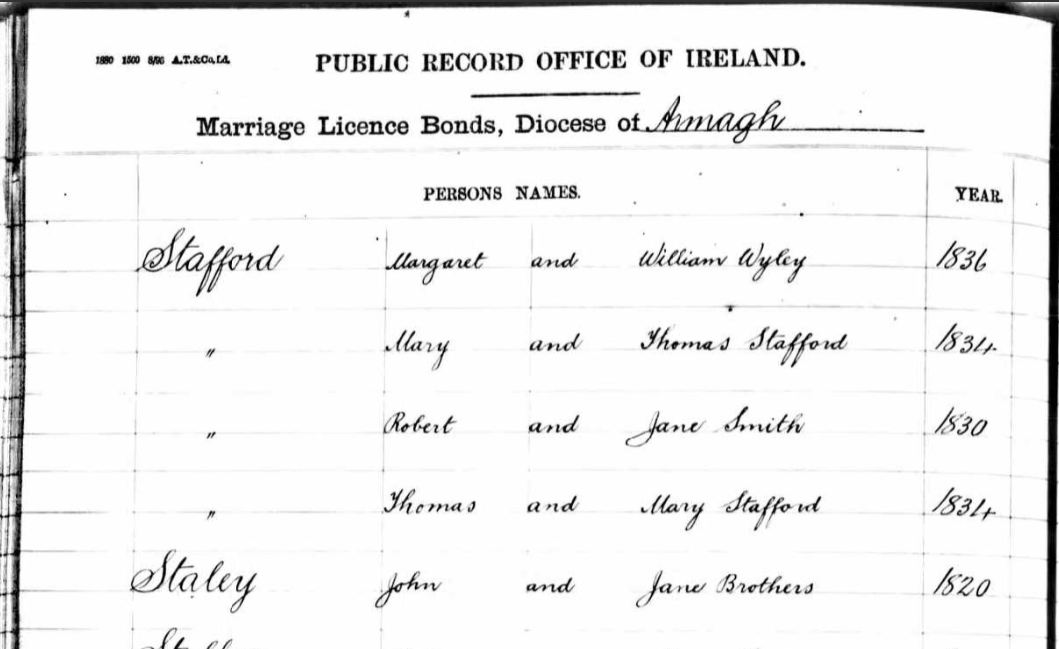
My grandmother related a story about an Elizabeth Staley who ran away from boarding school and eloped to Ireland, but later returned. The only Irish connection found so far is Jane Brothers, so perhaps she meant Elizabeth Staley’s mother. A boarding school seems unlikely, and it would seem that it was John Staley who went to Ireland.
The 1841 census states Jane’s age as 33, which would make her just 12 at the time of her marriage. The 1851 census states her age as 44, making her 13 at the time of her 1820 marriage, and the 1861 census estimates her birth year as a more likely 1804. Birth records in Ireland for her have not been found. It’s possible, perhaps, that she was in service in the Newhall area as a teenager (more likely than boarding school), and that John and Jane ran off to get married in Ireland, although I haven’t found any record of a child born to them early in their marriage. John was an agricultural labourer, and later a coal miner.
John Staley was the son of Joseph Staley (1756-1838) and Sarah Dumolo (1764-). Joseph and Sarah were married by licence in Newhall in 1782. Joseph was a carpenter on the marriage licence, but later a collier (although not necessarily a miner).
The Derbyshire Record Office holds records of an “Estimate of Joseph Staley of Newhall for the cost of continuing to work Pisternhill Colliery” dated 1820 and addresssed to Mr Bloud at Calke Abbey (presumably the owner of the mine)
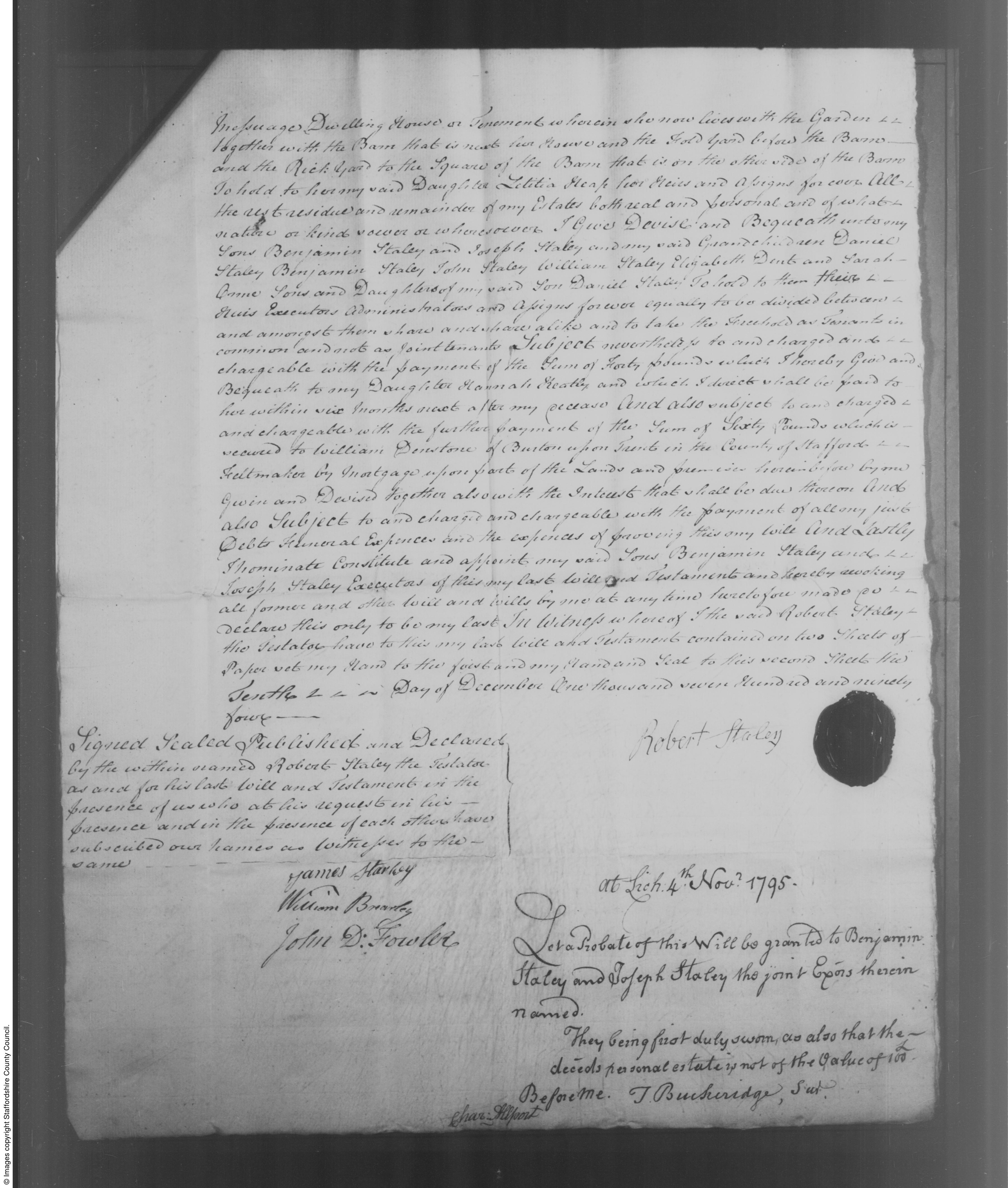
Josephs parents were Robert Staley and Elizabeth. I couldn’t find a baptism or birth record for Robert Staley. Other trees on an ancestry site had his birth in Elton, but with no supporting documents. Robert, as stated in his 1795 will, was a Yeoman.
“Yeoman: A former class of small freeholders who farm their own land; a commoner of good standing.”
“Husbandman: The old word for a farmer below the rank of yeoman. A husbandman usually held his land by copyhold or leasehold tenure and may be regarded as the ‘average farmer in his locality’. The words ‘yeoman’ and ‘husbandman’ were gradually replaced in the later 18th and 19th centuries by ‘farmer’.”He left a number of properties in Newhall and Hartshorne (near Newhall) including dwellings, enclosures, orchards, various yards, barns and acreages. It seemed to me more likely that he had inherited them, rather than moving into the village and buying them.
There is a mention of Robert Staley in a 1782 newpaper advertisement.
“Fire Engine To Be Sold. An exceedingly good fire engine, with the boiler, cylinder, etc in good condition. For particulars apply to Mr Burslem at Burton-upon-Trent, or Robert Staley at Newhall near Burton, where the engine may be seen.”
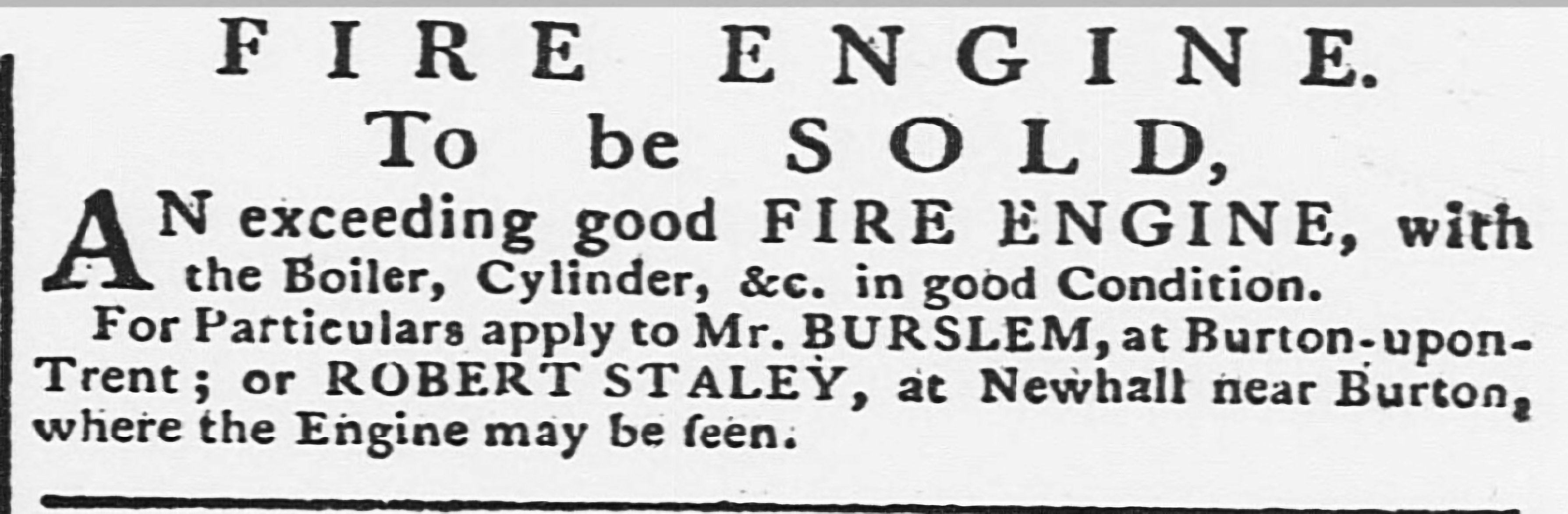
Was the fire engine perhaps connected with a foundry or a coal mine?
I noticed that Robert Staley was the witness at a 1755 marriage in Stapenhill between Barbara Burslem and Richard Daston the younger esquire. The other witness was signed Burslem Jnr.
Looking for Robert Staley
I assumed that once again, in the absence of the correct records, a similarly named and aged persons baptism had been added to the tree regardless of accuracy, so I looked through the Stapenhill/Newhall parish register images page by page. There were no Staleys in Newhall at all in the early 1700s, so it seemed that Robert did come from elsewhere and I expected to find the Staleys in a neighbouring parish. But I still didn’t find any Staleys.
I spoke to a couple of Staley descendants that I’d met during the family research. I met Carole via a DNA match some months previously and contacted her to ask about the Staleys in Elton. She also had Robert Staley born in Elton (indeed, there were many Staleys in Elton) but she didn’t have any documentation for his birth, and we decided to collaborate and try and find out more.
I couldn’t find the earlier Elton parish registers anywhere online, but eventually found the untranscribed microfiche images of the Bishops Transcripts for Elton.
via familysearch:
“In its most basic sense, a bishop’s transcript is a copy of a parish register. As bishop’s transcripts generally contain more or less the same information as parish registers, they are an invaluable resource when a parish register has been damaged, destroyed, or otherwise lost. Bishop’s transcripts are often of value even when parish registers exist, as priests often recorded either additional or different information in their transcripts than they did in the original registers.”Unfortunately there was a gap in the Bishops Transcripts between 1704 and 1711 ~ exactly where I needed to look. I subsequently found out that the Elton registers were incomplete as they had been damaged by fire.
I estimated Robert Staleys date of birth between 1710 and 1715. He died in 1795, and his son Daniel died in 1805: both of these wills were found online. Daniel married Mary Moon in Stapenhill in 1762, making a likely birth date for Daniel around 1740.
The marriage of Robert Staley (assuming this was Robert’s father) and Alice Maceland (or Marsland or Marsden, depending on how the parish clerk chose to spell it presumably) was in the Bishops Transcripts for Elton in 1704. They were married in Elton on 26th February. There followed the missing parish register pages and in all likelihood the records of the baptisms of their first children. No doubt Robert was one of them, probably the first male child.
(Incidentally, my grandfather’s Marshalls also came from Elton, a small Derbyshire village near Matlock. The Staley’s are on my grandmothers Warren side.)
The parish register pages resume in 1711. One of the first entries was the baptism of Robert Staley in 1711, parents Thomas and Ann. This was surely the one we were looking for, and Roberts parents weren’t Robert and Alice.
But then in 1735 a marriage was recorded between Robert son of Robert Staley (and this was unusual, the father of the groom isn’t usually recorded on the parish register) and Elizabeth Milner. They were married on the 9th March 1735. We know that the Robert we were looking for married an Elizabeth, as her name was on the Stapenhill baptisms of their later children, including Joseph Staleys. The 1735 marriage also fit with the assumed birth date of Daniel, circa 1740. A baptism was found for a Robert Staley in 1738 in the Elton registers, parents Robert and Elizabeth, as well as the baptism in 1736 for Mary, presumably their first child. Her burial is recorded the following year.
The marriage of Robert Staley and Elizabeth Milner in 1735:
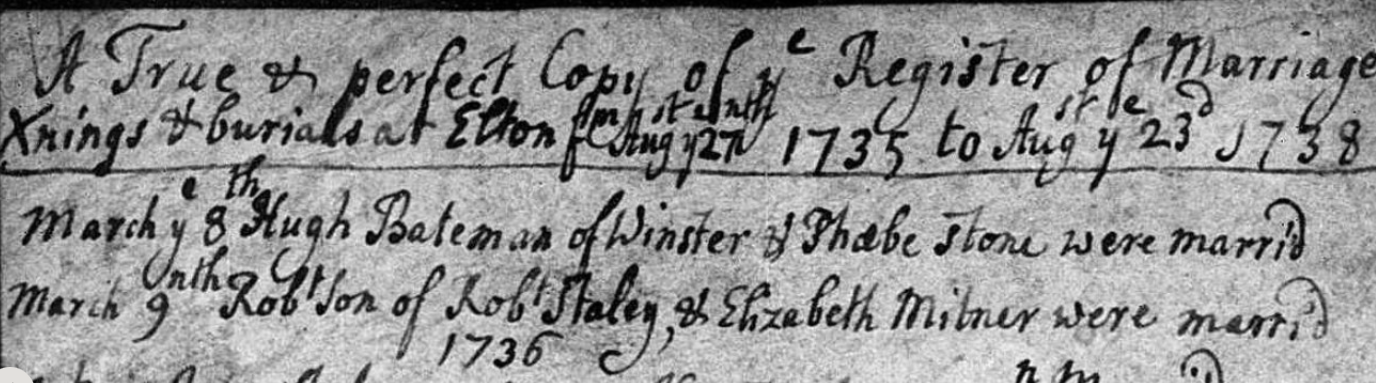
There were several other Staley couples of a similar age in Elton, perhaps brothers and cousins. It seemed that Thomas and Ann’s son Robert was a different Robert, and that the one we were looking for was prior to that and on the missing pages.
Even so, this doesn’t prove that it was Elizabeth Staleys great grandfather who was born in Elton, but no other birth or baptism for Robert Staley has been found. It doesn’t explain why the Staleys moved to Stapenhill either, although the Enclosures Act and the Industrial Revolution could have been factors.
The 18th century saw the rise of the Industrial Revolution and many renowned Derbyshire Industrialists emerged. They created the turning point from what was until then a largely rural economy, to the development of townships based on factory production methods.
The Marsden Connection
There are some possible clues in the records of the Marsden family. Robert Staley married Alice Marsden (or Maceland or Marsland) in Elton in 1704. Robert Staley is mentioned in the 1730 will of John Marsden senior, of Baslow, Innkeeper (Peacock Inne & Whitlands Farm). He mentions his daughter Alice, wife of Robert Staley.
In a 1715 Marsden will there is an intriguing mention of an alias, which might explain the different spellings on various records for the name Marsden: “MARSDEN alias MASLAND, Christopher – of Baslow, husbandman, 28 Dec 1714. son Robert MARSDEN alias MASLAND….” etc.
Some potential reasons for a move from one parish to another are explained in this history of the Marsden family, and indeed this could relate to Robert Staley as he married into the Marsden family and his wife was a beneficiary of a Marsden will. The Chatsworth Estate, at various times, bought a number of farms in order to extend the park.
THE MARSDEN FAMILY
OXCLOSE AND PARKGATE
In the Parishes of
Baslow and Chatsworthby
David Dalrymple-Smith“John Marsden (b1653) another son of Edmund (b1611) faired well. By the time he died in
1730 he was publican of the Peacock, the Inn on Church Lane now called the Cavendish
Hotel, and the farmer at “Whitlands”, almost certainly Bubnell Cliff Farm.”“Coal mining was well known in the Chesterfield area. The coalfield extends as far as the
Gritstone edges, where thin seams outcrop especially in the Baslow area.”“…the occupants were evicted from the farmland below Dobb Edge and
the ground carefully cleared of all traces of occupation and farming. Shelter belts were
planted especially along the Heathy Lea Brook. An imposing new drive was laid to the
Chatsworth House with the Lodges and “The Golden Gates” at its northern end….”Although this particular event was later than any events relating to Robert Staley, it’s an indication of how farms and farmland disappeared, and a reason for families to move to another area:
“The Dukes of Devonshire (of Chatsworth) were major figures in the aristocracy and the government of the
time. Such a position demanded a display of wealth and ostentation. The 6th Duke of
Devonshire, the Bachelor Duke, was not content with the Chatsworth he inherited in 1811,
and immediately started improvements. After major changes around Edensor, he turned his
attention at the north end of the Park. In 1820 plans were made extend the Park up to the
Baslow parish boundary. As this would involve the destruction of most of the Farm at
Oxclose, the farmer at the Higher House Samuel Marsden (b1755) was given the tenancy of
Ewe Close a large farm near Bakewell.
Plans were revised in 1824 when the Dukes of Devonshire and Rutland “Exchanged Lands”,
reputedly during a game of dice. Over 3300 acres were involved in several local parishes, of
which 1000 acres were in Baslow. In the deal Devonshire acquired the southeast corner of
Baslow Parish.
Part of the deal was Gibbet Moor, which was developed for “Sport”. The shelf of land
between Parkgate and Robin Hood and a few extra fields was left untouched. The rest,
between Dobb Edge and Baslow, was agricultural land with farms, fields and houses. It was
this last part that gave the Duke the opportunity to improve the Park beyond his earlier
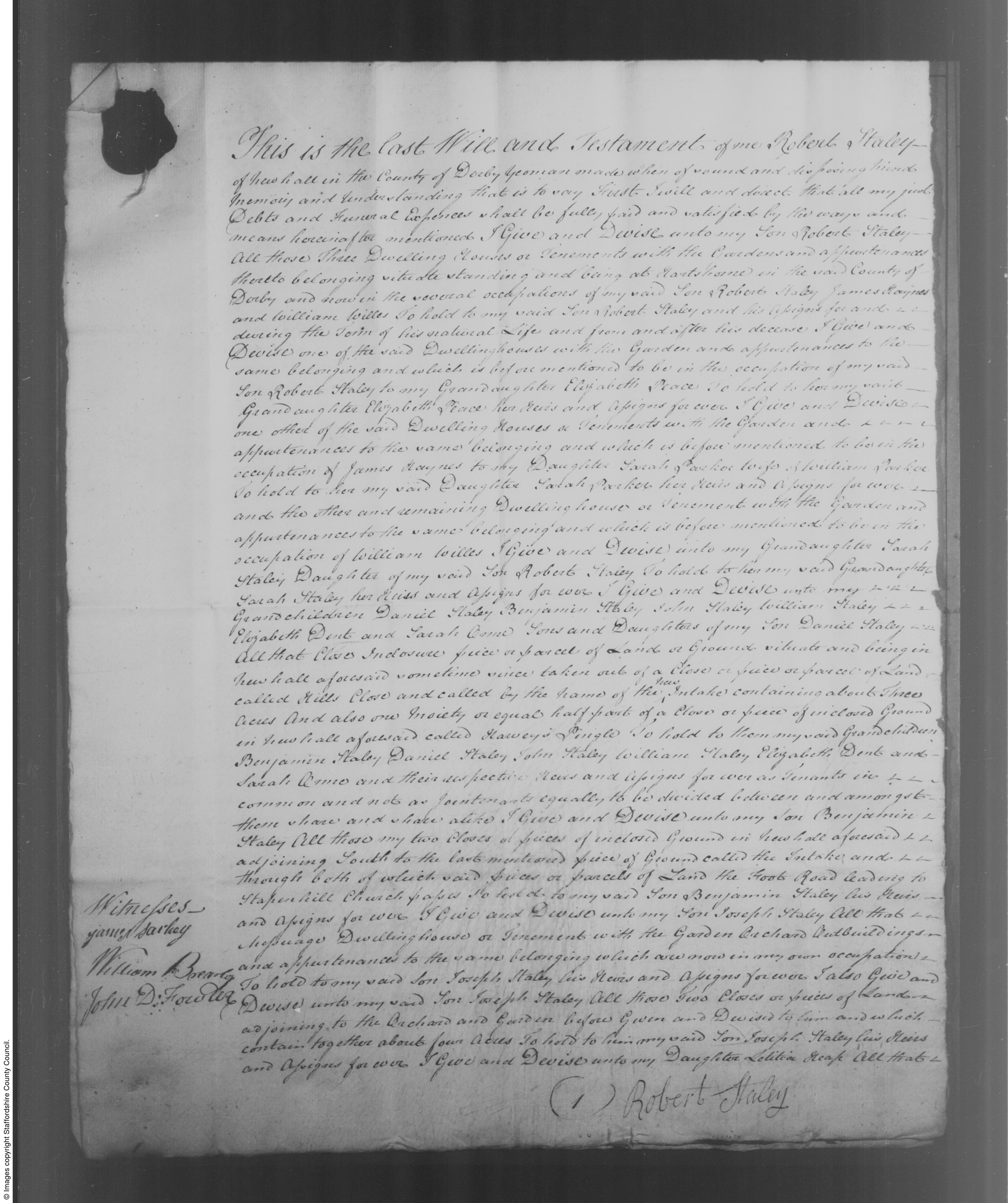
expectations.”The 1795 will of Robert Staley.
Inriguingly, Robert included the children of his son Daniel Staley in his will, but omitted to leave anything to Daniel. A perusal of Daniels 1808 will sheds some light on this: Daniel left his property to his six reputed children with Elizabeth Moon, and his reputed daughter Mary Brearly. Daniels wife was Mary Moon, Elizabeths husband William Moons daughter.
The will of Robert Staley, 1795:
The 1805 will of Daniel Staley, Robert’s son:
This is the last will and testament of me Daniel Staley of the Township of Newhall in the parish of Stapenhill in the County of Derby, Farmer. I will and order all of my just debts, funeral and testamentary expenses to be fully paid and satisfied by my executors hereinafter named by and out of my personal estate as soon as conveniently may be after my decease.
I give, devise and bequeath to Humphrey Trafford Nadin of Church Gresely in the said County of Derby Esquire and John Wilkinson of Newhall aforesaid yeoman all my messuages, lands, tenements, hereditaments and real and personal estates to hold to them, their heirs, executors, administrators and assigns until Richard Moon the youngest of my reputed sons by Elizabeth Moon shall attain his age of twenty one years upon trust that they, my said trustees, (or the survivor of them, his heirs, executors, administrators or assigns), shall and do manage and carry on my farm at Newhall aforesaid and pay and apply the rents, issues and profits of all and every of my said real and personal estates in for and towards the support, maintenance and education of all my reputed children by the said Elizabeth Moon until the said Richard Moon my youngest reputed son shall attain his said age of twenty one years and equally share and share and share alike.
And it is my will and desire that my said trustees or trustee for the time being shall recruit and keep up the stock upon my farm as they in their discretion shall see occasion or think proper and that the same shall not be diminished. And in case any of my said reputed children by the said Elizabeth Moon shall be married before my said reputed youngest son shall attain his age of twenty one years that then it is my will and desire that non of their husbands or wives shall come to my farm or be maintained there or have their abode there. That it is also my will and desire in case my reputed children or any of them shall not be steady to business but instead shall be wild and diminish the stock that then my said trustees or trustee for the time being shall have full power and authority in their discretion to sell and dispose of all or any part of my said personal estate and to put out the money arising from the sale thereof to interest and to pay and apply the interest thereof and also thereunto of the said real estate in for and towards the maintenance, education and support of all my said reputed children by the said
Elizabeth Moon as they my said trustees in their discretion that think proper until the said Richard Moon shall attain his age of twenty one years.Then I give to my grandson Daniel Staley the sum of ten pounds and to each and every of my sons and daughters namely Daniel Staley, Benjamin Staley, John Staley, William Staley, Elizabeth Dent and Sarah Orme and to my niece Ann Brearly the sum of five pounds apiece.
I give to my youngest reputed son Richard Moon one share in the Ashby Canal Navigation and I direct that my said trustees or trustee for the time being shall have full power and authority to pay and apply all or any part of the fortune or legacy hereby intended for my youngest reputed son Richard Moon in placing him out to any trade, business or profession as they in their discretion shall think proper.
And I direct that to my said sons and daughters by my late wife and my said niece shall by wholly paid by my said reputed son Richard Moon out of the fortune herby given him. And it is my will and desire that my said reputed children shall deliver into the hands of my executors all the monies that shall arise from the carrying on of my business that is not wanted to carry on the same unto my acting executor and shall keep a just and true account of all disbursements and receipts of the said business and deliver up the same to my acting executor in order that there may not be any embezzlement or defraud amongst them and from and immediately after my said reputed youngest son Richard Moon shall attain his age of twenty one years then I give, devise and bequeath all my real estate and all the residue and remainder of my personal estate of what nature and kind whatsoever and wheresoever unto and amongst all and every my said reputed sons and daughters namely William Moon, Thomas Moon, Joseph Moon, Richard Moon, Ann Moon, Margaret Moon and to my reputed daughter Mary Brearly to hold to them and their respective heirs, executors, administrator and assigns for ever according to the nature and tenure of the same estates respectively to take the same as tenants in common and not as joint tenants.And lastly I nominate and appoint the said Humphrey Trafford Nadin and John Wilkinson executors of this my last will and testament and guardians of all my reputed children who are under age during their respective minorities hereby revoking all former and other wills by me heretofore made and declaring this only to be my last will.
In witness whereof I the said Daniel Staley the testator have to this my last will and testament set my hand and seal the eleventh day of March in the year of our Lord one thousand eight hundred and five.
June 6, 2022 at 9:17 am #6301In reply to: The Elusive Samuel Housley and Other Family Stories
The Warrens of Stapenhill
There were so many Warren’s in Stapenhill that it was complicated to work out who was who. I had gone back as far as Samuel Warren marrying Catherine Holland, and this was as far back as my cousin Ian Warren had gone in his research some decades ago as well. The Holland family from Barton under Needwood are particularly interesting, and will be a separate chapter.
Stapenhill village by John Harden:
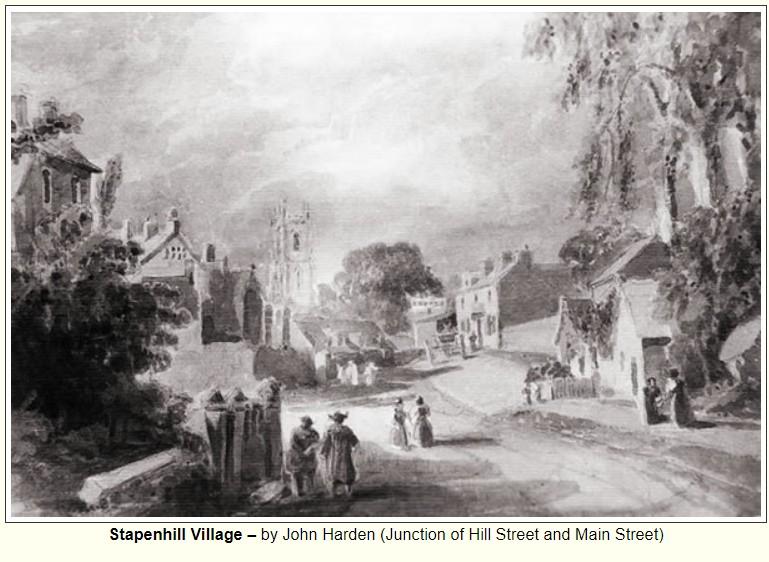
Resuming the research on the Warrens, Samuel Warren 1771-1837 married Catherine Holland 1775-1861 in 1795 and their son Samuel Warren 1800-1882 married Elizabeth Bridge, whose childless brother Benjamin Bridge left the Warren Brothers Boiler Works in Newhall to his nephews, the Warren brothers.
Samuel Warren and Catherine Holland marriage licence 1795:
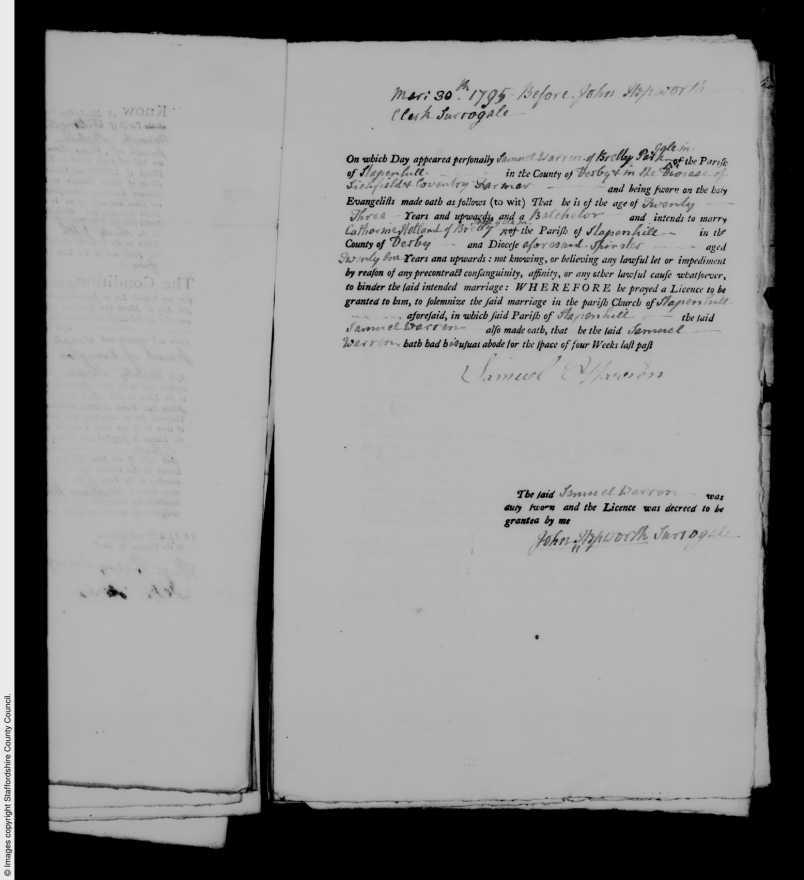
Samuel (born 1771) was baptised at Stapenhill St Peter and his parents were William and Anne Warren. There were at least three William and Ann Warrens in town at the time. One of those William’s was born in 1744, which would seem to be the right age to be Samuel’s father, and one was born in 1710, which seemed a little too old. Another William, Guiliamos Warren (Latin was often used in early parish registers) was baptised in Stapenhill in 1729.
Stapenhill St Peter:
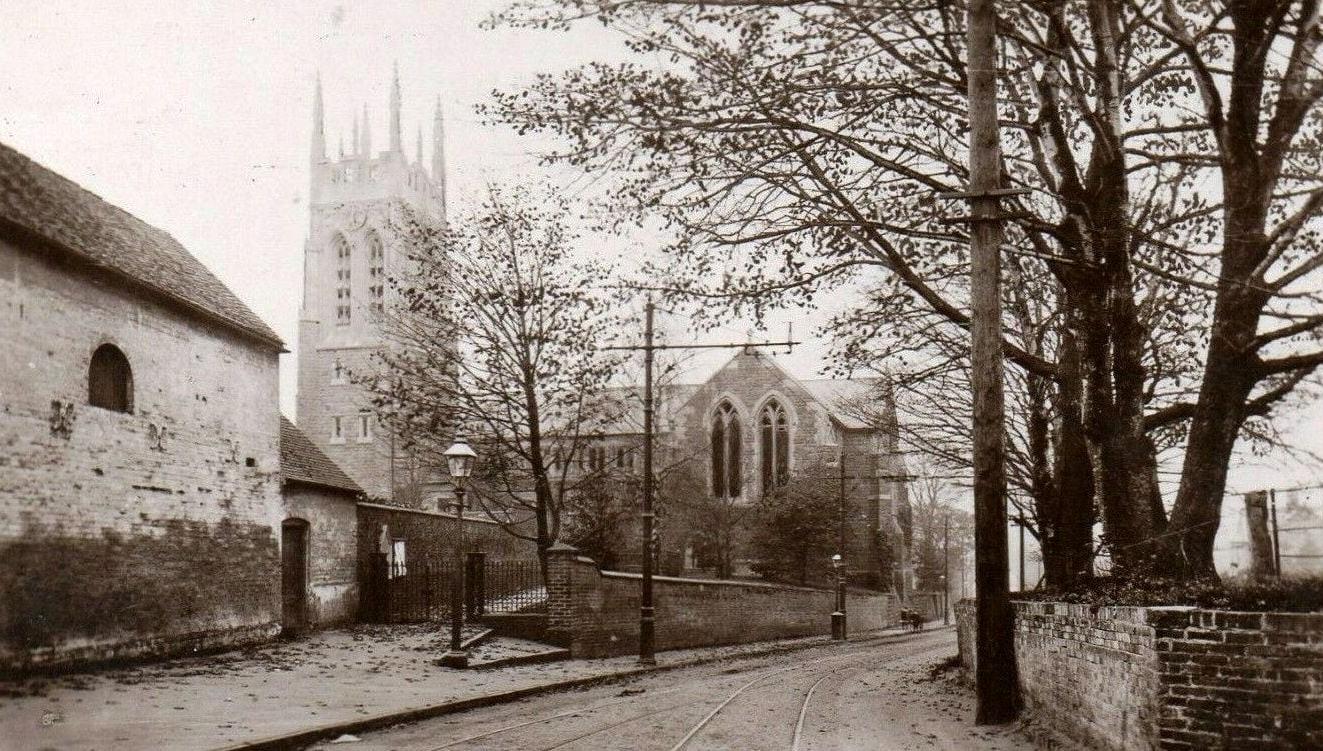
William Warren (born 1744) appeared to have been born several months before his parents wedding. William Warren and Ann Insley married 16 July 1744, but the baptism of William in 1744 was 24 February. This seemed unusual ~ children were often born less than nine months after a wedding, but not usually before the wedding! Then I remembered the change from the Julian calendar to the Gregorian calendar in 1752. Prior to 1752, the first day of the year was Lady Day, March 25th, not January 1st. This meant that the birth in February 1744 was actually after the wedding in July 1744. Now it made sense. The first son was named William, and he was born seven months after the wedding.
William born in 1744 died intestate in 1822, and his wife Ann made a legal claim to his estate. However he didn’t marry Ann Holland (Ann was Catherines Hollands sister, who married Samuel Warren the year before) until 1796, so this William and Ann were not the parents of Samuel.
It seemed likely that William born in 1744 was Samuels brother. William Warren and Ann Insley had at least eight children between 1744 and 1771, and it seems that Samuel was their last child, born when William the elder was 61 and his wife Ann was 47.
It seems it wasn’t unusual for the Warren men to marry rather late in life. William Warren’s (born 1710) parents were William Warren and Elizabeth Hatterton. On the marriage licence in 1702/1703 (it appears to say 1703 but is transcribed as 1702), William was a 40 year old bachelor from Stapenhill, which puts his date of birth at 1662. Elizabeth was considerably younger, aged 19.
William Warren and Elizabeth Hatterton marriage licence 1703:
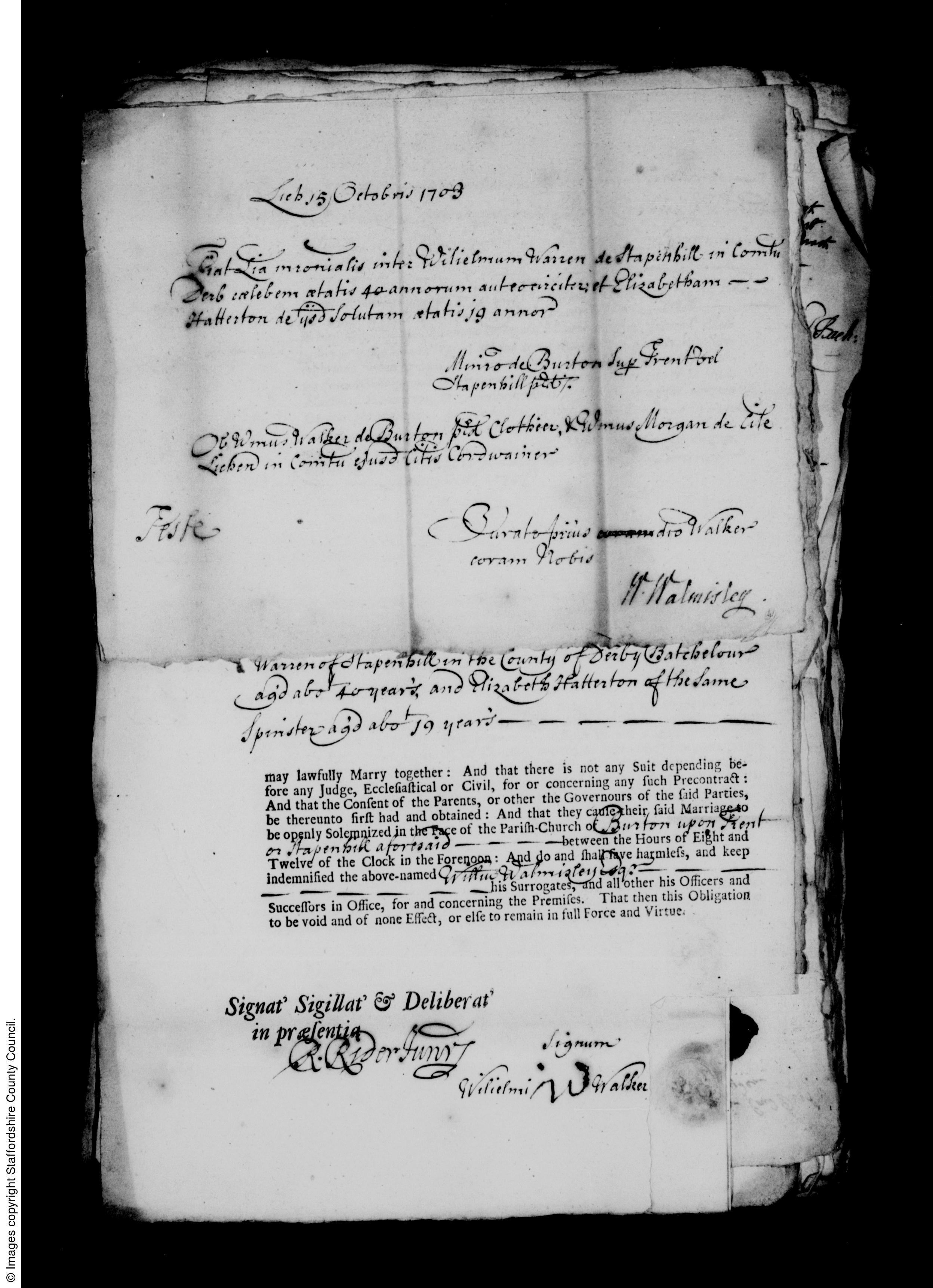
These Warren’s were farmers, and they were literate and able to sign their own names on various documents. This is worth noting, as most made the mark of an X.
I found three Warren and Holland marriages. One was Samuel Warren and Catherine Holland in 1795, then William Warren and Ann Holland in 1796. William Warren and Ann Hollands daughter born in 1799 married John Holland in 1824.
Elizabeth Hatterton (wife of William Warren who was born circa 1662) was born in Burton upon Trent in 1685. Her parents were Edward Hatterton 1655-1722, and Sara.
A page from the 1722 will of Edward Hatterton:
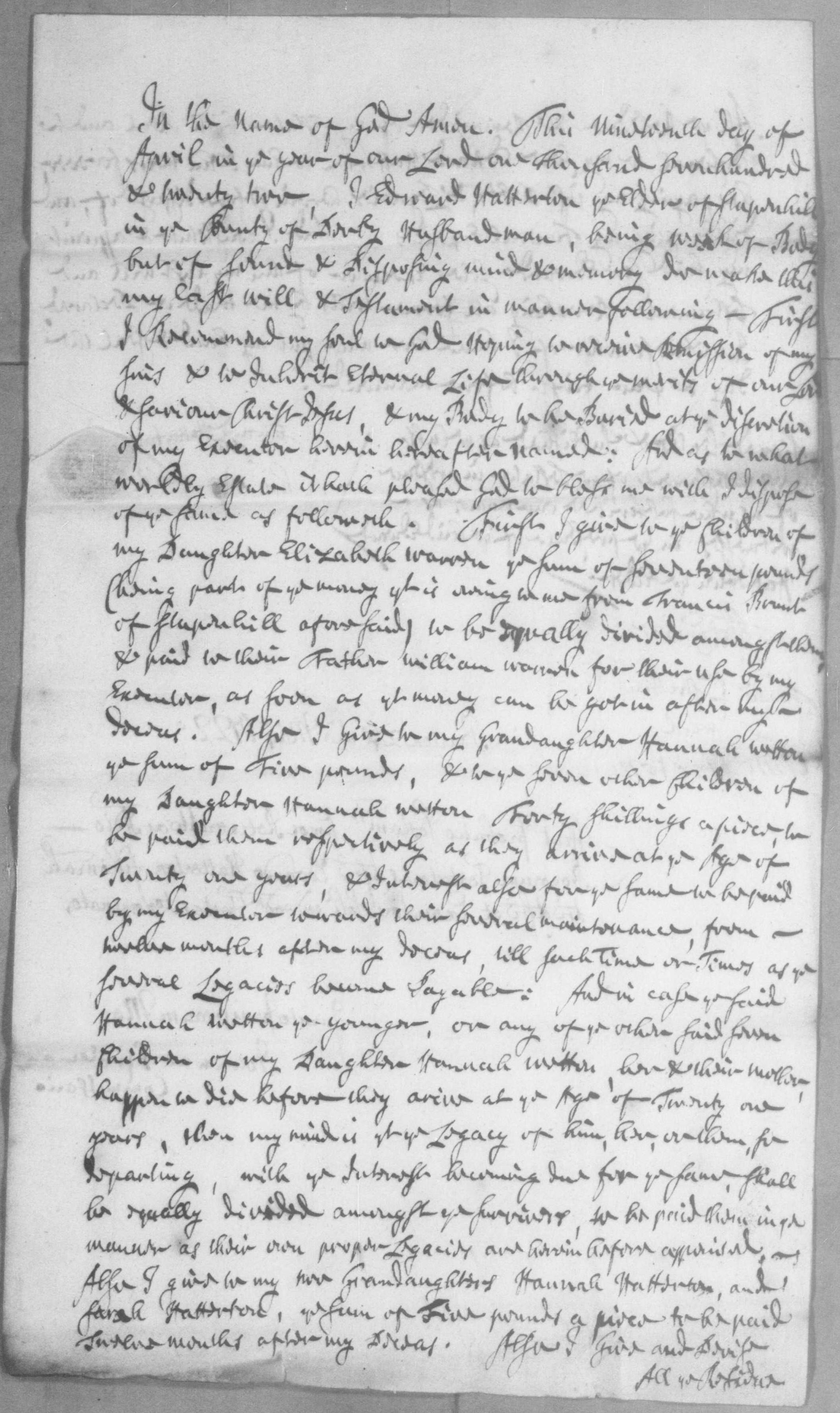
The earliest Warren I found records for was William Warren who married Elizabeth Hatterton in 1703. The marriage licence states his age as 40 and that he was from Stapenhill, but none of the Stapenhill parish records online go back as far as 1662. On other public trees on ancestry websites, a birth record from Suffolk has been chosen, probably because it was the only record to be found online with the right name and date. Once again, I don’t think that is correct, and perhaps one day I’ll find some earlier Stapenhill records to prove that he was born in locally.
Subsequently, I found a list of the 1662 Hearth Tax for Stapenhill. On it were a number of Warrens, three William Warrens including one who was a constable. One of those William Warrens had a son he named William (as they did, hence the number of William Warrens in the tree) the same year as this hearth tax list.
But was it the William Warren with 2 chimneys, the one with one chimney who was too poor to pay it, or the one who was a constable?
from the list:
Will. Warryn 2
Richard Warryn 1
William Warren Constable
These names are not payable by Act:
Will. Warryn 1
Richard Warren John Watson
over seers of the poore and churchwardensThe Hearth Tax:
via wiki:
In England, hearth tax, also known as hearth money, chimney tax, or chimney money, was a tax imposed by Parliament in 1662, to support the Royal Household of King Charles II. Following the Restoration of the monarchy in 1660, Parliament calculated that the Royal Household needed an annual income of £1,200,000. The hearth tax was a supplemental tax to make up the shortfall. It was considered easier to establish the number of hearths than the number of heads, hearths forming a more stationary subject for taxation than people. This form of taxation was new to England, but had precedents abroad. It generated considerable debate, but was supported by the economist Sir William Petty, and carried through the Commons by the influential West Country member Sir Courtenay Pole, 2nd Baronet (whose enemies nicknamed him “Sir Chimney Poll” as a result). The bill received Royal Assent on 19 May 1662, with the first payment due on 29 September 1662, Michaelmas.
One shilling was liable to be paid for every firehearth or stove, in all dwellings, houses, edifices or lodgings, and was payable at Michaelmas, 29 September and on Lady Day, 25 March. The tax thus amounted to two shillings per hearth or stove per year. The original bill contained a practical shortcoming in that it did not distinguish between owners and occupiers and was potentially a major burden on the poor as there were no exemptions. The bill was subsequently amended so that the tax was paid by the occupier. Further amendments introduced a range of exemptions that ensured that a substantial proportion of the poorer people did not have to pay the tax.Indeed it seems clear that William Warren the elder came from Stapenhill and not Suffolk, and one of the William Warrens paying hearth tax in 1662 was undoubtedly the father of William Warren who married Elizabeth Hatterton.
April 12, 2022 at 8:13 am #6290In reply to: The Elusive Samuel Housley and Other Family Stories
Leicestershire Blacksmiths
The Orgill’s of Measham led me further into Leicestershire as I traveled back in time.
I also realized I had uncovered a direct line of women and their mothers going back ten generations:
myself, Tracy Edwards 1957-
my mother Gillian Marshall 1933-
my grandmother Florence Warren 1906-1988
her mother and my great grandmother Florence Gretton 1881-1927
her mother Sarah Orgill 1840-1910
her mother Elizabeth Orgill 1803-1876
her mother Sarah Boss 1783-1847
her mother Elizabeth Page 1749-
her mother Mary Potter 1719-1780
and her mother and my 7x great grandmother Mary 1680-You could say it leads us to the very heart of England, as these Leicestershire villages are as far from the coast as it’s possible to be. There are countless other maternal lines to follow, of course, but only one of mothers of mothers, and ours takes us to Leicestershire.
The blacksmiths
Sarah Boss was the daughter of Michael Boss 1755-1807, a blacksmith in Measham, and Elizabeth Page of nearby Hartshorn, just over the county border in Derbyshire.
An earlier Michael Boss, a blacksmith of Measham, died in 1772, and in his will he left the possession of the blacksmiths shop and all the working tools and a third of the household furniture to Michael, who he named as his nephew. He left his house in Appleby Magna to his wife Grace, and five pounds to his mother Jane Boss. As none of Michael and Grace’s children are mentioned in the will, perhaps it can be assumed that they were childless.
The will of Michael Boss, 1772, Measham:
Michael Boss the uncle was born in Appleby Magna in 1724. His parents were Michael Boss of Nelson in the Thistles and Jane Peircivall of Appleby Magna, who were married in nearby Mancetter in 1720.
Information worth noting on the Appleby Magna website:
In 1752 the calendar in England was changed from the Julian Calendar to the Gregorian Calendar, as a result 11 days were famously “lost”. But for the recording of Church Registers another very significant change also took place, the start of the year was moved from March 25th to our more familiar January 1st.
Before 1752 the 1st day of each new year was March 25th, Lady Day (a significant date in the Christian calendar). The year number which we all now use for calculating ages didn’t change until March 25th. So, for example, the day after March 24th 1750 was March 25th 1751, and January 1743 followed December 1743.
This March to March recording can be seen very clearly in the Appleby Registers before 1752. Between 1752 and 1768 there appears slightly confused recording, so dates should be carefully checked. After 1768 the recording is more fully by the modern calendar year.Michael Boss the uncle married Grace Cuthbert. I haven’t yet found the birth or parents of Grace, but a blacksmith by the name of Edward Cuthbert is mentioned on an Appleby Magna history website:
An Eighteenth Century Blacksmith’s Shop in Little Appleby
by Alan RobertsCuthberts inventory
The inventory of Edward Cuthbert provides interesting information about the household possessions and living arrangements of an eighteenth century blacksmith. Edward Cuthbert (als. Cutboard) settled in Appleby after the Restoration to join the handful of blacksmiths already established in the parish, including the Wathews who were prominent horse traders. The blacksmiths may have all worked together in the same shop at one time. Edward and his wife Sarah recorded the baptisms of several of their children in the parish register. Somewhat sadly three of the boys named after their father all died either in infancy or as young children. Edward’s inventory which was drawn up in 1732, by which time he was probably a widower and his children had left home, suggests that they once occupied a comfortable two-storey house in Little Appleby with an attached workshop, well equipped with all the tools for repairing farm carts, ploughs and other implements, for shoeing horses and for general ironmongery.
Edward Cuthbert born circa 1660, married Joane Tuvenet in 1684 in Swepston cum Snarestone , and died in Appleby in 1732. Tuvenet is a French name and suggests a Huguenot connection, but this isn’t our family, and indeed this Edward Cuthbert is not likely to be Grace’s father anyway.
Michael Boss and Elizabeth Page appear to have married twice: once in 1776, and once in 1779. Both of the documents exist and appear correct. Both marriages were by licence. They both mention Michael is a blacksmith.
Their first daughter, Elizabeth, was baptized in February 1777, just nine months after the first wedding. It’s not known when she was born, however, and it’s possible that the marriage was a hasty one. But why marry again three years later?
But Michael Boss and Elizabeth Page did not marry twice.
Elizabeth Page from Smisby was born in 1752 and married Michael Boss on the 5th of May 1776 in Measham. On the marriage licence allegations and bonds, Michael is a bachelor.
Baby Elizabeth was baptised in Measham on the 9th February 1777. Mother Elizabeth died on the 18th February 1777, also in Measham.
In 1779 Michael Boss married another Elizabeth Page! She was born in 1749 in Hartshorn, and Michael is a widower on the marriage licence allegations and bonds.
Hartshorn and Smisby are neighbouring villages, hence the confusion. But a closer look at the documents available revealed the clues. Both Elizabeth Pages were literate, and indeed their signatures on the marriage registers are different:
Marriage of Michael Boss and Elizabeth Page of Smisby in 1776:
Marriage of Michael Boss and Elizabeth Page of Harsthorn in 1779:
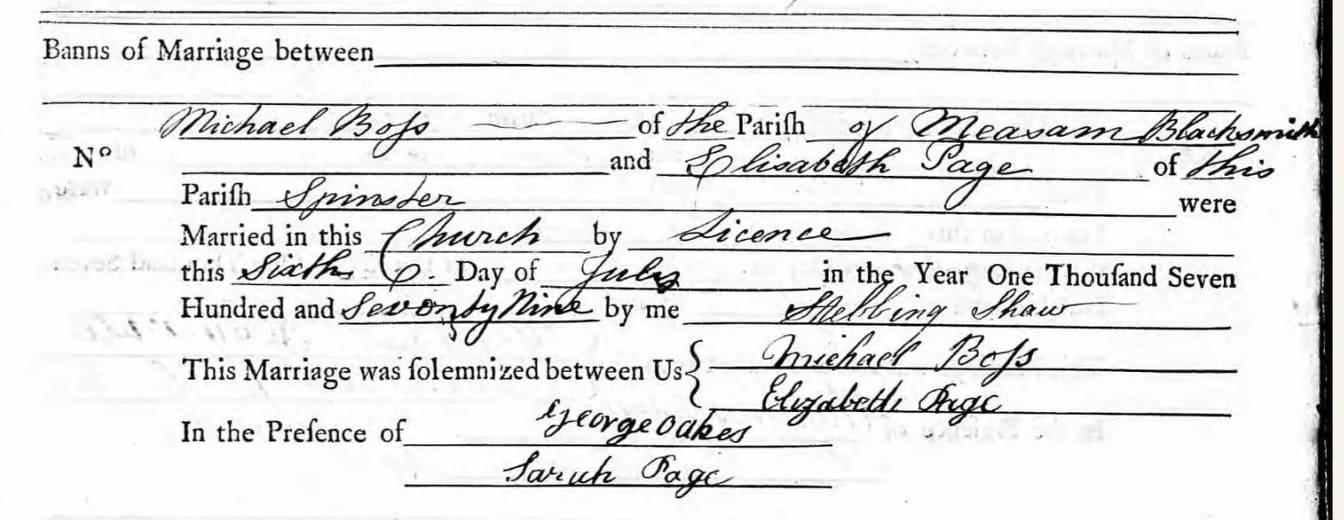
Not only did Michael Boss marry two women both called Elizabeth Page but he had an unusual start in life as well. His uncle Michael Boss left him the blacksmith business and a third of his furniture. This was all in the will. But which of Uncle Michaels brothers was nephew Michaels father?
The only Michael Boss born at the right time was in 1750 in Edingale, Staffordshire, about eight miles from Appleby Magna. His parents were Thomas Boss and Ann Parker, married in Edingale in 1747. Thomas died in August 1750, and his son Michael was baptised in the December, posthumus son of Thomas and his widow Ann. Both entries are on the same page of the register.
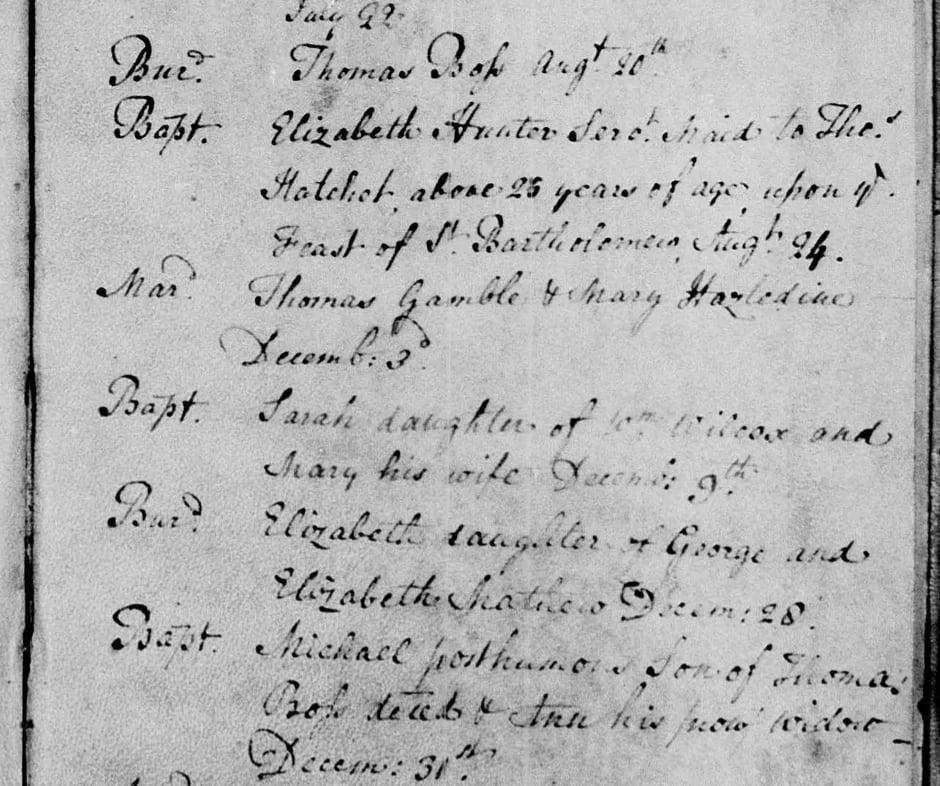
Ann Boss, the young widow, married again. But perhaps Michael and his brother went to live with their childless uncle and aunt, Michael Boss and Grace Cuthbert.
The great grandfather of Michael Boss (the Measham blacksmith born in 1850) was also Michael Boss, probably born in the 1660s. He died in Newton Regis in Warwickshire in 1724, four years after his son (also Michael Boss born 1693) married Jane Peircivall. The entry on the parish register states that Michael Boss was buried ye 13th Affadavit made.
I had not seen affadavit made on a parish register before, and this relates to the The Burying in Woollen Acts 1666–80. According to Wikipedia:
“Acts of the Parliament of England which required the dead, except plague victims and the destitute, to be buried in pure English woollen shrouds to the exclusion of any foreign textiles. It was a requirement that an affidavit be sworn in front of a Justice of the Peace (usually by a relative of the deceased), confirming burial in wool, with the punishment of a £5 fee for noncompliance. Burial entries in parish registers were marked with the word “affidavit” or its equivalent to confirm that affidavit had been sworn; it would be marked “naked” for those too poor to afford the woollen shroud. The legislation was in force until 1814, but was generally ignored after 1770.”
Michael Boss buried 1724 “Affadavit made”:
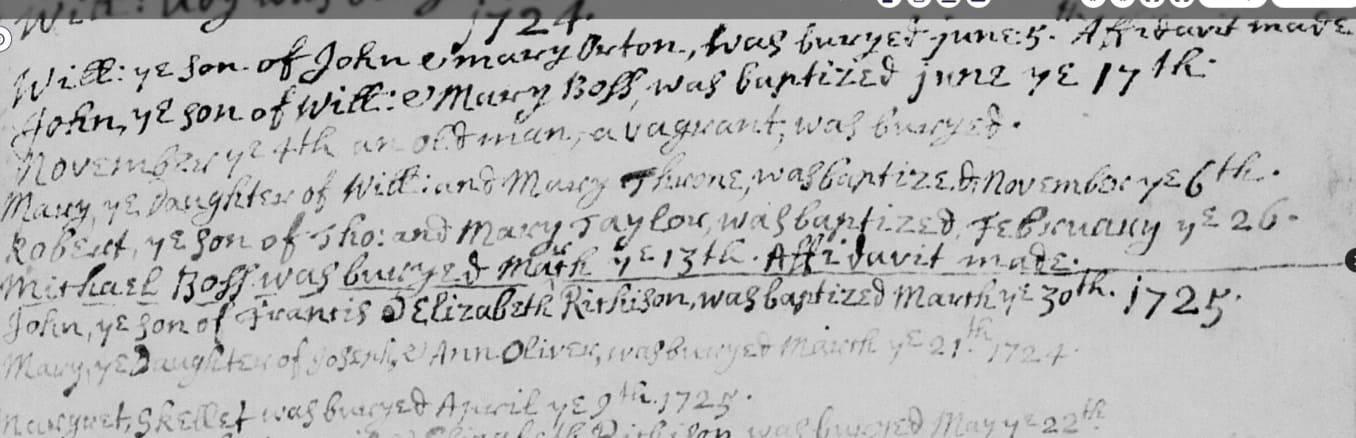
Elizabeth Page‘s father was William Page 1717-1783, a wheelwright in Hartshorn. (The father of the first wife Elizabeth was also William Page, but he was a husbandman in Smisby born in 1714. William Page, the father of the second wife, was born in Nailstone, Leicestershire, in 1717. His place of residence on his marriage to Mary Potter was spelled Nelson.)
Her mother was Mary Potter 1719- of nearby Coleorton. Mary’s father, Richard Potter 1677-1731, was a blacksmith in Coleorton.
A page of the will of Richard Potter 1731:
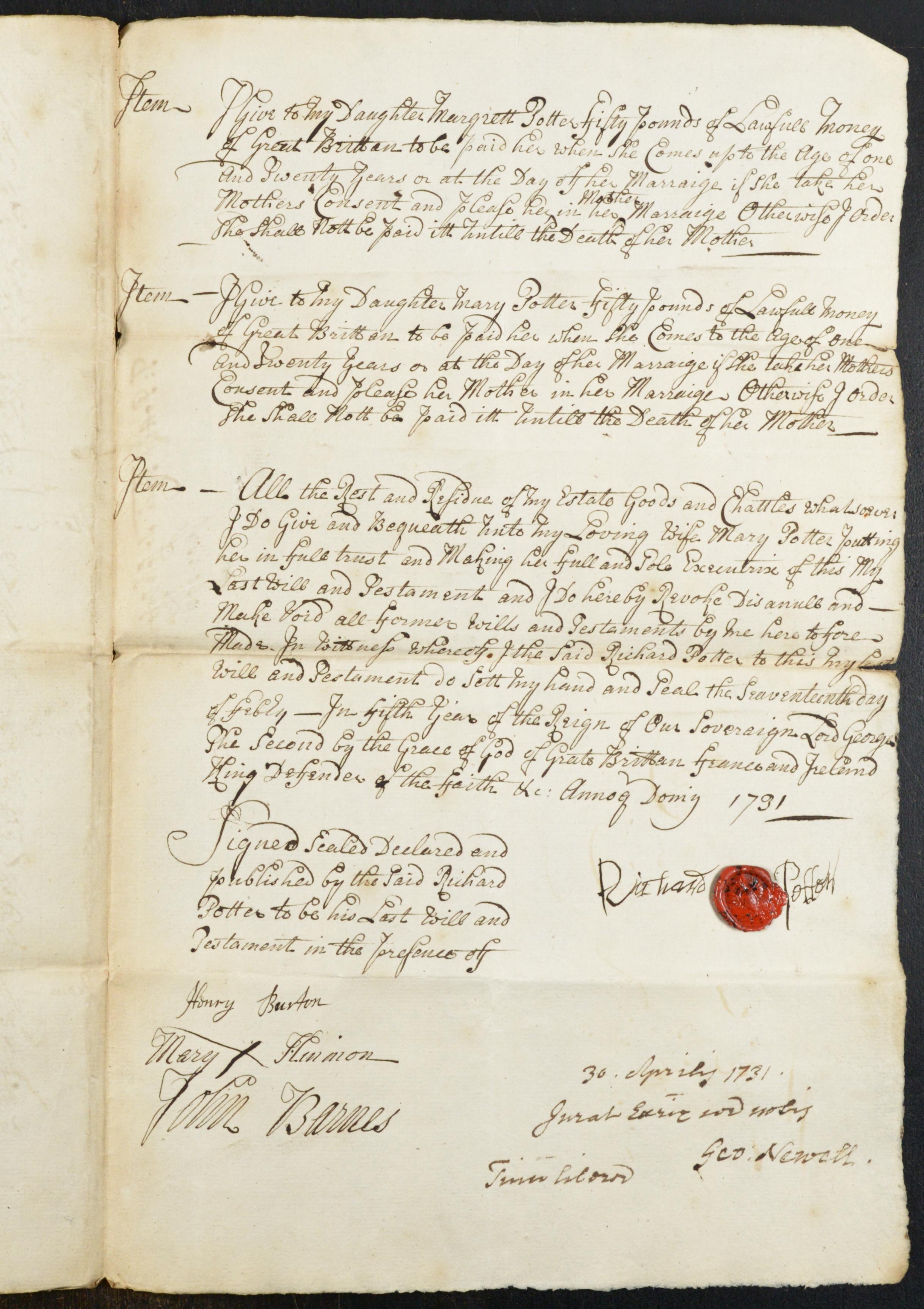
Richard Potter states: “I will and order that my son Thomas Potter shall after my decease have one shilling paid to him and no more.” As he left £50 to each of his daughters, one can’t help but wonder what Thomas did to displease his father.
Richard stipulated that his son Thomas should have one shilling paid to him and not more, for several good considerations, and left “the house and ground lying in the parish of Whittwick in a place called the Long Lane to my wife Mary Potter to dispose of as she shall think proper.”
His son Richard inherited the blacksmith business: “I will and order that my son Richard Potter shall live and be with his mother and serve her duly and truly in the business of a blacksmith, and obey and serve her in all lawful commands six years after my decease, and then I give to him and his heirs…. my house and grounds Coulson House in the Liberty of Thringstone”
Richard wanted his son John to be a blacksmith too: “I will and order that my wife bring up my son John Potter at home with her and teach or cause him to be taught the trade of a blacksmith and that he shall serve her duly and truly seven years after my decease after the manner of an apprentice and at the death of his mother I give him that house and shop and building and the ground belonging to it which I now dwell in to him and his heirs forever.”
To his daughters Margrett and Mary Potter, upon their reaching the age of one and twenty, or the day after their marriage, he leaves £50 each. All the rest of his goods are left to his loving wife Mary.
An inventory of the belongings of Richard Potter, 1731:
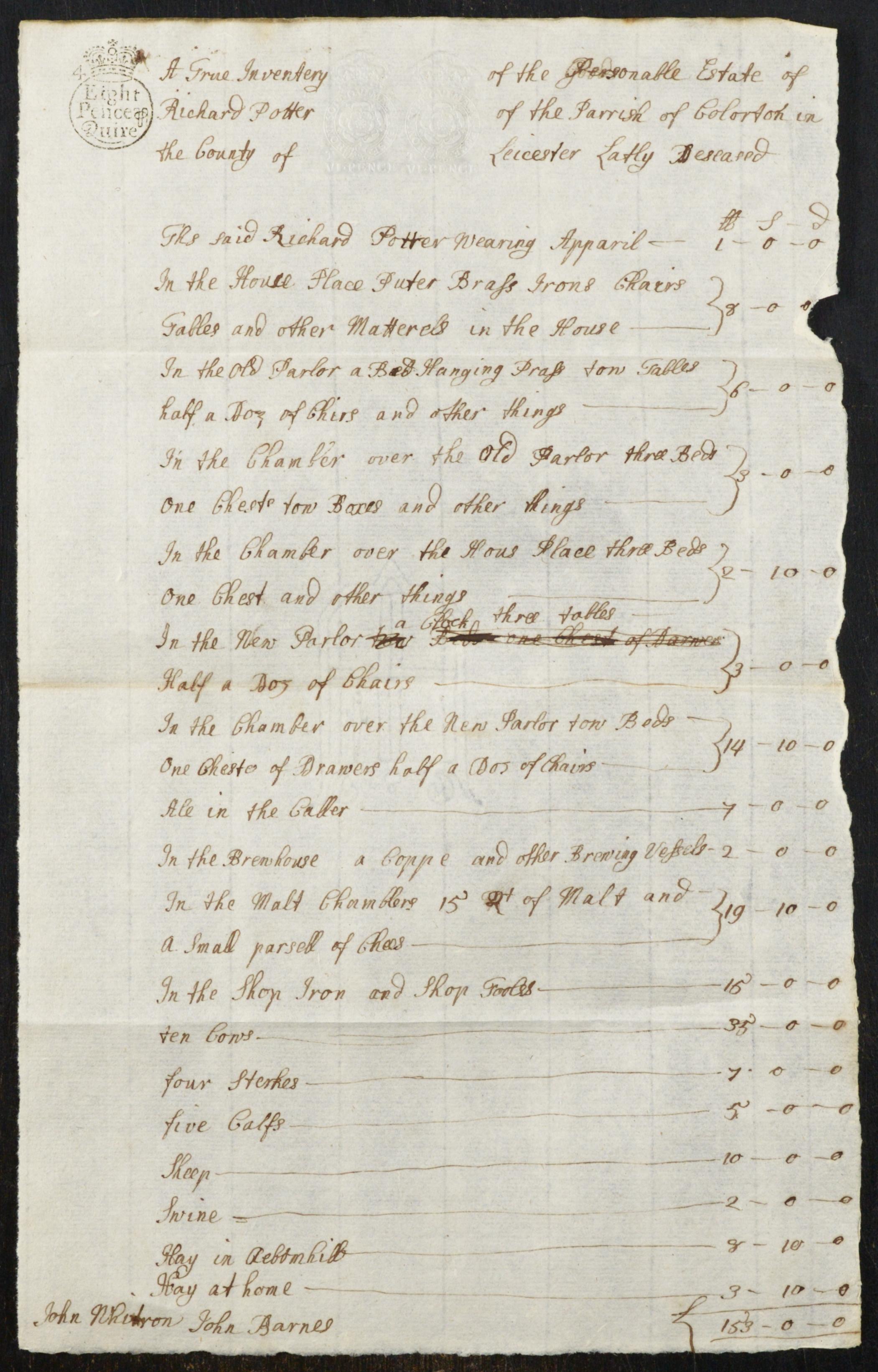
Richard Potters father was also named Richard Potter 1649-1719, and he too was a blacksmith.
Richard Potter of Coleorton in the county of Leicester, blacksmith, stated in his will: “I give to my son and daughter Thomas and Sarah Potter the possession of my house and grounds.”
He leaves ten pounds each to his daughters Jane and Alice, to his son Francis he gives five pounds, and five shillings to his son Richard. Sons Joseph and William also receive five shillings each. To his daughter Mary, wife of Edward Burton, and her daughter Elizabeth, he gives five shillings each. The rest of his good, chattels and wordly substance he leaves equally between his son and daugter Thomas and Sarah. As there is no mention of his wife, it’s assumed that she predeceased him.
The will of Richard Potter, 1719:
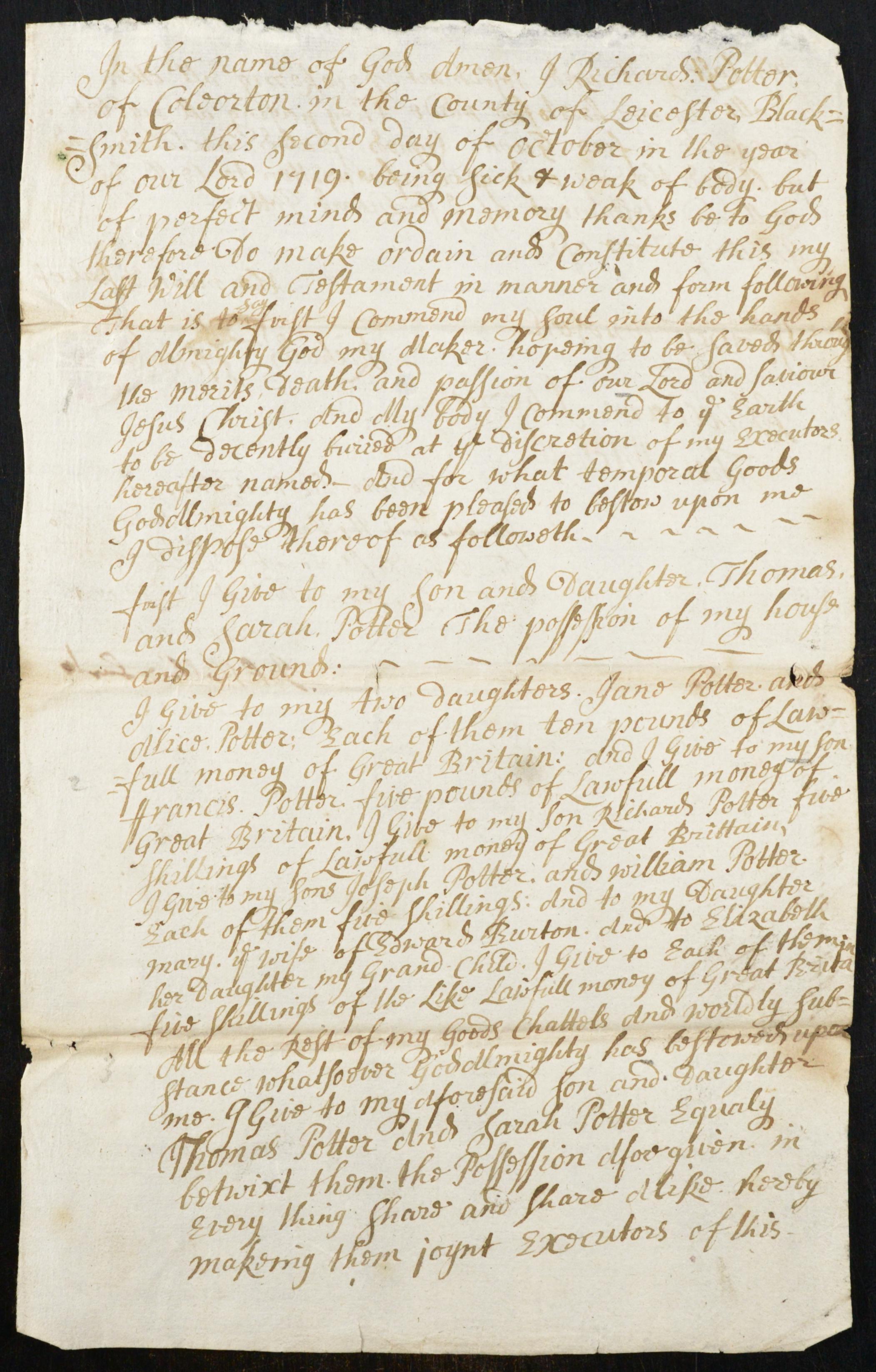
Richard Potter’s (1649-1719) parents were William Potter and Alse Huldin, both born in the early 1600s. They were married in 1646 at Breedon on the Hill, Leicestershire. The name Huldin appears to originate in Finland.
William Potter was a blacksmith. In the 1659 parish registers of Breedon on the Hill, William Potter of Breedon blacksmith buryed the 14th July.
April 2, 2022 at 6:15 pm #6286In reply to: The Elusive Samuel Housley and Other Family Stories
Matthew Orgill and His Family
Matthew Orgill 1828-1907 was the Orgill brother who went to Australia, but returned to Measham. Matthew married Mary Orgill in Measham in October 1856, having returned from Victoria, Australia in May of that year.
Although Matthew was the first Orgill brother to go to Australia, he was the last one I found, and that was somewhat by accident, while perusing “Orgill” and “Measham” in a newspaper archives search. I chanced on Matthew’s obituary in the Nuneaton Observer, Friday 14 June 1907:
LATE MATTHEW ORGILL PEACEFUL END TO A BLAMELESS LIFE.
‘Sunset and Evening Star And one clear call for me.”
It is with very deep regret that we have to announce the death of Mr. Matthew Orgill, late of Measham, who passed peacefully away at his residence in Manor Court Road, Nuneaton, in the early hours of yesterday morning. Mr. Orgill, who was in his eightieth year, was a man with a striking history, and was a very fine specimen of our best English manhood. In early life be emigrated to South Africa—sailing in the “Hebrides” on 4th February. 1850—and was one of the first settlers at the Cape; afterwards he went on to Australia at the time of the Gold Rush, and ultimately came home to his native England and settled down in Measham, in Leicestershire, where he carried on a successful business for the long period of half-a-century.
He was full of reminiscences of life in the Colonies in the early days, and an hour or two in his company was an education itself. On the occasion of the recall of Sir Harry Smith from the Governorship of Natal (for refusing to be a party to the slaying of the wives and children in connection with the Kaffir War), Mr. Orgill was appointed to superintend the arrangements for the farewell demonstration. It was one of his boasts that he made the first missionary cart used in South Africa, which is in use to this day—a monument to the character of his work; while it is an interesting fact to note that among Mr. Orgill’s papers there is the original ground-plan of the city of Durban before a single house was built.
In Africa Mr. Orgill came in contact with the great missionary, David Livingstone, and between the two men there was a striking resemblance in character and a deep and lasting friendship. Mr. Orgill could give a most graphic description of the wreck of the “Birkenhead,” having been in the vicinity at the time when the ill-fated vessel went down. He played a most prominent part on the occasion of the famous wreck of the emigrant ship, “Minerva.” when, in conjunction with some half-a-dozen others, and at the eminent risk of their own lives, they rescued more than 100 of the unfortunate passengers. He was afterwards presented with an interesting relic as a memento of that thrilling experience, being a copper bolt from the vessel on which was inscribed the following words: “Relic of the ship Minerva, wrecked off Bluff Point, Port Natal. 8.A.. about 2 a.m.. Friday, July 5, 1850.”
Mr. Orgill was followed to the Colonies by no fewer than six of his brothers, all of whom did well, and one of whom married a niece (brother’s daughter) of the late Mr. William Ewart Gladstone.
On settling down in Measham his kindly and considerate disposition soon won for him a unique place in the hearts of all the people, by whom he was greatly beloved. He was a man of sterling worth and integrity. Upright and honourable in all his dealings, he led a Christian life that was a pattern to all with whom he came in contact, and of him it could truly he said that he wore the white flower of a blameless life.
He was a member of the Baptist Church, and although beyond much active service since settling down in Nuneaton less than two years ago he leaves behind him a record in Christian service attained by few. In politics he was a Radical of the old school. A great reader, he studied all the questions of the day, and could back up every belief he held by sound and fearless argument. The South African – war was a great grief to him. He knew the Boers from personal experience, and although he suffered at the time of the war for his outspoken condemnation, he had the satisfaction of living to see the people of England fully recognising their awful blunder. To give anything like an adequate idea of Mr. Orgill’s history would take up a great amount of space, and besides much of it has been written and commented on before; suffice it to say that it was strenuous, interesting, and eventful, and yet all through his hands remained unspotted and his heart was pure.
He is survived by three daughters, and was father-in-law to Mr. J. S. Massey. St Kilda. Manor Court Road, to whom deep and loving sympathy is extended in their sore bereavement by a wide circle of friends. The funeral is arranged to leave for Measham on Monday at twelve noon.
“To give anything like an adequate idea of Mr. Orgill’s history would take up a great amount of space, and besides much of it has been written and commented on before…”
I had another look in the newspaper archives and found a number of articles mentioning him, including an intriguing excerpt in an article about local history published in the Burton Observer and Chronicle 8 August 1963:
on an upstairs window pane he scratched with his diamond ring “Matthew Orgill, 1st July, 1858”
I asked on a Measham facebook group if anyone knew the location of the house mentioned in the article and someone kindly responded. This is the same building, seen from either side:
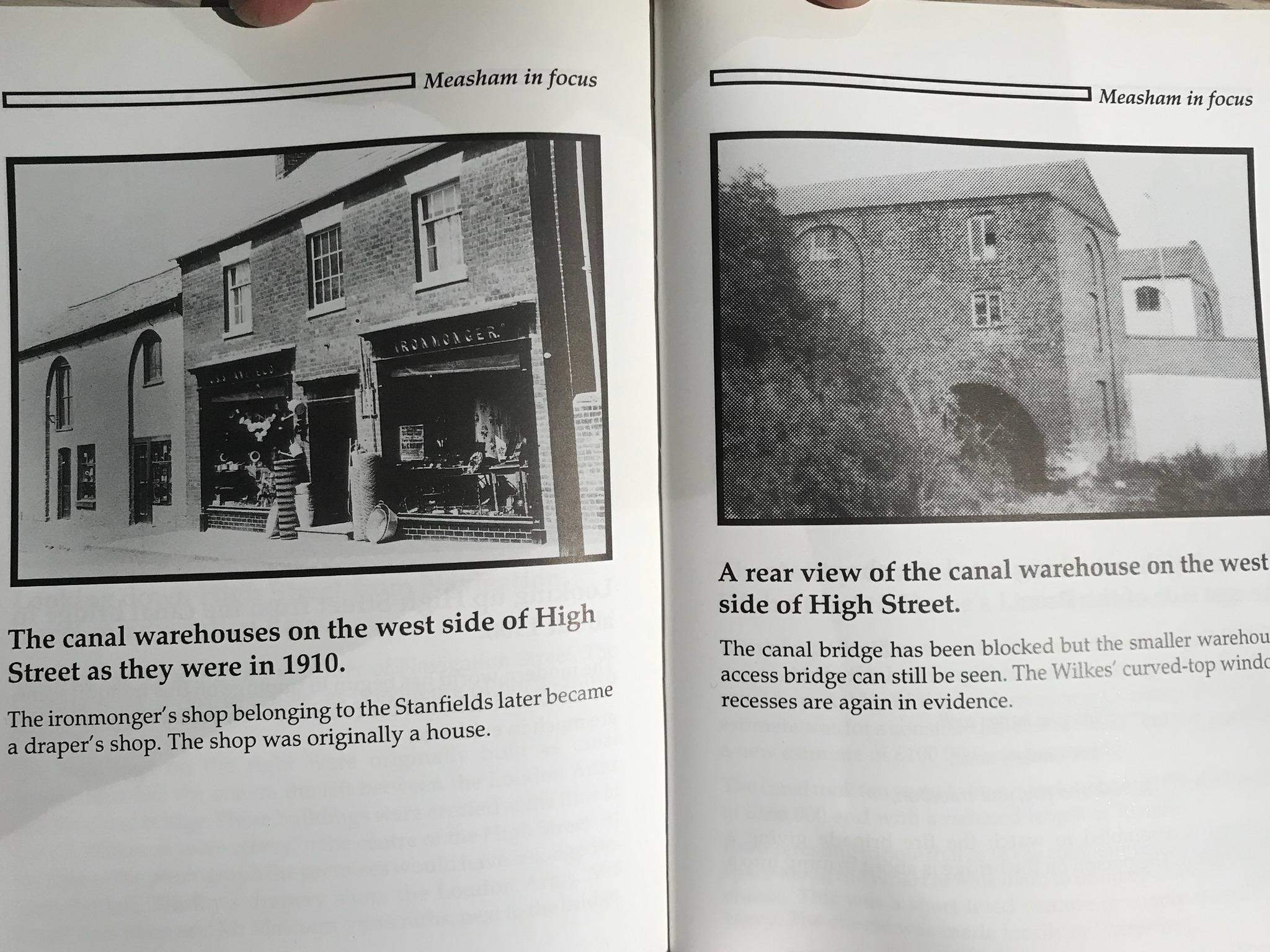
Coincidentally, I had already found this wonderful photograph of the same building, taken in 1910 ~ three years after Matthew’s death.
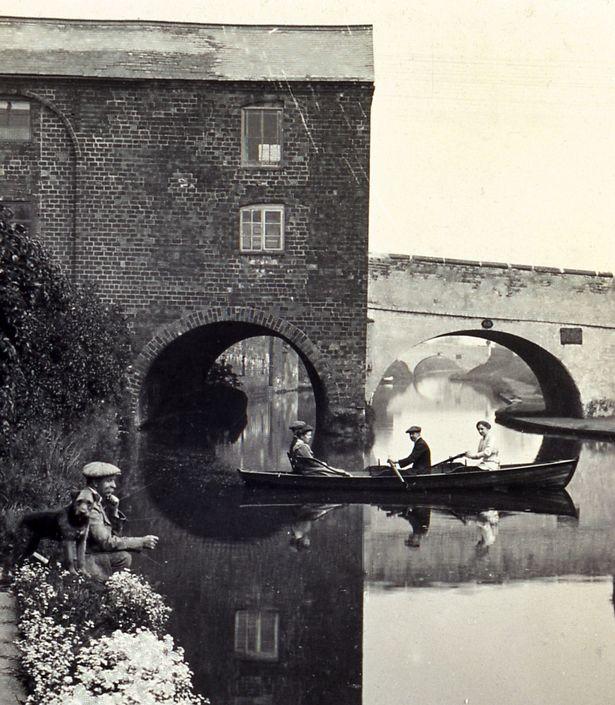
But what to make of the inscription in the window?
Matthew and Mary married in October 1856, and their first child (according to the records I’d found thus far) was a daughter Mary born in 1860. I had a look for a Matthew Orgill birth registered in 1858, the date Matthew had etched on the window, and found a death for a Matthew Orgill in 1859. Assuming I would find the birth of Matthew Orgill registered on the first of July 1958, to match the etching in the window, the corresponding birth was in July 1857!
Matthew and Mary had four children. Matthew, Mary, Clara and Hannah. Hannah Proudman Orgill married Joseph Stanton Massey. The Orgill name continues with their son Stanley Orgill Massey 1900-1979, who was a doctor and surgeon. Two of Stanley’s four sons were doctors, Paul Mackintosh Orgill Massey 1929-2009, and Michael Joseph Orgill Massey 1932-1989.
Mary Orgill 1827-1894, Matthews wife, was an Orgill too.
And this is where the Orgill branch of the tree gets complicated.
Mary’s father was Henry Orgill born in 1805 and her mother was Hannah Proudman born in 1805.
Henry Orgill’s father was Matthew Orgill born in 1769 and his mother was Frances Finch born in 1771.Mary’s husband Matthews parents are Matthew Orgill born in 1798 and Elizabeth Orgill born in 1803.
Another Orgill Orgill marriage!
Matthews parents, Matthew and Elizabeth, have the same grandparents as each other, Matthew Orgill born in 1736 and Ann Proudman born in 1735.
But Matthews grandparents are none other than Matthew Orgill born in 1769 and Frances Finch born in 1771 ~ the same grandparents as his wife Mary!
March 10, 2022 at 7:40 am #6281In reply to: The Elusive Samuel Housley and Other Family Stories
The Measham Thatchers
Orgills, Finches and Wards
Measham is a large village in north west Leicestershire, England, near the Derbyshire, Staffordshire and Warwickshire boundaries. Our family has a penchant for border straddling, and the Orgill’s of Measham take this a step further living on the boundaries of four counties. Historically it was in an exclave of Derbyshire absorbed into Leicestershire in 1897, so once again we have two sets of county records to search.
ORGILL
Richard Gretton, the baker of Swadlincote and my great grandmother Florence Nightingale Grettons’ father, married Sarah Orgill (1840-1910) in 1861.
(Incidentally, Florence Nightingale Warren nee Gretton’s first child Hildred born in 1900 had the middle name Orgill. Florence’s brother John Orgill Gretton emigrated to USA.)
When they first married, they lived with Sarah’s widowed mother Elizabeth in Measham. Elizabeth Orgill is listed on the 1861 census as a farmer of two acres.
Sarah Orgill’s father Matthew Orgill (1798-1859) was a thatcher, as was his father Matthew Orgill (1771-1852).
Matthew Orgill the elder left his property to his son Henry:
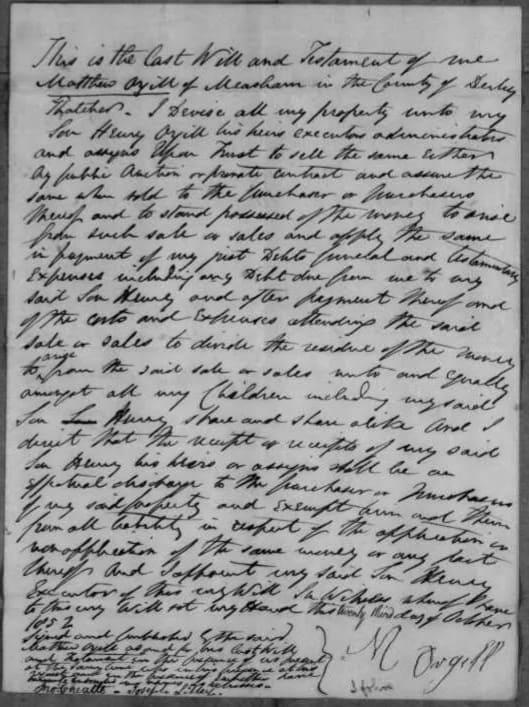
Sarah’s mother Elizabeth (1803-1876) was also an Orgill before her marriage to Matthew.
According to Pigot & Co’s Commercial Directory for Derbyshire, in Measham in 1835 Elizabeth Orgill was a straw bonnet maker, an ideal occupation for a thatchers wife.
Matthew Orgill, thatcher, is listed in White’s directory in 1857, and other Orgill’s are mentioned in Measham:
Mary Orgill, straw hat maker; Henry Orgill, grocer; Daniel Orgill, painter; another Matthew Orgill is a coal merchant and wheelwright. Likewise a number of Orgill’s are listed in the directories for Measham in the subsequent years, as farmers, plumbers, painters, grocers, thatchers, wheelwrights, coal merchants and straw bonnet makers.
Matthew and Elizabeth Orgill, Measham Baptist church:
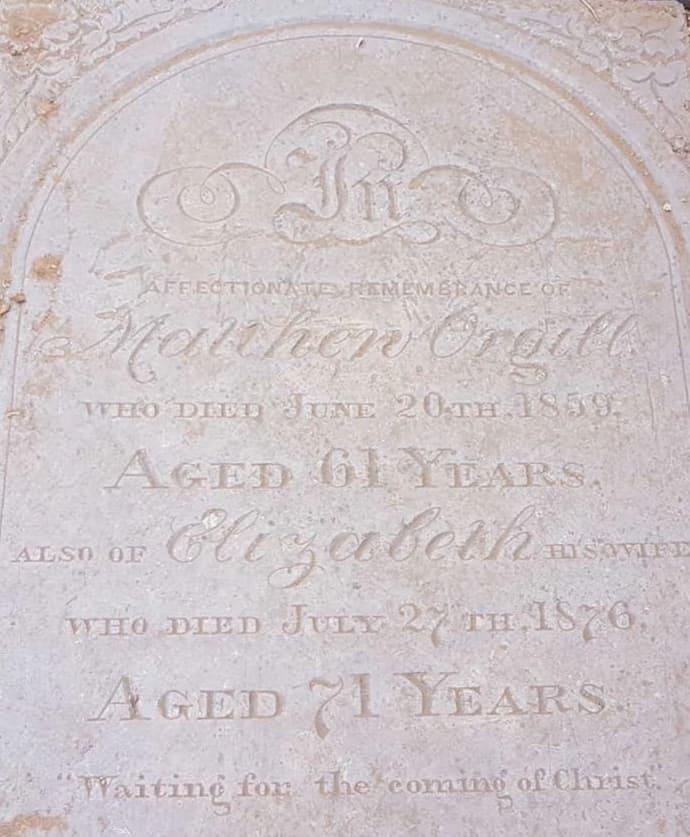
According to a history of thatching, for every six or seven thatchers appearing in the 1851 census there are now less than one. Another interesting fact in the history of thatched roofs (via thatchinginfo dot com):
The Watling Street Divide…
The biggest dividing line of all, that between the angular thatching of the Northern and Eastern traditions and the rounded Southern style, still roughly follows a very ancient line; the northern section of the old Roman road of Watling Street, the modern A5. Seemingly of little significance today; this was once the border between two peoples. Agreed in the peace treaty, between the Saxon King Alfred and Guthrum, the Danish Viking leader; over eleven centuries ago.
After making their peace, various Viking armies settled down, to the north and east of the old road; firstly, in what was known as The Danelaw and later in Norse kingdoms, based in York. They quickly formed a class of farmers and peasants. Although the Saxon kings soon regained this area; these people stayed put. Their influence is still seen, for example, in the widespread use of boarded gable ends, so common in Danish thatching.
Over time, the Southern and Northern traditions have slipped across the old road, by a few miles either way. But even today, travelling across the old highway will often bring the differing thatching traditions quickly into view.Pear Tree Cottage, Bosworth Road, Measham. 1900. Matthew Orgill was a thatcher living on Bosworth road.
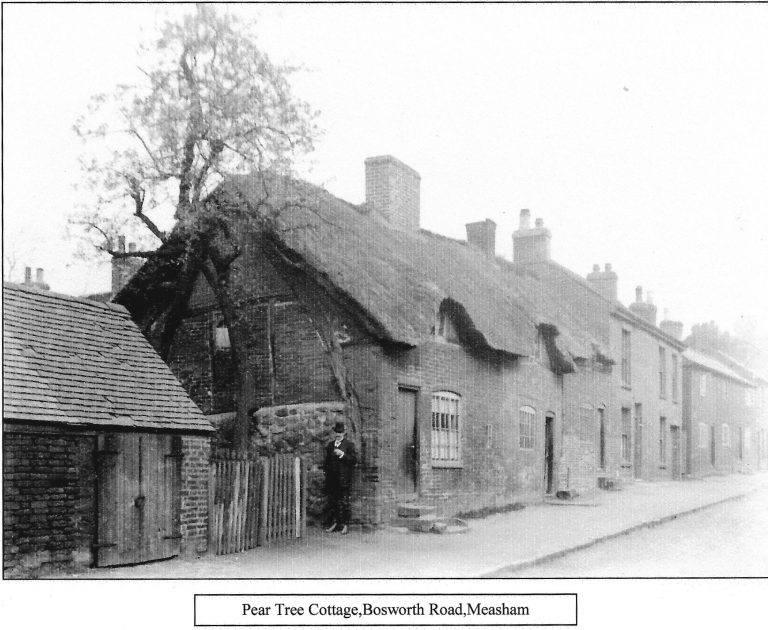
FINCH
Matthew the elder married Frances Finch 1771-1848, also of Measham. On the 1851 census Matthew is an 80 year old thatcher living with his daughter Mary and her husband Samuel Piner, a coal miner.
Henry Finch 1743- and Mary Dennis 1749- , both of Measham, were Frances parents. Henry’s father was also Henry Finch, born in 1707 in Measham, and he married Frances Ward, also born in 1707, and also from Measham.
WARD
The ancient boundary between the kingdom of Mercia and the Danelaw
I didn’t find much information on the history of Measham, but I did find a great deal of ancient history on the nearby village of Appleby Magna, two miles away. The parish records indicate that the Ward and Finch branches of our family date back to the 1500’s in the village, and we can assume that the ancient history of the neighbouring village would be relevant to our history.
There is evidence of human settlement in Appleby from the early Neolithic period, 6,000 years ago, and there are also Iron Age and Bronze Age sites in the vicinity. There is evidence of further activity within the village during the Roman period, including evidence of a villa or farm and a temple. Appleby is near three known Roman roads: Watling Street, 10 miles south of the village; Bath Lane, 5 miles north of the village; and Salt Street, which forms the parish’s south boundary.
But it is the Scandinavian invasions that are particularly intriguing, with regard to my 58% Scandinavian DNA (and virtually 100% Midlands England ancestry). Repton is 13 miles from Measham. In the early 10th century Chilcote, Measham and Willesley were part of the royal Derbyshire estate of Repton.
The arrival of Scandinavian invaders in the second half of the ninth century caused widespread havoc throughout northern England. By the AD 870s the Danish army was occupying Mercia and it spent the winter of 873-74 at Repton, the headquarters of the Mercian kings. The events are recorded in detail in the Peterborough manuscript of the Anglo-Saxon Chronicles…
Although the Danes held power for only 40 years, a strong, even subversive, Danish element remained in the population for many years to come.
A Scandinavian influence may also be detected among the field names of the parish. Although many fields have relatively modern names, some clearly have elements which reach back to the time of Danish incursion and control.
The Borders:
The name ‘aeppel byg’ is given in the will of Wulfic Spot of AD 1004……………..The decision at Domesday to include this land in Derbyshire, as one of Burton Abbey’s Derbyshire manors, resulted in the division of the village of Appleby Magna between the counties of Leicester and Derby for the next 800 years
Richard Dunmore’s Appleby Magma website.
This division of Appleby between Leicestershire and Derbyshire persisted from Domesday until 1897, when the recently created county councils (1889) simplified the administration of many villages in this area by a radical realignment of the boundary:
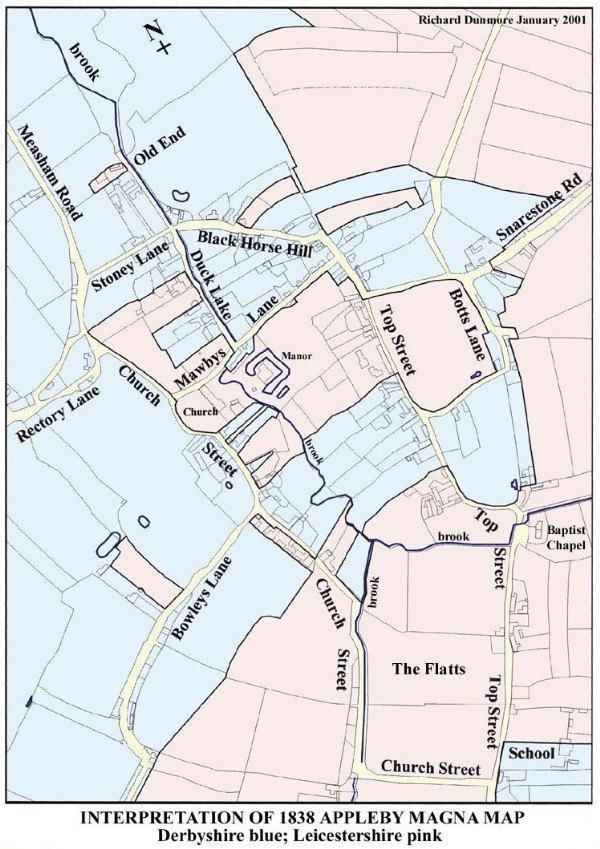
I would appear that our family not only straddle county borders, but straddle ancient kingdom borders as well. This particular branch of the family (we assume, given the absence of written records that far back) were living on the edge of the Danelaw and a strong element of the Danes survives to this day in my DNA.
-
AuthorSearch Results