

Search Results for 'odd'
-
AuthorSearch Results
-
January 28, 2022 at 8:17 pm #6263
In reply to: The Elusive Samuel Housley and Other Family Stories
From Tanganyika with Love
continued ~ part 4
With thanks to Mike Rushby.
Mchewe Estate. 31st January 1936
Dearest Family,
Life is very quiet just now. Our neighbours have left and I miss them all especially
Joni who was always a great bearer of news. We also grew fond of his Swedish
brother-in-law Max, whose loud ‘Hodi’ always brought a glad ‘Karibu’ from us. His wife,
Marion, I saw less often. She is not strong and seldom went visiting but has always
been friendly and kind and ready to share her books with me.Ann’s birthday is looming ahead and I am getting dreadfully anxious that her
parcels do not arrive in time. I am delighted that you were able to get a good head for
her doll, dad, but horrified to hear that it was so expensive. You would love your
‘Charming Ann’. She is a most responsible little soul and seems to have outgrown her
mischievous ways. A pity in a way, I don’t want her to grow too serious. You should see
how thoroughly Ann baths and towels herself. She is anxious to do Georgie and Kate
as well.I did not mean to teach Ann to write until after her fifth birthday but she has taught
herself by copying the large print in newspaper headlines. She would draw a letter and
ask me the name and now I find that at four Ann knows the whole alphabet. The front
cement steps is her favourite writing spot. She uses bits of white clay we use here for
whitewashing.Coffee prices are still very low and a lot of planters here and at Mbosi are in a
mess as they can no longer raise mortgages on their farms or get advances from the
Bank against their crops. We hear many are leaving their farms to try their luck on the
Diggings.George is getting fed up too. The snails are back on the shamba and doing
frightful damage. Talk of the plagues of Egypt! Once more they are being collected in
piles and bashed into pulp. The stench on the shamba is frightful! The greybeards in the
village tell George that the local Chief has put a curse on the farm because he is angry
that the Government granted George a small extension to the farm two years ago! As
the Chief was consulted at the time and was agreeable this talk of a curse is nonsense
but goes to show how the uneducated African put all disasters down to witchcraft.With much love,
Eleanor.Mchewe Estate. 9th February 1936
Dearest Family,
Ann’s birthday yesterday was not quite the gay occasion we had hoped. The
seventh was mail day so we sent a runner for the mail, hoping against hope that your
parcel containing the dolls head had arrived. The runner left for Mbeya at dawn but, as it
was a very wet day, he did not return with the mail bag until after dark by which time Ann
was fast asleep. My heart sank when I saw the parcel which contained the dolls new
head. It was squashed quite flat. I shed a few tears over that shattered head, broken
quite beyond repair, and George felt as bad about it as I did. The other parcel arrived in
good shape and Ann loves her little sewing set, especially the thimble, and the nursery
rhymes are a great success.Ann woke early yesterday and began to open her parcels. She said “But
Mummy, didn’t Barbara’s new head come?” So I had to show her the fragments.
Instead of shedding the flood of tears I expected, Ann just lifted the glass eyes in her
hand and said in a tight little voice “Oh poor Barbara.” George saved the situation. as
usual, by saying in a normal voice,”Come on Ann, get up and lets play your new
records.” So we had music and sweets before breakfast. Later I removed Barbara’s
faded old blond wig and gummed on the glossy new brown one and Ann seems quite
satisfied.Last night, after the children were tucked up in bed, we discussed our financial
situation. The coffee trees that have survived the plagues of borer beetle, mealie bugs
and snails look strong and fine, but George says it will be years before we make a living
out of the farm. He says he will simply have to make some money and he is leaving for
the Lupa on Saturday to have a look around on the Diggings. If he does decide to peg
a claim and work it he will put up a wattle and daub hut and the children and I will join him
there. But until such time as he strikes gold I shall have to remain here on the farm and
‘Keep the Home Fires Burning’.Now don’t go and waste pity on me. Women all over the country are having to
stay at home whilst their husbands search for a livelihood. I am better off than most
because I have a comfortable little home and loyal servants and we still have enough
capitol to keep the wolf from the door. Anyway this is the rainy season and hardly the
best time to drag three small children around the sodden countryside on prospecting
safaris.So I’ll stay here at home and hold thumbs that George makes a lucky strike.
Heaps of love to all,
Eleanor.Mchewe Estate. 27th February 1936
Dearest Family,
Well, George has gone but here we are quite safe and cosy. Kate is asleep and
Ann and Georgie are sprawled on the couch taking it in turns to enumerate the things
God has made. Every now and again Ann bothers me with an awkward question. “Did
God make spiders? Well what for? Did he make weeds? Isn’t He silly, mummy? She is
becoming a very practical person. She sews surprisingly well for a four year old and has
twice made cakes in the past week, very sweet and liberally coloured with cochineal and
much appreciated by Georgie.I have been without George for a fortnight and have adapted myself to my new
life. The children are great company during the day and I have arranged my evenings so
that they do not seem long. I am determined that when George comes home he will find
a transformed wife. I read an article entitled ‘Are you the girl he married?’ in a magazine
last week and took a good look in the mirror and decided that I certainly was not! Hair dry,
skin dry, and I fear, a faint shadow on the upper lip. So now I have blown the whole of
your Christmas Money Order on an order to a chemist in Dar es Salaam for hair tonic,
face cream and hair remover and am anxiously awaiting the parcel.In the meantime, after tucking the children into bed at night, I skip on the verandah
and do the series of exercises recommended in the magazine article. After this exertion I
have a leisurely bath followed by a light supper and then read or write letters to pass
the time until Kate’s ten o’clock feed. I have arranged for Janey to sleep in the house.
She comes in at 9.30 pm and makes up her bed on the living room floor by the fire.The days are by no means uneventful. The day before yesterday the biggest
troop of monkeys I have ever seen came fooling around in the trees and on the grass
only a few yards from the house. These monkeys were the common grey monkeys
with black faces. They came in all sizes and were most entertaining to watch. Ann and
Georgie had a great time copying their antics and pulling faces at the monkeys through
the bedroom windows which I hastily closed.Thomas, our headman, came running up and told me that this troop of monkeys
had just raided his maize shamba and asked me to shoot some of them. I would not of
course do this. I still cannot bear to kill any animal, but I fired a couple of shots in the air
and the monkeys just melted away. It was fantastic, one moment they were there and
the next they were not. Ann and Georgie thought I had been very unkind to frighten the
poor monkeys but honestly, when I saw what they had done to my flower garden, I
almost wished I had hardened my heart and shot one or two.The children are all well but Ann gave me a nasty fright last week. I left Ann and
Georgie at breakfast whilst I fed Fanny, our bull terrier on the back verandah. Suddenly I
heard a crash and rushed inside to find Ann’s chair lying on its back and Ann beside it on
the floor perfectly still and with a paper white face. I shouted for Janey to bring water and
laid Ann flat on the couch and bathed her head and hands. Soon she sat up with a wan
smile and said “I nearly knocked my head off that time, didn’t I.” She must have been
standing on the chair and leaning against the back. Our brick floors are so terribly hard that
she might have been seriously hurt.However she was none the worse for the fall, but Heavens, what an anxiety kids
are.Lots of love,
EleanorMchewe Estate. 12th March 1936
Dearest Family,
It was marvellous of you to send another money order to replace the one I spent
on cosmetics. With this one I intend to order boots for both children as a protection from
snake bite, though from my experience this past week the threat seems to be to the
head rather than the feet. I was sitting on the couch giving Kate her morning milk from a
cup when a long thin snake fell through the reed ceiling and landed with a thud just behind
the couch. I shouted “Nyoka, Nyoka!” (Snake,Snake!) and the houseboy rushed in with
a stick and killed the snake. I then held the cup to Kate’s mouth again but I suppose in
my agitation I tipped it too much because the baby choked badly. She gasped for
breath. I quickly gave her a sharp smack on the back and a stream of milk gushed
through her mouth and nostrils and over me. Janey took Kate from me and carried her
out into the fresh air on the verandah and as I anxiously followed her through the door,
another long snake fell from the top of the wall just missing me by an inch or so. Luckily
the houseboy still had the stick handy and dispatched this snake also.The snakes were a pair of ‘boomslangs’, not nice at all, and all day long I have
had shamba boys coming along to touch hands and say “Poli Memsahib” – “Sorry
madam”, meaning of course ‘Sorry you had a fright.’Apart from that one hectic morning this has been a quiet week. Before George
left for the Lupa he paid off most of the farm hands as we can now only afford a few
labourers for the essential work such as keeping the weeds down in the coffee shamba.
There is now no one to keep the grass on the farm roads cut so we cannot use the pram
when we go on our afternoon walks. Instead Janey carries Kate in a sling on her back.
Janey is a very clean slim woman, and her clothes are always spotless, so Kate keeps
cool and comfortable. Ann and Georgie always wear thick overalls on our walks as a
protection against thorns and possible snakes. We usually make our way to the
Mchewe River where Ann and Georgie paddle in the clear cold water and collect shiny
stones.The cosmetics parcel duly arrived by post from Dar es Salaam so now I fill the
evenings between supper and bed time attending to my face! The much advertised
cream is pink and thick and feels revolting. I smooth it on before bedtime and keep it on
all night. Just imagine if George could see me! The advertisements promise me a skin
like a rose in six weeks. What a surprise there is in store for George!You will have been wondering what has happened to George. Well on the Lupa
he heard rumours of a new gold strike somewhere in the Sumbawanga District. A couple
of hundred miles from here I think, though I am not sure where it is and have no one to
ask. You look it up on the map and tell me. John Molteno is also interested in this and
anxious to have it confirmed so he and George have come to an agreement. John
Molteno provided the porters for the journey together with prospecting tools and
supplies but as he cannot leave his claims, or his gold buying business, George is to go
on foot to the area of the rumoured gold strike and, if the strike looks promising will peg
claims in both their names.The rainy season is now at its height and the whole countryside is under water. All
roads leading to the area are closed to traffic and, as there are few Europeans who
would attempt the journey on foot, George proposes to get a head start on them by
making this uncomfortable safari. I have just had my first letter from George since he left
on this prospecting trip. It took ages to reach me because it was sent by runner to
Abercorn in Northern Rhodesia, then on by lorry to Mpika where it was put on a plane
for Mbeya. George writes the most charming letters which console me a little upon our
all too frequent separations.His letter was cheerful and optimistic, though reading between the lines I should
say he had a grim time. He has reached Sumbawanga after ‘a hell of a trip’, to find that
the rumoured strike was at Mpanda and he had a few more days of foot safari ahead.
He had found the trip from the Lupa even wetter than he had expected. The party had
three days of wading through swamps sometimes waist deep in water. Of his sixteen
porters, four deserted an the second day out and five others have had malaria and so
been unable to carry their loads. He himself is ‘thin but very fit’, and he sounds full of
beans and writes gaily of the marvellous holiday we will have if he has any decent luck! I
simply must get that mink and diamonds complexion.The frustrating thing is that I cannot write back as I have no idea where George is
now.With heaps of love,
Eleanor.Mchewe Estate. 24th March 1936
Dearest Family,
How kind you are. Another parcel from home. Although we are very short
of labourers I sent a special runner to fetch it as Ann simply couldn’t bear the suspense
of waiting to see Brenda, “My new little girl with plaits.” Thank goodness Brenda is
unbreakable. I could not have born another tragedy. She really is an exquisite little doll
and has hardly been out of Ann’s arms since arrival. She showed Brenda proudly to all
the staff. The kitchen boy’s face was a study. His eyes fairly came out on sticks when he
saw the dolls eyes not only opening and shutting, but moving from side to side in that
incredibly lifelike way. Georgie loves his little model cars which he carries around all day
and puts under his pillow at night.As for me, I am enchanted by my very smart new frock. Janey was so lavish with
her compliments when I tried the frock on, that in a burst of generosity I gave her that
rather tartish satin and lace trousseau nighty, and she was positively enthralled. She
wore it that very night when she appeared as usual to doss down by the fire.
By the way it was Janey’s turn to have a fright this week. She was in the
bathroom washing the children’s clothes in an outsize hand basin when it happened. As
she took Georgie’s overalls from the laundry basket a large centipede ran up her bare
arm. Luckily she managed to knock the centipede off into the hot water in the hand basin.
It was a brute, about six inches long of viciousness with a nasty sting. The locals say that
the bite is much worse than a scorpions so Janey had a lucky escape.Kate cut her first two teeth yesterday and will, I hope, sleep better now. I don’t
feel that pink skin food is getting a fair trial with all those broken nights. There is certainly
no sign yet of ‘The skin he loves to touch”. Kate, I may say, is rosy and blooming. She
can pull herself upright providing she has something solid to hold on to. She is so plump
I have horrible visions of future bow legs so I push her down, but she always bobs up
again.Both Ann and Georgie are mad on books. Their favourites are ‘Barbar and
Celeste” and, of all things, ‘Struvel Peter’ . They listen with absolute relish to the sad tale
of Harriet who played with matches.I have kept a laugh for the end. I am hoping that it will not be long before George
comes home and thought it was time to take the next step towards glamour, so last
Wednesday after lunch I settled the children on their beds and prepared to remove the ,
to me, obvious down on my upper lip. (George always loyally says that he can’t see
any.) Well I got out the tube of stuff and carefully followed the directions. I smoothed a
coating on my upper lip. All this was watched with great interest by the children, including
the baby, who stood up in her cot for a better view. Having no watch, I had propped
the bedroom door open so that I could time the operation by the cuckoo clock in the
living room. All the children’s surprised comments fell on deaf ears. I would neither talk
nor smile for fear of cracking the hair remover which had set hard. The set time was up
and I was just about to rinse the remover off when Kate slipped, knocking her head on
the corner of the cot. I rushed to the rescue and precious seconds ticked off whilst I
pacified her.So, my dears, when I rinsed my lip, not only the plaster and the hair came away
but the skin as well and now I really did have a Ronald Coleman moustache – a crimson
one. I bathed it, I creamed it, powdered it but all to no avail. Within half an hour my lip
had swollen until I looked like one of those Duckbilled West African women. Ann’s
comments, “Oh Mummy, you do look funny. Georgie, doesn’t Mummy look funny?”
didn’t help to soothe me and the last straw was that just then there was the sound of a car drawing up outside – the first car I had heard for months. Anyway, thank heaven, it
was not George, but the representative of a firm which sells agricultural machinery and
farm implements, looking for orders. He had come from Dar es Salaam and had not
heard that all the planters from this district had left their farms. Hospitality demanded that I
should appear and offer tea. I did not mind this man because he was a complete
stranger and fat, middle aged and comfortable. So I gave him tea, though I didn’t
attempt to drink any myself, and told him the whole sad tale.Fortunately much of the swelling had gone next day and only a brown dryness
remained. I find myself actually hoping that George is delayed a bit longer. Of one thing
I am sure. If ever I grow a moustache again, it stays!Heaps of love from a sadder but wiser,
EleanorMchewe Estate. 3rd April 1936
Dearest Family,
Sound the trumpets, beat the drums. George is home again. The safari, I am sad
to say, was a complete washout in more ways than one. Anyway it was lovely to be
together again and we don’t yet talk about the future. The home coming was not at all as
I had planned it. I expected George to return in our old A.C. car which gives ample
warning of its arrival. I had meant to wear my new frock and make myself as glamourous
as possible, with our beautiful babe on one arm and our other jewels by my side.
This however is what actually happened. Last Saturday morning at about 2 am , I
thought I heard someone whispering my name. I sat up in bed, still half asleep, and
there was George at the window. He was thin and unshaven and the tiredest looking
man I have ever seen. The car had bogged down twenty miles back along the old Lupa
Track, but as George had had no food at all that day, he decided to walk home in the
bright moonlight.This is where I should have served up a tasty hot meal but alas, there was only
the heal of a loaf and no milk because, before going to bed I had given the remaining
milk to the dog. However George seemed too hungry to care what he ate. He made a
meal off a tin of bully, a box of crustless cheese and the bread washed down with cup
after cup of black tea. Though George was tired we talked for hours and it was dawn
before we settled down to sleep.During those hours of talk George described his nightmarish journey. He started
up the flooded Rukwa Valley and there were days of wading through swamp and mud
and several swollen rivers to cross. George is a strong swimmer and the porters who
were recruited in that area, could also swim. There remained the problem of the stores
and of Kianda the houseboy who cannot swim. For these they made rough pole rafts
which they pulled across the rivers with ropes. Kianda told me later that he hopes never
to make such a journey again. He swears that the raft was submerged most of the time
and that he was dragged through the rivers underwater! You should see the state of
George’s clothes which were packed in a supposedly water tight uniform trunk. The
whole lot are mud stained and mouldy.To make matters more trying for George he was obliged to live mostly on
porters rations, rice and groundnut oil which he detests. As all the district roads were
closed the little Indian Sores in the remote villages he passed had been unable to
replenish their stocks of European groceries. George would have been thinner had it not
been for two Roman Catholic missions enroute where he had good meals and dry
nights. The Fathers are always wonderfully hospitable to wayfarers irrespective of
whether or not they are Roman Catholics. George of course is not a Catholic. One finds
the Roman Catholic missions right out in the ‘Blue’ and often on spots unhealthy to
Europeans. Most of the Fathers are German or Dutch but they all speak a little English
and in any case one can always fall back on Ki-Swahili.George reached his destination all right but it soon became apparent that reports
of the richness of the strike had been greatly exaggerated. George had decided that
prospects were brighter on the Lupa than on the new strike so he returned to the Lupa
by the way he had come and, having returned the borrowed equipment decided to
make his way home by the shortest route, the old and now rarely used road which
passes by the bottom of our farm.The old A.C. had been left for safe keeping at the Roman Catholic Galala
Mission 40 miles away, on George’s outward journey, and in this old car George, and
the houseboy Kianda , started for home. The road was indescribably awful. There were long stretches that were simply one big puddle, in others all the soil had been washed
away leaving the road like a rocky river bed. There were also patches where the tall
grass had sprung up head high in the middle of the road,
The going was slow because often the car bogged down because George had
no wheel chains and he and Kianda had the wearisome business of digging her out. It
was just growing dark when the old A.C. settled down determinedly in the mud for the
last time. They could not budge her and they were still twenty miles from home. George
decided to walk home in the moonlight to fetch help leaving Kianda in charge of the car
and its contents and with George’s shot gun to use if necessary in self defence. Kianda
was reluctant to stay but also not prepared to go for help whilst George remained with
the car as lions are plentiful in that area. So George set out unarmed in the moonlight.
Once he stopped to avoid a pride of lion coming down the road but he circled safely
around them and came home without any further alarms.Kianda said he had a dreadful night in the car, “With lions roaming around the car
like cattle.” Anyway the lions did not take any notice of the car or of Kianda, and the next
day George walked back with all our farm boys and dug and pushed the car out of the
mud. He brought car and Kianda back without further trouble but the labourers on their
way home were treed by the lions.The wet season is definitely the time to stay home.
Lots and lots of love,
EleanorMchewe Estate. 30th April 1936
Dearest Family,
Young George’s third birthday passed off very well yesterday. It started early in
the morning when he brought his pillow slip of presents to our bed. Kate was already
there and Ann soon joined us. Young George liked all the presents you sent, especially
the trumpet. It has hardly left his lips since and he is getting quite smart about the finger
action.We had quite a party. Ann and I decorated the table with Christmas tree tinsel
and hung a bunch of balloons above it. Ann also decorated young George’s chair with
roses and phlox from the garden. I had made and iced a fruit cake but Ann begged to
make a plain pink cake. She made it entirely by herself though I stood by to see that
she measured the ingredients correctly. When the cake was baked I mixed some soft
icing in a jug and she poured it carefully over the cake smoothing the gaps with her
fingers!During the party we had the gramophone playing and we pulled crackers and
wore paper hats and altogether had a good time. I forgot for a while that George is
leaving again for the Lupa tomorrow for an indefinite time. He was marvellous at making
young George’s party a gay one. You will have noticed the change from Georgie to
young George. Our son declares that he now wants to be called George, “Like Dad”.
He an Ann are a devoted couple and I am glad that there is only a fourteen
months difference in their ages. They play together extremely well and are very
independent which is just as well for little Kate now demands a lot of my attention. My
garden is a real cottage garden and looks very gay and colourful. There are hollyhocks
and Snapdragons, marigolds and phlox and of course the roses and carnations which, as
you know, are my favourites. The coffee shamba does not look so good because the
small labour force, which is all we can afford, cannot cope with all the weeds. You have
no idea how things grow during the wet season in the tropics.Nothing alarming ever seems to happen when George is home, so I’m afraid this
letter is rather dull. I wanted you to know though, that largely due to all your gifts of toys
and sweets, Georgie’s 3rd birthday party went with a bang.Your very affectionate,
EleanorMchewe Estate. 17th September 1936
Dearest Family,
I am sorry to hear that Mummy worries about me so much. “Poor Eleanor”,
indeed! I have a quite exceptional husband, three lovely children, a dear little home and
we are all well.It is true that I am in rather a rut but what else can we do? George comes
home whenever he can and what excitement there is when he does come. He cannot
give me any warning because he has to take advantage of chance lifts from the Diggings
to Mbeya, but now that he is prospecting nearer home he usually comes walking over
the hills. About 50 miles of rough going. Really and truly I am all right. Although our diet is
monotonous we have plenty to eat. Eggs and milk are cheap and fruit plentiful and I
have a good cook so can devote all my time to the children. I think it is because they are
my constant companions that Ann and Georgie are so grown up for their years.
I have no ayah at present because Janey has been suffering form rheumatism
and has gone home for one of her periodic rests. I manage very well without her except
in the matter of the afternoon walks. The outward journey is all right. George had all the
grass cut on his last visit so I am able to push the pram whilst Ann, George and Fanny
the dog run ahead. It is the uphill return trip that is so trying. Our walk back is always the
same, down the hill to the river where the children love to play and then along the car
road to the vegetable garden. I never did venture further since the day I saw a leopard
jump on a calf. I did not tell you at the time as I thought you might worry. The cattle were
grazing on a small knoll just off our land but near enough for me to have a clear view.
Suddenly the cattle scattered in all directions and we heard the shouts of the herd boys
and saw – or rather had the fleeting impression- of a large animal jumping on a calf. I
heard the herd boy shout “Chui, Chui!” (leopard) and believe me, we turned in our
tracks and made for home. To hasten things I picked up two sticks and told the children
that they were horses and they should ride them home which they did with
commendable speed.Ann no longer rides Joseph. He became increasingly bad tempered and a
nuisance besides. He took to rolling all over my flower beds though I had never seen
him roll anywhere else. Then one day he kicked Ann in the chest, not very hard but
enough to send her flying. Now George has given him to the native who sells milk to us
and he seems quite happy grazing with the cattle.With love to you all,
Eleanor.Mchewe Estate. 2nd October 1936
Dearest Family,
Since I last wrote George has been home and we had a lovely time as usual.
Whilst he was here the District Commissioner and his wife called. Mr Pollock told
George that there is to be a big bush clearing scheme in some part of the Mbeya
District to drive out Tsetse Fly. The game in the area will have to be exterminated and
there will probably be a job for George shooting out the buffalo. The pay would be
good but George says it is a beastly job. Although he is a professional hunter, he hates
slaughter.Mrs P’s real reason for visiting the farm was to invite me to stay at her home in
Mbeya whilst she and her husband are away in Tukuyu. Her English nanny and her small
daughter will remain in Mbeya and she thought it might be a pleasant change for us and
a rest for me as of course Nanny will do the housekeeping. I accepted the invitation and I
think I will go on from there to Tukuyu and visit my friend Lillian Eustace for a fortnight.
She has given us an open invitation to visit her at any time.I had a letter from Dr Eckhardt last week, telling me that at a meeting of all the
German Settlers from Mbeya, Tukuyu and Mbosi it had been decided to raise funds to
build a school at Mbeya. They want the British Settlers to co-operate in this and would
be glad of a subscription from us. I replied to say that I was unable to afford a
subscription at present but would probably be applying for a teaching job.
The Eckhardts are the leaders of the German community here and are ardent
Nazis. For this reason they are unpopular with the British community but he is the only
doctor here and I must say they have been very decent to us. Both of them admire
George. George has still not had any luck on the Lupa and until he makes a really
promising strike it is unlikely that the children and I will join him. There is no fresh milk there
and vegetables and fruit are imported from Mbeya and Iringa and are very expensive.
George says “You wouldn’t be happy on the diggings anyway with a lot of whores and
their bastards!”Time ticks away very pleasantly here. Young George and Kate are blooming
and I keep well. Only Ann does not look well. She is growing too fast and is listless and
pale. If I do go to Mbeya next week I shall take her to the doctor to be overhauled.
We do not go for our afternoon walks now that George has returned to the Lupa.
That leopard has been around again and has killed Tubbage that cowardly Alsatian. We
gave him to the village headman some months ago. There is no danger to us from the
leopard but I am terrified it might get Fanny, who is an excellent little watchdog and
dearly loved by all of us. Yesterday I sent a note to the Boma asking for a trap gun and
today the farm boys are building a trap with logs.I had a mishap this morning in the garden. I blundered into a nest of hornets and
got two stings in the left arm above the elbow. Very painful at the time and the place is
still red and swollen.Much love to you all,
Eleanor.Mchewe Estate. 10th October 1936
Dearest Family,
Well here we are at Mbeya, comfortably installed in the District Commissioner’s
house. It is one of two oldest houses in Mbeya and is a charming gabled place with tiled
roof. The garden is perfectly beautiful. I am enjoying the change very much. Nanny
Baxter is very entertaining. She has a vast fund of highly entertaining tales of the goings
on amongst the British Aristocracy, gleaned it seems over the nursery teacup in many a
Stately Home. Ann and Georgie are enjoying the company of other children.
People are very kind about inviting us out to tea and I gladly accept these
invitations but I have turned down invitations to dinner and one to a dance at the hotel. It
is no fun to go out at night without George. There are several grass widows at the pub
whose husbands are at the diggings. They have no inhibitions about parties.
I did have one night and day here with George, he got the chance of a lift and
knowing that we were staying here he thought the chance too good to miss. He was
also anxious to hear the Doctor’s verdict on Ann. I took Ann to hospital on my second
day here. Dr Eckhardt said there was nothing specifically wrong but that Ann is a highly
sensitive type with whom the tropics does not agree. He advised that Ann should
spend a year in a more temperate climate and that the sooner she goes the better. I felt
very discouraged to hear this and was most relieved when George turned up
unexpectedly that evening. He phoo-hood Dr Eckhardt’s recommendation and next
morning called in Dr Aitkin, the Government Doctor from Chunya and who happened to
be in Mbeya.Unfortunately Dr Aitkin not only confirmed Dr Eckhardt’s opinion but said that he
thought Ann should stay out of the tropics until she had passed adolescence. I just don’t
know what to do about Ann. She is a darling child, very sensitive and gentle and a
lovely companion to me. Also she and young George are inseparable and I just cannot
picture one without the other. I know that you would be glad to have Ann but how could
we bear to part with her?Your worried but affectionate,
Eleanor.Tukuyu. 23rd October 1936
Dearest Family,
As you see we have moved to Tukuyu and we are having a lovely time with
Lillian Eustace. She gave us such a warm welcome and has put herself out to give us
every comfort. She is a most capable housekeeper and I find her such a comfortable
companion because we have the same outlook in life. Both of us are strictly one man
women and that is rare here. She has a two year old son, Billy, who is enchanted with
our rolly polly Kate and there are other children on the station with whom Ann and
Georgie can play. Lillian engaged a temporary ayah for me so I am having a good rest.
All the children look well and Ann in particular seems to have benefited by the
change to a cooler climate. She has a good colour and looks so well that people all
exclaim when I tell them, that two doctors have advised us to send Ann out of the
country. Perhaps after all, this holiday in Tukuyu will set her up.We had a trying journey from Mbeya to Tukuyu in the Post Lorry. The three
children and I were squeezed together on the front seat between the African driver on
one side and a vast German on the other. Both men smoked incessantly – the driver
cigarettes, and the German cheroots. The cab was clouded with a blue haze. Not only
that! I suddenly felt a smarting sensation on my right thigh. The driver’s cigarette had
burnt a hole right through that new checked linen frock you sent me last month.
I had Kate on my lap all the way but Ann and Georgie had to stand against the
windscreen all the way. The fat German offered to take Ann on his lap but she gave him
a very cold “No thank you.” Nor did I blame her. I would have greatly enjoyed the drive
under less crowded conditions. The scenery is gorgeous. One drives through very high
country crossing lovely clear streams and at one point through rain forest. As it was I
counted the miles and how thankful I was to see the end of the journey.
In the days when Tanganyika belonged to the Germans, Tukuyu was the
administrative centre for the whole of the Southern Highlands Province. The old German
Fort is still in use as Government offices and there are many fine trees which were
planted by the Germans. There is a large prosperous native population in this area.
They go in chiefly for coffee and for bananas which form the basis of their diet.
There are five British married couples here and Lillian and I go out to tea most
mornings. In the afternoon there is tennis or golf. The gardens here are beautiful because
there is rain or at least drizzle all the year round. There are even hedge roses bordering
some of the district roads. When one walks across the emerald green golf course or
through the Boma gardens, it is hard to realise that this gentle place is Tropical Africa.
‘Such a green and pleasant land’, but I think I prefer our corner of Tanganyika.Much love,
Eleanor.Mchewe. 12th November 1936
Dearest Family,
We had a lovely holiday but it is so nice to be home again, especially as Laza,
the local Nimrod, shot that leopard whilst we were away (with his muzzleloader gun). He
was justly proud of himself, and I gave him a tip so that he could buy some native beer
for a celebration. I have never seen one of theses parties but can hear the drums and
sounds of merrymaking, especially on moonlight nights.Our house looks so fresh and uncluttered. Whilst I was away, the boys
whitewashed the house and my houseboy had washed all the curtains, bedspreads,
and loose covers and watered the garden. If only George were here it would be
heaven.Ann looked so bonny at Tukuyu that I took her to the Government Doctor there
hoping that he would find her perfectly healthy, but alas he endorsed the finding of the
other two doctors so, when an opportunity offers, I think I shall have to send Ann down
to you for a long holiday from the Tropics. Mother-in-law has offered to fetch her next
year but England seems so far away. With you she will at least be on the same
continent.I left the children for the first time ever, except for my stay in hospital when Kate
was born, to go on an outing to Lake Masoko in the Tukuyu district, with four friends.
Masoko is a beautiful, almost circular crater lake and very very deep. A detachment of
the King’s African Rifles are stationed there and occupy the old German barracks
overlooking the lake.We drove to Masoko by car and spent the afternoon there as guests of two
British Army Officers. We had a good tea and the others went bathing in the lake but i
could not as I did not have a costume. The Lake was as beautiful as I had been lead to
imagine and our hosts were pleasant but I began to grow anxious as the afternoon
advanced and my friends showed no signs of leaving. I was in agonies when they
accepted an invitation to stay for a sundowner. We had this in the old German beer
garden overlooking the Lake. It was beautiful but what did I care. I had promised the
children that I would be home to give them their supper and put them to bed. When I
did at length return to Lillian’s house I found the situation as I had expected. Ann, with her
imagination had come to the conclusion that I never would return. She had sobbed
herself into a state of exhaustion. Kate was screaming in sympathy and George 2 was
very truculent. He wouldn’t even speak to me. Poor Lillian had had a trying time.
We did not return to Mbeya by the Mail Lorry. Bill and Lillian drove us across to
Mbeya in their new Ford V8 car. The children chattered happily in the back of the car
eating chocolate and bananas all the way. I might have known what would happen! Ann
was dreadfully and messily car sick.I engaged the Mbeya Hotel taxi to drive us out to the farm the same afternoon
and I expect it will be a long time before we leave the farm again.Lots and lots of love to all,
Eleanor.Chunya 27th November 1936
Dearest Family,
You will be surprised to hear that we are all together now on the Lupa goldfields.
I have still not recovered from my own astonishment at being here. Until last Saturday
night I never dreamed of this move. At about ten o’clock I was crouched in the inglenook
blowing on the embers to make a fire so that I could heat some milk for Kate who is
cutting teeth and was very restless. Suddenly I heard a car outside. I knew it must be
George and rushed outside storm lamp in hand. Sure enough, there was George
standing by a strange car, and beaming all over his face. “Something for you my love,”
he said placing a little bundle in my hand. It was a knotted handkerchief and inside was a
fine gold nugget.George had that fire going in no time, Kate was given the milk and half an aspirin
and settles down to sleep, whilst George and I sat around for an hour chatting over our
tea. He told me that he had borrowed the car from John Molteno and had come to fetch
me and the children to join him on the diggings for a while. It seems that John, who has a
camp at Itewe, a couple of miles outside the township of Chunya, the new
Administrative Centre of the diggings, was off to the Cape to visit his family for a few
months. John had asked George to run his claims in his absence and had given us the
loan of his camp and his car.George had found the nugget on his own claim but he is not too elated because
he says that one good month on the diggings is often followed by several months of
dead loss. However, I feel hopeful, we have had such a run of bad luck that surely it is
time for the tide to change. George spent Sunday going over the farm with Thomas, the
headman, and giving him instructions about future work whilst I packed clothes and
kitchen equipment. I have brought our ex-kitchenboy Kesho Kutwa with me as cook and
also Janey, who heard that we were off to the Lupa and came to offer her services once
more as ayah. Janey’s ex-husband Abel is now cook to one of the more successful
diggers and I think she is hoping to team up with him again.The trip over the Mbeya-Chunya pass was new to me and I enjoyed it very
much indeed. The road winds over the mountains along a very high escarpment and
one looks down on the vast Usangu flats stretching far away to the horizon. At the
highest point the road rises to about 7000 feet, and this was too much for Ann who was
leaning against the back of my seat. She was very thoroughly sick, all over my hair.
This camp of John Molteno’s is very comfortable. It consists of two wattle and
daub buildings built end to end in a clearing in the miombo bush. The main building
consists of a large living room, a store and an office, and the other of one large bedroom
and a small one separated by an area for bathing. Both buildings are thatched. There are
no doors, and there are no windows, but these are not necessary because one wall of
each building is built up only a couple of feet leaving a six foot space for light and air. As
this is the dry season the weather is pleasant. The air is fresh and dry but not nearly so
hot as I expected.Water is a problem and must be carried long distances in kerosene tins.
vegetables and fresh butter are brought in a van from Iringa and Mbeya Districts about
once a fortnight. I have not yet visited Chunya but I believe it is as good a shopping
centre as Mbeya so we will be able to buy all the non perishable food stuffs we need.
What I do miss is the fresh milk. The children are accustomed to drinking at least a pint of
milk each per day but they do not care for the tinned variety.Ann and young George love being here. The camp is surrounded by old
prospecting trenches and they spend hours each day searching for gold in the heaps of gravel. Sometimes they find quartz pitted with little spots of glitter and they bring them
to me in great excitement. Alas it is only Mica. We have two neighbours. The one is a
bearded Frenchman and the other an Australian. I have not yet met any women.
George looks very sunburnt and extremely fit and the children also look well.
George and I have decided that we will keep Ann with us until my Mother-in-law comes
out next year. George says that in spite of what the doctors have said, he thinks that the
shock to Ann of being separated from her family will do her more harm than good. She
and young George are inseparable and George thinks it would be best if both
George and Ann return to England with my Mother-in-law for a couple of years. I try not
to think at all about the breaking up of the family.Much love to all,
Eleanor.January 28, 2022 at 2:29 pm #6261In reply to: The Elusive Samuel Housley and Other Family Stories
From Tanganyika with Love
continued
With thanks to Mike Rushby.
Mchewe Estate. 11th July 1931.
Dearest Family,
You say that you would like to know more about our neighbours. Well there is
not much to tell. Kath Wood is very good about coming over to see me. I admire her
very much because she is so capable as well as being attractive. She speaks very
fluent Ki-Swahili and I envy her the way she can carry on a long conversation with the
natives. I am very slow in learning the language possibly because Lamek and the
houseboy both speak basic English.I have very little to do with the Africans apart from the house servants, but I do
run a sort of clinic for the wives and children of our employees. The children suffer chiefly
from sore eyes and worms, and the older ones often have bad ulcers on their legs. All
farmers keep a stock of drugs and bandages.George also does a bit of surgery and last month sewed up the sole of the foot
of a boy who had trodden on the blade of a panga, a sort of sword the Africans use for
hacking down bush. He made an excellent job of it. George tells me that the Africans
have wonderful powers of recuperation. Once in his bachelor days, one of his men was
disembowelled by an elephant. George washed his “guts” in a weak solution of
pot.permang, put them back in the cavity and sewed up the torn flesh and he
recovered.But to get back to the neighbours. We see less of Hicky Wood than of Kath.
Hicky can be charming but is often moody as I believe Irishmen often are.
Major Jones is now at home on his shamba, which he leaves from time to time
for temporary jobs on the district roads. He walks across fairly regularly and we are
always glad to see him for he is a great bearer of news. In this part of Africa there is no
knocking or ringing of doorbells. Front doors are always left open and visitors always
welcome. When a visitor approaches a house he shouts “Hodi”, and the owner of the
house yells “Karibu”, which I believe means “Come near” or approach, and tea is
produced in a matter of minutes no matter what hour of the day it is.
The road that passes all our farms is the only road to the Gold Diggings and
diggers often drop in on the Woods and Major Jones and bring news of the Goldfields.
This news is sometimes about gold but quite often about whose wife is living with
whom. This is a great country for gossip.Major Jones now has his brother Llewyllen living with him. I drove across with
George to be introduced to him. Llewyllen’s health is poor and he looks much older than
his years and very like the portrait of Trader Horn. He has the same emaciated features,
burning eyes and long beard. He is proud of his Welsh tenor voice and often bursts into
song.Both brothers are excellent conversationalists and George enjoys walking over
sometimes on a Sunday for a bit of masculine company. The other day when George
walked across to visit the Joneses, he found both brothers in the shamba and Llew in a
great rage. They had been stooping to inspect a water furrow when Llew backed into a
hornets nest. One furious hornet stung him on the seat and another on the back of his
neck. Llew leapt forward and somehow his false teeth shot out into the furrow and were
carried along by the water. When George arrived Llew had retrieved his teeth but
George swears that, in the commotion, the heavy leather leggings, which Llew always
wears, had swivelled around on his thin legs and were calves to the front.
George has heard that Major Jones is to sell pert of his land to his Swedish brother-in-law, Max Coster, so we will soon have another couple in the neighbourhood.I’ve had a bit of a pantomime here on the farm. On the day we went to Tukuyu,
all our washing was stolen from the clothes line and also our new charcoal iron. George
reported the matter to the police and they sent out a plain clothes policeman. He wears
the long white Arab gown called a Kanzu much in vogue here amongst the African elite
but, alas for secrecy, huge black police boots protrude from beneath the Kanzu and, to
add to this revealing clue, the askari springs to attention and salutes each time I pass by.
Not much hope of finding out the identity of the thief I fear.George’s furrow was entirely successful and we now have water running behind
the kitchen. Our drinking water we get from a lovely little spring on the farm. We boil and
filter it for safety’s sake. I don’t think that is necessary. The furrow water is used for
washing pots and pans and for bath water.Lots of love,
EleanorMchewe Estate. 8th. August 1931
Dearest Family,
I think it is about time I told you that we are going to have a baby. We are both
thrilled about it. I have not seen a Doctor but feel very well and you are not to worry. I
looked it up in my handbook for wives and reckon that the baby is due about February
8th. next year.The announcement came from George, not me! I had been feeling queasy for
days and was waiting for the right moment to tell George. You know. Soft lights and
music etc. However when I was listlessly poking my food around one lunch time
George enquired calmly, “When are you going to tell me about the baby?” Not at all
according to the book! The problem is where to have the baby. February is a very wet
month and the nearest Doctor is over 50 miles away at Tukuyu. I cannot go to stay at
Tukuyu because there is no European accommodation at the hospital, no hotel and no
friend with whom I could stay.George thinks I should go South to you but Capetown is so very far away and I
love my little home here. Also George says he could not come all the way down with
me as he simply must stay here and get the farm on its feet. He would drive me as far
as the railway in Northern Rhodesia. It is a difficult decision to take. Write and tell me what
you think.The days tick by quietly here. The servants are very willing but have to be
supervised and even then a crisis can occur. Last Saturday I was feeling squeamish and
decided not to have lunch. I lay reading on the couch whilst George sat down to a
solitary curry lunch. Suddenly he gave an exclamation and pushed back his chair. I
jumped up to see what was wrong and there, on his plate, gleaming in the curry gravy
were small bits of broken glass. I hurried to the kitchen to confront Lamek with the plate.
He explained that he had dropped the new and expensive bottle of curry powder on
the brick floor of the kitchen. He did not tell me as he thought I would make a “shauri” so
he simply scooped up the curry powder, removed the larger pieces of glass and used
part of the powder for seasoning the lunch.The weather is getting warmer now. It was very cold in June and July and we had
fires in the daytime as well as at night. Now that much of the land has been cleared we
are able to go for pleasant walks in the weekends. My favourite spot is a waterfall on the
Mchewe River just on the boundary of our land. There is a delightful little pool below the
waterfall and one day George intends to stock it with trout.Now that there are more Europeans around to buy meat the natives find it worth
their while to kill an occasional beast. Every now and again a native arrives with a large
bowl of freshly killed beef for sale. One has no way of knowing whether the animal was
healthy and the meat is often still warm and very bloody. I hated handling it at first but am
becoming accustomed to it now and have even started a brine tub. There is no other
way of keeping meat here and it can only be kept in its raw state for a few hours before
going bad. One of the delicacies is the hump which all African cattle have. When corned
it is like the best brisket.See what a housewife I am becoming.
With much love,
Eleanor.Mchewe Estate. Sept.6th. 1931
Dearest Family,
I have grown to love the life here and am sad to think I shall be leaving
Tanganyika soon for several months. Yes I am coming down to have the baby in the
bosom of the family. George thinks it best and so does the doctor. I didn’t mention it
before but I have never recovered fully from the effects of that bad bout of malaria and
so I have been persuaded to leave George and our home and go to the Cape, in the
hope that I shall come back here as fit as when I first arrived in the country plus a really
healthy and bouncing baby. I am torn two ways, I long to see you all – but how I would
love to stay on here.George will drive me down to Northern Rhodesia in early October to catch a
South bound train. I’ll telegraph the date of departure when I know it myself. The road is
very, very bad and the car has been giving a good deal of trouble so, though the baby
is not due until early February, George thinks it best to get the journey over soon as
possible, for the rains break in November and the the roads will then be impassable. It
may take us five or six days to reach Broken Hill as we will take it slowly. I am looking
forward to the drive through new country and to camping out at night.
Our days pass quietly by. George is out on the shamba most of the day. He
goes out before breakfast on weekdays and spends most of the day working with the
men – not only supervising but actually working with his hands and beating the labourers
at their own jobs. He comes to the house for meals and tea breaks. I potter around the
house and garden, sew, mend and read. Lamek continues to be a treasure. he turns out
some surprising dishes. One of his specialities is stuffed chicken. He carefully skins the
chicken removing all bones. He then minces all the chicken meat and adds minced onion
and potatoes. He then stuffs the chicken skin with the minced meat and carefully sews it
together again. The resulting dish is very filling because the boned chicken is twice the
size of a normal one. It lies on its back as round as a football with bloated legs in the air.
Rather repulsive to look at but Lamek is most proud of his accomplishment.
The other day he produced another of his masterpieces – a cooked tortoise. It
was served on a dish covered with parsley and crouched there sans shell but, only too
obviously, a tortoise. I took one look and fled with heaving diaphragm, but George said
it tasted quite good. He tells me that he has had queerer dishes produced by former
cooks. He says that once in his hunting days his cook served up a skinned baby
monkey with its hands folded on its breast. He says it would take a cannibal to eat that
dish.And now for something sad. Poor old Llew died quite suddenly and it was a sad
shock to this tiny community. We went across to the funeral and it was a very simple and
dignified affair. Llew was buried on Joni’s farm in a grave dug by the farm boys. The
body was wrapped in a blanket and bound to some boards and lowered into the
ground. There was no service. The men just said “Good-bye Llew.” and “Sleep well
Llew”, and things like that. Then Joni and his brother-in-law Max, and George shovelled
soil over the body after which the grave was filled in by Joni’s shamba boys. It was a
lovely bright afternoon and I thought how simple and sensible a funeral it was.
I hope you will be glad to have me home. I bet Dad will be holding thumbs that
the baby will be a girl.Very much love,
Eleanor.Note
“There are no letters to my family during the period of Sept. 1931 to June 1932
because during these months I was living with my parents and sister in a suburb of
Cape Town. I had hoped to return to Tanganyika by air with my baby soon after her
birth in Feb.1932 but the doctor would not permit this.A month before my baby was born, a company called Imperial Airways, had
started the first passenger service between South Africa and England. One of the night
stops was at Mbeya near my husband’s coffee farm, and it was my intention to take the
train to Broken Hill in Northern Rhodesia and to fly from there to Mbeya with my month
old baby. In those days however, commercial flying was still a novelty and the doctor
was not sure that flying at a high altitude might not have an adverse effect upon a young
baby.He strongly advised me to wait until the baby was four months old and I did this
though the long wait was very trying to my husband alone on our farm in Tanganyika,
and to me, cherished though I was in my old home.My story, covering those nine long months is soon told. My husband drove me
down from Mbeya to Broken Hill in NorthernRhodesia. The journey was tedious as the
weather was very hot and dry and the road sandy and rutted, very different from the
Great North road as it is today. The wooden wheel spokes of the car became so dry
that they rattled and George had to bind wet rags around them. We had several
punctures and with one thing and another I was lucky to catch the train.
My parents were at Cape Town station to welcome me and I stayed
comfortably with them, living very quietly, until my baby was born. She arrived exactly
on the appointed day, Feb.8th.I wrote to my husband “Our Charmian Ann is a darling baby. She is very fair and
rather pale and has the most exquisite hands, with long tapering fingers. Daddy
absolutely dotes on her and so would you, if you were here. I can’t bear to think that you
are so terribly far away. Although Ann was born exactly on the day, I was taken quite by
surprise. It was awfully hot on the night before, and before going to bed I had a fancy for
some water melon. The result was that when I woke in the early morning with labour
pains and vomiting I thought it was just an attack of indigestion due to eating too much
melon. The result was that I did not wake Marjorie until the pains were pretty frequent.
She called our next door neighbour who, in his pyjamas, drove me to the nursing home
at breakneck speed. The Matron was very peeved that I had left things so late but all
went well and by nine o’clock, Mother, positively twittering with delight, was allowed to
see me and her first granddaughter . She told me that poor Dad was in such a state of
nerves that he was sick amongst the grapevines. He says that he could not bear to go
through such an anxious time again, — so we will have to have our next eleven in
Tanganyika!”The next four months passed rapidly as my time was taken up by the demands
of my new baby. Dr. Trudy King’s method of rearing babies was then the vogue and I
stuck fanatically to all the rules he laid down, to the intense exasperation of my parents
who longed to cuddle the child.As the time of departure drew near my parents became more and more reluctant
to allow me to face the journey alone with their adored grandchild, so my brother,
Graham, very generously offered to escort us on the train to Broken Hill where he could
put us on the plane for Mbeya.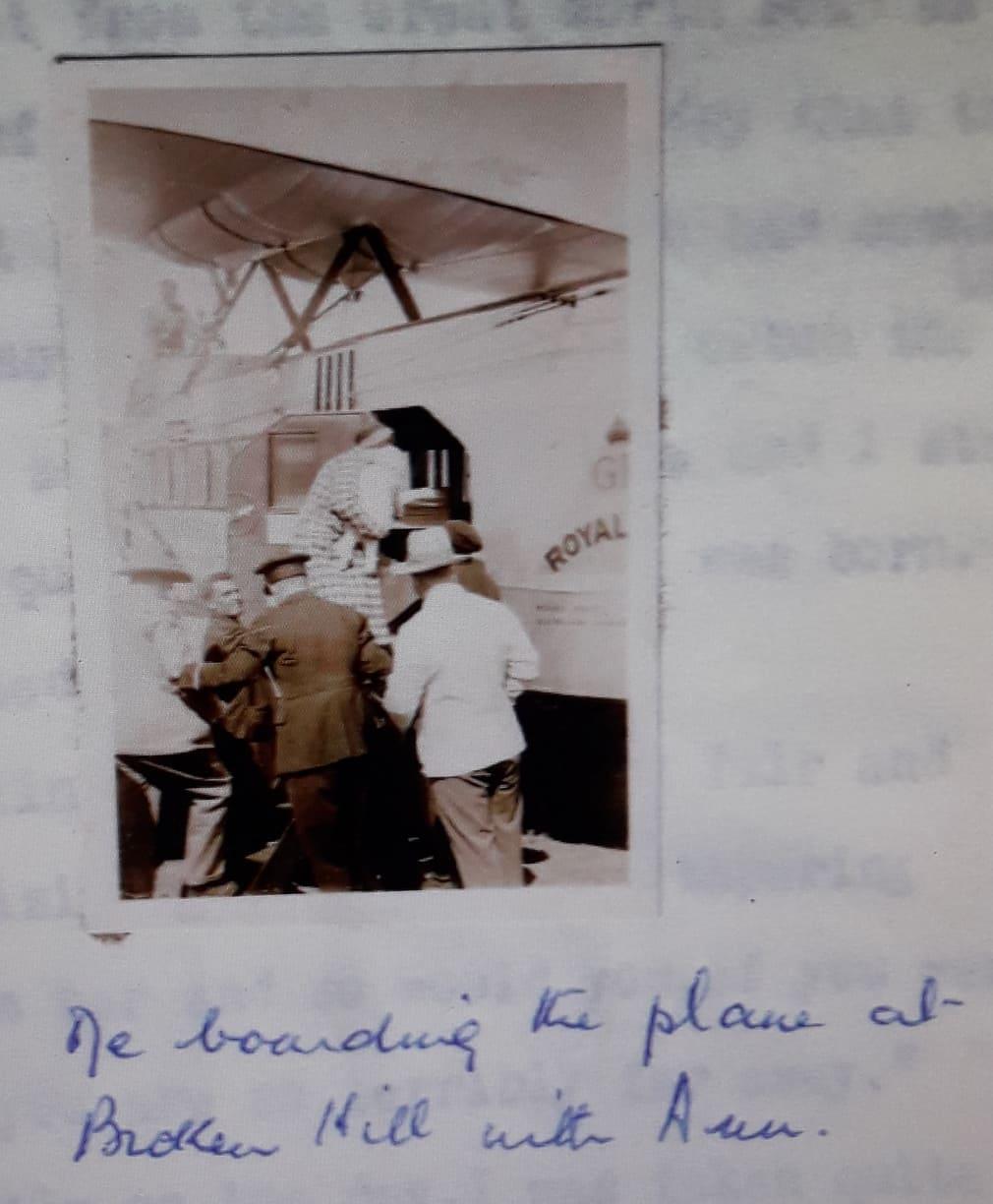
Mchewe Estate. June 15th 1932
Dearest Family,
You’ll be glad to know that we arrived quite safe and sound and very, very
happy to be home.The train Journey was uneventful. Ann slept nearly all the way.
Graham was very kind and saw to everything. He even sat with the baby whilst I went
to meals in the dining car.We were met at Broken Hill by the Thoms who had arranged accommodation for
us at the hotel for the night. They also drove us to the aerodrome in the morning where
the Airways agent told us that Ann is the first baby to travel by air on this section of the
Cape to England route. The plane trip was very bumpy indeed especially between
Broken Hill and Mpika. Everyone was ill including poor little Ann who sicked up her milk
all over the front of my new coat. I arrived at Mbeya looking a sorry caricature of Radiant
Motherhood. I must have been pale green and the baby was snow white. Under the
circumstances it was a good thing that George did not meet us. We were met instead
by Ken Menzies, the owner of the Mbeya Hotel where we spent the night. Ken was
most fatherly and kind and a good nights rest restored Ann and me to our usual robust
health.Mbeya has greatly changed. The hotel is now finished and can accommodate
fifty guests. It consists of a large main building housing a large bar and dining room and
offices and a number of small cottage bedrooms. It even has electric light. There are
several buildings out at the aerodrome and private houses going up in Mbeya.
After breakfast Ken Menzies drove us out to the farm where we had a warm
welcome from George, who looks well but rather thin. The house was spotless and the
new cook, Abel, had made light scones for tea. George had prepared all sorts of lovely
surprises. There is a new reed ceiling in the living room and a new dresser gay with
willow pattern plates which he had ordered from England. There is also a writing table
and a square table by the door for visitors hats. More personal is a lovely model ship
which George assembled from one of those Hobbie’s kits. It puts the finishing touch to
the rather old world air of our living room.In the bedroom there is a large double bed which George made himself. It has
strips of old car tyres nailed to a frame which makes a fine springy mattress and on top
of this is a thick mattress of kapok.In the kitchen there is a good wood stove which
George salvaged from a Mission dump. It looks a bit battered but works very well. The
new cook is excellent. The only blight is that he will wear rubber soled tennis shoes and
they smell awful. I daren’t hurt his feelings by pointing this out though. Opposite the
kitchen is a new laundry building containing a forty gallon hot water drum and a sink for
washing up. Lovely!George has been working very hard. He now has forty acres of coffee seedlings
planted out and has also found time to plant a rose garden and fruit trees. There are
orange and peach trees, tree tomatoes, paw paws, guavas and berries. He absolutely
adores Ann who has been very good and does not seem at all unsettled by the long
journey.It is absolutely heavenly to be back and I shall be happier than ever now that I
have a baby to play with during the long hours when George is busy on the farm,
Thank you for all your love and care during the many months I was with you. Ann
sends a special bubble for granddad.Your very loving,
Eleanor.Mchewe Estate Mbeya July 18th 1932
Dearest Family,
Ann at five months is enchanting. She is a very good baby, smiles readily and is
gaining weight steadily. She doesn’t sleep much during the day but that does not
matter, because, apart from washing her little things, I have nothing to do but attend to
her. She sleeps very well at night which is a blessing as George has to get up very
early to start work on the shamba and needs a good nights rest.
My nights are not so good, because we are having a plague of rats which frisk
around in the bedroom at night. Great big ones that come up out of the long grass in the
gorge beside the house and make cosy homes on our reed ceiling and in the thatch of
the roof.We always have a night light burning so that, if necessary, I can attend to Ann
with a minimum of fuss, and the things I see in that dim light! There are gaps between
the reeds and one night I heard, plop! and there, before my horrified gaze, lay a newly
born hairless baby rat on the floor by the bed, plop, plop! and there lay two more.
Quite dead, poor things – but what a careless mother.I have also seen rats scampering around on the tops of the mosquito nets and
sometimes we have them on our bed. They have a lovely game. They swarm down
the cord from which the mosquito net is suspended, leap onto the bed and onto the
floor. We do not have our net down now the cold season is here and there are few
mosquitoes.Last week a rat crept under Ann’s net which hung to the floor and bit her little
finger, so now I tuck the net in under the mattress though it makes it difficult for me to
attend to her at night. We shall have to get a cat somewhere. Ann’s pram has not yet
arrived so George carries her when we go walking – to her great content.
The native women around here are most interested in Ann. They come to see
her, bearing small gifts, and usually bring a child or two with them. They admire my child
and I admire theirs and there is an exchange of gifts. They produce a couple of eggs or
a few bananas or perhaps a skinny fowl and I hand over sugar, salt or soap as they
value these commodities. The most lavish gift went to the wife of Thomas our headman,
who produced twin daughters in the same week as I had Ann.Our neighbours have all been across to welcome me back and to admire the
baby. These include Marion Coster who came out to join her husband whilst I was in
South Africa. The two Hickson-Wood children came over on a fat old white donkey.
They made a pretty picture sitting astride, one behind the other – Maureen with her arms
around small Michael’s waist. A native toto led the donkey and the children’ s ayah
walked beside it.It is quite cold here now but the sun is bright and the air dry. The whole
countryside is beautifully green and we are a very happy little family.Lots and lots of love,
Eleanor.Mchewe Estate August 11th 1932
Dearest Family,
George has been very unwell for the past week. He had a nasty gash on his
knee which went septic. He had a swelling in the groin and a high temperature and could
not sleep at night for the pain in his leg. Ann was very wakeful too during the same
period, I think she is teething. I luckily have kept fit though rather harassed. Yesterday the
leg looked so inflamed that George decided to open up the wound himself. he made
quite a big cut in exactly the right place. You should have seen the blackish puss
pouring out.After he had thoroughly cleaned the wound George sewed it up himself. he has
the proper surgical needles and gut. He held the cut together with his left hand and
pushed the needle through the flesh with his right. I pulled the needle out and passed it
to George for the next stitch. I doubt whether a surgeon could have made a neater job
of it. He is still confined to the couch but today his temperature is normal. Some
husband!The previous week was hectic in another way. We had a visit from lions! George
and I were having supper about 8.30 on Tuesday night when the back verandah was
suddenly invaded by women and children from the servants quarters behind the kitchen.
They were all yelling “Simba, Simba.” – simba means lions. The door opened suddenly
and the houseboy rushed in to say that there were lions at the huts. George got up
swiftly, fetched gun and ammunition from the bedroom and with the houseboy carrying
the lamp, went off to investigate. I remained at the table, carrying on with my supper as I
felt a pioneer’s wife should! Suddenly something big leapt through the open window
behind me. You can imagine what I thought! I know now that it is quite true to say one’s
hair rises when one is scared. However it was only Kelly, our huge Irish wolfhound,
taking cover.George returned quite soon to say that apparently the commotion made by the
women and children had frightened the lions off. He found their tracks in the soft earth
round the huts and a bag of maize that had been playfully torn open but the lions had
moved on.Next day we heard that they had moved to Hickson-Wood’s shamba. Hicky
came across to say that the lions had jumped over the wall of his cattle boma and killed
both his white Muskat riding donkeys.
He and a friend sat up all next night over the remains but the lions did not return to
the kill.Apart from the little set back last week, Ann is blooming. She has a cap of very
fine fair hair and clear blue eyes under straight brow. She also has lovely dimples in both
cheeks. We are very proud of her.Our neighbours are picking coffee but the crops are small and the price is low. I
am amazed that they are so optimistic about the future. No one in these parts ever
seems to grouse though all are living on capital. They all say “Well if the worst happens
we can always go up to the Lupa Diggings.”Don’t worry about us, we have enough to tide us over for some time yet.
Much love to all,
Eleanor.Mchewe Estate. 28th Sept. 1932
Dearest Family,
News! News! I’m going to have another baby. George and I are delighted and I
hope it will be a boy this time. I shall be able to have him at Mbeya because things are
rapidly changing here. Several German families have moved to Mbeya including a
German doctor who means to build a hospital there. I expect he will make a very good
living because there must now be some hundreds of Europeans within a hundred miles
radius of Mbeya. The Europeans are mostly British or German but there are also
Greeks and, I believe, several other nationalities are represented on the Lupa Diggings.
Ann is blooming and developing according to the Book except that she has no
teeth yet! Kath Hickson-Wood has given her a very nice high chair and now she has
breakfast and lunch at the table with us. Everything within reach goes on the floor to her
amusement and my exasperation!You ask whether we have any Church of England missionaries in our part. No we
haven’t though there are Lutheran and Roman Catholic Missions. I have never even
heard of a visiting Church of England Clergyman to these parts though there are babies
in plenty who have not been baptised. Jolly good thing I had Ann Christened down
there.The R.C. priests in this area are called White Fathers. They all have beards and
wear white cassocks and sun helmets. One, called Father Keiling, calls around frequently.
Though none of us in this area is Catholic we take it in turn to put him up for the night. The
Catholic Fathers in their turn are most hospitable to travellers regardless of their beliefs.
Rather a sad thing has happened. Lucas our old chicken-boy is dead. I shall miss
his toothy smile. George went to the funeral and fired two farewell shots from his rifle
over the grave – a gesture much appreciated by the locals. Lucas in his day was a good
hunter.Several of the locals own muzzle loading guns but the majority hunt with dogs
and spears. The dogs wear bells which make an attractive jingle but I cannot bear the
idea of small antelope being run down until they are exhausted before being clubbed of
stabbed to death. We seldom eat venison as George does not care to shoot buck.
Recently though, he shot an eland and Abel rendered down the fat which is excellent for
cooking and very like beef fat.Much love to all,
Eleanor.Mchewe Estate. P.O.Mbeya 21st November 1932
Dearest Family,
George has gone off to the Lupa for a week with John Molteno. John came up
here with the idea of buying a coffee farm but he has changed his mind and now thinks of
staking some claims on the diggings and also setting up as a gold buyer.Did I tell you about his arrival here? John and George did some elephant hunting
together in French Equatorial Africa and when John heard that George had married and
settled in Tanganyika, he also decided to come up here. He drove up from Cape Town
in a Baby Austin and arrived just as our labourers were going home for the day. The little
car stopped half way up our hill and John got out to investigate. You should have heard
the astonished exclamations when John got out – all 6 ft 5 ins. of him! He towered over
the little car and even to me it seemed impossible for him to have made the long
journey in so tiny a car.Kath Wood has been over several times lately. She is slim and looks so right in
the shirt and corduroy slacks she almost always wears. She was here yesterday when
the shamba boy, digging in the front garden, unearthed a large earthenware cooking pot,
sealed at the top. I was greatly excited and had an instant mental image of fabulous
wealth. We made the boy bring the pot carefully on to the verandah and opened it in
happy anticipation. What do you think was inside? Nothing but a grinning skull! Such a
treat for a pregnant female.We have a tree growing here that had lovely straight branches covered by a
smooth bark. I got the garden boy to cut several of these branches of a uniform size,
peeled off the bark and have made Ann a playpen with the poles which are much like
broom sticks. Now I can leave her unattended when I do my chores. The other morning
after breakfast I put Ann in her playpen on the verandah and gave her a piece of toast
and honey to keep her quiet whilst I laundered a few of her things. When I looked out a
little later I was horrified to see a number of bees buzzing around her head whilst she
placidly concentrated on her toast. I made a rapid foray and rescued her but I still don’t
know whether that was the thing to do.We all send our love,
Eleanor.Mbeya Hospital. April 25th. 1933
Dearest Family,
Here I am, installed at the very new hospital, built by Dr Eckhardt, awaiting the
arrival of the new baby. George has gone back to the farm on foot but will walk in again
to spend the weekend with us. Ann is with me and enjoys the novelty of playing with
other children. The Eckhardts have two, a pretty little girl of two and a half and a very fair
roly poly boy of Ann’s age. Ann at fourteen months is very active. She is quite a little girl
now with lovely dimples. She walks well but is backward in teething.George, Ann and I had a couple of days together at the hotel before I moved in
here and several of the local women visited me and have promised to visit me in
hospital. The trip from farm to town was very entertaining if not very comfortable. There
is ten miles of very rough road between our farm and Utengule Mission and beyond the
Mission there is a fair thirteen or fourteen mile road to Mbeya.As we have no car now the doctor’s wife offered to drive us from the Mission to
Mbeya but she would not risk her car on the road between the Mission and our farm.
The upshot was that I rode in the Hickson-Woods machila for that ten mile stretch. The
machila is a canopied hammock, slung from a bamboo pole, in which I reclined, not too
comfortably in my unwieldy state, with Ann beside me or sometime straddling me. Four
of our farm boys carried the machila on their shoulders, two fore and two aft. The relief
bearers walked on either side. There must have been a dozen in all and they sang a sort
of sea shanty song as they walked. One man would sing a verse and the others took up
the chorus. They often improvise as they go. They moaned about my weight (at least
George said so! I don’t follow Ki-Swahili well yet) and expressed the hope that I would
have a son and that George would reward them handsomely.George and Kelly, the dog, followed close behind the machila and behind
George came Abel our cook and his wife and small daughter Annalie, all in their best
attire. The cook wore a palm beach suit, large Terai hat and sunglasses and two colour
shoes and quite lent a tone to the proceedings! Right at the back came the rag tag and
bobtail who joined the procession just for fun.Mrs Eckhardt was already awaiting us at the Mission when we arrived and we had
an uneventful trip to the Mbeya Hotel.During my last week at the farm I felt very tired and engaged the cook’s small
daughter, Annalie, to amuse Ann for an hour after lunch so that I could have a rest. They
played in the small verandah room which adjoins our bedroom and where I keep all my
sewing materials. One afternoon I was startled by a scream from Ann. I rushed to the
room and found Ann with blood steaming from her cheek. Annalie knelt beside her,
looking startled and frightened, with my embroidery scissors in her hand. She had cut off
half of the long curling golden lashes on one of Ann’s eyelids and, in trying to finish the
job, had cut off a triangular flap of skin off Ann’s cheek bone.I called Abel, the cook, and demanded that he should chastise his daughter there and
then and I soon heard loud shrieks from behind the kitchen. He spanked her with a
bamboo switch but I am sure not as well as she deserved. Africans are very tolerant
towards their children though I have seen husbands and wives fighting furiously.
I feel very well but long to have the confinement over.Very much love,
Eleanor.Mbeya Hospital. 2nd May 1933.
Dearest Family,
Little George arrived at 7.30 pm on Saturday evening 29 th. April. George was
with me at the time as he had walked in from the farm for news, and what a wonderful bit
of luck that was. The doctor was away on a case on the Diggings and I was bathing Ann
with George looking on, when the pains started. George dried Ann and gave her
supper and put her to bed. Afterwards he sat on the steps outside my room and a
great comfort it was to know that he was there.The confinement was short but pretty hectic. The Doctor returned to the Hospital
just in time to deliver the baby. He is a grand little boy, beautifully proportioned. The
doctor says he has never seen a better formed baby. He is however rather funny
looking just now as his head is, very temporarily, egg shaped. He has a shock of black
silky hair like a gollywog and believe it or not, he has a slight black moustache.
George came in, looked at the baby, looked at me, and we both burst out
laughing. The doctor was shocked and said so. He has no sense of humour and couldn’t
understand that we, though bursting with pride in our son, could never the less laugh at
him.Friends in Mbeya have sent me the most gorgeous flowers and my room is
transformed with delphiniums, roses and carnations. The room would be very austere
without the flowers. Curtains, bedspread and enamelware, walls and ceiling are all
snowy white.George hired a car and took Ann home next day. I have little George for
company during the day but he is removed at night. I am longing to get him home and
away from the German nurse who feeds him on black tea when he cries. She insists that
tea is a medicine and good for him.Much love from a proud mother of two.
Eleanor.Mchewe Estate 12May 1933
Dearest Family,
We are all together at home again and how lovely it feels. Even the house
servants seem pleased. The boy had decorated the lounge with sprays of
bougainvillaea and Abel had backed one of his good sponge cakes.Ann looked fat and rosy but at first was only moderately interested in me and the
new baby but she soon thawed. George is good with her and will continue to dress Ann
in the mornings and put her to bed until I am satisfied with Georgie.He, poor mite, has a nasty rash on face and neck. I am sure it is just due to that
tea the nurse used to give him at night. He has lost his moustache and is fast loosing his
wild black hair and emerging as quite a handsome babe. He is a very masculine looking
infant with much more strongly marked eyebrows and a larger nose that Ann had. He is
very good and lies quietly in his basket even when awake.George has been making a hatching box for brown trout ova and has set it up in
a small clear stream fed by a spring in readiness for the ova which is expected from
South Africa by next weeks plane. Some keen fishermen from Mbeya and the District
have clubbed together to buy the ova. The fingerlings are later to be transferred to
streams in Mbeya and Tukuyu Districts.I shall now have my hands full with the two babies and will not have much time for the
garden, or I fear, for writing very long letters. Remember though, that no matter how
large my family becomes, I shall always love you as much as ever.Your affectionate,
Eleanor.Mchewe Estate. 14th June 1933
Dearest Family,
The four of us are all well but alas we have lost our dear Kelly. He was rather a
silly dog really, although he grew so big he retained all his puppy ways but we were all
very fond of him, especially George because Kelly attached himself to George whilst I
was away having Ann and from that time on he was George’s shadow. I think he had
some form of biliary fever. He died stretched out on the living room couch late last night,
with George sitting beside him so that he would not feel alone.The children are growing fast. Georgie is a darling. He now has a fluff of pale
brown hair and his eyes are large and dark brown. Ann is very plump and fair.
We have had several visitors lately. Apart from neighbours, a car load of diggers
arrived one night and John Molteno and his bride were here. She is a very attractive girl
but, I should say, more suited to life in civilisation than in this back of beyond. She has
gone out to the diggings with her husband and will have to walk a good stretch of the fifty
or so miles.The diggers had to sleep in the living room on the couch and on hastily erected
camp beds. They arrived late at night and left after breakfast next day. One had half a
beard, the other side of his face had been forcibly shaved in the bar the night before.your affectionate,
EleanorMchewe Estate. August 10 th. 1933
Dearest Family,
George is away on safari with two Indian Army officers. The money he will get for
his services will be very welcome because this coffee growing is a slow business, and
our capitol is rapidly melting away. The job of acting as White Hunter was unexpected
or George would not have taken on the job of hatching the ova which duly arrived from
South Africa.George and the District Commissioner, David Pollock, went to meet the plane
by which the ova had been consigned but the pilot knew nothing about the package. It
came to light in the mail bag with the parcels! However the ova came to no harm. David
Pollock and George brought the parcel to the farm and carefully transferred the ova to
the hatching box. It was interesting to watch the tiny fry hatch out – a process which took
several days. Many died in the process and George removed the dead by sucking
them up in a glass tube.When hatched, the tiny fry were fed on ant eggs collected by the boys. I had to
take over the job of feeding and removing the dead when George left on safari. The fry
have to be fed every four hours, like the baby, so each time I have fed Georgie. I hurry
down to feed the trout.The children are very good but keep me busy. Ann can now say several words
and understands more. She adores Georgie. I long to show them off to you.Very much love
Eleanor.Mchewe Estate. October 27th 1933
Dear Family,
All just over flu. George and Ann were very poorly. I did not fare so badly and
Georgie came off best. He is on a bottle now.There was some excitement here last Wednesday morning. At 6.30 am. I called
for boiling water to make Georgie’s food. No water arrived but muffled shouting and the
sound of blows came from the kitchen. I went to investigate and found a fierce fight in
progress between the house boy and the kitchen boy. In my efforts to make them stop
fighting I went too close and got a sharp bang on the mouth with the edge of an
enamelled plate the kitchen boy was using as a weapon. My teeth cut my lip inside and
the plate cut it outside and blood flowed from mouth to chin. The boys were petrified.
By the time I had fed Georgie the lip was stiff and swollen. George went in wrath
to the kitchen and by breakfast time both house boy and kitchen boy had swollen faces
too. Since then I have a kettle of boiling water to hand almost before the words are out
of my mouth. I must say that the fight was because the house boy had clouted the
kitchen boy for keeping me waiting! In this land of piece work it is the job of the kitchen
boy to light the fire and boil the kettle but the houseboy’s job to carry the kettle to me.
I have seen little of Kath Wood or Marion Coster for the past two months. Major
Jones is the neighbour who calls most regularly. He has a wireless set and calls on all of
us to keep us up to date with world as well as local news. He often brings oranges for
Ann who adores him. He is a very nice person but no oil painting and makes no effort to
entertain Ann but she thinks he is fine. Perhaps his monocle appeals to her.George has bought a six foot long galvanised bath which is a great improvement
on the smaller oval one we have used until now. The smaller one had grown battered
from much use and leaks like a sieve. Fortunately our bathroom has a cement floor,
because one had to fill the bath to the brim and then bath extremely quickly to avoid
being left high and dry.Lots and lots of love,
Eleanor.Mchewe Estate. P.O. Mbeya 1st December 1933
Dearest Family,
Ann has not been well. We think she has had malaria. She has grown a good
deal lately and looks much thinner and rather pale. Georgie is thriving and has such
sparkling brown eyes and a ready smile. He and Ann make a charming pair, one so fair
and the other dark.The Moltenos’ spent a few days here and took Georgie and me to Mbeya so
that Georgie could be vaccinated. However it was an unsatisfactory trip because the
doctor had no vaccine.George went to the Lupa with the Moltenos and returned to the farm in their Baby
Austin which they have lent to us for a week. This was to enable me to go to Mbeya to
have a couple of teeth filled by a visiting dentist.We went to Mbeya in the car on Saturday. It was quite a squash with the four of
us on the front seat of the tiny car. Once George grabbed the babies foot instead of the
gear knob! We had Georgie vaccinated at the hospital and then went to the hotel where
the dentist was installed. Mr Dare, the dentist, had few instruments and they were very
tarnished. I sat uncomfortably on a kitchen chair whilst he tinkered with my teeth. He filled
three but two of the fillings came out that night. This meant another trip to Mbeya in the
Baby Austin but this time they seem all right.The weather is very hot and dry and the garden a mess. We are having trouble
with the young coffee trees too. Cut worms are killing off seedlings in the nursery and
there is a borer beetle in the planted out coffee.George bought a large grey donkey from some wandering Masai and we hope
the children will enjoy riding it later on.Very much love,
Eleanor.Mchewe Estate. 14th February 1934.
Dearest Family,
You will be sorry to hear that little Ann has been very ill, indeed we were terribly
afraid that we were going to lose her. She enjoyed her birthday on the 8th. All the toys
you, and her English granny, sent were unwrapped with such delight. However next
day she seemed listless and a bit feverish so I tucked her up in bed after lunch. I dosed
her with quinine and aspirin and she slept fitfully. At about eleven o’clock I was
awakened by a strange little cry. I turned up the night light and was horrified to see that
Ann was in a convulsion. I awakened George who, as always in an emergency, was
perfectly calm and practical. He filled the small bath with very warm water and emersed
Ann in it, placing a cold wet cloth on her head. We then wrapped her in blankets and
gave her an enema and she settled down to sleep. A few hours later we had the same
thing over again.At first light we sent a runner to Mbeya to fetch the doctor but waited all day in
vain and in the evening the runner returned to say that the doctor had gone to a case on
the diggings. Ann had been feverish all day with two or three convulsions. Neither
George or I wished to leave the bedroom, but there was Georgie to consider, and in
the afternoon I took him out in the garden for a while whilst George sat with Ann.
That night we both sat up all night and again Ann had those wretched attacks of
convulsions. George and I were worn out with anxiety by the time the doctor arrived the
next afternoon. Ann had not been able to keep down any quinine and had had only
small sips of water since the onset of the attack.The doctor at once diagnosed the trouble as malaria aggravated by teething.
George held Ann whilst the Doctor gave her an injection. At the first attempt the needle
bent into a bow, George was furious! The second attempt worked and after a few hours
Ann’s temperature dropped and though she was ill for two days afterwards she is now
up and about. She has also cut the last of her baby teeth, thank God. She looks thin and
white, but should soon pick up. It has all been a great strain to both of us. Georgie
behaved like an angel throughout. He played happily in his cot and did not seem to
sense any tension as people say, babies do. Our baby was cheerful and not at all
subdued.This is the rainy season and it is a good thing that some work has been done on
our road or the doctor might not have got through.Much love to all,
Eleanor.Mchewe Estate. 1st October 1934
Dearest Family,
We are all well now, thank goodness, but last week Georgie gave us such a
fright. I was sitting on the verandah, busy with some sewing and not watching Ann and
Georgie, who were trying to reach a bunch of bananas which hung on a rope from a
beam of the verandah. Suddenly I heard a crash, Georgie had fallen backward over the
edge of the verandah and hit the back of his head on the edge of the brick furrow which
carries away the rainwater. He lay flat on his back with his arms spread out and did not
move or cry. When I picked him up he gave a little whimper, I carried him to his cot and
bathed his face and soon he began sitting up and appeared quite normal. The trouble
began after he had vomited up his lunch. He began to whimper and bang his head
against the cot.George and I were very worried because we have no transport so we could not
take Georgie to the doctor and we could not bear to go through again what we had gone
through with Ann earlier in the year. Then, in the late afternoon, a miracle happened. Two
men George hardly knew, and complete strangers to me, called in on their way from the
diggings to Mbeya and they kindly drove Georgie and me to the hospital. The Doctor
allowed me to stay with Georgie and we spent five days there. Luckily he responded to
treatment and is now as alive as ever. Children do put years on one!There is nothing much else to report. We have a new vegetable garden which is
doing well but the earth here is strange. Gardens seem to do well for two years but by
that time the soil is exhausted and one must move the garden somewhere else. The
coffee looks well but it will be another year before we can expect even a few bags of
coffee and prices are still low. Anyway by next year George should have some good
return for all his hard work.Lots of love,
Eleanor.Mchewe Estate. November 4th 1934
Dearest Family,
George is home from his White Hunting safari looking very sunburnt and well.
The elderly American, who was his client this time, called in here at the farm to meet me
and the children. It is amazing what spirit these old lads have! This one looked as though
he should be thinking in terms of slippers and an armchair but no, he thinks in terms of
high powered rifles with telescopic sights.It is lovely being together again and the children are delighted to have their Dad
home. Things are always exciting when George is around. The day after his return
George said at breakfast, “We can’t go on like this. You and the kids never get off the
shamba. We’ll simply have to get a car.” You should have heard the excitement. “Get a
car Daddy?’” cried Ann jumping in her chair so that her plaits bounced. “Get a car
Daddy?” echoed Georgie his brown eyes sparkling. “A car,” said I startled, “However
can we afford one?”“Well,” said George, “on my way back from Safari I heard that a car is to be sold
this week at the Tukuyu Court, diseased estate or bankruptcy or something, I might get it
cheap and it is an A.C.” The name meant nothing to me, but George explained that an
A.C. is first cousin to a Rolls Royce.So off he went to the sale and next day the children and I listened all afternoon for
the sound of an approaching car. We had many false alarms but, towards evening we
heard what appeared to be the roar of an aeroplane engine. It was the A.C. roaring her
way up our steep hill with a long plume of steam waving gaily above her radiator.
Out jumped my beaming husband and in no time at all, he was showing off her
points to an admiring family. Her lines are faultless and seats though worn are most
comfortable. She has a most elegant air so what does it matter that the radiator leaks like
a sieve, her exhaust pipe has broken off, her tyres are worn almost to the canvas and
she has no windscreen. She goes, and she cost only five pounds.Next afternoon George, the kids and I piled into the car and drove along the road
on lookout for guinea fowl. All went well on the outward journey but on the homeward
one the poor A.C. simply gasped and died. So I carried the shot gun and George
carried both children and we trailed sadly home. This morning George went with a bunch
of farmhands and brought her home. Truly temperamental, she came home literally
under her own steam.George now plans to get a second hand engine and radiator for her but it won’t
be an A.C. engine. I think she is the only one of her kind in the country.
I am delighted to hear, dad, that you are sending a bridle for Joseph for
Christmas. I am busy making a saddle out of an old piece of tent canvas stuffed with
kapok, some webbing and some old rug straps. A car and a riding donkey! We’re
definitely carriage folk now.Lots of love to all,
Eleanor.Mchewe Estate. 28th December 1934
Dearest Family,
Thank you for the wonderful Christmas parcel. My frock is a splendid fit. George
declares that no one can knit socks like Mummy and the children love their toys and new
clothes.Joseph, the donkey, took his bit with an air of bored resignation and Ann now
rides proudly on his back. Joseph is a big strong animal with the looks and disposition of
a mule. he will not go at all unless a native ‘toto’ walks before him and when he does go
he wears a pained expression as though he were carrying fourteen stone instead of
Ann’s fly weight. I walk beside the donkey carrying Georgie and our cat, ‘Skinny Winnie’,
follows behind. Quite a cavalcade. The other day I got so exasperated with Joseph that
I took Ann off and I got on. Joseph tottered a few paces and sat down! to the huge
delight of our farm labourers who were going home from work. Anyway, one good thing,
the donkey is so lazy that there is little chance of him bolting with Ann.The Moltenos spent Christmas with us and left for the Lupa Diggings yesterday.
They arrived on the 22nd. with gifts for the children and chocolates and beer. That very
afternoon George and John Molteno left for Ivuna, near Lake Ruckwa, to shoot some
guinea fowl and perhaps a goose for our Christmas dinner. We expected the menfolk
back on Christmas Eve and Anne and I spent a busy day making mince pies and
sausage rolls. Why I don’t know, because I am sure Abel could have made them better.
We decorated the Christmas tree and sat up very late but no husbands turned up.
Christmas day passed but still no husbands came. Anne, like me, is expecting a baby
and we both felt pretty forlorn and cross. Anne was certain that they had been caught up
in a party somewhere and had forgotten all about us and I must say when Boxing Day
went by and still George and John did not show up I felt ready to agree with her.
They turned up towards evening and explained that on the homeward trip the car
had bogged down in the mud and that they had spent a miserable Christmas. Anne
refused to believe their story so George, to prove their case, got the game bag and
tipped the contents on to the dining room table. Out fell several guinea fowl, long past
being edible, followed by a large goose so high that it was green and blue where all the
feathers had rotted off.The stench was too much for two pregnant girls. I shot out of the front door
closely followed by Anne and we were both sick in the garden.I could not face food that evening but Anne is made of stronger stuff and ate her
belated Christmas dinner with relish.I am looking forward enormously to having Marjorie here with us. She will be able
to carry back to you an eyewitness account of our home and way of life.Much love to you all,
Eleanor.Mchewe Estate. 5th January 1935
Dearest Family,
You cannot imagine how lovely it is to have Marjorie here. She came just in time
because I have had pernicious vomiting and have lost a great deal of weight and she
took charge of the children and made me spend three days in hospital having treatment.
George took me to the hospital on the afternoon of New Years Eve and decided
to spend the night at the hotel and join in the New Years Eve celebrations. I had several
visitors at the hospital that evening and George actually managed to get some imported
grapes for me. He returned to the farm next morning and fetched me from the hospital
four days later. Of course the old A.C. just had to play up. About half way home the
back axle gave in and we had to send a passing native some miles back to a place
called Mbalizi to hire a lorry from a Greek trader to tow us home to the farm.
The children looked well and were full of beans. I think Marjorie was thankful to
hand them over to me. She is delighted with Ann’s motherly little ways but Georgie she
calls “a really wild child”. He isn’t, just has such an astonishing amount of energy and is
always up to mischief. Marjorie brought us all lovely presents. I am so thrilled with my
sewing machine. It may be an old model but it sews marvellously. We now have an
Alsatian pup as well as Joseph the donkey and the two cats.Marjorie had a midnight encounter with Joseph which gave her quite a shock but
we had a good laugh about it next day. Some months ago George replaced our wattle
and daub outside pit lavatory by a substantial brick one, so large that Joseph is being
temporarily stabled in it at night. We neglected to warn Marj about this and one night,
storm lamp in hand, she opened the door and Joseph walked out braying his thanks.
I am afraid Marjorie is having a quiet time, a shame when the journey from Cape
Town is so expensive. The doctor has told me to rest as much as I can, so it is
impossible for us to take Marj on sight seeing trips.I hate to think that she will be leaving in ten days time.
Much love,
Eleanor.Mchewe Estate. 18th February 1935
Dearest Family,
You must be able to visualise our life here quite well now that Marj is back and
has no doubt filled in all the details I forget to mention in my letters. What a journey we
had in the A.C. when we took her to the plane. George, the children and I sat in front and
Marj sat behind with numerous four gallon tins of water for the insatiable radiator. It was
raining and the canvas hood was up but part of the side flaps are missing and as there is
no glass in the windscreen the rain blew in on us. George got fed up with constantly
removing the hot radiator cap so simply stuffed a bit of rag in instead. When enough
steam had built up in the radiator behind the rag it blew out and we started all over again.
The car still roars like an aeroplane engine and yet has little power so that George sent
gangs of boys to the steep hills between the farm and the Mission to give us a push if
necessary. Fortunately this time it was not, and the boys cheered us on our way. We
needed their help on the homeward journey however.George has now bought an old Chev engine which he means to install before I
have to go to hospital to have my new baby. It will be quite an engineering feet as
George has few tools.I am sorry to say that I am still not well, something to do with kidneys or bladder.
George bought me some pills from one of the several small shops which have opened
in Mbeya and Ann is most interested in the result. She said seriously to Kath Wood,
“Oh my Mummy is a very clever Mummy. She can do blue wee and green wee as well
as yellow wee.” I simply can no longer manage the children without help and have
engaged the cook’s wife, Janey, to help. The children are by no means thrilled. I plead in
vain that I am not well enough to go for walks. Ann says firmly, “Ann doesn’t want to go
for a walk. Ann will look after you.” Funny, though she speaks well for a three year old,
she never uses the first person. Georgie say he would much rather walk with
Keshokutwa, the kitchen boy. His name by the way, means day-after-tomorrow and it
suits him down to the ground, Kath Wood walks over sometimes with offers of help and Ann will gladly go walking with her but Georgie won’t. He on the other hand will walk with Anne Molteno
and Ann won’t. They are obstinate kids. Ann has developed a very fertile imagination.
She has probably been looking at too many of those nice women’s magazines you
sent. A few days ago she said, “You are sick Mummy, but Ann’s got another Mummy.
She’s not sick, and my other mummy (very smugly) has lovely golden hair”. This
morning’ not ten minutes after I had dressed her, she came in with her frock wet and
muddy. I said in exasperation, “Oh Ann, you are naughty.” To which she instantly
returned, “My other Mummy doesn’t think I am naughty. She thinks I am very nice.” It
strikes me I shall have to get better soon so that I can be gay once more and compete
with that phantom golden haired paragon.We had a very heavy storm over the farm last week. There was heavy rain with
hail which stripped some of the coffee trees and the Mchewe River flooded and the
water swept through the lower part of the shamba. After the water had receded George
picked up a fine young trout which had been stranded. This was one of some he had
put into the river when Georgie was a few months old.The trials of a coffee farmer are legion. We now have a plague of snails. They
ring bark the young trees and leave trails of slime on the glossy leaves. All the ring
barked trees will have to be cut right back and this is heartbreaking as they are bearing
berries for the first time. The snails are collected by native children, piled upon the
ground and bashed to a pulp which gives off a sickening stench. I am sorry for the local
Africans. Locusts ate up their maize and now they are losing their bean crop to the snails.Lots of love, Eleanor
December 21, 2021 at 1:47 pm #6247In reply to: The Elusive Samuel Housley and Other Family Stories
Warren Brothers Boiler Makers
Samuel Warren, my great grandfather, and husband of Florence Nightingale Gretton, worked with the family company of boiler makers in Newhall in his early years. He developed an interest in motor cars, and left the family business to start up on his own. By all accounts, he made some bad decisions and borrowed a substantial amount of money from his sister. It was because of this disastrous state of affairs that the impoverished family moved from Swadlincote/Newhall to Stourbridge.
1914: Tram no 10 on Union Road going towards High Street Newhall. On the left Henry Harvey Engineer, on the right Warren Bros Boiler Manufacturers & Engineers:
I found a newspaper article in the Derbyshire Advertiser and Journal dated the 2nd October 1915 about a Samuel Warren of Warren Brothers Boilermakers, but it was about my great grandfathers uncle, also called Samuel.
DEATH OF MR. SAMUEL WARREN, OF NEWHALL. Samuel Warren, of Rose Villa, Newhall, passed away on Saturday evening at the age of 85.. Of somewhat retiring disposition, he took little or no active part in public affairs, but for many years was trustee of the loyal British Oak Lodge of the M.U. of Oddfellows, and in many other ways served His community when opportunity permitted. He was member of the firm of Warren Bros., of the Boiler Works, Newhall. This thriving business was established by the late Mr. Benjamin Bridge, over 60 years ago, and on his death it was taken over by his four nephews. Mr. William Warren died several years ago, and with the demise Mr. Samuel Warren, two brothers remain, Messrs. Henry and Benjamin Warren. He leaves widow, six daughters, and three sons to mourn his loss.
This was the first I’d heard of Benjamin Bridge. William Warren mentioned in the article as having died previously was Samuel’s father, my great great grandfather. William’s brother Henry was the father of Ben Warren, the footballer.
But who was Benjamin Bridge?
Samuel’s father was William Warren 1835-1881. He had a brother called Samuel, mentioned above, and William’s father was also named Samuel. Samuel Warren 1800-1882 married Elizabeth Bridge 1813-1872. Benjamin Bridge 1811-1898 was Elizabeth’s brother.
Burton Chronicle 28 July 1898:
Benjamin and his wife Jane had no children. According to the obituary in the newspaper, the couple were fondly remembered for their annual tea’s for the widows of the town. Benjamin Bridge’s house was known as “the preachers house”. He was superintendent of Newhall Sunday School and member of Swadlincote’s board of health. And apparently very fond of a tall white hat!
On the 1881 census, Benjamin Bridge and his wife live near to the Warren family in Newhall. The Warren’s live in the “boiler yard” and the family living in between the Bridge’s and the Warren’s include an apprentice boiler maker, so we can assume these were houses incorporated in the boiler works property. Benjamin is a 72 year old retired boiler maker. Elizabeth Warren is a widow (William died in 1881), two of her sons are boiler makers, and Samuel, my great grandfather, is on the next page of the census, at seven years old.
Warren Brothers made boilers for the Burton breweries, including Bass, Ratcliff and Gretton.
This receipt from Warrens Boiler yard for a new boiler in 1885 was purchased off Ebay by Colin Smith. He gave it to one of the grandsons of Robert Adolphus Warren, to keep in the Warren family. It is in his safe at home, and he promised Colin that it will stay in the family forever.
 December 18, 2021 at 7:05 pm #6246
In reply to: The Elusive Samuel Housley and Other Family Stories
Florence Nightingale Gretton
1881-1927
Florence’s father was Richard Gretton, a baker in Swadlincote, Derbyshire. When Richard married Sarah Orgill in 1861, they lived with her mother, a widow, in Measham, Ashby de la Zouch in Leicestershire. On the 1861 census Sarah’s mother, Elizabeth, is a farmer of two acres.
(Swadlincote and Ashby de la Zouch are on the Derbyshire Leicestershire border and not far from each other. Swadlincote is near to Burton upon Trent which is sometimes in Staffordshire, sometimes in Derbyshire. Newhall, Church Gresley, and Swadlincote are all very close to each other or districts in the same town.)
Ten years later in 1871 Richard and Sarah have their own place in Swadlincote, he is a baker, and they have four children. A fourteen year old apprentice or servant is living with them.
In the Ashby-de-la-Zouch Gazette on 28 February 1880, it was reported that Richard Gretton, baker, of Swadlincote, was charged by Captain Bandys with carrying bread in a cart for sale, the said cart not being provided with scales and weights, according to the requirements of the Act, on the 17th January last.—Defendant pleaded guilty, but urged in extenuation of the offence that in the hurry he had forgotten to put the scales in the cart before his son started.—The Bench took this view of the case, regarding it as an oversight, and fined him one shilling only and costs. This was not his only offence.
In 1883, he was fined twenty shillings, and ten shillings and sixpence costs.
By 1881 they have 4 more children, and Florence Nightingale is the youngest at four months. Richard is 48 by now, and Sarah is 44. Florence’s older brother William is a blacksmith.
Interestingly on the same census page, two doors down Thomas and Selina Warren live at the Stanhope Arms. Richards son John Gretton lives at the pub, a 13 year old servant. Incidentally, I noticed on Thomas and Selena’s marriage register that Richard and Sarah Gretton were the witnesses at the wedding.
Ten years later in 1891, Florence Nightingale and her sister Clara are living with Selina Warren, widow, retired innkeeper, one door down from the Stanhope Arms. Florence is ten, Clara twelve and they are scholars.
Richard and Sarah are still living three doors up on the other side of the Stanhope Arms, with three of their sons. But the two girls lived up the road with the Warren widow!The Stanhope Arms, Swadlincote: it’s possible that the shop with the awning was Richard Gretton’s bakers shop (although not at the time of this later photo).
Richard died in 1898, a year before Florence married Samuel Warren.
Sarah is a widowed 60 year old baker on the 1901 census. Her son 26 year old son Alf, also a baker, lives at the same address, as does her 22 year old daughter Clara who is a district nurse.
Clara Gretton and family, photo found online:
In 1901 Florence Nightingale (who we don’t have a photograph of!) is now married and is Florrie Warren on the census, and she, her husband Samuel, and their one year old daughter Hildred are visitors at the address of Elizabeth (Staley)Warren, 60 year old widow and Samuel’s mother, and Samuel’s 36 year old brother William. Samuel and William are engineers.
Samuel and Florrie had ten children between 1900 and 1925 (and all but two of them used their middle name and not first name: my mother and I had no idea until I found all the records. My grandmother Florence Noreen was known as Nora, which we knew of course, uncle Jack was actually Douglas John, and so on).
Hildred, Clara, Billy, and Nora were born in Swadlincote. Sometime between my grandmother’s birth in 1907 and Kay’s birth in 1911, the family moved to Oldswinford, in Stourbridge. Later they moved to Market Street.
1911 census, Oldswinford, Stourbridge:
Oddly, nobody knew when Florrie Warren died. My mothers cousin Ian Warren researched the Warren family some years ago, while my grandmother was still alive. She contributed family stories and information, but couldn’t remember if her mother died in 1929 or 1927. A recent search of records confirmed that it was the 12th November 1927.
She was 46 years old. We were curious to know how she died, so my mother ordered a paper copy of her death certificate. It said she died at 31 Market Street, Stourbridge at the age of 47. Clara May Warren, her daughter, was in attendance. Her husband Samuel Warren was a motor mechanic. The Post mortem was by Percival Evans, coroner for Worcestershire, who clarified the cause of death as vascular disease of the heart. There was no inquest. The death was registered on 15 Nov 1927.
I looked for a photo of 31 Market Street in Stourbridge, and was astonished to see that it was the house next door to one I lived in breifly in the 1980s. We didn’t know that the Warren’s lived in Market Street until we started searching the records.
Market Street, Stourbridge. I lived in the one on the corner on the far right, my great grandmother died in the one next door.
I found some hitherto unknown emigrants in the family. Florence Nightingale Grettons eldest brother William 1861-1940 stayed in Swadlincote. John Orgill Gretton born in 1868 moved to Trenton New Jersey USA in 1888, married in 1892 and died in 1949 in USA. Michael Thomas born in 1870 married in New York in 1893 and died in Trenton in 1940. Alfred born 1875 stayed in Swadlincote. Charles Herbert born 1876 married locally and then moved to Australia in 1912, and died in Victoria in 1954. Clara Elizabeth was a district nurse, married locally and died at the age of 99.
December 17, 2021 at 10:36 am #6241In reply to: The Elusive Samuel Housley and Other Family Stories
Kidsley Grange Farm and The Quakers Next Door
Kidsley Grange Farm in Smalley, Derbyshire, was the home of the Housleys in the 1800s. William Housley 1781-1848 was born in nearby Selston. His wife Ellen Carrington 1795-1872 was from a long line of Carringtons in Smalley. They had ten children between 1815 and 1838. Samuel, my 3x great grandfather, was the second son born in 1816.
The original farm has been made into a nursing home in recent years, which at the time of writing is up for sale at £500,000. Sadly none of the original farm appears visible with all the new additions.
The farm before it was turned into a nursing home:
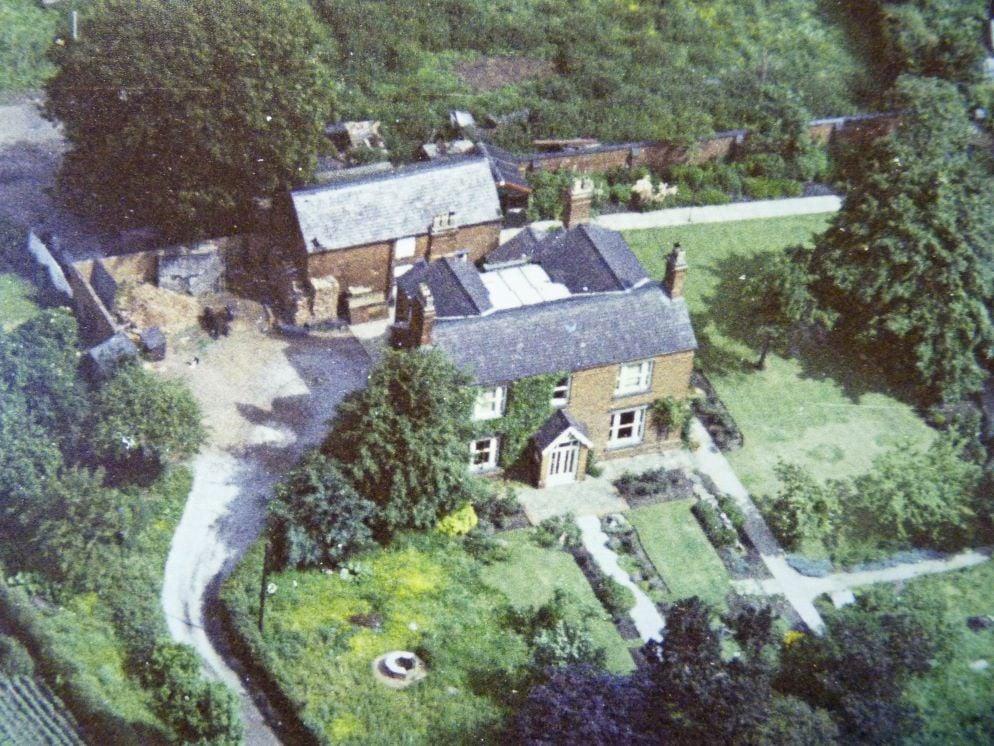
Kidsley Grange Farm and Kidsley Park, a neighbouring farm, are mentioned in a little book about the history of Smalley. The neighbours at Kidsley Park, the Davy’s, were friends of the Housleys. They were Quakers.
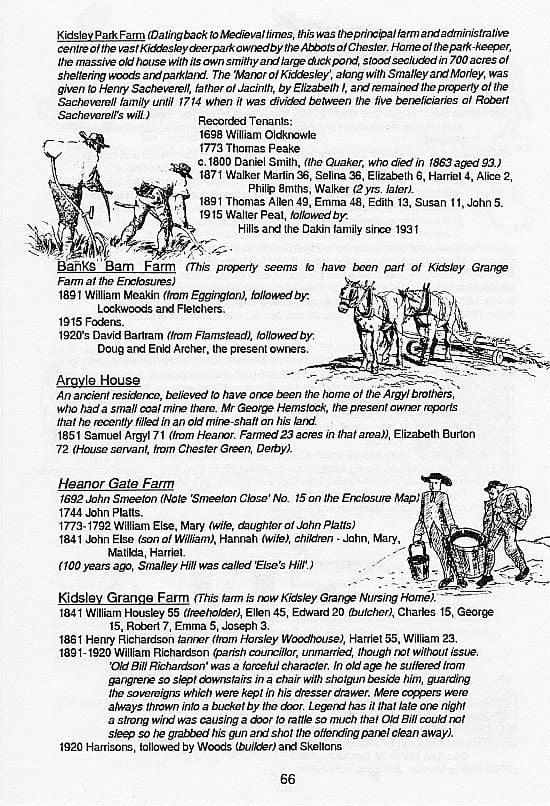
In Kerry’s History of Smalley:
Kidsley Park Farm was owned by Daniel Smith, a prominent Quaker and the last of the Quakers at Kidsley. His daughter, Elizabeth Davy, widow of William Davis, married WH Barber MB of Smalley. Elizabeth was the author of the poem “Farewell to Kidsley Park”.
Emma Housley sent one of Elizabeth Davy’s poems to her brother George in USA.
“We have sent you a piece of poetry that Mrs. Davy composed about our ‘Old House.’ I am sure you will like it though you may not understand all the allusions she makes use of as well as we do.”
Farewell to Kidsley Park
Farewell, Farewell, Thy pathways now by strangers feet are trod,
And other hands and horses strange henceforth shall turn thy sod,
Yes, other eyes may watch the buds expanding in the spring.
And other children round the hearth the coming years may bring,
But mine will be the memory of cares and pleasures there,
Intenser ~ that no living thing in some of them can share,
Commencing with the loved, and lost, in days of long ago,
When one was present on whose head Atlantic’s breezes blow,
Long years ago he left that roof, and made a home afar ~
For that is really only “home” where life’s affections are!
How many thoughts come o’er me, for old Kidsley has “a name
And memory” ~ in the hearts of some not unknown to fame.
We dream not, in those happy times, that I should be the last,
Alone, to leave my native place ~ alone, to meet the blast,
I loved each nook and corner there, each leaf and blade of grass,
Each moonlight shadow on the pond I loved: but let it pass,
For mine is still the memory that only death can mar;
I fancy I shall see it reflecting every star.
The graves of buried quadrupeds, affectionate and true,
Will have the olden sunshine, and the same bright morning dew,
But the birds that sang at even when the autumn leaves were seer,
Will miss the crumbs they used to get, in winters long and drear.
Will the poor down-trodden miss me? God help them if they do!
Some manna in the wilderness, His goodness guide them to!
Farewell to those who love me! I shall bear them still in mind,
And hope to be remembered by those I left behind:
Do not forget the aged man ~ though another fills his place ~
Another, bearing not his name, nor coming of his race.
His creed might be peculiar; but there was much of good
Successors will not imitate, because not understood.
Two hundred years have come and past since George Fox ~ first of “Friends” ~
Established his religion there ~ which my departure ends.
Then be it so: God prosper these in basket and in store,
And make them happy in my place ~ my dwelling, never more!
For I may be a wanderer ~ no roof nor hearthstone mine:
May light that cometh from above my resting place define.
Gloom hovers o’er the prospect now, but He who was my friend,
In the midst of troubled waters, will see me to the end.Elizabeth Davy, June 6th, 1863, Derby.
Another excerpt from Barbara Housley’s Narrative on the Letters from the family in Smalley to George in USA mentions the Davy’s:
Anne’s will was probated October 14, 1856. Mr. William Davy of Kidsley Park appeared for the family. Her estate was valued at under £20. Emma was to receive fancy needlework, a four post bedstead, feather bed and bedding, a mahogany chest of drawers, plates, linen and china. Emma was also to receive Anne’s writing desk! There was a condition that Ellen would have use of these items until her death.
The money that Anne was to receive from her grandfather, William Carrington, and her father, William Housley was to be distributed one third to Joseph, one third to Emma, and one third to be divided between her four neices: John’s daughter Elizabeth, 18, and Sam’s daughters Elizabeth, 10, Mary Anne, 9 and Catherine, age 7 to be paid by the trustees as they think “most useful and proper.” Emma Lyon and Elizabeth Davy were the witnesses.Mrs. Davy wrote to George on March 21 1856 sending some gifts from his sisters and a portrait of their mother–“Emma is away yet and A is so much worse.” Mrs. Davy concluded: “With best wishes
for thy health and prosperity in this world and the next I am thy sincere friend.” Whenever the girls sent greetings from Mrs. Davy they used her Quaker speech pattern of “thee and thy.”September 18, 2021 at 8:26 pm #6213In reply to: The Precious Life and Rambles of Liz Tattler
“Well, I wish you would stop interrupting me while I fill in the empty pages of my pink notebook with gripping stories, I keep losing my thread. Most annoying!” Liz sighed. She wrote Liz snapped at first and then erased it and changed it to Liz sighed. Then she added Liz sighed with the very mildest slight irritation and then became exasperated with the whole thing and told herself to just leave it and try to move on!
But really, Finnley’s timing, as usual! Just as Liz had worked out the direct line to the characters fathers mothers fathers fathers mothers fathers mothers fathers father and mother, Finnley wafts through the scene, making herself conspicuous, and scattering Liz’s tenuous concentration like feathers in the wind.
“And I don’t want to hear a word about apostrophes either,” she added, mentally noting the one in don’t.
“Oh, now I see what you’re doing, Liz!” Gordon appeared, smoking a pipe. “Very clever!”
“Good God, Gordon, you’re smoking a pipe!” It was an astonishing sight. “What an astonishing sight! Where are your nuts?”
“Well, it’s like this,” Gordon grinned, “I’ve been eating nuts in every scene for, how long? I just can’t face another nut.”
Liz barked out a loud cackle. “You think that’s bad, have you seen what they keep dressing me in? Anyway, ” she asked, “What do you mean clever and you see what I’m doing? What am I doing?”
“The code, of course! I spotted it right away,” Gordon replied smugly.
Finnley heaved herself out of the pool and walked over to Liz and Gordon. (is it Gordon or Godfrey? Liz felt the cold tendrils of dread that she had somehow gone off the track and would have to retrace her steps and get in a fearful muddle Oh no! )
A splat of blue algae across her face, as Finnley flicked the sodden strands of dyed debris off that clung to her hair and body, halted the train of thought that Liz had embarked on, and came to an abrupt collision with a harmless wet fish, you could say, as it’s shorter than saying an abrupt collision with a bit of dyed blue algae.
Liz yawned. Finnley was already asleep.
“What was in that blue dye?”
June 7, 2021 at 12:42 am #6203In reply to: Newsreel from the Rim of the Realm
“Pssst”
Glor startled. She’d been watching Mavis and Shar through the day-room window. Against her advice, they had joined the outdoor CryoChi class and it really was a hoot watching them gyrating around. All of a sudden though, like a bloody sign, there was a butterfly! Landed on the window ledge and then bumped against the glass like it were trying to get in. Most peculiar. Anyway it had got her thinking about how she was a bit like a butterfly herself. And how she was going to flit around showing off her fine new face. Soon as she got out of here anyway.
“Wot are you pissting about? Gave me a fright you did!” Glor frowned. “I was doing me meditations.”
“Sorry,” said Sophie.
“Sophie, ain’t it? You’re new here?”
Sophie nodded and looked so downcast that Glor softened.
“Well don’t you worry. A few beauty treatments and you’ll scrub up alright.” She paused, wondering if there was a kindly way of mentioning the latex. “And maybe a brand new outfit to go with the new face!” It didn’t seem to cheer Sophie up any and Glor sighed. “What were you pissting about anyway, Sophie?”
Sophie looked nervously over her shoulder. “I’m here against my will. In fact, I don’t even know where I am.”
Glor cocked her head. “Speak up, Sophie.”
“I said I’m here against my will!”
Glor nodded. “Hubby book you in did he? My first were always threatening to do that if I didn’t tidy myself up. Bastard. He’ll be sorry now though.” She smiled, thinking of the butterfly.
February 3, 2021 at 6:49 am #6181In reply to: Twists and One Return From the Time Capsule
Nora remembered something. Now that she had remembered, it seemed rather odd that she had forgotten in the first place. “Will, I don’t suppose you’ve seen my phone?”
Will continued to gaze into the distance. “Your phone? No, I haven’t seen it.”
“I don’t know where it is … ”
Now he looked at her, a slight frown creasing his brow. “Nora, you don’t need a phone up here. Look at all this beauty!” A violent sweep of his arm made Nora take a step back.
“It’s beautiful,” she stuttered.
Will’s expression softened. “I’m glad you can see it, Nora.”
January 29, 2021 at 10:03 am #6178In reply to: Twists and One Return From the Time Capsule
Nora woke to the sun streaming in the little dormer window in the attic bedroom. She stretched under the feather quilt and her feet encountered the cool air, an intoxicating contrast to the snug warmth of the bed. She couldn’t remember the last time she’d slept so well and was reluctant to awaken fully and confront the day. She felt peaceful and rested, and oddly, at home.
Unfortunately that thought roused her to sit and frown, and look around the room. The dust was dancing in the sunbeams and rivulets of condensation trickled down the window panes. A small statue of an owl was silhouetted on the sill, and a pitcher of dried herbs or flowers, strands of spider webs sparkled like silver thread between the desiccated buds.
An old whicker chair in the corner was piled with folded blankets and bed linens, and the bookshelf behind it ~ Nora threw back the covers and padded over to the books. Why were they all facing the wall? The spines were at the back, with just the pages showing. Intrigued, Nora extracted a book to see what it was, just as a gentle knock sounded on the door.
Yes? she said, turning, placing the book on top of the pile of bedclothes on the chair, her thoughts now on the events of the previous night.
“I expect you’re ready for some coffee!” Will called brightly. Nora opened the door, smiling. What a nice man he was, making her so welcome, and such a pleasant evening they’d spent, drinking sweet home made wine and sharing stories. It had been late, very late, when he’d shown her to her room. Nora has been tempted to invite him in with her (very tempted if the truth be known) and wasn’t quite sure why she hadn’t.
“I slept so well!” she said, thanking him as he handed her the mug. “It looks like a lovely day today,” she added brightly, and then frowned a little. She didn’t really want to leave. She was supposed to continue her journey, of course she knew that. But she really wanted to stay a little bit longer.
“I’ve got a surprise planned for lunch,” he said, “and something I’d like to show you this morning. No rush!” he added with a twinkly smile.
Nora beamed at him and promptly ditched any thoughts of continuing her trip today.
“No rush” she repeated softly.
January 5, 2021 at 9:03 pm #6175In reply to: Twists and One Return From the Time Capsule
“”Sorry, I’m only just telling you this about the note now, lovie. Your Grandma’s been on at me to tell you. Just in my thoughts I mean!” he added quickly.
Jane smirked and tapped her forehead. “Careful, Old Man. She’ll think you’ve completely lost it!”
Clara stared at him, a small frown creasing her brow. “So, the note said you were to call him?”
Bob nodded uneasily. Clara had that look on her face. The one that means she aren’t happy with the way things are proceeding.
“And then what?” asked Clara slowly.
“I dunno.” Bob shrugged. “Guess they’d bury it again? They was pretty clear they didn’t want it found. Now, how about I put the kettle on?” Bob stood quickly and began to busy himself filling the jug with water from the tap.
Clara shook her head firmly. “No.”
“No to a cup of tea?”
“No we can’t call this man.”
“I don’t know Clara. It’s getting odd it is. Strangers leaving maps in collars and whatnot. It’s not right.”
“Well, I agree it needs further investigation. But we can’t call him … not without knowing why and what’s in it.” She tapped her fingers on the table. “I’ll try and get hold of Nora again.”
January 4, 2021 at 4:53 am #6174In reply to: Twists and One Return From the Time Capsule
Clara breathed a sigh of relief when she saw VanGogh running towards her; in the moonlight he looked like a pale ghost.
“Where’ve you been eh?” she asked as he nuzzled her excitedly. She crouched down to pat him. “And what’s this?” A piece of paper folded into quarters had been tucked into VanGogh’s collar. Clara stood upright and looked uneasily around the garden; a small wind made the leaves rustle and the deep shadows stirred. Clara shivered.
“Clara?” called Bob from the door.
“It’s okay Grandpa, I found him. We’re coming in now.”
In the warm light of the kitchen, Clara showed Bob the piece of paper. “It’s a map, but I don’t know those place names.”
“And it was stuffed into his collar you say?” Bob frowned. “That’s very strange indeed. Who’d of done that?”
Clara shook her head. “It wasn’t Mr Willets because I saw him drive off. But why didn’t VanGogh bark? He always barks when someone comes on the property.”
“You really should tell her about the note,” said Jane. She was perched on the kitchen bench. VanGogh pricked his ears up and wagged his tail as he looked towards her. Bob couldn’t figure out if the dog could see Jane or just somehow sensed her there. He nodded.
“What?” asked Clara.
“There’s something I should tell you, Clara. It’s about that box you found.”
December 22, 2020 at 1:47 am #6168In reply to: Tart Wreck Repackage
The wardrobe was sitting solidly in the middle of the office, exactly where they had left it.
Or was it?
“I was expecting a room full of middle-aged ladies,” said Star, her voice troubled. She frowned at the wardrobe. “Has it moved a little do you think? I’m sure it was closer to the window before. Or was it smaller. There’s something different about it …”
“Maybe they are inside,” whispered Tara.
“What! All of them?” Star sniggered nervously.
“We should check.” But Tara didn’t move— she felt an odd reluctance to approach the wardrobe. “You check, Star.”
Star shook her head. “Where’s Rosamund? Checking wardrobes for middle-aged drug mules is the sort of job she should be doing.”
“Are you looking for me?” asked a soft voice from the doorway. Tara and Star spun round.
“Good grief!” exclaimed Tara. “Rosamund! What are you wearing?”
Rosamund was dressed in a silky yellow thing that floated to her ankles. Her feet were bare and her long hair, usually worn loose, was now neatly plaited. Encircling the top of her head was a daisy chain. She smiled gently at Star and Tara. “Peace, my friends.” Dozens of gold bracelets jangled as she extended her hands to them. “Come, my dear friends, let us partake of carrot juice together.”
December 17, 2020 at 6:07 am #6165In reply to: Twists and One Return From the Time Capsule
“Knock, knock! Dinner’s ready!” Clara popped her head around the door to Bob’s room. “What are you doing?” she asked as Bob started and hurriedly put his hand over a small piece of paper.
“Er, nothing, just …” His words trailed off. He smiled brightly at her. “Dinner eh. Smells good. I’ll be right with you.”
Clara’s gaze travelled from Bob’s face to the cardboard box on the bed. “Are you okay? You look strange. What’s in that box?”
“Odds and ends. Just doing a bit of sorting.” He put the piece of paper in the box and placed the lid back on. “Nothing that won’t keep till after dinner.”
“If there are any old photos in the box I’d love to see them.”
“Tell her,” said Jane. There she was, sitting cross-legged in the middle of the bed near the box. “Go on, tell her about the number.”
Bob shook his head vigorously and Clara regarded him strangely. “Not to worry about photos then,” she said
“You were wishing I was here and now here I am and you aren’t even going to listen to me?” Now Jane was whispering into his ear and he imagined he could almost feel her breath like a feather tickling his cheek—it was all he could do not to laugh. “Tell her or I will.”
December 16, 2020 at 2:47 pm #6164In reply to: Twists and One Return From the Time Capsule
VanGogh was sniffing frantically on the patio outside the house, a usual indication that he’d found the perfect spot for a healthy stool, but this time, as soon as Clara had looked the other way to take care of the sautéed mushrooms on the stove, he darted for the shed where the odd big toy had been unearthed and stored out of sight.
His tail wagged frantically as he pushed the door open, and slid underneath the tarpaulin behind the sleeping lawn-eater.
He started to scratch the box, the way he usually tried to open the puzzle ball Clara would fill with some kibble. It didn’t roll like the ball-that-dispensed-kibble. In frustration, VanGogh started to push his paws on the sleek smooth surface, near the curious indentations.
Something clicked open.
“VanGogh! Where are you boy?! Come!”
Suddenly distracted from this puzzling quest, he rushed to the kitchen for dinner.
December 9, 2020 at 1:18 am #6157In reply to: Twists and One Return From the Time Capsule
Bob sighed loudly as he rummaged through the odds and ends drawer: old menus from the takeaways in town, pens, rubber bands, a button, reading glasses, newspaper clippings. He’d never expected to need the phone number; now he did and what do you know? He can’t find the damn thing.
“What a shameful mess that drawer is in,” said Jane. She was seated at the kitchen table, arms folded, shaking her head at him. She looked about twenty today with her dark hair cascading prettily over a lacy pink mini dress.
Bob frowned at her though his heart did a leap. The way it always did when he saw her. “You were the one who kept it clean and you jumped ship. And I’ve said, can’t you look your age?”
“Don’t I look pretty?” She pouted and fluttered long eyelashes at him.
“Makes me feel old. And I don’t recognise you like that.”
“You are old,” she said as her hair turned white. “And bad-tempered as ever. What are you hunting for?”
“The phone number. You know the one he said to call if the box was ever unearthed. Can’t find it anywhere.”
“You’d lose your head …” said Jane as her head lifted off her body.
Bob jumped. “Darn it, Jane. I’ve said don’t do that! Why do you always do that and go giving me the heebie jeebies?”
“Cos I can, love.” She grinned mischievously before settling her head back on her shoulders. “Just a bit of fun. Now think hard, where else might you have put it? The shoe-box under our bed? The safe in the pantry?”
Bob flung a hand to his head. “The shoe-box! That’s where it will be!”
Jane grinned. “Well, get a move-along, old man. Before our Clara gets in more deep than what’s good for her. She won’t let it go now she’s found it. Stubborn as a mule my grandchild,” she added proudly.
Bob reached a hand to her. “Come with me while I look? I miss you, Jane. You never stay long enough.”
“Oh stop with all the sweet talk!” She poked her tongue out at him. “Anyway I’ve told you before, it takes too much energy.” She was fading and Bob felt his chest tighten. “Don’t worry, I’m keeping an eye on you, old man.” She was vibrating air now, sparkly and pink.
December 4, 2020 at 11:10 am #6152In reply to: Twists and One Return From the Time Capsule
By now, the trench had been dug deeply around the mysterious artefact. It was surprisingly not rusty at all, and the box was large and oddly pear-shaped. There was no obvious lid nor hinge. Nothing that seemed ancient per say, and yet, given the depth of the dig, it was probably coming from a past long gone.
Clara had posted some pics to Alienor, her friend and amateur archeologist, and she’d been immediately intrigued (an slightly jealous at the find). There were still strict restriction in place, so she couldn’t come immediately, but you could hear from the tone of her voice messages, she was dying to become an outlaw to see the wonder in situ.
“Come on Clare, it’s going to be dark soon, we should go home or you’ll catch a cold.”
“Alright Granpa, but help me first get that out in the garage, we can’t let it outside unprotected.”
VanGogh barked approvedly.
November 5, 2020 at 3:04 pm #6146In reply to: Two Aunties au Pair and Their Pert Carouses
“And who might you be?” Finnley looked at the oddly clothed bag lady who’d appeared in the staff wing.
“I’m November, you punny insolent thing.”
“What sort of name is that? Is that a woman’s name anyway?”
“Jeeze Louise, consider it non-binary. It feels like there is too much woman energy in that den anyway.”
“And what makes you feel like you are in charge now?”
“Let’s call it power vacuum, sweetie. And if you’re itching at the thought, just wait until you see my boss.”
“Let me guess. She’s December, right?”
“Yep. And they are a mean piece of work, and going to make a swift clean up of all the dregs left over by that orange nightmare.”
November 5, 2020 at 1:46 pm #6145In reply to: Two Aunties au Pair and Their Pert Carouses
The moving lorry had been parked outside the Beige House for hours.

The driver was furious, as nobody has been able to answer their calls or guide them. At least the manager had let them park in front of the entrance, but it might have been based on a misunderstanding. “That’s for the removal of the Lady’s stuff, is it?” He’d nodded, it was only half a lie, his client was a lady, except she wasn’t moving out. She was moving in.
He shouted to his partner who was smoking outside.
“George! Bloody hell, if this Ms June isn’t picking up the phone or showing up, I’m going to dump all her stuff here, I don’t care how precious is her cargo!”
“Come on, Fred! Don’t get mad, you’ve seen how particular she was when we loaded the boat’s content, so full of her sentimental knick-knacks!”
“What do you expect? Us keeping all these stone statues that weigh a ton! I don’t care. I tell you, she better show up in the next minutes, or else…”
November 5, 2020 at 3:44 am #6144In reply to: Two Aunties au Pair and Their Pert Carouses
“You know, April … I’ve never felt myself suited to work. Never found my …” June screwed up her face in concentration. “… special calling.”
“Can’t we sit down over there for a minute? My feet are bloody killing me.” April nodded towards a park bench; she didn’t have much patience today for June and her philosophising, after all, wasn’t it June’s fault they were in this mess? “It’s too bad we can’t even afford the bus fare,” she grumbled as she settled herself on the wooden seat.
“Not too much further,” said June plonking down next to her.
April bent down to take off her socks and sneakers and massaged her grateful feet in the damp grass. “Think I’ve got a blister. And I’d kill for a cuppa tea. I do hope Finnley has kept on top of things.”
June snorted. “Not bloody likely. Anyway, while we’ve been walking I’ve been thinking … what if we sue?”
April yawned noisily without bothering to put a hand over her mouth—she knew June hated that. “Who is Sue? Does she have money?”
“No, you idiot, not, who Sue. I mean what if we sue for money? Sue the president for wrongdoings which have been done to us.”
“Oh!” April perked up. “There’s certainly been plenty of wrongdoings!”
June smiled smugly. “Exactly.”
September 19, 2020 at 7:09 pm #6132In reply to: The Whale’s Diaries Collection
I don’t know how long it’s been since I ran away but I wish I’d done it years ago. I’m having a whale of a time. Every day is different and always new people to talk to. Boggles my mind to think how long I spent sitting in the same place seeing the same two or three faces day in day out. I miss my old comfy chair sometimes, though. That’s one thing that’s hard to find, a nice recliner to kick back and snooze in. You can find things to sit on, but not with arms and a backrest.
I discovered a good trick for getting a bit of a lie down, though, especially when it rains. I go and sit in an emergency ward waiting room and start doubling over saying I’m in pain, and they let me lie on a trolley. If I fall asleep quietly they tend to forget me, they’re that busy rushing all over the place, and then when I wake up I just sneak out. Always make full use of the bathroom facilities before I go and if I wander around a bit I can usually find one with a shower as well. Usually find some useful odds and ends on the carts the staff push around, and then I’m on my way, rested, showered, toileted and ready to roll.
I always wear a mask though, I don’t take unnecessary risks. And I only take unused syringes to trade with the junkies. I wouldn’t want it on my conscience that I’d passed the plague on to anyone vulnerable.
-
AuthorSearch Results