

Search Results for 'offered'
-
AuthorSearch Results
-
November 10, 2023 at 9:10 am #7286
In reply to: Orbs of Madjourneys
Youssef contemplated a whirlwind of dust and wondered if it contained traces of nordic ancestry. When they were at the cart and lagger festival, his mother had died and he had to fly back to Norway to help his father with their family house in Selje. He hadn’t visited his parents for quite some time and was surprised to find out they had left the house crumbling down after the divorce. Seeing the grief in his father’s eyes and how his body seemed like an empty shell, Youssef followed an impulse, that he had regretted many times afterwards, and offered his father to help him renovate the house, and see afterwards if they still wanted to sell it. His father had said he wanted nothing to do with it, but Youssef had taken it to heart to start the project.
A cold gust of wind whipped his face with thousands of sea salt needles. He laughed. What kind of thought was that? Who could possibly come up with such a convoluted image? A tear ran down his face. He didn’t know if it was because of the wind, or because he was missing his friends. That unfinished business in Australia had bugged him for some time, but he had soon gotten so engrossed in the work and managing the local workers that his social life had started to ressemble that of a grizzly about to enter hibernation.
After a few months of work, he couldn’t believe that the house was done. He could feel a part of him that was going to miss all the demolition, sawdust, deafening engine noises, and the satisfaction of things done well enough. It seemed he was awakening back to his life. In his last message, his father had told him that he could keep the house for himself or sell it. Youssef hadn’t made his mind. He thought he wanted to enjoy quiet for a time.
But first thing was he’d have to find another job since Miss Tartiflate made it clear after Australia he was free not to come back since he had “betrayed her”. He snorted to cover a blend of amusement and disappointment. His phone rang. Unknown caller. Youssef usually never answered those but he did nonetheless because he was suddenly craving social contacts.
“We know you’re looking for a job,” said a metallic voice. Youssef’s phone buzzed. “We’ve sent you a job offer. Click the link at the end of the message if you’re game.”
As soon as the caller hung up Youssef opened the message. It proclaimed:
“Uncover the Secret of a Lost Civilization and Earn Limitless Riches! If you’re game, you may delve into this link.”
Youssef winced at the clickbait. It was spam, evidently. Or was it the job offer? The voice sounded metallic, just like a bot. Should he call Xavier about that? Have him trace the call? He clicked on the link, thinking he hadn’t accepted anything yet.
May 22, 2023 at 6:45 am #7248In reply to: Coma Cameleon
Thanks to the fresh faced young looking redhead for her kindness, Tibu’s leap into the unknown went exceedingly well. He had a new warmth in his heart and the confidence to make a good impression when he went to the job fair all those years ago, and a tall handsome French man with a winning smile had offered him a job in his new rock and gem shop. Tibu had been honest with him about his past, telling him about the amnesia and that Tibu wasn’t really his name but he didn’t know what his name really was, but the French man said he loved the name Tibu. Tibu sighed with a deep sense of relief. What a stroke of luck to have a chance at a new life. When he started the new job, he gradually stopped dwelling on the forgotten past life as his new life took shape and he made new friends. He never forgot the book he’d been reading when that kind redhead brought him tea and listened to him, and it inspired him to write his own story, in case anyone ever found comfort in it.
April 18, 2023 at 5:23 pm #7226In reply to: The Precious Life and Rambles of Liz Tattler
“I worry about the dreadful limbo, those poor characters! So much going on and there they all are, frozen in time, perched on the edge of all those cliffs, waiting to spring into action, leap across chasms of revelations, lurch into dark mysterious depths…” Liz trailed off, looking pensively out of the window. “I wonder if the characters will ever forgive me for the jerky spasms of action followed by interminable stretches of oblivion, endlessly repeated…. Oh dear, oh dear! What a terrible torment, taunting them with great unveilings, and then… then, the desertion, forsaken yet again, abandoned …. and for what?”
“Attending to other pressing matters in real life?” offered Finnley. “Entertaining guests? Worrying about aged relatives?” Liz interrupted with a cross between a snort and a harumph. “Writing shopping lists?” Finnley continued, a fount of gently patient sagacity. Bless that girl, thought Liz, uncharacteristically generous in her assessment of the often difficult maid. “Do you even know if they’re aware of the dilated gaps in the narrative?”
Liz was momentarily nonplussed. This was something she had heretofore not considered. “You mean they might not be waiting?”
“That’s right”, Finnley replied, warming to the idea that she hadn’t given much thought to, and had just thrown into the conversation to mollify Liz, who was in danger of droning on depressingly for the rest of the evening. “They probably don’t even notice, a bit like blinking out, and then springing back into animation. I wouldn’t worry if I were you. Why don’t you ask them and see what they say?”
“Ask them?” repeated Liz stupidly. I really am getting dull in the head, she thought to herself and wondered why Finnley was smirking and nodding. Was the dratted girl reading her mind again? “Fetch me something to buck me up, Finnley. And fetch Roberto and Godfrey in here. Oh and bring a tray of whatever you’re bringing me, to buck us all up.” Liz looked up and smiled magnanimously into Finnley’s face. “And one for yourself, dear.”
Tidying the stack of papers on her desk into a neat pile and blowing the ash and crumbs off, Liz felt a plan forming. They would have a meeting with the characters and discuss their feelings, their hopes and ambitions, work it all out together. Why didn’t I think of this before? she wondered, quite forgetting that it was Finnley’s idea.
March 15, 2023 at 4:27 pm #7167In reply to: The Chronicles of the Flying Fish Inn

I can’t believe the cart race is tomorrow. Joe, Callum and I have worked so hard this year to incorporate solar panels and wind propellers to our little bijou. The cart race rules are clear, apart from thermal engines and fossil fuels, your imagination is your limit. Our only worry was that dust storm. We feared the Mayor would cancelled the race, but I think she won’t. She desperately needs the money.
Some folks thought to revive the festival as a prank fifteen years ago, but people had so much fun the council agreed to renew it the next year, and the year after that it was made official. It’s been a small town festival for ten years, and would have stayed like that if it hadn’t been for a bus full of Italian tourist on their way to Uluru. It broke down as they drove through main street – I remember it because I just started my job at the garage and couldn’t attend the race. Those Italians, a bunch of crazy people, posted videos of the race on the Internet and it went viral, propelling our ghost town to worldwide fame. We thought it would subside but some folks created a FishBone group and we’re almost as famous as Punxsutawney once a year. We even have a team of old ladies from Tikfijikoo Island.
All that attention attracted sponsors, mostly booze brands. But this year we’ve got a special one from Sidney. Aunt Idle who’s got a special friend at the city council told us the council members couldn’t believe it when the tart called and offered money. Botty Banworth, head of a big news company made famous by her blog: Prudish Beauty.
Aunt Idle, who heard it from one of her special friends at the town’s council, started a protest because she thought the Banworth tart would force the council to ban all recreational substances. But I have it from Callum, who’s the Mayor’s son, that the tart is not interested in making us an example of sobriety. She’s asked to lease the land where the old mines are and the Mayor haven’t told anybody about it.
After Callum told me about the lease, it reminded me about the riddle.
A mine, a tile, dust piled high,
Together they rest, yet always outside.
One misstep, and you’ll surely fall,
Into the depths, where danger lies all.Then something else happened. Another woman stopped at the gas station earlier today. I recognised one of the Inn’s guests, the one with the Mercedes. With her mirror sunglasses and her headscarf wrapped around her hair, she already looked suspicious. But as it happened, she asked me about the mines and how to go there. For abandoned mines, they sure attract a lot of attention.
It reminded me of something. So after work, I went to the Inn and asked the twins permission to go up to their lair. When dad disappeared, Mater went mad, she threw everything to the garbage. The twins waited til she got back inside and moved everything back in the attic and called it their lair. It looks just like dad’s old office with the boxes full of papers, the mahogany desk and even his typewriter. For whatever reason, Mater just ignores it and if she needs something from the attic, she asks someone else to get it, pretexting she can’t climb all those stairs.

I was right. Dad left the old manuscript he was working on at the time. A sci-fi novel about strange occurrences in an abandoned mine that looked just like the one outside of town. Prune said it’s badly written, and it doesn’t even have a title. But I remember having nightmares after reading some of the passages.
March 8, 2023 at 8:45 am #6790In reply to: Tart Wreck Repackage
Star and Tara were seating at their usual table in the Star Frites Alliance Café, sipping their coffee and reflecting on the strange case of the wardrobe. They had managed to find Uncle Basil, and Vince had been able to change his will just in time. They had also discovered that the wardrobe was being used to smuggle illegal drugs, which they promptly reported to the authorities.
As they sat there, they saw Finton, the waitress from the café where they last met Vince French, walking towards them with a big smile on her face. “Hello there, ladies! I just wanted to thank you for helping Vince find his uncle. He’s been so much happier since then.”
“It was all in a day’s work,” said Star with a grin. “And we also managed to solve the mystery of the wardrobe.” she couldn’t help boasting.
“Did we now?” Tara raised an eyebrow.
Finton’s eyes widened in surprise. “Oh my! That’s quite the accomplishment. What did you find?”
“It was being used to smuggle drugs,” explained Star. “We reported it to the authorities.”
“Well, I never! You two are quite the detectives,” said Finton, impressed.
“Sure, we could be proud, but there are more mysteries calling for our help. Now if you don’t mind, Finton, we have important business to talk about.” Star said.
“And it’s rather hush-hush.” Tara added, to clue in the poor waitress.
Star’s knack for finding clues in all the wrong places, and Tara’s slight nudges towards the path of logical deduction and reason had made them quite famous now around the corner. Well, slightly more famous than before, meaning they were featured in a tiny article in the local neswpaper, page 8, near the weekly crosswords. But somehow, that they’d accomplished their missions did advocate in their favour. And new clients had been pouring in.
“Do we have a new case you haven’t told me about?” wondered Tara.
“Nah.” retorted Star. “Just wanted to get rid of the nosy brat and enjoy my coffee while it’s hot. I hate tepid coffee. Tastes like cat piss.”
“How would you know… Never mind…” Tara replied distractedly as handsome and well-dressed man approached their table. “Excuse me, are you Star and Tara, the private investigators?”
“Well, as a matter of fact, we are,” said Star, propping her goods forward, and batting a few eyelids. “Who’s asking?”
“My name is Thomas, and I have a rather unusual case for you.”
Tara pushed Star to the back of the cushioned banquet bench to make room for the easy on the eyes stranger, while Star repressed a Oof and a fookoof..
“It involves a missing pineapple.” Thomas said after taking the offered seat.
“A missing pineapple?” repeated Star incredulously.
Tara had an irrepressible fit of titter “So long as it’s not for a pizza…”
“Yes, you see, I am a collector of exotic fruits, and I had a rare pineapple in my collection that has gone missing. It’s worth quite a lot of money, and I can’t seem to find it anywhere.”
Star and Tara exchanged a look. They were both thinking the same thing. Was “exotic fruit” code for something else? Otherwise, this was not even remotely bizarre by their standard, and they’d seen some strange cases already.
“We’ll have to think over it.” for once Star didn’t want to sound too eager. “Do you have any leads?” asked Tara.
“Well, I did hear a rumor that it was spotted in the hands of a local street performer, but I can’t be sure.”
“Alright, we’ll consider it,” said Star decisively. She fumbled into her hairy bag —some smart upcycling made by Rosamund with the old patchy mink coats. She handed a torn namecard to the young Thomas. “We’ll call you.”
Thomas looked at her surprised. “Do you mean, should I write my number?”
Tara rolled her eyes and sighed. “Obvie.” Somehow the good-looking ones didn’t seem to be the brightest tools in the picnic box.
“But first, we need to finish our coffee.” She took a long sip and grinned at Tara. “Looks like we may have another mysterman on our hands.”
February 28, 2023 at 2:10 pm #6721In reply to: Orbs of Madjourneys
Xavier was dramatically behind his work, but he could see the benefits to his mood of the break from his routine. While the others had been enlisted to a bush tucker cooking lesson by their hosts, he’d retreated to his room for some catching up with his programming.
The lady with the dreadlocks in particular seemed to have taken a liking to Youssef so much so that she had offered to join their group for the cooking lesson session, which apparently was initially met with disbelief a first, then surprise and anxiety and finally made her family raise a few eyebrows profusely. Youssef didn’t seem bothered by it, and to be fair, did seem completely oblivious to the situation.Speaking of awkward situations, after the bar discussion, Glimmer had got off on her own, apparently going to chase for literal rainbows. She’d mentioned in a conspiratorial tone “You don’t see them rainbows nowadays, have you? See, that’s what I mean, them with the government electric waves, laser rays and stuff, they manipulate the weather… Keep people docile and hopeless. So I’m going on a chase.”
Xavier had frowned at Yasmin before she could top it off with a “good luck with the unicorns.” He didn’t need telepathy to know that Yasmin could hardly pass on an ironic salvo in a potentially comical situation.
Anyway, Glimmer leaving off to new adventures of her own without overstaying her welcome was met with a few sighs of relief. The four of them quite liked the comfort of their little group with their insider references and jokes.His programmic work was rather tedious and slow, but he’d made good progress connecting the new training model into the AL, and the muffled sounds of the cooking class with the occasional laughter did make him want to finish faster.
He hoped he would get most of it done in time to enjoy the incoming festival. The town however ghostly it had seemed on arrival, had taken a unexpected liveliness with colorful bunting flags now spreading across all roads intersections.
With all this newfound activity, they’d almost forgotten about the game. However, he could feel there was something more at play, and it would be a trial of Zara’s leadership capabilities —her style had often been solo. It was great for scouting mission and opening new doors in unknown parts of the game, but apparently the group quest required something different…
February 23, 2023 at 7:43 am #6634In reply to: Prompts of Madjourneys
The next quest is going to be a group quest for Zara, Yasmin, Xavier and Youssef. It will require active support and close collaboration to focus on a single mystery at first not necessarily showing connection or interest to all members of the group, but completing it will show how all things are interconnected. It may start inside the game at the hidden library underground the Flying Fish Inn.
Quirk offered for this: getting lost in the mines of creativity, and struggle to complete the chapters of the book of Story to a satisfactory conclusion.
Quirk accepted.
The group finds themselves in the hidden library underground the Flying Fish Inn, surrounded by books and manuscripts. They come across a particularly old and mysterious book titled “The Lost Pages of Creativity.” The book contains scattered chapters, each written by a different author, but the group soon realizes that they are all interconnected and must be completed in order to unlock the mystery of the book’s true purpose.
Each chapter presents a different challenge related to creativity, ranging from writing a poem to creating a piece of art. The group must work together to solve each challenge, bringing their individual skills and perspectives to the table. As they complete each chapter, they will uncover clues that lead them deeper into the mystery.
Their ultimate goal is to find the missing pages of the book, which are scattered throughout the inn and surrounding areas. They will need to use their problem-solving skills and work together to find and piece together the missing pages in the correct order to unlock the true purpose of the book.
To begin, the group is given a clue to start their search for the first missing page: “In the quietest place, the loudest secrets are kept.” They must work together to decipher the clue and find the missing page. Once found, they must insert the corresponding tile into the game to progress to the next chapter. Proof of the insert should be provided in real life.
Each of the four characters are provided with a personal clue:
Zara: “Amidst the foliage and bark, A feather and a beak in the dark 🌳🍃🐦🕯️🌑”
Yasmin: “In the depths of the ocean blue, A key lies waiting just for you 🌊🔑🧜♀️🐚🕰️”
Xavier: “Seeking knowledge both new and old, Find the owl with eyes of gold 📚🦉💡🔍🕰️”
Youssef: “Amongst the sands and rocky dunes, A lantern flickers, a key it looms 🏜️🪔🔍🔑🕯️”
Each of these clues hints at a specific location or object that the character needs to find in order to progress in the game.
February 21, 2023 at 9:10 am #6615In reply to: Orbs of Madjourneys
Like ships in the night, Zara and Yasmin still hadn’t met up with Xavier and Youssef at the inn. Yasmin was tired from traveling and retired to her room to catch up on some sleep, despite Zara’s hopes that they’d have a glass of wine or two and discuss whatever it was that was on Yasmins mind. Zara decided to catch up on her game.
The next quirk was “unleash your hidden rudeness” which gave Zara pause to consider how hidden her rudeness actually was. But wait, it was the avatar Zara, not herself. Or was it? Zara rearranged the pillows and settled herself on the bed.
Zara found her game self in the bustling streets of a medieval market town, visually an improvement on the previous game level of the mines, which pleased her, with many colourful characters and intriguing alleyways and street market vendors.
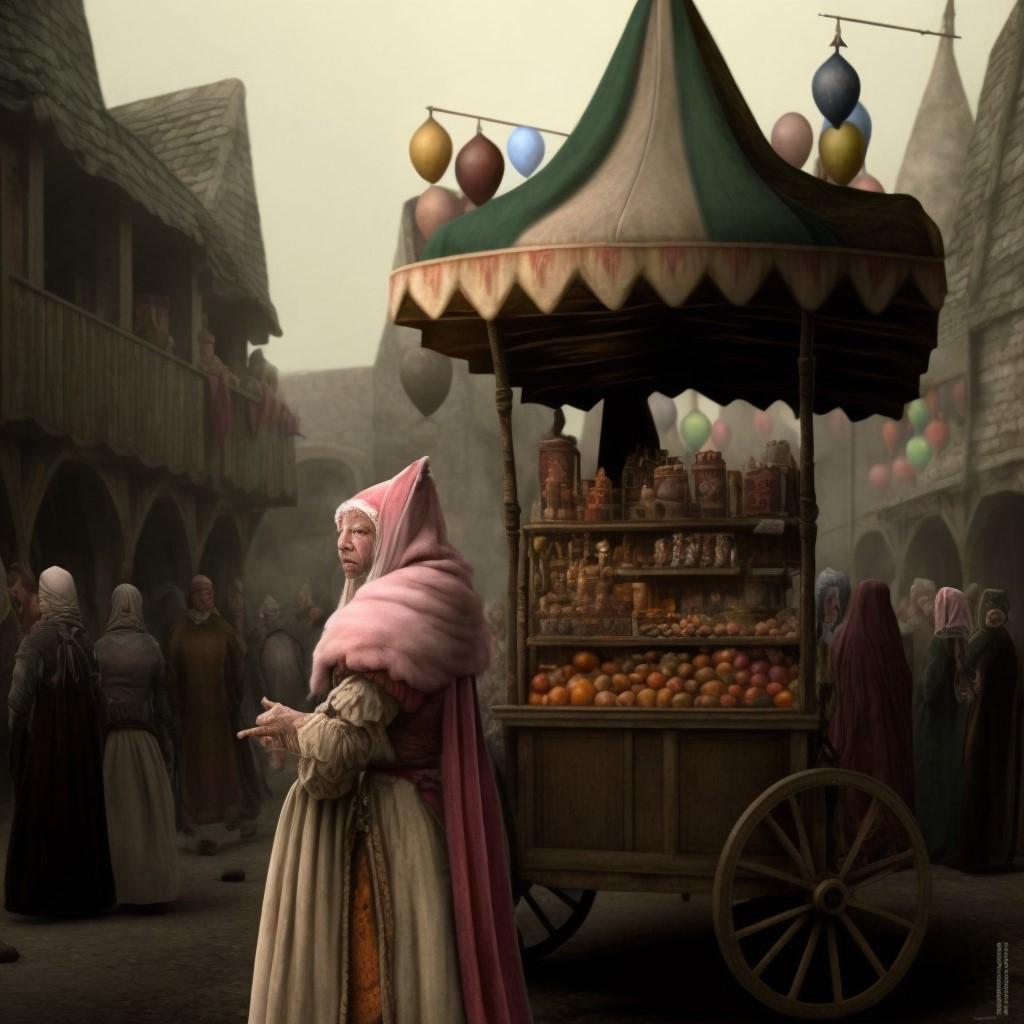
She quickly forgot what her quest was and set off wandering around the scene. Each alley led to a little square and each square had gaily coloured carts of wares for sale, and an abundance of grinning jesters and jugglers. Although tempted to linger and join the onlookers jeering and goading the jugglers and artistes that she encountered, Zara continued her ramble around the scene.
She came to a gathering outside an old market hall, where two particularly raucous jesters were trying to tempt the onlookers into partaking of what appeared to be cups of tea. Zara wondered what the joke was and why nobody in the crowd was willing to try. She inched closer, attracting the attention of the odd grinning fellow in the orange head piece.
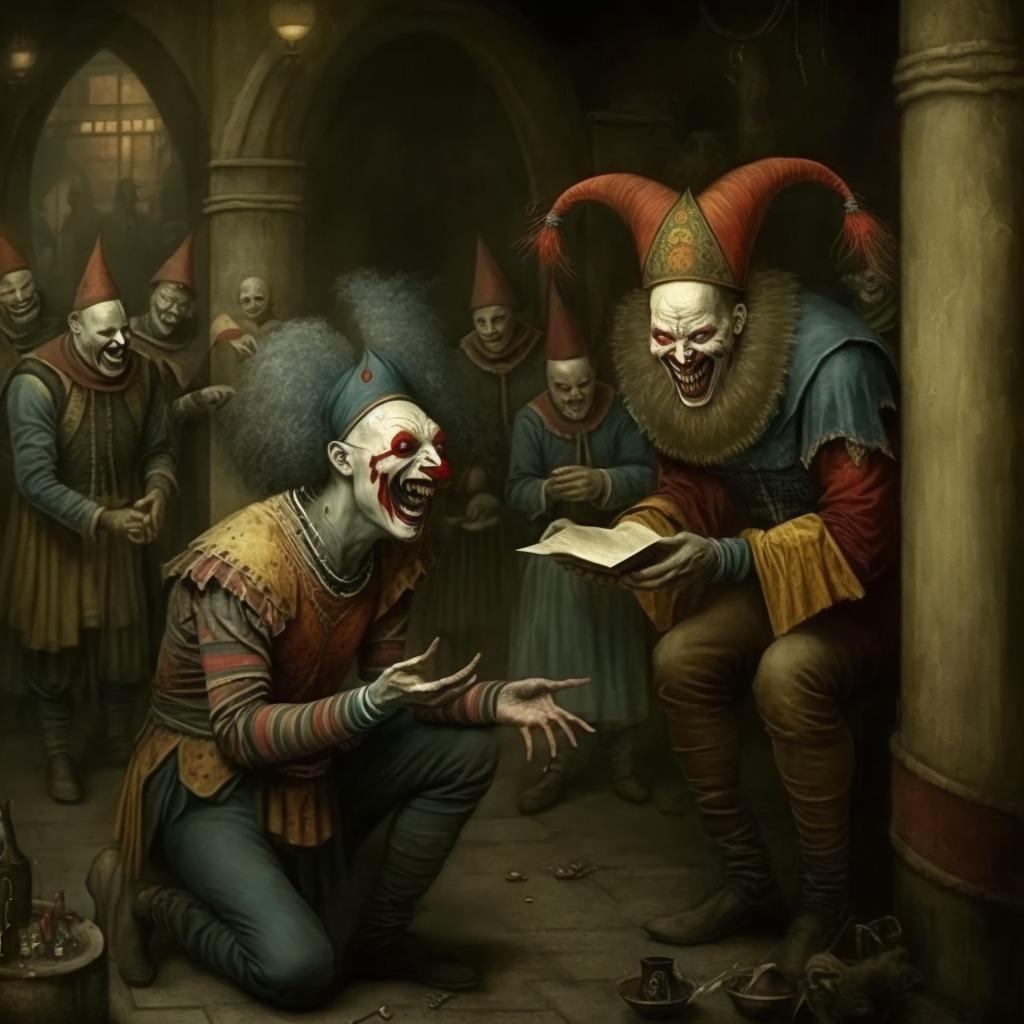
“Come hither, ye fine wench in thy uncomely scant garments, I know what thou seekest! Pray, sit thee down beside me and partake of my remedy.”
“Who, me?” asked Zara, looking behind her to make sure he wasn’t talking to someone else.
“Thoust in dire need of my elixir, come ye hither!”
Somewhat reluctantly Zara stepped towards the odd figure who was offering to hand her a cup. She considered the inadvisability of drinking something that everyone else was refusing, but what the hell, she took the cup and saucer off him and took a hesitant sip.
The crowd roared with laughter and there was much mirthful thigh slapping when Zara spit the foul tasting concoction all over the jesters shoes.
“Believe me dame,” quoth the Jester, “I perceive proffered ware is worse by ten in the hundred than that which is sought. But I pray ye, tell me thy quest.”
“My quest is none of your business, and your tea sucks, mister,” Zara replied. “But I like the cup.”
Pushing past the still laughing onlookers and clutching the cup, Zara spotted a tavern on the opposite side of the square and made her way towards it. A tankard of ale was what she needed to get rid of the foul taste lingering in her mouth.

The inside of the tavern was as much a madhouse as the streets outside it. What was everyone laughing at? Zara found a place to sit on a bench beside a long wooden table. She sat patiently waiting to be served, trying to eavesdrop to decipher the cause of such merriment, but the snatches of conversation made no sense to her. The jollity was contagious, and before long Zara was laughing along with the others. A strange child sat down on the opposite bench (she seemed familiar somehow) and Zara couldn’t help remarking, “You lot are as mad as a box of frogs, are you all on drugs or something?” which provoked further hoots of laughter, thigh slapping and table thumping.
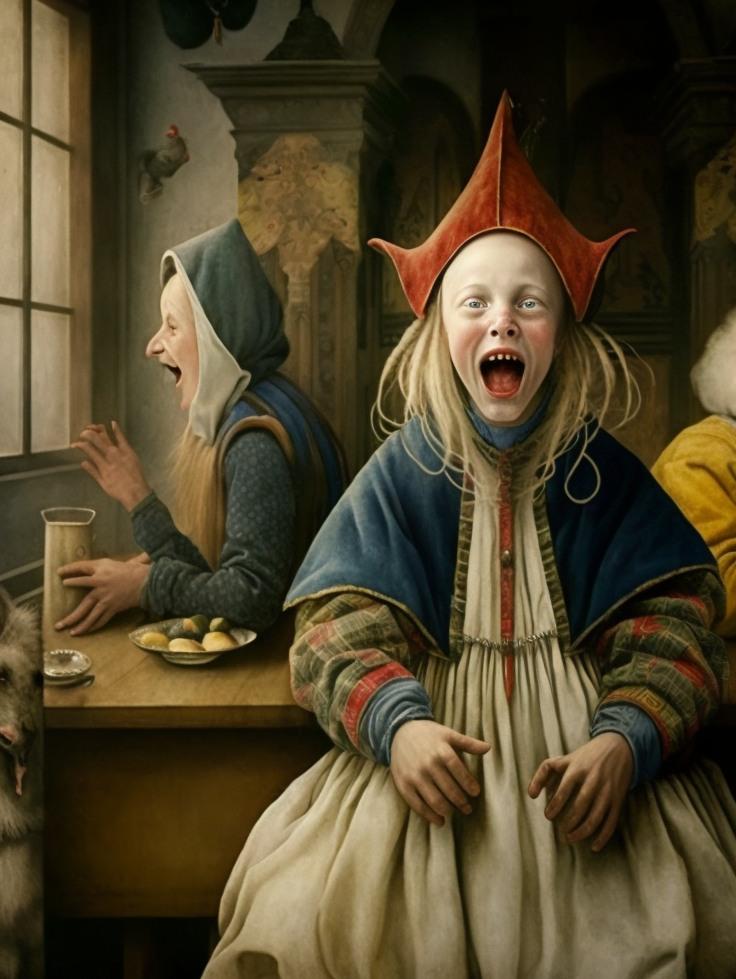
“Ye be an ungodly rude maid, and ye’ll not get a tankard of ale while thoust leavest thy cup of elixir untasted yet,” the child said with a smirk.
“And you are an impertinent child,” Zara replied, considering the potential benefits of drinking the remainder of the concoction if it would hasten the arrival of the tankard of ale she was now craving. She gritted her teeth and picked up the cup.
But the design on the cup had changed, and now bore a strange resemblance to Xavier. Not only that, the cup was calling her name in Xavier’s voice, and the table thumping got louder.

“Zara!” Xavier was knocking on her bedroom door. “Zara! We’re going for a beer in the local tavern, are you coming?”
“Xavi!” Zara snapped back to reality, “Yes! I’m bloody parched.”
February 8, 2023 at 10:27 pm #6515In reply to: Prompts of Madjourneys
Yasmin offered the following quirk: “sounding like a lunatic when I share synchs” (synchronicity) – getting excited when she gets “answers”, and willing to share generously. She wouldn’t fake it, as she’s not capable of lying and stuff like synchs are sacrosanct in her mind.
Setting for the game is the next random quote from the story.Quirk accepted.
In the Land of Quirk, Yasmin finds herself in the heart of a hidden library, deep in the basement of the Flying Fish Inn. The library is filled with books and artifacts related to the study of synchronicities and the beyond.
As Yasmin delves deeper into the library, she comes across an ancient book that seems to hold the secrets of the universe. She eagerly opens it, but finds that it is written in a code that she cannot understand.
The librarian, a wise old owl, appears and greets Yasmin. He tells her that the book is the Key to the Beyond and that only the purest of heart can decode it. He explains that the code can only be unlocked by finding the missing pieces of a puzzle scattered throughout the library.
Yasmin’s task is to find the missing pieces of the puzzle and put them together to unlock the code. Along the way, she will meet various characters who will provide her with clues and challenges.
Proof of completion in real life: Yasmin must find a real-life object that relates to a synchronicity that she experiences while on her quest in the Land of Quirk. She must then share this synchronicity with her friends at the Flying Fish Inn to prove that she has completed her quest.
Good luck, Yasmin!
February 8, 2023 at 10:08 pm #6514In reply to: Prompts of Madjourneys
Xavier offered the following quirk: “being the holder of continuity”
Quirk accepted.
Your quest takes place in the ghost town of Midnight, where time seems to have stood still. The townspeople are all frozen in time, stuck in their daily routines and unable to move on. Your mission is to find the missing piece of continuity, a small hourglass that will set time back in motion and allow the townspeople to move forward.
The clue to finding the hourglass lies within a discarded pocket watch that can be found in the mayor’s office. You must unscrew the back and retrieve a hidden key. The key will unlock a secret compartment in the town clock tower, where the hourglass is kept.
Be careful as you search for the hourglass, as the town is not as abandoned as it seems. Spectral figures roam the streets, and strange whispers can be heard in the wind. You may also encounter a mysterious old man who seems to know more about the town’s secrets than he lets on.
Proof of completion can be shown by taking a photo of the hourglass and the pocket watch, and sending it to the game’s creators.
Good luck!
February 8, 2023 at 10:06 pm #6513In reply to: Prompts of Madjourneys
Youssef offered the following quirk: “unwilling magnet for talkative people in need of listening” (setting in a ghost town).
Setting: A small ghost town in the middle of the Australian outback. The town was once thriving but now only a few stragglers remain, living in old, decrepit buildings. You find yourself in the town square, surrounded by the old post office, the saloon, and a few other ramshackle buildings.
Quest: Your task is to find the source of the magnetic pull that attracts talkative people to you. You must find the reason behind it and break the spell, so you can continue your journey in peace.
Direction to investigate: Start by talking to the residents of the town, they may have some information or insights on the strange happenings in the town. Explore the old post office and the saloon, they might hold the key to breaking the spell.
Characters to engage: The residents of the town, including the old timer at the saloon and the postmaster at the post office.
Tile to look for: A silver key in the shape of a tongue, symbolizing the power of speech.
Proof of insert in real life: Take a picture of yourself holding the key, and send it to the game master as proof of completion.
February 7, 2023 at 10:43 pm #6512In reply to: Prompts of Madjourneys
Zara offered the following quirk: “unleash my hidden rudeness”
Quirk accepted.
You find yourself in the bustling streets of an old medieval town. The people around you are going about their business, and you see vendors selling goods, street performers entertaining the crowd, and guards patrolling the area. You hear rumors about a secret society of mischievous tricksters who are known for causing trouble and making people’s lives more interesting.
You decide to investigate these rumors and join the society of tricksters, who call themselves the “Rude Ones.” You are tasked with finding the key to their hideout, a tile with a rude message written on it. To do this, you must complete several challenges and pranks around the town, each more mischievous than the last.
Your objective is to find the tile, sneak into the Rude Ones’ hideout, and cause as much chaos and trouble as possible. You must also find a way to insert a real-life prank or act of rudeness into your daily life, as proof of your success in the game.
Possible directions to investigate:
- Talk to the vendors and street performers to gather information about the Rude Ones.
- Observe the guards and see if they have any information on the secret society.
- Explore the different neighborhoods and see if anyone knows about the hideout.
Possible characters to engage:
- A mysterious street performer who is rumored to be part of the Rude Ones.
- A vendor who has a reputation for being rude to customers.
- A guard who is rumored to be in league with the Rude Ones.
Look for a tile with a rude message written on it, and capture proof of your real-life prank or act of rudeness. Good luck, and have fun!
February 7, 2023 at 8:51 pm #6507In reply to: Orbs of Madjourneys
To Youssef’s standards, a plane was never big and Flight AL357 was even smaller. When he found his seat, he had to ask a sweaty Chinese man and a snorting woman in a suit with a bowl cut and pink almond shaped glasses to move out so he could squeeze himself in the small space allotted to economy class passengers. On his right, an old lady looked at the size of his arms and almost lost her teeth. She snapped her mouth shut just in time and returned quickly to her magazine. Her hands were trembling and Youssef couldn’t tell if she was annoyed or something else.
The pilote announced they were ready to leave and Youssef sighed with relief. Which was short lived when he got the first bump on the back of his seat. He looked back, apologising to the woman with the bowl cut on his left. Behind him was a kid wearing a false moustache and chewing like a cow. He was swinging his tiny legs, hitting the back of Youssef’s seat with the regularity of a metronome. The kid blew his gum until the bubble exploded. The mother looked ready to open fire if Youssef started to complain. He turned back again and tried to imagine he was getting a massage in one of those Japanese shiatsu chairs you find in some airports.
The woman in front of him had thrown her very blond hair atop her seat and it was all over his screen. The old lady looked at him and offered him a gum. He wondered how she could chew gums with her false teeth, and kindly declined. The woman with the bowl cut and pink glasses started to talk to her sweaty neighbour in Chinese. The man looked at Youssef as if he had been caught by a tiger and was going to get eaten alive. His eyes were begging for help.
As the plane started to move, the old woman started to talk.
« Hi, I’m Gladys. I am afraid of flying, she said. Can I hold your hand during take off ? »
After another bump on his back, Youssef sighed. It was going to be a long flight for everyone.
As soon as they had gained altitude, Youssef let go of the old woman’s hand. She hadn’t stopped talking about her daughter and how she was going to be happy to see her again. The flight attendant passed by with a trolley and offered them a drink and a bag of peanuts. The old woman took a glass of red wine. Youssef was tempted to take a coke and dip the hair of the woman in front of him in it. He had seen a video on LooTube recently with a girl in a similar situation. She had stuck gum and lollypops in the hair of her nemesis, dipped a few strands in her soda and clipped strands randomly with her nail cutter. He could ask the old woman one of her gums, but thought that if a girl could do it, it would certainly not go well for him if he tried.
Instead he asked the flight attendant if there was wifi on board. Sadly there was none. He had hoped at least the could play the game and catch up with his friends during that long flight to Sydney.

When the doors opened, Youssef thought he was free of them all. He was tired, his back hurt, and he couldn’t sleep because the kid behind him kept crying and kicking, the food looked like it had been regurgitated twice by a yak, and the old chatty woman had drained his batteries. She said she wouldn’t sleep on a plane because she had to put her dentures in a glass for hygiene reasons and feared someone would steal them while she had her eyes closed.
He walked with long strides in the corridors up to the custom counters and picked a line, eager to put as much distance between him and the other passengers. Xavier had sent him a message saying he was arriving in Sydney in a few hours. Youssef thought it would be nice to change his flight so that they could go together to Alice Spring. He could do some time with a friend for a change.
His bushy hair stood on end when he heard the voice of the old woman just behind him. He wondered how she had managed to catch up so fast. He saw a small cart driving away.
« I wanted to tell, Gladys said, it was such a nice flight in your company. How long have you before your flight to Alice? We can have a coffee together. »
Youssef mentally said sorry to his friend. He couldn’t wait for the next flight.
January 10, 2023 at 10:15 pm #6363In reply to: Train your subjective AI – text version
try another short story, with a bit of drama with the following words:
road form charlton smooth everyone cottage hanging rush offer agree subject district included appear sha returning grattidge nottingham 848 tetbury chicken
It was a cold and gloomy day in the small village of Tetbury, nestled in the picturesque Cotswolds district. A young woman named Sha was returning home to her cottage after a long and tiring journey. She had been away visiting her family in Nottingham and was looking forward to relaxing in her cozy home.
As she walked down the dirt road that led to her cottage, she couldn’t help but notice that something was off. Her neighbor, Mr. Charlton, was outside hanging laundry and he didn’t acknowledge her as she walked by. Sha thought it was strange, as he was usually a friendly and sociable person.
When Sha arrived at her cottage, she was shocked to find that it had been broken into. The front door was ajar and the inside of her home had been ransacked. Sha immediately panicked and called the police, who arrived on the scene shortly thereafter.
The police officers, including Inspector Grattidge, took Sha’s statement and began to investigate the crime. They discovered that a group of burglars had been operating in the area, targeting homes and businesses in the district. The burglars had been known for their smooth operations and their ability to strike quickly, which led to their nickname “The Smooth Operators”.
As Sha waited for the police to finish their investigation, she couldn’t shake the feeling that something was not right. She had always thought of Tetbury as a safe and friendly place, and she couldn’t believe that something like this could happen in her community.
As the investigation went on, the police found out that the Smooth operators have been targeting houses with no security cameras, but Sha’s cottage was an exception, the police were able to find out that the group offered to pay a considerable sum of money to the people who reported the locations of the houses that had no cameras, and it was Mr. Charlton who was the informant and he even rushed to Sha’s cottage as soon as he knew the police was investigating the case, He was arrested for the crime and Sha was heartbroken to find out that her once friendly neighbor had betrayed her.
Feeling violated and betrayed, Sha decided that she could no longer stay in the village and she put her cottage up for sale. She packed up her belongings and moved away, leaving behind the memories of her peaceful home and the community she had once thought of as her own. The end.
November 18, 2022 at 4:47 pm #6348In reply to: Family Stories From The Other Side ~ Book Two
Wong Sang
Wong Sang was born in China in 1884. In October 1916 he married Alice Stokes in Oxford.
Alice was the granddaughter of William Stokes of Churchill, Oxfordshire and William was the brother of Thomas Stokes the wheelwright (who was my 3X great grandfather). In other words Alice was my second cousin, three times removed, on my fathers paternal side.
Wong Sang was an interpreter, according to the baptism registers of his children and the Dreadnought Seamen’s Hospital admission registers in 1930. The hospital register also notes that he was employed by the Blue Funnel Line, and that his address was 11, Limehouse Causeway, E 14. (London)
“The Blue Funnel Line offered regular First-Class Passenger and Cargo Services From the UK to South Africa, Malaya, China, Japan, Australia, Java, and America. Blue Funnel Line was Owned and Operated by Alfred Holt & Co., Liverpool.
The Blue Funnel Line, so-called because its ships have a blue funnel with a black top, is more appropriately known as the Ocean Steamship Company.”Wong Sang and Alice’s daughter, Frances Eileen Sang, was born on the 14th July, 1916 and baptised in 1920 at St Stephen in Poplar, Tower Hamlets, London. The birth date is noted in the 1920 baptism register and would predate their marriage by a few months, although on the death register in 1921 her age at death is four years old and her year of birth is recorded as 1917.
Charles Ronald Sang was baptised on the same day in May 1920, but his birth is recorded as April of that year. The family were living on Morant Street, Poplar.
James William Sang’s birth is recorded on the 1939 census and on the death register in 2000 as being the 8th March 1913. This definitely would predate the 1916 marriage in Oxford.
William Norman Sang was born on the 17th October 1922 in Poplar.
Alice and the three sons were living at 11, Limehouse Causeway on the 1939 census, the same address that Wong Sang was living at when he was admitted to Dreadnought Seamen’s Hospital on the 15th January 1930. Wong Sang died in the hospital on the 8th March of that year at the age of 46.
Alice married John Patterson in 1933 in Stepney. John was living with Alice and her three sons on Limehouse Causeway on the 1939 census and his occupation was chef.
Via Old London Photographs:
“Limehouse Causeway is a street in east London that was the home to the original Chinatown of London. A combination of bomb damage during the Second World War and later redevelopment means that almost nothing is left of the original buildings of the street.”
Limehouse Causeway in 1925:
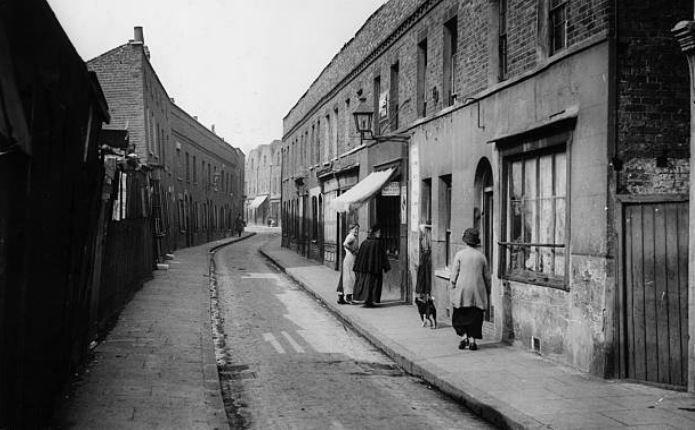
From The Story of Limehouse’s Lost Chinatown, poplarlondon website:
“Limehouse was London’s first Chinatown, home to a tightly-knit community who were demonised in popular culture and eventually erased from the cityscape.
As recounted in the BBC’s ‘Our Greatest Generation’ series, Connie was born to a Chinese father and an English mother in early 1920s Limehouse, where she used to play in the street with other British and British-Chinese children before running inside for teatime at one of their houses.
Limehouse was London’s first Chinatown between the 1880s and the 1960s, before the current Chinatown off Shaftesbury Avenue was established in the 1970s by an influx of immigrants from Hong Kong.
Connie’s memories of London’s first Chinatown as an “urban village” paint a very different picture to the seedy area portrayed in early twentieth century novels.
The pyramid in St Anne’s church marked the entrance to the opium den of Dr Fu Manchu, a criminal mastermind who threatened Western society by plotting world domination in a series of novels by Sax Rohmer.
Thomas Burke’s Limehouse Nights cemented stereotypes about prostitution, gambling and violence within the Chinese community, and whipped up anxiety about sexual relationships between Chinese men and white women.
Though neither novelist was familiar with the Chinese community, their depictions made Limehouse one of the most notorious areas of London.
Travel agent Thomas Cook even organised tours of the area for daring visitors, despite the rector of Limehouse warning that “those who look for the Limehouse of Mr Thomas Burke simply will not find it.”
All that remains is a handful of Chinese street names, such as Ming Street, Pekin Street, and Canton Street — but what was Limehouse’s chinatown really like, and why did it get swept away?
Chinese migration to Limehouse
Chinese sailors discharged from East India Company ships settled in the docklands from as early as the 1780s.
By the late nineteenth century, men from Shanghai had settled around Pennyfields Lane, while a Cantonese community lived on Limehouse Causeway.
Chinese sailors were often paid less and discriminated against by dock hirers, and so began to diversify their incomes by setting up hand laundry services and restaurants.
Old photographs show shopfronts emblazoned with Chinese characters with horse-drawn carts idling outside or Chinese men in suits and hats standing proudly in the doorways.
In oral histories collected by Yat Ming Loo, Connie’s husband Leslie doesn’t recall seeing any Chinese women as a child, since male Chinese sailors settled in London alone and married working-class English women.
In the 1920s, newspapers fear-mongered about interracial marriages, crime and gambling, and described chinatown as an East End “colony.”
Ironically, Chinese opium-smoking was also demonised in the press, despite Britain waging war against China in the mid-nineteenth century for suppressing the opium trade to alleviate addiction amongst its people.
The number of Chinese people who settled in Limehouse was also greatly exaggerated, and in reality only totalled around 300.
The real Chinatown
Although the press sought to characterise Limehouse as a monolithic Chinese community in the East End, Connie remembers seeing people of all nationalities in the shops and community spaces in Limehouse.
She doesn’t remember feeling discriminated against by other locals, though Connie does recall having her face measured and IQ tested by a member of the British Eugenics Society who was conducting research in the area.
Some of Connie’s happiest childhood memories were from her time at Chung-Hua Club, where she learned about Chinese culture and language.
Why did Chinatown disappear?
The caricature of Limehouse’s Chinatown as a den of vice hastened its erasure.
Police raids and deportations fuelled by the alarmist media coverage threatened the Chinese population of Limehouse, and slum clearance schemes to redevelop low-income areas dispersed Chinese residents in the 1930s.
The Defence of the Realm Act imposed at the beginning of the First World War criminalised opium use, gave the authorities increased powers to deport Chinese people and restricted their ability to work on British ships.
Dwindling maritime trade during World War II further stripped Chinese sailors of opportunities for employment, and any remnants of Chinatown were destroyed during the Blitz or erased by postwar development schemes.”
Wong Sang 1884-1930
The year 1918 was a troublesome one for Wong Sang, an interpreter and shipping agent for Blue Funnel Line. The Sang family were living at 156, Chrisp Street.
Chrisp Street, Poplar, in 1913 via Old London Photographs:
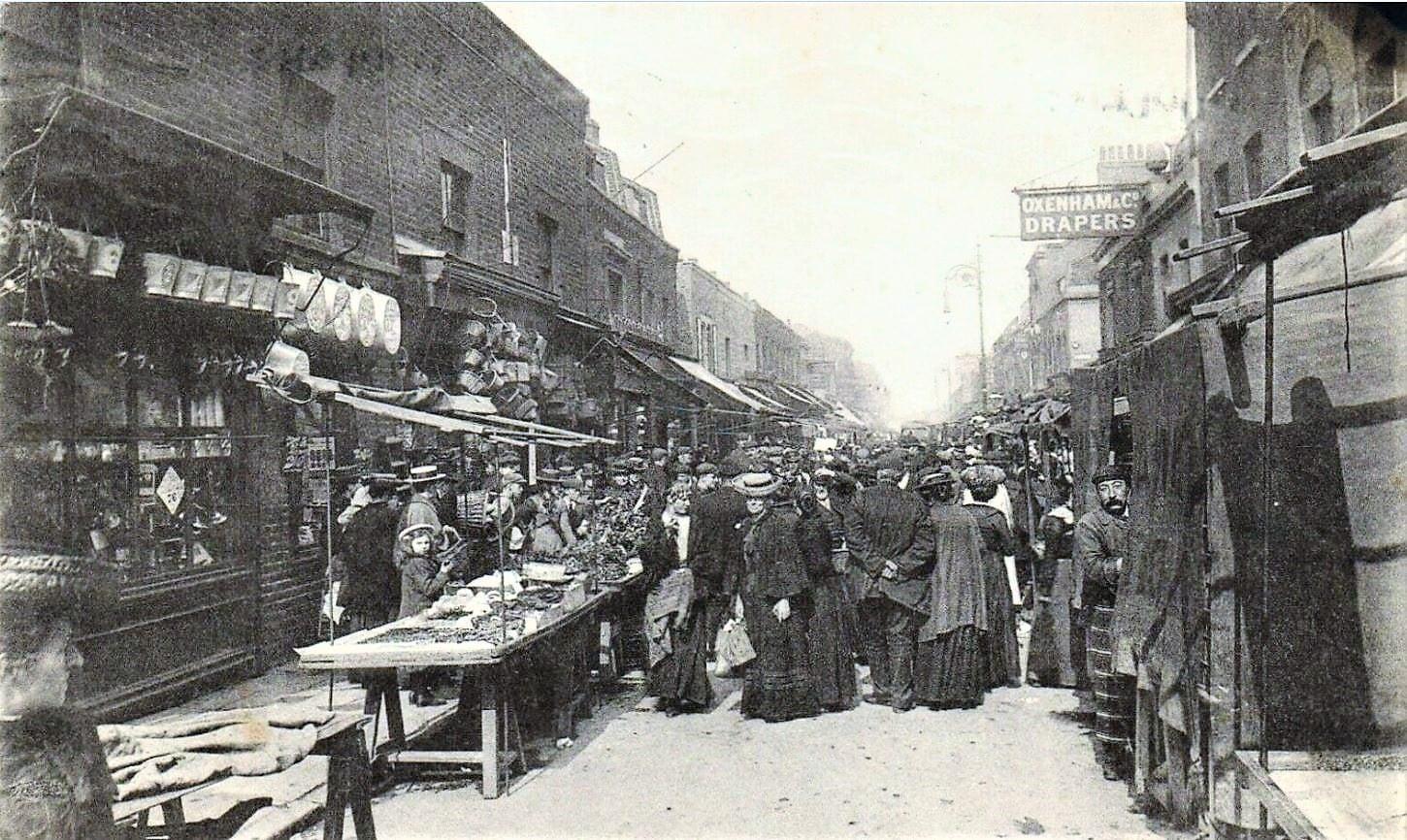
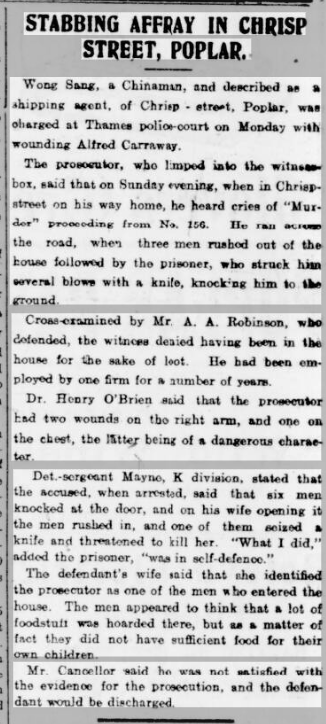
In February Wong Sang was discharged from a false accusation after defending his home from potential robbers.
East End News and London Shipping Chronicle – Friday 15 February 1918:
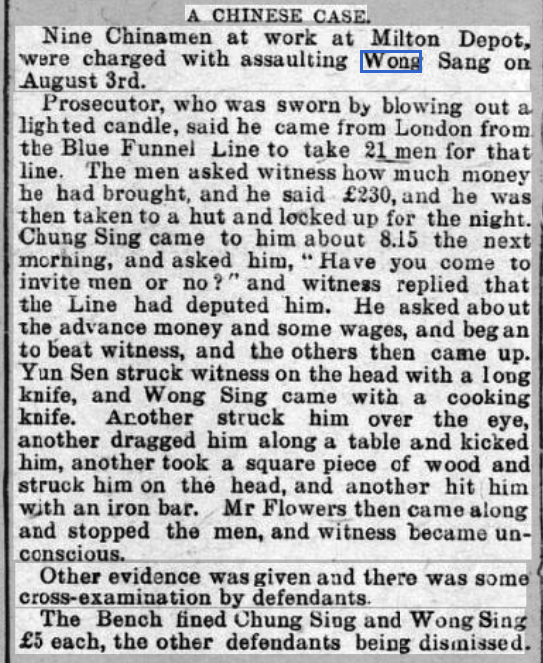
In August of that year he was involved in an incident that left him unconscious.
Faringdon Advertiser and Vale of the White Horse Gazette – Saturday 31 August 1918:
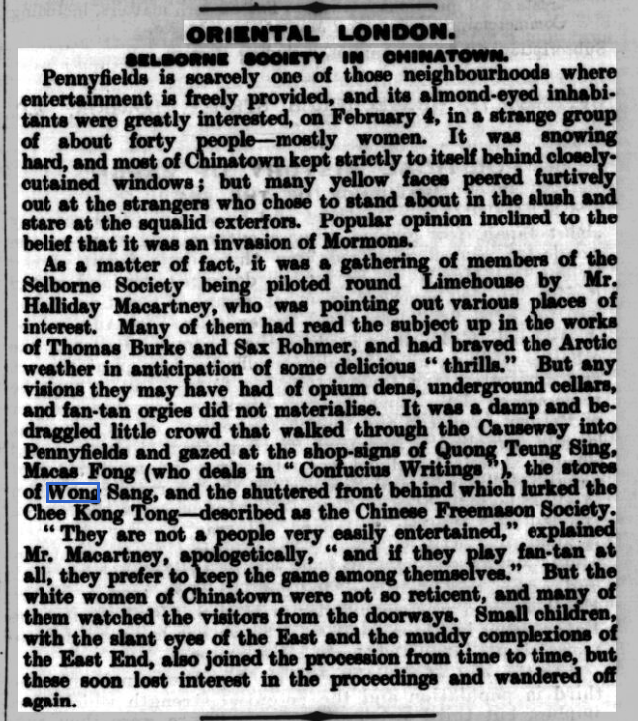
Wong Sang is mentioned in an 1922 article about “Oriental London”.
London and China Express – Thursday 09 February 1922:
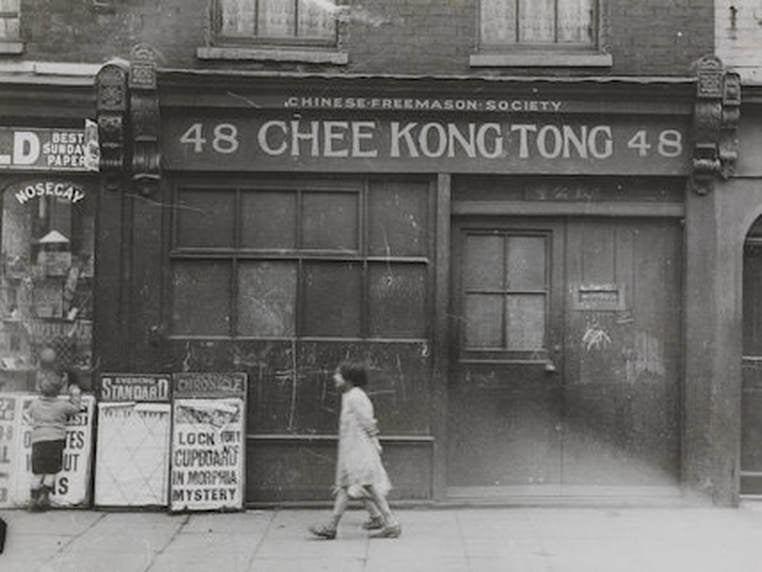
A photograph of the Chee Kong Tong Chinese Freemason Society mentioned in the above article, via Old London Photographs:
Wong Sang was recommended by the London Metropolitan Police in 1928 to assist in a case in Wellingborough, Northampton.
Difficulty of Getting an Interpreter: Northampton Mercury – Friday 16 March 1928:
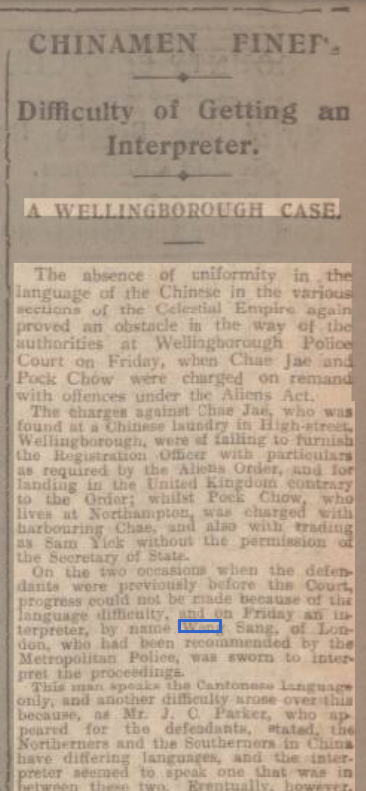
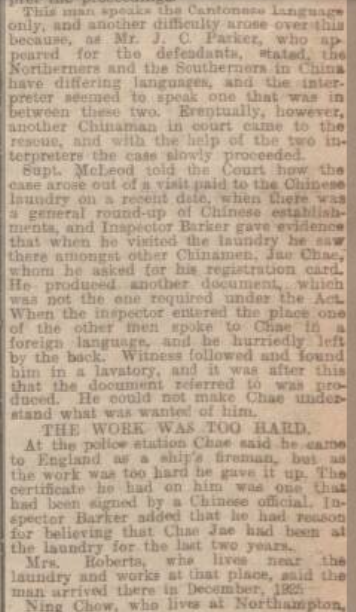
The difficulty was that “this man speaks the Cantonese language only…the Northeners and the Southerners in China have differing languages and the interpreter seemed to speak one that was in between these two.”
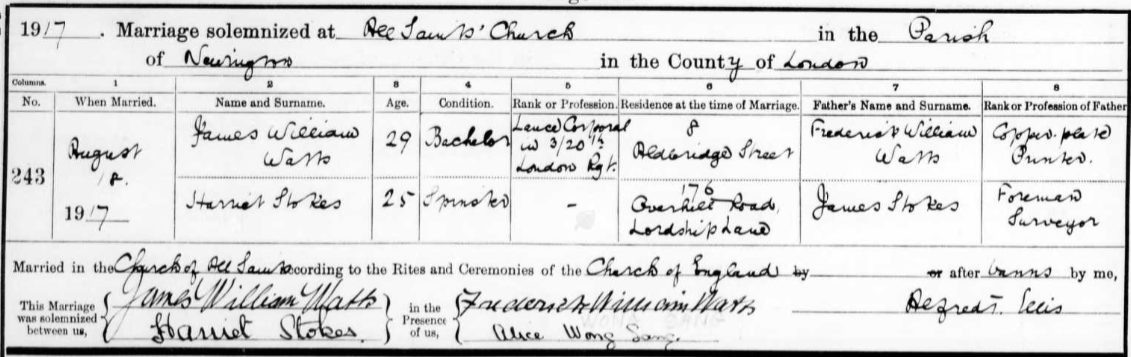
In 1917, Alice Wong Sang was a witness at her sister Harriet Stokes marriage to James William Watts in Southwark, London. Their father James Stokes occupation on the marriage register is foreman surveyor, but on the census he was a council roadman or labourer. (I initially rejected this as the correct marriage for Harriet because of the discrepancy with the occupations. Alice Wong Sang as a witness confirmed that it was indeed the correct one.)
James William Sang 1913-2000 was a clock fitter and watch assembler (on the 1939 census). He married Ivy Laura Fenton in 1963 in Sidcup, Kent. James died in Southwark in 2000.
Charles Ronald Sang 1920-1974 was a draughtsman (1939 census). He married Eileen Burgess in 1947 in Marylebone. Charles and Eileen had two sons: Keith born in 1951 and Roger born in 1952. He died in 1974 in Hertfordshire.
William Norman Sang 1922-2000 was a clerk and telephone operator (1939 census). William enlisted in the Royal Artillery in 1942. He married Lily Mullins in 1949 in Bethnal Green, and they had three daughters: Marion born in 1950, Christine in 1953, and Frances in 1959. He died in Redbridge in 2000.
I then found another two births registered in Poplar by Alice Sang, both daughters. Doris Winifred Sang was born in 1925, and Patricia Margaret Sang was born in 1933 ~ three years after Wong Sang’s death. Neither of the these daughters were on the 1939 census with Alice, John Patterson and the three sons. Margaret had presumably been evacuated because of the war to a family in Taunton, Somerset. Doris would have been fourteen and I have been unable to find her in 1939 (possibly because she died in 2017 and has not had the redaction removed yet on the 1939 census as only deceased people are viewable).
Doris Winifred Sang 1925-2017 was a nursing sister. She didn’t marry, and spent a year in USA between 1954 and 1955. She stayed in London, and died at the age of ninety two in 2017.
Patricia Margaret Sang 1933-1998 was also a nurse. She married Patrick L Nicely in Stepney in 1957. Patricia and Patrick had five children in London: Sharon born 1959, Donald in 1960, Malcolm was born and died in 1966, Alison was born in 1969 and David in 1971.
I was unable to find a birth registered for Alice’s first son, James William Sang (as he appeared on the 1939 census). I found Alice Stokes on the 1911 census as a 17 year old live in servant at a tobacconist on Pekin Street, Limehouse, living with Mr Sui Fong from Hong Kong and his wife Sarah Sui Fong from Berlin. I looked for a birth registered for James William Fong instead of Sang, and found it ~ mothers maiden name Stokes, and his date of birth matched the 1939 census: 8th March, 1913.
On the 1921 census, Wong Sang is not listed as living with them but it is mentioned that Mr Wong Sang was the person returning the census. Also living with Alice and her sons James and Charles in 1921 are two visitors: (Florence) May Stokes, 17 years old, born in Woodstock, and Charles Stokes, aged 14, also born in Woodstock. May and Charles were Alice’s sister and brother.
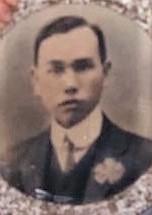
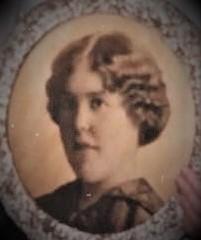
I found Sharon Nicely on social media and she kindly shared photos of Wong Sang and Alice Stokes:
 October 21, 2022 at 2:06 pm #6337
In reply to: Family Stories From The Other Side ~ Book Two
Annie Elizabeth Stokes
1871-1961
“Grandma E”
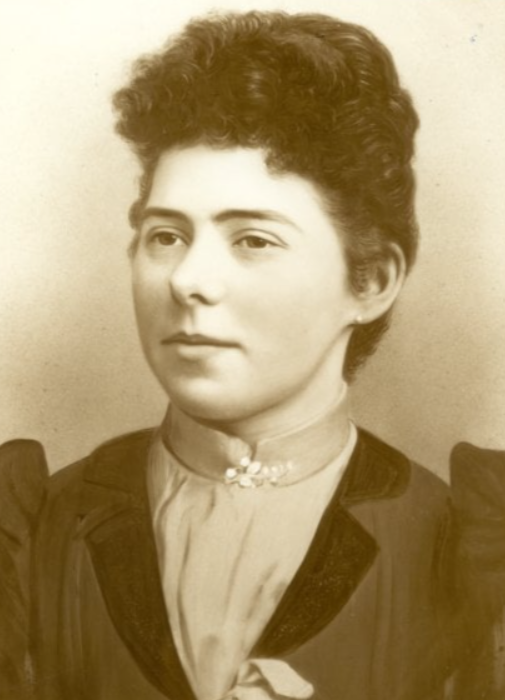
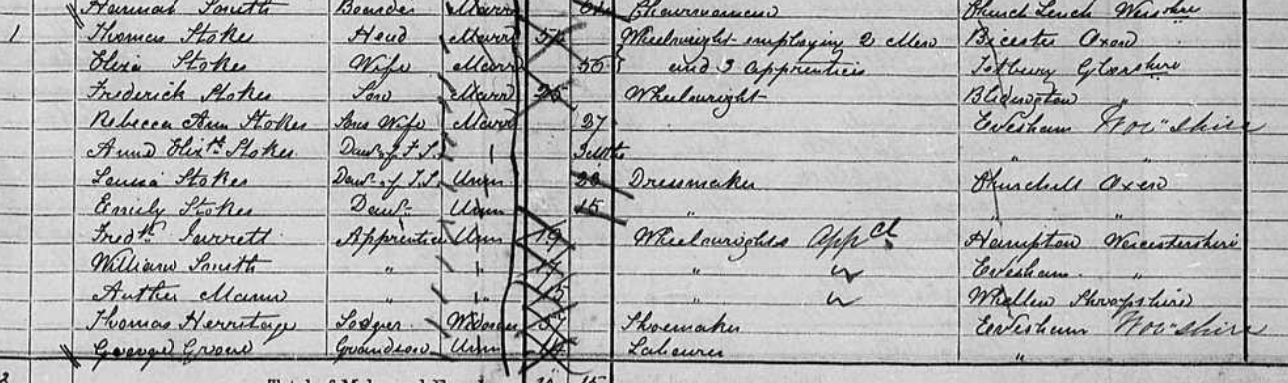
Annie, my great grandmother, was born 2 Jan 1871 in Merstow Green, Evesham, Worcestershire. Her father Fred Stokes was a wheelwright. On the 1771 census in Merston Green Annie was 3 months old and there was quite a houseful: Annies parents Fred and Rebecca, Fred’s parents Thomas and Eliza and two of their daughters, three apprentices, a lodger and one of Thomas’s grandsons.
1771 census Merstow Green, Evesham:
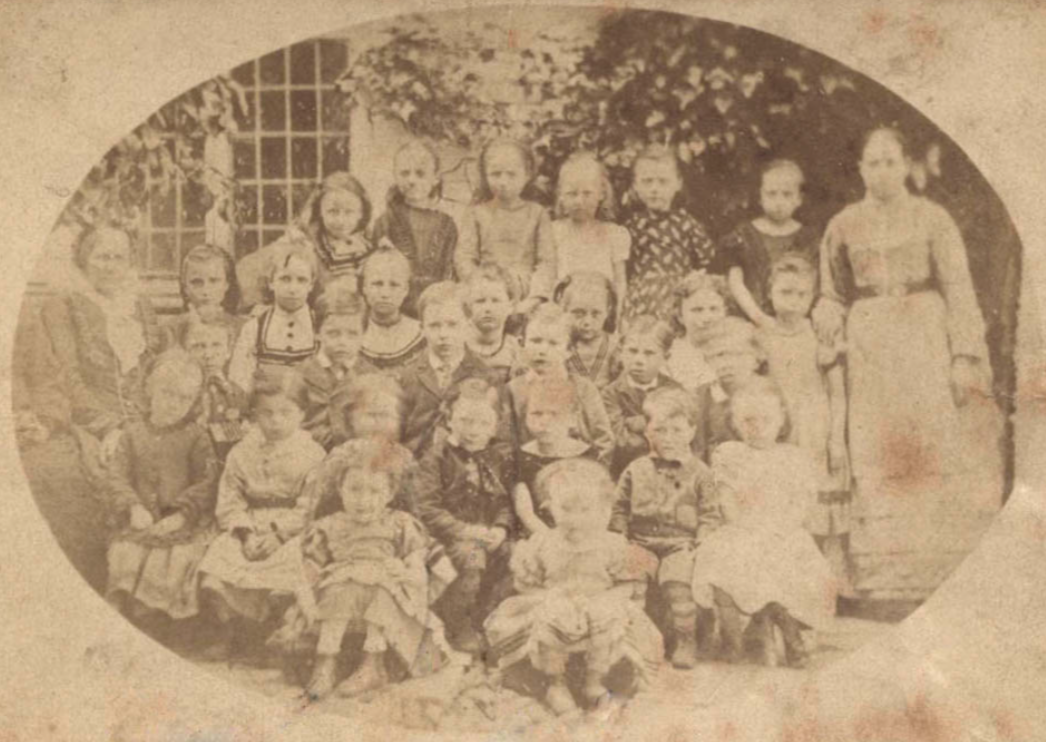
Annie at school in the early 1870s in Broadway. Annie is in the front on the left and her brother Fred is in the centre of the first seated row:
In 1881 Annie was a 10 year old visitor at the Angel Inn, Chipping Camden. A boarder there was 19 year old William Halford, a wheelwright apprentice. John Such, a 62 year old widower, was the innkeeper. Her parents and two siblings were living at La Quinta, on Main Street in Broadway.
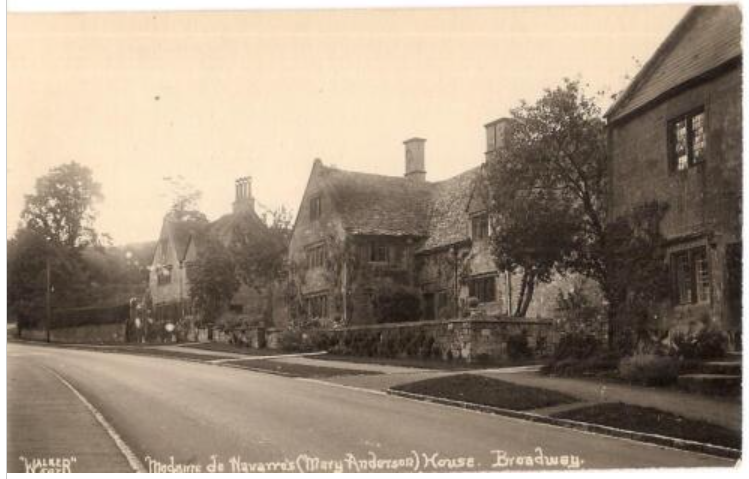
According to her obituary in 1962, “When the Maxton family visited Broadway to stay with Mr and Madame de Navarro at Court Farm, they offered Annie a family post with them which took her for several years to Paris and other parts of the continent.”
Mary Anderson was an American theatre actress. In 1890 she married Antonio Fernando de Navarro. She became known as Mary Anderson de Navarro. They settled at Court Farm in the Cotswolds, Broadway, Worcestershire, where she cultivated an interest in music and became a noted hostess with a distinguished circle of musical, literary and ecclesiastical guests. As in the years when Mary lived there, it was often filled with visiting artists and musicians, including Myra Hess and a young Jacqueline du Pré. (via Wikipedia)
Court Farm, Broadway:
Annie was an assistant to a tobacconist in West Bromwich in 1991, living as a boarder with William Calcutt and family. He future husband Albert was living in neighbouring Tipton in 1891, working at a pawnbroker apprenticeship.
Annie married Albert Parker Edwards in 1898 in Evesham. On the 1901 census, she was in hospital in Redditch.
By 1911, Anne and Albert had five children and were living at the Cricketers Arms in Redditch.
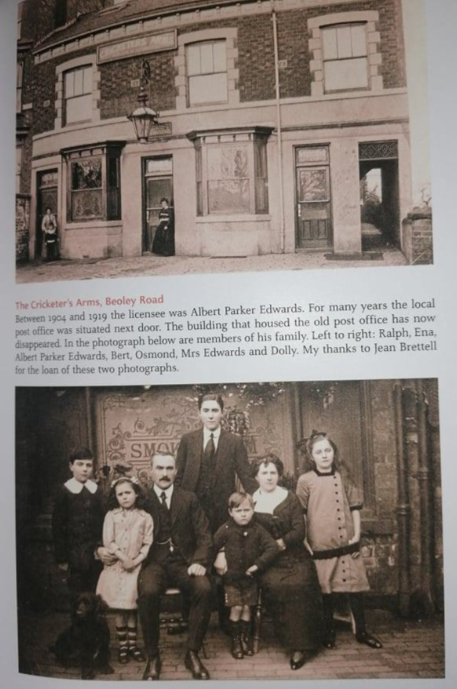
Behind the bar in 1904 shortly after taking over at the Cricketers Arms. From a book on Redditch pubs:
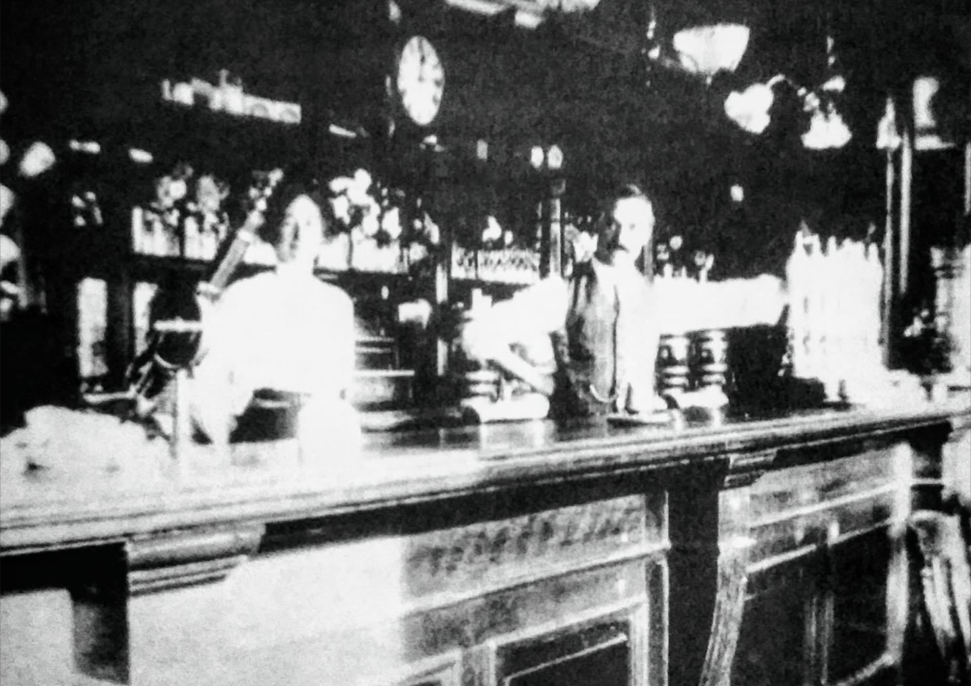
Annie was referred to in later years as Grandma E, probably to differentiate between her and my fathers Grandma T, as both lived to a great age.
Annie with her grandson Reg on the left and her daughter in law Peggy on the right, in the early 1950s:
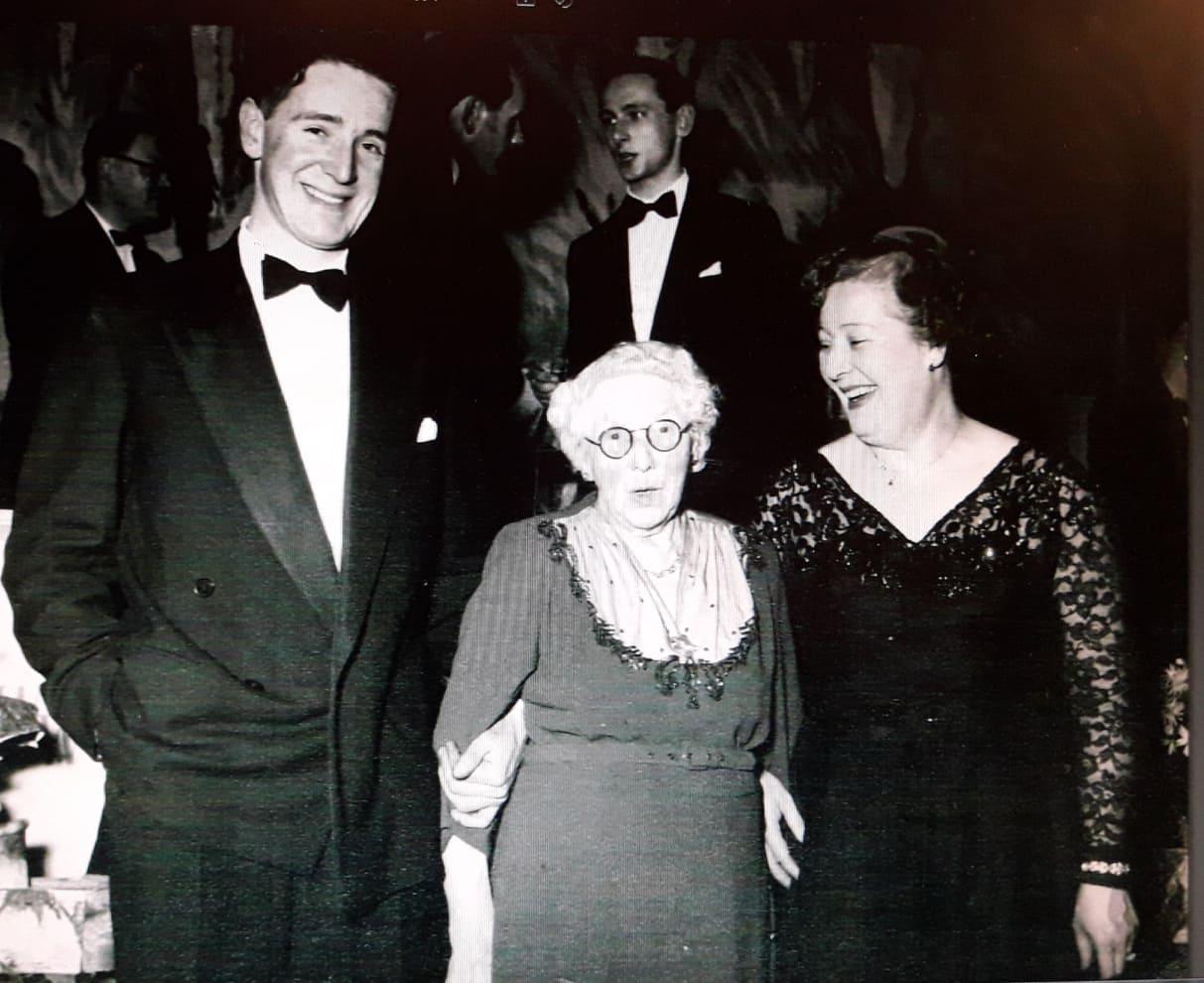
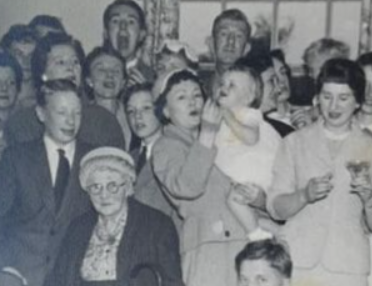
Annie at my christening in 1959:
Annie died 30 Dec 1961, aged 90, at Ravenscourt nursing home, Redditch. Her obituary in the Droitwich Guardian in January 1962:
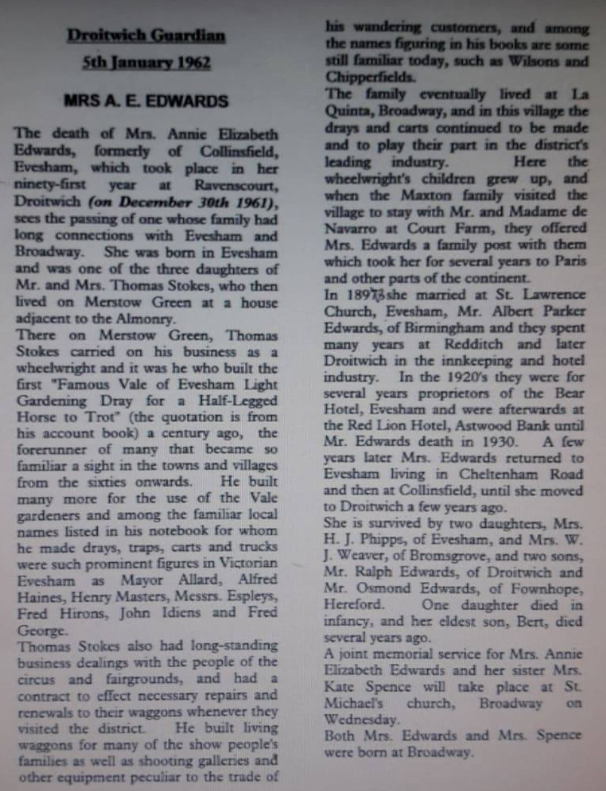
Note that this obituary contains an obvious error: Annie’s father was Frederick Stokes, and Thomas was his father.
February 4, 2022 at 3:17 pm #6269In reply to: The Elusive Samuel Housley and Other Family Stories
The Housley Letters
From Barbara Housley’s Narrative on the Letters.
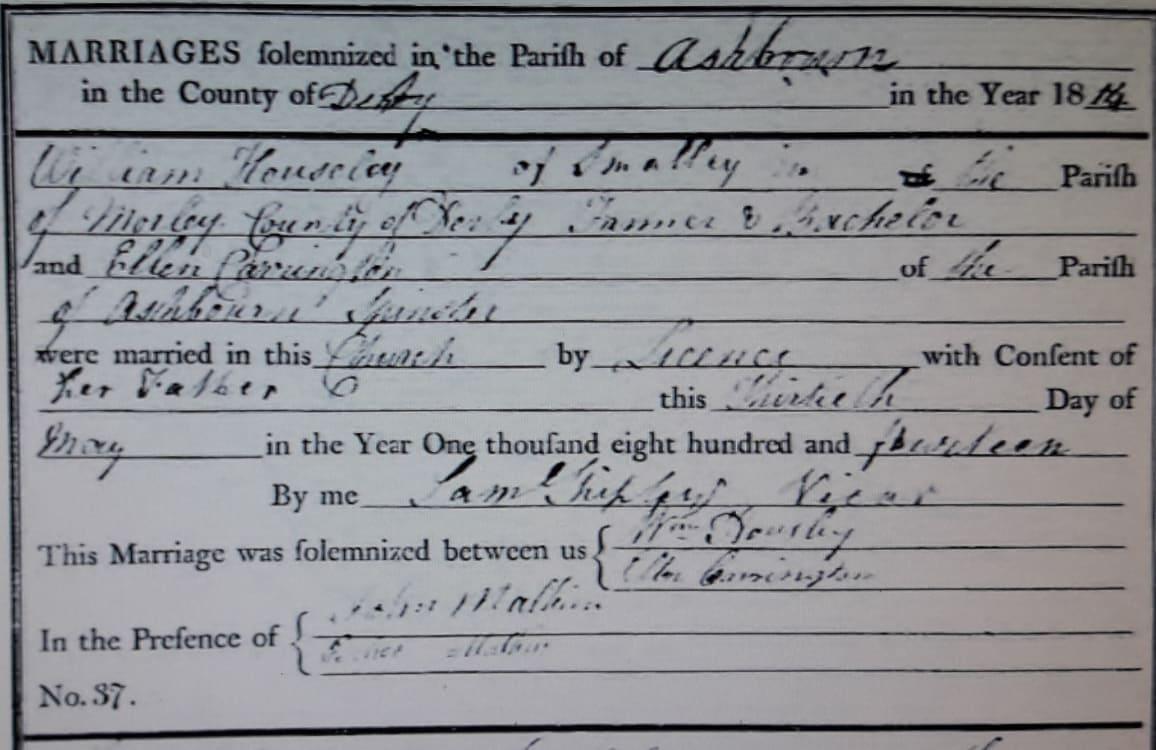
William Housley (1781-1848) and Ellen Carrington were married on May 30, 1814 at St. Oswald’s church in Ashbourne. William died in 1848 at the age of 67 of “disease of lungs and general debility”. Ellen died in 1872.
Marriage of William Housley and Ellen Carrington in Ashbourne in 1814:
Parish records show three children for William and his first wife, Mary, Ellens’ sister, who were married December 29, 1806: Mary Ann, christened in 1808 and mentioned frequently in the letters; Elizabeth, christened in 1810, but never mentioned in any letters; and William, born in 1812, probably referred to as Will in the letters. Mary died in 1813.
William and Ellen had ten children: John, Samuel, Edward, Anne, Charles, George, Joseph, Robert, Emma, and Joseph. The first Joseph died at the age of four, and the last son was also named Joseph. Anne never married, Charles emigrated to Australia in 1851, and George to USA, also in 1851. The letters are to George, from his sisters and brothers in England.
The following are excerpts of those letters, including excerpts of Barbara Housley’s “Narrative on Historic Letters”. They are grouped according to who they refer to, rather than chronological order.
ELLEN HOUSLEY 1795-1872
Joseph wrote that when Emma was married, Ellen “broke up the comfortable home and the things went to Derby and she went to live with them but Derby didn’t agree with her so she left again leaving her things behind and came to live with John in the new house where she died.” Ellen was listed with John’s household in the 1871 census.
In May 1872, the Ilkeston Pioneer carried this notice: “Mr. Hopkins will sell by auction on Saturday next the eleventh of May 1872 the whole of the useful furniture, sewing machine, etc. nearly new on the premises of the late Mrs. Housley at Smalley near Heanor in the county of Derby. Sale at one o’clock in the afternoon.”Ellen’s family was evidently rather prominant in Smalley. Two Carringtons (John and William) served on the Parish Council in 1794. Parish records are full of Carrington marriages and christenings; census records confirm many of the family groupings.
In June of 1856, Emma wrote: “Mother looks as well as ever and was told by a lady the other day that she looked handsome.” Later she wrote: “Mother is as stout as ever although she sometimes complains of not being able to do as she used to.”
Mary’s children:
MARY ANN HOUSLEY 1808-1878
There were hard feelings between Mary Ann and Ellen and her children. Anne wrote: “If you remember we were not very friendly when you left. They never came and nothing was too bad for Mary Ann to say of Mother and me, but when Robert died Mother sent for her to the funeral but she did not think well to come so we took no more notice. She would not allow her children to come either.”
Mary Ann was unlucky in love! In Anne’s second letter she wrote: “William Carrington is paying Mary Ann great attention. He is living in London but they write to each other….We expect it will be a match.” Apparantly the courtship was stormy for in 1855, Emma wrote: “Mary Ann’s wedding with William Carrington has dropped through after she had prepared everything, dresses and all for the occassion.” Then in 1856, Emma wrote: “William Carrington and Mary Ann are separated. They wore him out with their nonsense.” Whether they ever married is unclear. Joseph wrote in 1872: “Mary Ann was married but her husband has left her. She is in very poor health. She has one daughter and they are living with their mother at Smalley.”
Regarding William Carrington, Emma supplied this bit of news: “His sister, Mrs. Lily, has eloped with a married man. Is she not a nice person!”
WILLIAM HOUSLEY JR. 1812-1890
According to a letter from Anne, Will’s two sons and daughter were sent to learn dancing so they would be “fit for any society.” Will’s wife was Dorothy Palfry. They were married in Denby on October 20, 1836 when Will was 24. According to the 1851 census, Will and Dorothy had three sons: Alfred 14, Edwin 12, and William 10. All three boys were born in Denby.
In his letter of May 30, 1872, after just bemoaning that all of his brothers and sisters are gone except Sam and John, Joseph added: “Will is living still.” In another 1872 letter Joseph wrote, “Will is living at Heanor yet and carrying on his cattle dealing.” The 1871 census listed Will, 59, and his son William, 30, of Lascoe Road, Heanor, as cattle dealers.
Ellen’s children:
JOHN HOUSLEY 1815-1893
John married Sarah Baggally in Morely in 1838. They had at least six children. Elizabeth (born 2 May 1838) was “out service” in 1854. In her “third year out,” Elizabeth was described by Anne as “a very nice steady girl but quite a woman in appearance.” One of her positions was with a Mrs. Frearson in Heanor. Emma wrote in 1856: “Elizabeth is still at Mrs. Frearson. She is such a fine stout girl you would not know her.” Joseph wrote in 1872 that Elizabeth was in service with Mrs. Eliza Sitwell at Derby. (About 1850, Miss Eliza Wilmot-Sitwell provided for a small porch with a handsome Norman doorway at the west end of the St. John the Baptist parish church in Smalley.)
According to Elizabeth’s birth certificate and the 1841 census, John was a butcher. By 1851, the household included a nurse and a servant, and John was listed as a “victular.” Anne wrote in February 1854, “John has left the Public House a year and a half ago. He is living where Plumbs (Ann Plumb witnessed William’s death certificate with her mark) did and Thomas Allen has the land. He has been working at James Eley’s all winter.” In 1861, Ellen lived with John and Sarah and the three boys.
John sold his share in the inheritance from their mother and disappeared after her death. (He died in Doncaster, Yorkshire, in 1893.) At that time Charles, the youngest would have been 21. Indeed, Joseph wrote in July 1872: “John’s children are all grown up”.
In May 1872, Joseph wrote: “For what do you think, John has sold his share and he has acted very bad since his wife died and at the same time he sold all his furniture. You may guess I have never seen him but once since poor mother’s funeral and he is gone now no one knows where.”
In February 1874 Joseph wrote: “You want to know what made John go away. Well, I will give you one reason. I think I told you that when his wife died he persuaded me to leave Derby and come to live with him. Well so we did and dear Harriet to keep his house. Well he insulted my wife and offered things to her that was not proper and my dear wife had the power to resist his unmanly conduct. I did not think he could of served me such a dirty trick so that is one thing dear brother. He could not look me in the face when we met. Then after we left him he got a woman in the house and I suppose they lived as man and wife. She caught the small pox and died and there he was by himself like some wild man. Well dear brother I could not go to him again after he had served me and mine as he had and I believe he was greatly in debt too so that he sold his share out of the property and when he received the money at Belper he went away and has never been seen by any of us since but I have heard of him being at Sheffield enquiring for Sam Caldwell. You will remember him. He worked in the Nag’s Head yard but I have heard nothing no more of him.”
A mention of a John Housley of Heanor in the Nottinghma Journal 1875. I don’t know for sure if the John mentioned here is the brother John who Joseph describes above as behaving improperly to his wife. John Housley had a son Joseph, born in 1840, and John’s wife Sarah died in 1870.
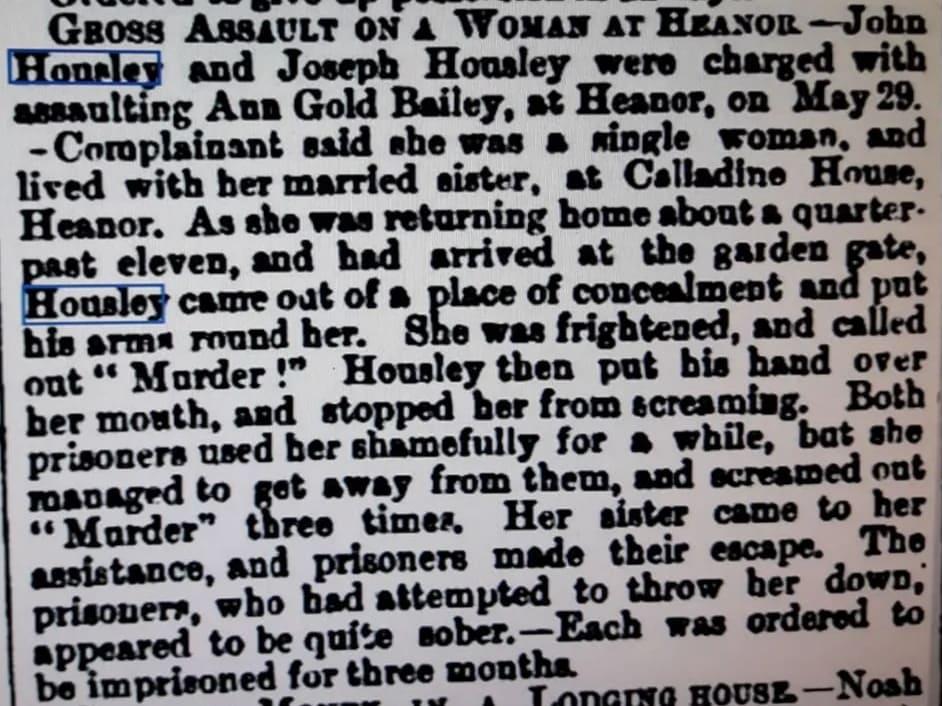
In 1876, the solicitor wrote to George: “Have you heard of John Housley? He is entitled to Robert’s share and I want him to claim it.”
SAMUEL HOUSLEY 1816-
Sam married Elizabeth Brookes of Sutton Coldfield, and they had three daughters: Elizabeth, Mary Anne and Catherine. Elizabeth his wife died in 1849, a few months after Samuel’s father William died in 1848. The particular circumstances relating to these individuals have been discussed in previous chapters; the following are letter excerpts relating to them.
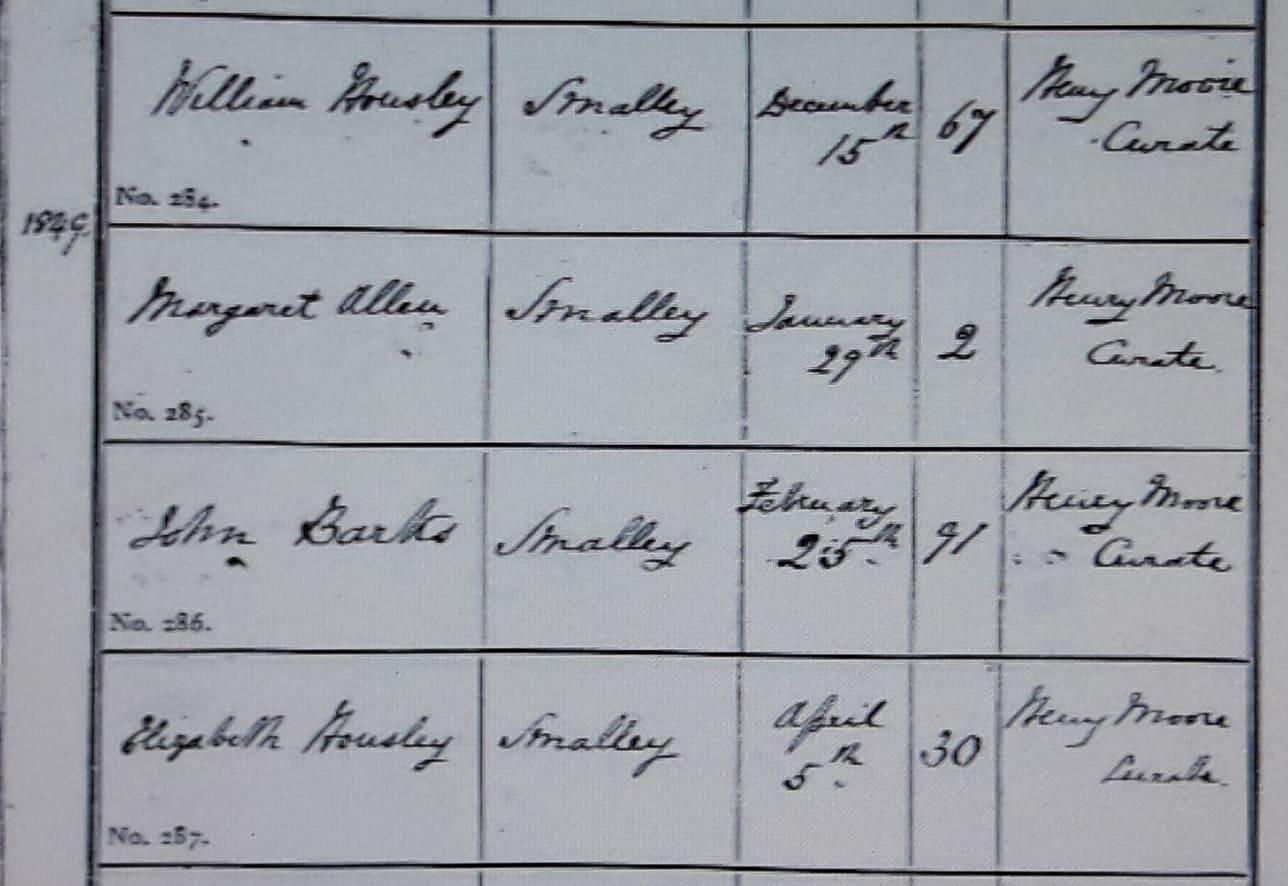
Death of William Housley 15 Dec 1848, and Elizabeth Housley 5 April 1849, Smalley:
Joseph wrote in December 1872: “I saw one of Sam’s daughters, the youngest Kate, you would remember her a baby I dare say. She is very comfortably married.”
In the same letter (December 15, 1872), Joseph wrote: “I think we have now found all out now that is concerned in the matter for there was only Sam that we did not know his whereabouts but I was informed a week ago that he is dead–died about three years ago in Birmingham Union. Poor Sam. He ought to have come to a better end than that….His daughter and her husband went to Brimingham and also to Sutton Coldfield that is where he married his wife from and found out his wife’s brother. It appears he has been there and at Birmingham ever since he went away but ever fond of drink.”
(Sam, however, was still alive in 1871, living as a lodger at the George and Dragon Inn, Henley in Arden. And no trace of Sam has been found since. It would appear that Sam did not want to be found.)
EDWARD HOUSLEY 1819-1843
Edward died before George left for USA in 1851, and as such there is no mention of him in the letters.
ANNE HOUSLEY 1821-1856
Anne wrote two letters to her brother George between February 1854 and her death in 1856. Apparently she suffered from a lung disease for she wrote: “I can say you will be surprised I am still living and better but still cough and spit a deal. Can do nothing but sit and sew.” According to the 1851 census, Anne, then 29, was a seamstress. Their friend, Mrs. Davy, wrote in March 1856: “This I send in a box to my Brother….The pincushion cover and pen wiper are Anne’s work–are for thy wife. She would have made it up had she been able.” Anne was not living at home at the time of the 1841 census. She would have been 19 or 20 and perhaps was “out service.”
In her second letter Anne wrote: “It is a great trouble now for me to write…as the body weakens so does the mind often. I have been very weak all summer. That I continue is a wonder to all and to spit so much although much better than when you left home.” She also wrote: “You know I had a desire for America years ago. Were I in health and strength, it would be the land of my adoption.”
In November 1855, Emma wrote, “Anne has been very ill all summer and has not been able to write or do anything.” Their neighbor Mrs. Davy wrote on March 21, 1856: “I fear Anne will not be long without a change.” In a black-edged letter the following June, Emma wrote: “I need not tell you how happy she was and how calmly and peacefully she died. She only kept in bed two days.”
Certainly Anne was a woman of deep faith and strong religious convictions. When she wrote that they were hoping to hear of Charles’ success on the gold fields she added: “But I would rather hear of him having sought and found the Pearl of great price than all the gold Australia can produce, (For what shall it profit a man if he gain the whole world and lose his soul?).” Then she asked George: “I should like to learn how it was you were first led to seek pardon and a savior. I do feel truly rejoiced to hear you have been led to seek and find this Pearl through the workings of the Holy Spirit and I do pray that He who has begun this good work in each of us may fulfill it and carry it on even unto the end and I can never doubt the willingness of Jesus who laid down his life for us. He who said whoever that cometh unto me I will in no wise cast out.”
Anne’s will was probated October 14, 1856. Mr. William Davy of Kidsley Park appeared for the family. Her estate was valued at under £20. Emma was to receive fancy needlework, a four post bedstead, feather bed and bedding, a mahogany chest of drawers, plates, linen and china. Emma was also to receive Anne’s writing desk. There was a condition that Ellen would have use of these items until her death.
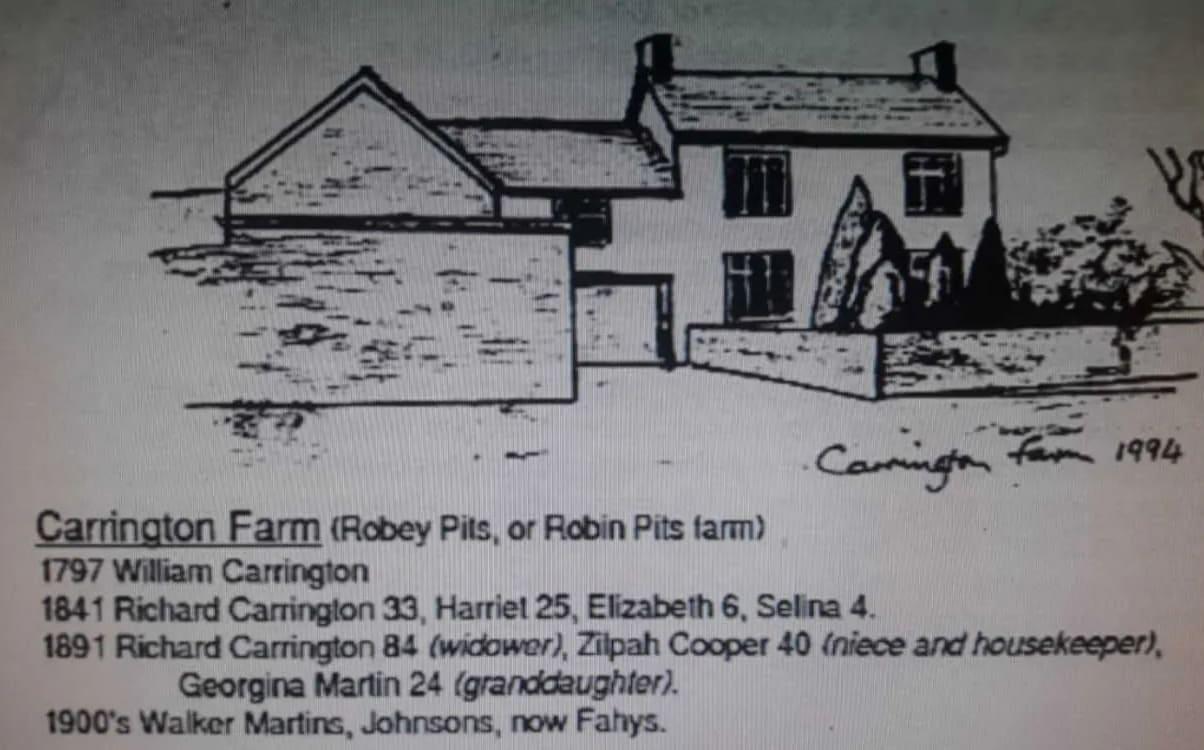
The money that Anne was to receive from her grandfather, William Carrington, and her father, William Housley was to be distributed one third to Joseph, one third to Emma, and one third to be divided between her four neices: John’s daughter Elizabeth, 18, and Sam’s daughters Elizabeth, 10, Mary Ann, 9 and Catharine, age 7 to be paid by the trustees as they think “most useful and proper.” Emma Lyon and Elizabeth Davy were the witnesses.
The Carrington Farm:
CHARLES HOUSLEY 1823-1855
Charles went to Australia in 1851, and was last heard from in January 1853. According to the solicitor, who wrote to George on June 3, 1874, Charles had received advances on the settlement of their parent’s estate. “Your promissory note with the two signed by your brother Charles for 20 pounds he received from his father and 20 pounds he received from his mother are now in the possession of the court.”
Charles and George were probably quite close friends. Anne wrote in 1854: “Charles inquired very particularly in both his letters after you.”
According to Anne, Charles and a friend married two sisters. He and his father-in-law had a farm where they had 130 cows and 60 pigs. Whatever the trade he learned in England, he never worked at it once he reached Australia. While it does not seem that Charles went to Australia because gold had been discovered there, he was soon caught up in “gold fever”. Anne wrote: “I dare say you have heard of the immense gold fields of Australia discovered about the time he went. Thousands have since then emigrated to Australia, both high and low. Such accounts we heard in the papers of people amassing fortunes we could not believe. I asked him when I wrote if it was true. He said this was no exaggeration for people were making their fortune daily and he intended going to the diggings in six weeks for he could stay away no longer so that we are hoping to hear of his success if he is alive.”
In March 1856, Mrs. Davy wrote: “I am sorry to tell thee they have had a letter from Charles’s wife giving account of Charles’s death of 6 months consumption at the Victoria diggings. He has left 2 children a boy and a girl William and Ellen.” In June of the same year in a black edged letter, Emma wrote: “I think Mrs. Davy mentioned Charles’s death in her note. His wife wrote to us. They have two children Helen and William. Poor dear little things. How much I should like to see them all. She writes very affectionately.”
In December 1872, Joseph wrote: “I’m told that Charles two daughters has wrote to Smalley post office making inquiries about his share….” In January 1876, the solicitor wrote: “Charles Housley’s children have claimed their father’s share.”
GEORGE HOUSLEY 1824-1877
George emigrated to the United states in 1851, arriving in July. The solicitor Abraham John Flint referred in a letter to a 15-pound advance which was made to George on June 9, 1851. This certainly was connected to his journey. George settled along the Delaware River in Bucks County, Pennsylvania. The letters from the solicitor were addressed to: Lahaska Post Office, Bucks County, Pennsylvania.
George married Sarah Ann Hill on May 6, 1854 in Doylestown, Bucks County, Pennsylvania. In her first letter (February 1854), Anne wrote: “We want to know who and what is this Miss Hill you name in your letter. What age is she? Send us all the particulars but I would advise you not to get married until you have sufficient to make a comfortable home.”
Upon learning of George’s marriage, Anne wrote: “I hope dear brother you may be happy with your wife….I hope you will be as a son to her parents. Mother unites with me in kind love to you both and to your father and mother with best wishes for your health and happiness.” In 1872 (December) Joseph wrote: “I am sorry to hear that sister’s father is so ill. It is what we must all come to some time and hope we shall meet where there is no more trouble.”
Emma wrote in 1855, “We write in love to your wife and yourself and you must write soon and tell us whether there is a little nephew or niece and what you call them.” In June of 1856, Emma wrote: “We want to see dear Sarah Ann and the dear little boy. We were much pleased with the “bit of news” you sent.” The bit of news was the birth of John Eley Housley, January 11, 1855. Emma concluded her letter “Give our very kindest love to dear sister and dearest Johnnie.”
In September 1872, Joseph wrote, “I was very sorry to hear that John your oldest had met with such a sad accident but I hope he is got alright again by this time.” In the same letter, Joseph asked: “Now I want to know what sort of a town you are living in or village. How far is it from New York? Now send me all particulars if you please.”
In March 1873 Harriet asked Sarah Ann: “And will you please send me all the news at the place and what it is like for it seems to me that it is a wild place but you must tell me what it is like….”. The question of whether she was referring to Bucks County, Pennsylvania or some other place is raised in Joseph’s letter of the same week.
On March 17, 1873, Joseph wrote: “I was surprised to hear that you had gone so far away west. Now dear brother what ever are you doing there so far away from home and family–looking out for something better I suppose.”The solicitor wrote on May 23, 1874: “Lately I have not written because I was not certain of your address and because I doubted I had much interesting news to tell you.” Later, Joseph wrote concerning the problems settling the estate, “You see dear brother there is only me here on our side and I cannot do much. I wish you were here to help me a bit and if you think of going for another summer trip this turn you might as well run over here.”
Apparently, George had indicated he might return to England for a visit in 1856. Emma wrote concerning the portrait of their mother which had been sent to George: “I hope you like mother’s portrait. I did not see it but I suppose it was not quite perfect about the eyes….Joseph and I intend having ours taken for you when you come over….Do come over before very long.”
In March 1873, Joseph wrote: “You ask me what I think of you coming to England. I think as you have given the trustee power to sign for you I think you could do no good but I should like to see you once again for all that. I can’t say whether there would be anything amiss if you did come as you say it would be throwing good money after bad.”
On June 10, 1875, the solicitor wrote: “I have been expecting to hear from you for some time past. Please let me hear what you are doing and where you are living and how I must send you your money.” George’s big news at that time was that on May 3, 1875, he had become a naturalized citizen “renouncing and abjuring all allegiance and fidelity to every foreign prince, potentate, state and sovereignity whatsoever, and particularly to Victoria Queen of Great Britain of whom he was before a subject.”
ROBERT HOUSLEY 1832-1851
In 1854, Anne wrote: “Poor Robert. He died in August after you left he broke a blood vessel in the lung.”
From Joseph’s first letter we learn that Robert was 19 when he died: “Dear brother there have been a great many changes in the family since you left us. All is gone except myself and John and Sam–we have heard nothing of him since he left. Robert died first when he was 19 years of age. Then Anne and Charles too died in Australia and then a number of years elapsed before anyone else. Then John lost his wife, then Emma, and last poor dear mother died last January on the 11th.”Anne described Robert’s death in this way: “He had thrown up blood many times before in the spring but the last attack weakened him that he only lived a fortnight after. He died at Derby. Mother was with him. Although he suffered much he never uttered a murmur or regret and always a smile on his face for everyone that saw him. He will be regretted by all that knew him”.
Robert died a resident of St. Peter’s Parish, Derby, but was buried in Smalley on August 16, 1851.
Apparently Robert was apprenticed to be a joiner for, according to Anne, Joseph took his place: “Joseph wanted to be a joiner. We thought we could do no better than let him take Robert’s place which he did the October after and is there still.”In 1876, the solicitor wrote to George: “Have you heard of John Housley? He is entitled to Robert’s share and I want him to claim it.”
EMMA HOUSLEY 1836-1871
Emma was not mentioned in Anne’s first letter. In the second, Anne wrote that Emma was living at Spondon with two ladies in her “third situation,” and added, “She is grown a bouncing woman.” Anne described her sister well. Emma wrote in her first letter (November 12, 1855): “I must tell you that I am just 21 and we had my pudding last Sunday. I wish I could send you a piece.”
From Emma’s letters we learn that she was living in Derby from May until November 1855 with Mr. Haywood, an iron merchant. She explained, “He has failed and I have been obliged to leave,” adding, “I expect going to a new situation very soon. It is at Belper.” In 1851 records, William Haywood, age 22, was listed as an iron foundry worker. In the 1857 Derby Directory, James and George were listed as iron and brass founders and ironmongers with an address at 9 Market Place, Derby.
In June 1856, Emma wrote from “The Cedars, Ashbourne Road” where she was working for Mr. Handysides.
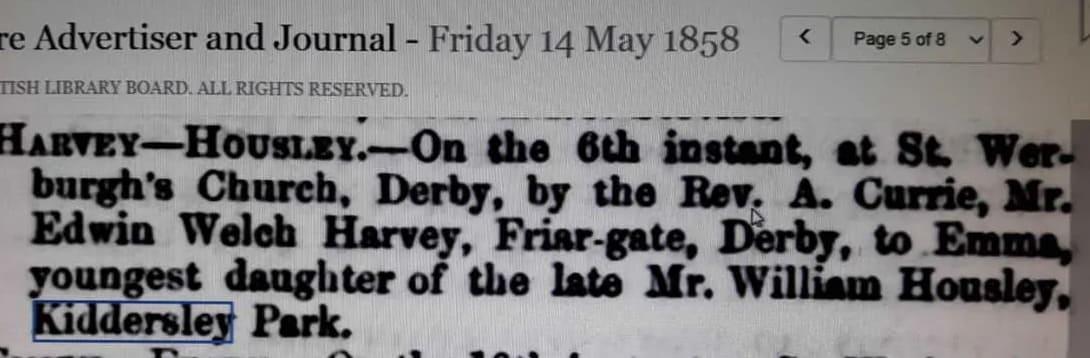
While she was working for Mr. Handysides, Emma wrote: “Mother is thinking of coming to live at Derby. That will be nice for Joseph and I.”Friargate and Ashbourne Road were located in St. Werburgh’s Parish. (In fact, St. Werburgh’s vicarage was at 185 Surrey Street. This clue led to the discovery of the record of Emma’s marriage on May 6, 1858, to Edwin Welch Harvey, son of Samuel Harvey in St. Werburgh’s.)
In 1872, Joseph wrote: “Our sister Emma, she died at Derby at her own home for she was married. She has left two young children behind. The husband was the son of the man that I went apprentice to and has caused a great deal of trouble to our family and I believe hastened poor Mother’s death….”. Joseph added that he believed Emma’s “complaint” was consumption and that she was sick a good bit. Joseph wrote: “Mother was living with John when I came home (from Ascension Island around 1867? or to Smalley from Derby around 1870?) for when Emma was married she broke up the comfortable home and the things went to Derby and she went to live with them but Derby did not agree with her so she had to leave it again but left all her things there.”
Emma Housley and Edwin Welch Harvey wedding, 1858:
JOSEPH HOUSLEY 1838-1893
We first hear of Joseph in a letter from Anne to George in 1854. “Joseph wanted to be a joiner. We thought we could do no better than let him take Robert’s place which he did the October after (probably 1851) and is there still. He is grown as tall as you I think quite a man.” Emma concurred in her first letter: “He is quite a man in his appearance and quite as tall as you.”
From Emma we learn in 1855: “Joseph has left Mr. Harvey. He had not work to employ him. So mother thought he had better leave his indenture and be at liberty at once than wait for Harvey to be a bankrupt. He has got a very good place of work now and is very steady.” In June of 1856, Emma wrote “Joseph and I intend to have our portraits taken for you when you come over….Mother is thinking of coming to Derby. That will be nice for Joseph and I. Joseph is very hearty I am happy to say.”
According to Joseph’s letters, he was married to Harriet Ballard. Joseph described their miraculous reunion in this way: “I must tell you that I have been abroad myself to the Island of Ascension. (Elsewhere he wrote that he was on the island when the American civil war broke out). I went as a Royal Marine and worked at my trade and saved a bit of money–enough to buy my discharge and enough to get married with but while I was out on the island who should I meet with there but my dear wife’s sister. (On two occasions Joseph and Harriet sent George the name and address of Harriet’s sister, Mrs. Brooks, in Susquehanna Depot, Pennsylvania, but it is not clear whether this was the same sister.) She was lady’s maid to the captain’s wife. Though I had never seen her before we got to know each other somehow so from that me and my wife recommenced our correspondence and you may be sure I wanted to get home to her. But as soon as I did get home that is to England I was not long before I was married and I have not regretted yet for we are very comfortable as well as circumstances will allow for I am only a journeyman joiner.”
Proudly, Joseph wrote: “My little family consists of three nice children–John, Joseph and Susy Annie.” On her birth certificate, Susy Ann’s birthdate is listed as 1871. Parish records list a Lucy Annie christened in 1873. The boys were born in Derby, John in 1868 and Joseph in 1869. In his second letter, Joseph repeated: “I have got three nice children, a good wife and I often think is more than I have deserved.” On August 6, 1873, Joseph and Harriet wrote: “We both thank you dear sister for the pieces of money you sent for the children. I don’t know as I have ever see any before.” Joseph ended another letter: “Now I must close with our kindest love to you all and kisses from the children.”
In Harriet’s letter to Sarah Ann (March 19, 1873), she promised: “I will send you myself and as soon as the weather gets warm as I can take the children to Derby, I will have them taken and send them, but it is too cold yet for we have had a very cold winter and a great deal of rain.” At this time, the children were all under 6 and the baby was not yet two.
In March 1873 Joseph wrote: “I have been working down at Heanor gate there is a joiner shop there where Kings used to live I have been working there this winter and part of last summer but the wages is very low but it is near home that is one comfort.” (Heanor Gate is about 1/4 mile from Kidsley Grange. There was a school and industrial park there in 1988.) At this time Joseph and his family were living in “the big house–in Old Betty Hanson’s house.” The address in the 1871 census was Smalley Lane.
A glimpse into Joseph’s personality is revealed by this remark to George in an 1872 letter: “Many thanks for your portrait and will send ours when we can get them taken for I never had but one taken and that was in my old clothes and dear Harriet is not willing to part with that. I tell her she ought to be satisfied with the original.”
On one occasion Joseph and Harriet both sent seeds. (Marks are still visible on the paper.) Joseph sent “the best cow cabbage seed in the country–Robinson Champion,” and Harriet sent red cabbage–Shaw’s Improved Red. Possibly cow cabbage was also known as ox cabbage: “I hope you will have some good cabbages for the Ox cabbage takes all the prizes here. I suppose you will be taking the prizes out there with them.” Joseph wrote that he would put the name of the seeds by each “but I should think that will not matter. You will tell the difference when they come up.”
George apparently would have liked Joseph to come to him as early as 1854. Anne wrote: “As to his coming to you that must be left for the present.” In 1872, Joseph wrote: “I have been thinking of making a move from here for some time before I heard from you for it is living from hand to mouth and never certain of a job long either.” Joseph then made plans to come to the United States in the spring of 1873. “For I intend all being well leaving England in the spring. Many thanks for your kind offer but I hope we shall be able to get a comfortable place before we have been out long.” Joseph promised to bring some things George wanted and asked: “What sort of things would be the best to bring out there for I don’t want to bring a lot that is useless.” Joseph’s plans are confirmed in a letter from the solicitor May 23, 1874: “I trust you are prospering and in good health. Joseph seems desirous of coming out to you when this is settled.”
George must have been reminiscing about gooseberries (Heanor has an annual gooseberry show–one was held July 28, 1872) and Joseph promised to bring cuttings when they came: “Dear Brother, I could not get the gooseberries for they was all gathered when I received your letter but we shall be able to get some seed out the first chance and I shall try to bring some cuttings out along.” In the same letter that he sent the cabbage seeds Joseph wrote: “I have got some gooseberries drying this year for you. They are very fine ones but I have only four as yet but I was promised some more when they were ripe.” In another letter Joseph sent gooseberry seeds and wrote their names: Victoria, Gharibaldi and Globe.
In September 1872 Joseph wrote; “My wife is anxious to come. I hope it will suit her health for she is not over strong.” Elsewhere Joseph wrote that Harriet was “middling sometimes. She is subject to sick headaches. It knocks her up completely when they come on.” In December 1872 Joseph wrote, “Now dear brother about us coming to America you know we shall have to wait until this affair is settled and if it is not settled and thrown into Chancery I’m afraid we shall have to stay in England for I shall never be able to save money enough to bring me out and my family but I hope of better things.”
On July 19, 1875 Abraham Flint (the solicitor) wrote: “Joseph Housley has removed from Smalley and is working on some new foundry buildings at Little Chester near Derby. He lives at a village called Little Eaton near Derby. If you address your letter to him as Joseph Housley, carpenter, Little Eaton near Derby that will no doubt find him.”
George did not save any letters from Joseph after 1874, hopefully he did reach him at Little Eaton. Joseph and his family are not listed in either Little Eaton or Derby on the 1881 census.
In his last letter (February 11, 1874), Joseph sounded very discouraged and wrote that Harriet’s parents were very poorly and both had been “in bed for a long time.” In addition, Harriet and the children had been ill.
The move to Little Eaton may indicate that Joseph received his settlement because in August, 1873, he wrote: “I think this is bad news enough and bad luck too, but I have had little else since I came to live at Kiddsley cottages but perhaps it is all for the best if one could only think so. I have begun to think there will be no chance for us coming over to you for I am afraid there will not be so much left as will bring us out without it is settled very shortly but I don’t intend leaving this house until it is settled either one way or the other. “Joseph Housley and the Kiddsley cottages:
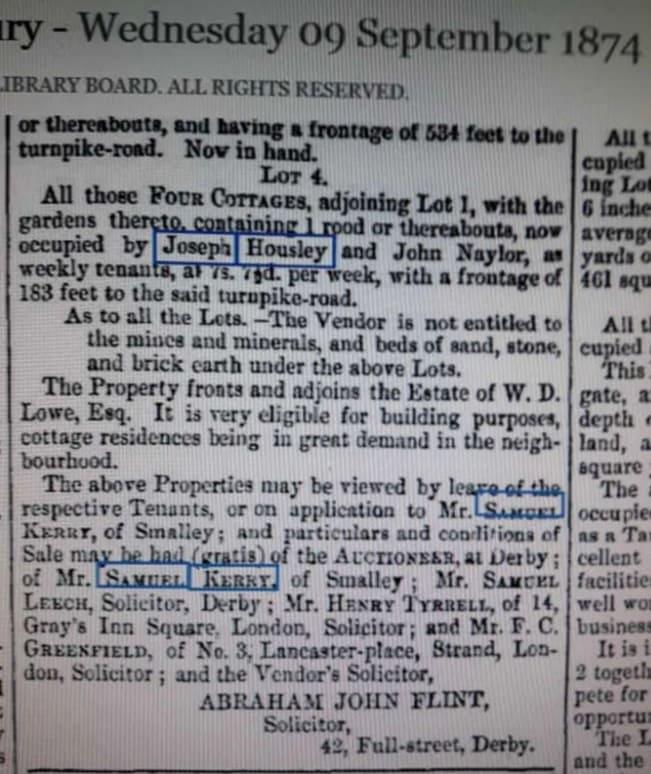 February 2, 2022 at 12:50 pm #6267
In reply to: The Elusive Samuel Housley and Other Family Stories
From Tanganyika with Love
continued part 8
With thanks to Mike Rushby.
Morogoro 20th January 1941
Dearest Family,
It is all arranged for us to go on three months leave to Cape Town next month so
get out your flags. How I shall love showing off Kate and John to you and this time
George will be with us and you’ll be able to get to know him properly. You can’t think
what a comfort it will be to leave all the worries of baggage and tipping to him. We will all
be travelling by ship to Durban and from there to Cape Town by train. I rather dread the
journey because there is a fifth little Rushby on the way and, as always, I am very
queasy.Kate has become such a little companion to me that I dread the thought of leaving
her behind with you to start schooling. I miss Ann and George so much now and must
face separation from Kate as well. There does not seem to be any alternative though.
There is a boarding school in Arusha and another has recently been started in Mbeya,
but both places are so far away and I know she would be very unhappy as a boarder at
this stage. Living happily with you and attending a day school might wean her of her
dependance upon me. As soon as this wretched war ends we mean to get Ann and
George back home and Kate too and they can then all go to boarding school together.
If I were a more methodical person I would try to teach Kate myself, but being a
muddler I will have my hands full with Johnny and the new baby. Life passes pleasantly
but quietly here. Much of my time is taken up with entertaining the children and sewing
for them and just waiting for George to come home.George works so hard on these safaris and this endless elephant hunting to
protect native crops entails so much foot safari, that he has lost a good deal of weight. it
is more than ten years since he had a holiday so he is greatly looking forward to this one.
Four whole months together!I should like to keep the ayah, Janet, for the new baby, but she says she wants
to return to her home in the Southern Highlands Province and take a job there. She is
unusually efficient and so clean, and the houseboy and cook are quite scared of her. She
bawls at them if the children’s meals are served a few minutes late but she is always
respectful towards me and practically creeps around on tiptoe when George is home.
She has a room next to the outside kitchen. One night thieves broke into the kitchen and
stole a few things, also a canvas chair and mat from the verandah. Ayah heard them, and
grabbing a bit of firewood, she gave chase. Her shouts so alarmed the thieves that they
ran off up the hill jettisoning their loot as they ran. She is a great character.Eleanor.
Morogoro 30th July 1941
Dearest Family,
Safely back in Morogoro after a rather grim voyage from Durban. Our ship was
completely blacked out at night and we had to sleep with warm clothing and life belts
handy and had so many tedious boat drills. It was a nuisance being held up for a whole
month in Durban, because I was so very pregnant when we did embark. In fact George
suggested that I had better hide in the ‘Ladies’ until the ship sailed for fear the Captain
might refuse to take me. It seems that the ship, on which we were originally booked to
travel, was torpedoed somewhere off the Cape.We have been given a very large house this tour with a mosquito netted
sleeping porch which will be fine for the new baby. The only disadvantage is that the
house is on the very edge of the residential part of Morogoro and Johnny will have to
go quite a distance to find playmates.I still miss Kate terribly. She is a loving little person. I had prepared for a scene
when we said good-bye but I never expected that she would be the comforter. It
nearly broke my heart when she put her arms around me and said, “I’m so sorry
Mummy, please don’t cry. I’ll be good. Please don’t cry.” I’m afraid it was all very
harrowing for you also. It is a great comfort to hear that she has settled down so happily.
I try not to think consciously of my absent children and remind myself that there are
thousands of mothers in the same boat, but they are always there at the back of my
mind.Mother writes that Ann and George are perfectly happy and well, and that though
German bombers do fly over fairly frequently, they are unlikely to drop their bombs on
a small place like Jacksdale.George has already left on safari to the Rufiji. There was no replacement for his
job while he was away so he is anxious to get things moving again. Johnny and I are
going to move in with friends until he returns, just in case all the travelling around brings
the new baby on earlier than expected.Eleanor.
Morogoro 26th August 1941
Dearest Family,
Our new son, James Caleb. was born at 3.30 pm yesterday afternoon, with a
minimum of fuss, in the hospital here. The Doctor was out so my friend, Sister Murray,
delivered the baby. The Sister is a Scots girl, very efficient and calm and encouraging,
and an ideal person to have around at such a time.Everything, this time, went without a hitch and I feel fine and proud of my
bouncing son. He weighs nine pounds and ten ounces and is a big boned fellow with
dark hair and unusually strongly marked eyebrows. His eyes are strong too and already
seem to focus. George is delighted with him and brought Hugh Nelson to see him this
morning. Hugh took one look, and, astonished I suppose by the baby’s apparent
awareness, said, “Gosh, this one has been here before.” The baby’s cot is beside my
bed so I can admire him as much as I please. He has large strong hands and George
reckons he’ll make a good boxer some day.Another of my early visitors was Mabemba, George’s orderly. He is a very big
African and looks impressive in his Game Scouts uniform. George met him years ago at
Mahenge when he was a young elephant hunter and Mabemba was an Askari in the
Police. Mabemba takes quite a proprietary interest in the family.Eleanor.
Morogoro 25th December 1941
Dearest Family,
Christmas Day today, but not a gay one. I have Johnny in bed with a poisoned
leg so he missed the children’s party at the Club. To make things a little festive I have
put up a little Christmas tree in the children’s room and have hung up streamers and
balloons above the beds. Johnny demands a lot of attention so it is fortunate that little
James is such a very good baby. He sleeps all night until 6 am when his feed is due.
One morning last week I got up as usual to feed him but I felt so dopey that I
thought I’d better have a cold wash first. I went into the bathroom and had a hurried
splash and then grabbed a towel to dry my face. Immediately I felt an agonising pain in
my nose. Reason? There was a scorpion in the towel! In no time at all my nose looked
like a pear and felt burning hot. The baby screamed with frustration whilst I feverishly
bathed my nose and applied this and that in an effort to cool it.For three days my nose was very red and tender,”A real boozer nose”, said
George. But now, thank goodness, it is back to normal.Some of the younger marrieds and a couple of bachelors came around,
complete with portable harmonium, to sing carols in the early hours. No sooner had we
settled down again to woo sleep when we were disturbed by shouts and screams from
our nearest neighbour’s house. “Just celebrating Christmas”, grunted George, but we
heard this morning that the neighbour had fallen down his verandah steps and broken his
leg.Eleanor.
Morogoro Hospital 30th September 1943
Dearest Family,
Well now we are eight! Our new son, Henry, was born on the night of the 28th.
He is a beautiful baby, weighing ten pounds three and a half ounces. This baby is very
well developed, handsome, and rather superior looking, and not at all amusing to look at
as the other boys were.George was born with a moustache, John had a large nose and
looked like a little old man, and Jim, bless his heart, looked rather like a baby
chimpanzee. Henry is different. One of my visitors said, “Heaven he’ll have to be a
Bishop!” I expect the lawn sleeves of his nightie really gave her that idea, but the baby
does look like ‘Someone’. He is very good and George, John, and Jim are delighted
with him, so is Mabemba.We have a dear little nurse looking after us. She is very petite and childish
looking. When the baby was born and she brought him for me to see, the nurse asked
his name. I said jokingly, “His name is Benjamin – the last of the family.” She is now very
peeved to discover that his real name is Henry William and persists in calling him
‘Benjie’.I am longing to get home and into my pleasant rut. I have been away for two
whole weeks and George is managing so well that I shall feel quite expendable if I don’t
get home soon. As our home is a couple of miles from the hospital, I arranged to move
in and stay with the nursing sister on the day the baby was due. There I remained for ten
whole days before the baby was born. Each afternoon George came and took me for a
ride in the bumpy Bedford lorry and the Doctor tried this and that but the baby refused
to be hurried.On the tenth day I had the offer of a lift and decided to go home for tea and
surprise George. It was a surprise too, because George was entertaining a young
Game Ranger for tea and my arrival, looking like a perambulating big top, must have
been rather embarrassing.Henry was born at the exact moment that celebrations started
in the Township for the end of the Muslim religious festival of Ramadan. As the Doctor
held him up by his ankles, there was the sound of hooters and firecrackers from the town.
The baby has a birthmark in the shape of a crescent moon above his left eyebrow.Eleanor.
Morogoro 26th January 1944
Dearest Family,
We have just heard that we are to be transferred to the Headquarters of the
Game Department at a place called Lyamungu in the Northern Province. George is not
at all pleased because he feels that the new job will entail a good deal of office work and
that his beloved but endless elephant hunting will be considerably curtailed. I am glad of
that and I am looking forward to seeing a new part of Tanganyika and particularly
Kilimanjaro which dominates Lyamungu.Thank goodness our menagerie is now much smaller. We found a home for the
guinea pigs last December and Susie, our mischievous guinea-fowl, has flown off to find
a mate.Last week I went down to Dar es Salaam for a check up by Doctor John, a
woman doctor, leaving George to cope with the three boys. I was away two nights and
a day and returned early in the morning just as George was giving Henry his six o’clock
bottle. It always amazes me that so very masculine a man can do my chores with no
effort and I have a horrible suspicion that he does them better than I do. I enjoyed the
short break at the coast very much. I stayed with friends and we bathed in the warm sea
and saw a good film.Now I suppose there will be a round of farewell parties. People in this country
are most kind and hospitable.Eleanor.
Lyamungu 20th March 1944
Dearest Family,
We left Morogoro after the round of farewell parties I had anticipated. The final
one was at the Club on Saturday night. George made a most amusing speech and the
party was a very pleasant occasion though I was rather tired after all the packing.
Several friends gathered to wave us off on Monday morning. We had two lorries
loaded with our goods. I rode in the cab of the first one with Henry on my knee. George
with John and Jim rode in the second one. As there was no room for them in the cab,
they sat on our couch which was placed across the width of the lorry behind the cab. This
seat was not as comfortable as it sounds, because the space behind the couch was
taken up with packing cases which were not lashed in place and these kept moving
forward as the lorry bumped its way over the bad road.Soon there was hardly any leg room and George had constantly to stand up and
push the second layer of packing cases back to prevent them from toppling over onto
the children and himself. As it is now the rainy season the road was very muddy and
treacherous and the lorries travelled so slowly it was dark by the time we reached
Karogwe from where we were booked to take the train next morning to Moshi.
Next morning we heard that there had been a washaway on the line and that the
train would be delayed for at least twelve hours. I was not feeling well and certainly did
not enjoy my day. Early in the afternoon Jimmy ran into a wall and blackened both his
eyes. What a child! As the day wore on I felt worse and worse and when at last the train
did arrive I simply crawled into my bunk whilst George coped nobly with the luggage
and the children.We arrived at Moshi at breakfast time and went straight to the Lion Cub Hotel
where I took to my bed with a high temperature. It was, of course, malaria. I always have
my attacks at the most inopportune times. Fortunately George ran into some friends
called Eccles and the wife Mollie came to my room and bathed Henry and prepared his
bottle and fed him. George looked after John and Jim. Next day I felt much better and
we drove out to Lyamungu the day after. There we had tea with the Game Warden and
his wife before moving into our new home nearby.The Game Warden is Captain Monty Moore VC. He came out to Africa
originally as an Officer in the King’s African Rifles and liked the country so much he left the
Army and joined the Game Department. He was stationed at Banagi in the Serengetti
Game Reserve and is well known for his work with the lions there. He particularly tamed
some of the lions by feeding them so that they would come out into the open and could
readily be photographed by tourists. His wife Audrey, has written a book about their
experiences at Banagi. It is called “Serengetti”Our cook, Hamisi, soon had a meal ready for us and we all went to bed early.
This is a very pleasant house and I know we will be happy here. I still feel a little shaky
but that is the result of all the quinine I have taken. I expect I shall feel fine in a day or two.Eleanor.
Lyamungu 15th May 1944
Dearest Family,
Well, here we are settled comfortably in our very nice house. The house is
modern and roomy, and there is a large enclosed verandah, which will be a Godsend in
the wet weather as a playroom for the children. The only drawback is that there are so
many windows to be curtained and cleaned. The grounds consist of a very large lawn
and a few beds of roses and shrubs. It is an ideal garden for children, unlike our steeply
terraced garden at Morogoro.Lyamungu is really the Government Coffee Research Station. It is about sixteen
miles from the town of Moshi which is the centre of the Tanganyika coffee growing
industry. Lyamungu, which means ‘place of God’ is in the foothills of Mt Kilimanjaro and
we have a beautiful view of Kilimanjaro. Kibo, the more spectacular of the two mountain
peaks, towers above us, looking from this angle, like a giant frosted plum pudding. Often the mountain is veiled by cloud and mist which sometimes comes down to
our level so that visibility is practically nil. George dislikes both mist and mountain but I
like both and so does John. He in fact saw Kibo before I did. On our first day here, the
peak was completely hidden by cloud. In the late afternoon when the children were
playing on the lawn outside I was indoors hanging curtains. I heard John call out, “Oh
Mummy, isn’t it beautiful!” I ran outside and there, above a scarf of cloud, I saw the
showy dome of Kibo with the setting sun shining on it tingeing the snow pink. It was an
unforgettable experience.As this is the rainy season, the surrounding country side is very lush and green.
Everywhere one sees the rich green of the coffee plantations and the lighter green of
the banana groves. Unfortunately our walks are rather circumscribed. Except for the main road to Moshi, there is nowhere to walk except through the Government coffee
plantation. Paddy, our dog, thinks life is pretty boring as there is no bush here and
nothing to hunt. There are only half a dozen European families here and half of those are
on very distant terms with the other half which makes the station a rather uncomfortable
one.The coffee expert who runs this station is annoyed because his European staff
has been cut down owing to the war, and three of the vacant houses and some office
buildings have been taken over temporarily by the Game Department. Another house
has been taken over by the head of the Labour Department. However I don’t suppose
the ill feeling will effect us much. We are so used to living in the bush that we are not
socially inclined any way.Our cook, Hamisi, came with us from Morogoro but I had to engage a new
houseboy and kitchenboy. I first engaged a houseboy who produced a wonderful ‘chit’
in which his previous employer describes him as his “friend and confidant”. I felt rather
dubious about engaging him and how right I was. On his second day with us I produced
some of Henry’s napkins, previously rinsed by me, and asked this boy to wash them.
He looked most offended and told me that it was beneath his dignity to do women’s
work. We parted immediately with mutual relief.Now I have a good natured fellow named Japhet who, though hard on crockery,
is prepared to do anything and loves playing with the children. He is a local boy, a
member of the Chagga tribe. These Chagga are most intelligent and, on the whole, well
to do as they all have their own small coffee shambas. Japhet tells me that his son is at
the Uganda University College studying medicine.The kitchen boy is a tall youth called
Tovelo, who helps both Hamisi, the cook, and the houseboy and also keeps an eye on
Henry when I am sewing. I still make all the children’s clothes and my own. Life is
pleasant but dull. George promises that he will take the whole family on safari when
Henry is a little older.Eleanor.
Lyamungu 18th July 1944
Dearest Family,
Life drifts quietly by at Lyamungu with each day much like the one before – or
they would be, except that the children provide the sort of excitement that prohibits
boredom. Of the three boys our Jim is the best at this. Last week Jim wandered into the
coffee plantation beside our house and chewed some newly spayed berries. Result?
A high temperature and nasty, bloody diarrhoea, so we had to rush him to the hospital at
Moshi for treatment. however he was well again next day and George went off on safari.
That night there was another crisis. As the nights are now very cold, at this high
altitude, we have a large fire lit in the living room and the boy leaves a pile of logs
beside the hearth so that I can replenish the fire when necessary. Well that night I took
Henry off to bed, leaving John and Jim playing in the living room. When their bedtime
came, I called them without leaving the bedroom. When I had tucked John and Jim into
bed, I sat reading a bedtime story as I always do. Suddenly I saw smoke drifting
through the door, and heard a frightening rumbling noise. Japhet rushed in to say that the
lounge chimney was on fire! Picture me, panic on the inside and sweet smile on the
outside, as I picked Henry up and said to the other two, “There’s nothing to be
frightened about chaps, but get up and come outside for a bit.” Stupid of me to be so
heroic because John and Jim were not at all scared but only too delighted at the chance
of rushing about outside in the dark. The fire to them was just a bit of extra fun.We hurried out to find one boy already on the roof and the other passing up a
brimming bucket of water. Other boys appeared from nowhere and soon cascades of
water were pouring down the chimney. The result was a mountain of smouldering soot
on the hearth and a pool of black water on the living room floor. However the fire was out
and no serious harm done because all the floors here are cement and another stain on
the old rug will hardly be noticed. As the children reluctantly returned to bed John
remarked smugly, “I told Jim not to put all the wood on the fire at once but he wouldn’t
listen.” I might have guessed!However it was not Jim but John who gave me the worst turn of all this week. As
a treat I decided to take the boys to the river for a picnic tea. The river is not far from our
house but we had never been there before so I took the kitchen boy, Tovelo, to show
us the way. The path is on the level until one is in sight of the river when the bank slopes
steeply down. I decided that it was too steep for the pram so I stopped to lift Henry out
and carry him. When I looked around I saw John running down the slope towards the
river. The stream is not wide but flows swiftly and I had no idea how deep it was. All I
knew was that it was a trout stream. I called for John, “Stop, wait for me!” but he ran on
and made for a rude pole bridge which spanned the river. He started to cross and then,
to my horror, I saw John slip. There was a splash and he disappeared under the water. I
just dumped the baby on the ground, screamed to the boy to mind him and ran madly
down the slope to the river. Suddenly I saw John’s tight fitting felt hat emerge, then his
eyes and nose. I dashed into the water and found, to my intense relief, that it only
reached up to my shoulders but, thank heaven no further. John’s steady eyes watched
me trustingly as I approached him and carried him safely to the bank. He had been
standing on a rock and had not panicked at all though he had to stand up very straight
and tall to keep his nose out of water. I was too proud of him to scold him for
disobedience and too wet anyway.I made John undress and put on two spare pullovers and wrapped Henry’s
baby blanket round his waist like a sarong. We made a small fire over which I crouched
with literally chattering teeth whilst Tovelo ran home to fetch a coat for me and dry clothes
for John.Eleanor.
Lyamungu 16th August 1944
Dearest Family,
We have a new bull terrier bitch pup whom we have named Fanny III . So once
more we have a menagerie , the two dogs, two cats Susie and Winnie, and
some pet hens who live in the garage and are a real nuisance.As John is nearly six I thought it time that he started lessons and wrote off to Dar
es Salaam for the correspondence course. We have had one week of lessons and I am
already in a state of physical and mental exhaustion. John is a most reluctant scholar.
“Why should I learn to read, when you can read to me?” he asks, and “Anyway why
should I read such stupid stuff, ‘Run Rover Run’, and ‘Mother play with baby’ . Who
wants to read about things like that? I don’t.”He rather likes sums, but the only subject about which he is enthusiastic is
prehistoric history. He laps up information about ‘The Tree Dwellers’, though he is very
sceptical about the existence of such people. “God couldn’t be so silly to make people
so stupid. Fancy living in trees when it is easy to make huts like the natives.” ‘The Tree
Dwellers is a highly imaginative story about a revolting female called Sharptooth and her
offspring called Bodo. I have a very clear mental image of Sharptooth, so it came as a
shock to me and highly amused George when John looked at me reflectively across the
tea table and said, “Mummy I expect Sharptooth looked like you. You have a sharp
tooth too!” I have, my eye teeth are rather sharp, but I hope the resemblance stops
there.John has an uncomfortably logical mind for a small boy. The other day he was
lying on the lawn staring up at the clouds when he suddenly muttered “I don’t believe it.”
“Believe what?” I asked. “That Jesus is coming on a cloud one day. How can he? The
thick ones always stay high up. What’s he going to do, jump down with a parachute?”
Tovelo, my kitchen boy, announced one evening that his grandmother was in the
kitchen and wished to see me. She was a handsome and sensible Chagga woman who
brought sad news. Her little granddaughter had stumbled backwards into a large cooking
pot of almost boiling maize meal porridge and was ‘ngongwa sana’ (very ill). I grabbed
a large bottle of Picric Acid and a packet of gauze which we keep for these emergencies
and went with her, through coffee shambas and banana groves to her daughter’s house.
Inside the very neat thatched hut the mother sat with the naked child lying face
downwards on her knee. The child’s buttocks and the back of her legs were covered in
huge burst blisters from which a watery pus dripped. It appeared that the accident had
happened on the previous day.I could see that it was absolutely necessary to clean up the damaged area, and I
suddenly remembered that there was a trained African hospital dresser on the station. I
sent the father to fetch him and whilst the dresser cleaned off the sloughed skin with
forceps and swabs saturated in Picric Acid, I cut the gauze into small squares which I
soaked in the lotion and laid on the cleaned area. I thought the small pieces would be
easier to change especially as the whole of the most tender parts, front and back, were
badly scalded. The child seemed dazed and neither the dresser nor I thought she would
live. I gave her half an aspirin and left three more half tablets to be given four hourly.
Next day she seemed much brighter. I poured more lotion on the gauze
disturbing as few pieces as possible and again the next day and the next. After a week
the skin was healing well and the child eating normally. I am sure she will be all right now.
The new skin is a brilliant red and very shiny but it is pale round the edges of the burnt
area and will I hope later turn brown. The mother never uttered a word of thanks, but the
granny is grateful and today brought the children a bunch of bananas.Eleanor.
c/o Game Dept. P.O.Moshi. 29th September 1944
Dearest Mummy,
I am so glad that you so enjoyed my last letter with the description of our very
interesting and enjoyable safari through Masailand. You said you would like an even
fuller description of it to pass around amongst the relations, so, to please you, I have
written it out in detail and enclose the result.We have spent a quiet week after our exertions and all are well here.
Very much love,
Eleanor.Safari in Masailand
George and I were at tea with our three little boys on the front lawn of our house
in Lyamungu, Northern Tanganyika. It was John’s sixth birthday and he and Jim, a
happy sturdy three year old, and Henry, aged eleven months, were munching the
squares of plain chocolate which rounded off the party, when George said casually
across the table to me, “Could you be ready by the day after tomorrow to go on
safari?” “Me too?” enquired John anxiously, before I had time to reply, and “Me too?”
echoed Jim. “yes, of course I can”, said I to George and “of course you’re coming too”,
to the children who rate a day spent in the bush higher than any other pleasure.
So in the early morning two days later, we started out happily for Masailand in a
three ton Ford lorry loaded to capacity with the five Rushbys, the safari paraphernalia,
drums of petrol and quite a retinue of servants and Game Scouts. George travelling
alone on his monthly safaris, takes only the cook and a couple of Game Scouts, but this was to be a safari de luxe.Henry and I shared the cab with George who was driving, whilst John and Jim
with the faithful orderly Mabemba beside them to point out the game animals, were
installed upon rolls of bedding in the body of the lorry. The lorry lumbered along, first
through coffee shambas, and then along the main road between Moshi and Arusha.
After half an hour or so, we turned South off the road into a track which crossed the
Sanya Plains and is the beginning of this part of Masailand. Though the dry season was
at its height, and the pasture dry and course, we were soon passing small groups of
game. This area is a Game Sanctuary and the antelope grazed quietly quite undisturbed
by the passing lorry. Here and there zebra stood bunched by the road, a few wild
ostriches stalked jerkily by, and in the distance some wildebeest cavorted around in their
crazy way.Soon the grasslands gave way to thorn bush, and we saw six fantastically tall
giraffe standing motionless with their heads turned enquiringly towards us. George
stopped the lorry so the children could have a good view of them. John was enchanted
but Jim, alas, was asleep.At mid day we reached the Kikoletwa River and turned aside to camp. Beside
the river, under huge leafy trees, there was a beautiful camping spot, but the river was
deep and reputed to be full of crocodiles so we passed it by and made our camp
some distance from the river under a tall thorn tree with a flat lacy canopy. All around the
camp lay uprooted trees of similar size that had been pushed over by elephants. As
soon as the lorry stopped a camp chair was set up for me and the Game Scouts quickly
slashed down grass and cleared the camp site of thorns. The same boys then pitched the tent whilst George himself set up the three camp beds and the folding cot for Henry,
and set up the safari table and the canvas wash bowl and bath.The cook in the meantime had cleared a cool spot for the kitchen , opened up the
chop boxes and started a fire. The cook’s boy and the dhobi (laundry boy) brought
water from the rather muddy river and tea was served followed shortly afterward by an
excellent lunch. In a very short time the camp had a suprisingly homely look. Nappies
fluttered from a clothes line, Henry slept peacefully in his cot, John and Jim sprawled on
one bed looking at comics, and I dozed comfortably on another.George, with the Game Scouts, drove off in the lorry about his work. As a Game
Ranger it is his business to be on a constant look out for poachers, both African and
European, and for disease in game which might infect the valuable herds of Masai cattle.
The lorry did not return until dusk by which time the children had bathed enthusiastically in
the canvas bath and were ready for supper and bed. George backed the lorry at right
angles to the tent, Henry’s cot and two camp beds were set up in the lorry, the tarpaulin
was lashed down and the children put to bed in their novel nursery.When darkness fell a large fire was lit in front of the camp, the exited children at
last fell asleep and George and I sat on by the fire enjoying the cool and quiet night.
When the fire subsided into a bed of glowing coals, it was time for our bed. During the
night I was awakened by the sound of breaking branches and strange indescribable
noises.” Just elephant”, said George comfortably and instantly fell asleep once more. I
didn’t! We rose with the birds next morning, but breakfast was ready and in a
remarkably short time the lorry had been reloaded and we were once more on our way.
For about half a mile we made our own track across the plain and then we turned
into the earth road once more. Soon we had reached the river and were looking with
dismay at the suspension bridge which we had to cross. At the far side, one steel
hawser was missing and there the bridge tilted dangerously. There was no handrail but
only heavy wooden posts which marked the extremities of the bridge. WhenGeorge
measured the distance between the posts he found that there could be barely two
inches to spare on either side of the cumbersome lorry.He decided to risk crossing, but the children and I and all the servants were told to
cross the bridge and go down the track out of sight. The Game Scouts remained on the
river bank on the far side of the bridge and stood ready for emergencies. As I walked
along anxiously listening, I was horrified to hear the lorry come to a stop on the bridge.
There was a loud creaking noise and I instantly visualised the lorry slowly toppling over
into the deep crocodile infested river. The engine restarted, the lorry crossed the bridge
and came slowly into sight around the bend. My heart slid back into its normal position.
George was as imperturbable as ever and simply remarked that it had been a near
thing and that we would return to Lyamungu by another route.Beyond the green river belt the very rutted track ran through very uninteresting
thorn bush country. Henry was bored and tiresome, jumping up and down on my knee
and yelling furiously. “Teeth”, said I apologetically to George, rashly handing a match
box to Henry to keep him quiet. No use at all! With a fat finger he poked out the tray
spilling the matches all over me and the floor. Within seconds Henry had torn the
matchbox to pieces with his teeth and flung the battered remains through the window.
An empty cigarette box met with the same fate as the match box and the yells
continued unabated until Henry slept from sheer exhaustion. George gave me a smile,
half sympathetic and half sardonic, “Enjoying the safari, my love?” he enquired. On these
trying occasions George has the inestimable advantage of being able to go into a Yogilike
trance, whereas I become irritated to screaming point.In an effort to prolong Henry’s slumber I braced my feet against the floor boards
and tried to turn myself into a human shock absorber as we lurched along the eroded
track. Several times my head made contact with the bolt of a rifle in the rack above, and
once I felt I had shattered my knee cap against the fire extinguisher in a bracket under the
dash board.Strange as it may seem, I really was enjoying the trip in spite of these
discomforts. At last after three years I was once more on safari with George. This type of
country was new to me and there was so much to see We passed a family of giraffe
standing in complete immobility only a few yards from the track. Little dick-dick. one of the smallest of the antelope, scuttled in pairs across the road and that afternoon I had my first view of Gerenuk, curious red brown antelope with extremely elongated legs and giraffe-like necks.Most interesting of all was my first sight of Masai at home. We could hear a tuneful
jangle of cattle bells and suddenly came across herds of humped cattle browsing upon
the thorn bushes. The herds were guarded by athletic,striking looking Masai youths and men.
Each had a calabash of water slung over his shoulder and a tall, highly polished spear in his
hand. These herdsmen were quite unselfconscious though they wore no clothing except for one carelessly draped blanket. Very few gave us any greeting but glanced indifferently at us from under fringes of clay-daubed plaited hair . The rest of their hair was drawn back behind the ears to display split earlobes stretched into slender loops by the weight of heavy brass or copper tribal ear rings.Most of the villages were set well back in the bush out of sight of the road but we did pass one
typical village which looked most primitive indeed. It consisted simply of a few mound like mud huts which were entirely covered with a plaster of mud and cattle dung and the whole clutch of huts were surrounded by a ‘boma’ of thorn to keep the cattle in at night and the lions out. There was a gathering of women and children on the road at this point. The children of both sexes were naked and unadorned, but the women looked very fine indeed. This is not surprising for they have little to do but adorn themselves, unlike their counterparts of other tribes who have to work hard cultivating the fields. The Masai women, and others I saw on safari, were far more amiable and cheerful looking than the men and were well proportioned.They wore skirts of dressed goat skin, knee length in front but ankle length behind. Their arms
from elbow to wrist, and legs from knee to ankle, were encased in tight coils of copper and
galvanised wire. All had their heads shaved and in some cases bound by a leather band
embroidered in red white and blue beads. Circular ear rings hung from slit earlobes and their
handsome throats were encircled by stiff wire necklaces strung with brightly coloured beads. These
necklaces were carefully graded in size and formed deep collars almost covering their breasts.
About a quarter of a mile further along the road we met eleven young braves in gala attire, obviously on their way to call on the girls. They formed a line across the road and danced up and down until the lorry was dangerously near when they parted and grinned cheerfully at us. These were the only cheerful
looking male Masai that I saw. Like the herdsmen these youths wore only a blanket, but their
blankets were ochre colour, and elegantly draped over their backs. Their naked bodies gleamed with oil. Several had painted white stripes on their faces, and two had whitewashed their faces entirely which I
thought a pity. All had their long hair elaborately dressed and some carried not only one,
but two gleaming spears.By mid day George decided that we had driven far enough for that day. He
stopped the lorry and consulted a rather unreliable map. “Somewhere near here is a
place called Lolbeni,” he said. “The name means Sweet Water, I hear that the
government have piped spring water down from the mountain into a small dam at which
the Masai water their cattle.” Lolbeni sounded pleasant to me. Henry was dusty and
cross, the rubber sheet had long slipped from my lap to the floor and I was conscious of
a very damp lap. ‘Sweet Waters’ I felt, would put all that right. A few hundred yards
away a small herd of cattle was grazing, so George lit his pipe and relaxed at last, whilst
a Game Scout went off to find the herdsman. The scout soon returned with an ancient
and emaciated Masai who was thrilled at the prospect of his first ride in a lorry and
offered to direct us to Lolbeni which was off the main track and about four miles away.Once Lolbeni had been a small administrative post and a good track had
led to it, but now the Post had been abandoned and the road is dotted with vigourous
thorn bushes and the branches of larger thorn trees encroach on the track The road had
deteriorated to a mere cattle track, deeply rutted and eroded by heavy rains over a
period of years. The great Ford truck, however, could take it. It lurched victoriously along,
mowing down the obstructions, tearing off branches from encroaching thorn trees with its
high railed sides, spanning gorges in the track, and climbing in and out of those too wide
to span. I felt an army tank could not have done better.I had expected Lolbeni to be a green oasis in a desert of grey thorns, but I was
quickly disillusioned. To be sure the thorn trees were larger and more widely spaced and
provided welcome shade, but the ground under the trees had been trampled by thousands of cattle into a dreary expanse of dirty grey sand liberally dotted with cattle droppings and made still more uninviting by the bleached bones of dead beasts.To the right of this waste rose a high green hill which gave the place its name and from which
the precious water was piped, but its slopes were too steep to provide a camping site.
Flies swarmed everywhere and I was most relieved when George said that we would
stay only long enough to fill our cans with water. Even the water was a disappointment!
The water in the small dam was low and covered by a revolting green scum, and though
the water in the feeding pipe was sweet, it trickled so feebly that it took simply ages to
fill a four gallon can.However all these disappointments were soon forgotten for we drove away
from the flies and dirt and trampled sand and soon, with their quiet efficiency, George
and his men set up a comfortable camp. John and Jim immediately started digging
operations in the sandy soil whilst Henry and I rested. After tea George took his shot
gun and went off to shoot guinea fowl and partridges for the pot. The children and I went
walking, keeping well in site of camp, and soon we saw a very large flock of Vulturine
Guineafowl, running aimlessly about and looking as tame as barnyard fowls, but melting
away as soon as we moved in their direction.We had our second quiet and lovely evening by the camp fire, followed by a
peaceful night.We left Lolbeni very early next morning, which was a good thing, for as we left
camp the herds of thirsty cattle moved in from all directions. They were accompanied by
Masai herdsmen, their naked bodies and blankets now covered by volcanic dust which
was being stirred in rising clouds of stifling ash by the milling cattle, and also by grey
donkeys laden with panniers filled with corked calabashes for water.Our next stop was Nabarera, a Masai cattle market and trading centre, where we
reluctantly stayed for two days in a pokey Goverment Resthouse because George had
a job to do in that area. The rest was good for Henry who promptly produced a tooth
and was consequently much better behaved for the rest of the trip. George was away in the bush most of the day but he returned for afternoon tea and later took the children out
walking. We had noticed curious white dumps about a quarter mile from the resthouse
and on the second afternoon we set out to investigate them. Behind the dumps we
found passages about six foot wide, cut through solid limestone. We explored two of
these and found that both passages led steeply down to circular wells about two and a
half feet in diameter.At the very foot of each passage, beside each well, rough drinking troughs had
been cut in the stone. The herdsmen haul the water out of the well in home made hide
buckets, the troughs are filled and the cattle driven down the ramps to drink at the trough.
It was obvious that the wells were ancient and the sloping passages new. George tells
me that no one knows what ancient race dug the original wells. It seems incredible that
these deep and narrow shafts could have been sunk without machinery. I craned my
neck and looked above one well and could see an immensely long shaft reaching up to
ground level. Small footholds were cut in the solid rock as far as I could see.
It seems that the Masai are as ignorant as ourselves about the origin of these
wells. They do say however that when their forebears first occupied what is now known
as Masailand, they not only found the Wanderobo tribe in the area but also a light
skinned people and they think it possible that these light skinned people dug the wells.
These people disappeared. They may have been absorbed or, more likely, they were
liquidated.The Masai had found the well impractical in their original form and had hired
labourers from neighbouring tribes to cut the passages to water level. Certainly the Masai are not responsible for the wells. They are a purely pastoral people and consider manual labour extremely degrading.They live chiefly on milk from their herd which they allow to go sour, and mix with blood that has been skilfully tapped from the necks of living cattle. They do not eat game meat, nor do they cultivate any
land. They hunt with spears, but hunt only lions, to protect their herds, and to test the skill
and bravery of their young warriors. What little grain they do eat is transported into
Masailand by traders. The next stage of our journey took us to Ngassamet where
George was to pick up some elephant tusks. I had looked forward particularly to this
stretch of road for I had heard that there was a shallow lake at which game congregates,
and at which I had great hopes of seeing elephants. We had come too late in the
season though, the lake was dry and there were only piles of elephant droppings to
prove that elephant had recently been there in numbers. Ngassamet, though no beauty
spot, was interesting. We saw more elaborate editions of the wells already described, and as this area
is rich in cattle we saw the aristocrats of the Masai. You cannot conceive of a more arrogant looking male than a young Masai brave striding by on sandalled feet, unselfconscious in all his glory. All the young men wore the casually draped traditional ochre blanket and carried one or more spears. But here belts and long knife sheaths of scarlet leather seem to be the fashion. Here fringes do not seem to be the thing. Most of these young Masai had their hair drawn smoothly back and twisted in a pointed queue, the whole plastered with a smooth coating of red clay. Some tied their horn shaped queues over their heads
so that the tip formed a deep Satanic peak on the brow. All these young men wore the traditional
copper earrings and I saw one or two with copper bracelets and one with a necklace of brightly coloured
beads.It so happened that, on the day of our visit to Ngassamet, there had been a
baraza (meeting) which was attended by all the local headmen and elders. These old
men came to pay their respects to George and a more shrewd and rascally looking
company I have never seen, George told me that some of these men own up to three
thousand head of cattle and more. The chief was as fat and Rabelasian as his second in
command was emaciated, bucktoothed and prim. The Chief shook hands with George
and greeted me and settled himself on the wall of the resthouse porch opposite
George. The lesser headmen, after politely greeting us, grouped themselves in a
semi circle below the steps with their ‘aides’ respectfully standing behind them. I
remained sitting in the only chair and watched the proceedings with interest and
amusement.These old Masai, I noticed, cared nothing for adornment. They had proved
themselves as warriors in the past and were known to be wealthy and influential so did
not need to make any display. Most of them had their heads comfortably shaved and
wore only a drab blanket or goatskin cloak. Their only ornaments were earrings whose
effect was somewhat marred by the serviceable and homely large safety pin that
dangled from the lobe of one ear. All carried staves instead of spears and all, except for
Buckteeth and one blind old skeleton of a man, appeared to have a keenly developed
sense of humour.“Mummy?” asked John in an urgent whisper, “Is that old blind man nearly dead?”
“Yes dear”, said I, “I expect he’ll soon die.” “What here?” breathed John in a tone of
keen anticipation and, until the meeting broke up and the old man left, he had John’s
undivided attention.After local news and the game situation had been discussed, the talk turned to the
war. “When will the war end?” moaned the fat Chief. “We have made great gifts of cattle
to the War Funds, we are taxed out of existence.” George replied with the Ki-Swahili
equivalent of ‘Sez you!’. This sally was received with laughter and the old fellows rose to
go. They made their farewells and dignified exits, pausing on their way to stare at our
pink and white Henry, who sat undismayed in his push chair giving them stare for stare
from his striking grey eyes.Towards evening some Masai, prompted no doubt by our native servants,
brought a sheep for sale. It was the last night of the fast of Ramadan and our
Mohammedan boys hoped to feast next day at our expense. Their faces fell when
George refused to buy the animal. “Why should I pay fifteen shillings for a sheep?” he
asked, “Am I not the Bwana Nyama and is not the bush full of my sheep?” (Bwana
Nyama is the native name for a Game Ranger, but means literally, ‘Master of the meat’)
George meant that he would shoot a buck for the men next day, but this incident was to
have a strange sequel. Ngassamet resthouse consists of one room so small we could
not put up all our camp beds and George and I slept on the cement floor which was
unkind to my curves. The night was bitterly cold and all night long hyaenas screeched
hideously outside. So we rose at dawn without reluctance and were on our way before it
was properly light.George had decided that it would be foolhardy to return home by our outward
route as he did not care to risk another crossing of the suspension bridge. So we
returned to Nabarera and there turned onto a little used track which would eventually take
us to the Great North Road a few miles South of Arusha. There was not much game
about but I saw Oryx which I had not previously seen. Soon it grew intolerably hot and I
think all of us but George were dozing when he suddenly stopped the lorry and pointed
to the right. “Mpishi”, he called to the cook, “There’s your sheep!” True enough, on that
dreary thorn covered plain,with not another living thing in sight, stood a fat black sheep.There was an incredulous babbling from the back of the lorry. Every native
jumped to the ground and in no time at all the wretched sheep was caught and
slaughtered. I felt sick. “Oh George”, I wailed, “The poor lost sheep! I shan’t eat a scrap
of it.” George said nothing but went and had a look at the sheep and called out to me,
“Come and look at it. It was kindness to kill the poor thing, the vultures have been at it
already and the hyaenas would have got it tonight.” I went reluctantly and saw one eye
horribly torn out, and small deep wounds on the sheep’s back where the beaks of the
vultures had cut through the heavy fleece. Poor thing! I went back to the lorry more
determined than ever not to eat mutton on that trip. The Scouts and servants had no
such scruples. The fine fat sheep had been sent by Allah for their feast day and that was
the end of it.“ ‘Mpishi’ is more convinced than ever that I am a wizard”, said George in
amusement as he started the lorry. I knew what he meant. Several times before George
had foretold something which had later happened. Pure coincidence, but strange enough
to give rise to a legend that George had the power to arrange things. “What happened
of course”, explained George, “Is that a flock of Masai sheep was driven to market along
this track yesterday or the day before. This one strayed and was not missed.”The day grew hotter and hotter and for long miles we looked out for a camping
spot but could find little shade and no trace of water anywhere. At last, in the early
afternoon we reached another pokey little rest house and asked for water. “There is no
water here,” said the native caretaker. “Early in the morning there is water in a well nearby
but we are allowed only one kerosene tin full and by ten o’clock the well is dry.” I looked
at George in dismay for we were all so tired and dusty. “Where do the Masai from the
village water their cattle then?” asked George. “About two miles away through the bush.
If you take me with you I shall show you”, replied the native.So we turned off into the bush and followed a cattle track even more tortuous than
the one to Lolbeni. Two Scouts walked ahead to warn us of hazards and I stretched my
arm across the open window to fend off thorns. Henry screamed with fright and hunger.
But George’s efforts to reach water went unrewarded as we were brought to a stop by
a deep donga. The native from the resthouse was apologetic. He had mistaken the
path, perhaps if we turned back we might find it. George was beyond speech. We
lurched back the way we had come and made our camp under the first large tree we
could find. Then off went our camp boys on foot to return just before dark with the water.
However they were cheerful for there was an unlimited quantity of dry wood for their fires
and meat in plenty for their feast. Long after George and I left our campfire and had gone
to bed, we could see the cheerful fires of the boys and hear their chatter and laughter.
I woke in the small hours to hear the insane cackling of hyaenas gloating over a
find. Later I heard scuffling around the camp table, I peered over the tailboard of the lorry
and saw George come out of his tent. What are you doing?” I whispered. “Looking for
something to throw at those bloody hyaenas,” answered George for all the world as
though those big brutes were tomcats on the prowl. Though the hyaenas kept up their
concert all night the children never stirred, nor did any of them wake at night throughout
the safari.Early next morning I walked across to the camp kitchen to enquire into the loud
lamentations coming from that quarter. “Oh Memsahib”, moaned the cook, “We could
not sleep last night for the bad hyaenas round our tents. They have taken every scrap of
meat we had left over from the feast., even the meat we had left to smoke over the fire.”
Jim, who of our three young sons is the cook’s favourite commiserated with him. He said
in Ki-Swahili, which he speaks with great fluency, “Truly those hyaenas are very bad
creatures. They also robbed us. They have taken my hat from the table and eaten the
new soap from the washbowl.Our last day in the bush was a pleasantly lazy one. We drove through country
that grew more open and less dry as we approached Arusha. We pitched our camp
near a large dam, and the water was a blessed sight after a week of scorched country.
On the plains to the right of our camp was a vast herd of native cattle enjoying a brief
rest after their long day trek through Masailand. They were destined to walk many more
weary miles before reaching their destination, a meat canning factory in Kenya.
The ground to the left of the camp rose gently to form a long low hill and on the
grassy slopes we could see wild ostriches and herds of wildebeest, zebra and
antelope grazing amicably side by side. In the late afternoon I watched the groups of
zebra and wildebeest merge into one. Then with a wildebeest leading, they walked
down the slope in single file to drink at the vlei . When they were satisfied, a wildebeest
once more led the herd up the trail. The others followed in a long and orderly file, and
vanished over the hill to their evening pasture.When they had gone, George took up his shotgun and invited John to
accompany him to the dam to shoot duck. This was the first time John had acted as
retriever but he did very well and proudly helped to carry a mixed bag of sand grouse
and duck back to camp.Next morning we turned into the Great North Road and passed first through
carefully tended coffee shambas and then through the township of Arusha, nestling at
the foot of towering Mount Meru. Beyond Arusha we drove through the Usa River
settlement where again coffee shambas and European homesteads line the road, and
saw before us the magnificent spectacle of Kilimanjaro unveiled, its white snow cap
gleaming in the sunlight. Before mid day we were home. “Well was it worth it?” enquired
George at lunch. “Lovely,” I replied. ”Let’s go again soon.” Then thinking regretfully of
our absent children I sighed, “If only Ann, George, and Kate could have gone with us
too.”Lyamungu 10th November. 1944
Dearest Family.
Mummy wants to know how I fill in my time with George away on safari for weeks
on end. I do believe that you all picture me idling away my days, waited on hand and
foot by efficient servants! On the contrary, life is one rush and the days never long
enough.To begin with, our servants are anything but efficient, apart from our cook, Hamisi
Issa, who really is competent. He suffers from frustration because our budget will not run
to elaborate dishes so there is little scope for his culinary art. There is one masterpiece
which is much appreciated by John and Jim. Hamisi makes a most realistic crocodile out
of pastry and stuffs its innards with minced meat. This revolting reptile is served on a
bed of parsley on my largest meat dish. The cook is a strict Mohammedan and
observes all the fasts and daily prayers and, like all Mohammedans he is very clean in
his person and, thank goodness, in the kitchen.His wife is his pride and joy but not his helpmate. She does absolutely nothing
but sit in a chair in the sun all day, sipping tea and smoking cigarettes – a more
expensive brand than mine! It is Hamisi who sweeps out their quarters, cooks
delectable curries for her, and spends more than he can afford on clothing and trinkets for
his wife. She just sits there with her ‘Mona Lisa’ smile and her painted finger and toe
nails, doing absolutely nothing.The thing is that natives despise women who do work and this applies especially
to their white employers. House servants much prefer a Memsahib who leaves
everything to them and is careless about locking up her pantry. When we first came to
Lyamungu I had great difficulty in employing a houseboy. A couple of rather efficient
ones did approach me but when they heard the wages I was prepared to pay and that
there was no number 2 boy, they simply were not interested. Eventually I took on a
local boy called Japhet who suits me very well except that his sight is not good and he
is extremely hard on the crockery. He tells me that he has lost face by working here
because his friends say that he works for a family that is too mean to employ a second
boy. I explained that with our large family we simply cannot afford to pay more, but this
didn’t register at all. Japhet says “But Wazungu (Europeans) all have money. They just
have to get it from the Bank.”The third member of our staff is a strapping youth named Tovelo who helps both
cook and boy, and consequently works harder than either. What do I do? I chivvy the
servants, look after the children, supervise John’s lessons, and make all my clothing and
the children’s on that blessed old hand sewing machine.The folk on this station entertain a good deal but we usually decline invitations
because we simply cannot afford to reciprocate. However, last Saturday night I invited
two couples to drinks and dinner. This was such an unusual event that the servants and I
were thrown into a flurry. In the end the dinner went off well though it ended in disaster. In
spite of my entreaties and exhortations to Japhet not to pile everything onto the tray at
once when clearing the table, he did just that. We were starting our desert and I was
congratulating myself that all had gone well when there was a frightful crash of breaking
china on the back verandah. I excused myself and got up to investigate. A large meat
dish, six dinner plates and four vegetable dishes lay shattered on the cement floor! I
controlled my tongue but what my eyes said to Japhet is another matter. What he said
was, “It is not my fault Memsahib. The handle of the tray came off.”It is a curious thing about native servants that they never accept responsibility for
a mishap. If they cannot pin their misdeeds onto one of their fellow servants then the responsibility rests with God. ‘Shauri ya Mungu’, (an act of God) is a familiar cry. Fatalists
can be very exasperating employees.The loss of my dinner service is a real tragedy because, being war time, one can
buy only china of the poorest quality made for the native trade. Nor was that the final
disaster of the evening. When we moved to the lounge for coffee I noticed that the
coffee had been served in the battered old safari coffee pot instead of the charming little
antique coffee pot which my Mother-in-law had sent for our tenth wedding anniversary.
As there had already been a disturbance I made no comment but resolved to give the
cook a piece of my mind in the morning. My instructions to the cook had been to warm
the coffee pot with hot water immediately before serving. On no account was he to put
the pewter pot on the hot iron stove. He did and the result was a small hole in the base
of the pot – or so he says. When I saw the pot next morning there was a two inch hole in
it.Hamisi explained placidly how this had come about. He said he knew I would be
mad when I saw the little hole so he thought he would have it mended and I might not
notice it. Early in the morning he had taken the pewter pot to the mechanic who looks
after the Game Department vehicles and had asked him to repair it. The bright individual
got busy with the soldering iron with the most devastating result. “It’s his fault,” said
Hamisi, “He is a mechanic, he should have known what would happen.”
One thing is certain, there will be no more dinner parties in this house until the war
is ended.The children are well and so am I, and so was George when he left on his safari
last Monday.Much love,
Eleanor.February 2, 2022 at 11:53 am #6265In reply to: The Elusive Samuel Housley and Other Family Stories
From Tanganyika with Love
continued ~ part 6
With thanks to Mike Rushby.
Mchewe 6th June 1937
Dearest Family,
Home again! We had an uneventful journey. Kate was as good as gold all the
way. We stopped for an hour at Bulawayo where we had to change trains but
everything was simplified for me by a very pleasant man whose wife shared my
compartment. Not only did he see me through customs but he installed us in our new
train and his wife turned up to see us off with magazines for me and fruit and sweets for
Kate. Very, very kind, don’t you think?Kate and I shared the compartment with a very pretty and gentle girl called
Clarice Simpson. She was very worried and upset because she was going home to
Broken Hill in response to a telegram informing her that her young husband was
dangerously ill from Blackwater Fever. She was very helpful with Kate whose
cheerfulness helped Clarice, I think, though I, quite unintentionally was the biggest help
at the end of our journey. Remember the partial dentures I had had made just before
leaving Cape Town? I know I shall never get used to the ghastly things, I’ve had them
two weeks now and they still wobble. Well this day I took them out and wrapped them
in a handkerchief, but when we were packing up to leave the train I could find the
handkerchief but no teeth! We searched high and low until the train had slowed down to
enter Broken Hill station. Then Clarice, lying flat on the floor, spied the teeth in the dark
corner under the bottom bunk. With much stretching she managed to retrieve the
dentures covered in grime and fluff. My look of horror, when I saw them, made young
Clarice laugh. She was met at the station by a very grave elderly couple. I do wonder
how things turned out for her.I stayed overnight with Kate at the Great Northern Hotel, and we set off for
Mbeya by plane early in the morning. One of our fellow passengers was a young
mother with a three week old baby. How ideas have changed since Ann was born. This
time we had a smooth passage and I was the only passenger to get airsick. Although
there were other women passengers it was a man once again, who came up and
offered to help. Kate went off with him amiably and he entertained her until we touched
down at Mbeya.George was there to meet us with a wonderful surprise, a little red two seater
Ford car. She is a bit battered and looks a bit odd because the boot has been
converted into a large wooden box for carrying raw salt, but she goes like the wind.
Where did George raise the cash to buy a car? Whilst we were away he found a small
cave full of bat guano near a large cave which is worked by a man called Bob Sargent.
As Sargent did not want any competition he bought the contents of the cave from
George giving him the small car as part payment.It was lovely to return to our little home and find everything fresh and tidy and the
garden full of colour. But it was heartbreaking to go into the bedroom and see George’s
precious forgotten boots still standing by his empty bed.With much love,
Eleanor.Mchewe 25th June 1937
Dearest Family,
Last Friday George took Kate and me in the little red Ford to visit Mr Sargent’s
camp on the Songwe River which cuts the Mbeya-Mbosi road. Mr Sargent bought
Hicky-Wood’s guano deposit and also our small cave and is making a good living out of
selling the bat guano to the coffee farmers in this province. George went to try to interest
him in a guano deposit near Kilwa in the Southern Province. Mr Sargent agreed to pay
25 pounds to cover the cost of the car trip and pegging costs. George will make the trip
to peg the claim and take samples for analysis. If the quality is sufficiently high, George
and Mr Sargent will go into partnership. George will work the claim and ship out the
guano from Kilwa which is on the coast of the Southern Province of Tanganyika. So now
we are busy building castles in the air once more.On Saturday we went to Mbeya where George had to attend a meeting of the
Trout Association. In the afternoon he played in a cricket match so Kate and I spent the
whole day with the wife of the new Superintendent of Police. They have a very nice
new house with lawns and a sunken rose garden. Kate had a lovely romp with Kit, her
three year old son.Mrs Wolten also has two daughters by a previous marriage. The elder girl said to
me, “Oh Mrs Rushby your husband is exactly like the strong silent type of man I
expected to see in Africa but he is the only one I have seen. I think he looks exactly like
those men in the ‘Barney’s Tobacco’ advertisements.”I went home with a huge pile of magazines to keep me entertained whilst
George is away on the Kilwa trip.Lots of love,
Eleanor.Mchewe 9th July 1937
Dearest Family,
George returned on Monday from his Kilwa safari. He had an entertaining
tale to tell.Before he approached Mr Sargent about going shares in the Kilwa guano
deposit he first approached a man on the Lupa who had done very well out of a small
gold reef. This man, however said he was not interested so you can imagine how
indignant George was when he started on his long trip, to find himself being trailed by
this very man and a co-driver in a powerful Ford V8 truck. George stopped his car and
had some heated things to say – awful threats I imagine as to what would happen to
anyone who staked his claim. Then he climbed back into our ancient little two seater and
went off like a bullet driving all day and most of the night. As the others took turns in
driving you can imagine what a feat it was for George to arrive in Kilwa ahead of them.
When they drove into Kilwa he met them with a bright smile and a bit of bluff –
quite justifiable under the circumstances I think. He said, you chaps can have a rest now,
you’re too late.” He then whipped off and pegged the claim. he brought some samples
of guano back but until it has been analysed he will not know whether the guano will be
an economic proposition or not. George is not very hopeful. He says there is a good
deal of sand mixed with the guano and that much of it was damp.The trip was pretty eventful for Kianda, our houseboy. The little two seater car
had been used by its previous owner for carting bags of course salt from his salt pans.
For this purpose the dicky seat behind the cab had been removed, and a kind of box
built into the boot of the car. George’s camp kit and provisions were packed into this
open box and Kianda perched on top to keep an eye on the belongings. George
travelled so fast on the rough road that at some point during the night Kianda was
bumped off in the middle of the Game Reserve. George did not notice that he was
missing until the next morning. He concluded, quite rightly as it happened, that Kianda
would be picked up by the rival truck so he continued his journey and Kianda rejoined
him at Kilwa.Believe it or not, the same thing happened on the way back but fortunately this
time George noticed his absence. He stopped the car and had just started back on his
tracks when Kianda came running down the road still clutching the unlighted storm lamp
which he was holding in his hand when he fell. The glass was not even cracked.
We are finding it difficult just now to buy native chickens and eggs. There has
been an epidemic amongst the poultry and one hesitates to eat the survivors. I have a
brine tub in which I preserve our surplus meat but I need the chickens for soup.
I hope George will be home for some months. He has arranged to take a Mr
Blackburn, a wealthy fruit farmer from Elgin, Cape, on a hunting safari during September
and October and that should bring in some much needed cash. Lillian Eustace has
invited Kate and me to spend the whole of October with her in Tukuyu.
I am so glad that you so much enjoy having Ann and George with you. We miss
them dreadfully. Kate is a pretty little girl and such a little madam. You should hear the
imperious way in which she calls the kitchenboy for her meals. “Boy Brekkis, Boy Lunch,
and Boy Eggy!” are her three calls for the day. She knows no Ki-Swahili.Eleanor
Mchewe 8th October 1937
Dearest Family,
I am rapidly becoming as superstitious as our African boys. They say the wild
animals always know when George is away from home and come down to have their
revenge on me because he has killed so many.I am being besieged at night by a most beastly leopard with a half grown cub. I
have grown used to hearing leopards grunt as they hunt in the hills at night but never
before have I had one roaming around literally under the windows. It has been so hot at
night lately that I have been sleeping with my bedroom door open onto the verandah. I
felt quite safe because the natives hereabouts are law-abiding and in any case I always
have a boy armed with a club sleeping in the kitchen just ten yards away. As an added
precaution I also have a loaded .45 calibre revolver on my bedside table, and Fanny
our bullterrier, sleeps on the mat by my bed. I am also looking after Barney, a fine
Airedale dog belonging to the Costers. He slept on a mat by the open bedroom door
near a dimly burning storm lamp.As usual I went to sleep with an easy mind on Monday night, but was awakened
in the early hours of Tuesday by the sound of a scuffle on the front verandah. The noise
was followed by a scream of pain from Barney. I jumped out of bed and, grabbing the
lamp with my left hand and the revolver in my right, I rushed outside just in time to see
two animal figures roll over the edge of the verandah into the garden below. There they
engaged in a terrific tug of war. Fortunately I was too concerned for Barney to be
nervous. I quickly fired two shots from the revolver, which incidentally makes a noise like
a cannon, and I must have startled the leopard for both animals, still locked together,
disappeared over the edge of the terrace. I fired two more shots and in a few moments
heard the leopard making a hurried exit through the dry leaves which lie thick under the
wild fig tree just beyond the terrace. A few seconds later Barney appeared on the low
terrace wall. I called his name but he made no move to come but stood with hanging
head. In desperation I rushed out, felt blood on my hands when I touched him, so I
picked him up bodily and carried him into the house. As I regained the verandah the boy
appeared, club in hand, having been roused by the shots. He quickly grasped what had
happened when he saw my blood saturated nightie. He fetched a bowl of water and a
clean towel whilst I examined Barney’s wounds. These were severe, the worst being a
gaping wound in his throat. I washed the gashes with a strong solution of pot permang
and I am glad to say they are healing remarkably well though they are bound to leave
scars. Fanny, very prudently, had taken no part in the fighting except for frenzied barking
which she kept up all night. The shots had of course wakened Kate but she seemed
more interested than alarmed and kept saying “Fanny bark bark, Mummy bang bang.
Poor Barney lots of blood.”In the morning we inspected the tracks in the garden. There was a shallow furrow
on the terrace where Barney and the leopard had dragged each other to and fro and
claw marks on the trunk of the wild fig tree into which the leopard climbed after I fired the
shots. The affair was of course a drama after the Africans’ hearts and several of our
shamba boys called to see me next day to make sympathetic noises and discuss the
affair.I went to bed early that night hoping that the leopard had been scared off for
good but I must confess I shut all windows and doors. Alas for my hopes of a restful
night. I had hardly turned down the lamp when the leopard started its terrifying grunting
just under the bedroom windows. If only she would sniff around quietly I should not
mind, but the noise is ghastly, something like the first sickening notes of a braying
donkey, amplified here by the hills and the gorge which is only a stones throw from the
bedroom. Barney was too sick to bark but Fanny barked loud enough for two and the more
frantic she became the hungrier the leopard sounded. Kate of course woke up and this
time she was frightened though I assured her that the noise was just a donkey having
fun. Neither of us slept until dawn when the leopard returned to the hills. When we
examined the tracks next morning we found that the leopard had been accompanied by
a fair sized cub and that together they had prowled around the house, kitchen, and out
houses, visiting especially the places to which the dogs had been during the day.
As I feel I cannot bear many more of these nights, I am sending a note to the
District Commissioner, Mbeya by the messenger who takes this letter to the post,
asking him to send a game scout or an armed policeman to deal with the leopard.
So don’t worry, for by the time this reaches you I feel sure this particular trouble
will be over.Eleanor.
Mchewe 17th October 1937
Dearest Family,
More about the leopard I fear! My messenger returned from Mbeya to say that
the District Officer was on safari so he had given the message to the Assistant District
Officer who also apparently left on safari later without bothering to reply to my note, so
there was nothing for me to do but to send for the village Nimrod and his muzzle loader
and offer him a reward if he could frighten away or kill the leopard.The hunter, Laza, suggested that he should sleep at the house so I went to bed
early leaving Laza and his two pals to make themselves comfortable on the living room
floor by the fire. Laza was armed with a formidable looking muzzle loader, crammed I
imagine with nuts and bolts and old rusty nails. One of his pals had a spear and the other
a panga. This fellow was also in charge of the Petromax pressure lamp whose light was
hidden under a packing case. I left the campaign entirely to Laza’s direction.
As usual the leopard came at midnight stealing down from the direction of the
kitchen and announcing its presence and position with its usual ghastly grunts. Suddenly
pandemonium broke loose on the back verandah. I heard the roar of the muzzle loader
followed by a vigourous tattoo beaten on an empty paraffin tin and I rushed out hoping
to find the dead leopard. however nothing of the kind had happened except that the
noise must have scared the beast because she did not return again that night. Next
morning Laza solemnly informed me that, though he had shot many leopards in his day,
this was no ordinary leopard but a “sheitani” (devil) and that as his gun was no good
against witchcraft he thought he might as well retire from the hunt. Scared I bet, and I
don’t blame him either.You can imagine my relief when a car rolled up that afternoon bringing Messers
Stewart and Griffiths, two farmers who live about 15 miles away, between here and
Mbeya. They had a note from the Assistant District Officer asking them to help me and
they had come to set up a trap gun in the garden. That night the leopard sniffed all
around the gun and I had the added strain of waiting for the bang and wondering what I
should do if the beast were only wounded. I conjured up horrible visions of the two little
totos trotting up the garden path with the early morning milk and being horribly mauled,
but I needn’t have worried because the leopard was far too wily to be caught that way.
Two more ghastly nights passed and then I had another visitor, a Dr Jackson of
the Tsetse Department on safari in the District. He listened sympathetically to my story
and left his shotgun and some SSG cartridges with me and instructed me to wait until the
leopard was pretty close and blow its b—– head off. It was good of him to leave his
gun. George always says there are three things a man should never lend, ‘His wife, his
gun and his dog.’ (I think in that order!)I felt quite cheered by Dr Jackson’s visit and sent
once again for Laza last night and arranged a real show down. In the afternoon I draped
heavy blankets over the living room windows to shut out the light of the pressure lamp
and the four of us, Laza and his two stooges and I waited up for the leopard. When we
guessed by her grunts that she was somewhere between the kitchen and the back door
we all rushed out, first the boy with the panga and the lamp, next Laza with his muzzle
loader, then me with the shotgun followed closely by the boy with the spear. What a
farce! The lamp was our undoing. We were blinded by the light and did not even
glimpse the leopard which made off with a derisive grunt. Laza said smugly that he knew
it was hopeless to try and now I feel tired and discouraged too.This morning I sent a runner to Mbeya to order the hotel taxi for tomorrow and I
shall go to friends in Mbeya for a day or two and then on to Tukuyu where I shall stay
with the Eustaces until George returns from Safari.Eleanor.
Mchewe 18th November 1937
My darling Ann,
Here we are back in our own home and how lovely it is to have Daddy back from
safari. Thank you very much for your letter. I hope by now you have got mine telling you
how very much I liked the beautiful tray cloth you made for my birthday. I bet there are
not many little girls of five who can embroider as well as you do, darling. The boy,
Matafari, washes and irons it so carefully and it looks lovely on the tea tray.Daddy and I had some fun last night. I was in bed and Daddy was undressing
when we heard a funny scratching noise on the roof. I thought it was the leopard. Daddy
quickly loaded his shotgun and ran outside. He had only his shirt on and he looked so
funny. I grabbed the loaded revolver from the cupboard and ran after Dad in my nightie
but after all the rush it was only your cat, Winnie, though I don’t know how she managed
to make such a noise. We felt so silly, we laughed and laughed.Kate talks a lot now but in such a funny way you would laugh to her her. She
hears the houseboys call me Memsahib so sometimes instead of calling me Mummy
she calls me “Oompaab”. She calls the bedroom a ‘bippon’ and her little behind she
calls her ‘sittendump’. She loves to watch Mandawi’s cattle go home along the path
behind the kitchen. Joseph your donkey, always leads the cows. He has a lazy life now.
I am glad you had such fun on Guy Fawkes Day. You will be sad to leave
Plumstead but I am sure you will like going to England on the big ship with granny Kate.
I expect you will start school when you get to England and I am sure you will find that
fun.God bless my dear little girl. Lots of love from Daddy and Kate,
and MummyMchewe 18th November 1937
Hello George Darling,
Thank you for your lovely drawing of Daddy shooting an elephant. Daddy says
that the only thing is that you have drawn him a bit too handsome.I went onto the verandah a few minutes ago to pick a banana for Kate from the
bunch hanging there and a big hornet flew out and stung my elbow! There are lots of
them around now and those stinging flies too. Kate wears thick corduroy dungarees so
that she will not get her fat little legs bitten. She is two years old now and is a real little
pickle. She loves running out in the rain so I have ordered a pair of red Wellingtons and a
tiny umbrella from a Nairobi shop for her Christmas present.Fanny’s puppies have their eyes open now and have very sharp little teeth.
They love to nip each other. We are keeping the fiercest little one whom we call Paddy
but are giving the others to friends. The coffee bushes are full of lovely white flowers
and the bees and ants are very busy stealing their honey.Yesterday a troop of baboons came down the hill and Dad shot a big one to
scare the others off. They are a nuisance because they steal the maize and potatoes
from the native shambas and then there is not enough food for the totos.
Dad and I are very proud of you for not making a fuss when you went to the
dentist to have that tooth out.Bye bye, my fine little son.
Three bags full of love from Kate, Dad and Mummy.Mchewe 12th February, 1938
Dearest Family,
here is some news that will please you. George has been offered and has
accepted a job as Forester at Mbulu in the Northern Province of Tanganyika. George
would have preferred a job as Game Ranger, but though the Game Warden, Philip
Teare, is most anxious to have him in the Game Department, there is no vacancy at
present. Anyway if one crops up later, George can always transfer from one
Government Department to another. Poor George, he hates the idea of taking a job. He
says that hitherto he has always been his own master and he detests the thought of
being pushed around by anyone.Now however he has no choice. Our capitol is almost exhausted and the coffee
market shows no signs of improving. With three children and another on the way, he
feels he simply must have a fixed income. I shall be sad to leave this little farm. I love
our little home and we have been so very happy here, but my heart rejoices at the
thought of overseas leave every thirty months. Now we shall be able to fetch Ann and
George from England and in three years time we will all be together in Tanganyika once
more.There is no sale for farms so we will just shut the house and keep on a very small
labour force just to keep the farm from going derelict. We are eating our hens but will
take our two dogs, Fanny and Paddy with us.One thing I shall be glad to leave is that leopard. She still comes grunting around
at night but not as badly as she did before. I do not mind at all when George is here but
until George was accepted for this forestry job I was afraid he might go back to the
Diggings and I should once more be left alone to be cursed by the leopard’s attentions.
Knowing how much I dreaded this George was most anxious to shoot the leopard and
for weeks he kept his shotgun and a powerful torch handy at night.One night last week we woke to hear it grunting near the kitchen. We got up very
quietly and whilst George loaded the shotgun with SSG, I took the torch and got the
heavy revolver from the cupboard. We crept out onto the dark verandah where George
whispered to me to not switch on the torch until he had located the leopard. It was pitch
black outside so all he could do was listen intently. And then of course I spoilt all his
plans. I trod on the dog’s tin bowl and made a terrific clatter! George ordered me to
switch on the light but it was too late and the leopard vanished into the long grass of the
Kalonga, grunting derisively, or so it sounded.She never comes into the clearing now but grunts from the hillside just above it.
Eleanor.
Mbulu 18th March, 1938
Dearest Family,
Journeys end at last. here we are at Mbulu, installed in our new quarters which are
as different as they possibly could be from our own cosy little home at Mchewe. We
live now, my dears, in one wing of a sort of ‘Beau Geste’ fort but I’ll tell you more about
it in my next letter. We only arrived yesterday and have not had time to look around.
This letter will tell you just about our trip from Mbeya.We left the farm in our little red Ford two seater with all our portable goods and
chattels plus two native servants and the two dogs. Before driving off, George took one
look at the flattened springs and declared that he would be surprised if we reached
Mbeya without a breakdown and that we would never make Mbulu with the car so
overloaded.However luck was with us. We reached Mbeya without mishap and at one of the
local garages saw a sturdy used Ford V8 boxbody car for sale. The garage agreed to
take our small car as part payment and George drew on our little remaining capitol for the
rest. We spent that night in the house of the Forest Officer and next morning set out in
comfort for the Northern Province of Tanganyika.I had done the journey from Dodoma to Mbeya seven years before so was
familiar with the scenery but the road was much improved and the old pole bridges had
been replaced by modern steel ones. Kate was as good as gold all the way. We
avoided hotels and camped by the road and she found this great fun.
The road beyond Dodoma was new to me and very interesting country, flat and
dry and dusty, as little rain falls there. The trees are mostly thorn trees but here and there
one sees a giant baobab, weird trees with fantastically thick trunks and fat squat branches
with meagre foliage. The inhabitants of this area I found interesting though. They are
called Wagogo and are a primitive people who ape the Masai in dress and customs
though they are much inferior to the Masai in physique. They are also great herders of
cattle which, rather surprisingly, appear to thrive in that dry area.The scenery alters greatly as one nears Babati, which one approaches by a high
escarpment from which one has a wonderful view of the Rift Valley. Babati township
appears to be just a small group of Indian shops and shabby native houses, but I
believe there are some good farms in the area. Though the little township is squalid,
there is a beautiful lake and grand mountains to please the eye. We stopped only long
enough to fill up with petrol and buy some foodstuffs. Beyond Babati there is a tsetse
fly belt and George warned our two native servants to see that no tsetse flies settled on
the dogs.We stopped for the night in a little rest house on the road about 80 miles from
Arusha where we were to spend a few days with the Forest Officer before going on to
Mbulu. I enjoyed this section of the road very much because it runs across wide plains
which are bounded on the West by the blue mountains of the Rift Valley wall. Here for
the first time I saw the Masai on their home ground guarding their vast herds of cattle. I
also saw their strange primitive hovels called Manyattas, with their thorn walled cattle
bomas and lots of plains game – giraffe, wildebeest, ostriches and antelope. Kate was
wildly excited and entranced with the game especially the giraffe which stood gazing
curiously and unafraid of us, often within a few yards of the road.Finally we came across the greatest thrill of all, my first view of Mt Meru the extinct
volcano about 16,000 feet high which towers over Arusha township. The approach to
Arusha is through flourishing coffee plantations very different alas from our farm at Mchewe. George says that at Arusha coffee growing is still a paying proposition
because here the yield of berry per acre is much higher than in the Southern highlands
and here in the North the farmers have not such heavy transport costs as the railway runs
from Arusha to the port at Tanga.We stayed overnight at a rather second rate hotel but the food was good and we
had hot baths and a good nights rest. Next day Tom Lewis the Forest Officer, fetched
us and we spent a few days camping in a tent in the Lewis’ garden having meals at their
home. Both Tom and Lillian Lewis were most friendly. Tom lewis explained to George
what his work in the Mbulu District was to be, and they took us camping in a Forest
Reserve where Lillian and her small son David and Kate and I had a lovely lazy time
amidst beautiful surroundings. Before we left for Mbulu, Lillian took me shopping to buy
material for curtains for our new home. She described the Forest House at Mbulu to me
and it sounded delightful but alas, when we reached Mbulu we discovered that the
Assistant District Officer had moved into the Forest House and we were directed to the
Fort or Boma. The night before we left Arusha for Mbulu it rained very heavily and the
road was very treacherous and slippery due to the surface being of ‘black cotton’ soil
which has the appearance and consistency of chocolate blancmange, after rain. To get to
Mbulu we had to drive back in the direction of Dodoma for some 70 miles and then turn
to the right and drive across plains to the Great Rift Valley Wall. The views from this
escarpment road which climbs this wall are magnificent. At one point one looks down
upon Lake Manyara with its brilliant white beaches of soda.The drive was a most trying one for George. We had no chains for the wheels
and several times we stuck in the mud and our two houseboys had to put grass and
branches under the wheels to stop them from spinning. Quite early on in the afternoon
George gave up all hope of reaching Mbulu that day and planned to spend the night in
a little bush rest camp at Karatu. However at one point it looked as though we would not
even reach this resthouse for late afternoon found us properly bogged down in a mess
of mud at the bottom of a long and very steep hill. In spite of frantic efforts on the part of
George and the two boys, all now very wet and muddy, the heavy car remained stuck.
Suddenly five Masai men appeared through the bushes beside the road. They
were all tall and angular and rather terrifying looking to me. Each wore only a blanket
knotted over one shoulder and all were armed with spears. They lined up by the side of
the road and just looked – not hostile but simply aloof and supercilious. George greeted
them and said in Ki-Swahili, “Help to push and I will reward you.” But they said nothing,
just drawing back imperceptibly to register disgust at the mere idea of manual labour.
Their expressions said quite clearly “A Masai is a warrior and does not soil his hands.”
George then did something which startled them I think, as much as me. He
plucked their spears from their hands one by one and flung them into the back of the
boxbody. “Now push!” he said, “And when we are safely out of the mud you shall have
your spears back.” To my utter astonishment the Masai seemed to applaud George’s
action. I think they admire courage in a man more than anything else. They pushed with a
will and soon we were roaring up the long steep slope. “I can’t stop here” quoth George
as up and up we went. The Masai were in mad pursuit with their blankets streaming
behind. They took a very steep path which was a shortcut to the top. They are certainly
amazing athletes and reached the top at the same time as the car. Their route of course
was shorter but much more steep, yet they came up without any sign of fatigue to claim
their spears and the money which George handed out with a friendly grin. The Masai
took the whole episode in good heart and we parted on the most friendly terms.After a rather chilly night in the three walled shack, we started on the last lap of our
journey yesterday morning in bright weather and made the trip to Mbulu without incident.Eleanor.
Mbulu 24th March, 1938
Dearest Family,
Mbulu is an attractive station but living in this rather romantic looking fort has many
disadvantages. Our quarters make up one side of the fort which is built up around a
hollow square. The buildings are single storied but very tall in the German manner and
there is a tower on one corner from which the Union Jack flies. The tower room is our
sitting room, and one has very fine views from the windows of the rolling country side.
However to reach this room one has to climb a steep flight of cement steps from the
court yard. Another disadvantage of this tower room is that there is a swarm of bees in
the roof and the stray ones drift down through holes in the ceiling and buzz angrily
against the window panes or fly around in a most menacing manner.Ours are the only private quarters in the Fort. Two other sides of the Fort are
used as offices, storerooms and court room and the fourth side is simply a thick wall with
battlements and loopholes and a huge iron shod double door of enormous thickness
which is always barred at sunset when the flag is hauled down. Two Police Askari always
remain in the Fort on guard at night. The effect from outside the whitewashed fort is very
romantic but inside it is hardly homely and how I miss my garden at Mchewe and the
grass and trees.We have no privacy downstairs because our windows overlook the bare
courtyard which is filled with Africans patiently waiting to be admitted to the courtroom as
witnesses or spectators. The outside windows which overlook the valley are heavily
barred. I can only think that the Germans who built this fort must have been very scared
of the local natives.Our rooms are hardly cosy and are furnished with typical heavy German pieces.
We have a vast bleak bedroom, a dining room and an enormous gloomy kitchen in
which meals for the German garrison were cooked. At night this kitchen is alive with
gigantic rats but fortunately they do not seem to care for the other rooms. To crown
everything owls hoot and screech at night on the roof.On our first day here I wandered outside the fort walls with Kate and came upon a
neatly fenced plot enclosing the graves of about fifteen South African soldiers killed by
the Germans in the 1914-18 war. I understand that at least one of theses soldiers died in
the courtyard here. The story goes, that during the period in the Great War when this fort
was occupied by a troop of South African Horse, a German named Siedtendorf
appeared at the great barred door at night and asked to speak to the officer in command
of the Troop. The officer complied with this request and the small shutter in the door was
opened so that he could speak with the German. The German, however, had not come
to speak. When he saw the exposed face of the officer, he fired, killing him, and
escaped into the dark night. I had this tale on good authority but cannot vouch for it. I do
know though, that there are two bullet holes in the door beside the shutter. An unhappy
story to think about when George is away, as he is now, and the moonlight throws queer
shadows in the court yard and the owls hoot.However though I find our quarters depressing, I like Mbulu itself very much. It is
rolling country, treeless except for the plantations of the Forestry Dept. The land is very
fertile in the watered valleys but the grass on hills and plains is cropped to the roots by
the far too numerous cattle and goats. There are very few Europeans on the station, only
Mr Duncan, the District Officer, whose wife and children recently left for England, the
Assistant District Officer and his wife, a bachelor Veterinary Officer, a Road Foreman and
ourselves, and down in the village a German with an American wife and an elderly
Irishman whom I have not met. The Government officials have a communal vegetable
garden in the valley below the fort which keeps us well supplied with green stuff.Most afternoons George, Kate and I go for walks after tea. On Fridays there is a
little ceremony here outside the fort. In the late afternoon a little procession of small
native schoolboys, headed by a drum and penny whistle band come marching up the
road to a tune which sounds like ‘Two lovely black eyes”. They form up below our tower
and as the flag is lowered for the day they play ‘God save the King’, and then march off
again. It is quite a cheerful little ceremony.The local Africans are a skinny lot and, I should say, a poor tribe. They protect
themselves against the cold by wrapping themselves in cotton blankets or a strip of
unbleached sheeting. This they drape over their heads, almost covering their faces and
the rest is wrapped closely round their bodies in the manner of a shroud. A most
depressing fashion. They live in very primitive comfortless houses. They simply make a
hollow in the hillside and build a front wall of wattle and daub. Into this rude shelter at night
go cattle and goats, men, women, and children.Mbulu village has the usual mud brick and wattle dukas and wattle and daub
houses. The chief trader is a Goan who keeps a surprisingly good variety of tinned
foodstuffs and also sells hardware and soft goods.The Europeans here have been friendly but as you will have noted there are
only two other women on station and no children at all to be companions for Kate.Eleanor.
Mbulu 20th June 1938
Dearest Family,
Here we are on Safari with George at Babati where we are occupying a rest
house on the slopes of Ufiome Mountain. The slopes are a Forest Reserve and
George is supervising the clearing of firebreaks in preparation for the dry weather. He
goes off after a very early breakfast and returns home in the late afternoon so Kate and I
have long lazy days.Babati is a pleasant spot and the resthouse is quite comfortable. It is about a mile
from the village which is just the usual collection of small mud brick and corrugated iron
Indian Dukas. There are a few settlers in the area growing coffee, or going in for mixed
farming but I don’t think they are doing very well. The farm adjoining the rest house is
owned by Lord Lovelace but is run by a manager.George says he gets enough exercise clambering about all day on the mountain,
so Kate and I do our walking in the mornings when George is busy, and we all relax in
the evenings when George returns from his field work. Kate’s favourite walk is to the big
block of mtama (sorghum) shambas lower down the hill. There are huge swarms of tiny
grain eating birds around waiting the chance to plunder the mtama, so the crops are
watched from sunrise to sunset.Crude observation platforms have been erected for this purpose in the centre of
each field and the women and the young boys of the family concerned, take it in turn to
occupy the platform and scare the birds. Each watcher has a sling and uses clods of
earth for ammunition. The clod is placed in the centre of the sling which is then whirled
around at arms length. Suddenly one end of the sling is released and the clod of earth
flies out and shatters against the mtama stalks. The sling makes a loud whip like crack and
the noise is quite startling and very effective in keeping the birds at a safe distance.Eleanor.
Karatu 3rd July 1938
Dearest Family,
Still on safari you see! We left Babati ten days ago and passed through Mbulu
on our way to this spot. We slept out of doors one night beside Lake Tiawa about eight
miles from Mbulu. It was a peaceful spot and we enjoyed watching the reflection of the
sunset on the lake and the waterhens and duck and pelicans settling down for the night.
However it turned piercingly cold after sunset so we had an early supper and then all
three of us lay down to sleep in the back of the boxbody (station wagon). It was a tight
fit and a real case of ‘When Dad turns, we all turn.’Here at Karatu we are living in a grass hut with only three walls. It is rather sweet
and looks like the setting for a Nativity Play. Kate and I share the only camp bed and
George and the dogs sleep on the floor. The air here is very fresh and exhilarating and
we all feel very fit. George is occupied all day supervising the cutting of firebreaks
around existing plantations and the forest reserve of indigenous trees. Our camp is on
the hillside and below us lie the fertile wheat lands of European farmers.They are mostly Afrikaners, the descendants of the Boer families who were
invited by the Germans to settle here after the Boer War. Most of them are pro-British
now and a few have called in here to chat to George about big game hunting. George
gets on extremely well with them and recently attended a wedding where he had a
lively time dancing at the reception. He likes the older people best as most are great
individualists. One fine old man, surnamed von Rooyen, visited our camp. He is a Boer
of the General Smuts type with spare figure and bearded face. George tells me he is a
real patriarch with an enormous family – mainly sons. This old farmer fought against the
British throughout the Boer War under General Smuts and again against the British in the
German East Africa campaign when he was a scout and right hand man to Von Lettow. It
is said that Von Lettow was able to stay in the field until the end of the Great War
because he listened to the advise given to him by von Rooyen. However his dislike for
the British does not extend to George as they have a mutual interest in big game
hunting.Kate loves being on safari. She is now so accustomed to having me as her nurse
and constant companion that I do not know how she will react to paid help. I shall have to
get someone to look after her during my confinement in the little German Red Cross
hospital at Oldeani.George has obtained permission from the District Commissioner, for Kate and
me to occupy the Government Rest House at Oldeani from the end of July until the end
of August when my baby is due. He will have to carry on with his field work but will join
us at weekends whenever possible.Eleanor.
Karatu 12th July 1938
Dearest Family,
Not long now before we leave this camp. We have greatly enjoyed our stay
here in spite of the very chilly earl mornings and the nights when we sit around in heavy
overcoats until our early bed time.Last Sunday I persuaded George to take Kate and me to the famous Ngoro-
Ngoro Crater. He was not very keen to do so because the road is very bumpy for
anyone in my interesting condition but I feel so fit that I was most anxious to take this
opportunity of seeing the enormous crater. We may never be in this vicinity again and in
any case safari will not be so simple with a small baby.What a wonderful trip it was! The road winds up a steep escarpment from which
one gets a glorious birds eye view of the plains of the Great Rift Valley far, far below.
The crater is immense. There is a road which skirts the rim in places and one has quite
startling views of the floor of the crater about two thousand feet below.A camp for tourists has just been built in a clearing in the virgin forest. It is most
picturesque as the camp buildings are very neatly constructed log cabins with very high
pitched thatched roofs. We spent about an hour sitting on the grass near the edge of the
crater enjoying the sunshine and the sharp air and really awe inspiring view. Far below us
in the middle of the crater was a small lake and we could see large herds of game
animals grazing there but they were too far away to be impressive, even seen through
George’s field glasses. Most appeared to be wildebeest and zebra but I also picked
out buffalo. Much more exciting was my first close view of a wild elephant. George
pointed him out to me as we approached the rest camp on the inward journey. He
stood quietly under a tree near the road and did not seem to be disturbed by the car
though he rolled a wary eye in our direction. On our return journey we saw him again at
almost uncomfortably close quarters. We rounded a sharp corner and there stood the
elephant, facing us and slap in the middle of the road. He was busily engaged giving
himself a dust bath but spared time to give us an irritable look. Fortunately we were on a
slight slope so George quickly switched off the engine and backed the car quietly round
the corner. He got out of the car and loaded his rifle, just in case! But after he had finished
his toilet the elephant moved off the road and we took our chance and passed without
incident.One notices the steepness of the Ngoro-Ngoro road more on the downward
journey than on the way up. The road is cut into the side of the mountain so that one has
a steep slope on one hand and a sheer drop on the other. George told me that a lorry
coming down the mountain was once charged from behind by a rhino. On feeling and
hearing the bash from behind the panic stricken driver drove off down the mountain as
fast as he dared and never paused until he reached level ground at the bottom of the
mountain. There was no sign of the rhino so the driver got out to examine his lorry and
found the rhino horn embedded in the wooden tail end of the lorry. The horn had been
wrenched right off!Happily no excitement of that kind happened to us. I have yet to see a rhino.
Eleanor.
Oldeani. 19th July 1938
Dearest Family,
Greetings from a lady in waiting! Kate and I have settled down comfortably in the
new, solidly built Government Rest House which comprises one large living room and
one large office with a connecting door. Outside there is a kitchen and a boys quarter.
There are no resident Government officials here at Oldeani so the office is in use only
when the District Officer from Mbulu makes his monthly visit. However a large Union
Jack flies from a flagpole in the front of the building as a gentle reminder to the entirely
German population of Oldeani that Tanganyika is now under British rule.There is quite a large community of German settlers here, most of whom are
engaged in coffee farming. George has visited several of the farms in connection with his
forestry work and says the coffee plantations look very promising indeed. There are also
a few German traders in the village and there is a large boarding school for German
children and also a very pleasant little hospital where I have arranged to have the baby.
Right next door to the Rest House is a General Dealers Store run by a couple named
Schnabbe. The shop is stocked with drapery, hardware, china and foodstuffs all
imported from Germany and of very good quality. The Schnabbes also sell local farm
produce, beautiful fresh vegetables, eggs and pure rich milk and farm butter. Our meat
comes from a German butchery and it is a great treat to get clean, well cut meat. The
sausages also are marvellous and in great variety.The butcher is an entertaining character. When he called round looking for custom I
expected him to break out in a yodel any minute, as it was obvious from a glance that
the Alps are his natural background. From under a green Tyrollean hat with feather,
blooms a round beefy face with sparkling small eyes and such widely spaced teeth that
one inevitably thinks of a garden rake. Enormous beefy thighs bulge from greasy
lederhosen which are supported by the traditional embroidered braces. So far the
butcher is the only cheery German, male or female, whom I have seen, and I have met
most of the locals at the Schnabbe’s shop. Most of the men seem to have cultivated
the grim Hitler look. They are all fanatical Nazis and one is usually greeted by a raised
hand and Heil Hitler! All very theatrical. I always feel like crying in ringing tones ‘God
Save the King’ or even ‘St George for England’. However the men are all very correct
and courteous and the women friendly. The women all admire Kate and cry, “Ag, das
kleine Englander.” She really is a picture with her rosy cheeks and huge grey eyes and
golden curls. Kate is having a wonderful time playing with Manfried, the Scnabbe’s small
son. Neither understands a word said by the other but that doesn’t seem to worry them.Before he left on safari, George took me to hospital for an examination by the
nurse, Sister Marianne. She has not been long in the country and knows very little
English but is determined to learn and carried on an animated, if rather quaint,
conversation with frequent references to a pocket dictionary. She says I am not to worry
because there is not doctor here. She is a very experienced midwife and anyway in an
emergency could call on the old retired Veterinary Surgeon for assistance.
I asked sister Marianne whether she knew of any German woman or girl who
would look after Kate whilst I am in hospital and today a very top drawer German,
bearing a strong likeness to ‘Little Willie’, called and offered the services of his niece who
is here on a visit from Germany. I was rather taken aback and said, “Oh no Baron, your
niece would not be the type I had in mind. I’m afraid I cannot pay much for a companion.”
However the Baron was not to be discouraged. He told me that his niece is seventeen
but looks twenty, that she is well educated and will make a cheerful companion. Her
father wishes her to learn to speak English fluently and that is why the Baron wished her
to come to me as a house daughter. As to pay, a couple of pounds a month for pocket
money and her keep was all he had in mind. So with some misgivings I agreed to take
the niece on as a companion as from 1st August.Eleanor.
Oldeani. 10th August 1938
Dearest Family,
Never a dull moment since my young companion arrived. She is a striking looking
girl with a tall boyish figure and very short and very fine dark hair which she wears
severely slicked back. She wears tweeds, no make up but has shiny rosy cheeks and
perfect teeth – she also,inevitably, has a man friend and I have an uncomfortable
suspicion that it is because of him that she was planted upon me. Upon second
thoughts though, maybe it was because of her excessive vitality, or even because of
her healthy appetite! The Baroness, I hear is in poor health and I can imagine that such
abundant health and spirit must have been quite overpowering. The name is Ingeborg,
but she is called Mouche, which I believe means Mouse. Someone in her family must
have a sense of humour.Her English only needed practice and she now chatters fluently so that I know her
background and views on life. Mouche’s father is a personal friend of Goering. He was
once a big noise in the German Airforce but is now connected with the car industry and
travels frequently and intensively in Europe and America on business. Mouche showed
me some snap shots of her family and I must say they look prosperous and charming.
Mouche tells me that her father wants her to learn to speak English fluently so that
she can get a job with some British diplomat in Cairo. I had immediate thought that I
might be nursing a future Mata Hari in my bosom, but this was immediately extinguished
when Mouche remarked that her father would like her to marry an Englishman. However
it seems that the mere idea revolts her. “Englishmen are degenerates who swill whisky
all day.” I pointed out that she had met George, who was a true blue Englishman, but
was nevertheless a fine physical specimen and certainly didn’t drink all day. Mouche
replied that George is not an Englishman but a hunter, as though that set him apart.
Mouche is an ardent Hitler fan and an enthusiastic member of the Hitler Youth
Movement. The house resounds with Hitler youth songs and when she is not singing,
her gramophone is playing very stirring marching songs. I cannot understand a word,
which is perhaps as well. Every day she does the most strenuous exercises watched
with envy by me as my proportions are now those of a circus Big Top. Mouche eats a
fantastic amount of meat and I feel it is a blessing that she is much admired by our
Tyrollean butcher who now delivers our meat in person and adds as a token of his
admiration some extra sausages for Mouche.I must confess I find her stimulating company as George is on safari most of the
time and my evenings otherwise would be lonely. I am a little worried though about
leaving Kate here with Mouche when I go to hospital. The dogs and Kate have not taken
to her. I am trying to prepare Kate for the separation but she says, “She’s not my
mummy. You are my dear mummy, and I want you, I want you.” George has got
permission from the Provincial Forestry Officer to spend the last week of August here at
the Rest House with me and I only hope that the baby will be born during that time.
Kate adores her dad and will be perfectly happy to remain here with him.One final paragraph about Mouche. I thought all German girls were domesticated
but not Mouche. I have Kesho-Kutwa here with me as cook and I have engaged a local
boy to do the laundry. I however expected Mouche would take over making the
puddings and pastry but she informed me that she can only bake a chocolate cake and
absolutely nothing else. She said brightly however that she would do the mending. As
there is none for her to do, she has rescued a large worn handkerchief of George’s and
sits with her feet up listening to stirring gramophone records whilst she mends the
handkerchief with exquisite darning.Eleanor.
Oldeani. 20th August 1938
Dearest Family,
Just after I had posted my last letter I received what George calls a demi official
letter from the District Officer informing me that I would have to move out of the Rest
House for a few days as the Governor and his hangers on would be visiting Oldeani
and would require the Rest House. Fortunately George happened to be here for a few
hours and he arranged for Kate and Mouche and me to spend a few days at the
German School as borders. So here I am at the school having a pleasant and restful
time and much entertained by all the goings on.The school buildings were built with funds from Germany and the school is run on
the lines of a contemporary German school. I think the school gets a grant from the
Tanganyika Government towards running expenses, but I am not sure. The school hall is
dominated by a more than life sized oil painting of Adolf Hitler which, at present, is
flanked on one side by the German Flag and on the other by the Union Jack. I cannot
help feeling that the latter was put up today for the Governor’s visit today.
The teachers are very amiable. We all meet at mealtimes, and though few of the
teachers speak English, the ones who do are anxious to chatter. The headmaster is a
scholarly man but obviously anti-British. He says he cannot understand why so many
South Africans are loyal to Britain – or rather to England. “They conquered your country
didn’t they?” I said that that had never occurred to me and that anyway I was mainly of
Scots descent and that loyalty to the crown was natural to me. “But the English
conquered the Scots and yet you are loyal to England. That I cannot understand.” “Well I
love England,” said I firmly, ”and so do all British South Africans.” Since then we have
stuck to English literature. Shakespeare, Lord Byron and Galsworthy seem to be the
favourites and all, thank goodness, make safe topics for conversation.
Mouche is in her element but Kate and I do not enjoy the food which is typically
German and consists largely of masses of fat pork and sauerkraut and unfamiliar soups. I
feel sure that the soup at lunch today had blobs of lemon curd in it! I also find most
disconcerting the way that everyone looks at me and says, “Bon appetite”, with much
smiling and nodding so I have to fight down my nausea and make a show of enjoying
the meals.The teacher whose room adjoins mine is a pleasant woman and I take my
afternoon tea with her. She, like all the teachers, has a large framed photo of Hitler on her
wall flanked by bracket vases of fresh flowers. One simply can’t get away from the man!
Even in the dormitories each child has a picture of Hitler above the bed. Hitler accepting
flowers from a small girl, or patting a small boy on the head. Even the children use the
greeting ‘Heil Hitler’. These German children seem unnaturally prim when compared with
my cheerful ex-pupils in South Africa but some of them are certainly very lovely to look
at.Tomorrow Mouche, Kate and I return to our quarters in the Rest House and in a
few days George will join us for a week.Eleanor.
Oldeani Hospital. 9th September 1938
Dearest Family,
You will all be delighted to hear that we have a second son, whom we have
named John. He is a darling, so quaint and good. He looks just like a little old man with a
high bald forehead fringed around the edges with a light brown fluff. George and I call
him Johnny Jo because he has a tiny round mouth and a rather big nose and reminds us
of A.A.Milne’s ‘Jonathan Jo has a mouth like an O’ , but Kate calls him, ‘My brother John’.
George was not here when he was born on September 5th, just two minutes
before midnight. He left on safari on the morning of the 4th and, of course, that very night
the labour pains started. Fortunately Kate was in bed asleep so Mouche walked with
me up the hill to the hospital where I was cheerfully received by Sister Marianne who
had everything ready for the confinement. I was lucky to have such an experienced
midwife because this was a breech birth and sister had to manage single handed. As
there was no doctor present I was not allowed even a sniff of anaesthetic. Sister slaved
away by the light of a pressure lamp endeavouring to turn the baby having first shoved
an inverted baby bath under my hips to raise them.What a performance! Sister Marianne was very much afraid that she might not be
able to save the baby and great was our relief when at last she managed to haul him out
by the feet. One slap and the baby began to cry without any further attention so Sister
wrapped him up in a blanket and took Johnny to her room for the night. I got very little
sleep but was so thankful to have the ordeal over that I did not mind even though I
heard a hyaena cackling and calling under my window in a most evil way.
When Sister brought Johnny to me in the early morning I stared in astonishment.
Instead of dressing him in one of his soft Viyella nighties, she had dressed him in a short
sleeved vest of knitted cotton with a cotton cloth swayed around his waist sarong
fashion. When I protested, “But Sister why is the baby not dressed in his own clothes?”
She answered firmly, “I find it is not allowed. A baby’s clotheses must be boiled and I
cannot boil clotheses of wool therefore your baby must wear the clotheses of the Red
Cross.”It was the same with the bedding. Poor Johnny lies all day in a deep wicker
basket with a detachable calico lining. There is no pillow under his head but a vast kind of
calico covered pillow is his only covering. There is nothing at all cosy and soft round my
poor baby. I said crossly to the Sister, “As every thing must be so sterile, I wonder you
don’t boil me too.” This she ignored.When my message reached George he dashed back to visit us. Sister took him
first to see the baby and George was astonished to see the baby basket covered by a
sheet. “She has the poor little kid covered up like a bloody parrot,” he told me. So I
asked him to go at once to buy a square of mosquito netting to replace the sheet.
Kate is quite a problem. She behaves like an Angel when she is here in my
room but is rebellious when Sister shoos her out. She says she “Hates the Nanny”
which is what she calls Mouche. Unfortunately it seems that she woke before midnight
on the night Johnny Jo was born to find me gone and Mouche in my bed. According to
Mouche, Kate wept all night and certainly when she visited me in the early morning
Kate’s face was puffy with crying and she clung to me crying “Oh my dear mummy, why
did you go away?” over and over again. Sister Marianne was touched and suggested
that Mouche and Kate should come to the hospital as boarders as I am the only patient
at present and there is plenty of room. Luckily Kate does not seem at all jealous of the
baby and it is a great relief to have here here under my eye.Eleanor.
January 28, 2022 at 8:17 pm #6263In reply to: The Elusive Samuel Housley and Other Family Stories
From Tanganyika with Love
continued ~ part 4
With thanks to Mike Rushby.
Mchewe Estate. 31st January 1936
Dearest Family,
Life is very quiet just now. Our neighbours have left and I miss them all especially
Joni who was always a great bearer of news. We also grew fond of his Swedish
brother-in-law Max, whose loud ‘Hodi’ always brought a glad ‘Karibu’ from us. His wife,
Marion, I saw less often. She is not strong and seldom went visiting but has always
been friendly and kind and ready to share her books with me.Ann’s birthday is looming ahead and I am getting dreadfully anxious that her
parcels do not arrive in time. I am delighted that you were able to get a good head for
her doll, dad, but horrified to hear that it was so expensive. You would love your
‘Charming Ann’. She is a most responsible little soul and seems to have outgrown her
mischievous ways. A pity in a way, I don’t want her to grow too serious. You should see
how thoroughly Ann baths and towels herself. She is anxious to do Georgie and Kate
as well.I did not mean to teach Ann to write until after her fifth birthday but she has taught
herself by copying the large print in newspaper headlines. She would draw a letter and
ask me the name and now I find that at four Ann knows the whole alphabet. The front
cement steps is her favourite writing spot. She uses bits of white clay we use here for
whitewashing.Coffee prices are still very low and a lot of planters here and at Mbosi are in a
mess as they can no longer raise mortgages on their farms or get advances from the
Bank against their crops. We hear many are leaving their farms to try their luck on the
Diggings.George is getting fed up too. The snails are back on the shamba and doing
frightful damage. Talk of the plagues of Egypt! Once more they are being collected in
piles and bashed into pulp. The stench on the shamba is frightful! The greybeards in the
village tell George that the local Chief has put a curse on the farm because he is angry
that the Government granted George a small extension to the farm two years ago! As
the Chief was consulted at the time and was agreeable this talk of a curse is nonsense
but goes to show how the uneducated African put all disasters down to witchcraft.With much love,
Eleanor.Mchewe Estate. 9th February 1936
Dearest Family,
Ann’s birthday yesterday was not quite the gay occasion we had hoped. The
seventh was mail day so we sent a runner for the mail, hoping against hope that your
parcel containing the dolls head had arrived. The runner left for Mbeya at dawn but, as it
was a very wet day, he did not return with the mail bag until after dark by which time Ann
was fast asleep. My heart sank when I saw the parcel which contained the dolls new
head. It was squashed quite flat. I shed a few tears over that shattered head, broken
quite beyond repair, and George felt as bad about it as I did. The other parcel arrived in
good shape and Ann loves her little sewing set, especially the thimble, and the nursery
rhymes are a great success.Ann woke early yesterday and began to open her parcels. She said “But
Mummy, didn’t Barbara’s new head come?” So I had to show her the fragments.
Instead of shedding the flood of tears I expected, Ann just lifted the glass eyes in her
hand and said in a tight little voice “Oh poor Barbara.” George saved the situation. as
usual, by saying in a normal voice,”Come on Ann, get up and lets play your new
records.” So we had music and sweets before breakfast. Later I removed Barbara’s
faded old blond wig and gummed on the glossy new brown one and Ann seems quite
satisfied.Last night, after the children were tucked up in bed, we discussed our financial
situation. The coffee trees that have survived the plagues of borer beetle, mealie bugs
and snails look strong and fine, but George says it will be years before we make a living
out of the farm. He says he will simply have to make some money and he is leaving for
the Lupa on Saturday to have a look around on the Diggings. If he does decide to peg
a claim and work it he will put up a wattle and daub hut and the children and I will join him
there. But until such time as he strikes gold I shall have to remain here on the farm and
‘Keep the Home Fires Burning’.Now don’t go and waste pity on me. Women all over the country are having to
stay at home whilst their husbands search for a livelihood. I am better off than most
because I have a comfortable little home and loyal servants and we still have enough
capitol to keep the wolf from the door. Anyway this is the rainy season and hardly the
best time to drag three small children around the sodden countryside on prospecting
safaris.So I’ll stay here at home and hold thumbs that George makes a lucky strike.
Heaps of love to all,
Eleanor.Mchewe Estate. 27th February 1936
Dearest Family,
Well, George has gone but here we are quite safe and cosy. Kate is asleep and
Ann and Georgie are sprawled on the couch taking it in turns to enumerate the things
God has made. Every now and again Ann bothers me with an awkward question. “Did
God make spiders? Well what for? Did he make weeds? Isn’t He silly, mummy? She is
becoming a very practical person. She sews surprisingly well for a four year old and has
twice made cakes in the past week, very sweet and liberally coloured with cochineal and
much appreciated by Georgie.I have been without George for a fortnight and have adapted myself to my new
life. The children are great company during the day and I have arranged my evenings so
that they do not seem long. I am determined that when George comes home he will find
a transformed wife. I read an article entitled ‘Are you the girl he married?’ in a magazine
last week and took a good look in the mirror and decided that I certainly was not! Hair dry,
skin dry, and I fear, a faint shadow on the upper lip. So now I have blown the whole of
your Christmas Money Order on an order to a chemist in Dar es Salaam for hair tonic,
face cream and hair remover and am anxiously awaiting the parcel.In the meantime, after tucking the children into bed at night, I skip on the verandah
and do the series of exercises recommended in the magazine article. After this exertion I
have a leisurely bath followed by a light supper and then read or write letters to pass
the time until Kate’s ten o’clock feed. I have arranged for Janey to sleep in the house.
She comes in at 9.30 pm and makes up her bed on the living room floor by the fire.The days are by no means uneventful. The day before yesterday the biggest
troop of monkeys I have ever seen came fooling around in the trees and on the grass
only a few yards from the house. These monkeys were the common grey monkeys
with black faces. They came in all sizes and were most entertaining to watch. Ann and
Georgie had a great time copying their antics and pulling faces at the monkeys through
the bedroom windows which I hastily closed.Thomas, our headman, came running up and told me that this troop of monkeys
had just raided his maize shamba and asked me to shoot some of them. I would not of
course do this. I still cannot bear to kill any animal, but I fired a couple of shots in the air
and the monkeys just melted away. It was fantastic, one moment they were there and
the next they were not. Ann and Georgie thought I had been very unkind to frighten the
poor monkeys but honestly, when I saw what they had done to my flower garden, I
almost wished I had hardened my heart and shot one or two.The children are all well but Ann gave me a nasty fright last week. I left Ann and
Georgie at breakfast whilst I fed Fanny, our bull terrier on the back verandah. Suddenly I
heard a crash and rushed inside to find Ann’s chair lying on its back and Ann beside it on
the floor perfectly still and with a paper white face. I shouted for Janey to bring water and
laid Ann flat on the couch and bathed her head and hands. Soon she sat up with a wan
smile and said “I nearly knocked my head off that time, didn’t I.” She must have been
standing on the chair and leaning against the back. Our brick floors are so terribly hard that
she might have been seriously hurt.However she was none the worse for the fall, but Heavens, what an anxiety kids
are.Lots of love,
EleanorMchewe Estate. 12th March 1936
Dearest Family,
It was marvellous of you to send another money order to replace the one I spent
on cosmetics. With this one I intend to order boots for both children as a protection from
snake bite, though from my experience this past week the threat seems to be to the
head rather than the feet. I was sitting on the couch giving Kate her morning milk from a
cup when a long thin snake fell through the reed ceiling and landed with a thud just behind
the couch. I shouted “Nyoka, Nyoka!” (Snake,Snake!) and the houseboy rushed in with
a stick and killed the snake. I then held the cup to Kate’s mouth again but I suppose in
my agitation I tipped it too much because the baby choked badly. She gasped for
breath. I quickly gave her a sharp smack on the back and a stream of milk gushed
through her mouth and nostrils and over me. Janey took Kate from me and carried her
out into the fresh air on the verandah and as I anxiously followed her through the door,
another long snake fell from the top of the wall just missing me by an inch or so. Luckily
the houseboy still had the stick handy and dispatched this snake also.The snakes were a pair of ‘boomslangs’, not nice at all, and all day long I have
had shamba boys coming along to touch hands and say “Poli Memsahib” – “Sorry
madam”, meaning of course ‘Sorry you had a fright.’Apart from that one hectic morning this has been a quiet week. Before George
left for the Lupa he paid off most of the farm hands as we can now only afford a few
labourers for the essential work such as keeping the weeds down in the coffee shamba.
There is now no one to keep the grass on the farm roads cut so we cannot use the pram
when we go on our afternoon walks. Instead Janey carries Kate in a sling on her back.
Janey is a very clean slim woman, and her clothes are always spotless, so Kate keeps
cool and comfortable. Ann and Georgie always wear thick overalls on our walks as a
protection against thorns and possible snakes. We usually make our way to the
Mchewe River where Ann and Georgie paddle in the clear cold water and collect shiny
stones.The cosmetics parcel duly arrived by post from Dar es Salaam so now I fill the
evenings between supper and bed time attending to my face! The much advertised
cream is pink and thick and feels revolting. I smooth it on before bedtime and keep it on
all night. Just imagine if George could see me! The advertisements promise me a skin
like a rose in six weeks. What a surprise there is in store for George!You will have been wondering what has happened to George. Well on the Lupa
he heard rumours of a new gold strike somewhere in the Sumbawanga District. A couple
of hundred miles from here I think, though I am not sure where it is and have no one to
ask. You look it up on the map and tell me. John Molteno is also interested in this and
anxious to have it confirmed so he and George have come to an agreement. John
Molteno provided the porters for the journey together with prospecting tools and
supplies but as he cannot leave his claims, or his gold buying business, George is to go
on foot to the area of the rumoured gold strike and, if the strike looks promising will peg
claims in both their names.The rainy season is now at its height and the whole countryside is under water. All
roads leading to the area are closed to traffic and, as there are few Europeans who
would attempt the journey on foot, George proposes to get a head start on them by
making this uncomfortable safari. I have just had my first letter from George since he left
on this prospecting trip. It took ages to reach me because it was sent by runner to
Abercorn in Northern Rhodesia, then on by lorry to Mpika where it was put on a plane
for Mbeya. George writes the most charming letters which console me a little upon our
all too frequent separations.His letter was cheerful and optimistic, though reading between the lines I should
say he had a grim time. He has reached Sumbawanga after ‘a hell of a trip’, to find that
the rumoured strike was at Mpanda and he had a few more days of foot safari ahead.
He had found the trip from the Lupa even wetter than he had expected. The party had
three days of wading through swamps sometimes waist deep in water. Of his sixteen
porters, four deserted an the second day out and five others have had malaria and so
been unable to carry their loads. He himself is ‘thin but very fit’, and he sounds full of
beans and writes gaily of the marvellous holiday we will have if he has any decent luck! I
simply must get that mink and diamonds complexion.The frustrating thing is that I cannot write back as I have no idea where George is
now.With heaps of love,
Eleanor.Mchewe Estate. 24th March 1936
Dearest Family,
How kind you are. Another parcel from home. Although we are very short
of labourers I sent a special runner to fetch it as Ann simply couldn’t bear the suspense
of waiting to see Brenda, “My new little girl with plaits.” Thank goodness Brenda is
unbreakable. I could not have born another tragedy. She really is an exquisite little doll
and has hardly been out of Ann’s arms since arrival. She showed Brenda proudly to all
the staff. The kitchen boy’s face was a study. His eyes fairly came out on sticks when he
saw the dolls eyes not only opening and shutting, but moving from side to side in that
incredibly lifelike way. Georgie loves his little model cars which he carries around all day
and puts under his pillow at night.As for me, I am enchanted by my very smart new frock. Janey was so lavish with
her compliments when I tried the frock on, that in a burst of generosity I gave her that
rather tartish satin and lace trousseau nighty, and she was positively enthralled. She
wore it that very night when she appeared as usual to doss down by the fire.
By the way it was Janey’s turn to have a fright this week. She was in the
bathroom washing the children’s clothes in an outsize hand basin when it happened. As
she took Georgie’s overalls from the laundry basket a large centipede ran up her bare
arm. Luckily she managed to knock the centipede off into the hot water in the hand basin.
It was a brute, about six inches long of viciousness with a nasty sting. The locals say that
the bite is much worse than a scorpions so Janey had a lucky escape.Kate cut her first two teeth yesterday and will, I hope, sleep better now. I don’t
feel that pink skin food is getting a fair trial with all those broken nights. There is certainly
no sign yet of ‘The skin he loves to touch”. Kate, I may say, is rosy and blooming. She
can pull herself upright providing she has something solid to hold on to. She is so plump
I have horrible visions of future bow legs so I push her down, but she always bobs up
again.Both Ann and Georgie are mad on books. Their favourites are ‘Barbar and
Celeste” and, of all things, ‘Struvel Peter’ . They listen with absolute relish to the sad tale
of Harriet who played with matches.I have kept a laugh for the end. I am hoping that it will not be long before George
comes home and thought it was time to take the next step towards glamour, so last
Wednesday after lunch I settled the children on their beds and prepared to remove the ,
to me, obvious down on my upper lip. (George always loyally says that he can’t see
any.) Well I got out the tube of stuff and carefully followed the directions. I smoothed a
coating on my upper lip. All this was watched with great interest by the children, including
the baby, who stood up in her cot for a better view. Having no watch, I had propped
the bedroom door open so that I could time the operation by the cuckoo clock in the
living room. All the children’s surprised comments fell on deaf ears. I would neither talk
nor smile for fear of cracking the hair remover which had set hard. The set time was up
and I was just about to rinse the remover off when Kate slipped, knocking her head on
the corner of the cot. I rushed to the rescue and precious seconds ticked off whilst I
pacified her.So, my dears, when I rinsed my lip, not only the plaster and the hair came away
but the skin as well and now I really did have a Ronald Coleman moustache – a crimson
one. I bathed it, I creamed it, powdered it but all to no avail. Within half an hour my lip
had swollen until I looked like one of those Duckbilled West African women. Ann’s
comments, “Oh Mummy, you do look funny. Georgie, doesn’t Mummy look funny?”
didn’t help to soothe me and the last straw was that just then there was the sound of a car drawing up outside – the first car I had heard for months. Anyway, thank heaven, it
was not George, but the representative of a firm which sells agricultural machinery and
farm implements, looking for orders. He had come from Dar es Salaam and had not
heard that all the planters from this district had left their farms. Hospitality demanded that I
should appear and offer tea. I did not mind this man because he was a complete
stranger and fat, middle aged and comfortable. So I gave him tea, though I didn’t
attempt to drink any myself, and told him the whole sad tale.Fortunately much of the swelling had gone next day and only a brown dryness
remained. I find myself actually hoping that George is delayed a bit longer. Of one thing
I am sure. If ever I grow a moustache again, it stays!Heaps of love from a sadder but wiser,
EleanorMchewe Estate. 3rd April 1936
Dearest Family,
Sound the trumpets, beat the drums. George is home again. The safari, I am sad
to say, was a complete washout in more ways than one. Anyway it was lovely to be
together again and we don’t yet talk about the future. The home coming was not at all as
I had planned it. I expected George to return in our old A.C. car which gives ample
warning of its arrival. I had meant to wear my new frock and make myself as glamourous
as possible, with our beautiful babe on one arm and our other jewels by my side.
This however is what actually happened. Last Saturday morning at about 2 am , I
thought I heard someone whispering my name. I sat up in bed, still half asleep, and
there was George at the window. He was thin and unshaven and the tiredest looking
man I have ever seen. The car had bogged down twenty miles back along the old Lupa
Track, but as George had had no food at all that day, he decided to walk home in the
bright moonlight.This is where I should have served up a tasty hot meal but alas, there was only
the heal of a loaf and no milk because, before going to bed I had given the remaining
milk to the dog. However George seemed too hungry to care what he ate. He made a
meal off a tin of bully, a box of crustless cheese and the bread washed down with cup
after cup of black tea. Though George was tired we talked for hours and it was dawn
before we settled down to sleep.During those hours of talk George described his nightmarish journey. He started
up the flooded Rukwa Valley and there were days of wading through swamp and mud
and several swollen rivers to cross. George is a strong swimmer and the porters who
were recruited in that area, could also swim. There remained the problem of the stores
and of Kianda the houseboy who cannot swim. For these they made rough pole rafts
which they pulled across the rivers with ropes. Kianda told me later that he hopes never
to make such a journey again. He swears that the raft was submerged most of the time
and that he was dragged through the rivers underwater! You should see the state of
George’s clothes which were packed in a supposedly water tight uniform trunk. The
whole lot are mud stained and mouldy.To make matters more trying for George he was obliged to live mostly on
porters rations, rice and groundnut oil which he detests. As all the district roads were
closed the little Indian Sores in the remote villages he passed had been unable to
replenish their stocks of European groceries. George would have been thinner had it not
been for two Roman Catholic missions enroute where he had good meals and dry
nights. The Fathers are always wonderfully hospitable to wayfarers irrespective of
whether or not they are Roman Catholics. George of course is not a Catholic. One finds
the Roman Catholic missions right out in the ‘Blue’ and often on spots unhealthy to
Europeans. Most of the Fathers are German or Dutch but they all speak a little English
and in any case one can always fall back on Ki-Swahili.George reached his destination all right but it soon became apparent that reports
of the richness of the strike had been greatly exaggerated. George had decided that
prospects were brighter on the Lupa than on the new strike so he returned to the Lupa
by the way he had come and, having returned the borrowed equipment decided to
make his way home by the shortest route, the old and now rarely used road which
passes by the bottom of our farm.The old A.C. had been left for safe keeping at the Roman Catholic Galala
Mission 40 miles away, on George’s outward journey, and in this old car George, and
the houseboy Kianda , started for home. The road was indescribably awful. There were long stretches that were simply one big puddle, in others all the soil had been washed
away leaving the road like a rocky river bed. There were also patches where the tall
grass had sprung up head high in the middle of the road,
The going was slow because often the car bogged down because George had
no wheel chains and he and Kianda had the wearisome business of digging her out. It
was just growing dark when the old A.C. settled down determinedly in the mud for the
last time. They could not budge her and they were still twenty miles from home. George
decided to walk home in the moonlight to fetch help leaving Kianda in charge of the car
and its contents and with George’s shot gun to use if necessary in self defence. Kianda
was reluctant to stay but also not prepared to go for help whilst George remained with
the car as lions are plentiful in that area. So George set out unarmed in the moonlight.
Once he stopped to avoid a pride of lion coming down the road but he circled safely
around them and came home without any further alarms.Kianda said he had a dreadful night in the car, “With lions roaming around the car
like cattle.” Anyway the lions did not take any notice of the car or of Kianda, and the next
day George walked back with all our farm boys and dug and pushed the car out of the
mud. He brought car and Kianda back without further trouble but the labourers on their
way home were treed by the lions.The wet season is definitely the time to stay home.
Lots and lots of love,
EleanorMchewe Estate. 30th April 1936
Dearest Family,
Young George’s third birthday passed off very well yesterday. It started early in
the morning when he brought his pillow slip of presents to our bed. Kate was already
there and Ann soon joined us. Young George liked all the presents you sent, especially
the trumpet. It has hardly left his lips since and he is getting quite smart about the finger
action.We had quite a party. Ann and I decorated the table with Christmas tree tinsel
and hung a bunch of balloons above it. Ann also decorated young George’s chair with
roses and phlox from the garden. I had made and iced a fruit cake but Ann begged to
make a plain pink cake. She made it entirely by herself though I stood by to see that
she measured the ingredients correctly. When the cake was baked I mixed some soft
icing in a jug and she poured it carefully over the cake smoothing the gaps with her
fingers!During the party we had the gramophone playing and we pulled crackers and
wore paper hats and altogether had a good time. I forgot for a while that George is
leaving again for the Lupa tomorrow for an indefinite time. He was marvellous at making
young George’s party a gay one. You will have noticed the change from Georgie to
young George. Our son declares that he now wants to be called George, “Like Dad”.
He an Ann are a devoted couple and I am glad that there is only a fourteen
months difference in their ages. They play together extremely well and are very
independent which is just as well for little Kate now demands a lot of my attention. My
garden is a real cottage garden and looks very gay and colourful. There are hollyhocks
and Snapdragons, marigolds and phlox and of course the roses and carnations which, as
you know, are my favourites. The coffee shamba does not look so good because the
small labour force, which is all we can afford, cannot cope with all the weeds. You have
no idea how things grow during the wet season in the tropics.Nothing alarming ever seems to happen when George is home, so I’m afraid this
letter is rather dull. I wanted you to know though, that largely due to all your gifts of toys
and sweets, Georgie’s 3rd birthday party went with a bang.Your very affectionate,
EleanorMchewe Estate. 17th September 1936
Dearest Family,
I am sorry to hear that Mummy worries about me so much. “Poor Eleanor”,
indeed! I have a quite exceptional husband, three lovely children, a dear little home and
we are all well.It is true that I am in rather a rut but what else can we do? George comes
home whenever he can and what excitement there is when he does come. He cannot
give me any warning because he has to take advantage of chance lifts from the Diggings
to Mbeya, but now that he is prospecting nearer home he usually comes walking over
the hills. About 50 miles of rough going. Really and truly I am all right. Although our diet is
monotonous we have plenty to eat. Eggs and milk are cheap and fruit plentiful and I
have a good cook so can devote all my time to the children. I think it is because they are
my constant companions that Ann and Georgie are so grown up for their years.
I have no ayah at present because Janey has been suffering form rheumatism
and has gone home for one of her periodic rests. I manage very well without her except
in the matter of the afternoon walks. The outward journey is all right. George had all the
grass cut on his last visit so I am able to push the pram whilst Ann, George and Fanny
the dog run ahead. It is the uphill return trip that is so trying. Our walk back is always the
same, down the hill to the river where the children love to play and then along the car
road to the vegetable garden. I never did venture further since the day I saw a leopard
jump on a calf. I did not tell you at the time as I thought you might worry. The cattle were
grazing on a small knoll just off our land but near enough for me to have a clear view.
Suddenly the cattle scattered in all directions and we heard the shouts of the herd boys
and saw – or rather had the fleeting impression- of a large animal jumping on a calf. I
heard the herd boy shout “Chui, Chui!” (leopard) and believe me, we turned in our
tracks and made for home. To hasten things I picked up two sticks and told the children
that they were horses and they should ride them home which they did with
commendable speed.Ann no longer rides Joseph. He became increasingly bad tempered and a
nuisance besides. He took to rolling all over my flower beds though I had never seen
him roll anywhere else. Then one day he kicked Ann in the chest, not very hard but
enough to send her flying. Now George has given him to the native who sells milk to us
and he seems quite happy grazing with the cattle.With love to you all,
Eleanor.Mchewe Estate. 2nd October 1936
Dearest Family,
Since I last wrote George has been home and we had a lovely time as usual.
Whilst he was here the District Commissioner and his wife called. Mr Pollock told
George that there is to be a big bush clearing scheme in some part of the Mbeya
District to drive out Tsetse Fly. The game in the area will have to be exterminated and
there will probably be a job for George shooting out the buffalo. The pay would be
good but George says it is a beastly job. Although he is a professional hunter, he hates
slaughter.Mrs P’s real reason for visiting the farm was to invite me to stay at her home in
Mbeya whilst she and her husband are away in Tukuyu. Her English nanny and her small
daughter will remain in Mbeya and she thought it might be a pleasant change for us and
a rest for me as of course Nanny will do the housekeeping. I accepted the invitation and I
think I will go on from there to Tukuyu and visit my friend Lillian Eustace for a fortnight.
She has given us an open invitation to visit her at any time.I had a letter from Dr Eckhardt last week, telling me that at a meeting of all the
German Settlers from Mbeya, Tukuyu and Mbosi it had been decided to raise funds to
build a school at Mbeya. They want the British Settlers to co-operate in this and would
be glad of a subscription from us. I replied to say that I was unable to afford a
subscription at present but would probably be applying for a teaching job.
The Eckhardts are the leaders of the German community here and are ardent
Nazis. For this reason they are unpopular with the British community but he is the only
doctor here and I must say they have been very decent to us. Both of them admire
George. George has still not had any luck on the Lupa and until he makes a really
promising strike it is unlikely that the children and I will join him. There is no fresh milk there
and vegetables and fruit are imported from Mbeya and Iringa and are very expensive.
George says “You wouldn’t be happy on the diggings anyway with a lot of whores and
their bastards!”Time ticks away very pleasantly here. Young George and Kate are blooming
and I keep well. Only Ann does not look well. She is growing too fast and is listless and
pale. If I do go to Mbeya next week I shall take her to the doctor to be overhauled.
We do not go for our afternoon walks now that George has returned to the Lupa.
That leopard has been around again and has killed Tubbage that cowardly Alsatian. We
gave him to the village headman some months ago. There is no danger to us from the
leopard but I am terrified it might get Fanny, who is an excellent little watchdog and
dearly loved by all of us. Yesterday I sent a note to the Boma asking for a trap gun and
today the farm boys are building a trap with logs.I had a mishap this morning in the garden. I blundered into a nest of hornets and
got two stings in the left arm above the elbow. Very painful at the time and the place is
still red and swollen.Much love to you all,
Eleanor.Mchewe Estate. 10th October 1936
Dearest Family,
Well here we are at Mbeya, comfortably installed in the District Commissioner’s
house. It is one of two oldest houses in Mbeya and is a charming gabled place with tiled
roof. The garden is perfectly beautiful. I am enjoying the change very much. Nanny
Baxter is very entertaining. She has a vast fund of highly entertaining tales of the goings
on amongst the British Aristocracy, gleaned it seems over the nursery teacup in many a
Stately Home. Ann and Georgie are enjoying the company of other children.
People are very kind about inviting us out to tea and I gladly accept these
invitations but I have turned down invitations to dinner and one to a dance at the hotel. It
is no fun to go out at night without George. There are several grass widows at the pub
whose husbands are at the diggings. They have no inhibitions about parties.
I did have one night and day here with George, he got the chance of a lift and
knowing that we were staying here he thought the chance too good to miss. He was
also anxious to hear the Doctor’s verdict on Ann. I took Ann to hospital on my second
day here. Dr Eckhardt said there was nothing specifically wrong but that Ann is a highly
sensitive type with whom the tropics does not agree. He advised that Ann should
spend a year in a more temperate climate and that the sooner she goes the better. I felt
very discouraged to hear this and was most relieved when George turned up
unexpectedly that evening. He phoo-hood Dr Eckhardt’s recommendation and next
morning called in Dr Aitkin, the Government Doctor from Chunya and who happened to
be in Mbeya.Unfortunately Dr Aitkin not only confirmed Dr Eckhardt’s opinion but said that he
thought Ann should stay out of the tropics until she had passed adolescence. I just don’t
know what to do about Ann. She is a darling child, very sensitive and gentle and a
lovely companion to me. Also she and young George are inseparable and I just cannot
picture one without the other. I know that you would be glad to have Ann but how could
we bear to part with her?Your worried but affectionate,
Eleanor.Tukuyu. 23rd October 1936
Dearest Family,
As you see we have moved to Tukuyu and we are having a lovely time with
Lillian Eustace. She gave us such a warm welcome and has put herself out to give us
every comfort. She is a most capable housekeeper and I find her such a comfortable
companion because we have the same outlook in life. Both of us are strictly one man
women and that is rare here. She has a two year old son, Billy, who is enchanted with
our rolly polly Kate and there are other children on the station with whom Ann and
Georgie can play. Lillian engaged a temporary ayah for me so I am having a good rest.
All the children look well and Ann in particular seems to have benefited by the
change to a cooler climate. She has a good colour and looks so well that people all
exclaim when I tell them, that two doctors have advised us to send Ann out of the
country. Perhaps after all, this holiday in Tukuyu will set her up.We had a trying journey from Mbeya to Tukuyu in the Post Lorry. The three
children and I were squeezed together on the front seat between the African driver on
one side and a vast German on the other. Both men smoked incessantly – the driver
cigarettes, and the German cheroots. The cab was clouded with a blue haze. Not only
that! I suddenly felt a smarting sensation on my right thigh. The driver’s cigarette had
burnt a hole right through that new checked linen frock you sent me last month.
I had Kate on my lap all the way but Ann and Georgie had to stand against the
windscreen all the way. The fat German offered to take Ann on his lap but she gave him
a very cold “No thank you.” Nor did I blame her. I would have greatly enjoyed the drive
under less crowded conditions. The scenery is gorgeous. One drives through very high
country crossing lovely clear streams and at one point through rain forest. As it was I
counted the miles and how thankful I was to see the end of the journey.
In the days when Tanganyika belonged to the Germans, Tukuyu was the
administrative centre for the whole of the Southern Highlands Province. The old German
Fort is still in use as Government offices and there are many fine trees which were
planted by the Germans. There is a large prosperous native population in this area.
They go in chiefly for coffee and for bananas which form the basis of their diet.
There are five British married couples here and Lillian and I go out to tea most
mornings. In the afternoon there is tennis or golf. The gardens here are beautiful because
there is rain or at least drizzle all the year round. There are even hedge roses bordering
some of the district roads. When one walks across the emerald green golf course or
through the Boma gardens, it is hard to realise that this gentle place is Tropical Africa.
‘Such a green and pleasant land’, but I think I prefer our corner of Tanganyika.Much love,
Eleanor.Mchewe. 12th November 1936
Dearest Family,
We had a lovely holiday but it is so nice to be home again, especially as Laza,
the local Nimrod, shot that leopard whilst we were away (with his muzzleloader gun). He
was justly proud of himself, and I gave him a tip so that he could buy some native beer
for a celebration. I have never seen one of theses parties but can hear the drums and
sounds of merrymaking, especially on moonlight nights.Our house looks so fresh and uncluttered. Whilst I was away, the boys
whitewashed the house and my houseboy had washed all the curtains, bedspreads,
and loose covers and watered the garden. If only George were here it would be
heaven.Ann looked so bonny at Tukuyu that I took her to the Government Doctor there
hoping that he would find her perfectly healthy, but alas he endorsed the finding of the
other two doctors so, when an opportunity offers, I think I shall have to send Ann down
to you for a long holiday from the Tropics. Mother-in-law has offered to fetch her next
year but England seems so far away. With you she will at least be on the same
continent.I left the children for the first time ever, except for my stay in hospital when Kate
was born, to go on an outing to Lake Masoko in the Tukuyu district, with four friends.
Masoko is a beautiful, almost circular crater lake and very very deep. A detachment of
the King’s African Rifles are stationed there and occupy the old German barracks
overlooking the lake.We drove to Masoko by car and spent the afternoon there as guests of two
British Army Officers. We had a good tea and the others went bathing in the lake but i
could not as I did not have a costume. The Lake was as beautiful as I had been lead to
imagine and our hosts were pleasant but I began to grow anxious as the afternoon
advanced and my friends showed no signs of leaving. I was in agonies when they
accepted an invitation to stay for a sundowner. We had this in the old German beer
garden overlooking the Lake. It was beautiful but what did I care. I had promised the
children that I would be home to give them their supper and put them to bed. When I
did at length return to Lillian’s house I found the situation as I had expected. Ann, with her
imagination had come to the conclusion that I never would return. She had sobbed
herself into a state of exhaustion. Kate was screaming in sympathy and George 2 was
very truculent. He wouldn’t even speak to me. Poor Lillian had had a trying time.
We did not return to Mbeya by the Mail Lorry. Bill and Lillian drove us across to
Mbeya in their new Ford V8 car. The children chattered happily in the back of the car
eating chocolate and bananas all the way. I might have known what would happen! Ann
was dreadfully and messily car sick.I engaged the Mbeya Hotel taxi to drive us out to the farm the same afternoon
and I expect it will be a long time before we leave the farm again.Lots and lots of love to all,
Eleanor.Chunya 27th November 1936
Dearest Family,
You will be surprised to hear that we are all together now on the Lupa goldfields.
I have still not recovered from my own astonishment at being here. Until last Saturday
night I never dreamed of this move. At about ten o’clock I was crouched in the inglenook
blowing on the embers to make a fire so that I could heat some milk for Kate who is
cutting teeth and was very restless. Suddenly I heard a car outside. I knew it must be
George and rushed outside storm lamp in hand. Sure enough, there was George
standing by a strange car, and beaming all over his face. “Something for you my love,”
he said placing a little bundle in my hand. It was a knotted handkerchief and inside was a
fine gold nugget.George had that fire going in no time, Kate was given the milk and half an aspirin
and settles down to sleep, whilst George and I sat around for an hour chatting over our
tea. He told me that he had borrowed the car from John Molteno and had come to fetch
me and the children to join him on the diggings for a while. It seems that John, who has a
camp at Itewe, a couple of miles outside the township of Chunya, the new
Administrative Centre of the diggings, was off to the Cape to visit his family for a few
months. John had asked George to run his claims in his absence and had given us the
loan of his camp and his car.George had found the nugget on his own claim but he is not too elated because
he says that one good month on the diggings is often followed by several months of
dead loss. However, I feel hopeful, we have had such a run of bad luck that surely it is
time for the tide to change. George spent Sunday going over the farm with Thomas, the
headman, and giving him instructions about future work whilst I packed clothes and
kitchen equipment. I have brought our ex-kitchenboy Kesho Kutwa with me as cook and
also Janey, who heard that we were off to the Lupa and came to offer her services once
more as ayah. Janey’s ex-husband Abel is now cook to one of the more successful
diggers and I think she is hoping to team up with him again.The trip over the Mbeya-Chunya pass was new to me and I enjoyed it very
much indeed. The road winds over the mountains along a very high escarpment and
one looks down on the vast Usangu flats stretching far away to the horizon. At the
highest point the road rises to about 7000 feet, and this was too much for Ann who was
leaning against the back of my seat. She was very thoroughly sick, all over my hair.
This camp of John Molteno’s is very comfortable. It consists of two wattle and
daub buildings built end to end in a clearing in the miombo bush. The main building
consists of a large living room, a store and an office, and the other of one large bedroom
and a small one separated by an area for bathing. Both buildings are thatched. There are
no doors, and there are no windows, but these are not necessary because one wall of
each building is built up only a couple of feet leaving a six foot space for light and air. As
this is the dry season the weather is pleasant. The air is fresh and dry but not nearly so
hot as I expected.Water is a problem and must be carried long distances in kerosene tins.
vegetables and fresh butter are brought in a van from Iringa and Mbeya Districts about
once a fortnight. I have not yet visited Chunya but I believe it is as good a shopping
centre as Mbeya so we will be able to buy all the non perishable food stuffs we need.
What I do miss is the fresh milk. The children are accustomed to drinking at least a pint of
milk each per day but they do not care for the tinned variety.Ann and young George love being here. The camp is surrounded by old
prospecting trenches and they spend hours each day searching for gold in the heaps of gravel. Sometimes they find quartz pitted with little spots of glitter and they bring them
to me in great excitement. Alas it is only Mica. We have two neighbours. The one is a
bearded Frenchman and the other an Australian. I have not yet met any women.
George looks very sunburnt and extremely fit and the children also look well.
George and I have decided that we will keep Ann with us until my Mother-in-law comes
out next year. George says that in spite of what the doctors have said, he thinks that the
shock to Ann of being separated from her family will do her more harm than good. She
and young George are inseparable and George thinks it would be best if both
George and Ann return to England with my Mother-in-law for a couple of years. I try not
to think at all about the breaking up of the family.Much love to all,
Eleanor. -
AuthorSearch Results

