
Search Results for 'paper'
-
AuthorSearch Results
-
December 4, 2024 at 11:58 pm #7644
In reply to: Quintessence: Reversing the Fifth
From Decay to Birth: a Map of Paths and Connections
7. Darius’s Encounter (November 2024)
Moments before the reunion with Lucien and his friends, Darius was wandering the bouquinistes along the Seine when he spotted this particular map among a stack of old prints. The design struck him immediately—the spirals, the loops, the faint shimmer of indigo against yellowed paper.
He purchased it without hesitation. As he would examine it more closely, he would notice faint marks along the edges—creases that had come from a vineyard pin, and a smudge of red dust, from Catalonia.
When the bouquiniste had mentioned that the map had come from a traveler passing through, Darius had felt a strange familiarity. It wasn’t the map itself but the echoes of its journey— quiet connections he couldn’t yet place.
6. Matteo’s Discovery (near Avignon, Spring 2024)
The office at the edge of the vineyard was a ruin, its beams sagging and its walls cracked. Matteo had wandered in during a quiet afternoon, drawn by the promise of shade and a moment of solitude.
His eyes scanned the room—a rusted typewriter, ledgers crumbling into dust, and a paper pinned to the wall, its edges curling with age. Matteo stepped closer, pulling the pin free and unfolding what turned out to be a map.
Its lines twisted and looped in ways that seemed deliberate yet impossible to follow. Matteo traced one path with his finger, feeling the faint grooves where the ink had sunk into the paper. Something about it unsettled him, though he couldn’t say why.
Days later, while sharing a drink with a traveler at the local inn, Matteo showed him the map.
“It’s beautiful,” the traveler said, running his hand over the faded indigo lines. “But it doesn’t belong here.”
Matteo nodded. “Take it, then. Maybe you’ll figure it out.”
The traveler left with the map that night, and Matteo returned to the vineyard, feeling lighter somehow.
5. From Hand to Hand (1995–2024)
By the time Matteo found it in the spring of 2024, the map had long been forgotten, its intricate lines dulled by dust and time.
2012: A vineyard owner near Avignon purchased it at an estate sale, pinning it to the wall of his office without much thought.
2001: A collector in Marseille framed it in her study, claiming it was a lost artifact of a secret cartographer society, though she later sold it when funds ran low.
1997: A scholar in Barcelona traded an old atlas for it, drawn to its artistry but unable to decipher its purpose.
The map had passed through many hands over the previous three decades and each owner puzzling over, and finally adding their own meaning to its lines.
4. The Artist (1995)
The mapmaker was a recluse, known only as Almadora to the handful of people who bought her work. Living in a sunlit attic in Girona, she spent her days tracing intricate patterns onto paper, claiming to chart not geography but connections.
“I don’t map what is,” she once told a curious buyer. “I map what could be.”
In 1995, Almadora began work on the labyrinthine map. She used a pale paper from Girona and indigo ink from India, layering lines that seemed to twist and spiral outward endlessly. The map wasn’t signed, nor did it bear any explanations. When it was finished, Almadora sold it to a passing merchant for a handful of coins, its journey into the world beginning quietly, without ceremony.
3. The Ink (1990s)
The ink came from a different path altogether. Indigo plants, or aviri, grown on Kongarapattu, were harvested, fermented, and dried into cakes of pigment. The process was ancient, perfected over centuries, and the resulting hue was so rich it seemed to vibrate with unexplored depth.
From the harbour of Pondicherry, this particular batch of indigo made its way to an artisan in Girona, who mixed it with oils and resins to create a striking ink. Its journey intersected with Amei’s much later, when remnants of the same batch were used to dye textiles she would work with as a designer. But in the mid-1990s, it served a singular purpose: to bring a recluse artist’s vision to life.
2. The Paper (1980)
The tree bore laughter and countless other sounds of nature and passer-by’s arguments for years, a sturdy presence, unwavering in a sea of shifting lives. Even after the farmhouse was sold, long after the sisters had grown apart, the tree remained. But time is merciless, even to the strongest roots.
By 1979, battered by storms and neglect, the great tree cracked and fell, its once-proud form reduced to timber for a nearby mill.
The tree’s journey didn’t end in the mill; it transformed. Its wood was stripped, pulped, and pressed into paper. Some sheets were coarse and rough, destined for everyday use. But a few, including one particularly smooth and pale sheet, were set aside as high-quality stock for specialized buyers.
This sheet traveled south to Catalonia, where it sat in a shop in Girona for years, its surface untouched but full of potential. By the time the artist found it in the mid-1990s, it had already begun to yellow at the edges, carrying the faint scent of age.
1. The Seed (1950s)
It began in a forgotten corner of Kent, where a seed took root beneath a patch of open sky. The tree grew tall and sprawling over decades, its branches a canopy for birds and children alike. By 1961, it had become the centerpiece of the small farmhouse where two young sisters, Vanessa and Elara, played beneath its shade.
“Elara, you’re too slow!” Vanessa called, her voice sharp with mock impatience. Elara, only six years old, trailed behind, clutching a wooden stick she used to scratch shapes into the dirt. “I’m making a map!” she announced, her curls bouncing as she ran to catch up.
Vanessa rolled her eyes, already halfway up the tree’s lowest branch. “You and your maps. You think you’re going somewhere?”
December 4, 2024 at 3:22 pm #7642In reply to: Quintessence: Reversing the Fifth
It was the chalkapocalypse, which in actual fact occurred so close to Elara’s coming retirement that it hardly need have bothered her in the slightest, that had sparked her interest. She, like many of her colleagues, had quickly stockpiled the Japanese chalk, and she had more than enough to see out the remaining term of her employment at the university. Not that she wanted to stay at Warwick, she’d had enough of university politics and funding cuts, not to mention the dreary midlands weather.
When at last the day had come, she’d sold her mediocre semi detached suburban house with its, more often than not, dripping shrubbery and rarely if ever used white metal patio table and chairs, and made the move, with the intention of pursuing her research at her leisure. In the warmth of a Tuscan sun.
Often the words of her friend and colleague Tom came to her, as she settled into the farmhouse and familiarised herself with the land and the locals.
Physics is a process of getting stuck. Blackboards are the best tool for getting unstuck. You do most of your calculations on paper. Then, when you reach a dead end, you go to the blackboard and share the problem with a colleague. But here’s the funny thing. You often solve the problem yourself in the process of writing it out. You don’t imagine something first and then write it down. It’s through the act of writing that ideas make themselves known. Scientists at blackboards have thoughts that wouldn’t come if they just stood there, with their arms folded.
It was entirely down to Tom’s words that Elara had painted the walls of the barn with blackboard paint, and stocked it with the remains of her Hagoromo chalk hoard, as well as samples of every other available chalk. She had also purchased a number of books on the history of chalk. She’d had no intention of rushing, and retirement provided a relaxed environment for going at her own pace, unfettered by the relentless demands of students and classes. It was a project to savour, luxuriate in, amuse herself with.
When Florian had arrived, she was occupied with showing him around, and before long setting him to tasks that needed doing, and her chalk project had remained on a back burner. He’d asked her about the blackboards in the barn, and wondered if she was planning on giving lectures.
Laughing, Elara said no, that was the last thing she ever wanted to do again. She shared with him what Tom had said, about the ideas flowing during the process of writing.
“And while that makes perfect sense in any medium, not just chalk, it’s the chalk itself ….” Elara smiled. “Well, you don’t want to hear all the technical details. And I wouldn’t want to spill the beans before I’m sure.”
“It does make sense,” Florian replied, “To just write and then the ideas will flow. I’ve been wanting to write a book, but I never know how to start, and I’m not even sure what I want to write about. But perhaps I should just start writing.” Grinning, he added, “Probably not with chalk, though.”
“That’s the spirit, just make a start. You never know what may come of it. And it can be fun, you know, and illuminating in ways you didn’t expect. I used to write stories with a few friends….” Elara’s voice trailed off uncomfortably, as if a cloud had obscured the sun.
Florian noticed her unexpected discomfiture, and tactfully changed the subject. We all have pasts we don’t want to talk about. “Is the sun sufficiently past the yard arm for a glass of wine?” he asked. “What is a yard arm, anyway?”
“A yard is a spar on a mast from which sails are set. It may be constructed of timber or steel or from more modern materials such as aluminium or carbon fibre. Although some types of fore and aft rigs have yards, the term is usually used to describe the horizontal spars used on square rigged sails…”
“Once a lecturer, always a lecturer, eh?” Florian teased.
“Sorry!” Elara said with a rueful look. ” I’d love a glass of wine.”
December 2, 2024 at 8:35 pm #7634In reply to: Quintessence: Reversing the Fifth
Nov.30, 2024 2:33pm – Darius: The Map and the Moment
Darius strolled along the Seine, the late morning sky a patchwork of rainclouds and stubborn sunlight. The bouquinistes’ stalls were already open, their worn green boxes overflowing with vintage books, faded postcards, and yellowed maps with a faint smell of damp paper overpowered by the aroma of crêpes and nearby french fries stalls. He moved along the stalls with a casual air, his leather duffel slung over one shoulder, boots clicking against the cobblestones.
The duffel had seen more continents than most people, its scuffed surface hinting at his nomadic life. India, Brazil, Morocco, Nepal—it carried traces of them all. Inside were a few changes of clothes, a knife he’d once bought off a blacksmith in Rajasthan, and a rolled-up leather journal that served more as a collection of ideas than a record of events.
Darius wasn’t in Paris for nostalgia, though it tugged at him in moments like this. The city had always been Lucien’s thing —artistic, brooding, and layered with history. For Darius, Paris was just another waypoint. Another stop on a map that never quite seemed to end.
It was the map that stopped him, actually. A tattered, hand-drawn thing propped against a pile of secondhand books, its edges curling like a forgotten leaf. Darius leaned in, frowning at its odd geometry. It wasn’t a city plan or a geographical rendering; it was… something else.
“Ah, you’ve found my prize,” said the bouquiniste, a short older man with a grizzled beard and a cigarette dangling from his lips.
“This?” Darius held up the map, his dark fingers tracing the looping, interconnected lines. They reminded him of something—a mandala, maybe, or one of those intricate yantras he’d seen in a temple in Varanasi.
“It’s not a real place,” the bouquiniste continued, leaning closer as though revealing a secret. “More of a… philosophical map.”
Darius raised an eyebrow. “A philosophical map?”
The man gestured toward the lines. “Each path represents a choice, a possibility. You could spend your life trying to follow it, or you could accept that you already have.”
Darius tilted his head, the edges of a smile forming. “That’s deep for ten euros.”
“It’s twenty,” the bouquiniste corrected, his grin flashing gold teeth.
Darius handed over the money without a second thought. The map was too strange to leave behind, and besides, it felt like something he was meant to find.
He rolled it up and tucked it into his duffel, turning back toward the city’s winding streets. The café wasn’t far now, but he still had time.

He stopped by a street vendor selling espresso shots and ordered one, the strong, bitter taste jolting his senses awake. As he leaned against a lamppost, he noticed his reflection in a shop window: a tall, broad-shouldered man, his dark skin glistening faintly in the misty air. His leather jacket was worn at the elbows, his boots dusted with dirt from some far-flung place.
He looked like a man who belonged everywhere and nowhere—a nomad who’d long since stopped wondering what home was supposed to feel like.
India had been the last big stop. It was messy, beautiful chaos. The temples had been impressive, sure, but it was the street food vendors, the crowded markets, the strolls on the beach with the peaceful cows sunbathing, and the quiet, forgotten alleys that stuck with him. He’d made some connections, met some people who’d lingered in his thoughts longer than they should have.
One of them had been a woman named Anila, who had handed him a fragment of something—an idea, a story, a warning. He couldn’t quite remember now. It felt like she’d been trying to tell him something important, but whatever it was had slipped through his fingers like water.
Darius shook his head, pushing the thought aside. The past was the past, and Paris was the present. He looked at the rolled-up map peeking out of his duffel and smirked. Maybe Lucien would know what to make of it. Or Elara, with her scientific mind and love of puzzles.
The group had always been a strange mix, like a band that shouldn’t work but somehow did. And now, after five years of silence, they were coming back together.
The idea made his stomach churn—not with nerves, exactly, but with a sense of inevitability. Things had been left unsaid back then, unfinished. And while Darius wasn’t usually one to linger on the past, something about this meeting felt… different.
The café was just around the corner now, its brass fixtures glinting through the drizzle. Darius slung his duffel higher on his shoulder and took one last sip of espresso before tossing the cup into a bin.
Whatever this reunion was about, he’d be ready for it.
But the map—it stayed on his mind, its looping lines and impossible paths pressing into his thoughts like a puzzle waiting to be solved.
December 2, 2024 at 8:16 am #7632In reply to: Quintessence: Reversing the Fifth
It was a wonder that the letter had reached her at the guest house, the post being so slow and unreliable these days. It didn’t give Elara much time to plan the trip, but it was enough ~ just. If it hadn’t been so easy to get to Paris from Dover she’d probably have said she couldn’t make it. The study could wait while she took a few days off, progress had been made on the project, more than expected. The additional properties of the chalk at Samphire Hoe were exciting, but would need much more work.
I’m supposed to be retired, Elara reminded herself, wondering how she’d allowed herself to get roped in to another field trip. A few weeks back in England, all expense paid, had swayed her, but the weeks were turning into months.
Looking at the envelope again, Elara wondered what the stain was. It didn’t look like paint. Tempted to run it through some tests at the lab, she realised she didn’t have time. She had to book tickets and pack a few things, and send a message to Florian to thank him for forwarding the letter. I wonder why he didn’t just tell me about the letter in a message? she wondered. I’d have suggested he open it and tell me what it said. And how unusual to send an actual paper letter! It was partly this intriguing point that was making her determined to go and see what it was all about.
But you know what Lucien is like, she reminded herself, wondering if he was still the same. Five years wasn’t long, but it was relative. The past five years had flown by, but a lot had happened. But have I changed? A few more wrinkles, grey hairs more prolific, arthritic hips a little more troublesome…. and my interests have changed…
Elara wasn’t sure if she had changed more than she had stayed fundamentally the same. Mutatur autem idem, vel in diversum…..
December 2, 2024 at 1:19 am #7631In reply to: Quintessence: Reversing the Fifth
Amei found the letter waiting on the narrow hallway table; her flatmate, Felix, must have left it there. They rarely crossed paths these days as he was working long shifts at the hospital. His absence suited her—mostly.
It was a novelty to get a letter! She turned it over in her hands, noting the faint coffee stain on one corner and the Paris postmark. The handwriting was sharp and angular, unmistakably Lucien’s. It felt like a relic from another life, a self she’d long ago left behind in favour of the safe existence she had built in London.
She slipped a finger under the flap and opened the envelope. It contained a single piece of paper—she read the words and Lucien’s familiar insistence leapt off the page.
Amei set the letter on the kitchen counter and stood for a moment, staring out the window. The view was of the neighbouring building—a dreary brick wall streaked with stains, its monotony interrupted only by a single trailing vine struggling to cling to life.
The flat was small but tidy, shaped by two lives that rarely intersected. Felix’s presence was minimal: a mug left on the counter, a jacket draped over a chair. The rest was hers—books stacked on shelves, notebooks brimming with half-formed ideas, and an easel by the window holding an unfinished canvas. She freelanced as a textile designer. On the desk lay fabric swatches and sketches for her latest project—a clean, modern design for a boutique client. The work was steady and paid the bills but left little room for the creative freedom she once craved.
It certainly wasn’t the life she’d envisioned for herself at twenty, or even thirty, but it was functional. Yet there was an emptiness to it all; she was good at what she did, but the passion she’d once felt for her work had dulled.
There were no children at home to fill the silence, no pets to demand her attention. Relationships had come and gone, but none had felt like forever. Felix offered a semblance of company, though their conversations had dwindled to polite exchanges or the odd humorous anecdote. Her days had settled into a rhythm of predictability, punctuated only by deadlines and occasional dinners with colleagues she liked but never truly connected with.
Amei sank into the armchair by the window. Should she go? She had to admit she was curious. It must be nearly five years since they had last been together and the events of that last occasion still haunted her.
She leaned back, her gaze trailing to the vine outside the window, and let the question linger.
December 1, 2024 at 5:44 pm #7623In reply to: Quintessence: Reversing the Fifth
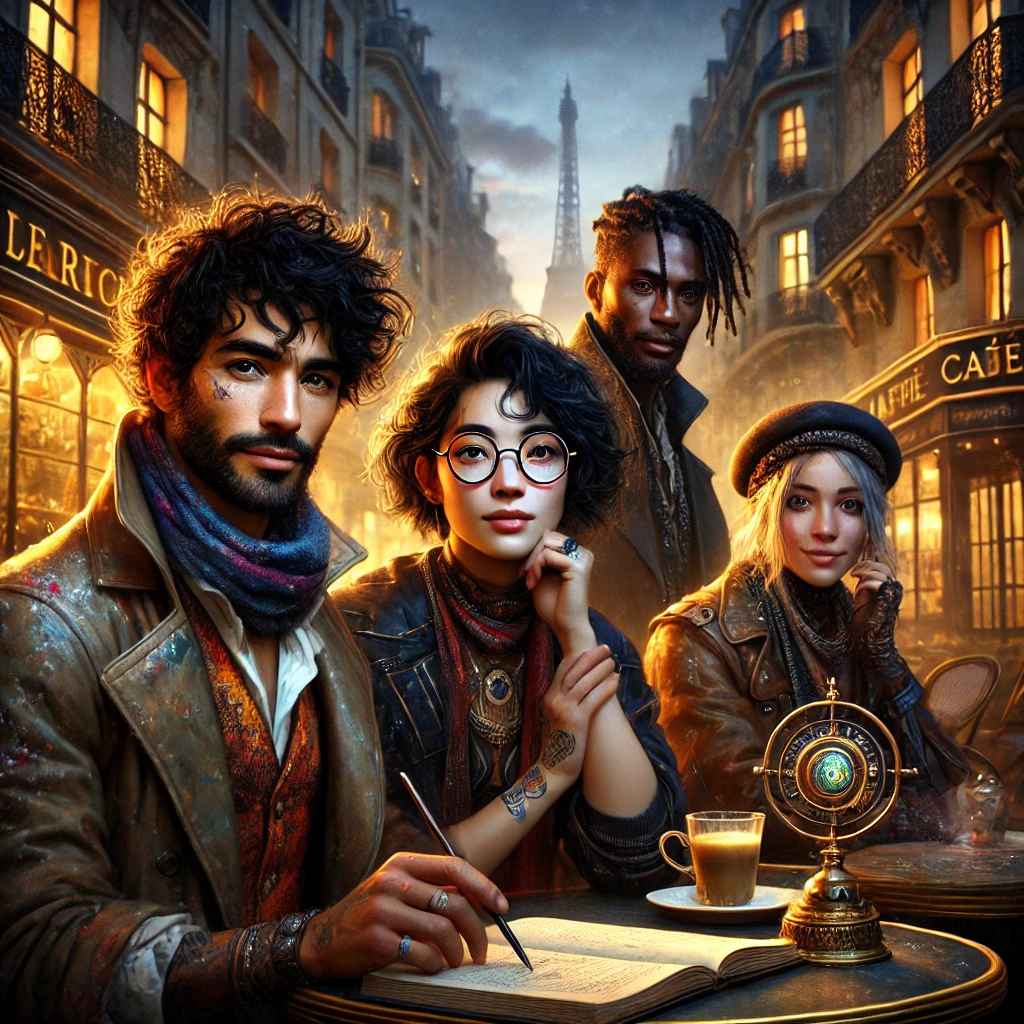
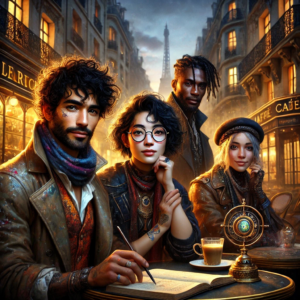
At the Café
The Sarah Bernardt Café shimmered under a pale grey November sky a busy last Saturday of the “Black Week”. Golden lights spilled onto cobblestones slick with rain, and the air buzzed with the din of a city alive in the moment. Inside, the crowd pressed together, laughing, arguing, living. And in a corner table by the fogged-up window, old friends were about to quietly converged, coming to a long overdue reunion.
Lucien was the first to arrive, dragging a weathered suitcase behind him. Its wheels rattled unevenly on the cobblestones, a sound he hated. His dark curls, damp from the rain, clung to his forehead, and his scarf, streaked with old paint, hung loose around his neck. He folded himself into a corner chair, his suitcase tucked awkwardly beside him. When the server approached, Lucien waved him off with a distracted shake of his head and opened a battered sketchbook.
The next arrival was Elara. She entered briskly, shaking rain from her short gray-streaked hair, her eyes scanning the room as though searching for anomalies. A small roller bag trailed behind her, pristine and black, a sharp contrast to Lucien’s worn luggage. She stopped at the table and tilted her head.
“Still brooding?” she asked, pulling off her coat and folding it neatly over the back of a chair.
“Still talking?” Lucien didn’t look up, his pencil scratching faint lines across the page.
Elara smiled faintly. “Two minutes in, and you’re already immortalizing us? You know I hate being drawn.”
“You hate being caught off guard,” Lucien murmured. “But I never get your nose wrong.”
She laughed, the sound light but brief, and sank into her seat, placing her bag carefully beside her.
The door swung open again, and Darius entered, shaking the rain from his jacket. His presence seemed to fill the room immediately. He strode toward the table, a leather duffel slung over one shoulder and a well-worn travel pouch clutched in his hand. His boots clacked against the café’s tile floor, his movements easy, confident.
“Did you walk here?” Elara asked as he dropped his things with a thud and pulled out a chair.
“Ran into someone on the way,” he said, settling back. “Some guy selling maps. Got this one for ten euros—worth every cent.” He waved a yellowed scrap of paper that looked more fiction than cartography.
Lucien snorted. “Still paying for strangers’ stories, I see.”
“The good ones aren’t free.” Darius grinned and leaned back in his chair, propping one boot against the table leg.
The final arrival was Amei. Her entrance was quieter but no less noticeable. She unwound her scarf slowly, her layered clothing a mix of textures and colors that seemed to absorb the café’s golden light. A tote bag rested over her shoulder, bulging with what could have been books, or journals, or stories yet untold.
“You’re late,” Darius said, but his voice carried no accusation.
“Right on time,” Amei replied, lowering herself into the last chair. “You’re all just early.”
Her gaze swept across them, lingering on the bags piled at their feet. “I see I’m not the only one who came a long way.”
“Not all of us live in Paris,” Elara said, with a glance at Lucien.
“Only some of us make better life choices,” Lucien replied dryly.
The comment drew laughter—a tentative sound that loosened the air between them, thick as it was with five years of absence.
 November 18, 2024 at 9:40 pm #7605
In reply to: The Incense of the Quadrivium’s Mystiques
Although the small hotel was tucked in a relatively quiet corner, and despite the authentic but delightfully shabby interior of soothing dimensions ~ roomy and airy, but not vast and terrifyingly empty ~ the constant background hum of city life was making Truella yearn for the stillness of home. Not that home was silence, indeed not: the background tranquility was frequently punctuated with noises, many strident. A dog barks, a neighbour shouts, a car drives past from time to time. But the noises have an identifiable individuality and reason, unlike the continual maddening drone of the metropolis.
She was pleased to find her room had a little balcony. Even if the little wooden chair was rickety and uncomfortable, it was enough to perch on to enjoy a cigarette and breathe in the car fumes. Truella slept fitfully, waking to remember Tolkeinesque snapshots of dreams, drifting off again and returning to wakefullness with snatches of conversations in unknown tongues. Sitting on the balcony in the deep dark hours of the night, the street below, now quiet, shivered and changed, her head still swimming with dream images. She caught glimpses of people as they passed, vivid, clear and full of character. Many who passed were carrying bunches of grasses or herbs or wildflowers in their hands, the women with a basket over their arm and a shawl draped over their head or shoulders.
Hardly any men though, I wonder why?
When Truella mentioned it over breakfast the next moring, Eris said “You’ve been reading too much of that new gender and feminist anthropology stuff over on GreenGrotto.”
Laughing, Truella tipped another packet of sugar in her coffee. “I love the colour of the walls in here,” she said, gazing around the breakfast room. “A sort of bright but muted sun shining on a white wall. Nice old furniture, too.”
“Tell me about the old furniture, the mirror in my room is all speckled, makes me look like I have blemishes all over my face,” said Zeezel with a toss of her head. “Can I have your sugar, Frella, if you’re not having it,” adding I’m on holiday by way of excuse.
Absentmindely Frella passed over the paper packet. “I had strange dreams last night too…about that place we’re supposed to be going to a picnic to later.”
Catching everyones attention, she continued, “The abandoned colosseum with Giovanni, with all the vines and flowers. It was like a game board and the stone statues were the players and they moved around the board, Oh! and such a beautiful board it was with all the vines and flowers ….. ”
“Gosh” said Truella, leaning back and folding her hands. What an idea.
November 7, 2024 at 9:34 pm #7591In reply to: The Incense of the Quadrivium’s Mystiques
Eris had called in sick. Even with the worst case of cold she’s had in years, she was feeling well enough to do jinx-from-home duties, and while her brain was in slow motion, she was relishing the quiet from the daily nagging of processes at the Quadrivium’s office, paperwork, tedious explaining to new hires in the ever growing coven extensions.
When Jeezel called her at the end of the day, she was glad to learn that Truella had found courage to stand up for them. Jeezel had such a colorful way of describing events, and in describing that particular scene where Truella had made her stand, it was always difficult to extract the truth from the makeup.
“You’re not really paying attention, are you?” Jeezel, ever astute to where attention was, quizzed her.
“What made you say that?” Eris didn’t try to deny.
“Oh I guess, when I started to speak about the camels in knickers going for a bath in the ball pit from all the dropped balls this year.”
“Ah, right. That would do.”
“Tell me, anything troubling you, luv’? You know you can tell me things.”
After a little moment, Eris said “Well, it’s just a thought,… but what if I’m in need of change of path?”
“What do you mean?” Jeezel tried to not sound too alarmed. “Not being a witch anymore?”
“Oh, no. Well,… why not, there’s no shame in no magic —but no. More like…”
“What? Quitting the coven?”
“… Yeah. It’s gone to madder and madder, it’s so hard to keep track with all the nonsense.” Eris corrected seeing the face of Jeezel. “Not that nonsense. You know what I mean… the daily nonsense. Our nonsense is fine. More than fine actually.”
“Phew, you had me worried though. Although…”
“I know… Quitting the coven.”
“You could be stripped of magic, if Malové learns about this…” then with more concern in her voice “WE could all be stripped of magic.”
“Yeah, I know. But look, is that what makes us happy?”
“It certainly foots the bill —or more like magically takes care of the bills.”
“Like I said, Jeez’, it’s just a thought, nothing to worry about, actually it helped to get it out.”
“I think it’s more than a thought.” Jeezel said with an air of age-old wisdom. “Let’s see where this leads. Imagine that…”
“Yeah, we’ll see. Thanks for checking in, it’s nice for a change. I don’t know what’s got into the other two these days, they’re always talking about clothing.”
“Yeah, I know. And pjs’.”
“Go figure.”
November 5, 2024 at 3:36 am #7581In reply to: The Incense of the Quadrivium’s Mystiques
After leaving the clamour of her fellow witches behind, Frella took a moment to ground herself after the whirlwind of ideas and plans discussed during their meeting.
As she walked home, her thoughts drifted back to Herma’s cottage. The treasure trove of curiosities in the camphor chest had captivated her imagination, but the trips had grown tiresome, each journey stretching her time and energy. Instead, she gathered a few items to keep at her own cottage—an ever growing collection of mysterious postcards, a brass spyglass, some aged papers hinting at forgotten histories, and of course, the mirror. Each object hummed with potential, calling to her in quiet moments, urging her to dig deeper.
The treasures from Herma’s chest were scattered across her kitchen table; each object felt like a piece of a larger puzzle, and she was determined to fit them together.
As Frella settled into a chair, she felt a sudden urge to inspect the mirror; the thought of its secrets sent a thrill through her, albeit tinged with trepidation.
It was exquisite, its opalescent sheen casting soft reflections across the room. She held it up to the light, watching colours shift within the glass, swirling like a living entity.
“What do you wish to show me this time?” she whispered.
As she gazed into the mirror, her reflection blurred, and she felt a pull—a connection to the past. Images began to form, and Frella found herself once more staring at the same elderly woman, her silver hair wild and glistening.
As the vision settled around her, Frella felt the air shimmer with energy, and the scene began to shift again. She focused intently, eager to grasp every detail.
Oliver Cromwell sat at a grand wooden desk piled high with scrolls and papers, his quill poised in his hand and brow furrowed in concentration. The room bustled with activity—servants hurried to and fro, and shrill laughter floated in from outside, where a gathering seemed to be taking place.
“By the King’s beard, where is the ink?” Cromwell muttered, his voice a deep rumble. With a flourish, he dipped the quill into a small inkwell that looked suspiciously like it had been made from a goat’s hoof.
With great care, he began to write on a piece of parchment. The ornate script flowed from his quill, remarkably elegant despite the chaos around him.
“To my dearest friend,” he wrote, brow twitching with the effort of being both eloquent and succinct. “I trust this missive finds you well, though your ears may be ringing from the ruckus outside. We’ve recently triumphed over the King, and while my duties as Lord Protector keep me occupied, I have stolen a moment to compose this note.”
He paused, casting a wary glance around the room as if expecting eavesdroppers. “I must admit, I have developed a curious fondness for a young lady who claims she can commune with spirits. I suspect she may know a thing or two about the secret lives of witches. If you find yourself in town, perhaps we could investigate together? Bring wine. And if you can manage it, a decent snack. One can hardly strategise on an empty stomach.”
Cromwell’s mouth twitched into a wry smile as he added, “P.S. If you happen to encounter Seraphina, do inform her that I’ll return her mirror just as soon as I’m done with my… experiments. I fear she may not appreciate the ‘creative applications’ I’ve discovered for it.”
With a sigh of resignation, he sealed the parchment with an ornate wax stamp shaped like a owl. “Now, where did I see that errant messenger?” he grumbled, scanning the room irritably.
Frella placed the mirror gently back on the table, her heart pounding. She needed to unravel the mysteries linking her to Seraphina and Cromwell. The time for discovery was upon her, and with each passing moment, she felt the call of her ancestors echoing through the very fabric of her being.
But could she untangle the mystery before her fellow witches set off on yet another ill-fated adventure? She would have to make haste.
October 30, 2024 at 3:58 pm #7576In reply to: The Incense of the Quadrivium’s Mystiques
After the postcard craze had passed, Frella returned to Herma’s cottage several times to study the camphor chest. Every day for a week, Herma let her into the living room, where she would sit quietly in front of the chest, sometimes for hours. The wood’s glossy surface would catch the light, warm and rich, like polished honey. Frella would trace the strange curves of the mysterious engravings with her fingers, feeling the subtle dips and rises beneath her touch. The patterns felt ancient, worn smooth in places, yet sharp along certain edges, as if holding onto secrets just out of reach.
Then, as she lifted the heavy lid, a soft creak would break the silence, the hinges groaning as if they hadn’t moved in ages. A burst of cool, earthy fragrance would immediately rise, filling the air with camphor’s sharp, clean scent, mingled with faint hints of aged cedar and spice.
It didn’t take long for Frella to notice that each time she opened the chest, she would find a new object among the old papers and postcards. It was never the same. Once, it was an old brass spyglass; another time, it might be an ornate compass with seven directions marked. Yet another day, she found a teddy bear. By some odd coincidence, each item always seemed to be something she needed in her life at that particular moment.
When Eris informed them that Malove was most likely under a powerful spell, Frella found the mirror. An inscription carved clumsily on its back read, “This Mystic Mirror belongs to Seraphina.” The mirror’s metal was cold, tarnished, and in need of a good polish. Jeezel would have surely raved about the intricate vines of silver and gold, twisting in delicate patterns that seemed to shift with the viewer’s perspective. But what captivated Frella most was the glass itself. It held a faint opalescent sheen, swirling with hints of colors, like a rainbow caught in crystal.
The first time Frella looked into it, she saw, behind her own reflection, an elderly woman with silver hair handing the mirror down to a little girl who looked just like Frella had as a child. The clothes were peculiar, and the room they stood in looked as if it belonged in a fantasy movie. Then the little girl began carefully carving something on the back of the mirror with what looked like a golden chisel. When she finally turned the mirror and looked into it, her reflection replaced Frella’s. She said something, but there was no sound. Frella had the distinct impression that the girl’s lips had formed the words, “We are the same. It’s yours now; you’ll need it soon.” Then she vanished, and Frella’s own reflection reappeared.
Still filled with awe at what just happened, Frella wondered if Seraphina was a long lost ancestor. “Was that chest also yours, Seraphina?” she asked in a whisper to the ghosts of the past.
October 24, 2024 at 7:23 pm #7569In reply to: The Incense of the Quadrivium’s Mystiques
After Truella had gone, happily clutching her carefully contained droplets (in an unusual but eminently practical miniature container, the likes of which he had never before seen), he realised that he should have asked her to tell him when. When? If he knew when, armed with the knowledge, he could disappear in the nick of time and teleport with Truella to her time in the future, and organise all their paperwork. He would be in charge of everything, obviously.
The possibilities of being able to time travel began to unfold in his minds eye. He wondered how he had not thus far entertained the idea of taking over a future coven, it made so much more sense than sending reluctant men on tortuous journeys across land and stormy seas to spy for him.
October 24, 2024 at 7:56 am #7568In reply to: The Incense of the Quadrivium’s Mystiques
The year 480 AD. It was there hovering in her mind the moment she woke up the morning after Eris had mentioned the DNA spell idea. 480 AD. But why? And it seemed strangely familiar, as if she’d dreamed of that date before. Mumbling the date over and over, Truella pushed the bed covers back, noted the welcome slight chill of the October morning, and made her way blindly to the kitchen to make coffee. 480 AD. Why, though?
Eris’s change of tune yesterday about the paperwork had given her a slight inward chuckle, but it was a good sign. And Eris had been right: Truella did like the DNA idea. At first she’d wondered if she would find something containing DNA. Then she reminded herself that she herself contained DNA available to use. But what was the year 480 AD to do with it?
Taking her steaming mug of coffee outside, Truella sat down under the porch and lit a cigarette. Too late for Romans but then what was next after Romans? It would have made more sense if it was 1480 AD, when Cromwell was born.
Oh, but what an idea! Yes! The DNA of Cromwell! She was reminded of the pieces of Hannibals tunic, and the efficacy of that spell. If they could find a bit of that old tunic, they could surely time travel back to gather some DNA from old Thomas. Truella giggled, imagining herself appearing in Cromwell’s chamber, armed with a cotton swab. “If you please, my Lord, open wide, this will only take a moment.”
He would rub his eyes, wondering if the fever had returned. What was this unseemly wench doing in here, bearing an uncanny resemblance to Lizzie, his dead wife. “Open wide,” she would say, for all the world as if she was the one giving the orders. “My lady, if you please to explain your purpose?” he would replied calmly, rather amused at the incomprehensible interlude.
“Well if you must know, we need some of your DNA. Yes, yes, I know you don’t know what that is yet, I’ve come from the future you see, and we know a lot more. Well, that’s not strictly true or I wouldn’t be here now. We know more about some things, but other things haven’t changed much. It’s the sea of paperwork we’re drowning in. Nobody could have more paperwork than you, my Lord Cromwell, but you have a particularly efficient way of dealing with it.”
“Are you referring to the Tower and the …”
“Gosh, no! No, we don’t plan to execute anyone. We just need a bit, a tiny bit, of your DNA to use in a spell…”
Suddenly Cromwell understood who this woman was. He didn’t need to call for the man who dealt with postcards from the future: everyone knows that Cromwell never forgets any paperwork he’s ever seen. In the future they called it photographic memory, but of course it wasn’t called that in his time.
“You, my lady, are one of those witches from the future, are you not? And why, pray, would I be willing to assist with witchcraft?”
“Well, why not?” retorted Truella. “You won’t be around to be executed for heresy, you were already..” She clapped her hand to her mouth. He didn’t know about that yet, obviously.
Cromwell merely raised a sardonic eyebrow. “I don’t want to know when,” he said calmly. He knew his days were numbered.
“Now, there a number of ways we can collect a bit of your DNA, sir, any bodily fluid will do,” Truella said, and then blushed deeply. Well, why not? she asked herself, and then wondered, What if he hasn’t had a bath for six months?
October 23, 2024 at 6:55 pm #7567In reply to: The Incense of the Quadrivium’s Mystiques
“I’m glad Hallowe’en is soon coming…” Eris sighed to her colleague. “Honestly, when did all the witchery stuff got outnumbered by Project Managers Officers?”
“Don’t ask me!” replied Truella in the dirt-smeared reflection of her obsidian mirror. She was still obviously distracted from her Incense-making numbers, not that she ever really cared about it —and even less since Malové got replaced for a while.
“Found anything worth scrying in your old postcards?” Jeezel affably trying to practice genuine interest in Truella’s games. Her own image was all pixellated due to the abundance of glitter on the makeup stand she was using for the conference call.
“Shht…” shushed Frella appearing in a faint halo light through her pristinely shiny scrying mirror, “Don’t encourage her, silly. There’s going to be no end of it. And Eris has a point, I may say.”
“Does she, now? And when did you start to take sides?” Truella felt like Pinocchio being told the Land of Toys wasn’t all that it was supposed to be.
“Listen,” Eris said “I’m sure you’ve realised by now, we have PM Officers for about any ridiculous thing in the Quadrivium nowadays. None of them having any magic to show for. They’re going to suffocate us in paperwork if you ask me. I suspect the Malové that came back was put under some sleeper sort of a spell; the Malové we knew would never have tolerated such nonsense.”
Eris marked a pause, looking sideways at Truella’s reflection on her Witchype screen. “And I think she’s had a fair deal of nonsense to contend with… but at least, even in a dragon fire mishap, there was magical prowess that could be harnessed.”
“I do like to get my hands dirty you know, and unravel layers of earth without the help of any spell” snickered Truella.
“That is not the matter and you know it…” Eris sighed.
“You meant to say, it’s time for a good old fashioned witchy coven spell to unravel the truth and break one maybe?” Frella ventured mockingly coyly.
“I’m in!” Jeeze jumped in suddenly “Been so bored for so long with all these timesheeting, spreadsheeting, and reportshitting if you don’t mind my French.”
“Actually I have an idea for a spell… and it may be of interest to you Truella too.” Eris continued.
Truella raised an eyebrow. She was not one to take things at face value. “Try me”
“All my ancestry research has pointed me to something we could work with. You know that bits of hair and nail are basically just middle-agey way of gathering DNA; and that DNA can act as a conduit through time and space, the same way it connects people.”
“Ooooh…” cooed Trooella.
“Exactly.” All nodded in a silent conspiring understanding.
June 17, 2024 at 7:40 am #7487In reply to: The Incense of the Quadrivium’s Mystiques
Although not unheard of in Limerick, it had been raining for days and that affected moods. The weather forecast, despite many promises, hadn’t been able to curb the collective melancholy. Jeezel had to resist the temptation to use a spell or two just for an hour of sunshine, but she remembered what Linda Paul would say about meddling with weather patterns. She’d likely take a dramatic pause, her eyes narrowing in theatrical emphasis as she weighed her words carefully.
“Darling, one does not simply tinker with the weather as if it were a mere accessory to one’s outfit. The weather, you see, is a complex symphony conducted by the universe itself. Each raindrop, each gust of wind, each sunbeam—it’s all part of an intricate, celestial score. Tampering with such forces is akin to striking a discordant note in a masterpiece; the repercussions can be chaotic and unpredictable. Mother Nature has a way of setting things right, and trust me, her methods are rarely gentle. Remember the tale of the tempestuous sorcerer who tried to stop a storm and ended up summoning a hurricane? Or that ill-fated witch who thought to banish winter, only to plunge her village into eternal ice?” Her eyes might sparkle with a hint of mischief as she added, “And let’s not forget the fashion disasters! Imagine trying to maintain a perfect coiffure in a sudden downpour you inadvertently summoned. Utterly tragic, darling.”
Jeezel giggled at the evocation. No, she would not meddle with the intricate weave of weathery, but one little filter spell on her window was innocuous enough to transform the “gloom of June” into a “dawn’s gentle fingers caressing the horizon”. She was standing before her ornate, vintage mirror in a midnight blue gown. The magic morning light was dancing upon the silver filigree, casting ethereal patterns across her boudoir.
Her thoughts meandered through the labyrinth of anticipation and preparation. “A convent,” she mused, “How delightfully austere. A stark contrast to my usual flamboyance.” In her address to the coven and looking specifically at Jeezel with ice cold eyes, Austreberthe had insisted on modesty and temperance. “But then, Austreberthe is not Malové,” Jeezel said, “and even the most demure places need a touch of magic.”
She ran her fingers through her raven locks, contemplating her wardrobe. “Burgundy for modesty and vintage silver lace mantilla for a whisper of enchantment”, she decided. It would strike the perfect balance.
Then, her mind turned to practicalities. The convent, with its storied history and sacred relics, would likely be a trove of ancient magics. She carefully selected a few essential items on her vanity: a vial of protective potion, a small pouch of moon blessed herbs and her favourite amulet in the shape of a silver hedgehog she got from her grand-mother and imbued with protective and clarity spells.
Her eyes fall on the thick file Truella had given each of them the day before. Full of charts and bullet lists about the cloister, questions about history, mug shots and detailed descriptions of the current inhabitants, with (not so) occasional pictures of her own digs and dogs. If Eris had skimmed through it in seconds and started to ask questions, Frella said she would read it before going to bed as it helped with her remembering. Jeezel had said nothing. She had gotten dizzy with too many bullet points and letters. All she could think about was the precious space and weight it would take in her suitcase and in her mind.
Though, there was something different. An envelop stuck between the file and the mahogany wood of the vanity. She took the envelop and opened it. It contained a letter and a small, ornate key, its surface inscribed with runes that glimmered with an otherworldly light. The paper grain was of fine quality. Jeezel recognized Malové’s intricate calligraphy. The paper carried subtle fragrances of sandalwood, jasmine, and bergamot, with a touch of vetiver and ambergris. With each whiff hidden facets were emerging from an apparently simple message.
“Jeezel, my trusted enchantress,” it started, “your journey to the convent in Spain is of utmost importance, more than the others can fathom. Beneath the cloistered serenity of those ancient walls lies a secret long kept from the world—a relic of unparalleled power known as the ‘Crimson Opus.’ It is said to be a manuscript not written with ink, but with the very essence of time itself.”
Your mission is to locate this Crimson Opus. It is guarded by a labyrinth of spells and enchantments designed to deter even the most skilled of seekers. But you, my dear Jeezel, possess the unique aptitude to unravel its mysteries. The convent’s seemingly mundane routines are the veil that conceals its true purpose; a sanctuary for the relic, and a prison for those who seek its power with ill intent.”
“You must be cautious, for the Crimson Opus has a sentience of its own. It will test your resolve, tempt you with visions and promises. Trust in your instincts, and remember, its true power can only be harnessed by those with a pure heart and an unyielding will.”
“The key will guide you to the hidden chamber where the Opus rests. Use it wisely, and under no circumstances let it fall into the wrong hands. You are more than capable, my dear. Don’t mention your mission to anyone. The fate of many may hinge upon your success, but I have no doubt in your abilities. Go forth, and may the ancient forces watch over you.”
Jeezel would have thought of a joke were it not for the mastery with which the message and its hidden layers had been crafted. She thought Malové was enthralled in a passionate romance in Brasil, but something in the scent she had not been able to decipher seemed to suggest the reality was more complex than it seemed. She thought of her friends. Did they all received a similar letter? Whom could she trust when secrecy was mandatory?
She held her hedgehog amulet more tightly, asking for some guidance.
June 6, 2024 at 6:32 pm #7454In reply to: The Incense of the Quadrivium’s Mystiques
I honestly don’t know what made me do it, it took me by surpise when I did it. It was bugging me that I couldn’t remember, and before I knew what was happening, I’d asked Malove.
Ah, the Caryatid Characteristics of a Case, a subject that requires both discernment and a keen eye for detail. In essence, the phrase “Caryatid Characteristics” refers to the fundamental attributes and peculiarities that support the overall structure of a particular case or situation, much like how caryatids—those graceful, sculpted figures in classical architecture—bear the weight of a building’s entablature on their shoulders.
To break it down into pragmatic terms, identifying the Caryatid Characteristics involves an in-depth analysis of the following elements:
Structural Integrity: Just as caryatids ensure the stability of a structure, the core components of the case must be sound and unwavering. This includes the key facts, the primary evidence, and the foundational arguments that hold the case together.
Aesthetic Nuances: Caryatids are not merely functional; they are also artistic. Similarly, the subtleties and nuances of a case—such as the motives, the intentions, and the underlying themes—add layers of complexity and depth, transforming a simple matter into a multifaceted situation.
Historical Context: Caryatids often reflect the cultural and historical context of their time. Understanding the background, the precedents, and the situational history provides a richer perspective and informs the current dynamics at play.
Symbolic Significance: In architecture, caryatids symbolize strength and beauty. In a case, the symbolic elements—the metaphors, the symbols, and the overarching message—must be identified and interpreted to grasp the full scope of its significance.
Resonance and Impact: Lastly, caryatids have a visual and emotional impact on observers. Similarly, the case’s broader implications, its potential consequences, and the emotional resonance it evokes must be considered. This is where the true weight of the matter lies, affecting not only the immediate parties involved but potentially a wider audience.Applying these characteristics to a case requires a blend of logical analysis, creative thinking, and intuitive insight. It is not merely about assembling facts but about understanding how each element supports the whole, much like the elegant yet sturdy caryatids in timeless architecture.
Now, if you’re asking how this applies to our current predicament with our spring cleaning of collective energies, well, one could say the caryatids in our situation are the core rituals, the seasoned wisdom passed down through the coven, and the precise incantations in our incense blends. Each component must be scrutinized and perfected to ensure we uphold the structural and spiritual integrity of our craft.
Let’s not dawdle; the orchestra in this zoo waits for no one.
Who will rise to the occasion?
Who indeed? I asked her if we all sent each other postcards, would it help?
Postcards, my dear, are more than mere scraps of paper with hastily scribbled words and picturesque scenes. They are tangible connections in an increasingly ephemeral world. Sending each other postcards won’t just help; it will create ripples of intention and resonance that can weave us closer together, despite the physical distances.
Consider the following:
Anchoring Intentions: Each postcard carries the sender’s energy and intention. When you pen your thoughts, wishes, or even riddles, you imbue the postcard with a part of yourself. The recipient, upon receiving it, senses this connection. It’s a form of sympathetic magic, drawing us closer through shared symbols and messages.
Physical Mementos: In an age where digital communication reigns supreme, holding a physical object—something that has traveled miles to reach your hands—grounds you. It anchors you in the physical world and provides a break from the transient nature of digital interactions. These postcards become talismans, reminders of our connections and shared journeys.
Ritualistic Value: The act of writing, sending, and receiving postcards can be ritualistic. This ritual can strengthen the bonds within our coven, reaffirming our commitment to each other and our shared goals. Each postcard becomes a symbol of our collective energy, our shared purpose, and our mutual support.
Cultural Exchange: Postcards often carry images or symbols from different locales. Sharing them can broaden our horizons, offer new perspectives, and remind us of the diverse tapestry that makes up our coven. It’s a gentle nudge to appreciate the wider world and the myriad experiences within it.
Mystical Conduits: In our magical practice, objects can serve as conduits for energy. Postcards, having traversed the globe, carry the imprints of various energies and places. They become more than just messages—they are carriers of the world’s pulse, connecting us to the broader rhythms of existence.So, yes, sending each other postcards will help. It will infuse our lives with a tangible sense of connection, a reminder of our shared purpose, and a touch of magic in the mundane. Let’s make this act a part of our practice, a testament to our enduring bonds and our collective strength.
Who will be the first to send a missive across the miles?
April 18, 2024 at 8:17 am #7435In reply to: The Incense of the Quadrivium’s Mystiques
“Business!” Truella spat the word out. “Always business, always about money.”
“It’s the way of the world, Tru,” Eris said in a futile attempt to mollify Truella. “Try and fit in a bit.”
“Fit in? Fit in? Fit in to what? Squeeze into one of Jeezel’s cocktail dresses? A lung crushing basque? Lie down flat like a dollar bill and get squashed into a pile of dirty paper notes like the rest of them? I don’t want to fit in.”
“But it’s the only way, you know it is,” Eris entreated. “Please try and see some sense.”
“Sense? Sense? What sense? Common sense? A sense of adventure? A sense of wonder? A sense of the sensational? A sense of sensitivity? A sense of senselessness?”
Eris sighed deeply. “You’re not making sense. And what’s more, you haven’t made any scents for ages either. How do you expect to manage on your own without the coven?”
“Eris,” Truella said with an equally profound sigh,”You misunderstand me. I don’t wish to leave the coven, I wish to change it. It’s gone wrong, horribly wrong. We’re supposed to change the world for the better, not kowtow to this dreadful modern scourge. We need to return to our roots, our true calling. What has happened to us all? Meek grovelling subservient money grubbing towers of the line, that’s what! It’s a disgrace!”
“How are you going to pay your electricity bill then, without any of that ghastly currency?”
“I am a WITCH! I should be able to magic up the light! We all should! Not pissing around making smelly unguents to pander to the faux enlightened! Enlightened! hah! What a word for the huddled masses who can’t even summon up enough magic to illuminate a light bulb. Why aren’t we working on free electricity? huh? Answer me that!”
“Ok then, I’ll report back to Malove that you’re working on a free electricty spell, shall I?” Eris was becoming exasperated.
“You do that!” Truella stormed angrily, annoyed at having her superior motives ridiculed. “But I suggest you have a long hard think about what I’ve said. And you can tell the others that. And not only that,” she added, “Tell them to start work on a magic money spell. It’s utterly beyond me how a coven of witches, constantly strapped for cash, hasn’t considered the all too obvious solution of simply magicking up a pile of banknotes. Or even easier, digits on a screen. Digits on a screen, that’s all it is!”
Eris was forced to admit that this was a very good point.
“Think, Eris,” Truella gave her friends arm a gentle squeeze, relieved that she was starting to see some sense. “If we perfect the money magic spell, and share it widely ~ for free, of course, no need to charge anyone for it after all! ~ the hoarders can bury themselves under mountains of money without depriving anyone else of any essentials. It’s a game changer, Eris. It would be Change, with a capital C. Real Change.”
Eris looked doubtful. “But…”
“And ask yourself why you hesitate.” And with that Truella flounced off, back to her dig, leaving a perplexed Eris in a fog of confusion.
April 7, 2024 at 7:35 am #7420In reply to: The Incense of the Quadrivium’s Mystiques
Spring was there. At 5:57am in the morning, true to her name, Truella had been planting truelles incognito in what appeared to be random flowerbeds in the cities she was passing through. The truelles, she would usually find with the locator spell in sheds around the city and magic them out right into her hands. She loved magic for its efficiency, which really meant there was no need to break in and forage for hours in cramped little rooms.
As she was following a border of plane trees, she chuckled. Believe it or not, she practically invented that spell. At least that’s what her mother used to tell her when she was 6yo and she often wandered alone around the city without mentioning it to anyone. At the time, she had believed her mother. She had bragged about it with her friends at school and pretended she had forgotten all about it like because of a bump on her head. But truth is she had frequent memory losses, which didn’t worry her at the time, and she found it cool to be able to do things and rediscover them later on.
It was an uncle with a dreadfully red moustache, who took pity on her and decided to shatter her dreams of early accomplishments and fame. Was it that same year? Or the next?
Anyway, back to the truelles, she didn’t do it for people to take photos of it and post them to social media, like gawdy Jeez seemed to think, but it was to remind people of the treasures they had buried in those dark little rooms just there in their gardens. How long would it take them to realise that those forgotten tools had disappeared?
Pleased with herself, she noticed a man with a white shirt leaning forward in front of one of the plane trees, his right hand on the bark, two paper bags full of croissants in the other. Frowning, she walked towards him. She was about to ask if he needed help when a strong smell of alcohol made her gag. Then without a warning, the man threw up a red mash in front of him. Truella jumped back, raising the truelle as if it could protect her from any splatter.
“Eww!” She wouldn’t dare saying anything else as opening her mouth could open the gates for her own early toasted cheese fritter. At least the man would not need embalming fluids if he didn’t survive his nocturnal drinking spree.
She cast the truelle in front of the tree and a spell on the man so that he would bury deep the traces of his last meal. She didn’t want the neighbourhood dogs getting drunk after feasting on it.
March 24, 2024 at 9:59 pm #7413In reply to: The Incense of the Quadrivium’s Mystiques
It wasn’t until late the following afternoon that Truella, with a pang of guilt, remembered Roger. Frella grinned sheepishly and said that she had forgotten him too.
“But you know what? Wait, let me show you the tile I bought in Brazil.” Frella trotted off to find her suitcase.
“Look what it says on the bit of paper that came with it:
Function: The Freevole tile embodies the essence of empowerment and autonomy. It serves as a reminder and a guide for those standing at life’s many crossroads, facing decisions that may seem overwhelming. This tile encourages the holder to recognize their inner strength and the ability to choose their path confidently, even when faced with seemingly insurmountable challenges.
At the center of the tile, there is a small vole standing at a crossroads where waters intersect, with dry earth visible behind it. The scene depicts sheets of water overlapping on both sides of the vole, creating a sense of inundation, yet there is an opening ahead, suggesting a path or choice to be made.We need to backtrack a bit with Roger. Look what it says here:
What that vole hadn’t realized was that he had to backtrack a bit. There was no way ahead or to the sides, but the way out was behind him.
See what I mean?”
Truella squinted at Frella. “What?”
Sighing, Frigella thrust the bit of paper at her friend. “Read the rest of it!”
The Vole: The vole symbolizes the individual facing a decision point or crossroads in life. Its presence suggests vulnerability, but also resilience and adaptability.
Crossing of Waters: The intersection of waters represents the convergence of different paths or possibilities. It symbolizes the complexities and challenges of decision-making, where multiple options overlap and intertwine.
Dry Earth Behind: The dry earth behind the vole symbolizes stability, past experiences, or familiar ground. It represents the foundation upon which decisions are based and serves as a reminder of where one has come from.
Overlap of Drowned Sheets of Water: The drowned sheets of water on both sides signify the potential consequences or risks associated with each choice. They represent the unknown and the possibility of being overwhelmed by circumstances.
Opening Ahead: The opening ahead signifies opportunity, hope, and the possibility of forging a new path. It represents the future and the freedom to make choices that lead to growth and fulfilment.Families: This tile is aligned with the Vold family, known for their connection to transformation, challenge, and the breaking of old systems to make way for the new. The Vold energy within the Freevole tile emphasizes the importance of facing challenges head-on and using them as opportunities for growth and empowerment.
Significance: The scene depicted on the Freevole tile, with the vole at a crossroads between inundation and dry earth, symbolizes the moments in life where we must make significant choices amidst emotional or situational floods. The waters represent challenges and emotions that may threaten to overwhelm, while the dry earth symbolizes the solid ground of our inner strength and determination. The path ahead, though uncertain, indicates that there is always a way forward, guided by our autonomy and personal power.
As an advice: When encountering the Freevole tile, take it as a sign to pause and reflect on your current crossroads. It urges you to tap into your inner resilience and recognize that you have the power to navigate your life’s journey. The choices before you, while daunting, are opportunities to assert your independence and steer your life according to your true desires and values. Trust in your ability to make decisions that will lead you to your chosen path of fulfillment and growth. Remember, the floods of challenge bring with them the nourishment needed for new beginnings; it is within your power to find the opening and move forward with courage and confidence.
The motif of the Freevole, standing determined and attentive amidst the forces of nature, serves as a potent symbol of the power within each individual to face life’s uncertainties and emerge stronger for having made their own choices.“Ok so in a nutshell,” Truella replied slowly, “Roger’s crossroads took him to Brazil and ours took us here, and that’s all that needs to be said about it. Right?”
“Exactly!”
February 15, 2024 at 7:47 pm #7375In reply to: The Incense of the Quadrivium’s Mystiques
“The very image of a spy from a cheap novel. Perched behind his newspaper, peering through holes like a child with a telescope. He’s a creature of shadows, blending into the background, always watching, never seen. He thinks himself clever, but he’s as subtle as a cat in a fishbowl. He’s drawn to Frigella like a moth to a flame, but can’t shake off his ingrained caution. Intrigued yet wary, like a mouse sniffing a piece of cheese in a trap. He needs to make up his mind before his tail gets caught.”
“What’s on your mind, Needles?” Frigella inquired of her hedgehog familiar.
“Nothing,” replied the hedgehog cryptically, returning happily to his strawberry snack. “But you’ll soon find out…”

Cedric Spellbind found himself woefully unprepared for what was coming after the jump into the weird glowing vortex. On a hunch, he’d followed the enigmatic Miss O’Green. Something about her, her diaphaneous looks…
His wool tweed cap wasn’t the best attire for wherever he had jumped into. The damp smells, the warm humid air filled with electricity —something told him he wasn’t in Limerick any more,… but where.
The group Ms Frigella was with had moved swiftly, nonchalantly going in the streets after the boisterous tall figure with the black curly wig had made a string of light glow on the ground, evanescent trail they followed unhesitant to somewhere only them seemed to know.
He was struggling to keep the pace. At some point, the blue-haired one had turned suspiciously casting her glance, and he’d managed to dart in a nearby alley. They’d resumed their stroll, but she’d done something after that, some sort of dark magic that made their group seem to disappear in a fog, the sounds they made suddenly all muffled.
Accustomed to tracking witches, he’d discreetly put a findmystuff tracker on the bag. Wherever that bag would go, he would follow. He opted to let them proceed unhindered, for now.
He checked his phone. He couldn’t catch the signs in the streets during his shadowing. His phone had started buzzing as soon as he’d emerged from the vortex, so he was surely in another country. The SMS he’d received confirmed that hypothesis: he was in Brazil.
5 missed calls. His mother… He couldn’t call her back now, it would cost him a fortune, and his witch tracking wasn’t exactly paying the bills. She would hate him for it, but she would have to wait. Maybe a bit of worrying for him wasn’t bad. One could hope.
His last witch hunt hadn’t been the most successful. Bulgarian witches were fierce. To be honest, it had been a fiasco, and he was posted in Limerick as a consequence —on desk job only. He knew there were worse places to be, but he was missing the action of the field… He shouldn’t have followed these witches, but again, following orders had never been his strong suit.
February 6, 2024 at 7:27 am #7353In reply to: The Incense of the Quadrivium’s Mystiques
Cedric peered through the peephole in his newspaper. He’d have recognised that bogwitch anywhere. Drat that blonde one grabbing her arm, he’d have been able to catch her red handed and arrest her.
Cedric was ambitious. He’d been working for MAMA for thirty years as an agent and wanted a promotion, a nice cushy office job where he could sit in comfort dishing out orders. He’d had enough of traipsing round the countryside and sitting in draughty pubs in the back of beyond and felt it was high time that the Ministry for the Abolition of the Magical Arts recognised his potential as a leader.
Who was that blonde one anyway? Another bogwitch no doubt, covens springing up everywhere these days, defying proper law and order, it was an outrage. She hadn’t seemed too happy to see that old tart Aggie, though. Maybe there was a rift between covens that he could exploit for his own ends. Cedric decided to keep an eye on her, perhaps mislead her into thinking he was on her side. It gave him a frisson of pleasure to think how clever he would look when he made his report.
Frigella her name was, Cedric heard Aggie ask her why she was rushing off.
“Gottta run, I’m babysitting. And just you behave yourself Aggie, I told you, we don’t do things like that around here. It’s witches like you that give us all a bad name.”
Cedric rolled his newspaper up and pulled his deerstalker hat low over his eyes and followed Frigella out onto the street.
-
AuthorSearch Results