

Daily Random Quote

  • Well, Illi thought, I could shelter under this heavy cape, but what would be the point of that? It’s smelly and dark under there, at least the rain is light and clean. What I need to find is a cave. I’ll create a cave to find! Wouldn’t be much fun to just create a cave, Illi reasoned, ... · ID #149 (continued)
    (next in 16h 39min…)

Latest Activity

Search Results for 'side'

Forums Search Search Results for 'side'

Viewing 20 results - 341 through 360 (of 1,357 total)
  • Author
    Search Results
  • #6224
    TracyTracy
    Participant

      The Woman in the Portrait: Catherine Housley’s Mother
      “The One I Ruined”

      I was living in England at the time of my great aunts deaths in 1983, both Dorothy Tooby and Phyllis Marshall, when this portrait came to be in my possession via their brother, my grandfather George Marshall. There was some damage on the mouth. I mentioned it at work and my boss said he had a friend who could fix it, but when I eventually got it back it was much worse. Since then, this portrait has been known as “the one I ruined”.

      This picture remains a mystery, even though we know her name now. She appears to be in mourning. She doesn’t appear to be too poor, or unhealthy. And yet Elizabeth died at just thirty years of age of TB and her children were in the workhouse a year later.

      On closer inspection, the portrait could be a photograph that has been painted over, but it’s considerably larger than any of the usual photographs of the time. Is there a possibility that the picture was made later, after her death, in memory of her?  This seems to be the likeliest explanation.

      #6222
      TracyTracy
      Participant

        George Gilman Rushby: The Cousin Who Went To Africa

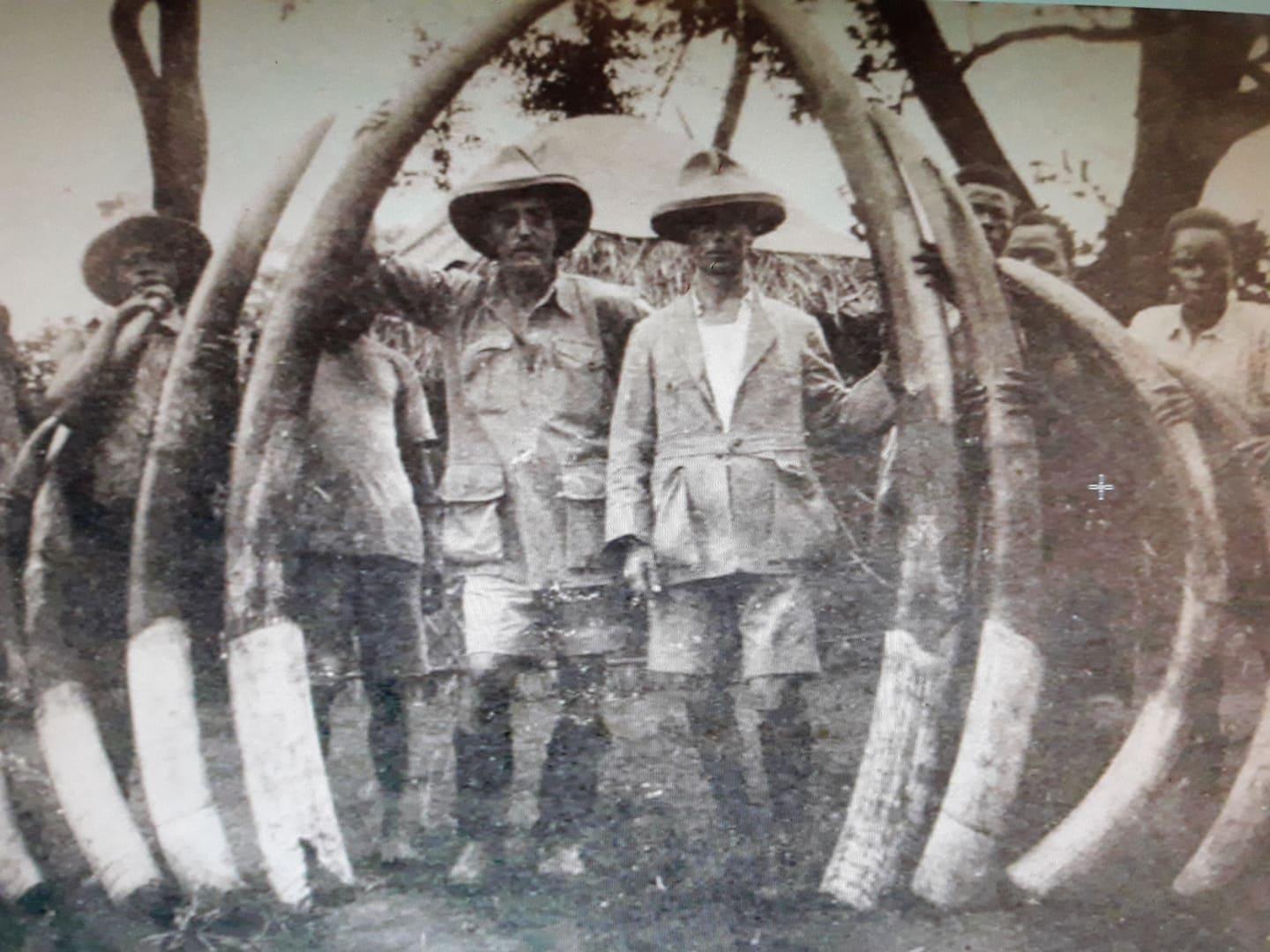
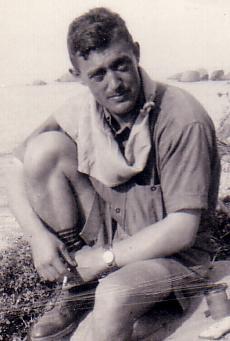
        The portrait of the woman has “mother of Catherine Housley, Smalley” written on the back, and one of the family photographs has “Francis Purdy” written on the back. My first internet search was “Catherine Housley Smalley Francis Purdy”. Easily found was the family tree of George (Mike) Rushby, on one of the genealogy websites. It seemed that it must be our family, but the African lion hunter seemed unlikely until my mother recalled her father had said that he had a cousin who went to Africa. I also noticed that the lion hunter’s middle name was Gilman ~ the name that Catherine Housley’s daughter ~ my great grandmother, Mary Ann Gilman Purdy ~ adopted, from her aunt and uncle who brought her up.

        I tried to contact George (Mike) Rushby via the ancestry website, but got no reply. I searched for his name on Facebook and found a photo of a wildfire in a place called Wardell, in Australia, and he was credited with taking the photograph. A comment on the photo, which was a few years old, got no response, so I found a Wardell Community group on Facebook, and joined it. A very small place, population some 700 or so, and I had an immediate response on the group to my question. They knew Mike, exchanged messages, and we were able to start emailing. I was in the chair at the dentist having an exceptionally long canine root canal at the time that I got the message with his email address, and at that moment the song Down in Africa started playing.

        Mike said it was clever of me to track him down which amused me, coming from the son of an elephant and lion hunter.  He didn’t know why his father’s middle name was Gilman, and was not aware that Catherine Housley’s sister married a Gilman.

        Mike Rushby kindly gave me permission to include his family history research in my book.  This is the story of my grandfather George Marshall’s cousin.  A detailed account of George Gilman Rushby’s years in Africa can be found in another chapter called From Tanganyika With Love; the letters Eleanor wrote to her family.

        George Gilman Rushby:

        George Gilman Rushby


        The story of George Gilman Rushby 1900-1969, as told by his son Mike:

        George Gilman Rushby:
        Elephant hunter,poacher, prospector, farmer, forestry officer, game ranger, husband to Eleanor, and father of 6 children who now live around the world.

        George Gilman Rushby was born in Nottingham on 28 Feb 1900 the son of Catherine Purdy and John Henry Payling Rushby. But John Henry died when his son was only one and a half years old, and George shunned his drunken bullying stepfather Frank Freer and was brought up by Gypsies who taught him how to fight and took him on regular poaching trips. His love of adventure and his ability to hunt were nurtured at an early stage of his life.
        The family moved to Eastwood, where his mother Catherine owned and managed The Three Tuns Inn, but when his stepfather died in mysterious circumstances, his mother married a wealthy bookmaker named Gregory Simpson. He could afford to send George to Worksop College and to Rugby School. This was excellent schooling for George, but the boarding school environment, and the lack of a stable home life, contributed to his desire to go out in the world and do his own thing. When he finished school his first job was as a trainee electrician with Oaks & Co at Pye Bridge. He also worked part time as a motor cycle mechanic and as a professional boxer to raise the money for a voyage to South Africa.

        In May 1920 George arrived in Durban destitute and, like many others, living on the beach and dependant upon the Salvation Army for a daily meal. However he soon got work as an electrical mechanic, and after a couple of months had earned enough money to make the next move North. He went to Lourenco Marques where he was appointed shift engineer for the town’s power station. However he was still restless and left the comfort of Lourenco Marques for Beira in August 1921.

        Beira was the start point of the new railway being built from the coast to Nyasaland. George became a professional hunter providing essential meat for the gangs of construction workers building the railway. He was a self employed contractor with his own support crew of African men and began to build up a satisfactory business. However, following an incident where he had to shoot and kill a man who attacked him with a spear in middle of the night whilst he was sleeping, George left the lower Zambezi and took a paddle steamer to Nyasaland (Malawi). On his arrival in Karongo he was encouraged to shoot elephant which had reached plague proportions in the area – wrecking African homes and crops, and threatening the lives of those who opposed them.

        His next move was to travel by canoe the five hundred kilometre length of Lake Nyasa to Tanganyika, where he hunted for a while in the Lake Rukwa area, before walking through Northern Rhodesia (Zambia) to the Congo. Hunting his way he overachieved his quota of ivory resulting in his being charged with trespass, the confiscation of his rifles, and a fine of one thousand francs. He hunted his way through the Congo to Leopoldville then on to the Portuguese enclave, near the mouth of the mighty river, where he worked as a barman in a rough and tough bar until he received a message that his old friend Lumb had found gold at Lupa near Chunya. George set sail on the next boat for Antwerp in Belgium, then crossed to England and spent a few weeks with his family in Jacksdale before returning by sea to Dar es Salaam. Arriving at the gold fields he pegged his claim and almost immediately went down with blackwater fever – an illness that used to kill three out of four within a week.

        When he recovered from his fever, George exchanged his gold lease for a double barrelled .577 elephant rifle and took out a special elephant control licence with the Tanganyika Government. He then headed for the Congo again and poached elephant in Northern Rhodesia from a base in the Congo. He was known by the Africans as “iNyathi”, or the Buffalo, because he was the most dangerous in the long grass. After a profitable hunting expedition in his favourite hunting ground of the Kilombera River he returned to the Congo via Dar es Salaam and Mombassa. He was after the Kabalo district elephant, but hunting was restricted, so he set up his base in The Central African Republic at a place called Obo on the Congo tributary named the M’bomu River. From there he could make poaching raids into the Congo and the Upper Nile regions of the Sudan. He hunted there for two and a half years. He seldom came across other Europeans; hunters kept their own districts and guarded their own territories. But they respected one another and he made good and lasting friendships with members of that small select band of adventurers.

        Leaving for Europe via the Congo, George enjoyed a short holiday in Jacksdale with his mother. On his return trip to East Africa he met his future bride in Cape Town. She was 24 year old Eleanor Dunbar Leslie; a high school teacher and daughter of a magistrate who spent her spare time mountaineering, racing ocean yachts, and riding horses. After a whirlwind romance, they were betrothed within 36 hours.

        On 25 July 1930 George landed back in Dar es Salaam. He went directly to the Mbeya district to find a home. For one hundred pounds he purchased the Waizneker’s farm on the banks of the Mntshewe Stream. Eleanor, who had been delayed due to her contract as a teacher, followed in November. Her ship docked in Dar es Salaam on 7 Nov 1930, and they were married that day. At Mchewe Estate, their newly acquired farm, they lived in a tent whilst George with some help built their first home – a lovely mud-brick cottage with a thatched roof. George and Eleanor set about developing a coffee plantation out of a bush block. It was a very happy time for them. There was no electricity, no radio, and no telephone. Newspapers came from London every two months. There were a couple of neighbours within twenty miles, but visitors were seldom seen. The farm was a haven for wild life including snakes, monkeys and leopards. Eleanor had to go South all the way to Capetown for the birth of her first child Ann, but with the onset of civilisation, their first son George was born at a new German Mission hospital that had opened in Mbeya.

        Occasionally George had to leave the farm in Eleanor’s care whilst he went off hunting to make his living. Having run the coffee plantation for five years with considerable establishment costs and as yet no return, George reluctantly started taking paying clients on hunting safaris as a “white hunter”. This was an occupation George didn’t enjoy. but it brought him an income in the days when social security didn’t exist. Taking wealthy clients on hunting trips to kill animals for trophies and for pleasure didn’t amuse George who hunted for a business and for a way of life. When one of George’s trackers was killed by a leopard that had been wounded by a careless client, George was particularly upset.
        The coffee plantation was approaching the time of its first harvest when it was suddenly attacked by plagues of borer beetles and ring barking snails. At the same time severe hail storms shredded the crop. The pressure of the need for an income forced George back to the Lupa gold fields. He was unlucky in his gold discoveries, but luck came in a different form when he was offered a job with the Forestry Department. The offer had been made in recognition of his initiation and management of Tanganyika’s rainbow trout project. George spent most of his short time with the Forestry Department encouraging the indigenous people to conserve their native forests.

        In November 1938 he transferred to the Game Department as Ranger for the Eastern Province of Tanganyika, and over several years was based at Nzasa near Dar es Salaam, at the old German town of Morogoro, and at lovely Lyamungu on the slopes of Kilimanjaro. Then the call came for him to be transferred to Mbeya in the Southern Province for there was a serious problem in the Njombe district, and George was selected by the Department as the only man who could possibly fix the problem.

        Over a period of several years, people were being attacked and killed by marauding man-eating lions. In the Wagingombe area alone 230 people were listed as having been killed. In the Njombe district, which covered an area about 200 km by 300 km some 1500 people had been killed. Not only was the rural population being decimated, but the morale of the survivors was so low, that many of them believed that the lions were not real. Many thought that evil witch doctors were controlling the lions, or that lion-men were changing form to kill their enemies. Indeed some wichdoctors took advantage of the disarray to settle scores and to kill for reward.

        By hunting down and killing the man-eaters, and by showing the flesh and blood to the doubting tribes people, George was able to instil some confidence into the villagers. However the Africans attributed the return of peace and safety, not to the efforts of George Rushby, but to the reinstallation of their deposed chief Matamula Mangera who had previously been stood down for corruption. It was Matamula , in their eyes, who had called off the lions.

        Soon after this adventure, George was appointed Deputy Game Warden for Tanganyika, and was based in Arusha. He retired in 1956 to the Njombe district where he developed a coffee plantation, and was one of the first in Tanganyika to plant tea as a major crop. However he sensed a swing in the political fortunes of his beloved Tanganyika, and so sold the plantation and settled in a cottage high on a hill overlooking the Navel Base at Simonstown in the Cape. It was whilst he was there that TV Bulpin wrote his biography “The Hunter is Death” and George wrote his book “No More The Tusker”. He died in the Cape, and his youngest son Henry scattered his ashes at the Southern most tip of Africa where the currents of the Atlantic and Indian Oceans meet .

        George Gilman Rushby:

        #6220
        TracyTracy
        Participant

          Helper Belper: “Let’s start at the beginning.”

          When I found a huge free genealogy tree website with lots of our family already on it, I couldn’t believe my luck. Quite soon after a perusal, I found I had a number of questions. Was it really possible that our Warren family tree had been traced back to 500AD? I asked on a genealogy forum: only if you can latch onto an aristocratic line somewhere, in which case that lineage will be already documented, as normally parish records only go back to the 1600s, if you are lucky. It is very hard to prove and the validity of it met with some not inconsiderable skepticism among the long term hard core genealogists. This is not to say that it isn’t possible, but is more likely a response to the obvious desire of many to be able to trace their lineage back to some kind of royalty, regardless of the documentation and proof.

          Another question I had on this particular website was about the entries attached to Catherine Housley that made no sense. The immense public family tree there that anyone can add to had Catherine Housley’s mother as Catherine Marriot. But Catherine Marriot had another daughter called Catherine, two years before our Catherine was born, who didn’t die beforehand. It wasn’t unusual to name another child the same name if an earlier one had died in infancy, but this wasn’t the case.

          I asked this question on a British Genealogy forum, and learned that other people’s family trees are never to be trusted. One should always start with oneself, and trace back with documentation every step of the way. Fortified with all kinds of helpful information, I still couldn’t find out who Catherine Housley’s mother was, so I posted her portrait on the forum and asked for help to find her. Among the many helpful replies, one of the members asked if she could send me a private message. She had never had the urge to help someone find a person before, but felt a compulsion to find Catherine Housley’s mother. Eight months later and counting at time of writing, and she is still my most amazing Helper. The first thing she said in the message was “Right. Let’s start at the beginning. What do you know for sure.” I said Mary Ann Gilman Purdy, my great grandmother, and we started from there.

          Fran found all the documentation and proof, a perfect and necessary compliment to my own haphazard meanderings. She taught me how to find the proof, how to spot inconsistencies, and what to look for and where.  I still continue my own haphazard wanderings as well, which also bear fruit.

          It was decided to order the birth certificate, a paper copy that could be stuck onto the back of the portrait, so my mother in Wales ordered it as she has the portrait. When it arrived, she read the names of Catherine’s parents to me over the phone. We were expecting it to be John Housley and Sarah Baggaley. But it wasn’t! It was his brother Samuel Housley and Elizabeth Brookes! I had been looking at the photograph of the portrait thinking it was Catherine Marriot, then looking at it thinking her name was Sarah Baggaley, and now the woman in the portrait was Elizabeth Brookes. And she was from Wolverhampton. My helper, unknown to me, had ordered a digital copy, which arrived the same day.

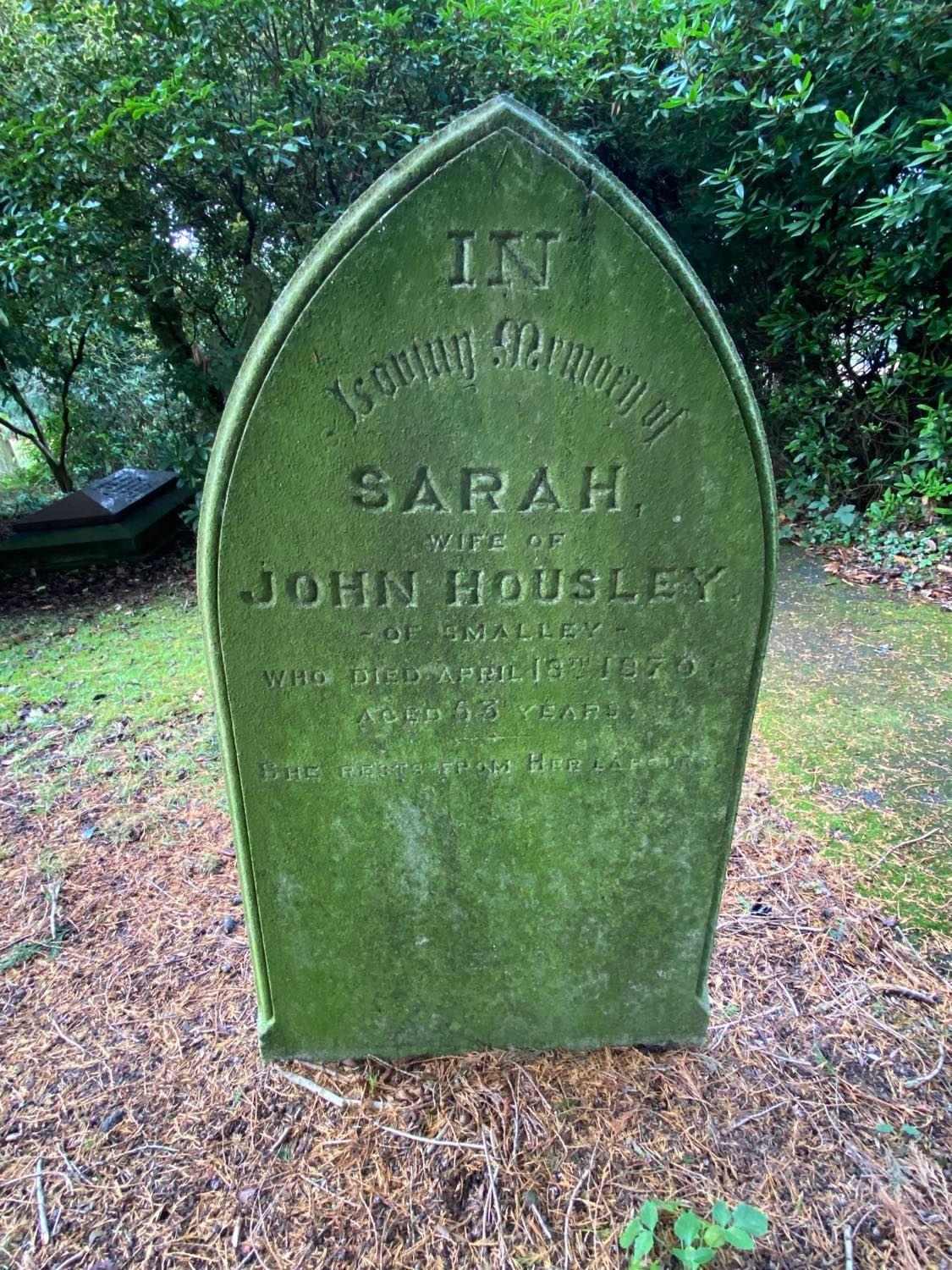
          Months later, Fran, visiting friends in Derby,  made a special trip to Smalley, a tiny village not far from Derby, to look for Housley gravestones in the two churchyards.  There are numerous Housley burials registered in the Smalley parish records, but she could only find one Housley grave, that of Sarah Baggaley.  Unfortunately the documentation had already proved that Sarah was not the woman in the portrait, Catherine Housley’s mother, but Catherine’s aunt.

          Sarah Housley nee Baggaley’s grave stone in Smalley:

          Sarah Housley Grave

          #6219
          TracyTracy
          Participant

            The following stories started with a single question.

            Who was Catherine Housley’s mother?

            But one question leads to another, and another, and so this book will never be finished.  This is the first in a collection of stories of a family history research project, not a complete family history.  There will always be more questions and more searches, and each new find presents more questions.

            A list of names and dates is only moderately interesting, and doesn’t mean much unless you get to know the characters along the way.   For example, a cousin on my fathers side has already done a great deal of thorough and accurate family research. I copied one branch of the family onto my tree, going back to the 1500’s, but lost interest in it after about an hour or so, because I didn’t feel I knew any of the individuals.

            Parish registers, the census every ten years, birth, death and marriage certificates can tell you so much, but they can’t tell you why.  They don’t tell you why parents chose the names they did for their children, or why they moved, or why they married in another town.  They don’t tell you why a person lived in another household, or for how long. The census every ten years doesn’t tell you what people were doing in the intervening years, and in the case of the UK and the hundred year privacy rule, we can’t even use those for the past century.  The first census was in 1831 in England, prior to that all we have are parish registers. An astonishing amount of them have survived and have been transcribed and are one way or another available to see, both transcriptions and microfiche images.  Not all of them survived, however. Sometimes the writing has faded to white, sometimes pages are missing, and in some case the entire register is lost or damaged.

            Sometimes if you are lucky, you may find mention of an ancestor in an obscure little local history book or a journal or diary.  Wills, court cases, and newspaper archives often provide interesting information. Town memories and history groups on social media are another excellent source of information, from old photographs of the area, old maps, local history, and of course, distantly related relatives still living in the area.  Local history societies can be useful, and some if not all are very helpful.

            If you’re very lucky indeed, you might find a distant relative in another country whose grandparents saved and transcribed bundles of old letters found in the attic, from the family in England to the brother who emigrated, written in the 1800s.  More on this later, as it merits its own chapter as the most exciting find so far.

            The social history of the time and place is important and provides many clues as to why people moved and why the family professions and occupations changed over generations.  The Enclosures Act and the Industrial Revolution in England created difficulties for rural farmers, factories replaced cottage industries, and the sons of land owning farmers became shop keepers and miners in the local towns.  For the most part (at least in my own research) people didn’t move around much unless there was a reason.  There are no reasons mentioned in the various registers, records and documents, but with a little reading of social history you can sometimes make a good guess.  Samuel Housley, for example, a plumber, probably moved from rural Derbyshire to urban Wolverhampton, when there was a big project to install indoor plumbing to areas of the city in the early 1800s.  Derbyshire nailmakers were offered a job and a house if they moved to Wolverhampton a generation earlier.

            Occasionally a couple would marry in another parish, although usually they married in their own. Again, there was often a reason.  William Housley and Ellen Carrington married in Ashbourne, not in Smalley.  In this case, William’s first wife was Mary Carrington, Ellen’s sister.  It was not uncommon for a man to marry a deceased wife’s sister, but it wasn’t strictly speaking legal.  This caused some problems later when William died, as the children of the first wife contested the will, on the grounds of the second marriage being illegal.

            Needless to say, there are always questions remaining, and often a fresh pair of eyes can help find a vital piece of information that has escaped you.  In one case, I’d been looking for the death of a widow, Mary Anne Gilman, and had failed to notice that she remarried at a late age. Her death was easy to find, once I searched for it with her second husbands name.

            This brings me to the topic of maternal family lines. One tends to think of their lineage with the focus on paternal surnames, but very quickly the number of surnames increases, and all of the maternal lines are directly related as much as the paternal name.  This is of course obvious, if you start from the beginning with yourself and work back.  In other words, there is not much point in simply looking for your fathers name hundreds of years ago because there are hundreds of other names that are equally your own family ancestors. And in my case, although not intentionally, I’ve investigated far more maternal lines than paternal.

            This book, which I hope will be the first of several, will concentrate on my mothers family: The story so far that started with the portrait of Catherine Housley’s mother.
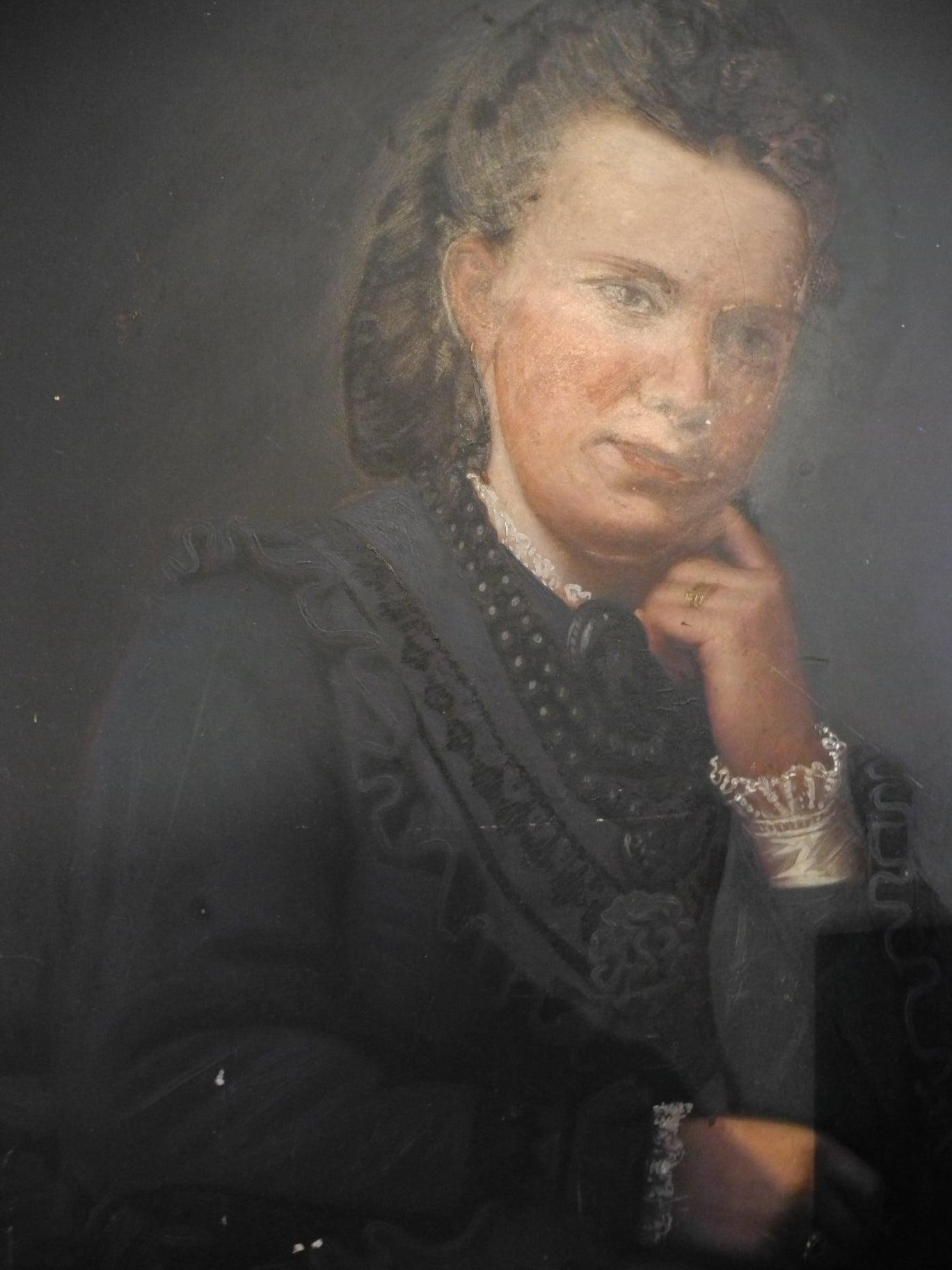
            Elizabeth Brookes


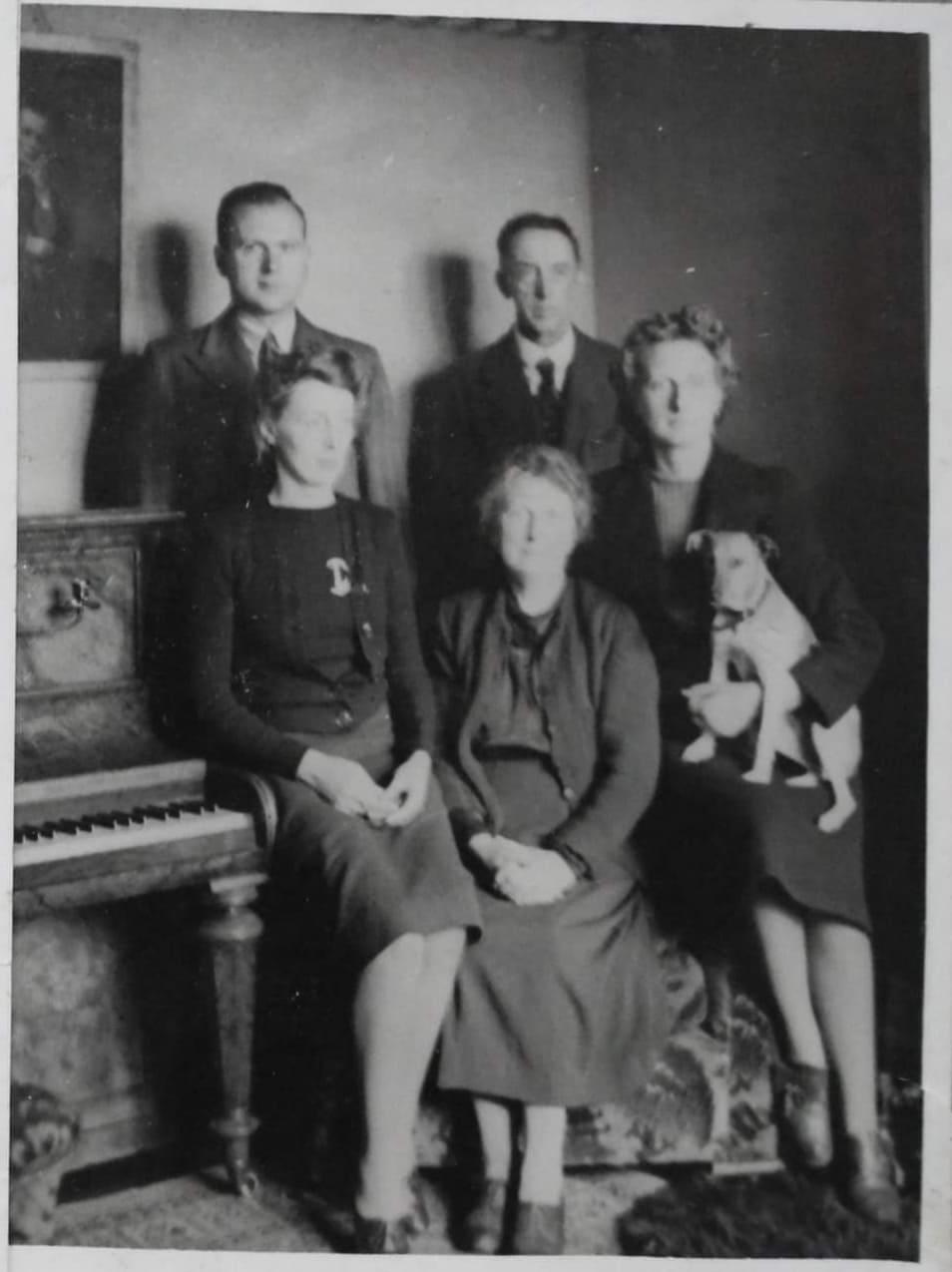
            This painting, now in my mothers house, used to hang over the piano in the home of her grandparents.   It says on the back “Catherine Housley’s mother, Smalley”.

            The portrait of Catherine Housley’s mother can be seen above the piano. Back row Ronald Marshall, my grandfathers brother, William Marshall, my great grandfather, Mary Ann Gilman Purdy Marshall in the middle, my great grandmother, with her daughters Dorothy on the left and Phyllis on the right, at the Marshall’s house on Love Lane in Stourbridge.
            Marshalls


            The Search for Samuel Housley

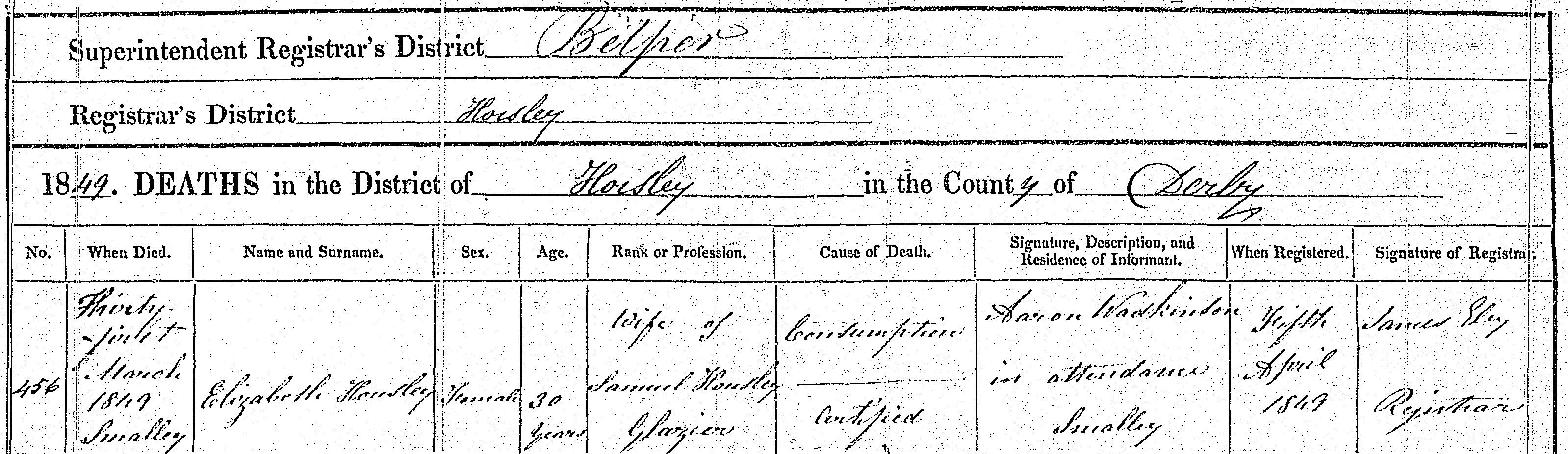
            As soon as the search for Catherine Housley’s mother was resolved, achieved by ordering a paper copy of her birth certificate, the search for Catherine Housley’s father commenced. We know he was born in Smalley in 1816, son of William Housley and Ellen Carrington, and that he married Elizabeth Brookes in Wolverhampton in 1844. He was a plumber and glazier. His three daughters born between 1845 and 1849 were born in Smalley. Elizabeth died in 1849 of consumption, but Samuel didn’t register her death. A 20 year old neighbour called Aaron Wadkinson did.
            Elizabeth death


            Where was Samuel?

            On the 1851 census, two of Samuel’s daughters were listed as inmates in the Belper Workhouse, and the third, 2 year old Catherine, was listed as living with John Benniston and his family in nearby Heanor.  Benniston was a framework knitter.

            Where was Samuel?

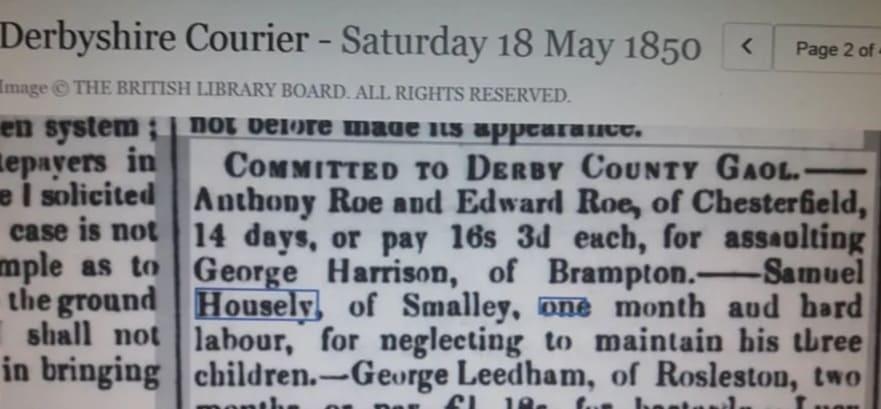
            A long search through the microfiche workhouse registers provided an answer. The reason for Elizabeth and Mary Anne’s admission in June 1850 was given as “father in prison”. In May 1850, Samuel Housley was sentenced to one month hard labour at Derby Gaol for failing to maintain his three children. What happened to those little girls in the year after their mothers death, before their father was sentenced, and they entered the workhouse? Where did Catherine go, a six week old baby? We have yet to find out.
            Samuel Housley 1850


            And where was Samuel Housley in 1851? He hasn’t appeared on any census.

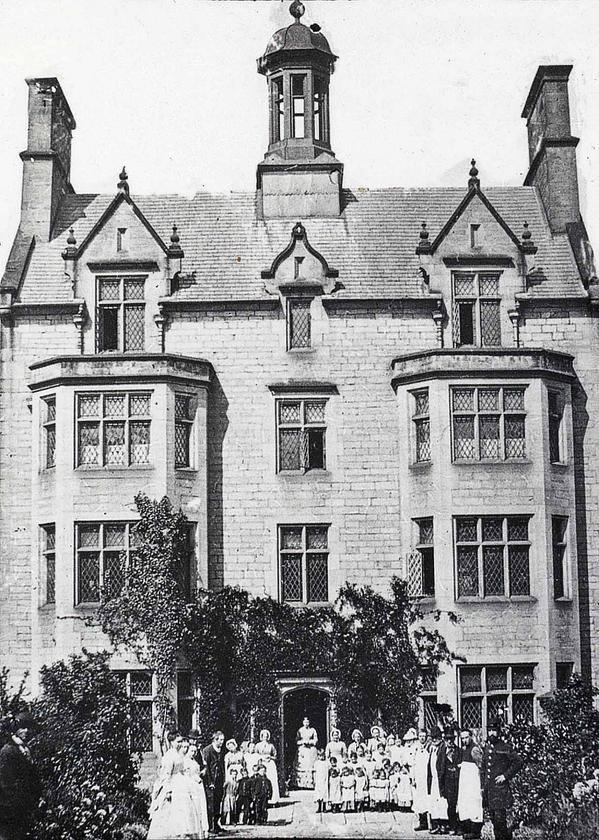
            According to the Belper workhouse registers, Mary Anne was discharged on trial as a servant February 1860. She was readmitted a month later in March 1860, the reason given: unwell.

            Belper Workhouse:
            Belper Workhouse

            Eventually, Mary Anne and Elizabeth were discharged, in April 1860, with an aunt and uncle. The workhouse register doesn’t name the aunt and uncle. One can only wonder why it took them so long.
            On the 1861 census, Elizabeth, 16 years old, is a servant in St Peters, Derby, and Mary Anne, 15 years old, is a servant in St Werburghs, Derby.

            But where was Samuel?

            After some considerable searching, we found him, despite a mistranscription of his name, on the 1861 census, living as a lodger and plumber in Darlaston, Walsall.
            Eventually we found him on a 1871 census living as a lodger at the George and Dragon in Henley in Arden. The age is not exactly right, but close enough, he is listed as an unmarried painter, also close enough, and his birth is listed as Kidsley, Derbyshire. He was born at Kidsley Grange Farm. We can assume that he was probably alive in 1872, the year his mother died, and the following year, 1873, during the Kerry vs Housley court case.
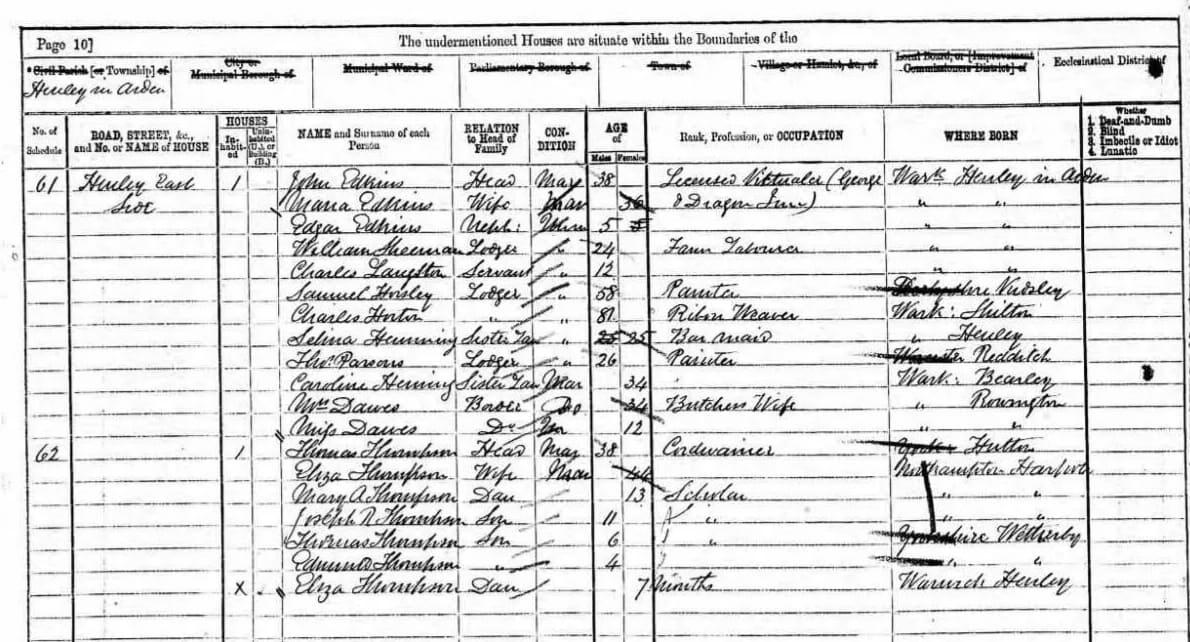
            Samuel Housley 1871


            I found some living Housley descendants in USA. Samuel Housley’s brother George emigrated there in 1851. The Housley’s in USA found letters in the attic, from the family in Smalley ~ written between 1851 and 1870s. They sent me a “Narrative on the Letters” with many letter excerpts.

            The Housley family were embroiled in a complicated will and court case in the early 1870s. In December 15, 1872, Joseph (Samuel’s brother) wrote to George:

            “I think we have now found all out now that is concerned in the matter for there was only Sam that we did not know his whereabouts but I was informed a week ago that he is dead–died about three years ago in Birmingham Union. Poor Sam. He ought to have come to a better end than that….His daughter and her husband went to Birmingham and also to Sutton Coldfield that is where he married his wife from and found out his wife’s brother. It appears he has been there and at Birmingham ever since he went away but ever fond of drink.”

            No record of Samuel Housley’s death can be found for the Birmingham Union in 1869 or thereabouts.

            But if he was alive in 1871 in Henley In Arden…..
            Did Samuel tell his wife’s brother to tell them he was dead? Or did the brothers say he was dead so they could have his share?

            We still haven’t found a death for Samuel Housley.


            #6208

            “Not so fast!” Glor muttered grimly, grabbing a flapping retreating arm of each of her friends, and yanking them to her sides. “Now’s our chance. It’s a trap, dontcha see? They got the wind up, and they’re gonna round us all up, it don’t bear thinking about what they’ll do next!”

            With her free hand Mavis felt Gloria’s forehead, her palm slipping unpleasantly over the feverish salty slick.  “Her’s deplirious, Sha, not right in the ‘ead, the ‘eat’s got to her.  Solar over dose or whatever they call it nowadays.”

            “My life depends on going to the bloody assembly hall, Glor, let go of my arm before I give yer a Glasgow kiss,” Sharon hissed, ignoring Mavis.

            “I’m trying to save you!” screeched Gloria, her head exploding in exasperation.  She took a deep breath.  Told herself to stop screeching like that, wasn’t helping her cause.  Should she just let go of Sharon’s arm?

            Mavis started trying to take the pulse on Glor’s restraining wrists, provoking Gloria beyond endurance, and she lashed out and slapped Mavis’s free hand away, unintentionally freeing Sharon from her grasp.  This further upset the balance and Gloria tumbled into Mavis at the moment of slapping her hand, causing a considerably more forceful manoeuvre than was intended.

            Sharon didn’t hesitate to defend Mavis from the apparently deranged attack, and dived on to Gloria, pinning her arms behind her back.

            Mavis scrambled to her feet and backed away slowly, nursing her hand, wide eyed and slack jawed in astonishment.

            Where was this going?

            #6201
            TracyTracy
            Participant

              “Go and put the kettle on while I think about this,” Liz instructed Finnley.  “A vacation is not a bad idea.  A change of air would do us good.  Perhaps a nice self catering cottage somewhere in the country…”

              “Self catering? And who might that self be that would be doing the catering for you, Liz?”

              “I was only thinking of you!” retorted Liz, affronted. “You might get bored in a fancy hotel with nothing to dust!”

              “Try me!” snapped Finnley.  “You think you know me inside out, don’t you, but I’m just a story character to you, aren’t I? You don’t know me at all! Just the idea you have of a cleaner! I can’t take it anymore!”

              “Oh for god’s sake stop blubbering, Finnley, no need to be so dramatic. Where would you like to go?”

              “OH, I don’t know, Somewhere sunny and warm, with mountains and beaches, and not too many tourists.”

              “Hah! Anywhere nice and warm with mountains and beaches is going to be packed with tourists. If you want a nice quiet holiday with no tourists you’d have to go somewhere cold and horrid.” Liz sniffed. “Everywhere nice in the world is stuffed with tourists. I know! How about a staycation?  We can stay right here and you can make us a nice picnic every day to eat on the lawn.”

              “Fuck off, Liz,” snapped Finnley.

              “I say, there is no need to be rude! I could sack you for that!”

              “Yes but you won’t. Nobody else would work for you, and you know it.”

              “Yes well there is that,” Liz had to admit, sighing. “Well then, YOU choose somewhere. You decide. I am putty in your sweaty hands, willing to bend to your every whim. Just to keep the peace.”

              Finnley rolled her eyes and went to put the kettle on. Where DID she want to go, she wondered?   And would a holiday with Liz be any holiday at all?

              #6200
              F LoveF Love
              Participant

                “Clean it up yourself,” snarled Finnley throwing a piece of bhum bottle towards Liz. “You were the one what knocked it over.” She glared menacingly at Liz who  jumped behind the philodendron plant in alarm.

                “Finnley you are looking very ferocious … whatever is wrong?”

                “I am not going to waste my life cleaning up after you!” Finnley tilted her chin defiantly. “I have aspirations, Madam.”

                “But Finnley, cleaning is what I pay you to do.” Liz shook her head in bewilderment at the girl’s audacity. “We all have our gifts. I was blessed with the gift of writing. Roberto is visually fetching and potters in the garden. Godfrey … well I don’t know what he does but it could be something to do with peanuts—I must ask one day. And you, Finnley, you clean. It’s your vocation in life.”

                Finnley beamed. “Vacation! now you’re talking, Madam! Where shall we go?”

                “Vacation! I suppose you’ve heard of glowvid?” Liz waved her right hand at Finnley and then held the palm to her up to her face and considered it carefully. “Look, Finnley! The glow has all but gone.”

                #6196

                Ay, the framework knittin’ were ‘ard work, but it were our own, and better by a mile than what come next. We ‘ad the frame in our home and all the family helped, the girls’d be the seamers and the spool threaders and many a fine stocking we made in our cottages, until those industrialists and capitalists came to our fair dales with their factories and such and took our livelihoods from under our noses.

                We ‘ad a needle maker in our village, a miller and a baker, and a dressmaker. We ‘ad farms and a dairy and a butcher, and all the old families in our parish ‘ad their place. There’s always those that find work hard, and those that find it rewarding, but even them as found the framework knittin’ ‘ard soon changed their tune about the framework knittin’ being hard when they was doubled over under gods green earth all the day long in the coal mines.

                Ay, the changes wrought upon our fair parish wreaked an unholy disruption upon the face of village life.  It were the inclosures act what started our downfall, when our common land was took from us, that were indeed the beginning of the end of our fine community of largely honest souls, and even the good nature of the gent from the hall and the Parish poor fund couldn’t halt the downfall.

                Ay and I’ve traveled to the future and seen the ungoldy sight of it now. The old farm on the turnpike road surrounded now by house upon house and not an onion nor a carrot to be seen growing in their gardens, and the fronts all hardened floors for those contraptions they move around in, and empty all day long with not a sign of life until nightfall when they all come home and go inside and shut the doors, and never a one passing the time of day with their neighbours over the garden fence, and not a chicken or a cow in sight.

                There’s no needlemaker now, and the mill’s been knocked down, and there are painted lines on all the hard roads, although I will say that ugly as they are they don’t get near so rutted and muddy when the weather’s bad.

                I can’t stay long when I visit the future with that woman who comes to call upon us asking questions. I can’t stay long at all.

                #6193

                I hope all this social media as they call it stands the test of time because little things like this are priceless and so few and far between, and someday someone wants to know a little thing like this to paint a picture in their mind.  I don’t know if this is one of ours as they say but but he was there too and could even have been one of you or another one of me, the possibilities are endless and the charm of the random snippet is boundless.

                “The gallery stairs were honeycombed on
                each side by old Jonathan Beniston’s spiked
                crutches, and although Jonathan could not
                read, he considered himself a valuable
                addition to the choir, contributing a sort of
                drone bass accompaniment to the melodies. after the style of a bagpipe ” chanter.”

                Here’s another one I want to include in my book:

                Mr. Joseph Moss, formerly a framework knitter of Woodhouse Lane, for several years kept a Diary of the principal events and incidents in the locality: a most commendable undertaking. It is much to be regretted that so few attempt anything of the kind, so useful, and always interest- ing. Besides the registration of marriages and funerals, we have notices of storms, removals, accidents, sales, robberies, police captures, festivities, re-openings of churches, and many other matters. His record begins in 1855, ^^d ends in 1881, Mr. Moss was a violinist of some ability, and was in great demand at all rural festivities. He was a good singer, and sang (inter alia) ” The Beggar’s Ramble ” with his own local variations^ in good style, and usually with much eclat. The following are a few extracts from his Diary : —

                ” — July. Restoration of Horsley Church. New weathercock placed on spire by Charles, son of Mr. Anthony Kerry, the builder, on the 31st. A few days later, the south arches of the nave fell down, bringing with it the roofs of nave and south aisle. The pillar next the tower had been under- mined by the making of a grave, and as soon as the gravestone over it was moved the column began to settle : a loud shout was made, and the workmen had only just time to scamper out of the building before the roof and top windows and all came down.”

                #6192

                They found me and locked me up again but I suppose it was going to happen sooner or later. I don’t mind though, I can always plot an escape when I’m ready but the fact is, I was tired after awhile. I needed a rest and so here I am. The weather’s awful so I may as well rest up here for a bit longer. They gave me a shot, too, so I don’t have to wear a mask anymore. Unless I want to wear it as a disguise of course, so I’ll keep a couple for when I escape again.

                They gave me a computer to keep me amused and showed me how to do the daftest things I’d never want to do and I thought, what a load of rubbish, just give me a good book, but then this charming little angel of a helper appeared as if by magic and showed me how to do a family tree on this machine.  Well! I had no idea such pursuits could be so engrossing, it’s like being the heroine in a detective novel, like writing your own book in a way.

                I got off on a sidetrack with the search for one woman in particular and got I tell you I got so sucked inside the story I spent a fortnight in a small village in the north midlands two centuries ago that I had to shake me head to get back to the present for the necessary daily functions. I feel like I could write a book about that fortnight. Two hundred years explored in a fortnight in the search for CH’s mother.

                I could write a book on the maternal line and how patriarchy has failed us in the search for our ancestry and blood lines. The changing names, the census status, lack of individual occupation but a mother knows for sure who her children are. And yet we follow paternal lines because the names are easier, but mothers know for sure which child is theirs whereas men can not be as sure as that.  Barking up the wrong tree is easy done.

                I can’t start writing any of these books at the moment because I’m still trying to find out who won the SK&JH vs ALL the rest of the H family court case in 1873.  It seems the youngest son (who was an overseer with questionable accounts) was left out of the will. The executor of the will was his co plaintiff in the court case, a neighbouring land owner, and the whole rest of the family were the defendants.  It’s gripping, there are so many twists and turns. This might give us a clue why CH grew up in the B’s house instead of her own. Why did CH’s mothers keep the boys and send two girls to live with another family? How did we end up with the oil painting of CH’s mother? It’s a mystery and I’m having a whale of a time.

                Another good thing about my little adventure and then this new hobby is how, as you may have noticed, I’m not half as daft as I was when I was withering away in that place with nothing to do. I mean I know I’m withering away and not going anywhere again now,  but on the other hand I’ve just had a fortnights holiday in the nineteenth century, which is more than many can say, even if they’ve been allowed out.

                #6188

                Reddening, Bob stammered, “Yeah, yes, uh, yeah. Um…”

                Clara squeezed her grandfathers arm reassuringly.  “We’re looking for my friend Nora.” she interrupted, to give him time to compose himself.  Poor dear was easily flustered these days. Turning to Will, “She was hiking over to visit us and should have arrived yesterday and she’d have passed right by here, but her phone seems to be dead.”

                Will had to think quickly. If he could keep them both here with Nora long enough to get the box ~ or better yet, replace the contents with something else. Yes, that was it!  He could take a sack of random stuff to put in the box, and they’d never suspect a thing. He was going to hide the contents in a statue anyway, so he didn’t even need the box.

                Spreading his arms wide in welcome and smiling broadly, he said “This is your lucky day! Come inside and I’ll put the kettle on, Nora’s gone up to take some photos of the old ruin, she’ll be back soon.”

                Bob and Clara relaxed and returned the smile and allowed themselves to be ushered into the kitchen and seated at the table.

                Will lit the gas flame under the soup before filling the kettle with water. They’d be too polite to refuse, if he put a bowl in front of them, and if they didn’t drink it, well then he’d have to resort to plan B.  He put a little pinch of powder from a tiny jar into each cup of  tea; it wouldn’t hurt and would likely make them more biddable.  Then the soup would do the trick.

                Will steered the conversation to pleasant banter about the wildflowers on the way up to the ruins that he’d said Nora was visiting, and the birds that were migrating at this time of year, keeping the topics off anything potentially agitating.  The tea was starting to take effect and Clara and Bob relaxed and enjoyed the conversation.  They sipped the soup without protest, although Bob did grimace a bit at the thought of eating on an agitated stomach. He’d have indigestion for days, but didn’t want to be rude and refuse. He was enjoying the respite from all the vexation,  though, and was quite happy for the moment just to let the man prattle on while he ate the damn soup.

                “Oh, I think Nora must be back! I just heard her voice!” exclaimed Clara.

                Will had heard it too, but he said, “That wasn’t Nora, that was the parrot! It’s a fast leaner, and Nora’s been training it to say things….I tell you what, you stay here and finish your soup, and I’ll go and fetch the parrot.”

                “Parrot? What parrot?” Clara and Bob said in unison.  They both found it inordinately funny and by the time Will had exited the kitchen, locking the door from the outside, they were hooting and wiping the tears of laughter from their cheeks.

                “What the hell was in that tea!” Clara joked, finishing her soup.

                What was Nora doing awake already? Will didn’t have to keep her quiet for long, but he needed to keep her quiet now, just until the soup took effect on the others.

                Either that or find a parrot.

                #6185

                “I’ll be right back!” Nora told Will, who was stirring a big bubbling pot on the stove. “Need to wash my hands.”

                She had a quick look around the bedroom she’d slept in for her missing phone. Nowhere to be found!  Maybe she could find Will’s phone when he went out to feed the donkey, and call her phone to try and locate it. Damn, that wouldn’t work either. Will had said there was no network here. That would explain why her phone stopped working when she was alone in the dark woods.

                “Smells delicious!” she said brightly, scraping a chair back across the brick floor and seating herself at the kitchen table.

                The home made soup was chock full of vegetables and looked and smelled wonderful, but it had a peculiar acrid aftertaste.  Nora tried to ignore it, taking gulps of wine in between each mouthful to eliminate the bitterness.  She wished it wasn’t soup in a way, so that she’d be able to surreptitiously palm some of it off onto the dogs that were waiting hopefully under the table.  If only Will would leave the room for a minute, but he seemed to be watching her every move.

                “Very tasty, but I can’t manage another mouthful, it’s so filling,” she said, but Will looked so offended that she sighed and carried on eating. He topped up her wine glass.

                By the time Nora had finished the soup, she felt quite nauseous and stood up quickly to head for the bathroom. The room started to spin and she held on to the edge of the table, but it was no good. The spinning didn’t stop and she crashed to the floor, unconscious.

                Smiling with satisfaction, Will stood up and walked around the table to where she lay. Shame he’d had to put her to sleep, really she was quite a nice woman and cute, too, in a funny elfin way.  He’d started to like her.  Plenty of time to get to know her now, anyway. She wouldn’t be going anywhere for awhile.

                He picked her up and carried her to the secret room behind his workshop on the other side of the patio.  The walls and floor were thick stone, and there were no windows.  He laid her on the bench, locked the door, and went back in the house to fetch blankets and bedding and a pile of books for her to read when she came round.  Probably not for a good 24 hours he reckoned, somehow she’d managed to eat all the soup.  He would put much less in the next batch, just enough to keep her docile and sleepy.

                It would only be for a few days, just long enough for him to find that box and move it to a safer location. He’d been entrusted to make sure the contents of the box were preserved for the people in the future, and he was a man of his word.

                If they had listened to him in the first place this would never have happened.  Burying a box was a risk: all kinds of possibilities existed for a buried box to be accidentally unearthed.   He had suggested encasing the contents inside a concrete statue, but they’d ignored him. Well, now was his chance.  He was looking forward to making a new statue.

                #6184

                Clara had an uneasy feeling which, try as she might, she could not shake it off. She attempted to distract herself by making a sandwich for lunch, but the feeling wouldn’t go away. She went outside to look for Bob, eventually finding him chatting away to himself out in the orchard. It sounded like he was arguing with someone.

                “Grandpa?”

                Bob jumped. “Didn’t see you there, Clara!” He laughed shakily. “What are you doing sneaking up on me like that? It’s not good for me old heart.”

                “Grandpa, I need to go and find Nora. I’ve got a bad feeling, like she’s in some sort of trouble.”

                “Go and find her? Do you know where she is then? Has she been in touch?”

                “I need to go to the Village. Where the statue man lives.”

                “Well you’re not going by yourself. Not with all these strange goings ons and the numerous bits of paper and maps and whatnot which keep turning up all over the place.”

                #6172

                In reply to: Tart Wreck Repackage

                “I think not!” declared Star, knocking the foul concoction out of Tara’s hands as she raised it to her lips. The bilious sludge hit the full length mirror with a thwack, and slid down the glass in a revoltingly lumpy fashion, momentarily mesmerizing them both.

                “Well make your bloody mind up, are the carrots a good thing or a bad thing?” asked Tara with more than a hint of exasperation.  “I can’t seem to keep things straight.”

                Star sighed. “I think we’re supposed to keep an open mind until we know for sure.”

                “Well, it isn’t easy. It would be nice to know what exactly it is that I’m trying to prove.”

                “We won’t know until we find out, which is why you need to keep an open mind, and keep track of what you know for sure, which can be whittled down considerably to manageable proportions when you eliminate all the suppositions.”

                “In a nutshell though, what does that mean with regard to the wardrobe?”

                #6171

                Nora was relieved when  the man with the donkey knew her name and was expecting her.  She assumed that Clara had made contact with him, but when she mentioned her friend, he shook his head with a puzzled frown. I don’t know anyone called Clara, he said.  Here, get yourself up on Manolete, it’ll be easier if you ride.  We’ll be home in half an hour.

                The gentle rhythmic rocking astride the donkey soothed her as she relaxed and observed her surroundings. The woods had opened out into a wide path beside an orchard. Nora felt the innocuous hospitability of the orchard in comparison to the unpredictability of the woods, although she felt that idea would require further consideration at a later date.  One never knew how much influence films and stories and the like had on one’s ideas, likely substantial, Nora thought ~ another consideration not lost on Nora was the feeling of safety she had now that she wasn’t alone, and that she was with someone who clearly knew where he was going.

                Notwithstanding simultaneous time, Nora wondered which came first ~ the orchard, the man with the donkey, or the feeling of safety and hospitability itself?

                It was me, said the man leading the donkey, turning round with a smile. I came first. Remember?

                #6168

                In reply to: Tart Wreck Repackage

                The wardrobe was sitting solidly in the middle of the office, exactly where they had left it.

                Or was it?

                “I was expecting a room full of middle-aged ladies,” said Star, her voice troubled. She frowned at the wardrobe. “Has it moved a little do you think? I’m sure it was closer to the window before. Or was it smaller. There’s something different about it …”

                “Maybe they are inside,” whispered Tara.

                “What! All of them?” Star sniggered nervously.

                “We should check.” But Tara didn’t move— she felt an odd reluctance to approach the wardrobe. “You check, Star.”

                Star shook her head. “Where’s Rosamund? Checking wardrobes for middle-aged drug mules is the sort of job she should be doing.”

                “Are you looking for me?” asked a soft voice from the doorway. Tara and Star spun round.

                “Good grief!” exclaimed Tara. “Rosamund! What are you wearing?”

                Rosamund was dressed in a silky yellow thing that floated to her ankles. Her feet were bare and her long hair, usually worn loose, was now neatly plaited. Encircling the top of her head was a daisy chain. She smiled gently at Star and Tara. “Peace, my friends.” Dozens of gold bracelets jangled as she extended her hands to them. “Come, my dear friends, let us partake of carrot juice together.”

                #6167

                “Box?” said Bob placing a hand on his chest. “Not the … ”

                “Not box, Grandpa. Crops.” Clara spoke loudly. Poor old Grandpa must be going a bit deaf as well—he’d gone downhill since Grandma died. “His dogs got into your garden and dug up the crops. He says he’ll come by in the morning and fix up the damage. ”

                “No, need to shout, Clara. I swear you said box. I thought you meant the box in the garage.”

                “Oh, no that would be awful!” Clara shuddered at the thought of anything happening to her precious treasure. “Maybe we should bring the box inside, Grandpa? Make sure it’s safe.”

                Bob sighed. Last thing he wanted was the damn box inside the house. But Clara had that look on her face, the one that means she’s made up her mind. He glanced around, wondering where they could put it so it was out of the way.

                “Hey!” exclaimed Clara. “Where’s VanGogh gone? Did he sneak outside when Mr Willets came.” She went to the door and peered out into the darkness. “VanGogh! Here, Boy!” she shouted. “VanGogh!”

                #6164

                VanGogh was sniffing frantically on the patio outside the house, a usual indication that he’d found the perfect spot for a healthy stool, but this time, as soon as Clara had looked the other way to take care of the sautéed mushrooms on the stove, he darted for the shed where the odd big toy had been unearthed and stored out of sight.

                His tail wagged frantically as he pushed the door open, and slid underneath the tarpaulin behind the sleeping lawn-eater.

                He started to scratch the box, the way he usually tried to open the puzzle ball Clara would fill with some kibble. It didn’t roll like the ball-that-dispensed-kibble. In frustration, VanGogh started to push his paws on the sleek smooth surface, near the curious indentations.

                Something clicked open.

                “VanGogh! Where are you boy?! Come!”

                Suddenly distracted from this puzzling quest, he rushed to the kitchen for dinner.

                #6163

                In reply to: Scrying the Word Cloud

                TracyTracy
                Participant

                  secret feet clothes

                  finally story suddenly known

                  pain added sometimes feeling

                  chinese whatever

                  top side telling

                  whispered continue

                  mars work bag

                  #6160

                  The message was scrawled in pencil on a roughly torn off piece of note paper. Bob had to squint to make out some of the words.

                  Hopefully you won’t need this but put this somewhere safe, just in case. The  man i introduced you to today will know what to do. 

                  And then there was a phone number. Bob wondered if the man would still be there. It was nearly 15 years ago and Bob’s memory was sketchy. He frowned, trying to remember. When the receptacle had been unearthed in the bad flooding of that year, he had contacted someone … how he got onto him he can no longer recall … some number from the archeological thingamajigs maybe. The person he spoke to came round, him and another fellow, said he shouldn’t tell anyone about the receptacle. Said it should be put back in the ground. Said it was important. The other fellow, the one he is supposed to call, made sculptures—Bob remembered that because there had been some sitting on the back of his truck.

                  Bob sat on the side of the bed and rubbed his head. He couldn’t really be bothered with all this carry on. It all seemed a bit crazy now, having to keep the damn thing buried. What’s all that about? And Clara was so excited, contacting her archeological friend and whatnot. Strange girl though, that Nora. He wished Jane were still here. She’d know what to do.

                Viewing 20 results - 341 through 360 (of 1,357 total)

                Daily Random Quote

                • Well, Illi thought, I could shelter under this heavy cape, but what would be the point of that? It’s smelly and dark under there, at least the rain is light and clean. What I need to find is a cave. I’ll create a cave to find! Wouldn’t be much fun to just create a cave, Illi reasoned, ... · ID #149 (continued)
                  (next in 16h 39min…)

                Recent Replies

                WordCloud says