


Search Results for 'thomas'
-
AuthorSearch Results
-
February 5, 2022 at 1:59 pm #6272
In reply to: The Elusive Samuel Housley and Other Family Stories
The Housley Letters
The Carringtons
Carrington Farm, Smalley:
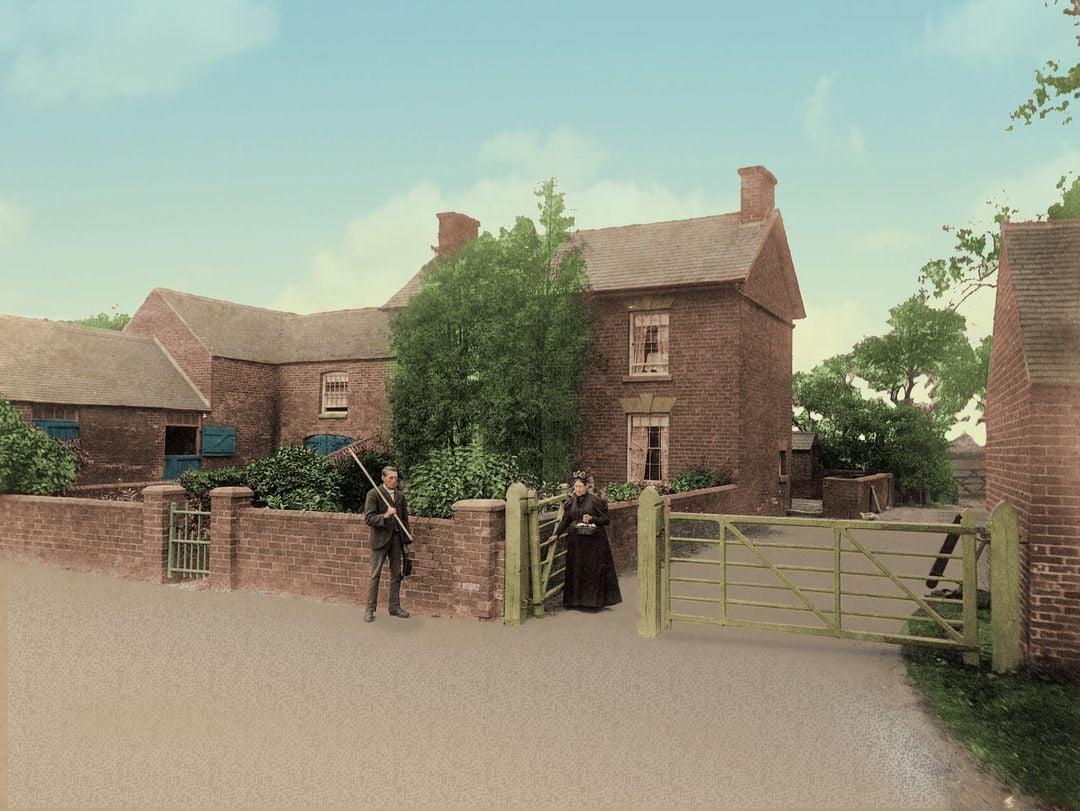
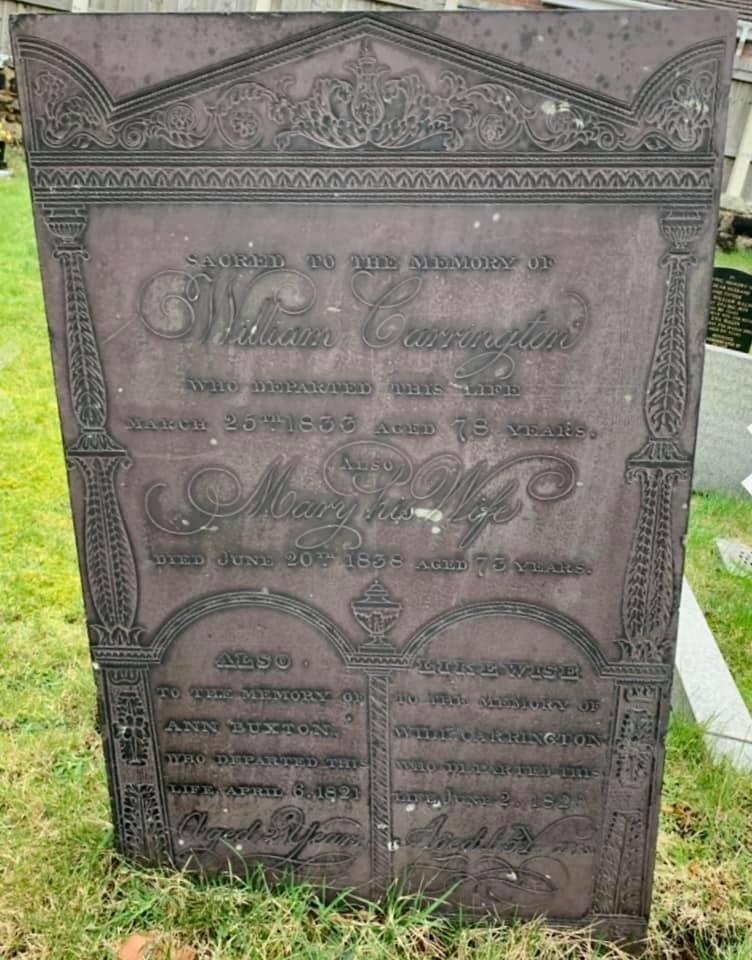
Ellen Carrington was born in 1795. Her father William Carrington 1755-1833 was from Smalley. Her mother Mary Malkin 1765-1838 was from Ellastone, in Staffordshire. Ellastone is on the Derbyshire border and very close to Ashboure, where Ellen married William Housley.
From Barbara Housley’s Narrative on the Letters:
Ellen’s family was evidently rather prominant in Smalley. Two Carringtons (John and William) served on the Parish Council in 1794. Parish records are full of Carrington marriages and christenings.
The letters refer to a variety of “uncles” who were probably Ellen’s brothers, but could be her uncles. These include:
RICHARD
Probably the youngest Uncle, and certainly the most significant, is Richard. He was a trustee for some of the property which needed to be settled following Ellen’s death. Anne wrote in 1854 that Uncle Richard “has got a new house built” and his daughters are “fine dashing young ladies–the belles of Smalley.” Then she added, “Aunt looks as old as my mother.”
Richard was born somewhere between 1808 and 1812. Since Richard was a contemporary of the older Housley children, “Aunt,” who was three years younger, should not look so old!
Richard Carrington and Harriet Faulkner were married in Repton in 1833. A daughter Elizabeth was baptised March 24, 1834. In July 1872, Joseph wrote: “Elizabeth is married too and a large family and is living in Uncle Thomas’s house for he is dead.” Elizabeth married Ayres (Eyres) Clayton of Lascoe. His occupation was listed as joiner and shopkeeper. They were married before 1864 since Elizabeth Clayton witnessed her sister’s marriage. Their children in April 1871 were Selina (1863), Agnes Maria (1866) and Elizabeth Ann (1868). A fourth daughter, Alice Augusta, was born in 1872 or 1873, probably by July 1872 to fit Joseph’s description “large family”! A son Charles Richard was born in 1880.
An Elizabeth Ann Clayton married John Arthur Woodhouse on May 12, 1913. He was a carpenter. His father was a miner. Elizabeth Ann’s father, Ayres, was also a carpenter. John Arthur’s age was given as 25. Elizabeth Ann’s age was given as 33 or 38. However, if she was born in 1868, her age would be 45. Possibly this is another case of a child being named for a deceased sibling. If she were 38 and born in 1875, she would fill the gap between Alice Augusta and Charles Richard.
Selina Clayton, who would have been 18, is not listed in the household in 1881. She died on June 11, 1914 at age 51. Agnes Maria Clayton died at the age of 25 and was buried March 31, 1891. Charles Richard died at the age of 5 and was buried on February 4, 1886. A Charles James Clayton, 18 months, was buried June 8, 1889 in Heanor.
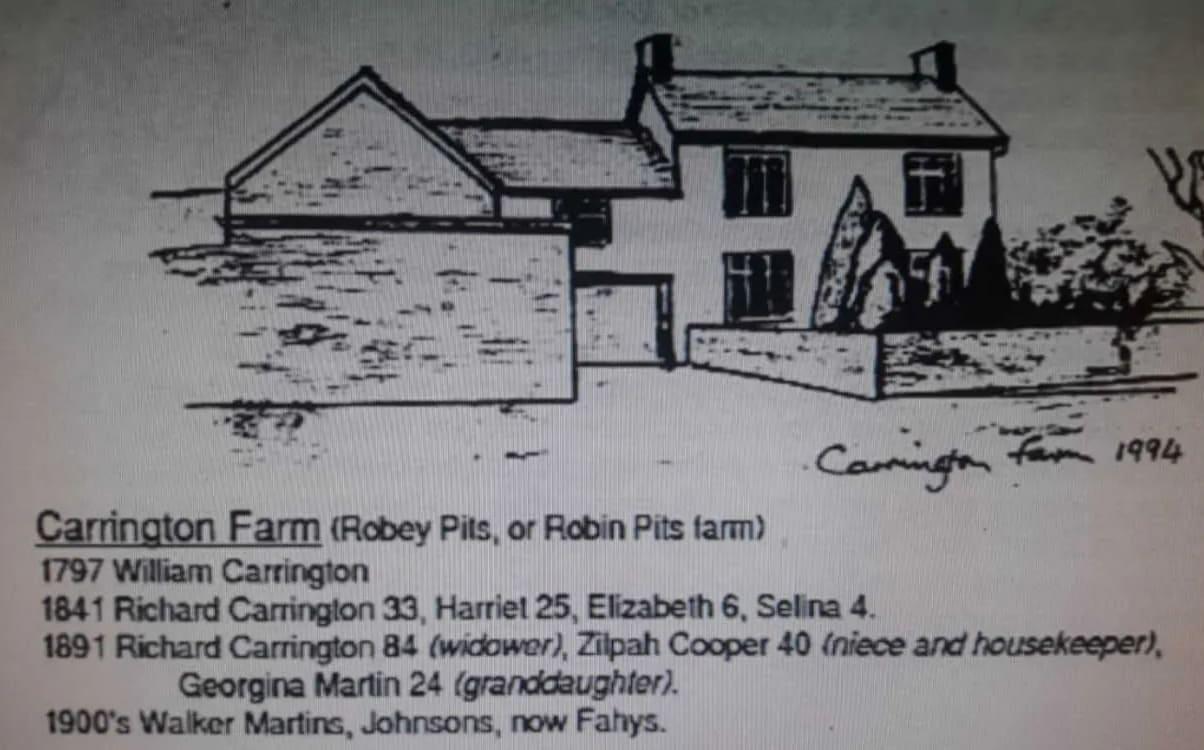
Richard Carrington’s second daughter, Selina, born in 1837, married Walker Martin (b.1835) on February 11, 1864 and they were living at Kidsley Park Farm in 1872, according to a letter from Joseph, and, according to the census, were still there in 1881. This 100 acre farm was formerly the home of Daniel Smith and his daughter Elizabeth Davy Barber. Selina and Walker had at least five children: Elizabeth Ann (1865), Harriet Georgianna (1866/7), Alice Marian (September 6, 1868), Philip Richard (1870), and Walker (1873). In December 1972, Joseph mentioned the death of Philip Walker, a farmer of Prospect Farm, Shipley. This was probably Walker Martin’s grandfather, since Walker was born in Shipley. The stock was to be sold the following Monday, but his daughter (Walker’s mother?) died the next day. Walker’s father was named Thomas. An Annie Georgianna Martin age 13 of Shipley died in April of 1859.
Selina Martin died on October 29, 1906 but her estate was not settled until November 14, 1910. Her gross estate was worth L223.56. Her son Walker and her daughter Harriet Georgiana were her trustees and executers. Walker was to get Selina’s half of Richard’s farm. Harriet Georgiana and Alice Marian were to be allowed to live with him. Philip Richard received L25. Elizabeth Ann was already married to someone named Smith.
Richard and Harriet may also have had a son George. In 1851 a Harriet Carrington and her three year old son George were living with her step-father John Benniston in Heanor. John may have been recently widowed and needed her help. Or, the Carrington home may have been inadequate since Anne reported a new one was built by 1854. Selina’s second daughter’s name testifies to the presence of a “George” in the family! Could the death of this son account for the haggard appearance Anne described when she wrote: “Aunt looks as old as my mother?”
Harriet was buried May 19, 1866. She was 55 when she died.In 1881, Georgianna then 14, was living with her grandfather and his niece, Zilpah Cooper, age 38–who lived with Richard on his 63 acre farm as early as 1871. A Zilpah, daughter of William and Elizabeth, was christened October 1843. Her brother, William Walter, was christened in 1846 and married Anna Maria Saint in 1873. There are four Selina Coopers–one had a son William Thomas Bartrun Cooper christened in 1864; another had a son William Cooper christened in 1873.
Our Zilpah was born in Bretley 1843. She died at age 49 and was buried on September 24, 1892. In her will, which was witnessed by Selina Martin, Zilpah’s sister, Frances Elizabeth Cleave, wife of Horatio Cleave of Leicester is mentioned. James Eley and Francis Darwin Huish (Richard’s soliciter) were executers.
Richard died June 10, 1892, and was buried on June 13. He was 85. As might be expected, Richard’s will was complicated. Harriet Georgiana Martin and Zilpah Cooper were to share his farm. If neither wanted to live there it was to go to Georgiana’s cousin Selina Clayton. However, Zilpah died soon after Richard. Originally, he left his piano, parlor and best bedroom furniture to his daughter Elizabeth Clayton. Then he revoked everything but the piano. He arranged for the payment of £150 which he owed. Later he added a codicil explaining that the debt was paid but he had borrowed £200 from someone else to do it!
Richard left a good deal of property including: The house and garden in Smalley occupied by Eyres Clayton with four messuages and gardens adjoining and large garden below and three messuages at the south end of the row with the frame work knitters shop and garden adjoining; a dwelling house used as a public house with a close of land; a small cottage and garden and four cottages and shop and gardens.
THOMAS
In August 1854, Anne wrote “Uncle Thomas is about as usual.” A Thomas Carrington married a Priscilla Walker in 1810.
Their children were baptised in August 1830 at the same time as the Housley children who at that time ranged in age from 3 to 17. The oldest of Thomas and Priscilla’s children, Henry, was probably at least 17 as he was married by 1836. Their youngest son, William Thomas, born 1830, may have been Mary Ellen Weston’s beau. However, the only Richard whose christening is recorded (1820), was the son of Thomas and Lucy. In 1872 Joseph reported that Richard’s daughter Elizabeth was married and living in Uncle Thomas’s house. In 1851, Alfred Smith lived in house 25, Foulks lived in 26, Thomas and Priscilla lived in 27, Bennetts lived in 28, Allard lived in 29 and Day lived in 30. Thomas and Priscilla do not appear in 1861. In 1871 Elizabeth Ann and Ayres Clayton lived in House 54. None of the families listed as neighbors in 1851 remained. However, Joseph Carrington, who lived in house 19 in 1851, lived in house 51 in 1871.
JOHN
In August 1854, Anne wrote: “Uncle John is with Will and Frank has been home in a comfortable place in Cotmanhay.” Although John and William are two of the most popular Carrington names, only two John’s have sons named William. John and Rachel Buxton Carrington had a son William christened in 1788. At the time of the letters this John would have been over 100 years old. Their son John and his wife Ann had a son William who was born in 1805. However, this William age 46 was living with his widowed mother in 1851. A Robert Carrington and his wife Ann had a son John born 1n 1805. He would be the right age to be a brother to Francis Carrington discussed below. This John was living with his widowed mother in 1851 and was unmarried. There are no known Williams in this family grouping. A William Carrington of undiscovered parentage was born in 1821. It is also possible that the Will in question was Anne’s brother Will Housley.
–Two Francis Carringtons appear in the 1841 census both of them aged 35. One is living with Richard and Harriet Carrington. The other is living next door to Samuel and Ellen Carrington Kerry (the trustee for “father’s will”!). The next name in this sequence is John Carrington age 15 who does not seem to live with anyone! but may be part of the Kerry household.
FRANK (see above)
While Anne did not preface her mention of the name Frank with an “Uncle,” Joseph referred to Uncle Frank and James Carrington in the same sentence. A James Carrington was born in 1814 and had a wife Sarah. He worked as a framework knitter. James may have been a son of William and Anne Carrington. He lived near Richard according to the 1861 census. Other children of William and Anne are Hannah (1811), William (1815), John (1816), and Ann (1818). An Ann Carrington married a Frank Buxton in 1819. This might be “Uncle Frank.”
An Ellen Carrington was born to John and Rachel Carrington in 1785. On October 25, 1809, a Samuel Kerry married an Ellen Carrington. However this Samuel Kerry is not the trustee involved in settling Ellen’s estate. John Carrington died July 1815.
William and Mary Carrington:
 February 5, 2022 at 10:50 am #6271
In reply to: The Elusive Samuel Housley and Other Family Stories
The Housley Letters
FRIENDS AND NEIGHBORS
from Barbara Housley’s Narrative on the Letters:
George apparently asked about old friends and acquaintances and the family did their best to answer although Joseph wrote in 1873: “There is very few of your old cronies that I know of knocking about.”
In Anne’s first letter she wrote about a conversation which Robert had with EMMA LYON before his death and added “It (his death) was a great trouble to Lyons.” In her second letter Anne wrote: “Emma Lyon is to be married September 5. I am going the Friday before if all is well. There is every prospect of her being comfortable. MRS. L. always asks after you.” In 1855 Emma wrote: “Emma Lyon now Mrs. Woolhouse has got a fine boy and a pretty fuss is made with him. They call him ALFRED LYON WOOLHOUSE.”
(Interesting to note that Elizabeth Housley, the eldest daughter of Samuel and Elizabeth, was living with a Lyon family in Derby in 1861, after she left Belper workhouse. The Emma listed on the census in 1861 was 10 years old, and so can not be the Emma Lyon mentioned here, but it’s possible, indeed likely, that Peter Lyon the baker was related to the Lyon’s who were friends of the Housley’s. The mention of a sea captain in the Lyon family begs the question did Elizabeth Housley meet her husband, George William Stafford, a seaman, through some Lyon connections, but to date this remains a mystery.)
Elizabeth Housley living with Peter Lyon and family in Derby St Peters in 1861:
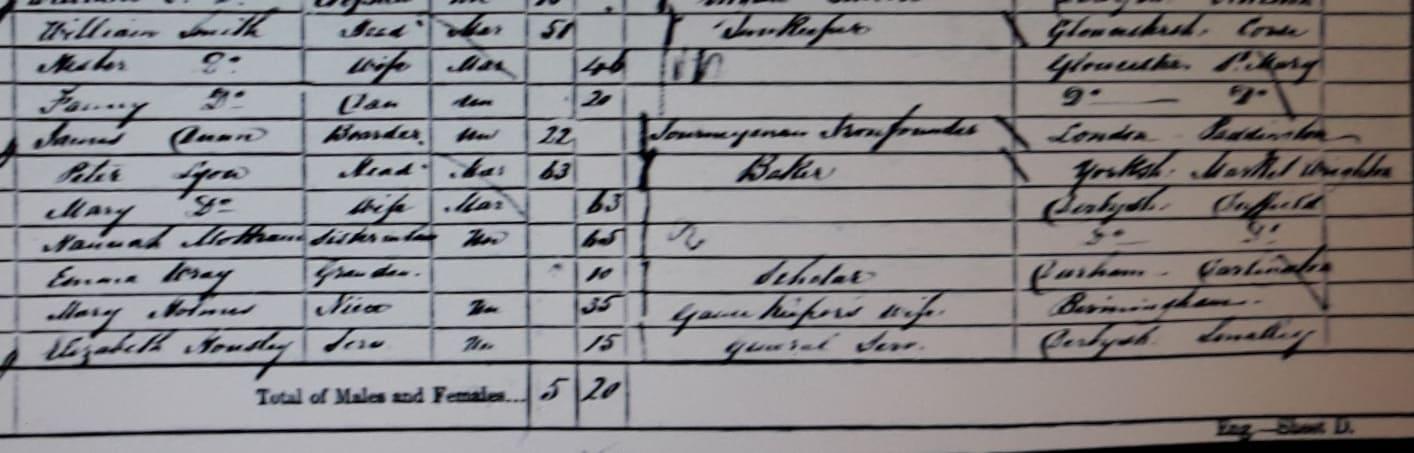
A Henrietta Lyon was married in 1860. Her father was Matthew, a Navy Captain. The 1857 Derby Directory listed a Richard Woolhouse, plumber, glazier, and gas fitter on St. Peter’s Street. Robert lived in St. Peter’s parish at the time of his death. An Alfred Lyon, son of Alfred and Jemima Lyon 93 Friargate, Derby was baptised on December 4, 1877. An Allen Hewley Lyon, born February 1, 1879 was baptised June 17 1879.
Anne wrote in August 1854: “KERRY was married three weeks since to ELIZABETH EATON. He has left Smith some time.” Perhaps this was the same person referred to by Joseph: “BILL KERRY, the blacksmith for DANIEL SMITH, is working for John Fletcher lace manufacturer.” According to the 1841 census, Elizabeth age 12, was the oldest daughter of Thomas and Rebecca Eaton. She would certainly have been of marriagable age in 1854. A William Kerry, age 14, was listed as a blacksmith’s apprentice in the 1851 census; but another William Kerry who was 29 in 1851 was already working for Daniel Smith as a blacksmith. REBECCA EATON was listed in the 1851 census as a widow serving as a nurse in the John Housley household. The 1881 census lists the family of William Kerry, blacksmith, as Jane, 19; William 13; Anne, 7; and Joseph, 4. Elizabeth is not mentioned but Bill is not listed as a widower.
Anne also wrote in 1854 that she had not seen or heard anything of DICK HANSON for two years. Joseph wrote that he did not know Old BETTY HANSON’S son. A Richard Hanson, age 24 in 1851, lived with a family named Moore. His occupation was listed as “journeyman knitter.” An Elizabeth Hanson listed as 24 in 1851 could hardly be “Old Betty.” Emma wrote in June 1856 that JOE OLDKNOW age 27 had married Mrs. Gribble’s servant age 17.
Anne wrote that “JOHN SPENCER had not been since father died.” The only John Spencer in Smalley in 1841 was four years old. He would have been 11 at the time of William Housley’s death. Certainly, the two could have been friends, but perhaps young John was named for his grandfather who was a crony of William’s living in a locality not included in the Smalley census.
TAILOR ALLEN had lost his wife and was still living in the old house in 1872. JACK WHITE had died very suddenly, and DR. BODEN had died also. Dr. Boden’s first name was Robert. He was 53 in 1851, and was probably the Robert, son of Richard and Jane, who was christened in Morely in 1797. By 1861, he had married Catherine, a native of Smalley, who was at least 14 years his junior–18 according to the 1871 census!
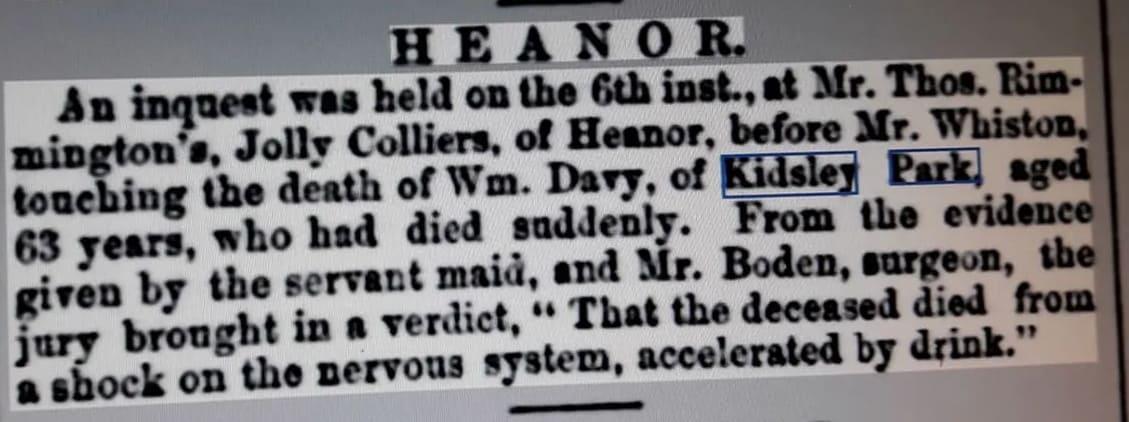
Among the family’s dearest friends were JOSEPH AND ELIZABETH DAVY, who were married some time after 1841. Mrs. Davy was born in 1812 and her husband in 1805. In 1841, the Kidsley Park farm household included DANIEL SMITH 72, Elizabeth 29 and 5 year old Hannah Smith. In 1851, Mr. Davy’s brother William and 10 year old Emma Davy were visiting from London. Joseph reported the death of both Davy brothers in 1872; Joseph apparently died first.
Mrs. Davy’s father, was a well known Quaker. In 1856, Emma wrote: “Mr. Smith is very hearty and looks much the same.” He died in December 1863 at the age of 94. George Fox, the founder of the Quakers visited Kidsley Park in 1650 and 1654.
Mr. Davy died in 1863, but in 1854 Anne wrote how ill he had been for two years. “For two last winters we never thought he would live. He is now able to go out a little on the pony.” In March 1856, his wife wrote, “My husband is in poor health and fell.” Later in 1856, Emma wrote, “Mr. Davy is living which is a great wonder. Mrs. Davy is very delicate but as good a friend as ever.”
In The Derbyshire Advertiser and Journal, 15 May 1863:
Whenever the girls sent greetings from Mrs. Davy they used her Quaker speech pattern of “thee and thy.” Mrs. Davy wrote to George on March 21 1856 sending some gifts from his sisters and a portrait of their mother–“Emma is away yet and A is so much worse.” Mrs. Davy concluded: “With best wishes for thy health and prosperity in this world and the next I am thy sincere friend.”
Mrs. Davy later remarried. Her new husband was W.T. BARBER. The 1861 census lists William Barber, 35, Bachelor of Arts, Cambridge, living with his 82 year old widowed mother on an 135 acre farm with three servants. One of these may have been the Ann who, according to Joseph, married Jack Oldknow. By 1871 the farm, now occupied by William, 47 and Elizabeth, 57, had grown to 189 acres. Meanwhile, Kidsley Park Farm became the home of the Housleys’ cousin Selina Carrington and her husband Walker Martin. Both Barbers were still living in 1881.
Mrs. Davy was described in Kerry’s History of Smalley as “an accomplished and exemplary lady.” A piece of her poetry “Farewell to Kidsley Park” was published in the history. It was probably written when Elizabeth moved to the Barber farm. Emma sent one of her poems to George. It was supposed to be about their house. “We have sent you a piece of poetry that Mrs. Davy composed about our ‘Old House.’ I am sure you will like it though you may not understand all the allusions she makes use of as well as we do.”
Kiddsley Park Farm, Smalley, in 1898. (note that the Housley’s lived at Kiddsley Grange Farm, and the Davy’s at neighbouring Kiddsley Park Farm)
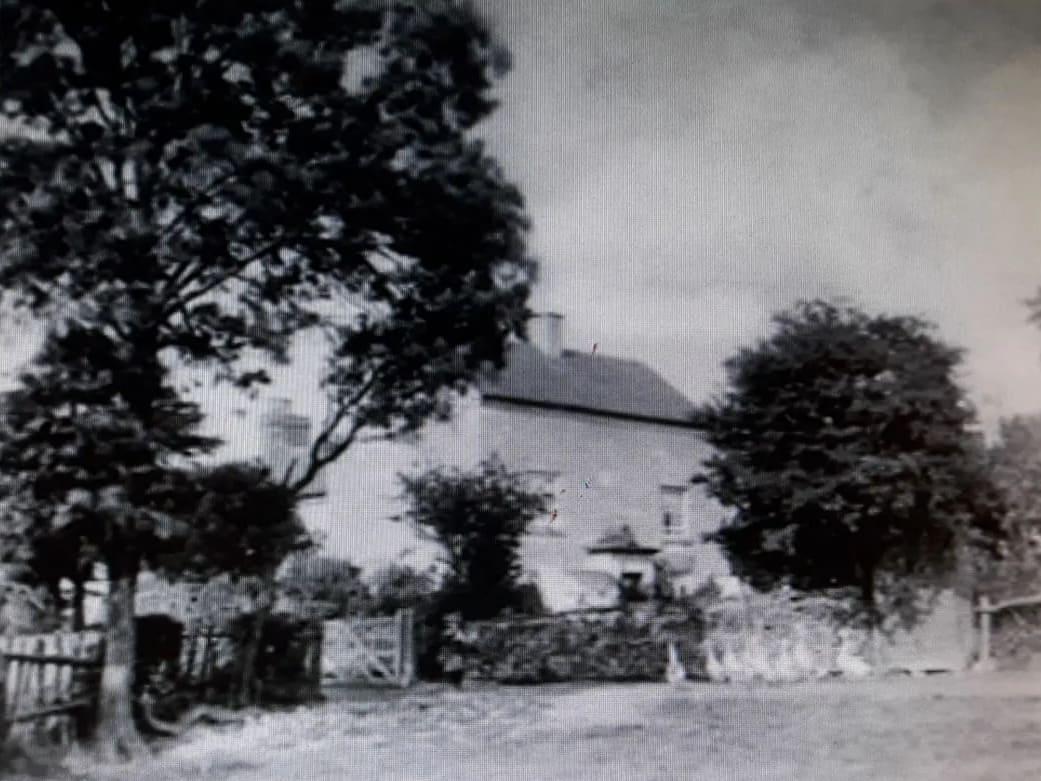
Emma was not sure if George wanted to hear the local gossip (“I don’t know whether such little particulars will interest you”), but shared it anyway. In November 1855: “We have let the house to Mr. Gribble. I dare say you know who he married, Matilda Else. They came from Lincoln here in March. Mrs. Gribble gets drunk nearly every day and there are such goings on it is really shameful. So you may be sure we have not very pleasant neighbors but we have very little to do with them.”
John Else and his wife Hannah and their children John and Harriet (who were born in Smalley) lived in Tag Hill in 1851. With them lived a granddaughter Matilda Gribble age 3 who was born in Lincoln. A Matilda, daughter of John and Hannah, was christened in 1815. (A Sam Else died when he fell down the steps of a bar in 1855.)
February 4, 2022 at 3:17 pm #6269In reply to: The Elusive Samuel Housley and Other Family Stories
The Housley Letters
From Barbara Housley’s Narrative on the Letters.
William Housley (1781-1848) and Ellen Carrington were married on May 30, 1814 at St. Oswald’s church in Ashbourne. William died in 1848 at the age of 67 of “disease of lungs and general debility”. Ellen died in 1872.
Marriage of William Housley and Ellen Carrington in Ashbourne in 1814:
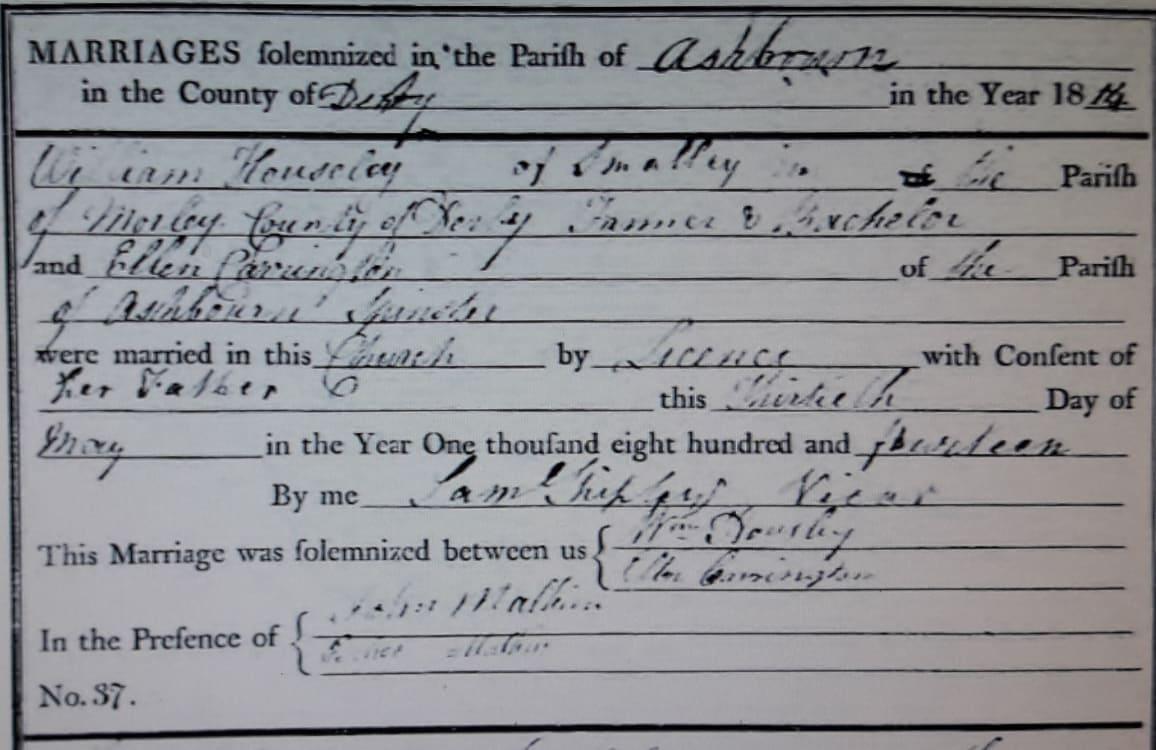
Parish records show three children for William and his first wife, Mary, Ellens’ sister, who were married December 29, 1806: Mary Ann, christened in 1808 and mentioned frequently in the letters; Elizabeth, christened in 1810, but never mentioned in any letters; and William, born in 1812, probably referred to as Will in the letters. Mary died in 1813.
William and Ellen had ten children: John, Samuel, Edward, Anne, Charles, George, Joseph, Robert, Emma, and Joseph. The first Joseph died at the age of four, and the last son was also named Joseph. Anne never married, Charles emigrated to Australia in 1851, and George to USA, also in 1851. The letters are to George, from his sisters and brothers in England.
The following are excerpts of those letters, including excerpts of Barbara Housley’s “Narrative on Historic Letters”. They are grouped according to who they refer to, rather than chronological order.
ELLEN HOUSLEY 1795-1872
Joseph wrote that when Emma was married, Ellen “broke up the comfortable home and the things went to Derby and she went to live with them but Derby didn’t agree with her so she left again leaving her things behind and came to live with John in the new house where she died.” Ellen was listed with John’s household in the 1871 census.
In May 1872, the Ilkeston Pioneer carried this notice: “Mr. Hopkins will sell by auction on Saturday next the eleventh of May 1872 the whole of the useful furniture, sewing machine, etc. nearly new on the premises of the late Mrs. Housley at Smalley near Heanor in the county of Derby. Sale at one o’clock in the afternoon.”Ellen’s family was evidently rather prominant in Smalley. Two Carringtons (John and William) served on the Parish Council in 1794. Parish records are full of Carrington marriages and christenings; census records confirm many of the family groupings.
In June of 1856, Emma wrote: “Mother looks as well as ever and was told by a lady the other day that she looked handsome.” Later she wrote: “Mother is as stout as ever although she sometimes complains of not being able to do as she used to.”
Mary’s children:
MARY ANN HOUSLEY 1808-1878
There were hard feelings between Mary Ann and Ellen and her children. Anne wrote: “If you remember we were not very friendly when you left. They never came and nothing was too bad for Mary Ann to say of Mother and me, but when Robert died Mother sent for her to the funeral but she did not think well to come so we took no more notice. She would not allow her children to come either.”
Mary Ann was unlucky in love! In Anne’s second letter she wrote: “William Carrington is paying Mary Ann great attention. He is living in London but they write to each other….We expect it will be a match.” Apparantly the courtship was stormy for in 1855, Emma wrote: “Mary Ann’s wedding with William Carrington has dropped through after she had prepared everything, dresses and all for the occassion.” Then in 1856, Emma wrote: “William Carrington and Mary Ann are separated. They wore him out with their nonsense.” Whether they ever married is unclear. Joseph wrote in 1872: “Mary Ann was married but her husband has left her. She is in very poor health. She has one daughter and they are living with their mother at Smalley.”
Regarding William Carrington, Emma supplied this bit of news: “His sister, Mrs. Lily, has eloped with a married man. Is she not a nice person!”
WILLIAM HOUSLEY JR. 1812-1890
According to a letter from Anne, Will’s two sons and daughter were sent to learn dancing so they would be “fit for any society.” Will’s wife was Dorothy Palfry. They were married in Denby on October 20, 1836 when Will was 24. According to the 1851 census, Will and Dorothy had three sons: Alfred 14, Edwin 12, and William 10. All three boys were born in Denby.
In his letter of May 30, 1872, after just bemoaning that all of his brothers and sisters are gone except Sam and John, Joseph added: “Will is living still.” In another 1872 letter Joseph wrote, “Will is living at Heanor yet and carrying on his cattle dealing.” The 1871 census listed Will, 59, and his son William, 30, of Lascoe Road, Heanor, as cattle dealers.
Ellen’s children:
JOHN HOUSLEY 1815-1893
John married Sarah Baggally in Morely in 1838. They had at least six children. Elizabeth (born 2 May 1838) was “out service” in 1854. In her “third year out,” Elizabeth was described by Anne as “a very nice steady girl but quite a woman in appearance.” One of her positions was with a Mrs. Frearson in Heanor. Emma wrote in 1856: “Elizabeth is still at Mrs. Frearson. She is such a fine stout girl you would not know her.” Joseph wrote in 1872 that Elizabeth was in service with Mrs. Eliza Sitwell at Derby. (About 1850, Miss Eliza Wilmot-Sitwell provided for a small porch with a handsome Norman doorway at the west end of the St. John the Baptist parish church in Smalley.)
According to Elizabeth’s birth certificate and the 1841 census, John was a butcher. By 1851, the household included a nurse and a servant, and John was listed as a “victular.” Anne wrote in February 1854, “John has left the Public House a year and a half ago. He is living where Plumbs (Ann Plumb witnessed William’s death certificate with her mark) did and Thomas Allen has the land. He has been working at James Eley’s all winter.” In 1861, Ellen lived with John and Sarah and the three boys.
John sold his share in the inheritance from their mother and disappeared after her death. (He died in Doncaster, Yorkshire, in 1893.) At that time Charles, the youngest would have been 21. Indeed, Joseph wrote in July 1872: “John’s children are all grown up”.
In May 1872, Joseph wrote: “For what do you think, John has sold his share and he has acted very bad since his wife died and at the same time he sold all his furniture. You may guess I have never seen him but once since poor mother’s funeral and he is gone now no one knows where.”
In February 1874 Joseph wrote: “You want to know what made John go away. Well, I will give you one reason. I think I told you that when his wife died he persuaded me to leave Derby and come to live with him. Well so we did and dear Harriet to keep his house. Well he insulted my wife and offered things to her that was not proper and my dear wife had the power to resist his unmanly conduct. I did not think he could of served me such a dirty trick so that is one thing dear brother. He could not look me in the face when we met. Then after we left him he got a woman in the house and I suppose they lived as man and wife. She caught the small pox and died and there he was by himself like some wild man. Well dear brother I could not go to him again after he had served me and mine as he had and I believe he was greatly in debt too so that he sold his share out of the property and when he received the money at Belper he went away and has never been seen by any of us since but I have heard of him being at Sheffield enquiring for Sam Caldwell. You will remember him. He worked in the Nag’s Head yard but I have heard nothing no more of him.”
A mention of a John Housley of Heanor in the Nottinghma Journal 1875. I don’t know for sure if the John mentioned here is the brother John who Joseph describes above as behaving improperly to his wife. John Housley had a son Joseph, born in 1840, and John’s wife Sarah died in 1870.
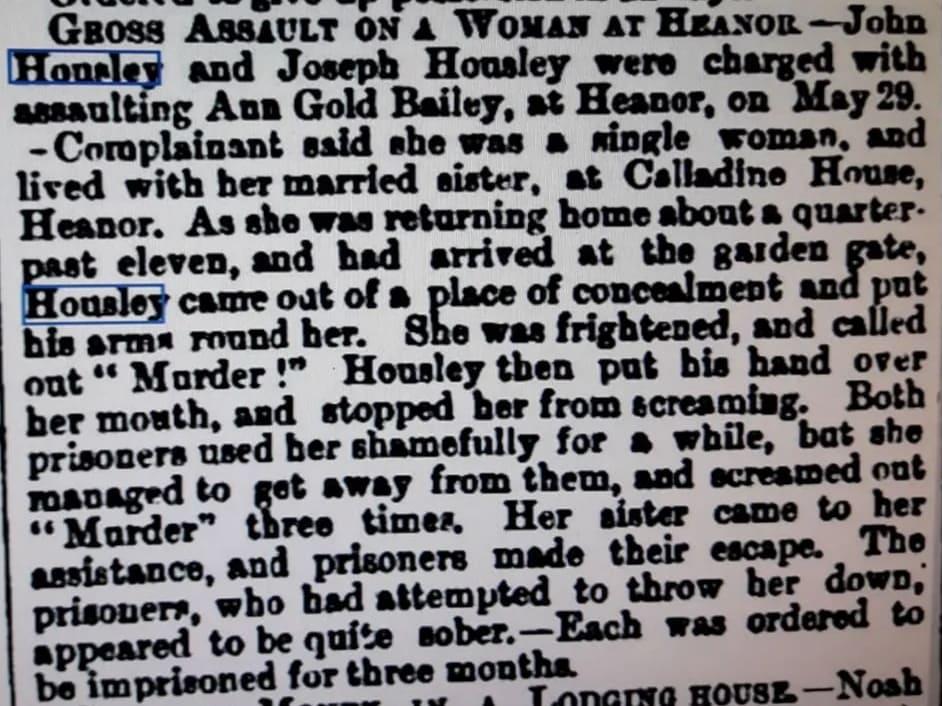
In 1876, the solicitor wrote to George: “Have you heard of John Housley? He is entitled to Robert’s share and I want him to claim it.”
SAMUEL HOUSLEY 1816-
Sam married Elizabeth Brookes of Sutton Coldfield, and they had three daughters: Elizabeth, Mary Anne and Catherine. Elizabeth his wife died in 1849, a few months after Samuel’s father William died in 1848. The particular circumstances relating to these individuals have been discussed in previous chapters; the following are letter excerpts relating to them.
Death of William Housley 15 Dec 1848, and Elizabeth Housley 5 April 1849, Smalley:
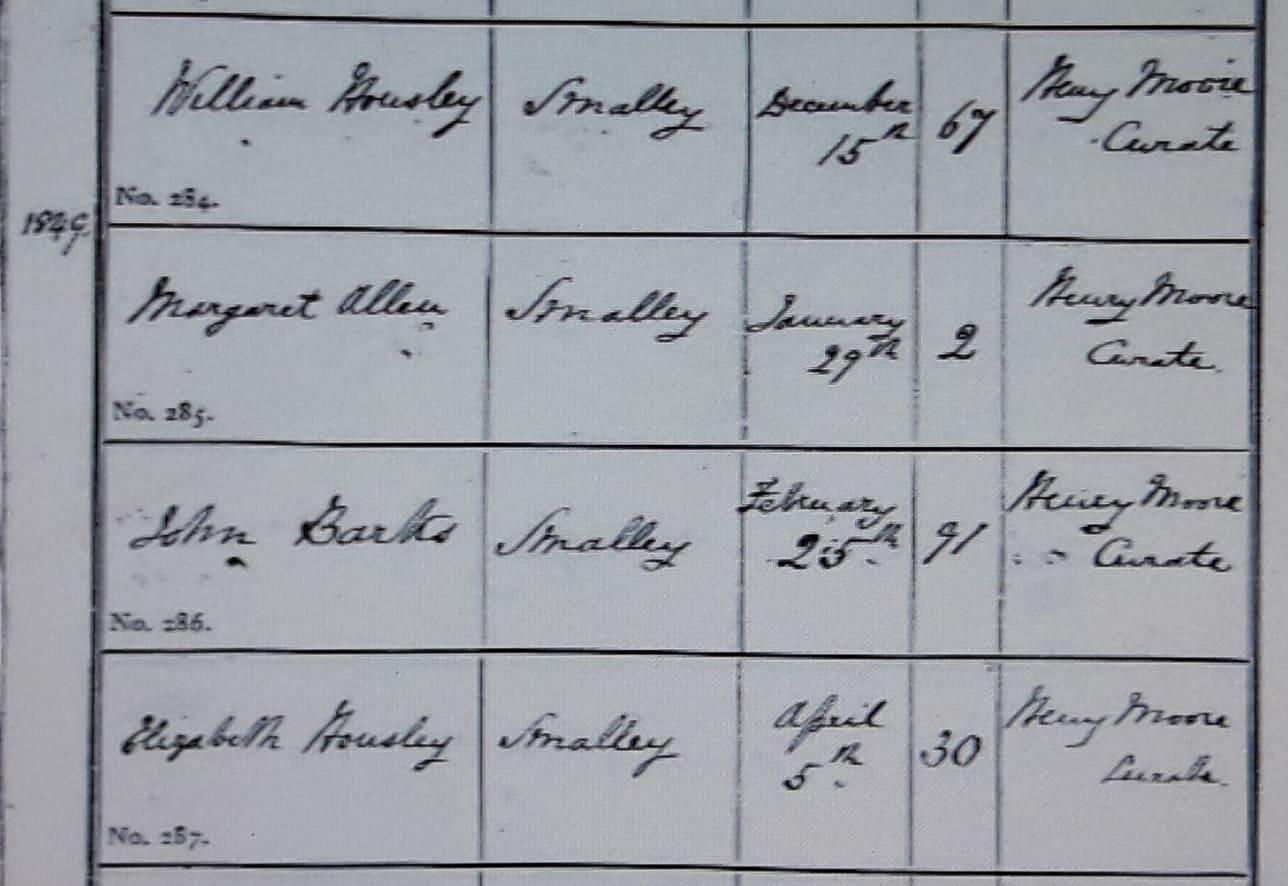
Joseph wrote in December 1872: “I saw one of Sam’s daughters, the youngest Kate, you would remember her a baby I dare say. She is very comfortably married.”
In the same letter (December 15, 1872), Joseph wrote: “I think we have now found all out now that is concerned in the matter for there was only Sam that we did not know his whereabouts but I was informed a week ago that he is dead–died about three years ago in Birmingham Union. Poor Sam. He ought to have come to a better end than that….His daughter and her husband went to Brimingham and also to Sutton Coldfield that is where he married his wife from and found out his wife’s brother. It appears he has been there and at Birmingham ever since he went away but ever fond of drink.”
(Sam, however, was still alive in 1871, living as a lodger at the George and Dragon Inn, Henley in Arden. And no trace of Sam has been found since. It would appear that Sam did not want to be found.)
EDWARD HOUSLEY 1819-1843
Edward died before George left for USA in 1851, and as such there is no mention of him in the letters.
ANNE HOUSLEY 1821-1856
Anne wrote two letters to her brother George between February 1854 and her death in 1856. Apparently she suffered from a lung disease for she wrote: “I can say you will be surprised I am still living and better but still cough and spit a deal. Can do nothing but sit and sew.” According to the 1851 census, Anne, then 29, was a seamstress. Their friend, Mrs. Davy, wrote in March 1856: “This I send in a box to my Brother….The pincushion cover and pen wiper are Anne’s work–are for thy wife. She would have made it up had she been able.” Anne was not living at home at the time of the 1841 census. She would have been 19 or 20 and perhaps was “out service.”
In her second letter Anne wrote: “It is a great trouble now for me to write…as the body weakens so does the mind often. I have been very weak all summer. That I continue is a wonder to all and to spit so much although much better than when you left home.” She also wrote: “You know I had a desire for America years ago. Were I in health and strength, it would be the land of my adoption.”
In November 1855, Emma wrote, “Anne has been very ill all summer and has not been able to write or do anything.” Their neighbor Mrs. Davy wrote on March 21, 1856: “I fear Anne will not be long without a change.” In a black-edged letter the following June, Emma wrote: “I need not tell you how happy she was and how calmly and peacefully she died. She only kept in bed two days.”
Certainly Anne was a woman of deep faith and strong religious convictions. When she wrote that they were hoping to hear of Charles’ success on the gold fields she added: “But I would rather hear of him having sought and found the Pearl of great price than all the gold Australia can produce, (For what shall it profit a man if he gain the whole world and lose his soul?).” Then she asked George: “I should like to learn how it was you were first led to seek pardon and a savior. I do feel truly rejoiced to hear you have been led to seek and find this Pearl through the workings of the Holy Spirit and I do pray that He who has begun this good work in each of us may fulfill it and carry it on even unto the end and I can never doubt the willingness of Jesus who laid down his life for us. He who said whoever that cometh unto me I will in no wise cast out.”
Anne’s will was probated October 14, 1856. Mr. William Davy of Kidsley Park appeared for the family. Her estate was valued at under £20. Emma was to receive fancy needlework, a four post bedstead, feather bed and bedding, a mahogany chest of drawers, plates, linen and china. Emma was also to receive Anne’s writing desk. There was a condition that Ellen would have use of these items until her death.
The money that Anne was to receive from her grandfather, William Carrington, and her father, William Housley was to be distributed one third to Joseph, one third to Emma, and one third to be divided between her four neices: John’s daughter Elizabeth, 18, and Sam’s daughters Elizabeth, 10, Mary Ann, 9 and Catharine, age 7 to be paid by the trustees as they think “most useful and proper.” Emma Lyon and Elizabeth Davy were the witnesses.
The Carrington Farm:
CHARLES HOUSLEY 1823-1855
Charles went to Australia in 1851, and was last heard from in January 1853. According to the solicitor, who wrote to George on June 3, 1874, Charles had received advances on the settlement of their parent’s estate. “Your promissory note with the two signed by your brother Charles for 20 pounds he received from his father and 20 pounds he received from his mother are now in the possession of the court.”
Charles and George were probably quite close friends. Anne wrote in 1854: “Charles inquired very particularly in both his letters after you.”
According to Anne, Charles and a friend married two sisters. He and his father-in-law had a farm where they had 130 cows and 60 pigs. Whatever the trade he learned in England, he never worked at it once he reached Australia. While it does not seem that Charles went to Australia because gold had been discovered there, he was soon caught up in “gold fever”. Anne wrote: “I dare say you have heard of the immense gold fields of Australia discovered about the time he went. Thousands have since then emigrated to Australia, both high and low. Such accounts we heard in the papers of people amassing fortunes we could not believe. I asked him when I wrote if it was true. He said this was no exaggeration for people were making their fortune daily and he intended going to the diggings in six weeks for he could stay away no longer so that we are hoping to hear of his success if he is alive.”
In March 1856, Mrs. Davy wrote: “I am sorry to tell thee they have had a letter from Charles’s wife giving account of Charles’s death of 6 months consumption at the Victoria diggings. He has left 2 children a boy and a girl William and Ellen.” In June of the same year in a black edged letter, Emma wrote: “I think Mrs. Davy mentioned Charles’s death in her note. His wife wrote to us. They have two children Helen and William. Poor dear little things. How much I should like to see them all. She writes very affectionately.”
In December 1872, Joseph wrote: “I’m told that Charles two daughters has wrote to Smalley post office making inquiries about his share….” In January 1876, the solicitor wrote: “Charles Housley’s children have claimed their father’s share.”
GEORGE HOUSLEY 1824-1877
George emigrated to the United states in 1851, arriving in July. The solicitor Abraham John Flint referred in a letter to a 15-pound advance which was made to George on June 9, 1851. This certainly was connected to his journey. George settled along the Delaware River in Bucks County, Pennsylvania. The letters from the solicitor were addressed to: Lahaska Post Office, Bucks County, Pennsylvania.
George married Sarah Ann Hill on May 6, 1854 in Doylestown, Bucks County, Pennsylvania. In her first letter (February 1854), Anne wrote: “We want to know who and what is this Miss Hill you name in your letter. What age is she? Send us all the particulars but I would advise you not to get married until you have sufficient to make a comfortable home.”
Upon learning of George’s marriage, Anne wrote: “I hope dear brother you may be happy with your wife….I hope you will be as a son to her parents. Mother unites with me in kind love to you both and to your father and mother with best wishes for your health and happiness.” In 1872 (December) Joseph wrote: “I am sorry to hear that sister’s father is so ill. It is what we must all come to some time and hope we shall meet where there is no more trouble.”
Emma wrote in 1855, “We write in love to your wife and yourself and you must write soon and tell us whether there is a little nephew or niece and what you call them.” In June of 1856, Emma wrote: “We want to see dear Sarah Ann and the dear little boy. We were much pleased with the “bit of news” you sent.” The bit of news was the birth of John Eley Housley, January 11, 1855. Emma concluded her letter “Give our very kindest love to dear sister and dearest Johnnie.”
In September 1872, Joseph wrote, “I was very sorry to hear that John your oldest had met with such a sad accident but I hope he is got alright again by this time.” In the same letter, Joseph asked: “Now I want to know what sort of a town you are living in or village. How far is it from New York? Now send me all particulars if you please.”
In March 1873 Harriet asked Sarah Ann: “And will you please send me all the news at the place and what it is like for it seems to me that it is a wild place but you must tell me what it is like….”. The question of whether she was referring to Bucks County, Pennsylvania or some other place is raised in Joseph’s letter of the same week.
On March 17, 1873, Joseph wrote: “I was surprised to hear that you had gone so far away west. Now dear brother what ever are you doing there so far away from home and family–looking out for something better I suppose.”The solicitor wrote on May 23, 1874: “Lately I have not written because I was not certain of your address and because I doubted I had much interesting news to tell you.” Later, Joseph wrote concerning the problems settling the estate, “You see dear brother there is only me here on our side and I cannot do much. I wish you were here to help me a bit and if you think of going for another summer trip this turn you might as well run over here.”
Apparently, George had indicated he might return to England for a visit in 1856. Emma wrote concerning the portrait of their mother which had been sent to George: “I hope you like mother’s portrait. I did not see it but I suppose it was not quite perfect about the eyes….Joseph and I intend having ours taken for you when you come over….Do come over before very long.”
In March 1873, Joseph wrote: “You ask me what I think of you coming to England. I think as you have given the trustee power to sign for you I think you could do no good but I should like to see you once again for all that. I can’t say whether there would be anything amiss if you did come as you say it would be throwing good money after bad.”
On June 10, 1875, the solicitor wrote: “I have been expecting to hear from you for some time past. Please let me hear what you are doing and where you are living and how I must send you your money.” George’s big news at that time was that on May 3, 1875, he had become a naturalized citizen “renouncing and abjuring all allegiance and fidelity to every foreign prince, potentate, state and sovereignity whatsoever, and particularly to Victoria Queen of Great Britain of whom he was before a subject.”
ROBERT HOUSLEY 1832-1851
In 1854, Anne wrote: “Poor Robert. He died in August after you left he broke a blood vessel in the lung.”
From Joseph’s first letter we learn that Robert was 19 when he died: “Dear brother there have been a great many changes in the family since you left us. All is gone except myself and John and Sam–we have heard nothing of him since he left. Robert died first when he was 19 years of age. Then Anne and Charles too died in Australia and then a number of years elapsed before anyone else. Then John lost his wife, then Emma, and last poor dear mother died last January on the 11th.”Anne described Robert’s death in this way: “He had thrown up blood many times before in the spring but the last attack weakened him that he only lived a fortnight after. He died at Derby. Mother was with him. Although he suffered much he never uttered a murmur or regret and always a smile on his face for everyone that saw him. He will be regretted by all that knew him”.
Robert died a resident of St. Peter’s Parish, Derby, but was buried in Smalley on August 16, 1851.
Apparently Robert was apprenticed to be a joiner for, according to Anne, Joseph took his place: “Joseph wanted to be a joiner. We thought we could do no better than let him take Robert’s place which he did the October after and is there still.”In 1876, the solicitor wrote to George: “Have you heard of John Housley? He is entitled to Robert’s share and I want him to claim it.”
EMMA HOUSLEY 1836-1871
Emma was not mentioned in Anne’s first letter. In the second, Anne wrote that Emma was living at Spondon with two ladies in her “third situation,” and added, “She is grown a bouncing woman.” Anne described her sister well. Emma wrote in her first letter (November 12, 1855): “I must tell you that I am just 21 and we had my pudding last Sunday. I wish I could send you a piece.”
From Emma’s letters we learn that she was living in Derby from May until November 1855 with Mr. Haywood, an iron merchant. She explained, “He has failed and I have been obliged to leave,” adding, “I expect going to a new situation very soon. It is at Belper.” In 1851 records, William Haywood, age 22, was listed as an iron foundry worker. In the 1857 Derby Directory, James and George were listed as iron and brass founders and ironmongers with an address at 9 Market Place, Derby.
In June 1856, Emma wrote from “The Cedars, Ashbourne Road” where she was working for Mr. Handysides.
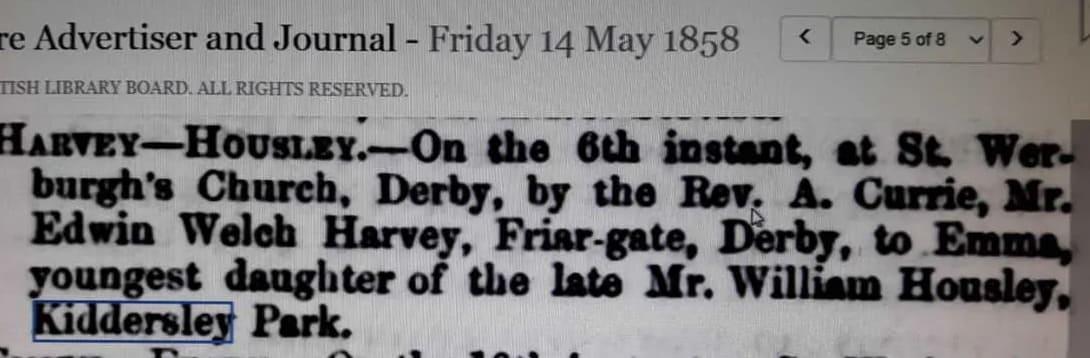
While she was working for Mr. Handysides, Emma wrote: “Mother is thinking of coming to live at Derby. That will be nice for Joseph and I.”Friargate and Ashbourne Road were located in St. Werburgh’s Parish. (In fact, St. Werburgh’s vicarage was at 185 Surrey Street. This clue led to the discovery of the record of Emma’s marriage on May 6, 1858, to Edwin Welch Harvey, son of Samuel Harvey in St. Werburgh’s.)
In 1872, Joseph wrote: “Our sister Emma, she died at Derby at her own home for she was married. She has left two young children behind. The husband was the son of the man that I went apprentice to and has caused a great deal of trouble to our family and I believe hastened poor Mother’s death….”. Joseph added that he believed Emma’s “complaint” was consumption and that she was sick a good bit. Joseph wrote: “Mother was living with John when I came home (from Ascension Island around 1867? or to Smalley from Derby around 1870?) for when Emma was married she broke up the comfortable home and the things went to Derby and she went to live with them but Derby did not agree with her so she had to leave it again but left all her things there.”
Emma Housley and Edwin Welch Harvey wedding, 1858:
JOSEPH HOUSLEY 1838-1893
We first hear of Joseph in a letter from Anne to George in 1854. “Joseph wanted to be a joiner. We thought we could do no better than let him take Robert’s place which he did the October after (probably 1851) and is there still. He is grown as tall as you I think quite a man.” Emma concurred in her first letter: “He is quite a man in his appearance and quite as tall as you.”
From Emma we learn in 1855: “Joseph has left Mr. Harvey. He had not work to employ him. So mother thought he had better leave his indenture and be at liberty at once than wait for Harvey to be a bankrupt. He has got a very good place of work now and is very steady.” In June of 1856, Emma wrote “Joseph and I intend to have our portraits taken for you when you come over….Mother is thinking of coming to Derby. That will be nice for Joseph and I. Joseph is very hearty I am happy to say.”
According to Joseph’s letters, he was married to Harriet Ballard. Joseph described their miraculous reunion in this way: “I must tell you that I have been abroad myself to the Island of Ascension. (Elsewhere he wrote that he was on the island when the American civil war broke out). I went as a Royal Marine and worked at my trade and saved a bit of money–enough to buy my discharge and enough to get married with but while I was out on the island who should I meet with there but my dear wife’s sister. (On two occasions Joseph and Harriet sent George the name and address of Harriet’s sister, Mrs. Brooks, in Susquehanna Depot, Pennsylvania, but it is not clear whether this was the same sister.) She was lady’s maid to the captain’s wife. Though I had never seen her before we got to know each other somehow so from that me and my wife recommenced our correspondence and you may be sure I wanted to get home to her. But as soon as I did get home that is to England I was not long before I was married and I have not regretted yet for we are very comfortable as well as circumstances will allow for I am only a journeyman joiner.”
Proudly, Joseph wrote: “My little family consists of three nice children–John, Joseph and Susy Annie.” On her birth certificate, Susy Ann’s birthdate is listed as 1871. Parish records list a Lucy Annie christened in 1873. The boys were born in Derby, John in 1868 and Joseph in 1869. In his second letter, Joseph repeated: “I have got three nice children, a good wife and I often think is more than I have deserved.” On August 6, 1873, Joseph and Harriet wrote: “We both thank you dear sister for the pieces of money you sent for the children. I don’t know as I have ever see any before.” Joseph ended another letter: “Now I must close with our kindest love to you all and kisses from the children.”
In Harriet’s letter to Sarah Ann (March 19, 1873), she promised: “I will send you myself and as soon as the weather gets warm as I can take the children to Derby, I will have them taken and send them, but it is too cold yet for we have had a very cold winter and a great deal of rain.” At this time, the children were all under 6 and the baby was not yet two.
In March 1873 Joseph wrote: “I have been working down at Heanor gate there is a joiner shop there where Kings used to live I have been working there this winter and part of last summer but the wages is very low but it is near home that is one comfort.” (Heanor Gate is about 1/4 mile from Kidsley Grange. There was a school and industrial park there in 1988.) At this time Joseph and his family were living in “the big house–in Old Betty Hanson’s house.” The address in the 1871 census was Smalley Lane.
A glimpse into Joseph’s personality is revealed by this remark to George in an 1872 letter: “Many thanks for your portrait and will send ours when we can get them taken for I never had but one taken and that was in my old clothes and dear Harriet is not willing to part with that. I tell her she ought to be satisfied with the original.”
On one occasion Joseph and Harriet both sent seeds. (Marks are still visible on the paper.) Joseph sent “the best cow cabbage seed in the country–Robinson Champion,” and Harriet sent red cabbage–Shaw’s Improved Red. Possibly cow cabbage was also known as ox cabbage: “I hope you will have some good cabbages for the Ox cabbage takes all the prizes here. I suppose you will be taking the prizes out there with them.” Joseph wrote that he would put the name of the seeds by each “but I should think that will not matter. You will tell the difference when they come up.”
George apparently would have liked Joseph to come to him as early as 1854. Anne wrote: “As to his coming to you that must be left for the present.” In 1872, Joseph wrote: “I have been thinking of making a move from here for some time before I heard from you for it is living from hand to mouth and never certain of a job long either.” Joseph then made plans to come to the United States in the spring of 1873. “For I intend all being well leaving England in the spring. Many thanks for your kind offer but I hope we shall be able to get a comfortable place before we have been out long.” Joseph promised to bring some things George wanted and asked: “What sort of things would be the best to bring out there for I don’t want to bring a lot that is useless.” Joseph’s plans are confirmed in a letter from the solicitor May 23, 1874: “I trust you are prospering and in good health. Joseph seems desirous of coming out to you when this is settled.”
George must have been reminiscing about gooseberries (Heanor has an annual gooseberry show–one was held July 28, 1872) and Joseph promised to bring cuttings when they came: “Dear Brother, I could not get the gooseberries for they was all gathered when I received your letter but we shall be able to get some seed out the first chance and I shall try to bring some cuttings out along.” In the same letter that he sent the cabbage seeds Joseph wrote: “I have got some gooseberries drying this year for you. They are very fine ones but I have only four as yet but I was promised some more when they were ripe.” In another letter Joseph sent gooseberry seeds and wrote their names: Victoria, Gharibaldi and Globe.
In September 1872 Joseph wrote; “My wife is anxious to come. I hope it will suit her health for she is not over strong.” Elsewhere Joseph wrote that Harriet was “middling sometimes. She is subject to sick headaches. It knocks her up completely when they come on.” In December 1872 Joseph wrote, “Now dear brother about us coming to America you know we shall have to wait until this affair is settled and if it is not settled and thrown into Chancery I’m afraid we shall have to stay in England for I shall never be able to save money enough to bring me out and my family but I hope of better things.”
On July 19, 1875 Abraham Flint (the solicitor) wrote: “Joseph Housley has removed from Smalley and is working on some new foundry buildings at Little Chester near Derby. He lives at a village called Little Eaton near Derby. If you address your letter to him as Joseph Housley, carpenter, Little Eaton near Derby that will no doubt find him.”
George did not save any letters from Joseph after 1874, hopefully he did reach him at Little Eaton. Joseph and his family are not listed in either Little Eaton or Derby on the 1881 census.
In his last letter (February 11, 1874), Joseph sounded very discouraged and wrote that Harriet’s parents were very poorly and both had been “in bed for a long time.” In addition, Harriet and the children had been ill.
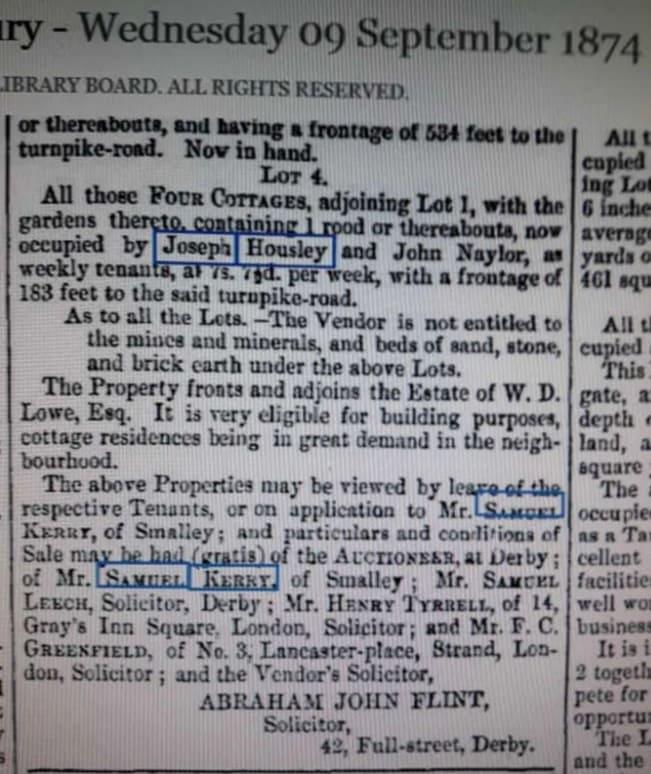
The move to Little Eaton may indicate that Joseph received his settlement because in August, 1873, he wrote: “I think this is bad news enough and bad luck too, but I have had little else since I came to live at Kiddsley cottages but perhaps it is all for the best if one could only think so. I have begun to think there will be no chance for us coming over to you for I am afraid there will not be so much left as will bring us out without it is settled very shortly but I don’t intend leaving this house until it is settled either one way or the other. “Joseph Housley and the Kiddsley cottages:
 February 2, 2022 at 12:33 pm #6266
In reply to: The Elusive Samuel Housley and Other Family Stories
From Tanganyika with Love
continued part 7
With thanks to Mike Rushby.
Oldeani Hospital. 19th September 1938
Dearest Family,
George arrived today to take us home to Mbulu but Sister Marianne will not allow
me to travel for another week as I had a bit of a set back after baby’s birth. At first I was
very fit and on the third day Sister stripped the bed and, dictionary in hand, started me
off on ante natal exercises. “Now make a bridge Mrs Rushby. So. Up down, up down,’
whilst I obediently hoisted myself aloft on heels and head. By the sixth day she
considered it was time for me to be up and about but alas, I soon had to return to bed
with a temperature and a haemorrhage. I got up and walked outside for the first time this
morning.I have had lots of visitors because the local German settlers seem keen to see
the first British baby born in the hospital. They have been most kind, sending flowers
and little German cards of congratulations festooned with cherubs and rather sweet. Most
of the women, besides being pleasant, are very smart indeed, shattering my illusion that
German matrons are invariably fat and dowdy. They are all much concerned about the
Czecko-Slovakian situation, especially Sister Marianne whose home is right on the
border and has several relations who are Sudentan Germans. She is ant-Nazi and
keeps on asking me whether I think England will declare war if Hitler invades Czecko-
Slovakia, as though I had inside information.George tells me that he has had a grass ‘banda’ put up for us at Mbulu as we are
both determined not to return to those prison-like quarters in the Fort. Sister Marianne is
horrified at the idea of taking a new baby to live in a grass hut. She told George,
“No,No,Mr Rushby. I find that is not to be allowed!” She is an excellent Sister but rather
prim and George enjoys teasing her. This morning he asked with mock seriousness,
“Sister, why has my wife not received her medal?” Sister fluttered her dictionary before
asking. “What medal Mr Rushby”. “Why,” said George, “The medal that Hitler gives to
women who have borne four children.” Sister started a long and involved explanation
about the medal being only for German mothers whilst George looked at me and
grinned.Later. Great Jubilation here. By the noise in Sister Marianne’s sitting room last night it
sounded as though the whole German population had gathered to listen to the wireless
news. I heard loud exclamations of joy and then my bedroom door burst open and
several women rushed in. “Thank God “, they cried, “for Neville Chamberlain. Now there
will be no war.” They pumped me by the hand as though I were personally responsible
for the whole thing.George on the other hand is disgusted by Chamberlain’s lack of guts. Doesn’t
know what England is coming to these days. I feel too content to concern myself with
world affairs. I have a fine husband and four wonderful children and am happy, happy,
happy.Eleanor.
Mbulu. 30th September 1938
Dearest Family,
Here we are, comfortably installed in our little green house made of poles and
rushes from a nearby swamp. The house has of course, no doors or windows, but
there are rush blinds which roll up in the day time. There are two rooms and a little porch
and out at the back there is a small grass kitchen.Here we have the privacy which we prize so highly as we are screened on one
side by a Forest Department plantation and on the other three sides there is nothing but
the rolling countryside cropped bare by the far too large herds of cattle and goats of the
Wambulu. I have a lovely lazy time. I still have Kesho-Kutwa and the cook we brought
with us from the farm. They are both faithful and willing souls though not very good at
their respective jobs. As one of these Mbeya boys goes on safari with George whose
job takes him from home for three weeks out of four, I have taken on a local boy to cut
firewood and heat my bath water and generally make himself useful. His name is Saa,
which means ‘Clock’We had an uneventful but very dusty trip from Oldeani. Johnny Jo travelled in his
pram in the back of the boxbody and got covered in dust but seems none the worst for
it. As the baby now takes up much of my time and Kate was showing signs of
boredom, I have engaged a little African girl to come and play with Kate every morning.
She is the daughter of the head police Askari and a very attractive and dignified little
person she is. Her name is Kajyah. She is scrupulously clean, as all Mohammedan
Africans seem to be. Alas, Kajyah, though beautiful, is a bore. She simply does not
know how to play, so they just wander around hand in hand.There are only two drawbacks to this little house. Mbulu is a very windy spot so
our little reed house is very draughty. I have made a little tent of sheets in one corner of
the ‘bedroom’ into which I can retire with Johnny when I wish to bathe or sponge him.
The other drawback is that many insects are attracted at night by the lamp and make it
almost impossible to read or sew and they have a revolting habit of falling into the soup.
There are no dangerous wild animals in this area so I am not at all nervous in this
flimsy little house when George is on safari. Most nights hyaenas come around looking
for scraps but our dogs, Fanny and Paddy, soon see them off.Eleanor.
Mbulu. 25th October 1938
Dearest Family,
Great news! a vacancy has occurred in the Game Department. George is to
transfer to it next month. There will be an increase in salary and a brighter prospect for
the future. It will mean a change of scene and I shall be glad of that. We like Mbulu and
the people here but the rains have started and our little reed hut is anything but water
tight.Before the rain came we had very unpleasant dust storms. I think I told you that
this is a treeless area and the grass which normally covers the veldt has been cropped
to the roots by the hungry native cattle and goats. When the wind blows the dust
collects in tall black columns which sweep across the country in a most spectacular
fashion. One such dust devil struck our hut one day whilst we were at lunch. George
swept Kate up in a second and held her face against his chest whilst I rushed to Johnny
Jo who was asleep in his pram, and stooped over the pram to protect him. The hut
groaned and creaked and clouds of dust blew in through the windows and walls covering
our persons, food, and belongings in a black pall. The dogs food bowls and an empty
petrol tin outside the hut were whirled up and away. It was all over in a moment but you
should have seen what a family of sweeps we looked. George looked at our blackened
Johnny and mimicked in Sister Marianne’s primmest tones, “I find that this is not to be
allowed.”The first rain storm caught me unprepared when George was away on safari. It
was a terrific thunderstorm. The quite violent thunder and lightening were followed by a
real tropical downpour. As the hut is on a slight slope, the storm water poured through
the hut like a river, covering the entire floor, and the roof leaked like a lawn sprinkler.
Johnny Jo was snug enough in the pram with the hood raised, but Kate and I had a
damp miserable night. Next morning I had deep drains dug around the hut and when
George returned from safari he managed to borrow an enormous tarpaulin which is now
lashed down over the roof.It did not rain during the next few days George was home but the very next night
we were in trouble again. I was awakened by screams from Kate and hurriedly turned up
the lamp to see that we were in the midst of an invasion of siafu ants. Kate’s bed was
covered in them. Others appeared to be raining down from the thatch. I quickly stripped
Kate and carried her across to my bed, whilst I rushed to the pram to see whether
Johnny Jo was all right. He was fast asleep, bless him, and slept on through all the
commotion, whilst I struggled to pick all the ants out of Kate’s hair, stopping now and
again to attend to my own discomfort. These ants have a painful bite and seem to
choose all the most tender spots. Kate fell asleep eventually but I sat up for the rest of
the night to make sure that the siafu kept clear of the children. Next morning the servants
dispersed them by laying hot ash.In spite of the dampness of the hut both children are blooming. Kate has rosy
cheeks and Johnny Jo now has a fuzz of fair hair and has lost his ‘old man’ look. He
reminds me of Ann at his age.Eleanor.
Iringa. 30th November 1938
Dearest Family,
Here we are back in the Southern Highlands and installed on the second floor of
another German Fort. This one has been modernised however and though not so
romantic as the Mbulu Fort from the outside, it is much more comfortable.We are all well
and I am really proud of our two safari babies who stood up splendidly to a most trying
journey North from Mbulu to Arusha and then South down the Great North Road to
Iringa where we expect to stay for a month.At Arusha George reported to the headquarters of the Game Department and
was instructed to come on down here on Rinderpest Control. There is a great flap on in
case the rinderpest spread to Northern Rhodesia and possibly onwards to Southern
Rhodesia and South Africa. Extra veterinary officers have been sent to this area to
inoculate all the cattle against the disease whilst George and his African game Scouts will
comb the bush looking for and destroying diseased game. If the rinderpest spreads,
George says it may be necessary to shoot out all the game in a wide belt along the
border between the Southern Highlands of Tanganyika and Northern Rhodesia, to
prevent the disease spreading South. The very idea of all this destruction sickens us
both.George left on a foot safari the day after our arrival and I expect I shall be lucky if I
see him occasionally at weekends until this job is over. When rinderpest is under control
George is to be stationed at a place called Nzassa in the Eastern Province about 18
miles from Dar es Salaam. George’s orderly, who is a tall, cheerful Game Scout called
Juma, tells me that he has been stationed at Nzassa and it is a frightful place! However I
refuse to be depressed. I now have the cheering prospect of leave to England in thirty
months time when we will be able to fetch Ann and George and be a proper family
again. Both Ann and George look happy in the snapshots which mother-in-law sends
frequently. Ann is doing very well at school and loves it.To get back to our journey from Mbulu. It really was quite an experience. It
poured with rain most of the way and the road was very slippery and treacherous the
120 miles between Mbulu and Arusha. This is a little used earth road and the drains are
so blocked with silt as to be practically non existent. As usual we started our move with
the V8 loaded to capacity. I held Johnny on my knee and Kate squeezed in between
George and me. All our goods and chattels were in wooden boxes stowed in the back
and the two houseboys and the two dogs had to adjust themselves to the space that
remained. We soon ran into trouble and it took us all day to travel 47 miles. We stuck
several times in deep mud and had some most nasty skids. I simply clutched Kate in
one hand and Johnny Jo in the other and put my trust in George who never, under any
circumstances, loses his head. Poor Johnny only got his meals when circumstances
permitted. Unfortunately I had put him on a bottle only a few days before we left Mbulu
and, as I was unable to buy either a primus stove or Thermos flask there we had to
make a fire and boil water for each meal. Twice George sat out in the drizzle with a rain
coat rapped over his head to protect a miserable little fire of wet sticks drenched with
paraffin. Whilst we waited for the water to boil I pacified John by letting him suck a cube
of Tate and Lyles sugar held between my rather grubby fingers. Not at all according to
the book.That night George, the children and I slept in the car having dumped our boxes
and the two servants in a deserted native hut. The rain poured down relentlessly all night
and by morning the road was more of a morass than ever. We swerved and skidded
alarmingly till eventually one of the wheel chains broke and had to be tied together with
string which constantly needed replacing. George was so patient though he was wet
and muddy and tired and both children were very good. Shortly before reaching the Great North Road we came upon Jack Gowan, the Stock Inspector from Mbulu. His car
was bogged down to its axles in black mud. He refused George’s offer of help saying
that he had sent his messenger to a nearby village for help.I hoped that conditions would be better on the Great North Road but how over
optimistic I was. For miles the road runs through a belt of ‘black cotton soil’. which was
churned up into the consistency of chocolate blancmange by the heavy lorry traffic which
runs between Dodoma and Arusha. Soon the car was skidding more fantastically than
ever. Once it skidded around in a complete semi circle so George decided that it would
be safer for us all to walk whilst he negotiated the very bad patches. You should have
seen me plodding along in the mud and drizzle with the baby in one arm and Kate
clinging to the other. I was terrified of slipping with Johnny. Each time George reached
firm ground he would return on foot to carry Kate and in this way we covered many bad
patches.We were more fortunate than many other travellers. We passed several lorries
ditched on the side of the road and one car load of German men, all elegantly dressed in
lounge suits. One was busy with his camera so will have a record of their plight to laugh
over in the years to come. We spent another night camping on the road and next day
set out on the last lap of the journey. That also was tiresome but much better than the
previous day and we made the haven of the Arusha Hotel before dark. What a picture
we made as we walked through the hall in our mud splattered clothes! Even Johnny was
well splashed with mud but no harm was done and both he and Kate are blooming.
We rested for two days at Arusha and then came South to Iringa. Luckily the sun
came out and though for the first day the road was muddy it was no longer so slippery
and the second day found us driving through parched country and along badly
corrugated roads. The further South we came, the warmer the sun which at times blazed
through the windscreen and made us all uncomfortably hot. I have described the country
between Arusha and Dodoma before so I shan’t do it again. We reached Iringa without
mishap and after a good nights rest all felt full of beans.Eleanor.
Mchewe Estate, Mbeya. 7th January 1939.
Dearest Family,
You will be surprised to note that we are back on the farm! At least the children
and I are here. George is away near the Rhodesian border somewhere, still on
Rinderpest control.I had a pleasant time at Iringa, lots of invitations to morning tea and Kate had a
wonderful time enjoying the novelty of playing with children of her own age. She is not
shy but nevertheless likes me to be within call if not within sight. It was all very suburban
but pleasant enough. A few days before Christmas George turned up at Iringa and
suggested that, as he would be working in the Mbeya area, it might be a good idea for
the children and me to move to the farm. I agreed enthusiastically, completely forgetting
that after my previous trouble with the leopard I had vowed to myself that I would never
again live alone on the farm.Alas no sooner had we arrived when Thomas, our farm headman, brought the
news that there were now two leopards terrorising the neighbourhood, and taking dogs,
goats and sheep and chickens. Traps and poisoned bait had been tried in vain and he
was sure that the female was the same leopard which had besieged our home before.
Other leopards said Thomas, came by stealth but this one advertised her whereabouts
in the most brazen manner.George stayed with us on the farm over Christmas and all was quiet at night so I
cheered up and took the children for walks along the overgrown farm paths. However on
New Years Eve that darned leopard advertised her presence again with the most blood
chilling grunts and snarls. Horrible! Fanny and Paddy barked and growled and woke up
both children. Kate wept and kept saying, “Send it away mummy. I don’t like it.” Johnny
Jo howled in sympathy. What a picnic. So now the whole performance of bodyguards
has started again and ‘till George returns we confine our exercise to the garden.
Our little house is still cosy and sweet but the coffee plantation looks very
neglected. I wish to goodness we could sell it.Eleanor.
Nzassa 14th February 1939.
Dearest Family,
After three months of moving around with two small children it is heavenly to be
settled in our own home, even though Nzassa is an isolated spot and has the reputation
of being unhealthy.We travelled by car from Mbeya to Dodoma by now a very familiar stretch of
country, but from Dodoma to Dar es Salaam by train which made a nice change. We
spent two nights and a day in the Splendid Hotel in Dar es Salaam, George had some
official visits to make and I did some shopping and we took the children to the beach.
The bay is so sheltered that the sea is as calm as a pond and the water warm. It is
wonderful to see the sea once more and to hear tugs hooting and to watch the Arab
dhows putting out to sea with their oddly shaped sails billowing. I do love the bush, but
I love the sea best of all, as you know.We made an early start for Nzassa on the 3rd. For about four miles we bowled
along a good road. This brought us to a place called Temeke where George called on
the District Officer. His house appears to be the only European type house there. The
road between Temeke and the turn off to Nzassa is quite good, but the six mile stretch
from the turn off to Nzassa is a very neglected bush road. There is nothing to be seen
but the impenetrable bush on both sides with here and there a patch of swampy
ground where rice is planted in the wet season.After about six miles of bumpy road we reached Nzassa which is nothing more
than a sandy clearing in the bush. Our house however is a fine one. It was originally built
for the District Officer and there is a small court house which is now George’s office. The
District Officer died of blackwater fever so Nzassa was abandoned as an administrative
station being considered too unhealthy for Administrative Officers but suitable as
Headquarters for a Game Ranger. Later a bachelor Game Ranger was stationed here
but his health also broke down and he has been invalided to England. So now the
healthy Rushbys are here and we don’t mean to let the place get us down. So don’t
worry.The house consists of three very large and airy rooms with their doors opening
on to a wide front verandah which we shall use as a living room. There is also a wide
back verandah with a store room at one end and a bathroom at the other. Both
verandahs and the end windows of the house are screened my mosquito gauze wire
and further protected by a trellis work of heavy expanded metal. Hasmani, the Game
Scout, who has been acting as caretaker, tells me that the expanded metal is very
necessary because lions often come out of the bush at night and roam around the
house. Such a comforting thought!On our very first evening we discovered how necessary the mosquito gauze is.
After sunset the air outside is thick with mosquitos from the swamps. About an acre of
land has been cleared around the house. This is a sandy waste because there is no
water laid on here and absolutely nothing grows here except a rather revolting milky
desert bush called ‘Manyara’, and a few acacia trees. A little way from the house there is
a patch of citrus trees, grape fruit, I think, but whether they ever bear fruit I don’t know.
The clearing is bordered on three sides by dense dusty thorn bush which is
‘lousy with buffalo’ according to George. The open side is the road which leads down to
George’s office and the huts for the Game Scouts. Only Hasmani and George’s orderly
Juma and their wives and families live there, and the other huts provide shelter for the
Game Scouts from the bush who come to Nzassa to collect their pay and for a short
rest. I can see that my daily walk will always be the same, down the road to the huts and
back! However I don’t mind because it is far too hot to take much exercise.The climate here is really tropical and worse than on the coast because the thick
bush cuts us off from any sea breeze. George says it will be cooler when the rains start
but just now we literally drip all day. Kate wears nothing but a cotton sun suit, and Johnny
a napkin only, but still their little bodies are always moist. I have shorn off all Kate’s lovely
shoulder length curls and got George to cut my hair very short too.We simply must buy a refrigerator. The butter, and even the cheese we bought
in Dar. simply melted into pools of oil overnight, and all our meat went bad, so we are
living out of tins. However once we get organised I shall be quite happy here. I like this
spacious house and I have good servants. The cook, Hamisi Issa, is a Swahili from Lindi
whom we engaged in Dar es Salaam. He is a very dignified person, and like most
devout Mohammedan Cooks, keeps both his person and the kitchen spotless. I
engaged the house boy here. He is rather a timid little body but is very willing and quite
capable. He has an excessively plain but cheerful wife whom I have taken on as ayah. I
do not really need help with the children but feel I must have a woman around just in
case I go down with malaria when George is away on safari.Eleanor.
Nzassa 28th February 1939.
Dearest Family,
George’s birthday and we had a special tea party this afternoon which the
children much enjoyed. We have our frig now so I am able to make jellies and provide
them with really cool drinks.Our very first visitor left this morning after spending only one night here. He is Mr
Ionides, the Game Ranger from the Southern Province. He acted as stand in here for a
short while after George’s predecessor left for England on sick leave, and where he has
since died. Mr Ionides returned here to hand over the range and office formally to
George. He seems a strange man and is from all accounts a bit of a hermit. He was at
one time an Officer in the Regular Army but does not look like a soldier, he wears the
most extraordinary clothes but nevertheless contrives to look top-drawer. He was
educated at Rugby and Sandhurst and is, I should say, well read. Ionides told us that he
hated Nzassa, particularly the house which he thinks sinister and says he always slept
down in the office.The house, or at least one bedroom, seems to have the same effect on Kate.
She has been very nervous at night ever since we arrived. At first the children occupied
the bedroom which is now George’s. One night, soon after our arrival, Kate woke up
screaming to say that ‘something’ had looked at her through the mosquito net. She was
in such a hysterical state that inspite of the heat and discomfort I was obliged to crawl into
her little bed with her and remained there for the rest of the night.Next night I left a night lamp burning but even so I had to sit by her bed until she
dropped off to sleep. Again I was awakened by ear-splitting screams and this time
found Kate standing rigid on her bed. I lifted her out and carried her to a chair meaning to
comfort her but she screeched louder than ever, “Look Mummy it’s under the bed. It’s
looking at us.” In vain I pointed out that there was nothing at all there. By this time
George had joined us and he carried Kate off to his bed in the other room whilst I got into
Kate’s bed thinking she might have been frightened by a rat which might also disturb
Johnny.Next morning our houseboy remarked that he had heard Kate screaming in the
night from his room behind the kitchen. I explained what had happened and he must
have told the old Scout Hasmani who waylaid me that afternoon and informed me quite
seriously that that particular room was haunted by a ‘sheitani’ (devil) who hates children.
He told me that whilst he was acting as caretaker before our arrival he one night had his
wife and small daughter in the room to keep him company. He said that his small
daughter woke up and screamed exactly as Kate had done! Silly coincidence I
suppose, but such strange things happen in Africa that I decided to move the children
into our room and George sleeps in solitary state in the haunted room! Kate now sleeps
peacefully once she goes to sleep but I have to stay with her until she does.I like this house and it does not seem at all sinister to me. As I mentioned before,
the rooms are high ceilinged and airy, and have cool cement floors. We have made one
end of the enclosed verandah into the living room and the other end is the playroom for
the children. The space in between is a sort of no-mans land taken over by the dogs as
their special territory.Eleanor.
Nzassa 25th March 1939.
Dearest Family,
George is on safari down in the Rufigi River area. He is away for about three
weeks in the month on this job. I do hate to see him go and just manage to tick over until
he comes back. But what fun and excitement when he does come home.
Usually he returns after dark by which time the children are in bed and I have
settled down on the verandah with a book. The first warning is usually given by the
dogs, Fanny and her son Paddy. They stir, sit up, look at each other and then go and sit
side by side by the door with their noses practically pressed to the mosquito gauze and
ears pricked. Soon I can hear the hum of the car, and so can Hasmani, the old Game
Scout who sleeps on the back verandah with rifle and ammunition by his side when
George is away. When he hears the car he turns up his lamp and hurries out to rouse
Juma, the houseboy. Juma pokes up the fire and prepares tea which George always
drinks whist a hot meal is being prepared. In the meantime I hurriedly comb my hair and
powder my nose so that when the car stops I am ready to rush out and welcome
George home. The boy and Hasmani and the garden boy appear to help with the
luggage and to greet George and the cook, who always accompanies George on
Safari. The home coming is always a lively time with much shouting of greetings.
‘Jambo’, and ‘Habari ya safari’, whilst the dogs, beside themselves with excitement,
rush around like lunatics.As though his return were not happiness enough, George usually collects the
mail on his way home so there is news of Ann and young George and letters from you
and bundles of newspapers and magazines. On the day following his return home,
George has to deal with official mail in the office but if the following day is a weekday we
all, the house servants as well as ourselves, pile into the boxbody and go to Dar es
Salaam. To us this means a mornings shopping followed by an afternoon on the beach.
It is a bit cooler now that the rains are on but still very humid. Kate keeps chubby
and rosy in spite of the climate but Johnny is too pale though sturdy enough. He is such
a good baby which is just as well because Kate is a very demanding little girl though
sunny tempered and sweet. I appreciate her company very much when George is
away because we are so far off the beaten track that no one ever calls.Eleanor.
Nzassa 28th April 1939.
Dearest Family,
You all seem to wonder how I can stand the loneliness and monotony of living at
Nzassa when George is on safari, but really and truly I do not mind. Hamisi the cook
always goes on safari with George and then the houseboy Juma takes over the cooking
and I do the lighter housework. the children are great company during the day, and when
they are settled for the night I sit on the verandah and read or write letters or I just dream.
The verandah is entirely enclosed with both wire mosquito gauze and a trellis
work of heavy expanded metal, so I am safe from all intruders be they human, animal, or
insect. Outside the air is alive with mosquitos and the cicadas keep up their monotonous
singing all night long. My only companions on the verandah are the pale ghecco lizards
on the wall and the two dogs. Fanny the white bull terrier, lies always near my feet
dozing happily, but her son Paddy, who is half Airedale has a less phlegmatic
disposition. He sits alert and on guard by the metal trellis work door. Often a lion grunts
from the surrounding bush and then his hackles rise and he stands up stiffly with his nose
pressed to the door. Old Hasmani from his bedroll on the back verandah, gives a little
cough just to show he is awake. Sometimes the lions are very close and then I hear the
click of a rifle bolt as Hasmani loads his rifle – but this is usually much later at night when
the lights are out. One morning I saw large pug marks between the wall of my bedroom
and the garage but I do not fear lions like I did that beastly leopard on the farm.
A great deal of witchcraft is still practiced in the bush villages in the
neighbourhood. I must tell you about old Hasmani’s baby in connection with this. Last
week Hasmani came to me in great distress to say that his baby was ‘Ngongwa sana ‘
(very ill) and he thought it would die. I hurried down to the Game Scouts quarters to see
whether I could do anything for the child and found the mother squatting in the sun
outside her hut with the baby on her lap. The mother was a young woman but not an
attractive one. She appeared sullen and indifferent compared with old Hasmani who
was very distressed. The child was very feverish and breathing with difficulty and
seemed to me to be suffering from bronchitis if not pneumonia. I rubbed his back and
chest with camphorated oil and dosed him with aspirin and liquid quinine. I repeated the
treatment every four hours, but next day there was no apparent improvement.
In the afternoon Hasmani begged me to give him that night off duty and asked for
a loan of ten shillings. He explained to me that it seemed to him that the white man’s
medicine had failed to cure his child and now he wished to take the child to the local witch
doctor. “For ten shillings” said Hasmani, “the Maganga will drive the devil out of my
child.” “How?” asked I. “With drums”, said Hasmani confidently. I did not know what to
do. I thought the child was too ill to be exposed to the night air, yet I knew that if I
refused his request and the child were to die, Hasmani and all the other locals would hold
me responsible. I very reluctantly granted his request. I was so troubled by the matter
that I sent for George’s office clerk. Daniel, and asked him to accompany Hasmani to the
ceremony and to report to me the next morning. It started to rain after dark and all night
long I lay awake in bed listening to the drums and the light rain. Next morning when I
went out to the kitchen to order breakfast I found a beaming Hasmani awaiting me.
“Memsahib”, he said. “My child is well, the fever is now quite gone, the Maganga drove
out the devil just as I told you.” Believe it or not, when I hurried to his quarters after
breakfast I found the mother suckling a perfectly healthy child! It may be my imagination
but I thought the mother looked pretty smug.The clerk Daniel told me that after Hasmani
had presented gifts of money and food to the ‘Maganga’, the naked baby was placed
on a goat skin near the drums. Most of the time he just lay there but sometimes the witch
doctor picked him up and danced with the child in his arms. Daniel seemed reluctant to
talk about it. Whatever mumbo jumbo was used all this happened a week ago and the
baby has never looked back.Eleanor.
Nzassa 3rd July 1939.
Dearest Family,
Did I tell you that one of George’s Game Scouts was murdered last month in the
Maneromango area towards the Rufigi border. He was on routine patrol, with a porter
carrying his bedding and food, when they suddenly came across a group of African
hunters who were busy cutting up a giraffe which they had just killed. These hunters were
all armed with muzzle loaders, spears and pangas, but as it is illegal to kill giraffe without
a permit, the Scout went up to the group to take their names. Some argument ensued
and the Scout was stabbed.The District Officer went to the area to investigate and decided to call in the Police
from Dar es Salaam. A party of police went out to search for the murderers but after
some days returned without making any arrests. George was on an elephant control
safari in the Bagamoyo District and on his return through Dar es Salaam he heard of the
murder. George was furious and distressed to hear the news and called in here for an
hour on his way to Maneromango to search for the murderers himself.After a great deal of strenuous investigation he arrested three poachers, put them
in jail for the night at Maneromango and then brought them to Dar es Salaam where they
are all now behind bars. George will now have to prosecute in the Magistrate’s Court
and try and ‘make a case’ so that the prisoners may be committed to the High Court to
be tried for murder. George is convinced of their guilt and justifiably proud to have
succeeded where the police failed.George had to borrow handcuffs for the prisoners from the Chief at
Maneromango and these he brought back to Nzassa after delivering the prisoners to
Dar es Salaam so that he may return them to the Chief when he revisits the area next
week.I had not seen handcuffs before and picked up a pair to examine them. I said to
George, engrossed in ‘The Times’, “I bet if you were arrested they’d never get
handcuffs on your wrist. Not these anyway, they look too small.” “Standard pattern,”
said George still concentrating on the newspaper, but extending an enormous relaxed
left wrist. So, my dears, I put a bracelet round his wrist and as there was a wide gap I
gave a hard squeeze with both hands. There was a sharp click as the handcuff engaged
in the first notch. George dropped the paper and said, “Now you’ve done it, my love,
one set of keys are in the Dar es Salaam Police Station, and the others with the Chief at
Maneromango.” You can imagine how utterly silly I felt but George was an angel about it
and said as he would have to go to Dar es Salaam we might as well all go.So we all piled into the car, George, the children and I in the front, and the cook
and houseboy, immaculate in snowy khanzus and embroidered white caps, a Game
Scout and the ayah in the back. George never once complain of the discomfort of the
handcuff but I was uncomfortably aware that it was much too tight because his arm
above the cuff looked red and swollen and the hand unnaturally pale. As the road is so
bad George had to use both hands on the wheel and all the time the dangling handcuff
clanked against the dashboard in an accusing way.We drove straight to the Police Station and I could hear the roars of laughter as
George explained his predicament. Later I had to put up with a good deal of chaffing
and congratulations upon putting the handcuffs on George.Eleanor.
Nzassa 5th August 1939
Dearest Family,
George made a point of being here for Kate’s fourth birthday last week. Just
because our children have no playmates George and I always do all we can to make
birthdays very special occasions. We went to Dar es Salaam the day before the
birthday and bought Kate a very sturdy tricycle with which she is absolutely delighted.
You will be glad to know that your parcels arrived just in time and Kate loved all your
gifts especially the little shop from Dad with all the miniature tins and packets of
groceries. The tea set was also a great success and is much in use.We had a lively party which ended with George and me singing ‘Happy
Birthday to you’, and ended with a wild game with balloons. Kate wore her frilly white net
party frock and looked so pretty that it seemed a shame that there was no one but us to
see her. Anyway it was a good party. I wish so much that you could see the children.
Kate keeps rosy and has not yet had malaria. Johnny Jo is sturdy but pale. He
runs a temperature now and again but I am not sure whether this is due to teething or
malaria. Both children of course take quinine every day as George and I do. George
quite frequently has malaria in spite of prophylactic quinine but this is not surprising as he
got the germ thoroughly established in his system in his early elephant hunting days. I
get it too occasionally but have not been really ill since that first time a month after my
arrival in the country.Johnny is such a good baby. His chief claim to beauty is his head of soft golden
curls but these are due to come off on his first birthday as George considers them too
girlish. George left on safari the day after the party and the very next morning our wood
boy had a most unfortunate accident. He was chopping a rather tough log when a chip
flew up and split his upper lip clean through from mouth to nostril exposing teeth and
gums. A truly horrible sight and very bloody. I cleaned up the wound as best I could
and sent him off to the hospital at Dar es Salaam on the office bicycle. He wobbled
away wretchedly down the road with a white cloth tied over his mouth to keep off the
dust. He returned next day with his lip stitched and very swollen and bearing a
resemblance to my lip that time I used the hair remover.Eleanor.
Splendid Hotel. Dar es Salaam 7th September 1939
Dearest Family,
So now another war has started and it has disrupted even our lives. We have left
Nzassa for good. George is now a Lieutenant in the King’s African Rifles and the children
and I are to go to a place called Morogoro to await further developments.
I was glad to read in today’s paper that South Africa has declared war on
Germany. I would have felt pretty small otherwise in this hotel which is crammed full of
men who have been called up for service in the Army. George seems exhilarated by
the prospect of active service. He is bursting out of his uniform ( at the shoulders only!)
and all too ready for the fray.The war came as a complete surprise to me stuck out in the bush as I was without
wireless or mail. George had been away for a fortnight so you can imagine how
surprised I was when a messenger arrived on a bicycle with a note from George. The
note informed me that war had been declared and that George, as a Reserve Officer in
the KAR had been called up. I was to start packing immediately and be ready by noon
next day when George would arrive with a lorry for our goods and chattels. I started to
pack immediately with the help of the houseboy and by the time George arrived with
the lorry only the frig remained to be packed and this was soon done.Throughout the morning Game Scouts had been arriving from outlying parts of
the District. I don’t think they had the least idea where they were supposed to go or
whom they were to fight but were ready to fight anybody, anywhere, with George.
They all looked very smart in well pressed uniforms hung about with water bottles and
ammunition pouches. The large buffalo badge on their round pill box hats absolutely
glittered with polish. All of course carried rifles and when George arrived they all lined up
and they looked most impressive. I took some snaps but unfortunately it was drizzling
and they may not come out well.We left Nzassa without a backward glance. We were pretty fed up with it by
then. The children and I are spending a few days here with George but our luggage, the
dogs, and the houseboys have already left by train for Morogoro where a small house
has been found for the children and me.George tells me that all the German males in this Territory were interned without a
hitch. The whole affair must have been very well organised. In every town and
settlement special constables were sworn in to do the job. It must have been a rather
unpleasant one but seems to have gone without incident. There is a big transit camp
here at Dar for the German men. Later they are to be sent out of the country, possibly to
Rhodesia.The Indian tailors in the town are all terribly busy making Army uniforms, shorts
and tunics in khaki drill. George swears that they have muddled their orders and he has
been given the wrong things. Certainly the tunic is far too tight. His hat, a khaki slouch hat
like you saw the Australians wearing in the last war, is also too small though it is the
largest they have in stock. We had a laugh over his other equipment which includes a
small canvas haversack and a whistle on a black cord. George says he feels like he is
back in his Boy Scouting boyhood.George has just come in to say the we will be leaving for Morogoro tomorrow
afternoon.Eleanor.
Morogoro 14th September 1939
Dearest Family,
Morogoro is a complete change from Nzassa. This is a large and sprawling
township. The native town and all the shops are down on the flat land by the railway but
all the European houses are away up the slope of the high Uluguru Mountains.
Morogoro was a flourishing town in the German days and all the streets are lined with
trees for coolness as is the case in other German towns. These trees are the flamboyant
acacia which has an umbrella top and throws a wide but light shade.Most of the houses have large gardens so they cover a considerable area and it
is quite a safari for me to visit friends on foot as our house is on the edge of this area and
the furthest away from the town. Here ones house is in accordance with ones seniority in
Government service. Ours is a simple affair, just three lofty square rooms opening on to
a wide enclosed verandah. Mosquitoes are bad here so all doors and windows are
screened and we will have to carry on with our daily doses of quinine.George came up to Morogoro with us on the train. This was fortunate because I
went down with a sharp attack of malaria at the hotel on the afternoon of our departure
from Dar es Salaam. George’s drastic cure of vast doses of quinine, a pillow over my
head, and the bed heaped with blankets soon brought down the temperature so I was
fit enough to board the train but felt pretty poorly on the trip. However next day I felt
much better which was a good thing as George had to return to Dar es Salaam after two
days. His train left late at night so I did not see him off but said good-bye at home
feeling dreadful but trying to keep the traditional stiff upper lip of the wife seeing her
husband off to the wars. He hopes to go off to Abyssinia but wrote from Dar es Salaam
to say that he is being sent down to Rhodesia by road via Mbeya to escort the first
detachment of Rhodesian white troops.First he will have to select suitable camping sites for night stops and arrange for
supplies of food. I am very pleased as it means he will be safe for a while anyway. We
are both worried about Ann and George in England and wonder if it would be safer to
have them sent out.Eleanor.
Morogoro 4th November 1939
Dearest Family,
My big news is that George has been released from the Army. He is very
indignant and disappointed because he hoped to go to Abyssinia but I am terribly,
terribly glad. The Chief Secretary wrote a very nice letter to George pointing out that he
would be doing a greater service to his country by his work of elephant control, giving
crop protection during the war years when foodstuffs are such a vital necessity, than by
doing a soldiers job. The Government plan to start a huge rice scheme in the Rufiji area,
and want George to control the elephant and hippo there. First of all though. he must go
to the Southern Highlands Province where there is another outbreak of Rinderpest, to
shoot out diseased game especially buffalo, which might spread the disease.So off we go again on our travels but this time we are leaving the two dogs
behind in the care of Daniel, the Game Clerk. Fanny is very pregnant and I hate leaving
her behind but the clerk has promised to look after her well. We are taking Hamisi, our
dignified Swahili cook and the houseboy Juma and his wife whom we brought with us
from Nzassa. The boy is not very good but his wife makes a cheerful and placid ayah
and adores Johnny.Eleanor.
Iringa 8th December 1939
Dearest Family,
The children and I are staying in a small German house leased from the
Custodian of Enemy Property. I can’t help feeling sorry for the owners who must be in
concentration camps somewhere.George is away in the bush dealing with the
Rinderpest emergency and the cook has gone with him. Now I have sent the houseboy
and the ayah away too. Two days ago my houseboy came and told me that he felt
very ill and asked me to write a ‘chit’ to the Indian Doctor. In the note I asked the Doctor
to let me know the nature of his complaint and to my horror I got a note from him to say
that the houseboy had a bad case of Venereal Disease. Was I horrified! I took it for
granted that his wife must be infected too and told them both that they would have to
return to their home in Nzassa. The boy shouted and the ayah wept but I paid them in
lieu of notice and gave them money for the journey home. So there I was left servant
less with firewood to chop, a smokey wood burning stove to control, and of course, the
two children.To add to my troubles Johnny had a temperature so I sent for the European
Doctor. He diagnosed malaria and was astonished at the size of Johnny’s spleen. He
said that he must have had suppressed malaria over a long period and the poor child
must now be fed maximum doses of quinine for a long time. The Doctor is a fatherly
soul, he has been recalled from retirement to do this job as so many of the young
doctors have been called up for service with the army.I told him about my houseboy’s complaint and the way I had sent him off
immediately, and he was very amused at my haste, saying that it is most unlikely that
they would have passed the disease onto their employers. Anyway I hated the idea. I
mean to engage a houseboy locally, but will do without an ayah until we return to
Morogoro in February.Something happened today to cheer me up. A telegram came from Daniel which
read, “FLANNEL HAS FIVE CUBS.”Eleanor.
Morogoro 10th March 1940
Dearest Family,
We are having very heavy rain and the countryside is a most beautiful green. In
spite of the weather George is away on safari though it must be very wet and
unpleasant. He does work so hard at his elephant hunting job and has got very thin. I
suppose this is partly due to those stomach pains he gets and the doctors don’t seem
to diagnose the trouble.Living in Morogoro is much like living in a country town in South Africa, particularly
as there are several South African women here. I go out quite often to morning teas. We
all take our war effort knitting, and natter, and are completely suburban.
I sometimes go and see an elderly couple who have been interred here. They
are cold shouldered by almost everyone else but I cannot help feeling sorry for them.
Usually I go by invitation because I know Mrs Ruppel prefers to be prepared and
always has sandwiches and cake. They both speak English but not fluently and
conversation is confined to talking about my children and theirs. Their two sons were
students in Germany when war broke out but are now of course in the German Army.
Such nice looking chaps from their photographs but I suppose thorough Nazis. As our
conversation is limited I usually ask to hear a gramophone record or two. They have a
large collection.Janet, the ayah whom I engaged at Mbeya, is proving a great treasure. She is a
trained hospital ayah and is most dependable and capable. She is, perhaps, a little strict
but the great thing is that I can trust her with the children out of my sight.
Last week I went out at night for the first time without George. The occasion was
a farewell sundowner given by the Commissioner of Prisoners and his wife. I was driven
home by the District Officer and he stopped his car by the back door in a large puddle.
Ayah came to the back door, storm lamp in hand, to greet me. My escort prepared to
drive off but the car stuck. I thought a push from me might help, so without informing the
driver, I pushed as hard as I could on the back of the car. Unfortunately the driver
decided on other tactics. He put the engine in reverse and I was knocked flat on my back
in the puddle. The car drove forward and away without the driver having the least idea of
what happened. The ayah was in quite a state, lifting me up and scolding me for my
stupidity as though I were Kate. I was a bit shaken but non the worse and will know
better next time.Eleanor.
Morogoro 14th July 1940
Dearest Family,
How good it was of Dad to send that cable to Mother offering to have Ann and
George to live with you if they are accepted for inclusion in the list of children to be
evacuated to South Africa. It would be wonderful to know that they are safely out of the
war zone and so much nearer to us but I do dread the thought of the long sea voyage
particularly since we heard the news of the sinking of that liner carrying child evacuees to
Canada. I worry about them so much particularly as George is so often away on safari.
He is so comforting and calm and I feel brave and confident when he is home.
We have had no news from England for five weeks but, when she last wrote,
mother said the children were very well and that she was sure they would be safe in the
country with her.Kate and John are growing fast. Kate is such a pretty little girl, rosy in spite of the
rather trying climate. I have allowed her hair to grow again and it hangs on her shoulders
in shiny waves. John is a more slightly built little boy than young George was, and quite
different in looks. He has Dad’s high forehead and cleft chin, widely spaced brown eyes
that are not so dark as mine and hair that is still fair and curly though ayah likes to smooth it
down with water every time she dresses him. He is a shy child, and although he plays
happily with Kate, he does not care to play with other children who go in the late
afternoons to a lawn by the old German ‘boma’.Kate has playmates of her own age but still rather clings to me. Whilst she loves
to have friends here to play with her, she will not go to play at their houses unless I go
too and stay. She always insists on accompanying me when I go out to morning tea
and always calls Janet “John’s ayah”. One morning I went to a knitting session at a
neighbours house. We are all knitting madly for the troops. As there were several other
women in the lounge and no other children, I installed Kate in the dining room with a
colouring book and crayons. My hostess’ black dog was chained to the dining room
table leg, but as he and Kate are on friendly terms I was not bothered by this.
Some time afterwards, during a lull in conversation, I heard a strange drumming
noise coming from the dining room. I went quickly to investigate and, to my horror, found
Kate lying on her back with the dog chain looped around her neck. The frightened dog
was straining away from her as far as he could get and the chain was pulled so tightly
around her throat that she could not scream. The drumming noise came from her heels
kicking in a panic on the carpet.Even now I do not know how Kate got herself into this predicament. Luckily no
great harm was done but I think I shall do my knitting at home in future.Eleanor.
Morogoro 16th November 1940
Dearest Family,
I much prefer our little house on the hillside to the larger one we had down below.
The only disadvantage is that the garden is on three levels and both children have had
some tumbles down the steps on the tricycle. John is an extremely stoical child. He
never cries when he hurts himself.I think I have mentioned ‘Morningside’ before. It is a kind of Resthouse high up in
the Uluguru Mountains above Morogoro. Jess Howe-Browne, who runs the large
house as a Guest House, is a wonderful woman. Besides running the boarding house
she also grows vegetables, flowers and fruit for sale in Morogoro and Dar es Salaam.
Her guests are usually women and children from Dar es Salaam who come in the hot
season to escape the humidity on the coast. Often the mothers leave their children for
long periods in Jess Howe-Browne’s care. There is a road of sorts up the mountain side
to Morningside, but this is so bad that cars do not attempt it and guests are carried up
the mountain in wicker chairs lashed to poles. Four men carry an adult, and two a child,
and there are of course always spare bearers and they work in shifts.Last week the children and I went to Morningside for the day as guests. John
rode on my lap in one chair and Kate in a small chair on her own. This did not please
Kate at all. The poles are carried on the bearers shoulders and one is perched quite high.
The motion is a peculiar rocking one. The bearers chant as they go and do not seem
worried by shortness of breath! They are all hillmen of course and are, I suppose, used
to trotting up and down to the town.Morningside is well worth visiting and we spent a delightful day there. The fresh
cool air is a great change from the heavy air of the valley. A river rushes down the
mountain in a series of cascades, and the gardens are shady and beautiful. Behind the
property is a thick indigenous forest which stretches from Morningside to the top of the
mountain. The house is an old German one, rather in need of repair, but Jess has made
it comfortable and attractive, with some of her old family treasures including a fine old
Grandfather clock. We had a wonderful lunch which included large fresh strawberries and
cream. We made the return journey again in the basket chairs and got home before dark.
George returned home at the weekend with a baby elephant whom we have
called Winnie. She was rescued from a mud hole by some African villagers and, as her
mother had abandoned her, they took her home and George was informed. He went in
the truck to fetch her having first made arrangements to have her housed in a shed on the
Agriculture Department Experimental Farm here. He has written to the Game Dept
Headquarters to inform the Game Warden and I do not know what her future will be, but
in the meantime she is our pet. George is afraid she will not survive because she has
had a very trying time. She stands about waist high and is a delightful creature and quite
docile. Asian and African children as well as Europeans gather to watch her and George
encourages them to bring fruit for her – especially pawpaws which she loves.
Whilst we were there yesterday one of the local ladies came, very smartly
dressed in a linen frock, silk stockings, and high heeled shoes. She watched fascinated
whilst Winnie neatly split a pawpaw and removed the seeds with her trunk, before
scooping out the pulp and putting it in her mouth. It was a particularly nice ripe pawpaw
and Winnie enjoyed it so much that she stretched out her trunk for more. The lady took
fright and started to run with Winnie after her, sticky trunk outstretched. Quite an
entertaining sight. George managed to stop Winnie but not before she had left a gooey
smear down the back of the immaculate frock.Eleanor.
January 28, 2022 at 9:30 pm #6264In reply to: The Elusive Samuel Housley and Other Family Stories
From Tanganyika with Love
continued ~ part 5
With thanks to Mike Rushby.
Chunya 16th December 1936
Dearest Family,
Since last I wrote I have visited Chunya and met several of the diggers wives.
On the whole I have been greatly disappointed because there is nothing very colourful
about either township or women. I suppose I was really expecting something more like
the goldrush towns and women I have so often seen on the cinema screen.
Chunya consists of just the usual sun-dried brick Indian shops though there are
one or two double storied buildings. Most of the life in the place centres on the
Goldfields Hotel but we did not call there. From the store opposite I could hear sounds
of revelry though it was very early in the afternoon. I saw only one sight which was quite
new to me, some elegantly dressed African women, with high heels and lipsticked
mouths teetered by on their way to the silk store. “Native Tarts,” said George in answer
to my enquiry.Several women have called on me and when I say ‘called’ I mean called. I have
grown so used to going without stockings and wearing home made dresses that it was
quite a shock to me to entertain these ladies dressed to the nines in smart frocks, silk
stockings and high heeled shoes, handbags, makeup and whatnot. I feel like some
female Rip van Winkle. Most of the women have a smart line in conversation and their
talk and views on life would make your nice straight hair curl Mummy. They make me feel
very unsophisticated and dowdy but George says he has a weakness for such types
and I am to stay exactly as I am. I still do not use any makeup. George says ‘It’s all right
for them. They need it poor things, you don’t.” Which, though flattering, is hardly true.
I prefer the men visitors, though they also are quite unlike what I had expected
diggers to be. Those whom George brings home are all well educated and well
groomed and I enjoy listening to their discussion of the world situation, sport and books.
They are extremely polite to me and gentle with the children though I believe that after a
few drinks at the pub tempers often run high. There were great arguments on the night
following the abdication of Edward VIII. Not that the diggers were particularly attached to
him as a person, but these men are all great individualists and believe in freedom of
choice. George, rather to my surprise, strongly supported Edward. I did not.Many of the diggers have wireless sets and so we keep up to date with the
news. I seldom leave camp. I have my hands full with the three children during the day
and, even though Janey is a reliable ayah, I would not care to leave the children at night
in these grass roofed huts. Having experienced that fire on the farm, I know just how
unlikely it would be that the children would be rescued in time in case of fire. The other
women on the diggings think I’m crazy. They leave their children almost entirely to ayahs
and I must confess that the children I have seen look very well and happy. The thing is
that I simply would not enjoy parties at the hotel or club, miles away from the children
and I much prefer to stay at home with a book.I love hearing all about the parties from George who likes an occasional ‘boose
up’ with the boys and is terribly popular with everyone – not only the British but with the
Germans, Scandinavians and even the Afrikaans types. One Afrikaans woman said “Jou
man is ‘n man, al is hy ‘n Engelsman.” Another more sophisticated woman said, “George
is a handsome devil. Aren’t you scared to let him run around on his own?” – but I’m not. I
usually wait up for George with sandwiches and something hot to drink and that way I
get all the news red hot.There is very little gold coming in. The rains have just started and digging is
temporarily at a standstill. It is too wet for dry blowing and not yet enough water for
panning and sluicing. As this camp is some considerable distance from the claims, all I see of the process is the weighing of the daily taking of gold dust and tiny nuggets.
Unless our luck changes I do not think we will stay on here after John Molteno returns.
George does not care for the life and prefers a more constructive occupation.
Ann and young George still search optimistically for gold. We were all saddened
last week by the death of Fanny, our bull terrier. She went down to the shopping centre
with us and we were standing on the verandah of a store when a lorry passed with its
canvas cover flapping. This excited Fanny who rushed out into the street and the back
wheel of the lorry passed right over her, killing her instantly. Ann was very shocked so I
soothed her by telling her that Fanny had gone to Heaven. When I went to bed that
night I found Ann still awake and she asked anxiously, “Mummy, do you think God
remembered to give Fanny her bone tonight?”Much love to all,
Eleanor.Itewe, Chunya 23rd December 1936
Dearest Family,
Your Christmas parcel arrived this morning. Thank you very much for all the
clothing for all of us and for the lovely toys for the children. George means to go hunting
for a young buffalo this afternoon so that we will have some fresh beef for Christmas for
ourselves and our boys and enough for friends too.I had a fright this morning. Ann and Georgie were, as usual, searching for gold
whilst I sat sewing in the living room with Kate toddling around. She wandered through
the curtained doorway into the store and I heard her playing with the paraffin pump. At
first it did not bother me because I knew the tin was empty but after ten minutes or so I
became irritated by the noise and went to stop her. Imagine my horror when I drew the
curtain aside and saw my fat little toddler fiddling happily with the pump whilst, curled up
behind the tin and clearly visible to me lay the largest puffadder I have ever seen.
Luckily I acted instinctively and scooped Kate up from behind and darted back into the
living room without disturbing the snake. The houseboy and cook rushed in with sticks
and killed the snake and then turned the whole storeroom upside down to make sure
there were no more.I have met some more picturesque characters since I last wrote. One is a man
called Bishop whom George has known for many years having first met him in the
Congo. I believe he was originally a sailor but for many years he has wandered around
Central Africa trying his hand at trading, prospecting, a bit of elephant hunting and ivory
poaching. He is now keeping himself by doing ‘Sign Writing”. Bish is a gentle and
dignified personality. When we visited his camp he carefully dusted a seat for me and
called me ‘Marm’, quite ye olde world. The only thing is he did spit.Another spitter is the Frenchman in a neighbouring camp. He is in bed with bad
rheumatism and George has been going across twice a day to help him and cheer him
up. Once when George was out on the claim I went across to the Frenchman’s camp in
response to an SOS, but I think he was just lonely. He showed me snapshots of his
two daughters, lovely girls and extremely smart, and he chatted away telling me his life
history. He punctuated his remarks by spitting to right and left of the bed, everywhere in
fact, except actually at me.George took me and the children to visit a couple called Bert and Hilda Farham.
They have a small gold reef which is worked by a very ‘Heath Robinson’ type of
machinery designed and erected by Bert who is reputed to be a clever engineer though
eccentric. He is rather a handsome man who always looks very spruce and neat and
wears a Captain Kettle beard. Hilda is from Johannesburg and quite a character. She
has a most generous figure and literally masses of beetroot red hair, but she also has a
warm deep voice and a most generous disposition. The Farhams have built
themselves a more permanent camp than most. They have a brick cottage with proper
doors and windows and have made it attractive with furniture contrived from petrol
boxes. They have no children but Hilda lavishes a great deal of affection on a pet
monkey. Sometimes they do quite well out of their gold and then they have a terrific
celebration at the Club or Pub and Hilda has an orgy of shopping. At other times they
are completely broke but Hilda takes disasters as well as triumphs all in her stride. She
says, “My dear, when we’re broke we just live on tea and cigarettes.”I have met a young woman whom I would like as a friend. She has a dear little
baby, but unfortunately she has a very wet husband who is also a dreadful bore. I can’t
imagine George taking me to their camp very often. When they came to visit us George
just sat and smoked and said,”Oh really?” to any remark this man made until I felt quite
hysterical. George looks very young and fit and the children are lively and well too. I ,
however, am definitely showing signs of wear and tear though George says,
“Nonsense, to me you look the same as you always did.” This I may say, I do not
regard as a compliment to the young Eleanor.Anyway, even though our future looks somewhat unsettled, we are all together
and very happy.With love,
Eleanor.Itewe, Chunya 30th December 1936
Dearest Family,
We had a very cheery Christmas. The children loved the toys and are so proud
of their new clothes. They wore them when we went to Christmas lunch to the
Cresswell-Georges. The C-Gs have been doing pretty well lately and they have a
comfortable brick house and a large wireless set. The living room was gaily decorated
with bought garlands and streamers and balloons. We had an excellent lunch cooked by
our ex cook Abel who now works for the Cresswell-Georges. We had turkey with
trimmings and plum pudding followed by nuts and raisons and chocolates and sweets
galore. There was also a large variety of drinks including champagne!There were presents for all of us and, in addition, Georgie and Ann each got a
large tin of chocolates. Kate was much admired. She was a picture in her new party frock
with her bright hair and rosy cheeks. There were other guests beside ourselves and
they were already there having drinks when we arrived. Someone said “What a lovely
child!” “Yes” said George with pride, “She’s a Marie Stopes baby.” “Truby King!” said I
quickly and firmly, but too late to stop the roar of laughter.Our children played amicably with the C-G’s three, but young George was
unusually quiet and surprised me by bringing me his unopened tin of chocolates to keep
for him. Normally he is a glutton for sweets. I might have guessed he was sickening for
something. That night he vomited and had diarrhoea and has had an upset tummy and a
slight temperature ever since.Janey is also ill. She says she has malaria and has taken to her bed. I am dosing
her with quinine and hope she will soon be better as I badly need her help. Not only is
young George off his food and peevish but Kate has a cold and Ann sore eyes and
they all want love and attention. To complicate things it has been raining heavily and I
must entertain the children indoors.Eleanor.
Itewe, Chunya 19th January 1937
Dearest Family,
So sorry I have not written before but we have been in the wars and I have had neither
the time nor the heart to write. However the worst is now over. Young George and
Janey are both recovering from Typhoid Fever. The doctor had Janey moved to the
native hospital at Chunya but I nursed young George here in the camp.As I told you young George’s tummy trouble started on Christmas day. At first I
thought it was only a protracted bilious attack due to eating too much unaccustomed rich
food and treated him accordingly but when his temperature persisted I thought that the
trouble might be malaria and kept him in bed and increased the daily dose of quinine.
He ate less and less as the days passed and on New Years Day he seemed very
weak and his stomach tender to the touch.George fetched the doctor who examined small George and said he had a very
large liver due no doubt to malaria. He gave the child injections of emertine and quinine
and told me to give young George frequent and copious drinks of water and bi-carb of
soda. This was more easily said than done. Young George refused to drink this mixture
and vomited up the lime juice and water the doctor had suggested as an alternative.
The doctor called every day and gave George further injections and advised me
to give him frequent sips of water from a spoon. After three days the child was very
weak and weepy but Dr Spiers still thought he had malaria. During those anxious days I
also worried about Janey who appeared to be getting worse rather that better and on
January the 3rd I asked the doctor to look at her. The next thing I knew, the doctor had
put Janey in his car and driven her off to hospital. When he called next morning he
looked very grave and said he wished to talk to my husband. I said that George was out
on the claim but if what he wished to say concerned young George’s condition he might
just as well tell me.With a good deal of reluctance Dr Spiers then told me that Janey showed all the
symptoms of Typhoid Fever and that he was very much afraid that young George had
contracted it from her. He added that George should be taken to the Mbeya Hospital
where he could have the professional nursing so necessary in typhoid cases. I said “Oh
no,I’d never allow that. The child had never been away from his family before and it
would frighten him to death to be sick and alone amongst strangers.” Also I was sure that
the fifty mile drive over the mountains in his weak condition would harm him more than
my amateur nursing would. The doctor returned to the camp that afternoon to urge
George to send our son to hospital but George staunchly supported my argument that
young George would stand a much better chance of recovery if we nursed him at home.
I must say Dr Spiers took our refusal very well and gave young George every attention
coming twice a day to see him.For some days the child was very ill. He could not keep down any food or liquid
in any quantity so all day long, and when he woke at night, I gave him a few drops of
water at a time from a teaspoon. His only nourishment came from sucking Macintosh’s
toffees. Young George sweated copiously especially at night when it was difficult to
change his clothes and sponge him in the draughty room with the rain teeming down
outside. I think I told you that the bedroom is a sort of shed with only openings in the wall
for windows and doors, and with one wall built only a couple of feet high leaving a six
foot gap for air and light. The roof leaked and the damp air blew in but somehow young
George pulled through.Only when he was really on the mend did the doctor tell us that whilst he had
been attending George, he had also been called in to attend to another little boy of the same age who also had typhoid. He had been called in too late and the other little boy,
an only child, had died. Young George, thank God, is convalescent now, though still on a
milk diet. He is cheerful enough when he has company but very peevish when left
alone. Poor little lad, he is all hair, eyes, and teeth, or as Ann says” Georgie is all ribs ribs
now-a-days Mummy.” He shares my room, Ann and Kate are together in the little room.
Anyway the doctor says he should be up and around in about a week or ten days time.
We were all inoculated against typhoid on the day the doctor made the diagnosis
so it is unlikely that any of us will develop it. Dr Spiers was most impressed by Ann’s
unconcern when she was inoculated. She looks gentle and timid but has always been
very brave. Funny thing when young George was very ill he used to wail if I left the
room, but now that he is convalescent he greatly prefers his dad’s company. So now I
have been able to take the girls for walks in the late afternoons whilst big George
entertains small George. This he does with the minimum of effort, either he gets out
cartons of ammunition with which young George builds endless forts, or else he just sits
beside the bed and cleans one of his guns whilst small George watches with absorbed
attention.The Doctor tells us that Janey is also now convalescent. He says that exhusband
Abel has been most attentive and appeared daily at the hospital with a tray of
food that made his, the doctor’s, mouth water. All I dare say, pinched from Mrs
Cresswell-George.I’ll write again soon. Lots of love to all,
Eleanor.Chunya 29th January 1937
Dearest Family,
Georgie is up and about but still tires very easily. At first his legs were so weak
that George used to carry him around on his shoulders. The doctor says that what the
child really needs is a long holiday out of the Tropics so that Mrs Thomas’ offer, to pay all
our fares to Cape Town as well as lending us her seaside cottage for a month, came as
a Godsend. Luckily my passport is in order. When George was in Mbeya he booked
seats for the children and me on the first available plane. We will fly to Broken Hill and go
on to Cape Town from there by train.Ann and George are wildly thrilled at the idea of flying but I am not. I remember
only too well how airsick I was on the old Hannibal when I flew home with the baby Ann.
I am longing to see you all and it will be heaven to give the children their first seaside
holiday.I mean to return with Kate after three months but, if you will have him, I shall leave
George behind with you for a year. You said you would all be delighted to have Ann so
I do hope you will also be happy to have young George. Together they are no trouble
at all. They amuse themselves and are very independent and loveable.
George and I have discussed the matter taking into consideration the letters from
you and George’s Mother on the subject. If you keep Ann and George for a year, my
mother-in-law will go to Cape Town next year and fetch them. They will live in England
with her until they are fit enough to return to the Tropics. After the children and I have left
on this holiday, George will be able to move around and look for a job that will pay
sufficiently to enable us to go to England in a few years time to fetch our children home.
We both feel very sad at the prospect of this parting but the children’s health
comes before any other consideration. I hope Kate will stand up better to the Tropics.
She is plump and rosy and could not look more bonny if she lived in a temperate
climate.We should be with you in three weeks time!
Very much love,
Eleanor.Broken Hill, N Rhodesia 11th February 1937
Dearest Family,
Well here we are safe and sound at the Great Northern Hotel, Broken Hill, all
ready to board the South bound train tonight.We were still on the diggings on Ann’s birthday, February 8th, when George had
a letter from Mbeya to say that our seats were booked on the plane leaving Mbeya on
the 10th! What a rush we had packing up. Ann was in bed with malaria so we just
bundled her up in blankets and set out in John Molteno’s car for the farm. We arrived that
night and spent the next day on the farm sorting things out. Ann and George wanted to
take so many of their treasures and it was difficult for them to make a small selection. In
the end young George’s most treasured possession, his sturdy little boots, were left
behind.Before leaving home on the morning of the tenth I took some snaps of Ann and
young George in the garden and one of them with their father. He looked so sad. After
putting us on the plane, George planned to go to the fishing camp for a day or two
before returning to the empty house on the farm.John Molteno returned from the Cape by plane just before we took off, so he
will take over the running of his claims once more. I told John that I dreaded the plane trip
on account of air sickness so he gave me two pills which I took then and there. Oh dear!
How I wished later that I had not done so. We had an extremely bumpy trip and
everyone on the plane was sick except for small George who loved every moment.
Poor Ann had a dreadful time but coped very well and never complained. I did not
actually puke until shortly before we landed at Broken Hill but felt dreadfully ill all the way.
Kate remained rosy and cheerful almost to the end. She sat on my lap throughout the
trip because, being under age, she travelled as baggage and was not entitled to a seat.
Shortly before we reached Broken Hill a smartly dressed youngish man came up
to me and said, “You look so poorly, please let me take the baby, I have children of my
own and know how to handle them.” Kate made no protest and off they went to the
back of the plane whilst I tried to relax and concentrate on not getting sick. However,
within five minutes the man was back. Kate had been thoroughly sick all over his collar
and jacket.I took Kate back on my lap and then was violently sick myself, so much so that
when we touched down at Broken Hill I was unable to speak to the Immigration Officer.
He was so kind. He sat beside me until I got my diaphragm under control and then
drove me up to the hotel in his own car.We soon recovered of course and ate a hearty dinner. This morning after
breakfast I sallied out to look for a Bank where I could exchange some money into
Rhodesian and South African currency and for the Post Office so that I could telegraph
to George and to you. What a picnic that trip was! It was a terribly hot day and there was
no shade. By the time we had done our chores, the children were hot, and cross, and
tired and so indeed was I. As I had no push chair for Kate I had to carry her and she is
pretty heavy for eighteen months. George, who is still not strong, clung to my free arm
whilst Ann complained bitterly that no one was helping her.Eventually Ann simply sat down on the pavement and declared that she could
not go another step, whereupon George of course decided that he also had reached his
limit and sat down too. Neither pleading no threats would move them so I had to resort
to bribery and had to promise that when we reached the hotel they could have cool
drinks and ice-cream. This promise got the children moving once more but I am determined that nothing will induce me to stir again until the taxi arrives to take us to the
station.This letter will go by air and will reach you before we do. How I am longing for
journeys end.With love to you all,
Eleanor.Leaving home 10th February 1937, George Gilman Rushby with Ann and Georgie (Mike) Rushby:
NOTE
We had a very warm welcome to the family home at Plumstead Cape Town.
After ten days with my family we moved to Hout Bay where Mrs Thomas lent us her
delightful seaside cottage. She also provided us with two excellent maids so I had
nothing to do but rest and play on the beach with the children.After a month at the sea George had fully recovered his health though not his
former gay spirits. After another six months with my parents I set off for home with Kate,
leaving Ann and George in my parent’s home under the care of my elder sister,
Marjorie.One or two incidents during that visit remain clearly in my memory. Our children
had never met elderly people and were astonished at the manifestations of age. One
morning an elderly lady came around to collect church dues. She was thin and stooped
and Ann surveyed her with awe. She turned to me with a puzzled expression and
asked in her clear voice, “Mummy, why has that old lady got a moustache – oh and a
beard?’ The old lady in question was very annoyed indeed and said, “What a rude little
girl.” Ann could not understand this, she said, “But Mummy, I only said she had a
moustache and a beard and she has.” So I explained as best I could that when people
have defects of this kind they are hurt if anyone mentions them.A few days later a strange young woman came to tea. I had been told that she
had a most disfiguring birthmark on her cheek and warned Ann that she must not
comment on it. Alas! with the kindest intentions Ann once again caused me acute
embarrassment. The young woman was hardly seated when Ann went up to her and
gently patted the disfiguring mark saying sweetly, “Oh, I do like this horrible mark on your
face.”I remember also the afternoon when Kate and George were christened. My
mother had given George a white silk shirt for the occasion and he wore it with intense
pride. Kate was baptised first without incident except that she was lost in admiration of a
gold bracelet given her that day by her Godmother and exclaimed happily, “My
bangle, look my bangle,” throughout the ceremony. When George’s turn came the
clergyman held his head over the font and poured water on George’s forehead. Some
splashed on his shirt and George protested angrily, “Mum, he has wet my shirt!” over
and over again whilst I led him hurriedly outside.My last memory of all is at the railway station. The time had come for Kate and
me to get into our compartment. My sisters stood on the platform with Ann and George.
Ann was resigned to our going, George was not so, at the last moment Sylvia, my
younger sister, took him off to see the engine. The whistle blew and I said good-bye to
my gallant little Ann. “Mummy”, she said urgently to me, “Don’t forget to wave to
George.”And so I waved good-bye to my children, never dreaming that a war would
intervene and it would be eight long years before I saw them again.January 28, 2022 at 8:17 pm #6263In reply to: The Elusive Samuel Housley and Other Family Stories
From Tanganyika with Love
continued ~ part 4
With thanks to Mike Rushby.
Mchewe Estate. 31st January 1936
Dearest Family,
Life is very quiet just now. Our neighbours have left and I miss them all especially
Joni who was always a great bearer of news. We also grew fond of his Swedish
brother-in-law Max, whose loud ‘Hodi’ always brought a glad ‘Karibu’ from us. His wife,
Marion, I saw less often. She is not strong and seldom went visiting but has always
been friendly and kind and ready to share her books with me.Ann’s birthday is looming ahead and I am getting dreadfully anxious that her
parcels do not arrive in time. I am delighted that you were able to get a good head for
her doll, dad, but horrified to hear that it was so expensive. You would love your
‘Charming Ann’. She is a most responsible little soul and seems to have outgrown her
mischievous ways. A pity in a way, I don’t want her to grow too serious. You should see
how thoroughly Ann baths and towels herself. She is anxious to do Georgie and Kate
as well.I did not mean to teach Ann to write until after her fifth birthday but she has taught
herself by copying the large print in newspaper headlines. She would draw a letter and
ask me the name and now I find that at four Ann knows the whole alphabet. The front
cement steps is her favourite writing spot. She uses bits of white clay we use here for
whitewashing.Coffee prices are still very low and a lot of planters here and at Mbosi are in a
mess as they can no longer raise mortgages on their farms or get advances from the
Bank against their crops. We hear many are leaving their farms to try their luck on the
Diggings.George is getting fed up too. The snails are back on the shamba and doing
frightful damage. Talk of the plagues of Egypt! Once more they are being collected in
piles and bashed into pulp. The stench on the shamba is frightful! The greybeards in the
village tell George that the local Chief has put a curse on the farm because he is angry
that the Government granted George a small extension to the farm two years ago! As
the Chief was consulted at the time and was agreeable this talk of a curse is nonsense
but goes to show how the uneducated African put all disasters down to witchcraft.With much love,
Eleanor.Mchewe Estate. 9th February 1936
Dearest Family,
Ann’s birthday yesterday was not quite the gay occasion we had hoped. The
seventh was mail day so we sent a runner for the mail, hoping against hope that your
parcel containing the dolls head had arrived. The runner left for Mbeya at dawn but, as it
was a very wet day, he did not return with the mail bag until after dark by which time Ann
was fast asleep. My heart sank when I saw the parcel which contained the dolls new
head. It was squashed quite flat. I shed a few tears over that shattered head, broken
quite beyond repair, and George felt as bad about it as I did. The other parcel arrived in
good shape and Ann loves her little sewing set, especially the thimble, and the nursery
rhymes are a great success.Ann woke early yesterday and began to open her parcels. She said “But
Mummy, didn’t Barbara’s new head come?” So I had to show her the fragments.
Instead of shedding the flood of tears I expected, Ann just lifted the glass eyes in her
hand and said in a tight little voice “Oh poor Barbara.” George saved the situation. as
usual, by saying in a normal voice,”Come on Ann, get up and lets play your new
records.” So we had music and sweets before breakfast. Later I removed Barbara’s
faded old blond wig and gummed on the glossy new brown one and Ann seems quite
satisfied.Last night, after the children were tucked up in bed, we discussed our financial
situation. The coffee trees that have survived the plagues of borer beetle, mealie bugs
and snails look strong and fine, but George says it will be years before we make a living
out of the farm. He says he will simply have to make some money and he is leaving for
the Lupa on Saturday to have a look around on the Diggings. If he does decide to peg
a claim and work it he will put up a wattle and daub hut and the children and I will join him
there. But until such time as he strikes gold I shall have to remain here on the farm and
‘Keep the Home Fires Burning’.Now don’t go and waste pity on me. Women all over the country are having to
stay at home whilst their husbands search for a livelihood. I am better off than most
because I have a comfortable little home and loyal servants and we still have enough
capitol to keep the wolf from the door. Anyway this is the rainy season and hardly the
best time to drag three small children around the sodden countryside on prospecting
safaris.So I’ll stay here at home and hold thumbs that George makes a lucky strike.
Heaps of love to all,
Eleanor.Mchewe Estate. 27th February 1936
Dearest Family,
Well, George has gone but here we are quite safe and cosy. Kate is asleep and
Ann and Georgie are sprawled on the couch taking it in turns to enumerate the things
God has made. Every now and again Ann bothers me with an awkward question. “Did
God make spiders? Well what for? Did he make weeds? Isn’t He silly, mummy? She is
becoming a very practical person. She sews surprisingly well for a four year old and has
twice made cakes in the past week, very sweet and liberally coloured with cochineal and
much appreciated by Georgie.I have been without George for a fortnight and have adapted myself to my new
life. The children are great company during the day and I have arranged my evenings so
that they do not seem long. I am determined that when George comes home he will find
a transformed wife. I read an article entitled ‘Are you the girl he married?’ in a magazine
last week and took a good look in the mirror and decided that I certainly was not! Hair dry,
skin dry, and I fear, a faint shadow on the upper lip. So now I have blown the whole of
your Christmas Money Order on an order to a chemist in Dar es Salaam for hair tonic,
face cream and hair remover and am anxiously awaiting the parcel.In the meantime, after tucking the children into bed at night, I skip on the verandah
and do the series of exercises recommended in the magazine article. After this exertion I
have a leisurely bath followed by a light supper and then read or write letters to pass
the time until Kate’s ten o’clock feed. I have arranged for Janey to sleep in the house.
She comes in at 9.30 pm and makes up her bed on the living room floor by the fire.The days are by no means uneventful. The day before yesterday the biggest
troop of monkeys I have ever seen came fooling around in the trees and on the grass
only a few yards from the house. These monkeys were the common grey monkeys
with black faces. They came in all sizes and were most entertaining to watch. Ann and
Georgie had a great time copying their antics and pulling faces at the monkeys through
the bedroom windows which I hastily closed.Thomas, our headman, came running up and told me that this troop of monkeys
had just raided his maize shamba and asked me to shoot some of them. I would not of
course do this. I still cannot bear to kill any animal, but I fired a couple of shots in the air
and the monkeys just melted away. It was fantastic, one moment they were there and
the next they were not. Ann and Georgie thought I had been very unkind to frighten the
poor monkeys but honestly, when I saw what they had done to my flower garden, I
almost wished I had hardened my heart and shot one or two.The children are all well but Ann gave me a nasty fright last week. I left Ann and
Georgie at breakfast whilst I fed Fanny, our bull terrier on the back verandah. Suddenly I
heard a crash and rushed inside to find Ann’s chair lying on its back and Ann beside it on
the floor perfectly still and with a paper white face. I shouted for Janey to bring water and
laid Ann flat on the couch and bathed her head and hands. Soon she sat up with a wan
smile and said “I nearly knocked my head off that time, didn’t I.” She must have been
standing on the chair and leaning against the back. Our brick floors are so terribly hard that
she might have been seriously hurt.However she was none the worse for the fall, but Heavens, what an anxiety kids
are.Lots of love,
EleanorMchewe Estate. 12th March 1936
Dearest Family,
It was marvellous of you to send another money order to replace the one I spent
on cosmetics. With this one I intend to order boots for both children as a protection from
snake bite, though from my experience this past week the threat seems to be to the
head rather than the feet. I was sitting on the couch giving Kate her morning milk from a
cup when a long thin snake fell through the reed ceiling and landed with a thud just behind
the couch. I shouted “Nyoka, Nyoka!” (Snake,Snake!) and the houseboy rushed in with
a stick and killed the snake. I then held the cup to Kate’s mouth again but I suppose in
my agitation I tipped it too much because the baby choked badly. She gasped for
breath. I quickly gave her a sharp smack on the back and a stream of milk gushed
through her mouth and nostrils and over me. Janey took Kate from me and carried her
out into the fresh air on the verandah and as I anxiously followed her through the door,
another long snake fell from the top of the wall just missing me by an inch or so. Luckily
the houseboy still had the stick handy and dispatched this snake also.The snakes were a pair of ‘boomslangs’, not nice at all, and all day long I have
had shamba boys coming along to touch hands and say “Poli Memsahib” – “Sorry
madam”, meaning of course ‘Sorry you had a fright.’Apart from that one hectic morning this has been a quiet week. Before George
left for the Lupa he paid off most of the farm hands as we can now only afford a few
labourers for the essential work such as keeping the weeds down in the coffee shamba.
There is now no one to keep the grass on the farm roads cut so we cannot use the pram
when we go on our afternoon walks. Instead Janey carries Kate in a sling on her back.
Janey is a very clean slim woman, and her clothes are always spotless, so Kate keeps
cool and comfortable. Ann and Georgie always wear thick overalls on our walks as a
protection against thorns and possible snakes. We usually make our way to the
Mchewe River where Ann and Georgie paddle in the clear cold water and collect shiny
stones.The cosmetics parcel duly arrived by post from Dar es Salaam so now I fill the
evenings between supper and bed time attending to my face! The much advertised
cream is pink and thick and feels revolting. I smooth it on before bedtime and keep it on
all night. Just imagine if George could see me! The advertisements promise me a skin
like a rose in six weeks. What a surprise there is in store for George!You will have been wondering what has happened to George. Well on the Lupa
he heard rumours of a new gold strike somewhere in the Sumbawanga District. A couple
of hundred miles from here I think, though I am not sure where it is and have no one to
ask. You look it up on the map and tell me. John Molteno is also interested in this and
anxious to have it confirmed so he and George have come to an agreement. John
Molteno provided the porters for the journey together with prospecting tools and
supplies but as he cannot leave his claims, or his gold buying business, George is to go
on foot to the area of the rumoured gold strike and, if the strike looks promising will peg
claims in both their names.The rainy season is now at its height and the whole countryside is under water. All
roads leading to the area are closed to traffic and, as there are few Europeans who
would attempt the journey on foot, George proposes to get a head start on them by
making this uncomfortable safari. I have just had my first letter from George since he left
on this prospecting trip. It took ages to reach me because it was sent by runner to
Abercorn in Northern Rhodesia, then on by lorry to Mpika where it was put on a plane
for Mbeya. George writes the most charming letters which console me a little upon our
all too frequent separations.His letter was cheerful and optimistic, though reading between the lines I should
say he had a grim time. He has reached Sumbawanga after ‘a hell of a trip’, to find that
the rumoured strike was at Mpanda and he had a few more days of foot safari ahead.
He had found the trip from the Lupa even wetter than he had expected. The party had
three days of wading through swamps sometimes waist deep in water. Of his sixteen
porters, four deserted an the second day out and five others have had malaria and so
been unable to carry their loads. He himself is ‘thin but very fit’, and he sounds full of
beans and writes gaily of the marvellous holiday we will have if he has any decent luck! I
simply must get that mink and diamonds complexion.The frustrating thing is that I cannot write back as I have no idea where George is
now.With heaps of love,
Eleanor.Mchewe Estate. 24th March 1936
Dearest Family,
How kind you are. Another parcel from home. Although we are very short
of labourers I sent a special runner to fetch it as Ann simply couldn’t bear the suspense
of waiting to see Brenda, “My new little girl with plaits.” Thank goodness Brenda is
unbreakable. I could not have born another tragedy. She really is an exquisite little doll
and has hardly been out of Ann’s arms since arrival. She showed Brenda proudly to all
the staff. The kitchen boy’s face was a study. His eyes fairly came out on sticks when he
saw the dolls eyes not only opening and shutting, but moving from side to side in that
incredibly lifelike way. Georgie loves his little model cars which he carries around all day
and puts under his pillow at night.As for me, I am enchanted by my very smart new frock. Janey was so lavish with
her compliments when I tried the frock on, that in a burst of generosity I gave her that
rather tartish satin and lace trousseau nighty, and she was positively enthralled. She
wore it that very night when she appeared as usual to doss down by the fire.
By the way it was Janey’s turn to have a fright this week. She was in the
bathroom washing the children’s clothes in an outsize hand basin when it happened. As
she took Georgie’s overalls from the laundry basket a large centipede ran up her bare
arm. Luckily she managed to knock the centipede off into the hot water in the hand basin.
It was a brute, about six inches long of viciousness with a nasty sting. The locals say that
the bite is much worse than a scorpions so Janey had a lucky escape.Kate cut her first two teeth yesterday and will, I hope, sleep better now. I don’t
feel that pink skin food is getting a fair trial with all those broken nights. There is certainly
no sign yet of ‘The skin he loves to touch”. Kate, I may say, is rosy and blooming. She
can pull herself upright providing she has something solid to hold on to. She is so plump
I have horrible visions of future bow legs so I push her down, but she always bobs up
again.Both Ann and Georgie are mad on books. Their favourites are ‘Barbar and
Celeste” and, of all things, ‘Struvel Peter’ . They listen with absolute relish to the sad tale
of Harriet who played with matches.I have kept a laugh for the end. I am hoping that it will not be long before George
comes home and thought it was time to take the next step towards glamour, so last
Wednesday after lunch I settled the children on their beds and prepared to remove the ,
to me, obvious down on my upper lip. (George always loyally says that he can’t see
any.) Well I got out the tube of stuff and carefully followed the directions. I smoothed a
coating on my upper lip. All this was watched with great interest by the children, including
the baby, who stood up in her cot for a better view. Having no watch, I had propped
the bedroom door open so that I could time the operation by the cuckoo clock in the
living room. All the children’s surprised comments fell on deaf ears. I would neither talk
nor smile for fear of cracking the hair remover which had set hard. The set time was up
and I was just about to rinse the remover off when Kate slipped, knocking her head on
the corner of the cot. I rushed to the rescue and precious seconds ticked off whilst I
pacified her.So, my dears, when I rinsed my lip, not only the plaster and the hair came away
but the skin as well and now I really did have a Ronald Coleman moustache – a crimson
one. I bathed it, I creamed it, powdered it but all to no avail. Within half an hour my lip
had swollen until I looked like one of those Duckbilled West African women. Ann’s
comments, “Oh Mummy, you do look funny. Georgie, doesn’t Mummy look funny?”
didn’t help to soothe me and the last straw was that just then there was the sound of a car drawing up outside – the first car I had heard for months. Anyway, thank heaven, it
was not George, but the representative of a firm which sells agricultural machinery and
farm implements, looking for orders. He had come from Dar es Salaam and had not
heard that all the planters from this district had left their farms. Hospitality demanded that I
should appear and offer tea. I did not mind this man because he was a complete
stranger and fat, middle aged and comfortable. So I gave him tea, though I didn’t
attempt to drink any myself, and told him the whole sad tale.Fortunately much of the swelling had gone next day and only a brown dryness
remained. I find myself actually hoping that George is delayed a bit longer. Of one thing
I am sure. If ever I grow a moustache again, it stays!Heaps of love from a sadder but wiser,
EleanorMchewe Estate. 3rd April 1936
Dearest Family,
Sound the trumpets, beat the drums. George is home again. The safari, I am sad
to say, was a complete washout in more ways than one. Anyway it was lovely to be
together again and we don’t yet talk about the future. The home coming was not at all as
I had planned it. I expected George to return in our old A.C. car which gives ample
warning of its arrival. I had meant to wear my new frock and make myself as glamourous
as possible, with our beautiful babe on one arm and our other jewels by my side.
This however is what actually happened. Last Saturday morning at about 2 am , I
thought I heard someone whispering my name. I sat up in bed, still half asleep, and
there was George at the window. He was thin and unshaven and the tiredest looking
man I have ever seen. The car had bogged down twenty miles back along the old Lupa
Track, but as George had had no food at all that day, he decided to walk home in the
bright moonlight.This is where I should have served up a tasty hot meal but alas, there was only
the heal of a loaf and no milk because, before going to bed I had given the remaining
milk to the dog. However George seemed too hungry to care what he ate. He made a
meal off a tin of bully, a box of crustless cheese and the bread washed down with cup
after cup of black tea. Though George was tired we talked for hours and it was dawn
before we settled down to sleep.During those hours of talk George described his nightmarish journey. He started
up the flooded Rukwa Valley and there were days of wading through swamp and mud
and several swollen rivers to cross. George is a strong swimmer and the porters who
were recruited in that area, could also swim. There remained the problem of the stores
and of Kianda the houseboy who cannot swim. For these they made rough pole rafts
which they pulled across the rivers with ropes. Kianda told me later that he hopes never
to make such a journey again. He swears that the raft was submerged most of the time
and that he was dragged through the rivers underwater! You should see the state of
George’s clothes which were packed in a supposedly water tight uniform trunk. The
whole lot are mud stained and mouldy.To make matters more trying for George he was obliged to live mostly on
porters rations, rice and groundnut oil which he detests. As all the district roads were
closed the little Indian Sores in the remote villages he passed had been unable to
replenish their stocks of European groceries. George would have been thinner had it not
been for two Roman Catholic missions enroute where he had good meals and dry
nights. The Fathers are always wonderfully hospitable to wayfarers irrespective of
whether or not they are Roman Catholics. George of course is not a Catholic. One finds
the Roman Catholic missions right out in the ‘Blue’ and often on spots unhealthy to
Europeans. Most of the Fathers are German or Dutch but they all speak a little English
and in any case one can always fall back on Ki-Swahili.George reached his destination all right but it soon became apparent that reports
of the richness of the strike had been greatly exaggerated. George had decided that
prospects were brighter on the Lupa than on the new strike so he returned to the Lupa
by the way he had come and, having returned the borrowed equipment decided to
make his way home by the shortest route, the old and now rarely used road which
passes by the bottom of our farm.The old A.C. had been left for safe keeping at the Roman Catholic Galala
Mission 40 miles away, on George’s outward journey, and in this old car George, and
the houseboy Kianda , started for home. The road was indescribably awful. There were long stretches that were simply one big puddle, in others all the soil had been washed
away leaving the road like a rocky river bed. There were also patches where the tall
grass had sprung up head high in the middle of the road,
The going was slow because often the car bogged down because George had
no wheel chains and he and Kianda had the wearisome business of digging her out. It
was just growing dark when the old A.C. settled down determinedly in the mud for the
last time. They could not budge her and they were still twenty miles from home. George
decided to walk home in the moonlight to fetch help leaving Kianda in charge of the car
and its contents and with George’s shot gun to use if necessary in self defence. Kianda
was reluctant to stay but also not prepared to go for help whilst George remained with
the car as lions are plentiful in that area. So George set out unarmed in the moonlight.
Once he stopped to avoid a pride of lion coming down the road but he circled safely
around them and came home without any further alarms.Kianda said he had a dreadful night in the car, “With lions roaming around the car
like cattle.” Anyway the lions did not take any notice of the car or of Kianda, and the next
day George walked back with all our farm boys and dug and pushed the car out of the
mud. He brought car and Kianda back without further trouble but the labourers on their
way home were treed by the lions.The wet season is definitely the time to stay home.
Lots and lots of love,
EleanorMchewe Estate. 30th April 1936
Dearest Family,
Young George’s third birthday passed off very well yesterday. It started early in
the morning when he brought his pillow slip of presents to our bed. Kate was already
there and Ann soon joined us. Young George liked all the presents you sent, especially
the trumpet. It has hardly left his lips since and he is getting quite smart about the finger
action.We had quite a party. Ann and I decorated the table with Christmas tree tinsel
and hung a bunch of balloons above it. Ann also decorated young George’s chair with
roses and phlox from the garden. I had made and iced a fruit cake but Ann begged to
make a plain pink cake. She made it entirely by herself though I stood by to see that
she measured the ingredients correctly. When the cake was baked I mixed some soft
icing in a jug and she poured it carefully over the cake smoothing the gaps with her
fingers!During the party we had the gramophone playing and we pulled crackers and
wore paper hats and altogether had a good time. I forgot for a while that George is
leaving again for the Lupa tomorrow for an indefinite time. He was marvellous at making
young George’s party a gay one. You will have noticed the change from Georgie to
young George. Our son declares that he now wants to be called George, “Like Dad”.
He an Ann are a devoted couple and I am glad that there is only a fourteen
months difference in their ages. They play together extremely well and are very
independent which is just as well for little Kate now demands a lot of my attention. My
garden is a real cottage garden and looks very gay and colourful. There are hollyhocks
and Snapdragons, marigolds and phlox and of course the roses and carnations which, as
you know, are my favourites. The coffee shamba does not look so good because the
small labour force, which is all we can afford, cannot cope with all the weeds. You have
no idea how things grow during the wet season in the tropics.Nothing alarming ever seems to happen when George is home, so I’m afraid this
letter is rather dull. I wanted you to know though, that largely due to all your gifts of toys
and sweets, Georgie’s 3rd birthday party went with a bang.Your very affectionate,
EleanorMchewe Estate. 17th September 1936
Dearest Family,
I am sorry to hear that Mummy worries about me so much. “Poor Eleanor”,
indeed! I have a quite exceptional husband, three lovely children, a dear little home and
we are all well.It is true that I am in rather a rut but what else can we do? George comes
home whenever he can and what excitement there is when he does come. He cannot
give me any warning because he has to take advantage of chance lifts from the Diggings
to Mbeya, but now that he is prospecting nearer home he usually comes walking over
the hills. About 50 miles of rough going. Really and truly I am all right. Although our diet is
monotonous we have plenty to eat. Eggs and milk are cheap and fruit plentiful and I
have a good cook so can devote all my time to the children. I think it is because they are
my constant companions that Ann and Georgie are so grown up for their years.
I have no ayah at present because Janey has been suffering form rheumatism
and has gone home for one of her periodic rests. I manage very well without her except
in the matter of the afternoon walks. The outward journey is all right. George had all the
grass cut on his last visit so I am able to push the pram whilst Ann, George and Fanny
the dog run ahead. It is the uphill return trip that is so trying. Our walk back is always the
same, down the hill to the river where the children love to play and then along the car
road to the vegetable garden. I never did venture further since the day I saw a leopard
jump on a calf. I did not tell you at the time as I thought you might worry. The cattle were
grazing on a small knoll just off our land but near enough for me to have a clear view.
Suddenly the cattle scattered in all directions and we heard the shouts of the herd boys
and saw – or rather had the fleeting impression- of a large animal jumping on a calf. I
heard the herd boy shout “Chui, Chui!” (leopard) and believe me, we turned in our
tracks and made for home. To hasten things I picked up two sticks and told the children
that they were horses and they should ride them home which they did with
commendable speed.Ann no longer rides Joseph. He became increasingly bad tempered and a
nuisance besides. He took to rolling all over my flower beds though I had never seen
him roll anywhere else. Then one day he kicked Ann in the chest, not very hard but
enough to send her flying. Now George has given him to the native who sells milk to us
and he seems quite happy grazing with the cattle.With love to you all,
Eleanor.Mchewe Estate. 2nd October 1936
Dearest Family,
Since I last wrote George has been home and we had a lovely time as usual.
Whilst he was here the District Commissioner and his wife called. Mr Pollock told
George that there is to be a big bush clearing scheme in some part of the Mbeya
District to drive out Tsetse Fly. The game in the area will have to be exterminated and
there will probably be a job for George shooting out the buffalo. The pay would be
good but George says it is a beastly job. Although he is a professional hunter, he hates
slaughter.Mrs P’s real reason for visiting the farm was to invite me to stay at her home in
Mbeya whilst she and her husband are away in Tukuyu. Her English nanny and her small
daughter will remain in Mbeya and she thought it might be a pleasant change for us and
a rest for me as of course Nanny will do the housekeeping. I accepted the invitation and I
think I will go on from there to Tukuyu and visit my friend Lillian Eustace for a fortnight.
She has given us an open invitation to visit her at any time.I had a letter from Dr Eckhardt last week, telling me that at a meeting of all the
German Settlers from Mbeya, Tukuyu and Mbosi it had been decided to raise funds to
build a school at Mbeya. They want the British Settlers to co-operate in this and would
be glad of a subscription from us. I replied to say that I was unable to afford a
subscription at present but would probably be applying for a teaching job.
The Eckhardts are the leaders of the German community here and are ardent
Nazis. For this reason they are unpopular with the British community but he is the only
doctor here and I must say they have been very decent to us. Both of them admire
George. George has still not had any luck on the Lupa and until he makes a really
promising strike it is unlikely that the children and I will join him. There is no fresh milk there
and vegetables and fruit are imported from Mbeya and Iringa and are very expensive.
George says “You wouldn’t be happy on the diggings anyway with a lot of whores and
their bastards!”Time ticks away very pleasantly here. Young George and Kate are blooming
and I keep well. Only Ann does not look well. She is growing too fast and is listless and
pale. If I do go to Mbeya next week I shall take her to the doctor to be overhauled.
We do not go for our afternoon walks now that George has returned to the Lupa.
That leopard has been around again and has killed Tubbage that cowardly Alsatian. We
gave him to the village headman some months ago. There is no danger to us from the
leopard but I am terrified it might get Fanny, who is an excellent little watchdog and
dearly loved by all of us. Yesterday I sent a note to the Boma asking for a trap gun and
today the farm boys are building a trap with logs.I had a mishap this morning in the garden. I blundered into a nest of hornets and
got two stings in the left arm above the elbow. Very painful at the time and the place is
still red and swollen.Much love to you all,
Eleanor.Mchewe Estate. 10th October 1936
Dearest Family,
Well here we are at Mbeya, comfortably installed in the District Commissioner’s
house. It is one of two oldest houses in Mbeya and is a charming gabled place with tiled
roof. The garden is perfectly beautiful. I am enjoying the change very much. Nanny
Baxter is very entertaining. She has a vast fund of highly entertaining tales of the goings
on amongst the British Aristocracy, gleaned it seems over the nursery teacup in many a
Stately Home. Ann and Georgie are enjoying the company of other children.
People are very kind about inviting us out to tea and I gladly accept these
invitations but I have turned down invitations to dinner and one to a dance at the hotel. It
is no fun to go out at night without George. There are several grass widows at the pub
whose husbands are at the diggings. They have no inhibitions about parties.
I did have one night and day here with George, he got the chance of a lift and
knowing that we were staying here he thought the chance too good to miss. He was
also anxious to hear the Doctor’s verdict on Ann. I took Ann to hospital on my second
day here. Dr Eckhardt said there was nothing specifically wrong but that Ann is a highly
sensitive type with whom the tropics does not agree. He advised that Ann should
spend a year in a more temperate climate and that the sooner she goes the better. I felt
very discouraged to hear this and was most relieved when George turned up
unexpectedly that evening. He phoo-hood Dr Eckhardt’s recommendation and next
morning called in Dr Aitkin, the Government Doctor from Chunya and who happened to
be in Mbeya.Unfortunately Dr Aitkin not only confirmed Dr Eckhardt’s opinion but said that he
thought Ann should stay out of the tropics until she had passed adolescence. I just don’t
know what to do about Ann. She is a darling child, very sensitive and gentle and a
lovely companion to me. Also she and young George are inseparable and I just cannot
picture one without the other. I know that you would be glad to have Ann but how could
we bear to part with her?Your worried but affectionate,
Eleanor.Tukuyu. 23rd October 1936
Dearest Family,
As you see we have moved to Tukuyu and we are having a lovely time with
Lillian Eustace. She gave us such a warm welcome and has put herself out to give us
every comfort. She is a most capable housekeeper and I find her such a comfortable
companion because we have the same outlook in life. Both of us are strictly one man
women and that is rare here. She has a two year old son, Billy, who is enchanted with
our rolly polly Kate and there are other children on the station with whom Ann and
Georgie can play. Lillian engaged a temporary ayah for me so I am having a good rest.
All the children look well and Ann in particular seems to have benefited by the
change to a cooler climate. She has a good colour and looks so well that people all
exclaim when I tell them, that two doctors have advised us to send Ann out of the
country. Perhaps after all, this holiday in Tukuyu will set her up.We had a trying journey from Mbeya to Tukuyu in the Post Lorry. The three
children and I were squeezed together on the front seat between the African driver on
one side and a vast German on the other. Both men smoked incessantly – the driver
cigarettes, and the German cheroots. The cab was clouded with a blue haze. Not only
that! I suddenly felt a smarting sensation on my right thigh. The driver’s cigarette had
burnt a hole right through that new checked linen frock you sent me last month.
I had Kate on my lap all the way but Ann and Georgie had to stand against the
windscreen all the way. The fat German offered to take Ann on his lap but she gave him
a very cold “No thank you.” Nor did I blame her. I would have greatly enjoyed the drive
under less crowded conditions. The scenery is gorgeous. One drives through very high
country crossing lovely clear streams and at one point through rain forest. As it was I
counted the miles and how thankful I was to see the end of the journey.
In the days when Tanganyika belonged to the Germans, Tukuyu was the
administrative centre for the whole of the Southern Highlands Province. The old German
Fort is still in use as Government offices and there are many fine trees which were
planted by the Germans. There is a large prosperous native population in this area.
They go in chiefly for coffee and for bananas which form the basis of their diet.
There are five British married couples here and Lillian and I go out to tea most
mornings. In the afternoon there is tennis or golf. The gardens here are beautiful because
there is rain or at least drizzle all the year round. There are even hedge roses bordering
some of the district roads. When one walks across the emerald green golf course or
through the Boma gardens, it is hard to realise that this gentle place is Tropical Africa.
‘Such a green and pleasant land’, but I think I prefer our corner of Tanganyika.Much love,
Eleanor.Mchewe. 12th November 1936
Dearest Family,
We had a lovely holiday but it is so nice to be home again, especially as Laza,
the local Nimrod, shot that leopard whilst we were away (with his muzzleloader gun). He
was justly proud of himself, and I gave him a tip so that he could buy some native beer
for a celebration. I have never seen one of theses parties but can hear the drums and
sounds of merrymaking, especially on moonlight nights.Our house looks so fresh and uncluttered. Whilst I was away, the boys
whitewashed the house and my houseboy had washed all the curtains, bedspreads,
and loose covers and watered the garden. If only George were here it would be
heaven.Ann looked so bonny at Tukuyu that I took her to the Government Doctor there
hoping that he would find her perfectly healthy, but alas he endorsed the finding of the
other two doctors so, when an opportunity offers, I think I shall have to send Ann down
to you for a long holiday from the Tropics. Mother-in-law has offered to fetch her next
year but England seems so far away. With you she will at least be on the same
continent.I left the children for the first time ever, except for my stay in hospital when Kate
was born, to go on an outing to Lake Masoko in the Tukuyu district, with four friends.
Masoko is a beautiful, almost circular crater lake and very very deep. A detachment of
the King’s African Rifles are stationed there and occupy the old German barracks
overlooking the lake.We drove to Masoko by car and spent the afternoon there as guests of two
British Army Officers. We had a good tea and the others went bathing in the lake but i
could not as I did not have a costume. The Lake was as beautiful as I had been lead to
imagine and our hosts were pleasant but I began to grow anxious as the afternoon
advanced and my friends showed no signs of leaving. I was in agonies when they
accepted an invitation to stay for a sundowner. We had this in the old German beer
garden overlooking the Lake. It was beautiful but what did I care. I had promised the
children that I would be home to give them their supper and put them to bed. When I
did at length return to Lillian’s house I found the situation as I had expected. Ann, with her
imagination had come to the conclusion that I never would return. She had sobbed
herself into a state of exhaustion. Kate was screaming in sympathy and George 2 was
very truculent. He wouldn’t even speak to me. Poor Lillian had had a trying time.
We did not return to Mbeya by the Mail Lorry. Bill and Lillian drove us across to
Mbeya in their new Ford V8 car. The children chattered happily in the back of the car
eating chocolate and bananas all the way. I might have known what would happen! Ann
was dreadfully and messily car sick.I engaged the Mbeya Hotel taxi to drive us out to the farm the same afternoon
and I expect it will be a long time before we leave the farm again.Lots and lots of love to all,
Eleanor.Chunya 27th November 1936
Dearest Family,
You will be surprised to hear that we are all together now on the Lupa goldfields.
I have still not recovered from my own astonishment at being here. Until last Saturday
night I never dreamed of this move. At about ten o’clock I was crouched in the inglenook
blowing on the embers to make a fire so that I could heat some milk for Kate who is
cutting teeth and was very restless. Suddenly I heard a car outside. I knew it must be
George and rushed outside storm lamp in hand. Sure enough, there was George
standing by a strange car, and beaming all over his face. “Something for you my love,”
he said placing a little bundle in my hand. It was a knotted handkerchief and inside was a
fine gold nugget.George had that fire going in no time, Kate was given the milk and half an aspirin
and settles down to sleep, whilst George and I sat around for an hour chatting over our
tea. He told me that he had borrowed the car from John Molteno and had come to fetch
me and the children to join him on the diggings for a while. It seems that John, who has a
camp at Itewe, a couple of miles outside the township of Chunya, the new
Administrative Centre of the diggings, was off to the Cape to visit his family for a few
months. John had asked George to run his claims in his absence and had given us the
loan of his camp and his car.George had found the nugget on his own claim but he is not too elated because
he says that one good month on the diggings is often followed by several months of
dead loss. However, I feel hopeful, we have had such a run of bad luck that surely it is
time for the tide to change. George spent Sunday going over the farm with Thomas, the
headman, and giving him instructions about future work whilst I packed clothes and
kitchen equipment. I have brought our ex-kitchenboy Kesho Kutwa with me as cook and
also Janey, who heard that we were off to the Lupa and came to offer her services once
more as ayah. Janey’s ex-husband Abel is now cook to one of the more successful
diggers and I think she is hoping to team up with him again.The trip over the Mbeya-Chunya pass was new to me and I enjoyed it very
much indeed. The road winds over the mountains along a very high escarpment and
one looks down on the vast Usangu flats stretching far away to the horizon. At the
highest point the road rises to about 7000 feet, and this was too much for Ann who was
leaning against the back of my seat. She was very thoroughly sick, all over my hair.
This camp of John Molteno’s is very comfortable. It consists of two wattle and
daub buildings built end to end in a clearing in the miombo bush. The main building
consists of a large living room, a store and an office, and the other of one large bedroom
and a small one separated by an area for bathing. Both buildings are thatched. There are
no doors, and there are no windows, but these are not necessary because one wall of
each building is built up only a couple of feet leaving a six foot space for light and air. As
this is the dry season the weather is pleasant. The air is fresh and dry but not nearly so
hot as I expected.Water is a problem and must be carried long distances in kerosene tins.
vegetables and fresh butter are brought in a van from Iringa and Mbeya Districts about
once a fortnight. I have not yet visited Chunya but I believe it is as good a shopping
centre as Mbeya so we will be able to buy all the non perishable food stuffs we need.
What I do miss is the fresh milk. The children are accustomed to drinking at least a pint of
milk each per day but they do not care for the tinned variety.Ann and young George love being here. The camp is surrounded by old
prospecting trenches and they spend hours each day searching for gold in the heaps of gravel. Sometimes they find quartz pitted with little spots of glitter and they bring them
to me in great excitement. Alas it is only Mica. We have two neighbours. The one is a
bearded Frenchman and the other an Australian. I have not yet met any women.
George looks very sunburnt and extremely fit and the children also look well.
George and I have decided that we will keep Ann with us until my Mother-in-law comes
out next year. George says that in spite of what the doctors have said, he thinks that the
shock to Ann of being separated from her family will do her more harm than good. She
and young George are inseparable and George thinks it would be best if both
George and Ann return to England with my Mother-in-law for a couple of years. I try not
to think at all about the breaking up of the family.Much love to all,
Eleanor.January 28, 2022 at 2:29 pm #6261In reply to: The Elusive Samuel Housley and Other Family Stories
From Tanganyika with Love
continued
With thanks to Mike Rushby.
Mchewe Estate. 11th July 1931.
Dearest Family,
You say that you would like to know more about our neighbours. Well there is
not much to tell. Kath Wood is very good about coming over to see me. I admire her
very much because she is so capable as well as being attractive. She speaks very
fluent Ki-Swahili and I envy her the way she can carry on a long conversation with the
natives. I am very slow in learning the language possibly because Lamek and the
houseboy both speak basic English.I have very little to do with the Africans apart from the house servants, but I do
run a sort of clinic for the wives and children of our employees. The children suffer chiefly
from sore eyes and worms, and the older ones often have bad ulcers on their legs. All
farmers keep a stock of drugs and bandages.George also does a bit of surgery and last month sewed up the sole of the foot
of a boy who had trodden on the blade of a panga, a sort of sword the Africans use for
hacking down bush. He made an excellent job of it. George tells me that the Africans
have wonderful powers of recuperation. Once in his bachelor days, one of his men was
disembowelled by an elephant. George washed his “guts” in a weak solution of
pot.permang, put them back in the cavity and sewed up the torn flesh and he
recovered.But to get back to the neighbours. We see less of Hicky Wood than of Kath.
Hicky can be charming but is often moody as I believe Irishmen often are.
Major Jones is now at home on his shamba, which he leaves from time to time
for temporary jobs on the district roads. He walks across fairly regularly and we are
always glad to see him for he is a great bearer of news. In this part of Africa there is no
knocking or ringing of doorbells. Front doors are always left open and visitors always
welcome. When a visitor approaches a house he shouts “Hodi”, and the owner of the
house yells “Karibu”, which I believe means “Come near” or approach, and tea is
produced in a matter of minutes no matter what hour of the day it is.
The road that passes all our farms is the only road to the Gold Diggings and
diggers often drop in on the Woods and Major Jones and bring news of the Goldfields.
This news is sometimes about gold but quite often about whose wife is living with
whom. This is a great country for gossip.Major Jones now has his brother Llewyllen living with him. I drove across with
George to be introduced to him. Llewyllen’s health is poor and he looks much older than
his years and very like the portrait of Trader Horn. He has the same emaciated features,
burning eyes and long beard. He is proud of his Welsh tenor voice and often bursts into
song.Both brothers are excellent conversationalists and George enjoys walking over
sometimes on a Sunday for a bit of masculine company. The other day when George
walked across to visit the Joneses, he found both brothers in the shamba and Llew in a
great rage. They had been stooping to inspect a water furrow when Llew backed into a
hornets nest. One furious hornet stung him on the seat and another on the back of his
neck. Llew leapt forward and somehow his false teeth shot out into the furrow and were
carried along by the water. When George arrived Llew had retrieved his teeth but
George swears that, in the commotion, the heavy leather leggings, which Llew always
wears, had swivelled around on his thin legs and were calves to the front.
George has heard that Major Jones is to sell pert of his land to his Swedish brother-in-law, Max Coster, so we will soon have another couple in the neighbourhood.I’ve had a bit of a pantomime here on the farm. On the day we went to Tukuyu,
all our washing was stolen from the clothes line and also our new charcoal iron. George
reported the matter to the police and they sent out a plain clothes policeman. He wears
the long white Arab gown called a Kanzu much in vogue here amongst the African elite
but, alas for secrecy, huge black police boots protrude from beneath the Kanzu and, to
add to this revealing clue, the askari springs to attention and salutes each time I pass by.
Not much hope of finding out the identity of the thief I fear.George’s furrow was entirely successful and we now have water running behind
the kitchen. Our drinking water we get from a lovely little spring on the farm. We boil and
filter it for safety’s sake. I don’t think that is necessary. The furrow water is used for
washing pots and pans and for bath water.Lots of love,
EleanorMchewe Estate. 8th. August 1931
Dearest Family,
I think it is about time I told you that we are going to have a baby. We are both
thrilled about it. I have not seen a Doctor but feel very well and you are not to worry. I
looked it up in my handbook for wives and reckon that the baby is due about February
8th. next year.The announcement came from George, not me! I had been feeling queasy for
days and was waiting for the right moment to tell George. You know. Soft lights and
music etc. However when I was listlessly poking my food around one lunch time
George enquired calmly, “When are you going to tell me about the baby?” Not at all
according to the book! The problem is where to have the baby. February is a very wet
month and the nearest Doctor is over 50 miles away at Tukuyu. I cannot go to stay at
Tukuyu because there is no European accommodation at the hospital, no hotel and no
friend with whom I could stay.George thinks I should go South to you but Capetown is so very far away and I
love my little home here. Also George says he could not come all the way down with
me as he simply must stay here and get the farm on its feet. He would drive me as far
as the railway in Northern Rhodesia. It is a difficult decision to take. Write and tell me what
you think.The days tick by quietly here. The servants are very willing but have to be
supervised and even then a crisis can occur. Last Saturday I was feeling squeamish and
decided not to have lunch. I lay reading on the couch whilst George sat down to a
solitary curry lunch. Suddenly he gave an exclamation and pushed back his chair. I
jumped up to see what was wrong and there, on his plate, gleaming in the curry gravy
were small bits of broken glass. I hurried to the kitchen to confront Lamek with the plate.
He explained that he had dropped the new and expensive bottle of curry powder on
the brick floor of the kitchen. He did not tell me as he thought I would make a “shauri” so
he simply scooped up the curry powder, removed the larger pieces of glass and used
part of the powder for seasoning the lunch.The weather is getting warmer now. It was very cold in June and July and we had
fires in the daytime as well as at night. Now that much of the land has been cleared we
are able to go for pleasant walks in the weekends. My favourite spot is a waterfall on the
Mchewe River just on the boundary of our land. There is a delightful little pool below the
waterfall and one day George intends to stock it with trout.Now that there are more Europeans around to buy meat the natives find it worth
their while to kill an occasional beast. Every now and again a native arrives with a large
bowl of freshly killed beef for sale. One has no way of knowing whether the animal was
healthy and the meat is often still warm and very bloody. I hated handling it at first but am
becoming accustomed to it now and have even started a brine tub. There is no other
way of keeping meat here and it can only be kept in its raw state for a few hours before
going bad. One of the delicacies is the hump which all African cattle have. When corned
it is like the best brisket.See what a housewife I am becoming.
With much love,
Eleanor.Mchewe Estate. Sept.6th. 1931
Dearest Family,
I have grown to love the life here and am sad to think I shall be leaving
Tanganyika soon for several months. Yes I am coming down to have the baby in the
bosom of the family. George thinks it best and so does the doctor. I didn’t mention it
before but I have never recovered fully from the effects of that bad bout of malaria and
so I have been persuaded to leave George and our home and go to the Cape, in the
hope that I shall come back here as fit as when I first arrived in the country plus a really
healthy and bouncing baby. I am torn two ways, I long to see you all – but how I would
love to stay on here.George will drive me down to Northern Rhodesia in early October to catch a
South bound train. I’ll telegraph the date of departure when I know it myself. The road is
very, very bad and the car has been giving a good deal of trouble so, though the baby
is not due until early February, George thinks it best to get the journey over soon as
possible, for the rains break in November and the the roads will then be impassable. It
may take us five or six days to reach Broken Hill as we will take it slowly. I am looking
forward to the drive through new country and to camping out at night.
Our days pass quietly by. George is out on the shamba most of the day. He
goes out before breakfast on weekdays and spends most of the day working with the
men – not only supervising but actually working with his hands and beating the labourers
at their own jobs. He comes to the house for meals and tea breaks. I potter around the
house and garden, sew, mend and read. Lamek continues to be a treasure. he turns out
some surprising dishes. One of his specialities is stuffed chicken. He carefully skins the
chicken removing all bones. He then minces all the chicken meat and adds minced onion
and potatoes. He then stuffs the chicken skin with the minced meat and carefully sews it
together again. The resulting dish is very filling because the boned chicken is twice the
size of a normal one. It lies on its back as round as a football with bloated legs in the air.
Rather repulsive to look at but Lamek is most proud of his accomplishment.
The other day he produced another of his masterpieces – a cooked tortoise. It
was served on a dish covered with parsley and crouched there sans shell but, only too
obviously, a tortoise. I took one look and fled with heaving diaphragm, but George said
it tasted quite good. He tells me that he has had queerer dishes produced by former
cooks. He says that once in his hunting days his cook served up a skinned baby
monkey with its hands folded on its breast. He says it would take a cannibal to eat that
dish.And now for something sad. Poor old Llew died quite suddenly and it was a sad
shock to this tiny community. We went across to the funeral and it was a very simple and
dignified affair. Llew was buried on Joni’s farm in a grave dug by the farm boys. The
body was wrapped in a blanket and bound to some boards and lowered into the
ground. There was no service. The men just said “Good-bye Llew.” and “Sleep well
Llew”, and things like that. Then Joni and his brother-in-law Max, and George shovelled
soil over the body after which the grave was filled in by Joni’s shamba boys. It was a
lovely bright afternoon and I thought how simple and sensible a funeral it was.
I hope you will be glad to have me home. I bet Dad will be holding thumbs that
the baby will be a girl.Very much love,
Eleanor.Note
“There are no letters to my family during the period of Sept. 1931 to June 1932
because during these months I was living with my parents and sister in a suburb of
Cape Town. I had hoped to return to Tanganyika by air with my baby soon after her
birth in Feb.1932 but the doctor would not permit this.A month before my baby was born, a company called Imperial Airways, had
started the first passenger service between South Africa and England. One of the night
stops was at Mbeya near my husband’s coffee farm, and it was my intention to take the
train to Broken Hill in Northern Rhodesia and to fly from there to Mbeya with my month
old baby. In those days however, commercial flying was still a novelty and the doctor
was not sure that flying at a high altitude might not have an adverse effect upon a young
baby.He strongly advised me to wait until the baby was four months old and I did this
though the long wait was very trying to my husband alone on our farm in Tanganyika,
and to me, cherished though I was in my old home.My story, covering those nine long months is soon told. My husband drove me
down from Mbeya to Broken Hill in NorthernRhodesia. The journey was tedious as the
weather was very hot and dry and the road sandy and rutted, very different from the
Great North road as it is today. The wooden wheel spokes of the car became so dry
that they rattled and George had to bind wet rags around them. We had several
punctures and with one thing and another I was lucky to catch the train.
My parents were at Cape Town station to welcome me and I stayed
comfortably with them, living very quietly, until my baby was born. She arrived exactly
on the appointed day, Feb.8th.I wrote to my husband “Our Charmian Ann is a darling baby. She is very fair and
rather pale and has the most exquisite hands, with long tapering fingers. Daddy
absolutely dotes on her and so would you, if you were here. I can’t bear to think that you
are so terribly far away. Although Ann was born exactly on the day, I was taken quite by
surprise. It was awfully hot on the night before, and before going to bed I had a fancy for
some water melon. The result was that when I woke in the early morning with labour
pains and vomiting I thought it was just an attack of indigestion due to eating too much
melon. The result was that I did not wake Marjorie until the pains were pretty frequent.
She called our next door neighbour who, in his pyjamas, drove me to the nursing home
at breakneck speed. The Matron was very peeved that I had left things so late but all
went well and by nine o’clock, Mother, positively twittering with delight, was allowed to
see me and her first granddaughter . She told me that poor Dad was in such a state of
nerves that he was sick amongst the grapevines. He says that he could not bear to go
through such an anxious time again, — so we will have to have our next eleven in
Tanganyika!”The next four months passed rapidly as my time was taken up by the demands
of my new baby. Dr. Trudy King’s method of rearing babies was then the vogue and I
stuck fanatically to all the rules he laid down, to the intense exasperation of my parents
who longed to cuddle the child.As the time of departure drew near my parents became more and more reluctant
to allow me to face the journey alone with their adored grandchild, so my brother,
Graham, very generously offered to escort us on the train to Broken Hill where he could
put us on the plane for Mbeya.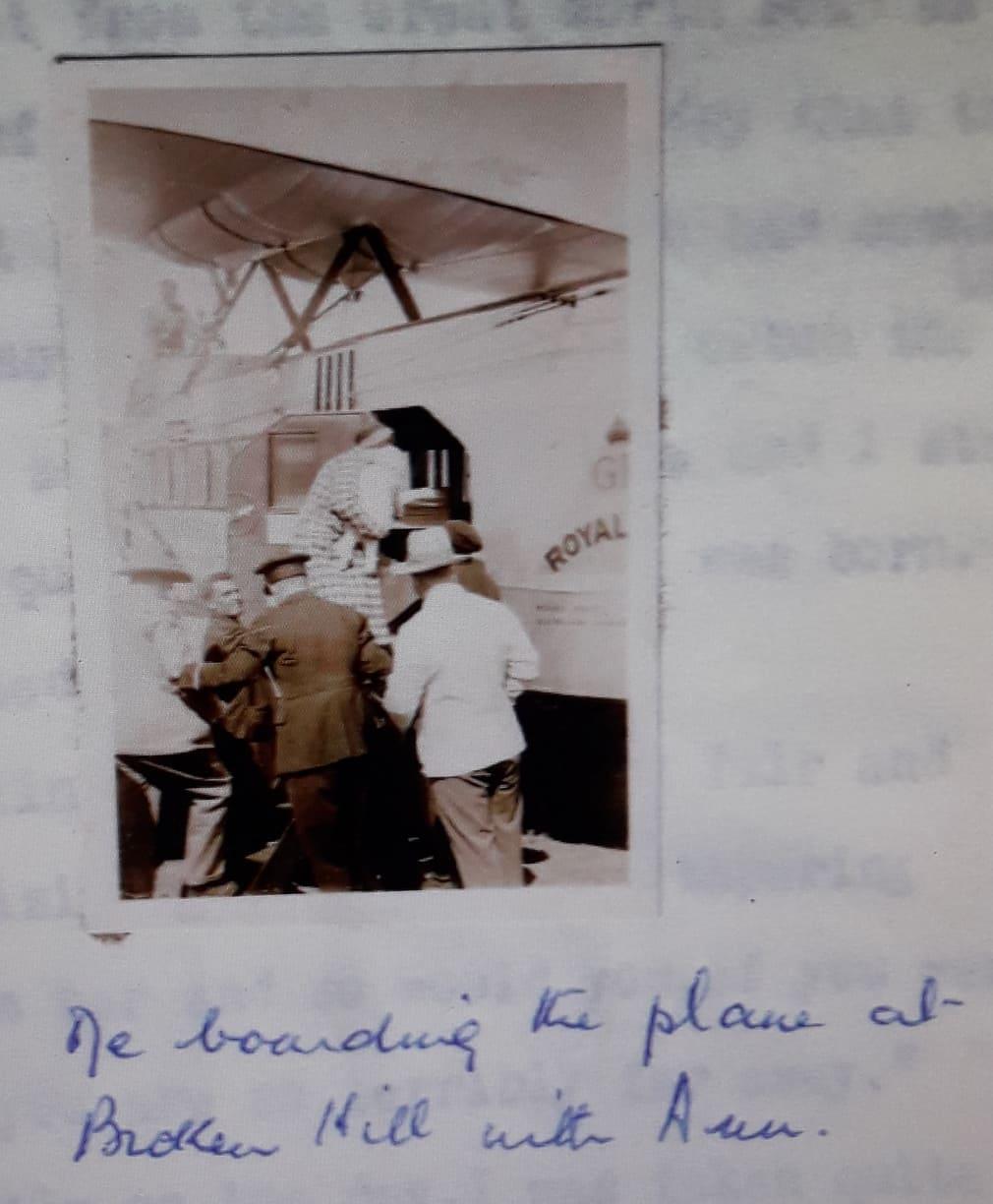
Mchewe Estate. June 15th 1932
Dearest Family,
You’ll be glad to know that we arrived quite safe and sound and very, very
happy to be home.The train Journey was uneventful. Ann slept nearly all the way.
Graham was very kind and saw to everything. He even sat with the baby whilst I went
to meals in the dining car.We were met at Broken Hill by the Thoms who had arranged accommodation for
us at the hotel for the night. They also drove us to the aerodrome in the morning where
the Airways agent told us that Ann is the first baby to travel by air on this section of the
Cape to England route. The plane trip was very bumpy indeed especially between
Broken Hill and Mpika. Everyone was ill including poor little Ann who sicked up her milk
all over the front of my new coat. I arrived at Mbeya looking a sorry caricature of Radiant
Motherhood. I must have been pale green and the baby was snow white. Under the
circumstances it was a good thing that George did not meet us. We were met instead
by Ken Menzies, the owner of the Mbeya Hotel where we spent the night. Ken was
most fatherly and kind and a good nights rest restored Ann and me to our usual robust
health.Mbeya has greatly changed. The hotel is now finished and can accommodate
fifty guests. It consists of a large main building housing a large bar and dining room and
offices and a number of small cottage bedrooms. It even has electric light. There are
several buildings out at the aerodrome and private houses going up in Mbeya.
After breakfast Ken Menzies drove us out to the farm where we had a warm
welcome from George, who looks well but rather thin. The house was spotless and the
new cook, Abel, had made light scones for tea. George had prepared all sorts of lovely
surprises. There is a new reed ceiling in the living room and a new dresser gay with
willow pattern plates which he had ordered from England. There is also a writing table
and a square table by the door for visitors hats. More personal is a lovely model ship
which George assembled from one of those Hobbie’s kits. It puts the finishing touch to
the rather old world air of our living room.In the bedroom there is a large double bed which George made himself. It has
strips of old car tyres nailed to a frame which makes a fine springy mattress and on top
of this is a thick mattress of kapok.In the kitchen there is a good wood stove which
George salvaged from a Mission dump. It looks a bit battered but works very well. The
new cook is excellent. The only blight is that he will wear rubber soled tennis shoes and
they smell awful. I daren’t hurt his feelings by pointing this out though. Opposite the
kitchen is a new laundry building containing a forty gallon hot water drum and a sink for
washing up. Lovely!George has been working very hard. He now has forty acres of coffee seedlings
planted out and has also found time to plant a rose garden and fruit trees. There are
orange and peach trees, tree tomatoes, paw paws, guavas and berries. He absolutely
adores Ann who has been very good and does not seem at all unsettled by the long
journey.It is absolutely heavenly to be back and I shall be happier than ever now that I
have a baby to play with during the long hours when George is busy on the farm,
Thank you for all your love and care during the many months I was with you. Ann
sends a special bubble for granddad.Your very loving,
Eleanor.Mchewe Estate Mbeya July 18th 1932
Dearest Family,
Ann at five months is enchanting. She is a very good baby, smiles readily and is
gaining weight steadily. She doesn’t sleep much during the day but that does not
matter, because, apart from washing her little things, I have nothing to do but attend to
her. She sleeps very well at night which is a blessing as George has to get up very
early to start work on the shamba and needs a good nights rest.
My nights are not so good, because we are having a plague of rats which frisk
around in the bedroom at night. Great big ones that come up out of the long grass in the
gorge beside the house and make cosy homes on our reed ceiling and in the thatch of
the roof.We always have a night light burning so that, if necessary, I can attend to Ann
with a minimum of fuss, and the things I see in that dim light! There are gaps between
the reeds and one night I heard, plop! and there, before my horrified gaze, lay a newly
born hairless baby rat on the floor by the bed, plop, plop! and there lay two more.
Quite dead, poor things – but what a careless mother.I have also seen rats scampering around on the tops of the mosquito nets and
sometimes we have them on our bed. They have a lovely game. They swarm down
the cord from which the mosquito net is suspended, leap onto the bed and onto the
floor. We do not have our net down now the cold season is here and there are few
mosquitoes.Last week a rat crept under Ann’s net which hung to the floor and bit her little
finger, so now I tuck the net in under the mattress though it makes it difficult for me to
attend to her at night. We shall have to get a cat somewhere. Ann’s pram has not yet
arrived so George carries her when we go walking – to her great content.
The native women around here are most interested in Ann. They come to see
her, bearing small gifts, and usually bring a child or two with them. They admire my child
and I admire theirs and there is an exchange of gifts. They produce a couple of eggs or
a few bananas or perhaps a skinny fowl and I hand over sugar, salt or soap as they
value these commodities. The most lavish gift went to the wife of Thomas our headman,
who produced twin daughters in the same week as I had Ann.Our neighbours have all been across to welcome me back and to admire the
baby. These include Marion Coster who came out to join her husband whilst I was in
South Africa. The two Hickson-Wood children came over on a fat old white donkey.
They made a pretty picture sitting astride, one behind the other – Maureen with her arms
around small Michael’s waist. A native toto led the donkey and the children’ s ayah
walked beside it.It is quite cold here now but the sun is bright and the air dry. The whole
countryside is beautifully green and we are a very happy little family.Lots and lots of love,
Eleanor.Mchewe Estate August 11th 1932
Dearest Family,
George has been very unwell for the past week. He had a nasty gash on his
knee which went septic. He had a swelling in the groin and a high temperature and could
not sleep at night for the pain in his leg. Ann was very wakeful too during the same
period, I think she is teething. I luckily have kept fit though rather harassed. Yesterday the
leg looked so inflamed that George decided to open up the wound himself. he made
quite a big cut in exactly the right place. You should have seen the blackish puss
pouring out.After he had thoroughly cleaned the wound George sewed it up himself. he has
the proper surgical needles and gut. He held the cut together with his left hand and
pushed the needle through the flesh with his right. I pulled the needle out and passed it
to George for the next stitch. I doubt whether a surgeon could have made a neater job
of it. He is still confined to the couch but today his temperature is normal. Some
husband!The previous week was hectic in another way. We had a visit from lions! George
and I were having supper about 8.30 on Tuesday night when the back verandah was
suddenly invaded by women and children from the servants quarters behind the kitchen.
They were all yelling “Simba, Simba.” – simba means lions. The door opened suddenly
and the houseboy rushed in to say that there were lions at the huts. George got up
swiftly, fetched gun and ammunition from the bedroom and with the houseboy carrying
the lamp, went off to investigate. I remained at the table, carrying on with my supper as I
felt a pioneer’s wife should! Suddenly something big leapt through the open window
behind me. You can imagine what I thought! I know now that it is quite true to say one’s
hair rises when one is scared. However it was only Kelly, our huge Irish wolfhound,
taking cover.George returned quite soon to say that apparently the commotion made by the
women and children had frightened the lions off. He found their tracks in the soft earth
round the huts and a bag of maize that had been playfully torn open but the lions had
moved on.Next day we heard that they had moved to Hickson-Wood’s shamba. Hicky
came across to say that the lions had jumped over the wall of his cattle boma and killed
both his white Muskat riding donkeys.
He and a friend sat up all next night over the remains but the lions did not return to
the kill.Apart from the little set back last week, Ann is blooming. She has a cap of very
fine fair hair and clear blue eyes under straight brow. She also has lovely dimples in both
cheeks. We are very proud of her.Our neighbours are picking coffee but the crops are small and the price is low. I
am amazed that they are so optimistic about the future. No one in these parts ever
seems to grouse though all are living on capital. They all say “Well if the worst happens
we can always go up to the Lupa Diggings.”Don’t worry about us, we have enough to tide us over for some time yet.
Much love to all,
Eleanor.Mchewe Estate. 28th Sept. 1932
Dearest Family,
News! News! I’m going to have another baby. George and I are delighted and I
hope it will be a boy this time. I shall be able to have him at Mbeya because things are
rapidly changing here. Several German families have moved to Mbeya including a
German doctor who means to build a hospital there. I expect he will make a very good
living because there must now be some hundreds of Europeans within a hundred miles
radius of Mbeya. The Europeans are mostly British or German but there are also
Greeks and, I believe, several other nationalities are represented on the Lupa Diggings.
Ann is blooming and developing according to the Book except that she has no
teeth yet! Kath Hickson-Wood has given her a very nice high chair and now she has
breakfast and lunch at the table with us. Everything within reach goes on the floor to her
amusement and my exasperation!You ask whether we have any Church of England missionaries in our part. No we
haven’t though there are Lutheran and Roman Catholic Missions. I have never even
heard of a visiting Church of England Clergyman to these parts though there are babies
in plenty who have not been baptised. Jolly good thing I had Ann Christened down
there.The R.C. priests in this area are called White Fathers. They all have beards and
wear white cassocks and sun helmets. One, called Father Keiling, calls around frequently.
Though none of us in this area is Catholic we take it in turn to put him up for the night. The
Catholic Fathers in their turn are most hospitable to travellers regardless of their beliefs.
Rather a sad thing has happened. Lucas our old chicken-boy is dead. I shall miss
his toothy smile. George went to the funeral and fired two farewell shots from his rifle
over the grave – a gesture much appreciated by the locals. Lucas in his day was a good
hunter.Several of the locals own muzzle loading guns but the majority hunt with dogs
and spears. The dogs wear bells which make an attractive jingle but I cannot bear the
idea of small antelope being run down until they are exhausted before being clubbed of
stabbed to death. We seldom eat venison as George does not care to shoot buck.
Recently though, he shot an eland and Abel rendered down the fat which is excellent for
cooking and very like beef fat.Much love to all,
Eleanor.Mchewe Estate. P.O.Mbeya 21st November 1932
Dearest Family,
George has gone off to the Lupa for a week with John Molteno. John came up
here with the idea of buying a coffee farm but he has changed his mind and now thinks of
staking some claims on the diggings and also setting up as a gold buyer.Did I tell you about his arrival here? John and George did some elephant hunting
together in French Equatorial Africa and when John heard that George had married and
settled in Tanganyika, he also decided to come up here. He drove up from Cape Town
in a Baby Austin and arrived just as our labourers were going home for the day. The little
car stopped half way up our hill and John got out to investigate. You should have heard
the astonished exclamations when John got out – all 6 ft 5 ins. of him! He towered over
the little car and even to me it seemed impossible for him to have made the long
journey in so tiny a car.Kath Wood has been over several times lately. She is slim and looks so right in
the shirt and corduroy slacks she almost always wears. She was here yesterday when
the shamba boy, digging in the front garden, unearthed a large earthenware cooking pot,
sealed at the top. I was greatly excited and had an instant mental image of fabulous
wealth. We made the boy bring the pot carefully on to the verandah and opened it in
happy anticipation. What do you think was inside? Nothing but a grinning skull! Such a
treat for a pregnant female.We have a tree growing here that had lovely straight branches covered by a
smooth bark. I got the garden boy to cut several of these branches of a uniform size,
peeled off the bark and have made Ann a playpen with the poles which are much like
broom sticks. Now I can leave her unattended when I do my chores. The other morning
after breakfast I put Ann in her playpen on the verandah and gave her a piece of toast
and honey to keep her quiet whilst I laundered a few of her things. When I looked out a
little later I was horrified to see a number of bees buzzing around her head whilst she
placidly concentrated on her toast. I made a rapid foray and rescued her but I still don’t
know whether that was the thing to do.We all send our love,
Eleanor.Mbeya Hospital. April 25th. 1933
Dearest Family,
Here I am, installed at the very new hospital, built by Dr Eckhardt, awaiting the
arrival of the new baby. George has gone back to the farm on foot but will walk in again
to spend the weekend with us. Ann is with me and enjoys the novelty of playing with
other children. The Eckhardts have two, a pretty little girl of two and a half and a very fair
roly poly boy of Ann’s age. Ann at fourteen months is very active. She is quite a little girl
now with lovely dimples. She walks well but is backward in teething.George, Ann and I had a couple of days together at the hotel before I moved in
here and several of the local women visited me and have promised to visit me in
hospital. The trip from farm to town was very entertaining if not very comfortable. There
is ten miles of very rough road between our farm and Utengule Mission and beyond the
Mission there is a fair thirteen or fourteen mile road to Mbeya.As we have no car now the doctor’s wife offered to drive us from the Mission to
Mbeya but she would not risk her car on the road between the Mission and our farm.
The upshot was that I rode in the Hickson-Woods machila for that ten mile stretch. The
machila is a canopied hammock, slung from a bamboo pole, in which I reclined, not too
comfortably in my unwieldy state, with Ann beside me or sometime straddling me. Four
of our farm boys carried the machila on their shoulders, two fore and two aft. The relief
bearers walked on either side. There must have been a dozen in all and they sang a sort
of sea shanty song as they walked. One man would sing a verse and the others took up
the chorus. They often improvise as they go. They moaned about my weight (at least
George said so! I don’t follow Ki-Swahili well yet) and expressed the hope that I would
have a son and that George would reward them handsomely.George and Kelly, the dog, followed close behind the machila and behind
George came Abel our cook and his wife and small daughter Annalie, all in their best
attire. The cook wore a palm beach suit, large Terai hat and sunglasses and two colour
shoes and quite lent a tone to the proceedings! Right at the back came the rag tag and
bobtail who joined the procession just for fun.Mrs Eckhardt was already awaiting us at the Mission when we arrived and we had
an uneventful trip to the Mbeya Hotel.During my last week at the farm I felt very tired and engaged the cook’s small
daughter, Annalie, to amuse Ann for an hour after lunch so that I could have a rest. They
played in the small verandah room which adjoins our bedroom and where I keep all my
sewing materials. One afternoon I was startled by a scream from Ann. I rushed to the
room and found Ann with blood steaming from her cheek. Annalie knelt beside her,
looking startled and frightened, with my embroidery scissors in her hand. She had cut off
half of the long curling golden lashes on one of Ann’s eyelids and, in trying to finish the
job, had cut off a triangular flap of skin off Ann’s cheek bone.I called Abel, the cook, and demanded that he should chastise his daughter there and
then and I soon heard loud shrieks from behind the kitchen. He spanked her with a
bamboo switch but I am sure not as well as she deserved. Africans are very tolerant
towards their children though I have seen husbands and wives fighting furiously.
I feel very well but long to have the confinement over.Very much love,
Eleanor.Mbeya Hospital. 2nd May 1933.
Dearest Family,
Little George arrived at 7.30 pm on Saturday evening 29 th. April. George was
with me at the time as he had walked in from the farm for news, and what a wonderful bit
of luck that was. The doctor was away on a case on the Diggings and I was bathing Ann
with George looking on, when the pains started. George dried Ann and gave her
supper and put her to bed. Afterwards he sat on the steps outside my room and a
great comfort it was to know that he was there.The confinement was short but pretty hectic. The Doctor returned to the Hospital
just in time to deliver the baby. He is a grand little boy, beautifully proportioned. The
doctor says he has never seen a better formed baby. He is however rather funny
looking just now as his head is, very temporarily, egg shaped. He has a shock of black
silky hair like a gollywog and believe it or not, he has a slight black moustache.
George came in, looked at the baby, looked at me, and we both burst out
laughing. The doctor was shocked and said so. He has no sense of humour and couldn’t
understand that we, though bursting with pride in our son, could never the less laugh at
him.Friends in Mbeya have sent me the most gorgeous flowers and my room is
transformed with delphiniums, roses and carnations. The room would be very austere
without the flowers. Curtains, bedspread and enamelware, walls and ceiling are all
snowy white.George hired a car and took Ann home next day. I have little George for
company during the day but he is removed at night. I am longing to get him home and
away from the German nurse who feeds him on black tea when he cries. She insists that
tea is a medicine and good for him.Much love from a proud mother of two.
Eleanor.Mchewe Estate 12May 1933
Dearest Family,
We are all together at home again and how lovely it feels. Even the house
servants seem pleased. The boy had decorated the lounge with sprays of
bougainvillaea and Abel had backed one of his good sponge cakes.Ann looked fat and rosy but at first was only moderately interested in me and the
new baby but she soon thawed. George is good with her and will continue to dress Ann
in the mornings and put her to bed until I am satisfied with Georgie.He, poor mite, has a nasty rash on face and neck. I am sure it is just due to that
tea the nurse used to give him at night. He has lost his moustache and is fast loosing his
wild black hair and emerging as quite a handsome babe. He is a very masculine looking
infant with much more strongly marked eyebrows and a larger nose that Ann had. He is
very good and lies quietly in his basket even when awake.George has been making a hatching box for brown trout ova and has set it up in
a small clear stream fed by a spring in readiness for the ova which is expected from
South Africa by next weeks plane. Some keen fishermen from Mbeya and the District
have clubbed together to buy the ova. The fingerlings are later to be transferred to
streams in Mbeya and Tukuyu Districts.I shall now have my hands full with the two babies and will not have much time for the
garden, or I fear, for writing very long letters. Remember though, that no matter how
large my family becomes, I shall always love you as much as ever.Your affectionate,
Eleanor.Mchewe Estate. 14th June 1933
Dearest Family,
The four of us are all well but alas we have lost our dear Kelly. He was rather a
silly dog really, although he grew so big he retained all his puppy ways but we were all
very fond of him, especially George because Kelly attached himself to George whilst I
was away having Ann and from that time on he was George’s shadow. I think he had
some form of biliary fever. He died stretched out on the living room couch late last night,
with George sitting beside him so that he would not feel alone.The children are growing fast. Georgie is a darling. He now has a fluff of pale
brown hair and his eyes are large and dark brown. Ann is very plump and fair.
We have had several visitors lately. Apart from neighbours, a car load of diggers
arrived one night and John Molteno and his bride were here. She is a very attractive girl
but, I should say, more suited to life in civilisation than in this back of beyond. She has
gone out to the diggings with her husband and will have to walk a good stretch of the fifty
or so miles.The diggers had to sleep in the living room on the couch and on hastily erected
camp beds. They arrived late at night and left after breakfast next day. One had half a
beard, the other side of his face had been forcibly shaved in the bar the night before.your affectionate,
EleanorMchewe Estate. August 10 th. 1933
Dearest Family,
George is away on safari with two Indian Army officers. The money he will get for
his services will be very welcome because this coffee growing is a slow business, and
our capitol is rapidly melting away. The job of acting as White Hunter was unexpected
or George would not have taken on the job of hatching the ova which duly arrived from
South Africa.George and the District Commissioner, David Pollock, went to meet the plane
by which the ova had been consigned but the pilot knew nothing about the package. It
came to light in the mail bag with the parcels! However the ova came to no harm. David
Pollock and George brought the parcel to the farm and carefully transferred the ova to
the hatching box. It was interesting to watch the tiny fry hatch out – a process which took
several days. Many died in the process and George removed the dead by sucking
them up in a glass tube.When hatched, the tiny fry were fed on ant eggs collected by the boys. I had to
take over the job of feeding and removing the dead when George left on safari. The fry
have to be fed every four hours, like the baby, so each time I have fed Georgie. I hurry
down to feed the trout.The children are very good but keep me busy. Ann can now say several words
and understands more. She adores Georgie. I long to show them off to you.Very much love
Eleanor.Mchewe Estate. October 27th 1933
Dear Family,
All just over flu. George and Ann were very poorly. I did not fare so badly and
Georgie came off best. He is on a bottle now.There was some excitement here last Wednesday morning. At 6.30 am. I called
for boiling water to make Georgie’s food. No water arrived but muffled shouting and the
sound of blows came from the kitchen. I went to investigate and found a fierce fight in
progress between the house boy and the kitchen boy. In my efforts to make them stop
fighting I went too close and got a sharp bang on the mouth with the edge of an
enamelled plate the kitchen boy was using as a weapon. My teeth cut my lip inside and
the plate cut it outside and blood flowed from mouth to chin. The boys were petrified.
By the time I had fed Georgie the lip was stiff and swollen. George went in wrath
to the kitchen and by breakfast time both house boy and kitchen boy had swollen faces
too. Since then I have a kettle of boiling water to hand almost before the words are out
of my mouth. I must say that the fight was because the house boy had clouted the
kitchen boy for keeping me waiting! In this land of piece work it is the job of the kitchen
boy to light the fire and boil the kettle but the houseboy’s job to carry the kettle to me.
I have seen little of Kath Wood or Marion Coster for the past two months. Major
Jones is the neighbour who calls most regularly. He has a wireless set and calls on all of
us to keep us up to date with world as well as local news. He often brings oranges for
Ann who adores him. He is a very nice person but no oil painting and makes no effort to
entertain Ann but she thinks he is fine. Perhaps his monocle appeals to her.George has bought a six foot long galvanised bath which is a great improvement
on the smaller oval one we have used until now. The smaller one had grown battered
from much use and leaks like a sieve. Fortunately our bathroom has a cement floor,
because one had to fill the bath to the brim and then bath extremely quickly to avoid
being left high and dry.Lots and lots of love,
Eleanor.Mchewe Estate. P.O. Mbeya 1st December 1933
Dearest Family,
Ann has not been well. We think she has had malaria. She has grown a good
deal lately and looks much thinner and rather pale. Georgie is thriving and has such
sparkling brown eyes and a ready smile. He and Ann make a charming pair, one so fair
and the other dark.The Moltenos’ spent a few days here and took Georgie and me to Mbeya so
that Georgie could be vaccinated. However it was an unsatisfactory trip because the
doctor had no vaccine.George went to the Lupa with the Moltenos and returned to the farm in their Baby
Austin which they have lent to us for a week. This was to enable me to go to Mbeya to
have a couple of teeth filled by a visiting dentist.We went to Mbeya in the car on Saturday. It was quite a squash with the four of
us on the front seat of the tiny car. Once George grabbed the babies foot instead of the
gear knob! We had Georgie vaccinated at the hospital and then went to the hotel where
the dentist was installed. Mr Dare, the dentist, had few instruments and they were very
tarnished. I sat uncomfortably on a kitchen chair whilst he tinkered with my teeth. He filled
three but two of the fillings came out that night. This meant another trip to Mbeya in the
Baby Austin but this time they seem all right.The weather is very hot and dry and the garden a mess. We are having trouble
with the young coffee trees too. Cut worms are killing off seedlings in the nursery and
there is a borer beetle in the planted out coffee.George bought a large grey donkey from some wandering Masai and we hope
the children will enjoy riding it later on.Very much love,
Eleanor.Mchewe Estate. 14th February 1934.
Dearest Family,
You will be sorry to hear that little Ann has been very ill, indeed we were terribly
afraid that we were going to lose her. She enjoyed her birthday on the 8th. All the toys
you, and her English granny, sent were unwrapped with such delight. However next
day she seemed listless and a bit feverish so I tucked her up in bed after lunch. I dosed
her with quinine and aspirin and she slept fitfully. At about eleven o’clock I was
awakened by a strange little cry. I turned up the night light and was horrified to see that
Ann was in a convulsion. I awakened George who, as always in an emergency, was
perfectly calm and practical. He filled the small bath with very warm water and emersed
Ann in it, placing a cold wet cloth on her head. We then wrapped her in blankets and
gave her an enema and she settled down to sleep. A few hours later we had the same
thing over again.At first light we sent a runner to Mbeya to fetch the doctor but waited all day in
vain and in the evening the runner returned to say that the doctor had gone to a case on
the diggings. Ann had been feverish all day with two or three convulsions. Neither
George or I wished to leave the bedroom, but there was Georgie to consider, and in
the afternoon I took him out in the garden for a while whilst George sat with Ann.
That night we both sat up all night and again Ann had those wretched attacks of
convulsions. George and I were worn out with anxiety by the time the doctor arrived the
next afternoon. Ann had not been able to keep down any quinine and had had only
small sips of water since the onset of the attack.The doctor at once diagnosed the trouble as malaria aggravated by teething.
George held Ann whilst the Doctor gave her an injection. At the first attempt the needle
bent into a bow, George was furious! The second attempt worked and after a few hours
Ann’s temperature dropped and though she was ill for two days afterwards she is now
up and about. She has also cut the last of her baby teeth, thank God. She looks thin and
white, but should soon pick up. It has all been a great strain to both of us. Georgie
behaved like an angel throughout. He played happily in his cot and did not seem to
sense any tension as people say, babies do. Our baby was cheerful and not at all
subdued.This is the rainy season and it is a good thing that some work has been done on
our road or the doctor might not have got through.Much love to all,
Eleanor.Mchewe Estate. 1st October 1934
Dearest Family,
We are all well now, thank goodness, but last week Georgie gave us such a
fright. I was sitting on the verandah, busy with some sewing and not watching Ann and
Georgie, who were trying to reach a bunch of bananas which hung on a rope from a
beam of the verandah. Suddenly I heard a crash, Georgie had fallen backward over the
edge of the verandah and hit the back of his head on the edge of the brick furrow which
carries away the rainwater. He lay flat on his back with his arms spread out and did not
move or cry. When I picked him up he gave a little whimper, I carried him to his cot and
bathed his face and soon he began sitting up and appeared quite normal. The trouble
began after he had vomited up his lunch. He began to whimper and bang his head
against the cot.George and I were very worried because we have no transport so we could not
take Georgie to the doctor and we could not bear to go through again what we had gone
through with Ann earlier in the year. Then, in the late afternoon, a miracle happened. Two
men George hardly knew, and complete strangers to me, called in on their way from the
diggings to Mbeya and they kindly drove Georgie and me to the hospital. The Doctor
allowed me to stay with Georgie and we spent five days there. Luckily he responded to
treatment and is now as alive as ever. Children do put years on one!There is nothing much else to report. We have a new vegetable garden which is
doing well but the earth here is strange. Gardens seem to do well for two years but by
that time the soil is exhausted and one must move the garden somewhere else. The
coffee looks well but it will be another year before we can expect even a few bags of
coffee and prices are still low. Anyway by next year George should have some good
return for all his hard work.Lots of love,
Eleanor.Mchewe Estate. November 4th 1934
Dearest Family,
George is home from his White Hunting safari looking very sunburnt and well.
The elderly American, who was his client this time, called in here at the farm to meet me
and the children. It is amazing what spirit these old lads have! This one looked as though
he should be thinking in terms of slippers and an armchair but no, he thinks in terms of
high powered rifles with telescopic sights.It is lovely being together again and the children are delighted to have their Dad
home. Things are always exciting when George is around. The day after his return
George said at breakfast, “We can’t go on like this. You and the kids never get off the
shamba. We’ll simply have to get a car.” You should have heard the excitement. “Get a
car Daddy?’” cried Ann jumping in her chair so that her plaits bounced. “Get a car
Daddy?” echoed Georgie his brown eyes sparkling. “A car,” said I startled, “However
can we afford one?”“Well,” said George, “on my way back from Safari I heard that a car is to be sold
this week at the Tukuyu Court, diseased estate or bankruptcy or something, I might get it
cheap and it is an A.C.” The name meant nothing to me, but George explained that an
A.C. is first cousin to a Rolls Royce.So off he went to the sale and next day the children and I listened all afternoon for
the sound of an approaching car. We had many false alarms but, towards evening we
heard what appeared to be the roar of an aeroplane engine. It was the A.C. roaring her
way up our steep hill with a long plume of steam waving gaily above her radiator.
Out jumped my beaming husband and in no time at all, he was showing off her
points to an admiring family. Her lines are faultless and seats though worn are most
comfortable. She has a most elegant air so what does it matter that the radiator leaks like
a sieve, her exhaust pipe has broken off, her tyres are worn almost to the canvas and
she has no windscreen. She goes, and she cost only five pounds.Next afternoon George, the kids and I piled into the car and drove along the road
on lookout for guinea fowl. All went well on the outward journey but on the homeward
one the poor A.C. simply gasped and died. So I carried the shot gun and George
carried both children and we trailed sadly home. This morning George went with a bunch
of farmhands and brought her home. Truly temperamental, she came home literally
under her own steam.George now plans to get a second hand engine and radiator for her but it won’t
be an A.C. engine. I think she is the only one of her kind in the country.
I am delighted to hear, dad, that you are sending a bridle for Joseph for
Christmas. I am busy making a saddle out of an old piece of tent canvas stuffed with
kapok, some webbing and some old rug straps. A car and a riding donkey! We’re
definitely carriage folk now.Lots of love to all,
Eleanor.Mchewe Estate. 28th December 1934
Dearest Family,
Thank you for the wonderful Christmas parcel. My frock is a splendid fit. George
declares that no one can knit socks like Mummy and the children love their toys and new
clothes.Joseph, the donkey, took his bit with an air of bored resignation and Ann now
rides proudly on his back. Joseph is a big strong animal with the looks and disposition of
a mule. he will not go at all unless a native ‘toto’ walks before him and when he does go
he wears a pained expression as though he were carrying fourteen stone instead of
Ann’s fly weight. I walk beside the donkey carrying Georgie and our cat, ‘Skinny Winnie’,
follows behind. Quite a cavalcade. The other day I got so exasperated with Joseph that
I took Ann off and I got on. Joseph tottered a few paces and sat down! to the huge
delight of our farm labourers who were going home from work. Anyway, one good thing,
the donkey is so lazy that there is little chance of him bolting with Ann.The Moltenos spent Christmas with us and left for the Lupa Diggings yesterday.
They arrived on the 22nd. with gifts for the children and chocolates and beer. That very
afternoon George and John Molteno left for Ivuna, near Lake Ruckwa, to shoot some
guinea fowl and perhaps a goose for our Christmas dinner. We expected the menfolk
back on Christmas Eve and Anne and I spent a busy day making mince pies and
sausage rolls. Why I don’t know, because I am sure Abel could have made them better.
We decorated the Christmas tree and sat up very late but no husbands turned up.
Christmas day passed but still no husbands came. Anne, like me, is expecting a baby
and we both felt pretty forlorn and cross. Anne was certain that they had been caught up
in a party somewhere and had forgotten all about us and I must say when Boxing Day
went by and still George and John did not show up I felt ready to agree with her.
They turned up towards evening and explained that on the homeward trip the car
had bogged down in the mud and that they had spent a miserable Christmas. Anne
refused to believe their story so George, to prove their case, got the game bag and
tipped the contents on to the dining room table. Out fell several guinea fowl, long past
being edible, followed by a large goose so high that it was green and blue where all the
feathers had rotted off.The stench was too much for two pregnant girls. I shot out of the front door
closely followed by Anne and we were both sick in the garden.I could not face food that evening but Anne is made of stronger stuff and ate her
belated Christmas dinner with relish.I am looking forward enormously to having Marjorie here with us. She will be able
to carry back to you an eyewitness account of our home and way of life.Much love to you all,
Eleanor.Mchewe Estate. 5th January 1935
Dearest Family,
You cannot imagine how lovely it is to have Marjorie here. She came just in time
because I have had pernicious vomiting and have lost a great deal of weight and she
took charge of the children and made me spend three days in hospital having treatment.
George took me to the hospital on the afternoon of New Years Eve and decided
to spend the night at the hotel and join in the New Years Eve celebrations. I had several
visitors at the hospital that evening and George actually managed to get some imported
grapes for me. He returned to the farm next morning and fetched me from the hospital
four days later. Of course the old A.C. just had to play up. About half way home the
back axle gave in and we had to send a passing native some miles back to a place
called Mbalizi to hire a lorry from a Greek trader to tow us home to the farm.
The children looked well and were full of beans. I think Marjorie was thankful to
hand them over to me. She is delighted with Ann’s motherly little ways but Georgie she
calls “a really wild child”. He isn’t, just has such an astonishing amount of energy and is
always up to mischief. Marjorie brought us all lovely presents. I am so thrilled with my
sewing machine. It may be an old model but it sews marvellously. We now have an
Alsatian pup as well as Joseph the donkey and the two cats.Marjorie had a midnight encounter with Joseph which gave her quite a shock but
we had a good laugh about it next day. Some months ago George replaced our wattle
and daub outside pit lavatory by a substantial brick one, so large that Joseph is being
temporarily stabled in it at night. We neglected to warn Marj about this and one night,
storm lamp in hand, she opened the door and Joseph walked out braying his thanks.
I am afraid Marjorie is having a quiet time, a shame when the journey from Cape
Town is so expensive. The doctor has told me to rest as much as I can, so it is
impossible for us to take Marj on sight seeing trips.I hate to think that she will be leaving in ten days time.
Much love,
Eleanor.Mchewe Estate. 18th February 1935
Dearest Family,
You must be able to visualise our life here quite well now that Marj is back and
has no doubt filled in all the details I forget to mention in my letters. What a journey we
had in the A.C. when we took her to the plane. George, the children and I sat in front and
Marj sat behind with numerous four gallon tins of water for the insatiable radiator. It was
raining and the canvas hood was up but part of the side flaps are missing and as there is
no glass in the windscreen the rain blew in on us. George got fed up with constantly
removing the hot radiator cap so simply stuffed a bit of rag in instead. When enough
steam had built up in the radiator behind the rag it blew out and we started all over again.
The car still roars like an aeroplane engine and yet has little power so that George sent
gangs of boys to the steep hills between the farm and the Mission to give us a push if
necessary. Fortunately this time it was not, and the boys cheered us on our way. We
needed their help on the homeward journey however.George has now bought an old Chev engine which he means to install before I
have to go to hospital to have my new baby. It will be quite an engineering feet as
George has few tools.I am sorry to say that I am still not well, something to do with kidneys or bladder.
George bought me some pills from one of the several small shops which have opened
in Mbeya and Ann is most interested in the result. She said seriously to Kath Wood,
“Oh my Mummy is a very clever Mummy. She can do blue wee and green wee as well
as yellow wee.” I simply can no longer manage the children without help and have
engaged the cook’s wife, Janey, to help. The children are by no means thrilled. I plead in
vain that I am not well enough to go for walks. Ann says firmly, “Ann doesn’t want to go
for a walk. Ann will look after you.” Funny, though she speaks well for a three year old,
she never uses the first person. Georgie say he would much rather walk with
Keshokutwa, the kitchen boy. His name by the way, means day-after-tomorrow and it
suits him down to the ground, Kath Wood walks over sometimes with offers of help and Ann will gladly go walking with her but Georgie won’t. He on the other hand will walk with Anne Molteno
and Ann won’t. They are obstinate kids. Ann has developed a very fertile imagination.
She has probably been looking at too many of those nice women’s magazines you
sent. A few days ago she said, “You are sick Mummy, but Ann’s got another Mummy.
She’s not sick, and my other mummy (very smugly) has lovely golden hair”. This
morning’ not ten minutes after I had dressed her, she came in with her frock wet and
muddy. I said in exasperation, “Oh Ann, you are naughty.” To which she instantly
returned, “My other Mummy doesn’t think I am naughty. She thinks I am very nice.” It
strikes me I shall have to get better soon so that I can be gay once more and compete
with that phantom golden haired paragon.We had a very heavy storm over the farm last week. There was heavy rain with
hail which stripped some of the coffee trees and the Mchewe River flooded and the
water swept through the lower part of the shamba. After the water had receded George
picked up a fine young trout which had been stranded. This was one of some he had
put into the river when Georgie was a few months old.The trials of a coffee farmer are legion. We now have a plague of snails. They
ring bark the young trees and leave trails of slime on the glossy leaves. All the ring
barked trees will have to be cut right back and this is heartbreaking as they are bearing
berries for the first time. The snails are collected by native children, piled upon the
ground and bashed to a pulp which gives off a sickening stench. I am sorry for the local
Africans. Locusts ate up their maize and now they are losing their bean crop to the snails.Lots of love, Eleanor
January 28, 2022 at 1:10 pm #6260In reply to: The Elusive Samuel Housley and Other Family Stories
From Tanganyika with Love
With thanks to Mike Rushby.
- “The letters of Eleanor Dunbar Leslie to her parents and her sister in South Africa
concerning her life with George Gilman Rushby of Tanganyika, and the trials and
joys of bringing up a family in pioneering conditions.
These letters were transcribed from copies of letters typed by Eleanor Rushby from
the originals which were in the estate of Marjorie Leslie, Eleanor’s sister. Eleanor
kept no diary of her life in Tanganyika, so these letters were the living record of an
important part of her life.Prelude
Having walked across Africa from the East coast to Ubangi Shauri Chad
in French Equatorial Africa, hunting elephant all the way, George Rushby
made his way down the Congo to Leopoldville. He then caught a ship to
Europe and had a holiday in Brussels and Paris before visiting his family
in England. He developed blackwater fever and was extremely ill for a
while. When he recovered he went to London to arrange his return to
Africa.Whilst staying at the Overseas Club he met Eileen Graham who had come
to England from Cape Town to study music. On hearing that George was
sailing for Cape Town she arranged to introduce him to her friend
Eleanor Dunbar Leslie. “You’ll need someone lively to show you around,”
she said. “She’s as smart as paint, a keen mountaineer, a very good school
teacher, and she’s attractive. You can’t miss her, because her father is a
well known Cape Town Magistrate. And,” she added “I’ve already written
and told her what ship you are arriving on.”Eleanor duly met the ship. She and George immediately fell in love.
Within thirty six hours he had proposed marriage and was accepted
despite the misgivings of her parents. As she was under contract to her
High School, she remained in South Africa for several months whilst
George headed for Tanganyika looking for a farm where he could build
their home.These details are a summary of chapter thirteen of the Biography of
George Gilman Rushby ‘The Hunter is Death “ by T.V.Bulpin.Dearest Marj,
Terrifically exciting news! I’ve just become engaged to an Englishman whom I
met last Monday. The result is a family upheaval which you will have no difficulty in
imagining!!The Aunts think it all highly romantic and cry in delight “Now isn’t that just like our
El!” Mummy says she doesn’t know what to think, that anyway I was always a harum
scarum and she rather expected something like this to happen. However I know that
she thinks George highly attractive. “Such a nice smile and gentle manner, and such
good hands“ she murmurs appreciatively. “But WHY AN ELEPHANT HUNTER?” she
ends in a wail, as though elephant hunting was an unmentionable profession.
Anyway I don’t think so. Anyone can marry a bank clerk or a lawyer or even a
millionaire – but whoever heard of anyone marrying anyone as exciting as an elephant
hunter? I’m thrilled to bits.Daddy also takes a dim view of George’s profession, and of George himself as
a husband for me. He says that I am so impulsive and have such wild enthusiasms that I
need someone conservative and steady to give me some serenity and some ballast.
Dad says George is a handsome fellow and a good enough chap he is sure, but
he is obviously a man of the world and hints darkly at a possible PAST. George says
he has nothing of the kind and anyway I’m the first girl he has asked to marry him. I don’t
care anyway, I’d gladly marry him tomorrow, but Dad has other ideas.He sat in his armchair to deliver his verdict, wearing the same look he must wear
on the bench. If we marry, and he doesn’t think it would be a good thing, George must
buy a comfortable house for me in Central Africa where I can stay safely when he goes
hunting. I interrupted to say “But I’m going too”, but dad snubbed me saying that in no
time at all I’ll have a family and one can’t go dragging babies around in the African Bush.”
George takes his lectures with surprising calm. He says he can see Dad’s point of
view much better than I can. He told the parents today that he plans to buy a small
coffee farm in the Southern Highlands of Tanganyika and will build a cosy cottage which
will be a proper home for both of us, and that he will only hunt occasionally to keep the
pot boiling.Mummy, of course, just had to spill the beans. She said to George, “I suppose
you know that Eleanor knows very little about house keeping and can’t cook at all.” a fact
that I was keeping a dark secret. But George just said, “Oh she won’t have to work. The
boys do all that sort of thing. She can lie on a couch all day and read if she likes.” Well
you always did say that I was a “Lily of the field,” and what a good thing! If I were one of
those terribly capable women I’d probably die of frustration because it seems that
African house boys feel that they have lost face if their Memsahibs do anything but the
most gracious chores.George is absolutely marvellous. He is strong and gentle and awfully good
looking too. He is about 5 ft 10 ins tall and very broad. He wears his curly brown hair cut
very short and has a close clipped moustache. He has strongly marked eyebrows and
very striking blue eyes which sometimes turn grey or green. His teeth are strong and
even and he has a quiet voice.I expect all this sounds too good to be true, but come home quickly and see for
yourself. George is off to East Africa in three weeks time to buy our farm. I shall follow as
soon as he has bought it and we will be married in Dar es Salaam.Dad has taken George for a walk “to get to know him” and that’s why I have time
to write such a long screed. They should be back any minute now and I must fly and
apply a bit of glamour.Much love my dear,
your jubilant
EleanorS.S.Timavo. Durban. 28th.October. 1930.
Dearest Family,
Thank you for the lovely send off. I do wish you were all on board with me and
could come and dance with me at my wedding. We are having a very comfortable
voyage. There were only four of the passengers as far as Durban, all of them women,
but I believe we are taking on more here. I have a most comfortable deck cabin to
myself and the use of a sumptuous bathroom. No one is interested in deck games and I
am having a lazy time, just sunbathing and reading.I sit at the Captain’s table and the meals are delicious – beautifully served. The
butter for instance, is moulded into sprays of roses, most exquisitely done, and as for
the ice-cream, I’ve never tasted anything like them.The meals are continental type and we have hors d’oeuvre in a great variety
served on large round trays. The Italians souse theirs with oil, Ugh! We also of course
get lots of spaghetti which I have some difficulty in eating. However this presents no
problem to the Chief Engineer who sits opposite to me. He simply rolls it around his
fork and somehow the spaghetti flows effortlessly from fork to mouth exactly like an
ascending escalator. Wine is served at lunch and dinner – very mild and pleasant stuff.
Of the women passengers the one i liked best was a young German widow
from South west Africa who left the ship at East London to marry a man she had never
met. She told me he owned a drapers shop and she was very happy at the prospect
of starting a new life, as her previous marriage had ended tragically with the death of her
husband and only child in an accident.I was most interested to see the bridegroom and stood at the rail beside the gay
young widow when we docked at East London. I picked him out, without any difficulty,
from the small group on the quay. He was a tall thin man in a smart grey suit and with a
grey hat perched primly on his head. You can always tell from hats can’t you? I wasn’t
surprised to see, when this German raised his head, that he looked just like the Kaiser’s
“Little Willie”. Long thin nose and cold grey eyes and no smile of welcome on his tight
mouth for the cheery little body beside me. I quite expected him to jerk his thumb and
stalk off, expecting her to trot at his heel.However she went off blithely enough. Next day before the ship sailed, she
was back and I saw her talking to the Captain. She began to cry and soon after the
Captain patted her on the shoulder and escorted her to the gangway. Later the Captain
told me that the girl had come to ask him to allow her to work her passage back to
Germany where she had some relations. She had married the man the day before but
she disliked him because he had deceived her by pretending that he owned a shop
whereas he was only a window dresser. Bad show for both.The Captain and the Chief Engineer are the only officers who mix socially with
the passengers. The captain seems rather a melancholy type with, I should say, no
sense of humour. He speaks fair English with an American accent. He tells me that he
was on the San Francisco run during Prohibition years in America and saw many Film
Stars chiefly “under the influence” as they used to flock on board to drink. The Chief
Engineer is big and fat and cheerful. His English is anything but fluent but he makes up
for it in mime.I visited the relations and friends at Port Elizabeth and East London, and here at
Durban. I stayed with the Trotters and Swans and enjoyed myself very much at both
places. I have collected numerous wedding presents, china and cutlery, coffee
percolator and ornaments, and where I shall pack all these things I don’t know. Everyone has been terribly kind and I feel extremely well and happy.At the start of the voyage I had a bit of bad luck. You will remember that a
perfectly foul South Easter was blowing. Some men were busy working on a deck
engine and I stopped to watch and a tiny fragment of steel blew into my eye. There is
no doctor on board so the stewardess put some oil into the eye and bandaged it up.
The eye grew more and more painful and inflamed and when when we reached Port
Elizabeth the Captain asked the Port Doctor to look at it. The Doctor said it was a job for
an eye specialist and telephoned from the ship to make an appointment. Luckily for me,
Vincent Tofts turned up at the ship just then and took me off to the specialist and waited
whilst he extracted the fragment with a giant magnet. The specialist said that I was very
lucky as the thing just missed the pupil of my eye so my sight will not be affected. I was
temporarily blinded by the Belladona the eye-man put in my eye so he fitted me with a
pair of black goggles and Vincent escorted me back to the ship. Don’t worry the eye is
now as good as ever and George will not have to take a one-eyed bride for better or
worse.I have one worry and that is that the ship is going to be very much overdue by
the time we reach Dar es Salaam. She is taking on a big wool cargo and we were held
up for three days in East london and have been here in Durban for five days.
Today is the ninth Anniversary of the Fascist Movement and the ship was
dressed with bunting and flags. I must now go and dress for the gala dinner.Bless you all,
Eleanor.S.S.Timavo. 6th. November 1930
Dearest Family,
Nearly there now. We called in at Lourenco Marques, Beira, Mozambique and
Port Amelia. I was the only one of the original passengers left after Durban but there we
took on a Mrs Croxford and her mother and two men passengers. Mrs C must have
something, certainly not looks. She has a flat figure, heavily mascared eyes and crooked
mouth thickly coated with lipstick. But her rather sweet old mother-black-pearls-type tells
me they are worn out travelling around the world trying to shake off an admirer who
pursues Mrs C everywhere.The one male passenger is very quiet and pleasant. The old lady tells me that he
has recently lost his wife. The other passenger is a horribly bumptious type.
I had my hair beautifully shingled at Lourenco Marques, but what an experience it
was. Before we docked I asked the Captain whether he knew of a hairdresser, but he
said he did not and would have to ask the agent when he came aboard. The agent was
a very suave Asian. He said “Sure he did” and offered to take me in his car. I rather
doubtfully agreed — such a swarthy gentleman — and was driven, not to a hairdressing
establishment, but to his office. Then he spoke to someone on the telephone and in no
time at all a most dago-y type arrived carrying a little black bag. He was all patent
leather, hair, and flashing smile, and greeted me like an old and valued friend.
Before I had collected my scattered wits tthe Agent had flung open a door and
ushered me through, and I found myself seated before an ornate mirror in what was only
too obviously a bedroom. It was a bedroom with a difference though. The unmade bed
had no legs but hung from the ceiling on brass chains.The agent beamingly shut the door behind him and I was left with my imagination
and the afore mentioned oily hairdresser. He however was very business like. Before I
could say knife he had shingled my hair with a cut throat razor and then, before I could
protest, had smothered my neck in stinking pink powder applied with an enormous and
filthy swansdown powder puff. He held up a mirror for me to admire his handiwork but I
was aware only of the enormous bed reflected in it, and hurriedly murmuring “very nice,
very nice” I made my escape to the outer office where, to my relief, I found the Chief
Engineer who escorted me back to the ship.In the afternoon Mrs Coxford and the old lady and I hired a taxi and went to the
Polana Hotel for tea. Very swish but I like our Cape Peninsula beaches better.
At Lorenco Marques we took on more passengers. The Governor of
Portuguese Nyasaland and his wife and baby son. He was a large middle aged man,
very friendly and unassuming and spoke perfect English. His wife was German and
exquisite, as fragile looking and with the delicate colouring of a Dresden figurine. She
looked about 18 but she told me she was 28 and showed me photographs of two
other sons – hefty youngsters, whom she had left behind in Portugal and was missing
very much.It was frightfully hot at Beira and as I had no money left I did not go up to the
town, but Mrs Croxford and I spent a pleasant hour on the beach under the Casurina
trees.The Governor and his wife left the ship at Mozambique. He looked very
imposing in his starched uniform and she more Dresden Sheperdish than ever in a
flowered frock. There was a guard of honour and all the trimmings. They bade me a warm farewell and invited George and me to stay at any time.The German ship “Watussi” was anchored in the Bay and I decided to visit her
and try and have my hair washed and set. I had no sooner stepped on board when a
lady came up to me and said “Surely you are Beeba Leslie.” It was Mrs Egan and she
had Molly with her. Considering Mrs Egan had not seen me since I was five I think it was
jolly clever of her to recognise me. Molly is charming and was most friendly. She fixed
things with the hairdresser and sat with me until the job was done. Afterwards I had tea
with them.Port Amelia was our last stop. In fact the only person to go ashore was Mr
Taylor, the unpleasant man, and he returned at sunset very drunk indeed.
We reached Port Amelia on the 3rd – my birthday. The boat had anchored by
the time I was dressed and when I went on deck I saw several row boats cluttered
around the gangway and in them were natives with cages of wild birds for sale. Such tiny
crowded cages. I was furious, you know me. I bought three cages, carried them out on
to the open deck and released the birds. I expected them to fly to the land but they flew
straight up into the rigging.The quiet male passenger wandered up and asked me what I was doing. I said
“I’m giving myself a birthday treat, I hate to see caged birds.” So next thing there he
was buying birds which he presented to me with “Happy Birthday.” I gladly set those
birds free too and they joined the others in the rigging.Then a grinning steward came up with three more cages. “For the lady with
compliments of the Captain.” They lost no time in joining their friends.
It had given me so much pleasure to free the birds that I was only a little
discouraged when the quiet man said thoughtfully “This should encourage those bird
catchers you know, they are sold out. When evening came and we were due to sail I
was sure those birds would fly home, but no, they are still there and they will probably
remain until we dock at Dar es Salaam.During the morning the Captain came up and asked me what my Christian name
is. He looked as grave as ever and I couldn’t think why it should interest him but said “the
name is Eleanor.” That night at dinner there was a large iced cake in the centre of the
table with “HELENA” in a delicate wreath of pink icing roses on the top. We had
champagne and everyone congratulated me and wished me good luck in my marriage.
A very nice gesture don’t you think. The unpleasant character had not put in an
appearance at dinner which made the party all the nicerI sat up rather late in the lounge reading a book and by the time I went to bed
there was not a soul around. I bathed and changed into my nighty,walked into my cabin,
shed my dressing gown, and pottered around. When I was ready for bed I put out my
hand to draw the curtains back and a hand grasped my wrist. It was that wretched
creature outside my window on the deck, still very drunk. Luckily I was wearing that
heavy lilac silk nighty. I was livid. “Let go at once”, I said, but he only grinned stupidly.
“I’m not hurting you” he said, “only looking”. “I’ll ring for the steward” said I, and by
stretching I managed to press the bell with my free hand. I rang and rang but no one
came and he just giggled. Then I said furiously, “Remember this name, George
Rushby, he is a fine boxer and he hates specimens like you. When he meets me at Dar
es Salaam I shall tell him about this and I bet you will be sorry.” However he still held on
so I turned and knocked hard on the adjoining wall which divided my cabin from Mrs
Croxfords. Soon Mrs Croxford and the old lady appeared in dressing gowns . This
seemed to amuse the drunk even more though he let go my wrist. So whilst the old
lady stayed with me, Mrs C fetched the quiet passenger who soon hustled him off. He has kept out of my way ever since. However I still mean to tell George because I feel
the fellow got off far too lightly. I reported the matter to the Captain but he just remarked
that he always knew the man was low class because he never wears a jacket to meals.
This is my last night on board and we again had free champagne and I was given
some tooled leather work by the Captain and a pair of good paste earrings by the old
lady. I have invited them and Mrs Croxford, the Chief Engineer, and the quiet
passenger to the wedding.This may be my last night as Eleanor Leslie and I have spent this long while
writing to you just as a little token of my affection and gratitude for all the years of your
love and care. I shall post this letter on the ship and must turn now and get some beauty
sleep. We have been told that we shall be in Dar es Salaam by 9 am. I am so excited
that I shall not sleep.Very much love, and just for fun I’ll sign my full name for the last time.
with my “bes respeks”,Eleanor Leslie.
Eleanor and George Rushby:
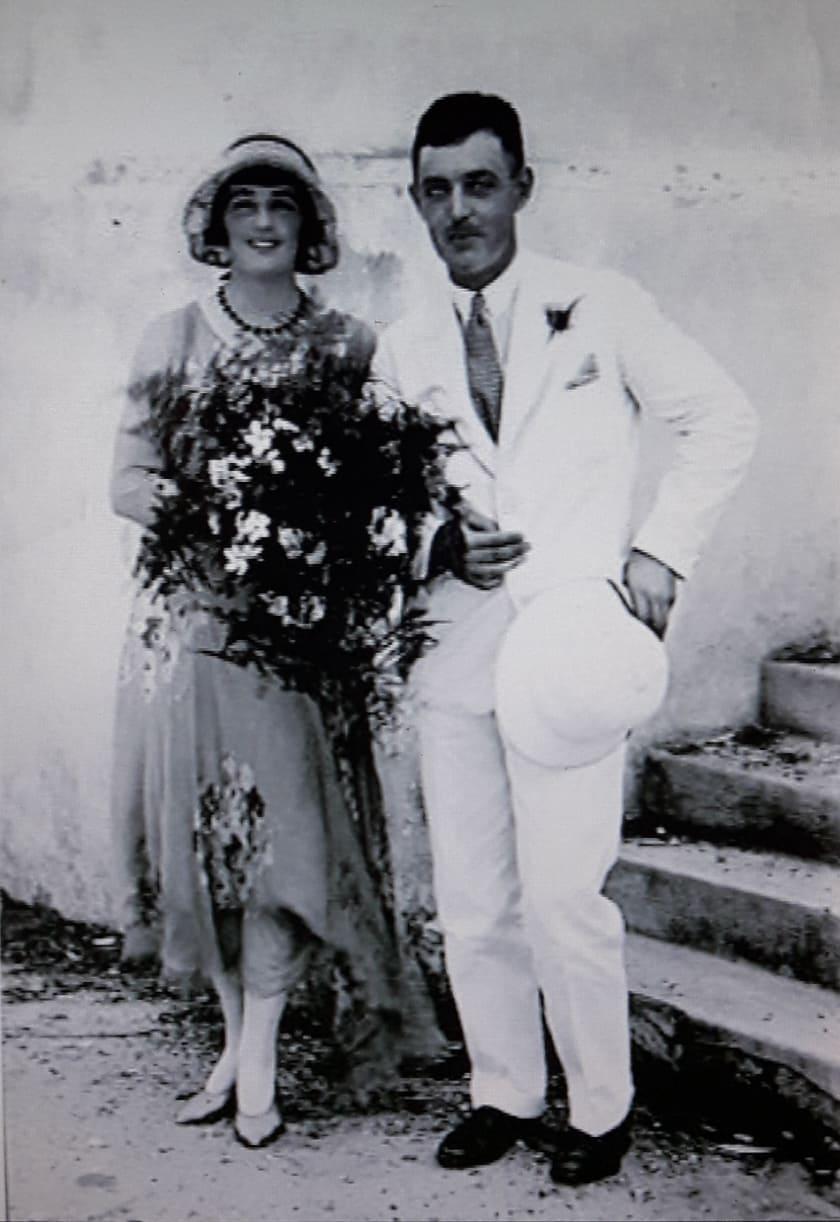
Splendid Hotel, Dar es Salaam 11th November 1930
Dearest Family,
I’m writing this in the bedroom whilst George is out buying a tin trunk in which to
pack all our wedding presents. I expect he will be gone a long time because he has
gone out with Hicky Wood and, though our wedding was four days ago, it’s still an
excuse for a party. People are all very cheery and friendly here.
I am wearing only pants and slip but am still hot. One swelters here in the
mornings, but a fresh sea breeze blows in the late afternoons and then Dar es Salaam is
heavenly.We arrived in Dar es Salaam harbour very early on Friday morning (7 th Nov).
The previous night the Captain had said we might not reach Dar. until 9 am, and certainly
no one would be allowed on board before 8 am. So I dawdled on the deck in my
dressing gown and watched the green coastline and the islands slipping by. I stood on
the deck outside my cabin and was not aware that I was looking out at the wrong side of
the landlocked harbour. Quite unknown to me George and some friends, the Hickson
Woods, were standing on the Gymkhana Beach on the opposite side of the channel
anxiously scanning the ship for a sign of me. George says he had a horrible idea I had
missed the ship. Blissfully unconscious of his anxiety I wandered into the bathroom
prepared for a good soak. The anchor went down when I was in the bath and suddenly
there was a sharp wrap on the door and I heard Mrs Croxford say “There’s a man in a
boat outside. He is looking out for someone and I’m sure it’s your George. I flung on
some clothes and rushed on deck with tousled hair and bare feet and it was George.
We had a marvellous reunion. George was wearing shorts and bush shirt and
looked just like the strong silent types one reads about in novels. I finished dressing then
George helped me bundle all the wedding presents I had collected en route into my
travelling rug and we went into the bar lounge to join the Hickson Woods. They are the
couple from whom George bought the land which is to be our coffee farm Hicky-Wood
was laughing when we joined them. he said he had called a chap to bring a couple of
beers thinking he was the steward but it turned out to be the Captain. He does wear
such a very plain uniform that I suppose it was easy to make the mistake, but Hicky
says he was not amused.Anyway as the H-W’s are to be our neighbours I’d better describe them. Kath
Wood is very attractive, dark Irish, with curly black hair and big brown eyes. She was
married before to Viv Lumb a great friend of George’s who died some years ago of
blackwater fever. They had one little girl, Maureen, and Kath and Hicky have a small son
of three called Michael. Hicky is slightly below average height and very neat and dapper
though well built. He is a great one for a party and good fun but George says he can be
bad tempered.Anyway we all filed off the ship and Hicky and Cath went on to the hotel whilst
George and I went through customs. Passing the customs was easy. Everyone
seemed to know George and that it was his wedding day and I just sailed through,
except for the little matter of the rug coming undone when George and I had to scramble
on the floor for candlesticks and fruit knives and a wooden nut bowl.
Outside the customs shed we were mobbed by a crowd of jabbering Africans
offering their services as porters, and soon my luggage was piled in one rickshaw whilst
George and I climbed into another and we were born smoothly away on rubber shod
wheels to the Splendid Hotel. The motion was pleasing enough but it seemed weird to
be pulled along by one human being whilst another pushed behind. We turned up a street called Acacia Avenue which, as its name implies, is lined
with flamboyant acacia trees now in the full glory of scarlet and gold. The rickshaw
stopped before the Splendid Hotel and I was taken upstairs into a pleasant room which
had its own private balcony overlooking the busy street.Here George broke the news that we were to be married in less than an hours
time. He would have to dash off and change and then go straight to the church. I would
be quite all right, Kath would be looking in and friends would fetch me.
I started to dress and soon there was a tap at the door and Mrs Hickson-Wood
came in with my bouquet. It was a lovely bunch of carnations and frangipani with lots of
asparagus fern and it went well with my primrose yellow frock. She admired my frock
and Leghorn hat and told me that her little girl Maureen was to be my flower girl. Then
she too left for the church.I was fully dressed when there was another knock on the door and I opened it to
be confronted by a Police Officer in a starched white uniform. I’m McCallum”, he said,
“I’ve come to drive you to the church.” Downstairs he introduced me to a big man in a
tussore silk suit. “This is Dr Shicore”, said McCallum, “He is going to give you away.”
Honestly, I felt exactly like Alice in Wonderland. Wouldn’t have been at all surprised if
the White Rabbit had popped up and said he was going to be my page.I walked out of the hotel and across the pavement in a dream and there, by the
curb, was a big dark blue police car decorated with white ribbons and with a tall African
Police Ascari holding the door open for me. I had hardly time to wonder what next when
the car drew up before a tall German looking church. It was in fact the Lutheran Church in
the days when Tanganyika was German East Africa.Mrs Hickson-Wood, very smart in mushroom coloured georgette and lace, and
her small daughter were waiting in the porch, so in we went. I was glad to notice my
friends from the boat sitting behind George’s friends who were all complete strangers to
me. The aisle seemed very long but at last I reached George waiting in the chancel with
Hicky-Wood, looking unfamiliar in a smart tussore suit. However this feeling of unreality
passed when he turned his head and smiled at me.In the vestry after the ceremony I was kissed affectionately by several complete
strangers and I felt happy and accepted by George’s friends. Outside the church,
standing apart from the rest of the guests, the Italian Captain and Chief Engineer were
waiting. They came up and kissed my hand, and murmured felicitations, but regretted
they could not spare the time to come to the reception. Really it was just as well
because they would not have fitted in at all well.Dr Shircore is the Director of Medical Services and he had very kindly lent his
large house for the reception. It was quite a party. The guests were mainly men with a
small sprinkling of wives. Champagne corks popped and there was an enormous cake
and soon voices were raised in song. The chief one was ‘Happy Days Are Here Again’
and I shall remember it for ever.The party was still in full swing when George and I left. The old lady from the ship
enjoyed it hugely. She came in an all black outfit with a corsage of artificial Lily-of-the-
Valley. Later I saw one of the men wearing the corsage in his buttonhole and the old
lady was wearing a carnation.When George and I got back to the hotel,I found that my luggage had been
moved to George’s room by his cook Lamek, who was squatting on his haunches and
clapped his hands in greeting. My dears, you should see Lamek – exactly like a
chimpanzee – receding forehead, wide flat nose, and long lip, and such splayed feet. It was quite a strain not to laugh, especially when he produced a gift for me. I have not yet
discovered where he acquired it. It was a faded mauve straw toque of the kind worn by
Queen Mary. I asked George to tell Lamek that I was touched by his generosity but felt
that I could not accept his gift. He did not mind at all especially as George gave him a
generous tip there and then.I changed into a cotton frock and shady straw hat and George changed into shorts
and bush shirt once more. We then sneaked into the dining room for lunch avoiding our
wedding guests who were carrying on the party in the lounge.After lunch we rejoined them and they all came down to the jetty to wave goodbye
as we set out by motor launch for Honeymoon Island. I enjoyed the launch trip very
much. The sea was calm and very blue and the palm fringed beaches of Dar es Salaam
are as romantic as any bride could wish. There are small coral islands dotted around the
Bay of which Honeymoon Island is the loveliest. I believe at one time it bore the less
romantic name of Quarantine Island. Near the Island, in the shallows, the sea is brilliant
green and I saw two pink jellyfish drifting by.There is no jetty on the island so the boat was stopped in shallow water and
George carried me ashore. I was enchanted with the Island and in no hurry to go to the
bungalow, so George and I took our bathing costumes from our suitcases and sent the
luggage up to the house together with a box of provisions.We bathed and lazed on the beach and suddenly it was sunset and it began to
get dark. We walked up the beach to the bungalow and began to unpack the stores,
tea, sugar, condensed milk, bread and butter, sardines and a large tin of ham. There
were also cups and saucers and plates and cutlery.We decided to have an early meal and George called out to the caretaker, “Boy
letta chai”. Thereupon the ‘boy’ materialised and jabbered to George in Ki-Swaheli. It
appeared he had no utensil in which to boil water. George, ever resourceful, removed
the ham from the tin and gave him that. We had our tea all right but next day the ham
was bad.Then came bed time. I took a hurricane lamp in one hand and my suitcase in the
other and wandered into the bedroom whilst George vanished into the bathroom. To
my astonishment I saw two perfectly bare iron bedsteads – no mattress or pillows. We
had brought sheets and mosquito nets but, believe me, they are a poor substitute for a
mattress.Anyway I arrayed myself in my pale yellow satin nightie and sat gingerly down
on the iron edge of the bed to await my groom who eventually appeared in a
handsome suit of silk pyjamas. His expression, as he took in the situation, was too much
for me and I burst out laughing and so did he.Somewhere in the small hours I woke up. The breeze had dropped and the
room was unbearably stuffy. I felt as dry as a bone. The lamp had been turned very
low and had gone out, but I remembered seeing a water tank in the yard and I decided
to go out in the dark and drink from the tap. In the dark I could not find my slippers so I
slipped my feet into George’s shoes, picked up his matches and groped my way out
of the room. I found the tank all right and with one hand on the tap and one cupped for
water I stooped to drink. Just then I heard a scratchy noise and sensed movements
around my feet. I struck a match and oh horrors! found that the damp spot on which I was
standing was alive with white crabs. In my hurry to escape I took a clumsy step, put
George’s big toe on the hem of my nightie and down I went on top of the crabs. I need
hardly say that George was awakened by an appalling shriek and came rushing to my
aid like a knight of old. Anyway, alarms and excursions not withstanding, we had a wonderful weekend on the island and I was sorry to return to the heat of Dar es Salaam, though the evenings
here are lovely and it is heavenly driving along the coast road by car or in a rickshaw.
I was surprised to find so many Indians here. Most of the shops, large and small,
seem to be owned by Indians and the place teems with them. The women wear
colourful saris and their hair in long black plaits reaching to their waists. Many wear baggy
trousers of silk or satin. They give a carnival air to the sea front towards sunset.
This long letter has been written in instalments throughout the day. My first break
was when I heard the sound of a band and rushed to the balcony in time to see The
Kings African Rifles band and Askaris march down the Avenue on their way to an
Armistice Memorial Service. They looked magnificent.I must end on a note of most primitive pride. George returned from his shopping
expedition and beamingly informed me that he had thrashed the man who annoyed me
on the ship. I felt extremely delighted and pressed for details. George told me that
when he went out shopping he noticed to his surprise that the ‘Timavo” was still in the
harbour. He went across to the Agents office and there saw a man who answered to the
description I had given. George said to him “Is your name Taylor?”, and when he said
“yes”, George said “Well my name is George Rushby”, whereupon he hit Taylor on the
jaw so that he sailed over the counter and down the other side. Very satisfactory, I feel.
With much love to all.Your cave woman
Eleanor.Mchewe Estate. P.O. Mbeya 22 November 1930
Dearest Family,
Well here we are at our Country Seat, Mchewe Estate. (pronounced
Mn,-che’-we) but I will start at the beginning of our journey and describe the farm later.
We left the hotel at Dar es Salaam for the station in a taxi crowded with baggage
and at the last moment Keith Wood ran out with the unwrapped bottom layer of our
wedding cake. It remained in its naked state from there to here travelling for two days in
the train on the luggage rack, four days in the car on my knee, reposing at night on the
roof of the car exposed to the winds of Heaven, and now rests beside me in the tent
looking like an old old tombstone. We have no tin large enough to hold it and one
simply can’t throw away ones wedding cake so, as George does not eat cake, I can see
myself eating wedding cake for tea for months to come, ants permitting.We travelled up by train from Dar to Dodoma, first through the lush vegetation of
the coastal belt to Morogoro, then through sisal plantations now very overgrown with
weeds owing to the slump in prices, and then on to the arid area around Dodoma. This
part of the country is very dry at this time of the year and not unlike parts of our Karoo.
The train journey was comfortable enough but slow as the engines here are fed with
wood and not coal as in South Africa.Dodoma is the nearest point on the railway to Mbeya so we left the train there to
continue our journey by road. We arrived at the one and only hotel in the early hours and
whilst someone went to rout out the night watchman the rest of us sat on the dismal
verandah amongst a litter of broken glass. Some bright spark remarked on the obvious –
that there had been a party the night before.When we were shown to a room I thought I rather preferred the verandah,
because the beds had not yet been made up and there was a bucket of vomit beside
the old fashioned washstand. However George soon got the boys to clean up the
room and I fell asleep to be awakened by George with an invitation to come and see
our car before breakfast.Yes, we have our own car. It is a Chev, with what is called a box body. That
means that sides, roof and doors are made by a local Indian carpenter. There is just the
one front seat with a kapok mattress on it. The tools are kept in a sort of cupboard fixed
to the side so there is a big space for carrying “safari kit” behind the cab seat.
Lamek, who had travelled up on the same train, appeared after breakfast, and
helped George to pack all our luggage into the back of the car. Besides our suitcases
there was a huge bedroll, kitchen utensils and a box of provisions, tins of petrol and
water and all Lamek’s bits and pieces which included three chickens in a wicker cage and
an enormous bunch of bananas about 3 ft long.When all theses things were packed there remained only a small space between
goods and ceiling and into this Lamek squeezed. He lay on his back with his horny feet a
mere inch or so from the back of my head. In this way we travelled 400 miles over
bumpy earth roads and crude pole bridges, but whenever we stopped for a meal
Lamek wriggled out and, like Aladdin’s genie, produced good meals in no time at all.
In the afternoon we reached a large river called the Ruaha. Workmen were busy
building a large bridge across it but it is not yet ready so we crossed by a ford below
the bridge. George told me that the river was full of crocodiles but though I looked hard, I
did not see any. This is also elephant country but I did not see any of those either, only
piles of droppings on the road. I must tell you that the natives around these parts are called Wahehe and the river is Ruaha – enough to make a cat laugh. We saw some Wahehe out hunting with spears
and bows and arrows. They live in long low houses with the tiniest shuttered windows
and rounded roofs covered with earth.Near the river we also saw a few Masai herding cattle. They are rather terrifying to
look at – tall, angular, and very aloof. They wear nothing but a blanket knotted on one
shoulder, concealing nothing, and all carried one or two spears.
The road climbs steeply on the far side of the Ruaha and one has the most
tremendous views over the plains. We spent our first night up there in the high country.
Everything was taken out of the car, the bed roll opened up and George and I slept
comfortably in the back of the car whilst Lamek, rolled in a blanket, slept soundly by a
small fire nearby. Next morning we reached our first township, Iringa, and put up at the
Colonist Hotel. We had a comfortable room in the annex overlooking the golf course.
our room had its own little dressing room which was also the bathroom because, when
ordered to do so, the room boy carried in an oval galvanised bath and filled it with hot
water which he carried in a four gallon petrol tin.When we crossed to the main building for lunch, George was immediately hailed
by several men who wanted to meet the bride. I was paid some handsome
compliments but was not sure whether they were sincere or the result of a nice alcoholic
glow. Anyhow every one was very friendly.After lunch I went back to the bedroom leaving George chatting away. I waited and
waited – no George. I got awfully tired of waiting and thought I’d give him a fright so I
walked out onto the deserted golf course and hid behind some large boulders. Soon I
saw George returning to the room and the boy followed with a tea tray. Ah, now the hue
and cry will start, thought I, but no, no George appeared nor could I hear any despairing
cry. When sunset came I trailed crossly back to our hotel room where George lay
innocently asleep on his bed, hands folded on his chest like a crusader on his tomb. In a
moment he opened his eyes, smiled sleepily and said kindly, “Did you have a nice walk
my love?” So of course I couldn’t play the neglected wife as he obviously didn’t think
me one and we had a very pleasant dinner and party in the hotel that evening.
Next day we continued our journey but turned aside to visit the farm of a sprightly
old man named St.Leger Seaton whom George had known for many years, so it was
after dark before George decided that we had covered our quota of miles for the day.
Whilst he and Lamek unpacked I wandered off to a stream to cool my hot feet which had
baked all day on the floor boards of the car. In the rather dim moonlight I sat down on the
grassy bank and gratefully dabbled my feet in the cold water. A few minutes later I
started up with a shriek – I had the sensation of red hot pins being dug into all my most
sensitive parts. I started clawing my clothes off and, by the time George came to the
rescue with the lamp, I was practically in the nude. “Only Siafu ants,” said George calmly.
Take off all your clothes and get right in the water.” So I had a bathe whilst George
picked the ants off my clothes by the light of the lamp turned very low for modesty’s
sake. Siafu ants are beastly things. They are black ants with outsized heads and
pinchers. I shall be very, very careful where I sit in future.The next day was even hotter. There was no great variety in the scenery. Most
of the country was covered by a tree called Miombo, which is very ordinary when the
foliage is a mature deep green, but when in new leaf the trees look absolutely beautiful
as the leaves,surprisingly, are soft pastel shades of red and yellow.Once again we turned aside from the main road to visit one of George’s friends.
This man Major Hugh Jones MC, has a farm only a few miles from ours but just now he is supervising the making of an airstrip. Major Jones is quite a character. He is below
average height and skinny with an almost bald head and one nearly blind eye into which
he screws a monocle. He is a cultured person and will, I am sure, make an interesting
neighbour. George and Major Jones’ friends call him ‘Joni’ but he is generally known in
this country as ‘Ropesoles’ – as he is partial to that type of footwear.
We passed through Mbeya township after dark so I have no idea what the place
is like. The last 100 miles of our journey was very dusty and the last 15 miles extremely
bumpy. The road is used so little that in some places we had to plow our way through
long grass and I was delighted when at last George turned into a side road and said
“This is our place.” We drove along the bank of the Mchewe River, then up a hill and
stopped at a tent which was pitched beside the half built walls of our new home. We
were expected so there was hot water for baths and after a supper of tinned food and
good hot tea, I climbed thankfully into bed.Next morning I was awakened by the chattering of the African workmen and was
soon out to inspect the new surroundings. Our farm was once part of Hickson Wood’s
land and is separated from theirs by a river. Our houses cannot be more than a few
hundred yards apart as the crow flies but as both are built on the slopes of a long range
of high hills, and one can only cross the river at the foot of the slopes, it will be quite a
safari to go visiting on foot . Most of our land is covered with shoulder high grass but it
has been partly cleared of trees and scrub. Down by the river George has made a long
coffee nursery and a large vegetable garden but both coffee and vegetable seedlings
are too small to be of use.George has spared all the trees that will make good shade for the coffee later on.
There are several huge wild fig trees as big as oaks but with smooth silvery-green trunks
and branches and there are lots of acacia thorn trees with flat tops like Japanese sun
shades. I’ve seen lovely birds in the fig trees, Louries with bright plumage and crested
heads, and Blue Rollers, and in the grasslands there are widow birds with incredibly long
black tail feathers.There are monkeys too and horrible but fascinating tree lizards with blue bodies
and orange heads. There are so many, many things to tell you but they must wait for
another time as James, the house boy, has been to say “Bafu tiari” and if I don’t go at
once, the bath will be cold.I am very very happy and terribly interested in this new life so please don’t
worry about me.Much love to you all,
Eleanor.Mchewe Estate 29th. November 1930
Dearest Family,
I’ve lots of time to write letters just now because George is busy supervising the
building of the house from early morning to late afternoon – with a break for lunch of
course.On our second day here our tent was moved from the house site to a small
clearing further down the slope of our hill. Next to it the labourers built a ‘banda’ , which is
a three sided grass hut with thatched roof – much cooler than the tent in this weather.
There is also a little grass lav. so you see we have every convenience. I spend most of
my day in the banda reading or writing letters. Occasionally I wander up to the house site
and watch the building, but mostly I just sit.I did try exploring once. I wandered down a narrow path towards the river. I
thought I might paddle and explore the river a little but I came round a bend and there,
facing me, was a crocodile. At least for a moment I thought it was and my adrenaline
glands got very busy indeed. But it was only an enormous monitor lizard, four or five
feet long. It must have been as scared as I was because it turned and rushed off through
the grass. I turned and walked hastily back to the camp and as I passed the house site I
saw some boys killing a large puff adder. Now I do my walking in the evenings with
George. Nothing alarming ever seems to happen when he is around.It is interesting to watch the boys making bricks for the house. They make a pile
of mud which they trample with their feet until it is the right consistency. Then they fill
wooden moulds with the clayey mud, and press it down well and turn out beautiful shiny,
dark brown bricks which are laid out in rows and covered with grass to bake slowly in the
sun.Most of the materials for the building are right here at hand. The walls will be sun
dried bricks and there is a white clay which will make a good whitewash for the inside
walls. The chimney and walls will be of burnt brick and tiles and George is now busy
building a kiln for this purpose. Poles for the roof are being cut in the hills behind the
house and every day women come along with large bundles of thatching grass on their
heads. Our windows are modern steel casement ones and the doors have been made
at a mission in the district. George does some of the bricklaying himself. The other
bricklayer is an African from Northern Rhodesia called Pedro. It makes me perspire just
to look at Pedro who wears an overcoat all day in the very hot sun.
Lamek continues to please. He turns out excellent meals, chicken soup followed
by roast chicken, vegetables from the Hickson-Woods garden and a steamed pudding
or fruit to wind up the meal. I enjoy the chicken but George is fed up with it and longs for
good red meat. The chickens are only about as large as a partridge but then they cost
only sixpence each.I had my first visit to Mbeya two days ago. I put on my very best trousseau frock
for the occasion- that yellow striped silk one – and wore my wedding hat. George didn’t
comment, but I saw later that I was dreadfully overdressed.
Mbeya at the moment is a very small settlement consisting of a bundle of small
Indian shops – Dukas they call them, which stock European tinned foods and native soft
goods which seem to be mainly of Japanese origin. There is a one storied Government
office called the Boma and two attractive gabled houses of burnt brick which house the
District Officer and his Assistant. Both these houses have lovely gardens but i saw them
only from the outside as we did not call. After buying our stores George said “Lets go to the pub, I want you to meet Mrs Menzies.” Well the pub turned out to be just three or four grass rondavels on a bare
plot. The proprietor, Ken Menzies, came out to welcome us. I took to him at once
because he has the same bush sandy eyebrows as you have Dad. He told me that
unfortunately his wife is away at the coast, and then he ushered me through the door
saying “Here’s George with his bride.” then followed the Iringa welcome all over again,
only more so, because the room was full of diggers from the Lupa Goldfields about fifty
miles away.Champagne corks popped as I shook hands all around and George was
clapped on the back. I could see he was a favourite with everyone and I tried not to be
gauche and let him down. These men were all most kind and most appeared to be men
of more than average education. However several were unshaven and looked as
though they had slept in their clothes as I suppose they had. When they have a little luck
on the diggings they come in here to Menzies pub and spend the lot. George says
they bring their gold dust and small nuggets in tobacco tins or Kruschen salts jars and
hand them over to Ken Menzies saying “Tell me when I’ve spent the lot.” Ken then
weighs the gold and estimates its value and does exactly what the digger wants.
However the Diggers get good value for their money because besides the drink
they get companionship and good food and nursing if they need it. Mrs Menzies is a
trained nurse and most kind and capable from what I was told. There is no doctor or
hospital here so her experience as a nursing sister is invaluable.
We had lunch at the Hotel and afterwards I poured tea as I was the only female
present. Once the shyness had worn off I rather enjoyed myself.Now to end off I must tell you a funny story of how I found out that George likes
his women to be feminine. You will remember those dashing black silk pyjamas Aunt
Mary gave me, with flowered “happy coat” to match. Well last night I thought I’d give
George a treat and when the boy called me for my bath I left George in the ‘banda’
reading the London Times. After my bath I put on my Japanese pyjamas and coat,
peered into the shaving mirror which hangs from the tent pole and brushed my hair until it
shone. I must confess that with my fringe and shingled hair I thought I made quite a
glamourous Japanese girl. I walked coyly across to the ‘banda’. Alas no compliment.
George just glanced up from the Times and went on reading.
He was away rather a long time when it came to his turn to bath. I glanced up
when he came back and had a slight concussion. George, if you please, was arrayed in
my very best pale yellow satin nightie. The one with the lace and ribbon sash and little
bows on the shoulder. I knew exactly what he meant to convey. I was not to wear the
trousers in the family. I seethed inwardly, but pretending not to notice, I said calmly “shall
I call for food?” In this garb George sat down to dinner and it says a great deal for African
phlegm that the boy did not drop the dishes.We conversed politely about this and that, and then, as usual, George went off
to bed. I appeared to be engrossed in my book and did not stir. When I went to the
tent some time later George lay fast asleep still in my nightie, though all I could see of it
was the little ribbon bows looking farcically out of place on his broad shoulders.
This morning neither of us mentioned the incident, George was up and dressed
by the time I woke up but I have been smiling all day to think what a ridiculous picture
we made at dinner. So farewell to pyjamas and hey for ribbons and bows.Your loving
Eleanor.Mchewe Estate. Mbeya. 8th December 1930
Dearest Family,
A mere shadow of her former buxom self lifts a languid pen to write to you. I’m
convalescing after my first and I hope my last attack of malaria. It was a beastly
experience but all is now well and I am eating like a horse and will soon regain my
bounce.I took ill on the evening of the day I wrote my last letter to you. It started with a
splitting headache and fits of shivering. The symptoms were all too familiar to George
who got me into bed and filled me up with quinine. He then piled on all the available
blankets and packed me in hot water bottles. I thought I’d explode and said so and
George said just to lie still and I’d soon break into a good sweat. However nothing of the
kind happened and next day my temperature was 105 degrees. Instead of feeling
miserable as I had done at the onset, I now felt very merry and most chatty. George
now tells me I sang the most bawdy songs but I hardly think it likely. Do you?
You cannot imagine how tenderly George nursed me, not only that day but
throughout the whole eight days I was ill. As we do not employ any African house
women, and there are no white women in the neighbourhood at present to whom we
could appeal for help, George had to do everything for me. It was unbearably hot in the
tent so George decided to move me across to the Hickson-Woods vacant house. They
have not yet returned from the coast.George decided I was too weak to make the trip in the car so he sent a
messenger over to the Woods’ house for their Machila. A Machila is a canopied canvas
hammock slung from a bamboo pole and carried by four bearers. The Machila duly
arrived and I attempted to walk to it, clinging to George’s arm, but collapsed in a faint so
the trip was postponed to the next morning when I felt rather better. Being carried by
Machila is quite pleasant but I was in no shape to enjoy anything and got thankfully into
bed in the Hickson-Woods large, cool and rather dark bedroom. My condition did not
improve and George decided to send a runner for the Government Doctor at Tukuyu
about 60 miles away. Two days later Dr Theis arrived by car and gave me two
injections of quinine which reduced the fever. However I still felt very weak and had to
spend a further four days in bed.We have now decided to stay on here until the Hickson-Woods return by which
time our own house should be ready. George goes off each morning and does not
return until late afternoon. However don’t think “poor Eleanor” because I am very
comfortable here and there are lots of books to read and the days seem to pass very
quickly.The Hickson-Wood’s house was built by Major Jones and I believe the one on
his shamba is just like it. It is a square red brick building with a wide verandah all around
and, rather astonishingly, a conical thatched roof. There is a beautiful view from the front
of the house and a nice flower garden. The coffee shamba is lower down on the hill.
Mrs Wood’s first husband, George’s friend Vi Lumb, is buried in the flower
garden. He died of blackwater fever about five years ago. I’m told that before her
second marriage Kath lived here alone with her little daughter, Maureen, and ran the farm
entirely on her own. She must be quite a person. I bet she didn’t go and get malaria
within a few weeks of her marriage.The native tribe around here are called Wasafwa. They are pretty primitive but
seem amiable people. Most of the men, when they start work, wear nothing but some
kind of sheet of unbleached calico wrapped round their waists and hanging to mid calf. As soon as they have drawn their wages they go off to a duka and buy a pair of khaki
shorts for five or six shillings. Their women folk wear very short beaded skirts. I think the
base is goat skin but have never got close enough for a good look. They are very shy.
I hear from George that they have started on the roof of our house but I have not
seen it myself since the day I was carried here by Machila. My letters by the way go to
the Post Office by runner. George’s farm labourers take it in turn to act in this capacity.
The mail bag is given to them on Friday afternoon and by Saturday evening they are
back with our very welcome mail.Very much love,
Eleanor.Mbeya 23rd December 1930
Dearest Family,
George drove to Mbeya for stores last week and met Col. Sherwood-Kelly VC.
who has been sent by the Government to Mbeya as Game Ranger. His job will be to
protect native crops from raiding elephants and hippo etc., and to protect game from
poachers. He has had no training for this so he has asked George to go with him on his
first elephant safari to show him the ropes.George likes Col. Kelly and was quite willing to go on safari but not willing to
leave me alone on the farm as I am still rather shaky after malaria. So it was arranged that
I should go to Mbeya and stay with Mrs Harmer, the wife of the newly appointed Lands
and Mines Officer, whose husband was away on safari.So here I am in Mbeya staying in the Harmers temporary wattle and daub
house. Unfortunately I had a relapse of the malaria and stayed in bed for three days with
a temperature. Poor Mrs Harmer had her hands full because in the room next to mine
she was nursing a digger with blackwater fever. I could hear his delirious babble through
the thin wall – very distressing. He died poor fellow , and leaves a wife and seven
children.I feel better than I have done for weeks and this afternoon I walked down to the
store. There are great signs of activity and people say that Mbeya will grow rapidly now
owing to the boom on the gold fields and also to the fact that a large aerodrome is to be
built here. Mbeya is to be a night stop on the proposed air service between England
and South Africa. I seem to be the last of the pioneers. If all these schemes come about
Mbeya will become quite suburban.26th December 1930
George, Col. Kelly and Mr Harmer all returned to Mbeya on Christmas Eve and
it was decided that we should stay and have midday Christmas dinner with the
Harmers. Col. Kelly and the Assistant District Commissioner came too and it was quite a
festive occasion, We left Mbeya in the early afternoon and had our evening meal here at
Hickson-Wood’s farm. I wore my wedding dress.I went across to our house in the car this morning. George usually walks across to
save petrol which is very expensive here. He takes a short cut and wades through the
river. The distance by road is very much longer than the short cut. The men are now
thatching the roof of our cottage and it looks charming. It consists of a very large living
room-dinning room with a large inglenook fireplace at one end. The bedroom is a large
square room with a smaller verandah room adjoining it. There is a wide verandah in the
front, from which one has a glorious view over a wide valley to the Livingstone
Mountains on the horizon. Bathroom and storeroom are on the back verandah and the
kitchen is some distance behind the house to minimise the risk of fire.You can imagine how much I am looking forward to moving in. We have some
furniture which was made by an Indian carpenter at Iringa, refrectory dining table and
chairs, some small tables and two armchairs and two cupboards and a meatsafe. Other
things like bookshelves and extra cupboards we will have to make ourselves. George
has also bought a portable gramophone and records which will be a boon.
We also have an Irish wolfhound puppy, a skinny little chap with enormous feet
who keeps me company all day whilst George is across at our farm working on the
house.Lots and lots of love,
Eleanor.Mchewe Estate 8th Jan 1931
Dearest Family,
Alas, I have lost my little companion. The Doctor called in here on Boxing night
and ran over and killed Paddy, our pup. It was not his fault but I was very distressed
about it and George has promised to try and get another pup from the same litter.
The Hickson-Woods returned home on the 29th December so we decided to
move across to our nearly finished house on the 1st January. Hicky Wood decided that
we needed something special to mark the occasion so he went off and killed a sucking
pig behind the kitchen. The piglet’s screams were terrible and I felt that I would not be
able to touch any dinner. Lamek cooked and served sucking pig up in the traditional way
but it was high and quite literally, it stank. Our first meal in our own home was not a
success.However next day all was forgotten and I had something useful to do. George
hung doors and I held the tools and I also planted rose cuttings I had brought from
Mbeya and sowed several boxes with seeds.Dad asked me about the other farms in the area. I haven’t visited any but there
are five besides ours. One belongs to the Lutheran Mission at Utengule, a few miles
from here. The others all belong to British owners. Nearest to Mbeya, at the foot of a
very high peak which gives Mbeya its name, are two farms, one belonging to a South
African mining engineer named Griffiths, the other to I.G.Stewart who was an officer in the
Kings African Rifles. Stewart has a young woman called Queenie living with him. We are
some miles further along the range of hills and are some 23 miles from Mbeya by road.
The Mchewe River divides our land from the Hickson-Woods and beyond their farm is
Major Jones.All these people have been away from their farms for some time but have now
returned so we will have some neighbours in future. However although the houses are
not far apart as the crow flies, they are all built high in the foothills and it is impossible to
connect the houses because of the rivers and gorges in between. One has to drive right
down to the main road and then up again so I do not suppose we will go visiting very
often as the roads are very bumpy and eroded and petrol is so expensive that we all
save it for occasional trips to Mbeya.The rains are on and George has started to plant out some coffee seedlings. The
rains here are strange. One can hear the rain coming as it moves like a curtain along the
range of hills. It comes suddenly, pours for a little while and passes on and the sun
shines again.I do like it here and I wish you could see or dear little home.
Your loving,
Eleanor.Mchewe Estate. 1st April 1931
Dearest Family,
Everything is now running very smoothly in our home. Lamek continues to
produce palatable meals and makes wonderful bread which he bakes in a four gallon
petrol tin as we have no stove yet. He puts wood coals on the brick floor of the kitchen,
lays the tin lengh-wise on the coals and heaps more on top. The bread tins are then put
in the petrol tin, which has one end cut away, and the open end is covered by a flat
piece of tin held in place by a brick. Cakes are also backed in this make-shift oven and I
have never known Lamek to have a failure yet.Lamek has a helper, known as the ‘mpishi boy’ , who does most of the hard
work, cleans pots and pans and chops the firewood etc. Another of the mpishi boy’s
chores is to kill the two chickens we eat each day. The chickens run wild during the day
but are herded into a small chicken house at night. One of the kitchen boy’s first duties is
to let the chickens out first thing in the early morning. Some time after breakfast it dawns
on Lamek that he will need a chicken for lunch. he informs the kitchen boy who selects a
chicken and starts to chase it in which he is enthusiastically joined by our new Irish
wolfhound pup, Kelly. Together they race after the frantic fowl, over the flower beds and
around the house until finally the chicken collapses from sheer exhaustion. The kitchen
boy then hands it over to Lamek who murders it with the kitchen knife and then pops the
corpse into boiling water so the feathers can be stripped off with ease.I pointed out in vain, that it would be far simpler if the doomed chickens were kept
in the chicken house in the mornings when the others were let out and also that the correct
way to pluck chickens is when they are dry. Lamek just smiled kindly and said that that
may be so in Europe but that his way is the African way and none of his previous
Memsahibs has complained.My houseboy, named James, is clean and capable in the house and also a
good ‘dhobi’ or washboy. He takes the washing down to the river and probably
pounds it with stones, but I prefer not to look. The ironing is done with a charcoal iron
only we have no charcoal and he uses bits of wood from the kitchen fire but so far there
has not been a mishap.It gets dark here soon after sunset and then George lights the oil lamps and we
have tea and toast in front of the log fire which burns brightly in our inglenook. This is my
favourite hour of the day. Later George goes for his bath. I have mine in the mornings
and we have dinner at half past eight. Then we talk a bit and read a bit and sometimes
play the gramophone. I expect it all sounds pretty unexciting but it doesn’t seem so to
me.Very much love,
Eleanor.Mchewe Estate 20th April 1931
Dearest Family,
It is still raining here and the countryside looks very lush and green, very different
from the Mbeya district I first knew, when plains and hills were covered in long brown
grass – very course stuff that grows shoulder high.Most of the labourers are hill men and one can see little patches of cultivation in
the hills. Others live in small villages near by, each consisting of a cluster of thatched huts
and a few maize fields and perhaps a patch of bananas. We do not have labour lines on
the farm because our men all live within easy walking distance. Each worker has a labour
card with thirty little squares on it. One of these squares is crossed off for each days work
and when all thirty are marked in this way the labourer draws his pay and hies himself off
to the nearest small store and blows the lot. The card system is necessary because
these Africans are by no means slaves to work. They work only when they feel like it or
when someone in the family requires a new garment, or when they need a few shillings
to pay their annual tax. Their fields, chickens and goats provide them with the food they
need but they draw rations of maize meal beans and salt. Only our headman is on a
salary. His name is Thomas and he looks exactly like the statues of Julius Caesar, the
same bald head and muscular neck and sardonic expression. He comes from Northern
Rhodesia and is more intelligent than the locals.We still live mainly on chickens. We have a boy whose job it is to scour the
countryside for reasonable fat ones. His name is Lucas and he is quite a character. He
has such long horse teeth that he does not seem able to close his mouth and wears a
perpetual amiable smile. He brings his chickens in beehive shaped wicker baskets
which are suspended on a pole which Lucas carries on his shoulder.We buy our groceries in bulk from Mbeya, our vegetables come from our
garden by the river and our butter from Kath Wood. Our fresh milk we buy from the
natives. It is brought each morning by three little totos each carrying one bottle on his
shaven head. Did I tell you that the local Wasafwa file their teeth to points. These kids
grin at one with their little sharks teeth – quite an “all-ready-to-eat-you-with-my-dear” look.
A few nights ago a message arrived from Kath Wood to say that Queenie
Stewart was very ill and would George drive her across to the Doctor at Tukuyu. I
wanted George to wait until morning because it was pouring with rain, and the mountain
road to Tukuyu is tricky even in dry weather, but he said it is dangerous to delay with any
kind of fever in Africa and he would have to start at once. So off he drove in the rain and I
did not see him again until the following night.George said that it had been a nightmare trip. Queenie had a high temperature
and it was lucky that Kath was able to go to attend to her. George needed all his
attention on the road which was officially closed to traffic, and very slippery, and in some
places badly eroded. In some places the decking of bridges had been removed and
George had to get out in the rain and replace it. As he had nothing with which to fasten
the decking to the runners it was a dangerous undertaking to cross the bridges especially
as the rivers are now in flood and flowing strongly. However they reached Tukuyu safely
and it was just as well they went because the Doctor diagnosed Queenies illness as
Spirillium Tick Fever which is a very nasty illness indeed.Eleanor.
Mchewe Estate. 20th May 1931
Dear Family,
I’m feeling fit and very happy though a bit lonely sometimes because George
spends much of his time away in the hills cutting a furrow miles long to bring water to the
house and to the upper part of the shamba so that he will be able to irrigate the coffee
during the dry season.It will be quite an engineering feat when it is done as George only has makeshift
surveying instruments. He has mounted an ordinary cheap spirit level on an old camera
tripod and has tacked two gramophone needles into the spirit level to give him a line.
The other day part of a bank gave way and practically buried two of George’s labourers
but they were quickly rescued and no harm was done. However he will not let them
work unless he is there to supervise.I keep busy so that the days pass quickly enough. I am delighted with the
material you sent me for curtains and loose covers and have hired a hand sewing
machine from Pedro-of-the-overcoat and am rattling away all day. The machine is an
ancient German one and when I say rattle, I mean rattle. It is a most cumbersome, heavy
affair of I should say, the same vintage as George Stevenson’s Rocket locomotive.
Anyway it sews and I am pleased with my efforts. We made a couch ourselves out of a
native bed, a mattress and some planks but all this is hidden under the chintz cover and
it looks quite the genuine bought article. I have some diversions too. Small black faced
monkeys sit in the trees outside our bedroom window and they are most entertaining to
watch. They are very mischievous though. When I went out into the garden this morning
before breakfast I found that the monkeys had pulled up all my carnations. There they
lay, roots in the air and whether they will take again I don’t know.I like the monkeys but hate the big mountain baboons that come and hang
around our chicken house. I am terrified that they will tear our pup into bits because he is
a plucky young thing and will rush out to bark at the baboons.George usually returns for the weekends but last time he did not because he had
a touch of malaria. He sent a boy down for the mail and some fresh bread. Old Lucas
arrived with chickens just as the messenger was setting off with mail and bread in a
haversack on his back. I thought it might be a good idea to send a chicken to George so
I selected a spry young rooster which I handed to the messenger. He, however,
complained that he needed both hands for climbing. I then had one of my bright ideas
and, putting a layer of newspaper over the bread, I tucked the rooster into the haversack
and buckled down the flap so only his head protruded.I thought no more about it until two days later when the messenger again
appeared for fresh bread. He brought a rather terse note from George saying that the
previous bread was uneatable as the rooster had eaten some of it and messed on the
rest. Ah me!The previous weekend the Hickson-Woods, Stewarts and ourselves, went
across to Tukuyu to attend a dance at the club there. the dance was very pleasant. All
the men wore dinner jackets and the ladies wore long frocks. As there were about
twenty men and only seven ladies we women danced every dance whilst the surplus
men got into a huddle around the bar. George and I spent the night with the Agricultural
Officer, Mr Eustace, and I met his fiancee, Lillian Austin from South Africa, to whom I took
a great liking. She is Governess to the children of Major Masters who has a farm in the
Tukuyu district.On the Sunday morning we had a look at the township. The Boma was an old German one and was once fortified as the Africans in this district are a very warlike tribe.
They are fine looking people. The men wear sort of togas and bands of cloth around
their heads and look like Roman Senators, but the women go naked except for a belt
from which two broad straps hang down, one in front and another behind. Not a graceful
garb I assure you.We also spent a pleasant hour in the Botanical Gardens, laid out during the last
war by the District Commissioner, Major Wells, with German prisoner of war labour.
There are beautiful lawns and beds of roses and other flowers and shady palm lined
walks and banana groves. The gardens are terraced with flights of brick steps connecting
the different levels and there is a large artificial pond with little islands in it. I believe Major
Wells designed the lake to resemble in miniature, the Lakes of Killarney.
I enjoyed the trip very much. We got home at 8 pm to find the front door locked
and the kitchen boy fast asleep on my newly covered couch! I hastily retreated to the
bedroom whilst George handled the situation.Eleanor.
January 1, 2022 at 10:21 am #6249In reply to: The Elusive Samuel Housley and Other Family Stories
Grettons in USA and The Lusitania Survivor
Two of my grandmothers uncles emigrated to New Jersey, USA, John Orgill Gretton in 1888, and Michael Thomas Gretton in 1889. My grandmothers mother Florence Nightingale Gretton, born in 1881 and the youngest of eight, was still a child when they left. This is perhaps why we knew nothing of them until the family research started.
Michael Thomas Gretton
1870-1940
Michael, known by his middle name of Thomas, married twice. His occupation was a potter in the sanitary ware industry. He and his first wife Edith Wise had three children, William R Gretton 1894-1961, Charles Thomas Gretton 1897-1960, and Clara P Gretton 1895-1997. Edith died in 1922, and Thomas married again. His second wife Martha Ann Barker was born in Stoke on Trent in England, but had emigrated to USA in 1909. She had two children with her first husband Thomas Barker, Doris and Winifred. Thomas Barker died in 1921.
Martha Ann Barker and her daughter Doris, born in 1900, were Lusitania survivors. The Lusitania was a British ocean liner that was sunk on 7 May 1915 by a German U-boat 11 miles (18 km) off the southern coast of Ireland, killing 1,198 passengers and crew. Martha and Doris survived, but sadly nine year old Winifred did not. Her remains were lost at sea.
Winifred Barker:
Thomas Barker sailed to England after the disaster to accompany Martha and Doris on the trip home to USA:
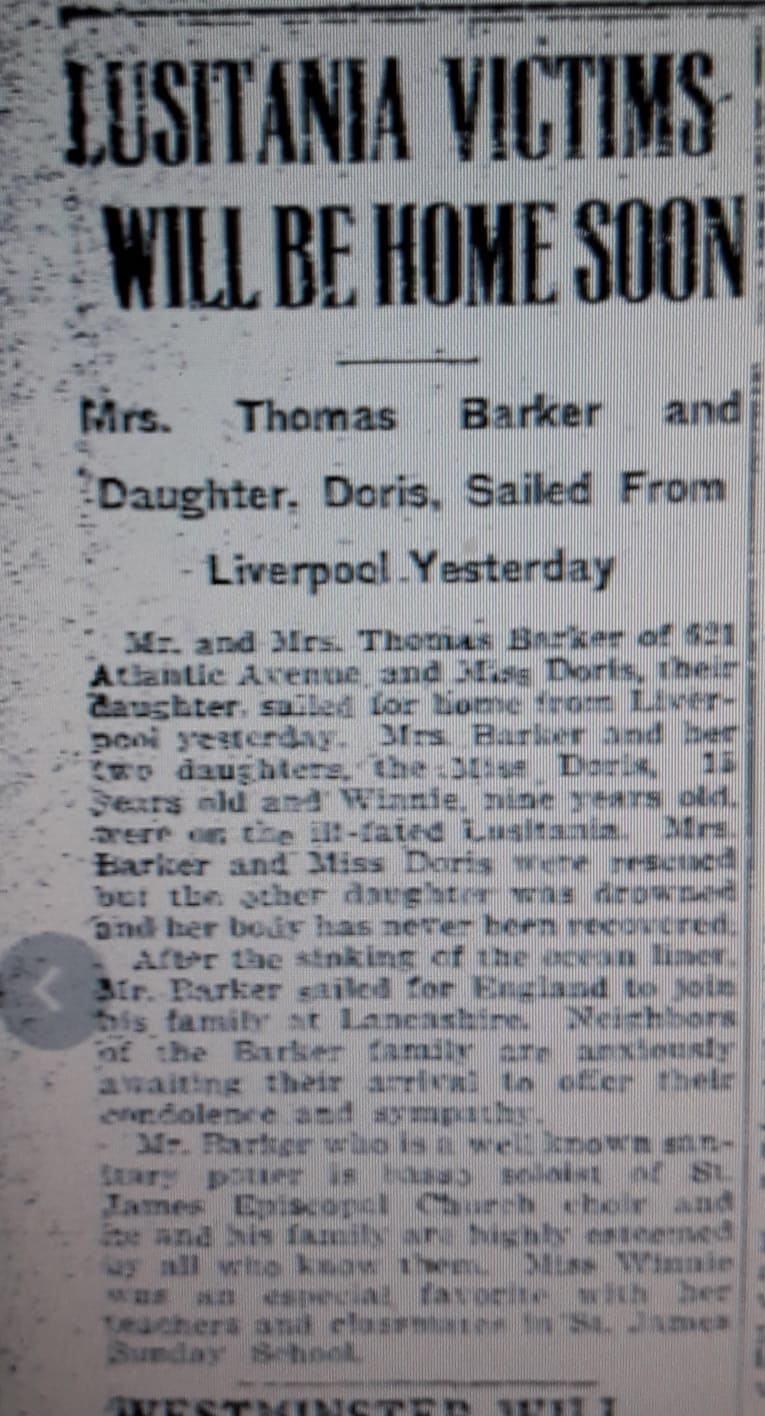
Thomas Gretton, Martha’s second husband, died in 1940. She survived him by 23 years and died in 1963 in New Jersey:
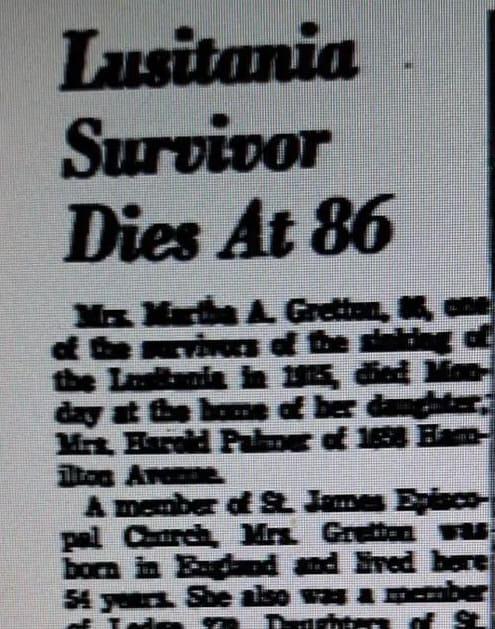
John Orgill Gretton
1868-1949
John Orgill Gretton was a “Freeholder” in New Jersey for 24 years. New Jersey alone of all the United States has the distinction of retaining the title of “FREEHOLDER” to denote the elected members of the county governing bodies. This descriptive name, which commemorates the origin of home rule, is used by only 21 of the nation’s 3,047 counties. In other states, these county officials are known as commissioners, supervisors, probate judges, police jurors, councilors and a variety of other names.
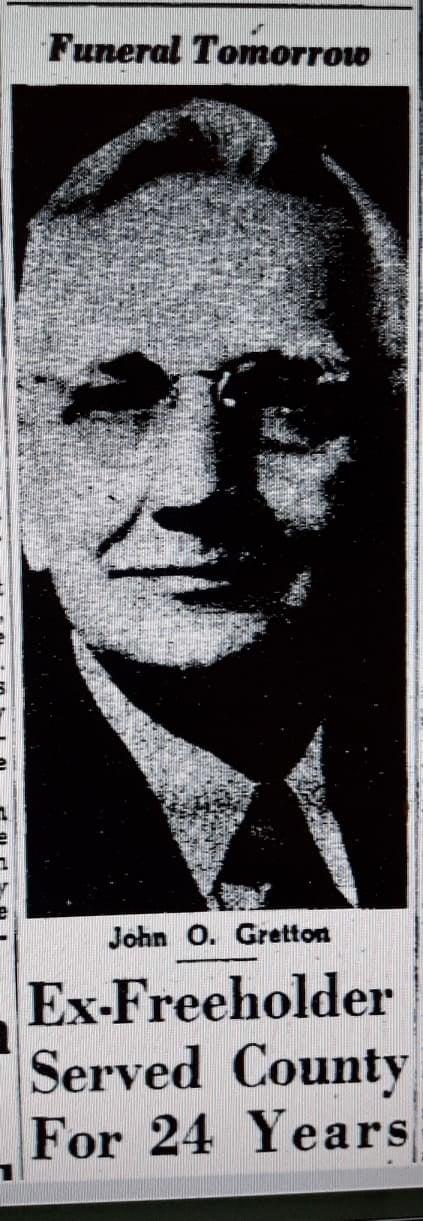
John and his wife Caroline Thum had four children, Florence J Gretton 1893-1965, George Thum Gretton 1895-1951, Wilhelmina F Gretton 1899-1931, and Nathalie A Gretton 1904-1947.
Their engagements and weddings appear on the society pages of the Trenton Newspapers. For example the article headline on the wedding in 1919 of George Thum Gretton and his wife Elizabeth Stokes announces “Charming Society Girl Becomes Bride Today”.
December 18, 2021 at 7:05 pm #6246In reply to: The Elusive Samuel Housley and Other Family Stories
Florence Nightingale Gretton
1881-1927
Florence’s father was Richard Gretton, a baker in Swadlincote, Derbyshire. When Richard married Sarah Orgill in 1861, they lived with her mother, a widow, in Measham, Ashby de la Zouch in Leicestershire. On the 1861 census Sarah’s mother, Elizabeth, is a farmer of two acres.
(Swadlincote and Ashby de la Zouch are on the Derbyshire Leicestershire border and not far from each other. Swadlincote is near to Burton upon Trent which is sometimes in Staffordshire, sometimes in Derbyshire. Newhall, Church Gresley, and Swadlincote are all very close to each other or districts in the same town.)
Ten years later in 1871 Richard and Sarah have their own place in Swadlincote, he is a baker, and they have four children. A fourteen year old apprentice or servant is living with them.
In the Ashby-de-la-Zouch Gazette on 28 February 1880, it was reported that Richard Gretton, baker, of Swadlincote, was charged by Captain Bandys with carrying bread in a cart for sale, the said cart not being provided with scales and weights, according to the requirements of the Act, on the 17th January last.—Defendant pleaded guilty, but urged in extenuation of the offence that in the hurry he had forgotten to put the scales in the cart before his son started.—The Bench took this view of the case, regarding it as an oversight, and fined him one shilling only and costs. This was not his only offence.
In 1883, he was fined twenty shillings, and ten shillings and sixpence costs.
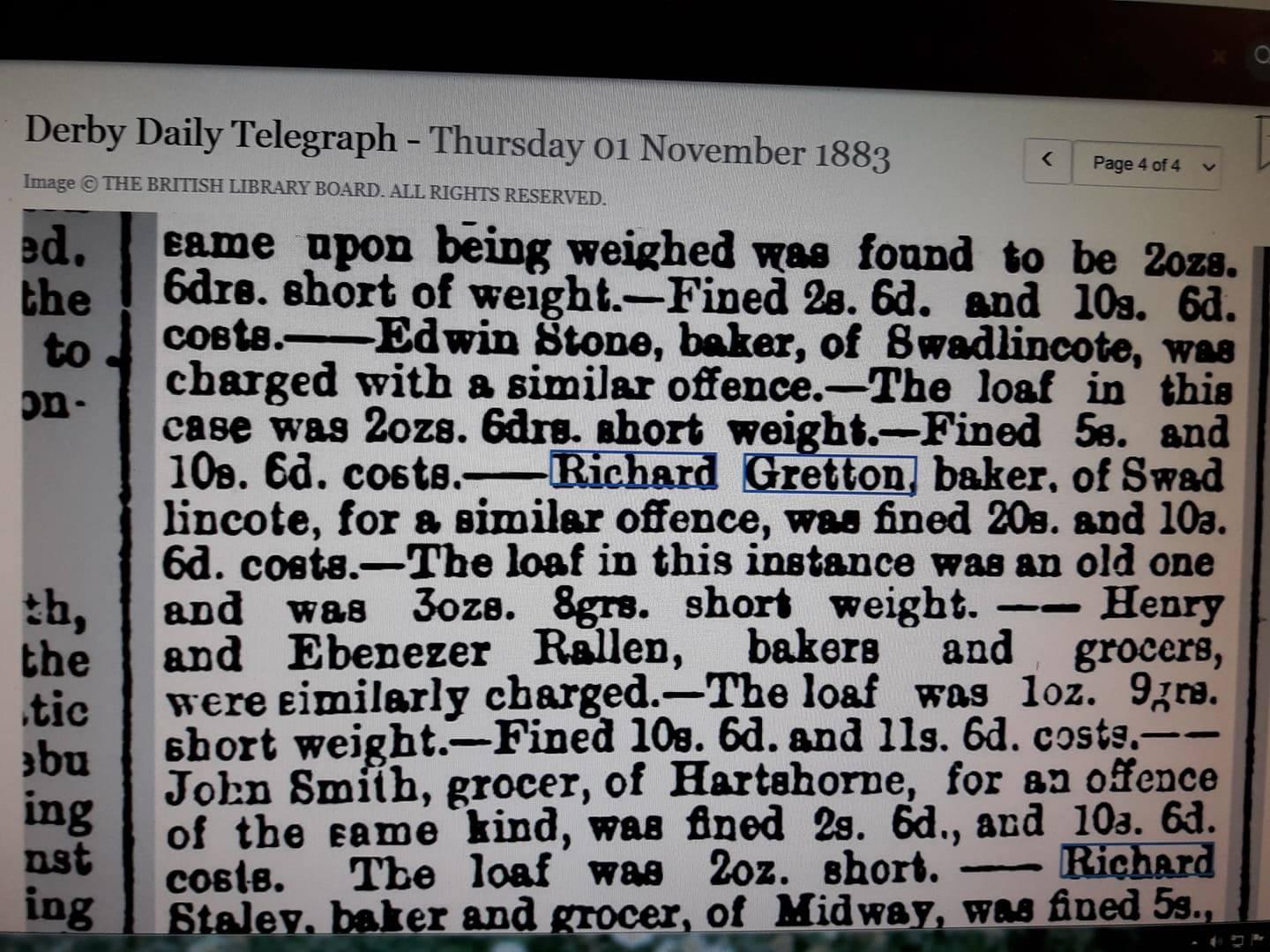
By 1881 they have 4 more children, and Florence Nightingale is the youngest at four months. Richard is 48 by now, and Sarah is 44. Florence’s older brother William is a blacksmith.
Interestingly on the same census page, two doors down Thomas and Selina Warren live at the Stanhope Arms. Richards son John Gretton lives at the pub, a 13 year old servant. Incidentally, I noticed on Thomas and Selena’s marriage register that Richard and Sarah Gretton were the witnesses at the wedding.
Ten years later in 1891, Florence Nightingale and her sister Clara are living with Selina Warren, widow, retired innkeeper, one door down from the Stanhope Arms. Florence is ten, Clara twelve and they are scholars.
Richard and Sarah are still living three doors up on the other side of the Stanhope Arms, with three of their sons. But the two girls lived up the road with the Warren widow!The Stanhope Arms, Swadlincote: it’s possible that the shop with the awning was Richard Gretton’s bakers shop (although not at the time of this later photo).
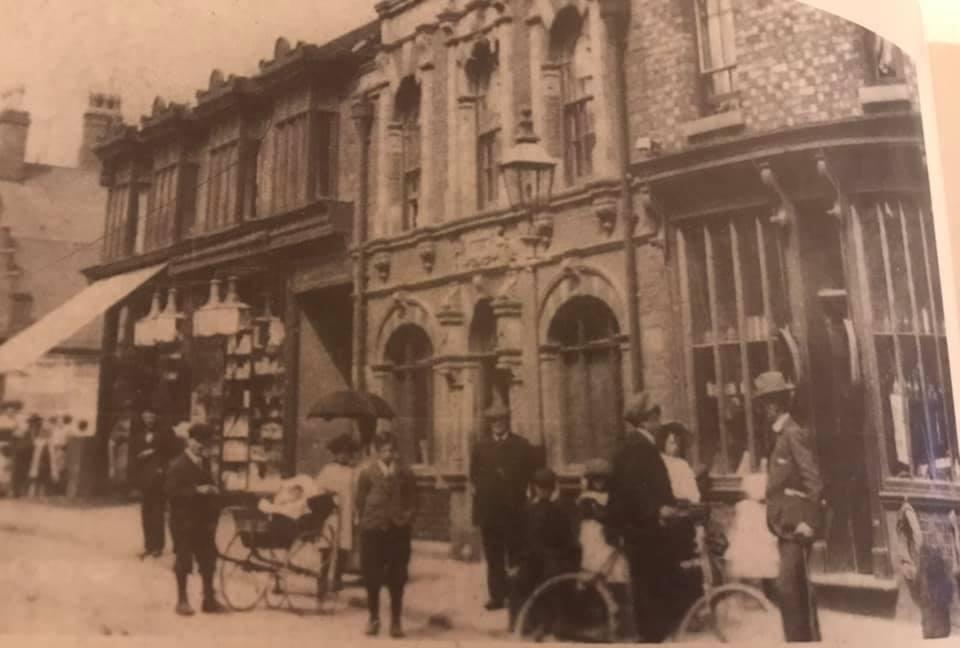
Richard died in 1898, a year before Florence married Samuel Warren.
Sarah is a widowed 60 year old baker on the 1901 census. Her son 26 year old son Alf, also a baker, lives at the same address, as does her 22 year old daughter Clara who is a district nurse.
Clara Gretton and family, photo found online:
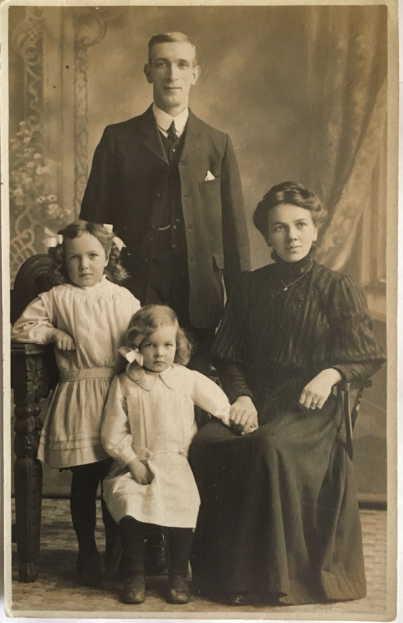
In 1901 Florence Nightingale (who we don’t have a photograph of!) is now married and is Florrie Warren on the census, and she, her husband Samuel, and their one year old daughter Hildred are visitors at the address of Elizabeth (Staley)Warren, 60 year old widow and Samuel’s mother, and Samuel’s 36 year old brother William. Samuel and William are engineers.
Samuel and Florrie had ten children between 1900 and 1925 (and all but two of them used their middle name and not first name: my mother and I had no idea until I found all the records. My grandmother Florence Noreen was known as Nora, which we knew of course, uncle Jack was actually Douglas John, and so on).
Hildred, Clara, Billy, and Nora were born in Swadlincote. Sometime between my grandmother’s birth in 1907 and Kay’s birth in 1911, the family moved to Oldswinford, in Stourbridge. Later they moved to Market Street.
1911 census, Oldswinford, Stourbridge:
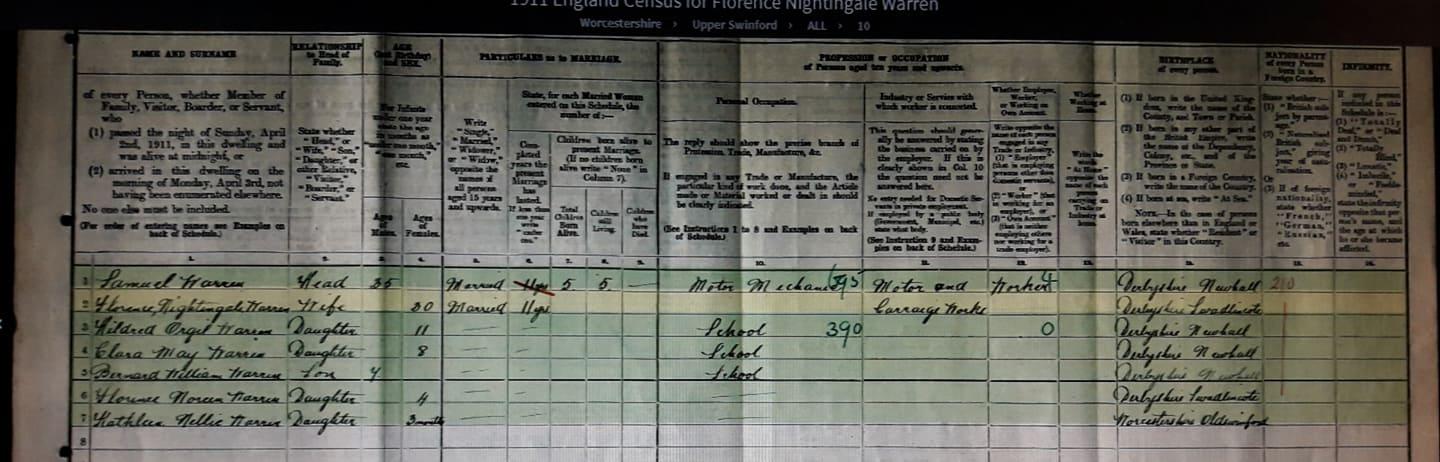
Oddly, nobody knew when Florrie Warren died. My mothers cousin Ian Warren researched the Warren family some years ago, while my grandmother was still alive. She contributed family stories and information, but couldn’t remember if her mother died in 1929 or 1927. A recent search of records confirmed that it was the 12th November 1927.
She was 46 years old. We were curious to know how she died, so my mother ordered a paper copy of her death certificate. It said she died at 31 Market Street, Stourbridge at the age of 47. Clara May Warren, her daughter, was in attendance. Her husband Samuel Warren was a motor mechanic. The Post mortem was by Percival Evans, coroner for Worcestershire, who clarified the cause of death as vascular disease of the heart. There was no inquest. The death was registered on 15 Nov 1927.
I looked for a photo of 31 Market Street in Stourbridge, and was astonished to see that it was the house next door to one I lived in breifly in the 1980s. We didn’t know that the Warren’s lived in Market Street until we started searching the records.
Market Street, Stourbridge. I lived in the one on the corner on the far right, my great grandmother died in the one next door.
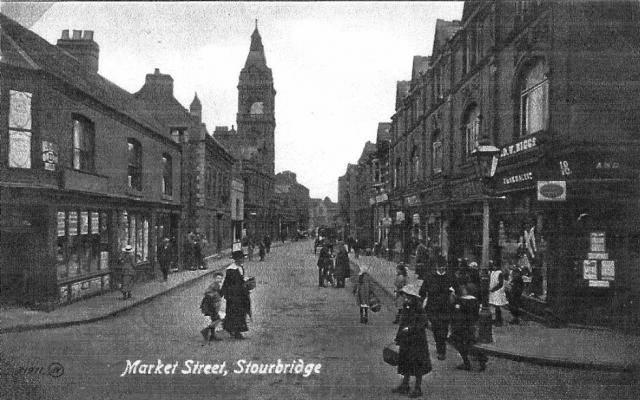
I found some hitherto unknown emigrants in the family. Florence Nightingale Grettons eldest brother William 1861-1940 stayed in Swadlincote. John Orgill Gretton born in 1868 moved to Trenton New Jersey USA in 1888, married in 1892 and died in 1949 in USA. Michael Thomas born in 1870 married in New York in 1893 and died in Trenton in 1940. Alfred born 1875 stayed in Swadlincote. Charles Herbert born 1876 married locally and then moved to Australia in 1912, and died in Victoria in 1954. Clara Elizabeth was a district nurse, married locally and died at the age of 99.
December 18, 2021 at 12:59 pm #6243In reply to: The Elusive Samuel Housley and Other Family Stories
William Housley’s Will and the Court Case
William Housley died in 1848, but his widow Ellen didn’t die until 1872. The court case was in 1873. Details about the court case are archived at the National Archives at Kew, in London, but are not available online. They can be viewed in person, but that hasn’t been possible thus far. However, there are a great many references to it in the letters.
William Housley’s first wife was Mary Carrington 1787-1813. They had three children, Mary Anne, Elizabeth and William. When Mary died, William married Mary’s sister Ellen, not in their own parish church at Smalley but in Ashbourne. Although not uncommon for a widower to marry a deceased wife’s sister, it wasn’t legal. This point is mentioned in one of the letters.
One of the pages of William Housley’s will:
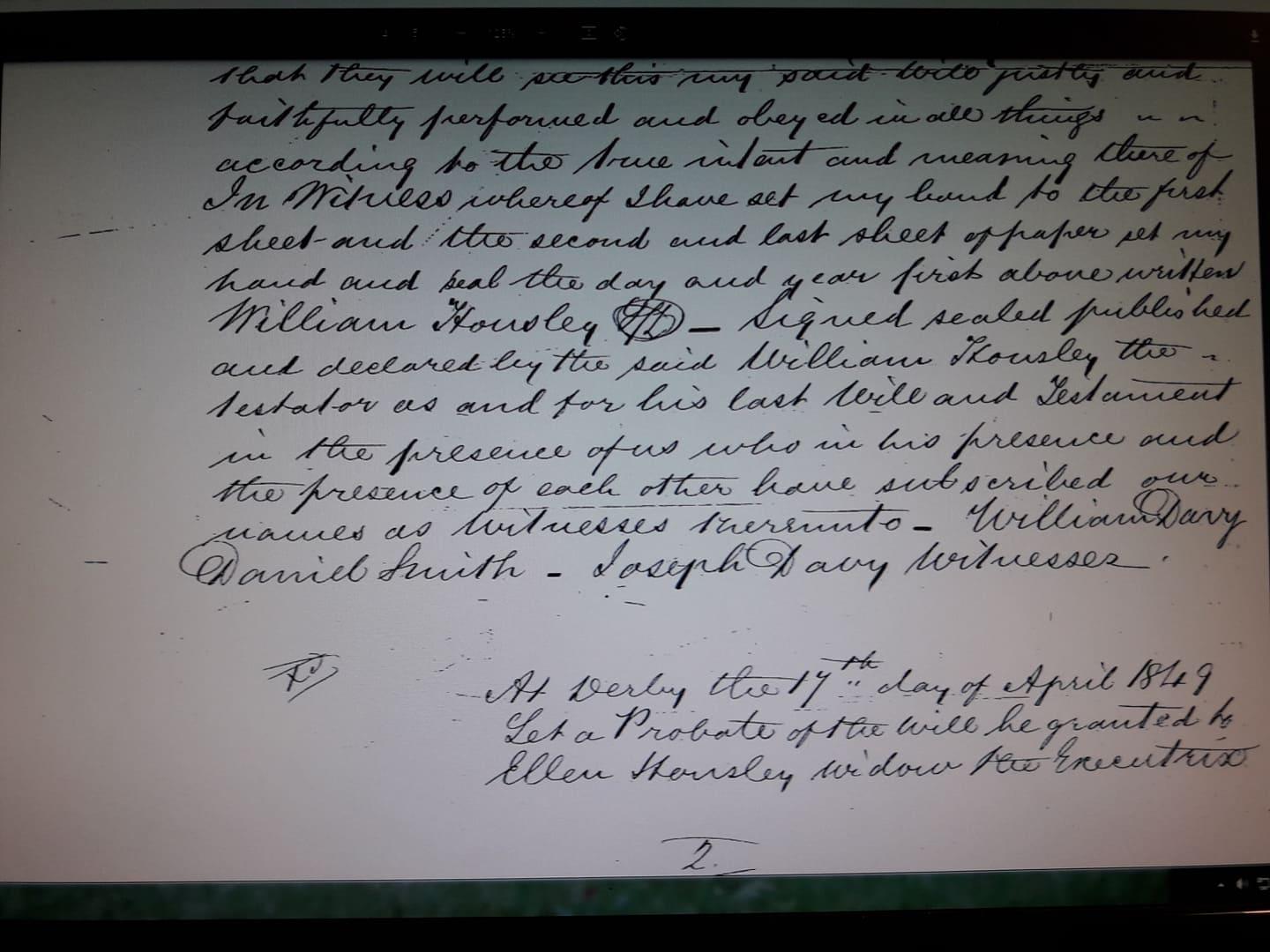
An excerpt from Barbara Housley’s Narrative on the Letters:
A comment in a letter from Joseph (August 6, 1873) indicated that William was married twice and that his wives were sisters: “What do you think that I believe that Mary Ann is trying to make our father’s will of no account as she says that my father’s marriage with our mother was not lawful he marrying two sisters. What do you think of her? I have heard my mother say something about paying a fine at the time of the marriage to make it legal.” Markwell and Saul in The A-Z Guide to Tracing Ancestors in Britain explain that marriage to a deceased wife’s sister was not permissible under Canon law as the relationship was within the prohibited degrees. However, such marriages did take place–usually well away from the couple’s home area. Up to 1835 such marriages were not void but were voidable by legal action. Few such actions were instituted but the risk was always there.
Joseph wrote that when Emma was married, Ellen “broke up the comfortable home and the things went to Derby and she went to live with them but Derby didn’t agree with her so she left again leaving her things behind and came to live with John in the new house where she died.” Ellen was listed with John’s household in the 1871 census.
In May 1872, the Ilkeston Pioneer carried this notice: “Mr. Hopkins will sell by auction on Saturday next the eleventh of May 1872 the whole of the useful furniture, sewing machine, etc. nearly new on the premises of the late Mrs. Housley at Smalley near Heanor in the county of Derby. Sale at one o’clock in the afternoon.”There were hard feelings between Mary Ann and Ellen and her children. Anne wrote: “If you remember we were not very friendly when you left. They never came and nothing was too bad for Mary Ann to say of Mother and me, but when Robert died Mother sent for her to the funeral but she did not think well to come so we took no more notice. She would not allow her children to come either.”
Mary Ann was still living in May 1872. Joseph implied that she and her brother, Will “intend making a bit of bother about the settlement of the bit of property” left by their mother. The 1871 census listed Mary Ann’s occupation as “income from houses.”In July 1872, Joseph introduced Ruth’s husband: “No doubt he is a bad lot. He is one of the Heath’s of Stanley Common a miller and he lives at Smalley Mill” (Ruth Heath was Mary Anne Housley’s daughter)
In 1873 Joseph wrote, “He is nothing but a land shark both Heath and his wife and his wife is the worst of the two. You will think these is hard words but they are true dear brother.” The solicitor, Abraham John Flint, was not at all pleased with Heath’s obstruction of the settlement of the estate. He wrote on June 30, 1873: “Heath agreed at first and then because I would not pay his expenses he refused and has since instructed another solicitor for his wife and Mrs. Weston who have been opposing us to the utmost. I am concerned for all parties interested except these two….The judge severely censured Heath for his conduct and wanted to make an order for sale there and then but Heath’s council would not consent….” In June 1875, the solicitor wrote: “Heath bid for the property but it fetched more money than he could give for it. He has been rather quieter lately.”In May 1872, Joseph wrote: “For what do you think, John has sold his share and he has acted very bad since his wife died and at the same time he sold all his furniture. You may guess I have never seen him but once since poor mother’s funeral and he is gone now no one knows where.”
In 1876, the solicitor wrote to George: “Have you heard of John Housley? He is entitled to Robert’s share and I want him to claim it.”
Anne intended that one third of the inheritance coming to her from her father and her grandfather, William Carrington, be divided between her four nieces: Sam’s three daughters and John’s daughter Elizabeth.
In the same letter (December 15, 1872), Joseph wrote:
“I think we have now found all out now that is concerned in the matter for there was only Sam that we did not know his whereabouts but I was informed a week ago that he is dead–died about three years ago in Birmingham Union. Poor Sam. He ought to have come to a better end than that”However, Samuel was still alive was on the 1871 census in Henley in Arden, and no record of his death can be found. Samuel’s brother in law said he was dead: we do not know why he lied, or perhaps the brothers were lying to keep his share, or another possibility is that Samuel himself told his brother in law to tell them that he was dead. I am inclined to think it was the latter.
Excerpts from Barbara Housley’s Narrative on the Letters continued:
Charles went to Australia in 1851, and was last heard from in January 1853. According to the solicitor, who wrote to George on June 3, 1874, Charles had received advances on the settlement of their parent’s estate. “Your promissory note with the two signed by your brother Charles for 20 pounds he received from his father and 20 pounds he received from his mother are now in the possession of the court.”
In December 1872, Joseph wrote: “I’m told that Charles two daughters has wrote to Smalley post office making inquiries about his share….” In January 1876, the solicitor wrote: “Charles Housley’s children have claimed their father’s share.”
In the Adelaide Observer 28 Aug 1875
HOUSLEY – wanted information
as to the Death, Will, or Intestacy, and
Children of Charles Housley, formerly of
Smalley, Derbyshire, England, who died at
Geelong or Creewick Creek Diggings, Victoria
August, 1855. His children will hear of something to their advantage by communicating with
Mr. A J. Flint, solicitor, Derby, England.
June 16,1875.The Diggers & Diggings of Victoria in 1855. Drawn on Stone by S.T. Gill:
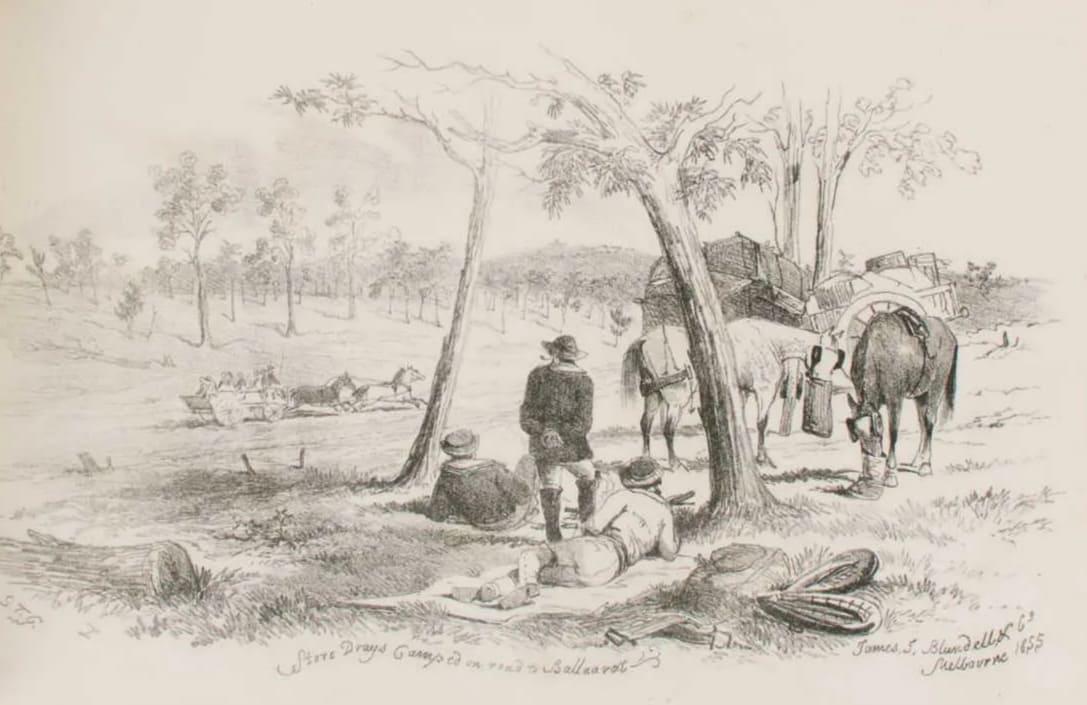
The court case:
Kerry v Housley.
Documents: Bill, demurrer.
Plaintiffs: Samuel Kerry and Joseph Housley.
Defendants: William Housley, Joseph Housley (deleted), Edwin Welch Harvey, Eleanor Harvey (deleted), Ernest Harvey infant, William Stafford, Elizabeth Stafford his wife, Mary Ann Housley, George Purdy and Catherine Purdy his wife, Elizabeth Housley, Mary Ann Weston widow and William Heath and Ruth Heath his wife (deleted).
Provincial solicitor employed in Derbyshire.
Date: 1873From the Narrative on the Letters:
The solicitor wrote on May 23, 1874: “Lately I have not written because I was not certain of your address and because I doubted I had much interesting news to tell you.” Later, Joseph wrote concerning the problems settling the estate, “You see dear brother there is only me here on our side and I cannot do much. I wish you were here to help me a bit and if you think of going for another summer trip this turn you might as well run over here.”
In March 1873, Joseph wrote: “You ask me what I think of you coming to England. I think as you have given the trustee power to sign for you I think you could do no good but I should like to see you once again for all that. I can’t say whether there would be anything amiss if you did come as you say it would be throwing good money after bad.”
In September 1872 Joseph wrote; “My wife is anxious to come. I hope it will suit her health for she is not over strong.” Elsewhere Joseph wrote that Harriet was “middling sometimes. She is subject to sick headaches. It knocks her up completely when they come on.” In December 1872 Joseph wrote, “Now dear brother about us coming to America you know we shall have to wait until this affair is settled and if it is not settled and thrown into Chancery I’m afraid we shall have to stay in England for I shall never be able to save money enough to bring me out and my family but I hope of better things.”
On July 19, 1875 Abraham Flint (the solicitor) wrote: “Joseph Housley has removed from Smalley and is working on some new foundry buildings at Little Chester near Derby. He lives at a village called Little Eaton near Derby. If you address your letter to him as Joseph Housley, carpenter, Little Eaton near Derby that will no doubt find him.”In his last letter (February 11, 1874), Joseph sounded very discouraged and wrote that Harriet’s parents were very poorly and both had been “in bed for a long time.” In addition, Harriet and the children had been ill.
The move to Little Eaton may indicate that Joseph received his settlement because in August, 1873, he wrote: “I think this is bad news enough and bad luck too, but I have had little else since I came to live at Kiddsley cottages but perhaps it is all for the best if one could only think so. I have begun to think there will be no chance for us coming over to you for I am afraid there will not be so much left as will bring us out without it is settled very shortly but I don’t intend leaving this house until it is settled either one way or the other. ”Joseph’s letters were much concerned with the settling of their mother’s estate. In 1854, Anne wrote, “As for my mother coming (to America) I think not at all likely. She is tied here with her property.” A solicitor, Abraham John Flint of 42 Full Street Derby, was engaged by John following the death of their mother. On June 30, 1873 the solicitor wrote: “Dear sir, On the death of your mother I was consulted by your brother John. I acted for him with reference to the sale and division of your father’s property at Smalley. Mr. Kerry was very unwilling to act as trustee being over 73 years of age but owing to the will being a badly drawn one we could not appoint another trustee in his place nor could the property be sold without a decree of chancery. Therefore Mr. Kerry consented and after a great deal of trouble with Heath who has opposed us all throughout whenever matters did not suit him, we found the title deeds and offered the property for sale by public auction on the 15th of July last. Heath could not find his purchase money without mortaging his property the solicitor which the mortgagee employed refused to accept Mr. Kerry’s title and owing to another defect in the will we could not compel them.”
In July 1872, Joseph wrote, “I do not know whether you can remember who the trustee was to my father’s will. It was Thomas Watson and Samuel Kerry of Smalley Green. Mr. Watson is dead (died a fortnight before mother) so Mr. Kerry has had to manage the affair.”
On Dec. 15, 1972, Joseph wrote, “Now about this property affair. It seems as far off of being settled as ever it was….” and in the following March wrote: “I think we are as far off as ever and farther I think.”
Concerning the property which was auctioned on July 15, 1872 and brought 700 pounds, Joseph wrote: “It was sold in five lots for building land and this man Heath bought up four lots–that is the big house, the croft and the cottages. The croft was made into two lots besides the piece belonging to the big house and the cottages and gardens was another lot and the little intake was another. William Richardson bought that.” Elsewhere Richardson’s purchase was described as “the little croft against Smith’s lane.” Smith’s Lane was probably named for their neighbor Daniel Smith, Mrs. Davy’s father.
But in December 1872, Joseph wrote that they had not received any money because “Mr. Heath is raising all kinds of objections to the will–something being worded wrong in the will.” In March 1873, Joseph “clarified” matters in this way: “His objection was that one trustee could not convey the property that his signature was not guarantee sufficient as it states in the will that both trustees has to sign the conveyance hence this bother.”
Joseph indicated that six shares were to come out of the 700 pounds besides Will’s 20 pounds. Children were to come in for the parents shares if dead. The solicitor wrote in 1873, “This of course refers to the Kidsley property in which you take a one seventh share and which if the property sells well may realize you about 60-80 pounds.” In March 1873 Joseph wrote: “You have an equal share with the rest in both lots of property, but I am afraid there will be but very little for any of us.”The other “lot of property” was “property in Smalley left under another will.” On July 17, 1872, Joseph wrote: “It was left by my grandfather Carrington and Uncle Richard is trustee. He seems very backward in bringing the property to a sale but I saw him and told him that I for one expect him to proceed with it.” George seemed to have difficulty understanding that there were two pieces of property so Joseph explained further: “It was left by my grandfather Carrington not by our father and Uncle Richard is the trustee for it but the will does not give him power to sell without the signatures of the parties concerned.” In June 1873 the solicitor Abraham John Flint asked: “Nothing has been done about the other property at Smalley at present. It wants attention and the other parties have asked me to attend to it. Do you authorize me to see to it for you as well?”
After Ellen’s death, the rent was divided between Joseph, Will, Mary Ann and Mr. Heath who bought John’s share and was married to Mary Ann’s daughter, Ruth. Joseph said that Mr. Heath paid 40 pounds for John’s share and that John had drawn 110 pounds in advance. The solicitor said Heath said he paid 60. The solicitor said that Heath was trying to buy the shares of those at home to get control of the property and would have defied the absent ones to get anything.
In September 1872 Joseph wrote that the lawyer said the trustee cannot sell the property at the bottom of Smalley without the signatures of all parties concerned in it and it will have to go through chancery court which will be a great expense. He advised Joseph to sell his share and Joseph advised George to do the same.George sent a “portrait” so that it could be established that it was really him–still living and due a share. Joseph wrote (July 1872): “the trustee was quite willing to (acknowledge you) for the portrait I think is a very good one.” Several letters later in response to an inquiry from George, Joseph wrote: “The trustee recognized you in a minute…I have not shown it to Mary Ann for we are not on good terms….Parties that I have shown it to own you again but they say it is a deal like John. It is something like him, but I think is more like myself.”
In September 1872 Joseph wrote that the lawyer required all of their ages and they would have to pay “succession duty”. Joseph requested that George send a list of birth dates.On May 23, 1874, the solicitor wrote: “I have been offered 240 pounds for the three cottages and the little house. They sold for 200 pounds at the last sale and then I was offered 700 pounds for the whole lot except Richardson’s Heanor piece for which he is still willing to give 58 pounds. Thus you see that the value of the estate has very materially increased since the last sale so that this delay has been beneficial to your interests than other-wise. Coal has become much dearer and they suppose there is coal under this estate. There are many enquiries about it and I believe it will realize 800 pounds or more which increase will more than cover all expenses.” Eventually the solicitor wrote that the property had been sold for 916 pounds and George would take a one-ninth share.
January 14, 1876: “I am very sorry to hear of your lameness and illness but I trust that you are now better. This matter as I informed you had to stand over until December since when all the costs and expenses have been taxed and passed by the court and I am expecting to receive the order for these this next week, then we have to pay the legacy duty and them divide the residue which I doubt won’t come to very much amongst so many of you. But you will hear from me towards the end of the month or early next month when I shall have to send you the papers to sign for your share. I can’t tell you how much it will be at present as I shall have to deduct your share with the others of the first sale made of the property before it went to court.
Wishing you a Happy New Year, I am Dear Sir, Yours truly
Abram J. Flint”September 15, 1876 (the last letter)
“I duly received your power of attorney which appears to have been properly executed on Thursday last and I sent it on to my London agent, Mr. Henry Lyvell, who happens just now to be away for his annual vacation and will not return for 14 or 20 days and as his signature is required by the Paymaster General before he will pay out your share, it must consequently stand over and await his return home. It shall however receive immediate attention as soon as he returns and I hope to be able to send your checque for the balance very shortly.”1874 in chancery:
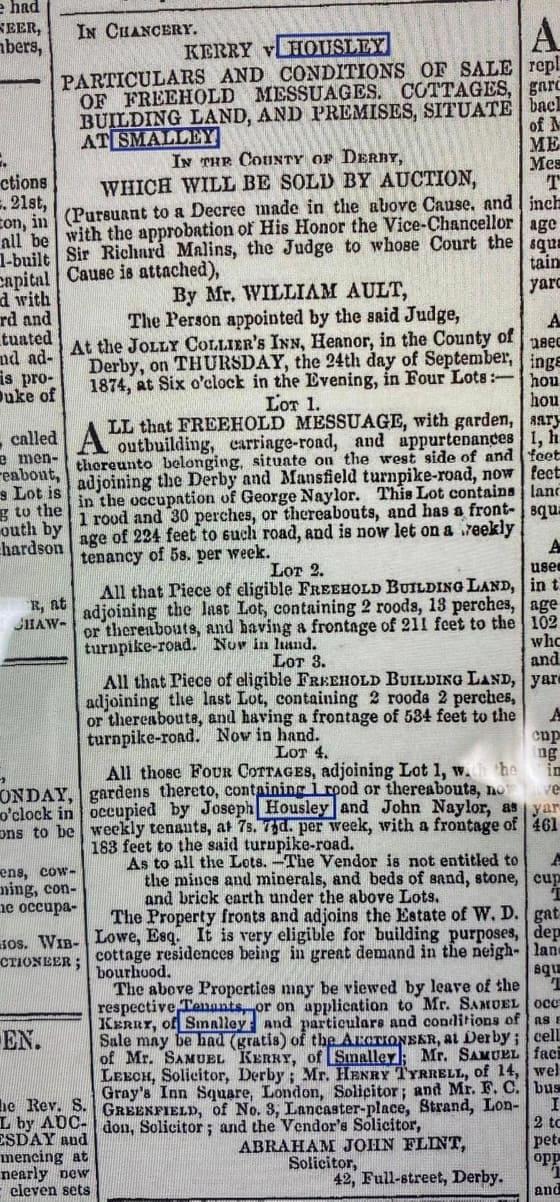 December 13, 2021 at 3:06 pm #6228
In reply to: The Elusive Samuel Housley and Other Family Stories
Francis Purdy: The Beggarlea Bulldog and Primitive Methodist Preacher
Francis Purdy was my great great grandfather. We did not know anything about the Primitive Methodists prior to this family research project, but my mother had another look through the family souvenirs and photographs and found a little book dated 1913, by William Purdy called: The History of The Primitive Methodists of Langley, Heanor, Derbyshire and District. Practical remarks on Sunday school work and a biography of the late Francis Purdy, an early local preacher. Printed by GC Brittain and sons. William Purdy was Francis son, and George’s brother.
Francis Purdy:
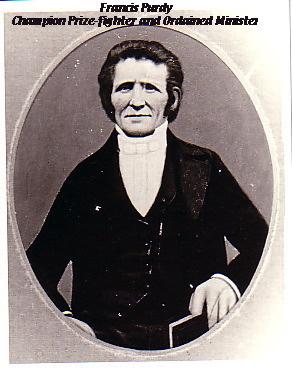
The following can be found online from various sources but I am unable to find the original source to credit with this information:
“In spite of having pious parents, Francis was a great prize-fighter and owner of champion dogs. He was known as the Beggarlee Bulldog, and fought many pitched battles. It was in 1823 that he fought on Nottingham Forest for the championship of three counties. After the fight going eleven rounds, which continued one hour and twenty minutes, he was declared victorious.”
The Primitive Methodists under the Rev Richard Whitechurch began a regular mission in Beggarlee. The locals tried to dismiss the Methodist “Ranters” by the use of intimidating tactics. Francis was prepared to release his fighting dogs during their prayer meeting, but became so interested in their faith that he instead joined them. The Methodist Church wrote: ”A strong feeling came over him, while his mates incited him to slip his dogs from the leads. He refused, and decided to return home. After concealing himself in a dyke, to listen to the Missioners on the following Sunday, he stole into the house of a Mrs Church, where a service was being held. Shortly after this, a society was formed with Francis Purdy as leader, and he was also the superintendent of the first Sunday School. After a short spell as local preacher at Beauvale, Tag Hill, Awsworth, Kimberly, Brinsley, etc., Mr Francis Purdy was ordained a minister by the Rev. Thomas King, of Nottingham, on the 17th December, 1827.”
November 29, 2007 at 11:46 am #487In reply to: Circle of Eights, Stories
Jo was looking at Mc Gaughran. He didn’t like him. Especially since he was so insistant at buying their ranch. It was not the price that was important. Mc Gaughran had offered them much already and Jo was a bit shamefull that he even once considered the offer. They had a little argument about that with Elroy, and he had felt very tore appart opposing his brother. He was very close to him and was admiring him so much.
And he was feeling very protective toward his sister. She could do whatever she wanted, that was not the point. The point was he didn’t want other to bother her. And that Mc Gaughran was looking at her a bit too insistantly to his taste.
He finished his whiskey an looked at the barman, Thomas. He was a very good friend of Elroy and him and was like a giant dwarf, stout and big red beard. He knew he could count on him to have a look at the man.
— Have to go, Tommee, he mumbled. Be back later.
Despite his disgust of Mc Gaughran, he also had some stuffs to check about the new man in town. He was feeling a bit unseasy as if some things would be unfolded, things that should better stay burried. He left the saloon like a shadow.
- “The letters of Eleanor Dunbar Leslie to her parents and her sister in South Africa
-
AuthorSearch Results
