-
AuthorSearch Results
-
October 18, 2023 at 3:20 pm #7281
In reply to: Family Stories From The Other Side ~ Book Two
The 1935 Joseph Gerrard Challenge.
While researching the Gerrard family of Ellastone I chanced upon a 1935 newspaper article in the Ashbourne Register. There were two articles in 1935 in this paper about the Gerrards, the second a follow up to the first. An advertisement was also placed offering a £1 reward to anyone who could find Joseph Gerrard’s baptism record.
Ashbourne Telegraph – Friday 05 April 1935:
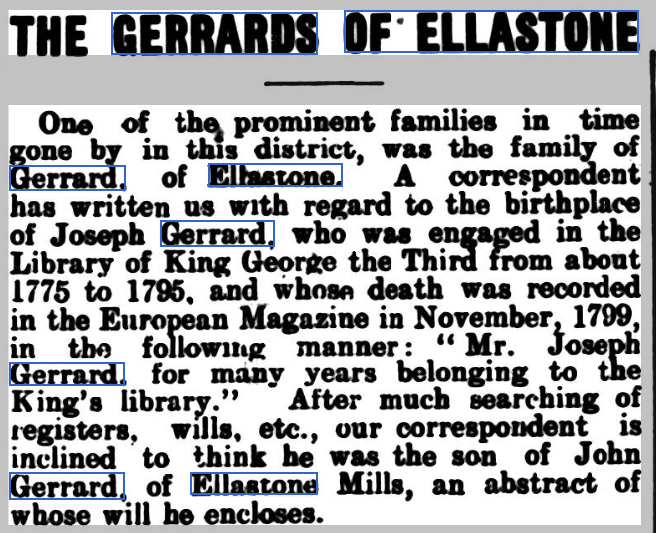
The author wanted to prove that the Joseph Gerrard “who was engaged in the library of King George the third from about 1775 to 1795, and whose death was recorded in the European Magazine in November 1799” was the son of John Gerrard of Ellastone Mills, Staffordshire. Included in the first article was a selected transcription of the 1796 will of John Gerrard. John’s son Joseph is mentioned in this will: John leaves him “£20 to buy a suit of mourning if he thinks proper.”
This Joseph Gerrard however, born in 1739, died in 1815 at Brailsford. Joseph’s brother John also died at Brailsford Mill, and both of their ages at death give a birth year of 1739. Maybe they were twins. William Gerrard and Joseph Gerrard of Brailsford Mill are mentioned in a 1811 newspaper article in the Derby Mercury.
I decided that there was nothing susbtantial about this claim, until I read the 1724 will of John Gerrard the elder, the father of John who died in 1796. In his will he leaves £100 to his son Joseph Gerrard, “secretary to the Bishop of Oxford”.
Perhaps there was something to this story after all. Joseph, baptised in 1701 in Ellastone, was the son of John Gerrard the elder.
I found Joseph Gerrard (and his son James Gerrard) mentioned in the Alumni Oxonienses: The Members of the University of Oxford, University of Oxford, Joseph Foster, 1888. “Joseph Gerard son of John of Elleston county Stafford, pleb, Oriel Coll, matric, 30th May 1718, age 18, BA. 9th March 1721-2; of Merton Coll MA 1728.”
In The Works of John Wesley 1735-1738, Joseph Gerrad is mentioned: “Joseph Gerard , matriculated at Oriel College 1718 , aged 18 , ordained 1727 to serve as curate of Cuddesdon , becoming rector of St. Martin’s , Oxford in 1729 , and vicar of Banbury in 1734.”
In The History of Banbury Alfred Beesley 1842 “a visitation of smallpox occured at Banbury (Oxfordshire) in 1731 and continued until 1733.” Joseph Gerrard was the vicar of Banbury in 1734.
According to the The History and Antiquities of the County of Buckingham George Lipscomb · 1847, Joseph Gerrard was made rector of Monks Risborough in 1738 “but he also continued to hold Stewkley until his death”.
The Speculum of Archbishop Thomas Secker by Secker, Thomas, 1693-1768, also mentions Joseph Gerrard under Monks Risborough and adds that he “resides constantly in the Parsonage ho. except when he goes for a few days to Steukley county Bucks (Buckinghamshire) of which he is vicar.” Joseph’s son James Gerrard 1741-1789 is also mentioned as being a rector at Monks Risborough in 1783.
Joseph Gerrard married Elizabeth Reynolds on 23 July 1739 in Monks Risborough, Buckinghamshire. They had five children between 1740 and 1750, including James baptised 1740 and Joseph baptised 1742.
Joseph died in 1785 in Monks Risborough.
So who was Joseph Gerrard of the Kings Library who died in 1799? It wasn’t Joseph’s son Joseph baptised in 1742 in Monks Risborough, because in his father’s 1785 will he mentions “my only son James”, indicating that Joseph died before that date.
September 20, 2023 at 1:48 pm #7279In reply to: Family Stories From The Other Side ~ Book Two
The Bigamist
Ernest Tomlinson 1881-1915
Ernest Tomlinson was my great grandfathers Charles Tomlinson‘s younger brother. Their parents were Charles Tomlinson the elder 1847-1907 and Emma Grattidge 1853-1911.
In 1896, aged 14, Ernest attempted to drown himself in the pond at Penn after his father took his watch off him for arguing with his brothers. Ernest tells the police “It’s all through my brothers putting on me”. The policeman told him he was a very silly and wicked boy and to see the curate at Penn and to try and be a better boy in future. He was discharged.
Bridgnorth Journal and South Shropshire Advertiser. – Saturday 11 July 1896:
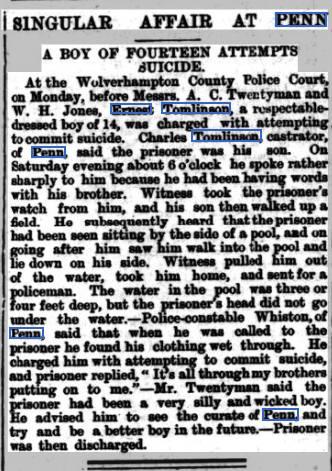
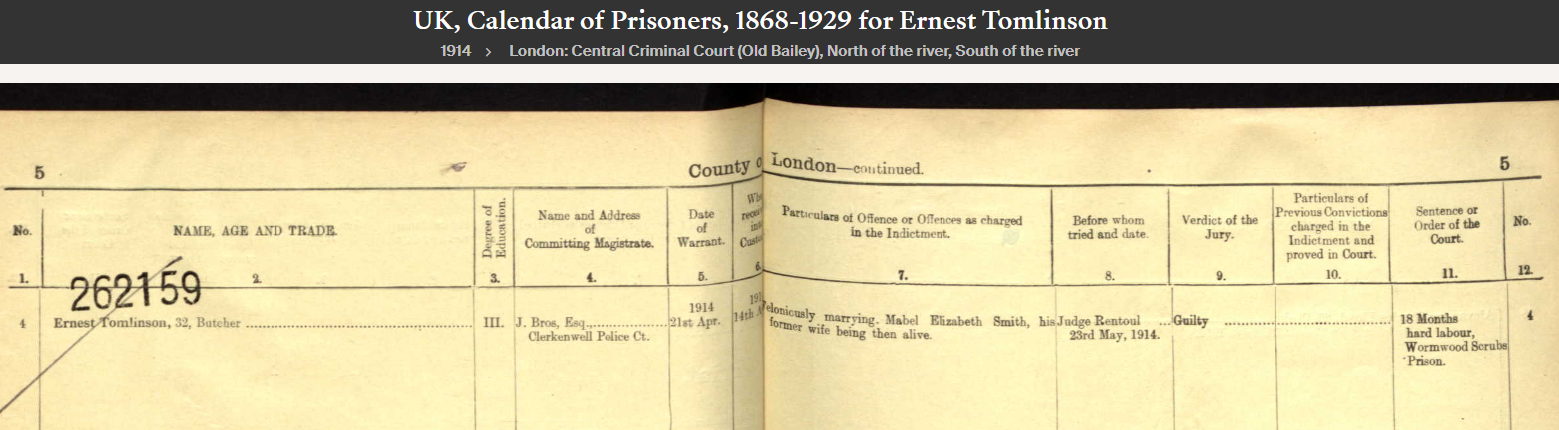
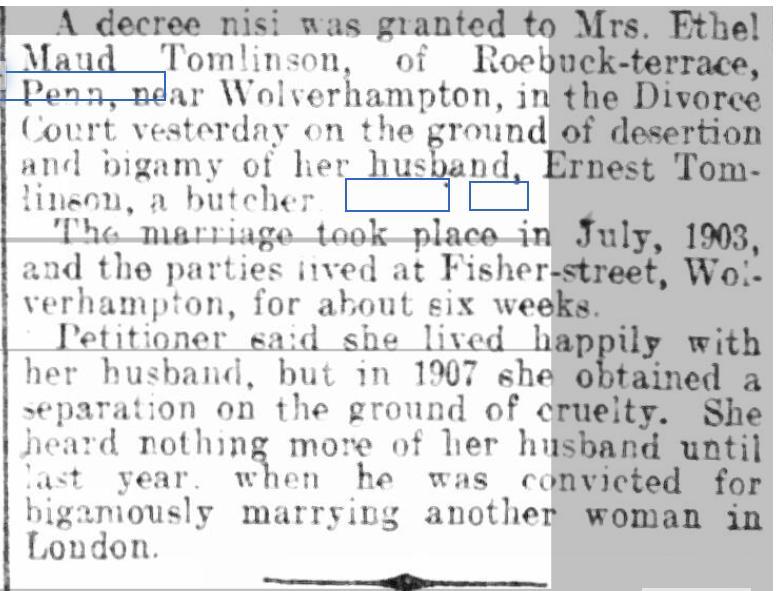
In 1903 Ernest married Ethel Maude Howe in Wolverhampton. Four years later in 1907 Ethel was granted a separation on the grounds of cruelty.
In Islington in London in 1913, Ernest bigamously married Mabel Elizabeth Smith. Mabel left Ernest for treating her very badly. She went to Wolverhampton and found out about his first wife still being alive.
London Evening Standard – Monday 25 May 1914:
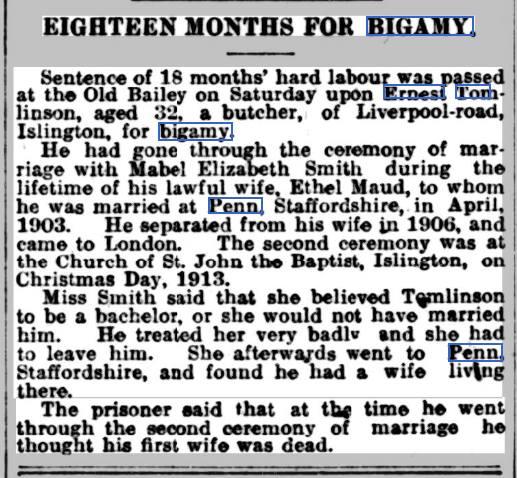
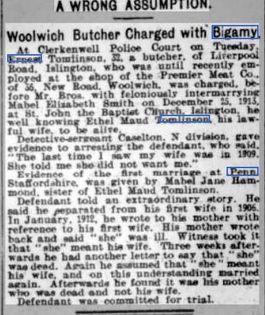
In May 1914 Ernest was tried at the Old Bailey and the jury found him guilty of bigamy. In his defense, Ernest said that he had received a letter from his mother saying that she was ill, and a further letter saying that she had died. He said he wrongly assumed that they were referring to his wife, and that he was free to marry. It was his mother who had died. He was sentenced to 18 months hard labour at Wormwood Scrubs prison.
Woolwich Gazette – Tuesday 28 April 1914:
Ethel Maude Tomlinson was granted a decree nisi in 1915.
Birmingham Daily Gazette – Wednesday 02 June 1915:
Ernest died in September 1915 in hospital in Wolverhampton.
August 15, 2023 at 12:42 pm #7267In reply to: Family Stories From The Other Side ~ Book Two
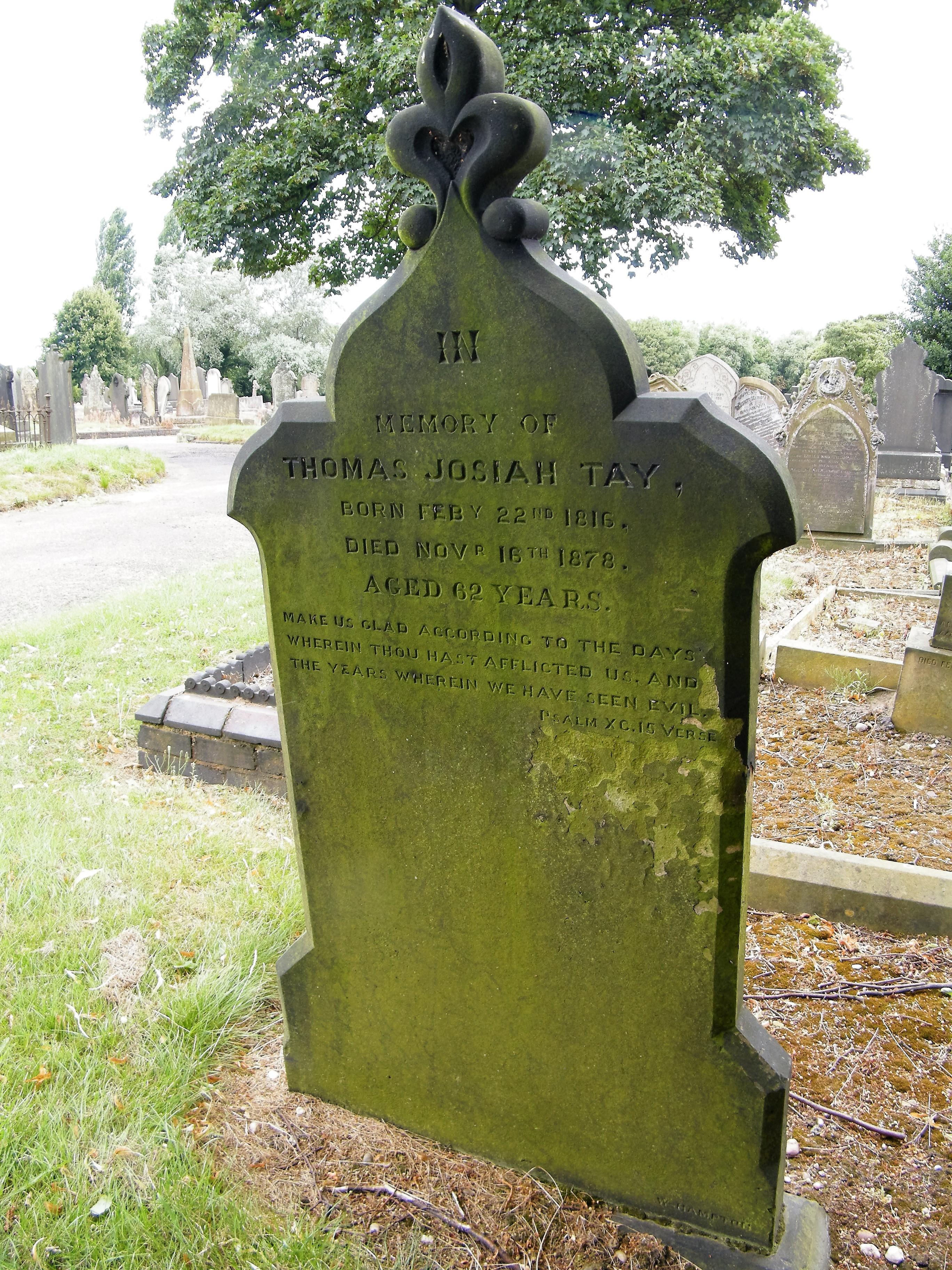
Thomas Josiah Tay
22 Feb 1816 – 16 November 1878
“Make us glad according to the days wherein thou hast afflicted us, and the years wherein we have seen evil.”
I first came across the name TAY in the 1844 will of John Tomlinson (1766-1844), gentleman of Wergs, Tettenhall. John’s friends, trustees and executors were Edward Moore, surgeon of Halesowen, and Edward Tay, timber merchant of Wolverhampton.
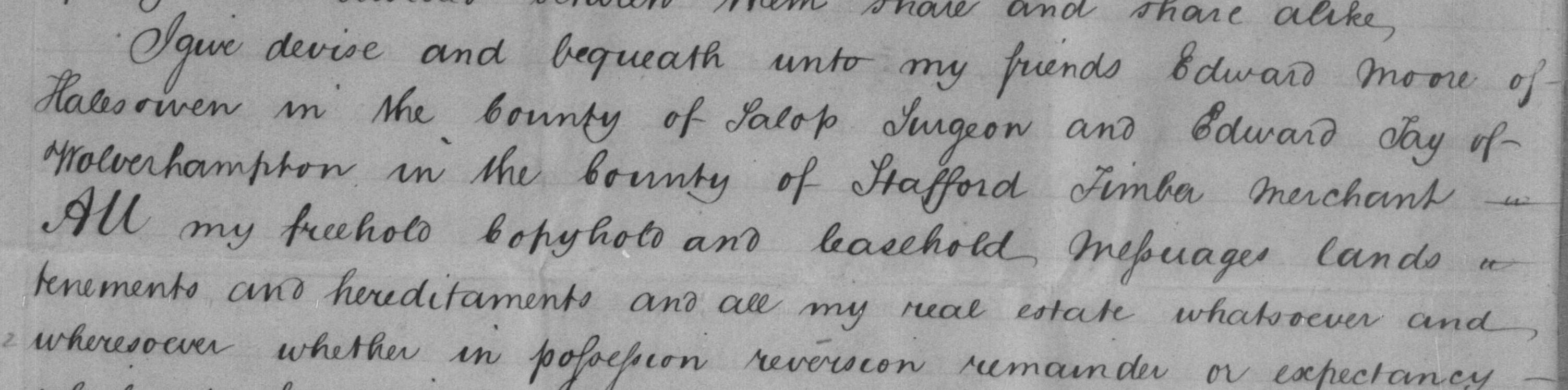
Edward Moore (born in 1805) was the son of John’s wife’s (Sarah Hancox born 1772) sister Lucy Hancox (born 1780) from her first marriage in 1801. In 1810 widowed Lucy married Josiah Tay (1775-1837).
Edward Tay was the son of Sarah Hancox sister Elizabeth (born 1778), who married Thomas Tay in 1800. Thomas Tay (1770-1841) and Josiah Tay were brothers.
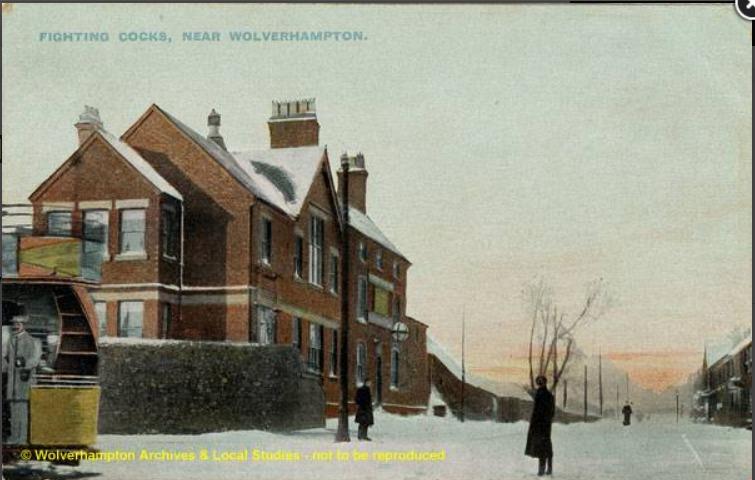
Edward Tay (1803-1862) was born in Sedgley and was buried in Penn. He was innkeeper of The Fighting Cocks, Dudley Road, Wolverhampton, as well as a builder and timber merchant, according to various censuses, trade directories, his marriage registration where his father Thomas Tay is also a timber merchant, as well as being named as a timber merchant in John Tomlinsons will.
John Tomlinson’s daughter Catherine (born in 1794) married Benjamin Smith in Tettenhall in 1822. William Tomlinson (1797-1867), Catherine’s brother, and my 3x great grandfather, was one of the witnesses.
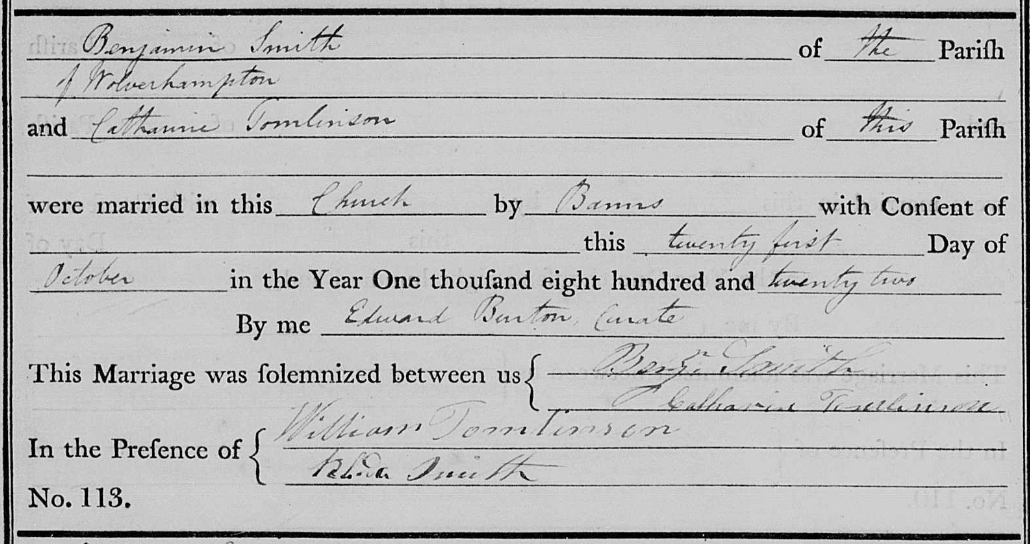
Their daughter Matilda Sarah Smith (1823-1910) married Thomas Josiah Tay in 1850 in Birmingham. Thomas Josiah Tay (1816-1878) was Edward Tay’s brother, the sons of Elizabeth Hancox and Thomas Tay.
Therefore, William Hancox 1737-1816 (the father of Sarah, Elizabeth and Lucy), was Matilda’s great grandfather and Thomas Josiah Tay’s grandfather.
Thomas Josiah Tay’s relationship to me is the husband of first cousin four times removed, as well as my first cousin, five times removed.
In 1837 Thomas Josiah Tay is mentioned in the will of his uncle Josiah Tay.

In 1841 Thomas Josiah Tay appears on the Stafford criminal registers for an “attempt to procure miscarriage”. He was found not guilty.
According to the Staffordshire Advertiser on 14th March 1840 the listing for the Assizes included: “Thomas Ashmall and Thomas Josiah Tay, for administering noxious ingredients to Hannah Evans, of Wolverhampton, with intent to procure abortion.”
The London Morning Herald on 19th March 1840 provides further information: “Mr Thomas Josiah Tay, a chemist and druggist, surrendered to take his trial on a charge of having administered drugs to Hannah Lear, now Hannah Evans, with intent to procure abortion.” She entered the service of Tay in 1837 and after four months “an intimacy was formed” and two months later she was “enciente”. Tay advised her to take some pills and a draught which he gave her and she became very ill. The prosecutrix admitted that she had made no mention of this until 1939. Verdict: not guilty.
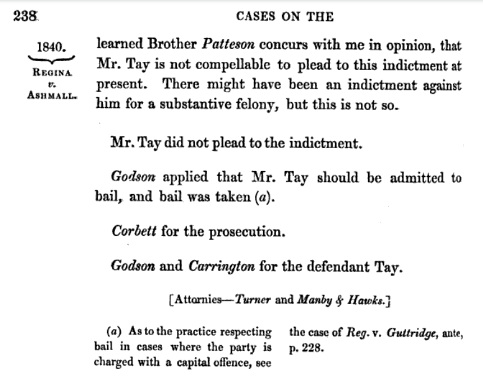
However, the case of Thomas Josiah Tay is also mentioned in a couple of law books, and the story varies slightly. In the 1841 Reports of Cases Argued and Rules at Nisi Prius, the Regina vs Ashmall and Tay case states that Thomas Ashmall feloniously, unlawfully, and maliciously, did use a certain instrument, and that Thomas Josiah Tay did procure the instrument, counsel and command Ashmall in the use of it. It concludes that Tay was not compellable to plead to the indictment, and that he did not.
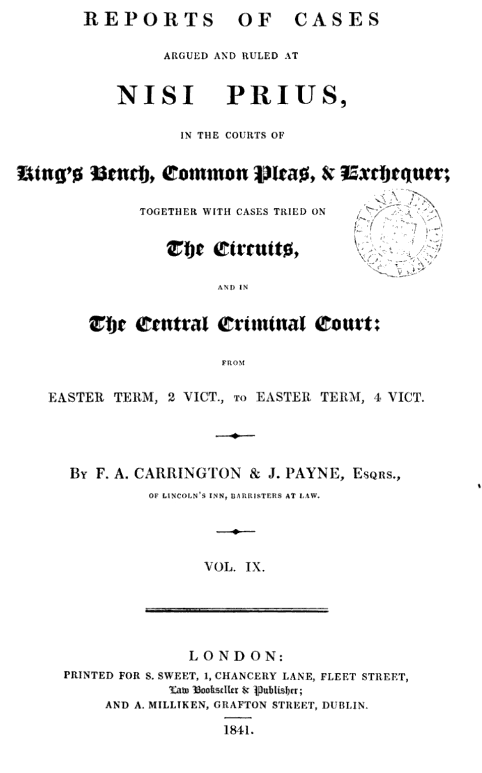
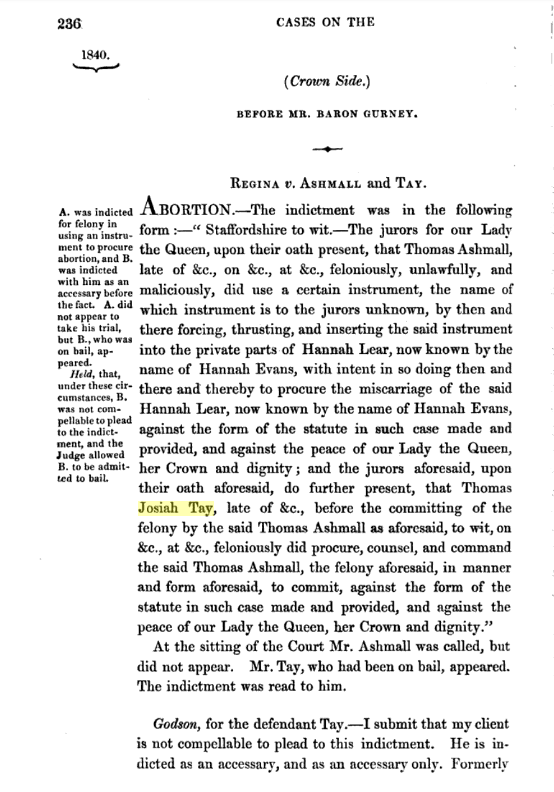
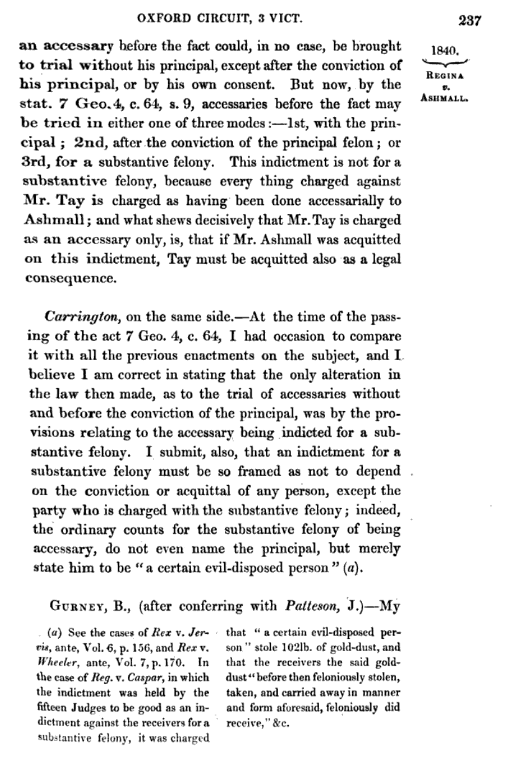
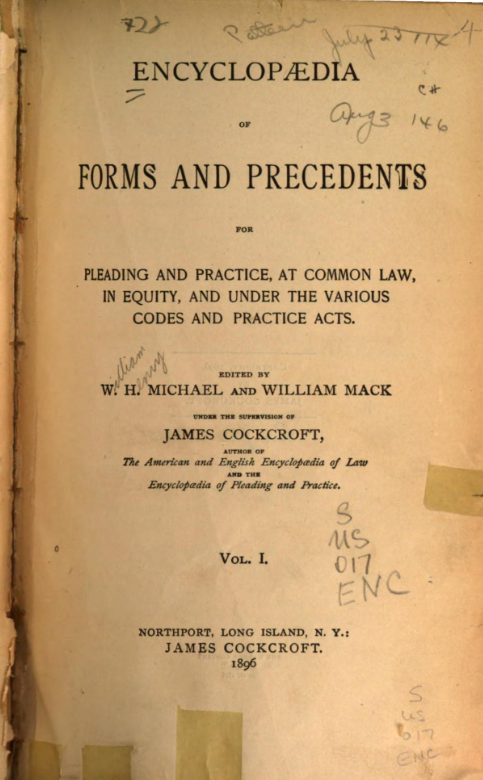
The Regina vs Ashmall and Tay case is also mentioned in the Encyclopedia of Forms and Precedents, 1896.
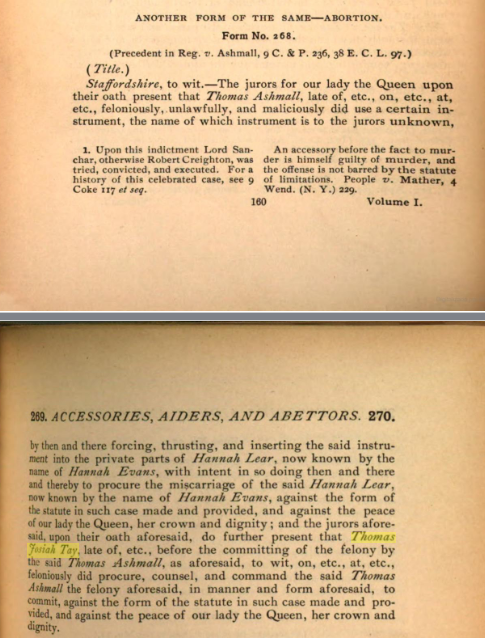
In 1845 Thomas Josiah Tay married Isabella Southwick in Tettenhall. Two years later in 1847 Isabella died.
In 1850 Thomas Josiah married Matilda Sarah Smith. (granddaughter of John Tomlinson, as mentioned above)
On the 1851 census Thomas Josiah Tay was a farmer of 100 acres employing two labourers in Shelfield, Walsall, Staffordshire. Thomas Josiah and Matilda Sarah have a daughter Matilda under a year old, and they have a live in house servant.
In 1861 Thomas Josiah Tay, his wife and their four children Ann, James, Josiah and Alice, live in Chelmarsh, Shropshire. He was a farmer of 224 acres. Mercy Smith, Matilda’s sister, lives with them, a 28 year old dairy maid.
In 1863 Thomas Josiah Tay of Hampton Lode (Chelmarsh) Shropshire was bankrupt. Creditors include Frederick Weaver, druggist of Wolverhampton.
In 1869 Thomas Josiah Tay was again bankrupt. He was an innkeeper at The Fighting Cocks on Dudley Road, Wolverhampton, at the time, the same inn as his uncle Edward Tay, aforementioned timber merchant.
In 1871, Thomas Josiah Tay, his wife Matilda, and their three children Alice, Edward and Maryann, were living in Birmingham. Thomas Josiah was a commercial traveller.
He died on the 16th November 1878 at the age of 62 and was buried in Darlaston, Walsall. On his gravestone:
“Make us glad according to the days wherein thou hast afflicted us, and the years wherein we have seen evil.” Psalm XC 15 verse.
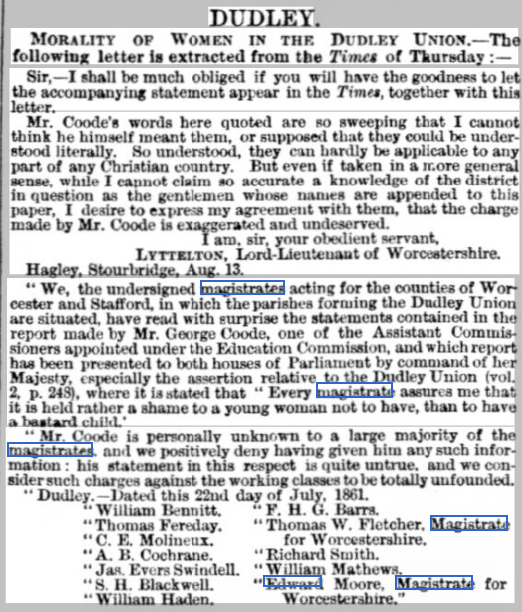
Edward Moore, surgeon, was also a MAGISTRATE in later years. On the 1871 census he states his occupation as “magistrate for counties Worcester and Stafford, and deputy lieutenant of Worcester, formerly surgeon”. He lived at Townsend House in Halesowen for many years. His wifes name was PATTERN Lucas. Her mothers name was Pattern Hewlitt from Birmingham, an unusal name that I have not heard before. On the 1871 census, Edward’s son was a 22 year old solicitor.
In 1861 an article appeared in the newspapers about the state of the morality of the women of Dudley. It was claimed that all the local magistrates agreed with the premise of the article, concerning unmarried women and their attitudes towards having illegitimate children. Letters appeared in subsequent newspapers signed by local magistrates, including Edward Moore, strongly disagreeing.
Staffordshire Advertiser 17 August 1861:
 November 14, 2022 at 12:09 pm #6346
In reply to: Family Stories From The Other Side ~ Book Two
The Mormon Browning Who Went To Utah
Isaac Browning’s (1784-1848) sister Hannah married Francis Buckingham. There were at least three Browning Buckingham marriages in Tetbury. Their daughter Charlotte married James Paskett, a shoemaker. Charlotte was born in 1818 and in 1871 she and her family emigrated to Utah, USA.
Charlotte’s relationship to me is first cousin five times removed.
James and Charlotte: (photos found online)
The house of James and Charlotte in Tetbury:
The home of James and Charlotte in Utah:
Obituary:
James Pope Paskett Dead.
Veteran of 87 Laid to rest. Special Correspondence Coalville, Summit Co., Oct 28—James Pope Paskett of Henefer died Oct. 24, 1903 of old age and general debility. Funeral services were held at Henefer today. Elders W.W. Cluff, Alma Elderge, Robert Jones, Oscar Wilkins and Bishop M.F. Harris were the speakers. There was a large attendance many coming from other wards in the stake. James Pope Paskett was born in Chippenham, Wiltshire, England, on March 12, 1817; married Chalotte Buckingham in the year 1839; eight children were born to them, three sons and five daughters, all of whom are living and residing in Utah, except one in Brisbane, Australia. Father Paskett joined the church of Jesus Christ of Latter Day Saints in 1847, and emigrated to Utah in 1871, and has resided in Henefer ever since. He leaves his faithful and aged wife. He was respected and esteemed by all who knew him.
Charlotte died in Henefer, Utah, on 27th December 1910 at the age of 91.
James and Charlotte in later life:
November 13, 2022 at 10:29 pm #6345In reply to: Family Stories From The Other Side ~ Book Two
Crime and Punishment in Tetbury
I noticed that there were quite a number of Brownings of Tetbury in the newspaper archives involved in criminal activities while doing a routine newspaper search to supplement the information in the usual ancestry records. I expanded the tree to include cousins, and offsping of cousins, in order to work out who was who and how, if at all, these individuals related to our Browning family.
I was expecting to find some of our Brownings involved in the Swing Riots in Tetbury in 1830, but did not. Most of our Brownings (including cousins) were stone masons. Most of the rioters in 1830 were agricultural labourers.
The Browning crimes are varied, and by todays standards, not for the most part terribly serious ~ you would be unlikely to receive a sentence of hard labour for being found in an outhouse with the intent to commit an unlawful act nowadays, or for being drunk.
The central character in this chapter is Isaac Browning (my 4x great grandfather), who did not appear in any criminal registers, but the following individuals can be identified in the family structure through their relationship to him.
RICHARD LOCK BROWNING born in 1853 was Isaac’s grandson, his son George’s son. Richard was a mason. In 1879 he and Henry Browning of the same age were sentenced to one month hard labour for stealing two pigeons in Tetbury. Henry Browning was Isaac’s nephews son.
In 1883 Richard Browning, mason of Tetbury, was charged with obtaining food and lodging under false pretences, but was found not guilty and acquitted.
In 1884 Richard Browning, mason of Tetbury, was sentenced to one month hard labour for game trespass.Richard had been fined a number of times in Tetbury:
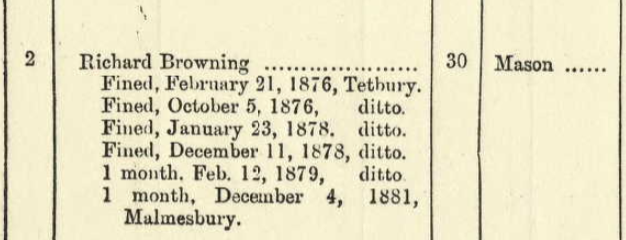
Richard Lock Browning was five feet eight inches tall, dark hair, grey eyes, an oval face and a dark complexion. He had two cuts on the back of his head (in February 1879) and a scar on his right eyebrow.
HENRY BROWNING, who was stealing pigeons with Richard Lock Browning in 1879, (Isaac’s brother Williams grandson, son of George Browning and his wife Charity) was charged with being drunk in 1882 and ordered to pay a fine of one shilling and costs of fourteen shillings, or seven days hard labour.
Henry was found guilty of gaming in the highway at Tetbury in 1872 and was sentenced to seven days hard labour. In 1882 Henry (who was also a mason) was charged with assault but discharged.
Henry was five feet five inches tall, brown hair and brown eyes, a long visage and a fresh complexion.
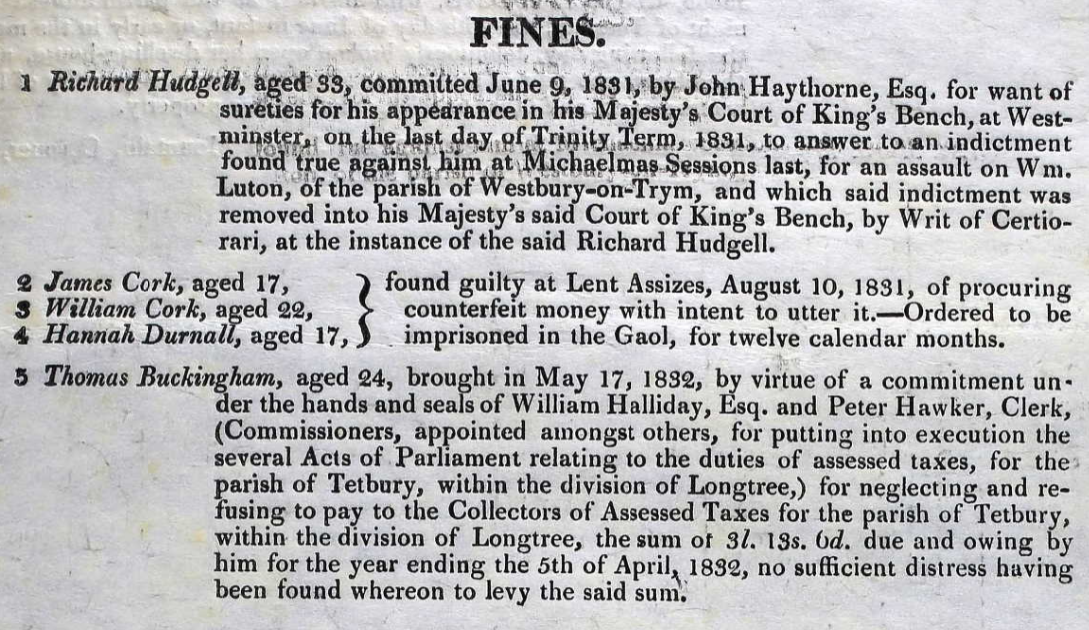
Henry emigrated with his daughter to Canada in 1913, and died in Vancouver in 1919.THOMAS BUCKINGHAM 1808-1846 (Isaacs daughter Janes husband) was charged with stealing a black gelding in Tetbury in 1838. No true bill. (A “no true bill” means the jury did not find probable cause to continue a case.)
Thomas did however neglect to pay his taxes in 1832:
LEWIN BUCKINGHAM (grandson of Isaac, his daughter Jane’s son) was found guilty in 1846 stealing two fowls in Tetbury when he was sixteen years old.
In 1846 he was sentence to one month hard labour (or pay ten shillings fine and ten shillings costs) for loitering with the intent to trespass in search of conies.
A year later in 1847, he and three other young men were sentenced to four months hard labour for larceny.
Lewin was five feet three inches tall, with brown hair and brown eyes, long visage, sallow complexion, and had a scar on his left arm.JOHN BUCKINGHAM born circa 1832, a Tetbury labourer (Isaac’s grandson, Lewin’s brother) was sentenced to six weeks hard labour for larceny in 1855 for stealing a duck in Cirencester. The notes on the register mention that he had been employed by Mr LOCK, Angel Inn. (John’s grandmother was Mary Lock so this is likely a relative).
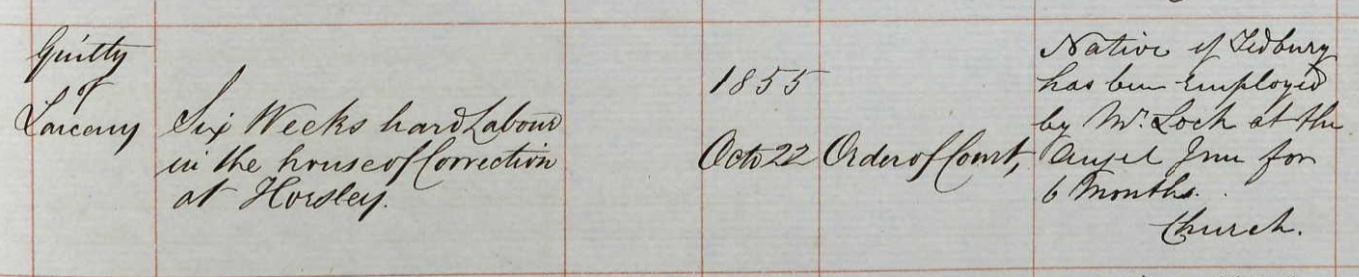
The previous year in 1854 John was sentenced to one month or a one pound fine for assaulting and beating W. Wood.
John was five feet eight and three quarter inches tall, light brown hair and grey eyes, an oval visage and a fresh complexion. He had a scar on his left arm and inside his right knee.JOSEPH PERRET was born circa 1831 and he was a Tetbury labourer. (He was Isaac’s granddaughter Charlotte Buckingham’s husband)
In 1855 he assaulted William Wood and was sentenced to one month or a two pound ten shilling fine. Was it the same W Wood that his wifes cousin John assaulted the year before?
In 1869 Joseph was sentenced to one month hard labour for feloniously receiving a cupboard known to be stolen.JAMES BUCKINGAM born circa 1822 in Tetbury was a shoemaker. (Isaac’s nephew, his sister Hannah’s son)
In 1854 the Tetbury shoemaker was sentenced to four months hard labour for stealing 30 lbs of lead off someones house.
In 1856 the Tetbury shoemaker received two months hard labour or pay £2 fine and 12 s costs for being found in pursuit of game.
In 1868 he was sentenced to two months hard labour for stealing a gander. A unspecified previous conviction is noted.
1871 the Tetbury shoemaker was found in an outhouse for an unlawful purpose and received ten days hard labour. The register notes that his sister is Mrs Cook, the Green, Tetbury. (James sister Prudence married Thomas Cook)
James sister Charlotte married a shoemaker and moved to UTAH.
James was five feet eight inches tall, dark hair and blue eyes, a long visage and a florid complexion. He had a scar on his forehead and a mole on the right side of his neck and abdomen, and a scar on the right knee.October 19, 2022 at 6:46 am #6336In reply to: Family Stories From The Other Side ~ Book Two
The Hamstall Ridware Connection
Stubbs and Woods
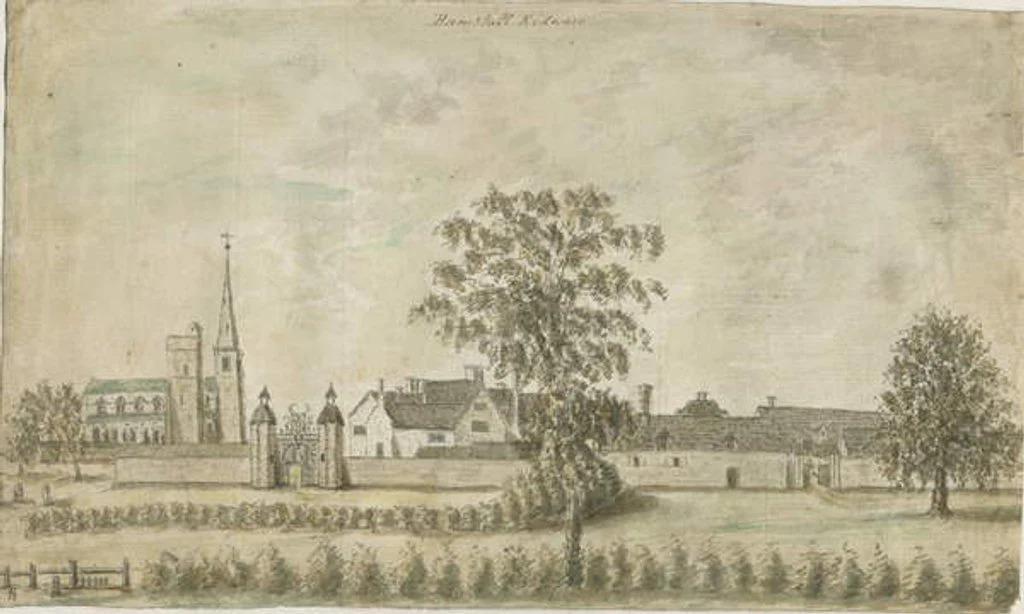 Hamstall Ridware
Charles Tomlinson‘s (1847-1907) wife Emma Grattidge (1853-1911) was born in Wolverhampton, the daughter and youngest child of William Grattidge (1820-1887) born in Foston, Derbyshire, and Mary Stubbs (1819-1880), born in Burton on Trent, daughter of Solomon Stubbs.
Solomon Stubbs (1781-1857) was born in Hamstall Ridware in 1781, the son of Samuel and Rebecca. Samuel Stubbs (1743-) and Rebecca Wood (1754-) married in 1769 in Darlaston. Samuel and Rebecca had six other children, all born in Darlaston. Sadly four of them died in infancy. Son John was born in 1779 in Darlaston and died two years later in Hamstall Ridware in 1781, the same year that Solomon was born there.
But why did they move to Hamstall Ridware?
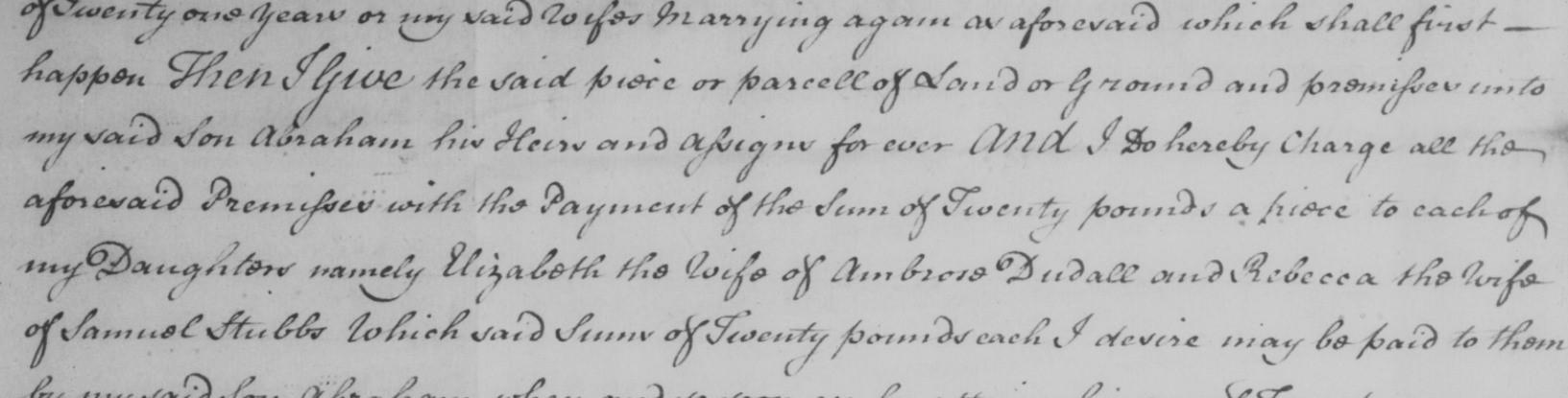
Samuel Stubbs was born in 1743 in Curdworth, Warwickshire (near to Birmingham). I had made a mistake on the tree (along with all of the public trees on the Ancestry website) and had Rebecca Wood born in Cheddleton, Staffordshire. Rebecca Wood from Cheddleton was also born in 1843, the right age for the marriage. The Rebecca Wood born in Darlaston in 1754 seemed too young, at just fifteen years old at the time of the marriage. I couldn’t find any explanation for why a woman from Cheddleton would marry in Darlaston and then move to Hamstall Ridware. People didn’t usually move around much other than intermarriage with neighbouring villages, especially women. I had a closer look at the Darlaston Rebecca, and did a search on her father William Wood. I found his 1784 will online in which he mentions his daughter Rebecca, wife of Samuel Stubbs. Clearly the right Rebecca Wood was the one born in Darlaston, which made much more sense.
An excerpt from William Wood’s 1784 will mentioning daughter Rebecca married to Samuel Stubbs:
But why did they move to Hamstall Ridware circa 1780?
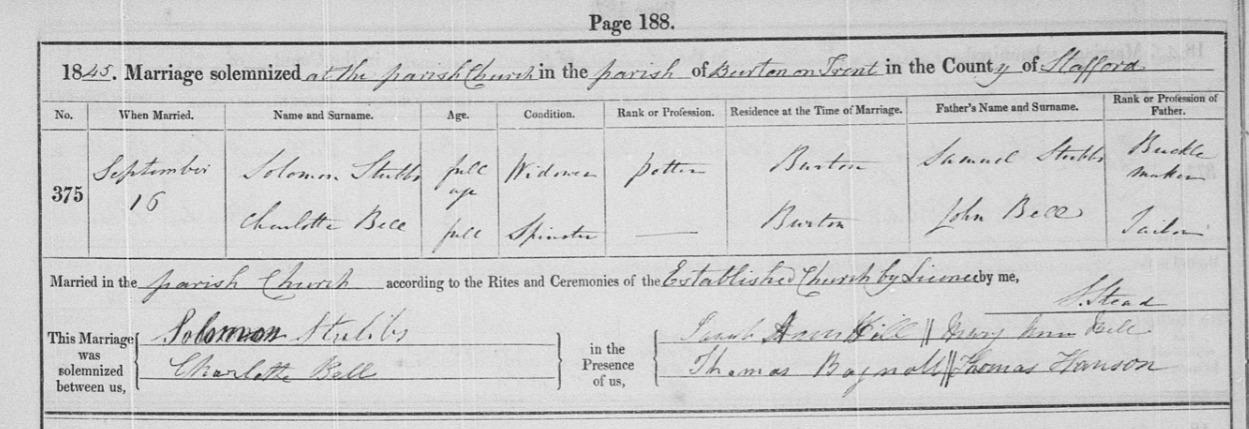
I had not intially noticed that Solomon Stubbs married again the year after his wife Phillis Lomas (1787-1844) died. Solomon married Charlotte Bell in 1845 in Burton on Trent and on the marriage register, Solomon’s father Samuel Stubbs occupation was mentioned: Samuel was a buckle maker.
Marriage of Solomon Stubbs and Charlotte Bell, father Samuel Stubbs buckle maker:
A rudimentary search on buckle making in the late 1700s provided a possible answer as to why Samuel and Rebecca left Darlaston in 1781. Shoe buckles had gone out of fashion, and by 1781 there were half as many buckle makers in Wolverhampton as there had been previously.
“Where there were 127 buckle makers at work in Wolverhampton, 68 in Bilston and 58 in Birmingham in 1770, their numbers had halved in 1781.”
via “historywebsite”(museum/metalware/steel)
Steel buckles had been the height of fashion, and the trade became enormous in Wolverhampton. Wolverhampton was a steel working town, renowned for its steel jewellery which was probably of many types. The trade directories show great numbers of “buckle makers”. Steel buckles were predominantly made in Wolverhampton: “from the late 1760s cut steel comes to the fore, from the thriving industry of the Wolverhampton area”. Bilston was also a great centre of buckle making, and other areas included Walsall. (It should be noted that Darlaston, Walsall, Bilston and Wolverhampton are all part of the same area)
In 1860, writing in defence of the Wolverhampton Art School, George Wallis talks about the cut steel industry in Wolverhampton. Referring to “the fine steel workers of the 17th and 18th centuries” he says: “Let them remember that 100 years ago [sc. c. 1760] a large trade existed with France and Spain in the fine steel goods of Birmingham and Wolverhampton, of which the latter were always allowed to be the best both in taste and workmanship. … A century ago French and Spanish merchants had their houses and agencies at Birmingham for the purchase of the steel goods of Wolverhampton…..The Great Revolution in France put an end to the demand for fine steel goods for a time and hostile tariffs finished what revolution began”.
The next search on buckle makers, Wolverhampton and Hamstall Ridware revealed an unexpected connecting link.
In Riotous Assemblies: Popular Protest in Hanoverian England by Adrian Randall:
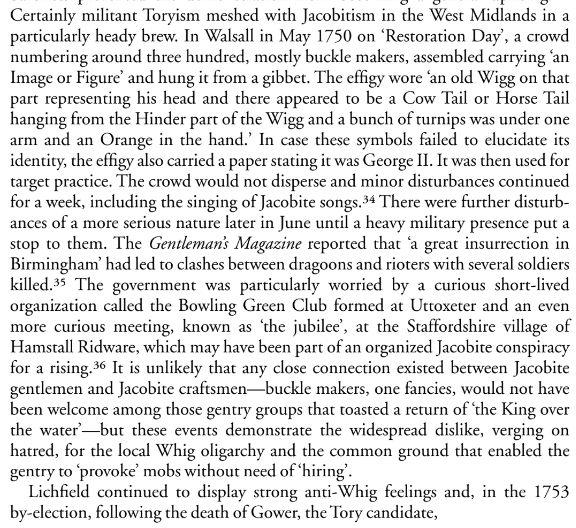
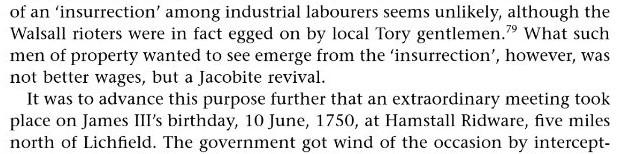
In Walsall in 1750 on “Restoration Day” a crowd numbering 300 assembled, mostly buckle makers, singing Jacobite songs and other rebellious and riotous acts. The government was particularly worried about a curious meeting known as the “Jubilee” in Hamstall Ridware, which may have been part of a conspiracy for a Jacobite uprising.
But this was thirty years before Samuel and Rebecca moved to Hamstall Ridware and does not help to explain why they moved there around 1780, although it does suggest connecting links.
Rebecca’s father, William Wood, was a brickmaker. This was stated at the beginning of his will. On closer inspection of the will, he was a brickmaker who owned four acres of brick kilns, as well as dwelling houses, shops, barns, stables, a brewhouse, a malthouse, cattle and land.
A page from the 1784 will of William Wood:
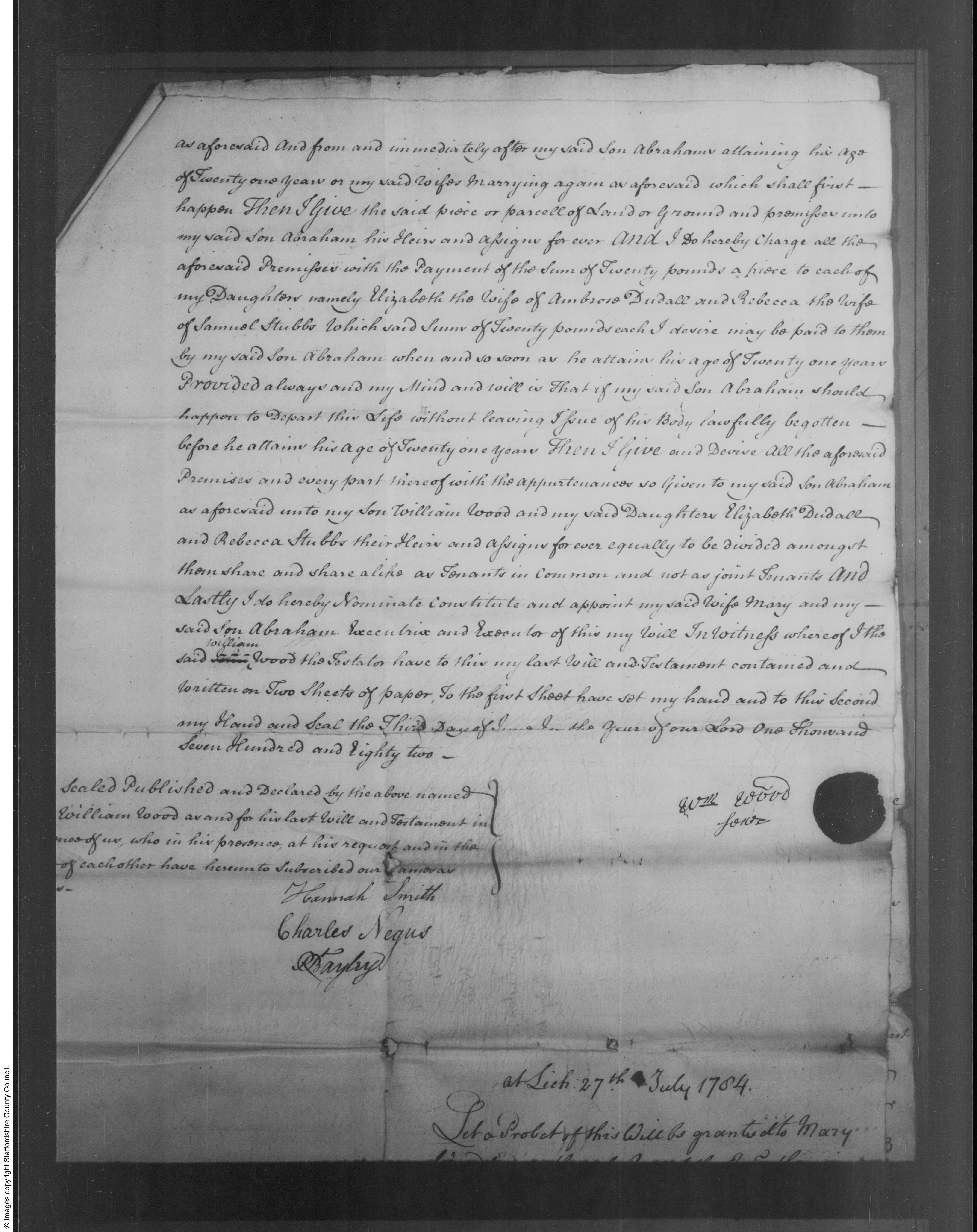
The 1784 will of William Wood of Darlaston:
I William Wood the elder of Darlaston in the county of Stafford, brickmaker, being of sound and disposing mind memory and understanding (praised be to god for the same) do make publish and declare my last will and testament in manner and form following (that is to say) {after debts and funeral expense paid etc} I give to my loving wife Mary the use usage wear interest and enjoyment of all my goods chattels cattle stock in trade ~ money securities for money personal estate and effects whatsoever and wheresoever to hold unto her my said wife for and during the term of her natural life providing she so long continues my widow and unmarried and from or after her decease or intermarriage with any future husband which shall first happen.
Then I give all the said goods chattels cattle stock in trade money securites for money personal estate and effects unto my son Abraham Wood absolutely and forever. Also I give devise and bequeath unto my said wife Mary all that my messuages tenement or dwelling house together with the malthouse brewhouse barn stableyard garden and premises to the same belonging situate and being at Darlaston aforesaid and now in my own possession. Also all that messuage tenement or dwelling house together with the shop garden and premises with the appurtenances to the same ~ belonging situate in Darlaston aforesaid and now in the several holdings or occupation of George Knowles and Edward Knowles to hold the aforesaid premises and every part thereof with the appurtenances to my said wife Mary for and during the term of her natural life provided she so long continues my widow and unmarried. And from or after her decease or intermarriage with a future husband which shall first happen. Then I give and devise the aforesaid premises and every part thereof with the appurtenances unto my said son Abraham Wood his heirs and assigns forever.
Also I give unto my said wife all that piece or parcel of land or ground inclosed and taken out of Heath Field in the parish of Darlaston aforesaid containing four acres or thereabouts (be the same more or less) upon which my brick kilns erected and now in my own possession. To hold unto my said wife Mary until my said son Abraham attains his age of twenty one years if she so long continues my widow and unmarried as aforesaid and from and immediately after my said son Abraham attaining his age of twenty one years or my said wife marrying again as aforesaid which shall first happen then I give the said piece or parcel of land or ground and premises unto my said son Abraham his heirs and assigns forever.
And I do hereby charge all the aforesaid premises with the payment of the sum of twenty pounds a piece to each of my daughters namely Elizabeth the wife of Ambrose Dudall and Rebecca the wife of Samuel Stubbs which said sum of twenty pounds each I devise may be paid to them by my said son Abraham when and so soon as he attains his age of twenty one years provided always and my mind and will is that if my said son Abraham should happen to depart this life without leaving issue of his body lawfully begotten before he attains his age of twenty one years then I give and devise all the aforesaid premises and every part thereof with the appurtenances so given to my said son Abraham as aforesaid unto my said son William Wood and my said daughter Elizabeth Dudall and Rebecca Stubbs their heirs and assigns forever equally divided among them share and share alike as tenants in common and not as joint tenants. And lastly I do hereby nominate constitute and appoint my said wife Mary and my said son Abraham executrix and executor of this my will.
The marriage of William Wood (1725-1784) and Mary Clews (1715-1798) in 1749 was in Hamstall Ridware.
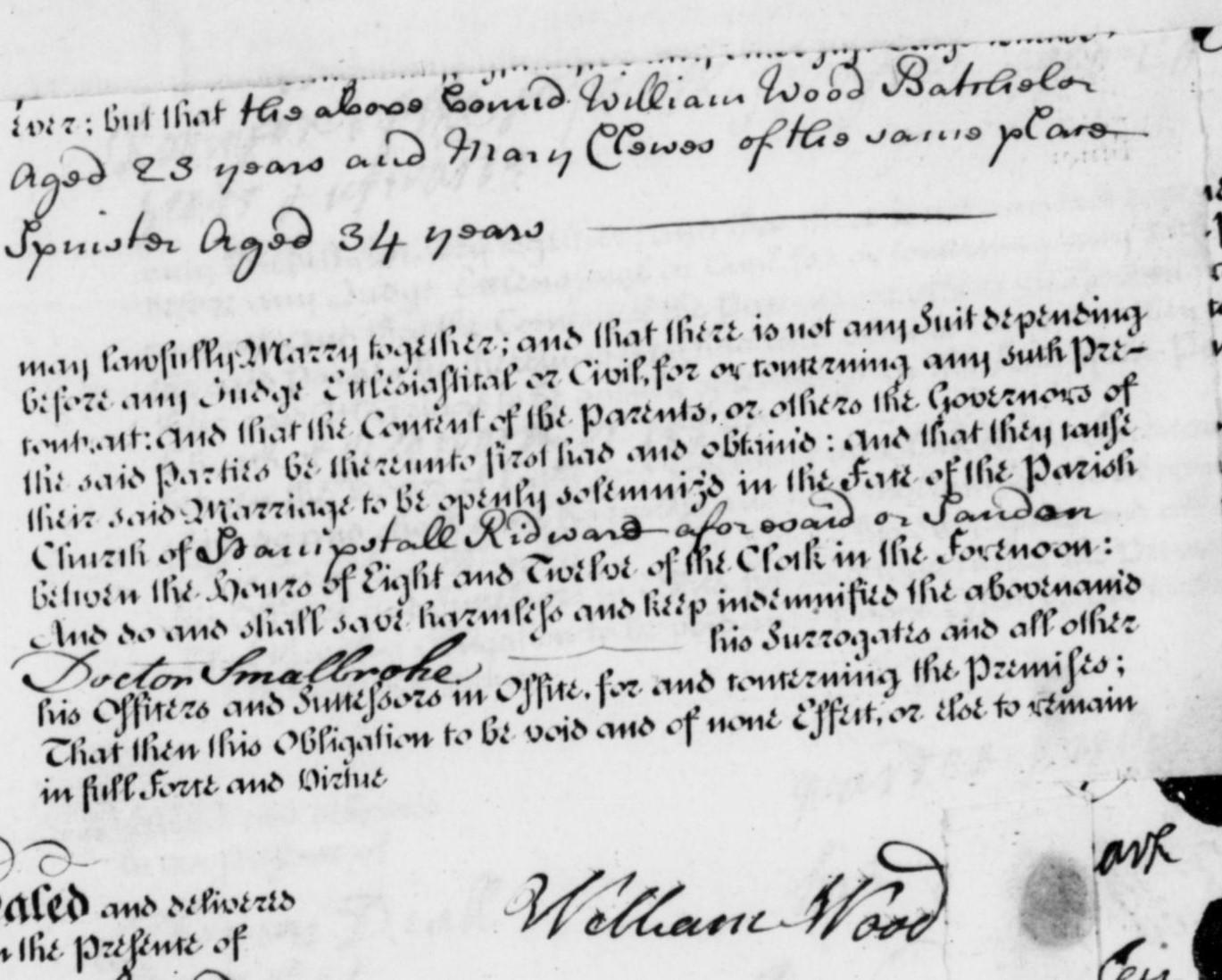
Mary was eleven years Williams senior, and it appears that they both came from Hamstall Ridware and moved to Darlaston after they married. Clearly Rebecca had extended family there (notwithstanding any possible connecting links between the Stubbs buckle makers of Darlaston and the Hamstall Ridware Jacobites thirty years prior). When the buckle trade collapsed in Darlaston, they likely moved to find employment elsewhere, perhaps with the help of Rebecca’s family.
I have not yet been able to find deaths recorded anywhere for either Samuel or Rebecca (there are a couple of deaths recorded for a Samuel Stubbs, one in 1809 in Wolverhampton, and one in 1810 in Birmingham but impossible to say which, if either, is the right one with the limited information, and difficult to know if they stayed in the Hamstall Ridware area or perhaps moved elsewhere)~ or find a reason for their son Solomon to be in Burton upon Trent, an evidently prosperous man with several properties including an earthenware business, as well as a land carrier business.
October 11, 2022 at 2:58 pm #6334In reply to: Family Stories From The Other Side ~ Book Two
The House on Penn Common
Toi Fang and the Duke of Sutherland
Tomlinsons
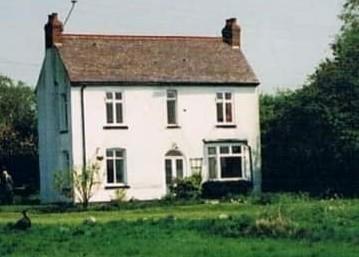
Grassholme
Charles Tomlinson (1873-1929) my great grandfather, was born in Wolverhampton in 1873. His father Charles Tomlinson (1847-1907) was a licensed victualler or publican, or alternatively a vet/castrator. He married Emma Grattidge (1853-1911) in 1872. On the 1881 census they were living at The Wheel in Wolverhampton.
Charles married Nellie Fisher (1877-1956) in Wolverhampton in 1896. In 1901 they were living next to the post office in Upper Penn, with children (Charles) Sidney Tomlinson (1896-1955), and Hilda Tomlinson (1898-1977) . Charles was a vet/castrator working on his own account.
In 1911 their address was 4, Wakely Hill, Penn, and living with them were their children Hilda, Frank Tomlinson (1901-1975), (Dorothy) Phyllis Tomlinson (1905-1982), Nellie Tomlinson (1906-1978) and May Tomlinson (1910-1983). Charles was a castrator working on his own account.
Charles and Nellie had a further four children: Charles Fisher Tomlinson (1911-1977), Margaret Tomlinson (1913-1989) (my grandmother Peggy), Major Tomlinson (1916-1984) and Norah Mary Tomlinson (1919-2010).
My father told me that my grandmother had fallen down the well at the house on Penn Common in 1915 when she was two years old, and sent me a photo of her standing next to the well when she revisted the house at a much later date.
Peggy next to the well on Penn Common:
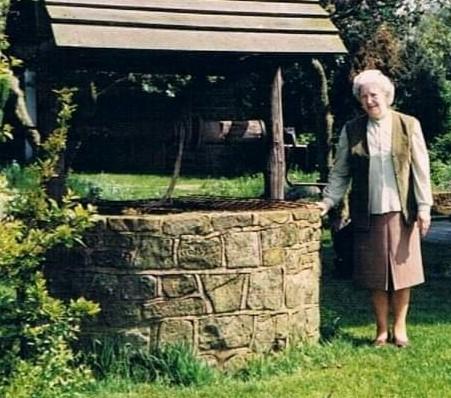
My grandmother Peggy told me that her father had had a racehorse called Toi Fang. She remembered the racing colours were sky blue and orange, and had a set of racing silks made which she sent to my father.
Through a DNA match, I met Ian Tomlinson. Ian is the son of my fathers favourite cousin Roger, Frank’s son. Ian found some racing silks and sent a photo to my father (they are now in contact with each other as a result of my DNA match with Ian), wondering what they were.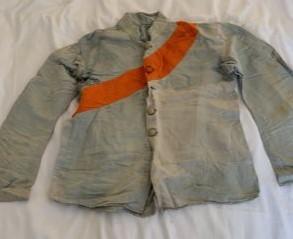
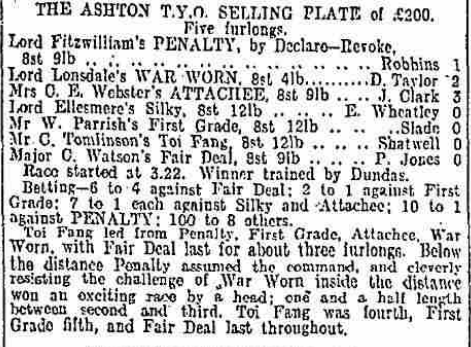
When Ian sent a photo of these racing silks, I had a look in the newspaper archives. In 1920 there are a number of mentions in the racing news of Mr C Tomlinson’s horse TOI FANG. I have not found any mention of Toi Fang in the newspapers in the following years.
The Scotsman – Monday 12 July 1920:
The other story that Ian Tomlinson recalled was about the house on Penn Common. Ian said he’d heard that the local titled person took Charles Tomlinson to court over building the house but that Tomlinson won the case because it was built on common land and was the first case of it’s kind.
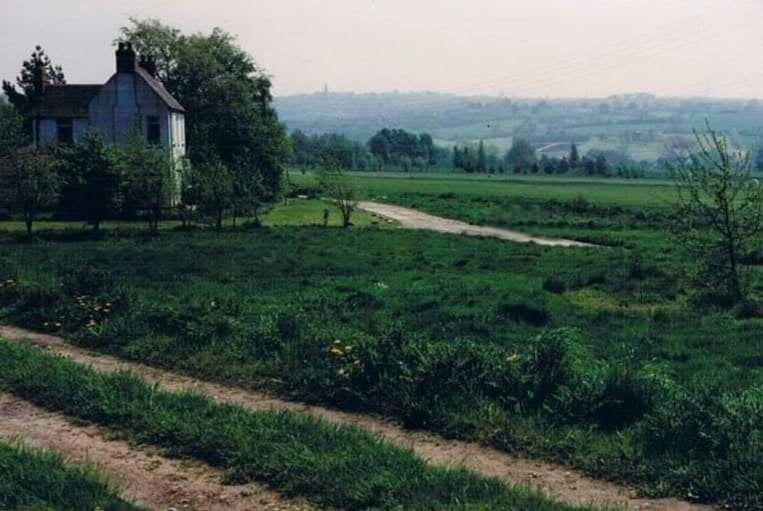
Penn Common Right of Way Case:
Staffordshire Advertiser March 9, 1912In the chancery division, on Tuesday, before Mr Justice Joyce, it was announced that a settlement had been arrived at of the Penn Common Right of Way case, the hearing of which occupied several days last month. The action was brought by the Duke of Sutherland (as Lord of the Manor of Penn) and Mr Harry Sydney Pitt (on behalf of himself and other freeholders of the manor having a right to pasturage on Penn Common) to restrain Mr James Lakin, Carlton House, Penn; Mr Charles Tomlinson, Mayfield Villa, Wakely Hill, Penn; and Mr Joseph Harold Simpkin, Dudley Road, Wolverhampton, from drawing building materials across the common, or otherwise causing injury to the soil.
The real point in dispute was whether there was a public highway for all purposes running by the side of the defendants land from the Turf Tavern past the golf club to the Barley Mow.
Mr Hughes, KC for the plaintiffs, now stated that the parties had been in consultation, and had come to terms, the substance of which was that the defendants admitted that there was no public right of way, and that they were granted a private way. This, he thought, would involve the granting of some deed or deeds to express the rights of the parties, and he suggested that the documents should be be settled by some counsel to be mutually agreed upon.His lordship observed that the question of coal was probably the important point. Mr Younger said Mr Tomlinson was a freeholder, and the plaintiffs could not mine under him. Mr Hughes: The coal actually under his house is his, and, of course, subsidence might be produced by taking away coal some distance away. I think some document is required to determine his actual rights.
Mr Younger said he wanted to avoid anything that would increase the costs, but, after further discussion, it was agreed that Mr John Dixon (an expert on mineral rights), or failing him, another counsel satisfactory to both parties, should be invited to settle the terms scheduled in the agreement, in order to prevent any further dispute.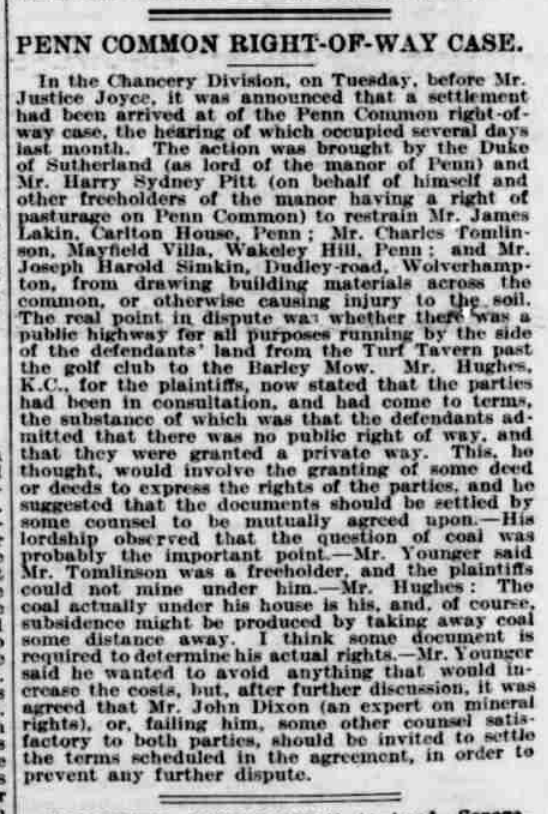
The name of the house is Grassholme. The address of Mayfield Villas is the house they were living in while building Grassholme, which I assume they had not yet moved in to at the time of the newspaper article in March 1912.
What my grandmother didn’t tell anyone was how her father died in 1929:
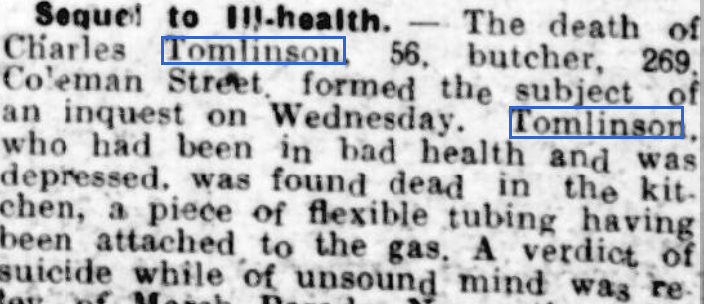
On the 1921 census, Charles, Nellie and eight of their children were living at 269 Coleman Street, Wolverhampton.
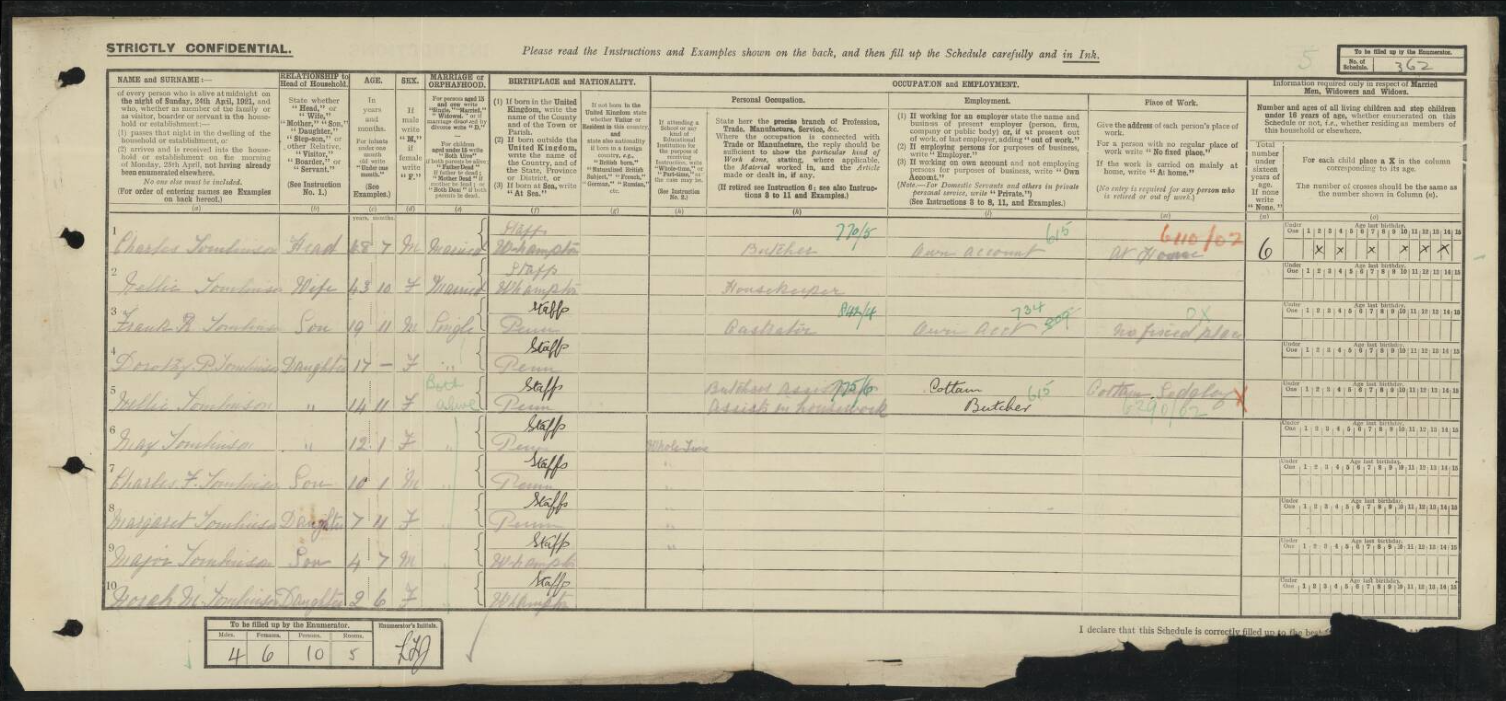
They were living on Coleman Street in 1915 when Charles was fined for staying open late.
Staffordshire Advertiser – Saturday 13 February 1915:

What is not yet clear is why they moved from the house on Penn Common sometime between 1912 and 1915. And why did he have a racehorse in 1920?
October 11, 2022 at 11:39 am #6333In reply to: Family Stories From The Other Side ~ Book Two
The Grattidge Family
The first Grattidge to appear in our tree was Emma Grattidge (1853-1911) who married Charles Tomlinson (1847-1907) in 1872.
Charles Tomlinson (1873-1929) was their son and he married my great grandmother Nellie Fisher. Their daughter Margaret (later Peggy Edwards) was my grandmother on my fathers side.
Emma Grattidge was born in Wolverhampton, the daughter and youngest child of William Grattidge (1820-1887) born in Foston, Derbyshire, and Mary Stubbs, born in Burton on Trent, daughter of Solomon Stubbs, a land carrier. William and Mary married at St Modwens church, Burton on Trent, in 1839. It’s unclear why they moved to Wolverhampton. On the 1841 census William was employed as an agent, and their first son William was nine months old. Thereafter, William was a licensed victuallar or innkeeper.
William Grattidge was born in Foston, Derbyshire in 1820. His parents were Thomas Grattidge, farmer (1779-1843) and Ann Gerrard (1789-1822) from Ellastone. Thomas and Ann married in 1813 in Ellastone. They had five children before Ann died at the age of 25:
Bessy was born in 1815, Thomas in 1818, William in 1820, and Daniel Augustus and Frederick were twins born in 1822. They were all born in Foston. (records say Foston, Foston and Scropton, or Scropton)
On the 1841 census Thomas had nine people additional to family living at the farm in Foston, presumably agricultural labourers and help.
After Ann died, Thomas had three children with Kezia Gibbs (30 years his junior) before marrying her in 1836, then had a further four with her before dying in 1843. Then Kezia married Thomas’s nephew Frederick Augustus Grattidge (born in 1816 in Stafford) in London in 1847 and had two more!
The siblings of William Grattidge (my 3x great grandfather):
Frederick Grattidge (1822-1872) was a schoolmaster and never married. He died at the age of 49 in Tamworth at his twin brother Daniels address.
Daniel Augustus Grattidge (1822-1903) was a grocer at Gungate in Tamworth.
Thomas Grattidge (1818-1871) married in Derby, and then emigrated to Illinois, USA.
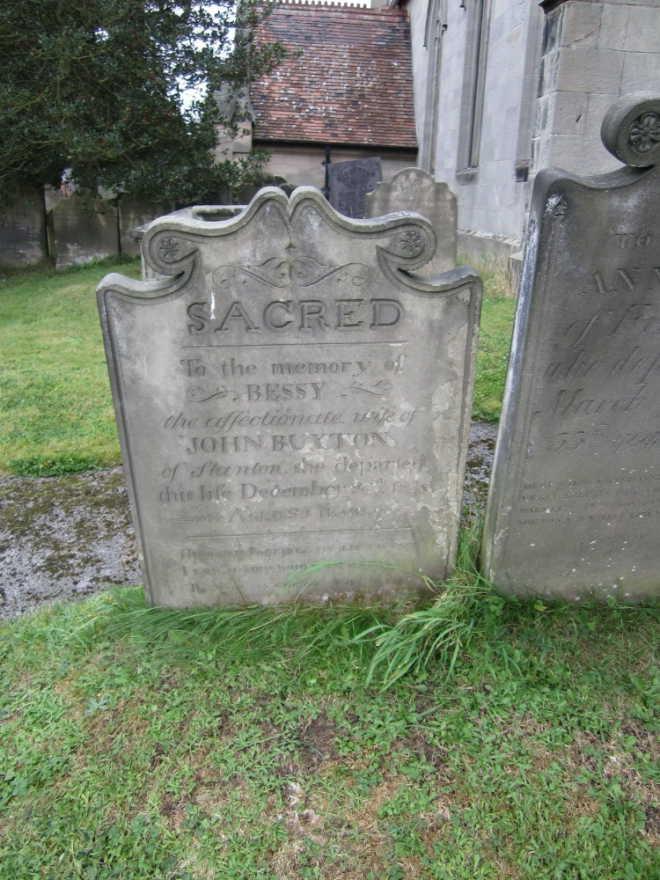
Bessy Grattidge (1815-1840) married John Buxton, farmer, in Ellastone in January 1838. They had three children before Bessy died in December 1840 at the age of 25: Henry in 1838, John in 1839, and Bessy Buxton in 1840. Bessy was baptised in January 1841. Presumably the birth of Bessy caused the death of Bessy the mother.
Bessy Buxton’s gravestone:
“Sacred to the memory of Bessy Buxton, the affectionate wife of John Buxton of Stanton She departed this life December 20th 1840, aged 25 years. “Husband, Farewell my life is Past, I loved you while life did last. Think on my children for my sake, And ever of them with I take.”
20 Dec 1840, Ellastone, Staffordshire
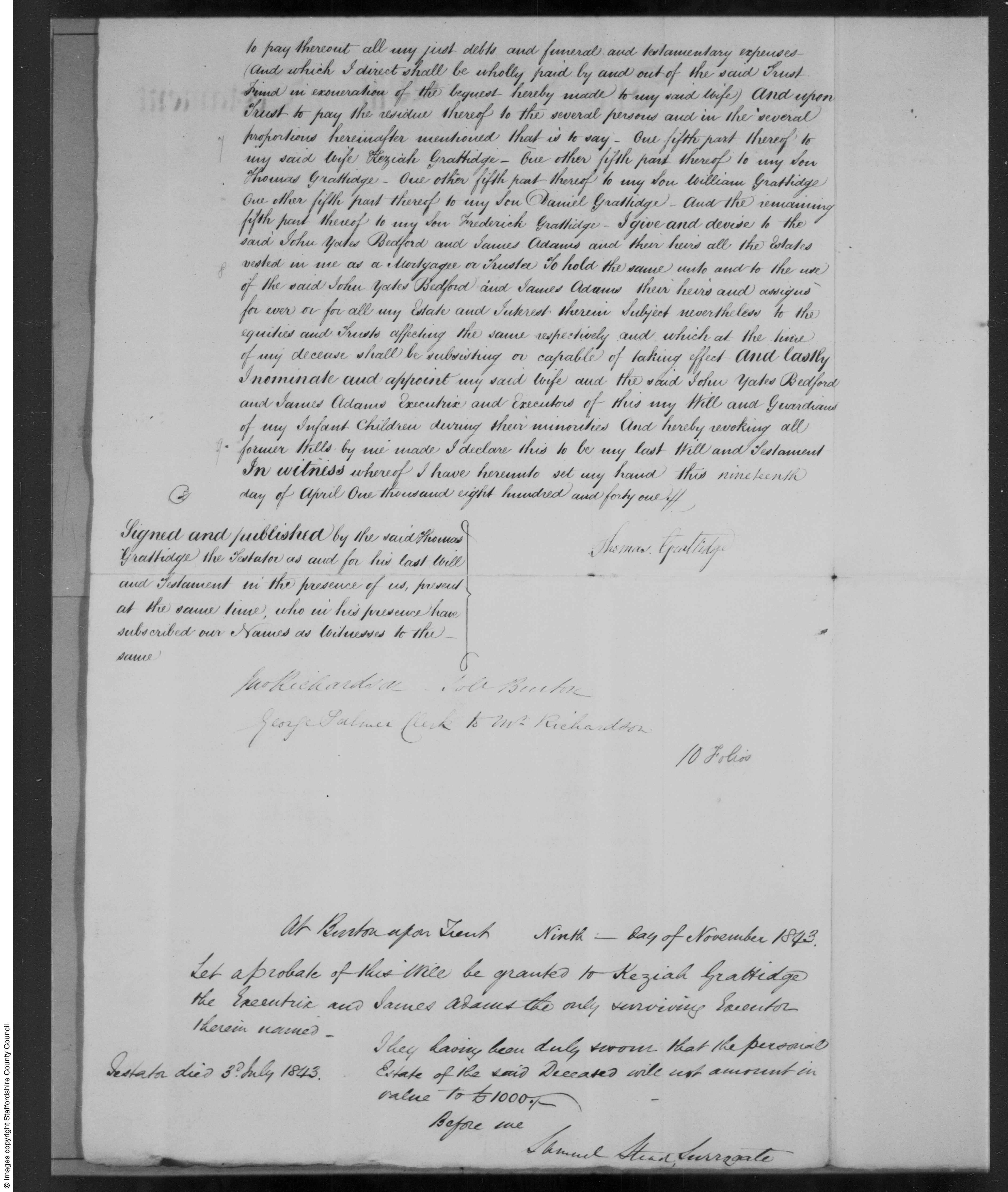
In the 1843 will of Thomas Grattidge, farmer of Foston, he leaves fifth shares of his estate, including freehold real estate at Findern, to his wife Kezia, and sons William, Daniel, Frederick and Thomas. He mentions that the children of his late daughter Bessy, wife of John Buxton, will be taken care of by their father. He leaves the farm to Keziah in confidence that she will maintain, support and educate his children with her.
An excerpt from the will:
I give and bequeath unto my dear wife Keziah Grattidge all my household goods and furniture, wearing apparel and plate and plated articles, linen, books, china, glass, and other household effects whatsoever, and also all my implements of husbandry, horses, cattle, hay, corn, crops and live and dead stock whatsoever, and also all the ready money that may be about my person or in my dwelling house at the time of my decease, …I also give my said wife the tenant right and possession of the farm in my occupation….
A page from the 1843 will of Thomas Grattidge:
William Grattidges half siblings (the offspring of Thomas Grattidge and Kezia Gibbs):
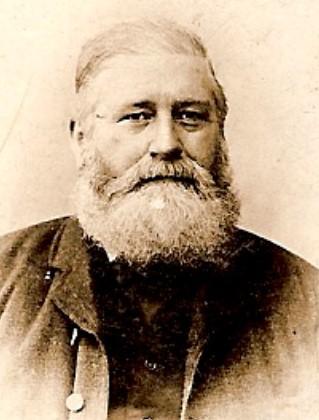
Albert Grattidge (1842-1914) was a railway engine driver in Derby. In 1884 he was driving the train when an unfortunate accident occured outside Ambergate. Three children were blackberrying and crossed the rails in front of the train, and one little girl died.
Albert Grattidge:
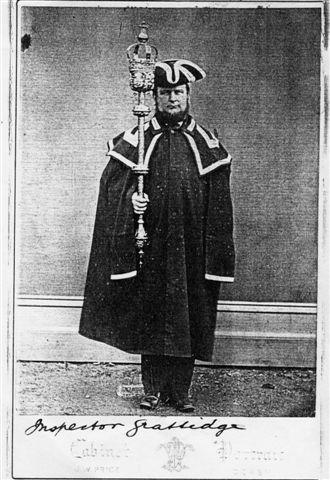
George Grattidge (1826-1876) was baptised Gibbs as this was before Thomas married Kezia. He was a police inspector in Derby.
George Grattidge:
Edwin Grattidge (1837-1852) died at just 15 years old.
Ann Grattidge (1835-) married Charles Fletcher, stone mason, and lived in Derby.
Louisa Victoria Grattidge (1840-1869) was sadly another Grattidge woman who died young. Louisa married Emmanuel Brunt Cheesborough in 1860 in Derby. In 1861 Louisa and Emmanuel were living with her mother Kezia in Derby, with their two children Frederick and Ann Louisa. Emmanuel’s occupation was sawyer. (Kezia Gibbs second husband Frederick Augustus Grattidge was a timber merchant in Derby)
At the time of her death in 1869, Emmanuel was the landlord of the White Hart public house at Bridgegate in Derby.
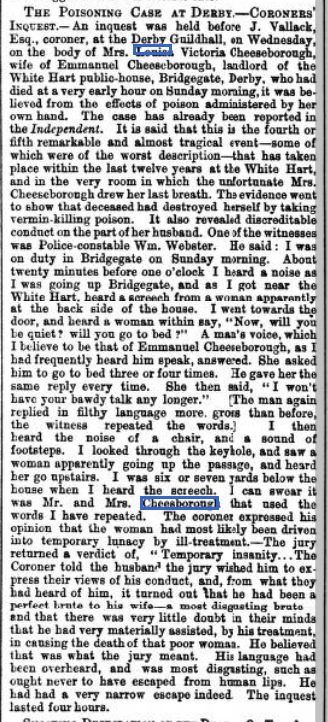
The Derby Mercury of 17th November 1869:
“On Wednesday morning Mr Coroner Vallack held an inquest in the Grand
Jury-room, Town-hall, on the body of Louisa Victoria Cheeseborough, aged
33, the wife of the landlord of the White Hart, Bridge-gate, who committed
suicide by poisoning at an early hour on Sunday morning. The following
evidence was taken:Mr Frederick Borough, surgeon, practising in Derby, deposed that he was
called in to see the deceased about four o’clock on Sunday morning last. He
accordingly examined the deceased and found the body quite warm, but dead.
He afterwards made enquiries of the husband, who said that he was afraid
that his wife had taken poison, also giving him at the same time the
remains of some blue material in a cup. The aunt of the deceased’s husband
told him that she had seen Mrs Cheeseborough put down a cup in the
club-room, as though she had just taken it from her mouth. The witness took
the liquid home with him, and informed them that an inquest would
necessarily have to be held on Monday. He had made a post mortem
examination of the body, and found that in the stomach there was a great
deal of congestion. There were remains of food in the stomach and, having
put the contents into a bottle, he took the stomach away. He also examined
the heart and found it very pale and flabby. All the other organs were
comparatively healthy; the liver was friable.Hannah Stone, aunt of the deceased’s husband, said she acted as a servant
in the house. On Saturday evening, while they were going to bed and whilst
witness was undressing, the deceased came into the room, went up to the
bedside, awoke her daughter, and whispered to her. but what she said the
witness did not know. The child jumped out of bed, but the deceased closed
the door and went away. The child followed her mother, and she also
followed them to the deceased’s bed-room, but the door being closed, they
then went to the club-room door and opening it they saw the deceased
standing with a candle in one hand. The daughter stayed with her in the
room whilst the witness went downstairs to fetch a candle for herself, and
as she was returning up again she saw the deceased put a teacup on the
table. The little girl began to scream, saying “Oh aunt, my mother is
going, but don’t let her go”. The deceased then walked into her bed-room,
and they went and stood at the door whilst the deceased undressed herself.
The daughter and the witness then returned to their bed-room. Presently
they went to see if the deceased was in bed, but she was sitting on the
floor her arms on the bedside. Her husband was sitting in a chair fast
asleep. The witness pulled her on the bed as well as she could.
Ann Louisa Cheesborough, a little girl, said that the deceased was her
mother. On Saturday evening last, about twenty minutes before eleven
o’clock, she went to bed, leaving her mother and aunt downstairs. Her aunt
came to bed as usual. By and bye, her mother came into her room – before
the aunt had retired to rest – and awoke her. She told the witness, in a
low voice, ‘that she should have all that she had got, adding that she
should also leave her her watch, as she was going to die’. She did not tell
her aunt what her mother had said, but followed her directly into the
club-room, where she saw her drink something from a cup, which she
afterwards placed on the table. Her mother then went into her own room and
shut the door. She screamed and called her father, who was downstairs. He
came up and went into her room. The witness then went to bed and fell
asleep. She did not hear any noise or quarrelling in the house after going
to bed.Police-constable Webster was on duty in Bridge-gate on Saturday evening
last, about twenty minutes to one o’clock. He knew the White Hart
public-house in Bridge-gate, and as he was approaching that place, he heard
a woman scream as though at the back side of the house. The witness went to
the door and heard the deceased keep saying ‘Will you be quiet and go to
bed’. The reply was most disgusting, and the language which the
police-constable said was uttered by the husband of the deceased, was
immoral in the extreme. He heard the poor woman keep pressing her husband
to go to bed quietly, and eventually he saw him through the keyhole of the
door pass and go upstairs. his wife having gone up a minute or so before.
Inspector Fearn deposed that on Sunday morning last, after he had heard of
the deceased’s death from supposed poisoning, he went to Cheeseborough’s
public house, and found in the club-room two nearly empty packets of
Battie’s Lincoln Vermin Killer – each labelled poison.Several of the Jury here intimated that they had seen some marks on the
deceased’s neck, as of blows, and expressing a desire that the surgeon
should return, and re-examine the body. This was accordingly done, after
which the following evidence was taken:Mr Borough said that he had examined the body of the deceased and observed
a mark on the left side of the neck, which he considered had come on since
death. He thought it was the commencement of decomposition.
This was the evidence, after which the jury returned a verdict “that the
deceased took poison whilst of unsound mind” and requested the Coroner to
censure the deceased’s husband.The Coroner told Cheeseborough that he was a disgusting brute and that the
jury only regretted that the law could not reach his brutal conduct.
However he had had a narrow escape. It was their belief that his poor
wife, who was driven to her own destruction by his brutal treatment, would
have been a living woman that day except for his cowardly conduct towards
her.The inquiry, which had lasted a considerable time, then closed.”
In this article it says:
“it was the “fourth or fifth remarkable and tragical event – some of which were of the worst description – that has taken place within the last twelve years at the White Hart and in the very room in which the unfortunate Louisa Cheesborough drew her last breath.”
Sheffield Independent – Friday 12 November 1869:
 May 3, 2022 at 4:40 pm #6291
In reply to: The Elusive Samuel Housley and Other Family Stories
Jane Eaton
The Nottingham Girl
Jane Eaton 1809-1879
Francis Purdy, the Beggarlea Bulldog and Methodist Minister, married Jane Eaton in 1837 in Nottingham. Jane was his second wife.
Jane Eaton, photo says “Grandma Purdy” on the back:
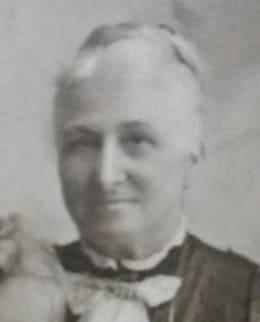
Jane is described as a “Nottingham girl” in a book excerpt sent to me by Jim Giles, a relation who shares the same 3x great grandparents, Francis and Jane Purdy.
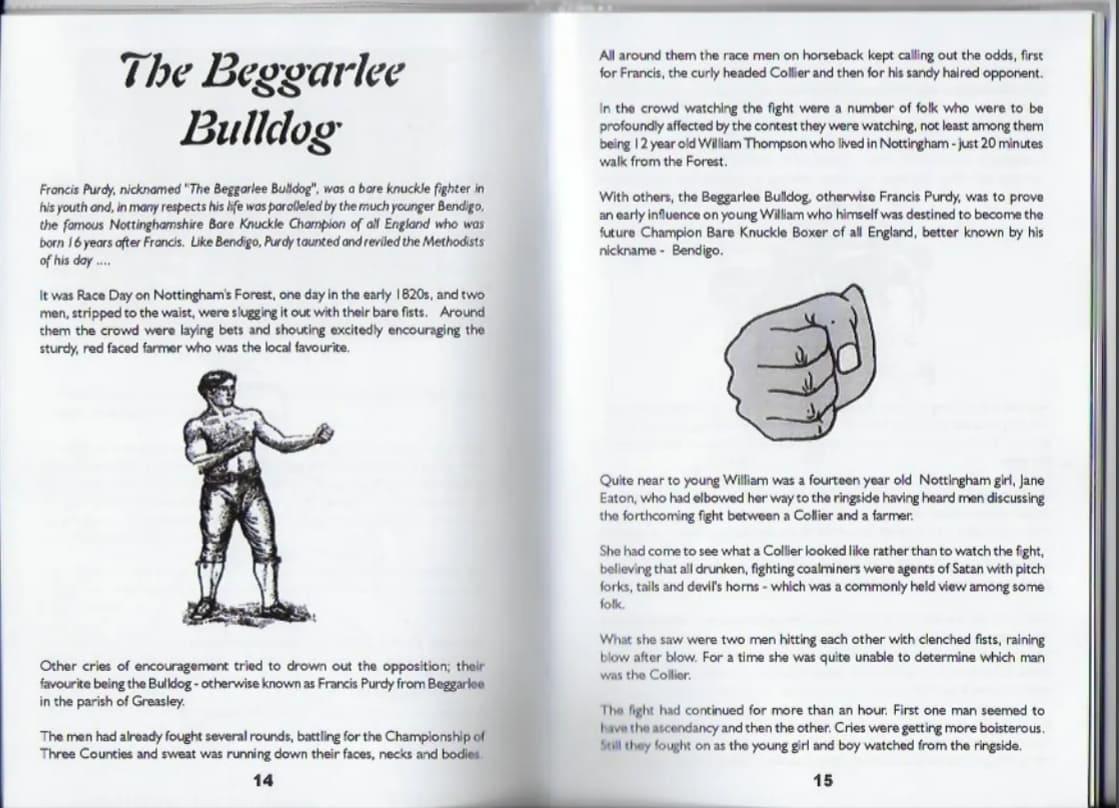
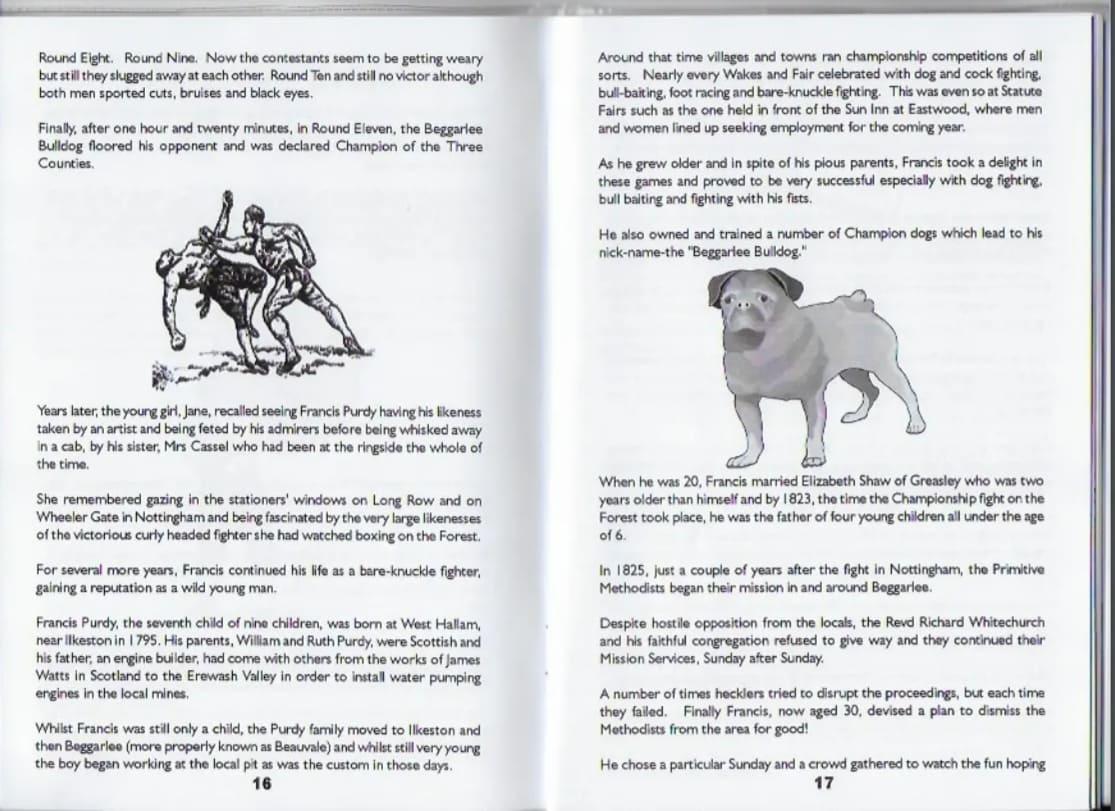
Elizabeth, Francis Purdy’s first wife, died suddenly at chapel in 1836, leaving nine children.
On Christmas day the following year Francis married Jane Eaton at St Peters church in Nottingham. Jane married a Methodist Minister, and didn’t realize she married the bare knuckle fighter she’d seen when she was fourteen until he undressed and she saw his scars.
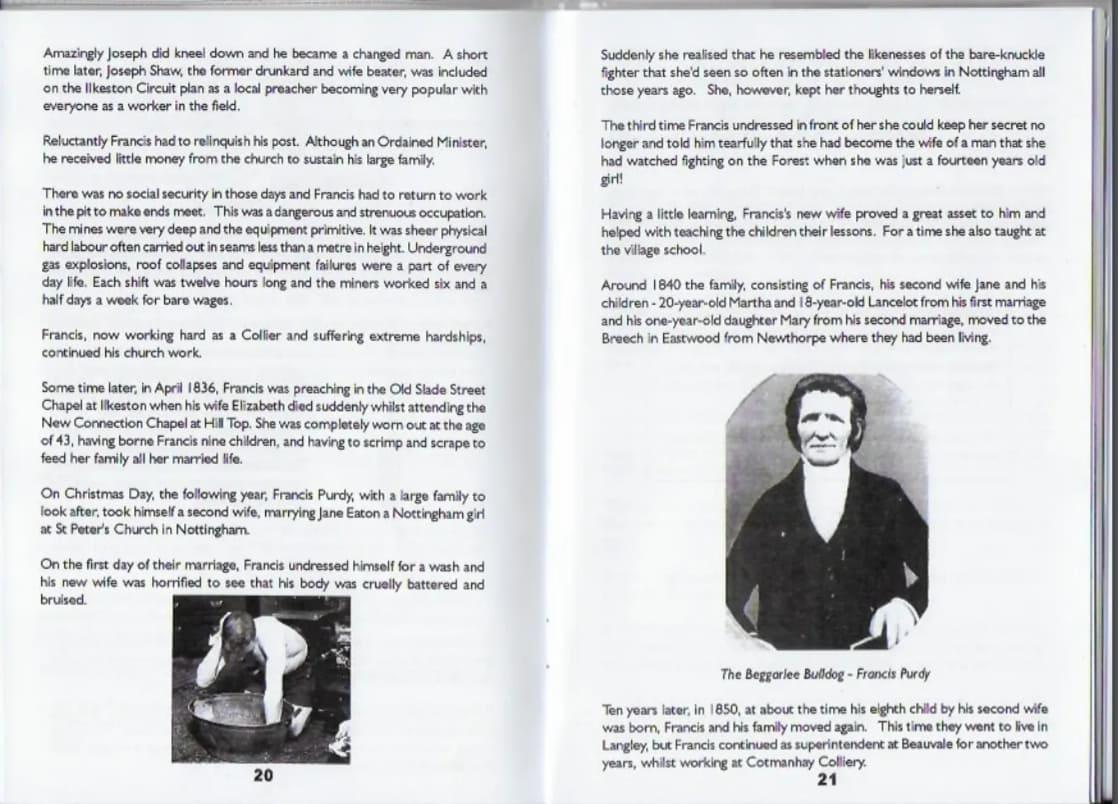
William Eaton 1767-1851
On the marriage certificate Jane’s father was William Eaton, occupation gardener. Francis’s father was William Purdy, engineer.
On the 1841 census living in Sollory’s Yard, Nottingham St Mary, William Eaton was a 70 year old gardener. It doesn’t say which county he was born in but indicates that it was not Nottinghamshire. Living with him were Mary Eaton, milliner, age 35, Mary Eaton, milliner, 15, and Elizabeth Rhodes age 35, a sempstress (another word for seamstress). The three women were born in Nottinghamshire.
But who was Elizabeth Rhodes?
Elizabeth Eaton was Jane’s older sister, born in 1797 in Nottingham. She married William Rhodes, a private in the 5th Dragoon Guards, in Leeds in October 1815.
I looked for Elizabeth Rhodes on the 1851 census, which stated that she was a widow. I was also trying to determine which William Eaton death was the right one, and found William Eaton was still living with Elizabeth in 1851 at Pilcher Gate in Nottingham, but his name had been entered backwards: Eaton William. I would not have found him on the 1851 census had I searched for Eaton as a last name.
Pilcher Gate gets its strange name from pilchers or fur dealers and was once a very narrow thoroughfare. At the lower end stood a pub called The Windmill – frequented by the notorious robber and murderer Charlie Peace.
This was a lucky find indeed, because William’s place of birth was listed as Grantham, Lincolnshire. There were a couple of other William Eaton’s born at the same time, both near to Nottingham. It was tricky to work out which was the right one, but as it turned out, neither of them were.
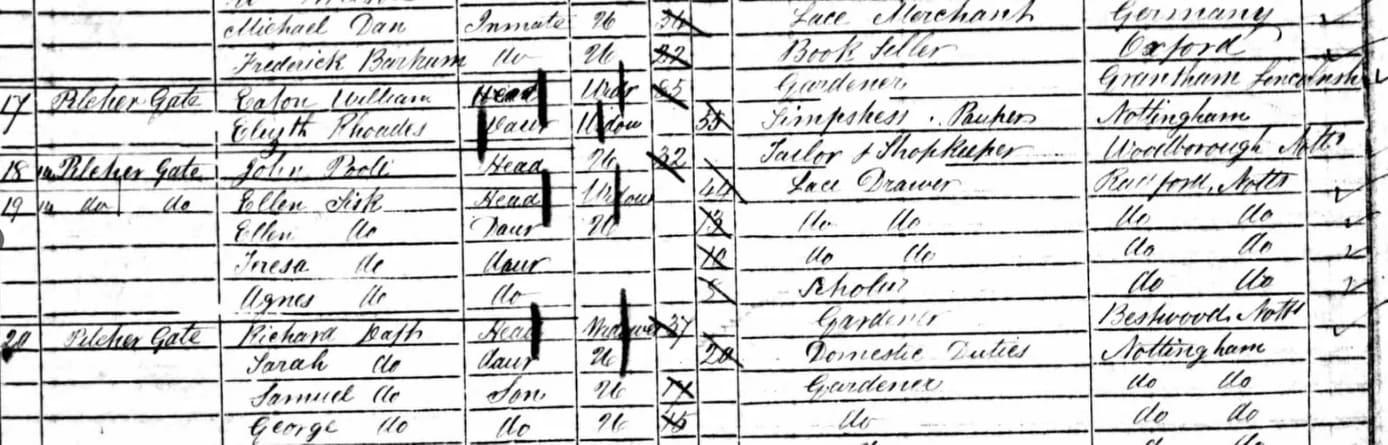
Now we had Nottinghamshire and Lincolnshire border straddlers, so the search moved to the Lincolnshire records.
But first, what of the two Mary Eatons living with William?William and his wife Mary had a daughter Mary in 1799 who died in 1801, and another daughter Mary Ann born in 1803. (It was common to name children after a previous infant who had died.) It seems that Mary Ann didn’t marry but had a daughter Mary Eaton born in 1822.
William and his wife Mary also had a son Richard Eaton born in 1801 in Nottingham.
Who was William Eaton’s wife Mary?
There are two possibilities: Mary Cresswell and a marriage in Nottingham in 1797, or Mary Dewey and a marriage at Grantham in 1795. If it’s Mary Cresswell, the first child Elizabeth would have been born just four or five months after the wedding. (This was far from unusual). However, no births in Grantham, or in Nottingham, were recorded for William and Mary in between 1795 and 1797.
We don’t know why William moved from Grantham to Nottingham or when he moved there. According to Dearden’s 1834 Nottingham directory, William Eaton was a “Gardener and Seedsman”.
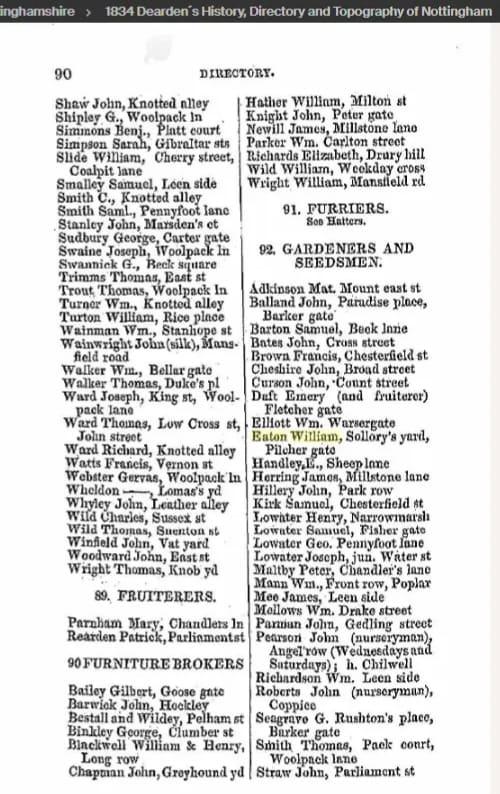
There was another William Eaton selling turnip seeds in the same part of Nottingham. At first I thought it must be the same William, but apparently not, as that William Eaton is recorded as a victualler, born in Ruddington. The turnip seeds were advertised in 1847 as being obtainable from William Eaton at the Reindeer Inn, Wheeler Gate. Perhaps he was related.
William lived in the Lace Market part of Nottingham. I wondered where a gardener would be working in that part of the city. According to CreativeQuarter website, “in addition to the trades and housing (sometimes under the same roof), there were a number of splendid mansions being built with extensive gardens and orchards. Sadly, these no longer exist as they were gradually demolished to make way for commerce…..The area around St Mary’s continued to develop as an elegant residential district during the seventeenth and eighteenth centuries, with buildings … being built for nobility and rich merchants.”
William Eaton died in Nottingham in September 1851, thankfully after the census was taken recording his place of birth.
April 12, 2022 at 8:13 am #6290In reply to: The Elusive Samuel Housley and Other Family Stories
Leicestershire Blacksmiths
The Orgill’s of Measham led me further into Leicestershire as I traveled back in time.
I also realized I had uncovered a direct line of women and their mothers going back ten generations:
myself, Tracy Edwards 1957-
my mother Gillian Marshall 1933-
my grandmother Florence Warren 1906-1988
her mother and my great grandmother Florence Gretton 1881-1927
her mother Sarah Orgill 1840-1910
her mother Elizabeth Orgill 1803-1876
her mother Sarah Boss 1783-1847
her mother Elizabeth Page 1749-
her mother Mary Potter 1719-1780
and her mother and my 7x great grandmother Mary 1680-You could say it leads us to the very heart of England, as these Leicestershire villages are as far from the coast as it’s possible to be. There are countless other maternal lines to follow, of course, but only one of mothers of mothers, and ours takes us to Leicestershire.
The blacksmiths
Sarah Boss was the daughter of Michael Boss 1755-1807, a blacksmith in Measham, and Elizabeth Page of nearby Hartshorn, just over the county border in Derbyshire.
An earlier Michael Boss, a blacksmith of Measham, died in 1772, and in his will he left the possession of the blacksmiths shop and all the working tools and a third of the household furniture to Michael, who he named as his nephew. He left his house in Appleby Magna to his wife Grace, and five pounds to his mother Jane Boss. As none of Michael and Grace’s children are mentioned in the will, perhaps it can be assumed that they were childless.
The will of Michael Boss, 1772, Measham:
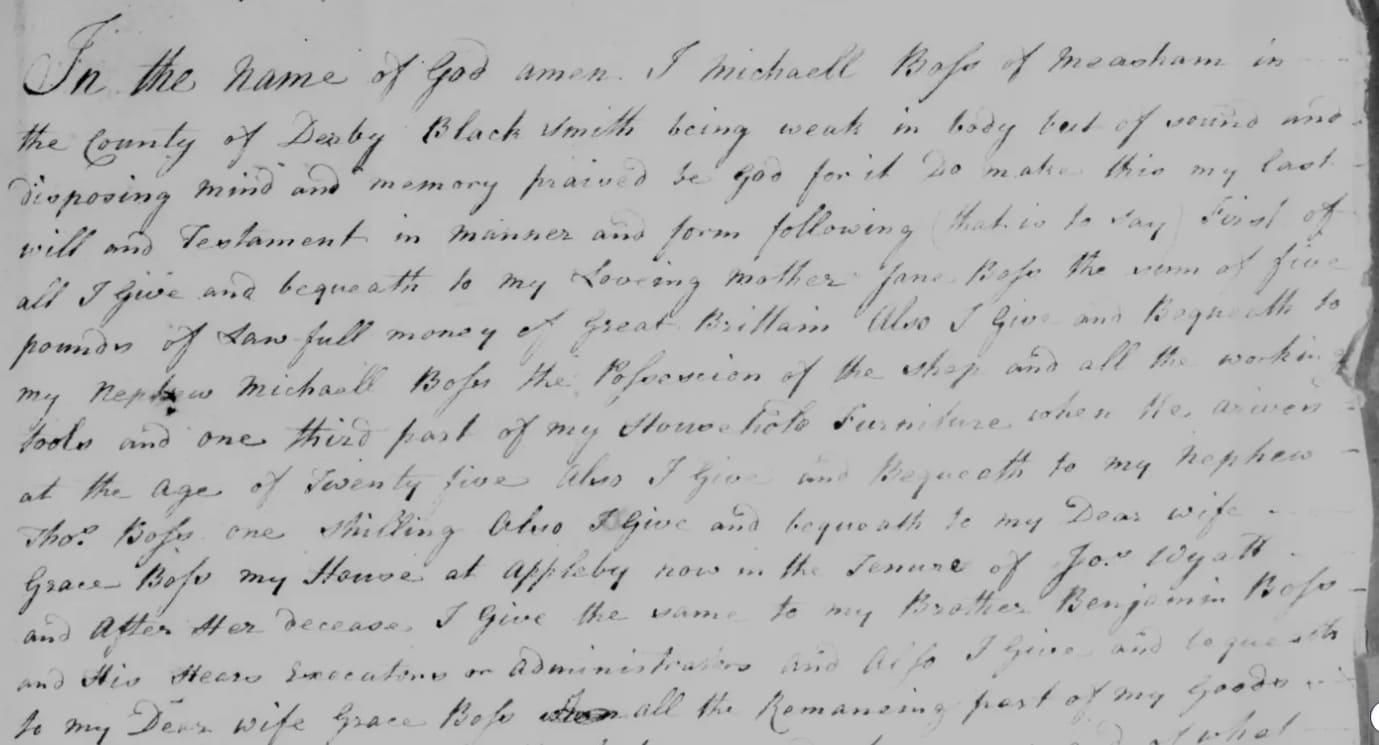
Michael Boss the uncle was born in Appleby Magna in 1724. His parents were Michael Boss of Nelson in the Thistles and Jane Peircivall of Appleby Magna, who were married in nearby Mancetter in 1720.
Information worth noting on the Appleby Magna website:
In 1752 the calendar in England was changed from the Julian Calendar to the Gregorian Calendar, as a result 11 days were famously “lost”. But for the recording of Church Registers another very significant change also took place, the start of the year was moved from March 25th to our more familiar January 1st.
Before 1752 the 1st day of each new year was March 25th, Lady Day (a significant date in the Christian calendar). The year number which we all now use for calculating ages didn’t change until March 25th. So, for example, the day after March 24th 1750 was March 25th 1751, and January 1743 followed December 1743.
This March to March recording can be seen very clearly in the Appleby Registers before 1752. Between 1752 and 1768 there appears slightly confused recording, so dates should be carefully checked. After 1768 the recording is more fully by the modern calendar year.Michael Boss the uncle married Grace Cuthbert. I haven’t yet found the birth or parents of Grace, but a blacksmith by the name of Edward Cuthbert is mentioned on an Appleby Magna history website:
An Eighteenth Century Blacksmith’s Shop in Little Appleby
by Alan RobertsCuthberts inventory
The inventory of Edward Cuthbert provides interesting information about the household possessions and living arrangements of an eighteenth century blacksmith. Edward Cuthbert (als. Cutboard) settled in Appleby after the Restoration to join the handful of blacksmiths already established in the parish, including the Wathews who were prominent horse traders. The blacksmiths may have all worked together in the same shop at one time. Edward and his wife Sarah recorded the baptisms of several of their children in the parish register. Somewhat sadly three of the boys named after their father all died either in infancy or as young children. Edward’s inventory which was drawn up in 1732, by which time he was probably a widower and his children had left home, suggests that they once occupied a comfortable two-storey house in Little Appleby with an attached workshop, well equipped with all the tools for repairing farm carts, ploughs and other implements, for shoeing horses and for general ironmongery.
Edward Cuthbert born circa 1660, married Joane Tuvenet in 1684 in Swepston cum Snarestone , and died in Appleby in 1732. Tuvenet is a French name and suggests a Huguenot connection, but this isn’t our family, and indeed this Edward Cuthbert is not likely to be Grace’s father anyway.
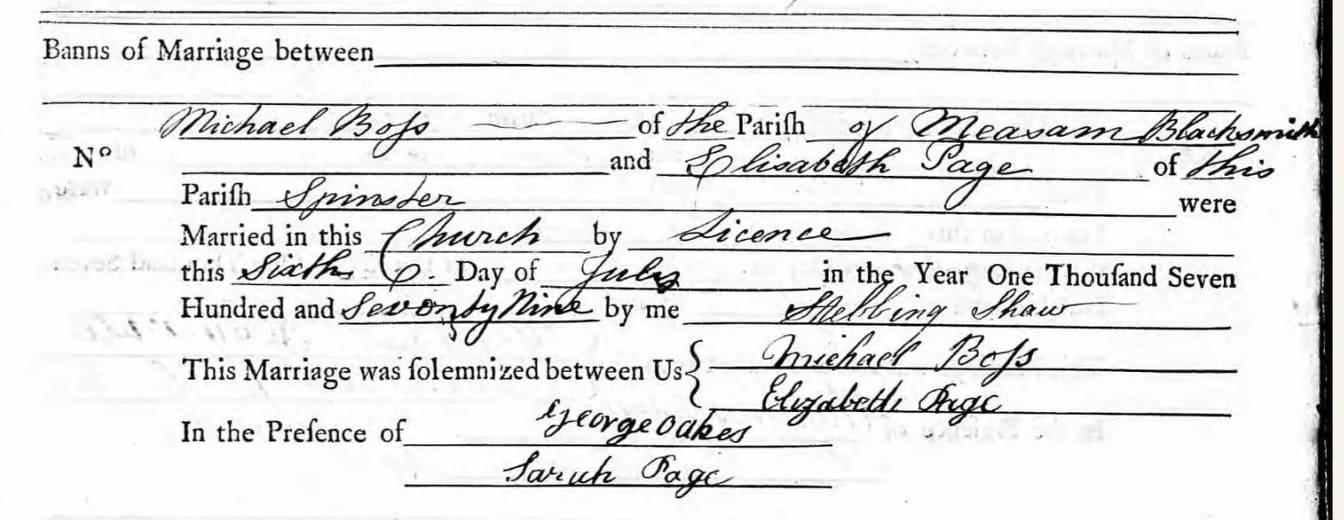
Michael Boss and Elizabeth Page appear to have married twice: once in 1776, and once in 1779. Both of the documents exist and appear correct. Both marriages were by licence. They both mention Michael is a blacksmith.
Their first daughter, Elizabeth, was baptized in February 1777, just nine months after the first wedding. It’s not known when she was born, however, and it’s possible that the marriage was a hasty one. But why marry again three years later?
But Michael Boss and Elizabeth Page did not marry twice.
Elizabeth Page from Smisby was born in 1752 and married Michael Boss on the 5th of May 1776 in Measham. On the marriage licence allegations and bonds, Michael is a bachelor.
Baby Elizabeth was baptised in Measham on the 9th February 1777. Mother Elizabeth died on the 18th February 1777, also in Measham.
In 1779 Michael Boss married another Elizabeth Page! She was born in 1749 in Hartshorn, and Michael is a widower on the marriage licence allegations and bonds.
Hartshorn and Smisby are neighbouring villages, hence the confusion. But a closer look at the documents available revealed the clues. Both Elizabeth Pages were literate, and indeed their signatures on the marriage registers are different:
Marriage of Michael Boss and Elizabeth Page of Smisby in 1776:
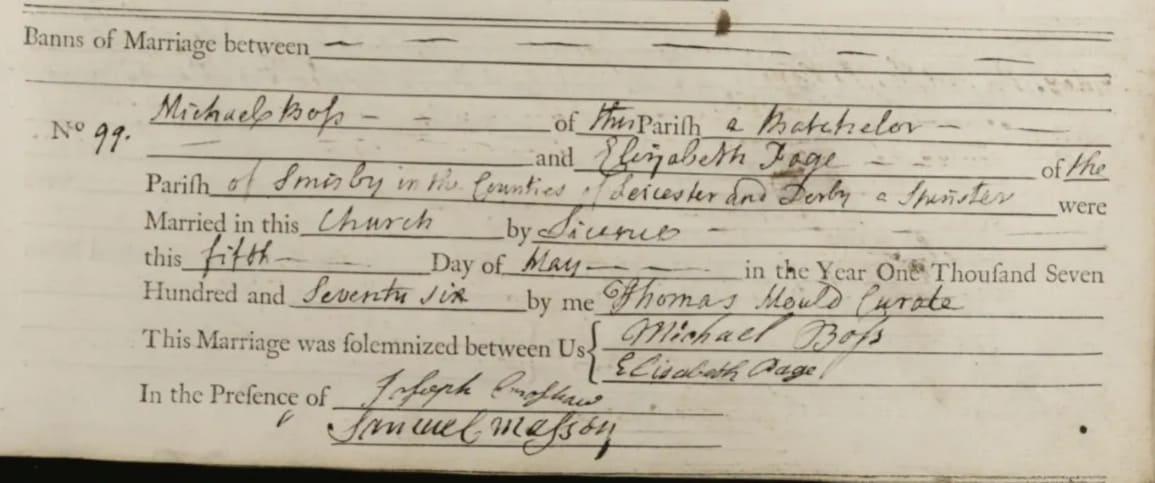
Marriage of Michael Boss and Elizabeth Page of Harsthorn in 1779:
Not only did Michael Boss marry two women both called Elizabeth Page but he had an unusual start in life as well. His uncle Michael Boss left him the blacksmith business and a third of his furniture. This was all in the will. But which of Uncle Michaels brothers was nephew Michaels father?
The only Michael Boss born at the right time was in 1750 in Edingale, Staffordshire, about eight miles from Appleby Magna. His parents were Thomas Boss and Ann Parker, married in Edingale in 1747. Thomas died in August 1750, and his son Michael was baptised in the December, posthumus son of Thomas and his widow Ann. Both entries are on the same page of the register.
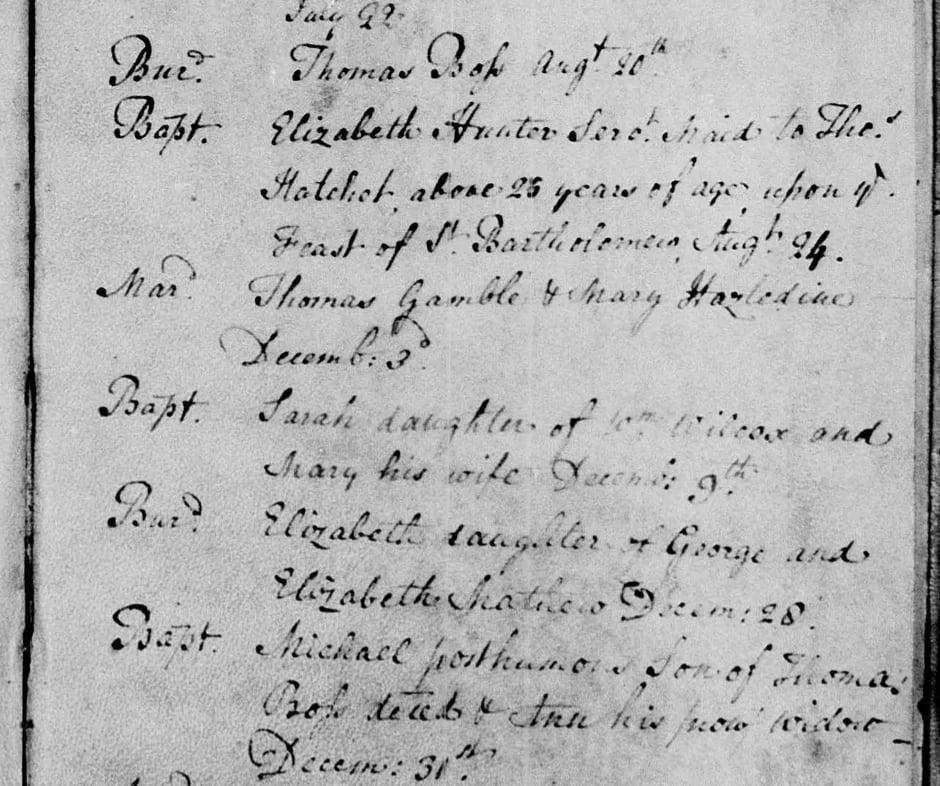
Ann Boss, the young widow, married again. But perhaps Michael and his brother went to live with their childless uncle and aunt, Michael Boss and Grace Cuthbert.
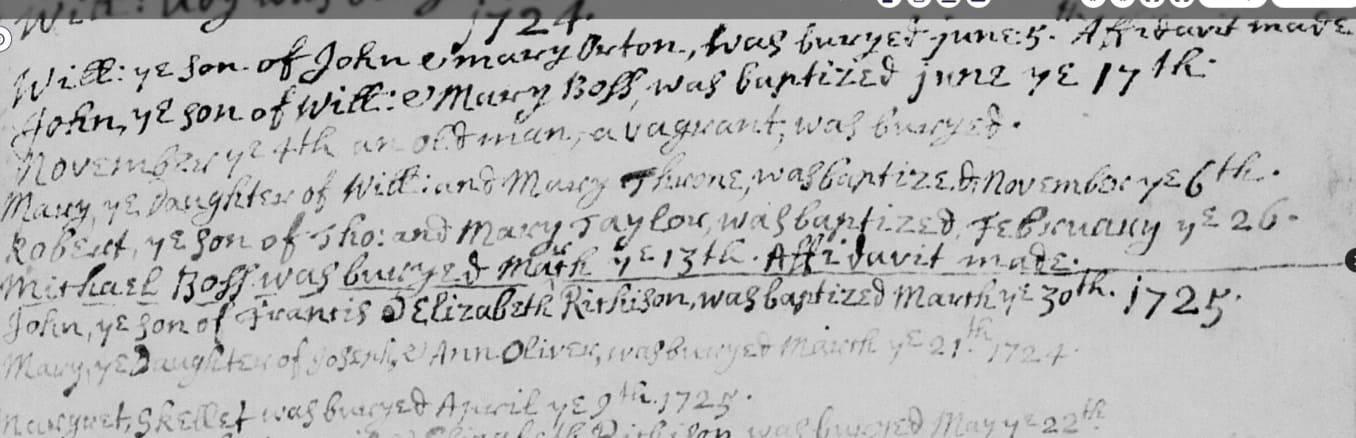
The great grandfather of Michael Boss (the Measham blacksmith born in 1850) was also Michael Boss, probably born in the 1660s. He died in Newton Regis in Warwickshire in 1724, four years after his son (also Michael Boss born 1693) married Jane Peircivall. The entry on the parish register states that Michael Boss was buried ye 13th Affadavit made.
I had not seen affadavit made on a parish register before, and this relates to the The Burying in Woollen Acts 1666–80. According to Wikipedia:
“Acts of the Parliament of England which required the dead, except plague victims and the destitute, to be buried in pure English woollen shrouds to the exclusion of any foreign textiles. It was a requirement that an affidavit be sworn in front of a Justice of the Peace (usually by a relative of the deceased), confirming burial in wool, with the punishment of a £5 fee for noncompliance. Burial entries in parish registers were marked with the word “affidavit” or its equivalent to confirm that affidavit had been sworn; it would be marked “naked” for those too poor to afford the woollen shroud. The legislation was in force until 1814, but was generally ignored after 1770.”
Michael Boss buried 1724 “Affadavit made”:
Elizabeth Page‘s father was William Page 1717-1783, a wheelwright in Hartshorn. (The father of the first wife Elizabeth was also William Page, but he was a husbandman in Smisby born in 1714. William Page, the father of the second wife, was born in Nailstone, Leicestershire, in 1717. His place of residence on his marriage to Mary Potter was spelled Nelson.)
Her mother was Mary Potter 1719- of nearby Coleorton. Mary’s father, Richard Potter 1677-1731, was a blacksmith in Coleorton.
A page of the will of Richard Potter 1731:
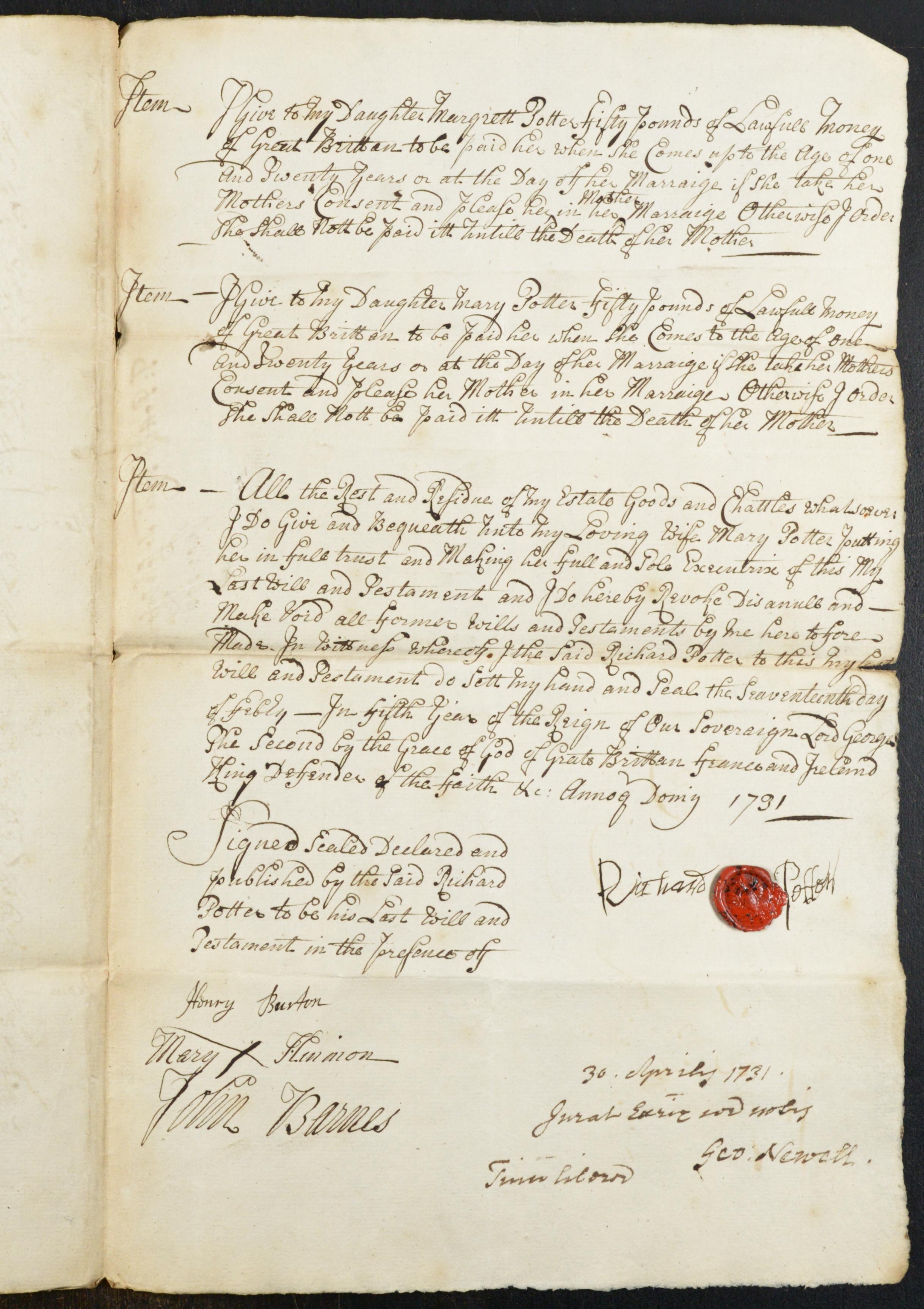
Richard Potter states: “I will and order that my son Thomas Potter shall after my decease have one shilling paid to him and no more.” As he left £50 to each of his daughters, one can’t help but wonder what Thomas did to displease his father.
Richard stipulated that his son Thomas should have one shilling paid to him and not more, for several good considerations, and left “the house and ground lying in the parish of Whittwick in a place called the Long Lane to my wife Mary Potter to dispose of as she shall think proper.”
His son Richard inherited the blacksmith business: “I will and order that my son Richard Potter shall live and be with his mother and serve her duly and truly in the business of a blacksmith, and obey and serve her in all lawful commands six years after my decease, and then I give to him and his heirs…. my house and grounds Coulson House in the Liberty of Thringstone”
Richard wanted his son John to be a blacksmith too: “I will and order that my wife bring up my son John Potter at home with her and teach or cause him to be taught the trade of a blacksmith and that he shall serve her duly and truly seven years after my decease after the manner of an apprentice and at the death of his mother I give him that house and shop and building and the ground belonging to it which I now dwell in to him and his heirs forever.”
To his daughters Margrett and Mary Potter, upon their reaching the age of one and twenty, or the day after their marriage, he leaves £50 each. All the rest of his goods are left to his loving wife Mary.
An inventory of the belongings of Richard Potter, 1731:
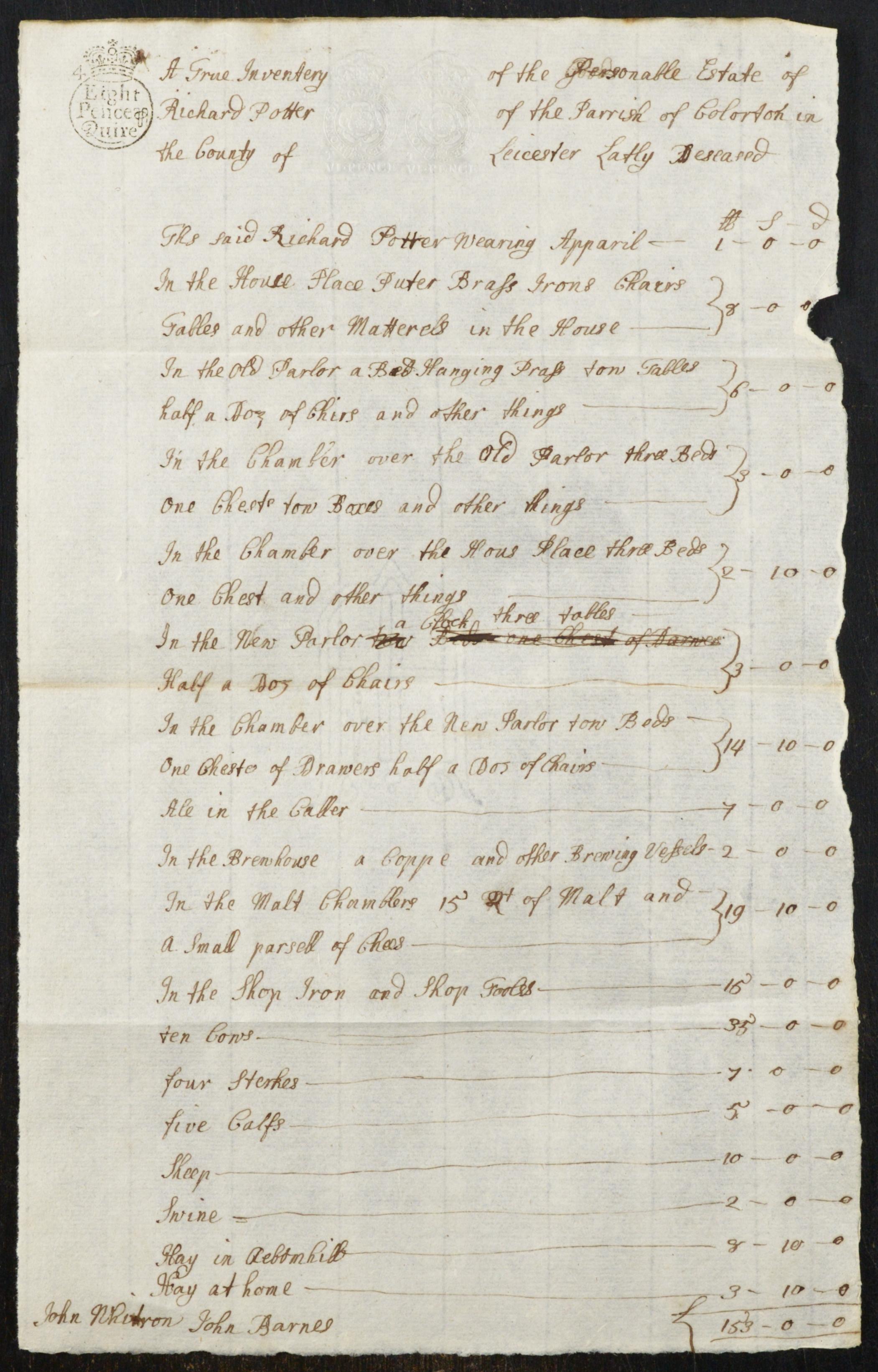
Richard Potters father was also named Richard Potter 1649-1719, and he too was a blacksmith.
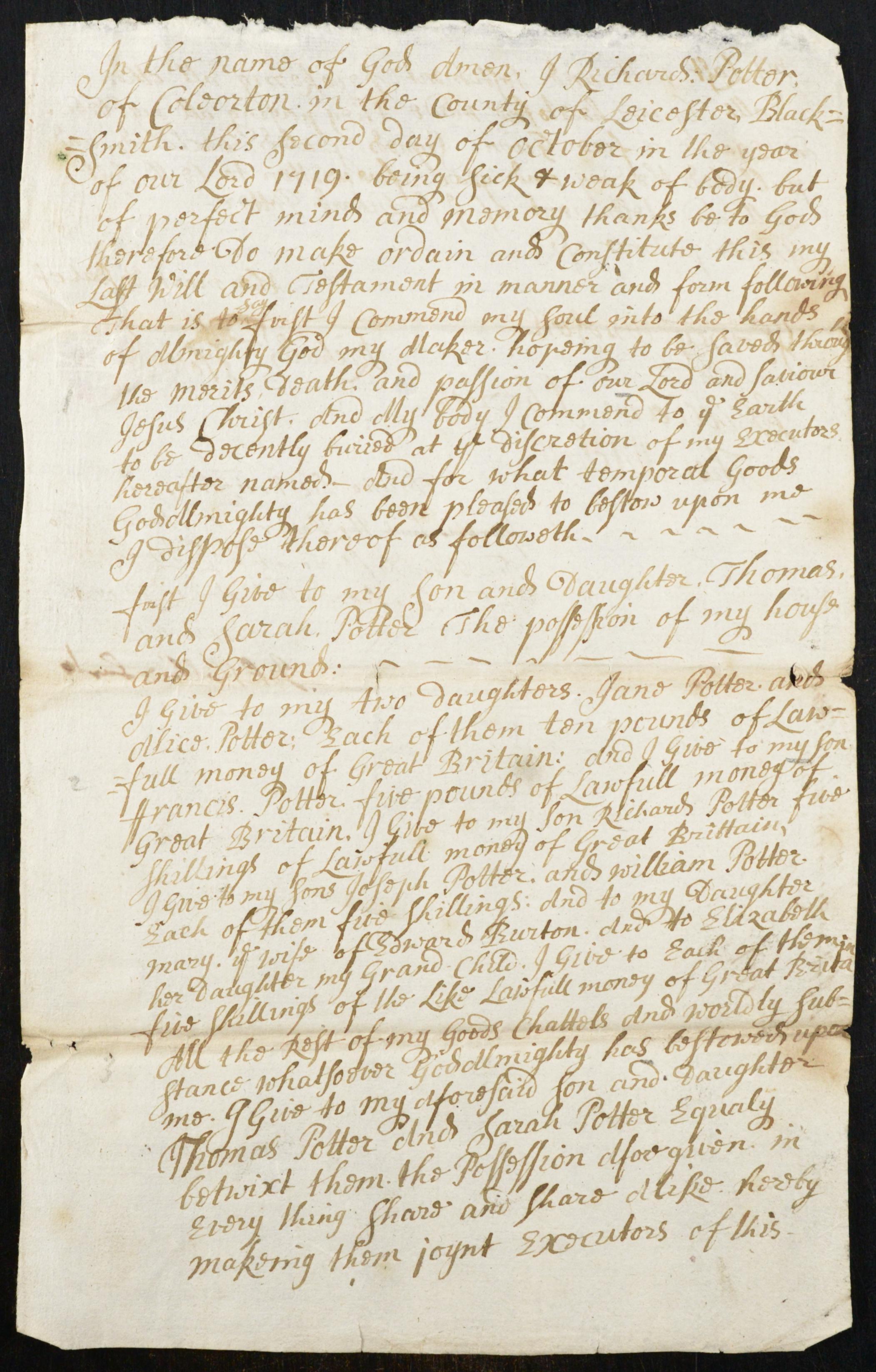
Richard Potter of Coleorton in the county of Leicester, blacksmith, stated in his will: “I give to my son and daughter Thomas and Sarah Potter the possession of my house and grounds.”
He leaves ten pounds each to his daughters Jane and Alice, to his son Francis he gives five pounds, and five shillings to his son Richard. Sons Joseph and William also receive five shillings each. To his daughter Mary, wife of Edward Burton, and her daughter Elizabeth, he gives five shillings each. The rest of his good, chattels and wordly substance he leaves equally between his son and daugter Thomas and Sarah. As there is no mention of his wife, it’s assumed that she predeceased him.
The will of Richard Potter, 1719:
Richard Potter’s (1649-1719) parents were William Potter and Alse Huldin, both born in the early 1600s. They were married in 1646 at Breedon on the Hill, Leicestershire. The name Huldin appears to originate in Finland.
William Potter was a blacksmith. In the 1659 parish registers of Breedon on the Hill, William Potter of Breedon blacksmith buryed the 14th July.
December 25, 2021 at 10:47 am #6248In reply to: The Elusive Samuel Housley and Other Family Stories
Bakewell Not Eyam
The Elton Marshalls
Some years ago I read a book about Eyam, the Derbyshire village devastated by the plague in 1665, and about how the villagers quarantined themselves to prevent further spread. It was quite a story. Each year on ‘Plague Sunday’, at the end of August, residents of Eyam mark the bubonic plague epidemic that devastated their small rural community in the years 1665–6. They wear the traditional costume of the day and attend a memorial service to remember how half the village sacrificed themselves to avoid spreading the disease further.
My 4X great grandfather James Marshall married Ann Newton in 1792 in Elton. On a number of other people’s trees on an online ancestry site, Ann Newton was from Eyam. Wouldn’t that have been interesting, to find ancestors from Eyam, perhaps going back to the days of the plague. Perhaps that is what the people who put Ann Newton’s birthplace as Eyam thought, without a proper look at the records.
But I didn’t think Ann Newton was from Eyam. I found she was from Over Haddon, near Bakewell ~ much closer to Elton than Eyam. On the marriage register, it says that James was from Elton parish, and she was from Darley parish. Her birth in 1770 says Bakewell, which was the registration district for the villages of Over Haddon and Darley. Her parents were George Newton and Dorothy Wipperley of Over Haddon,which is incidentally very near to Nether Haddon, and Haddon Hall. I visited Haddon Hall many years ago, as well as Chatsworth (and much preferred Haddon Hall).
I looked in the Eyam registers for Ann Newton, and found a couple of them around the time frame, but the men they married were not James Marshall.
Ann died in 1806 in Elton (a small village just outside Matlock) at the age of 36 within days of her newborn twins, Ann and James. James and Ann had two sets of twins. John and Mary were twins as well, but Mary died in 1799 at the age of three.
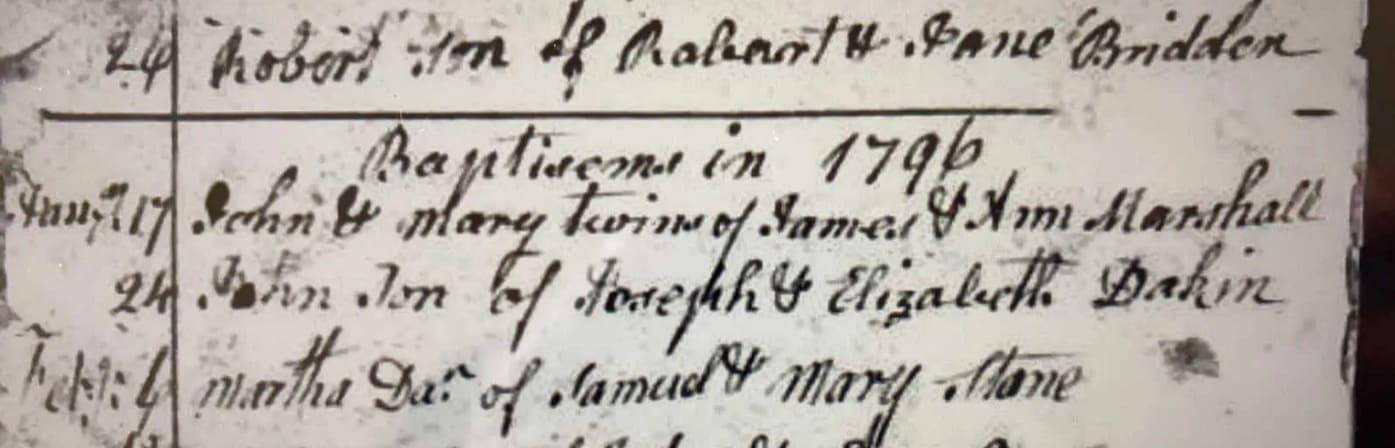
1796 baptism of twins John and Mary of James and Ann Marshall
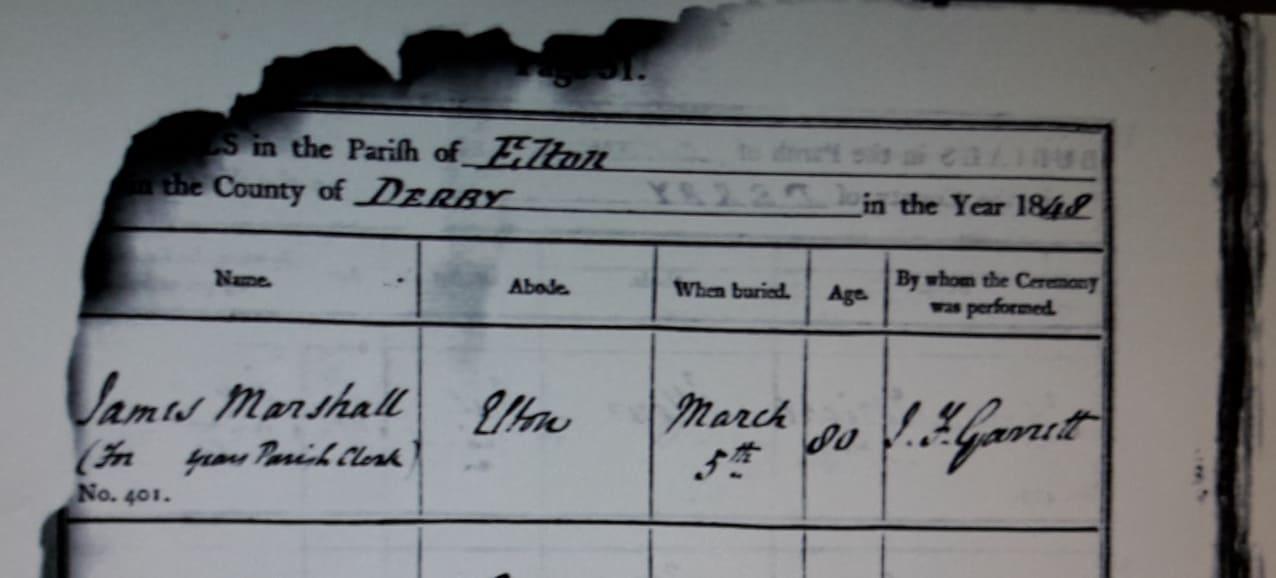
Ann’s husband James died 42 years later at the age of eighty, in Elton in 1848. It was noted in the parish register that he was for years parish clerk.
On the 1851 census John Marshall born in 1796, the son of James Marshall the parish clerk, was a lead miner occupying six acres in Elton, Derbyshire.
His son, also John, was registered on the census as a lead miner at just eight years old.
The mining of lead was the most important industry in the Peak district of Derbyshire from Roman times until the 19th century – with only agriculture being more important for the livelihood of local people. The height of lead mining in Derbyshire came in the 17th and 18th centuries, and the evidence is still visible today – most obviously in the form of lines of hillocks from the more than 25,000 mineshafts which once existed.
Peak District Mines Historical Society
Smelting, or extracting the lead from the ore by melting it, was carried out in a small open hearth. Lead was cast in layers as each batch of ore was smelted; the blocks of lead thus produced were referred to as “pigs”. Examples of early smelting-hearths found within the county were stone lined, with one side open facing the prevailing wind to create the draught needed. The hilltops of the Matlocks would have provided very suitable conditions.
The miner used a tool called a mattock or a pick, and hammers and iron wedges in harder veins, to loosen the ore. They threw the ore onto ridges on each side of the vein, going deeper where the ore proved richer.
Many mines were very shallow and, once opened, proved too poor to develop. Benjamin Bryan cited the example of “Ember Hill, on the shoulder of Masson, above Matlock Bath” where there are hollows in the surface showing where there had been fruitless searches for lead.
There were small buildings, called “coes”, near each mine shaft which were used for tool storage, to provide shelter and as places for changing into working clothes. It was here that the lead was smelted and stored until ready for sale.
Lead is, of course, very poisonous. As miners washed lead-bearing material, great care was taken with the washing vats, which had to be covered. If cattle accidentally drank the poisoned water they would die from something called “belland”.
Cornish and Welsh miners introduced the practice of buddling for ore into Derbyshire about 1747. Buddling involved washing the heaps of rubbish in the slag heaps, the process of separating the very small particles from the dirt and spar with which they are mixed, by means of a small stream of water. This method of extraction was a major pollutant, affecting farmers and their animals (poisoned by Belland from drinking the waste water), the brooks and streams and even the River Derwent.
Women also worked in the mines. An unattributed account from 1829, says: “The head is much enwrapped, and the features nearly hidden in a muffling of handkerchiefs, over which is put a man’s hat, in the manner of the paysannes of Wales”. He also describes their gowns, usually red, as being “tucked up round the waist in a sort of bag, and set off by a bright green petticoat”. They also wore a man’s grey or dark blue coat and shoes with 3″ thick soles that were tied round with cords. The 1829 writer called them “complete harridans!”
Lead Mining in Matlock & Matlock Bath, The Andrews Pages
John’s wife Margaret died at the age of 42 in 1847. I don’t know the cause of death, but perhaps it was lead poisoning. John’s son John, despite a very early start in the lead mine, became a carter and lived to the ripe old age of 88.
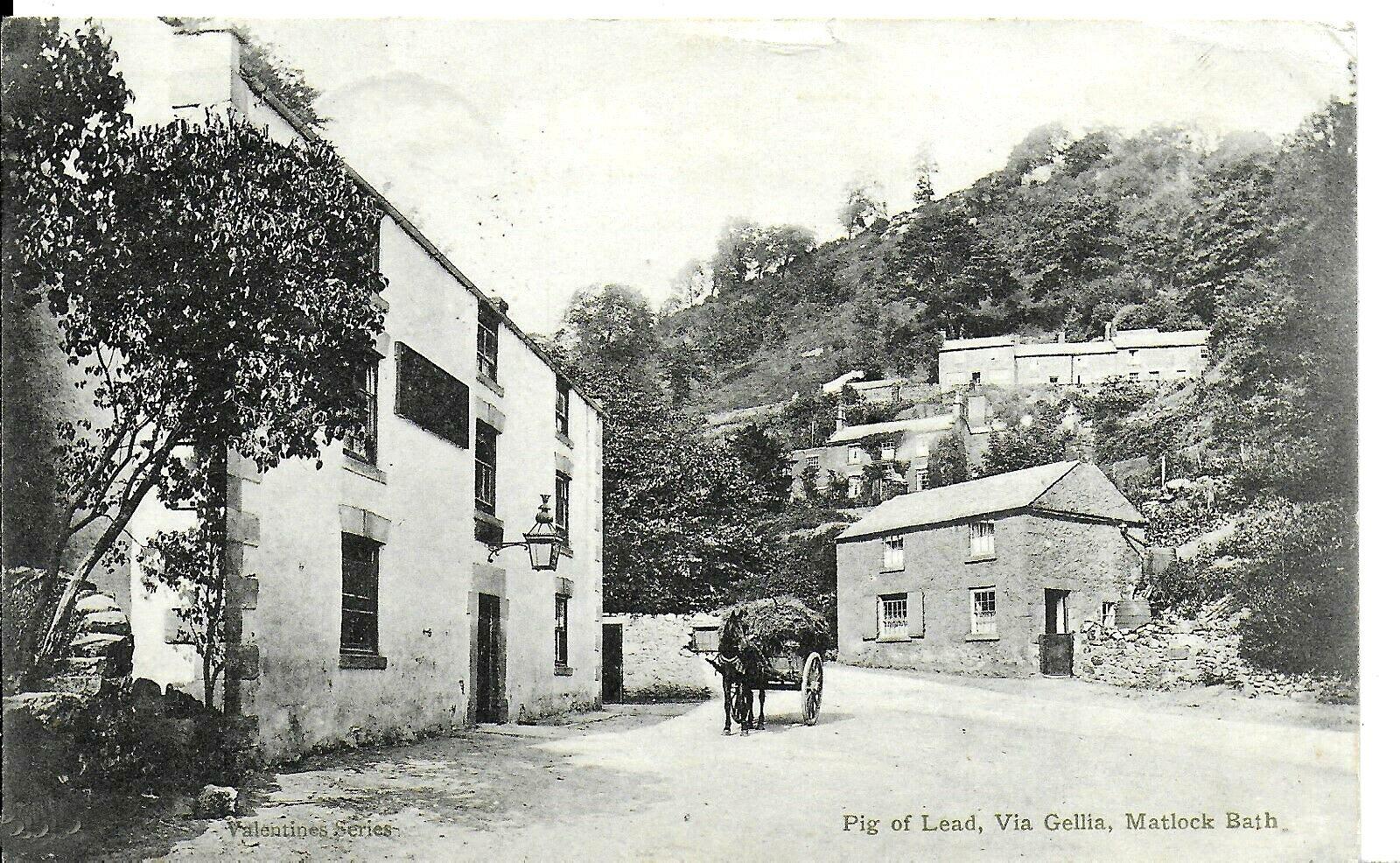
The Pig of Lead pub, 1904:
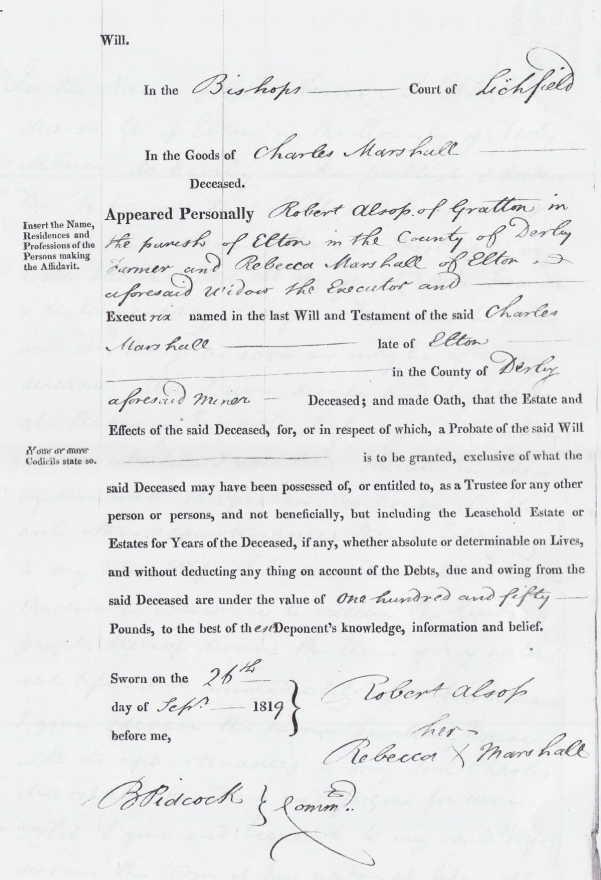
The earliest Marshall I’ve found so far is Charles, born in 1742. Charles married Rebecca Knowles, 1775-1823. I don’t know what his occupation was but when he died in 1819 he left a not inconsiderable sum to his wife.
1819 Charles Marshall probate:
There are still Marshall’s living in Elton and Matlock, not our immediate known family, but probably distantly related. I asked a Matlock group on facebook:
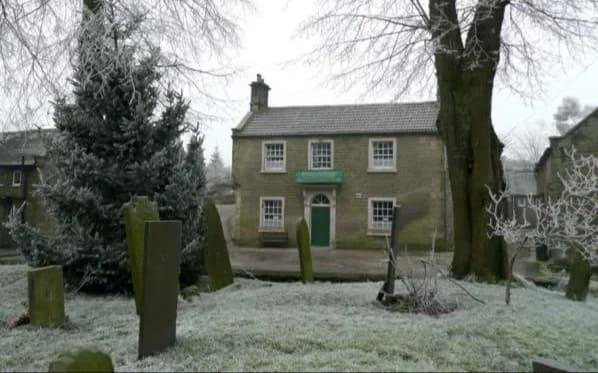
“…there are Marshall’s still in the village. There are certainly families who live here who have done generation after generation & have many memories & stories to tell. Visit The Duke on a Friday night…”
The Duke, Elton:
 December 13, 2021 at 12:33 pm #6225
In reply to: The Elusive Samuel Housley and Other Family Stories
William Marshall’s Parents
William Marshall 1876-1968, my great grandfather, married Mary Ann Gilman Purdy in Buxton. We assumed that both their families came from Buxton, but this was not the case. The Marshall’s came from Elton, near Matlock; the Purdy’s from Eastwood, Nottinghamshire.
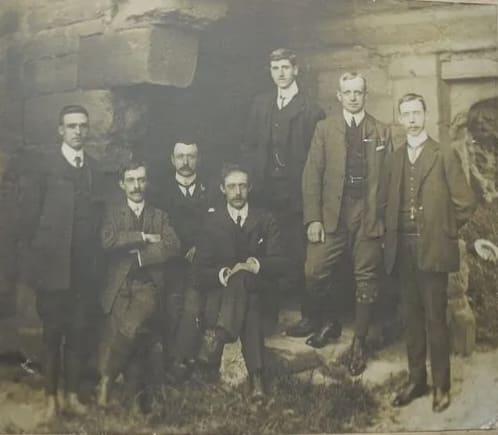
William Marshall, seated in centre, with colleagues from the insurance company:
William and all his siblings were born in Fairfield in Buxton. But both Emma Featherstone 1847-1928, his mother, and John Marshall 1842-1930, his father, came from rural Derbyshire. Emma from Ashbourne (or Biggin, Newhaven, or Hartington, depending on what she chose to put on the census, which are all tiny rural places in the same area).
Emma and John Marshall in the middle, photo says “William Marshall’s parents” on the back:
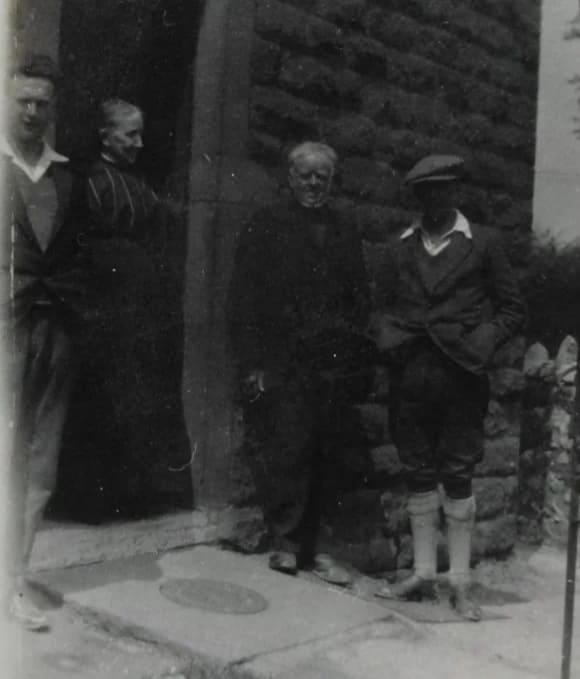
John Marshall was a carter, later a coal carter, and was born in Elton, Derbyshire. Elton is a rural village near to Matlock. He was unable to write (at least at the time of his wedding) but Emma signed her own name.
In 1851 Emma is 3 or 4 years old living with family at the Jug and Glass Inn, Hartington. In 1861 Emma was a 14 year old servant at a 112 acre farm, Heathcote, but her parents were still living at the Jug and Glass. Emma Featherstone’s parents both died when she was 18, in 1865.
In 1871 she was a servant at Old House Farm, Nether Hartington Quarter, Ashborne.On the census, a female apprentice was listed as a servant, a boy as an apprentice. It seems to have been quite normal, at least that’s what I’ve found so far, for all teenagers to go and live in another household to learn a trade, to be independent from the parents, and so doesn’t necessarily mean a servant as we would think of it. Often they stayed with family friends, and usually married in their early twenties and had their own household ~ often with a “servant” or teenager from someone else’s family.
The only marriage I could find for Emma and John was in Manchester in 1873, which didn’t make much sense. If Emma was single on the 1871 census, and her first child James was born in 1873, her marriage had to be between those dates. But the marriage register in Manchester appears to be correct, John was a carter, Emma’s father was Francis Featherstone. But why Manchester?
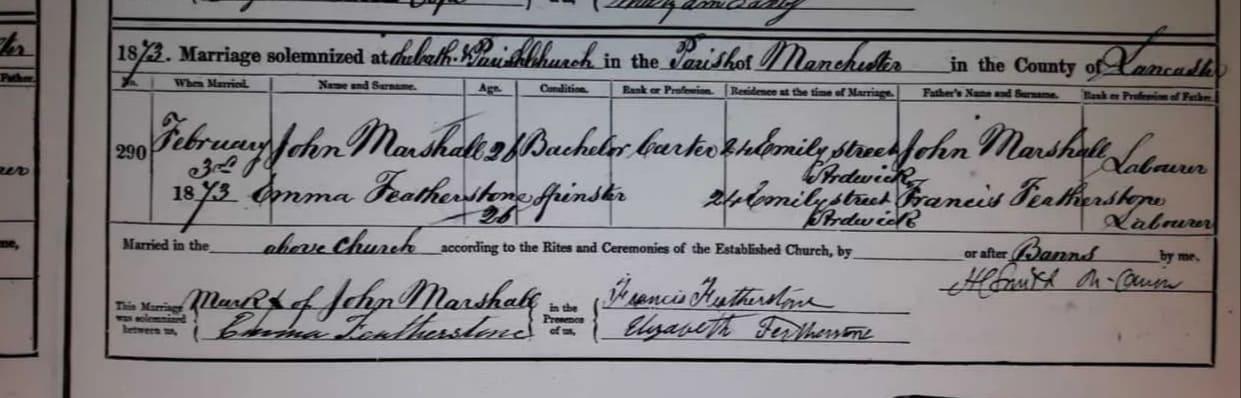
I noticed that the witnesses to the marriage were Francis and Elizabeth Featherstone. He father was Francis, but who was Elizabeth? Emma’s mother was Sarah. Then I found that Emma’s brother Francis married Elizabeth, and they lived in Manchester on the 1871 census. Henry Street, Ardwick. Emma and John’s address on the marriage register is Emily Street, Ardwick. Both of them at the same address.
The marriage was in February 1873, and James, the first child was born in July, 1873, in Buxton.
It would seem that Emma and John had to get married, hence the move to Manchester where her brother was, and then quickly moved to Buxton for the birth of the child. It was far from uncommon, I’ve found while making notes of dates in registers, for a first child to be born six or 7 months after the wedding.
Emma died in 1928 at the age of 80, two years before her husband John. She left him a little money in her will! This seems unusual so perhaps she had her own money, possibly from the death of her parents before she married, and perhaps from the sale of the Jug and Glass.
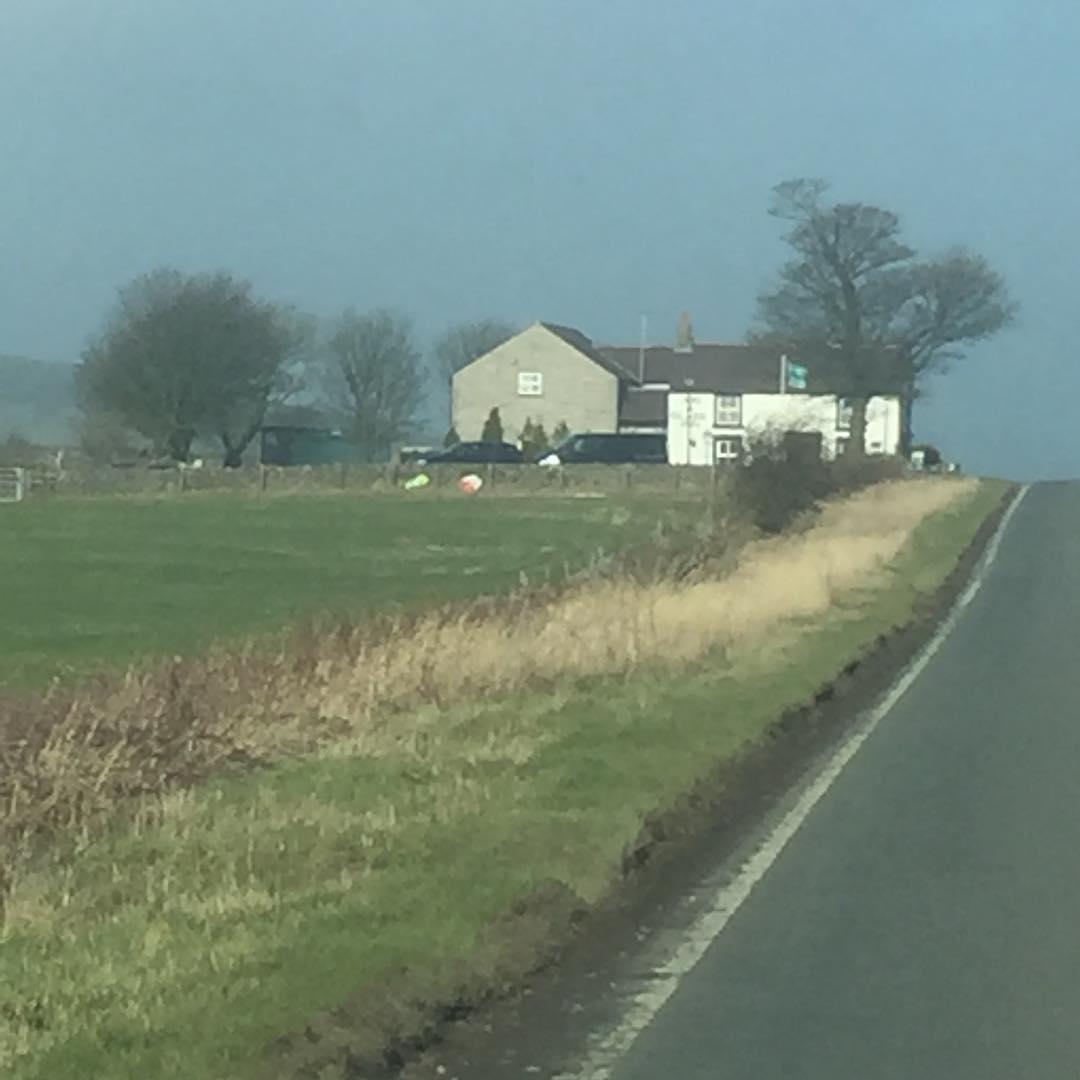
I found a photo of the Jug and Glass online. It looks just like the pub I’d seen in my family history meditations on a number of occasions:
 January 9, 2013 at 4:26 pm #2957
In reply to: The Surge Team’s Coils
The aftershock of the surge at the Three Kings’ Parade started to hit full blast at the portals initial location, thus effectively linking old mummies energy to the bodies there that were hit by Mari Fe, and for he most part still lying unconscious.
The combination of energies started to make them arise and walk like mindless zombies, intoning old guttural sounds in cadence in a language that sounded like Italian poetry.
There you had the Balthazar, Rogelio, Dru and alter-Ed who all woke up at once, and even Sanso who had been hit (while impersonating a Portal Worker) started to feel oddly strange.Noticing the atypical occurrence, Arona, whom Janet seemed to have had taken a sudden liking to (blame it on her Yankee side), started to look at her brood and rally them for a safe and prompt exit.
“What is it Arona dearie?” Janet didn’t seem worried. She was a Surge Team member after all, and a zombilic epidemic (zombies energy coming from wormholes) wasn’t anything she couldn’t handle.
“I fear that although your presence is most delightful, we shall be on our way.” Arona’s old sabulmantium had shown persistent and remarkable hints of dragon energy in this dimension that, although a bit different and looking in her mind’s eye like red flying snakes bearing impossibly long mustache, resonated quite well —not to mention she was eager to part with such bizarre company.
“Alrighty, let’s keep in touch dearie,” Janet added, covering their escape, not without winking at Sanso as he was the last one to leave through the map portal, leaving her to look for her missing flushed friends, Mari Fe and Pearl.
Unbeknownst to everyone, the picture-taking lady had camouflaged herself to look like a red sofa nearby the hot pink leather chaise lounge in the corner of the room, and was documenting silently the promising epic battle of Janet and Riff Raff against the zombies.
And for sure, Janet was still ready to make good use of the pocket-sized forklift to move away all cumbersome bodies,… as there was bound to be casualties.February 27, 2008 at 10:32 am #767In reply to: Circle of Eights, Stories
State of Marshall VS Vinya Grey
extracts of procedure 5057TP on case of unsolved time-blink that may have interfered with the timeline – Aug. 5th, 2237— As you are certainly most aware, Ms Grey, local authorities of the T FGF P (Timespace and Further Geodimensional Flux Police) has recently uncovered a case of unexplainable appearance of a new species within the past.
The genetic makeup of this species bears some rather crude indication of human interference, though no official authorization has been recorded on its behalf. Our investigations have led us to believe you may have more than a little to do with this incident, which is, as you are once again quite aware, within the boundaries of decree 5533 on allowed and banned interferences and seeding into the timeline.— Objection, Judge! Prosecutor Arkandiusz is trying to intimidate my client. No proof has been yet produced that may confirm or infirm these allegations.
— Mmmm… Objection rejected. Please continue Mr. Arkandiusz.
— Shall I remind Ms Grey that the voluntary or involuntary seeding of new species within other areas has most of the time been disastrous, which is the reason of the decree aforementioned. Precedents were numerous even when our ancestors were not even aware of the possibility of time interference. Rabbits in Australia, does it ring any bell?
— Objection, Judge! We are not talking about deadly pests here, we are talking about severely handicapped goats! Jeeze, come on…
— … Do you mean, the Fainting Goats of our annual Fair, Mr Frey?
— Yes, Judge Cornwick.
— Oh, that is most interesting… Well, perhaps after this long introduction you may want to introduce your first witness Mr Arkandiusz, Ms… Beryl is that?
January 2, 2008 at 6:03 pm #2099In reply to: QUIZ TIME: Test YOUR grasp
Sounds like we found some missing link about the fainting goats …
November 30, 2007 at 12:16 pm #499In reply to: Circle of Eights, Stories
Thanksgiving, 1847
That last business trip in British Honduras had proven fruitful to Aldous. It had almost made him forget about the blue bull of the Disperso family.
Because Aldous was a collector. No one truly understood what were his motivations, but he was driven by the highest ideals. Some treasures weren’t deserved by the profane, he was thinking as he was munching on a tender juicy turkey leg.
He belched with profound depth.
Yes, he was doing everything with utmost depth and dedication.Take that blue bull for instance… A gift from Indian officials he had managed to have them bring here. Its real place was in a zoo, with a small fee at the entrance of course, but most importantly some information on how it was acquired and by whom. Definitely not in the farm of some hillbillies just because they have happened to win that stupid rodeo contest.
In any case, he would put that right again in due time.Let’s think of more pleasant things. Like these mahogany traders who had came into contact with remote Mayan tribes. Mahogany was nice, but Mayan treasure were even more interesting.
-
AuthorSearch Results
Search Results for '847'
Viewing 16 results - 1 through 16 (of 16 total)
-
Search Results


Viewing 16 results - 1 through 16 (of 16 total)