-
AuthorSearch Results
-
August 28, 2024 at 1:31 pm #7549
In reply to: The Elusive Samuel Housley and Other Family Stories
The Tailor of Haddon
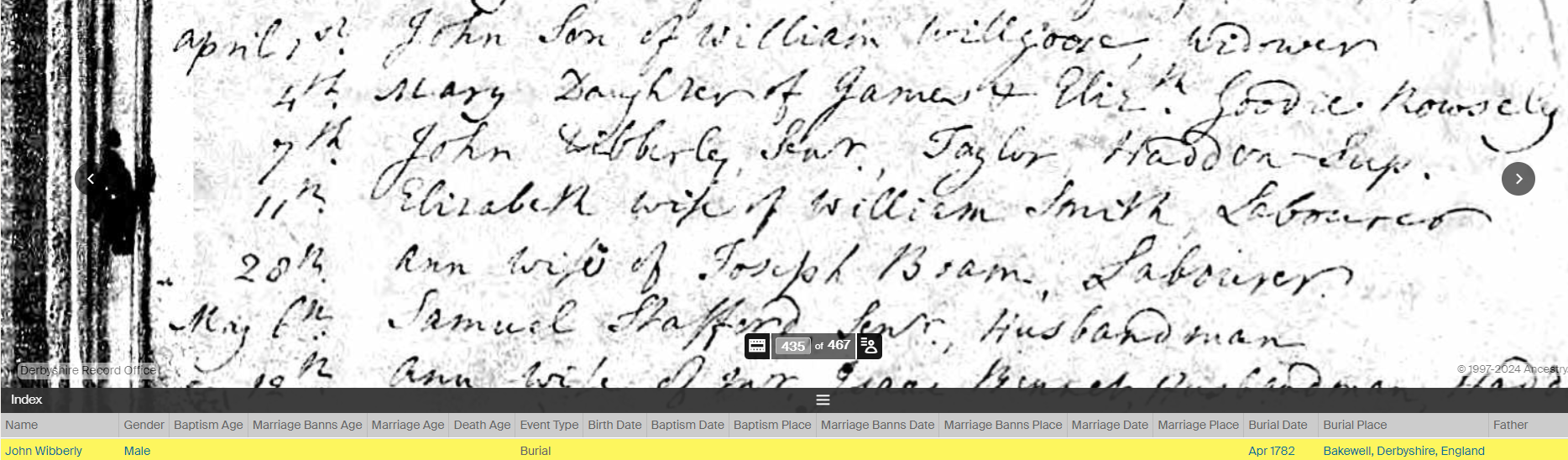
Wibberly and Newton of Over HaddonIt was noted in the Bakewell parish register in 1782 that John Wibberly 1705?-1782 (my 6x great grandfather) was “taylor of Haddon”.
James Marshall 1767-1848 (my 4x great grandfather), parish clerk of Elton, married Ann Newton 1770-1806 in Elton in 1792. In the Bakewell parish register, Ann was baptised on the 2rd of June 1770, her parents George and Dorothy Newton of Upper Haddon. The Bakewell registers at the time covered several smaller villages in the area, although what is currently known as Over Haddon was referred to as Upper Haddon in the earlier entries.
Newton:
George Newton 1728-1798 was the son of George Newton 1706- of Upper Haddon and Jane Sailes, who were married in 1727, both of Upper Haddon.
George Newton born in 1706 was the son of George Newton 1676- and Anne Carr, who were married in 1701, both of Upper Haddon.
George Newton born in 1676 was the son of John Newton 1647- and Alice who were married in 1673 in Bakewell. There is no last name for Alice on the marriage transcription.
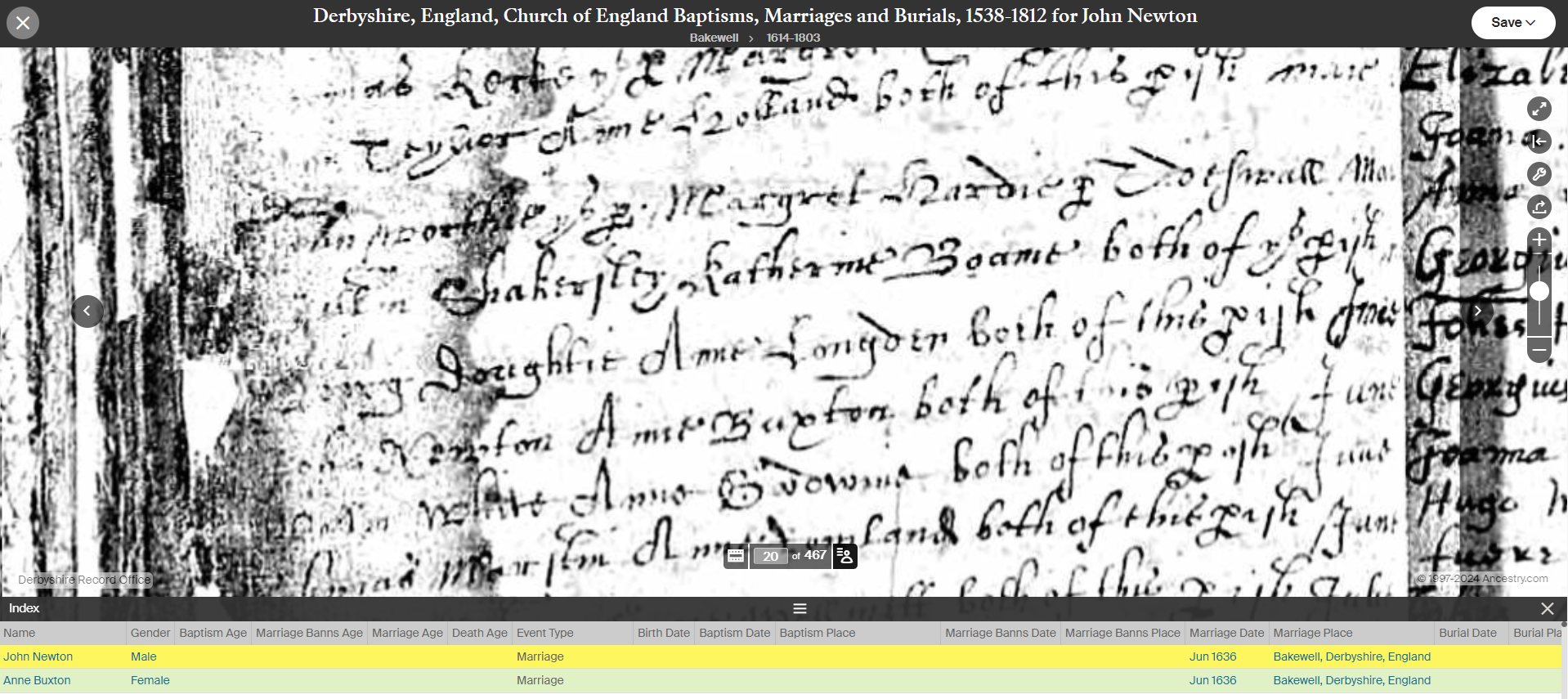
John Newton born in 1647 (my 9x great grandfather) was the son of John Newton and Anne Buxton (my 10x great grandparents), who were married in Bakewell in 1636.
1636 marriage of John Newton and Anne Buxton:
Wibberly
Dorothy Wibberly 1731-1827 married George Newton in 1755 in Bakewell. The entry in the parish registers says that they were both of Over Haddon. Dorothy was baptised in Bakewell on the 25th June 1731, her parents were John and Mary of Over Haddon.

John Wibberly and Mary his wife baptised nine children in Bakewell between 1730 and 1750, and on all of the entries in the parish registers it is stated that they were from Over Haddon. A parish register entry for John and Mary’s marriage has not yet been found, but a marriage in Beeley, a tiny nearby village, in 1728 to Mary Mellor looks likely.
John Wibberly died in Over Haddon in 1782. The entry in the Bakewell parish register notes that he was “taylor of Haddon”.
The tiny village of Over Haddon was historically associated with Haddon Hall.
A baptism for John Wibberly has not yet been found, however, there were Wibersley’s in the Bakewell registers from the early 1600s:
1619 Joyce Wibersley married Raphe Cowper.
1621 Jocosa Wibersley married Radulphus Cowper
1623 Agnes Wibersley married Richard Palfreyman
1635 Cisley Wibberlsy married ? Mr. Mason
1653 John Wibbersly married Grace DaykenHaddon Hall
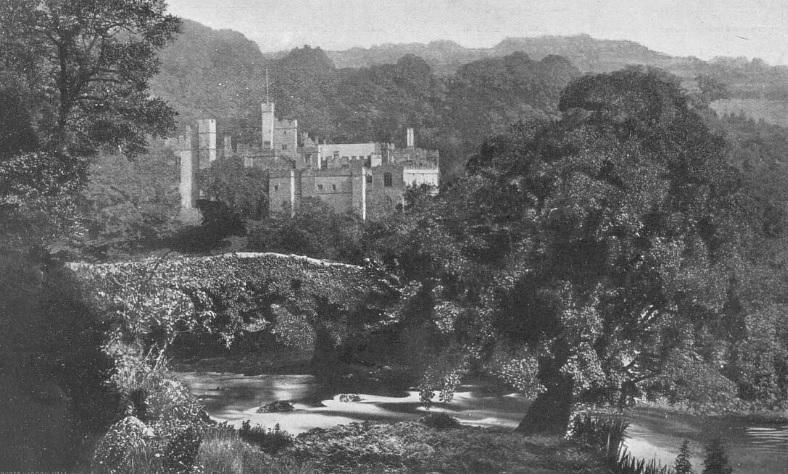
Sir Richard Vernon (c. 1390 – 1451) of Haddon Hall.
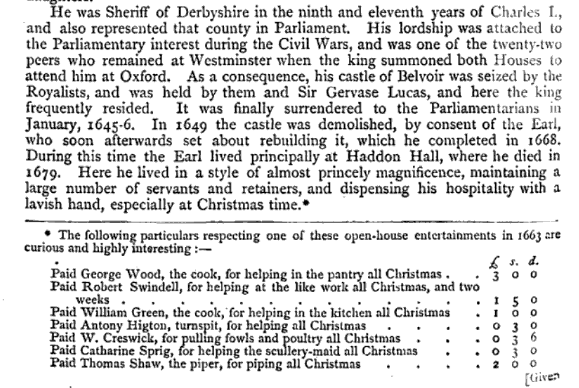
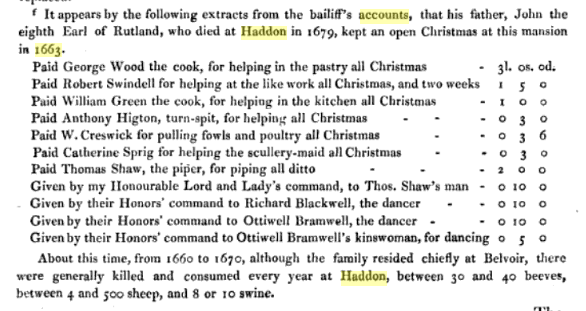
Vernon’s property was widespread and varied. From his parents he inherited the manors of Marple and Wibersley, in Cheshire. Perhaps the Over Haddon Wibersley’s origins were from Sir Richard Vernon’s property in Cheshire. There is, however, a medieval wayside cross called Whibbersley Cross situated on Leash Fen in the East Moors of the Derbyshire Peak District. It may have served as a boundary cross marking the estate of Beauchief Abbey. Wayside crosses such as this mostly date from the 9th to 15th centuries.Found in both The History and Antiquities of Haddon Hall by S Raynor, 1836, and the 1663 household accounts published by Lysons, Haddon Hall had 140 domestic staff.
In the book Haddon Hall, an Illustrated Guide, 1871, an example from the 1663 Christmas accounts:
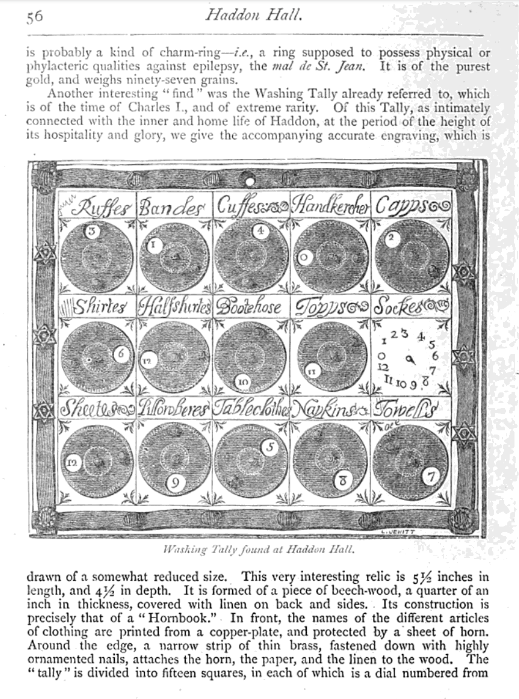
Also in this book, an early 1600s “washing tally” from Haddon Hall:
Over Haddon
Martha Taylor, “the fasting damsel”, was born in Over Haddon in 1649. She didn’t eat for almost two years before her death in 1684. One of the Quakers associated with the Marshall Quakers of Elton, John Gratton, visited the fasting damsel while he was living at Monyash, and occasionally “went two miles to see a woman at Over Haddon who pretended to live without meat.” from The Reliquary, 1861.
August 28, 2024 at 6:26 am #7548In reply to: The Elusive Samuel Housley and Other Family Stories
Elton Marshall’s
Early Quaker Emigrants to USA.
The earliest Marshall in my tree is Charles Marshall (my 5x great grandfather), Overseer of the Poor and Churchwarden of Elton. His 1819 gravestone in Elton says he was 77 years old when he died, indicating a birth in 1742, however no baptism can be found.
According to the Derbyshire records office, Elton was a chapelry of Youlgreave until 1866. The Youlgreave registers date back to the mid 1500s, and there are many Marshalls in the registers from 1559 onwards. The Elton registers however are incomplete due to fire damage.
While doing a google books search for Marshall’s of Elton, I found many American family history books mentioning Abraham Marshall of Gratton born in 1667, who became a Quaker aged 16, and emigrated to Pennsylvania USA in 1700. Some of these books say that Abraham’s parents were Humphrey Marshall and his wife Hannah Turner. (Gratton is a tiny village next to Elton, also in Youlgreave parish.)
Abraham’s son born in USA was also named Humphrey. He was a well known botanist.
Abraham’s cousin John Marshall, also a Quaker, emigrated from Elton to USA in 1687, according to these books.
(There are a number of books on Colonial Families in Pennsylvania that repeat each other so impossible to cite the original source)
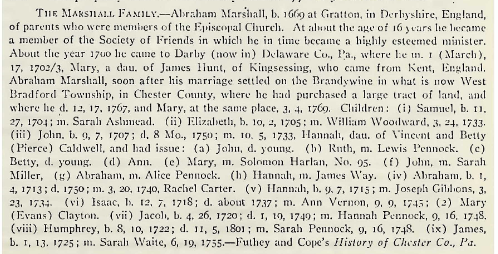
In the Youlgreave parish registers I found a baptism in 1667 for Humphrey Marshall son of Humphrey and Hannah. I didn’t find a baptism for Abraham, but it looks as though it could be correct. Abraham had a son he named Humphrey. But did it just look logical to whoever wrote the books, or do they know for sure? Did the famous botanist Humphrey Marshall have his own family records? The books don’t say where they got this information.
An earlier Humphrey Marshall was baptised in Youlgreave in 1559, his father Edmund. And in 1591 another Humphrey Marshall was baptised, his father George.
But can we connect these Marshall’s to ours? We do have an Abraham Marshall, grandson of Charles, born in 1792. The name isn’t all that common, so may indicate a family connection. The villages of Elton, Gratton and Youlgreave are all very small and it would seem very likely that the Marshall’s who went the USA are related to ours, if not brothers, then probably cousins.
Derbyshire Quakers
In “Derbyshire Quakers 1650-1761” by Helen Forde:
“… Friends lived predominantly in the northern half of the country during this first century of existence. Numbers may have been reduced by emigration to America and migration to other parts of the country but were never high and declined in the early eighteenth century. Predominantly a middle to lower class group economically, Derbyshire Friends numbered very few wealthy members. Many were yeoman farmers or wholesalers and it was these groups who dominated the business meetings having time to devote themselves to the Society. Only John Gratton of Monyash combined an outstanding ministry together with an organising ability which brought him recognition amongst London Friends as well as locally. Derbyshire Friends enjoyed comparatively harmonious relations with civil and Anglican authorities, though prior to the Toleration Act of 1639 the priests were their worst persecutors…..”
Also mentioned in this book: There were monthly meetings in Elton, as well as a number of other nearby places.
John Marshall of Elton 1682/3 appears in a list of Quaker emigrants from Derbyshire.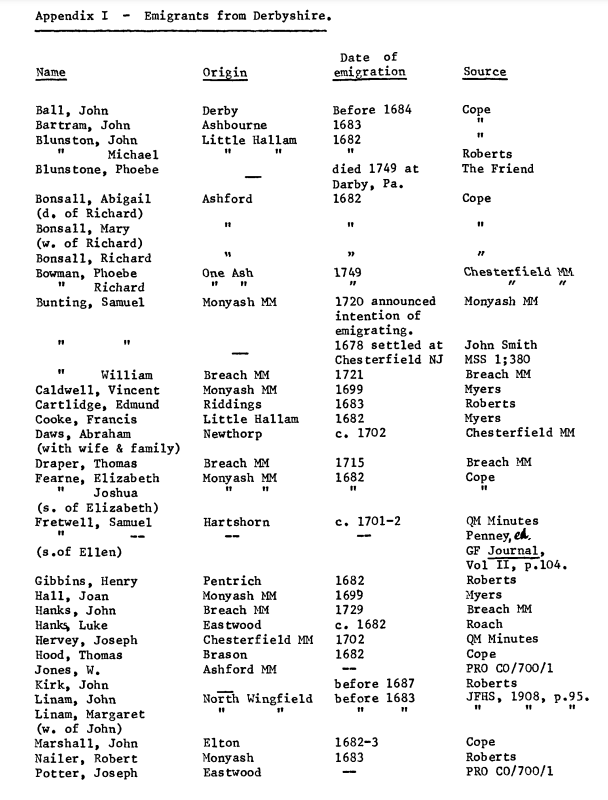
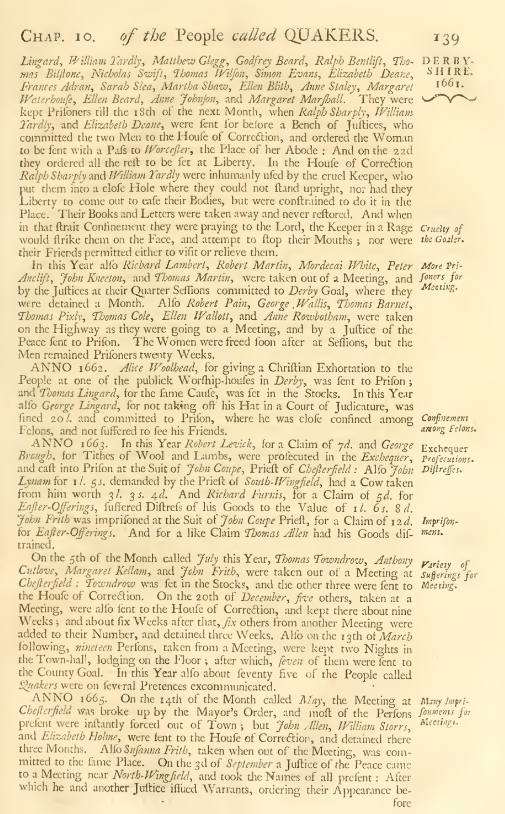
The following image is a page from the 1753 book on the sufferings of Quakers by Joseph Besse as an example of some of the persecutions of Quakers in Derbyshire in the 1600s:
A collection of the sufferings of the people called Quakers, for the testimony of a good conscience from the time of their being first distinguished by that name in the year 1650 to the time of the act commonly called the Act of toleration granted to Protestant dissenters in the first year of the reign of King William the Third and Queen Mary in the year 1689 (Volume 1)
Besse, Joseph. 1753Note the names Margaret Marshall and Anne Staley. This book would appear to contradict Helen Forde’s statement above about the harmonious relations with Anglican authority.
The Botanist
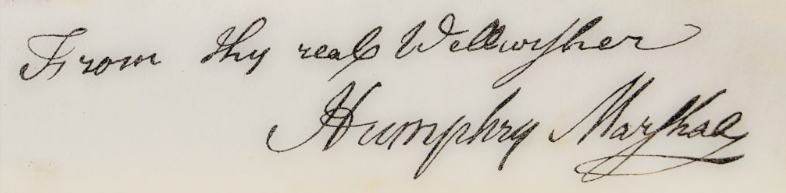
Humphry Marshall 1722-1801 was born in Marshallton, Pennsylvania, the son of the immigrant from Elton, Abraham Marshall. He was the cousin of botanists John Bartram and William Bartram. Like many early American botanists, he was a Quaker. He wrote his first book, A Few Observations Concerning Christ, in 1755.
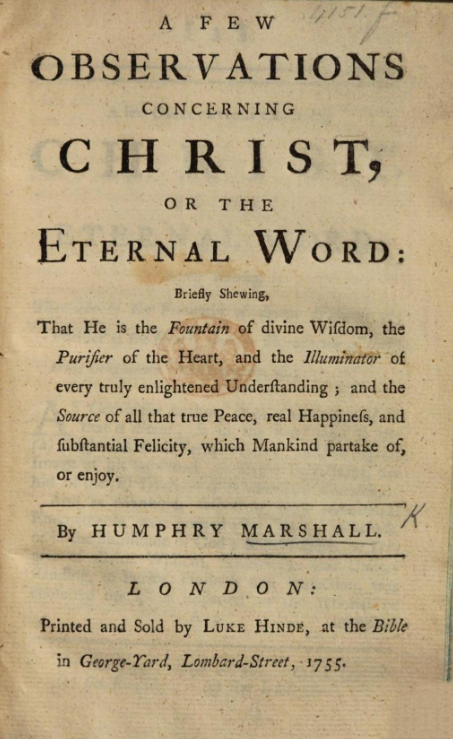
In 1785, Marshall published Arbustrum Americanum: The American Grove, an Alphabetical Catalogue of Forest Trees and Shrubs, Natives of the American United States (Philadelphia).
Marshall has been called the “Father of American Dendrology”.
A genus of plants, Marshallia, was named in honor of Humphry Marshall and his nephew Moses Marshall, also a botanist.
In 1848 the Borough of West Chester established the Marshall Square Park in his honor. Marshall Square Park is four miles east of Marshallton.
via Wikipedia.
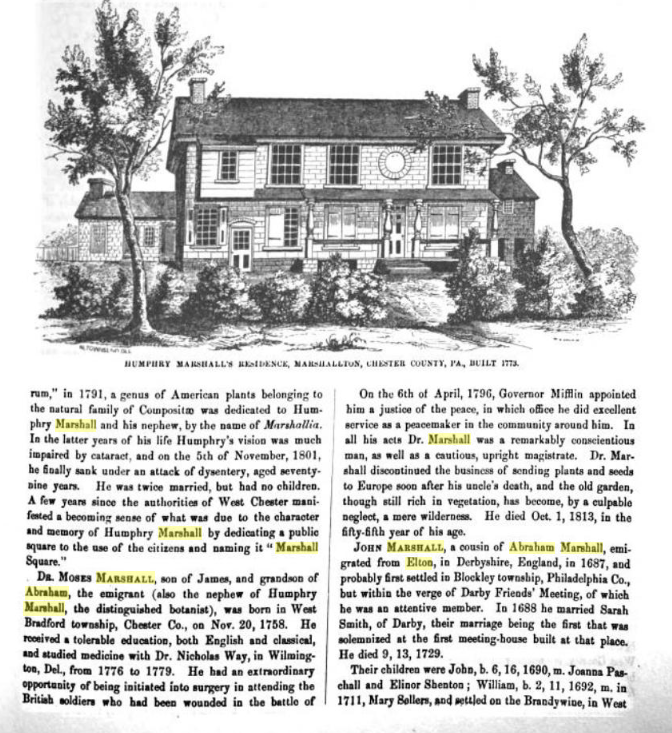
From The History of Chester County Pennsylvania, 1881, by J Smith Futhey and Gilbert Cope:
From The Chester Country History Center:
“Immediately on the Receipt of your Letter, I ordered a Reflecting Telescope for you which was made accordingly. Dr. Fothergill had since desired me to add a Microscope and Thermometer, and will
pay for the whole.’– Benjamin Franklin to Humphry, March 18, 1770
“In his lifetime, Humphry Marshall made his living as a stonemason, farmer, and miller, but eventually became known for his contributions to astronomy, meteorology, agriculture, and the natural sciences.
In 1773, Marshall built a stone house with a hothouse, a botanical laboratory, and an observatory for astronomical studies. He established an arboretum of native trees on the property and the second botanical garden in the nation (John Bartram, his cousin, had the first). From his home base, Humphry expanded his botanical plant exchange business and increased his overseas contacts. With the help of men like Benjamin Franklin and the English botanist Dr. John Fothergill, they eventually included German, Dutch, Swedish, and Irish plant collectors and scientists. Franklin, then living in London, introduced Marshall’s writings to the Royal Society in London and both men encouraged Marshall’s astronomical and botanical studies by supplying him with books and instruments including the latest telescope and microscope.
Marshall’s scientific work earned him honorary memberships to the American Philosophical Society and the Philadelphia Society for Promoting Agriculture, where he shared his ground-breaking ideas on scientific farming methods. In the years before the American Revolution, Marshall’s correspondence was based on his extensive plant and seed exchanges, which led to further studies and publications. In 1785, he authored his magnum opus, Arbustum Americanum: The American Grove. It is a catalog of American trees and shrubs that followed the Linnaean system of plant classification and was the first publication of its kind.”
 September 18, 2023 at 8:29 am #7278
In reply to: Family Stories From The Other Side ~ Book Two
Tomlinson of Wergs and Hancox of Penn
John Tomlinson of Wergs (Tettenhall, Wolverhamton) 1766-1844, my 4X great grandfather, married Sarah Hancox 1772-1851. They were married on the 27th May 1793 by licence at St Peter in Wolverhampton.
Between 1794 and 1819 they had twelve children, although four of them died in childhood or infancy. Catherine was born in 1794, Thomas in 1795 who died 6 years later, William (my 3x great grandfather) in 1797, Jemima in 1800, John, Richard and Matilda between 1802 and 1806 who all died in childhood, Emma in 1809, Mary Ann in 1811, Sidney in 1814, and Elijah in 1817 who died two years later.On the 1841 census John and Sarah were living in Hockley in Birmingham, with three of their children, and surgeon Charles Reynolds. John’s occupation was “Ind” meaning living by independent means. He was living in Hockley when he died in 1844, and in his will he was “John Tomlinson, gentleman”.
Sarah Hancox was born in 1772 in Penn, Wolverhampton. Her father William Hancox was also born in Penn in 1737. Sarah’s mother Elizabeth Parkes married William’s brother Francis in 1767. Francis died in 1768, and in 1770 Elizabeth married William.
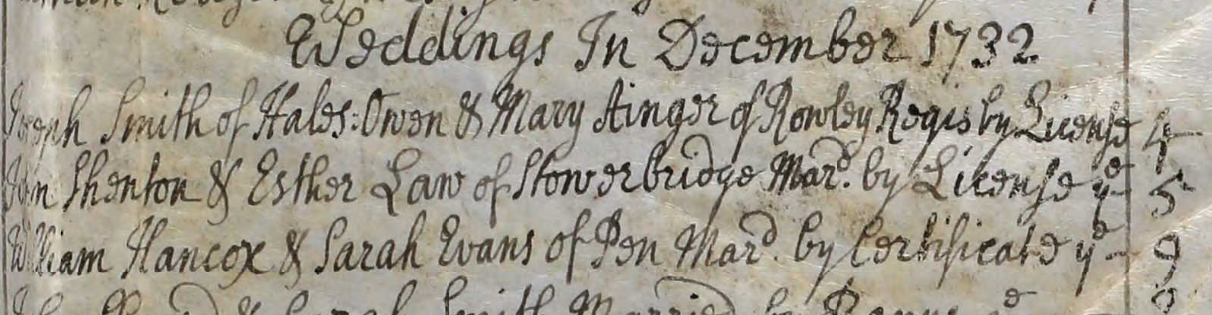
William’s father was William Hancox, yeoman, born in 1703 in Penn. He died intestate in 1772, his wife Sarah claiming her right to his estate. William Hancox and Sarah Evans, both of Penn, were married on the 9th December 1732 in Dudley, Worcestershire, by “certificate”. Marriages were usually either by banns or by licence. Apparently a marriage by certificate indicates that they were non conformists, or dissenters, and had the non conformist marriage “certified” in a Church of England church.
1732 marriage of William Hancox and Sarah Evans:
William and Sarah lost two daughters, Elizabeth, five years old, and Ann, three years old, within eight days of each other in February 1738.
William the elder’s father was John Hancox born in Penn in 1668. He married Elizabeth Wilkes from Sedgley in 1691 at Himley. John Hancox, “of Straw Hall” according to the Wolverhampton burial register, died in 1730. Straw Hall is in Penn. John’s parents were Walter Hancox and Mary Noake. Walter was born in Tettenhall in 1625, his father Richard Hancox. Mary Noake was born in Penn in 1634. Walter died in Penn in 1689.
Straw Hall thanks to Bradney Mitchell:
“Here is a picture I have of Straw Hall, Penn Road.
The painting is by John Reid circa 1878.
Sketch commissioned by George Bradney Mitchell to record the town as it was before its redevelopment, in a book called Wolverhampton and its Environs. ©”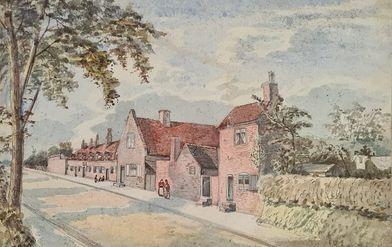
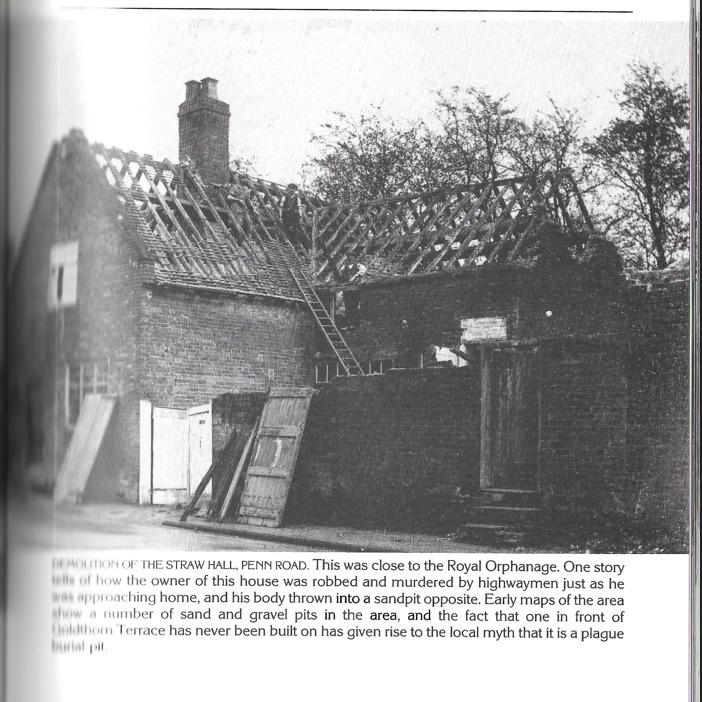
And a photo of the demolition of Straw Hall with an interesting story:
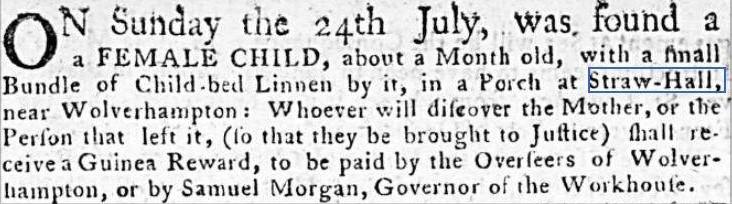
In 1757 a child was abandoned on the porch of Straw Hall. Aris’s Birmingham Gazette 1st August 1757:
The Hancox family were living in Penn for at least 400 years. My great grandfather Charles Tomlinson built a house on Penn Common in the early 1900s, and other Tomlinson relatives have lived there. But none of the family knew of the Hancox connection to Penn. I don’t think that anyone imagined a Tomlinson ancestor would have been a gentleman, either.
Sarah Hancox’s brother William Hancox 1776-1848 had a busy year in 1804.
On 29 Aug 1804 he applied for a licence to marry Ann Grovenor of Claverley.
In August 1804 he had property up for auction in Penn. “part of Lightwoods, 3 plots, and the Coppice”
On 14 Sept 1804 their first son John was baptised in Penn. According to a later census John was born in Claverley. (before the parents got married)(Incidentally, John Hancox’s descendant married a Warren, who is a descendant of my 4x great grandfather Samuel Warren, on my mothers side, from Newhall, Derbyshire!)
On 30 Sept he married Ann in Penn.
In December he was a bankrupt pig and sheep dealer.
In July 1805 he’s in the papers under “certificates”: William Hancox the younger, sheep and pig dealer and chapman of Penn. (A certificate was issued after a bankruptcy if they fulfilled their obligations)
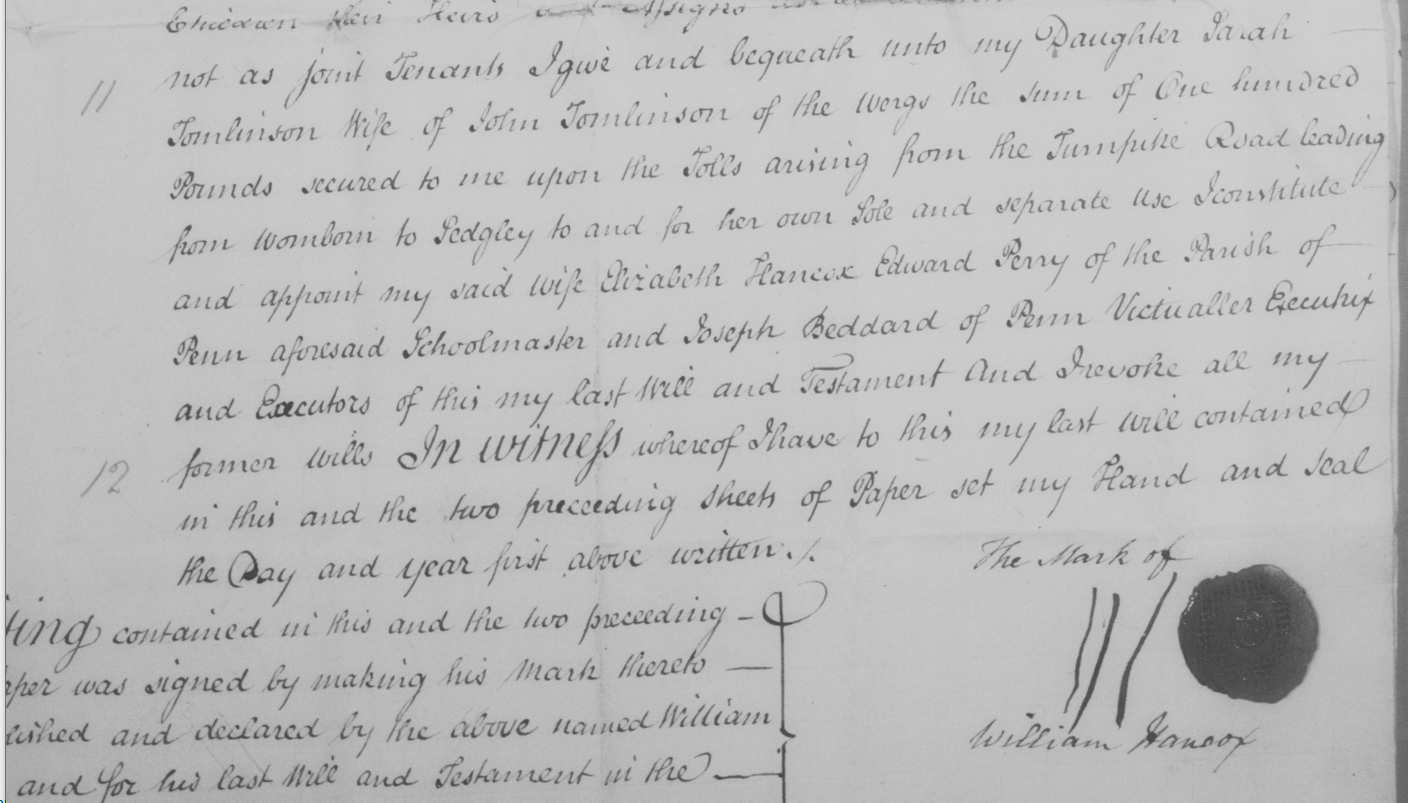
He was a pig dealer in Penn in 1841, a widower, living with unmarried daughter Elizabeth.Sarah’s father William Hancox died in 1816. In his will, he left his “daughter Sarah, wife of John Tomlinson of the Wergs the sum of £100 secured to me upon the tolls arising from the turnpike road leading from Wombourne to Sedgeley to and for her sole and separate use”.
The trustees of toll road would decide not to collect tolls themselves but get someone else to do it by selling the collecting of tolls for a fixed price. This was called “farming the tolls”. The Act of Parliament which set up the trust would authorise the trustees to farm out the tolls. This example is different. The Trustees of turnpikes needed to raise money to carry out work on the highway. The usual way they did this was to mortgage the tolls – they borrowed money from someone and paid the borrower interest; as security they gave the borrower the right, if they were not paid, to take over the collection of tolls and keep the proceeds until they had been paid off. In this case William Hancox has lent £100 to the turnpike and is leaving it (the right to interest and/or have the whole sum repaid) to his daughter Sarah Tomlinson. (this information on tolls from the Wolverhampton family history group.)William Hancox, Penn Wood, maltster, left a considerable amount of property to his children in 1816. All household effects he left to his wife Elizabeth, and after her decease to his son Richard Hancox: four dwelling houses in John St, Wolverhampton, in the occupation of various Pratts, Wright and William Clarke. He left £200 to his daughter Frances Gordon wife of James Gordon, and £100 to his daughter Ann Pratt widow of John Pratt. To his son William Hancox, all his various properties in Penn wood. To Elizabeth Tay wife of Thomas Tay he left £200, and to Richard Hancox various other properties in Penn Wood, and to his daughter Lucy Tay wife of Josiah Tay more property in Lower Penn. All his shops in St John Wolverhamton to his son Edward Hancox, and more properties in Lower Penn to both Francis Hancox and Edward Hancox. To his daughter Ellen York £200, and property in Montgomery and Bilston to his son John Hancox. Sons Francis and Edward were underage at the time of the will. And to his daughter Sarah, his interest in the toll mentioned above.
Sarah Tomlinson, wife of John Tomlinson of the Wergs, in William Hancox will:
 January 10, 2023 at 10:15 pm #6363
In reply to: Train your subjective AI – text version
try another short story, with a bit of drama with the following words:
road form charlton smooth everyone cottage hanging rush offer agree subject district included appear sha returning grattidge nottingham 848 tetbury chicken
It was a cold and gloomy day in the small village of Tetbury, nestled in the picturesque Cotswolds district. A young woman named Sha was returning home to her cottage after a long and tiring journey. She had been away visiting her family in Nottingham and was looking forward to relaxing in her cozy home.
As she walked down the dirt road that led to her cottage, she couldn’t help but notice that something was off. Her neighbor, Mr. Charlton, was outside hanging laundry and he didn’t acknowledge her as she walked by. Sha thought it was strange, as he was usually a friendly and sociable person.
When Sha arrived at her cottage, she was shocked to find that it had been broken into. The front door was ajar and the inside of her home had been ransacked. Sha immediately panicked and called the police, who arrived on the scene shortly thereafter.
The police officers, including Inspector Grattidge, took Sha’s statement and began to investigate the crime. They discovered that a group of burglars had been operating in the area, targeting homes and businesses in the district. The burglars had been known for their smooth operations and their ability to strike quickly, which led to their nickname “The Smooth Operators”.
As Sha waited for the police to finish their investigation, she couldn’t shake the feeling that something was not right. She had always thought of Tetbury as a safe and friendly place, and she couldn’t believe that something like this could happen in her community.
As the investigation went on, the police found out that the Smooth operators have been targeting houses with no security cameras, but Sha’s cottage was an exception, the police were able to find out that the group offered to pay a considerable sum of money to the people who reported the locations of the houses that had no cameras, and it was Mr. Charlton who was the informant and he even rushed to Sha’s cottage as soon as he knew the police was investigating the case, He was arrested for the crime and Sha was heartbroken to find out that her once friendly neighbor had betrayed her.
Feeling violated and betrayed, Sha decided that she could no longer stay in the village and she put her cottage up for sale. She packed up her belongings and moved away, leaving behind the memories of her peaceful home and the community she had once thought of as her own. The end.
December 19, 2022 at 9:48 am #6352In reply to: Family Stories From The Other Side ~ Book Two
The Birmingham Bootmaker
Samuel Jones 1816-1875
Samuel Jones the elder was born in Belfast circa 1779. He is one of just two direct ancestors found thus far born in Ireland. Samuel married Jane Elizabeth Brooker (born in St Giles, London) on the 25th January 1807 at St George, Hanover Square in London. Their first child Mary was born in 1808 in London, and then the family moved to Birmingham. Mary was my 3x great grandmother.
But this chapter is about her brother Samuel Jones. I noticed that on a number of other trees on the Ancestry site, Samuel Jones was a convict transported to Australia, but this didn’t tally with the records I’d found for Samuel in Birmingham. In fact another Samuel Jones born at the same time in the same place was transported, but his occupation was a baker. Our Samuel Jones was a bootmaker like his father.
Samuel was born on 28th January 1816 in Birmingham and baptised at St Phillips on the 19th August of that year, the fourth child and first son of Samuel the elder and Jane’s eleven children.
On the 1839 electoral register a Samuel Jones owned a property on Colmore Row, Birmingham.
Samuel Jones, bootmaker of 15, Colmore Row is listed in the 1849 Birmingham post office directory, and in the 1855 White’s Directory.
On the 1851 census, Samuel was an unmarried bootmaker employing sixteen men at 15, Colmore Row. A 9 year old nephew Henry Harris was living with him, and his mother Ruth Harris, as well as a female servant. Samuel’s sister Ruth was born in 1818 and married Henry Harris in 1840. Henry died in 1848.
Samuel was a 45 year old bootmaker at 15 Colmore Row on the 1861 census, living with Maria Walcot, a 26 year old domestic servant.
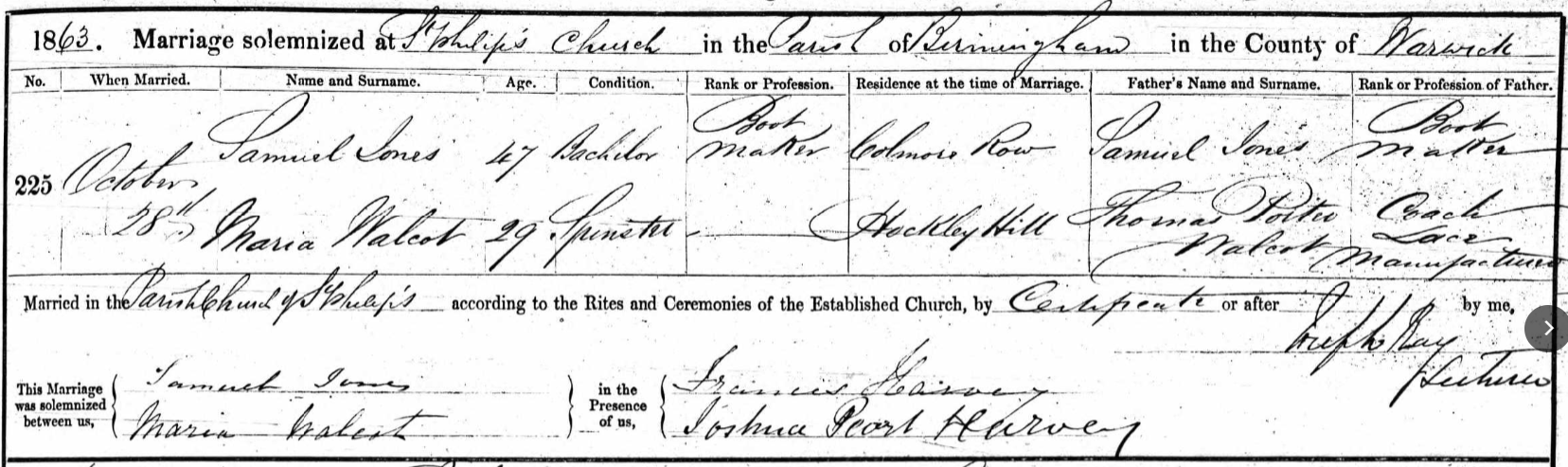
In October 1863 Samuel married Maria Walcot at St Philips in Birmingham. They don’t appear to have had any children as none appear on the 1871 census, where Samuel and Maria are living at the same address, with another female servant and two male lodgers by the name of Messant from Ipswich.
Marriage of Samuel Jones and Maria Walcot:
In 1864 Samuel’s father died. Samuel the son is mentioned in the probate records as one of the executors: “Samuel Jones of Colmore Row Birmingham in the county of Warwick boot and shoe manufacturer the son”.
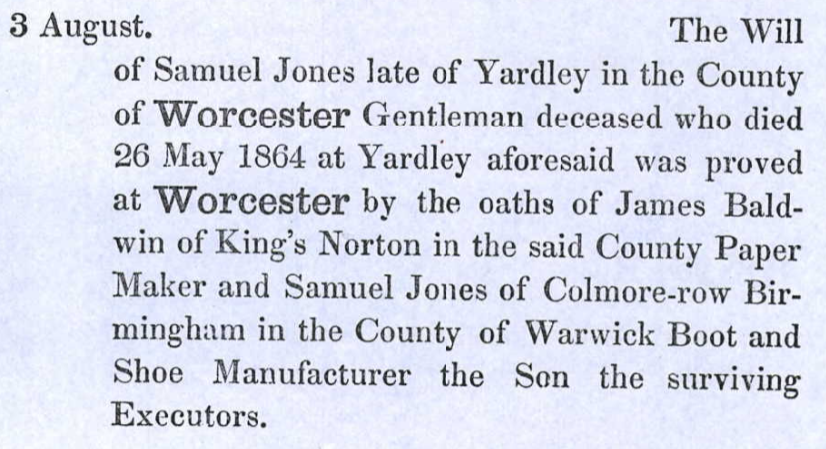
Indeed it could hardly be clearer that this Samuel Jones was not the convict transported to Australia in 1834!
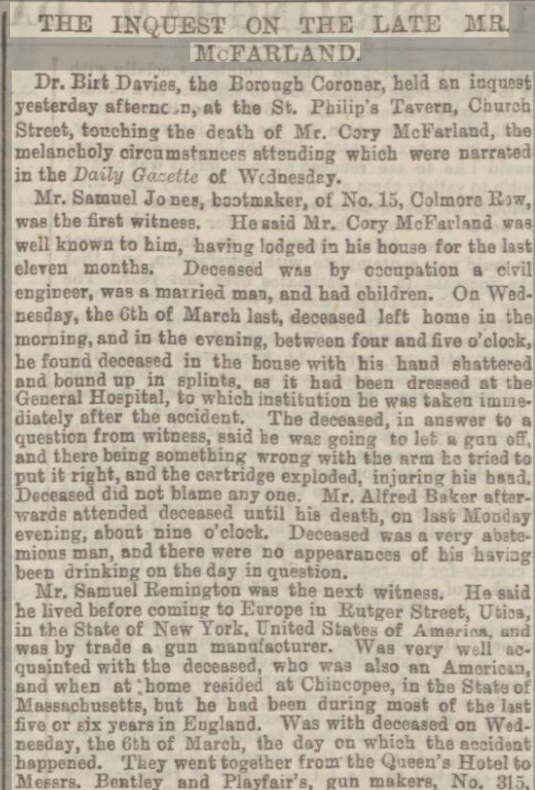
In 1867 Samuel Jones, bootmaker, was mentioned in the Birmingham Daily Gazette with regard to an unfortunate incident involving his American lodger, Cory McFarland. The verdict was accidental death.
Birmingham Daily Gazette – Friday 05 April 1867:
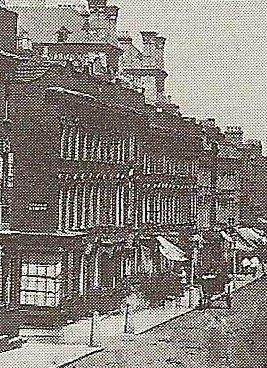
I asked a Birmingham history group for an old photo of Colmore Row. This photo is circa 1870 and number 15 is furthest from the camera. The businesses on the street at the time were as follows:
7 homeopathic chemist George John Morris. 8 surgeon dentist Frederick Sims. 9 Saul & Walter Samuel, Australian merchants. Surgeons occupied 10, pawnbroker John Aaron at 11 & 12. 15 boot & shoemaker. 17 auctioneer…
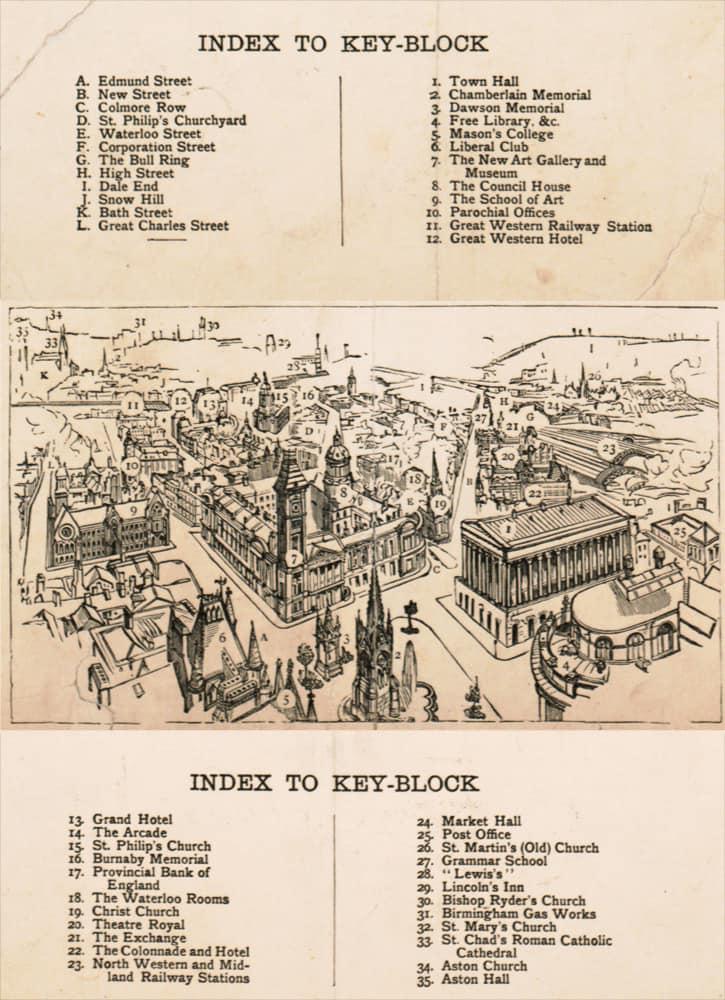
from Bird’s Eye View of Birmingham, 1886:
 November 14, 2022 at 12:09 pm #6346
In reply to: Family Stories From The Other Side ~ Book Two
The Mormon Browning Who Went To Utah
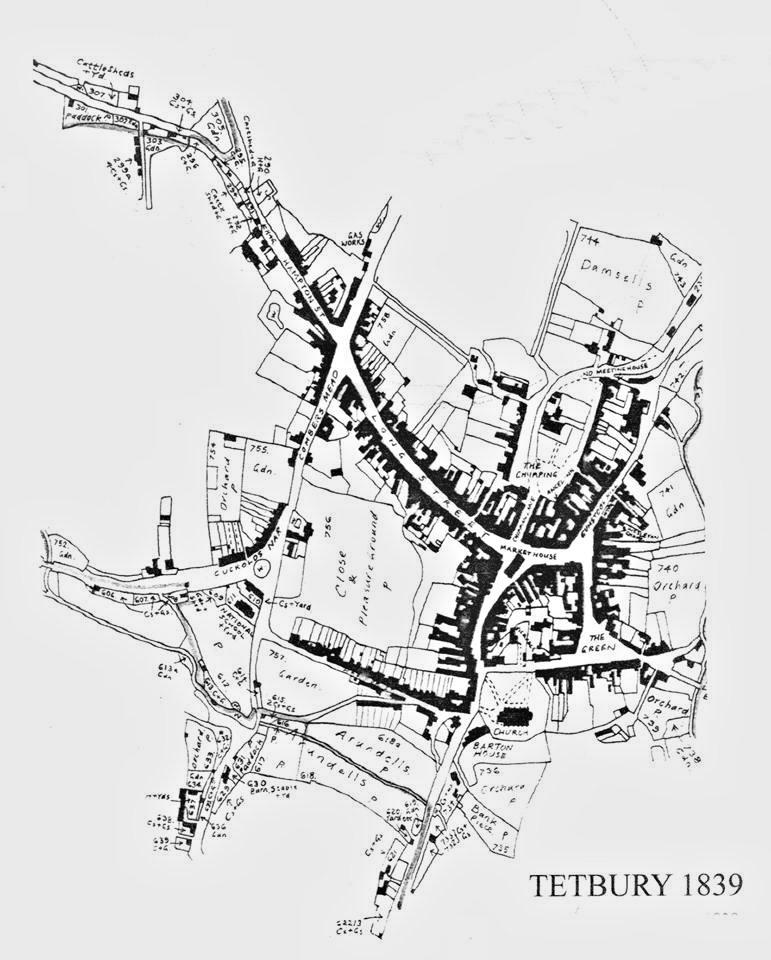
Isaac Browning’s (1784-1848) sister Hannah married Francis Buckingham. There were at least three Browning Buckingham marriages in Tetbury. Their daughter Charlotte married James Paskett, a shoemaker. Charlotte was born in 1818 and in 1871 she and her family emigrated to Utah, USA.
Charlotte’s relationship to me is first cousin five times removed.
James and Charlotte: (photos found online)
The house of James and Charlotte in Tetbury:
The home of James and Charlotte in Utah:
Obituary:
James Pope Paskett Dead.
Veteran of 87 Laid to rest. Special Correspondence Coalville, Summit Co., Oct 28—James Pope Paskett of Henefer died Oct. 24, 1903 of old age and general debility. Funeral services were held at Henefer today. Elders W.W. Cluff, Alma Elderge, Robert Jones, Oscar Wilkins and Bishop M.F. Harris were the speakers. There was a large attendance many coming from other wards in the stake. James Pope Paskett was born in Chippenham, Wiltshire, England, on March 12, 1817; married Chalotte Buckingham in the year 1839; eight children were born to them, three sons and five daughters, all of whom are living and residing in Utah, except one in Brisbane, Australia. Father Paskett joined the church of Jesus Christ of Latter Day Saints in 1847, and emigrated to Utah in 1871, and has resided in Henefer ever since. He leaves his faithful and aged wife. He was respected and esteemed by all who knew him.
Charlotte died in Henefer, Utah, on 27th December 1910 at the age of 91.
James and Charlotte in later life:
November 4, 2022 at 2:19 pm #6342In reply to: Family Stories From The Other Side ~ Book Two
Brownings of Tetbury
Isaac Browning (1784-1848) married Mary Lock (1787-1870) in Tetbury in 1806. Both of them were born in Tetbury, Gloucestershire. Isaac was a stone mason. Between 1807 and 1832 they baptised fourteen children in Tetbury, and on 8 Nov 1829 Isaac and Mary baptised five daughters all on the same day.
I considered that they may have been quintuplets, with only the last born surviving, which would have answered my question about the name of the house La Quinta in Broadway, the home of Eliza Browning and Thomas Stokes son Fred. However, the other four daughters were found in various records and they were not all born the same year. (So I still don’t know why the house in Broadway had such an unusual name).
Their son George was born and baptised in 1827, but Louisa born 1821, Susan born 1822, Hesther born 1823 and Mary born 1826, were not baptised until 1829 along with Charlotte born in 1828. (These birth dates are guesswork based on the age on later censuses.) Perhaps George was baptised promptly because he was sickly and not expected to survive. Isaac and Mary had a son George born in 1814 who died in 1823. Presumably the five girls were healthy and could wait to be done as a job lot on the same day later.
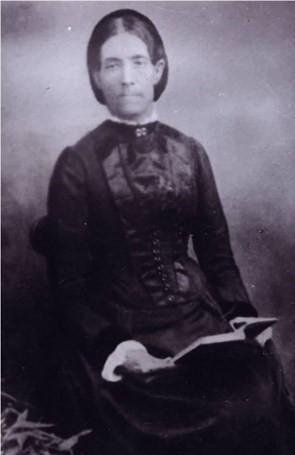
Eliza Browning (1814-1886), my great great great grandmother, had a baby six years before she married Thomas Stokes. Her name was Ellen Harding Browning, which suggests that her fathers name was Harding. On the 1841 census seven year old Ellen was living with her grandfather Isaac Browning in Tetbury. Ellen Harding Browning married William Dee in Tetbury in 1857, and they moved to Western Australia.
Ellen Harding Browning Dee: (photo found on ancestry website)
OBITUARY. MRS. ELLEN DEE.
A very old and respected resident of Dongarra, in the person of Mrs. Ellen Dee, passed peacefully away on Sept. 27, at the advanced age of 74 years.The deceased had been ailing for some time, but was about and actively employed until Wednesday, Sept. 20, whenn she was heard groaning by some neighbours, who immediately entered her place and found her lying beside the fireplace. Tho deceased had been to bed over night, and had evidently been in the act of lighting thc fire, when she had a seizure. For some hours she was conscious, but had lost the power of speech, and later on became unconscious, in which state she remained until her death.
The deceased was born in Gloucestershire, England, in 1833, was married to William Dee in Tetbury Church 23 years later. Within a month she left England with her husband for Western Australian in the ship City oí Bristol. She resided in Fremantle for six months, then in Greenough for a short time, and afterwards (for 42 years) in Dongarra. She was, therefore, a colonist of about 51 years. She had a family of four girls and three boys, and five of her children survive her, also 35 grandchildren, and eight great grandchildren. She was very highly respected, and her sudden collapse came as a great shock to many.
Eliza married Thomas Stokes (1816-1885) in September 1840 in Hempstead, Gloucestershire. On the 1841 census, Eliza and her mother Mary Browning (nee Lock) were staying with Thomas Lock and family in Cirencester. Strangely, Thomas Stokes has not been found thus far on the 1841 census, and Thomas and Eliza’s first child William James Stokes birth was registered in Witham, in Essex, on the 6th of September 1841.
I don’t know why William James was born in Witham, or where Thomas was at the time of the census in 1841. One possibility is that as Thomas Stokes did a considerable amount of work with circus waggons, circus shooting galleries and so on as a journeyman carpenter initially and then later wheelwright, perhaps he was working with a traveling circus at the time.
But back to the Brownings ~ more on William James Stokes to follow.
One of Isaac and Mary’s fourteen children died in infancy: Ann was baptised and died in 1811. Two of their children died at nine years old: the first George, and Mary who died in 1835. Matilda was 21 years old when she died in 1844.
Jane Browning (1808-) married Thomas Buckingham in 1830 in Tetbury. In August 1838 Thomas was charged with feloniously stealing a black gelding.
Susan Browning (1822-1879) married William Cleaver in November 1844 in Tetbury. Oddly thereafter they use the name Bowman on the census. On the 1851 census Mary Browning (Susan’s mother), widow, has grandson George Bowman born in 1844 living with her. The confusion with the Bowman and Cleaver names was clarified upon finding the criminal registers:
30 January 1834. Offender: William Cleaver alias Bowman, Richard Bunting alias Barnfield and Jeremiah Cox, labourers of Tetbury. Crime: Stealing part of a dead fence from a rick barton in Tetbury, the property of Robert Tanner, farmer.
And again in 1836:
29 March 1836 Bowman, William alias Cleaver, of Tetbury, labourer age 18; 5’2.5” tall, brown hair, grey eyes, round visage with fresh complexion; several moles on left cheek, mole on right breast. Charged on the oath of Ann Washbourn & others that on the morning of the 31 March at Tetbury feloniously stolen a lead spout affixed to the dwelling of the said Ann Washbourn, her property. Found guilty 31 March 1836; Sentenced to 6 months.
On the 1851 census Susan Bowman was a servant living in at a large drapery shop in Cheltenham. She was listed as 29 years old, married and born in Tetbury, so although it was unusual for a married woman not to be living with her husband, (or her son for that matter, who was living with his grandmother Mary Browning), perhaps her husband William Bowman alias Cleaver was in trouble again. By 1861 they are both living together in Tetbury: William was a plasterer, and they had three year old Isaac and Thomas, one year old. In 1871 William was still a plasterer in Tetbury, living with wife Susan, and sons Isaac and Thomas. Interestingly, a William Cleaver is living next door but one!
Susan was 56 when she died in Tetbury in 1879.
Three of the Browning daughters went to London.
Louisa Browning (1821-1873) married Robert Claxton, coachman, in 1848 in Bryanston Square, Westminster, London. Ester Browning was a witness.
Ester Browning (1823-1893)(or Hester) married Charles Hudson Sealey, cabinet maker, in Bethnal Green, London, in 1854. Charles was born in Tetbury. Charlotte Browning was a witness.
Charlotte Browning (1828-1867?) was admitted to St Marylebone workhouse in London for “parturition”, or childbirth, in 1860. She was 33 years old. A birth was registered for a Charlotte Browning, no mothers maiden name listed, in 1860 in Marylebone. A death was registered in Camden, buried in Marylebone, for a Charlotte Browning in 1867 but no age was recorded. As the age and parents were usually recorded for a childs death, I assume this was Charlotte the mother.
I found Charlotte on the 1851 census by chance while researching her mother Mary Lock’s siblings. Hesther Lock married Lewin Chandler, and they were living in Stepney, London. Charlotte is listed as a neice. Although Browning is mistranscribed as Broomey, the original page says Browning. Another mistranscription on this record is Hesthers birthplace which is transcribed as Yorkshire. The original image shows Gloucestershire.
Isaac and Mary’s first son was John Browning (1807-1860). John married Hannah Coates in 1834. John’s brother Charles Browning (1819-1853) married Eliza Coates in 1842. Perhaps they were sisters. On the 1861 census Hannah Browning, John’s wife, was a visitor in the Harding household in a village called Coates near Tetbury. Thomas Harding born in 1801 was the head of the household. Perhaps he was the father of Ellen Harding Browning.
George Browning (1828-1870) married Louisa Gainey in Tetbury, and died in Tetbury at the age of 42. Their son Richard Lock Browning, a 32 year old mason, was sentenced to one month hard labour for game tresspass in Tetbury in 1884.
Isaac Browning (1832-1857) was the youngest son of Isaac and Mary. He was just 25 years old when he died in Tetbury.
October 22, 2022 at 1:18 pm #6338In reply to: Family Stories From The Other Side ~ Book Two
Albert Parker Edwards
1876-1930
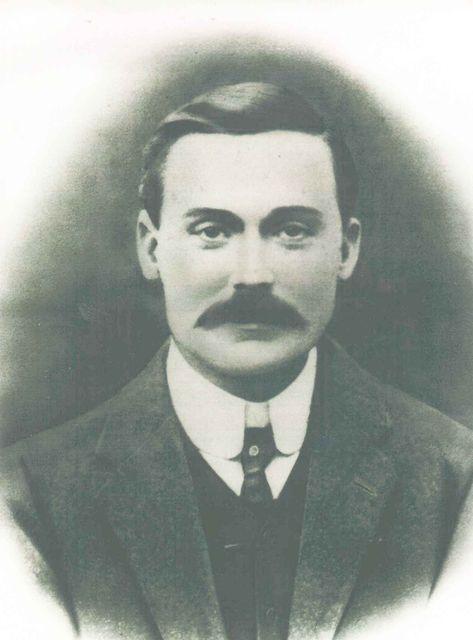
Albert Parker Edwards, my great grandfather, was born in Aston, Warwickshire in 1876. On the 1881 census he was living with his parents Enoch and Amelia in Bournebrook, Northfield, Worcestershire. Enoch was a button tool maker at the time of the census.
In 1890 Albert was indentured in an apprenticeship as a pawnbroker in Tipton, Staffordshire.
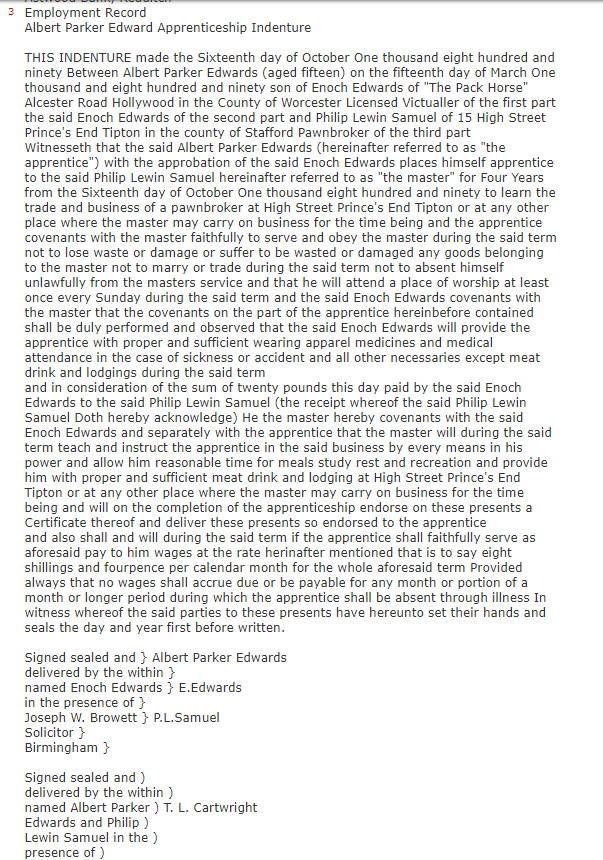
On the 1891 census Albert was a lodger in Tipton at the home of Phoebe Levy, pawnbroker, and Alberts occupation was an apprentice.
Albert married Annie Elizabeth Stokes in 1898 in Evesham, and their first son, my grandfather Albert Garnet Edwards (1898-1950), was born six months later in Crabbs Cross. On the 1901 census, Annie was in hospital as a patient and Albert was living at Crabbs Cross with a boarder, his brother Garnet Edwards. Their two year old son Albert Garnet was staying with his uncle Ralph, Albert Parkers brother, also in Crabbs Cross.
Albert and Annie kept the Cricketers Arms hotel on Beoley Road in Redditch until around 1920. They had a further four children while living there: Doris May Edwards (1902-1974), Ralph Clifford Edwards (1903-1988), Ena Flora Edwards (1908-1983) and Osmond Edwards (1910-2000).
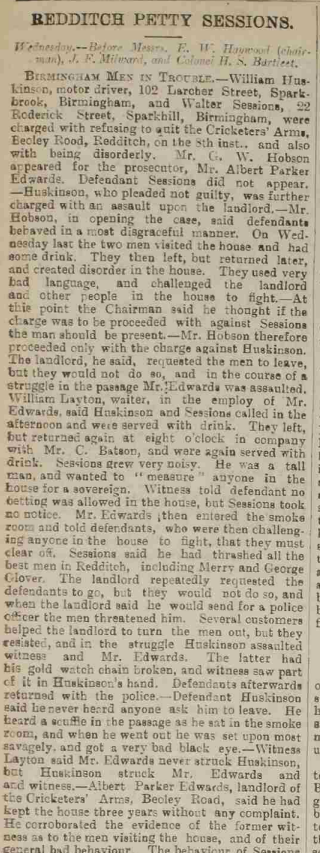
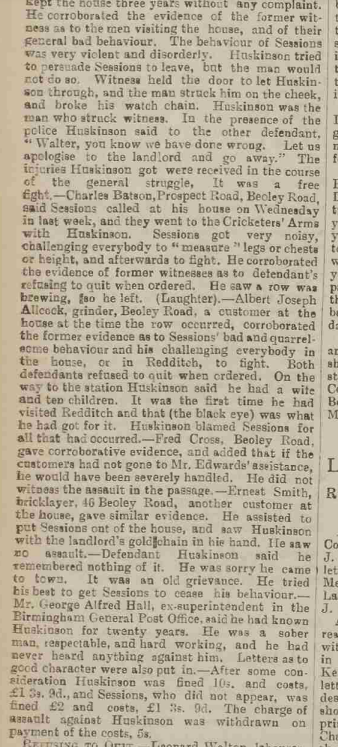
In 1906 Albert was assaulted during an incident in the Cricketers Arms.
Bromsgrove & Droitwich Messenger – Saturday 18 August 1906:
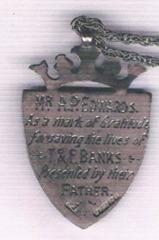
In 1910 a gold medal was given to Albert Parker Edwards by Mr. Banks, a policeman, in Redditch for saving the life of his two children from drowning in a brook on the Proctor farm which adjoined The Cricketers Arms. The story my father heard was that policeman Banks could not persuade the town of Redditch to come up with an award for Albert Parker Edwards so policeman Banks did it himself. William Banks, police constable, was living on Beoley Road on the 1911 census. His son Thomas was aged 5 and his daughter Frances was 8. It seems that when the father retired from the police he moved to Worcester. Thomas went into the hotel business and in 1939 was the manager of the Abbey hotel in Kenilworth. Frances married Edward Pardoe and was living along Redditch Road, Alvechurch in 1939.
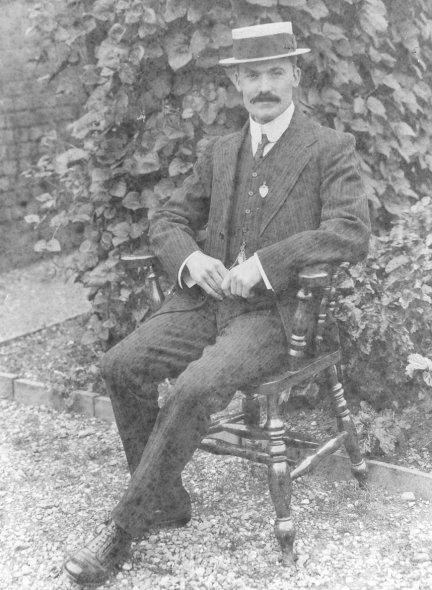
My grandmother Peggy had the gold medal put on a gold chain for me in the 1970s. When I left England in the 1980s, I gave it back to her for safekeeping. When she died, the medal on the chain ended up in my fathers possession, who claims to have no knowledge that it was once given to me!
The medal:
Albert Parker Edwards wearing the medal:
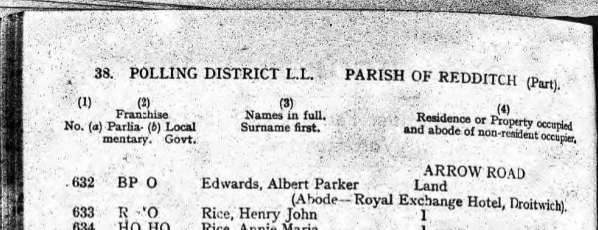
In 1921 Albert was at the The Royal Exchange hotel in Droitwich:
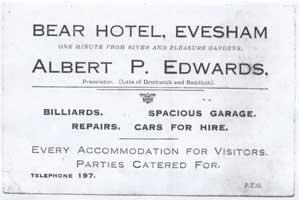
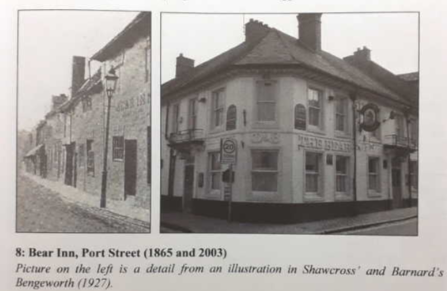
Between 1922 and 1927 Albert kept the Bear Hotel in Evesham:
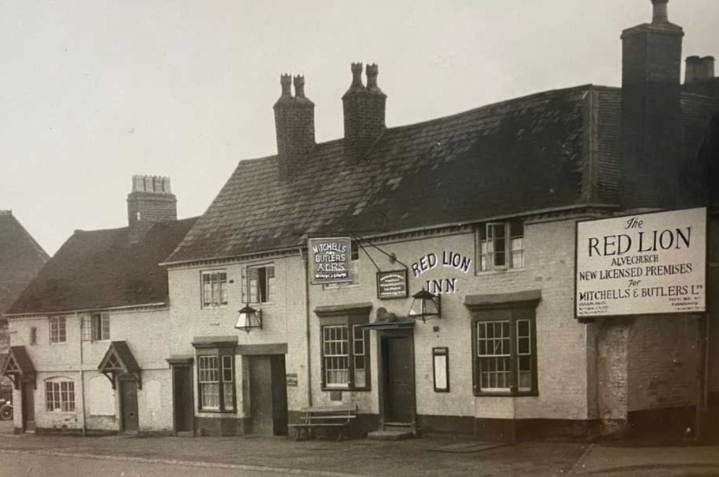
Then Albert and Annie moved to the Red Lion at Astwood Bank:
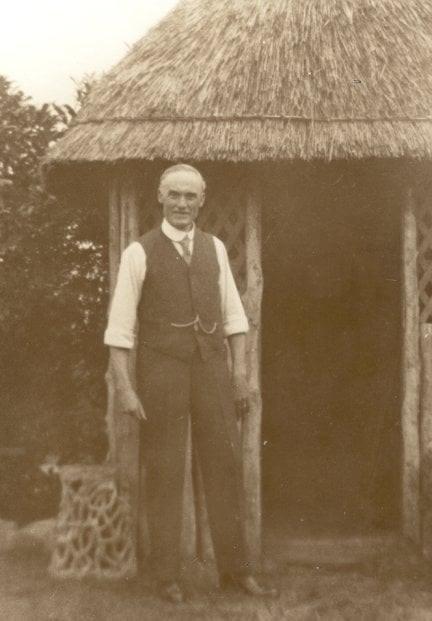
Albert in the garden behind the Red Lion:
They stayed at the Red Lion until Albert Parker Edwards died on the 11th of February, 1930 aged 53.
 March 11, 2022 at 12:52 pm #6282
In reply to: The Elusive Samuel Housley and Other Family Stories
Magson
This unusual name is of early medieval English origin, and is one of the rare group of modern surnames classed as “metronymics”, where the original surname derived from the name of the first bearer’s mother, the majority of surnames being created from patronymics, that is, through the male side.
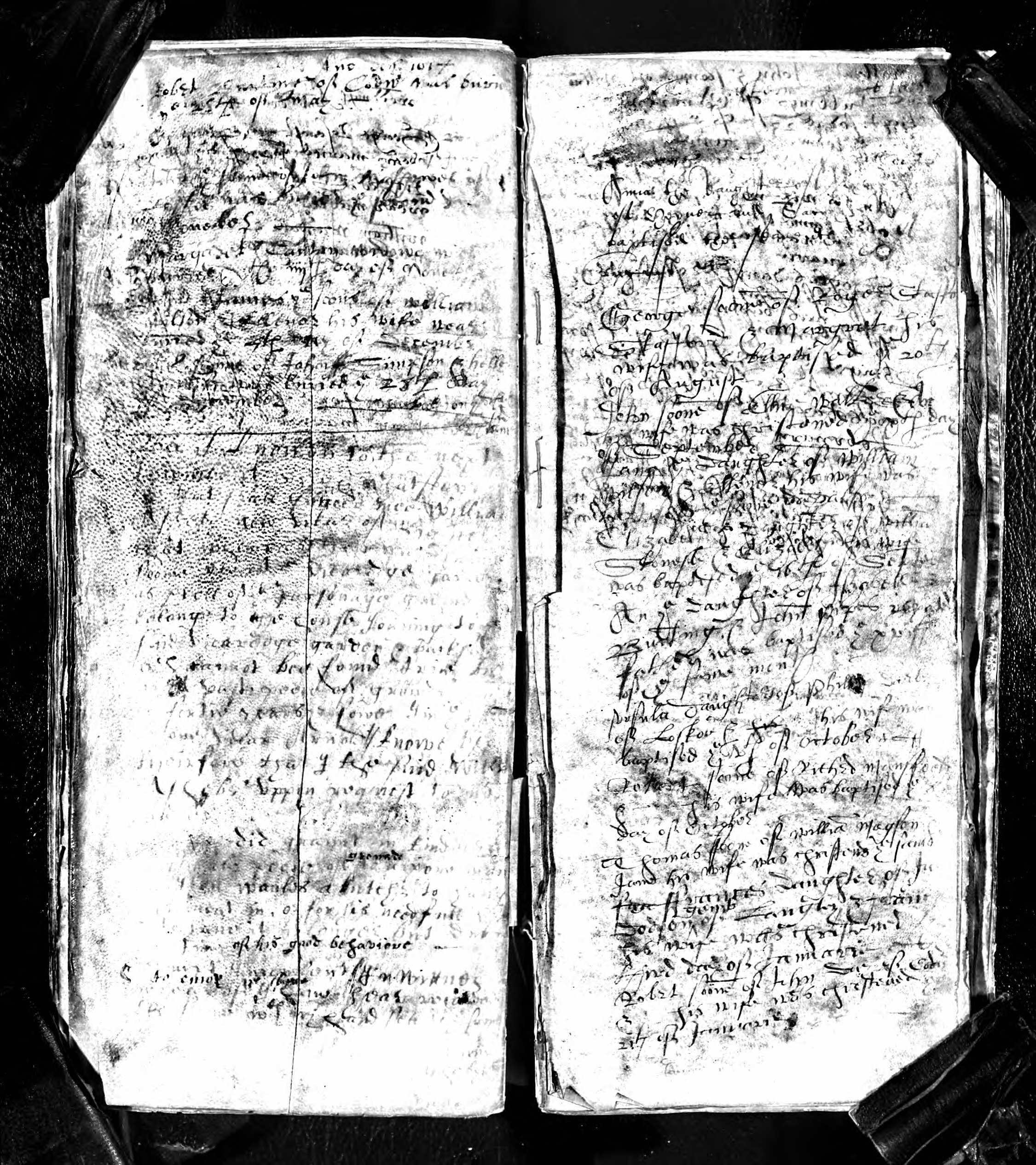
William Housley’s (1781-1848) great grandfather John Housley 1670- married Sarah Magson in 1700. She was also born in 1670, and both were born in Selston, Nottinghamshire, as was William.
The parish records mention Magson’s in Selston and nearby Heanor as far back at 1580, but they are not easy to read:
 March 10, 2022 at 7:40 am #6281
In reply to: The Elusive Samuel Housley and Other Family Stories
The Measham Thatchers
Orgills, Finches and Wards
Measham is a large village in north west Leicestershire, England, near the Derbyshire, Staffordshire and Warwickshire boundaries. Our family has a penchant for border straddling, and the Orgill’s of Measham take this a step further living on the boundaries of four counties. Historically it was in an exclave of Derbyshire absorbed into Leicestershire in 1897, so once again we have two sets of county records to search.
ORGILL
Richard Gretton, the baker of Swadlincote and my great grandmother Florence Nightingale Grettons’ father, married Sarah Orgill (1840-1910) in 1861.
(Incidentally, Florence Nightingale Warren nee Gretton’s first child Hildred born in 1900 had the middle name Orgill. Florence’s brother John Orgill Gretton emigrated to USA.)
When they first married, they lived with Sarah’s widowed mother Elizabeth in Measham. Elizabeth Orgill is listed on the 1861 census as a farmer of two acres.
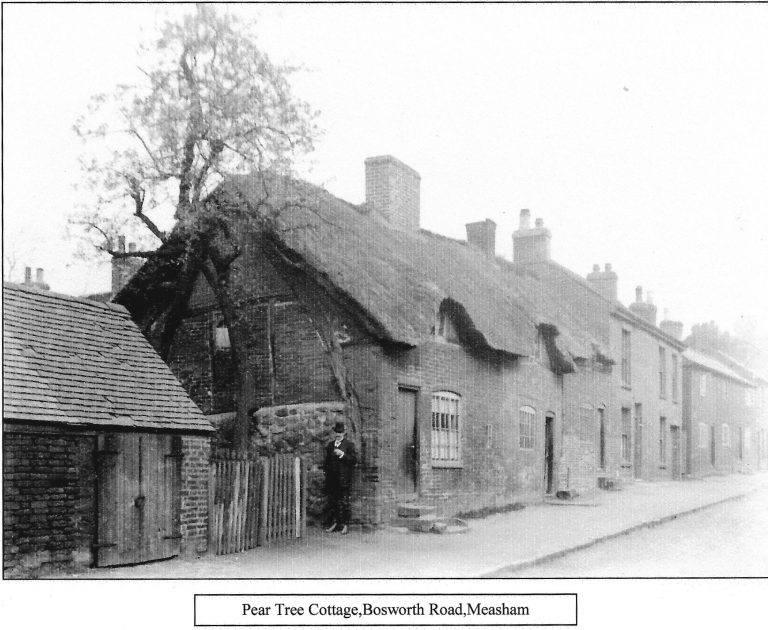
Sarah Orgill’s father Matthew Orgill (1798-1859) was a thatcher, as was his father Matthew Orgill (1771-1852).
Matthew Orgill the elder left his property to his son Henry:
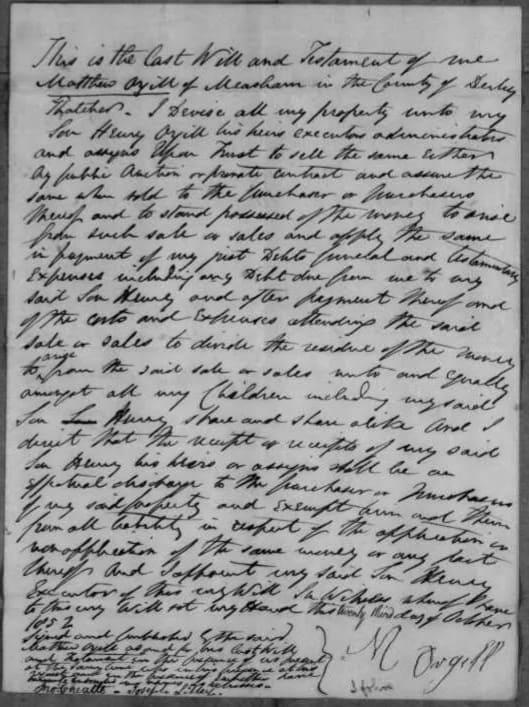
Sarah’s mother Elizabeth (1803-1876) was also an Orgill before her marriage to Matthew.
According to Pigot & Co’s Commercial Directory for Derbyshire, in Measham in 1835 Elizabeth Orgill was a straw bonnet maker, an ideal occupation for a thatchers wife.
Matthew Orgill, thatcher, is listed in White’s directory in 1857, and other Orgill’s are mentioned in Measham:
Mary Orgill, straw hat maker; Henry Orgill, grocer; Daniel Orgill, painter; another Matthew Orgill is a coal merchant and wheelwright. Likewise a number of Orgill’s are listed in the directories for Measham in the subsequent years, as farmers, plumbers, painters, grocers, thatchers, wheelwrights, coal merchants and straw bonnet makers.
Matthew and Elizabeth Orgill, Measham Baptist church:
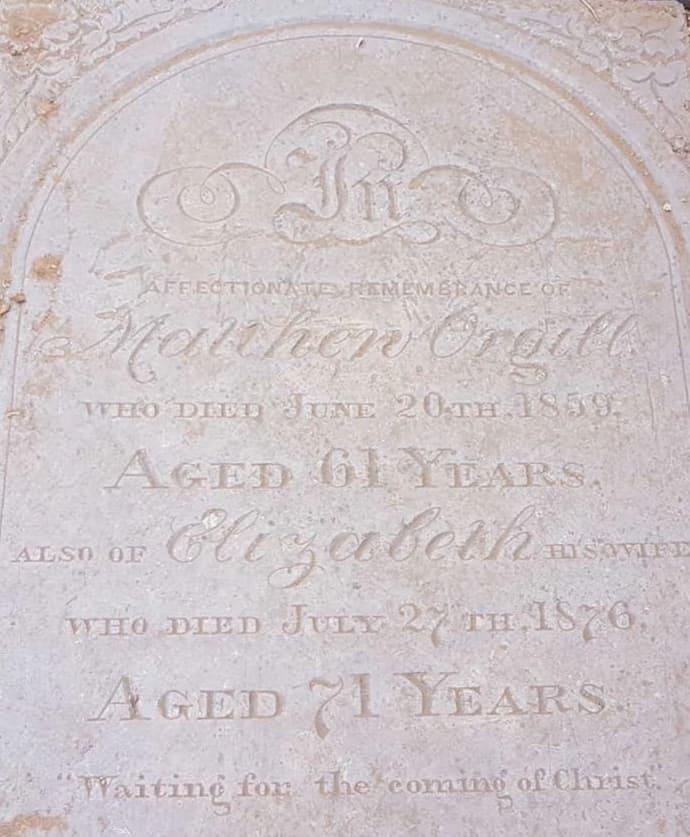
According to a history of thatching, for every six or seven thatchers appearing in the 1851 census there are now less than one. Another interesting fact in the history of thatched roofs (via thatchinginfo dot com):
The Watling Street Divide…
The biggest dividing line of all, that between the angular thatching of the Northern and Eastern traditions and the rounded Southern style, still roughly follows a very ancient line; the northern section of the old Roman road of Watling Street, the modern A5. Seemingly of little significance today; this was once the border between two peoples. Agreed in the peace treaty, between the Saxon King Alfred and Guthrum, the Danish Viking leader; over eleven centuries ago.
After making their peace, various Viking armies settled down, to the north and east of the old road; firstly, in what was known as The Danelaw and later in Norse kingdoms, based in York. They quickly formed a class of farmers and peasants. Although the Saxon kings soon regained this area; these people stayed put. Their influence is still seen, for example, in the widespread use of boarded gable ends, so common in Danish thatching.
Over time, the Southern and Northern traditions have slipped across the old road, by a few miles either way. But even today, travelling across the old highway will often bring the differing thatching traditions quickly into view.Pear Tree Cottage, Bosworth Road, Measham. 1900. Matthew Orgill was a thatcher living on Bosworth road.
FINCH
Matthew the elder married Frances Finch 1771-1848, also of Measham. On the 1851 census Matthew is an 80 year old thatcher living with his daughter Mary and her husband Samuel Piner, a coal miner.
Henry Finch 1743- and Mary Dennis 1749- , both of Measham, were Frances parents. Henry’s father was also Henry Finch, born in 1707 in Measham, and he married Frances Ward, also born in 1707, and also from Measham.
WARD
The ancient boundary between the kingdom of Mercia and the Danelaw
I didn’t find much information on the history of Measham, but I did find a great deal of ancient history on the nearby village of Appleby Magna, two miles away. The parish records indicate that the Ward and Finch branches of our family date back to the 1500’s in the village, and we can assume that the ancient history of the neighbouring village would be relevant to our history.
There is evidence of human settlement in Appleby from the early Neolithic period, 6,000 years ago, and there are also Iron Age and Bronze Age sites in the vicinity. There is evidence of further activity within the village during the Roman period, including evidence of a villa or farm and a temple. Appleby is near three known Roman roads: Watling Street, 10 miles south of the village; Bath Lane, 5 miles north of the village; and Salt Street, which forms the parish’s south boundary.
But it is the Scandinavian invasions that are particularly intriguing, with regard to my 58% Scandinavian DNA (and virtually 100% Midlands England ancestry). Repton is 13 miles from Measham. In the early 10th century Chilcote, Measham and Willesley were part of the royal Derbyshire estate of Repton.
The arrival of Scandinavian invaders in the second half of the ninth century caused widespread havoc throughout northern England. By the AD 870s the Danish army was occupying Mercia and it spent the winter of 873-74 at Repton, the headquarters of the Mercian kings. The events are recorded in detail in the Peterborough manuscript of the Anglo-Saxon Chronicles…
Although the Danes held power for only 40 years, a strong, even subversive, Danish element remained in the population for many years to come.
A Scandinavian influence may also be detected among the field names of the parish. Although many fields have relatively modern names, some clearly have elements which reach back to the time of Danish incursion and control.
The Borders:
The name ‘aeppel byg’ is given in the will of Wulfic Spot of AD 1004……………..The decision at Domesday to include this land in Derbyshire, as one of Burton Abbey’s Derbyshire manors, resulted in the division of the village of Appleby Magna between the counties of Leicester and Derby for the next 800 years
Richard Dunmore’s Appleby Magma website.
This division of Appleby between Leicestershire and Derbyshire persisted from Domesday until 1897, when the recently created county councils (1889) simplified the administration of many villages in this area by a radical realignment of the boundary:
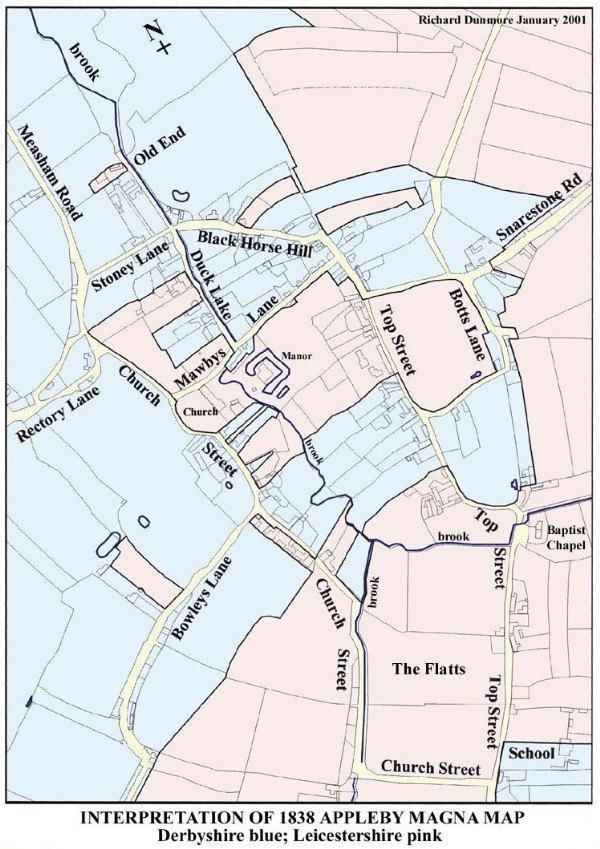
I would appear that our family not only straddle county borders, but straddle ancient kingdom borders as well. This particular branch of the family (we assume, given the absence of written records that far back) were living on the edge of the Danelaw and a strong element of the Danes survives to this day in my DNA.
February 4, 2022 at 3:17 pm #6269In reply to: The Elusive Samuel Housley and Other Family Stories
The Housley Letters
From Barbara Housley’s Narrative on the Letters.
William Housley (1781-1848) and Ellen Carrington were married on May 30, 1814 at St. Oswald’s church in Ashbourne. William died in 1848 at the age of 67 of “disease of lungs and general debility”. Ellen died in 1872.
Marriage of William Housley and Ellen Carrington in Ashbourne in 1814:
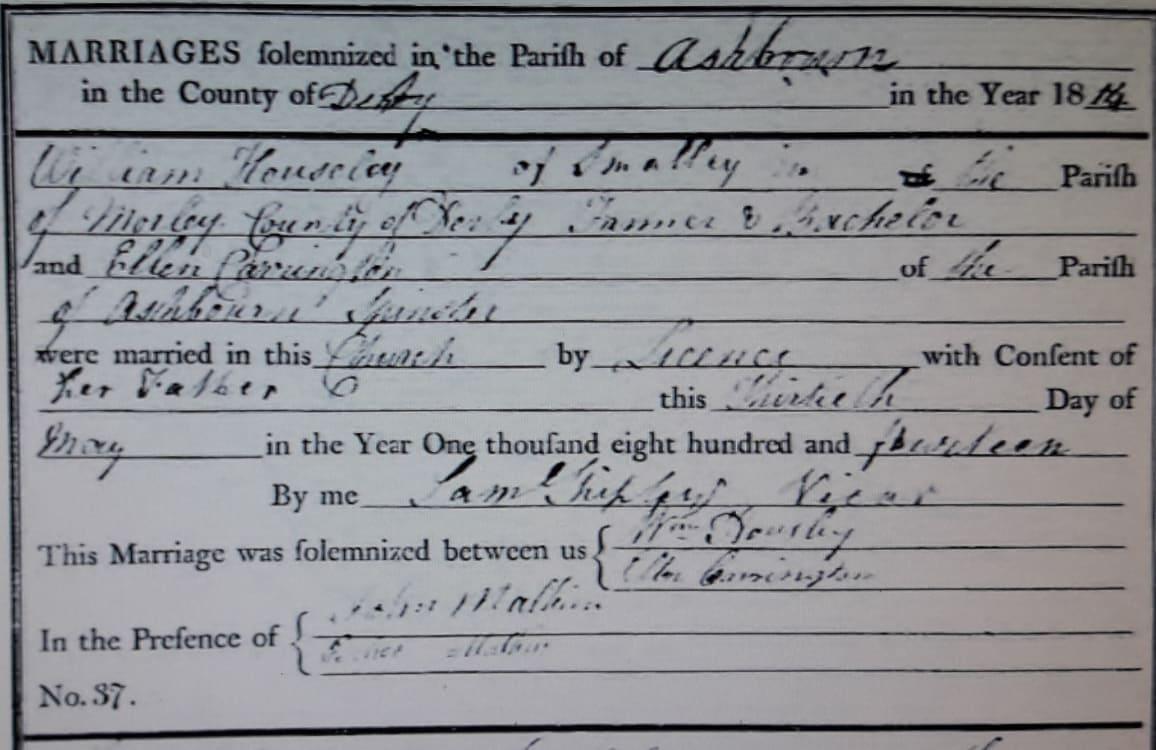
Parish records show three children for William and his first wife, Mary, Ellens’ sister, who were married December 29, 1806: Mary Ann, christened in 1808 and mentioned frequently in the letters; Elizabeth, christened in 1810, but never mentioned in any letters; and William, born in 1812, probably referred to as Will in the letters. Mary died in 1813.
William and Ellen had ten children: John, Samuel, Edward, Anne, Charles, George, Joseph, Robert, Emma, and Joseph. The first Joseph died at the age of four, and the last son was also named Joseph. Anne never married, Charles emigrated to Australia in 1851, and George to USA, also in 1851. The letters are to George, from his sisters and brothers in England.
The following are excerpts of those letters, including excerpts of Barbara Housley’s “Narrative on Historic Letters”. They are grouped according to who they refer to, rather than chronological order.
ELLEN HOUSLEY 1795-1872
Joseph wrote that when Emma was married, Ellen “broke up the comfortable home and the things went to Derby and she went to live with them but Derby didn’t agree with her so she left again leaving her things behind and came to live with John in the new house where she died.” Ellen was listed with John’s household in the 1871 census.
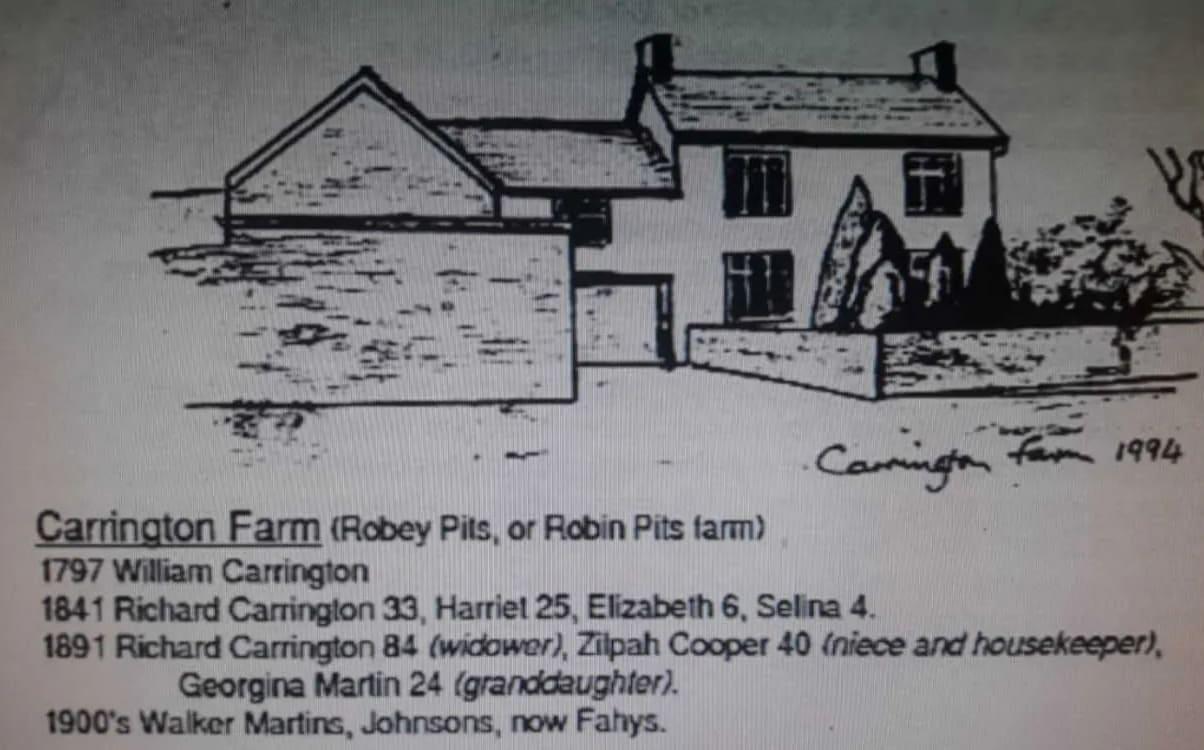
In May 1872, the Ilkeston Pioneer carried this notice: “Mr. Hopkins will sell by auction on Saturday next the eleventh of May 1872 the whole of the useful furniture, sewing machine, etc. nearly new on the premises of the late Mrs. Housley at Smalley near Heanor in the county of Derby. Sale at one o’clock in the afternoon.”Ellen’s family was evidently rather prominant in Smalley. Two Carringtons (John and William) served on the Parish Council in 1794. Parish records are full of Carrington marriages and christenings; census records confirm many of the family groupings.
In June of 1856, Emma wrote: “Mother looks as well as ever and was told by a lady the other day that she looked handsome.” Later she wrote: “Mother is as stout as ever although she sometimes complains of not being able to do as she used to.”
Mary’s children:
MARY ANN HOUSLEY 1808-1878
There were hard feelings between Mary Ann and Ellen and her children. Anne wrote: “If you remember we were not very friendly when you left. They never came and nothing was too bad for Mary Ann to say of Mother and me, but when Robert died Mother sent for her to the funeral but she did not think well to come so we took no more notice. She would not allow her children to come either.”
Mary Ann was unlucky in love! In Anne’s second letter she wrote: “William Carrington is paying Mary Ann great attention. He is living in London but they write to each other….We expect it will be a match.” Apparantly the courtship was stormy for in 1855, Emma wrote: “Mary Ann’s wedding with William Carrington has dropped through after she had prepared everything, dresses and all for the occassion.” Then in 1856, Emma wrote: “William Carrington and Mary Ann are separated. They wore him out with their nonsense.” Whether they ever married is unclear. Joseph wrote in 1872: “Mary Ann was married but her husband has left her. She is in very poor health. She has one daughter and they are living with their mother at Smalley.”
Regarding William Carrington, Emma supplied this bit of news: “His sister, Mrs. Lily, has eloped with a married man. Is she not a nice person!”
WILLIAM HOUSLEY JR. 1812-1890
According to a letter from Anne, Will’s two sons and daughter were sent to learn dancing so they would be “fit for any society.” Will’s wife was Dorothy Palfry. They were married in Denby on October 20, 1836 when Will was 24. According to the 1851 census, Will and Dorothy had three sons: Alfred 14, Edwin 12, and William 10. All three boys were born in Denby.
In his letter of May 30, 1872, after just bemoaning that all of his brothers and sisters are gone except Sam and John, Joseph added: “Will is living still.” In another 1872 letter Joseph wrote, “Will is living at Heanor yet and carrying on his cattle dealing.” The 1871 census listed Will, 59, and his son William, 30, of Lascoe Road, Heanor, as cattle dealers.
Ellen’s children:
JOHN HOUSLEY 1815-1893
John married Sarah Baggally in Morely in 1838. They had at least six children. Elizabeth (born 2 May 1838) was “out service” in 1854. In her “third year out,” Elizabeth was described by Anne as “a very nice steady girl but quite a woman in appearance.” One of her positions was with a Mrs. Frearson in Heanor. Emma wrote in 1856: “Elizabeth is still at Mrs. Frearson. She is such a fine stout girl you would not know her.” Joseph wrote in 1872 that Elizabeth was in service with Mrs. Eliza Sitwell at Derby. (About 1850, Miss Eliza Wilmot-Sitwell provided for a small porch with a handsome Norman doorway at the west end of the St. John the Baptist parish church in Smalley.)
According to Elizabeth’s birth certificate and the 1841 census, John was a butcher. By 1851, the household included a nurse and a servant, and John was listed as a “victular.” Anne wrote in February 1854, “John has left the Public House a year and a half ago. He is living where Plumbs (Ann Plumb witnessed William’s death certificate with her mark) did and Thomas Allen has the land. He has been working at James Eley’s all winter.” In 1861, Ellen lived with John and Sarah and the three boys.
John sold his share in the inheritance from their mother and disappeared after her death. (He died in Doncaster, Yorkshire, in 1893.) At that time Charles, the youngest would have been 21. Indeed, Joseph wrote in July 1872: “John’s children are all grown up”.
In May 1872, Joseph wrote: “For what do you think, John has sold his share and he has acted very bad since his wife died and at the same time he sold all his furniture. You may guess I have never seen him but once since poor mother’s funeral and he is gone now no one knows where.”
In February 1874 Joseph wrote: “You want to know what made John go away. Well, I will give you one reason. I think I told you that when his wife died he persuaded me to leave Derby and come to live with him. Well so we did and dear Harriet to keep his house. Well he insulted my wife and offered things to her that was not proper and my dear wife had the power to resist his unmanly conduct. I did not think he could of served me such a dirty trick so that is one thing dear brother. He could not look me in the face when we met. Then after we left him he got a woman in the house and I suppose they lived as man and wife. She caught the small pox and died and there he was by himself like some wild man. Well dear brother I could not go to him again after he had served me and mine as he had and I believe he was greatly in debt too so that he sold his share out of the property and when he received the money at Belper he went away and has never been seen by any of us since but I have heard of him being at Sheffield enquiring for Sam Caldwell. You will remember him. He worked in the Nag’s Head yard but I have heard nothing no more of him.”
A mention of a John Housley of Heanor in the Nottinghma Journal 1875. I don’t know for sure if the John mentioned here is the brother John who Joseph describes above as behaving improperly to his wife. John Housley had a son Joseph, born in 1840, and John’s wife Sarah died in 1870.
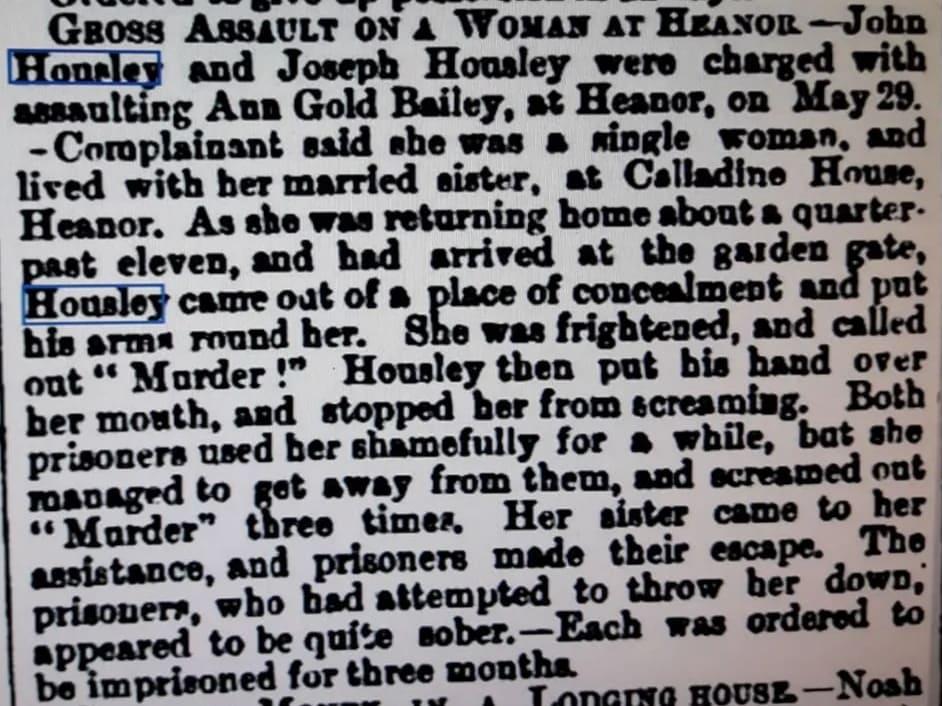
In 1876, the solicitor wrote to George: “Have you heard of John Housley? He is entitled to Robert’s share and I want him to claim it.”
SAMUEL HOUSLEY 1816-
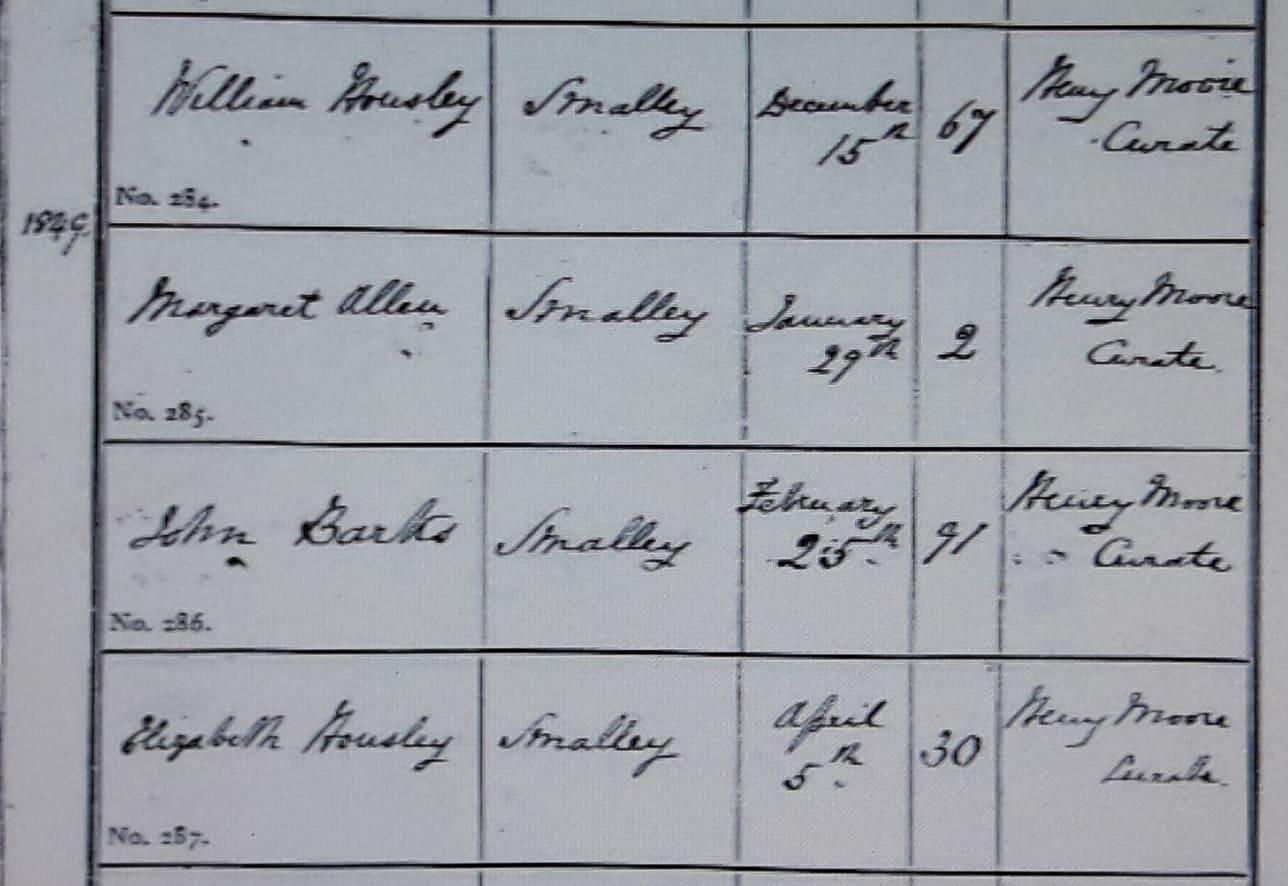
Sam married Elizabeth Brookes of Sutton Coldfield, and they had three daughters: Elizabeth, Mary Anne and Catherine. Elizabeth his wife died in 1849, a few months after Samuel’s father William died in 1848. The particular circumstances relating to these individuals have been discussed in previous chapters; the following are letter excerpts relating to them.
Death of William Housley 15 Dec 1848, and Elizabeth Housley 5 April 1849, Smalley:
Joseph wrote in December 1872: “I saw one of Sam’s daughters, the youngest Kate, you would remember her a baby I dare say. She is very comfortably married.”
In the same letter (December 15, 1872), Joseph wrote: “I think we have now found all out now that is concerned in the matter for there was only Sam that we did not know his whereabouts but I was informed a week ago that he is dead–died about three years ago in Birmingham Union. Poor Sam. He ought to have come to a better end than that….His daughter and her husband went to Brimingham and also to Sutton Coldfield that is where he married his wife from and found out his wife’s brother. It appears he has been there and at Birmingham ever since he went away but ever fond of drink.”
(Sam, however, was still alive in 1871, living as a lodger at the George and Dragon Inn, Henley in Arden. And no trace of Sam has been found since. It would appear that Sam did not want to be found.)
EDWARD HOUSLEY 1819-1843
Edward died before George left for USA in 1851, and as such there is no mention of him in the letters.
ANNE HOUSLEY 1821-1856
Anne wrote two letters to her brother George between February 1854 and her death in 1856. Apparently she suffered from a lung disease for she wrote: “I can say you will be surprised I am still living and better but still cough and spit a deal. Can do nothing but sit and sew.” According to the 1851 census, Anne, then 29, was a seamstress. Their friend, Mrs. Davy, wrote in March 1856: “This I send in a box to my Brother….The pincushion cover and pen wiper are Anne’s work–are for thy wife. She would have made it up had she been able.” Anne was not living at home at the time of the 1841 census. She would have been 19 or 20 and perhaps was “out service.”
In her second letter Anne wrote: “It is a great trouble now for me to write…as the body weakens so does the mind often. I have been very weak all summer. That I continue is a wonder to all and to spit so much although much better than when you left home.” She also wrote: “You know I had a desire for America years ago. Were I in health and strength, it would be the land of my adoption.”
In November 1855, Emma wrote, “Anne has been very ill all summer and has not been able to write or do anything.” Their neighbor Mrs. Davy wrote on March 21, 1856: “I fear Anne will not be long without a change.” In a black-edged letter the following June, Emma wrote: “I need not tell you how happy she was and how calmly and peacefully she died. She only kept in bed two days.”
Certainly Anne was a woman of deep faith and strong religious convictions. When she wrote that they were hoping to hear of Charles’ success on the gold fields she added: “But I would rather hear of him having sought and found the Pearl of great price than all the gold Australia can produce, (For what shall it profit a man if he gain the whole world and lose his soul?).” Then she asked George: “I should like to learn how it was you were first led to seek pardon and a savior. I do feel truly rejoiced to hear you have been led to seek and find this Pearl through the workings of the Holy Spirit and I do pray that He who has begun this good work in each of us may fulfill it and carry it on even unto the end and I can never doubt the willingness of Jesus who laid down his life for us. He who said whoever that cometh unto me I will in no wise cast out.”
Anne’s will was probated October 14, 1856. Mr. William Davy of Kidsley Park appeared for the family. Her estate was valued at under £20. Emma was to receive fancy needlework, a four post bedstead, feather bed and bedding, a mahogany chest of drawers, plates, linen and china. Emma was also to receive Anne’s writing desk. There was a condition that Ellen would have use of these items until her death.
The money that Anne was to receive from her grandfather, William Carrington, and her father, William Housley was to be distributed one third to Joseph, one third to Emma, and one third to be divided between her four neices: John’s daughter Elizabeth, 18, and Sam’s daughters Elizabeth, 10, Mary Ann, 9 and Catharine, age 7 to be paid by the trustees as they think “most useful and proper.” Emma Lyon and Elizabeth Davy were the witnesses.
The Carrington Farm:
CHARLES HOUSLEY 1823-1855
Charles went to Australia in 1851, and was last heard from in January 1853. According to the solicitor, who wrote to George on June 3, 1874, Charles had received advances on the settlement of their parent’s estate. “Your promissory note with the two signed by your brother Charles for 20 pounds he received from his father and 20 pounds he received from his mother are now in the possession of the court.”
Charles and George were probably quite close friends. Anne wrote in 1854: “Charles inquired very particularly in both his letters after you.”
According to Anne, Charles and a friend married two sisters. He and his father-in-law had a farm where they had 130 cows and 60 pigs. Whatever the trade he learned in England, he never worked at it once he reached Australia. While it does not seem that Charles went to Australia because gold had been discovered there, he was soon caught up in “gold fever”. Anne wrote: “I dare say you have heard of the immense gold fields of Australia discovered about the time he went. Thousands have since then emigrated to Australia, both high and low. Such accounts we heard in the papers of people amassing fortunes we could not believe. I asked him when I wrote if it was true. He said this was no exaggeration for people were making their fortune daily and he intended going to the diggings in six weeks for he could stay away no longer so that we are hoping to hear of his success if he is alive.”
In March 1856, Mrs. Davy wrote: “I am sorry to tell thee they have had a letter from Charles’s wife giving account of Charles’s death of 6 months consumption at the Victoria diggings. He has left 2 children a boy and a girl William and Ellen.” In June of the same year in a black edged letter, Emma wrote: “I think Mrs. Davy mentioned Charles’s death in her note. His wife wrote to us. They have two children Helen and William. Poor dear little things. How much I should like to see them all. She writes very affectionately.”
In December 1872, Joseph wrote: “I’m told that Charles two daughters has wrote to Smalley post office making inquiries about his share….” In January 1876, the solicitor wrote: “Charles Housley’s children have claimed their father’s share.”
GEORGE HOUSLEY 1824-1877
George emigrated to the United states in 1851, arriving in July. The solicitor Abraham John Flint referred in a letter to a 15-pound advance which was made to George on June 9, 1851. This certainly was connected to his journey. George settled along the Delaware River in Bucks County, Pennsylvania. The letters from the solicitor were addressed to: Lahaska Post Office, Bucks County, Pennsylvania.
George married Sarah Ann Hill on May 6, 1854 in Doylestown, Bucks County, Pennsylvania. In her first letter (February 1854), Anne wrote: “We want to know who and what is this Miss Hill you name in your letter. What age is she? Send us all the particulars but I would advise you not to get married until you have sufficient to make a comfortable home.”
Upon learning of George’s marriage, Anne wrote: “I hope dear brother you may be happy with your wife….I hope you will be as a son to her parents. Mother unites with me in kind love to you both and to your father and mother with best wishes for your health and happiness.” In 1872 (December) Joseph wrote: “I am sorry to hear that sister’s father is so ill. It is what we must all come to some time and hope we shall meet where there is no more trouble.”
Emma wrote in 1855, “We write in love to your wife and yourself and you must write soon and tell us whether there is a little nephew or niece and what you call them.” In June of 1856, Emma wrote: “We want to see dear Sarah Ann and the dear little boy. We were much pleased with the “bit of news” you sent.” The bit of news was the birth of John Eley Housley, January 11, 1855. Emma concluded her letter “Give our very kindest love to dear sister and dearest Johnnie.”
In September 1872, Joseph wrote, “I was very sorry to hear that John your oldest had met with such a sad accident but I hope he is got alright again by this time.” In the same letter, Joseph asked: “Now I want to know what sort of a town you are living in or village. How far is it from New York? Now send me all particulars if you please.”
In March 1873 Harriet asked Sarah Ann: “And will you please send me all the news at the place and what it is like for it seems to me that it is a wild place but you must tell me what it is like….”. The question of whether she was referring to Bucks County, Pennsylvania or some other place is raised in Joseph’s letter of the same week.
On March 17, 1873, Joseph wrote: “I was surprised to hear that you had gone so far away west. Now dear brother what ever are you doing there so far away from home and family–looking out for something better I suppose.”The solicitor wrote on May 23, 1874: “Lately I have not written because I was not certain of your address and because I doubted I had much interesting news to tell you.” Later, Joseph wrote concerning the problems settling the estate, “You see dear brother there is only me here on our side and I cannot do much. I wish you were here to help me a bit and if you think of going for another summer trip this turn you might as well run over here.”
Apparently, George had indicated he might return to England for a visit in 1856. Emma wrote concerning the portrait of their mother which had been sent to George: “I hope you like mother’s portrait. I did not see it but I suppose it was not quite perfect about the eyes….Joseph and I intend having ours taken for you when you come over….Do come over before very long.”
In March 1873, Joseph wrote: “You ask me what I think of you coming to England. I think as you have given the trustee power to sign for you I think you could do no good but I should like to see you once again for all that. I can’t say whether there would be anything amiss if you did come as you say it would be throwing good money after bad.”
On June 10, 1875, the solicitor wrote: “I have been expecting to hear from you for some time past. Please let me hear what you are doing and where you are living and how I must send you your money.” George’s big news at that time was that on May 3, 1875, he had become a naturalized citizen “renouncing and abjuring all allegiance and fidelity to every foreign prince, potentate, state and sovereignity whatsoever, and particularly to Victoria Queen of Great Britain of whom he was before a subject.”
ROBERT HOUSLEY 1832-1851
In 1854, Anne wrote: “Poor Robert. He died in August after you left he broke a blood vessel in the lung.”
From Joseph’s first letter we learn that Robert was 19 when he died: “Dear brother there have been a great many changes in the family since you left us. All is gone except myself and John and Sam–we have heard nothing of him since he left. Robert died first when he was 19 years of age. Then Anne and Charles too died in Australia and then a number of years elapsed before anyone else. Then John lost his wife, then Emma, and last poor dear mother died last January on the 11th.”Anne described Robert’s death in this way: “He had thrown up blood many times before in the spring but the last attack weakened him that he only lived a fortnight after. He died at Derby. Mother was with him. Although he suffered much he never uttered a murmur or regret and always a smile on his face for everyone that saw him. He will be regretted by all that knew him”.
Robert died a resident of St. Peter’s Parish, Derby, but was buried in Smalley on August 16, 1851.
Apparently Robert was apprenticed to be a joiner for, according to Anne, Joseph took his place: “Joseph wanted to be a joiner. We thought we could do no better than let him take Robert’s place which he did the October after and is there still.”In 1876, the solicitor wrote to George: “Have you heard of John Housley? He is entitled to Robert’s share and I want him to claim it.”
EMMA HOUSLEY 1836-1871
Emma was not mentioned in Anne’s first letter. In the second, Anne wrote that Emma was living at Spondon with two ladies in her “third situation,” and added, “She is grown a bouncing woman.” Anne described her sister well. Emma wrote in her first letter (November 12, 1855): “I must tell you that I am just 21 and we had my pudding last Sunday. I wish I could send you a piece.”
From Emma’s letters we learn that she was living in Derby from May until November 1855 with Mr. Haywood, an iron merchant. She explained, “He has failed and I have been obliged to leave,” adding, “I expect going to a new situation very soon. It is at Belper.” In 1851 records, William Haywood, age 22, was listed as an iron foundry worker. In the 1857 Derby Directory, James and George were listed as iron and brass founders and ironmongers with an address at 9 Market Place, Derby.
In June 1856, Emma wrote from “The Cedars, Ashbourne Road” where she was working for Mr. Handysides.
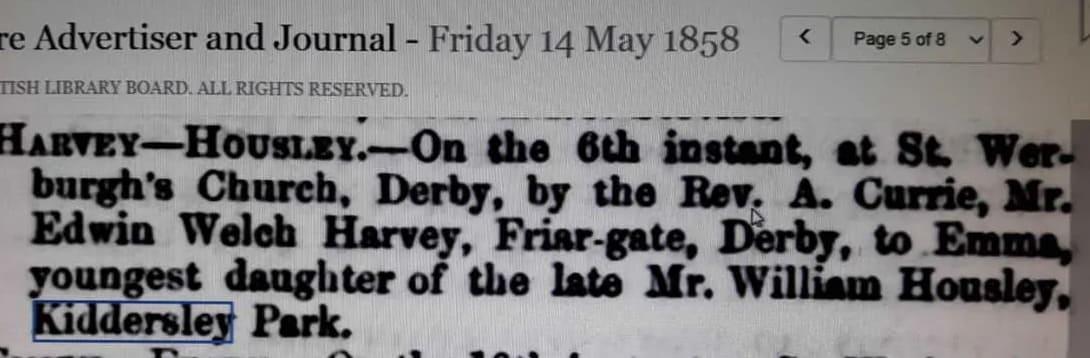
While she was working for Mr. Handysides, Emma wrote: “Mother is thinking of coming to live at Derby. That will be nice for Joseph and I.”Friargate and Ashbourne Road were located in St. Werburgh’s Parish. (In fact, St. Werburgh’s vicarage was at 185 Surrey Street. This clue led to the discovery of the record of Emma’s marriage on May 6, 1858, to Edwin Welch Harvey, son of Samuel Harvey in St. Werburgh’s.)
In 1872, Joseph wrote: “Our sister Emma, she died at Derby at her own home for she was married. She has left two young children behind. The husband was the son of the man that I went apprentice to and has caused a great deal of trouble to our family and I believe hastened poor Mother’s death….”. Joseph added that he believed Emma’s “complaint” was consumption and that she was sick a good bit. Joseph wrote: “Mother was living with John when I came home (from Ascension Island around 1867? or to Smalley from Derby around 1870?) for when Emma was married she broke up the comfortable home and the things went to Derby and she went to live with them but Derby did not agree with her so she had to leave it again but left all her things there.”
Emma Housley and Edwin Welch Harvey wedding, 1858:
JOSEPH HOUSLEY 1838-1893
We first hear of Joseph in a letter from Anne to George in 1854. “Joseph wanted to be a joiner. We thought we could do no better than let him take Robert’s place which he did the October after (probably 1851) and is there still. He is grown as tall as you I think quite a man.” Emma concurred in her first letter: “He is quite a man in his appearance and quite as tall as you.”
From Emma we learn in 1855: “Joseph has left Mr. Harvey. He had not work to employ him. So mother thought he had better leave his indenture and be at liberty at once than wait for Harvey to be a bankrupt. He has got a very good place of work now and is very steady.” In June of 1856, Emma wrote “Joseph and I intend to have our portraits taken for you when you come over….Mother is thinking of coming to Derby. That will be nice for Joseph and I. Joseph is very hearty I am happy to say.”
According to Joseph’s letters, he was married to Harriet Ballard. Joseph described their miraculous reunion in this way: “I must tell you that I have been abroad myself to the Island of Ascension. (Elsewhere he wrote that he was on the island when the American civil war broke out). I went as a Royal Marine and worked at my trade and saved a bit of money–enough to buy my discharge and enough to get married with but while I was out on the island who should I meet with there but my dear wife’s sister. (On two occasions Joseph and Harriet sent George the name and address of Harriet’s sister, Mrs. Brooks, in Susquehanna Depot, Pennsylvania, but it is not clear whether this was the same sister.) She was lady’s maid to the captain’s wife. Though I had never seen her before we got to know each other somehow so from that me and my wife recommenced our correspondence and you may be sure I wanted to get home to her. But as soon as I did get home that is to England I was not long before I was married and I have not regretted yet for we are very comfortable as well as circumstances will allow for I am only a journeyman joiner.”
Proudly, Joseph wrote: “My little family consists of three nice children–John, Joseph and Susy Annie.” On her birth certificate, Susy Ann’s birthdate is listed as 1871. Parish records list a Lucy Annie christened in 1873. The boys were born in Derby, John in 1868 and Joseph in 1869. In his second letter, Joseph repeated: “I have got three nice children, a good wife and I often think is more than I have deserved.” On August 6, 1873, Joseph and Harriet wrote: “We both thank you dear sister for the pieces of money you sent for the children. I don’t know as I have ever see any before.” Joseph ended another letter: “Now I must close with our kindest love to you all and kisses from the children.”
In Harriet’s letter to Sarah Ann (March 19, 1873), she promised: “I will send you myself and as soon as the weather gets warm as I can take the children to Derby, I will have them taken and send them, but it is too cold yet for we have had a very cold winter and a great deal of rain.” At this time, the children were all under 6 and the baby was not yet two.
In March 1873 Joseph wrote: “I have been working down at Heanor gate there is a joiner shop there where Kings used to live I have been working there this winter and part of last summer but the wages is very low but it is near home that is one comfort.” (Heanor Gate is about 1/4 mile from Kidsley Grange. There was a school and industrial park there in 1988.) At this time Joseph and his family were living in “the big house–in Old Betty Hanson’s house.” The address in the 1871 census was Smalley Lane.
A glimpse into Joseph’s personality is revealed by this remark to George in an 1872 letter: “Many thanks for your portrait and will send ours when we can get them taken for I never had but one taken and that was in my old clothes and dear Harriet is not willing to part with that. I tell her she ought to be satisfied with the original.”
On one occasion Joseph and Harriet both sent seeds. (Marks are still visible on the paper.) Joseph sent “the best cow cabbage seed in the country–Robinson Champion,” and Harriet sent red cabbage–Shaw’s Improved Red. Possibly cow cabbage was also known as ox cabbage: “I hope you will have some good cabbages for the Ox cabbage takes all the prizes here. I suppose you will be taking the prizes out there with them.” Joseph wrote that he would put the name of the seeds by each “but I should think that will not matter. You will tell the difference when they come up.”
George apparently would have liked Joseph to come to him as early as 1854. Anne wrote: “As to his coming to you that must be left for the present.” In 1872, Joseph wrote: “I have been thinking of making a move from here for some time before I heard from you for it is living from hand to mouth and never certain of a job long either.” Joseph then made plans to come to the United States in the spring of 1873. “For I intend all being well leaving England in the spring. Many thanks for your kind offer but I hope we shall be able to get a comfortable place before we have been out long.” Joseph promised to bring some things George wanted and asked: “What sort of things would be the best to bring out there for I don’t want to bring a lot that is useless.” Joseph’s plans are confirmed in a letter from the solicitor May 23, 1874: “I trust you are prospering and in good health. Joseph seems desirous of coming out to you when this is settled.”
George must have been reminiscing about gooseberries (Heanor has an annual gooseberry show–one was held July 28, 1872) and Joseph promised to bring cuttings when they came: “Dear Brother, I could not get the gooseberries for they was all gathered when I received your letter but we shall be able to get some seed out the first chance and I shall try to bring some cuttings out along.” In the same letter that he sent the cabbage seeds Joseph wrote: “I have got some gooseberries drying this year for you. They are very fine ones but I have only four as yet but I was promised some more when they were ripe.” In another letter Joseph sent gooseberry seeds and wrote their names: Victoria, Gharibaldi and Globe.
In September 1872 Joseph wrote; “My wife is anxious to come. I hope it will suit her health for she is not over strong.” Elsewhere Joseph wrote that Harriet was “middling sometimes. She is subject to sick headaches. It knocks her up completely when they come on.” In December 1872 Joseph wrote, “Now dear brother about us coming to America you know we shall have to wait until this affair is settled and if it is not settled and thrown into Chancery I’m afraid we shall have to stay in England for I shall never be able to save money enough to bring me out and my family but I hope of better things.”
On July 19, 1875 Abraham Flint (the solicitor) wrote: “Joseph Housley has removed from Smalley and is working on some new foundry buildings at Little Chester near Derby. He lives at a village called Little Eaton near Derby. If you address your letter to him as Joseph Housley, carpenter, Little Eaton near Derby that will no doubt find him.”
George did not save any letters from Joseph after 1874, hopefully he did reach him at Little Eaton. Joseph and his family are not listed in either Little Eaton or Derby on the 1881 census.
In his last letter (February 11, 1874), Joseph sounded very discouraged and wrote that Harriet’s parents were very poorly and both had been “in bed for a long time.” In addition, Harriet and the children had been ill.
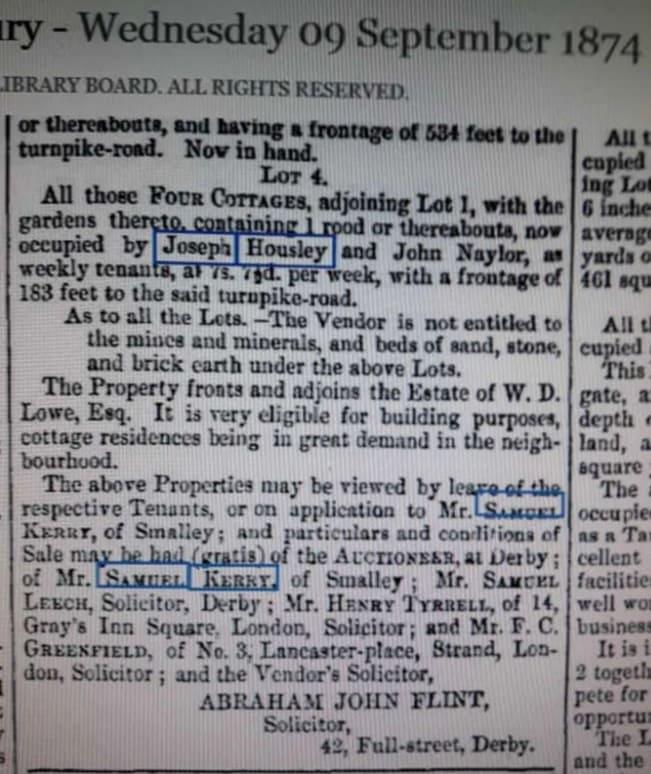
The move to Little Eaton may indicate that Joseph received his settlement because in August, 1873, he wrote: “I think this is bad news enough and bad luck too, but I have had little else since I came to live at Kiddsley cottages but perhaps it is all for the best if one could only think so. I have begun to think there will be no chance for us coming over to you for I am afraid there will not be so much left as will bring us out without it is settled very shortly but I don’t intend leaving this house until it is settled either one way or the other. “Joseph Housley and the Kiddsley cottages:
 December 25, 2021 at 10:47 am #6248
In reply to: The Elusive Samuel Housley and Other Family Stories
Bakewell Not Eyam
The Elton Marshalls
Some years ago I read a book about Eyam, the Derbyshire village devastated by the plague in 1665, and about how the villagers quarantined themselves to prevent further spread. It was quite a story. Each year on ‘Plague Sunday’, at the end of August, residents of Eyam mark the bubonic plague epidemic that devastated their small rural community in the years 1665–6. They wear the traditional costume of the day and attend a memorial service to remember how half the village sacrificed themselves to avoid spreading the disease further.
My 4X great grandfather James Marshall married Ann Newton in 1792 in Elton. On a number of other people’s trees on an online ancestry site, Ann Newton was from Eyam. Wouldn’t that have been interesting, to find ancestors from Eyam, perhaps going back to the days of the plague. Perhaps that is what the people who put Ann Newton’s birthplace as Eyam thought, without a proper look at the records.
But I didn’t think Ann Newton was from Eyam. I found she was from Over Haddon, near Bakewell ~ much closer to Elton than Eyam. On the marriage register, it says that James was from Elton parish, and she was from Darley parish. Her birth in 1770 says Bakewell, which was the registration district for the villages of Over Haddon and Darley. Her parents were George Newton and Dorothy Wipperley of Over Haddon,which is incidentally very near to Nether Haddon, and Haddon Hall. I visited Haddon Hall many years ago, as well as Chatsworth (and much preferred Haddon Hall).
I looked in the Eyam registers for Ann Newton, and found a couple of them around the time frame, but the men they married were not James Marshall.
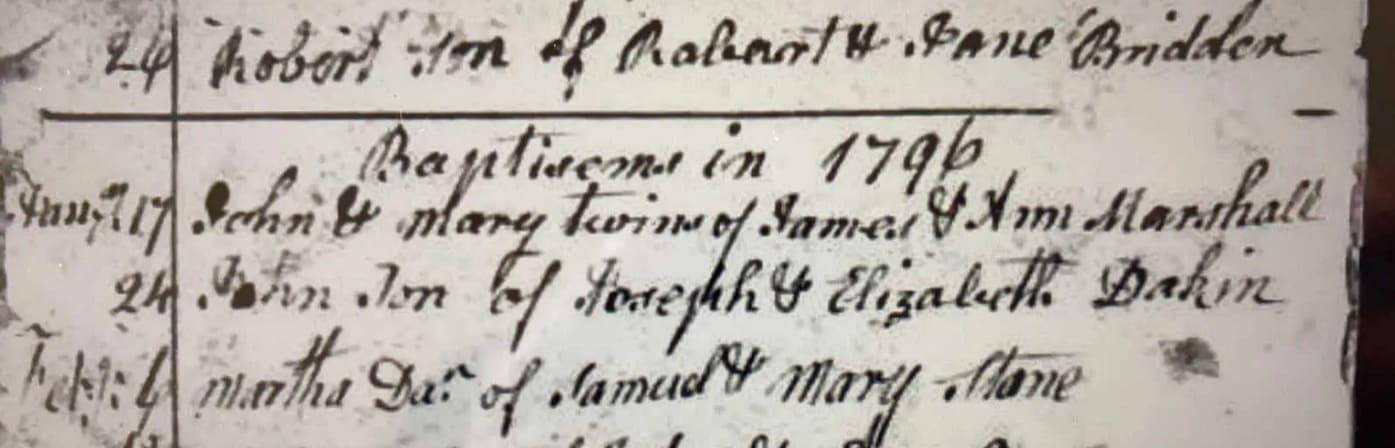
Ann died in 1806 in Elton (a small village just outside Matlock) at the age of 36 within days of her newborn twins, Ann and James. James and Ann had two sets of twins. John and Mary were twins as well, but Mary died in 1799 at the age of three.
1796 baptism of twins John and Mary of James and Ann Marshall
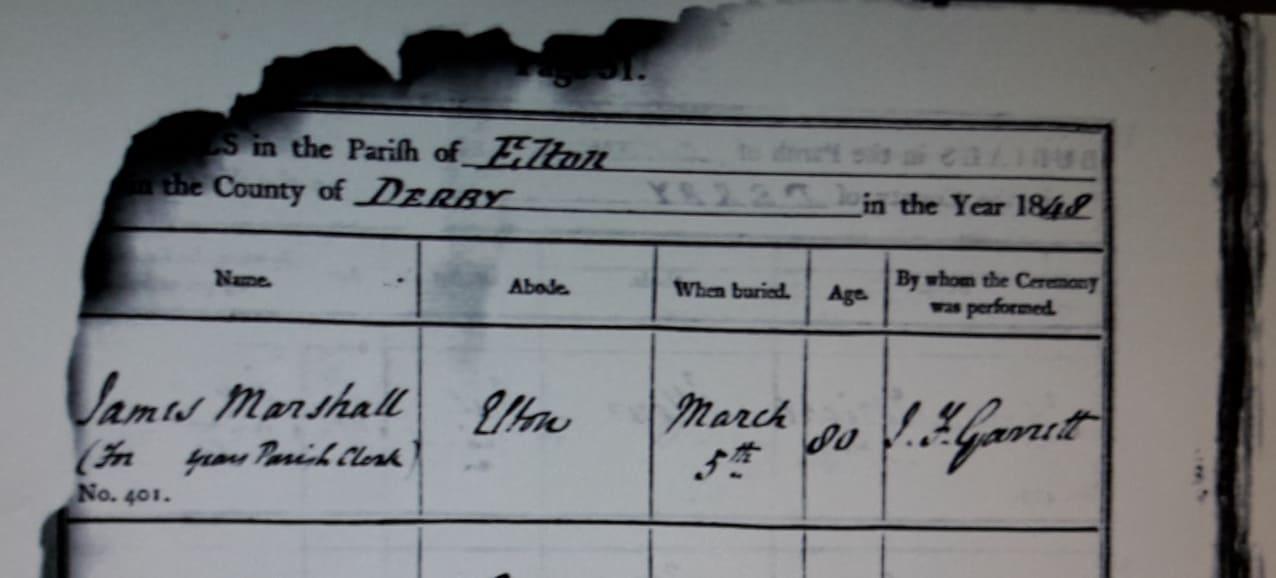
Ann’s husband James died 42 years later at the age of eighty, in Elton in 1848. It was noted in the parish register that he was for years parish clerk.
On the 1851 census John Marshall born in 1796, the son of James Marshall the parish clerk, was a lead miner occupying six acres in Elton, Derbyshire.
His son, also John, was registered on the census as a lead miner at just eight years old.
The mining of lead was the most important industry in the Peak district of Derbyshire from Roman times until the 19th century – with only agriculture being more important for the livelihood of local people. The height of lead mining in Derbyshire came in the 17th and 18th centuries, and the evidence is still visible today – most obviously in the form of lines of hillocks from the more than 25,000 mineshafts which once existed.
Peak District Mines Historical Society
Smelting, or extracting the lead from the ore by melting it, was carried out in a small open hearth. Lead was cast in layers as each batch of ore was smelted; the blocks of lead thus produced were referred to as “pigs”. Examples of early smelting-hearths found within the county were stone lined, with one side open facing the prevailing wind to create the draught needed. The hilltops of the Matlocks would have provided very suitable conditions.
The miner used a tool called a mattock or a pick, and hammers and iron wedges in harder veins, to loosen the ore. They threw the ore onto ridges on each side of the vein, going deeper where the ore proved richer.
Many mines were very shallow and, once opened, proved too poor to develop. Benjamin Bryan cited the example of “Ember Hill, on the shoulder of Masson, above Matlock Bath” where there are hollows in the surface showing where there had been fruitless searches for lead.
There were small buildings, called “coes”, near each mine shaft which were used for tool storage, to provide shelter and as places for changing into working clothes. It was here that the lead was smelted and stored until ready for sale.
Lead is, of course, very poisonous. As miners washed lead-bearing material, great care was taken with the washing vats, which had to be covered. If cattle accidentally drank the poisoned water they would die from something called “belland”.
Cornish and Welsh miners introduced the practice of buddling for ore into Derbyshire about 1747. Buddling involved washing the heaps of rubbish in the slag heaps, the process of separating the very small particles from the dirt and spar with which they are mixed, by means of a small stream of water. This method of extraction was a major pollutant, affecting farmers and their animals (poisoned by Belland from drinking the waste water), the brooks and streams and even the River Derwent.
Women also worked in the mines. An unattributed account from 1829, says: “The head is much enwrapped, and the features nearly hidden in a muffling of handkerchiefs, over which is put a man’s hat, in the manner of the paysannes of Wales”. He also describes their gowns, usually red, as being “tucked up round the waist in a sort of bag, and set off by a bright green petticoat”. They also wore a man’s grey or dark blue coat and shoes with 3″ thick soles that were tied round with cords. The 1829 writer called them “complete harridans!”
Lead Mining in Matlock & Matlock Bath, The Andrews Pages
John’s wife Margaret died at the age of 42 in 1847. I don’t know the cause of death, but perhaps it was lead poisoning. John’s son John, despite a very early start in the lead mine, became a carter and lived to the ripe old age of 88.
The Pig of Lead pub, 1904:
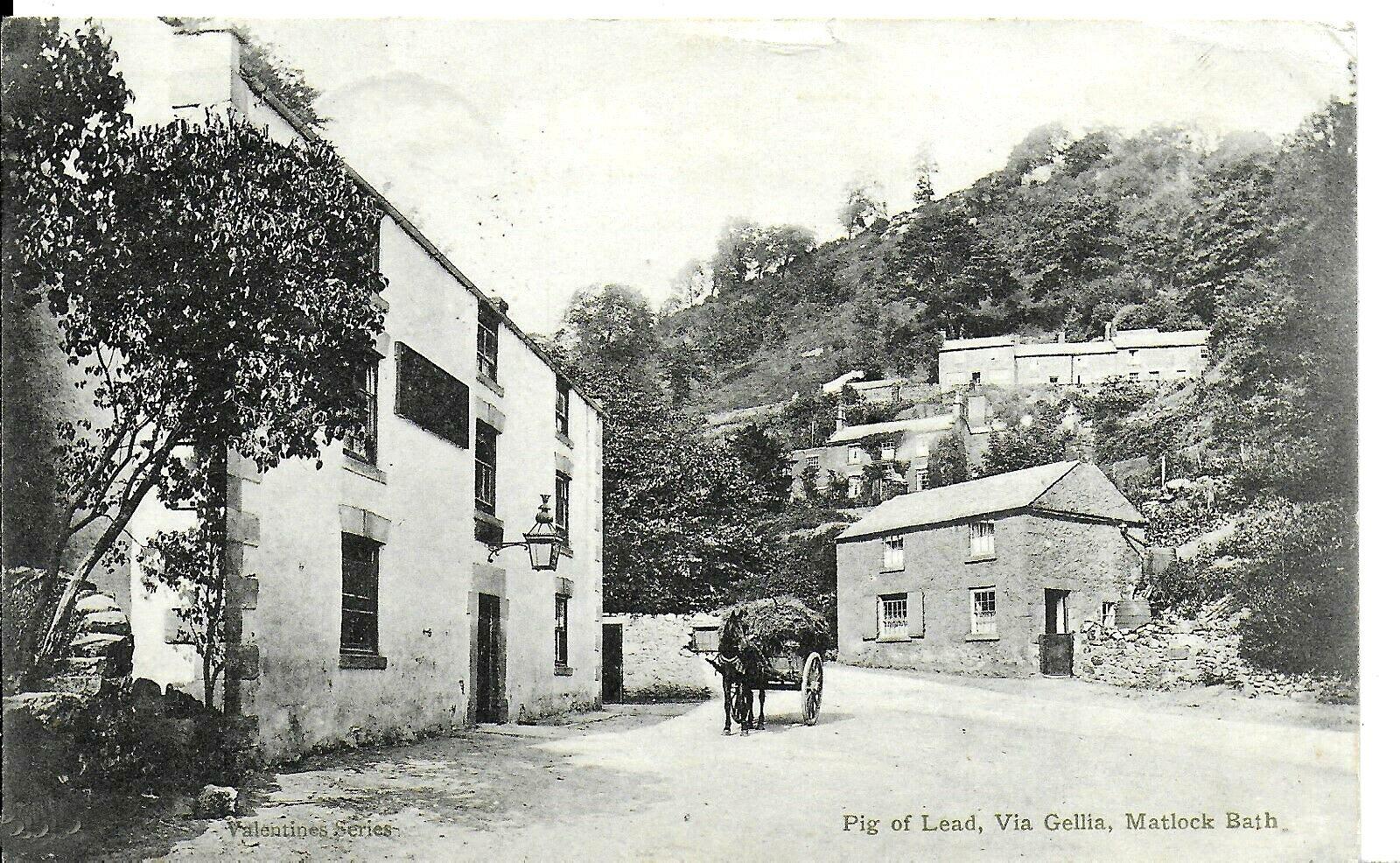
The earliest Marshall I’ve found so far is Charles, born in 1742. Charles married Rebecca Knowles, 1775-1823. I don’t know what his occupation was but when he died in 1819 he left a not inconsiderable sum to his wife.
1819 Charles Marshall probate:
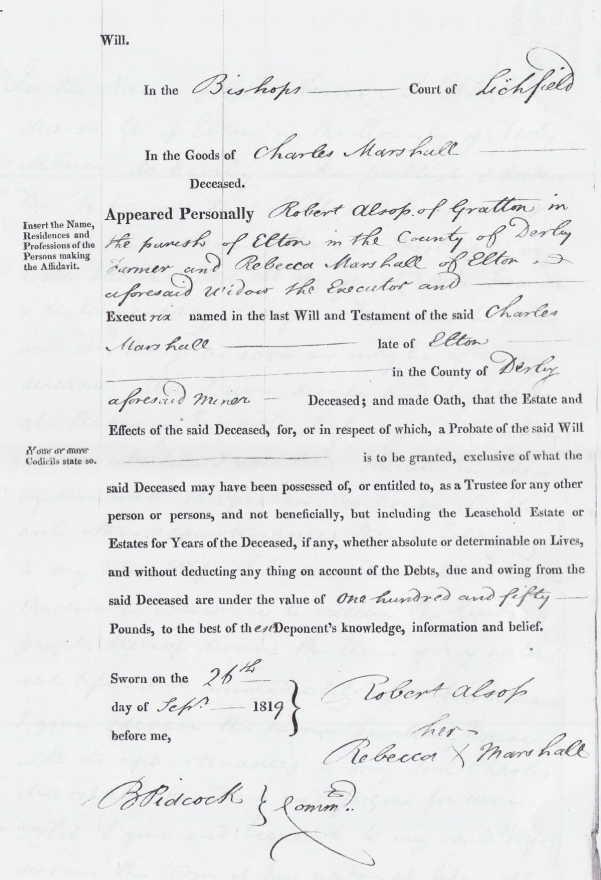
There are still Marshall’s living in Elton and Matlock, not our immediate known family, but probably distantly related. I asked a Matlock group on facebook:
“…there are Marshall’s still in the village. There are certainly families who live here who have done generation after generation & have many memories & stories to tell. Visit The Duke on a Friday night…”
The Duke, Elton:
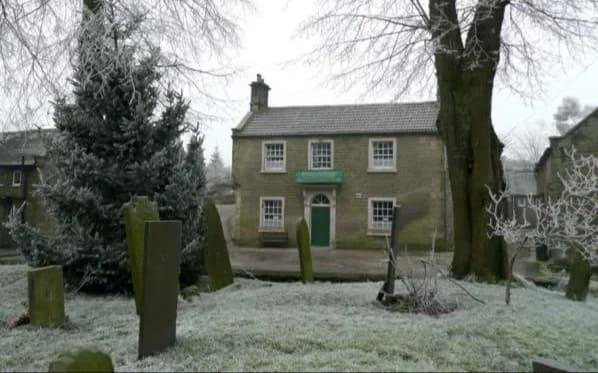 December 18, 2021 at 12:59 pm #6243
In reply to: The Elusive Samuel Housley and Other Family Stories
William Housley’s Will and the Court Case
William Housley died in 1848, but his widow Ellen didn’t die until 1872. The court case was in 1873. Details about the court case are archived at the National Archives at Kew, in London, but are not available online. They can be viewed in person, but that hasn’t been possible thus far. However, there are a great many references to it in the letters.
William Housley’s first wife was Mary Carrington 1787-1813. They had three children, Mary Anne, Elizabeth and William. When Mary died, William married Mary’s sister Ellen, not in their own parish church at Smalley but in Ashbourne. Although not uncommon for a widower to marry a deceased wife’s sister, it wasn’t legal. This point is mentioned in one of the letters.
One of the pages of William Housley’s will:
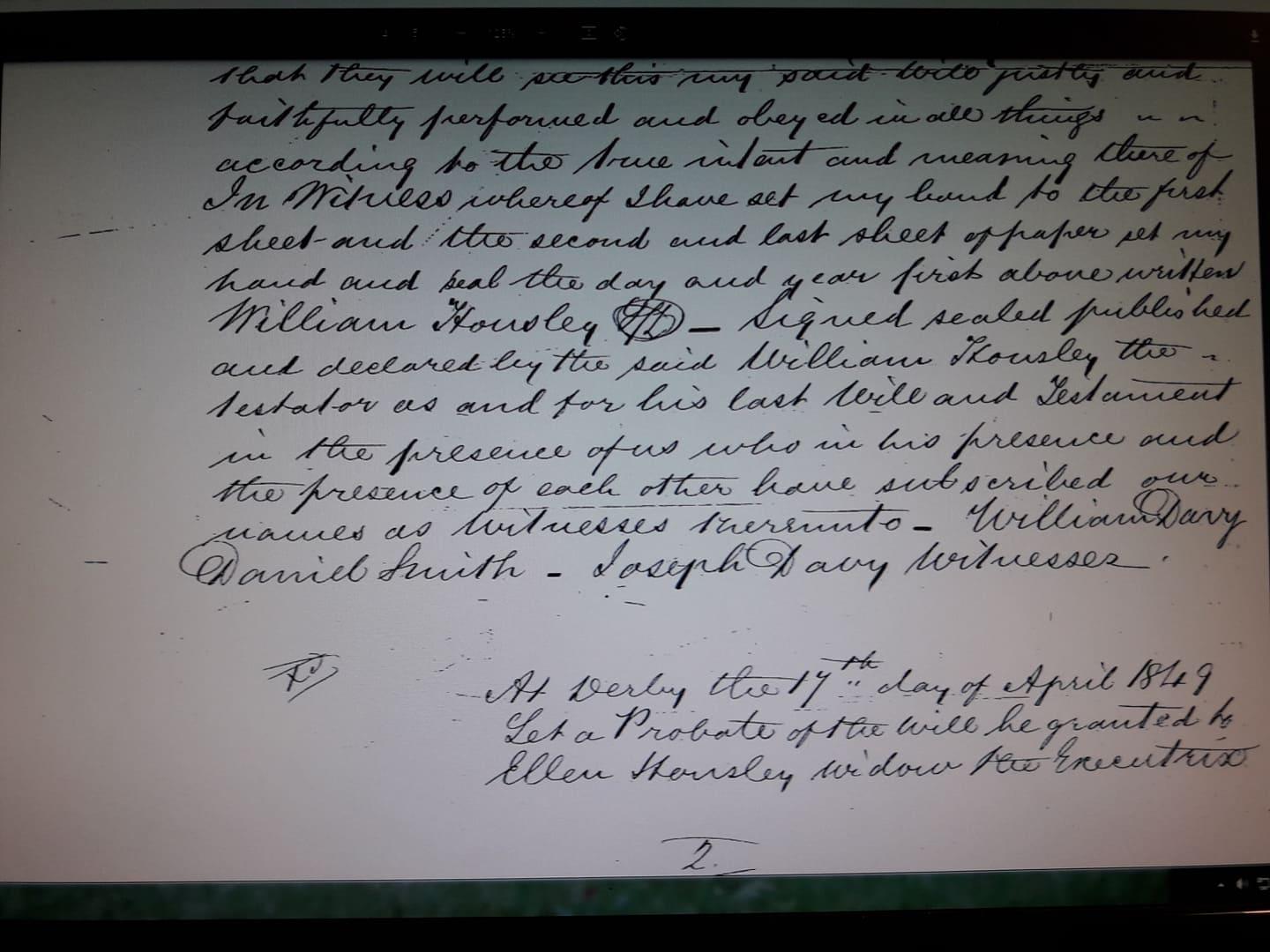
An excerpt from Barbara Housley’s Narrative on the Letters:
A comment in a letter from Joseph (August 6, 1873) indicated that William was married twice and that his wives were sisters: “What do you think that I believe that Mary Ann is trying to make our father’s will of no account as she says that my father’s marriage with our mother was not lawful he marrying two sisters. What do you think of her? I have heard my mother say something about paying a fine at the time of the marriage to make it legal.” Markwell and Saul in The A-Z Guide to Tracing Ancestors in Britain explain that marriage to a deceased wife’s sister was not permissible under Canon law as the relationship was within the prohibited degrees. However, such marriages did take place–usually well away from the couple’s home area. Up to 1835 such marriages were not void but were voidable by legal action. Few such actions were instituted but the risk was always there.
Joseph wrote that when Emma was married, Ellen “broke up the comfortable home and the things went to Derby and she went to live with them but Derby didn’t agree with her so she left again leaving her things behind and came to live with John in the new house where she died.” Ellen was listed with John’s household in the 1871 census.
In May 1872, the Ilkeston Pioneer carried this notice: “Mr. Hopkins will sell by auction on Saturday next the eleventh of May 1872 the whole of the useful furniture, sewing machine, etc. nearly new on the premises of the late Mrs. Housley at Smalley near Heanor in the county of Derby. Sale at one o’clock in the afternoon.”There were hard feelings between Mary Ann and Ellen and her children. Anne wrote: “If you remember we were not very friendly when you left. They never came and nothing was too bad for Mary Ann to say of Mother and me, but when Robert died Mother sent for her to the funeral but she did not think well to come so we took no more notice. She would not allow her children to come either.”
Mary Ann was still living in May 1872. Joseph implied that she and her brother, Will “intend making a bit of bother about the settlement of the bit of property” left by their mother. The 1871 census listed Mary Ann’s occupation as “income from houses.”In July 1872, Joseph introduced Ruth’s husband: “No doubt he is a bad lot. He is one of the Heath’s of Stanley Common a miller and he lives at Smalley Mill” (Ruth Heath was Mary Anne Housley’s daughter)
In 1873 Joseph wrote, “He is nothing but a land shark both Heath and his wife and his wife is the worst of the two. You will think these is hard words but they are true dear brother.” The solicitor, Abraham John Flint, was not at all pleased with Heath’s obstruction of the settlement of the estate. He wrote on June 30, 1873: “Heath agreed at first and then because I would not pay his expenses he refused and has since instructed another solicitor for his wife and Mrs. Weston who have been opposing us to the utmost. I am concerned for all parties interested except these two….The judge severely censured Heath for his conduct and wanted to make an order for sale there and then but Heath’s council would not consent….” In June 1875, the solicitor wrote: “Heath bid for the property but it fetched more money than he could give for it. He has been rather quieter lately.”In May 1872, Joseph wrote: “For what do you think, John has sold his share and he has acted very bad since his wife died and at the same time he sold all his furniture. You may guess I have never seen him but once since poor mother’s funeral and he is gone now no one knows where.”
In 1876, the solicitor wrote to George: “Have you heard of John Housley? He is entitled to Robert’s share and I want him to claim it.”
Anne intended that one third of the inheritance coming to her from her father and her grandfather, William Carrington, be divided between her four nieces: Sam’s three daughters and John’s daughter Elizabeth.
In the same letter (December 15, 1872), Joseph wrote:
“I think we have now found all out now that is concerned in the matter for there was only Sam that we did not know his whereabouts but I was informed a week ago that he is dead–died about three years ago in Birmingham Union. Poor Sam. He ought to have come to a better end than that”However, Samuel was still alive was on the 1871 census in Henley in Arden, and no record of his death can be found. Samuel’s brother in law said he was dead: we do not know why he lied, or perhaps the brothers were lying to keep his share, or another possibility is that Samuel himself told his brother in law to tell them that he was dead. I am inclined to think it was the latter.
Excerpts from Barbara Housley’s Narrative on the Letters continued:
Charles went to Australia in 1851, and was last heard from in January 1853. According to the solicitor, who wrote to George on June 3, 1874, Charles had received advances on the settlement of their parent’s estate. “Your promissory note with the two signed by your brother Charles for 20 pounds he received from his father and 20 pounds he received from his mother are now in the possession of the court.”
In December 1872, Joseph wrote: “I’m told that Charles two daughters has wrote to Smalley post office making inquiries about his share….” In January 1876, the solicitor wrote: “Charles Housley’s children have claimed their father’s share.”
In the Adelaide Observer 28 Aug 1875
HOUSLEY – wanted information
as to the Death, Will, or Intestacy, and
Children of Charles Housley, formerly of
Smalley, Derbyshire, England, who died at
Geelong or Creewick Creek Diggings, Victoria
August, 1855. His children will hear of something to their advantage by communicating with
Mr. A J. Flint, solicitor, Derby, England.
June 16,1875.The Diggers & Diggings of Victoria in 1855. Drawn on Stone by S.T. Gill:
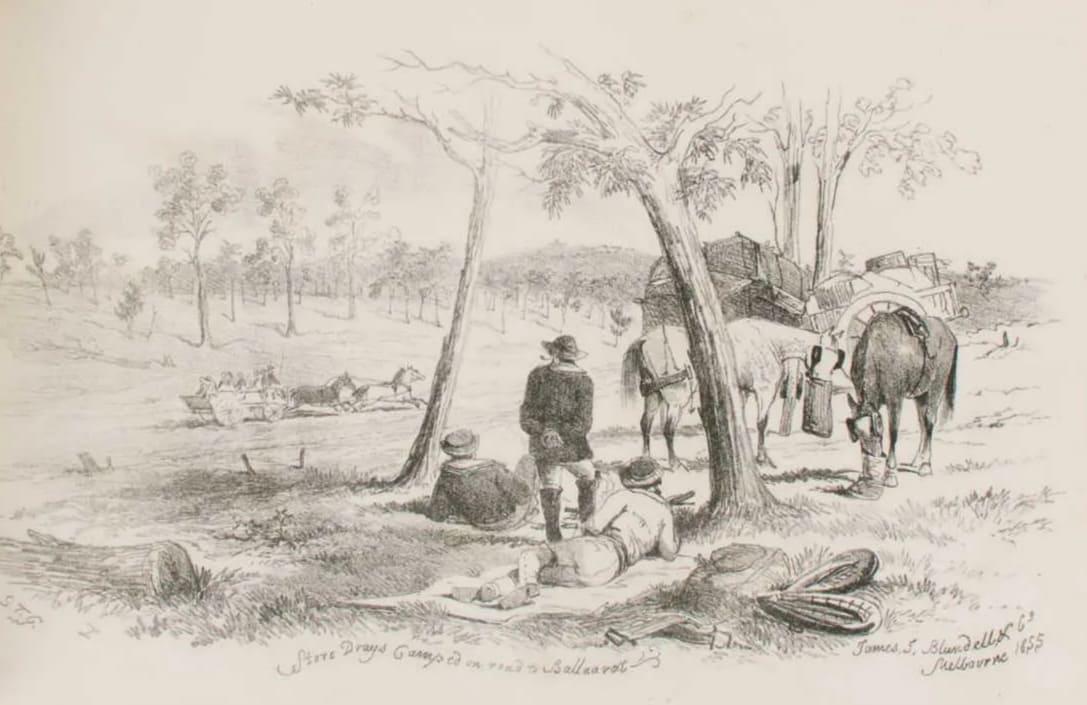
The court case:
Kerry v Housley.
Documents: Bill, demurrer.
Plaintiffs: Samuel Kerry and Joseph Housley.
Defendants: William Housley, Joseph Housley (deleted), Edwin Welch Harvey, Eleanor Harvey (deleted), Ernest Harvey infant, William Stafford, Elizabeth Stafford his wife, Mary Ann Housley, George Purdy and Catherine Purdy his wife, Elizabeth Housley, Mary Ann Weston widow and William Heath and Ruth Heath his wife (deleted).
Provincial solicitor employed in Derbyshire.
Date: 1873From the Narrative on the Letters:
The solicitor wrote on May 23, 1874: “Lately I have not written because I was not certain of your address and because I doubted I had much interesting news to tell you.” Later, Joseph wrote concerning the problems settling the estate, “You see dear brother there is only me here on our side and I cannot do much. I wish you were here to help me a bit and if you think of going for another summer trip this turn you might as well run over here.”
In March 1873, Joseph wrote: “You ask me what I think of you coming to England. I think as you have given the trustee power to sign for you I think you could do no good but I should like to see you once again for all that. I can’t say whether there would be anything amiss if you did come as you say it would be throwing good money after bad.”
In September 1872 Joseph wrote; “My wife is anxious to come. I hope it will suit her health for she is not over strong.” Elsewhere Joseph wrote that Harriet was “middling sometimes. She is subject to sick headaches. It knocks her up completely when they come on.” In December 1872 Joseph wrote, “Now dear brother about us coming to America you know we shall have to wait until this affair is settled and if it is not settled and thrown into Chancery I’m afraid we shall have to stay in England for I shall never be able to save money enough to bring me out and my family but I hope of better things.”
On July 19, 1875 Abraham Flint (the solicitor) wrote: “Joseph Housley has removed from Smalley and is working on some new foundry buildings at Little Chester near Derby. He lives at a village called Little Eaton near Derby. If you address your letter to him as Joseph Housley, carpenter, Little Eaton near Derby that will no doubt find him.”In his last letter (February 11, 1874), Joseph sounded very discouraged and wrote that Harriet’s parents were very poorly and both had been “in bed for a long time.” In addition, Harriet and the children had been ill.
The move to Little Eaton may indicate that Joseph received his settlement because in August, 1873, he wrote: “I think this is bad news enough and bad luck too, but I have had little else since I came to live at Kiddsley cottages but perhaps it is all for the best if one could only think so. I have begun to think there will be no chance for us coming over to you for I am afraid there will not be so much left as will bring us out without it is settled very shortly but I don’t intend leaving this house until it is settled either one way or the other. ”Joseph’s letters were much concerned with the settling of their mother’s estate. In 1854, Anne wrote, “As for my mother coming (to America) I think not at all likely. She is tied here with her property.” A solicitor, Abraham John Flint of 42 Full Street Derby, was engaged by John following the death of their mother. On June 30, 1873 the solicitor wrote: “Dear sir, On the death of your mother I was consulted by your brother John. I acted for him with reference to the sale and division of your father’s property at Smalley. Mr. Kerry was very unwilling to act as trustee being over 73 years of age but owing to the will being a badly drawn one we could not appoint another trustee in his place nor could the property be sold without a decree of chancery. Therefore Mr. Kerry consented and after a great deal of trouble with Heath who has opposed us all throughout whenever matters did not suit him, we found the title deeds and offered the property for sale by public auction on the 15th of July last. Heath could not find his purchase money without mortaging his property the solicitor which the mortgagee employed refused to accept Mr. Kerry’s title and owing to another defect in the will we could not compel them.”
In July 1872, Joseph wrote, “I do not know whether you can remember who the trustee was to my father’s will. It was Thomas Watson and Samuel Kerry of Smalley Green. Mr. Watson is dead (died a fortnight before mother) so Mr. Kerry has had to manage the affair.”
On Dec. 15, 1972, Joseph wrote, “Now about this property affair. It seems as far off of being settled as ever it was….” and in the following March wrote: “I think we are as far off as ever and farther I think.”
Concerning the property which was auctioned on July 15, 1872 and brought 700 pounds, Joseph wrote: “It was sold in five lots for building land and this man Heath bought up four lots–that is the big house, the croft and the cottages. The croft was made into two lots besides the piece belonging to the big house and the cottages and gardens was another lot and the little intake was another. William Richardson bought that.” Elsewhere Richardson’s purchase was described as “the little croft against Smith’s lane.” Smith’s Lane was probably named for their neighbor Daniel Smith, Mrs. Davy’s father.
But in December 1872, Joseph wrote that they had not received any money because “Mr. Heath is raising all kinds of objections to the will–something being worded wrong in the will.” In March 1873, Joseph “clarified” matters in this way: “His objection was that one trustee could not convey the property that his signature was not guarantee sufficient as it states in the will that both trustees has to sign the conveyance hence this bother.”
Joseph indicated that six shares were to come out of the 700 pounds besides Will’s 20 pounds. Children were to come in for the parents shares if dead. The solicitor wrote in 1873, “This of course refers to the Kidsley property in which you take a one seventh share and which if the property sells well may realize you about 60-80 pounds.” In March 1873 Joseph wrote: “You have an equal share with the rest in both lots of property, but I am afraid there will be but very little for any of us.”The other “lot of property” was “property in Smalley left under another will.” On July 17, 1872, Joseph wrote: “It was left by my grandfather Carrington and Uncle Richard is trustee. He seems very backward in bringing the property to a sale but I saw him and told him that I for one expect him to proceed with it.” George seemed to have difficulty understanding that there were two pieces of property so Joseph explained further: “It was left by my grandfather Carrington not by our father and Uncle Richard is the trustee for it but the will does not give him power to sell without the signatures of the parties concerned.” In June 1873 the solicitor Abraham John Flint asked: “Nothing has been done about the other property at Smalley at present. It wants attention and the other parties have asked me to attend to it. Do you authorize me to see to it for you as well?”
After Ellen’s death, the rent was divided between Joseph, Will, Mary Ann and Mr. Heath who bought John’s share and was married to Mary Ann’s daughter, Ruth. Joseph said that Mr. Heath paid 40 pounds for John’s share and that John had drawn 110 pounds in advance. The solicitor said Heath said he paid 60. The solicitor said that Heath was trying to buy the shares of those at home to get control of the property and would have defied the absent ones to get anything.
In September 1872 Joseph wrote that the lawyer said the trustee cannot sell the property at the bottom of Smalley without the signatures of all parties concerned in it and it will have to go through chancery court which will be a great expense. He advised Joseph to sell his share and Joseph advised George to do the same.George sent a “portrait” so that it could be established that it was really him–still living and due a share. Joseph wrote (July 1872): “the trustee was quite willing to (acknowledge you) for the portrait I think is a very good one.” Several letters later in response to an inquiry from George, Joseph wrote: “The trustee recognized you in a minute…I have not shown it to Mary Ann for we are not on good terms….Parties that I have shown it to own you again but they say it is a deal like John. It is something like him, but I think is more like myself.”
In September 1872 Joseph wrote that the lawyer required all of their ages and they would have to pay “succession duty”. Joseph requested that George send a list of birth dates.On May 23, 1874, the solicitor wrote: “I have been offered 240 pounds for the three cottages and the little house. They sold for 200 pounds at the last sale and then I was offered 700 pounds for the whole lot except Richardson’s Heanor piece for which he is still willing to give 58 pounds. Thus you see that the value of the estate has very materially increased since the last sale so that this delay has been beneficial to your interests than other-wise. Coal has become much dearer and they suppose there is coal under this estate. There are many enquiries about it and I believe it will realize 800 pounds or more which increase will more than cover all expenses.” Eventually the solicitor wrote that the property had been sold for 916 pounds and George would take a one-ninth share.
January 14, 1876: “I am very sorry to hear of your lameness and illness but I trust that you are now better. This matter as I informed you had to stand over until December since when all the costs and expenses have been taxed and passed by the court and I am expecting to receive the order for these this next week, then we have to pay the legacy duty and them divide the residue which I doubt won’t come to very much amongst so many of you. But you will hear from me towards the end of the month or early next month when I shall have to send you the papers to sign for your share. I can’t tell you how much it will be at present as I shall have to deduct your share with the others of the first sale made of the property before it went to court.
Wishing you a Happy New Year, I am Dear Sir, Yours truly
Abram J. Flint”September 15, 1876 (the last letter)
“I duly received your power of attorney which appears to have been properly executed on Thursday last and I sent it on to my London agent, Mr. Henry Lyvell, who happens just now to be away for his annual vacation and will not return for 14 or 20 days and as his signature is required by the Paymaster General before he will pay out your share, it must consequently stand over and await his return home. It shall however receive immediate attention as soon as he returns and I hope to be able to send your checque for the balance very shortly.”1874 in chancery:
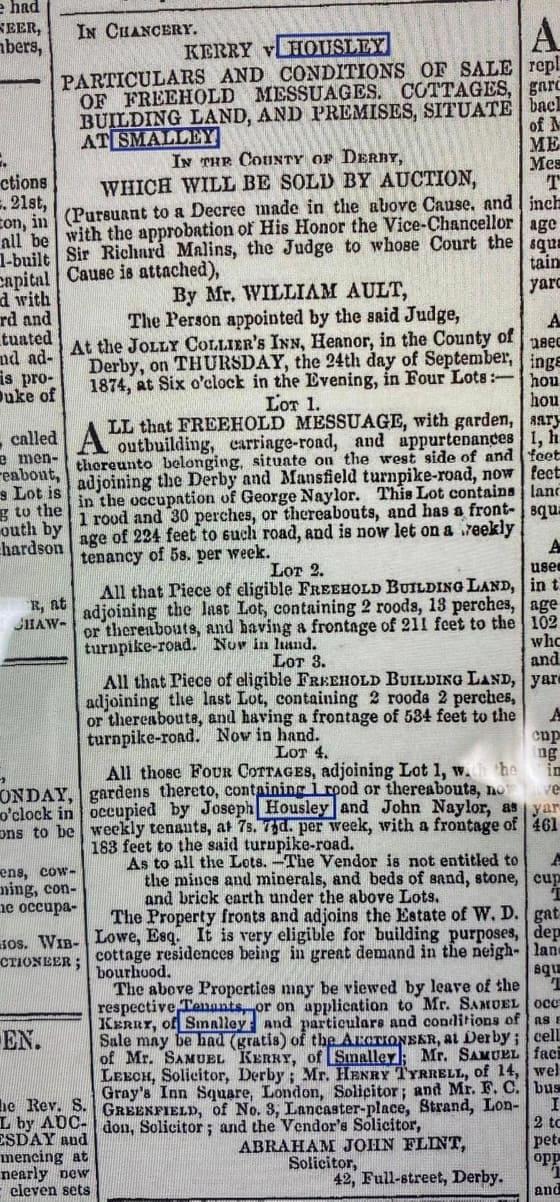 December 17, 2021 at 10:36 am #6241
In reply to: The Elusive Samuel Housley and Other Family Stories
Kidsley Grange Farm and The Quakers Next Door
Kidsley Grange Farm in Smalley, Derbyshire, was the home of the Housleys in the 1800s. William Housley 1781-1848 was born in nearby Selston. His wife Ellen Carrington 1795-1872 was from a long line of Carringtons in Smalley. They had ten children between 1815 and 1838. Samuel, my 3x great grandfather, was the second son born in 1816.
The original farm has been made into a nursing home in recent years, which at the time of writing is up for sale at £500,000. Sadly none of the original farm appears visible with all the new additions.
The farm before it was turned into a nursing home:
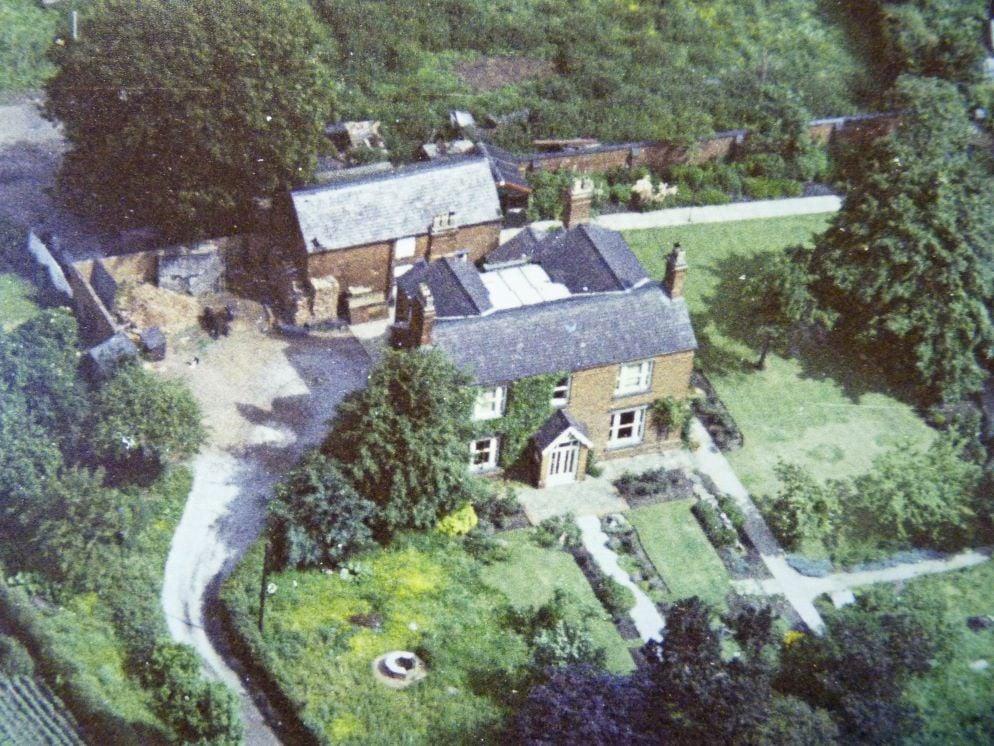
Kidsley Grange Farm and Kidsley Park, a neighbouring farm, are mentioned in a little book about the history of Smalley. The neighbours at Kidsley Park, the Davy’s, were friends of the Housleys. They were Quakers.
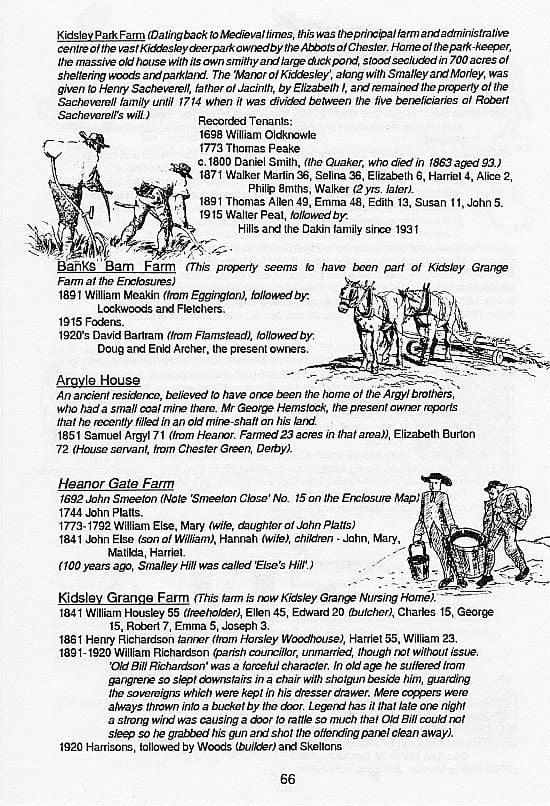
In Kerry’s History of Smalley:
Kidsley Park Farm was owned by Daniel Smith, a prominent Quaker and the last of the Quakers at Kidsley. His daughter, Elizabeth Davy, widow of William Davis, married WH Barber MB of Smalley. Elizabeth was the author of the poem “Farewell to Kidsley Park”.
Emma Housley sent one of Elizabeth Davy’s poems to her brother George in USA.
“We have sent you a piece of poetry that Mrs. Davy composed about our ‘Old House.’ I am sure you will like it though you may not understand all the allusions she makes use of as well as we do.”
Farewell to Kidsley Park
Farewell, Farewell, Thy pathways now by strangers feet are trod,
And other hands and horses strange henceforth shall turn thy sod,
Yes, other eyes may watch the buds expanding in the spring.
And other children round the hearth the coming years may bring,
But mine will be the memory of cares and pleasures there,
Intenser ~ that no living thing in some of them can share,
Commencing with the loved, and lost, in days of long ago,
When one was present on whose head Atlantic’s breezes blow,
Long years ago he left that roof, and made a home afar ~
For that is really only “home” where life’s affections are!
How many thoughts come o’er me, for old Kidsley has “a name
And memory” ~ in the hearts of some not unknown to fame.
We dream not, in those happy times, that I should be the last,
Alone, to leave my native place ~ alone, to meet the blast,
I loved each nook and corner there, each leaf and blade of grass,
Each moonlight shadow on the pond I loved: but let it pass,
For mine is still the memory that only death can mar;
I fancy I shall see it reflecting every star.
The graves of buried quadrupeds, affectionate and true,
Will have the olden sunshine, and the same bright morning dew,
But the birds that sang at even when the autumn leaves were seer,
Will miss the crumbs they used to get, in winters long and drear.
Will the poor down-trodden miss me? God help them if they do!
Some manna in the wilderness, His goodness guide them to!
Farewell to those who love me! I shall bear them still in mind,
And hope to be remembered by those I left behind:
Do not forget the aged man ~ though another fills his place ~
Another, bearing not his name, nor coming of his race.
His creed might be peculiar; but there was much of good
Successors will not imitate, because not understood.
Two hundred years have come and past since George Fox ~ first of “Friends” ~
Established his religion there ~ which my departure ends.
Then be it so: God prosper these in basket and in store,
And make them happy in my place ~ my dwelling, never more!
For I may be a wanderer ~ no roof nor hearthstone mine:
May light that cometh from above my resting place define.
Gloom hovers o’er the prospect now, but He who was my friend,
In the midst of troubled waters, will see me to the end.Elizabeth Davy, June 6th, 1863, Derby.
Another excerpt from Barbara Housley’s Narrative on the Letters from the family in Smalley to George in USA mentions the Davy’s:
Anne’s will was probated October 14, 1856. Mr. William Davy of Kidsley Park appeared for the family. Her estate was valued at under £20. Emma was to receive fancy needlework, a four post bedstead, feather bed and bedding, a mahogany chest of drawers, plates, linen and china. Emma was also to receive Anne’s writing desk! There was a condition that Ellen would have use of these items until her death.
The money that Anne was to receive from her grandfather, William Carrington, and her father, William Housley was to be distributed one third to Joseph, one third to Emma, and one third to be divided between her four neices: John’s daughter Elizabeth, 18, and Sam’s daughters Elizabeth, 10, Mary Anne, 9 and Catherine, age 7 to be paid by the trustees as they think “most useful and proper.” Emma Lyon and Elizabeth Davy were the witnesses.Mrs. Davy wrote to George on March 21 1856 sending some gifts from his sisters and a portrait of their mother–“Emma is away yet and A is so much worse.” Mrs. Davy concluded: “With best wishes
for thy health and prosperity in this world and the next I am thy sincere friend.” Whenever the girls sent greetings from Mrs. Davy they used her Quaker speech pattern of “thee and thy.”December 13, 2021 at 11:07 am #6221In reply to: The Elusive Samuel Housley and Other Family Stories
Mary Ann Gilman Purdy
1880-1950
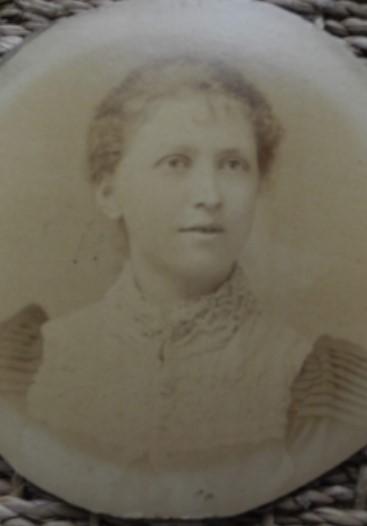
Mary Ann was my grandfather George Marshall’s mother. She died in 1950, seven years before I was born. She has been referred to more often than not, since her death, as Mary Ann Gilman Purdy, rather than Mary Marshall. She was from Buxton, so we believed, as was her husband William Marshall. There are family photos of the Gilmans, grocers in Buxton, and we knew that Mary Ann was brought up by them. My grandfather, her son, said that she thought very highly of the Gilman’s, and added the Gilman name to her birth name of Purdy.
The 1891 census in Buxton:
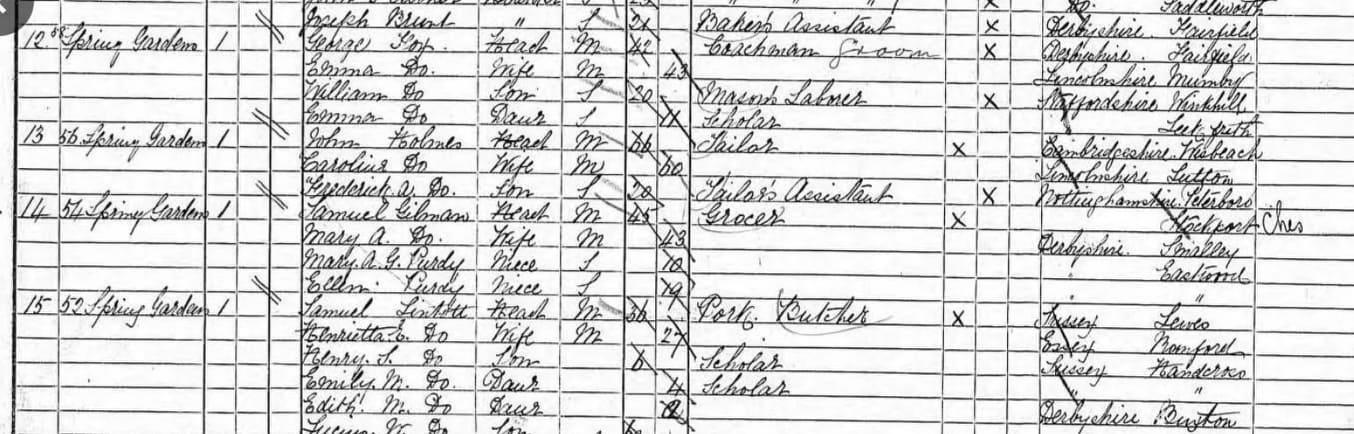
(Mary Ann’s aunt, Mrs Gilman, was also called Mary Anne, but spelled with an E.)
Samuel Gilman 1846-1909, and Mary Anne (Housley) Gilman 1846-1935, in Buxton:
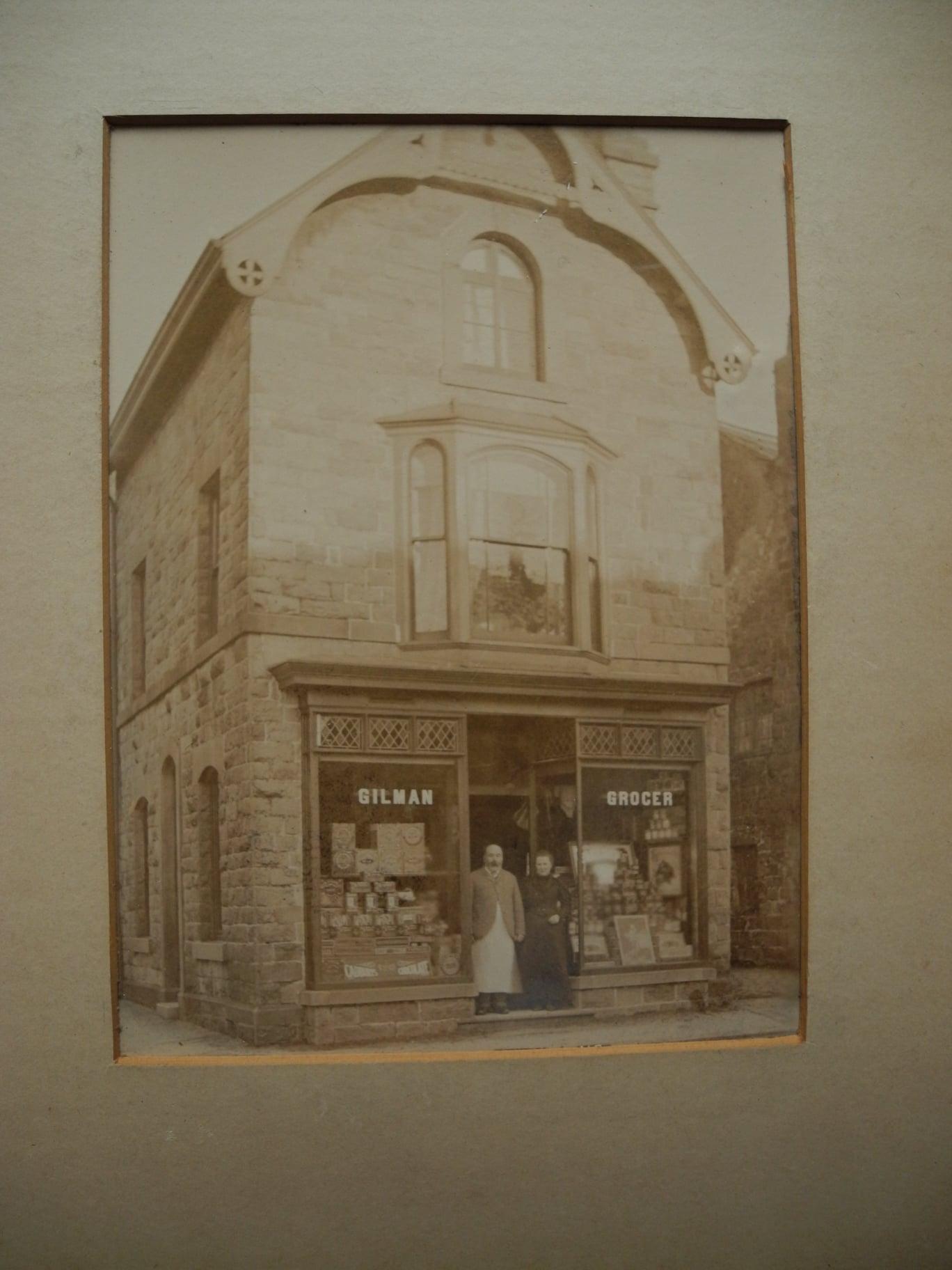
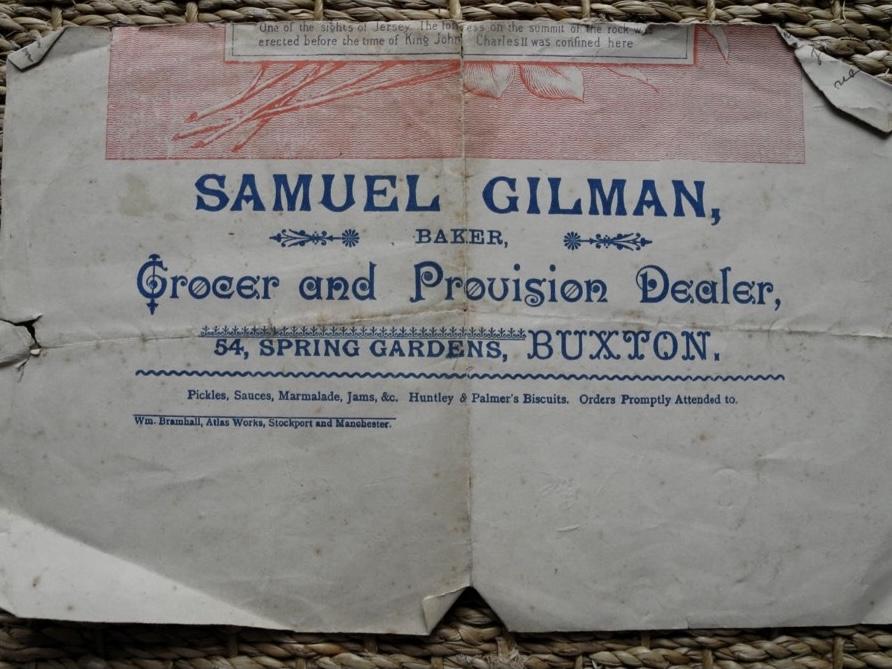
What we didn’t know was why Mary Ann (and her sister Ellen/Nellie, we later found) grew up with the Gilman’s. But Mary Ann wasn’t born in Buxton, Derbyshire, she was born in Eastwood, Nottinghamshire. When the search moved to Nottingham, we found the Purdy’s.
George Purdy 1848-1935, Mary Ann’s father:
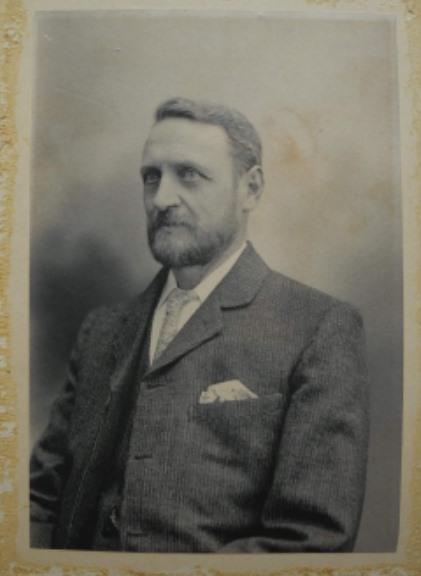
Mary Ann’s parents were George Purdy of Eastwood, and Catherine Housley of Smalley.
Catherine Housley 1849-1884, Mary Ann’s mother:
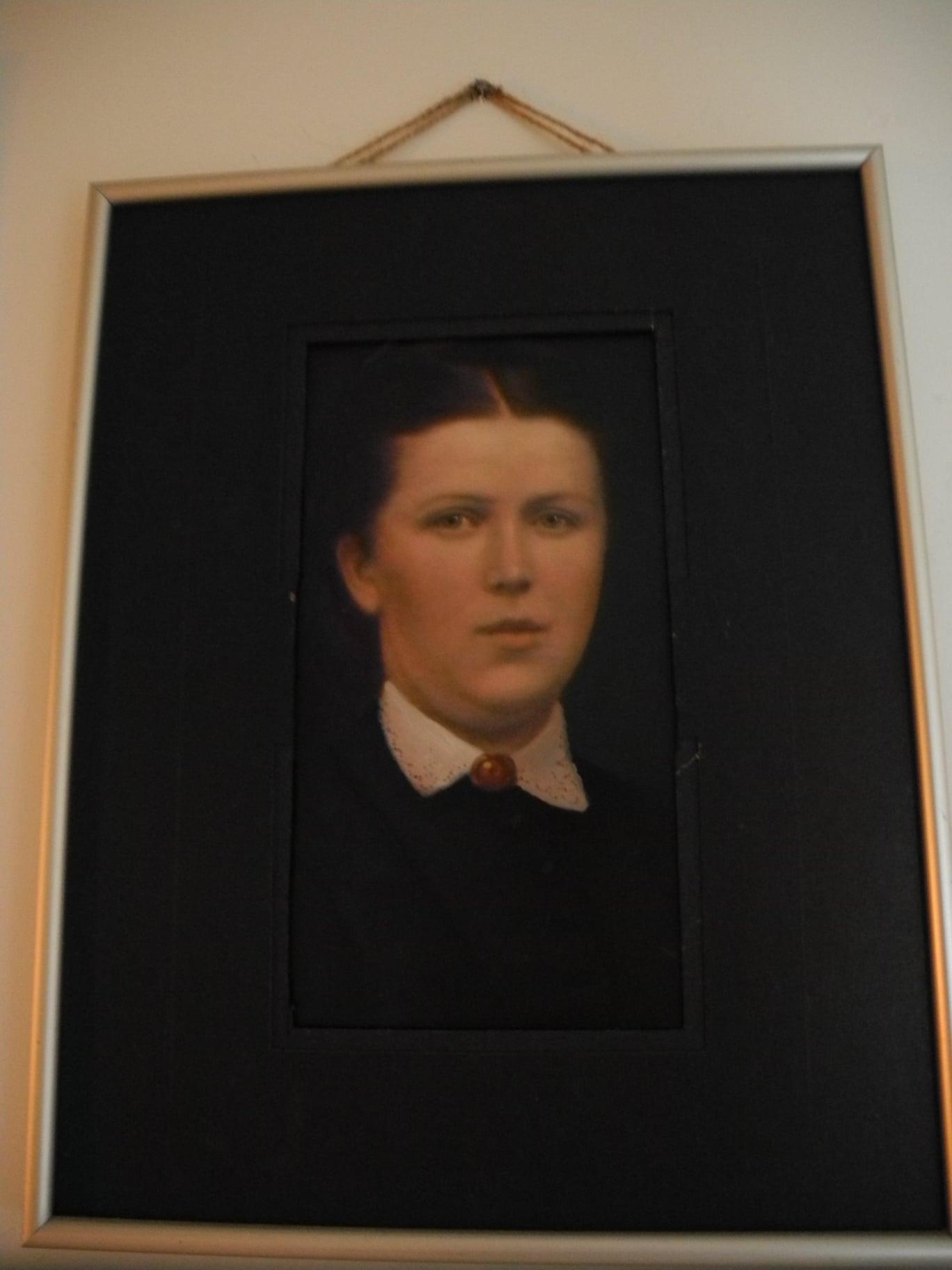
Mary Ann was four years old when her mother died. She had three sisters and one brother. George Purdy remarried and kept the two older daughters, and the young son with him. The two younger daughters, Mary Ann and Nellie, went to live with Catherine’s sister, also called Mary Anne, and her husband Samuel Gilman. They had no children of their own. One of the older daughters who stayed with their father was Kate , whose son George Gilman Rushby, went to Africa. But that is another chapter.
George was the son of Francis Purdy and his second wife Jane Eaton. Francis had some twenty children, and is believed in Eastwood to be the reason why there are so many Purdy’s.
The woman who was a mother to Mary Ann and who she thought very highly of, her mothers sister, spent her childhood in the Belper Workhouse. She and her older sister Elizabeth were admitted in June, 1850, the reason: father in prison. Their mother had died the previous year. Mary Anne Housley, Catherine’s sister, married Samuel Gilman, and looked after her dead sisters children.
Mary Ann Gilman Purdy Marshalls recipes written on the back of the Gilmans Grocers paper:
 February 4, 2016 at 1:38 am #3899
In reply to: The Chronicles of the Flying Fish Inn
There was something off at play, a warping wrapped-up forking of the story.
This being a euphemism for a fucking comment of course.January 13, 2013 at 5:45 pm #2963In reply to: The Surge Team’s Coils
“Looks like Ed Steams’ own impetus was his downfall Janet said solemnly after she covered the mustacheless body with a white bedsheet.
“Damn right you are, Janet.” Riff Raff nodded. “I wouldn’t have recognized him without his mustache though…”
“I think it’s safe to say that Pearl and Mari Fe’s plan was nearly a fiasco, but in the end, he took the surge full blast. Not quite the end we had in mind for him, but what’s done is done.”The zombies hadn’t been difficult to subjugate however, and although Riff Raff nearly had his brain eaten out, there had been no spread or civilian loss to deplore. That much was good, Janet didn’t like the whole body moving business one bit. The Moreguest Facility was such a drab place, at least she could go straight back to her post in beautiful sunny West Coast.
On the table, an egg-shaped translucent gem was beaming bright green. Janet took it thoughtfully, carefully placing it in the diplomatic case. “Strange that Ed died from the surge while the others recovered once the zombie energy had been sealed into the rote.”
Riff Raff was more pragmatic. Or maybe eager to get back home too. “He was a man consumed by his quest for artifacts, let’s not dwell on things past.”Using the portal from the bathroom once she decontaminated and recalibrated it, she’d sent everyone, their clothes doused in moonshine to some dark alleys in Granada, where they would probably be picked by local officers alerted by the usual racket made by the transspace portal, with no memory at all and alcohol breath. At least the nosy auditor would be in for a trip.
“Hey Riff, give my regards to Midgenta” Janet bear-hugged her friend, throwing the diplomatic suitcase with the pocket-sized forklift into the glove box of the red car, and disappearing in a trail of fine caliche billowing behind the vehicle wheels.
January 16, 2012 at 12:04 am #2833In reply to: Tales of Tw’Elves
™ ™ ™ 📖 📖 📖 🎈 🎈 🎈 🍉 🍉 🍉
 January 2, 2008 at 5:44 pm #622
In reply to: Circle of Eights, Stories
Somewhere during the 23 rd century
“aaa AAAA AAAAA Tcheeeew !”
…
“Hiiiiii?! Oh Fracking NOOOoooo!”The shriek had been heard in the whole facility.
Phefia Beryl was the first on the spot where Vinya Grey had been playing so exuberantly with her vocal chords.
— Vinnie? Are you alright?… What just happened?
— Oh, Pheffy… I think I made an awful blunder…
— What do you mean?
— You know, my last experiment?
— The g…
— Yes!
— What?!
— They poofed away…
— Away?… You mean, all of them? Oh bugger…
A few minutes later, Vinya and Phefia were around a white table sucking on straws picked into white and red polystyrenoid balls.
— Vinnie, you look terrible… That last geomagnetic storm had not done very good on your DNA I’m afraid.
— And the worse is that each time I sneeze, I blow up wormholes… I thought it would go better very quickly, but last one was big and lasted long enough to let the whole experimental herd wander off in another time/space and/or dimension…
— Yeah, that’s pretty bad… But wherever they went, they probably will die very soon… Imagine… With their stiff legs anytime they see something frightening, I guess a mere mapgie could easily have them for dinner…
— Such a pity… I was close to doing something great with them… When we discovered these fossilized blue spiders, I knew it was the first step.
— Bwah, this rehydrated frogrog is the grossest thing I’ve ever drunk… But yeah you’re right, the first results were very promising. The spiders venom could provoke very random and deep mutations.
— And all we needed was a little more control on the direction of the mutations.
— Anyway they’re just goats… You possibly can’t have breached a cosmic law with a handful of GOATS…
— Hope so Pheffy, hope so…
San Demangelo, 1848
Elroy was laughing… Hey Joe, Twi! he shouted A letter from Uncle Ernie!
— Uncle Ernie? How’s the old bat doin’? asked Twilight
— He’s sending his greetings for the new year, and babbling about last dead people in the neighborhood. But there’s something funny. He’s saying that he’d just acquired some funny goats. Like popped in, out of nowhere. At first he’d thought of a joke, but apparently no one’s been claiming them. He’d thought them dead, they were a dozen laying stiff on the ground, but when they started to wake up, they went down again like broken dolls. Apparently the magpies on top of the tree had been scaring them. Ahaha… Where does he get such strange stories…
— Well, magpies are scarey, Twilight said meaningfully, with a side glance at Joe…
— Whatever… At least he’d been giving us a good laugh. He’s saying he’s gonna breed the horny beasts, and start a Fainting Goat Fair (or FGF) in Marshall County. Perhaps we could get there next Thanksgiving…
— Depends when the Freak Show’s coming to town, mused Twilight, I hope to see them soon… -
AuthorSearch Results
Search Results for '848'
Viewing 19 results - 1 through 19 (of 19 total)
-
Search Results


Viewing 19 results - 1 through 19 (of 19 total)