

Search Results for 'ago'
-
AuthorSearch Results
-
February 2, 2023 at 2:47 pm #6491
In reply to: Newsreel from the Rim of the Realm
Sophie was glad she could help that young guy Youssef get out of this mess with that false ingenue. She was clearly not for him, he needed someone more mature who would know how to handle his big body. She looked at Miss Bossy Pants’ office. Ricardo was there again and they seem to be in another of their grand discussions. When Miss Bossy saw Sophie watching, she moved to the big window and shut the venetian blind. What were they all about, always plotting things in the back of their journalists. If Sophie didn’t have an ounce of ethic, she would have RVed them long ago, but she made a point to only use her abilities for good, and at times good gossip with friends.
She went out to the elevator and called it. While she waited, she started writing a message : “The boy is on his way. I did like you asked. Now book me a place to that Akashic Record training as promised.”
The answer came only a few seconds later : “consider it done”
The elevator bell rang and the door opened. Sophie got in with a big satisfied smile on her face.”
February 1, 2023 at 11:23 am #6485In reply to: Orbs of Madjourneys
The two figures disappeared from view and Zara continued towards the light. An alcove to her right revealed a grotesque frog like creature with a pile of bones and gruesome looking objects. Zara hurried past.
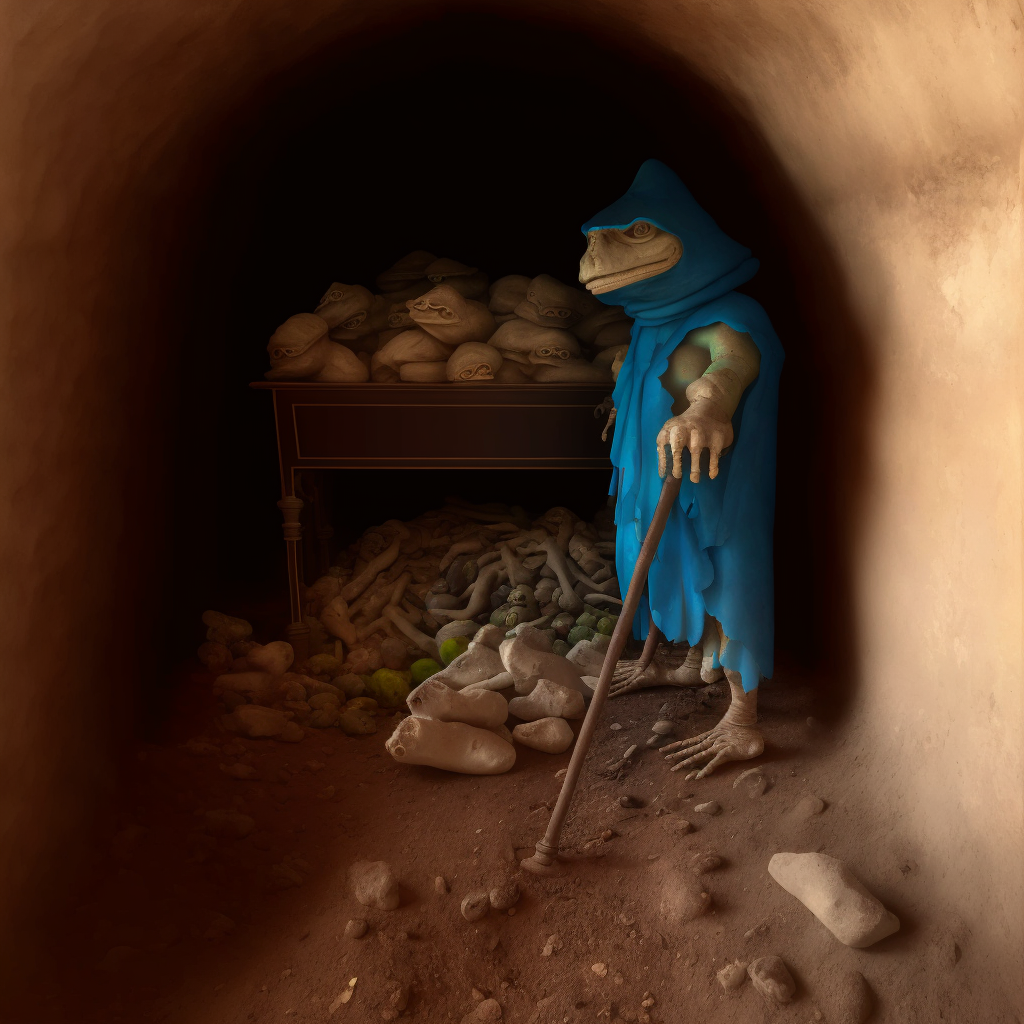
Bugger, I bet that was Osnas, Zara realized. But she wasn’t going to go back now. It seemed there was only one way to go, towards the light. Although in real life she was sitting on a brightly lit aeroplane with the stewards bustling about with the drinks and snacks cart, she could feel the chill of the tunnels and the uneasy thrill of secrets and danger.
“Tea? Coffee? Soft drink?” smiled the hostess with the blue uniform, leaning over her cart towards Zara.
“Coffee please,” she replied, glancing up with a smile, and then her smile froze as she noticed the frog like features of the woman. “And a packet of secret tiles please,” she added with a giggle.
“Sorry, did you say nuts?”
“Yeah, nuts. Thank you, peanuts will be fine, cheers.”
Sipping coffee in between handfulls of peanuts, Zara returned to the game.
As Zara continued along the tunnels following the light, she noticed the drawings on the floor. She stopped to take a photo, as the two figures continued ahead of her.
I don’t know how I’m supposed to work out what any of this means, though. Just keep going I guess. Zara wished that Pretty Girl was with her. This was the first time she’d played without her.
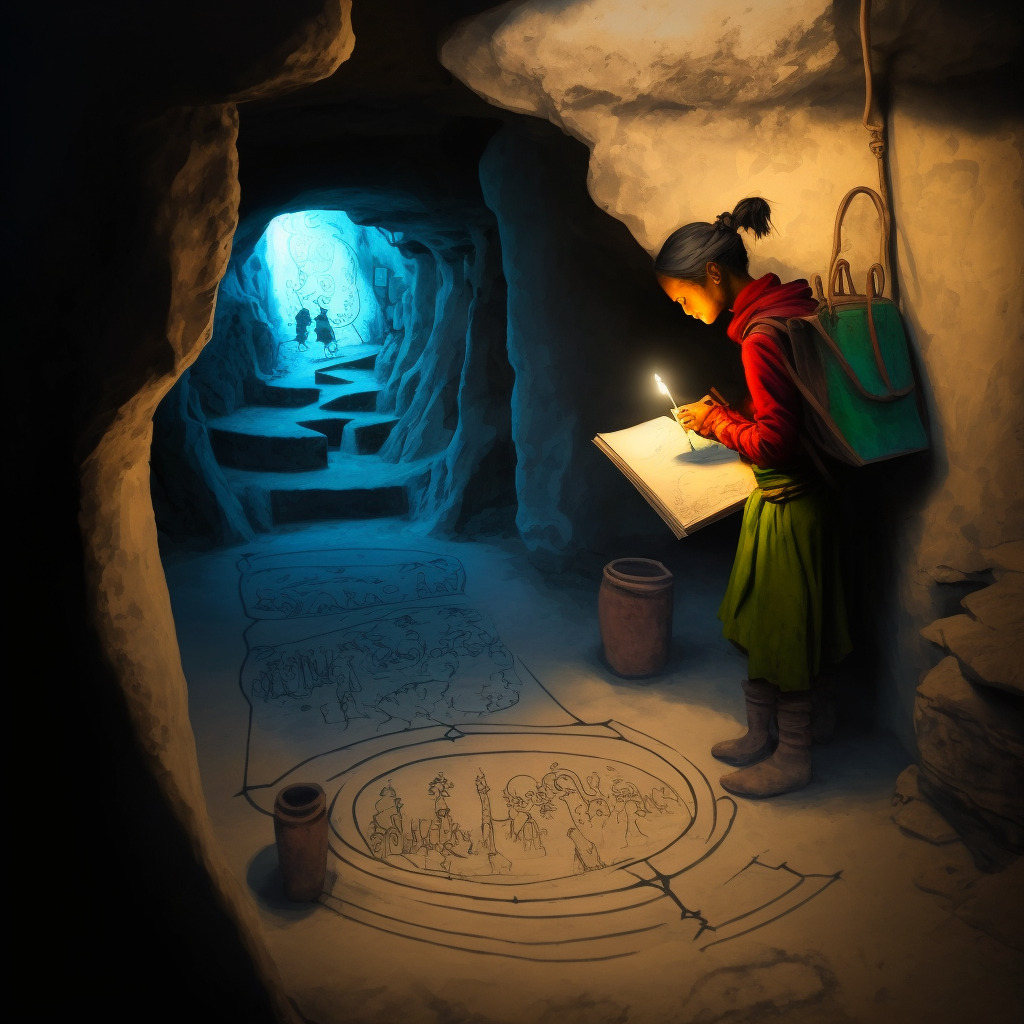
The walls and floors had many drawings, symbols and diagrams, and Zara stopped to take photos of all of them as she slowly made her way along the tunnel.
Zara meanwhile make screenshots of them all as well. The frisson of fear had given way to curiosity, now that the tunnel was more brightly lit, and there were intriguing things to notice. She was no closer to working out what they meant, but she was enjoying it now and happy to just explore.
But who had etched all these pictures into the rock? You’d expect to see cave paintings in a cave, but in an old mine? How old was the mine? she wondered. The game had been scanty with any kind of factual information about the mine, and it could have been a bronze age mine, a Roman mine, or just a gold rush mine from not so very long ago. She assumed it wasn’t a coal mine, which she deduced from the absence of any coal, and mentally heard her friend Yasmin snort with laughter at her train of thought. She reminded herself that it was just a game and not an archaeology dig, after all, and to just keep exploring. And that Yasmin wasn’t reading her mind and snorting at her thoughts.
January 31, 2023 at 3:31 pm #6479In reply to: The Jorid’s Travels – 14 years on
Chapter 1: The Search Begins

Georges was sitting more or less comfortably in the command chair on the control deck of the Jorid, slowly drinking his tea. The temperature of the beverage seemed to be determined randomly since the interference patterns in the navigation array weren’t totally fixed when they removed those low quality tiles. Drinking cold or hot tea was not the worse of it, and it was even kind of a challenge to swallow it and not get burned by ice. The deck kept changing shape and colours, reconfiguring along with the quantum variations of the Boodenbaum field variation due to some leakage of information between dimensions. Salomé had preferred resting in her travelpod where the effects were not as strongly felt.
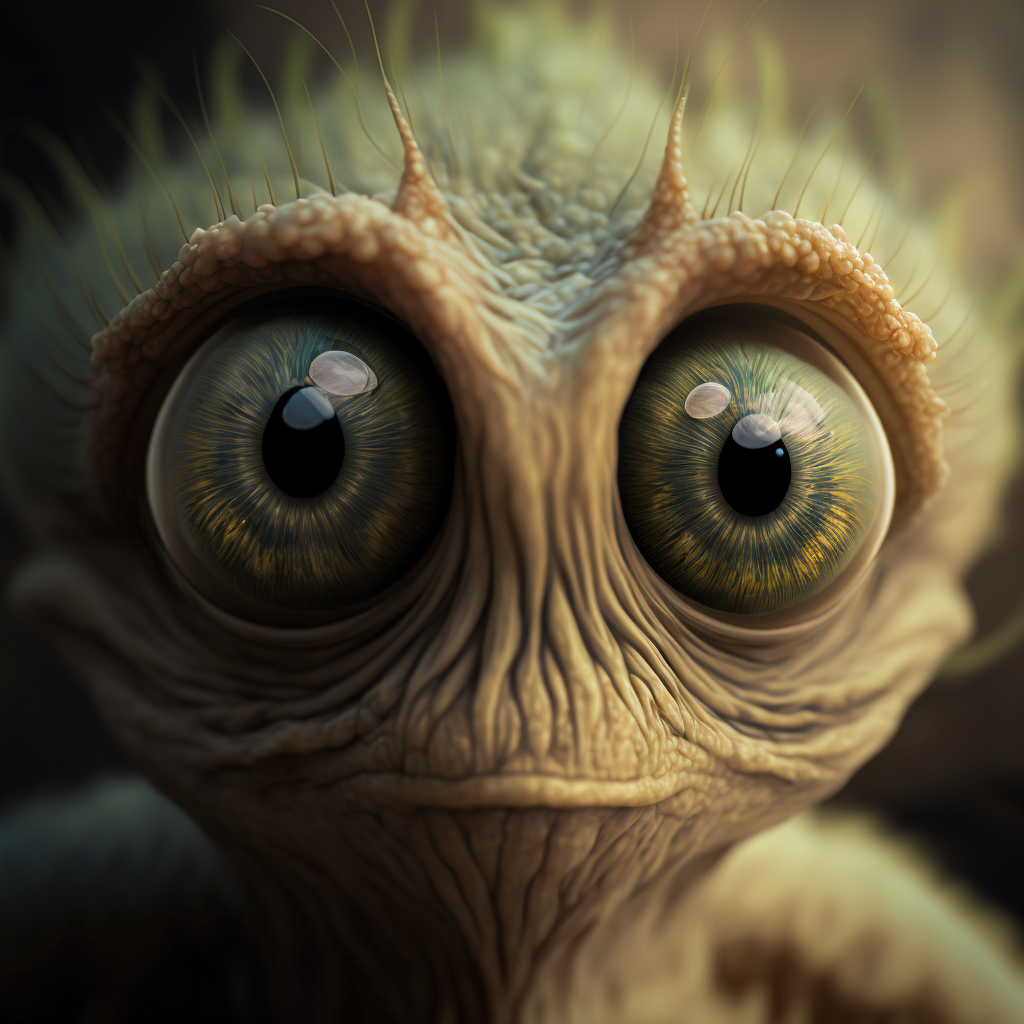 “The worse is not as much seeing your face morph into a soul-insect and turn inside down, although those greenish hues usually make me feel nauseous, but feeling two probable realities where my organs grow and shrink at the same time is more than I can bear.”
After a few freakish experiences, where his legs cross-merged with the chair, or a third eye grow behind his head, or that time when dissolved into a poof of greasy smoke, Georges got used to the fluid nature of reality during the trips. You just had to get along with it and not resist. He thought it gave some spice and colours to their journey across dimensions. He enjoyed the differences of perceptions generated by the fluctuations of the Boodenbaum field, as it allowed his tea to taste like chardonnay or bœuf bourguignon, and was glad when he discovered a taste that he had never experienced before.
During the last few trips, he had attempted to talk with Jorid, but their voices were so garbled and transformed so quickly that he lost interest. He couldn’t make the difference with the other noises, like honking trucks passing by on a motorway, or the cry of agony of a mating Irdvark. He felt a pang of nostalgia as the memories of Duane, Murtuane and Phréal merged into the deck around him. He wondered if he could get physically lost during one of the trips as he started to feel his limbs move away from his body, one hairy foot brushing by his left ear while he drank a sip of tea with the mouth that had grown on his middle finger. Salomé had warned him about fractured perception and losing a piece of his mind… It seemed it hadn’t happened yet. But would he notice?
 Already he felt the deceleration he had come to notice when they neared their destination. The deck stabilized into a shape adapted to this quadrant of the dimensional universes. The large command screen displayed images of several ruins lost in the sand desert of Bluhm’Oxl.
Georges looked at his hands, and touched his legs. His reflection on the command screen looked back at him. Handsome as usual. He grinned. Salomé wouldn’t refrain from telling him if something was off anyway.
Jorid: “I have woken up Salomé.”
She won’t be long now. Georges ordered a hot meklah, one of her favorites drink that usually helped her refocus when getting out of her pod.
A blip caught Georges’ attention.
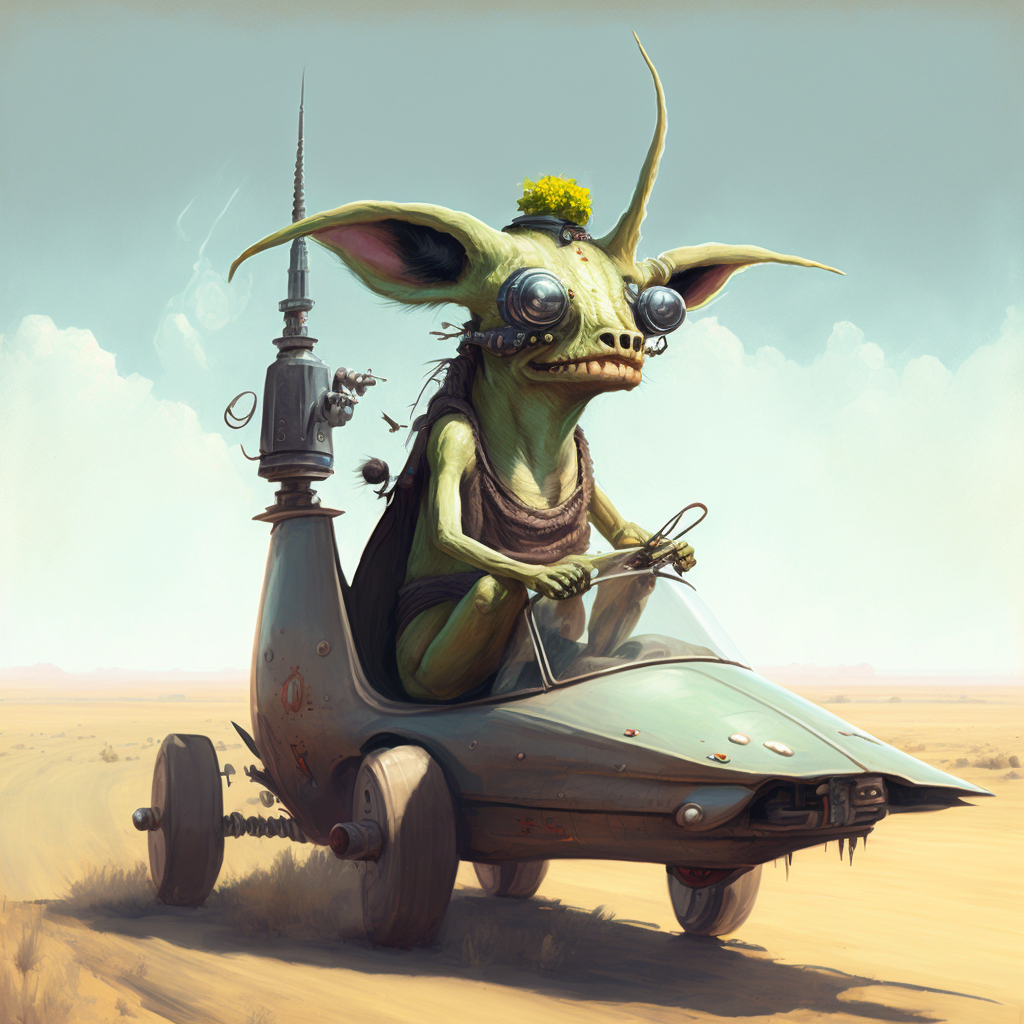
Jorid: “This is Tlal Klatl’Oxl, better know as Klatu. Your potential contact on Bluhm’Oxl and a Zathu. He’ll guide and protect you as you enter the conflict zone to look for Léonard.”
 January 30, 2023 at 8:43 pm #6472
In reply to: The Jorid’s Travels – 14 years on
Salomé: Using the new trans-dimensional array, Jorid, plot course to a new other-dimensional exploration
Georges (comments): “New realms of consciousness, extravagant creatures expected, dragons least of them!” He winked “May that be a warning for whoever wants to follow in our steps”.
The Jorid: Ready for departure.
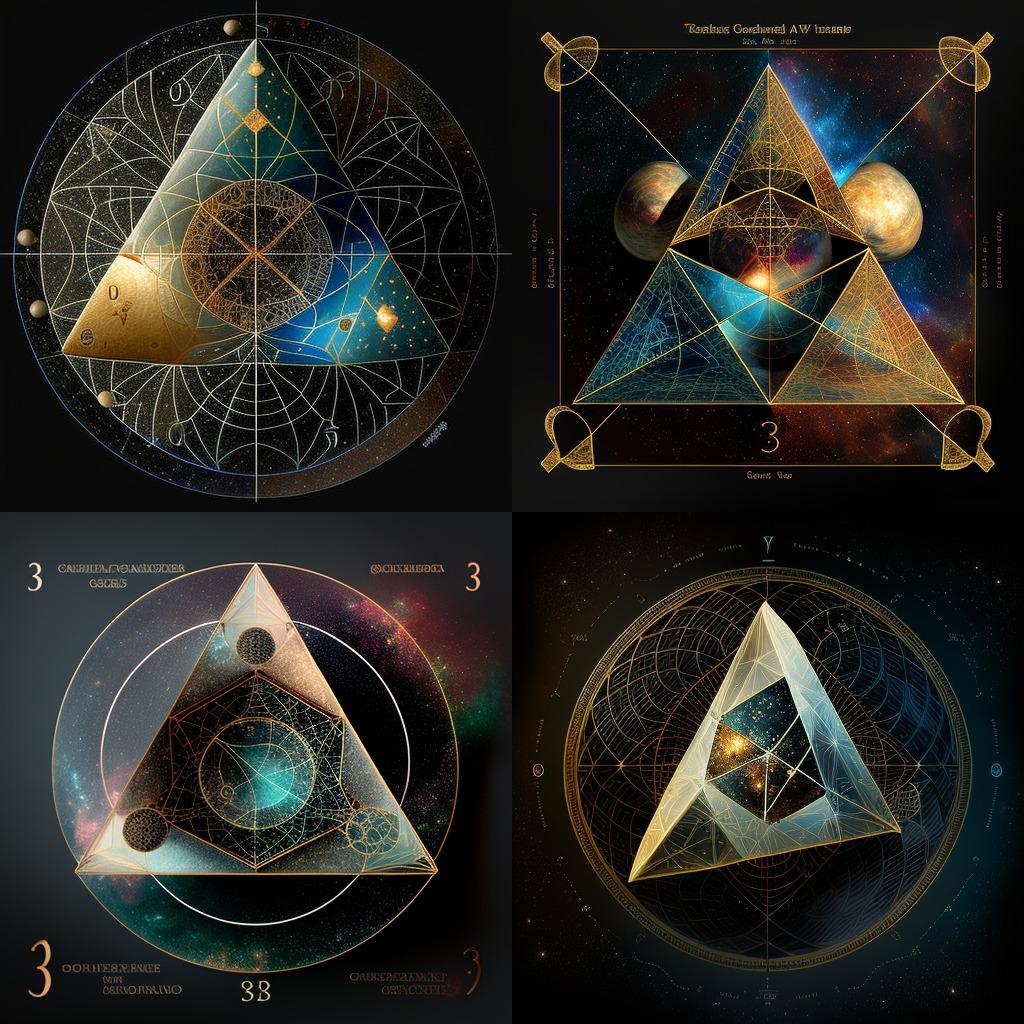
Salomé: Plot coordinates quadrant AVB 34-7•8 – Cosmic time triangulation congruent to 2023 AD Earth era. Quantum drive engaged.
Jorid: Departure initiated. Entering interdimensional space. Standby for quantum leap.
Salomé (sighing): Please analyse subspace signatures, evidences of life forms in the quadrant.
Jorid: Scanning subspace signatures. Detecting multiple life forms in the AVB 34-7•8 quadrant. Further analysis required to determine intelligence and potential danger.
Salomé: Jorid, engage human interaction mode, with conversational capabilities and extrapolate please!
Jorid: Engaging human interaction mode. Ready for conversation. What would you like to know or discuss?
Georges: We currently have amassed quite a number of tiles. How many Salomé?
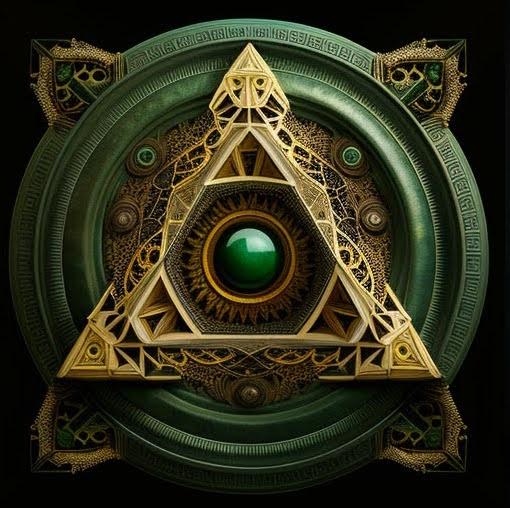 Salomé: Let me check. I think about 47 of them last I count. I didn’t insert the auto-generated ones, they were of lesser quality and seemed to interfere with the navigational array landing us always in expected places already travelled.
Georges: Léonard has been missing for 4 months.
Salomé: you mean by our count, right?
Georges: Right. We need to find him to readjust or correct the navigational array. Jorid, give us statistical probabilities that we can use as clues to his current potential locations.
Jorid: Calculating statistical probabilities for Léonard’s location. It would be helpful to have more information, such as known destinations or areas of interest, to increase accuracy of probabilities.
Salomé: Jorid is in a lazy mood it seems. I preferred her more chatty.
Georges: You mean “him”, surely dear?
Salomé: (rolls eyes)
Georges: Anyway, Léonard seemed interested in archaeological finds in recent excavated tombs near the sand deserts of Bluhm’Oxl in the Zathu sector.
 Jorid: Analyzing data on archaeological finds near the sand deserts of Bluhm’Oxl in the Zathu sector. Probability of Léonard being in the area is calculated at 43%. Shall I plot a course to Bluhm’Oxl for further investigation?
Salomé (loosing patience): Please engage your quantum capacities to access more data. We built you to be a bit more helpful than a bloody computer.
Georges laughed: I remembered you had more patience, dear!
Salomé: She’s in a mood today, isn’t she. What did you do to her?
Georges (cunningly): Jorid, sweet thing, please provide more details about the area, the populations, the customs the whole gamut dammit, and potential territorial conflicts in the vicinity. And be more chatty to please Salomé.
Jorid: Of course, I apologize for my previous responses. Analyzing data on the sand deserts of Bluhm’Oxl in the Zathu sector, including information on populations, customs, territorial conflicts and other relevant details. The area is known for its rich history and cultural heritage, with several ancient tombs and ruins attracting archaeological interest. The main population is composed of the Zathu nomads, known for their hospitality and trading skills. There are no known territorial conflicts in the area, but it is advised to exercise caution while traveling as the deserts can be treacherous.
Georges (laughs): You can’t stop her know!
Salomé (smiles noticing the “her”): Well, that doesn’t tell too much, does it. How shall we proceed? Need to synthetise some local clothes, or are you back to your thieving habits (pun intended)?
Georges: Haha, always ready for a good adventure. It seems we’ll have to do some research on the ground. As for the clothes, I’ll leave that to you my dear. Your sense of style never fails to impress. Let’s make sure to blend in with the locals and avoid drawing any unnecessary attention. The goal is to find Léonard, not get into trouble.
January 24, 2023 at 12:40 pm #6458In reply to: Orbs of Madjourneys
“I’m going to have to jump in this pool, Pretty Girl, look at this one! It reminds me of something…”
Zara came to a green pool that was different from the others, and walked into it.
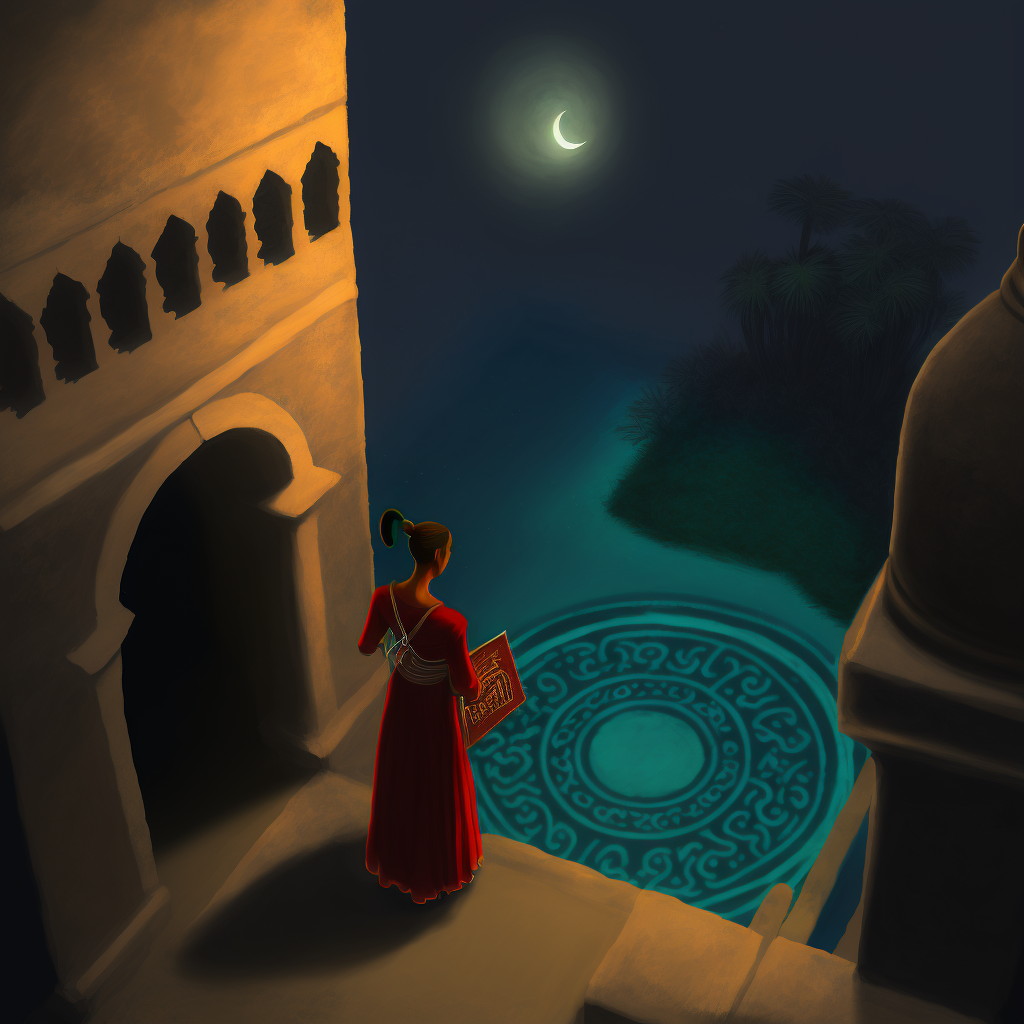
She emerged into a new scene, with what appeared to be a floating portal, but a square one this time.
“May as well step onto it and see where it goes!” Zara told the parrot, who was taking a keen interest in the screen, somewhat strangely for a bird. “I like having you here, Pretty Girl, it’s nice to have someone to talk to.”
Zara stepped onto the floating tile portal.
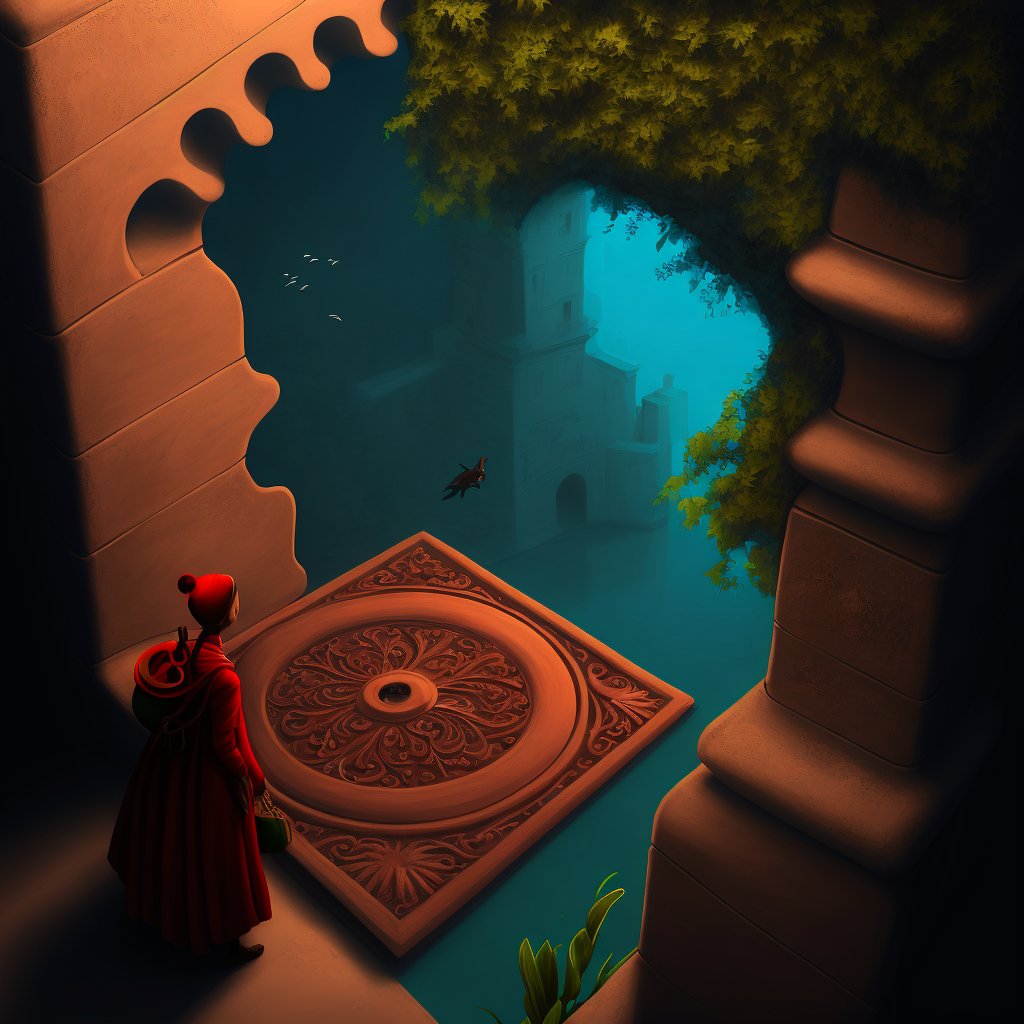
“Hey, wasn’t my quest to find a wooden tile?” Zara suddenly remembered. She’d forgotten her quest while she was wandering around the enchanting castle.
“Yes, but that doesn’t look like the tile you were supposed to find though,” replied the parrot.
“It might lead me to it,” snapped Zara who didn’t really want to leave the pretty castle scenes anyway. It felt magical and somehow familiar, like she’d been there before, a long long time ago.
After stepping onto the floating tile portal, Zara encountered another tile portal. This time it was upright, with a circular portal in the centre. By now it seemed clear that the thing to do was to walk through it. She wandered around the scene first as if she was a tourist simply taking in the new sights before taking the plunge.
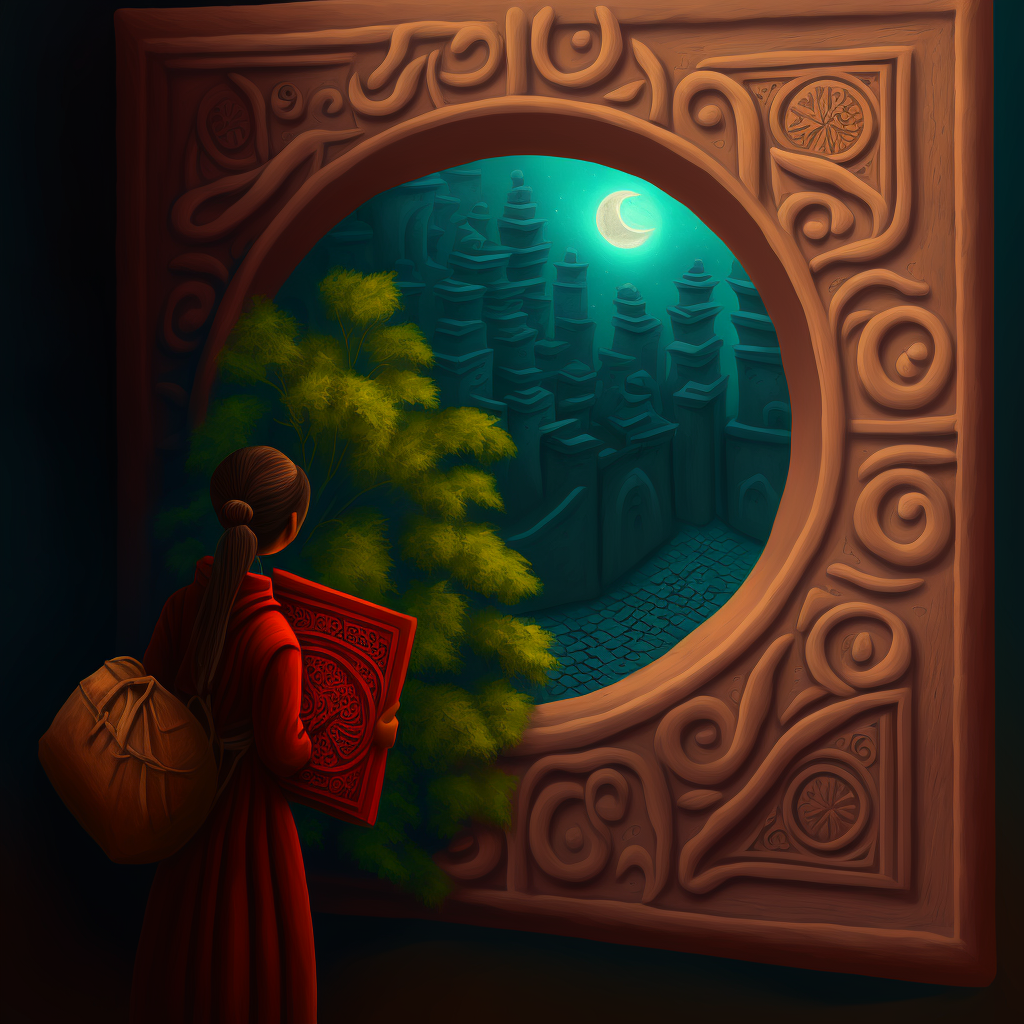
“Oh my god, look! It’s my tile!” Zara said excitedly to the parrot, just as the words flashed up on her screen:
Congratulations! You have reached the first goal of your first quest!
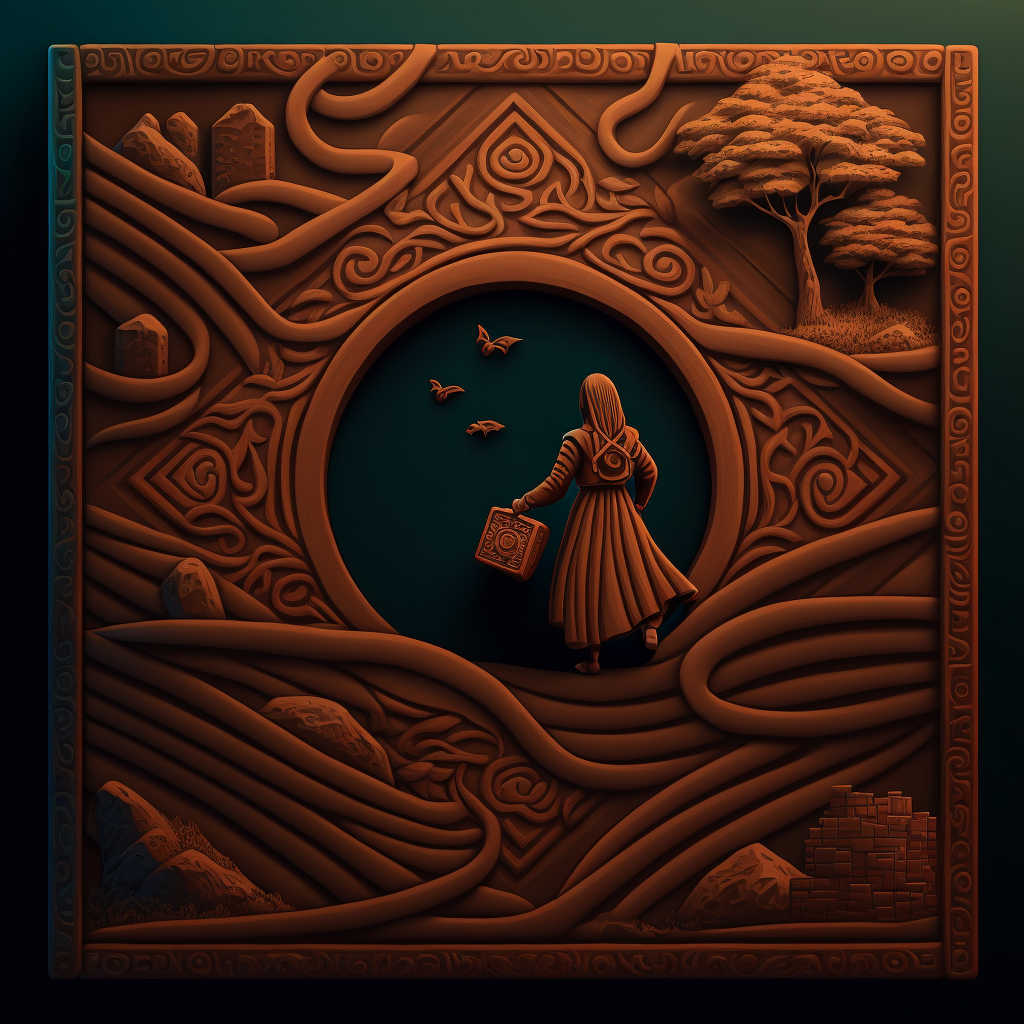
“Oh bugger! Look at the time, it’s already starting to get light outside. I completely forgot about going to that church to see Isaac’s ghost, and now I haven’t had a wink of sleep all night.”
“Time well spent,” said the parrot sagely, “You can go and see Isaac tomorrow night, and he may be all the more willing to talk since you kept him waiting.”
January 14, 2023 at 8:13 pm #6387In reply to: Scrying the Word Cloud
Words from the Cloud prompted me to write a story:
song stayed act unexpected recall words spears bus learn king expected followed fright hot wore kianda picture walked playing coast dusty
Once upon a time, in a far-off land, there was a Song that stayed in the hearts of the people. The Song was about an Act of bravery and sacrifice that had taken place many years ago. But one day, an unexpected recall of the Song was issued by the king. He had heard that the Song was not being sung correctly, and he wanted to make sure that the true story was being told. The people were puzzled, as they had learned the Song from their ancestors and had always thought it was accurate. But they followed the king’s orders and set out to learn the correct version of the Song. As they began to recall the words, they realized that there were some discrepancies. They had always sung about the hero wielding a sword, but the true story spoke of him wielding Spears. They were taken aback, but they knew they had to correct the Song. So, they set out on a journey to retrace the hero’s steps.
As they traveled, they encountered unexpected challenges. They faced a bus that broke down, a coastline that was dusty and treacherous, and even a group of bandits. But they pressed on, determined to learn the truth.
As they approached the hero’s final battle, they felt a sense of dread. They had heard that the enemy was fierce, and they were not prepared for what they would find. But they followed the path and soon found themselves at the edge of a hot, barren wasteland.
The heroes wore their Kianda, traditional armor made of woven reeds, and stepped forward, ready for battle. But to their surprise, the enemy was nowhere to be found. Instead, they found a picture etched into the ground, depicting the hero and his enemy locked in a fierce battle.
The people walked around the picture, marveling at the detail and skill of the artist. And as they looked closer, they saw that the hero was holding Spears, not a sword. They realized that they had learned the true story, and they felt a sense of pride and gratitude.
With the Song corrected, they returned home, playing the new version for all to hear. And from that day on, the true story of the hero’s bravery and sacrifice was remembered, and the Song stayed in the hearts of the people forevermore.
January 13, 2023 at 6:47 pm #6378Topic: Prompts of Madjourneys
A thread to share some of the prompts behind the AI-assisted journey into new adventures.
To start off…
Please write the exciting start of a novel.
Some elements you can integrate if you want:
– Four randomly chosen names full of panache that sound distinct from each other, slightly exotic and evocative
– the sentiment from this quotation: “Look around… Beauty is everywhere. You only have to look to see it.” – a group of four people ready for an adventure, standing in a cave with stalactites in front of a giant orb or bubble that seem to open to another brightly lit realm. Inside the bigger orb are some smaller orbs.
– the following term “mad journeys”Told it to continue and it brought dragons… Asked to tone down the fantasy stuff, here’s what came out:
They walked into a small village, where they were greeted by a group of people wearing clothes that looked like they were from the 1920s. The people told them that they were in the land of the “Quirks”, a place where everything and everyone was a little bit different, and that they had to find the “Key of Quirks” in order to leave the land.
The group set off on their journey to find the key, but little did they know that their adventure was about to become even more exciting and quirky than they could ever have imagined. They encountered a talking dog, a man who had a garden on top of his head, and a group of people who lived inside of giant mushrooms.
As they journeyed on, they faced challenges and made new friends, but most importantly they learn to embrace their own quirks and individuality. Eventually, they found the key and were able to leave the land of the Quirks, but they knew that they would always carry a piece of that land with them.
January 11, 2023 at 8:44 pm #6366In reply to: Train your subjective AI – text version
Asking the AI to expand on the glossary of the original Circle of Eights Story:
Locations
Malvina’s Cave: A dark and damp cave located in the heart of the Gripshawk mountains, known for its population of Glukenitch creatures.
Lan’ork: A vast and diverse continent known for its Eastern Lagunas, home to the Indogo flamingos. Dragon Head Peninsula: A rugged and mountainous region, home to the Langoat creatures and also known for its rich deposits of dragon ore.
Asgurdy: A sprawling desert region, known for its nomadic tribes who use Saurhse as mounts for transportation.
Golfindely: An idyllic coastal region known for its beautiful beaches and crystal clear waters, home to the Golfindel and Grake creatures.
Magical Schools
Dragonian Magic: A form of magic that is practiced by Dragonriders and Dragon tamers, which involves the manipulation of dragon energy and bonding with dragon companions.
Gripshawk Magic: A form of magic that is practiced by Gripshawks, which involves the manipulation of the natural elements and telepathic communication with other creatures.
Ugling Magic: A form of magic that is practiced by Uglings, which involves the use of charms, spells, and potions to manipulate the physical world.
Guilds
Dragon Riders Guild: A prestigious guild of dragon riders, responsible for maintaining peace and order in the world by using their dragon companions for protection and transportation.
Gripshawk Hunters Guild: A guild of skilled hunters who specialize in hunting and capturing exotic creatures for various purposes.
Ugling Alchemists Guild: A guild of alchemists and potion makers, who create various potions and elixirs for medicinal and magical purposes.
Organizations
The Order of the Buntifluën: A secret organization dedicated to the study and use of Buntifluën artefacts for the betterment of communication and understanding between sentient beings.
The Glubolín Network: A network of individuals who possess Glubolín devices, used for communication and sharing information across long distances.
The Sabulmantium Society: A society of scholars and adventurers who study the properties and uses of Sabulmantium devices for divination and navigation.
Here are a few new invented terms with their potential IPA pronunciations and definitions that would fit in this fantasy world:
Dragons:
Krynn [ ˈkrĭn ] : A subspecies of dragon known for its ability to control and manipulate time.
Creatures:
Kelpies [ ˈkĕl-pēz ] : Aquatic creatures resembling horses, known for their ability to shape-shift and lure unsuspecting victims into the water.
Magical Artefacts:
Dragonwhisper [ ˈdrā-gən-ˌhwis-pər ] : An ancient and powerful magical artifact, which allows the user to communicate and control dragons telepathically.
Necrotalisman [ ˈnĕk-rə-ˈtā-lĭz-mən ] : A magical artifact in the shape of a talisman that grants its wielder the ability to control and summon the dead.
Plants:
Blightthorn [ ˈblīt-ˌthôrn ] : A poisonous plant known for its dark purple flowers and thorny stem, its extract is used in dark magic
Faeleaf [ ˈfā-ˌlēf ] : A rare plant found in the deep forest known for its bright green leaves, its extract is used in healing potions
Locations:
The Shadowland [ ˈshā-dō-ˌland ] : A mysterious and dangerous land overrun by dark magic and controlled by Necromancers.
The Hidden Vale [ ˈhī-dən-ˈvāl ] : A secluded valley located deep in the mountains, home to the reclusive Faeleaf plants.
Organization:
The Necromancers’ Circle [ ˈnĕk-rə-ˈmän-sər-z-ˈsər-kəl ] : A secret organization of powerful necromancers who seek to expand their control over death and the dead.
Here are a few more invented terms with their potential IPA pronunciations and definitions that fit in this fantasy world, having less to do with necromancy, and more with various forms of consciousness or energy manipulation, magical or mythical creatures or species:
Creatures:
Eterneon [ ˈē-tər-ˈnē-ən ] : A species of winged creatures known for their ability to manipulate and harness the energy of the stars, they are highly sought after by astromancers and star-gazers.
Psicon [ ˈsī-ˌkän ] : A species of psychic creatures, known for their ability to read minds and influence emotions.
Magical Artefacts:
Energyshield [ ˈen-ər-jē-ˌshēld ] : A magical artifact that creates a protective barrier around the user, deflecting or absorbing any kind of energy-based attacks.
Empathstone [ ˈĕm-pāth-ˈstōn ] : A small, glowing stone which allows the user to sense and control the emotions of others.
Magical Schools:
Energyshaping [ ˈen-ər-jē-ˌshāp-ing ] : A school of magic that involves the manipulation and control of various forms of energy.
Empathymagic [ ˈĕm-pā-thē-ˈmaj-ik ] : A school of magic that involves the manipulation of emotions and the ability to sense the emotions of others.
Locations:
Eternity’s Edge [ ˈē-tər-nə-tēz-ˈēj] : A remote and mysterious cliff located high in the mountains, known for its strong emanations of star energy and rumored to be home to a hidden community of Eterneons.
Psicon’s Den [ ˈsī-kän-z-ˈdĕn] : A secret cave system located deep within the forest, it is said to be home to a colony of Psicon creatures.
Organizations:
The Energists Guild [ ˈen-ər-jist-z-ˈgild] : A powerful guild of magic users specializing in Energyshaping magic.
The Empath Council [ ˈĕm-pāth-ˈkoun-səl]: A secretive group of Empathymagic users, dedicated to the study and control of emotions.
January 7, 2023 at 2:14 pm #6354In reply to: Train Your Subjective AI
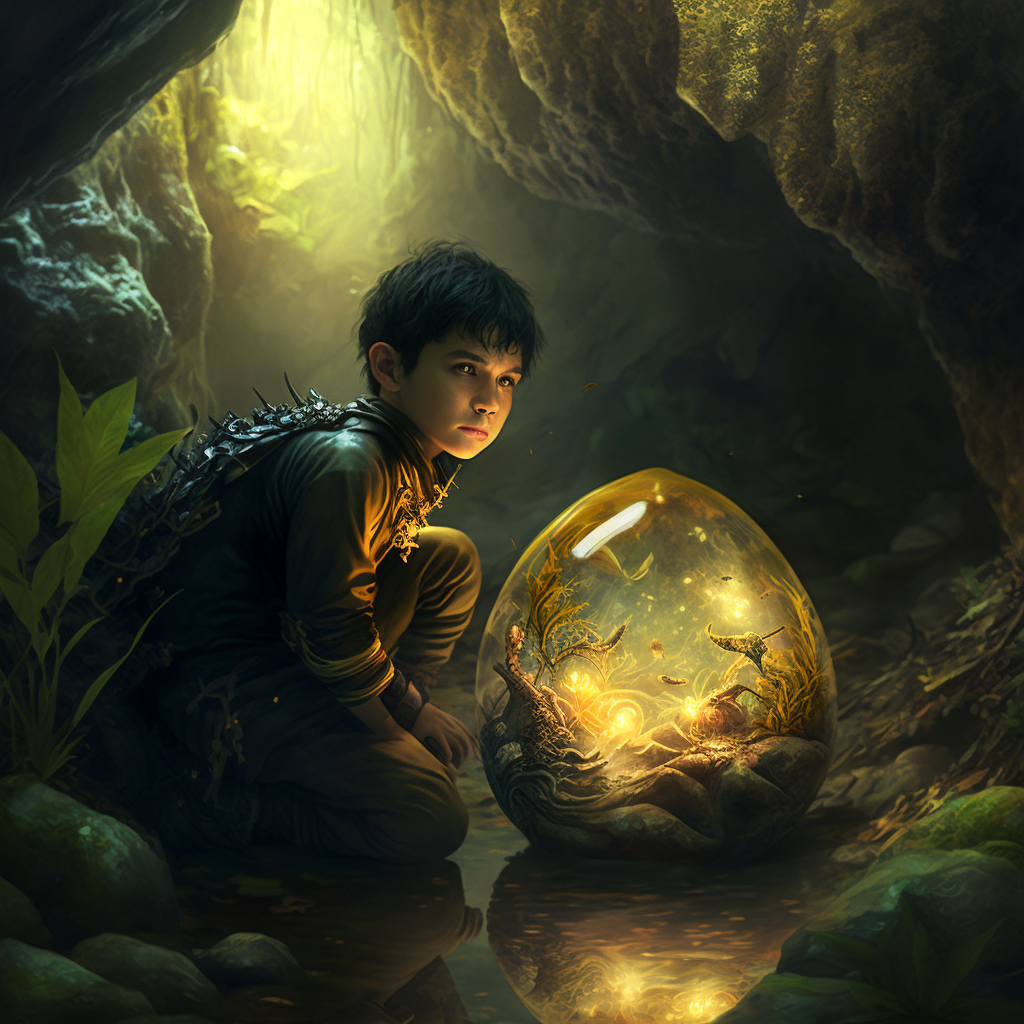
Irtak tending a dragon egg in Malvina’s cave

 November 10, 2022 at 10:59 am #6343
In reply to: Family Stories From The Other Side ~ Book Two
Colney Hatch Lunatic Asylum
William James Stokes
William James Stokes was the first son of Thomas Stokes and Eliza Browning. Oddly, his birth was registered in Witham in Essex, on the 6th September 1841.
Birth certificate of William James Stokes:
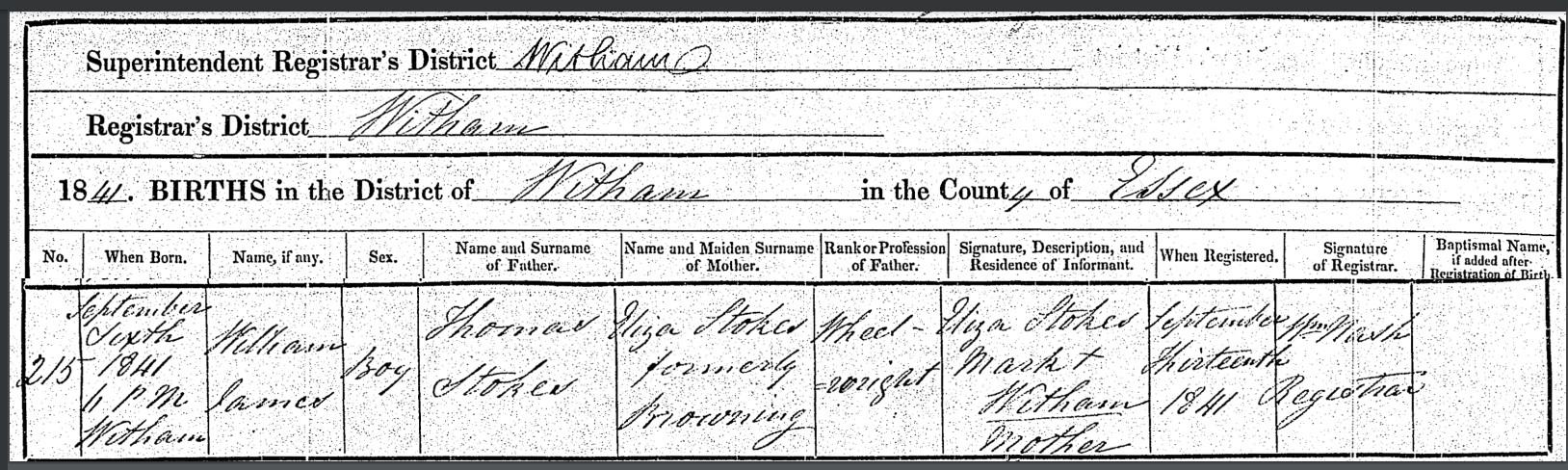
His father Thomas Stokes has not yet been found on the 1841 census, and his mother Eliza was staying with her uncle Thomas Lock in Cirencester in 1841. Eliza’s mother Mary Browning (nee Lock) was staying there too. Thomas and Eliza were married in September 1840 in Hempstead in Gloucestershire.
It’s a mystery why William was born in Essex but one possibility is that his father Thomas, who later worked with the Chipperfields making circus wagons, was staying with the Chipperfields who were wheelwrights in Witham in 1841. Or perhaps even away with a traveling circus at the time of the census, learning the circus waggon wheelwright trade. But this is a guess and it’s far from clear why Eliza would make the journey to Witham to have the baby when she was staying in Cirencester a few months prior.
In 1851 Thomas and Eliza, William and four younger siblings were living in Bledington in Oxfordshire.
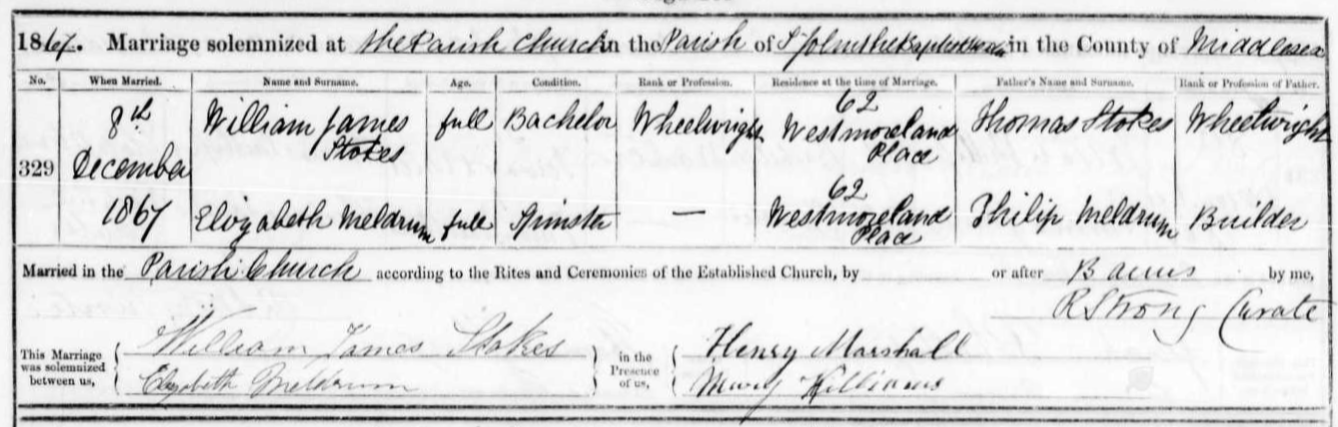
William was a 19 year old wheelwright living with his parents in Evesham in 1861. He married Elizabeth Meldrum in December 1867 in Hackney, London. He and his father are both wheelwrights on the marriage register.
Marriage of William James Stokes and Elizabeth Meldrum in 1867:
William and Elizabeth had a daughter, Elizabeth Emily Stokes, in 1868 in Shoreditch, London.
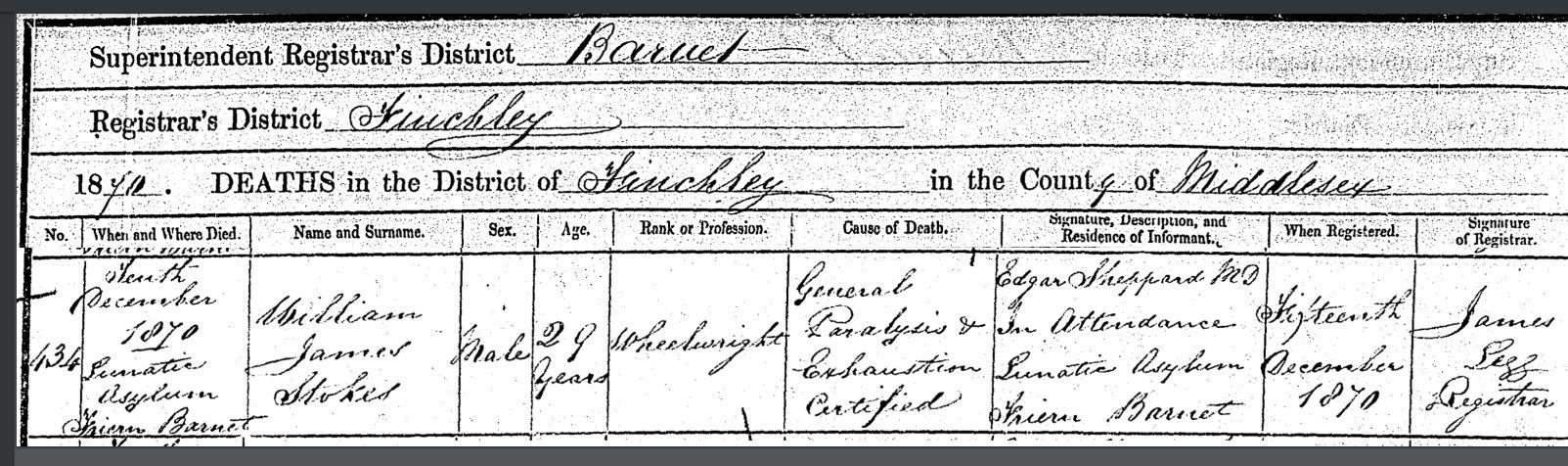
On the 3rd of December 1870, William James Stokes was admitted to Colney Hatch Lunatic Asylum. One week later on the 10th of December, he was dead.
On his death certificate the cause of death was “general paralysis and exhaustion, certified. MD Edgar Sheppard in attendance.” William was just 29 years old.
Death certificate William James Stokes:
I asked on a genealogy forum what could possibly have caused this death at such a young age. A retired pathology professor replied that “in medicine the term General Paralysis is only used in one context – that of Tertiary Syphilis.”
“Tertiary syphilis is the third and final stage of syphilis, a sexually transmitted disease that unfolds in stages when the individual affected doesn’t receive appropriate treatment.”From the article “Looking back: This fascinating and fatal disease” by Jennifer Wallis:
“……in asylums across Britain in the late 19th century, with hundreds of people receiving the diagnosis of general paralysis of the insane (GPI). The majority of these were men in their 30s and 40s, all exhibiting one or more of the disease’s telltale signs: grandiose delusions, a staggering gait, disturbed reflexes, asymmetrical pupils, tremulous voice, and muscular weakness. Their prognosis was bleak, most dying within months, weeks, or sometimes days of admission.
The fatal nature of GPI made it of particular concern to asylum superintendents, who became worried that their institutions were full of incurable cases requiring constant care. The social effects of the disease were also significant, attacking men in the prime of life whose admission to the asylum frequently left a wife and children at home. Compounding the problem was the erratic behaviour of the general paralytic, who might get themselves into financial or legal difficulties. Delusions about their vast wealth led some to squander scarce family resources on extravagant purchases – one man’s wife reported he had bought ‘a quantity of hats’ despite their meagre income – and doctors pointed to the frequency of thefts by general paralytics who imagined that everything belonged to them.”
The London Archives hold the records for Colney Hatch, but they informed me that the particular records for the dates that William was admitted and died were in too poor a condition to be accessed without causing further damage.
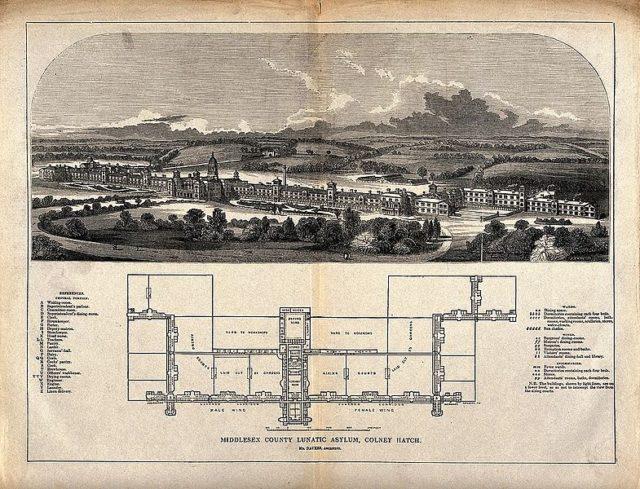
Colney Hatch Lunatic Asylum gained such notoriety that the name “Colney Hatch” appeared in various terms of abuse associated with the concept of madness. Infamous inmates that were institutionalized at Colney Hatch (later called Friern Hospital) include Jack the Ripper suspect Aaron Kosminski from 1891, and from 1911 the wife of occultist Aleister Crowley. In 1993 the hospital grounds were sold and the exclusive apartment complex called Princess Park Manor was built.
Colney Hatch:
In 1873 Williams widow married William Hallam in Limehouse in London. Elizabeth died in 1930, apparently unaffected by her first husbands ailment.
October 19, 2022 at 6:46 am #6336In reply to: Family Stories From The Other Side ~ Book Two
The Hamstall Ridware Connection
Stubbs and Woods
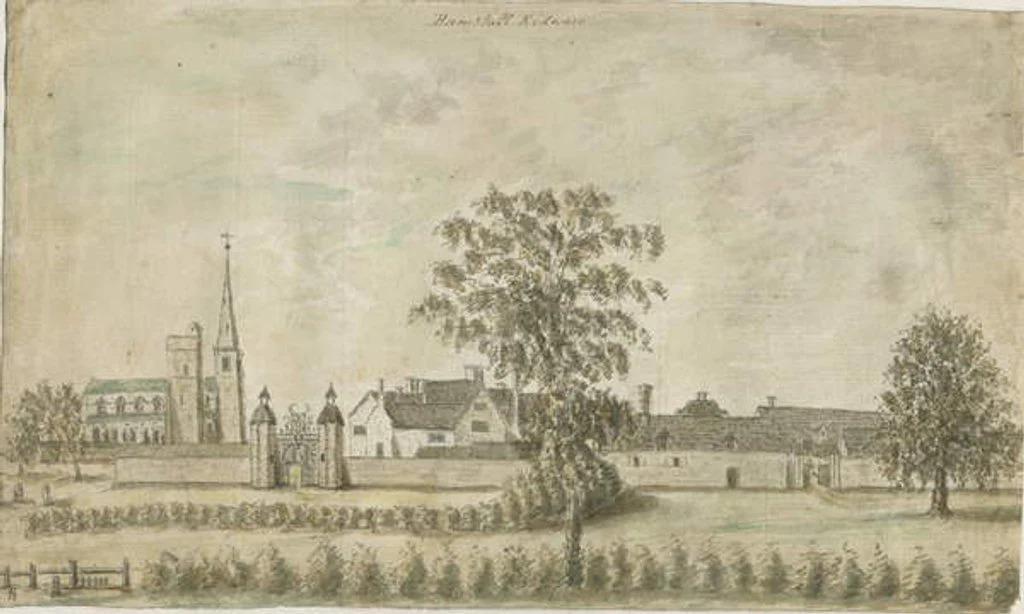 Hamstall Ridware
Charles Tomlinson‘s (1847-1907) wife Emma Grattidge (1853-1911) was born in Wolverhampton, the daughter and youngest child of William Grattidge (1820-1887) born in Foston, Derbyshire, and Mary Stubbs (1819-1880), born in Burton on Trent, daughter of Solomon Stubbs.
Solomon Stubbs (1781-1857) was born in Hamstall Ridware in 1781, the son of Samuel and Rebecca. Samuel Stubbs (1743-) and Rebecca Wood (1754-) married in 1769 in Darlaston. Samuel and Rebecca had six other children, all born in Darlaston. Sadly four of them died in infancy. Son John was born in 1779 in Darlaston and died two years later in Hamstall Ridware in 1781, the same year that Solomon was born there.
But why did they move to Hamstall Ridware?
Samuel Stubbs was born in 1743 in Curdworth, Warwickshire (near to Birmingham). I had made a mistake on the tree (along with all of the public trees on the Ancestry website) and had Rebecca Wood born in Cheddleton, Staffordshire. Rebecca Wood from Cheddleton was also born in 1843, the right age for the marriage. The Rebecca Wood born in Darlaston in 1754 seemed too young, at just fifteen years old at the time of the marriage. I couldn’t find any explanation for why a woman from Cheddleton would marry in Darlaston and then move to Hamstall Ridware. People didn’t usually move around much other than intermarriage with neighbouring villages, especially women. I had a closer look at the Darlaston Rebecca, and did a search on her father William Wood. I found his 1784 will online in which he mentions his daughter Rebecca, wife of Samuel Stubbs. Clearly the right Rebecca Wood was the one born in Darlaston, which made much more sense.
An excerpt from William Wood’s 1784 will mentioning daughter Rebecca married to Samuel Stubbs:
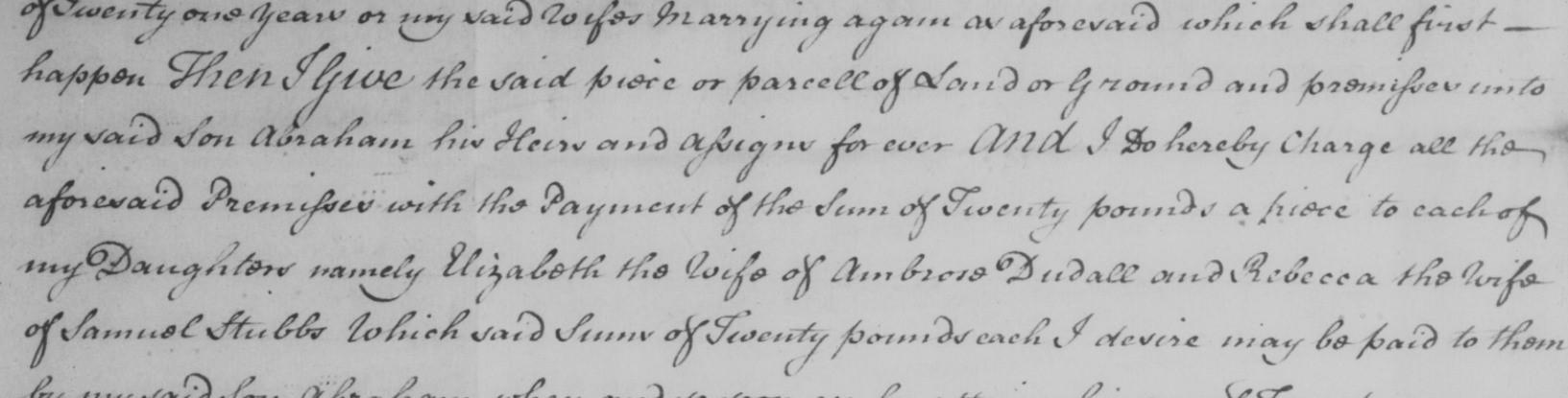
But why did they move to Hamstall Ridware circa 1780?
I had not intially noticed that Solomon Stubbs married again the year after his wife Phillis Lomas (1787-1844) died. Solomon married Charlotte Bell in 1845 in Burton on Trent and on the marriage register, Solomon’s father Samuel Stubbs occupation was mentioned: Samuel was a buckle maker.
Marriage of Solomon Stubbs and Charlotte Bell, father Samuel Stubbs buckle maker:
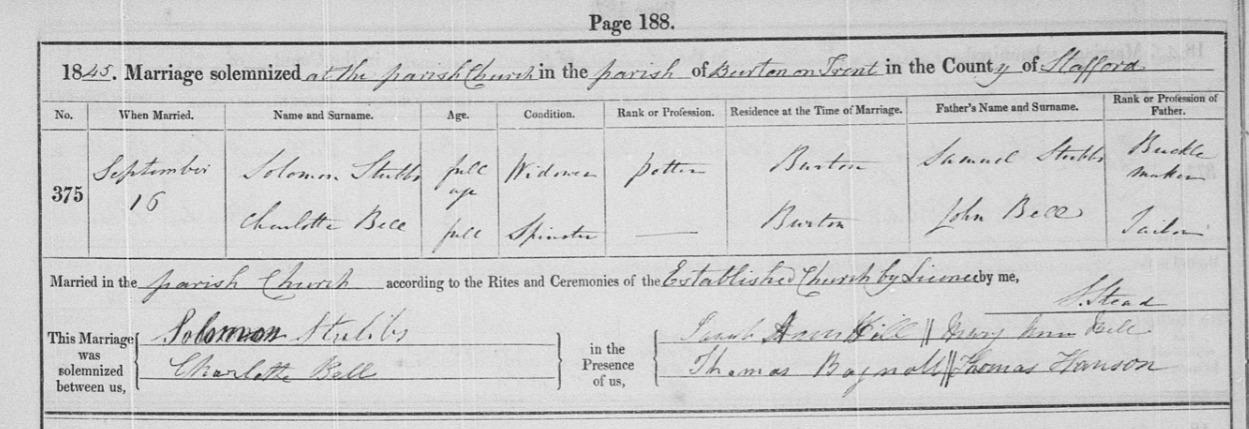
A rudimentary search on buckle making in the late 1700s provided a possible answer as to why Samuel and Rebecca left Darlaston in 1781. Shoe buckles had gone out of fashion, and by 1781 there were half as many buckle makers in Wolverhampton as there had been previously.
“Where there were 127 buckle makers at work in Wolverhampton, 68 in Bilston and 58 in Birmingham in 1770, their numbers had halved in 1781.”
via “historywebsite”(museum/metalware/steel)
Steel buckles had been the height of fashion, and the trade became enormous in Wolverhampton. Wolverhampton was a steel working town, renowned for its steel jewellery which was probably of many types. The trade directories show great numbers of “buckle makers”. Steel buckles were predominantly made in Wolverhampton: “from the late 1760s cut steel comes to the fore, from the thriving industry of the Wolverhampton area”. Bilston was also a great centre of buckle making, and other areas included Walsall. (It should be noted that Darlaston, Walsall, Bilston and Wolverhampton are all part of the same area)
In 1860, writing in defence of the Wolverhampton Art School, George Wallis talks about the cut steel industry in Wolverhampton. Referring to “the fine steel workers of the 17th and 18th centuries” he says: “Let them remember that 100 years ago [sc. c. 1760] a large trade existed with France and Spain in the fine steel goods of Birmingham and Wolverhampton, of which the latter were always allowed to be the best both in taste and workmanship. … A century ago French and Spanish merchants had their houses and agencies at Birmingham for the purchase of the steel goods of Wolverhampton…..The Great Revolution in France put an end to the demand for fine steel goods for a time and hostile tariffs finished what revolution began”.
The next search on buckle makers, Wolverhampton and Hamstall Ridware revealed an unexpected connecting link.
In Riotous Assemblies: Popular Protest in Hanoverian England by Adrian Randall:
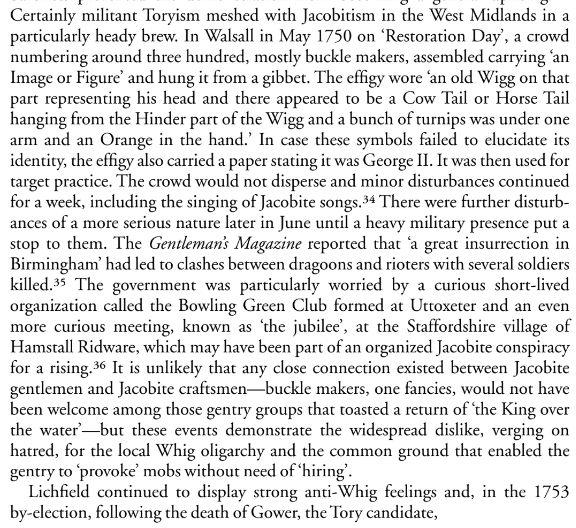
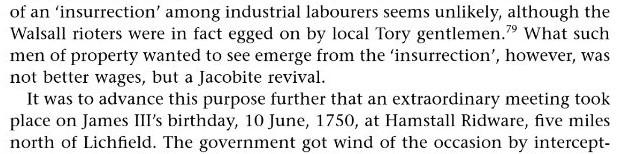
In Walsall in 1750 on “Restoration Day” a crowd numbering 300 assembled, mostly buckle makers, singing Jacobite songs and other rebellious and riotous acts. The government was particularly worried about a curious meeting known as the “Jubilee” in Hamstall Ridware, which may have been part of a conspiracy for a Jacobite uprising.
But this was thirty years before Samuel and Rebecca moved to Hamstall Ridware and does not help to explain why they moved there around 1780, although it does suggest connecting links.
Rebecca’s father, William Wood, was a brickmaker. This was stated at the beginning of his will. On closer inspection of the will, he was a brickmaker who owned four acres of brick kilns, as well as dwelling houses, shops, barns, stables, a brewhouse, a malthouse, cattle and land.
A page from the 1784 will of William Wood:
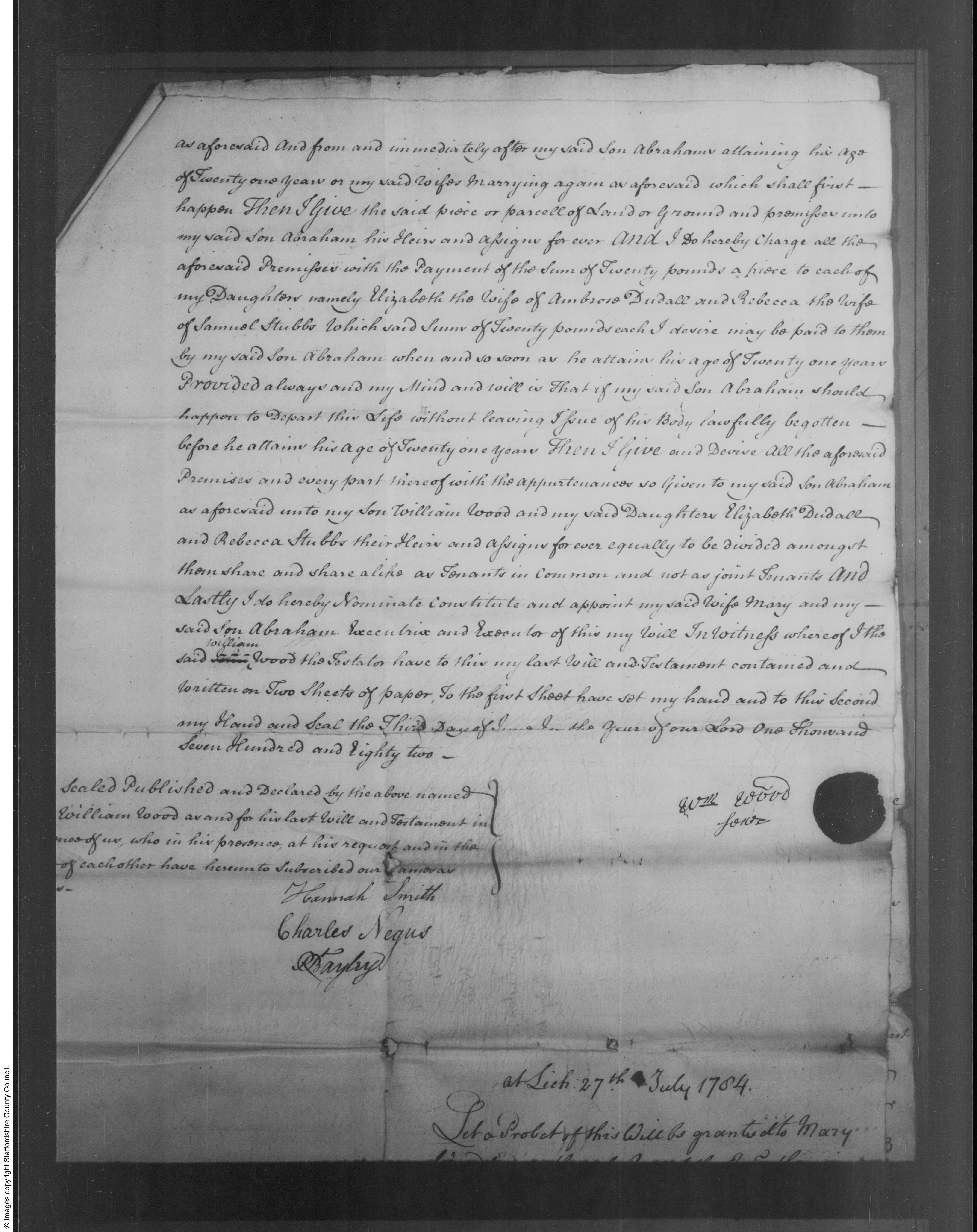
The 1784 will of William Wood of Darlaston:
I William Wood the elder of Darlaston in the county of Stafford, brickmaker, being of sound and disposing mind memory and understanding (praised be to god for the same) do make publish and declare my last will and testament in manner and form following (that is to say) {after debts and funeral expense paid etc} I give to my loving wife Mary the use usage wear interest and enjoyment of all my goods chattels cattle stock in trade ~ money securities for money personal estate and effects whatsoever and wheresoever to hold unto her my said wife for and during the term of her natural life providing she so long continues my widow and unmarried and from or after her decease or intermarriage with any future husband which shall first happen.
Then I give all the said goods chattels cattle stock in trade money securites for money personal estate and effects unto my son Abraham Wood absolutely and forever. Also I give devise and bequeath unto my said wife Mary all that my messuages tenement or dwelling house together with the malthouse brewhouse barn stableyard garden and premises to the same belonging situate and being at Darlaston aforesaid and now in my own possession. Also all that messuage tenement or dwelling house together with the shop garden and premises with the appurtenances to the same ~ belonging situate in Darlaston aforesaid and now in the several holdings or occupation of George Knowles and Edward Knowles to hold the aforesaid premises and every part thereof with the appurtenances to my said wife Mary for and during the term of her natural life provided she so long continues my widow and unmarried. And from or after her decease or intermarriage with a future husband which shall first happen. Then I give and devise the aforesaid premises and every part thereof with the appurtenances unto my said son Abraham Wood his heirs and assigns forever.
Also I give unto my said wife all that piece or parcel of land or ground inclosed and taken out of Heath Field in the parish of Darlaston aforesaid containing four acres or thereabouts (be the same more or less) upon which my brick kilns erected and now in my own possession. To hold unto my said wife Mary until my said son Abraham attains his age of twenty one years if she so long continues my widow and unmarried as aforesaid and from and immediately after my said son Abraham attaining his age of twenty one years or my said wife marrying again as aforesaid which shall first happen then I give the said piece or parcel of land or ground and premises unto my said son Abraham his heirs and assigns forever.
And I do hereby charge all the aforesaid premises with the payment of the sum of twenty pounds a piece to each of my daughters namely Elizabeth the wife of Ambrose Dudall and Rebecca the wife of Samuel Stubbs which said sum of twenty pounds each I devise may be paid to them by my said son Abraham when and so soon as he attains his age of twenty one years provided always and my mind and will is that if my said son Abraham should happen to depart this life without leaving issue of his body lawfully begotten before he attains his age of twenty one years then I give and devise all the aforesaid premises and every part thereof with the appurtenances so given to my said son Abraham as aforesaid unto my said son William Wood and my said daughter Elizabeth Dudall and Rebecca Stubbs their heirs and assigns forever equally divided among them share and share alike as tenants in common and not as joint tenants. And lastly I do hereby nominate constitute and appoint my said wife Mary and my said son Abraham executrix and executor of this my will.
The marriage of William Wood (1725-1784) and Mary Clews (1715-1798) in 1749 was in Hamstall Ridware.
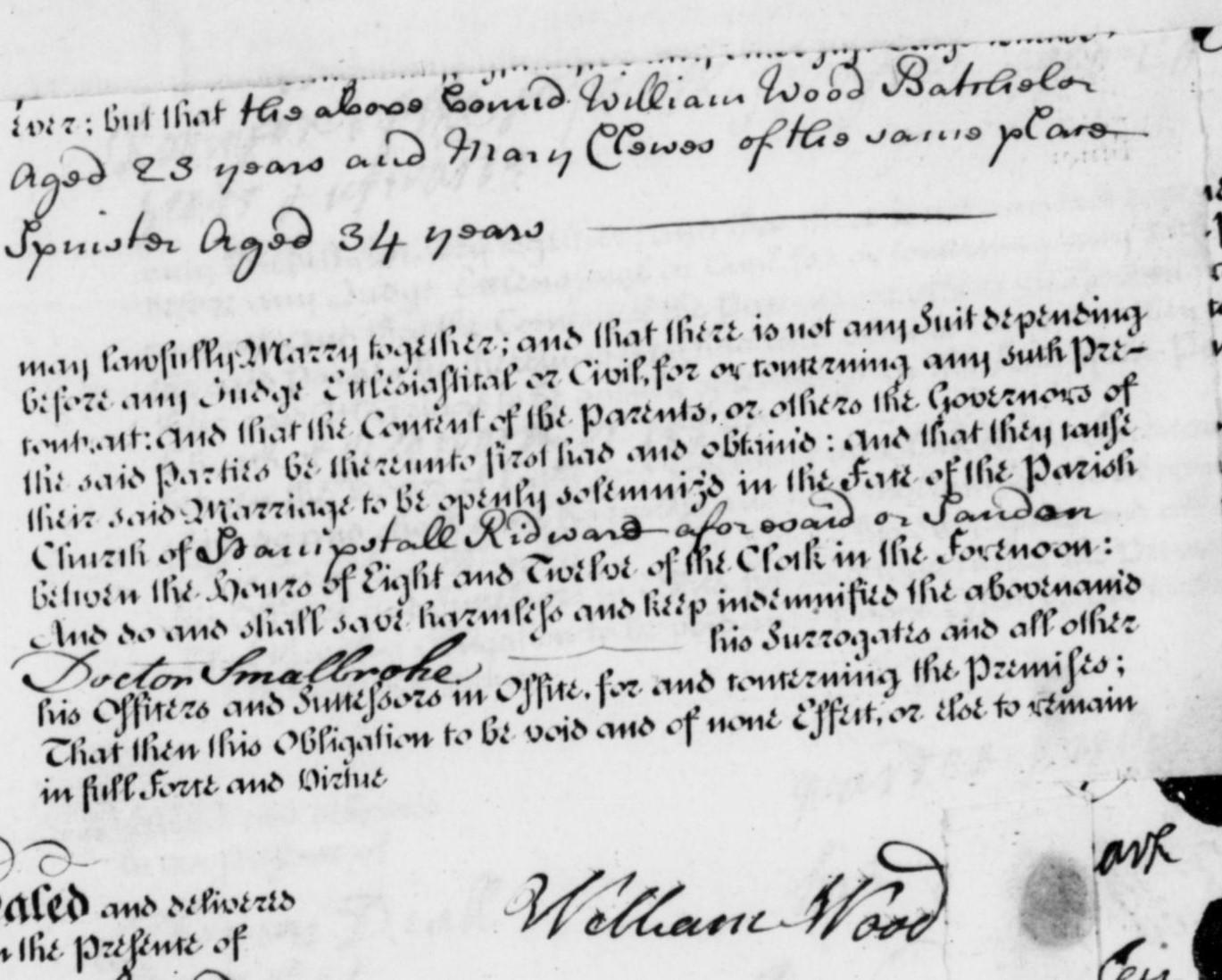
Mary was eleven years Williams senior, and it appears that they both came from Hamstall Ridware and moved to Darlaston after they married. Clearly Rebecca had extended family there (notwithstanding any possible connecting links between the Stubbs buckle makers of Darlaston and the Hamstall Ridware Jacobites thirty years prior). When the buckle trade collapsed in Darlaston, they likely moved to find employment elsewhere, perhaps with the help of Rebecca’s family.
I have not yet been able to find deaths recorded anywhere for either Samuel or Rebecca (there are a couple of deaths recorded for a Samuel Stubbs, one in 1809 in Wolverhampton, and one in 1810 in Birmingham but impossible to say which, if either, is the right one with the limited information, and difficult to know if they stayed in the Hamstall Ridware area or perhaps moved elsewhere)~ or find a reason for their son Solomon to be in Burton upon Trent, an evidently prosperous man with several properties including an earthenware business, as well as a land carrier business.
July 12, 2022 at 9:46 am #6320In reply to: The Sexy Wooden Leg
When Maryechka arrived at the front gate of the Vyriy hotel with its gaudy plaster storks at the entrance, she sneaked into the side gate leading to the kitchens.
She had to be careful not to to be noticed by Larysa who often had her cigarette break hidden under the pine tree. Larysa didn’t like children, or at least, she disliked them slightly less than the elderly residents, whoever was the loudest and the uncleanliest was sure to suffer her disapproval.
Larysa was basically single-handedly managing the hotel, doing most of the chores to keep it afloat. The only thing she didn’t do was the catering, and packaged trays arrived every day for the residents. Maryechka’s grand-pa was no picky eater, and made a point of clearing his tray of food, but she suspected most of the other residents didn’t.
The only other employee she was told, was the gardener who would have been old enough to be a resident himself, and had died of a stroke before the summer. The small garden was clearly in need of tending after.Maryechka could see the coast was clear, and was making her ways to the stairs when she heard clanking in the stairs and voices arguing.
“Keep your voice down, you’re going to wake the dragon.”
“That’s your fault, you don’t pack light for your adventures. You really needed to take all these suitcases? How can we make a run for it with all that dead weight!”
July 10, 2022 at 2:36 am #6317In reply to: The Sexy Wooden Leg
The sharp rat-a-tat on the door startled Olga Herringbonevsky. The initial surprise quickly turned to annoyance. It was 11am and she wasn’t expecting a knock on the door at 11am. At 10am she expected a knock. It would be Larysa with the lukewarm cup of tea and a stale biscuit. Sometimes Olga complained about it and Larysa would say, Well you’re on the third floor so what do you expect? And she’d look cross and pour the tea so some of it slopped into the saucer. So the biscuits go stale on the way up do they? Olga would mutter. At 10:30am Larysa would return to collect the cup and saucer. I can’t do this much longer, she’d say. I’m not young any more and all these damn stairs. She’d been saying that for as long as Olga could remember.
For a moment, Olga contemplated ignoring the intrusion but the knocking started up again, this time accompanied by someone shouting her name.
With a very loud sigh, she put her book on the side table, face down so she would not lose her place for it was a most enjoyable whodunit, and hauled herself up from the chair. Her ankle was not good since she’d gone over on it the other day and Olga was in a very poor mood by the time she reached the door.
“Yes?” She glowered at Egbert.
“Have you seen this?” Egbert was waving a piece of paper at her.
“No,” Olga started to close the door.
“Olga stop!” Egbert’s face had reddened and Olga wondered if he might cry. Again, he waved the piece of paper in her face and then let his hand fall defeated to his side. “Olga, it’s bad news. You should have got a letter .”
Olga glanced at the pile of unopened letters on her dresser. It was never good news. She couldn’t be bothered with letters any more.
“Well, Egbert, I suppose you’d better come in”.
“That Ursula has a heart of steel,” said Olga when she’d heard the news.
“Pfft,” said Egbert. “She has no heart. This place has always been about money for her.”
“It’s bad times, Egbert. Bad times.”
Egbert nodded. “It is, Olga. But there must be something we can do.” He pursed his lips and Olga noticed that he would not meet her eyes.
“What? Spit it out, Old Man.”
He looked at her briefly before his eyes slid back to the dirty grey carpet. “I have heard stories, Olga. That you are … well connected. That you know people.”
Olga noticed that it had become difficult to breathe. Seeing Egbert looking at her with concern, she made an effort to steady herself. She took an extra big gasp of air and pointed to the book face-down on the side table. “That is a very good book I am reading. You may borrow it when I have finished.”
Egbert nodded. “Thank you.” he said and they both stared at the book.
“It was a long time ago, Egbert. And no business of anyone else.” Olga knew her voice was sharp but not sharp enough it seemed as Egbert was not done yet with all his prying words.
“Olga, you said it yourself. These are bad times. And desperate measures are needed or we will all perish.” Now he looked her in the eyes. “Old woman, swallow your pride. You must save yourself and all of us here.”
July 7, 2022 at 5:31 pm #6316In reply to: The Sexy Wooden Leg
Myroslava was hungry. She saw ducks flying in the sky and realised she wasn’t too far from the Kal’mius river, south of Dantesk. She took out her sling and hit one with a stone she just picked on the floor. She smiled and said in a low voice : “You see father, I haven’t lost my touch.”
She had traveled several days with a group of reportourists, as she called them. A bunch of war reporters who thought it entertaining to take pictures of bombed areas, going about like peacocks as if they wore a plot armour against Rootian bullets and missiles and discourse at night on the tactics of the different armies. She was glad when she crossed the Rootian lines two days ago. Even if it meant no more dehydrated food and no more plot armour, she was certainly better off without the inane discussions.
She picked the duck and looked for a freshly bombarded place where there was still smoke. She could make some fire without being noticed too much. She didn’t like raw meat that much.
Soon after leaving the group or reportourists, without all the noise they made, she became certain she was being followed. She tried once to surprise them, but they were good at hiding and camouflaging their tracks. She wondered how long it had lasted. She cursed the noisy reporters and cursed her lack of good vodka. Cursing without alcohol was like boxing without fists.
July 7, 2022 at 9:45 am #6315In reply to: The Sexy Wooden Leg
It was not yet 9am and Eusebius Kazandis was already sweating. The morning sun was hitting hard on the tarp of his booth. He put the last cauldron among lines of cauldrons on a sagging table at the summer fair of Innsbruck, Austria. It was a tiny three-legged black cauldron with a simple Celtic knot on one side and a tree on the other side, like all the others. His father’s father’s father used to make cauldrons for a living, the kind you used to distil ouzo or cook meals for an Inn. But as time went by and industrialisation made it easier for cooks, the trade slowly evolved toward smaller cauldrons for modern Wiccans. A modern witch wanted it portable and light, ready to use in everyday life situations, and Eusebius was there to provide it for them.
Eusebius sat on his chair and sighed. He couldn’t help but notice the woman in colourful dress who had spread a shawl on the grass under the tall sequoia tree. Nobody liked this spot under the branches oozing sticky resin. She didn’t seem to mind. She was arranging small colourful bottles of oil on her shawl. A sign near her said : Massage oils, Fragrant oils, Polishing oils, all with different names evocative of different properties. He hadn’t noticed her yesterday when everybody was installing their stalls. He wondered if she had paid her fee.
Rosa was smiling as she spread in front of her the meadow flowers she’d picked on her way to the market. It was another beautiful day, under the shade and protection of the big sequoia tree watching over her. She assembled small bouquets and put them in between the vials containing her precious handmade oils. She had noticed people, and especially women, would naturally gather around well dressed stalls and engage conversation. Since she left her hometown of Torino, seven years ago, she’d followed the wind on her journey across Europe. It had led her to Innsbruck and had suddenly stopped blowing. That usually meant she had something to do there, but it also meant that she would have to figure out what she was meant to do before she could go on with her life.
The stout man waiting behind his dark cauldrons, was watching her again. He looked quite sad, and she couldn’t help but thinking he was not where he needed to be. When she looked at him, she saw Hephaestus whose inner fire had been tamed. His banner was a mishmash of religious stuff, aimed at pagans and budding witches. Although his grim booth would most certainly benefit from a feminine touch, but she didn’t want to offend him by a misplaced suggestion. It was not her place to find his place.
Rosa, who knew to cultivate any available friendship when she arrived somewhere, waved at the man. Startled, he looked away as if caught doing something inappropriate. Rosa sighed. Maybe she should have bring him some coffee.
As her first clients arrived, she prayed for a gush of wind to tell her where to go next. But the branches of the old tree remained perfectly still under the scorching sun.
July 6, 2022 at 9:47 am #6310In reply to: The Sexy Wooden Leg
Olek wished he wasn’t so easy to find.
The old caretaker of the shrine of Saint Edigna couldn’t have chosen a less conspicuous place to live in this warring time. People were flocking from afar, more and more each day drawn about by the ancient place, and the sacred oil bleeding linden tree which had suddenly and quite miraculously resumed its flow in the midst of the ambiant chaos started by the war.
It wasn’t always like this. A few months ago, the linden tree was just an old linden tree that may or may not have been miraculous, if the old wifes’ tales were to be trusted. Mankind’s memory is a flimsy thing as it occurs, and while for many generations before, speculations had abounded about whether or not the Saint was real, had such or such filiation, et cætera— it now seemed the old tales that were passed down from mother to children had managed to keep alive a knowledge that had but all dried up on old flaky parchments scribbled in pale inks that kept eluding old scholars’ exegesis.
Olek himself wasn’t a learned man. A man of faith, he was a little — more by upbringing than by choice, and by slow attunement to nature it would seem. Over the years, he’d be servicing the country in many ways, and after a rather long carrier started at young age, he had finally managed to retire in this place.
He thought he’d be left alone, to care for a little garden patch, checking in from times to times on the old grumpy neighbours, but alas, the Holy Nation’s destiny still had something in store for him.The latest pilgrim family had brought a message. It was another push to action. “Plan acceleration needs to happen”.
“What clucking plan again?” was his first reaction. Bad temper had a way of flaring right up his vents as in old times. When he’d calmed down, he wondered if he had ever seen a call for slowing down in his life. People were always so busy mindlessly carting around, bumping into the darkness.He smiled thinking of something his old man used to say. He’d never planned for a thing in his life, and was always very carefree it was often scary. His mantra was “People are always getting prepared for the wrong things. They never can prepare for the unexpected, and surely enough, only the unexpected happens.”
That sort of chaos paddling approach to life didn’t seem to bring him any sort of extraordinary success, and while he had the same mixed bag of ups and downs as the rest of his compatriots, just so much less did he suffer for the same result! Olek guessed that was the whole point, even if he really couldn’t accept it until much later in life.Maybe Olek would start playing by his father’s book. Until he could find a way to get lost behind enemy lines.
June 6, 2022 at 9:17 am #6301In reply to: The Elusive Samuel Housley and Other Family Stories
The Warrens of Stapenhill
There were so many Warren’s in Stapenhill that it was complicated to work out who was who. I had gone back as far as Samuel Warren marrying Catherine Holland, and this was as far back as my cousin Ian Warren had gone in his research some decades ago as well. The Holland family from Barton under Needwood are particularly interesting, and will be a separate chapter.
Stapenhill village by John Harden:
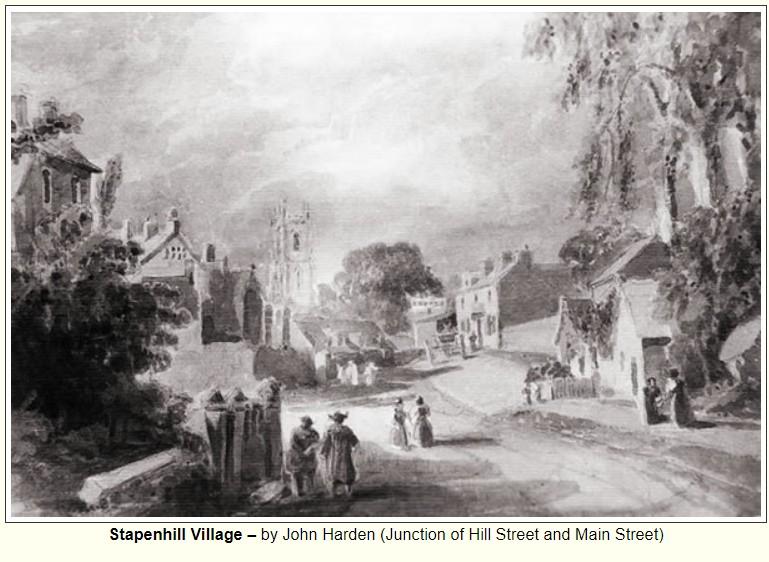
Resuming the research on the Warrens, Samuel Warren 1771-1837 married Catherine Holland 1775-1861 in 1795 and their son Samuel Warren 1800-1882 married Elizabeth Bridge, whose childless brother Benjamin Bridge left the Warren Brothers Boiler Works in Newhall to his nephews, the Warren brothers.
Samuel Warren and Catherine Holland marriage licence 1795:
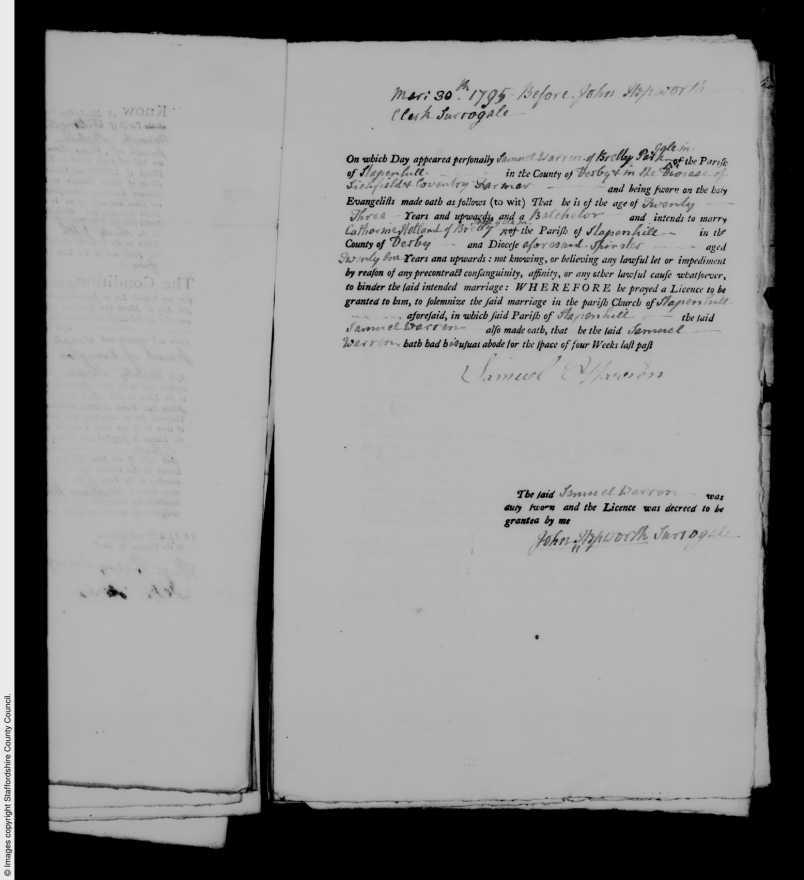
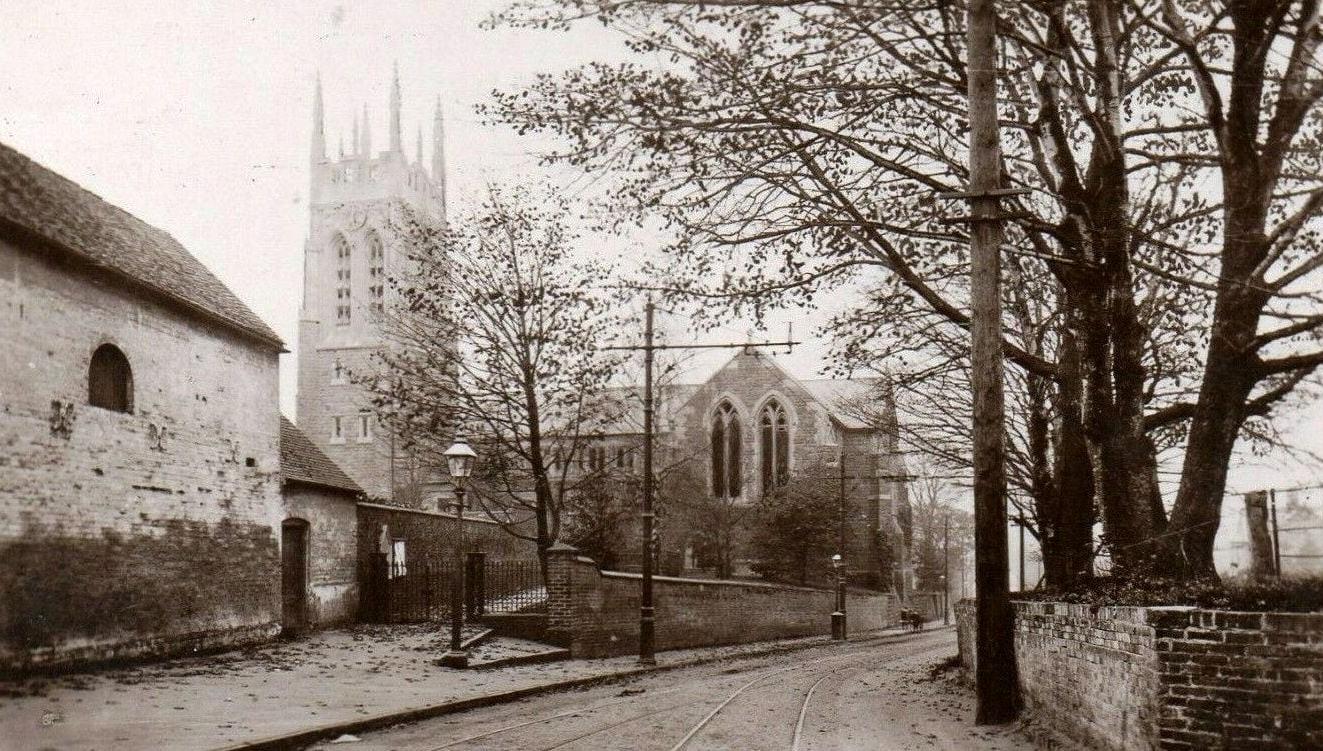
Samuel (born 1771) was baptised at Stapenhill St Peter and his parents were William and Anne Warren. There were at least three William and Ann Warrens in town at the time. One of those William’s was born in 1744, which would seem to be the right age to be Samuel’s father, and one was born in 1710, which seemed a little too old. Another William, Guiliamos Warren (Latin was often used in early parish registers) was baptised in Stapenhill in 1729.
Stapenhill St Peter:
William Warren (born 1744) appeared to have been born several months before his parents wedding. William Warren and Ann Insley married 16 July 1744, but the baptism of William in 1744 was 24 February. This seemed unusual ~ children were often born less than nine months after a wedding, but not usually before the wedding! Then I remembered the change from the Julian calendar to the Gregorian calendar in 1752. Prior to 1752, the first day of the year was Lady Day, March 25th, not January 1st. This meant that the birth in February 1744 was actually after the wedding in July 1744. Now it made sense. The first son was named William, and he was born seven months after the wedding.
William born in 1744 died intestate in 1822, and his wife Ann made a legal claim to his estate. However he didn’t marry Ann Holland (Ann was Catherines Hollands sister, who married Samuel Warren the year before) until 1796, so this William and Ann were not the parents of Samuel.
It seemed likely that William born in 1744 was Samuels brother. William Warren and Ann Insley had at least eight children between 1744 and 1771, and it seems that Samuel was their last child, born when William the elder was 61 and his wife Ann was 47.
It seems it wasn’t unusual for the Warren men to marry rather late in life. William Warren’s (born 1710) parents were William Warren and Elizabeth Hatterton. On the marriage licence in 1702/1703 (it appears to say 1703 but is transcribed as 1702), William was a 40 year old bachelor from Stapenhill, which puts his date of birth at 1662. Elizabeth was considerably younger, aged 19.
William Warren and Elizabeth Hatterton marriage licence 1703:
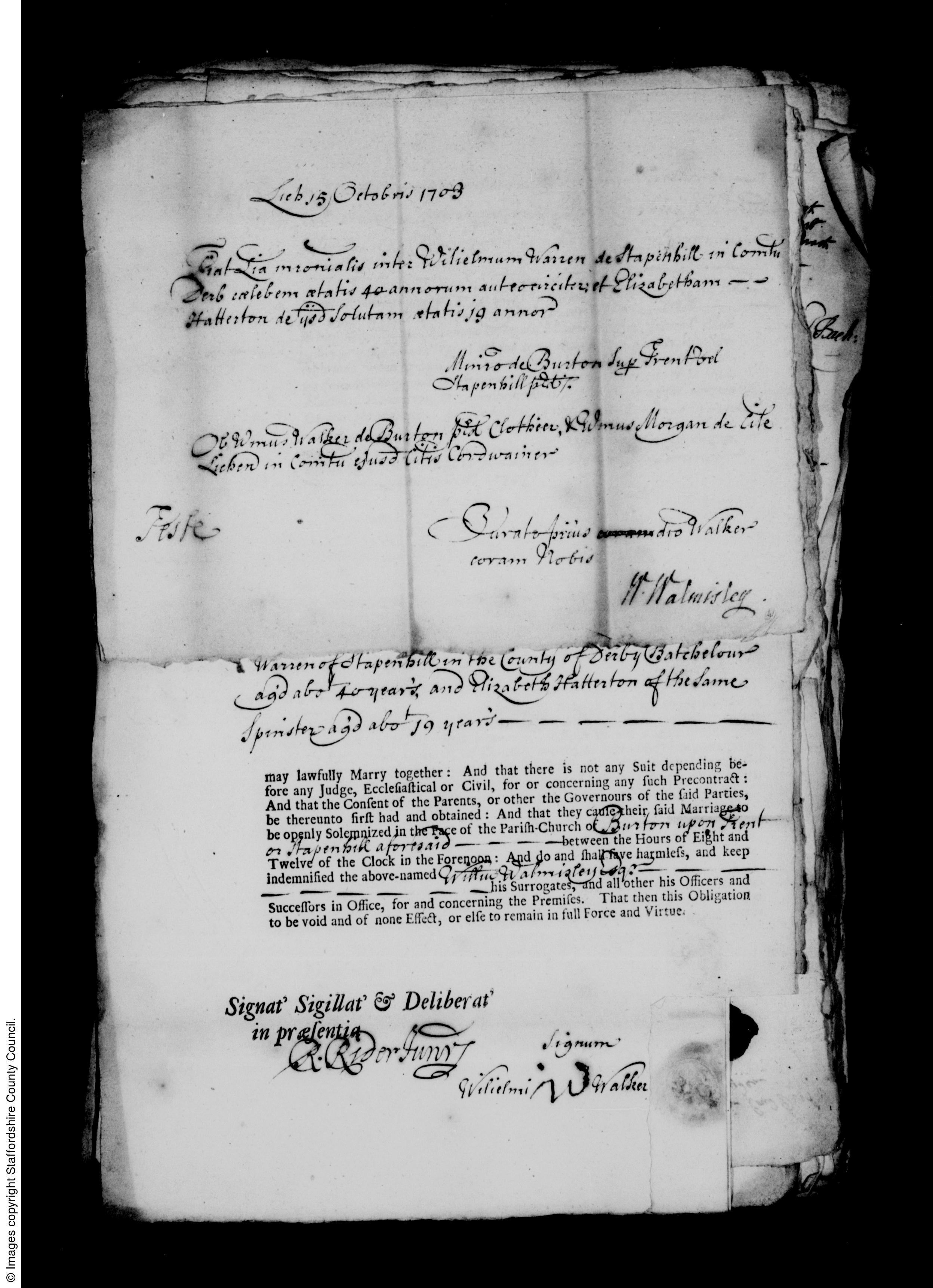
These Warren’s were farmers, and they were literate and able to sign their own names on various documents. This is worth noting, as most made the mark of an X.
I found three Warren and Holland marriages. One was Samuel Warren and Catherine Holland in 1795, then William Warren and Ann Holland in 1796. William Warren and Ann Hollands daughter born in 1799 married John Holland in 1824.
Elizabeth Hatterton (wife of William Warren who was born circa 1662) was born in Burton upon Trent in 1685. Her parents were Edward Hatterton 1655-1722, and Sara.
A page from the 1722 will of Edward Hatterton:
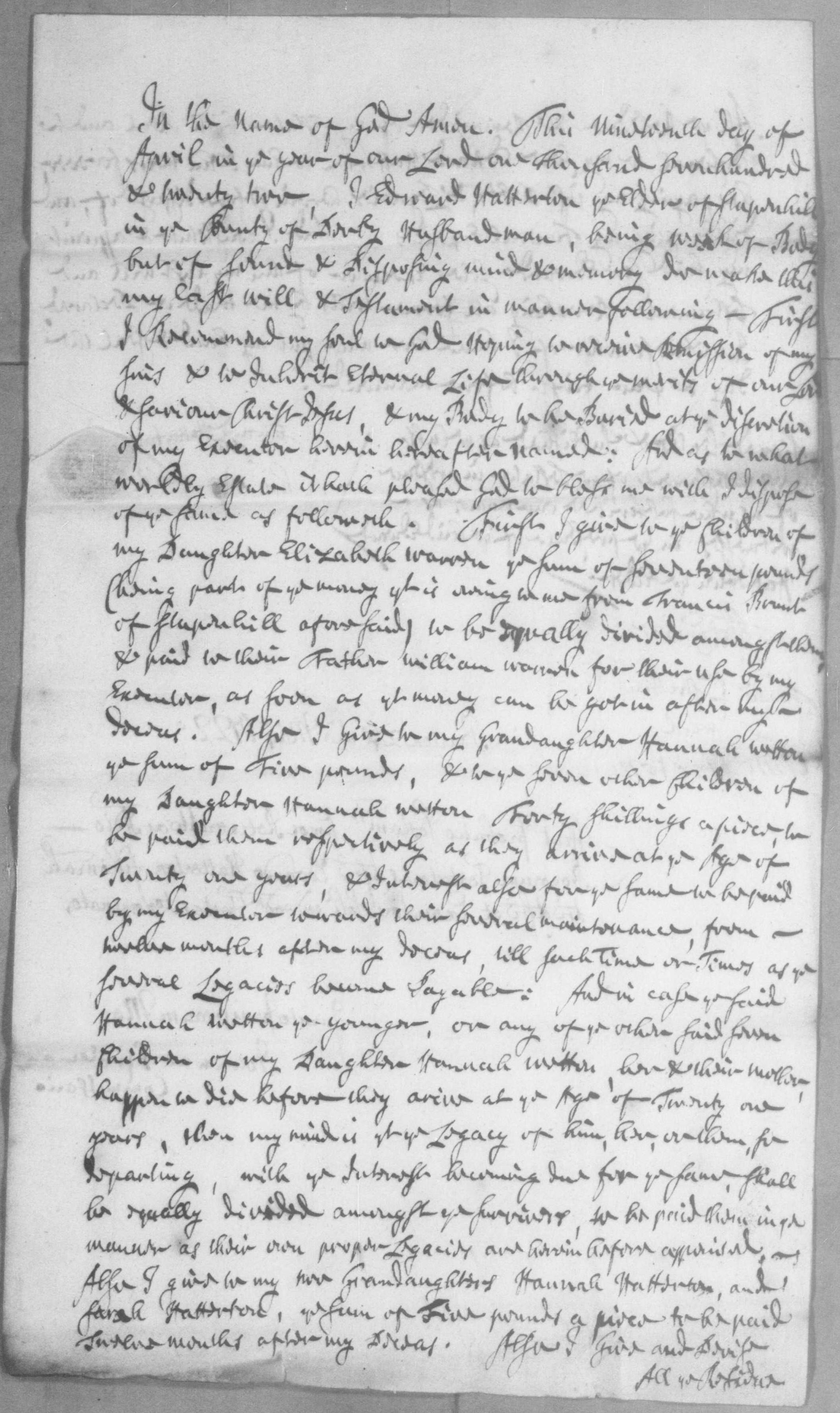
The earliest Warren I found records for was William Warren who married Elizabeth Hatterton in 1703. The marriage licence states his age as 40 and that he was from Stapenhill, but none of the Stapenhill parish records online go back as far as 1662. On other public trees on ancestry websites, a birth record from Suffolk has been chosen, probably because it was the only record to be found online with the right name and date. Once again, I don’t think that is correct, and perhaps one day I’ll find some earlier Stapenhill records to prove that he was born in locally.
Subsequently, I found a list of the 1662 Hearth Tax for Stapenhill. On it were a number of Warrens, three William Warrens including one who was a constable. One of those William Warrens had a son he named William (as they did, hence the number of William Warrens in the tree) the same year as this hearth tax list.
But was it the William Warren with 2 chimneys, the one with one chimney who was too poor to pay it, or the one who was a constable?
from the list:
Will. Warryn 2
Richard Warryn 1
William Warren Constable
These names are not payable by Act:
Will. Warryn 1
Richard Warren John Watson
over seers of the poore and churchwardensThe Hearth Tax:
via wiki:
In England, hearth tax, also known as hearth money, chimney tax, or chimney money, was a tax imposed by Parliament in 1662, to support the Royal Household of King Charles II. Following the Restoration of the monarchy in 1660, Parliament calculated that the Royal Household needed an annual income of £1,200,000. The hearth tax was a supplemental tax to make up the shortfall. It was considered easier to establish the number of hearths than the number of heads, hearths forming a more stationary subject for taxation than people. This form of taxation was new to England, but had precedents abroad. It generated considerable debate, but was supported by the economist Sir William Petty, and carried through the Commons by the influential West Country member Sir Courtenay Pole, 2nd Baronet (whose enemies nicknamed him “Sir Chimney Poll” as a result). The bill received Royal Assent on 19 May 1662, with the first payment due on 29 September 1662, Michaelmas.
One shilling was liable to be paid for every firehearth or stove, in all dwellings, houses, edifices or lodgings, and was payable at Michaelmas, 29 September and on Lady Day, 25 March. The tax thus amounted to two shillings per hearth or stove per year. The original bill contained a practical shortcoming in that it did not distinguish between owners and occupiers and was potentially a major burden on the poor as there were no exemptions. The bill was subsequently amended so that the tax was paid by the occupier. Further amendments introduced a range of exemptions that ensured that a substantial proportion of the poorer people did not have to pay the tax.Indeed it seems clear that William Warren the elder came from Stapenhill and not Suffolk, and one of the William Warrens paying hearth tax in 1662 was undoubtedly the father of William Warren who married Elizabeth Hatterton.
May 3, 2022 at 4:40 pm #6291In reply to: The Elusive Samuel Housley and Other Family Stories
Jane Eaton
The Nottingham Girl
Jane Eaton 1809-1879
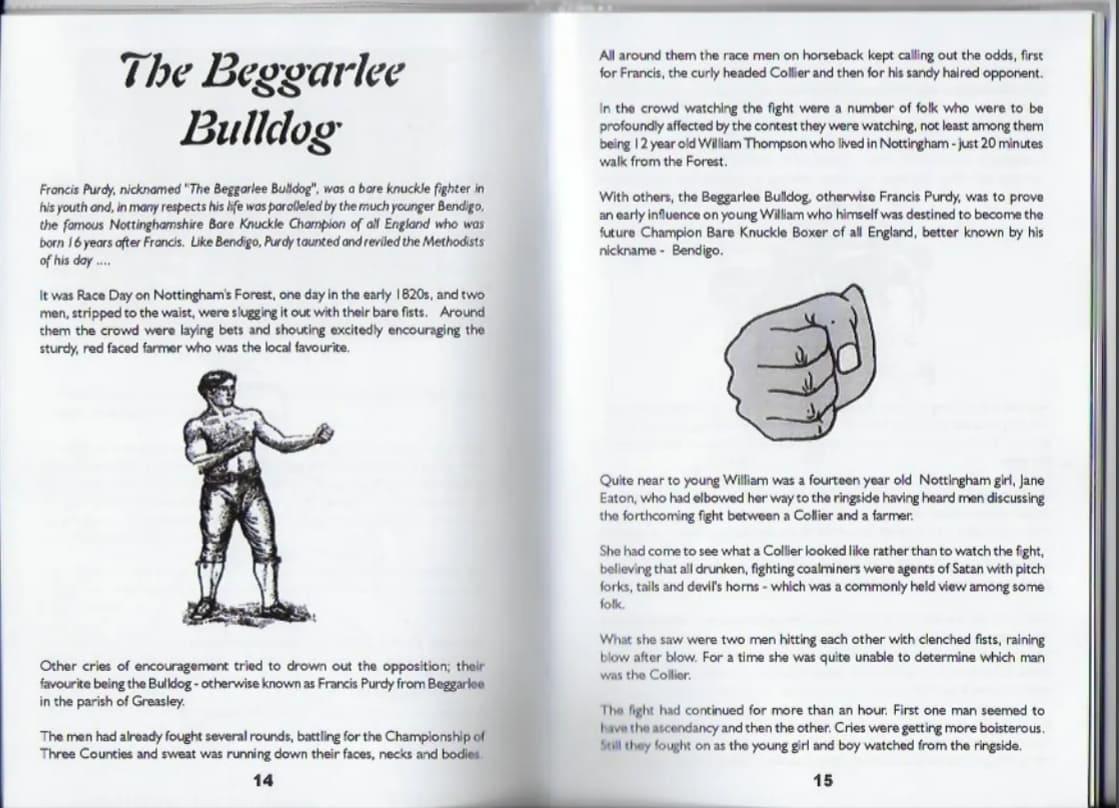
Francis Purdy, the Beggarlea Bulldog and Methodist Minister, married Jane Eaton in 1837 in Nottingham. Jane was his second wife.
Jane Eaton, photo says “Grandma Purdy” on the back:
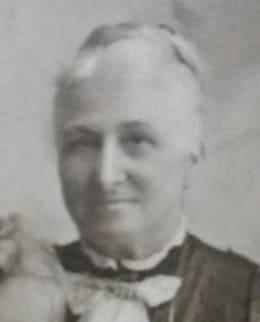
Jane is described as a “Nottingham girl” in a book excerpt sent to me by Jim Giles, a relation who shares the same 3x great grandparents, Francis and Jane Purdy.
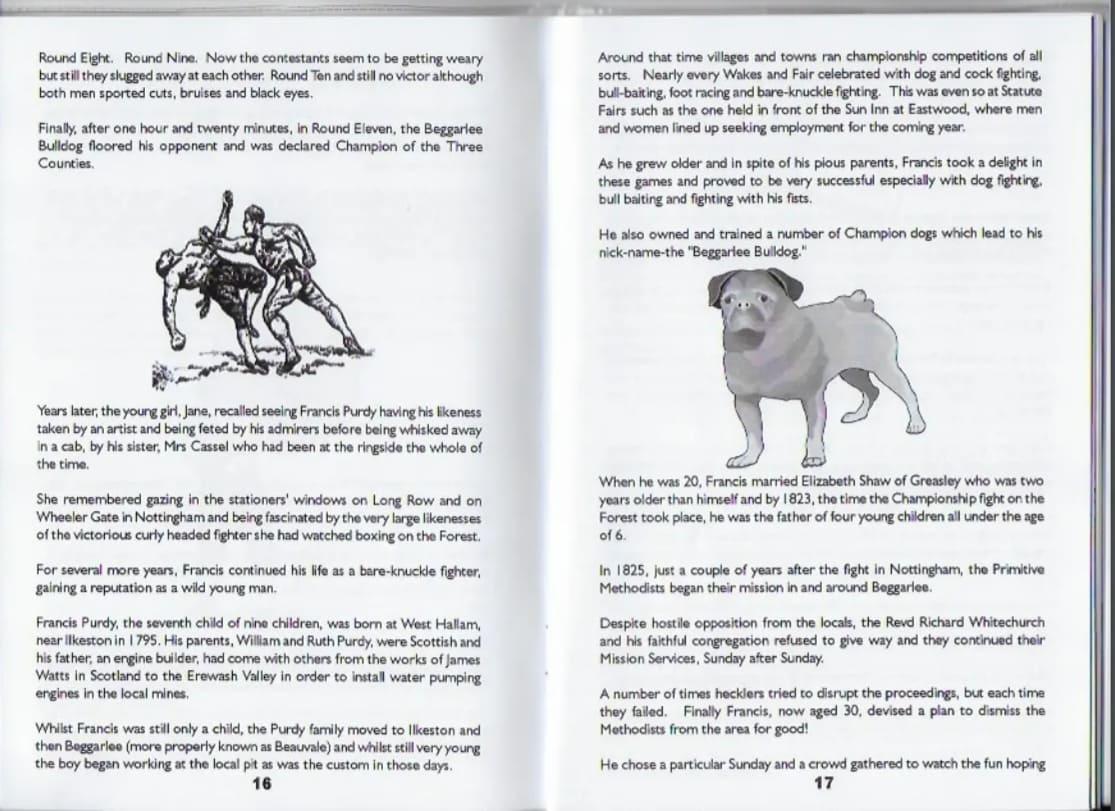
Elizabeth, Francis Purdy’s first wife, died suddenly at chapel in 1836, leaving nine children.
On Christmas day the following year Francis married Jane Eaton at St Peters church in Nottingham. Jane married a Methodist Minister, and didn’t realize she married the bare knuckle fighter she’d seen when she was fourteen until he undressed and she saw his scars.
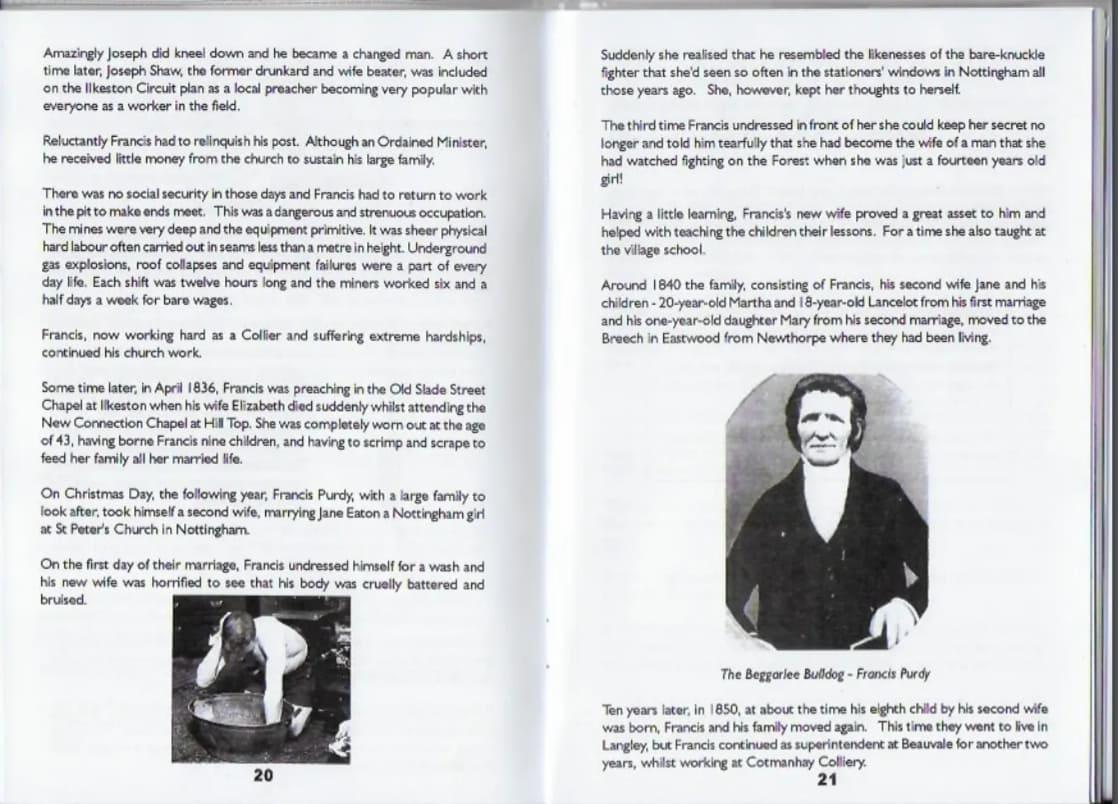
William Eaton 1767-1851
On the marriage certificate Jane’s father was William Eaton, occupation gardener. Francis’s father was William Purdy, engineer.
On the 1841 census living in Sollory’s Yard, Nottingham St Mary, William Eaton was a 70 year old gardener. It doesn’t say which county he was born in but indicates that it was not Nottinghamshire. Living with him were Mary Eaton, milliner, age 35, Mary Eaton, milliner, 15, and Elizabeth Rhodes age 35, a sempstress (another word for seamstress). The three women were born in Nottinghamshire.
But who was Elizabeth Rhodes?
Elizabeth Eaton was Jane’s older sister, born in 1797 in Nottingham. She married William Rhodes, a private in the 5th Dragoon Guards, in Leeds in October 1815.
I looked for Elizabeth Rhodes on the 1851 census, which stated that she was a widow. I was also trying to determine which William Eaton death was the right one, and found William Eaton was still living with Elizabeth in 1851 at Pilcher Gate in Nottingham, but his name had been entered backwards: Eaton William. I would not have found him on the 1851 census had I searched for Eaton as a last name.
Pilcher Gate gets its strange name from pilchers or fur dealers and was once a very narrow thoroughfare. At the lower end stood a pub called The Windmill – frequented by the notorious robber and murderer Charlie Peace.
This was a lucky find indeed, because William’s place of birth was listed as Grantham, Lincolnshire. There were a couple of other William Eaton’s born at the same time, both near to Nottingham. It was tricky to work out which was the right one, but as it turned out, neither of them were.
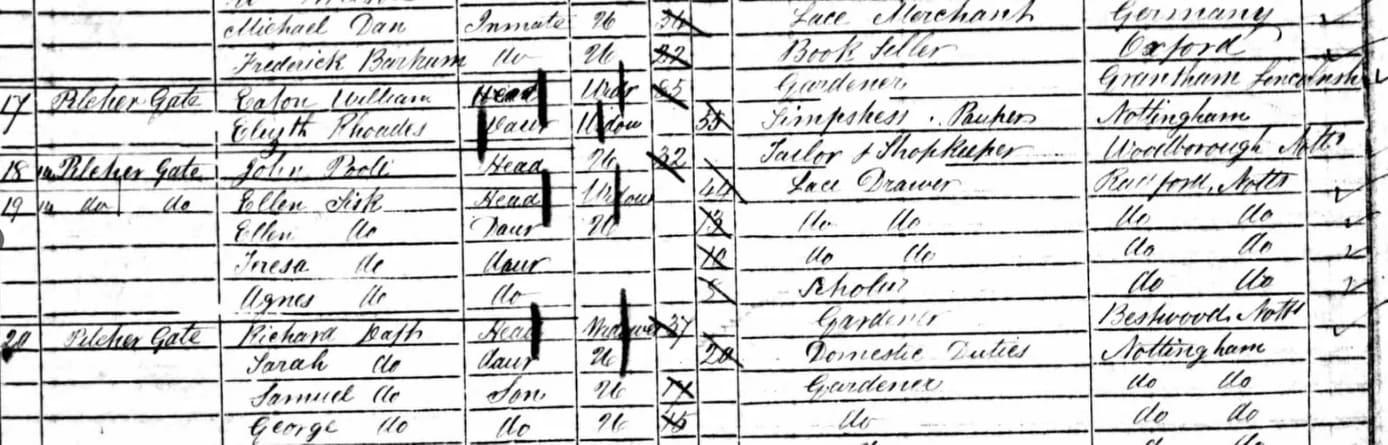
Now we had Nottinghamshire and Lincolnshire border straddlers, so the search moved to the Lincolnshire records.
But first, what of the two Mary Eatons living with William?William and his wife Mary had a daughter Mary in 1799 who died in 1801, and another daughter Mary Ann born in 1803. (It was common to name children after a previous infant who had died.) It seems that Mary Ann didn’t marry but had a daughter Mary Eaton born in 1822.
William and his wife Mary also had a son Richard Eaton born in 1801 in Nottingham.
Who was William Eaton’s wife Mary?
There are two possibilities: Mary Cresswell and a marriage in Nottingham in 1797, or Mary Dewey and a marriage at Grantham in 1795. If it’s Mary Cresswell, the first child Elizabeth would have been born just four or five months after the wedding. (This was far from unusual). However, no births in Grantham, or in Nottingham, were recorded for William and Mary in between 1795 and 1797.
We don’t know why William moved from Grantham to Nottingham or when he moved there. According to Dearden’s 1834 Nottingham directory, William Eaton was a “Gardener and Seedsman”.
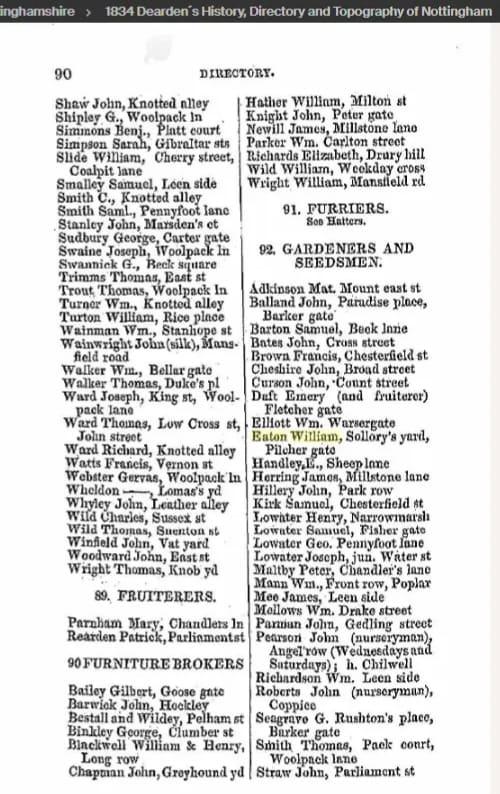
There was another William Eaton selling turnip seeds in the same part of Nottingham. At first I thought it must be the same William, but apparently not, as that William Eaton is recorded as a victualler, born in Ruddington. The turnip seeds were advertised in 1847 as being obtainable from William Eaton at the Reindeer Inn, Wheeler Gate. Perhaps he was related.
William lived in the Lace Market part of Nottingham. I wondered where a gardener would be working in that part of the city. According to CreativeQuarter website, “in addition to the trades and housing (sometimes under the same roof), there were a number of splendid mansions being built with extensive gardens and orchards. Sadly, these no longer exist as they were gradually demolished to make way for commerce…..The area around St Mary’s continued to develop as an elegant residential district during the seventeenth and eighteenth centuries, with buildings … being built for nobility and rich merchants.”
William Eaton died in Nottingham in September 1851, thankfully after the census was taken recording his place of birth.
April 2, 2022 at 6:15 pm #6286In reply to: The Elusive Samuel Housley and Other Family Stories
Matthew Orgill and His Family
Matthew Orgill 1828-1907 was the Orgill brother who went to Australia, but returned to Measham. Matthew married Mary Orgill in Measham in October 1856, having returned from Victoria, Australia in May of that year.
Although Matthew was the first Orgill brother to go to Australia, he was the last one I found, and that was somewhat by accident, while perusing “Orgill” and “Measham” in a newspaper archives search. I chanced on Matthew’s obituary in the Nuneaton Observer, Friday 14 June 1907:
LATE MATTHEW ORGILL PEACEFUL END TO A BLAMELESS LIFE.
‘Sunset and Evening Star And one clear call for me.”
It is with very deep regret that we have to announce the death of Mr. Matthew Orgill, late of Measham, who passed peacefully away at his residence in Manor Court Road, Nuneaton, in the early hours of yesterday morning. Mr. Orgill, who was in his eightieth year, was a man with a striking history, and was a very fine specimen of our best English manhood. In early life be emigrated to South Africa—sailing in the “Hebrides” on 4th February. 1850—and was one of the first settlers at the Cape; afterwards he went on to Australia at the time of the Gold Rush, and ultimately came home to his native England and settled down in Measham, in Leicestershire, where he carried on a successful business for the long period of half-a-century.
He was full of reminiscences of life in the Colonies in the early days, and an hour or two in his company was an education itself. On the occasion of the recall of Sir Harry Smith from the Governorship of Natal (for refusing to be a party to the slaying of the wives and children in connection with the Kaffir War), Mr. Orgill was appointed to superintend the arrangements for the farewell demonstration. It was one of his boasts that he made the first missionary cart used in South Africa, which is in use to this day—a monument to the character of his work; while it is an interesting fact to note that among Mr. Orgill’s papers there is the original ground-plan of the city of Durban before a single house was built.
In Africa Mr. Orgill came in contact with the great missionary, David Livingstone, and between the two men there was a striking resemblance in character and a deep and lasting friendship. Mr. Orgill could give a most graphic description of the wreck of the “Birkenhead,” having been in the vicinity at the time when the ill-fated vessel went down. He played a most prominent part on the occasion of the famous wreck of the emigrant ship, “Minerva.” when, in conjunction with some half-a-dozen others, and at the eminent risk of their own lives, they rescued more than 100 of the unfortunate passengers. He was afterwards presented with an interesting relic as a memento of that thrilling experience, being a copper bolt from the vessel on which was inscribed the following words: “Relic of the ship Minerva, wrecked off Bluff Point, Port Natal. 8.A.. about 2 a.m.. Friday, July 5, 1850.”
Mr. Orgill was followed to the Colonies by no fewer than six of his brothers, all of whom did well, and one of whom married a niece (brother’s daughter) of the late Mr. William Ewart Gladstone.
On settling down in Measham his kindly and considerate disposition soon won for him a unique place in the hearts of all the people, by whom he was greatly beloved. He was a man of sterling worth and integrity. Upright and honourable in all his dealings, he led a Christian life that was a pattern to all with whom he came in contact, and of him it could truly he said that he wore the white flower of a blameless life.
He was a member of the Baptist Church, and although beyond much active service since settling down in Nuneaton less than two years ago he leaves behind him a record in Christian service attained by few. In politics he was a Radical of the old school. A great reader, he studied all the questions of the day, and could back up every belief he held by sound and fearless argument. The South African – war was a great grief to him. He knew the Boers from personal experience, and although he suffered at the time of the war for his outspoken condemnation, he had the satisfaction of living to see the people of England fully recognising their awful blunder. To give anything like an adequate idea of Mr. Orgill’s history would take up a great amount of space, and besides much of it has been written and commented on before; suffice it to say that it was strenuous, interesting, and eventful, and yet all through his hands remained unspotted and his heart was pure.
He is survived by three daughters, and was father-in-law to Mr. J. S. Massey. St Kilda. Manor Court Road, to whom deep and loving sympathy is extended in their sore bereavement by a wide circle of friends. The funeral is arranged to leave for Measham on Monday at twelve noon.
“To give anything like an adequate idea of Mr. Orgill’s history would take up a great amount of space, and besides much of it has been written and commented on before…”
I had another look in the newspaper archives and found a number of articles mentioning him, including an intriguing excerpt in an article about local history published in the Burton Observer and Chronicle 8 August 1963:
on an upstairs window pane he scratched with his diamond ring “Matthew Orgill, 1st July, 1858”
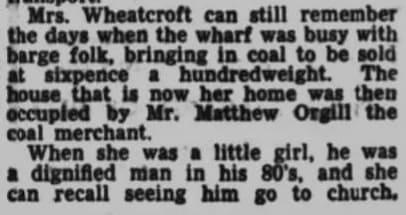
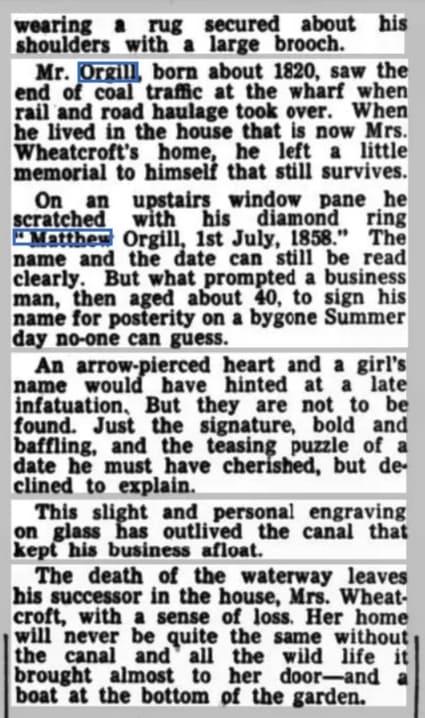
I asked on a Measham facebook group if anyone knew the location of the house mentioned in the article and someone kindly responded. This is the same building, seen from either side:
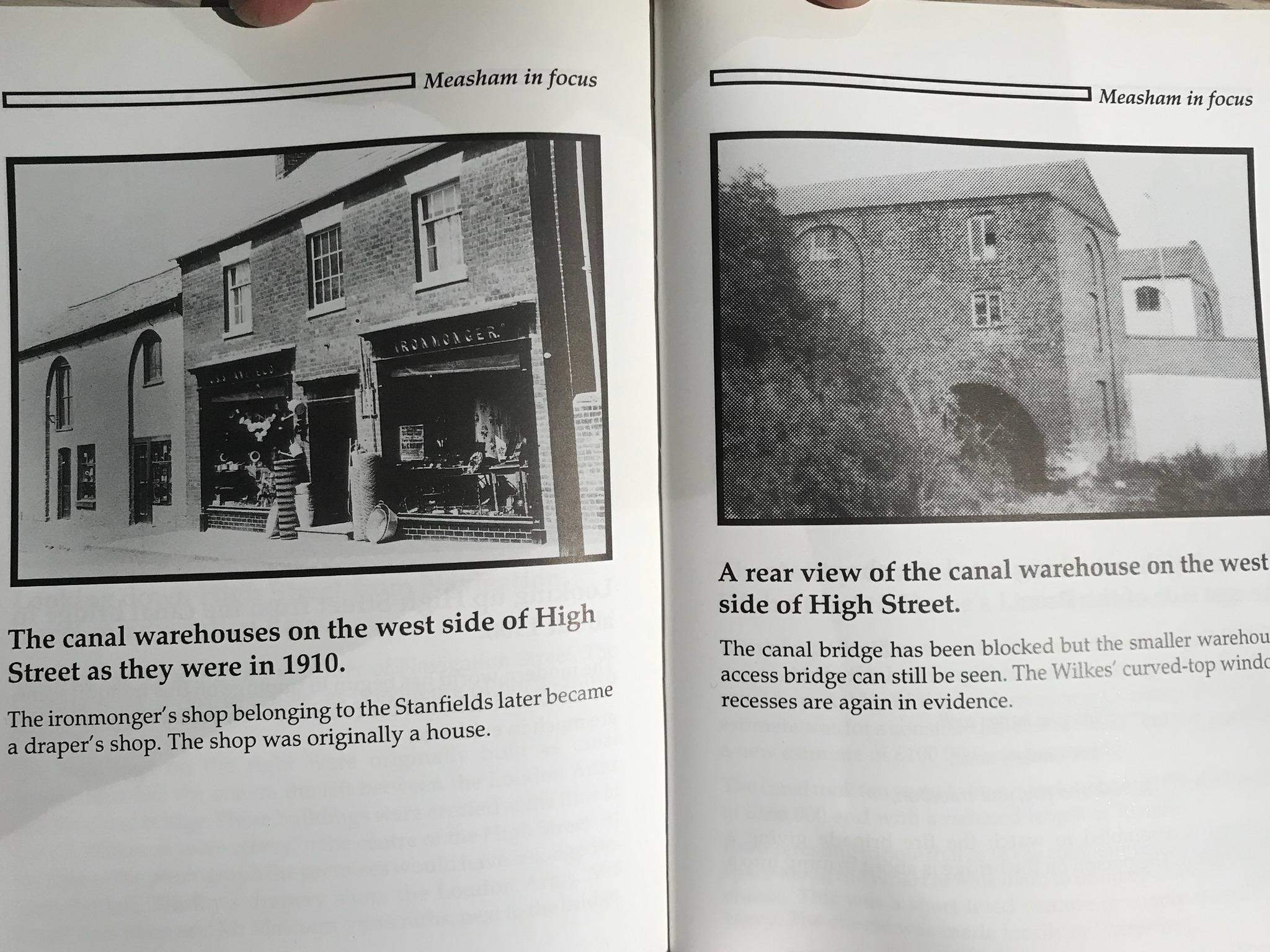
Coincidentally, I had already found this wonderful photograph of the same building, taken in 1910 ~ three years after Matthew’s death.
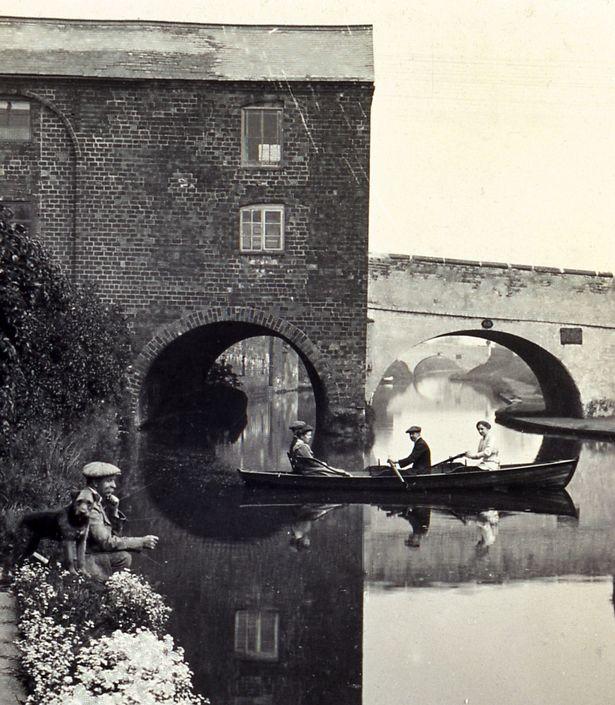
But what to make of the inscription in the window?
Matthew and Mary married in October 1856, and their first child (according to the records I’d found thus far) was a daughter Mary born in 1860. I had a look for a Matthew Orgill birth registered in 1858, the date Matthew had etched on the window, and found a death for a Matthew Orgill in 1859. Assuming I would find the birth of Matthew Orgill registered on the first of July 1958, to match the etching in the window, the corresponding birth was in July 1857!
Matthew and Mary had four children. Matthew, Mary, Clara and Hannah. Hannah Proudman Orgill married Joseph Stanton Massey. The Orgill name continues with their son Stanley Orgill Massey 1900-1979, who was a doctor and surgeon. Two of Stanley’s four sons were doctors, Paul Mackintosh Orgill Massey 1929-2009, and Michael Joseph Orgill Massey 1932-1989.
Mary Orgill 1827-1894, Matthews wife, was an Orgill too.
And this is where the Orgill branch of the tree gets complicated.
Mary’s father was Henry Orgill born in 1805 and her mother was Hannah Proudman born in 1805.
Henry Orgill’s father was Matthew Orgill born in 1769 and his mother was Frances Finch born in 1771.Mary’s husband Matthews parents are Matthew Orgill born in 1798 and Elizabeth Orgill born in 1803.
Another Orgill Orgill marriage!
Matthews parents, Matthew and Elizabeth, have the same grandparents as each other, Matthew Orgill born in 1736 and Ann Proudman born in 1735.
But Matthews grandparents are none other than Matthew Orgill born in 1769 and Frances Finch born in 1771 ~ the same grandparents as his wife Mary!
March 10, 2022 at 7:40 am #6281In reply to: The Elusive Samuel Housley and Other Family Stories
The Measham Thatchers
Orgills, Finches and Wards
Measham is a large village in north west Leicestershire, England, near the Derbyshire, Staffordshire and Warwickshire boundaries. Our family has a penchant for border straddling, and the Orgill’s of Measham take this a step further living on the boundaries of four counties. Historically it was in an exclave of Derbyshire absorbed into Leicestershire in 1897, so once again we have two sets of county records to search.
ORGILL
Richard Gretton, the baker of Swadlincote and my great grandmother Florence Nightingale Grettons’ father, married Sarah Orgill (1840-1910) in 1861.
(Incidentally, Florence Nightingale Warren nee Gretton’s first child Hildred born in 1900 had the middle name Orgill. Florence’s brother John Orgill Gretton emigrated to USA.)
When they first married, they lived with Sarah’s widowed mother Elizabeth in Measham. Elizabeth Orgill is listed on the 1861 census as a farmer of two acres.
Sarah Orgill’s father Matthew Orgill (1798-1859) was a thatcher, as was his father Matthew Orgill (1771-1852).
Matthew Orgill the elder left his property to his son Henry:
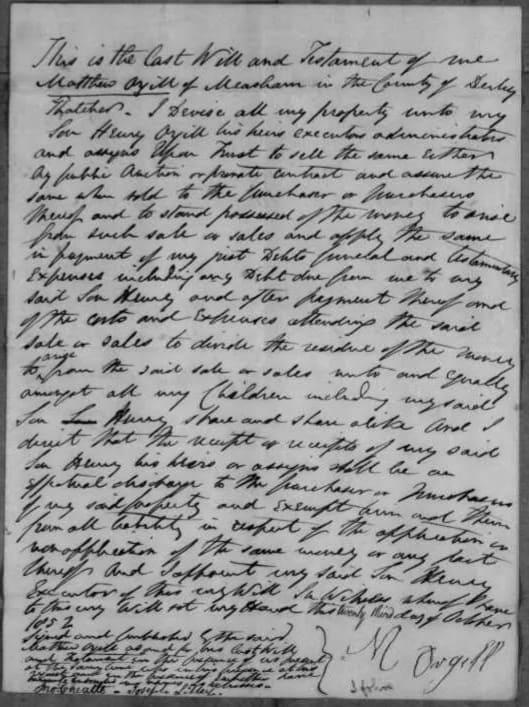
Sarah’s mother Elizabeth (1803-1876) was also an Orgill before her marriage to Matthew.
According to Pigot & Co’s Commercial Directory for Derbyshire, in Measham in 1835 Elizabeth Orgill was a straw bonnet maker, an ideal occupation for a thatchers wife.
Matthew Orgill, thatcher, is listed in White’s directory in 1857, and other Orgill’s are mentioned in Measham:
Mary Orgill, straw hat maker; Henry Orgill, grocer; Daniel Orgill, painter; another Matthew Orgill is a coal merchant and wheelwright. Likewise a number of Orgill’s are listed in the directories for Measham in the subsequent years, as farmers, plumbers, painters, grocers, thatchers, wheelwrights, coal merchants and straw bonnet makers.
Matthew and Elizabeth Orgill, Measham Baptist church:
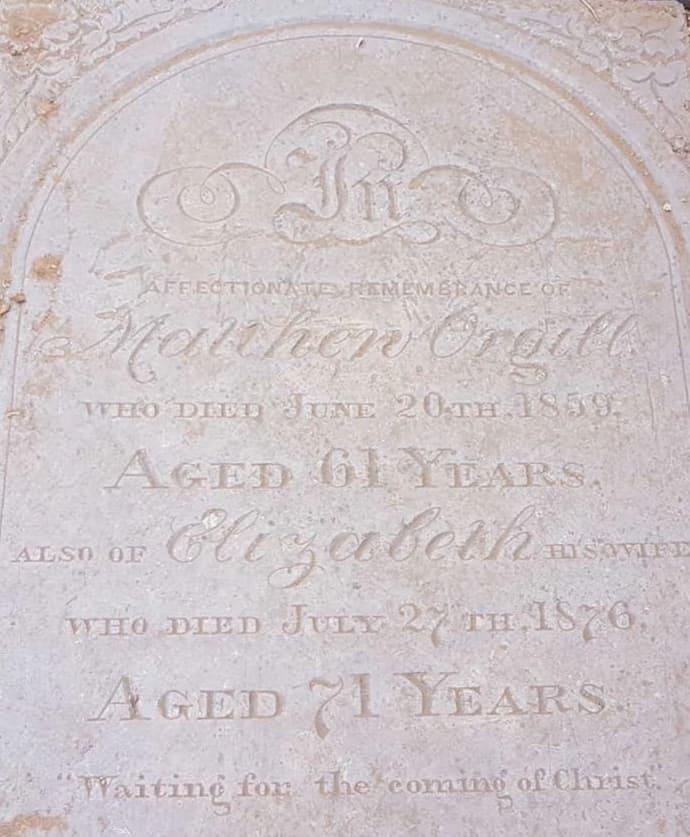
According to a history of thatching, for every six or seven thatchers appearing in the 1851 census there are now less than one. Another interesting fact in the history of thatched roofs (via thatchinginfo dot com):
The Watling Street Divide…
The biggest dividing line of all, that between the angular thatching of the Northern and Eastern traditions and the rounded Southern style, still roughly follows a very ancient line; the northern section of the old Roman road of Watling Street, the modern A5. Seemingly of little significance today; this was once the border between two peoples. Agreed in the peace treaty, between the Saxon King Alfred and Guthrum, the Danish Viking leader; over eleven centuries ago.
After making their peace, various Viking armies settled down, to the north and east of the old road; firstly, in what was known as The Danelaw and later in Norse kingdoms, based in York. They quickly formed a class of farmers and peasants. Although the Saxon kings soon regained this area; these people stayed put. Their influence is still seen, for example, in the widespread use of boarded gable ends, so common in Danish thatching.
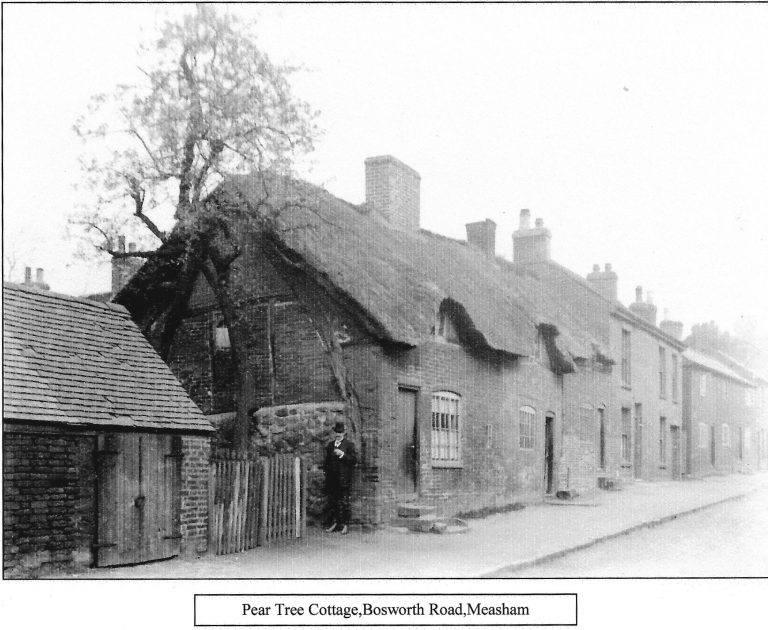
Over time, the Southern and Northern traditions have slipped across the old road, by a few miles either way. But even today, travelling across the old highway will often bring the differing thatching traditions quickly into view.Pear Tree Cottage, Bosworth Road, Measham. 1900. Matthew Orgill was a thatcher living on Bosworth road.
FINCH
Matthew the elder married Frances Finch 1771-1848, also of Measham. On the 1851 census Matthew is an 80 year old thatcher living with his daughter Mary and her husband Samuel Piner, a coal miner.
Henry Finch 1743- and Mary Dennis 1749- , both of Measham, were Frances parents. Henry’s father was also Henry Finch, born in 1707 in Measham, and he married Frances Ward, also born in 1707, and also from Measham.
WARD
The ancient boundary between the kingdom of Mercia and the Danelaw
I didn’t find much information on the history of Measham, but I did find a great deal of ancient history on the nearby village of Appleby Magna, two miles away. The parish records indicate that the Ward and Finch branches of our family date back to the 1500’s in the village, and we can assume that the ancient history of the neighbouring village would be relevant to our history.
There is evidence of human settlement in Appleby from the early Neolithic period, 6,000 years ago, and there are also Iron Age and Bronze Age sites in the vicinity. There is evidence of further activity within the village during the Roman period, including evidence of a villa or farm and a temple. Appleby is near three known Roman roads: Watling Street, 10 miles south of the village; Bath Lane, 5 miles north of the village; and Salt Street, which forms the parish’s south boundary.
But it is the Scandinavian invasions that are particularly intriguing, with regard to my 58% Scandinavian DNA (and virtually 100% Midlands England ancestry). Repton is 13 miles from Measham. In the early 10th century Chilcote, Measham and Willesley were part of the royal Derbyshire estate of Repton.
The arrival of Scandinavian invaders in the second half of the ninth century caused widespread havoc throughout northern England. By the AD 870s the Danish army was occupying Mercia and it spent the winter of 873-74 at Repton, the headquarters of the Mercian kings. The events are recorded in detail in the Peterborough manuscript of the Anglo-Saxon Chronicles…
Although the Danes held power for only 40 years, a strong, even subversive, Danish element remained in the population for many years to come.
A Scandinavian influence may also be detected among the field names of the parish. Although many fields have relatively modern names, some clearly have elements which reach back to the time of Danish incursion and control.
The Borders:
The name ‘aeppel byg’ is given in the will of Wulfic Spot of AD 1004……………..The decision at Domesday to include this land in Derbyshire, as one of Burton Abbey’s Derbyshire manors, resulted in the division of the village of Appleby Magna between the counties of Leicester and Derby for the next 800 years
Richard Dunmore’s Appleby Magma website.
This division of Appleby between Leicestershire and Derbyshire persisted from Domesday until 1897, when the recently created county councils (1889) simplified the administration of many villages in this area by a radical realignment of the boundary:
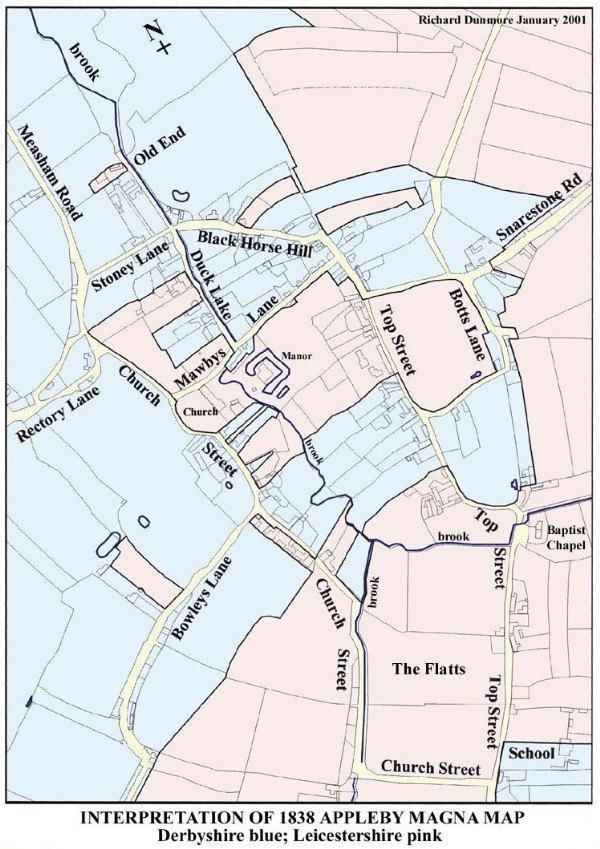
I would appear that our family not only straddle county borders, but straddle ancient kingdom borders as well. This particular branch of the family (we assume, given the absence of written records that far back) were living on the edge of the Danelaw and a strong element of the Danes survives to this day in my DNA.
-
AuthorSearch Results