

Search Results for 'arm'
-
AuthorSearch Results
-
December 25, 2021 at 10:47 am #6248
In reply to: The Elusive Samuel Housley and Other Family Stories
Bakewell Not Eyam
The Elton Marshalls
Some years ago I read a book about Eyam, the Derbyshire village devastated by the plague in 1665, and about how the villagers quarantined themselves to prevent further spread. It was quite a story. Each year on ‘Plague Sunday’, at the end of August, residents of Eyam mark the bubonic plague epidemic that devastated their small rural community in the years 1665–6. They wear the traditional costume of the day and attend a memorial service to remember how half the village sacrificed themselves to avoid spreading the disease further.
My 4X great grandfather James Marshall married Ann Newton in 1792 in Elton. On a number of other people’s trees on an online ancestry site, Ann Newton was from Eyam. Wouldn’t that have been interesting, to find ancestors from Eyam, perhaps going back to the days of the plague. Perhaps that is what the people who put Ann Newton’s birthplace as Eyam thought, without a proper look at the records.
But I didn’t think Ann Newton was from Eyam. I found she was from Over Haddon, near Bakewell ~ much closer to Elton than Eyam. On the marriage register, it says that James was from Elton parish, and she was from Darley parish. Her birth in 1770 says Bakewell, which was the registration district for the villages of Over Haddon and Darley. Her parents were George Newton and Dorothy Wipperley of Over Haddon,which is incidentally very near to Nether Haddon, and Haddon Hall. I visited Haddon Hall many years ago, as well as Chatsworth (and much preferred Haddon Hall).
I looked in the Eyam registers for Ann Newton, and found a couple of them around the time frame, but the men they married were not James Marshall.
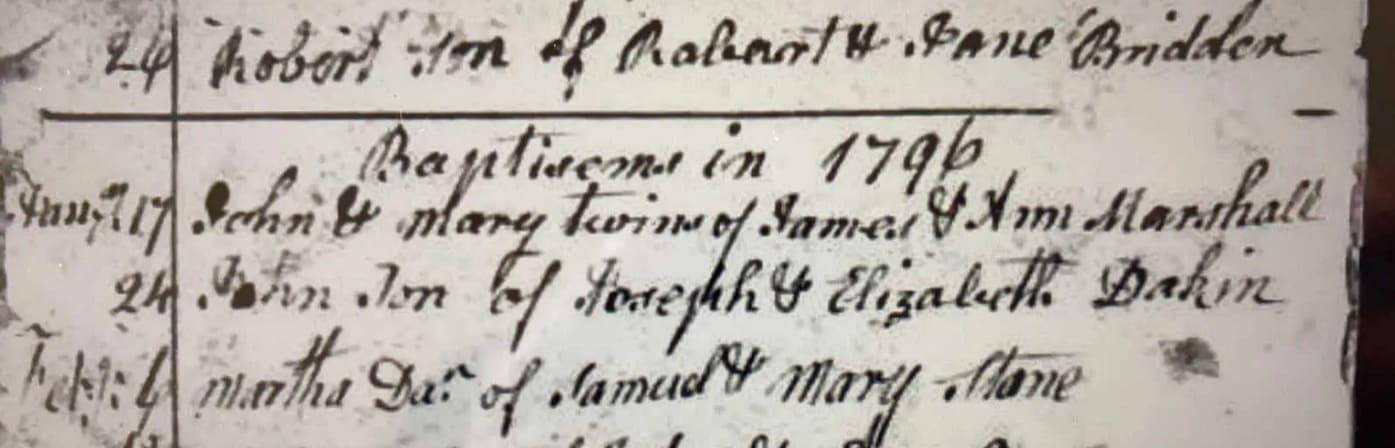
Ann died in 1806 in Elton (a small village just outside Matlock) at the age of 36 within days of her newborn twins, Ann and James. James and Ann had two sets of twins. John and Mary were twins as well, but Mary died in 1799 at the age of three.
1796 baptism of twins John and Mary of James and Ann Marshall
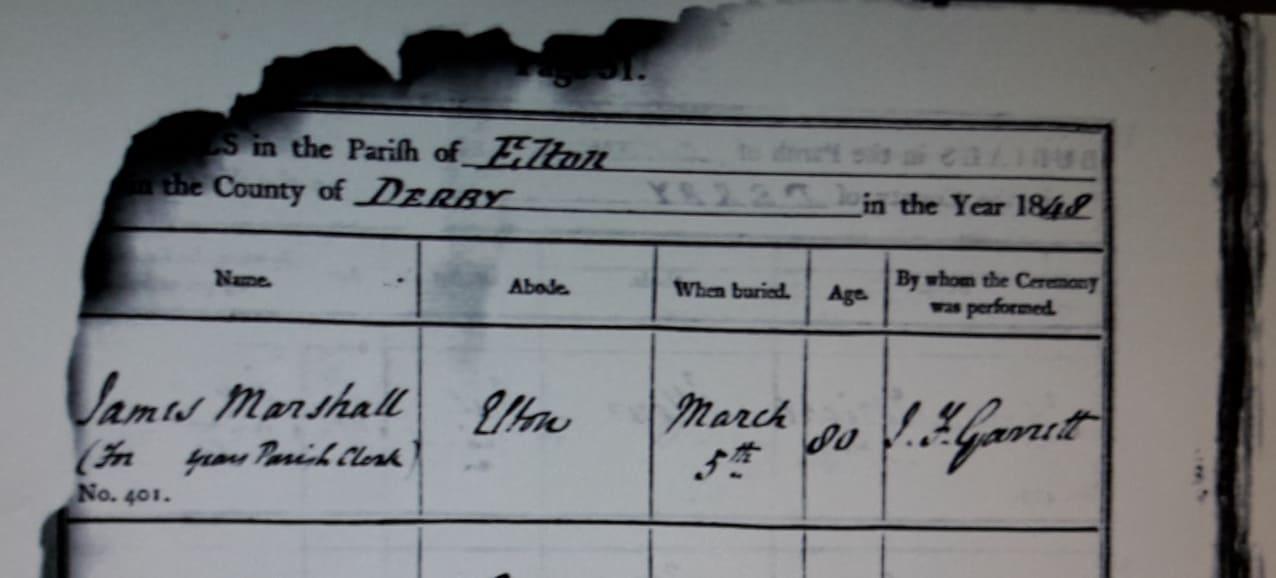
Ann’s husband James died 42 years later at the age of eighty, in Elton in 1848. It was noted in the parish register that he was for years parish clerk.
On the 1851 census John Marshall born in 1796, the son of James Marshall the parish clerk, was a lead miner occupying six acres in Elton, Derbyshire.
His son, also John, was registered on the census as a lead miner at just eight years old.
The mining of lead was the most important industry in the Peak district of Derbyshire from Roman times until the 19th century – with only agriculture being more important for the livelihood of local people. The height of lead mining in Derbyshire came in the 17th and 18th centuries, and the evidence is still visible today – most obviously in the form of lines of hillocks from the more than 25,000 mineshafts which once existed.
Peak District Mines Historical Society
Smelting, or extracting the lead from the ore by melting it, was carried out in a small open hearth. Lead was cast in layers as each batch of ore was smelted; the blocks of lead thus produced were referred to as “pigs”. Examples of early smelting-hearths found within the county were stone lined, with one side open facing the prevailing wind to create the draught needed. The hilltops of the Matlocks would have provided very suitable conditions.
The miner used a tool called a mattock or a pick, and hammers and iron wedges in harder veins, to loosen the ore. They threw the ore onto ridges on each side of the vein, going deeper where the ore proved richer.
Many mines were very shallow and, once opened, proved too poor to develop. Benjamin Bryan cited the example of “Ember Hill, on the shoulder of Masson, above Matlock Bath” where there are hollows in the surface showing where there had been fruitless searches for lead.
There were small buildings, called “coes”, near each mine shaft which were used for tool storage, to provide shelter and as places for changing into working clothes. It was here that the lead was smelted and stored until ready for sale.
Lead is, of course, very poisonous. As miners washed lead-bearing material, great care was taken with the washing vats, which had to be covered. If cattle accidentally drank the poisoned water they would die from something called “belland”.
Cornish and Welsh miners introduced the practice of buddling for ore into Derbyshire about 1747. Buddling involved washing the heaps of rubbish in the slag heaps, the process of separating the very small particles from the dirt and spar with which they are mixed, by means of a small stream of water. This method of extraction was a major pollutant, affecting farmers and their animals (poisoned by Belland from drinking the waste water), the brooks and streams and even the River Derwent.
Women also worked in the mines. An unattributed account from 1829, says: “The head is much enwrapped, and the features nearly hidden in a muffling of handkerchiefs, over which is put a man’s hat, in the manner of the paysannes of Wales”. He also describes their gowns, usually red, as being “tucked up round the waist in a sort of bag, and set off by a bright green petticoat”. They also wore a man’s grey or dark blue coat and shoes with 3″ thick soles that were tied round with cords. The 1829 writer called them “complete harridans!”
Lead Mining in Matlock & Matlock Bath, The Andrews Pages
John’s wife Margaret died at the age of 42 in 1847. I don’t know the cause of death, but perhaps it was lead poisoning. John’s son John, despite a very early start in the lead mine, became a carter and lived to the ripe old age of 88.
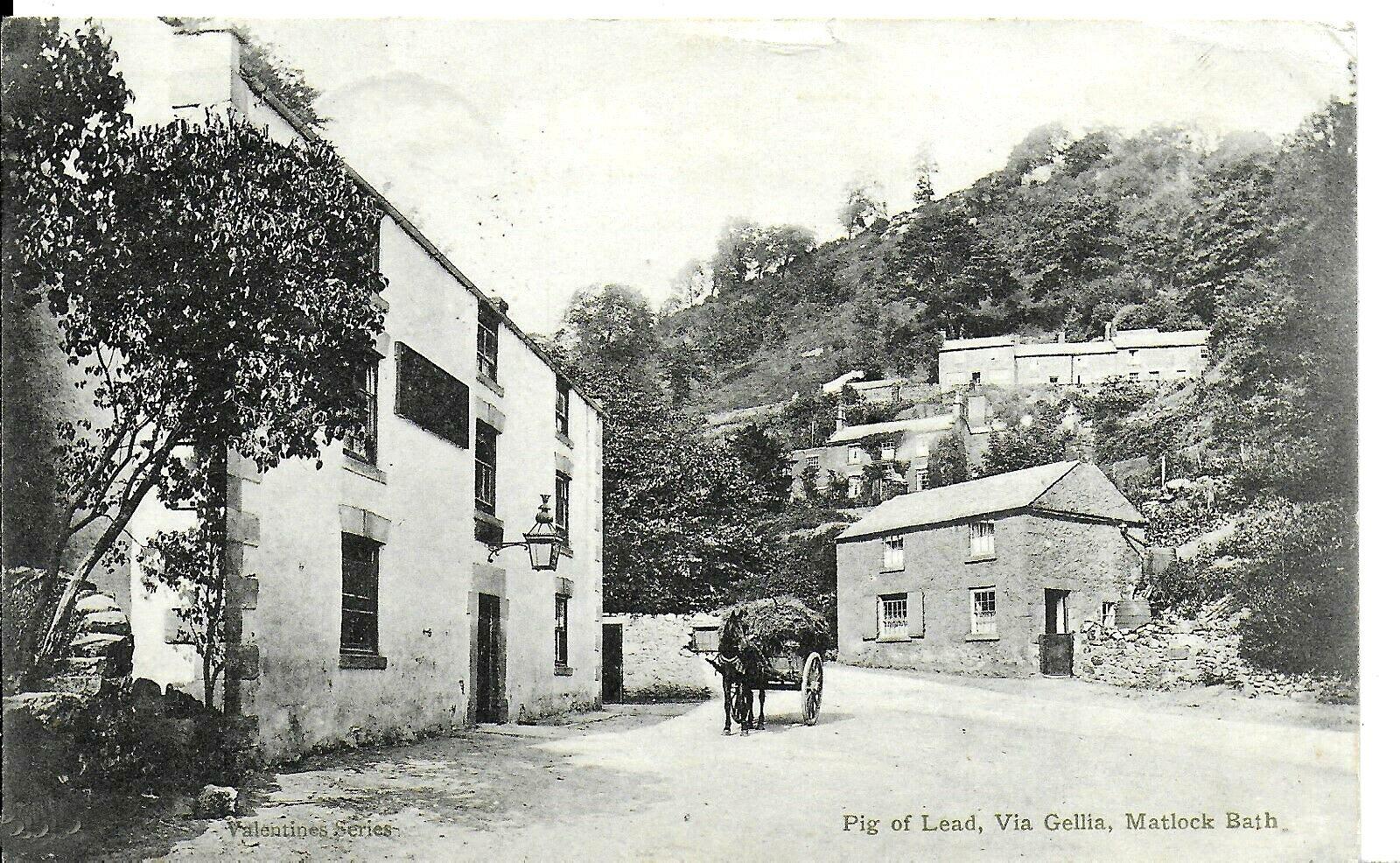
The Pig of Lead pub, 1904:
The earliest Marshall I’ve found so far is Charles, born in 1742. Charles married Rebecca Knowles, 1775-1823. I don’t know what his occupation was but when he died in 1819 he left a not inconsiderable sum to his wife.
1819 Charles Marshall probate:
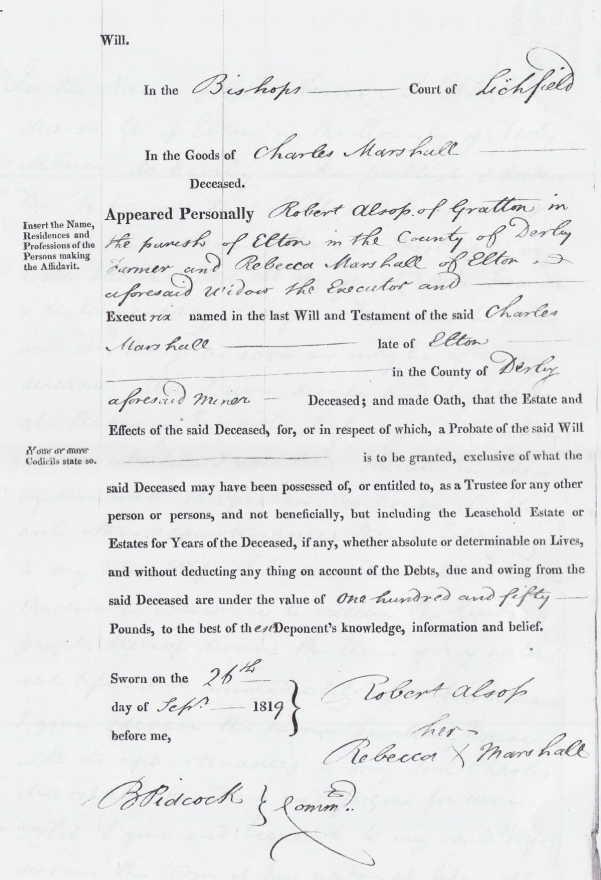
There are still Marshall’s living in Elton and Matlock, not our immediate known family, but probably distantly related. I asked a Matlock group on facebook:
“…there are Marshall’s still in the village. There are certainly families who live here who have done generation after generation & have many memories & stories to tell. Visit The Duke on a Friday night…”
The Duke, Elton:
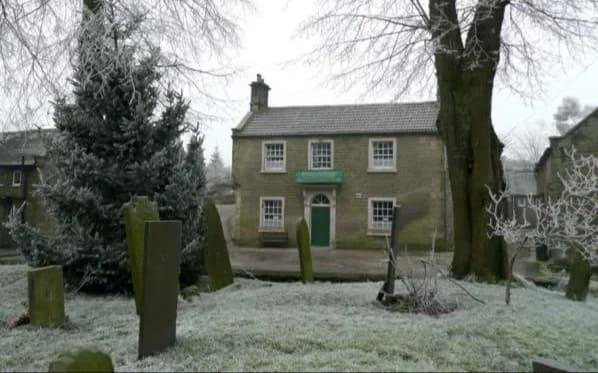 December 18, 2021 at 7:05 pm #6246
In reply to: The Elusive Samuel Housley and Other Family Stories
Florence Nightingale Gretton
1881-1927
Florence’s father was Richard Gretton, a baker in Swadlincote, Derbyshire. When Richard married Sarah Orgill in 1861, they lived with her mother, a widow, in Measham, Ashby de la Zouch in Leicestershire. On the 1861 census Sarah’s mother, Elizabeth, is a farmer of two acres.
(Swadlincote and Ashby de la Zouch are on the Derbyshire Leicestershire border and not far from each other. Swadlincote is near to Burton upon Trent which is sometimes in Staffordshire, sometimes in Derbyshire. Newhall, Church Gresley, and Swadlincote are all very close to each other or districts in the same town.)
Ten years later in 1871 Richard and Sarah have their own place in Swadlincote, he is a baker, and they have four children. A fourteen year old apprentice or servant is living with them.
In the Ashby-de-la-Zouch Gazette on 28 February 1880, it was reported that Richard Gretton, baker, of Swadlincote, was charged by Captain Bandys with carrying bread in a cart for sale, the said cart not being provided with scales and weights, according to the requirements of the Act, on the 17th January last.—Defendant pleaded guilty, but urged in extenuation of the offence that in the hurry he had forgotten to put the scales in the cart before his son started.—The Bench took this view of the case, regarding it as an oversight, and fined him one shilling only and costs. This was not his only offence.
In 1883, he was fined twenty shillings, and ten shillings and sixpence costs.
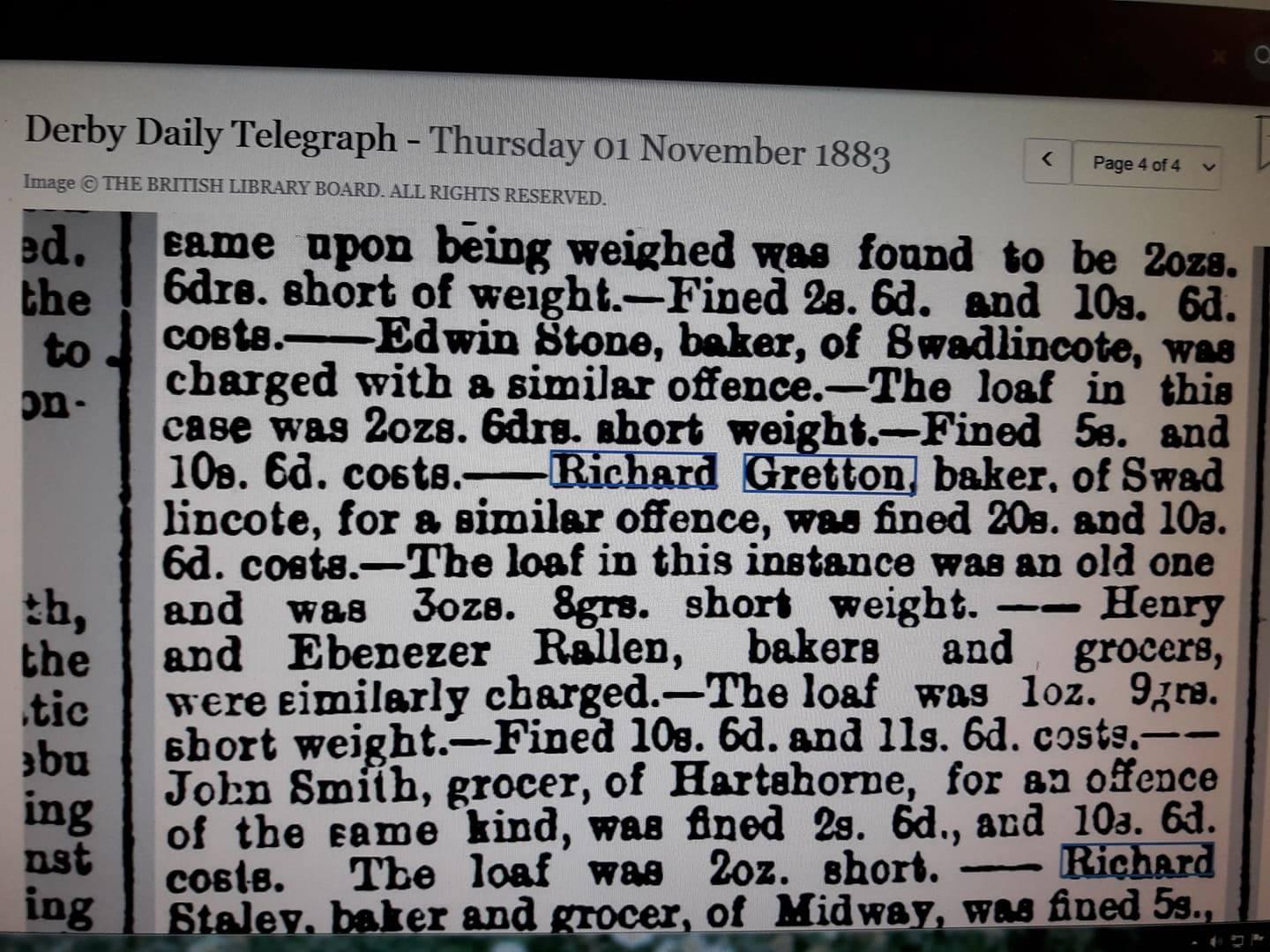
By 1881 they have 4 more children, and Florence Nightingale is the youngest at four months. Richard is 48 by now, and Sarah is 44. Florence’s older brother William is a blacksmith.
Interestingly on the same census page, two doors down Thomas and Selina Warren live at the Stanhope Arms. Richards son John Gretton lives at the pub, a 13 year old servant. Incidentally, I noticed on Thomas and Selena’s marriage register that Richard and Sarah Gretton were the witnesses at the wedding.
Ten years later in 1891, Florence Nightingale and her sister Clara are living with Selina Warren, widow, retired innkeeper, one door down from the Stanhope Arms. Florence is ten, Clara twelve and they are scholars.
Richard and Sarah are still living three doors up on the other side of the Stanhope Arms, with three of their sons. But the two girls lived up the road with the Warren widow!The Stanhope Arms, Swadlincote: it’s possible that the shop with the awning was Richard Gretton’s bakers shop (although not at the time of this later photo).
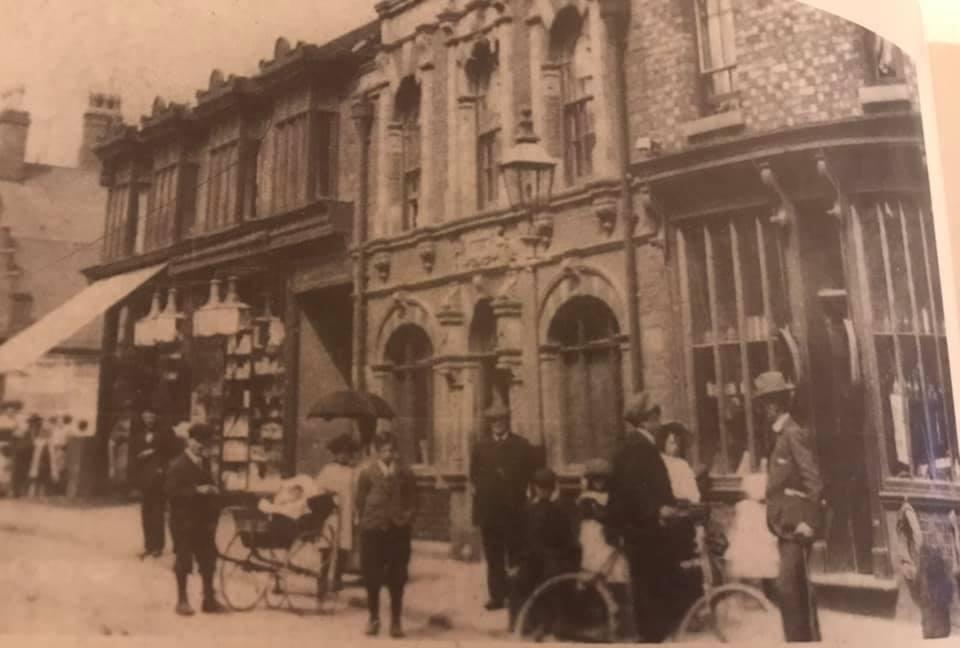
Richard died in 1898, a year before Florence married Samuel Warren.
Sarah is a widowed 60 year old baker on the 1901 census. Her son 26 year old son Alf, also a baker, lives at the same address, as does her 22 year old daughter Clara who is a district nurse.
Clara Gretton and family, photo found online:
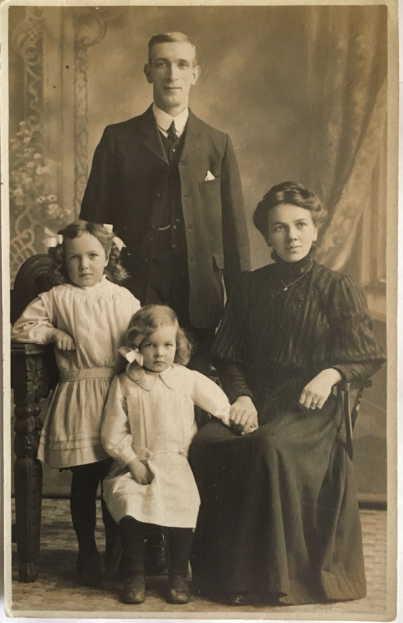
In 1901 Florence Nightingale (who we don’t have a photograph of!) is now married and is Florrie Warren on the census, and she, her husband Samuel, and their one year old daughter Hildred are visitors at the address of Elizabeth (Staley)Warren, 60 year old widow and Samuel’s mother, and Samuel’s 36 year old brother William. Samuel and William are engineers.
Samuel and Florrie had ten children between 1900 and 1925 (and all but two of them used their middle name and not first name: my mother and I had no idea until I found all the records. My grandmother Florence Noreen was known as Nora, which we knew of course, uncle Jack was actually Douglas John, and so on).
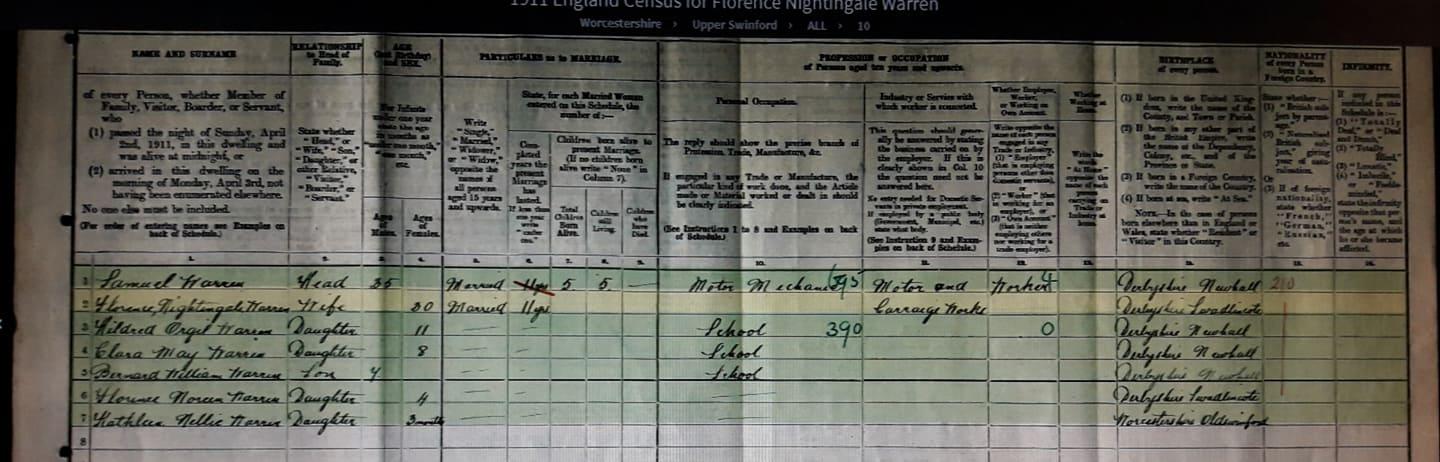
Hildred, Clara, Billy, and Nora were born in Swadlincote. Sometime between my grandmother’s birth in 1907 and Kay’s birth in 1911, the family moved to Oldswinford, in Stourbridge. Later they moved to Market Street.
1911 census, Oldswinford, Stourbridge:
Oddly, nobody knew when Florrie Warren died. My mothers cousin Ian Warren researched the Warren family some years ago, while my grandmother was still alive. She contributed family stories and information, but couldn’t remember if her mother died in 1929 or 1927. A recent search of records confirmed that it was the 12th November 1927.
She was 46 years old. We were curious to know how she died, so my mother ordered a paper copy of her death certificate. It said she died at 31 Market Street, Stourbridge at the age of 47. Clara May Warren, her daughter, was in attendance. Her husband Samuel Warren was a motor mechanic. The Post mortem was by Percival Evans, coroner for Worcestershire, who clarified the cause of death as vascular disease of the heart. There was no inquest. The death was registered on 15 Nov 1927.
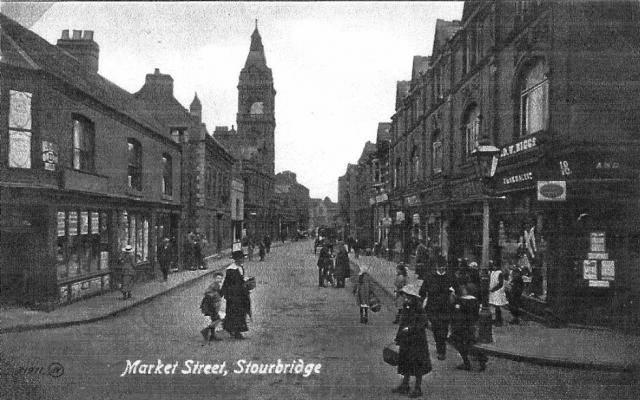
I looked for a photo of 31 Market Street in Stourbridge, and was astonished to see that it was the house next door to one I lived in breifly in the 1980s. We didn’t know that the Warren’s lived in Market Street until we started searching the records.
Market Street, Stourbridge. I lived in the one on the corner on the far right, my great grandmother died in the one next door.
I found some hitherto unknown emigrants in the family. Florence Nightingale Grettons eldest brother William 1861-1940 stayed in Swadlincote. John Orgill Gretton born in 1868 moved to Trenton New Jersey USA in 1888, married in 1892 and died in 1949 in USA. Michael Thomas born in 1870 married in New York in 1893 and died in Trenton in 1940. Alfred born 1875 stayed in Swadlincote. Charles Herbert born 1876 married locally and then moved to Australia in 1912, and died in Victoria in 1954. Clara Elizabeth was a district nurse, married locally and died at the age of 99.
December 17, 2021 at 10:36 am #6241In reply to: The Elusive Samuel Housley and Other Family Stories
Kidsley Grange Farm and The Quakers Next Door
Kidsley Grange Farm in Smalley, Derbyshire, was the home of the Housleys in the 1800s. William Housley 1781-1848 was born in nearby Selston. His wife Ellen Carrington 1795-1872 was from a long line of Carringtons in Smalley. They had ten children between 1815 and 1838. Samuel, my 3x great grandfather, was the second son born in 1816.
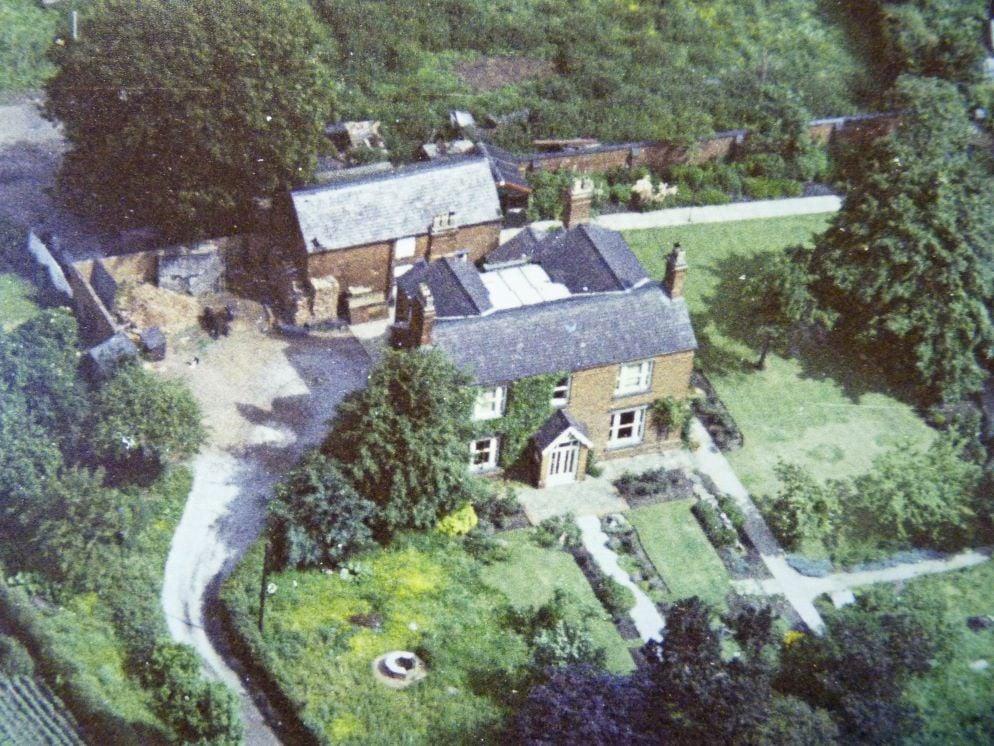
The original farm has been made into a nursing home in recent years, which at the time of writing is up for sale at £500,000. Sadly none of the original farm appears visible with all the new additions.
The farm before it was turned into a nursing home:
Kidsley Grange Farm and Kidsley Park, a neighbouring farm, are mentioned in a little book about the history of Smalley. The neighbours at Kidsley Park, the Davy’s, were friends of the Housleys. They were Quakers.
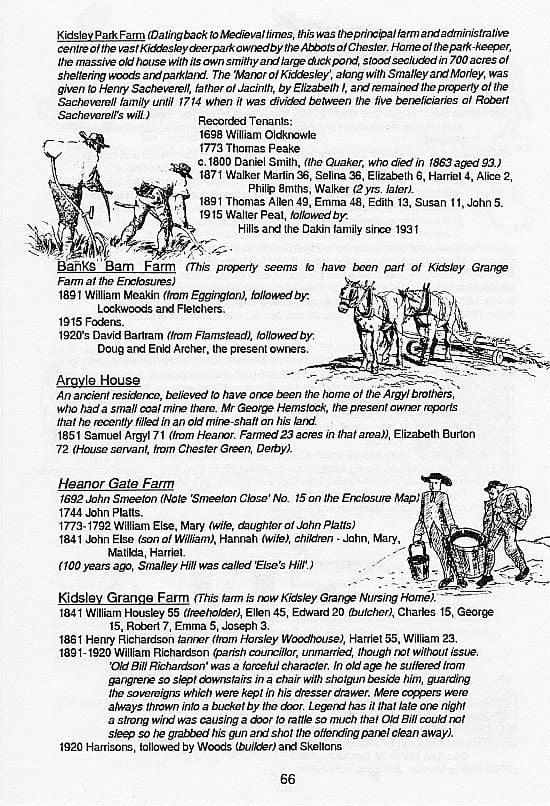
In Kerry’s History of Smalley:
Kidsley Park Farm was owned by Daniel Smith, a prominent Quaker and the last of the Quakers at Kidsley. His daughter, Elizabeth Davy, widow of William Davis, married WH Barber MB of Smalley. Elizabeth was the author of the poem “Farewell to Kidsley Park”.
Emma Housley sent one of Elizabeth Davy’s poems to her brother George in USA.
“We have sent you a piece of poetry that Mrs. Davy composed about our ‘Old House.’ I am sure you will like it though you may not understand all the allusions she makes use of as well as we do.”
Farewell to Kidsley Park
Farewell, Farewell, Thy pathways now by strangers feet are trod,
And other hands and horses strange henceforth shall turn thy sod,
Yes, other eyes may watch the buds expanding in the spring.
And other children round the hearth the coming years may bring,
But mine will be the memory of cares and pleasures there,
Intenser ~ that no living thing in some of them can share,
Commencing with the loved, and lost, in days of long ago,
When one was present on whose head Atlantic’s breezes blow,
Long years ago he left that roof, and made a home afar ~
For that is really only “home” where life’s affections are!
How many thoughts come o’er me, for old Kidsley has “a name
And memory” ~ in the hearts of some not unknown to fame.
We dream not, in those happy times, that I should be the last,
Alone, to leave my native place ~ alone, to meet the blast,
I loved each nook and corner there, each leaf and blade of grass,
Each moonlight shadow on the pond I loved: but let it pass,
For mine is still the memory that only death can mar;
I fancy I shall see it reflecting every star.
The graves of buried quadrupeds, affectionate and true,
Will have the olden sunshine, and the same bright morning dew,
But the birds that sang at even when the autumn leaves were seer,
Will miss the crumbs they used to get, in winters long and drear.
Will the poor down-trodden miss me? God help them if they do!
Some manna in the wilderness, His goodness guide them to!
Farewell to those who love me! I shall bear them still in mind,
And hope to be remembered by those I left behind:
Do not forget the aged man ~ though another fills his place ~
Another, bearing not his name, nor coming of his race.
His creed might be peculiar; but there was much of good
Successors will not imitate, because not understood.
Two hundred years have come and past since George Fox ~ first of “Friends” ~
Established his religion there ~ which my departure ends.
Then be it so: God prosper these in basket and in store,
And make them happy in my place ~ my dwelling, never more!
For I may be a wanderer ~ no roof nor hearthstone mine:
May light that cometh from above my resting place define.
Gloom hovers o’er the prospect now, but He who was my friend,
In the midst of troubled waters, will see me to the end.Elizabeth Davy, June 6th, 1863, Derby.
Another excerpt from Barbara Housley’s Narrative on the Letters from the family in Smalley to George in USA mentions the Davy’s:
Anne’s will was probated October 14, 1856. Mr. William Davy of Kidsley Park appeared for the family. Her estate was valued at under £20. Emma was to receive fancy needlework, a four post bedstead, feather bed and bedding, a mahogany chest of drawers, plates, linen and china. Emma was also to receive Anne’s writing desk! There was a condition that Ellen would have use of these items until her death.
The money that Anne was to receive from her grandfather, William Carrington, and her father, William Housley was to be distributed one third to Joseph, one third to Emma, and one third to be divided between her four neices: John’s daughter Elizabeth, 18, and Sam’s daughters Elizabeth, 10, Mary Anne, 9 and Catherine, age 7 to be paid by the trustees as they think “most useful and proper.” Emma Lyon and Elizabeth Davy were the witnesses.Mrs. Davy wrote to George on March 21 1856 sending some gifts from his sisters and a portrait of their mother–“Emma is away yet and A is so much worse.” Mrs. Davy concluded: “With best wishes
for thy health and prosperity in this world and the next I am thy sincere friend.” Whenever the girls sent greetings from Mrs. Davy they used her Quaker speech pattern of “thee and thy.”December 16, 2021 at 1:51 pm #6240In reply to: The Elusive Samuel Housley and Other Family Stories
Phyllis Ellen Marshall
1909 – 1983
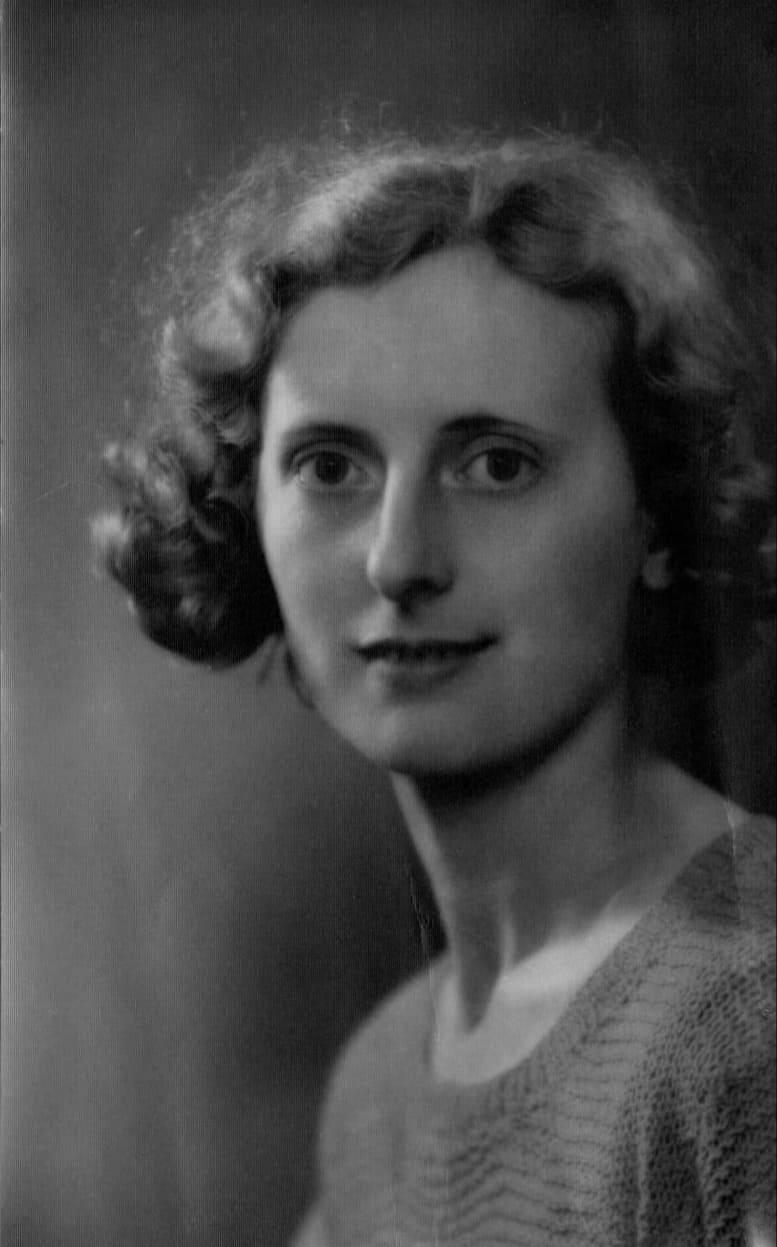
Phyllis, my grandfather George Marshall’s sister, never married. She lived in her parents home in Love Lane, and spent decades of her later life bedridden, living alone and crippled with rheumatoid arthritis. She had her bed in the front downstairs room, and had cords hanging by her bed to open the curtains, turn on the tv and so on, and she had carers and meals on wheels visit her daily. The room was dark and grim, but Phyllis was always smiling and cheerful. Phyllis loved the Degas ballerinas and had a couple of prints on the walls.
I remember visiting her, but it has only recently registered that this was my great grandparents house. When I was a child, we visited her and she indicated a tin on a chest of drawers and said I could take a biscuit. It was a lemon puff, and was the stalest biscuit I’d ever had. To be polite I ate it. Then she offered me another one! I declined, but she thought I was being polite and said “Go on! You can have another!” I ate another one, and have never eaten a lemon puff since that day.
Phyllis’s nephew Bryan Marshall used to visit her regularly. I didn’t realize how close they were until recently, when I resumed contact with Bryan, who emigrated to USA in the 1970s following a successful application for a job selling stained glass windows and church furnishings.
I asked on a Stourbridge facebook group if anyone remembered her.
AF Yes I remember her. My friend and I used to go up from Longlands school every Friday afternoon to do jobs for her. I remember she had a record player and we used to put her 45rpm record on Send in the Clowns for her. Such a lovely lady. She had her bed in the front room.
KW I remember very clearly a lady in a small house in Love Lane with alley at the left hand. I was intrigued by this lady who used to sit with the front door open and she was in a large chair of some sort. I used to see people going in and out and the lady was smiling. I was young then (31) and wondered how she coped but my sense was she had lots of help. I’ve never forgotten that lady in Love Lane sitting in the open door way I suppose when it was warm enough.
LR I used to deliver meals on wheels to her lovely lady.
I sent Bryan the comments from the Stourbridge group and he replied:
Thanks Tracy. I don’t recognize the names here but lovely to see such kind comments.
In the early 70’s neighbors on Corser Street, Mr. & Mrs. Walter Braithwaite would pop around with occasional visits and meals. Walter was my piano teacher for awhile when I was in my early twenties. He was a well known music teacher at Rudolph Steiner School (former Elmfield School) on Love Lane. A very fine school. I seem to recall seeing a good article on Walter recently…perhaps on the Stourbridge News website. He was very well known.
I’m ruminating about life with my Aunt Phyllis. We were very close. Our extra special time was every Saturday at 5pm (I seem to recall) we’d watch Doctor Who. Right from the first episode. We loved it. Likewise I’d do the children’s crossword out of Woman’s Realm magazine…always looking to win a camera but never did ! She opened my mind to the Bible, music and ballet. She once got tickets and had a taxi take us into Birmingham to see the Bolshoi Ballet…at a time when they rarely left their country. It was a very big deal in the early 60’s. ! I’ve many fond memories about her and grandad which I’ll share in due course. I’d change the steel needle on the old record player, following each play of the 78rpm records…oh my…another world.Bryan continues reminiscing about Phyllis in further correspondence:
Yes, I can recall those two Degas prints. I don’t know much of Phyllis’ early history other than she was a hairdresser in Birmingham. I want to say at John Lewis, for some reason (so there must have been a connection and being such a large store I bet they did have a salon?)
You will know that she had severe and debilitating rheumatoid arthritis that eventually gnarled her hands and moved through her body. I remember strapping on her leg/foot braces and hearing her writhe in pain as I did so but she wanted to continue walking standing/ getting up as long as she could. I’d take her out in the wheelchair and I can’t believe I say it along …but down Stanley Road!! (I had subsequent nightmares about what could have happened to her, had I tripped or let go!) She loved Mary Stevens Park, the swans, ducks and of course Canadian geese. Was grateful for everything in creation. As I used to go over Hanbury Hill on my visit to Love Lane, she would always remind me to smell the “sea-air” as I crested the hill.
In the earlier days she smoked cigarettes with one of those long filters…looking like someone from the twenties.I’ll check on “Send in the clowns”. I do recall that music. I remember also she loved to hear Neil Diamond. Her favorites in classical music gave me an appreciation of Elgar and Delius especially. She also loved ballet music such as Swan Lake and Nutcracker. Scheherazade and La Boutique Fantastic also other gems.
When grandad died she and aunt Dorothy shared more about grandma (who died I believe when John and I were nine-months old…therefore early 1951). Grandma (Mary Ann Gilman Purdy) played the piano and loved Strauss and Offenbach. The piano in the picture you sent had a bad (wonky) leg which would fall off and when we had the piano at 4, Mount Road it was rather dangerous. In any event my parents didn’t want me or others “banging on it” for fear of waking the younger brothers so it disappeared at sometime.
By the way, the dog, Flossy was always so rambunctious (of course, she was a JRT!) she was put on the stairway which fortunately had a door on it. Having said that I’ve always loved dogs so was very excited to see her and disappointed when she was not around.Phyllis with her parents William and Mary Marshall, and Flossie the dog in the garden at Love Lane:
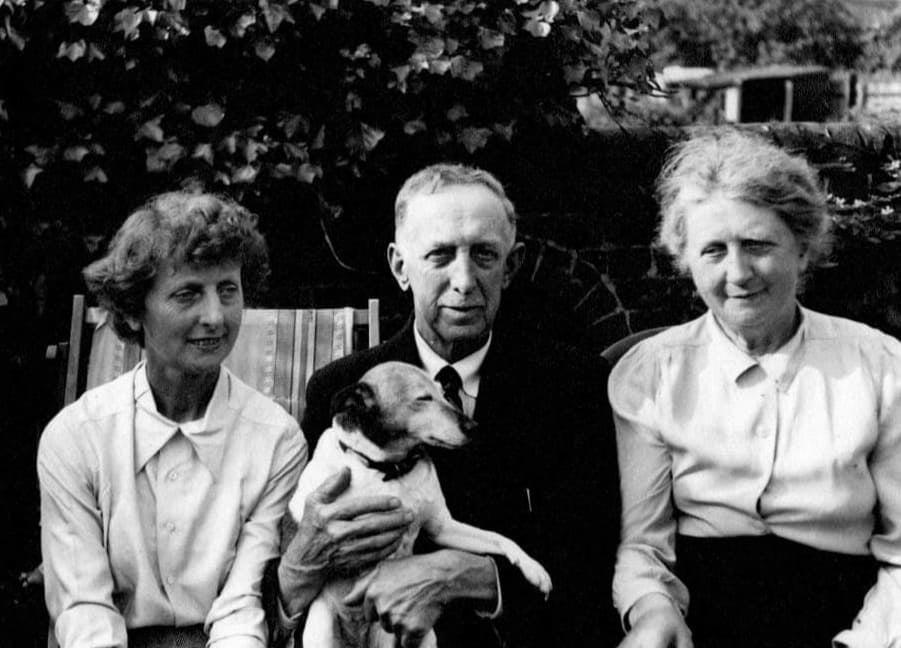
Bryan continues:
I’ll always remember the early days with the outside toilet with the overhead cistern caked in active BIG spider webs. I used to have to light a candle to go outside, shielding the flame until destination. In that space I’d set the candle down and watch the eery shadows move from side to side whilst…well anyway! Then I’d run like hell back into the house. Eventually the kitchen wall was broken through so it became an indoor loo. Phew!
In the early days the house was rented for ten-shillings a week…I know because I used to take over a ten-bob-note to a grumpy lady next door who used to sign the receipt in the rent book. Then, I think she died and it became available for $600.00 yes…the whole house for $600.00 but it wasn’t purchased then. Eventually aunt Phyllis purchased it some years later…perhaps when grandad died.I used to work much in the back garden which was a lovely walled garden with arch-type decorations in the brickwork and semicircular shaped capping bricks. The abundant apple tree. Raspberry and loganberry canes. A gooseberry bush and huge Victoria plum tree on the wall at the bottom of the garden which became a wonderful attraction for wasps! (grandad called the “whasps”). He would stew apples and fruit daily.
Do you remember their black and white cat Twinky? Always sat on the pink-screen TV and when she died they were convinced that “that’s wot got ‘er”. Grandad of course loved all his cats and as he aged, he named them all “Billy”.Have you come across the name “Featherstone” in grandma’s name. I don’t recall any details but Dorothy used to recall this. She did much searching of the family history Such a pity she didn’t hand anything on to anyone. She also said that we had a member of the family who worked with James Watt….but likewise I don’t have details.
Gifts of chocolates to Phyllis were regular and I became the recipient of the overflow!What a pity Dorothy’s family history research has disappeared! I have found the Featherstone’s, and the Purdy who worked with James Watt, but I wonder what else Dorothy knew.
I mentioned DH Lawrence to Bryan, and the connection to Eastwood, where Bryan’s grandma (and Phyllis’s mother) Mary Ann Gilman Purdy was born, and shared with him the story about Francis Purdy, the Primitive Methodist minister, and about Francis’s son William who invented the miners lamp.
He replied:
As a nosy young man I was looking through the family bookcase in Love Lane and came across a brown paper covered book. Intrigued, I found “Sons and Lovers” D.H. Lawrence. I knew it was a taboo book (in those days) as I was growing up but now I see the deeper connection. Of course! I know that Phyllis had I think an earlier boyfriend by the name of Maurice who lived in Perry Barr, Birmingham. I think he later married but was always kind enough to send her a book and fond message each birthday (Feb.12). I guess you know grandad’s birthday – July 28. We’d always celebrate those days. I’d usually be the one to go into Oldswinford and get him a cardigan or pullover and later on, his 2oz tins of St. Bruno tobacco for his pipe (I recall the room filled with smoke as he puffed away).
Dorothy and Phyllis always spoke of their ancestor’s vocation as a Minister. So glad to have this history! Wow, what a story too. The Lord rescued him from mischief indeed. Just goes to show how God can change hearts…one at a time.
So interesting to hear about the Miner’s Lamp. My vicar whilst growing up at St. John’s in Stourbridge was from Durham and each Harvest Festival, there would be a miner’s lamp placed upon the altar as a symbol of the colliery and the bountiful harvest.More recollections from Bryan about the house and garden at Love Lane:
I always recall tea around the three legged oak table bedecked with a colorful seersucker cloth. Battenburg cake. Jam Roll. Rich Tea and Digestive biscuits. Mr. Kipling’s exceedingly good cakes! Home-made jam. Loose tea from the Coronation tin cannister. The ancient mangle outside the back door and the galvanized steel wash tub with hand-operated agitator on the underside of the lid. The hand operated water pump ‘though modernisation allowed for a cold tap only inside, above the single sink and wooden draining board. A small gas stove and very little room for food preparation. Amazing how the Marshalls (×7) managed in this space!
The small window over the sink in the kitchen brought in little light since the neighbor built on a bathroom annex at the back of their house, leaving #47 with limited light, much to to upset of grandad and Phyllis. I do recall it being a gloomy place..i.e.the kitchen and back room.
The garden was lovely. Long and narrow with privet hedge dividing the properties on the right and the lovely wall on the left. Dorothy planted spectacular lilac bushes against the wall. Vivid blues, purples and whites. Double-flora. Amazing…and with stunning fragrance. Grandad loved older victorian type plants such as foxgloves and comfrey. Forget-me-nots and marigolds (calendulas) in abundance. Rhubarb stalks. Always plantings of lettuce and other vegetables. Lots of mint too! A large varigated laurel bush outside the front door!
Such a pleasant walk through the past.
An autograph book belonging to Phyllis from the 1920s has survived in which each friend painted a little picture, drew a cartoon, or wrote a verse. This entry is perhaps my favourite:
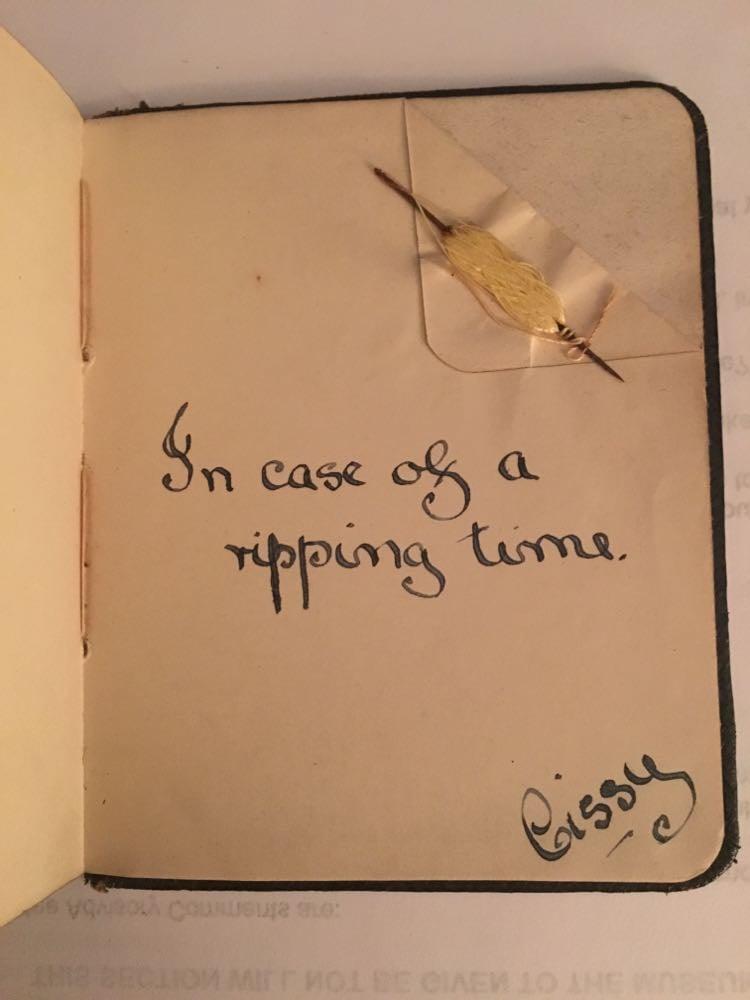 December 15, 2021 at 9:34 am #6236
In reply to: The Elusive Samuel Housley and Other Family Stories
The Liverpool Fires
Catherine Housley had two older sisters, Elizabeth 1845-1883 and Mary Anne 1846-1935. Both Elizabeth and Mary Anne grew up in the Belper workhouse after their mother died, and their father was jailed for failing to maintain his three children. Mary Anne married Samuel Gilman and they had a grocers shop in Buxton. Elizabeth married in Liverpool in 1873.
What was she doing in Liverpool? How did she meet William George Stafford?
According to the census, Elizabeth Housley was in Belper workhouse in 1851. In 1861, aged 16, she was a servant in the household of Peter Lyon, a baker in Derby St Peters. We noticed that the Lyon’s were friends of the family and were mentioned in the letters to George in Pennsylvania.
No record of Elizabeth can be found on the 1871 census, but in 1872 the birth and death was registered of Elizabeth and William’s child, Elizabeth Jane Stafford. The parents are registered as William and Elizabeth Stafford, although they were not yet married. William’s occupation is a “refiner”.
In April, 1873, a Fatal Fire is reported in the Liverpool Mercury. Fearful Termination of a Saturday Night Debauch. Seven Persons Burnt To Death. Interesting to note in the article that “the middle room being let off to a coloured man named William Stafford and his wife”.
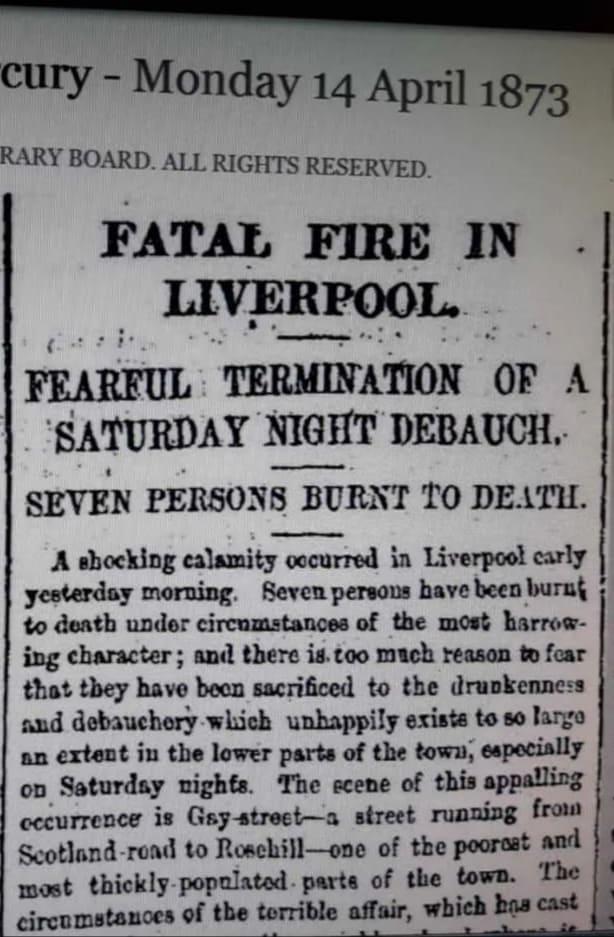
We had noted on the census that William Stafford place of birth was “Africa, British subject” but it had not occurred to us that he was “coloured”. A register of birth has not yet been found for William and it is not known where in Africa he was born.
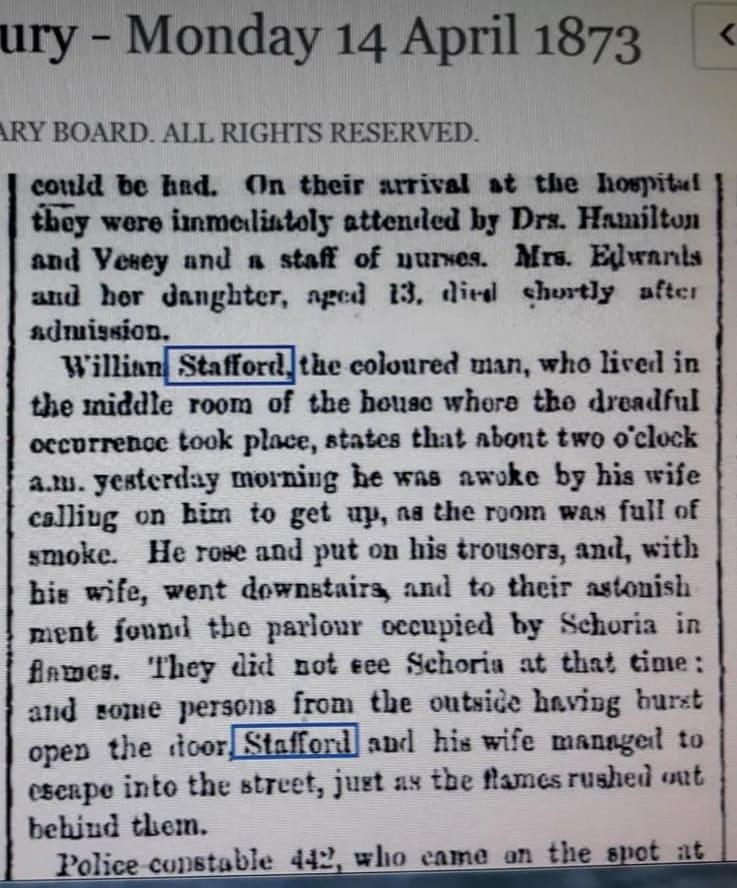
Elizabeth and William survived the fire on Gay Street, and were still living on Gay Street in October 1873 when they got married.
William’s occupation on the marriage register is sugar refiner, and his father is Peter Stafford, farmer. Elizabeth’s father is Samuel Housley, plumber. It does not say Samuel Housley deceased, so perhaps we can assume that Samuel is still alive in 1873.
Eliza Florence Stafford, their second daughter, was born in 1876.
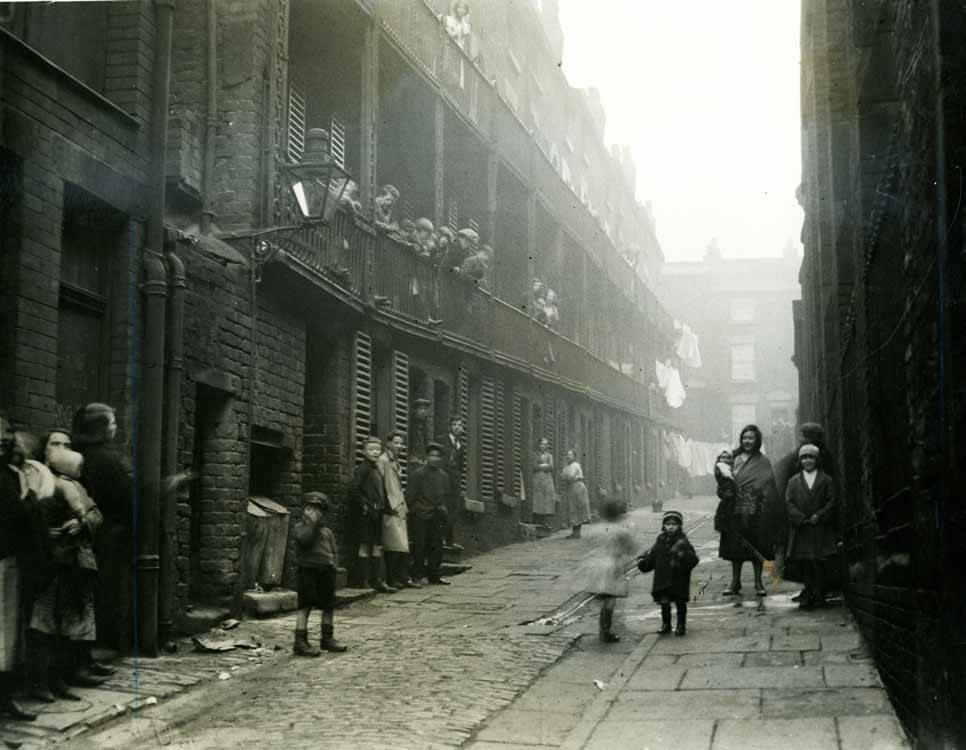
William’s occupation on the 1881 census is “fireman”, in his case, a fire stoker at the sugar refinery, an unpleasant and dangerous job for which they were paid slightly more. William, Elizabeth and Eliza were living in Byrom Terrace.
Byrom Terrace, Liverpool, in 1933
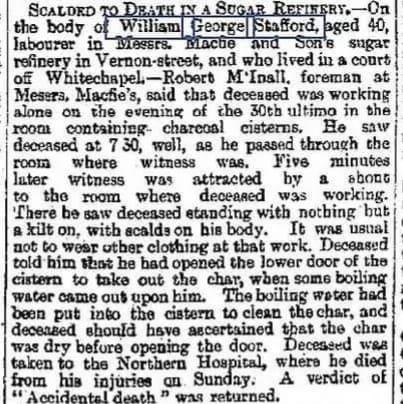
Elizabeth died of heart problems in 1883, when Eliza was six years old, and in 1891 her father died, scalded to death in a tragic accident at the sugar refinery.
Eliza, aged 15, was living as an inmate at the Walton on the Hill Institution in 1891. It’s not clear when she was admitted to the workhouse, perhaps after her mother died in 1883.
In 1901 Eliza Florence Stafford is a 24 year old live in laundrymaid, according to the census, living in West Derby (a part of Liverpool, and not actually in Derby). On the 1911 census there is a Florence Stafford listed as an unnmarried laundress, with a daughter called Florence. In 1901 census she was a laundrymaid in West Derby, Liverpool, and the daughter Florence Stafford was born in 1904 West Derby. It’s likely that this is Eliza Florence, but nothing further has been found so far.
The questions remaining are the location of William’s birth, the name of his mother and his family background, what happened to Eliza and her daughter after 1911, and how did Elizabeth meet William in the first place.
William Stafford was a seaman prior to working in the sugar refinery, and he appears on several ship’s crew lists. Nothing so far has indicated where he might have been born, or where his father came from.
Some months after finding the newspaper article about the fire on Gay Street, I saw an unusual request for information on the Liverpool genealogy group. Someone asked if anyone knew of a fire in Liverpool in the 1870’s. She had watched a programme about children recalling past lives, in this case a memory of a fire. The child recalled pushing her sister into a burning straw mattress by accident, as she attempted to save her from a falling beam. I watched the episode in question hoping for more information to confirm if this was the same fire, but details were scant and it’s impossible to say for sure.
December 14, 2021 at 9:28 pm #6231In reply to: The Elusive Samuel Housley and Other Family Stories
Gladstone Road
My mother remembers her grandfather Samuel Warren’s house at 3 Gladstone Road, Stourbridge. She was born in 1933, so this would be late 1930s early 1940s.
“Opening a big wooden gate in a high brick wall off the sidewalk I went down a passage with a very high hedge to the main house which was entered on this side through a sort of glassed-in lean-to then into the dark and damp scullery and then into a large room with a fireplace which was dining room and living room for most of the time. The house was Georgian and had wooden interior shutters at the windows. My Grandad sat by the fire probably most of the day. The fireplace may have had an oven built over or to the side of the fire which was common in those days and was used for cooking.
That room led into a hall going three ways and the main front door was here. One hall went to the pantry which had stone slabs for keeping food cool, such a long way from the kitchen! Opposite the pantry was the door to the cellar. One hall led to two large rooms with big windows overlooking the garden. There was also a door at the end of this hallway which opened into the garden. The stairs went up opposite the front door with a box room at the top then along a landing to another hall going right and left with two bedrooms down each hall.
The toilet got to from the scullery and lean-to was outside down another passage all overgrown near the pigsty. No outside lights!
On Christmas day the families would all have the day here. I think the menfolk went over to the pub {Gate Hangs Well?} for a drink while the women cooked dinner. Chris would take all the children down the dark, damp cellar steps and tell us ghost stories scaring us all. A fire would be lit in one of the big main rooms {probably only used once a year} and we’d sit in there and dinner was served in the other big main room. When the house was originally built the servants would have used the other room and scullery.
I have a recollection of going upstairs and into a bedroom off the right hand hall and someone was in bed, I thought an old lady but I was uncomfortable in there and never went in again. Seemed that person was there a long time. I did go upstairs with Betty to her room which was the opposite way down the hall and loved it. She was dating lots of soldiers during the war years. One in particular I remember was an American Army Officer that she was fond of but he was killed when he left England to fight in Germany.
I wonder if the person in bed that nobody spoke about was an old housekeeper?
My mother used to say there was a white lady who floated around in the garden. I think Kay died at Gladstone Road!”Samuel Warren, born in 1874 in Newhall, Derbyshire, was my grandmothers father. This is the only photograph we’ve seen of him (seated on right with cap). Kay, who died of TB in 1938, is holding the teddy bear. Samuel died in 1950, in Stourbridge, at the age of 76.
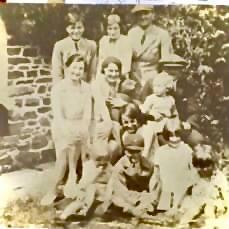
Left to right: back row: Leslie Warren. Hildred Williams / Griffiths (Nee Warren). Billy Warren. 2nd row: Gladys (Gary) Warren. Kay Warren (holding teddy bear). Samuel Warren (father). Hildred’s son Chris Williams (on knee). Lorna Warren. Joan Williams. Peggy Williams (Hildreds daughters). Jack Warren. Betty Warren.
December 13, 2021 at 2:34 pm #6227In reply to: The Elusive Samuel Housley and Other Family Stories
The Scottish Connection
My grandfather always used to say we had some Scottish blood because his “mother was a Purdy”, and that they were from the low counties of Scotland near to the English border.
My mother had a Scottish hat in among the boxes of souvenirs and old photographs. In one of her recent house moves, she finally threw it away, not knowing why we had it or where it came from, and of course has since regretted it! It probably came from one of her aunts, either Phyllis or Dorothy. Neither of them had children, and they both died in 1983. My grandfather was executor of the estate in both cases, and it’s assumed that the portraits, the many photographs, the booklet on Primitive Methodists, and the Scottish hat, all relating to his mother’s side of the family, came into his possession then. His sister Phyllis never married and was living in her parents home until she died, and is the likeliest candidate for the keeper of the family souvenirs.
Catherine Housley married George Purdy, and his father was Francis Purdy, the Primitive Methodist preacher. William Purdy was the father of Francis.
Record searches find William Purdy was born on 16 July 1767 in Carluke, Lanarkshire, near Glasgow in Scotland. He worked for James Watt, the inventor of the steam engine, and moved to Derbyshire for the purpose of installing steam driven pumps to remove the water from the collieries in the area.
Another descendant of Francis Purdy found the following in a book in a library in Eastwood:
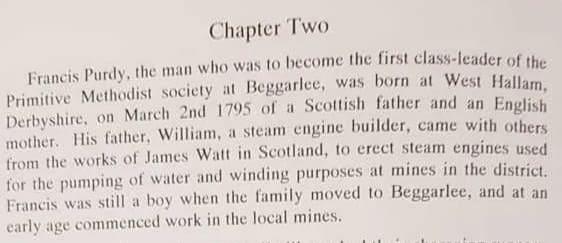
William married a local girl, Ruth Clarke, in Duffield in Derbyshire in 1786. William and Ruth had nine children, and the seventh was Francis who was born at West Hallam in 1795.
Perhaps the Scottish hat came from William Purdy, but there is another story of Scottish connections in Smalley: Bonnie Prince Charlie and the Jacobite Rebellion of 1745. Although the Purdy’s were not from Smalley, Catherine Housley was.
From an article on the Heanor and District Local History Society website:
The Jacobites in Smalley
Few people would readily associate the village of Smalley, situated about two miles west of Heanor, with Bonnie Prince Charlie and the Jacobite Rebellion of 1745 – but there is a clear link.
During the winter of 1745, Charles Edward Stuart, the “Bonnie Prince” or “The Young Pretender”, marched south from Scotland. His troops reached Derby on 4 December, and looted the town, staying for two days before they commenced a fateful retreat as the Duke of Cumberland’s army approached.
While staying in Derby, or during the retreat, some of the Jacobites are said to have visited some of the nearby villages, including Smalley.
A history of the local aspects of this escapade was written in 1933 by L. Eardley-Simpson, entitled “Derby and the ‘45,” from which the following is an extract:
“The presence of a party at Smalley is attested by several local traditions and relics. Not long ago there were people living who remember to have seen at least a dozen old pikes in a room adjoining the stables at Smalley Hall, and these were stated to have been left by a party of Highlanders who came to exchange their ponies for horses belonging to the then owner, Mrs Richardson; in 1907, one of these pikes still remained. Another resident of Smalley had a claymore which was alleged to have been found on Drumhill, Breadsall Moor, while the writer of the History of Smalley himself (Reverend C. Kerry) had a magnificent Andrew Ferrara, with a guard of finely wrought iron, engraved with two heads in Tudor helmets, of the same style, he states, as the one left at Wingfield Manor, though why the outlying bands of Army should have gone so far afield, he omits to mention. Smalley is also mentioned in another strange story as to the origin of the family of Woolley of Collingham who attained more wealth and a better position in the world than some of their relatives. The story is to the effect that when the Scots who had visited Mrs Richardson’s stables were returning to Derby, they fell in with one Woolley of Smalley, a coal carrier, and impressed him with horse and cart for the conveyance of certain heavy baggage. On the retreat, the party with Woolley was surprised by some of the Elector’s troopers (the Royal army) who pursued the Scots, leaving Woolley to shift for himself. This he did, and, his suspicion that the baggage he was carrying was part of the Prince’s treasure turning out to be correct, he retired to Collingham, and spent the rest of his life there in the enjoyment of his luckily acquired gains. Another story of a similar sort was designed to explain the rise of the well-known Derbyshire family of Cox of Brailsford, but the dates by no means agree with the family pedigree, and in any event the suggestion – for it is little more – is entirely at variance with the views as to the rights of the Royal House of Stuart which were expressed by certain members of the Cox family who were alive not many years ago.”
A letter from Charles Kerry, dated 30 July 1903, narrates another strange twist to the tale. When the Highlanders turned up in Smalley, a large crowd, mainly women, gathered. “On a command in Gaelic, the regiment stooped, and throwing their kilts over their backs revealed to the astonished ladies and all what modesty is careful to conceal. Father, who told me, said they were not any more troubled with crowds of women.”
Folklore or fact? We are unlikely to know, but the Scottish artefacts in the Smalley area certainly suggest that some of the story is based on fact.
We are unlikely to know where that Scottish hat came from, but we did find the Scottish connection. William Purdy’s mother was Grizel Gibson, and her mother was Grizel Murray, both of Lanarkshire in Scotland. The name Grizel is a Scottish form of the name Griselda, and means “grey battle maiden”. But with the exception of the name Murray, The Purdy and Gibson names are not traditionally Scottish, so there is not much of a Scottish connection after all. But the mystery of the Scottish hat remains unsolved.
December 13, 2021 at 12:33 pm #6225In reply to: The Elusive Samuel Housley and Other Family Stories
William Marshall’s Parents
William Marshall 1876-1968, my great grandfather, married Mary Ann Gilman Purdy in Buxton. We assumed that both their families came from Buxton, but this was not the case. The Marshall’s came from Elton, near Matlock; the Purdy’s from Eastwood, Nottinghamshire.
William Marshall, seated in centre, with colleagues from the insurance company:
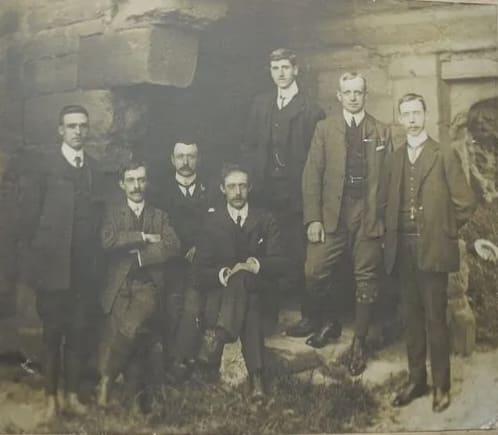
William and all his siblings were born in Fairfield in Buxton. But both Emma Featherstone 1847-1928, his mother, and John Marshall 1842-1930, his father, came from rural Derbyshire. Emma from Ashbourne (or Biggin, Newhaven, or Hartington, depending on what she chose to put on the census, which are all tiny rural places in the same area).
Emma and John Marshall in the middle, photo says “William Marshall’s parents” on the back:
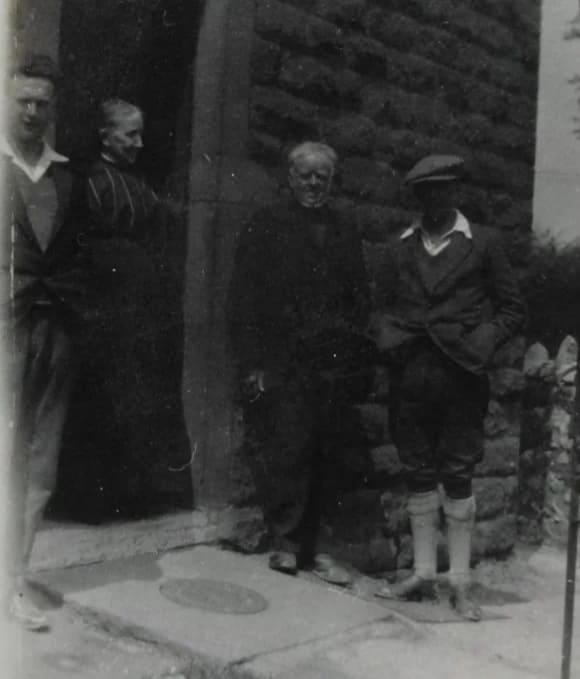
John Marshall was a carter, later a coal carter, and was born in Elton, Derbyshire. Elton is a rural village near to Matlock. He was unable to write (at least at the time of his wedding) but Emma signed her own name.
In 1851 Emma is 3 or 4 years old living with family at the Jug and Glass Inn, Hartington. In 1861 Emma was a 14 year old servant at a 112 acre farm, Heathcote, but her parents were still living at the Jug and Glass. Emma Featherstone’s parents both died when she was 18, in 1865.
In 1871 she was a servant at Old House Farm, Nether Hartington Quarter, Ashborne.On the census, a female apprentice was listed as a servant, a boy as an apprentice. It seems to have been quite normal, at least that’s what I’ve found so far, for all teenagers to go and live in another household to learn a trade, to be independent from the parents, and so doesn’t necessarily mean a servant as we would think of it. Often they stayed with family friends, and usually married in their early twenties and had their own household ~ often with a “servant” or teenager from someone else’s family.
The only marriage I could find for Emma and John was in Manchester in 1873, which didn’t make much sense. If Emma was single on the 1871 census, and her first child James was born in 1873, her marriage had to be between those dates. But the marriage register in Manchester appears to be correct, John was a carter, Emma’s father was Francis Featherstone. But why Manchester?
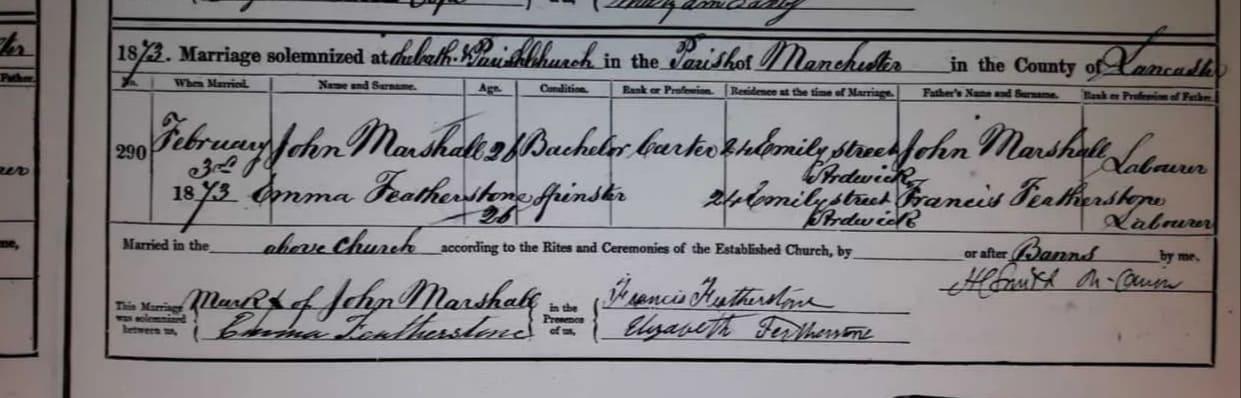
I noticed that the witnesses to the marriage were Francis and Elizabeth Featherstone. He father was Francis, but who was Elizabeth? Emma’s mother was Sarah. Then I found that Emma’s brother Francis married Elizabeth, and they lived in Manchester on the 1871 census. Henry Street, Ardwick. Emma and John’s address on the marriage register is Emily Street, Ardwick. Both of them at the same address.
The marriage was in February 1873, and James, the first child was born in July, 1873, in Buxton.
It would seem that Emma and John had to get married, hence the move to Manchester where her brother was, and then quickly moved to Buxton for the birth of the child. It was far from uncommon, I’ve found while making notes of dates in registers, for a first child to be born six or 7 months after the wedding.
Emma died in 1928 at the age of 80, two years before her husband John. She left him a little money in her will! This seems unusual so perhaps she had her own money, possibly from the death of her parents before she married, and perhaps from the sale of the Jug and Glass.
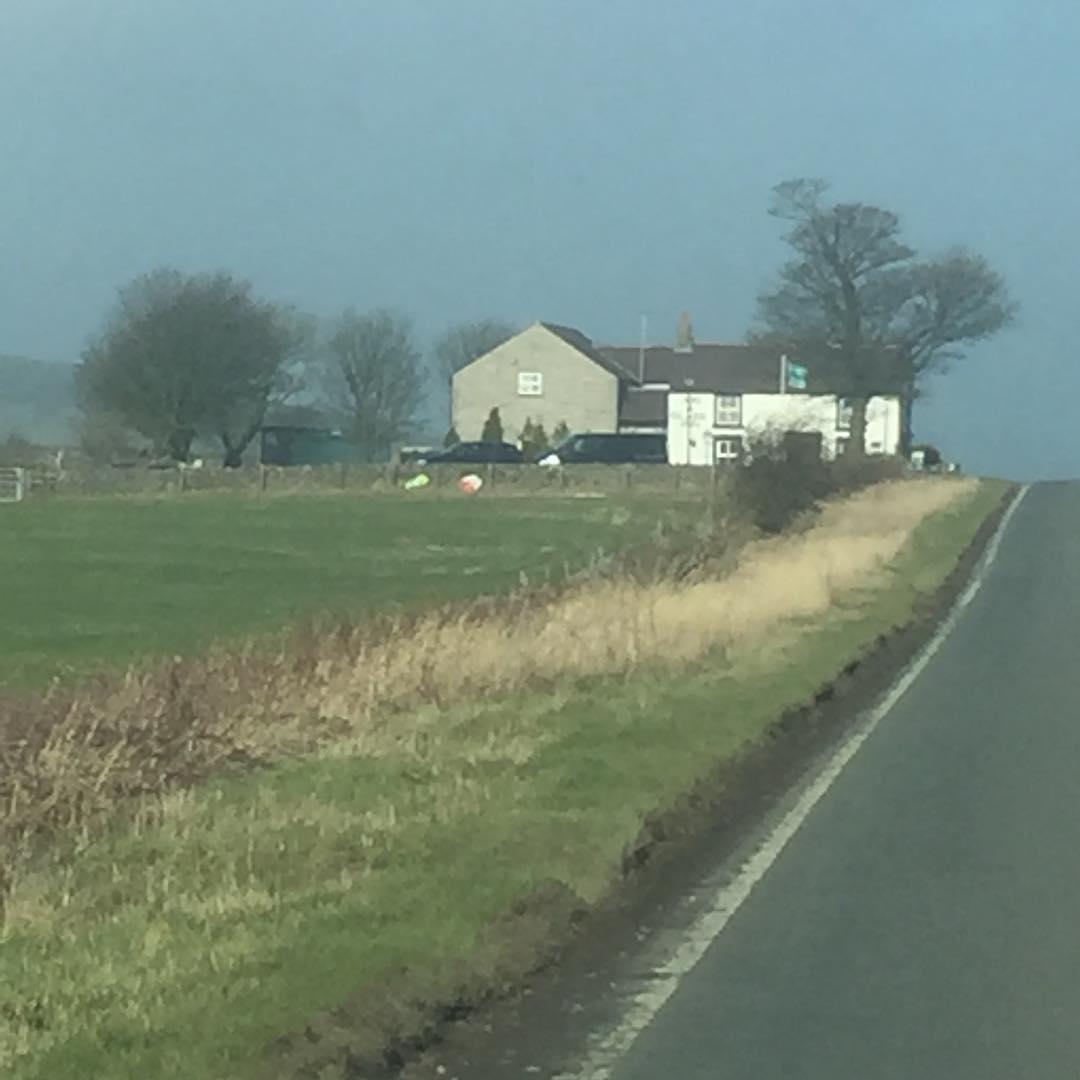
I found a photo of the Jug and Glass online. It looks just like the pub I’d seen in my family history meditations on a number of occasions:
 December 13, 2021 at 11:58 am #6223
In reply to: The Elusive Samuel Housley and Other Family Stories
Kate Purdy and the DH Lawrence Connection
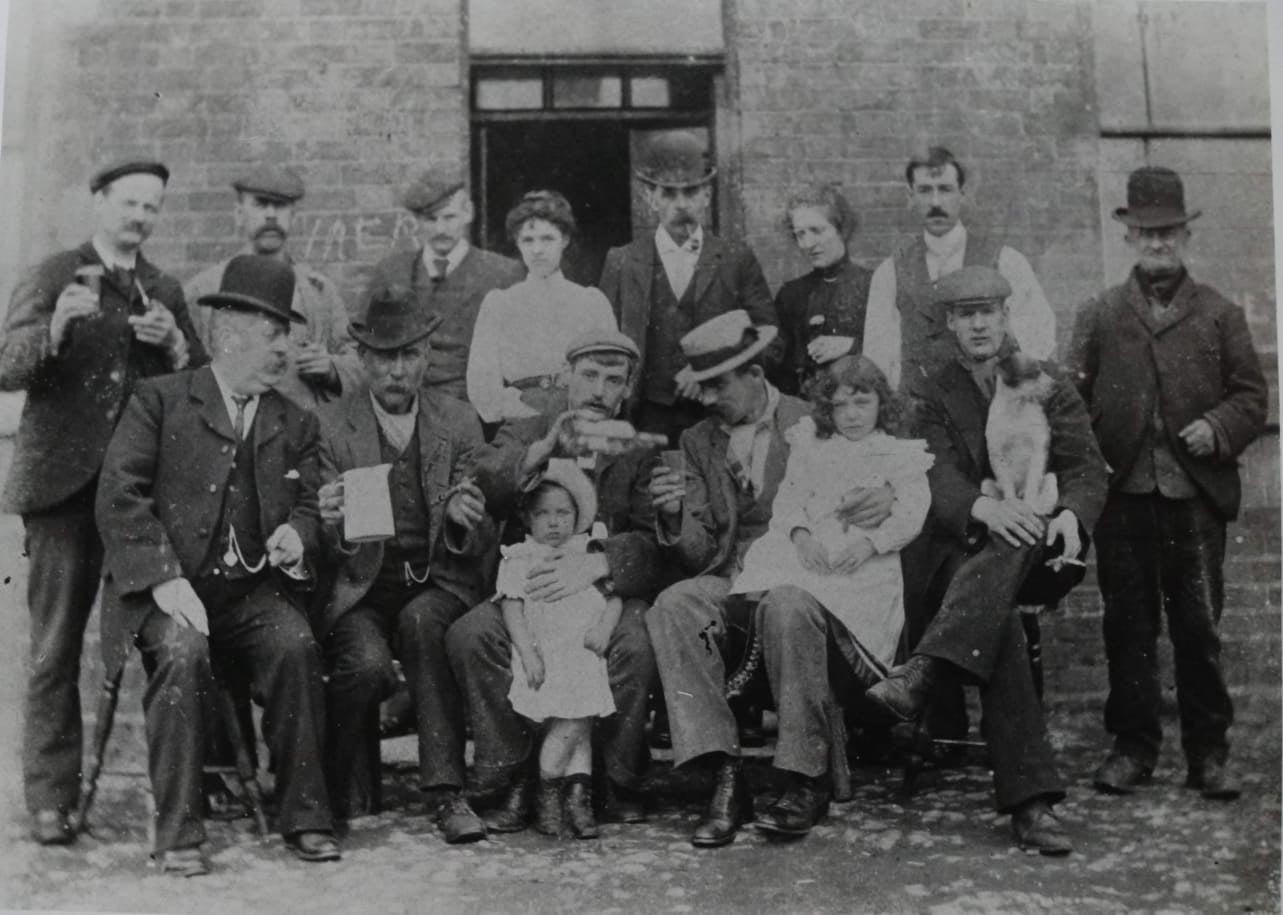
Catherine (Kate) Purdy 1874-1950 was my grandfather George Marshall’s aunt, and the mother of George Rushby who went to Africa. The photo is one of our family photos, and we knew that the woman at the back third from the right was an aunt of my grandfather’s. We didn’t know that it was Kate until we saw other photos of her in Mike’s collection.
DH Lawrence was born in Eastwood at roughly the same time as my great grandmother Mary Ann Gilman Purdy. Apparently his books are based on actual people living in the area at the time, so I read as many of his books as I could find, to help paint the picture of the time and place. I also found out via an Eastwood facebook group, that he was not well liked there, and still isn’t. They say he was a wife beater, a groper and was cruel to animals, and they did not want a statue of him in their town!
Kate Rushby third from right back row:
Kate Rushby’s story as told by her grandson Mike:
George’s daughter Catherine (Kate) Purdy grew up in Eastwood and was living at Walnut Tree Lane when, at the age of 21, and on the 24 Sep 1894, she married John Henry Payling Rushby who was a policeman in the Grimsby Police. John Henry left the Police and together they bought a public house “The Three Tuns Inn” at Beggarlee. The establishment was frequented by amongst others, the writer D.H.Lawrence who wrote much of his book “Sons and Lovers” in the Inn. In his book he calls the Inn “The Moon and Stars” and mentions Kate. though not by name.
John Henry Rushby had two children, Charlotte and George Gilman Rushby. But a year after the birth of George on 28 Feb 1900, John Henry died at the age of thirty on 13 Sep 1901. He liked to show off his strength to his friends by lifting above his head an oak barrel full of beer. This would have weighed almost 200 kilograms. “He bust his gut” Kate said. He died of peritonitis following a hernia.
Following the death of John Henry, Kate managed the Three Tuns Inn on her own. But a regular visitor to the Inn was Frank Freer who was a singer and used to entertain the patrons with his fine baritone voice and by playing the cornet. He and Kate got married, but he turned out to be a drunk who beat his wife and was cruel to her son. They separated and he died from alcoholism, though he may also have been struck on the head with a beer bottle by a person unknown. She then married Mr Gregory Simpson who fathered a daughter Catherine, and then died from gas injuries he suffered on the battlefield in the first world war.
Despite her lack of men able to stay the course, Catherine became a very successful business woman. She ran the Three Tuns Inn and later moved to Jacksdale where she owned ”ThePortland Arms Hotel”. She travelled extensively to Europe in times of peace, to Africa several times, and around England frequently. She settled in Selston Lane Jacksdale in a large house bracketed by the homes of her daughters Lottie and Cath. She was a strong and tenacious woman who became the surrogate mother of her grandchildren Ann and George when they were separated from their parents by the second world war.
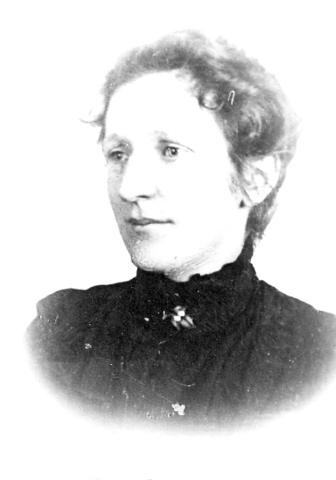
Mike Rushby’s photo of Kate:
 December 13, 2021 at 11:29 am #6222
In reply to: The Elusive Samuel Housley and Other Family Stories
George Gilman Rushby: The Cousin Who Went To Africa
The portrait of the woman has “mother of Catherine Housley, Smalley” written on the back, and one of the family photographs has “Francis Purdy” written on the back. My first internet search was “Catherine Housley Smalley Francis Purdy”. Easily found was the family tree of George (Mike) Rushby, on one of the genealogy websites. It seemed that it must be our family, but the African lion hunter seemed unlikely until my mother recalled her father had said that he had a cousin who went to Africa. I also noticed that the lion hunter’s middle name was Gilman ~ the name that Catherine Housley’s daughter ~ my great grandmother, Mary Ann Gilman Purdy ~ adopted, from her aunt and uncle who brought her up.
I tried to contact George (Mike) Rushby via the ancestry website, but got no reply. I searched for his name on Facebook and found a photo of a wildfire in a place called Wardell, in Australia, and he was credited with taking the photograph. A comment on the photo, which was a few years old, got no response, so I found a Wardell Community group on Facebook, and joined it. A very small place, population some 700 or so, and I had an immediate response on the group to my question. They knew Mike, exchanged messages, and we were able to start emailing. I was in the chair at the dentist having an exceptionally long canine root canal at the time that I got the message with his email address, and at that moment the song Down in Africa started playing.
Mike said it was clever of me to track him down which amused me, coming from the son of an elephant and lion hunter. He didn’t know why his father’s middle name was Gilman, and was not aware that Catherine Housley’s sister married a Gilman.
Mike Rushby kindly gave me permission to include his family history research in my book. This is the story of my grandfather George Marshall’s cousin. A detailed account of George Gilman Rushby’s years in Africa can be found in another chapter called From Tanganyika With Love; the letters Eleanor wrote to her family.
George Gilman Rushby:
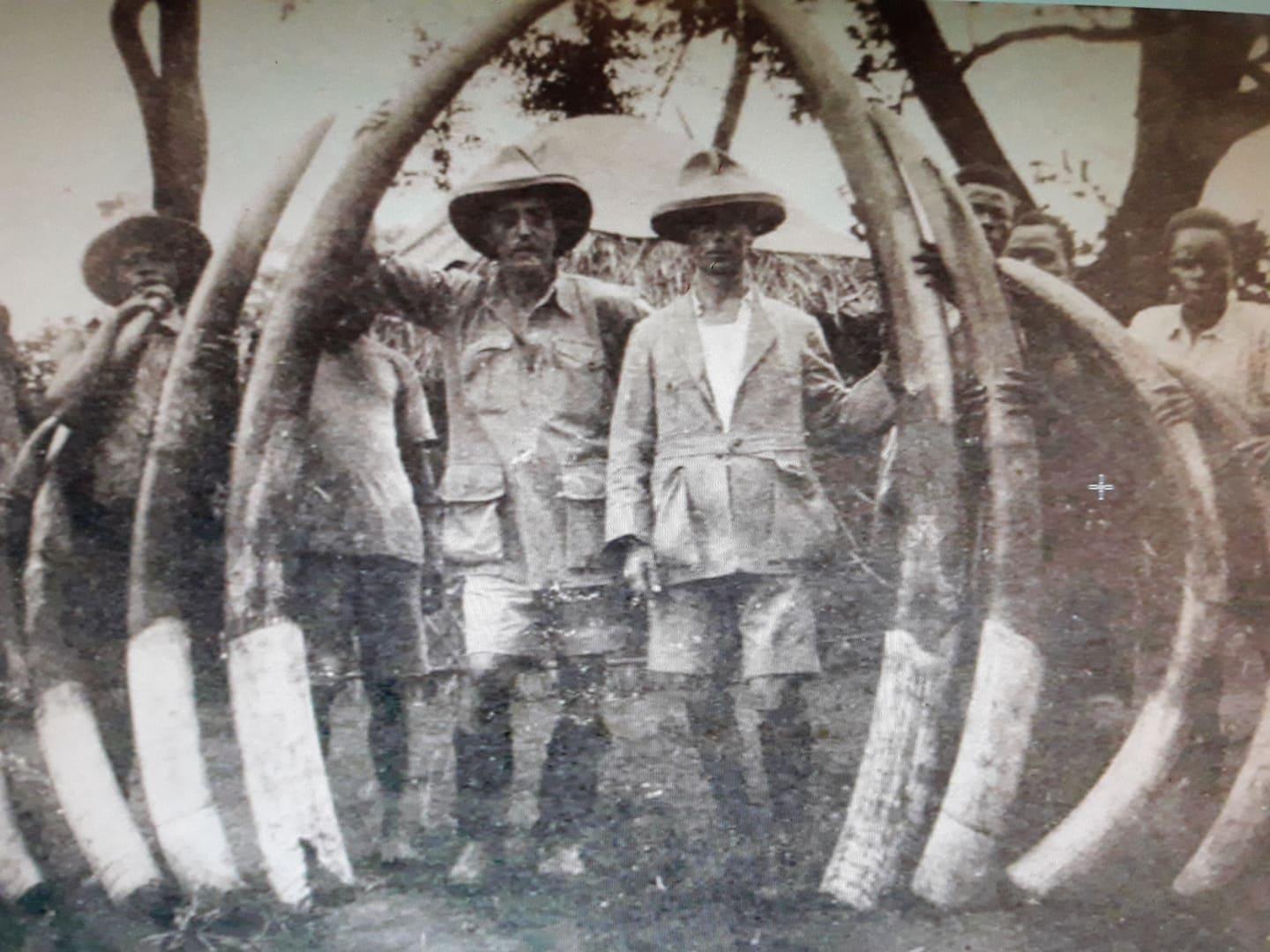
The story of George Gilman Rushby 1900-1969, as told by his son Mike:
George Gilman Rushby:
Elephant hunter,poacher, prospector, farmer, forestry officer, game ranger, husband to Eleanor, and father of 6 children who now live around the world.George Gilman Rushby was born in Nottingham on 28 Feb 1900 the son of Catherine Purdy and John Henry Payling Rushby. But John Henry died when his son was only one and a half years old, and George shunned his drunken bullying stepfather Frank Freer and was brought up by Gypsies who taught him how to fight and took him on regular poaching trips. His love of adventure and his ability to hunt were nurtured at an early stage of his life.
The family moved to Eastwood, where his mother Catherine owned and managed The Three Tuns Inn, but when his stepfather died in mysterious circumstances, his mother married a wealthy bookmaker named Gregory Simpson. He could afford to send George to Worksop College and to Rugby School. This was excellent schooling for George, but the boarding school environment, and the lack of a stable home life, contributed to his desire to go out in the world and do his own thing. When he finished school his first job was as a trainee electrician with Oaks & Co at Pye Bridge. He also worked part time as a motor cycle mechanic and as a professional boxer to raise the money for a voyage to South Africa.In May 1920 George arrived in Durban destitute and, like many others, living on the beach and dependant upon the Salvation Army for a daily meal. However he soon got work as an electrical mechanic, and after a couple of months had earned enough money to make the next move North. He went to Lourenco Marques where he was appointed shift engineer for the town’s power station. However he was still restless and left the comfort of Lourenco Marques for Beira in August 1921.
Beira was the start point of the new railway being built from the coast to Nyasaland. George became a professional hunter providing essential meat for the gangs of construction workers building the railway. He was a self employed contractor with his own support crew of African men and began to build up a satisfactory business. However, following an incident where he had to shoot and kill a man who attacked him with a spear in middle of the night whilst he was sleeping, George left the lower Zambezi and took a paddle steamer to Nyasaland (Malawi). On his arrival in Karongo he was encouraged to shoot elephant which had reached plague proportions in the area – wrecking African homes and crops, and threatening the lives of those who opposed them.
His next move was to travel by canoe the five hundred kilometre length of Lake Nyasa to Tanganyika, where he hunted for a while in the Lake Rukwa area, before walking through Northern Rhodesia (Zambia) to the Congo. Hunting his way he overachieved his quota of ivory resulting in his being charged with trespass, the confiscation of his rifles, and a fine of one thousand francs. He hunted his way through the Congo to Leopoldville then on to the Portuguese enclave, near the mouth of the mighty river, where he worked as a barman in a rough and tough bar until he received a message that his old friend Lumb had found gold at Lupa near Chunya. George set sail on the next boat for Antwerp in Belgium, then crossed to England and spent a few weeks with his family in Jacksdale before returning by sea to Dar es Salaam. Arriving at the gold fields he pegged his claim and almost immediately went down with blackwater fever – an illness that used to kill three out of four within a week.
When he recovered from his fever, George exchanged his gold lease for a double barrelled .577 elephant rifle and took out a special elephant control licence with the Tanganyika Government. He then headed for the Congo again and poached elephant in Northern Rhodesia from a base in the Congo. He was known by the Africans as “iNyathi”, or the Buffalo, because he was the most dangerous in the long grass. After a profitable hunting expedition in his favourite hunting ground of the Kilombera River he returned to the Congo via Dar es Salaam and Mombassa. He was after the Kabalo district elephant, but hunting was restricted, so he set up his base in The Central African Republic at a place called Obo on the Congo tributary named the M’bomu River. From there he could make poaching raids into the Congo and the Upper Nile regions of the Sudan. He hunted there for two and a half years. He seldom came across other Europeans; hunters kept their own districts and guarded their own territories. But they respected one another and he made good and lasting friendships with members of that small select band of adventurers.
Leaving for Europe via the Congo, George enjoyed a short holiday in Jacksdale with his mother. On his return trip to East Africa he met his future bride in Cape Town. She was 24 year old Eleanor Dunbar Leslie; a high school teacher and daughter of a magistrate who spent her spare time mountaineering, racing ocean yachts, and riding horses. After a whirlwind romance, they were betrothed within 36 hours.
On 25 July 1930 George landed back in Dar es Salaam. He went directly to the Mbeya district to find a home. For one hundred pounds he purchased the Waizneker’s farm on the banks of the Mntshewe Stream. Eleanor, who had been delayed due to her contract as a teacher, followed in November. Her ship docked in Dar es Salaam on 7 Nov 1930, and they were married that day. At Mchewe Estate, their newly acquired farm, they lived in a tent whilst George with some help built their first home – a lovely mud-brick cottage with a thatched roof. George and Eleanor set about developing a coffee plantation out of a bush block. It was a very happy time for them. There was no electricity, no radio, and no telephone. Newspapers came from London every two months. There were a couple of neighbours within twenty miles, but visitors were seldom seen. The farm was a haven for wild life including snakes, monkeys and leopards. Eleanor had to go South all the way to Capetown for the birth of her first child Ann, but with the onset of civilisation, their first son George was born at a new German Mission hospital that had opened in Mbeya.
Occasionally George had to leave the farm in Eleanor’s care whilst he went off hunting to make his living. Having run the coffee plantation for five years with considerable establishment costs and as yet no return, George reluctantly started taking paying clients on hunting safaris as a “white hunter”. This was an occupation George didn’t enjoy. but it brought him an income in the days when social security didn’t exist. Taking wealthy clients on hunting trips to kill animals for trophies and for pleasure didn’t amuse George who hunted for a business and for a way of life. When one of George’s trackers was killed by a leopard that had been wounded by a careless client, George was particularly upset.
The coffee plantation was approaching the time of its first harvest when it was suddenly attacked by plagues of borer beetles and ring barking snails. At the same time severe hail storms shredded the crop. The pressure of the need for an income forced George back to the Lupa gold fields. He was unlucky in his gold discoveries, but luck came in a different form when he was offered a job with the Forestry Department. The offer had been made in recognition of his initiation and management of Tanganyika’s rainbow trout project. George spent most of his short time with the Forestry Department encouraging the indigenous people to conserve their native forests.In November 1938 he transferred to the Game Department as Ranger for the Eastern Province of Tanganyika, and over several years was based at Nzasa near Dar es Salaam, at the old German town of Morogoro, and at lovely Lyamungu on the slopes of Kilimanjaro. Then the call came for him to be transferred to Mbeya in the Southern Province for there was a serious problem in the Njombe district, and George was selected by the Department as the only man who could possibly fix the problem.
Over a period of several years, people were being attacked and killed by marauding man-eating lions. In the Wagingombe area alone 230 people were listed as having been killed. In the Njombe district, which covered an area about 200 km by 300 km some 1500 people had been killed. Not only was the rural population being decimated, but the morale of the survivors was so low, that many of them believed that the lions were not real. Many thought that evil witch doctors were controlling the lions, or that lion-men were changing form to kill their enemies. Indeed some wichdoctors took advantage of the disarray to settle scores and to kill for reward.
By hunting down and killing the man-eaters, and by showing the flesh and blood to the doubting tribes people, George was able to instil some confidence into the villagers. However the Africans attributed the return of peace and safety, not to the efforts of George Rushby, but to the reinstallation of their deposed chief Matamula Mangera who had previously been stood down for corruption. It was Matamula , in their eyes, who had called off the lions.
Soon after this adventure, George was appointed Deputy Game Warden for Tanganyika, and was based in Arusha. He retired in 1956 to the Njombe district where he developed a coffee plantation, and was one of the first in Tanganyika to plant tea as a major crop. However he sensed a swing in the political fortunes of his beloved Tanganyika, and so sold the plantation and settled in a cottage high on a hill overlooking the Navel Base at Simonstown in the Cape. It was whilst he was there that TV Bulpin wrote his biography “The Hunter is Death” and George wrote his book “No More The Tusker”. He died in the Cape, and his youngest son Henry scattered his ashes at the Southern most tip of Africa where the currents of the Atlantic and Indian Oceans meet .
George Gilman Rushby:
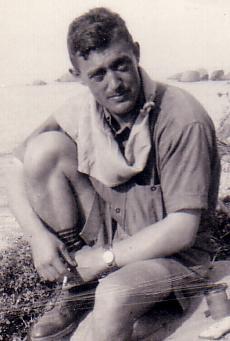 December 13, 2021 at 10:09 am #6219
Topic: The Elusive Samuel Housley and Other Family Stories
in forum TP’s Family BooksThe following stories started with a single question.
Who was Catherine Housley’s mother?
But one question leads to another, and another, and so this book will never be finished. This is the first in a collection of stories of a family history research project, not a complete family history. There will always be more questions and more searches, and each new find presents more questions.
A list of names and dates is only moderately interesting, and doesn’t mean much unless you get to know the characters along the way. For example, a cousin on my fathers side has already done a great deal of thorough and accurate family research. I copied one branch of the family onto my tree, going back to the 1500’s, but lost interest in it after about an hour or so, because I didn’t feel I knew any of the individuals.
Parish registers, the census every ten years, birth, death and marriage certificates can tell you so much, but they can’t tell you why. They don’t tell you why parents chose the names they did for their children, or why they moved, or why they married in another town. They don’t tell you why a person lived in another household, or for how long. The census every ten years doesn’t tell you what people were doing in the intervening years, and in the case of the UK and the hundred year privacy rule, we can’t even use those for the past century. The first census was in 1831 in England, prior to that all we have are parish registers. An astonishing amount of them have survived and have been transcribed and are one way or another available to see, both transcriptions and microfiche images. Not all of them survived, however. Sometimes the writing has faded to white, sometimes pages are missing, and in some case the entire register is lost or damaged.
Sometimes if you are lucky, you may find mention of an ancestor in an obscure little local history book or a journal or diary. Wills, court cases, and newspaper archives often provide interesting information. Town memories and history groups on social media are another excellent source of information, from old photographs of the area, old maps, local history, and of course, distantly related relatives still living in the area. Local history societies can be useful, and some if not all are very helpful.
If you’re very lucky indeed, you might find a distant relative in another country whose grandparents saved and transcribed bundles of old letters found in the attic, from the family in England to the brother who emigrated, written in the 1800s. More on this later, as it merits its own chapter as the most exciting find so far.
The social history of the time and place is important and provides many clues as to why people moved and why the family professions and occupations changed over generations. The Enclosures Act and the Industrial Revolution in England created difficulties for rural farmers, factories replaced cottage industries, and the sons of land owning farmers became shop keepers and miners in the local towns. For the most part (at least in my own research) people didn’t move around much unless there was a reason. There are no reasons mentioned in the various registers, records and documents, but with a little reading of social history you can sometimes make a good guess. Samuel Housley, for example, a plumber, probably moved from rural Derbyshire to urban Wolverhampton, when there was a big project to install indoor plumbing to areas of the city in the early 1800s. Derbyshire nailmakers were offered a job and a house if they moved to Wolverhampton a generation earlier.
Occasionally a couple would marry in another parish, although usually they married in their own. Again, there was often a reason. William Housley and Ellen Carrington married in Ashbourne, not in Smalley. In this case, William’s first wife was Mary Carrington, Ellen’s sister. It was not uncommon for a man to marry a deceased wife’s sister, but it wasn’t strictly speaking legal. This caused some problems later when William died, as the children of the first wife contested the will, on the grounds of the second marriage being illegal.
Needless to say, there are always questions remaining, and often a fresh pair of eyes can help find a vital piece of information that has escaped you. In one case, I’d been looking for the death of a widow, Mary Anne Gilman, and had failed to notice that she remarried at a late age. Her death was easy to find, once I searched for it with her second husbands name.
This brings me to the topic of maternal family lines. One tends to think of their lineage with the focus on paternal surnames, but very quickly the number of surnames increases, and all of the maternal lines are directly related as much as the paternal name. This is of course obvious, if you start from the beginning with yourself and work back. In other words, there is not much point in simply looking for your fathers name hundreds of years ago because there are hundreds of other names that are equally your own family ancestors. And in my case, although not intentionally, I’ve investigated far more maternal lines than paternal.
This book, which I hope will be the first of several, will concentrate on my mothers family: The story so far that started with the portrait of Catherine Housley’s mother.
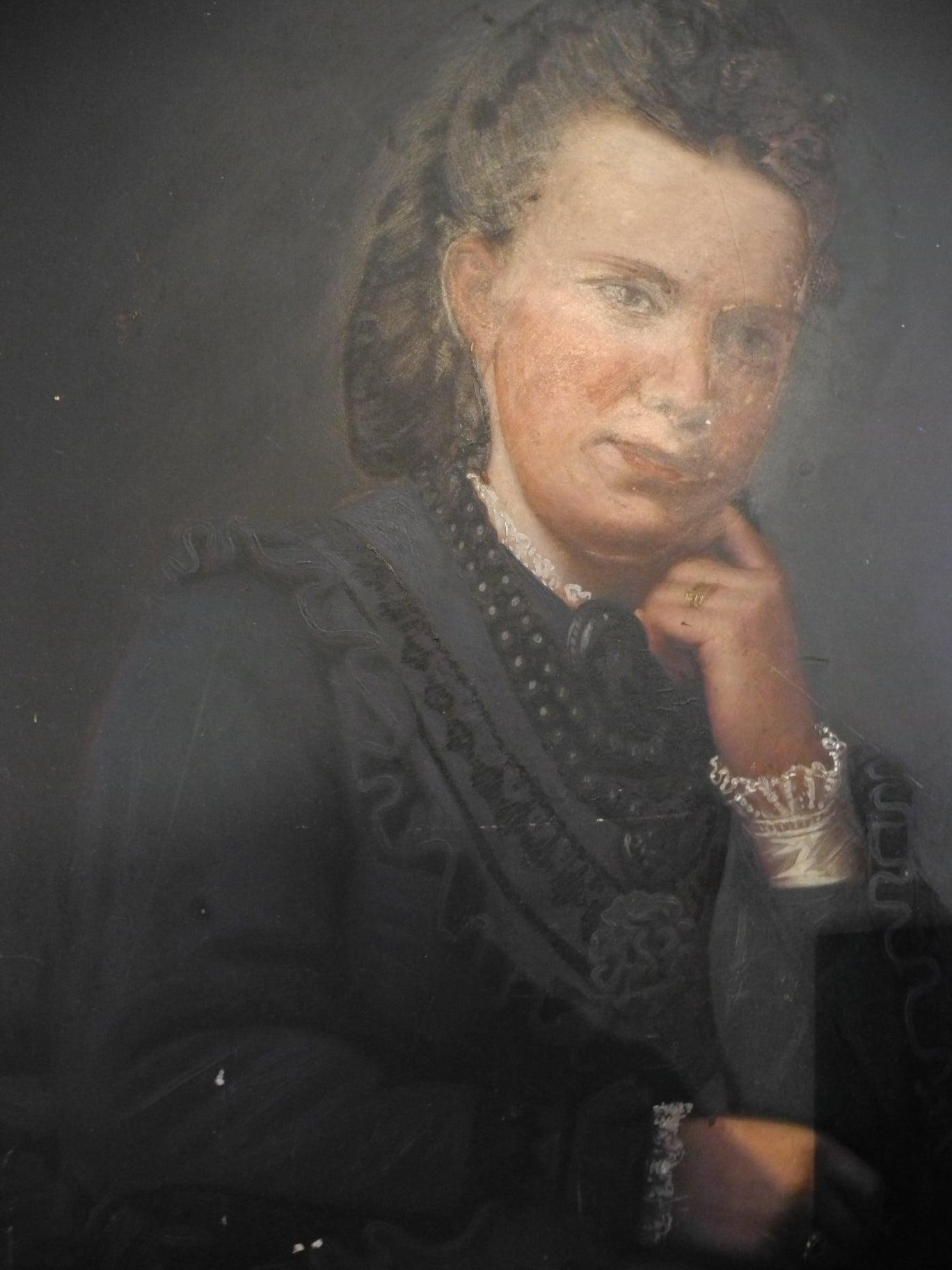
This painting, now in my mothers house, used to hang over the piano in the home of her grandparents. It says on the back “Catherine Housley’s mother, Smalley”.
The portrait of Catherine Housley’s mother can be seen above the piano. Back row Ronald Marshall, my grandfathers brother, William Marshall, my great grandfather, Mary Ann Gilman Purdy Marshall in the middle, my great grandmother, with her daughters Dorothy on the left and Phyllis on the right, at the Marshall’s house on Love Lane in Stourbridge.
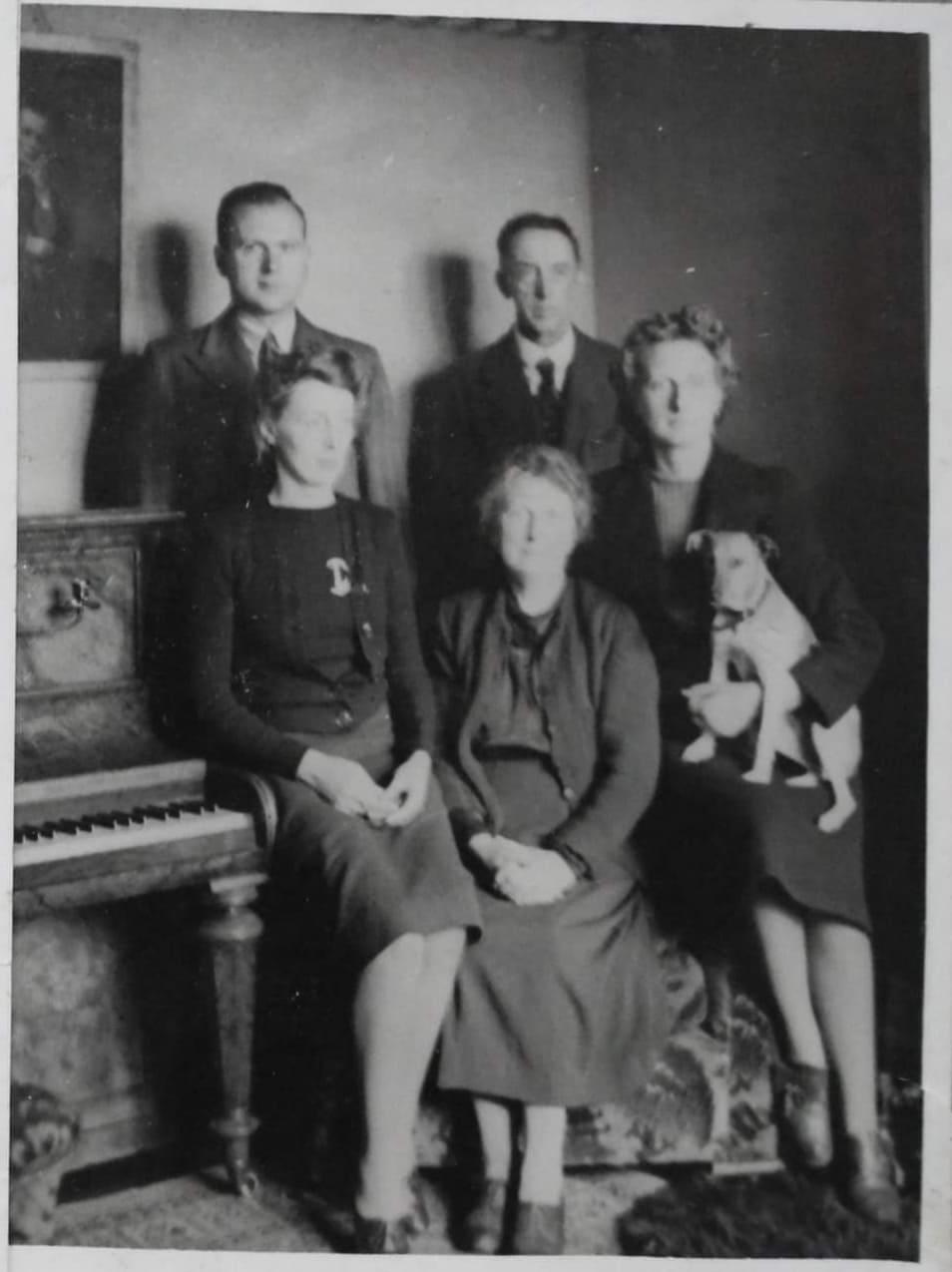
The Search for Samuel Housley
As soon as the search for Catherine Housley’s mother was resolved, achieved by ordering a paper copy of her birth certificate, the search for Catherine Housley’s father commenced. We know he was born in Smalley in 1816, son of William Housley and Ellen Carrington, and that he married Elizabeth Brookes in Wolverhampton in 1844. He was a plumber and glazier. His three daughters born between 1845 and 1849 were born in Smalley. Elizabeth died in 1849 of consumption, but Samuel didn’t register her death. A 20 year old neighbour called Aaron Wadkinson did.
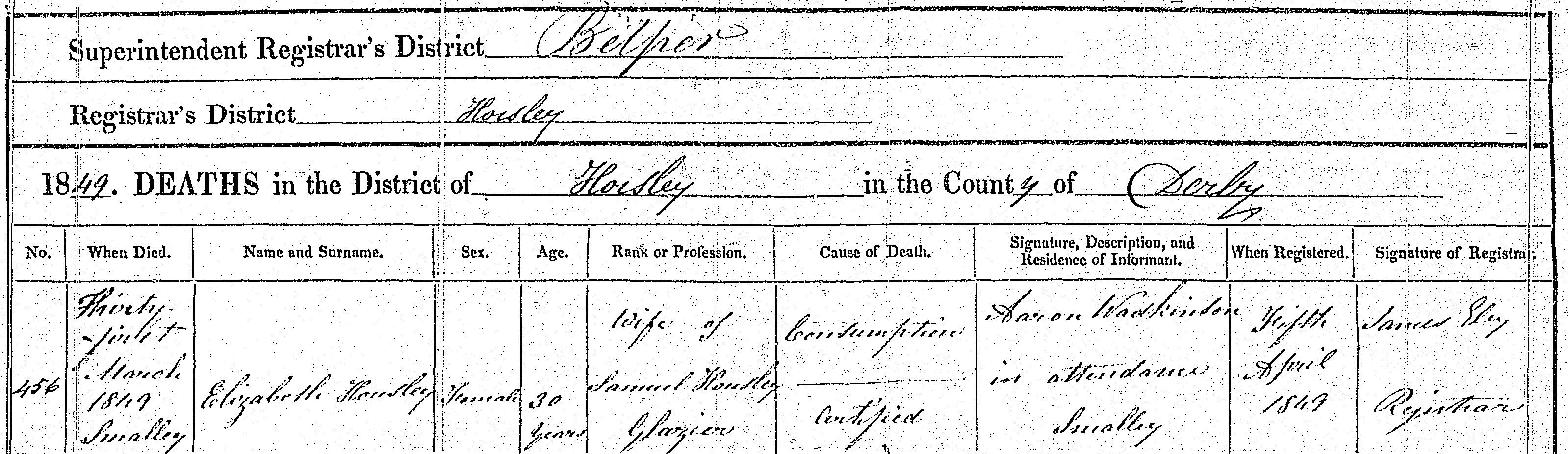
Where was Samuel?
On the 1851 census, two of Samuel’s daughters were listed as inmates in the Belper Workhouse, and the third, 2 year old Catherine, was listed as living with John Benniston and his family in nearby Heanor. Benniston was a framework knitter.
Where was Samuel?
A long search through the microfiche workhouse registers provided an answer. The reason for Elizabeth and Mary Anne’s admission in June 1850 was given as “father in prison”. In May 1850, Samuel Housley was sentenced to one month hard labour at Derby Gaol for failing to maintain his three children. What happened to those little girls in the year after their mothers death, before their father was sentenced, and they entered the workhouse? Where did Catherine go, a six week old baby? We have yet to find out.
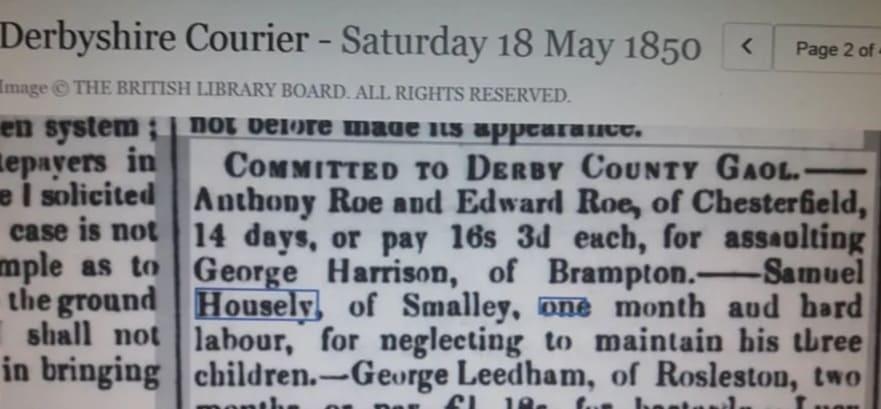
And where was Samuel Housley in 1851? He hasn’t appeared on any census.
According to the Belper workhouse registers, Mary Anne was discharged on trial as a servant February 1860. She was readmitted a month later in March 1860, the reason given: unwell.
Belper Workhouse:
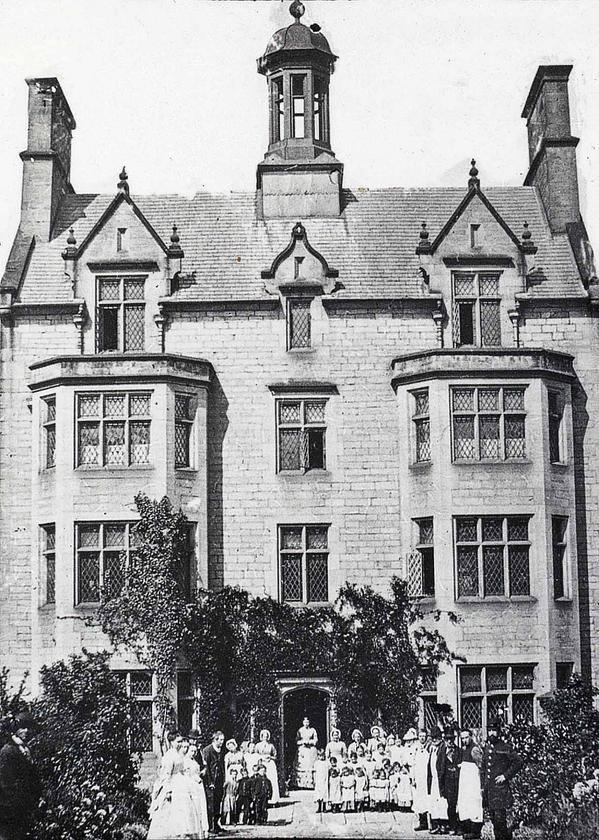
Eventually, Mary Anne and Elizabeth were discharged, in April 1860, with an aunt and uncle. The workhouse register doesn’t name the aunt and uncle. One can only wonder why it took them so long.
On the 1861 census, Elizabeth, 16 years old, is a servant in St Peters, Derby, and Mary Anne, 15 years old, is a servant in St Werburghs, Derby.But where was Samuel?
After some considerable searching, we found him, despite a mistranscription of his name, on the 1861 census, living as a lodger and plumber in Darlaston, Walsall.
Eventually we found him on a 1871 census living as a lodger at the George and Dragon in Henley in Arden. The age is not exactly right, but close enough, he is listed as an unmarried painter, also close enough, and his birth is listed as Kidsley, Derbyshire. He was born at Kidsley Grange Farm. We can assume that he was probably alive in 1872, the year his mother died, and the following year, 1873, during the Kerry vs Housley court case.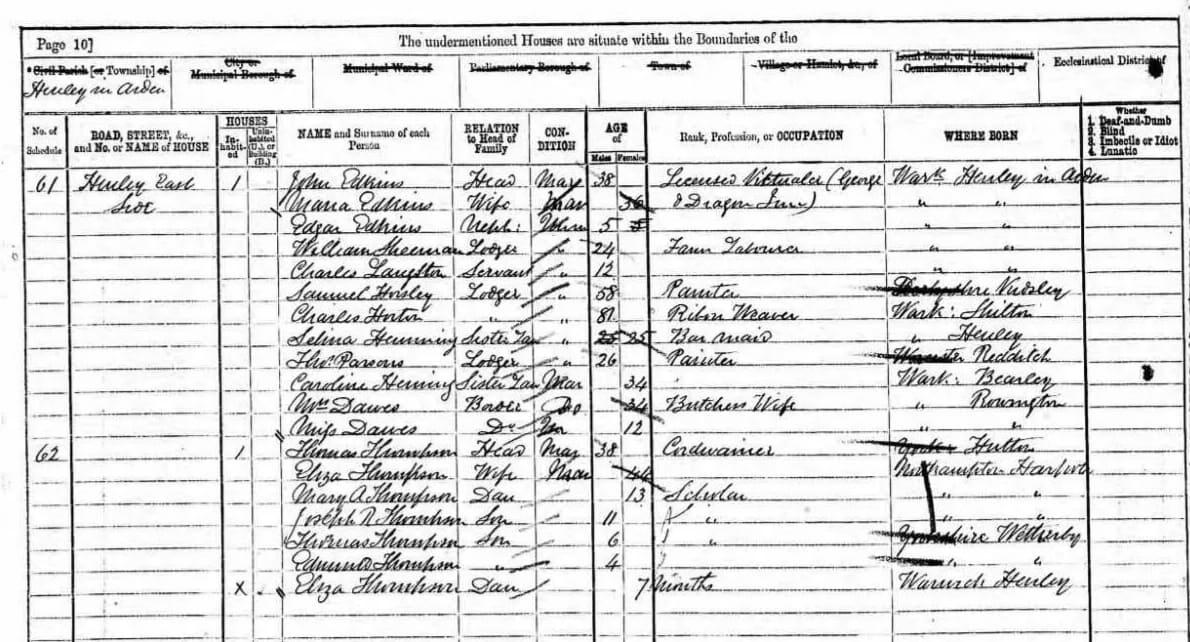
I found some living Housley descendants in USA. Samuel Housley’s brother George emigrated there in 1851. The Housley’s in USA found letters in the attic, from the family in Smalley ~ written between 1851 and 1870s. They sent me a “Narrative on the Letters” with many letter excerpts.
The Housley family were embroiled in a complicated will and court case in the early 1870s. In December 15, 1872, Joseph (Samuel’s brother) wrote to George:
“I think we have now found all out now that is concerned in the matter for there was only Sam that we did not know his whereabouts but I was informed a week ago that he is dead–died about three years ago in Birmingham Union. Poor Sam. He ought to have come to a better end than that….His daughter and her husband went to Birmingham and also to Sutton Coldfield that is where he married his wife from and found out his wife’s brother. It appears he has been there and at Birmingham ever since he went away but ever fond of drink.”
No record of Samuel Housley’s death can be found for the Birmingham Union in 1869 or thereabouts.
But if he was alive in 1871 in Henley In Arden…..
Did Samuel tell his wife’s brother to tell them he was dead? Or did the brothers say he was dead so they could have his share?We still haven’t found a death for Samuel Housley.
September 18, 2021 at 8:26 pm #6213In reply to: The Precious Life and Rambles of Liz Tattler
“Well, I wish you would stop interrupting me while I fill in the empty pages of my pink notebook with gripping stories, I keep losing my thread. Most annoying!” Liz sighed. She wrote Liz snapped at first and then erased it and changed it to Liz sighed. Then she added Liz sighed with the very mildest slight irritation and then became exasperated with the whole thing and told herself to just leave it and try to move on!
But really, Finnley’s timing, as usual! Just as Liz had worked out the direct line to the characters fathers mothers fathers fathers mothers fathers mothers fathers father and mother, Finnley wafts through the scene, making herself conspicuous, and scattering Liz’s tenuous concentration like feathers in the wind.
“And I don’t want to hear a word about apostrophes either,” she added, mentally noting the one in don’t.
“Oh, now I see what you’re doing, Liz!” Gordon appeared, smoking a pipe. “Very clever!”
“Good God, Gordon, you’re smoking a pipe!” It was an astonishing sight. “What an astonishing sight! Where are your nuts?”
“Well, it’s like this,” Gordon grinned, “I’ve been eating nuts in every scene for, how long? I just can’t face another nut.”
Liz barked out a loud cackle. “You think that’s bad, have you seen what they keep dressing me in? Anyway, ” she asked, “What do you mean clever and you see what I’m doing? What am I doing?”
“The code, of course! I spotted it right away,” Gordon replied smugly.
Finnley heaved herself out of the pool and walked over to Liz and Gordon. (is it Gordon or Godfrey? Liz felt the cold tendrils of dread that she had somehow gone off the track and would have to retrace her steps and get in a fearful muddle Oh no! )
A splat of blue algae across her face, as Finnley flicked the sodden strands of dyed debris off that clung to her hair and body, halted the train of thought that Liz had embarked on, and came to an abrupt collision with a harmless wet fish, you could say, as it’s shorter than saying an abrupt collision with a bit of dyed blue algae.
Liz yawned. Finnley was already asleep.
“What was in that blue dye?”
June 12, 2021 at 9:37 pm #6208In reply to: Newsreel from the Rim of the Realm
“Not so fast!” Glor muttered grimly, grabbing a flapping retreating arm of each of her friends, and yanking them to her sides. “Now’s our chance. It’s a trap, dontcha see? They got the wind up, and they’re gonna round us all up, it don’t bear thinking about what they’ll do next!”
With her free hand Mavis felt Gloria’s forehead, her palm slipping unpleasantly over the feverish salty slick. “Her’s deplirious, Sha, not right in the ‘ead, the ‘eat’s got to her. Solar over dose or whatever they call it nowadays.”
“My life depends on going to the bloody assembly hall, Glor, let go of my arm before I give yer a Glasgow kiss,” Sharon hissed, ignoring Mavis.
“I’m trying to save you!” screeched Gloria, her head exploding in exasperation. She took a deep breath. Told herself to stop screeching like that, wasn’t helping her cause. Should she just let go of Sharon’s arm?
Mavis started trying to take the pulse on Glor’s restraining wrists, provoking Gloria beyond endurance, and she lashed out and slapped Mavis’s free hand away, unintentionally freeing Sharon from her grasp. This further upset the balance and Gloria tumbled into Mavis at the moment of slapping her hand, causing a considerably more forceful manoeuvre than was intended.
Sharon didn’t hesitate to defend Mavis from the apparently deranged attack, and dived on to Gloria, pinning her arms behind her back.
Mavis scrambled to her feet and backed away slowly, nursing her hand, wide eyed and slack jawed in astonishment.
Where was this going?
June 11, 2021 at 2:50 am #6207In reply to: Newsreel from the Rim of the Realm
“I was ‘anging onto his bloody arm for dear life and the strangest thing you will never believe ….” Glor paused dramatically.
“Go on then, Glor! Don’t leave us ‘anging now!” said Sha. “We’re all agog, we are.”
“Don’t be such a bloody tease, Glor!” snapped Mavis.
“If yer will both ‘ush, I’ll tell ya.” Glor folded her arms and looked at her friends sternly. “His arm didn’t feel right. It felt like one of them dolls they put in shops with the fancy clothes on. Wot do you call them?”
“Wot yer on about, Sha? Youse feeling alright?” Mavis slapped a hand to Glor’s forehead. “A bit ‘ot. Might be the bloody stress got to you. All this escaping nonsense that Sophie is on about. She’s lost ‘er marbles an all if yer ask me. Mind, she must be bloody ninety if she’s a day.”
Glor heaved a loud sigh. Why did she always have to be the brains? “Have you numskuttles ever thought to yerselves that Mr Andrew Anderson is a bit too bloody bootiful? That it ain’t natural?”
Before the others could answer, a loud siren shrieked followed by the doctor’s voice. “EMERGENCY. ASSEMBLE IN THE HALL. I REPEAT. EVERYONE MUST GO WITH HASTE TO THE HALL YOUR LIFE DEPENDS UPON IT.
June 9, 2021 at 8:47 pm #6206In reply to: Newsreel from the Rim of the Realm
“I’m not ‘aving this treatment, Mavis, I’ve booked meself in for the spirit chew all mender tations session instead. No need to loook at me like that, our Mavis, I aint going all new agey on yer, just thought I’d give it a try and see if it relaxes me a bit.”
“Relaxes yer? Yer int done a stroke of work in years, whatcher on about?” Sha said, nudging Mavis in the ribs and cackling.
“It’s not all about the body, y’ know!” Glor replied, feeling the futility of trying to make them understand the importance of it to her, or the significance in the wider picture.
“I’m listening,” a melodious voice whispered behind her. Andrew Anderson smiled and looked deep into her squinting eyes as she turned to face him (the sun was going down behind him and it was very hard to see, much to her chagrin).
“Tell me more, Glor, what’s the score, Glor, I want to know more…”
Gloria, who knees had momentarily turned to jelly, reeled backwards at this surprising change in the conversation, and lost her balance due to her temporarily affected knees. Instinctively she reached out and grabbed Mr Anderson’s arm, and managed to avoid falling to the ground.
She retracted her arm slowly as an increasingly baffled look spread across her face.
Why did his arm feel so peculiar? It felt like a shop mannequin, unyielding, different somehow. Creepy somehow. Glor mumbled, “Sure, later,” and quickly caught up with her friends.
“Hey, You’ll never guess what, wait til I tell yer..” Glor started to tell them about Mr Anderson and then stopped. Would it be futile? Would they understand what she was trying to say?
“I’m listening,” a melodious voice whispered in her ear.
“Not bloody you again! You stalking me, or what?” Visibly rattled, Gloria rushed over to her friends, wondering why every time that weirdo whispered in her ear, she had somehow fallen back and had to catch up again.
She’d have to inform her friends of the danger, but would they listen? They were falling for him and wouldn’t be easily discouraged. They’d be lured to the yacht and not want to escape. The fools! What could she do?
“I’m listening,” the melodious voice whispered.
June 6, 2021 at 8:11 am #6201In reply to: The Precious Life and Rambles of Liz Tattler
“Go and put the kettle on while I think about this,” Liz instructed Finnley. “A vacation is not a bad idea. A change of air would do us good. Perhaps a nice self catering cottage somewhere in the country…”
“Self catering? And who might that self be that would be doing the catering for you, Liz?”
“I was only thinking of you!” retorted Liz, affronted. “You might get bored in a fancy hotel with nothing to dust!”
“Try me!” snapped Finnley. “You think you know me inside out, don’t you, but I’m just a story character to you, aren’t I? You don’t know me at all! Just the idea you have of a cleaner! I can’t take it anymore!”
“Oh for god’s sake stop blubbering, Finnley, no need to be so dramatic. Where would you like to go?”
“OH, I don’t know, Somewhere sunny and warm, with mountains and beaches, and not too many tourists.”
“Hah! Anywhere nice and warm with mountains and beaches is going to be packed with tourists. If you want a nice quiet holiday with no tourists you’d have to go somewhere cold and horrid.” Liz sniffed. “Everywhere nice in the world is stuffed with tourists. I know! How about a staycation? We can stay right here and you can make us a nice picnic every day to eat on the lawn.”
“Fuck off, Liz,” snapped Finnley.
“I say, there is no need to be rude! I could sack you for that!”
“Yes but you won’t. Nobody else would work for you, and you know it.”
“Yes well there is that,” Liz had to admit, sighing. “Well then, YOU choose somewhere. You decide. I am putty in your sweaty hands, willing to bend to your every whim. Just to keep the peace.”
Finnley rolled her eyes and went to put the kettle on. Where DID she want to go, she wondered? And would a holiday with Liz be any holiday at all?
June 5, 2021 at 11:17 pm #6200In reply to: The Precious Life and Rambles of Liz Tattler
“Clean it up yourself,” snarled Finnley throwing a piece of bhum bottle towards Liz. “You were the one what knocked it over.” She glared menacingly at Liz who jumped behind the philodendron plant in alarm.
“Finnley you are looking very ferocious … whatever is wrong?”
“I am not going to waste my life cleaning up after you!” Finnley tilted her chin defiantly. “I have aspirations, Madam.”
“But Finnley, cleaning is what I pay you to do.” Liz shook her head in bewilderment at the girl’s audacity. “We all have our gifts. I was blessed with the gift of writing. Roberto is visually fetching and potters in the garden. Godfrey … well I don’t know what he does but it could be something to do with peanuts—I must ask one day. And you, Finnley, you clean. It’s your vocation in life.”
Finnley beamed. “Vacation! now you’re talking, Madam! Where shall we go?”
“Vacation! I suppose you’ve heard of glowvid?” Liz waved her right hand at Finnley and then held the palm to her up to her face and considered it carefully. “Look, Finnley! The glow has all but gone.”
April 25, 2021 at 7:21 am #6196In reply to: The Whale’s Diaries Collection
Ay, the framework knittin’ were ‘ard work, but it were our own, and better by a mile than what come next. We ‘ad the frame in our home and all the family helped, the girls’d be the seamers and the spool threaders and many a fine stocking we made in our cottages, until those industrialists and capitalists came to our fair dales with their factories and such and took our livelihoods from under our noses.
We ‘ad a needle maker in our village, a miller and a baker, and a dressmaker. We ‘ad farms and a dairy and a butcher, and all the old families in our parish ‘ad their place. There’s always those that find work hard, and those that find it rewarding, but even them as found the framework knittin’ ‘ard soon changed their tune about the framework knittin’ being hard when they was doubled over under gods green earth all the day long in the coal mines.
Ay, the changes wrought upon our fair parish wreaked an unholy disruption upon the face of village life. It were the inclosures act what started our downfall, when our common land was took from us, that were indeed the beginning of the end of our fine community of largely honest souls, and even the good nature of the gent from the hall and the Parish poor fund couldn’t halt the downfall.
Ay and I’ve traveled to the future and seen the ungoldy sight of it now. The old farm on the turnpike road surrounded now by house upon house and not an onion nor a carrot to be seen growing in their gardens, and the fronts all hardened floors for those contraptions they move around in, and empty all day long with not a sign of life until nightfall when they all come home and go inside and shut the doors, and never a one passing the time of day with their neighbours over the garden fence, and not a chicken or a cow in sight.
There’s no needlemaker now, and the mill’s been knocked down, and there are painted lines on all the hard roads, although I will say that ugly as they are they don’t get near so rutted and muddy when the weather’s bad.
I can’t stay long when I visit the future with that woman who comes to call upon us asking questions. I can’t stay long at all.
April 24, 2021 at 8:02 pm #6193In reply to: The Whale’s Diaries Collection
I hope all this social media as they call it stands the test of time because little things like this are priceless and so few and far between, and someday someone wants to know a little thing like this to paint a picture in their mind. I don’t know if this is one of ours as they say but but he was there too and could even have been one of you or another one of me, the possibilities are endless and the charm of the random snippet is boundless.
“The gallery stairs were honeycombed on
each side by old Jonathan Beniston’s spiked
crutches, and although Jonathan could not
read, he considered himself a valuable
addition to the choir, contributing a sort of
drone bass accompaniment to the melodies. after the style of a bagpipe ” chanter.”Here’s another one I want to include in my book:
Mr. Joseph Moss, formerly a framework knitter of Woodhouse Lane, for several years kept a Diary of the principal events and incidents in the locality: a most commendable undertaking. It is much to be regretted that so few attempt anything of the kind, so useful, and always interest- ing. Besides the registration of marriages and funerals, we have notices of storms, removals, accidents, sales, robberies, police captures, festivities, re-openings of churches, and many other matters. His record begins in 1855, ^^d ends in 1881, Mr. Moss was a violinist of some ability, and was in great demand at all rural festivities. He was a good singer, and sang (inter alia) ” The Beggar’s Ramble ” with his own local variations^ in good style, and usually with much eclat. The following are a few extracts from his Diary : —
” — July. Restoration of Horsley Church. New weathercock placed on spire by Charles, son of Mr. Anthony Kerry, the builder, on the 31st. A few days later, the south arches of the nave fell down, bringing with it the roofs of nave and south aisle. The pillar next the tower had been under- mined by the making of a grave, and as soon as the gravestone over it was moved the column began to settle : a loud shout was made, and the workmen had only just time to scamper out of the building before the roof and top windows and all came down.”
April 24, 2021 at 7:34 pm #6192In reply to: The Whale’s Diaries Collection
They found me and locked me up again but I suppose it was going to happen sooner or later. I don’t mind though, I can always plot an escape when I’m ready but the fact is, I was tired after awhile. I needed a rest and so here I am. The weather’s awful so I may as well rest up here for a bit longer. They gave me a shot, too, so I don’t have to wear a mask anymore. Unless I want to wear it as a disguise of course, so I’ll keep a couple for when I escape again.
They gave me a computer to keep me amused and showed me how to do the daftest things I’d never want to do and I thought, what a load of rubbish, just give me a good book, but then this charming little angel of a helper appeared as if by magic and showed me how to do a family tree on this machine. Well! I had no idea such pursuits could be so engrossing, it’s like being the heroine in a detective novel, like writing your own book in a way.
I got off on a sidetrack with the search for one woman in particular and got I tell you I got so sucked inside the story I spent a fortnight in a small village in the north midlands two centuries ago that I had to shake me head to get back to the present for the necessary daily functions. I feel like I could write a book about that fortnight. Two hundred years explored in a fortnight in the search for CH’s mother.
I could write a book on the maternal line and how patriarchy has failed us in the search for our ancestry and blood lines. The changing names, the census status, lack of individual occupation but a mother knows for sure who her children are. And yet we follow paternal lines because the names are easier, but mothers know for sure which child is theirs whereas men can not be as sure as that. Barking up the wrong tree is easy done.
I can’t start writing any of these books at the moment because I’m still trying to find out who won the SK&JH vs ALL the rest of the H family court case in 1873. It seems the youngest son (who was an overseer with questionable accounts) was left out of the will. The executor of the will was his co plaintiff in the court case, a neighbouring land owner, and the whole rest of the family were the defendants. It’s gripping, there are so many twists and turns. This might give us a clue why CH grew up in the B’s house instead of her own. Why did CH’s mothers keep the boys and send two girls to live with another family? How did we end up with the oil painting of CH’s mother? It’s a mystery and I’m having a whale of a time.
Another good thing about my little adventure and then this new hobby is how, as you may have noticed, I’m not half as daft as I was when I was withering away in that place with nothing to do. I mean I know I’m withering away and not going anywhere again now, but on the other hand I’ve just had a fortnights holiday in the nineteenth century, which is more than many can say, even if they’ve been allowed out.
-
AuthorSearch Results