


Search Results for 'away'
-
AuthorSearch Results
-
March 1, 2025 at 1:42 pm #7848
In reply to: The Last Cruise of Helix 25
Helix 25 – Murder Board – Evie’s apartment
The ship had gone mad.
Riven Holt stood in what should have been a secured crime scene, staring at the makeshift banner that had replaced his official security tape. “ENTER FREELY AND OF YOUR OWN WILL,” it read, in bold, uneven letters. The edges were charred. Someone had burned it, for reasons he would never understand.
Behind him, the faint sounds of mass lunacy echoed through the corridors. People chanting, people sobbing, someone loudly trying to bargain with gravity.
“Sir, the floors are not real! We’ve all been walking on a lie!” someone had screamed earlier, right before diving headfirst into a pile of chairs left there by someone trying to create a portal.
Riven did his best to ignore the chaos, gripping his tablet like it was the last anchor to reality. He had two dead bodies. He had one ship full of increasingly unhinged people. And he had forty hours without sleep. His brain felt like a dried-out husk, working purely on stubbornness and caffeine fumes.
Evie was crouched over Mandrake’s remains, muttering to herself as she sorted through digital records. TP stood nearby, his holographic form flickering as if he, too, were being affected by the ship’s collective insanity.
“Well,” TP mused, rubbing his nonexistent chin. “This is quite the predicament.”
Riven pinched the bridge of his nose. “TP, if you say anything remotely poetic about the human condition, I will unplug your entire database.”
TP looked delighted. “Ah, my dear lieutenant, a threat worthy of true desperation!”
Evie ignored them both, then suddenly stiffened. “Riven, I… you need to see this.”
He braced himself. “What now?”
She turned the screen toward him. Two names appeared side by side:
ETHAN MARLOWE
MANDRAKE
Both M.
The sound that came out of Riven was not quite a word. More like a dying engine trying to restart.
TP gasped dramatically. “My stars. The letter M! The implications are—”
“No.” Riven put up a hand, one tremor away from screaming. “We are NOT doing this. I am not letting my brain spiral into a letter-based conspiracy theory while people outside are rolling in protein paste and reciting odes to Jupiter’s moons.”
Evie, far too calm for his liking, just tapped the screen again. “It’s a pattern. We have to consider it.”
TP nodded sagely. “Indeed. The letter M—known throughout history as a mark of mystery, malice, and… wait, let me check… ah, macaroni.”
Riven was going to have an aneurysm.
Instead, he exhaled slowly, like a man trying to keep the last shreds of his soul from unraveling.
“That means the Lexicans are involved.”
Evie paled. “Oh no.”
TP beamed. “Oh yes!”
The Lexicans had been especially unpredictable lately. One had been caught trying to record the “song of the walls” because “they hum with forgotten words.” Another had attempted to marry the ship’s AI. A third had been detained for throwing their own clothing into the air vents because “the whispers demanded tribute.”
Riven leaned against the console, feeling his mind slipping. He needed a reality check. A hard, cold, undeniable fact.
Only one person could give him that.
“You know what? Fine,” he muttered. “Let’s just ask the one person who might actually be able to tell me if this is a coincidence or some ancient space cult.”
Evie frowned. “Who?”
Riven was already walking. “My grandfather.”
Evie practically choked. “Wait, WHAT?!”
TP clapped his hands. “Ah, the classic ‘Wake the Old Man to Solve the Crimes’ maneuver. Love it.”
The corridors were worse than before. As they made their way toward cryo-storage, the lunacy had escalated:
A crowd was parading down the halls with helium balloons, chanting, “Gravity is a Lie!”
A group of engineers had dismantled a security door, claiming “it whispered to them about betrayal.”
And a bunch of Lexicans, led by Kio’ath, had smeared stinking protein paste onto the Atrium walls, drawing spirals and claiming the prophecy was upon them all.
Riven’s grip on reality was thin.Evie grabbed his arm. “Think about this. What if your grandfather wakes up and he’s just as insane as everyone else?”
Riven didn’t even break stride. “Then at least we’ll be insane with more context.”
TP sighed happily. “Ah, reckless decision-making. The very heart of detective work.”
Helix 25 — Victor Holt’s Awakening
They reached the cryo-chamber. The pod loomed before them, controls locked down under layers of security.
Riven cracked his knuckles, eyes burning with the desperation of a man who had officially run out of better options.
Evie stared. “You’re actually doing this.”
He was already punching in override codes. “Damn right I am.”
The door opened. A low hum filled the room. The first thing Riven noticed was the frost still clinging to the edges of an already open cryopod. Cold vapor curled around its base, its occupant nowhere to be seen.
His stomach clenched. Someone had beaten them here. Another pod’s systems activated. The glass began to fog as temperature levels shifted.
TP leaned in. “Oh, this is going to be deliciously catastrophic.”
Before the pod could fully engage, a flicker of movement in the dim light caught Riven’s eye. Near the terminal, hunched over the access panel like a gang of thieves cracking a vault, stood Zoya Kade and Anuí Naskó—and, a baby wrapped in what could only be described as an aggressively overdesigned Lexican tapestry, layers of embroidered symbols and unreadable glyphs woven in mismatched patterns. It was sucking desperately the lexican’s sleeve.
Riven’s exhaustion turned into a slow, rising fury. For a brief moment, his mind was distracted by something he had never actually considered before—he had always assumed Anuí was a woman. The flowing robes, the mannerisms, the way they carried themselves. But now, cradling the notorious Lexican baby in ceremonial cloth, could they possibly be…
Anuí caught his look and smiled faintly, unreadable as ever. “This has nothing to do with gender,” they said smoothly, shifting the baby with practiced ease. “I merely am the second father of the child.”
“Oh, for f***—What in the hell are you two doing here?”
Anuí barely glanced up, shifting the baby to their other arm as though hacking into a classified cryo-storage facility while holding an infant was a perfectly normal occurrence. “Unlocking the axis of the spiral,” they said smoothly. “It was prophesied. The Speaker’s name has been revealed.”
Zoya, still pressing at the panel, didn’t even look at him. “We need to wake Victor Holt.”
Riven threw his hands in the air. “Great! Fantastic! So do we! The difference is that I actually have a reason.”
Anuí, eyes glinting with something between mischief and intellect, gave an elegant nod. “So do we, Lieutenant. Yours is a crime scene. Ours is history itself.”
Riven felt his headache spike. “Oh good. You’ve been licking the walls again.”
TP, absolutely delighted, interjected, “Oh, I like them. Their madness is methodical!”
Riven narrowed his eyes, pointing at the empty pod. “Who the hell did you wake up?”
Zoya didn’t flinch. “We don’t know.”
He barked a laugh, sharp and humorless. “Oh, you don’t know? You cracked into a classified cryo-storage facility, activated a pod, and just—what? Didn’t bother to check who was inside?”
Anuí adjusted the baby, watching him with that same unsettling, too-knowing expression. “It was not part of the prophecy. We were guided here for Victor Holt.”
“And yet someone else woke up first!” Riven gestured wildly to the empty pod. “So, unless the prophecy also mentioned mystery corpses walking out of deep freeze, I suggest you start making sense.”
Before Riven could launch into a proper interrogation, the cryo-system let out a deep hiss.
Steam coiled up from Victor Holt’s pod as the seals finally unlocked, fog spilling over the edges like something out of an ancient myth. A figure was stirring within, movements sluggish, muscles regaining function after years in suspension.
And then, from the doorway, another voice rang out, sharp, almost panicked.
Ellis Marlowe stood at the threshold, looking at the two open pods, his eyes wide with something between shock and horror.
“What have you done?”
Riven braced himself.
Evie muttered, “Oh, this is gonna be bad.”
March 1, 2025 at 10:12 am #7844In reply to: The Last Cruise of Helix 25
Base Klyutch – Dr. Markova’s Clinic, Dusk
The scent of roasting meat and simmering stew drifted in from the kitchens, mingling with the sharper smells of antiseptic and herbs in the clinic. The faint clatter of pots and the low murmur of voices preparing the evening meal gave the air a sense of routine, of a world still turning despite everything. Solara Ortega sat on the edge of the examination table, rolling her shoulder to ease the stiffness. Dr. Yelena Markova worked in silence, cool fingers pressing against bruised skin, clinical as ever. Outside, Base Klyutch was settling into the quiet of night—wind turbines hummed, a sentry dog barked in the distance.
“You’re lucky,” Yelena muttered, pressing into Solara’s ribs just hard enough to make a point. “Nothing broken. Just overworked muscles and bad decisions.”
Solara exhaled sharply. “Bad decisions keep us alive.”
Yelena scoffed. “That’s what you tell yourself when you run off into the wild with Orrin Holt?”
Solara ignored the name, focusing instead on the peeling medical posters curling off the clinic walls.
“We didn’t find them,” she said flatly. “They moved west. Too far ahead. No proper tracking gear, no way to catch up before the lionboars or Sokolov’s men did.”
Yelena didn’t blink. “That’s not what I asked.”
A memory surfaced; Orrin standing beside her in the empty refugee camp, the air thick with the scent of old ashes and trampled earth. The fire pits were cold, the shelters abandoned, scraps of cloth and discarded tin cups the only proof that people had once been there. And then she had seen it—a child’s scarf, frayed and half-buried in the dirt. Not the same one, but close enough to make her chest tighten. The last time she had seen her son, he had worn one just like it.
She hadn’t picked it up. Just stood there, staring, forcing her breath steady, forcing her mind to stay fixed on what was in front of her, not what had been lost. Then Orrin’s hand had settled on her shoulder—warm, steady, comforting. Too comforting. She had jerked away, faster than she meant to, pulse hammering at the sudden weight of everything his touch threatened to unearth. He hadn’t said a word. Just looked at her, knowing, as he always did.
She had turned, found her voice, made it sharp. The trail was already too cold. No point chasing ghosts. And she had walked away before she could give the silence between them the space to say anything else.
Solara forced her attention back to the present, to the clinic. She turned her gaze to Yelena, steady and unmoved. “But that’s what matters. We didn’t find them. They made their choice.”
Yelena clicked her tongue, scribbling something onto her worn-out tablet. “Mm. And yet, you come back looking like hell. And Orrin? He looked like a man who’d just seen a ghost.”
Solara let out a dry breath, something close to a laugh. “Orrin always looks like that.”
Yelena arched an eyebrow. “Not always. Not before he came back and saw what he had lost.”
Solara pushed off the table, rolling out the tension in her neck. “Doesn’t matter.”
“Oh, it matters,” Yelena said, setting the tablet down. “You still look at him, Solara. Like you did before. And don’t insult me by pretending otherwise.”
Solara stiffened, fingers flexing at her sides. “I have a husband, Yelena.”
“Yes, you do,” Yelena said plainly. “And yet, when you say Orrin’s name, you sound like you’re standing in a place you swore you wouldn’t go back to.”
Solara forced herself to breathe evenly, eyes flicking toward the door.
“I made my choice,” she said quietly.
Yelena’s gaze softened, just a little. “Did he?”
Footsteps pounded outside, uneven, hurried. The clinic door burst open, and Janos Varga—Solara’s husband—strode in, breathless, his eyes bright with something rare.
“Solara, you need to come now,” he said, voice sharp with urgency. “Koval’s team—Orrin—they found something.”
Her spine straightened, her heartbeat accelerated. “What? Did they find…?” No, the tracks were clear, the refugees went west.
Janos ran a hand through his curls, his old radio headset still looped around his neck. “One of Helix 57’s life boat’s wreckage. And a man. Some old lunatic calling himself Merdhyn. And—” he paused, catching his breath, “—we picked up a signal. From space.”
The air in the room tightened. Yelena’s lips parted slightly, the shadow of an emotion passed on her face, too fast to read. Solara’s pulse kicked up.
“Where are they?” she asked.
Janos met her gaze. “Koval’s office.”
For a moment, silence. The wind rattled the windowpanes.
Yelena straightened abruptly, setting her tablet down with a deliberate motion. “There’s nothing more I can do for your shoulder. And I’m coming too,” she said, already reaching for her coat.
Solara grabbed her jacket. “Take us there, Janos.”
March 1, 2025 at 10:01 am #7843In reply to: The Last Cruise of Helix 25
Helix 25 – Space Tai Chi and Mass Lunacy
The Grand Observation Atrium was one of the few places on Helix 25 where people would come and regroup from all strata of the ship —Upper Decks, Lower Decks, even the more elusive Hold-dwellers— there were always groups of them gathered for the morning sessions without any predefined roles.
In the secular tradition of Chinese taichi done on public squares, a revival of this practice has started few years ago all thanks to Grand Master Sifu Gou quiet stubborn consistency to practice in the early light of the artificial day, that gradually had attracted followers, quietly and awkwardly joining to follow his strange motions. The unions, ever eager to claim a social victory and seeing an opportunity to boost their stature, petitioned to make this a right, and succeeded, despite the complaints from the cleaning staff who couldn’t do their jobs (and jogs) in the late night while all passengers had gone to sleep, apart from the night owls and party goers.
In short, it was a quiet moment of communion, and it was now institutionalised, whether Sifu Gou had wanted it or not.
The artificial gravity fluctuated subtly here, closer to the artificial gravitational core, in a way that could help attune people to feel their balance shift, even in absence of the Earth’s old pull.
It was simply perfect for Space Tai Chi.
A soft chime signaled the start of the session. Grand Master Gou, in the Helix 25’s signature milk-silk fabric pajamas, silver-haired and in a quiet poise, stood at the center of the open-air space beneath the reinforced glass dome, where Jupiter loomed impossibly large beyond the ship, its storms shifting in slow, eternal violence. He moved slowly, deliberately, his hands bearing a weight that flowed improbably in the thinness of the gravity shifts.
“To find one’s center,” he intoned, “is to find the center of all things. The ship moves, and so do we. You need to feel the center of gravity and use it —it is our guide.”
A hundred bodies followed in various degrees of synchrony, from well-dressed Upper Deck philosophers to the manutentioners and practical mechanics of the Lower Decks in their uniforms who stretched stiff shoulders between shift rotations. There was something mesmerizing about the communal movement, that even the ship usually a motionless background, seemed to vibrate beneath their feet as though their motions echoed through space.
Every morning, for this graceful moment, Helix 25 felt like a true utopia.
That was without counting when the madness began.

The Gossip Spiral
“Did you hear about Sarawen?” hissed a woman in a flowing silk robe.
“The Lexican?” gasped another.
“Yes. Gave birth last night.”
“What?! Already? Why weren’t we informed?”
“Oh, she kept it very quiet. Didn’t even invite anyone to the naming.”
“Disgraceful. And where are her two husbands? Following her everywhere. Suspicious if you ask me.”A grizzled Lower Deck worker grunted, still trying to follow Master Gou’s movement. “Why would she invite people to see her water break? Sounds unhygienic.”
This earned a scandalized gasp from an Upper Decker. “Not the birth—the ceremony! Honestly, you Lower Deck folk know nothing of tradition.”
Wisdom Against Wisdom
Master Gou was just finishing an elegant and powerful sweep of his arms when Edeltraut Snoot, a self-proclaimed philosopher from Quadrant B, pirouetted herself into the session with a flamboyant twirl.
“Ah, my dear glowing movement-makers! Thou dost align thine energies with the artificial celestial pull, and yet! And yet! Dost thou not see—this gravity is but a fabrication! A lie to lull thee into believing in balance when there is none!”
Master Gou paused, blinking, impassive, suspended in time and space, yet intently concentrated. Handling such disturbances of the force gracefully, unperturbed, was what the practice was about. He resumed as soon as Edeltraut moved aside to continue her impassionate speech.
“Ah yiii! The Snoot Knows. Oh yes. Balance is an illusion sold to us by the Grand Micromanagers, the Whymen of the Ever-Hungry Order. Like pacmaniacs, they devour structure and call it stability. And we! We are but rabbits, forced to hop through their labyrinth of rules!”
Someone muttered, “Oh no, it’s another of those speeches.”
Another person whispered, “Just let her talk, it’s easier.”
The Snoot lady continued, undeterred. “But we? Oh, we are not merely rabbits. We are the mist in the hedge! The trick in their tale! We evade! We escape! And when they demand we obey their whys—we vanish!”
By now, half the class had abandoned their movements entirely, mesmerized by the absurdity. The other half valiantly continued the Space taichi routine while inching away.
Master Gou finally closed the form, then sighed intently, pinching the bridge of his nose. “Let us… return to our breath.”
More Mass Lunacy
It started as a low murmur, a shifting agitation in the crowd. Then, bickering erupted like a solar flare.
“I can’t find my center with all this noise!”
“Oh shut up, you’ve never had a center.”
“Who took my water flask?!”
“Why is this man so close to me?!”
“I am FLOATING?! HELP!”Synthia’s calm, omnipresent voice chimed in overhead.
“For your well-being, an emergency dose of equilibrium supplements will be dispensed.”
Small white pills rained from overhead dispensers.
Instead of calming people down, this only increased the chaos.
Some took the pills immediately, while others refused on principle.
Someone accused the Lexicans of hoarding pills.
Two men got into a heated debate over whether taking the pills was an act of submission to the AI overlords.
A woman screamed that her husband had vanished, only to be reminded that he left her twelve years ago.
Someone swore they saw a moon-sized squid in the sky.The Unions and the Leopards
Near the edges of the room, two quadrant bosses from different labor unions were deep in mutual grumbling.
“Bloody management.”
“Agreed, even if they don’t call themselves that any longer, it’s still bloody management.”
“Damn right. MICRO-management.”
“Always telling us to be more efficient, more aligned, more at peace.”
“Yeah, well, who the hell voted for peace?! I preferred it when we just argued in the corridors!”One of them scowled. “That’s the problem, mate. We fought for this, better conditions, and what did we get? More rules, more supervisors! Who knew that the Leopards-Eating-People’s-Faces Party would, y’know—eat our own bloody faces?!”
The other snorted. “We demanded stability, and now we have so much stability we can’t move without filling out a form with all sorts of dumb questions. You know I have to submit a motion request before taking a piss?”
“…seriously?”
“Dead serious. Takes an eternity to fill. And four goddamn business hours for approval.”
“That’s inhumane.”
“Bloody right it is.”
At that moment, Synthia’s voice chimed in again.
“Please be advised: Temporary gravitational shifts are normal during orbital adjustments. Equilibrium supplements have been optimized. Kindly return to your scheduled calm.”
The Slingshot Begins
The whole ship gave a lurch, a gravitational hiccup as Helix 25 completed its slingshot maneuver around the celestial body.
Bodies swayed unnaturally. Some hovered momentarily, shrieking.
Someone declared that they had achieved enlightenment.
Someone else vomited.Master Gou sighed deeply, rubbing his temples. “We should invent retirement for old Masters. People can’t handle their shit during those Moonacies. Months of it ahead, better focus on breath more.”
Snoot Lady, still unaffected, spread her arms wide and declared:
“And so, the rabbit prevails once again!”Evie, passing by on her way to the investigation, took one look at the scene of absolute madness and turned right back around.
“Yeah. Nope. Not this morning. Back to the Murder Board.”
February 24, 2025 at 9:11 am #7833In reply to: The Last Cruise of Helix 25
“We were heading that way anyway,” Molly informed the others. She was pleased with the decision to head towards Hungary, or what used to be known as Hungary.
“Slowly heading that way,” interjected Tundra. “We spent years roaming around Ukraine and never saw a sign of survivors anywhere.”
“And I wanted to go home,” continued Molly. “Or try to, anyway. I’m very old, you know,” she added, as if they might not have noticed.
“I’ve never even been outside Ukraine,” said Yulia. “How exciting!”
Anya gave her a withering look. “You can send some postcards,” she said which caused a general tittering about the absurdity of the idea.
Yulia returned the look and said sharply, ” I plan to draw in my sketchbook all the new sights.”
“While we’re foraging for food and building campfires and washing our knickers in streams?” snorted Finja.
“Does anyone actually know where this city is that we’re heading for? And the way there?” asked Gregor, “Because if it’s any help,” he added, rummaging in his backpack, “I saved this.” Triumphantly we waved a battered old folded map.
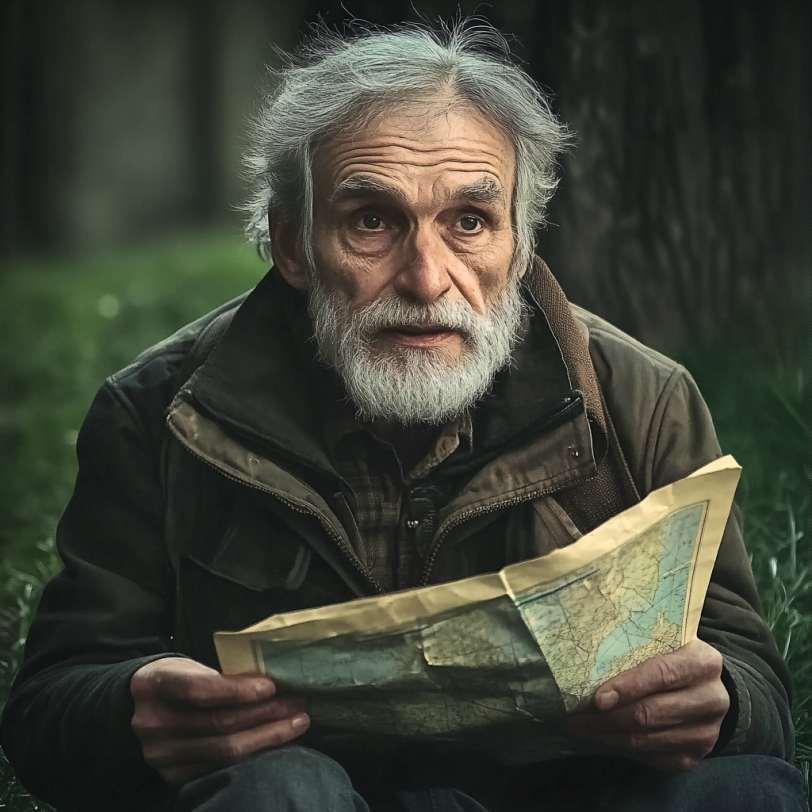
It was the first time in years that anyone had paid the old man any attention. Mikhail, Anya and Jian rushed over to him, eager to have a look. As their hands reached for the fragile map, Gregor clapsed it close to his chest, savouring his moment of glory.
“Ha!” he said, “Ha! Nobody wanted paper maps, but I knew it would come in handy one day!”
“Well done, Gregor” Molly said loudly. “A man after my own heart! I also have a paper map!” Tundra beamed happily at her great grandmother.
An excited buzz of murmuring swept through the gathered group.
“Ok, calm down everyone.” Anya stepped in to organise the situation. “Someone spread out a blanket. Let’s have a look at these maps ~ carefully! Stand back, everyone.”
Reluctantly, Molly and Gregor handed the maps to Anya, allowing her to slowly open them and spread them out. The folds had worn away completely in parts. Pebbles were collected to hold down the corners and protect the delicate paper from the breeze.
“Here, look” Mikhail pointed. “Here’s where we were at the asylum. Middle of nowhere. And here,” he pointed to a position slightly westwards, “Is where we are now. As you can see, the Hungarian border is close.”
“Where was that truck heading?” asked Vera.
Mikhail frowned and pored over the map. “Eastwards is all we can say for sure. Probably in the direction of Mukachevo, but Molly and Tundra said there were no survivors there. We just don’t know.”
“Yet,” added Jian, a man of few words.
“And where are we aiming for?” asked Finja.
“Nyíregyháza,” replied Mikhail, pointing at the map. “Should take us three or four days. Maybe a bit longer,” he added, glancing at Molly and Gregor.
“You’ll not outwalk Berlingo,” Molly snorted, “And I for one will be jolly glad to get back to some places that I can pronounce. And spell. Never did get a grip on that Cyrillic, I’d have been lost without Tundra.” Tundra beamed again at her grandmother. “And Hungarian names are only a tad better.”
“I can help you there,” Petro spoke up for the first time.
“You, help?” Anya said in astonishment, ” All you’ve ever done is complain!”
“Nobody has ever needed me, that’s why. I’m Hungarian. Surprised, are you? Nobody ever wanted to know where I was from. Nobody ever wanted my help with anything.”
“We’re all very glad you can help us now, Petro,” Molly said kindly, throwing a severe glance around the group. Tundra beamed proudly at Molly again.
“It’s an easy enough journey,” Petro addressed Molly directly, “Mostly agricultural plains. Well, they were agricultural anyway. Might be a good chance of feral chickens and self propagated crops, and the like. Finding water shouldn’t be a problem either. Used to be a lovely area,” Petro grew wistful. “I might go back to my village,” his voice trailed off as his mind returned to his childhood. “Never thought I’d ever see it again.”
“Well never mind that now,” Anya butted in rudely, “We need to make a start.” She began to carefully fold up the maps.
February 16, 2025 at 12:50 pm #7810In reply to: The Last Cruise of Helix 25
Helix 25 – Below Lower Decks – Shadow Sector
Kai Nova moved cautiously through the underbelly of Helix 25, entering a part of the Lower Decks where the usual throb of the ship’s automated systems turned muted. The air had a different smell here— it was less sterile, more… human. It was warm, the heat from outdated processors and unmonitored power nodes radiating through the bulkheads. The Upper Decks would have reported this inefficiency.
Here, it simply went unnoticed, or more likely, ignored.
He was being watched.
He knew it the moment he passed a cluster of workers standing by a storage unit, their voices trailing off as he walked by. Not unusual, except these weren’t Lower Deck engineers. They had the look of people who existed outside of the ship’s official structure—clothes unmarked by department insignias, movements too intentional for standard crew assignments.
He stopped at the rendezvous point: an unlit access panel leading to what was supposed to be an abandoned sublevel. The panel had been manually overridden, its system logs erased. That alone told him enough—whoever he was meeting had the skills to work outside of Helix 25’s omnipresent oversight.
A voice broke the silence.
“You’re late.”
Kai turned, keeping his stance neutral. The speaker was of indistinct gender, shaved head, tall and wiry, with sharp green eyes locked on his movements. They wore layered robes that, at a glance, could have passed as scavenged fabric—until Kai noticed the intricate stitching of symbols hidden in the folds.
They looked like Zoya’s brand —he almost thought… or let’s just say, Zoya’s influence. Zoya Kade’s litanies had a farther reach he would expect.
“Wasn’t aware this was a job interview,” Kai quipped, leaning casually against the bulkhead.
“Everything’s a test,” they replied. “Especially for outsiders.”
Kai smirked. “I didn’t come to join your book club. I came for answers.”
A low chuckle echoed from the shadows, followed by the shifting of figures stepping into the faint light. Three, maybe four of them. It could have been an ambush, but that was a display.
“Pilot,” the woman continued, avoiding names. “Seeker of truth? Or just another lost soul looking for something to believe in?”
Kai rolled his shoulders, sensing the tension in the air. “I believe in not running out of fuel before reaching nowhere.”
That got their attention.
The recruiter studied him before nodding slightly. “Good. You understand the problem.”
Kai crossed his arms. “I understand a lot of problems. I also understand you’re not just a bunch of doomsayers whispering in the dark. You’re organized. And you think this ship is heading toward a dead end.”
“You say that like it isn’t.”
Kai exhaled, glancing at the flickering emergency light above. “Synthia doesn’t make mistakes.”
They smiled, but it wasn’t friendly. “No. It makes adjustments.” — the heavy tone on the “it” struck him. Techno-bigots, or something else? Were they denying Synthia’s sentience, or just adjusting for gender misnomers, it was hard to tell, and he had a hard time to gauge the sanity of this group.
A low murmur of agreement rippled through the gathered figures.
Kai tilted his head. “You think she’s leading us into the abyss?”
The person stepped closer. “What do you think happened to the rest of the fleet, Pilot?”
Kai stiffened slightly. The Helix Fleet, the original grand exodus of humanity—once multiple ships, now only Helix 25, drifting further into the unknown.
He had never been given a real answer.
“Think about it,” they pressed. “This ship wasn’t built for endless travel. Its original mission was altered. Its course reprogrammed. You fly the vessel, but you don’t control it.” She gestured to the others. “None of us do. We’re passengers on a ride to oblivion, on a ship driven by a dead man’s vision.”
Kai had heard the whispers—about the tycoon who had bankrolled Helix 25, about how the ship’s true directive had been rewritten when the Earth refugees arrived. But this group… they didn’t just speculate. They were ready to act.
He kept his voice steady. “You planning on mutiny?”
They smiled, stepping back into the half-shadow. “Mutiny is such a crude word. We’re simply ensuring that we survive.”
Before Kai could respond, a warning prickle ran up his spine.
Someone else was watching.
He turned slowly, catching the faintest silhouette lingering just beyond the corridor entrance. He recognized the stance instantly—Cadet Taygeta.
Damn it.
She had followed him.
The group noticed, shifting slightly. Not hostile, but suddenly alert.
“Well, well,” the woman murmured. “Seems you have company. You weren’t as careful as you thought. How are you going to deal with this problem now?”
Kai exhaled, weighing his options. If Taygeta had followed him, she’d already flagged this meeting in her records. If he tried to run, she’d report it. If he didn’t run, she might just dig deeper.
And the worst part?
She wasn’t corruptible. She wasn’t the type to look the other way.
“You should go,” the movement person said. “Before your shadow decides to interfere.”
Kai hesitated for half a second, before stepping back.
“This isn’t over,” he said.
Her smile returned. “No, Pilot. It’s just beginning.”
With that, Kai turned and walked toward the exit—toward Taygeta, who was waiting for him with arms crossed, expression unreadable.
He didn’t speak first.
She did.
“You’re terrible at being subtle.”
Kai sighed, thinking quickly of how much of the conversation could be accessed by the central system. They were still in the shadow zone, but that wasn’t sufficient. “How much did you hear?”
“Enough.” Her voice was even, but her fingers twitched at her side. “You know this is treason, right?”
Kai ran a hand through his hair. “You really think we’re on course for a fresh new paradise?”
Taygeta didn’t answer right away. That was enough of an answer.
Finally, she exhaled. “You should report this.”
“You should,” Kai corrected.
She frowned.
He pressed on. “You know me, Taygeta. I don’t follow lost causes. I don’t get involved in politics. I fly. I survive. But if they’re right—if there’s even a chance that we’re being sent to our deaths—I need to know.”
Taygeta’s fingers twitched again.
Then, with a sharp breath, she turned.
“I didn’t see anything tonight.”
Kai blinked. “What?”
Her back was already to him, her voice tight. “Whatever you’re doing, Nova, be careful. Because next time?” She turned her head slightly, just enough to let him see the edge of her conflicted expression.
“I will report you.”
Then she was gone.
Kai let out a slow breath, glancing back toward the hidden movement behind him.
No turning back now.
February 15, 2025 at 9:21 am #7789In reply to: The Last Cruise of Helix 25
Helix 25 – Poop Deck – The Jardenery
Evie stepped through the entrance of the Jardenery, and immediately, the sterile hum of Helix 25’s corridors faded into a world of green. Of all the spotless clean places on the ship, it was the only where Finkley’s bots tolerated the scent of damp earth. A soft rustle of hydroponic leaves shifting under artificial sunlight made the place an ecosystem within an ecosystem, designed to nourrish both body and mind.
Yet, for all its cultivated serenity, today it was a crime scene. The Drying Machine was connected to the Jardenery and the Granary, designed to efficiently extract precious moisture for recycling, while preserving the produce.
Riven Holt, walking beside her, didn’t share her reverence. “I don’t see why this place is relevant,” he muttered, glancing around at the towering bioluminescent vines spiraling up trellises. “The body was found in the drying machine, not in a vegetable patch.”
Evie ignored him, striding toward the far corner where Amara Voss was hunched over a sleek terminal, frowning at a glowing screen. The renowned geneticist barely noticed their approach, her fingers flicking through analysis results faster than human eyes could process.
A flicker of light.
“Ah-ha!” TP materialized beside Evie, adjusting his holographic lapels. “Madame Voss, I must say, your domain is quite the delightful contrast to our usual haunts of murder and mystery.” He twitched his mustache. “Alas, I suspect you are not admiring the flora?”
Amara exhaled sharply, rubbing her temples, not at all surprised by the holographic intrusion. She was Evie’s godmother, and had grown used to her experiments.
“No, indeed. I’m admiring this.” She turned the screen toward them.
The DNA profile glowed in crisp lines of data, revealing a sequence highlighted in red.
Evie frowned. “What are we looking at?”
Amara pinched the bridge of her nose. “A genetic anomaly.”
Riven crossed his arms. “You’ll have to be more specific.”
Amara gave him a sharp look but turned back to the display. “The sample we found at the crime scene—blood residue on the drying machine and some traces on the granary floor—matches an ancient DNA profile from my research database. A perfect match.”
Evie felt a prickle of unease. “Ancient? What do you mean? From the 2000s?”
Amara chuckled, then nodded grimly. “No, ancient as in Medieval ancient. Specifically, Crusader DNA, from the Levant. A profile we mapped from preserved remains centuries ago.”
Silence stretched between them.
Finally, Riven scoffed. “That’s impossible.”
TP hummed thoughtfully, twirling his cane. “Impossible, yet indisputable. A most delightful contradiction.”
Evie’s mind raced. “Could the database be corrupted?”
Amara shook her head. “I checked. The sequencing is clean. This isn’t an error. This DNA was present at the crime scene.” She hesitated, then added, “The thing is…” she paused before considering to continue. They were all hanging on her every word, waiting for what she would say next.
Amara continued “I once theorized that it might be possible to reawaken dormant ancestral DNA embedded in human cells. If the right triggers were applied, someone could manifest genetic markers—traits, even memories—from long-dead ancestors. Awakening old skills, getting access to long lost secrets of states…”
Riven looked at her as if she’d grown a second head. “You’re saying someone on Helix 25 might have… transformed into a medieval Crusader?”
Amara exhaled. “I’m saying I don’t know. But either someone aboard has a genetic profile that shouldn’t exist, or someone created it.”
TP’s mustache twitched. “Ah! A puzzle worthy of my finest deductive faculties. To find the source, we must trace back the lineage! And perhaps a… witness.”
Evie turned toward Amara. “Did Herbert ever come here?”
Before Amara could answer, a voice cut through the foliage.
“Herbert?”
They turned to find Romualdo, the Jardenery’s caretaker, standing near a towering fruit-bearing vine, his arms folded, a leaf-tipped stem tucked behind his ear like a cigarette. He was a broad-shouldered man with sun-weathered skin, dressed in a simple coverall, his presence almost too casual for someone surrounded by murder investigators.
Romualdo scratched his chin. “Yeah, he used to come around. Not for the plants, though. He wasn’t the gardening type.”
Evie stepped closer. “What did he want?”
Romualdo shrugged. “Questions, mostly. Liked to chat about history. Said he was looking for something old. Always wanted to know about heritage, bloodlines, forgotten things.” He shook his head. “Didn’t make much sense to me. But then again, I like practical things. Things that grow.”
Amara blushed, quickly catching herself. “Did he ever mention anything… specific? Like a name?”
Romualdo thought for a moment, then grinned. “Oh yeah. He asked about the Crusades.”
Evie stiffened. TP let out an appreciative hum.
“Fascinating,” TP mused. “Our dearly departed Herbert was not merely a victim, but perhaps a seeker of truths unknown. And, as any good mystery dictates, seekers who get too close often find themselves…” He tipped his hat. “Extinguished.”
Riven scowled. “That’s a bit dramatic.”
Romualdo snorted. “Sounds about right, though.” He picked up a tattered book from his workbench and waved it. “I lend out my books. Got myself the only complete collection of works of Liz Tattler in the whole ship. Doc Amara’s helping me with the reading. Before I could read, I only liked the covers, they were so romantic and intriguing, but now I can read most of them on my own.” Noticing he was making the Doctor uncomfortable, he switched back to the topic. “So yes, Herbert knew I was collector of books and he borrowed this one a few weeks ago. Kept coming back with more questions after reading it.”
Evie took the book and glanced at the cover. The Blood of the Past: Genetic Echoes Through History by Dr. Amara Voss.
She turned to Amara. “You wrote this?”
Amara stared at the book, her expression darkening. “A long time ago. Before I realized some theories should stay theories.”
Evie closed the book. “Looks like someone didn’t agree.”
Romualdo wiped his hands on his coveralls. “Well, I hope you figure it out soon. Hate to think the plants are breathing in murder residue.”
TP sighed dramatically. “Ah, the tragedy of contaminated air! Shall I alert the sanitation team?”
Riven rolled his eyes. “Let’s go.”
As they walked away, Evie’s grip tightened around the book. The deeper they dug, the stranger this murder became.
February 8, 2025 at 3:38 pm #7765In reply to: The Last Cruise of Helix 25
Zoya clicked her tongue, folding her arms as Evie and her flickering detective vanished into the dead man’s private world. She listened to the sounds of investigation. The sound of others touching what should have been hers first. She exhaled through her nose, slow and measured.
The body was elsewhere, dried and ruined. That didn’t matter. What mattered was here—hairs, nail clippings, that contained traces, strands, fragments of DNA waiting to be read like old parchments.
She stepped forward, the soft layers of her robes shifting.
“You can’t keep me out forever, young man.”
Riven didn’t move. Arms crossed, jaw locked, standing there like a sentry at some sacred threshold. Victor Holt’s grandson, through and through, she thought.
“I can keep you out long enough.”
Zoya clicked her tongue. Not quite amusement, not quite irritation.
“I should have suspected such obstinacy. You take after him, after all.”
Riven’s shoulders tensed.
Good. Let him feel it.
His voice was tight. “If you’re referring to my grandfather, you should choose your words carefully.”
Zoya smiled, slow and knowing. “I always choose my words carefully.”
Riven’s glare could have cut through metal.
Zoya tilted her head, studying him as she would an artifact pulled from the wreckage of an old world. So much of Victor Holt was in him—the posture, the unyielding spine, the desperate need to be right.
But Victor Holt had been wrong.
And that was why he was sleeping in a frozen cell of his own making.
She took another step forward, lowering her voice just enough that the curious would not hear what she said.
“He never understood the ship’s true mission. He clung to his authority, his rigid hierarchies, his outdated beliefs. He would have let us rot in luxury while the real work of survival slipped away. And when he refused to see reason—” she exhaled, her gaze never leaving his, “he stepped aside.”
Riven’s jaw locked. “He was forced aside.”
Zoya only smiled. “A matter of perspective.”
She let that hang. Let him sit with it.
She could see the war in his eyes—the desperate urge to refute her, to throw his grandfather’s legacy in her face, to remind her that Victor Holt was still here, still waiting in cryo, still a looming shadow over the ship. But Victor Holt’s silence was the greatest proof of his failure.
Riven clenched his jaw.
Anuí’s voice, smooth and patient, cut through the tension.
“She is not wrong.”
Zoya frowned. She had expected them to speak eventually. They always did.
They stood just a little apart, hand tucked in their robes, their expression unreadable.
“In its current state, the body is useless,” Anuí said lightly, as if stating something obvious, “but that does not mean it has left no trace.” Then they murmured “Nāvdaṭi hrás’ka… aṣṭīr pālachá.”
Zoya glanced at them, her eyes narrowing. In an old tongue forgotten by all, it meant The bones remember… the blood does not lie. She did not trust the Lexicans’ sudden interest in genetics.
They did not see history in bloodlines, did not place value in the remnants of DNA. They preferred their records rewritten, reclaimed, restructured to suit a new truth, not an old one.
Yet here they were, aligning themselves with her. And that was what gave her pause.
“Your people have never cared for the past as it was,” she murmured. “Only for what it could become.”
Anuí’s lips curved, withholding more than they gave. “Truth takes many forms.”
Zoya scoffed. They were here for their own reasons. That much was certain. She could use that
Riven’s fingers tightened at his sides. “I have my orders.”
Zoya lifted a brow. “And whose orders are those?”
The hesitation was slight. “It’s not up to me.”
Zoya stilled. The words were quiet, bitter, revealing.
Not up to him.
So, someone had ensured she wouldn’t step foot in that room. Not just delayed—denied.
She exhaled, long and slow. “I see.” She paused. “I will find out who gave that order.”
And when she did, they would regret it.
February 8, 2025 at 11:32 am #7763In reply to: The Last Cruise of Helix 25
The corridor outside Mr. Herbert’s suite was pristine, polished white and gold, designed to impress, like most of the ship. Soft recessed lighting reflected off gilded fixtures and delicate, unnecessary embellishments.
It was all Riven had ever known.
His grandfather, Victor Holt, now in cryo sleep, had been among the paying elite, those who had boarded Helix 25, expecting a decadent, interstellar retreat. Riven, however had not been one of them. He had been two years old when Earth fell, sent with his aunt Seren Vega on the last shuttle to ever reach the ship, crammed in with refugees who had fought for a place among the stars. His father had stayed behind, to look for his mother.
Whatever had happened after that—the chaos, the desperation, the cataclysm that had forced this ship to become one of humanity’s last refuges—Riven had no memory of it. He only knew what he had been told. And, like everything else on Helix 25, history depended on who was telling it.
For the first time in his life, someone had been murdered inside this floating palace of glass and gold. And Riven, inspired by his grandfather’s legacy and the immense collection of murder stories and mysteries in the ship’s database, expected to keep things under control.
He stood straight in front of the suite’s sealed sliding door, arms crossed on a sleek uniform that belonged to Victor Holt. He was blocking entry with the full height of his young authority. As if standing there could stop the chaos from seeping in.
A holographic Do Not Enter warning scrolled diagonally across the door in Effin Muck’s signature font—because even crimes on this ship came branded.
People hovered in the corridor, coming and going. Most were just curious, drawn by the sheer absurdity of a murder happening here.
Riven scanned their faces, his muscles coiled with tension. Everyone was a potential suspect. Even the ones who usually didn’t care about ship politics.
Because on Helix 25, death wasn’t supposed to happen. Not anymore.
Someone broke away from the crowd and tried to push past him.
“You’re wasting time. Young man.”
Zoya Kade. Half scientist, half mad Prophet, all irritation. Her gold-green eyes bore into him, sharp beneath the deep lines of her face. Her mismatched layered robes shifting as she moved. Riven had no difficulty keeping the tall and wiry 83 years old woman at a distance.
Her silver-white braid was woven with tiny artifacts—bits of old circuits, beads, a fragment of a key that probably didn’t open anything anymore. A collector of lost things. But not just trinkets—stories, knowledge, genetic whispers of the past. And now, she wanted access to this room like it was another artifact to be uncovered.
“No one is going in.” Riven said slowly, “until we finish securing the area.”
Zoya exhaled sharply, turning her head toward Evie, who had just emerged from the crowd, tablet in hand, TP flickering at her side.
“Evie, tell him.”
Evie did not look pleased to be associated with the old woman. “Riven, we need access to his room. I just need…”
Riven hesitated.
Not for long, barely a second, but long enough for someone to notice. And of course, it was Anuí Naskó.
They had been waiting, standing slightly apart from the others, their tall, androgynous frame wrapped in the deep-colored robes of the Lexicans, fingers lightly tapping the surface of their handheld lexicon. Observing. Listening. Their presence was a constant challenge. When Zoya collected knowledge like artifacts, Anuí broke it apart, reshaped it. To them, history was a wound still open, and it was the Lexicans duty to rewrite the truth that had been stolen.
“Ah,” Anuí murmured, smiling slightly, “I see.”
Riven started to tap his belt buckle. His spine stiffened. He didn’t like that tone.
“See what, exactly?”
Anuí turned their sharp, angular gaze on him. “That this is about control.”
Riven locked his jaw. “This is about security.”
“Is it?” Anuí tapped a finger against their chin. “Because as far as I can tell, you’re just as inexperienced in murder investigation as the rest of us.”
The words cut sharp in Riven’s pride. Rendering him speechless for a moment.
“Oh! Well said,” Zoya added.
Riven felt heat rise to his face, but he didn’t let it show. He had been preparing himself for challenges, just not from every direction at once.
His grip tightened on his belt, but he forced himself to stay calm.
Zoya, clearly enjoying herself now, gestured toward Evie. “And what about them?” She nodded toward TP, whose holographic form flickered slightly under the corridor’s ligthing. “Evie and her self proclaimed detective machine here have no real authority either, yet you hesitate.”
TP puffed up indignantly. “I beg your pardon, madame. I am an advanced deductive intelligence, programmed with the finest investigative minds in history! Sherlock Holmes, Hercule Poirot, Miss Marple, Marshall Pee Stoll…”
Zoya lifted a hand. “Yes, yes. And I am a boar.”
TP’s mustache twitched. “Highly unlikely.”
Evie groaned. “Enough TP.”
But Zoya wasn’t finished. She looked directly at Riven now. “You don’t trust me. You don’t trust Anuí. But you trust her.” She gave a node toward Evie. “Why?
Riven felt his stomach twist. He didn’t have an answer. Or rather, he had too many answers, none of which he could say out loud. Because he did trust Evie. Because she was brilliant, meticulous, practical. Because… he wanted her to trust him back. But admitting that, showing favoritism, expecially here in front of everyone, was impossible.
So he forced his voice into neutrality. “She has technical expertise and no political agenda about it.”
Anuí left out a soft hmm, neither agreeing nor disagreeing, but filing the information away for later.
Evie took the moment to press forward. “Riven, we need access to the room. We have to check his logs before anything gets wiped or overwritten. If there’s something there, we’re losing valuable time just standing there arguing.”
She was right. Damn it, she was right. Riven exhaled slowly.
“Fine. But only you.”
Anuí’s lips curved but just slightly. “How predictable.”
Zoya snorted.
Evie didn’t waste time. She brushed past him, keying in a security override on her tablet. The suite doors slid open with a quiet hiss.
February 3, 2025 at 10:10 pm #7733In reply to: The Last Cruise of Helix 25
Leaving the Asylum
They argued about whether to close the heavy gates behind them. In the end, they left them open. The metal groaned as it sat ajar, rust flaking from its hinges.
“Are we all here?” Anya asked. Now that they were leaving, she felt in charge again—or at least, she needed to be. If morale slipped, things would unravel fast. She scanned the group, counting them off.
“Mikhail,” she started, pointing. “Tala. Vera, our esteemed historian.”
Vera sniffed. “I prefer genealogist, thank you very much.”
“Petro,” Anya continued, “probably about to grumble.”
Petro scowled. “I was thinking.”
“Jian, our mystery man.”
Jian raised an eyebrow in acknowledgment.
Anya turned to the next two. “Ah, the twins. Even though you two have never spoken, I’ve always assumed you understood me. Don’t prove me wrong now.”
The twins—Luka and Lev—nodded and grinned at exactly the same time.
“Then we have Yulia… no, we don’t have Yulia. Where in God’s name is Yulia?”
“Here I am!” Yulia’s voice rang out as she jogged back toward them, breathless. “I just went to say goodbye to the cat.” She sighed dramatically. “I wish we could take him. Please, can we take him?”
Yulia was short and quick-moving, her restless hands always in motion, her thoughts spilling out just as fast.
“We can’t,” Mikhail said firmly. “And he can look after himself.”
She huffed. “Well, I expect we could if we tried.”
“And finally, old Gregor, who I gather would rather be taking a nap.”
Gregor, who was well past eighty, rubbed his face and yawned. “You say that like it’s a bad thing.”
Anya frowned, scanning the group again. “Wait. We’re missing Finja.”
A small scraping sound came from behind them.
Finja stood near the gate, furiously scrubbing the rusted metal with a rag she had pulled from her sleeve. “This place is disgusting,” she muttered. “Filth everywhere. The world may have ended, but that’s no excuse for grime.”
Anya sighed. “Finja, leave the gate alone.”
Finja gave it one last wipe before tucking the rag away with a huff. “Fine.”
Anya shook her head. “That’s eleven. No one’s run off or died yet. A promising start.”
They formed a motley crew, each carrying as much as they could manage. Mikhail pushed a battered cart, loaded with scavenged supplies—blankets, tools, whatever food they had left.
The road beneath their feet was cracked and uneven, roots breaking through in places. They followed it in silence for the most part. Even Yulia remained quiet. Some glanced back, but no one turned around.
The nearest village was more than fifty kilometers away. In all directions, there was only wilderness—fields long overtaken by weeds, trees pushing through cracks in forgotten roads. A skeletal signpost leaned at an odd angle, its lettering long since faded.
“It’s going to be dark soon,” Mikhail said. “And the old ones are tired. Aren’t you, Vera?”
“That’s enough of the old business,” puffed Vera, pulling her shoulders back.
Tala laughed. “Well, I must be an old one. I didn’t sleep a wink last night. And there’s a clearing over there.” She pointed.
The evening was cool, but they managed to build a small fire and scrape together a meal of vegetables they’d brought from their garden.
After their meal, they sat around the fire while Finja busied herself tidying up. “Dirty savages,” she muttered under her breath. Then, more loudly, “We should keep watch tonight.”
Vera, perched on a log, pulled her shawl tightly around her. The glow from the fire cast long shadows across her face.
“Vera, you look like a witch,” Yulia declared. “We should have brought the cat for you to ride on a broomstick together.”
“I’ll have you know I’m descended from witches,” Vera replied. “I know none of you think you’re related to me, but just imagine what your great-grandparents would say if they saw us now. Running into the wilderness like a band of exiled aristocrats.”
Jian, seated nearby, smirked slightly. “My great-grandparents were rice farmers.”
Vera brightened—Jian never talked about his past. She leaned in conspiratorially. “Do you know your full lineage? Because I do. I know mine back fourteen generations. You’d be amazed how many bloodlines cross without people realizing.”
Tala shook her head but smiled. Like Petro and Gregor, Vera had been at the asylum for many decades, a relic of another time. She claimed to have been a private investigator and genealogist in her former life.
Petro, hunched over and rubbing his hands by the fire, muttered, “We’re all ghosts now. Doesn’t matter where we came from.”
“Oh, stop that, Petro,” Anya admonished. “Remember our plan?”
“We go to the city,” Jian said. He rarely spoke unless he had something worth saying. “There will be things left behind. Maybe tech, maybe supplies. If I can get into an old server, I might even find something useful.”
“And if there’s nothing?” Petro moaned. “We should never have left.” He clasped his hands over his head.
Jian shrugged. “The world doesn’t erase itself overnight.”
Mikhail nodded. “We rest tonight. Tomorrow, we head for the city. And Finja’s right—tonight we take turns keeping watch.”
They sat in silence, watching the fire burn low. The evening stretched long and uneasy.
February 3, 2025 at 5:18 am #7730In reply to: The Last Cruise of Helix 25
The Asylum 2050
They had been talking about leaving for a long time.
Not in any urgent way, not in a we must leave now kind of way, but in the slow, circling conversations of people who had too much time and not enough answers.
Those who had left before them had never returned. Perhaps they had found something better, though that seemed unlikely. Perhaps they had found nothing at all. The first group left over twenty years ago—just for supplies. They never came back. Others drifted off over the years. They never came back either.
The core group had stayed because—what else was there? The asylum had been safe, for the most part. It had become home. Overgrown now, with only a fraction of its former inhabitants. The walls had once kept them in; now, they were what kept the rest of the world out.
But the crops were failing. The soil was thinning. The last winter had been long and cruel. Summer was harsh. Water was harder to find.
And so the reasons to stay had been replaced with reasons to go.
She was about forty now—or near enough, though time had softened the numbers. Natalia. A name from a past life; now they called her Tala.
Her family had left her here years ago. Paid well for it, as if they were settling an expensive inconvenience. She had been young then—too young to know how final it would be. They had called her difficult, willful, unable to conform. She wasn’t mad, but they had paid to have her called mad so they could get rid of her. And in the world before, that had been enough.
She had been furious at first. She tried to run away even though the asylum was many miles from anywhere. The drugs they made her take put an end to that. The drugs stopped many years ago, but she no longer wanted to run.
She sat at the edge of the vegetable garden, turning soil between her fingers. It was dry, thinning. No matter how deep she dug, the color stayed the same—pale, lifeless.
“Nothing wants to grow anymore,” said Anya, standing over her. Older—mid-sixties. Once a nurse, before everything had fallen apart. She had been one of the staff members who stayed behind when the first group left for supplies, but now she was the only one remaining. The others had abandoned the asylum years ago. At first, her authority had meant something. Now, it was just a memory, but she still carried it like an old habit. She was practical, sharp-eyed, and had a way of making decisions that others followed without question.
Tala wiped her hands on her skirt and looked up. “We probably should have left last year.”
Anya sighed. She dropped a brittle stalk of something dead into the compost pile. “Doesn’t matter now. We must go soon, or we don’t go at all.”
There was no arguing with that.
Later, in the old communal hall, the last of them gathered. Eleven of them.
Mikhail leaned against the window, his arms crossed. He was a little older than Tala. He thought a long time before he spoke.
“How many weapons do we have?”
Anya shrugged. “A couple of old rifles with half a dozen bullets. A handful of knives. And whatever rocks and sticks we pick up on the way.”
“It’s not enough to defend ourselves,” Tala said. Petro, an older resident who couldn’t remember life before the asylum, moaned and rocked. “But we’ll have our wits about us,” she added, offering a small reassurance.
Mikhail glanced at her. “We don’t know what’s out there.”
Before communication went silent, there had been stories of plagues, wars, starvation, entire cities turning against themselves. People had come through the asylum’s doors shortly before the collapse, mad with what they had seen.
But then, nobody came. The fences had grown thick with vines. And the world had gone quiet.
Over time, they had become a kind of family, bound by necessity rather than blood. They were people who had been left behind for reasons that no longer mattered. In this world, sanity had become a relative thing. They looked after one another, oddities and all.
Mikhail exhaled and pushed off the window. “Tomorrow, then.”
December 23, 2024 at 11:20 am #7708In reply to: Quintessence: Reversing the Fifth
Elara — Nov 2021: The End of Genealogix
The numbers on the screen were almost comical in their smallness. Elara stared at the royalty statement, her lips pressed into a tight line as the cursor blinked on the final transaction: £12.37, marked Genealogix Royalty Deposit. Below it, the stark words: Final Payout.
She leaned back in her chair, pushing her glasses up onto her forehead, and sighed. The end wasn’t a surprise. For years, she’d known her genetic algorithm would be replaced by something faster, smarter, and infinitely more marketable. The AI companies had come, sweeping up data and patents like vultures at a sky burial. Genealogix, her improbable golden goose, had simply been outpaced.
Still, staring at the zero balance in the account felt oddly final, as if a door had quietly closed on a chapter of her life. She glanced toward the window, where the Tuscan hills rolled gently under the late afternoon sun. Most of the renovation work on the farmhouse had been finished, albeit slowly, over the years. There was no urgent financial burden, but the thought of her remaining savings made her stomach tighten all the same.
Elara had stumbled into success with Genealogix, though not without effort. It was one of her many patents—most of them quirky solutions to problems nobody else seemed interested in solving. A self-healing chalkboard coating? Useless. A way to chart audio waveforms onto three-dimensional paper models? Intriguing but commercially barren. Genealogix had been an afterthought at the time, something she tinkered with while traveling through Europe on a teaching fellowship.
When the royalties started rolling in unexpectedly, it had felt like a cosmic joke. “Finally,” she’d muttered to herself as she cashed her first sizeable check, “they like something useless.”
The freedom that money brought was a relief. It allowed her to drop the short-term contracts that tethered her to institutions and pursue science on her own terms. No rigid conventions, no endless grant applications, no academic politics. She’d call it “investigation,” free from the dogma that so often suffocated creativity.
And yet, she was no fool. She’d known Genealogix was a fluke, its lifespan limited.
She clicked away from the bank statement and opened her browser, absently scrolling through her bookmarked social accounts. An old post from Lucien caught her eye—a photograph of a half-finished painting, the colors dark and chaotic. His caption read: “When the labyrinth swallows the light.”
Her brow furrowed. She’d been quietly following Lucien for years, watching his work evolve through fits and starts. It was obvious he was struggling. This post was old, maybe Lucian had stopped updating after the pandemic. She’d sent anonymous payments to buy his paintings more than once, under names that would mean nothing to him —”Darlara Ameilikian” was a bit on the nose, but unlike Amei, Elara loved a good wink.
Her mind wandered to Darius, and her suggesting he looked into 1-euro housing schemes available in Italy. It had been during a long phone call, back when she was scouting options for herself. They still had tense exchanges, and he was smart to avoid any mention of his odd friends, otherwise she’d had hung the phone faster than a mouse chased by a pack of dogs. “You’d thrive in something like that,” she’d told him. “Build it with your own hands. Make it something meaningful.” He’d laughed but had sounded intrigued. She wondered if he’d ever followed up on it.
As for Amei—Elara had sent her a birthday gift earlier that year, a rare fabric she’d stumbled across in a tiny local shop. Amei hadn’t known it was from her, of course. That was Elara’s way. She preferred to keep her gestures quiet, almost random —it was best that way, she was rubbish at remembering the small stuff that mattered so much to people, she wasn’t even sure of Amei’s birthday to be honest; so she preferred to scatter little nods like seeds to the wind.
Her eyes drifted to a framed ticket stub on the bookshelf, a relic from 2007: Eliane Radigue — Naldjorlak II, Aarau Festival (Switzerland). Funny how the most unlikely event had made them into a group of friends. That concert had been a weird and improbable anchor point in their lives, a moment of serendipity that had drawn them toward something more than their own parts.
By that time, they were already good friends with Amei, and she’d agreed to join her to discover the music, although she could tell it was more for the strange appeal of something almost alien in experience, than for the hurdles of travel and logistics. But Elara’s enthusiasm and devil-may-care had won her over, and they were here.
Radigue’s strange sound sculptures, had rippled through the darkened festival scene, wavering and hauntingly delicate, and at the same time slow and deliberate, leading them towards an inevitability. Elara had been mesmerized, sitting alone near the back as Amei had gone for refreshments, when a stranger beside her had leaned over to ask, “What’s that sound? A bell? Or a drone?”
It was Lucien. Their conversation had lasted through the intermission soon joined by Amei, and spilled into a café afterward, where Darius had eventually joined them. They’d formed a bond that night, one that felt strange and tenuous at the time but proved to be resilient, even as the years pulled them apart.
Elara closed the laptop, resting her hand on its warm surface for a moment before standing. She walked to the window, the sun dipping lower over the horizon, casting long shadows across the vineyard. The farmhouse had been a gamble, a piece of the future she wasn’t entirely sure she believed in when she’d bought it. But now, as the light shifted and the hills glowed gold, she felt a quiet satisfaction.
The patent was gone, the money would fade, but she still had this. And perhaps, that was enough.
December 22, 2024 at 10:49 pm #7704In reply to: Quintessence: Reversing the Fifth
Darius: Christmas 2022
Darius was expecting some cold snap, landing in Paris, but the weather was rather pleasant this time of the year.
It was the kind of day that begged for aimless wandering, but Darius had an appointment he couldn’t avoid—or so he told himself. His plane had been late, and looking at the time he would arrive at the apartment, he was already feeling quite drained. The streets were lively, tourists and locals intermingling dreamingly under strings of festive lights spread out over the boulevards. He listlessly took some snapshot videos —fleeting ideas, backgrounds for his channel.
The wellness channel had not done very well to be honest, and he was struggling with keeping up with the community he had drawn to himself. Most of the latest posts had drawn the usual encouragements and likes, but there were also the growing background chatter, gossiping he couldn’t be bothered to rein in — he was no guru, but it still took its toll, and he could feel it required more energy to be in this mode that he’d liked to.
His patrons had been kind, for a few years now, indulging his flights of fancy, funding his trips, introducing him to influencers. Seeing how little progress he’d made, he was starting to wonder if he should have paid more attention to the background chatter. Monsieur Renard had always taken a keen interest in his travels, looking for places to expand his promoter schemes of co-housing under the guide of low investment into conscious living spaces, or something well-marketed by Eloïse. The crude reality was starting to stare at his face. He wasn’t sure how long he could keep up pretending they were his friends.
By the time he reached the apartment, in a quiet street adjacent to rue Saint Dominique, nestled in 7th arrondissement with its well-kept façades, he was no longer simply fashionably late.
Without even the time to say his name, the door buzz clicked open, leading him to the old staircase. The apartment door opened before he could knock. There was a crackling tension hanging in the air even before Renard’s face appeared—his rotund face reddened by an annoyance he was poorly hiding beneath a polished exterior. He seemed far away from the guarded and meticulous man that Darius once knew.
“You’re late,” Renard said brusquely, stepping aside to let Darius in. The man was dressed impeccably, as always, but there was a sharpness to his movements.
Inside, the apartment was its usual display of cultivated sophistication—mid-century furniture, muted tones, and artful clutter that screamed effortless wealth. Eloïse sat on the couch, her legs crossed, a glass of wine poised delicately in her hand. She didn’t look up as Darius entered.
“Sorry,” Darius muttered, setting down his bag. “Flight delay.”
Renard waved it off impatiently, already pacing the room. “Do you know where Lucien is?” he asked abruptly, his gaze slicing toward Darius.
The question caught him off guard. “Lucien?” Darius echoed. “No. Why?”
Renard let out a sharp, humorless laugh. “Why? Because he owes me. He owes us. And he’s gone off the grid like some bloody enfant terrible who thinks the rules don’t apply to him.”
Darius hesitated. “I haven’t seen him in months,” he said carefully.
Renard stopped pacing, fixing him with a hard look. “Are you sure about that? You two were close, weren’t you? Don’t tell me you’re covering for him.”
“I’m not,” Darius said firmly, though the accusation sent a ripple of anger through him.
Renard snorted, turning away. “Typical. All you dreamers are the same—full of ideas but no follow-through. And when things fall apart, you scatter like rats, leaving the rest of us to clean up the mess.”
Darius stiffened. “I didn’t come here to be insulted,” he said, his voice a steady growl.
“Then why did you come, Darius?” Renard shot back, his tone cutting. “To float on someone else’s dime a little longer? To pretend you’re above all this while you leech off people who actually make things happen?”
The words hit like a slap. Darius glanced at Eloïse, expecting her to interject, to soften the blow. But she remained silent, her gaze fixed on her glass as if it held all the answers.
For the first time, he saw her clearly—not as a confidante or a muse, but as someone who had always been one step removed, always watching, always using.
“I think I’ve had enough,” Darius said finally, his voice calm despite the storm brewing inside him. “I think I’ve had enough for a long time.”
Renard turned, his expression a mix of incredulity and disdain. “Enough? You think you can walk away from this? From us?”
“Yes, I can.” Darius said simply, grabbing his bag.
“You’ll never make it on your own,” Renard called after him, his voice dripping with scorn.
Darius paused at the door, glancing back at Eloïse one last time. “I’ll take my chances,” he said, and then slammed the door.

The evening air was like a balm, open and soft unlike the claustrophobic tension of the apartment. Darius walked aimlessly at first, his thoughts caught between flares of wounded pride and muted anxiety, but as he walked and walked, it soon turned into a return of confidence, slow and steady.
His phone buzzed in his pocket, and he pulled it out to see a familiar name. It was a couple he knew from the south of France, friends he hadn’t spoken to in months. He answered, their warm voices immediately lifting his spirits.
“Darius!” one of them said. “What are you doing for Christmas? You should come down to stay with us. We’ve finally moved to a bigger space—and you owe us a visit.”
Darius smiled, the weight of Renard’s words falling away. “You know what? That sounds perfect.”
As he hung up, he looked up at the Parisian skyline, Darius wished he’d had the courage to take that step into the unknown a long time ago. Wherever Lucien was, he felt suddenly closer to him —as if inspired by his friend’s bold move away from this malicious web of influence.
December 22, 2024 at 9:40 pm #7703In reply to: The Precious Life and Rambles of Liz Tattler
“Shades of PUNK, Liz’, I meant, shades of punk, of course.” Godfrey vociferated in exaggeration.
With all the agitation that Liz’ had to endure with the botapocalypse she was worried about, Godfrey couldn’t have her more distracted about acquired tastes of colours. Liz might have not liked pink, but pink liked Liz with a passion.
While she was out of earshot, he still couldn’t help but wink and whispered to her shadow conspiratorially “and don’t worry, your secret is safe with me.”
He jumped when Finnley smirked in his back.
“What have you been doing, lurking in the shadows?”
“I don’t do lurking, that’s called discretion. Hardly what I would call all that hot pink froufrou that I found in the wardrobes and took for a needed dry-clean. Don’t thank me. Well, nobody does, anyway.”
Seeing the surprised face of Godfrey, a million thoughts raced through her mind; She shrugged “I’m not sure I want to know about all these secrets. Now let me do my cleaning and scurry away.”
December 19, 2024 at 7:59 pm #7700In reply to: Quintessence: Reversing the Fifth
Elara — December 2021
Taking a few steps back in order to see if the makeshift decorations were evenly spaced, Elara squinted as if to better see the overall effect, which was that of a lopsided bare branch with too few clove studded lemons. Nothing about it conjured up the spirit of Christmas, and she was surprised to find herself wishing she had tinsel, fat garlands of red and gold and green and silver tinsel, coloured fairy lights and those shiny baubles that would sever your toe clean off if you stepped on a broken one.
It’s because I can’t go out and buy any, she told herself, I hate tinsel.
It was Elara’s first Christmas in Tuscany, and the urge to have a Christmas tree had been unexpected. She hadn’t had a tree or decorated for Christmas for as long as she could remember, and although she enjoyed the social gathering with friends, she resented the forced gift exchange and disliked the very word festive.
The purchase of the farmhouse and the move from Warwick had been difficult, with the pandemic in full swing but a summer gap in restrictions had provided a window for the maneuvre. Work on the house had been slow and sporadic, but the weather was such a pleasant change from Warwick, and the land extensive, so that Elara spent the first months outside.
The solitude was welcome after the constant demands of her increasingly senile older sister and her motley brood of diverse offspring, and the constant dramas of the seemingly endless fruits of their loins. The fresh air, the warm sun on her skin, satisfying physical work in the garden and long walks was making her feel strong and able again, optimistic.
England had become so depressing, eating away at itself in gloom and loathing, racist and americanised, the corner pubs all long since closed and still boarded up or flattened to make ring roads around unspeakably grim housing estates and empty shops, populated with grey Lowry lives beetling around like stick figures, their days punctuated with domestic upsets both on their telly screens and in their kitchens. Vanessa’s overabundant family and the lack of any redeeming features in any of them, and the uninspiring and uninspired students at the university had taken its toll, and Elara became despondent and discouraged, and thus, failed to see any hopeful signs.
When the lockdown happened, instead of staying in contact with video calls, she did the opposite, and broke off all contact, ignoring phone calls, messages and emails from Vanessa’s family. The almost instant tranquility of mind was like a miracle, and Elara wondered why it had never occurred to her to do it before. Feeling so much better, Elara extended the idea to include ignoring all phone calls and messages, regardless of who they were. She attended to those regarding the Tuscan property and the sale of her house in Warwick.
The only personal messages she responded to during those first strange months of quarantine were from Florian. She had never met him in person, and the majority of their conversations were about shared genealogy research. The great thing about family ancestors, she’d once said to him, Is that they’re all dead and can’t argue about anything.
Christmas of December, 2021, and what a year it had been, not just for Elara, but for everyone. The isolation and solitude had worked well for her. She was where she wanted to be, and happy. She was alone, which is what she wanted.
If only I had some tinsel though.
December 11, 2024 at 4:41 am #7662In reply to: Quintessence: Reversing the Fifth
The Waking
Lucien – Early 2024 Darius – Dec 2022 Amei – 2022-2023 Elara – 2022 Matteo – Halloween 2023 Aversion/Reflection Jealousy/Accomplishment Pride/Equanimity Attachment/Discernment Ignorance/Wisdom The sky outside Lucien’s studio window was still dark, the faint glow of dawn breaking on the horizon. He woke suddenly, the echo of footsteps chasing him out of sleep. Renard’s shadow loomed in his mind like a smudge he couldn’t erase. He sat up, rubbing his temples, the remnants of the dream slipping away like water through his fingers. The chase felt endless, but this time, something had shifted. There was no fear in his chest—only a whisper of resolve. “Time to stop running.” The hum of the airplane’s engine filled Darius’s ears as he opened his eyes, the cabin lights dimmed for landing. He glanced at the blinking seatbelt sign and adjusted his scarf. The dream still lingered, faint and elusive, like smoke curling away before he could grasp it. He wasn’t sure where he’d been in his mind, but he felt a pull—something calling him back. South of France was just the next stop. Beyond that,… Beyond that? He didn’t know. Amei sat cross-legged on her living room floor, the guided meditation app still playing its soft tones through her headphones. Her breathing steadied, but her thoughts drifted. Images danced at the edges of her mind—threads weaving together, faces she couldn’t place, a labyrinth spiraling endlessly. The meditation always seemed to end with these fragments, leaving her both unsettled and curious. What was she trying to find? Elara woke with a start, the unfamiliar sensation of a dream etched vividly in her mind. Her dreams usually dissolved the moment she opened her eyes, but this one lingered, sharp and bright. She reached for her notebook on the bedside table, fumbling for the pen. The details spilled out onto the page—a white bull, a labyrinth of light, faces shifting like water. “I never remember my dreams,” she thought, “but this one… this one feels important.” Matteo woke to the sound of children laughing outside, their voices echoing through the streets of Avignon. Halloween wasn’t as big a deal here as elsewhere, but it had its charm. He stretched and sat up, the weight of a restless sleep hanging over him. His dreams had been strange—familiar faces, glowing patterns, a sense of something unfinished. The room seemed to glow for a moment. “Strange,” he thought, brushing it off as a trick of the light. “No resentment, only purpose.” “You’re not lost. You’re walking your own path.” “Messy patterns are still patterns.” “Let go. The beauty is in the flow.” “Everything is connected. Even the smallest light adds to the whole.” The Endless Chase –
Lucien ran through a labyrinth, its walls shifting and alive, made of tangled roots and flickering light. Behind him, the echo of footsteps and Renard’s voice calling his name, mocking him. But as he turned a corner, the walls parted to reveal a still lake, its surface reflecting the stars. He stopped, breathless, staring at his reflection in the water. It wasn’t him—it was a younger boy, wide-eyed and unafraid. The boy reached out, and Lucien felt a calm ripple through him. The chase wasn’t real. It never was. The walls dissolved, leaving him standing under a vast, open sky.The Wandering Maze –
Darius wandered through a green field, the tall grass brushing against his hands. The horizon seemed endless, but each step revealed new paths, twisting and turning like a living map. He saw figures ahead—people he thought he recognized—but when he reached them, they vanished, leaving only their footprints. Frustration welled up in his chest, but then he heard laughter—a clear, joyful sound. A child ran past him, leaving a trail of flowers in their wake. Darius followed, the path opening into a vibrant garden. There, he saw his own footprints, weaving among the flowers. “You’re not lost,” a voice said. “You’re walking your own path.”The Woven Tapestry –
Amei found herself in a dim room, lit only by the soft glow of a loom. Threads of every color stretched across the space, intertwining in intricate patterns. She sat before the loom, her hands moving instinctively, weaving the threads together. Faces appeared in the fabric—Tabitha, her estranged friends, even strangers she didn’t recognize. The threads wove tighter, forming a brilliant tapestry that seemed to hum with life. She saw herself in the center, not separate from the others but connected. This time she heard clearly “Messy patterns are still patterns,” a voice whispered, and she smiled.The Scattered Grains –
Elara stood on a beach, the sand slipping through her fingers as she tried to gather it. The harder she grasped, the more it escaped. A wave rolled in, sweeping the sand into intricate patterns that glowed under the moonlight. She knelt, watching the designs shift and shimmer, each one unique and fleeting. “Let go,” the wind seemed to say. “The beauty is in the flow.” Elara let the sand fall, and as it scattered, it transformed into light, rising like fireflies into the night sky.The Mandala of Light –
Matteo stood in a darkened room, the only light coming from a glowing mandala etched on the floor. As he stepped closer, the patterns began to move, spinning and shifting. Faces appeared—his mother, the friends he hadn’t yet met, and even his own reflection. The mandala expanded, encompassing the room, then the city, then the world. “Everything is connected,” a voice said, low and resonant. “Even the smallest light adds to the whole.” Matteo reached out, touching the edge of the mandala, and felt its warmth spread through him.
Dreamtime
It begins with running—feet pounding against the earth, my breath sharp in my chest. The path twists endlessly, the walls of the labyrinth curling like roots, closing tighter with each turn. I know I’m being chased, though I never see who or what is behind me. The air thickens as I round a corner and come to a halt before a still lake. Its surface gleams under a canopy of stars, too perfect, too quiet. I kneel to look closer, and the face that stares back isn’t mine. A boy gazes up with wide, curious eyes, unafraid. He smiles as though he knows something I don’t, and my breath steadies. The walls of the labyrinth crumble, their roots receding into the earth. Around me, the horizon stretches wide and infinite, and I wonder if I’ve always been here.
The grass is soft under my feet, swaying with a breeze that hums like a song I almost recognize. I walk, though I don’t know where I’m going. Figures appear ahead—shadowy forms I think I know—but as I approach, they dissolve into mist. I call out, but my voice is swallowed by the wind. Laughter ripples through the air, and a child darts past me, their feet leaving trails of flowers in the earth. I follow, unable to stop myself. The path unfolds into a garden, vibrant and alive, every bloom humming with its own quiet song. At the center, I find myself again—my own footprints weaving among the flowers. The laughter returns, soft and knowing. A voice says, “You’re not lost. You’re walking your own path.” But whose voice is it? My own? Someone else’s? I can’t tell.
The scene shifts, or maybe it’s always been this way. Threads of light stretch across the horizon, forming a vast loom. My hands move instinctively, weaving the threads into patterns I don’t understand but feel compelled to create. Faces emerge in the fabric—some I know, others I only feel. Each thread hums with life, vibrating with its own story. The patterns grow more intricate, their colors blending into something breathtaking. At the center, my own face appears, not solitary but connected to all the others. The threads seem to breathe, their rhythm matching my own heartbeat. A voice whispers, teasing but kind: “Messy patterns are still patterns.” I want to laugh, or cry, or maybe both, but my hands keep weaving as the threads dissolve into light.
I’m on the beach now, though I don’t remember how I got here. The sand is cool under my hands, slipping through my fingers no matter how tightly I try to hold it. A wave rolls in, its foam glowing under a pale moon. Where the water touches the sand, intricate patterns bloom—spirals, mandalas, fleeting images that shift with the tide. I try to gather them, to keep them, but the harder I hold on, the faster they fade. A breeze lifts the patterns into the air, scattering them like fireflies. I watch them go, feeling both loss and wonder. “Let go,” a voice says, carried by the wind. “The beauty is in the flow.” I let the sand fall from my hands, and for the first time, I see the patterns clearly, etched not on the ground but in the sky.
The room is dark, yet I see everything. A mandala of light spreads across the floor, its intricate shapes pulsing with a rhythm I recognize but can’t place. I step closer, and the mandala begins to spin, its patterns expanding to fill the room, then the city, then the world. Faces appear within the light—my mother’s, a child’s, strangers I know but have never met. The mandala connects everything it touches, its warmth spreading through me like a flame. I reach out, my hand trembling, and the moment I touch it, a voice echoes in the air: “Everything is connected. Even the smallest light adds to the whole.” The mandala slows, its light softening, and I find myself standing at its center, whole and unafraid.
I feel the labyrinth’s walls returning, but they’re no longer enclosing me—they’re part of the loom, their roots weaving into the threads. The flowers of the garden bloom within the mandala’s light, their petals scattering like sand into the tide. The waves carry them to the horizon, where they rise into the sky, forming constellations I feel I’ve always known.
I wake—or do I? The dream lingers, its light and rhythm threading through my thoughts. It feels like a map, a guide, a story unfinished. I see the faces again—yours, mine, ours—and wonder where the path leads next.
December 9, 2024 at 4:15 pm #7659In reply to: Quintessence: Reversing the Fifth
March 2024
The phone buzzed on the table as Lucien pulled on his scarf, preparing to leave for the private class he had scheduled at his atelier. He glanced at the screen and froze. His father’s name glared back at him.
He hesitated. He knew why the man called; he knew how it would go, but he couldn’t resolve to cut that link. With a sharp breath he swiped to answer.
“Lucien”, his father began, his tone already full of annoyance. “Why didn’t you take the job with Bernard’s firm? He told me everything went well in the interview. They were ready to hire you back.”
As always, no hello, no question about his health or anything personal.
“I didn’t want it”, Lucien said, his voice calm only on the surface.
“It’s a solid career, Lucien. Architecture isn’t some fleeting whim. When your mother died, you quit your position at the firm, and got involved with those friends of yours. I said nothing for a while. I thought it was a phase, that it wouldn’t last. And I was right, it didn’t. I don’t understand why you refuse to go back to a proper life.”
“I already told you, it’s not what I want. I’ve made my decision.”
Lucien’s father sighed. “Not what you want? What exactly do you want, son? To keep scraping by with these so-called art projects? Giving private classes to kids who’ll never make a career out of it? That’s not a proper life?”
Lucien clenched his jaw, gripping his scarf. “Well, it’s my life. And my decisions.”
“Your decisions? To waste the potential you’ve been given? You have talent for real work—work that could leave a mark. Architecture is lasting. What you are doing now? It’s nothing. It’s just… air.”
Lucien swallowed hard. “It’s mine, Dad. Even if you don’t understand it.”
A pause followed. Lucien heard his father speak to someone else, then back to him. “I have to go”, he said, his tone back to professional. “A meeting. But we’re not finished.”
“We’re never finished”, Lucien muttered as the line went dead.
Lucien adjusted the light over his student’s drawing table, tilting the lamp slightly to cast a softer glow on his drawing. The young man—in his twenties—was focused, his pencil moving steadily as he worked on the folds of a draped fabric pinned to the wall. The lines were strong, the composition thoughtful, but there was still something missing—a certain fluidity, a touch of life.
“You’re close,” Lucien said, leaning slightly over the boy’s shoulder. He gestured toward the edge of the fabric where the shadows deepened. “But look here. The transition between the shadow and the light—it’s too harsh. You want it to feel like a whisper, not a line.”
The student glanced at him, nodding. Lucien took a pencil and demonstrated on a blank corner of the canvas, his movements deliberate but featherlight. “Blend it like this,” he said, softening the edge into a gradient. “See? The shadow becomes part of the light, like it’s breathing.”
The student’s brow furrowed in concentration as he mimicked the movement, his hand steady but unsure. Lucien smiled faintly, watching as the harsh line dissolved into something more organic. “There. Much better.”
The boy glanced up, his face brightening. “Thanks. It’s hard to see those details when you’re in it.”
Lucien nodded, stepping back. “That’s the trick. You have to step away sometimes. Look at it like you’re seeing it for the first time.”
He watched as the student adjusted his work, a flicker of satisfaction softening the lingering weight of his father’s morning call. Guiding someone else, helping them see their own potential—it was the kind of genuine care and encouragement he had always craved but never received.
When Éloïse and Monsieur Renard appeared in his life years ago, their honeyed words and effusive praise seduced him. They had marveled at his talent, his ideas. They offered to help with the shared project in the Drôme. He and his friends hadn’t realized the couple’s flattery came with strings, that their praise was a net meant to entangle them, not make them succeed.
The studio door creaked open, snapping him back to reality. Lucien tensed as Monsieur Renard entered, his polished shoes clicking against the wooden floor. His sharp eyes scanned the room before landing on the student’s work.
“What have we here?” He asked, his voice bordering on disdain.
Lucien moved in between Renard and the boy, as if to protect him. His posture stiff. “A study”, he said curtly.
Renard examined the boy’s sketch for a moment. He pulled out a sleek card from his pocket and tossed it onto the drawing table without looking at the student. “Call me when you’ve improved”, he said flatly. “We might have work for you.”
The student hesitated only briefly. Glancing at Lucien, he gathered his things in silence. A moment later, the door closed behind the young man. The card remained on the table, untouched.
Renard let out a faint snort, brushing a speck of dust from his jacket. He moved to Lucien’s drawing table where a series of sketches were scattered. “What are these?” he asked. “Another one of your indulgences?”
“It’s personal”, he said, his voice low.
Renard snorted softly, shaking his head. “You’re wasting your time, Lucien. Do as you’re asked. That’s what you’re good at, copying others’ work.”
Lucien gritted his teeth but said nothing. Renard reached into his jacket and handed Lucien a folded sheet of paper. “Eloïse’s new request. We expect fast quality. What about the previous one?”
Lucien nodded towards the covered stack of canvases near the wall. “Done.”
“Good. They’ll come tomorrow and take the lot.”
Renard started to leave but paused, his hand on the doorframe. He said without looking back: “And don’t start dreaming about becoming your own person, Lucien. You remember what happened to the last one who wanted out, don’t you?” The man stepped out, the sound of his steps echoing through the studio.
Lucien stared at the door long after it had closed. The sketches on his table caught his eyes—a labyrinth of twisted roads, fragmented landscapes, and faint, familiar faces. They were his prayers, his invocation to the gods, drawn over and over again as though the repetition might force a way out of the dark hold Renard and Éloïse had over his life.
He had told his father this morning that he had chosen his life, but standing here, he couldn’t lie to himself. His decisions hadn’t been fully his own these last few years. At the time, he even believed he could protect his friends by agreeing to the couple’s terms, taking the burden onto himself. But instead of shielding them, he had only fractured their friendship and trapped himself.
Lucien followed the lines of one of the sketches absently, his fingers smudging the charcoal. He couldn’t shake off the feeling that something was missing. Or someone. Yes, an unfathomable sense that someone else had to be part of this, though he couldn’t yet place who. Whoever it was, they felt like a thread waiting to tie them all together again.
He knew what he needed to do to bring them back together. To draw it where it all began, where they had dreamed together. Avignon.December 8, 2024 at 9:51 pm #7657In reply to: Quintessence: A Portrait in Reverse
A list of events for reference (WIP)
Date Matteo Lucien Darius Amei Elara Nov 2024 M: Working as a server in Paris; recognizes and cryptically addresses the group at the Sarah Bernhardt Café. L: Sketching in Paris; begins orchestrating the reunion by sending letters to the group. D: is back in Paris for the reunion A: visits Paris for the reunion E: visits Paris for the reunion from Churchill Guest House (Samphire Hoe), visits a guest house in Kent, back in England for a week weeks/months, all expense paid. Mrs Lovejoy the landlady. Spring 2024 M: In Avignon, works at a vineyard. Finds a map. Crosses path with Lucien. Moves to next job in Paris. L: Visits Avignon. Caught in debt to Monsieur Renard; creates labyrinthine sketches blending personal and mythical themes. Crosses path with Matteo. D: by June 2024 sends a postcard to Amei, Is seen in Goa A: Her daughter Tabitha is in Goa teaching E: is retired in Tuscany, living with Florian, a distant relative met through family research.
Summer 2024 (Olympics) has a strange dream at CERN learning about the death of her mother who’d actually died in her youth.
She reminisces about chalkapocalypse.Feb 2024 M:In London, works for a moving company. Crosses path with Amei and Tabitha. L: Is implied he is caught back into the schemes of M. Renard to pay his debts. D: A: Moves from her London home to a smaller apartment in London; reflects on her estranged friends and past. Crosses path with Matteo. E: Dec 2023 M:In Avignon, considers moving to a job in London to support his mother’s care. L: Going with the alias “Julien”, he is recognized in the streets, after 3 years of self-imposed exile, to escape M. Renard & Eloïse. D: Resumes his travels on his own terms A: Buys candles, reflects on leaving. E: Nov 2023 M: His mother requires more care, he goes to Avignon regularly where she is in care. Breaks up with Juliette end of summer. L: D: moves on from Guadeloupe, where he spent time rebuilding homes and reflecting. A: E: early 2023 M: Visits Valencia and Xàtiva, hometown of the Borgias with Juliette; she makes him discover Darius’ videos. L: D: Lives in South of France, returns to Guadeloupe after hurricane Fiona. A: E: Dec 2022 M: New year’s eve, Matteo discovers about Elara’s work on memory applicable to early stage Alzheimer with sensory soundwaves stimuli and ancestral genetic research. L: D: Runs a wellness channel. Goes back to Paris, breaks ties with M. Renard & Eloïse. Receives an invitation to see friends in South of France A: Lives with Paul E: early 2022 M: Lives in Paris with Juliette, travels to many places together, week-ends getaways in London, Amsterdam, Rome… L: D: A: E: Early May, pandemic restrictions were largely over. Florian, her distant relative, moves in to Elara’s Tuscan farmhouse, where she is enjoying retirement. end of 2021 M: L: After the pandemic lockdown thinks of a way to escape. Goes by the alias “Julien” D: Locked down in Budapest; sketches empty streets, sends postcards to Amei to maintain emotional connections. A: E: Dec. 2021, first Christmas in Tuscany
Nov – end of Genealogix royalties from her successful patent, taken over by more efficient AI algorithms. She gives the idea to Darius of looking for 1-euro housing.beginning 2021 M: L: Third & last wave of lockdown measures in France D: A: E: 2020 M: L: D: A: E: beg. 2020 M: L: Pandemic starts – first waves of lockdown D: A: E: Nov 2019 M: Last group meeting before the Nov 2024 reunion L: Last group meeting before the Nov 2024 reunion D: Last group meeting before the Nov 2024 reunion A: Last group meeting before the Nov 2024 reunion E: Last group meeting before the Nov 2024 reunion 2019 M: Plans for his mother / co-housing project L: Spring break in Andalucia with Elara D: Spring break in Andalucia with Elara A: Spring break in Andalucia with Elara E: Spring, before pandemic; visit in Andalucia to her father – joined by Lucien & Amei ; Darius tried to bring those people (M. Renard & Eloïse presumably) to see the hidden pyramid ca. 2014 M: L: D: A: E: chalkapocalypse, before Elara’s retirement. She is employed in Warwick.
Before that, lived from short term teaching contracts mostly, enabling her to travel. She learned Spanish when she moved with her father to Spain 30 years ago, working in an English school for expats, improved her French while working in Paris, moved to Warwick to be near her sister Vanessa thinking she would settle there.2010 M: L: D: A: E: Genealogix became unexpectedly lucrative when it was picked up by a now-dominant genealogy platform around 2010. Every ancestry test sold earned her a modest but steady royalty, which for a time, gave her the freedom to pursue less practical research. 2007 M: L: Meets Elara & Amei, Darius a concert of Eliane Radigue at Aarau, Switzerland D: Meets Lucien, Elara & Amei a concert of Eliane Radigue at Aarau, Switzerland A:Accepts Elara’s invitation to go to a concert of Eliane Radigue at Aarau, Switzerland, meets Lucien & Darius there. The group is formed E:Goes to a concert of Eliane Radigue at Aarau, Switzerland with Amei, meets Lucien & Darius there. The group is formed before 2007 M: L: D: A:Meets Elara at a gallery in London, Southbank E: Meets Amei at a gallery, London Southbank December 8, 2024 at 9:42 pm #7656In reply to: Quintessence: Reversing the Fifth
Matteo — December 1st 2023: the Advent Visit
(near Avignon, France)
The hallway smelled of nondescript antiseptic and artificial lavender, a lingering scent jarring his senses with an irreconciliable blend of sterility and forced comfort. Matteo shifted the small box of Christmas decorations under his arm, his boots squeaking slightly against the linoleum floor. Outside, the low winter sun cast long, pale shadows through the care facility’s narrow windows.
When he reached Room 208, Matteo paused, hand resting on the doorframe. From inside, he could hear the soft murmur of a holiday tune—something old-fashioned and meant to be cheerful, likely playing from the small radio he’d gifted her last year. Taking a breath, he stepped inside.
His mother, Drusilla sat by the window in her padded chair, a thick knit shawl draped over her frail shoulders. She was staring intently at her hands, her fingers trembling slightly as they folded and unfolded the edge of the shawl. The golden light streaming through the window framed her face, softening the lines of age and wear.
“Hi, Ma,” Matteo said softly, setting the box down on the small table beside her.
Her head snapped up at the sound of his voice, her eyes narrowing as she fixed him with a sharp, almost panicked look. “Léon?” she said, her voice shaking. “What are you doing here? How are you here?” There was a tinge of anger in her tone, the kind that masked fear.
Matteo froze, his breath catching. “Ma, it’s me. Matteo. I’m Matteo, your son, please calm down” he said gently, stepping closer. “Who’s Léon?”
She stared at him for a long moment, her eyes clouded with confusion. Then, like a tide retreating, recognition crept back into her expression. “Matteo,” she murmured, her voice softer now, though tinged with exhaustion. “Oh, my boy. I’m sorry. I—” She looked away, her hands clutching the shawl tighter. “I thought you were someone else.”
“It’s okay,” Matteo said, crouching beside her chair. “I’m here. It’s me.”
Drusilla reached out hesitantly, her fingers brushing his cheek. “You look so much like him sometimes,” she said. “Léon… your father. He’d hold his head just like that when he didn’t want anyone to know he was worried.”
As much as Matteo knew, Drusilla had arrived in France from Italy in her twenties. He was born soon after. She had a job as a hairdresser in a little shop in Avignon, and did errands and chores for people in the village. For the longest time, it was just the two of them, as far as he’d recall.
Matteo’s chest tightened. “You’ve never told me much about him.”
“There wasn’t much to tell,” she said, her voice distant. “He came. He left. But he gave me something before he went. I always thought it would mean something, but…” Her voice trailed off as she reached into the pocket of her shawl and pulled out a small silver medallion, worn smooth with age. She held it out to him. “He said it was for you. When you were older.”
Matteo took the medallion carefully, turning it over in his hand. It was a simple but well-crafted Saint Christopher medal, the patron saint of travellers, with faint initials etched on the back—L.A.. He didn’t recognize the letters, but the weight of it in his palm felt significant, grounding.
“Why didn’t you give it to me before?” he asked, his voice quiet.
“I forgot I had it,” she admitted with a faint, sad laugh. “And then I thought… maybe it was better to keep it. Something of his, for when I needed it. But I think it’s yours now.”
Matteo slipped the medallion into his pocket, his mind spinning with questions he didn’t want to ask—not now. “Thanks, Ma,” he said simply.
Drusilla sighed and leaned back in her chair, her gaze drifting to the small box he’d brought. “What’s that?”
“Decorations,” Matteo said, seizing the moment to shift the focus. “I thought we could make your room a little festive for Christmas.”
Her face softened, and she smiled faintly. “That’s nice,” she said. “I haven’t done that in… I don’t remember when.”
Matteo opened the box and began pulling out garlands and baubles. As he worked, Drusilla watched silently, her hands still clutching the shawl. After a moment, she spoke again, her voice quieter now.
“Do you remember our house in Crest?” she asked.
Matteo paused, a tangle of tinsel in his hands. “Crest?” he echoed. “The place where you wanted to move to?”
Drusilla nodded slowly. “I thought it would be nice. A co-housing place. I could grow old in the garden, and you’d be nearby. It seemed like a good idea then.”
“It was a good idea,” Matteo said. “It just… didn’t happen.”
“No,… you’re right” she said, collecting her thoughts for a moment, her gaze distant. “You were too restless. Always moving. I thought maybe you’d stay if we built something together.”
Matteo swallowed hard, the weight of her words pressing on him. “I wanted to, Ma,” he said. “I really did.”
Drusilla’s eyes softened, and she reached for his hand, her grip surprisingly strong. “You’re here now,” she said. “That’s what matters.”
They spent the next hour decorating the room. Matteo hung garlands around the window and draped tinsel over the small tree he’d set up on the table. Drusilla directed him with occasional nods and murmured suggestions, her moments of lucidity shining like brief flashes of sunlight through clouds.
When the last bauble was hung, Drusilla smiled faintly. “It’s beautiful,” she said. “Like home.”
Matteo sat beside her, emotion weighing on him more than the physical efforts and the early drive. He was thinking about the job offer in London, the chance to earn more money to ensure she had everything she needed here. But leaving her felt impossible, even as staying seemed equally unsustainable. He was afraid it was just a justification to avoid facing the slow fraying of her memories.
Drusilla’s voice broke through his thoughts. “You’ll figure it out,” she said, her eyes closing as she leaned back in her chair. “You always do.”
Matteo watched her as she drifted into a light doze, her breathing steady and peaceful. He reached into his pocket, his fingers brushing against the medallion. The weight of it felt like both a question and an answer—one he wasn’t ready to face yet.
“Patron saint of travellers”, that felt like a sign, if not a blessing.
December 8, 2024 at 6:06 am #7655In reply to: Quintessence: Reversing the Fifth
Amei switched on the TV for background noise as she tackled another pile of books. The usual mid-morning chatter filled the room—updates on the weather, a cooking segment, and finally, the news. She was only half-listening until the anchor’s voice caught her attention.
“In the race against climate change, scientists at Harvard are turning to an unexpected solution: chalk. The ambitious project involves launching a balloon into the stratosphere, carrying 600 kilograms of calcium carbonate, which would be sprayed 12 miles above the Earth’s surface. The idea? To reflect sunlight and slow global warming.”
Amei looked up. The screen showed an animated demonstration of the project—a balloon rising into the atmosphere, spraying fine particles into the air. The narration continued, but her focus drifted, caught on a single word: chalk.
Elara loved chalk. Amei smiled faintly, remembering how passionately she used to talk about it—the way she could turn something so mundane into a story of structure, history, and beauty. “It’s not just a rock,” Elara had said once, gesturing dramatically, “it’s a record of time.”
She wasn’t even sure where Elara was these days. The last time they’d spoken was during lockdown. Amei had called to check in, awkward but well-meaning, only to be met with curt responses and a tone that made it clear Elara wanted the conversation over.
She hadn’t tried again after that. It hurt more than she’d expected. Elara could be all or nothing when it came to friendships—brilliant and intense one moment, distant and impenetrable the next. Amei had always known that about her, but knowing didn’t make it any easier.
The news droned on in the background, but Amei reached for the remote and switched off the TV. Her mind was elsewhere, tangled in memories.
She’d first met Elara in a gallery on Southbank, a tiny exhibition tucked away in a brutalist building. It was near Amei’s shared flat, and with her flatmates out for the evening, she had gone alone, more out of boredom than genuine interest. The display wasn’t large—just a few photographs and abstract sculptures, their descriptions dense with scientific jargon.
Amei stood in front of a piece labelled The Geometry of Chaos—a spiraling wire structure that cast intricate, shifting shadows on the wall. She tilted her head, trying to look engaged, though her thoughts were already drifting towards home and her comfy bed.
“Magnificent, isn’t it?”
The voice startled her. She turned to see a dark-haired woman, arms crossed, studying the piece with an intensity that made Amei feel as though she must have missed something obvious. The woman wore a long, flowing skirt, layered necklaces, and a cardigan that looked hand-knitted. Her dark hair was piled into a messy bun, a few strands escaping to frame her face.
“It’s quite interesting,” Amei said. “But I’m not sure I get it.”
“It’s not about getting it. It’s about recognizing the pattern,” the woman replied, stepping closer. She pointed to the shadows on the wall. “See? The curve repeats itself. Infinite, but contained.”
“You sound like you know what you’re talking about.”
“I do,” she said. “Do you?”
Amei laughed, caught off guard. “Not very often. I think I’m more into… messy patterns.”
The woman’s sharp expression softened slightly. “Messy patterns are still patterns.” She smiled. “I’m Elara.”
“Amei,” she replied, returning the smile.
Elara’s gaze dropped, and she nodded toward Amei’s skirt. “I’ve been admiring your skirt. Gorgeous fabric. Where did you get it?”
“Oh, I made it, actually,” Amei felt proud.
Elara raised her eyebrows. “You made it? I’m impressed.”
And that was how it began. A chance meeting that turned into decades of close friendship. They’d left the gallery together, talking all the way to a nearby café.
December 7, 2024 at 10:16 am #7651In reply to: Quintessence: A Portrait in Reverse
Exploring further potential backstory for the characters – to be explored further…
This thread beautifully connects to the lingering themes of fractured ideals, missed opportunities, and the pull of reconnection. Here’s an expanded exploration of the “habitats participatifs” (co-housing communities) and how they tie the characters together while weaving in subtle links to their estrangement and Matteo’s role as the fifth element.
Backstory: The Co-Housing Dream
Habitat Participatif: A Shared Vision
The group’s initial bond, forged through shared values and late-night conversations, had coalesced around a dream: buying land in the Drôme region of France to create a co-housing community. The French term habitat participatif—intergenerational, eco-conscious, and collaborative living—perfectly encapsulated their ideals.
What Drew Them In:
- Amei: Longing for a sense of rootedness and community after years of drifting.
- Elara: Intrigued by the participatory aspect, where decisions were made collectively, blending science and sustainability.
- Darius: Enchanted by the idea of shared creative spaces and a slower, more intentional way of living.
- Lucien: Inspired by the communal energy, imagining workshops where art could flourish outside the constraints of traditional galleries.
The Land in Drôme
They had narrowed their options to a specific site near the village of Crest, not far from Lyon. The land, sprawling and sun-drenched, had an old farmhouse that could serve as a communal hub, surrounded by fields and woods. A nearby river threaded through the valley, and the faint outline of mountains painted the horizon.
The traboules of Lyon, labyrinthine passageways, had captivated Amei during an earlier visit, leaving her wondering if their metaphorical weaving through life could mirror the paths their group sought to create.
The Role of Monsieur Renard
When it came to financing, the group faced challenges. None of them were particularly wealthy, and pooling their resources fell short. Enter Monsieur Renard, whose interest in supporting “projects with potential” brought him into their orbit through Éloïse.
Initial Promise:
- Renard presented himself as a patron of innovation, sustainability, and community projects, offering seed funding in exchange for a minor share in the enterprise.
- His charisma and Éloïse’s insistence made him seem like the perfect ally—until his controlling tendencies emerged.
The Split: Fractured Trust
Renard’s involvement—and Éloïse’s increasing influence on Darius—created fault lines in the group.
- Darius’s Drift:
- Darius became entranced by Renard and Éloïse’s vision of community as something deeper, bordering on spiritual. Renard spoke of “energetic alignment” and the importance of a guiding vision, which resonated with Darius’s creative side.
- He began advocating for Renard’s deeper involvement, insisting the project couldn’t succeed without external backing.
- Elara’s Resistance:
- Elara, ever the pragmatist, saw Renard as manipulative, his promises too vague and his influence too broad. Her resistance created tension with Darius, whom she accused of being naive.
- “This isn’t about community for him,” she had said. “It’s about control.”
- Lucien’s Hesitation:
- Lucien, torn between loyalty to his friends and his own fascination with Éloïse, wavered. Her talk of labyrinths and collective energy intrigued him, but he grew wary of her sway over Darius.
- When Renard offered to fund Lucien’s art, he hesitated, sensing a price he couldn’t articulate.
- Amei’s Silence:
- Amei, haunted by her own experiences with manipulation in past relationships, withdrew. She saw the dream slipping away but couldn’t bring herself to fight for it.
Matteo’s Unseen Role
Unbeknownst to the others, Matteo had been invited to join as a fifth partner—a practical addition to balance their idealism. His background in construction and agriculture, coupled with his easygoing nature, made him a perfect fit.
The Missed Connection:
- Matteo had visited the Drôme site briefly, a stranger to the group but intrigued by their vision. His presence was meant to ground their plans, to bring practicality to their shared dream.
- By the time he arrived, however, the group’s fractures were deepening. Renard’s shadow loomed too large, and the guru-like influence of Éloïse had soured the collaborative energy. Matteo left quietly, sensing the dream unraveling before it could take root.
The Fallout: A Fractured Dream
The group dissolved after a final argument about Renard’s involvement:
- Elara refused to move forward with his funding. “I’m not selling my future to him,” she said bluntly.
- Darius, feeling betrayed, accused her of sabotaging the dream out of stubbornness.
- Lucien, caught in the middle, tried to mediate but ultimately sided with Elara.
- Amei, already pulling away, suggested they put the project on hold.
The land was never purchased. The group scattered soon after, their estrangement compounded by the pandemic. Matteo drifted in a different direction, their connection lost before it could form.
Amei’s Perspective: Post-Split Reflection
In the scene where Amei buys candles :
- The shopkeeper’s comments about “seeking something greater” resonate with Amei’s memory of the co-housing dream and how it became entangled with Éloïse and Renard’s influence.
- Her sharper-than-usual reply reflects her lingering bitterness over the way “seeking” led to manipulation and betrayal.
Reunion at the Café: A New Beginning
When the group reunites, the dream of the co-housing project lingers as a symbol of what was lost—but also of what could still be reclaimed. Matteo’s presence at the café bridges the gap between their fractured past and a potential new path.
Matteo’s Role:
- His unspoken connection to the co-housing plan becomes a point of quiet irony: he was meant to be part of their story all along but arrived too late. Now, at the café, he steps into the role he missed years ago—the one who helps them see the threads that still bind them.
-
AuthorSearch Results