

Search Results for 'born'
-
AuthorSearch Results
-
August 17, 2023 at 4:32 pm #7268
In reply to: Family Stories From The Other Side ~ Book Two
William Tomlinson
1797-1867
The Tomlinsons of Wolverhampton were butchers and publicans for several generations. Therefore it was a surprise to find that William’s father was a gentleman of independant means.
William Tomlinson 1797-1867 was born in Wergs, Tettenhall. His birthplace, and that of his first four children, is stated as Wergs on the 1851 census. They were baptised at St Michael and All Angels church in Tettenhall Regis, as were many of the Tomlinson family including William.
Tettenhall, St Michael and All Angels church:
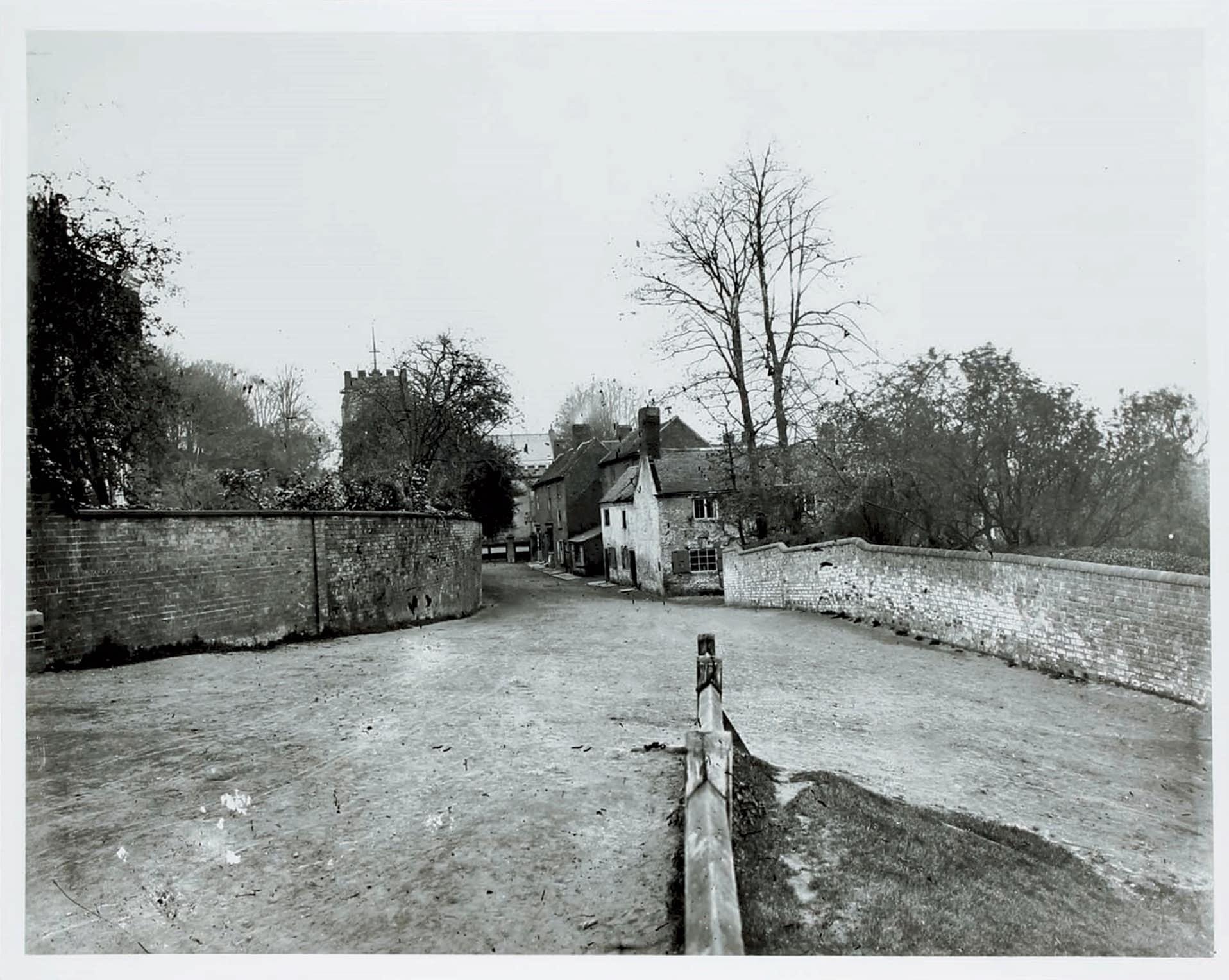
Wergs is a very small area and there was no other William Tomlinson baptised there at the time of William’s birth. It is of course possible that another William Tomlinson was born in Wergs and the record of the baptism hasn’t been found, but there are a number of other documents that prove that John Tomlinson, gentleman of Wergs, was Williams father.
In 1834 on the Shropshire Quarter session rolls there are two documents regarding William. In October 1834 William Tomlinson of Tettenhall, son of John, took an examination. Also in October of 1834 there is a reconizance document for William Tomlinson for “pig dealer”. On the marriage certificate of his son Charles Tomlinson to Emma Grattidge (mistranscribed as Pratadge) in 1872, father William’s occupation is “dealer”.
William Tomlinson was a witness at his sister Catherine and Benjamin Smiths wedding in 1822 in Tettenhall. In John Tomlinson’s 1844 will, he mentions his “daughter Catherine Smith, wife of Benjamin Smith”. William’s signature as a witness at Catherine’s marriage matches his signature on the licence for his own marriage to Elizabeth Adams in 1827 in Shareshill, Staffordshire.
William’s signature on his wedding licence:
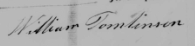
Williams signature as a witness to Catherine’s marriage:

William was the eldest surviving son when his father died in 1844, so it is surprising that William only inherited £25. John Tomlinson left his various properties to his daughters, with the exception of Catherine, who also received £25. There was one other surviving son, Sidney, born in 1814. Three of John and Sarah Tomlinson’s sons and one daughter died in infancy. Sidney was still unmarried and living at home when his father died, and in 1851 and 1861 was living with his sister Emma Wilson. He was unmarried when he died in 1867. John left Sidney an income for life in his will, but not property.
In John Tomlinson’s will he also mentions his daughter Jemima, wife of William Smith, farmer, of Great Barr. On the 1841 census William, butcher, is a visitor. His two children Sarah and Thomas are with him. His wife Elizabeth and the rest of the children are at Graisley Street. William is also on the Graisley Street census, occupation castrator. This was no doubt done in error, not realizing that he was also registered on the census where he was visiting at the time.
William’s wife, Elizabeth Adams, was born in Tong, Shropshire in 1807. The Adams in Tong appear to be agricultural labourers, at least on later censuses. Perhaps we can speculate that John didn’t approve of his son marrying an agricutural labourers daughter. Elizabeth would have been twenty years old at the time of the marriage; William thirty.
August 15, 2023 at 12:42 pm #7267In reply to: Family Stories From The Other Side ~ Book Two
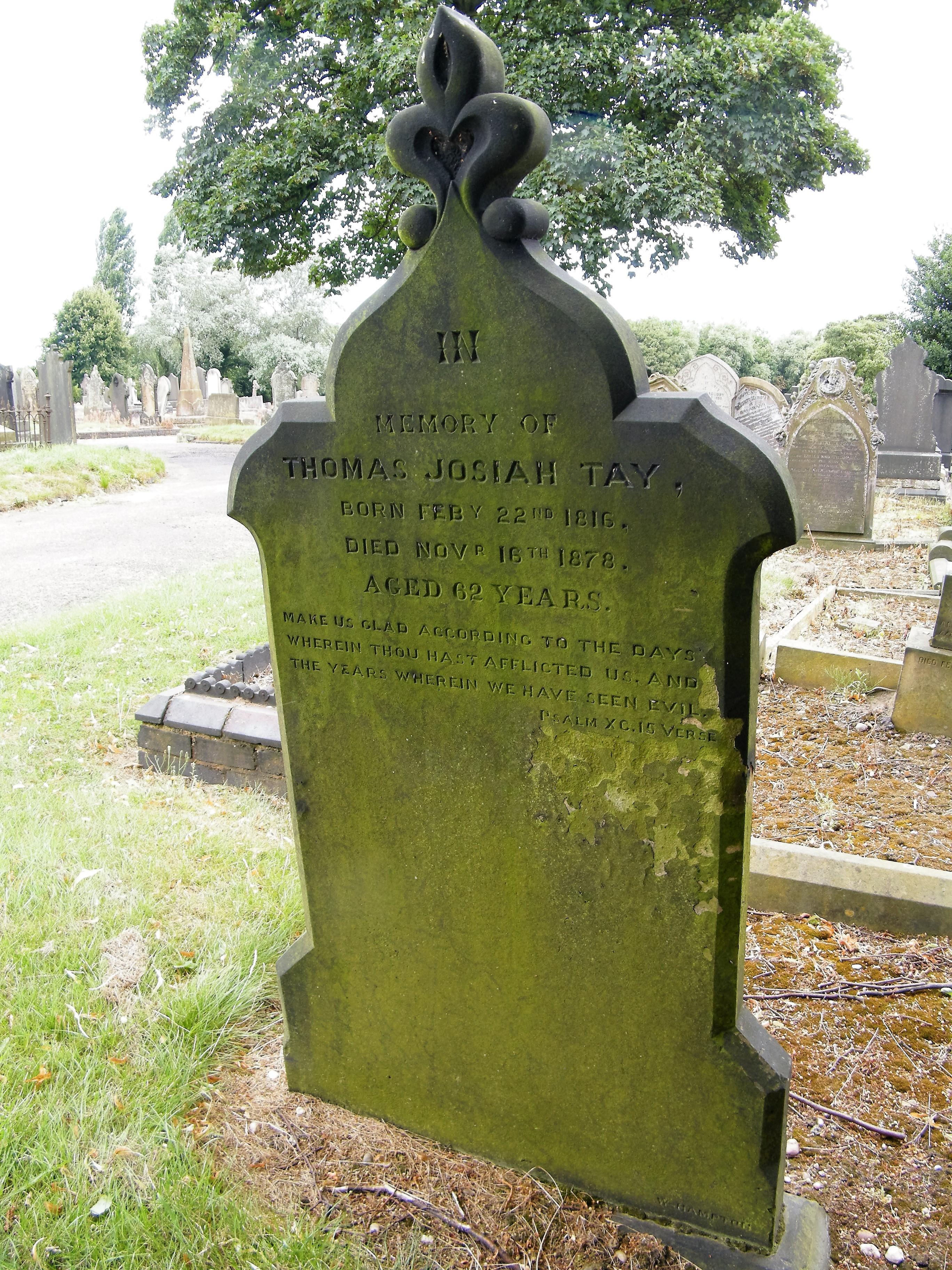
Thomas Josiah Tay
22 Feb 1816 – 16 November 1878
“Make us glad according to the days wherein thou hast afflicted us, and the years wherein we have seen evil.”
I first came across the name TAY in the 1844 will of John Tomlinson (1766-1844), gentleman of Wergs, Tettenhall. John’s friends, trustees and executors were Edward Moore, surgeon of Halesowen, and Edward Tay, timber merchant of Wolverhampton.
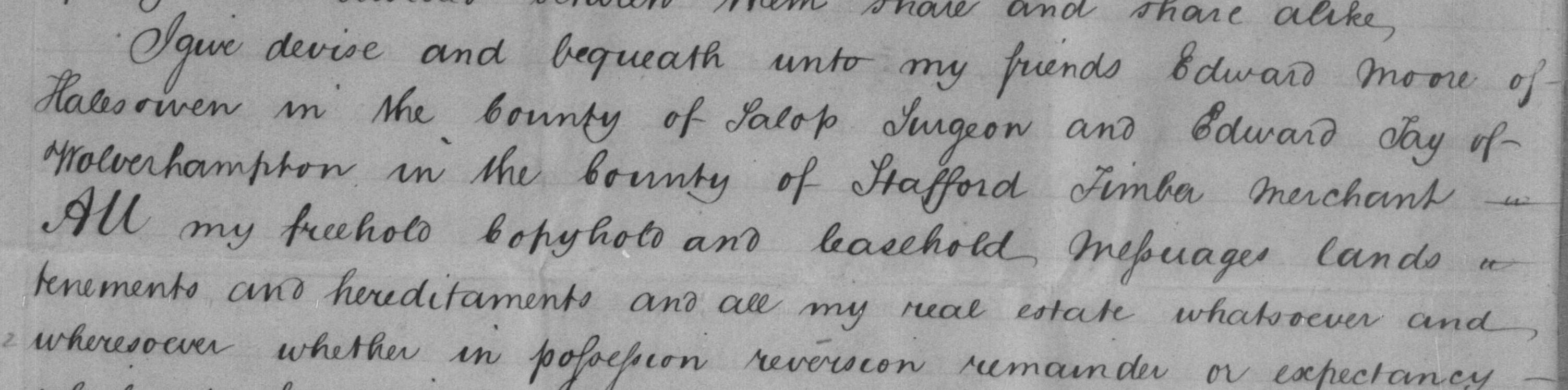
Edward Moore (born in 1805) was the son of John’s wife’s (Sarah Hancox born 1772) sister Lucy Hancox (born 1780) from her first marriage in 1801. In 1810 widowed Lucy married Josiah Tay (1775-1837).
Edward Tay was the son of Sarah Hancox sister Elizabeth (born 1778), who married Thomas Tay in 1800. Thomas Tay (1770-1841) and Josiah Tay were brothers.
Edward Tay (1803-1862) was born in Sedgley and was buried in Penn. He was innkeeper of The Fighting Cocks, Dudley Road, Wolverhampton, as well as a builder and timber merchant, according to various censuses, trade directories, his marriage registration where his father Thomas Tay is also a timber merchant, as well as being named as a timber merchant in John Tomlinsons will.
John Tomlinson’s daughter Catherine (born in 1794) married Benjamin Smith in Tettenhall in 1822. William Tomlinson (1797-1867), Catherine’s brother, and my 3x great grandfather, was one of the witnesses.
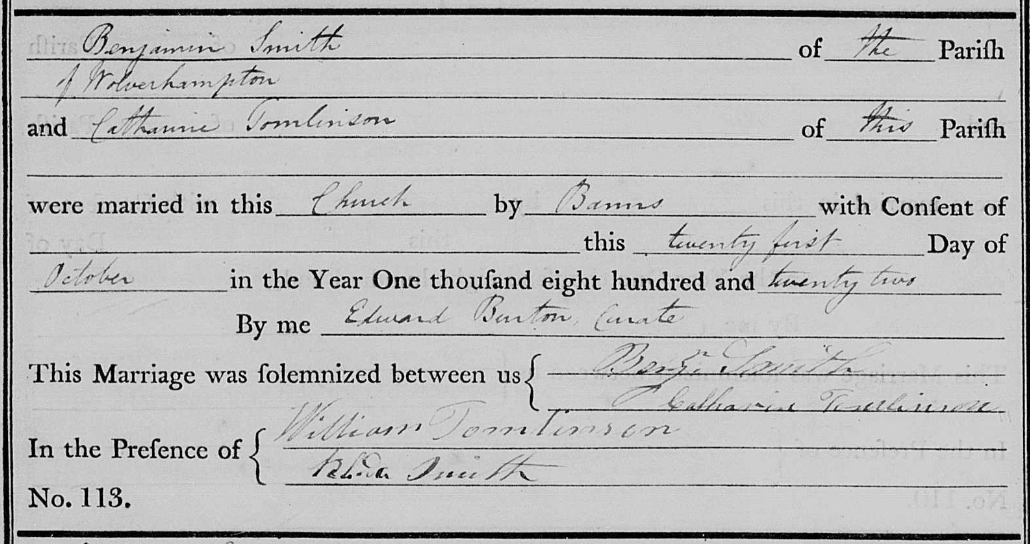
Their daughter Matilda Sarah Smith (1823-1910) married Thomas Josiah Tay in 1850 in Birmingham. Thomas Josiah Tay (1816-1878) was Edward Tay’s brother, the sons of Elizabeth Hancox and Thomas Tay.
Therefore, William Hancox 1737-1816 (the father of Sarah, Elizabeth and Lucy), was Matilda’s great grandfather and Thomas Josiah Tay’s grandfather.
Thomas Josiah Tay’s relationship to me is the husband of first cousin four times removed, as well as my first cousin, five times removed.
In 1837 Thomas Josiah Tay is mentioned in the will of his uncle Josiah Tay.

In 1841 Thomas Josiah Tay appears on the Stafford criminal registers for an “attempt to procure miscarriage”. He was found not guilty.
According to the Staffordshire Advertiser on 14th March 1840 the listing for the Assizes included: “Thomas Ashmall and Thomas Josiah Tay, for administering noxious ingredients to Hannah Evans, of Wolverhampton, with intent to procure abortion.”
The London Morning Herald on 19th March 1840 provides further information: “Mr Thomas Josiah Tay, a chemist and druggist, surrendered to take his trial on a charge of having administered drugs to Hannah Lear, now Hannah Evans, with intent to procure abortion.” She entered the service of Tay in 1837 and after four months “an intimacy was formed” and two months later she was “enciente”. Tay advised her to take some pills and a draught which he gave her and she became very ill. The prosecutrix admitted that she had made no mention of this until 1939. Verdict: not guilty.
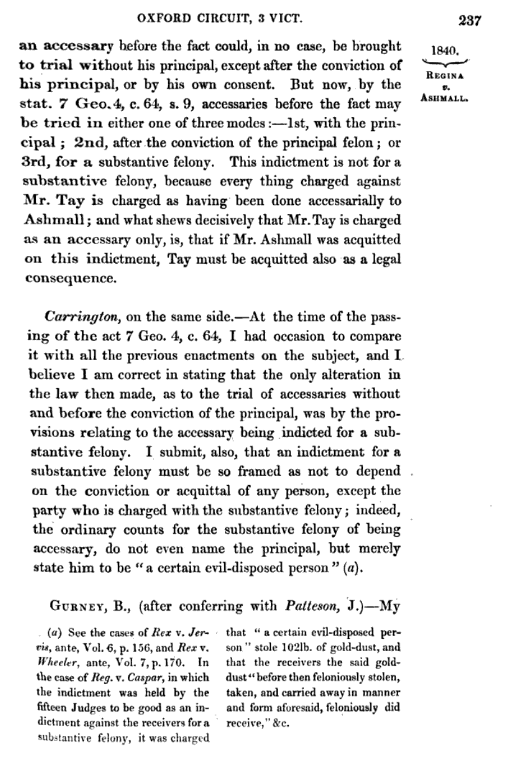
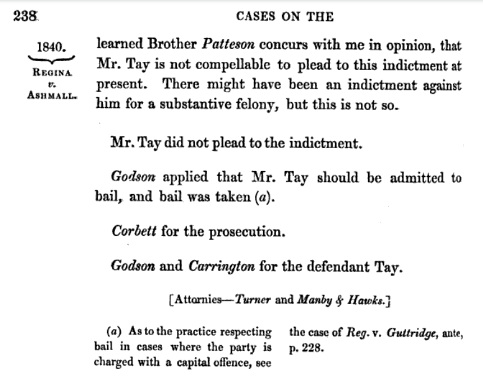
However, the case of Thomas Josiah Tay is also mentioned in a couple of law books, and the story varies slightly. In the 1841 Reports of Cases Argued and Rules at Nisi Prius, the Regina vs Ashmall and Tay case states that Thomas Ashmall feloniously, unlawfully, and maliciously, did use a certain instrument, and that Thomas Josiah Tay did procure the instrument, counsel and command Ashmall in the use of it. It concludes that Tay was not compellable to plead to the indictment, and that he did not.
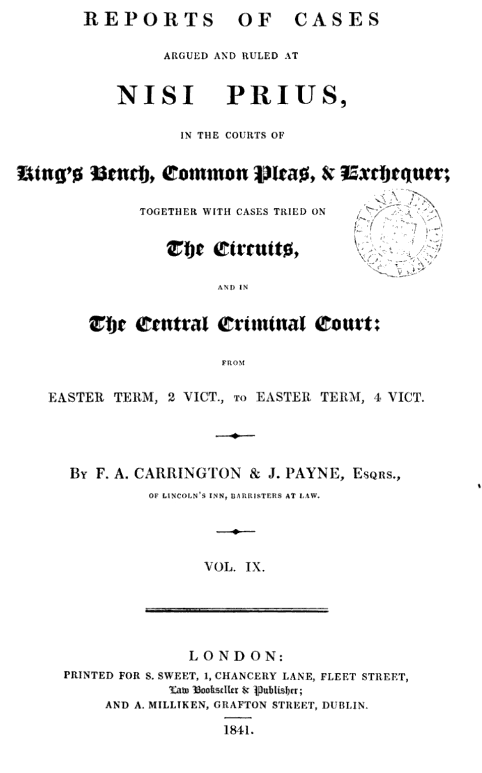
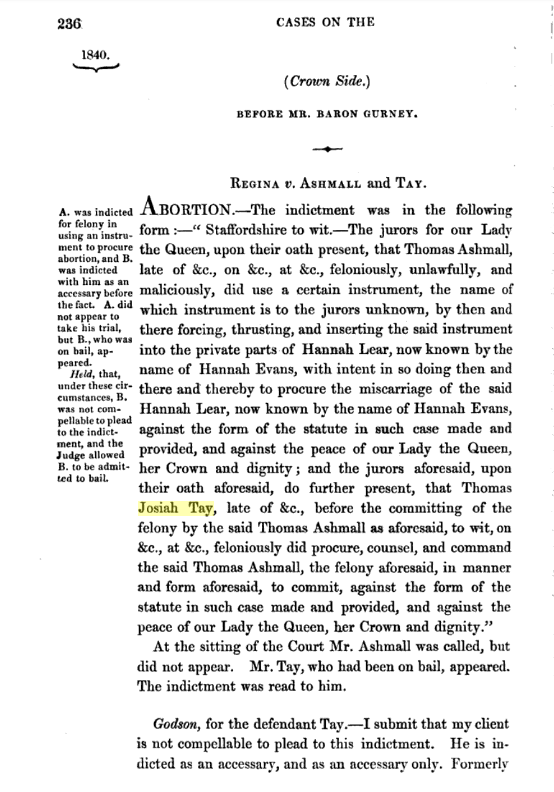
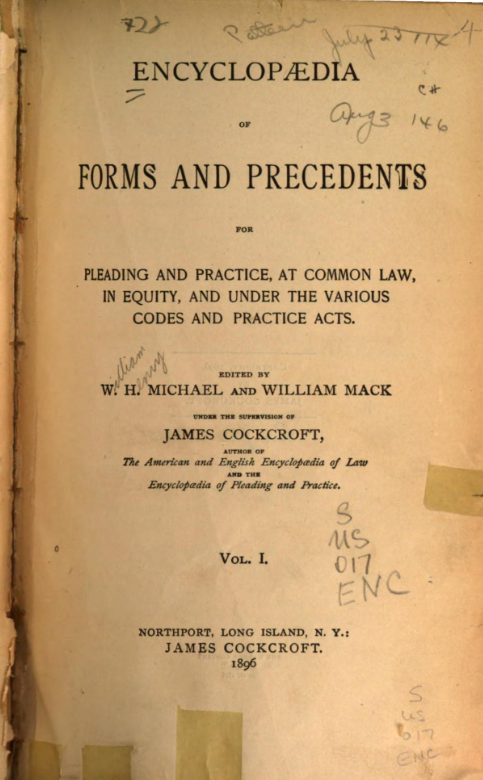
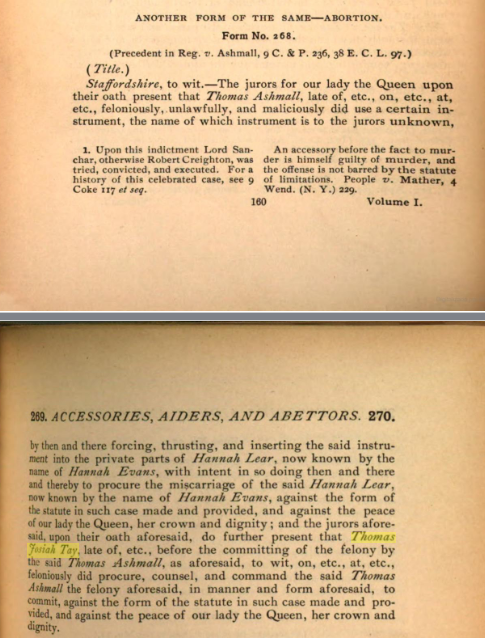
The Regina vs Ashmall and Tay case is also mentioned in the Encyclopedia of Forms and Precedents, 1896.
In 1845 Thomas Josiah Tay married Isabella Southwick in Tettenhall. Two years later in 1847 Isabella died.
In 1850 Thomas Josiah married Matilda Sarah Smith. (granddaughter of John Tomlinson, as mentioned above)
On the 1851 census Thomas Josiah Tay was a farmer of 100 acres employing two labourers in Shelfield, Walsall, Staffordshire. Thomas Josiah and Matilda Sarah have a daughter Matilda under a year old, and they have a live in house servant.
In 1861 Thomas Josiah Tay, his wife and their four children Ann, James, Josiah and Alice, live in Chelmarsh, Shropshire. He was a farmer of 224 acres. Mercy Smith, Matilda’s sister, lives with them, a 28 year old dairy maid.
In 1863 Thomas Josiah Tay of Hampton Lode (Chelmarsh) Shropshire was bankrupt. Creditors include Frederick Weaver, druggist of Wolverhampton.
In 1869 Thomas Josiah Tay was again bankrupt. He was an innkeeper at The Fighting Cocks on Dudley Road, Wolverhampton, at the time, the same inn as his uncle Edward Tay, aforementioned timber merchant.
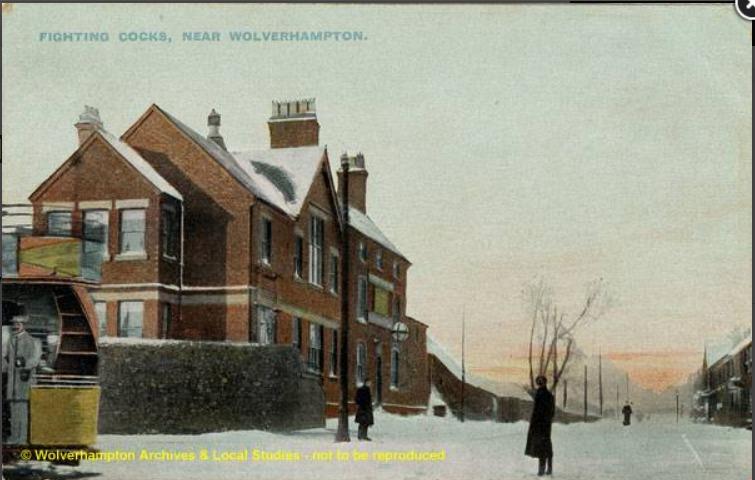
In 1871, Thomas Josiah Tay, his wife Matilda, and their three children Alice, Edward and Maryann, were living in Birmingham. Thomas Josiah was a commercial traveller.
He died on the 16th November 1878 at the age of 62 and was buried in Darlaston, Walsall. On his gravestone:
“Make us glad according to the days wherein thou hast afflicted us, and the years wherein we have seen evil.” Psalm XC 15 verse.
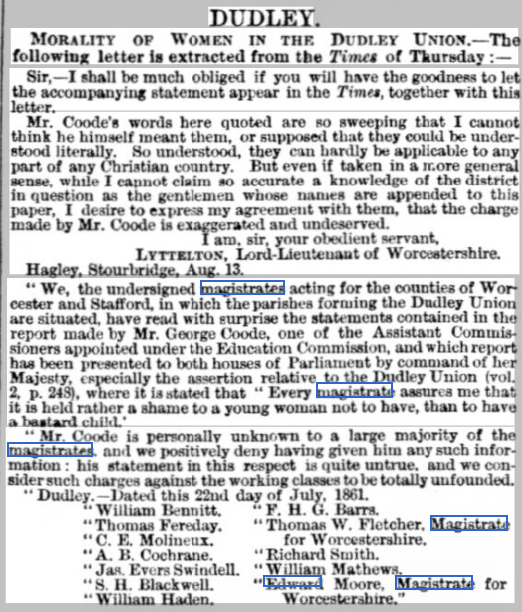
Edward Moore, surgeon, was also a MAGISTRATE in later years. On the 1871 census he states his occupation as “magistrate for counties Worcester and Stafford, and deputy lieutenant of Worcester, formerly surgeon”. He lived at Townsend House in Halesowen for many years. His wifes name was PATTERN Lucas. Her mothers name was Pattern Hewlitt from Birmingham, an unusal name that I have not heard before. On the 1871 census, Edward’s son was a 22 year old solicitor.
In 1861 an article appeared in the newspapers about the state of the morality of the women of Dudley. It was claimed that all the local magistrates agreed with the premise of the article, concerning unmarried women and their attitudes towards having illegitimate children. Letters appeared in subsequent newspapers signed by local magistrates, including Edward Moore, strongly disagreeing.
Staffordshire Advertiser 17 August 1861:
 July 5, 2023 at 8:21 pm #7263
In reply to: Family Stories From The Other Side ~ Book Two
Solomon Stubbs
1781-1857
Solomon was born in Hamstall Ridware, Staffordshire, parents Samuel Stubbs and Rebecca Wood. (see The Hamstall Ridware Connection chapter)
Solomon married Phillis Lomas at St Modwen’s in Burton on Trent on 30th May 1815. Phillis was the llegitimate daughter of Frances Lomas. No father was named on the baptism on the 17th January 1787 in Sutton on the Hill, Derbyshire, and the entry on the baptism register states that she was illegitimate. Phillis’s mother Frances married Daniel Fox in 1790 in Sutton on the Hill. Unfortunately this means that it’s impossible to find my 5X great grandfather on this side of the family.
Solomon and Phillis had four daughters, the last died in infancy.
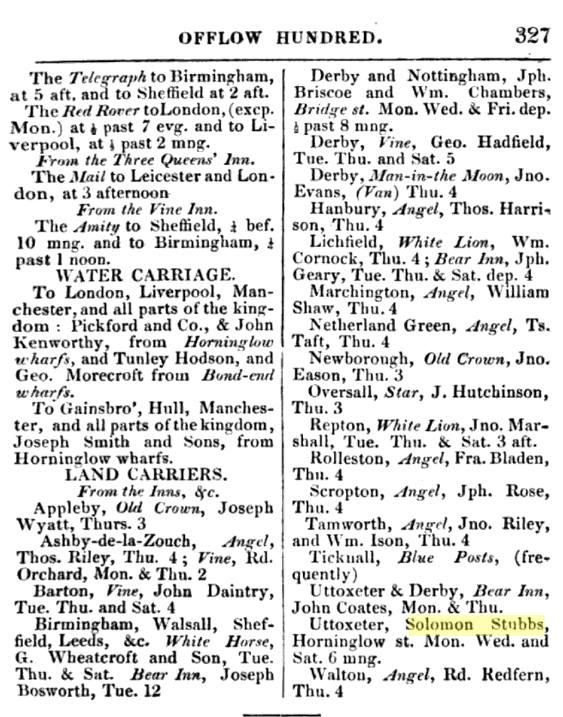
Sarah 1816-1867, Mary (my 3X great grandmother) 1819-1880, Phillis 1823-1905, and Maria 1825-1826.Solomon Stubbs of Horninglow St is listed in the 1834 Whites Directory under “China, Glass, Etc Dlrs”. Next to his name is Joanna Warren (earthenware) High St. Joanna Warren is related to me on my maternal side. No doubt Solomon and Joanna knew each other, unaware that several generations later a marriage would take place, not locally but miles away, joining their families.
Solomon Stubbs is also listed in Whites Directory in 1831 and 1834 Burton on Trent as a land carrier:
“Land Carriers, from the Inns, Etc: Uttoxeter, Solomon Stubbs, Horninglow St, Mon. Wed. and Sat. 6 mng.”
Solomon is listed in the electoral registers in 1837. The 1837 United Kingdom general election was triggered by the death of King William IV and produced the first Parliament of the reign of his successor, Queen Victoria.
National Archives:
“In 1832, Parliament passed a law that changed the British electoral system. It was known as the Great Reform Act, which basically gave the vote to middle class men, leaving working men disappointed.
The Reform Act became law in response to years of criticism of the electoral system from those outside and inside Parliament. Elections in Britain were neither fair nor representative. In order to vote, a person had to own property or pay certain taxes to qualify, which excluded most working class people.”Via the Burton on Trent History group:
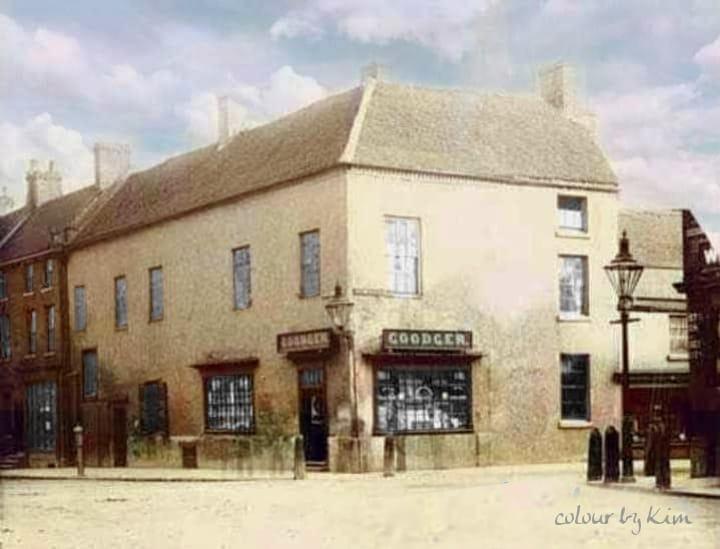
“a very early image of High street and Horninglow street junction, where the original ‘ Bargates’ were in the days of the Abbey. ‘Gate’ is the Saxon meaning Road, ‘Bar’ quite self explanatory, meant ‘to stop entrance’. There was another Bargate across Cat street (Station street), the Abbot had these constructed to regulate the Traders coming into town, in the days when the Abbey ran things. In the photo you can see the Posts on the corner, designed to stop Carts and Carriages mounting the Pavement. Only three Posts remain today and they are Listed.”
On the 1841 census, Solomon’s occupation was Carrier. Daughter Sarah is still living at home, and Sarah Grattidge, 13 years old, lives with them. Solomon’s daughter Mary had married William Grattidge in 1839.
Solomon Stubbs of Horninglow Street, Burton on Trent, is listed as an Earthenware Dealer in the 1842 Pigot’s Directory of Staffordshire.
In May 1844 Solomon’s wife Phillis died. In July 1844 daughter Sarah married Thomas Brandon in Burton on Trent. It was noted in the newspaper announcement that this was the first wedding to take place at the Holy Trinity church.
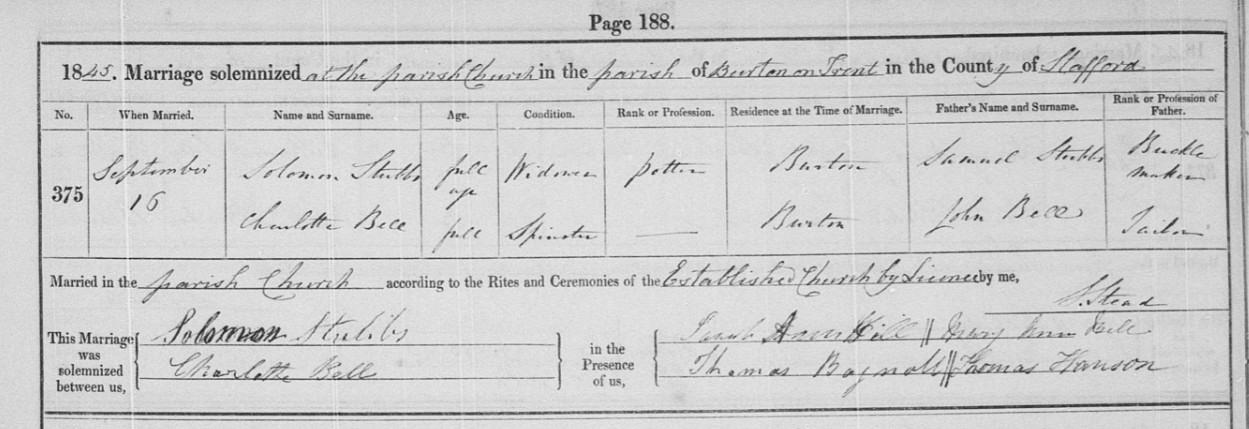
Solomon married Charlotte Bell by licence the following year in 1845. She was considerably younger than him, born in 1824. On the marriage certificate Solomon’s occupation is potter. It seems that he had the earthenware business as well as the land carrier business, in addition to owning a number of properties.
The marriage of Solomon Stubbs and Charlotte Bell:
Also in 1845, Solomon’s daughter Phillis was married in Burton on Trent to John Devitt, son of CD Devitt, Esq, formerly of the General Post Office Dublin.
Solomon Stubbs died in September 1857 in Burton on Trent. In the Staffordshire Advertiser on Saturday 3 October 1857:
“On the 22nd ultimo, suddenly, much respected, Solomon Stubbs, of Guild-street, Burton-on-Trent, aged 74 years.”
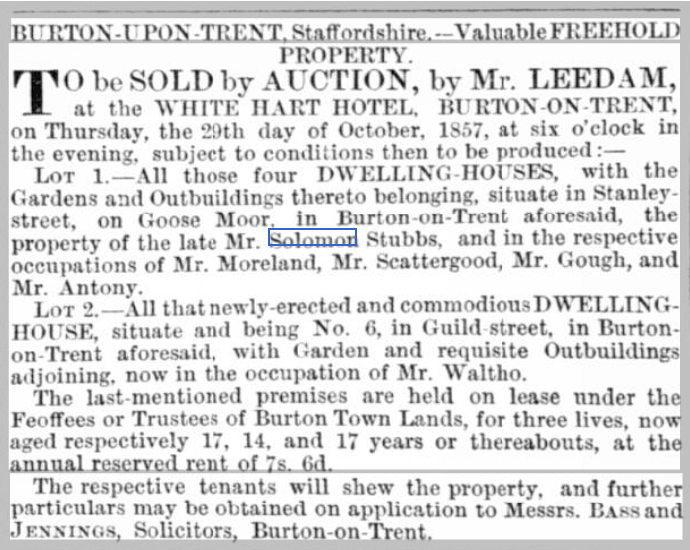
In the Staffordshire Advertiser, 24th October 1857, the auction of the property of Solomon Stubbs was announced:
“BURTON ON TRENT, on Thursday, the 29th day of October, 1857, at six o’clock in the evening, subject to conditions then to be produced:— Lot I—All those four DWELLING HOUSES, with the Gardens and Outbuildings thereto belonging, situate in Stanleystreet, on Goose Moor, in Burton-on-Trent aforesaid, the property of the late Mr. Solomon Stubbs, and in the respective occupations of Mr. Moreland, Mr. Scattergood, Mr. Gough, and Mr. Antony…..”
Sadly, the graves of Solomon, his wife Phillis, and their infant daughter Maria have since been removed and are listed in the UK Records of the Removal of Graves and Tombstones 1601-2007.
July 4, 2023 at 7:52 pm #7261In reply to: Family Stories From The Other Side ~ Book Two
Long Lost Enoch Edwards
My father used to mention long lost Enoch Edwards. Nobody in the family knew where he went to and it was assumed that he went to USA, perhaps to Utah to join his sister Sophie who was a Mormon handcart pioneer, but no record of him was found in USA.
Andrew Enoch Edwards (my great great grandfather) was born in 1840, but was (almost) always known as Enoch. Although civil registration of births had started from 1 July 1837, neither Enoch nor his brother Stephen were registered. Enoch was baptised (as Andrew) on the same day as his brothers Reuben and Stephen in May 1843 at St Chad’s Catholic cathedral in Birmingham. It’s a mystery why these three brothers were baptised Catholic, as there are no other Catholic records for this family before or since. One possible theory is that there was a school attached to the church on Shadwell Street, and a Catholic baptism was required for the boys to go to the school. Enoch’s father John died of TB in 1844, and perhaps in 1843 he knew he was dying and wanted to ensure an education for his sons. The building of St Chads was completed in 1841, and it was close to where they lived.
Enoch appears (as Enoch rather than Andrew) on the 1841 census, six months old. The family were living at Unett Street in Birmingham: John and Sarah and children Mariah, Sophia, Matilda, a mysterious entry transcribed as Lene, a daughter, that I have been unable to find anywhere else, and Reuben and Stephen.
Enoch was just four years old when his father John, an engineer and millwright, died of consumption in 1844.
In 1851 Enoch’s widowed mother Sarah was a mangler living on Summer Street, Birmingham, Matilda a dressmaker, Reuben and Stephen were gun percussionists, and eleven year old Enoch was an errand boy.
On the 1861 census, Sarah was a confectionrer on Canal Street in Birmingham, Stephen was a blacksmith, and Enoch a button tool maker.
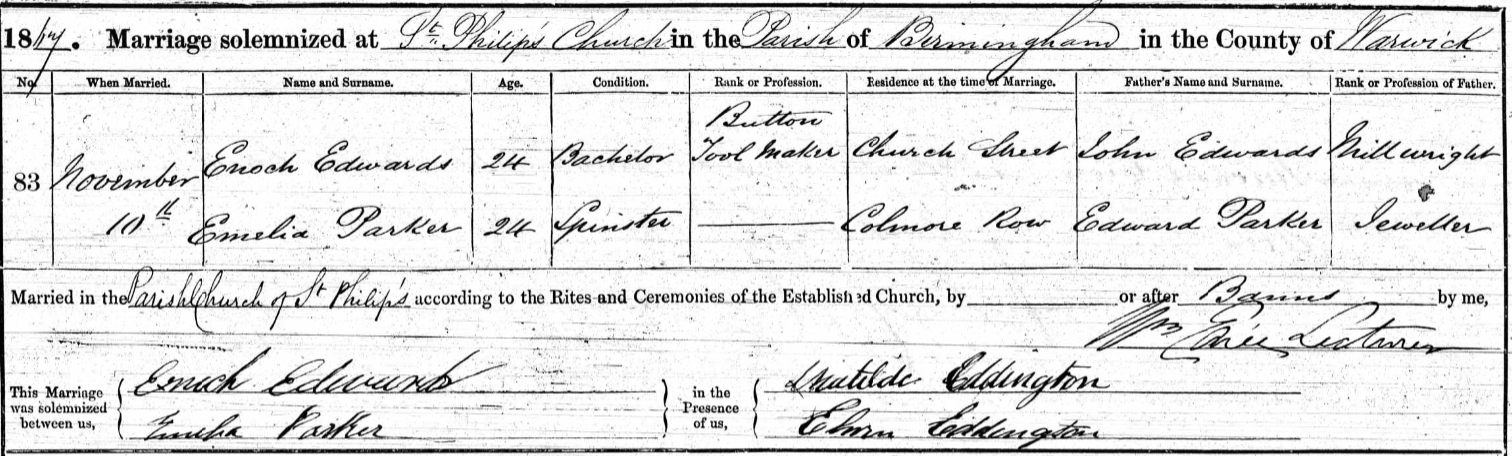
On the 10th November 1867 Enoch married Emelia Parker, daughter of jeweller and rope maker Edward Parker, at St Philip in Birmingham. Both Emelia and Enoch were able to sign their own names, and Matilda and Edwin Eddington were witnesses (Enoch’s sister and her husband). Enoch’s address was Church Street, and his occupation button tool maker.
Four years later in 1871, Enoch was a publican living on Clifton Road. Son Enoch Henry was two years old, and Ralph Ernest was three months. Eliza Barton lived with them as a general servant.
By 1881 Enoch was back working as a button tool maker in Bournebrook, Birmingham. Enoch and Emilia by then had three more children, Amelia, Albert Parker (my great grandfather) and Ada.
Garnet Frederick Edwards was born in 1882. This is the first instance of the name Garnet in the family, and subsequently Garnet has been the middle name for the eldest son (my brother, father and grandfather all have Garnet as a middle name).
Enoch was the licensed victualler at the Pack Horse Hotel in 1991 at Kings Norton. By this time, only daughters Amelia and Ada and son Garnet are living at home.
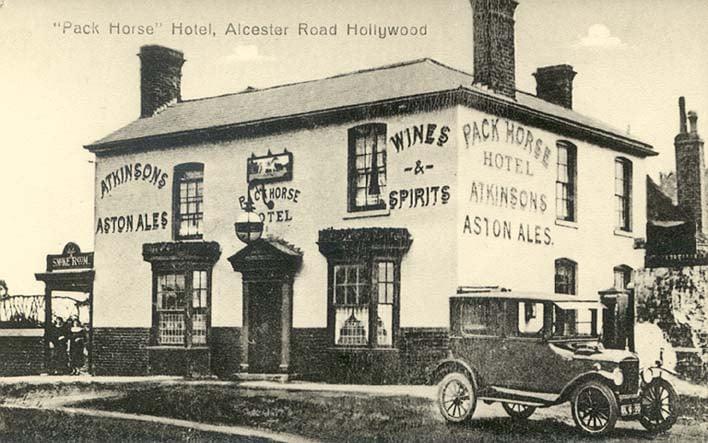
Additional information from my fathers cousin, Paul Weaver:
“Enoch refused to allow his son Albert Parker to go to King Edwards School in Birmingham, where he had been awarded a place. Instead, in October 1890 he made Albert Parker Edwards take an apprenticeship with a pawnboker in Tipton.
Towards the end of the 19th century Enoch kept The Pack Horse in Alcester Road, Hollywood, where a twist was 1d an ounce, and beer was 2d a pint. The children had to get up early to get breakfast at 6 o’clock for the hay and straw men on their way to the Birmingham hay and straw market. Enoch is listed as a member of “The Kingswood & Pack Horse Association for the Prosecution of Offenders”, a kind of early Neighbourhood Watch, dated 25 October 1890.
The Edwards family later moved to Redditch where they kept The Rifleman Inn at 35 Park Road. They must have left the Pack Horse by 1895 as another publican was in place by then.”Emelia his wife died in 1895 of consumption at the Rifleman Inn in Redditch, Worcestershire, and in 1897 Enoch married Florence Ethel Hedges in Aston. Enoch was 56 and Florence was just 21 years old.
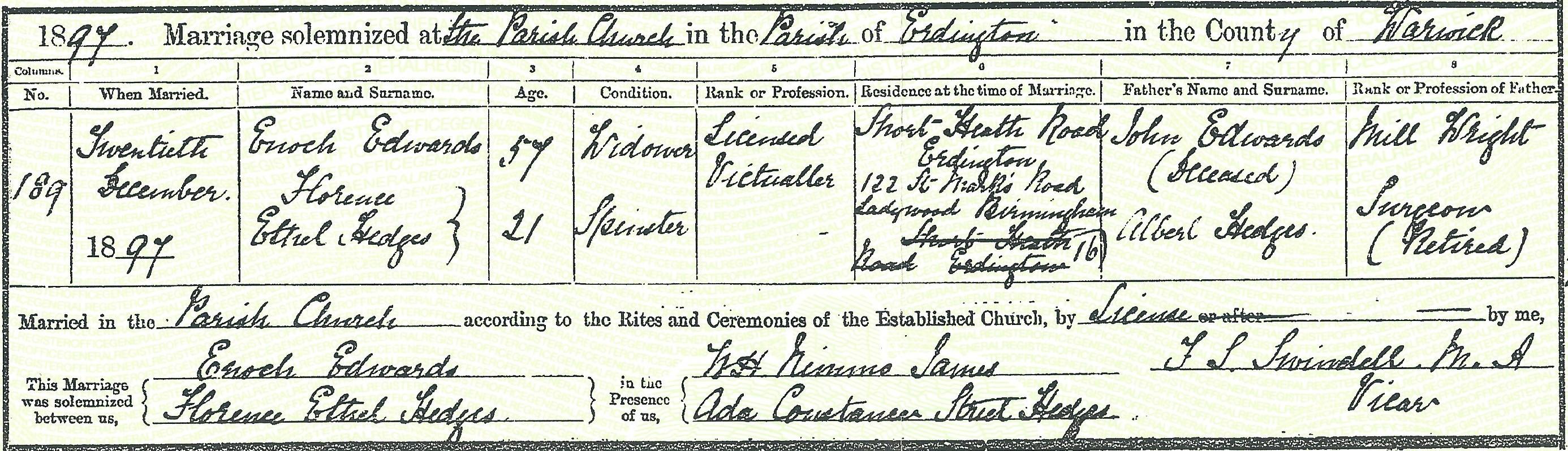
The following year in 1898 their daughter Muriel Constance Freda Edwards was born in Deritend, Warwickshire.
In 1901 Enoch, (Andrew on the census), publican, Florence and Muriel were living in Dudley. It was hard to find where he went after this.From Paul Weaver:
“Family accounts have it that Enoch EDWARDS fell out with all his family, and at about the age of 60, he left all behind and emigrated to the U.S.A. Enoch was described as being an active man, and it is believed that he had another family when he settled in the U.S.A. Esmor STOKES has it that a postcard was received by the family from Enoch at Niagara Falls.
On 11 June 1902 Harry Wright (the local postmaster responsible in those days for licensing) brought an Enoch EDWARDS to the Bedfordshire Petty Sessions in Biggleswade regarding “Hole in the Wall”, believed to refer to the now defunct “Hole in the Wall” public house at 76 Shortmead Street, Biggleswade with Enoch being granted “temporary authority”. On 9 July 1902 the transfer was granted. A year later in the 1903 edition of Kelly’s Directory of Bedfordshire, Hunts and Northamptonshire there is an Enoch EDWARDS running the Wheatsheaf Public House, Church Street, St. Neots, Huntingdonshire which is 14 miles south of Biggleswade.”
It seems that Enoch and his new family moved away from the midlands in the early 1900s, but again the trail went cold.
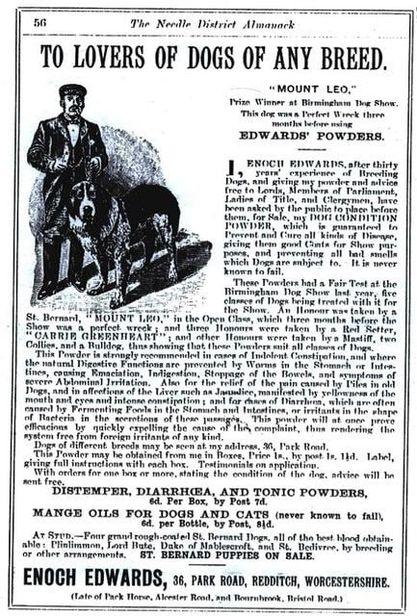
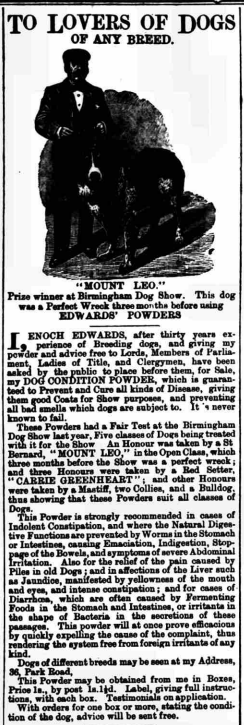
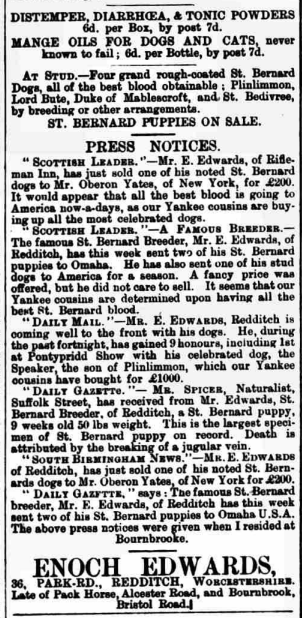
When I started doing the genealogy research, I joined a local facebook group for Redditch in Worcestershire. Enoch’s son Albert Parker Edwards (my great grandfather) spent most of his life there. I asked in the group about Enoch, and someone posted an illustrated advertisement for Enoch’s dog powders. Enoch was a well known breeder/keeper of St Bernards and is cited in a book naming individuals key to the recovery/establishment of ‘mastiff’ size dog breeds.
We had not known that Enoch was a breeder of champion St Bernard dogs!
Once I knew about the St Bernard dogs and the names Mount Leo and Plinlimmon via the newspaper adverts, I did an internet search on Enoch Edwards in conjunction with these dogs.
Enoch’s St Bernard dog “Mount Leo” was bred from the famous Plinlimmon, “the Emperor of Saint Bernards”. He was reported to have sent two puppies to Omaha and one of his stud dogs to America for a season, and in 1897 Enoch made the news for selling a St Bernard to someone in New York for £200. Plinlimmon, bred by Thomas Hall, was born in Liverpool, England on June 29, 1883. He won numerous dog shows throughout Europe in 1884, and in 1885, he was named Best Saint Bernard.
In the Birmingham Mail on 14th June 1890:
“Mr E Edwards, of Bournebrook, has been well to the fore with his dogs of late. He has gained nine honours during the past fortnight, including a first at the Pontypridd show with a St Bernard dog, The Speaker, a son of Plinlimmon.”
In the Alcester Chronicle on Saturday 05 June 1897:
It was discovered that Enoch, Florence and Muriel moved to Canada, not USA as the family had assumed. The 1911 census for Montreal St Jaqcues, Quebec, stated that Enoch, (Florence) Ethel, and (Muriel) Frida had emigrated in 1906. Enoch’s occupation was machinist in 1911. The census transcription is not very good. Edwards was transcribed as Edmand, but the dates of birth for all three are correct. Birthplace is correct ~ A for Anglitan (the census is in French) but race or tribe is also an A but the transcribers have put African black! Enoch by this time was 71 years old, his wife 33 and daughter 11.
Additional information from Paul Weaver:
“In 1906 he and his new family travelled to Canada with Enoch travelling first and Ethel and Frida joined him in Quebec on 25 June 1906 on board the ‘Canada’ from Liverpool.
Their immigration record suggests that they were planning to travel to Winnipeg, but five years later in 1911, Enoch, Florence Ethel and Frida were still living in St James, Montreal. Enoch was employed as a machinist by Canadian Government Railways working 50 hours. It is the 1911 census record that confirms his birth as November 1840. It also states that Enoch could neither read nor write but managed to earn $500 in 1910 for activity other than his main profession, although this may be referring to his innkeeping business interests.
By 1921 Florence and Muriel Frida are living in Langford, Neepawa, Manitoba with Peter FUCHS, an Ontarian farmer of German descent who Florence had married on 24 Jul 1913 implying that Enoch died sometime in 1911/12, although no record has been found.”The extra $500 in earnings was perhaps related to the St Bernard dogs. Enoch signed his name on the register on his marriage to Emelia, and I think it’s very unlikely that he could neither read nor write, as stated above.
However, it may not be Enoch’s wife Florence Ethel who married Peter Fuchs. A Florence Emma Edwards married Peter Fuchs, and on the 1921 census in Neepawa her daugther Muriel Elizabeth Edwards, born in 1902, lives with them. Quite a coincidence, two Florence and Muriel Edwards in Neepawa at the time. Muriel Elizabeth Edwards married and had two children but died at the age of 23 in 1925. Her mother Florence was living with the widowed husband and the two children on the 1931 census in Neepawa. As there was no other daughter on the 1911 census with Enoch, Florence and Muriel in Montreal, it must be a different Florence and daughter. We don’t know, though, why Muriel Constance Freda married in Neepawa.
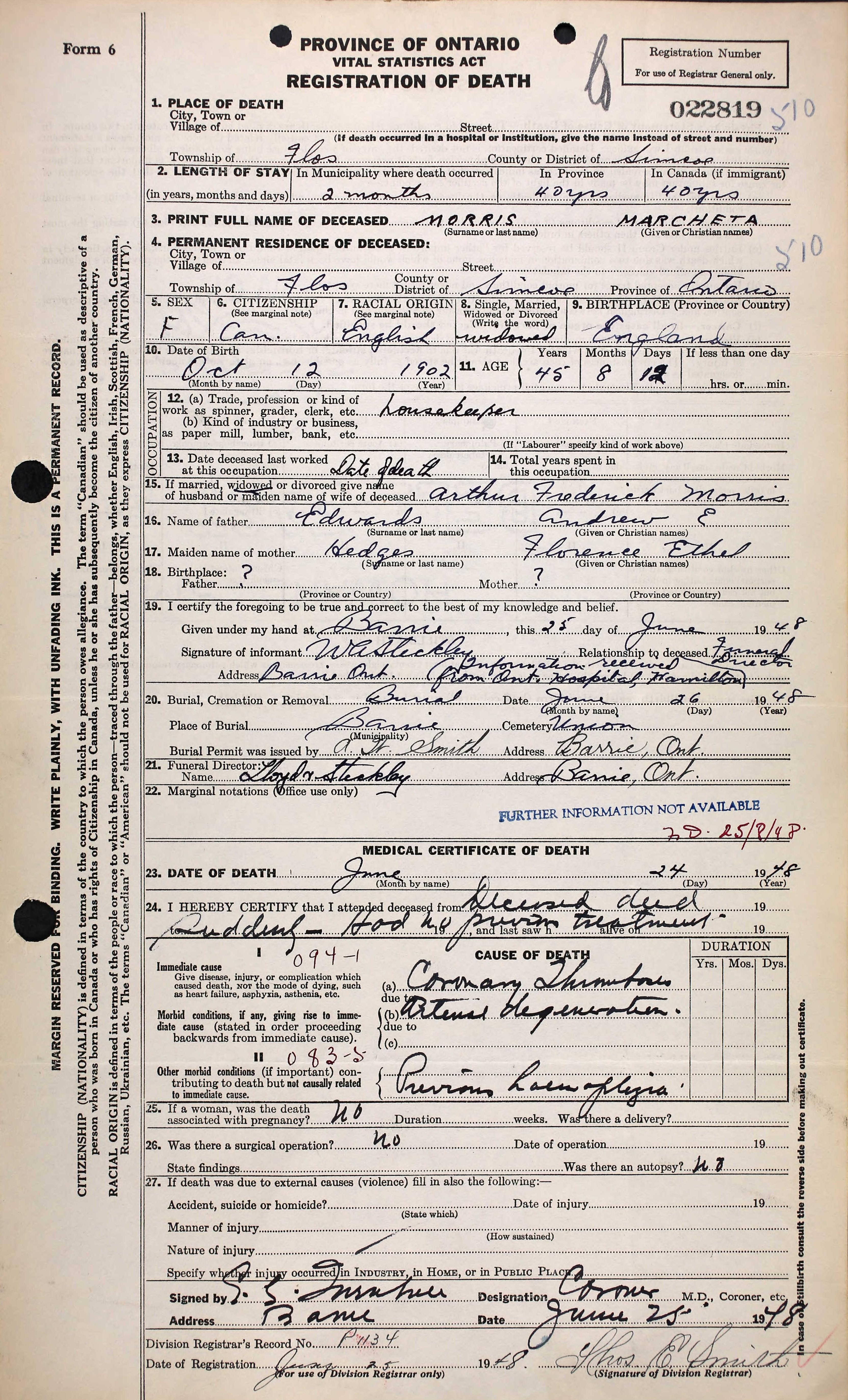
Indeed, Florence was not a widow in 1913. Enoch died in 1924 in Montreal, aged 84. Neither Enoch, Florence or their daughter has been found yet on the 1921 census. The search is not easy, as Enoch sometimes used the name Andrew, Florence used her middle name Ethel, and daughter Muriel used Freda, Valerie (the name she added when she married in Neepawa), and died as Marcheta. The only name she NEVER used was Constance!
A Canadian genealogist living in Montreal phoned the cemetery where Enoch was buried. She said “Enoch Edwards who died on Feb 27 1924 is not buried in the Mount Royal cemetery, he was only cremated there on March 4, 1924. There are no burial records but he died of an abcess and his body was sent to the cemetery for cremation from the Royal Victoria Hospital.”
1924 Obituary for Enoch Edwards:
Cimetière Mont-Royal Outremont, Montreal Region, Quebec, Canada
The Montreal Star 29 Feb 1924, Fri · Page 31

Muriel Constance Freda Valerie Edwards married Arthur Frederick Morris on 24 Oct 1925 in Neepawa, Manitoba. (She appears to have added the name Valerie when she married.)
Unexpectedly a death certificate appeared for Muriel via the hints on the ancestry website. Her name was “Marcheta Morris” on this document, however it also states that she was the widow of Arthur Frederick Morris and daughter of Andrew E Edwards and Florence Ethel Hedges. She died suddenly in June 1948 in Flos, Simcoe, Ontario of a coronary thrombosis, where she was living as a housekeeper.
 June 13, 2023 at 10:31 am #7255
In reply to: Family Stories From The Other Side ~ Book Two
The First Wife of John Edwards
1794-1844
John was a widower when he married Sarah Reynolds from Kinlet. Both my fathers cousin and I had come to a dead end in the Edwards genealogy research as there were a number of possible births of a John Edwards in Birmingham at the time, and a number of possible first wives for a John Edwards at the time.
John Edwards was a millwright on the 1841 census, the only census he appeared on as he died in 1844, and 1841 was the first census. His birth is recorded as 1800, however on the 1841 census the ages were rounded up or down five years. He was an engineer on some of the marriage records of his children with Sarah, and on his death certificate, engineer and millwright, aged 49. The age of 49 at his death from tuberculosis in 1844 is likely to be more accurate than the census (Sarah his wife was present at his death), making a birth date of 1794 or 1795.
John married Sarah Reynolds in January 1827 in Birmingham, and I am descended from this marriage. Any children of John’s first marriage would no doubt have been living with John and Sarah, but had probably left home by the time of the 1841 census.
I found an Elizabeth Edwards, wife of John Edwards of Constitution Hill, died in August 1826 at the age of 23, as stated on the parish death register. It would be logical for a young widower with small children to marry again quickly. If this was John’s first wife, the marriage to Sarah six months later in January 1827 makes sense. Therefore, John’s first wife, I assumed, was Elizabeth, born in 1803.
Death of Elizabeth Edwards, 23 years old. St Mary, Birmingham, 15 Aug 1826:

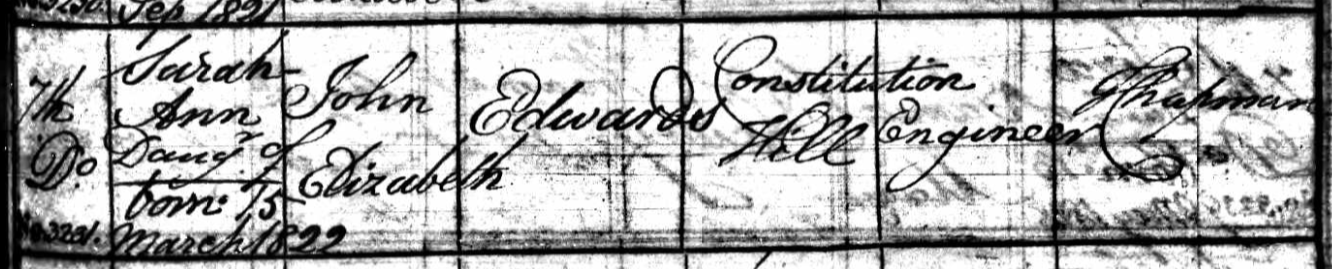
There were two baptisms recorded for parents John and Elizabeth Edwards, Constitution Hill, and John’s occupation was an engineer on both baptisms.
They were both daughters: Sarah Ann in 1822 and Elizabeth in 1824.Sarah Ann Edwards: St Philip, Birmingham. Born 15 March 1822, baptised 7 September 1822:
Elizabeth Edwards: St Philip, Birmingham. Born 6 February 1824, baptised 25 February 1824:

With John’s occupation as engineer stated, it looked increasingly likely that I’d found John’s first wife and children of that marriage.
Then I found a marriage of Elizabeth Beach to John Edwards in 1819, and subsequently found an Elizabeth Beach baptised in 1803. This appeared to be the right first wife for John, until an Elizabeth Slater turned up, with a marriage to a John Edwards in 1820. An Elizabeth Slater was baptised in 1803. Either Elizabeth Beach or Elizabeth Slater could have been the first wife of John Edwards. As John’s first wife Elizabeth is not related to us, it’s not necessary to go further back, and in a sense, doesn’t really matter which one it was.
But the Slater name caught my eye.
But first, the name Sarah Ann.
Of the possible baptisms for John Edwards, the most likely seemed to be in 1794, parents John and Sarah. John and Sarah had two infant daughters die just prior to John’s birth. The first was Sarah, the second Sarah Ann. Perhaps this was why John named his daughter Sarah Ann? In the absence of any other significant clues, I decided to assume these were the correct parents. I found and read half a dozen wills of any John Edwards I could find within the likely time period of John’s fathers death.
One of them was dated 1803. In this will, John mentions that his children are not yet of age. (John would have been nine years old.)
He leaves his plating business and some properties to his eldest son Thomas Davis Edwards, (just shy of 21 years old at the time of his fathers death in 1803) with the business to be run jointly with his widow, Sarah. He mentions his son John, and leaves several properties to him, when he comes of age. He also leaves various properties to his daughters Elizabeth and Mary, ditto. The baptisms for all of these children, including the infant deaths of Sarah and Sarah Ann have been found. All but Mary’s were in the same parish. (I found one for Mary in Sutton Coldfield, which was apparently correct, as a later census also recorded her birth as Sutton Coldfield. She was living with family on that census, so it would appear to be correct that for whatever reason, their daughter Mary was born in Sutton Coldfield)Mary married John Slater in 1813. The witnesses were Elizabeth Whitehouse and John Edwards, her sister and brother. Elizabeth married William Nicklin Whitehouse in 1805 and one of the witnesses was Mary Edwards.
Mary’s husband John Slater died in 1821. They had no children. Mary never remarried, and lived with her bachelor brother Thomas Davis Edwards in West Bromwich. Thomas never married, and on the census he was either a proprietor of houses, or “sinecura” (earning a living without working).With Mary marrying a Slater, does this indicate that her brother John’s first wife was Elizabeth Slater rather than Elizabeth Beach? It is a compelling possibility, but does not constitute proof.
Not only that, there is no absolute proof that the John Edwards who died in 1803 was our ancestor John Edwards father.
If we can’t be sure which Elizabeth married John Edwards, we can be reasonably sure who their daughters married. On both of the marriage records the father is recorded as John Edwards, engineer.
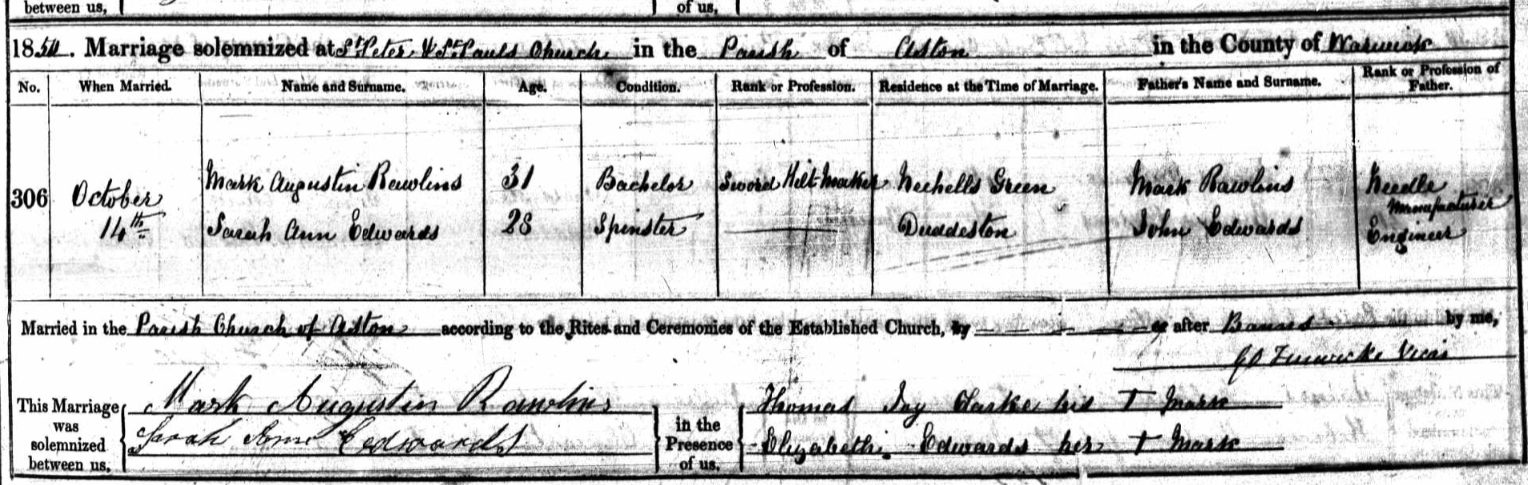
Sarah Ann married Mark Augustin Rawlins in 1850. Mark was a sword hilt maker at the time of the marriage, his father Mark a needle manufacturer. One of the witnesses was Elizabeth Edwards, who signed with her mark. Sarah Ann and Mark however were both able to sign their own names on the register.
Sarah Ann Edwards and Mark Augustin Rawlins marriage 14 October 1850 St Peter and St Paul, Aston, Birmingham:
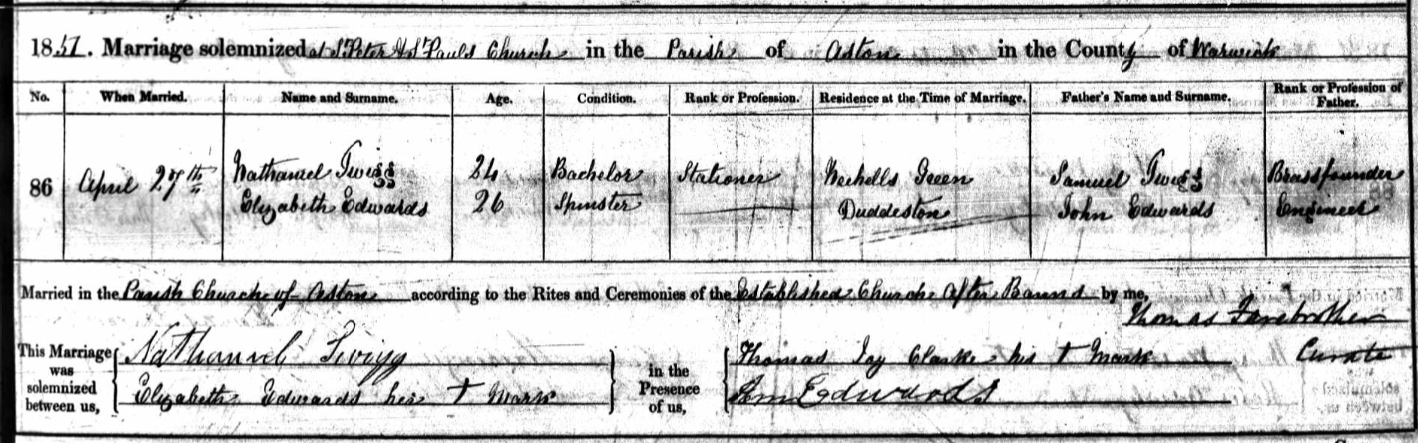
Elizabeth married Nathaniel Twigg in 1851. (She was living with her sister Sarah Ann and Mark Rawlins on the 1851 census, I assume the census was taken before her marriage to Nathaniel on the 27th April 1851.) Nathaniel was a stationer (later on the census a bookseller), his father Samuel a brass founder. Elizabeth signed with her mark, apparently unable to write, and a witness was Ann Edwards. Although Sarah Ann, Elizabeth’s sister, would have been Sarah Ann Rawlins at the time, having married the previous year, she was known as Ann on later censuses. The signature of Ann Edwards looks remarkably similar to Sarah Ann Edwards signature on her own wedding. Perhaps she couldn’t write but had learned how to write her signature for her wedding?
Elizabeth Edwards and Nathaniel Twigg marriage 27 April 1851, St Peter and St Paul, Aston, Birmingham:
Sarah Ann and Mark Rawlins had one daughter and four sons between 1852 and 1859. One of the sons, Edward Rawlins 1857-1931, was a school master and later master of an orphanage.
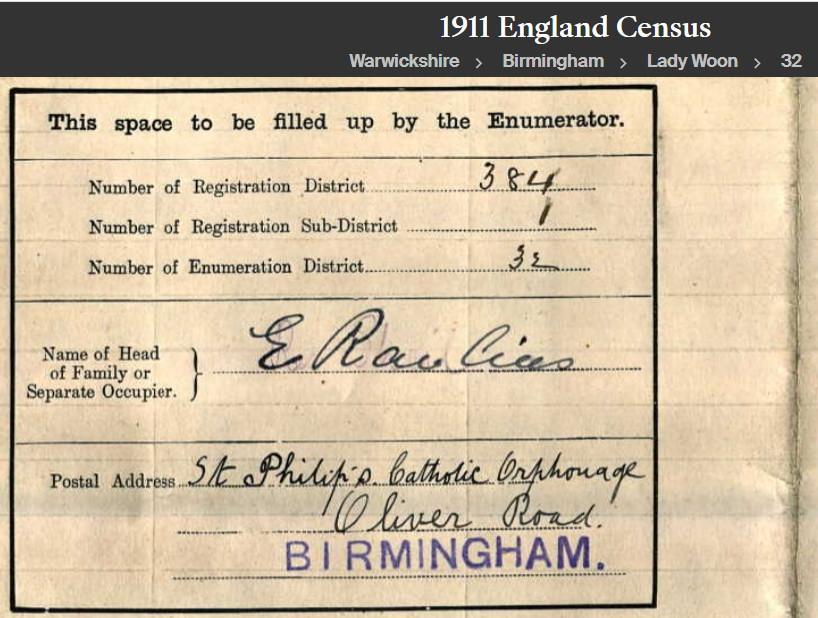
On the 1881 census Edward was a bookseller, in 1891 a stationer, 1901 schoolmaster and his wife Edith was matron, and in 1911 he and Edith were master and matron of St Philip’s Catholic Orphanage on Oliver Road in Birmingham. Edward and Edith did not have any children.
Edward Rawlins, 1911:
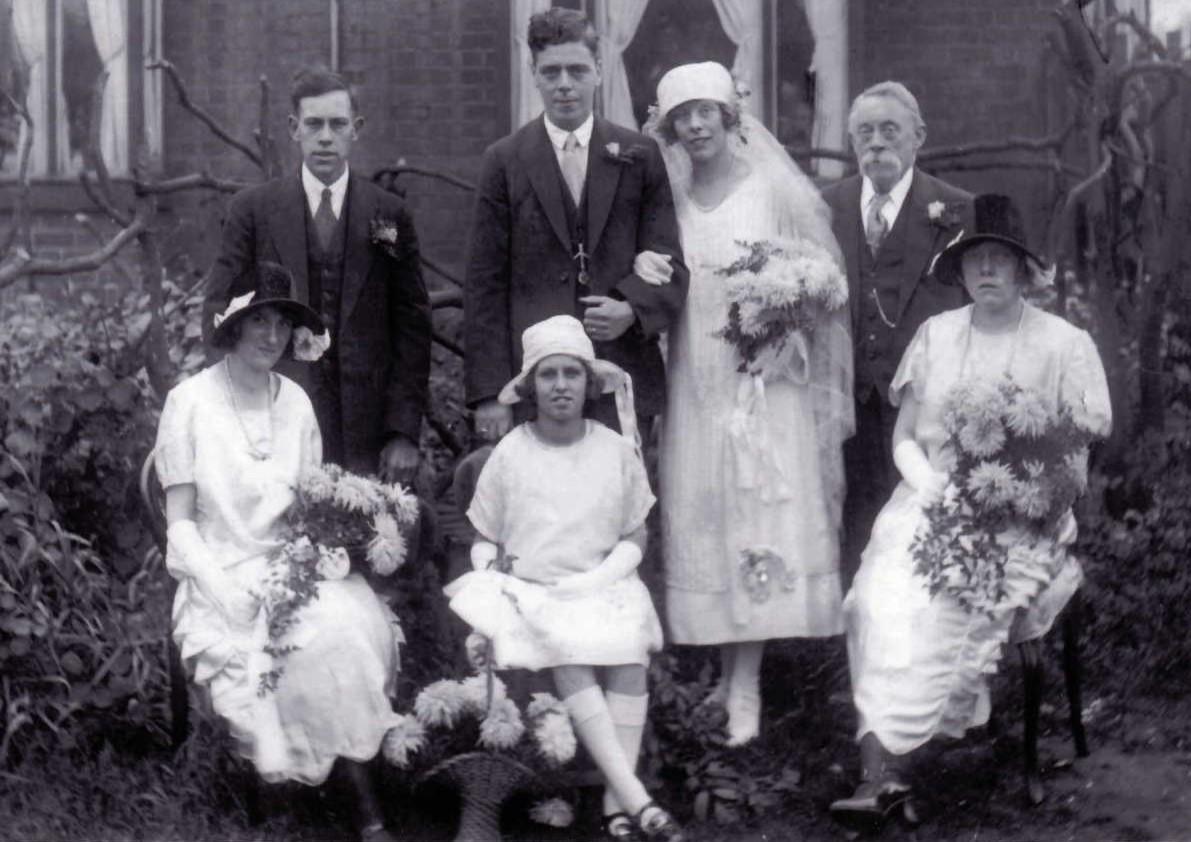
Elizabeth and Nathaniel Twigg appear to have had only one son, Arthur Twigg 1862-1943. Arthur was a photographer at 291 Bloomsbury Street, Birmingham. Arthur married Harriet Moseley from Burton on Trent, and they had two daughters, Elizabeth Ann 1897-1954, and Edith 1898-1983. I found a photograph of Edith on her wedding day, with her father Arthur in the picture. Arthur and Harriet also had a son Samuel Arthur, who lived for less than a month, born in 1904. Arthur had mistakenly put this son on the 1911 census stating “less than one month”, but the birth and death of Samuel Arthur Twigg were registered in the same quarter of 1904, and none were found registered for 1911.
Edith Twigg and Leslie A Hancock on their Wedding Day 1925. Arthur Twigg behind the bride. Maybe Elizabeth Ann Twigg seated on the right: (photo found on the ancestry website)
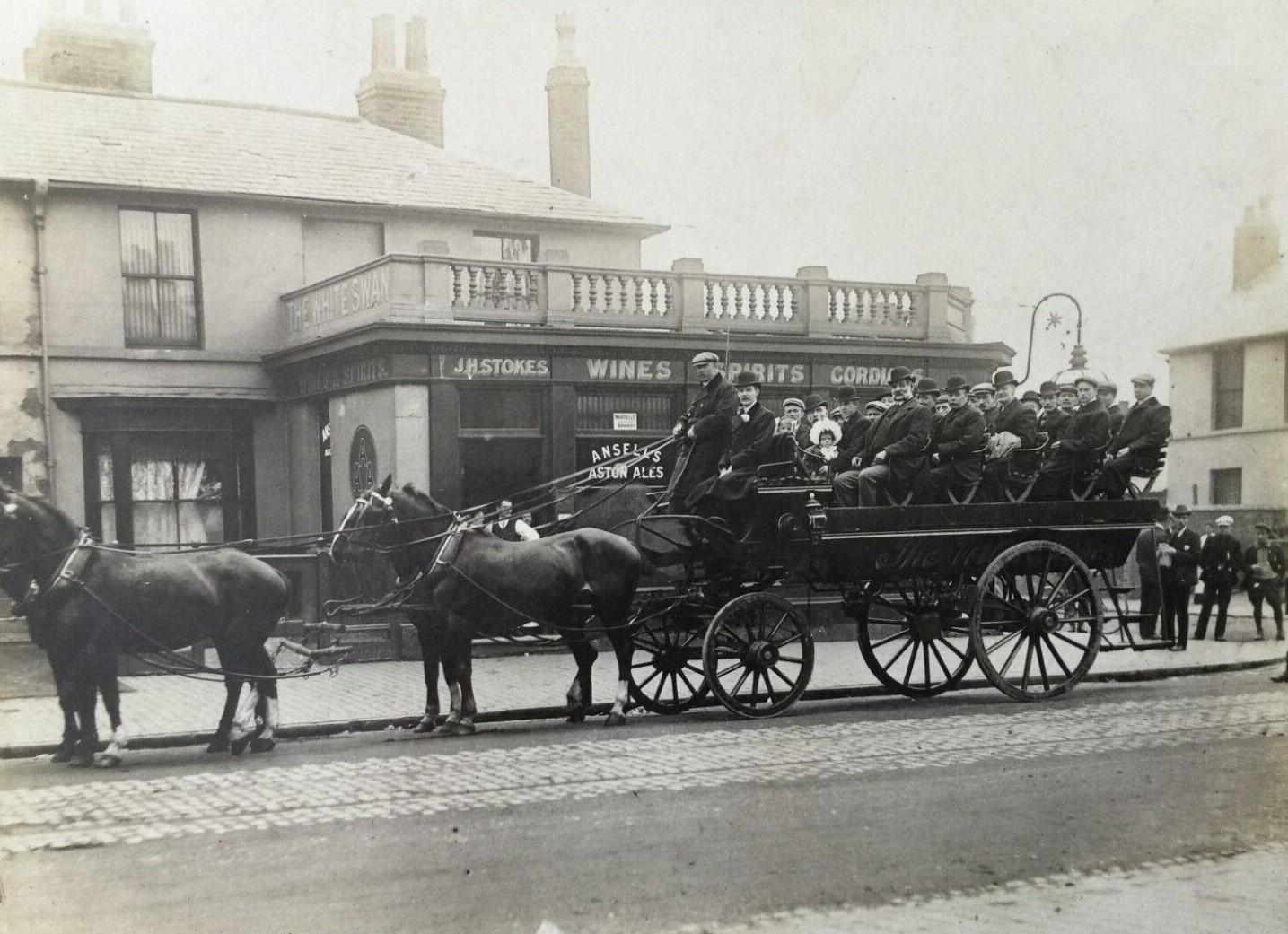
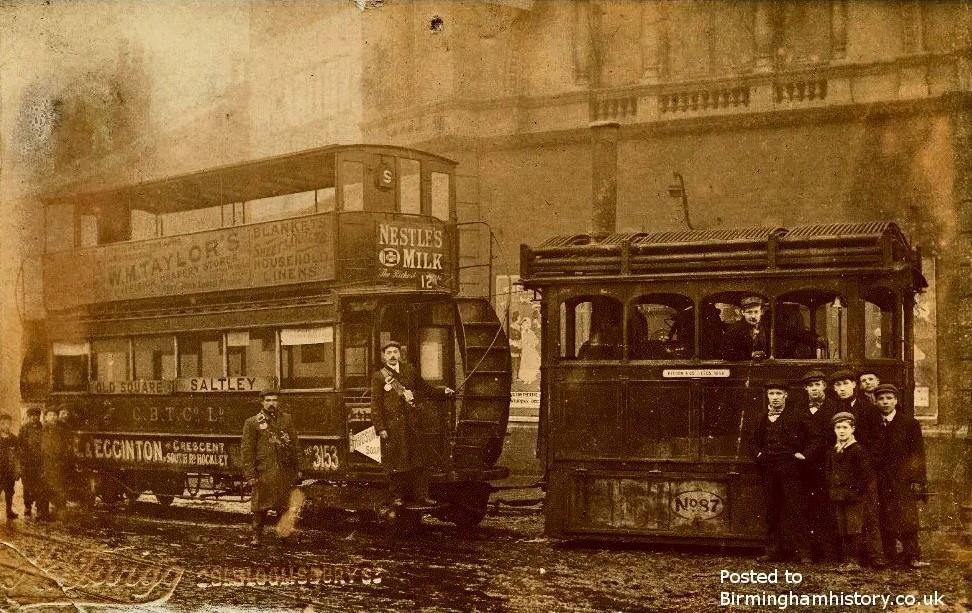
Photographs by Arthur Twigg, 291 Bloomsbury Street, Birmingham:
 February 22, 2023 at 8:54 am #6621
In reply to: Orbs of Madjourneys
As the four of them walked into the tavern, having walked the mile or so from the Flying Fish Inn to the main street of the tiny town, Zara noticed the black BMW that she and Yasmin had seen parked outside the Piggly supermarket on the way back from the airport in Alice. She elbowed Yasmin in the ribs to point it out, but there was no need as Yasmin was already snorting nervously at the sight of it.
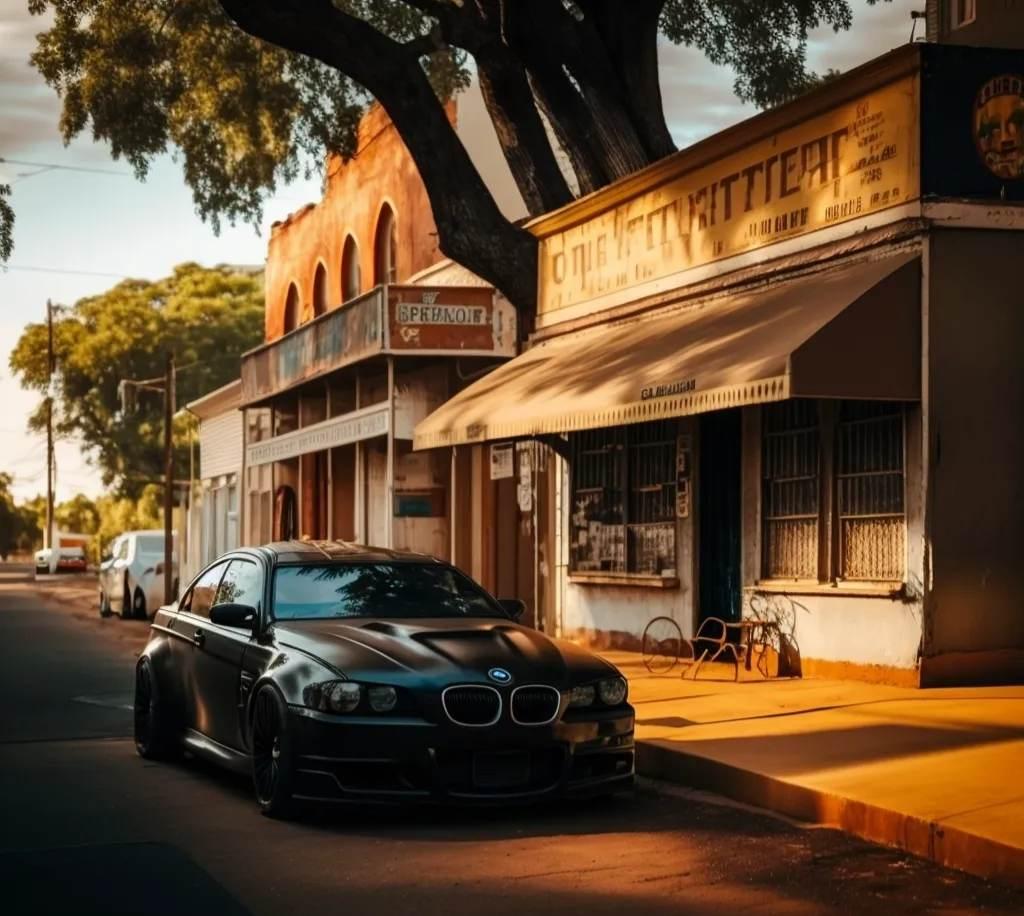
Sister Finli caught sight of them as she was just about to leave Betsy’s gem shop and paused until they’d disappeared into the bar before leaving the shop. It was the first time that Finli had seen Betsy in the flesh, and what a lot of flesh there was to see. Finli was horrifed, comparing her own elegant thin fingers with the fat sausage like digits of Betsy. She would never have expected Betsy to look this way. Still, it had thrown her, and she lost her usual efficient composure and quickly purchased a pink speckled gummy bear necklace. Annoyingly, this transaction reminded her that she seemed to have lost her crucifix.
Finli was an orphan. The nuns had named her Finean Lisa. Finean meant beautiful daughter, and Lisa meant devoted to god. Later they shortened it to Finli. She’d spent all her life at the orphanage in Suva, having been deposited there at birth, and although she had no particular calling to be a nun, she had not known what else to do with her life. It was the only family she’d ever known, and so she stayed on. It was only in the past year or two that she’d had any curiosity about who her real parents were, when she read about DNA tests and ancestry research. She’d been told in the past that no records existed as she had been found on the doorstep of the orphanage one morning 43 years ago. The knowledge had filled her with comtempt for her parents, whoever they were, and for the most part she pushed them from her mind, not caring to know. But when she read about all the successes of adopted people finding their real parents, she was consumed with curiosity. At first she just wanted to know who they were. But once she had found their names, she wanted to know more. She wanted to know why. One thing led to another.
Her real father had disappeared, lost down some mines although the story there was far from clear. Indeed, that particular story was a darn sight more than unclear, it was downright fishy. Her real mother was was alive and kicking, and living near to the mines where Howard had disappeared. Finli deduced that she must have been born, or at least conceived, in this godforsaken place in the outback. What an ignominous start to her uneventful life.
She knew that Fred was her uncle, but she had not told him she knew that. Did Fred know who she was? He’d always been kind to her, but then, he was affable to everyone. When it came to her knowledge that Fred had given that tiresome snorting volunteer girl a parcel to take with her, to, of all places! that very town in the outback, Finli simply had to know what was in it. But she didn’t want to spill the beans too soon, in case it hindered her attempts to find the truth about Howard, her father. She decided to travel to the town incognito. But how was she going to find the money for it? Well, she knew she was burning her bridges, but she had to do it. She stole the golden chalice from the church and sold it on Ubay. She was suprised at how much money it fetched. Not only could she afford the trip, she could do it in style.
It was an exciting adventure, but Finli was not accustomed to travel and adventure. In fact, she was dreading meeting her mother. At times she wished she’d just stayed at the orphanage. But it was too late now. She was here.
 February 13, 2023 at 10:38 pm #6543
In reply to: Orbs of Madjourneys
The road was stretching endlessly and monotonously, a straight line disappearing into a nothingness of dry landscapes that sounded a bit depressing. At regular speed, the car barely seemed to progress, and Youssef was rather serious at the wheel. Soon Xavier was left depleted of jokes to tell (even the bad ones which tended to come off easily with sleep deprivation), so he tried to catch some of the patchy network signal to reconnect where he’d left off on the game. There wasn’t much network, and all he could download in the car, even with the game in lo-fi mode, was a measly text message with the starter for his new challenge.
Your quest takes place in the ghost town of Midnight, where time seems to have stood still. The townspeople are all frozen in time, stuck in their daily routines and unable to move on. Your mission is to find the missing piece of continuity, a small hourglass that will set time back in motion and allow the townspeople to move forward.
A ghost town seemed apt indeed.
The welcome signs at the entrance of the town for their hostel were rather uninviting, but a festive banner mentioning the local “Lager and Carts festival” caught his attention. He counted the days. It would be next week-end; there was a good chance they’d still be there, the four of them. At least some action to look forward to!
When he and Youssef arrived at the Inn after that rather uneventful and terribly long drive, all they wanted was to get a shower and some sleep. Zara wasn’t back yet from her trip, but they both figured out they’d meet at breakfast in the morning.
The old lady with the sharp tongue had shown them their rooms rather unceremoniously; she was too busy ranting about an idle person not taking their *one job* seriously to care about details. Xavier almost asked for a wifi, but then thought better and decided to hold his question until he found someone to ask who was born in his century.
Xavier took room 7, and Youssef room 5.The rooms were quite nicely decorated. It reminded him of something he’d read in the plane from a commentary of the Bardo Thodöl:
In Tibetan the word for body is lü, which means “something you leave behind,” like baggage. Each time we say “lü,” it reminds us that we are only travelers, taking temporary refuge in this life and this body. So in Tibet people did not distract themselves by spending all their time trying to make their external circumstances more comfortable. They were satisfied if they had enough to eat, clothes on their backs, and a roof over their heads. Going on as we do, obsessively trying to improve our conditions, can become an end in itself and a pointless distraction. Would anyone in their right mind think of fastidiously redecorating their hotel room every time they booked into one?
— The Tibetan Book of Living and Dying
At least, he wasn’t feeling compelled to redecorate this room; it was perfect. The shared sanitaries, the boiler and the piping were another story, but that was probably coming from the same era as the owner, nice as she was.
After having unpacked his few belongings, and taken a hot shower, he laid on the bed looking at the ceiling, which was blank and made a nice contrast to the ornate walls full of colorful dots.
Luckily, searching through the signals available, he could see there was mostly one, and without any password. With the next neighbour a few miles away, no wonder nobody bothered with security.
He connected to AL to check a few parameters — there seemed to be some degenerescence in the programme output that wasn’t satisfactory, and he was wondering if some self-repair or training reinforcement mechanisms were missing. At the moment, nothing too pressing, but he would keep an eye on them.
Still no words from Yasmin… he thought drifting to sleep… I half expected her to be there already…
February 12, 2023 at 10:18 pm #6540In reply to: Prompts of Madjourneys
Update & clarifications on the characters:
Looking at the avatars that Zara, Youssef, Xavier and Yasmin are using in VR.
Full name or real name in RL :: name in VR (
@nickhandle) description of avatar.- Zara Patara-Smythe :: Zara (
@zaraloon) is a 25-year-old woman of mixed heritage, her mother is Indian and her father is British. She has long, dark hair that she keeps in a sleek ponytail, dark brown eyes and a sharp jawline. She stands at 5’6″ and has a toned and athletic build. She usually wears practical clothing that allows her to move around easily, such as cargo pants and a tank top. - Xavier Olafsson :: Xavier (
@xavimunk) is a 27-year-old man of Norwegian and Danish descent. He has blonde hair that he keeps in a messy style, blue eyes, and a charming smile. He stands at 6’1″ and has a lean build. He is always seen wearing a colorful and bold clothing, such as a Hawaiian shirt and shorts. - Yasmin Ahmed :: Yasmin (
@yasminowl) is a 23-year-old woman of Egyptian descent. She has long, black hair that she keeps in a tight braid, dark brown eyes and a round face. She stands at 5’4″ and has a petite build. She usually wears conservative clothing, such as long skirts and blouses. - Youssef Ali :: Youssef (
@youssefbear) is a 26-year-old man of half Yemeni, half Norwegian descent. He has short, curly black hair, dark brown eyes and a square jawline. He stands at 6’2″ and has a muscular build. He usually wears comfortable clothing such as a t-shirt and jeans, and always has a backpack on his shoulder.
Full descriptions for real-life Zara, Yasmin, Youssef, Xavier:
Real Life Zara Patara-Smythe :: Zara is a 57-year-old woman who is an adventurous traveler and a passionate hobbyist. She has a full mane of gorgeous auburn hair that she keeps in a sleek ponytail, sparkling green eyes, and a warm smile that puts others at ease. She is of mixed heritage, her mother was Indian and her father was British. She is well-educated and well-off, either through an inheritance or a supportive and understanding husband. Zara is a lover of art, music, and history, and spends much of her time indulging in her passions. She is always eager to explore new places and meet new people, and her adventurous spirit often leads her to travel off the beaten path.
Real Life Yasmin Ahmed :: Yasmin is a 32-year-old woman who is kind, nurturing, and always puts others first. She has long, black hair that she keeps in a tight braid, almond-shaped brown eyes, and a warm smile that lights up a room. Born in Egypt, she grew up in a close-knit family and values the importance of community. She is a talented actress, who has kept her career a secret from those closest to her, in order to pursue a more fulfilling life working with children. Yasmin currently volunteers at an orphanage in Fiji, where she devotes herself to helping children in need.
Real Life Youssef Ali :: Youssef is a 34-year-old man who is driven, confident, and always up for a challenge. He has short, curly black hair, dark brown eyes, and a square jawline that gives him a strong and determined look. Born to a Yemeni father and a Norwegian mother, he has a unique blend of cultures that has shaped his world view. Youssef is a talented blogger, who has traveled the world in search of new and interesting stories to share with his audience. He is always on the go, with a backpack on his shoulder, ready for his next adventure.
Real Life Xavier Olafsson :: Xavier is a 36-year-old man who is bright, cheerful, and always looking for the positive in every situation. He has blonde hair that he keeps in a messy style, blue eyes, and a charming smile that never fails to win people over. Born to Norwegian and Danish parents, he has a love for the sea and an appreciation for the finer things in life. Xavier is an AI developer, who is working on a project he calls AL. He is always eager to share his ideas with others and is constantly seeking new and exciting opportunities.
February 6, 2023 at 10:15 pm #6498Some background information on The Sexy Wooden Leg and potential plot developments.
Setting
(nearby Duckailingtown in Dumbass, Oocrane)
The Rootians (a fictitious nationality) invaded Oocrane (a fictitious country) under the guise of freeing the Dumbass region from Lazies. They burned crops and buildings, including the home of a man named Dumbass Voldomeer who was known for his wooden leg and carpenter skills. After the war, Voldomeer was hungry and saw a nest of swan eggs. He went back to his home, carved nine wooden eggs, and replaced the real eggs with the wooden ones so he could eat the eggs for food. The swans still appeared to be brooding on their eggs by the end of summer.Note: There seem to be a bird thematic at play.
The swans’ eggs introduce the plot. The mysterious virus is likely a swan flu. Town in Oocrane often have reminiscing tones of birds’ species.
Bird To(w)nes: (Oocrane/crane, Keav/kea, Spovlar/shoveler, Dilove/dove…)
Also the town’s nursing home/hotel’s name is Vyriy from a mythical place in Slavic mythology (also Iriy, Vyrai, or Irij) where “birds fly for winter and souls go after death” which is sometimes identified with paradise. It is believed that spring has come to Earth from Vyrai.At the Keav Headquarters
(🗺️ Capital of Oocrane)
General Rudechenko and Major Myroslava Kovalev are discussing the incapacitation of President Voldomeer who is suffering from a mysterious virus. The President had told Major Kovalev about a man in the Dumbass region who looked similar to him and could be used as a replacement. The Major volunteers to bring the man to the General, but the General fears it is a suicide mission. He grants her permission but orders his aide to ensure she gets lost behind enemy lines.
Myroslava, the ambitious Major goes undercover as a former war reporter, is now traveling on her own after leaving a group of journalists. She is being followed but tries to lose her pursuers by hunting and making fire in bombed areas. She is frustrated and curses her lack of alcohol.
The Shrine of the Flovlinden Tree
(🗺️ Shpovlar, geographical center of Oocrane)
Olek is the caretaker of the shrine of Saint Edigna and lives near the sacred linden tree. People have been flocking to the shrine due to the miraculous flow of oil from the tree. Olek had retired to this place after a long career, but now a pilgrim family has brought a message of a plan acceleration, which upsets Olek. He reflects on his life and the chaos of people always rushing around and preparing for the wrong things. He thinks about his father’s approach to life, which was carefree and resulted in the same ups and downs as others, but with less suffering. Olek may consider adopting this approach until he can find a way to hide from the enemy.
Rosa and the Cauldron Maker
(young Oocranian wiccan travelling to Innsbruck, Austria)
Eusebius Kazandis is selling black cauldrons at the summer fair of Innsbruck, Austria. He is watching Rosa, a woman selling massage oils, fragrant oils, and polishing oils. Rosa notices Eusebius is sad and thinks he is not where he needs to be. She waves at him, but he looks away as if caught doing something wrong. Rosa is on a journey across Europe, following the wind, and is hoping for a gust to tell her where to go next. However, the branches of the tree she is under remain still.
The Nursing Home
(Nearby the town of Dilove, Oocrane, on Roomhen border somewhere in Transcarpetya)
Egna, who has lived for almost a millennium, initially thinks the recent miracle at the Flovlinden Tree is just another con. She has performed many miracles in her life, but mostly goes unnoticed. She has a book full of records of the lives of many people she has tracked, and reminisces that she has a connection to the President Voldomeer. She decides to go and see the Flovlinden Tree for herself.
🗺️ (the Vyriy hotel at Dilove, Oocrane, on Roomhen border)
Ursula, the owner of a hotel on the outskirts of town, is experiencing a surge in business from the increased number of pilgrims visiting the linden tree. She plans to refurbish the hotel to charge more per night and plans to get a business loan from her nephew Boris, the bank manager. However, she must first evict the old residents of the hotel, which she is dreading. To avoid confrontation, she decides to send letters signed by a fake business manager.
Egbert Gofindlevsky, Olga Herringbonevsky and Obadiah Sproutwinklov are elderly residents of an old hotel turned nursing home who receive a letter informing them that they must leave. Egbert goes to see Obadiah about the letter, but finds a bad odor in his room and decides to see Olga instead.
Maryechka, Obadiah’s granddaughter, goes back home after getting medicine for her sick mother and finds her home empty. She decides to visit her grandfather and his friends at the old people’s home, since the schools are closed and she’s not interested in online activities.
Olga and Egbert have a conversation about their current situation and decide to leave the nursing home and visit Rosa, Olga’s distant relative. Maryechka encounters Egbert and Olga on the stairs and overhears them talking about leaving their friends behind. Olga realizes that it is important to hold onto their hearts and have faith in the kindness of strangers. They then go to see Obadiah, with Olga showing a burst of energy and Egbert with a weak smile.Thus starts their escape and unfolding adventure on the roads of war-torn Oocrane.
Character Keyword Characteristics Sentiment Egbert old man, sharp tone sad, fragile Maryechka Obadiah’s granddaughter, shy innocent Olga old woman, knobbly fingers conflicted, determined Obadiah stubborn as a mule, old friend of Egbert unyielding, possibly deaf January 30, 2023 at 8:37 pm #6471Topic: The Jorid’s Travels – 14 years on
in forum Yurara Fameliki’s StoriesThe Jorid is a vessel that can travel through dimensions as well as time, within certain boundaries.
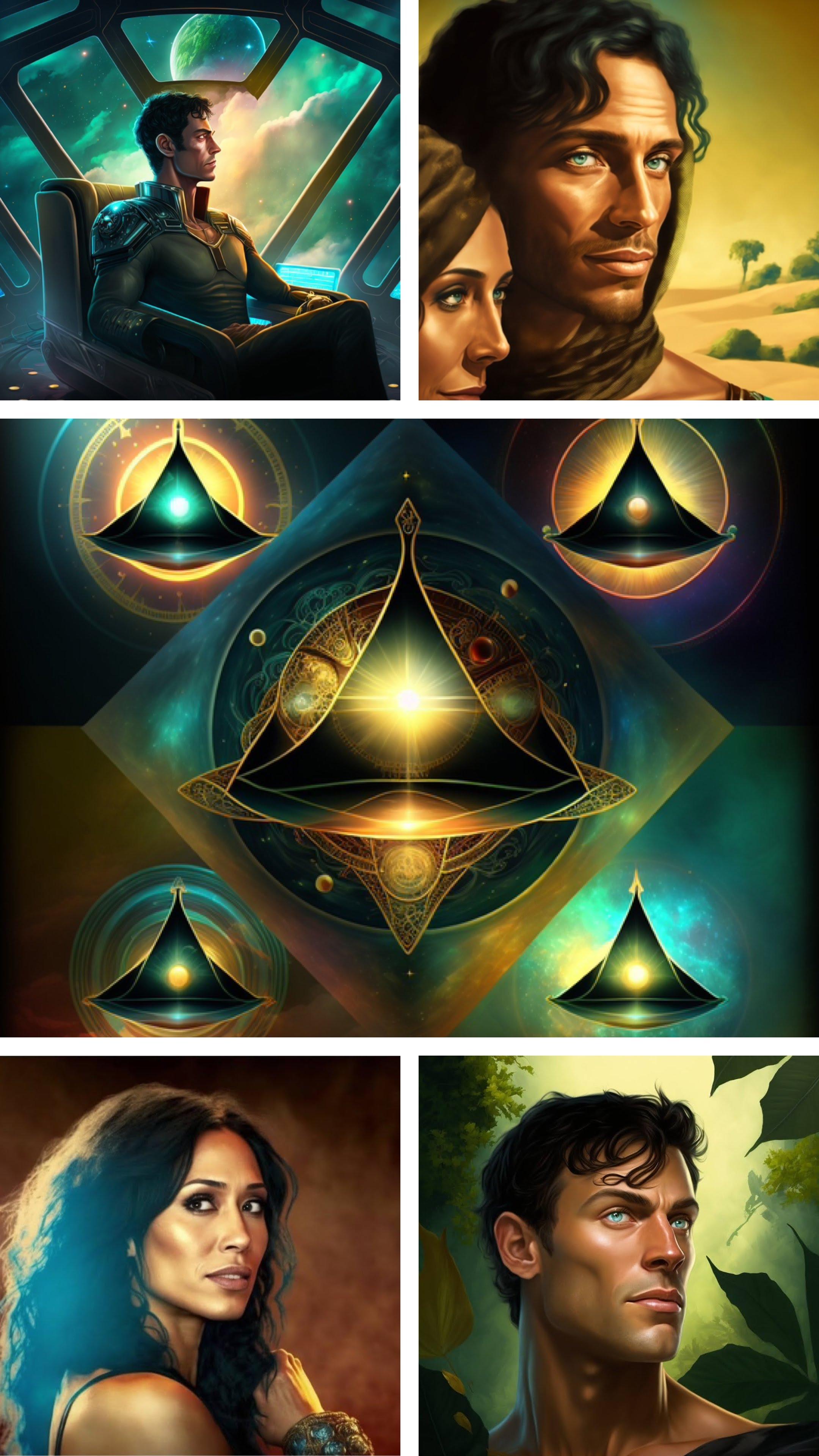
The Jorid has been built and is operated by Georges and his companion Salomé.
Georges was a French thief possibly from the 1800s, turned other-dimensional explorer, and along with Salomé, a girl of mysterious origins who he first met in the Alienor dimension but believed to be born in Northern India in a distant past, they have lived rich adventures together, and are deeply bound by love and mutual interests.Georges, with his handsome face, dark hair and amber gaze, is a bit of a daredevil at times, curious and engaging with others. He is very interesting in anything that shines, strange mechanisms and generally the ways consciousness works in living matter. Salomé, on the other hand is deeply intuitive, empath at times, quite logical and rational but also interested in mysticism, the ways of the Truth, and the “why” rather than the “how” of things.
The world of Alienor (a pale green sun under which twin planets originally orbited – Duane, Murtuane – with an additional third, Phreal, home planet of the Guardians, an alien race of builders with god-like powers) lived through cataclysmic changes, finished by the time this story is told.
The Jorid’s original prototype designs were crafted by Léonard, a mysterious figure, self-taught in the arts of dimensional magic in Alienor sects, who acted as a mentor to Georges during his adventures. It is not known where he is now.
The story unfolds 14 years after we discovered Georges & Salomé in the story.
(for more background information, refer to this thread)
January 19, 2023 at 10:49 am #6419In reply to: Orbs of Madjourneys
“I’d advise you not to take the parrot, Zara,” Harry the vet said, “There are restrictions on bringing dogs and other animals into state parks, and you can bet some jobsworth official will insist she stays in a cage at the very least.”
“Yeah, you’re right, I guess I’ll leave her here. I want to call in and see my cousin in Camden on the way to the airport in Sydney anyway. He has dozens of cats, I’d hate for anything to happen to Pretty Girl,” Zara replied.
“Is that the distant cousin you met when you were doing your family tree?” Harry asked, glancing up from the stitches he was removing from a wounded wombat. “There, he’s good to go. Give him a couple more days, then he can be released back where he came from.”
Zara smiled at Harry as she picked up the animal. “Yes! We haven’t met in person yet, and he’s going to show me the church my ancestor built. He says people have been spotting ghosts there lately, and there are rumours that it’s the ghost of the old convict Isaac who built it. If I can’t find photos of the ancestors, maybe I can get photos of their ghosts instead,” Zara said with a laugh.
“Good luck with that,” Harry replied raising an eyebrow. He liked Zara, she was quirkier than the others.
Zara hadn’t found it easy to research her mothers family from Bangalore in India, but her fathers English family had been easy enough. Although Zara had been born in England and emigrated to Australia in her late 20s, many of her ancestors siblings had emigrated over several generations, and Zara had managed to trace several down and made contact with a few of them. Isaac Stokes wasn’t a direct ancestor, he was the brother of her fourth great grandfather but his story had intrigued her. Sentenced to transportation for stealing tools for his work as a stonemason seemed to have worked in his favour. He built beautiful stone buildings in a tiny new town in the 1800s in the charming style of his home town in England.
Zara planned to stay in Camden for a couple of days before meeting the others at the Flying Fish Inn, anticipating a pleasant visit before the crazy adventure started.

Zara stepped down from the bus, squinting in the bright sunlight and looking around for her newfound cousin Bertie. A lanky middle aged man in dungarees and a red baseball cap came forward with his hand extended.
“Welcome to Camden, Zara I presume! Great to meet you!” he said shaking her hand and taking her rucksack. Zara was taken aback to see the family resemblance to her grandfather. So many scattered generations and yet there was still a thread of familiarity. “I bet you’re hungry, let’s go and get some tucker at Belle’s Cafe, and then I bet you want to see the church first, hey? Whoa, where’d that dang parrot come from?” Bertie said, ducking quickly as the bird swooped right in between them.
“Oh no, it’s Pretty Girl!” exclaimed Zara. “She wasn’t supposed to come with me, I didn’t bring her! How on earth did you fly all this way to get here the same time as me?” she asked the parrot.
“Pretty Girl has her ways, don’t forget to feed the parrot,” the bird replied with a squalk that resembled a mirthful guffaw.
“That’s one strange parrot you got here, girl!” Bertie said in astonishment.
“Well, seeing as you’re here now, Pretty Girl, you better come with us,” Zara said.
“Obviously,” replied Pretty Girl. It was hard to say for sure, but Zara was sure she detected an avian eye roll.
They sat outside under a sunshade to eat rather than cause any upset inside the cafe. Zara fancied an omelette but Pretty Girl objected, so she ordered hash browns instead and a fruit salad for the parrot. Bertie was a good sport about the strange talking bird after his initial surprise.
Bertie told her a bit about the ghost sightings, which had only started quite recently. They started when I started researching him, Zara thought to herself, almost as if he was reaching out. Her imagination was running riot already.
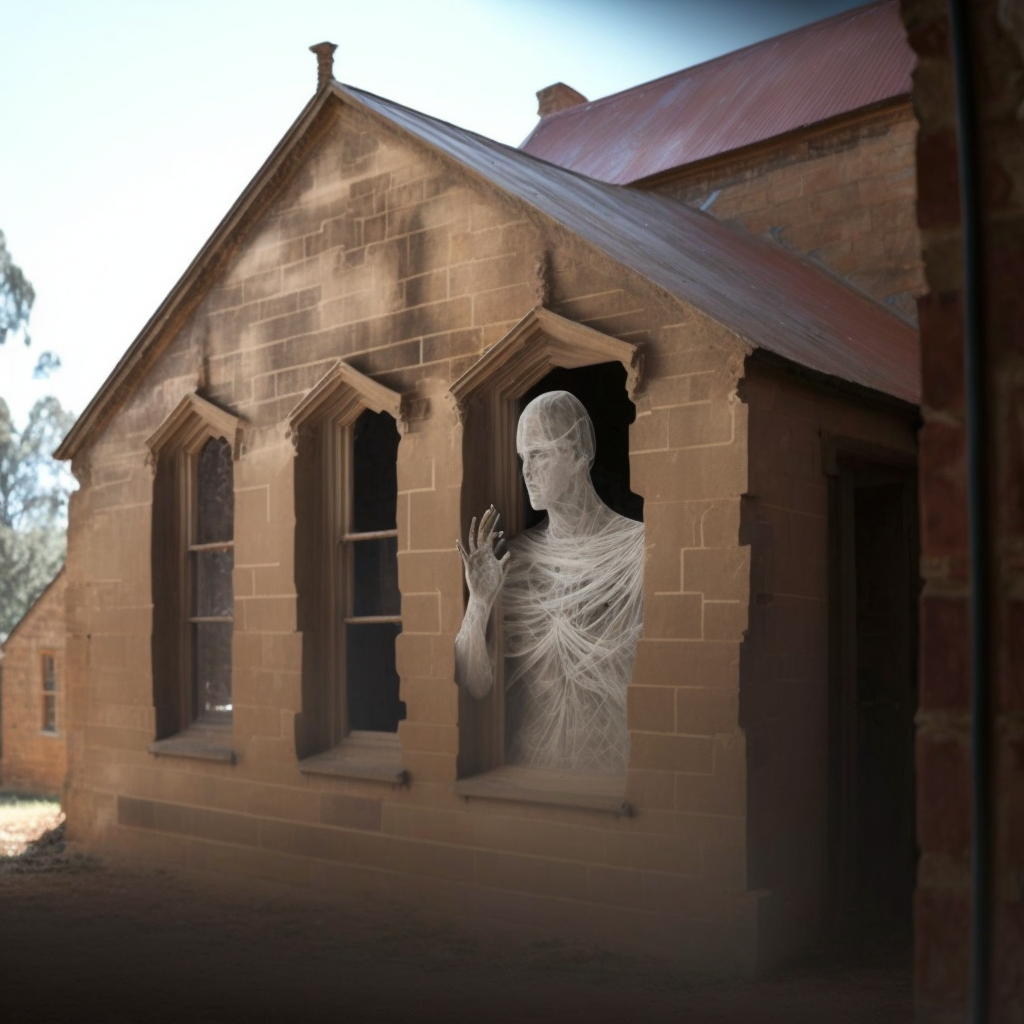
Bertie showed Zara around the church, a small building made of sandstone, but no ghost appeared in the bright heat of the afternoon. He took her on a little tour of Camden, once a tiny outpost but now a suburb of the city, pointing out all the original buildings, in particular the ones that Isaac had built. The church was walking distance of Bertie’s house and Zara decided to slip out and stroll over there after everyone had gone to bed.
Bertie had kindly allowed Pretty Girl to stay in the guest bedroom with her, safe from the cats, and Zara intended that the parrot stay in the room, but Pretty Girl was having none of it and insisted on joining her.
“Alright then, but no talking! I don’t want you scaring any ghost away so just keep a low profile!”
The moon was nearly full and it was a pleasant walk to the church. Pretty Girl fluttered from tree to tree along the sidewalk quietly. Enchanting aromas of exotic scented flowers wafted into her nostrils and Zara felt warmly relaxed and optimistic.
Zara was disappointed to find that the church was locked for the night, and realized with a sigh that she should have expected this to be the case. She wandered around the outside, trying to peer in the windows but there was nothing to be seen as the glass reflected the street lights. These things are not done in a hurry, she reminded herself, be patient.
Sitting under a tree on the grassy lawn attempting to open her mind to receiving ghostly communications (she wasn’t quite sure how to do that on purpose, any ghosts she’d seen previously had always been accidental and unexpected) Pretty Girl landed on her shoulder rather clumsily, pressing something hard and chill against her cheek.
“I told you to keep a low profile!” Zara hissed, as the parrot dropped the key into her lap. “Oh! is this the key to the church door?”
It was hard to see in the dim light but Zara was sure the parrot nodded, and was that another avian eye roll?
Zara walked slowly over the grass to the church door, tingling with anticipation. Pretty Girl hopped along the ground behind her. She turned the key in the lock and slowly pushed open the heavy door and walked inside and up the central aisle, looking around. And then she saw him.
Zara gasped. For a breif moment as the spectral wisps cleared, he looked almost solid. And she could see his tattoos.
“Oh my god,” she whispered, “It is really you. I recognize those tattoos from the description in the criminal registers. Some of them anyway, it seems you have a few more tats since you were transported.”
“Aye, I did that, wench. I were allays fond o’ me tats, does tha like ’em?”
He actually spoke to me! This was beyond Zara’s wildest hopes. Quick, ask him some questions!
“If you don’t mind me asking, Isaac, why did you lie about who your father was on your marriage register? I almost thought it wasn’t you, you know, that I had the wrong Isaac Stokes.”
A deafening rumbling laugh filled the building with echoes and the apparition dispersed in a labyrinthine swirl of tattood wisps.
“A story for another day,” whispered Zara, “Time to go back to Berties. Come on Pretty Girl. And put that key back where you found it.”
 January 17, 2023 at 8:52 am #6395
In reply to: Orbs of Madjourneys
Glimmer Gambol attempted to slip into the chat room unnoticed to eavesdrop, which was of course impossible. She’d been ready and waiting for her parts in the story almost since before the others were born.
“Well!” she said, “If you’re all off doing errands in the real world, I’ll make a start myself. Leave it to me!”
“Is this wise?” Zara said to Xavier, who was perhaps not the best person to ask. His
 by way of reply was not reassuring.
“She’ll probably invite loads of random quirky guests to the game,” Yasmin added, echoing Zara’s concern. Xavier’s smile widened.
 December 19, 2022 at 9:48 am #6352
In reply to: Family Stories From The Other Side ~ Book Two
The Birmingham Bootmaker
Samuel Jones 1816-1875
Samuel Jones the elder was born in Belfast circa 1779. He is one of just two direct ancestors found thus far born in Ireland. Samuel married Jane Elizabeth Brooker (born in St Giles, London) on the 25th January 1807 at St George, Hanover Square in London. Their first child Mary was born in 1808 in London, and then the family moved to Birmingham. Mary was my 3x great grandmother.
But this chapter is about her brother Samuel Jones. I noticed that on a number of other trees on the Ancestry site, Samuel Jones was a convict transported to Australia, but this didn’t tally with the records I’d found for Samuel in Birmingham. In fact another Samuel Jones born at the same time in the same place was transported, but his occupation was a baker. Our Samuel Jones was a bootmaker like his father.
Samuel was born on 28th January 1816 in Birmingham and baptised at St Phillips on the 19th August of that year, the fourth child and first son of Samuel the elder and Jane’s eleven children.
On the 1839 electoral register a Samuel Jones owned a property on Colmore Row, Birmingham.
Samuel Jones, bootmaker of 15, Colmore Row is listed in the 1849 Birmingham post office directory, and in the 1855 White’s Directory.
On the 1851 census, Samuel was an unmarried bootmaker employing sixteen men at 15, Colmore Row. A 9 year old nephew Henry Harris was living with him, and his mother Ruth Harris, as well as a female servant. Samuel’s sister Ruth was born in 1818 and married Henry Harris in 1840. Henry died in 1848.
Samuel was a 45 year old bootmaker at 15 Colmore Row on the 1861 census, living with Maria Walcot, a 26 year old domestic servant.
In October 1863 Samuel married Maria Walcot at St Philips in Birmingham. They don’t appear to have had any children as none appear on the 1871 census, where Samuel and Maria are living at the same address, with another female servant and two male lodgers by the name of Messant from Ipswich.
Marriage of Samuel Jones and Maria Walcot:
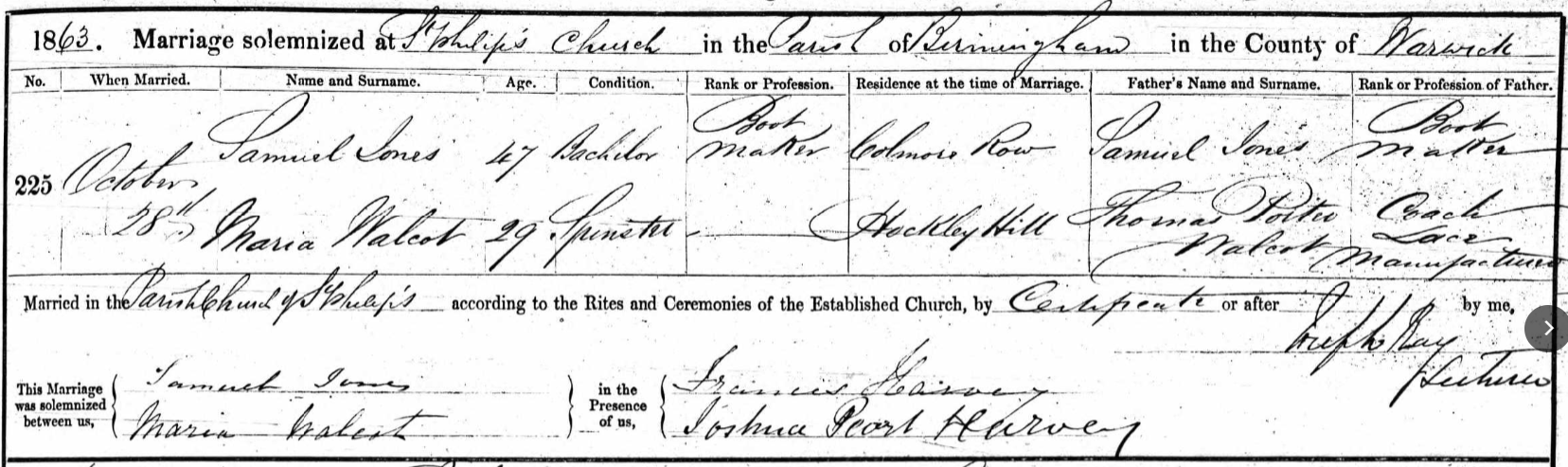
In 1864 Samuel’s father died. Samuel the son is mentioned in the probate records as one of the executors: “Samuel Jones of Colmore Row Birmingham in the county of Warwick boot and shoe manufacturer the son”.
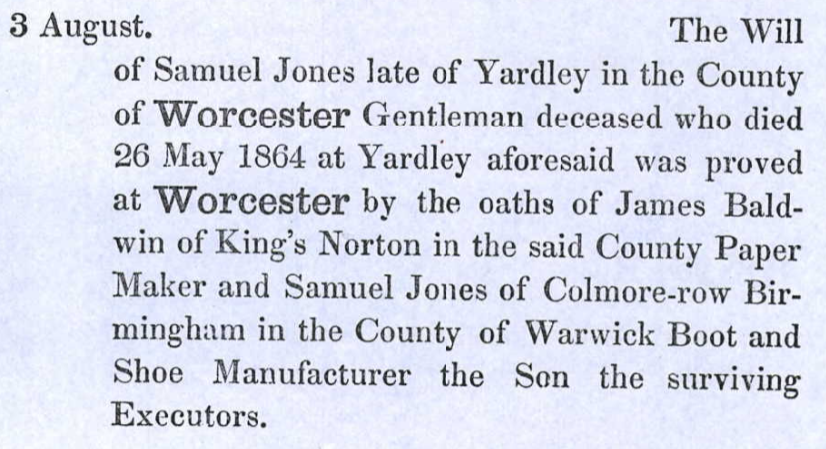
Indeed it could hardly be clearer that this Samuel Jones was not the convict transported to Australia in 1834!
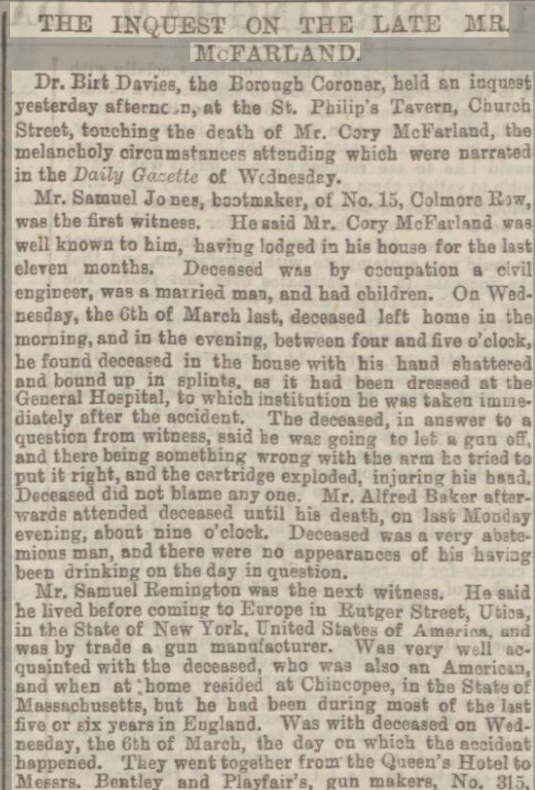
In 1867 Samuel Jones, bootmaker, was mentioned in the Birmingham Daily Gazette with regard to an unfortunate incident involving his American lodger, Cory McFarland. The verdict was accidental death.
Birmingham Daily Gazette – Friday 05 April 1867:
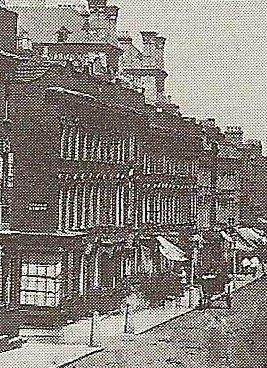
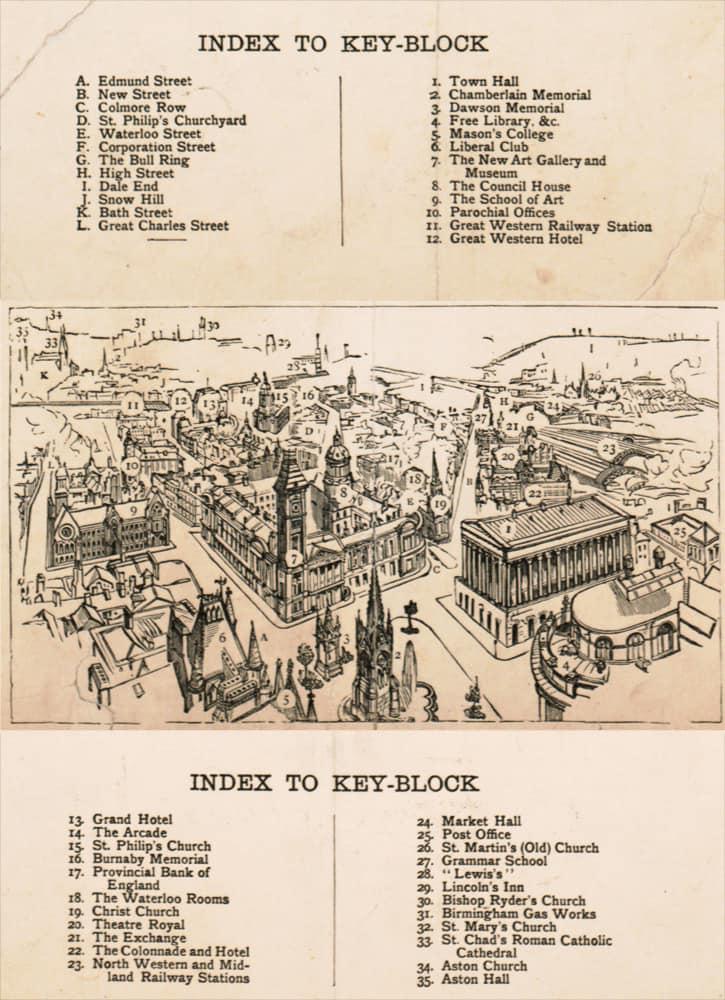
I asked a Birmingham history group for an old photo of Colmore Row. This photo is circa 1870 and number 15 is furthest from the camera. The businesses on the street at the time were as follows:
7 homeopathic chemist George John Morris. 8 surgeon dentist Frederick Sims. 9 Saul & Walter Samuel, Australian merchants. Surgeons occupied 10, pawnbroker John Aaron at 11 & 12. 15 boot & shoemaker. 17 auctioneer…
from Bird’s Eye View of Birmingham, 1886:
 December 6, 2022 at 2:17 pm #6350
In reply to: Family Stories From The Other Side ~ Book Two
Transportation
Isaac Stokes 1804-1877
Isaac was born in Churchill, Oxfordshire in 1804, and was the youngest brother of my 4X great grandfather Thomas Stokes. The Stokes family were stone masons for generations in Oxfordshire and Gloucestershire, and Isaac’s occupation was a mason’s labourer in 1834 when he was sentenced at the Lent Assizes in Oxford to fourteen years transportation for stealing tools.
Churchill where the Stokes stonemasons came from: on 31 July 1684 a fire destroyed 20 houses and many other buildings, and killed four people. The village was rebuilt higher up the hill, with stone houses instead of the old timber-framed and thatched cottages. The fire was apparently caused by a baker who, to avoid chimney tax, had knocked through the wall from her oven to her neighbour’s chimney.
Isaac stole a pick axe, the value of 2 shillings and the property of Thomas Joyner of Churchill; a kibbeaux and a trowel value 3 shillings the property of Thomas Symms; a hammer and axe value 5 shillings, property of John Keen of Sarsden.
(The word kibbeaux seems to only exists in relation to Isaac Stokes sentence and whoever was the first to write it was perhaps being creative with the spelling of a kibbo, a miners or a metal bucket. This spelling is repeated in the criminal reports and the newspaper articles about Isaac, but nowhere else).
In March 1834 the Removal of Convicts was announced in the Oxford University and City Herald: Isaac Stokes and several other prisoners were removed from the Oxford county gaol to the Justitia hulk at Woolwich “persuant to their sentences of transportation at our Lent Assizes”.
via digitalpanopticon:
Hulks were decommissioned (and often unseaworthy) ships that were moored in rivers and estuaries and refitted to become floating prisons. The outbreak of war in America in 1775 meant that it was no longer possible to transport British convicts there. Transportation as a form of punishment had started in the late seventeenth century, and following the Transportation Act of 1718, some 44,000 British convicts were sent to the American colonies. The end of this punishment presented a major problem for the authorities in London, since in the decade before 1775, two-thirds of convicts at the Old Bailey received a sentence of transportation – on average 283 convicts a year. As a result, London’s prisons quickly filled to overflowing with convicted prisoners who were sentenced to transportation but had no place to go.
To increase London’s prison capacity, in 1776 Parliament passed the “Hulks Act” (16 Geo III, c.43). Although overseen by local justices of the peace, the hulks were to be directly managed and maintained by private contractors. The first contract to run a hulk was awarded to Duncan Campbell, a former transportation contractor. In August 1776, the Justicia, a former transportation ship moored in the River Thames, became the first prison hulk. This ship soon became full and Campbell quickly introduced a number of other hulks in London; by 1778 the fleet of hulks on the Thames held 510 prisoners.
Demand was so great that new hulks were introduced across the country. There were hulks located at Deptford, Chatham, Woolwich, Gosport, Plymouth, Portsmouth, Sheerness and Cork.The Justitia via rmg collections:
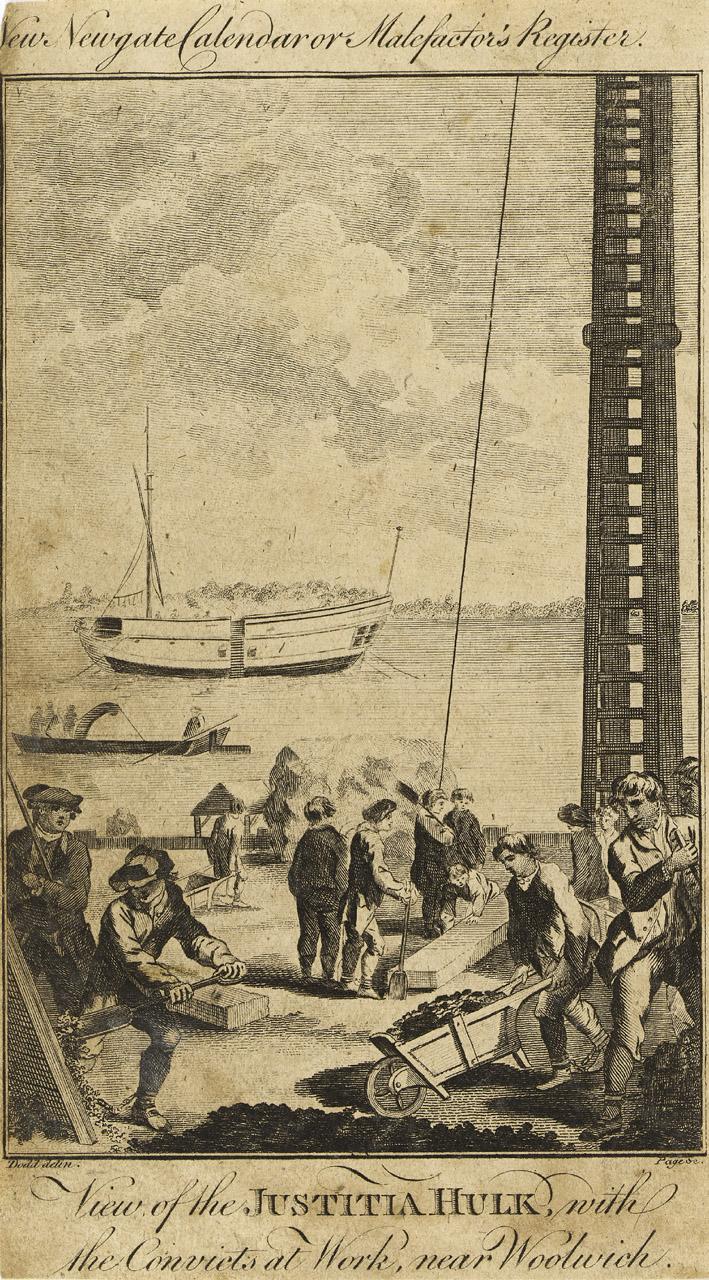
Convicts perform hard labour at the Woolwich Warren. The hulk on the river is the ‘Justitia’. Prisoners were kept on board such ships for months awaiting deportation to Australia. The ‘Justitia’ was a 260 ton prison hulk that had been originally moored in the Thames when the American War of Independence put a stop to the transportation of criminals to the former colonies. The ‘Justitia’ belonged to the shipowner Duncan Campbell, who was the Government contractor who organized the prison-hulk system at that time. Campbell was subsequently involved in the shipping of convicts to the penal colony at Botany Bay (in fact Port Jackson, later Sydney, just to the north) in New South Wales, the ‘first fleet’ going out in 1788.
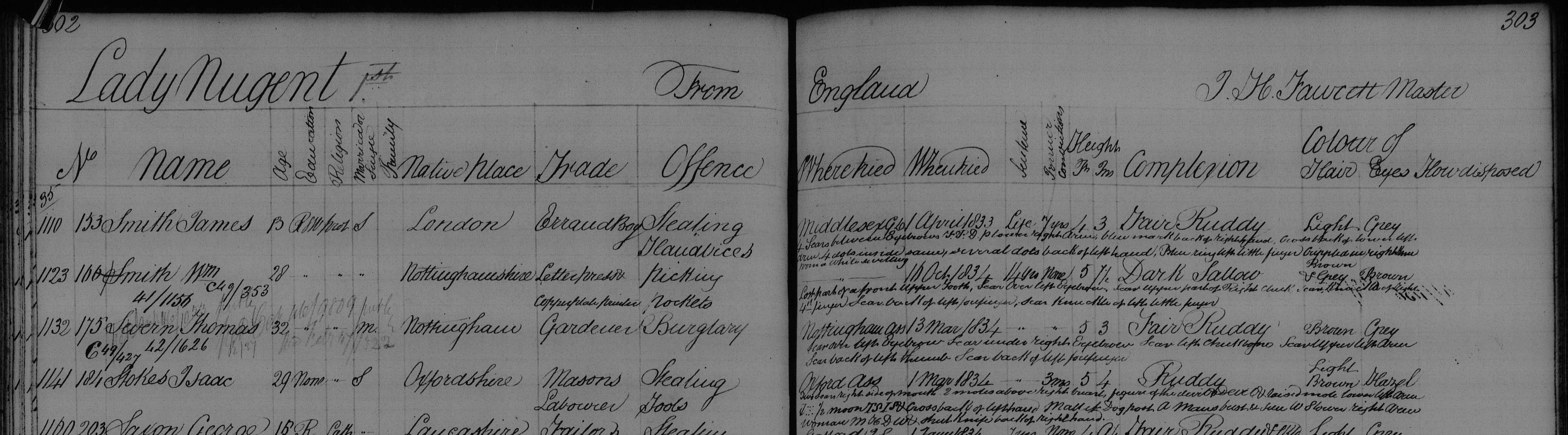
While searching for records for Isaac Stokes I discovered that another Isaac Stokes was transported to New South Wales in 1835 as well. The other one was a butcher born in 1809, sentenced in London for seven years, and he sailed on the Mary Ann. Our Isaac Stokes sailed on the Lady Nugent, arriving in NSW in April 1835, having set sail from England in December 1834.
Lady Nugent was built at Bombay in 1813. She made four voyages under contract to the British East India Company (EIC). She then made two voyages transporting convicts to Australia, one to New South Wales and one to Van Diemen’s Land (Tasmania). (via Wikipedia)
via freesettlerorfelon website:
On 20 November 1834, 100 male convicts were transferred to the Lady Nugent from the Justitia Hulk and 60 from the Ganymede Hulk at Woolwich, all in apparent good health. The Lady Nugent departed Sheerness on 4 December 1834.
SURGEON OLIVER SPROULE
Oliver Sproule kept a Medical Journal from 7 November 1834 to 27 April 1835. He recorded in his journal the weather conditions they experienced in the first two weeks:
‘In the course of the first week or ten days at sea, there were eight or nine on the sick list with catarrhal affections and one with dropsy which I attribute to the cold and wet we experienced during that period beating down channel. Indeed the foremost berths in the prison at this time were so wet from leaking in that part of the ship, that I was obliged to issue dry beds and bedding to a great many of the prisoners to preserve their health, but after crossing the Bay of Biscay the weather became fine and we got the damp beds and blankets dried, the leaks partially stopped and the prison well aired and ventilated which, I am happy to say soon manifested a favourable change in the health and appearance of the men.
Besides the cases given in the journal I had a great many others to treat, some of them similar to those mentioned but the greater part consisted of boils, scalds, and contusions which would not only be too tedious to enter but I fear would be irksome to the reader. There were four births on board during the passage which did well, therefore I did not consider it necessary to give a detailed account of them in my journal the more especially as they were all favourable cases.
Regularity and cleanliness in the prison, free ventilation and as far as possible dry decks turning all the prisoners up in fine weather as we were lucky enough to have two musicians amongst the convicts, dancing was tolerated every afternoon, strict attention to personal cleanliness and also to the cooking of their victuals with regular hours for their meals, were the only prophylactic means used on this occasion, which I found to answer my expectations to the utmost extent in as much as there was not a single case of contagious or infectious nature during the whole passage with the exception of a few cases of psora which soon yielded to the usual treatment. A few cases of scurvy however appeared on board at rather an early period which I can attribute to nothing else but the wet and hardships the prisoners endured during the first three or four weeks of the passage. I was prompt in my treatment of these cases and they got well, but before we arrived at Sydney I had about thirty others to treat.’
The Lady Nugent arrived in Port Jackson on 9 April 1835 with 284 male prisoners. Two men had died at sea. The prisoners were landed on 27th April 1835 and marched to Hyde Park Barracks prior to being assigned. Ten were under the age of 14 years.
The Lady Nugent:
Isaac’s distinguishing marks are noted on various criminal registers and record books:
“Height in feet & inches: 5 4; Complexion: Ruddy; Hair: Light brown; Eyes: Hazel; Marks or Scars: Yes [including] DEVIL on lower left arm, TSIS back of left hand, WS lower right arm, MHDW back of right hand.”
Another includes more detail about Isaac’s tattoos:
“Two slight scars right side of mouth, 2 moles above right breast, figure of the devil and DEVIL and raised mole, lower left arm; anchor, seven dots half moon, TSIS and cross, back of left hand; a mallet, door post, A, mans bust, sun, WS, lower right arm; woman, MHDW and shut knife, back of right hand.”
From How tattoos became fashionable in Victorian England (2019 article in TheConversation by Robert Shoemaker and Zoe Alkar):
“Historical tattooing was not restricted to sailors, soldiers and convicts, but was a growing and accepted phenomenon in Victorian England. Tattoos provide an important window into the lives of those who typically left no written records of their own. As a form of “history from below”, they give us a fleeting but intriguing understanding of the identities and emotions of ordinary people in the past.
As a practice for which typically the only record is the body itself, few systematic records survive before the advent of photography. One exception to this is the written descriptions of tattoos (and even the occasional sketch) that were kept of institutionalised people forced to submit to the recording of information about their bodies as a means of identifying them. This particularly applies to three groups – criminal convicts, soldiers and sailors. Of these, the convict records are the most voluminous and systematic.
Such records were first kept in large numbers for those who were transported to Australia from 1788 (since Australia was then an open prison) as the authorities needed some means of keeping track of them.”On the 1837 census Isaac was working for the government at Illiwarra, New South Wales. This record states that he arrived on the Lady Nugent in 1835. There are three other indent records for an Isaac Stokes in the following years, but the transcriptions don’t provide enough information to determine which Isaac Stokes it was. In April 1837 there was an abscondment, and an arrest/apprehension in May of that year, and in 1843 there was a record of convict indulgences.
From the Australian government website regarding “convict indulgences”:
“By the mid-1830s only six per cent of convicts were locked up. The vast majority worked for the government or free settlers and, with good behaviour, could earn a ticket of leave, conditional pardon or and even an absolute pardon. While under such orders convicts could earn their own living.”
In 1856 in Camden, NSW, Isaac Stokes married Catherine Daly. With no further information on this record it would be impossible to know for sure if this was the right Isaac Stokes. This couple had six children, all in the Camden area, but none of the records provided enough information. No occupation or place or date of birth recorded for Isaac Stokes.
I wrote to the National Library of Australia about the marriage record, and their reply was a surprise! Issac and Catherine were married on 30 September 1856, at the house of the Rev. Charles William Rigg, a Methodist minister, and it was recorded that Isaac was born in Edinburgh in 1821, to parents James Stokes and Sarah Ellis! The age at the time of the marriage doesn’t match Isaac’s age at death in 1877, and clearly the place of birth and parents didn’t match either. Only his fathers occupation of stone mason was correct. I wrote back to the helpful people at the library and they replied that the register was in a very poor condition and that only two and a half entries had survived at all, and that Isaac and Catherines marriage was recorded over two pages.
I searched for an Isaac Stokes born in 1821 in Edinburgh on the Scotland government website (and on all the other genealogy records sites) and didn’t find it. In fact Stokes was a very uncommon name in Scotland at the time. I also searched Australian immigration and other records for another Isaac Stokes born in Scotland or born in 1821, and found nothing. I was unable to find a single record to corroborate this mysterious other Isaac Stokes.
As the age at death in 1877 was correct, I assume that either Isaac was lying, or that some mistake was made either on the register at the home of the Methodist minster, or a subsequent mistranscription or muddle on the remnants of the surviving register. Therefore I remain convinced that the Camden stonemason Isaac Stokes was indeed our Isaac from Oxfordshire.
I found a history society newsletter article that mentioned Isaac Stokes, stone mason, had built the Glenmore church, near Camden, in 1859.
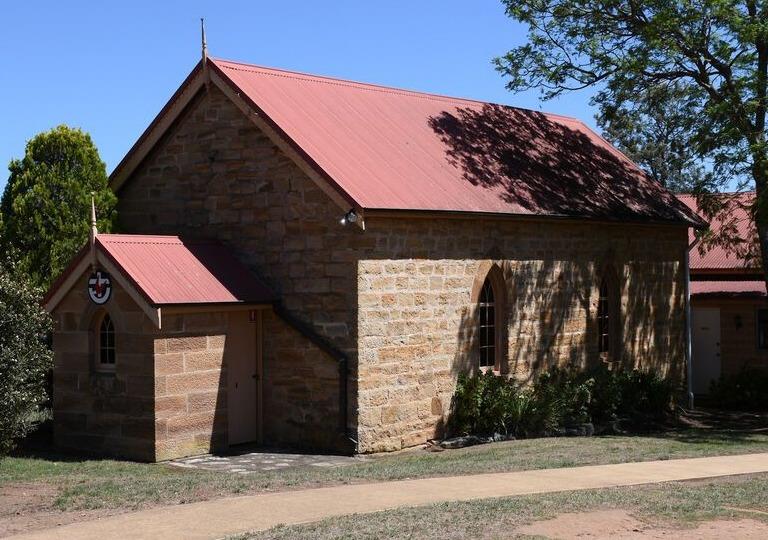
From the Wollondilly museum April 2020 newsletter:
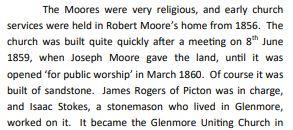
From the Camden History website:
“The stone set over the porch of Glenmore Church gives the date of 1860. The church was begun in 1859 on land given by Joseph Moore. James Rogers of Picton was given the contract to build and local builder, Mr. Stokes, carried out the work. Elizabeth Moore, wife of Edward, laid the foundation stone. The first service was held on 19th March 1860. The cemetery alongside the church contains the headstones and memorials of the areas early pioneers.”
Isaac died on the 3rd September 1877. The inquest report puts his place of death as Bagdelly, near to Camden, and another death register has put Cambelltown, also very close to Camden. His age was recorded as 71 and the inquest report states his cause of death was “rupture of one of the large pulmonary vessels of the lung”. His wife Catherine died in childbirth in 1870 at the age of 43.
Isaac and Catherine’s children:
William Stokes 1857-1928
Catherine Stokes 1859-1846
Sarah Josephine Stokes 1861-1931
Ellen Stokes 1863-1932
Rosanna Stokes 1865-1919
Louisa Stokes 1868-1844.
It’s possible that Catherine Daly was a transported convict from Ireland.
Some time later I unexpectedly received a follow up email from The Oaks Heritage Centre in Australia.
“The Gaudry papers which we have in our archive record him (Isaac Stokes) as having built: the church, the school and the teachers residence. Isaac is recorded in the General return of convicts: 1837 and in Grevilles Post Office directory 1872 as a mason in Glenmore.”
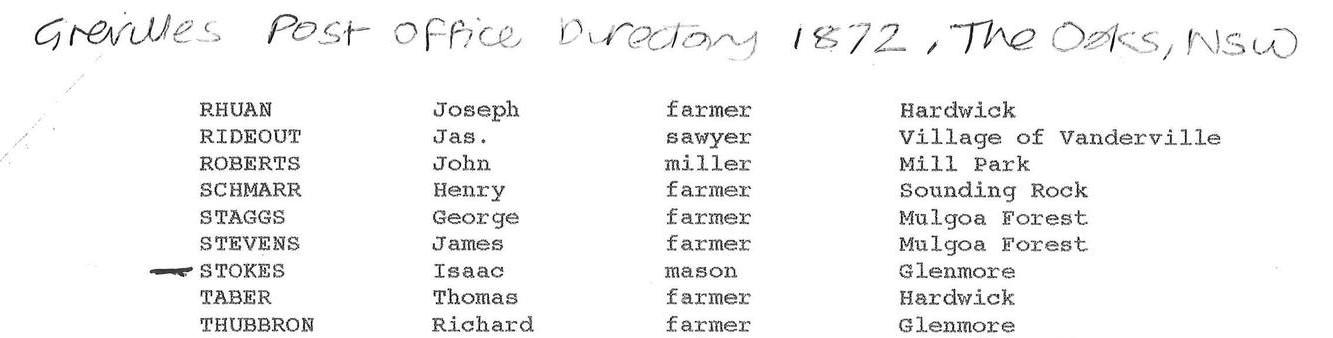 November 18, 2022 at 4:47 pm #6348
In reply to: Family Stories From The Other Side ~ Book Two
Wong Sang
Wong Sang was born in China in 1884. In October 1916 he married Alice Stokes in Oxford.
Alice was the granddaughter of William Stokes of Churchill, Oxfordshire and William was the brother of Thomas Stokes the wheelwright (who was my 3X great grandfather). In other words Alice was my second cousin, three times removed, on my fathers paternal side.
Wong Sang was an interpreter, according to the baptism registers of his children and the Dreadnought Seamen’s Hospital admission registers in 1930. The hospital register also notes that he was employed by the Blue Funnel Line, and that his address was 11, Limehouse Causeway, E 14. (London)
“The Blue Funnel Line offered regular First-Class Passenger and Cargo Services From the UK to South Africa, Malaya, China, Japan, Australia, Java, and America. Blue Funnel Line was Owned and Operated by Alfred Holt & Co., Liverpool.
The Blue Funnel Line, so-called because its ships have a blue funnel with a black top, is more appropriately known as the Ocean Steamship Company.”Wong Sang and Alice’s daughter, Frances Eileen Sang, was born on the 14th July, 1916 and baptised in 1920 at St Stephen in Poplar, Tower Hamlets, London. The birth date is noted in the 1920 baptism register and would predate their marriage by a few months, although on the death register in 1921 her age at death is four years old and her year of birth is recorded as 1917.
Charles Ronald Sang was baptised on the same day in May 1920, but his birth is recorded as April of that year. The family were living on Morant Street, Poplar.
James William Sang’s birth is recorded on the 1939 census and on the death register in 2000 as being the 8th March 1913. This definitely would predate the 1916 marriage in Oxford.
William Norman Sang was born on the 17th October 1922 in Poplar.
Alice and the three sons were living at 11, Limehouse Causeway on the 1939 census, the same address that Wong Sang was living at when he was admitted to Dreadnought Seamen’s Hospital on the 15th January 1930. Wong Sang died in the hospital on the 8th March of that year at the age of 46.
Alice married John Patterson in 1933 in Stepney. John was living with Alice and her three sons on Limehouse Causeway on the 1939 census and his occupation was chef.
Via Old London Photographs:
“Limehouse Causeway is a street in east London that was the home to the original Chinatown of London. A combination of bomb damage during the Second World War and later redevelopment means that almost nothing is left of the original buildings of the street.”
Limehouse Causeway in 1925:
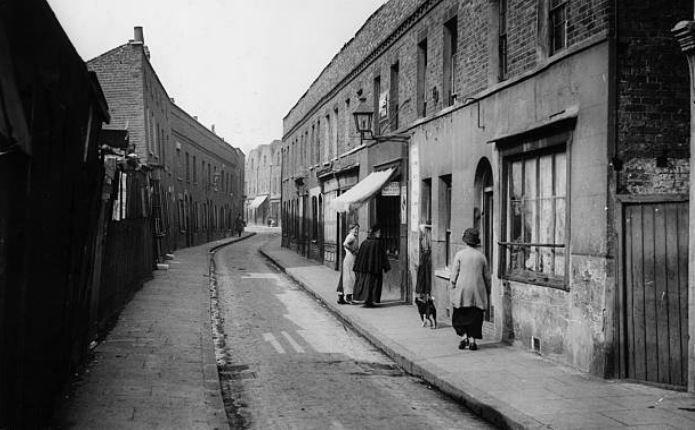
From The Story of Limehouse’s Lost Chinatown, poplarlondon website:
“Limehouse was London’s first Chinatown, home to a tightly-knit community who were demonised in popular culture and eventually erased from the cityscape.
As recounted in the BBC’s ‘Our Greatest Generation’ series, Connie was born to a Chinese father and an English mother in early 1920s Limehouse, where she used to play in the street with other British and British-Chinese children before running inside for teatime at one of their houses.
Limehouse was London’s first Chinatown between the 1880s and the 1960s, before the current Chinatown off Shaftesbury Avenue was established in the 1970s by an influx of immigrants from Hong Kong.
Connie’s memories of London’s first Chinatown as an “urban village” paint a very different picture to the seedy area portrayed in early twentieth century novels.
The pyramid in St Anne’s church marked the entrance to the opium den of Dr Fu Manchu, a criminal mastermind who threatened Western society by plotting world domination in a series of novels by Sax Rohmer.
Thomas Burke’s Limehouse Nights cemented stereotypes about prostitution, gambling and violence within the Chinese community, and whipped up anxiety about sexual relationships between Chinese men and white women.
Though neither novelist was familiar with the Chinese community, their depictions made Limehouse one of the most notorious areas of London.
Travel agent Thomas Cook even organised tours of the area for daring visitors, despite the rector of Limehouse warning that “those who look for the Limehouse of Mr Thomas Burke simply will not find it.”
All that remains is a handful of Chinese street names, such as Ming Street, Pekin Street, and Canton Street — but what was Limehouse’s chinatown really like, and why did it get swept away?
Chinese migration to Limehouse
Chinese sailors discharged from East India Company ships settled in the docklands from as early as the 1780s.
By the late nineteenth century, men from Shanghai had settled around Pennyfields Lane, while a Cantonese community lived on Limehouse Causeway.
Chinese sailors were often paid less and discriminated against by dock hirers, and so began to diversify their incomes by setting up hand laundry services and restaurants.
Old photographs show shopfronts emblazoned with Chinese characters with horse-drawn carts idling outside or Chinese men in suits and hats standing proudly in the doorways.
In oral histories collected by Yat Ming Loo, Connie’s husband Leslie doesn’t recall seeing any Chinese women as a child, since male Chinese sailors settled in London alone and married working-class English women.
In the 1920s, newspapers fear-mongered about interracial marriages, crime and gambling, and described chinatown as an East End “colony.”
Ironically, Chinese opium-smoking was also demonised in the press, despite Britain waging war against China in the mid-nineteenth century for suppressing the opium trade to alleviate addiction amongst its people.
The number of Chinese people who settled in Limehouse was also greatly exaggerated, and in reality only totalled around 300.
The real Chinatown
Although the press sought to characterise Limehouse as a monolithic Chinese community in the East End, Connie remembers seeing people of all nationalities in the shops and community spaces in Limehouse.
She doesn’t remember feeling discriminated against by other locals, though Connie does recall having her face measured and IQ tested by a member of the British Eugenics Society who was conducting research in the area.
Some of Connie’s happiest childhood memories were from her time at Chung-Hua Club, where she learned about Chinese culture and language.
Why did Chinatown disappear?
The caricature of Limehouse’s Chinatown as a den of vice hastened its erasure.
Police raids and deportations fuelled by the alarmist media coverage threatened the Chinese population of Limehouse, and slum clearance schemes to redevelop low-income areas dispersed Chinese residents in the 1930s.
The Defence of the Realm Act imposed at the beginning of the First World War criminalised opium use, gave the authorities increased powers to deport Chinese people and restricted their ability to work on British ships.
Dwindling maritime trade during World War II further stripped Chinese sailors of opportunities for employment, and any remnants of Chinatown were destroyed during the Blitz or erased by postwar development schemes.”
Wong Sang 1884-1930
The year 1918 was a troublesome one for Wong Sang, an interpreter and shipping agent for Blue Funnel Line. The Sang family were living at 156, Chrisp Street.
Chrisp Street, Poplar, in 1913 via Old London Photographs:
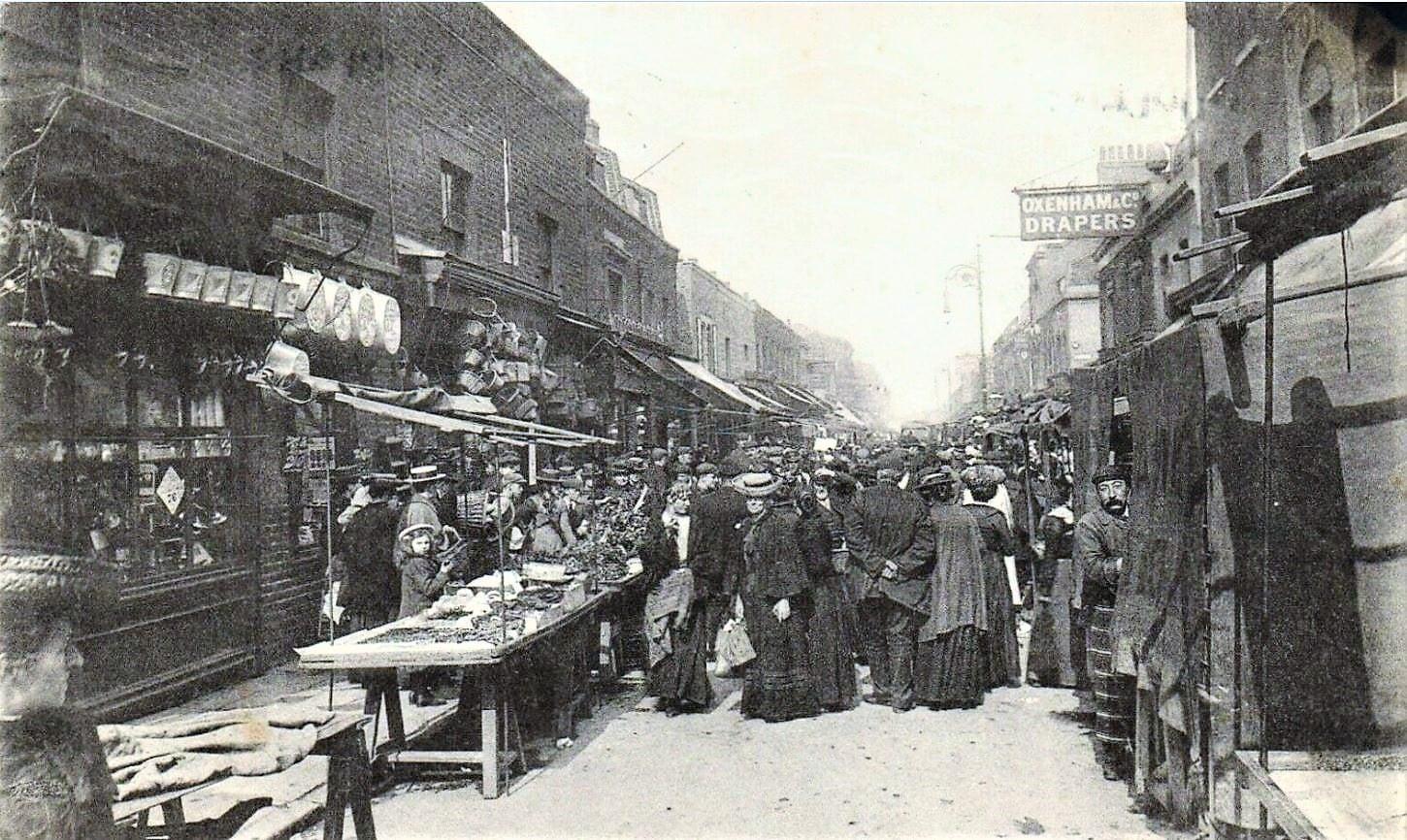
In February Wong Sang was discharged from a false accusation after defending his home from potential robbers.
East End News and London Shipping Chronicle – Friday 15 February 1918:
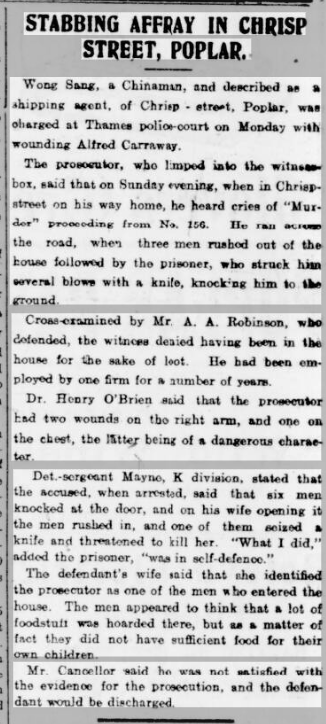
In August of that year he was involved in an incident that left him unconscious.
Faringdon Advertiser and Vale of the White Horse Gazette – Saturday 31 August 1918:
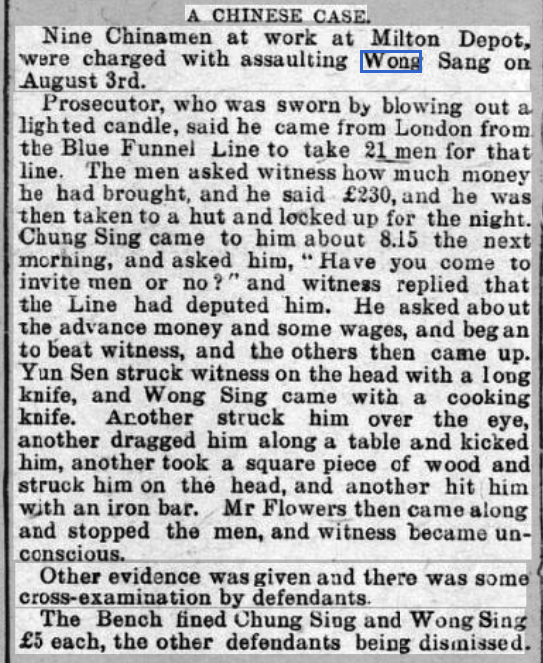
Wong Sang is mentioned in an 1922 article about “Oriental London”.
London and China Express – Thursday 09 February 1922:
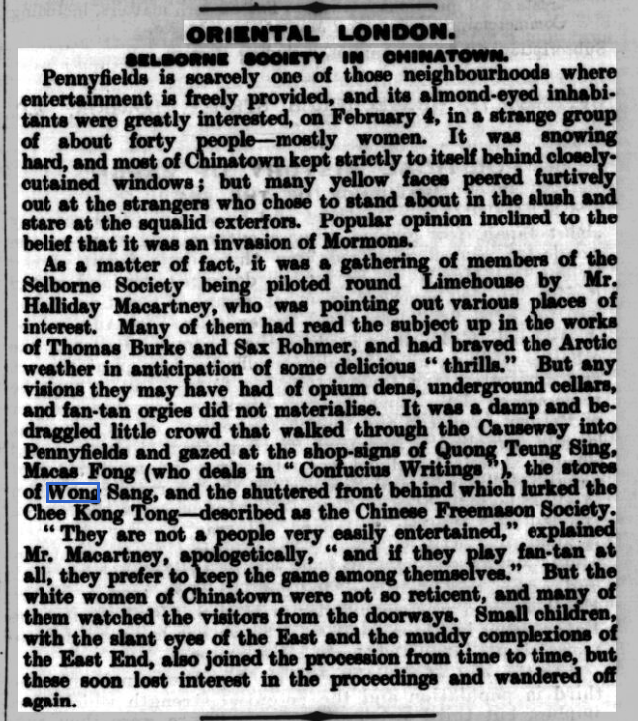
A photograph of the Chee Kong Tong Chinese Freemason Society mentioned in the above article, via Old London Photographs:
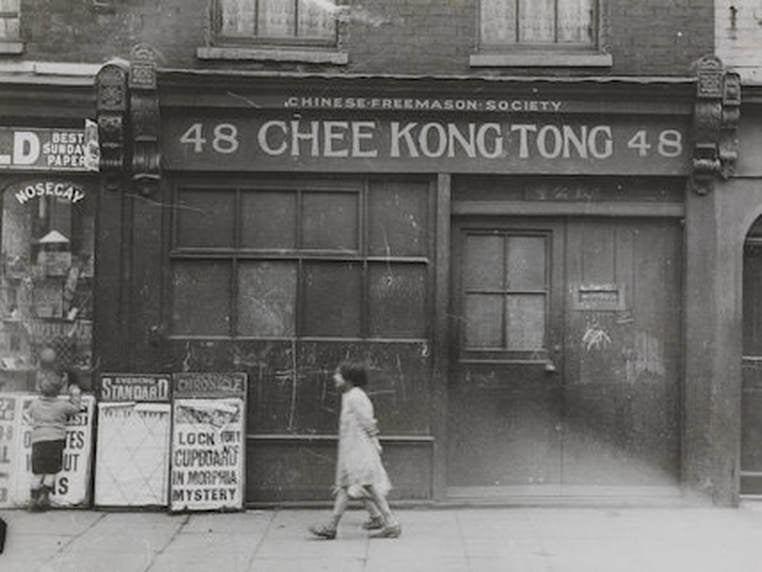
Wong Sang was recommended by the London Metropolitan Police in 1928 to assist in a case in Wellingborough, Northampton.
Difficulty of Getting an Interpreter: Northampton Mercury – Friday 16 March 1928:
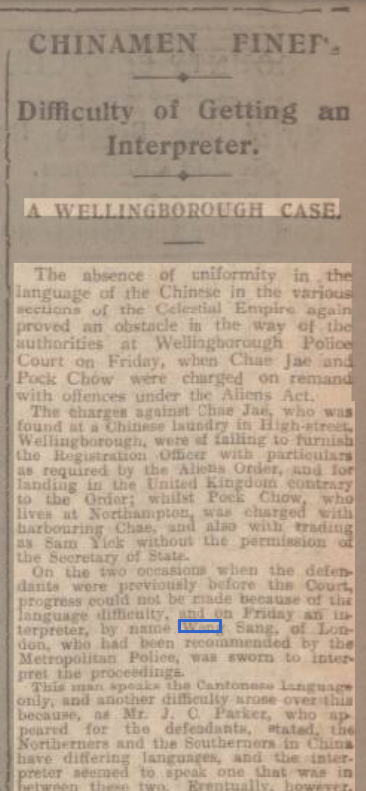
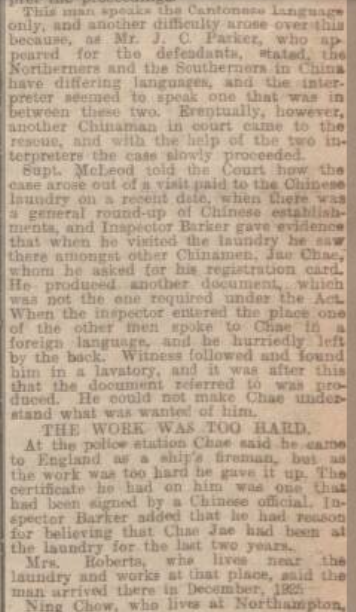
The difficulty was that “this man speaks the Cantonese language only…the Northeners and the Southerners in China have differing languages and the interpreter seemed to speak one that was in between these two.”
In 1917, Alice Wong Sang was a witness at her sister Harriet Stokes marriage to James William Watts in Southwark, London. Their father James Stokes occupation on the marriage register is foreman surveyor, but on the census he was a council roadman or labourer. (I initially rejected this as the correct marriage for Harriet because of the discrepancy with the occupations. Alice Wong Sang as a witness confirmed that it was indeed the correct one.)
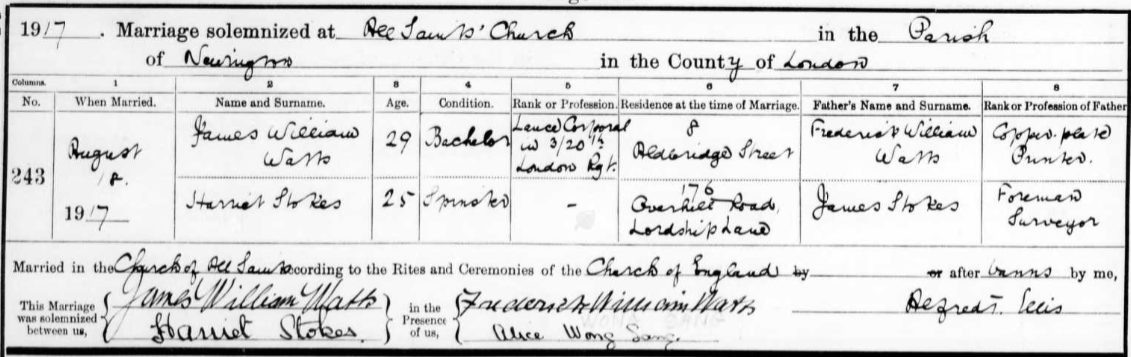
James William Sang 1913-2000 was a clock fitter and watch assembler (on the 1939 census). He married Ivy Laura Fenton in 1963 in Sidcup, Kent. James died in Southwark in 2000.
Charles Ronald Sang 1920-1974 was a draughtsman (1939 census). He married Eileen Burgess in 1947 in Marylebone. Charles and Eileen had two sons: Keith born in 1951 and Roger born in 1952. He died in 1974 in Hertfordshire.
William Norman Sang 1922-2000 was a clerk and telephone operator (1939 census). William enlisted in the Royal Artillery in 1942. He married Lily Mullins in 1949 in Bethnal Green, and they had three daughters: Marion born in 1950, Christine in 1953, and Frances in 1959. He died in Redbridge in 2000.
I then found another two births registered in Poplar by Alice Sang, both daughters. Doris Winifred Sang was born in 1925, and Patricia Margaret Sang was born in 1933 ~ three years after Wong Sang’s death. Neither of the these daughters were on the 1939 census with Alice, John Patterson and the three sons. Margaret had presumably been evacuated because of the war to a family in Taunton, Somerset. Doris would have been fourteen and I have been unable to find her in 1939 (possibly because she died in 2017 and has not had the redaction removed yet on the 1939 census as only deceased people are viewable).
Doris Winifred Sang 1925-2017 was a nursing sister. She didn’t marry, and spent a year in USA between 1954 and 1955. She stayed in London, and died at the age of ninety two in 2017.
Patricia Margaret Sang 1933-1998 was also a nurse. She married Patrick L Nicely in Stepney in 1957. Patricia and Patrick had five children in London: Sharon born 1959, Donald in 1960, Malcolm was born and died in 1966, Alison was born in 1969 and David in 1971.
I was unable to find a birth registered for Alice’s first son, James William Sang (as he appeared on the 1939 census). I found Alice Stokes on the 1911 census as a 17 year old live in servant at a tobacconist on Pekin Street, Limehouse, living with Mr Sui Fong from Hong Kong and his wife Sarah Sui Fong from Berlin. I looked for a birth registered for James William Fong instead of Sang, and found it ~ mothers maiden name Stokes, and his date of birth matched the 1939 census: 8th March, 1913.
On the 1921 census, Wong Sang is not listed as living with them but it is mentioned that Mr Wong Sang was the person returning the census. Also living with Alice and her sons James and Charles in 1921 are two visitors: (Florence) May Stokes, 17 years old, born in Woodstock, and Charles Stokes, aged 14, also born in Woodstock. May and Charles were Alice’s sister and brother.
I found Sharon Nicely on social media and she kindly shared photos of Wong Sang and Alice Stokes:
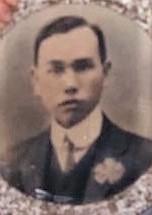
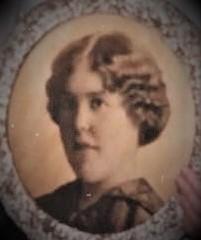 November 14, 2022 at 12:09 pm #6346
In reply to: Family Stories From The Other Side ~ Book Two
The Mormon Browning Who Went To Utah
Isaac Browning’s (1784-1848) sister Hannah married Francis Buckingham. There were at least three Browning Buckingham marriages in Tetbury. Their daughter Charlotte married James Paskett, a shoemaker. Charlotte was born in 1818 and in 1871 she and her family emigrated to Utah, USA.
Charlotte’s relationship to me is first cousin five times removed.
James and Charlotte: (photos found online)
The house of James and Charlotte in Tetbury:
The home of James and Charlotte in Utah:
Obituary:
James Pope Paskett Dead.
Veteran of 87 Laid to rest. Special Correspondence Coalville, Summit Co., Oct 28—James Pope Paskett of Henefer died Oct. 24, 1903 of old age and general debility. Funeral services were held at Henefer today. Elders W.W. Cluff, Alma Elderge, Robert Jones, Oscar Wilkins and Bishop M.F. Harris were the speakers. There was a large attendance many coming from other wards in the stake. James Pope Paskett was born in Chippenham, Wiltshire, England, on March 12, 1817; married Chalotte Buckingham in the year 1839; eight children were born to them, three sons and five daughters, all of whom are living and residing in Utah, except one in Brisbane, Australia. Father Paskett joined the church of Jesus Christ of Latter Day Saints in 1847, and emigrated to Utah in 1871, and has resided in Henefer ever since. He leaves his faithful and aged wife. He was respected and esteemed by all who knew him.
Charlotte died in Henefer, Utah, on 27th December 1910 at the age of 91.
James and Charlotte in later life:
November 13, 2022 at 10:29 pm #6345In reply to: Family Stories From The Other Side ~ Book Two
Crime and Punishment in Tetbury
I noticed that there were quite a number of Brownings of Tetbury in the newspaper archives involved in criminal activities while doing a routine newspaper search to supplement the information in the usual ancestry records. I expanded the tree to include cousins, and offsping of cousins, in order to work out who was who and how, if at all, these individuals related to our Browning family.
I was expecting to find some of our Brownings involved in the Swing Riots in Tetbury in 1830, but did not. Most of our Brownings (including cousins) were stone masons. Most of the rioters in 1830 were agricultural labourers.
The Browning crimes are varied, and by todays standards, not for the most part terribly serious ~ you would be unlikely to receive a sentence of hard labour for being found in an outhouse with the intent to commit an unlawful act nowadays, or for being drunk.
The central character in this chapter is Isaac Browning (my 4x great grandfather), who did not appear in any criminal registers, but the following individuals can be identified in the family structure through their relationship to him.
RICHARD LOCK BROWNING born in 1853 was Isaac’s grandson, his son George’s son. Richard was a mason. In 1879 he and Henry Browning of the same age were sentenced to one month hard labour for stealing two pigeons in Tetbury. Henry Browning was Isaac’s nephews son.
In 1883 Richard Browning, mason of Tetbury, was charged with obtaining food and lodging under false pretences, but was found not guilty and acquitted.
In 1884 Richard Browning, mason of Tetbury, was sentenced to one month hard labour for game trespass.Richard had been fined a number of times in Tetbury:
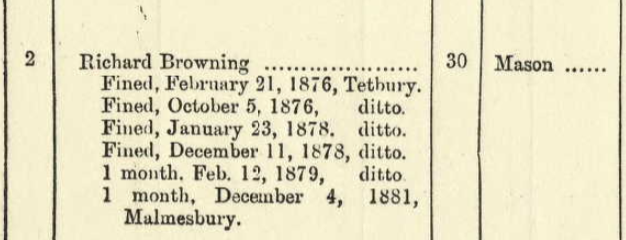
Richard Lock Browning was five feet eight inches tall, dark hair, grey eyes, an oval face and a dark complexion. He had two cuts on the back of his head (in February 1879) and a scar on his right eyebrow.
HENRY BROWNING, who was stealing pigeons with Richard Lock Browning in 1879, (Isaac’s brother Williams grandson, son of George Browning and his wife Charity) was charged with being drunk in 1882 and ordered to pay a fine of one shilling and costs of fourteen shillings, or seven days hard labour.
Henry was found guilty of gaming in the highway at Tetbury in 1872 and was sentenced to seven days hard labour. In 1882 Henry (who was also a mason) was charged with assault but discharged.
Henry was five feet five inches tall, brown hair and brown eyes, a long visage and a fresh complexion.
Henry emigrated with his daughter to Canada in 1913, and died in Vancouver in 1919.THOMAS BUCKINGHAM 1808-1846 (Isaacs daughter Janes husband) was charged with stealing a black gelding in Tetbury in 1838. No true bill. (A “no true bill” means the jury did not find probable cause to continue a case.)
Thomas did however neglect to pay his taxes in 1832:
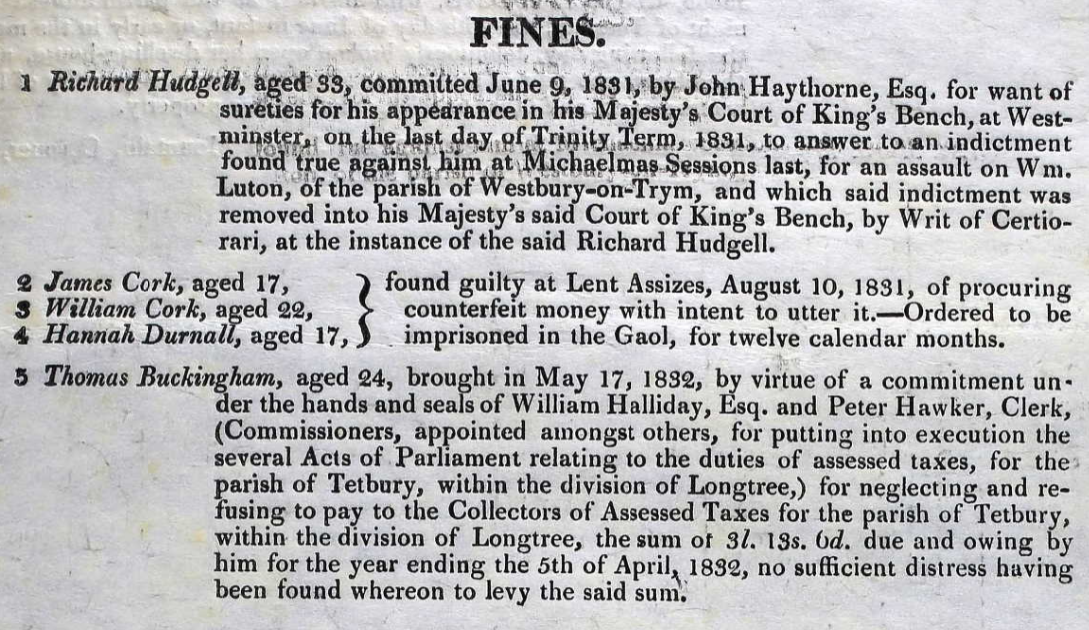
LEWIN BUCKINGHAM (grandson of Isaac, his daughter Jane’s son) was found guilty in 1846 stealing two fowls in Tetbury when he was sixteen years old.
In 1846 he was sentence to one month hard labour (or pay ten shillings fine and ten shillings costs) for loitering with the intent to trespass in search of conies.
A year later in 1847, he and three other young men were sentenced to four months hard labour for larceny.
Lewin was five feet three inches tall, with brown hair and brown eyes, long visage, sallow complexion, and had a scar on his left arm.JOHN BUCKINGHAM born circa 1832, a Tetbury labourer (Isaac’s grandson, Lewin’s brother) was sentenced to six weeks hard labour for larceny in 1855 for stealing a duck in Cirencester. The notes on the register mention that he had been employed by Mr LOCK, Angel Inn. (John’s grandmother was Mary Lock so this is likely a relative).
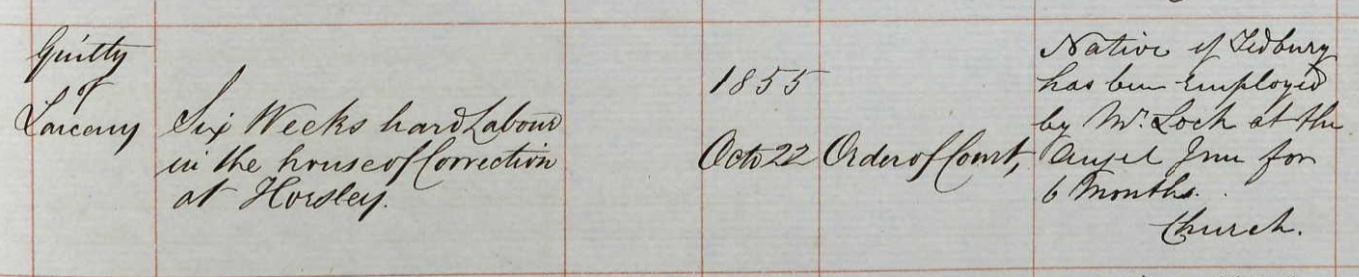
The previous year in 1854 John was sentenced to one month or a one pound fine for assaulting and beating W. Wood.
John was five feet eight and three quarter inches tall, light brown hair and grey eyes, an oval visage and a fresh complexion. He had a scar on his left arm and inside his right knee.JOSEPH PERRET was born circa 1831 and he was a Tetbury labourer. (He was Isaac’s granddaughter Charlotte Buckingham’s husband)
In 1855 he assaulted William Wood and was sentenced to one month or a two pound ten shilling fine. Was it the same W Wood that his wifes cousin John assaulted the year before?
In 1869 Joseph was sentenced to one month hard labour for feloniously receiving a cupboard known to be stolen.JAMES BUCKINGAM born circa 1822 in Tetbury was a shoemaker. (Isaac’s nephew, his sister Hannah’s son)
In 1854 the Tetbury shoemaker was sentenced to four months hard labour for stealing 30 lbs of lead off someones house.
In 1856 the Tetbury shoemaker received two months hard labour or pay £2 fine and 12 s costs for being found in pursuit of game.
In 1868 he was sentenced to two months hard labour for stealing a gander. A unspecified previous conviction is noted.
1871 the Tetbury shoemaker was found in an outhouse for an unlawful purpose and received ten days hard labour. The register notes that his sister is Mrs Cook, the Green, Tetbury. (James sister Prudence married Thomas Cook)
James sister Charlotte married a shoemaker and moved to UTAH.
James was five feet eight inches tall, dark hair and blue eyes, a long visage and a florid complexion. He had a scar on his forehead and a mole on the right side of his neck and abdomen, and a scar on the right knee.November 10, 2022 at 10:59 am #6343In reply to: Family Stories From The Other Side ~ Book Two
Colney Hatch Lunatic Asylum
William James Stokes
William James Stokes was the first son of Thomas Stokes and Eliza Browning. Oddly, his birth was registered in Witham in Essex, on the 6th September 1841.
Birth certificate of William James Stokes:
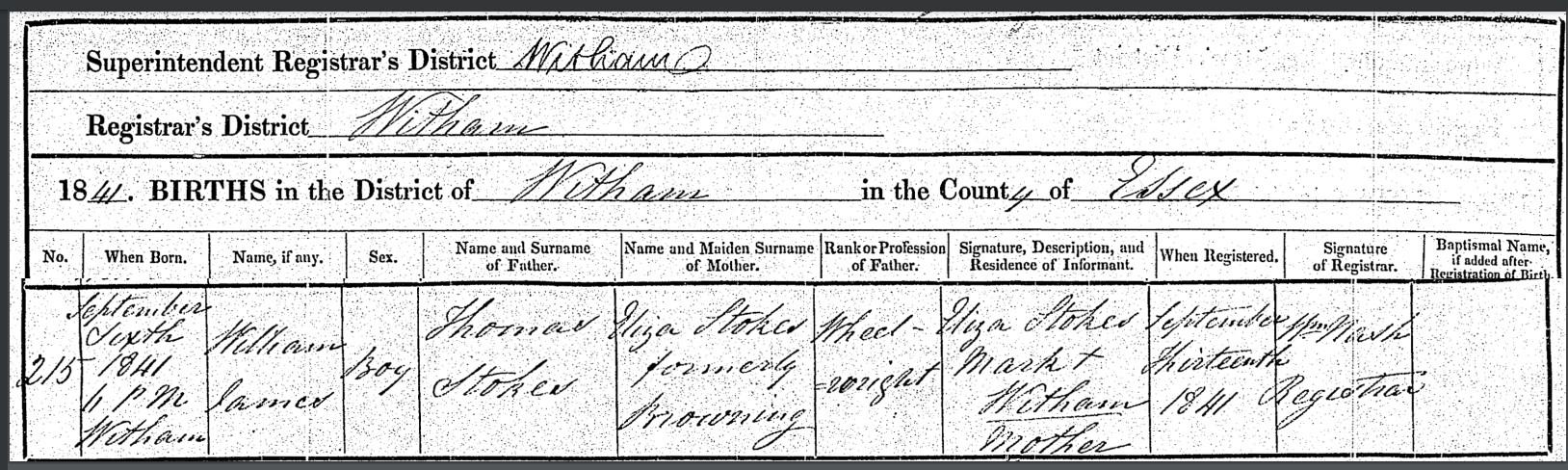
His father Thomas Stokes has not yet been found on the 1841 census, and his mother Eliza was staying with her uncle Thomas Lock in Cirencester in 1841. Eliza’s mother Mary Browning (nee Lock) was staying there too. Thomas and Eliza were married in September 1840 in Hempstead in Gloucestershire.
It’s a mystery why William was born in Essex but one possibility is that his father Thomas, who later worked with the Chipperfields making circus wagons, was staying with the Chipperfields who were wheelwrights in Witham in 1841. Or perhaps even away with a traveling circus at the time of the census, learning the circus waggon wheelwright trade. But this is a guess and it’s far from clear why Eliza would make the journey to Witham to have the baby when she was staying in Cirencester a few months prior.
In 1851 Thomas and Eliza, William and four younger siblings were living in Bledington in Oxfordshire.
William was a 19 year old wheelwright living with his parents in Evesham in 1861. He married Elizabeth Meldrum in December 1867 in Hackney, London. He and his father are both wheelwrights on the marriage register.
Marriage of William James Stokes and Elizabeth Meldrum in 1867:
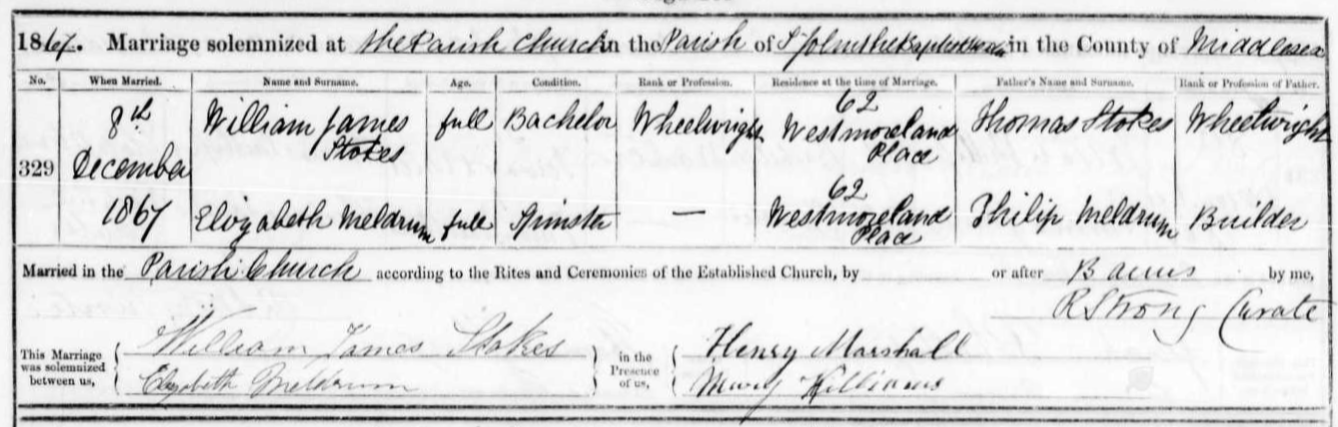
William and Elizabeth had a daughter, Elizabeth Emily Stokes, in 1868 in Shoreditch, London.
On the 3rd of December 1870, William James Stokes was admitted to Colney Hatch Lunatic Asylum. One week later on the 10th of December, he was dead.
On his death certificate the cause of death was “general paralysis and exhaustion, certified. MD Edgar Sheppard in attendance.” William was just 29 years old.
Death certificate William James Stokes:
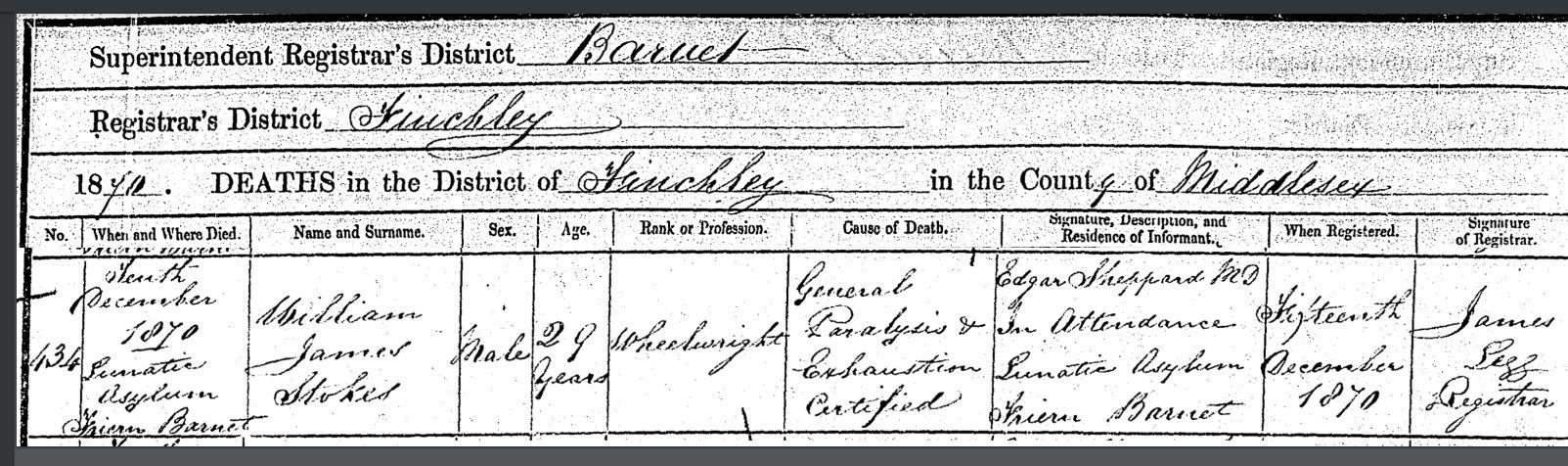
I asked on a genealogy forum what could possibly have caused this death at such a young age. A retired pathology professor replied that “in medicine the term General Paralysis is only used in one context – that of Tertiary Syphilis.”
“Tertiary syphilis is the third and final stage of syphilis, a sexually transmitted disease that unfolds in stages when the individual affected doesn’t receive appropriate treatment.”From the article “Looking back: This fascinating and fatal disease” by Jennifer Wallis:
“……in asylums across Britain in the late 19th century, with hundreds of people receiving the diagnosis of general paralysis of the insane (GPI). The majority of these were men in their 30s and 40s, all exhibiting one or more of the disease’s telltale signs: grandiose delusions, a staggering gait, disturbed reflexes, asymmetrical pupils, tremulous voice, and muscular weakness. Their prognosis was bleak, most dying within months, weeks, or sometimes days of admission.
The fatal nature of GPI made it of particular concern to asylum superintendents, who became worried that their institutions were full of incurable cases requiring constant care. The social effects of the disease were also significant, attacking men in the prime of life whose admission to the asylum frequently left a wife and children at home. Compounding the problem was the erratic behaviour of the general paralytic, who might get themselves into financial or legal difficulties. Delusions about their vast wealth led some to squander scarce family resources on extravagant purchases – one man’s wife reported he had bought ‘a quantity of hats’ despite their meagre income – and doctors pointed to the frequency of thefts by general paralytics who imagined that everything belonged to them.”
The London Archives hold the records for Colney Hatch, but they informed me that the particular records for the dates that William was admitted and died were in too poor a condition to be accessed without causing further damage.
Colney Hatch Lunatic Asylum gained such notoriety that the name “Colney Hatch” appeared in various terms of abuse associated with the concept of madness. Infamous inmates that were institutionalized at Colney Hatch (later called Friern Hospital) include Jack the Ripper suspect Aaron Kosminski from 1891, and from 1911 the wife of occultist Aleister Crowley. In 1993 the hospital grounds were sold and the exclusive apartment complex called Princess Park Manor was built.
Colney Hatch:
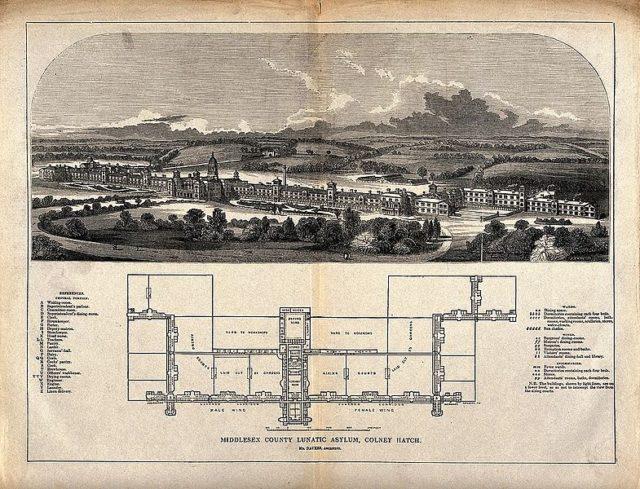
In 1873 Williams widow married William Hallam in Limehouse in London. Elizabeth died in 1930, apparently unaffected by her first husbands ailment.
November 4, 2022 at 2:19 pm #6342In reply to: Family Stories From The Other Side ~ Book Two
Brownings of Tetbury
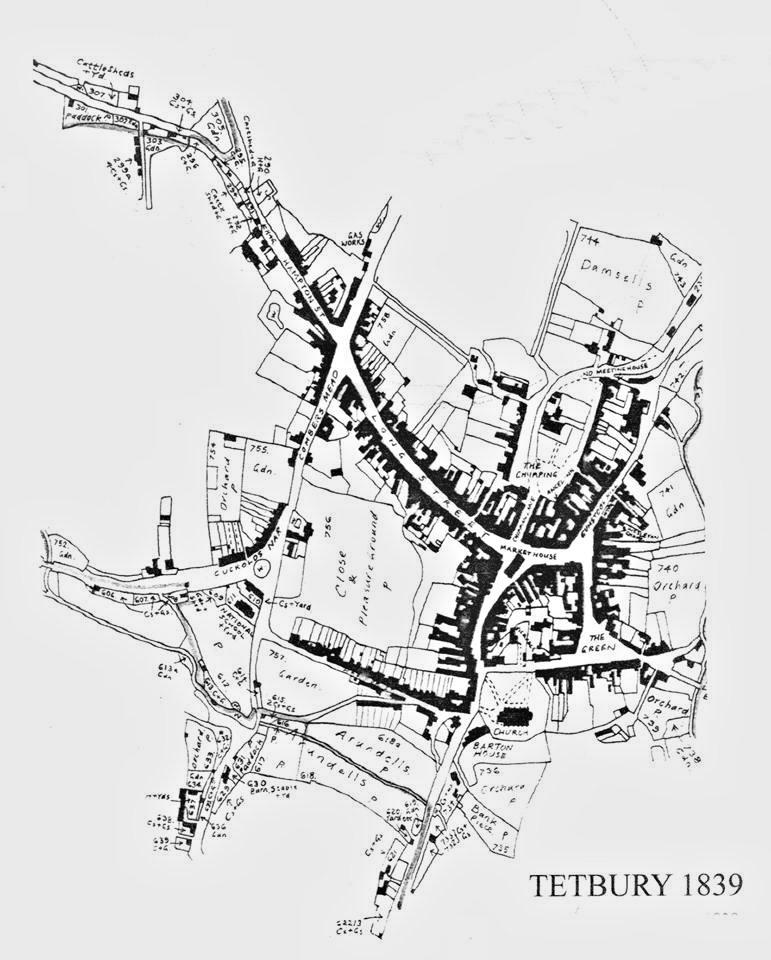
Isaac Browning (1784-1848) married Mary Lock (1787-1870) in Tetbury in 1806. Both of them were born in Tetbury, Gloucestershire. Isaac was a stone mason. Between 1807 and 1832 they baptised fourteen children in Tetbury, and on 8 Nov 1829 Isaac and Mary baptised five daughters all on the same day.
I considered that they may have been quintuplets, with only the last born surviving, which would have answered my question about the name of the house La Quinta in Broadway, the home of Eliza Browning and Thomas Stokes son Fred. However, the other four daughters were found in various records and they were not all born the same year. (So I still don’t know why the house in Broadway had such an unusual name).
Their son George was born and baptised in 1827, but Louisa born 1821, Susan born 1822, Hesther born 1823 and Mary born 1826, were not baptised until 1829 along with Charlotte born in 1828. (These birth dates are guesswork based on the age on later censuses.) Perhaps George was baptised promptly because he was sickly and not expected to survive. Isaac and Mary had a son George born in 1814 who died in 1823. Presumably the five girls were healthy and could wait to be done as a job lot on the same day later.
Eliza Browning (1814-1886), my great great great grandmother, had a baby six years before she married Thomas Stokes. Her name was Ellen Harding Browning, which suggests that her fathers name was Harding. On the 1841 census seven year old Ellen was living with her grandfather Isaac Browning in Tetbury. Ellen Harding Browning married William Dee in Tetbury in 1857, and they moved to Western Australia.
Ellen Harding Browning Dee: (photo found on ancestry website)
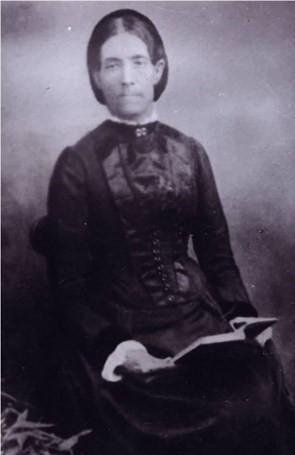
OBITUARY. MRS. ELLEN DEE.
A very old and respected resident of Dongarra, in the person of Mrs. Ellen Dee, passed peacefully away on Sept. 27, at the advanced age of 74 years.The deceased had been ailing for some time, but was about and actively employed until Wednesday, Sept. 20, whenn she was heard groaning by some neighbours, who immediately entered her place and found her lying beside the fireplace. Tho deceased had been to bed over night, and had evidently been in the act of lighting thc fire, when she had a seizure. For some hours she was conscious, but had lost the power of speech, and later on became unconscious, in which state she remained until her death.
The deceased was born in Gloucestershire, England, in 1833, was married to William Dee in Tetbury Church 23 years later. Within a month she left England with her husband for Western Australian in the ship City oí Bristol. She resided in Fremantle for six months, then in Greenough for a short time, and afterwards (for 42 years) in Dongarra. She was, therefore, a colonist of about 51 years. She had a family of four girls and three boys, and five of her children survive her, also 35 grandchildren, and eight great grandchildren. She was very highly respected, and her sudden collapse came as a great shock to many.
Eliza married Thomas Stokes (1816-1885) in September 1840 in Hempstead, Gloucestershire. On the 1841 census, Eliza and her mother Mary Browning (nee Lock) were staying with Thomas Lock and family in Cirencester. Strangely, Thomas Stokes has not been found thus far on the 1841 census, and Thomas and Eliza’s first child William James Stokes birth was registered in Witham, in Essex, on the 6th of September 1841.
I don’t know why William James was born in Witham, or where Thomas was at the time of the census in 1841. One possibility is that as Thomas Stokes did a considerable amount of work with circus waggons, circus shooting galleries and so on as a journeyman carpenter initially and then later wheelwright, perhaps he was working with a traveling circus at the time.
But back to the Brownings ~ more on William James Stokes to follow.
One of Isaac and Mary’s fourteen children died in infancy: Ann was baptised and died in 1811. Two of their children died at nine years old: the first George, and Mary who died in 1835. Matilda was 21 years old when she died in 1844.
Jane Browning (1808-) married Thomas Buckingham in 1830 in Tetbury. In August 1838 Thomas was charged with feloniously stealing a black gelding.
Susan Browning (1822-1879) married William Cleaver in November 1844 in Tetbury. Oddly thereafter they use the name Bowman on the census. On the 1851 census Mary Browning (Susan’s mother), widow, has grandson George Bowman born in 1844 living with her. The confusion with the Bowman and Cleaver names was clarified upon finding the criminal registers:
30 January 1834. Offender: William Cleaver alias Bowman, Richard Bunting alias Barnfield and Jeremiah Cox, labourers of Tetbury. Crime: Stealing part of a dead fence from a rick barton in Tetbury, the property of Robert Tanner, farmer.
And again in 1836:
29 March 1836 Bowman, William alias Cleaver, of Tetbury, labourer age 18; 5’2.5” tall, brown hair, grey eyes, round visage with fresh complexion; several moles on left cheek, mole on right breast. Charged on the oath of Ann Washbourn & others that on the morning of the 31 March at Tetbury feloniously stolen a lead spout affixed to the dwelling of the said Ann Washbourn, her property. Found guilty 31 March 1836; Sentenced to 6 months.
On the 1851 census Susan Bowman was a servant living in at a large drapery shop in Cheltenham. She was listed as 29 years old, married and born in Tetbury, so although it was unusual for a married woman not to be living with her husband, (or her son for that matter, who was living with his grandmother Mary Browning), perhaps her husband William Bowman alias Cleaver was in trouble again. By 1861 they are both living together in Tetbury: William was a plasterer, and they had three year old Isaac and Thomas, one year old. In 1871 William was still a plasterer in Tetbury, living with wife Susan, and sons Isaac and Thomas. Interestingly, a William Cleaver is living next door but one!
Susan was 56 when she died in Tetbury in 1879.
Three of the Browning daughters went to London.
Louisa Browning (1821-1873) married Robert Claxton, coachman, in 1848 in Bryanston Square, Westminster, London. Ester Browning was a witness.
Ester Browning (1823-1893)(or Hester) married Charles Hudson Sealey, cabinet maker, in Bethnal Green, London, in 1854. Charles was born in Tetbury. Charlotte Browning was a witness.
Charlotte Browning (1828-1867?) was admitted to St Marylebone workhouse in London for “parturition”, or childbirth, in 1860. She was 33 years old. A birth was registered for a Charlotte Browning, no mothers maiden name listed, in 1860 in Marylebone. A death was registered in Camden, buried in Marylebone, for a Charlotte Browning in 1867 but no age was recorded. As the age and parents were usually recorded for a childs death, I assume this was Charlotte the mother.
I found Charlotte on the 1851 census by chance while researching her mother Mary Lock’s siblings. Hesther Lock married Lewin Chandler, and they were living in Stepney, London. Charlotte is listed as a neice. Although Browning is mistranscribed as Broomey, the original page says Browning. Another mistranscription on this record is Hesthers birthplace which is transcribed as Yorkshire. The original image shows Gloucestershire.
Isaac and Mary’s first son was John Browning (1807-1860). John married Hannah Coates in 1834. John’s brother Charles Browning (1819-1853) married Eliza Coates in 1842. Perhaps they were sisters. On the 1861 census Hannah Browning, John’s wife, was a visitor in the Harding household in a village called Coates near Tetbury. Thomas Harding born in 1801 was the head of the household. Perhaps he was the father of Ellen Harding Browning.
George Browning (1828-1870) married Louisa Gainey in Tetbury, and died in Tetbury at the age of 42. Their son Richard Lock Browning, a 32 year old mason, was sentenced to one month hard labour for game tresspass in Tetbury in 1884.
Isaac Browning (1832-1857) was the youngest son of Isaac and Mary. He was just 25 years old when he died in Tetbury.
October 23, 2022 at 6:57 am #6340In reply to: Family Stories From The Other Side ~ Book Two
Wheelwrights of Broadway
Thomas Stokes 1816-1885
Frederick Stokes 1845-1917
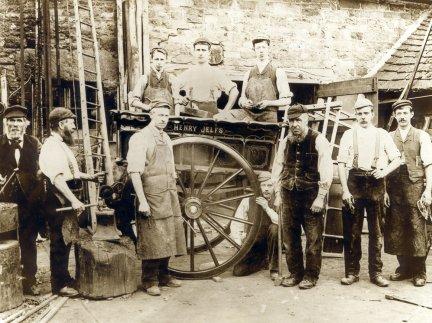
Stokes Wheelwrights. Fred on left of wheel, Thomas his father on right.
Thomas Stokes
Thomas Stokes was born in Bicester, Oxfordshire in 1816. He married Eliza Browning (born in 1814 in Tetbury, Gloucestershire) in Gloucester in 1840 Q3. Their first son William was baptised in Chipping Hill, Witham, Essex, on 3 Oct 1841. This seems a little unusual, and I can’t find Thomas and Eliza on the 1841 census. However both the 1851 and 1861 census state that William was indeed born in Essex.
In 1851 Thomas and Eliza were living in Bledington, Gloucestershire, and Thomas was a journeyman carpenter.
Note that a journeyman does not mean someone who moved around a lot. A journeyman was a tradesman who had served his trade apprenticeship and mastered his craft, not bound to serve a master, but originally hired by the day. The name derives from the French for day – jour.
Also on the 1851 census: their daughter Susan, born in Churchill Oxfordshire in 1844; son Frederick born in Bledington Gloucestershire in 1846; daughter Louisa born in Foxcote Oxfordshire in 1849; and 2 month old daughter Harriet born in Bledington in 1851.
On the 1861 census Thomas and Eliza were living in Evesham, Worcestershire, and daughter Susan was no longer living at home, but William, Fred, Louisa and Harriet were, as well as daughter Emily born in Churchill Oxfordshire in 1856. Thomas was a wheelwright.
On the 1871 census Thomas and Eliza were still living in Evesham, and Thomas was a wheelwright employing three apprentices. Son Fred, also a wheelwright, and his wife Ann Rebecca live with them.
Mr Stokes, wheelwright, was found guilty of reprehensible conduct in concealing the fact that small-pox existed in his house, according to a mention in The Oxfordshire Weekly News on Wednesday 19 February 1873:
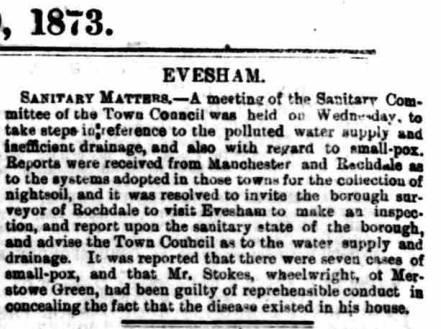
From Paul Weaver’s ancestry website:
“It was Thomas Stokes who built the first “Famous Vale of Evesham Light Gardening Dray for a Half-Legged Horse to Trot” (the quotation is from his account book), the forerunner of many that became so familiar a sight in the towns and villages from the 1860s onwards. He built many more for the use of the Vale gardeners.
Thomas also had long-standing business dealings with the people of the circus and fairgrounds, and had a contract to effect necessary repairs and renewals to their waggons whenever they visited the district. He built living waggons for many of the show people’s families as well as shooting galleries and other equipment peculiar to the trade of his wandering customers, and among the names figuring in his books are some still familiar today, such as Wilsons and Chipperfields.
He is also credited with inventing the wooden “Mushroom” which was used by housewives for many years to darn socks. He built and repaired all kinds of vehicles for the gentry as well as for the circus and fairground travellers.
Later he lived with his wife at Merstow Green, Evesham, in a house adjoining the Almonry.”
An excerpt from the book Evesham Inns and Signs by T.J.S. Baylis:
The Old Red Horse, Evesham:
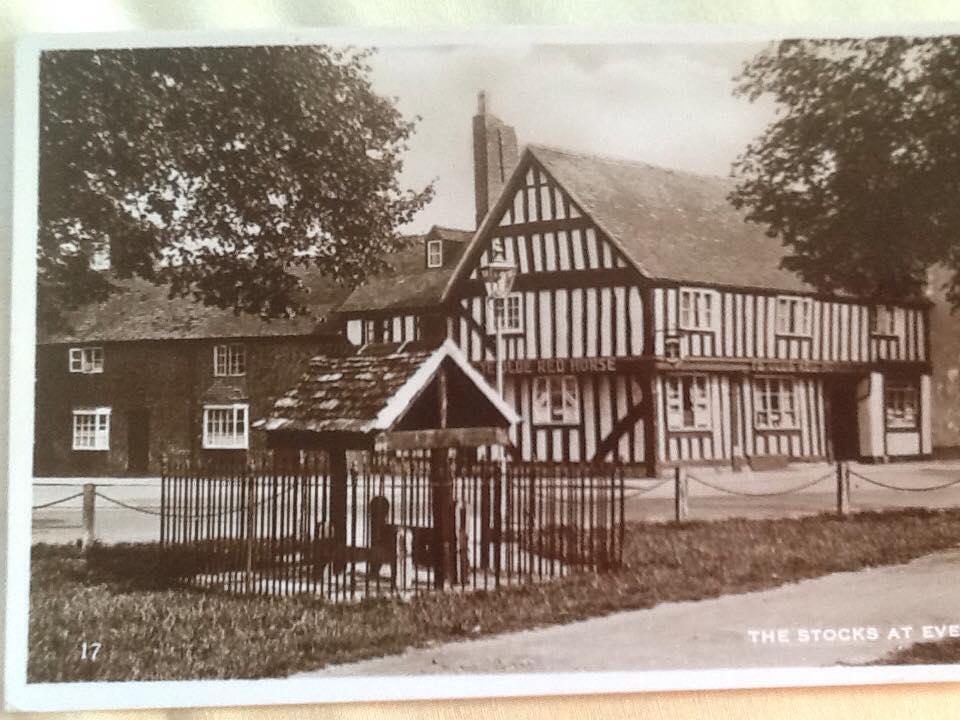
Thomas died in 1885 aged 68 of paralysis, bronchitis and debility. His wife Eliza a year later in 1886.
Frederick Stokes
In Worcester in 1870 Fred married Ann Rebecca Day, who was born in Evesham in 1845.
Ann Rebecca Day:
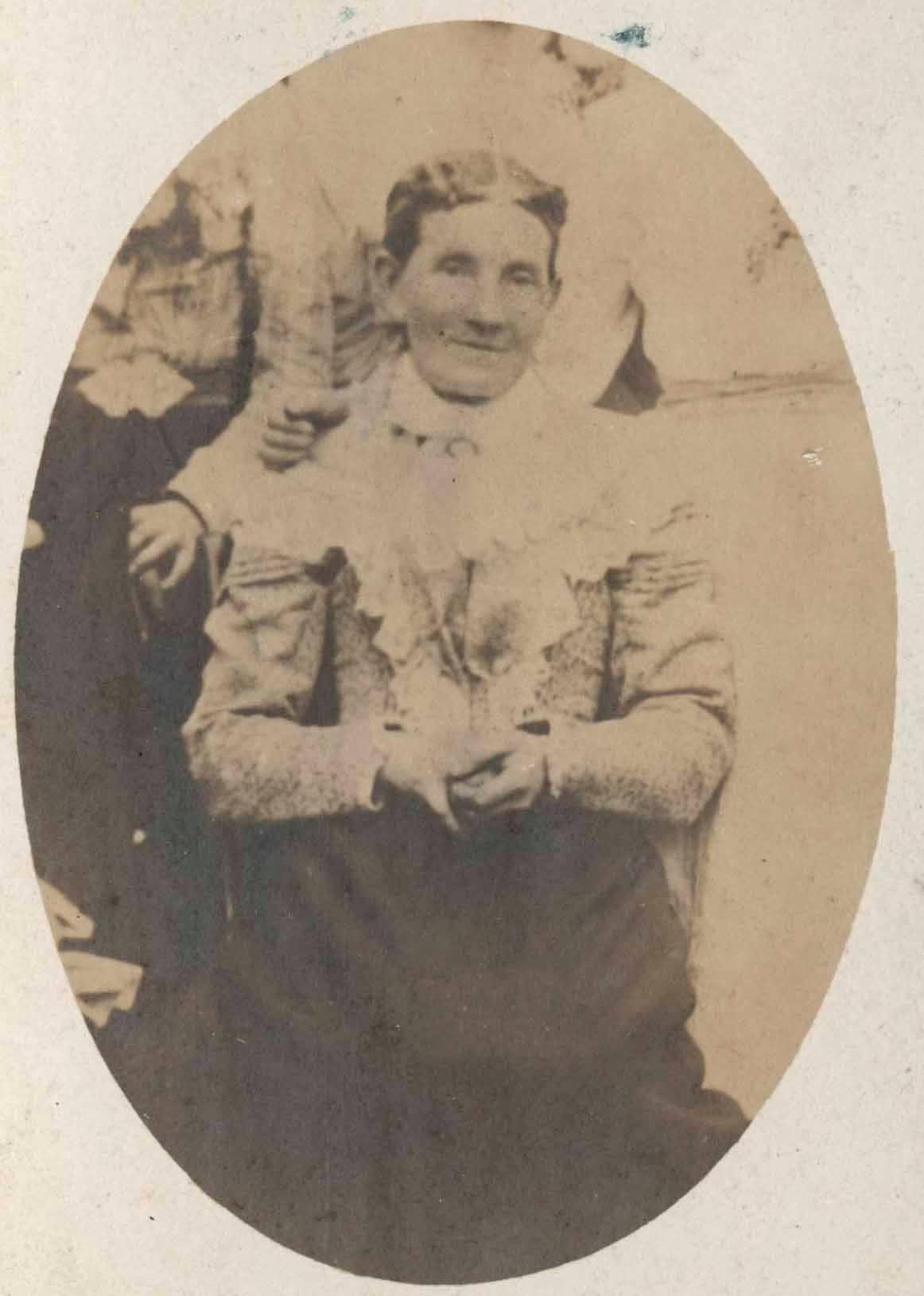
In 1871 Fred was still living with his parents in Evesham, with his wife Ann Rebecca as well as their three month old daughter Annie Elizabeth. Fred and Ann (referred to as Rebecca) moved to La Quinta on Main Street, Broadway.
Rebecca Stokes in the doorway of La Quinta on Main Street Broadway, with her grandchildren Ralph and Dolly Edwards:
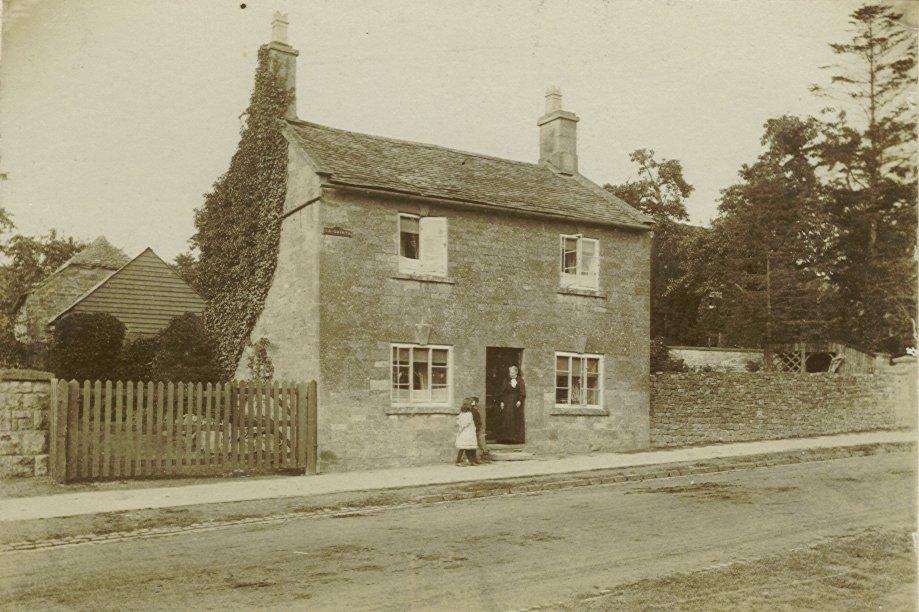
Fred was a wheelwright employing one man on the 1881 census. In 1891 they were still in Broadway, Fred’s occupation was wheelwright and coach painter, as well as his fifteen year old son Frederick.
In the Evesham Journal on Saturday 10 December 1892 it was reported that “Two cases of scarlet fever, the children of Mr. Stokes, wheelwright, Broadway, were certified by Mr. C. W. Morris to be isolated.”
Still in Broadway in 1901 and Fred’s son Albert was also a wheelwright. By 1911 Fred and Rebecca had only one son living at home in Broadway, Reginald, who was a coach painter. Fred was still a wheelwright aged 65.
Fred’s signature on the 1911 census:

Rebecca died in 1912 and Fred in 1917.
Fred Stokes:
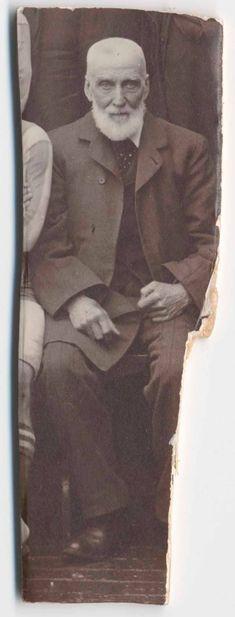
In the book Evesham to Bredon From Old Photographs By Fred Archer:
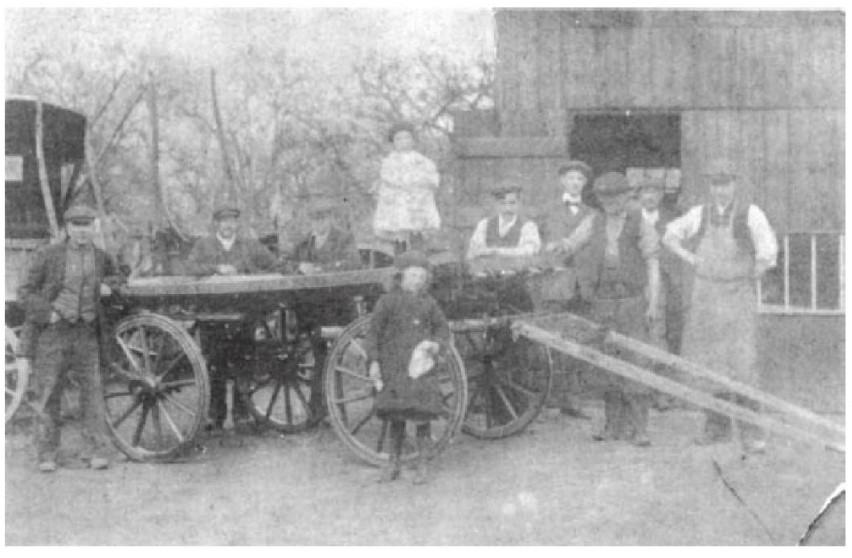
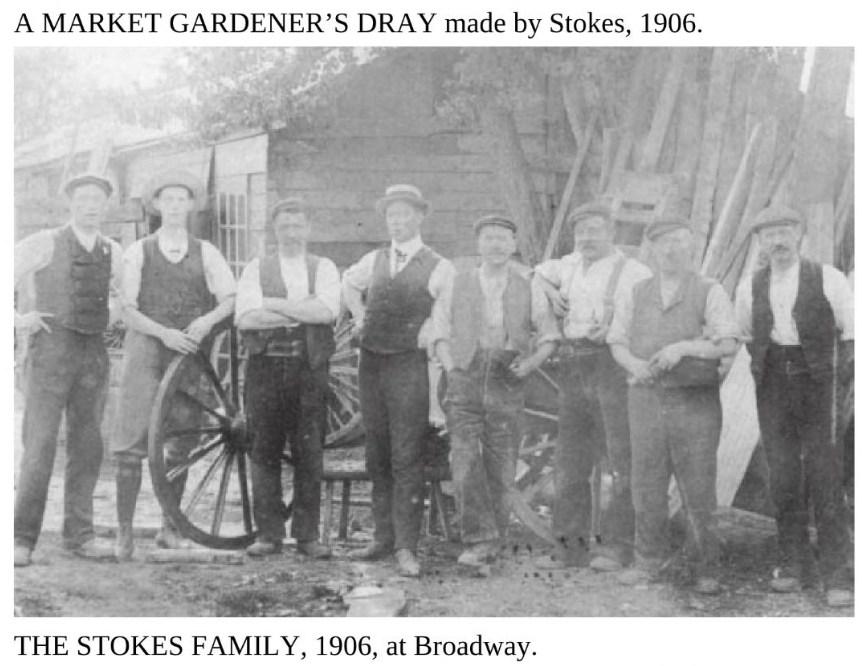
- Zara Patara-Smythe :: Zara (
-
AuthorSearch Results