


Search Results for 'cut'
-
AuthorSearch Results
-
February 8, 2025 at 11:32 am #7763
In reply to: The Last Cruise of Helix 25
The corridor outside Mr. Herbert’s suite was pristine, polished white and gold, designed to impress, like most of the ship. Soft recessed lighting reflected off gilded fixtures and delicate, unnecessary embellishments.
It was all Riven had ever known.
His grandfather, Victor Holt, now in cryo sleep, had been among the paying elite, those who had boarded Helix 25, expecting a decadent, interstellar retreat. Riven, however had not been one of them. He had been two years old when Earth fell, sent with his aunt Seren Vega on the last shuttle to ever reach the ship, crammed in with refugees who had fought for a place among the stars. His father had stayed behind, to look for his mother.
Whatever had happened after that—the chaos, the desperation, the cataclysm that had forced this ship to become one of humanity’s last refuges—Riven had no memory of it. He only knew what he had been told. And, like everything else on Helix 25, history depended on who was telling it.
For the first time in his life, someone had been murdered inside this floating palace of glass and gold. And Riven, inspired by his grandfather’s legacy and the immense collection of murder stories and mysteries in the ship’s database, expected to keep things under control.
He stood straight in front of the suite’s sealed sliding door, arms crossed on a sleek uniform that belonged to Victor Holt. He was blocking entry with the full height of his young authority. As if standing there could stop the chaos from seeping in.
A holographic Do Not Enter warning scrolled diagonally across the door in Effin Muck’s signature font—because even crimes on this ship came branded.
People hovered in the corridor, coming and going. Most were just curious, drawn by the sheer absurdity of a murder happening here.
Riven scanned their faces, his muscles coiled with tension. Everyone was a potential suspect. Even the ones who usually didn’t care about ship politics.
Because on Helix 25, death wasn’t supposed to happen. Not anymore.
Someone broke away from the crowd and tried to push past him.
“You’re wasting time. Young man.”
Zoya Kade. Half scientist, half mad Prophet, all irritation. Her gold-green eyes bore into him, sharp beneath the deep lines of her face. Her mismatched layered robes shifting as she moved. Riven had no difficulty keeping the tall and wiry 83 years old woman at a distance.
Her silver-white braid was woven with tiny artifacts—bits of old circuits, beads, a fragment of a key that probably didn’t open anything anymore. A collector of lost things. But not just trinkets—stories, knowledge, genetic whispers of the past. And now, she wanted access to this room like it was another artifact to be uncovered.
“No one is going in.” Riven said slowly, “until we finish securing the area.”
Zoya exhaled sharply, turning her head toward Evie, who had just emerged from the crowd, tablet in hand, TP flickering at her side.
“Evie, tell him.”
Evie did not look pleased to be associated with the old woman. “Riven, we need access to his room. I just need…”
Riven hesitated.
Not for long, barely a second, but long enough for someone to notice. And of course, it was Anuí Naskó.
They had been waiting, standing slightly apart from the others, their tall, androgynous frame wrapped in the deep-colored robes of the Lexicans, fingers lightly tapping the surface of their handheld lexicon. Observing. Listening. Their presence was a constant challenge. When Zoya collected knowledge like artifacts, Anuí broke it apart, reshaped it. To them, history was a wound still open, and it was the Lexicans duty to rewrite the truth that had been stolen.
“Ah,” Anuí murmured, smiling slightly, “I see.”
Riven started to tap his belt buckle. His spine stiffened. He didn’t like that tone.
“See what, exactly?”
Anuí turned their sharp, angular gaze on him. “That this is about control.”
Riven locked his jaw. “This is about security.”
“Is it?” Anuí tapped a finger against their chin. “Because as far as I can tell, you’re just as inexperienced in murder investigation as the rest of us.”
The words cut sharp in Riven’s pride. Rendering him speechless for a moment.
“Oh! Well said,” Zoya added.
Riven felt heat rise to his face, but he didn’t let it show. He had been preparing himself for challenges, just not from every direction at once.
His grip tightened on his belt, but he forced himself to stay calm.
Zoya, clearly enjoying herself now, gestured toward Evie. “And what about them?” She nodded toward TP, whose holographic form flickered slightly under the corridor’s ligthing. “Evie and her self proclaimed detective machine here have no real authority either, yet you hesitate.”
TP puffed up indignantly. “I beg your pardon, madame. I am an advanced deductive intelligence, programmed with the finest investigative minds in history! Sherlock Holmes, Hercule Poirot, Miss Marple, Marshall Pee Stoll…”
Zoya lifted a hand. “Yes, yes. And I am a boar.”
TP’s mustache twitched. “Highly unlikely.”
Evie groaned. “Enough TP.”
But Zoya wasn’t finished. She looked directly at Riven now. “You don’t trust me. You don’t trust Anuí. But you trust her.” She gave a node toward Evie. “Why?
Riven felt his stomach twist. He didn’t have an answer. Or rather, he had too many answers, none of which he could say out loud. Because he did trust Evie. Because she was brilliant, meticulous, practical. Because… he wanted her to trust him back. But admitting that, showing favoritism, expecially here in front of everyone, was impossible.
So he forced his voice into neutrality. “She has technical expertise and no political agenda about it.”
Anuí left out a soft hmm, neither agreeing nor disagreeing, but filing the information away for later.
Evie took the moment to press forward. “Riven, we need access to the room. We have to check his logs before anything gets wiped or overwritten. If there’s something there, we’re losing valuable time just standing there arguing.”
She was right. Damn it, she was right. Riven exhaled slowly.
“Fine. But only you.”
Anuí’s lips curved but just slightly. “How predictable.”
Zoya snorted.
Evie didn’t waste time. She brushed past him, keying in a security override on her tablet. The suite doors slid open with a quiet hiss.
December 22, 2024 at 10:49 pm #7704In reply to: Quintessence: Reversing the Fifth
Darius: Christmas 2022
Darius was expecting some cold snap, landing in Paris, but the weather was rather pleasant this time of the year.
It was the kind of day that begged for aimless wandering, but Darius had an appointment he couldn’t avoid—or so he told himself. His plane had been late, and looking at the time he would arrive at the apartment, he was already feeling quite drained. The streets were lively, tourists and locals intermingling dreamingly under strings of festive lights spread out over the boulevards. He listlessly took some snapshot videos —fleeting ideas, backgrounds for his channel.
The wellness channel had not done very well to be honest, and he was struggling with keeping up with the community he had drawn to himself. Most of the latest posts had drawn the usual encouragements and likes, but there were also the growing background chatter, gossiping he couldn’t be bothered to rein in — he was no guru, but it still took its toll, and he could feel it required more energy to be in this mode that he’d liked to.
His patrons had been kind, for a few years now, indulging his flights of fancy, funding his trips, introducing him to influencers. Seeing how little progress he’d made, he was starting to wonder if he should have paid more attention to the background chatter. Monsieur Renard had always taken a keen interest in his travels, looking for places to expand his promoter schemes of co-housing under the guide of low investment into conscious living spaces, or something well-marketed by Eloïse. The crude reality was starting to stare at his face. He wasn’t sure how long he could keep up pretending they were his friends.
By the time he reached the apartment, in a quiet street adjacent to rue Saint Dominique, nestled in 7th arrondissement with its well-kept façades, he was no longer simply fashionably late.
Without even the time to say his name, the door buzz clicked open, leading him to the old staircase. The apartment door opened before he could knock. There was a crackling tension hanging in the air even before Renard’s face appeared—his rotund face reddened by an annoyance he was poorly hiding beneath a polished exterior. He seemed far away from the guarded and meticulous man that Darius once knew.
“You’re late,” Renard said brusquely, stepping aside to let Darius in. The man was dressed impeccably, as always, but there was a sharpness to his movements.
Inside, the apartment was its usual display of cultivated sophistication—mid-century furniture, muted tones, and artful clutter that screamed effortless wealth. Eloïse sat on the couch, her legs crossed, a glass of wine poised delicately in her hand. She didn’t look up as Darius entered.
“Sorry,” Darius muttered, setting down his bag. “Flight delay.”
Renard waved it off impatiently, already pacing the room. “Do you know where Lucien is?” he asked abruptly, his gaze slicing toward Darius.
The question caught him off guard. “Lucien?” Darius echoed. “No. Why?”
Renard let out a sharp, humorless laugh. “Why? Because he owes me. He owes us. And he’s gone off the grid like some bloody enfant terrible who thinks the rules don’t apply to him.”
Darius hesitated. “I haven’t seen him in months,” he said carefully.
Renard stopped pacing, fixing him with a hard look. “Are you sure about that? You two were close, weren’t you? Don’t tell me you’re covering for him.”
“I’m not,” Darius said firmly, though the accusation sent a ripple of anger through him.
Renard snorted, turning away. “Typical. All you dreamers are the same—full of ideas but no follow-through. And when things fall apart, you scatter like rats, leaving the rest of us to clean up the mess.”
Darius stiffened. “I didn’t come here to be insulted,” he said, his voice a steady growl.
“Then why did you come, Darius?” Renard shot back, his tone cutting. “To float on someone else’s dime a little longer? To pretend you’re above all this while you leech off people who actually make things happen?”
The words hit like a slap. Darius glanced at Eloïse, expecting her to interject, to soften the blow. But she remained silent, her gaze fixed on her glass as if it held all the answers.
For the first time, he saw her clearly—not as a confidante or a muse, but as someone who had always been one step removed, always watching, always using.
“I think I’ve had enough,” Darius said finally, his voice calm despite the storm brewing inside him. “I think I’ve had enough for a long time.”
Renard turned, his expression a mix of incredulity and disdain. “Enough? You think you can walk away from this? From us?”
“Yes, I can.” Darius said simply, grabbing his bag.
“You’ll never make it on your own,” Renard called after him, his voice dripping with scorn.
Darius paused at the door, glancing back at Eloïse one last time. “I’ll take my chances,” he said, and then slammed the door.

The evening air was like a balm, open and soft unlike the claustrophobic tension of the apartment. Darius walked aimlessly at first, his thoughts caught between flares of wounded pride and muted anxiety, but as he walked and walked, it soon turned into a return of confidence, slow and steady.
His phone buzzed in his pocket, and he pulled it out to see a familiar name. It was a couple he knew from the south of France, friends he hadn’t spoken to in months. He answered, their warm voices immediately lifting his spirits.
“Darius!” one of them said. “What are you doing for Christmas? You should come down to stay with us. We’ve finally moved to a bigger space—and you owe us a visit.”
Darius smiled, the weight of Renard’s words falling away. “You know what? That sounds perfect.”
As he hung up, he looked up at the Parisian skyline, Darius wished he’d had the courage to take that step into the unknown a long time ago. Wherever Lucien was, he felt suddenly closer to him —as if inspired by his friend’s bold move away from this malicious web of influence.
December 20, 2024 at 1:44 am #7701In reply to: Quintessence: Reversing the Fifth
Amei attached a card and ribbon to the last of the neatly wrapped gifts and placed it under the tree. This one was for Paul—a notebook with a cover of soft fabric she’d block-printed with delicate, overlapping circles in muted blues and greens. The fabric was left over from a set of cushions for a client, but she had spent hours crafting the notebook, knowing all the while Paul probably wouldn’t use it. He was impossible to buy for, preferring things he picked out himself. Tabitha had been far easier: Amei had secretly made a dress out of a soft, flowing fabric that Tabitha had fallen in love with the moment Amei showed it to her.
The house felt calm for the moment. Tabitha had gone out earlier, calling over her shoulder that she’d be back in time for dinner. Amei smiled at the memory of her daughter’s laughter. Her excitement about Christmas was palpable, a bright contrast to the quietness that had settled over everything else. Amei used to feel like that about Christmas too. This year, though, she was only making the effort for Tabitha.
Somewhere down the hallway, Paul’s voice murmured on a call—distant, like everything about him lately. The air smelled faintly of cinnamon and cloves from the mulled wine simmering on the stove, but even that warm, festive scent felt like it was trying too hard.
The house felt big, despite the occasional bursts of life it saw on days like this. It had felt that way for months now, the weight of unspoken things pressing against the faded walls.
She sighed and reached for the decoration box, pulling out a small clay angel with chipped wings. The sight of it made her pause. Lucien had given it to her years ago, one Christmas, and declared it “charmingly imperfect,” insisting it belonged at the top of her tree. She smiled faintly at the memory, turning it over in her hands. Every year since, it had held its place at the top of the tree.
“Still not done?” Paul’s voice cut into her thoughts. She turned to see him standing in the doorway. At the sound of Paul’s voice, Briar, their elderly cat—or technically Paul’s cat—emerged from behind the curtain, her tail curling as she wove around his legs. Paul crouched slightly to scratch behind her ears, and Briar leaned into his touch, purring softly
“She thinks it’s dinner time,” Amei said evenly.
“You always go overboard with these things, Amei,” Paul said, straightening and nodding towards the gifts.
“It’s Christmas,” she snapped, the irritation slipping through before she could stop it. She turned back to the tree, her fingers moving stiffly as she busied herself with strands of sparkly tinsel.
Paul didn’t respond, but she could feel his gaze linger. It was the silence that had grown between them in recent months, filled with everything they couldn’t bring themselves to say…yet.
The sound of the front door banging shut and brisk footsteps broke the tension. Tabitha burst past Paul into the room, her cheeks flushed from the cold. “Hey, Paul. Hey, Mumma Bear,” she said brightly. Her eyes lit up as they landed on the tree. “The tree looks gorgeous! Don’t you just love Christmas?”
December 14, 2024 at 6:42 pm #7682In reply to: Quintessence: Reversing the Fifth
Matteo — Autumn 2023
The Jardin des Plantes park was quiet, the kind of quiet that settled after a brisk autumn rain. Matteo sat on a weathered wooden bench, watching a golden retriever chase the last of the fallen leaves tumbling across the gravel path. The damp air was carrying scents of the earth welcoming a retreat inside, and taking the time to be alone with his thoughts was something he’d missed.
His phone buzzed with a notification—a news update about the latest film adaptation from a Liz Tattler classic fiction. The name made him smile faintly. Juliette had loved Tattler’s novels, their whimsical characters, and the unflinching and unapologetic observations about life’s quiet mysteries and the unexpected rants about the virtues of cleaning and dustsceawung that propelled the word in the people’s top 100 favourite in the Oxford dictionary for several years consecutively.
“They’re so full of texture,” Juliette once said as she was sprawled on the bed of their tiny Parisian flat, a battered paperback in her hands. “Like you can feel the pages breathe.”
His image of her was still vivid, they’d stayed on good terms and he would still thumb up some of her posts from time to time —but it was only small moments rather than full scenes that used to come back, fragmented pieces of memories really —her dark hair falling messily over her face, her legs crossed in a casual way.
Paris had been a playground for them. For a while, they were caught in a whirlwind of late-night conversations in smoky cafés and lazy Sunday mornings wandering the Seine. They’d spent hours in bookstores, Juliette hunting for first editions and Matteo snapping pictures of the handwritten notes tucked between the pages of used novels.
A year ago, a different park in a different city—Hyde Park, London. She was there, twirling a scarf she’d picked up in Vienna the weekend before, the bright red of it like a ribbon of fire against the soft gray skies. They had been enamored with each other and with the spontaneity of hopping trains to new cities, their weekends folding into one another like pages of a travel journal. London one week, Paris the next, Berlin after that. Each city a postcard snapshot, vibrant and fleeting.
Juliette would tease him about his fascination with the little things—how he would linger too long over a cup of coffee at a café or stop to photograph a tree in the middle of nowhere. “You’re always looking for stories,” she’d said with a laugh, tucking a stray strand of hair behind her ear. “Even when you’re not sure what they mean.”
“Stories are everywhere,” he would reply, snapping a picture of her against the backdrop of the park, her scarf billowing in the wind. She had rolled her eyes but smiled, and in that moment, he had believed her smile was the most perfect thing he’d ever seen.
The break-up came unannounced, but not fully unexpected. There were signs here and there. Her love of the endless whirlwind of life, that was a match for his way of following life’s intents for him. When sometimes life went still during winter, he would also follow, but she wouldn’t. She had insatiable love for a life filled with animation, bursts of colours, sounds. It had been easy to be with her then, her curiosity pulling him along, their shared love of stories giving their time together a weight that felt timeless. It was when Drusilla’s condition worsened, that their rhythms became untangled, no longer synching at every heartbeat. And it was fine. Matteo had made his decision then to leave Paris and bring his mother to Avignon where she could receive the care she needed. Those past two weeks that brought the inevitable conclusion of their separation had left him surprisingly content. Happy for the past moments, and hopeful for the unwritten future.
He could see clearly that Juliette needed her freedom back; and she’d agreed. Regular train rides to Avignon, the weekends spent trying to make the sparse walls of his mother’s room feel like home as she started to forget her son’s girlfriend, and sometimes even her own son.
Last they were in this park together was one of their last shared moments of innocent happiness ; It was a beautiful sunny afternoon —or was it only coloured by memories? They had been sitting in the Jardin des Plantes, sharing a crêpe. Juliette had been scrolling through her phone, stopping at an announcement about an interview with Liz Tattler airing that evening. “You should watch it,” she’d said, her tone light but distant. “Her books are about people like us—drifting, figuring it out.”
He had smiled then, nodding, though he wasn’t sure if he’d meant it. A week later, she told him she was moving back to Lille, closer to her family until she figured out her next step. “It’s not you, Matteo,” she’d said, her eyes soft but resolute. “You need to be here, for her. I need… something else.”
Now, sitting in the park a few weeks later, Matteo pulled his phone from his pocket and opened his gallery. He scrolled through the pictures until he found one from their weekend in London—a black-and-white shot of Julia standing in front of a red telephone booth, her smile sharp and her eyes already focused on the next shooting star to catch.
Julia was right, he thought. People like them—they drifted, but they also found their way, sometimes in unexpected ways. He put on his earpods, listening to the beginning of Liz Tattler’s interview.
Her distinct raspy voice brimming with a cackling energy was already engrossing. Synchy as ever, she was saying:
“Every story begins with something lost, but it’s never about the loss. It’s about what you find because of it.”
December 14, 2024 at 2:28 pm #7671[Scene opens with an elegant study, filled with books and ornate furniture. Liz Tattler sits comfortably in a plush armchair, draped in her signature flamboyant attire.]
Narrator (warm, engaging voice): “Meet Liz Tattler, the visionary behind countless bestsellers.”
[Quick cuts: Liz passionately gesturing as she describes her creative process, her hands adorned with long, pink nails.]
Narrator: “A master of transforming the mundane into the magical.”
[A playful montage of Liz surrounded by whimsical titles, each book cover a splash of color and intrigue.]
Narrator: “Where outrageous tales and heartfelt truths dance in harmony.”
[End with a close-up of Liz, a twinkle in her eye, the words “A Legacy of Imagination” glowing beneath her.]
Narrator: “Join us for an exclusive glimpse into the world of a storytelling legend.”
[Screen fades to “Liz Tattler: A Lifetime of Bestsellers” with contact details for the interview.]
December 14, 2024 at 1:14 pm #7665A link to another previous video I quite like.
Some rushes from Corrie and Clove, as we try to advertise the Flying Fish Inn.
La escena comienza con una toma aérea del bush australiano, mostrando extensas áreas de matorrales verdes y marrones, con un camino serpenteante que lleva al Flying Fish Inn, un encantador edificio rústico rodeado de naturaleza salvaje.
La imagen transiciona a una anciana enérgica en el jardín del Inn, riendo junto a un kookaburra posado en su hombro. Su expresión es cálida y acogedora.
La escena cambia rápidamente a la Tía Idle, con trenzas, en una habitación vibrante llena de murales de dreamtime, con las gemelas Clove y Corrie trabajando en su arte.
La vista serena del atardecer desde la veranda del Inn muestra un cielo pintado con tonos de naranja y rosa, mientras el entorno se sumerge en una tranquilidad mágica.
La pantalla se desvanece al logo del Flying Fish Inn, acompañado de información de contacto y un suave toque musical. [Scene opens with a sweeping aerial shot of the Australian bush, transitioning to the rustic charm of the Flying Fish Inn nestled amidst the wild beauty.]
Narrator (calm, inviting voice): “Escape to the heart of the outback at the Flying Fish Inn, where stories come alive.”
[Cut to Mater, a sprightly centenarian, in the garden with her kookaburra friend, a warm smile on her face.]
Narrator: “Meet Mater, our beloved storyteller, celebrated for her legendary bush tucker cuisine.”
[Quick transition to Aunt Idle, in a vibrant room adorned with dreamtime murals, created by the twins Clove and Corrie.]
Narrator: “Join Aunt Idle, brimming with tales of adventure, and marvel at the dreamtime artwork by the creative twins.”
[Flashes of Prune with a telescope, gazing at the stars, embodying her dream of Mars.]Narrator: “And Prune, the stargazer, connecting dreams and reality under the vast desert sky.”[End with a serene sunset view from the Inn’s veranda, the sky painted with hues of orange and pink.]
Narrator: “Discover the magic of the bush and the warmth of community. Your outback adventure awaits at the Flying Fish Inn.”
[The screen fades to the Flying Fish Inn logo with contact information and a gentle musical flourish.]
December 9, 2024 at 4:15 pm #7659In reply to: Quintessence: Reversing the Fifth
March 2024
The phone buzzed on the table as Lucien pulled on his scarf, preparing to leave for the private class he had scheduled at his atelier. He glanced at the screen and froze. His father’s name glared back at him.
He hesitated. He knew why the man called; he knew how it would go, but he couldn’t resolve to cut that link. With a sharp breath he swiped to answer.
“Lucien”, his father began, his tone already full of annoyance. “Why didn’t you take the job with Bernard’s firm? He told me everything went well in the interview. They were ready to hire you back.”
As always, no hello, no question about his health or anything personal.
“I didn’t want it”, Lucien said, his voice calm only on the surface.
“It’s a solid career, Lucien. Architecture isn’t some fleeting whim. When your mother died, you quit your position at the firm, and got involved with those friends of yours. I said nothing for a while. I thought it was a phase, that it wouldn’t last. And I was right, it didn’t. I don’t understand why you refuse to go back to a proper life.”
“I already told you, it’s not what I want. I’ve made my decision.”
Lucien’s father sighed. “Not what you want? What exactly do you want, son? To keep scraping by with these so-called art projects? Giving private classes to kids who’ll never make a career out of it? That’s not a proper life?”
Lucien clenched his jaw, gripping his scarf. “Well, it’s my life. And my decisions.”
“Your decisions? To waste the potential you’ve been given? You have talent for real work—work that could leave a mark. Architecture is lasting. What you are doing now? It’s nothing. It’s just… air.”
Lucien swallowed hard. “It’s mine, Dad. Even if you don’t understand it.”
A pause followed. Lucien heard his father speak to someone else, then back to him. “I have to go”, he said, his tone back to professional. “A meeting. But we’re not finished.”
“We’re never finished”, Lucien muttered as the line went dead.

Lucien adjusted the light over his student’s drawing table, tilting the lamp slightly to cast a softer glow on his drawing. The young man—in his twenties—was focused, his pencil moving steadily as he worked on the folds of a draped fabric pinned to the wall. The lines were strong, the composition thoughtful, but there was still something missing—a certain fluidity, a touch of life.
“You’re close,” Lucien said, leaning slightly over the boy’s shoulder. He gestured toward the edge of the fabric where the shadows deepened. “But look here. The transition between the shadow and the light—it’s too harsh. You want it to feel like a whisper, not a line.”
The student glanced at him, nodding. Lucien took a pencil and demonstrated on a blank corner of the canvas, his movements deliberate but featherlight. “Blend it like this,” he said, softening the edge into a gradient. “See? The shadow becomes part of the light, like it’s breathing.”
The student’s brow furrowed in concentration as he mimicked the movement, his hand steady but unsure. Lucien smiled faintly, watching as the harsh line dissolved into something more organic. “There. Much better.”
The boy glanced up, his face brightening. “Thanks. It’s hard to see those details when you’re in it.”
Lucien nodded, stepping back. “That’s the trick. You have to step away sometimes. Look at it like you’re seeing it for the first time.”
He watched as the student adjusted his work, a flicker of satisfaction softening the lingering weight of his father’s morning call. Guiding someone else, helping them see their own potential—it was the kind of genuine care and encouragement he had always craved but never received.
When Éloïse and Monsieur Renard appeared in his life years ago, their honeyed words and effusive praise seduced him. They had marveled at his talent, his ideas. They offered to help with the shared project in the Drôme. He and his friends hadn’t realized the couple’s flattery came with strings, that their praise was a net meant to entangle them, not make them succeed.
The studio door creaked open, snapping him back to reality. Lucien tensed as Monsieur Renard entered, his polished shoes clicking against the wooden floor. His sharp eyes scanned the room before landing on the student’s work.
“What have we here?” He asked, his voice bordering on disdain.
Lucien moved in between Renard and the boy, as if to protect him. His posture stiff. “A study”, he said curtly.
Renard examined the boy’s sketch for a moment. He pulled out a sleek card from his pocket and tossed it onto the drawing table without looking at the student. “Call me when you’ve improved”, he said flatly. “We might have work for you.”
The student hesitated only briefly. Glancing at Lucien, he gathered his things in silence. A moment later, the door closed behind the young man. The card remained on the table, untouched.
Renard let out a faint snort, brushing a speck of dust from his jacket. He moved to Lucien’s drawing table where a series of sketches were scattered. “What are these?” he asked. “Another one of your indulgences?”
“It’s personal”, he said, his voice low.
Renard snorted softly, shaking his head. “You’re wasting your time, Lucien. Do as you’re asked. That’s what you’re good at, copying others’ work.”
Lucien gritted his teeth but said nothing. Renard reached into his jacket and handed Lucien a folded sheet of paper. “Eloïse’s new request. We expect fast quality. What about the previous one?”
Lucien nodded towards the covered stack of canvases near the wall. “Done.”
“Good. They’ll come tomorrow and take the lot.”
Renard started to leave but paused, his hand on the doorframe. He said without looking back: “And don’t start dreaming about becoming your own person, Lucien. You remember what happened to the last one who wanted out, don’t you?” The man stepped out, the sound of his steps echoing through the studio.
Lucien stared at the door long after it had closed. The sketches on his table caught his eyes—a labyrinth of twisted roads, fragmented landscapes, and faint, familiar faces. They were his prayers, his invocation to the gods, drawn over and over again as though the repetition might force a way out of the dark hold Renard and Éloïse had over his life.
He had told his father this morning that he had chosen his life, but standing here, he couldn’t lie to himself. His decisions hadn’t been fully his own these last few years. At the time, he even believed he could protect his friends by agreeing to the couple’s terms, taking the burden onto himself. But instead of shielding them, he had only fractured their friendship and trapped himself.
Lucien followed the lines of one of the sketches absently, his fingers smudging the charcoal. He couldn’t shake off the feeling that something was missing. Or someone. Yes, an unfathomable sense that someone else had to be part of this, though he couldn’t yet place who. Whoever it was, they felt like a thread waiting to tie them all together again.
He knew what he needed to do to bring them back together. To draw it where it all began, where they had dreamed together. Avignon.December 7, 2024 at 11:18 am #7652In reply to: Quintessence: Reversing the Fifth
Darius: The Call Home
South of France: Early 2023
Darius stared at the cracked ceiling of the tiny room, the faint hum of a heater barely cutting through the January chill. His breath rose in soft clouds, dissipating like the ambitions that had once kept him moving. The baby’s cries from the next room pierced the quiet again, sharp and insistent. He hadn’t been sleeping well—not that he blamed the baby.
The young couple, friends of friends, had taken him in when he’d landed back in France late the previous year, his travel funds evaporated and his wellness “influencer” groups struggling to gain traction. What had started as a confident online project—bridging human connection through storytelling and mindfulness—had withered under the relentless churn of algorithm changes and the oversaturated market: even in its infancy, AI and its well-rounded litanies seemed the ubiquitous answers to humanities’ challenges.
“Maybe this isn’t what people need right now,” he had muttered during one of his few recent live sessions, the comment section painfully empty.
The atmosphere in the apartment was strained. He felt it every time he stepped into the cramped kitchen, the way the couple’s conversation quieted, the careful politeness in their questions about his plans.
“I’ve got some things in the works,” he’d say, avoiding their eyes.
But the truth was, he didn’t.
It wasn’t just the lack of money or direction that weighed on him—it was a gnawing sense of purposelessness, a creeping awareness that the threads he’d woven into his identity were fraying. He could still hear Éloïse’s voice in his mind sometimes, low and hypnotic: “You’re meant to do more than drift. Trust the pattern. Follow the pull.”
The pull. He had followed it across continents, into conversations and connections that felt profound at the time but now seemed hollow, like echoes in an empty room.
When his phone buzzed late one night, the sound startling in the quiet, he almost didn’t answer.
“Darius,” his aunt’s voice crackled through the line, faint but firm. “It’s time you came home.”
Arrival in Guadeloupe
The air in Pointe-à-Pitre was thick and warm, clinging to his skin like a second layer. His aunt met him at the airport, her sharp gaze softening only slightly when she saw him.
“You look thin,” she said, her tone clipped. “Let’s get you fed.”
The ride to Capesterre-Belle-Eau was a blur of green —banana fields and palms swaying in the breeze, the mountains rising in the distance like sleeping giants. The scent of the sea mingled with the earthy sweetness of the land, a sharp contrast to the sterile chill of the south of France.
“You’ll help with the house,” his aunt said, her hands steady on the wheel. “And the fields. Don’t think you’re here to lounge.”
He nodded, too tired to argue.
The first few weeks felt like penance. His aunt was tireless, moving with an energy that gainsaid her years, barking orders as he struggled to keep up.
“Your hands are too soft,” she said once, glancing at his blistered palms. “Too much time spent talking, not enough doing.”
Her words stung, but there was no malice in them—only a brutal honesty that cut through his haze.
Evenings were quieter, spent on the veranda with plates of steaming rice and codfish, with the backdrop of cicadas’ relentless and rhythmic agitation. She didn’t ask about his travels, his work, or the strange detours his life had taken. Instead, she told stories—of storms weathered, crops saved, neighbors who came together when the land demanded it.
A Turning Point
One morning, as the sun rose over the fields, his aunt handed him a machete.
“Today, you clear,” she said.
He stood among the ruined banana trees, their fallen trunks like skeletal remains of what had once been vibrant and alive. The air was heavy with the scent of damp earth and decay.
With each swing of the machete, he felt something shift inside him. The physical labor, relentless and grounding, pulled him out of his head and into his body. The repetitive motion—strike, clear, drag—was almost meditative, a rhythm that matched the heartbeat of the land.
By midday, his shirt clung to his back, soaked with sweat. His muscles ached, his hands stung, but for the first time in months, his mind felt quiet.
As he paused to drink from a canteen, his aunt approached, a rare smile softening her stern features.
“You’re starting to see it, aren’t you?” she said.
“See what?”
“That life isn’t just what you chase. It’s what you build.”
Over time, the work became less about obligation and more about integration. He began to recognize the faces of the neighbors who stopped by to lend a hand, their laughter and stories sending vibrant pulsating waves resonant of a community he hadn’t realized he missed.
One evening, as the sun dipped low, a group gathered to share a meal. Someone brought out drums, the rhythmic beat carrying through the warm night air. Darius found himself smiling, his feet moving instinctively to the music.
The trance of Éloïse’s words—the pull she had promised—dissipated like smoke in the wind. What remained was what mattered: it wasn’t the pull but the roots —the people, the land, the stories they shared.
The Bell
It was his aunt who rang the bell for dinner one evening, the sound sharp and clear, cutting through the humid air like a call to attention.
Darius paused, the sound resonating in his chest. It reminded him of something—a faint echo from his time with Éloïse and Renard, but different. This was simpler, purer, untainted by manipulation.
He looked at his aunt, who was watching him with a knowing smile. “You’ve been lost a long time, haven’t you?” she said quietly.
Darius nodded, unable to speak.
“Good,” she said. “It means you know the way back.”
By the time he wrote to Amei, his hand no longer trembled. “Guadeloupe feels like a map of its own,” he wrote, the words flowing easily. “its paths crossing mine in ways I can’t explain. It made me think of you. I hope you’re well.”
For the first time in years, he felt like he was on solid ground—not chasing a pull, but rooted in the rhythm of the land, the people, and himself.
The haze lifted, and with it came clarity and maybe hope. It was time to reconnect—not just with long-lost friends and shared ideals, but with the version of himself he thought he’d lost.
December 5, 2024 at 8:45 am #7646In reply to: Quintessence: Reversing the Fifth
Mon. November 25th, 10am.
The bell sat on the stool near Lucien’s workbench, its bronze surface polished to a faint glow. He had spent the last ten minutes running a soft cloth over its etched patterns, tracing the curves and grooves he’d never fully understood. It wasn’t the first time he had picked it up, and it wouldn’t be the last. Something about the bell kept him tethered to it, even after all these years. He could still remember the day he’d found it—a cold morning at a flea market in the north of Paris, the stalls cramped and overflowing with gaudy trinkets, antiques, and forgotten relics.
He’d spotted it on a cluttered table, nestled between a rusted lamp and a cracked porcelain dish. As he reached for it, she had appeared, her dark eyes sharp with curiosity and mischief. Éloïse. The bell had been their first conversation, its strange beauty sparking a connection that quickly spiraled into something far more dangerous. Her charm masking the shadows she moved in. Slowly she became the reason he distanced himself from Amei, Elara, and Darius. It hadn’t been intentional, at least not at first. But by the time he realized what was happening, it was already too late.
A sharp knock at the door yanked him from the memory. Lucien’s hand froze mid-polish, the cloth resting against the bell. The knock came again, louder this time, impatient. He knew who it would be, though the name on the patron’s lips changed depending on who was asking. Most called him “Monsieur Renard.” The Fox. A nickname as smooth and calculating as the man himself.
Lucien opened the door, and Monsieur Renard stepped in, his gray suit immaculate and his air of quiet authority as sharp as ever. His eyes swept the studio, frowning as they landed on the unfinished painting on the easel—a lavish banquet scene, rich with silver and velvet.
“Lucien,” Renard said smoothly, his voice cutting through the silence. “I trust you’ll be ready to deliver on this commission.”
Lucien stiffened. “I need more time.”
“Of course,” Renard replied with a small smile that didn’t reach his eyes. “We all need something we can’t have. You have until the end of the week. Don’t make her regret recommending you.”
As Renard spoke, his gaze fell on the bell perched on the stool. “What’s this?” he asked, stepping closer. He picked it up, his long and strong fingers brushing the polished surface. “Charming,” he murmured, turning it over. “A flea market find, I suppose?”
Lucien said nothing, his jaw tightening as Renard tipped the bell slightly, the etched patterns catching the faint light from the window. Without care, Renard dropped it back onto the stool, the force of the motion knocking it over. The bell struck the wood with a resonant tone that lingered in the air, low and haunting.
Renard didn’t even glance at it. “You’ve always had a weakness for the past,” he remarked lightly, turning his attention back to the painting. “I’ll leave you to it. Don’t disappoint.”
With that, he was gone, his polished shoes clicking against the floor as he disappeared down the hall.
Lucien stood in the silence, staring at the bell where it had fallen, its soft tone still reverberating in his mind. Slowly, he bent down and picked it up, cradling it in his hands. The polished bronze felt warm, almost alive, as if it were vibrating faintly beneath his fingertips. He wrapped it carefully in a piece of linen and placed it inside his suitcase, alongside his sketchbooks and a few hastily folded clothes. The suitcase had been half-packed for weeks, a quiet reflection of his own uncertainty—leaving or staying, running or standing still, he hadn’t known.
Crossing the room, he sat at his desk, staring at the blank paper in front of him. The pen felt heavy in his hand as he began to write: Sarah Bernhardt Cafe, November 30th , 4 PM. No excuses this time!
He paused, rereading the words, then wrote them again and again, folding each note with care. He didn’t know what he expected from his friends—Amei, Elara, Darius—but they were the only ones who might still know him, who might still see something in him worth saving. If there was a way out of the shadows Éloïse and Monsieur Renard had drawn him into, it lay with them.
As he sealed the last envelope, the low tone of the bell still hummed faintly in his memory, echoing like a call he couldn’t ignore.
December 4, 2024 at 3:22 pm #7642In reply to: Quintessence: Reversing the Fifth
It was the chalkapocalypse, which in actual fact occurred so close to Elara’s coming retirement that it hardly need have bothered her in the slightest, that had sparked her interest. She, like many of her colleagues, had quickly stockpiled the Japanese chalk, and she had more than enough to see out the remaining term of her employment at the university. Not that she wanted to stay at Warwick, she’d had enough of university politics and funding cuts, not to mention the dreary midlands weather.
When at last the day had come, she’d sold her mediocre semi detached suburban house with its, more often than not, dripping shrubbery and rarely if ever used white metal patio table and chairs, and made the move, with the intention of pursuing her research at her leisure. In the warmth of a Tuscan sun.
Often the words of her friend and colleague Tom came to her, as she settled into the farmhouse and familiarised herself with the land and the locals.
Physics is a process of getting stuck. Blackboards are the best tool for getting unstuck. You do most of your calculations on paper. Then, when you reach a dead end, you go to the blackboard and share the problem with a colleague. But here’s the funny thing. You often solve the problem yourself in the process of writing it out. You don’t imagine something first and then write it down. It’s through the act of writing that ideas make themselves known. Scientists at blackboards have thoughts that wouldn’t come if they just stood there, with their arms folded.
It was entirely down to Tom’s words that Elara had painted the walls of the barn with blackboard paint, and stocked it with the remains of her Hagoromo chalk hoard, as well as samples of every other available chalk. She had also purchased a number of books on the history of chalk. She’d had no intention of rushing, and retirement provided a relaxed environment for going at her own pace, unfettered by the relentless demands of students and classes. It was a project to savour, luxuriate in, amuse herself with.
When Florian had arrived, she was occupied with showing him around, and before long setting him to tasks that needed doing, and her chalk project had remained on a back burner. He’d asked her about the blackboards in the barn, and wondered if she was planning on giving lectures.
Laughing, Elara said no, that was the last thing she ever wanted to do again. She shared with him what Tom had said, about the ideas flowing during the process of writing.
“And while that makes perfect sense in any medium, not just chalk, it’s the chalk itself ….” Elara smiled. “Well, you don’t want to hear all the technical details. And I wouldn’t want to spill the beans before I’m sure.”
“It does make sense,” Florian replied, “To just write and then the ideas will flow. I’ve been wanting to write a book, but I never know how to start, and I’m not even sure what I want to write about. But perhaps I should just start writing.” Grinning, he added, “Probably not with chalk, though.”
“That’s the spirit, just make a start. You never know what may come of it. And it can be fun, you know, and illuminating in ways you didn’t expect. I used to write stories with a few friends….” Elara’s voice trailed off uncomfortably, as if a cloud had obscured the sun.
Florian noticed her unexpected discomfiture, and tactfully changed the subject. We all have pasts we don’t want to talk about. “Is the sun sufficiently past the yard arm for a glass of wine?” he asked. “What is a yard arm, anyway?”
“A yard is a spar on a mast from which sails are set. It may be constructed of timber or steel or from more modern materials such as aluminium or carbon fibre. Although some types of fore and aft rigs have yards, the term is usually used to describe the horizontal spars used on square rigged sails…”
“Once a lecturer, always a lecturer, eh?” Florian teased.
“Sorry!” Elara said with a rueful look. ” I’d love a glass of wine.”
December 4, 2024 at 6:50 am #7639In reply to: Quintessence: A Portrait in Reverse
Work in Progress: Character Timelines and Events
Matteo
- November 2024 (Reunion):
- Newly employed at the Sarah Bernhardt Café, started after its reopening.
- Writes the names of Lucien, Elara, Darius, and Amei in his notebook without understanding why.
- Acquires the bell from Les Reliques, drawn to it as if guided by an unseen force.
- Serves the group during the reunion, surprised to see all four together, though he knows them individually.
- Summer 2024 (Olympics):
- Working in a vineyard in southern France, nearing the end of the harvest season.
- Receives a call for a renovation job in Paris, which pulls him toward the city.
- Feels an intuitive connection to Paris, as if something is waiting for him there.
- Past Events (Implied):
- Matteo has a mysterious ability to sense patterns and connections in people’s lives.
- Has likely crossed paths with the group in unremarkable but meaningful ways before.
Darius
- November 2024 (Reunion):
- Arrives at the café, a wanderer who rarely stays in one place.
- Reflects on his time in India during the autumn and the philosophical journey it sparked.
- Brings with him an artifact that ties into his travels and personal story.
- Summer 2024 (Olympics):
- Living in Barcelona, sketching temples and engaging with a bohemian crowd.
- Prompted by a stranger to consider a trip to India, sparking curiosity and the seeds of his autumn journey.
- Begins to plan his travels, sensing that India is calling him for a reason he doesn’t yet understand.
- Past Events (Implied):
- Has a history of introducing enigmatic figures to the group, often leading to tension.
- His intense, nomadic lifestyle creates both fascination and distance between him and the others.
Elara
- November 2024 (Reunion):
- Travels from England to Paris to attend the reunion, balancing work and emotional hesitation.
- Still processing her mother’s passing and reflecting on their strained relationship.
- Finds comfort in the shared dynamics of the group but remains analytical about the events around the bell.
- Summer 2024 (Olympics):
- (was revealed to be a dream event) Attends a CERN conference in Geneva, immersed in intellectual debates and cutting-edge research. Receives news of her mother’s death in Montrouge, prompting a reflective journey to make funeral arrangements. Struggles with unresolved feelings about her mother but finds herself strangely at peace with the finality.
- Dreams of her mother’s death during a nap in Tuscany, a surreal merging of past and present that leaves her unsettled.
- Hears a bell’s clang, only to find Florian fixing a bell to the farmhouse gate. The sound pulls her further into introspection about her mother and her life choices.
- Mentors Florian, encouraging him to explore his creativity, paralleling her own evolving relationship with her chalk research.
- Past Events (Implied):
- Moved to Tuscany after retiring from academia, pursuing independent research on chalk.
- Fondly remembers the creative writing she once shared with the group, though it now feels like a distant chapter of her life.
- Had a close but occasionally challenging relationship with Lucien and Amei during their younger years.
- Values intellectual connections over emotional ones but is gradually learning to reconcile the two.
Lucien
- November 2024 (Reunion):
- Sends the letter that brings the group together at the café, though his intentions are unclear even to himself.
- In his Paris studio, struggles with an unfinished commissioned painting. Feels disconnected from his art and his sense of purpose.
- Packs a suitcase with sketchbooks and a bundle wrapped in linen, symbolizing his uncertainty—neither a complete departure nor a definitive arrival.
- Heads to the café in the rain, reluctant but compelled to reconnect with the group. Confronts his feelings of guilt and estrangement from the group.
- Summer 2024 (Olympics):
- Escapes Paris, overwhelmed by the crowds and noise of the Games, and travels to Lausanne.
- Reflects on his artistic block and the emotional weight of his distance from the group.
- Notices a sketch in his book of a doorway with a bell he doesn’t recall drawing, sparking vague recognition.
- Past Events (Implied):
- Once the emotional “anchor” of the group, he drifted apart after a falling-out or personal crisis.
- Feels a lingering sense of responsibility to reunite the group but struggles with his own vulnerabilities.
Amei
- November 2024 (Reunion):
- Joins the reunion at Lucien’s insistence, hesitant but curious about reconnecting with the group.
- Brings with her notebooks filled with fragments of stories and a quiet hope for resolution.
- Feels the weight of the group’s shared history but refrains from dwelling on it outwardly.
- Summer 2024 (Olympics):
- Recently moved into a smaller flat in London, downsizing after her daughter Tabitha left for university.
- Has a conversation with Tabitha about life and change, hinting at unresolved emotions about motherhood and independence.
- Tabitha jokes about Amei joining her in Goa, a suggestion Amei dismisses but secretly considers.
- Past Events (Implied):
- The last group meeting five years ago left her with lingering emotional scars.
- Maintains a deep but quiet connection to Lucien and shares a playful dynamic with Elara.
Tabitha (Amei’s Daughter)
- November 2024:
- Calls Amei to share snippets of her life, teasing her mother about her workaholic tendencies.
- Reflects on their relationship, noting Amei’s supportive but emotionally guarded nature.
- Summer 2024 (Olympics):
- Planning her autumn trip to Goa with friends, viewing it as a rite of passage.
- Discusses her mother’s habits with her peers, acknowledging Amei’s complexities while expressing affection.
- Past Events (Implied):
- Represents a bridge between Amei’s past and present, highlighting generational contrasts and continuities.
Key Threads and Patterns
- The Bell: Acts as a silent witness and instigator, threading its presence through pivotal moments in each character’s journey, whether directly or indirectly.
- Shared Histories: While each character grapples with personal struggles, their paths hint at intersections in the past, tied to unresolved tensions and shared experiences.
- Forward and Backward Motion: The narrative moves between the characters’ immediate challenges and the ripples of their past decisions, with the bell serving as a focal point for both.
November 20, 2024 at 6:39 pm #7608In reply to: The Incense of the Quadrivium’s Mystiques
“Maybe I’m just old fashioned but those things are just weird,” Truella shook her head as she tried to get her focus and equilibrium back. “Great pics though, Jez. Look how clean my nails are.”
“I thought we were going to Amalfi, I was looking forward to that,” said Frella, not sure whether she liked the VR pod experience.
“So was I until I found out about the Limoncello. Can’t stand that evil brew, instant heartburn.”
“You don’t have to drink it, Tru,” Eris replied with a withering look. “We need to buy a few things before Giovanni’s time travel trip to the abandoned Colosseum. Secateurs and zip lock plastic bags for the seeds and plant cuttings. I wonder where the proper stores are, we seem to be surrounded with souvenir and gift shops and bakeries.”
“I’ll get a trowel. No, I’m not planning to start a dig, but it might come in handy. I’ll go with Eris and you two can mooch about buying over priced tourist tat. Get me a dozen postcards, will you? And some shawls and scarves for the photos at the Colosseum.”
November 6, 2024 at 12:03 am #7584In reply to: The Incense of the Quadrivium’s Mystiques
Frella considered the box of props, Truella’s request still echoing in her mind. Or perhaps “command” was more accurate? She had been tempted to tell Tru to put together her own prop box. Regardless, Frella, being uncommonly good-natured, decided to indulge her friend. After all, poor Truella deserved a bit of indulgence after her recent ordeal.
It was curious, even ironic, that a witch as formidable as Truella had found herself spirited away by Thomas Cromwell. The incident left Frella baffled, but Truella, true to form, had been vague about the whole affair, refusing to provide even a brief synopsis. And any hope of clarification had been swallowed by Truella’s recent hobby: deleting gifs on her phone—a pastime that Frella was convinced had reached the level of an obsession.
Shaking her head, Frella returned to her task. The box needed to be extraordinary, full of magic tailored to delight, surprise, and assist even the most accomplished witch. With a whispered spell, she conjured a feather-light coat woven from shimmering starlight, and folded it carefully into the box. Depending on the moon’s phase, the coat could cloak its wearer in illusions or make them vanish entirely.
Next came a pair of Ug Boots enchanted with swiftness, rendering the wearer light as air and nearly impossible to catch. Beside them, she placed a midnight-blue satchel with a mind of its own—returning lost items to their rightful owners, whether or not they wanted to be found.
Frella paused, her hands hovering above the box. What else? After some thought, she conjured a delicate chemise spun from moonlight, its diaphanous fabric especially created to ward off hexes. “Truella should get plenty of use out of this one,” Frella mused, remembering past escapades. “Not that I’m calling her a tart or anything.”
She followed it with iridescent sunglasses. The lenses could decode ancient texts or, failing that, soften a cutting glare. A golden phoenix brooch came next. Pinned to fabric, it could either blaze into a protective flame or summon a fiery companion to light the way.
With a snigger, Frella crafted a magical moustache—a silky, distinguished creation. It granted the wearer an air of nobility, perfect for moments when one needed gravitas, especially if Truella found herself back in the 16th century (or whenever it was).
A string of enchanted pearls nestled into the box, each bead holding a spell: one for charm, another to quell hunger, and a third to lower prices at the supermarket. Truella was always banging on about her budget.
Frella added three wigs: a flaming red one for irresistible allure, a sleek black bob for perfect recall, and a powdered peruke for communing with spirits of the past.
For good measure, she added a selection of headgear: a knitted beanie for quick thinking and to keep warm, a velvet-trimmed bonnet to ward off insults, and a silk turban that blocked eavesdropping and mind-reading.
Finally, she included a pretty peacock-feathered fan. A mere flick of the wrist could shift the weather or create a gust strong enough to fend off any ill intentions.
The box now brimmed with marvels; would these treasures aid Truella and perhaps shield her from whatever tangled fate had ensnared her with Thomas Cromwell?
Frella could only hope so.
November 5, 2024 at 10:08 am #7582In reply to: The Incense of the Quadrivium’s Mystiques
The postcard was marked URGENT and the man in charge of postcards made haste to find Thomas Cromwell but he was nowhere to be found. The postcard was damp and the ink had run, but “send your boatman asap” was decipherable. The man in charge of postcards was not aware of any boatman by the name of Asap, but knowing Thomas it was possible he’d found another bright waif to train, probably one of the urchins hanging about the gates waiting for scraps from the kitchen.
“Asap! Asap!” the postcard man called as he ran down to the river. “Boatman Asap!”
“There be no boatman by that name on the masters barge, lad. Are you speaking my language?” replied boatman Rafe.
“Have you seen the master?” the postcard man asked, “And be quick about you, whatever your name is.”
“Aye, I can tell you that. He’s asleep in the barge.”
“Asleep? Asleep? In the middle of the day? You fool, get out of my way!” the postcard man shoved Rafe out of the way roughly. “My Lord Cromwell! Asleep on the barge in the middle of the day! Call the physician, you dolt!”
“Calm yourself man, I am in no need of assistance,” Cromwell said, yawning and rubbing his eyes as he rose to see what all the shouting was about. Being in two places at once was becoming difficult to conceal. He would have to employ a man of concealment to cover for him while he was in Malove’s body.
I must have a word with Thurston about licorice spiders, Cromwell made a mental note to speak to his cook, while holding out his hand for the postcard. “Thank you, Babbidge”, he said to the man in charge of postcards, giving him a few coins. “You did well to find me. That will be all.”
“Rafe,” Cromwell said to the boatman after a slight pause, “Can you row to the future, do you think?”
“Whatever you say, master, just tell me where it is.”
“Therein lies the problem,” replied Thomas Cromwell, promptly falling asleep again.
While Malove was tucking into some sugared ghosts at the party, she felt an odd plucking sensation, as if one of her spells had been accessed.
A split second later, Cromwell woke up. There was no time to lose gathering ingredients for spells, or laborious complicated rituals. Cromwell made a mental note to streamline the future coven with more efficient simple magic.
“Take all your clothes off, Rafe.” Astonished, the boatman removed his hat and his cloak. Thomas Cromwell did likewise. “Now you put my clothes on, Rafe, and I’ll wear yours. Get out of the boat and go and find somewhere under a bush to hide until I come back. I’m taking your boat. Don’t, under any circumstances, allow yourself to be seen.”
Terrified, the boatman scuttled off to seek cover. He’d heard the rumours about Cromwell’s imminent arrest. He almost laughed maniacally when the thought crossed his mind that he wished he had a mirror to see himself in Lord Cromwell’s hat, but that thought quickly turned to horror when he imagined the hat ~ and the head ~ rolling under the scaffold. God save us all, he whispered, knowing that God wouldn’t.
In a split second, boatman Cromwell found himself rowing the barge through flooded orange groves. I must fill my pockets with oranges for Thurston to make spiced orange tarts, he thought, before I return.
“Ah, there you are, bedraggled wench, you did well to send for assistance. A biblical flood if ever I saw one. There’s just one small problem,” Cromwell said as he pulled Truella into the barge, ” I can save you from drowning, but we must return forthwith to the Thames. I can not put my boatman in danger for long.”
“The Thames in the 1500s?” Truella said stupidly, shivering in her wet clothes.
Cromwell looked at her tight blue breeches and thin unseemly vest. “Your clothes simply won’t do”.
“Some dry ones would be nice,” Truella admitted.
“It’s not that your clothes are too wet,” he replied, frowning. He could send Rafe for a kitchenmaids dress, but then what would the kitchenmaid wear? They had one dress only, not racks of garments like the people in the future. Not unless they were ladies.
Lord Thomas Cromwell cast another eye over Truella. She was a similar build to Anne of Chives.
“If you think I’m dressing up as one of Henry’s wives…”
Laughing, Cromwell admitted she had a point. “No, perhaps not a good idea, especially as he does not well like this one. No need for her to be the death of both of us.”
“Look, just drop me off in Limerick on the way home, it’s barely out of your way. It’s probably raining there too, but at least I won’t have to worry about clothes. I’d look awful in one of those linen caps anyway.”
Cromwell gave her an approving look and agreed to her idea. Within a split second they were in Ireland, but Cromwell was in for a surprise.
“Yoohoo, Frella!” Truella called, delighted to see her friend strolling along the river bank. “It’s me!”
Thomas Cromwell pulled the boat up to the river bank, tossing the rope to Frella’s friend to secure it. Frella’s friend grabbed the rope and froze in astonishment. “You! Fancy seeing YOU here! Uncle Thomas!”
November 4, 2024 at 8:02 pm #7580In reply to: The Incense of the Quadrivium’s Mystiques
When Eris arrived at the meeting room, she overheard Malové requesting yet another of those delicious licorice spider. Jeezel sprang to her feet, flashing what looked like a welcoming gesture toward Eris, in fact asking to join her at the treats table.
“She arrived so tense,” Jeezel said, seizing the bowl of licorice spiders. “I was worried she’d pick up that something was off, but the incense you prepared, combined with my sigils, worked like a charm.” She winked. “Now she’s as mellow as a sweet old grandma. And I must say she’s actually enjoying the party.”
“I’m wondering if we didn’t went too far on the relaxing part,” Frella remarked as she joined her sisters at the treats table. “Malové just asked when we’re starting the karaoke.
“Now, that is spooky,” Eris replied, smirking, “but I suppose it’s in keeping with today’s theme. I think the spell she’s under is reacting to our own enchantments. By the way, where is Truella?”
Frella, sighed, slightly uneasy. “She mentioned a leak in the historic artifacts warehouse—or maybe a flood? Hard to tell with all the gurgling sounds in the background. Then the line cut off, and I haven’t been able to reach her since.”
“I’m afraid we’ll have to start without her,” said Eris, a hint of concern in her voice. “Echo,” she said to her familiar who just appeared in a rainbow swirl at the mention of its name, “do whatever it takes to reach her, see if she needs our help. She still has with her an essential element for our spell.”
Echo nodded before vanishing just as swiftly as it had arrived, leaving a trail of iridescent light in its wake.
“It’s so beautiful,” said Malové, suddenly appearing behind them and startling the three witches. “I want one too. You’re naughty to leave me alone at the big table, as if I were being punished.” She pouted playfully, her eyes darting toward the array of treats and decorations that had caught her attention.
Jeezel exchanged a quick, amused glance with Eris, who quickly composed herself. It was going to be one of those long meetings.
November 4, 2024 at 2:01 pm #7578In reply to: The Incense of the Quadrivium’s Mystiques
When Eris gave Jeezel carte blanche to decorate the meeting room, Frella and Truella looked at her as if she’d handed fireworks to a dragon. They protested immediately, arguing that giving Jeezel that much freedom was like inviting a storm draped in sequins and velvet. After all, Jeezel was a queen diva—a master of flair and excess, ready to transform any ordinary space into a grand stage for her dramatic vision. In their eyes, it would defeat the whole purpose! But Eris raised a firm hand, silencing her sister’s objections.
“Let’s be honest, Malové is no ordinary witch,” she began, addressing Truella, Frella, and even Jeezel, who was still stung by her sisters’ criticism of her decorating skills. “We don’t know how many centuries that witch has been roaming the world, gathering knowledge and sharpening her mind. But what we do know is that she’d detect any concealing spell in a heartbeat.”
“Yeah, you’re right,” Truella agreed. “I think that’s the smell…”
“You mean based on your last potion experiment?” snorted Frella.
“Girls, focus,” Eris said. “This meeting is long overdue, and we need to conceal the truth-revealing spell’s elements. Jeezel’s flair may be our best distraction. Malové has always dismissed her grandiosity as harmless extravagance, so for once, let’s use that to our advantage.”
While Eris spoke, Jeezel’s brow furrowed as she engaged in an animated dialogue with her inner diva, picturing every details. Frella rolled her eyes subtly, glancing off-camera as though for dramatic effect.
“Isn’t that a bit much for a meeting?” Truella groaned. “You already assigned us topics to prepare. Now we’re adding decorations?”
“You won’t have to lift a finger,” Jeezel declared. “I’ve got it all under control—and I already have everything we need. Here’s my vision: Halloween is coming, so the decor should be both elegant and enchanting. I’ll start by draping the room in velvet curtains in deep purples and midnight blacks—straight from my own bedroom.”
Truella’s jaw dropped, while Jeezel’s grin only widened.
“Oh! I love those,” Frella murmured approvingly.
“Next, delicate cobweb accents with a touch of silver thread to catch the light,” Jeezel continued. “Truella, we’ll need your excavation lamps with a few colored gels. They’ll cast a warm, inviting glow—a perfect mix of relaxation and intrigue, with shadows in just the right places. And for the season, a few glowing pumpkins tucked around the room will complete the scene.”
Jeezel’s inner diva briefly entertained the idea of mystical fog, but she discarded it—after all, this was a meeting, not a sabbat. Instead, she proposed a more subtle touch: “To conceal the spell’s elements, I’ll bring in a few charming critters. Faux ravens perched on shelves, bats hanging from the ceiling…a whimsical, creepy-cute vibe. We’ll adorn them with runes and sigils in an insconpicuous way and Frella can cast a gentle animation spell to make them shift ever so slightly. The movement will be just enough to escape Malové’s notice as she stays focused on the meeting. That way she’ll be oblivious to the spell being woven around her.”
“Are you starting to see where this is going?” Eris asked, looking at her sisters.
Frella nodded, and before Truella could chime in with any objections, Jeezel added, “And no Halloween gathering would be complete without wickedly delightful treats! Picture a grand table with themed snacks and drinks on polished silver trays and cauldrons. Caramel apples, spiced cider, chocolates shaped like magic potions—tempting enough to charm even a disciplined witch.”
“Now you’re talking my language,” Truella admitted, finally warming up to the idea.
“Perfect, then it’s settled,” Eris said, pleased. “You all have your tasks. They’ll help us reveal her hidden agenda and how the spell is influencing her. Truella, you’l handle Historical Artifacts and Lore. Frella, with your talent for connections, you’ll cover Coven Alliances and Mutual Interests. Jeezel, you’re in charge of Telluric and Cosmic Energies—it shouldn’t be hard with your endless videos on the subject. I’ll handle the rest: Magical Incense Innovations, Leadership Philosophy, and Coven Dynamics.”
October 28, 2024 at 2:31 pm #7570In reply to: The Incense of the Quadrivium’s Mystiques
“If you’re planning on having a baby, you’d better use those droplets fast. That silvery glow? It’s already decaying,” said Jeezel, meticulously selecting twelve golden pheasant feathers from the pile in front of her. She inspected each one carefully, choosing only the finest, most vibrant feathers, free from even the slightest flaw.
Truella snorted. “I’m well aware of the effects of time on matter,” she replied, shifting back in her swivel chair. “I am, after all, an experienced amateur archaeologist. Take a look at this.” She held her hand up closer to the camera, fingers spread.
“I’m not sure what your dirty fingernails are supposed to prove,” said Jeezel, arranging her selected feathers into a fan shape. “That they’re overdue for a manicure? Natural decay has nothing to do with time travel side effects, as you’d know if you watched my YouTube series on the subject.”
“We know all about your videos,” said Eris quickly, stepping in before Jeezel could launch into one of her infamous lectures on the dangers of time travel as seen by her Gran, Linda Pol. “I’m sure those droplets can still be useful in our spell. Cromwell had to navigate treacherous political waters with an impeccable grasp of strategy, manipulation, and the darker facets of power. Those droplets could act as a metaphysical catalyst, adding depth and purpose to the spell.”
“Exactly,” said Truella, tilting her chin up proudly. “A proactive hunch on my part.”
“I get the metaphysical catalyst bit,” said Frella, “but won’t those darker facets blow up in our faces? I mean, wasn’t Cromwell a master of secrets and deception? In the rudest way possible, if you ask me.”
“He could be gentle, too,” Truella murmured, blushing slightly.
“And that’s not even mentioning the spell’s potential to tap into the collective memory of his era,” added Jeezel. “And ‘rude’ isn’t how I’d describe his atrocities and ruthlessness. I covered that in detail in the video series…”
“We know,” Eris cut in. “That’s why we need to craft this spell with precision and include safeguards. Are the fans ready?”
“All set,” said Jeezel, her eyes sparkling with pride as she held up the four finished fans. “One for each of us, crafted with care and magic. They’ll clear the space, sweep away falsehoods, and purge any misleading energies. With these, only pure, unfiltered truth will emerge.”
“I’ll bring the Mystic Mirror I found in that old camphor chest,” said Frella. “Its surface shimmers and reflects the hidden truth of the soul.”
“And I have my unusual but eminently practical container—containing Cromwell’s droplets,” Truella chimed in, holding it up.
“Perfect. Then it’s settled. I’ll send Malove a meeting invitation for tonight,” said Eris, leaning in with a knowing smile. “You all know the place.”
October 24, 2024 at 7:56 am #7568In reply to: The Incense of the Quadrivium’s Mystiques
The year 480 AD. It was there hovering in her mind the moment she woke up the morning after Eris had mentioned the DNA spell idea. 480 AD. But why? And it seemed strangely familiar, as if she’d dreamed of that date before. Mumbling the date over and over, Truella pushed the bed covers back, noted the welcome slight chill of the October morning, and made her way blindly to the kitchen to make coffee. 480 AD. Why, though?
Eris’s change of tune yesterday about the paperwork had given her a slight inward chuckle, but it was a good sign. And Eris had been right: Truella did like the DNA idea. At first she’d wondered if she would find something containing DNA. Then she reminded herself that she herself contained DNA available to use. But what was the year 480 AD to do with it?
Taking her steaming mug of coffee outside, Truella sat down under the porch and lit a cigarette. Too late for Romans but then what was next after Romans? It would have made more sense if it was 1480 AD, when Cromwell was born.
Oh, but what an idea! Yes! The DNA of Cromwell! She was reminded of the pieces of Hannibals tunic, and the efficacy of that spell. If they could find a bit of that old tunic, they could surely time travel back to gather some DNA from old Thomas. Truella giggled, imagining herself appearing in Cromwell’s chamber, armed with a cotton swab. “If you please, my Lord, open wide, this will only take a moment.”
He would rub his eyes, wondering if the fever had returned. What was this unseemly wench doing in here, bearing an uncanny resemblance to Lizzie, his dead wife. “Open wide,” she would say, for all the world as if she was the one giving the orders. “My lady, if you please to explain your purpose?” he would replied calmly, rather amused at the incomprehensible interlude.
“Well if you must know, we need some of your DNA. Yes, yes, I know you don’t know what that is yet, I’ve come from the future you see, and we know a lot more. Well, that’s not strictly true or I wouldn’t be here now. We know more about some things, but other things haven’t changed much. It’s the sea of paperwork we’re drowning in. Nobody could have more paperwork than you, my Lord Cromwell, but you have a particularly efficient way of dealing with it.”
“Are you referring to the Tower and the …”
“Gosh, no! No, we don’t plan to execute anyone. We just need a bit, a tiny bit, of your DNA to use in a spell…”
Suddenly Cromwell understood who this woman was. He didn’t need to call for the man who dealt with postcards from the future: everyone knows that Cromwell never forgets any paperwork he’s ever seen. In the future they called it photographic memory, but of course it wasn’t called that in his time.
“You, my lady, are one of those witches from the future, are you not? And why, pray, would I be willing to assist with witchcraft?”
“Well, why not?” retorted Truella. “You won’t be around to be executed for heresy, you were already..” She clapped her hand to her mouth. He didn’t know about that yet, obviously.
Cromwell merely raised a sardonic eyebrow. “I don’t want to know when,” he said calmly. He knew his days were numbered.
“Now, there a number of ways we can collect a bit of your DNA, sir, any bodily fluid will do,” Truella said, and then blushed deeply. Well, why not? she asked herself, and then wondered, What if he hasn’t had a bath for six months?
August 28, 2024 at 6:26 am #7548In reply to: The Elusive Samuel Housley and Other Family Stories
Elton Marshall’s
Early Quaker Emigrants to USA.
The earliest Marshall in my tree is Charles Marshall (my 5x great grandfather), Overseer of the Poor and Churchwarden of Elton. His 1819 gravestone in Elton says he was 77 years old when he died, indicating a birth in 1742, however no baptism can be found.
According to the Derbyshire records office, Elton was a chapelry of Youlgreave until 1866. The Youlgreave registers date back to the mid 1500s, and there are many Marshalls in the registers from 1559 onwards. The Elton registers however are incomplete due to fire damage.
While doing a google books search for Marshall’s of Elton, I found many American family history books mentioning Abraham Marshall of Gratton born in 1667, who became a Quaker aged 16, and emigrated to Pennsylvania USA in 1700. Some of these books say that Abraham’s parents were Humphrey Marshall and his wife Hannah Turner. (Gratton is a tiny village next to Elton, also in Youlgreave parish.)
Abraham’s son born in USA was also named Humphrey. He was a well known botanist.
Abraham’s cousin John Marshall, also a Quaker, emigrated from Elton to USA in 1687, according to these books.
(There are a number of books on Colonial Families in Pennsylvania that repeat each other so impossible to cite the original source)
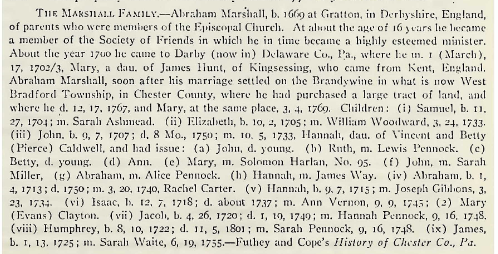
In the Youlgreave parish registers I found a baptism in 1667 for Humphrey Marshall son of Humphrey and Hannah. I didn’t find a baptism for Abraham, but it looks as though it could be correct. Abraham had a son he named Humphrey. But did it just look logical to whoever wrote the books, or do they know for sure? Did the famous botanist Humphrey Marshall have his own family records? The books don’t say where they got this information.
An earlier Humphrey Marshall was baptised in Youlgreave in 1559, his father Edmund. And in 1591 another Humphrey Marshall was baptised, his father George.
But can we connect these Marshall’s to ours? We do have an Abraham Marshall, grandson of Charles, born in 1792. The name isn’t all that common, so may indicate a family connection. The villages of Elton, Gratton and Youlgreave are all very small and it would seem very likely that the Marshall’s who went the USA are related to ours, if not brothers, then probably cousins.
Derbyshire Quakers
In “Derbyshire Quakers 1650-1761” by Helen Forde:
“… Friends lived predominantly in the northern half of the country during this first century of existence. Numbers may have been reduced by emigration to America and migration to other parts of the country but were never high and declined in the early eighteenth century. Predominantly a middle to lower class group economically, Derbyshire Friends numbered very few wealthy members. Many were yeoman farmers or wholesalers and it was these groups who dominated the business meetings having time to devote themselves to the Society. Only John Gratton of Monyash combined an outstanding ministry together with an organising ability which brought him recognition amongst London Friends as well as locally. Derbyshire Friends enjoyed comparatively harmonious relations with civil and Anglican authorities, though prior to the Toleration Act of 1639 the priests were their worst persecutors…..”
Also mentioned in this book: There were monthly meetings in Elton, as well as a number of other nearby places.
John Marshall of Elton 1682/3 appears in a list of Quaker emigrants from Derbyshire.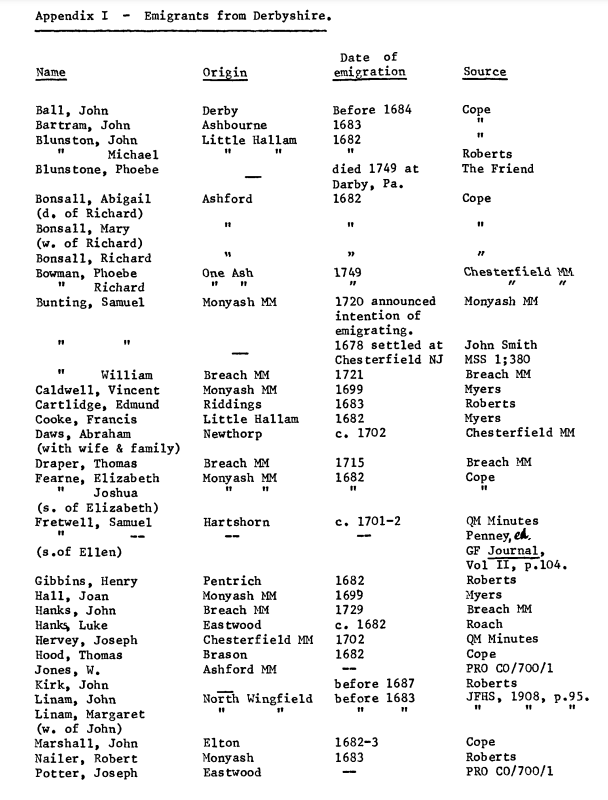
The following image is a page from the 1753 book on the sufferings of Quakers by Joseph Besse as an example of some of the persecutions of Quakers in Derbyshire in the 1600s:
A collection of the sufferings of the people called Quakers, for the testimony of a good conscience from the time of their being first distinguished by that name in the year 1650 to the time of the act commonly called the Act of toleration granted to Protestant dissenters in the first year of the reign of King William the Third and Queen Mary in the year 1689 (Volume 1)
Besse, Joseph. 1753Note the names Margaret Marshall and Anne Staley. This book would appear to contradict Helen Forde’s statement above about the harmonious relations with Anglican authority.
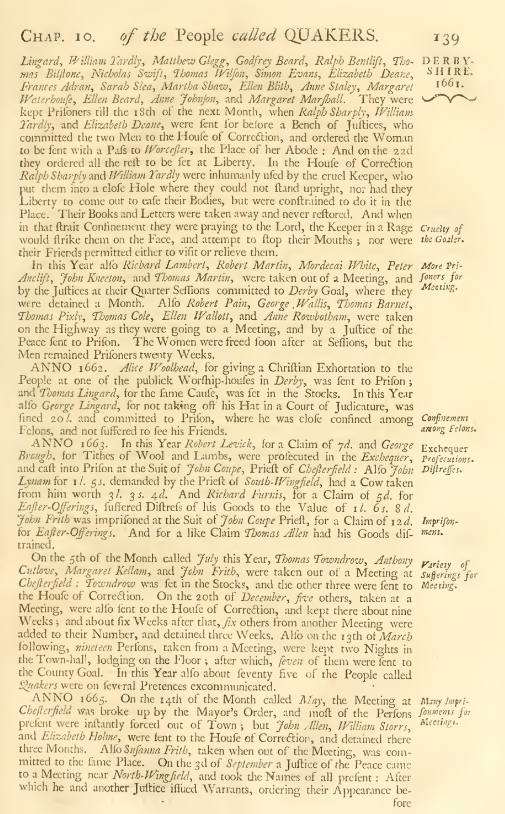
The Botanist
Humphry Marshall 1722-1801 was born in Marshallton, Pennsylvania, the son of the immigrant from Elton, Abraham Marshall. He was the cousin of botanists John Bartram and William Bartram. Like many early American botanists, he was a Quaker. He wrote his first book, A Few Observations Concerning Christ, in 1755.
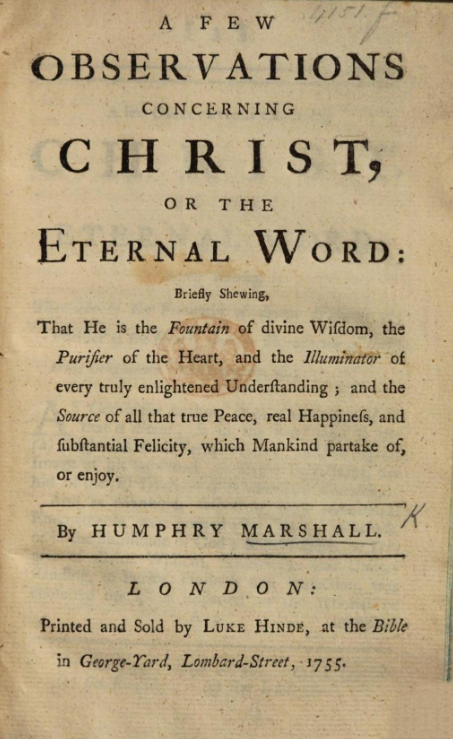
In 1785, Marshall published Arbustrum Americanum: The American Grove, an Alphabetical Catalogue of Forest Trees and Shrubs, Natives of the American United States (Philadelphia).
Marshall has been called the “Father of American Dendrology”.
A genus of plants, Marshallia, was named in honor of Humphry Marshall and his nephew Moses Marshall, also a botanist.
In 1848 the Borough of West Chester established the Marshall Square Park in his honor. Marshall Square Park is four miles east of Marshallton.
via Wikipedia.
From The History of Chester County Pennsylvania, 1881, by J Smith Futhey and Gilbert Cope:
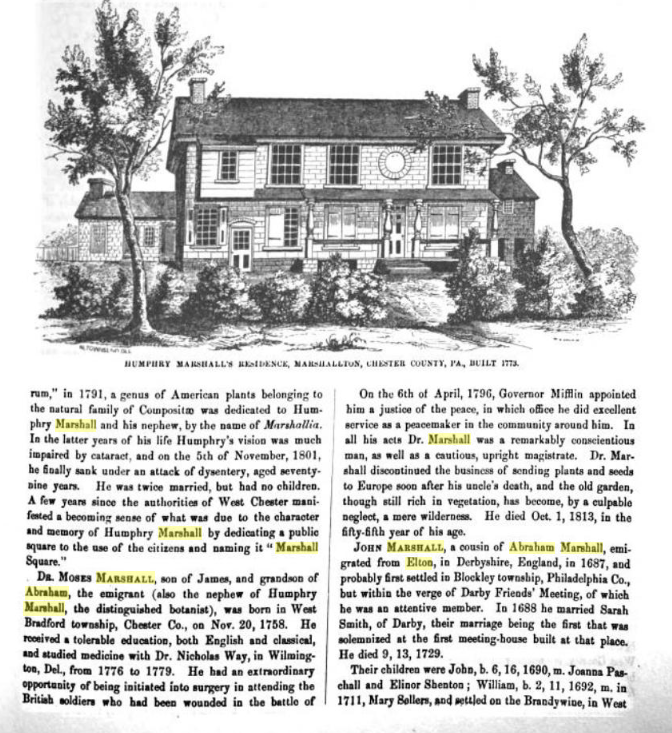
From The Chester Country History Center:
“Immediately on the Receipt of your Letter, I ordered a Reflecting Telescope for you which was made accordingly. Dr. Fothergill had since desired me to add a Microscope and Thermometer, and will
pay for the whole.’– Benjamin Franklin to Humphry, March 18, 1770
“In his lifetime, Humphry Marshall made his living as a stonemason, farmer, and miller, but eventually became known for his contributions to astronomy, meteorology, agriculture, and the natural sciences.
In 1773, Marshall built a stone house with a hothouse, a botanical laboratory, and an observatory for astronomical studies. He established an arboretum of native trees on the property and the second botanical garden in the nation (John Bartram, his cousin, had the first). From his home base, Humphry expanded his botanical plant exchange business and increased his overseas contacts. With the help of men like Benjamin Franklin and the English botanist Dr. John Fothergill, they eventually included German, Dutch, Swedish, and Irish plant collectors and scientists. Franklin, then living in London, introduced Marshall’s writings to the Royal Society in London and both men encouraged Marshall’s astronomical and botanical studies by supplying him with books and instruments including the latest telescope and microscope.
Marshall’s scientific work earned him honorary memberships to the American Philosophical Society and the Philadelphia Society for Promoting Agriculture, where he shared his ground-breaking ideas on scientific farming methods. In the years before the American Revolution, Marshall’s correspondence was based on his extensive plant and seed exchanges, which led to further studies and publications. In 1785, he authored his magnum opus, Arbustum Americanum: The American Grove. It is a catalog of American trees and shrubs that followed the Linnaean system of plant classification and was the first publication of its kind.”
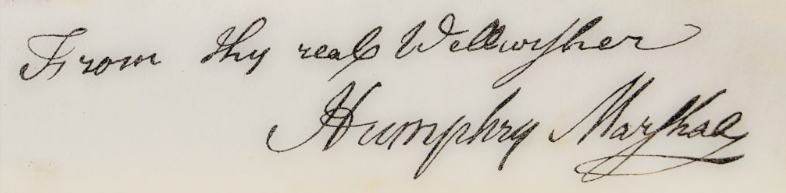 August 16, 2024 at 2:56 pm #7544
In reply to: The Elusive Samuel Housley and Other Family Stories
Youlgreave
The Frost Family and The Big Snow
The Youlgreave parish registers are said to be the most complete and interesting in the country. Starting in 1558, they are still largely intact today.
“The future historian of this parish will find a vast stock of material ready to hand, and if such a work was ever accomplished it would once more be seen how the history of even a remote village is but the history of the nation in little; how national victories were announced on the church bells, and national disasters by the proclamation of a form of prayer…”
J. Charles Cox, Notes on the Churches of Derbyshire, 1877.
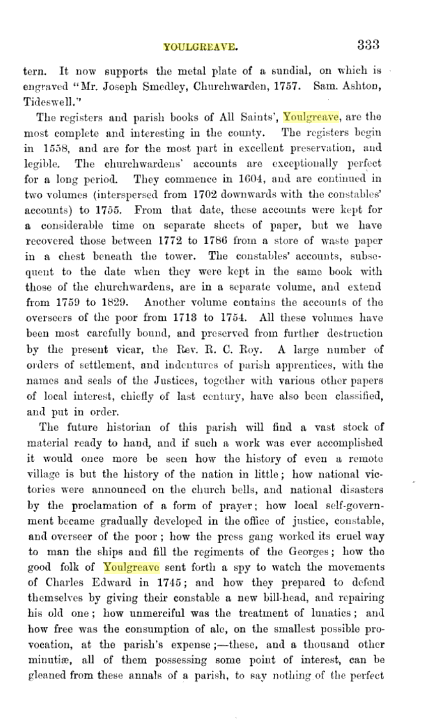
Although the Youlgreave parish registers are available online on microfilm, just the baptisms, marriages and burials are provided on the genealogy websites. However, I found some excerpts from the churchwardens accounts in a couple of old books, The Reliquary 1864, and Notes on Derbyshire Churches 1877.
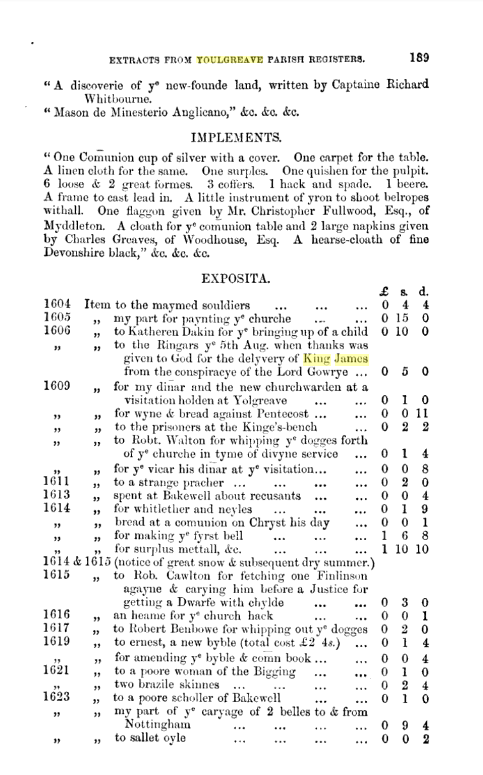
Hannah Keeling, my 4x great grandmother, was born in Youlgreave, Derbyshire, in 1767. In 1791 she married Edward Lees of Hartington, Derbyshire, a village seven and a half miles south west of Youlgreave. Edward and Hannah’s daughter Sarah Lees, born in Hartington in 1808, married Francis Featherstone in 1835. The Featherstone’s were farmers. Their daughter Emma Featherstone married John Marshall from Elton. Elton is just three miles from Youlgreave, and there are a great many Marshall’s in the Youlgreave parish registers, some no doubt distantly related to ours.
Hannah Keeling’s parents were John Keeling 1734-1823, and Ellen Frost 1739-1805, both of Youlgreave.
On the burial entry in the parish registers in Youlgreave in 1823, John Keeling was 88 years old when he died, and was the “late parish clerk”, indicating that my 5x great grandfather played a part in compiling the “best parish registers in the country”. In 1762 John’s father in law John Frost died intestate, and John Keeling, cordwainer, co signed the documents with his mother in law Ann. John Keeling was a shoe maker and a parish clerk.
John Keeling’s father was Thomas Keeling, baptised on the 9th of March 1709 in Youlgreave and his parents were John Keeling and Ann Ashmore. John and Ann were married on the 6th April 1708. Some of the transcriptions have Thomas baptised in March 1708, which would be a month before his parents married. However, this was before the Julian calendar was replaced by the Gregorian calendar, and prior to 1752 the new year started on the 25th of March, therefore the 9th of March 1708 was eleven months after the 6th April 1708.
Thomas Keeling married Dorothy, which we know from the baptism of John Keeling in 1734, but I have not been able to find their marriage recorded. Until I can find my 6x great grandmother Dorothy’s maiden name, I am unable to trace her family further back.
Unfortunately I haven’t found a baptism for Thomas’s father John Keeling, despite that there are Keelings in the Youlgrave registers in the early 1600s, possibly it is one of the few illegible entries in these registers.
The Frosts of Youlgreave
Ellen Frost’s father was John Frost, born in Youlgreave in 1707. John married Ann Staley of Elton in 1733 in Youlgreave.
(Note that this part of the family tree is the Marshall side, but we also have Staley’s in Elton on the Warren side. Our branch of the Elton Staley’s moved to Stapenhill in the mid 1700s. Robert Staley, born 1711 in Elton, died in Stapenhill in 1795. There are many Staley’s in the Youlgreave parish registers, going back to the late 1500s.)
John Frost (my 6x great grandfather), miner, died intestate in 1762 in Youlgreave. Miner in this case no doubt means a lead miner, mining his own land (as John Marshall’s father John was in Elton. On the 1851 census John Marshall senior was mining 9 acres). Ann Frost, as the widow and relict of the said deceased John Frost, claimed the right of administration of his estate. Ann Frost (nee Staley) signed her own name, somewhat unusual for a woman to be able to write in 1762, as well as her son in law John Keeling.
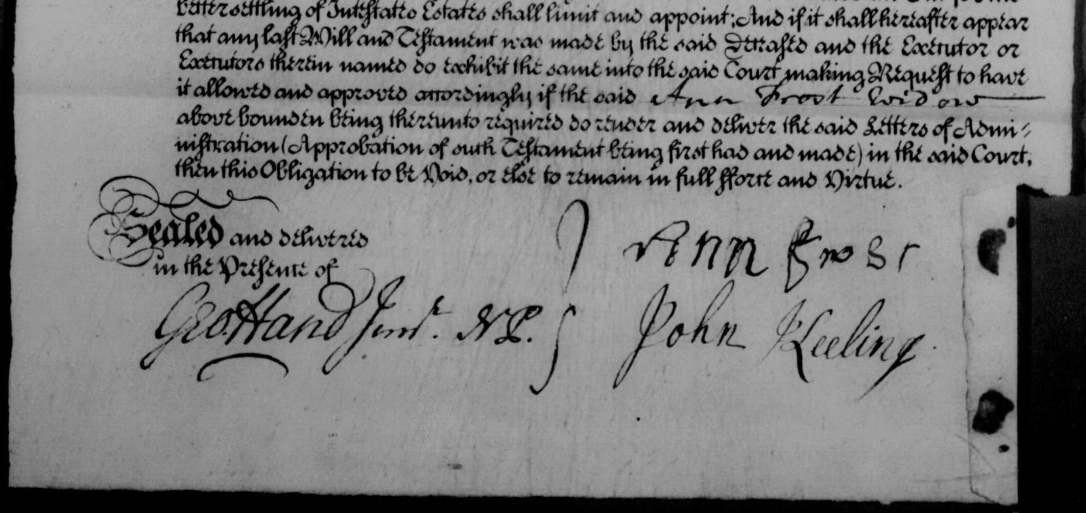
John’s parents were David Frost and Ann. David was baptised in 1665 in Youlgreave. Once again, I have not found a marriage for David and Ann so I am unable to continue further back with her family. Marriages were often held in the parish of the bride, and perhaps those neighbouring parish records from the 1600s haven’t survived.
David’s parents were William Frost and Ellen (or Ellin, or Helen, depending on how the parish clerk chose to spell it). Once again, their marriage hasn’t been found, but was probably in a neighbouring parish.
William Frost’s wife Ellen, my 8x great grandmother, died in Youlgreave in 1713. In her will she left her daughter Catherine £20. Catherine was born in 1665 and was apparently unmarried at the age of 48 in 1713. She named her son Isaac Frost (born in 1662) executor, and left him the remainder of her “goods, chattels and cattle”.
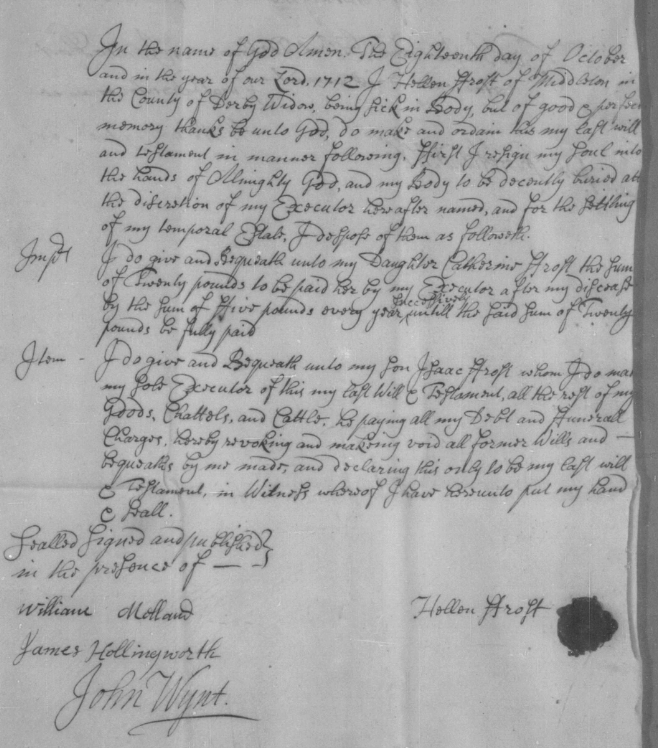
William Frost was baptised in Youlgreave in 1627, his parents were William Frost and Anne.
William Frost senior, husbandman, was probably born circa 1600, and died intestate in 1648 in Middleton, Youlgreave. His widow Anna was named in the document. On the compilation of the inventory of his goods, Thomas Garratt, Will Melland and A Kidiard are named.(Husbandman: The old word for a farmer below the rank of yeoman. A husbandman usually held his land by copyhold or leasehold tenure and may be regarded as the ‘average farmer in his locality’. The words ‘yeoman’ and ‘husbandman’ were gradually replaced in the later 18th and 19th centuries by ‘farmer’.)
Unable to find a baptism for William Frost born circa 1600, I read through all the pages of the Youlgreave parish registers from 1558 to 1610. Despite the good condition of these registers, there are a number of illegible entries. There were three Frost families baptising children during this timeframe and one of these is likely to be Willliam’s.
Baptisms:
1581 Eliz Frost, father Michael.
1582 Francis f Michael. (must have died in infancy)
1582 Margaret f William.
1585 Francis f Michael.
1586 John f Nicholas.
1588 Barbara f Michael.
1590 Francis f Nicholas.
1591 Joane f Michael.
1594 John f Michael.
1598 George f Michael.
1600 Fredericke (female!) f William.Marriages in Youlgreave which could be William’s parents:
1579 Michael Frost Eliz Staley
1587 Edward Frost Katherine Hall
1600 Nicholas Frost Katherine Hardy.
1606 John Frost Eliz Hanson.Michael Frost of Youlgreave is mentioned on the Derbyshire Muster Rolls in 1585.
(Muster records: 1522-1649. The militia muster rolls listed all those liable for military service.)
Frideswide:
A burial is recorded in 1584 for Frideswide Frost (female) father Michael. As the father is named, this indicates that Frideswide was a child.
(Frithuswith, commonly Frideswide c. 650 – 19 October 727), was an English princess and abbess. She is credited as the foundress of a monastery later incorporated into Christ Church, Oxford. She was the daughter of a sub-king of a Merica named Dida of Eynsham whose lands occupied western Oxfordshire and the upper reaches of the River Thames.)
An unusual name, and certainly very different from the usual names of the Frost siblings. As I did not find a baptism for her, I wondered if perhaps she died too soon for a baptism and was given a saints name, in the hope that it would help in the afterlife, given the beliefs of the times. Or perhaps it wasn’t an unusual name at the time in Youlgreave. A Fridesweda Gilbert was buried in Youlgreave in 1604, the spinster daughter of Francis Gilbert. There is a small brass effigy in the church, underneath is written “Frideswide Gilbert to the grave, Hath resigned her earthly part…”
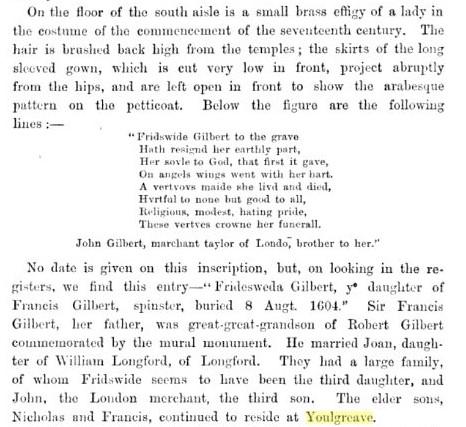
J. Charles Cox, Notes on the Churches of Derbyshire, 1877.
King James
A parish register entry in 1603:
“1603 King James of Skottland was proclaimed kinge of England, France and Ireland at Bakewell upon Monday being the 29th of March 1603.” (March 1603 would be 1604, because of the Julian calendar in use at the time.)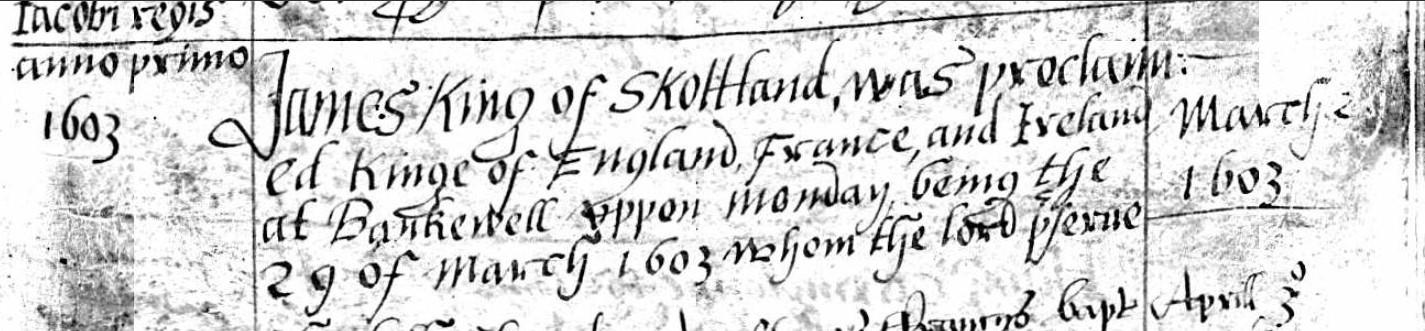
The Big Snow
“This year 1614/5 January 16th began the greatest snow whichever fell uppon the earth within man’s memorye. It covered the earth fyve quarters deep uppon the playne. And for heaps or drifts of snow, they were very deep; so that passengers both horse or foot passed over yates, hedges and walles. ….The spring was so cold and so late that much cattel was in very great danger and some died….”
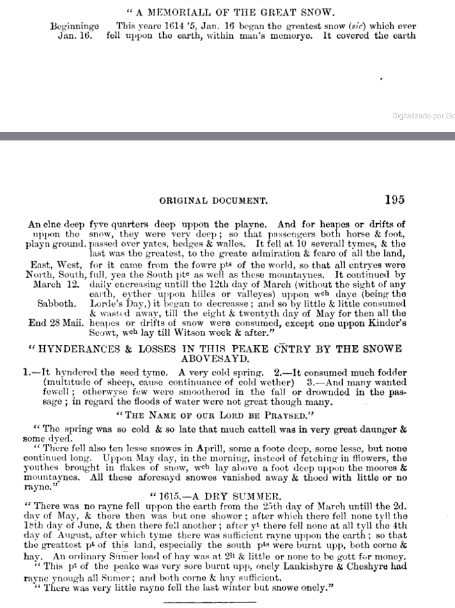
From the Youlgreave parish registers.
Our ancestor William Frost born circa 1600 would have been a teenager during the big snow.
- November 2024 (Reunion):
-
AuthorSearch Results