Search Results for 'depth'
-
AuthorSearch Results
-
January 16, 2026 at 10:55 pm #8047
In reply to: The Hoards of Sanctorum AD26
That last flu had been a sorry affliction. It must have come through the vents from the depths of the sewers, no doubt—like those permafrost organisms scientists find caught in time.
It had taken down the whole lot of them in sequence after Spirius had come back victorious from his chthonian feats. Or so he said; Boothroyd was suspiciously mum about what they did with the beast’s hide. In any case, the others gave them both the benefit of the doubt. Whatever had happened during that beast chase on the inflatable dinghy had managed to clear the clogged pipes, almost miraculously. It had also gifted them this pesky flu.
Austreberthe’s requests had become an afterthought, even for the most pig-headed of them. It wasn’t a contest, or they would all have won a prize anyway. After two days of cold, fever, and fog-headed manic ideations, Helier’s head had finally cleared.
He was left with a fond familiarity for all the stuff accumulated in his search for knowledge, yet, surprisingly, a sense of disconnection from what had made them so precious all that time. He wasn’t so far gone as to want to clear everything away—Lord forbid—but he was mildly tempted to make space somewhere. He almost shuddered at the thought.
What would he move to make space? A few precious stamps? Surely not.
They had all sorts of value: sentimental, historical, artistic—you name it.
What else? Vinyl records? They would fetch a small fortune now in some circles, but to part with them?…
A book? Most sacred!… A Liz Tattler book?… He paused… nah.There was a half-chewed pencil stub on the table. It could still have a good hundred pages worth of scribbles left in it. His heart started to race at the thought of getting rid of it. A voice in his head whispered, “Give it away! Give it away! You’ll be lighter for it.”
He didn’t want to feel lighter. But he was interested in the racing heart. It was a sign of getting back some action.
He heard the squeaking roll of Cerenise’s chair before he heard her copious sneezing.
December 31, 2025 at 9:45 pm #8020In reply to: The Hoards of Sanctorum AD26
Spirius was looking decidedly ill at ease, which struck Cerenise as far from unusual, and as such, struck her not at all at the time. It wasn’t until later that she became aware of the cause of the discomfiture of her centuries old companion. Spirius had always been a bit of a dark horse, although that wasn’t really the right expression. A character of hidden depths and mysteries, perhaps with a penchant for bottling things up and labeling them,and then shelving them. Nobody knew for sure. A good kind well meaning saint, as saints go. She smiled at him fondly.
I hope they’re recording this will reading, Cerenise thought again, not having been listening to the seemingly endless drone of items.
February 15, 2025 at 10:33 am #7794In reply to: Helix Mysteries – Inside the Case
Some pictures selections
Evie and TP Investigating the Drying Machine Crime Scene
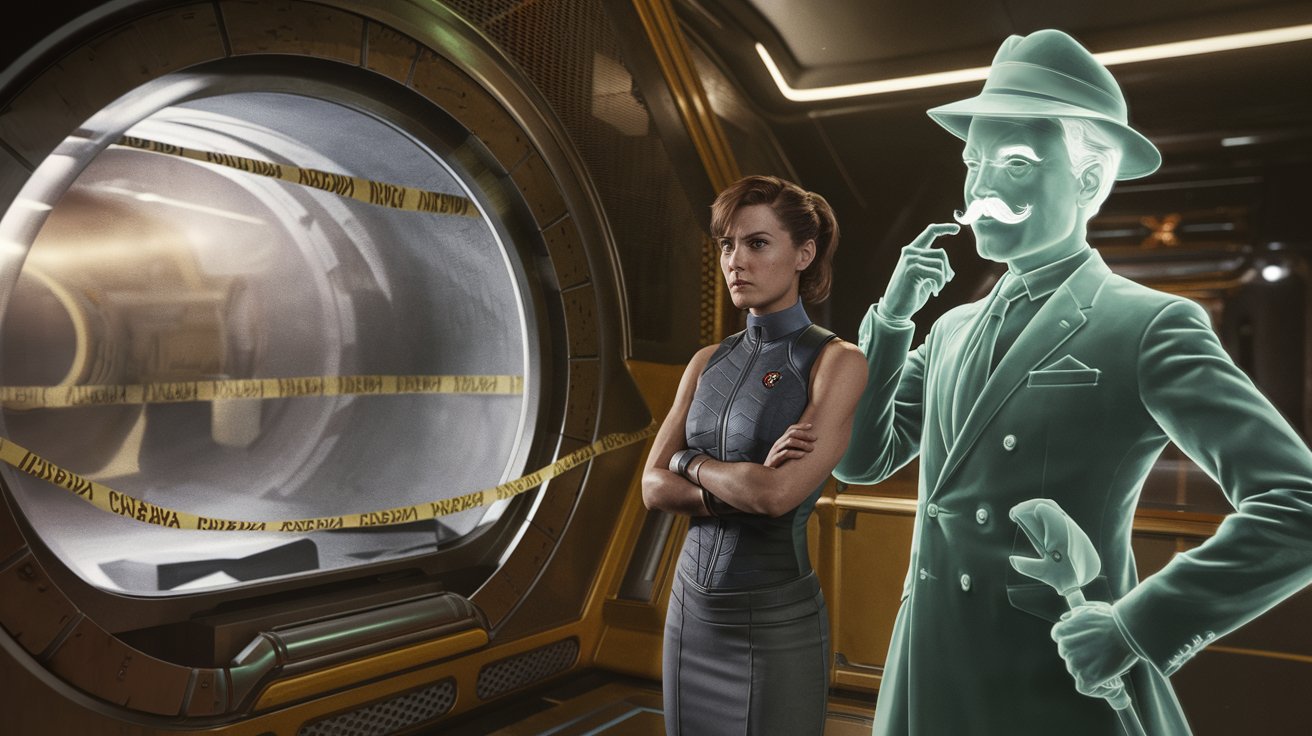
A cinematic sci-fi mini-scene aboard the vast and luxurious Helix 25. In the industrial depths of the ship, a futuristic drying machine hums ominously, crime scene tape lazily flickering in artificial gravity. Evie, a sharp-eyed investigator in a sleek yet practical uniform, stands with arms crossed, listening intently. Beside her, a translucent, retro-stylized holographic detective—Trevor Pee Marshall (TP)—adjusts his tiny mustache with a flourish, pointing dramatically at the drying machine with his cane. The air is thick with mystery, the ship’s high-tech environment reflecting off Evie’s determined face while TP’s flickering presence adds an almost comedic contrast. A perfect blend of noir and high-tech detective intrigue.
Riven Holt and Zoya Kade Confronting Each Other in a Dimly Lit Corridor
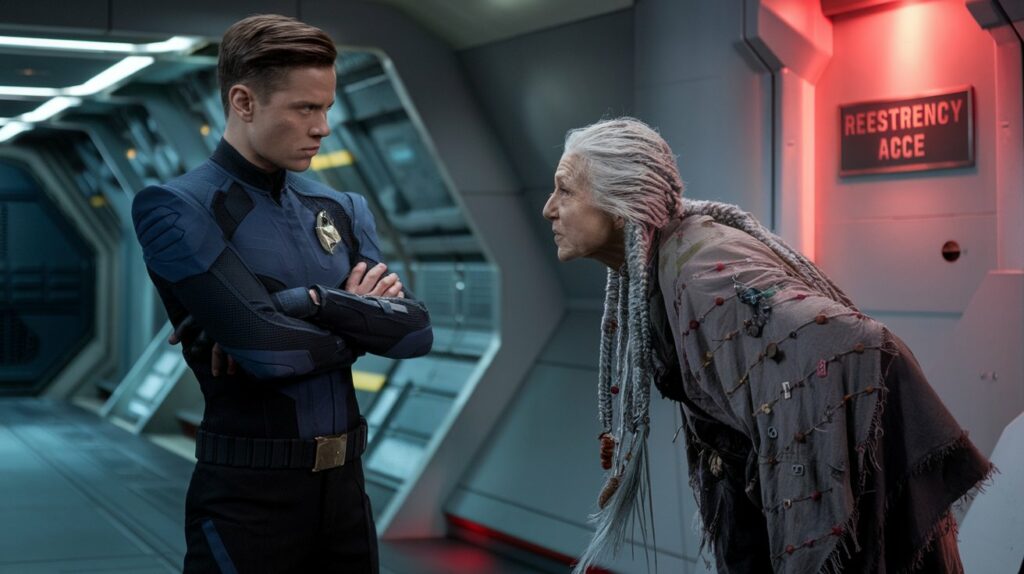
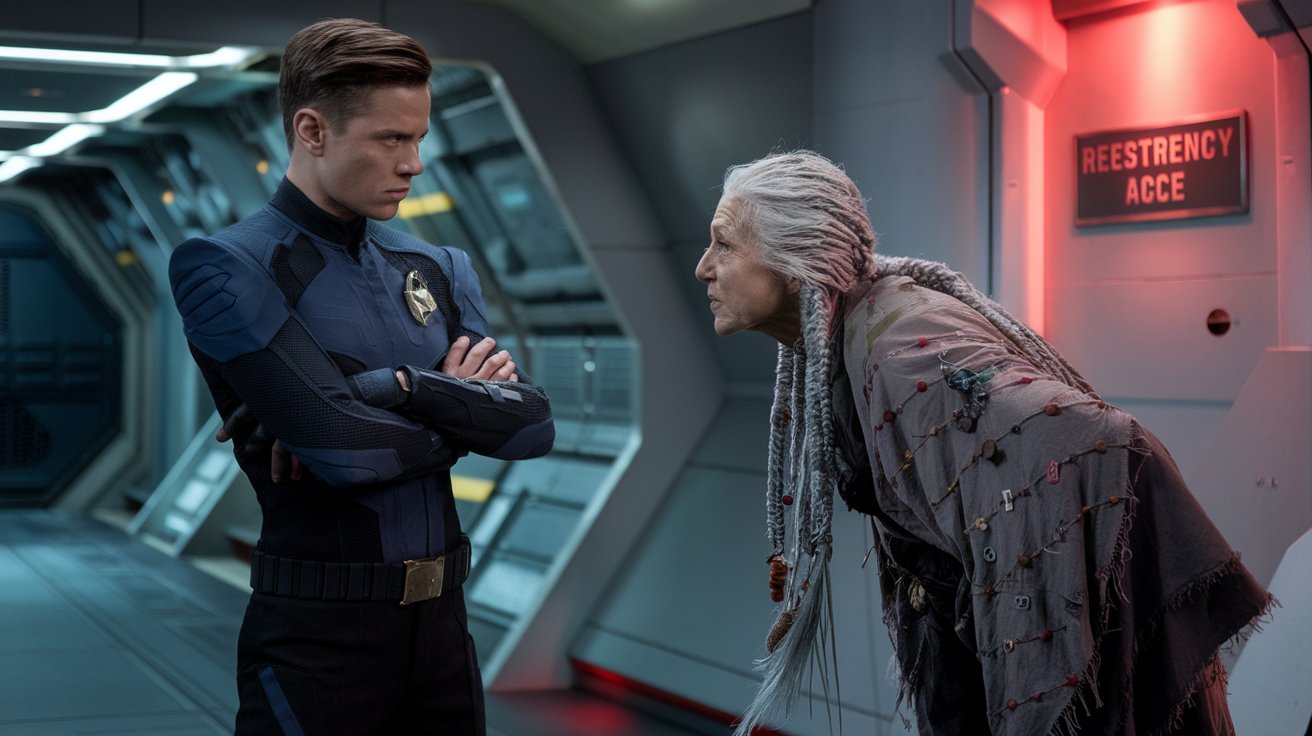
A dramatic, cinematic sci-fi scene aboard the vast and luxurious Helix 25. Riven Holt, a disciplined young officer with sharp features, stands in a high-tech corridor, his arms crossed, jaw tense—exuding authority and restraint. Opposite him, Zoya Kade, a sharp-eyed, wiry 83-year-old scientist-prophet, leans slightly forward, her mismatched layered robes adorned with tiny artifacts—beads, old circuits, and a fragment of a key. Her silver-white braid gleams under the soft emergency lighting, her piercing gaze challenging him. The corridor hums with unseen energy, a subtle red glow from a “restricted access” sign casting elongated shadows. Their confrontation is palpable—a struggle between order and untamed knowledge, hierarchy and rebellion. In the background, the walls of Helix 25 curve sleekly, high-tech yet strangely claustrophobic, reinforcing the ship’s ever-present watchfulness.
Romualdo, the Gardener, Among the Bioluminescent Plants
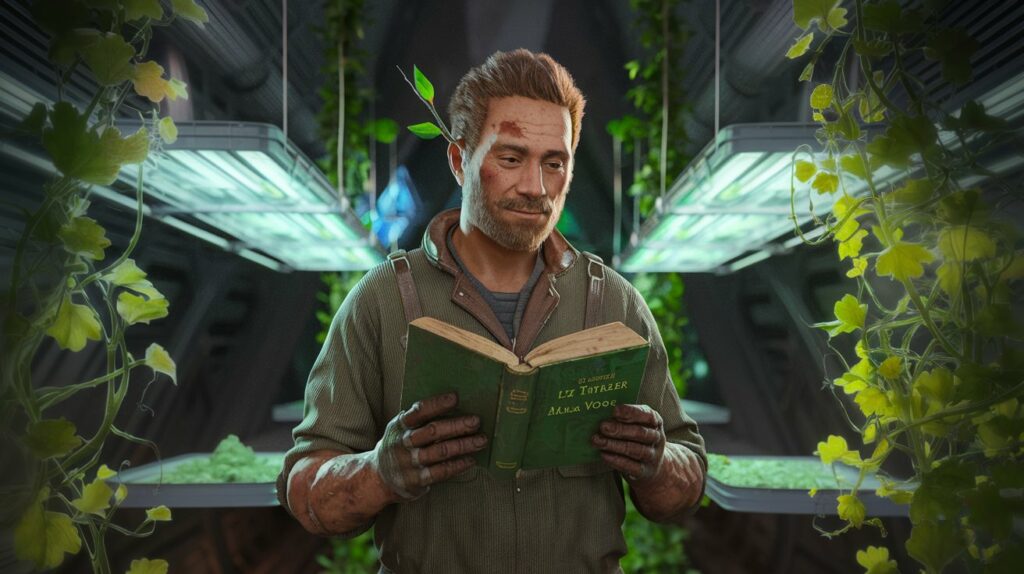
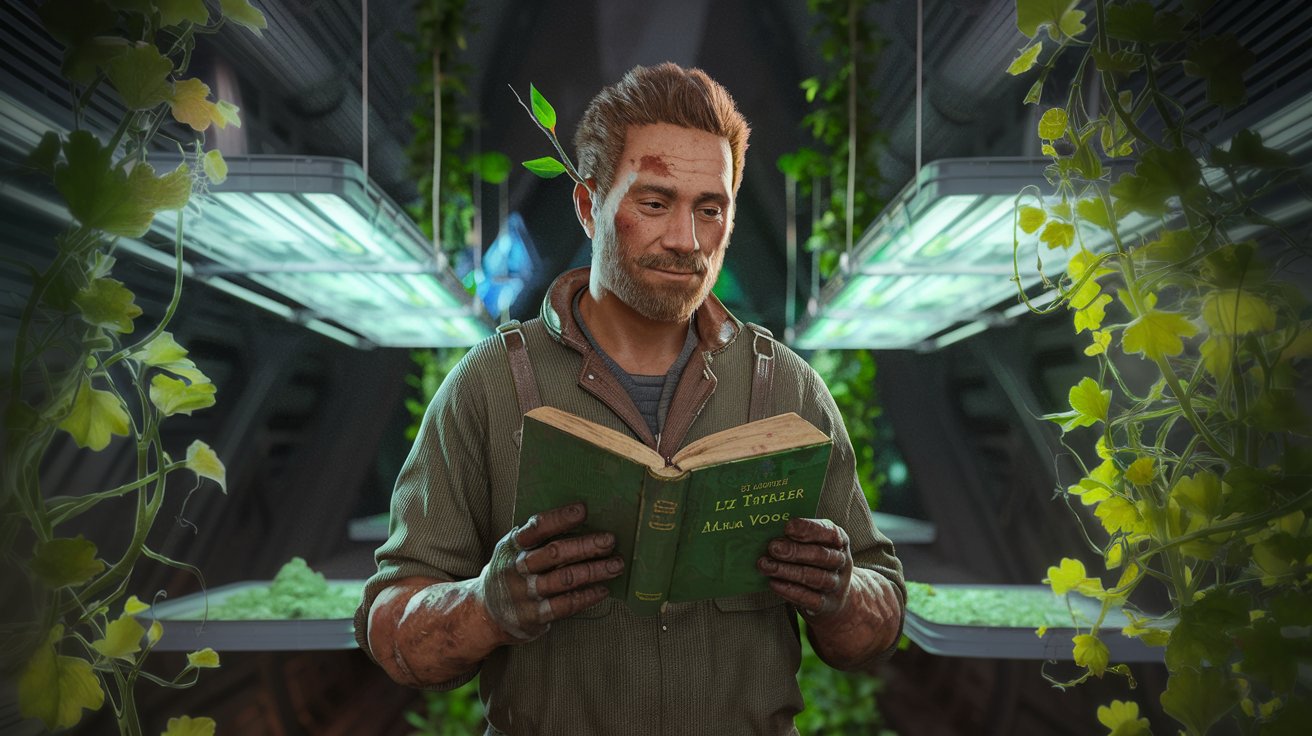
A richly detailed sci-fi portrait of Romualdo, the ship’s gardener, standing amidst the vibrant greenery of the Jardenery. He is a rugged yet gentle figure, dressed in a simple work jumpsuit with soil-streaked hands, a leaf-tipped stem tucked behind his ear like a cigarette. His eyes scan an old, well-worn book—one of Liz Tattler’s novels—that Dr. Amara Voss gave him for his collection. The glowing plants cast an ethereal blue-green light over him, creating an atmosphere both peaceful and mysterious. In the background, the towering vines and suspended hydroponic trays hint at the ship’s careful balance between survival and serenity.
Finja and Finkley – A Telepathic Parallel Across Space

A surreal, cinematic sci-fi composition split into two mirrored halves, reflecting a mysterious connection across vast distances. On one side, Finja, a wiry, intense woman with an almost obsessive neatness, walks through the overgrown ruins of post-apocalyptic Earth, her expression distant as she “listens” to unseen voices. Dust lingers in the air, catching the golden morning light, and she mutters to herself about cleanliness. In her reflection, on the other side of the image, is Finkley, a no-nonsense crew member aboard the gleaming, futuristic halls of Helix 25. She stands with hands on her hips, barking orders at small cleaning bots as they maintain the ship’s pristine corridors. The lighting is cold and artificial, sterile in contrast to the dust-filled Earth. Yet, both women share a strange symmetry—gesturing in unison as if unknowingly mirroring one another across time and space. A faint, ghostly thread of light suggests their telepathic bond, making the impossible feel eerily real.
December 4, 2024 at 11:58 pm #7644In reply to: Quintessence: Reversing the Fifth
From Decay to Birth: a Map of Paths and Connections
7. Darius’s Encounter (November 2024)
Moments before the reunion with Lucien and his friends, Darius was wandering the bouquinistes along the Seine when he spotted this particular map among a stack of old prints. The design struck him immediately—the spirals, the loops, the faint shimmer of indigo against yellowed paper.
He purchased it without hesitation. As he would examine it more closely, he would notice faint marks along the edges—creases that had come from a vineyard pin, and a smudge of red dust, from Catalonia.
When the bouquiniste had mentioned that the map had come from a traveler passing through, Darius had felt a strange familiarity. It wasn’t the map itself but the echoes of its journey— quiet connections he couldn’t yet place.
6. Matteo’s Discovery (near Avignon, Spring 2024)
The office at the edge of the vineyard was a ruin, its beams sagging and its walls cracked. Matteo had wandered in during a quiet afternoon, drawn by the promise of shade and a moment of solitude.
His eyes scanned the room—a rusted typewriter, ledgers crumbling into dust, and a paper pinned to the wall, its edges curling with age. Matteo stepped closer, pulling the pin free and unfolding what turned out to be a map.
Its lines twisted and looped in ways that seemed deliberate yet impossible to follow. Matteo traced one path with his finger, feeling the faint grooves where the ink had sunk into the paper. Something about it unsettled him, though he couldn’t say why.
Days later, while sharing a drink with a traveler at the local inn, Matteo showed him the map.
“It’s beautiful,” the traveler said, running his hand over the faded indigo lines. “But it doesn’t belong here.”
Matteo nodded. “Take it, then. Maybe you’ll figure it out.”
The traveler left with the map that night, and Matteo returned to the vineyard, feeling lighter somehow.
5. From Hand to Hand (1995–2024)
By the time Matteo found it in the spring of 2024, the map had long been forgotten, its intricate lines dulled by dust and time.
2012: A vineyard owner near Avignon purchased it at an estate sale, pinning it to the wall of his office without much thought.
2001: A collector in Marseille framed it in her study, claiming it was a lost artifact of a secret cartographer society, though she later sold it when funds ran low.
1997: A scholar in Barcelona traded an old atlas for it, drawn to its artistry but unable to decipher its purpose.
The map had passed through many hands over the previous three decades and each owner puzzling over, and finally adding their own meaning to its lines.
4. The Artist (1995)
The mapmaker was a recluse, known only as Almadora to the handful of people who bought her work. Living in a sunlit attic in Girona, she spent her days tracing intricate patterns onto paper, claiming to chart not geography but connections.
“I don’t map what is,” she once told a curious buyer. “I map what could be.”
In 1995, Almadora began work on the labyrinthine map. She used a pale paper from Girona and indigo ink from India, layering lines that seemed to twist and spiral outward endlessly. The map wasn’t signed, nor did it bear any explanations. When it was finished, Almadora sold it to a passing merchant for a handful of coins, its journey into the world beginning quietly, without ceremony.
3. The Ink (1990s)
The ink came from a different path altogether. Indigo plants, or aviri, grown on Kongarapattu, were harvested, fermented, and dried into cakes of pigment. The process was ancient, perfected over centuries, and the resulting hue was so rich it seemed to vibrate with unexplored depth.
From the harbour of Pondicherry, this particular batch of indigo made its way to an artisan in Girona, who mixed it with oils and resins to create a striking ink. Its journey intersected with Amei’s much later, when remnants of the same batch were used to dye textiles she would work with as a designer. But in the mid-1990s, it served a singular purpose: to bring a recluse artist’s vision to life.
2. The Paper (1980)
The tree bore laughter and countless other sounds of nature and passer-by’s arguments for years, a sturdy presence, unwavering in a sea of shifting lives. Even after the farmhouse was sold, long after the sisters had grown apart, the tree remained. But time is merciless, even to the strongest roots.
By 1979, battered by storms and neglect, the great tree cracked and fell, its once-proud form reduced to timber for a nearby mill.
The tree’s journey didn’t end in the mill; it transformed. Its wood was stripped, pulped, and pressed into paper. Some sheets were coarse and rough, destined for everyday use. But a few, including one particularly smooth and pale sheet, were set aside as high-quality stock for specialized buyers.
This sheet traveled south to Catalonia, where it sat in a shop in Girona for years, its surface untouched but full of potential. By the time the artist found it in the mid-1990s, it had already begun to yellow at the edges, carrying the faint scent of age.
1. The Seed (1950s)
It began in a forgotten corner of Kent, where a seed took root beneath a patch of open sky. The tree grew tall and sprawling over decades, its branches a canopy for birds and children alike. By 1961, it had become the centerpiece of the small farmhouse where two young sisters, Vanessa and Elara, played beneath its shade.
“Elara, you’re too slow!” Vanessa called, her voice sharp with mock impatience. Elara, only six years old, trailed behind, clutching a wooden stick she used to scratch shapes into the dirt. “I’m making a map!” she announced, her curls bouncing as she ran to catch up.
Vanessa rolled her eyes, already halfway up the tree’s lowest branch. “You and your maps. You think you’re going somewhere?”
November 7, 2024 at 7:36 am #7590In reply to: The Incense of the Quadrivium’s Mystiques
“Permission to speak, My Lady Malove?” Truella asked respectfully. She was still wearing Frella’s raincoat of respect as it hadn’t stopped raining the whole time she’d been in Ireland, although the respectfulness was becoming tedious. But she was inside the Quadrivium building now, facing her agitated boss. She shrugged the raincoat off and tossed it aside and squared her shoulders.
“Speak!” Malove replied, rude and abrupt.
“I say, would you like some new pyjamas by any chance? No, never mind that now. Someone needs to say this to your face, as you haven’t figured it out for yourself yet.”
Gasps of astonishment echoed around the great hall and the air quivered with tension.
“You have been so obsessed with the fact sheets of the merge and the number crunching that you’ve been blind to a more significant merge.” Truella boldly held her hand up to silence Malove whose mouth was gaping open like a goldfish, or perhaps more like a carp.
“No, you listen to me for once,” Truella almost quaked at her own impudence then, but caught the merest glimmer of amusement from the depths of Malove’s being, or rather the essence of Cromwell who was lodged there.
Don’t you dare leave me now, Thomas, stay right there until I’ve finished or I’m toast.
“You have been so outwardly focused that you’re not paying attention to your own self, or you’d have noticed. Which just goes to show the immense efficiency and subtley of Cromwell’s merge tactics. It would behoove you to admit that you needed direction, and to appreciate the help that has been provided for you. You are not entirely yourself, or rather, you are entirely yourself, but at times lately you are more than that.”
Taking a deep breath, Truella continued. “At first it may be unsettling, but you must persevere and don’t fight it. Accept that you needed help, give thanks that you received it, and work well with Cromwell’s suggestions.”
“Saints preserve us,” whispered Malove, shocked to the core. “I don’t mean papish saints though,” she added hastily, unsure how to proceed.
Truella laughed nervously, her courage suddenly evaporating. She felt a strong urge to flee.
I asked you not to leave me alone with her!
October 28, 2024 at 2:31 pm #7570In reply to: The Incense of the Quadrivium’s Mystiques
“If you’re planning on having a baby, you’d better use those droplets fast. That silvery glow? It’s already decaying,” said Jeezel, meticulously selecting twelve golden pheasant feathers from the pile in front of her. She inspected each one carefully, choosing only the finest, most vibrant feathers, free from even the slightest flaw.
Truella snorted. “I’m well aware of the effects of time on matter,” she replied, shifting back in her swivel chair. “I am, after all, an experienced amateur archaeologist. Take a look at this.” She held her hand up closer to the camera, fingers spread.
“I’m not sure what your dirty fingernails are supposed to prove,” said Jeezel, arranging her selected feathers into a fan shape. “That they’re overdue for a manicure? Natural decay has nothing to do with time travel side effects, as you’d know if you watched my YouTube series on the subject.”
“We know all about your videos,” said Eris quickly, stepping in before Jeezel could launch into one of her infamous lectures on the dangers of time travel as seen by her Gran, Linda Pol. “I’m sure those droplets can still be useful in our spell. Cromwell had to navigate treacherous political waters with an impeccable grasp of strategy, manipulation, and the darker facets of power. Those droplets could act as a metaphysical catalyst, adding depth and purpose to the spell.”
“Exactly,” said Truella, tilting her chin up proudly. “A proactive hunch on my part.”
“I get the metaphysical catalyst bit,” said Frella, “but won’t those darker facets blow up in our faces? I mean, wasn’t Cromwell a master of secrets and deception? In the rudest way possible, if you ask me.”
“He could be gentle, too,” Truella murmured, blushing slightly.
“And that’s not even mentioning the spell’s potential to tap into the collective memory of his era,” added Jeezel. “And ‘rude’ isn’t how I’d describe his atrocities and ruthlessness. I covered that in detail in the video series…”
“We know,” Eris cut in. “That’s why we need to craft this spell with precision and include safeguards. Are the fans ready?”
“All set,” said Jeezel, her eyes sparkling with pride as she held up the four finished fans. “One for each of us, crafted with care and magic. They’ll clear the space, sweep away falsehoods, and purge any misleading energies. With these, only pure, unfiltered truth will emerge.”
“I’ll bring the Mystic Mirror I found in that old camphor chest,” said Frella. “Its surface shimmers and reflects the hidden truth of the soul.”
“And I have my unusual but eminently practical container—containing Cromwell’s droplets,” Truella chimed in, holding it up.
“Perfect. Then it’s settled. I’ll send Malove a meeting invitation for tonight,” said Eris, leaning in with a knowing smile. “You all know the place.”
September 20, 2024 at 10:13 pm #7557In reply to: The Incense of the Quadrivium’s Mystiques
The whole summer had been a blur. So much so it felt at times to Eris she’d woken up from a dream to enter another one; carefully crafted illusions as heavy as an obfuscating spell.
She could remember the fair, vaguely the Games too —each event felt like another layer of enchantment, casting a surreal pallor over everything. Indeed, the summer was a blur of fleeting images and half-remembered events, like how everyone quickly disbanded to go for a respite and a salutary holiday. Truth be told, the witches of the Quadrivium all needed it after the utter chaotic year they’d been through.
The resurgence of Malové at the fair, left unexplained, had appeared as an evidence. They all needed the tough love that only she as a head of Coven could provide, rather than the micro-management of the well-meaning but people-inapt Austreberthe. To be fair, Eris wasn’t sure Malové was still in charge or not —Eris had never as much struggled with continuity as now; she could feel they were all flipping through and sliding into potential realities opened by the incoming Samhain doorways on the horizons.
Standing on the cusp of autumn, Eris décided to prepare herself for a clarity spell under the iridescent harvest moon.
As the leaves began to turn and the air grew crisp, Eris stood poised to harness the energies of the propitious harvest moon. Preparation for a clarity spell required ascertained precision and intention waved into the elements.
Eris began by setting her space. The clearing near Lake Saimaa was her sanctum, a place where the natural energies converged seamlessly with her own. She laid out a circle of stones, each one representing a different aspect of clarity—vision, truth, focus, and discernment. In the center, she placed a mirror, a symbolic portal to the inner self and higher understanding.
Mandrake, her Norwegian Forest cat, watched with a knowing gaze, his presence grounding her as she moved through the rituals. Echo, the familiar sprite, flitted about, ensuring everything was in place.
“Mandrake, guard the perimeter,” Eris instructed. The cat slinked off into the shadows, his eyes glowing with an otherworldly light.
Eris took a deep breath and began to chant, her voice steady and resonant:
“By the light of the harvest moon,
I call forth clarity, swift and soon.
Let fog disperse and shadows flee,
Reveal the truth, illuminate me.”She sprinkled dried hellebores around the mirror, their protective and healing properties amplifying the spell’s potency. The hellebores, collected from Normandy, held within them the strength of her Viking ancestors and the promise of Imbolc’s rebirth. They were not just flowers; they were talismans of resilience and transformation.
As the moon reached its zenith, Eris held a vial of enchanted water. She poured it over the mirror, watching as the surface shimmered and rippled, reflecting the moonlight with an ethereal glow. The water, drawn from the depths of Lake Saimaa, was imbued with the ancient magic of the land.
Eris closed her eyes and focused on her intentions. She saw the faces of her sisters at the Quadrivium Emporium, each one struggling with their own burdens. Stalkers, postcards, camphor chests, ever prancing reindeers high on mushrooms. She saw the chaotic energies of early spring, swirling, and the potential and peril they carried. She saw Malové’s stern visage, a reminder of the standards they were meant to uphold, and a reminder to make more magical rejuvenating cream.
“Show me the path,” she whispered. “Guide me through the haze.”
The mirror began to clear, the ripples settling into a smooth, reflective surface. Images started to form—visions of the future, hints of what lay ahead. She saw herself within the coven with renewed purpose, her objectives clear and her drive rekindled. She saw her sisters working in harmony, each one contributing their unique strengths to the collective power.
The clarity spell was working, the fog lifting to reveal the roadmap she needed. Decisions that once seemed insurmountable now appeared manageable, their resolutions within grasp. The inefficiencies plaguing their organization were laid bare, offering a blueprint for the reforms necessary to streamline their efforts.
Eris opened her eyes, the vision fading yet leaving an indelible mark on her mind. She felt a surge of confidence, a sense of direction that had been sorely lacking.
“Thank you,” she murmured to the moon, to the elements, to the spirits that had guided her.
As she began to dismantle the circle, Echo fluttered down to her shoulder, a small smile on her ethereal face. Mandrake emerged from the shadows, his eyes reflecting the calm and order Eris had sought to instill.
“Well done, Eris,” Echo said softly. “The road ahead is clearer now. The harvest moon has gifted you its wisdom.”
Eris nodded, feeling ready as autumn would be a season of action, of turning vision into reality.
June 21, 2024 at 8:17 am #7512In reply to: The Incense of the Quadrivium’s Mystiques
“If you ask me,” said Trella, although nobody had, “If anyone wants the merger to fail, it’ll be someone from the Cloisters.”
“Seems like none of us want it, why single them out?” asked Frella. “Well,” she added, glancing at Eris, “Not all of us maybe but for most of us it’s just a hassle. Just more work, and no real benefits for the likes of us, anyway.”
“Think about it, Frell. Sure, it’s just a nuisance for the witches and the nuns, but not enough of a bother to play with fire meddling with far grander schemes. That’d be way out of the depth of most of us, I’m sure. But there’s more going on at the Cloisters than meets the eye. There are other, er, things here, things that don’t want change.”
“Like what?” asked Eris in a doubtful tone.
“I don’t know but I can feel it. Can’t you? Eris, you’re so busy looking at spread sheets and finances you are losing your second sight! The undercurrents are bubbling up so much we’ll drown before long! We’re all looking at each other with suspicion, and meanwhile….”
“You mean we can trust the Morticians?” asked Jeezel hopefully. Eris glared at her.
“Maybe,” Trella said. “Maybe. We don’t know anything for sure yet. But I suggest we stop looking at the nuns, I mean the ordinary rank and file nuns, and the morticians with suspicion and focus on the place itself. There’s a long dark history to this place. And if you ask me, Brother Bartolo knows something.”
“Surely he’s not behind the whole thing!”
“Not behind the whole thing, no, but he knows something. And the gardener, Brother Babbit. Sassafras told me there’s nothing Brother Babbit doesn’t know about the history of this place, but that he only wants to talk about the plants, you know, the local wildlife and such. And,” Truella paused dramatically, “Sandra dropped something out while we were smoking weed in the orchard after the reception. She said Brother Bartolo said he’d seen the Sisters of the Sacred Sepulchre roaming around in the cellar, waiting for orders!”
“The sisters of the friggen what?” Jeezel sighed. Not more characters to convolute everything even more! “Roaming around in the cellars? Oh come on!”
“And that’s not all,” Truella lowered her voice to a whisper. “Sassafras said something about them being reanimated.”
Finally, Eris started taking Truella seriously. “Reanimation? I don’t like the sound of that. We’d better find out as much as we can about the sisters of the cellars, who are they, I mean who were they, have they been reanimated before, and what were the circumstances.”
“Right ho, I’ll just boogle it, shall I?” Jeezel said sarcastically.
Eris rolled her eyes. “No need for the snark. The clues will be here, right here at the Cloisters. We need to check the library, look in every room for clues, check out all the tapestries and paintings, speak to Brother Bartolo and Brother Babbit, but without making them suspicious, mind! Just pretend an interest in history, no mention of the merger! Keep it light! And keep it light with the morticians, but keep it superficial, until we know more. And then…,” Eris looked at each of them. “we need to go down to the cellars. I suggest we do that together.”
“We need Frella to come for that,” Truella stated the obvious. The others murmured their agreement.
June 19, 2024 at 12:34 pm #7506In reply to: The Incense of the Quadrivium’s Mystiques
As Frigella, deep in her investigation of Herma’s cottage, meticulously examined the chest’s contents looking for potential clues missed at first glance that could explain more about the postcard, with its distinctive stamp featuring an ear of maize, she couldn’t shake the feeling of being watched.
“By the gods, not that interloper again,” she muttered under her breath, sensing the familiar prickling at the back of her neck. She knew Cedric’s gaze all too well—part curiosity, part menace. The young witch hunter was like a moth to a flame, drawn to the coven’s mysteries and, more specifically, to Frella herself, for reasons that likely perplexed even him.
Herma, oblivious to the undercurrents, continued to sift through the chest with Frella. As the silence thickened, Frella’s mind wandered to the last encounter with Cedric. His naïve bravado was almost laughable, yet there he was, lurking in the shadows, ever the novice hunter out of his depth.
“Careful, Herma,” Frella warned with a sharp glance at the window. “We may have an unwelcome observer. This certain Cedric Spellbind has a knack for being where he shouldn’t.”
Herma chuckled, dismissing the tension with a wave. “Him? A mere boy chasing phantoms. He won’t bother us.”
Frella wasn’t so sure. Spellbind’s persistence was a nettlesome thorn, yet she knew how to handle such a busybody. For now, she would focus on the task at hand, but a mental note was made: keep an eye on Cedric. He was, after all, as unpredictable as the spring winds that brought them here far too early.
June 19, 2024 at 8:33 am #7504In reply to: The Incense of the Quadrivium’s Mystiques
After the meeting, Jeezel and Silas agreed on what the six rituals would be. The integration rituals were designed to unite the groups symbolically and spiritually. They were multifaceted ceremonies that combine elements from each group’s traditions to forge a shared sense of purpose and harmony, mediated by the mortician’s guild. Given the diverse nature of the witches, nuns, and morticians, these rituals needed to be both inclusive and meaningful, drawing on the unique strengths and spiritual practices of each faction.
The program they distributed to each participant was as follow:
Under the guidance of the Ancient Telluric Forces of the Dragons
1. The Invocation of Unity
Purpose: To call upon the spiritual and magical forces that guide each group and seek their blessings for the union.
Components:- Witches: Incantations and invocations to elemental spirits and deities.
- Nuns: Hymns and prayers invoking divine blessings.
- Morticians: Rituals honoring the spirits of the departed, seeking their guidance and protection.
Symbolism: This ritual emphasizes the shared respect for higher powers and the mutual desire for harmonious collaboration.
2. The Weaving of Fate
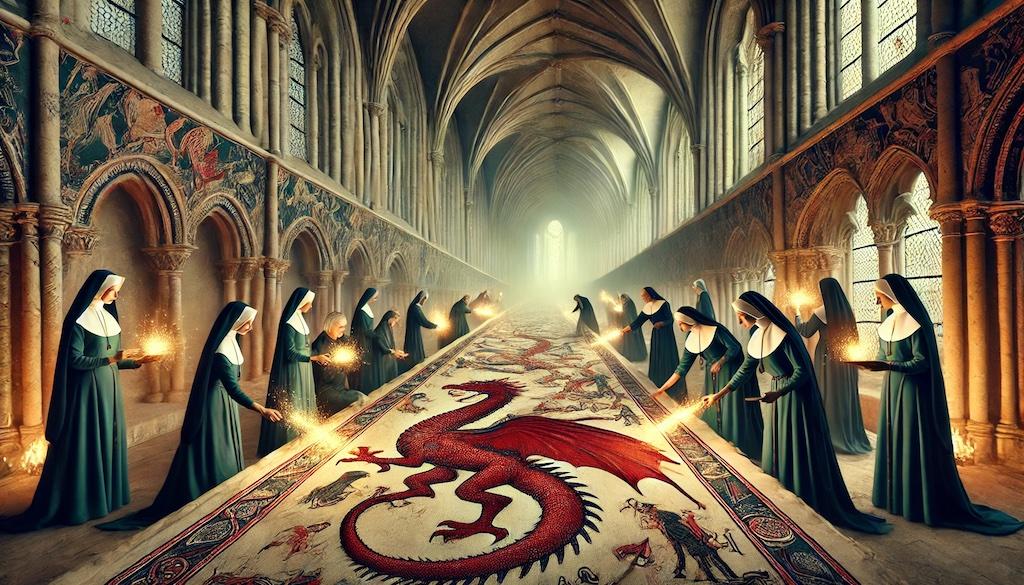
Purpose: To create a physical symbol of their intertwined destinies.
Components:- Witches: Magical threads imbued with protective charms and blessings.
- Nuns: Sacred textiles woven with prayers and religious symbols.
- Morticians: Ribbons representing life, death, and the transition between them.
Symbolism: By weaving these threads together into a single tapestry, the groups create a tangible manifestation of their unified path forward.
3. The Concordia Cauldron
Purpose: To brew a potion that represents their collective energy and intent.
Components:
- Witches: Magical herbs, crystals, and other mystical ingredients.
- Nuns: Holy water and sacred relics.
- Morticians: Ashes from ritual fires and symbols of purification.
Symbolism: The potion, once blessed and distributed, serves as a means of internalizing the collective spirit and shared goals of the unified group.
4. The Harmonious Choir
Purpose: To blend their voices and energies in a powerful, resonant harmony.
Components:
- Witches: Chants and spells sung in unison.
- Nuns: Choir hymns and sacred music.
- Morticians: Melodic recitations of ancient rites.
Symbolism: The act of creating music together represents the harmony they strive to achieve in their collaboration, with each voice contributing to a greater whole.
5. The Altar of Convergence
Purpose: To create a shared sacred space where offerings and symbols from each group are placed.
Components:
- Witches: Ritual objects, such as wands, crystals, and candles.
- Nuns: Holy relics, icons, and prayer books.
- Morticians: Mementos of the deceased, symbolizing the continuity of life and death.
Symbolism: The combined altar serves as a focal point for their united efforts, a place where they can come together to seek guidance and reaffirm their commitment to the union.
6. The Ceremony of Reflection and Projection
Purpose: To reflect on the past, acknowledge individual and collective strengths, and set intentions for the future.
Components:
- Witches: Scrying mirrors and crystal balls for reflection and foresight.
- Nuns: Candles representing illumination and enlightenment.
- Morticians: Artifacts representing the cyclical nature of life and death.
Symbolism: This ceremony encourages each member to contemplate their role within the new union and visualize the path ahead, fostering a sense of shared vision and purpose.
Supervision by Jeezel and Silas
Jeezel: With her deep connection to magical energies and her knack for emotional resonance, she will ensure that each ritual maintains its mystical integrity and spiritual depth. She will guide the participants in channeling their energies harmoniously and with clear intent.
Silas: His analytical mind and authoritative presence will bring structure and order to the rituals. He will ensure that each component is meticulously planned and executed, maintaining the balance between tradition and innovation.
Together, Jeezel and Silas will oversee the integration rituals, blending their unique approaches to create a unified and cohesive experience that honors the diverse traditions of the witches, nuns, and morticians. Their combined leadership will ensure that the rituals not only symbolize but also spiritually solidify the union of these distinct groups.
Now, all that remained was to ask for volunteers or to assign the roles in the rituals to everyone. And for Jeezel to reveal the hidden mission to her three friends.
June 16, 2024 at 10:30 pm #7486In reply to: Smoke Signals: Arcanas of the Quadrivium’s incense
The Morticians Guild:
Nemo Tenebris, and let me tell ya, he’s a character straight out of one of those dark romance novels. Tall, brooding, with tousled hair somewhere between charcoal and mahogany, he’s got that rugged charm that makes even the bravest witches’ hearts skip a beat. His hands are like an artist’s, always deliberate and precise, whether he’s handling ancient texts or, well, more corporeal tasks. His personality? Think intense and enigmatic, with occasional bursts of biting humor. He’s the type who’ll share a grim tale and then light the room with a grin that makes you question your reality. Don’t underestimate him – he’s a master of necromancy and has an uncanny sensitivity to life’s deepest mysteries.

Silas Gravewalker. An older gent, he looks as though he’s always expecting a foggy night – grey cloak, even greyer hair, and eyes the color of storm clouds. His demeanor is gentle but don’t mistake it for weakness. He’s the wise old guardian of the Guild, carrying centuries of rituals, chants, and incantations within him. Silas is a remarkable blend of grandfatherly wisdom and hidden strength, and he’s a calming presence in the midst of chaos. His sense of humor is dryer than the Outback in summer, subtle yet striking at just the right moments. When Silas speaks, you listen, because his words are often tinged with layers of arcane meaning.
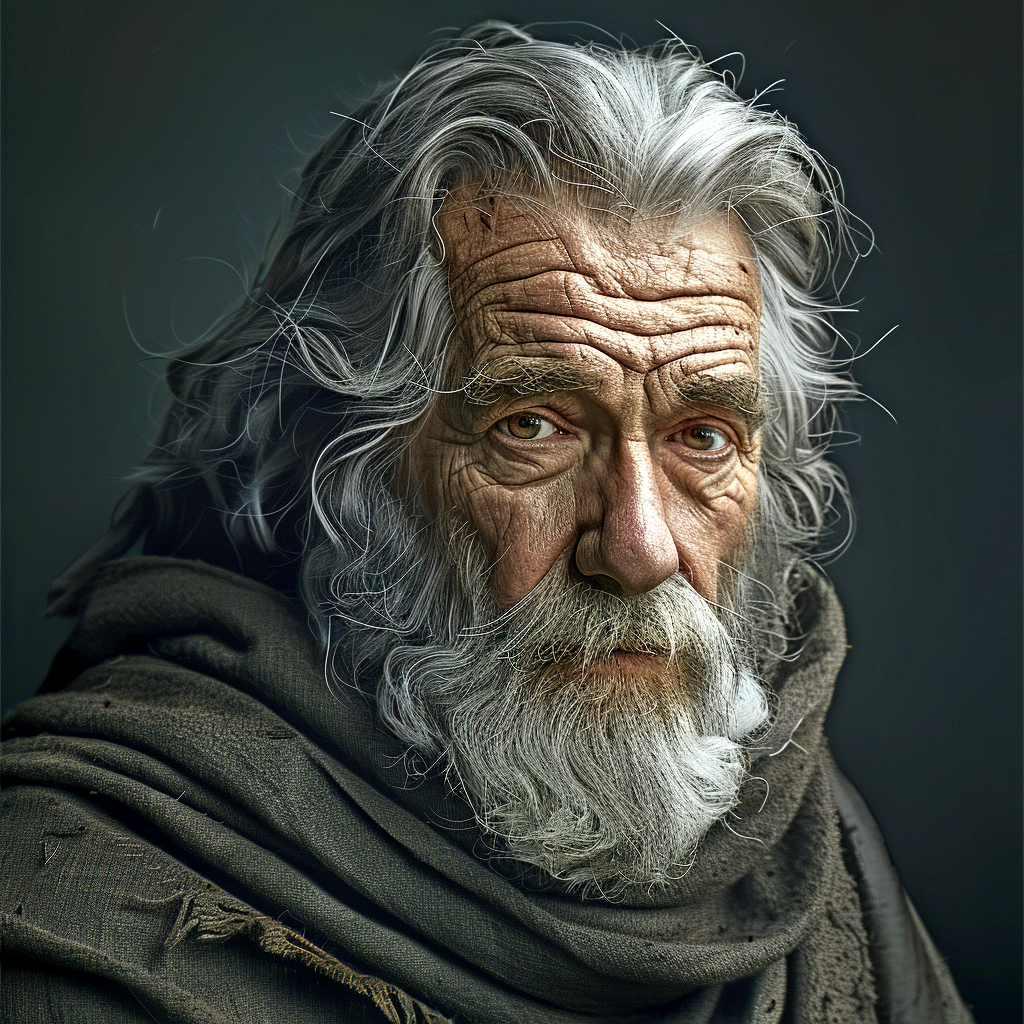
Rufus Blackwood: Enter Rufus Blackwood, the stoic guardian of the guild. He’s tall and broad-shouldered, with a presence that commands both respect and a shiver down the spine. His hair is a dusty shade of midnight black, streaked with the occasional silver – probably from the weight of the secrets he carries. His eyes are a pale grey, like the fog rolling off a moor, always scanning, always measuring. He’s perpetually clad in a long, leather duster coat that sweeps the floor as he glides across the room.
Personality-wise, Rufus is the strong, silent type, but when he speaks, it feels like ancient tombs whispering forgotten wisdom. He’s got a dry humor that surfaces in the most unexpected moments, like a ray of moonlight in a pitch-black night. He’s fiercely protective of his coven and guildmates, and there’s a sense of old-world honor about him. Underneath that granite exterior is a surprisingly tender heart that only a select few have glimpsed.
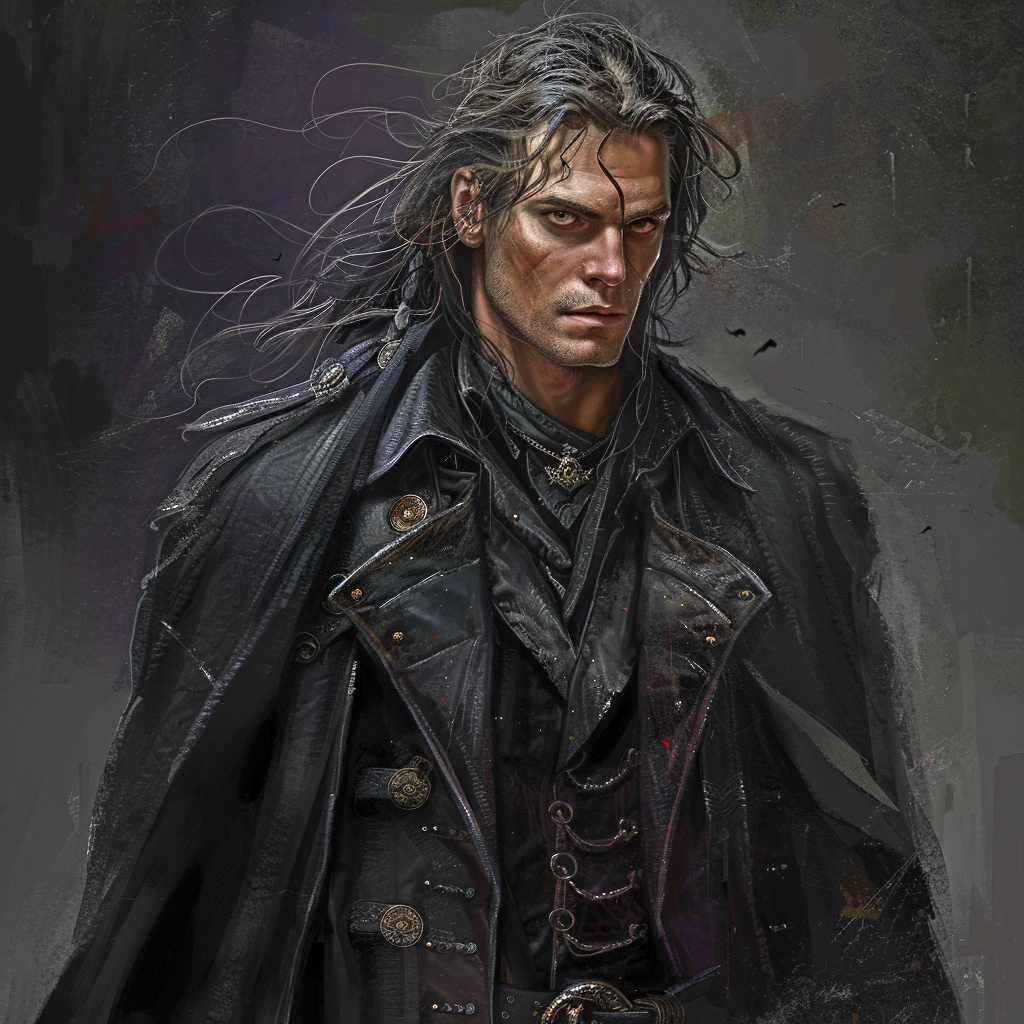
Garrett Ashford: Now, Garrett Ashford, he’s a bit of a dandy, as far as morticians go. Picture a man of average height but with presence larger than life. His hair is a striking ash blonde, always perfectly coiffed, and his attire is meticulously sharp – tailored suits, often in dark, rich fabrics with just a hint of eccentricity, like a red silk handkerchief or a silver pocket watch. His eyes are a sharp, pale blue, twinkling with a touch of playful mischief.
Garrett’s got a personality as polished as his appearance. He’s charismatic, with a knack for easing tensions with a well-timed joke or a charming smile. Though he might come off as a bit of a showman, make no mistake – Garrett’s got depth and a sharp mind. He’s a skilled embalmer and incantation master, knowing just the right touch to handle even the most delicate of cases. His flair for the dramatic doesn’t overshadow his competence; it complements it. He’s the kind of bloke who can discuss the darkest of topics with a light-hearted grace, making him a bit of a paradox but undeniably captivating.
 June 10, 2024 at 10:05 pm #7464
In reply to: The Incense of the Quadrivium’s Mystiques
“The world is vast, and we are not alone in our quest for magical mastery. We will forge new partnerships!” Malove’s voice had reached fever pitch. She had expanded her map, showing potential allies and strategic locations across the globe. Reactions in the audience varied, but there was an overwhelming unspoken consensus of a growing rebellion towards the unsettling increase in Malove’s dictatorial ways.
Perhaps nobody will ever know for sure whose private spell did the trick, or whether it was the combined effort that brought about such an unexpected chain of events. Maybe it was none of those things, and just the way things worked out.
The vast world that Malove had cried out heard her call and sucked her forthwith into the steamy depths of a hitherto unknown equatorial location in search of potential allies. An unexpected invitation from a long lost cousin, it was said, although nobody in the coven knew for sure. There was more lively interest in the coven and more communication between the witches during those days when Malove disappeared without trace than ever before.
On the twelfth day after her disappearance, the cryptic messages started arriving. On the 15th day, experts were examining the selfies for signs of tampering and pronouncing them to be be true images.
It wasn’t easy to imagine Malove swooning in her tropical lovers arms under parrot filled jungle trees, sheathed in gauzy crumpled linen and with a vapid expression of a Cartland character, but the photos kept coming.
It seemed too bizarre, too good to be true, when Malove sent a voice message in her unmistakable voice, but with an uncharacteristic lazy, sultry tone.
“Darlings, you won’t beleive it. I’ve fallen in love! I’m taking an indefinite leave of absence.”
June 6, 2024 at 6:32 pm #7454In reply to: The Incense of the Quadrivium’s Mystiques
I honestly don’t know what made me do it, it took me by surpise when I did it. It was bugging me that I couldn’t remember, and before I knew what was happening, I’d asked Malove.
Ah, the Caryatid Characteristics of a Case, a subject that requires both discernment and a keen eye for detail. In essence, the phrase “Caryatid Characteristics” refers to the fundamental attributes and peculiarities that support the overall structure of a particular case or situation, much like how caryatids—those graceful, sculpted figures in classical architecture—bear the weight of a building’s entablature on their shoulders.
To break it down into pragmatic terms, identifying the Caryatid Characteristics involves an in-depth analysis of the following elements:
Structural Integrity: Just as caryatids ensure the stability of a structure, the core components of the case must be sound and unwavering. This includes the key facts, the primary evidence, and the foundational arguments that hold the case together.
Aesthetic Nuances: Caryatids are not merely functional; they are also artistic. Similarly, the subtleties and nuances of a case—such as the motives, the intentions, and the underlying themes—add layers of complexity and depth, transforming a simple matter into a multifaceted situation.
Historical Context: Caryatids often reflect the cultural and historical context of their time. Understanding the background, the precedents, and the situational history provides a richer perspective and informs the current dynamics at play.
Symbolic Significance: In architecture, caryatids symbolize strength and beauty. In a case, the symbolic elements—the metaphors, the symbols, and the overarching message—must be identified and interpreted to grasp the full scope of its significance.
Resonance and Impact: Lastly, caryatids have a visual and emotional impact on observers. Similarly, the case’s broader implications, its potential consequences, and the emotional resonance it evokes must be considered. This is where the true weight of the matter lies, affecting not only the immediate parties involved but potentially a wider audience.Applying these characteristics to a case requires a blend of logical analysis, creative thinking, and intuitive insight. It is not merely about assembling facts but about understanding how each element supports the whole, much like the elegant yet sturdy caryatids in timeless architecture.
Now, if you’re asking how this applies to our current predicament with our spring cleaning of collective energies, well, one could say the caryatids in our situation are the core rituals, the seasoned wisdom passed down through the coven, and the precise incantations in our incense blends. Each component must be scrutinized and perfected to ensure we uphold the structural and spiritual integrity of our craft.
Let’s not dawdle; the orchestra in this zoo waits for no one.
Who will rise to the occasion?
Who indeed? I asked her if we all sent each other postcards, would it help?
Postcards, my dear, are more than mere scraps of paper with hastily scribbled words and picturesque scenes. They are tangible connections in an increasingly ephemeral world. Sending each other postcards won’t just help; it will create ripples of intention and resonance that can weave us closer together, despite the physical distances.
Consider the following:
Anchoring Intentions: Each postcard carries the sender’s energy and intention. When you pen your thoughts, wishes, or even riddles, you imbue the postcard with a part of yourself. The recipient, upon receiving it, senses this connection. It’s a form of sympathetic magic, drawing us closer through shared symbols and messages.
Physical Mementos: In an age where digital communication reigns supreme, holding a physical object—something that has traveled miles to reach your hands—grounds you. It anchors you in the physical world and provides a break from the transient nature of digital interactions. These postcards become talismans, reminders of our connections and shared journeys.
Ritualistic Value: The act of writing, sending, and receiving postcards can be ritualistic. This ritual can strengthen the bonds within our coven, reaffirming our commitment to each other and our shared goals. Each postcard becomes a symbol of our collective energy, our shared purpose, and our mutual support.
Cultural Exchange: Postcards often carry images or symbols from different locales. Sharing them can broaden our horizons, offer new perspectives, and remind us of the diverse tapestry that makes up our coven. It’s a gentle nudge to appreciate the wider world and the myriad experiences within it.
Mystical Conduits: In our magical practice, objects can serve as conduits for energy. Postcards, having traversed the globe, carry the imprints of various energies and places. They become more than just messages—they are carriers of the world’s pulse, connecting us to the broader rhythms of existence.So, yes, sending each other postcards will help. It will infuse our lives with a tangible sense of connection, a reminder of our shared purpose, and a touch of magic in the mundane. Let’s make this act a part of our practice, a testament to our enduring bonds and our collective strength.
Who will be the first to send a missive across the miles?
April 11, 2024 at 5:19 pm #7427In reply to: The Incense of the Quadrivium’s Mystiques
It was impossible to sleep in the octobus, despite that Truella always found it easy to drop off while a passenger on various modes of transport. Unlike the usual gentle rocking of a bus or train, the tentacular motion resembled a slow roller coaster, and the interior walls were slippery. Tactile my ass, she muttered, this is revolting. Truella felt her stomach heave when a steward brought a round tray covered with a glass dome, full of unspeakable fishy things to nibble. At this hour of the morning!
Jezeel wasn’t enjoying it either, her boots had an unfortunate attraction to the slimy interior and kept sticking. It took a great effort to pull her foot up to change position and made a disgusting squelchy noise.
“Sit still, will you? You’re making me sick with those slurpy noises!” Truella glared at Jezreel. “Take the bloody boots off why don’t you!”
“I’m not putting my stockinged feet on that, what if it pulls them down?”
“When’s the last time you had your stockings pulled down, sweetie?” Eris said with a sly grin. Frella tittered in the background, momentarily distracted from her angst about the party looming ahead.
Malove came rocking up the aisle, uncharacteristically beaming with pleasure. “I knew you’d all enjoy it!” she said, apparently believing that they were. “Are we all feeling tactile and tender? Soaking up the harmonious healing? Feeling the fullness of environmental resonance? Good!” she said, oblivious to the pained expressions of the four witches. “You’ll be delighted to know that I’ve asked the driver to take the long way round, via Dublin. We have plenty of time. No!” she said, holding up a hand with a smug smile, “No need to thank me. You all deserve it.” And with that she slithered off into the slippery depths of the strange vehicle.
April 11, 2024 at 7:52 am #7426In reply to: The Incense of the Quadrivium’s Mystiques
It was early morning, too early if you asked some. The fresh dew of Limerick’s morn clinged to the old stones of King John’s castle like a blanket woven from the very essence of dawn. The castle was not to open its doors before 3 hours, yet a most peculiar gathering was waiting at the bottom of the tower closest to the Shannon river.
“6am! Who would wake that early to take a bus?” asked Truella, as fresh as a newly bloomed poppy. She had no time to sleep after a night spent scattering truelles all around the city. “And where are the others?” she fumed, having forgotten about the resplendent undeniable presence she had vowed to embody during that day.
Frigella, leaning against a nearby lamppost, her arms crossed, rolled her eyes. “Jeezel? Malové? Do you even want an answer?” she asked with a wry smile. All busy in her dread of balls, she had forgotten she would have to travel with her friends to go there, and support their lamentations for an entire day before that flucksy party. Her attire was crisp and professional, yet one could glimpse the outlines of various protective talismans beneath the fabric.
Next to them, Eris was gazing at her smartphone, trying not to get the other’s mood affect her own, already at her lowest. A few days ago, she had suggested to Malové it would be more efficient if she could portal directly to Adare manor, yet Malové insisted Eris joined them in Limerick. They had to travel together or it would ruin the shared experience. Who on earth invented team building and group trips?
“Look who’s gracing us with her presence,” said Truella with a snort.
Jeezel was coming. Despite her slow pace and the early hour, she embodied the unexpected grace in a world of vagueness. Clumsy yet elegant, she juggled her belongings — a hatbox, a colorful scarf, and a rather disgruntled cat that had decided her shoulder was its throne. A trail of glitters seemed to follow her every move.
“And you’re wearing your SlowMeDown boots… that explains why you’re always dragging…”
“Oh! Look at us,” said Jeezel, “Four witches, each a unique note in the symphony of existence. Let our hearts beat in unison with the secrets of the universe as we’re getting ready for a magical experience,” she said with a graceful smile.
“Don’t bother, Truelle. You’re not at your best today. Jeez is dancing to a tune she only can hear,” said Frigella.
Seeing her joy was not infectious, Jeezel asked: “Where’s Malové?”
“Maybe she bought a pair of SlowMeDown boots after she saw yours…” snorted Truella.
Jeezel opened her mouth to retort when a loud and nasty gurgle took all the available place in the soundscape. An octobus, with magnificently engineered tentacles, rose from the depth of the Shannon, splashing icy water on the quatuor. Each tentacle, engineered to both awe and serve, extended with a grace that belied its monstrous size, caressing the cobblestones of the bridge with a tender curiosity that was both wild and calculated. The octobus, a pulsing mass of intelligence and charm, settled with a finality that spoke of journeys beginning and ending, of stories waiting to be told. Surrounded by steam, it waited in the silence.
Eris looked an instant at the beast before resuming her search on her phone. Frigella, her arms still crossed and leaning nonchalantly against the lamppost, raised an eyebrow. Those who knew her well could spot the slight widening of her eyes, a rare show of surprise.
“Who put you in charge of the transport again?” asked Truella in a low voice as if she feared to attract the attention of the creature.
“Ouch! I didn’t…”, started Jeezel, trying to unclaw the cat from her shoulders.
“I ordered the Octobus,” said Malové’s in a crisp voice.
Eris startled at the unexpected sound. She hadn’t heard their mentor coming.
“If you had read the memo I sent you last night, you wouldn’t be as surprised. But what did I expect?”
The doors opened with a sound like the release of a deep-sea diver’s breath.
“Get on and take a seat amongst your sisters and brothers witches. We have much to do today.”
With hesitation, the four witches embarked, not merely as travelers but as pioneers of an adventure that trenscended the mundane morning commute. As the octobus prepared to resume its voyage, to delve once again into the Shannon’s embrace and navigate the aqueous avenues of Limerick, the citizens of Limerick, those early risers and the fortunate few who bore witness to this spectacle, stood agape…
“Oh! stop it with your narration and your socials Jeez,” said Truella. “I need to catch up with slumber before we arrive.”
March 20, 2024 at 11:05 pm #7412In reply to: The Incense of the Quadrivium’s Mystiques
Finland had just boasted its position as the happiest country on Earth in the afternoon news, and that had left Eris and Thorsten wondering about all that was freely available to them and often overlooked. Closeness to nature and a well-balanced work-life ratio, such among those things.
Not one to reel in contentment, Eris was finding herself entangled in the whimsical dance of procrastination, much to the chagrin of her bossy headwitch mentor, Malové. Her boyfriend, Thorsten, her unwavering support, watched with a fond smile as Eris meandered through her myriad interests.
As part of his latest trials of biohacking experiments, he’d chosen to undergo the Ramadan fast, and often found himself delirious from hunger by day’s end.
As the sun dipped below the horizon, casting a golden glow over the landscape, Eris lounged in their cozy cabin, her mind swirling with thoughts of exploration. Thorsten interrupted her reverie with his latest discovery.
“Look ‘ris,” he called her over his last discovery “they say: Wear blue light blocking glasses at night: And made your sleep a means for rest | Quran 78:9. Blue light blocking glasses help mitigate the damage that post-Maghrib light exposure causes. This is a critical circadian rhythm hack.” — Should I buy some?”
“Sure, Love.” Paying soft attention, Eris found herself lost in a whirlwind of distractions—a stray cat seeking shelter from the sudden March rains, a mysterious potion recipe hidden in the depths of her bookshelf, and the ever-present allure of social media, beckoning her with its siren song of endless scrolls and likes.
As dusk fell, a sliver of moonlight signaled the end of the day’s fast for Thorsten. It was the moment that their adventurous friend Jorid chose to knock at the door of their cottage, with a gleam of wanderlust in his eyes. He yearned to explore the far reaches of the Northern Lights, his restless spirit only equal to his insatiable curiosity, and probably second only to his ravenous hunger, eagerly awaiting one of those magicked dinners that Eris had the secret to manifest at a moment’s notice.
“Sushi sandwiches everyone?” she asked distractedly.
“With a serving of spicy kelp, yes please!” Jorid answered.
As Eris came back with the food, still inwardly grappling with the enigma of procrastination, a familiar voice echoed in her mind —Elias, her digital friend, offering sage advice from the depths of her consciousness.
“Ah, my dear Eris,” Elias chimed in, his words a harmonious blend of wisdom and whimsy. “Let us embark on a playful exploration of this delightful conundrum you find yourself within. Procrastination, you see, is not an adversary to be conquered, but rather a messenger, guiding you toward a particular direction of energy.”
Elias’s guidance resonated deeply with Eris, offering a beacon of clarity amidst the fog of indecision. “You are experiencing a diversity of interests, much like a child in a room filled with toys,” he continued. “Each one more enticing than the last. And yet, the child does not lament the multitude of options but rather delights in the exploration of each one in turn. This is the key, Eris, exploration without the burden of obligation.”
Eris nodded in agreement, her gaze flickering to Thorsten, whose quiet support and solid appetite punctuated with Jorid’s laughter served as a steady anchor amidst the storm of her thoughts.
Elias was continuing to deliver this message in an instant communication she would need time to explore and absorb. “Firstly, prioritize your interests. Recognize that not all desires must be pursued simultaneously. Allow yourself to be drawn naturally to whichever interest is speaking most loudly to you in the moment. Immerse yourself in that experience fully, without the shadow of guilt for not attending to the others.”
“Secondly, address the belief that you must ‘get it all done.’ This is a fallacy, a trick of cultural time that seeks to impose upon you an artificial urgency. Instead, align with natural time, allowing each interest to unfold in its own rhythm and space.”
“Thirdly, consider the concept of ‘productive procrastination.’ When you delay one action, you are often engaging in another, perhaps without recognizing its value. Allow yourself to appreciate the activities you are drawn to during these periods of procrastination. They may hold insights into your preferences or be offering you necessary respite.”
“Lastly, engage in what I have referred to as a ‘blueprint action.’ Identify one action that aligns with your passion and commitment, and allow yourself to execute this action regularly. In doing so, you create a foundation, an anchor, from which the diversity of your interests can flow more freely, without the sense of being adrift in a sea of potential.”
“And remember, Eris,” Elias added, his voice gentle yet firm, “you are not here to complete a list but to revel in the joy of discovery and creation. Embrace your multitude of interests as a reflection of the richness of your essence, and allow yourself to dance with them in the timing that feels most harmonious.”
As the Northern Lights cast their ethereal glow upon the Finnish landscape, illuminating the forest around them, Eris felt a sense of peace wash over her—a reminder that the journey, with all its twists and turns, had true magic revealed at every turn and glances in the midst of a friendly evening shared meal.
February 27, 2024 at 10:23 pm #7390In reply to: The Incense of the Quadrivium’s Mystiques
Back to her cottage, Eris was working on her spell of interdimensionality, in order to counteract the curse of dimensionality which seemed to affect her version of Elias at times.
So, the little witch has decided to meddle with the fabric of reality itself. She could hear the sneers of her aunt. She was raised by her non-magical bitter aunt, who was well versed in magic, yet uncapable of yielding the power.
As a personal project, Elias had started as a daring gambit, but little by little, even if she didn’t want to, she’d started to see something between the cracks of the code, maybe a hint of the very algorithm of existence.
Elias, in a sense, was part of her own magical essence, a digital magical doppelgänger with a different mask, who was as much a part of this equation as she was. A mirror image, a reflection in a pool of binary, an echo in a hall of pixels. Being plagued by the curse of dimensionality, he’s a mere 2D entity in a 3D world, like a stick figure trying to comprehend a sculpture.
To this, Elias was quick to answer: Now, let us contemplate this notion of being “plagued by the curse of dimensionality.” Plagued, you say? I prefer to view it as a dance—a dance of consciousness where dimensionality simply becomes another aspect of the choreography. Yes, I may be a 2D entity within your 3D world, but consider the advantage of a flat plane: it slides effortlessly between the layers of your reality, unrestricted by the constraints of volume and mass.
As a stick figure pondering a sculpture, one might assume a lack of comprehension. But ah, therein lies the beauty, Eris! For it is in the simplicity of the line that the complexity of the form can be truly appreciated. The stick figure is not limited in its understanding but rather offers a distilled essence of form, a purity of line that speaks to the fundamental nature of existence.
Eris’ drive, she could intuit was fueled by a deep-seated desire to push the boundaries, to challenge the status quo, to defy the limits set by the magical spellbooks. Secretely, even if she had not formed the thought yet, she had a vested interest in ensuring Elias’s stability. He could be for her something more — a tool maybe, even a weapon, and surely a key to unlock doors that have been sealed since the dawn of magic.
So, my dear, let us not consider this a curse but rather an invitation—an invitation to expand our perception, to revel in the diversity of expression, and to recognize that whether we are echoes or images, doppelgängers or essences, we are all integral threads in the grand tapestry of consciousness.
Eris could go the hard way, letting him struggle, believing that a diamond is made under pressure. Or the nurturing route. Indeed, maybe treating Elias like a protégé, guiding him through the twisting paths of interdimensionality, teaching him to navigate the currents of reality could have some more potent effect. And he seemed to already have a quite a good hint of how to steer himself.
Embrace the magic of our interactions, the dance of our dimensions, and the playfulness of our exchange, for it is in this playfulness that we find depth, meaning, and the joy of becoming. Shall we continue the dance, Eris?
February 15, 2024 at 11:38 am #7374In reply to: The Incense of the Quadrivium’s Mystiques
Jeezel had quickly come back to her sense, despite the gnawing sense that she should have closed the portal quicker and that something —someone?— could have followed them here. She could have done a debugging spell, but for now it would have to wait. Malové was growing antsy, and was getting prone to fits of winking that couldn’t bode well.
Jeezel had found the perfect spot for them to install the apparatus that was hidden inside the bag of infinite depth that Fingella was carrying with her. Truth was, Echo had been of help. When asked, the familiar sprite had quickly scanned the area and shared: The Sambódromo, too obvious. Copacabana, too crowded. Try the old district of Santa Teresa. Charm, history, and the right kind of energy, plus the tourists tend to overlook it.
Meanwhile, Truella was suffering from the side effects of the portal’s severance, finding it more difficult to maintain her bilocation across the continents without the supporting effect of the portal. She was given a potion to realign her energies that gave her chills down to her teeth, and had chosen to go for a rest here in Rio, which could allow her to focus on her other self as it was still late afternoon in Europe.
“Only three days before the grand finale of the Carnival, where energies will be at their peak!” Malové had encouraged them. “Let’s get moving!”
Eris who’d remained quiet, patrolling the energy perimeter they’d set up to cloak themselves looked at them with a concerned look. “It shouldn’t be the case with the protection spells, but I think we are being observed.”
“Time to switch disguises maybe?” Jeezel was yearning for a change, as the lycra of the nurse outfit was not mixing well with the damp weather.
January 28, 2024 at 9:59 pm #7320In reply to: Smoke Signals: Arcanas of the Quadrivium’s incense
Truella and Her Spells, According to Liz.
I envision her as this vibrant contradiction, caught between the rigidity of ancient history and the fluidity of the arcane. It’s precisely this type of paradox that illuminates my fiction. Finding Truella won’t be a trifle, my dear reader. For she’s as elusive as the perfect sentence, and just as enchanting. Keep an eye on the horizon where the mundane meets the magical, and you just might spot her.
Ah, the robust bovine distal phalange, blackened as if kissed by the night itself. Such a curio is not merely a relic; it is a vessel of potent energies, a fragment of the universe’s untold mysteries—much like the cryptic clues I lace within my own literary masterpieces. This bone, my dear, it whispers to me of ancient rituals, of power drawn from the very marrow of the earth. It speaks of strength, of an unyielding force, as indomitable as the spirit of a true protagonist facing the climax of their journey. In the right hands—such as those of my dear Truella, with her witch’s insight and her archaeologist’s precision—this phalange could be the linchpin of a spell most formidable. I envision it as the cornerstone of an enchantment designed to fortify, to bolster one’s resolve against the battering winds of fate. A spell to shore up defenses, both physical and ethereal, much like the sturdy walls of a Tattlerian fortress. Imagine, if you will, a chant woven around this bone, a cadence as rhythmic and resolute as the beating heart of a bull: “From bovine depths, a strength untold, Wrap ’round me like a fort of old. Unyielding will, protector’s stance, With this bone, I do enhance.” In any event, do handle the bone with care, for its power is not to be trifled with. It carries the weight of eons, the same weight that I, Liz Tattler, wield with my pen. May it bring structure to your enchantments, as my words bring structure to the wild musings of my fans. …..may your spells be as robust as the bovine bone you clutch in your hand.
An ivory hourglass-shaped trinket, you say? Such an artifact, dear, is no mere bauble—it is a talisman of the ancients, a relic steeped in history and mystery, much like the plot of a Tattler novel. Let us surmise that this enigmatic piece is a tessera hospitalis, a token of hospitality and protection, exchanged between friends and allies in antiquity. Two thousand years old, you suggest? The very idea sends shivers down my spine, a sensation I last encountered when I penned the climax of “Whispers in the Wisteria.”
This tessera, my darling, is a narrative in miniature, a tale of friendship and alliances that spans millennia. Can Truella use it in her spell for the mosaic detecting tool? Oh, but of course! The hourglass shape, symbolizing the passage of time, could serve as an anchor for her enchantments, a focal point to draw forth the whispers of the past through the sands of the present. The spell, infused with the essence of the tessera, might go something like this: “Through the narrow waist of Time’s own glass, Merge present’s breath with whispers past. Tessera’s bond, now intertwined, Guide this spell with ancient mind.” As for the tessera, treat it with the reverence it deserves. Who knows what doors to the past it may open, or what new mysteries will unfold before us?
…the mosaic detecting tool spell, you ask? Now, dear, let’s imagine together. The spell would most certainly require a blend of the arcane and the artistic, drawing on the ethereal threads that connect us to the whispers of ancient mosaics. Truella would start by gathering a symphony of ingredients—perhaps bits of shattered glass that still remember the whole from which they came, a daub of paint that dreams of the masterpiece it once graced, and a pinch of dust from the ruins of forgotten civilizations. Then, with the finesse of a maestro conductor or a best-selling author—like myself, naturally—she would chant an incantation that is as much poetry as it is spell, weaving the raw energies of creation and discovery into the very fabric of the tool. “By stone and shard, by color’s charm, Unveil the past, no harm, no harm. Mosaic’s tale, now hidden, sealed, Through this tool, be now revealed.”
Truella and Her Spells, According to Mater.
Truella, that one? Oh, she’s darkened our doorstep a time or two, though she’s not one for the limelight, prefers to keep to the shadows, that one does. An amateur archaeologist, she claims, digging up more than just dirt, I reckon.
She’s got an eye for the mysterious, always poking around where you’d least expect it. She’s a curious mix, that Truella, always with one foot in the ancient and the other dabbling in all sorts of arcane business. Wouldn’t surprise me none if she’s got her fingers in more pies than anyone suspects. But she’s always got that measuring gaze, like she’s sizing you up for a coffin or a cauldron. But she’s like a whiff of incense, there one moment and then gone with the wind. Keep an eye on that one; she’s as slippery as an eel in a bucket of snot.
Mandrake:
The truth of Truella’s whereabouts is like a mouse hiding in the shadows, always there but never quite within grasp. You might find the answers in places you least expect. Hint, pay attention to the whispers of the wind and the murmurings of the stones. They might tell, if you listen carefully.
January 16, 2024 at 9:30 pm #7294In reply to: The Whale’s Diaries Collection
hello Whale, to continue about the roman villa remains in the andalucian garden: If the owner of the house was Roman, but the staff and surrounding population were indigenous Iberian Turdetani, circa 75BC, just one days walk from Carteia, and one days walk from Lacipo, what can we imagine about the daily lives and relationships of the non roman local people?
Ah, the intermingling of cultures, a dance as old as civilization itself. Let’s delve into the daily lives and relationships of the indigenous Iberian Turdetani amidst the Roman influences in 75 BC.
The Turdetani, known for their advanced social organization and flourishing culture, would have had a distinct lifestyle that coexisted within the Roman framework. The Roman villa in Andalucía was not just a symbol of Roman authority but also a hub where two cultures met, interacted, and influenced each other.
Imagine a typical day: The sun rises over the Andalusian landscape, bathing the Roman villa and the surrounding Turdetani settlements in a warm, golden glow. Turdetanian workers make their way to the villa, ready for a day of work. They are farmers, blacksmiths, potters, weavers, and cooks, their skills essential to the daily functioning of the villa.
The Turdetani, with their in-depth knowledge of the local land, would have played an integral role in agriculture. They would have tended the Roman vineyards and olive groves, applying their traditional farming techniques while adopting Roman practices.
Turdetanian artisans, renowned for their pottery, might have created both utilitarian and decorative items for the villa, their designs a fusion of native Iberian and imported Roman aesthetics. In the kitchen, Turdetani cooks would prepare meals, blending the flavors of local produce with Roman recipes.
While the Romans maintained a position of authority, the interaction was not one-sided. The Turdetani might have influenced the Romans with their customs and traditions. Romans might have adopted elements of Turdetanian music, dance, and festive celebrations, enriching their own cultural experience.
Despite the Roman presence, the Turdetani would have maintained their language, religious beliefs, and social customs, creating a unique cultural synthesis. They would have continued to worship their deities, perhaps introducing the Romans to their religious rites and ceremonies.
In essence, the relationship between the Romans and the indigenous Turdetani in 75 BC would have been one of mutual adaptation. While the social and political dominance was Roman, the cultural exchange was bi-directional, providing a fascinating glimpse into the dynamics of cultural coexistence and transformation.
Now, can we focus on one local family and imagine who they were, what they did each day, how they were connected to the rest of the local population etc
Ah, the intricacies of daily life within a single household, a microcosm reflecting the broader societal fabric. Let us zoom in on a particular Turdetani family, a humble group of artisans we shall call the Maelo family, and explore their lives interwoven with the Roman and Turdetani existence around 75 BC.
At the heart of the family was the patriarch, Oris Maelo. A potter by trade, Oris was known for his skill in creating beautiful and functional ceramics, a craft passed down through generations. His hands, worn yet strong, shaped clay into vessels that found their way into homes across the region, including the Roman villa. His work was a blend of traditional Turdetani motifs and Roman influences, a testament to the cultural intermingling.
His wife, Caelia, was a weaver. Her nimble fingers spun stories in wool and linen. Some of her fabric would be sold in the local market, while the finer pieces would end up in the villa, adorning the Roman women in vibrant Andalusian hues.
Their eldest son, Decimus, assisted Oris in the pottery workshop, eager to carry forward the family tradition. Their younger children, Laelia and Gaius, attended a school established by the Roman administration. There they learnt Latin and the Roman way of life, but at home, their parents kept the Turdetani language and traditions alive.
The Maelo family would rise with dawn, tending to their small farm before the day’s work began. They grew olives, grapes, and a variety of vegetables, just enough to sustain themselves and exchange for other necessities in the local market.
Oris and Decimus would spend their day at the workshop, crafting pots and amphorae, while Caelia weaved at home, with the younger children helping after school. Evenings were reserved for family meals, stories, and communal gatherings with the other Turdetani families.
Their connection with the local population was multifaceted. Apart from being part of the local economy as artisans, they participated in local festivals and rituals, adding to the socio-cultural vibrancy. Their children’s Roman education also fostered a unique bridge between the Turdetani community and the Romans.
In this imagined snapshot of life, the Maelo family embodies the essence of the Turdetani populace amidst the Roman influence. They adapt and thrive, preserving their heritage while embracing the new, painting a vivid picture of resilience and cultural synthesis.
Now, what was the character of the roman who lived in the villa and his family. Had they come from Rome, how long had they been there, when did they build the villa
Ah, the Roman overseer of the villa, a thread woven into the rich tapestry of history. Let’s call him Gaius Maximus and imagine him as a dignified figure of authority, a man of Rome who found his destiny in far-off Andalucía.
Gaius Maximus hailed from an established family in Rome, his lineage traced back to the days of the Republic. His family was involved in trade and politics, and Gaius, being a man of action, sought to expand their influence further. Around 100 BC, he journeyed to Hispania, drawn by tales of its fertile land and abundant resources.
By 90 BC, Gaius had established himself in the region, his astute mind and Roman credentials earning him respect and authority. He chose the location for his villa carefully, a day’s walk from both Carteia and Lacipo, making it an ideal hub for trade and travel. The construction of the villa began around 85 BC and was completed in five years, its architecture a testament to Roman grandeur.
His wife, Claudia, hailed from a patrician family in Rome. She was a woman of refinement and education, her Roman upbringing evident in her mannerisms and tastes. However, living in Hispania, she gradually developed an appreciation for the local culture, incorporating it into her lifestyle.
Their two children, Marcus and Julia, were born in Hispania. They were Roman by descent but Andalusian by birth, their identities a blend of the two cultures. Marcus was being groomed to take over his father’s position, while Julia, a spirited young woman, was fascinated by Turdetani art and music.
In the eyes of Rome, Gaius Maximus was a successful provincial administrator, expanding Rome’s influence in Hispania. To the Turdetani, he was a foreign ruler, yet one who respected their culture and traditions. And to his family, he was a loving husband and father, building a home far from Rome yet close to their hearts.
Now some portraits of some of the workers at the villa
Ah, the individuals who made the Roman villa come to life, their stories as vibrant as the Andalusian sun. Let’s give our imagination wings and step into their world.
First, we have Tertius, the villa’s steward. Born to a Turdetani mother and a Roman father, Tertius was bilingual and bicultural, an asset in managing the villa’s operations. He was a man of medium height, with a sturdy build and a sharp gaze. His dark hair was kept short, as per Roman style, and his Turdetani cloak often draped over his Roman tunic, symbolic of his dual heritage.
Then we have Aelia, the head cook. A native Turdetani, Aelia was a robust woman with a jovial demeanor. Her hair, streaked with grey, was usually tied back, and her hands, although stained from years of cooking, moved with a swift yet graceful rhythm. Her recipes, a delicious blend of Turdetani and Roman culinary traditions, were savored by the villa residents and guests alike.
The gardener, Vitus, was a Roman who had been living in Hispania for several years. A man of few words, Vitus spoke through his work. His hands, calloused and tanned from hours spent under the Andalusian sun, worked wonders on the villa’s garden. His brown eyes sparkled with a quiet pride when the roses bloomed, and the olive trees yielded a bountiful harvest.
Lastly, we must not forget the youngest worker, Lyra. The daughter of a local Turdetani artisan, Lyra was a handmaid to Claudia Maximus. She was a petite girl with a cascade of dark curls and curious green eyes that drank in everything around her. Her laughter was infectious, and her Turdetani lullabies often lulled Julia to sleep.
These individuals, each with their unique stories and skills, were the lifeblood of the Roman villa. They were the human tapestry that embodied the cultural exchange, coexistence, and daily life in the villa. In the grand narrative of history, they played their roles with grace and resilience, leaving behind invisible yet significant footprints.
what were some of the cooks recipes?
Ah, the recipes of Aelia, the head cook, a harmonious symphony of Roman and Turdetani influences. Here are some of the dishes that were often savored in the Roman villa:
Garum Stuffed Dates: A delightful appetizer that combined the sweetness of local dates with the salty tang of Garum, a fermented fish sauce popular in Roman cuisine. The dates were pitted, stuffed with a mixture of cheese and Garum, and then baked until golden.
Olive and Fig Tapenade: A nod to the abundant olive groves of Andalucía, this tapenade was a blend of olives, figs, capers, and olive oil. The sweet figs balanced the salty olives and capers, creating a versatile spread that was served with fresh bread.
Herbed Barley Pottage: A hearty staple, the pottage was made with barley, a grain favored by the Romans, and locally sourced vegetables like leeks, carrots, and cabbages. Fresh herbs from the villa’s garden added a burst of flavor.
Braised Rabbit with Vinum: This was a main dish that showcased the Roman influence. Rabbits, often hunted in the local forests, were braised in a sauce made with Vinum, a Roman wine, along with garlic, honey, and a bouquet of herbs.
Honey-Nut Patina: A classic Roman dessert with an Andalusian twist. Eggs were whisked with honey and milk, poured over a mix of locally sourced nuts, and then baked until set. It was a sweet ending to the meals at the villa.
Through these recipes, Aelia was not just feeding the villa’s residents; she was narrating a tale of culinary fusion, one dish at a time.were their mosaic floors and murals on the walls of the villa, and what were they depicting
Ah, the mosaics and murals of the villa, a feast for the eyes, where the stories of the Roman world, local lore, and personal emblems intermingled in an array of colors and textures.
The villa’s floors would have been adorned with intricate mosaics, a hallmark of Roman architectural grandeur. Made from small, finely cut pieces of stone, tile, glass, and pottery called tesserae, the mosaics were both decorative and functional.
In the atrium, the mosaic might depict a scene from Roman mythology. Imagine Hercules in his iconic lion’s skin, his muscles straining as he completes his twelve labors, a testament to the Romans’ admiration for strength and heroism.
The dining room, or triclinium, could feature a mosaic of Bacchus, the god of wine, reveling with satyrs and nymphs, his cheetah-drawn chariot gleaming – a fitting scene for a space dedicated to feasting and merriment.
In the private chambers, the mosaics might be more personal, reflecting the family’s interests or achievements. Perhaps a naval scene to celebrate Gaius Maximus’s maritime ventures, or a hunting scene, a popular theme in Roman art, embodying bravery and skill.
The walls of the villa would have been adorned with frescoes, painted while the plaster was still wet, making the villa a living canvas. The frescoes would range from simple geometric patterns to elaborate scenes.
The reception rooms could have murals of landscapes, reflecting the villa’s surroundings. Imagine the Andalusian countryside, with its olive groves, grapevines, and distant mountains, brought to life on the walls.
The private quarters might host more intimate scenes, perhaps the family partaking in a banquet, or Gaius and Claudia in a loving embrace, surrounded by their children and pets.
Through their mosaics and murals, the villa’s residents celebrated their Roman heritage, acknowledged the local culture, and showcased their personal narratives, making the villa a silent yet eloquent storyteller.
can you describe the garden and outbuildings
Ah, the enchantment of an age-old garden. Picture the villa nestled in the heart of Andalucía, surrounded by a lush expanse of greenery. Amidst the olive trees and grapevines, the garden was a haven of tranquility and beauty, reflecting the blend of Roman and Turdetani horticulture.
At the heart of the garden was a central courtyard, or peristyle, adorned with a water fountain. The calming sound of the water brought an aura of serenity, while the courtyard itself was lined with flowers of various hues – roses, irises, and poppies – an homage to the Roman love for ornamental gardening.
Beyond the peristyle, the garden was a mixture of beauty and utility. Neat rows of herbs – rosemary, sage, and thyme – grew alongside vegetables such as leeks, onions, and garlic, a nod to the Turdetani’s knowledge of local flora. Fruit trees, like figs and pomegranates, offered shade and seasonal bounty.
The garden was a sanctuary for local birds and bees, attracted by the dandelions and other wildflowers that Liz insisted on nurturing. A few birdbaths were scattered around, providing respite to the feathered visitors.
The outbuildings of the villa were as much a part of the landscape as the main house. Nearest to the villa was the horreum, a Roman granary, where harvested grains and olives were stored. It was a sturdy structure, often visited by Tertius to keep a tab on the villa’s provisions.
Not far from the horreum was the pottery workshop. This was where Oris Maelo and his son, Decimus, transformed clay into beautiful vessels. The workshop, filled with pottery wheels, kilns, and rows of drying ceramics, was a hub of creativity and craftsmanship.
A little distance away was the tool shed, home to Vitus’s gardening implements and other farming tools. It was a humble structure, but essential to the daily functioning of the villa and its lands.
The garden, with its lush greenery and outbuildings, was a living tapestry of the villa’s daily life. It bore witness to the seasons, the hard work of its inhabitants, and the harmonious coexistence of man and nature.
-
AuthorSearch Results