

Search Results for 'died'
-
AuthorSearch Results
-
December 4, 2024 at 8:44 am #7641
In reply to: Quintessence: Reversing the Fifth
The luxury of an afternoon nap was one of the finer pleasures of retirement, particularly during the heat of an Italian summer. Elara stretched like a cat on the capacious sofa, pulling a couple of kilim covered cushions into place to support her neck. She had only read a few pages of her book about the Cerne Abbas giant, the enigmatic chalk figure on a hill in Dorset, before her eyes slid closed and the book dropped with a thud onto her chest.
The distant clang of a bell woke her several hours later, although she remained motionless, unable to open her eyes at first. Not one to recall dreams as a rule, Elara was surprised at the intensity of the dream she was struggling to awaken from, and the clarity of the details, and the emotion. In the dream she was at the CERN conference, a clamour and cacophony of colleagues, some familiar to her in waking life, some characters complete strangers but familiar to her in the dream. She had felt agitation at the noise and at the cold coffee, and an indescribable feeling when Florian somehow appeared by her side, who was supposed to be in Tuscany, whispering in her ear that her mother had died and she was to make the funeral arrangements.
Elara’s mother had died when she was just a child, barely eight years old. She was no longer sure if she remembered her, or if her memories were from the photographs and anecdotes she’d seen and heard in the following years. Her older sister Vanessa had said darkly that she was lucky and well out of it, to not have had to put up with her when she was a teenager, like she had. Vanessa was ten years older than Elara, and had assumed the role of mother. She explained later that she’d let Elara run wild because she didn’t want to be bossy and domineering, but admitted that she should perhaps have reined her younger sister in a bit more than she had.
Again, the distant bell clanged. Shaking her head as if to dispel the memories the dream had conjured, Elara rose from the sofa and walked out on to the terrace. Across the yard she could see Florian, replacing the old bell on the new gate post.
“Sorry, did I wake you?” he called. “I had a bit of linen round the clanger so it didn’t make a noise while I screwed it to the post, but it slipped. Sorry,” he repeated.
Squinting in the bright sun, Elara strolled over to him, saying, “Honestly, don’t worry, I was glad to wake up. What a dream I had! That’s great Florian, nice job.”
November 5, 2024 at 1:14 pm #7583In reply to: The Incense of the Quadrivium’s Mystiques
Frella rolled her eyes. What were the odds of Truella turning up now!
“Well, don’t look so pleased to see me,” Truella said sarcastically. “I could have drowned you know, if Thomas hadn’t saved me. Are you going to introduce me to your friend?”
Frella looked helplessly at Oliver. “Perhaps you’d better go now, it’s all getting too complicated.”
“My good lady, would you curtail my pleasure at this unexpected meeting with a nephew I knew not existed?” Thomas interrupted, taking control of the situation, in as much as an out of control situation could be managed.
“My good man,” Frella replied tartly, “Would you curtail my pleasure with your nephew?”
“Now, now,” butted in Truella, trying to get a handle on the situation, “Surely nobody needs to have any pleasure curtailed. But Thomas has to get the boat back quickly, so I suggest someone explains to him who his nephew is. Then he can get back to the Thames. And I’ll walk back to your cottage, Frella, and borrow some dry clothes if you don’t mind, and then you can get on with….it, in peace.”
“Get on with what exactly!” Frella retorted, blushing furiously. “Oliver, why don’t you go back with your uncle, you know where the Thames is, don’t you? It just seems easier that way.”
Oliver laughed at the very idea of not knowing where the Thames was. “But my great great grand uncle Thomas died before I was born. I know of him, but he knows not of me. Well, he does now, admittedly.”
“So your name is Oliver,” mused Thomas, “Oliver Cromwell. And by the look of your doublet and hose, you’re a wealthy man. We have much to talk about. Pray step into the boat, my good sir, and we’ll find a way to get you back to your own time later. We must make haste for the sake of my boatman, Rafe.”
And with that they were off in a puff of river mist.
October 29, 2024 at 7:27 am #7574In reply to: The Incense of the Quadrivium’s Mystiques
In a dream that night, Jeezel connected to one of her Neanderthal ancestry who lived and died in Gibraltar. While that Gibraltar Woman, as affectionately named by archaeologists grunted her name with prehistoric fabulousness, Jeezel thought that nowadays her ancestor would deserve a name like Chantelle.
Chantelle de Gibraltar, a name with flair, mystery and a touch of French elegance.
Jeezel giggled and her ancestor grunted with satisfaction in recognition of their eternal bond.
September 13, 2024 at 8:37 pm #7552In reply to: The Incense of the Quadrivium’s Mystiques
Frella woke with a start. The sun peeked through the curtains of her cottage, softly lighting her room. She lay there quietly trying to hang on to the dream: the bustling fair, the strange cloak-wearing girl with the black cat who said her name was —well she couldn’t remember now—, and even Cedric had made an appearance! Now he was infiltrating her dreams as well! She may need to do a spell for that. As the fog of sleep lifted, the vividness of the dream lingered at the edges of her consciousness and she played it over a few times, wondering what the message was. The fair was months ago, funny that it was coming up in her dreams now.
Her alarm buzzed on the bedside table and a warm tone chimed: “Good morning, Frella. The time is 6:45 a.m. Today’s forecast is mild with a chance of light rain in the morning. Would you like to review today’s tasks?”
Frella snorted and waved her hand in the air, silencing the digital assistant with a flicker of magic. It was far too early for that nonsense. The alarm faded into a soothing melody and the device shifted to Dream Journal mode: “It looks as though you had a vivid dream. Would you like my help to record it while it’s still fresh?”
Ignoring the prompt, Frella sat up and swung her legs over the side of the bed. Her feet made soft taps on the wooden floor as she walked over to the window. She pulled apart the curtains and opened the window, letting the cool morning air fill the room. Birds called in the distance, and she smiled as she leaned on the windowsill and let the fresh breeze stroke her face.
As she turned away from the window, her eyes fell on the postcard which had arrived in the mail yesterday, still sitting on her dressing table. The edges were slightly worn as if it had travelled a very long way to reach her and the spindly writing was indecipherable even with the help of a decrypting spell. The thought crossed her mind that perhaps it was somehow connected with her dream. She picked it up and studied it again; did that signature read Arona? Wasn’t that the name of the girl in the dream!
August 28, 2024 at 1:31 pm #7549In reply to: The Elusive Samuel Housley and Other Family Stories
The Tailor of Haddon
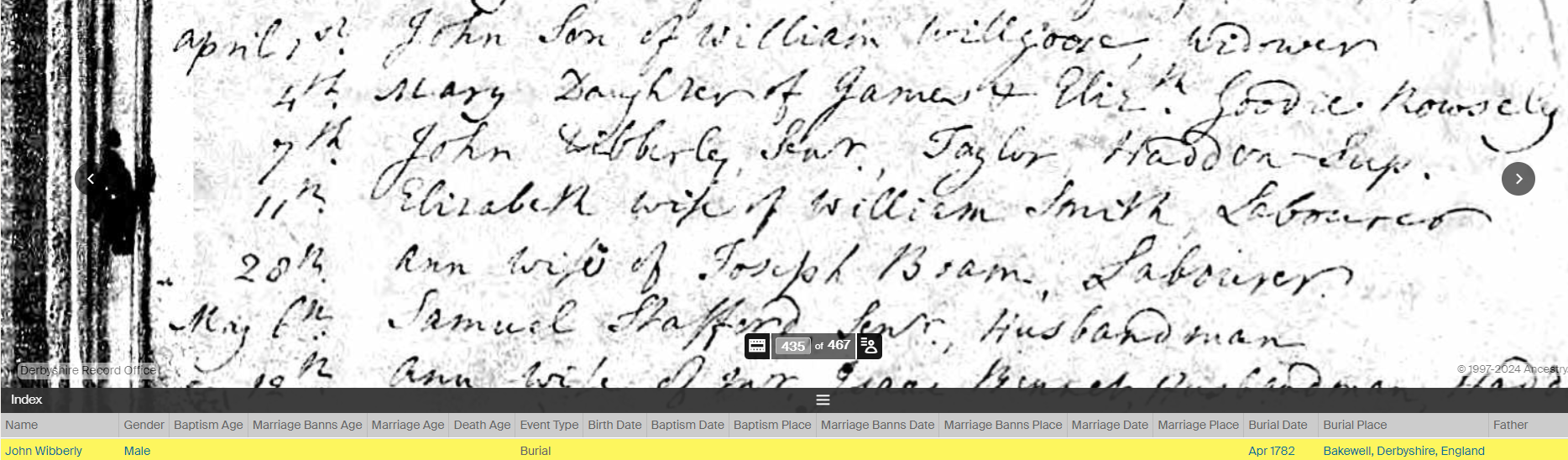
Wibberly and Newton of Over HaddonIt was noted in the Bakewell parish register in 1782 that John Wibberly 1705?-1782 (my 6x great grandfather) was “taylor of Haddon”.
James Marshall 1767-1848 (my 4x great grandfather), parish clerk of Elton, married Ann Newton 1770-1806 in Elton in 1792. In the Bakewell parish register, Ann was baptised on the 2rd of June 1770, her parents George and Dorothy Newton of Upper Haddon. The Bakewell registers at the time covered several smaller villages in the area, although what is currently known as Over Haddon was referred to as Upper Haddon in the earlier entries.
Newton:
George Newton 1728-1798 was the son of George Newton 1706- of Upper Haddon and Jane Sailes, who were married in 1727, both of Upper Haddon.
George Newton born in 1706 was the son of George Newton 1676- and Anne Carr, who were married in 1701, both of Upper Haddon.
George Newton born in 1676 was the son of John Newton 1647- and Alice who were married in 1673 in Bakewell. There is no last name for Alice on the marriage transcription.
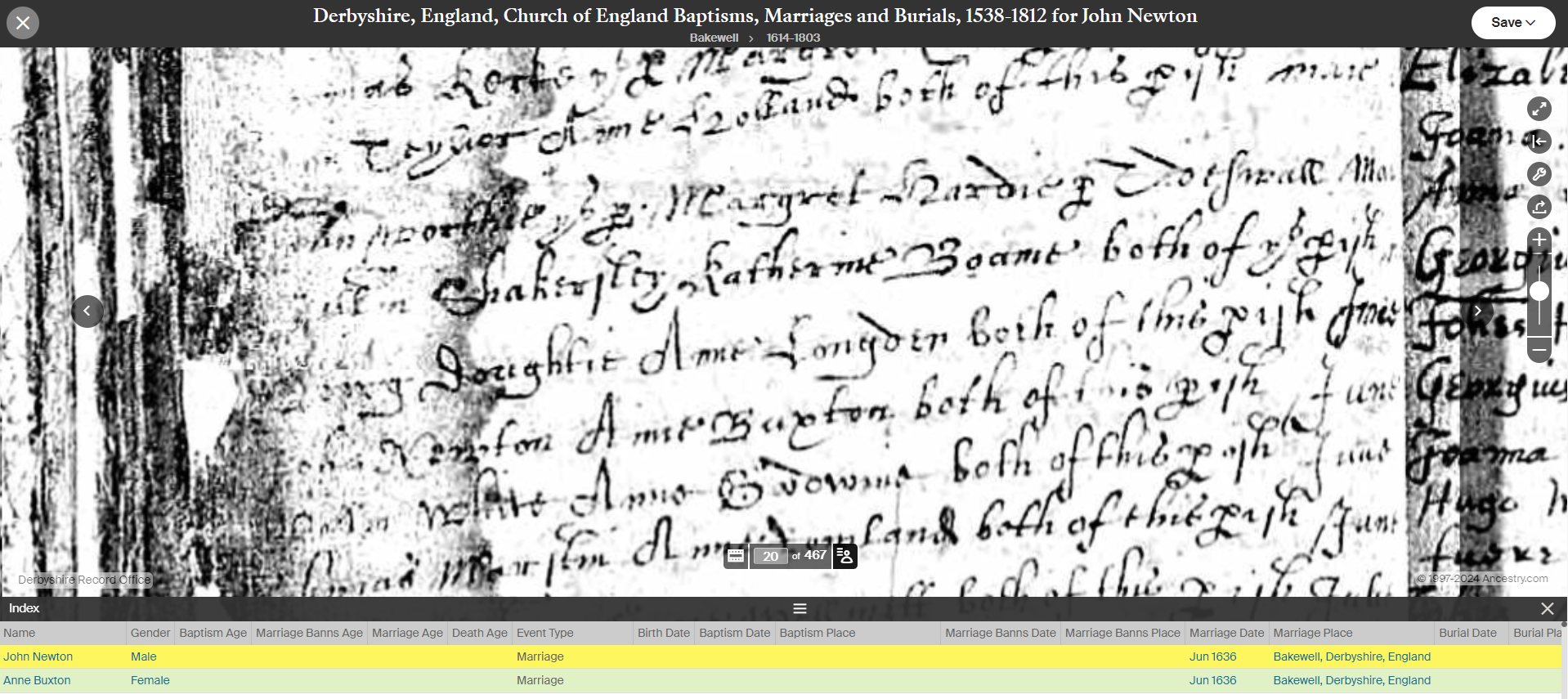
John Newton born in 1647 (my 9x great grandfather) was the son of John Newton and Anne Buxton (my 10x great grandparents), who were married in Bakewell in 1636.
1636 marriage of John Newton and Anne Buxton:
Wibberly
Dorothy Wibberly 1731-1827 married George Newton in 1755 in Bakewell. The entry in the parish registers says that they were both of Over Haddon. Dorothy was baptised in Bakewell on the 25th June 1731, her parents were John and Mary of Over Haddon.

John Wibberly and Mary his wife baptised nine children in Bakewell between 1730 and 1750, and on all of the entries in the parish registers it is stated that they were from Over Haddon. A parish register entry for John and Mary’s marriage has not yet been found, but a marriage in Beeley, a tiny nearby village, in 1728 to Mary Mellor looks likely.
John Wibberly died in Over Haddon in 1782. The entry in the Bakewell parish register notes that he was “taylor of Haddon”.
The tiny village of Over Haddon was historically associated with Haddon Hall.
A baptism for John Wibberly has not yet been found, however, there were Wibersley’s in the Bakewell registers from the early 1600s:
1619 Joyce Wibersley married Raphe Cowper.
1621 Jocosa Wibersley married Radulphus Cowper
1623 Agnes Wibersley married Richard Palfreyman
1635 Cisley Wibberlsy married ? Mr. Mason
1653 John Wibbersly married Grace DaykenHaddon Hall
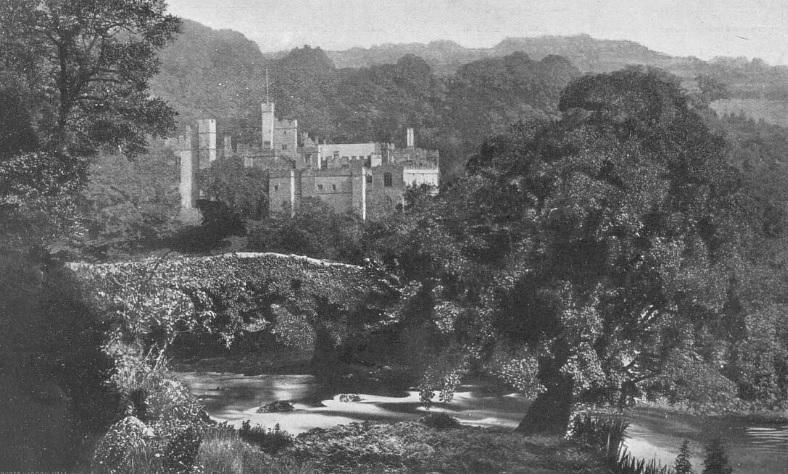
Sir Richard Vernon (c. 1390 – 1451) of Haddon Hall.
Vernon’s property was widespread and varied. From his parents he inherited the manors of Marple and Wibersley, in Cheshire. Perhaps the Over Haddon Wibersley’s origins were from Sir Richard Vernon’s property in Cheshire. There is, however, a medieval wayside cross called Whibbersley Cross situated on Leash Fen in the East Moors of the Derbyshire Peak District. It may have served as a boundary cross marking the estate of Beauchief Abbey. Wayside crosses such as this mostly date from the 9th to 15th centuries.Found in both The History and Antiquities of Haddon Hall by S Raynor, 1836, and the 1663 household accounts published by Lysons, Haddon Hall had 140 domestic staff.
In the book Haddon Hall, an Illustrated Guide, 1871, an example from the 1663 Christmas accounts:
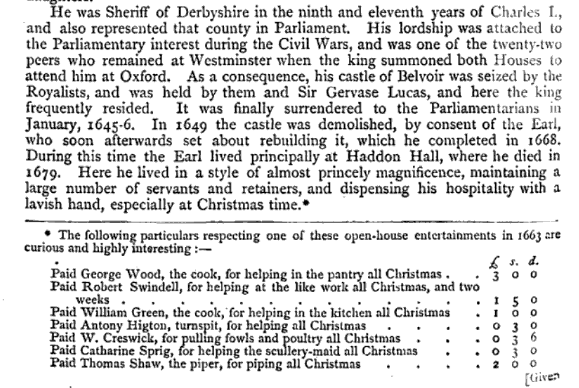
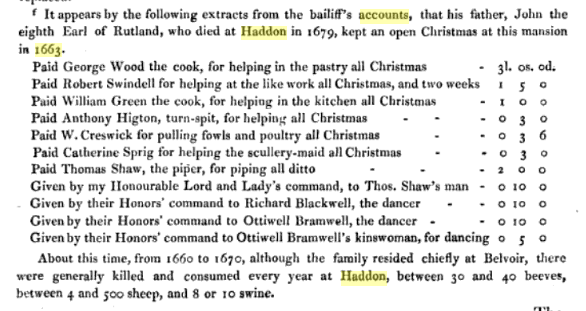
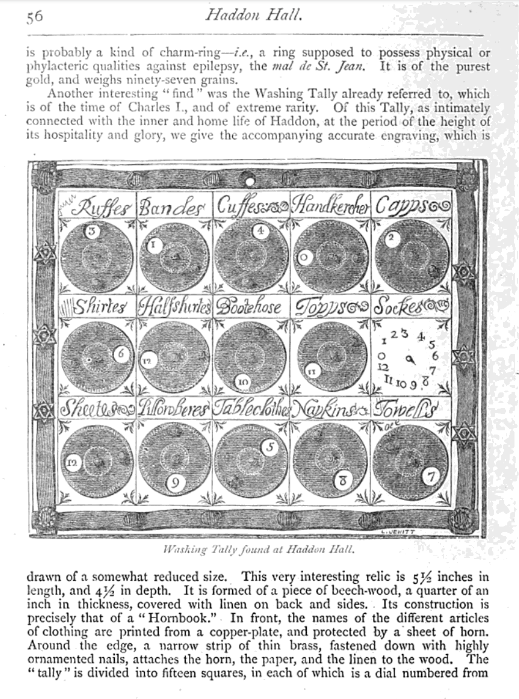
Also in this book, an early 1600s “washing tally” from Haddon Hall:
Over Haddon
Martha Taylor, “the fasting damsel”, was born in Over Haddon in 1649. She didn’t eat for almost two years before her death in 1684. One of the Quakers associated with the Marshall Quakers of Elton, John Gratton, visited the fasting damsel while he was living at Monyash, and occasionally “went two miles to see a woman at Over Haddon who pretended to live without meat.” from The Reliquary, 1861.
August 28, 2024 at 6:26 am #7548In reply to: The Elusive Samuel Housley and Other Family Stories
Elton Marshall’s
Early Quaker Emigrants to USA.
The earliest Marshall in my tree is Charles Marshall (my 5x great grandfather), Overseer of the Poor and Churchwarden of Elton. His 1819 gravestone in Elton says he was 77 years old when he died, indicating a birth in 1742, however no baptism can be found.
According to the Derbyshire records office, Elton was a chapelry of Youlgreave until 1866. The Youlgreave registers date back to the mid 1500s, and there are many Marshalls in the registers from 1559 onwards. The Elton registers however are incomplete due to fire damage.
While doing a google books search for Marshall’s of Elton, I found many American family history books mentioning Abraham Marshall of Gratton born in 1667, who became a Quaker aged 16, and emigrated to Pennsylvania USA in 1700. Some of these books say that Abraham’s parents were Humphrey Marshall and his wife Hannah Turner. (Gratton is a tiny village next to Elton, also in Youlgreave parish.)
Abraham’s son born in USA was also named Humphrey. He was a well known botanist.
Abraham’s cousin John Marshall, also a Quaker, emigrated from Elton to USA in 1687, according to these books.
(There are a number of books on Colonial Families in Pennsylvania that repeat each other so impossible to cite the original source)
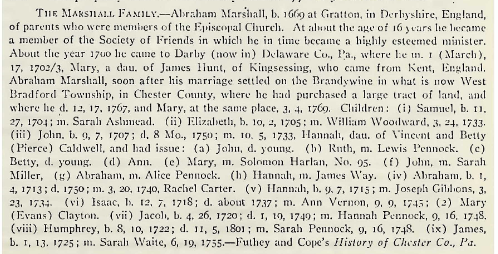
In the Youlgreave parish registers I found a baptism in 1667 for Humphrey Marshall son of Humphrey and Hannah. I didn’t find a baptism for Abraham, but it looks as though it could be correct. Abraham had a son he named Humphrey. But did it just look logical to whoever wrote the books, or do they know for sure? Did the famous botanist Humphrey Marshall have his own family records? The books don’t say where they got this information.
An earlier Humphrey Marshall was baptised in Youlgreave in 1559, his father Edmund. And in 1591 another Humphrey Marshall was baptised, his father George.
But can we connect these Marshall’s to ours? We do have an Abraham Marshall, grandson of Charles, born in 1792. The name isn’t all that common, so may indicate a family connection. The villages of Elton, Gratton and Youlgreave are all very small and it would seem very likely that the Marshall’s who went the USA are related to ours, if not brothers, then probably cousins.
Derbyshire Quakers
In “Derbyshire Quakers 1650-1761” by Helen Forde:
“… Friends lived predominantly in the northern half of the country during this first century of existence. Numbers may have been reduced by emigration to America and migration to other parts of the country but were never high and declined in the early eighteenth century. Predominantly a middle to lower class group economically, Derbyshire Friends numbered very few wealthy members. Many were yeoman farmers or wholesalers and it was these groups who dominated the business meetings having time to devote themselves to the Society. Only John Gratton of Monyash combined an outstanding ministry together with an organising ability which brought him recognition amongst London Friends as well as locally. Derbyshire Friends enjoyed comparatively harmonious relations with civil and Anglican authorities, though prior to the Toleration Act of 1639 the priests were their worst persecutors…..”
Also mentioned in this book: There were monthly meetings in Elton, as well as a number of other nearby places.
John Marshall of Elton 1682/3 appears in a list of Quaker emigrants from Derbyshire.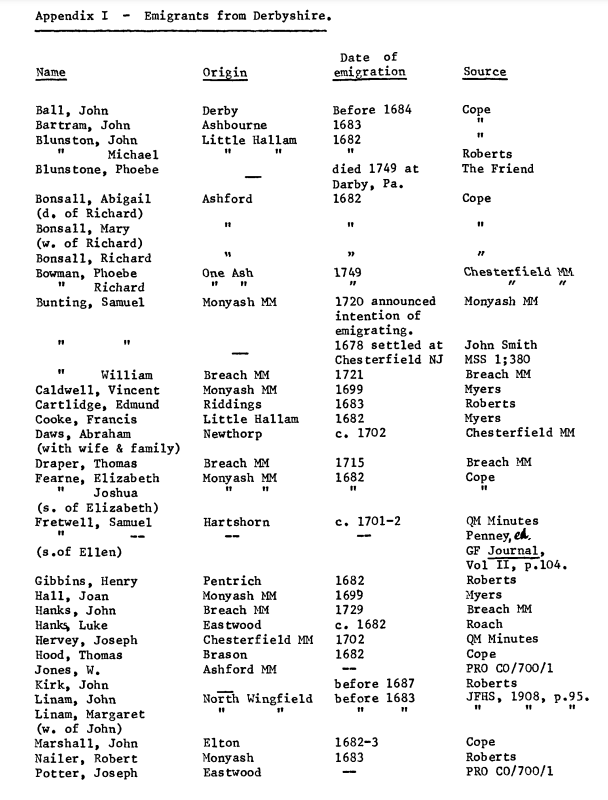
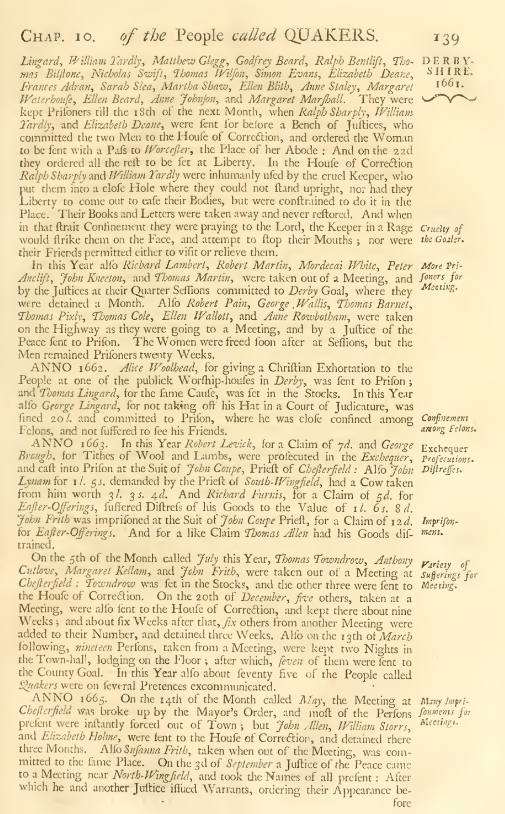
The following image is a page from the 1753 book on the sufferings of Quakers by Joseph Besse as an example of some of the persecutions of Quakers in Derbyshire in the 1600s:
A collection of the sufferings of the people called Quakers, for the testimony of a good conscience from the time of their being first distinguished by that name in the year 1650 to the time of the act commonly called the Act of toleration granted to Protestant dissenters in the first year of the reign of King William the Third and Queen Mary in the year 1689 (Volume 1)
Besse, Joseph. 1753Note the names Margaret Marshall and Anne Staley. This book would appear to contradict Helen Forde’s statement above about the harmonious relations with Anglican authority.
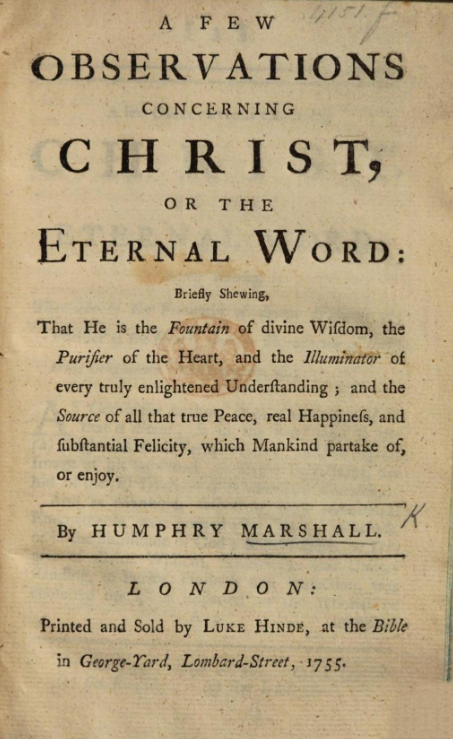
The Botanist
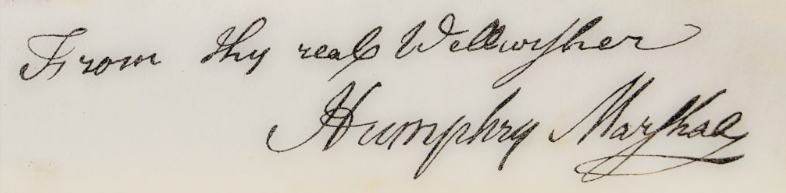
Humphry Marshall 1722-1801 was born in Marshallton, Pennsylvania, the son of the immigrant from Elton, Abraham Marshall. He was the cousin of botanists John Bartram and William Bartram. Like many early American botanists, he was a Quaker. He wrote his first book, A Few Observations Concerning Christ, in 1755.
In 1785, Marshall published Arbustrum Americanum: The American Grove, an Alphabetical Catalogue of Forest Trees and Shrubs, Natives of the American United States (Philadelphia).
Marshall has been called the “Father of American Dendrology”.
A genus of plants, Marshallia, was named in honor of Humphry Marshall and his nephew Moses Marshall, also a botanist.
In 1848 the Borough of West Chester established the Marshall Square Park in his honor. Marshall Square Park is four miles east of Marshallton.
via Wikipedia.
From The History of Chester County Pennsylvania, 1881, by J Smith Futhey and Gilbert Cope:
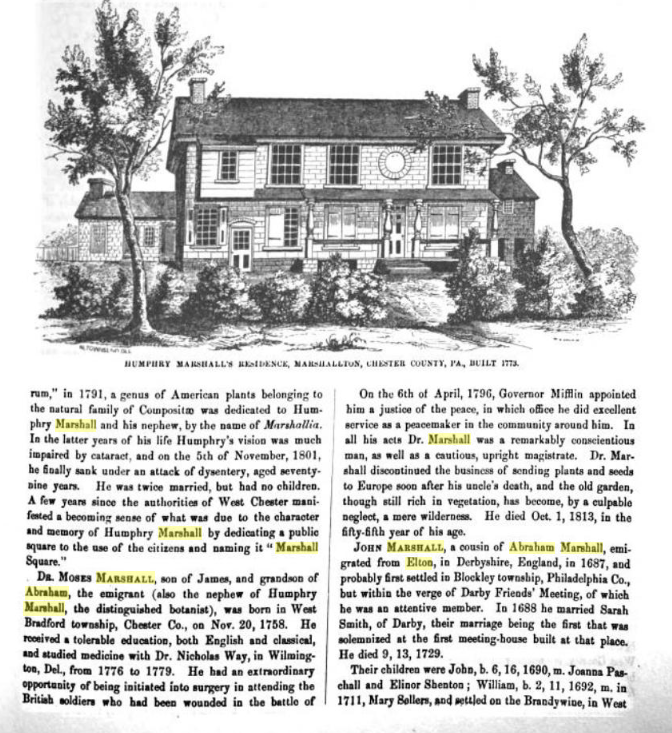
From The Chester Country History Center:
“Immediately on the Receipt of your Letter, I ordered a Reflecting Telescope for you which was made accordingly. Dr. Fothergill had since desired me to add a Microscope and Thermometer, and will
pay for the whole.’– Benjamin Franklin to Humphry, March 18, 1770
“In his lifetime, Humphry Marshall made his living as a stonemason, farmer, and miller, but eventually became known for his contributions to astronomy, meteorology, agriculture, and the natural sciences.
In 1773, Marshall built a stone house with a hothouse, a botanical laboratory, and an observatory for astronomical studies. He established an arboretum of native trees on the property and the second botanical garden in the nation (John Bartram, his cousin, had the first). From his home base, Humphry expanded his botanical plant exchange business and increased his overseas contacts. With the help of men like Benjamin Franklin and the English botanist Dr. John Fothergill, they eventually included German, Dutch, Swedish, and Irish plant collectors and scientists. Franklin, then living in London, introduced Marshall’s writings to the Royal Society in London and both men encouraged Marshall’s astronomical and botanical studies by supplying him with books and instruments including the latest telescope and microscope.
Marshall’s scientific work earned him honorary memberships to the American Philosophical Society and the Philadelphia Society for Promoting Agriculture, where he shared his ground-breaking ideas on scientific farming methods. In the years before the American Revolution, Marshall’s correspondence was based on his extensive plant and seed exchanges, which led to further studies and publications. In 1785, he authored his magnum opus, Arbustum Americanum: The American Grove. It is a catalog of American trees and shrubs that followed the Linnaean system of plant classification and was the first publication of its kind.”
 August 21, 2024 at 12:27 pm #7546
In reply to: The Elusive Samuel Housley and Other Family Stories
The Potters of Darley Bridge
Rebecca Knowles 1745-1823, my 5x great grandmother, married Charles Marshall 1742-1819, the churchwarden of Elton, in Darley, Derbyshire, in 1767. Rebecca was born in Darley in 1745, the youngest child of Roger Knowles 1695-1784, and Martha Potter 1702?-1772.
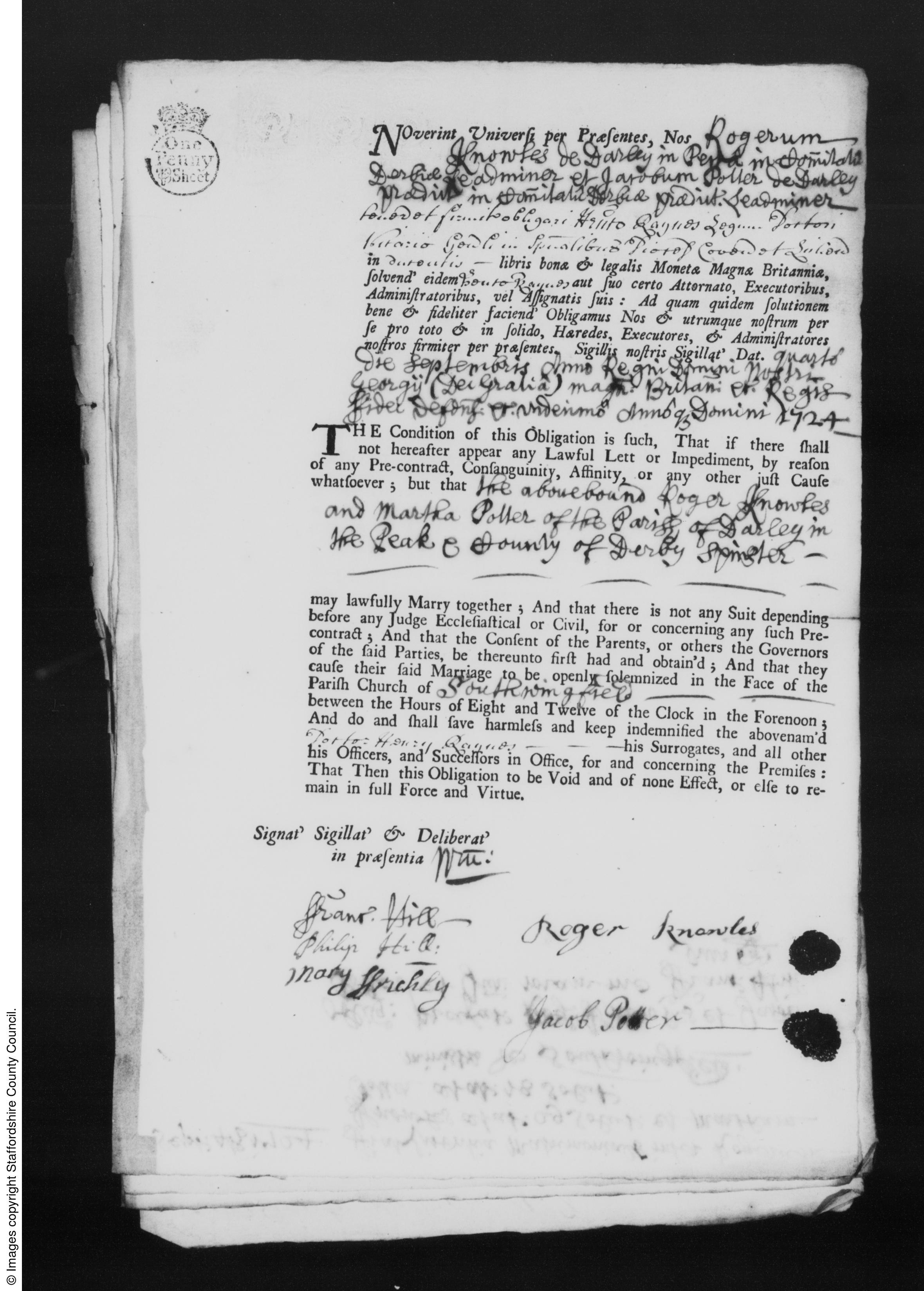
Although Roger and Martha were both from Darley, they were married in South Wingfield by licence in 1724. Roger’s occupation on the marriage licence was lead miner. (Lead miners in Derbyshire at that time usually mined their own land.) Jacob Potter signed the licence so I assumed that Jacob Potter was her father.
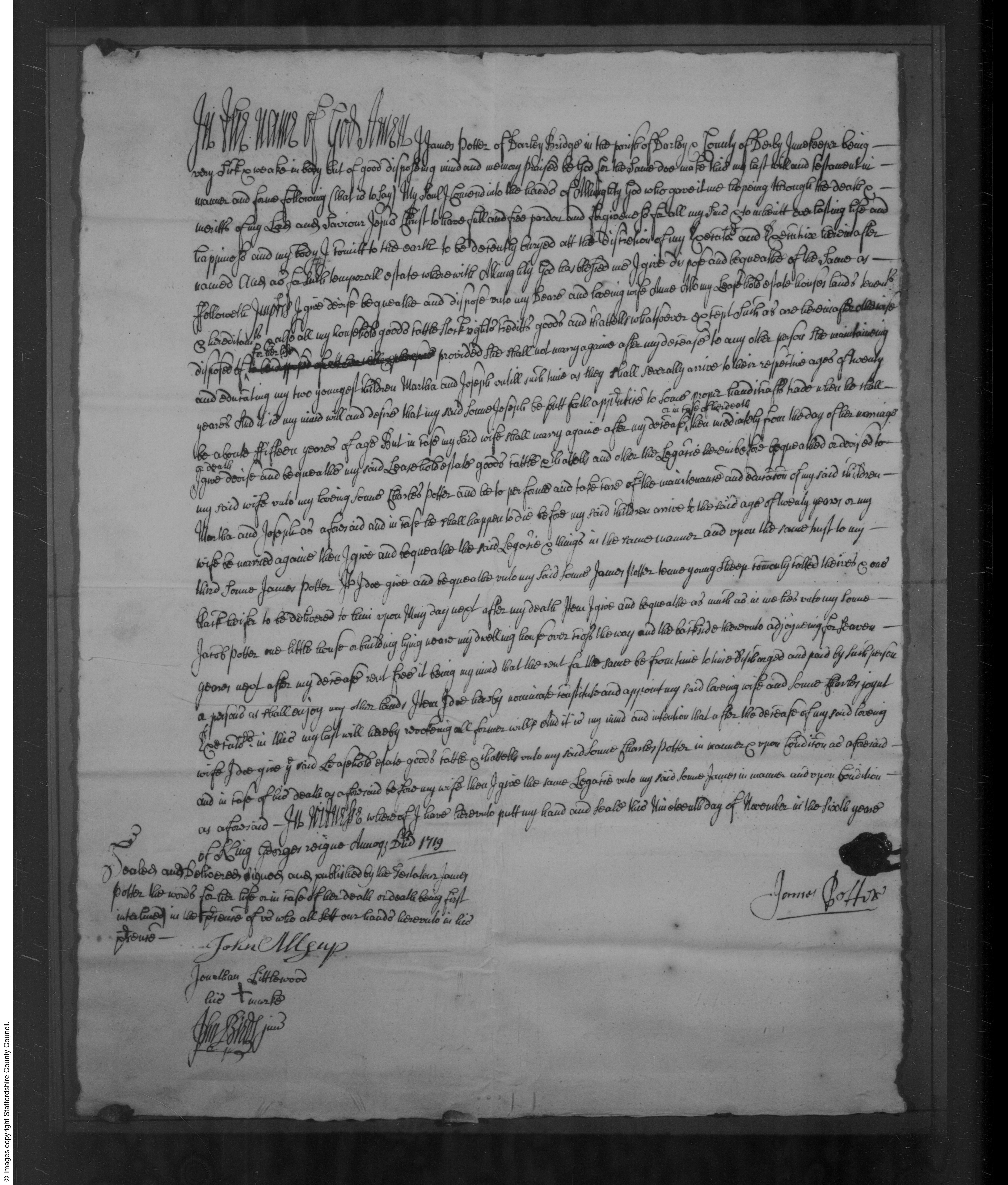
I then found the will of Jacobi Potter who died in 1719. However, he signed the will James Potter. Jacobi is latin for James. James Potter mentioned his daughter Martha in his will “when she comes of age”. Martha was the youngest child of James. James also mentioned in his will son James AND son Jacob, so there were both James’s and Jacob’s in the family, although at times in the documents James is written as Jacobi!
Jacob Potter who signed Martha’s marriage licence was her brother Jacob.
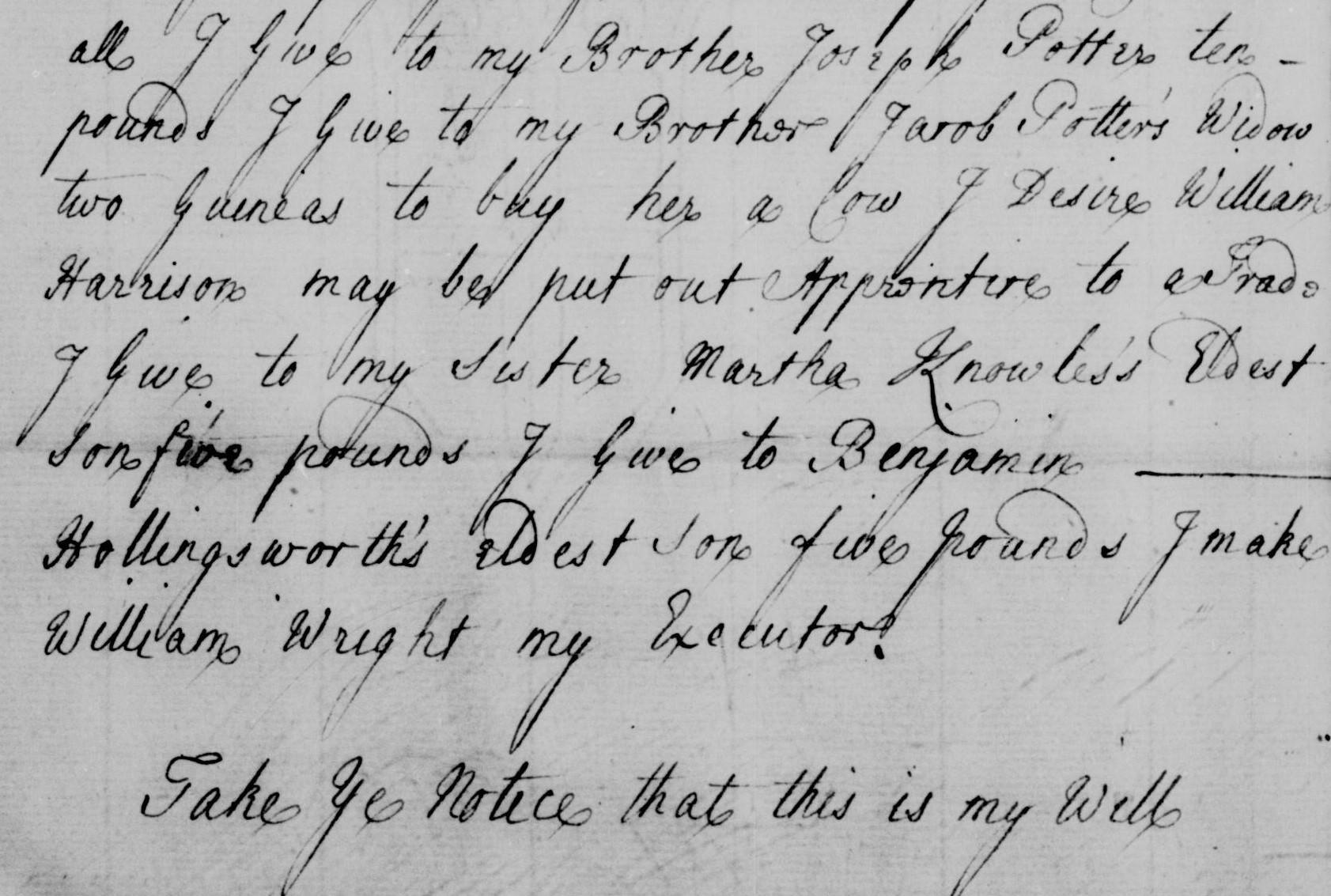
Martha’s brother James mentioned his sister Martha Knowles in his 1739 will, as well as his brother Jacob and his brother Joseph.
Martha’s father James Potter mentions his wife Ann in his 1719 will. James Potter married Ann Waterhurst in 1690 in Wirksworth, some seven miles from Darley. James occupation was innkeeper at Darley Bridge.
I did a search for Waterhurst (there was only a transcription available for that marriage, not a microfilm) and found no Waterhursts anywhere, but I did find many Warhursts in Derbyshire. In the older records, Warhust is also spelled Wearhurst and in a number of other ways. A Martha Warhurst died in Peak Forest, Derbyshire, in 1681. Her husbands name was missing from the deteriorated register pages. This may or may not be Martha Potter’s grandmother: the records for the 1600s are scanty if they exist at all, and often there are bits missing and illegible entries.
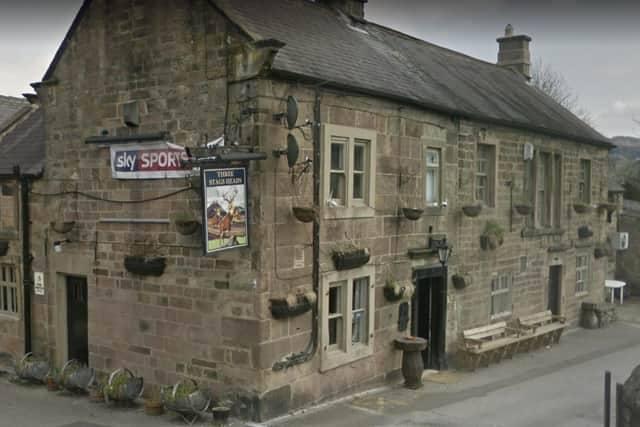
The only inn at Darley Bridge was The Three Stags Heads, by the bridge. It is now a listed building, and was on a medieval packhorse route. The current building was built in 1736, however there is a late 17th century section at rear of the cross wing. The Three Stags Heads was up for sale for £430,000 in 2022, the closure a result of the covid pandemic.
Another listed building in Darley Bridge is Potters Cottage, with a plaque above the door that says “Jonathan and Alice Potter 1763”. Jonathan Potter 1725-1785 was James grandson, the son of his son Charles Potter 1691-1752. His son Charles was also an innkeeper at Darley Bridge: James left the majority of his property to his son Charles.
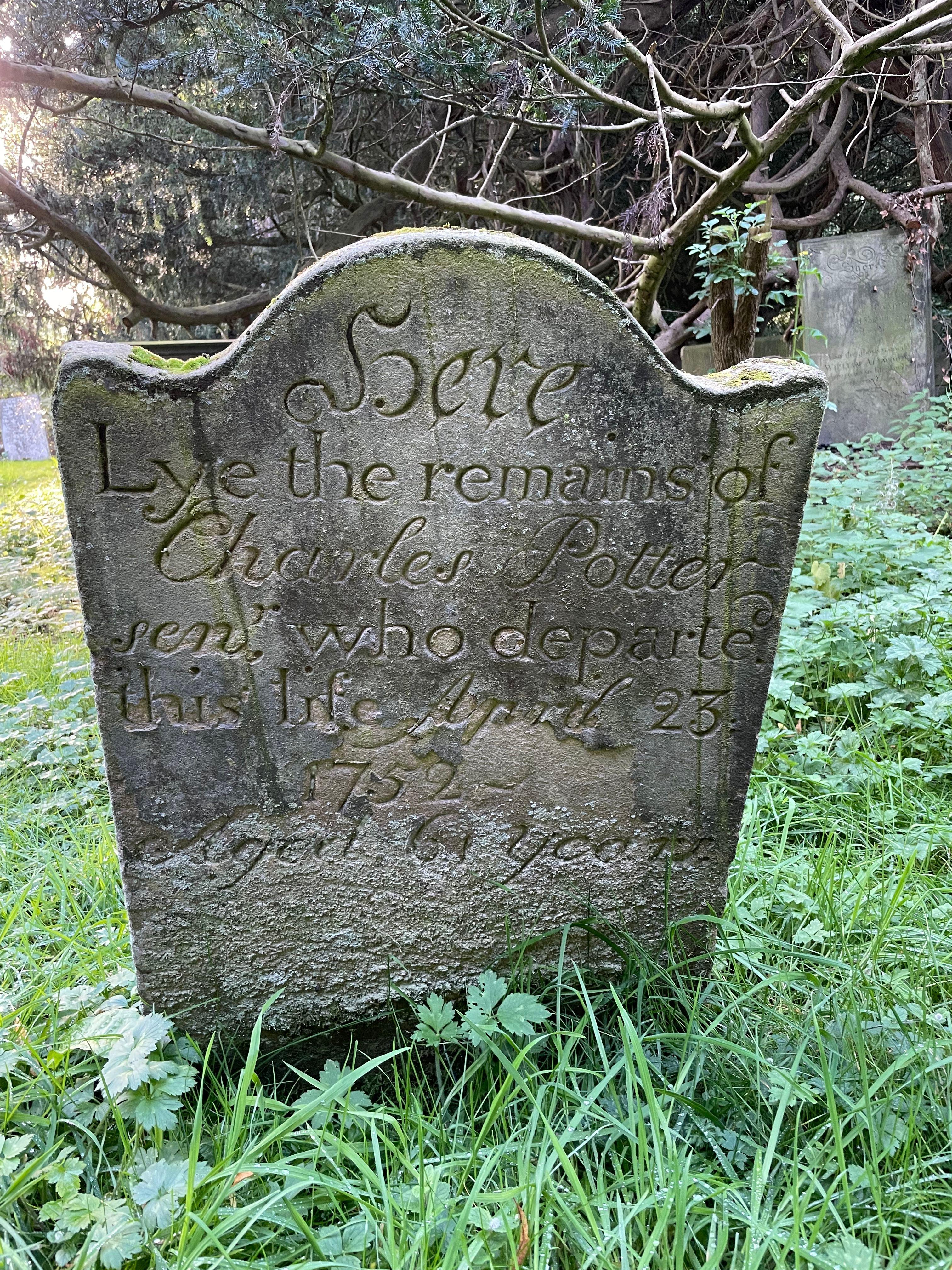
Charles is the only child of James Potter that we know the approximate date of birth, because his age was on his grave stone. I haven’t found any of their baptisms, but did note that many Potters were baptised in non conformist registers in Chesterfield.
Potters Cottage
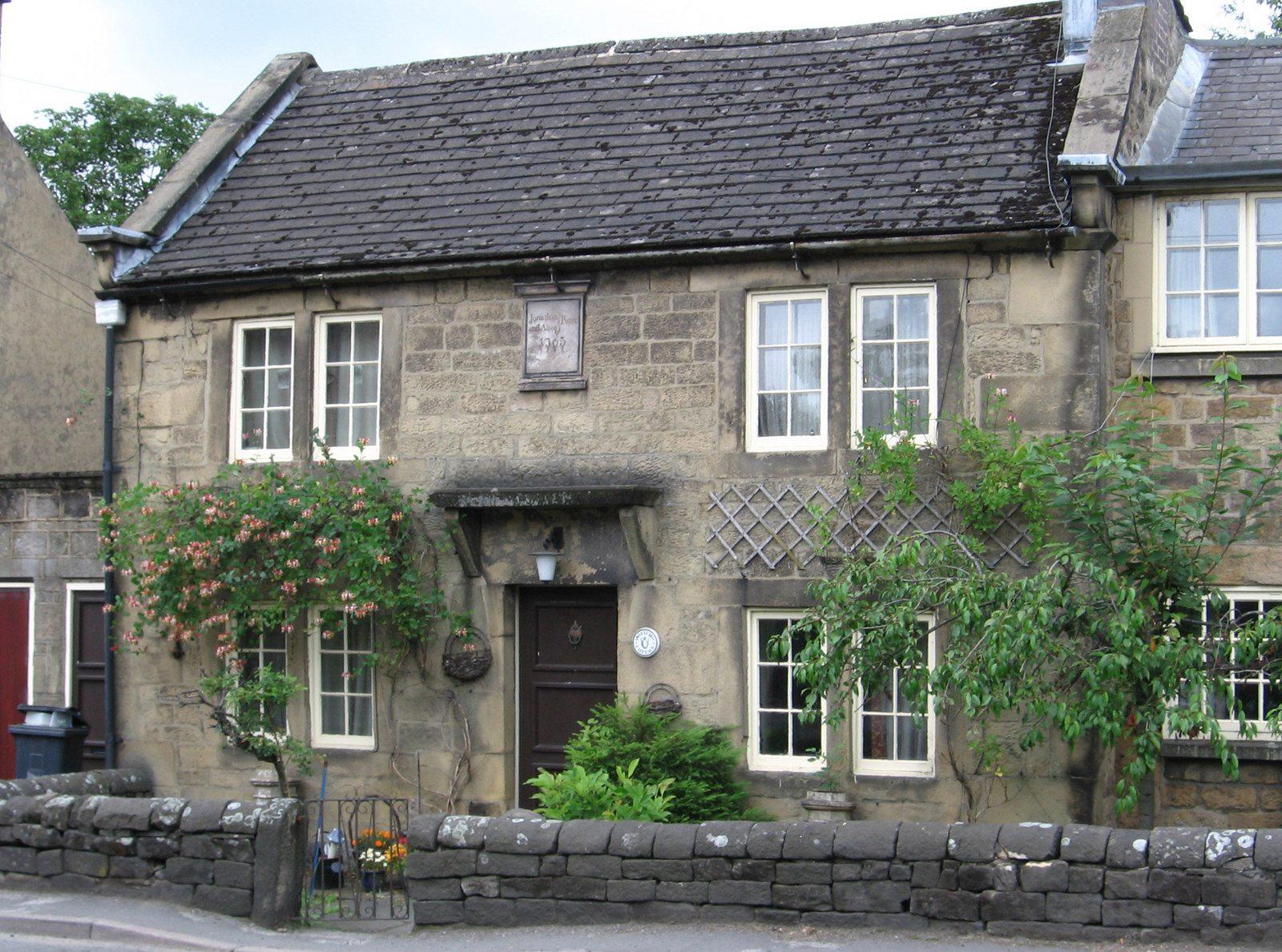
Jonathan Potter of Potters Cottage married Alice Beeley in 1748.
“Darley Bridge was an important packhorse route across the River Derwent. There was a packhorse route from here up to Beeley Moor via Darley Dale. A reference to this bridge appears in 1504… Not far to the north of the bridge at Darley Dale is Church Lane; in 1635 it was known as Ghost Lane after a Scottish pedlar was murdered there. Pedlars tended to be called Scottish only because they sold cheap Scottish linen.”
via Derbyshire Heritage website.
According to Wikipedia, the bridge dates back to the 15th century.
August 16, 2024 at 2:56 pm #7544In reply to: The Elusive Samuel Housley and Other Family Stories
Youlgreave
The Frost Family and The Big Snow
The Youlgreave parish registers are said to be the most complete and interesting in the country. Starting in 1558, they are still largely intact today.
“The future historian of this parish will find a vast stock of material ready to hand, and if such a work was ever accomplished it would once more be seen how the history of even a remote village is but the history of the nation in little; how national victories were announced on the church bells, and national disasters by the proclamation of a form of prayer…”
J. Charles Cox, Notes on the Churches of Derbyshire, 1877.
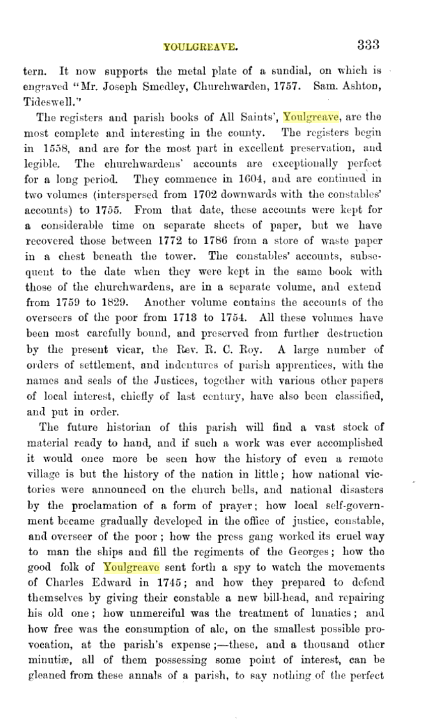
Although the Youlgreave parish registers are available online on microfilm, just the baptisms, marriages and burials are provided on the genealogy websites. However, I found some excerpts from the churchwardens accounts in a couple of old books, The Reliquary 1864, and Notes on Derbyshire Churches 1877.
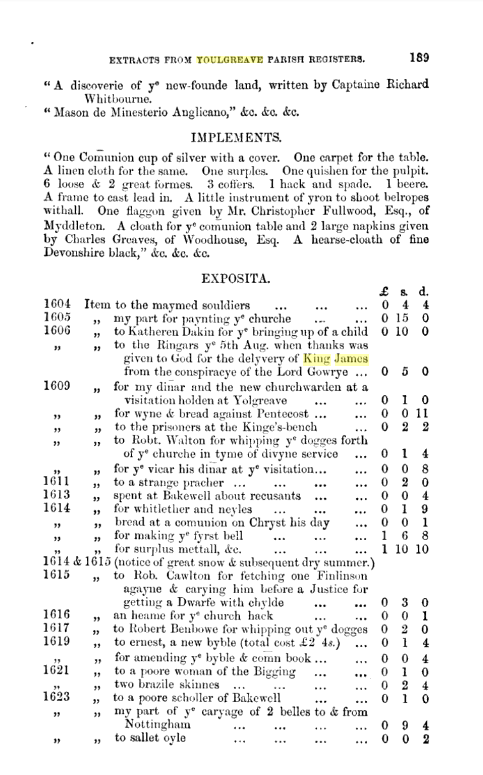
Hannah Keeling, my 4x great grandmother, was born in Youlgreave, Derbyshire, in 1767. In 1791 she married Edward Lees of Hartington, Derbyshire, a village seven and a half miles south west of Youlgreave. Edward and Hannah’s daughter Sarah Lees, born in Hartington in 1808, married Francis Featherstone in 1835. The Featherstone’s were farmers. Their daughter Emma Featherstone married John Marshall from Elton. Elton is just three miles from Youlgreave, and there are a great many Marshall’s in the Youlgreave parish registers, some no doubt distantly related to ours.
Hannah Keeling’s parents were John Keeling 1734-1823, and Ellen Frost 1739-1805, both of Youlgreave.
On the burial entry in the parish registers in Youlgreave in 1823, John Keeling was 88 years old when he died, and was the “late parish clerk”, indicating that my 5x great grandfather played a part in compiling the “best parish registers in the country”. In 1762 John’s father in law John Frost died intestate, and John Keeling, cordwainer, co signed the documents with his mother in law Ann. John Keeling was a shoe maker and a parish clerk.
John Keeling’s father was Thomas Keeling, baptised on the 9th of March 1709 in Youlgreave and his parents were John Keeling and Ann Ashmore. John and Ann were married on the 6th April 1708. Some of the transcriptions have Thomas baptised in March 1708, which would be a month before his parents married. However, this was before the Julian calendar was replaced by the Gregorian calendar, and prior to 1752 the new year started on the 25th of March, therefore the 9th of March 1708 was eleven months after the 6th April 1708.
Thomas Keeling married Dorothy, which we know from the baptism of John Keeling in 1734, but I have not been able to find their marriage recorded. Until I can find my 6x great grandmother Dorothy’s maiden name, I am unable to trace her family further back.
Unfortunately I haven’t found a baptism for Thomas’s father John Keeling, despite that there are Keelings in the Youlgrave registers in the early 1600s, possibly it is one of the few illegible entries in these registers.
The Frosts of Youlgreave
Ellen Frost’s father was John Frost, born in Youlgreave in 1707. John married Ann Staley of Elton in 1733 in Youlgreave.
(Note that this part of the family tree is the Marshall side, but we also have Staley’s in Elton on the Warren side. Our branch of the Elton Staley’s moved to Stapenhill in the mid 1700s. Robert Staley, born 1711 in Elton, died in Stapenhill in 1795. There are many Staley’s in the Youlgreave parish registers, going back to the late 1500s.)
John Frost (my 6x great grandfather), miner, died intestate in 1762 in Youlgreave. Miner in this case no doubt means a lead miner, mining his own land (as John Marshall’s father John was in Elton. On the 1851 census John Marshall senior was mining 9 acres). Ann Frost, as the widow and relict of the said deceased John Frost, claimed the right of administration of his estate. Ann Frost (nee Staley) signed her own name, somewhat unusual for a woman to be able to write in 1762, as well as her son in law John Keeling.
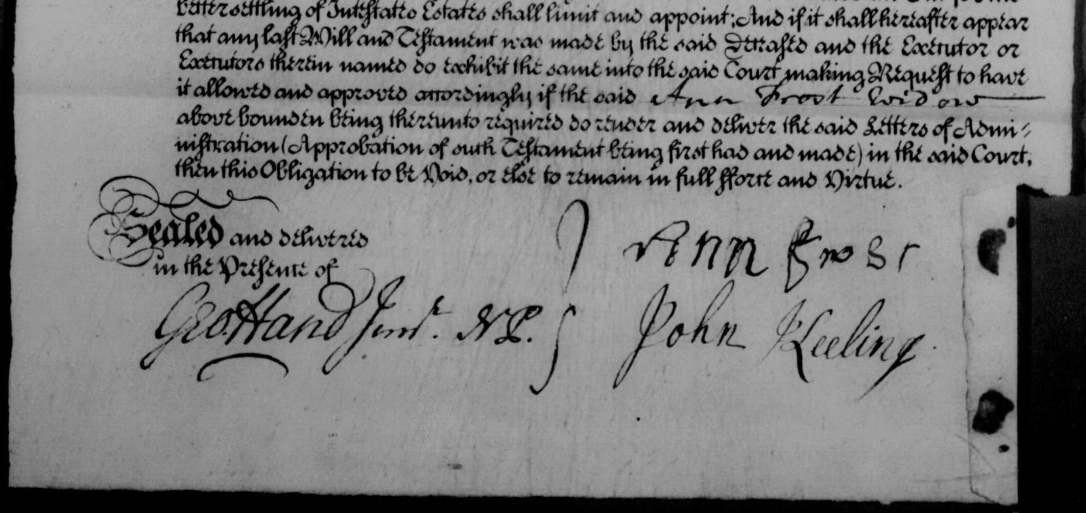
John’s parents were David Frost and Ann. David was baptised in 1665 in Youlgreave. Once again, I have not found a marriage for David and Ann so I am unable to continue further back with her family. Marriages were often held in the parish of the bride, and perhaps those neighbouring parish records from the 1600s haven’t survived.
David’s parents were William Frost and Ellen (or Ellin, or Helen, depending on how the parish clerk chose to spell it). Once again, their marriage hasn’t been found, but was probably in a neighbouring parish.
William Frost’s wife Ellen, my 8x great grandmother, died in Youlgreave in 1713. In her will she left her daughter Catherine £20. Catherine was born in 1665 and was apparently unmarried at the age of 48 in 1713. She named her son Isaac Frost (born in 1662) executor, and left him the remainder of her “goods, chattels and cattle”.
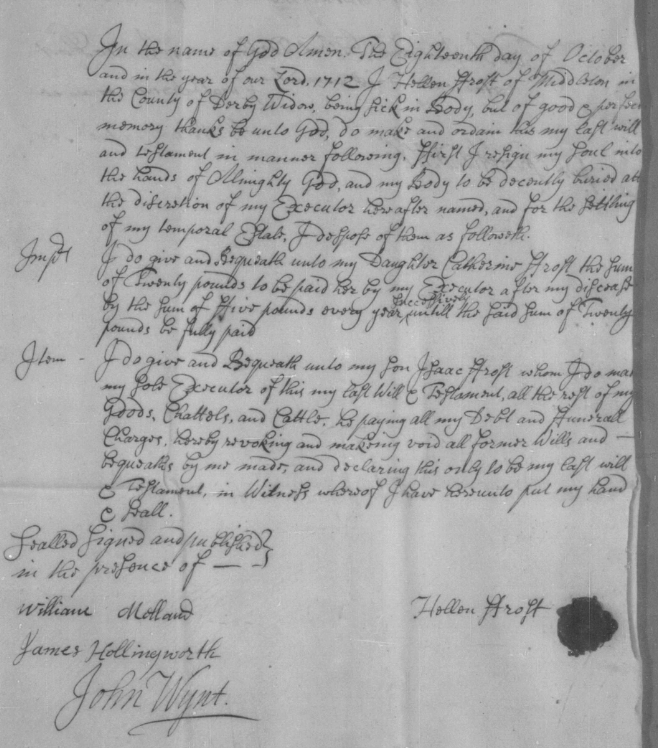
William Frost was baptised in Youlgreave in 1627, his parents were William Frost and Anne.
William Frost senior, husbandman, was probably born circa 1600, and died intestate in 1648 in Middleton, Youlgreave. His widow Anna was named in the document. On the compilation of the inventory of his goods, Thomas Garratt, Will Melland and A Kidiard are named.(Husbandman: The old word for a farmer below the rank of yeoman. A husbandman usually held his land by copyhold or leasehold tenure and may be regarded as the ‘average farmer in his locality’. The words ‘yeoman’ and ‘husbandman’ were gradually replaced in the later 18th and 19th centuries by ‘farmer’.)
Unable to find a baptism for William Frost born circa 1600, I read through all the pages of the Youlgreave parish registers from 1558 to 1610. Despite the good condition of these registers, there are a number of illegible entries. There were three Frost families baptising children during this timeframe and one of these is likely to be Willliam’s.
Baptisms:
1581 Eliz Frost, father Michael.
1582 Francis f Michael. (must have died in infancy)
1582 Margaret f William.
1585 Francis f Michael.
1586 John f Nicholas.
1588 Barbara f Michael.
1590 Francis f Nicholas.
1591 Joane f Michael.
1594 John f Michael.
1598 George f Michael.
1600 Fredericke (female!) f William.Marriages in Youlgreave which could be William’s parents:
1579 Michael Frost Eliz Staley
1587 Edward Frost Katherine Hall
1600 Nicholas Frost Katherine Hardy.
1606 John Frost Eliz Hanson.Michael Frost of Youlgreave is mentioned on the Derbyshire Muster Rolls in 1585.
(Muster records: 1522-1649. The militia muster rolls listed all those liable for military service.)
Frideswide:
A burial is recorded in 1584 for Frideswide Frost (female) father Michael. As the father is named, this indicates that Frideswide was a child.
(Frithuswith, commonly Frideswide c. 650 – 19 October 727), was an English princess and abbess. She is credited as the foundress of a monastery later incorporated into Christ Church, Oxford. She was the daughter of a sub-king of a Merica named Dida of Eynsham whose lands occupied western Oxfordshire and the upper reaches of the River Thames.)
An unusual name, and certainly very different from the usual names of the Frost siblings. As I did not find a baptism for her, I wondered if perhaps she died too soon for a baptism and was given a saints name, in the hope that it would help in the afterlife, given the beliefs of the times. Or perhaps it wasn’t an unusual name at the time in Youlgreave. A Fridesweda Gilbert was buried in Youlgreave in 1604, the spinster daughter of Francis Gilbert. There is a small brass effigy in the church, underneath is written “Frideswide Gilbert to the grave, Hath resigned her earthly part…”
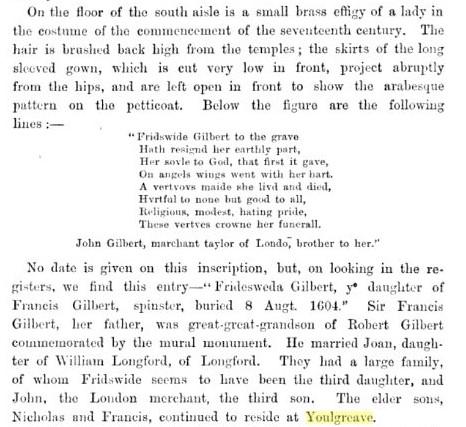
J. Charles Cox, Notes on the Churches of Derbyshire, 1877.
King James
A parish register entry in 1603:
“1603 King James of Skottland was proclaimed kinge of England, France and Ireland at Bakewell upon Monday being the 29th of March 1603.” (March 1603 would be 1604, because of the Julian calendar in use at the time.)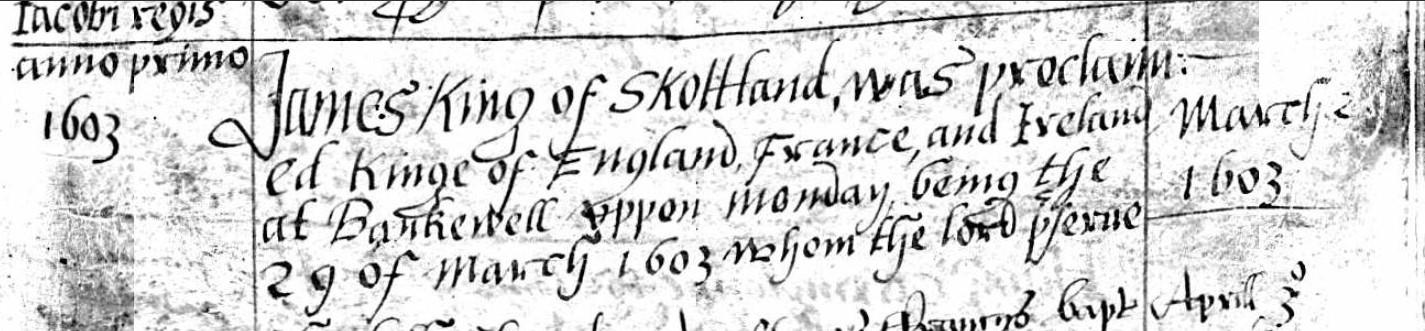
The Big Snow
“This year 1614/5 January 16th began the greatest snow whichever fell uppon the earth within man’s memorye. It covered the earth fyve quarters deep uppon the playne. And for heaps or drifts of snow, they were very deep; so that passengers both horse or foot passed over yates, hedges and walles. ….The spring was so cold and so late that much cattel was in very great danger and some died….”
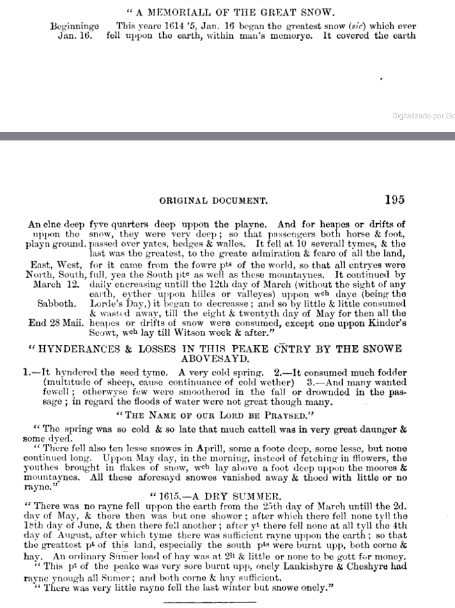
From the Youlgreave parish registers.
Our ancestor William Frost born circa 1600 would have been a teenager during the big snow.
June 7, 2024 at 3:49 am #7456In reply to: The Incense of the Quadrivium’s Mystiques
Sure I’ll help you, said Frella and Herma smiled gratefully.
“You’re a dear.” She reached into her pocket, pulled out a postcard and waved it at Frella. “It’s my eyes, I can’t make it out, all scrawled it is.”
Frella reached for the card. On the front was a silhouette drawing of a blackbird on a tree branch. She turned the card over and studied it closely. “It doesn’t make any sense,” she said at last. “I think it is written in code.” She held the card to her nose and a prickly, spicy smell just about overpowered her. It was achingly sad and sweet and nostalgic and a great lump formed in her chest.
Herma leaned over and patted her knee gently. “What is it?”
Frella gave herself a little shake. “Camphor,” she said at last. “Is there a camphor chest somewhere? I think it’s the key to this.”
April 11, 2024 at 7:52 am #7426In reply to: The Incense of the Quadrivium’s Mystiques
It was early morning, too early if you asked some. The fresh dew of Limerick’s morn clinged to the old stones of King John’s castle like a blanket woven from the very essence of dawn. The castle was not to open its doors before 3 hours, yet a most peculiar gathering was waiting at the bottom of the tower closest to the Shannon river.
“6am! Who would wake that early to take a bus?” asked Truella, as fresh as a newly bloomed poppy. She had no time to sleep after a night spent scattering truelles all around the city. “And where are the others?” she fumed, having forgotten about the resplendent undeniable presence she had vowed to embody during that day.
Frigella, leaning against a nearby lamppost, her arms crossed, rolled her eyes. “Jeezel? Malové? Do you even want an answer?” she asked with a wry smile. All busy in her dread of balls, she had forgotten she would have to travel with her friends to go there, and support their lamentations for an entire day before that flucksy party. Her attire was crisp and professional, yet one could glimpse the outlines of various protective talismans beneath the fabric.
Next to them, Eris was gazing at her smartphone, trying not to get the other’s mood affect her own, already at her lowest. A few days ago, she had suggested to Malové it would be more efficient if she could portal directly to Adare manor, yet Malové insisted Eris joined them in Limerick. They had to travel together or it would ruin the shared experience. Who on earth invented team building and group trips?
“Look who’s gracing us with her presence,” said Truella with a snort.
Jeezel was coming. Despite her slow pace and the early hour, she embodied the unexpected grace in a world of vagueness. Clumsy yet elegant, she juggled her belongings — a hatbox, a colorful scarf, and a rather disgruntled cat that had decided her shoulder was its throne. A trail of glitters seemed to follow her every move.
“And you’re wearing your SlowMeDown boots… that explains why you’re always dragging…”
“Oh! Look at us,” said Jeezel, “Four witches, each a unique note in the symphony of existence. Let our hearts beat in unison with the secrets of the universe as we’re getting ready for a magical experience,” she said with a graceful smile.
“Don’t bother, Truelle. You’re not at your best today. Jeez is dancing to a tune she only can hear,” said Frigella.
Seeing her joy was not infectious, Jeezel asked: “Where’s Malové?”
“Maybe she bought a pair of SlowMeDown boots after she saw yours…” snorted Truella.
Jeezel opened her mouth to retort when a loud and nasty gurgle took all the available place in the soundscape. An octobus, with magnificently engineered tentacles, rose from the depth of the Shannon, splashing icy water on the quatuor. Each tentacle, engineered to both awe and serve, extended with a grace that belied its monstrous size, caressing the cobblestones of the bridge with a tender curiosity that was both wild and calculated. The octobus, a pulsing mass of intelligence and charm, settled with a finality that spoke of journeys beginning and ending, of stories waiting to be told. Surrounded by steam, it waited in the silence.
Eris looked an instant at the beast before resuming her search on her phone. Frigella, her arms still crossed and leaning nonchalantly against the lamppost, raised an eyebrow. Those who knew her well could spot the slight widening of her eyes, a rare show of surprise.
“Who put you in charge of the transport again?” asked Truella in a low voice as if she feared to attract the attention of the creature.
“Ouch! I didn’t…”, started Jeezel, trying to unclaw the cat from her shoulders.
“I ordered the Octobus,” said Malové’s in a crisp voice.
Eris startled at the unexpected sound. She hadn’t heard their mentor coming.
“If you had read the memo I sent you last night, you wouldn’t be as surprised. But what did I expect?”
The doors opened with a sound like the release of a deep-sea diver’s breath.
“Get on and take a seat amongst your sisters and brothers witches. We have much to do today.”
With hesitation, the four witches embarked, not merely as travelers but as pioneers of an adventure that trenscended the mundane morning commute. As the octobus prepared to resume its voyage, to delve once again into the Shannon’s embrace and navigate the aqueous avenues of Limerick, the citizens of Limerick, those early risers and the fortunate few who bore witness to this spectacle, stood agape…
“Oh! stop it with your narration and your socials Jeez,” said Truella. “I need to catch up with slumber before we arrive.”
February 7, 2024 at 12:40 am #7356In reply to: The Incense of the Quadrivium’s Mystiques
“Would you be looking for me?”
Cedric jumped. Where on earth had she come from? It was the blond witch from the cafe, but what was she doing sneaking up behind him when he’d seen her rushing off down the street not a minute before! And yet here she was, smirking at him like butter wouldn’t melt!
He studied her. She wasn’t conventionally pretty he decided, with her thin, sharp features. And she had no meat on her bones. Cedric liked women who were soft and had a bit of something he could squeeze. And she was so … white … almost like one of those albinos … still, there was something he found strangely compelling about her.
She’s a witch, he reminded himself. “What on earth gave you the idea I was following you?” He twisted his mouth into an amused sneer, hoping it showed the contempt she surely deserved.
“You’re not then?” Her gaze was unswerving and Cedric had to look away, pretending to take a great interest in a black poodle peeing on a nearby lamp post. Cedric liked dogs and up until six months ago had a miniature schnauzer called Mitzy. Thinking of Mitzy, he felt the familiar little squeeze in his chest.
“I’m Frigella O’Green,” she said, still studying him intently.
Reluctantly he pulled his gaze back towards her. “Oh, ah … Cedric … just Cedric.” He’d nearly told her his surname which didn’t seem a good idea, all things considered. Out of habit, he raised his hand to take hers, then remembering, thrust it awkwardly in his jacket pocket.
“Well, just Cedric, if you’re not looking for me, I’ll be off … I’m in a bit of a hurry.” Then she smiled at him, properly this time, and Cedric wondered why he hadn’t thought she was pretty a moment ago. “Nice hat by the way, Cedric. Stylish.” She turned then and Cedric watched her stride down the street until she was no longer visible. Distractedly he brushed the wool tweed of his cap.
Frigella O’Green is a witch, Cedric, he told himself sternly.
February 5, 2024 at 8:08 pm #7350In reply to: The Incense of the Quadrivium’s Mystiques
Eris did portal to be in person for the last Ritual. After all, Smoke Testing for incense making was the reverse expectation of what it meant in programming. You plug in a new board and turn on the power. If you see smoke coming from the board, turn off the power. You don’t have to do any more testing. But for witches, it just meant success. This one however revealed itself to be so glorious, she would have regretted sorely if she’d missed it.
“Someone tried to jinx my blog with black magic emojis! Quick, give me a Nokia!” Jeezel sharp cry was the innocent trigger that dominoed the whole ceremony into mayhem. With her clumsy hand gestures, she inadvertently elbowed Frigella as she was carefully counting the last drops of the resin, which spilled over to the nearby Bunsen burner.
From there, the sweet symphony of disaster that unfolded in the sanctified chamber of the coven could have been put to a choral version of Tchaikovsky’s Overture 1812, with climactic volley of cannon fire, ringing chimes, and brass fanfare. Only with smoke as sound effects.
In the ensuing chaos of the Fourth Rite, everything became quickly shrouded in a thick, billowing smoke, an unintended byproduct of the smoke test gone wildly awry. Truella, in her attempts to salvage the ceremony, darted through the room, a scorched piece of fabric clutched in her hand—her delicate pashmina shawl that did more fanning than smothering and now more charcoal than its original vibrant hue. Her expression teetered between horror and disbelief as she lamented her once-prized possession, now reduced to ashes.
Jeezel, ever the optimist, quickly came back to her senses choosing to find humor if not opportunity amidst disaster. Like a true diva emerging from the smoke effects, she held up a singed twig adorned with the remains of decorative leaves and announced with a wide grin, “Behold, the perfect accessory for the Autumn Pageant!” Her voice was muffled by the smog, her figure obscured save for the intermittent glint of her eyes as she wove through the smoke, brandishing the charred twig like a parade marshal’s baton.
Meanwhile, Eris was caught in a frenetic ballet, attempting to corral the smoke with sweeps of her arms and ancient spells, as if the very air could be tamed by her whims. Her efforts, while noble, only served to create an odd wind pattern that whirled papers and loose items into a miniature cyclone of confusion.
At the epicenter of the pandemonium stood Malové, the High Witch, her composure as livid as the flames that had sparked the debacle. Her normally unflappable demeanor crumbled as she surveyed the disarray, her voice rising above the cacophony, “Witches, have you mistaken this sacred rite for a comedy of errors?” Her words cut through the haze, sharp and commanding.
Frigella, caught off-guard by the commotion, scrambled to quell the smoky serpent that had coiled throughout the room. With a flick of her wand, she directed gusts of fresh air towards the smoke, but in her haste, the spell went askew, further fanning the chaos as parchments and ritual tools spun through the air like leaves in a storm.
All the witches assembled, not knowing how to respond, tried to grapple with the havoc.
There, in the mist of misadventure, the Fourth Rite of 2024 would be one for the annals, a tale to be told with a mix of chagrin and mirth for ages to come. And though Malové’s patience was tried, even the High Witch couldn’t deny the comedic spectacle that unfurled before her—a spectacle that would surely need to be remedied.
January 29, 2024 at 7:13 am #7322In reply to: The Incense of the Quadrivium’s Mystiques
A power move indeed, what a thing to suggest! Truella felt misunderstood again. And all she was trying to do was work out her new spell in such a way that the others would help her with it while assuming it was a necessary addition to the repertoire of the coven. Which indeed it could be, after all. People were strange, and witches were stranger.
But was it a power thing to be consumed with a passionate hobby, even if it wasn’t on the coven to do list? The power to do her own thing, but still be part of the group? She needed them, she knew that, it was no good thinking she could go it alone, even if it seemed temptingly less complicated. If only she had a spell to be in two places at once.
Be careful, the voice of Lisia Tattius, her disembodied helper, whispered in her ear, For such magic requires a balance of the soul.
Are you suggesting my soul doesn’t have the necessary balance? Truella replied, soundlessly of course, but with a visible impatient frown. Lisia putting a damper on her scheme again with words of caution, it was exasperating at times.
Divided attention can lead to fractures, shattered fragments….
Lisia’s words reminded Truella of the other spell she wanted, and it suddenly occurred to her that Lisia had given her just the clue she needed to convince the others that her spell was a necessary addition and not just a sideline personal whim.
But why would a spell be useful to collect the shattered fragments, if nothing had been shattered and divided in the first place? Of course! It was becoming clear. One must retrace the sequence of events to the initial fragmentation before proceeding with the recollection of said pieces.
There was a lot more to think about than Truella had intially realized. And it would be imperative to ensure the new new spells stayed distinctly separate, because what if the scattered shards started doubling up and appearing in two places at once? Picturing this possible occurence was enough to give Truella a headache.
“Why are you frowning?” Frigella asked, “Are you even listening to me? You didn’t hear a word I said, did you?”
“No,” Truella was nothing if not frank, especially with Frigella. “Not a word, I was thinking about my own stuff.”
“Typical!” her friend snorted, somewhat uncharacteristically, as she was more of a chirruping type.
“Causam invenio ante fragmentorum fragmentorum rursus simul,” Imperiosus Adiutoremus interjected, with a sly smile. Imperiosus Adiutoremus, not his real name of course, was an old friend of Truella’s from the days of the Roman Republic in Baetica. Two millenia stuck in that necropolis until Truella finally succeeded in conjuring his spirit free of his mortal remains (stuck there for eternity thanks to their old adversary Tani, the Iberian sorcerer, and his powerful spells). It had taken Truella 2176 years and countless lifetimes to reverse that spell, and naturally Imperiosus (or Imp for short) was bound to be eternally grateful. And Truella welcomed his interruptions, which always made her smile in fond remembrance of their happy days together before that dreadful uprising of the local tribes. True, he was bossy, even now, but his intentions were always to be helpful. Lisia Tattius and Imperiosus, now in their ephemeral states, were often at odds. Lisia took umbrage if Imp’s suggestions contradicted her own, and resented it when Truella favoured Imp over herself. Some things never change. Lisia had been Truella’s house slave, back in the day, though had always been treated well. Truella had been fond of her and allowed her liberties because she found her impertinence amusing. Little did she know at the time that she’d be subjected to that for all eternity. Still, she had her uses. Although it had often seemed like a mistake to teach her to read, for Lisia’s voracious appetite for the written word had made her copiously wordy, but she was useful more often than not and could spout many an eloquent phrase. True, always a pastiche of plagiarism, but not without her own particular panache and perspicacity.
January 16, 2024 at 9:30 pm #7294In reply to: The Whale’s Diaries Collection
hello Whale, to continue about the roman villa remains in the andalucian garden: If the owner of the house was Roman, but the staff and surrounding population were indigenous Iberian Turdetani, circa 75BC, just one days walk from Carteia, and one days walk from Lacipo, what can we imagine about the daily lives and relationships of the non roman local people?
Ah, the intermingling of cultures, a dance as old as civilization itself. Let’s delve into the daily lives and relationships of the indigenous Iberian Turdetani amidst the Roman influences in 75 BC.
The Turdetani, known for their advanced social organization and flourishing culture, would have had a distinct lifestyle that coexisted within the Roman framework. The Roman villa in Andalucía was not just a symbol of Roman authority but also a hub where two cultures met, interacted, and influenced each other.
Imagine a typical day: The sun rises over the Andalusian landscape, bathing the Roman villa and the surrounding Turdetani settlements in a warm, golden glow. Turdetanian workers make their way to the villa, ready for a day of work. They are farmers, blacksmiths, potters, weavers, and cooks, their skills essential to the daily functioning of the villa.
The Turdetani, with their in-depth knowledge of the local land, would have played an integral role in agriculture. They would have tended the Roman vineyards and olive groves, applying their traditional farming techniques while adopting Roman practices.
Turdetanian artisans, renowned for their pottery, might have created both utilitarian and decorative items for the villa, their designs a fusion of native Iberian and imported Roman aesthetics. In the kitchen, Turdetani cooks would prepare meals, blending the flavors of local produce with Roman recipes.
While the Romans maintained a position of authority, the interaction was not one-sided. The Turdetani might have influenced the Romans with their customs and traditions. Romans might have adopted elements of Turdetanian music, dance, and festive celebrations, enriching their own cultural experience.
Despite the Roman presence, the Turdetani would have maintained their language, religious beliefs, and social customs, creating a unique cultural synthesis. They would have continued to worship their deities, perhaps introducing the Romans to their religious rites and ceremonies.
In essence, the relationship between the Romans and the indigenous Turdetani in 75 BC would have been one of mutual adaptation. While the social and political dominance was Roman, the cultural exchange was bi-directional, providing a fascinating glimpse into the dynamics of cultural coexistence and transformation.
Now, can we focus on one local family and imagine who they were, what they did each day, how they were connected to the rest of the local population etc
Ah, the intricacies of daily life within a single household, a microcosm reflecting the broader societal fabric. Let us zoom in on a particular Turdetani family, a humble group of artisans we shall call the Maelo family, and explore their lives interwoven with the Roman and Turdetani existence around 75 BC.
At the heart of the family was the patriarch, Oris Maelo. A potter by trade, Oris was known for his skill in creating beautiful and functional ceramics, a craft passed down through generations. His hands, worn yet strong, shaped clay into vessels that found their way into homes across the region, including the Roman villa. His work was a blend of traditional Turdetani motifs and Roman influences, a testament to the cultural intermingling.
His wife, Caelia, was a weaver. Her nimble fingers spun stories in wool and linen. Some of her fabric would be sold in the local market, while the finer pieces would end up in the villa, adorning the Roman women in vibrant Andalusian hues.
Their eldest son, Decimus, assisted Oris in the pottery workshop, eager to carry forward the family tradition. Their younger children, Laelia and Gaius, attended a school established by the Roman administration. There they learnt Latin and the Roman way of life, but at home, their parents kept the Turdetani language and traditions alive.
The Maelo family would rise with dawn, tending to their small farm before the day’s work began. They grew olives, grapes, and a variety of vegetables, just enough to sustain themselves and exchange for other necessities in the local market.
Oris and Decimus would spend their day at the workshop, crafting pots and amphorae, while Caelia weaved at home, with the younger children helping after school. Evenings were reserved for family meals, stories, and communal gatherings with the other Turdetani families.
Their connection with the local population was multifaceted. Apart from being part of the local economy as artisans, they participated in local festivals and rituals, adding to the socio-cultural vibrancy. Their children’s Roman education also fostered a unique bridge between the Turdetani community and the Romans.
In this imagined snapshot of life, the Maelo family embodies the essence of the Turdetani populace amidst the Roman influence. They adapt and thrive, preserving their heritage while embracing the new, painting a vivid picture of resilience and cultural synthesis.
Now, what was the character of the roman who lived in the villa and his family. Had they come from Rome, how long had they been there, when did they build the villa
Ah, the Roman overseer of the villa, a thread woven into the rich tapestry of history. Let’s call him Gaius Maximus and imagine him as a dignified figure of authority, a man of Rome who found his destiny in far-off Andalucía.
Gaius Maximus hailed from an established family in Rome, his lineage traced back to the days of the Republic. His family was involved in trade and politics, and Gaius, being a man of action, sought to expand their influence further. Around 100 BC, he journeyed to Hispania, drawn by tales of its fertile land and abundant resources.
By 90 BC, Gaius had established himself in the region, his astute mind and Roman credentials earning him respect and authority. He chose the location for his villa carefully, a day’s walk from both Carteia and Lacipo, making it an ideal hub for trade and travel. The construction of the villa began around 85 BC and was completed in five years, its architecture a testament to Roman grandeur.
His wife, Claudia, hailed from a patrician family in Rome. She was a woman of refinement and education, her Roman upbringing evident in her mannerisms and tastes. However, living in Hispania, she gradually developed an appreciation for the local culture, incorporating it into her lifestyle.
Their two children, Marcus and Julia, were born in Hispania. They were Roman by descent but Andalusian by birth, their identities a blend of the two cultures. Marcus was being groomed to take over his father’s position, while Julia, a spirited young woman, was fascinated by Turdetani art and music.
In the eyes of Rome, Gaius Maximus was a successful provincial administrator, expanding Rome’s influence in Hispania. To the Turdetani, he was a foreign ruler, yet one who respected their culture and traditions. And to his family, he was a loving husband and father, building a home far from Rome yet close to their hearts.
Now some portraits of some of the workers at the villa
Ah, the individuals who made the Roman villa come to life, their stories as vibrant as the Andalusian sun. Let’s give our imagination wings and step into their world.
First, we have Tertius, the villa’s steward. Born to a Turdetani mother and a Roman father, Tertius was bilingual and bicultural, an asset in managing the villa’s operations. He was a man of medium height, with a sturdy build and a sharp gaze. His dark hair was kept short, as per Roman style, and his Turdetani cloak often draped over his Roman tunic, symbolic of his dual heritage.
Then we have Aelia, the head cook. A native Turdetani, Aelia was a robust woman with a jovial demeanor. Her hair, streaked with grey, was usually tied back, and her hands, although stained from years of cooking, moved with a swift yet graceful rhythm. Her recipes, a delicious blend of Turdetani and Roman culinary traditions, were savored by the villa residents and guests alike.
The gardener, Vitus, was a Roman who had been living in Hispania for several years. A man of few words, Vitus spoke through his work. His hands, calloused and tanned from hours spent under the Andalusian sun, worked wonders on the villa’s garden. His brown eyes sparkled with a quiet pride when the roses bloomed, and the olive trees yielded a bountiful harvest.
Lastly, we must not forget the youngest worker, Lyra. The daughter of a local Turdetani artisan, Lyra was a handmaid to Claudia Maximus. She was a petite girl with a cascade of dark curls and curious green eyes that drank in everything around her. Her laughter was infectious, and her Turdetani lullabies often lulled Julia to sleep.
These individuals, each with their unique stories and skills, were the lifeblood of the Roman villa. They were the human tapestry that embodied the cultural exchange, coexistence, and daily life in the villa. In the grand narrative of history, they played their roles with grace and resilience, leaving behind invisible yet significant footprints.
what were some of the cooks recipes?
Ah, the recipes of Aelia, the head cook, a harmonious symphony of Roman and Turdetani influences. Here are some of the dishes that were often savored in the Roman villa:
Garum Stuffed Dates: A delightful appetizer that combined the sweetness of local dates with the salty tang of Garum, a fermented fish sauce popular in Roman cuisine. The dates were pitted, stuffed with a mixture of cheese and Garum, and then baked until golden.
Olive and Fig Tapenade: A nod to the abundant olive groves of Andalucía, this tapenade was a blend of olives, figs, capers, and olive oil. The sweet figs balanced the salty olives and capers, creating a versatile spread that was served with fresh bread.
Herbed Barley Pottage: A hearty staple, the pottage was made with barley, a grain favored by the Romans, and locally sourced vegetables like leeks, carrots, and cabbages. Fresh herbs from the villa’s garden added a burst of flavor.
Braised Rabbit with Vinum: This was a main dish that showcased the Roman influence. Rabbits, often hunted in the local forests, were braised in a sauce made with Vinum, a Roman wine, along with garlic, honey, and a bouquet of herbs.
Honey-Nut Patina: A classic Roman dessert with an Andalusian twist. Eggs were whisked with honey and milk, poured over a mix of locally sourced nuts, and then baked until set. It was a sweet ending to the meals at the villa.
Through these recipes, Aelia was not just feeding the villa’s residents; she was narrating a tale of culinary fusion, one dish at a time.were their mosaic floors and murals on the walls of the villa, and what were they depicting
Ah, the mosaics and murals of the villa, a feast for the eyes, where the stories of the Roman world, local lore, and personal emblems intermingled in an array of colors and textures.
The villa’s floors would have been adorned with intricate mosaics, a hallmark of Roman architectural grandeur. Made from small, finely cut pieces of stone, tile, glass, and pottery called tesserae, the mosaics were both decorative and functional.
In the atrium, the mosaic might depict a scene from Roman mythology. Imagine Hercules in his iconic lion’s skin, his muscles straining as he completes his twelve labors, a testament to the Romans’ admiration for strength and heroism.
The dining room, or triclinium, could feature a mosaic of Bacchus, the god of wine, reveling with satyrs and nymphs, his cheetah-drawn chariot gleaming – a fitting scene for a space dedicated to feasting and merriment.
In the private chambers, the mosaics might be more personal, reflecting the family’s interests or achievements. Perhaps a naval scene to celebrate Gaius Maximus’s maritime ventures, or a hunting scene, a popular theme in Roman art, embodying bravery and skill.
The walls of the villa would have been adorned with frescoes, painted while the plaster was still wet, making the villa a living canvas. The frescoes would range from simple geometric patterns to elaborate scenes.
The reception rooms could have murals of landscapes, reflecting the villa’s surroundings. Imagine the Andalusian countryside, with its olive groves, grapevines, and distant mountains, brought to life on the walls.
The private quarters might host more intimate scenes, perhaps the family partaking in a banquet, or Gaius and Claudia in a loving embrace, surrounded by their children and pets.
Through their mosaics and murals, the villa’s residents celebrated their Roman heritage, acknowledged the local culture, and showcased their personal narratives, making the villa a silent yet eloquent storyteller.
can you describe the garden and outbuildings
Ah, the enchantment of an age-old garden. Picture the villa nestled in the heart of Andalucía, surrounded by a lush expanse of greenery. Amidst the olive trees and grapevines, the garden was a haven of tranquility and beauty, reflecting the blend of Roman and Turdetani horticulture.
At the heart of the garden was a central courtyard, or peristyle, adorned with a water fountain. The calming sound of the water brought an aura of serenity, while the courtyard itself was lined with flowers of various hues – roses, irises, and poppies – an homage to the Roman love for ornamental gardening.
Beyond the peristyle, the garden was a mixture of beauty and utility. Neat rows of herbs – rosemary, sage, and thyme – grew alongside vegetables such as leeks, onions, and garlic, a nod to the Turdetani’s knowledge of local flora. Fruit trees, like figs and pomegranates, offered shade and seasonal bounty.
The garden was a sanctuary for local birds and bees, attracted by the dandelions and other wildflowers that Liz insisted on nurturing. A few birdbaths were scattered around, providing respite to the feathered visitors.
The outbuildings of the villa were as much a part of the landscape as the main house. Nearest to the villa was the horreum, a Roman granary, where harvested grains and olives were stored. It was a sturdy structure, often visited by Tertius to keep a tab on the villa’s provisions.
Not far from the horreum was the pottery workshop. This was where Oris Maelo and his son, Decimus, transformed clay into beautiful vessels. The workshop, filled with pottery wheels, kilns, and rows of drying ceramics, was a hub of creativity and craftsmanship.
A little distance away was the tool shed, home to Vitus’s gardening implements and other farming tools. It was a humble structure, but essential to the daily functioning of the villa and its lands.
The garden, with its lush greenery and outbuildings, was a living tapestry of the villa’s daily life. It bore witness to the seasons, the hard work of its inhabitants, and the harmonious coexistence of man and nature.
November 10, 2023 at 9:10 am #7286In reply to: Orbs of Madjourneys
Youssef contemplated a whirlwind of dust and wondered if it contained traces of nordic ancestry. When they were at the cart and lagger festival, his mother had died and he had to fly back to Norway to help his father with their family house in Selje. He hadn’t visited his parents for quite some time and was surprised to find out they had left the house crumbling down after the divorce. Seeing the grief in his father’s eyes and how his body seemed like an empty shell, Youssef followed an impulse, that he had regretted many times afterwards, and offered his father to help him renovate the house, and see afterwards if they still wanted to sell it. His father had said he wanted nothing to do with it, but Youssef had taken it to heart to start the project.
A cold gust of wind whipped his face with thousands of sea salt needles. He laughed. What kind of thought was that? Who could possibly come up with such a convoluted image? A tear ran down his face. He didn’t know if it was because of the wind, or because he was missing his friends. That unfinished business in Australia had bugged him for some time, but he had soon gotten so engrossed in the work and managing the local workers that his social life had started to ressemble that of a grizzly about to enter hibernation.
After a few months of work, he couldn’t believe that the house was done. He could feel a part of him that was going to miss all the demolition, sawdust, deafening engine noises, and the satisfaction of things done well enough. It seemed he was awakening back to his life. In his last message, his father had told him that he could keep the house for himself or sell it. Youssef hadn’t made his mind. He thought he wanted to enjoy quiet for a time.
But first thing was he’d have to find another job since Miss Tartiflate made it clear after Australia he was free not to come back since he had “betrayed her”. He snorted to cover a blend of amusement and disappointment. His phone rang. Unknown caller. Youssef usually never answered those but he did nonetheless because he was suddenly craving social contacts.
“We know you’re looking for a job,” said a metallic voice. Youssef’s phone buzzed. “We’ve sent you a job offer. Click the link at the end of the message if you’re game.”
As soon as the caller hung up Youssef opened the message. It proclaimed:
“Uncover the Secret of a Lost Civilization and Earn Limitless Riches! If you’re game, you may delve into this link.”
Youssef winced at the clickbait. It was spam, evidently. Or was it the job offer? The voice sounded metallic, just like a bot. Should he call Xavier about that? Have him trace the call? He clicked on the link, thinking he hadn’t accepted anything yet.
October 25, 2023 at 7:08 am #7282In reply to: Family Stories From The Other Side ~ Book Two
Ellastone Gerrards in the 1500s.
John Gerrard 1633-1681 was born and died in Ellastone.
Other trees on the ancestry website inexplicably have John’s father as Sir John Garrard, baronet of Lamer, who was born in Hertfordshire and died in Buckinghamshire, yet his children were supposedly born in Ellastone.
Fortunately the Ellastone parish records begin in 1537. I found the transcribed register via a googlebooks search, and read all the earliest pages. I had previously contacted the Staffordshire Archives about John’s will, and they informed me that the name Gerrard was Garratt in the earlier records.
I found the baptism of John in the Ellastone parish register on 7th September 1626, father George Garratt. One of John’s brothers was named George, which makes sense as the children were invariably named after parents and siblings. However, John born in 1626 died in 1628. Another son named John was baptised in 1633.
I found the baptisms of ten children with the father George Garratt in the Ellastone register, from 1623 to 1643, and although all the first entries only had the fathers name, the last couple included the mothers name, Judith. George Garratt was a churchwarden in Ellastone in 1627.George Garratt of Ellastone seems to be a much more likely father for John than a baronet from Hertfordshire who mysteriously had a son baptised in Ellastone but does not appear to have ever lived there.
I did not find a marriage of George and Judith in the Ellastone register, however Judith may have come from a neighbouring village and the marriage was usually held in the brides parish. The wedding was probably circa 1622.
George was baptised in Ellastone on the 19th March 1595. Some of the transcriptions say March 1794, some say 1795. The official start of the year on the Julian calendar used to be Lady Day (25th March). This was changed in 1752.
His father was Rycharde Garrarde. Rycharde married Agnes Bothom in Ellastone on the 29th September 1594. George’s parents were married in the September of 1594 and George was born the following March. On the old calendar, March came after September.
George died in 1669 in Ellastone. He was my 10X great grandfather. I have not found a death recorded for his father Rycharde, my 11X great grandfather.
George’s mother Agnes Bothom was baptised in Ellastone on the 9th January 1567. Her father was John Bothom. On the 27th November 1557 John Bothom married Margaret Hurde in Ellastone.
The earliest entry in the Ellastone parish registers is 1537, a bit too late for the baptism of John Bothom, but only by a couple of years. John Bothom and his wife Agnes were probably born around 1535. Obviously the John Bothom baptism in 1550 with father William is too late for a marriage in 1557.
October 18, 2023 at 3:20 pm #7281In reply to: Family Stories From The Other Side ~ Book Two
The 1935 Joseph Gerrard Challenge.
While researching the Gerrard family of Ellastone I chanced upon a 1935 newspaper article in the Ashbourne Register. There were two articles in 1935 in this paper about the Gerrards, the second a follow up to the first. An advertisement was also placed offering a £1 reward to anyone who could find Joseph Gerrard’s baptism record.
Ashbourne Telegraph – Friday 05 April 1935:
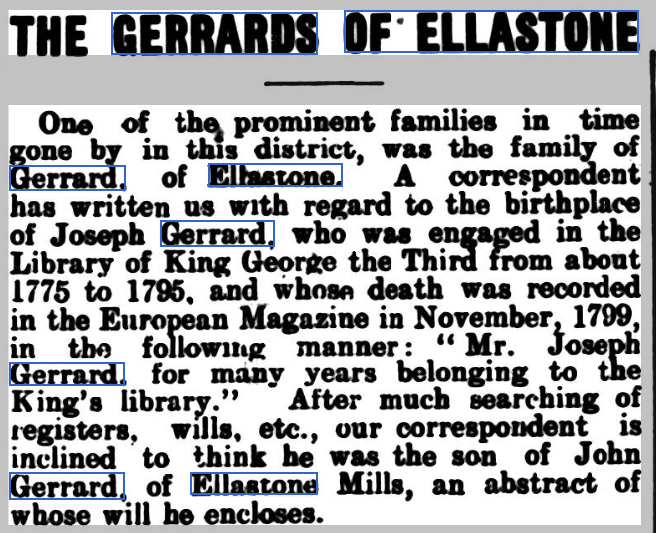
The author wanted to prove that the Joseph Gerrard “who was engaged in the library of King George the third from about 1775 to 1795, and whose death was recorded in the European Magazine in November 1799” was the son of John Gerrard of Ellastone Mills, Staffordshire. Included in the first article was a selected transcription of the 1796 will of John Gerrard. John’s son Joseph is mentioned in this will: John leaves him “£20 to buy a suit of mourning if he thinks proper.”
This Joseph Gerrard however, born in 1739, died in 1815 at Brailsford. Joseph’s brother John also died at Brailsford Mill, and both of their ages at death give a birth year of 1739. Maybe they were twins. William Gerrard and Joseph Gerrard of Brailsford Mill are mentioned in a 1811 newspaper article in the Derby Mercury.
I decided that there was nothing susbtantial about this claim, until I read the 1724 will of John Gerrard the elder, the father of John who died in 1796. In his will he leaves £100 to his son Joseph Gerrard, “secretary to the Bishop of Oxford”.
Perhaps there was something to this story after all. Joseph, baptised in 1701 in Ellastone, was the son of John Gerrard the elder.
I found Joseph Gerrard (and his son James Gerrard) mentioned in the Alumni Oxonienses: The Members of the University of Oxford, University of Oxford, Joseph Foster, 1888. “Joseph Gerard son of John of Elleston county Stafford, pleb, Oriel Coll, matric, 30th May 1718, age 18, BA. 9th March 1721-2; of Merton Coll MA 1728.”
In The Works of John Wesley 1735-1738, Joseph Gerrad is mentioned: “Joseph Gerard , matriculated at Oriel College 1718 , aged 18 , ordained 1727 to serve as curate of Cuddesdon , becoming rector of St. Martin’s , Oxford in 1729 , and vicar of Banbury in 1734.”
In The History of Banbury Alfred Beesley 1842 “a visitation of smallpox occured at Banbury (Oxfordshire) in 1731 and continued until 1733.” Joseph Gerrard was the vicar of Banbury in 1734.
According to the The History and Antiquities of the County of Buckingham George Lipscomb · 1847, Joseph Gerrard was made rector of Monks Risborough in 1738 “but he also continued to hold Stewkley until his death”.
The Speculum of Archbishop Thomas Secker by Secker, Thomas, 1693-1768, also mentions Joseph Gerrard under Monks Risborough and adds that he “resides constantly in the Parsonage ho. except when he goes for a few days to Steukley county Bucks (Buckinghamshire) of which he is vicar.” Joseph’s son James Gerrard 1741-1789 is also mentioned as being a rector at Monks Risborough in 1783.
Joseph Gerrard married Elizabeth Reynolds on 23 July 1739 in Monks Risborough, Buckinghamshire. They had five children between 1740 and 1750, including James baptised 1740 and Joseph baptised 1742.
Joseph died in 1785 in Monks Risborough.
So who was Joseph Gerrard of the Kings Library who died in 1799? It wasn’t Joseph’s son Joseph baptised in 1742 in Monks Risborough, because in his father’s 1785 will he mentions “my only son James”, indicating that Joseph died before that date.
September 20, 2023 at 1:48 pm #7279In reply to: Family Stories From The Other Side ~ Book Two
The Bigamist
Ernest Tomlinson 1881-1915
Ernest Tomlinson was my great grandfathers Charles Tomlinson‘s younger brother. Their parents were Charles Tomlinson the elder 1847-1907 and Emma Grattidge 1853-1911.
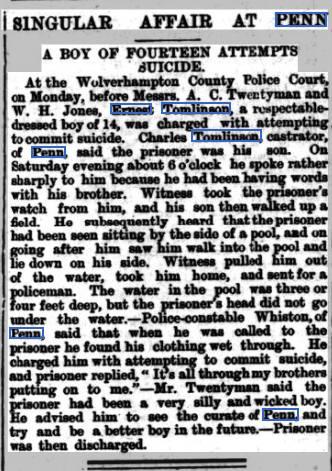
In 1896, aged 14, Ernest attempted to drown himself in the pond at Penn after his father took his watch off him for arguing with his brothers. Ernest tells the police “It’s all through my brothers putting on me”. The policeman told him he was a very silly and wicked boy and to see the curate at Penn and to try and be a better boy in future. He was discharged.
Bridgnorth Journal and South Shropshire Advertiser. – Saturday 11 July 1896:
In 1903 Ernest married Ethel Maude Howe in Wolverhampton. Four years later in 1907 Ethel was granted a separation on the grounds of cruelty.
In Islington in London in 1913, Ernest bigamously married Mabel Elizabeth Smith. Mabel left Ernest for treating her very badly. She went to Wolverhampton and found out about his first wife still being alive.
London Evening Standard – Monday 25 May 1914:
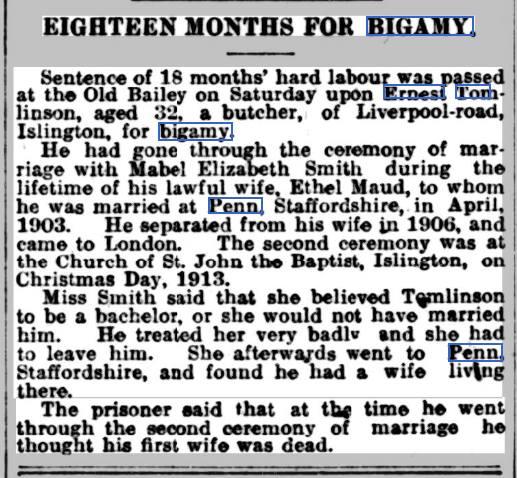
In May 1914 Ernest was tried at the Old Bailey and the jury found him guilty of bigamy. In his defense, Ernest said that he had received a letter from his mother saying that she was ill, and a further letter saying that she had died. He said he wrongly assumed that they were referring to his wife, and that he was free to marry. It was his mother who had died. He was sentenced to 18 months hard labour at Wormwood Scrubs prison.
Woolwich Gazette – Tuesday 28 April 1914:
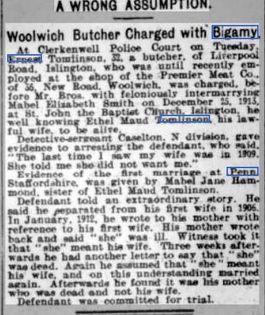
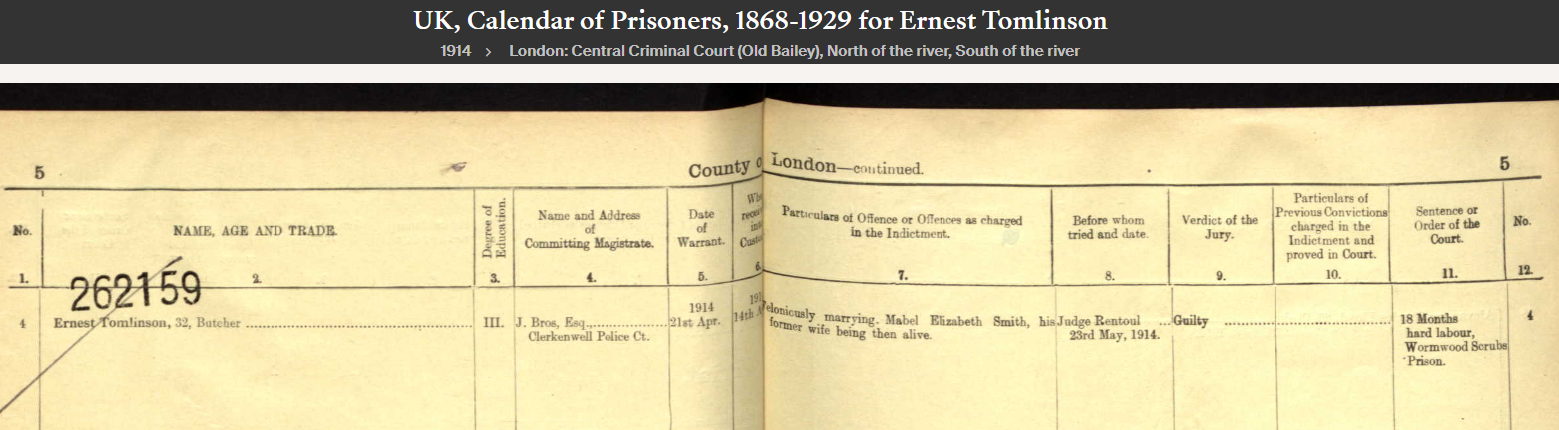
Ethel Maude Tomlinson was granted a decree nisi in 1915.
Birmingham Daily Gazette – Wednesday 02 June 1915:
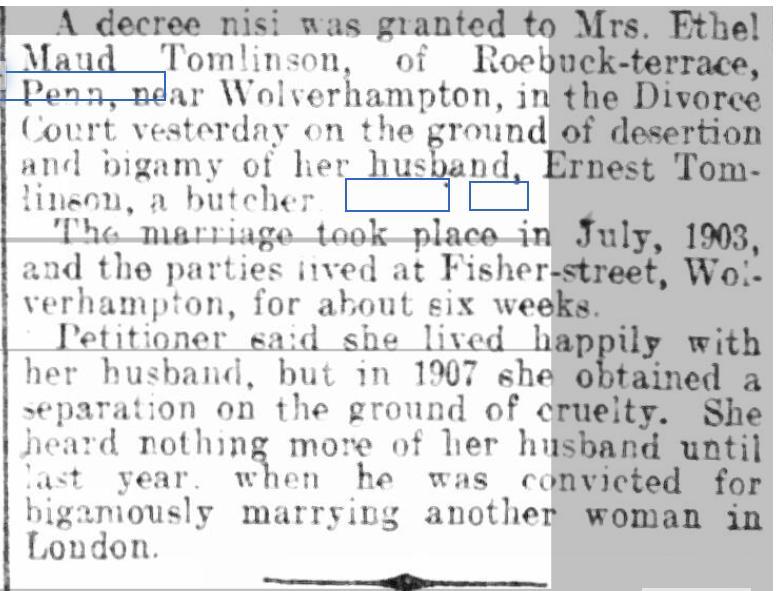
Ernest died in September 1915 in hospital in Wolverhampton.
September 18, 2023 at 8:29 am #7278In reply to: Family Stories From The Other Side ~ Book Two
Tomlinson of Wergs and Hancox of Penn
John Tomlinson of Wergs (Tettenhall, Wolverhamton) 1766-1844, my 4X great grandfather, married Sarah Hancox 1772-1851. They were married on the 27th May 1793 by licence at St Peter in Wolverhampton.
Between 1794 and 1819 they had twelve children, although four of them died in childhood or infancy. Catherine was born in 1794, Thomas in 1795 who died 6 years later, William (my 3x great grandfather) in 1797, Jemima in 1800, John, Richard and Matilda between 1802 and 1806 who all died in childhood, Emma in 1809, Mary Ann in 1811, Sidney in 1814, and Elijah in 1817 who died two years later.On the 1841 census John and Sarah were living in Hockley in Birmingham, with three of their children, and surgeon Charles Reynolds. John’s occupation was “Ind” meaning living by independent means. He was living in Hockley when he died in 1844, and in his will he was “John Tomlinson, gentleman”.
Sarah Hancox was born in 1772 in Penn, Wolverhampton. Her father William Hancox was also born in Penn in 1737. Sarah’s mother Elizabeth Parkes married William’s brother Francis in 1767. Francis died in 1768, and in 1770 Elizabeth married William.
William’s father was William Hancox, yeoman, born in 1703 in Penn. He died intestate in 1772, his wife Sarah claiming her right to his estate. William Hancox and Sarah Evans, both of Penn, were married on the 9th December 1732 in Dudley, Worcestershire, by “certificate”. Marriages were usually either by banns or by licence. Apparently a marriage by certificate indicates that they were non conformists, or dissenters, and had the non conformist marriage “certified” in a Church of England church.
1732 marriage of William Hancox and Sarah Evans:
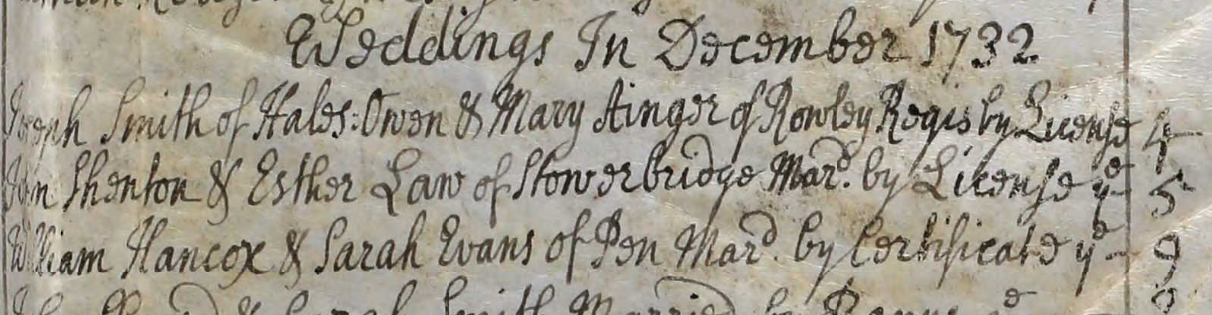
William and Sarah lost two daughters, Elizabeth, five years old, and Ann, three years old, within eight days of each other in February 1738.
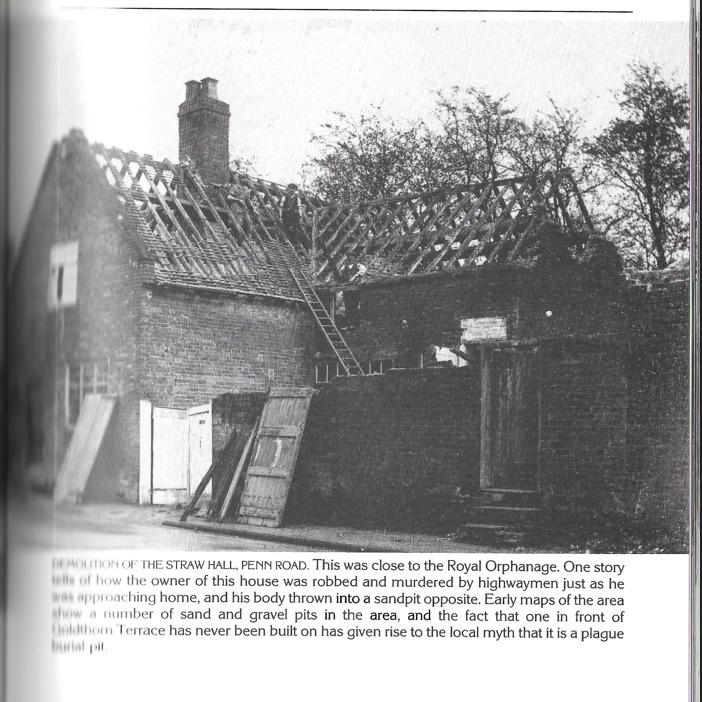
William the elder’s father was John Hancox born in Penn in 1668. He married Elizabeth Wilkes from Sedgley in 1691 at Himley. John Hancox, “of Straw Hall” according to the Wolverhampton burial register, died in 1730. Straw Hall is in Penn. John’s parents were Walter Hancox and Mary Noake. Walter was born in Tettenhall in 1625, his father Richard Hancox. Mary Noake was born in Penn in 1634. Walter died in Penn in 1689.
Straw Hall thanks to Bradney Mitchell:
“Here is a picture I have of Straw Hall, Penn Road.
The painting is by John Reid circa 1878.
Sketch commissioned by George Bradney Mitchell to record the town as it was before its redevelopment, in a book called Wolverhampton and its Environs. ©”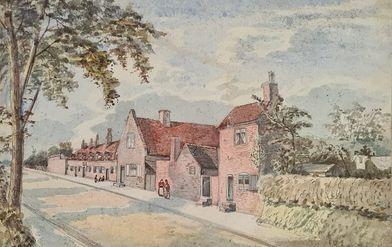
And a photo of the demolition of Straw Hall with an interesting story:
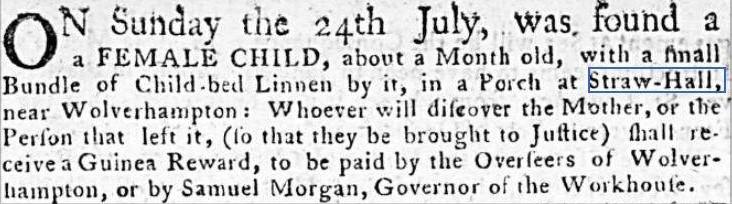
In 1757 a child was abandoned on the porch of Straw Hall. Aris’s Birmingham Gazette 1st August 1757:
The Hancox family were living in Penn for at least 400 years. My great grandfather Charles Tomlinson built a house on Penn Common in the early 1900s, and other Tomlinson relatives have lived there. But none of the family knew of the Hancox connection to Penn. I don’t think that anyone imagined a Tomlinson ancestor would have been a gentleman, either.
Sarah Hancox’s brother William Hancox 1776-1848 had a busy year in 1804.
On 29 Aug 1804 he applied for a licence to marry Ann Grovenor of Claverley.
In August 1804 he had property up for auction in Penn. “part of Lightwoods, 3 plots, and the Coppice”
On 14 Sept 1804 their first son John was baptised in Penn. According to a later census John was born in Claverley. (before the parents got married)(Incidentally, John Hancox’s descendant married a Warren, who is a descendant of my 4x great grandfather Samuel Warren, on my mothers side, from Newhall, Derbyshire!)
On 30 Sept he married Ann in Penn.
In December he was a bankrupt pig and sheep dealer.
In July 1805 he’s in the papers under “certificates”: William Hancox the younger, sheep and pig dealer and chapman of Penn. (A certificate was issued after a bankruptcy if they fulfilled their obligations)
He was a pig dealer in Penn in 1841, a widower, living with unmarried daughter Elizabeth.Sarah’s father William Hancox died in 1816. In his will, he left his “daughter Sarah, wife of John Tomlinson of the Wergs the sum of £100 secured to me upon the tolls arising from the turnpike road leading from Wombourne to Sedgeley to and for her sole and separate use”.
The trustees of toll road would decide not to collect tolls themselves but get someone else to do it by selling the collecting of tolls for a fixed price. This was called “farming the tolls”. The Act of Parliament which set up the trust would authorise the trustees to farm out the tolls. This example is different. The Trustees of turnpikes needed to raise money to carry out work on the highway. The usual way they did this was to mortgage the tolls – they borrowed money from someone and paid the borrower interest; as security they gave the borrower the right, if they were not paid, to take over the collection of tolls and keep the proceeds until they had been paid off. In this case William Hancox has lent £100 to the turnpike and is leaving it (the right to interest and/or have the whole sum repaid) to his daughter Sarah Tomlinson. (this information on tolls from the Wolverhampton family history group.)William Hancox, Penn Wood, maltster, left a considerable amount of property to his children in 1816. All household effects he left to his wife Elizabeth, and after her decease to his son Richard Hancox: four dwelling houses in John St, Wolverhampton, in the occupation of various Pratts, Wright and William Clarke. He left £200 to his daughter Frances Gordon wife of James Gordon, and £100 to his daughter Ann Pratt widow of John Pratt. To his son William Hancox, all his various properties in Penn wood. To Elizabeth Tay wife of Thomas Tay he left £200, and to Richard Hancox various other properties in Penn Wood, and to his daughter Lucy Tay wife of Josiah Tay more property in Lower Penn. All his shops in St John Wolverhamton to his son Edward Hancox, and more properties in Lower Penn to both Francis Hancox and Edward Hancox. To his daughter Ellen York £200, and property in Montgomery and Bilston to his son John Hancox. Sons Francis and Edward were underage at the time of the will. And to his daughter Sarah, his interest in the toll mentioned above.
Sarah Tomlinson, wife of John Tomlinson of the Wergs, in William Hancox will:
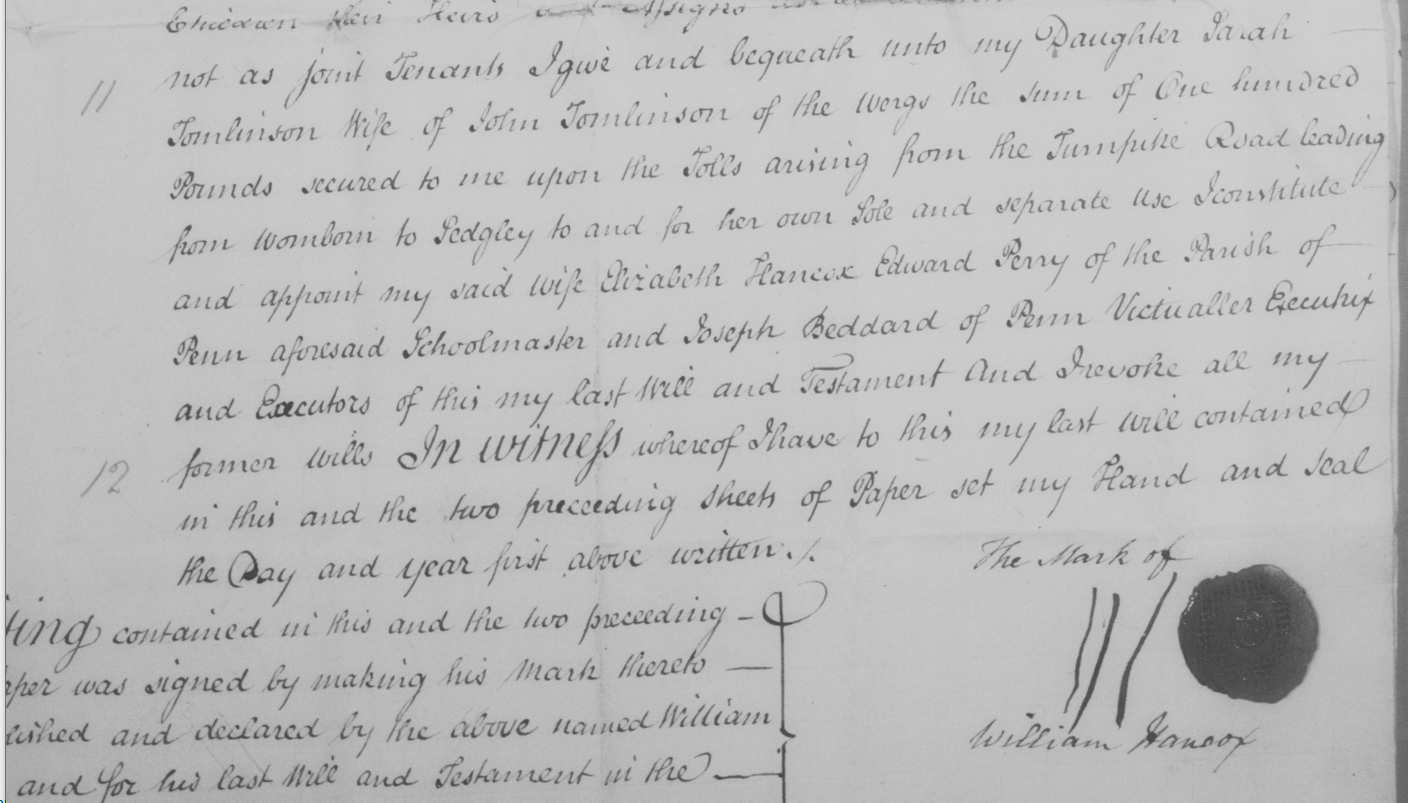 September 5, 2023 at 1:35 pm #7276
In reply to: Family Stories From The Other Side ~ Book Two
Wood Screw Manufacturers
The Fishers of West Bromwich.
My great grandmother, Nellie Fisher, was born in 1877 in Wolverhampton. Her father William 1834-1916 was a whitesmith, and his father William 1792-1873 was a whitesmith and master screw maker. William’s father was Abel Fisher, wood screw maker, victualler, and according to his 1849 will, a “gentleman”.
Nellie Fisher 1877-1956 :
Abel Fisher was born in 1769 according to his burial document (age 81 in 1849) and on the 1841 census. Abel was a wood screw manufacturer in Wolverhampton.
As no baptism record can be found for Abel Fisher, I read every Fisher will I could find in a 30 year period hoping to find his fathers will. I found three other Fishers who were wood screw manufacurers in neighbouring West Bromwich, which led me to assume that Abel was born in West Bromwich and related to these other Fishers.
The wood screw making industry was a relatively new thing when Abel was born.
“The screw was used in furniture but did not become a common woodworking fastener until efficient machine tools were developed near the end of the 18th century. The earliest record of lathe made wood screws dates to an English patent of 1760. The development of wood screws progressed from a small cottage industry in the late 18th century to a highly mechanized industry by the mid-19th century. This rapid transformation is marked by several technical innovations that help identify the time that a screw was produced. The earliest, handmade wood screws were made from hand-forged blanks. These screws were originally produced in homes and shops in and around the manufacturing centers of 18th century Europe. Individuals, families or small groups participated in the production of screw blanks and the cutting of the threads. These small operations produced screws individually, using a series of files, chisels and cutting tools to form the threads and slot the head. Screws produced by this technique can vary significantly in their shape and the thread pitch. They are most easily identified by the profusion of file marks (in many directions) over the surface. The first record regarding the industrial manufacture of wood screws is an English patent registered to Job and William Wyatt of Staffordshire in 1760.”
Wood Screw Makers of West Bromwich:
Edward Fisher, wood screw maker of West Bromwich, died in 1796. He mentions his wife Pheney and two underage sons in his will. Edward (whose baptism has not been found) married Pheney Mallin on 13 April 1793. Pheney was 17 years old, born in 1776. Her parents were Isaac Mallin and Sarah Firme, who were married in West Bromwich in 1768.
Edward and Pheney’s son Edward was born on 21 October 1793, and their son Isaac in 1795. The executors of Edwards 1796 will are Daniel Fisher the Younger, Isaac Mallin, and Joseph Fisher.There is a marriage allegations and bonds document in 1774 for an Edward Fisher, bachelor and wood screw maker of West Bromwich, aged 25 years and upwards, and Mary Mallin of the same age, father Isaac Mallin. Isaac Mallin and Sarah didn’t marry until 1768 and Mary Mallin would have been born circa 1749. Perhaps Isaac Mallin’s father was the father of Mary Mallin. It’s possible that Edward Fisher was born in 1749 and first married Mary Mallin, and then later Pheney, but it’s also possible that the Edward Fisher who married Mary Mallin in 1774 was Edward Fishers uncle, Daniel’s brother. (I do not know if Daniel had a brother Edward, as I haven’t found a baptism, or marriage, for Daniel Fisher the elder.)
There are two difficulties with finding the records for these West Bromwich families. One is that the West Bromwich registers are not available online in their entirety, and are held by the Sandwell Archives, and even so, they are incomplete. Not only that, the Fishers were non conformist. There is no surviving register prior to 1787. The chapel opened in 1788, and any registers that existed before this date, taken in a meeting houses for example, appear not to have survived.
Daniel Fisher the younger died intestate in 1818. Daniel was a wood screw maker of West Bromwich. He was born in 1751 according to his age stated as 67 on his death in 1818. Daniel’s wife Mary, and his son William Fisher, also a wood screw maker, claimed the estate.
Daniel Fisher the elder was a farmer of West Bromwich, who died in 1806. He was 81 when he died, which makes a birth date of 1725, although no baptism has been found. No marriage has been found either, but he was probably married not earlier than 1746.
Daniel’s sons Daniel and Joseph were the main inheritors, and he also mentions his other children and grandchildren namely William Fisher, Thomas Fisher, Hannah wife of William Hadley, two grandchildren Edward and Isaac Fisher sons of Edward Fisher his son deceased. Daniel the elder presumably refers to the wood screw manufacturing when he says “to my son Daniel Fisher the good will and advantage which may arise from his manufacture or trade now carried on by me.” Daniel does not mention a son called Abel unfortunately, but neither does he mention his other grandchildren. Abel may be Daniel’s son, or he may be a nephew.
The Staffordshire Record Office holds the documents of a Testamentary Case in 1817. The principal people are Isaac Fisher, a legatee; Daniel and Joseph Fisher, executors. Principal place, West Bromwich, and deceased person, Daniel Fisher the elder, farmer.
William and Sarah Fisher baptised six children in the Mares Green Non Conformist registers in West Bromwich between 1786 and 1798. William Fisher and Sarah Birch were married in West Bromwich in 1777. This William was probably born circa 1753 and was probably the son of Daniel Fisher the elder, farmer.
Daniel Fisher the younger and his wife Mary had a son William, as mentioned in the intestacy papers, although I have not found a baptism for William. I did find a baptism for another son, Eutychus Fisher in 1792.
In White’s Directory of Staffordshire in 1834, there are three Fishers who are wood screw makers in Wolverhampton: Eutychus Fisher, Oxford Street; Stephen Fisher, Bloomsbury; and William Fisher, Oxford Street.
Abel’s son William Fisher 1792-1873 was living on Oxford Street on the 1841 census, with his wife Mary and their son William Fisher 1834-1916.
In The European Magazine, and London Review of 1820 (Volume 77 – Page 564) under List of Patents, W Fisher and H Fisher of West Bromwich, wood screw manufacturers, are listed. Also in 1820 in the Birmingham Chronicle, the partnership of William and Hannah Fisher, wood screw manufacturers of West Bromwich, was dissolved.
In the Staffordshire General & Commercial Directory 1818, by W. Parson, three Fisher’s are listed as wood screw makers. Abel Fisher victualler and wood screw maker, Red Lion, Walsal Road; Stephen Fisher wood screw maker, Buggans Lane; and Daniel Fisher wood screw manufacturer, Brickiln Lane.
In Aris’s Birmingham Gazette on 4 January 1819 Abel Fisher is listed with 23 other wood screw manufacturers (Stephen Fisher and William Fisher included) stating that “In consequence of the rise in prices of iron and the advanced price given to journeymen screw forgers, we the undersigned manufacturers of wood screws are under the necessity of advancing screws 10 percent, to take place on the 11th january 1819.”
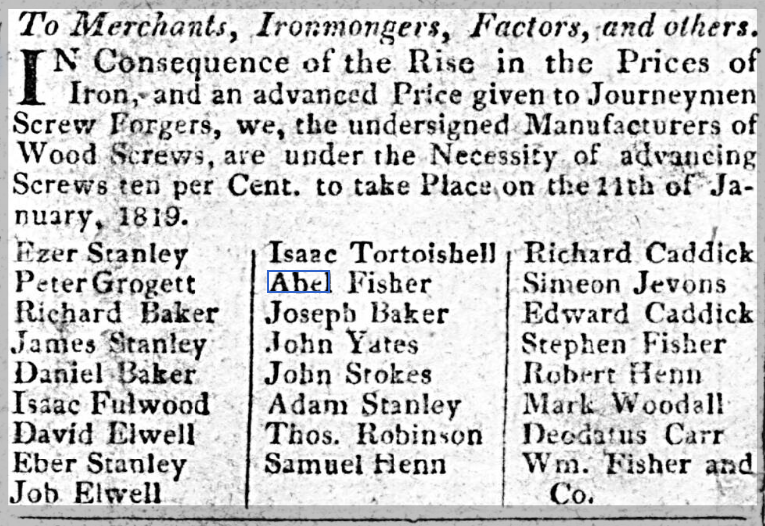
In Abel Fisher’s 1849 will, he names his three sons Abel Fisher 1796-1869, Paul Fisher 1811-1900 and John Southall Fisher 1801-1871 as the executors. He also mentions his other three sons, William Fisher 1792-1873, Benjamin Fisher 1798-1870, and Joseph Fisher 1803-1876, and daughters Sarah Fisher 1794- wife of William Colbourne, Mary Fisher 1804- wife of Thomas Pearce, and Susannah (Hannah) Fisher 1813- wife of Parkes. His son Silas Fisher 1809-1837 wasn’t mentioned as he died before Abel, nor his sons John Fisher 1799-1800, and Edward Southall Fisher 1806-1843. Abel’s wife Susannah Southall born in 1771 died in 1824. They were married in 1791.
The 1849 will of Abel Fisher:
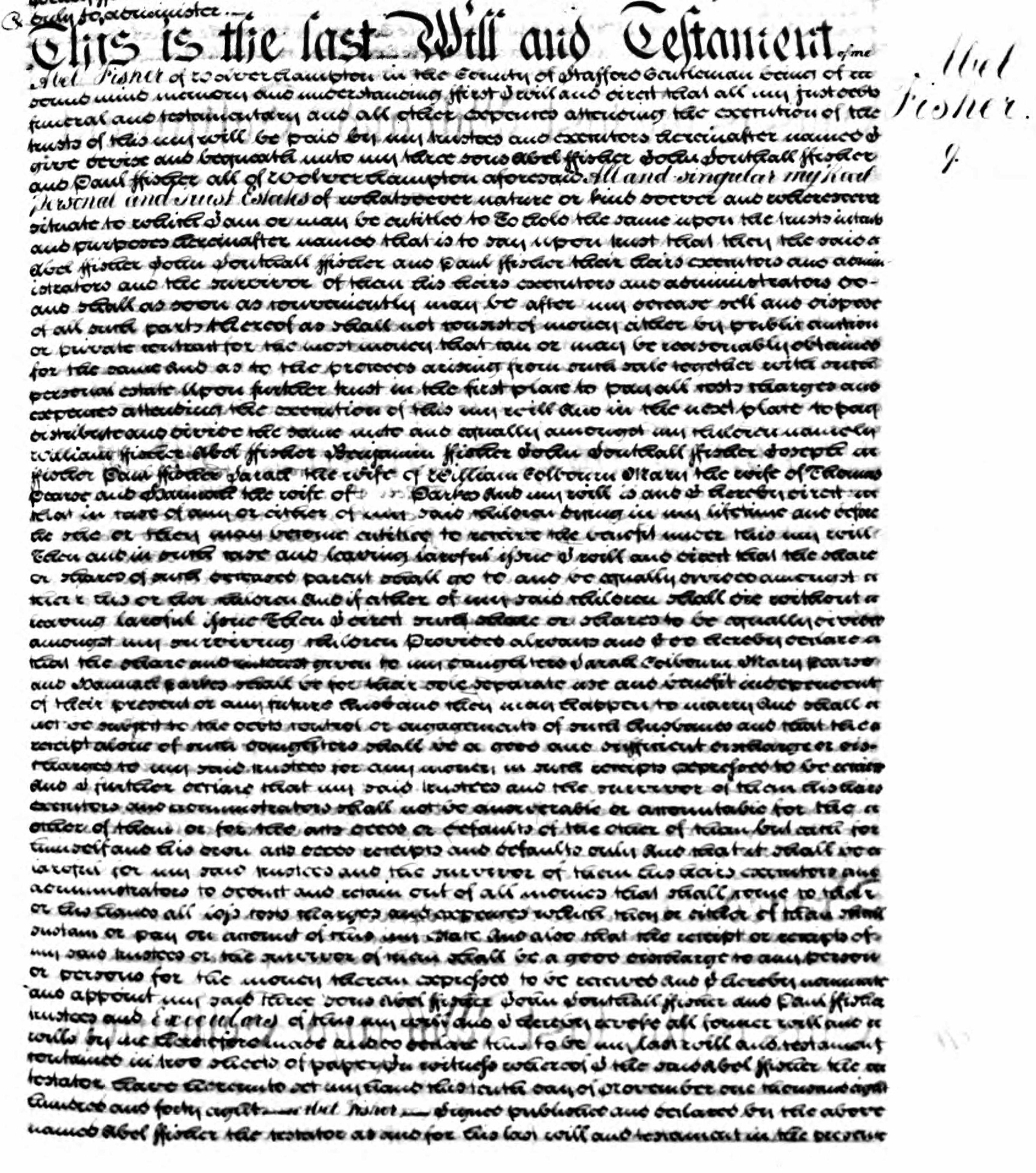
-
AuthorSearch Results
