


Search Results for 'ended'
-
AuthorSearch Results
-
January 14, 2022 at 3:06 pm #6253
In reply to: The Elusive Samuel Housley and Other Family Stories
My Grandparents Kitchen
My grandmother used to have golden syrup in her larder, hanging on the white plastic coated storage rack that was screwed to the inside of the larder door. Mostly the larder door was left propped open with an old flat iron, so you could see the Heinz ketchup and home made picallilli (she made a particularly good picallili), the Worcester sauce and the jar of pickled onions, as you sat at the kitchen table.
If you were sitting to the right of the kitchen table you could see an assortment of mismatched crockery, cups and bowls, shoe cleaning brushes, and at the back, tiny tins of baked beans and big ones of plum tomatoes, and normal sized tins of vegetable and mushroom soup. Underneath the little shelves that housed the tins was a blue plastic washing up bowl with a few onions, some in, some out of the yellow string bag they came home from the expensive little village supermarket in.
There was much more to the left in the awkward triangular shape under the stairs, but you couldn’t see under there from your seat at the kitchen table. You could see the shelf above the larder door which held an ugly china teapot of graceless modern lines, gazed with metallic silver which was wearing off in places. Beside the teapot sat a serving bowl, squat and shapely with little handles, like a flattened Greek urn, in white and reddish brown with flecks of faded gilt. A plain white teapot completed the trio, a large cylindrical one with neat vertical ridges and grooves.
There were two fridges under the high shallow wooden wall cupboard. A waist high bulbous old green one with a big handle that pulled out with a clunk, and a chest high sleek white one with a small freezer at the top with a door of its own. On the top of the fridges were biscuit and cracker tins, big black keys, pencils and brittle yellow notepads, rubber bands and aspirin value packs and a bottle of Brufen. There was a battered old maroon spectacle case and a whicker letter rack, letters crammed in and fanning over the top. There was always a pile of glossy advertising pamphlets and flyers on top of the fridges, of the sort that were best put straight into the tiny pedal bin.
My grandmother never lined the pedal bin with a used plastic bag, nor with a specially designed plastic bin liner. The bin was so small that the flip top lid was often gaping, resting on a mound of cauliflower greens and soup tins. Behind the pedal bin, but on the outer aspect of the kitchen wall, was the big black dustbin with the rubbery lid. More often than not, the lid was thrust upwards. If Thursday when the dustbin men came was several days away, you’d wish you hadn’t put those newspapers in, or those old shoes! You stood in the softly drizzling rain in your slippers, the rubbery sheild of a lid in your left hand and the overflowing pedal bin in the other. The contents of the pedal bin are not going to fit into the dustbin. You sigh, put the pedal bin and the dustbin lid down, and roll up your sleeves ~ carefully, because you’ve poked your fingers into a porridge covered teabag. You grab the sides of the protruding black sack and heave. All being well, the contents should settle and you should have several inches more of plastic bag above the rim of the dustbin. Unless of course it’s a poor quality plastic bag in which case your fingernail will go through and a horizontal slash will appear just below rubbish level. Eventually you upend the pedal bin and scrape the cigarette ash covered potato peelings into the dustbin with your fingers. By now the fibres of your Shetland wool jumper are heavy with damp, just like the fuzzy split ends that curl round your pale frowning brow. You may push back your hair with your forearm causing the moisture to bead and trickle down your face, as you turn the brass doorknob with your palm and wrist, tea leaves and cigarette ash clinging unpleasantly to your fingers.
The pedal bin needs rinsing in the kitchen sink, but the sink is full of mismatched saucepans, some new in shades of harvest gold, some battered and mishapen in stainless steel and aluminium, bits of mashed potato stuck to them like concrete pebbledash. There is a pale pink octagonally ovoid shallow serving dish and a little grey soup bowl with a handle like a miniature pottery saucepan decorated with kitcheny motifs.
The water for the coffee bubbles in a suacepan on the cream enamelled gas cooker. My grandmother never used a kettle, although I do remember a heavy flame orange one. The little pan for boiling water had a lip for easy pouring and a black plastic handle.
The steam has caused the condensation on the window over the sink to race in rivulets down to the fablon coated windowsill. The yellow gingham curtains hang limply, the left one tucked behind the back of the cooker.
You put the pedal bin back it it’s place below the tea towel holder, and rinse your mucky fingers under the tap. The gas water heater on the wall above you roars into life just as you turn the tap off, and disappointed, subsides.
As you lean over to turn the cooker knob, the heat from the oven warms your arm. The gas oven was almost always on, the oven door open with clean tea towels and sometimes large white pants folded over it to air.
The oven wasn’t the only heat in my grandparents kitchen. There was an electric bar fire near the red formica table which used to burn your legs. The kitchen table was extended by means of a flap at each side. When I was small I wasn’t allowed to snap the hinge underneath shut as my grandmother had pinched the skin of her palm once.
The electric fire was plugged into the same socket as the radio. The radio took a minute or two to warm up when you switched it on, a bulky thing with sharp seventies edges and a reddish wood effect veneer and big knobs. The light for my grandfathers workshop behind the garage (where he made dentures) was plugged into the same socket, which had a big heavy white three way adaptor in. The plug for the washing machine was hooked by means of a bit of string onto a nail or hook so that it didn’t fall down behing the washing machine when it wasn’t plugged in. Everything was unplugged when it wasn’t in use. Sometimes there was a shrivelled Christmas cactus on top of the radio, but it couldn’t hide the adaptor and all those plugs.
Above the washing machine was a rhomboid wooden wall cupboard with sliding frsoted glass doors. It was painted creamy gold, the colour of a nicotine stained pub ceiling, and held packets of Paxo stuffing and little jars of Bovril and Marmite, packets of Bisto and a jar of improbably red Maraschino cherries.
The nicotine coloured cupboard on the opposite wall had half a dozen large hooks screwed under the bottom shelf. A variety of mugs and cups hung there when they weren’t in the bowl waiting to be washed up. Those cupboard doors seemed flimsy for their size, and the thin beading on the edge of one door had come unstuck at the bottom and snapped back if you caught it with your sleeve. The doors fastened with a little click in the centre, and the bottom of the door reverberated slightly as you yanked it open. There were always crumbs in the cupboard from the numerous packets of bisucits and crackers and there was always an Allbran packet with the top folded over to squeeze it onto the shelf. The sugar bowl was in there, sticky grains like sandpaper among the biscuit crumbs.
Half of one of the shelves was devoted to medicines: grave looking bottles of codeine linctus with no nonsense labels, brown glass bottles with pills for rheumatism and angina. Often you would find a large bottle, nearly full, of Brewers yeast or vitamin supplements with a dollar price tag, souvenirs of the familys last visit. Above the medicines you’d find a faded packet of Napolitana pasta bows or a dusty packet of muesli. My grandparents never used them but she left them in the cupboard. Perhaps the dollar price tags and foreign foods reminded her of her children.
If there had been a recent visit you would see monstrous jars of Sanka and Maxwell House coffee in there too, but they always used the coffee. They liked evaporated milk in their coffee, and used tins and tins of “evap” as they called it. They would pour it over tinned fruit, or rhubard crumble or stewed apples.
When there was just the two of them, or when I was there as well, they’d eat at the kitchen table. The table would be covered in a white embroidered cloth and the food served in mismatched serving dishes. The cutlery was large and bent, the knife handles in varying shades of bone. My grandfathers favourite fork had the tip of each prong bent in a different direction. He reckoned it was more efficient that way to spear his meat. He often used to chew his meat and then spit it out onto the side of his plate. Not in company, of course. I can understand why he did that, not having eaten meat myself for so long. You could chew a piece of meat for several hours and still have a stringy lump between your cheek and your teeth.
My grandfather would always have a bowl of Allbran with some Froment wheat germ for his breakfast, while reading the Daily Mail at the kitchen table. He never worse slippers, always shoes indoors, and always wore a tie. He had lots of ties but always wore a plain maroon one. His shirts were always cream and buttoned at throat and cuff, and eventually started wearing shirts without detachable collars. He wore greeny grey trousers and a cardigan of the same shade most of the time, the same colour as a damp English garden.
The same colour as the slimy green wooden clothes pegs that I threw away and replaced with mauve and fuschia pink plastic ones. “They’re a bit bright for up the garden, aren’t they,” he said. He was right. I should have ignored the green peg stains on the laundry. An English garden should be shades of moss and grassy green, rich umber soil and brick red walls weighed down with an atmosphere of dense and heavy greyish white.
After Grandma died and Mop had retired (I always called him Mop, nobody knows why) at 10:00am precisely Mop would have a cup of instant coffee with evap. At lunch, a bowl of tinned vegetable soup in his special soup bowl, and a couple of Krackawheat crackers and a lump of mature Cheddar. It was a job these days to find a tasty cheddar, he’d say.
When he was working, and he worked until well into his seventies, he took sandwiches. Every day he had the same sandwich filling: a combination of cheese, peanut butter and marmite. It was an unusal choice for an otherwise conventional man. He loved my grandmothers cooking, which wasn’t brilliant but was never awful. She was always generous with the cheese in cheese sauces and the meat in meat pies. She overcooked the cauliflower, but everyone did then. She made her gravy in the roasting pan, and made onion sauce, bread sauce, parsley sauce and chestnut stuffing. She had her own version of cosmopolitan favourites, and called her quiche a quiche when everyone was still calling it egg and bacon pie. She used to like Auntie Daphne’s ratatouille, rather exotic back then, and pronounced it Ratta Twa. She made pizza unlike any other, with shortcrust pastry smeared with tomato puree from a tube, sprinkled with oregano and great slabs of cheddar.
The roast was always overdone. “We like our meat well done” she’d say. She’d walk up the garden to get fresh mint for the mint sauce and would announce with pride “these runner beans are out of the garding”. They always grew vegetables at the top of the garden, behind the lawn and the silver birch tree. There was always a pudding: a slice of almond tart (always with home made pastry), a crumble or stewed fruit. Topped with evap, of course.
December 18, 2021 at 12:59 pm #6243In reply to: The Elusive Samuel Housley and Other Family Stories
William Housley’s Will and the Court Case
William Housley died in 1848, but his widow Ellen didn’t die until 1872. The court case was in 1873. Details about the court case are archived at the National Archives at Kew, in London, but are not available online. They can be viewed in person, but that hasn’t been possible thus far. However, there are a great many references to it in the letters.
William Housley’s first wife was Mary Carrington 1787-1813. They had three children, Mary Anne, Elizabeth and William. When Mary died, William married Mary’s sister Ellen, not in their own parish church at Smalley but in Ashbourne. Although not uncommon for a widower to marry a deceased wife’s sister, it wasn’t legal. This point is mentioned in one of the letters.
One of the pages of William Housley’s will:
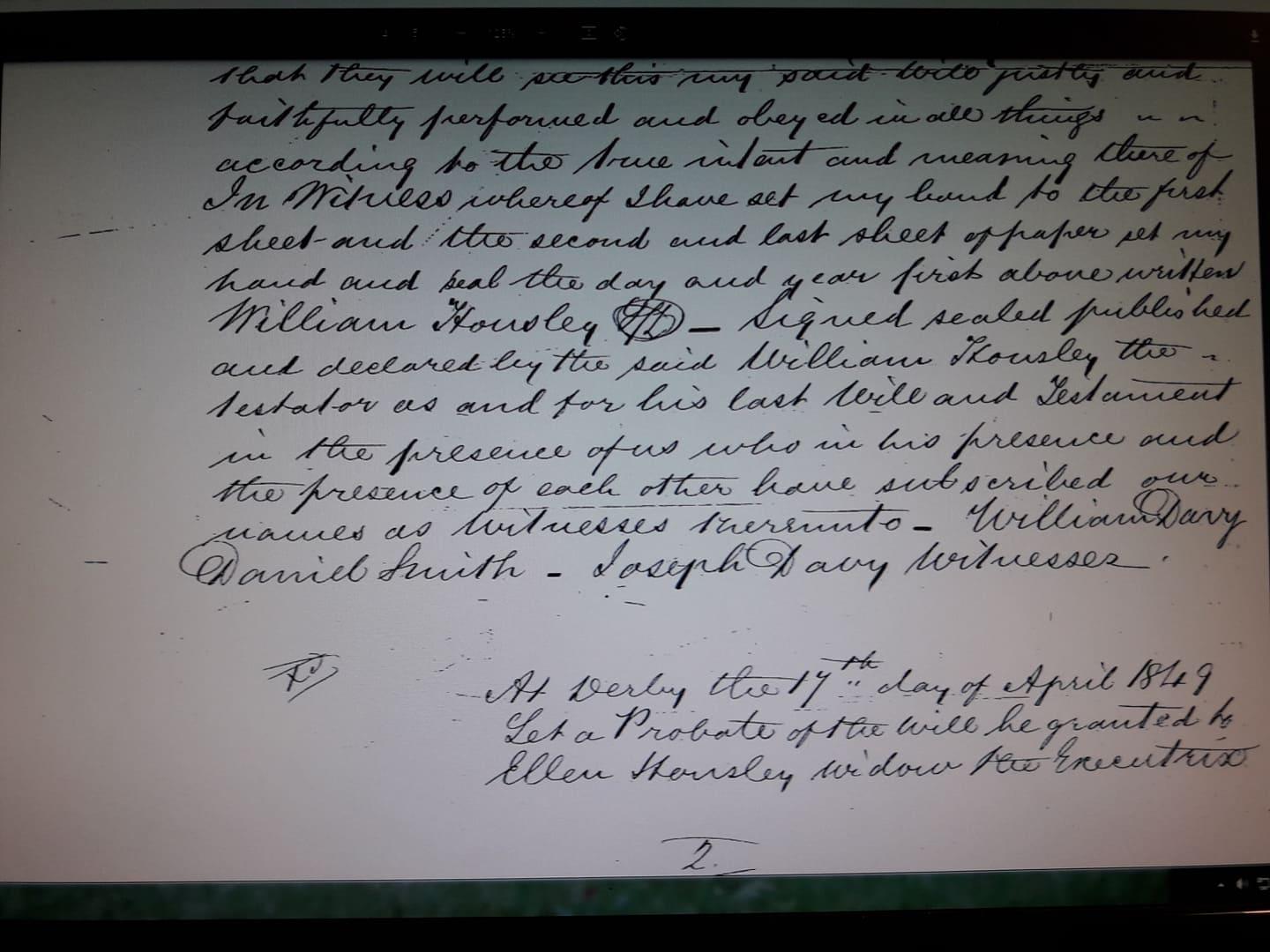
An excerpt from Barbara Housley’s Narrative on the Letters:
A comment in a letter from Joseph (August 6, 1873) indicated that William was married twice and that his wives were sisters: “What do you think that I believe that Mary Ann is trying to make our father’s will of no account as she says that my father’s marriage with our mother was not lawful he marrying two sisters. What do you think of her? I have heard my mother say something about paying a fine at the time of the marriage to make it legal.” Markwell and Saul in The A-Z Guide to Tracing Ancestors in Britain explain that marriage to a deceased wife’s sister was not permissible under Canon law as the relationship was within the prohibited degrees. However, such marriages did take place–usually well away from the couple’s home area. Up to 1835 such marriages were not void but were voidable by legal action. Few such actions were instituted but the risk was always there.
Joseph wrote that when Emma was married, Ellen “broke up the comfortable home and the things went to Derby and she went to live with them but Derby didn’t agree with her so she left again leaving her things behind and came to live with John in the new house where she died.” Ellen was listed with John’s household in the 1871 census.
In May 1872, the Ilkeston Pioneer carried this notice: “Mr. Hopkins will sell by auction on Saturday next the eleventh of May 1872 the whole of the useful furniture, sewing machine, etc. nearly new on the premises of the late Mrs. Housley at Smalley near Heanor in the county of Derby. Sale at one o’clock in the afternoon.”There were hard feelings between Mary Ann and Ellen and her children. Anne wrote: “If you remember we were not very friendly when you left. They never came and nothing was too bad for Mary Ann to say of Mother and me, but when Robert died Mother sent for her to the funeral but she did not think well to come so we took no more notice. She would not allow her children to come either.”
Mary Ann was still living in May 1872. Joseph implied that she and her brother, Will “intend making a bit of bother about the settlement of the bit of property” left by their mother. The 1871 census listed Mary Ann’s occupation as “income from houses.”In July 1872, Joseph introduced Ruth’s husband: “No doubt he is a bad lot. He is one of the Heath’s of Stanley Common a miller and he lives at Smalley Mill” (Ruth Heath was Mary Anne Housley’s daughter)
In 1873 Joseph wrote, “He is nothing but a land shark both Heath and his wife and his wife is the worst of the two. You will think these is hard words but they are true dear brother.” The solicitor, Abraham John Flint, was not at all pleased with Heath’s obstruction of the settlement of the estate. He wrote on June 30, 1873: “Heath agreed at first and then because I would not pay his expenses he refused and has since instructed another solicitor for his wife and Mrs. Weston who have been opposing us to the utmost. I am concerned for all parties interested except these two….The judge severely censured Heath for his conduct and wanted to make an order for sale there and then but Heath’s council would not consent….” In June 1875, the solicitor wrote: “Heath bid for the property but it fetched more money than he could give for it. He has been rather quieter lately.”In May 1872, Joseph wrote: “For what do you think, John has sold his share and he has acted very bad since his wife died and at the same time he sold all his furniture. You may guess I have never seen him but once since poor mother’s funeral and he is gone now no one knows where.”
In 1876, the solicitor wrote to George: “Have you heard of John Housley? He is entitled to Robert’s share and I want him to claim it.”
Anne intended that one third of the inheritance coming to her from her father and her grandfather, William Carrington, be divided between her four nieces: Sam’s three daughters and John’s daughter Elizabeth.
In the same letter (December 15, 1872), Joseph wrote:
“I think we have now found all out now that is concerned in the matter for there was only Sam that we did not know his whereabouts but I was informed a week ago that he is dead–died about three years ago in Birmingham Union. Poor Sam. He ought to have come to a better end than that”However, Samuel was still alive was on the 1871 census in Henley in Arden, and no record of his death can be found. Samuel’s brother in law said he was dead: we do not know why he lied, or perhaps the brothers were lying to keep his share, or another possibility is that Samuel himself told his brother in law to tell them that he was dead. I am inclined to think it was the latter.
Excerpts from Barbara Housley’s Narrative on the Letters continued:
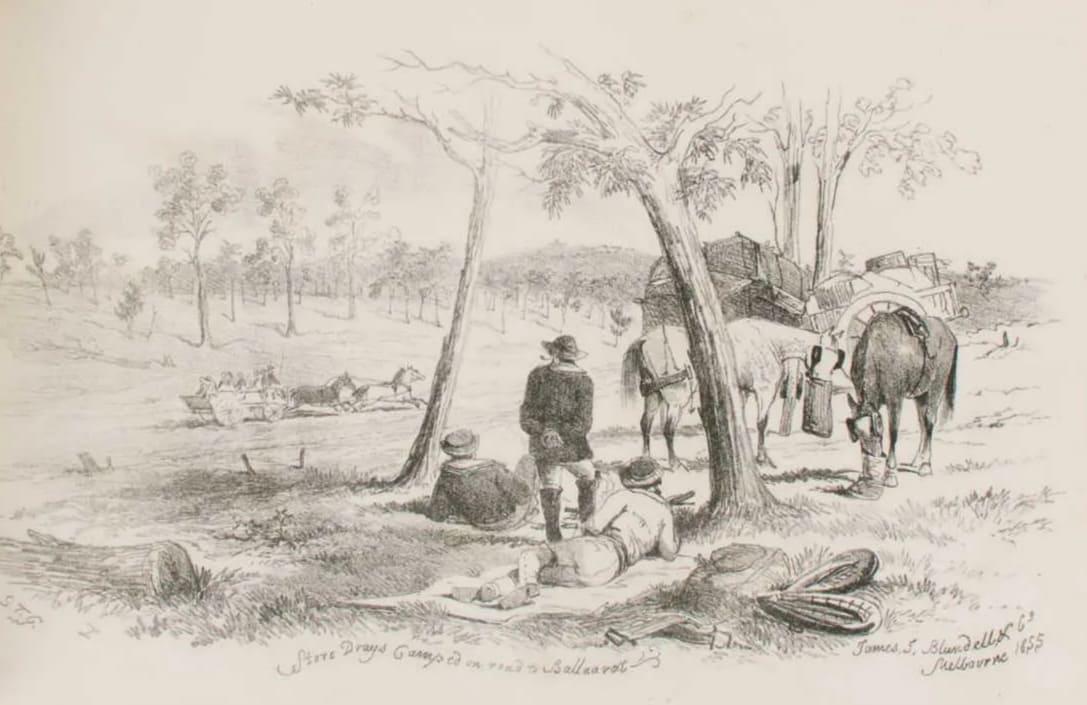
Charles went to Australia in 1851, and was last heard from in January 1853. According to the solicitor, who wrote to George on June 3, 1874, Charles had received advances on the settlement of their parent’s estate. “Your promissory note with the two signed by your brother Charles for 20 pounds he received from his father and 20 pounds he received from his mother are now in the possession of the court.”
In December 1872, Joseph wrote: “I’m told that Charles two daughters has wrote to Smalley post office making inquiries about his share….” In January 1876, the solicitor wrote: “Charles Housley’s children have claimed their father’s share.”
In the Adelaide Observer 28 Aug 1875
HOUSLEY – wanted information
as to the Death, Will, or Intestacy, and
Children of Charles Housley, formerly of
Smalley, Derbyshire, England, who died at
Geelong or Creewick Creek Diggings, Victoria
August, 1855. His children will hear of something to their advantage by communicating with
Mr. A J. Flint, solicitor, Derby, England.
June 16,1875.The Diggers & Diggings of Victoria in 1855. Drawn on Stone by S.T. Gill:
The court case:
Kerry v Housley.
Documents: Bill, demurrer.
Plaintiffs: Samuel Kerry and Joseph Housley.
Defendants: William Housley, Joseph Housley (deleted), Edwin Welch Harvey, Eleanor Harvey (deleted), Ernest Harvey infant, William Stafford, Elizabeth Stafford his wife, Mary Ann Housley, George Purdy and Catherine Purdy his wife, Elizabeth Housley, Mary Ann Weston widow and William Heath and Ruth Heath his wife (deleted).
Provincial solicitor employed in Derbyshire.
Date: 1873From the Narrative on the Letters:
The solicitor wrote on May 23, 1874: “Lately I have not written because I was not certain of your address and because I doubted I had much interesting news to tell you.” Later, Joseph wrote concerning the problems settling the estate, “You see dear brother there is only me here on our side and I cannot do much. I wish you were here to help me a bit and if you think of going for another summer trip this turn you might as well run over here.”
In March 1873, Joseph wrote: “You ask me what I think of you coming to England. I think as you have given the trustee power to sign for you I think you could do no good but I should like to see you once again for all that. I can’t say whether there would be anything amiss if you did come as you say it would be throwing good money after bad.”
In September 1872 Joseph wrote; “My wife is anxious to come. I hope it will suit her health for she is not over strong.” Elsewhere Joseph wrote that Harriet was “middling sometimes. She is subject to sick headaches. It knocks her up completely when they come on.” In December 1872 Joseph wrote, “Now dear brother about us coming to America you know we shall have to wait until this affair is settled and if it is not settled and thrown into Chancery I’m afraid we shall have to stay in England for I shall never be able to save money enough to bring me out and my family but I hope of better things.”
On July 19, 1875 Abraham Flint (the solicitor) wrote: “Joseph Housley has removed from Smalley and is working on some new foundry buildings at Little Chester near Derby. He lives at a village called Little Eaton near Derby. If you address your letter to him as Joseph Housley, carpenter, Little Eaton near Derby that will no doubt find him.”In his last letter (February 11, 1874), Joseph sounded very discouraged and wrote that Harriet’s parents were very poorly and both had been “in bed for a long time.” In addition, Harriet and the children had been ill.
The move to Little Eaton may indicate that Joseph received his settlement because in August, 1873, he wrote: “I think this is bad news enough and bad luck too, but I have had little else since I came to live at Kiddsley cottages but perhaps it is all for the best if one could only think so. I have begun to think there will be no chance for us coming over to you for I am afraid there will not be so much left as will bring us out without it is settled very shortly but I don’t intend leaving this house until it is settled either one way or the other. ”Joseph’s letters were much concerned with the settling of their mother’s estate. In 1854, Anne wrote, “As for my mother coming (to America) I think not at all likely. She is tied here with her property.” A solicitor, Abraham John Flint of 42 Full Street Derby, was engaged by John following the death of their mother. On June 30, 1873 the solicitor wrote: “Dear sir, On the death of your mother I was consulted by your brother John. I acted for him with reference to the sale and division of your father’s property at Smalley. Mr. Kerry was very unwilling to act as trustee being over 73 years of age but owing to the will being a badly drawn one we could not appoint another trustee in his place nor could the property be sold without a decree of chancery. Therefore Mr. Kerry consented and after a great deal of trouble with Heath who has opposed us all throughout whenever matters did not suit him, we found the title deeds and offered the property for sale by public auction on the 15th of July last. Heath could not find his purchase money without mortaging his property the solicitor which the mortgagee employed refused to accept Mr. Kerry’s title and owing to another defect in the will we could not compel them.”
In July 1872, Joseph wrote, “I do not know whether you can remember who the trustee was to my father’s will. It was Thomas Watson and Samuel Kerry of Smalley Green. Mr. Watson is dead (died a fortnight before mother) so Mr. Kerry has had to manage the affair.”
On Dec. 15, 1972, Joseph wrote, “Now about this property affair. It seems as far off of being settled as ever it was….” and in the following March wrote: “I think we are as far off as ever and farther I think.”
Concerning the property which was auctioned on July 15, 1872 and brought 700 pounds, Joseph wrote: “It was sold in five lots for building land and this man Heath bought up four lots–that is the big house, the croft and the cottages. The croft was made into two lots besides the piece belonging to the big house and the cottages and gardens was another lot and the little intake was another. William Richardson bought that.” Elsewhere Richardson’s purchase was described as “the little croft against Smith’s lane.” Smith’s Lane was probably named for their neighbor Daniel Smith, Mrs. Davy’s father.
But in December 1872, Joseph wrote that they had not received any money because “Mr. Heath is raising all kinds of objections to the will–something being worded wrong in the will.” In March 1873, Joseph “clarified” matters in this way: “His objection was that one trustee could not convey the property that his signature was not guarantee sufficient as it states in the will that both trustees has to sign the conveyance hence this bother.”
Joseph indicated that six shares were to come out of the 700 pounds besides Will’s 20 pounds. Children were to come in for the parents shares if dead. The solicitor wrote in 1873, “This of course refers to the Kidsley property in which you take a one seventh share and which if the property sells well may realize you about 60-80 pounds.” In March 1873 Joseph wrote: “You have an equal share with the rest in both lots of property, but I am afraid there will be but very little for any of us.”The other “lot of property” was “property in Smalley left under another will.” On July 17, 1872, Joseph wrote: “It was left by my grandfather Carrington and Uncle Richard is trustee. He seems very backward in bringing the property to a sale but I saw him and told him that I for one expect him to proceed with it.” George seemed to have difficulty understanding that there were two pieces of property so Joseph explained further: “It was left by my grandfather Carrington not by our father and Uncle Richard is the trustee for it but the will does not give him power to sell without the signatures of the parties concerned.” In June 1873 the solicitor Abraham John Flint asked: “Nothing has been done about the other property at Smalley at present. It wants attention and the other parties have asked me to attend to it. Do you authorize me to see to it for you as well?”
After Ellen’s death, the rent was divided between Joseph, Will, Mary Ann and Mr. Heath who bought John’s share and was married to Mary Ann’s daughter, Ruth. Joseph said that Mr. Heath paid 40 pounds for John’s share and that John had drawn 110 pounds in advance. The solicitor said Heath said he paid 60. The solicitor said that Heath was trying to buy the shares of those at home to get control of the property and would have defied the absent ones to get anything.
In September 1872 Joseph wrote that the lawyer said the trustee cannot sell the property at the bottom of Smalley without the signatures of all parties concerned in it and it will have to go through chancery court which will be a great expense. He advised Joseph to sell his share and Joseph advised George to do the same.George sent a “portrait” so that it could be established that it was really him–still living and due a share. Joseph wrote (July 1872): “the trustee was quite willing to (acknowledge you) for the portrait I think is a very good one.” Several letters later in response to an inquiry from George, Joseph wrote: “The trustee recognized you in a minute…I have not shown it to Mary Ann for we are not on good terms….Parties that I have shown it to own you again but they say it is a deal like John. It is something like him, but I think is more like myself.”
In September 1872 Joseph wrote that the lawyer required all of their ages and they would have to pay “succession duty”. Joseph requested that George send a list of birth dates.On May 23, 1874, the solicitor wrote: “I have been offered 240 pounds for the three cottages and the little house. They sold for 200 pounds at the last sale and then I was offered 700 pounds for the whole lot except Richardson’s Heanor piece for which he is still willing to give 58 pounds. Thus you see that the value of the estate has very materially increased since the last sale so that this delay has been beneficial to your interests than other-wise. Coal has become much dearer and they suppose there is coal under this estate. There are many enquiries about it and I believe it will realize 800 pounds or more which increase will more than cover all expenses.” Eventually the solicitor wrote that the property had been sold for 916 pounds and George would take a one-ninth share.
January 14, 1876: “I am very sorry to hear of your lameness and illness but I trust that you are now better. This matter as I informed you had to stand over until December since when all the costs and expenses have been taxed and passed by the court and I am expecting to receive the order for these this next week, then we have to pay the legacy duty and them divide the residue which I doubt won’t come to very much amongst so many of you. But you will hear from me towards the end of the month or early next month when I shall have to send you the papers to sign for your share. I can’t tell you how much it will be at present as I shall have to deduct your share with the others of the first sale made of the property before it went to court.
Wishing you a Happy New Year, I am Dear Sir, Yours truly
Abram J. Flint”September 15, 1876 (the last letter)
“I duly received your power of attorney which appears to have been properly executed on Thursday last and I sent it on to my London agent, Mr. Henry Lyvell, who happens just now to be away for his annual vacation and will not return for 14 or 20 days and as his signature is required by the Paymaster General before he will pay out your share, it must consequently stand over and await his return home. It shall however receive immediate attention as soon as he returns and I hope to be able to send your checque for the balance very shortly.”1874 in chancery:
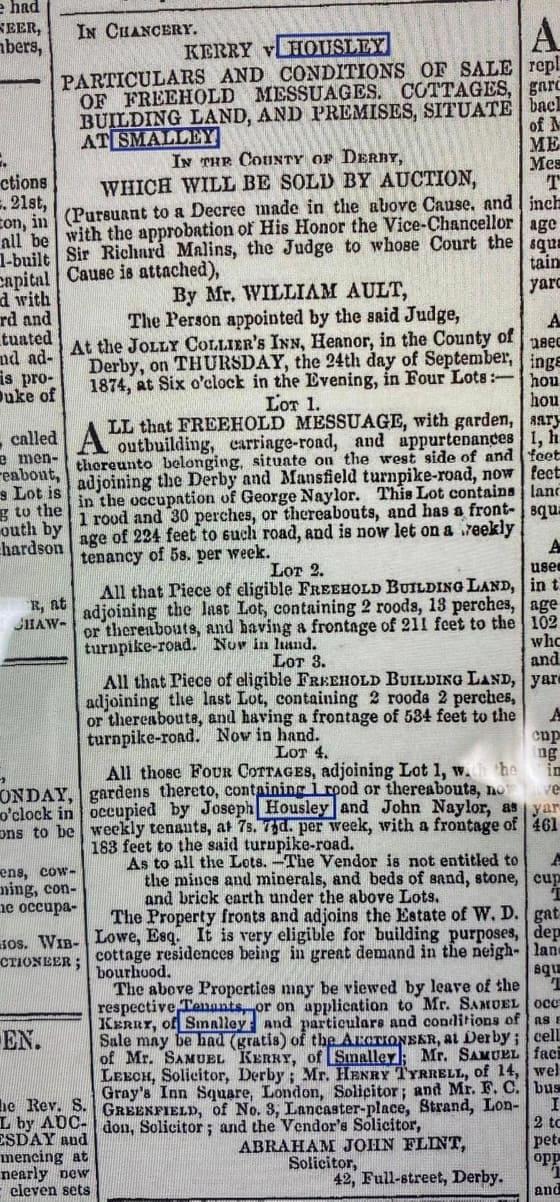 December 18, 2021 at 10:02 am #6242
In reply to: The Elusive Samuel Housley and Other Family Stories
The Housley Letters
We discovered that one of Samuel’s brothers, George Housley 1826-1877, emigrated to America in 1851, to Solebury, in Pennsylvania. Another brother, Charles 1823-1856, emigrated to Australia at the same time.
I wrote to the Solebury Historical Society to ask them if they had any information on the Housleys there. About a month later I had a very helpful and detailed reply from them.
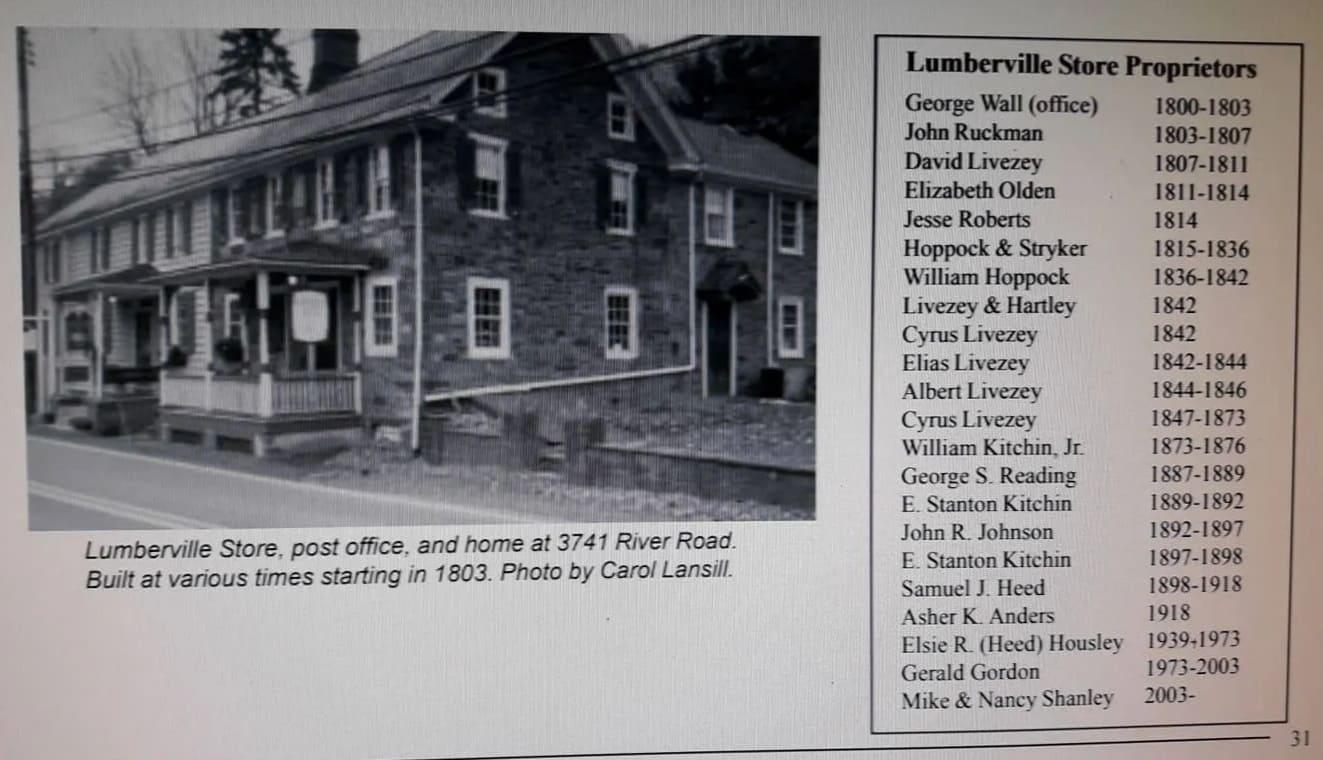
There were Housley people in Solebury Township and nearby communities from 1854 to at least 1973, perhaps 1985. George Housley immigrated in 1851, arriving in New York from London in July 1851 on the ship “Senator”. George was in Solebury by 1854, when he is listed on the tax roles for the Township He didn’t own land at that time. Housley family members mostly lived in the Lumberville area, a village in Solebury, or in nearby Buckingham or Wrightstown. The second wife of Howard (aka Harry) Housley was Elsa (aka Elsie) R. Heed, the daughter of the Lumberville Postmaster. Elsie was the proprietor of the Lumberville General Store from 1939 to 1973, and may have continued to live in Lumberville until her death in 1985. The Lumberville General Store was, and still is, a focal point of the community. The store was also the official Post Office at one time, hence the connection between Elsie’s father as Postmaster, and Elsie herself as the proprietor of the store. The Post Office function at Lumberville has been reduced now to a bank of cluster mailboxes, and official U.S. Postal functions are now in Point Pleasant, PA a few miles north of Lumberville.
We’ve attached a pdf of the Housley people buried in Carversville Cemetery, which is in the town next to Lumberville, and is still in Solebury Township. We hope this list will confirm that these are your relatives.It doesn’t seem that any Housley people still live in the area. Some of George’s descendents moved to Wilkes-Barre, PA and Flemington, NJ. One descendent, Barbara Housley, lived in nearby Doylestown, PA, which is the county seat for Bucks County. She actually visited Solebury Township Historical Society looking for Housley relatives, and it would have been nice to connect you with her. Unfortunately she died in 2018. Her obituary is attached in case you want to follow up with the nieces and great nieces who are listed.
Lumberville General Store, Pennsylvania, Elsie Housley:
I noticed the name of Barbara’s brother Howard Housley in her obituary, and found him on facebook. I knew it was the right Howard Housley as I recognized Barbara’s photograph in his friends list as the same photo in the obituary. Howard didn’t reply initially to a friend request from a stranger, so I found his daughter Laura on facebook and sent her a message. She replied, spoke to her father, and we exchanged email addresses and were able to start a correspondence. I simply could not believe my luck when Howard sent me a 17 page file of Barbara’s Narrative on the Letters with numerous letter excerpts interspersed with her own research compiled on a six month trip to England.
The letters were written to George between 1851 and the 1870s, from the Housley family in Smalley.
Narrative of Historic Letters ~ Barbara Housley.
AND BELIEVE ME EVER MY DEAR BROTHER, YOUR AFFECTIONATE FAMILY
In February 1991, I took a picture of my 16 month old niece Laura Ann Housley standing near the tombstones of her great-great-great-grandparents, George and Sarah Ann Hill Housley. The occassion was the funeral of another Sarah Housley, Sarah Lord Housley, wife of Albert Kilmer Housley, youngest son of John Eley Housley (George and Sarah Ann’s first born). Laura Ann’s great-grandfather (my grandfather) was another George, John Eley’s first born. It was Aunt Sarah who brought my mother, Lois, a packet of papers which she had found in the attic. Mom spent hours transcribing the letters which had been written first horizontally and then vertically to save paper. What began to emerge was a priceless glimpse into the lives and concerns of Housleys who lived and died over a century ago. All of the letters ended with the phrase “And believe me ever my dear brother, your affectionate….”
The greeting and opening remarks of each of the letters are included in a list below. The sentence structure and speech patterns have not been altered however spelling and some punctuation has been corrected. Some typical idiosyncrasies were: as for has, were for where and vice versa, no capitals at the beginnings of sentences, occasional commas and dashes but almost no periods. Emma appears to be the best educated of the three Housley letter-writers. Sister-in-law Harriet does not appear to be as well educated as any of the others. Since their mother did not write but apparently was in good health, it must be assumed that she could not.
The people discussed and described in the following pages are for the most part known to be the family and friends of the Housleys of Smalley, Derbyshire, England. However, practically every page brings conjectures about the significance of persons who are mentioned in the letters and information about persons whose names seem to be significant but who have not yet been established as actual members of the family.To say this was a priceless addition to the family research is an understatement. I have since, with Howard’s permission, sent the file to the Derby Records Office for their family history section. We are hoping that Howard will find the actual letters in among the boxes he has of his sisters belongings. Some of the letters mention photographs that were sent. Perhaps some will be found.
December 15, 2021 at 7:53 am #6234In reply to: The Elusive Samuel Housley and Other Family Stories
Ben Warren
Derby County and England football legend who died aged 37 penniless and ‘insane’
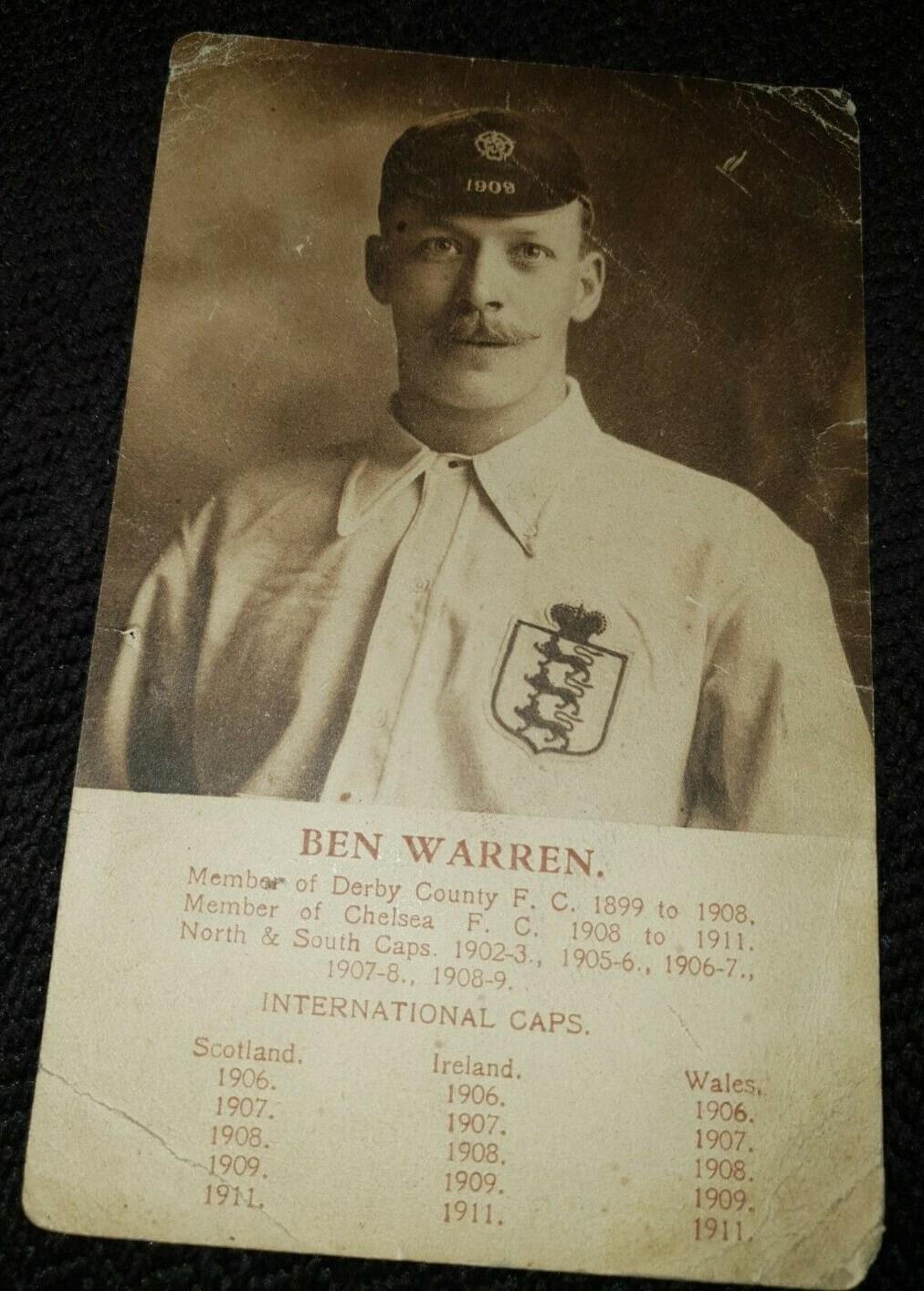
Ben Warren 1879 – 1917 was Samuel Warren’s (my great grandfather) cousin.
From the Derby Telegraph:
Just 17 months after earning his 22nd England cap, against Scotland at Everton on April 1, 1911, he was certified insane. What triggered his decline was no more than a knock on the knee while playing for Chelsea against Clapton Orient.
The knee would not heal and the longer he was out, the more he fretted about how he’d feed his wife and four children. In those days, if you didn’t play, there was no pay.
…..he had developed “brain fever” and this mild-mannered man had “become very strange and, at times, violent”. The coverage reflected his celebrity status.
On December 15, 1911, as Rick Glanvill records in his Official Biography of Chelsea FC: “He was admitted to a private clinic in Nottingham, suffering from acute mania, delusions that he was being poisoned and hallucinations of hearing and vision.”
He received another blow in February, 1912, when his mother, Emily, died. She had congestion of the lungs and caught influenza, her condition not helped, it was believed, by worrying about Ben.
She had good reason: her famous son would soon be admitted to the unfortunately named Derby County Lunatic Asylum.
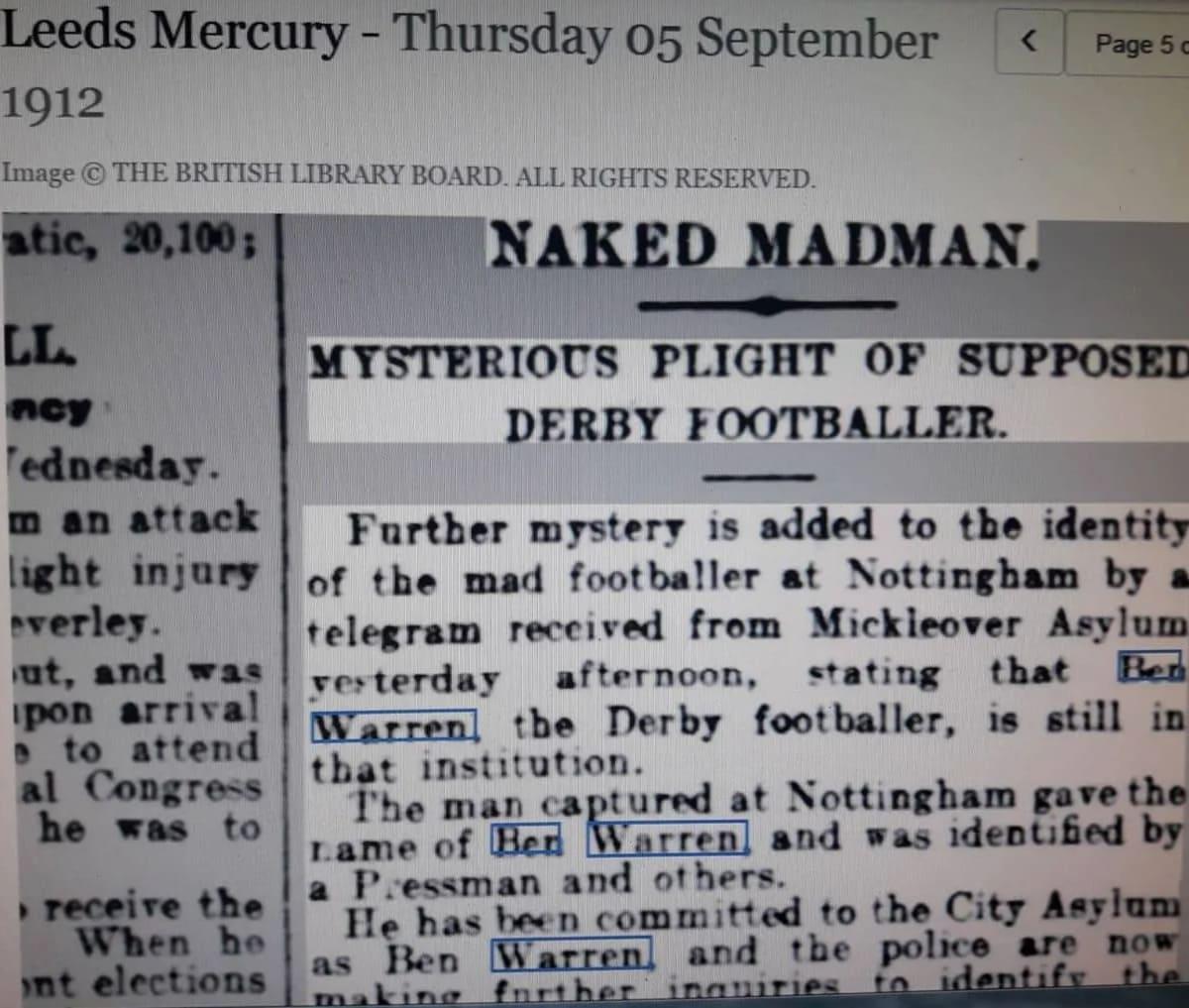
As Britain sleepwalked towards the First World War, Ben’s condition deteriorated. Glanvill writes: “His case notes from what would be a five-year stay, catalogue a devastating decline in which he is at various times described as incoherent, restless, destructive, ‘stuporose’ and ‘a danger to himself’.’”
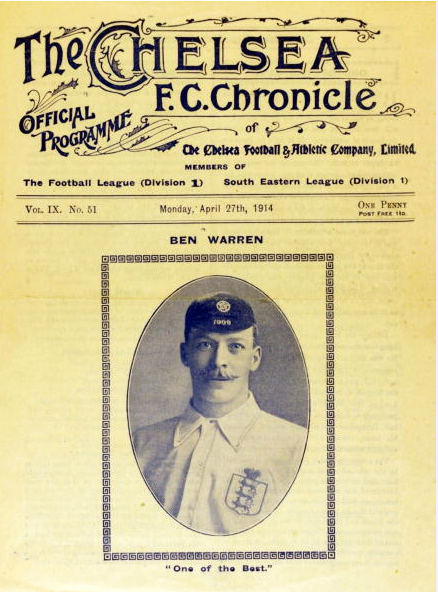
photo: Football 27th April 1914. A souvenir programme for the testimonial game for Chelsea and England’s Ben Warren, (pictured) who had been declared insane and sent to a lunatic asylum. The game was a select XI for the North playing a select XI from The South proceeds going to Warren’s family.
In September, that decline reached a new and pitiable low. The following is an abridged account of what The Courier called “an amazing incident” that took place on September 4.
“Spotted by a group of men while walking down Derby Road in Nottingham, a man was acting strangely, smoking a cigarette and had nothing on but a collar and tie.
“He jumped about the pavement and roadway, as though playing an imaginary game of football. When approached, he told them he was going to Trent Bridge to play in a match and had to be there by 3.30.”
Eventually he was taken to a police station and recognised by a reporter as England’s erstwhile right-half. What made the story even harder to digest was that Ben had escaped from the asylum and walked the 20 miles to Nottingham apparently unnoticed.
He had played at “Trent Bridge” many times – at least on Nottingham Forest’s adjacent City Ground.
As a shocked nation came to terms with the desperate plight of one of its finest footballers, some papers suggested his career was not yet over. And his relatives claimed that he had been suffering from nothing more than a severe nervous breakdown.
He would never be the same again – as a player or a man. He wasn’t even a shadow of the weird “footballer” who had walked 20 miles to Nottingham.
Then, he had nothing on, now he just had nothing – least of all self-respect. He ripped sheets into shreds and attempted suicide, saying: “I’m no use to anyone – and ought to be out of the way.”
“A year before his suicide attempt in 1916 the ominous symptom of ‘dry cough’ had been noted. Two months after it, in October 1916, the unmistakable signs of tuberculosis were noted and his enfeebled body rapidly succumbed.
At 11.30pm on 15 January 1917, international footballer Ben Warren was found dead by a night attendant.
He was 37 and when they buried him the records described him as a “pauper’.”
However you look at it, it is the salutary tale of a footballer worrying about money. And it began with a knock on the knee.
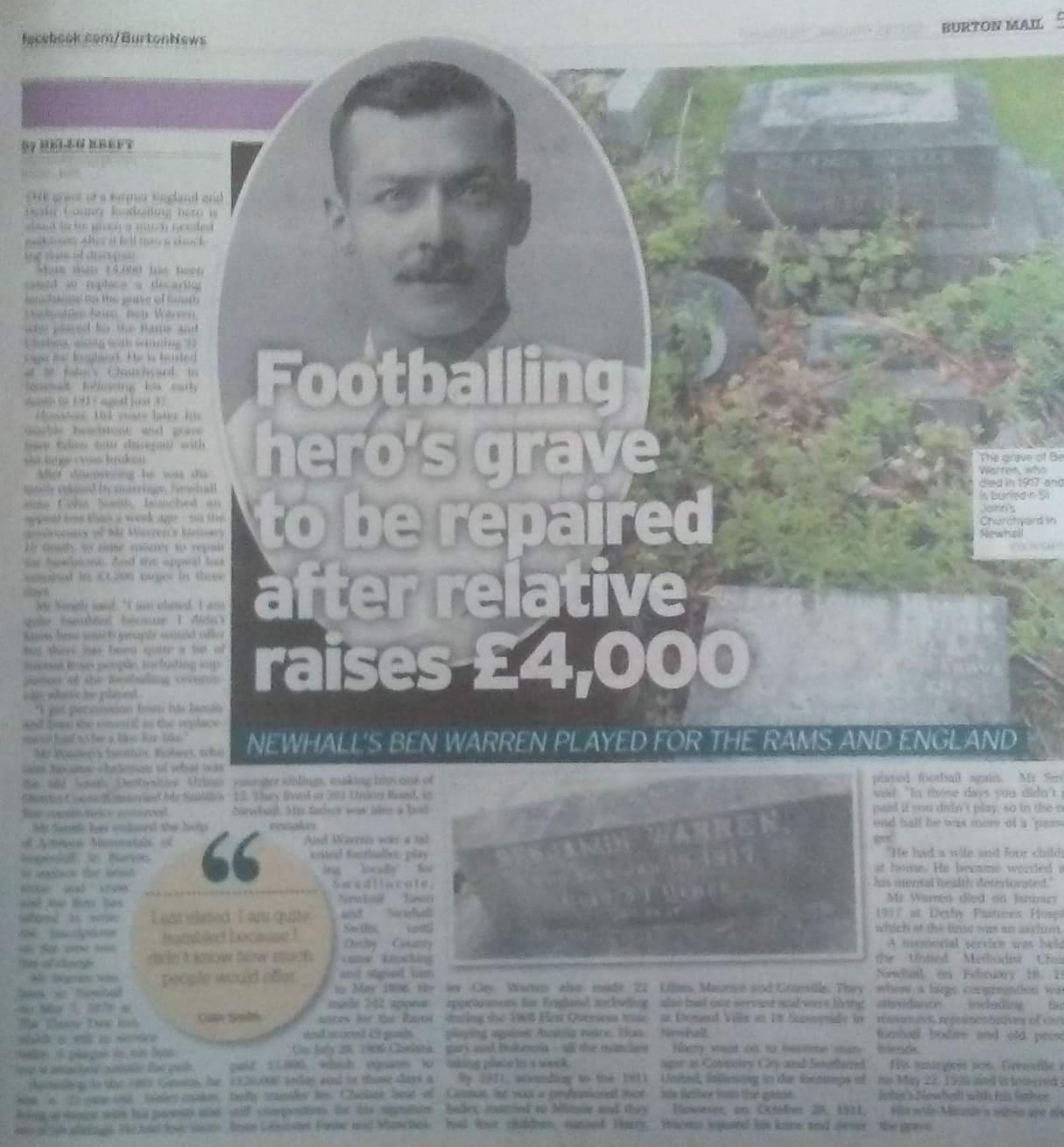
On 14th November 2021, Gill Castle posted on the Newhall and Swadlincote group:
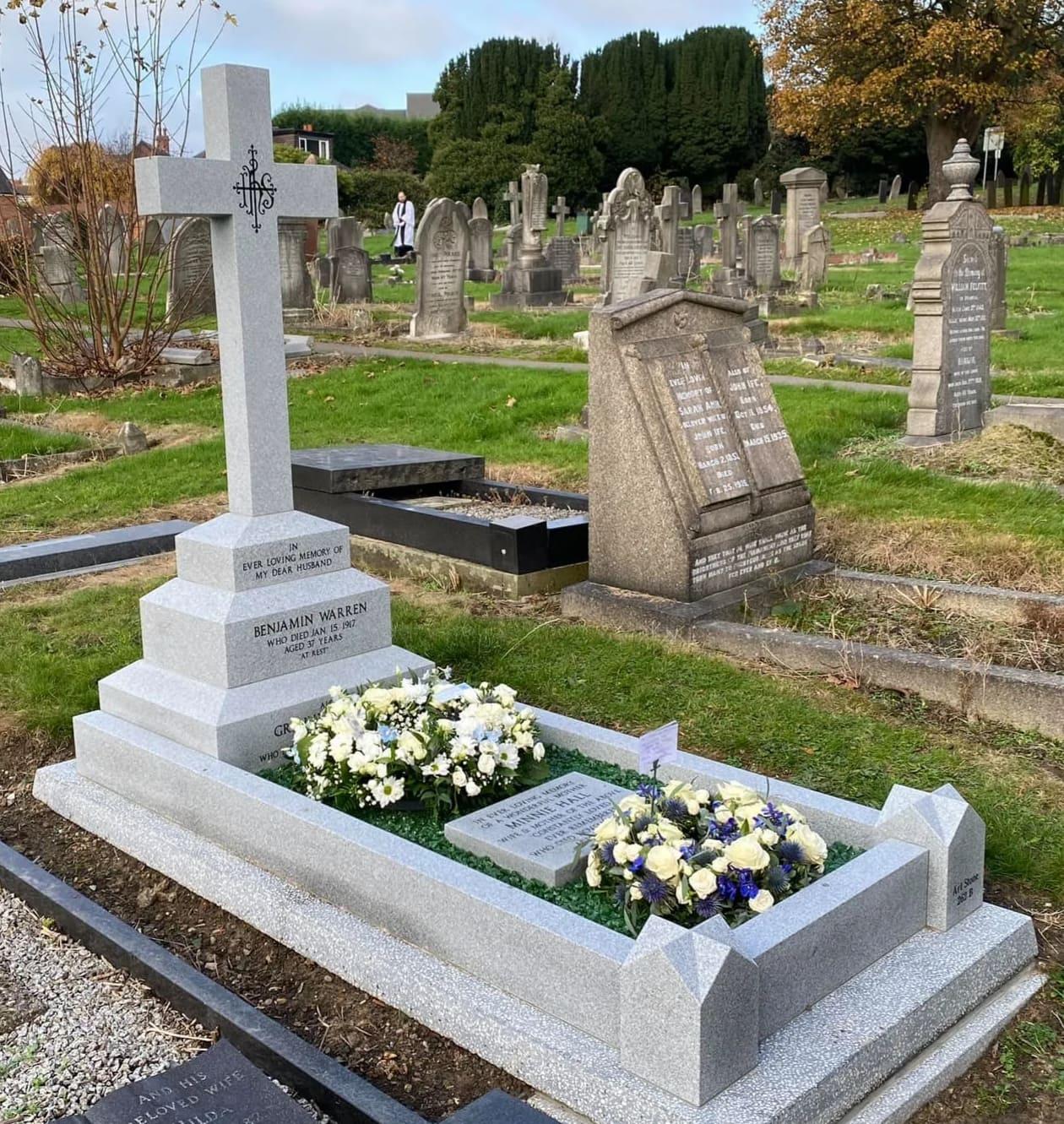
I would like to thank Colin Smith and everyone who supported him in getting my great grandfather’s grave restored (Ben Warren who played for Derby, Chelsea and England)
The month before, Colin Smith posted:
My Ben Warren Journey is nearly complete.
It started two years ago when I was sent a family wedding photograph asking if I recognised anyone. My Great Great Grandmother was on there. But soon found out it was the wedding of Ben’s brother Robert to my 1st cousin twice removed, Eveline in 1910.
I researched Ben and his football career and found his resting place in St Johns Newhall, all overgrown and in a poor state with the large cross all broken off. I stood there and decided he needed to new memorial & headstone. He was our local hero, playing Internationally for England 22 times. He needs to be remembered.
After seeking family permission and Council approval, I had a quote from Art Stone Memorials, Burton on Trent to undertake the work. Fundraising then started and the memorial ordered.
Covid came along and slowed the process of getting materials etc. But we have eventually reached the final installation today.
I am deeply humbled for everyone who donated in January this year to support me and finally a massive thank you to everyone, local people, football supporters of Newhall, Derby County & Chelsea and football clubs for their donations.
Ben will now be remembered more easily when anyone walks through St Johns and see this beautiful memorial just off the pathway.
Finally a huge thank you for Art Stone Memorials Team in everything they have done from the first day I approached them. The team have worked endlessly on this project to provide this for Ben and his family as a lasting memorial. Thank you again Alex, Pat, Matt & Owen for everything. Means a lot to me.
The final chapter is when we have a dedication service at the grave side in a few weeks time,
Ben was born in The Thorntree Inn Newhall South Derbyshire and lived locally all his life.
He played local football for Swadlincote, Newhall Town and Newhall Swifts until Derby County signed Ben in May 1898. He made 242 appearances and scored 19 goals at Derby County.
28th July 1908 Chelsea won the bidding beating Leicester Fosse & Manchester City bids.
Ben also made 22 appearance’s for England including the 1908 First Overseas tour playing Austria twice, Hungary and Bohemia all in a week.
28 October 1911 Ben Injured his knee and never played football again
Ben is often compared with Steven Gerard for his style of play and team ethic in the modern era.
Herbert Chapman ( Player & Manager ) comments “ Warren was a human steam engine who played through 90 minutes with intimidating strength and speed”.
Charles Buchan comments “I am certain that a better half back could not be found, Part of the Best England X1 of all time”
Chelsea allowed Ben to live in Sunnyside Newhall, he used to run 5 miles every day round Bretby Park and had his own gym at home. He was compared to the likes of a Homing Pigeon, as he always came back to Newhall after his football matches.
Ben married Minnie Staley 21st October 1902 at Emmanuel Church Swadlincote and had four children, Harry, Lillian, Maurice & Grenville. Harry went on to be Manager at Coventry & Southend following his father in his own career as football Manager.
After Ben’s football career ended in 1911 his health deteriorated until his passing at Derby Pastures Hospital aged 37yrs
Ben’s youngest son, Grenville passed away 22nd May 1929 and is interred together in St John’s Newhall with his Father
His wife, Minnie’s ashes are also with Ben & Grenville.
Thank you again everyone.
RIP Ben Warren, our local Newhall Hero. You are remembered.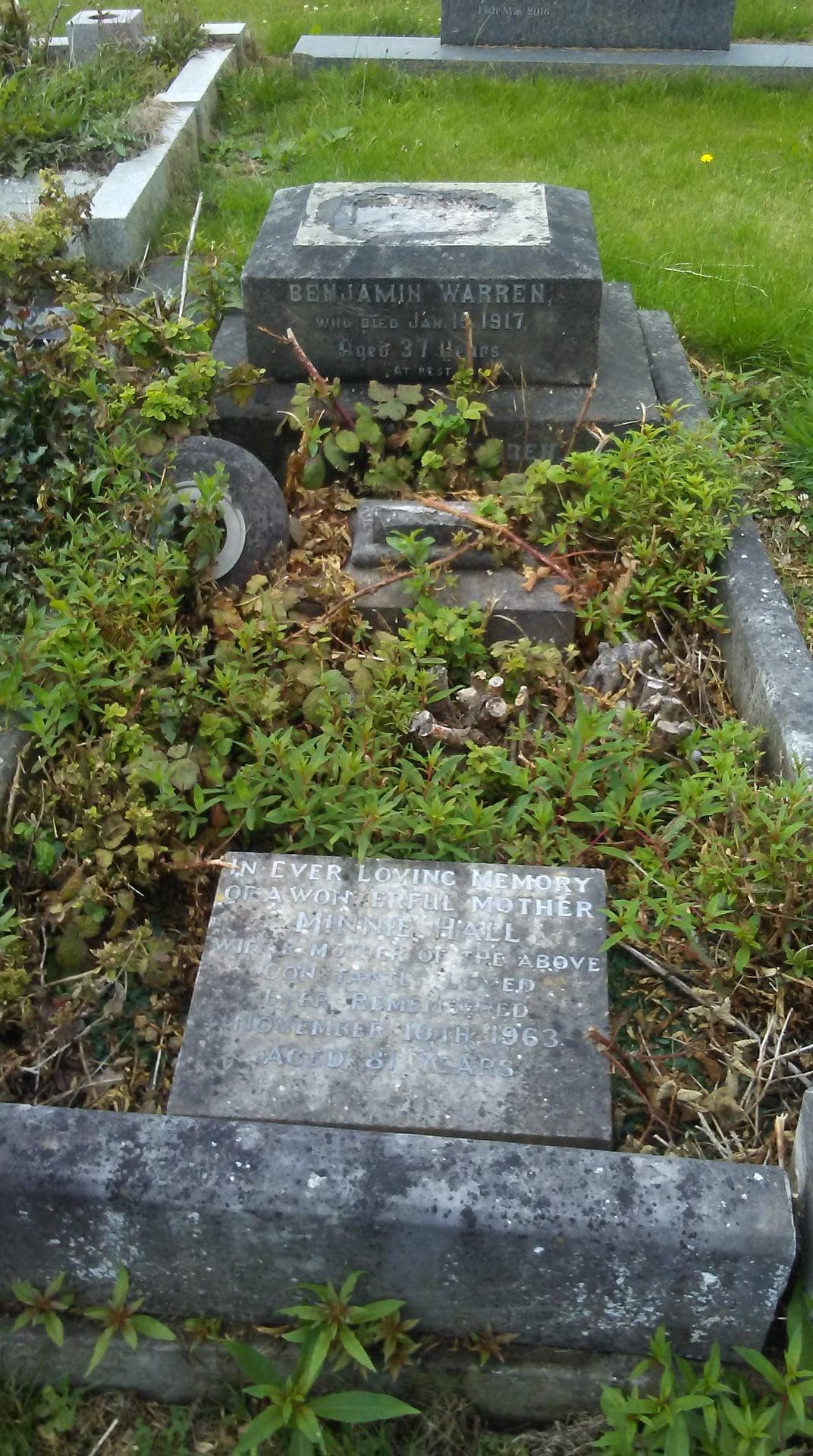
 June 12, 2021 at 9:37 pm #6208
In reply to: Newsreel from the Rim of the Realm
“Not so fast!” Glor muttered grimly, grabbing a flapping retreating arm of each of her friends, and yanking them to her sides. “Now’s our chance. It’s a trap, dontcha see? They got the wind up, and they’re gonna round us all up, it don’t bear thinking about what they’ll do next!”
With her free hand Mavis felt Gloria’s forehead, her palm slipping unpleasantly over the feverish salty slick. “Her’s deplirious, Sha, not right in the ‘ead, the ‘eat’s got to her. Solar over dose or whatever they call it nowadays.”
“My life depends on going to the bloody assembly hall, Glor, let go of my arm before I give yer a Glasgow kiss,” Sharon hissed, ignoring Mavis.
“I’m trying to save you!” screeched Gloria, her head exploding in exasperation. She took a deep breath. Told herself to stop screeching like that, wasn’t helping her cause. Should she just let go of Sharon’s arm?
Mavis started trying to take the pulse on Glor’s restraining wrists, provoking Gloria beyond endurance, and she lashed out and slapped Mavis’s free hand away, unintentionally freeing Sharon from her grasp. This further upset the balance and Gloria tumbled into Mavis at the moment of slapping her hand, causing a considerably more forceful manoeuvre than was intended.
Sharon didn’t hesitate to defend Mavis from the apparently deranged attack, and dived on to Gloria, pinning her arms behind her back.
Mavis scrambled to her feet and backed away slowly, nursing her hand, wide eyed and slack jawed in astonishment.
Where was this going?
February 6, 2021 at 1:23 pm #6185In reply to: Twists and One Return From the Time Capsule
“I’ll be right back!” Nora told Will, who was stirring a big bubbling pot on the stove. “Need to wash my hands.”
She had a quick look around the bedroom she’d slept in for her missing phone. Nowhere to be found! Maybe she could find Will’s phone when he went out to feed the donkey, and call her phone to try and locate it. Damn, that wouldn’t work either. Will had said there was no network here. That would explain why her phone stopped working when she was alone in the dark woods.
“Smells delicious!” she said brightly, scraping a chair back across the brick floor and seating herself at the kitchen table.
The home made soup was chock full of vegetables and looked and smelled wonderful, but it had a peculiar acrid aftertaste. Nora tried to ignore it, taking gulps of wine in between each mouthful to eliminate the bitterness. She wished it wasn’t soup in a way, so that she’d be able to surreptitiously palm some of it off onto the dogs that were waiting hopefully under the table. If only Will would leave the room for a minute, but he seemed to be watching her every move.
“Very tasty, but I can’t manage another mouthful, it’s so filling,” she said, but Will looked so offended that she sighed and carried on eating. He topped up her wine glass.
By the time Nora had finished the soup, she felt quite nauseous and stood up quickly to head for the bathroom. The room started to spin and she held on to the edge of the table, but it was no good. The spinning didn’t stop and she crashed to the floor, unconscious.
Smiling with satisfaction, Will stood up and walked around the table to where she lay. Shame he’d had to put her to sleep, really she was quite a nice woman and cute, too, in a funny elfin way. He’d started to like her. Plenty of time to get to know her now, anyway. She wouldn’t be going anywhere for awhile.
He picked her up and carried her to the secret room behind his workshop on the other side of the patio. The walls and floor were thick stone, and there were no windows. He laid her on the bench, locked the door, and went back in the house to fetch blankets and bedding and a pile of books for her to read when she came round. Probably not for a good 24 hours he reckoned, somehow she’d managed to eat all the soup. He would put much less in the next batch, just enough to keep her docile and sleepy.
It would only be for a few days, just long enough for him to find that box and move it to a safer location. He’d been entrusted to make sure the contents of the box were preserved for the people in the future, and he was a man of his word.
If they had listened to him in the first place this would never have happened. Burying a box was a risk: all kinds of possibilities existed for a buried box to be accidentally unearthed. He had suggested encasing the contents inside a concrete statue, but they’d ignored him. Well, now was his chance. He was looking forward to making a new statue.
December 22, 2020 at 1:47 am #6168In reply to: Tart Wreck Repackage
The wardrobe was sitting solidly in the middle of the office, exactly where they had left it.
Or was it?
“I was expecting a room full of middle-aged ladies,” said Star, her voice troubled. She frowned at the wardrobe. “Has it moved a little do you think? I’m sure it was closer to the window before. Or was it smaller. There’s something different about it …”
“Maybe they are inside,” whispered Tara.
“What! All of them?” Star sniggered nervously.
“We should check.” But Tara didn’t move— she felt an odd reluctance to approach the wardrobe. “You check, Star.”
Star shook her head. “Where’s Rosamund? Checking wardrobes for middle-aged drug mules is the sort of job she should be doing.”
“Are you looking for me?” asked a soft voice from the doorway. Tara and Star spun round.
“Good grief!” exclaimed Tara. “Rosamund! What are you wearing?”
Rosamund was dressed in a silky yellow thing that floated to her ankles. Her feet were bare and her long hair, usually worn loose, was now neatly plaited. Encircling the top of her head was a daisy chain. She smiled gently at Star and Tara. “Peace, my friends.” Dozens of gold bracelets jangled as she extended her hands to them. “Come, my dear friends, let us partake of carrot juice together.”
October 21, 2020 at 9:23 am #6142In reply to: The Whale’s Diaries Collection
Everyone seems happy about the rain, and I don’t blame them. I’m not daft, I know we need rain but it’s not so easy when you don’t have a home. But I am nothing if not stalwart and stoic, resourceful and adaptable, and I found a good way to keep warm and dry during the downpours. It’s amazing how much heat an animal gives off, so I camp down in stables or kennels when it’s cold and wet. It can get a bit smelly, but it’s warm and dry and when my clothes are damp and stinking I just throw them all away and get some new ones out of the recycling bins. Just to clarify, I find the new clothes first before throwing the ones I’m wearing away. I’m not daft, I know walking around naked would catch attention and I try to stay under the radar. Nobody really notices smelly old ladies wandering around these days anyway, but naked would be another matter.
There’s a stable I really like just outside of town, lots of nice deep clean straw. There’s a white horse in there that knows me now and the gentle whicker of recognition when she sees me warms my heart. I don’t stay there any two nights running though. One thing I’ve learned is don’t do anything too regular, keep it random and varied. I don’t want anyone plotting my movements and interfering with me in any way.
There’s not much to do in a stable when it rains for days and nights on end but remember things, so I may as well write them down. I’m never quite sure if the things I remember are my memories or someone elses, a past life of my own perhaps, or another person entirely. I used to worry a bit about that, but not anymore. Nobody cares and there’s nobody to flag my memories as false, and if there was, I wouldn’t care if they did.
Anyway, the other day while I was nestled in a pile of sweet hay listening to the thunder, I recalled that day when someone offered me a fortune for that old mirror I’d bought at the flea market. I know I hadn’t paid much for it, because I never did pay much for anything. Never have done. I bought it because it was unusual (hideous is what everyone said about it, but people have got very strangely ordinary taste, I’ve found) and because it was cheap enough that I could buy it without over thinking the whole thing. At the end of the day you can’t beat the magic of spontaneity, it out performs long winded assessment every time.
So this man was a friend of a friend who happened to visit and made me an offer I couldn’t refuse so of course I sold the mirror to him. He was so delighted about it that I’d have given him the mirror for nothing if I knew he wanted it that much, but I’m not daft, I took the money. I found out later that he’d won the lottery, so I never felt guilty about it.
Well, after he’d gone I sat there looking at this pile of money in my hands and knew exactly what I was going to do. But first I had to find them. They’d moved again and we’d lost contact but I knew I’d find a way. And I did. They’d given up all hope of ever getting that money back that I’d borrowed, but they said the timing was perfect, couldn’t have been better, they said. It wouldn’t have meant all that much to them if I’d paid it back right away, they said, because they didn’t need it then as much as they did when they finally got it back.
They were strange times back then, and one thing after another was happening all over the world, what with the strange weather, and all the pandemics and refugees. Hard to keep food on the table, let alone make plans or pay debts back. But debt is a funny thing. I felt stung when I realized they didn’t think I intended to pay them back but the fact was, I couldn’t do it at the time. And I wanted it to be a magical perfect timing surprise when I did. I suppose in a way I wanted it to be like it was when they loaned me the money. I remember I wept at the kindness of it. Well I didn’t want them to weep necessarily, but I wanted it to mean something wonderful, somehow. And timing is everything and you can’t plan that kind of thing, not really.
It was a happy ending in the end though, I gave them the whole amount I got for that old mirror, which was considerably more than the loan.
The rain has stopped now and the sun is shining. My damp clothes are steaming and probably much smellier than I think. Time to find a recycling bin and a fresh new look.
April 26, 2020 at 12:24 pm #6073In reply to: Tart Wreck Repackage
The words of the Great Leader Undisputed Gabe were still resonating in the back of Gavin’s mind. The promotion to Operating Tomathetan seemed a great honour on the surface, but it certainly brought its lot of responsibilities with it. And from what he had seen before, it would only add to his current ones.
Gavin descended the Pealgrim path to the Dark Room where all the sorting happened. Many trails from the many carrot fields combined into one and all led to that central building all painted in black, hence its name.
A zealous Seed level had recently been put in charge of the re-painting. As there was only black paint in the warehouse he had the genius idea to save the order some money by using only what they already had, and as there was enough paint he covered all the windows, certainly thinking light could damage the crops. Repainting everything was out of the question so they had kept it like that and just added some artificial light to help the workers. Great Leader Undisputed Gabe, had thought it was a nice initiative as now workers could work any hour of the day.
When Gavin entered the Dark Room, it reeked of carrot and sweat. Members of the cult of all ages were sorting the divine roots by shapes, sizes and thickness. Most of them didn’t know what was the final purpose, innocent minds. All they had was the Sorting Song written by Britta the one legged vestal to help her fellow cultshipers in their work.
If a carrot is short, not worth the effort
As a long stalactites, like ice on your tits
A bar thick as a fist, you’ve just been blissed
…Each verse gave advices about what they were looking for, where to put them after sorting and each team had their own songs that they sang while doing their work with the enthusiasm of cultshipers. Even though the song had been crafted to answer most of the situations in terms of carrot shapes, sizes and thickness, it happened that some would not fit into any categories. And recently, those seem to happen more often than once and the pile of misshapen carrots threaten to exceed that of the others combined.
“Eugene, Have you found what is the problem?” asked Gavin to their agronomist. His surname was Carrot and he came from noble Irish descent, quite appropriate for his work, thought Gavin. Eugene was skinny with a long neck and he often seemed to abuse the ritual fasting ceremony ending with the consumption of sacred mushroom soup.
“It’s because of the microscopic snails that infest the crops,” Eugene said. Gavin couldn’t help but notice an accumulation of dried saliva at the corner of his mouth. “They’re carried by bird shit and they are too small to be eaten by our ducks and in the end they cause the carrots to grow random shapes unfit for Odin.”
Odin, short for Organic Dildo Industry, has been the main source of revenue for the cult. Since the start of the confinement the demand has skyrocketed. Especially appreciated by vegans and nature lovers, it also procured a nice orange tan on the skin after usage.
“Can’t you find smaller dwarf ducks?”
“Your Gourdness, microscopic means very tiny, even dwarf ducks wouldn’t be able to eat them unless they eat the carrots.”
“And that would be a problem,” sighed Gavin. “What is your solution then?”
“I don’t have one.”
Gavin raised his hands to the black roof in despair. Did he have to do the jobs of everyone? He needed some fresh eyes and fresh ideas.
April 19, 2020 at 11:27 am #6064In reply to: The Whale’s Diaries Collection
I’ve been up since god knows what time. Got up for the loo and couldn’t face going back to the awful nightmares. That girl that came yesterday said she’d been having nightmares, she said it was common now, people having nightmares, what with the quarantine. I think I might have just snorted at the silly girl, but when I woke up last night I wondered if it was true. Or maybe I’m just a suggestible old fool.
Anyway, I stayed up because lord knows I don’t want to be in a city in America at night, not waking and not dreaming either. I’ve had a feeling for a long time, and much longer than this virus, that it was like a horror movie and it would behoove me not to watch it anymore or I’d be having nightmares. I didn’t stop watching though, sort of a horrified fascination, like I’d watched this far so why stop now.
In the dream I was on a dark city street at a bus stop, it was night time and the lights were bright in a shop window on the other side of the sidewalk. I had a bunch of tickets in my hand all stapled together, but they were indecipherable. I had no idea where I was going or how to get there. Then I noticed the man that was by my side, a stranger that seemed to have latched on to me, had stolen all my tickets and replaced them with the rolled up used ticket stubs. I made him give me back my tickets but then I knew I couldn’t trust him.
Then I realized I hadn’t finished packing properly and only had a ragged orange towel with bloodstains on it. So I go back home (I say home but I don’t know what house it was) to pack my bags properly, and find a stack of nice new black towels, and replace the bloody orange one.
I’m walking around the house, wondering what else I should pack, and one room leads into another, and then another, and then another, in a sort of spiral direction (highly improbable because you’d have ended up back in the same room, in real life) and then I found a lovely room and thought to myself, What a nice room! You’d never have known it was there because it wasn’t on the way to anywhere and didn’t seem to have a function as a room.
It was familiar and I remembered I’d been there before, in another dream, years ago. It had lovely furniture in it, big old polished wooden pieces, but not cluttered, the room was white and bright and spacious. Lovely big old bureau on one wall, I remember that piece quite clearly. Not a speck of dust on it and the lovely dark sheen of ancient polished oak.
Anyway in the dream I didn’t take anything from the room, and probably should have just stayed there but the next thing I know, I’m in a car with my mother and she races off down the fast lane of an empty motorway. I’m thinking, surely she doesn’t know how to take me where I have to go? She seemed so confident, so out of character the way she was driving.
I got up for the loo and all I kept thinking about was that awful scene in the city street, which admittedly doesn’t sound that bad. I won’t bother telling the girl about it when she comes to do my breakfast, it loses a little in the telling, I think.
But the more I think about that lovely room at the end of the spiral of rooms, the more I’m trying to wrack my brains to remember where I’ve seen that room before. I’ve half a mind to go back there and open that dark oak bureau and see what’s inside.
April 18, 2020 at 1:42 pm #6044In reply to: Seven Twines and the Dragon Heartwoods
They had to stop to get some rest. Rukshan knew the signs, the song of a black swan, a nesting bear in the forest, cubic clouds… All strange omens not to be taken lightly. He told the others they’d better find shelter somewhere and not spend the night outside.
As soon had he make the announcement that he saw the relief on their faces. They’d been enthusiastic for half a day, but the monotony of walking got the better of their motivation, especially the kids who were not used to such long journeys out of the cottage’s safety.
Fortunately they were not far from the Sooricat Inn, a place lost in the woods, it still had four walls, warm food and almost certainly a hot bath. Let’s just hope they’re open, thought the Fae.
When they arrived, the owner, an old man from Sina, looked at them suspiciously.
“Ya’ll have your attestation? I can’t believe ya’re all family. Don’t think I’m a fool, ya’re a Fae, and this little fella there, he’s smaller than the children but has a beard. Never saw anything like him,” he said with rumbling r’s pointing at the children and Gorrash with his chin. The dwarf seemed offended but a stern look from Rukshan prevented him from speaking.
“Anyway,” continued the innkeeper, “I can just sell ya food. Not’ing parsonal. That’s rooles, ya’know with the all stayin’at home thing from Gavernor Leraway, I can not even let ya’in. Ya can buy food and eat it outside if ya want.”
“Look, it’s almost twilight,” said Rukshan. “We’ve walked the whole day, the children are exhausted.”
Tak and Nesy showed their best puppy face, risking to make Fox burst into laughter. That seemed to soften the man a little.
“Oh! I really shouldn’t. I don’t like breaking rooles.”
“I knew you more daring, Admirable Fuyi,” said a booming voice coming from behind them. They all turned around to see Kumihimo. She was wearing a cloak made of green and yellow gingko leaves, her silvery white hair, almost glowing in the dark, cascading beautifully on her shoulders. A grey cat strode alongside her.
“Oh! that’s just the donkey, Ronaldo. It got transformed into a cat after walking directly into a trap to get one of those darn carrots. He knew better, don’t pity him. He got what he deserved.” Kumihimo’s rant got a indignant meow, close to a heehaw, from Ronaldo.
“Kumi! I can’t believe it’s ya!” said the innkeeper.
“You two know each others?” asked Rukshan.
“It’s a long story,” said the innkeeper, “From when I was serving in Sina’s army, we had conquered the high plateaus. I gave up the title of Admirable when I left the army. After Kumi opened my eyes.” Fuyi’s eyes got wet. “Ah! I’m sure I’ll regret it, but come on in, ya’ll. Let me hear yar story after you taste the soup.”
April 18, 2020 at 9:56 am #6025In reply to: Story Bored

BOARD 10Board 10, Story 1
Arona beat Leörmn at his game of chess, and wins a sabulmantium. “But did you turn Mandrake into that glowing thing, or it’s just a diversion for sneakily gobbling him?”
The maids escapees of Versailles timeline venture in strange lands and go to extreme lengths to find adequate food. “Didn’t the time GPS say to turn left at your peril?”
Ascended Master Floverly goes about her duties to paint and inspire the world a better place by applying Herself entirely lovingly to the most demanding tasks. “A whole new world / A new fantastic point of view…”
April 7, 2020 at 2:04 pm #5964In reply to: Newsreel from the Rim of the Realm
They walked through a labyrinth of tunnels which seemed to have been carved into a rocky mountain. The clicks and clacks of their high heels echoed in the cold silence meeting all of Sophie’s questions, leaving her wondering where they could be. Tightly held by her rompers she felt her fat mass wobbling like jelly around her skeleton. It didn’t help clear her mind which was still confused by the environment and the apparent memory loss concerning how she arrived there.
Sophie couldn’t tell how many turns they took before Barbara put her six fingers hand on a flat rock at shoulders height. The rock around the hand turned green and glowed for two seconds; then a big chunk of rock slid to the side revealing a well designed modern style room.
“Doctor, Sophie is here,” said Barbara when they entered.
A little man was working at his desk. At least Sophie assumed it was his desk and that he was working. He was wearing a Hawaiian shirt and bermudas. The computer screen he was looking at projected a greenish tint onto his face, and it made him look just like the green man icon. Sophie cackled, a little at first.
The Doctor’s hand tensed on the mouse and his eyebrows gathered like angry caterpillars ready to fight. He must have made a wrong move because a cascade of sound ending in a flop indicated he just died a death, most certainly on one of those facegoat addictive games.
That certainly didn’t help muffle Sophie’s cackle until she felt Barbara’s six fingers seizing her shoulders as if for a Vulcan nerve pinch. Sophie expected to lose consciousness, but the hand was mostly warm, except for that extra finger which was cold and buzzing. The contact of the hand upon the latex gave off little squeaky sounds that made Sophie feel uncomfortable. She swallowed her anxiety and wished for the woman to remove her hand. But as she had noticed more than once, wishes could take time and twists before they could be fulfilled.
“Why do you have to ruin everything every time?” asked the Doctor. His face was now red and distorted.
“Every time?” said Sophie confused.
“Yes! You took your sleeper agent role too seriously. We couldn’t get any valuable intel and the whole doll operation was a fiasco. We almost lost the magpies. And now, your taste for uncharted drugs, which as a parenthesis I confess I admire your dedication to explore unknown territories for science… Anyway, you were all day locked up into your boudoir trying to contact me while I just needed you to look at computer screens and attend to meetings.”
Sophie was too shocked to believe it. How could the man be so misinformed. She never liked computers and meetings, except maybe while looking online for conspiracy theories and aliens and going to comiccons. But…
“Now you’re so addict to the drugs that you’re useless until you follow our rehab program.”
“A rehab program?” asked Sophie, her voice shaking. “But…” That certainly was the spookiest thing she had heard since she had arrived to this place, and this made her speechless, but certainly not optionless. Without thinking she tried a move she had seen in movies. She turned and threw her mass into Barbara. The two women fell on the cold floor. Sophie heard a crack before she felt the pain in her right arm. She thought she ought to have persevered in her combat training course after the first week. But life is never perfect.
“Suffice!” said the Doctor from above. “You’ll like it with the other guests, you’ll see. All you have to do is follow the protocol we’ll give you each day and read the documentation that Barbara will give you.”
Sophie tried a witty answer but the pain was too much and it ended in a desperate moan.
January 29, 2020 at 10:08 am #5662In reply to: Pop﹡in People Tribulations
Jerk had been tracking all of it. He’d done a nice map of all the location the both of them had travelled, with little animated pins for the dolls they’d collected.
It was a bit difficult to get them all to focus, and by them he didn’t mean the pins.
After Shawn-Paul and Maeve had come back home, their little lives at the building had resumed with some slight changes. For one, he’d finally realized through some fine deductive work worthy of Sherlock that Maeve was the one behind the dolls postings on his website. He was finally sure after a firewall update got her locked out of the website and she requested to get back in. Anyways, that made things easier, although they still mostly exchanged and discussed though the website despite them being front door neighbours on the same floor. But the arrangement was convenient, especially since Shawn-Paul had kind of unofficially moved in with her and Fabio.
He’d invited them in Lucinda’s apartment to do a little old fashioned slide show —Lucinda’s apartment was bigger he’d argued; and all the funny collection of paraphernalia she’d gathered on the walls and cabinets tops was always great to set the mood or do an improvised theme party. For sure, it didn’t have anything to do with the fact he wouldn’t need to clean up and push all the mess in the corners of his own apartment.
Lucinda was all excited. And not just by her new boyfriend Jasper. She wanted to make a book about their expedition, and everybody had immediately rolled their eyes. Books in this century, she must be the last one dinosaur raving about books.
The slide show started by the end. Where the dolls all ended up finally. La Isla de las Muñecas in Mexico: the Island of Dolls.
That’s when they were all appreciating the fitting finish line that the door bell rang.
“Uncle Fergus?!” Maeve was incredulous; it was months they weren’t in contact.
“I’m here for Jasper.” he said ominously.
January 22, 2020 at 12:40 pm #5628In reply to: Two Aunties au Pair and Their Pert Carouses
Realizing that she had to come up with a plan quickly to distract April from taking her pith helmet, June took a few deep breaths and calmed herself. It was true she was often flaky and disorganized, but in an emergency she was capable of acting swiftly and efficiently.
“I’ve got it!” she exclaimed. April paused on her way over to the hat stand and looked over her shoulder at June. “Come and sit down, I have a plan,” June said, patting the sofa cushion beside her.
“Remember Jacqui who we met in Scotland at the Nanny and Au Pair convention? Called herself Nanny Gibbon and tried to pass herself off as Scottish?” April frowned, trying to remember. Europeans all looked the same to her. “Ended up with that eccentric family with all the strange goings on?” June prompted.
“Oh yes, now I remember. Wasn’t there an odd story about a mummy that had washed up from, where was it?”
“Alabama!” shouted June triumphantly. “Exactly!”
“Well excuse me for being dense, but how does that help?”
June leaned back into the sofa with a happy smile. April had forgotten all about the pith helmet and was now focused on the new plan. “Well,” she said, rearranging some scatter cushions behind her back into a more comfortable position, “Do you remember the woman who arrived with the mummy, Ella Marie? She stayed with Jacqui for a while and they became good friends. Apparently she loved that crazy Wrick family; Jacqui said Ella Marie felt right at home there. She would have stayed, but she missed her husband in the end and felt guilty about leaving him, so she went back to Alabama.”
Aprils eyes widened slightly as she started to understand. “Did they stay in contact?”
“Oh yes!” replied June, leaning forward. “And not only that, Jacqui is there right now, on holiday! I’ve been seeing her holiday photos on FleeceCrack.”
“Maybe they can find that baby for us,” April said, looking relieved. “Or at least swap it for that girl baby. Where did that come from anyway?”
January 18, 2020 at 8:48 am #5612In reply to: Two Aunties au Pair and Their Pert Carouses
Why was Mr August making interview appointments at this time of night? May wondered briefly, but the overpowering smell coming from the nether regions of the howling toddler had to be dealt with first. Anyone would think he’d been drinking the laced wine, judging from the volume that had over spilled the disposable diaper. There was only one way to clean him up and May took him back outside to the garden hose. It was a cold night, but babies were not easily killed, she’d heard. She could easily warm him back up again afterwards. At least the violent shivering had stopped that dreadful squawking.
Once the child was clean and tightly swaddled in clean cooks aprons ~ she was tempted to swaddle right over his face but he’d gone quiet at last ~ May wondered again about the mysterious late visitor. She had to be a call girl, a prostitute, a lady of ill repute, to be calling at such an hour to see a gentleman. How dare she take that hoity toity attitude with me! May became increasingly offended the more she thought about it.
Oh well, she decided, it was highly unlikely that she’d ever cross the path of such a low life again, and there was no need to give any more thought to Mr August’s disreputable assignations. It might come in handy if there was ever a need to blackmail him, though.
May yawned and looked at the clock. June and April would surely be back soon, and relieve her of the tiresome baby. Quiet at last, but an unpleasant shade of blue. Better than that dreadful orange, anyway.
January 17, 2020 at 8:05 pm #5606In reply to: The Chronicles of the Flying Fish Inn
Aunt Idle:
I wish now that I’d had the sense to open the letter in private. I can’t imagine why I didn’t think of that, but I didn’t. I tried not to make a drama out of it, I didn’t make an announcement or anything. One morning after breakfast I untied the string and opened the letter. It wasn’t any of the things I had expected. Clearly printed in large capital letters at the top was written DON’T TELL MATER.
Quickly I folded it over, dropping it discreetly into my lap under the table. “Any more nettle tea in the pot, Bert?” I asked and feigned a casual yawn.
“Well?” asked Mater.
“Well what?” I asked.
“I can read you like a book,” she said, to which I replied hotly, “Well then I won’t need to write one, will I.”
“What did the letter say?” she pressed on.
“What letter?” I said
“For crying out loud!” she said.
“Pass your cup then,” said Bert, giving me a piercing look. Over the top of Mater’s head he mouthed a word, with a questioning look. I’ve never been any good at lip reading, but it looked like he was trying to say Jasper.
“Who?” I mouthed back, but Mater saw me, so I pretended I had a bit of nettle stuck between my teeth.
“For crying out loud,” Mater said again which elicited an exasperated remark from Bert about broken records, open books, unread letters and lost marbles.
January 9, 2020 at 8:39 am #5370In reply to: Two Aunties au Pair and Their Pert Carouses
August Finest, the chief of Stuff at the Beige House, liked the feeling of his dark flannel suit and his sunglasses. He always wore them inside too, because he didn’t want people to notice he was looking at them. He also had an earpiece that gave him a handy excuse when he didn’t want to speak with somebody and often pretended to be needed by the boss. But these days, the boss barely needed him, except for pesky tasks and it made August a bit gloomy.
The maid was looking at him with her wide dark eyes. She frightened him a bit, but he wasn’t sure why, except that her eyes were too… He readjusted his glasses. Certainly he shouldn’t be afraid of a maid in the Beige House. He quickly looked at his notebook and it reminded him of something. He raised his right index, gave the maid a big smile and left in the other direction, leaving Norma gaping. She had just remembered about her wages.
October 22, 2019 at 5:29 pm #4857In reply to: Pop﹡in People Tribulations
WIB (workman in blue) opened his lunch box and unwrapped a sandwich. He sighed when he saw it was cheese and pickle again. It had been cheese and pickle all week, a sure sign that WAH (woman at home) wasn’t giving him the attention he deserved, throwing the easiest thing together day after day instead of planning a nice roast chicken dinner, with the prospect of a couple of days of savoury chicken sandwiches to take to work. She hadn’t even bothered to boil up a few hard boiled eggs for a bit of variety. He loved egg sandwiches. He wasn’t a hard man to please, he ruminated dolefully, chewing the cheese and pickle.
He reached for his flask to wash it down with a gulp of tea, and noticed with some surprise that she’d bought him a new flask. His old one had a few dents in the screw on cup, and this one looked all shiny and new. Anxious to wash down the cheesy lump in his throat, he unscrewed the cap and poured the flask over the cup.
But there was no tea in the flask, nothing poured out of it. He peered inside and shook it.
“That woman’s lost her marbles!”
It was the last straw. He stood up, shook the flask above his head, and roared incoherently.
“Everything alright, mate?” asked his work colleague mildly. WIB2 was contentedly munching a juicy pink ham sandwich. He even had a packet of crisps to go with it, WIB1 noticed.
“No tea? Fancy some of my coffee? Pass yer cup. What’s in the flask then, what’s rattling?”
WAB1 sat back down on the low wall and upended the flask, pulling at a bit of black stuff that was protruding from the top.
““Maybe it’s full of banknotes!” WIB2 suggested.
“It’s a fucking doll! What the..?”
“Why did your old lady put a doll in your flask instead of tea, mate? Private joke or something, bit of a lark?” WIB2 elbowed WIB1 in the ribs playfully. “No?” he responded to WIB1’s scowl. “Maybe there’s something stitched inside it, then.”

“Lucinda, where is this going?”
“I don’t fucking know, Helper Effy.”
“I thought as much. Perhaps we’d better go back to the beginning.”
September 25, 2019 at 7:47 am #4831In reply to: Pop﹡in People Tribulations
Veranassessee snapped her phone shut, put it in her pocket and turned to hail a taxi. As she spotted one coming around the corner she lunged forward with her arm out to flag him down and slipped on a rolling apple in the gutter. Her extended arm got caught in the spokes of a passing bicycle, and she ended up headbutting the cyclist in the groin, before somersaulting right over the bike and landing head first in the ice cream vendors street cart. The innocent cyclist doubled over, his strange beannie hat with the wooden top getting caught in the mangled wheel spokes.
-
AuthorSearch Results
