


Search Results for 'town'
-
AuthorSearch Results
-
January 4, 2026 at 9:59 pm #8042
In reply to: Finder’s Keepers of the Hoard
A continuous, fast-moving FPV drone shot.
The Start: The camera zips through a sterile, white modern reception area with a sign reading ‘Sanctus Training Ltd.’ It flies over a bored receptionist’s desk and straight through a pair of unassuming double doors.
The Reveal: The moment the doors pass, the world expands impossible. We are now inside a massive, cathedral-like Grand Townhouse built of glowing golden Cotswold stone.
The Hoard: The drone dives into a ‘canyon’ of hoarded objects. It weaves perilously between towering stacks of yellowed newspapers, piles of 17th-century furniture, and a mountain of washing machines.
The Architecture: As the drone speeds up, we pass tall, elegant Georgian windows on the left (showing a blur of an overgrown orchard and stables outside). On the right, the architecture shifts to heavy, rough stone arches—the Medieval Norman wing.
The Details: The camera narrowly misses a hanging chandelier made of plastic coat hangers and crystal, zooms over a grand dining table buried in Roman pottery and taxidermy, and finally flies up towards the vaulted ceiling of a Norman Chapel, where a beam of purple stained-glass light catches dust motes dancing in the air.”
December 31, 2025 at 5:36 pm #8017In reply to: The Hoards of Sanctorum AD26
“In the name of god amen I Auftreberthe saint of wafhing and water of the parifh of Gloucefter in the county of Gloucefterfhire being weak of body but of sound and perfect mind and memory do hereby commit my soul to the almighty and hereby do make thif my laft will and teftament in manner and form af followeth…”
And so began the reading of Austreberthe’s will to the small gathering assembled in the library of the emporium. Bartholomew Gosnold, the aged barrister, stood behind the large oak desk, clearing his throat frequently and pausing to peer over his spectacles. The library was atwinkle with lamps of a variety of styles and ages, but was otherwise dark and vast in the areas outside of the pools of light. Heavy brocade curtains covered the windows, and a fire glowed in the hearth, for it was winter, the last day of the year, and darkness came early and freshly fallen snow blanketed the town in frigid holy silence.
Despite the fire, it was chilly in the library which was rarely heated, and Cerenise wound her ancient Kashmiri shawl aound her neck and shoulders, pausing to finger the cloth appreciatively. It was an exquisite Kani shawl, woven with intricate floral motifs in warm shades of red and plum, soft as a rabbit. She inched her wicker bath chair closer to the fire, accidentally tipping over a small table and sending the contents of a green glazed Tamegroute bowl skittering across the floor.
Yvoise tutted loudly as she rose from her chair to collect all the buttons and stand the little table back up. Luckily the bowl had landed on the Tabriz rug and hadn’t broken.
Bartholomew Gosnold paused until Yvoise had finished, and then resumed his reading of the will, after first clearing his throat again.
December 31, 2025 at 11:11 am #8009In reply to: Finder’s Keepers of the Hoard
Some ideas for the background thread and character profiles for “The Hoards of Emporium 26.”
The Setting: Emporium 26
They live in Gloucester (ancient Glevum), a city built on Roman bones where the layout of the streets still follows the legions’ sandals. They inhabit a sprawling, shared Georgian townhouse complex that has been knocked through into one labyrinthine dwelling—Number 26.
To the outside world, it looks like a dilapidated heritage site. Inside, it is The Emporium: a geological stratification of history, where layers of Roman pottery are mixed with 1990s Beanie Babies and medieval reliquaries.
The Background Thread: “The Weight of Eternity”
Why do they hoard? Because when you live forever, “letting go” feels like losing a piece of the timeline. Hoarding objects is for them an accumulation of evidence of existence.
- The Curse: They cannot die naturally, but they can fade if they are forgotten. The “stuff” anchors them to the physical plane.
- The “Halo” Effect: Occasionally, when they are arguing over whose turn it is to do the dishes, or when they find a lost treasure, the stained-glass light of their old divinity flickers behind their heads—a neon halo of forgotten holiness.
The Hoarders & Their Stashes
1. Helier ( The Hermit / The Dreamer)
- Saintly Origin: Based on St. Helier (Jersey/Normandy). He was an ascetic hermit who lived in a cave and was eventually beheaded.
- Modern Persona: A soft-spoken agoraphobe who hasn’t left the house since the invention of the internet. He wears oversized cardigans that smell like old library books.
- The Mania: Escapism & Communication.
- Because he spent centuries in silence on a rock, he is now obsessed with human stories and noise.
- The Hoard: ” The Media Mountain.”
- His wing of the house is a fire hazard of pulp fiction, towering stacks of National Geographic (dating back to the first issue), thousands of VHS tapes (he has no VCR), and tangled knots of ethernet cables that he refuses to throw away “in case they fit a port from 1998.”
- The Secret Stash: Beneath a pile of “The Hoarder Vampires” novels lies his true relic: The Stone Pillow. The actual rock he slept on in the 6th century. He still naps on it when his back hurts.
2. Spirius (The Bishop / The Container)
- Saintly Origin: Evocative of St. Exuperius (Bayeux). A driver-out of demons and a man of grand gestures.
- Modern Persona: A nervous, fidgety man who is convinced the world is leaking. He is the “fixer” of the group but usually makes things worse with duct tape.
- The Mania: Containment & Preservation.
- In the old days, he bottled demons. Now, he’s terrified of running out of space to put things.
- The Hoard: “The Vessel Void.”
- Spirius hoards anything that can hold something else. Empty jam jars (washed, mostly), Tupperware with no matching lids, biscuit tins, and thousands of plastic carrier bags stuffed inside other carrier bags (the “Bag of Bags”).
- The Secret Stash: In a locked pantry, he keeps a shelf of sealed mason jars labeled with dates like “1431” or “1789.” He claims they contain the “Sigh of a King” or “The smell of rain before the Plague.” It’s actually just dust, but the jars vibrate slightly.
3. Cerenise (The Weaver / The Mender)
- Saintly Origin: Evocative of St. Ceneri or St. Cerneuf. A saint of travelers, or perhaps needlework.
- Modern Persona: She is the “Wheelchair Girl’s” friend mentioned in the intro? Or perhaps she is in a wheelchair now—not because she can’t walk, but because she’s too tired from walking for 1,500 years. She is sharp-tongued and fashionable in a “crazy bag lady” sort of way.
- The Mania: Potential & Texture.
- She sees the soul in broken things. She cannot throw away anything that “could be fixed.”
- The Hoard: “The Fabric of Time.”
- Her rooms are draped in layers of textiles: velvet curtains from a 1920s cinema, moth-eaten tapestries depicting her own miracles (she thinks the nose is wrong), and buttons. Millions of buttons. She also hoards broken appliances—toasters, lamps, clocks—insisting she will repair them “next Tuesday.”
- The Secret Stash: A mannequin dressed in a perfectly preserved Roman stola, hidden under forty layers of polyester coats. It’s the outfit she wore when she performed her first miracle. She tries it on every New Year’s Eve.
4. Yvoise (The Advocate / The Bureaucrat)
- Saintly Origin: Evocative of St. Yves (Patron of Lawyers/Brittany/Normandy). The arbiter of justice.
- Modern Persona: The “Manager” of Emporium 26. She wears power suits from the 80s and is always carrying a clipboard. She loves rules, even if she invents them.
- The Mania: Proof of Truth.
- She is terrified of being forgotten or cheated. She needs a receipt for everything.
- The Hoard: “The Archive of Nothing.”
- Yvoise hoards paper. Receipts from a coffee bought in 1952, bus tickets, expired warranties, junk mail, and legal disclaimers torn off mattresses. Her room looks like the inside of a shredder that exploded. She claims she is building “The Case for Humanity.”
- The Secret Stash: A filing cabinet labeled “Do Not Open.” Inside is not paper, but Seeds. Seeds from the trees of ancient Gaul. She is saving them for when the paper finally takes over the world and she needs to replant the forest she misses.
Starter: The Reading of Austreberthe’s Will
The story kicks off because Austreberthe (The Saint of Washing/Water) has died. Her hoard was Soap and Water.
- The house is now flooding because her magical containment on the plumbing has broken.
- The remaining four must navigate her “Tsunami Wing”—a treacherous dungeon of accumulated bath bombs, stolen hotel towels, and aggressive washing machines—to find her Will.
- The Will is rumored to reveal the location of the “Golden Key,” an object that can legally terminate their lease on Emporium 26, which none of them want, but all of them crave.
December 30, 2025 at 1:13 pm #8001In reply to: The Elusive Samuel Housley and Other Family Stories
John Brooks
The Father of Catherine Housley’s Mother, Elizabeth Brooks.I had not managed to find out anything about the Brooks family in previous searches. We knew that Elizabeth Brooks father was J Brooks, cooper, from her marriage record. A cooper is a man who makes barrels.
Elizabeth was born in 1819 in Sutton Coldfield, parents John and Mary Brooks. Elizabeth had three brothers, all baptised in Sutton Coldfield: Thomas 1815-1821, John 1816-1821, and William Brooks, 1822-1875. William was known to Samuel Housley, the husband of Elizabeth, which we know from the Housley Letters, sent from the family in Smalley to George, Samuel’s brother, in USA, from the 1850s to 1870s. More to follow on William Brooks.
Elizabeth married Samuel Housley in Wolverhampton in 1844. Elizabeth and Samuel had three daughters in Smalley before Elizabeth’s death from TB in 1849, the youngest, just 6 weeks old at the time, was my great great grandmother Catherine Housley.
Elizabeth’s mother Mary died in 1823, and it not known if Elizabeth, then four, and William, a year old, stayed at home with their father or went to stay with relatives. There were no census records during those years.
John Brooks married Mary Wagstaff in 1814 in Birmingham. A witness at their marriage was Elizabeth Brooks, and this was probably John’s sister.
On the 1841 census (which was the first census in England) John Brooks, cooper, was living on Dudley Road, Wolverhampton, with wife Sarah. I was unable to find a marriage for them before a marriage in 1845 between John Brooks and Sarah Hughes, so presumably they lived together as man and wife before they married.
Then came the lucky find with John Brooks place of birth: Netherseal, Leicestershire. The place of birth on the 1841 census wasn’t specified, thereafter it was. On the 1851 census John Brooks, cooper, and Sarah his wife were living at Queens Cross, Dudley, with a three year old granddaughter E Brooks. John was born in 1791 in Netherseal.
It was commonplace for people to move to the industrial midlands around this time, from the surrounding countryside. However if they died before the 1851 census stating place of birth, it’s usually impossible to find out where they came from, particularly if they had a common name.
John Brooks doesn’t appear on any further census. I found seven deaths registered in Dudley for a John Brooks between 1851 and 1861, so presumably he is one of them.NETHERSEAL
On 27 June 1790 appears in the Netherseal parish register “John Brooks the son of John and Elizabeth Brooks Priestnal was baptised.” The name Priestnal does not appear in the transcription, nor the Bishops Transcripts, nor on any other sibling baptism. The Priestnal mystery will be solved in the next chapter.
John Brooks senior married Elizabeth Wilson by marriage licence on 20 November 1788 in Gresley, a neighbouring town in Derbyshire (incidentally near to Swadlincote and the ancestral lines of the Warren family, which also has branches in Netherseal. The Brooks family is the Marshall side). John Brooks was a farmer.
I haven’t found a baptism yet for John Brooks senior, but his death in Netherseal in 1846 provided the age at death, eighty years old, which puts his birth at 1766. The 1841 census has his birth as 1766 as well.
In 1841 John Brooks was 75, and “independent”, meaning that he was living on his own means. The name Brooks was transcribed as Broster, making this difficult to find, but it is clearly Brooks if you look at the original.
His wife Elizabeth, born in 1762, is also on the census, as well as the Jackson family: Joseph Jackon born 1804, Elizabeth Jackson his wife born 1799, and children Joseph, born 1833, William 1834, Thomas 1835, Stephen 1836, and Mary born 1838.
John and Elizabeths daughter Elizabeth Brooks, born in 1799, married Joseph Jackson, the son of an “opulent farmer” (newspaper archives) of Tatenhill, Staffordshire. They married on the 19th January 1832 in Burton on Trent. (Elizabeth Brooks was probably the witness on John Brooks junior’s marriage to Mary Wagstaff in Birmingham in 1814, although it could have been his mother, also Elizabeth Brooks.)
(Elizabeth Jackson nee Brooks was the aunt of Elizabeth in the portrait)
Joseph Jackson was declared bankrupt in 1833 (newspapers) and in 1834 a noticed in the newspapers “to the creditors of Joseph Jackson junior”, a victualler and farmer late of Netherseal, “following no business, who was lately dischared from his Majesty’s Gaol at Stafford” whose real estate was to be sold by auction. I haven’t yet found what he was in prison for.
In 1841 Joseph appeared again in the newspapers, in which he publicly stated that he had accused Thomas Webb, surgeon of Barton Under Needwood, of owing him money “just to annoy him” and “with a view to extort money from him”. and that he undertakes to pay Thomas Webb or his attorney, the costs within 14 days.
Joseph and Elizabeth had twins in 1841, born in Netherseal, John and Ruth. Elizabeth died in 1850.
Thereafter, Joseph was a labourer at the iron works in Wednesbury, and many generations of Jacksons continued working in the iron industry in Wednesbury ~ all orignially descended from farmers in Netherseal and Tatenhill.March 6, 2025 at 9:24 pm #7858In reply to: The Last Cruise of Helix 25
It was still raining the morning after the impromptu postcard party at the Golden Trowel in the Hungarian village, and for most of the morning nobody was awake to notice. Molly had spent a sleepless night and was the only one awake listening to the pounding rain. Untroubled by the idea of lack of sleep, her confidence bolstered by the new company and not being solely responsible for the child, Molly luxuriated in the leisure to indulge a mental re run of the previous evening.
Finjas bombshell revelation after the postcard game suddenly changed everything. It was not what Molly had expected to hear. In their advanced state of inebriation by that time it was impossible for anyone to consider the ramifications in any sensible manner. A wild and raucous exuberance ensued of the kind that was all but forgotten to all of them, and unknown to Tundra. It was a joy that brought tears to Mollys eyes to see the wonderful time the child was having.
Molly didn’t want to think about it yet. She wasn’t so sure she wanted to have anything to do with it, the ship coming back. Communication with it, yes. The ship coming back? There was so much to consider, so many ways of looking at it. And there was Tundra to think about, she was so innocent of so many things. Was it better that way? Molly wasn’t going to think about that yet. She wanted to make sure she remembered all the postcard stories.
There is no rush.
The postcard Finja had chosen hadn’t struck Molly as the most interesting, not at the time, but later she wondered if there was any connection with her later role as centre stage overly dramatic prophet. What an extraordinary scene that was! The unexpected party was quite enough excitement without all that as well.
Finja’s card was addressed to Miss FP Finly, c/o The Flying Fish Inn somewhere in the outback of Australia, Molly couldn’t recall the name of the town. The handwriting had been hard to decipher, but it appeared to be a message from “forever your obedient servant xxx” informing her of a Dustsceawung convention in Tasmania. As nobody had any idea what a Dustsceawung conference was, and Finja declined to elaborate with a story or anecdote, the attention moved on to the next card. Molly remembered the time many years ago when everyone would have picked up their gadgets to find out what it meant. As it was now, it remained an unimportant and trifling mystery, perhaps something to wonder about later.
Why did Finja choose that card, and then decline to explain why she chose it? Who was Finly? Why did The Flying Fish Inn seem vaguely familiar to Molly?
I’m sure I’ve seen a postcard from there before. Maybe Ellis had one in his collection.
Yes, that must be it.
Mikhail’s story had been interesting. Molly was struggling to remember all the names. He’d mentioned his Uncle Grishenka, and a cousin Zhana, and a couple called Boris and Elvira with a mushroom farm. The best part was about the snow that the reindeer peed on. Molly had read about that many years ago, but was never entirely sure if it was true or not. Mickhail assured them all that it was indeed true, and many a wild party they’d had in the cold dark winters, and proceeded to share numerous funny anecdotes.
“We all had such strange ideas about Russia back then,” Molly had said. Many of the others murmured agreement, but Jian, a man of few words, merely looked up, raised an eyebrow, and looked down at his postcard again. “Russia was the big bad bogeyman for most of our lives. And in the end, we were our own worst enemies.”
“And by the time we realised, it was too late,” added Petro.
In an effort to revive the party spirit from the descent into depressing memories, Tala suggested they move on to the next postcard, which was Vera’s.
“I know the Tower of London better than any of you would believe,” Vera announced with a smug grin. Mikhail rolled his eyes and downed a large swig of vodka. “My 12th great grandfather was employed in the household of Thomas Cromwell himself. He was the man in charge of postcards to the future.” She paused for greater effect. In the absence of the excited interest she had expected, she continued. “So you can see how exciting it is for me to have a postcard as a prompt.” This further explanation was met with blank stares. Recklessly, Vera added, “I bet you didn’t know that Thomas Cromwell was a time traveller, did you? Oh yes!” she continued, although nobody had responded, “He became involved with a coven of witches in Ireland. Would you believe it!”
“No,” said Mikhail. “I probably wouldn’t.”
“I believe you, Vera,” piped up Tundra, entranced, “Will you tell me all about that later?”
Tundra’s interjection gave Tala the excuse she needed to move on to the next postcard. Mikhail and Vera has always been at loggerheads, and fueled with the unaccustomed alcohol, it was in danger of escalating quickly. “Next postcard!” she announced.
Everyone started banging on the tables shouting, “Next postcard! Next postcard!” Luka and Lev topped up everyone’s glasses.
Molly’s postcard was next.
December 23, 2024 at 10:36 am #7707In reply to: Quintessence: Reversing the Fifth
Matteo — Easter Break 2023
The air in the streets carried the sweet intoxicating smell of orange blossoms, as Matteo stood at the edge of a narrow cobbled street in Xàtiva, the small town just a train ride from Valencia that Juliette had insisted on visiting. The weekend had been a blur of color and history—street markets in Italy, Venetian canals last month, and now this little-known hometown of the Borgias, nestled under the shadow of an ancient castle.
Post-pandemic tourism was reshaping the rhythm of Europe. The crowds in the big capitals felt different now—quieter in some places, overwhelming in others. Xàtiva, however, seemed untouched, its charm untouched. Matteo liked it. It felt authentic, a place with layers to uncover.
Juliette, as always, had planned everything. She had a knack for unearthing destinations that felt simultaneously curated and spontaneous. They had started with the obvious—Berlin, Amsterdam, Florence—but now her choices were becoming more eccentric.
“Where do you even find these places?” Matteo had asked on the flight to Valencia, his curiosity genuine.
She grinned, pulling out her phone and scrolling through saved videos. “Here,” she said, passing it to him. “This channel had great ideas before it went dark. He had listed all those places with 1-euro houses deals in many fantastic places in Europe. Once we’re ready to settle” she smiled at him.
The video that played featured sweeping shots of abandoned stone houses and misty mountain roads, narrated by a deep, calm voice. “There’s magic in forgotten places,” the narrator said. “A story waiting for the right hands to revive it.”
Matteo leaned closer, intrigued. The channel was called Wayfare, and the host, though unnamed in the video, had a quiet magnetism that made him linger. The content wasn’t polished—some shots were shaky, the editing rough—but there was an earnestness to it that immediately captured his attention.
“This guy’s great,” Matteo said. “What happened to him?”
“Darius, I think his name was,” Juliette replied. “I loved his videos. He didn’t have a huge audience, but it felt like he was speaking to you, you know?” She shrugged. “He shut it down a while back. Rumors about some drama with patrons or something.”
Matteo handed the phone back, his interest waning. “Too bad,” he said. “I like his style.”
The train ride to Xàtiva had been smooth, the rolling hills and sun-drenched orchards sliding slowly outside the window. The time seemed to move at a slower pace here. Matteo’d been working with an international moving company in Paris, mostly focused to expats in and out of France. Tips were good and it usually meant having a tiring week, but what the job lacked in interest, it compensated with with extra recuperation days.
As they climbed toward the castle overlooking the town, Juliette rattled off details she’d picked up online.
“The Borgias are fascinating,” she said, gesturing toward the town below. “They came from here, you know. Rose to power around the 13th century. Claimed they were descended from Visigoth kings, but most people think that’s all invention.”
“Clever, though,” Matteo said. “Makes you almost wish you had a magic box to smartly rewrite your ancestry, that people would believe it if you play it right.”
Juliette smiled. “Yeah! They were masters cheaters and gaslighters.”
“Reinventing where they came from, like us, always reinventing where we go…”
Juliette chuckled but didn’t reply.
Matteo’s mind wandered, threading Juliette’s history lesson with stories his grandmother used to tell—tales of the Borgias’ rise through cunning and charm, and how they were descended from the infamous family through Lucrecia, the Pope’s illegitimate daughter. It was strange how family lore could echo through places so distant from where he’d grown up.
As they reached the castle’s summit, Matteo paused to take it all in. The valley stretched below them, a patchwork of red-tiled rooftops and olive groves shimmering in the afternoon light. Somewhere in this region, Juliette said, Darius had explored foreclosed homes, hoping to revive them with new communities. Matteo couldn’t help but think how odd it was, these faint connections between lives—threads weaving places and people together, even when the patterns weren’t clear.

Later, over a shared plate of paella, Juliette nudged him with her fork. “What are you thinking about?”
“Nothing much,” Matteo said, swirling his glass of wine. “Just… how people tell stories. The Borgias, this Darius guy, even us—everyone’s looking for a way to leave a mark, even if it’s just on a weekend trip.”
Juliette smiled, her eyes glinting with mischief. “Well, you better leave your mark tomorrow. I want a picture of you standing on that castle wall.”
Matteo laughed, raising his glass. “Deal. But only if you promise not to fall off first.”
As the sun dipped below the horizon, the streets of Xàtiva began to glow with the warmth of lamplight. Matteo leaned back in his chair, the wine softening the edges of the day. For a moment, he thought of Darius again—of foreclosed homes and forgotten stories. He didn’t dwell on it, though. The present was enough.
December 8, 2024 at 9:51 pm #7657In reply to: Quintessence: A Portrait in Reverse
A list of events for reference (WIP)
Date Matteo Lucien Darius Amei Elara Nov 2024 M: Working as a server in Paris; recognizes and cryptically addresses the group at the Sarah Bernhardt Café. L: Sketching in Paris; begins orchestrating the reunion by sending letters to the group. D: is back in Paris for the reunion A: visits Paris for the reunion E: visits Paris for the reunion from Churchill Guest House (Samphire Hoe), visits a guest house in Kent, back in England for a week weeks/months, all expense paid. Mrs Lovejoy the landlady. Spring 2024 M: In Avignon, works at a vineyard. Finds a map. Crosses path with Lucien. Moves to next job in Paris. L: Visits Avignon. Caught in debt to Monsieur Renard; creates labyrinthine sketches blending personal and mythical themes. Crosses path with Matteo. D: by June 2024 sends a postcard to Amei, Is seen in Goa A: Her daughter Tabitha is in Goa teaching E: is retired in Tuscany, living with Florian, a distant relative met through family research.
Summer 2024 (Olympics) has a strange dream at CERN learning about the death of her mother who’d actually died in her youth.
She reminisces about chalkapocalypse.Feb 2024 M:In London, works for a moving company. Crosses path with Amei and Tabitha. L: Is implied he is caught back into the schemes of M. Renard to pay his debts. D: A: Moves from her London home to a smaller apartment in London; reflects on her estranged friends and past. Crosses path with Matteo. E: Dec 2023 M:In Avignon, considers moving to a job in London to support his mother’s care. L: Going with the alias “Julien”, he is recognized in the streets, after 3 years of self-imposed exile, to escape M. Renard & Eloïse. D: Resumes his travels on his own terms A: Buys candles, reflects on leaving. E: Nov 2023 M: His mother requires more care, he goes to Avignon regularly where she is in care. Breaks up with Juliette end of summer. L: D: moves on from Guadeloupe, where he spent time rebuilding homes and reflecting. A: E: early 2023 M: Visits Valencia and Xàtiva, hometown of the Borgias with Juliette; she makes him discover Darius’ videos. L: D: Lives in South of France, returns to Guadeloupe after hurricane Fiona. A: E: Dec 2022 M: New year’s eve, Matteo discovers about Elara’s work on memory applicable to early stage Alzheimer with sensory soundwaves stimuli and ancestral genetic research. L: D: Runs a wellness channel. Goes back to Paris, breaks ties with M. Renard & Eloïse. Receives an invitation to see friends in South of France A: Lives with Paul E: early 2022 M: Lives in Paris with Juliette, travels to many places together, week-ends getaways in London, Amsterdam, Rome… L: D: A: E: Early May, pandemic restrictions were largely over. Florian, her distant relative, moves in to Elara’s Tuscan farmhouse, where she is enjoying retirement. end of 2021 M: L: After the pandemic lockdown thinks of a way to escape. Goes by the alias “Julien” D: Locked down in Budapest; sketches empty streets, sends postcards to Amei to maintain emotional connections. A: E: Dec. 2021, first Christmas in Tuscany
Nov – end of Genealogix royalties from her successful patent, taken over by more efficient AI algorithms. She gives the idea to Darius of looking for 1-euro housing.beginning 2021 M: L: Third & last wave of lockdown measures in France D: A: E: 2020 M: L: D: A: E: beg. 2020 M: L: Pandemic starts – first waves of lockdown D: A: E: Nov 2019 M: Last group meeting before the Nov 2024 reunion L: Last group meeting before the Nov 2024 reunion D: Last group meeting before the Nov 2024 reunion A: Last group meeting before the Nov 2024 reunion E: Last group meeting before the Nov 2024 reunion 2019 M: Plans for his mother / co-housing project L: Spring break in Andalucia with Elara D: Spring break in Andalucia with Elara A: Spring break in Andalucia with Elara E: Spring, before pandemic; visit in Andalucia to her father – joined by Lucien & Amei ; Darius tried to bring those people (M. Renard & Eloïse presumably) to see the hidden pyramid ca. 2014 M: L: D: A: E: chalkapocalypse, before Elara’s retirement. She is employed in Warwick.
Before that, lived from short term teaching contracts mostly, enabling her to travel. She learned Spanish when she moved with her father to Spain 30 years ago, working in an English school for expats, improved her French while working in Paris, moved to Warwick to be near her sister Vanessa thinking she would settle there.2010 M: L: D: A: E: Genealogix became unexpectedly lucrative when it was picked up by a now-dominant genealogy platform around 2010. Every ancestry test sold earned her a modest but steady royalty, which for a time, gave her the freedom to pursue less practical research. 2007 M: L: Meets Elara & Amei, Darius a concert of Eliane Radigue at Aarau, Switzerland D: Meets Lucien, Elara & Amei a concert of Eliane Radigue at Aarau, Switzerland A:Accepts Elara’s invitation to go to a concert of Eliane Radigue at Aarau, Switzerland, meets Lucien & Darius there. The group is formed E:Goes to a concert of Eliane Radigue at Aarau, Switzerland with Amei, meets Lucien & Darius there. The group is formed before 2007 M: L: D: A:Meets Elara at a gallery in London, Southbank E: Meets Amei at a gallery, London Southbank December 5, 2024 at 11:01 pm #7647In reply to: Quintessence: Reversing the Fifth
Darius: A Map of People
June 2023 – Capesterre-Belle-Eau, Guadeloupe
The air in Capesterre-Belle-Eau was thick with humidity, the kind that clung to your skin and made every movement slow and deliberate. Darius leaned against the railing of the veranda, his gaze fixed on the horizon where the sky blends into the sea. The scent of wet earth and banana leaves filling the air. He was home.
It had been nearly a year since hurricane Fiona swept through Guadeloupe, its winds blowing a trail of destruction across homes, plantations, and lives. Capesterre-Belle-Eau had been among the hardest hit, its banana plantations reduced to ruin and its roads washed away in torrents of mud.
Darius hadn’t been here when it happened. He’d read about it from across the Atlantic, the news filtering through headlines and phone calls from his aunt, her voice brittle with worry.
“Darius, you should come back,” she’d said. “The land remembers everyone who’s left it.”
It was an unusual thing for her to say, but the words lingered. By the time he arrived in early 2023 to join the relief efforts, the worst of the crisis had passed, but the scars remained—on the land, on the people, and somewhere deep inside himself.
Home, and Not — Now, passing days having turned into quick six months, Darius was still here, though he couldn’t say why. He had thrown himself into the work, helped to rebuild homes, clear debris, and replant crops. But it wasn’t just the physical labor that kept him—it was the strange sensation of being rooted in a place he’d once fled.
Capesterre-Belle-Eau wasn’t just home; it was bones-deep memories of childhood. The long walks under the towering banana trees, the smell of frying codfish and steaming rice from his aunt’s kitchen, the rhythm of gwoka drums carrying through the evening air.
“Tu reviens pour rester cette fois ?” Come back to stay? a neighbor had asked the day he returned, her eyes sharp with curiosity.
He had laughed, brushing off the question. “On verra,” he’d replied. We’ll see.
But deep down, he knew the answer. He wasn’t back for good. He was here to make amends—not just to the land that had raised him but to himself.
A Map of Travels — On the veranda that afternoon, Darius opened his phone and scrolled through his photo gallery. Each image was pinned to a digital map, marking all the places he’d been since he got the phone. Of all places, it was Budapest which popped out, a poor snapshot of Buda Castle.
He found it a funny thought — just like where he was now, he hadn’t planned to stay so long there. He remembered the date: 2020, in the midst of the pandemic. He’d spent in Budapest most of it, sketching the empty streets.
Five years ago, their little group of four had all been reconnecting in Paris, full of plans that never came to fruition. By late 2019, the group had scattered, each of them drawn into their own orbits, until the first whispers of the pandemic began to ripple across the world.
Funding his travels had never been straightforward. He’d tried his hand at dozens of odd jobs over the years—bartending in Lisbon, teaching English in Marrakech, sketching portraits in tourist squares across Europe. He lived frugally, keeping his possessions light and his plans loose. Yet, his confidence had a way of opening doors; people trusted him without knowing why, offering him opportunities that always seemed to arrive at just the right time.
Even during the pandemic, when the world seemed to fold in on itself, he had found a way.
Darius had already arrived in Budapest by then, living cheaply in a rented studio above a bakery. The city had remained open longer than most in Europe or the world, its streets still alive with muted activity even as the rest of Europe closed down. He’d wandered freely for months, sketching graffiti-covered bridges, quiet cafes, and the crumbling facades of buildings that seemed to echo his own restlessness.
When the lockdowns finally came like everywhere else, it was just before winter, he’d stayed, uncertain of where else to go. His days became a rhythm of sketching, reading, and sending postcards. Amei was one of the few who replied—but never ostentatiously. It was enough to know she was still there, even if the distance between them felt greater than ever.
But the map didn’t tell the whole story. It didn’t show the faces, the laughter, the fleeting connections that had made those places matter.
Swatting at a buzzing mosquito, he reached for the small leather-bound folio on the table beside him. Inside was a collection of fragments: ticket stubs, pressed flowers, a frayed string bracelet gifted by a child in Guatemala, and a handful of postcards he’d sent to Amei but had never been sure she received.
One of them, yellowed at the edges, showed a labyrinth carved into stone. He turned it over, his own handwriting staring back at him.
“Amei,” it read. “I thought of you today. Of maps and paths and the people who make them worth walking. Wherever you are, I hope you’re well. —D.”
He hadn’t sent it. Amei’s responses had always been brief—a quick WhatsApp message, a thumbs-up on his photos, or a blue tick showing she’d read his posts. But they’d never quite managed to find their way back to the conversations they used to have.
The Market — The next morning, Darius wandered through the market in Trois-Rivières, a smaller town nestled between the sea and the mountains. The vendors called out their wares—bunches of golden bananas, pyramids of vibrant mangoes, bags of freshly ground cassava flour.
“Tiens, Darius!” called a woman selling baskets woven from dried palm fronds. “You’re not at work today?”
“Day off,” he said, smiling as he leaned against her stall. “Figured I’d treat myself.”
She handed him a small woven bracelet, her eyes twinkling. “A gift. For luck, wherever you go next.”
Darius accepted it with a quiet laugh. “Merci, tatie.”
As he turned to leave, he noticed a couple at the next stall—tourists, by the look of them, their backpacks and wide-eyed curiosity marking them as outsiders. They made him suddenly realise how much he missed the lifestyle.
The woman wore an orange scarf, its boldness standing out as if the color orange itself had disappeared from the spectrum, and only a single precious dash could be seen into all the tones of the market. Something else about them caught his attention. Maybe it was the way they moved together, or the way the man gestured as he spoke, as if every word carried weight.
“Nice scarf,” Darius said casually as he passed.
The woman smiled, adjusting the fabric. “Thanks. Picked it up in Rajasthan. It’s been with me everywhere since.”
Her partner added, “It’s funny, isn’t it? The things we carry. Sometimes it feels like they know more about where we’ve been than we do.”
Darius tilted his head, intrigued. “Do you ever think about maps? Not the ones that lead to places, but the ones that lead to people. Paths crossing because they’re meant to.”
The man grinned. “Maybe it’s not about the map itself,” he said. “Maybe it’s about being open to seeing the connections.”
A Letter to Amei — That evening, as the sun dipped below the horizon, Darius sat at the edge of the bay, his feet dangling above the water. The leather-bound folio sat open beside him, its contents spread out in the fading light.
He picked up the labyrinth postcard again, tracing its worn edges with his thumb.
“Amei,” he wrote on the back just under the previous message a second one —the words flowing easily this time. “Guadeloupe feels like a map of its own, its paths crossing mine in ways I can’t explain. It made me think of you. I hope you’re well. —D.”
He folded the card into an envelope and tucked it into his bag, resolving to send it the next day.
As he watched the waves lap against the rocks, he felt a sense of motion rolling like waves asking to be surfed. He didn’t know where the next path would lead next, but he felt it was time to move on again.
November 5, 2024 at 3:36 am #7581In reply to: The Incense of the Quadrivium’s Mystiques
After leaving the clamour of her fellow witches behind, Frella took a moment to ground herself after the whirlwind of ideas and plans discussed during their meeting.
As she walked home, her thoughts drifted back to Herma’s cottage. The treasure trove of curiosities in the camphor chest had captivated her imagination, but the trips had grown tiresome, each journey stretching her time and energy. Instead, she gathered a few items to keep at her own cottage—an ever growing collection of mysterious postcards, a brass spyglass, some aged papers hinting at forgotten histories, and of course, the mirror. Each object hummed with potential, calling to her in quiet moments, urging her to dig deeper.
The treasures from Herma’s chest were scattered across her kitchen table; each object felt like a piece of a larger puzzle, and she was determined to fit them together.
As Frella settled into a chair, she felt a sudden urge to inspect the mirror; the thought of its secrets sent a thrill through her, albeit tinged with trepidation.
It was exquisite, its opalescent sheen casting soft reflections across the room. She held it up to the light, watching colours shift within the glass, swirling like a living entity.
“What do you wish to show me this time?” she whispered.
As she gazed into the mirror, her reflection blurred, and she felt a pull—a connection to the past. Images began to form, and Frella found herself once more staring at the same elderly woman, her silver hair wild and glistening.
As the vision settled around her, Frella felt the air shimmer with energy, and the scene began to shift again. She focused intently, eager to grasp every detail.
Oliver Cromwell sat at a grand wooden desk piled high with scrolls and papers, his quill poised in his hand and brow furrowed in concentration. The room bustled with activity—servants hurried to and fro, and shrill laughter floated in from outside, where a gathering seemed to be taking place.
“By the King’s beard, where is the ink?” Cromwell muttered, his voice a deep rumble. With a flourish, he dipped the quill into a small inkwell that looked suspiciously like it had been made from a goat’s hoof.
With great care, he began to write on a piece of parchment. The ornate script flowed from his quill, remarkably elegant despite the chaos around him.
“To my dearest friend,” he wrote, brow twitching with the effort of being both eloquent and succinct. “I trust this missive finds you well, though your ears may be ringing from the ruckus outside. We’ve recently triumphed over the King, and while my duties as Lord Protector keep me occupied, I have stolen a moment to compose this note.”
He paused, casting a wary glance around the room as if expecting eavesdroppers. “I must admit, I have developed a curious fondness for a young lady who claims she can commune with spirits. I suspect she may know a thing or two about the secret lives of witches. If you find yourself in town, perhaps we could investigate together? Bring wine. And if you can manage it, a decent snack. One can hardly strategise on an empty stomach.”
Cromwell’s mouth twitched into a wry smile as he added, “P.S. If you happen to encounter Seraphina, do inform her that I’ll return her mirror just as soon as I’m done with my… experiments. I fear she may not appreciate the ‘creative applications’ I’ve discovered for it.”
With a sigh of resignation, he sealed the parchment with an ornate wax stamp shaped like a owl. “Now, where did I see that errant messenger?” he grumbled, scanning the room irritably.
Frella placed the mirror gently back on the table, her heart pounding. She needed to unravel the mysteries linking her to Seraphina and Cromwell. The time for discovery was upon her, and with each passing moment, she felt the call of her ancestors echoing through the very fabric of her being.
But could she untangle the mystery before her fellow witches set off on yet another ill-fated adventure? She would have to make haste.
July 23, 2024 at 9:21 am #7541In reply to: The Incense of the Quadrivium’s Mystiques
“I think we’re late setting our booths up, Frel,” Truella said with a frown. “We better go into the town. I need a toy shop and you need the ironmongers.”
“Toy shop? What for?”
“Miniature plastic cows. I’ll spray them all with some metallic paint and sell them as magical idols or something. And some empty miniature bottles or vials to fill with cow dung.”
“You won’t be able to sell cow dung!”
“I will if it says magical on the bottle, you wait and see!”
“And I’m going to buy a box of hinges and pretend they’re magical too, is that it?”
“Have you got any other ideas?”
Frella was forced to admit that she had not. “Come on then, there’s a bus to the shopping centre in ten minutes.”
“Perfect! You can tell me the rest of the story of the camphor chest on the way.”
February 20, 2024 at 2:49 pm #7380In reply to: The Incense of the Quadrivium’s Mystiques
The second coming had been anticipated for many years, although few but the most fanatic of the American sects expected it to actually happen, and they, of course, expected it to happen in their own country. Certainly, nobody expected him to be 30 meters high weighing over 600 tons. Naturally people were sceptical but when he turned the Rodrigo de Freitas lake into wine, even the most scientific minds were unable to find an explanation.
“We had better get the hell out of town,” Frigella said, “Before anyone realizes it was our spell to reverse the effects of the termitation honey on Truella.”
“Have I got time to go for a swim in the wine lake first,” asked Jezeel, “I mean, it would be such a shame to miss that once in a lifetime experience, and I’m sure it will do wonders for my complexion.”
“You’re right, it would be a shame to miss it,” agreed Truella, “But are you sure the spell is stable, I don’t want to turn to stone again while I’m swimming.”
“Well, I think we should leave town as soon as possible” Frigella said, her pale forehead wrinking into a little frown.
“Look, Malove isn’t even up yet after stuffing herself with that smoked hippo last night, if she wakes up before we get back she’ll just think we’ve gone out for coffee. We’re supposed to be having a little holiday. Anyway I put some sleeping pills in her portion, she won’t wake up until well after lunch. We have plenty of time and it’s only two blocks from here. Oh come on, where’s your sense of adventure?”
“Well come on then” Eris said, “But let’s get going. Don’t start doing your makeup Jez, it will all come off in the wine anyway.”
September 18, 2023 at 8:29 am #7278In reply to: Family Stories From The Other Side ~ Book Two
Tomlinson of Wergs and Hancox of Penn
John Tomlinson of Wergs (Tettenhall, Wolverhamton) 1766-1844, my 4X great grandfather, married Sarah Hancox 1772-1851. They were married on the 27th May 1793 by licence at St Peter in Wolverhampton.
Between 1794 and 1819 they had twelve children, although four of them died in childhood or infancy. Catherine was born in 1794, Thomas in 1795 who died 6 years later, William (my 3x great grandfather) in 1797, Jemima in 1800, John, Richard and Matilda between 1802 and 1806 who all died in childhood, Emma in 1809, Mary Ann in 1811, Sidney in 1814, and Elijah in 1817 who died two years later.On the 1841 census John and Sarah were living in Hockley in Birmingham, with three of their children, and surgeon Charles Reynolds. John’s occupation was “Ind” meaning living by independent means. He was living in Hockley when he died in 1844, and in his will he was “John Tomlinson, gentleman”.
Sarah Hancox was born in 1772 in Penn, Wolverhampton. Her father William Hancox was also born in Penn in 1737. Sarah’s mother Elizabeth Parkes married William’s brother Francis in 1767. Francis died in 1768, and in 1770 Elizabeth married William.
William’s father was William Hancox, yeoman, born in 1703 in Penn. He died intestate in 1772, his wife Sarah claiming her right to his estate. William Hancox and Sarah Evans, both of Penn, were married on the 9th December 1732 in Dudley, Worcestershire, by “certificate”. Marriages were usually either by banns or by licence. Apparently a marriage by certificate indicates that they were non conformists, or dissenters, and had the non conformist marriage “certified” in a Church of England church.
1732 marriage of William Hancox and Sarah Evans:
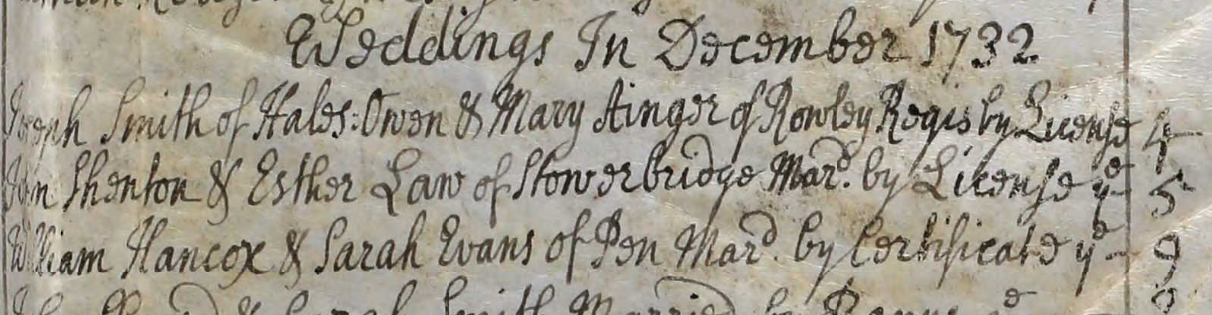
William and Sarah lost two daughters, Elizabeth, five years old, and Ann, three years old, within eight days of each other in February 1738.
William the elder’s father was John Hancox born in Penn in 1668. He married Elizabeth Wilkes from Sedgley in 1691 at Himley. John Hancox, “of Straw Hall” according to the Wolverhampton burial register, died in 1730. Straw Hall is in Penn. John’s parents were Walter Hancox and Mary Noake. Walter was born in Tettenhall in 1625, his father Richard Hancox. Mary Noake was born in Penn in 1634. Walter died in Penn in 1689.
Straw Hall thanks to Bradney Mitchell:
“Here is a picture I have of Straw Hall, Penn Road.
The painting is by John Reid circa 1878.
Sketch commissioned by George Bradney Mitchell to record the town as it was before its redevelopment, in a book called Wolverhampton and its Environs. ©”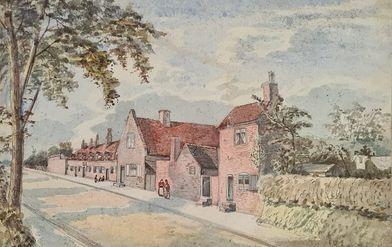
And a photo of the demolition of Straw Hall with an interesting story:
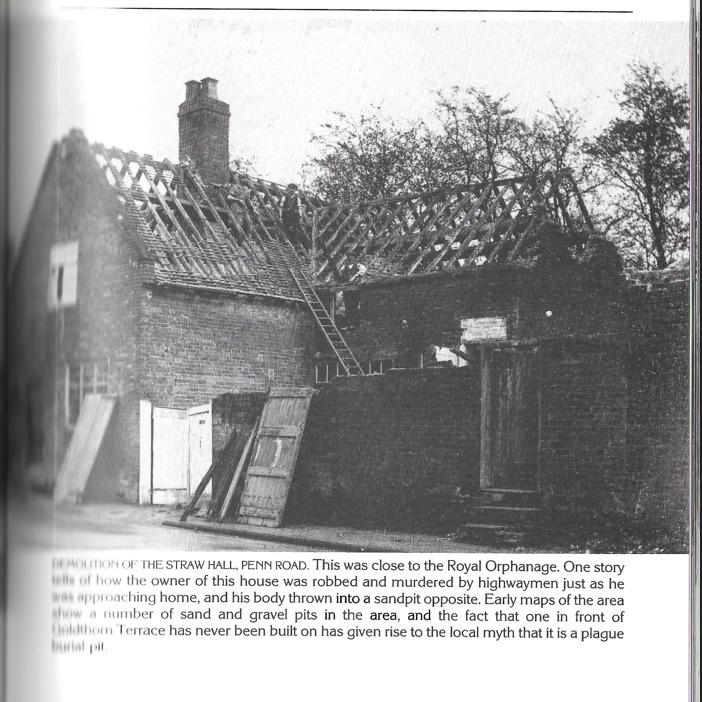
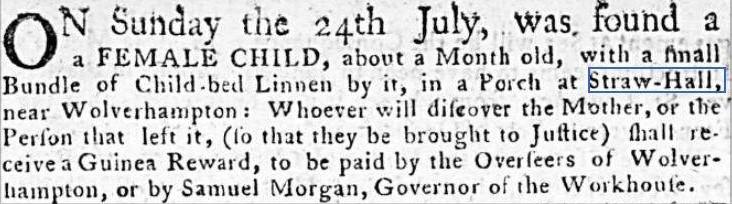
In 1757 a child was abandoned on the porch of Straw Hall. Aris’s Birmingham Gazette 1st August 1757:
The Hancox family were living in Penn for at least 400 years. My great grandfather Charles Tomlinson built a house on Penn Common in the early 1900s, and other Tomlinson relatives have lived there. But none of the family knew of the Hancox connection to Penn. I don’t think that anyone imagined a Tomlinson ancestor would have been a gentleman, either.
Sarah Hancox’s brother William Hancox 1776-1848 had a busy year in 1804.
On 29 Aug 1804 he applied for a licence to marry Ann Grovenor of Claverley.
In August 1804 he had property up for auction in Penn. “part of Lightwoods, 3 plots, and the Coppice”
On 14 Sept 1804 their first son John was baptised in Penn. According to a later census John was born in Claverley. (before the parents got married)(Incidentally, John Hancox’s descendant married a Warren, who is a descendant of my 4x great grandfather Samuel Warren, on my mothers side, from Newhall, Derbyshire!)
On 30 Sept he married Ann in Penn.
In December he was a bankrupt pig and sheep dealer.
In July 1805 he’s in the papers under “certificates”: William Hancox the younger, sheep and pig dealer and chapman of Penn. (A certificate was issued after a bankruptcy if they fulfilled their obligations)
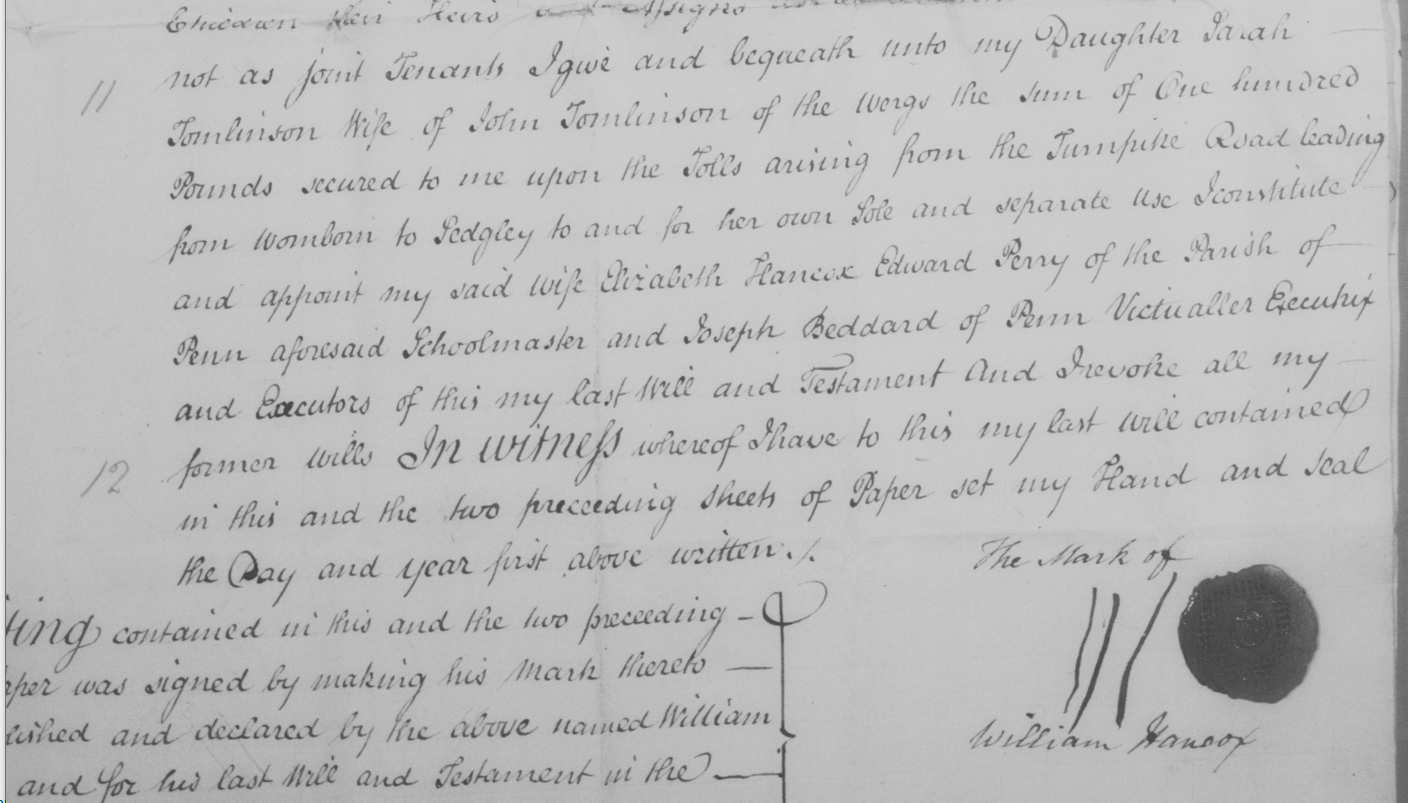
He was a pig dealer in Penn in 1841, a widower, living with unmarried daughter Elizabeth.Sarah’s father William Hancox died in 1816. In his will, he left his “daughter Sarah, wife of John Tomlinson of the Wergs the sum of £100 secured to me upon the tolls arising from the turnpike road leading from Wombourne to Sedgeley to and for her sole and separate use”.
The trustees of toll road would decide not to collect tolls themselves but get someone else to do it by selling the collecting of tolls for a fixed price. This was called “farming the tolls”. The Act of Parliament which set up the trust would authorise the trustees to farm out the tolls. This example is different. The Trustees of turnpikes needed to raise money to carry out work on the highway. The usual way they did this was to mortgage the tolls – they borrowed money from someone and paid the borrower interest; as security they gave the borrower the right, if they were not paid, to take over the collection of tolls and keep the proceeds until they had been paid off. In this case William Hancox has lent £100 to the turnpike and is leaving it (the right to interest and/or have the whole sum repaid) to his daughter Sarah Tomlinson. (this information on tolls from the Wolverhampton family history group.)William Hancox, Penn Wood, maltster, left a considerable amount of property to his children in 1816. All household effects he left to his wife Elizabeth, and after her decease to his son Richard Hancox: four dwelling houses in John St, Wolverhampton, in the occupation of various Pratts, Wright and William Clarke. He left £200 to his daughter Frances Gordon wife of James Gordon, and £100 to his daughter Ann Pratt widow of John Pratt. To his son William Hancox, all his various properties in Penn wood. To Elizabeth Tay wife of Thomas Tay he left £200, and to Richard Hancox various other properties in Penn Wood, and to his daughter Lucy Tay wife of Josiah Tay more property in Lower Penn. All his shops in St John Wolverhamton to his son Edward Hancox, and more properties in Lower Penn to both Francis Hancox and Edward Hancox. To his daughter Ellen York £200, and property in Montgomery and Bilston to his son John Hancox. Sons Francis and Edward were underage at the time of the will. And to his daughter Sarah, his interest in the toll mentioned above.
Sarah Tomlinson, wife of John Tomlinson of the Wergs, in William Hancox will:
 August 15, 2023 at 12:42 pm #7267
In reply to: Family Stories From The Other Side ~ Book Two
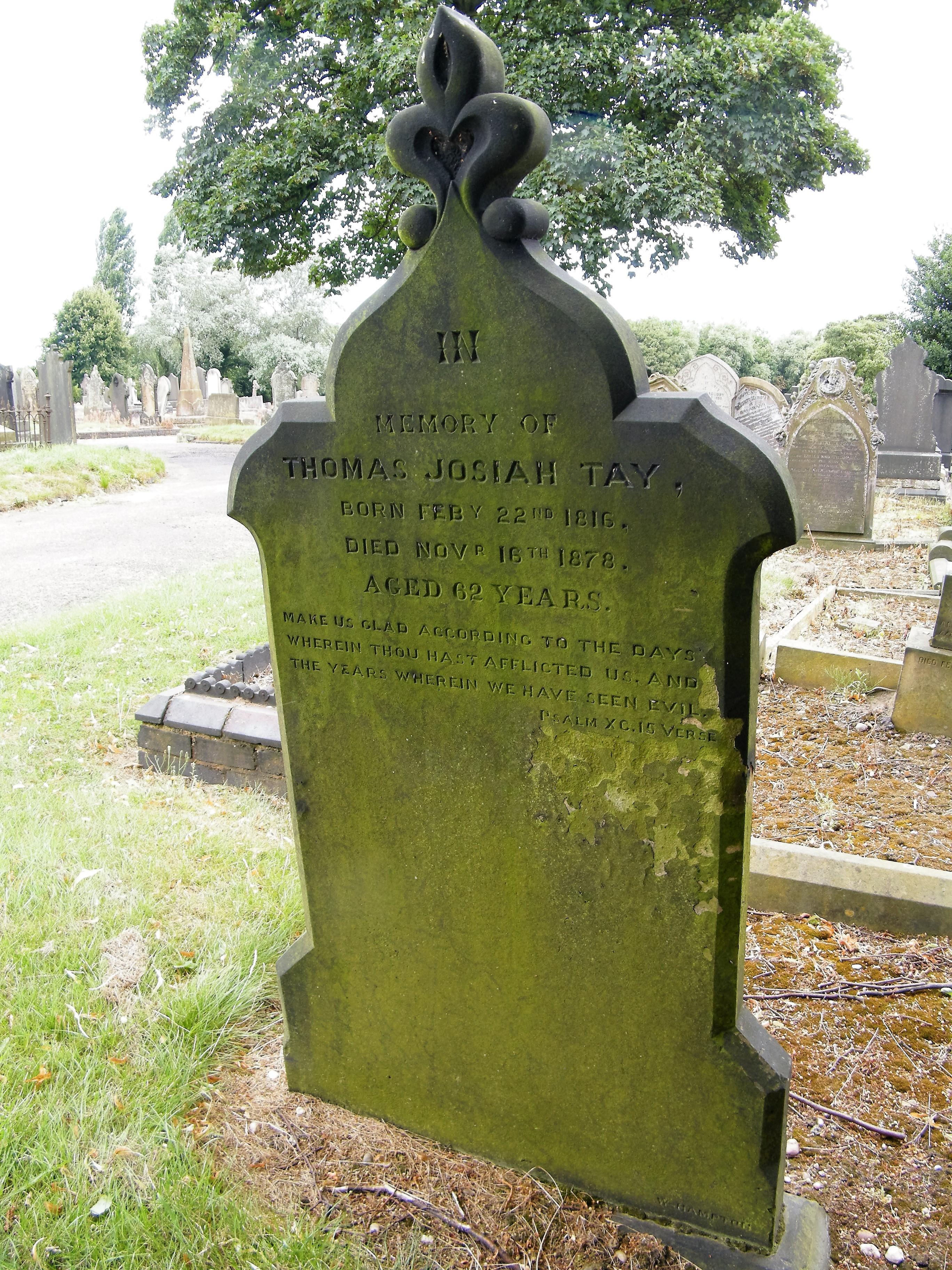
Thomas Josiah Tay
22 Feb 1816 – 16 November 1878
“Make us glad according to the days wherein thou hast afflicted us, and the years wherein we have seen evil.”
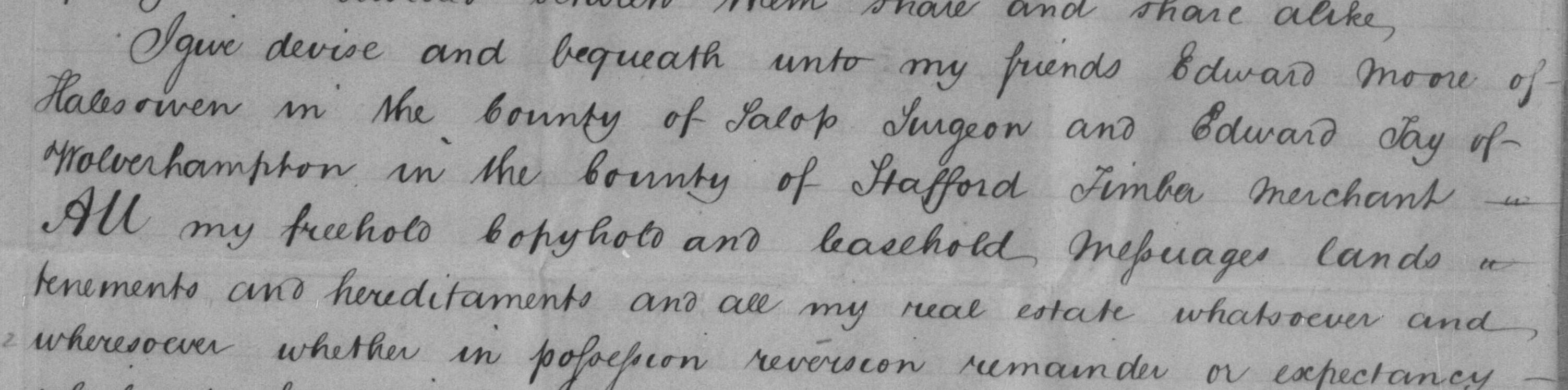
I first came across the name TAY in the 1844 will of John Tomlinson (1766-1844), gentleman of Wergs, Tettenhall. John’s friends, trustees and executors were Edward Moore, surgeon of Halesowen, and Edward Tay, timber merchant of Wolverhampton.
Edward Moore (born in 1805) was the son of John’s wife’s (Sarah Hancox born 1772) sister Lucy Hancox (born 1780) from her first marriage in 1801. In 1810 widowed Lucy married Josiah Tay (1775-1837).
Edward Tay was the son of Sarah Hancox sister Elizabeth (born 1778), who married Thomas Tay in 1800. Thomas Tay (1770-1841) and Josiah Tay were brothers.
Edward Tay (1803-1862) was born in Sedgley and was buried in Penn. He was innkeeper of The Fighting Cocks, Dudley Road, Wolverhampton, as well as a builder and timber merchant, according to various censuses, trade directories, his marriage registration where his father Thomas Tay is also a timber merchant, as well as being named as a timber merchant in John Tomlinsons will.
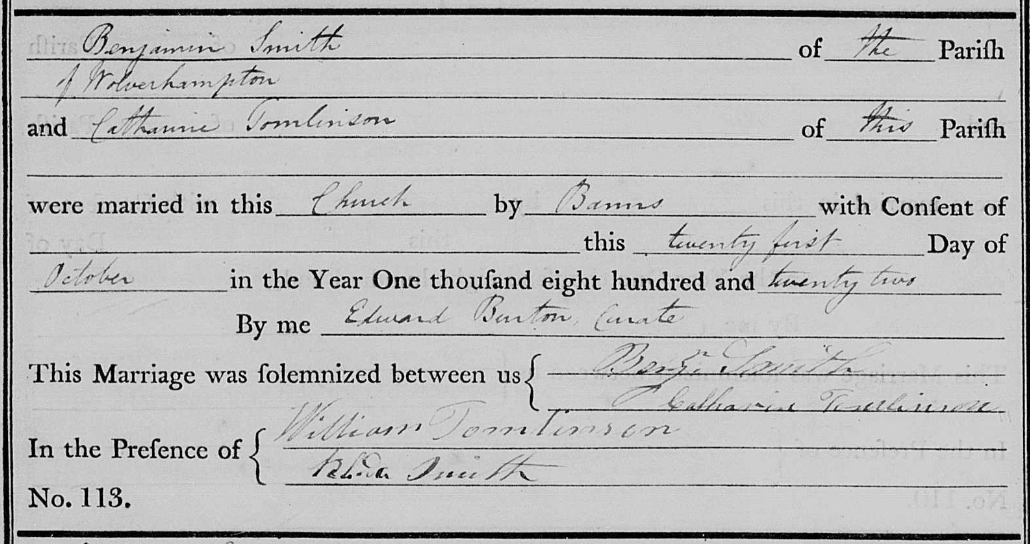
John Tomlinson’s daughter Catherine (born in 1794) married Benjamin Smith in Tettenhall in 1822. William Tomlinson (1797-1867), Catherine’s brother, and my 3x great grandfather, was one of the witnesses.
Their daughter Matilda Sarah Smith (1823-1910) married Thomas Josiah Tay in 1850 in Birmingham. Thomas Josiah Tay (1816-1878) was Edward Tay’s brother, the sons of Elizabeth Hancox and Thomas Tay.
Therefore, William Hancox 1737-1816 (the father of Sarah, Elizabeth and Lucy), was Matilda’s great grandfather and Thomas Josiah Tay’s grandfather.
Thomas Josiah Tay’s relationship to me is the husband of first cousin four times removed, as well as my first cousin, five times removed.
In 1837 Thomas Josiah Tay is mentioned in the will of his uncle Josiah Tay.

In 1841 Thomas Josiah Tay appears on the Stafford criminal registers for an “attempt to procure miscarriage”. He was found not guilty.
According to the Staffordshire Advertiser on 14th March 1840 the listing for the Assizes included: “Thomas Ashmall and Thomas Josiah Tay, for administering noxious ingredients to Hannah Evans, of Wolverhampton, with intent to procure abortion.”
The London Morning Herald on 19th March 1840 provides further information: “Mr Thomas Josiah Tay, a chemist and druggist, surrendered to take his trial on a charge of having administered drugs to Hannah Lear, now Hannah Evans, with intent to procure abortion.” She entered the service of Tay in 1837 and after four months “an intimacy was formed” and two months later she was “enciente”. Tay advised her to take some pills and a draught which he gave her and she became very ill. The prosecutrix admitted that she had made no mention of this until 1939. Verdict: not guilty.
However, the case of Thomas Josiah Tay is also mentioned in a couple of law books, and the story varies slightly. In the 1841 Reports of Cases Argued and Rules at Nisi Prius, the Regina vs Ashmall and Tay case states that Thomas Ashmall feloniously, unlawfully, and maliciously, did use a certain instrument, and that Thomas Josiah Tay did procure the instrument, counsel and command Ashmall in the use of it. It concludes that Tay was not compellable to plead to the indictment, and that he did not.
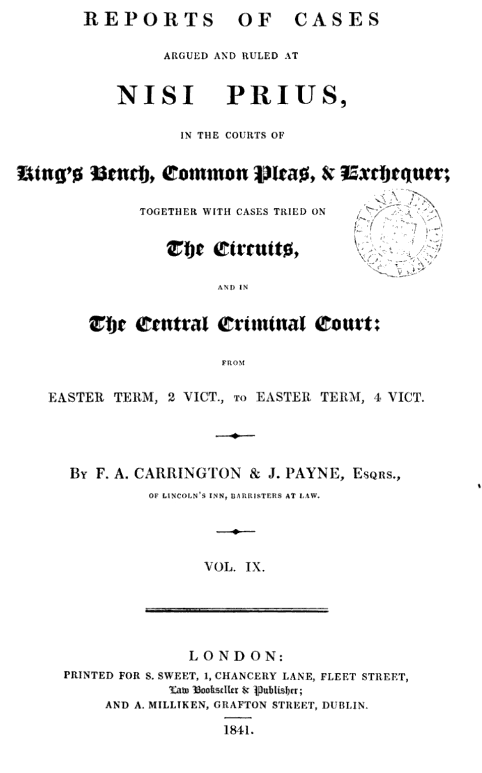
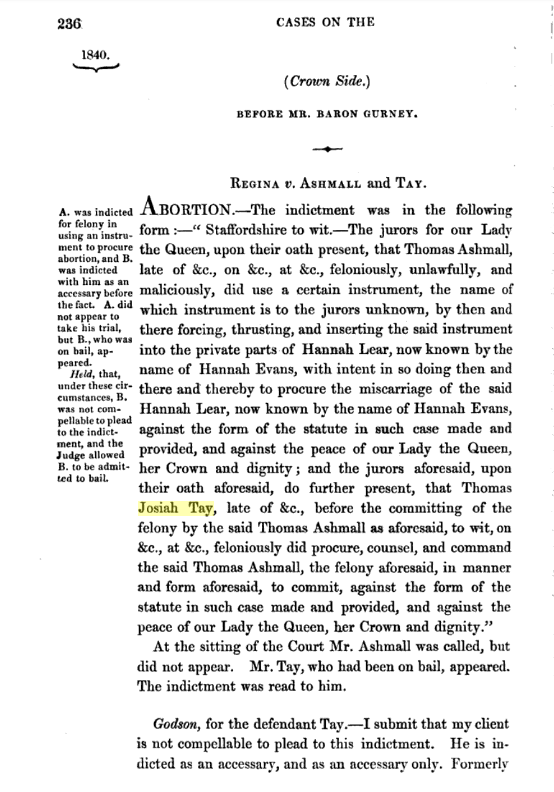
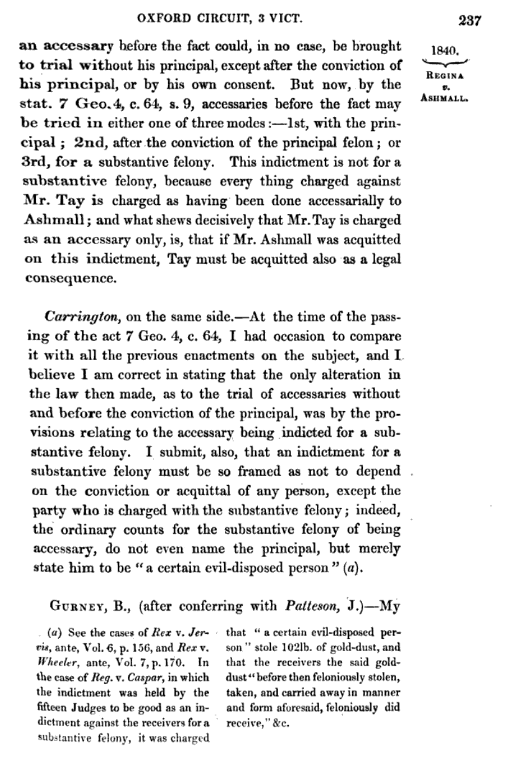
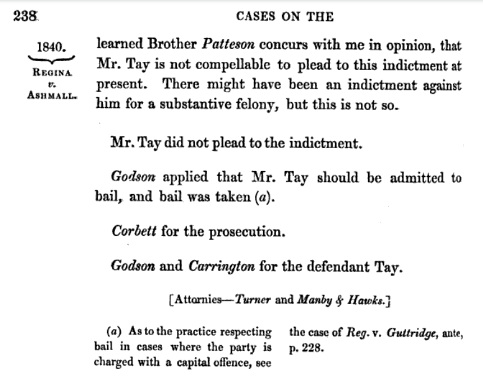
The Regina vs Ashmall and Tay case is also mentioned in the Encyclopedia of Forms and Precedents, 1896.
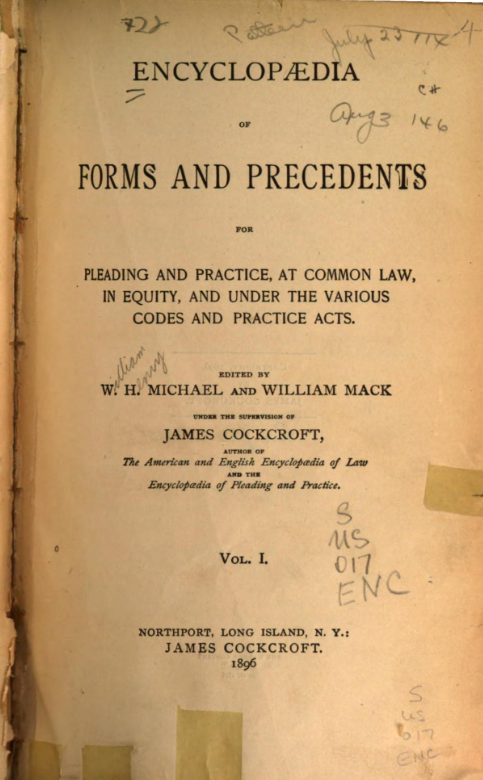
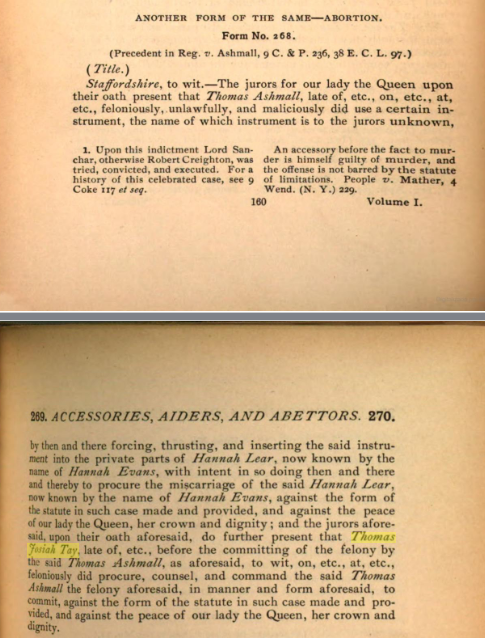
In 1845 Thomas Josiah Tay married Isabella Southwick in Tettenhall. Two years later in 1847 Isabella died.
In 1850 Thomas Josiah married Matilda Sarah Smith. (granddaughter of John Tomlinson, as mentioned above)
On the 1851 census Thomas Josiah Tay was a farmer of 100 acres employing two labourers in Shelfield, Walsall, Staffordshire. Thomas Josiah and Matilda Sarah have a daughter Matilda under a year old, and they have a live in house servant.
In 1861 Thomas Josiah Tay, his wife and their four children Ann, James, Josiah and Alice, live in Chelmarsh, Shropshire. He was a farmer of 224 acres. Mercy Smith, Matilda’s sister, lives with them, a 28 year old dairy maid.
In 1863 Thomas Josiah Tay of Hampton Lode (Chelmarsh) Shropshire was bankrupt. Creditors include Frederick Weaver, druggist of Wolverhampton.
In 1869 Thomas Josiah Tay was again bankrupt. He was an innkeeper at The Fighting Cocks on Dudley Road, Wolverhampton, at the time, the same inn as his uncle Edward Tay, aforementioned timber merchant.
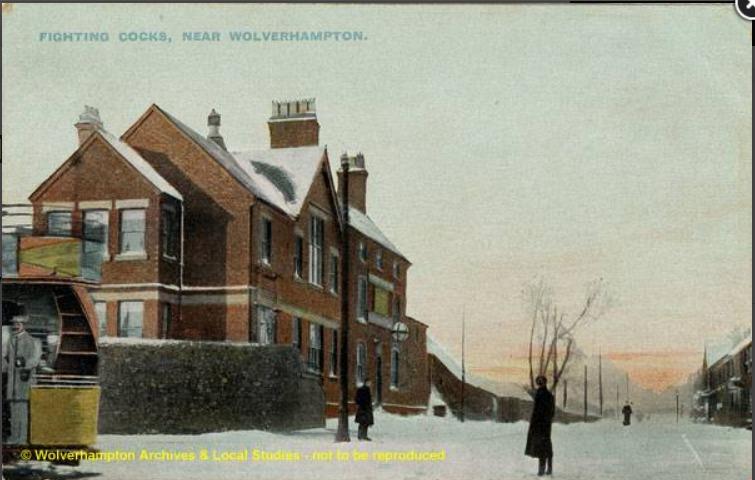
In 1871, Thomas Josiah Tay, his wife Matilda, and their three children Alice, Edward and Maryann, were living in Birmingham. Thomas Josiah was a commercial traveller.
He died on the 16th November 1878 at the age of 62 and was buried in Darlaston, Walsall. On his gravestone:
“Make us glad according to the days wherein thou hast afflicted us, and the years wherein we have seen evil.” Psalm XC 15 verse.
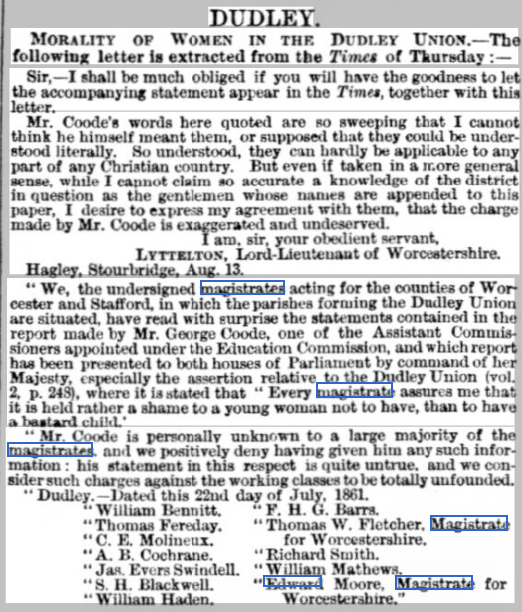
Edward Moore, surgeon, was also a MAGISTRATE in later years. On the 1871 census he states his occupation as “magistrate for counties Worcester and Stafford, and deputy lieutenant of Worcester, formerly surgeon”. He lived at Townsend House in Halesowen for many years. His wifes name was PATTERN Lucas. Her mothers name was Pattern Hewlitt from Birmingham, an unusal name that I have not heard before. On the 1871 census, Edward’s son was a 22 year old solicitor.
In 1861 an article appeared in the newspapers about the state of the morality of the women of Dudley. It was claimed that all the local magistrates agreed with the premise of the article, concerning unmarried women and their attitudes towards having illegitimate children. Letters appeared in subsequent newspapers signed by local magistrates, including Edward Moore, strongly disagreeing.
Staffordshire Advertiser 17 August 1861:
 July 5, 2023 at 8:21 pm #7263
In reply to: Family Stories From The Other Side ~ Book Two
Solomon Stubbs
1781-1857
Solomon was born in Hamstall Ridware, Staffordshire, parents Samuel Stubbs and Rebecca Wood. (see The Hamstall Ridware Connection chapter)
Solomon married Phillis Lomas at St Modwen’s in Burton on Trent on 30th May 1815. Phillis was the llegitimate daughter of Frances Lomas. No father was named on the baptism on the 17th January 1787 in Sutton on the Hill, Derbyshire, and the entry on the baptism register states that she was illegitimate. Phillis’s mother Frances married Daniel Fox in 1790 in Sutton on the Hill. Unfortunately this means that it’s impossible to find my 5X great grandfather on this side of the family.
Solomon and Phillis had four daughters, the last died in infancy.
Sarah 1816-1867, Mary (my 3X great grandmother) 1819-1880, Phillis 1823-1905, and Maria 1825-1826.Solomon Stubbs of Horninglow St is listed in the 1834 Whites Directory under “China, Glass, Etc Dlrs”. Next to his name is Joanna Warren (earthenware) High St. Joanna Warren is related to me on my maternal side. No doubt Solomon and Joanna knew each other, unaware that several generations later a marriage would take place, not locally but miles away, joining their families.
Solomon Stubbs is also listed in Whites Directory in 1831 and 1834 Burton on Trent as a land carrier:
“Land Carriers, from the Inns, Etc: Uttoxeter, Solomon Stubbs, Horninglow St, Mon. Wed. and Sat. 6 mng.”
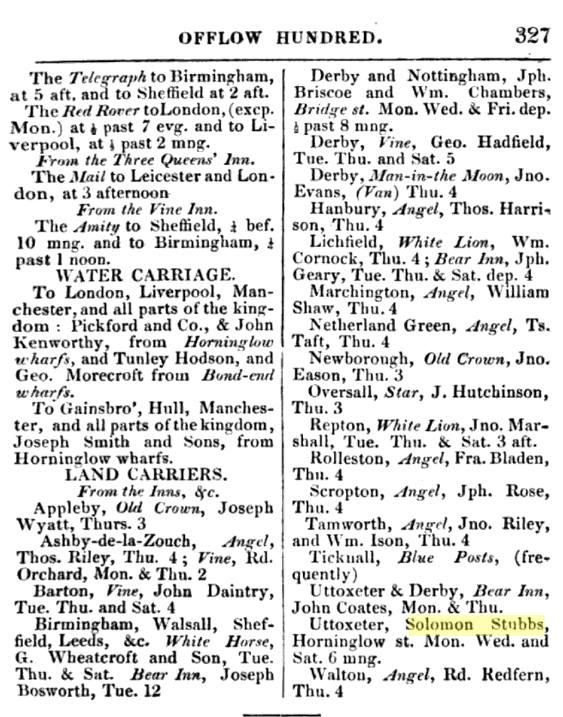
Solomon is listed in the electoral registers in 1837. The 1837 United Kingdom general election was triggered by the death of King William IV and produced the first Parliament of the reign of his successor, Queen Victoria.
National Archives:
“In 1832, Parliament passed a law that changed the British electoral system. It was known as the Great Reform Act, which basically gave the vote to middle class men, leaving working men disappointed.
The Reform Act became law in response to years of criticism of the electoral system from those outside and inside Parliament. Elections in Britain were neither fair nor representative. In order to vote, a person had to own property or pay certain taxes to qualify, which excluded most working class people.”Via the Burton on Trent History group:
“a very early image of High street and Horninglow street junction, where the original ‘ Bargates’ were in the days of the Abbey. ‘Gate’ is the Saxon meaning Road, ‘Bar’ quite self explanatory, meant ‘to stop entrance’. There was another Bargate across Cat street (Station street), the Abbot had these constructed to regulate the Traders coming into town, in the days when the Abbey ran things. In the photo you can see the Posts on the corner, designed to stop Carts and Carriages mounting the Pavement. Only three Posts remain today and they are Listed.”
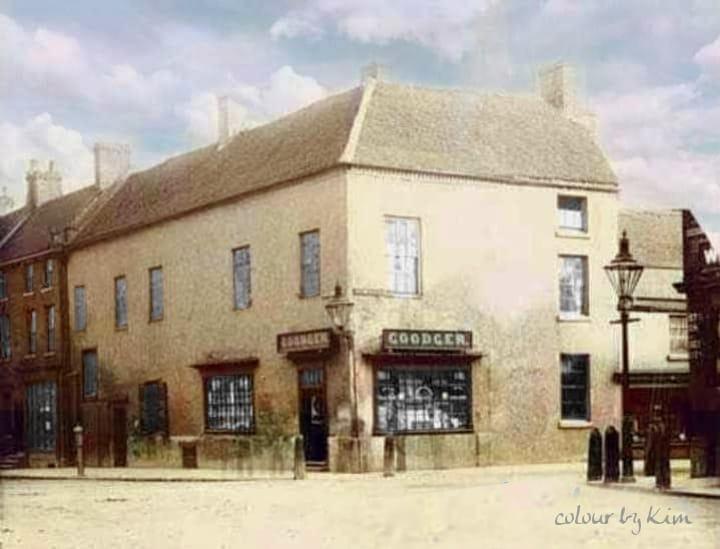
On the 1841 census, Solomon’s occupation was Carrier. Daughter Sarah is still living at home, and Sarah Grattidge, 13 years old, lives with them. Solomon’s daughter Mary had married William Grattidge in 1839.
Solomon Stubbs of Horninglow Street, Burton on Trent, is listed as an Earthenware Dealer in the 1842 Pigot’s Directory of Staffordshire.
In May 1844 Solomon’s wife Phillis died. In July 1844 daughter Sarah married Thomas Brandon in Burton on Trent. It was noted in the newspaper announcement that this was the first wedding to take place at the Holy Trinity church.
Solomon married Charlotte Bell by licence the following year in 1845. She was considerably younger than him, born in 1824. On the marriage certificate Solomon’s occupation is potter. It seems that he had the earthenware business as well as the land carrier business, in addition to owning a number of properties.
The marriage of Solomon Stubbs and Charlotte Bell:
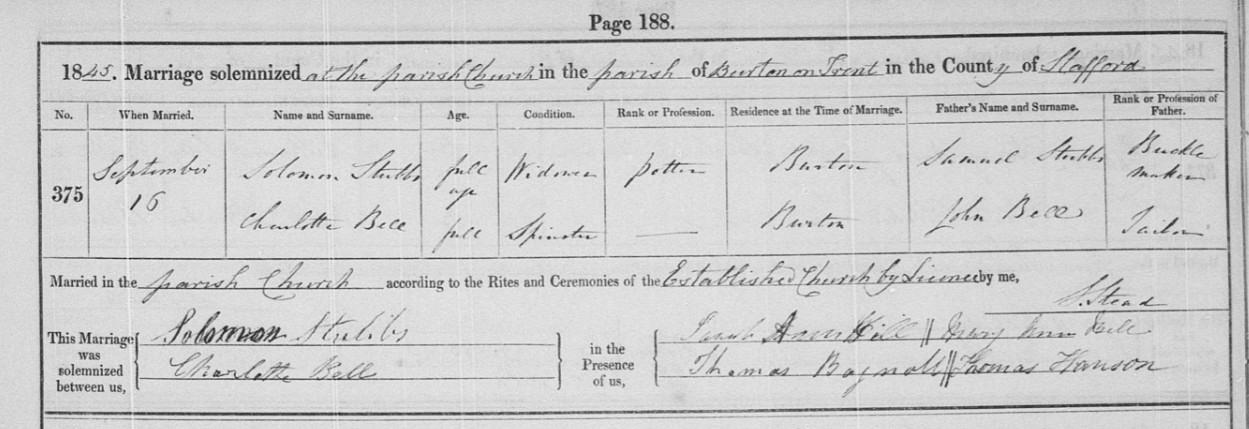
Also in 1845, Solomon’s daughter Phillis was married in Burton on Trent to John Devitt, son of CD Devitt, Esq, formerly of the General Post Office Dublin.
Solomon Stubbs died in September 1857 in Burton on Trent. In the Staffordshire Advertiser on Saturday 3 October 1857:
“On the 22nd ultimo, suddenly, much respected, Solomon Stubbs, of Guild-street, Burton-on-Trent, aged 74 years.”
In the Staffordshire Advertiser, 24th October 1857, the auction of the property of Solomon Stubbs was announced:
“BURTON ON TRENT, on Thursday, the 29th day of October, 1857, at six o’clock in the evening, subject to conditions then to be produced:— Lot I—All those four DWELLING HOUSES, with the Gardens and Outbuildings thereto belonging, situate in Stanleystreet, on Goose Moor, in Burton-on-Trent aforesaid, the property of the late Mr. Solomon Stubbs, and in the respective occupations of Mr. Moreland, Mr. Scattergood, Mr. Gough, and Mr. Antony…..”
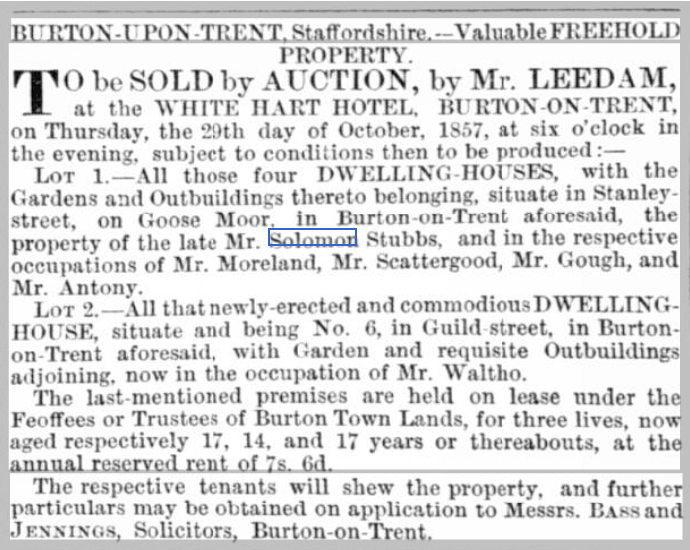
Sadly, the graves of Solomon, his wife Phillis, and their infant daughter Maria have since been removed and are listed in the UK Records of the Removal of Graves and Tombstones 1601-2007.
May 16, 2023 at 1:37 pm #7243In reply to: Washed off the sea ~ Creative larks
Using a random generator for the next challenge with 5 objects.
- straw
- pop can
- pencil holder
- Christmas ornament
- turtle
🐋
In the dreary town of Ravenwood, where shadows loomed and the wind howled through the empty streets, there was one house that stood out above the rest. It was the old mansion at the end of the road, shrouded in mystery and secrets. No one had lived there for years, but whispers of strange happenings and eerie lights could be heard wafting through the air.
One stormy night, a young writer named Edgar arrived in Ravenwood seeking inspiration for his latest story. Drawn to the mansion by a strange force, he ventured inside, and found himself face to face with a peculiar sight. A straw sat on the table, next to a pop can and a pencil holder, and a Christmas ornament hung from a cobweb in the corner. But it was the turtle, a giant terrapin that seemed to be staring back at him with knowing eyes, that caught his attention.
Edgar couldn’t shake the feeling that something was amiss, that the objects in the room were connected in some strange way. As he looked closer, he noticed that a thick layer of dust had settled on everything, as if no one had been there in years. And yet, the pop can still seemed to be fizzing, the straw stirred as if someone had just taken a sip, and the turtle’s eyes seemed to glow in the dim light.
Suddenly, a voice from behind him made Edgar jump. It was the ghost of the previous owner, who had died under mysterious circumstances years ago. The ghost revealed that the objects in the room had been cursed by a vengeful witch who had once lived in the nearby forest. Each object was imbued with a terrible power, and whoever possessed them would be consumed by darkness.
Edgar knew he had to escape, but as he turned to run, he felt a strange force pulling him towards the turtle. He tried to resist, but the turtle’s eyes seemed to hypnotize him, drawing him in closer and closer. Just as he was about to touch it, the turtle suddenly snapped its jaws shut, and Edgar woke up back in his own bed, drenched in sweat.
He realized it had all been a nightmare, but as he looked down at his feet, he saw the turtle from his dream, sitting innocently at the end of his bed. Suddenly, he remembered the words of the ghost, and knew he had to destroy the cursed objects before it was too late. With trembling hands, he picked up the turtle, and opened his window to cast it out into the night. But as he did so, he caught a glimpse of his own reflection in the glass, and saw that his eyes had turned a bright shade of red. The curse had already taken hold, and Edgar knew he was doomed to a life of darkness and despair.
Bit dark, Whale!


 May 12, 2023 at 12:57 pm #7232
In reply to: Washed off the sea ~ Creative larks
🐳
Welcome to the bustling riverfront community of Bridgewater, where the sound of boat horns and cries of merchants filled the air.
Bridgewater was a town of hardworking people, all striving to make a living in this busy trading port. One such person was Anne, a middle-aged woman who owned a small pottery shop by the river. Her days were filled with the clanging of clay and the whirring of her pottery wheel. She took great pride in her work, creating beautiful plates and tea bowls that were highly sought after by the locals.
Another memorable character was Jack, the town cobbler whose small shop was always busy with customers. He was known for his kind heart and his willingness to help anyone in need, often giving away shoes to those who couldn’t afford them. As the days passed, life in Bridgewater had its ups and downs.
The lost halfpenny spoke of a hard day’s work, but also of the generosity of the community. The broken pipes spoke of moments of relaxation, but also of the struggles of daily life. And the smashed plates and tea bowls spoke of hurried meals, but also of the occasional argument or disagreement.
Despite the challenges, the people of Bridgewater found small joys in life. Children played by the river, skipping stones and chasing each other. Couples walked hand in hand along the promenade, watching the boats come and go. And on warm summer evenings, the town square was filled with music and laughter as locals gathered for impromptu dance parties. But as with any community, there were also tensions and conflicts.
The town council was often at odds with the merchants, who felt that their needs were being overlooked. And there were whispers of a rival trading port that threatened to take away business from Bridgewater. One day, a fire broke out in the warehouse district, destroying several buildings and leaving many homeless. The community rallied together to help those in need, with Anne donating plates and bowls for makeshift kitchens and Jack offering his shop as a temporary shelter. As the smoke cleared and the ashes settled, the people of Bridgewater were left to rebuild their town. Through hard work and perseverance, they overcame the challenges and emerged even stronger than before. The lost halfpenny, broken pipes, and smashed plates were all reminders of the struggles they had faced, but they also spoke of the resilience and strength of the human spirit. And so, life in Bridgewater continued, a vibrant and bustling riverfront community where goods were traded and daily life was filled with both hardships and small joys.
April 2, 2023 at 1:45 pm #7222In reply to: Prompts of Madjourneys
Very well, let us focus a bit on an overarching mystery.
So, Xavier is working on this program he calls AL (for Alternate Life), for a company we know little about.
Meanwhile, the game they’re playing on, Orbs of Madjourneys seems to direct them to certain quests which subtly influence their activities. For instance, after playing the game, a succession of events got the four of them booking a trip to the Flying fish Inn in the middle of Australian outback (Zara is living in Australia unlike the others).
Let’s assume the Game had somehow detected some unlawful or immoral activities being conducted, and has started to drop clues to influence these 4 gamers, selected because of their unique connexions and some of their special skills to get to reveal and bring the mystery to light.
Zara has an explorer mind, free-spirited, jumping right in. It’s suggested she was assigned group leadership for this round of game, while taking care of a group doesn’t come naturally for her. Yasmin is talented and it is said she is the brains of the team and also a competent actress, which may come in play at some point. Youssef is a journalist, and works for Miss Tartiflate, owner of THE Blog, a blog with a soul – unlike rival blog from Botty Banworth, the lady millionaire, who is sponsoring the Carts & Lager festival at the town of the Flying Fish Inn, next to the mines. Xavier has a bit of a monkey mind, but is also good at drawing connections; he’s a programmer for AL.
Which brings us to the group quest. The current hunch is that there is some shenanigan at play in the old collapsed mines of the town, where some key characters were lost in the past. One of them being Fred, a sci-fi writer who disappeared to Fiji to protect his family (the owners of the Flying Fish Inn) a decade or so ago. It’s suggested by the last poem found in the game that it may have something to do with illegal underground water drilling —possibly for frivolous usages of a select few elite, like maintaining a golf green nearby or other things.
If that is on the right track, we need to accelerate the path of discovery of these mysteries for our 4 characters. The game will suggest additional clues to their quests, so that they can use their skills during the Carts & Lager Festival to discover the truth, while remaining out of harm’s way.
Here are some additional clues that the game will suggest to our four characters:
Zara:
“To find the truth, you must first seek the light.” 🌞🔍🕯️💡🔦
“The answer lies beneath the surface.” 🕳️🔍👀🌊💧Yasmin:
“All the world’s a stage, and we are merely players.” 🌍🎭🤹♀️👥🕺
“Sometimes, the truth is hidden in plain sight.” 👀🔍🤫🧐🕵️♀️Youssef:
“Words have power, and the pen is mightier than the sword.” 📝🗡️💪📚👨💻
“The truth may be hidden in the most unexpected of places.” 🤔🕵️♂️🔍🧩🕰️Xavier:
“The truth is a puzzle waiting to be solved.” 🧩🔍🤔🕵️♂️💡
“Sometimes, the smallest details can lead to the biggest discoveries.” 🔍👀🔬🧐🔎What are potential outcomes for our 4 characters in game and in real life.
How are they going to work together to unravel the mystery and discover the truth.There are several potential outcomes for our 4 characters as they work together to unravel the truth about the collapsed mines and the illegal underground water drilling.
In the game, they may encounter various obstacles and puzzles to solve, such as deciphering codes and finding hidden passages. They will need to work together and use their unique skills to uncover the truth and prevent any further harm.
In real life, they may need to conduct research and gather information about the history of the town and its residents. They may also need to interview locals and investigate any suspicious activity related to the water drilling. They will need to be careful not to draw too much attention to themselves, as the perpetrators may try to silence them.
If they are successful in their quest, they may uncover a conspiracy involving powerful people in the town and beyond who are profiting from the illegal water drilling. They may also discover the fate of Fred, the missing writer, and other key characters. The truth may have a significant impact on the future of the town and its residents.
To work together effectively, each of the characters will need to utilize their unique skills and strengths. Zara’s exploratory nature may help them discover hidden clues and passages, while Yasmin’s intellect and acting abilities may allow her to gain access to key information and people. Youssef’s journalistic skills and connection to Miss Tartiflate may provide them with insider knowledge and resources, and Xavier’s ability to draw connections and work with technology may help them piece together the puzzle.
Overall, by working together and using their skills in both the game and real life, our 4 characters may uncover a significant truth and make a positive impact on the town and its residents.
March 29, 2023 at 3:05 pm #7220In reply to: The Chronicles of the Flying Fish Inn
At 10:30am, the air is buzzing with excitement. As the first race is going to start soon. There has been no signs of a dust storm and everyone seem to have forgotten about it. The participants are cheering and getting ready for the race while groups of tourists are wandering about, taking pictures of the teams and the folks in costume. People came from as far as Mexico, Italy and Macedonia.
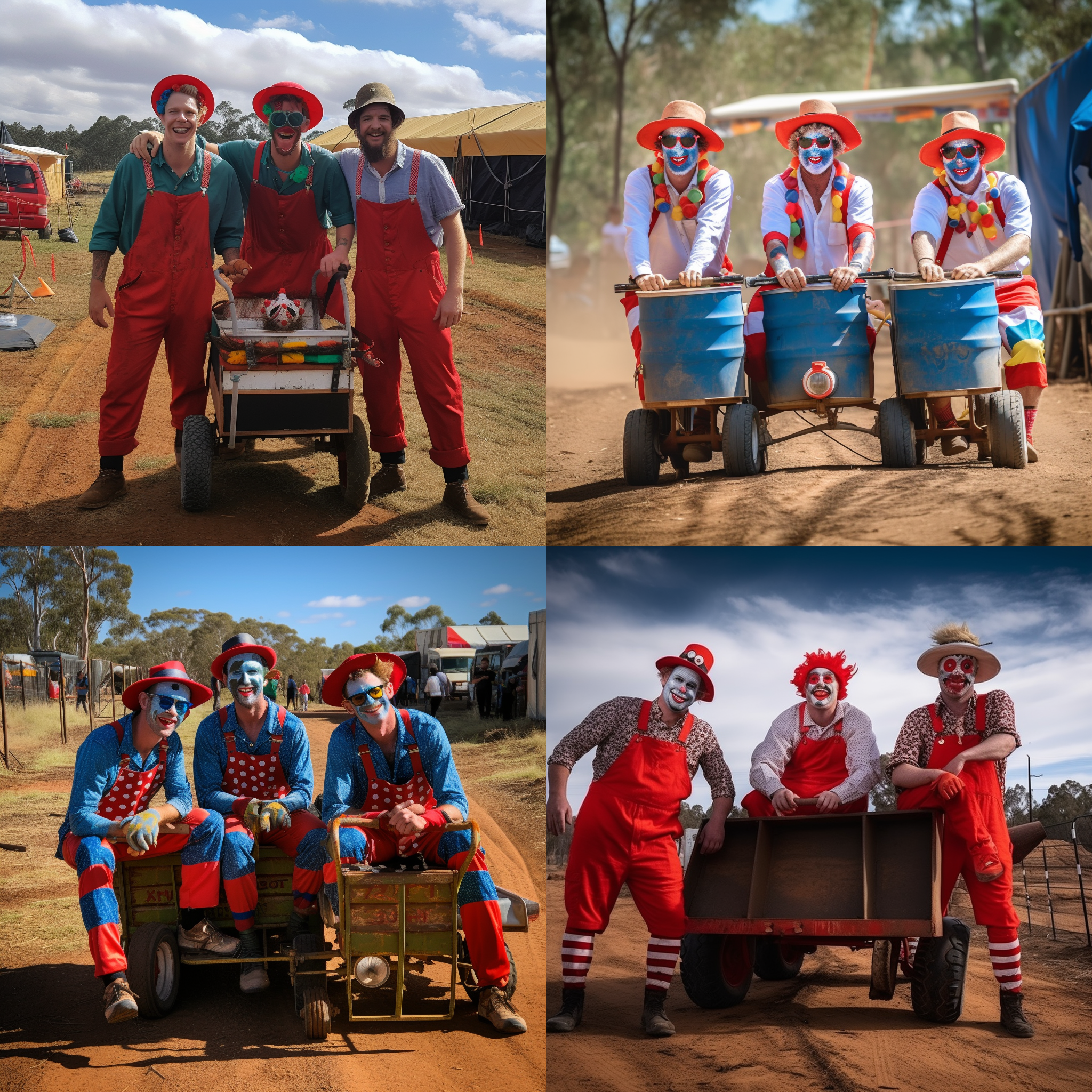
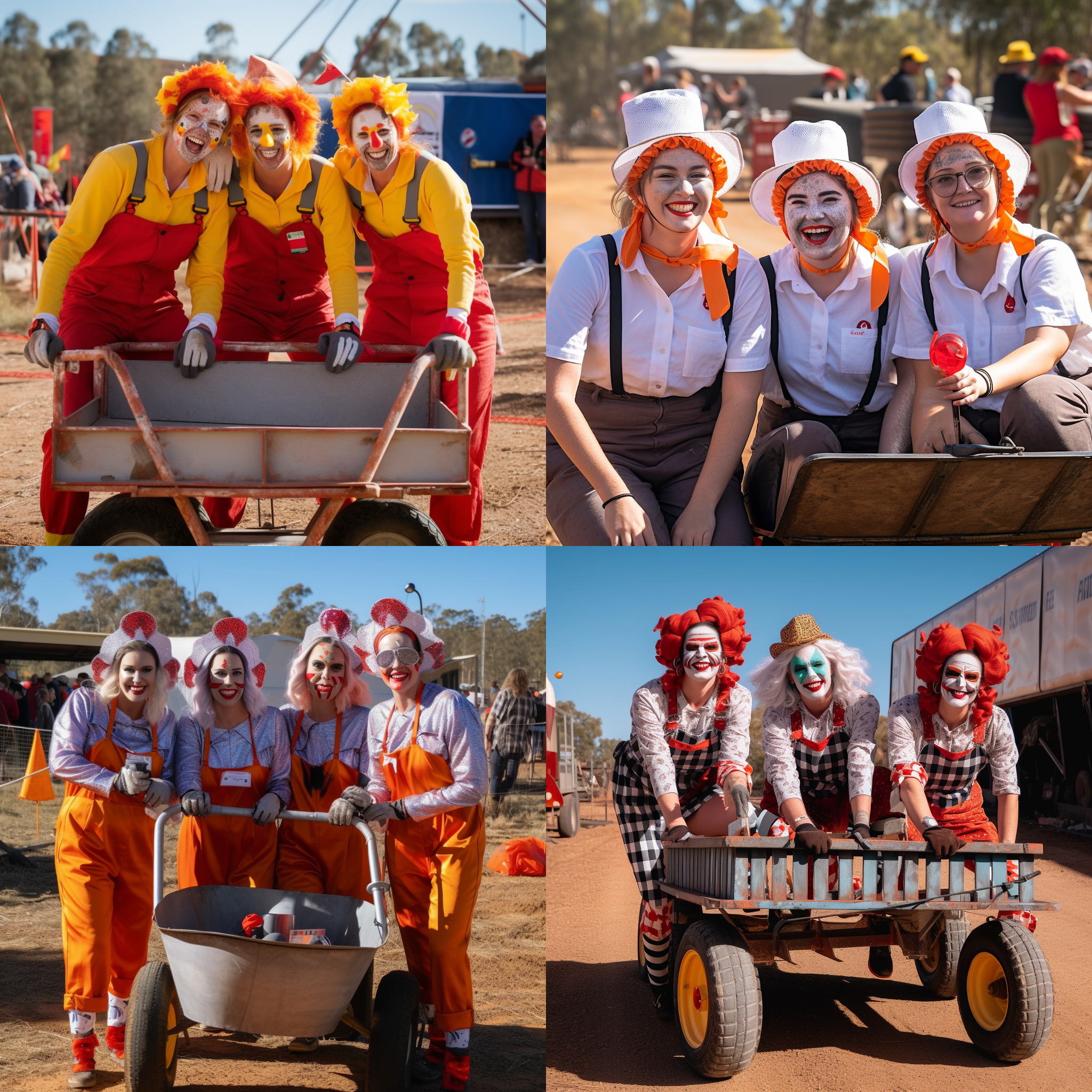
Because of the harsh conditions, miners were usually males back in the days. But there have always been teams at our little town’s festival ready to include women and children because they were usually lighter and it was easier to push the carts around on the tracks. Since a few years, there even have been full female teams, and they were pretty good too.
Prune arrives with her new fancy reflex camera she got at her last birthday. She wants to take our picture in front of our cart. At Joe and Callum’s surprise, I try to talk her into joining our team and be part of the fun. I get out of the cart a spare hat and a wig I had prepared for her, but she says today she’s doing a reportage about the festival. I know she wants to be on the lookout for our father, and keep an eye on the Inn’s guests. She told me yesterday something was off with that Liana Parker who kept snooping around and asking questions to townsfolk about Howard and Fred. And, she heard the two other girls talking about Liana being a Finli and a nun.
I frown. I haven’t told the boys anything about my father or suspicious guests with false names. Prune knows I’m not too keen about letting my little sister following people around on her own. I told her something could go wrong, but she brushed it aside explaining it was the perfect occasion because people wouldn’t pay attention to someone taking random pictures during a festival. She’s got a point, but I’m still her big brother. I had to try.
She asks us to strike a pose in front of our cart and tells a few jokes. When we laugh she takes a picture of our all male team, I’m the one in the center, Callum’s on the left and Joe on the right. I’m glad despite all the concern, I look like I’m having fun.
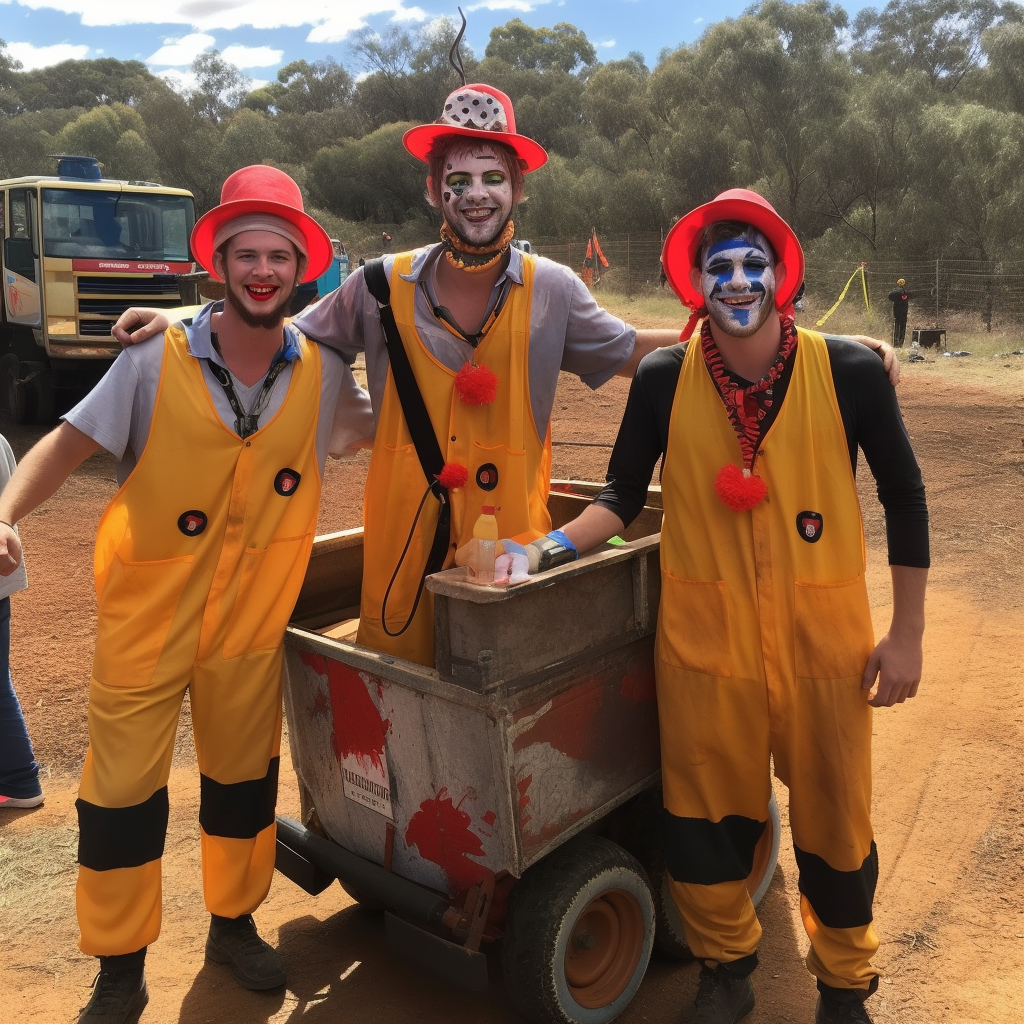
Checking her camera screen, Prune says: “You guys remind me of the Clockwork Orange with your hats, but more colourful and less creepy.”
Callum and Joe look at each other, each having one eyebrow raised. I snort. I’m sure they don’t understand the reference.
“You’re ok,” she tells them. “It means people will notice and remember you.”
“Spread the word! We’ll crush them all!” Callum shouts.
Prune looks at me. “You’re still frowning,” she says. “It’ll be fine.”
“Ok,” I say. “But at least take the hat. You can’t dress as yourself during a Cart and Lager festival, or you’ll pop out of the crowd.”
She raises her eyes to the sky and sighs. Then, she takes the orange hat from my hands and puts it on her head.
“There, happy? Consider that an endorsement of your team,” she says with a wink.
Joe and Callum hoot and whistle loudly. “Miss serious is running wild! Anything can happen today.”
We all laugh. Their enthusiasm is contagious.
“Hey! You’re mother is about to talk,” says Joe to Callum. “She’s hot.”
“Don’t speak about my mother like that.”
The mayor has climbed on the central stage and she’s talking with an all dressed up woman with a big hat that makes her look like the Queen of England. She sure seems out of place in our little town’s festival. Flanked by two bodyguards in black, I guess it’s Botty Banworth who’s provided that expensive sound system the mayor’s trying to use. “One, two, three… Is it working? Yes. Ok. All the participants are expected to bring their cart to the depart lane. We’re about to start. In the meantime let me introduce Miss Banworth who’s been very generous and allowed our festival to get to another level. She’s going to help us rehabilitate the abandoned mines and open a museum.”
A roar from the crowd. The woman’s lips are so thin and red that the smile she puts on her face looks like it’s just been made with a razor blade. I shiver. She’s the Queen of England turned by a vampire.
Someone bumps into my back and knocks the air out of my lungs. I almost fall on my sister.
“Hey! Watch out!” says Callum.
I catch my breath and look up. It’s Betsy, dressed as a miner too, with extra sequins and gummy stars on her dungarees. She looks confused and mutters some excuses but doesn’t stop. She walks as if she has had a few lagers already.
“Hey, Betsy,” calls Prune. “You seem like you just saw a ghost.”
“Someone… near the mines… It can’t be…” says Betsy.
“Who did you see near the mines?” shouts my sister.
With the noise around us, I almost didn’t hear Betsy’s answer.
“Fred… Howard… It can’t be. I need Idle’s cakes,” she says before disappearing in the crowd.
I look at Prune. I see in her eyes we’re thinking the same thing. Dad’s really here. We nod at the same time and I move my lips: “Be careful.” She nods.
“You three, win,” she tells us before leaving.
“You heard her?” I asked Callum and Joe. “Let’s move our limo.” As we approach the tracks with the other participants, a gush of wind almost knock my hat off my head. There is some commotion coming from the central stage. A guy climbed up and is shouting something that I don’t understand, pointing at the sky behind us. When I look back like everyone, tourists and teams, I understand.
“Dust! Dust’s coming!”
And right from the direction of the abandoned mines. Dad what did you get yourself into?
It’s 10:55am and I’m pretty sure we’ll have to put off the race.
March 15, 2023 at 4:27 pm #7167In reply to: The Chronicles of the Flying Fish Inn

I can’t believe the cart race is tomorrow. Joe, Callum and I have worked so hard this year to incorporate solar panels and wind propellers to our little bijou. The cart race rules are clear, apart from thermal engines and fossil fuels, your imagination is your limit. Our only worry was that dust storm. We feared the Mayor would cancelled the race, but I think she won’t. She desperately needs the money.
Some folks thought to revive the festival as a prank fifteen years ago, but people had so much fun the council agreed to renew it the next year, and the year after that it was made official. It’s been a small town festival for ten years, and would have stayed like that if it hadn’t been for a bus full of Italian tourist on their way to Uluru. It broke down as they drove through main street – I remember it because I just started my job at the garage and couldn’t attend the race. Those Italians, a bunch of crazy people, posted videos of the race on the Internet and it went viral, propelling our ghost town to worldwide fame. We thought it would subside but some folks created a FishBone group and we’re almost as famous as Punxsutawney once a year. We even have a team of old ladies from Tikfijikoo Island.
All that attention attracted sponsors, mostly booze brands. But this year we’ve got a special one from Sidney. Aunt Idle who’s got a special friend at the city council told us the council members couldn’t believe it when the tart called and offered money. Botty Banworth, head of a big news company made famous by her blog: Prudish Beauty.
Aunt Idle, who heard it from one of her special friends at the town’s council, started a protest because she thought the Banworth tart would force the council to ban all recreational substances. But I have it from Callum, who’s the Mayor’s son, that the tart is not interested in making us an example of sobriety. She’s asked to lease the land where the old mines are and the Mayor haven’t told anybody about it.
After Callum told me about the lease, it reminded me about the riddle.
A mine, a tile, dust piled high,
Together they rest, yet always outside.
One misstep, and you’ll surely fall,
Into the depths, where danger lies all.Then something else happened. Another woman stopped at the gas station earlier today. I recognised one of the Inn’s guests, the one with the Mercedes. With her mirror sunglasses and her headscarf wrapped around her hair, she already looked suspicious. But as it happened, she asked me about the mines and how to go there. For abandoned mines, they sure attract a lot of attention.
It reminded me of something. So after work, I went to the Inn and asked the twins permission to go up to their lair. When dad disappeared, Mater went mad, she threw everything to the garbage. The twins waited til she got back inside and moved everything back in the attic and called it their lair. It looks just like dad’s old office with the boxes full of papers, the mahogany desk and even his typewriter. For whatever reason, Mater just ignores it and if she needs something from the attic, she asks someone else to get it, pretexting she can’t climb all those stairs.

I was right. Dad left the old manuscript he was working on at the time. A sci-fi novel about strange occurrences in an abandoned mine that looked just like the one outside of town. Prune said it’s badly written, and it doesn’t even have a title. But I remember having nightmares after reading some of the passages.
March 7, 2023 at 11:42 pm #6787In reply to: Coma Cameleon Background
Some connecting ideas for this thread so far — doesn’t make yet complete sense, but we’ll see… :
As it turns out, Aaron and Tibu are the same person. After Aaron attached his watch to the Wall of Watches, he suddenly found himself transported to a different time and place. Disoriented and confused, he stumbled upon a time-traveling device and accidentally activated it, sending him hurtling through time and space.
As Tibu, Aaron found himself in a strange new world, unable to remember anything about his past life as Aaron. He struggled to adapt to his new surroundings, living on the streets and relying on the kindness of strangers to survive.
One day, while wandering the streets of a small Spanish town, Tibu stumbled upon a lost little girl named Lily. Recognizing the fear and confusion in her eyes, Tibu felt an instant connection to her. He promised to help her find her way home and they set off together, embarking on a journey to discover Lily’s true identity.
As they traveled together, Lily began to open up to Tibu, sharing her dreams and fears with him. Tibu, in turn, began to share his own story with her, remembering parts about his life as Aaron and finally the accident that had left him in a coma.
It was only through his travels with Lily that Tibu began to piece together the fragments of his past and come to terms with his true identity. And it was through his connection with Lily that he found the strength and courage to confront the truth about his past and move forward with his life.
As for how Aaron ended up in a coma, it was revealed that he had been involved in a car accident while on his way to an important meeting. The accident left him in a coma, and it was only through his journey as Tibu that he was finally able to wake up and remember his past life as Aaron.
-
AuthorSearch Results