


Search Results for 'hand'
-
AuthorSearch Results
-
April 12, 2024 at 7:33 am #7429
In reply to: The Incense of the Quadrivium’s Mystiques
The next morning, Jeezel woke up in her hot pink satin sheets with no memories of the steampunk party and a headache. Her grand-mother Linda would say it only meant one thing: the aftermath of an evening so fabulous, so wild, and so extravagant that it’s left her with nothing but a hint of a headache and a blank canvas where her memories should be. That steampunk party at Adare Manor must have been an affair for the ages!
Well, Jeezel didn’t remembered about an affair either, but that headache was not just a hint. And her joints? Could that be all that humidity in the tentaculous octobus? That she remembered. As soon as they arrived she got rid of her SlowMeDown boots in the hotel compactor, gagging at the slushy sound. It was just before Eris found that spoiled baby. The tentation had been great, but fortunately Frella took it, fierce like a lioness mother to whom would suggest she gave it to the conciergerie.
An idea popped in between two throbs of her brains. She went straight to her phone and checked her pictures. None were taken after the yellow sodium lamps in the grand salon before dinner. That was unusual of her. She’d check with Truella. She saw her colleague use her camera like an automatic rifle with every meal. She must have taken something of the surrounding.
Jeezel stumbled down in her most glamourous morning attire. The buffet was a cornucopia of every food from every corner of the globe. With no surprise, she found Truella at the French corner, lurking by a decadent spread of cheeses that would make the finest connoisseurs weep with joy and anyone else find shelter in the toilets.
“Such a work of art,” was saying Truella to herself, “a still life begging to be devoured.” The witch licked her lips as she started to cut slimy slices of camembert and other unknown delicacies.
“Do you have any picture of the party last night?”
“What party?” asked Truella, too busy to cut properly a piece of roquefort to look at her friend.
“You mean you don’t remember either?”
“Are you playing tricks on me? I never recall my dreams.”
Baby cries interrupted them. Frigella, the baby in a baby pouch and her aura tinged with the yellow of responsibility was looking very intently at the tables as if in a quest for something critical.
“Have you found the milk,” she asked.
“Nope,” said Jeezel.
“Behind the cloche à fromages,” said Truella still without looking at her friends.
“Thanks.”
Jeezel, followed Frigella.
“Can I see the pictures of the party on your phone?”
“I wasn’t at the party,” said Frella with nonchalance. “Say hi to aunt Jeezel,” said the witch to the little one.
The throbbing seemed to intensify. Jeezel raised her hand to her forehead and fluttered her eyelashes dramatically. Were all of them under a spell of some sort? She spotted Malové. Alone at her table she was chewing religiously, certainly counting before swallowing. She wouldn’t get anything from the Headwitch, apart from more throbbing headache. Were those balls snail shells in her plate?
“We need to talk with Eris. She would know what happened last night.”
“Sure,” said the other two without paying attention.
April 12, 2024 at 6:45 am #7428In reply to: The Incense of the Quadrivium’s Mystiques
An unexpected result (or was it an intentional one?) of the octobus ride was a profound appreciation for the arrival at the destination. Not one of the witches had been truly looking forward to the event, but when they entered the building they were deeply grateful for the smooth hard floors and walls and sharp minimalism, if that is what the sparse clean decor was called.
“This place is sorely in need of some steampunk hats,” remarked Truella. “And some Victorian clothes.”
“Beats the hell out of that gross octobus, though,” Jezeel said, who was swanning grandly around the large entrance foyer, her boots making a neat thud rather than a revolting sucking sound.
“I rather like it,” said Frella, “Steampunk hats wouldn’t fit in here at all. Are you sure that party is being held here?” For a moment, she felt a ray of hope. She was feeling that it might be possible to remain unnoticed and unbothered in the vast clean space if she sat somewhere looking serenely vacant and unapproachable.
Spotting the shiny black grand piano in the corner, Jezeel glided majestically over to it and hopped onto the back of it, striking a glamourous pose. Naturally everyone took flattering photos of her as was expected.
Eris had rushed off to find a lavatory, and eventually emerged holding a strange awkward bundle.
“What on earth is that and where did you find it?” Frella noticed the look of alarm on Eris’s face. Truella was still taking photos of Jez from various angles, much to Jezreel’s delight.
“What does it bloody look like!” Eris said in an exasperated tone, “It’s a baby, someone left it in the loo! Go and ask at the desk, find out who lost a baby. I think it’s nappy needs changing.”
Frella went off to ask, returning shortly with surprising news. “There is nobody checked in here with a baby, Eris. Nobody knows whose it is. Here, give it to me, the poor thing.”
Eris handed over the smelly bundle gratefully.
I can stay in my room with this baby, Frella thought, It will be the perfect excuse not to go to the party.
April 11, 2024 at 5:19 pm #7427In reply to: The Incense of the Quadrivium’s Mystiques
It was impossible to sleep in the octobus, despite that Truella always found it easy to drop off while a passenger on various modes of transport. Unlike the usual gentle rocking of a bus or train, the tentacular motion resembled a slow roller coaster, and the interior walls were slippery. Tactile my ass, she muttered, this is revolting. Truella felt her stomach heave when a steward brought a round tray covered with a glass dome, full of unspeakable fishy things to nibble. At this hour of the morning!
Jezeel wasn’t enjoying it either, her boots had an unfortunate attraction to the slimy interior and kept sticking. It took a great effort to pull her foot up to change position and made a disgusting squelchy noise.
“Sit still, will you? You’re making me sick with those slurpy noises!” Truella glared at Jezreel. “Take the bloody boots off why don’t you!”
“I’m not putting my stockinged feet on that, what if it pulls them down?”
“When’s the last time you had your stockings pulled down, sweetie?” Eris said with a sly grin. Frella tittered in the background, momentarily distracted from her angst about the party looming ahead.
Malove came rocking up the aisle, uncharacteristically beaming with pleasure. “I knew you’d all enjoy it!” she said, apparently believing that they were. “Are we all feeling tactile and tender? Soaking up the harmonious healing? Feeling the fullness of environmental resonance? Good!” she said, oblivious to the pained expressions of the four witches. “You’ll be delighted to know that I’ve asked the driver to take the long way round, via Dublin. We have plenty of time. No!” she said, holding up a hand with a smug smile, “No need to thank me. You all deserve it.” And with that she slithered off into the slippery depths of the strange vehicle.
April 7, 2024 at 7:35 am #7420In reply to: The Incense of the Quadrivium’s Mystiques
Spring was there. At 5:57am in the morning, true to her name, Truella had been planting truelles incognito in what appeared to be random flowerbeds in the cities she was passing through. The truelles, she would usually find with the locator spell in sheds around the city and magic them out right into her hands. She loved magic for its efficiency, which really meant there was no need to break in and forage for hours in cramped little rooms.
As she was following a border of plane trees, she chuckled. Believe it or not, she practically invented that spell. At least that’s what her mother used to tell her when she was 6yo and she often wandered alone around the city without mentioning it to anyone. At the time, she had believed her mother. She had bragged about it with her friends at school and pretended she had forgotten all about it like because of a bump on her head. But truth is she had frequent memory losses, which didn’t worry her at the time, and she found it cool to be able to do things and rediscover them later on.
It was an uncle with a dreadfully red moustache, who took pity on her and decided to shatter her dreams of early accomplishments and fame. Was it that same year? Or the next?
Anyway, back to the truelles, she didn’t do it for people to take photos of it and post them to social media, like gawdy Jeez seemed to think, but it was to remind people of the treasures they had buried in those dark little rooms just there in their gardens. How long would it take them to realise that those forgotten tools had disappeared?
Pleased with herself, she noticed a man with a white shirt leaning forward in front of one of the plane trees, his right hand on the bark, two paper bags full of croissants in the other. Frowning, she walked towards him. She was about to ask if he needed help when a strong smell of alcohol made her gag. Then without a warning, the man threw up a red mash in front of him. Truella jumped back, raising the truelle as if it could protect her from any splatter.
“Eww!” She wouldn’t dare saying anything else as opening her mouth could open the gates for her own early toasted cheese fritter. At least the man would not need embalming fluids if he didn’t survive his nocturnal drinking spree.
She cast the truelle in front of the tree and a spell on the man so that he would bury deep the traces of his last meal. She didn’t want the neighbourhood dogs getting drunk after feasting on it.
April 4, 2024 at 6:14 am #7416In reply to: The Incense of the Quadrivium’s Mystiques
“Surprise!” Truella called, rapping on the caravan door. “Surprise breakfast outting!”
“What? It’s 7 o clock in the morning and it isn’t even light out,” Frella answered groggily, “And I don’t want breakfast yet.”
“You will by the time we get to Madrid!”
Frella mananged to rouse herself. “Why? What’s happened?”
“It’s Eris. She’s had an altercation with an elephant in a bar. We’ll have to teleport, there’s no time for the fast train. Not if we’re to get there before something…..happens…”
“Happens like what? Stop being so mysterious!”
“Put it this way, Frel. Jez is on her way too. It’s all hands on deck so I suggest you get a move on. I’ll be waiting.”
March 10, 2024 at 8:54 am #7401In reply to: The Incense of the Quadrivium’s Mystiques
It may surprise you, dear reader, to hear the story of Truella and Frella’s childhood at a Derbyshire mill in the early 1800s. But! I hear you say, how can this be? Read on, dear reader, read on, and all will be revealed.
Tilly, daughter of Everard Mucklewaite, miller of Brightwater Mill, was the youngest of 17 children. Her older siblings had already married and left home when she was growing up, and her parents were elderly. She was somewhat spoiled and allowed a free rein, which was unusual for the times, as her parents had long since satisfied the requirements for healthy sons to take over the mill, and well married daughters. She was a lively inquisitive child with a great love of the outdoors and spent her childhood days wandering around the woods and the fields and playing on the banks of the river. She had a great many imaginary friends and could hear the trees whisper to her, in particular the old weeping willow by the mill pond which she would sit under for hours, deep in conversation with the tree.
Tilly didn’t have any friends of her own age, but as she had never known human child friends, she didn’t feel the loss of it. Her older sisters used to talk among themselves though, saying she needed to play with other children or she’d never grow up and get out of her peculiar ways. Between themselves (for the parents were unconcerned) they sent a letter to an aunt who’d married an Irishman and moved with him to Limerick, asked them to send over a small girl child if they had one spare. As everyone knew, there were always spare girls that parents were happy to get rid of, if at all possible, and by return post came the letter announcing the soon arrival of Flora, who was a similar age to Tilly.
It was a long strange journey for little Flora, and she arrived at her new home shy and bewildered. The kitchen maid, Lucy, did her best to make her feel comfortable. Tilly ignored her at first, and Everard and his wife Constance were as usual preoccupied with their own age related ailments and increasing senility.
One bright spring day, Lucy noticed Flora gazing wistfully towards the millpond, where Tilly was sitting on the grass underneath the willow tree.
“Go on, child, go and sit with Tilly, she don’t bite, just go and sit awhile by her,” Lucy said, giving Flora a gentle push. “Here, take this,” she added, handing her two pieces of plum cake wrapped in a blue cloth.
Flora did as she was bid, and slowly approached the shade of the old willow. As soon as she reached the dangling branches, the tree whispered a welcome to her. She smiled, and Tilly smiled too, pleased and surprised that the willow has spoken to the shy new girl.
“Can you hear willow too?” Tilly asked, looking greatly pleased. She patted the grass beside her and invited Flora to sit. Gratefully, and with a welcome sigh, Flora joined her.
Tilly and Flora became inseperable friends over the next months and years, and it was a joy for Tilly to introduce Flora to all the other trees and creatures in their surroundings. They were like two peas in a pod.
Over the years, the willow tree shared it’s secrets with them both.
One summer day, at the suggestion of the willow tree, Tilly and Flora secretly dug a hole, hidden from prying eyes by the long curtain of hanging branches. They found, among other objects which they kept carefully in an old trunk in the attic, an old book, a grimoire, although they didn’t know it was called a grimoire at the time. In fact, they were unable to read it, as girls were seldom taught to read in those days. They secreted the old tome in the trunk in the attic with the other things they’d found.
Eventually the day came when Tilly and Flora were found husbands and had to leave the mill for their new lives. The trunk with its mysterious contents remained in the dusty attic, and was not seen again until almost 200 years later, when Truella’s parents bought the old mill to renovate it into holiday apartments. Truella took the trunk for safekeeping.
When she eventually opened it to explore what it contained, it all came flooding back to her, her past life as Tilly the millers daughter, and her friend Flora ~ Flora she knew was Frigella. No wonder Frella had seemed so familiar!
March 6, 2024 at 10:30 am #7397In reply to: The Incense of the Quadrivium’s Mystiques
Jeezel was enjoying a glass of champagne, enveloped by mother of pearl foam in a bathtub that was more like a swimming pool for a siren. Her emerald eyes were looking pensively at the reflections on the golden tiles. She was humming along a playlist carefully selected to help her relax and assimilate all the changes in her life.
Despite the fiasco in Brasil, Malove has been keeping them busy with more projects to come. Jeezel had to come up with new workshops for new recruits with the secret purpose of making witchcraft more accepted by the masses. Then, there were those secret missions for which Frigella and herself also had to procure rare and hard to find ingredients. Of course, all that, she could easily handle. Hadn’t she always managed to get back up on her feet every time she trampled on her train during her first beauty contest.
But now, there was Joe. Jeezel took a sip of champagne.
When she found her cottage, the bathroom was in a state not even a mother could love. Numerous cracks running wild like the worst kind of pantyhose mishap, and humidity creeping in like an unwelcome suitor at a drag ball.
When she put up a picture on Flick Flock, it was like blowing the mythic Cornucopia. Her fans came through like the chorus of a drag space opera. Offers poured in, tips, tricks and contacts. But one offer stood out, a brother of a fan near Limerick with hands skilled in construction.
If Jeezel’s got a heart as big as her hair, she didn’t let just anyone past the sequin curtains. Despite her hesitation to let a stranger wander through her abode, even one vouched for by a fan, she also knew when to delegate. With a few clicks of her carefully crafted nails on her phone screen and an appointment was decided. And Joe entered into her life.
He was more an Anthony Tomkin than her usual Brad Pitt or Chris Hemsworth type. But still she was intrigued. As usual, Lumina warned her not to let her artichoke heart be ruffled again. But, thought Jeezel, she was not a child anymore, she was a powerful witch. She gulped the last trace of champagne and rose, emerging from the foam like a newborn Venus.
What could the man possibly do to her that she couldn’t transmute into gold?
March 4, 2024 at 9:57 pm #7395In reply to: The Incense of the Quadrivium’s Mystiques
In the dimly lit chambers of the Quadrivium’s headquarters, a cold gust slipped through the cracked window, teasing the heavy velvet drapes and sending shivers down Malové’s spine. The Head Witchtress sat behind her opulent mahogany desk, lost in the musty pages of an ancient tome, when a discreet rap disturbed the solemnity of the room. With an air of urgency, a Beige House maid entered, her demeanor betraying the weight of her message.
“Mistress Malové,” she began, her voice a mere whisper, “I bear dire tidings.”
Malové arched an eyebrow. “Speak plainly, my dear.”
The spy-maid straightened, her gaze unwavering. “Lump, the ex-president, plots a resurrection across the pond. The Coven cannot allow it.”
A sly grin danced upon Malové’s lips as she pondered the revelation. “Indeed, we cannot.”
After a pregnant pause, she continued, her voice dripping with intrigue. “And perhaps, I have just the antidote.”
Rising from her seat, Malové cast a commanding presence upon the room. “We shall concoct a brew, a potion so potent that it shall pierce through the veil of deception and illuminate the truth. I dub it the ‘Illuminare Blend‘—a fusion of veracity essence, clarity petals, and a hint of the elusive enlightening elixir.”
This concoction, once ignited, would unleash a smoke suffused with spells of clarity and truth, penetrating minds and hearts alike. Under its influence, the populace would awaken to the reality of Lump’s nefarious designs.
“The essence of truth lies in the realm of the Forsaken Fae, beneath the boughs of the ever-blooming Tree of Veracity. Clarity petals are harvested beneath the Full Cold Moon from the enigmatic Clarity Bloom. And the enlightening elixir, rarest of all, is distilled during a solar eclipse, using the crystallized tears of a celestial phoenix.”
Malové’s laughter rang through the chamber, cutting through the tension like a knife. “Are we now in a Barry Otter novel? What do you expect me to say next? ‘This is the mission. We must procure these ingredients. The fate of the nation hangs in the balance. There is no room for failure’?”
The Beige House maid stood, bewildered by the abrupt shift in tone.
Chuckling, Malové waved a dismissive hand. “Fear not, my dear. Though the task is grave, most of these ingredients are but a click away, courtesy of Jibborium’s Emporium. They have yet to disappoint.”
With a nod, the maid retreated, prepared to execute her mission with alacrity.
“Wait,” Malové called after her. “You may need a prescription for some of these.” With a flourish, she produced a document that bore an official seal, albeit embellished with whimsy.
“Contact me when you have procured them. I shall dispatch my finest witches to assist with the incantations. Though we may be persona non grata in the Americas, we shall make do with Zoom.”
With a murmured acknowledgment, the maid vanished, leaving Malové to her thoughts and her dusty tome, a faint smirk playing upon her lips. “One cannot have that, indeed,” she mused, her mind already devising the spell that would thwart Lump’s resurgence and safeguard the nation.
February 20, 2024 at 1:44 pm #7379In reply to: The Incense of the Quadrivium’s Mystiques
From the moment they had stepped into the gorgeous villa, Malové had felt it was a trap.
It all went very fast and messily after that.
The memories were a bit blurred after all the manic rush of events.
One thing was sure: her little plan of a new smoke fragrance had to be the biggest fiasco since she took the reins of the Coven’s Quadrivium ventures.
Well, there wouldn’t be a huge point to go through the minute details of events that went down after that, would it.
Suffice to say that someone had snitched about their incognito presence directly in the ears of the Elder, and they would have been toast were it not for her quick wits.
A few curious souls would love to know how they ultimately escaped the clutches of the Brazilian witches. But that story would be one for later.
Carnival was over, and she for one, had never been big on feathers and glitter.
Lent and its Quadragesima austerities was more her style.In the end, they’d only be gone for less than a week and like that, they’d already come back to the Quadrivium.
It was luck really that Jeezel had been so good at producing the cascading portal just in time, and they could all slip through it, in spite of the sudden explosion of fireworks and the mad run ensuing. One of the pygmy hippos that was sent to chase after them had paid the price of Jeezel’s quick thinking this time, as she’d severed the portal at just the moment for the hippo to be bisected in a rather gruesome fashion.
Well, she’d never tasted smoked hippo, but she’d heard from her Tanzanian witch friend that one could find decent recipes, and it would do wonders with a garnish of orange marmalade.
And on top of that, she’d recently acquired a wardrobe sized smoking room that would do perfectly well for a trial run.She had to hand it to Frigella that she also did well with the hedgehog enlargement and armoring spells – the spikes throwing had really made a splash. Malové didn’t know she was so good at battle magic she even didn’t have to use her dragonage master spell.
The only issue was for Truella. Termitated by honey that was served by their cunning hosts, her duplicate self had been turned to stone instantaneously. That’s how Malové had known they were not meant to escape. Luckily for Truella, this was just her duplicate from the bilocation spell. On Malové’s orders, Eris had turned this second body into a miniature statue so that Eris could carry her away to safety during their mad escape.
Now, they would have to merge this stoned Truella back with her original self, so that Truella wouldn’t suffer from any tinkering effects afterwards.
February 15, 2024 at 11:04 am #7373In reply to: The Incense of the Quadrivium’s Mystiques
The disturbance had been felt in the bustling heart of Rio.
The warmth of the night had amplified the vibrant energy of the Carnival in Rio, a pulsating heart that reverberated through the city’s veins. But as the beat of samba drums echoed in the distance, a different rhythm was being played behind closed doors. Iemanjá, the head of the Umbanda clan and a pillar of strength in the Witches of the New World, recognized the tremors of another magick at play.
Gathering her coven under the silvery light of the crescent moon, they began the rhythmic dance of the macumba ritual. The air grew heavy, scented with copal and the salty tang of the ocean. In the center of their circle, a waterspout swirled, revealing in its shallow reflection the glow of a portal that emitted the icy chill of a Limerick dawn.
Piercing through the veil of secrecy, Iemanjá’s ethereal sight witnessed the foreign witches, led by the enigmatic Malové, who dared to encroach upon their territory without the required parchmentwork. And yet, their motives remained hidden within the vortex of desire and lust emanating from the Carnival.
A murmur of discontent rippled through the Umbanda clan. Mesmirah, her second, couldn’t stop herself shouting Sacrilégio! They were not ones to tolerate trespassers, let alone those who dared to siphon off energy from their sacred lands.
Silêncio! Iemanjá commanded the crowd. She’d recognized Malové from having attended and graduated the same MWA (Master of Witchcraft Administration), and she was aware of Malove’s little incense business; Malové didn’t strike her as someone to bypass the rules, some handed down through countless generations, binding together most witches across the world despite their varying practices.
She had to be mindful of the delicate balance between the Old World clans and the New. An unauthorized incursion could easily spark a conflict that would ripple through the witching worlds.
Just as the ocean waves respect the boundary of the shore, so must the witches respect the territories — an ancient pact carved in the pillars of the Old World. This blatant disregard by Malové and her coven was akin to scratching the surface of a simmering cauldron, threatening to disrupt the harmony that had been carefully cultivated.
As the revelation sunk in, Iemanjá knew they had to tread carefully. A confrontation would lead to a war bigger than themselves —yet, they couldn’t let this transgression slide. Their pride and the protection of their territory demanded action.
Mesmirah! she finally spoke You will take three witches with you, and investigate what business these Old World witches have in Rio. You will report to me.
Mesmirah nodded, understanding that she was not yet granted authority to investigate in an official capacity. Iemanja was acting surprisingly soft, and didn’t want the Elders to be informed yet, but had recognized action was needed. Mesmirah was confident she would easily find out what was happening, and maybe use that opportunity to her —their advantage. The game of power was on.
February 11, 2024 at 12:34 pm #7366In reply to: The Incense of the Quadrivium’s Mystiques
“Are we going down a sewer?” asked Truella as if you’d asked her to put her hand into dragon poop to see why they had diarrhoea. She was wearing the green blouse of a nurse. Jeezel’s thought the colour was almost a match with the witch’s face.
“Don’t be difficult,” said Frigella a bit annoyed. “You spend most of your free time in a hole as a hobby.” She was readjusting her purple blouse, which seemed to be bit too big for her.
“It’s my hole,” said Truella. “I know what’s in there. It’s got nothing to do with that murky miasma of decayed dreams and digested dinners piling up down there as a testimony of Limerick’s population’s contemplation of their puny lives on their pitiful thrones. And the stench, it cuts through the air, it would make a maggot gag. I tell you, certain portals are best left untraveled. I wonder why Malové has left you in charge of the portal.”
“We won’t go through the sewer,” said Jeezel. “It’s an ancient spell I got from my grand-mother Linda Pol from the time of her Time Travelling drag show. It creates a vortex impervious to any smell. If maggots gag it’ll be because they saw your panties.”
Truella, who had never learned how to hold her tongue, started to open her mouth when Malové arrived. She inspected every witch’s nurse attire and winced at Jeezel’s white blouse that made the tall witch look like one of those nightingale from the 50’s.
“Will you be able to breathe?” she asked. “We don’t want to be stuck here because you fainted before finishing your spell.”
“This is my natural silhouette, whispered Jeezel. The fabric is very stretchy. Anyway, I’m using sigils to cast this spell.”
Truella stopped her snort short when Malové glanced at her own blouse.
“As for you, your words are not the only thing you could iron out.”
Then she gave a nod of appreciation to Frigella and Eris. “Then we’re good to go.”
Jeezel started to draw lines and curves in space above and around the manhole, she looked like a peacock flaunting its feathers. Then she used her orange gloss to draw the one sigil around the manhole and invoked its name. Frigella who was seeing it performed for the first time had the impression Jeezel said “Fern” but she wouldn’t put her hand in a witch’s fire for it. The manhole cover shimmied and shook like it was coming to life. It lifted, hovering with all the grace of a duchess at high tea before sliding aside.
“Et voilà,” said Jeezel with glitter in her eyes. “Who’s first?”
Eris, intrigued by the vortex of glowing and sparkling with all the magical energy coursing through it, jumped right in, not waiting for anyone to answer.
February 11, 2024 at 10:32 am #7364In reply to: The Incense of the Quadrivium’s Mystiques
“Witches, assemble!” It was hard for Malové to forget the theatrics, even in presence of a limited number of persons.
The three witches had come in a hurry, summoned for some of them by a loud howler in the early light. Admittedly, Malové had to compensate for the usual tardiness of some, and her impeccable spells had been calling for the trio at just the right time for each to arrive precisely to the Quadrivium’s Headquarter in less than a minute’s space one from the other.
“Unbelievable” Frigella had muttered when she saw Truella already there.
“Hoy, don’t get your knickers in a twist Love, I’ve been called to that meeting only two days ago!”
Frigella didn’t have time to retort with a snark that she’d been summoned less than fifteen minutes before, as another popping sound and a flush indicated the arrival of Eris from the Quadrivium’s Emporium backdoor in the lady’s room.
“And where is Jeezel?” Truella wondered. “I haven’t seen her yet.”
“Oh, you know, there’s no accounting for wig time preparation even with Malové superb spells skills” Eris said pragmatically.
“I wouldn’t say that.” The voice of Malové, stern but not devoid of warmth, signaled the end of the chatty banter. “She was doing some chores for me, but she’ll be back in a second.” She clapped her hands elegantly, each hand barely touching the other, yet ripples of powerful energies resounded throughout the space.
The doors flung open, revealing Jeezel in a gorgeous golden fitting ensemble, the chiffon kerchief she had before to do her chores replaced by a subtly glittering tiara standing proud on the loveliest curly wig of luscious magpie dark hair reflecting a striking metallic blue in their shine.
Jeezel, who had been secretly crying over the punishment touched her cheeks for signs of blurred cracked mascara, but instead, she could feel her cheeks were delicately powdered, her eyes contoured to perfection.
“What?…” she for once couldn’t voice her emotions.
“Silly goose,” Malové smiled in a hard to decipher rictus. “You have forgotten the evil witch and the fairy godmother are all part of the same cabal. Now,” and she turned intently to the other assembled witches.
“Are we getting punished too?” Asked Truella who couldn’t refrain to hide her rebellious nature “I won’t…”
Before she could say more, Malové raised her hand and said “Enough with this punishment nonsense. Even that foul-mouthed Finnlee with her down-to-earth mores knows that there is nothing like a little cleaning to clear up the space.”
A sigh of relief from the four friends. So if punishment wasn’t in order, what was it about?
“So where was I? It’s going to get me a whole new comment to get to where I…” She started to get flustered with exasperation from all the interruptions. The four witches were silent except for long agitated side glances at each other.
That’s when the door bell started to ring relentlessly. She thought to let it pass, probably a delivery person for the staff. But it wasn’t stopping.
“What is it?” her voice as honey-coated as the raspy tongue of a feral hellcat.
“It’s Finnlee, M’am Witch, erm, HeadTwitch. I forgot my keys, open the door if you don’t want this place to go to more waste. Mark my words. So much staff has come and gone, it’s a miracle I’m still here with …”
Malové rolled her eyes, and flipped her hands in a savant motion, opening the gates remotely for the cursing cleaning lady. She was right, one couldn’t get the staff these days. And there was nothing like a good solid floor scrubbing, no magic involved but elbow grease. Magic rarely stuck enough, and honestly, it would be such a waste of energy.
February 7, 2024 at 12:40 am #7356In reply to: The Incense of the Quadrivium’s Mystiques
“Would you be looking for me?”
Cedric jumped. Where on earth had she come from? It was the blond witch from the cafe, but what was she doing sneaking up behind him when he’d seen her rushing off down the street not a minute before! And yet here she was, smirking at him like butter wouldn’t melt!
He studied her. She wasn’t conventionally pretty he decided, with her thin, sharp features. And she had no meat on her bones. Cedric liked women who were soft and had a bit of something he could squeeze. And she was so … white … almost like one of those albinos … still, there was something he found strangely compelling about her.
She’s a witch, he reminded himself. “What on earth gave you the idea I was following you?” He twisted his mouth into an amused sneer, hoping it showed the contempt she surely deserved.
“You’re not then?” Her gaze was unswerving and Cedric had to look away, pretending to take a great interest in a black poodle peeing on a nearby lamp post. Cedric liked dogs and up until six months ago had a miniature schnauzer called Mitzy. Thinking of Mitzy, he felt the familiar little squeeze in his chest.
“I’m Frigella O’Green,” she said, still studying him intently.
Reluctantly he pulled his gaze back towards her. “Oh, ah … Cedric … just Cedric.” He’d nearly told her his surname which didn’t seem a good idea, all things considered. Out of habit, he raised his hand to take hers, then remembering, thrust it awkwardly in his jacket pocket.
“Well, just Cedric, if you’re not looking for me, I’ll be off … I’m in a bit of a hurry.” Then she smiled at him, properly this time, and Cedric wondered why he hadn’t thought she was pretty a moment ago. “Nice hat by the way, Cedric. Stylish.” She turned then and Cedric watched her stride down the street until she was no longer visible. Distractedly he brushed the wool tweed of his cap.
Frigella O’Green is a witch, Cedric, he told himself sternly.
February 6, 2024 at 7:27 am #7353In reply to: The Incense of the Quadrivium’s Mystiques
Cedric peered through the peephole in his newspaper. He’d have recognised that bogwitch anywhere. Drat that blonde one grabbing her arm, he’d have been able to catch her red handed and arrest her.
Cedric was ambitious. He’d been working for MAMA for thirty years as an agent and wanted a promotion, a nice cushy office job where he could sit in comfort dishing out orders. He’d had enough of traipsing round the countryside and sitting in draughty pubs in the back of beyond and felt it was high time that the Ministry for the Abolition of the Magical Arts recognised his potential as a leader.
Who was that blonde one anyway? Another bogwitch no doubt, covens springing up everywhere these days, defying proper law and order, it was an outrage. She hadn’t seemed too happy to see that old tart Aggie, though. Maybe there was a rift between covens that he could exploit for his own ends. Cedric decided to keep an eye on her, perhaps mislead her into thinking he was on her side. It gave him a frisson of pleasure to think how clever he would look when he made his report.
Frigella her name was, Cedric heard Aggie ask her why she was rushing off.
“Gottta run, I’m babysitting. And just you behave yourself Aggie, I told you, we don’t do things like that around here. It’s witches like you that give us all a bad name.”
Cedric rolled his newspaper up and pulled his deerstalker hat low over his eyes and followed Frigella out onto the street.
February 5, 2024 at 8:08 pm #7350In reply to: The Incense of the Quadrivium’s Mystiques
Eris did portal to be in person for the last Ritual. After all, Smoke Testing for incense making was the reverse expectation of what it meant in programming. You plug in a new board and turn on the power. If you see smoke coming from the board, turn off the power. You don’t have to do any more testing. But for witches, it just meant success. This one however revealed itself to be so glorious, she would have regretted sorely if she’d missed it.
“Someone tried to jinx my blog with black magic emojis! Quick, give me a Nokia!” Jeezel sharp cry was the innocent trigger that dominoed the whole ceremony into mayhem. With her clumsy hand gestures, she inadvertently elbowed Frigella as she was carefully counting the last drops of the resin, which spilled over to the nearby Bunsen burner.
From there, the sweet symphony of disaster that unfolded in the sanctified chamber of the coven could have been put to a choral version of Tchaikovsky’s Overture 1812, with climactic volley of cannon fire, ringing chimes, and brass fanfare. Only with smoke as sound effects.
In the ensuing chaos of the Fourth Rite, everything became quickly shrouded in a thick, billowing smoke, an unintended byproduct of the smoke test gone wildly awry. Truella, in her attempts to salvage the ceremony, darted through the room, a scorched piece of fabric clutched in her hand—her delicate pashmina shawl that did more fanning than smothering and now more charcoal than its original vibrant hue. Her expression teetered between horror and disbelief as she lamented her once-prized possession, now reduced to ashes.
Jeezel, ever the optimist, quickly came back to her senses choosing to find humor if not opportunity amidst disaster. Like a true diva emerging from the smoke effects, she held up a singed twig adorned with the remains of decorative leaves and announced with a wide grin, “Behold, the perfect accessory for the Autumn Pageant!” Her voice was muffled by the smog, her figure obscured save for the intermittent glint of her eyes as she wove through the smoke, brandishing the charred twig like a parade marshal’s baton.
Meanwhile, Eris was caught in a frenetic ballet, attempting to corral the smoke with sweeps of her arms and ancient spells, as if the very air could be tamed by her whims. Her efforts, while noble, only served to create an odd wind pattern that whirled papers and loose items into a miniature cyclone of confusion.
At the epicenter of the pandemonium stood Malové, the High Witch, her composure as livid as the flames that had sparked the debacle. Her normally unflappable demeanor crumbled as she surveyed the disarray, her voice rising above the cacophony, “Witches, have you mistaken this sacred rite for a comedy of errors?” Her words cut through the haze, sharp and commanding.
Frigella, caught off-guard by the commotion, scrambled to quell the smoky serpent that had coiled throughout the room. With a flick of her wand, she directed gusts of fresh air towards the smoke, but in her haste, the spell went askew, further fanning the chaos as parchments and ritual tools spun through the air like leaves in a storm.
All the witches assembled, not knowing how to respond, tried to grapple with the havoc.
There, in the mist of misadventure, the Fourth Rite of 2024 would be one for the annals, a tale to be told with a mix of chagrin and mirth for ages to come. And though Malové’s patience was tried, even the High Witch couldn’t deny the comedic spectacle that unfurled before her—a spectacle that would surely need to be remedied.
February 1, 2024 at 10:18 am #7337In reply to: The Incense of the Quadrivium’s Mystiques
The bone people had replied to Truella’s urgent message while she was at the meeting, much to her relief. The last thing she wanted was the authorities snooping around, just as she was delving into the rich new layer. The odd things she’d been finding recently had piqued her curiousity and she had to keep reminding herself to merely find, observe and document, without attempting to make assumptions. She couldn’t help wondering though if these disparate items, things she hadn’t expected to find, were the ingredients for an ancient spell. The little bone amulet, the pigs teeth, and all the other little bits of bone with curious smooth sides. Fragments of mother of pearl, gleaming like new silver in the dirt, uncorroded and pristine despite the passage of time and the weight of the earth. Little clumps of charcoal, but scattered, not all in the same place. Not like there’d been a fire, more like little things had burned, here and there, at various times.
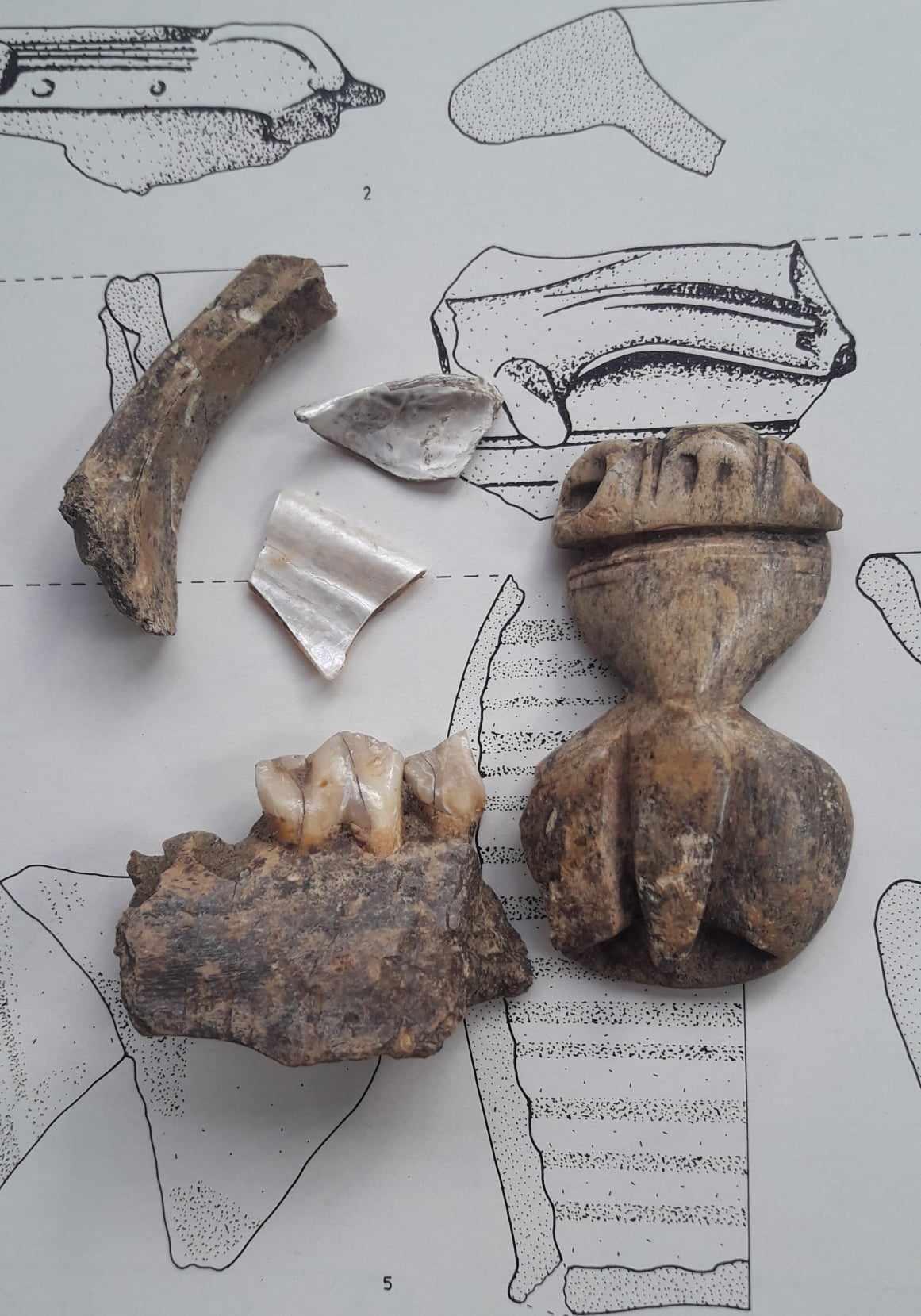
All the broken dishes and amphora were to be expected, but why so many? And why didn’t whoever lived here take their dishes with them when they went? Maybe they left in a hurry, smashing everything on the way out of the door so there was nothing left for the invaders? Or did the dishes simply fall and break when the abandoned wooden shelves rotted away over the centuries? A layer of abandonment was a curious and intriguing thing to contemplate.
Now that she had the experts opinion on the teeth ~ pig, not human ~ haste was needed to quell the growing rumours in the village that she had found human remains. That was the last thing she needed, the neighbours giving her suspicious looks or the authorities roping off her dig with striped plastic tape and putting a police tent over it, messing with the hole she had dug trowel by trowel, rubbing every handful of soil between her fingers. The very thought of it was unbearable. For this reason she rather hoped NOT to find a hoard of valuable ancient coins, contrary to what most people would hope to find. Still, she couldn’t help wonder while she was digging if the next trowel of soil would reveal one.
She must make it absolutely clear to Roger than he was only required to carry buckets of soil, and was not to do any actual digging.
February 1, 2024 at 7:14 am #7334In reply to: The Incense of the Quadrivium’s Mystiques
Impressed with Finnlee’s spirited outburst, Truella realised she’d barely noticed the cleaning lady and felt ashamed. The required daily appearances that the dictatorial Malove insisted upon rankled her, occupying her attention so that the cleanliness or otherwise of the premises went unnoticed. She made up her mind to seek Finnlee out and befriend her, treat her as an equal, draw her into her confidence. Besides, that confident no nonsense approach could come in handy for any staff uprisings. Not that any staff uprising were planned, she mentally added, quickly cloaking her thoughts in case any had leaked out.
Malove spun round and shot her a piercing look and Truella quailed a little, momentarily, but then squared her shoulders and impudently stared back. Malove raised an eyebrow and returned to addressing the witches.
After what seemed like an eternity the meeting was over. Truella planned to seek Finnlee out and invite her for a brew at the Faded Cabbage but Frigella approached her, looking a bit sheepish, and asked if she could have a word in private about a personal matter.
They strolled together towards the little park opposite, and once out of earshot of the others, Frigella came straight to the point.
“Can my cousin come and stay with you for a bit? The thing is, he’s got himself into a spot of bother and needs to disappear for a bit, if you know what I mean. He’s a big strong lad, and I’m sure he’d be willing to give you a hand with all that digging…”
Truella didn’t hesitate. “But of course, Frigella, send him over! He won’t be the first person on the run to come and stay, and probably won’t be the last.”
“The thing is he’s a bit sandwich short of a picnic, you know, not a full bag of shopping…”
“What, does he eat a lot? I don’t do much cooking…”
“No, no, well yes, he does have a good appetite, but that’s not what I meant. He’s a bit simple, but heart of gold. He’s from the other side of the family and our side never had much to do with them, but I always had a soft spot for him.”
” A simpleton might be a refreshing change from all the over complicated people, send him over! What’s his name?”
“Roger. Roger Goodall.”
Roger! The name rang a bell. It wasn’t until much later that Truella realized she should have asked what Roger was on the run for.
February 1, 2024 at 2:03 am #7333In reply to: The Incense of the Quadrivium’s Mystiques
“Attention, Witches!” Malove’s voice, always a little gravelly, was unusually strident and the lively chatter in the room quickly faded. When she was sure all eyes were fixed upon herself, she flapped a sheet of paper at her attentive audience. “This … ” Malove paused and regarded the piece of paper with bemusement. “… This diatribe was on my desk this morning. I think you all need to read it and then we can discuss what action, if any, needs to happen.”
“Action!” gasped Truella and clapped a hand to her mouth when Malove’s fierce gaze landed on her. A shiver went through the assembled witches.
Another forceful wave of Malove’s arm and a shimmering screen appeared. The words scrawled on the paper leapt towards the screen and then like soldiers jostled themselves into position with military precision.
“Dearly Beloved Coven Members (and I use that term as loosely as the morals of a politician),
It’s your ever-so-humble and not-at-all-grumbling cleaner, Finnlee, here. Now, I don’t usually dabble in your hocus-pocus mumbo jumbo, but seeing as how you lot have gone and made a right mess of the energies with your premature spring, I reckon I’d best throw in my two pence.
Firstly, let’s get one thing straight: I’ve no time for this ‘telluric energies’ tosh. Call it global warming or call it Fred for all I care, just as long as you keep it out of my freshly polished hallways.
Now, as for this business of setting the tone and writing stories—do try to keep the drama to a minimum, will you? Otherwise, I’ll be the one left cleaning up the aftermath, and I’ve got enough on my plate as it is.
And Frigella, my hat’s off to you, dear. A woman of action, not just words. Reminds me of myself, only I prefer to wield a broom rather than a wand.
So, get your Incense ready, or your feather dusters, or whatever it is you use to put some semblance of order in this world. Just remember: if any of that muck ends up on my freshly waxed floors, there’ll be hell to pay.
Yours in perpetual crankiness,
Finnlee”
January 31, 2024 at 4:51 pm #7329In reply to: The Incense of the Quadrivium’s Mystiques
The soft candle light on the altar created moving patterns on the walls draped with velvets and satins. The boudoir was the sanctuary where Jeezel weaved her magic. The patterns on the tapestries changed with her mood, and that night they were a blend of light and dark, electricity made them crackle like lightning in a mid afternoon summer storm.
The altar was a beautifully crafted mahogany table with each legs like a spindle from Sleeping Beauty’s own spinning wheel, but there was no sleeping done here. On her left, her vanity with her collection of wigs, each one a masterpiece styled to perfection, in every shade you could imagine. Tonight, she had chosen the red one. It was a fiery cascade of passion and power, the kind of red that stops traffic. Jeezel needed the confidence and boldness imbued in it to cast the potent Concordia spell.
The air was thick with the perfume of white sage. Lumina, Jeezel’s nine tailed fox familiar, was curled-up on a couch adorned with mystical silver runes pulsating with magic, her muzzle buried in the fur of her nine tails. Her eyes half closed, she was observing Jeezel’s preparation on the altar. The witch had lit a magical fire to heat a cauldron that’s seen more spells than a dictionary.
Jeezel had carefully selected a playlist as harmonious and uplifting as the spell itself, to make a symphony of sounds that would weave together like the most exquisite lace front on a show-stopping wig. She wanted it to be an auditory journey to the highest peaks of harmony that would support her during the casting.
As the precious moon water began to simmer, Jeezel creased the rose petals and the lavender in her hands before she delicately dropped them in the cauldron. The scent rose to her nose and she stirred clockwise with a wand made of the finest willow, while invoking thoughts of unity and shared purpose. The jittery patterns on the walls started to form temporary clusters. A change of colour in the liquid informed the witch it was time to add a drizzle of honey. Jeezel watched as it swirled into the potion, casting a golden glow that promised to mend fences and build bridges. The walls were full of harmonious ripples undulating gently in a soothing manner.
Once the honey was completely melted, Jeezel dropped in an amethyst crystal, whose radiating power would purify the concoction. The potion started to bubble and the glow on the tapestries turned an ugly dark red. Jeezel frowned, wondering if she had done something wrong.
“Stay focused,” said the fox in a brisk voice. “Good. The team energy is fighting back. Plant your stiletto heels firmly into the catwalk, and remember the pageant.”
The familiar’s tawny eyes glowed and the music changed to the emergency song. Jeezel felt an infusion of warm and steady energy from Lumina and started humming in sync with The Ride of the Valkyries. She stirred and chanted, every gesture filled with fiery confidence. The walls glowed darker and the potion hissed. But in the end, it was tamed. The original playlist had resumed to the grand finale. A gentle yet powerful orchestral swell that encapsulated the essence of unity and understanding, wrapping the boudoir and the potion in a sonic embrace that would banish drama and pettiness to the back of the chorus.
Jeezel released the dove feather into the brew, then finished with a sprinkle of glitter with a flourish. And it was done.
“Was the glitter necessary?” asked Lumina.
“Why not? It can’t do any harm.”
The fox jumped from the couch and looked at the potion.
“It’s sparkling like the twinkle in your eye when you hit the stage. It’s ready. Well done.”
Jeezel strained it with grace and poured it into the most fabulous vial she could find, and she sealed it with a kiss.

Jeezel opened Flick Flock and started typing a message to Roland.
The potion is ready. I’m sending it to you through the usual way.
[…]
As you use the potion, you’ll have to perform a kind of team building ritual that will help channel the potion’s power and bring your team together like sequins on a gown, darling.
Fist, dim the lights and set the stage with a circle of candles. Then gather around in the circle with your team, each of you holding a small vial of the potion. Next, take turns sharing something positive, a compliment or an expression of gratitude about the person to your left. It’s about building up that positive energy, getting the good vibes flowing like champagne at a gala.
Once the air is thick with love and camaraderie, each team member will add a drop of the Concordia potion to a communal bowl placed in the center of the circle as a symbol of unity, like a magical melting pot of harmony and shared intentions.
With the power of the potion pooling together, join hands (even if they’re not the touchy-feely types) and my familiar will guide you in an enchanting and rhythmic chant.
Finally with a climactic “clink” of glass of crystal, you’ll all seal the deal, the potion will be activated, and the spell cast.
I can affirm you, your team will be tighter than my corset after Thanksgiving dinner, ready to slay the day with peace and productivity.
Let’s get this done. And don’t forget to add a testimony and click the thumb up.
xoxox Jeezel.
January 31, 2024 at 8:51 am #7328In reply to: The Incense of the Quadrivium’s Mystiques
A place where glamour meets enchantment, said the brochure when she found what would become her cottage ten years ago. But tonight, Jeezel didn’t see the whimsical, neither did she hear the trees whispering secrets. And the moon… don’t let me start with the moon. The vines had started to cover the main door. It was painted in the richest shade of midnight blue, which was stunning when daylight splashed all over it, but there were no outside lights and at night, she always had difficulties finding the keyhole.
Jeezel took her phone out to turn on the torch and the pop of a champagne cork told her she had received an e-mail. Such a technological marvel dipped in fabulousness. It was shimmering and radiant, she had adorned it with crystals that would catch the light with every moment, casting rainbows across. But the only light it cast was an anxious message from Roland whose workplace had gone berserk.
“Please, do something quick!” was the content of the message.
The witch had never been good under pressure. She touched her forehead lightly with the back of her hand. She didn’t want to mess with her carefully applied makeup. Then lip synched her moto : “Shine bright, darling, and let the world bask in your glow.”
“That’s it!” she said. She took her key in her left hand and with a graceful and intricate swipe of her right hand she said: “Glowry”. Then she waved toward the door and added: “Hole”, and the key and the hole started to glow and attract each other. The door creeked open. Something else she’d have to attend to, later.
“At last,” she said when the door finally shut.
“Well, I could have grown a whole new tail in the time it took you to grace us with your presence at the door. What were you doing, love? Perfecting your grand entrance, or did you just get lost in the reflection of your own fabulousness again?,” said a warm and teasing voice.
-
AuthorSearch Results
