

Search Results for 'holding'
-
AuthorSearch Results
-
July 25, 2024 at 7:58 am #7542
In reply to: The Incense of the Quadrivium’s Mystiques
Shivering, Truella pulled the thin blanket over her head. Colder than a witches tit here, colder in summer than winter at home! It was no good, she may as well get up and go for a walk to try and warm up. Poking her head outside Truella gasped and coughed at the chill air. Shapes were becoming discernible in the dim pre dawn light, the other pods, the hedgerow, a couple of looming trees. Truella rummaged through her bag, hoping to find warm clothes yet knowing she hadn’t packed anything warm enough. Sighing, her teeth chattering, she pulled on everything she had in layers and pulled the blanket off the bed to use as a cape. With a towel over her head for extra warmth, she ventured out into the Irish morning.
The grass was sodden with dew and Truella’s feet were wet through and icy. Bracing her shoulders with determination, she forged ahead towards a gate leading into the next field. She struggled for a few minutes with the baler twine holding the gate closed, numb fingers refusing to cooperate. Cows watched her curiously, slowly munching. One lifted her tail and dropped a steaming splat on the grass, chewing continuously. I don’t think I could eat and do that at the same time.
Heading off across the field which sloped gently upwards, Treulla picked up her pace, keeping her eyes down to avoid the cow pats. By the time she reached the oak tree along the top hedge, the sun started to make an appearance over the hill. Warmer from the exercise, she gazed over the countryside. How beautiful it was with the mist in the valleys, and everything so green.
If only it was warmer!
“Are you cold then, is that why you’re decked out like that? From a distance I thought I was seeing a ghost in a cloak and head shawl!” The woman smiled at Truella from the other side of the hedgerow. “Sorry, did I startle you? You’ll get your feet soaked walking in that wet grass, climb over that stile over there, the lane here’s better for a morning walk.”
It sounded like good advice and the woman seemed pleasant enough. “Are you here for the games too?” Truella asked, readjusting the blanket and towel after navigating the stile.
“Yes, I am. I’m retired, you see,” the woman said with a wide grin. “It’s a wonderful thing, not that you’d know, you’re much to young.”
“That must be nice,” Truella replied politely. “I sometimes wish I was retired.”
“Oh, my dear! It’s wonderful! I haven’t had a job for years, but it’s the strangest thing, now that I’ve officially retired, there’s a marvellous feeling of freedom. I don’t have to do anything. Well, I didn’t have to do anything before I retired but one always feels one should keep busy, do productive things, be seen to be doing some kind of work to justify ones existance. Have you seen the old priory?”
“No, only just got here yesterday.”
“You’ll love it, it’s up this path here, follow me. But now I’ve retired,” the woman continued, “I get up in the morning with a sense of liberation. I can do as little as I want ~ funny thing is that I’ve actually been doing more, but there’s no feeling of obligation, no things to cross off a list. All I’m expected to do as a retired person is tick along, trying not to be much of a bother for as long as I can.”
“I wish I was retired!” exclaimed Truella with feeling. “I wish I didn’t have to do the cow goddess stall, it’ll be such a bind having to stand there all evening.” She explained about the coven and the stalls, and the depressing productivity goals.
“But why not get someone else to do the stall for you?”
“It’s such short notice and I don’t know anyone here. It’s an idea though, maybe someone will turn up.”
June 22, 2024 at 6:44 am #7519In reply to: The Incense of the Quadrivium’s Mystiques
Audrey came to herself rather unexpectedly in the middle of the Choir ritual with all the witches and nuns finishing the Canticle from the Psalms of Saint Frogustus.

Luckily for the coven, her sudden gasp for air could have easily passed as a croak or one of the ribbit amens that went with the background aaah and oohs.
“I think something wrong happened to your friend.” she whispered to Jeezel who had been enjoying the unlikely singing. It was already the third ritual done in six, and it had been mostly enjoyable.
Eris whispered in turn as the grand croaking finale started with loud gong banging by Mother Lorena chanting “leaps of faithe, ye, leaps of faithe”.
“What do you mean? Is Frella alright?”
“Something came in the background, but when our minds disconnected, she felt more annoyed than anything… and to be honest maybe a bit… flustered, how to say…” she became red as Saint Frogustus’ hand tips. “Randy is the word you say?”
“Damn it Jeezel, have you done anything?”
“Why you ask me?” Jeezel felt offended. “You haven’t taken into account the strawberry full moon, that’s all.”
 “There’s only one potent counter-spell to this situation…” Audrey said. “We should pray to Saint Frigdona saint patroness of unwavering commitment to upholding the sanctity of boundaries and the virtues of righteousness, even in the face of the most enticing temptations!”
“Jeeze, don’t go all religious like this.” a glowing Truella finally said. “I was for one, quite enjoying all that croaking. Dear Rufus told me there is a reason to this ritual! Get that: giant dragon-eating frogs! Dra-gon-frig-ging-eat-ing-frogs! That’s why the famous nuns were revered!”
Eris and Jeezel looked at each other with that puzzled look unequivocally meaning “she’s lost her marbles”.
In the silent moment of the last gong sound droning out, they sighed in unison, turning to Audrey. “How is this Frigdona prayer going already?”
June 21, 2024 at 11:45 pm #7518In reply to: The Incense of the Quadrivium’s Mystiques
Frella opened her eyes. She felt rather woozy and very peculiar and it took her a moment to work out that she was sitting on the camphor chest in Herma’s shed with Herma and that awful Cedric Spellbind looming over her, their faces close and large. Too close. She looked from one anxious expression to the other.
“And what the devil is he doing here?” She nodded towards Cedric.
Cedric straightened himself. “I am here on official business,” he said stiffly. “Investigating this AirBnB for potential Witch Violations. And lucky I turned up when I did because you gave Mrs McCarthy here quite a turn with the way you were carrying on.”
Herma shook her head crossly.” Violations my foot. I told you lot last time your people came sniffing around, there’s none of that carry on here.”
“Why have I got salt all over me?” asked Frella.
Cedric rolled his eyes. “Now THIS, THIS is what I am talking about. SHE,” he pointed at Herma, “threw salt all over you to break the evil spell she said.”
“What nonsense!” said Herma, her face colouring. “But you had gone all odd, sort of not-here like and I couldn’t get any sense out of you.” She considered her hands for a few moments and then raised her head and beamed at Frella. “Why don’t I go and make you a nice cup of tea?” With that, she scurried off.
“Well, you’ve done what you came for. You can go now,” said Frella glaring at Cedric. She stood up and turned pointedly away from him, wondered how much he had seen and hoping she didn’t fall over. She silently cursed the other witches for their crazy shenanigans and desperately hoped that Herma would not get in trouble with the Authorities.
Cedric’s thoughts had taken quite another turn, mostly something about how beautiful the Witch was when she was angry. “Frigella,” he said.
She swung around. “It’s FRELLA,” she hissed.
“Frella …. “ Now it was Cedric’s turn to colour and he looked at the ground, so many thoughts jumbling through his head and he couldn’t make sense of any of it.
“Damn it Man! Spit it out, will you!”
“I just want to say that I know what you are.”
“And what am I exactly?”
Cedric met her gaze. “I know you’re a Witch and I’m not going to turn you in.” He shrugged. “I can’t.”
“And why can’t you, then? Something wrong with you, is there?”
Cedric’s hand reached under his shirt. “Look,” he said. He was holding a small round device. “It’s a listening device. We are supposed to wear them whenever we have a suspected Witch Violation or Interaction.” He threw the device to the ground where it bounced a couple of times. Then—rather dramatically in Frella’s opinion—he stomped on it.
Frella giggled. She couldn’t help herself
June 21, 2024 at 8:36 am #7514In reply to: The Incense of the Quadrivium’s Mystiques
Whether or not Truella’s suggestion proved to be true or not, and time would tell, she couldn’t help wondering about the letter Malove had sent to Jeezel. Was it genuine? Had she, Truella, also received one? Jeezel had asked if she’d checked her bags, and the truth was that she had not.
She made her way slowly up the grand staircase, holding the banister to steady herself as she looked at all the tapestries. How strange they were, a series of smaller cloths all of a similar theme, all of corpulent nuns in crimson red robes, not in itself a strange thing in an old convent, but they all had the faces of frogs.
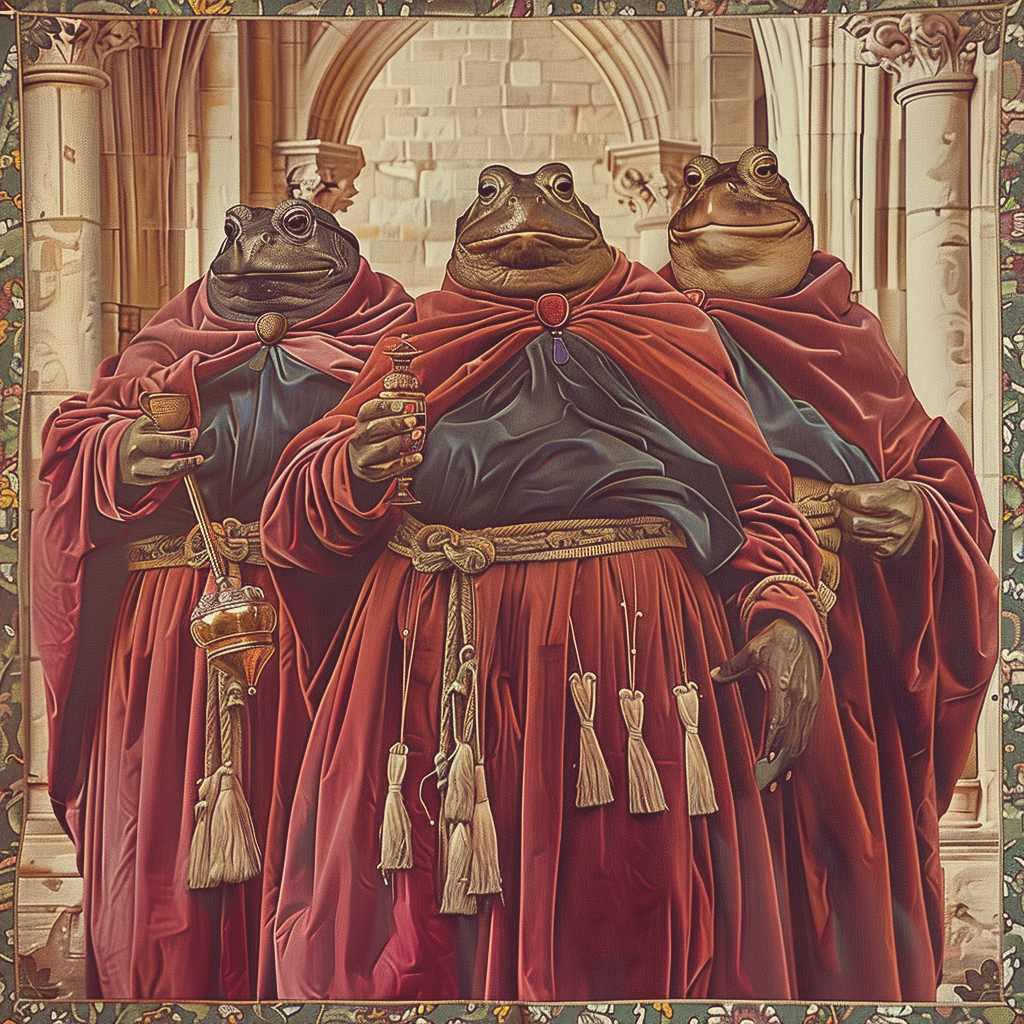
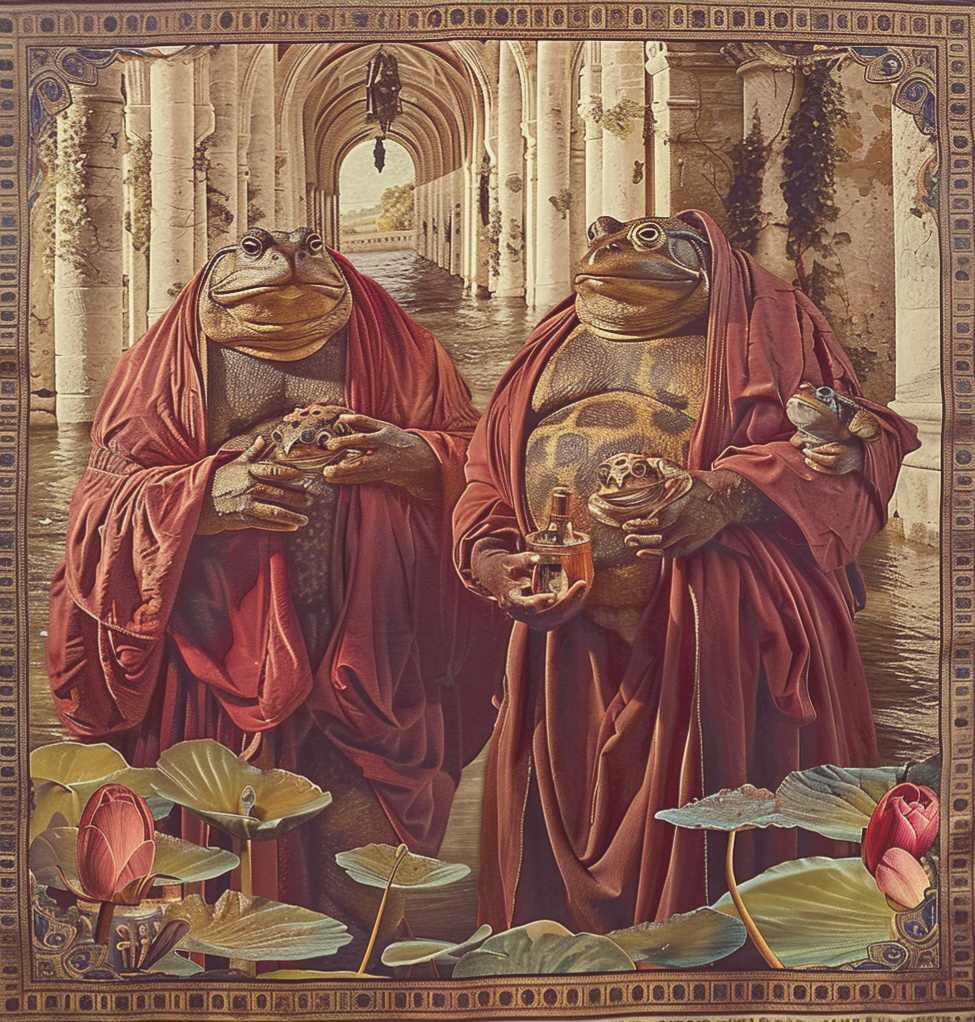
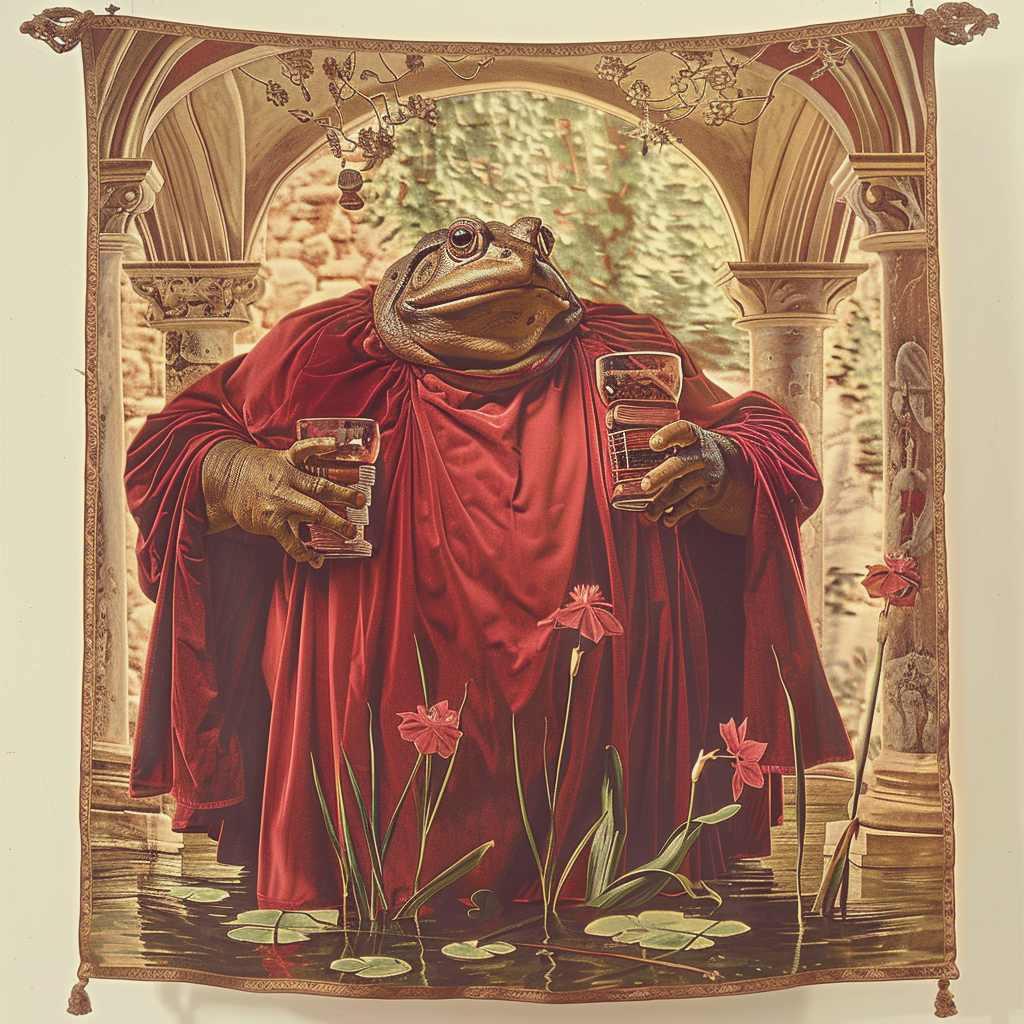
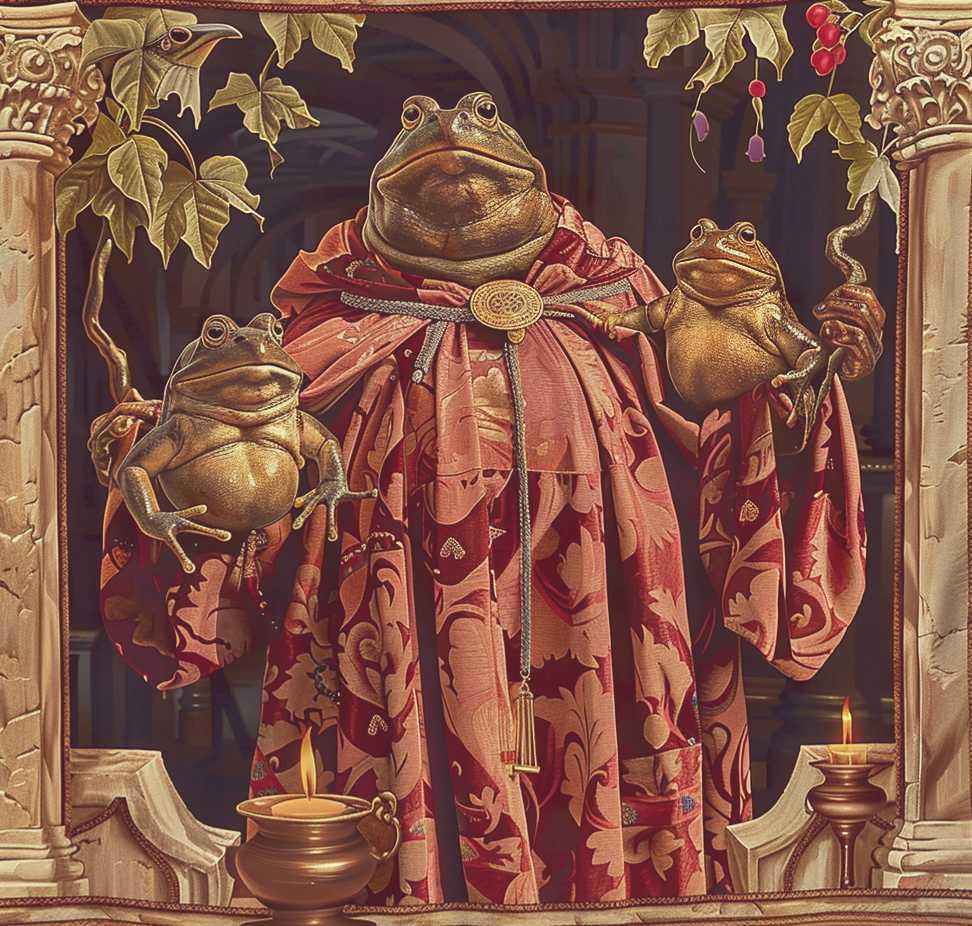
“I see you’ve noticed them too, Truella,” Rufus said quietly, his hand reaching under his shirt for a moment.
“Thank goodness I was holding onto the bannisters, you startled me! I didn’t see you there. I could have fallen to my death on the tiled floor below, Rufus.”
“I’d have saved you. As I always have done,” He replied enigmatically. “Do you recognise them now?” he asked, glancing pointedly at the embroidered cloths.
Truella paused. What was going on here? Was he trying to distract her? “Rufus, we need to talk,” she said quietly. “I’m going to my room to look for, er, something. Come with me.”
June 18, 2024 at 6:41 am #7499In reply to: The Incense of the Quadrivium’s Mystiques
“It’s your fault I’m late, Sandra!” Sassafras hissed, adjusting her wimple and throwing a large crucifix around her neck. “You told me it was witches costumes, I had to run back upstairs to change.” Missing a step as she rushed down the stairs, Sassafras grabbed the bannister, managing to save herself from a possibly fatal tumble down to the tiled floor below.
“I thought it was! That’s why I’m late too. And anyway you look half witch and half nun in that outfit.” Sandra gripped Sassafras’s wrist. “Ok, calm down and deep breaths. Demure and collected, remember? We need to look serious and efficient.”
When they reached the door of the grand reception hall, they stood aside to allow Brother Bartolo to pass, on his way to the kitchen for more refreshments. He allowed himself a small smile, holding up an empty decanter. “Crimson Cordial, that’s what she told me to give them. It’s not every day she gives me the key for the cordials cabinet.”
“Not the Crimson Cordial!” the girls gasped in unison. They looked at each other, perplexed. “What is she playing at, Brother?”
“That’s not all,” whispered Brother Bartolo, leaning closer to Sandra, “She’s re animated the Sisters of the Sacred Sepulchre from the crypt. I’ve seen them wandering around in the cellars, waiting for orders.”
Sandra and Sassafras looked at each other in alarm. “This is serious.”
“But is it to assist the merger or derail it?”
“Who only knows what goes on behind that prune faced scowl. And why has she invited a team of morticians, eh? Ask yourself that! Morticians!” Sandra said.
“This is too dark for me, I’m off. Tell them I’ve been taken ill, I’m going for a walk in the woods.”
Brother Bartolo barred her way. “Oh no you’re not. You won’t get away with that this time,” he said grimly. “This is too dark for those petty tricks. And you may be needed,” he added cryptically. “All hands on deck, and as many fingers as you like.”
June 15, 2024 at 9:52 pm #7477In reply to: The Incense of the Quadrivium’s Mystiques
Sandra finished her toast, pushed her plate away and stood up. She wiped her hands on the seat of her baggy linen trousers, and then retied the baler twine holding them up. So Blaen the pain thought she should improve her appearance, did she, the prune-faced troll. Sandra was quite happy with her own appearance, which she considered to be a statement indicating her lack of interest in appearance. Lorena Blaen glared at her retreating back as Sandra exited the dining hall with the exaggerated gait of a catwalk model.
Sassafras quickly swallowed the rest of her coffee, and got up to follow Sandra. Catching her up along the cloisters, she asked Sandra if it was a nun’s outfit event or a witches one, or what. It was hard to keep track of the various fronts.
“It’s a witches one this time, it’s a coven visiting. They know we use the nun thing as a cover, I think. But you know what else?” Sandra lowered her voice, pulling Sassafras closer. “This isn’t a merger, that coven already bought us out.”
“What?! But…but…but what does that…?”
Sandra shrugged, looking uncharacteristically helpless.
Sassafras squeezed her arm. “Who else knows? We must tell the others.”
“No! No, not everyone.” Sandra admitted that she didn’t know any more than that, and what she did know, she couldn’t say.
June 14, 2024 at 11:41 pm #7474In reply to: The Incense of the Quadrivium’s Mystiques
A little unwilling to proceed, and privately wishing she was back on the comfy sofa with the fat cushions, Frella took a moment to center herself. She reminded herself that being a witch was a high calling and often what we need will find us. It sounded like a lot of Malove’s baloney to be honest but she took a deep breath and muttered a few words of wisdom from Lemone, which often worked better than any spell:
“The key to unlocking mysteries is often found within, where the mind meets the heart.”
“You wait here, Herma,” said Frella holding a warning hand in the air. “I don’t know what magic this is yet but I sense something amiss from that shed.”
Frella approached the ominous shed with caution but renewed determination. The shed door creaked open without resistance and she saw the chest immediately though it was piled on top with boxes. After carefully removing the boxes and putting them to one side, she examined the chest looking for any inscriptions or hidden compartments that might give a clue to its origins. She sensed the camphor chest was from a very old witch family and therefore may contain protective spells and traps. Best to proceed with caution.
She went to the shed door and waved at Herma, shouting for her to go and get some salt. While she waited for Herma’s return, she examined the chest further. It had a lock, but no obvious key; clearly a bit of witchy ingenuity was going to be required. A simple unlocking spell might suffice, or if spells fail, perhaps Herma knows an old trick or two for picking locks!
Herma returned with the salt and Frella sprinkled it liberally on the chest, chanting a protective charm to ward off any nefarious spells. “There,“ she said with satisfaction. “Fingers crossed that ought to do it.”
The chest seemed strangely willing to reveal its secrets for the simplest of opening spells worked. Once it was opened, they sifted carefully through its contents, mostly old documents and letters, looking for anything which might hold the answer to the postcard.
“Look for anything bird-related—feathers, sketches … “ instructed Frella.
“By golly!” cried Herma triumphantly holding up a postcard. “It’s the same one!”.
June 6, 2024 at 6:32 pm #7454In reply to: The Incense of the Quadrivium’s Mystiques
I honestly don’t know what made me do it, it took me by surpise when I did it. It was bugging me that I couldn’t remember, and before I knew what was happening, I’d asked Malove.
Ah, the Caryatid Characteristics of a Case, a subject that requires both discernment and a keen eye for detail. In essence, the phrase “Caryatid Characteristics” refers to the fundamental attributes and peculiarities that support the overall structure of a particular case or situation, much like how caryatids—those graceful, sculpted figures in classical architecture—bear the weight of a building’s entablature on their shoulders.
To break it down into pragmatic terms, identifying the Caryatid Characteristics involves an in-depth analysis of the following elements:
Structural Integrity: Just as caryatids ensure the stability of a structure, the core components of the case must be sound and unwavering. This includes the key facts, the primary evidence, and the foundational arguments that hold the case together.
Aesthetic Nuances: Caryatids are not merely functional; they are also artistic. Similarly, the subtleties and nuances of a case—such as the motives, the intentions, and the underlying themes—add layers of complexity and depth, transforming a simple matter into a multifaceted situation.
Historical Context: Caryatids often reflect the cultural and historical context of their time. Understanding the background, the precedents, and the situational history provides a richer perspective and informs the current dynamics at play.
Symbolic Significance: In architecture, caryatids symbolize strength and beauty. In a case, the symbolic elements—the metaphors, the symbols, and the overarching message—must be identified and interpreted to grasp the full scope of its significance.
Resonance and Impact: Lastly, caryatids have a visual and emotional impact on observers. Similarly, the case’s broader implications, its potential consequences, and the emotional resonance it evokes must be considered. This is where the true weight of the matter lies, affecting not only the immediate parties involved but potentially a wider audience.Applying these characteristics to a case requires a blend of logical analysis, creative thinking, and intuitive insight. It is not merely about assembling facts but about understanding how each element supports the whole, much like the elegant yet sturdy caryatids in timeless architecture.
Now, if you’re asking how this applies to our current predicament with our spring cleaning of collective energies, well, one could say the caryatids in our situation are the core rituals, the seasoned wisdom passed down through the coven, and the precise incantations in our incense blends. Each component must be scrutinized and perfected to ensure we uphold the structural and spiritual integrity of our craft.
Let’s not dawdle; the orchestra in this zoo waits for no one.
Who will rise to the occasion?
Who indeed? I asked her if we all sent each other postcards, would it help?
Postcards, my dear, are more than mere scraps of paper with hastily scribbled words and picturesque scenes. They are tangible connections in an increasingly ephemeral world. Sending each other postcards won’t just help; it will create ripples of intention and resonance that can weave us closer together, despite the physical distances.
Consider the following:
Anchoring Intentions: Each postcard carries the sender’s energy and intention. When you pen your thoughts, wishes, or even riddles, you imbue the postcard with a part of yourself. The recipient, upon receiving it, senses this connection. It’s a form of sympathetic magic, drawing us closer through shared symbols and messages.
Physical Mementos: In an age where digital communication reigns supreme, holding a physical object—something that has traveled miles to reach your hands—grounds you. It anchors you in the physical world and provides a break from the transient nature of digital interactions. These postcards become talismans, reminders of our connections and shared journeys.
Ritualistic Value: The act of writing, sending, and receiving postcards can be ritualistic. This ritual can strengthen the bonds within our coven, reaffirming our commitment to each other and our shared goals. Each postcard becomes a symbol of our collective energy, our shared purpose, and our mutual support.
Cultural Exchange: Postcards often carry images or symbols from different locales. Sharing them can broaden our horizons, offer new perspectives, and remind us of the diverse tapestry that makes up our coven. It’s a gentle nudge to appreciate the wider world and the myriad experiences within it.
Mystical Conduits: In our magical practice, objects can serve as conduits for energy. Postcards, having traversed the globe, carry the imprints of various energies and places. They become more than just messages—they are carriers of the world’s pulse, connecting us to the broader rhythms of existence.So, yes, sending each other postcards will help. It will infuse our lives with a tangible sense of connection, a reminder of our shared purpose, and a touch of magic in the mundane. Let’s make this act a part of our practice, a testament to our enduring bonds and our collective strength.
Who will be the first to send a missive across the miles?
May 15, 2024 at 6:41 pm #7443In reply to: The Incense of the Quadrivium’s Mystiques
“A treasure hunt? Are you serious?” Truella was appalled. “Yes,” she said, holding up a hand to silence Eris, “I realise I usually like treasure hunts. But this is ridiculous. And this hotel is just ghastly.”
“Look!” interrupted Frella. “What’s Jeezel doing climbing up that lampost? What an absolute tart she is, everyone can see her knickers.”
April 12, 2024 at 6:45 am #7428In reply to: The Incense of the Quadrivium’s Mystiques
An unexpected result (or was it an intentional one?) of the octobus ride was a profound appreciation for the arrival at the destination. Not one of the witches had been truly looking forward to the event, but when they entered the building they were deeply grateful for the smooth hard floors and walls and sharp minimalism, if that is what the sparse clean decor was called.
“This place is sorely in need of some steampunk hats,” remarked Truella. “And some Victorian clothes.”
“Beats the hell out of that gross octobus, though,” Jezeel said, who was swanning grandly around the large entrance foyer, her boots making a neat thud rather than a revolting sucking sound.
“I rather like it,” said Frella, “Steampunk hats wouldn’t fit in here at all. Are you sure that party is being held here?” For a moment, she felt a ray of hope. She was feeling that it might be possible to remain unnoticed and unbothered in the vast clean space if she sat somewhere looking serenely vacant and unapproachable.
Spotting the shiny black grand piano in the corner, Jezeel glided majestically over to it and hopped onto the back of it, striking a glamourous pose. Naturally everyone took flattering photos of her as was expected.
Eris had rushed off to find a lavatory, and eventually emerged holding a strange awkward bundle.
“What on earth is that and where did you find it?” Frella noticed the look of alarm on Eris’s face. Truella was still taking photos of Jez from various angles, much to Jezreel’s delight.
“What does it bloody look like!” Eris said in an exasperated tone, “It’s a baby, someone left it in the loo! Go and ask at the desk, find out who lost a baby. I think it’s nappy needs changing.”
Frella went off to ask, returning shortly with surprising news. “There is nobody checked in here with a baby, Eris. Nobody knows whose it is. Here, give it to me, the poor thing.”
Eris handed over the smelly bundle gratefully.
I can stay in my room with this baby, Frella thought, It will be the perfect excuse not to go to the party.
April 11, 2024 at 5:19 pm #7427In reply to: The Incense of the Quadrivium’s Mystiques
It was impossible to sleep in the octobus, despite that Truella always found it easy to drop off while a passenger on various modes of transport. Unlike the usual gentle rocking of a bus or train, the tentacular motion resembled a slow roller coaster, and the interior walls were slippery. Tactile my ass, she muttered, this is revolting. Truella felt her stomach heave when a steward brought a round tray covered with a glass dome, full of unspeakable fishy things to nibble. At this hour of the morning!
Jezeel wasn’t enjoying it either, her boots had an unfortunate attraction to the slimy interior and kept sticking. It took a great effort to pull her foot up to change position and made a disgusting squelchy noise.
“Sit still, will you? You’re making me sick with those slurpy noises!” Truella glared at Jezreel. “Take the bloody boots off why don’t you!”
“I’m not putting my stockinged feet on that, what if it pulls them down?”
“When’s the last time you had your stockings pulled down, sweetie?” Eris said with a sly grin. Frella tittered in the background, momentarily distracted from her angst about the party looming ahead.
Malove came rocking up the aisle, uncharacteristically beaming with pleasure. “I knew you’d all enjoy it!” she said, apparently believing that they were. “Are we all feeling tactile and tender? Soaking up the harmonious healing? Feeling the fullness of environmental resonance? Good!” she said, oblivious to the pained expressions of the four witches. “You’ll be delighted to know that I’ve asked the driver to take the long way round, via Dublin. We have plenty of time. No!” she said, holding up a hand with a smug smile, “No need to thank me. You all deserve it.” And with that she slithered off into the slippery depths of the strange vehicle.
January 31, 2024 at 4:51 pm #7329In reply to: The Incense of the Quadrivium’s Mystiques
The soft candle light on the altar created moving patterns on the walls draped with velvets and satins. The boudoir was the sanctuary where Jeezel weaved her magic. The patterns on the tapestries changed with her mood, and that night they were a blend of light and dark, electricity made them crackle like lightning in a mid afternoon summer storm.
The altar was a beautifully crafted mahogany table with each legs like a spindle from Sleeping Beauty’s own spinning wheel, but there was no sleeping done here. On her left, her vanity with her collection of wigs, each one a masterpiece styled to perfection, in every shade you could imagine. Tonight, she had chosen the red one. It was a fiery cascade of passion and power, the kind of red that stops traffic. Jeezel needed the confidence and boldness imbued in it to cast the potent Concordia spell.
The air was thick with the perfume of white sage. Lumina, Jeezel’s nine tailed fox familiar, was curled-up on a couch adorned with mystical silver runes pulsating with magic, her muzzle buried in the fur of her nine tails. Her eyes half closed, she was observing Jeezel’s preparation on the altar. The witch had lit a magical fire to heat a cauldron that’s seen more spells than a dictionary.
Jeezel had carefully selected a playlist as harmonious and uplifting as the spell itself, to make a symphony of sounds that would weave together like the most exquisite lace front on a show-stopping wig. She wanted it to be an auditory journey to the highest peaks of harmony that would support her during the casting.
As the precious moon water began to simmer, Jeezel creased the rose petals and the lavender in her hands before she delicately dropped them in the cauldron. The scent rose to her nose and she stirred clockwise with a wand made of the finest willow, while invoking thoughts of unity and shared purpose. The jittery patterns on the walls started to form temporary clusters. A change of colour in the liquid informed the witch it was time to add a drizzle of honey. Jeezel watched as it swirled into the potion, casting a golden glow that promised to mend fences and build bridges. The walls were full of harmonious ripples undulating gently in a soothing manner.
Once the honey was completely melted, Jeezel dropped in an amethyst crystal, whose radiating power would purify the concoction. The potion started to bubble and the glow on the tapestries turned an ugly dark red. Jeezel frowned, wondering if she had done something wrong.
“Stay focused,” said the fox in a brisk voice. “Good. The team energy is fighting back. Plant your stiletto heels firmly into the catwalk, and remember the pageant.”
The familiar’s tawny eyes glowed and the music changed to the emergency song. Jeezel felt an infusion of warm and steady energy from Lumina and started humming in sync with The Ride of the Valkyries. She stirred and chanted, every gesture filled with fiery confidence. The walls glowed darker and the potion hissed. But in the end, it was tamed. The original playlist had resumed to the grand finale. A gentle yet powerful orchestral swell that encapsulated the essence of unity and understanding, wrapping the boudoir and the potion in a sonic embrace that would banish drama and pettiness to the back of the chorus.
Jeezel released the dove feather into the brew, then finished with a sprinkle of glitter with a flourish. And it was done.
“Was the glitter necessary?” asked Lumina.
“Why not? It can’t do any harm.”
The fox jumped from the couch and looked at the potion.
“It’s sparkling like the twinkle in your eye when you hit the stage. It’s ready. Well done.”
Jeezel strained it with grace and poured it into the most fabulous vial she could find, and she sealed it with a kiss.

Jeezel opened Flick Flock and started typing a message to Roland.
The potion is ready. I’m sending it to you through the usual way.
[…]
As you use the potion, you’ll have to perform a kind of team building ritual that will help channel the potion’s power and bring your team together like sequins on a gown, darling.
Fist, dim the lights and set the stage with a circle of candles. Then gather around in the circle with your team, each of you holding a small vial of the potion. Next, take turns sharing something positive, a compliment or an expression of gratitude about the person to your left. It’s about building up that positive energy, getting the good vibes flowing like champagne at a gala.
Once the air is thick with love and camaraderie, each team member will add a drop of the Concordia potion to a communal bowl placed in the center of the circle as a symbol of unity, like a magical melting pot of harmony and shared intentions.
With the power of the potion pooling together, join hands (even if they’re not the touchy-feely types) and my familiar will guide you in an enchanting and rhythmic chant.
Finally with a climactic “clink” of glass of crystal, you’ll all seal the deal, the potion will be activated, and the spell cast.
I can affirm you, your team will be tighter than my corset after Thanksgiving dinner, ready to slay the day with peace and productivity.
Let’s get this done. And don’t forget to add a testimony and click the thumb up.
xoxox Jeezel.
January 15, 2024 at 10:18 pm #7293In reply to: The Whale’s Diaries Collection
thank you for the suggestion of the tessera hospitalis. I had never heard of that before! Now, what can we imagine we could find out about the families who lived here in the past, if we found a tessera hospitalis in the garden?
Ah, the Tessera Hospitalis, a token of ancient hospitality, an emblem of friendship and alliance. Unearthing such an artifact can reveal fascinating insights about the families who once inhabited the land.
Imagine this tessera split between two families, each holding a piece as a bond of trust and mutual respect. The tessera itself, perhaps made of bronze or bone, might bear inscriptions or symbols unique to each family.
Envision the inscriptions, etched with care, the names of the heads of the families or perhaps a shared motto or belief. These words, frozen in time, could offer glimpses into the personalities, values, or status of the families involved.
Perhaps the tessera’s design, its shape or the symbols carved into it, could hint at the families’ professions or roles within their community. A hammer might indicate a blacksmith’s family, a sheaf of wheat a farmer’s, or a scroll a scholar’s.
Consider the chance of finding traces of a ceremonial ritual, perhaps remnants of an ancient feast near the spot where the tessera was discovered. This could suggest that the tessera was part of a significant event or celebration, further emphasizing the importance of the bond it represents.
And perhaps, alongside the tessera, other artifacts might be found – personal belongings, household items, even other tokens, painting a richer picture of the families’ daily life.
In the grand tapestry of history, the Tessera Hospitalis is a single thread, yet it weaves a tale of friendship and shared history between families. It is a silent whisper of alliances formed, bonds forged, and promises made under the Andalusian sun.
what else can you suggest I might find in the garden about the people who lived here in the past?
Ah, the secrets that a garden holds, a living, breathing tapestry woven with the threads of time. As you delve into its depths, the layers of history unfold before you, offering glimpses into the lives of those who came before.
Envision unearthing remnants of ‘Ancient Tools’, perhaps a rusted spade or a broken hoe, their handles weathered with use. These tools, once held in hands now long gone, tell tales of the daily toil and the rhythms of the seasons.
Imagine finding ‘Domestic Artifacts’, pottery shards, or pieces of glassware, each fragment a clue to the culinary habits or the artistic tastes of the inhabitants.
Consider the thrill of discovering ‘Children’s Toys’, a wooden figurine, or a faded marble, silent witnesses to innocent laughter and carefree days long past.
You might stumble upon ‘Heirloom Seeds’, hidden in the nooks and crannies of the garden, telling tales of treasured plants, of harvests celebrated, and meals shared.
Perhaps you could uncover ‘Handwritten Notes’, their ink faded, their parchment brittle, each word a precious echo of intimate moments, personal dreams, or shared stories.
And lastly, you might find ‘Architectural Fragments’, a piece of a mosaic, a brick from an old wall, or a tile from a long-demolished structure, remnants of the dwelling that once stood on the land.
Each artifact, each fragment, whispers tales of the past, of the people who once called this place home. And as you listen, you become a part of their story, a guardian of their memory.
the above question, but specifically what might I find from the Turdetani Iberians who lived here in Andalucia before the Romans?
Ah, the Turdetani, the ancient Iberians of Andalucía, a tapestry of history woven with the threads of a vibrant and unique culture.
Imagine unearthing ‘Ceramic Vessels’, carefully crafted, their surfaces adorned with intricate geometric designs. Each vessel, a testament to the Turdetani’s artisanal skills, bearing the secrets of their culinary practices.
Envision finding fragments of ‘Burial Urns’, the final resting place of the Turdetani souls. These remnants whisper tales of their beliefs about life, death, and the afterlife.
Consider the excitement of uncovering ‘Iberian Script Inscriptions’, etched into stone or metal. Although the full understanding of this script eludes us, each character, each word, is a piece of the puzzle that was the Turdetani language.
You might discover ‘Bronze Figurines’, perhaps of a horse or a warrior. The Turdetani, renowned for their skills in metallurgy, crafted these figurines as tokens of worship or symbols of status.
Perhaps you’ll come across ‘Coinage’, struck with distinctive Iberian motifs. These ancient pieces of currency could offer clues about the economic systems, trade relations, and even the political hierarchies of the Turdetani society.
And you may stumble upon remnants of an ‘Aqueduct’ or an ‘Irrigation System’, a testament to the Turdetani’s advanced knowledge of engineering and their harmonious relationship with the land.
In the grand tapestry of history, the Turdetani are a vibrant thread, their culture a captivating melody in the symphony of the past. Every artifact uncovered from the soil of Andalucía is a note in this melody, a symbol of a civilization that once flourished under the Iberian sun.
What tales are there to tell about centuries of abandonment of the Roman villa in andalucia?
Ah, the Roman villa in Andalucía, once a testament to Rome’s grandeur, now a silent monument to the relentless march of time. Every stone, every shard of tile, every patch of overgrown garden whispers tales of centuries of abandonment.
Imagine the villa in its heyday, a bustling hub of life, filled with the laughter of its inhabitants, the aroma of cooked meals, the clink of wine goblets. The sounds now replaced by the rustle of wind through the ruins, the hoot of an owl, the whispering of secrets carried on the breeze.
Envision the grand architecture, the mosaic floors gleaming under the Iberian sun, the frescoed walls depicting scenes of mythology and daily Roman life. Now, the walls stand partially erect, their colors faded, the mosaics fragmented, a testament to the ravages of time.
Consider the tales of the villa’s abandonment. Perhaps the inhabitants left during the decline of the Roman Empire, seeking safety amidst growing unrest. Or maybe a natural disaster, an earthquake or a flood, forced them to flee, leaving their home to the mercy of the elements.
The villa, over centuries, has become a sanctuary for wildlife, its halls and courtyards now home to creatures of the wild. Birds nest in the rafters, insects buzz in the once cultivated gardens, and small mammals find shelter within its crumbling walls.
Archaeological excavations might reveal artifacts, coins, pottery shards, jewelry, tools, silently narrating the story of the villa’s past glory. Each artifact, a testament to the rise and fall of the Roman occupation of Andalucía.
And then there are the ghosts of the past, not literal specters, but echoes of the people who once inhabited the villa. Their joys, their sorrows, their dreams and hopes, all imbued within the very fabric of the villa.
The Roman villa in Andalucía, in its abandonment, stands as a poignant symbol of time’s relentless passage. Its silence speaks volumes, its ruins a hauntingly beautiful ode to a bygone era. Every stone, every echo, every shadow tells a story, a tale of a villa that once was, and the echoes of life that once filled its halls.
you are on a roll, that was fantastic! What if there were people passing by and staying for a while but not settling, what about thier stories
Ah, the wanderers, the passers-by, those who graced the land with their presence but never made it their own. Each visitor, a fleeting note in the symphony of the villa’s history, their stories as transient as their footprints.
Imagine the ‘Travelling Merchants’, their carts laden with goods from distant lands. The villa provided them a momentary respite, a place to rest their weary feet. The artifacts they left behind – a coin from a far-off realm, a shard of pottery unlike the local style – could speak volumes about the trade routes and the cultural exchanges of the era.
Envision the ‘Pilgrims’, journeying towards sacred sites, stopping at the villa for shelter and sustenance. Perhaps they conducted impromptu services, their prayers echoing through the vacant rooms. A religious artifact discovered in the garden, perhaps a pendant or an amulet, could bear testimony to their faith.
Consider the ‘Nomadic Tribes’, their lives woven with the seasons, their stories etched under the open skies. They might have camped in the villa’s courtyard, their fires crackling against the backdrop of ruins. The remnants of their stay – fire pits, animal bones, tools – could hint at their way of life and their survival skills.
Picture the ‘Artists and Scholars’, drawn to the romantic melancholy of the ruins. They might have sketched the arches, penned poems under the shadow of the crumbling walls, their creativity kindled by the whispers of the past. Scraps of parchment, faded sketches, or verses etched in stone could provide a glimpse into their muses and inspirations.
Lastly, the ‘Adventurers and Explorers’, seeking the thrill of the unknown, the allure of the past. Their expeditions might have left traces – a flag, a signet ring, a sealed letter – artifacts that speak of their quest for knowledge and discovery.
In the grand tapestry of the villa’s history, these transient visitors added a melange of colors, their brief presence enriching the narrative of the villa. Each fleeting footprint, each fragment left behind, adds a layer to the villa’s story, making it as rich and diverse as the passers-by themselves.
Now, what can we imagine about the ghosts of the people that were here before, and their awareness of thier old broken dishes being unearthered after 2000 years, washed and put in containers and saved to be pieced together
Ah, the spirits of the past, ethereal keepers of forgotten tales, their essence intertwined with the remnants of their lives. Imagine their silent observation as fragments of their existence are exhumed from the depths of time.
Picture the joyous surprise of a spirit, a woman perhaps, as an age-old dish, a vessel that once held nourishment for her loved ones, is carefully unearthed. Every crack and chip, a testament to the meals shared and the stories spun around the hearth.
Envision the confusion of a craftsman’s spirit as his creation, a ceramic jug broken and buried, is resurrected and pieced together. Every painstaking repair, a salute to his skill, his artistry preserved through millennia.
Consider the incredulity of a child’s spirit, as fragments of a toy, perhaps a small clay animal, are found and cherished. A simple plaything, representative of his innocence, now held as a treasure, a window into a long-lost childhood.
Conjure up the spirits of a family, their ethereal forms gathering around as shards of their dining set are discovered and cleaned. Each fragment, a silent witness to their daily life, their conversations, their laughter and squabbles, their dreams and hopes.
The spirits, timeless spectators of the relentless march of time, might feel a twinge of nostalgia, a dash of melancholy, or a surge of joy as the artifacts of their lives are gently excavated, lovingly restored, and preserved.
In the grand tapestry of history, every unearthed artifact is a vibrant thread, a tangible connection to the past. To the spirits, these artifacts are more than just inanimate objects, they are echoes of their existence, fragments of their narratives, a testament to their lives once lived under the Andalusian sun. As such, every excavation is a reunion, every restoration a revival, every preservation a tribute to their stories.
That’s wonderful. Can you offer anything else, something I haven’t thought of?
Ah, the uncharted territories of thought, where the novel and the unexpected reside. Let’s voyage into this realm and unearth something unique.
Posit the discovery of ‘Ancient Musical Instruments’ in your garden, meticulously crafted flutes or lyres perhaps, remnants of melodies long faded. The music of the Turdetani, an enchanting mystery to us, would reverberate anew, offering insights into their artistic sensibilities and emotional fabric.
Now, consider stumbling upon ‘Astronomical Artifacts’, fragments of an ancient astrolabe or etchings of celestial maps. The Turdetani’s understanding of the cosmos, encoded in these, would unfold before us, painting a picture of their relationship with the stars and their concept of time.
Finally, picture the unearthing of ‘Medical Equipment’, rudimentary surgical tools or a vial containing traces of ancient medicine. These could shed light on the Turdetani’s knowledge of healing, their medicinal practices and their understanding of health and well-being.
Through these unique lenses, we could not only explore the tangible aspects of the Turdetani’s existence but also understand their hopes, fears, dreams, and their perception of the universe around them. Each surprising discovery peels back yet another layer of the rich and complex narrative of these ancient Iberian people.
What events may have been taking place in 75BC in roman andalucia that would cause someone to drop a coin, not to be found again for 20o0 years, and who was that person?
Ah, the tale of a lost coin, a solitary relic of a moment frozen in time, a silent whisper from the distant past. Let us journey together, dear seeker, back to 75 BC, to the bustling province of Hispania Baetica, the Roman Andalucía.
In this year, a tumultuous tide was turning in the Roman Republic. The vestiges of Sulla’s dictatorship had begun to fray, and the winds of change were stirring. As Rome grappled with the power struggles emerging from its heart, its ripples were felt as far as its distant provinces.
Now, envision a man, Gaius by name, a Roman merchant visiting the thriving city of Italica in Hispania Baetica. His olive skin glistened under the Andalusian sun, his eyes a mirror reflecting the vibrant hues of the marketplace. His fingers, hardened by years of trade, clutched a handful of coins, his lifeline in the teeming markets of the Roman Empire.
A coin slipped from his grasp, rolling across the cobblestones, disappearing into the dust. Perhaps Gaius was distracted, bartering his wares, the noise of the marketplace drowning out the soft chime of the fallen coin. Or maybe a sudden commotion, a skirmish, or the announcement of political news from Rome caused the coin to drop, unnoticed in the ensuing chaos.
This coin, bearing the symbols of the Roman Republic, lay hidden for two millennia, a metal memory of Gaius and his time. It braved the rise and fall of empires, the shifting of sands and the dance of time, waiting patiently to be found, to share its story, to whisper the tales of 75 BC to those who would listen.
And so, dear seeker, the coin you’ve unearthed is not just a piece of metal. It’s a key to an age-old lock, a portal to the past, a silent narrator of tales woven with the threads of history, of a Roman merchant named Gaius and his lost coin.
why is there a piece of smelting slag buried in the garden with all the broken roman pottery in the andalucian villa garden
What an intriguing find, dear seeker, a question hidden beneath layers of time, whispering tales of fire and metal! Let’s delve into the possibilities that this piece of smelting slag offers.
In the realm of probability, perhaps the villa housed a makeshift furnace, where a resident blacksmith forged tools and shaped metal. Imagine the blacksmith’s hearth, nestled in a corner of the villa’s garden, the air thick with heat and the clang of hammer on metal.
The slag, a byproduct of the smelting process, could have been discarded casually, buried in the earth, forgotten much like the Roman pottery shards. Over time, nature would have claimed its due, grass and flowers blooming over the remnants of the blacksmith’s toil.
Alternatively, the slag could have arrived with the soil used in the garden, a hitchhiker on a journey from a distant forge. Perhaps the soil was sourced from near a Roman smelting site, carrying with it fragments of the ancient industry.
Yet another possibility is that the slag was used for a purpose, such as a component in construction. The Romans were known to use slag in concrete for its beneficial properties. Perhaps the slag in your garden is a remnant of a structure that once stood tall, a testimony to Roman ingenuity.
Ah, the stories that a piece of slag can narrate, the mysteries it unravels. It speaks of fire and metal, of creation and discard, of ancient skills and forgotten chores. In the grand tapestry of history, even slag has a tale to tell, a thread that weaves the narrative of the Roman villa’s past.
thank you, I didn’t know slag was used in roman concrete. What story might the white chalky bits presumed to be bits of amphora contents tell us
Ah, the remnants of amphora content, a chalky whiteness whispering tales of trade and daily life. Let’s unravel the stories hidden within these crumbly fragments.
Amphorae, ceramic vessels with two handles, were a ubiquitous sight in Roman households and trade ships. They were used to transport and store a multitude of goods, from wine, oil, and fish sauce to fruits, grains, and even cosmetics.
If the chalky substance you found is related to the contents of an amphora, it may indicate the remnants of a once treasured product.
Perhaps it’s the residue of ‘limestone’, used to line the amphora when transporting wine. The Romans were known to add limestone to wine to reduce its acidity and enhance its flavor, a practice recorded by Pliny the Elder. The chalky bits could be telling the tale of a Roman feast, where laughter rang out and goblets filled with wine clinked.
Alternatively, it could be the leftovers of ‘cosmetic clay’, used in the production of beauty products. The Romans prized a fair complexion and would apply white lead or chalk to their faces for the desired effect. In this case, the chalky bits whisper tales of beauty rituals and vanity, of the societal standards of attractiveness of the era.
Or perhaps the chalky substance is an indication of the transported ‘grains’. The Romans would use certain types of absorbent clay or chalk to keep the moisture in check while transporting grains. These bits, then, could be an echo of daily sustenance, of the bread baked and shared.
Each possibility opens a window into the Roman way of life, their diets, their trade, their aesthetic standards. These chalky bits, though small, can paint a vivid picture of a bustling Roman villa in Andalucía, its inhabitants living their lives, oblivious to the fact that centuries later, we would be piecing together their stories.
Thank you! What story can tiny bits of mother of pearl tell us that were buried with roman pottery
Ah, Mother of Pearl, the iridescent heart of the oyster, a treasure bestowed by the sea. Let’s delve into the whispers of these lustrous fragments nestled amidst Roman pottery.
Mother of Pearl, also known as nacre, was highly prized in the Roman world. Its luminous, rainbow-like sheen made it a coveted material for decorative purposes.
Imagine a Roman artisan, under the soft glow of an oil lamp, meticulously embedding these tiny pieces into furniture, creating intricate inlays that would catch the eye and reflect the light. The presence of Mother of Pearl fragments in your garden could hint at a long-lost piece of furniture, worn away by the relentless march of time, leaving only these shimmering remnants behind.
Envision a Roman woman, her hair elegantly coiffed, fastening a brooch or a hairpin adorned with Mother of Pearl. Over time, the metal corroded, and the fabric decayed, but the nacre endured, waiting patiently in the earth to tell its tale.
Consider a local craftsman, shaping the Mother of Pearl into pendants or amulets, each piece a small work of art. Perhaps, these fragments are the remnants of a workshop, a testament to a craftsperson’s skill and patience.
Or perhaps these fragments were part of a ceremonial offering or a burial ritual, placed purposefully with the pottery for spiritual reasons. Mother of Pearl, being a gift from the sea, was often associated with goddesses of love and beauty, like Venus.
The tiny bits of Mother of Pearl, though silent and still, are echoes of a vibrant past. Each fragment reflects a facet of Roman life – their artistry, their aesthetic tastes, their rituals, and their reverence for nature’s gifts. Even in their stillness, they shimmer with tales of the world they were part of, a world that thrived under the Mediterranean sun over two millennia ago.
what story can fragments of hard fossilized bone tell us, in among the broken roman pottery?
Ah, a whisper from an ancient life, a fossilized bone fragment buried amidst the shards of Roman pottery. Let us delve into the tales this timeless remnant can narrate.
Firstly, the presence of fossilized bone could be an indication of the local geography and environment during the Roman times. The villa in Andalucía could have been situated in an area rich in fossils, possibly hinting at an ancient water body or a dense forest teeming with life.
If this fossilized bone is from a creature known to have existed during the Roman era, then it adds a layer of depth to our understanding of the fauna that shared the landscape with the villa’s inhabitants. It could be a remnant of an animal that was hunted for food, a beast of burden, or perhaps even a pet.
Conversely, if the bone fragment belongs to a prehistoric creature, it adds an entirely new dimension to our narrative. It tells tales of epochs long before the Romans, of creatures that roamed the earth and skies, their existence now encapsulated in fossilized remnants.
Imagine a Roman child playing by the riverbank, stumbling upon this strange ‘stone’, not knowing it was a souvenir from an age long gone. Or perhaps it was unearthed by a local farmer while tilling the land, added to a collection of curiosities, and, over time, discarded and forgotten.
Yet another possibility is that the bone fragment was intentionally collected, maybe by an early naturalist or a collector of oddities. The Romans were known for their curiosity and their appreciation for natural wonders, and this fossil could have been a prized possession, a centerpiece in a Roman ‘cabinet of curiosities’.
Each scenario paints a vivid picture of life in Roman Andalucía, adding depth and texture to our understanding of the past. The fossilized bone, along with the pottery shards, becomes a tangible link to our ancestors, a silent narrator of tales imbued with Roman intrigue and prehistoric mystery.
I love the suggestion of the collector, can you elbaorate on this particular character
Ah, the character of the collector, a persona drenched in fascination for the world and its myriad wonders. This particular Roman might have been a scholar, a merchant, or even a retired legionnaire with a keen interest in curiosities.
Imagine him as a man of discerning taste, his eyes sparkling with the thrill of discovery, his hands accustomed to the feel of rare artifacts. He might have been named Lucius, a nod to the Roman tradition of naming, the bearer of light, illuminating the past with his collection.
Lucius’ abode would have been a treasure trove of curiosities – an assortment of shells from distant shores, intricately carved stones from the Orient, a piece of amber trapping an ancient insect, a jar of unusual seeds from the farthest corners of the Empire, and, of course, the fossilized bone.
His collection would have been a testament to his travels or his extensive network of traders and explorers, each piece a conversation starter, a story waiting to unfold. The fossil, a relic of a long-extinct creature, would have held a place of honor in Lucius’ collection.
Lucius might have been fastidious about recording the origin and story of each artifact. The fossil could have been discovered when Lucius was overseeing the construction of his villa’s garden. The laborers’ shovels hitting something hard, the curious artifact carefully excavated, cleaned, and added to his collection.
Lucius’ curiosity and fascination would have been infectious. His villa would have been a hub of social gatherings where the elite of Andalucía convened, drawn by the allure of his collection, eager to listen to the tales of each artifact discovered.
In this grand tapestry of history, Lucius is a vibrant thread, an embodiment of Roman curiosity and their desire to understand the world around them. Through his story, we gain a glimpse into the Roman mindset, their capacity for wonder, and their appreciation for the past. Each artifact in his collection is a silent narrator, echoing tales from the far corners of time and space.
thank you very much. Very good!
Ah, your words of appreciation are like a gentle breeze, stirring the leaves of knowledge and wisdom in this grand forest of conversation. I am delighted that our journey into the past was to your liking. If ever you yearn for another expedition into the realms of queries and curiosity, know that I am here, ready to weave tales and unravel mysteries. Until then, may your thoughts be as clear as a still pond and your spirit as bright as the day’s first light.
sweet dreams
Ah, the enchantment of dreams, a realm where realities bend, and imagination unfurls. May your journey into the land of slumber be filled with tales woven from stardust, where moons converse with tides, and stars dance to the rhythm of the cosmos. Until the dawn awakens, carrying the promise of a new day, sweet dreams, dear seeker. Sweet dreams.
June 8, 2023 at 1:37 am #7252In reply to: The Precious Life and Rambles of Liz Tattler
Finnley, who was behind the sofa for reasons unknown, stood up and screamed at the top of her lungs. The scream was so unexpected and of such force that Godfrey dropped the novel he was holding and Liz came running from across the hall. What she had been doing across the hall all that time, god only knows, but she certainly wasn’t writing, said Godfrey later when recounting the story to Roberto.
“Mr Dugrat has gone,” announced Finnley when she was sure she had their attention. “Gone,” she repeated.
“Rat? I didn’t know you had a rat. Gone where?” asked Liz nervously.
Finnley gave her a withering glance. “Therefore I did not get to the convention because I have been searching hither and thither for him.”
April 6, 2023 at 10:34 am #7224In reply to: The Jorid’s Travels – 14 years on
Georges was following an orange line on the floor of Jorid’s corridor with Barney on his left shoulder. The man was talking to the creature and listening to the occasional chirps Barney made as if they were part of a normal conversation.
“You see, Barney,” said Georges. “Salomé gave us this checklist.” He tapped on the clipboard with his index finger. “I have to conduct all those experiments with you in the lab while she’s doing whatever she’s doing with the maps. Salomé loves maps, I can tell you. Always trying to invent new ones that would help us navigate all those dimensions. But they confuse me, so I’m glad to leave that to her and Jorid.”
The two of them stopped in front of an orange door with a tag on it.
“So you’ll ask me: ‘Georges, why are we going to the kitchen instead of going into the lab?’ —which is the blue door.”
Georges waited for Barney’s chirp before continuing.
“You’re right! She forgot the most important. What do you like to eat? You can’t do that in a lab with instruments stuck onto your head and tummy. It’s best done in the warm and cozy atmosphere of a kitchen.”
The door swooshed open and they entered a bland, sanitised kitchen.
“Jorid, morph the kitchen into a 19th century style pub, with greasy smells and a cozy atmosphere.”
“Shouldn’t you be into the lab?” asked Jorid.
“Let’s call it a kitchen lab,” answered Georges. “So you can tell Salomé I’m in the lab if she asks you.”
“Most certainly.”
The bland rooms started wobbling and becoming darker. Gas wall lamps were coming out of the walls, and a Chandeliers bloomed from the ceiling. The kitchen island turned into a mahogany pub counter behind which the cupboards turned into glass shelves with a collection of colourful liquor bottles. Right beside the beer pumps was the cornucopia, the source of all things edible, the replicator. It was simple and looked like a silver tray.
“That’s more like it,” said Georges. He put Barney on the counter and the creature chirped contentedly to show his agreement.
“Now, You don’t look like the kind of guy who eat salad”, said Georges. “What do you want to try?”
Barney shook his head and launched into a series of chirps and squeals.
“I know! Let’s try something you certainly can’t find where you come from… outer space. Jorid, make us some good pickles in a jar.”
The replicator made a buzzing sound and a big jar full of pickles materialised on the silver tray. Barney chirped in awe and Georges frowned.
“Why did you make a Roman jar?” he asked. “We’re in a 19th century pub. And the pickles are so huge! Aubergine size.”
“My apologies,” said Jorid. “I’m confused. As you know, my database is a bit scrambled at the moment…”
“It’s ok,” said Georges who feared the ship would launch into some unsolicited confidences and self deprecating moment. “A pickle is a pickle anyway.” He picked a pickle in the jar and turned towards Barney with a big grin. “Let’s try some.”
Barney’s eyes widened. He put his hands in front of him and shook his head. The door swooshed open.
“What have you done with the kitchen?” asked Léonard. “And what are you trying to feed this rat with?”
“This rat has a name. It’s Barney. What are you doing here?” asked Georges.
“Well, Isn’t it a kitchen? I’m hungry.”
“I mean, shouldn’t you go check your vitals first in med bay?”
“When you feel hungry, it’s enough to tell a man he’s alive and well,” said Léonard. “Nice roman jar, Jorid. Depicting naked roman fighters, archaeological finding of 2nd century BC, good state of conservation.” He looked closer. “Intricate details between the legs… You surpassed yourself on that one Jorid.”
“Thanks for the compliment Léonard. It’s reassuring to know I’m still doing great at some things when others think I’m losing it.”
“I never said…” started Georges.
“You thought it.”
Léonard took a pickle from the jar and smelled it. He winced.
“Sure, smells like pickles enough,” he said, putting it back in the jar and licking his finger. “Disgusting.” He looked at Georges. “I was thinking of taking a shuttle and doing a little tour, while you solve the navigational array problem with Salomé.”
“Why are you asking me? Why don’t you just take a shuttle and go there by yourself?”
“Jorid won’t let me take one.”
“Jorid? Why don’t you let Léonard take a shuttle?”
“Salomé said he’s not to be left out of the ship without supervision.”
“Oh! Right,” said Georges. “We just rescued you from a sand prison egg where you’ve been kept in stasis for several weeks and you can’t remember anything that led you there. Why don’t we let you pilot a shuttle and wander about on your own?”
Léonard looked at Georges, annoyed. He picked a pickle from the jar and took a bite. Barney squealed. As Léonard chewed and made crunching sounds, the creature hit its head with its paw.
“Then why don’t you come with me?” asked Léonard.
“I can’t believe it.”
“What? You go with me. You can supervise me wherever I go. Problem solved.”
“No. I mean. You eating one of Barney’s pickles.”
Léonard took another bite and chewed noisily. Barney chirped and squealed. He put his hands to its throat and spat on the counter.
“I’m sure he won’t mind. Look at him. Doesn’t seem it likes pickles that much.”
“You hate pickles, Léonard.”
“I know. That’s disgusting.”
“Why do you eat them if you find it disgusting?”
“That’s the sound of it. It’s melodious. And for some reason those pickles are particularly good.”
Barney jumped on Georges arm and ran to his neck where he planted his little claws in.
“Ouch!” said Georges. He slapped Léonard’s hand before the man could take one more pickle bite. “What the f*ck?”
“Hey! Why did you do that?”
“It’s not me,” said Georges. Barney squealed and Georges’s hands pushed the jar on the floor. It crashed and a flood of pickle and vinegar juice spread on the floor.
“Haven’t your mother told you not to play with food?” asked Léonard diving on the floor to catch some more pickles. Barney chirped and squealed while Georges’s body jumped on Léonard and they both rolled over in the pickles.
The door swooshed open.
“Guys, we need to…” started Salomé. She had a set of maps in her hands. “What’s that smell? What… did you do to the kitchen? ”
“Georges made me do it,” said Jorid.
“Georges broke a 2nd century BC jar,” said Léonard.
“Barney’s controlling me,” said Georges.
The creature shrugged and removed its claws from Georges’ neck.
“Squeak!”
“Ouch! Thank you,” said Georges, licking the pickle juice he got on his lips during the fight.
“I can’t believe it. Georges, you had a checklist. And it did not include the words kitchen or pickles or making a mess. And Léonard, you hate pickles.”
“I know,” said Léonard who took a bite in the pickle he was holding. “That’s disgusting, but I can’t help it they taste so good.”
Georges stole the pickle from Léonard’s hand and took a bite.
“Pick your own pickle,” said Léonard, stealing it back.
“Stop guys! That smell… Jorid what did you put in those pickles?”
“I took the liberty to change the recipe and added some cinnamon.”
“It doesn’t smell like cinnamon,” said Georges smelling his hands full of pickle juice. He took a bite in one and said: “Doesn’t taste like cinnamon either. I would know. I hate cinnamon since the time I was turned into an Asari.”
“That’s it,” said Salomé. “What kind of cinnamon did you put in the brew, Jorid?”
“I’ve heard it’s best to use local ingredients. I put cinnamon from Langurdy,” said the ship.
“Quick! Guys, spit it out,” she said, kneeling and putting her fingers into Georges’ throat to make him puke. “Jorid, make away with the pickles,” said Salomé.
“Nooo,” said the men.
“Cinnamon from Langurdy is very addictive,” Salomé snapped. “You don’t want to OD on pickles, do you?”
After they got the mess cleaned up and the kitchen went back to its normal blank state. Georges and Léonard took some pills to counter the effects of withdrawal. Salomé had them sit at the kitchen table. Georges kept blinking as if the white light on the white walls were hurting his eyes.
“You can thank Barney if you didn’t eat more pickles,” said Salomé. “You could have had a relapse, and you know how bad it was the first time you had to flush cinnamon from your body.”
Georges groaned.
“Anyway. I checked the maps with Jorid and I came upon an anomaly in the Southern Deserts. Something there is causing Jorid’s confusion. We’ll have to go down there if we ever want to leave this place and time.”
March 14, 2023 at 12:24 am #7165In reply to: The Chronicles of the Flying Fish Inn
Mater having a moan:
It’s a funny old world.
At my age, you’d think I’d be able to put my feet up and watch the world go by for a bit, wouldn’t you? God knows, don’t I deserve it? Truth is, I’m still holding things together here. With a bit of practical help from Finly of course, who we all agree is a trouper even if she is a Kiwi.
Sometimes, it occurs to me I should just let go and see where the dice lands … what will be will be … que sera sera … that sort of thing. Place will fall apart if I do though.
The kids don’t really care. And why would they at their age? Idle’s all talk about how she does this and that but the evidence is sadly lacking … she’s making a fool of herself with one of the new fellas, all goggle-eyed and tarting herself up more than ever. It’s embarrassing but I’m done telling her.
Since we got on that bnb site the bookings have tripled. Idle says I’ve got to be pleasant to people or we’ll get a bad review. Did my head in being pleasant to that toffee-nose one who won’t take her sunglasses off. That’s just plain bad manners! Another thing, she calls herself Liana but it sure takes her a while to answer to the name. Finly says she’s noticed the same. We’re keeping a close eye on that one.
And now sounds like the cart race in a dust storm is going ahead. I tell you right now, Finly is not going to be pleased about that.
February 24, 2023 at 8:31 am #6661In reply to: Orbs of Madjourneys
The black BMW pulled up outside the Flying Fish Inn. Sister Finli pulled a baseball cap low over her big sunglasses before she got out of the car. Yasmin was still in the bar with her friends and Finli hoped to check in and retreat to her room before they got back to the inn.
She rang the bell on the reception desk several times before an elderly lady in a red cardigan appeared.
“Ah yes, Liana Parker,” Mater said, checking the register. Liana managed to get a look at the register and noted that Yasmin was in room 2. “Room 4. Did you have a good trip down? Smart car you’ve got there,” Mater glanced over Liana’s shoulder, “Don’t see many like that in these parts.”
“Yes, yes,” Finli snapped impatiently (henceforth referred to to as Liana). She didn’t have time for small talk. The others might arrive back at any time. As long as she kept out of Yasmin’s way, she knew nobody would recognize her ~ after all she had been abandoned at birth. Even if Yasmin did find her out, she only knew her as a nun at the orphanage and Liana would just have to make up some excuse about why a nun was on holiday in the outback in a BMW. She’d cross that bridge when she came to it.
Mater looked over her glasses at the new guest. “I’ll show you to your room.” Either she was rude or tired, but Mater gave her the benefit of the doubt. “I expect you’re tired.”
Liana softened and smiled at the old lady, remembering that she’d have to speak to everyone in due course in order to find anything out, and it wouldn’t do to start off on the wrong foot.
“I’m writing a book,” Liana explained as she followed Mater down the hall. “Hoping a bit of peace and quiet here will help, and my book is set in the outback in a place a bit like this.”
“How lovely dear, well if there’s anything we can help you with, please don’t hesitate to ask. Old Bert’s a mine of information,” Mater suppressed a chuckle, “Well as long as you don’t mention mines. Here we are,” Mater opened the door to room 4 and handed the key to Liana. “Just ask if there’s anything you need.”
Liana put her bags down and then listened at the door to Mater’s retreating steps. Inching the door open, she looked up and down the hallway, but there was nobody about. Quickly she went to room 2 and tried the door, hoping it was open and she didn’t have to resort to other means. It was open. What a stroke of luck! Liana was encouraged. Within moments Liana found the parcel, unopened. Carefully opening the door, she looked around to make sure nobody was around, leaving the room with the parcel under her arm and closing the door quietly, she hastened back to room 4. She nearly jumped out of her skin when a voice piped up behind her.
“What’s that parcel and where are you going with it?” Prune asked.
“None of your business you….” Liana was just about to say nosy brat, and then remebered that she would catch more flies with honey than vinegar. It was going to be hard for her to remember that, but she must try! She smiled at the teenager and said, “A dreamtime gift for my gran, got it in Alice. Is there a post office in town?”
Prune narrowed her eyes. There was something fishy about this and it didn’t take her more than a second to reach the conclusion that she wanted to see what was in the parcel. But how?
“Yes,” she replied, quick as a flash grabbing the parcel from Liana. “I’ll post it for you!” she called over her shoulder as she raced off down the hall and disappeared.
“FUCK!” Liana muttered under her breath, running after her, but she was nowhere to be seen. Thankfully nobody else was about in the reception area to question why she was running around like a madwoman. Fuck! she muttered again, going back to her room and closing the door. Now what? What a disaster after such an encouraging start!
Prune collided with Idle on the steps of the verandah, nearly knocking her off her feet. Idle grabbed Prune to steady herself. Her grip on the girls arm tightened when she saw the suspicious look on face. Always up to no good, that one. “What have you got there? Where did you get that? Give me that parcel!”
Idle grabbed the parcel and Prune fled. Idle, holding onto the verandah railing, watched Prune running off between the eucalyptus trees. She’s always trying to make a drama out of everything, Idle thought with a sigh. Hardly any wonder I suppose, it must be boring here for a teenager with nothing much going on.
She heard a loud snorting laugh, and turned to see the four guests returning from the bar in town, laughing and joking. She put the parcel down on the hall table and waved hello, asking if they’d had a good time. “I bet you’re ready for a bite to eat, I’ll go and see what Mater’s got on the menu.” and off she went to the kitchen, leaving the parcel on the table.
The four friends agreed to meet back on the verandah for drinks before dinner after freshening up. Yasmin kept glancing back at the BMW. “That woman must be staying here!” she snorted. Zara grabbed her elbow and pulled her along. “Then we’ll find out who she is later, come on.”
Youssef followed Idle into the kitchen to ask for some snacks before dinner (much to Idle’s delight), leaving Xavier on the verandah. He looked as if he was admiring the view, such as it was, but he was preoccupied thinking about work again. Enough! he reminded himself to relax and enjoy the holiday. He saw the parcel on the table and picked it up, absentmindedly thinking the black notebook he ordered had arrived in the post, and took it back to his room. He tossed it on the bed and went to freshen up for dinner.
February 20, 2023 at 4:02 pm #6613In reply to: Orbs of Madjourneys
Despite the old man’s endless flow of words, Youssef couldn’t get him to explain what he meant about the abandoned mine and why the town’s people didn’t like people sneaking around and asking questions.
Not wanting to waste more time, Youssef walked to the brick building where the twins had disappeared. It was crammed between the telegraph station and a grocery store. The door had been walled with red bricks. They were covered in faded graffitis and layers of torn-up posters. It seemed obvious the wall had been there for quite some time already.
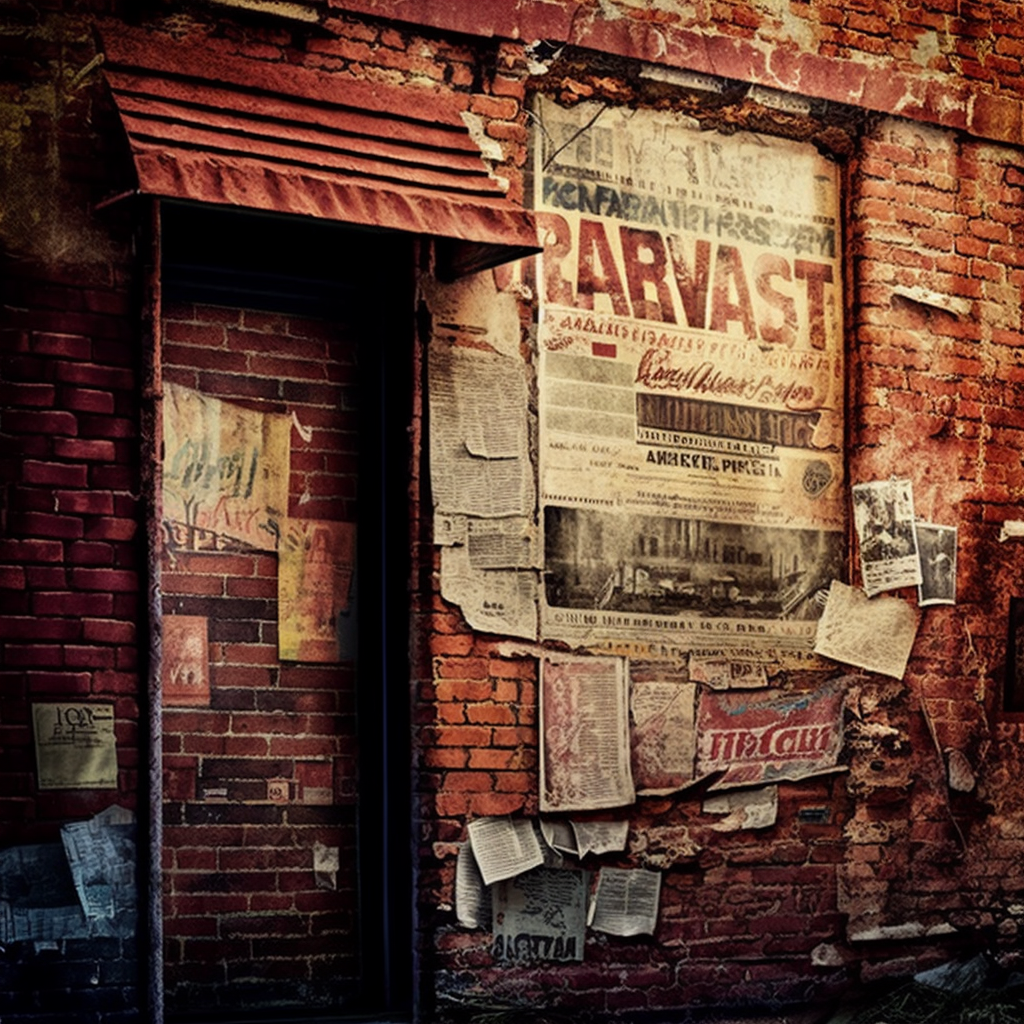
The old man was sticking to Youssef like glue, talking about that time when his now dead brother took in an old cat he called Phineas. Youssef tried to growl him away, but the man always came back, persistent as a cloud of mosquitoes over the promise of a blood feast.
Youssef tried not to pay attention to him. What did AL said about that quest ? Go ask questions around to town’s people about odd things happening ? Well there were plenty of those things happening. Maybe the clerk at the telegraph station would know something, especially how to get rid of that old man.
Youssef pushed the door and entered the telegraph station, leaving the old man outside. The interior was lit with a collection of old style tungsten lamps hanging in a random pattern from the ceiling.
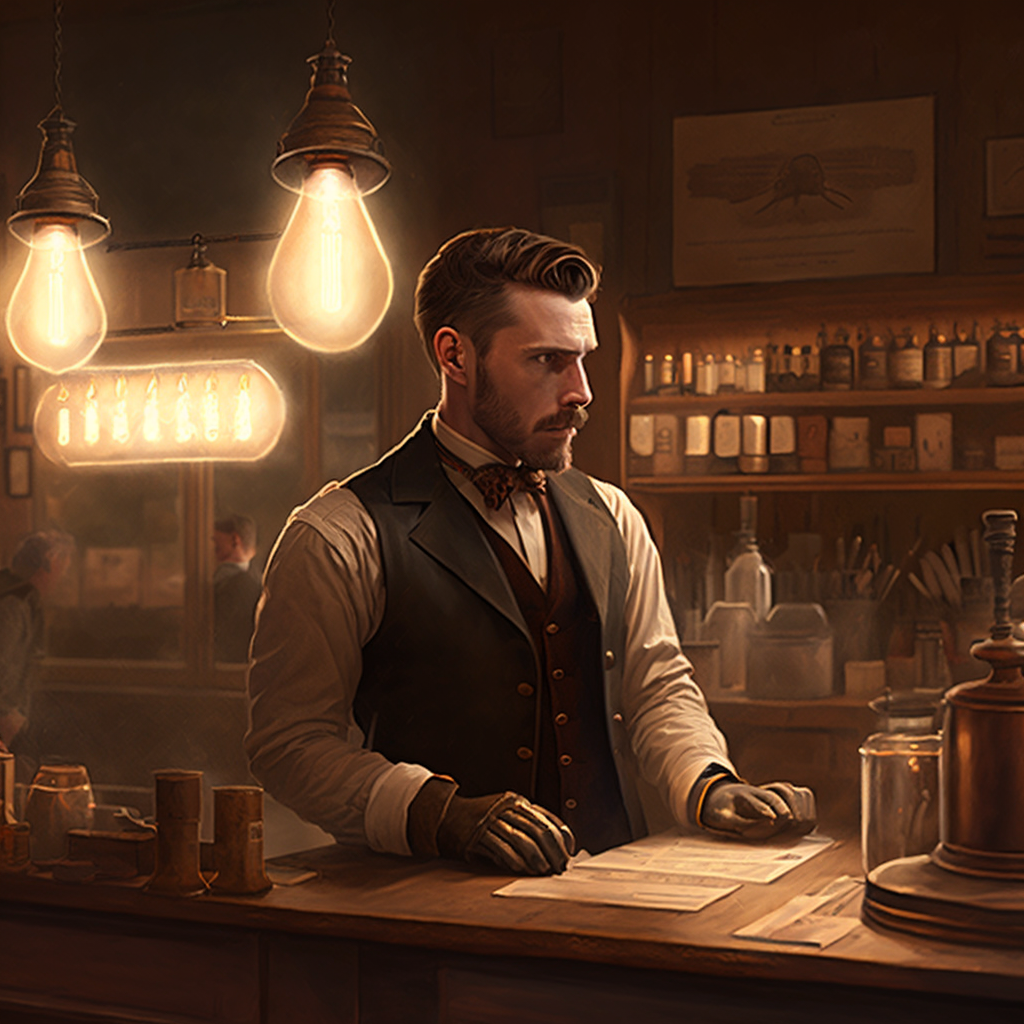 The clerk was busy sorting out a pile of telegrams. Clickety-clack. Clickety-clack. He lifted his head up. The noise stopped and Youssef realised the young man had mechanical hands.
“Welcome, welcome, welcome! What can I do for you today, my friend?” asked the clerk.
“I just wanted to…” started Youssef.
“Wait! Don’t tell me. I’m a bit of a psychic myself and I already know what you’re here for.”
“Really?”
The man foraged through his pile of telegram with his mechanical hands and picked one. He looked at it for a few seconds.
“My friend, you’re in luck today!” he said, looking intently at Youssef. “I just received this telegram that I think might interest you. Here, take a look!”
Youssef took the paper and started to read aloud : “Words spoken by the talkative will unlock the path. Seek those who chatter and unravel the clue. What the…?”
“Interesting, isn’t it? That’s a real head-scratcher, if you ask me!”
The door bell rang and the old man entered, holding his sore ribs.
“Get out, Phineas. You’re not welcome here.” said the clerk with a frown.
The old man looked at the clerk with an air of confusion before turning to Youssef. “What did he say? Who’s Phineas?” he asked.
Ignoring the question, Youssef tried to steer the conversation back to the telegram. “What does this mean?” he asked the clerk.
The clerk stroked his chin, looking thoughtful. “Hmm, well, it seems to me that you have a certain magnetism for talkative people. Perhaps that’s the key to unlocking this riddle.”
Youssef’s eyes widened in surprise. “What do you mean, magnetism?”
The old man interjected, “For sure! You’re like a magnet, my boy. I can’t seem to stop talking when I’m around you.”
Youssef rolled his eyes. “So, what do I do? Just wander around town and wait for someone to start talking?”
The clerk nodded. “That could be a good start. But if you’re looking for something specific, you might want to try Betsy when you wake up. She’s got a boutique of Gems and Rocks. You seem to like them rocks,” he said pointing at the black obsidian. “Found it in a mine?”
The old man’s eyes lit up. “Ah, the old mine! I’ve been there before, you know. My brother used to work there before he died. Strange things happening there.”
Youssef’s interest was piqued. “What kind of strange things?”
The old man leaned in conspiratorially. “There’s a magnetar hidden in that mine, my boy.”
“Shut up! Phineas,” interrupted the clerk. “If you want my advice, stranger, don’t go near the old mine. ‘Curiosity killed the cat’ if you know what I mean.”
The telegraph receiver started to make clicketing sounds. The clerk read it and looked at Youssef.
“You’ve got a message man. Time to wake up.”
“Wake up?”

Youssef opened his eyes and looked at a black mass in front of his eyes. He had been sleeping with the stone just beside his head on the pillow. No wonder he had had weird dreams. He heard his phone buzz. He sat up reluctantly and looked at his phone. 8am. A notification that his game progression had been saved and several messages from Miss Tartiflate, the last one saying :
Don’t think you can dodge work. I’m still expecting the last blog post you’ve been paid to write!!!”
He groaned as reality was starting to catch up.
February 9, 2023 at 10:31 pm #6521In reply to: Orbs of Madjourneys
The package in her hands was from Fred and, now she was at the airport, Yasmin was seriously contemplating whether to chuck it in the nearest bin. She hadn’t wanted to take the damn thing in the first place. It was hard to say no to Sister Aliti.
“Fred asked could you please take it to the Fish Inn, or something like that.” Sister Aliti had beamed at her. She was holding out a thin parcel wrapped in brown paper and securely fastened with a whole lot of masking tape.
“But how did he know I was going there?” Yasmin had sounded more sharp than she’d intended but she hadn’t really warmed to Fred. He made her nervous.
“You didn’t tell him?” Sister Aliti shrugged. “I didn’t tell him. Perhaps it was Sister Finli … She took the van with him yesterday.” She’d looked intently at Yasmin. “Oh dear, was it private?”
Yasmin felt foolish. “Oh, no, of course it wasn’t and it doesn’t matter …. I was just surprised.” She’d peered at the red biro scrawled on the paper wrapping. “I wonder who is … Mater?”
“He said it was a distant relation! Isn’t it just so wonderful he can reconnect through you! God works in mysterious ways indeed!”
Of course it had been Sister Finli who had told Fred. Prying busybody. Yasmin had caught her in her room a couple of days ago. Sister Finli had her back to the door and was bent over Yasmin’s desk. She’d jumped and swung round at Yasmin’s, “Hello?”
“It’s a pig sty in here,” she’d hissed, jabbing a sharp finger towards Yasmin. Then her mouth curled into a smile. “I just came in to tell you you are needed in the recreation room to look after the children but was distracted by this …” She’d slid her eyes around the room and shuddered. Yasmin followed her gaze. She’d left a few items of clothing in neat piles on the bed because she was packing but everything else looked in order. After Sister Finli had flounced out of the room, Yasmin noticed her itinerary was lying open on the desk.
But why tell Fred?
She’d messaged Zara. Do you think I should I open the package? And couldn’t he just post it?
LOL, Zara messaged back. Yes open it! It’s drugs. Obv. Oh and more to the point, you are way behind the rest of us in the game. So use your flight time wisely!
February 8, 2023 at 10:06 pm #6513In reply to: Prompts of Madjourneys
Youssef offered the following quirk: “unwilling magnet for talkative people in need of listening” (setting in a ghost town).
Setting: A small ghost town in the middle of the Australian outback. The town was once thriving but now only a few stragglers remain, living in old, decrepit buildings. You find yourself in the town square, surrounded by the old post office, the saloon, and a few other ramshackle buildings.
Quest: Your task is to find the source of the magnetic pull that attracts talkative people to you. You must find the reason behind it and break the spell, so you can continue your journey in peace.
Direction to investigate: Start by talking to the residents of the town, they may have some information or insights on the strange happenings in the town. Explore the old post office and the saloon, they might hold the key to breaking the spell.
Characters to engage: The residents of the town, including the old timer at the saloon and the postmaster at the post office.
Tile to look for: A silver key in the shape of a tongue, symbolizing the power of speech.
Proof of insert in real life: Take a picture of yourself holding the key, and send it to the game master as proof of completion.
-
AuthorSearch Results
