

Search Results for 'house'
-
AuthorSearch Results
-
November 4, 2022 at 2:19 pm #6342
In reply to: Family Stories From The Other Side ~ Book Two
Brownings of Tetbury
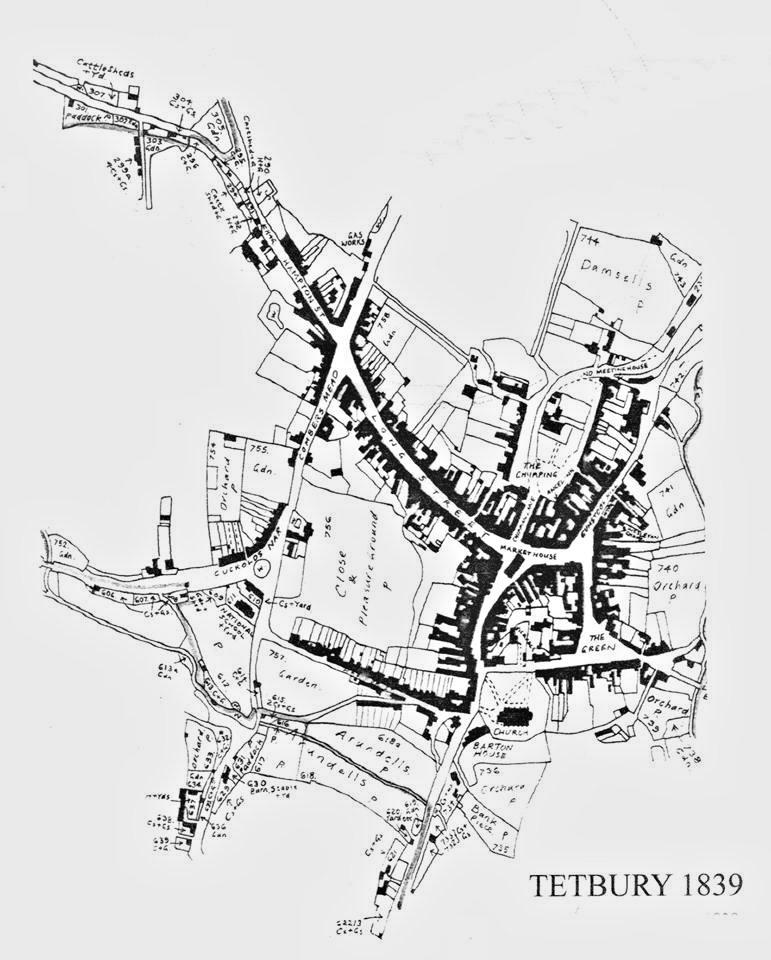
Isaac Browning (1784-1848) married Mary Lock (1787-1870) in Tetbury in 1806. Both of them were born in Tetbury, Gloucestershire. Isaac was a stone mason. Between 1807 and 1832 they baptised fourteen children in Tetbury, and on 8 Nov 1829 Isaac and Mary baptised five daughters all on the same day.
I considered that they may have been quintuplets, with only the last born surviving, which would have answered my question about the name of the house La Quinta in Broadway, the home of Eliza Browning and Thomas Stokes son Fred. However, the other four daughters were found in various records and they were not all born the same year. (So I still don’t know why the house in Broadway had such an unusual name).
Their son George was born and baptised in 1827, but Louisa born 1821, Susan born 1822, Hesther born 1823 and Mary born 1826, were not baptised until 1829 along with Charlotte born in 1828. (These birth dates are guesswork based on the age on later censuses.) Perhaps George was baptised promptly because he was sickly and not expected to survive. Isaac and Mary had a son George born in 1814 who died in 1823. Presumably the five girls were healthy and could wait to be done as a job lot on the same day later.
Eliza Browning (1814-1886), my great great great grandmother, had a baby six years before she married Thomas Stokes. Her name was Ellen Harding Browning, which suggests that her fathers name was Harding. On the 1841 census seven year old Ellen was living with her grandfather Isaac Browning in Tetbury. Ellen Harding Browning married William Dee in Tetbury in 1857, and they moved to Western Australia.
Ellen Harding Browning Dee: (photo found on ancestry website)
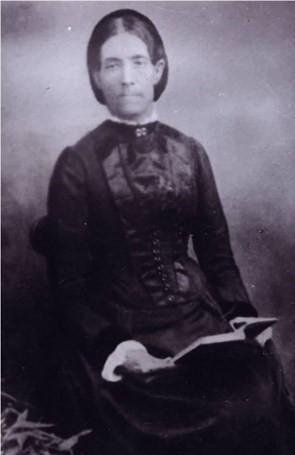
OBITUARY. MRS. ELLEN DEE.
A very old and respected resident of Dongarra, in the person of Mrs. Ellen Dee, passed peacefully away on Sept. 27, at the advanced age of 74 years.The deceased had been ailing for some time, but was about and actively employed until Wednesday, Sept. 20, whenn she was heard groaning by some neighbours, who immediately entered her place and found her lying beside the fireplace. Tho deceased had been to bed over night, and had evidently been in the act of lighting thc fire, when she had a seizure. For some hours she was conscious, but had lost the power of speech, and later on became unconscious, in which state she remained until her death.
The deceased was born in Gloucestershire, England, in 1833, was married to William Dee in Tetbury Church 23 years later. Within a month she left England with her husband for Western Australian in the ship City oí Bristol. She resided in Fremantle for six months, then in Greenough for a short time, and afterwards (for 42 years) in Dongarra. She was, therefore, a colonist of about 51 years. She had a family of four girls and three boys, and five of her children survive her, also 35 grandchildren, and eight great grandchildren. She was very highly respected, and her sudden collapse came as a great shock to many.
Eliza married Thomas Stokes (1816-1885) in September 1840 in Hempstead, Gloucestershire. On the 1841 census, Eliza and her mother Mary Browning (nee Lock) were staying with Thomas Lock and family in Cirencester. Strangely, Thomas Stokes has not been found thus far on the 1841 census, and Thomas and Eliza’s first child William James Stokes birth was registered in Witham, in Essex, on the 6th of September 1841.
I don’t know why William James was born in Witham, or where Thomas was at the time of the census in 1841. One possibility is that as Thomas Stokes did a considerable amount of work with circus waggons, circus shooting galleries and so on as a journeyman carpenter initially and then later wheelwright, perhaps he was working with a traveling circus at the time.
But back to the Brownings ~ more on William James Stokes to follow.
One of Isaac and Mary’s fourteen children died in infancy: Ann was baptised and died in 1811. Two of their children died at nine years old: the first George, and Mary who died in 1835. Matilda was 21 years old when she died in 1844.
Jane Browning (1808-) married Thomas Buckingham in 1830 in Tetbury. In August 1838 Thomas was charged with feloniously stealing a black gelding.
Susan Browning (1822-1879) married William Cleaver in November 1844 in Tetbury. Oddly thereafter they use the name Bowman on the census. On the 1851 census Mary Browning (Susan’s mother), widow, has grandson George Bowman born in 1844 living with her. The confusion with the Bowman and Cleaver names was clarified upon finding the criminal registers:
30 January 1834. Offender: William Cleaver alias Bowman, Richard Bunting alias Barnfield and Jeremiah Cox, labourers of Tetbury. Crime: Stealing part of a dead fence from a rick barton in Tetbury, the property of Robert Tanner, farmer.
And again in 1836:
29 March 1836 Bowman, William alias Cleaver, of Tetbury, labourer age 18; 5’2.5” tall, brown hair, grey eyes, round visage with fresh complexion; several moles on left cheek, mole on right breast. Charged on the oath of Ann Washbourn & others that on the morning of the 31 March at Tetbury feloniously stolen a lead spout affixed to the dwelling of the said Ann Washbourn, her property. Found guilty 31 March 1836; Sentenced to 6 months.
On the 1851 census Susan Bowman was a servant living in at a large drapery shop in Cheltenham. She was listed as 29 years old, married and born in Tetbury, so although it was unusual for a married woman not to be living with her husband, (or her son for that matter, who was living with his grandmother Mary Browning), perhaps her husband William Bowman alias Cleaver was in trouble again. By 1861 they are both living together in Tetbury: William was a plasterer, and they had three year old Isaac and Thomas, one year old. In 1871 William was still a plasterer in Tetbury, living with wife Susan, and sons Isaac and Thomas. Interestingly, a William Cleaver is living next door but one!
Susan was 56 when she died in Tetbury in 1879.
Three of the Browning daughters went to London.
Louisa Browning (1821-1873) married Robert Claxton, coachman, in 1848 in Bryanston Square, Westminster, London. Ester Browning was a witness.
Ester Browning (1823-1893)(or Hester) married Charles Hudson Sealey, cabinet maker, in Bethnal Green, London, in 1854. Charles was born in Tetbury. Charlotte Browning was a witness.
Charlotte Browning (1828-1867?) was admitted to St Marylebone workhouse in London for “parturition”, or childbirth, in 1860. She was 33 years old. A birth was registered for a Charlotte Browning, no mothers maiden name listed, in 1860 in Marylebone. A death was registered in Camden, buried in Marylebone, for a Charlotte Browning in 1867 but no age was recorded. As the age and parents were usually recorded for a childs death, I assume this was Charlotte the mother.
I found Charlotte on the 1851 census by chance while researching her mother Mary Lock’s siblings. Hesther Lock married Lewin Chandler, and they were living in Stepney, London. Charlotte is listed as a neice. Although Browning is mistranscribed as Broomey, the original page says Browning. Another mistranscription on this record is Hesthers birthplace which is transcribed as Yorkshire. The original image shows Gloucestershire.
Isaac and Mary’s first son was John Browning (1807-1860). John married Hannah Coates in 1834. John’s brother Charles Browning (1819-1853) married Eliza Coates in 1842. Perhaps they were sisters. On the 1861 census Hannah Browning, John’s wife, was a visitor in the Harding household in a village called Coates near Tetbury. Thomas Harding born in 1801 was the head of the household. Perhaps he was the father of Ellen Harding Browning.
George Browning (1828-1870) married Louisa Gainey in Tetbury, and died in Tetbury at the age of 42. Their son Richard Lock Browning, a 32 year old mason, was sentenced to one month hard labour for game tresspass in Tetbury in 1884.
Isaac Browning (1832-1857) was the youngest son of Isaac and Mary. He was just 25 years old when he died in Tetbury.
October 23, 2022 at 6:57 am #6340In reply to: Family Stories From The Other Side ~ Book Two
Wheelwrights of Broadway
Thomas Stokes 1816-1885
Frederick Stokes 1845-1917
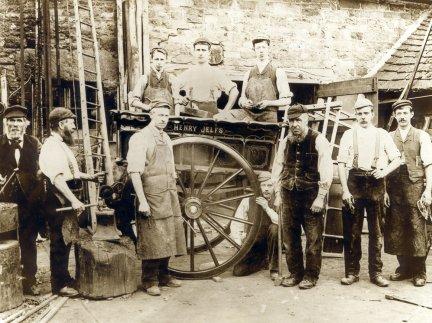
Stokes Wheelwrights. Fred on left of wheel, Thomas his father on right.
Thomas Stokes
Thomas Stokes was born in Bicester, Oxfordshire in 1816. He married Eliza Browning (born in 1814 in Tetbury, Gloucestershire) in Gloucester in 1840 Q3. Their first son William was baptised in Chipping Hill, Witham, Essex, on 3 Oct 1841. This seems a little unusual, and I can’t find Thomas and Eliza on the 1841 census. However both the 1851 and 1861 census state that William was indeed born in Essex.
In 1851 Thomas and Eliza were living in Bledington, Gloucestershire, and Thomas was a journeyman carpenter.
Note that a journeyman does not mean someone who moved around a lot. A journeyman was a tradesman who had served his trade apprenticeship and mastered his craft, not bound to serve a master, but originally hired by the day. The name derives from the French for day – jour.
Also on the 1851 census: their daughter Susan, born in Churchill Oxfordshire in 1844; son Frederick born in Bledington Gloucestershire in 1846; daughter Louisa born in Foxcote Oxfordshire in 1849; and 2 month old daughter Harriet born in Bledington in 1851.
On the 1861 census Thomas and Eliza were living in Evesham, Worcestershire, and daughter Susan was no longer living at home, but William, Fred, Louisa and Harriet were, as well as daughter Emily born in Churchill Oxfordshire in 1856. Thomas was a wheelwright.
On the 1871 census Thomas and Eliza were still living in Evesham, and Thomas was a wheelwright employing three apprentices. Son Fred, also a wheelwright, and his wife Ann Rebecca live with them.
Mr Stokes, wheelwright, was found guilty of reprehensible conduct in concealing the fact that small-pox existed in his house, according to a mention in The Oxfordshire Weekly News on Wednesday 19 February 1873:
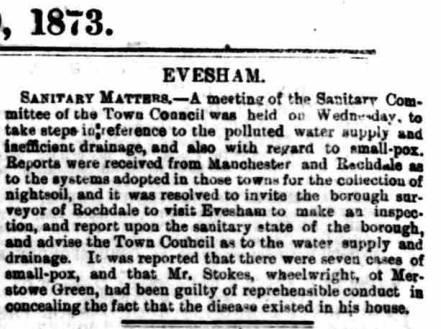
From Paul Weaver’s ancestry website:
“It was Thomas Stokes who built the first “Famous Vale of Evesham Light Gardening Dray for a Half-Legged Horse to Trot” (the quotation is from his account book), the forerunner of many that became so familiar a sight in the towns and villages from the 1860s onwards. He built many more for the use of the Vale gardeners.
Thomas also had long-standing business dealings with the people of the circus and fairgrounds, and had a contract to effect necessary repairs and renewals to their waggons whenever they visited the district. He built living waggons for many of the show people’s families as well as shooting galleries and other equipment peculiar to the trade of his wandering customers, and among the names figuring in his books are some still familiar today, such as Wilsons and Chipperfields.
He is also credited with inventing the wooden “Mushroom” which was used by housewives for many years to darn socks. He built and repaired all kinds of vehicles for the gentry as well as for the circus and fairground travellers.
Later he lived with his wife at Merstow Green, Evesham, in a house adjoining the Almonry.”
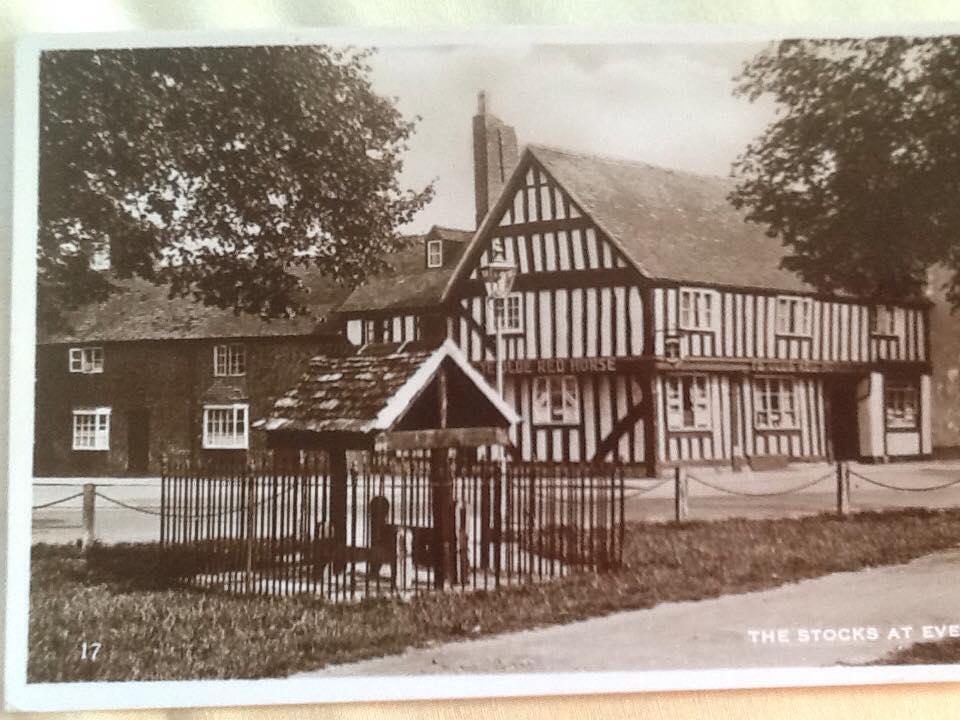
An excerpt from the book Evesham Inns and Signs by T.J.S. Baylis:
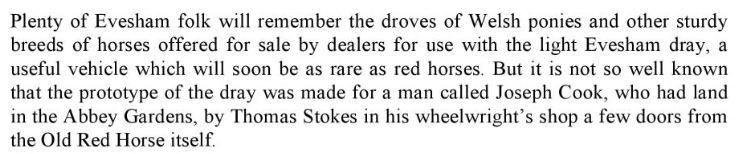
The Old Red Horse, Evesham:
Thomas died in 1885 aged 68 of paralysis, bronchitis and debility. His wife Eliza a year later in 1886.
Frederick Stokes
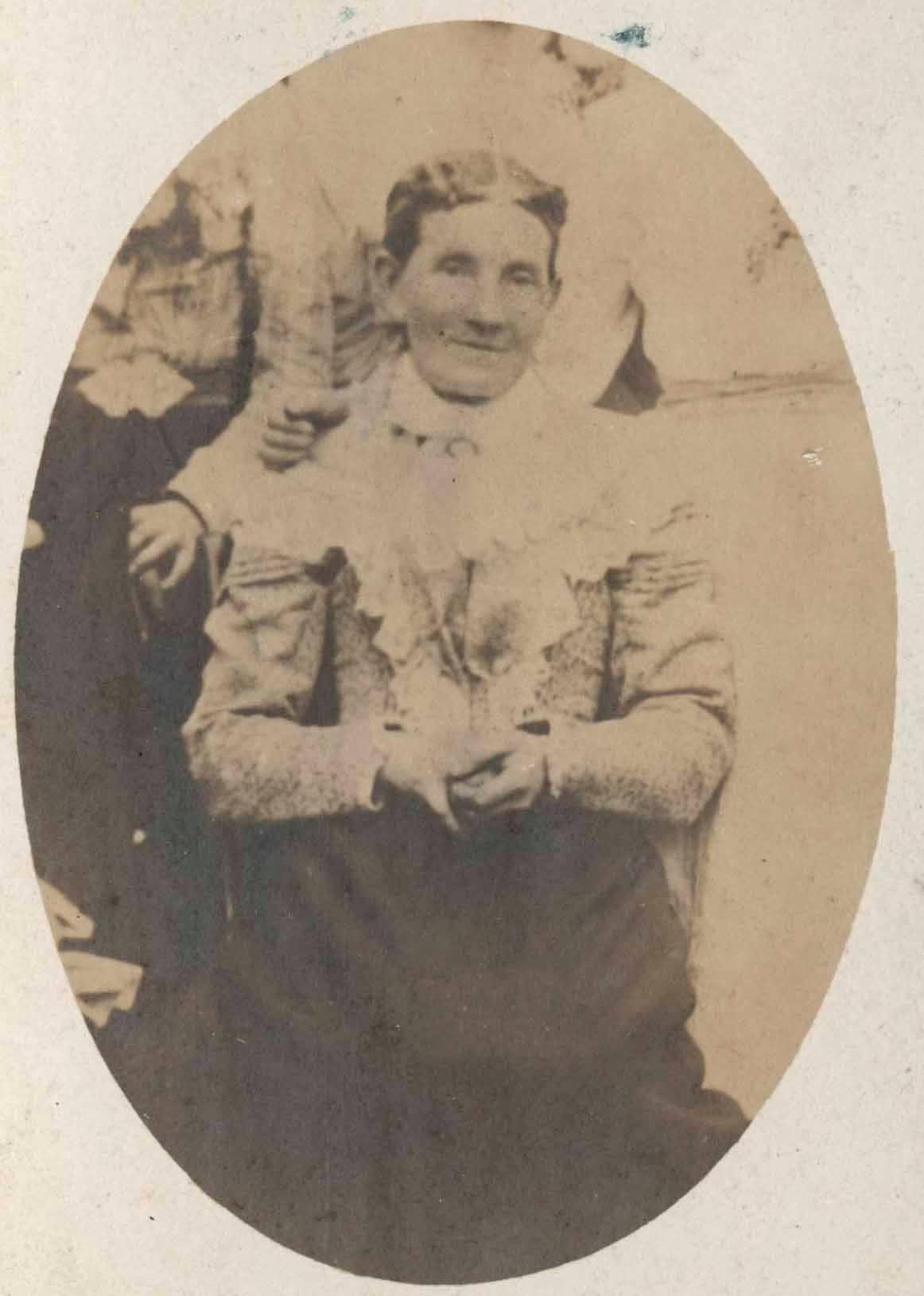
In Worcester in 1870 Fred married Ann Rebecca Day, who was born in Evesham in 1845.
Ann Rebecca Day:
In 1871 Fred was still living with his parents in Evesham, with his wife Ann Rebecca as well as their three month old daughter Annie Elizabeth. Fred and Ann (referred to as Rebecca) moved to La Quinta on Main Street, Broadway.
Rebecca Stokes in the doorway of La Quinta on Main Street Broadway, with her grandchildren Ralph and Dolly Edwards:
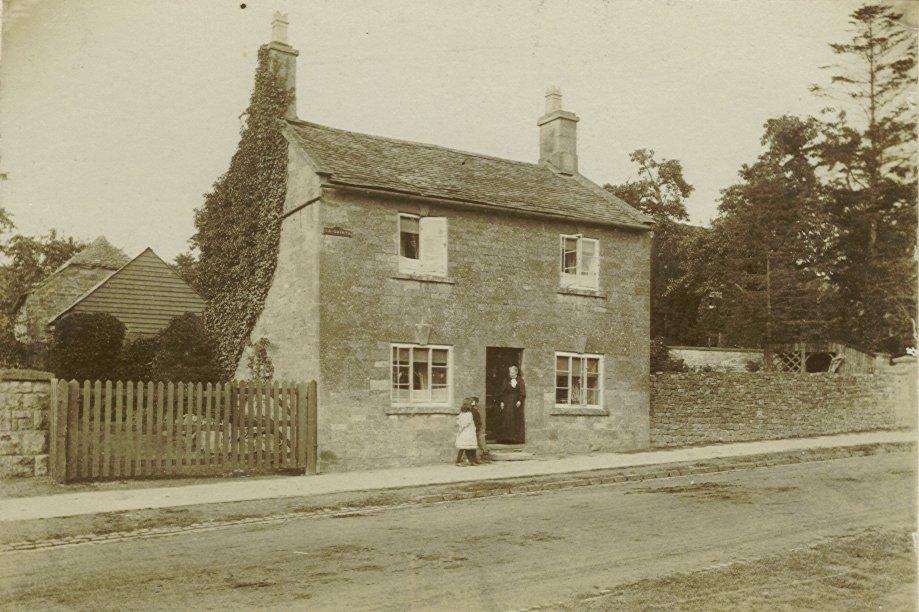
Fred was a wheelwright employing one man on the 1881 census. In 1891 they were still in Broadway, Fred’s occupation was wheelwright and coach painter, as well as his fifteen year old son Frederick.
In the Evesham Journal on Saturday 10 December 1892 it was reported that “Two cases of scarlet fever, the children of Mr. Stokes, wheelwright, Broadway, were certified by Mr. C. W. Morris to be isolated.”
Still in Broadway in 1901 and Fred’s son Albert was also a wheelwright. By 1911 Fred and Rebecca had only one son living at home in Broadway, Reginald, who was a coach painter. Fred was still a wheelwright aged 65.
Fred’s signature on the 1911 census:

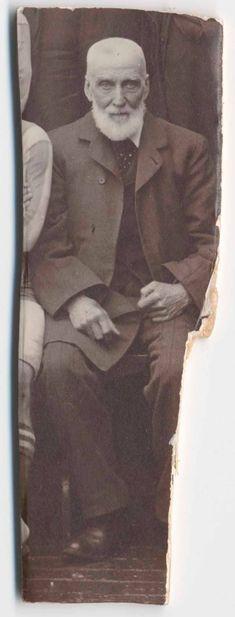
Rebecca died in 1912 and Fred in 1917.
Fred Stokes:
In the book Evesham to Bredon From Old Photographs By Fred Archer:
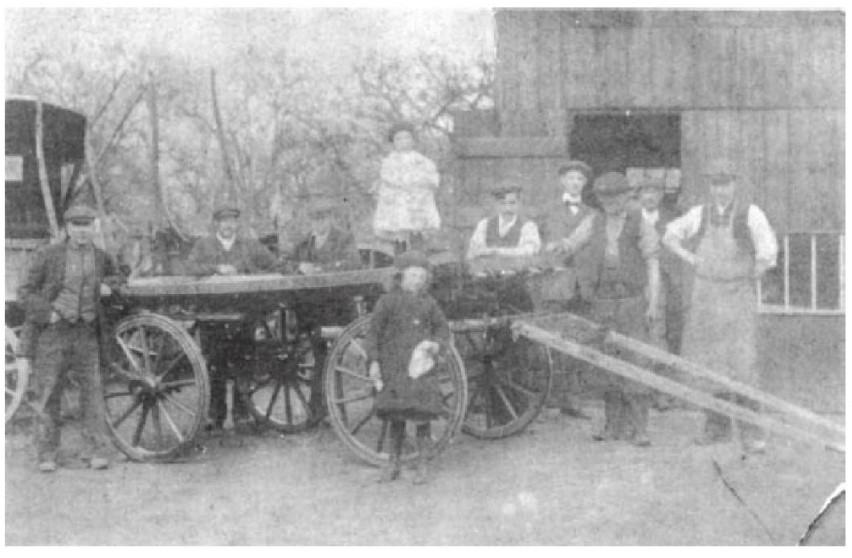
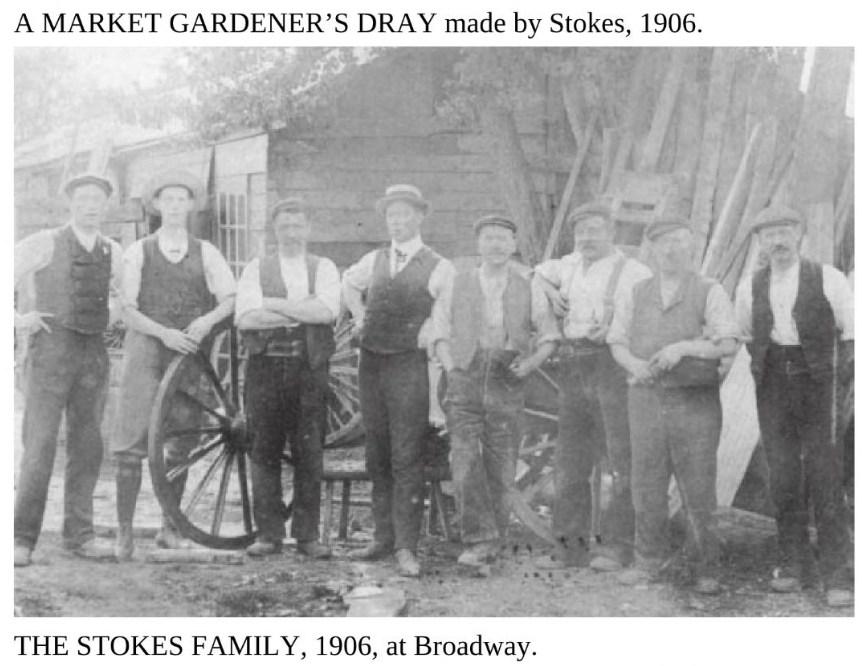 October 21, 2022 at 2:06 pm #6337
In reply to: Family Stories From The Other Side ~ Book Two
Annie Elizabeth Stokes
1871-1961
“Grandma E”
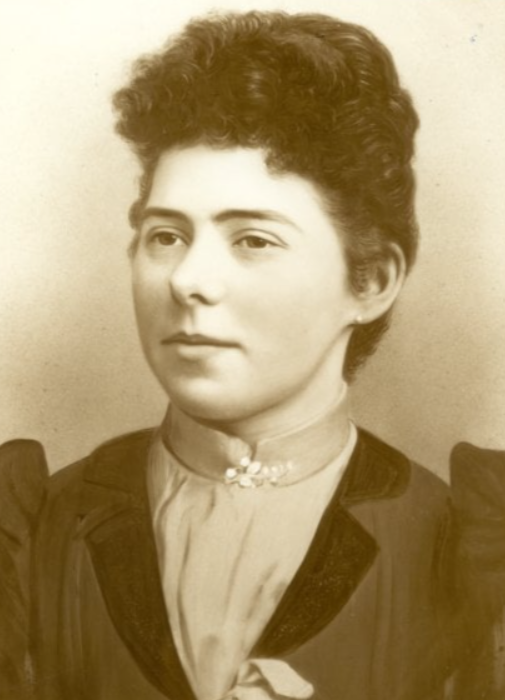
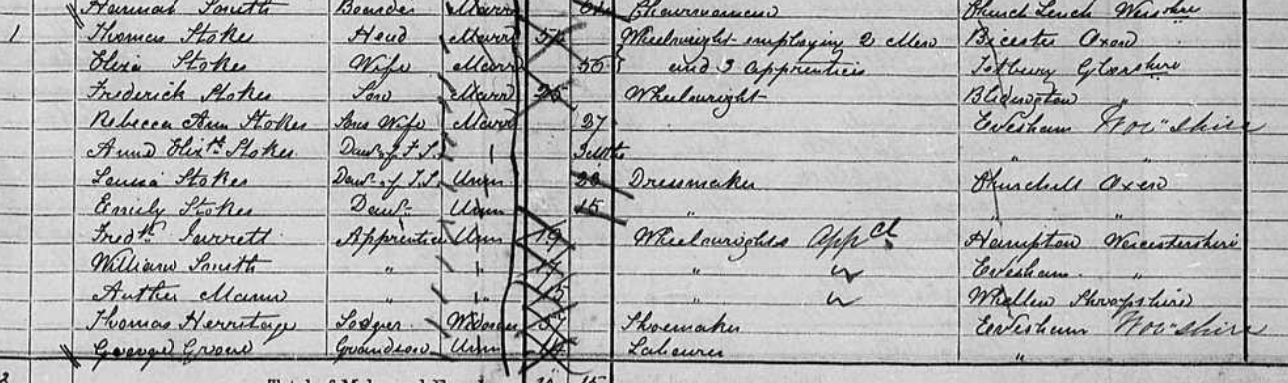
Annie, my great grandmother, was born 2 Jan 1871 in Merstow Green, Evesham, Worcestershire. Her father Fred Stokes was a wheelwright. On the 1771 census in Merston Green Annie was 3 months old and there was quite a houseful: Annies parents Fred and Rebecca, Fred’s parents Thomas and Eliza and two of their daughters, three apprentices, a lodger and one of Thomas’s grandsons.
1771 census Merstow Green, Evesham:
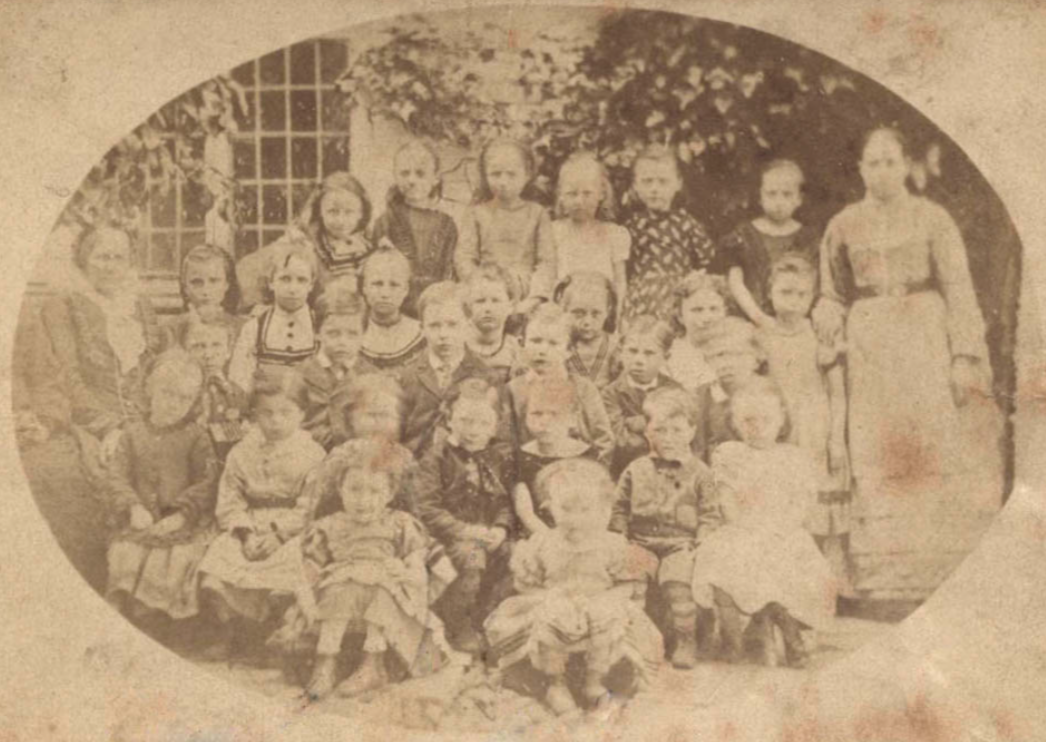
Annie at school in the early 1870s in Broadway. Annie is in the front on the left and her brother Fred is in the centre of the first seated row:
In 1881 Annie was a 10 year old visitor at the Angel Inn, Chipping Camden. A boarder there was 19 year old William Halford, a wheelwright apprentice. John Such, a 62 year old widower, was the innkeeper. Her parents and two siblings were living at La Quinta, on Main Street in Broadway.
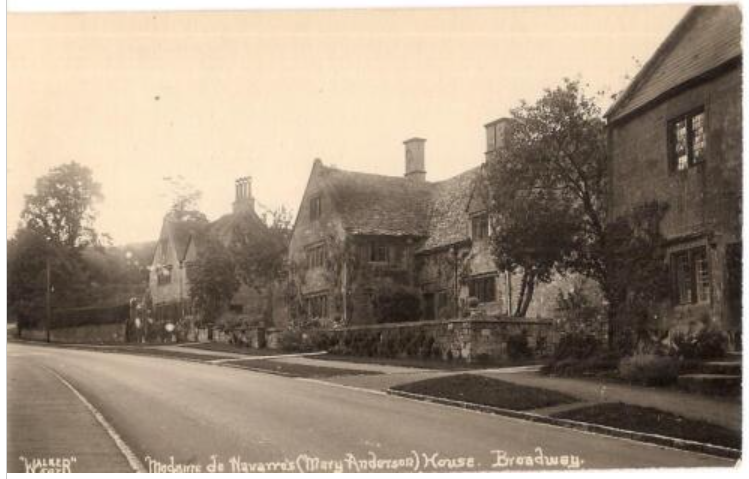
According to her obituary in 1962, “When the Maxton family visited Broadway to stay with Mr and Madame de Navarro at Court Farm, they offered Annie a family post with them which took her for several years to Paris and other parts of the continent.”
Mary Anderson was an American theatre actress. In 1890 she married Antonio Fernando de Navarro. She became known as Mary Anderson de Navarro. They settled at Court Farm in the Cotswolds, Broadway, Worcestershire, where she cultivated an interest in music and became a noted hostess with a distinguished circle of musical, literary and ecclesiastical guests. As in the years when Mary lived there, it was often filled with visiting artists and musicians, including Myra Hess and a young Jacqueline du Pré. (via Wikipedia)
Court Farm, Broadway:
Annie was an assistant to a tobacconist in West Bromwich in 1991, living as a boarder with William Calcutt and family. He future husband Albert was living in neighbouring Tipton in 1891, working at a pawnbroker apprenticeship.
Annie married Albert Parker Edwards in 1898 in Evesham. On the 1901 census, she was in hospital in Redditch.
By 1911, Anne and Albert had five children and were living at the Cricketers Arms in Redditch.
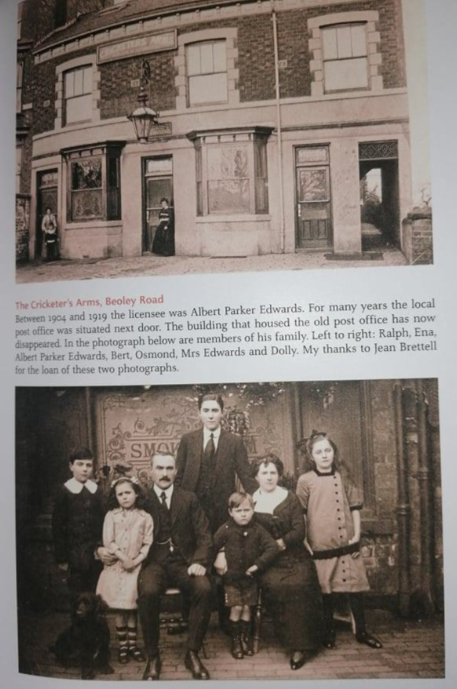
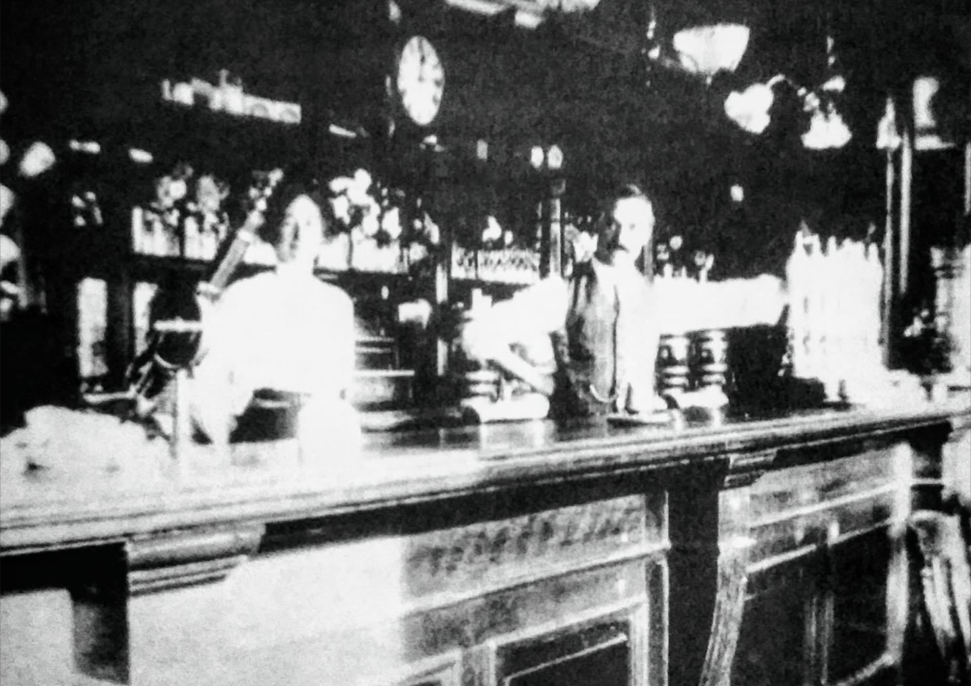
Behind the bar in 1904 shortly after taking over at the Cricketers Arms. From a book on Redditch pubs:
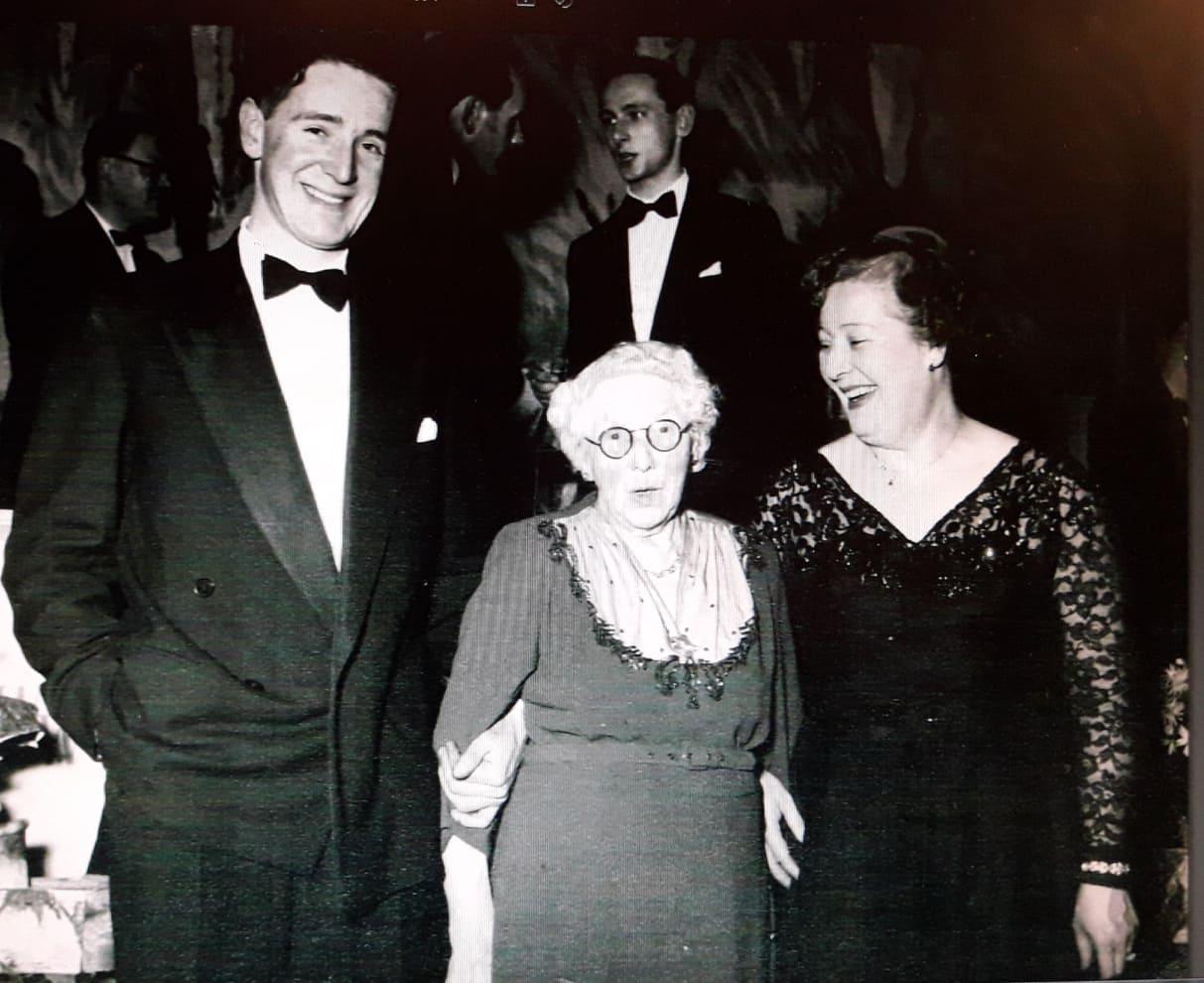
Annie was referred to in later years as Grandma E, probably to differentiate between her and my fathers Grandma T, as both lived to a great age.
Annie with her grandson Reg on the left and her daughter in law Peggy on the right, in the early 1950s:
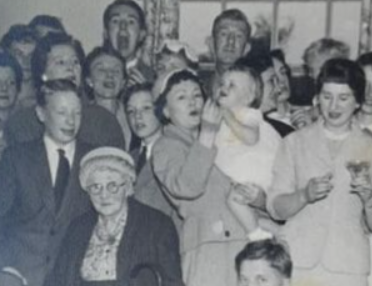
Annie at my christening in 1959:
Annie died 30 Dec 1961, aged 90, at Ravenscourt nursing home, Redditch. Her obituary in the Droitwich Guardian in January 1962:
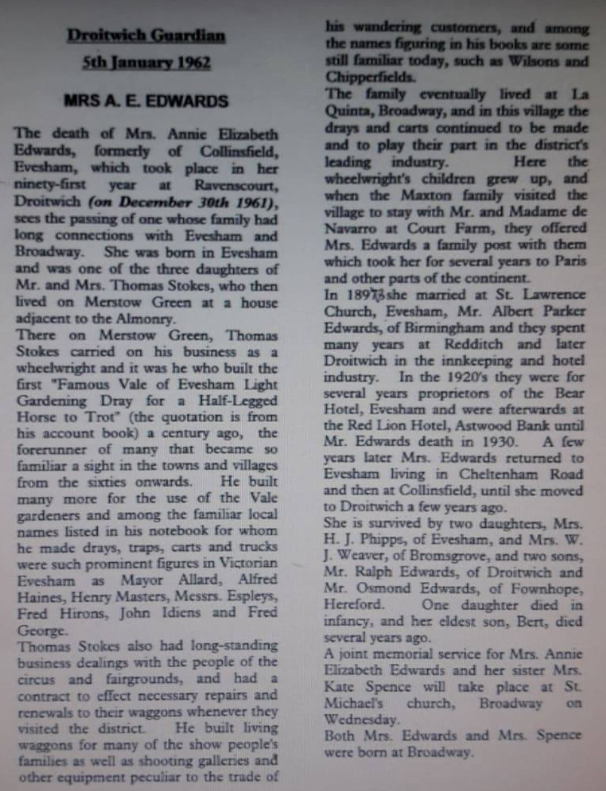
Note that this obituary contains an obvious error: Annie’s father was Frederick Stokes, and Thomas was his father.
October 19, 2022 at 6:46 am #6336In reply to: Family Stories From The Other Side ~ Book Two
The Hamstall Ridware Connection
Stubbs and Woods
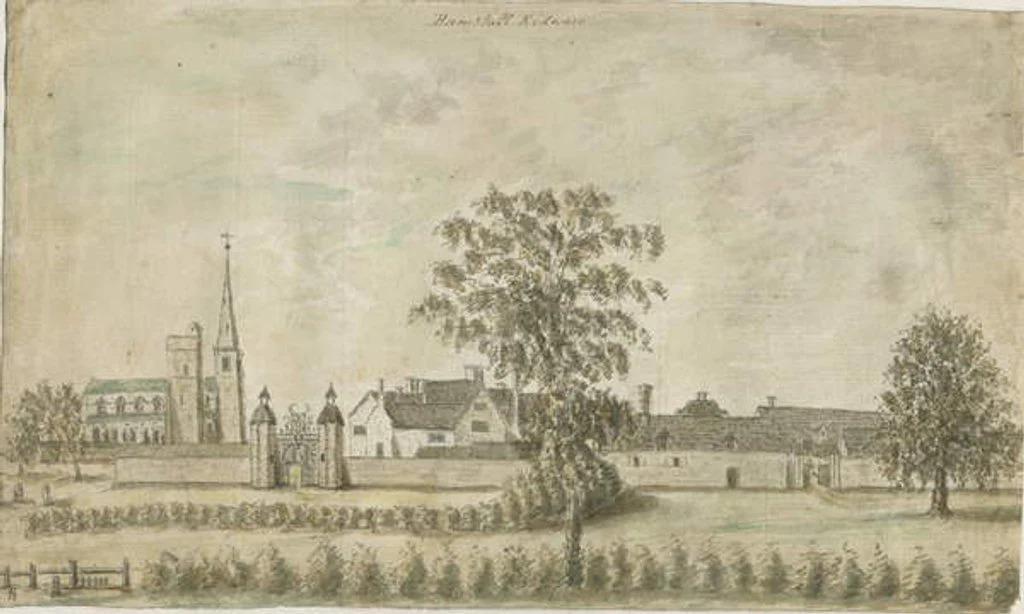 Hamstall Ridware
Charles Tomlinson‘s (1847-1907) wife Emma Grattidge (1853-1911) was born in Wolverhampton, the daughter and youngest child of William Grattidge (1820-1887) born in Foston, Derbyshire, and Mary Stubbs (1819-1880), born in Burton on Trent, daughter of Solomon Stubbs.
Solomon Stubbs (1781-1857) was born in Hamstall Ridware in 1781, the son of Samuel and Rebecca. Samuel Stubbs (1743-) and Rebecca Wood (1754-) married in 1769 in Darlaston. Samuel and Rebecca had six other children, all born in Darlaston. Sadly four of them died in infancy. Son John was born in 1779 in Darlaston and died two years later in Hamstall Ridware in 1781, the same year that Solomon was born there.
But why did they move to Hamstall Ridware?
Samuel Stubbs was born in 1743 in Curdworth, Warwickshire (near to Birmingham). I had made a mistake on the tree (along with all of the public trees on the Ancestry website) and had Rebecca Wood born in Cheddleton, Staffordshire. Rebecca Wood from Cheddleton was also born in 1843, the right age for the marriage. The Rebecca Wood born in Darlaston in 1754 seemed too young, at just fifteen years old at the time of the marriage. I couldn’t find any explanation for why a woman from Cheddleton would marry in Darlaston and then move to Hamstall Ridware. People didn’t usually move around much other than intermarriage with neighbouring villages, especially women. I had a closer look at the Darlaston Rebecca, and did a search on her father William Wood. I found his 1784 will online in which he mentions his daughter Rebecca, wife of Samuel Stubbs. Clearly the right Rebecca Wood was the one born in Darlaston, which made much more sense.
An excerpt from William Wood’s 1784 will mentioning daughter Rebecca married to Samuel Stubbs:
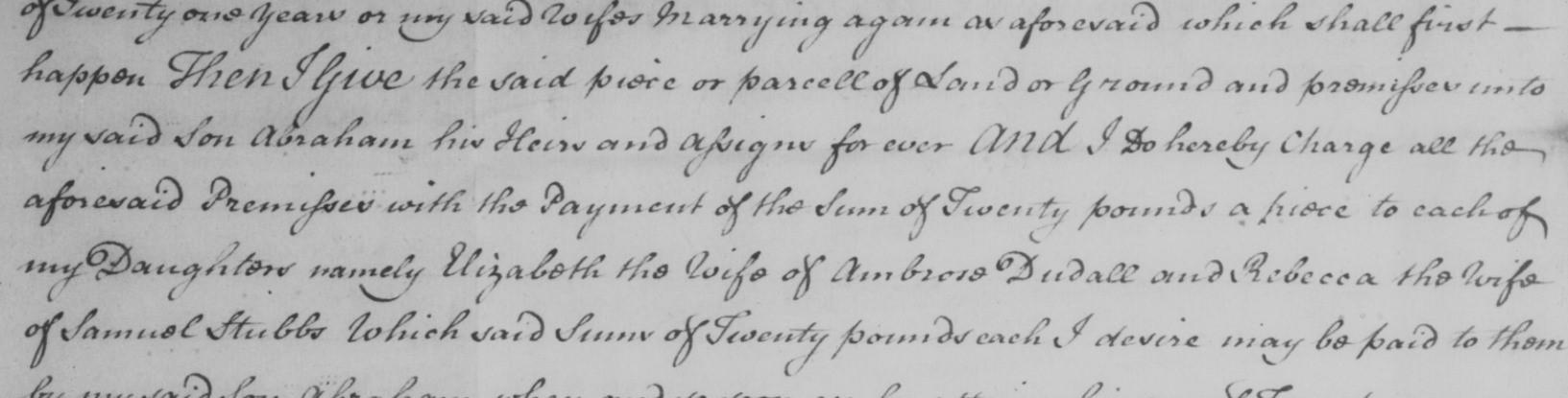
But why did they move to Hamstall Ridware circa 1780?
I had not intially noticed that Solomon Stubbs married again the year after his wife Phillis Lomas (1787-1844) died. Solomon married Charlotte Bell in 1845 in Burton on Trent and on the marriage register, Solomon’s father Samuel Stubbs occupation was mentioned: Samuel was a buckle maker.
Marriage of Solomon Stubbs and Charlotte Bell, father Samuel Stubbs buckle maker:
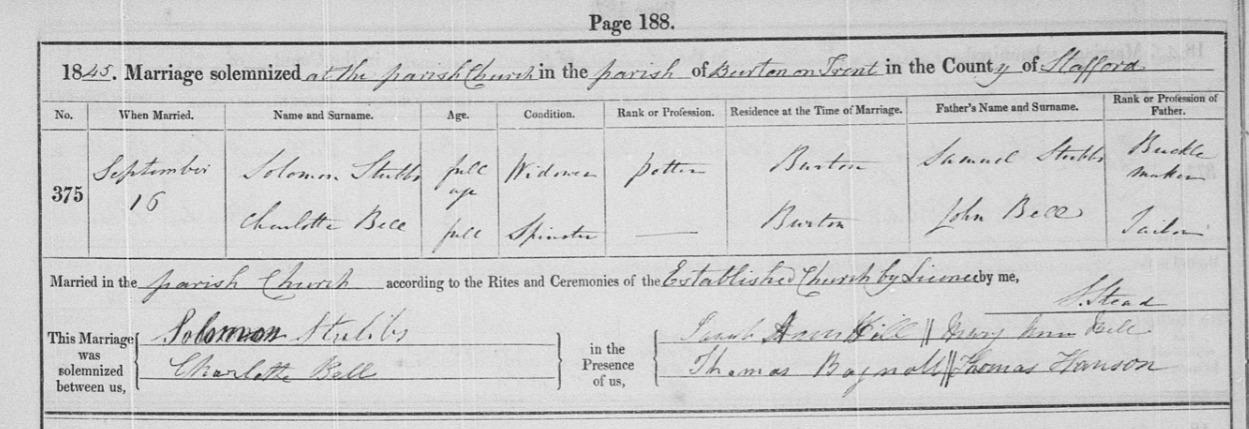
A rudimentary search on buckle making in the late 1700s provided a possible answer as to why Samuel and Rebecca left Darlaston in 1781. Shoe buckles had gone out of fashion, and by 1781 there were half as many buckle makers in Wolverhampton as there had been previously.
“Where there were 127 buckle makers at work in Wolverhampton, 68 in Bilston and 58 in Birmingham in 1770, their numbers had halved in 1781.”
via “historywebsite”(museum/metalware/steel)
Steel buckles had been the height of fashion, and the trade became enormous in Wolverhampton. Wolverhampton was a steel working town, renowned for its steel jewellery which was probably of many types. The trade directories show great numbers of “buckle makers”. Steel buckles were predominantly made in Wolverhampton: “from the late 1760s cut steel comes to the fore, from the thriving industry of the Wolverhampton area”. Bilston was also a great centre of buckle making, and other areas included Walsall. (It should be noted that Darlaston, Walsall, Bilston and Wolverhampton are all part of the same area)
In 1860, writing in defence of the Wolverhampton Art School, George Wallis talks about the cut steel industry in Wolverhampton. Referring to “the fine steel workers of the 17th and 18th centuries” he says: “Let them remember that 100 years ago [sc. c. 1760] a large trade existed with France and Spain in the fine steel goods of Birmingham and Wolverhampton, of which the latter were always allowed to be the best both in taste and workmanship. … A century ago French and Spanish merchants had their houses and agencies at Birmingham for the purchase of the steel goods of Wolverhampton…..The Great Revolution in France put an end to the demand for fine steel goods for a time and hostile tariffs finished what revolution began”.
The next search on buckle makers, Wolverhampton and Hamstall Ridware revealed an unexpected connecting link.
In Riotous Assemblies: Popular Protest in Hanoverian England by Adrian Randall:
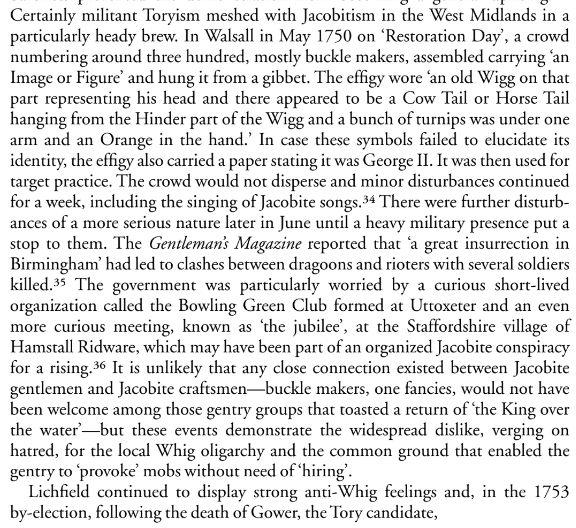
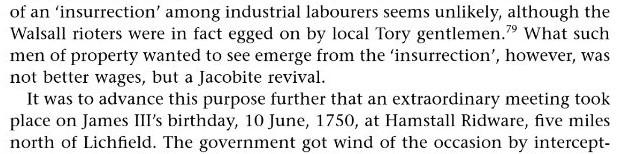
In Walsall in 1750 on “Restoration Day” a crowd numbering 300 assembled, mostly buckle makers, singing Jacobite songs and other rebellious and riotous acts. The government was particularly worried about a curious meeting known as the “Jubilee” in Hamstall Ridware, which may have been part of a conspiracy for a Jacobite uprising.
But this was thirty years before Samuel and Rebecca moved to Hamstall Ridware and does not help to explain why they moved there around 1780, although it does suggest connecting links.
Rebecca’s father, William Wood, was a brickmaker. This was stated at the beginning of his will. On closer inspection of the will, he was a brickmaker who owned four acres of brick kilns, as well as dwelling houses, shops, barns, stables, a brewhouse, a malthouse, cattle and land.
A page from the 1784 will of William Wood:
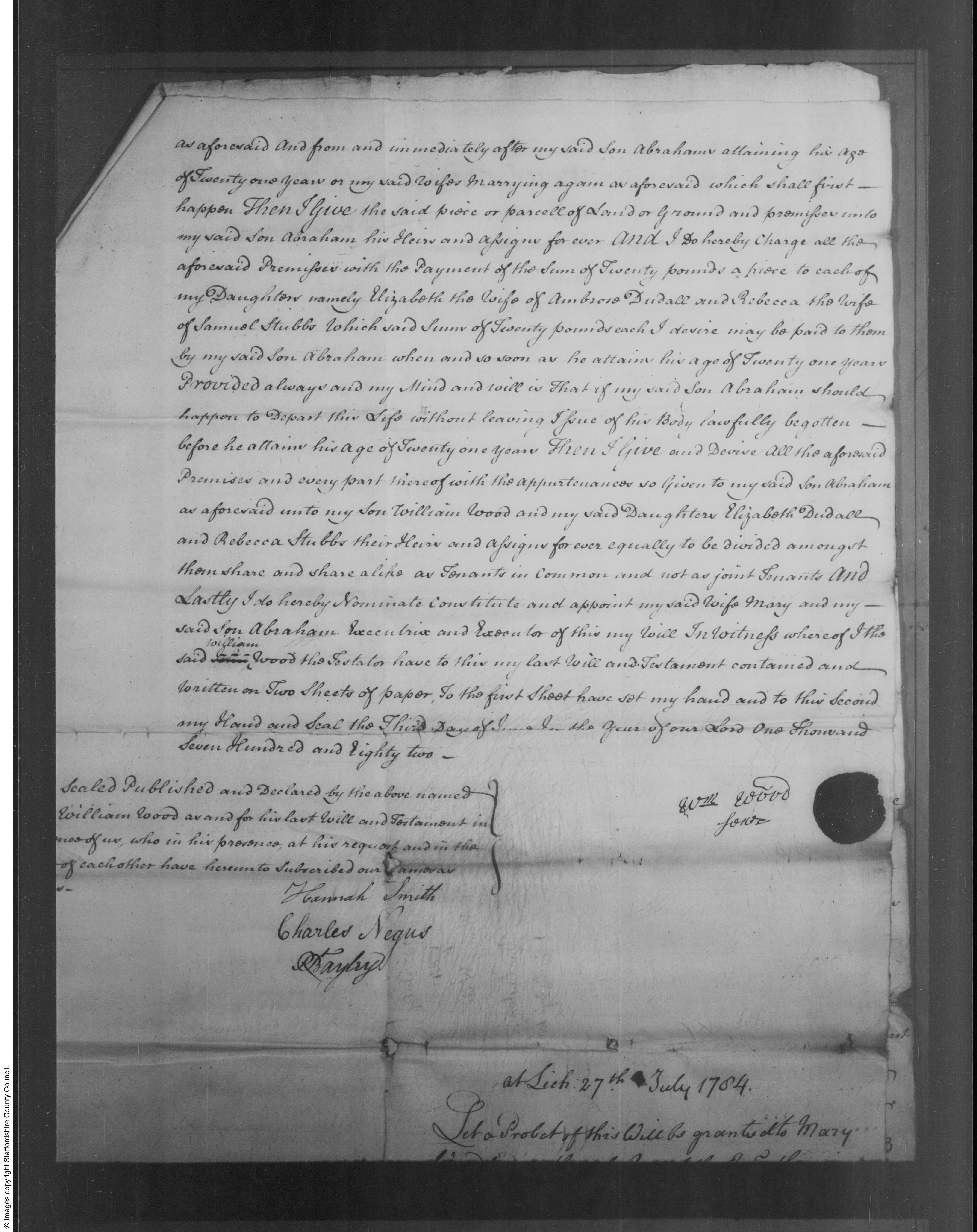
The 1784 will of William Wood of Darlaston:
I William Wood the elder of Darlaston in the county of Stafford, brickmaker, being of sound and disposing mind memory and understanding (praised be to god for the same) do make publish and declare my last will and testament in manner and form following (that is to say) {after debts and funeral expense paid etc} I give to my loving wife Mary the use usage wear interest and enjoyment of all my goods chattels cattle stock in trade ~ money securities for money personal estate and effects whatsoever and wheresoever to hold unto her my said wife for and during the term of her natural life providing she so long continues my widow and unmarried and from or after her decease or intermarriage with any future husband which shall first happen.
Then I give all the said goods chattels cattle stock in trade money securites for money personal estate and effects unto my son Abraham Wood absolutely and forever. Also I give devise and bequeath unto my said wife Mary all that my messuages tenement or dwelling house together with the malthouse brewhouse barn stableyard garden and premises to the same belonging situate and being at Darlaston aforesaid and now in my own possession. Also all that messuage tenement or dwelling house together with the shop garden and premises with the appurtenances to the same ~ belonging situate in Darlaston aforesaid and now in the several holdings or occupation of George Knowles and Edward Knowles to hold the aforesaid premises and every part thereof with the appurtenances to my said wife Mary for and during the term of her natural life provided she so long continues my widow and unmarried. And from or after her decease or intermarriage with a future husband which shall first happen. Then I give and devise the aforesaid premises and every part thereof with the appurtenances unto my said son Abraham Wood his heirs and assigns forever.
Also I give unto my said wife all that piece or parcel of land or ground inclosed and taken out of Heath Field in the parish of Darlaston aforesaid containing four acres or thereabouts (be the same more or less) upon which my brick kilns erected and now in my own possession. To hold unto my said wife Mary until my said son Abraham attains his age of twenty one years if she so long continues my widow and unmarried as aforesaid and from and immediately after my said son Abraham attaining his age of twenty one years or my said wife marrying again as aforesaid which shall first happen then I give the said piece or parcel of land or ground and premises unto my said son Abraham his heirs and assigns forever.
And I do hereby charge all the aforesaid premises with the payment of the sum of twenty pounds a piece to each of my daughters namely Elizabeth the wife of Ambrose Dudall and Rebecca the wife of Samuel Stubbs which said sum of twenty pounds each I devise may be paid to them by my said son Abraham when and so soon as he attains his age of twenty one years provided always and my mind and will is that if my said son Abraham should happen to depart this life without leaving issue of his body lawfully begotten before he attains his age of twenty one years then I give and devise all the aforesaid premises and every part thereof with the appurtenances so given to my said son Abraham as aforesaid unto my said son William Wood and my said daughter Elizabeth Dudall and Rebecca Stubbs their heirs and assigns forever equally divided among them share and share alike as tenants in common and not as joint tenants. And lastly I do hereby nominate constitute and appoint my said wife Mary and my said son Abraham executrix and executor of this my will.
The marriage of William Wood (1725-1784) and Mary Clews (1715-1798) in 1749 was in Hamstall Ridware.
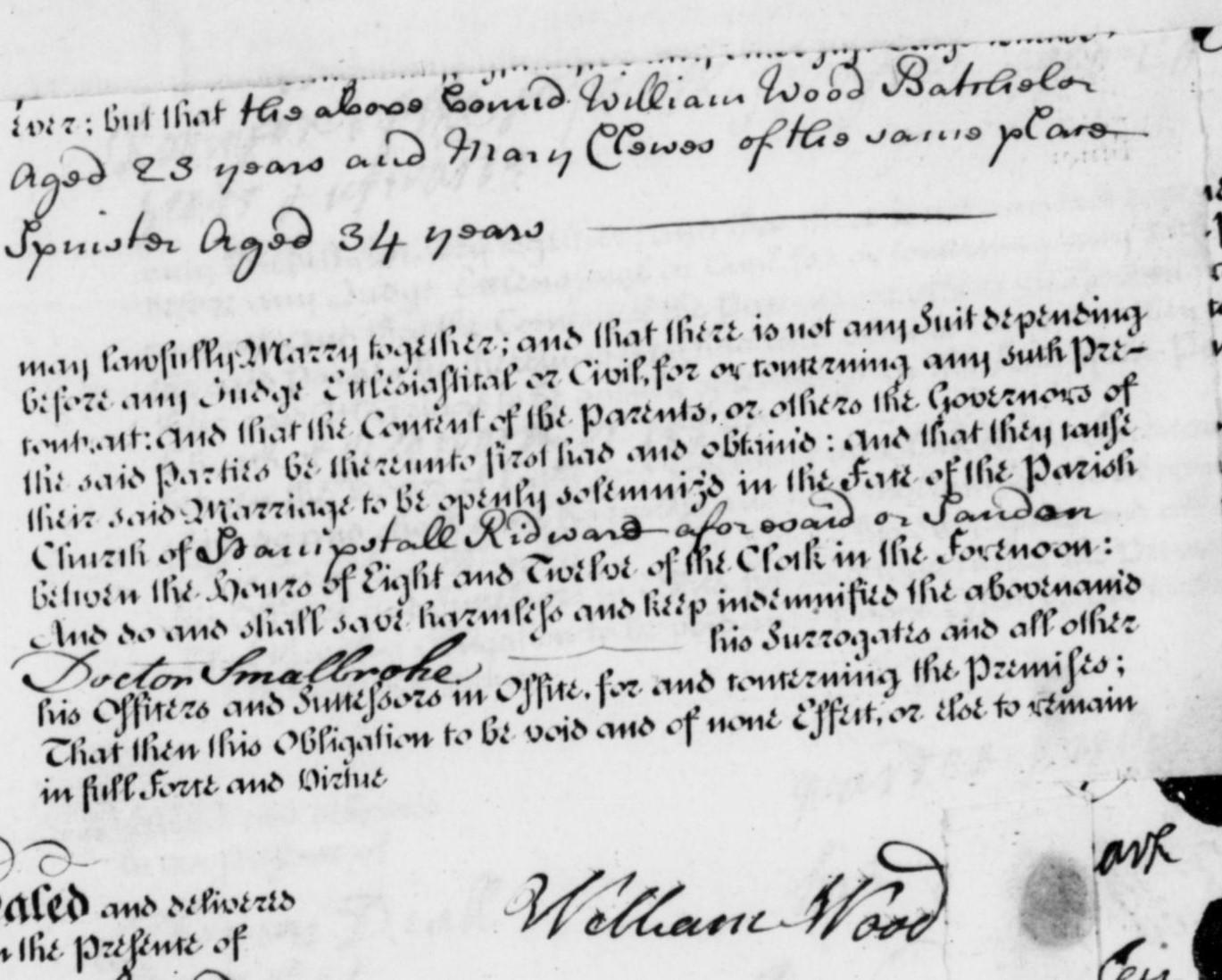
Mary was eleven years Williams senior, and it appears that they both came from Hamstall Ridware and moved to Darlaston after they married. Clearly Rebecca had extended family there (notwithstanding any possible connecting links between the Stubbs buckle makers of Darlaston and the Hamstall Ridware Jacobites thirty years prior). When the buckle trade collapsed in Darlaston, they likely moved to find employment elsewhere, perhaps with the help of Rebecca’s family.
I have not yet been able to find deaths recorded anywhere for either Samuel or Rebecca (there are a couple of deaths recorded for a Samuel Stubbs, one in 1809 in Wolverhampton, and one in 1810 in Birmingham but impossible to say which, if either, is the right one with the limited information, and difficult to know if they stayed in the Hamstall Ridware area or perhaps moved elsewhere)~ or find a reason for their son Solomon to be in Burton upon Trent, an evidently prosperous man with several properties including an earthenware business, as well as a land carrier business.
October 11, 2022 at 2:58 pm #6334In reply to: Family Stories From The Other Side ~ Book Two
The House on Penn Common
Toi Fang and the Duke of Sutherland
Tomlinsons
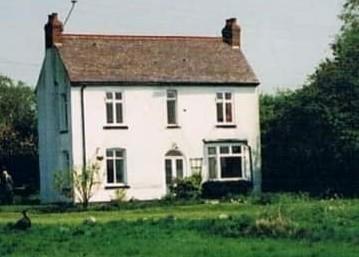
Grassholme
Charles Tomlinson (1873-1929) my great grandfather, was born in Wolverhampton in 1873. His father Charles Tomlinson (1847-1907) was a licensed victualler or publican, or alternatively a vet/castrator. He married Emma Grattidge (1853-1911) in 1872. On the 1881 census they were living at The Wheel in Wolverhampton.
Charles married Nellie Fisher (1877-1956) in Wolverhampton in 1896. In 1901 they were living next to the post office in Upper Penn, with children (Charles) Sidney Tomlinson (1896-1955), and Hilda Tomlinson (1898-1977) . Charles was a vet/castrator working on his own account.
In 1911 their address was 4, Wakely Hill, Penn, and living with them were their children Hilda, Frank Tomlinson (1901-1975), (Dorothy) Phyllis Tomlinson (1905-1982), Nellie Tomlinson (1906-1978) and May Tomlinson (1910-1983). Charles was a castrator working on his own account.
Charles and Nellie had a further four children: Charles Fisher Tomlinson (1911-1977), Margaret Tomlinson (1913-1989) (my grandmother Peggy), Major Tomlinson (1916-1984) and Norah Mary Tomlinson (1919-2010).
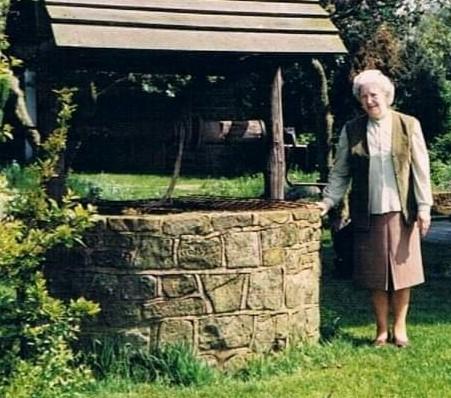
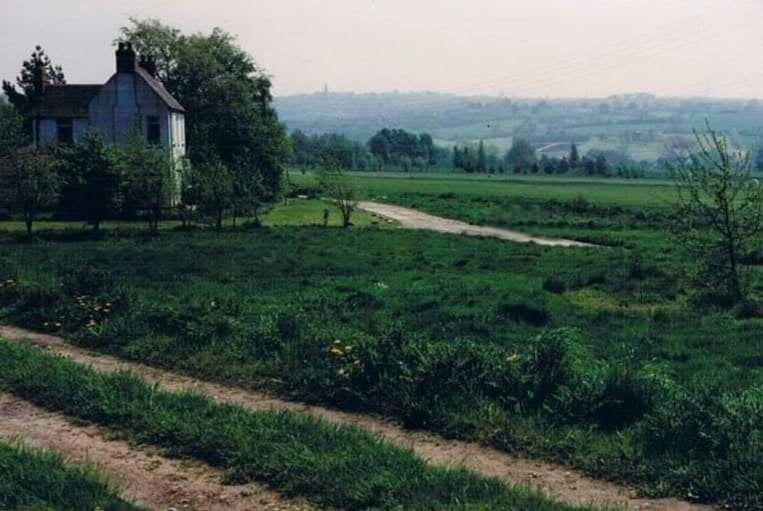
My father told me that my grandmother had fallen down the well at the house on Penn Common in 1915 when she was two years old, and sent me a photo of her standing next to the well when she revisted the house at a much later date.
Peggy next to the well on Penn Common:
My grandmother Peggy told me that her father had had a racehorse called Toi Fang. She remembered the racing colours were sky blue and orange, and had a set of racing silks made which she sent to my father.
Through a DNA match, I met Ian Tomlinson. Ian is the son of my fathers favourite cousin Roger, Frank’s son. Ian found some racing silks and sent a photo to my father (they are now in contact with each other as a result of my DNA match with Ian), wondering what they were.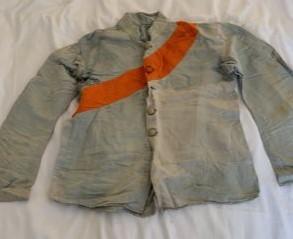
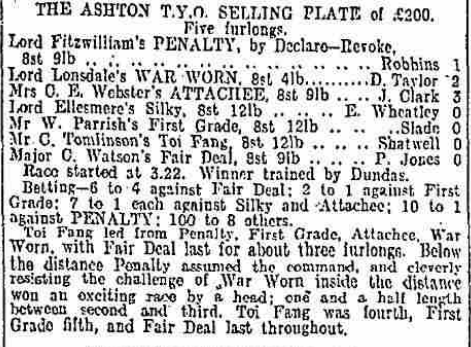
When Ian sent a photo of these racing silks, I had a look in the newspaper archives. In 1920 there are a number of mentions in the racing news of Mr C Tomlinson’s horse TOI FANG. I have not found any mention of Toi Fang in the newspapers in the following years.
The Scotsman – Monday 12 July 1920:
The other story that Ian Tomlinson recalled was about the house on Penn Common. Ian said he’d heard that the local titled person took Charles Tomlinson to court over building the house but that Tomlinson won the case because it was built on common land and was the first case of it’s kind.
Penn Common Right of Way Case:
Staffordshire Advertiser March 9, 1912In the chancery division, on Tuesday, before Mr Justice Joyce, it was announced that a settlement had been arrived at of the Penn Common Right of Way case, the hearing of which occupied several days last month. The action was brought by the Duke of Sutherland (as Lord of the Manor of Penn) and Mr Harry Sydney Pitt (on behalf of himself and other freeholders of the manor having a right to pasturage on Penn Common) to restrain Mr James Lakin, Carlton House, Penn; Mr Charles Tomlinson, Mayfield Villa, Wakely Hill, Penn; and Mr Joseph Harold Simpkin, Dudley Road, Wolverhampton, from drawing building materials across the common, or otherwise causing injury to the soil.
The real point in dispute was whether there was a public highway for all purposes running by the side of the defendants land from the Turf Tavern past the golf club to the Barley Mow.
Mr Hughes, KC for the plaintiffs, now stated that the parties had been in consultation, and had come to terms, the substance of which was that the defendants admitted that there was no public right of way, and that they were granted a private way. This, he thought, would involve the granting of some deed or deeds to express the rights of the parties, and he suggested that the documents should be be settled by some counsel to be mutually agreed upon.His lordship observed that the question of coal was probably the important point. Mr Younger said Mr Tomlinson was a freeholder, and the plaintiffs could not mine under him. Mr Hughes: The coal actually under his house is his, and, of course, subsidence might be produced by taking away coal some distance away. I think some document is required to determine his actual rights.
Mr Younger said he wanted to avoid anything that would increase the costs, but, after further discussion, it was agreed that Mr John Dixon (an expert on mineral rights), or failing him, another counsel satisfactory to both parties, should be invited to settle the terms scheduled in the agreement, in order to prevent any further dispute.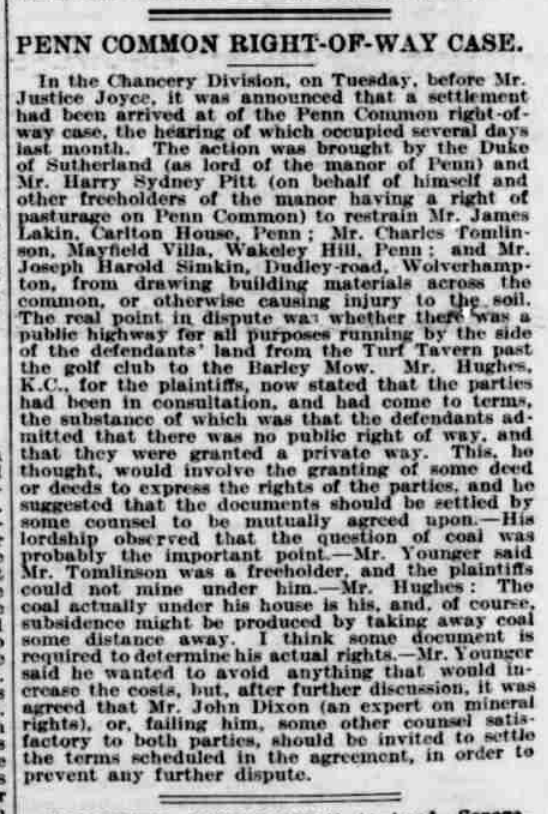
The name of the house is Grassholme. The address of Mayfield Villas is the house they were living in while building Grassholme, which I assume they had not yet moved in to at the time of the newspaper article in March 1912.
What my grandmother didn’t tell anyone was how her father died in 1929:
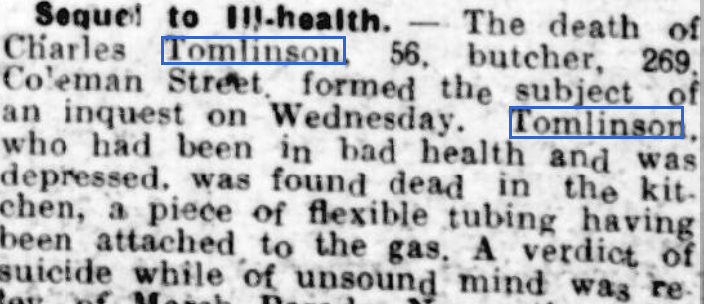
On the 1921 census, Charles, Nellie and eight of their children were living at 269 Coleman Street, Wolverhampton.
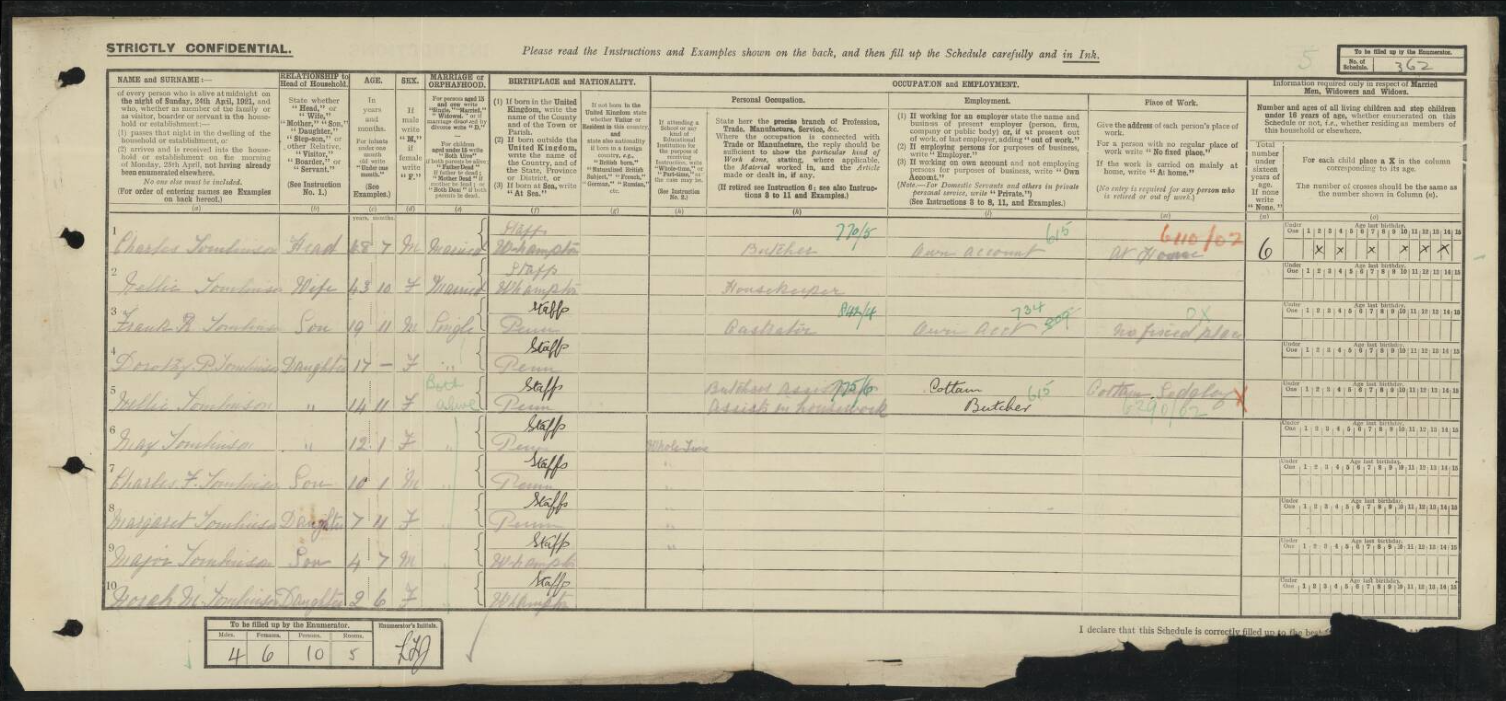
They were living on Coleman Street in 1915 when Charles was fined for staying open late.
Staffordshire Advertiser – Saturday 13 February 1915:

What is not yet clear is why they moved from the house on Penn Common sometime between 1912 and 1915. And why did he have a racehorse in 1920?
October 11, 2022 at 11:39 am #6333In reply to: Family Stories From The Other Side ~ Book Two
The Grattidge Family
The first Grattidge to appear in our tree was Emma Grattidge (1853-1911) who married Charles Tomlinson (1847-1907) in 1872.
Charles Tomlinson (1873-1929) was their son and he married my great grandmother Nellie Fisher. Their daughter Margaret (later Peggy Edwards) was my grandmother on my fathers side.
Emma Grattidge was born in Wolverhampton, the daughter and youngest child of William Grattidge (1820-1887) born in Foston, Derbyshire, and Mary Stubbs, born in Burton on Trent, daughter of Solomon Stubbs, a land carrier. William and Mary married at St Modwens church, Burton on Trent, in 1839. It’s unclear why they moved to Wolverhampton. On the 1841 census William was employed as an agent, and their first son William was nine months old. Thereafter, William was a licensed victuallar or innkeeper.
William Grattidge was born in Foston, Derbyshire in 1820. His parents were Thomas Grattidge, farmer (1779-1843) and Ann Gerrard (1789-1822) from Ellastone. Thomas and Ann married in 1813 in Ellastone. They had five children before Ann died at the age of 25:
Bessy was born in 1815, Thomas in 1818, William in 1820, and Daniel Augustus and Frederick were twins born in 1822. They were all born in Foston. (records say Foston, Foston and Scropton, or Scropton)
On the 1841 census Thomas had nine people additional to family living at the farm in Foston, presumably agricultural labourers and help.
After Ann died, Thomas had three children with Kezia Gibbs (30 years his junior) before marrying her in 1836, then had a further four with her before dying in 1843. Then Kezia married Thomas’s nephew Frederick Augustus Grattidge (born in 1816 in Stafford) in London in 1847 and had two more!
The siblings of William Grattidge (my 3x great grandfather):
Frederick Grattidge (1822-1872) was a schoolmaster and never married. He died at the age of 49 in Tamworth at his twin brother Daniels address.
Daniel Augustus Grattidge (1822-1903) was a grocer at Gungate in Tamworth.
Thomas Grattidge (1818-1871) married in Derby, and then emigrated to Illinois, USA.
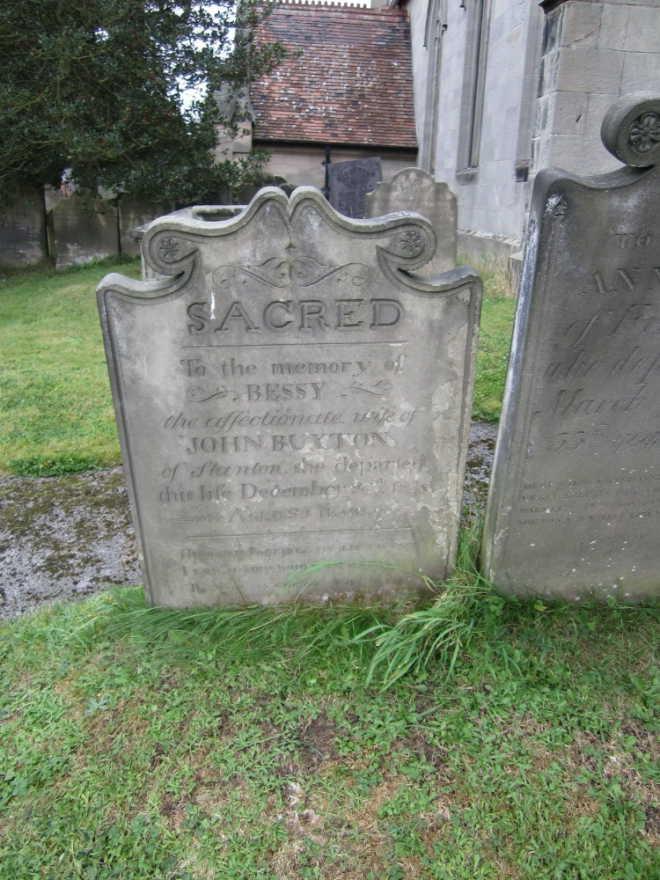
Bessy Grattidge (1815-1840) married John Buxton, farmer, in Ellastone in January 1838. They had three children before Bessy died in December 1840 at the age of 25: Henry in 1838, John in 1839, and Bessy Buxton in 1840. Bessy was baptised in January 1841. Presumably the birth of Bessy caused the death of Bessy the mother.
Bessy Buxton’s gravestone:
“Sacred to the memory of Bessy Buxton, the affectionate wife of John Buxton of Stanton She departed this life December 20th 1840, aged 25 years. “Husband, Farewell my life is Past, I loved you while life did last. Think on my children for my sake, And ever of them with I take.”
20 Dec 1840, Ellastone, Staffordshire
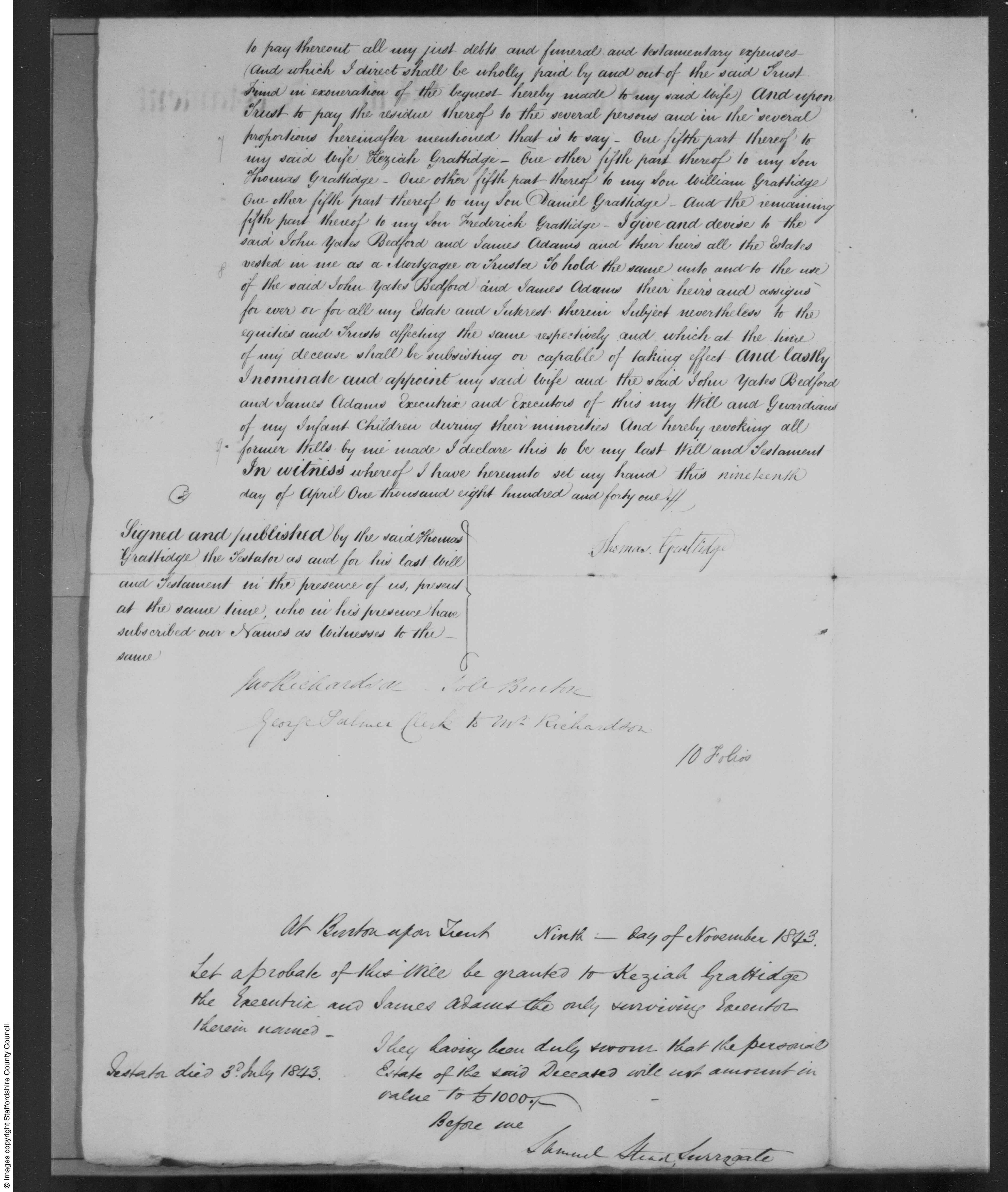
In the 1843 will of Thomas Grattidge, farmer of Foston, he leaves fifth shares of his estate, including freehold real estate at Findern, to his wife Kezia, and sons William, Daniel, Frederick and Thomas. He mentions that the children of his late daughter Bessy, wife of John Buxton, will be taken care of by their father. He leaves the farm to Keziah in confidence that she will maintain, support and educate his children with her.
An excerpt from the will:
I give and bequeath unto my dear wife Keziah Grattidge all my household goods and furniture, wearing apparel and plate and plated articles, linen, books, china, glass, and other household effects whatsoever, and also all my implements of husbandry, horses, cattle, hay, corn, crops and live and dead stock whatsoever, and also all the ready money that may be about my person or in my dwelling house at the time of my decease, …I also give my said wife the tenant right and possession of the farm in my occupation….
A page from the 1843 will of Thomas Grattidge:
William Grattidges half siblings (the offspring of Thomas Grattidge and Kezia Gibbs):
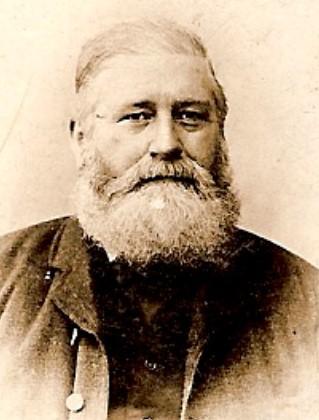
Albert Grattidge (1842-1914) was a railway engine driver in Derby. In 1884 he was driving the train when an unfortunate accident occured outside Ambergate. Three children were blackberrying and crossed the rails in front of the train, and one little girl died.
Albert Grattidge:
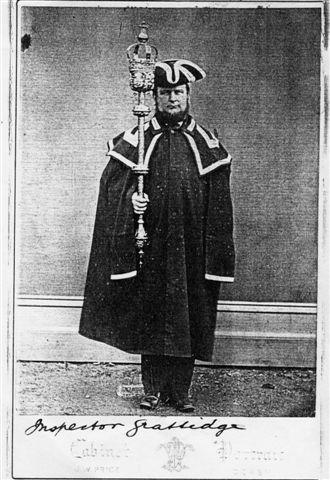
George Grattidge (1826-1876) was baptised Gibbs as this was before Thomas married Kezia. He was a police inspector in Derby.
George Grattidge:
Edwin Grattidge (1837-1852) died at just 15 years old.
Ann Grattidge (1835-) married Charles Fletcher, stone mason, and lived in Derby.
Louisa Victoria Grattidge (1840-1869) was sadly another Grattidge woman who died young. Louisa married Emmanuel Brunt Cheesborough in 1860 in Derby. In 1861 Louisa and Emmanuel were living with her mother Kezia in Derby, with their two children Frederick and Ann Louisa. Emmanuel’s occupation was sawyer. (Kezia Gibbs second husband Frederick Augustus Grattidge was a timber merchant in Derby)
At the time of her death in 1869, Emmanuel was the landlord of the White Hart public house at Bridgegate in Derby.
The Derby Mercury of 17th November 1869:
“On Wednesday morning Mr Coroner Vallack held an inquest in the Grand
Jury-room, Town-hall, on the body of Louisa Victoria Cheeseborough, aged
33, the wife of the landlord of the White Hart, Bridge-gate, who committed
suicide by poisoning at an early hour on Sunday morning. The following
evidence was taken:Mr Frederick Borough, surgeon, practising in Derby, deposed that he was
called in to see the deceased about four o’clock on Sunday morning last. He
accordingly examined the deceased and found the body quite warm, but dead.
He afterwards made enquiries of the husband, who said that he was afraid
that his wife had taken poison, also giving him at the same time the
remains of some blue material in a cup. The aunt of the deceased’s husband
told him that she had seen Mrs Cheeseborough put down a cup in the
club-room, as though she had just taken it from her mouth. The witness took
the liquid home with him, and informed them that an inquest would
necessarily have to be held on Monday. He had made a post mortem
examination of the body, and found that in the stomach there was a great
deal of congestion. There were remains of food in the stomach and, having
put the contents into a bottle, he took the stomach away. He also examined
the heart and found it very pale and flabby. All the other organs were
comparatively healthy; the liver was friable.Hannah Stone, aunt of the deceased’s husband, said she acted as a servant
in the house. On Saturday evening, while they were going to bed and whilst
witness was undressing, the deceased came into the room, went up to the
bedside, awoke her daughter, and whispered to her. but what she said the
witness did not know. The child jumped out of bed, but the deceased closed
the door and went away. The child followed her mother, and she also
followed them to the deceased’s bed-room, but the door being closed, they
then went to the club-room door and opening it they saw the deceased
standing with a candle in one hand. The daughter stayed with her in the
room whilst the witness went downstairs to fetch a candle for herself, and
as she was returning up again she saw the deceased put a teacup on the
table. The little girl began to scream, saying “Oh aunt, my mother is
going, but don’t let her go”. The deceased then walked into her bed-room,
and they went and stood at the door whilst the deceased undressed herself.
The daughter and the witness then returned to their bed-room. Presently
they went to see if the deceased was in bed, but she was sitting on the
floor her arms on the bedside. Her husband was sitting in a chair fast
asleep. The witness pulled her on the bed as well as she could.
Ann Louisa Cheesborough, a little girl, said that the deceased was her
mother. On Saturday evening last, about twenty minutes before eleven
o’clock, she went to bed, leaving her mother and aunt downstairs. Her aunt
came to bed as usual. By and bye, her mother came into her room – before
the aunt had retired to rest – and awoke her. She told the witness, in a
low voice, ‘that she should have all that she had got, adding that she
should also leave her her watch, as she was going to die’. She did not tell
her aunt what her mother had said, but followed her directly into the
club-room, where she saw her drink something from a cup, which she
afterwards placed on the table. Her mother then went into her own room and
shut the door. She screamed and called her father, who was downstairs. He
came up and went into her room. The witness then went to bed and fell
asleep. She did not hear any noise or quarrelling in the house after going
to bed.Police-constable Webster was on duty in Bridge-gate on Saturday evening
last, about twenty minutes to one o’clock. He knew the White Hart
public-house in Bridge-gate, and as he was approaching that place, he heard
a woman scream as though at the back side of the house. The witness went to
the door and heard the deceased keep saying ‘Will you be quiet and go to
bed’. The reply was most disgusting, and the language which the
police-constable said was uttered by the husband of the deceased, was
immoral in the extreme. He heard the poor woman keep pressing her husband
to go to bed quietly, and eventually he saw him through the keyhole of the
door pass and go upstairs. his wife having gone up a minute or so before.
Inspector Fearn deposed that on Sunday morning last, after he had heard of
the deceased’s death from supposed poisoning, he went to Cheeseborough’s
public house, and found in the club-room two nearly empty packets of
Battie’s Lincoln Vermin Killer – each labelled poison.Several of the Jury here intimated that they had seen some marks on the
deceased’s neck, as of blows, and expressing a desire that the surgeon
should return, and re-examine the body. This was accordingly done, after
which the following evidence was taken:Mr Borough said that he had examined the body of the deceased and observed
a mark on the left side of the neck, which he considered had come on since
death. He thought it was the commencement of decomposition.
This was the evidence, after which the jury returned a verdict “that the
deceased took poison whilst of unsound mind” and requested the Coroner to
censure the deceased’s husband.The Coroner told Cheeseborough that he was a disgusting brute and that the
jury only regretted that the law could not reach his brutal conduct.
However he had had a narrow escape. It was their belief that his poor
wife, who was driven to her own destruction by his brutal treatment, would
have been a living woman that day except for his cowardly conduct towards
her.The inquiry, which had lasted a considerable time, then closed.”
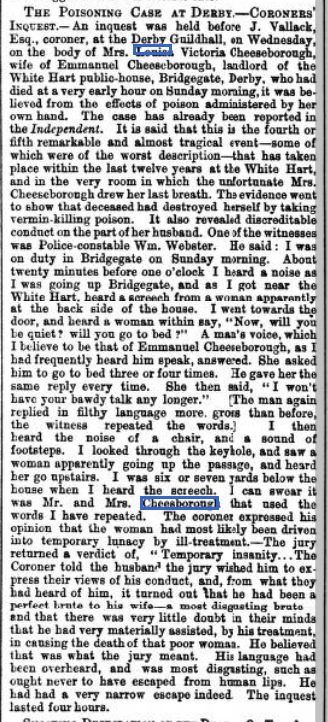
In this article it says:
“it was the “fourth or fifth remarkable and tragical event – some of which were of the worst description – that has taken place within the last twelve years at the White Hart and in the very room in which the unfortunate Louisa Cheesborough drew her last breath.”
Sheffield Independent – Friday 12 November 1869:
 August 18, 2022 at 8:26 am #6324
In reply to: The Elusive Samuel Housley and Other Family Stories
STONE MANOR
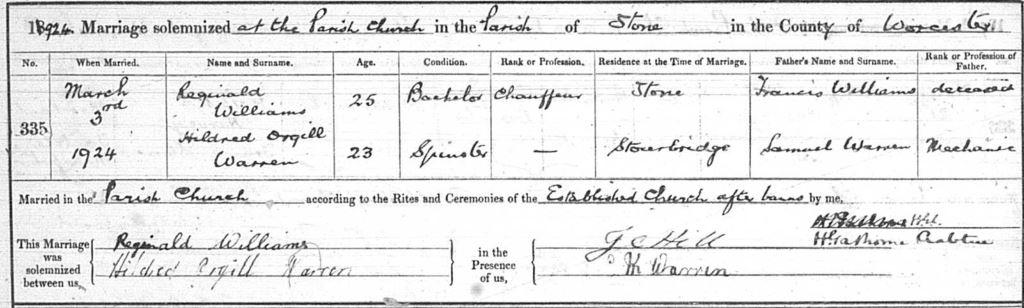
Hildred Orgill Warren born in 1900, my grandmothers sister, married Reginald Williams in Stone, Worcestershire in March 1924. Their daughter Joan was born there in October of that year.
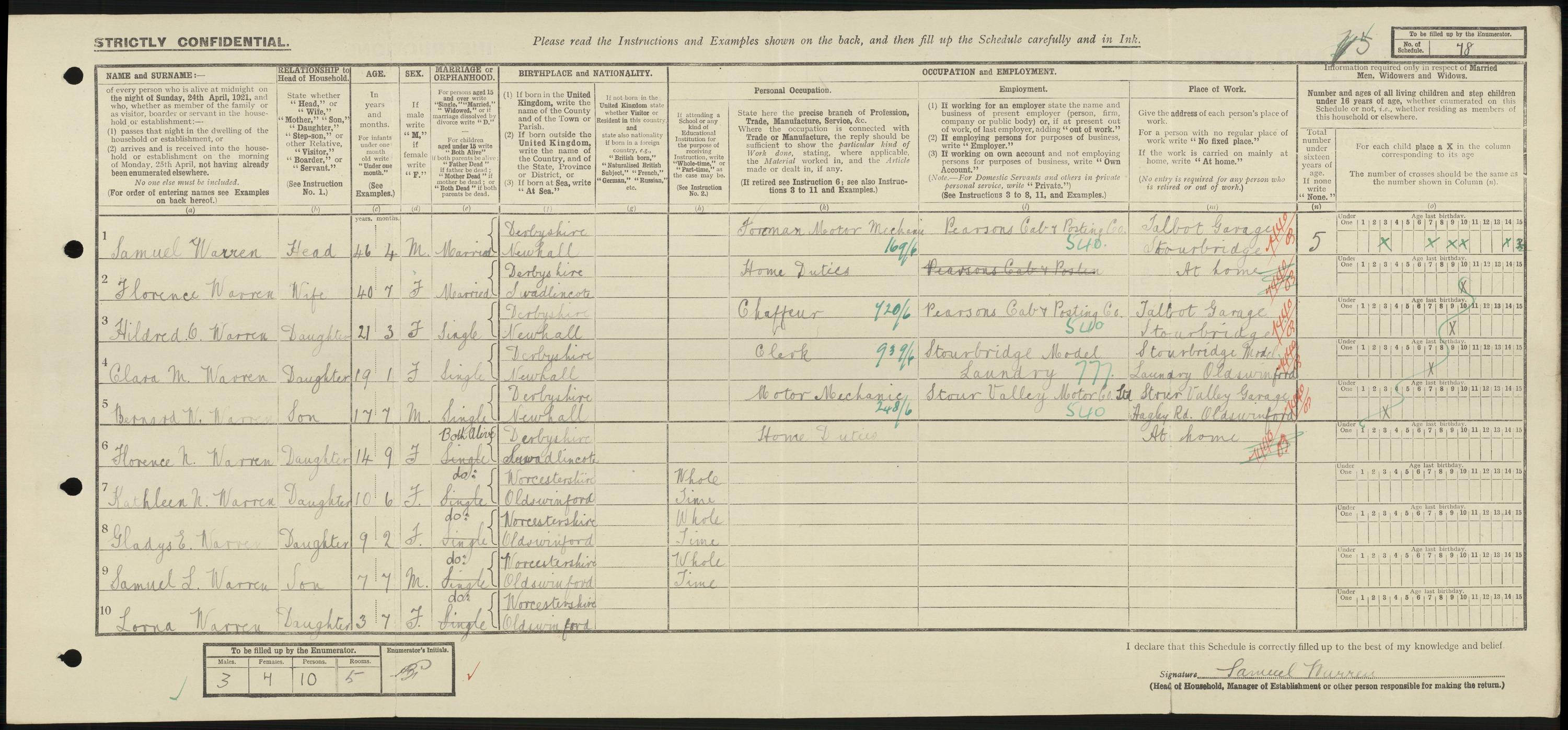
Hildred was a chaffeur on the 1921 census, living at home in Stourbridge with her father (my great grandfather) Samuel Warren, mechanic. I recall my grandmother saying that Hildred was one of the first lady chauffeurs. On their wedding certificate, Reginald is also a chauffeur.
1921 census, Stourbridge:
Hildred and Reg worked at Stone Manor. There is a family story of Hildred being involved in a car accident involving a fatality and that she had to go to court.
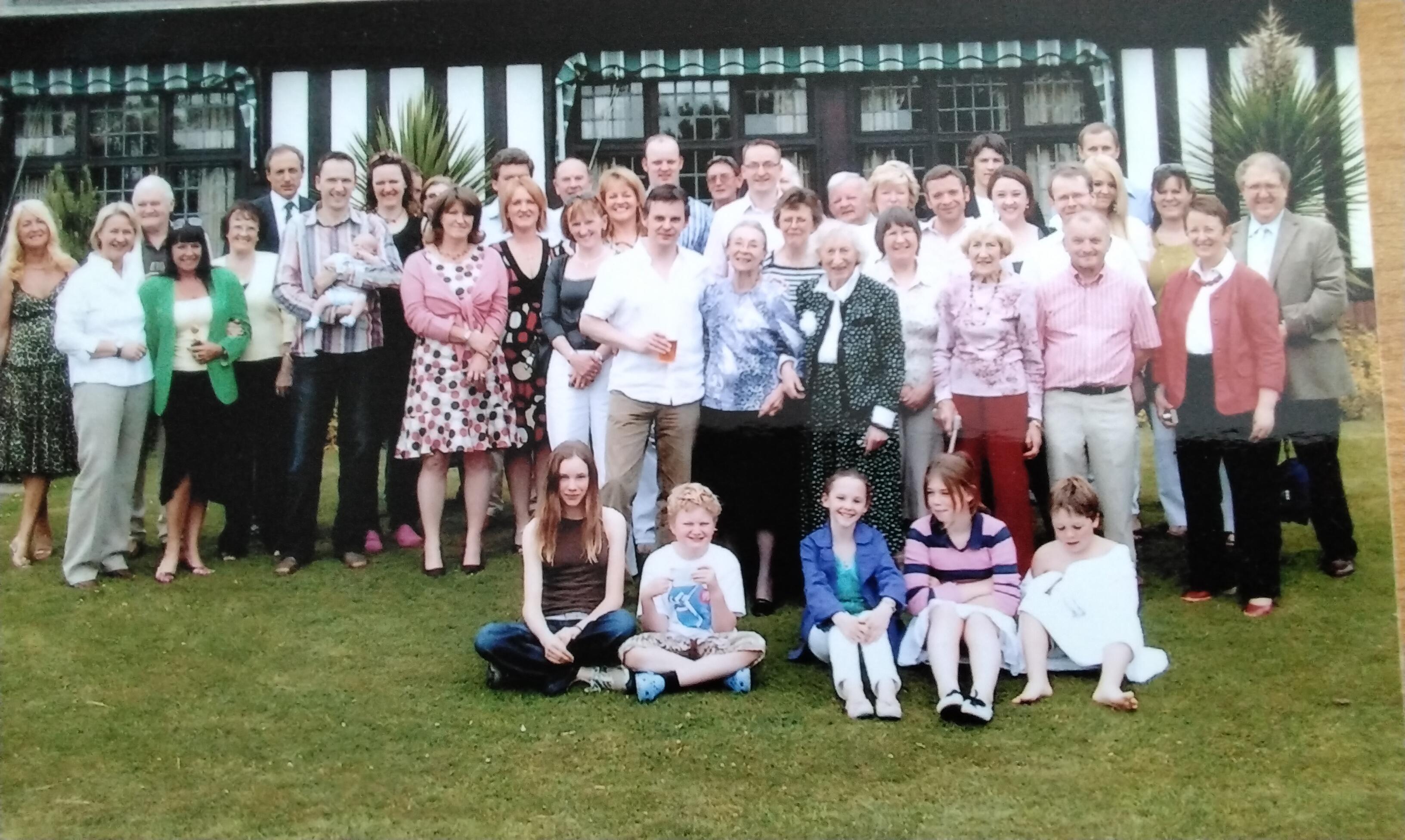
Stone Manor is in a tiny village called Stone, near Kidderminster, Worcestershire. It used to be a private house, but has been a hotel and nightclub for some years. We knew in the family that Hildred and Reg worked at Stone Manor and that Joan was born there. Around 2007 Joan held a family party there.
Stone Manor, Stone, Worcestershire:
I asked on a Kidderminster Family Research group about Stone Manor in the 1920s:
“the original Stone Manor burnt down and the current building dates from the early 1920’s and was built for James Culcheth Hill, completed in 1926”
But was there a fire at Stone Manor?
“I’m not sure there was a fire at the Stone Manor… there seems to have been a fire at another big house a short distance away and it looks like stories have crossed over… as the dates are the same…”JC Hill was one of the witnesses at Hildred and Reginalds wedding in Stone in 1924. K Warren, Hildreds sister Kay, was the other:
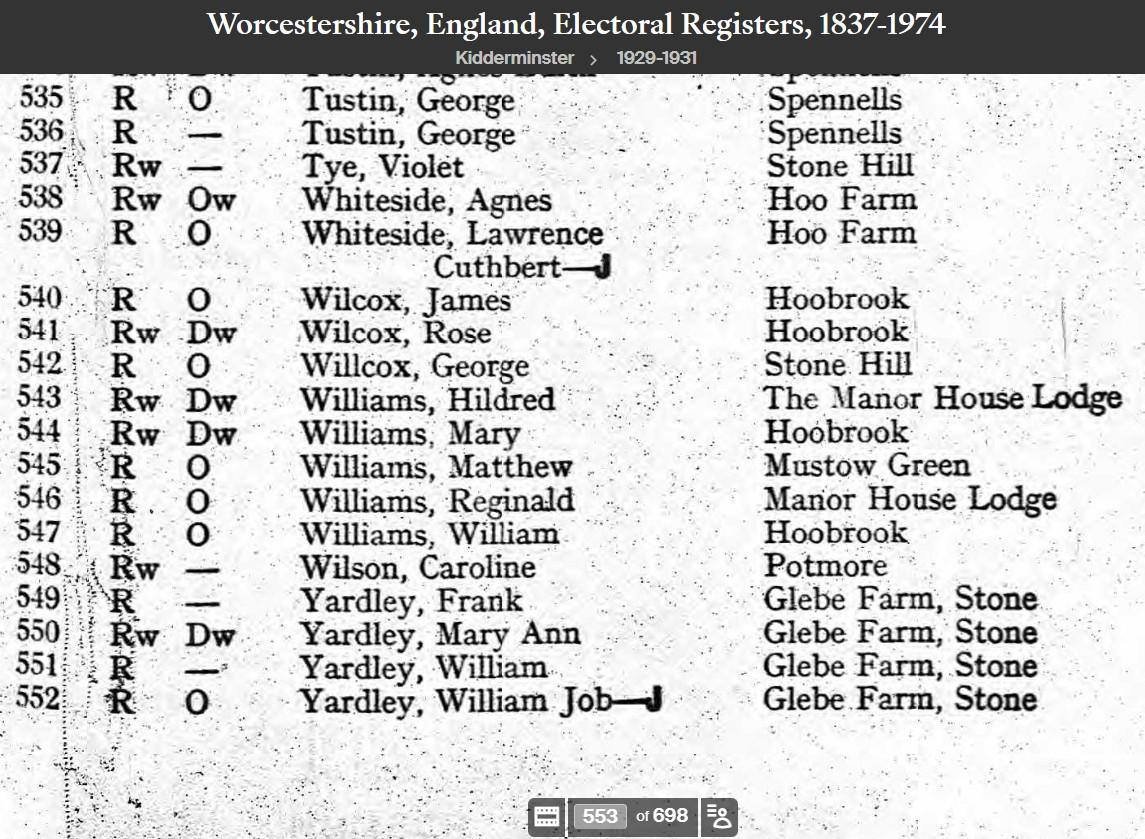
I searched the census and electoral rolls for James Culcheth Hill and found him at the Stone Manor on the 1929-1931 electoral rolls for Stone, and Hildred and Reginald living at The Manor House Lodge, Stone:
On the 1911 census James Culcheth Hill was a 12 year old student at Eastmans Royal Naval Academy, Northwood Park, Crawley, Winchester. He was born in Kidderminster in 1899. On the same census page, also a student at the school, is Reginald Culcheth Holcroft, born in 1900 in Stourbridge. The unusual middle name would seem to indicate that they might be related.
A member of the Kidderminster Family Research group kindly provided this article:
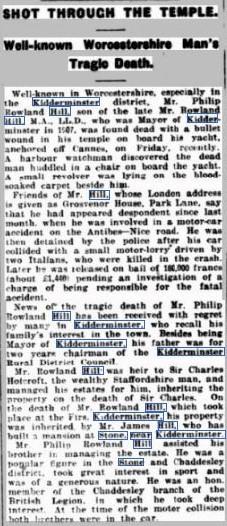
SHOT THROUGH THE TEMPLE
Well known Worcestershire man’s tragic death.
Dudley Chronicle 27 March 1930.
Well known in Worcestershire, especially the Kidderminster district, Mr Philip Rowland Hill MA LLD who was mayor of Kidderminster in 1907 was found dead with a bullet wound through his temple on board his yacht, anchored off Cannes, on Friday, recently. A harbour watchman discovered the dead man huddled in a chair on board the yacht. A small revolver was lying on the blood soaked carpet beside him.
Friends of Mr Hill, whose London address is given as Grosvenor House, Park Lane, say that he appeared despondent since last month when he was involved in a motor car accident on the Antibes ~ Nice road. He was then detained by the police after his car collided with a small motor lorry driven by two Italians, who were killed in the crash. Later he was released on bail of 180,000 francs (£1440) pending an investigation of a charge of being responsible for the fatal accident. …….
Mr Rowland Hill (Philips father) was heir to Sir Charles Holcroft, the wealthy Staffordshire man, and managed his estates for him, inheriting the property on the death of Sir Charles. On the death of Mr Rowland HIll, which took place at the Firs, Kidderminster, his property was inherited by Mr James (Culcheth) Hill who had built a mansion at Stone, near Kidderminster. Mr Philip Rowland Hill assisted his brother in managing the estate. …….
At the time of the collison both brothers were in the car.
This article doesn’t mention who was driving the car ~ could the family story of a car accident be this one? Hildred and Reg were working at Stone Manor, both were (or at least previously had been) chauffeurs, and Philip Hill was helping James Culcheth Hill manage the Stone Manor estate at the time.
This photograph was taken circa 1931 in Llanaeron, Wales. Hildred is in the middle on the back row:
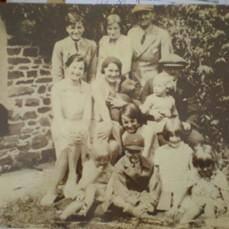
Sally Gray sent the photo with this message:
“Joan gave me a short note: Photo was taken when they lived in Wales, at Llanaeron, before Janet was born, & Aunty Lorna (my mother) lived with them, to take Joan to school in Aberaeron, as they only spoke Welsh at the local school.”
Hildred and Reginalds daughter Janet was born in 1932 in Stratford. It would appear that Hildred and Reg moved to Wales just after the car accident, and shortly afterwards moved to Stratford.
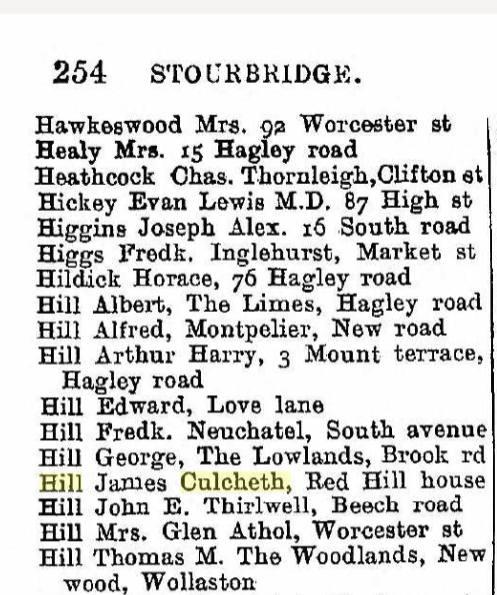
In 1921 James Culcheth Hill was living at Red Hill House in Stourbridge. Although I have not been able to trace Reginald Williams yet, perhaps this Stourbridge connection with his employer explains how Hildred met Reginald.
Sir Reginald Culcheth Holcroft, the other pupil at the school in Winchester with James Culcheth Hill, was indeed related, as Sir Holcroft left his estate to James Culcheth Hill’s father. Sir Reginald was born in 1899 in Upper Swinford, Stourbridge. Hildred also lived in that part of Stourbridge in the early 1900s.
1921 Red Hill House:
The 2007 family reunion organized by Joan Williams at Stone Manor: Joan in black and white at the front.
Unrelated to the Warrens, my fathers friends (and customers at The Fox when my grandmother Peggy Edwards owned it) Geoff and Beryl Lamb later bought Stone Manor.
July 1, 2022 at 9:51 am #6306In reply to: The Elusive Samuel Housley and Other Family Stories
Looking for Robert Staley
William Warren (1835-1880) of Newhall (Stapenhill) married Elizabeth Staley (1836-1907) in 1858. Elizabeth was born in Newhall, the daughter of John Staley (1795-1876) and Jane Brothers. John was born in Newhall, and Jane was born in Armagh, Ireland, and they were married in Armagh in 1820. Elizabeths older brothers were born in Ireland: William in 1826 and Thomas in Dublin in 1830. Francis was born in Liverpool in 1834, and then Elizabeth in Newhall in 1836; thereafter the children were born in Newhall.
Marriage of John Staley and Jane Brothers in 1820:
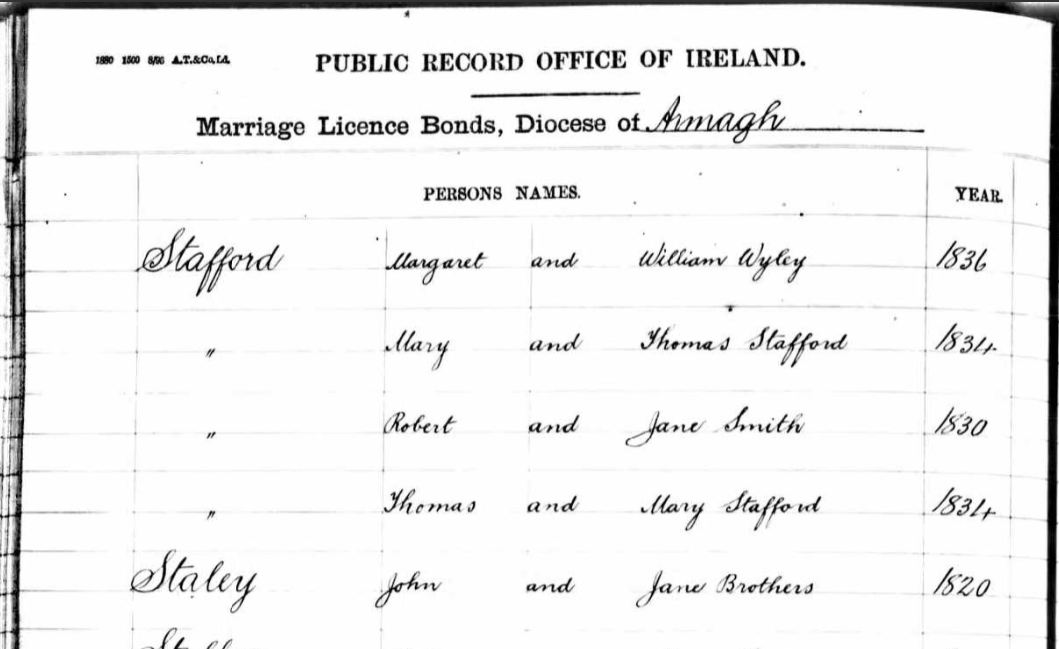
My grandmother related a story about an Elizabeth Staley who ran away from boarding school and eloped to Ireland, but later returned. The only Irish connection found so far is Jane Brothers, so perhaps she meant Elizabeth Staley’s mother. A boarding school seems unlikely, and it would seem that it was John Staley who went to Ireland.
The 1841 census states Jane’s age as 33, which would make her just 12 at the time of her marriage. The 1851 census states her age as 44, making her 13 at the time of her 1820 marriage, and the 1861 census estimates her birth year as a more likely 1804. Birth records in Ireland for her have not been found. It’s possible, perhaps, that she was in service in the Newhall area as a teenager (more likely than boarding school), and that John and Jane ran off to get married in Ireland, although I haven’t found any record of a child born to them early in their marriage. John was an agricultural labourer, and later a coal miner.
John Staley was the son of Joseph Staley (1756-1838) and Sarah Dumolo (1764-). Joseph and Sarah were married by licence in Newhall in 1782. Joseph was a carpenter on the marriage licence, but later a collier (although not necessarily a miner).
The Derbyshire Record Office holds records of an “Estimate of Joseph Staley of Newhall for the cost of continuing to work Pisternhill Colliery” dated 1820 and addresssed to Mr Bloud at Calke Abbey (presumably the owner of the mine)
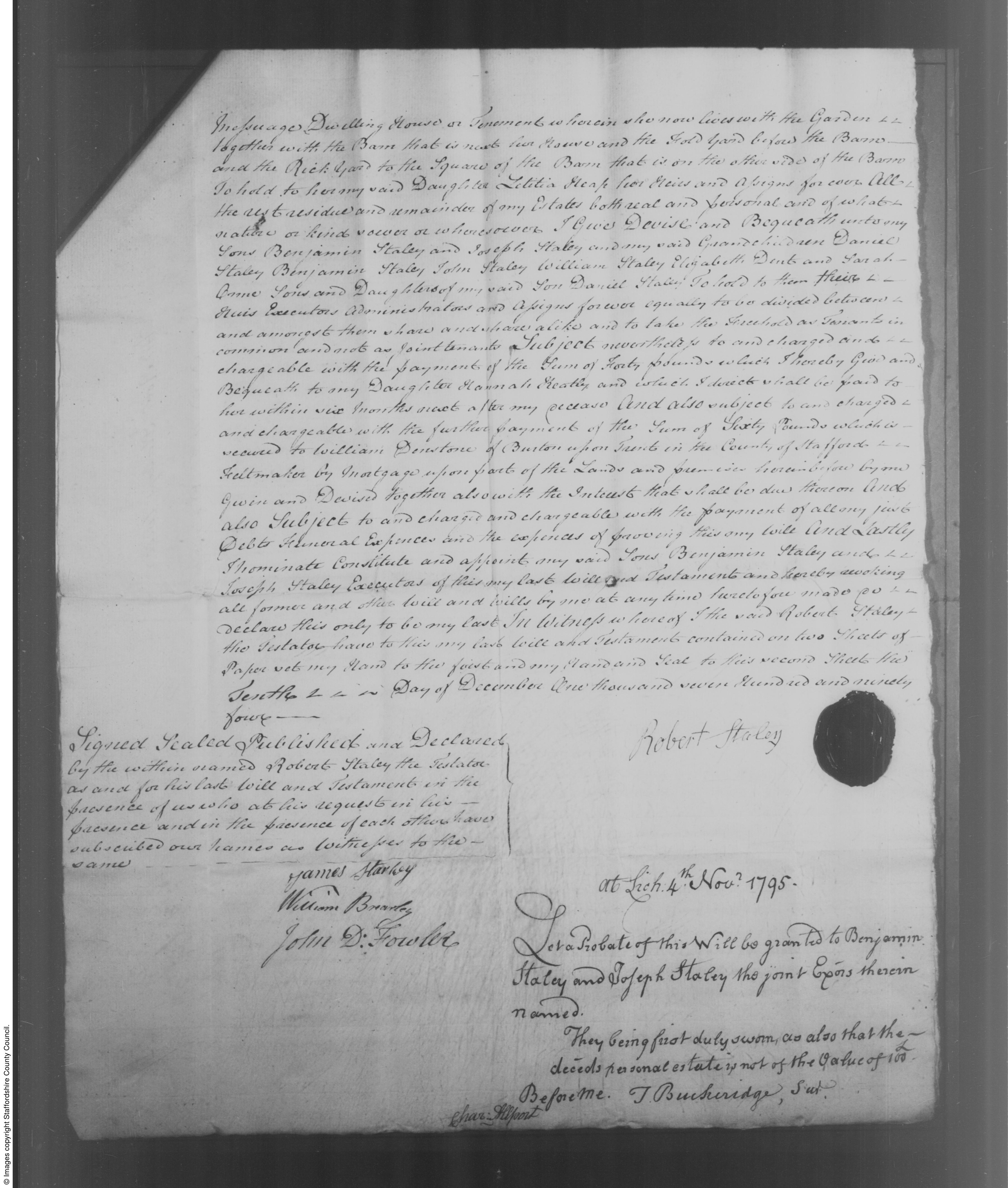
Josephs parents were Robert Staley and Elizabeth. I couldn’t find a baptism or birth record for Robert Staley. Other trees on an ancestry site had his birth in Elton, but with no supporting documents. Robert, as stated in his 1795 will, was a Yeoman.
“Yeoman: A former class of small freeholders who farm their own land; a commoner of good standing.”
“Husbandman: The old word for a farmer below the rank of yeoman. A husbandman usually held his land by copyhold or leasehold tenure and may be regarded as the ‘average farmer in his locality’. The words ‘yeoman’ and ‘husbandman’ were gradually replaced in the later 18th and 19th centuries by ‘farmer’.”He left a number of properties in Newhall and Hartshorne (near Newhall) including dwellings, enclosures, orchards, various yards, barns and acreages. It seemed to me more likely that he had inherited them, rather than moving into the village and buying them.
There is a mention of Robert Staley in a 1782 newpaper advertisement.
“Fire Engine To Be Sold. An exceedingly good fire engine, with the boiler, cylinder, etc in good condition. For particulars apply to Mr Burslem at Burton-upon-Trent, or Robert Staley at Newhall near Burton, where the engine may be seen.”
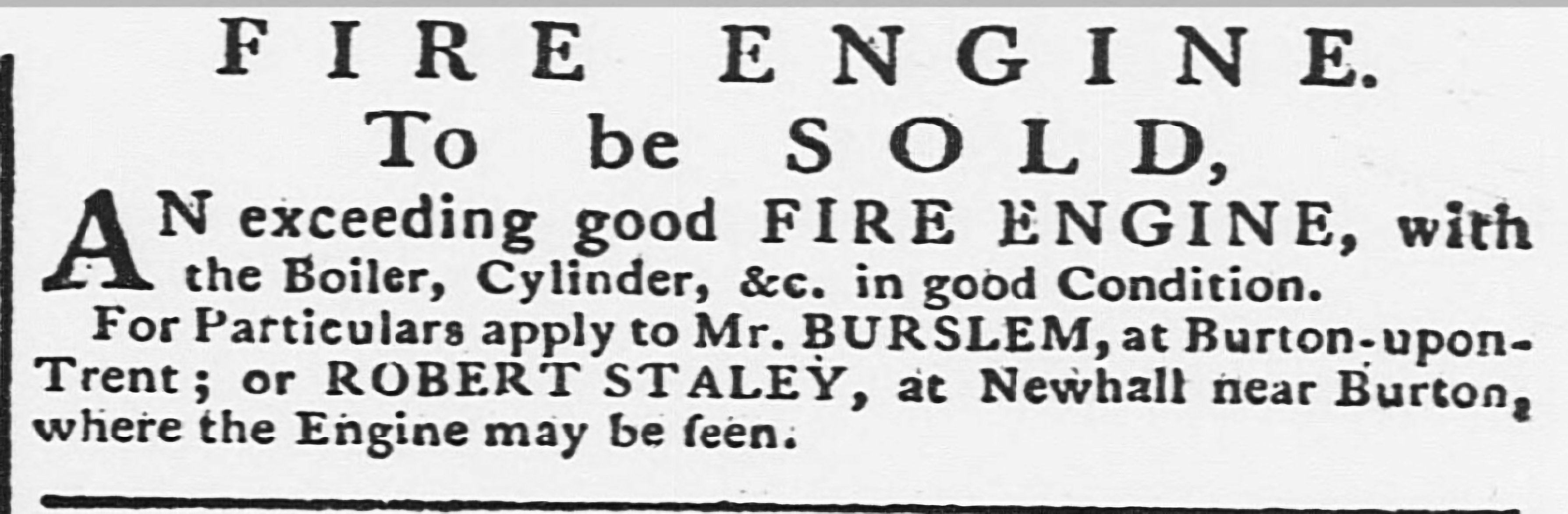
Was the fire engine perhaps connected with a foundry or a coal mine?
I noticed that Robert Staley was the witness at a 1755 marriage in Stapenhill between Barbara Burslem and Richard Daston the younger esquire. The other witness was signed Burslem Jnr.
Looking for Robert Staley
I assumed that once again, in the absence of the correct records, a similarly named and aged persons baptism had been added to the tree regardless of accuracy, so I looked through the Stapenhill/Newhall parish register images page by page. There were no Staleys in Newhall at all in the early 1700s, so it seemed that Robert did come from elsewhere and I expected to find the Staleys in a neighbouring parish. But I still didn’t find any Staleys.
I spoke to a couple of Staley descendants that I’d met during the family research. I met Carole via a DNA match some months previously and contacted her to ask about the Staleys in Elton. She also had Robert Staley born in Elton (indeed, there were many Staleys in Elton) but she didn’t have any documentation for his birth, and we decided to collaborate and try and find out more.
I couldn’t find the earlier Elton parish registers anywhere online, but eventually found the untranscribed microfiche images of the Bishops Transcripts for Elton.
via familysearch:
“In its most basic sense, a bishop’s transcript is a copy of a parish register. As bishop’s transcripts generally contain more or less the same information as parish registers, they are an invaluable resource when a parish register has been damaged, destroyed, or otherwise lost. Bishop’s transcripts are often of value even when parish registers exist, as priests often recorded either additional or different information in their transcripts than they did in the original registers.”Unfortunately there was a gap in the Bishops Transcripts between 1704 and 1711 ~ exactly where I needed to look. I subsequently found out that the Elton registers were incomplete as they had been damaged by fire.
I estimated Robert Staleys date of birth between 1710 and 1715. He died in 1795, and his son Daniel died in 1805: both of these wills were found online. Daniel married Mary Moon in Stapenhill in 1762, making a likely birth date for Daniel around 1740.
The marriage of Robert Staley (assuming this was Robert’s father) and Alice Maceland (or Marsland or Marsden, depending on how the parish clerk chose to spell it presumably) was in the Bishops Transcripts for Elton in 1704. They were married in Elton on 26th February. There followed the missing parish register pages and in all likelihood the records of the baptisms of their first children. No doubt Robert was one of them, probably the first male child.
(Incidentally, my grandfather’s Marshalls also came from Elton, a small Derbyshire village near Matlock. The Staley’s are on my grandmothers Warren side.)
The parish register pages resume in 1711. One of the first entries was the baptism of Robert Staley in 1711, parents Thomas and Ann. This was surely the one we were looking for, and Roberts parents weren’t Robert and Alice.
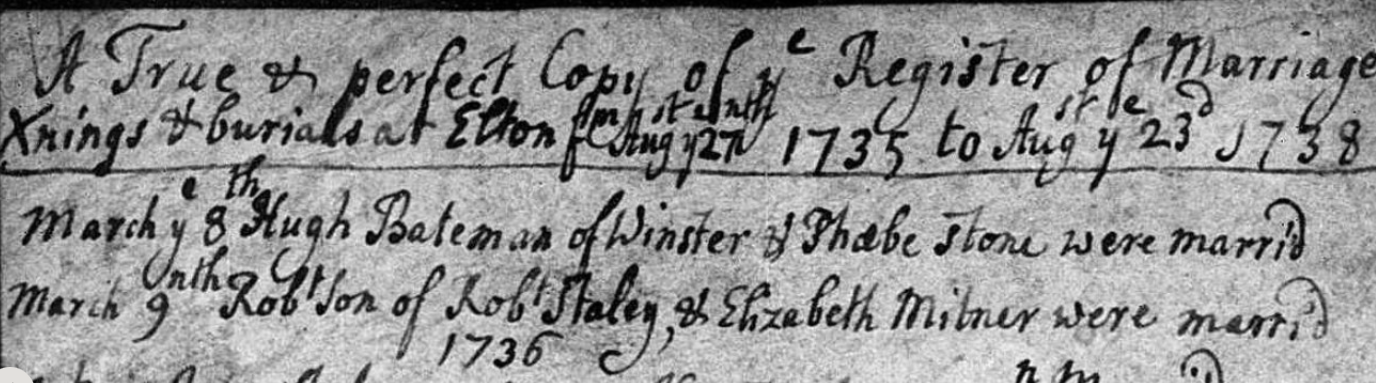
But then in 1735 a marriage was recorded between Robert son of Robert Staley (and this was unusual, the father of the groom isn’t usually recorded on the parish register) and Elizabeth Milner. They were married on the 9th March 1735. We know that the Robert we were looking for married an Elizabeth, as her name was on the Stapenhill baptisms of their later children, including Joseph Staleys. The 1735 marriage also fit with the assumed birth date of Daniel, circa 1740. A baptism was found for a Robert Staley in 1738 in the Elton registers, parents Robert and Elizabeth, as well as the baptism in 1736 for Mary, presumably their first child. Her burial is recorded the following year.
The marriage of Robert Staley and Elizabeth Milner in 1735:
There were several other Staley couples of a similar age in Elton, perhaps brothers and cousins. It seemed that Thomas and Ann’s son Robert was a different Robert, and that the one we were looking for was prior to that and on the missing pages.
Even so, this doesn’t prove that it was Elizabeth Staleys great grandfather who was born in Elton, but no other birth or baptism for Robert Staley has been found. It doesn’t explain why the Staleys moved to Stapenhill either, although the Enclosures Act and the Industrial Revolution could have been factors.
The 18th century saw the rise of the Industrial Revolution and many renowned Derbyshire Industrialists emerged. They created the turning point from what was until then a largely rural economy, to the development of townships based on factory production methods.
The Marsden Connection
There are some possible clues in the records of the Marsden family. Robert Staley married Alice Marsden (or Maceland or Marsland) in Elton in 1704. Robert Staley is mentioned in the 1730 will of John Marsden senior, of Baslow, Innkeeper (Peacock Inne & Whitlands Farm). He mentions his daughter Alice, wife of Robert Staley.
In a 1715 Marsden will there is an intriguing mention of an alias, which might explain the different spellings on various records for the name Marsden: “MARSDEN alias MASLAND, Christopher – of Baslow, husbandman, 28 Dec 1714. son Robert MARSDEN alias MASLAND….” etc.
Some potential reasons for a move from one parish to another are explained in this history of the Marsden family, and indeed this could relate to Robert Staley as he married into the Marsden family and his wife was a beneficiary of a Marsden will. The Chatsworth Estate, at various times, bought a number of farms in order to extend the park.
THE MARSDEN FAMILY
OXCLOSE AND PARKGATE
In the Parishes of
Baslow and Chatsworthby
David Dalrymple-Smith“John Marsden (b1653) another son of Edmund (b1611) faired well. By the time he died in
1730 he was publican of the Peacock, the Inn on Church Lane now called the Cavendish
Hotel, and the farmer at “Whitlands”, almost certainly Bubnell Cliff Farm.”“Coal mining was well known in the Chesterfield area. The coalfield extends as far as the
Gritstone edges, where thin seams outcrop especially in the Baslow area.”“…the occupants were evicted from the farmland below Dobb Edge and
the ground carefully cleared of all traces of occupation and farming. Shelter belts were
planted especially along the Heathy Lea Brook. An imposing new drive was laid to the
Chatsworth House with the Lodges and “The Golden Gates” at its northern end….”Although this particular event was later than any events relating to Robert Staley, it’s an indication of how farms and farmland disappeared, and a reason for families to move to another area:
“The Dukes of Devonshire (of Chatsworth) were major figures in the aristocracy and the government of the
time. Such a position demanded a display of wealth and ostentation. The 6th Duke of
Devonshire, the Bachelor Duke, was not content with the Chatsworth he inherited in 1811,
and immediately started improvements. After major changes around Edensor, he turned his
attention at the north end of the Park. In 1820 plans were made extend the Park up to the
Baslow parish boundary. As this would involve the destruction of most of the Farm at
Oxclose, the farmer at the Higher House Samuel Marsden (b1755) was given the tenancy of
Ewe Close a large farm near Bakewell.
Plans were revised in 1824 when the Dukes of Devonshire and Rutland “Exchanged Lands”,
reputedly during a game of dice. Over 3300 acres were involved in several local parishes, of
which 1000 acres were in Baslow. In the deal Devonshire acquired the southeast corner of
Baslow Parish.
Part of the deal was Gibbet Moor, which was developed for “Sport”. The shelf of land
between Parkgate and Robin Hood and a few extra fields was left untouched. The rest,
between Dobb Edge and Baslow, was agricultural land with farms, fields and houses. It was
this last part that gave the Duke the opportunity to improve the Park beyond his earlier
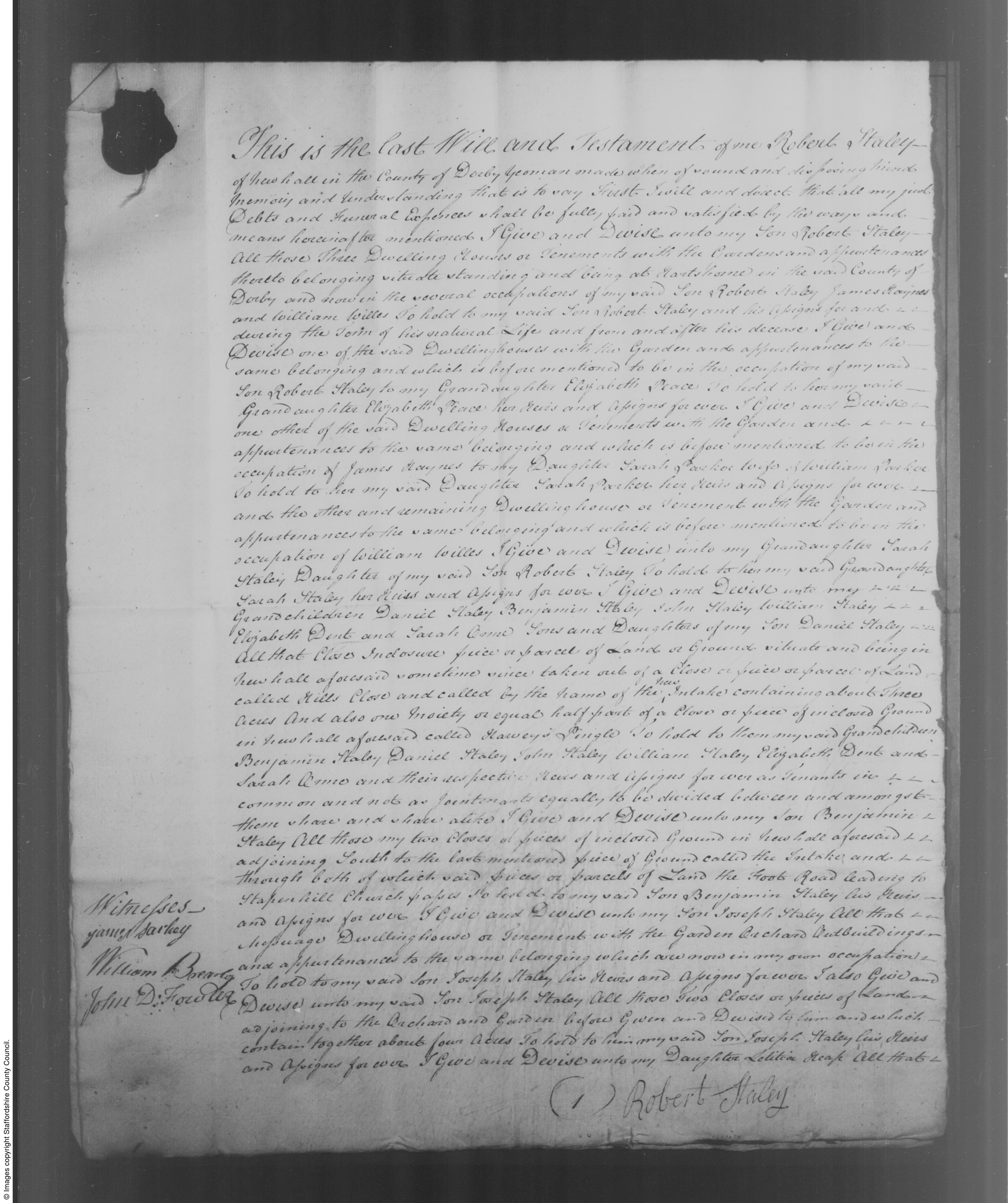
expectations.”The 1795 will of Robert Staley.
Inriguingly, Robert included the children of his son Daniel Staley in his will, but omitted to leave anything to Daniel. A perusal of Daniels 1808 will sheds some light on this: Daniel left his property to his six reputed children with Elizabeth Moon, and his reputed daughter Mary Brearly. Daniels wife was Mary Moon, Elizabeths husband William Moons daughter.
The will of Robert Staley, 1795:
The 1805 will of Daniel Staley, Robert’s son:
This is the last will and testament of me Daniel Staley of the Township of Newhall in the parish of Stapenhill in the County of Derby, Farmer. I will and order all of my just debts, funeral and testamentary expenses to be fully paid and satisfied by my executors hereinafter named by and out of my personal estate as soon as conveniently may be after my decease.
I give, devise and bequeath to Humphrey Trafford Nadin of Church Gresely in the said County of Derby Esquire and John Wilkinson of Newhall aforesaid yeoman all my messuages, lands, tenements, hereditaments and real and personal estates to hold to them, their heirs, executors, administrators and assigns until Richard Moon the youngest of my reputed sons by Elizabeth Moon shall attain his age of twenty one years upon trust that they, my said trustees, (or the survivor of them, his heirs, executors, administrators or assigns), shall and do manage and carry on my farm at Newhall aforesaid and pay and apply the rents, issues and profits of all and every of my said real and personal estates in for and towards the support, maintenance and education of all my reputed children by the said Elizabeth Moon until the said Richard Moon my youngest reputed son shall attain his said age of twenty one years and equally share and share and share alike.
And it is my will and desire that my said trustees or trustee for the time being shall recruit and keep up the stock upon my farm as they in their discretion shall see occasion or think proper and that the same shall not be diminished. And in case any of my said reputed children by the said Elizabeth Moon shall be married before my said reputed youngest son shall attain his age of twenty one years that then it is my will and desire that non of their husbands or wives shall come to my farm or be maintained there or have their abode there. That it is also my will and desire in case my reputed children or any of them shall not be steady to business but instead shall be wild and diminish the stock that then my said trustees or trustee for the time being shall have full power and authority in their discretion to sell and dispose of all or any part of my said personal estate and to put out the money arising from the sale thereof to interest and to pay and apply the interest thereof and also thereunto of the said real estate in for and towards the maintenance, education and support of all my said reputed children by the said
Elizabeth Moon as they my said trustees in their discretion that think proper until the said Richard Moon shall attain his age of twenty one years.Then I give to my grandson Daniel Staley the sum of ten pounds and to each and every of my sons and daughters namely Daniel Staley, Benjamin Staley, John Staley, William Staley, Elizabeth Dent and Sarah Orme and to my niece Ann Brearly the sum of five pounds apiece.
I give to my youngest reputed son Richard Moon one share in the Ashby Canal Navigation and I direct that my said trustees or trustee for the time being shall have full power and authority to pay and apply all or any part of the fortune or legacy hereby intended for my youngest reputed son Richard Moon in placing him out to any trade, business or profession as they in their discretion shall think proper.
And I direct that to my said sons and daughters by my late wife and my said niece shall by wholly paid by my said reputed son Richard Moon out of the fortune herby given him. And it is my will and desire that my said reputed children shall deliver into the hands of my executors all the monies that shall arise from the carrying on of my business that is not wanted to carry on the same unto my acting executor and shall keep a just and true account of all disbursements and receipts of the said business and deliver up the same to my acting executor in order that there may not be any embezzlement or defraud amongst them and from and immediately after my said reputed youngest son Richard Moon shall attain his age of twenty one years then I give, devise and bequeath all my real estate and all the residue and remainder of my personal estate of what nature and kind whatsoever and wheresoever unto and amongst all and every my said reputed sons and daughters namely William Moon, Thomas Moon, Joseph Moon, Richard Moon, Ann Moon, Margaret Moon and to my reputed daughter Mary Brearly to hold to them and their respective heirs, executors, administrator and assigns for ever according to the nature and tenure of the same estates respectively to take the same as tenants in common and not as joint tenants.And lastly I nominate and appoint the said Humphrey Trafford Nadin and John Wilkinson executors of this my last will and testament and guardians of all my reputed children who are under age during their respective minorities hereby revoking all former and other wills by me heretofore made and declaring this only to be my last will.
In witness whereof I the said Daniel Staley the testator have to this my last will and testament set my hand and seal the eleventh day of March in the year of our Lord one thousand eight hundred and five.
June 6, 2022 at 12:58 pm #6303In reply to: The Elusive Samuel Housley and Other Family Stories
The Hollands of Barton under Needwood
Samuel Warren of Stapenhill married Catherine Holland of Barton under Needwood in 1795.
I joined a Barton under Needwood History group and found an incredible amount of information on the Holland family, but first I wanted to make absolutely sure that our Catherine Holland was one of them as there were also Hollands in Newhall. Not only that, on the marriage licence it says that Catherine Holland was from Bretby Park Gate, Stapenhill.
Then I noticed that one of the witnesses on Samuel’s brother Williams marriage to Ann Holland in 1796 was John Hair. Hannah Hair was the wife of Thomas Holland, and they were the Barton under Needwood parents of Catherine. Catherine was born in 1775, and Ann was born in 1767.
The 1851 census clinched it: Catherine Warren 74 years old, widow and formerly a farmers wife, was living in the household of her son John Warren, and her place of birth is listed as Barton under Needwood. In 1841 Catherine was a 64 year old widow, her husband Samuel having died in 1837, and she was living with her son Samuel, a farmer. The 1841 census did not list place of birth, however. Catherine died on 31 March 1861 and does not appear on the 1861 census.
Once I had established that our Catherine Holland was from Barton under Needwood, I had another look at the information available on the Barton under Needwood History group, compiled by local historian Steve Gardner.
Catherine’s parents were Thomas Holland 1737-1828 and Hannah Hair 1739-1822.
Steve Gardner had posted a long list of the dates, marriages and children of the Holland family. The earliest entries in parish registers were Thomae Holland 1562-1626 and his wife Eunica Edwardes 1565-1632. They married on 10th July 1582. They were born, married and died in Barton under Needwood. They were direct ancestors of Catherine Holland, and as such my direct ancestors too.
The known history of the Holland family in Barton under Needwood goes back to Richard De Holland. (Thanks once again to Steve Gardner of the Barton under Needwood History group for this information.)
“Richard de Holland was the first member of the Holland family to become resident in Barton under Needwood (in about 1312) having been granted lands by the Earl of Lancaster (for whom Richard served as Stud and Stock Keeper of the Peak District) The Holland family stemmed from Upholland in Lancashire and had many family connections working for the Earl of Lancaster, who was one of the biggest Barons in England. Lancaster had his own army and lived at Tutbury Castle, from where he ruled over most of the Midlands area. The Earl of Lancaster was one of the main players in the ‘Barons Rebellion’ and the ensuing Battle of Burton Bridge in 1322. Richard de Holland was very much involved in the proceedings which had so angered Englands King. Holland narrowly escaped with his life, unlike the Earl who was executed.
From the arrival of that first Holland family member, the Hollands were a mainstay family in the community, and were in Barton under Needwood for over 600 years.”Continuing with various items of information regarding the Hollands, thanks to Steve Gardner’s Barton under Needwood history pages:
“PART 6 (Final Part)
Some mentions of The Manor of Barton in the Ancient Staffordshire Rolls:
1330. A Grant was made to Herbert de Ferrars, at le Newland in the Manor of Barton.
1378. The Inquisitio bonorum – Johannis Holand — an interesting Inventory of his goods and their value and his debts.
1380. View of Frankpledge ; the Jury found that Richard Holland was feloniously murdered by his wife Joan and Thomas Graunger, who fled. The goods of the deceased were valued at iiij/. iijj. xid. ; one-third went to the dead man, one-third to his son, one- third to the Lord for the wife’s share. Compare 1 H. V. Indictments. (1413.)
That Thomas Graunger of Barton smyth and Joan the wife of Richard de Holond of Barton on the Feast of St. John the Baptist 10 H. II. (1387) had traitorously killed and murdered at night, at Barton, Richard, the husband of the said Joan. (m. 22.)
The names of various members of the Holland family appear constantly among the listed Jurors on the manorial records printed below : —
1539. Richard Holland and Richard Holland the younger are on the Muster Roll of Barton
1583. Thomas Holland and Unica his wife are living at Barton.
1663-4. Visitations. — Barton under Needword. Disclaimers. William Holland, Senior, William Holland, Junior.
1609. Richard Holland, Clerk and Alice, his wife.
1663-4. Disclaimers at the Visitation. William Holland, Senior, William Holland, Junior.”I was able to find considerably more information on the Hollands in the book “Some Records of the Holland Family (The Hollands of Barton under Needwood, Staffordshire, and the Hollands in History)” by William Richard Holland. Luckily the full text of this book can be found online.
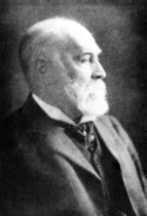
William Richard Holland (Died 1915) An early local Historian and author of the book:
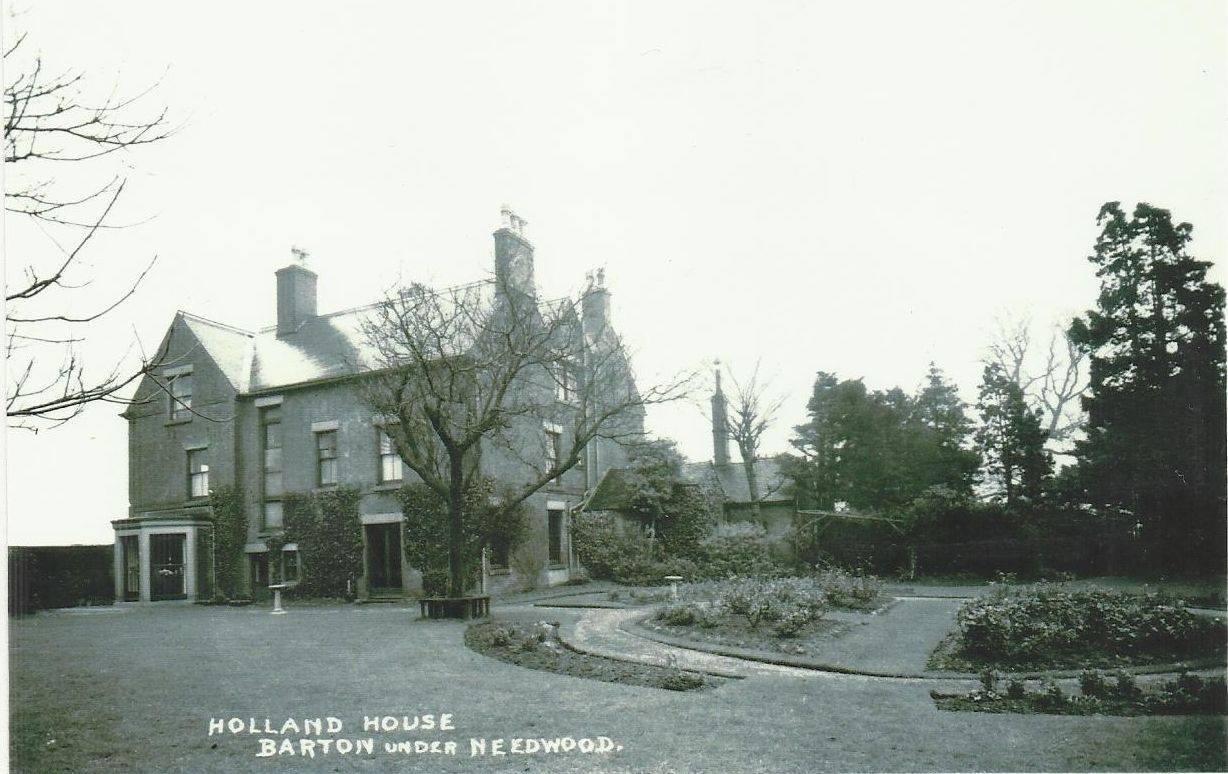
‘Holland House’ taken from the Gardens (sadly demolished in the early 60’s):
Excerpt from the book:
“The charter, dated 1314, granting Richard rights and privileges in Needwood Forest, reads as follows:
“Thomas Earl of Lancaster and Leicester, high-steward of England, to whom all these present shall come, greeting: Know ye, that we have given, &c., to Richard Holland of Barton, and his heirs, housboot, heyboot, and fireboot, and common of pasture, in our forest of Needwood, for all his beasts, as well in places fenced as lying open, with 40 hogs, quit of pawnage in our said forest at all times in the year (except hogs only in fence month). All which premises we will warrant, &c. to the said Richard and his heirs against all people for ever”
“The terms “housboot” “heyboot” and “fireboot” meant that Richard and his heirs were to have the privilege of taking from the Forest, wood needed for house repair and building, hedging material for the repairing of fences, and what was needful for purposes of fuel.”
Further excerpts from the book:
“It may here be mentioned that during the renovation of Barton Church, when the stone pillars were being stripped of the plaster which covered them, “William Holland 1617” was found roughly carved on a pillar near to the belfry gallery, obviously the work of a not too devout member of the family, who, seated in the gallery of that time, occupied himself thus during the service. The inscription can still be seen.”
“The earliest mention of a Holland of Upholland occurs in the reign of John in a Final Concord, made at the Lancashire Assizes, dated November 5th, 1202, in which Uchtred de Chryche, who seems to have had some right in the manor of Upholland, releases his right in fourteen oxgangs* of land to Matthew de Holland, in consideration of the sum of six marks of silver. Thus was planted the Holland Tree, all the early information of which is found in The Victoria County History of Lancaster.
As time went on, the family acquired more land, and with this, increased position. Thus, in the reign of Edward I, a Robert de Holland, son of Thurstan, son of Robert, became possessed of the manor of Orrell adjoining Upholland and of the lordship of Hale in the parish of Childwall, and, through marriage with Elizabeth de Samlesbury (co-heiress of Sir Wm. de Samlesbury of Samlesbury, Hall, near to Preston), of the moiety of that manor….
* An oxgang signified the amount of land that could be ploughed by one ox in one day”
“This Robert de Holland, son of Thurstan, received Knighthood in the reign of Edward I, as did also his brother William, ancestor of that branch of the family which later migrated to Cheshire. Belonging to this branch are such noteworthy personages as Mrs. Gaskell, the talented authoress, her mother being a Holland of this branch, Sir Henry Holland, Physician to Queen Victoria, and his two sons, the first Viscount Knutsford, and Canon Francis Holland ; Sir Henry’s grandson (the present Lord Knutsford), Canon Scott Holland, etc. Captain Frederick Holland, R.N., late of Ashbourne Hall, Derbyshire, may also be mentioned here.*”
Thanks to the Barton under Needwood history group for the following:
WALES END FARM:
In 1509 it was owned and occupied by Mr Johannes Holland De Wallass end who was a well to do Yeoman Farmer (the origin of the areas name – Wales End). Part of the building dates to 1490 making it probably the oldest building still standing in the Village: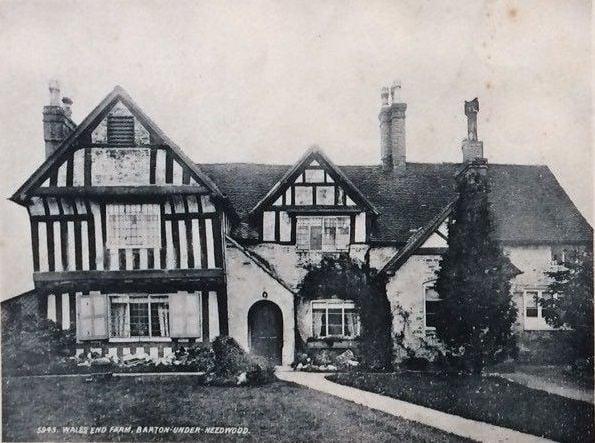
I found records for all of the Holland’s listed on the Barton under Needwood History group and added them to my ancestry tree. The earliest will I found was for Eunica Edwardes, then Eunica Holland, who died in 1632.
A page from the 1632 will and inventory of Eunica (Unice) Holland:
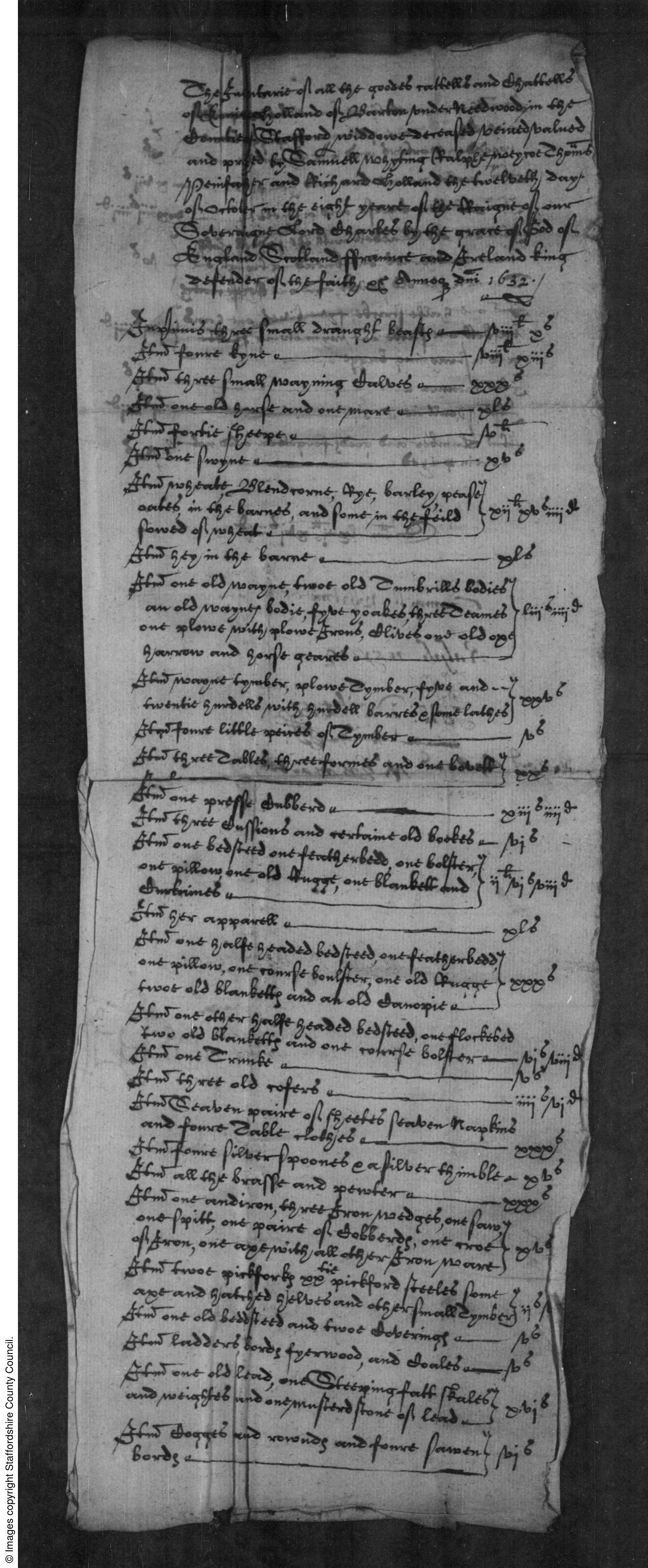
I’d been reading about “pedigree collapse” just before I found out her maiden name of Edwardes. Edwards is my own maiden name.
“In genealogy, pedigree collapse describes how reproduction between two individuals who knowingly or unknowingly share an ancestor causes the family tree of their offspring to be smaller than it would otherwise be.
Without pedigree collapse, a person’s ancestor tree is a binary tree, formed by the person, the parents, grandparents, and so on. However, the number of individuals in such a tree grows exponentially and will eventually become impossibly high. For example, a single individual alive today would, over 30 generations going back to the High Middle Ages, have roughly a billion ancestors, more than the total world population at the time. This apparent paradox occurs because the individuals in the binary tree are not distinct: instead, a single individual may occupy multiple places in the binary tree. This typically happens when the parents of an ancestor are cousins (sometimes unbeknownst to themselves). For example, the offspring of two first cousins has at most only six great-grandparents instead of the normal eight. This reduction in the number of ancestors is pedigree collapse. It collapses the binary tree into a directed acyclic graph with two different, directed paths starting from the ancestor who in the binary tree would occupy two places.” via wikipediaThere is nothing to suggest, however, that Eunica’s family were related to my fathers family, and the only evidence so far in my tree of pedigree collapse are the marriages of Orgill cousins, where two sets of grandparents are repeated.
A list of Holland ancestors:
Catherine Holland 1775-1861
her parents:
Thomas Holland 1737-1828 Hannah Hair 1739-1832
Thomas’s parents:
William Holland 1696-1756 Susannah Whiteing 1715-1752
William’s parents:
William Holland 1665- Elizabeth Higgs 1675-1720
William’s parents:
Thomas Holland 1634-1681 Katherine Owen 1634-1728
Thomas’s parents:
Thomas Holland 1606-1680 Margaret Belcher 1608-1664
Thomas’s parents:
Thomas Holland 1562-1626 Eunice Edwardes 1565- 1632June 6, 2022 at 9:17 am #6301In reply to: The Elusive Samuel Housley and Other Family Stories
The Warrens of Stapenhill
There were so many Warren’s in Stapenhill that it was complicated to work out who was who. I had gone back as far as Samuel Warren marrying Catherine Holland, and this was as far back as my cousin Ian Warren had gone in his research some decades ago as well. The Holland family from Barton under Needwood are particularly interesting, and will be a separate chapter.
Stapenhill village by John Harden:
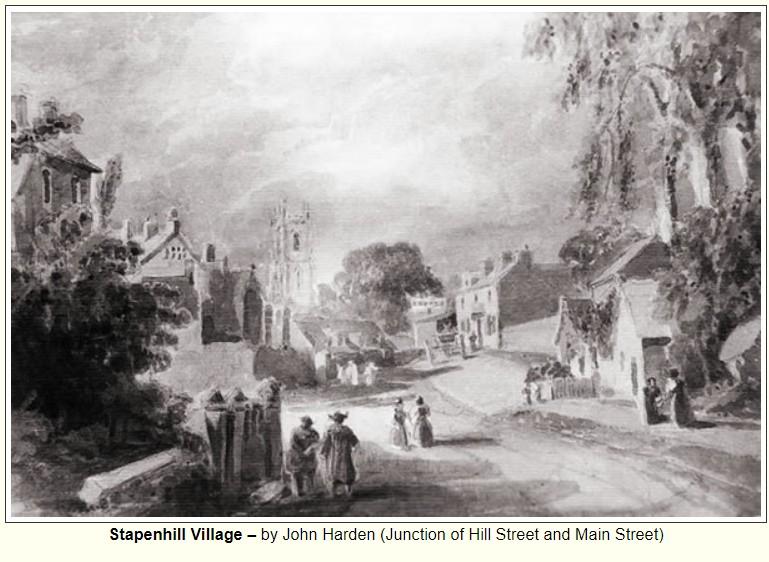
Resuming the research on the Warrens, Samuel Warren 1771-1837 married Catherine Holland 1775-1861 in 1795 and their son Samuel Warren 1800-1882 married Elizabeth Bridge, whose childless brother Benjamin Bridge left the Warren Brothers Boiler Works in Newhall to his nephews, the Warren brothers.
Samuel Warren and Catherine Holland marriage licence 1795:
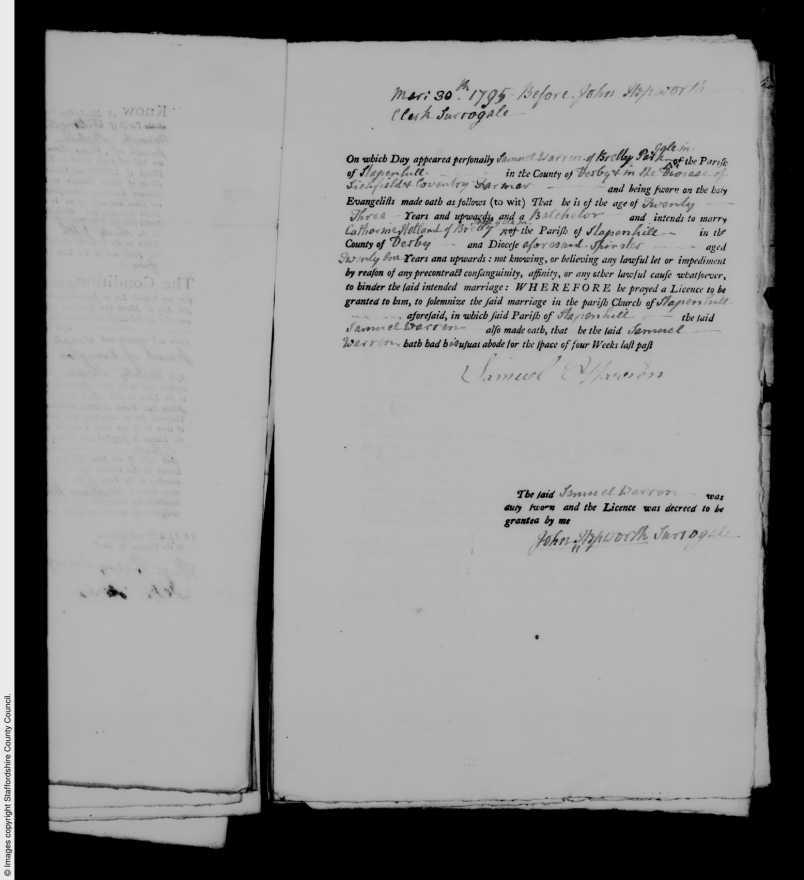
Samuel (born 1771) was baptised at Stapenhill St Peter and his parents were William and Anne Warren. There were at least three William and Ann Warrens in town at the time. One of those William’s was born in 1744, which would seem to be the right age to be Samuel’s father, and one was born in 1710, which seemed a little too old. Another William, Guiliamos Warren (Latin was often used in early parish registers) was baptised in Stapenhill in 1729.
Stapenhill St Peter:
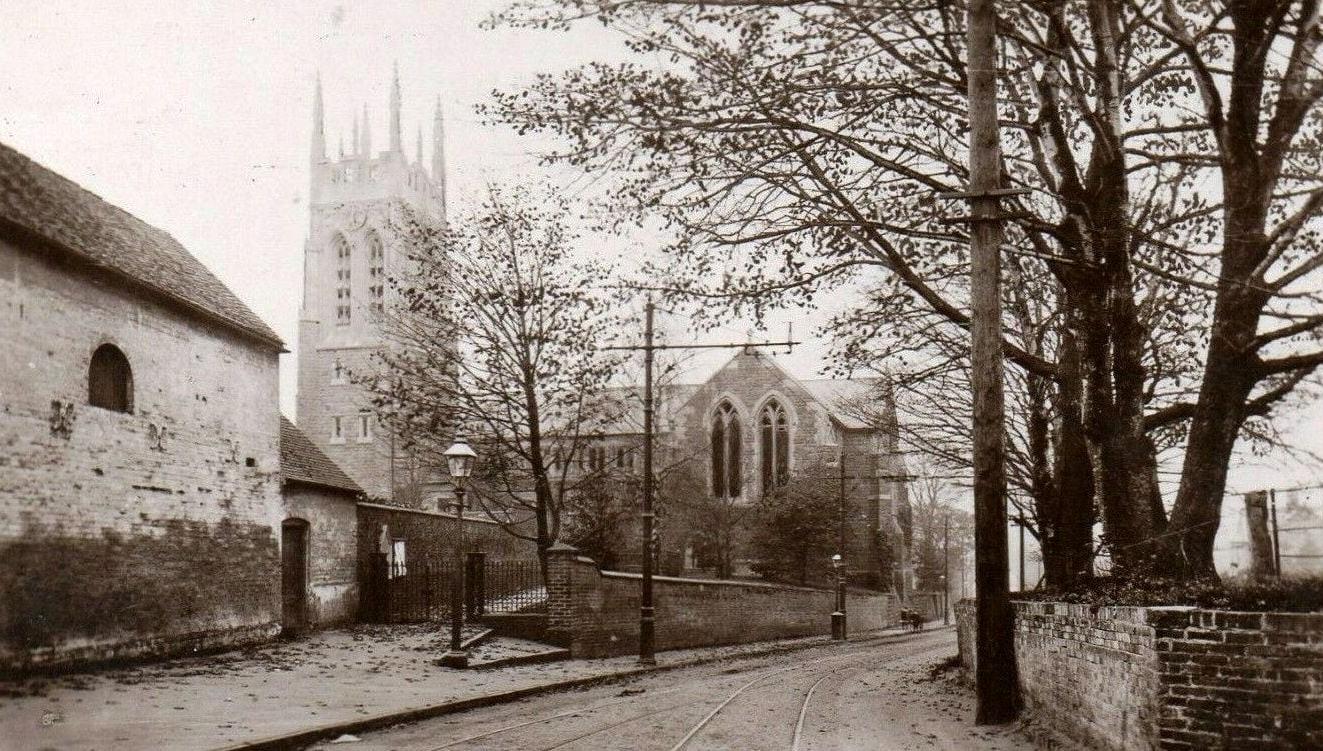
William Warren (born 1744) appeared to have been born several months before his parents wedding. William Warren and Ann Insley married 16 July 1744, but the baptism of William in 1744 was 24 February. This seemed unusual ~ children were often born less than nine months after a wedding, but not usually before the wedding! Then I remembered the change from the Julian calendar to the Gregorian calendar in 1752. Prior to 1752, the first day of the year was Lady Day, March 25th, not January 1st. This meant that the birth in February 1744 was actually after the wedding in July 1744. Now it made sense. The first son was named William, and he was born seven months after the wedding.
William born in 1744 died intestate in 1822, and his wife Ann made a legal claim to his estate. However he didn’t marry Ann Holland (Ann was Catherines Hollands sister, who married Samuel Warren the year before) until 1796, so this William and Ann were not the parents of Samuel.
It seemed likely that William born in 1744 was Samuels brother. William Warren and Ann Insley had at least eight children between 1744 and 1771, and it seems that Samuel was their last child, born when William the elder was 61 and his wife Ann was 47.
It seems it wasn’t unusual for the Warren men to marry rather late in life. William Warren’s (born 1710) parents were William Warren and Elizabeth Hatterton. On the marriage licence in 1702/1703 (it appears to say 1703 but is transcribed as 1702), William was a 40 year old bachelor from Stapenhill, which puts his date of birth at 1662. Elizabeth was considerably younger, aged 19.
William Warren and Elizabeth Hatterton marriage licence 1703:
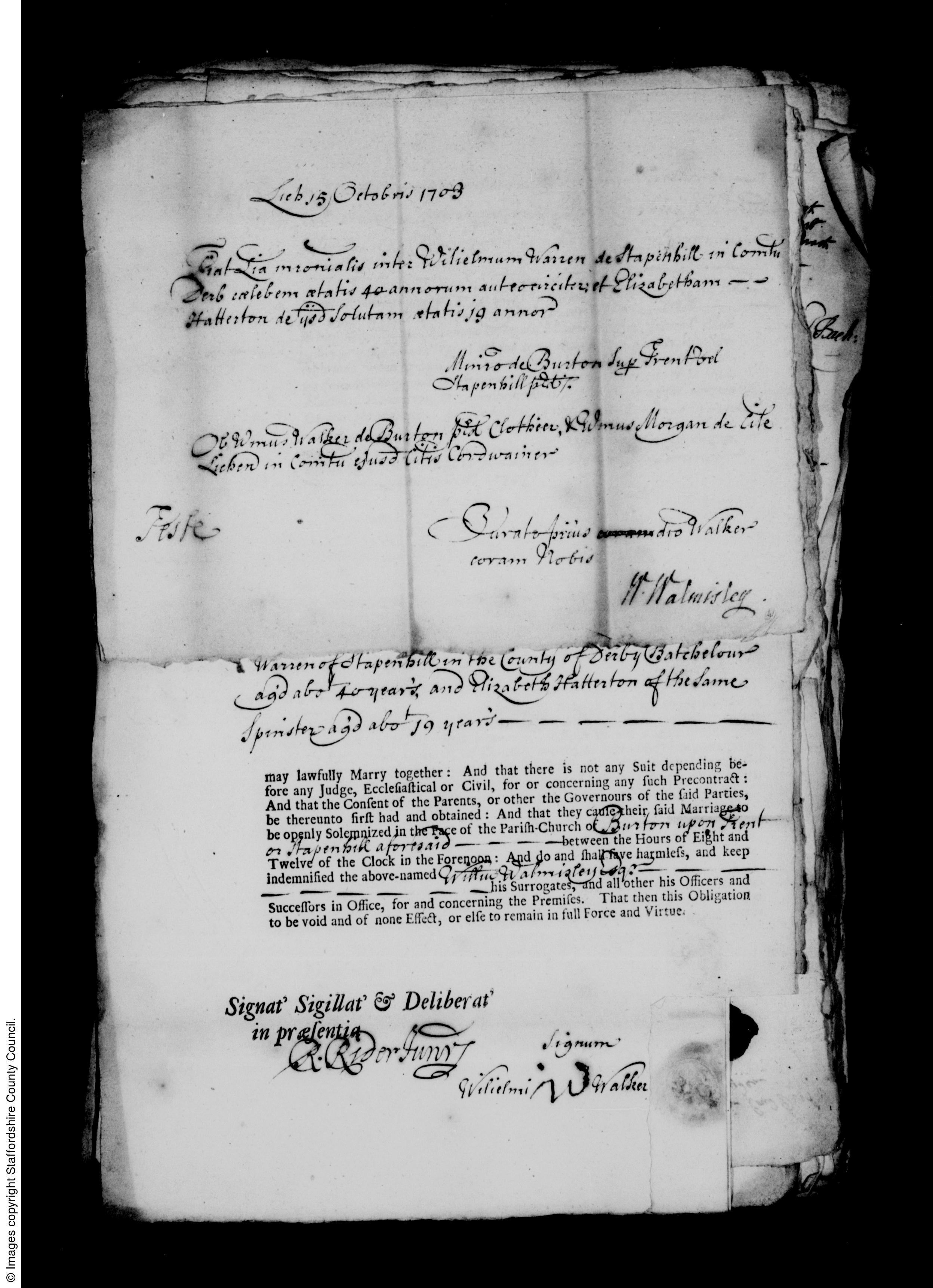
These Warren’s were farmers, and they were literate and able to sign their own names on various documents. This is worth noting, as most made the mark of an X.
I found three Warren and Holland marriages. One was Samuel Warren and Catherine Holland in 1795, then William Warren and Ann Holland in 1796. William Warren and Ann Hollands daughter born in 1799 married John Holland in 1824.
Elizabeth Hatterton (wife of William Warren who was born circa 1662) was born in Burton upon Trent in 1685. Her parents were Edward Hatterton 1655-1722, and Sara.
A page from the 1722 will of Edward Hatterton:
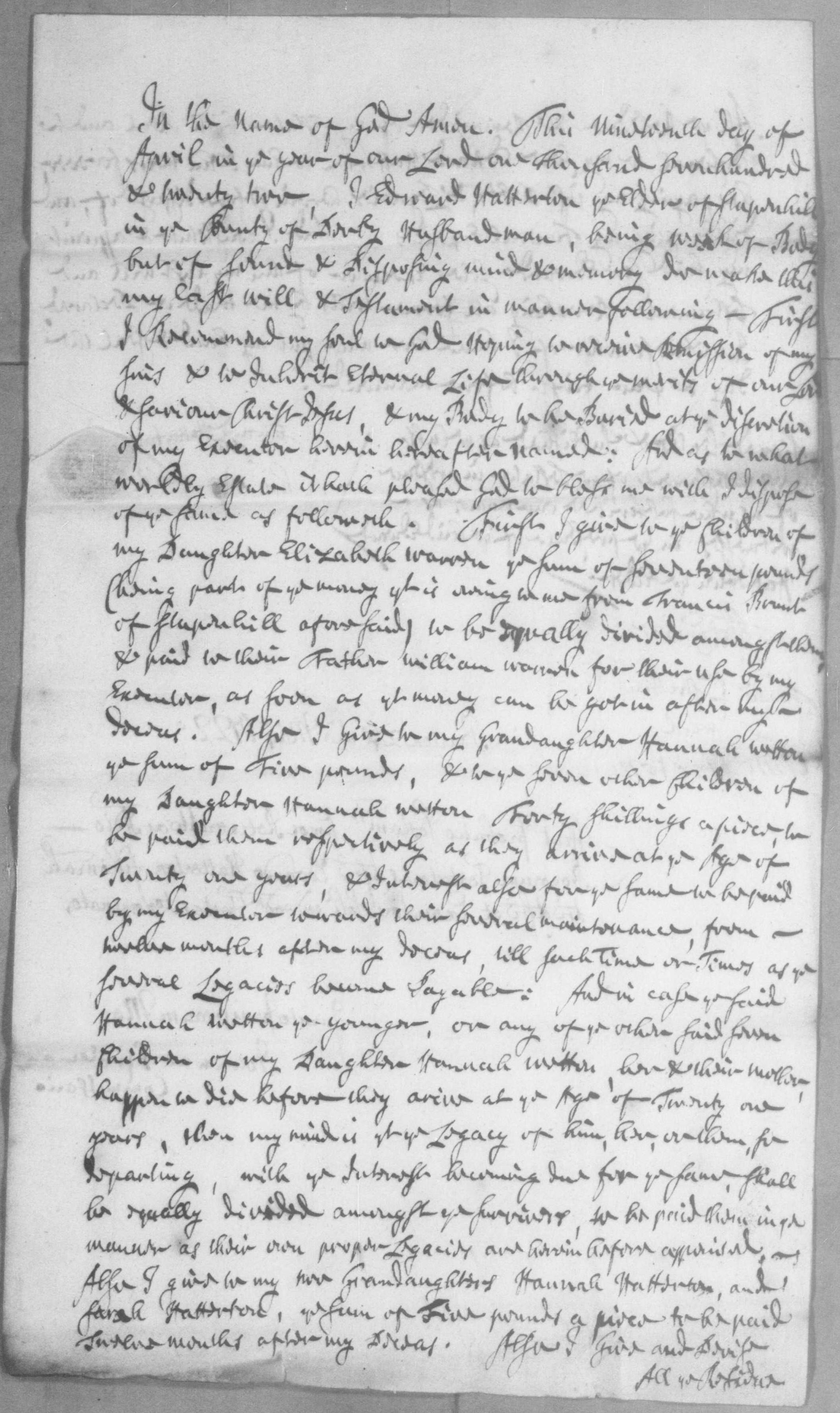
The earliest Warren I found records for was William Warren who married Elizabeth Hatterton in 1703. The marriage licence states his age as 40 and that he was from Stapenhill, but none of the Stapenhill parish records online go back as far as 1662. On other public trees on ancestry websites, a birth record from Suffolk has been chosen, probably because it was the only record to be found online with the right name and date. Once again, I don’t think that is correct, and perhaps one day I’ll find some earlier Stapenhill records to prove that he was born in locally.
Subsequently, I found a list of the 1662 Hearth Tax for Stapenhill. On it were a number of Warrens, three William Warrens including one who was a constable. One of those William Warrens had a son he named William (as they did, hence the number of William Warrens in the tree) the same year as this hearth tax list.
But was it the William Warren with 2 chimneys, the one with one chimney who was too poor to pay it, or the one who was a constable?
from the list:
Will. Warryn 2
Richard Warryn 1
William Warren Constable
These names are not payable by Act:
Will. Warryn 1
Richard Warren John Watson
over seers of the poore and churchwardensThe Hearth Tax:
via wiki:
In England, hearth tax, also known as hearth money, chimney tax, or chimney money, was a tax imposed by Parliament in 1662, to support the Royal Household of King Charles II. Following the Restoration of the monarchy in 1660, Parliament calculated that the Royal Household needed an annual income of £1,200,000. The hearth tax was a supplemental tax to make up the shortfall. It was considered easier to establish the number of hearths than the number of heads, hearths forming a more stationary subject for taxation than people. This form of taxation was new to England, but had precedents abroad. It generated considerable debate, but was supported by the economist Sir William Petty, and carried through the Commons by the influential West Country member Sir Courtenay Pole, 2nd Baronet (whose enemies nicknamed him “Sir Chimney Poll” as a result). The bill received Royal Assent on 19 May 1662, with the first payment due on 29 September 1662, Michaelmas.
One shilling was liable to be paid for every firehearth or stove, in all dwellings, houses, edifices or lodgings, and was payable at Michaelmas, 29 September and on Lady Day, 25 March. The tax thus amounted to two shillings per hearth or stove per year. The original bill contained a practical shortcoming in that it did not distinguish between owners and occupiers and was potentially a major burden on the poor as there were no exemptions. The bill was subsequently amended so that the tax was paid by the occupier. Further amendments introduced a range of exemptions that ensured that a substantial proportion of the poorer people did not have to pay the tax.Indeed it seems clear that William Warren the elder came from Stapenhill and not Suffolk, and one of the William Warrens paying hearth tax in 1662 was undoubtedly the father of William Warren who married Elizabeth Hatterton.
May 27, 2022 at 8:25 am #6300In reply to: The Elusive Samuel Housley and Other Family Stories
Looking for Carringtons
The Carringtons of Smalley, at least some of them, were Baptist ~ otherwise known as “non conformist”. Baptists don’t baptise at birth, believing it’s up to the person to choose when they are of an age to do so, although that appears to be fairly random in practice with small children being baptised. This makes it hard to find the birth dates registered as not every village had a Baptist church, and the baptisms would take place in another town. However some of the children were baptised in the village Anglican church as well, so they don’t seem to have been consistent. Perhaps at times a quick baptism locally for a sickly child was considered prudent, and preferable to no baptism at all. It’s impossible to know for sure and perhaps they were not strictly commited to a particular denomination.
Our Carrington’s start with Ellen Carrington who married William Housley in 1814. William Housley was previously married to Ellen’s older sister Mary Carrington. Ellen (born 1895 and baptised 1897) and her sister Nanny were baptised at nearby Ilkeston Baptist church but I haven’t found baptisms for Mary or siblings Richard and Francis. We know they were also children of William Carrington as he mentions them in his 1834 will. Son William was baptised at the local Smalley church in 1784, as was Thomas in 1896.
The absence of baptisms in Smalley with regard to Baptist influence was noted in the Smalley registers:
Smalley (chapelry of Morley) registers began in 1624, Morley registers began in 1540 with no obvious gaps in either. The gap with the missing registered baptisms would be 1786-1793. The Ilkeston Baptist register began in 1791. Information from the Smalley registers indicates that about a third of the children were not being baptised due to the Baptist influence.
William Housley son in law, daughter Mary Housley deceased, and daughter Eleanor (Ellen) Housley are all mentioned in William Housley’s 1834 will. On the marriage allegations and bonds for William Housley and Mary Carrington in 1806, her birth date is registered at 1787, her father William Carrington.
A Page from the will of William Carrington 1834:
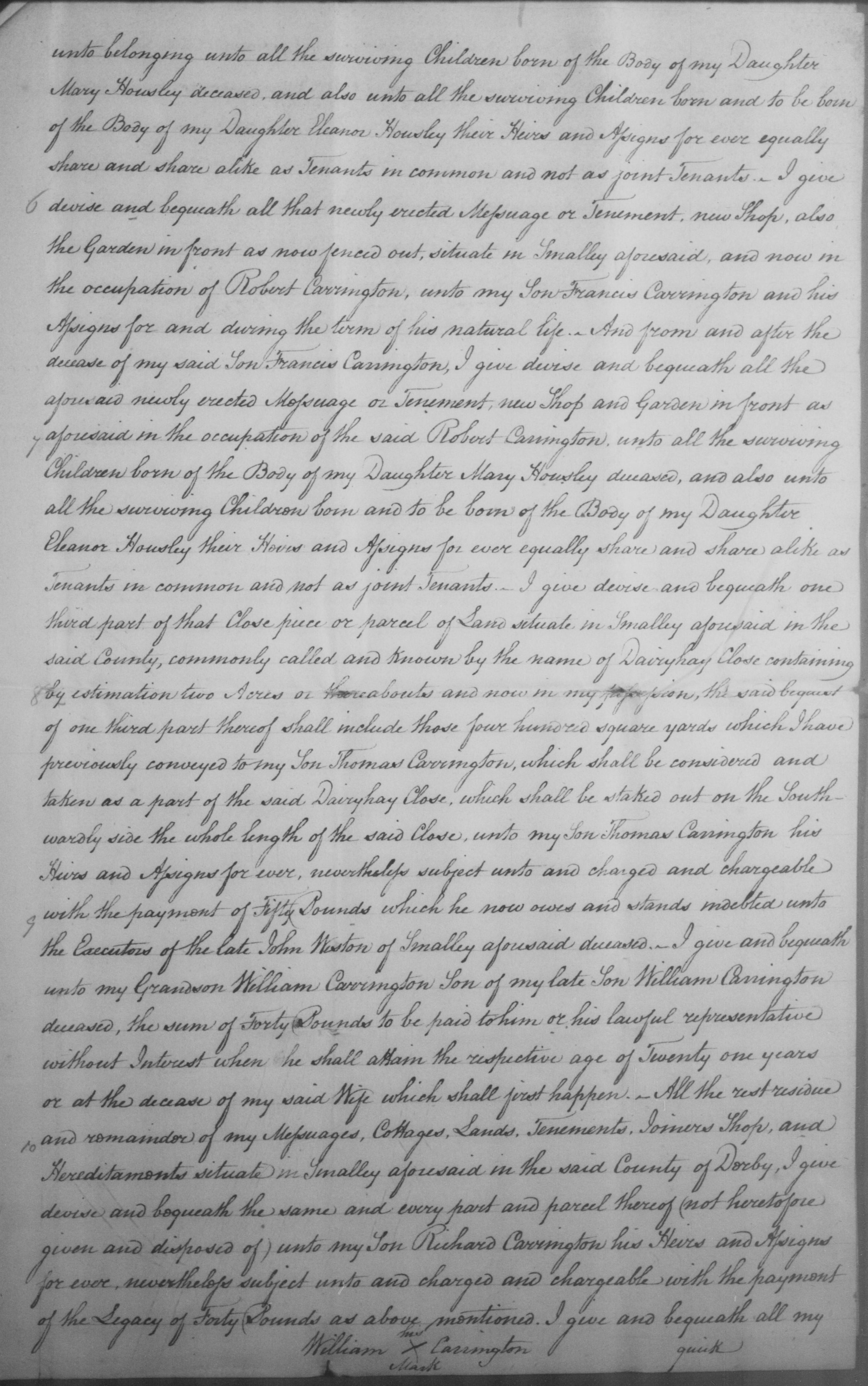
William Carrington was baptised in nearby Horsley Woodhouse on 27 August 1758. His parents were William and Margaret Carrington “near the Hilltop”. He married Mary Malkin, also of Smalley, on the 27th August 1783.
When I started looking for Margaret Wright who married William Carrington the elder, I chanced upon the Smalley parish register micro fiche images wrongly labeled by the ancestry site as Longford. I subsequently found that the Derby Records office published a list of all the wrongly labeled Derbyshire towns that the ancestry site knew about for ten years at least but has not corrected!
Margaret Wright was baptised in Smalley (mislabeled as Longford although the register images clearly say Smalley!) on the 2nd March 1728. Her parents were John and Margaret Wright.
But I couldn’t find a birth or baptism anywhere for William Carrington. I found four sources for William and Margaret’s marriage and none of them suggested that William wasn’t local. On other public trees on ancestry sites, William’s father was Joshua Carrington from Chinley. Indeed, when doing a search for William Carrington born circa 1720 to 1725, this was the only one in Derbyshire. But why would a teenager move to the other side of the county? It wasn’t uncommon to be apprenticed in neighbouring villages or towns, but Chinley didn’t seem right to me. It seemed to me that it had been selected on the other trees because it was the only easily found result for the search, and not because it was the right one.
I spent days reading every page of the microfiche images of the parish registers locally looking for Carringtons, any Carringtons at all in the area prior to 1720. Had there been none at all, then the possibility of William being the first Carrington in the area having moved there from elsewhere would have been more reasonable.
But there were many Carringtons in Heanor, a mile or so from Smalley, in the 1600s and early 1700s, although they were often spelled Carenton, sometimes Carrianton in the parish registers. The earliest Carrington I found in the area was Alice Carrington baptised in Ilkeston in 1602. It seemed obvious that William’s parents were local and not from Chinley.
The Heanor parish registers of the time were not very clearly written. The handwriting was bad and the spelling variable, depending I suppose on what the name sounded like to the person writing in the registers at the time as the majority of the people were probably illiterate. The registers are also in a generally poor condition.
I found a burial of a child called William on the 16th January 1721, whose father was William Carenton of “Losko” (Loscoe is a nearby village also part of Heanor at that time). This looked promising! If a child died, a later born child would be given the same name. This was very common: in a couple of cases I’ve found three deceased infants with the same first name until a fourth one named the same survived. It seemed very likely that a subsequent son would be named William and he would be the William Carrington born circa 1720 to 1725 that we were looking for.
Heanor parish registers: William son of William Carenton of Losko buried January 19th 1721:
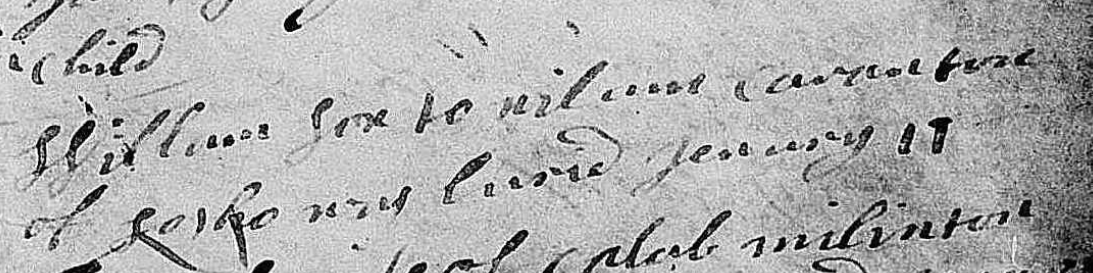
The Heanor parish registers between 1720 and 1729 are in many places illegible, however there are a couple of possibilities that could be the baptism of William in 1724 and 1725. A William son of William Carenton of Loscoe was buried in Jan 1721. In 1722 a Willian son of William Carenton (transcribed Tarenton) of Loscoe was buried. A subsequent son called William is likely. On 15 Oct 1724 a William son of William and Eliz (last name indecipherable) of Loscoe was baptised. A Mary, daughter of William Carrianton of Loscoe, was baptised in 1727.
I propose that William Carringtons was born in Loscoe and baptised in Heanor in 1724: if not 1724 then I would assume his baptism is one of the illegible or indecipherable entires within those few years. This falls short of absolute documented proof of course, but it makes sense to me.
In any case, if a William Carrington child died in Heanor in 1721 which we do have documented proof of, it further dismisses the case for William having arrived for no discernable reason from Chinley.
April 12, 2022 at 8:13 am #6290In reply to: The Elusive Samuel Housley and Other Family Stories
Leicestershire Blacksmiths
The Orgill’s of Measham led me further into Leicestershire as I traveled back in time.
I also realized I had uncovered a direct line of women and their mothers going back ten generations:
myself, Tracy Edwards 1957-
my mother Gillian Marshall 1933-
my grandmother Florence Warren 1906-1988
her mother and my great grandmother Florence Gretton 1881-1927
her mother Sarah Orgill 1840-1910
her mother Elizabeth Orgill 1803-1876
her mother Sarah Boss 1783-1847
her mother Elizabeth Page 1749-
her mother Mary Potter 1719-1780
and her mother and my 7x great grandmother Mary 1680-You could say it leads us to the very heart of England, as these Leicestershire villages are as far from the coast as it’s possible to be. There are countless other maternal lines to follow, of course, but only one of mothers of mothers, and ours takes us to Leicestershire.
The blacksmiths
Sarah Boss was the daughter of Michael Boss 1755-1807, a blacksmith in Measham, and Elizabeth Page of nearby Hartshorn, just over the county border in Derbyshire.
An earlier Michael Boss, a blacksmith of Measham, died in 1772, and in his will he left the possession of the blacksmiths shop and all the working tools and a third of the household furniture to Michael, who he named as his nephew. He left his house in Appleby Magna to his wife Grace, and five pounds to his mother Jane Boss. As none of Michael and Grace’s children are mentioned in the will, perhaps it can be assumed that they were childless.
The will of Michael Boss, 1772, Measham:
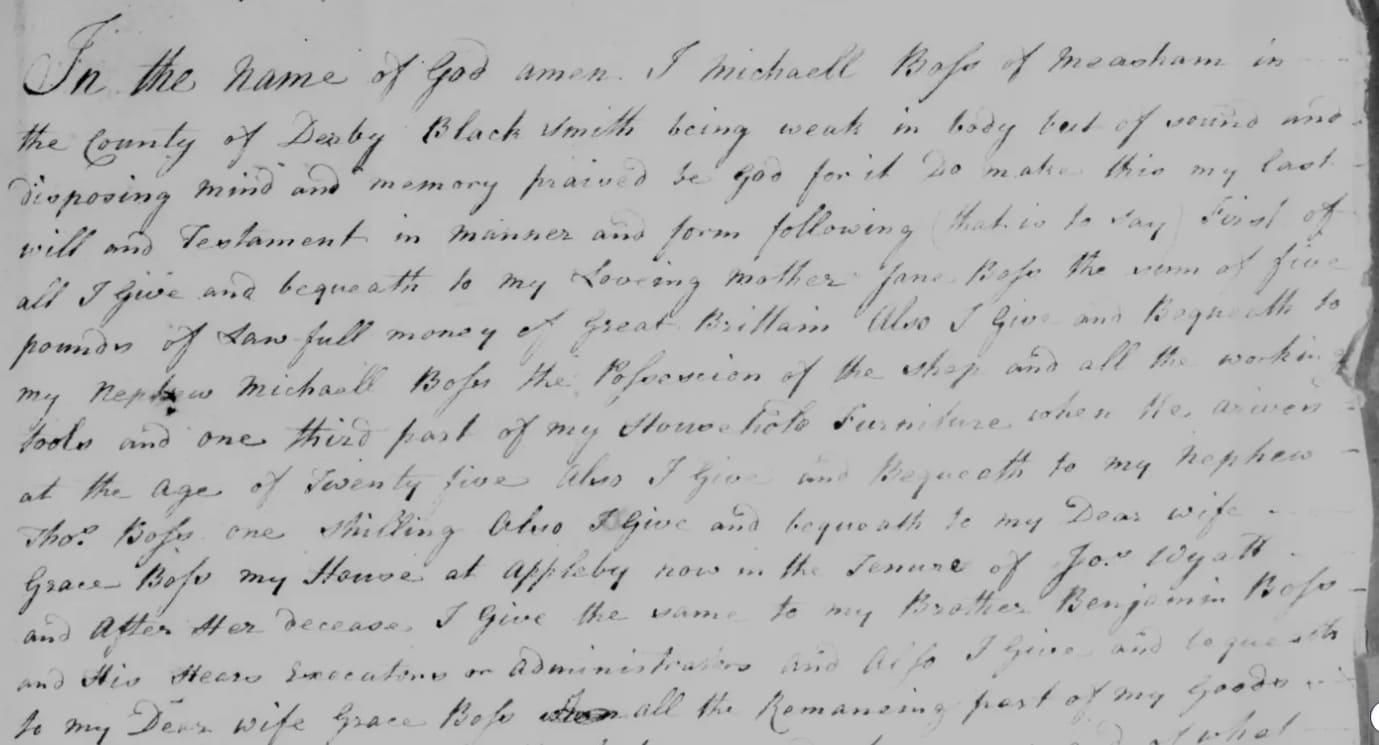
Michael Boss the uncle was born in Appleby Magna in 1724. His parents were Michael Boss of Nelson in the Thistles and Jane Peircivall of Appleby Magna, who were married in nearby Mancetter in 1720.
Information worth noting on the Appleby Magna website:
In 1752 the calendar in England was changed from the Julian Calendar to the Gregorian Calendar, as a result 11 days were famously “lost”. But for the recording of Church Registers another very significant change also took place, the start of the year was moved from March 25th to our more familiar January 1st.
Before 1752 the 1st day of each new year was March 25th, Lady Day (a significant date in the Christian calendar). The year number which we all now use for calculating ages didn’t change until March 25th. So, for example, the day after March 24th 1750 was March 25th 1751, and January 1743 followed December 1743.
This March to March recording can be seen very clearly in the Appleby Registers before 1752. Between 1752 and 1768 there appears slightly confused recording, so dates should be carefully checked. After 1768 the recording is more fully by the modern calendar year.Michael Boss the uncle married Grace Cuthbert. I haven’t yet found the birth or parents of Grace, but a blacksmith by the name of Edward Cuthbert is mentioned on an Appleby Magna history website:
An Eighteenth Century Blacksmith’s Shop in Little Appleby
by Alan RobertsCuthberts inventory
The inventory of Edward Cuthbert provides interesting information about the household possessions and living arrangements of an eighteenth century blacksmith. Edward Cuthbert (als. Cutboard) settled in Appleby after the Restoration to join the handful of blacksmiths already established in the parish, including the Wathews who were prominent horse traders. The blacksmiths may have all worked together in the same shop at one time. Edward and his wife Sarah recorded the baptisms of several of their children in the parish register. Somewhat sadly three of the boys named after their father all died either in infancy or as young children. Edward’s inventory which was drawn up in 1732, by which time he was probably a widower and his children had left home, suggests that they once occupied a comfortable two-storey house in Little Appleby with an attached workshop, well equipped with all the tools for repairing farm carts, ploughs and other implements, for shoeing horses and for general ironmongery.
Edward Cuthbert born circa 1660, married Joane Tuvenet in 1684 in Swepston cum Snarestone , and died in Appleby in 1732. Tuvenet is a French name and suggests a Huguenot connection, but this isn’t our family, and indeed this Edward Cuthbert is not likely to be Grace’s father anyway.
Michael Boss and Elizabeth Page appear to have married twice: once in 1776, and once in 1779. Both of the documents exist and appear correct. Both marriages were by licence. They both mention Michael is a blacksmith.
Their first daughter, Elizabeth, was baptized in February 1777, just nine months after the first wedding. It’s not known when she was born, however, and it’s possible that the marriage was a hasty one. But why marry again three years later?
But Michael Boss and Elizabeth Page did not marry twice.
Elizabeth Page from Smisby was born in 1752 and married Michael Boss on the 5th of May 1776 in Measham. On the marriage licence allegations and bonds, Michael is a bachelor.
Baby Elizabeth was baptised in Measham on the 9th February 1777. Mother Elizabeth died on the 18th February 1777, also in Measham.
In 1779 Michael Boss married another Elizabeth Page! She was born in 1749 in Hartshorn, and Michael is a widower on the marriage licence allegations and bonds.
Hartshorn and Smisby are neighbouring villages, hence the confusion. But a closer look at the documents available revealed the clues. Both Elizabeth Pages were literate, and indeed their signatures on the marriage registers are different:
Marriage of Michael Boss and Elizabeth Page of Smisby in 1776:
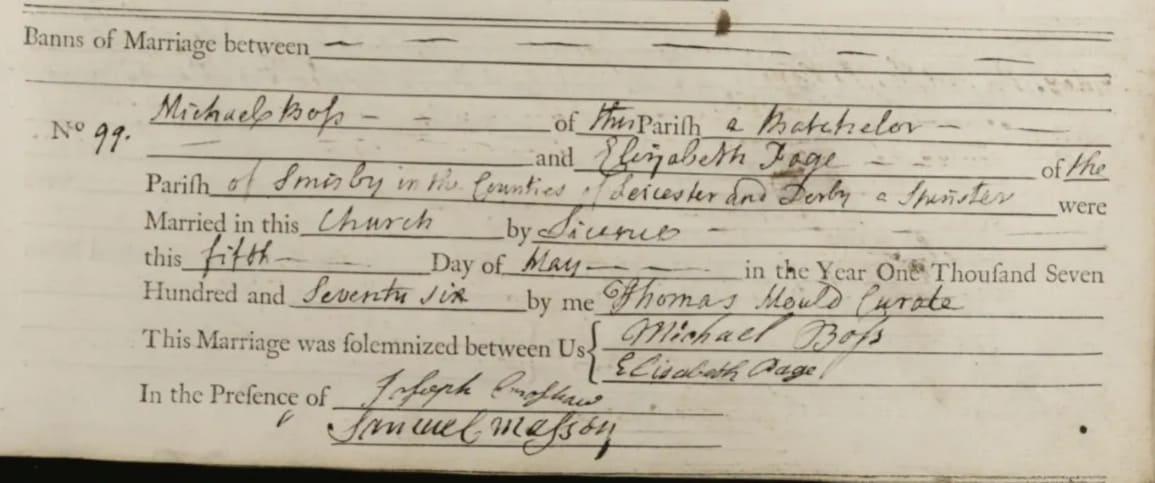
Marriage of Michael Boss and Elizabeth Page of Harsthorn in 1779:
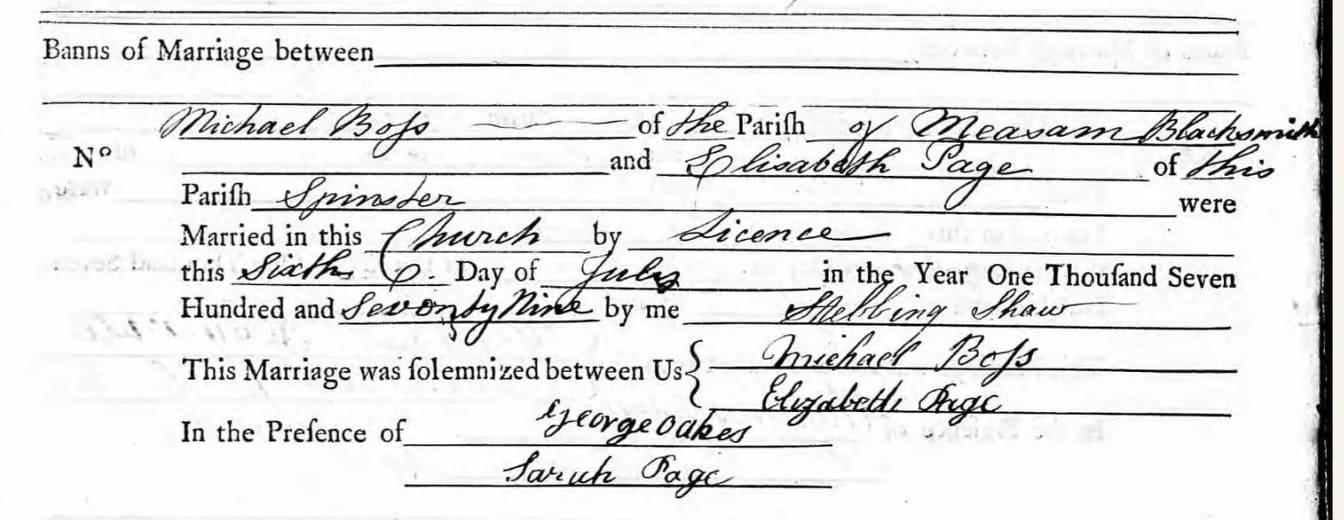
Not only did Michael Boss marry two women both called Elizabeth Page but he had an unusual start in life as well. His uncle Michael Boss left him the blacksmith business and a third of his furniture. This was all in the will. But which of Uncle Michaels brothers was nephew Michaels father?
The only Michael Boss born at the right time was in 1750 in Edingale, Staffordshire, about eight miles from Appleby Magna. His parents were Thomas Boss and Ann Parker, married in Edingale in 1747. Thomas died in August 1750, and his son Michael was baptised in the December, posthumus son of Thomas and his widow Ann. Both entries are on the same page of the register.
Ann Boss, the young widow, married again. But perhaps Michael and his brother went to live with their childless uncle and aunt, Michael Boss and Grace Cuthbert.
The great grandfather of Michael Boss (the Measham blacksmith born in 1850) was also Michael Boss, probably born in the 1660s. He died in Newton Regis in Warwickshire in 1724, four years after his son (also Michael Boss born 1693) married Jane Peircivall. The entry on the parish register states that Michael Boss was buried ye 13th Affadavit made.
I had not seen affadavit made on a parish register before, and this relates to the The Burying in Woollen Acts 1666–80. According to Wikipedia:
“Acts of the Parliament of England which required the dead, except plague victims and the destitute, to be buried in pure English woollen shrouds to the exclusion of any foreign textiles. It was a requirement that an affidavit be sworn in front of a Justice of the Peace (usually by a relative of the deceased), confirming burial in wool, with the punishment of a £5 fee for noncompliance. Burial entries in parish registers were marked with the word “affidavit” or its equivalent to confirm that affidavit had been sworn; it would be marked “naked” for those too poor to afford the woollen shroud. The legislation was in force until 1814, but was generally ignored after 1770.”
Michael Boss buried 1724 “Affadavit made”:
Elizabeth Page‘s father was William Page 1717-1783, a wheelwright in Hartshorn. (The father of the first wife Elizabeth was also William Page, but he was a husbandman in Smisby born in 1714. William Page, the father of the second wife, was born in Nailstone, Leicestershire, in 1717. His place of residence on his marriage to Mary Potter was spelled Nelson.)
Her mother was Mary Potter 1719- of nearby Coleorton. Mary’s father, Richard Potter 1677-1731, was a blacksmith in Coleorton.
A page of the will of Richard Potter 1731:
Richard Potter states: “I will and order that my son Thomas Potter shall after my decease have one shilling paid to him and no more.” As he left £50 to each of his daughters, one can’t help but wonder what Thomas did to displease his father.
Richard stipulated that his son Thomas should have one shilling paid to him and not more, for several good considerations, and left “the house and ground lying in the parish of Whittwick in a place called the Long Lane to my wife Mary Potter to dispose of as she shall think proper.”
His son Richard inherited the blacksmith business: “I will and order that my son Richard Potter shall live and be with his mother and serve her duly and truly in the business of a blacksmith, and obey and serve her in all lawful commands six years after my decease, and then I give to him and his heirs…. my house and grounds Coulson House in the Liberty of Thringstone”
Richard wanted his son John to be a blacksmith too: “I will and order that my wife bring up my son John Potter at home with her and teach or cause him to be taught the trade of a blacksmith and that he shall serve her duly and truly seven years after my decease after the manner of an apprentice and at the death of his mother I give him that house and shop and building and the ground belonging to it which I now dwell in to him and his heirs forever.”
To his daughters Margrett and Mary Potter, upon their reaching the age of one and twenty, or the day after their marriage, he leaves £50 each. All the rest of his goods are left to his loving wife Mary.
An inventory of the belongings of Richard Potter, 1731:
Richard Potters father was also named Richard Potter 1649-1719, and he too was a blacksmith.
Richard Potter of Coleorton in the county of Leicester, blacksmith, stated in his will: “I give to my son and daughter Thomas and Sarah Potter the possession of my house and grounds.”
He leaves ten pounds each to his daughters Jane and Alice, to his son Francis he gives five pounds, and five shillings to his son Richard. Sons Joseph and William also receive five shillings each. To his daughter Mary, wife of Edward Burton, and her daughter Elizabeth, he gives five shillings each. The rest of his good, chattels and wordly substance he leaves equally between his son and daugter Thomas and Sarah. As there is no mention of his wife, it’s assumed that she predeceased him.
The will of Richard Potter, 1719:
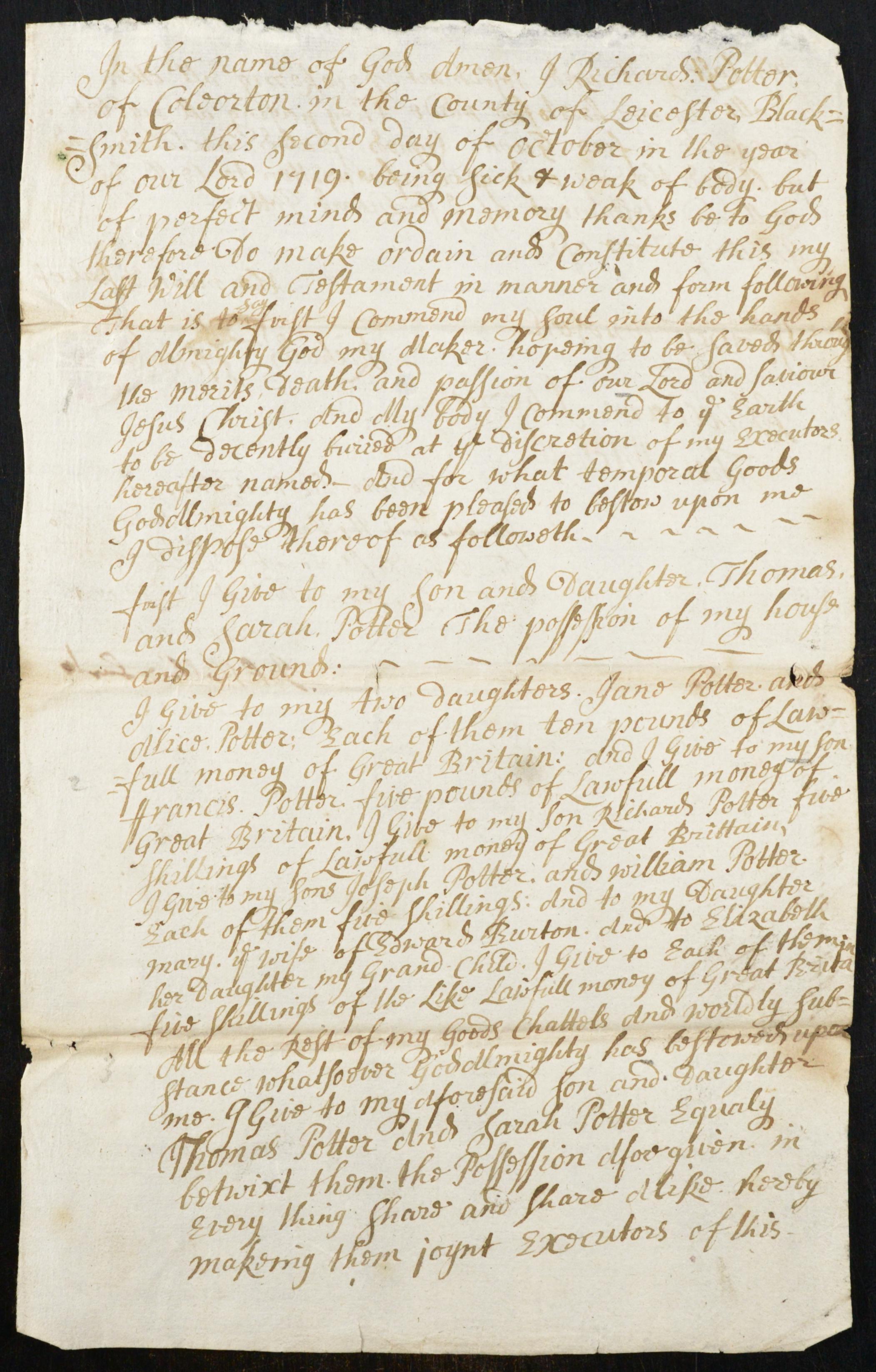
Richard Potter’s (1649-1719) parents were William Potter and Alse Huldin, both born in the early 1600s. They were married in 1646 at Breedon on the Hill, Leicestershire. The name Huldin appears to originate in Finland.
William Potter was a blacksmith. In the 1659 parish registers of Breedon on the Hill, William Potter of Breedon blacksmith buryed the 14th July.
April 2, 2022 at 6:15 pm #6286In reply to: The Elusive Samuel Housley and Other Family Stories
Matthew Orgill and His Family
Matthew Orgill 1828-1907 was the Orgill brother who went to Australia, but returned to Measham. Matthew married Mary Orgill in Measham in October 1856, having returned from Victoria, Australia in May of that year.
Although Matthew was the first Orgill brother to go to Australia, he was the last one I found, and that was somewhat by accident, while perusing “Orgill” and “Measham” in a newspaper archives search. I chanced on Matthew’s obituary in the Nuneaton Observer, Friday 14 June 1907:
LATE MATTHEW ORGILL PEACEFUL END TO A BLAMELESS LIFE.
‘Sunset and Evening Star And one clear call for me.”
It is with very deep regret that we have to announce the death of Mr. Matthew Orgill, late of Measham, who passed peacefully away at his residence in Manor Court Road, Nuneaton, in the early hours of yesterday morning. Mr. Orgill, who was in his eightieth year, was a man with a striking history, and was a very fine specimen of our best English manhood. In early life be emigrated to South Africa—sailing in the “Hebrides” on 4th February. 1850—and was one of the first settlers at the Cape; afterwards he went on to Australia at the time of the Gold Rush, and ultimately came home to his native England and settled down in Measham, in Leicestershire, where he carried on a successful business for the long period of half-a-century.
He was full of reminiscences of life in the Colonies in the early days, and an hour or two in his company was an education itself. On the occasion of the recall of Sir Harry Smith from the Governorship of Natal (for refusing to be a party to the slaying of the wives and children in connection with the Kaffir War), Mr. Orgill was appointed to superintend the arrangements for the farewell demonstration. It was one of his boasts that he made the first missionary cart used in South Africa, which is in use to this day—a monument to the character of his work; while it is an interesting fact to note that among Mr. Orgill’s papers there is the original ground-plan of the city of Durban before a single house was built.
In Africa Mr. Orgill came in contact with the great missionary, David Livingstone, and between the two men there was a striking resemblance in character and a deep and lasting friendship. Mr. Orgill could give a most graphic description of the wreck of the “Birkenhead,” having been in the vicinity at the time when the ill-fated vessel went down. He played a most prominent part on the occasion of the famous wreck of the emigrant ship, “Minerva.” when, in conjunction with some half-a-dozen others, and at the eminent risk of their own lives, they rescued more than 100 of the unfortunate passengers. He was afterwards presented with an interesting relic as a memento of that thrilling experience, being a copper bolt from the vessel on which was inscribed the following words: “Relic of the ship Minerva, wrecked off Bluff Point, Port Natal. 8.A.. about 2 a.m.. Friday, July 5, 1850.”
Mr. Orgill was followed to the Colonies by no fewer than six of his brothers, all of whom did well, and one of whom married a niece (brother’s daughter) of the late Mr. William Ewart Gladstone.
On settling down in Measham his kindly and considerate disposition soon won for him a unique place in the hearts of all the people, by whom he was greatly beloved. He was a man of sterling worth and integrity. Upright and honourable in all his dealings, he led a Christian life that was a pattern to all with whom he came in contact, and of him it could truly he said that he wore the white flower of a blameless life.
He was a member of the Baptist Church, and although beyond much active service since settling down in Nuneaton less than two years ago he leaves behind him a record in Christian service attained by few. In politics he was a Radical of the old school. A great reader, he studied all the questions of the day, and could back up every belief he held by sound and fearless argument. The South African – war was a great grief to him. He knew the Boers from personal experience, and although he suffered at the time of the war for his outspoken condemnation, he had the satisfaction of living to see the people of England fully recognising their awful blunder. To give anything like an adequate idea of Mr. Orgill’s history would take up a great amount of space, and besides much of it has been written and commented on before; suffice it to say that it was strenuous, interesting, and eventful, and yet all through his hands remained unspotted and his heart was pure.
He is survived by three daughters, and was father-in-law to Mr. J. S. Massey. St Kilda. Manor Court Road, to whom deep and loving sympathy is extended in their sore bereavement by a wide circle of friends. The funeral is arranged to leave for Measham on Monday at twelve noon.
“To give anything like an adequate idea of Mr. Orgill’s history would take up a great amount of space, and besides much of it has been written and commented on before…”
I had another look in the newspaper archives and found a number of articles mentioning him, including an intriguing excerpt in an article about local history published in the Burton Observer and Chronicle 8 August 1963:
on an upstairs window pane he scratched with his diamond ring “Matthew Orgill, 1st July, 1858”
I asked on a Measham facebook group if anyone knew the location of the house mentioned in the article and someone kindly responded. This is the same building, seen from either side:
Coincidentally, I had already found this wonderful photograph of the same building, taken in 1910 ~ three years after Matthew’s death.
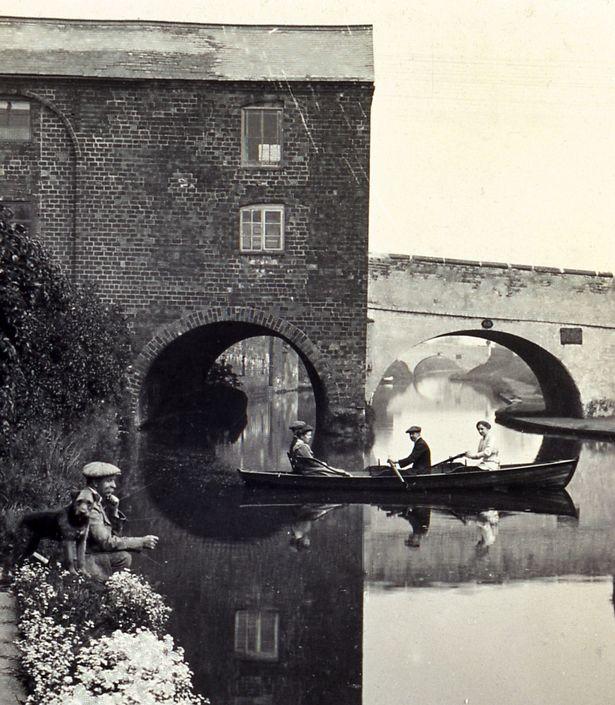
But what to make of the inscription in the window?
Matthew and Mary married in October 1856, and their first child (according to the records I’d found thus far) was a daughter Mary born in 1860. I had a look for a Matthew Orgill birth registered in 1858, the date Matthew had etched on the window, and found a death for a Matthew Orgill in 1859. Assuming I would find the birth of Matthew Orgill registered on the first of July 1958, to match the etching in the window, the corresponding birth was in July 1857!
Matthew and Mary had four children. Matthew, Mary, Clara and Hannah. Hannah Proudman Orgill married Joseph Stanton Massey. The Orgill name continues with their son Stanley Orgill Massey 1900-1979, who was a doctor and surgeon. Two of Stanley’s four sons were doctors, Paul Mackintosh Orgill Massey 1929-2009, and Michael Joseph Orgill Massey 1932-1989.
Mary Orgill 1827-1894, Matthews wife, was an Orgill too.
And this is where the Orgill branch of the tree gets complicated.
Mary’s father was Henry Orgill born in 1805 and her mother was Hannah Proudman born in 1805.
Henry Orgill’s father was Matthew Orgill born in 1769 and his mother was Frances Finch born in 1771.Mary’s husband Matthews parents are Matthew Orgill born in 1798 and Elizabeth Orgill born in 1803.
Another Orgill Orgill marriage!
Matthews parents, Matthew and Elizabeth, have the same grandparents as each other, Matthew Orgill born in 1736 and Ann Proudman born in 1735.
But Matthews grandparents are none other than Matthew Orgill born in 1769 and Frances Finch born in 1771 ~ the same grandparents as his wife Mary!
March 21, 2022 at 7:05 am #6284In reply to: The Elusive Samuel Housley and Other Family Stories
To Australia
Grettons
Charles Herbert Gretton 1876-1954
Charles Gretton, my great grandmothers youngest brother, arrived in Sydney Australia on 12 February 1912, having set sail on 5 January 1912 from London. His occupation on the passenger list was stockman, and he was traveling alone. Later that year, in October, his wife and two sons sailed out to join him.
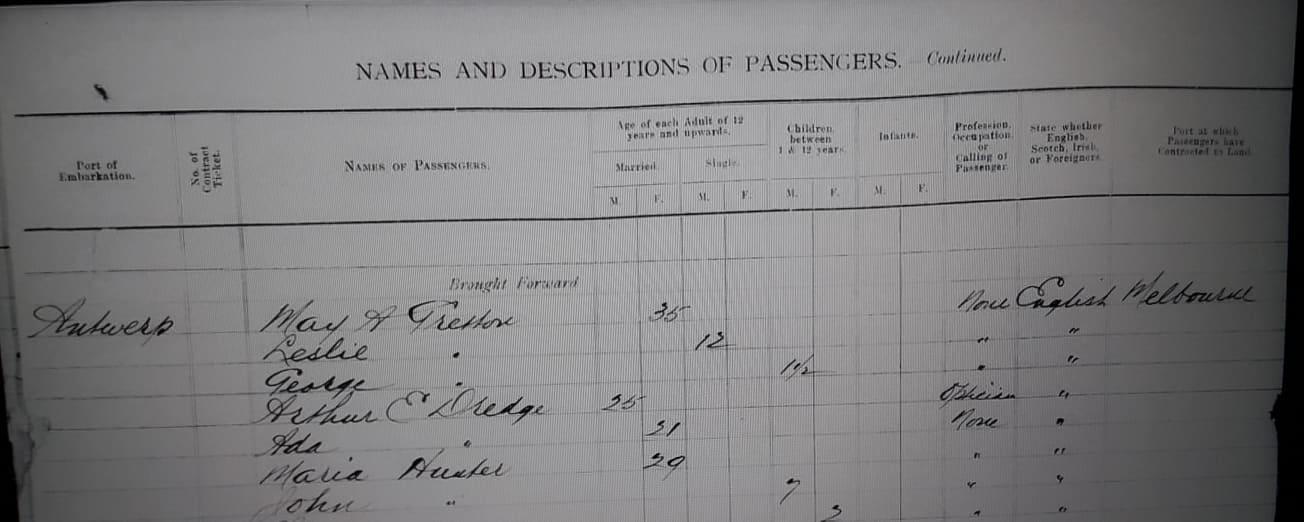
Charles was born in Swadlincote. He married Mary Anne Illsley, a local girl from nearby Church Gresley, in 1898. Their first son, Leslie Charles Bloemfontein Gretton, was born in 1900 in Church Gresley, and their second son, George Herbert Gretton, was born in 1910 in Swadlincote. In 1901 Charles was a colliery worker, and on the 1911 census, his occupation was a sanitary ware packer.
Charles and Mary Anne had two more sons, both born in Footscray: Frank Orgill Gretton in 1914, and Arthur Ernest Gretton in 1920.
On the Australian 1914 electoral rolls, Charles and Mary Ann were living at 72 Moreland Street, Footscray, and in 1919 at 134 Cowper Street, Footscray, and Charles was a labourer. In 1924, Charles was a sub foreman, living at 3, Ryan Street E, Footscray, Australia. On a later electoral register, Charles was a foreman. Footscray is a suburb of Melbourne, and developed into an industrial zone in the second half of the nineteenth century.
Charles died in Victoria in 1954 at the age of 77. His wife Mary Ann died in 1958.
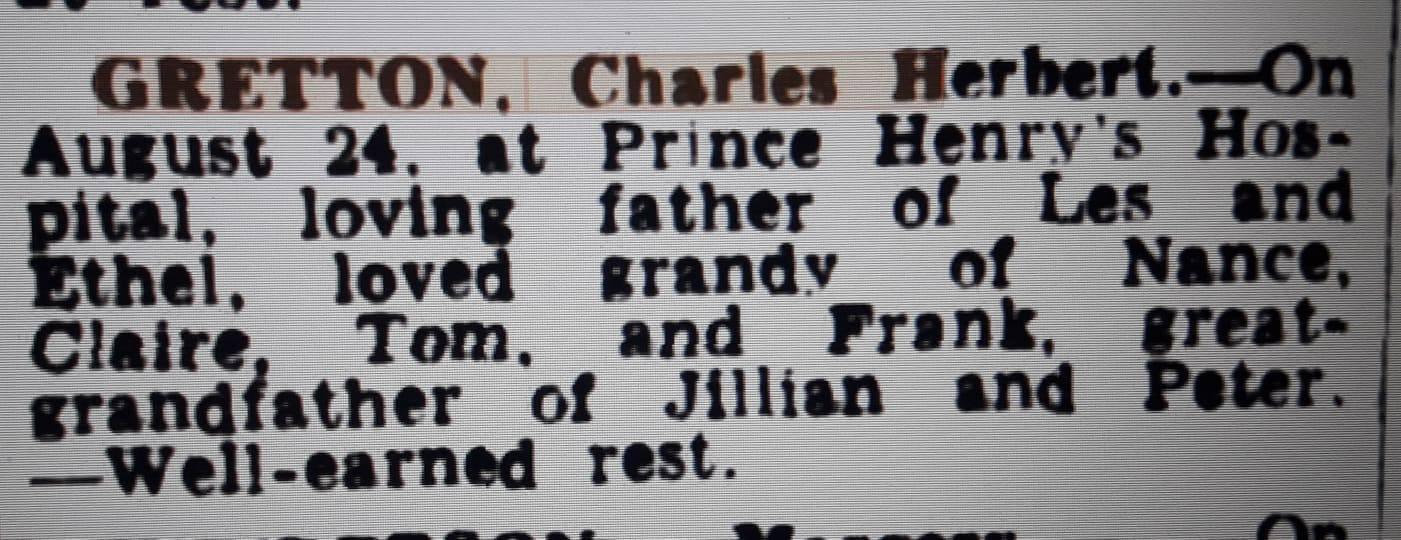
Charles and Mary Ann Gretton:
Leslie Charles Bloemfontein Gretton 1900-1955
Leslie was an electrician. He married Ethel Christine Halliday, born in 1900 in Footscray, in 1927. They had four children: Tom, Claire, Nancy and Frank. By 1943 they were living in Yallourn. Yallourn, Victoria was a company town in Victoria, Australia built between the 1920s and 1950s to house employees of the State Electricity Commission of Victoria, who operated the nearby Yallourn Power Station complex. However, expansion of the adjacent open-cut brown coal mine led to the closure and removal of the town in the 1980s.
On the 1954 electoral registers, daughter Claire Elizabeth Gretton, occupation teacher, was living at the same address as Leslie and Ethel.
Leslie died in Yallourn in 1955, and Ethel nine years later in 1964, also in Yallourn.
George Herbert Gretton 1910-1970
George married Florence May Hall in 1934 in Victoria, Australia. In 1942 George was listed on the electoral roll as a grocer, likewise in 1949. In 1963 his occupation was a process worker, and in 1968 in Flinders, a horticultural advisor.
George died in Lang Lang, not far from Melbourne, in 1970.
Frank Orgill Gretton 1914-
Arthur Ernest Gretton 1920-
Orgills
John Orgill 1835-1911
John Orgill was Charles Herbert Gretton’s uncle. He emigrated to Australia in 1865, and married Elizabeth Mary Gladstone 1845-1926 in Victoria in 1870. Their first child was born in December that year, in Dandenong. They had seven children, and their three sons all have the middle name Gladstone.
John Orgill was a councillor for the Shire of Dandenong in 1873, and between 1876 and 1879.
John Orgill:
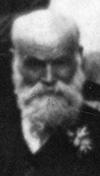
John Orgill obituary in the South Bourke and Mornington Journal, 21 December 1911:
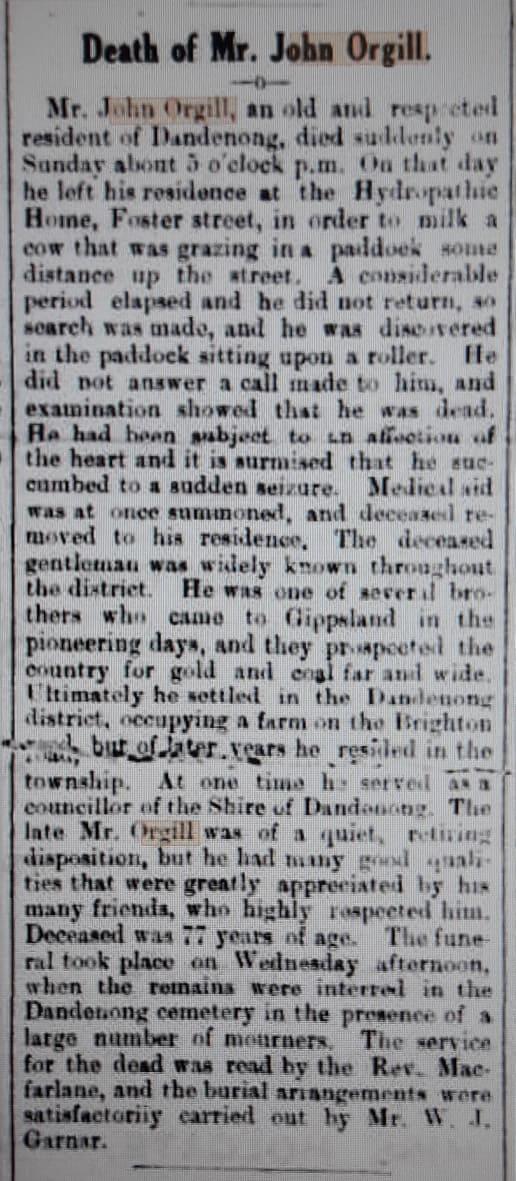
John’s wife Elizabeth Orgill, a teacher and a “a public spirited lady” according to newspaper articles, opened a hydropathic hospital in Dandenong called Gladstone House.
Elizabeth Gladstone Orgill:
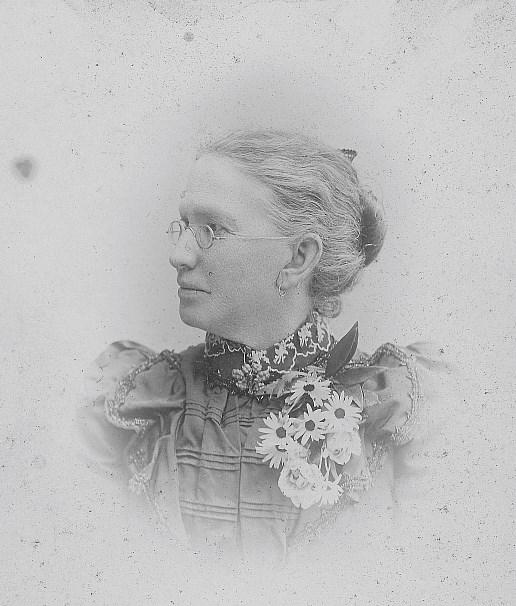
On the Old Dandenong website:
Gladstone House hydropathic hospital on the corner of Langhorne and Foster streets (153 Foster Street) Dandenong opened in 1896, working on the theory of water therapy, no medicine or operations. Her husband passed away in 1911 at 77, around similar time Dr Barclay Thompson obtained control of the practice. Mrs Orgill remaining on in some capacity.
Elizabeth Mary Orgill (nee Gladstone) operated Gladstone House until at least 1911, along with another hydropathic hospital (Birthwood) on Cheltenham road. She was the daughter of William Gladstone (Nephew of William Ewart Gladstone, UK prime minister in 1874).
Around 1912 Dr A. E. Taylor took over the location from Dr. Barclay Thompson. Mrs Orgill was still working here but no longer controlled the practice, having given it up to Barclay. Taylor served as medical officer for the Shire for before his death in 1939. After Taylor’s death Dr. T. C. Reeves bought his practice in 1939, later that year being appointed medical officer,
Gladstone Road in Dandenong is named after her family, who owned and occupied a farming paddock in the area on former Police Paddock ground, the Police reserve having earlier been reduced back to Stud Road.
Hydropathy (now known as Hydrotherapy) and also called water cure, is a part of medicine and alternative medicine, in particular of naturopathy, occupational therapy and physiotherapy, that involves the use of water for pain relief and treatment.
Gladstone House, Dandenong:
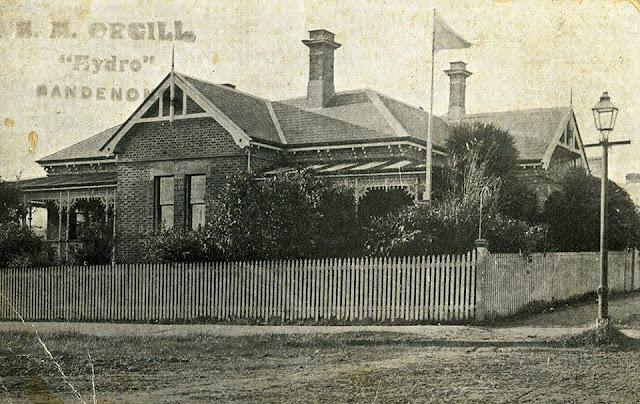
John’s brother Robert Orgill 1830-1915 also emigrated to Australia. I met (online) his great great grand daughter Lidya Orgill via the Old Dandenong facebook group.
John’s other brother Thomas Orgill 1833-1908 also emigrated to the same part of Australia.
Thomas Orgill:
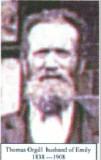
One of Thomas Orgills sons was George Albert Orgill 1880-1949:
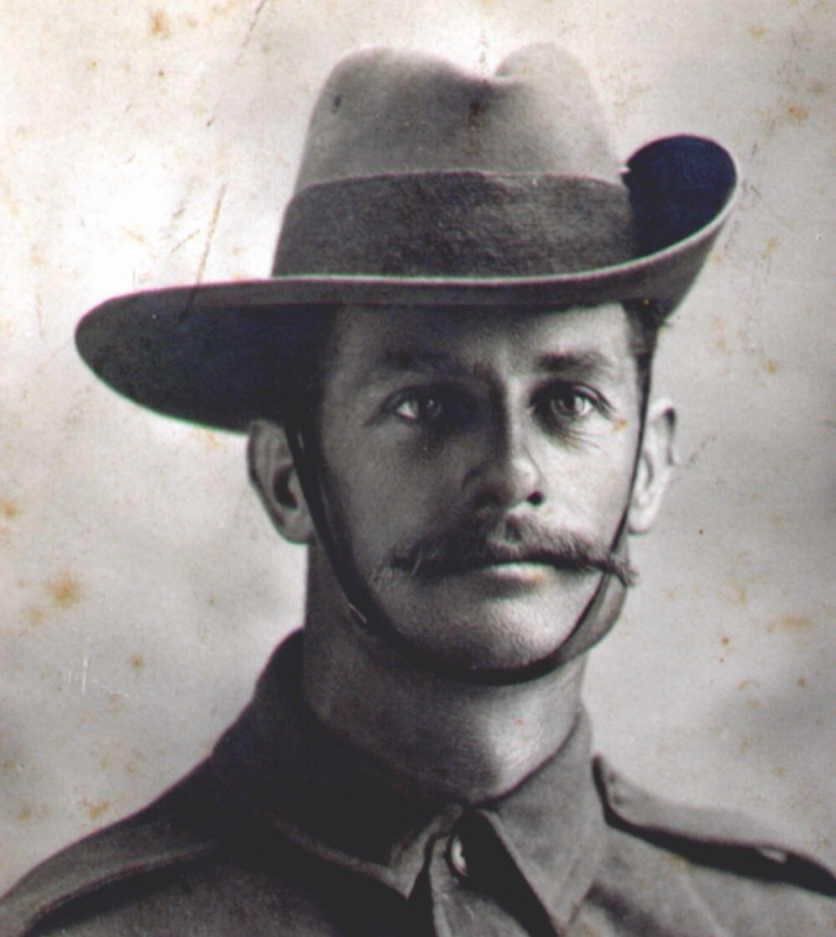
A letter was published in The South Bourke & Mornington Journal (Richmond, Victoria, Australia) on 17 Jun 1915, to Tom Orgill, Emerald Hill (South Melbourne) from hospital by his brother George Albert Orgill (4th Pioneers) describing landing of Covering Party prior to dawn invasion of Gallipoli:
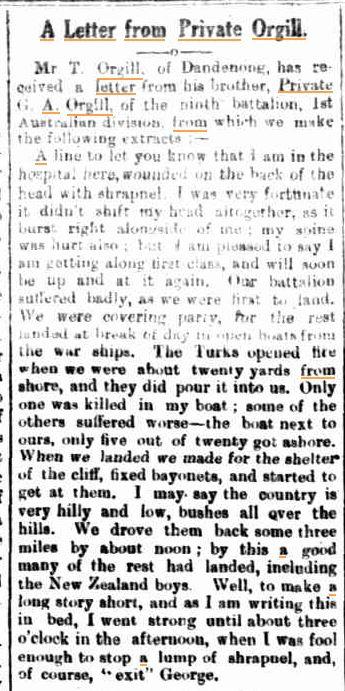
Another brother Henry Orgill 1837-1916 was born in Measham and died in Dandenong, Australia. Henry was a bricklayer living in Measham on the 1861 census. Also living with his widowed mother Elizabeth at that address was his sister Sarah and her husband Richard Gretton, the baker (my great great grandparents). In October of that year he sailed to Melbourne. His occupation was bricklayer on his death records in 1916.
Two of Henry’s sons, Arthur Garfield Orgill born 1888 and Ernest Alfred Orgill born 1880 were killed in action in 1917 and buried in Nord-Pas-de-Calais, France. Another son, Frederick Stanley Orgill, died in 1897 at the age of seven.
A fifth brother, William Orgill 1842- sailed from Liverpool to Melbourne in 1861, at 19 years of age. Four years later in 1865 he sailed from Victoria, Australia to New Zealand.
I assumed I had found all of the Orgill brothers who went to Australia, and resumed research on the Orgills in Measham, in England. A search in the British Newspaper Archives for Orgills in Measham revealed yet another Orgill brother who had gone to Australia.
Matthew Orgill 1828-1907 went to South Africa and to Australia, but returned to Measham.
The Orgill brothers had two sisters. One was my great great great grandmother Sarah, and the other was Hannah. Hannah married Francis Hart in Measham. One of her sons, John Orgill Hart 1862-1909, was born in Measham. On the 1881 census he was a 19 year old carpenters apprentice. Two years later in 1883 he was listed as a joiner on the passenger list of the ship Illawarra, bound for Australia. His occupation at the time of his death in Dandenong in 1909 was contractor.
An additional coincidental note about Dandenong: my step daughter Emily’s Australian partner is from Dandenong.
Housleys
Charles Housley 1823-1856
Charles Housley emigrated to Australia in 1851, the same year that his brother George emigrated to USA. Charles is mentioned in the Narrative on the Letters by Barbara Housley, and appears in the Housley Letters chapters.
Rushbys
George “Mike” Rushby 1933-
Mike moved to Australia from South Africa. His story is a separate chapter.
March 4, 2022 at 2:58 pm #6280In reply to: The Whale’s Diaries Collection
I started reading a book. In fact I started reading it three weeks ago, and have read the first page of the preface every night and fallen asleep. But my neck aches from doing too much gardening so I went back to bed to read this morning. I still fell asleep six times but at least I finished the preface. It’s the story of the family , initiated by the family collection of netsuke (whatever that is. Tiny Japanese carvings) But this is what stopped me reading and made me think (and then fall asleep each time I re read it)
“And I’m not entitled to nostalgia about all that lost wealth and glamour from a century ago. And I am not interested in thin. I want to know what the relationship has been between this wooden object that I am rolling between my fingers – hard and tricky and Japanese – and where it has been. I want to be able to reach to the handle of the door and turn it and feel it open. I want to walk into each room where this object has lived, to feel the volume of the space, to know what pictures were on the walls, how the light fell from the windows. And I want to know whose hands it has been in, and what they felt about it and thought about it – if they thought about it. I want to know what it has witnessed.” ― Edmund de Waal, The Hare With Amber Eyes: A Family’s Century of Art and Loss
And I felt almost bereft that none of the records tell me which way the light fell in through the windows.
I know who lived in the house in which years, but I don’t know who sat in the sun streaming through the window and which painting upon the wall they looked at and what the material was that covered the chair they sat on.
Were his clothes confortable (or hers, likely not), did he have an old favourite pair of trousers that his mother hated?
There is one house in particular that I keep coming back to. Like I got on the Housley train at Smalley and I can’t get off. Kidsley Grange Farm, they turned it into a nursing home and built extensions, and now it’s for sale for five hundred thousand pounds. But is the ghost still under the back stairs? Is there still a stain somewhere when a carafe of port was dropped?
Did Anns writing desk survive? Does someone have that, polished, with a vase of spring tulips on it? (on a mat of course so it doesn’t make a ring, despite that there are layers of beeswaxed rings already)
Does the desk remember the letters, the weight of a forearm or elbow, perhaps a smeared teardrop, or a comsumptive cough stain?
Is there perhaps a folded bit of paper or card that propped an uneven leg that fell through the floorboards that might tear into little squares if you found it and opened it, and would it be a rough draft of a letter never sent, or just a receipt for five head of cattle the summer before?
Did he hate the curtain material, or not even think of it? Did he love the house, or want to get away to see something new ~ or both?
Did he have a favourite cup, a favourite food, did he hate liver or cabbage?
Did he like his image when the photograph came from the studio or did he think it made his nose look big or his hair too thin, or did he wish he’d worn his other waistcoat?
Did he love his wife so much he couldn’t bear to see her dying, was it neglect or was it the unbearableness of it all that made him go away and drink?
Did the sun slanting in through the dormer window of his tiny attic room where he lodged remind him of ~ well no perhaps he was never in the room in daylight hours at all. Work all day and pub all night, keeping busy working hard and drinking hard and perhaps laughing hard, and maybe he only thought of it all on Sunday mornings.
So many deaths, one after another, his father, his wife, his brother, his sister, and another and another, all the coughing, all the debility. Perhaps he never understood why he lived and they did not, what kind of justice was there in that?
Did he take a souvenir or two with him, a handkerchief or a shawl perhaps, tucked away at the bottom of a battered leather bag that had his 3 shirts and 2 waistcoats in and a spare cap,something embroidered perhaps.
The quote in that book started me off with the light coming in the window and the need to know the simplest things, something nobody ever wrote in a letter, maybe never even mentioned to anyone.
Light coming in windows. I remeber when I was a teenager I had a day off sick and spent the whole day laying on the couch in a big window with the winter sun on my face all day, and I read Bonjour Tristesse in one sitting, and I’ll never forget that afternoon. I don’t remember much about that book, but I remember being transported. But at the same time as being present in that sunny window.
“Stories and objects share something, a patina…Perhaps patina is a process of rubbing back so that the essential is revealed…But it also seems additive, in the way that a piece of oak furniture gains over years and years of polishing.”
“How objects are handed on is all about story-telling. I am giving you this because I love you. Or because it was given to me. Because I bought it somewhere special. Because you will care for it. Because it will complicate your life. Because it will make someone else envious. There is no easy story in legacy. What is remembered and what is forgotten? There can be a chain of forgetting, the rubbing away of previous ownership as much as the slow accretion of stories. What is being passed on to me with all these small Japanese objects?”
“There are things in this world that the children hear, but whose sounds oscillate below an adult’s sense of pitch.”
What did the children hear?
February 9, 2022 at 7:00 pm #6276In reply to: The Elusive Samuel Housley and Other Family Stories
Ellastone and Mayfield
Malkins and Woodwards
Parish RegistersJane Woodward
It’s exciting, as well as enormously frustrating, to see so many Woodward’s in the Ellastone parish registers, and even more so because they go back so far. There are parish registers surviving from the 1500’s: in one, dated 1579, the death of Thomas Woodward was recorded. His father’s name was Humfrey.Jane Woodward married Rowland Malkin in 1751, in Thorpe, Ashbourne. Jane was from Mathfield (also known as Mayfield), Ellastone, on the Staffordshire side of the river Dove. Rowland was from Clifton, Ashbourne, on the Derbyshire side of the river. They were neighbouring villages, but in different counties.
Jane Woodward was born in 1726 according to the marriage transcription. No record of the baptism can be found for her, despite there having been at least four other Woodward couples in Ellastone and Mayfield baptizing babies in the 1720’s and 1730’s. Without finding out the baptism with her parents names on the parish register, it’s impossible to know which is the correct line to follow back to the earlier records.
I found a Mayfield history group on Facebook and asked if there were parish records existing that were not yet online. A member responded that she had a set on microfiche and had looked through the relevant years and didn’t see a Jane Woodward, but she did say that some of the pages were illegible.
The Ellasone parish records from the 1500s surviving at all, considering the events in 1673, is remarkable. To be so close, but for one indecipherable page from the 1700s, to tracing the family back to the 1500s! The search for the connecting link to the earlier records continues.
Some key events in the history of parish registers from familysearch:
In medieval times there were no parish registers. For some years before the Reformation, monastic houses (especially the smaller ones) the parish priest had been developing the custom of noting in an album or on the margins of the service books, the births and deaths of the leading local families.
1538 – Through the efforts of Thomas Cromwell a mandate was issued by Henry VIII to keep parish registers. This order that every parson, vicar or curate was to enter in a book every wedding, christening and burial in his parish. The parish was to provide a sure coffer with two locks, the parson having the custody of one key, the wardens the others. The entries were to be made each Sunday after the service in the presence of one of the wardens.
1642-60 – During the Civil War registers were neglected and Bishop Transcripts were not required.
1650 – In the restoration of Charles they went back to the church to keep christenings, marriages and burial. The civil records that were kept were filed in with the parish in their registers. it is quite usual to find entries explaining the situation during the Interregnum. One rector stated that on 23 April 1643 “Our church was defaced our font thrown down and new forms of prayer appointed”. Another minister not quite so bold wrote “When the war, more than a civil war was raging most grimly between royalists and parliamentarians throughout the greatest part of England, I lived well because I lay low”.
1653 – Cromwell, whose army had defeated the Royalists, was made Lord Protector and acted as king. He was a Puritan. The parish church of England was disorganized, many ministers fled for their lives, some were able to hide their registers and other registers were destroyed. Cromwell ruled that there would be no one religion in England all religions could be practiced. The government took away from the ministers not only the custody of the registers, but even the solemnization of the marriage ceremony. The marriage ceremony was entrusted to the justices to form a new Parish Register (not Registrar) elected by all the ratepayers in a parish, and sworn before and approved by a magistrate.. Parish clerks of the church were made a civil parish clerk and they recorded deaths, births and marriages in the civil parishes.Ellastone:
“Ellastone features as ‘Hayslope’ in George Eliot’s Adam Bede, published in 1859. It earned this recognition because the author’s father spent the early part of his life in the village working as a carpenter.”
Adam Bede Cottage, Ellastone:
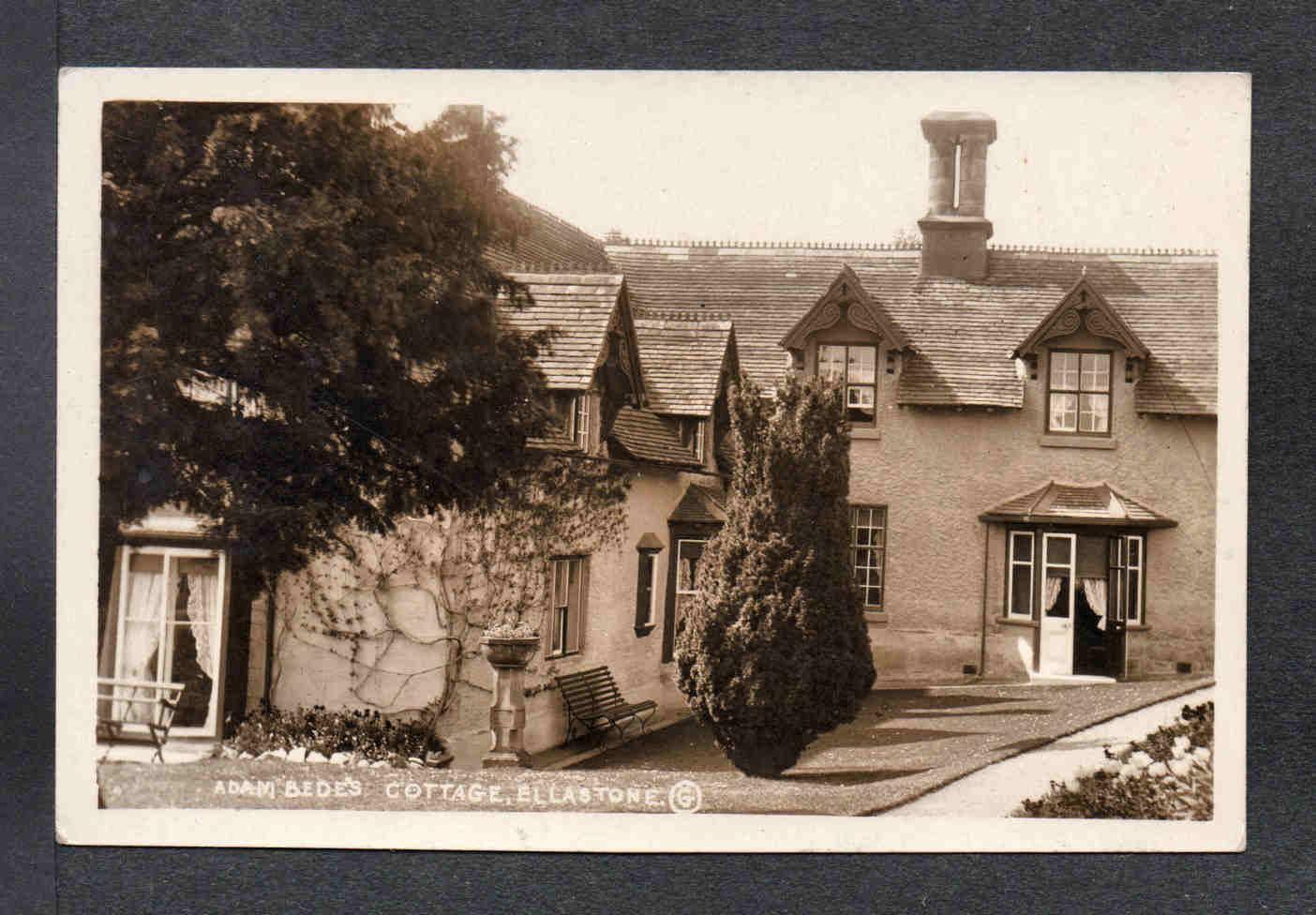
“It was at Ellastone that Robert Evans, George Eliot’s father, passed his early years and worked as a carpenter with his brother Samuel; and it was partly from reminiscences of her father’s talk and from her uncle Samuel’s wife’s preaching experiences that the author constructed the very powerful and moving story of Adam Bede.”
Mary Malkin
1765-1838
Ellen Carrington’s mother was Mary Malkin.
Ellastone:
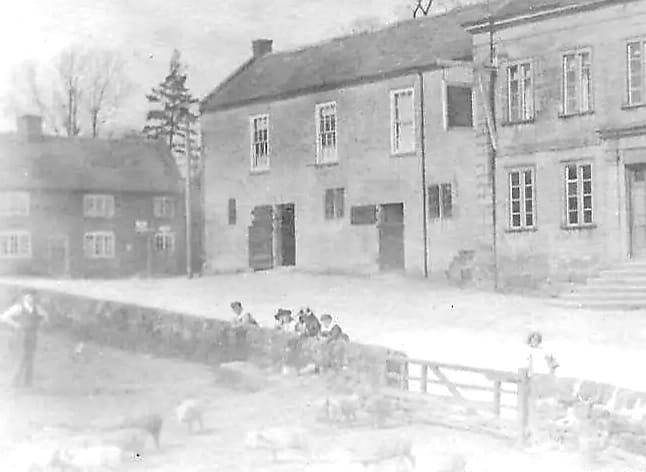
Ashbourn the 31st day of May in the year of our Lord 1751. The marriage of Rowland Malkin and Jane Woodward:
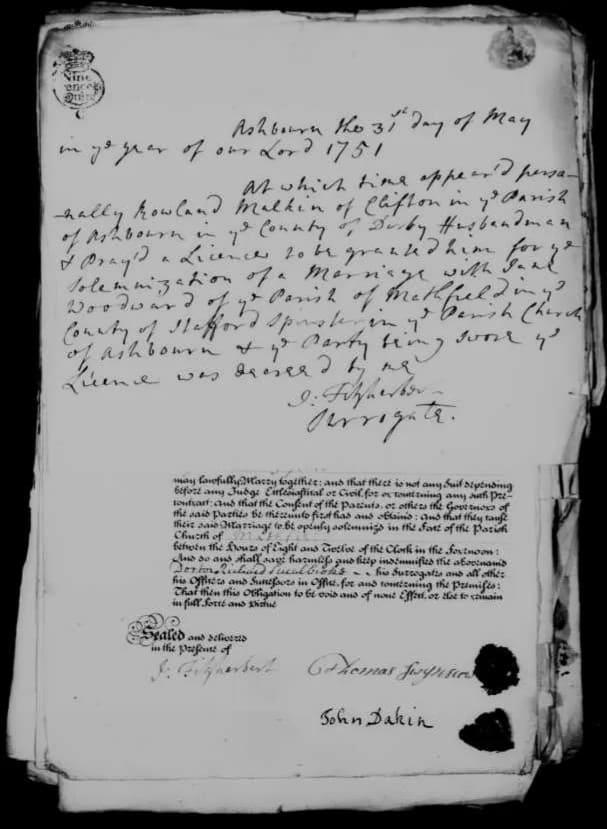 February 8, 2022 at 2:24 pm #6275
In reply to: The Elusive Samuel Housley and Other Family Stories
“AND NOW ABOUT EMMA”
and a mystery about George
I had overlooked this interesting part of Barbara Housley’s “Narrative on the Letters” initially, perhaps because I was more focused on finding Samuel Housley. But when I did eventually notice, I wondered how I had missed it! In this particularly interesting letter excerpt from Joseph, Barbara has not put the date of the letter ~ unusually, because she did with all of the others. However I dated the letter to later than 1867, because Joseph mentions his wife, and they married in 1867. This is important, because there are two Emma Housleys. Joseph had a sister Emma, born in 1836, two years before Joseph was born. At first glance, one would assume that a reference to Emma in the letters would mean his sister, but Emma the sister was married in Derby in 1858, and by 1869 had four children.
But there was another Emma Housley, born in 1851.
From Barbara Housley’s Narrative on the Letters:
“AND NOW ABOUT EMMA”
A MYSTERY
A very mysterious comment is contained in a letter from Joseph:
“And now about Emma. I have only seen her once and she came to me to get your address but I did not feel at liberty to give it to her until I had wrote to you but however she got it from someone. I think it was in this way. I was so pleased to hear from you in the first place and with John’s family coming to see me I let them read one or two of your letters thinking they would like to hear of you and I expect it was Will that noticed your address and gave it to her. She came up to our house one day when I was at work to know if I had heard from you but I had not heard from you since I saw her myself and then she called again after that and my wife showed her your boys’ portraits thinking no harm in doing so.”
At this point Joseph interrupted himself to thank them for sending the portraits. The next sentence is:
“Your son JOHN I have never seen to know him but I hear he is rather wild,” followed by: “EMMA has been living out service but don’t know where she is now.”
Since Joseph had just been talking about the portraits of George’s three sons, one of whom is John Eley, this could be a reference to things George has written in despair about a teen age son–but could Emma be a first wife and John their son? Or could Emma and John both be the children of a first wife?
Elsewhere, Joseph wrote, “AMY ELEY died 14 years ago. (circa 1858) She left a son and a daughter.”
An Amey Eley and a George Housley were married on April 1, 1849 in Duffield which is about as far west of Smalley as Heanor is East. She was the daughter of John, a framework knitter, and Sarah Eley. George’s father is listed as William, a farmer. Amey was described as “of full age” and made her mark on the marriage document.
Anne wrote in August 1854: “JOHN ELEY is living at Derby Station so must take the first opportunity to get the receipt.” Was John Eley Housley named for him?
(John Eley Housley is George Housley’s son in USA, with his second wife, Sarah.)
George Housley married Amey Eley in 1849 in Duffield. George’s father on the register is William Housley, farmer. Amey Eley’s father is John Eley, framework knitter.
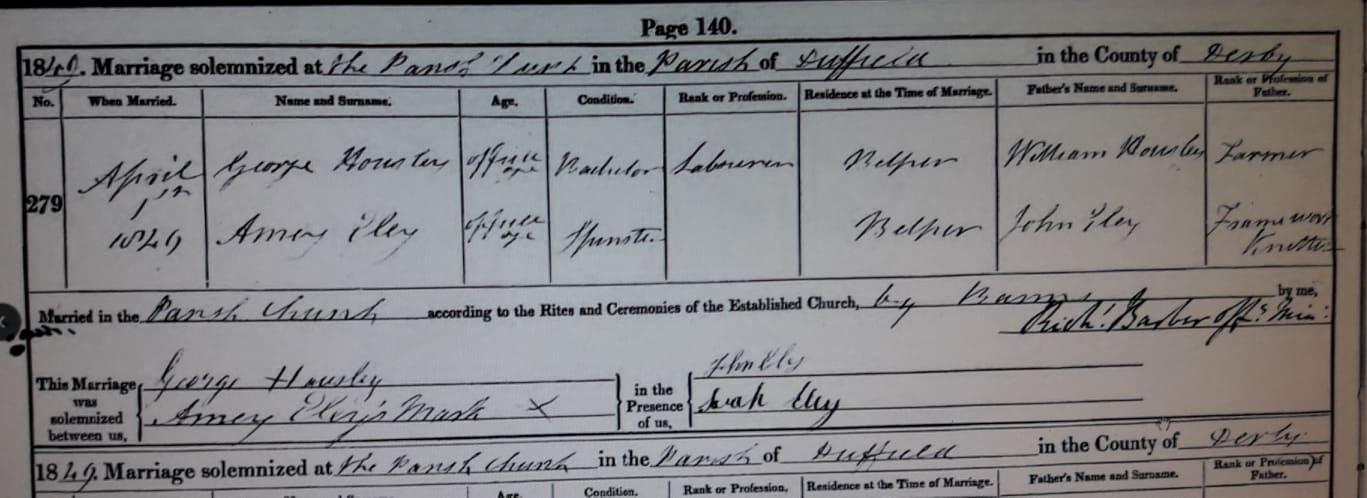
On the 1851 census, George Housley and his wife Amey Housley are living with her parents in Heanor, John Eley, a framework knitter, and his wife Rebecca. Also on the census are Charles J Housley, born in 1849 in Heanor, and Emma Housley, three months old at the time of the census, born in 1851. George’s birth place is listed as Smalley.
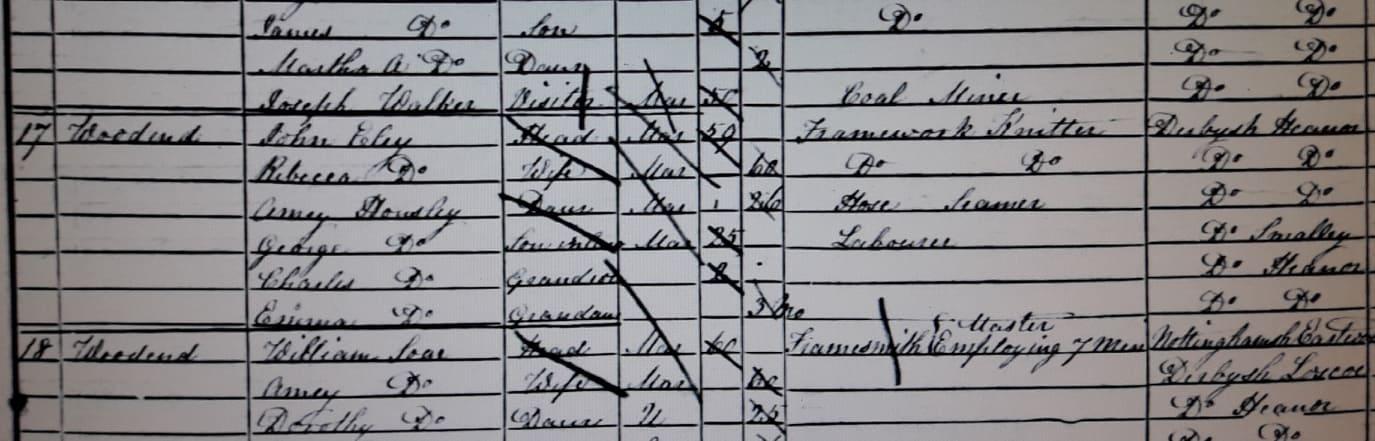
On the 31st of July 1851 George Housley arrives in New York. In 1854 George Housley marries Sarah Ann Hill in USA.
On the 1861 census in Heanor, Rebecca Eley was a widow, her husband John having died in 1852, and she had three grandchildren living with her: Charles J Housley aged 12, Emma Housley, 10, and mysteriously a William Housley aged 5! Amey Housley, the childrens mother, died in 1858.
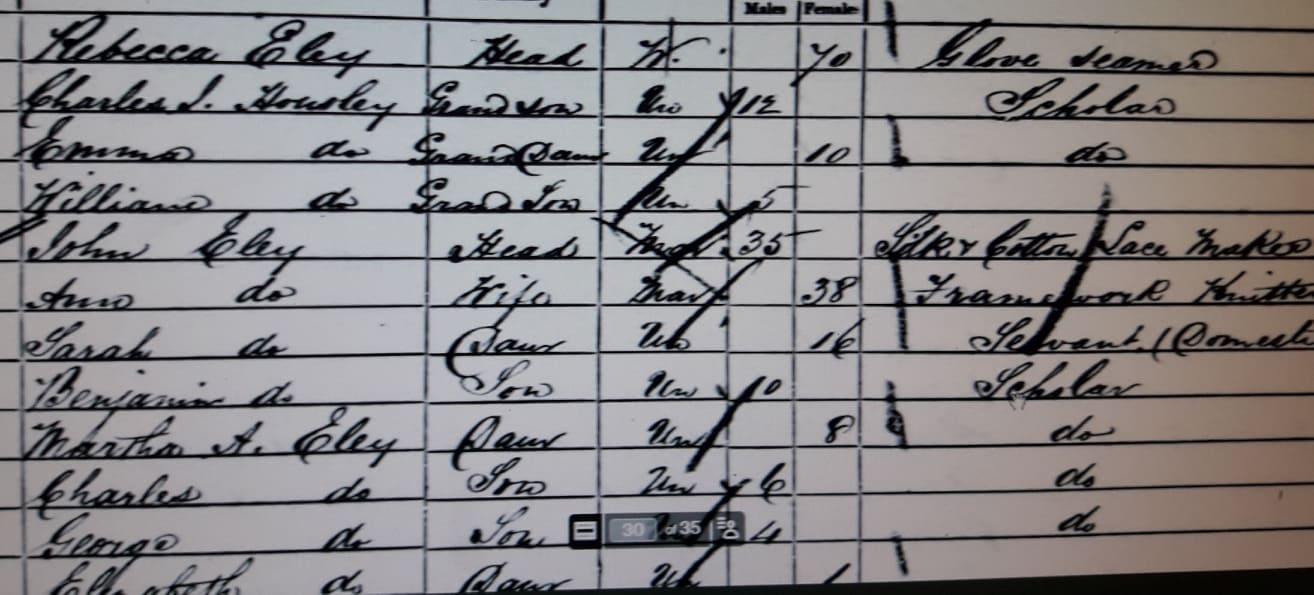
Back to the mysterious comment in Joseph’s letter. Joseph couldn’t have been speaking of his sister Emma. She was married with children by the time Joseph wrote that letter, so was not just out of service, and Joseph would have known where she was. There is no reason to suppose that the sister Emma was trying unsuccessfully to find George’s addresss: she had been sending him letters for years. Joseph must have been referring to George’s daughter Emma.
Joseph comments to George “Your son John…is rather wild.” followed by the remark about Emma’s whereabouts. Could Charles John Housley have used his middle name of John instead of Charles?
As for the child William born five years after George left for USA, despite his name of Housley, which was his mothers married name, we can assume that he was not a Housley ~ not George’s child, anyway. It is not clear who his father was, as Amey did not remarry.
A further excerpt from Barbara Housley’s Narrative on the Letters:
Certainly there was some mystery in George’s life. George apparently wanted his whereabouts kept secret. Anne wrote: “People are at a loss to know where you are. The general idea is you are with Charles. We don’t satisfy them.” In that same letter Anne wrote: “I know you could not help thinking of us very often although you neglected writing…and no doubt would feel grieved for the trouble you at times caused (our mother). She freely forgives all.” Near the end of the letter, Anne added: “Mother sends her love to you and hopes you will write and if you want to tell her anything you don’t want all to see you must write it on a piece of loose paper and put it inside the letter.”
In a letter to George from his sister Emma:
Emma wrote in 1855, “We write in love to your wife and yourself and you must write soon and tell us whether there is a little nephew or niece and what you call them.”
In June of 1856, Emma wrote: “We want to see dear Sarah Ann and the dear little boy. We were much pleased with the “bit of news” you sent.” The bit of news was the birth of John Eley Housley, January 11, 1855. Emma concluded her letter “Give our very kindest love to dear sister and dearest Johnnie.”
It would seem that George Housley named his first son with his second wife after his first wife’s father ~ while he was married to both of them.
Emma Housley
1851-1935
In 1871 Emma was 20 years old and “in service” living as a lodger in West Hallam, not far from Heanor. As she didn’t appear on a 1881 census, I looked for a marriage, but the only one that seemed right in every other way had Emma Housley’s father registered as Ralph Wibberly!
Who was Ralph Wibberly? A family friend or neighbour, perhaps, someone who had been a father figure? The first Ralph Wibberly I found was a blind wood cutter living in Derby. He had a son also called Ralph Wibberly. I did not think Ralph Wibberly would be a very common name, but I was wrong.
I then found a Ralph Wibberly living in Heanor, with a son also named Ralph Wibberly. A Ralph Wibberly married an Emma Salt from Heanor. In 1874, a 36 year old Ralph Wibberly (born in 1838) was on trial in Derby for inflicting grevious bodily harm on William Fretwell of Heanor. His occupation is “platelayer” (a person employed in laying and maintaining railway track.) The jury found him not guilty.
In 1851 a 23 year old Ralph Wibberly (born in 1828) was a prisoner in Derby Gaol. However, Ralph Wibberly, a 50 year old labourer born in 1801 and his son Ralph Wibberly, aged 13 and born in 1838, are living in Belper on the 1851 census. Perhaps the son was the same Ralph Wibberly who was found not guilty of GBH in 1874. This appears to be the one who married Emma Salt, as his wife on the 1871 census is called Emma, and his occupation is “Midland Company Railway labourer”.
Which was the Ralph Wibberly that Emma chose to name as her father on the marriage register? We may never know, but perhaps we can assume it was Ralph Wibberly born in 1801. It is unlikely to be the blind wood cutter from Derby; more likely to be the local Ralph Wibberly. Maybe his son Ralph, who we know was involved in a fight in 1874, was a friend of Emma’s brother Charles John, who was described by Joseph as a “wild one”, although Ralph was 11 years older than Charles John.
Emma Housley married James Slater on Christmas day in Heanor in 1873. Their first child, a daughter, was called Amy. Emma’s mother was Amy Eley. James Slater was a colliery brakesman (employed to work the steam-engine, or other machinery used in raising the coal from the mine.)
It occurred to me to wonder if Emma Housley (George’s daughter) knew Elizabeth, Mary Anne and Catherine (Samuel’s daughters). They were cousins, lived in the vicinity, and they had in common with each other having been deserted by their fathers who were brothers. Emma was born two years after Catherine. Catherine was living with John Benniston, a framework knitter in Heanor, from 1851 to 1861. Emma was living with her grandfather John Ely, a framework knitter in Heanor. In 1861, George Purdy was also living in Heanor. He was listed on the census as a 13 year old coal miner! George Purdy and Catherine Housley married in 1866 in Eastwood, Nottinghamshire ~ just over the county border. Emma’s first child Amy was born in Heanor, but the next two children, Eliza and Lilly, were born in Eastwood, in 1878 and 1880. Catherine and George’s fifth child, my great grandmother Mary Ann Gilman Purdy, was born in Eastwood in 1880, the same year as Lilly Slater.
By 1881 Emma and James Slater were living in Woodlinkin, Codnor and Loscoe, close to Heanor and Eastwood, on the Derbyshire side of the border. On each census up to 1911 their address on the census is Woodlinkin. Emma and James had nine children: six girls and 3 boys, the last, Alfred Frederick, born in 1901.
Emma and James lived three doors up from the Thorn Tree pub in Woodlinkin, Codnor:
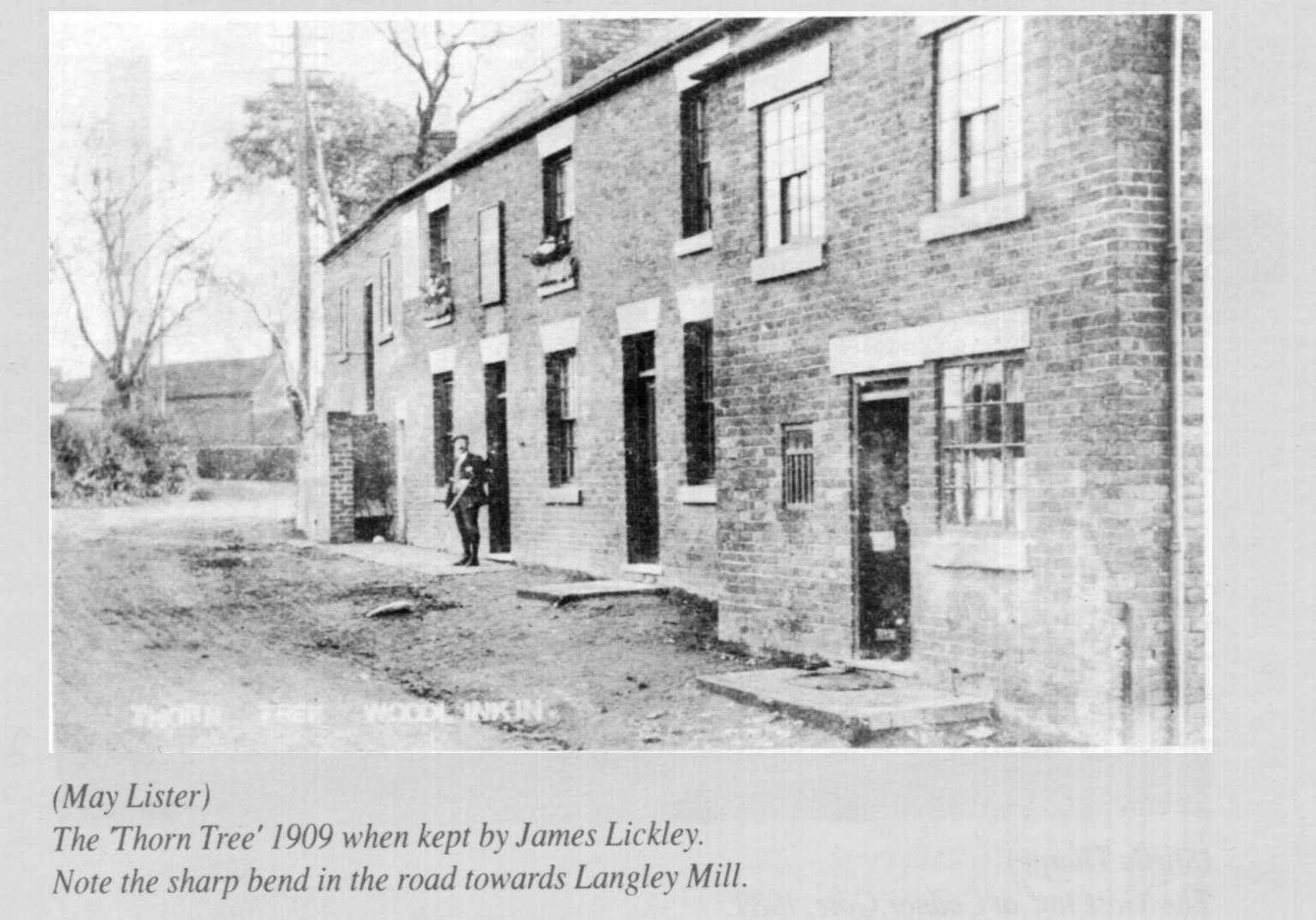
Emma Slater died in 1935 at the age of 84.
IN
LOVING MEMORY OF
EMMA SLATER
(OF WOODLINKIN)
WHO DIED
SEPT 12th 1935
AGED 84 YEARS
AT RESTCrosshill Cemetery, Codnor, Amber Valley Borough, Derbyshire, England:
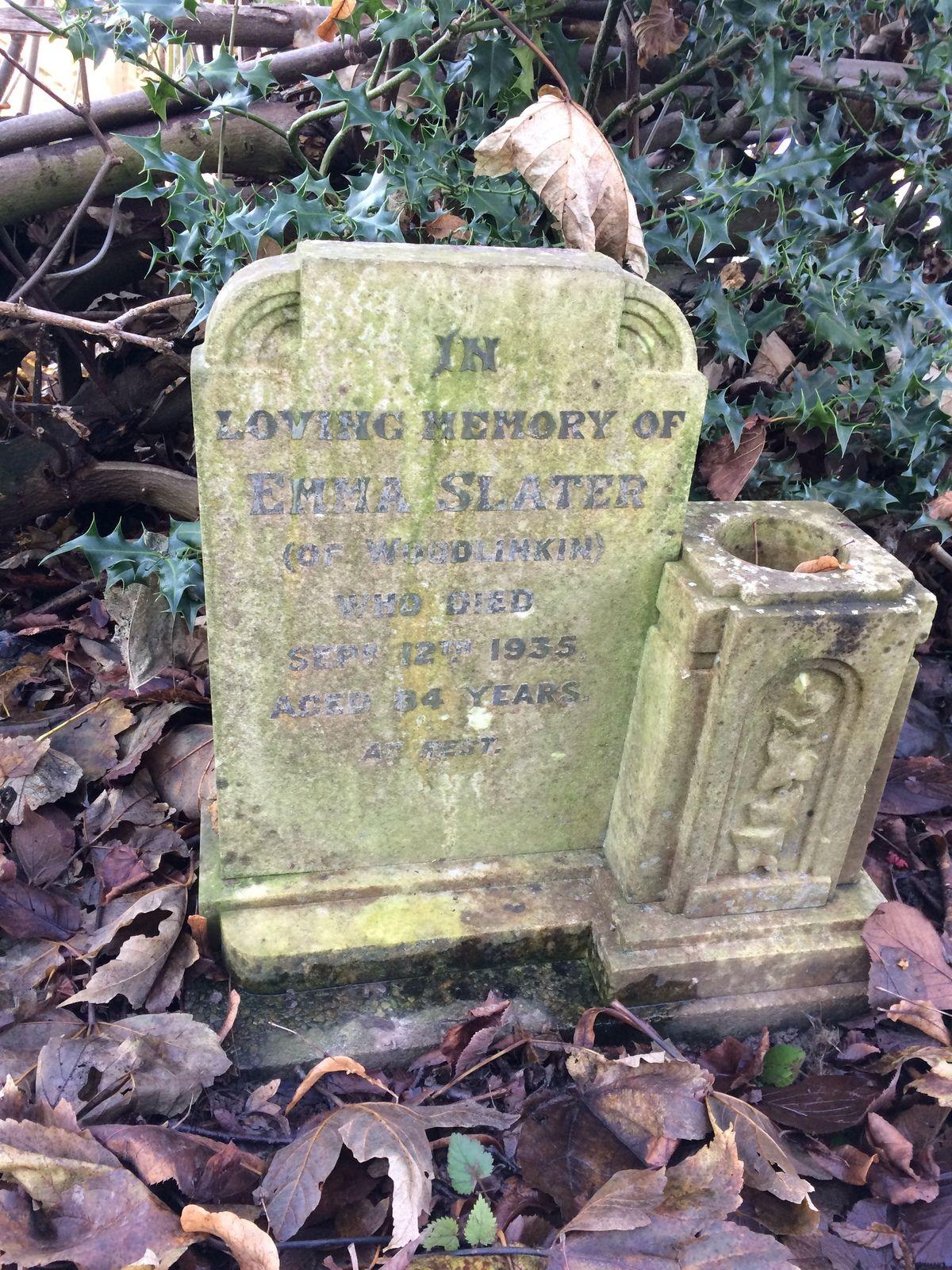
Charles John Housley
1949-
February 5, 2022 at 2:16 pm #6273In reply to: The Elusive Samuel Housley and Other Family Stories
The Housley Letters
THE NEIGHBORHOODFrom Barbara Housley’s Narrative on the Letters:
In July 1872, Joseph wrote to George who had been gone for 21 years: “You would not know Heanor now. It has got such a large place. They have got a town hall built where Charles’ stone yard was.”
Then Joseph took George on a tour from Smalley to Heanor pointing out all the changes:
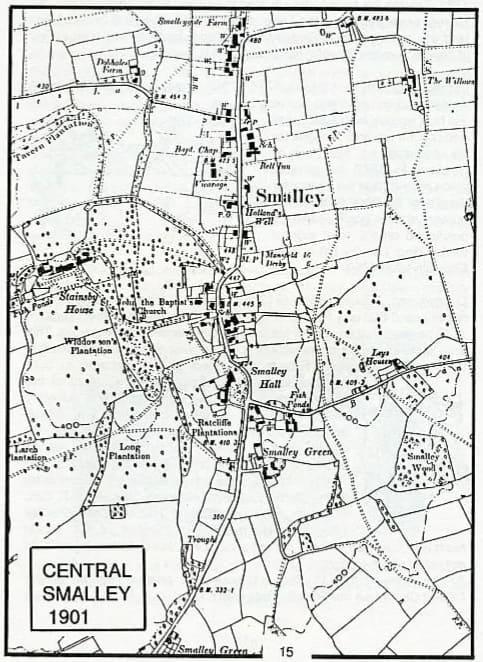
“Now we commence at Firby Brook. There is no public house there. It is turned into a market gardener’s place. Morley smithy stands as it did. You would know Chris Shepperd that used to keep the farm opposite. He is dead and the farm is got into other hands.” (In 1851, Chris Shepherd, age 39, and his widowed mother, Mary, had a farm of 114 acres. Charles Carrington, age 14, worked for them as a “cow boy.” In 1851 Hollingsworths also lived at Morely smithy.) “The Rose and Crown stands and Antony Kerry keeps that yet.” (In 1851, the census listed Kerry as a mason, builder, victicular, and farmer. He lived with his wife and four sons and numerous servants.) “They have pulled down Samuel Kerry’s farm house down and built him one in another place. Now we come to the Bell that was but they have pulled the old one down and made Isaac Potters House into the new Bell.” (In 1851, The Bell was run by Ann Weston, a widow.)
Smalley Roundhouse:
“The old Round House is standing yet but they have took the machine away. The Public House at the top end is kept by Mrs. Turton. I don’t know who she was before she married. Now we get to old Tom Oldknow. The old house is pulled down and a new one is put up but it is gone out of the family altogether. Now Jack is living at Stanley. He married Ann that used to live at Barbers at Smalley. That finishes Smalley. Now for Taghill. The old Jolly Collier is standing yet and a man of the name of Remmington keeps the new one opposite. Jack Foulkes son Jack used to keep that but has left just lately. There is the Nottingham House, Nags Head, Cross Keys and then the Red Lion but houses built on both sides all the way down Taghill. Then we get to the town hall that is built on the ground that Charles’ Stone Yard used to be. There is Joseph Watson’s shop standing yet in the old place. The King of Prussia, the White Lion and Hanks that is the Public House. You see there are more than there used to be. The Magistrate sits at the Town Hall and tries cases there every fortnight.”
.
February 5, 2022 at 1:59 pm #6272In reply to: The Elusive Samuel Housley and Other Family Stories
The Housley Letters
The Carringtons
Carrington Farm, Smalley:
Ellen Carrington was born in 1795. Her father William Carrington 1755-1833 was from Smalley. Her mother Mary Malkin 1765-1838 was from Ellastone, in Staffordshire. Ellastone is on the Derbyshire border and very close to Ashboure, where Ellen married William Housley.
From Barbara Housley’s Narrative on the Letters:
Ellen’s family was evidently rather prominant in Smalley. Two Carringtons (John and William) served on the Parish Council in 1794. Parish records are full of Carrington marriages and christenings.
The letters refer to a variety of “uncles” who were probably Ellen’s brothers, but could be her uncles. These include:
RICHARD
Probably the youngest Uncle, and certainly the most significant, is Richard. He was a trustee for some of the property which needed to be settled following Ellen’s death. Anne wrote in 1854 that Uncle Richard “has got a new house built” and his daughters are “fine dashing young ladies–the belles of Smalley.” Then she added, “Aunt looks as old as my mother.”
Richard was born somewhere between 1808 and 1812. Since Richard was a contemporary of the older Housley children, “Aunt,” who was three years younger, should not look so old!
Richard Carrington and Harriet Faulkner were married in Repton in 1833. A daughter Elizabeth was baptised March 24, 1834. In July 1872, Joseph wrote: “Elizabeth is married too and a large family and is living in Uncle Thomas’s house for he is dead.” Elizabeth married Ayres (Eyres) Clayton of Lascoe. His occupation was listed as joiner and shopkeeper. They were married before 1864 since Elizabeth Clayton witnessed her sister’s marriage. Their children in April 1871 were Selina (1863), Agnes Maria (1866) and Elizabeth Ann (1868). A fourth daughter, Alice Augusta, was born in 1872 or 1873, probably by July 1872 to fit Joseph’s description “large family”! A son Charles Richard was born in 1880.
An Elizabeth Ann Clayton married John Arthur Woodhouse on May 12, 1913. He was a carpenter. His father was a miner. Elizabeth Ann’s father, Ayres, was also a carpenter. John Arthur’s age was given as 25. Elizabeth Ann’s age was given as 33 or 38. However, if she was born in 1868, her age would be 45. Possibly this is another case of a child being named for a deceased sibling. If she were 38 and born in 1875, she would fill the gap between Alice Augusta and Charles Richard.
Selina Clayton, who would have been 18, is not listed in the household in 1881. She died on June 11, 1914 at age 51. Agnes Maria Clayton died at the age of 25 and was buried March 31, 1891. Charles Richard died at the age of 5 and was buried on February 4, 1886. A Charles James Clayton, 18 months, was buried June 8, 1889 in Heanor.
Richard Carrington’s second daughter, Selina, born in 1837, married Walker Martin (b.1835) on February 11, 1864 and they were living at Kidsley Park Farm in 1872, according to a letter from Joseph, and, according to the census, were still there in 1881. This 100 acre farm was formerly the home of Daniel Smith and his daughter Elizabeth Davy Barber. Selina and Walker had at least five children: Elizabeth Ann (1865), Harriet Georgianna (1866/7), Alice Marian (September 6, 1868), Philip Richard (1870), and Walker (1873). In December 1972, Joseph mentioned the death of Philip Walker, a farmer of Prospect Farm, Shipley. This was probably Walker Martin’s grandfather, since Walker was born in Shipley. The stock was to be sold the following Monday, but his daughter (Walker’s mother?) died the next day. Walker’s father was named Thomas. An Annie Georgianna Martin age 13 of Shipley died in April of 1859.
Selina Martin died on October 29, 1906 but her estate was not settled until November 14, 1910. Her gross estate was worth L223.56. Her son Walker and her daughter Harriet Georgiana were her trustees and executers. Walker was to get Selina’s half of Richard’s farm. Harriet Georgiana and Alice Marian were to be allowed to live with him. Philip Richard received L25. Elizabeth Ann was already married to someone named Smith.
Richard and Harriet may also have had a son George. In 1851 a Harriet Carrington and her three year old son George were living with her step-father John Benniston in Heanor. John may have been recently widowed and needed her help. Or, the Carrington home may have been inadequate since Anne reported a new one was built by 1854. Selina’s second daughter’s name testifies to the presence of a “George” in the family! Could the death of this son account for the haggard appearance Anne described when she wrote: “Aunt looks as old as my mother?”
Harriet was buried May 19, 1866. She was 55 when she died.In 1881, Georgianna then 14, was living with her grandfather and his niece, Zilpah Cooper, age 38–who lived with Richard on his 63 acre farm as early as 1871. A Zilpah, daughter of William and Elizabeth, was christened October 1843. Her brother, William Walter, was christened in 1846 and married Anna Maria Saint in 1873. There are four Selina Coopers–one had a son William Thomas Bartrun Cooper christened in 1864; another had a son William Cooper christened in 1873.
Our Zilpah was born in Bretley 1843. She died at age 49 and was buried on September 24, 1892. In her will, which was witnessed by Selina Martin, Zilpah’s sister, Frances Elizabeth Cleave, wife of Horatio Cleave of Leicester is mentioned. James Eley and Francis Darwin Huish (Richard’s soliciter) were executers.
Richard died June 10, 1892, and was buried on June 13. He was 85. As might be expected, Richard’s will was complicated. Harriet Georgiana Martin and Zilpah Cooper were to share his farm. If neither wanted to live there it was to go to Georgiana’s cousin Selina Clayton. However, Zilpah died soon after Richard. Originally, he left his piano, parlor and best bedroom furniture to his daughter Elizabeth Clayton. Then he revoked everything but the piano. He arranged for the payment of £150 which he owed. Later he added a codicil explaining that the debt was paid but he had borrowed £200 from someone else to do it!
Richard left a good deal of property including: The house and garden in Smalley occupied by Eyres Clayton with four messuages and gardens adjoining and large garden below and three messuages at the south end of the row with the frame work knitters shop and garden adjoining; a dwelling house used as a public house with a close of land; a small cottage and garden and four cottages and shop and gardens.
THOMAS
In August 1854, Anne wrote “Uncle Thomas is about as usual.” A Thomas Carrington married a Priscilla Walker in 1810.
Their children were baptised in August 1830 at the same time as the Housley children who at that time ranged in age from 3 to 17. The oldest of Thomas and Priscilla’s children, Henry, was probably at least 17 as he was married by 1836. Their youngest son, William Thomas, born 1830, may have been Mary Ellen Weston’s beau. However, the only Richard whose christening is recorded (1820), was the son of Thomas and Lucy. In 1872 Joseph reported that Richard’s daughter Elizabeth was married and living in Uncle Thomas’s house. In 1851, Alfred Smith lived in house 25, Foulks lived in 26, Thomas and Priscilla lived in 27, Bennetts lived in 28, Allard lived in 29 and Day lived in 30. Thomas and Priscilla do not appear in 1861. In 1871 Elizabeth Ann and Ayres Clayton lived in House 54. None of the families listed as neighbors in 1851 remained. However, Joseph Carrington, who lived in house 19 in 1851, lived in house 51 in 1871.
JOHN
In August 1854, Anne wrote: “Uncle John is with Will and Frank has been home in a comfortable place in Cotmanhay.” Although John and William are two of the most popular Carrington names, only two John’s have sons named William. John and Rachel Buxton Carrington had a son William christened in 1788. At the time of the letters this John would have been over 100 years old. Their son John and his wife Ann had a son William who was born in 1805. However, this William age 46 was living with his widowed mother in 1851. A Robert Carrington and his wife Ann had a son John born 1n 1805. He would be the right age to be a brother to Francis Carrington discussed below. This John was living with his widowed mother in 1851 and was unmarried. There are no known Williams in this family grouping. A William Carrington of undiscovered parentage was born in 1821. It is also possible that the Will in question was Anne’s brother Will Housley.
–Two Francis Carringtons appear in the 1841 census both of them aged 35. One is living with Richard and Harriet Carrington. The other is living next door to Samuel and Ellen Carrington Kerry (the trustee for “father’s will”!). The next name in this sequence is John Carrington age 15 who does not seem to live with anyone! but may be part of the Kerry household.
FRANK (see above)
While Anne did not preface her mention of the name Frank with an “Uncle,” Joseph referred to Uncle Frank and James Carrington in the same sentence. A James Carrington was born in 1814 and had a wife Sarah. He worked as a framework knitter. James may have been a son of William and Anne Carrington. He lived near Richard according to the 1861 census. Other children of William and Anne are Hannah (1811), William (1815), John (1816), and Ann (1818). An Ann Carrington married a Frank Buxton in 1819. This might be “Uncle Frank.”
An Ellen Carrington was born to John and Rachel Carrington in 1785. On October 25, 1809, a Samuel Kerry married an Ellen Carrington. However this Samuel Kerry is not the trustee involved in settling Ellen’s estate. John Carrington died July 1815.
William and Mary Carrington:
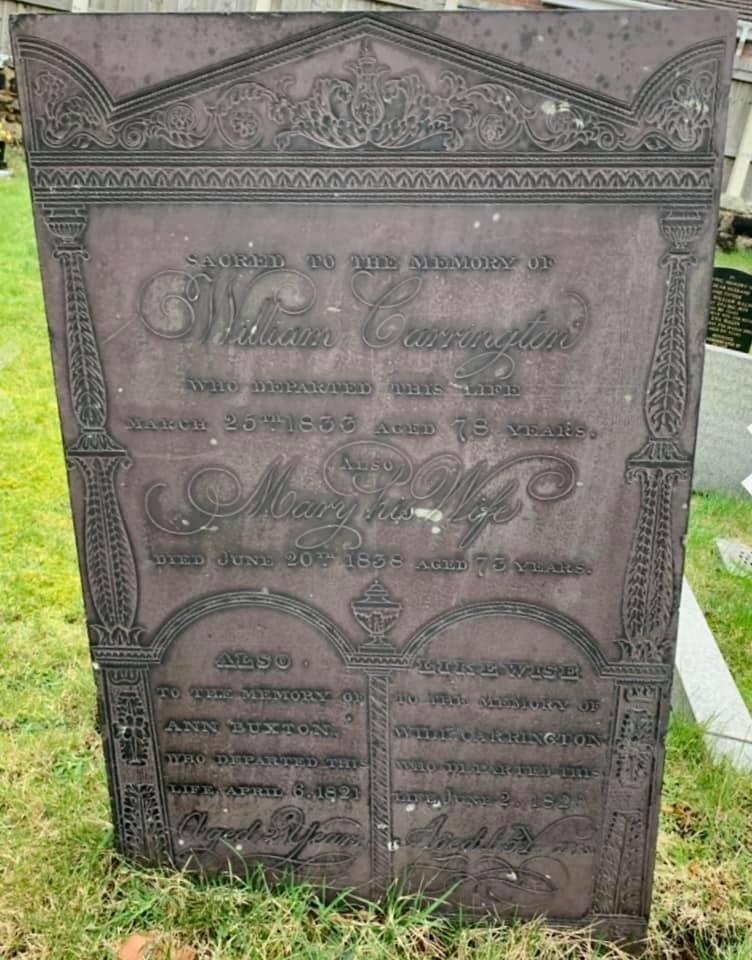 February 5, 2022 at 10:50 am #6271
In reply to: The Elusive Samuel Housley and Other Family Stories
The Housley Letters
FRIENDS AND NEIGHBORS
from Barbara Housley’s Narrative on the Letters:
George apparently asked about old friends and acquaintances and the family did their best to answer although Joseph wrote in 1873: “There is very few of your old cronies that I know of knocking about.”
In Anne’s first letter she wrote about a conversation which Robert had with EMMA LYON before his death and added “It (his death) was a great trouble to Lyons.” In her second letter Anne wrote: “Emma Lyon is to be married September 5. I am going the Friday before if all is well. There is every prospect of her being comfortable. MRS. L. always asks after you.” In 1855 Emma wrote: “Emma Lyon now Mrs. Woolhouse has got a fine boy and a pretty fuss is made with him. They call him ALFRED LYON WOOLHOUSE.”
(Interesting to note that Elizabeth Housley, the eldest daughter of Samuel and Elizabeth, was living with a Lyon family in Derby in 1861, after she left Belper workhouse. The Emma listed on the census in 1861 was 10 years old, and so can not be the Emma Lyon mentioned here, but it’s possible, indeed likely, that Peter Lyon the baker was related to the Lyon’s who were friends of the Housley’s. The mention of a sea captain in the Lyon family begs the question did Elizabeth Housley meet her husband, George William Stafford, a seaman, through some Lyon connections, but to date this remains a mystery.)
Elizabeth Housley living with Peter Lyon and family in Derby St Peters in 1861:
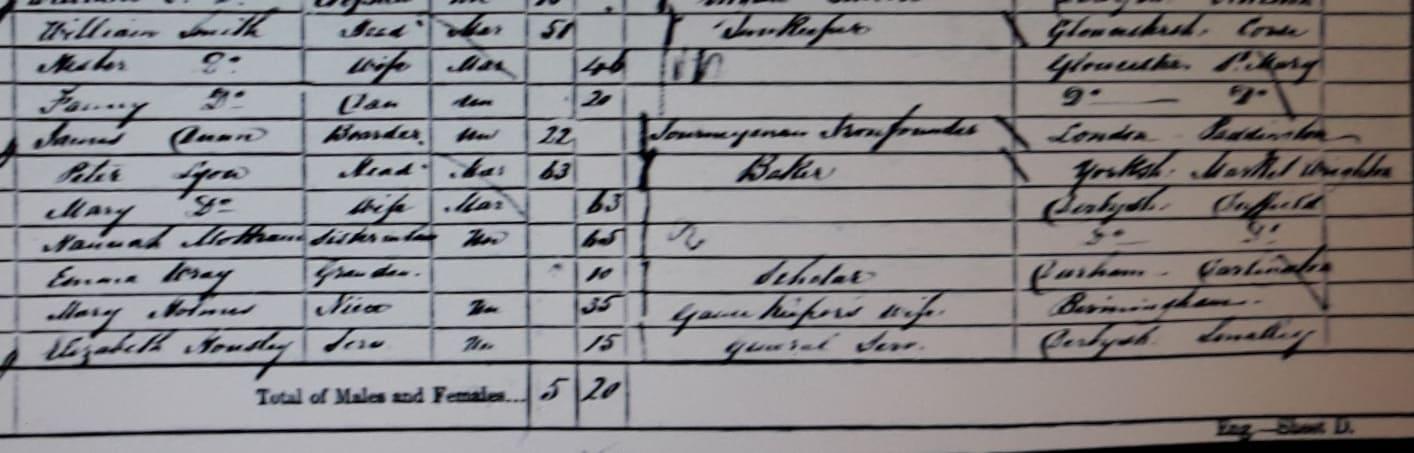
A Henrietta Lyon was married in 1860. Her father was Matthew, a Navy Captain. The 1857 Derby Directory listed a Richard Woolhouse, plumber, glazier, and gas fitter on St. Peter’s Street. Robert lived in St. Peter’s parish at the time of his death. An Alfred Lyon, son of Alfred and Jemima Lyon 93 Friargate, Derby was baptised on December 4, 1877. An Allen Hewley Lyon, born February 1, 1879 was baptised June 17 1879.
Anne wrote in August 1854: “KERRY was married three weeks since to ELIZABETH EATON. He has left Smith some time.” Perhaps this was the same person referred to by Joseph: “BILL KERRY, the blacksmith for DANIEL SMITH, is working for John Fletcher lace manufacturer.” According to the 1841 census, Elizabeth age 12, was the oldest daughter of Thomas and Rebecca Eaton. She would certainly have been of marriagable age in 1854. A William Kerry, age 14, was listed as a blacksmith’s apprentice in the 1851 census; but another William Kerry who was 29 in 1851 was already working for Daniel Smith as a blacksmith. REBECCA EATON was listed in the 1851 census as a widow serving as a nurse in the John Housley household. The 1881 census lists the family of William Kerry, blacksmith, as Jane, 19; William 13; Anne, 7; and Joseph, 4. Elizabeth is not mentioned but Bill is not listed as a widower.
Anne also wrote in 1854 that she had not seen or heard anything of DICK HANSON for two years. Joseph wrote that he did not know Old BETTY HANSON’S son. A Richard Hanson, age 24 in 1851, lived with a family named Moore. His occupation was listed as “journeyman knitter.” An Elizabeth Hanson listed as 24 in 1851 could hardly be “Old Betty.” Emma wrote in June 1856 that JOE OLDKNOW age 27 had married Mrs. Gribble’s servant age 17.
Anne wrote that “JOHN SPENCER had not been since father died.” The only John Spencer in Smalley in 1841 was four years old. He would have been 11 at the time of William Housley’s death. Certainly, the two could have been friends, but perhaps young John was named for his grandfather who was a crony of William’s living in a locality not included in the Smalley census.
TAILOR ALLEN had lost his wife and was still living in the old house in 1872. JACK WHITE had died very suddenly, and DR. BODEN had died also. Dr. Boden’s first name was Robert. He was 53 in 1851, and was probably the Robert, son of Richard and Jane, who was christened in Morely in 1797. By 1861, he had married Catherine, a native of Smalley, who was at least 14 years his junior–18 according to the 1871 census!
Among the family’s dearest friends were JOSEPH AND ELIZABETH DAVY, who were married some time after 1841. Mrs. Davy was born in 1812 and her husband in 1805. In 1841, the Kidsley Park farm household included DANIEL SMITH 72, Elizabeth 29 and 5 year old Hannah Smith. In 1851, Mr. Davy’s brother William and 10 year old Emma Davy were visiting from London. Joseph reported the death of both Davy brothers in 1872; Joseph apparently died first.
Mrs. Davy’s father, was a well known Quaker. In 1856, Emma wrote: “Mr. Smith is very hearty and looks much the same.” He died in December 1863 at the age of 94. George Fox, the founder of the Quakers visited Kidsley Park in 1650 and 1654.
Mr. Davy died in 1863, but in 1854 Anne wrote how ill he had been for two years. “For two last winters we never thought he would live. He is now able to go out a little on the pony.” In March 1856, his wife wrote, “My husband is in poor health and fell.” Later in 1856, Emma wrote, “Mr. Davy is living which is a great wonder. Mrs. Davy is very delicate but as good a friend as ever.”
In The Derbyshire Advertiser and Journal, 15 May 1863:
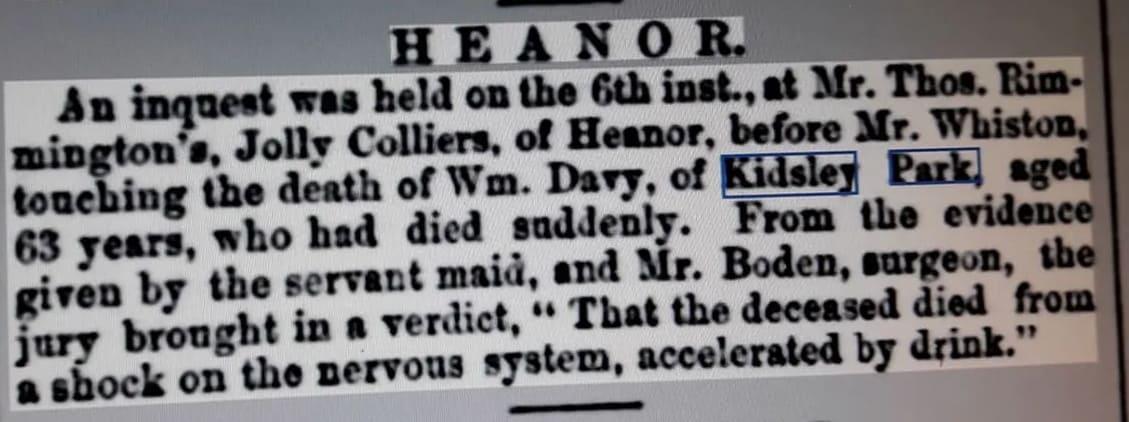
Whenever the girls sent greetings from Mrs. Davy they used her Quaker speech pattern of “thee and thy.” Mrs. Davy wrote to George on March 21 1856 sending some gifts from his sisters and a portrait of their mother–“Emma is away yet and A is so much worse.” Mrs. Davy concluded: “With best wishes for thy health and prosperity in this world and the next I am thy sincere friend.”
Mrs. Davy later remarried. Her new husband was W.T. BARBER. The 1861 census lists William Barber, 35, Bachelor of Arts, Cambridge, living with his 82 year old widowed mother on an 135 acre farm with three servants. One of these may have been the Ann who, according to Joseph, married Jack Oldknow. By 1871 the farm, now occupied by William, 47 and Elizabeth, 57, had grown to 189 acres. Meanwhile, Kidsley Park Farm became the home of the Housleys’ cousin Selina Carrington and her husband Walker Martin. Both Barbers were still living in 1881.
Mrs. Davy was described in Kerry’s History of Smalley as “an accomplished and exemplary lady.” A piece of her poetry “Farewell to Kidsley Park” was published in the history. It was probably written when Elizabeth moved to the Barber farm. Emma sent one of her poems to George. It was supposed to be about their house. “We have sent you a piece of poetry that Mrs. Davy composed about our ‘Old House.’ I am sure you will like it though you may not understand all the allusions she makes use of as well as we do.”
Kiddsley Park Farm, Smalley, in 1898. (note that the Housley’s lived at Kiddsley Grange Farm, and the Davy’s at neighbouring Kiddsley Park Farm)
Emma was not sure if George wanted to hear the local gossip (“I don’t know whether such little particulars will interest you”), but shared it anyway. In November 1855: “We have let the house to Mr. Gribble. I dare say you know who he married, Matilda Else. They came from Lincoln here in March. Mrs. Gribble gets drunk nearly every day and there are such goings on it is really shameful. So you may be sure we have not very pleasant neighbors but we have very little to do with them.”
John Else and his wife Hannah and their children John and Harriet (who were born in Smalley) lived in Tag Hill in 1851. With them lived a granddaughter Matilda Gribble age 3 who was born in Lincoln. A Matilda, daughter of John and Hannah, was christened in 1815. (A Sam Else died when he fell down the steps of a bar in 1855.)
-
AuthorSearch Results