
Search Results for 'saint'
-
AuthorSearch Results
-
January 18, 2026 at 8:18 am #8049
In reply to: The Hoards of Sanctorum AD26
Phurt was starting to think something fishy was a play, each time he thought his short spider life had ended he was pulled back from Spiderheaven by some unknown force. Not that he minded this time, there were plenty of places to hide and cast his strong silk cables. He had developed a sense of adventure and the sheer height of some of the mounds made him dizzy. It also made him want to be the first spider in the history of this thread to climb on top of that Mount Wobbly of the Topperware Chain.
Phurt had also noticed a strange and strong smell that seemed to come from the top of Mount Wobbly. Not that he minded the hygiene of the place; it was, to the contrary, a rather promising smell. It was the smell that said swarms of flies would gather there like an endless supply of blessed food.
Seeing that other spiders were gathering at the bottom of Mount Wobbly, he contorted his butt and secured his first cable.

Spirius had been investigating the origin of a strong smell that had started not long after Austreberthe puffed out of existence and became part of the dust she had spent her life chasing away. Which gave him one more proof that his theory of the holy body influence upon the physical world was true. He looked for a pen but they were behind two piles of unopened parcels he had started collecting when he had noticed that the postmen were leaving the boxes unattended and unprotected from the elements on the front porch of houses. His intentions were pure, as any saintly intentions are, but when he saw what good addition to the other boxes they made, he felt a pang of regret each time he thought of giving back those boxes to their rightful recipients.
Alas, most of them were dead by now, so he felt his duty was to keep those boxes intact to honour the memory of the dead.
Yvoise came in just as Spirius saw an odd and colourful australian jumping spider cast a delicate silk thread to one of the bottom row of his Tupperware collection.
“You should really do something about that smell,” she said. “I remember a time when decorum required holy people to exude only fragrance and essential oils.”
“Well, you know, it’s Austreberthe,” he said as wobbly as his heaps of plastic boxes. He had them all. You could even say he started the whole trend of pyramid schemes when his friend Pearl Topper saw him buy boxes from antiques shops. She invented the first plastic box as…
“Well, I asked you a question,” said Yvoise, interrupting his wandering thoughts.
“Have you noticed the spiders,” said Spirius.
“What spiders?”
“I think they’re trying to go up there,” Spirius said. “Look!”
He pointed a proud finger at the top of the highest Topperware tower in the Guyness book of records. A swarm of flies was circling around one of the boxes.
“And that means the smell comes from there.”
January 16, 2026 at 11:00 pm #8048In reply to: The Hoards of Sanctorum AD26
“Bless you,” Helier offered, instinctively sliding the half-chewed pencil stub under a pile of National Geographics from 1978. He felt a flush of guilt, as if he’d been caught trying to steal a kid’s toy.
Cerenise rolled into the room, looking like a sorry pile of laundry. She was wrapped in three different shawls—one Paisley, one Tartan, and one that looked like a doily from a medieval altar. She held a lace handkerchief to her nose, trumpeting into it with a force that rattled the nearby display of thimbles.
“It’s not the damp,” she croaked, her voice an octave lower than usual. “It’s the cleanliness. Since Spirius fixed that pipe, the air is too… sterile. My immune system is in shock. It misses the spores.”
She eyed the spot where Helier had hidden the pencil. “You were thinking about it, weren’t you?”
“Thinking about what?” Helier feigned innocence, picking up a ceramic frog.
“The Novena,” she whispered the word like a curse. “I saw the look in your eye. The ‘maybe I don’t need this’ look. It’s the fever talking, Helier. Don’t give in. I almost threw away a button yesterday. A bakelite toggle from a 1930s duffel coat. I held it over the bin for a full minute.” She shuddered, pulling the shawls tighter. “Madness.”
“Pure madness,” Helier agreed, quickly retrieving the pencil stub and placing it prominently on the desk to prove his loyalty to the hoard. “We must stay strong. Now, surely you didn’t brave the drafty hallway just to discuss my potential apostasy?”
“I didn’t,” Cerenise sniffed, tucking the handkerchief into her sleeve. “I found him. Or at least, I found the thread.”
She wheeled closer, dropping a printout onto Helier’s knees. It was a genealogy chart, annotated with her elegant, spider-scrawl handwriting.
“Pierre Wenceslas Varlet,” she announced. “Born 1824. Brother to a last of the famously named Austreberthes — mortal ones, unsaintly, of course. Her lineage didn’t die out, Helier.”
Helier squinted at the paper. “Varlet? Sounds like a villain in one of Liz Tattler’s bodice-rippers. ‘The Vengeful Varlet of Venice’.“
“Focus, Helier. Look at the modern branch.” She pointed to the bottom of the page. “The name changed in the 1950s. Anglicized. And I think, if my research into the local council tax records—hacked via that delightful ‘incognito mode’ you showed me—is correct, the current ‘Varlet’ is closer than we think.”
“How close?”
“Gloucester close,” Cerenise said, her eyes gleaming with the thrill of the hunt, momentarily forgetting her flu. “And you’ll never guess where he works.”
January 4, 2026 at 10:01 pm #8043In reply to: Finder’s Keepers of the Hoard
A cinematic, low-angle shot inside a flooded, ancient brick sewer tunnel that looks like a mix of Roman catacombs and Victorian industrial plumbing. The water is dark and murky, reflecting the light of a flickering lantern.
In the center of the frame, floating precariously, is a bright yellow, cheap inflatable dinghy.
Inside the dinghy are two men:
-
Spirius: An elderly man with a nervous expression, wearing a high-vis vest over ancient saintly robes. He is clutching an antique musket that is clearly too heavy for him. A faint, golden neon halo flickers erratically behind his head like a faulty streetlamp.
-
Boothroyd: A grumpy, weather-beaten gardener in a tweed cap. He looks completely resigned to his fate, lazily paddling with a plastic oar in one hand and holding a sharp garden spear in the other.
Action: The dinghy squeaks as it bumps against the wet brick walls. Spirius jumps at a drip of water falling from the ceiling. Something large ripples the water in the foreground—a menacing shadow moving beneath the surface.
Atmosphere:
-
Lighting: Chiaroscuro—deep shadows and warm lantern light, contrasting with the synthetic yellow of the boat.
-
Mood: Tense but ridiculous. High-stakes fantasy meets low-budget reality.
Movement:
-
The camera tracks slowly backward as the boat drifts forward.
-
The water ripples ominously.
-
Spirius’s halo buzzes and dims when he gets scared.
January 3, 2026 at 9:04 am #8023In reply to: The Hoards of Sanctorum AD26
“Quite fitting that I should get her sleeves,” Cerenise said with satisfaction. “And what a relief that she left the wolf to you, Spirius. I’d not have been able to manage a wolf.” Cerenise popped another cashew nut into her mouth.
Spirius looked at her with a raised eyebrow. “My guess is you’d have managed just fine,” he replied drily. He’d heard all the noise she made behind those locked doors. He’d seen her prancing around the orchard in the moonlight when she thought nobody was watching, naked as the day she was born all those centuries ago. He hadn’t lingered at the window, but he had put two and two together years ago, many years ago, just after the seige of Gloucester. If truth be told, Cerenise’s secret was known to them all, but they hadn’t interfered with her delusion.
“There’s going to come a point, and very soon, when we will have to deal with the water leak, you know,” Yvoise interrupted the inconsequential chatter. “Holy and healing as it may be, it will be the ruin of my collection if it reaches the upper floors.”
“And what do you propose?” asked Helier.
“I suggest we call a plumber!” snapped Yvoise. “This is the 21st century is it not? I know tradesmen are in short supply, and I know this isn’t an ordinary leak, but we should start with the obvious, and then adapt accordingly.”
“I must bottle as much of the holy water as possible before we stop the leak,” Spirius said, standing up abruptly in agitation.
Helier put a calming hand on the old boy’s shoulder. “There’s no rush, Spirius, there’s plenty of water in the cellars, it’s already waist deep down there.”
“And the saints only know what has floated into the cellars by now from the tunnels. Be careful down there, Spirius. Take Boothroyd the gardener with you,” Yvoise advised.
January 2, 2026 at 6:03 pm #8022In reply to: The Hoards of Sanctorum AD26
“You know,” Helier broke the silence, his mouth half-full of the buffet’s assortments of nuts and crackers, “this was bound to happen… People tend to forget you after a while. I mean, how many new babies named after dear Austreberthe nowadays. None of course. I think our records mention 1907 was the last baby Austreberthe, and a decade ago the last mass in their memory… oh this is too heartbreaking…”
“Why so gloomy?” Cerenise was eyeing the speckled and stained silverware and the chipped Rouen faience in which the potato salad was served. “Your name is still moderately in fashion, you shouldn’t die of forgetfulness any time soon. Enjoy the food while it’s free.”
Yvoise couldn’t help but tut at her. She was half-distracted by the calligraphy on those placeholders which she found exquisite. People in this age… it was a rare find now, some pretty calligraphy. The only ‘calli-‘anything this age does well enough is callipygian, and even then, it’s mostly the Kashtardians… She said to the others “Don’t throw yours away, I must have the full set.”
Spirius was inspecting the candleholders. None had lids, a fact that frustrated him to no end. “I miss the good old time we could just slay dragons and get a good sainthood concession for a nice half-millenium.”
Yvoise tittered “simple people we were back then. Everything funny-looking was a dragon I seem to recall.”
Spirius, his plate full of charcuteries, helped himself of a few appetizing gherkins, holding one large up to contemplate. “Yeah, but those few we slew in that period were still some darn tough-skinned gators I would have you know. Those crazy Roman buggers and their games and old false gods —they couldn’t help but bring those strange beasts from Africa to Gaul, leaving us to clean up after them…”
“Indeed, much harder now. It’s like fifteen minutes of sainthood on Instatok and Faceterest and you’re already has-been.” Yvoise had started to pocket some of the paper menus. “Luckily, we still have those relics spread around to fan the flames of remembrance, don’t we.”
“I guess the young ones must look at us funny…” Cerenise chuckled amused at the thought, almost spilling her truffle brouillade.
“Oh well, apparently our youngest geeks aren’t above dealing in relics.” Helier said. “Speaking of Novena and the coming nine days,… you’ve surely noticed as I did what was mentioned in the will, have you not?”
December 31, 2025 at 9:45 pm #8020In reply to: The Hoards of Sanctorum AD26
Spirius was looking decidedly ill at ease, which struck Cerenise as far from unusual, and as such, struck her not at all at the time. It wasn’t until later that she became aware of the cause of the discomfiture of her centuries old companion. Spirius had always been a bit of a dark horse, although that wasn’t really the right expression. A character of hidden depths and mysteries, perhaps with a penchant for bottling things up and labeling them,and then shelving them. Nobody knew for sure. A good kind well meaning saint, as saints go. She smiled at him fondly.
I hope they’re recording this will reading, Cerenise thought again, not having been listening to the seemingly endless drone of items.
December 31, 2025 at 8:43 pm #8019In reply to: The Hoards of Sanctorum AD26
Yvoise gaze was transfixed on the brittle yellow document held reverently in the old barristers hands. Her eyes widened when she saw the pile of similar written sheets on the desk. I simply must have them, she thought, I simply must. What an addition to my collection of written records! Unique document, absolutely unique. Listen to old Bart, she admonished herself, and with an effort she focused on the old barristers reading of the will.
Cerenise had noticed Yvoise practically drooling over the written paper type matter, and suppressed a grin (in consideration of the occasion), and smiled fondly at the saint she’d known for so very long. Such a confident capable character, despite her private mysteries. As saints go, she’s been a good one really. And as the holy mother of all saints surely knows, the organisers above all should be revered, for where would be be without them. Amen.
I hope this is being recorded so I can watch it later, Yvoise and Cerenise simultaneously thought, Because I haven’t paid attention to Bartholomew since my mind started wandering.
December 31, 2025 at 7:34 pm #8018In reply to: The Hoards of Sanctorum AD26
It must be two hundred years at least since we’ve heard a will read at number 26, Cerenise thought to herself, still in a mild state of shock at the unexpected turn of events. She allowed her mind to wander, as she was wont to do.
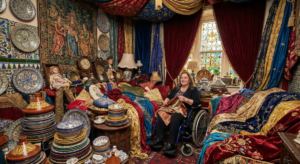 Cerenise had spent the best part of a week choosing a suitable outfit to wear for the occasion and the dressing room adjoining her bedroom had become even more difficult to navigate. Making sure her bedroom door was securely locked before hopping out of her wicker bath chair (she didn’t want the others to see how nimble she still was), she spent hours inching her way through the small gaps between wardrobes and storage boxes and old wooden coffers, pulling out garment after garment and taking them to the Napoleon III cheval mirror to try on. She touched the rosewood lovingly each time and sighed. It was a beautiful mirror that had faithfully reflected her image for over 150 years.
Holding a voluminous black taffetta mourning dress under her chin, Cerenise scrutinised her appearance. She looked well in black, she always felt, and it was such a good background for exotic shawls and scarves. Pulling the waist of the dress closer, it became apparent that a whalebone corset would be required if she was to wear the dress, a dreadful blight on the fun of wearing Victorian dresses. She lowered the dress and peered at her face. Not bad for, what was it now? One thousand 6 hundred and 43 years old? At around 45 years old, Cerenise decided that her face was perfect, not too young and not too old and old enough to command a modicum of respect. Thenceforth she stopped visibly aging, although she had allowed her fair hair to go silver white.
It was just after the siege of Gloucester in 1643, which often seemed like just yesterday, when Cerenise stopped walking in public. Unlike anyone else, she had relished the opportunity to stay in one place, and not be sent on errands miles away having to walk all the way in all weathers. Decades, or was it centuries, it was hard to keep track, of being a saint of travellers had worn thin by then, and she didn’t care if she never travelled again. She had done her share, although she still bestowed blessings when asked.
It was when she gave up walking in public that the hoarding started. Despite the dwellings having far fewer things in general in those days, there had always been pebbles and feathers, people’s teeth when they fell out, which they often did, and dried herbs and so forth. As the centuries rolled on, there were more and more things to hoard, reaching an awe inspiring crescendo in the last 30 years.
Cerenise, however, had wisely chosen to stop aging her teeth at the age of 21.
Physically, she was in surprisingly good shape for an apparent invalid but she spent hours every day behind locked doors, clambering and climbing among her many treasures, stored in many rooms of the labyrinthine old building. There was always just enough room for the bath chair to enter the door in each of her many rooms, and a good strong lock on the door. As soon as the door was locked, Cerenise parked the bath chair in front of the door and spent the day lifting boxes and climbing over bags and cupboards, a part of herself time travelling to wherever the treasures took her.
Eventually Cerenise settled on a long and shapeless but thickly woven, and thus warm, Neolithic style garment of unknown provenance but likely to be an Arts and Crafts replica. It was going to be cold in the library, and she could dress it up with a colourful shawl.
December 31, 2025 at 5:36 pm #8017In reply to: The Hoards of Sanctorum AD26
“In the name of god amen I Auftreberthe saint of wafhing and water of the parifh of Gloucefter in the county of Gloucefterfhire being weak of body but of sound and perfect mind and memory do hereby commit my soul to the almighty and hereby do make thif my laft will and teftament in manner and form af followeth…”
And so began the reading of Austreberthe’s will to the small gathering assembled in the library of the emporium. Bartholomew Gosnold, the aged barrister, stood behind the large oak desk, clearing his throat frequently and pausing to peer over his spectacles. The library was atwinkle with lamps of a variety of styles and ages, but was otherwise dark and vast in the areas outside of the pools of light. Heavy brocade curtains covered the windows, and a fire glowed in the hearth, for it was winter, the last day of the year, and darkness came early and freshly fallen snow blanketed the town in frigid holy silence.
Despite the fire, it was chilly in the library which was rarely heated, and Cerenise wound her ancient Kashmiri shawl aound her neck and shoulders, pausing to finger the cloth appreciatively. It was an exquisite Kani shawl, woven with intricate floral motifs in warm shades of red and plum, soft as a rabbit. She inched her wicker bath chair closer to the fire, accidentally tipping over a small table and sending the contents of a green glazed Tamegroute bowl skittering across the floor.
Yvoise tutted loudly as she rose from her chair to collect all the buttons and stand the little table back up. Luckily the bowl had landed on the Tabriz rug and hadn’t broken.
Bartholomew Gosnold paused until Yvoise had finished, and then resumed his reading of the will, after first clearing his throat again.
December 31, 2025 at 11:11 am #8009In reply to: Finder’s Keepers of the Hoard
Some ideas for the background thread and character profiles for “The Hoards of Emporium 26.”
The Setting: Emporium 26
They live in Gloucester (ancient Glevum), a city built on Roman bones where the layout of the streets still follows the legions’ sandals. They inhabit a sprawling, shared Georgian townhouse complex that has been knocked through into one labyrinthine dwelling—Number 26.
To the outside world, it looks like a dilapidated heritage site. Inside, it is The Emporium: a geological stratification of history, where layers of Roman pottery are mixed with 1990s Beanie Babies and medieval reliquaries.
The Background Thread: “The Weight of Eternity”
Why do they hoard? Because when you live forever, “letting go” feels like losing a piece of the timeline. Hoarding objects is for them an accumulation of evidence of existence.
- The Curse: They cannot die naturally, but they can fade if they are forgotten. The “stuff” anchors them to the physical plane.
- The “Halo” Effect: Occasionally, when they are arguing over whose turn it is to do the dishes, or when they find a lost treasure, the stained-glass light of their old divinity flickers behind their heads—a neon halo of forgotten holiness.
The Hoarders & Their Stashes
1. Helier ( The Hermit / The Dreamer)
- Saintly Origin: Based on St. Helier (Jersey/Normandy). He was an ascetic hermit who lived in a cave and was eventually beheaded.
- Modern Persona: A soft-spoken agoraphobe who hasn’t left the house since the invention of the internet. He wears oversized cardigans that smell like old library books.
- The Mania: Escapism & Communication.
- Because he spent centuries in silence on a rock, he is now obsessed with human stories and noise.
- The Hoard: ” The Media Mountain.”
- His wing of the house is a fire hazard of pulp fiction, towering stacks of National Geographic (dating back to the first issue), thousands of VHS tapes (he has no VCR), and tangled knots of ethernet cables that he refuses to throw away “in case they fit a port from 1998.”
- The Secret Stash: Beneath a pile of “The Hoarder Vampires” novels lies his true relic: The Stone Pillow. The actual rock he slept on in the 6th century. He still naps on it when his back hurts.
2. Spirius (The Bishop / The Container)
- Saintly Origin: Evocative of St. Exuperius (Bayeux). A driver-out of demons and a man of grand gestures.
- Modern Persona: A nervous, fidgety man who is convinced the world is leaking. He is the “fixer” of the group but usually makes things worse with duct tape.
- The Mania: Containment & Preservation.
- In the old days, he bottled demons. Now, he’s terrified of running out of space to put things.
- The Hoard: “The Vessel Void.”
- Spirius hoards anything that can hold something else. Empty jam jars (washed, mostly), Tupperware with no matching lids, biscuit tins, and thousands of plastic carrier bags stuffed inside other carrier bags (the “Bag of Bags”).
- The Secret Stash: In a locked pantry, he keeps a shelf of sealed mason jars labeled with dates like “1431” or “1789.” He claims they contain the “Sigh of a King” or “The smell of rain before the Plague.” It’s actually just dust, but the jars vibrate slightly.
3. Cerenise (The Weaver / The Mender)
- Saintly Origin: Evocative of St. Ceneri or St. Cerneuf. A saint of travelers, or perhaps needlework.
- Modern Persona: She is the “Wheelchair Girl’s” friend mentioned in the intro? Or perhaps she is in a wheelchair now—not because she can’t walk, but because she’s too tired from walking for 1,500 years. She is sharp-tongued and fashionable in a “crazy bag lady” sort of way.
- The Mania: Potential & Texture.
- She sees the soul in broken things. She cannot throw away anything that “could be fixed.”
- The Hoard: “The Fabric of Time.”
- Her rooms are draped in layers of textiles: velvet curtains from a 1920s cinema, moth-eaten tapestries depicting her own miracles (she thinks the nose is wrong), and buttons. Millions of buttons. She also hoards broken appliances—toasters, lamps, clocks—insisting she will repair them “next Tuesday.”
- The Secret Stash: A mannequin dressed in a perfectly preserved Roman stola, hidden under forty layers of polyester coats. It’s the outfit she wore when she performed her first miracle. She tries it on every New Year’s Eve.
4. Yvoise (The Advocate / The Bureaucrat)
- Saintly Origin: Evocative of St. Yves (Patron of Lawyers/Brittany/Normandy). The arbiter of justice.
- Modern Persona: The “Manager” of Emporium 26. She wears power suits from the 80s and is always carrying a clipboard. She loves rules, even if she invents them.
- The Mania: Proof of Truth.
- She is terrified of being forgotten or cheated. She needs a receipt for everything.
- The Hoard: “The Archive of Nothing.”
- Yvoise hoards paper. Receipts from a coffee bought in 1952, bus tickets, expired warranties, junk mail, and legal disclaimers torn off mattresses. Her room looks like the inside of a shredder that exploded. She claims she is building “The Case for Humanity.”
- The Secret Stash: A filing cabinet labeled “Do Not Open.” Inside is not paper, but Seeds. Seeds from the trees of ancient Gaul. She is saving them for when the paper finally takes over the world and she needs to replant the forest she misses.
Starter: The Reading of Austreberthe’s Will
The story kicks off because Austreberthe (The Saint of Washing/Water) has died. Her hoard was Soap and Water.
- The house is now flooding because her magical containment on the plumbing has broken.
- The remaining four must navigate her “Tsunami Wing”—a treacherous dungeon of accumulated bath bombs, stolen hotel towels, and aggressive washing machines—to find her Will.
- The Will is rumored to reveal the location of the “Golden Key,” an object that can legally terminate their lease on Emporium 26, which none of them want, but all of them crave.
December 22, 2024 at 10:49 pm #7704In reply to: Quintessence: Reversing the Fifth
Darius: Christmas 2022
Darius was expecting some cold snap, landing in Paris, but the weather was rather pleasant this time of the year.
It was the kind of day that begged for aimless wandering, but Darius had an appointment he couldn’t avoid—or so he told himself. His plane had been late, and looking at the time he would arrive at the apartment, he was already feeling quite drained. The streets were lively, tourists and locals intermingling dreamingly under strings of festive lights spread out over the boulevards. He listlessly took some snapshot videos —fleeting ideas, backgrounds for his channel.
The wellness channel had not done very well to be honest, and he was struggling with keeping up with the community he had drawn to himself. Most of the latest posts had drawn the usual encouragements and likes, but there were also the growing background chatter, gossiping he couldn’t be bothered to rein in — he was no guru, but it still took its toll, and he could feel it required more energy to be in this mode that he’d liked to.
His patrons had been kind, for a few years now, indulging his flights of fancy, funding his trips, introducing him to influencers. Seeing how little progress he’d made, he was starting to wonder if he should have paid more attention to the background chatter. Monsieur Renard had always taken a keen interest in his travels, looking for places to expand his promoter schemes of co-housing under the guide of low investment into conscious living spaces, or something well-marketed by Eloïse. The crude reality was starting to stare at his face. He wasn’t sure how long he could keep up pretending they were his friends.
By the time he reached the apartment, in a quiet street adjacent to rue Saint Dominique, nestled in 7th arrondissement with its well-kept façades, he was no longer simply fashionably late.
Without even the time to say his name, the door buzz clicked open, leading him to the old staircase. The apartment door opened before he could knock. There was a crackling tension hanging in the air even before Renard’s face appeared—his rotund face reddened by an annoyance he was poorly hiding beneath a polished exterior. He seemed far away from the guarded and meticulous man that Darius once knew.
“You’re late,” Renard said brusquely, stepping aside to let Darius in. The man was dressed impeccably, as always, but there was a sharpness to his movements.
Inside, the apartment was its usual display of cultivated sophistication—mid-century furniture, muted tones, and artful clutter that screamed effortless wealth. Eloïse sat on the couch, her legs crossed, a glass of wine poised delicately in her hand. She didn’t look up as Darius entered.
“Sorry,” Darius muttered, setting down his bag. “Flight delay.”
Renard waved it off impatiently, already pacing the room. “Do you know where Lucien is?” he asked abruptly, his gaze slicing toward Darius.
The question caught him off guard. “Lucien?” Darius echoed. “No. Why?”
Renard let out a sharp, humorless laugh. “Why? Because he owes me. He owes us. And he’s gone off the grid like some bloody enfant terrible who thinks the rules don’t apply to him.”
Darius hesitated. “I haven’t seen him in months,” he said carefully.
Renard stopped pacing, fixing him with a hard look. “Are you sure about that? You two were close, weren’t you? Don’t tell me you’re covering for him.”
“I’m not,” Darius said firmly, though the accusation sent a ripple of anger through him.
Renard snorted, turning away. “Typical. All you dreamers are the same—full of ideas but no follow-through. And when things fall apart, you scatter like rats, leaving the rest of us to clean up the mess.”
Darius stiffened. “I didn’t come here to be insulted,” he said, his voice a steady growl.
“Then why did you come, Darius?” Renard shot back, his tone cutting. “To float on someone else’s dime a little longer? To pretend you’re above all this while you leech off people who actually make things happen?”
The words hit like a slap. Darius glanced at Eloïse, expecting her to interject, to soften the blow. But she remained silent, her gaze fixed on her glass as if it held all the answers.
For the first time, he saw her clearly—not as a confidante or a muse, but as someone who had always been one step removed, always watching, always using.
“I think I’ve had enough,” Darius said finally, his voice calm despite the storm brewing inside him. “I think I’ve had enough for a long time.”
Renard turned, his expression a mix of incredulity and disdain. “Enough? You think you can walk away from this? From us?”
“Yes, I can.” Darius said simply, grabbing his bag.
“You’ll never make it on your own,” Renard called after him, his voice dripping with scorn.
Darius paused at the door, glancing back at Eloïse one last time. “I’ll take my chances,” he said, and then slammed the door.

The evening air was like a balm, open and soft unlike the claustrophobic tension of the apartment. Darius walked aimlessly at first, his thoughts caught between flares of wounded pride and muted anxiety, but as he walked and walked, it soon turned into a return of confidence, slow and steady.
His phone buzzed in his pocket, and he pulled it out to see a familiar name. It was a couple he knew from the south of France, friends he hadn’t spoken to in months. He answered, their warm voices immediately lifting his spirits.
“Darius!” one of them said. “What are you doing for Christmas? You should come down to stay with us. We’ve finally moved to a bigger space—and you owe us a visit.”
Darius smiled, the weight of Renard’s words falling away. “You know what? That sounds perfect.”
As he hung up, he looked up at the Parisian skyline, Darius wished he’d had the courage to take that step into the unknown a long time ago. Wherever Lucien was, he felt suddenly closer to him —as if inspired by his friend’s bold move away from this malicious web of influence.
December 8, 2024 at 9:42 pm #7656In reply to: Quintessence: Reversing the Fifth
Matteo — December 1st 2023: the Advent Visit
(near Avignon, France)
The hallway smelled of nondescript antiseptic and artificial lavender, a lingering scent jarring his senses with an irreconciliable blend of sterility and forced comfort. Matteo shifted the small box of Christmas decorations under his arm, his boots squeaking slightly against the linoleum floor. Outside, the low winter sun cast long, pale shadows through the care facility’s narrow windows.
When he reached Room 208, Matteo paused, hand resting on the doorframe. From inside, he could hear the soft murmur of a holiday tune—something old-fashioned and meant to be cheerful, likely playing from the small radio he’d gifted her last year. Taking a breath, he stepped inside.
His mother, Drusilla sat by the window in her padded chair, a thick knit shawl draped over her frail shoulders. She was staring intently at her hands, her fingers trembling slightly as they folded and unfolded the edge of the shawl. The golden light streaming through the window framed her face, softening the lines of age and wear.
“Hi, Ma,” Matteo said softly, setting the box down on the small table beside her.
Her head snapped up at the sound of his voice, her eyes narrowing as she fixed him with a sharp, almost panicked look. “Léon?” she said, her voice shaking. “What are you doing here? How are you here?” There was a tinge of anger in her tone, the kind that masked fear.
Matteo froze, his breath catching. “Ma, it’s me. Matteo. I’m Matteo, your son, please calm down” he said gently, stepping closer. “Who’s Léon?”
She stared at him for a long moment, her eyes clouded with confusion. Then, like a tide retreating, recognition crept back into her expression. “Matteo,” she murmured, her voice softer now, though tinged with exhaustion. “Oh, my boy. I’m sorry. I—” She looked away, her hands clutching the shawl tighter. “I thought you were someone else.”
“It’s okay,” Matteo said, crouching beside her chair. “I’m here. It’s me.”
Drusilla reached out hesitantly, her fingers brushing his cheek. “You look so much like him sometimes,” she said. “Léon… your father. He’d hold his head just like that when he didn’t want anyone to know he was worried.”
As much as Matteo knew, Drusilla had arrived in France from Italy in her twenties. He was born soon after. She had a job as a hairdresser in a little shop in Avignon, and did errands and chores for people in the village. For the longest time, it was just the two of them, as far as he’d recall.
Matteo’s chest tightened. “You’ve never told me much about him.”
“There wasn’t much to tell,” she said, her voice distant. “He came. He left. But he gave me something before he went. I always thought it would mean something, but…” Her voice trailed off as she reached into the pocket of her shawl and pulled out a small silver medallion, worn smooth with age. She held it out to him. “He said it was for you. When you were older.”
Matteo took the medallion carefully, turning it over in his hand. It was a simple but well-crafted Saint Christopher medal, the patron saint of travellers, with faint initials etched on the back—L.A.. He didn’t recognize the letters, but the weight of it in his palm felt significant, grounding.
“Why didn’t you give it to me before?” he asked, his voice quiet.
“I forgot I had it,” she admitted with a faint, sad laugh. “And then I thought… maybe it was better to keep it. Something of his, for when I needed it. But I think it’s yours now.”
Matteo slipped the medallion into his pocket, his mind spinning with questions he didn’t want to ask—not now. “Thanks, Ma,” he said simply.
Drusilla sighed and leaned back in her chair, her gaze drifting to the small box he’d brought. “What’s that?”
“Decorations,” Matteo said, seizing the moment to shift the focus. “I thought we could make your room a little festive for Christmas.”
Her face softened, and she smiled faintly. “That’s nice,” she said. “I haven’t done that in… I don’t remember when.”
Matteo opened the box and began pulling out garlands and baubles. As he worked, Drusilla watched silently, her hands still clutching the shawl. After a moment, she spoke again, her voice quieter now.
“Do you remember our house in Crest?” she asked.
Matteo paused, a tangle of tinsel in his hands. “Crest?” he echoed. “The place where you wanted to move to?”
Drusilla nodded slowly. “I thought it would be nice. A co-housing place. I could grow old in the garden, and you’d be nearby. It seemed like a good idea then.”
“It was a good idea,” Matteo said. “It just… didn’t happen.”
“No,… you’re right” she said, collecting her thoughts for a moment, her gaze distant. “You were too restless. Always moving. I thought maybe you’d stay if we built something together.”
Matteo swallowed hard, the weight of her words pressing on him. “I wanted to, Ma,” he said. “I really did.”
Drusilla’s eyes softened, and she reached for his hand, her grip surprisingly strong. “You’re here now,” she said. “That’s what matters.”

They spent the next hour decorating the room. Matteo hung garlands around the window and draped tinsel over the small tree he’d set up on the table. Drusilla directed him with occasional nods and murmured suggestions, her moments of lucidity shining like brief flashes of sunlight through clouds.
When the last bauble was hung, Drusilla smiled faintly. “It’s beautiful,” she said. “Like home.”
Matteo sat beside her, emotion weighing on him more than the physical efforts and the early drive. He was thinking about the job offer in London, the chance to earn more money to ensure she had everything she needed here. But leaving her felt impossible, even as staying seemed equally unsustainable. He was afraid it was just a justification to avoid facing the slow fraying of her memories.
Drusilla’s voice broke through his thoughts. “You’ll figure it out,” she said, her eyes closing as she leaned back in her chair. “You always do.”
Matteo watched her as she drifted into a light doze, her breathing steady and peaceful. He reached into his pocket, his fingers brushing against the medallion. The weight of it felt like both a question and an answer—one he wasn’t ready to face yet.
“Patron saint of travellers”, that felt like a sign, if not a blessing.
November 7, 2024 at 7:36 am #7590In reply to: The Incense of the Quadrivium’s Mystiques
“Permission to speak, My Lady Malove?” Truella asked respectfully. She was still wearing Frella’s raincoat of respect as it hadn’t stopped raining the whole time she’d been in Ireland, although the respectfulness was becoming tedious. But she was inside the Quadrivium building now, facing her agitated boss. She shrugged the raincoat off and tossed it aside and squared her shoulders.
“Speak!” Malove replied, rude and abrupt.
“I say, would you like some new pyjamas by any chance? No, never mind that now. Someone needs to say this to your face, as you haven’t figured it out for yourself yet.”
Gasps of astonishment echoed around the great hall and the air quivered with tension.
“You have been so obsessed with the fact sheets of the merge and the number crunching that you’ve been blind to a more significant merge.” Truella boldly held her hand up to silence Malove whose mouth was gaping open like a goldfish, or perhaps more like a carp.
“No, you listen to me for once,” Truella almost quaked at her own impudence then, but caught the merest glimmer of amusement from the depths of Malove’s being, or rather the essence of Cromwell who was lodged there.
Don’t you dare leave me now, Thomas, stay right there until I’ve finished or I’m toast.
“You have been so outwardly focused that you’re not paying attention to your own self, or you’d have noticed. Which just goes to show the immense efficiency and subtley of Cromwell’s merge tactics. It would behoove you to admit that you needed direction, and to appreciate the help that has been provided for you. You are not entirely yourself, or rather, you are entirely yourself, but at times lately you are more than that.”
Taking a deep breath, Truella continued. “At first it may be unsettling, but you must persevere and don’t fight it. Accept that you needed help, give thanks that you received it, and work well with Cromwell’s suggestions.”
“Saints preserve us,” whispered Malove, shocked to the core. “I don’t mean papish saints though,” she added hastily, unsure how to proceed.
Truella laughed nervously, her courage suddenly evaporating. She felt a strong urge to flee.
I asked you not to leave me alone with her!
August 16, 2024 at 2:56 pm #7544In reply to: The Elusive Samuel Housley and Other Family Stories
Youlgreave
The Frost Family and The Big Snow
The Youlgreave parish registers are said to be the most complete and interesting in the country. Starting in 1558, they are still largely intact today.
“The future historian of this parish will find a vast stock of material ready to hand, and if such a work was ever accomplished it would once more be seen how the history of even a remote village is but the history of the nation in little; how national victories were announced on the church bells, and national disasters by the proclamation of a form of prayer…”
J. Charles Cox, Notes on the Churches of Derbyshire, 1877.
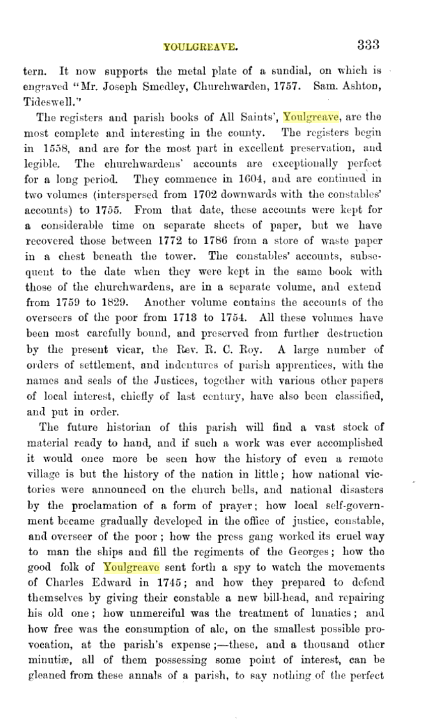
Although the Youlgreave parish registers are available online on microfilm, just the baptisms, marriages and burials are provided on the genealogy websites. However, I found some excerpts from the churchwardens accounts in a couple of old books, The Reliquary 1864, and Notes on Derbyshire Churches 1877.
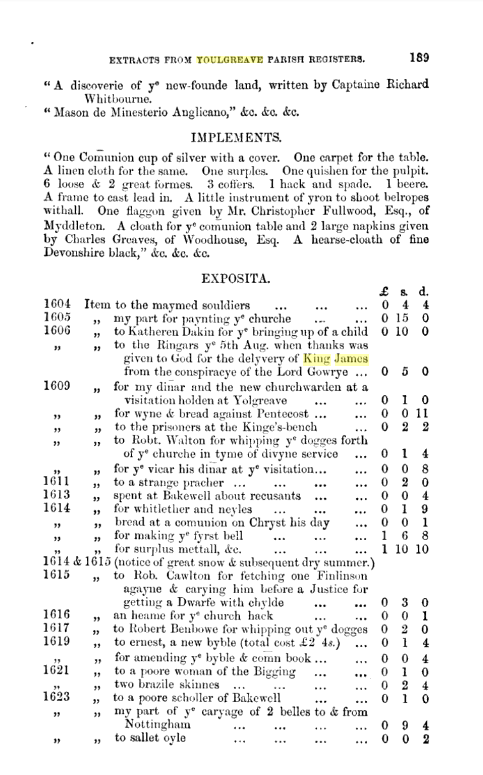
Hannah Keeling, my 4x great grandmother, was born in Youlgreave, Derbyshire, in 1767. In 1791 she married Edward Lees of Hartington, Derbyshire, a village seven and a half miles south west of Youlgreave. Edward and Hannah’s daughter Sarah Lees, born in Hartington in 1808, married Francis Featherstone in 1835. The Featherstone’s were farmers. Their daughter Emma Featherstone married John Marshall from Elton. Elton is just three miles from Youlgreave, and there are a great many Marshall’s in the Youlgreave parish registers, some no doubt distantly related to ours.
Hannah Keeling’s parents were John Keeling 1734-1823, and Ellen Frost 1739-1805, both of Youlgreave.
On the burial entry in the parish registers in Youlgreave in 1823, John Keeling was 88 years old when he died, and was the “late parish clerk”, indicating that my 5x great grandfather played a part in compiling the “best parish registers in the country”. In 1762 John’s father in law John Frost died intestate, and John Keeling, cordwainer, co signed the documents with his mother in law Ann. John Keeling was a shoe maker and a parish clerk.
John Keeling’s father was Thomas Keeling, baptised on the 9th of March 1709 in Youlgreave and his parents were John Keeling and Ann Ashmore. John and Ann were married on the 6th April 1708. Some of the transcriptions have Thomas baptised in March 1708, which would be a month before his parents married. However, this was before the Julian calendar was replaced by the Gregorian calendar, and prior to 1752 the new year started on the 25th of March, therefore the 9th of March 1708 was eleven months after the 6th April 1708.
Thomas Keeling married Dorothy, which we know from the baptism of John Keeling in 1734, but I have not been able to find their marriage recorded. Until I can find my 6x great grandmother Dorothy’s maiden name, I am unable to trace her family further back.
Unfortunately I haven’t found a baptism for Thomas’s father John Keeling, despite that there are Keelings in the Youlgrave registers in the early 1600s, possibly it is one of the few illegible entries in these registers.
The Frosts of Youlgreave
Ellen Frost’s father was John Frost, born in Youlgreave in 1707. John married Ann Staley of Elton in 1733 in Youlgreave.
(Note that this part of the family tree is the Marshall side, but we also have Staley’s in Elton on the Warren side. Our branch of the Elton Staley’s moved to Stapenhill in the mid 1700s. Robert Staley, born 1711 in Elton, died in Stapenhill in 1795. There are many Staley’s in the Youlgreave parish registers, going back to the late 1500s.)
John Frost (my 6x great grandfather), miner, died intestate in 1762 in Youlgreave. Miner in this case no doubt means a lead miner, mining his own land (as John Marshall’s father John was in Elton. On the 1851 census John Marshall senior was mining 9 acres). Ann Frost, as the widow and relict of the said deceased John Frost, claimed the right of administration of his estate. Ann Frost (nee Staley) signed her own name, somewhat unusual for a woman to be able to write in 1762, as well as her son in law John Keeling.
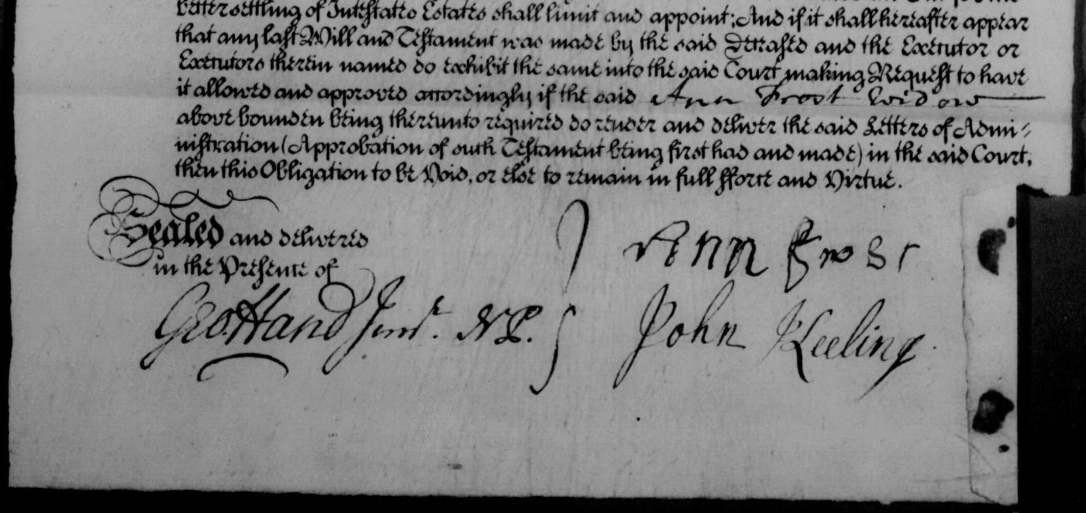
John’s parents were David Frost and Ann. David was baptised in 1665 in Youlgreave. Once again, I have not found a marriage for David and Ann so I am unable to continue further back with her family. Marriages were often held in the parish of the bride, and perhaps those neighbouring parish records from the 1600s haven’t survived.
David’s parents were William Frost and Ellen (or Ellin, or Helen, depending on how the parish clerk chose to spell it). Once again, their marriage hasn’t been found, but was probably in a neighbouring parish.
William Frost’s wife Ellen, my 8x great grandmother, died in Youlgreave in 1713. In her will she left her daughter Catherine £20. Catherine was born in 1665 and was apparently unmarried at the age of 48 in 1713. She named her son Isaac Frost (born in 1662) executor, and left him the remainder of her “goods, chattels and cattle”.
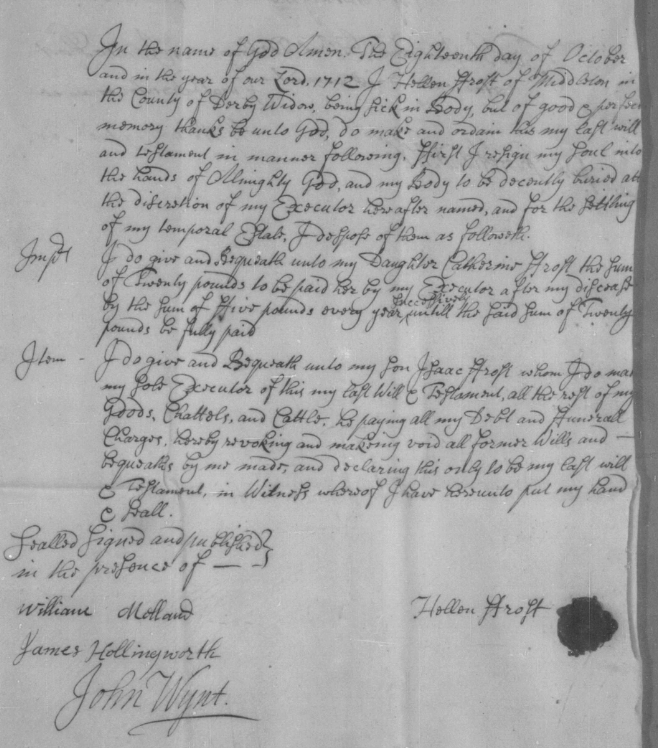
William Frost was baptised in Youlgreave in 1627, his parents were William Frost and Anne.
William Frost senior, husbandman, was probably born circa 1600, and died intestate in 1648 in Middleton, Youlgreave. His widow Anna was named in the document. On the compilation of the inventory of his goods, Thomas Garratt, Will Melland and A Kidiard are named.(Husbandman: The old word for a farmer below the rank of yeoman. A husbandman usually held his land by copyhold or leasehold tenure and may be regarded as the ‘average farmer in his locality’. The words ‘yeoman’ and ‘husbandman’ were gradually replaced in the later 18th and 19th centuries by ‘farmer’.)
Unable to find a baptism for William Frost born circa 1600, I read through all the pages of the Youlgreave parish registers from 1558 to 1610. Despite the good condition of these registers, there are a number of illegible entries. There were three Frost families baptising children during this timeframe and one of these is likely to be Willliam’s.
Baptisms:
1581 Eliz Frost, father Michael.
1582 Francis f Michael. (must have died in infancy)
1582 Margaret f William.
1585 Francis f Michael.
1586 John f Nicholas.
1588 Barbara f Michael.
1590 Francis f Nicholas.
1591 Joane f Michael.
1594 John f Michael.
1598 George f Michael.
1600 Fredericke (female!) f William.Marriages in Youlgreave which could be William’s parents:
1579 Michael Frost Eliz Staley
1587 Edward Frost Katherine Hall
1600 Nicholas Frost Katherine Hardy.
1606 John Frost Eliz Hanson.Michael Frost of Youlgreave is mentioned on the Derbyshire Muster Rolls in 1585.
(Muster records: 1522-1649. The militia muster rolls listed all those liable for military service.)
Frideswide:
A burial is recorded in 1584 for Frideswide Frost (female) father Michael. As the father is named, this indicates that Frideswide was a child.
(Frithuswith, commonly Frideswide c. 650 – 19 October 727), was an English princess and abbess. She is credited as the foundress of a monastery later incorporated into Christ Church, Oxford. She was the daughter of a sub-king of a Merica named Dida of Eynsham whose lands occupied western Oxfordshire and the upper reaches of the River Thames.)
An unusual name, and certainly very different from the usual names of the Frost siblings. As I did not find a baptism for her, I wondered if perhaps she died too soon for a baptism and was given a saints name, in the hope that it would help in the afterlife, given the beliefs of the times. Or perhaps it wasn’t an unusual name at the time in Youlgreave. A Fridesweda Gilbert was buried in Youlgreave in 1604, the spinster daughter of Francis Gilbert. There is a small brass effigy in the church, underneath is written “Frideswide Gilbert to the grave, Hath resigned her earthly part…”
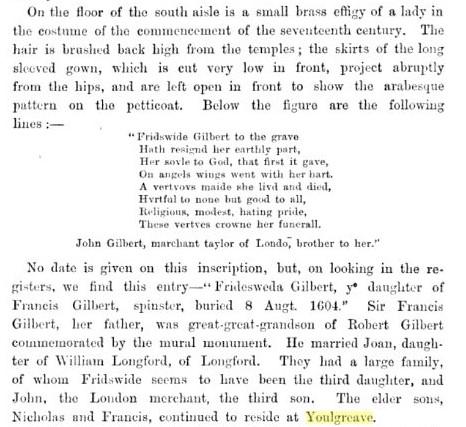
J. Charles Cox, Notes on the Churches of Derbyshire, 1877.
King James
A parish register entry in 1603:
“1603 King James of Skottland was proclaimed kinge of England, France and Ireland at Bakewell upon Monday being the 29th of March 1603.” (March 1603 would be 1604, because of the Julian calendar in use at the time.)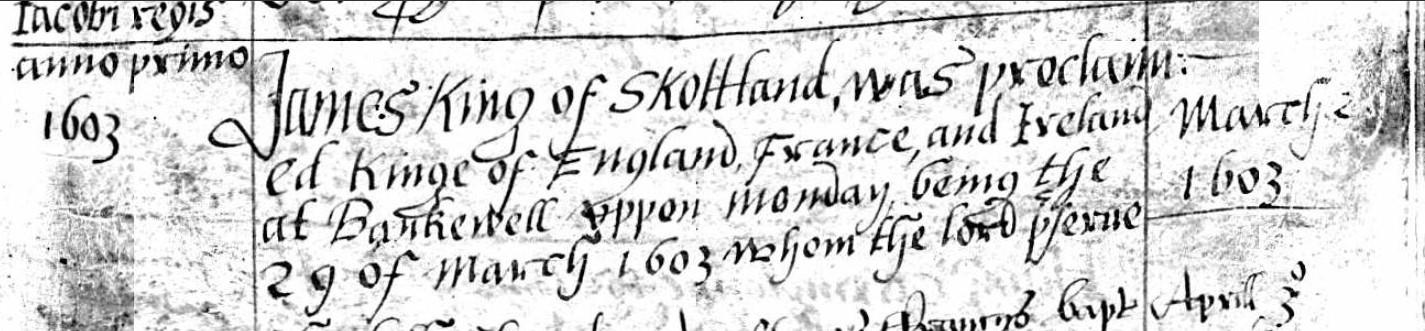
The Big Snow
“This year 1614/5 January 16th began the greatest snow whichever fell uppon the earth within man’s memorye. It covered the earth fyve quarters deep uppon the playne. And for heaps or drifts of snow, they were very deep; so that passengers both horse or foot passed over yates, hedges and walles. ….The spring was so cold and so late that much cattel was in very great danger and some died….”
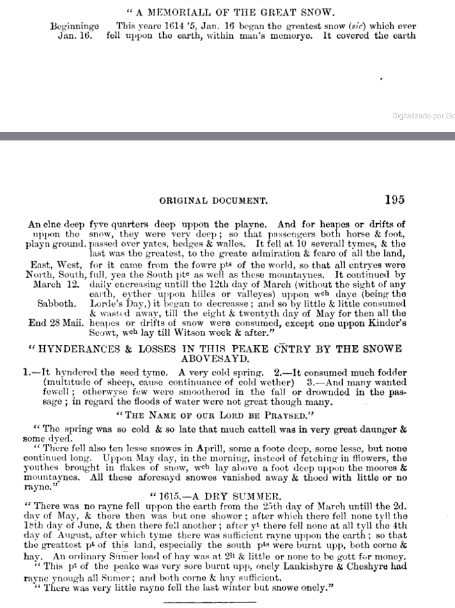
From the Youlgreave parish registers.
Our ancestor William Frost born circa 1600 would have been a teenager during the big snow.
June 22, 2024 at 6:44 am #7519In reply to: The Incense of the Quadrivium’s Mystiques
Audrey came to herself rather unexpectedly in the middle of the Choir ritual with all the witches and nuns finishing the Canticle from the Psalms of Saint Frogustus.

Luckily for the coven, her sudden gasp for air could have easily passed as a croak or one of the ribbit amens that went with the background aaah and oohs.
“I think something wrong happened to your friend.” she whispered to Jeezel who had been enjoying the unlikely singing. It was already the third ritual done in six, and it had been mostly enjoyable.
Eris whispered in turn as the grand croaking finale started with loud gong banging by Mother Lorena chanting “leaps of faithe, ye, leaps of faithe”.
“What do you mean? Is Frella alright?”
“Something came in the background, but when our minds disconnected, she felt more annoyed than anything… and to be honest maybe a bit… flustered, how to say…” she became red as Saint Frogustus’ hand tips. “Randy is the word you say?”
“Damn it Jeezel, have you done anything?”
“Why you ask me?” Jeezel felt offended. “You haven’t taken into account the strawberry full moon, that’s all.”
 “There’s only one potent counter-spell to this situation…” Audrey said. “We should pray to Saint Frigdona saint patroness of unwavering commitment to upholding the sanctity of boundaries and the virtues of righteousness, even in the face of the most enticing temptations!”
“Jeeze, don’t go all religious like this.” a glowing Truella finally said. “I was for one, quite enjoying all that croaking. Dear Rufus told me there is a reason to this ritual! Get that: giant dragon-eating frogs! Dra-gon-frig-ging-eat-ing-frogs! That’s why the famous nuns were revered!”
Eris and Jeezel looked at each other with that puzzled look unequivocally meaning “she’s lost her marbles”.
In the silent moment of the last gong sound droning out, they sighed in unison, turning to Audrey. “How is this Frigdona prayer going already?”
June 19, 2024 at 8:10 am #7503In reply to: The Incense of the Quadrivium’s Mystiques
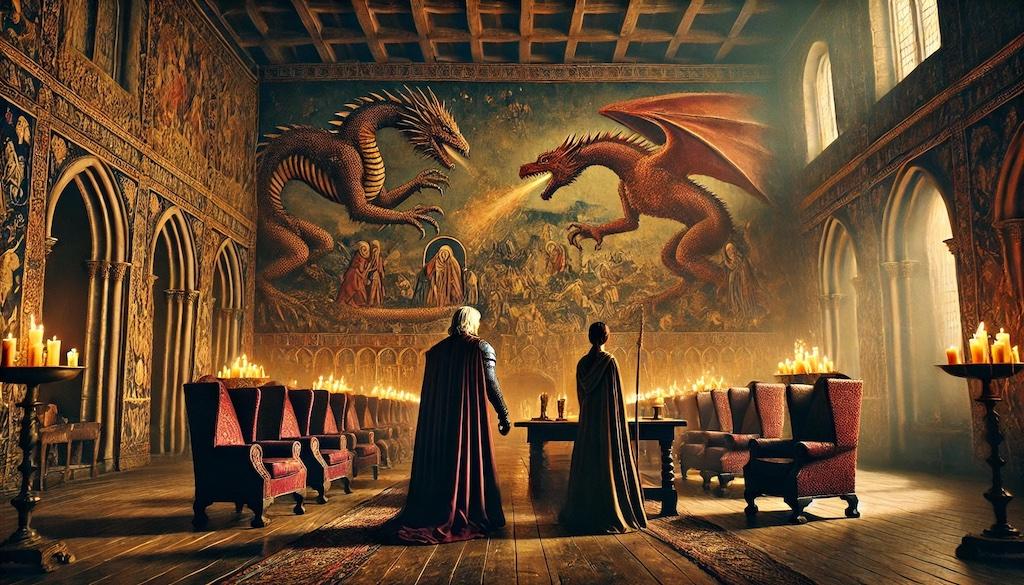
Silas led Jeezel into a secluded lounge, a hidden gem within the ancient cloister that seemed to be frozen in time. The atmosphere was thick with the scent of sandalwood and myrrh, mingling with a musty, earthy fragrance with undertones of aged woods.
Jeezel stopped a moment, in awe at the grand tapestries adorning the walls. They depicted scenes of epic battles between dragons and saints, the vibrant threads weaving tales of heroism and divine intervention. The dragons, captured in mid-roar with scales that seemed to shimmer with a life of their own, contrasted starkly agains the faces of the saints, their halo glowing softly in the dim light. Always the sensitive nose, Jeezel detected hints of incense and aged spices absorbed over centuries by the fabric, with a faint trace of mildew lingering on old stones and the faint sweetness of preserved herbs. She shivered.
Silas invited her to seat on one of the high-backed chairs upholstered in deep burgundy velvet that surrounded a massive oak table, carved with runes and symbols of protection. Jeezel frowned at the oddity to find pagan magic in a convent. As she sat the fabric of her gown brushed agains the plush velvet with a delicate sliding sound, like a faint sigh. The flickering flames of candelabras cast dancing shadows across the room, around which an array of curious relics and artifacts were scattered–an astrolabe here, a crystal ball there, and various objects of mystical significance.
Despite being an aficionado of pageants and grand performances, Jeezel couldn’t say she wasn’t impressed. Silas, ever the pillar of calm and wisdom, took a seat at the table, his fingers tracing the runes carved into the wood.
“Jeezel,” he began, his voice a soothing balm against the room’s charged energy, “I know I can trust you. Before we delve into the heart of these rituals, I must tell you something.”
Man! Here we are, she thought. She tensed on her chair.
“There are some people who would rather see the merger fail. They are doing anything in their power to foster such an outcome. We cannot let them win.”
Jeezel’s face tightened and she struggled to maintain her composure. She tapped with her fingers on the table to distract the head mortician’s attention and help her regain a stoic demeanor. Her mind raced weighing the implications. Malové had said that the Crimson Opus wasn’t just any artifact, it was key to immense power and knowledge, something that could tip the scales in their favour. How she regretted at that moment she had not paid enough attention at the merger meeting. Now, Malové was gone, somewhere, and Jeezel wasn’t even sure the postcard she had sent the coven was real. All she knew was that Malové counted on her to find that relic. And for that, she had to step in what appears to be a nest of vipers. She reminded herself she had survived worse competition in the past and still won her trophies with pride.
“Silas,” she said, her voice measured but with an edge of tension, “this complicates things more than I anticipated. We have enough on our hands ensuring the rituals go smoothly without sabotage.” She paused, taking a deep breath to steady herself. “But we cannot allow these factions to succeed. The merger is crucial for our mutual survival advancement. We’ll need to be vigilant, Silas. Every step we take, every ritual we perform, must be meticulously guarded. And we must identify who these adversaries are, and what they are planning.” She wished Malové would see her in that instant. She craved support from anyone. She looked at Silas, her eyes full of hope he could help. “I have a task from Malové that is of paramount importance,” she started and almost jumped from the chair when her hedgehog amulet almost tased her. A warning. Her mind suddenly found a new clarity. She realized she has been about to tell him about the Crimson Opus. Jeezel noticed the man’s finger was still caressing the runes on the table. Had he been casting a spell on her? She shook her head.
“Those six rituals cannot be compromised. I’ll need your help to ensure that we succeed. We must be prepared to act swiftly and decisively.”
Silas’ hand froze. He nodded. She wasn’t sure there wasn’t some irritation in his voice when he said: “You have my full support, Jeezel. We’ll strengthen our defenses and keep a close watch on any suspicious activities. The stakes are too high for failure.”
Did he mean that he would keep a close eye on her next moves? She’d have to be careful in her search of the Crimson Opus. She realized she needed some help. Malové, you entrusted me with that mission. Then, you’d have to trust me with whom I choose to trust.
July 4, 2023 at 7:52 pm #7261In reply to: Family Stories From The Other Side ~ Book Two
Long Lost Enoch Edwards
My father used to mention long lost Enoch Edwards. Nobody in the family knew where he went to and it was assumed that he went to USA, perhaps to Utah to join his sister Sophie who was a Mormon handcart pioneer, but no record of him was found in USA.
Andrew Enoch Edwards (my great great grandfather) was born in 1840, but was (almost) always known as Enoch. Although civil registration of births had started from 1 July 1837, neither Enoch nor his brother Stephen were registered. Enoch was baptised (as Andrew) on the same day as his brothers Reuben and Stephen in May 1843 at St Chad’s Catholic cathedral in Birmingham. It’s a mystery why these three brothers were baptised Catholic, as there are no other Catholic records for this family before or since. One possible theory is that there was a school attached to the church on Shadwell Street, and a Catholic baptism was required for the boys to go to the school. Enoch’s father John died of TB in 1844, and perhaps in 1843 he knew he was dying and wanted to ensure an education for his sons. The building of St Chads was completed in 1841, and it was close to where they lived.
Enoch appears (as Enoch rather than Andrew) on the 1841 census, six months old. The family were living at Unett Street in Birmingham: John and Sarah and children Mariah, Sophia, Matilda, a mysterious entry transcribed as Lene, a daughter, that I have been unable to find anywhere else, and Reuben and Stephen.
Enoch was just four years old when his father John, an engineer and millwright, died of consumption in 1844.
In 1851 Enoch’s widowed mother Sarah was a mangler living on Summer Street, Birmingham, Matilda a dressmaker, Reuben and Stephen were gun percussionists, and eleven year old Enoch was an errand boy.
On the 1861 census, Sarah was a confectionrer on Canal Street in Birmingham, Stephen was a blacksmith, and Enoch a button tool maker.
On the 10th November 1867 Enoch married Emelia Parker, daughter of jeweller and rope maker Edward Parker, at St Philip in Birmingham. Both Emelia and Enoch were able to sign their own names, and Matilda and Edwin Eddington were witnesses (Enoch’s sister and her husband). Enoch’s address was Church Street, and his occupation button tool maker.
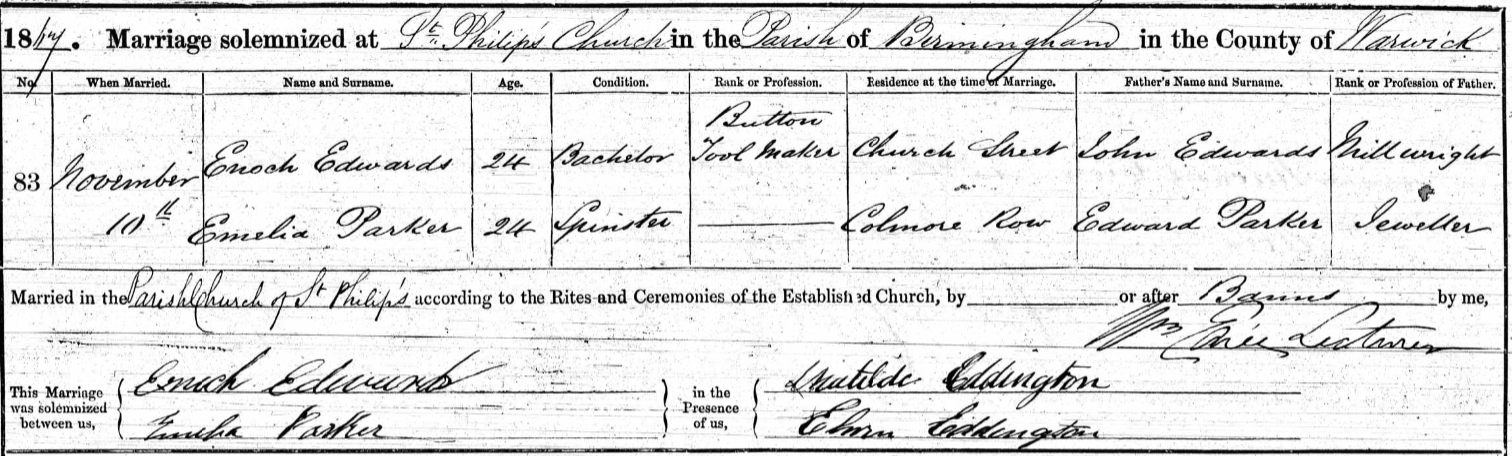
Four years later in 1871, Enoch was a publican living on Clifton Road. Son Enoch Henry was two years old, and Ralph Ernest was three months. Eliza Barton lived with them as a general servant.
By 1881 Enoch was back working as a button tool maker in Bournebrook, Birmingham. Enoch and Emilia by then had three more children, Amelia, Albert Parker (my great grandfather) and Ada.
Garnet Frederick Edwards was born in 1882. This is the first instance of the name Garnet in the family, and subsequently Garnet has been the middle name for the eldest son (my brother, father and grandfather all have Garnet as a middle name).
Enoch was the licensed victualler at the Pack Horse Hotel in 1991 at Kings Norton. By this time, only daughters Amelia and Ada and son Garnet are living at home.
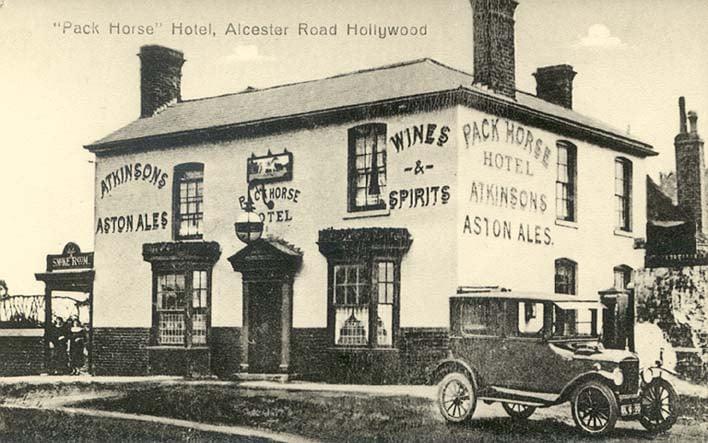
Additional information from my fathers cousin, Paul Weaver:
“Enoch refused to allow his son Albert Parker to go to King Edwards School in Birmingham, where he had been awarded a place. Instead, in October 1890 he made Albert Parker Edwards take an apprenticeship with a pawnboker in Tipton.
Towards the end of the 19th century Enoch kept The Pack Horse in Alcester Road, Hollywood, where a twist was 1d an ounce, and beer was 2d a pint. The children had to get up early to get breakfast at 6 o’clock for the hay and straw men on their way to the Birmingham hay and straw market. Enoch is listed as a member of “The Kingswood & Pack Horse Association for the Prosecution of Offenders”, a kind of early Neighbourhood Watch, dated 25 October 1890.
The Edwards family later moved to Redditch where they kept The Rifleman Inn at 35 Park Road. They must have left the Pack Horse by 1895 as another publican was in place by then.”Emelia his wife died in 1895 of consumption at the Rifleman Inn in Redditch, Worcestershire, and in 1897 Enoch married Florence Ethel Hedges in Aston. Enoch was 56 and Florence was just 21 years old.
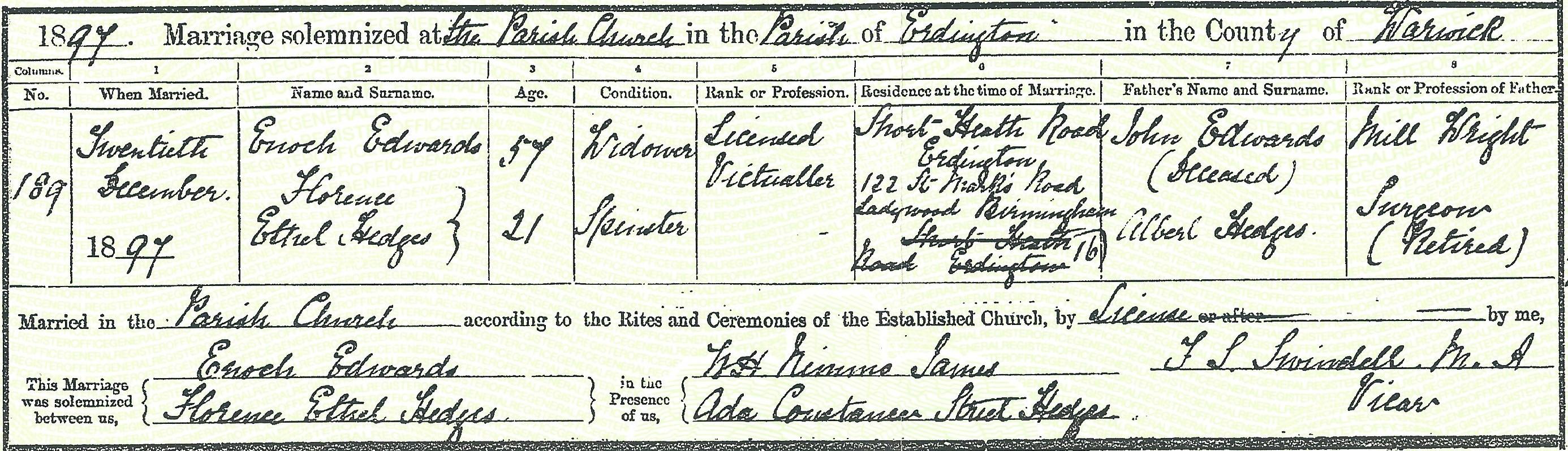
The following year in 1898 their daughter Muriel Constance Freda Edwards was born in Deritend, Warwickshire.
In 1901 Enoch, (Andrew on the census), publican, Florence and Muriel were living in Dudley. It was hard to find where he went after this.From Paul Weaver:
“Family accounts have it that Enoch EDWARDS fell out with all his family, and at about the age of 60, he left all behind and emigrated to the U.S.A. Enoch was described as being an active man, and it is believed that he had another family when he settled in the U.S.A. Esmor STOKES has it that a postcard was received by the family from Enoch at Niagara Falls.
On 11 June 1902 Harry Wright (the local postmaster responsible in those days for licensing) brought an Enoch EDWARDS to the Bedfordshire Petty Sessions in Biggleswade regarding “Hole in the Wall”, believed to refer to the now defunct “Hole in the Wall” public house at 76 Shortmead Street, Biggleswade with Enoch being granted “temporary authority”. On 9 July 1902 the transfer was granted. A year later in the 1903 edition of Kelly’s Directory of Bedfordshire, Hunts and Northamptonshire there is an Enoch EDWARDS running the Wheatsheaf Public House, Church Street, St. Neots, Huntingdonshire which is 14 miles south of Biggleswade.”
It seems that Enoch and his new family moved away from the midlands in the early 1900s, but again the trail went cold.
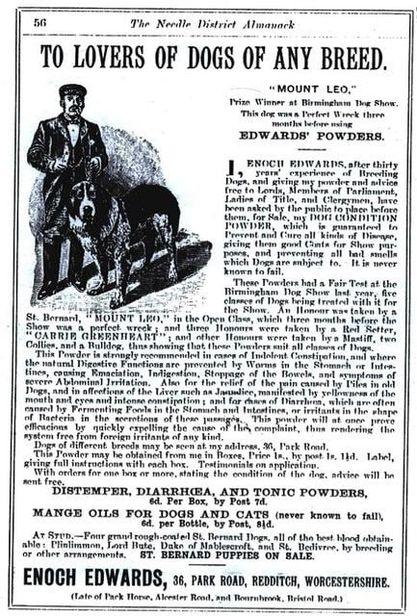
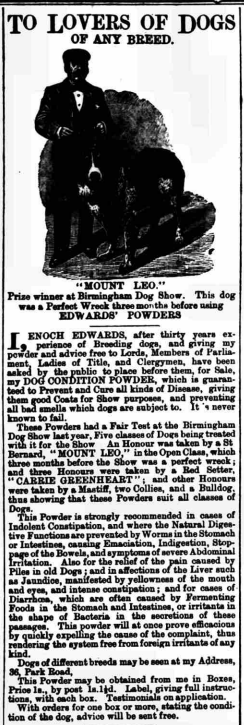
When I started doing the genealogy research, I joined a local facebook group for Redditch in Worcestershire. Enoch’s son Albert Parker Edwards (my great grandfather) spent most of his life there. I asked in the group about Enoch, and someone posted an illustrated advertisement for Enoch’s dog powders. Enoch was a well known breeder/keeper of St Bernards and is cited in a book naming individuals key to the recovery/establishment of ‘mastiff’ size dog breeds.
We had not known that Enoch was a breeder of champion St Bernard dogs!
Once I knew about the St Bernard dogs and the names Mount Leo and Plinlimmon via the newspaper adverts, I did an internet search on Enoch Edwards in conjunction with these dogs.
Enoch’s St Bernard dog “Mount Leo” was bred from the famous Plinlimmon, “the Emperor of Saint Bernards”. He was reported to have sent two puppies to Omaha and one of his stud dogs to America for a season, and in 1897 Enoch made the news for selling a St Bernard to someone in New York for £200. Plinlimmon, bred by Thomas Hall, was born in Liverpool, England on June 29, 1883. He won numerous dog shows throughout Europe in 1884, and in 1885, he was named Best Saint Bernard.
In the Birmingham Mail on 14th June 1890:
“Mr E Edwards, of Bournebrook, has been well to the fore with his dogs of late. He has gained nine honours during the past fortnight, including a first at the Pontypridd show with a St Bernard dog, The Speaker, a son of Plinlimmon.”
In the Alcester Chronicle on Saturday 05 June 1897:
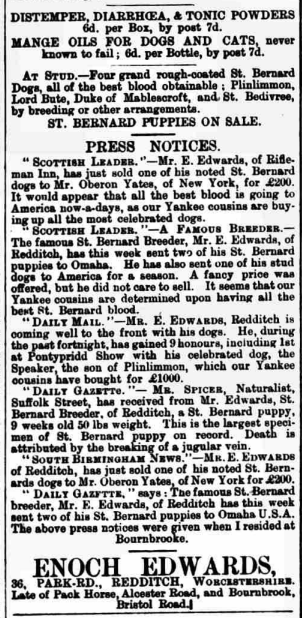
It was discovered that Enoch, Florence and Muriel moved to Canada, not USA as the family had assumed. The 1911 census for Montreal St Jaqcues, Quebec, stated that Enoch, (Florence) Ethel, and (Muriel) Frida had emigrated in 1906. Enoch’s occupation was machinist in 1911. The census transcription is not very good. Edwards was transcribed as Edmand, but the dates of birth for all three are correct. Birthplace is correct ~ A for Anglitan (the census is in French) but race or tribe is also an A but the transcribers have put African black! Enoch by this time was 71 years old, his wife 33 and daughter 11.
Additional information from Paul Weaver:
“In 1906 he and his new family travelled to Canada with Enoch travelling first and Ethel and Frida joined him in Quebec on 25 June 1906 on board the ‘Canada’ from Liverpool.
Their immigration record suggests that they were planning to travel to Winnipeg, but five years later in 1911, Enoch, Florence Ethel and Frida were still living in St James, Montreal. Enoch was employed as a machinist by Canadian Government Railways working 50 hours. It is the 1911 census record that confirms his birth as November 1840. It also states that Enoch could neither read nor write but managed to earn $500 in 1910 for activity other than his main profession, although this may be referring to his innkeeping business interests.
By 1921 Florence and Muriel Frida are living in Langford, Neepawa, Manitoba with Peter FUCHS, an Ontarian farmer of German descent who Florence had married on 24 Jul 1913 implying that Enoch died sometime in 1911/12, although no record has been found.”The extra $500 in earnings was perhaps related to the St Bernard dogs. Enoch signed his name on the register on his marriage to Emelia, and I think it’s very unlikely that he could neither read nor write, as stated above.
However, it may not be Enoch’s wife Florence Ethel who married Peter Fuchs. A Florence Emma Edwards married Peter Fuchs, and on the 1921 census in Neepawa her daugther Muriel Elizabeth Edwards, born in 1902, lives with them. Quite a coincidence, two Florence and Muriel Edwards in Neepawa at the time. Muriel Elizabeth Edwards married and had two children but died at the age of 23 in 1925. Her mother Florence was living with the widowed husband and the two children on the 1931 census in Neepawa. As there was no other daughter on the 1911 census with Enoch, Florence and Muriel in Montreal, it must be a different Florence and daughter. We don’t know, though, why Muriel Constance Freda married in Neepawa.
Indeed, Florence was not a widow in 1913. Enoch died in 1924 in Montreal, aged 84. Neither Enoch, Florence or their daughter has been found yet on the 1921 census. The search is not easy, as Enoch sometimes used the name Andrew, Florence used her middle name Ethel, and daughter Muriel used Freda, Valerie (the name she added when she married in Neepawa), and died as Marcheta. The only name she NEVER used was Constance!
A Canadian genealogist living in Montreal phoned the cemetery where Enoch was buried. She said “Enoch Edwards who died on Feb 27 1924 is not buried in the Mount Royal cemetery, he was only cremated there on March 4, 1924. There are no burial records but he died of an abcess and his body was sent to the cemetery for cremation from the Royal Victoria Hospital.”
1924 Obituary for Enoch Edwards:
Cimetière Mont-Royal Outremont, Montreal Region, Quebec, Canada
The Montreal Star 29 Feb 1924, Fri · Page 31

Muriel Constance Freda Valerie Edwards married Arthur Frederick Morris on 24 Oct 1925 in Neepawa, Manitoba. (She appears to have added the name Valerie when she married.)
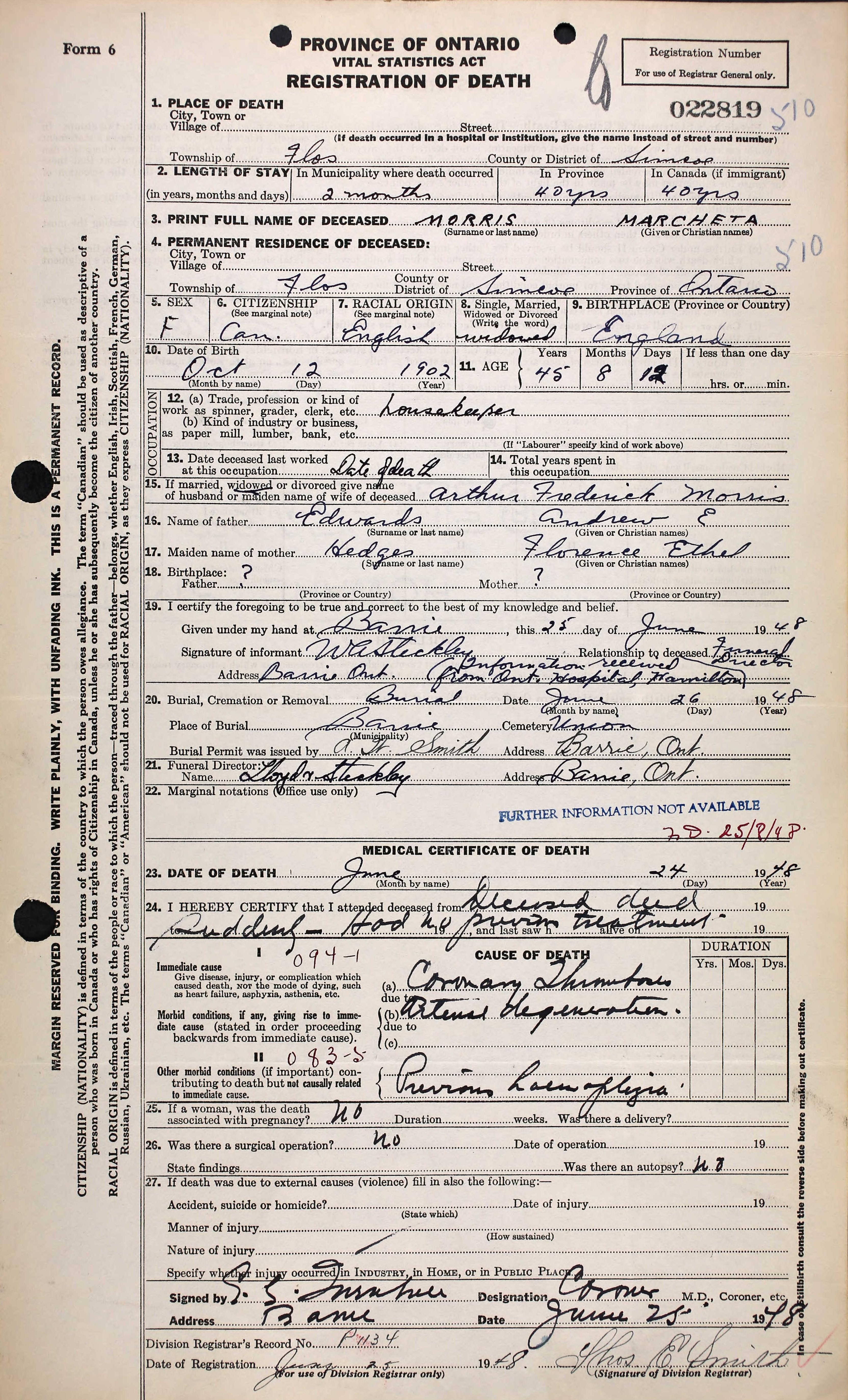
Unexpectedly a death certificate appeared for Muriel via the hints on the ancestry website. Her name was “Marcheta Morris” on this document, however it also states that she was the widow of Arthur Frederick Morris and daughter of Andrew E Edwards and Florence Ethel Hedges. She died suddenly in June 1948 in Flos, Simcoe, Ontario of a coronary thrombosis, where she was living as a housekeeper.
 May 16, 2023 at 10:52 am #7242
In reply to: Orbs of Madjourneys
Any news on Yasmin? Xavier sent a message to Zara. He was puzzled when she sent a cryptic screenshot with no explanatory message:
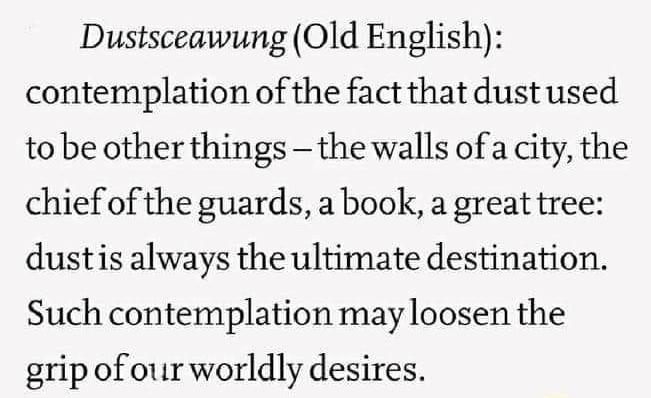
Xavier forwarded the message to Youssef and then his phone rang. It was an important call that went on at some length and he forgot to add that Zara had sent it to him with no explanation. Youssef frowned, and forwarded the screenshot to Zara. In a strange but by no means uncommon coincidence, Youssef was also called away before he had time to add a message of his own.
When Zara received the message from Youssef, her first thought was that somehow Youssef was involved with Yasmin’s disappearance, but what were they both doing at a dust convention? But she was having a busy day at the wombat rescue centre, and didn’t have time for this new puzzling development until the evening.
Zara had started the new job a week before, and had not been expecting it to be so busy. It was for this reason that it took her several days to realize that Yasmin hadn’t replied to any of her brief daily messages. When she tried phoning, the automated message informed her that the phone was switched off or outside of network, so Zara phoned the meditation centre where Yasmin was still staying when Zara left to start her new job. They said she had left a few days ago, and nobody knew where she was going to. They added that it was not their business to know such things, and that they were only interested in silence and contemplation. Zara sighed, and wished she wasn’t too busy to get a bus over to the retreat and ask around but it was a two hour journey and it would have to wait until her next day off.
Going back over the most recent messages from Yasmin, Zara realized that the very last communication was the odd message about dust. It hadn’t seemed particularly strange the other day, after all, there were so many odd people at meditation retreats and they all had strange quirks and wacky ideas, but then she’d seen a flyer pinned to the cork board at the wombat rescue centre about a Dustsceawung Convention. Had Yasmin gone to that?
The more that Zara thought about it, the more likely it seemed. While Zara herself hadn’t been very serious about the meditation regime at the retreat and had mostly snoozed during the sessions, Yasmin had been smitten and was in danger, to Zara’s way of thinking, of going over the top on the woo stuff. Kept going on about being enlightened and so on. But she’d also taken to sniffing everything, and not just flowers. Zara had seen her sniffing deeply with a rapturous expression on several occasions ~ once she even saw her on her knees sniffing the carpet.
When Zara asked her about it, a glazed look came over Yasmin’s face and she garbled something about it being the highest level of enlightenment, the scent was stronger and more precise than the word, and all the answers were in the scents and that we’d all been misled into thinking words were the key to the truth, when really it was our nose that was the key.
Zara had noticed that Yasmin wasn’t snorting as much, and decided to say no more on the topic. If it was doing Yasmin good and curing the snorting, then all well and good. But it was that saintly expression on her face that was worrying, and Zara hoped she’d snap out of it in due course.
I had better explain all this to Xavier and Youssef, Zara decided, and then see if I can find out more about the dust convention. Maybe we can use the game quest to help. Not that I have any time for game playing with all these wombats though!
February 6, 2023 at 10:44 pm #6500More developments
Chapter 3: The Journey becomes more eggciting
The Flovlinden Tree
The group reaches the Flovlinden Tree, a massive linden tree in the heart of Oocrane, which is said to be sacred and is attracting crowds of pilgrims.
They meet Olek, the old caretaker of the tree, who tells them the story of Saint Edigna. He explains how the tree is said to have magical healing properties, and how the tree is responsible for the sacred oil that the pilgrims come to collect.
However, Olek reveals that the secret of Saint Edigna is not what it seems. Edna, an old woman who has been living far from the crowd for thousands of years, is actually Saint Edigna.
Olek shares that Edna has been living in solitude for very long. He tells the group that if they want to learn more about the sacred tree and Edna, they must travel to her hidden home.
The four friends were shocked to hear that Edna was still alive and wanted to meet her. They asked Olek for directions, and he gave them a map that showed the way to Edna’s remote dwelling.
They bid farewell to Olek and set off on their journey to find Edna.A Run-In with Myroslava
The group comes across a former war reporter, Myroslava, who is traveling on her own after leaving a group of journalists. She is being followed by mysterious individuals and is trying to lose them by hunting and making fire in bombed areas.
Myroslava is frustrated and curses her lack of alcohol, wishing she could find a place to escape from her pursuers.
The group approaches Myroslava and offers to help her. She joins forces with them and together, they set off on their journey.
As they travel, Myroslava shares her experiences as a war reporter, and the group listens in awe. She explains how she has seen the worst of humanity, but also the best, and how it has changed her as a person.
Myroslava and the group continue their journey, with the former reporter becoming more and more determined to shake off her pursuers and continue on her own.A Visit with Eusebius Kazandis’ Relatives
The group reaches a small village where they are expected by relatives of Eusebius Kazandis, the cauldron seller that Rose has met at the Innsbruck fair.
The relatives tell the group about Kazandis and his business, and how he has been traveling the world, selling his wares. They explain how he has become a legend in their village, and how proud they are of him.
The group learns about Kazandis’ passion for cooking and how he uses his cauldrons to create delicious meals for his customers. They are also shown his secret recipe book, which has been passed down for generations.
The relatives invite the group to try some of Kazandis’ famous dishes, and they are blown away by the delicious flavors.
The group thanks the relatives for their hospitality and sets off on their journey, with a newfound appreciation for Kazandis and his love of cooking.A Surprising Encounter with Edna
The group finally reaches Edna’s hidden home, a small cottage in the middle of a dense forest.
As they approach the cottage, they are surprised to see Edna, who is actually the legendary Saint Edigna, standing outside, waiting for them.The four friends have finally arrived at Edna’s dwelling, where they learned about her vast knowledge of the families connected to her descendants. Edna showed them her books, and they were amazed to find that their own family was listed among her descendants. They were even more shocked to learn that they were related to President Voldomeer Zumbasky and Dumbass Voldomeer, who was said to be a distant relative and carpenter who made the President’s wooden leg. It was rumored that they shared a common ancestor, but in reality, they were possibly secret twins.
The Secret of Dumbass Voldomeer
The four friends were determined to find out more about Dumbass Voldomeer and his connection to their family. They learned that he lived in the small city of Duckailingtown in Dumbass, near the Rootian border. They also discovered that Dumbass Voldomeer had been enrolled to take the place of the President, who had succumbed from a mysterious swan flu virus, to which Dumbass Voldomeer was immune. As they set to Duckailingtown, they couldn’t help but wonder what other secrets and surprises lay ahead for them on this incredible journey.
February 6, 2023 at 10:15 pm #6498Some background information on The Sexy Wooden Leg and potential plot developments.
Setting
(nearby Duckailingtown in Dumbass, Oocrane)
The Rootians (a fictitious nationality) invaded Oocrane (a fictitious country) under the guise of freeing the Dumbass region from Lazies. They burned crops and buildings, including the home of a man named Dumbass Voldomeer who was known for his wooden leg and carpenter skills. After the war, Voldomeer was hungry and saw a nest of swan eggs. He went back to his home, carved nine wooden eggs, and replaced the real eggs with the wooden ones so he could eat the eggs for food. The swans still appeared to be brooding on their eggs by the end of summer.Note: There seem to be a bird thematic at play.
The swans’ eggs introduce the plot. The mysterious virus is likely a swan flu. Town in Oocrane often have reminiscing tones of birds’ species.
Bird To(w)nes: (Oocrane/crane, Keav/kea, Spovlar/shoveler, Dilove/dove…)
Also the town’s nursing home/hotel’s name is Vyriy from a mythical place in Slavic mythology (also Iriy, Vyrai, or Irij) where “birds fly for winter and souls go after death” which is sometimes identified with paradise. It is believed that spring has come to Earth from Vyrai.At the Keav Headquarters
(🗺️ Capital of Oocrane)
General Rudechenko and Major Myroslava Kovalev are discussing the incapacitation of President Voldomeer who is suffering from a mysterious virus. The President had told Major Kovalev about a man in the Dumbass region who looked similar to him and could be used as a replacement. The Major volunteers to bring the man to the General, but the General fears it is a suicide mission. He grants her permission but orders his aide to ensure she gets lost behind enemy lines.
Myroslava, the ambitious Major goes undercover as a former war reporter, is now traveling on her own after leaving a group of journalists. She is being followed but tries to lose her pursuers by hunting and making fire in bombed areas. She is frustrated and curses her lack of alcohol.
The Shrine of the Flovlinden Tree
(🗺️ Shpovlar, geographical center of Oocrane)
Olek is the caretaker of the shrine of Saint Edigna and lives near the sacred linden tree. People have been flocking to the shrine due to the miraculous flow of oil from the tree. Olek had retired to this place after a long career, but now a pilgrim family has brought a message of a plan acceleration, which upsets Olek. He reflects on his life and the chaos of people always rushing around and preparing for the wrong things. He thinks about his father’s approach to life, which was carefree and resulted in the same ups and downs as others, but with less suffering. Olek may consider adopting this approach until he can find a way to hide from the enemy.
Rosa and the Cauldron Maker
(young Oocranian wiccan travelling to Innsbruck, Austria)
Eusebius Kazandis is selling black cauldrons at the summer fair of Innsbruck, Austria. He is watching Rosa, a woman selling massage oils, fragrant oils, and polishing oils. Rosa notices Eusebius is sad and thinks he is not where he needs to be. She waves at him, but he looks away as if caught doing something wrong. Rosa is on a journey across Europe, following the wind, and is hoping for a gust to tell her where to go next. However, the branches of the tree she is under remain still.
The Nursing Home
(Nearby the town of Dilove, Oocrane, on Roomhen border somewhere in Transcarpetya)
Egna, who has lived for almost a millennium, initially thinks the recent miracle at the Flovlinden Tree is just another con. She has performed many miracles in her life, but mostly goes unnoticed. She has a book full of records of the lives of many people she has tracked, and reminisces that she has a connection to the President Voldomeer. She decides to go and see the Flovlinden Tree for herself.
🗺️ (the Vyriy hotel at Dilove, Oocrane, on Roomhen border)
Ursula, the owner of a hotel on the outskirts of town, is experiencing a surge in business from the increased number of pilgrims visiting the linden tree. She plans to refurbish the hotel to charge more per night and plans to get a business loan from her nephew Boris, the bank manager. However, she must first evict the old residents of the hotel, which she is dreading. To avoid confrontation, she decides to send letters signed by a fake business manager.
Egbert Gofindlevsky, Olga Herringbonevsky and Obadiah Sproutwinklov are elderly residents of an old hotel turned nursing home who receive a letter informing them that they must leave. Egbert goes to see Obadiah about the letter, but finds a bad odor in his room and decides to see Olga instead.
Maryechka, Obadiah’s granddaughter, goes back home after getting medicine for her sick mother and finds her home empty. She decides to visit her grandfather and his friends at the old people’s home, since the schools are closed and she’s not interested in online activities.
Olga and Egbert have a conversation about their current situation and decide to leave the nursing home and visit Rosa, Olga’s distant relative. Maryechka encounters Egbert and Olga on the stairs and overhears them talking about leaving their friends behind. Olga realizes that it is important to hold onto their hearts and have faith in the kindness of strangers. They then go to see Obadiah, with Olga showing a burst of energy and Egbert with a weak smile.Thus starts their escape and unfolding adventure on the roads of war-torn Oocrane.
Character Keyword Characteristics Sentiment Egbert old man, sharp tone sad, fragile Maryechka Obadiah’s granddaughter, shy innocent Olga old woman, knobbly fingers conflicted, determined Obadiah stubborn as a mule, old friend of Egbert unyielding, possibly deaf -
-
AuthorSearch Results