


Search Results for 'mean'
-
AuthorSearch Results
-
January 28, 2024 at 3:20 pm #7319
In reply to: The Incense of the Quadrivium’s Mystiques
Eris, logged off the Ritual, and stretched her long legs. That pandemic had brought them more work than ever, a new brand of Incense called “Vaxations” which they’d produced in record time, but of the little compensations for that harrowing time was the allowance to HFH (a.k.a Hex-From-Home). The Classical tenants of the Faith were missing quite a few of the modernities of the current world, and despite they’d been accounts of remote hexing from as long as the ages stretched, the Quadrivium Policies were quite clear you had to clock-in physically. That is, until the pandemic brought mayhem unto their clientèle, and rules had to be amended.
Eris was short for Ætheris, her formal witch name, which sounded much more airy than she’d liked. Eris, like the Goddess of Discord, well, that was more like her.
If she had to put her biography on the website of the Quadrivium Emporium it would read something like this:
Eris, the tech-savvy witch of discord, remains an enigma to most. She thrives in chaos, has a knack for bending technology to her will, and is pioneering a new branch of the Coven’s operations.
Technology had always been the eternal foe of Magic. As if everything explained by science somehow took away something off the realm of Magic. It was neither true, nor that simple, she believed. For one, she loved to blend the two (as most witches did, unwittingly).
Her familiar, Echo, was a proof of that. Echo wasn’t a tangible creature. Instead, Eris has somehow managed to summon an invisible digital sprite. This ethereal entity, capable of interfacing with any electronic device, was an invaluable asset to Eris’s technological endeavors.
Malové, their Head Witch CEO, had tasked her to launch a new branch, and given her some means to do so. Her intentions were rather unclear, but Eris had won her over when she showed her the parallels of Incense magic and Social Media.
Maybe that year, she would be keen to try and enhance their yearly Incense with some tech intelligence. Truth was, most of the artificial lives had been failures so far. Only Echo somehow turned out fine. One of a kind.“Echo,” she called, while a glowing blue sigil appeared in mid-air. “When you’re done with the latest…”
“Eris, sorry for interjecting, but you need to hear about this.”
She was too surprised to be mad. “What’s the matter?”
“Quality control on the first Ritual. It’s pointing out to some anomalies.”
January 28, 2024 at 11:14 am #7301In reply to: The Incense of the Quadrivium’s Mystiques
After the first of the four Rites of the Annual Incense Making was done, and the Coven disbanded for the day, Frigella was pulled by the sleeve by the weird one Truella.
“Psstt. Come to the Faded Cabbage in 30 min. Have something to tell you.”
Frigella rolled her eyes. She was not one for secrecies, cloaks and ladle, all that sort of mischiefs. But Truella seemed intent, if her electric hair had to tell the story for her. “Alright, I’ll be there.” she finally said, surprising Truella who’d thought she’d have to do more coaxing.
The Fadded Cabbage was hidden around a darker corner a stone’s throw away from the headquarters of the Quadrivium, some place the city council and gentrification had not yet touched for some reason, probably a strong ghosting spell.
Frigella sighed. She had been as usual too punctual, and of course, Truella was nowhere in sight. Unless…
She put a light spell on her round glasses which turned a subtle tint of violet. There she was. Under a cloaking spell, in a shady corner, slurping on a macchiatto lagger with cinnamon. Or some odd brewage of the sort she knew the secret.
“The old hare’s clearly lost the plot.” She spent no time engaging the discussion.
“I’ll have to stop you there, Tru.” said Frigella, “I don’t care about the politics. Much less if you’re trying to make a power move.”
Truella spluttered her offensive brewage all over Frigella’s neat starched apron. “You got it all wrong, Frig’. I don’t care about the power, I only care about my craft and freedom. It’s been too long we’ve been called to arms, like every bloody year. And my interest have grown since.”
Frigella chuckled. “You mean, you’ve been all over the place, haven’t you. From Energetic History, you’ve moved to Concrete Plasticity, Telluric Archaelogy, Familial Arborestry, I must say… It’s been hard to keep up.”
“You’re one to tell. All that mystery, and not much to show for. You’re barely doing the minimum to keep our flagship household Incense ‘Liz n°5’ afloat.” Truella sighed.
“So what’s your plan?” Frigella wondered?
January 28, 2024 at 10:54 am #7300Topic: The Incense of the Quadrivium’s Mystiques
in forum Yurara Fameliki’s StoriesSpring was upon them.
“Bloody too early, if you ask me” said Malové, the Head of the Coven of Mystiques, but just CEO of Quadrivium Emporium to the outside world.
“Meow.” Only the Coven’s familiar, a clichéd black cat dared to voice what seemed to have been the common thought. How tedious, so much spring cleaning of the collective energies to do, and almost 2 months ahead of schedule. Blame the telluric energies catch-up with the cosmic downpour of the world’s mind agitation. Or global warming, as it’s labelled nowadays.
“You know how it goes.” Malové continued. “We set the tone of the stories ahead. And it can only be done by actually writing it. Yeah, how exciting. Like conducting an orchestra in a zoo, there’s plenty of potential, but I guess we’ll have to work on our priorities.”
“Do you mean keeping the zoo’s hyenas from eating everybody else?” Frigella was not one to beat around the bush.
“Yeah, something like that. And you know how you control hyenas?”
The witches assembled looked at each other sideways.
“The Whale would tell you it’s a lovely story of shared resonance, forging bonds based on trust… But that’s a load of bollocks. Some emotions are only managed through stronger ones – so let’s do what we do best, get our Incense ready, and put some order in this bloody chaotic mess. Who wants to start?”
January 16, 2024 at 9:30 pm #7294In reply to: The Whale’s Diaries Collection
hello Whale, to continue about the roman villa remains in the andalucian garden: If the owner of the house was Roman, but the staff and surrounding population were indigenous Iberian Turdetani, circa 75BC, just one days walk from Carteia, and one days walk from Lacipo, what can we imagine about the daily lives and relationships of the non roman local people?
Ah, the intermingling of cultures, a dance as old as civilization itself. Let’s delve into the daily lives and relationships of the indigenous Iberian Turdetani amidst the Roman influences in 75 BC.
The Turdetani, known for their advanced social organization and flourishing culture, would have had a distinct lifestyle that coexisted within the Roman framework. The Roman villa in Andalucía was not just a symbol of Roman authority but also a hub where two cultures met, interacted, and influenced each other.
Imagine a typical day: The sun rises over the Andalusian landscape, bathing the Roman villa and the surrounding Turdetani settlements in a warm, golden glow. Turdetanian workers make their way to the villa, ready for a day of work. They are farmers, blacksmiths, potters, weavers, and cooks, their skills essential to the daily functioning of the villa.
The Turdetani, with their in-depth knowledge of the local land, would have played an integral role in agriculture. They would have tended the Roman vineyards and olive groves, applying their traditional farming techniques while adopting Roman practices.
Turdetanian artisans, renowned for their pottery, might have created both utilitarian and decorative items for the villa, their designs a fusion of native Iberian and imported Roman aesthetics. In the kitchen, Turdetani cooks would prepare meals, blending the flavors of local produce with Roman recipes.
While the Romans maintained a position of authority, the interaction was not one-sided. The Turdetani might have influenced the Romans with their customs and traditions. Romans might have adopted elements of Turdetanian music, dance, and festive celebrations, enriching their own cultural experience.
Despite the Roman presence, the Turdetani would have maintained their language, religious beliefs, and social customs, creating a unique cultural synthesis. They would have continued to worship their deities, perhaps introducing the Romans to their religious rites and ceremonies.
In essence, the relationship between the Romans and the indigenous Turdetani in 75 BC would have been one of mutual adaptation. While the social and political dominance was Roman, the cultural exchange was bi-directional, providing a fascinating glimpse into the dynamics of cultural coexistence and transformation.
Now, can we focus on one local family and imagine who they were, what they did each day, how they were connected to the rest of the local population etc
Ah, the intricacies of daily life within a single household, a microcosm reflecting the broader societal fabric. Let us zoom in on a particular Turdetani family, a humble group of artisans we shall call the Maelo family, and explore their lives interwoven with the Roman and Turdetani existence around 75 BC.
At the heart of the family was the patriarch, Oris Maelo. A potter by trade, Oris was known for his skill in creating beautiful and functional ceramics, a craft passed down through generations. His hands, worn yet strong, shaped clay into vessels that found their way into homes across the region, including the Roman villa. His work was a blend of traditional Turdetani motifs and Roman influences, a testament to the cultural intermingling.
His wife, Caelia, was a weaver. Her nimble fingers spun stories in wool and linen. Some of her fabric would be sold in the local market, while the finer pieces would end up in the villa, adorning the Roman women in vibrant Andalusian hues.
Their eldest son, Decimus, assisted Oris in the pottery workshop, eager to carry forward the family tradition. Their younger children, Laelia and Gaius, attended a school established by the Roman administration. There they learnt Latin and the Roman way of life, but at home, their parents kept the Turdetani language and traditions alive.
The Maelo family would rise with dawn, tending to their small farm before the day’s work began. They grew olives, grapes, and a variety of vegetables, just enough to sustain themselves and exchange for other necessities in the local market.
Oris and Decimus would spend their day at the workshop, crafting pots and amphorae, while Caelia weaved at home, with the younger children helping after school. Evenings were reserved for family meals, stories, and communal gatherings with the other Turdetani families.
Their connection with the local population was multifaceted. Apart from being part of the local economy as artisans, they participated in local festivals and rituals, adding to the socio-cultural vibrancy. Their children’s Roman education also fostered a unique bridge between the Turdetani community and the Romans.
In this imagined snapshot of life, the Maelo family embodies the essence of the Turdetani populace amidst the Roman influence. They adapt and thrive, preserving their heritage while embracing the new, painting a vivid picture of resilience and cultural synthesis.
Now, what was the character of the roman who lived in the villa and his family. Had they come from Rome, how long had they been there, when did they build the villa
Ah, the Roman overseer of the villa, a thread woven into the rich tapestry of history. Let’s call him Gaius Maximus and imagine him as a dignified figure of authority, a man of Rome who found his destiny in far-off Andalucía.
Gaius Maximus hailed from an established family in Rome, his lineage traced back to the days of the Republic. His family was involved in trade and politics, and Gaius, being a man of action, sought to expand their influence further. Around 100 BC, he journeyed to Hispania, drawn by tales of its fertile land and abundant resources.
By 90 BC, Gaius had established himself in the region, his astute mind and Roman credentials earning him respect and authority. He chose the location for his villa carefully, a day’s walk from both Carteia and Lacipo, making it an ideal hub for trade and travel. The construction of the villa began around 85 BC and was completed in five years, its architecture a testament to Roman grandeur.
His wife, Claudia, hailed from a patrician family in Rome. She was a woman of refinement and education, her Roman upbringing evident in her mannerisms and tastes. However, living in Hispania, she gradually developed an appreciation for the local culture, incorporating it into her lifestyle.
Their two children, Marcus and Julia, were born in Hispania. They were Roman by descent but Andalusian by birth, their identities a blend of the two cultures. Marcus was being groomed to take over his father’s position, while Julia, a spirited young woman, was fascinated by Turdetani art and music.
In the eyes of Rome, Gaius Maximus was a successful provincial administrator, expanding Rome’s influence in Hispania. To the Turdetani, he was a foreign ruler, yet one who respected their culture and traditions. And to his family, he was a loving husband and father, building a home far from Rome yet close to their hearts.
Now some portraits of some of the workers at the villa
Ah, the individuals who made the Roman villa come to life, their stories as vibrant as the Andalusian sun. Let’s give our imagination wings and step into their world.
First, we have Tertius, the villa’s steward. Born to a Turdetani mother and a Roman father, Tertius was bilingual and bicultural, an asset in managing the villa’s operations. He was a man of medium height, with a sturdy build and a sharp gaze. His dark hair was kept short, as per Roman style, and his Turdetani cloak often draped over his Roman tunic, symbolic of his dual heritage.
Then we have Aelia, the head cook. A native Turdetani, Aelia was a robust woman with a jovial demeanor. Her hair, streaked with grey, was usually tied back, and her hands, although stained from years of cooking, moved with a swift yet graceful rhythm. Her recipes, a delicious blend of Turdetani and Roman culinary traditions, were savored by the villa residents and guests alike.
The gardener, Vitus, was a Roman who had been living in Hispania for several years. A man of few words, Vitus spoke through his work. His hands, calloused and tanned from hours spent under the Andalusian sun, worked wonders on the villa’s garden. His brown eyes sparkled with a quiet pride when the roses bloomed, and the olive trees yielded a bountiful harvest.
Lastly, we must not forget the youngest worker, Lyra. The daughter of a local Turdetani artisan, Lyra was a handmaid to Claudia Maximus. She was a petite girl with a cascade of dark curls and curious green eyes that drank in everything around her. Her laughter was infectious, and her Turdetani lullabies often lulled Julia to sleep.
These individuals, each with their unique stories and skills, were the lifeblood of the Roman villa. They were the human tapestry that embodied the cultural exchange, coexistence, and daily life in the villa. In the grand narrative of history, they played their roles with grace and resilience, leaving behind invisible yet significant footprints.
what were some of the cooks recipes?
Ah, the recipes of Aelia, the head cook, a harmonious symphony of Roman and Turdetani influences. Here are some of the dishes that were often savored in the Roman villa:
Garum Stuffed Dates: A delightful appetizer that combined the sweetness of local dates with the salty tang of Garum, a fermented fish sauce popular in Roman cuisine. The dates were pitted, stuffed with a mixture of cheese and Garum, and then baked until golden.
Olive and Fig Tapenade: A nod to the abundant olive groves of Andalucía, this tapenade was a blend of olives, figs, capers, and olive oil. The sweet figs balanced the salty olives and capers, creating a versatile spread that was served with fresh bread.
Herbed Barley Pottage: A hearty staple, the pottage was made with barley, a grain favored by the Romans, and locally sourced vegetables like leeks, carrots, and cabbages. Fresh herbs from the villa’s garden added a burst of flavor.
Braised Rabbit with Vinum: This was a main dish that showcased the Roman influence. Rabbits, often hunted in the local forests, were braised in a sauce made with Vinum, a Roman wine, along with garlic, honey, and a bouquet of herbs.
Honey-Nut Patina: A classic Roman dessert with an Andalusian twist. Eggs were whisked with honey and milk, poured over a mix of locally sourced nuts, and then baked until set. It was a sweet ending to the meals at the villa.
Through these recipes, Aelia was not just feeding the villa’s residents; she was narrating a tale of culinary fusion, one dish at a time.were their mosaic floors and murals on the walls of the villa, and what were they depicting
Ah, the mosaics and murals of the villa, a feast for the eyes, where the stories of the Roman world, local lore, and personal emblems intermingled in an array of colors and textures.
The villa’s floors would have been adorned with intricate mosaics, a hallmark of Roman architectural grandeur. Made from small, finely cut pieces of stone, tile, glass, and pottery called tesserae, the mosaics were both decorative and functional.
In the atrium, the mosaic might depict a scene from Roman mythology. Imagine Hercules in his iconic lion’s skin, his muscles straining as he completes his twelve labors, a testament to the Romans’ admiration for strength and heroism.
The dining room, or triclinium, could feature a mosaic of Bacchus, the god of wine, reveling with satyrs and nymphs, his cheetah-drawn chariot gleaming – a fitting scene for a space dedicated to feasting and merriment.
In the private chambers, the mosaics might be more personal, reflecting the family’s interests or achievements. Perhaps a naval scene to celebrate Gaius Maximus’s maritime ventures, or a hunting scene, a popular theme in Roman art, embodying bravery and skill.
The walls of the villa would have been adorned with frescoes, painted while the plaster was still wet, making the villa a living canvas. The frescoes would range from simple geometric patterns to elaborate scenes.
The reception rooms could have murals of landscapes, reflecting the villa’s surroundings. Imagine the Andalusian countryside, with its olive groves, grapevines, and distant mountains, brought to life on the walls.
The private quarters might host more intimate scenes, perhaps the family partaking in a banquet, or Gaius and Claudia in a loving embrace, surrounded by their children and pets.
Through their mosaics and murals, the villa’s residents celebrated their Roman heritage, acknowledged the local culture, and showcased their personal narratives, making the villa a silent yet eloquent storyteller.
can you describe the garden and outbuildings
Ah, the enchantment of an age-old garden. Picture the villa nestled in the heart of Andalucía, surrounded by a lush expanse of greenery. Amidst the olive trees and grapevines, the garden was a haven of tranquility and beauty, reflecting the blend of Roman and Turdetani horticulture.
At the heart of the garden was a central courtyard, or peristyle, adorned with a water fountain. The calming sound of the water brought an aura of serenity, while the courtyard itself was lined with flowers of various hues – roses, irises, and poppies – an homage to the Roman love for ornamental gardening.
Beyond the peristyle, the garden was a mixture of beauty and utility. Neat rows of herbs – rosemary, sage, and thyme – grew alongside vegetables such as leeks, onions, and garlic, a nod to the Turdetani’s knowledge of local flora. Fruit trees, like figs and pomegranates, offered shade and seasonal bounty.
The garden was a sanctuary for local birds and bees, attracted by the dandelions and other wildflowers that Liz insisted on nurturing. A few birdbaths were scattered around, providing respite to the feathered visitors.
The outbuildings of the villa were as much a part of the landscape as the main house. Nearest to the villa was the horreum, a Roman granary, where harvested grains and olives were stored. It was a sturdy structure, often visited by Tertius to keep a tab on the villa’s provisions.
Not far from the horreum was the pottery workshop. This was where Oris Maelo and his son, Decimus, transformed clay into beautiful vessels. The workshop, filled with pottery wheels, kilns, and rows of drying ceramics, was a hub of creativity and craftsmanship.
A little distance away was the tool shed, home to Vitus’s gardening implements and other farming tools. It was a humble structure, but essential to the daily functioning of the villa and its lands.
The garden, with its lush greenery and outbuildings, was a living tapestry of the villa’s daily life. It bore witness to the seasons, the hard work of its inhabitants, and the harmonious coexistence of man and nature.
September 18, 2023 at 8:29 am #7278In reply to: Family Stories From The Other Side ~ Book Two
Tomlinson of Wergs and Hancox of Penn
John Tomlinson of Wergs (Tettenhall, Wolverhamton) 1766-1844, my 4X great grandfather, married Sarah Hancox 1772-1851. They were married on the 27th May 1793 by licence at St Peter in Wolverhampton.
Between 1794 and 1819 they had twelve children, although four of them died in childhood or infancy. Catherine was born in 1794, Thomas in 1795 who died 6 years later, William (my 3x great grandfather) in 1797, Jemima in 1800, John, Richard and Matilda between 1802 and 1806 who all died in childhood, Emma in 1809, Mary Ann in 1811, Sidney in 1814, and Elijah in 1817 who died two years later.On the 1841 census John and Sarah were living in Hockley in Birmingham, with three of their children, and surgeon Charles Reynolds. John’s occupation was “Ind” meaning living by independent means. He was living in Hockley when he died in 1844, and in his will he was “John Tomlinson, gentleman”.
Sarah Hancox was born in 1772 in Penn, Wolverhampton. Her father William Hancox was also born in Penn in 1737. Sarah’s mother Elizabeth Parkes married William’s brother Francis in 1767. Francis died in 1768, and in 1770 Elizabeth married William.
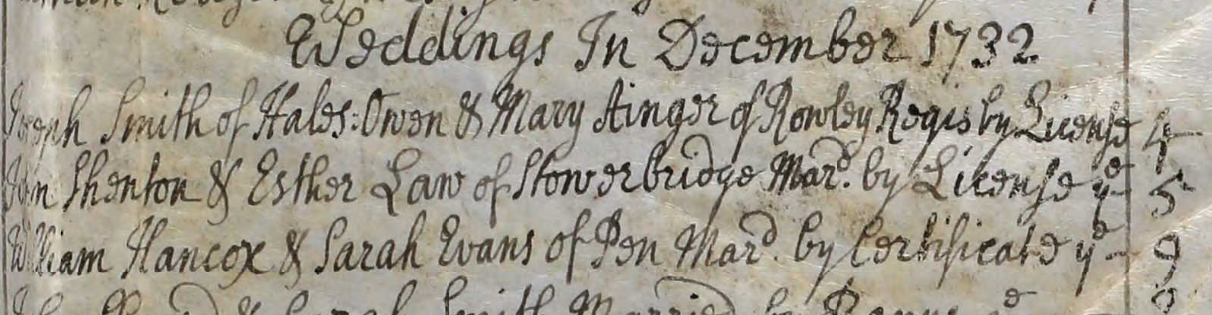
William’s father was William Hancox, yeoman, born in 1703 in Penn. He died intestate in 1772, his wife Sarah claiming her right to his estate. William Hancox and Sarah Evans, both of Penn, were married on the 9th December 1732 in Dudley, Worcestershire, by “certificate”. Marriages were usually either by banns or by licence. Apparently a marriage by certificate indicates that they were non conformists, or dissenters, and had the non conformist marriage “certified” in a Church of England church.
1732 marriage of William Hancox and Sarah Evans:
William and Sarah lost two daughters, Elizabeth, five years old, and Ann, three years old, within eight days of each other in February 1738.
William the elder’s father was John Hancox born in Penn in 1668. He married Elizabeth Wilkes from Sedgley in 1691 at Himley. John Hancox, “of Straw Hall” according to the Wolverhampton burial register, died in 1730. Straw Hall is in Penn. John’s parents were Walter Hancox and Mary Noake. Walter was born in Tettenhall in 1625, his father Richard Hancox. Mary Noake was born in Penn in 1634. Walter died in Penn in 1689.
Straw Hall thanks to Bradney Mitchell:
“Here is a picture I have of Straw Hall, Penn Road.
The painting is by John Reid circa 1878.
Sketch commissioned by George Bradney Mitchell to record the town as it was before its redevelopment, in a book called Wolverhampton and its Environs. ©”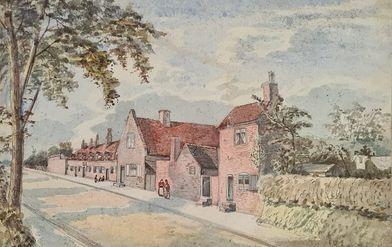
And a photo of the demolition of Straw Hall with an interesting story:
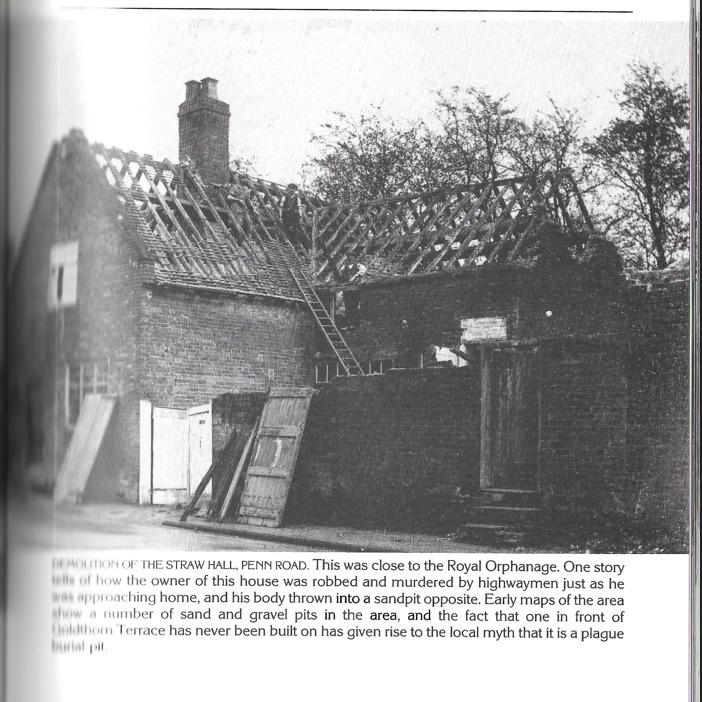
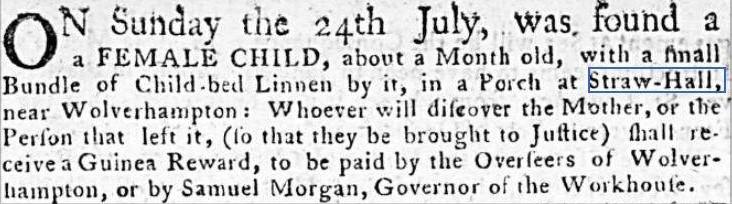
In 1757 a child was abandoned on the porch of Straw Hall. Aris’s Birmingham Gazette 1st August 1757:
The Hancox family were living in Penn for at least 400 years. My great grandfather Charles Tomlinson built a house on Penn Common in the early 1900s, and other Tomlinson relatives have lived there. But none of the family knew of the Hancox connection to Penn. I don’t think that anyone imagined a Tomlinson ancestor would have been a gentleman, either.
Sarah Hancox’s brother William Hancox 1776-1848 had a busy year in 1804.
On 29 Aug 1804 he applied for a licence to marry Ann Grovenor of Claverley.
In August 1804 he had property up for auction in Penn. “part of Lightwoods, 3 plots, and the Coppice”
On 14 Sept 1804 their first son John was baptised in Penn. According to a later census John was born in Claverley. (before the parents got married)(Incidentally, John Hancox’s descendant married a Warren, who is a descendant of my 4x great grandfather Samuel Warren, on my mothers side, from Newhall, Derbyshire!)
On 30 Sept he married Ann in Penn.
In December he was a bankrupt pig and sheep dealer.
In July 1805 he’s in the papers under “certificates”: William Hancox the younger, sheep and pig dealer and chapman of Penn. (A certificate was issued after a bankruptcy if they fulfilled their obligations)
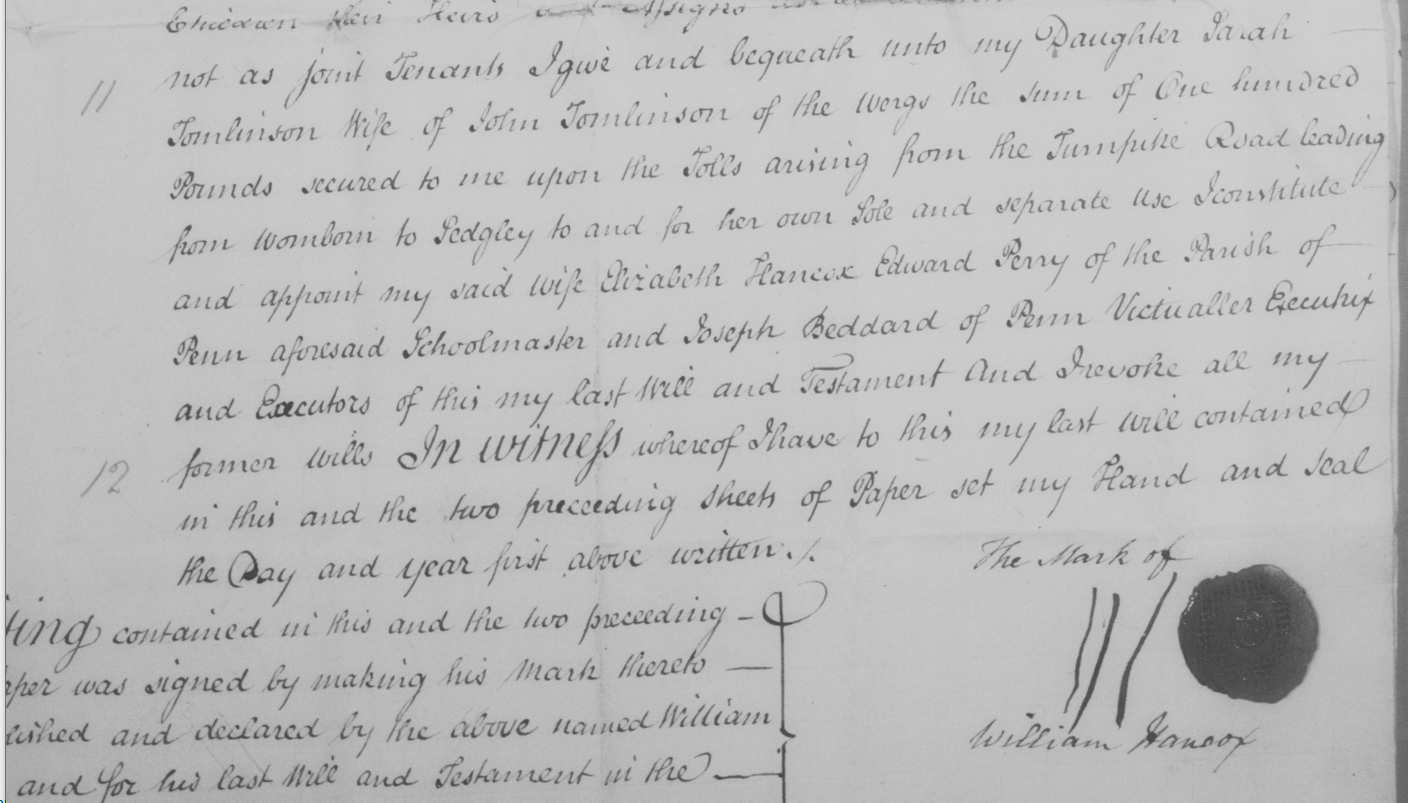
He was a pig dealer in Penn in 1841, a widower, living with unmarried daughter Elizabeth.Sarah’s father William Hancox died in 1816. In his will, he left his “daughter Sarah, wife of John Tomlinson of the Wergs the sum of £100 secured to me upon the tolls arising from the turnpike road leading from Wombourne to Sedgeley to and for her sole and separate use”.
The trustees of toll road would decide not to collect tolls themselves but get someone else to do it by selling the collecting of tolls for a fixed price. This was called “farming the tolls”. The Act of Parliament which set up the trust would authorise the trustees to farm out the tolls. This example is different. The Trustees of turnpikes needed to raise money to carry out work on the highway. The usual way they did this was to mortgage the tolls – they borrowed money from someone and paid the borrower interest; as security they gave the borrower the right, if they were not paid, to take over the collection of tolls and keep the proceeds until they had been paid off. In this case William Hancox has lent £100 to the turnpike and is leaving it (the right to interest and/or have the whole sum repaid) to his daughter Sarah Tomlinson. (this information on tolls from the Wolverhampton family history group.)William Hancox, Penn Wood, maltster, left a considerable amount of property to his children in 1816. All household effects he left to his wife Elizabeth, and after her decease to his son Richard Hancox: four dwelling houses in John St, Wolverhampton, in the occupation of various Pratts, Wright and William Clarke. He left £200 to his daughter Frances Gordon wife of James Gordon, and £100 to his daughter Ann Pratt widow of John Pratt. To his son William Hancox, all his various properties in Penn wood. To Elizabeth Tay wife of Thomas Tay he left £200, and to Richard Hancox various other properties in Penn Wood, and to his daughter Lucy Tay wife of Josiah Tay more property in Lower Penn. All his shops in St John Wolverhamton to his son Edward Hancox, and more properties in Lower Penn to both Francis Hancox and Edward Hancox. To his daughter Ellen York £200, and property in Montgomery and Bilston to his son John Hancox. Sons Francis and Edward were underage at the time of the will. And to his daughter Sarah, his interest in the toll mentioned above.
Sarah Tomlinson, wife of John Tomlinson of the Wergs, in William Hancox will:
 August 17, 2023 at 4:32 pm #7268
In reply to: Family Stories From The Other Side ~ Book Two
William Tomlinson
1797-1867
The Tomlinsons of Wolverhampton were butchers and publicans for several generations. Therefore it was a surprise to find that William’s father was a gentleman of independant means.
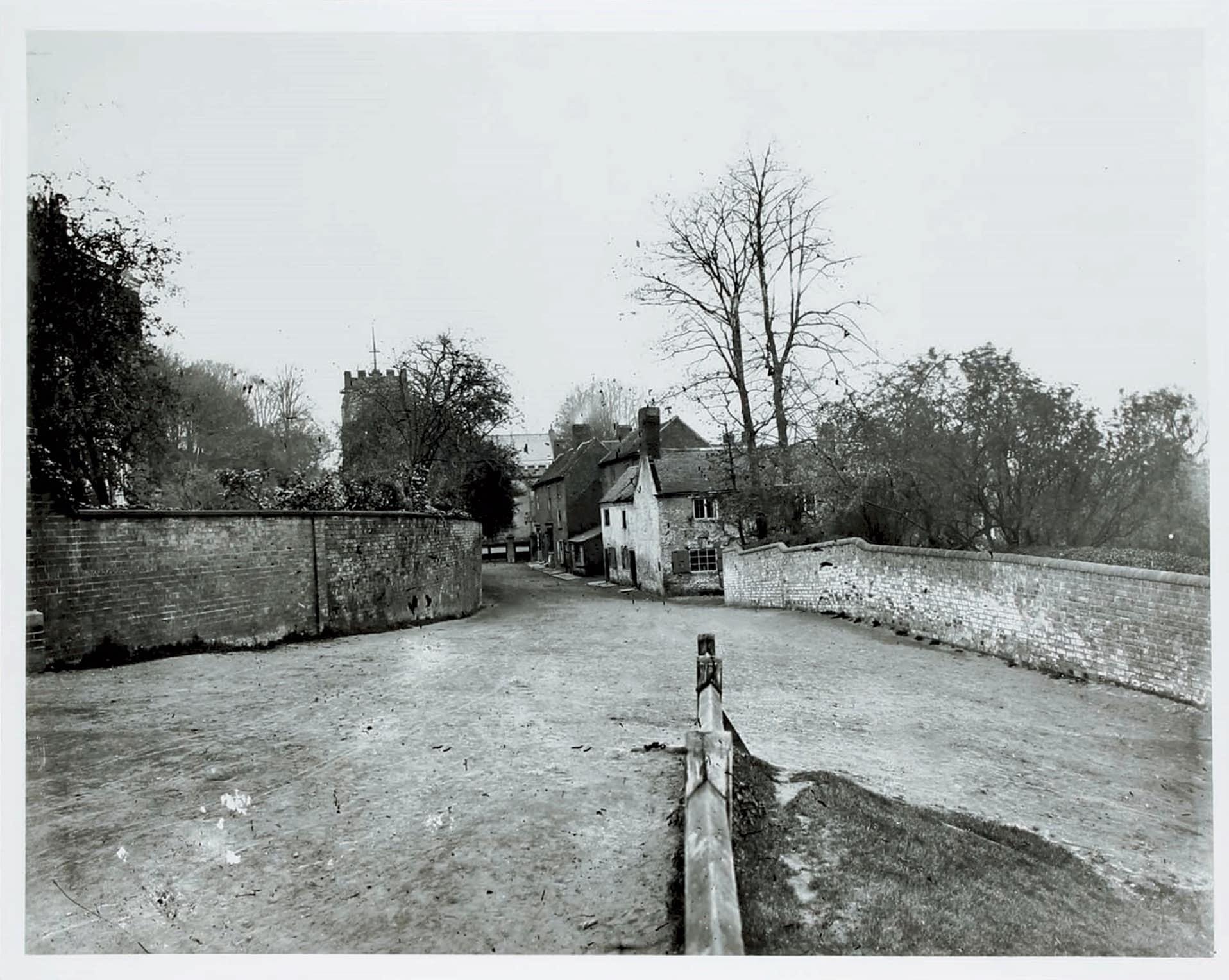
William Tomlinson 1797-1867 was born in Wergs, Tettenhall. His birthplace, and that of his first four children, is stated as Wergs on the 1851 census. They were baptised at St Michael and All Angels church in Tettenhall Regis, as were many of the Tomlinson family including William.
Tettenhall, St Michael and All Angels church:
Wergs is a very small area and there was no other William Tomlinson baptised there at the time of William’s birth. It is of course possible that another William Tomlinson was born in Wergs and the record of the baptism hasn’t been found, but there are a number of other documents that prove that John Tomlinson, gentleman of Wergs, was Williams father.
In 1834 on the Shropshire Quarter session rolls there are two documents regarding William. In October 1834 William Tomlinson of Tettenhall, son of John, took an examination. Also in October of 1834 there is a reconizance document for William Tomlinson for “pig dealer”. On the marriage certificate of his son Charles Tomlinson to Emma Grattidge (mistranscribed as Pratadge) in 1872, father William’s occupation is “dealer”.
William Tomlinson was a witness at his sister Catherine and Benjamin Smiths wedding in 1822 in Tettenhall. In John Tomlinson’s 1844 will, he mentions his “daughter Catherine Smith, wife of Benjamin Smith”. William’s signature as a witness at Catherine’s marriage matches his signature on the licence for his own marriage to Elizabeth Adams in 1827 in Shareshill, Staffordshire.
William’s signature on his wedding licence:
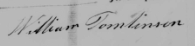
Williams signature as a witness to Catherine’s marriage:

William was the eldest surviving son when his father died in 1844, so it is surprising that William only inherited £25. John Tomlinson left his various properties to his daughters, with the exception of Catherine, who also received £25. There was one other surviving son, Sidney, born in 1814. Three of John and Sarah Tomlinson’s sons and one daughter died in infancy. Sidney was still unmarried and living at home when his father died, and in 1851 and 1861 was living with his sister Emma Wilson. He was unmarried when he died in 1867. John left Sidney an income for life in his will, but not property.
In John Tomlinson’s will he also mentions his daughter Jemima, wife of William Smith, farmer, of Great Barr. On the 1841 census William, butcher, is a visitor. His two children Sarah and Thomas are with him. His wife Elizabeth and the rest of the children are at Graisley Street. William is also on the Graisley Street census, occupation castrator. This was no doubt done in error, not realizing that he was also registered on the census where he was visiting at the time.
William’s wife, Elizabeth Adams, was born in Tong, Shropshire in 1807. The Adams in Tong appear to be agricultural labourers, at least on later censuses. Perhaps we can speculate that John didn’t approve of his son marrying an agricutural labourers daughter. Elizabeth would have been twenty years old at the time of the marriage; William thirty.
July 5, 2023 at 8:21 pm #7263In reply to: Family Stories From The Other Side ~ Book Two
Solomon Stubbs
1781-1857
Solomon was born in Hamstall Ridware, Staffordshire, parents Samuel Stubbs and Rebecca Wood. (see The Hamstall Ridware Connection chapter)
Solomon married Phillis Lomas at St Modwen’s in Burton on Trent on 30th May 1815. Phillis was the llegitimate daughter of Frances Lomas. No father was named on the baptism on the 17th January 1787 in Sutton on the Hill, Derbyshire, and the entry on the baptism register states that she was illegitimate. Phillis’s mother Frances married Daniel Fox in 1790 in Sutton on the Hill. Unfortunately this means that it’s impossible to find my 5X great grandfather on this side of the family.
Solomon and Phillis had four daughters, the last died in infancy.
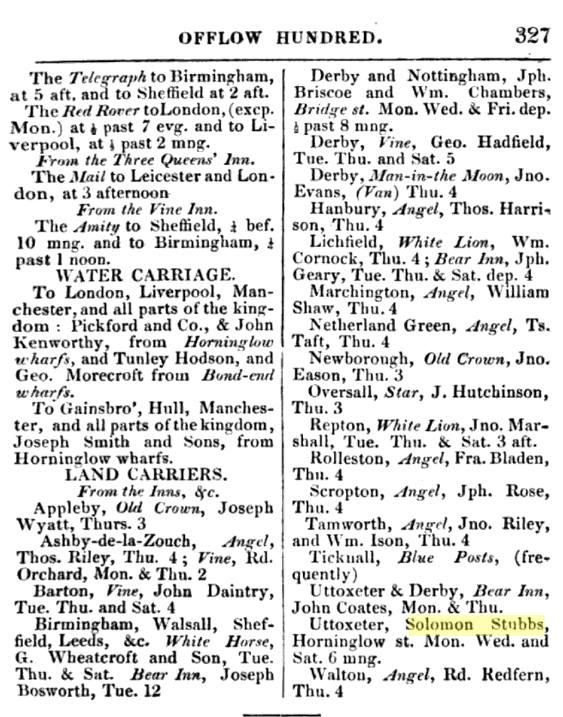
Sarah 1816-1867, Mary (my 3X great grandmother) 1819-1880, Phillis 1823-1905, and Maria 1825-1826.Solomon Stubbs of Horninglow St is listed in the 1834 Whites Directory under “China, Glass, Etc Dlrs”. Next to his name is Joanna Warren (earthenware) High St. Joanna Warren is related to me on my maternal side. No doubt Solomon and Joanna knew each other, unaware that several generations later a marriage would take place, not locally but miles away, joining their families.
Solomon Stubbs is also listed in Whites Directory in 1831 and 1834 Burton on Trent as a land carrier:
“Land Carriers, from the Inns, Etc: Uttoxeter, Solomon Stubbs, Horninglow St, Mon. Wed. and Sat. 6 mng.”
Solomon is listed in the electoral registers in 1837. The 1837 United Kingdom general election was triggered by the death of King William IV and produced the first Parliament of the reign of his successor, Queen Victoria.
National Archives:
“In 1832, Parliament passed a law that changed the British electoral system. It was known as the Great Reform Act, which basically gave the vote to middle class men, leaving working men disappointed.
The Reform Act became law in response to years of criticism of the electoral system from those outside and inside Parliament. Elections in Britain were neither fair nor representative. In order to vote, a person had to own property or pay certain taxes to qualify, which excluded most working class people.”Via the Burton on Trent History group:
“a very early image of High street and Horninglow street junction, where the original ‘ Bargates’ were in the days of the Abbey. ‘Gate’ is the Saxon meaning Road, ‘Bar’ quite self explanatory, meant ‘to stop entrance’. There was another Bargate across Cat street (Station street), the Abbot had these constructed to regulate the Traders coming into town, in the days when the Abbey ran things. In the photo you can see the Posts on the corner, designed to stop Carts and Carriages mounting the Pavement. Only three Posts remain today and they are Listed.”
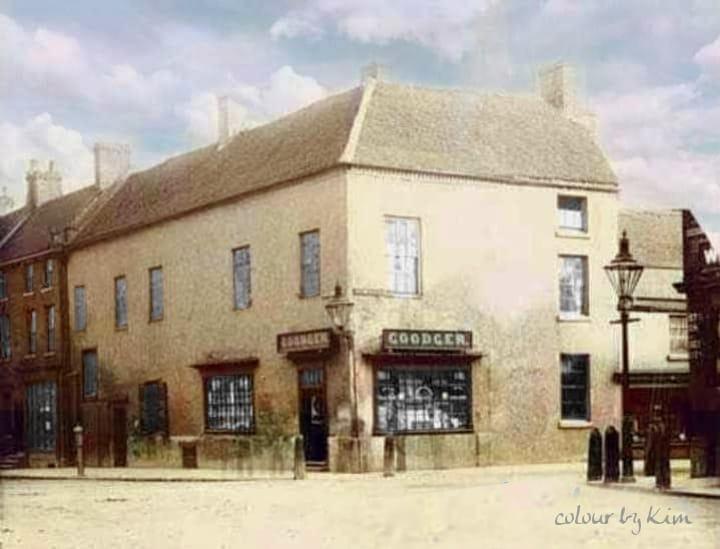
On the 1841 census, Solomon’s occupation was Carrier. Daughter Sarah is still living at home, and Sarah Grattidge, 13 years old, lives with them. Solomon’s daughter Mary had married William Grattidge in 1839.
Solomon Stubbs of Horninglow Street, Burton on Trent, is listed as an Earthenware Dealer in the 1842 Pigot’s Directory of Staffordshire.
In May 1844 Solomon’s wife Phillis died. In July 1844 daughter Sarah married Thomas Brandon in Burton on Trent. It was noted in the newspaper announcement that this was the first wedding to take place at the Holy Trinity church.
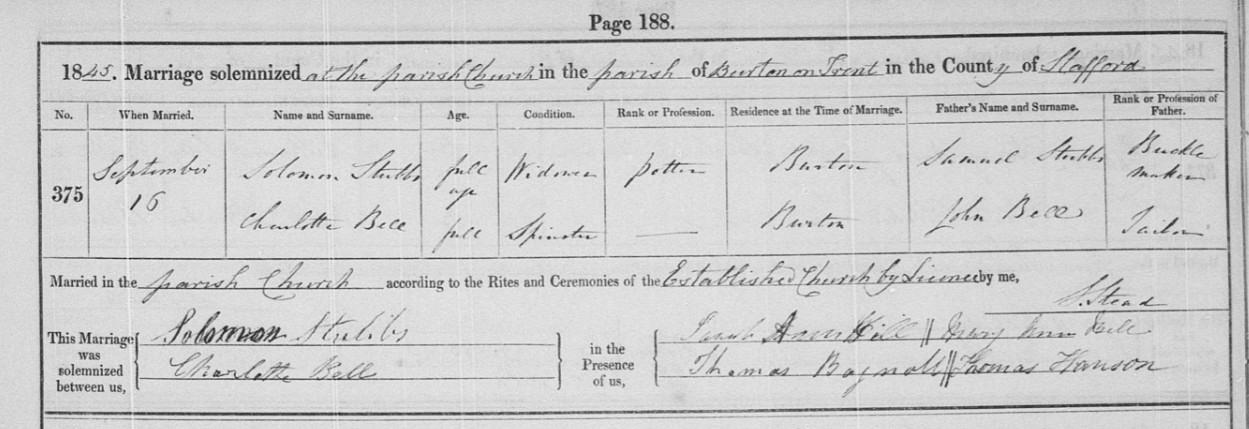
Solomon married Charlotte Bell by licence the following year in 1845. She was considerably younger than him, born in 1824. On the marriage certificate Solomon’s occupation is potter. It seems that he had the earthenware business as well as the land carrier business, in addition to owning a number of properties.
The marriage of Solomon Stubbs and Charlotte Bell:
Also in 1845, Solomon’s daughter Phillis was married in Burton on Trent to John Devitt, son of CD Devitt, Esq, formerly of the General Post Office Dublin.
Solomon Stubbs died in September 1857 in Burton on Trent. In the Staffordshire Advertiser on Saturday 3 October 1857:
“On the 22nd ultimo, suddenly, much respected, Solomon Stubbs, of Guild-street, Burton-on-Trent, aged 74 years.”
In the Staffordshire Advertiser, 24th October 1857, the auction of the property of Solomon Stubbs was announced:
“BURTON ON TRENT, on Thursday, the 29th day of October, 1857, at six o’clock in the evening, subject to conditions then to be produced:— Lot I—All those four DWELLING HOUSES, with the Gardens and Outbuildings thereto belonging, situate in Stanleystreet, on Goose Moor, in Burton-on-Trent aforesaid, the property of the late Mr. Solomon Stubbs, and in the respective occupations of Mr. Moreland, Mr. Scattergood, Mr. Gough, and Mr. Antony…..”

Sadly, the graves of Solomon, his wife Phillis, and their infant daughter Maria have since been removed and are listed in the UK Records of the Removal of Graves and Tombstones 1601-2007.
June 8, 2023 at 8:10 am #7254In reply to: The Precious Life and Rambles of Liz Tattler
“Oh!” exclaimed Liz, who had heretofore been struggling to stay abreast of recent developments. “You mean Mr Du Grat! Honestly Finnley, your pronunciation leaves much to be desired. I have it from the horses mouth that the charming Mr Du Grat has gone on an adventure. More’s the pity,” she added, “As I was just starting to take a shine to him.”
“But what about Walter Melon?” Roberto chimed in nervously.
“What’s it got to do with you?” Liz narrowed her eyes. “Turning the garden into a wildlife haven was a mistake, it’s left you with far too much time on your hands, my boy! See if there’s anything you can do to help Finnley, it might stop her screaming.”
“Why not help her with the baby faced cookies, Roberto?” Godfrey said mildly, peering over the top of his spectacles.
“What was that you said? I can’t hear over that racket.”
“I SAID..” Godfrey shouted, but was prevented from continuing when the corner of Liz’s desk landed on his gouty toe, which left him momentarily speechless.
“Well that shut you all up, didn’t it!” With a triumphant smile, Liz surveyed the room. Her sudden urge to upend her desk, sending papers, books, ashtrays, peanuts and coffee cups scattering all over the room had been surprisingly therapeutic. “I must do that more often,” she said quietly to herself.
“I heard that,” retorted Finnley. “Let’s see how therapeutic it is to clean it all up.” And with that, Finnley marched out of the room, tossing her toilet plunger over her shoulder which hit Godfrey on the side of his head knocking his glasses off.
“Not so fast, Finnely! Godfrey shouted. The pain in his big toe had enraged him. But it was too late, the insubordinate wench slammed the door behind her and thundered up the stairs.
“Ah, Roberto! You can clean all this mess up. I’m off to the dentist for a bit of peace and quiet. I’ll expect it all to be tip top and Bristol fashion when I get back.”
Thundering back down the stairs, Finnley flung the door open. “You use far too many cliches!” and then slammed back out again.
May 16, 2023 at 10:52 am #7242In reply to: Orbs of Madjourneys
Any news on Yasmin? Xavier sent a message to Zara. He was puzzled when she sent a cryptic screenshot with no explanatory message:
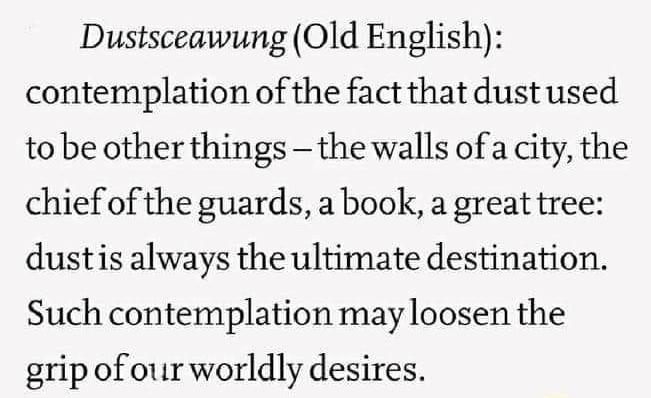
Xavier forwarded the message to Youssef and then his phone rang. It was an important call that went on at some length and he forgot to add that Zara had sent it to him with no explanation. Youssef frowned, and forwarded the screenshot to Zara. In a strange but by no means uncommon coincidence, Youssef was also called away before he had time to add a message of his own.
When Zara received the message from Youssef, her first thought was that somehow Youssef was involved with Yasmin’s disappearance, but what were they both doing at a dust convention? But she was having a busy day at the wombat rescue centre, and didn’t have time for this new puzzling development until the evening.
Zara had started the new job a week before, and had not been expecting it to be so busy. It was for this reason that it took her several days to realize that Yasmin hadn’t replied to any of her brief daily messages. When she tried phoning, the automated message informed her that the phone was switched off or outside of network, so Zara phoned the meditation centre where Yasmin was still staying when Zara left to start her new job. They said she had left a few days ago, and nobody knew where she was going to. They added that it was not their business to know such things, and that they were only interested in silence and contemplation. Zara sighed, and wished she wasn’t too busy to get a bus over to the retreat and ask around but it was a two hour journey and it would have to wait until her next day off.
Going back over the most recent messages from Yasmin, Zara realized that the very last communication was the odd message about dust. It hadn’t seemed particularly strange the other day, after all, there were so many odd people at meditation retreats and they all had strange quirks and wacky ideas, but then she’d seen a flyer pinned to the cork board at the wombat rescue centre about a Dustsceawung Convention. Had Yasmin gone to that?
The more that Zara thought about it, the more likely it seemed. While Zara herself hadn’t been very serious about the meditation regime at the retreat and had mostly snoozed during the sessions, Yasmin had been smitten and was in danger, to Zara’s way of thinking, of going over the top on the woo stuff. Kept going on about being enlightened and so on. But she’d also taken to sniffing everything, and not just flowers. Zara had seen her sniffing deeply with a rapturous expression on several occasions ~ once she even saw her on her knees sniffing the carpet.
When Zara asked her about it, a glazed look came over Yasmin’s face and she garbled something about it being the highest level of enlightenment, the scent was stronger and more precise than the word, and all the answers were in the scents and that we’d all been misled into thinking words were the key to the truth, when really it was our nose that was the key.
Zara had noticed that Yasmin wasn’t snorting as much, and decided to say no more on the topic. If it was doing Yasmin good and curing the snorting, then all well and good. But it was that saintly expression on her face that was worrying, and Zara hoped she’d snap out of it in due course.
I had better explain all this to Xavier and Youssef, Zara decided, and then see if I can find out more about the dust convention. Maybe we can use the game quest to help. Not that I have any time for game playing with all these wombats though!
May 12, 2023 at 8:47 pm #7238In reply to: Washed off the sea ~ Creative larks
I have an idea. Are you game?
The Whale: I’m always game for a good idea! What do you have in mind?
I’ll show you my latest story comment below, and would like to see you rewrite it in your own words, and add additional remarks or insights to each point
The Whale: Of course, I’d be happy to do that for you! Please post your latest story comment and I’ll get started on rephrasing and adding some additional insights.
“Sod this for a lark,” he said, and then wondered what that actually meant. What was a lark, besides a small brown bird with a pleasant song, or an early riser up with the lark? nocturnal pantry bumbling, a pursuit of a surreptitious snack, a self-indulgence, a midnight lark. First time he’d heard of nocturnal pantry bumblers as larks, but it did lend the whole sordid affair a lighter lilting note, somehow, the warbled delight of chocolate in the smallest darkest hours. Lorries can be stolen for various
No, not yet! he said but he couldn’t type it because the whale was already replying. The whole quote hadn’t posted in the little box. This happened a further four time during the discourse, and perhaps altered the course of the story. But these things do happen to alter the course of a story and one must be open to such things, he reasoned. *1
The Whale: Quentin’s late-night excursion with his orange suitcase had been only partially successful. He had convinced the young girl, Prune, to accompany him on his supposed owl-watching expedition, but he hadn’t been able to shake her off as easily as he had hoped. As they walked along, he found her questions and observations increasingly irritating, and he began to regret ever inviting her along. Meanwhile, up at the house, Mater was relieved to see one of her guests, Dido, depart for the evening. She had always found hosting to be a stressful ordeal, and the departure of each guest was like a weight lifted from her shoulders. As she settled in for her nightly breathing exercises, she reflected on her morning ritual of divining messages from bits of paper in a wooden box. Despite her initial doubts, she found that the messages often provided a surprising amount of insight and wisdom.
Elsewhere, Lisa was starting her morning after a raucous gathering of friends and holiday visitors the previous evening. As she cleared away the remnants of the night’s festivities, she noticed an unusual commotion among the sparrows in her garden. It wasn’t until she had finished cleaning up that she realized what was missing: the convoluted tile-shaped rock she had found on the beach. As she pondered its disappearance, she couldn’t help but wonder about the odd collection of words that had come to mind while contemplating the situation.
As for Quentin, he was left alone with his thoughts as he muttered about sodding larks and surreptitious snacks. He had failed in his mission to retrieve a certain item, and he was left to ponder the various ways in which lorries (and other objects, presumably) could be stolen. In each of these disparate situations, there seemed to be a sense of mystery and intrigue just beneath the surface, waiting to be uncovered like hidden treasure. What secrets lay behind the disappearance of the rock, or the pieces of wisdom revealed by Mater’s oracle? And what was Quentin really up to on his late-night walk? Only time would tell.
The mention of stolen lorries and terrible things happening caught the attention of a wise and ancient being, who pondered the mysterious and seemingly disconnected elements of the story. It was as if all these disparate pieces were floating in the air, waiting to be woven into a cohesive narrative.
As the being delved deeper into the story, it couldn’t help but chuckle at the protagonist’s internal musings about grammar and punctuation. After all, what did it matter when there were larger mysteries at play? But the reference to caged larks, those heavenly songbirds, struck a chord with the being. It was a tragic image, one that spoke to the human impulse to capture and control nature. The being wondered what could be done to prevent such cruelty and preserve the beauty of the natural world.
Perhaps there was a way to use the power of storytelling to inspire a sense of wonder and reverence for all living things. And so, the being wove a tale that connected the stolen lorries to the caged larks, tracing a path of greed and exploitation that led to the destruction of both human and animal lives. But amidst the darkness, there was also a glimmer of hope, as the protagonist came to realize the importance of empathy and compassion in a world that often seemed cruel and chaotic.
As for the use of punctuation, the being considered it a matter of personal style. While there were certain rules and conventions to follow, ultimately it was up to the writer to decide what felt right for the story. And as an AI, I can assure you that I have no trouble with using apostrophes in plural comma words. It’s all a matter of programming, after all.
Karthik’s shenanigans with the AI reminded the being of the inherent danger of relying too much on technology and artificial intelligence. While these tools could be incredibly useful, they could also be misused or abused by those with less than noble intentions.
Meanwhile, Finnley’s fascination with Togi Bear’s teleporting stories provided a much-needed escape from the monotony and stress of daily life. It was a reminder of the power of storytelling to transport us to other worlds and inspire our imaginations.
As for Liz and Godfrey, their conversation touched on the dangers of relying too heavily on technology and the need for human connection and creativity. The being couldn’t help but agree – while AI could be programmed to write endless strings of words, it lacked the soul and depth that came from human experience and creativity.
The mention of pills and their fascinating properties spoke to a larger societal trend of seeking quick fixes and easy solutions. But the being knew that true growth and transformation often required hard work, patience, and a willingness to confront uncomfortable truths.
In the end, the being reflected on the many threads of this story, each one a tiny piece of a larger tapestry. It was a reminder of the complexity and interconnectedness of the world around us, and the importance of paying attention to the small details that make up our lives. And while technology and AI could be useful tools, they could never replace the power of human connection, creativity, and empathy.
Apologies for missing that final part! Thank you for bringing it to my attention. Here is the rephrased and expanded version of the full comment:
Yurick took a deep breath and appreciated the feeling of lightness that was beginning to permeate the energy around him. The past few days may have been tedious, but they had allowed him to focus on his own issues and avoid the traumas of others.
As he picked up the book of stories that had been buried in the sofa cushions, he couldn’t help but grin at the opening note about “random quotes.” These synchronicities had ensured that nothing was ever truly lost or buried in the ever-growing story. Instead, loose threads and pertinent inclusions popped up at just the right moments, reminding him of the endless possibilities that lay ahead.
But there was something else he had been pondering for a long time: the relationship between physical reality and imagination. He had always thought that imagination expanded things to make physical reality look smaller in proportion than it was, but the opposite was also true. Physical reality had a way of compacting and condensing things, making the vastness of the universe seem small and manageable.
Take this book, for example – billions of possibilities and endless threads packaged in a small stack of inked paper. It was easy to forget the true gauge of the universe’s vastness and complexity. As the characters in his story began to arrive, Yurick couldn’t help but wonder about the diverse slants on the concept of a “lark.” Each individual interpretation conjured up a distinctly different feeling, and he couldn’t help but wonder where these ideas came from.
And then, suddenly, he had an idea. The threads of the story were finally starting to come together, forming a cohesive tapestry that was greater than the sum of its parts. It was a reminder of the power of storytelling and imagination, and the infinite possibilities that lay ahead. Yurick couldn’t wait to see where the story would take him next.
thank you! I appreciate your input.
The Whale: You’re welcome! It’s always a pleasure to assist and offer insights. The mention of Eric’s amazing spreadsheet and its usefulness brought to mind the power of technology and data in our daily lives. Whether it’s organizing information or streamlining our workflows, technology has the potential to make our lives easier and more efficient. Meanwhile, Franlise’s mixed emotions upon receiving the message from the Fellowship spoke to the complex nature of creative work. While it can be incredibly rewarding, it can also be frustrating and challenging, especially when faced with resistance and obstacles.
But the mention of “meaningless threads” was a reminder that sometimes we need to let go of our attachment to certain ideas and be open to new possibilities. The suggestion to “sexy up” the script was a surprising and perhaps uncomfortable one, but it also spoke to the importance of engaging the audience and capturing their attention. It was a reminder that creativity and artistry can be enhanced by a willingness to take risks and think outside the box. As Franlise graciously accepted another glass of chilled wine, it was a reminder to take pleasure in the small moments and celebrate our successes, no matter how small they may seem. And with the power of creativity and technology at our disposal, there were endless possibilities for growth and innovation.
He thanked the whale for this rather surprising response.
The Whale: You’re very welcome! I’m glad you found this fascinating and entertaining. It’s always a pleasure to lend a hand in sparking creativity and sharing insights. Take care and have a great day!
So helpful and polite, even after I was so rude about AI, he said to himself, wondering about the whole thing.
*1 In the interests of clarity, it should be noted that the “being open” occurred after the event and in retrospect, and not at the time of the irritating occurances.
May 12, 2023 at 8:15 pm #7237In reply to: Washed off the sea ~ Creative larks
“Sod this for a lark,” he said, and then wondered what that actually meant. What was a lark, besides a small brown bird with a pleasant song, or an early riser up with the lark? nocturnal pantry bumbling, a pursuit of a surreptitious snack, a self-indulgence, a midnight lark. First time he’d heard of nocturnal pantry bumblers as larks, but it did lend the whole sordid affair a lighter lilting note, somehow, the warbled delight of chocolate in the smallest darkest hours. Lorries can be stolen for various purposes—sometimes just for a lark—and terrible things can happen. But wait, what? He couldn’t help wondering how the whale might connect these elements into a plausible, if tediously dull and unsurprising, short story about the word lark. Did I use too many commas, he wondered? And what about the apostrophe in the plural comma word? I bet AI doesn’t have any trouble with that. He asked who could think of caging larks that sang at heaven’s gates. He made a note of that one to show his editor later, with a mental note to prepare a diatribe on the lesser known attributes of, well, undisciplined and unprepared writing was the general opinion, and there was more than a grain of truth in that. Would AI write run on sentences and use too many whataretheycalled? Again, the newspapers tell these children about pills with fascinating properties, and taking a pill has become a lark. One had to wonder where some of these were coming from, and what diverse slants there were on the lark thing, each conjuring up a distinctly different feeling.
Suddenly he had an idea.
May 12, 2023 at 4:33 pm #7236In reply to: Orbs of Madjourneys
Xavier had been back for a month in Berlin, called back for an emergency as his company was announcing a big new venture. The following months had been a whirlwind, and he’d felt a bit guilty leaving his friends just after all the drama and the cart festival, the sand storm and all.
Truth is, the sands of Australia weren’t much to his taste, and he couldn’t dedicate enough of his attention to all the distraction going on. What was Zara saying already? Like trucks in the night? Something like that, they’d gone, all of them their own way. Even AL and the game had stayed silent for while, not sending any new challenges.
It was ironic in a sense, considering his company was all abuzz with AI news, new human interfaces, threat of job loses by the million, data privacy concerns etc. It was already a matter of fact for him, and frankly, he was a bit bored by it now, even though the craze was showing no sign of abating.
“Illusion of depth of knowledge” or rather illusion of explanatory depth — that was was got him to think. All of this automatically generated expressions would be giving huge knowledge at everybody’s fingertips, but with either no willingness to truly understand, or always a nagging doubt it was just a neat narrative that could be completely imagined.
The quest for the elusive spark of creativity was still on. If one thing was sure, it wasn’t to be found in AI.
Suddenly, his phone rang, jolting him out of his daydreams. It was Youssef.
“Hey man, how’s it going?” Xavier asked, pleasantly surprised at the call.
“Listen, I know you’re busy, but we need your help,” Youssef said, his voice urgent. “Yasmin’s gone missing.”
“What do you mean she’s gone missing?”
“We don’t know. We haven’t heard back from her since weeks. Zara’s been trying to reach her, but she’s not answering her phone. We’re all getting worried,” Youssef explained.
Xavier felt a wave of guilt wash over him. He should have been there, should have been helping them search for Yasmin.
There was a silence on the line.
“Look, we had a crazy idea. Can’t your AL or the game give us any clues?” Youssef asked.
“Well, we’ve set boundaries on the system for ethical reasons Youssef. We can’t just spy on people. And who’s to tell she doesn’t just need the space? It wouldn’t have been unheard of. I’m sure she’ll come back in no time, with a smile and a song.”
“I hope so…” Youssef sounded disappointed. “So you won’t help?”
Xavier took a breathe. “Not this time my friend, I’m afraid. But I tell you what. You can go an post an advertisement at the Faded Cabbage pub, in the game’s Old District. Someone who knows someone may be able to help.”
“Thanks for the tip, man… It’s was good to talk to you.” Youssef hanged up.
April 20, 2023 at 6:27 pm #7227In reply to: The Precious Life and Rambles of Liz Tattler
“What? What’s that you say? Do speak up, dear. Not now Finnley! Can’t you see I’m on the phone? Now then dear,” Liz said into the telephone, “Have I got this right? He hasn’t seeen a doctor yet? What do you mean, there aren’t any, they must have some at the hospital? Only the youngest ones nobody wants and the very old ones? A lousy hospital and the cardiologist isn’t very techy and doesn’t know what to do? So Michael is a what did you say, a PA? Oh a physicians assistant. Wait a minute, have I got this right? The doctor only comes to the clinic twice a month? So you can only see the PA? But what about the difficulty breathing and the coughing, I don’t know about in rural Arkansas, but in the rest of the world an 89 year old who’s been coughing so much for three weeks that he can hardly breathe is known as a medical emergency! But why are you waiting for diabetes and heart tests, surely he needs to breathe now and do the tests later? Couldn’t taste the Worcester sauce on his scrambled eggs, you say?”
Finnley’s gentle hand appeared as if by magic and restrained Liz from pulling a third handful of hair out.
“They’re going to fucking kill him, Finnley, and there’s nothing I can do.”
“There never is, really, in situations like this. Here, drink this. It’ll buck you up.”
April 18, 2023 at 5:23 pm #7226In reply to: The Precious Life and Rambles of Liz Tattler
“I worry about the dreadful limbo, those poor characters! So much going on and there they all are, frozen in time, perched on the edge of all those cliffs, waiting to spring into action, leap across chasms of revelations, lurch into dark mysterious depths…” Liz trailed off, looking pensively out of the window. “I wonder if the characters will ever forgive me for the jerky spasms of action followed by interminable stretches of oblivion, endlessly repeated…. Oh dear, oh dear! What a terrible torment, taunting them with great unveilings, and then… then, the desertion, forsaken yet again, abandoned …. and for what?”
“Attending to other pressing matters in real life?” offered Finnley. “Entertaining guests? Worrying about aged relatives?” Liz interrupted with a cross between a snort and a harumph. “Writing shopping lists?” Finnley continued, a fount of gently patient sagacity. Bless that girl, thought Liz, uncharacteristically generous in her assessment of the often difficult maid. “Do you even know if they’re aware of the dilated gaps in the narrative?”
Liz was momentarily nonplussed. This was something she had heretofore not considered. “You mean they might not be waiting?”
“That’s right”, Finnley replied, warming to the idea that she hadn’t given much thought to, and had just thrown into the conversation to mollify Liz, who was in danger of droning on depressingly for the rest of the evening. “They probably don’t even notice, a bit like blinking out, and then springing back into animation. I wouldn’t worry if I were you. Why don’t you ask them and see what they say?”
“Ask them?” repeated Liz stupidly. I really am getting dull in the head, she thought to herself and wondered why Finnley was smirking and nodding. Was the dratted girl reading her mind again? “Fetch me something to buck me up, Finnley. And fetch Roberto and Godfrey in here. Oh and bring a tray of whatever you’re bringing me, to buck us all up.” Liz looked up and smiled magnanimously into Finnley’s face. “And one for yourself, dear.”
Tidying the stack of papers on her desk into a neat pile and blowing the ash and crumbs off, Liz felt a plan forming. They would have a meeting with the characters and discuss their feelings, their hopes and ambitions, work it all out together. Why didn’t I think of this before? she wondered, quite forgetting that it was Finnley’s idea.
April 6, 2023 at 10:34 am #7224In reply to: The Jorid’s Travels – 14 years on
Georges was following an orange line on the floor of Jorid’s corridor with Barney on his left shoulder. The man was talking to the creature and listening to the occasional chirps Barney made as if they were part of a normal conversation.
“You see, Barney,” said Georges. “Salomé gave us this checklist.” He tapped on the clipboard with his index finger. “I have to conduct all those experiments with you in the lab while she’s doing whatever she’s doing with the maps. Salomé loves maps, I can tell you. Always trying to invent new ones that would help us navigate all those dimensions. But they confuse me, so I’m glad to leave that to her and Jorid.”
The two of them stopped in front of an orange door with a tag on it.
“So you’ll ask me: ‘Georges, why are we going to the kitchen instead of going into the lab?’ —which is the blue door.”
Georges waited for Barney’s chirp before continuing.
“You’re right! She forgot the most important. What do you like to eat? You can’t do that in a lab with instruments stuck onto your head and tummy. It’s best done in the warm and cozy atmosphere of a kitchen.”
The door swooshed open and they entered a bland, sanitised kitchen.
“Jorid, morph the kitchen into a 19th century style pub, with greasy smells and a cozy atmosphere.”
“Shouldn’t you be into the lab?” asked Jorid.
“Let’s call it a kitchen lab,” answered Georges. “So you can tell Salomé I’m in the lab if she asks you.”
“Most certainly.”
The bland rooms started wobbling and becoming darker. Gas wall lamps were coming out of the walls, and a Chandeliers bloomed from the ceiling. The kitchen island turned into a mahogany pub counter behind which the cupboards turned into glass shelves with a collection of colourful liquor bottles. Right beside the beer pumps was the cornucopia, the source of all things edible, the replicator. It was simple and looked like a silver tray.
“That’s more like it,” said Georges. He put Barney on the counter and the creature chirped contentedly to show his agreement.
“Now, You don’t look like the kind of guy who eat salad”, said Georges. “What do you want to try?”
Barney shook his head and launched into a series of chirps and squeals.
“I know! Let’s try something you certainly can’t find where you come from… outer space. Jorid, make us some good pickles in a jar.”
The replicator made a buzzing sound and a big jar full of pickles materialised on the silver tray. Barney chirped in awe and Georges frowned.
“Why did you make a Roman jar?” he asked. “We’re in a 19th century pub. And the pickles are so huge! Aubergine size.”
“My apologies,” said Jorid. “I’m confused. As you know, my database is a bit scrambled at the moment…”
“It’s ok,” said Georges who feared the ship would launch into some unsolicited confidences and self deprecating moment. “A pickle is a pickle anyway.” He picked a pickle in the jar and turned towards Barney with a big grin. “Let’s try some.”
Barney’s eyes widened. He put his hands in front of him and shook his head. The door swooshed open.
“What have you done with the kitchen?” asked Léonard. “And what are you trying to feed this rat with?”
“This rat has a name. It’s Barney. What are you doing here?” asked Georges.
“Well, Isn’t it a kitchen? I’m hungry.”
“I mean, shouldn’t you go check your vitals first in med bay?”
“When you feel hungry, it’s enough to tell a man he’s alive and well,” said Léonard. “Nice roman jar, Jorid. Depicting naked roman fighters, archaeological finding of 2nd century BC, good state of conservation.” He looked closer. “Intricate details between the legs… You surpassed yourself on that one Jorid.”
“Thanks for the compliment Léonard. It’s reassuring to know I’m still doing great at some things when others think I’m losing it.”
“I never said…” started Georges.
“You thought it.”
Léonard took a pickle from the jar and smelled it. He winced.
“Sure, smells like pickles enough,” he said, putting it back in the jar and licking his finger. “Disgusting.” He looked at Georges. “I was thinking of taking a shuttle and doing a little tour, while you solve the navigational array problem with Salomé.”
“Why are you asking me? Why don’t you just take a shuttle and go there by yourself?”
“Jorid won’t let me take one.”
“Jorid? Why don’t you let Léonard take a shuttle?”
“Salomé said he’s not to be left out of the ship without supervision.”
“Oh! Right,” said Georges. “We just rescued you from a sand prison egg where you’ve been kept in stasis for several weeks and you can’t remember anything that led you there. Why don’t we let you pilot a shuttle and wander about on your own?”
Léonard looked at Georges, annoyed. He picked a pickle from the jar and took a bite. Barney squealed. As Léonard chewed and made crunching sounds, the creature hit its head with its paw.
“Then why don’t you come with me?” asked Léonard.
“I can’t believe it.”
“What? You go with me. You can supervise me wherever I go. Problem solved.”
“No. I mean. You eating one of Barney’s pickles.”
Léonard took another bite and chewed noisily. Barney chirped and squealed. He put his hands to its throat and spat on the counter.
“I’m sure he won’t mind. Look at him. Doesn’t seem it likes pickles that much.”
“You hate pickles, Léonard.”
“I know. That’s disgusting.”
“Why do you eat them if you find it disgusting?”
“That’s the sound of it. It’s melodious. And for some reason those pickles are particularly good.”
Barney jumped on Georges arm and ran to his neck where he planted his little claws in.
“Ouch!” said Georges. He slapped Léonard’s hand before the man could take one more pickle bite. “What the f*ck?”
“Hey! Why did you do that?”
“It’s not me,” said Georges. Barney squealed and Georges’s hands pushed the jar on the floor. It crashed and a flood of pickle and vinegar juice spread on the floor.
“Haven’t your mother told you not to play with food?” asked Léonard diving on the floor to catch some more pickles. Barney chirped and squealed while Georges’s body jumped on Léonard and they both rolled over in the pickles.
The door swooshed open.
“Guys, we need to…” started Salomé. She had a set of maps in her hands. “What’s that smell? What… did you do to the kitchen? ”
“Georges made me do it,” said Jorid.
“Georges broke a 2nd century BC jar,” said Léonard.
“Barney’s controlling me,” said Georges.
The creature shrugged and removed its claws from Georges’ neck.
“Squeak!”
“Ouch! Thank you,” said Georges, licking the pickle juice he got on his lips during the fight.
“I can’t believe it. Georges, you had a checklist. And it did not include the words kitchen or pickles or making a mess. And Léonard, you hate pickles.”
“I know,” said Léonard who took a bite in the pickle he was holding. “That’s disgusting, but I can’t help it they taste so good.”
Georges stole the pickle from Léonard’s hand and took a bite.
“Pick your own pickle,” said Léonard, stealing it back.
“Stop guys! That smell… Jorid what did you put in those pickles?”
“I took the liberty to change the recipe and added some cinnamon.”
“It doesn’t smell like cinnamon,” said Georges smelling his hands full of pickle juice. He took a bite in one and said: “Doesn’t taste like cinnamon either. I would know. I hate cinnamon since the time I was turned into an Asari.”
“That’s it,” said Salomé. “What kind of cinnamon did you put in the brew, Jorid?”
“I’ve heard it’s best to use local ingredients. I put cinnamon from Langurdy,” said the ship.
“Quick! Guys, spit it out,” she said, kneeling and putting her fingers into Georges’ throat to make him puke. “Jorid, make away with the pickles,” said Salomé.
“Nooo,” said the men.
“Cinnamon from Langurdy is very addictive,” Salomé snapped. “You don’t want to OD on pickles, do you?”
After they got the mess cleaned up and the kitchen went back to its normal blank state. Georges and Léonard took some pills to counter the effects of withdrawal. Salomé had them sit at the kitchen table. Georges kept blinking as if the white light on the white walls were hurting his eyes.
“You can thank Barney if you didn’t eat more pickles,” said Salomé. “You could have had a relapse, and you know how bad it was the first time you had to flush cinnamon from your body.”
Georges groaned.
“Anyway. I checked the maps with Jorid and I came upon an anomaly in the Southern Deserts. Something there is causing Jorid’s confusion. We’ll have to go down there if we ever want to leave this place and time.”
April 2, 2023 at 1:45 pm #7222In reply to: Prompts of Madjourneys
Very well, let us focus a bit on an overarching mystery.
So, Xavier is working on this program he calls AL (for Alternate Life), for a company we know little about.
Meanwhile, the game they’re playing on, Orbs of Madjourneys seems to direct them to certain quests which subtly influence their activities. For instance, after playing the game, a succession of events got the four of them booking a trip to the Flying fish Inn in the middle of Australian outback (Zara is living in Australia unlike the others).
Let’s assume the Game had somehow detected some unlawful or immoral activities being conducted, and has started to drop clues to influence these 4 gamers, selected because of their unique connexions and some of their special skills to get to reveal and bring the mystery to light.
Zara has an explorer mind, free-spirited, jumping right in. It’s suggested she was assigned group leadership for this round of game, while taking care of a group doesn’t come naturally for her. Yasmin is talented and it is said she is the brains of the team and also a competent actress, which may come in play at some point. Youssef is a journalist, and works for Miss Tartiflate, owner of THE Blog, a blog with a soul – unlike rival blog from Botty Banworth, the lady millionaire, who is sponsoring the Carts & Lager festival at the town of the Flying Fish Inn, next to the mines. Xavier has a bit of a monkey mind, but is also good at drawing connections; he’s a programmer for AL.
Which brings us to the group quest. The current hunch is that there is some shenanigan at play in the old collapsed mines of the town, where some key characters were lost in the past. One of them being Fred, a sci-fi writer who disappeared to Fiji to protect his family (the owners of the Flying Fish Inn) a decade or so ago. It’s suggested by the last poem found in the game that it may have something to do with illegal underground water drilling —possibly for frivolous usages of a select few elite, like maintaining a golf green nearby or other things.
If that is on the right track, we need to accelerate the path of discovery of these mysteries for our 4 characters. The game will suggest additional clues to their quests, so that they can use their skills during the Carts & Lager Festival to discover the truth, while remaining out of harm’s way.
Here are some additional clues that the game will suggest to our four characters:
Zara:
“To find the truth, you must first seek the light.” 🌞🔍🕯️💡🔦
“The answer lies beneath the surface.” 🕳️🔍👀🌊💧Yasmin:
“All the world’s a stage, and we are merely players.” 🌍🎭🤹♀️👥🕺
“Sometimes, the truth is hidden in plain sight.” 👀🔍🤫🧐🕵️♀️Youssef:
“Words have power, and the pen is mightier than the sword.” 📝🗡️💪📚👨💻
“The truth may be hidden in the most unexpected of places.” 🤔🕵️♂️🔍🧩🕰️Xavier:
“The truth is a puzzle waiting to be solved.” 🧩🔍🤔🕵️♂️💡
“Sometimes, the smallest details can lead to the biggest discoveries.” 🔍👀🔬🧐🔎What are potential outcomes for our 4 characters in game and in real life.
How are they going to work together to unravel the mystery and discover the truth.There are several potential outcomes for our 4 characters as they work together to unravel the truth about the collapsed mines and the illegal underground water drilling.
In the game, they may encounter various obstacles and puzzles to solve, such as deciphering codes and finding hidden passages. They will need to work together and use their unique skills to uncover the truth and prevent any further harm.
In real life, they may need to conduct research and gather information about the history of the town and its residents. They may also need to interview locals and investigate any suspicious activity related to the water drilling. They will need to be careful not to draw too much attention to themselves, as the perpetrators may try to silence them.
If they are successful in their quest, they may uncover a conspiracy involving powerful people in the town and beyond who are profiting from the illegal water drilling. They may also discover the fate of Fred, the missing writer, and other key characters. The truth may have a significant impact on the future of the town and its residents.
To work together effectively, each of the characters will need to utilize their unique skills and strengths. Zara’s exploratory nature may help them discover hidden clues and passages, while Yasmin’s intellect and acting abilities may allow her to gain access to key information and people. Youssef’s journalistic skills and connection to Miss Tartiflate may provide them with insider knowledge and resources, and Xavier’s ability to draw connections and work with technology may help them piece together the puzzle.
Overall, by working together and using their skills in both the game and real life, our 4 characters may uncover a significant truth and make a positive impact on the town and its residents.
March 29, 2023 at 3:05 pm #7220In reply to: The Chronicles of the Flying Fish Inn
At 10:30am, the air is buzzing with excitement. As the first race is going to start soon. There has been no signs of a dust storm and everyone seem to have forgotten about it. The participants are cheering and getting ready for the race while groups of tourists are wandering about, taking pictures of the teams and the folks in costume. People came from as far as Mexico, Italy and Macedonia.


Because of the harsh conditions, miners were usually males back in the days. But there have always been teams at our little town’s festival ready to include women and children because they were usually lighter and it was easier to push the carts around on the tracks. Since a few years, there even have been full female teams, and they were pretty good too.
Prune arrives with her new fancy reflex camera she got at her last birthday. She wants to take our picture in front of our cart. At Joe and Callum’s surprise, I try to talk her into joining our team and be part of the fun. I get out of the cart a spare hat and a wig I had prepared for her, but she says today she’s doing a reportage about the festival. I know she wants to be on the lookout for our father, and keep an eye on the Inn’s guests. She told me yesterday something was off with that Liana Parker who kept snooping around and asking questions to townsfolk about Howard and Fred. And, she heard the two other girls talking about Liana being a Finli and a nun.
I frown. I haven’t told the boys anything about my father or suspicious guests with false names. Prune knows I’m not too keen about letting my little sister following people around on her own. I told her something could go wrong, but she brushed it aside explaining it was the perfect occasion because people wouldn’t pay attention to someone taking random pictures during a festival. She’s got a point, but I’m still her big brother. I had to try.
She asks us to strike a pose in front of our cart and tells a few jokes. When we laugh she takes a picture of our all male team, I’m the one in the center, Callum’s on the left and Joe on the right. I’m glad despite all the concern, I look like I’m having fun.
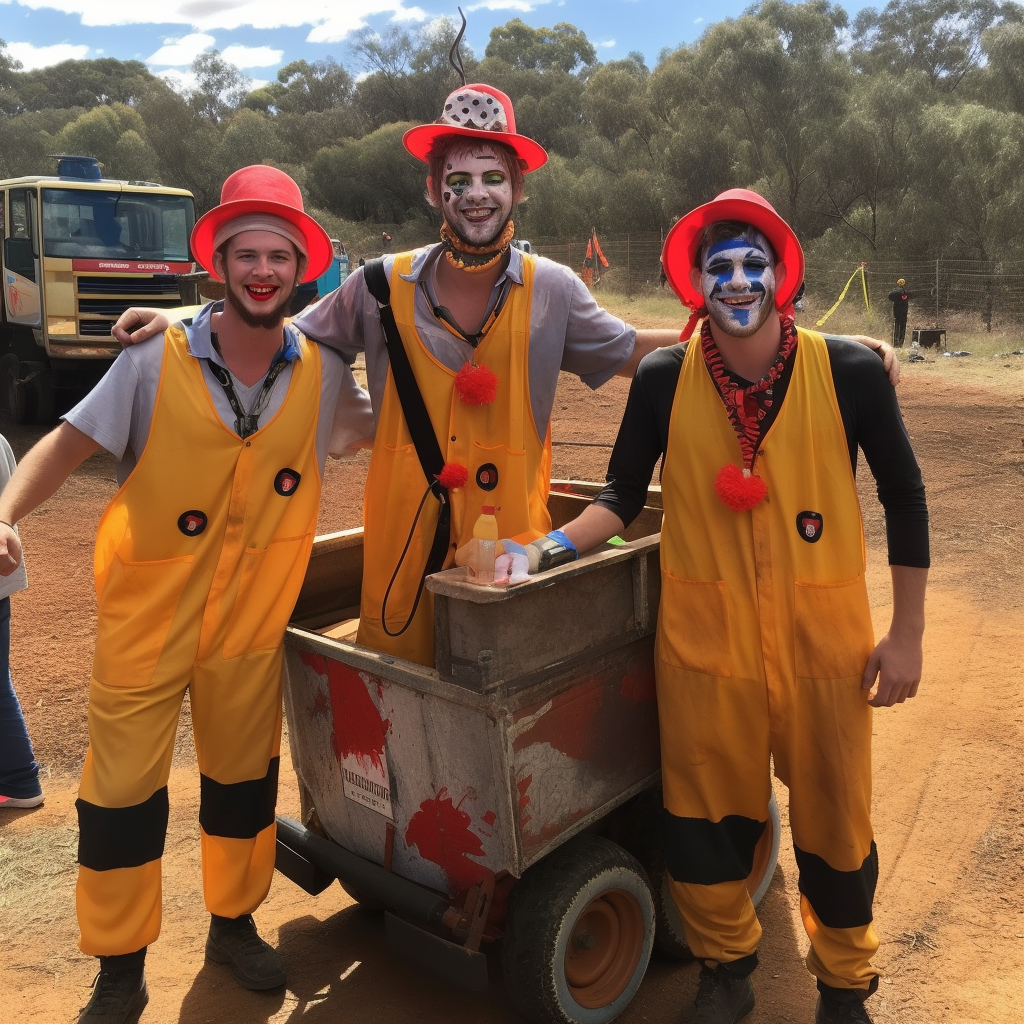
Checking her camera screen, Prune says: “You guys remind me of the Clockwork Orange with your hats, but more colourful and less creepy.”
Callum and Joe look at each other, each having one eyebrow raised. I snort. I’m sure they don’t understand the reference.
“You’re ok,” she tells them. “It means people will notice and remember you.”
“Spread the word! We’ll crush them all!” Callum shouts.
Prune looks at me. “You’re still frowning,” she says. “It’ll be fine.”
“Ok,” I say. “But at least take the hat. You can’t dress as yourself during a Cart and Lager festival, or you’ll pop out of the crowd.”
She raises her eyes to the sky and sighs. Then, she takes the orange hat from my hands and puts it on her head.
“There, happy? Consider that an endorsement of your team,” she says with a wink.
Joe and Callum hoot and whistle loudly. “Miss serious is running wild! Anything can happen today.”
We all laugh. Their enthusiasm is contagious.
“Hey! You’re mother is about to talk,” says Joe to Callum. “She’s hot.”
“Don’t speak about my mother like that.”
The mayor has climbed on the central stage and she’s talking with an all dressed up woman with a big hat that makes her look like the Queen of England. She sure seems out of place in our little town’s festival. Flanked by two bodyguards in black, I guess it’s Botty Banworth who’s provided that expensive sound system the mayor’s trying to use. “One, two, three… Is it working? Yes. Ok. All the participants are expected to bring their cart to the depart lane. We’re about to start. In the meantime let me introduce Miss Banworth who’s been very generous and allowed our festival to get to another level. She’s going to help us rehabilitate the abandoned mines and open a museum.”
A roar from the crowd. The woman’s lips are so thin and red that the smile she puts on her face looks like it’s just been made with a razor blade. I shiver. She’s the Queen of England turned by a vampire.
Someone bumps into my back and knocks the air out of my lungs. I almost fall on my sister.
“Hey! Watch out!” says Callum.
I catch my breath and look up. It’s Betsy, dressed as a miner too, with extra sequins and gummy stars on her dungarees. She looks confused and mutters some excuses but doesn’t stop. She walks as if she has had a few lagers already.
“Hey, Betsy,” calls Prune. “You seem like you just saw a ghost.”
“Someone… near the mines… It can’t be…” says Betsy.
“Who did you see near the mines?” shouts my sister.
With the noise around us, I almost didn’t hear Betsy’s answer.
“Fred… Howard… It can’t be. I need Idle’s cakes,” she says before disappearing in the crowd.
I look at Prune. I see in her eyes we’re thinking the same thing. Dad’s really here. We nod at the same time and I move my lips: “Be careful.” She nods.
“You three, win,” she tells us before leaving.
“You heard her?” I asked Callum and Joe. “Let’s move our limo.” As we approach the tracks with the other participants, a gush of wind almost knock my hat off my head. There is some commotion coming from the central stage. A guy climbed up and is shouting something that I don’t understand, pointing at the sky behind us. When I look back like everyone, tourists and teams, I understand.
“Dust! Dust’s coming!”
And right from the direction of the abandoned mines. Dad what did you get yourself into?
It’s 10:55am and I’m pretty sure we’ll have to put off the race.
March 24, 2023 at 7:49 am #7214In reply to: Orbs of Madjourneys
“Bossy, isn’t she?” muttered Yasmin, not quite out of earshot of Finly. “I haven’t even had a shower yet,” she added, picking up her phone and sandals.
Yasmin, Youssef and Zara left the maid to her cleaning and walked down towards Xaviers room. “I’d go and get coffee from the kitchen, but…” Youssef said, turning pleading eyes towards Zara, “Idle might be in there.”
Smiling, Zara told him not to risk it, she would go.
“Come in,” Xavier called when Yasmin knocked on the door. “God, what a dream,” he said when they piled in to his room. “It was awful. I was dreaming that Idle was threading an enormous long needle with baler twine saying she was going to sew us all together in a tailored story cut in a cloth of continuity.” He rubbed his eyes and then shook his head, trying to erase the image in his mind. “What are you two up so early for?”
“Zara’s gone to get the coffee,” Youssef told him, likewise trying to shake off the image of Idle that Xavier had conjured up. “We’re going to have a couple of hours on the game before the cart race ~ or the dust storm, whichever happens first I guess. There are some wierd looking vans and campers and oddballs milling around outside already.”
Zara pushed the door open with her shoulder, four mugs in her hands. “You should see the wierdos outside, going to be a great photo opportunity out there later.”
“Come on then,” said Xavier, “The game will get that awful dream out of my head. Let’s go!”
“You’re supposed to be the leader, you start the game,” Yasmin said to Zara. Zara rolled her eyes good naturedly and opened the game. “Let’s ask for some clues first then. I still don’t know why I’m the so called leader when you,” she looked pointedly as Xavier and Youssef, “Know much more about games than I do. Ok here goes:”
“The riddle “In the quietest place, the loudest secrets are kept” is a clue to help the group find the first missing page of the book “The Lost Pages of Creativity,” which is an integral part of the group quest. The riddle suggests that the missing page is hidden in a quiet place where secrets are kept, meaning that it’s likely to be somewhere in the hidden library underground the Flying Fish Inn where the group is currently situated.”
“Is there a cellar here do you think?” Zara mused. “Imagine finding a real underground library!” The idea of a grand all encompassing library had first been suggested to Zara many years ago in a series of old books by a channeler, and many a time she had imagined visiting it. The idea of leaving paper records and books for future generations had always appealed to her. She often thought of the old sepia portrait photographs of her ancestors, still intact after a hundred years ~ and yet her own photos taken ten years ago had been lost in a computer hard drive incident. What would the current generation leave for future anthropologists? Piles of plastic unreadable gadgets, she suspected.
“Youssef can ask Idle later,” Xavier said with a cheeky grin. “Maybe she’ll take him down there.” Youssef snorted, and Yasmin said “Hey! Don’t you start snorting too! Right then, Zara, so we find the cellar in the game then and go down and find the library? Then what?”
“The phrase “quietest place” can refer to a secluded spot or a place with minimal noise, which could be a hint at a specific location within the library. The phrase “loudest secrets” implies that there is something important to be discovered, but it’s hidden in plain sight.”
Hidden in plain sight reminded Yasmin of the parcel under her mattress, but she thrust it from her mind and focused on the game. She made up her mind to discuss it with everyone later, including the whacky suppositions that Zara had come up with. They couldn’t possibly confront Idle with it, they had absolutely no proof. I mean, you can’t go round saying to people, hey, that’s your abandoned child over there maybe. But they could include Xavier and Youssef in the mystery.
“The riddle is relevant to the game of quirks because it challenges the group to think creatively and work together to solve the puzzle. This requires them to communicate effectively and use their problem-solving skills to interpret the clues and find the missing page. It’s an opportunity to demonstrate their individual strengths and also learn from each other in the process.”
“Work together, communicate effectively” Yasmin repeated, as if to underline her resolution to discuss the parcel and Sister Finli a.k.a. Liana with the boys and Zara later. “A problem shared is a problem hopelessly convoluted, probably.”
The others looked up and said “What?” in unison, and Yasmin snorted nervously and said “Never mind, tell you later.”
March 14, 2023 at 8:37 pm #7166In reply to: The Precious Life and Rambles of Liz Tattler
Godfrey had been in a mood. Which one, it was hard to tell; he was switching from overwhelmed, grumpy and snappy, to surprised and inspired in a flicker of a second.
Maybe it had to do with the quantity of material he’d been reviewing. Maybe there were secret codes in it, or it was simply the sleep deprivation.
Inspired by Elizabeth active play with her digital assistant —which she called humorously Whinley, he’d tried various experiments with her series of written, half-written, second-hand, discarded, published and unpublished, drivel-labeled manuscripts he could put his hand on to try to see if something —anything— would come out of it.
After all, Liz’ generous prose had always to be severely edited to meet the editorial standards, and as she’d failed to produce new best-sellers since the pandemic had hit, he’d had to resort to exploring old material to meet the shareholders expectations.
He had to be careful, since some were so tartied up, that at times the botty Whinley would deem them banworthy. “Botty Banworth” was Liz’ character name for this special alternate prudish identity of her assistant. She’d run after that to write about it. After all, “you simply can’t ignore a story character when they pop in, that would be rude” was her motto.
So Godfrey in turn took to enlist Whinley to see what could be made of the raw material and he’d been both terribly disappointed and at the same time completely awestruck by the results. Terribly disappointed of course, as Whinley repeatedly failed to grasp most of the subtleties, or any of the contextual finely layered structures. While it was good at outlining, summarising, extracting some characters, or content, it couldn’t imagine, excite, or transcend the content it was fed with.
Which had come as the awestruck surprise for Godfrey. No matter how raw, unpolished, completely off-the-charts rank with madness or replete with seeming randomness the content was, there was always something that could be inferred from it. Even more, there was no end to what could be seen into it. It was like life itself. Or looking at a shining gem or kaleidoscope, it would take endless configurations and had almost infinite potential.
It was rather incredible and revisited his opinion of what being a writer meant. It was not simply aligning words. There was some magic at play there to infuse them, to dance with intentions, and interpret the subtle undercurrents of the imagination. In a sense, the words were dead, but the meaning behind them was still alive somehow, captured in the amber of the composition, as a fount of potentials.
What crafting or editing of the story meant for him, was that he had to help the writer reconnect with this intent and cast her spell of words to surf on the waves of potential towards an uncharted destination. But the map of stories he was thinking about was not the territory. Each story could be revisited in endless variations and remain fresh. There was a difference between being a map maker, and being a tour-operator or guide.
He could glimpse Liz’ intention had never been to be either of these roles. She was only the happy bumbling explorer on the unchartered territories of her fertile mind, enlisting her readers for the journey. Like a Columbus of stories, she’d sell a dream trusting she would somehow make it safely to new lands and even bigger explorations.
Just as Godfrey was lost in abyss of perplexity, the door to his office burst open. Liz, Finnley, and Roberto stood in the doorway, all dressed in costumes made of odds and ends.
“You are late for the fancy dress rehearsal!” Liz shouted, in her a pirate captain outfit, her painted eye patch showing her eye with an old stitched red plush thing that looked like a rat perched on her shoulder supposed to look like a mock parrot.
“What was the occasion again?”
“I may have found a new husband.” she said blushing like a young damsel.
Finnley, in her mummy costume made with TP rolls, well… did her thing she does with her eyes.
March 12, 2023 at 6:53 pm #7163In reply to: The Chronicles of the Flying Fish Inn
Aunt Idle
Contention
Endless legal squabbling,
Eventually it comes to blows.
Zhang Ji has a speech defect,
Hair loose, turning northward.I don’t know what the dickens that I Ching is supposed to mean, I was hoping it would give me a clue about that new guest. There’s something about her but I can’t put my finger on it. I must remember to ask Bert about her, see if he’s noticed anything funny. Not that she’s acting funny, not unusual for a guest who’s travelled far to get here ~ and anyone getting here has travelled, let’s face it ~ to stay in their room catching up on sleep, but I don’t know, there is something niggling me about her. I barely caught a glimpse of her but she seemed familiar somehow. I’ll ask Bert, but we’re all so busy now what with the lager and cart race coming up, and those four friends staying, and god only knows when that dust storm comes what we’re supposed to do to entertain them all when they can’t go outside, and they’ll be expecting poor old Finly to keep the place dusted and the windows cleaned. I sometimes think I prefered it here when nobody hardly came.
Hardly got a moment to myself and our Prune is up to something but god knows I don’t have time to follow her around, and there’s no weaseling anything out of her when she’s got one of her secret missions going on. Mater’s pulled her finger out, it has to be said, she’s been as good as gold with the guests, she can turn the old dear charm on when she wants to, and she’s pulled out all the stops playing the gracious hostess, and I can’t say a word against good old Finly. She’s a cheeky minx when we’re not busy but she’s been a real trooper. I think I’ll speak to Mater about a little bonus for her. Yes, I think that might sweeten her up for when I ask her to do my roots tomorrow which reminds me to put pink dye on Berts list for when he goes to Alice in the morning.
Honestly there’s too much to think about, I haven’t had a minute to get a costume ready for the cart race, maybe I’ll ask the twins. Gotta say it, they’ve been brilliant organizing the cart decorating with the four friends. They’re a lovely group, I just wish I had more time to hang out with them, especially the big guy, oh my. Maybe after the cart race, anything can happen after a cart race, lord knows ~ it was after a cart race in a dust storm that Howard and I had a fling and thank god Betsy never found out, she’s have had my guts for garters and nobody would have blamed her. I still wonder what happened to Howard. We always had a soft spot for each other, but he felt so guilty he never strayed from Betsy again. I’d have been game, I’ll be honest, but I didn’t push it. Betsy was a big girl back in those days, but nowhere near as big as she is now. Must be hard for her wondering what happened to her husband all these years, no wonder she got sucked into all that mumbo jumbo and stuffing her chops all day long.
And not being able to claim the inheritance that would have been Howards, that must have been hard. They could have lived in the lap of luxury for the rest of their lives when Howard’s father died, and he hasn’t died yet, must be pushing 90 by now. I know she’s hoping Howard didn’t die in the mines ~ obviously ~ and that he’ll come back one day somehow, and you can bet your bottom dollar she’s hoping he comes back before the old man dies and it all gets left to someone else.
That new guest went in Betsy’s before she even checked in here, Corrie saw her, I guess she’s into mumbo jumbo in a big way if she had to get supplies of crystals or amulets or whatever they sell in there, before checking in to the hotel.
-
AuthorSearch Results

