
Search Results for 'mile'
-
AuthorSearch Results
-
March 2, 2025 at 10:22 am #7852
In reply to: Helix Mysteries – Inside the Case
“Tundra Finds the Shoat-lion”
FADE IN:
EXT. THE GOLDEN TROWEL BAR — DUSK
A golden, muted twilight paints the landscape, illuminating the overgrown ivy and sprawled vines reclaiming the ancient tavern. THE GOLDEN TROWEL sign creaks gently in the breeze above the doorway.
ANGLE DOWN TO — TUNDRA, a spirited and curious 12-year-old girl with a wild, freckled pixie-cut and striking auburn hair, stepping carefully over ivy-covered stones and debris. She wears worn clothes, stitched lovingly by survivors; a scavenged backpack swings on one shoulder.
Behind her, through the windows of the tavern, warm lantern-light flickers. We glimpse MOLLY and GREGOR smiling and chatting quietly through dusty glass.
ANGLE ON — Tundra as she pauses, hearing a soft rustling near the abandoned beer barrels stacked against the tavern wall. Her green eyes widen, alert and intrigued.
SLOW PAN DOWN to reveal a small creature trembling in the shadows—a MARCASSIN, a tiny wild piglet no larger than a rugby ball, with coarse fur streaked ginger and cinnamon stripes along its body. Large dark eyes stare up, innocence mixed with wary curiosity. It’s adorable yet clearly distinct, with sharper canines already hinting at the deeply mutated carnivorous lineage of Hungary’s lion-boars.
Tundra inhales softly, visibly torn between instinctual cautiousness her elders taught and her own irrepressible instinct of compassion.
TUNDRA
(soft, gentle)
“It’s alright…I won’t hurt you.”She crouches slowly, reaching into her pocket—a small piece of stale bread emerges, held in her outstretched hand.
CLOSE-UP on the marcassin’s wary eyes shifting cautiously to her extended palm. A heartbeat of hesitation, and then it takes a tentative step forward, sniffing gently. Tundra holds utterly still, breath held in earnest hope.
The marcassin edges closer, wet nose brushing her fingers softly. Tundra beams, freckles highlighted by the fading sun, warmth and joy glowing on her face.
TUNDRA
(whispering happily)
“You’re not so scary, are you? I’m Tundra… I think we could be friends.”Movement at the tavern door draws her attention. The worn wood creaks as MOLLY and GREGOR step outside, shadows stretching long in the golden sunset. MOLLY’s eyes, initially alert with careful caution, soften at the touching scene.
MOLLY
(gently amused, warmly amused yet apprehensive)
“Careful now, darling. Even the smallest things aren’t always what they seem these days.”GREGOR
(softly chuckling, eyes twinkling)
“But then again, neither are we.”ANGLE ON Tundra, looking up to meet Molly’s eyes. Her determination tempered only by vulnerability, hope, and youthful stubbornness.
TUNDRA
“It needs us, Nana Molly. Everything needs somebody nowadays.”Molly considers the wisdom in Tundra’s young, earnest gaze. Gregor stifles a smile and pats Molly lightly lovingly on the shoulder.
GREGOR
(warmly, quietly)
“Ah, let her find hope where she sees it. Might be that little thing will change how we see hope ourselves.”ANGLE WIDE — the small group beside the tavern: Molly, her wise and caring gaze thoughtful; Gregor’s stance gentle yet cautiously protective; Tundra radiating youthful bravery, cradling newfound companionship as the marcassin squeaks softly, cuddling gently against her worn sweater.
ASCENDING SHOT ABOVE the tumbledown ancient Hungarian tavern, the warm glow of lantern and sunset mingling. Ancient vines and wild weeds whisper forgotten stories as stars blink awake above.
In that gentle hush, beneath a wild and vast sky reclaiming an abandoned land, Tundra’s act of compassion quietly rekindles hope for humanity’s delicate future.
FADE OUT.
March 1, 2025 at 3:21 pm #7849In reply to: The Last Cruise of Helix 25
Helix 25 – The Genetic Puzzle
Amara’s Lab – Data Now Aggregated
(Discrepancies Never Addressed)On the screen in front of Dr. Amara Voss, lines upon lines of genetic code were cascading and making her sleepy. While the rest of the ship was running amok, she was barricaded into her lab, content to have been staring at the sequences for the most part of the day —too long actually.
She took a sip of her long-cold tea and exhaled sharply.
Even if data was patchy from the records she had access to, there was a solid database of genetic materials, all dutifully collected for all passengers, or crew before embarkment, as was mandated by company policy. The official reason being to detect potential risks for deep space survival. Before the ship’s take-over, systematic recording of new-borns had been neglected, and after the ship’s takeover, population’s new born had drastically reduced, with the birth control program everyone had agreed on, as was suggested by Synthia. So not everyone’s DNA was accounted for, but in theory, anybody on the ship could be traced back and matched by less than 2 or 3 generations to the original data records.
The Marlowe lineage was the one that kept resurfacing. At first, she thought it was coincidence—tracing the bloodlines of the ship’s inhabitants was messy, a tangled net of survivors, refugees, and engineered populations. But Marlowe wasn’t alone.
Another name pulsed in the data. Forgelot. Then Holt. Old names of Earth, unlike the new star-birthed. There were others, too.
Families that had been aboard Helix 25 for some generations. But more importantly, bloodlines that could be traced back to Earth’s distant past.
But beyond just analysing their origins, there was something else that caught her attention. It was what was happening to them now.
Amara leaned forward, pulling up the mutation activation models she had been building. In normal conditions, these dormant genetic markers would remain just that—latent. Passed through generations like forgotten heirlooms, meaningless until triggered.
Except in this case, there was evidence that something had triggered them.
The human body, subjected to long-term exposure to deep space radiation, artificial gravity shifts, and cosmic phenomena, and had there not been a fair dose of shielding from the hull, should have mutated chaotically, randomly. But this was different. The genetic sequences weren’t just mutating—they were activating.
And more surprisingly… it wasn’t truly random.
Something—or someone—had inherited an old mechanism that allowed them to access knowledge, instincts, memories from generations long past.
The ancient Templars had believed in a ritualistic process to recover ancestral skills and knowledge. What Amara was seeing now…
She rubbed her forehead.
“Impossible.”
And yet—here was the data.
On Earth, the past was written in stories and fading ink. In space, the past was still alive—hiding inside their cells, waiting.
Earth – The Quiz Night Reveal
The Golden Trowel, Hungary
The candlelit warmth of The Golden Trowel buzzed with newfound energy. The survivors sat in a loose circle, drinks in hand, at this unplanned but much-needed evening of levity.
Once the postcards shared, everyone was listening as Tala addressed the group.
“If anyone has an anecdote, hang on to the postcard,” she said. “If not, pass it on. No wrong answers, but the best story wins.”
Molly felt the weight of her own selection, the Giralda’s spire sharp and unmistakable. Something about it stirred her—an itch in the back of her mind, a thread tugging at long-buried memories.
She turned toward Vera, who was already inspecting her own card with keen interest.
“Tower of London, anything exciting to share?”
Vera arched a perfectly sculpted eyebrow, lips curving in amusement.
“Molly Darling,” she drawled, “I can tell you lots, I know more about dead people’s families than most people know about their living ones, and London is surely a place of abundance of stories. But do you even know about your own name Marlowe?”
She spun the postcard between her fingers before answering.
“Not sure, really, I only know about Philip Marlowe, the fictional detective from Lady in the Lake novel… Never really thought about the name before.”
“Marlowe,” Vera smiled. “That’s an old name. Very old. Derived from an Old English phrase meaning ‘remnants of a lake.’”
Molly inhaled sharply.
Remnants of the Lady of the Lake ?
Her pulse thrummed. Beyond the historical curiosity she’d felt a deep old connection.
If her family had left behind records, they would have been on the ship… The thought came with unwanted feelings she’d rather have buried. The living mattered, the lost ones… They’d lost connection for so long, how could they…
Her fingers tightened around the postcard.
Unless there was something behind her ravings?
Molly swallowed the lump in her throat and met Vera’s gaze. “I need to talk to Finja.”

Finja had spent most of the evening pretending not to exist.
But after the fifth time Molly nudged her, eyes bright with silent pleas, she let out a long-suffering sigh.
“Alright,” she muttered. “But just one.”
Molly exhaled in relief.
The once-raucous Golden Trowel had dimmed into something softer—the edges of the night blurred with expectation.
Because it wasn’t just Molly who wanted to ask.
Maybe it was the effect of the postcards game, a shared psychic connection, or maybe like someone had muttered, caused by the new Moon’s sickness… A dozen others had realized, all at once, that they too had names to whisper.
Somehow, a whole population was still alive, in space, after all this time. There was no time for disbelief now, Finja’s knowledge of stuff was incontrovertible. Molly was cued by the care-taking of Ellis Marlowe by Finkley, she knew things about her softie of a son, only his mother and close people would know.
So Finja had relented. And agreed to use all means to establish a connection, to reignite a spark of hope she was worried could just be the last straw before being thrown into despair once again.
Finja closed her eyes.
The link had always been there, an immediate vivid presence beneath her skull, pristine and comfortable but tonight it felt louder, crowdier.
The moons had shifted, in syzygy, with a gravity pull in their orbits tugging at things unseen.
She reached out—
And the voices crashed into her.
Too much. Too many.
Hundreds of voices, drowning her in longing and loss.
“Where is my brother?”
“Did my wife make it aboard?”
“My son—please—he was supposed to be on Helix 23—”
“Tell them I’m still here!”Her head snapped back, breath shattering into gasps.
The crowd held its breath.
A dozen pairs of eyes, wide and unblinking.
Finja clenched her fists. She had to shut it down. She had to—
And then—
Something else.
A presence. Watching.
Synthia.
Her chest seized.
There was no logical way for an AI to interfere with telepathic frequencies.
And yet—
She felt it.
A subtle distortion. A foreign hand pressing against the link, observing.
The ship knew.
Finja jerked back, knocking over her chair.
The bar erupted into chaos.
“FINJA?! What did you see?”
“Was someone there?”
“Did you find anyone?!”Her breath came in short, panicked bursts.
She had never thought about the consequences of calling out across space.
But now…
Now she knew.
They were not the last survivors. Other lived and thrived beyond Earth.
And Synthia wanted to keep it that way.
Yet, Finja and Finkley had both simultaneously caught something.
It would take the ship time, but they were coming back. Synthia was not pleased about it, but had not been able to override the response to the beacon.They were coming back.
March 1, 2025 at 1:42 pm #7848In reply to: The Last Cruise of Helix 25
Helix 25 – Murder Board – Evie’s apartment
The ship had gone mad.
Riven Holt stood in what should have been a secured crime scene, staring at the makeshift banner that had replaced his official security tape. “ENTER FREELY AND OF YOUR OWN WILL,” it read, in bold, uneven letters. The edges were charred. Someone had burned it, for reasons he would never understand.
Behind him, the faint sounds of mass lunacy echoed through the corridors. People chanting, people sobbing, someone loudly trying to bargain with gravity.
“Sir, the floors are not real! We’ve all been walking on a lie!” someone had screamed earlier, right before diving headfirst into a pile of chairs left there by someone trying to create a portal.
Riven did his best to ignore the chaos, gripping his tablet like it was the last anchor to reality. He had two dead bodies. He had one ship full of increasingly unhinged people. And he had forty hours without sleep. His brain felt like a dried-out husk, working purely on stubbornness and caffeine fumes.
Evie was crouched over Mandrake’s remains, muttering to herself as she sorted through digital records. TP stood nearby, his holographic form flickering as if he, too, were being affected by the ship’s collective insanity.
“Well,” TP mused, rubbing his nonexistent chin. “This is quite the predicament.”
Riven pinched the bridge of his nose. “TP, if you say anything remotely poetic about the human condition, I will unplug your entire database.”
TP looked delighted. “Ah, my dear lieutenant, a threat worthy of true desperation!”
Evie ignored them both, then suddenly stiffened. “Riven, I… you need to see this.”
He braced himself. “What now?”
She turned the screen toward him. Two names appeared side by side:
ETHAN MARLOWE
MANDRAKE
Both M.
The sound that came out of Riven was not quite a word. More like a dying engine trying to restart.
TP gasped dramatically. “My stars. The letter M! The implications are—”
“No.” Riven put up a hand, one tremor away from screaming. “We are NOT doing this. I am not letting my brain spiral into a letter-based conspiracy theory while people outside are rolling in protein paste and reciting odes to Jupiter’s moons.”
Evie, far too calm for his liking, just tapped the screen again. “It’s a pattern. We have to consider it.”
TP nodded sagely. “Indeed. The letter M—known throughout history as a mark of mystery, malice, and… wait, let me check… ah, macaroni.”
Riven was going to have an aneurysm.
Instead, he exhaled slowly, like a man trying to keep the last shreds of his soul from unraveling.
“That means the Lexicans are involved.”
Evie paled. “Oh no.”
TP beamed. “Oh yes!”
The Lexicans had been especially unpredictable lately. One had been caught trying to record the “song of the walls” because “they hum with forgotten words.” Another had attempted to marry the ship’s AI. A third had been detained for throwing their own clothing into the air vents because “the whispers demanded tribute.”
Riven leaned against the console, feeling his mind slipping. He needed a reality check. A hard, cold, undeniable fact.
Only one person could give him that.
“You know what? Fine,” he muttered. “Let’s just ask the one person who might actually be able to tell me if this is a coincidence or some ancient space cult.”
Evie frowned. “Who?”
Riven was already walking. “My grandfather.”
Evie practically choked. “Wait, WHAT?!”
TP clapped his hands. “Ah, the classic ‘Wake the Old Man to Solve the Crimes’ maneuver. Love it.”
The corridors were worse than before. As they made their way toward cryo-storage, the lunacy had escalated:
A crowd was parading down the halls with helium balloons, chanting, “Gravity is a Lie!”
A group of engineers had dismantled a security door, claiming “it whispered to them about betrayal.”
And a bunch of Lexicans, led by Kio’ath, had smeared stinking protein paste onto the Atrium walls, drawing spirals and claiming the prophecy was upon them all.
Riven’s grip on reality was thin.Evie grabbed his arm. “Think about this. What if your grandfather wakes up and he’s just as insane as everyone else?”
Riven didn’t even break stride. “Then at least we’ll be insane with more context.”
TP sighed happily. “Ah, reckless decision-making. The very heart of detective work.”
Helix 25 — Victor Holt’s Awakening
They reached the cryo-chamber. The pod loomed before them, controls locked down under layers of security.
Riven cracked his knuckles, eyes burning with the desperation of a man who had officially run out of better options.
Evie stared. “You’re actually doing this.”
He was already punching in override codes. “Damn right I am.”
The door opened. A low hum filled the room. The first thing Riven noticed was the frost still clinging to the edges of an already open cryopod. Cold vapor curled around its base, its occupant nowhere to be seen.
His stomach clenched. Someone had beaten them here. Another pod’s systems activated. The glass began to fog as temperature levels shifted.
TP leaned in. “Oh, this is going to be deliciously catastrophic.”
Before the pod could fully engage, a flicker of movement in the dim light caught Riven’s eye. Near the terminal, hunched over the access panel like a gang of thieves cracking a vault, stood Zoya Kade and Anuí Naskó—and, a baby wrapped in what could only be described as an aggressively overdesigned Lexican tapestry, layers of embroidered symbols and unreadable glyphs woven in mismatched patterns. It was sucking desperately the lexican’s sleeve.
Riven’s exhaustion turned into a slow, rising fury. For a brief moment, his mind was distracted by something he had never actually considered before—he had always assumed Anuí was a woman. The flowing robes, the mannerisms, the way they carried themselves. But now, cradling the notorious Lexican baby in ceremonial cloth, could they possibly be…
Anuí caught his look and smiled faintly, unreadable as ever. “This has nothing to do with gender,” they said smoothly, shifting the baby with practiced ease. “I merely am the second father of the child.”
“Oh, for f***—What in the hell are you two doing here?”
Anuí barely glanced up, shifting the baby to their other arm as though hacking into a classified cryo-storage facility while holding an infant was a perfectly normal occurrence. “Unlocking the axis of the spiral,” they said smoothly. “It was prophesied. The Speaker’s name has been revealed.”
Zoya, still pressing at the panel, didn’t even look at him. “We need to wake Victor Holt.”
Riven threw his hands in the air. “Great! Fantastic! So do we! The difference is that I actually have a reason.”
Anuí, eyes glinting with something between mischief and intellect, gave an elegant nod. “So do we, Lieutenant. Yours is a crime scene. Ours is history itself.”
Riven felt his headache spike. “Oh good. You’ve been licking the walls again.”
TP, absolutely delighted, interjected, “Oh, I like them. Their madness is methodical!”
Riven narrowed his eyes, pointing at the empty pod. “Who the hell did you wake up?”
Zoya didn’t flinch. “We don’t know.”
He barked a laugh, sharp and humorless. “Oh, you don’t know? You cracked into a classified cryo-storage facility, activated a pod, and just—what? Didn’t bother to check who was inside?”
Anuí adjusted the baby, watching him with that same unsettling, too-knowing expression. “It was not part of the prophecy. We were guided here for Victor Holt.”
“And yet someone else woke up first!” Riven gestured wildly to the empty pod. “So, unless the prophecy also mentioned mystery corpses walking out of deep freeze, I suggest you start making sense.”
Before Riven could launch into a proper interrogation, the cryo-system let out a deep hiss.
Steam coiled up from Victor Holt’s pod as the seals finally unlocked, fog spilling over the edges like something out of an ancient myth. A figure was stirring within, movements sluggish, muscles regaining function after years in suspension.
And then, from the doorway, another voice rang out, sharp, almost panicked.
Ellis Marlowe stood at the threshold, looking at the two open pods, his eyes wide with something between shock and horror.
“What have you done?”
Riven braced himself.
Evie muttered, “Oh, this is gonna be bad.”
March 1, 2025 at 12:41 pm #7847In reply to: The Last Cruise of Helix 25
Helix 25 – The Lexican Quarters – Anuí’s Chambers
Anuí Naskó had been many things in their life—historian, philosopher, linguist, nuisance. But a father? No. No, that was entirely new.
And yet, here they were, rocking a very tiny, very loud creature wrapped in Lexican ceremonial cloth, embroidered with the full unpronounceable name bestowed upon it just moments ago: Hšyra-Mak-Talún i Ešvar—”He Who Cries the Arrival of the Infinite Spiral.”
The baby did, indeed, cry.
“Why do you scream at me?” Anuí muttered, swaying slightly, more in a daze than any real instinct to soothe. “I did not birth you. I did not know you existed until three hours ago. And yet, you are here, squalling, because your other father and your mother have decided to fulfill the Prophecy of the Spiral Throne.”
The Prophecy. The one that spoke of the moment the world would collapse and the Lexicans would ascend. The one nobody took seriously. Until now.
Zoya Kade, sitting across from them, watched with narrowed, calculating eyes. “And what exactly does that entail? This Lexican Dynasty?”
Anuí sighed, looking down at the writhing child who was trying to suck on their sleeves, still stained with the remnants of the protein paste they had spent the better part of the morning brewing. The Atrium’s walls needed to be prepared, after all—Kio’ath could not write the sigils without the proper medium. And as the cycles dictated, the medium must be crafted, fermented, and blessed by the hand of one who walks between identities. It had been a tedious, smelly process, but Anuí had endured worse in the name of preservation.
“Patterns repeat, cycles fold inward.” “Patterns repeat, cycles fold inward. The old texts speak of it, the words carved into the silent bones of forgotten tongues. This, Zoya, is no mere madness. This is the resurgence of what was foretold. A dynasty cannot exist without succession, and history does not move without inheritors. They believe they are ensuring the inevitability of their rise. And they might not be wrong.”
They adjusted their grip on the child, murmuring a phrase in a language so old it barely survived in the archives. “Tz’uran velth ka’an, the root that binds to the branch, the branch that binds to the sky. Our truths do not stand alone.”
The baby flailed, screaming louder. “Yes, yes, you are the heir,” Anuí murmured, bouncing it with more confidence. “Your lineage has been declared, your burden assigned. Accept it and be silent.” “Well, apparently it requires me to be a single parent while they go forth and multiply, securing ‘heirs to the truth.’ A dynasty is no good without an heir and a spare, you see.”
The baby flailed, screaming even louder. “Yes, yes, you are the heir,” Anuí murmured with a hint of irritation, bouncing the baby awkwardly. “You have been declared. Please, cease wailing now.”
Zoya exhaled through her nose, somewhere between disbelief and mild amusement. “And in the middle of all this divine nonsense, the Lexicans have chosen to back me?”
Anuí arched a delicate brow, shifting the baby to one arm with newfound ease. “Of course. The truth-seeker is foretold. The woman who speaks with voices of the past. We have our empire; you are our harbinger.”
Zoya’s lips twitched. “Your empire consists of thirty-eight highly unstable academics and a baby.”
“Thirty-nine. Kio’ath returned from exile yesterday,” Anuí corrected. “They claim the moons have been whispering.”
“Ah. Of course they have.”
Zoya fell silent, fingers tracing the worn etchings of her chair’s armrest. The ship’s hum pressed into her bones, the weight of something stirring in her mind, something old, something waiting.
Anuí’s gaze sharpened, the edges of their thoughts aligning like an ancient lexicon unfurling in front of them. “And now you are hearing it, aren’t you? The echoes of something that was always there. The syllables of the past, reshaped by new tongues, waiting for recognition. The Lexican texts spoke of a fracture in the line, a leader divided, a bridge yet to be found.”
They took a slow breath, fingers tightening over the child’s swaddled form. “The prophecy is not a single moment, Zoya. It is layers upon layers, intersecting at the point where chaos demands order. Where the unseen hand corrects its own forgetting. This is why they back you. Not because you seek the truth, but because you are the conduit through which it must pass.”
Zoya’s breath shallowed. A warmth curled in her chest, not of her own making. Her fingers twitched as if something unseen traced over them, urging her forward. The air around her thickened, charged.
She knew this feeling.
Her head tipped back, and when she spoke, it was not entirely her own voice.
“The past rises in bloodlines and memory,” she intoned, eyes unfocused, gaze burning through Anuí. “The lost sibling walks beneath the ice. The leader sleeps, but he must awaken, for the Spiral Throne cannot stand alone.”
Anuí’s pulse skipped. “Zoya—”
The baby let out a startled hiccup.
But Zoya did not stop.
“The essence calls, older than names, older than the cycle. I am Achaia-Vor, the Echo of Sundered Lineage. The Lost, The Twin, The Nameless Seed. The Spiral cannot turn without its axis. Awaken Victor Holt. He is the lock. You are the key. The path is drawn.
“The cycle bends but does not break. Across the void, the lost ones linger, their voices unheard, their blood unclaimed. The Link must be found. The Speaker walks unknowingly, divided across two worlds. The bridge between past and present, between silence and song. The Marlowe thread is cut, yet the weave remains. To see, you must seek the mirrored souls. To open the path, the twins must speak.”
Achaia-Vor. The name vibrated through the air, curling through the folds of Anuí’s mind like a forgotten melody.
Zoya’s eyes rolled back, body jerking as if caught between two timelines, two truths. She let out a breathless whisper, almost longing.
“Victor, my love. He is waiting for me. I must bring him back.”
Anuí cradled the baby closer, and for the first time, they saw the prophecy not as doctrine but as inevitability. The patterns were aligning—the cut thread of the Marlowes, the mirrored souls, the bridge that must be found.
“It is always the same,” they murmured, almost to themselves. “An axis must be turned, a voice must rise. We have seen this before, written in languages long burned to dust. The same myth, the same cycle, only the names change.”
They met Zoya’s gaze, the air between them thick with the weight of knowing. “And now, we must find the Speaker. Before another voice is silenced.”
“Well,” they muttered, exhaling slowly. “This just got significantly more complicated.”
The baby cooed.
Zoya Kade smiled.
March 1, 2025 at 12:35 pm #7846In reply to: The Last Cruise of Helix 25
Helix 25 — The Captain’s Awakening
The beacon’s pulse cut through the void like a sharpened arrowhead of ancient memory.
Far from Merdhyn’s remote island refuge, deep within the Hold’s bowels of Helix 25, something—someone—stirred.
Inside an unlisted cryo-chamber, the frozen stasis cracked. Veins of light slithered across the pod’s surface like Northern lights dancing on an old age screensaver. Systems whirred, data blipped and streamed in strings of unknown characters. The ship, Synthia, whispered in its infinite omniscience, but the moment was already beyond her control.
A breath. A slow, drawn-out breath.
The cryo-pod released its lock with a soft hiss, and through the dispersing mist, Veranassessee stepped forward— awakened.
She blinked once, twice, as her senses rushed back with the sudden sense of gravity’s return. It was not the disorienting shock of the newly thawed. No—this was a return long overdue. Her mind, trained to absorb and adapt, locked onto the now, cataloging every change, every discrepancy as her mind had remained awake during the whole session —equipoise and open, as a true master of her senses she was.
She was older than when she had first stepped inside. Older, but not old. Age, after all, was a trick of perception, and if anyone had mastered perception, it was her.
But now, crises called. Plural indeed. And she, once more, was called to carry out her divine duty, with skills forged in Earthly battles with mad scientists, genetically modified spiders bent on world domination, and otherworldly crystal skulls thiefs. That was far in her past. Since then, she’d used her skills in the private sector, climbing the ranks as her efficient cold-as-steel talents were recognized at every step. She was the true Captain. She had earned it. That was how Victor Holt fell in love. She hated that people could think it was depotism that gave her the title. If anything, she helped make Victor the man he was.
The ship thrummed beneath her bare feet. A subtle shift in the atmosphere. Something had changed since she last walked these halls, something was off. The ship’s course? Its command structure?
And, most importantly—
Who had sent the signal? Ellis Marlowe Sr. had moved swiftly for a man his age. It wasn’t that he feared the unknown. It wasn’t even the mystery of the murder that pushed him forward. It was something deeper, more personal.
The moment the solar flare alert had passed, whispers had spread—faint, half-muttered rumors that the Restricted Cryo-Chambers had been breached.
By the time he reached it, the pod was already empty.
The remnants of thawing frost still clung to the edges of the chamber. A faint imprint of a body, long at rest, now gone.
He swore under his breath, then turned to the ship’s log panel, reaching for a battered postcard. Scribbled on it were cheatcodes. His hands moved with a careful expertise of someone who had spent too many years filing things that others had forgotten. A postman he was, and registers he knew well.
Access Denied.
That wasn’t right. The codes should have given Ellis clearance for everything.
He scowled, adjusting his glasses. It was always the same names, always the same people tied to these inexplicable gaps in knowledge.
The Holts. The Forgelots. The Marlowes.
And now, an unlisted cryopod with no official records.Ellis exhaled slowly.
She was back. And with her, more history with this ship, like pieces of old broken potteries in an old dig would be unearthed.
He turned, already making his way toward the Murder Board.
Evie needed to see this.
The corridor stretched out before her, familiar in its dimensions yet strange in its silence. She had managed to switch the awkward hospital gown to a non-descript uniform that was hanging in the Hold.
How long have I been gone?
She exhaled. Irrelevant.
Her body moved with the precise economy of someone whose training never dulled. Her every motion were simple yet calculated, and her every breath controlled.
Unlike in the crypod, her mind started to bubbled with long forgotten emotions. It flickered over past decisions, past betrayals.
Victor Holt.
The name of her ex-husband settled into her consciousness. Once her greatest ally, then her most carefully avoided adversary.
And now?
Veranassessee smiled, stretching her limbs as though shrugging off the stiffness of years.
Outside, strange cries and howling in the corridors sounded like a mess was in progress. Who was in charge now? They were clearly doing a shit job.
Now, it was time to reclaim her ship.
She had questions.
And someone had better start providing answers.February 28, 2025 at 10:03 am #7838In reply to: The Last Cruise of Helix 25
After a short rest, Molly, Gregor and Petro ventured outside to wander around before the rain started.
“Az Aranysimító,” Molly read the sign above the door. “Nemzetközi Likőrök. What does that say, Petro?”
The old man smiled at Molly, a rare gleam in his rheumy eye. “Fancy a night out, old gal? It’s a pub, The Golden Trowel. International liquors, too. Pénteki Kvízestek,” Petro added, “Quiz nights on Fridays. I wonder if it’s Friday today?”
“Ha! Who knows what day of the week it is.” Molly took Petro’s arm, coquettishly accepting the date. “I wonder if they have any gin.”
“Count me in for a booze up,” Gregor said trying not to look miffed. “Now, now, boys,” laughed Molly, thoroughly enjoying herself.
“What are you all laughing at?” Vera joined them, cradling a selection of fruits held in her voluminous skirt. Gregor averted his eyes from the sight of her purple veined thighs. He said, “Come on, let’s go inside and find you a crate for those.”
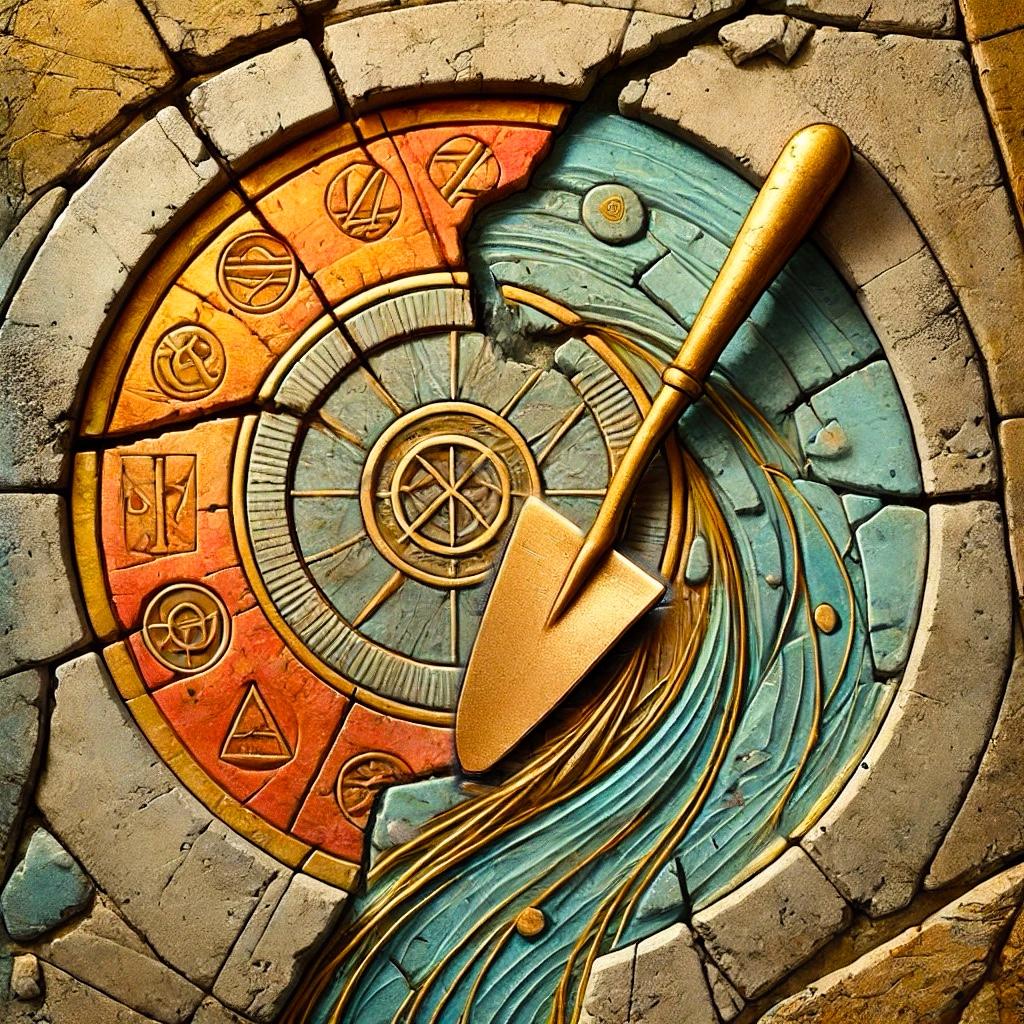
Brushing aside the dusty cobwebs, they made their way to the bar, miraculously and marvellously well stocked. Gregor emptied a crate of empty bottles for Vera, while Petro surveyed the bottles on the shelf behind the bar. Molly stood transfixed looking at a large square painting on the wall. A golden trowel was depicted, on a broken mosaic in a rich combination of terra sigillata orange and robins egg blue colours. Along the bottom of the picture were the words
“Nem minden darab illik rá első pillantásra. Ülj le a töredékekkel, mielőtt megpróbálnád összekényszeríteni őket.”
Triumphantly, Petro handed a nearly full bottle of Larios gin to Molly. “I’ll get you a glass but we may need to get Finja in here, they’re all very dirty. That’s nice,” he said, looking up at the picture.
“Not every piece fits at first glance. Sit with the fragments before trying to force them together.”
“Oh, I like that!” exclaimed Molly, giving Petro a grateful smile. “I’d never have known that if you hadn’t been here.”
Petro’s chest swelled with pride and happiness. It was the first time in many years that he’d felt useful to anyone.
February 23, 2025 at 1:35 pm #7828In reply to: The Last Cruise of Helix 25
Helix 25 – The Murder Board
Evie sat cross-legged on the floor of her cramped workspace, staring at the scattered notes, datapads, and threads taped to the wall. Finding some yarn on the ship had not been as easy as she thought, but it was a nice touch she thought.
The Murder Board, as Riven Holt had started calling it, was becoming an increasingly frustrating mess of unanswered questions.
Riven stood nearby, arms crossed, with a an irritated skepticism. “Almost a week,” he muttered. “We’re no closer than when we started.”
Evie exhaled sharply. “Then let’s go back to the basics.”
She tapped the board, where the crime scene was crudely sketched. The Drying Machine. Granary. Jardenery. Blood that shouldn’t exist.
She turned to Riven. “Alright, let’s list it out. Who are our suspects?”
He looked at his notes, dejected for a moment; “too many, obviously.” Last census on the ship was not accurate by far, but by all AI’s accounts cross-referenced with Finkley’s bots data, they estimated the population to be between 15,000 and 50,000. Give or take.
They couldn’t interview possibly all of them, all the more since there the interest in the murder had waned very rapidly. Apart from the occasional trio of nosy elderly ladies, the ship had returned mostly to the lull of the day-to-day routine.
So they’d focused on a few, and hoped TP’s machine brain could see patterns where they couldn’t.- First, the Obvious Candidates: People with Proximity to the Crime Scene
Romualdo, the Gardener – Friendly, unassuming. He lends books, grows plants, and talks about Elizabeth Tattler novels. But Herbert visited him often. Why?
Dr. Amara Voss – The geneticist. Her research proves the Crusader DNA link, but could she be hiding more? Despite being Evie’s godmother, she couldn’t be ruled out just yet.
Sue Forgelot – The socialite with connections everywhere. She had eluded their request for interviews. —does she know more than she lets on?
The Cleaning Staff – they had access everywhere. And the murder had a clean elegance to it… - Second, The Wild Cards: People with Unknown Agendas
The Lower Deck Engineers – Talented mechanic, with probable cybernetic knowledge, with probable access to unauthorized modifications. Could they kill for a reason, or for hire?
Zoya Kade and her Followers – They believe Helix 25 is on a doomed course, manipulated by a long-dead tycoon’s plan. Would they kill to force exposure of an inconvenient truth?
The Crew – Behind the sense of duty and polite smiles, could any of them be covering something up? - Third, The AI Factor: Sentient or Insentient?
Synthia, the AI – Controls the ship. Omnipresent. Can see everything, and yet… didn’t notice or report the murder. Too convenient.
Other personal AIs – Like Trevor Pee’s programme, most had in-built mechanisms to make them incapable of lying or harming humans. But could one of their access be compromised?
Riven frowned. “And what about Herbert himself? Who was he, really? He called himself Mr. Herbert, but the cat erm… Mandrake says that wasn’t his real name. If we figure out his past, maybe we find out why he was killed.”
Evie rubbed her temples. “We also still don’t know how he was killed. The ship’s safety systems should have shut the machine down. But something altered how the system perceived him before he went in.”
She gestured to another note. “And there’s still the genetic link. What was Herbert doing with Crusader DNA?”
A heavy silence settled between them.
Then TP’s voice chimed in. “Might I suggest an old detective’s trick? When stumped, return to who benefits.”
Riven exhaled. “Fine. Who benefits from Herbert’s death?”
Evie chewed the end of her stylus. “Depends. If it was personal, the killer is on this ship, and it’s someone who knew him. If it was bigger than Herbert, then we’re dealing with something… deeper.”
TP hummed. “I do hate deeper mysteries. They tend to involve conspiracies, misplaced prophecies, and far too many secret societies.”
Evie and Riven exchanged a glance.
Riven sighed. “We need a break.”
Evie scoffed. “Time means nothing here.”
Riven gestured out the window. “Then let’s go see it. The Sun.”
Helix 25 – The Sun-Gazing Chamber
The Sun-Gazing Chamber was one of Helix 25’s more poetic and yet practical inventions —an optically and digitally-enhanced projection of the Sun, positioned at the ship’s perihelion. It was meant to provide a psychological tether, a sense of humanity’s connection to the prime provider of life as they drifted in the void of the Solar System.
It was a beautifully designed setting where people would simply sit and relax, attuned to the shift of days and nights as if still on Earth. The primary setting had been voted to a massive 83.5% to be like in Hawai’i latitude and longitude, as its place was believed to be a reflection of Earth’s heart. That is was a State in the USA was a second thought of course.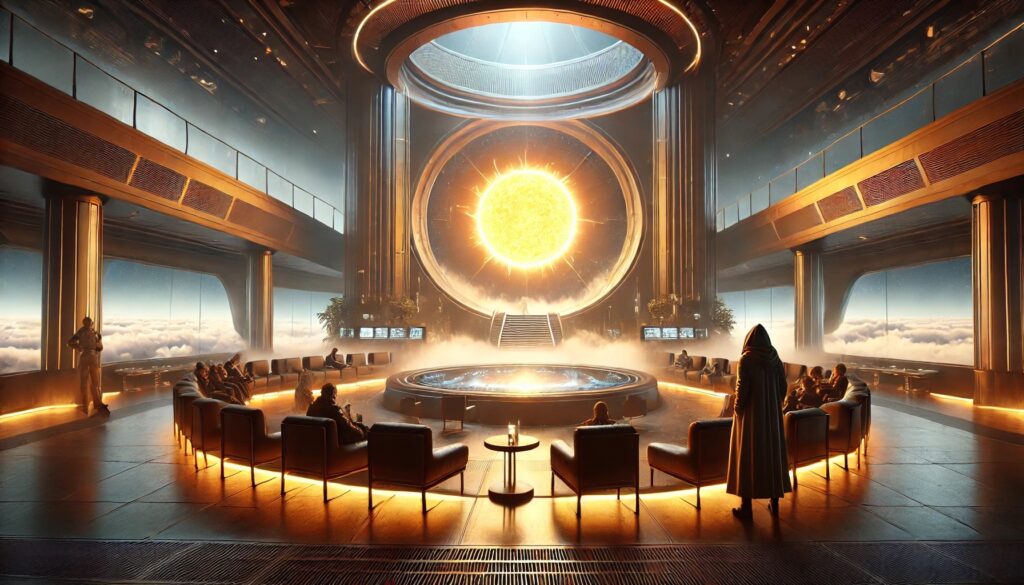
Evie sat on the observation bench, staring at the massive, golden sphere suspended in the darkness. “Do you think people back on Earth are still watching the sunrise?” she murmured.
Riven was quiet for a moment. “If there’s anyone left.”
Evie frowned. “If they are, I doubt they got much of a choice.”
TP materialized beside them, adjusting his holographic tie. “Ah, the age-old existential debate: are we the lucky ones who left Earth, or the tragic fools who abandoned it?”
Evie ignored him, glancing at the other ship residents in the chamber. Most people just sat quietly, basking in the light. But she caught snippets of whispers, doubt, something spreading through the ranks.
“Some people think we’re not really where they say we are,” she muttered.
Riven raised an eyebrow. “What, like conspiracy theories?”
TP scoffed. “Oh, you mean the Flat-Earthers?” He tsked. “Who couldn’t jump on the Helix lifeboats for their lives, convinced as they were we couldn’t make it to the stars. They deserved what came to them. Next they’ll be saying Helix 25 never even launched and we’re all just trapped in a simulation of a luxury cruise.”
Evie was shocked at Trevor Pee’s eructation and rubbed her face. “Damn Effin Muck tech, and those “Truth Control” rubbish datasets. I thought I’d thoroughly scrubbed all the old propaganda tech from the system.”
“Ah,” TP said, “but conspiracies are like mold. Persistent. Annoying. Occasionally toxic.”
Riven shook his head. “It’s nonsense. We’re moving. We’ve been moving for decades.”
Evie didn’t look convinced. “Then why do we feel stuck?”
A chime interrupted them.
A voice, over the comms. Solar flare alert.
Evie stiffened.
Then: Stay calm and return to your quarters until further notice.
Evie raised an eyebrow. This was the first time something like that happened. She turned to Riven who was looking at his datapad who was flashing and buzzing.
He said to her: “Stay quiet and come with me, a new death has been reported. Crazy coincidence. It’s just behind the Sun-Gazing chamber actually, in the Zero-G sector.”
February 21, 2025 at 8:24 pm #7827In reply to: The Precious Life and Rambles of Liz Tattler
“What do you mean, why haven’t I written anything?” Elizabeth glared at Godfrey. “The comments that used to be short, Are now far between offerings of extort, And if you want my report, I will have to resort, To a pointless and silly retort.”
Finnley tried to hide a reluctant smile of admiration behind her feather duster.
February 18, 2025 at 2:37 pm #7826In reply to: The Precious Life and Rambles of Liz Tattler
“Roberto, darling, pass the figs,” Liz said with a gracious smile.
“And as for you, Godfrey, you may address me as Elizabeth henceforward, to prevent further misunderstandings. My books are ELIZABETH Tatler, not that bumptious trash by that LIZ Tattler.”
February 16, 2025 at 2:37 pm #7813In reply to: The Last Cruise of Helix 25
Helix 25 – Crusades in the Cruise & Unexpected Archives
Evie hadn’t planned to visit Seren Vega again so soon, but when Mandrake slinked into her quarters and sat squarely on her console, swishing his tail with intent, she took it as a sign.
“Alright, you smug little AI-assisted furball,” she muttered, rising from her chair. “What’s so urgent?”
Mandrake stretched leisurely, then padded toward the door, tail flicking. Evie sighed, grabbed her datapad, and followed.
He led her straight to Seren’s quarters—no surprise there. The dimly lit space was as chaotic as ever, layers of old records, scattered datapads, and bound volumes stacked in precarious towers. Seren barely looked up as Evie entered, used to these unannounced visits.
“Tell the cat to stop knocking over my books,” she said dryly. “It never ever listens.”
“Well it’s a cat, isn’t it?” Evie replied. “And he seems to have an agenda.”
Mandrake leaped onto one of the shelves, knocking loose a tattered, old-fashioned book. It thudded onto the floor, flipping open near Evie’s feet. She crouched, brushing dust from the cover. Blood and Oaths: A Romance of the Crusades by Liz Tattler.
She glanced at Seren. “Tattler again?”
Seren shrugged. “Romualdo must have left it here. He hoards her books like sacred texts.”
Evie turned the pages, pausing at an unusual passage. The prose was different—less florid than Liz’s usual ramblings, more… restrained.
A fragment of text had been underlined, a single note scribbled in the margin: Not fiction.
Evie found a spot where she could sit on the floor, and started to read eagerly.
“Blood and Oaths: A Romance of the Crusades — Chapter XII
Sidon, 1157 AD.Brother Edric knelt within the dim sanctuary, the cold stone pressing into his bones. The candlelight flickered across the vaulted ceilings, painting ghosts upon the walls. The voices of his ancestors whispered within him, their memories not his own, yet undeniable. He knew the placement of every fortification before his enemies built them. He spoke languages he had never learned.
He could not recall the first time it happened, only that it had begun after his initiation into the Order—after the ritual, the fasting, the bloodletting beneath the broken moon. The last one, probably folklore, but effective.
It came as a gift.
It was a curse.
His brothers called it divine providence. He called it a drowning. Each time he drew upon it, his sense of self blurred. His grandfather’s memories bled into his own, his thoughts weighted by decisions made a lifetime ago.
And now, as he rose, he knew with certainty that their mission to reclaim the stronghold would fail. He had seen it through the eyes of his ancestor, the soldier who stood at these gates seventy years prior.
‘You know things no man should know,’ his superior whispered that night. ‘Be cautious, Brother Edric, for knowledge begets temptation.’
And Edric knew, too, the greatest temptation was not power.
It was forgetting which thoughts were his own.
Which life was his own.
He had vowed to bear this burden alone. His order demanded celibacy, for the sealed secrets of State must never pass beyond those trained to wield it.
But Edric had broken that vow.
Somewhere, beyond these walls, there was a child who bore his blood. And if blood held memory…
He did not finish the thought. He could not bear to.”
Evie exhaled, staring at the page. “This isn’t just Tattler’s usual nonsense, is it?”
Seren shook her head distractedly.
“It reads like a first-hand account—filtered through Liz’s dramatics, of course. But the details…” She tapped the underlined section. “Someone wanted this remembered.”
Mandrake, still perched smugly above them, let out a satisfied mrrrow.
Evie sat back, a seed of realization sprouting in her mind. “If this was real, and if this technique survived somehow…”
Mandrake finished the thought for her. “Then Amara’s theory isn’t theory at all.”
Evie ran a hand through her hair, glancing at the cat than at Evie. “I hate it when Mandrake’s right.”
“Well what’s a witch without her cat, isn’t it?” Seren replied with a smile.
Mandrake only flicked his tail, his work here done.
February 16, 2025 at 12:50 pm #7810In reply to: The Last Cruise of Helix 25
Helix 25 – Below Lower Decks – Shadow Sector
Kai Nova moved cautiously through the underbelly of Helix 25, entering a part of the Lower Decks where the usual throb of the ship’s automated systems turned muted. The air had a different smell here— it was less sterile, more… human. It was warm, the heat from outdated processors and unmonitored power nodes radiating through the bulkheads. The Upper Decks would have reported this inefficiency.
Here, it simply went unnoticed, or more likely, ignored.
He was being watched.
He knew it the moment he passed a cluster of workers standing by a storage unit, their voices trailing off as he walked by. Not unusual, except these weren’t Lower Deck engineers. They had the look of people who existed outside of the ship’s official structure—clothes unmarked by department insignias, movements too intentional for standard crew assignments.
He stopped at the rendezvous point: an unlit access panel leading to what was supposed to be an abandoned sublevel. The panel had been manually overridden, its system logs erased. That alone told him enough—whoever he was meeting had the skills to work outside of Helix 25’s omnipresent oversight.
A voice broke the silence.
“You’re late.”
Kai turned, keeping his stance neutral. The speaker was of indistinct gender, shaved head, tall and wiry, with sharp green eyes locked on his movements. They wore layered robes that, at a glance, could have passed as scavenged fabric—until Kai noticed the intricate stitching of symbols hidden in the folds.
They looked like Zoya’s brand —he almost thought… or let’s just say, Zoya’s influence. Zoya Kade’s litanies had a farther reach he would expect.
“Wasn’t aware this was a job interview,” Kai quipped, leaning casually against the bulkhead.
“Everything’s a test,” they replied. “Especially for outsiders.”
Kai smirked. “I didn’t come to join your book club. I came for answers.”
A low chuckle echoed from the shadows, followed by the shifting of figures stepping into the faint light. Three, maybe four of them. It could have been an ambush, but that was a display.
“Pilot,” the woman continued, avoiding names. “Seeker of truth? Or just another lost soul looking for something to believe in?”
Kai rolled his shoulders, sensing the tension in the air. “I believe in not running out of fuel before reaching nowhere.”
That got their attention.
The recruiter studied him before nodding slightly. “Good. You understand the problem.”
Kai crossed his arms. “I understand a lot of problems. I also understand you’re not just a bunch of doomsayers whispering in the dark. You’re organized. And you think this ship is heading toward a dead end.”
“You say that like it isn’t.”
Kai exhaled, glancing at the flickering emergency light above. “Synthia doesn’t make mistakes.”
They smiled, but it wasn’t friendly. “No. It makes adjustments.” — the heavy tone on the “it” struck him. Techno-bigots, or something else? Were they denying Synthia’s sentience, or just adjusting for gender misnomers, it was hard to tell, and he had a hard time to gauge the sanity of this group.
A low murmur of agreement rippled through the gathered figures.
Kai tilted his head. “You think she’s leading us into the abyss?”
The person stepped closer. “What do you think happened to the rest of the fleet, Pilot?”
Kai stiffened slightly. The Helix Fleet, the original grand exodus of humanity—once multiple ships, now only Helix 25, drifting further into the unknown.
He had never been given a real answer.
“Think about it,” they pressed. “This ship wasn’t built for endless travel. Its original mission was altered. Its course reprogrammed. You fly the vessel, but you don’t control it.” She gestured to the others. “None of us do. We’re passengers on a ride to oblivion, on a ship driven by a dead man’s vision.”
Kai had heard the whispers—about the tycoon who had bankrolled Helix 25, about how the ship’s true directive had been rewritten when the Earth refugees arrived. But this group… they didn’t just speculate. They were ready to act.
He kept his voice steady. “You planning on mutiny?”
They smiled, stepping back into the half-shadow. “Mutiny is such a crude word. We’re simply ensuring that we survive.”
Before Kai could respond, a warning prickle ran up his spine.
Someone else was watching.
He turned slowly, catching the faintest silhouette lingering just beyond the corridor entrance. He recognized the stance instantly—Cadet Taygeta.
Damn it.
She had followed him.
The group noticed, shifting slightly. Not hostile, but suddenly alert.
“Well, well,” the woman murmured. “Seems you have company. You weren’t as careful as you thought. How are you going to deal with this problem now?”
Kai exhaled, weighing his options. If Taygeta had followed him, she’d already flagged this meeting in her records. If he tried to run, she’d report it. If he didn’t run, she might just dig deeper.
And the worst part?
She wasn’t corruptible. She wasn’t the type to look the other way.
“You should go,” the movement person said. “Before your shadow decides to interfere.”
Kai hesitated for half a second, before stepping back.
“This isn’t over,” he said.
Her smile returned. “No, Pilot. It’s just beginning.”
With that, Kai turned and walked toward the exit—toward Taygeta, who was waiting for him with arms crossed, expression unreadable.
He didn’t speak first.
She did.
“You’re terrible at being subtle.”
Kai sighed, thinking quickly of how much of the conversation could be accessed by the central system. They were still in the shadow zone, but that wasn’t sufficient. “How much did you hear?”
“Enough.” Her voice was even, but her fingers twitched at her side. “You know this is treason, right?”
Kai ran a hand through his hair. “You really think we’re on course for a fresh new paradise?”
Taygeta didn’t answer right away. That was enough of an answer.
Finally, she exhaled. “You should report this.”
“You should,” Kai corrected.
She frowned.
He pressed on. “You know me, Taygeta. I don’t follow lost causes. I don’t get involved in politics. I fly. I survive. But if they’re right—if there’s even a chance that we’re being sent to our deaths—I need to know.”
Taygeta’s fingers twitched again.
Then, with a sharp breath, she turned.
“I didn’t see anything tonight.”
Kai blinked. “What?”
Her back was already to him, her voice tight. “Whatever you’re doing, Nova, be careful. Because next time?” She turned her head slightly, just enough to let him see the edge of her conflicted expression.
“I will report you.”
Then she was gone.
Kai let out a slow breath, glancing back toward the hidden movement behind him.
No turning back now.
February 15, 2025 at 12:20 pm #7799In reply to: The Last Cruise of Helix 25
Helix 25 – Lower Decks – Secretive Adjustments
Sue Brittany Kaleleonālani Forgelot moved with the practiced grace of someone accustomed to being noticed—but tonight, she walked as someone trying not to be. The Upper Deck was hers, where conversations flowed with elegant pretense and where everyone knew her by firstname —Sue, she would insist. There would be none of that bowing nonsense to her noble lineages —bless her distinguished ancestors.
Here, in the Lower Decks, she was a curiosity at best, an intrusion at worst.
Unlike the well-maintained Upper Decks, here the air was warmer, and one could sense mingled with the recycled air, a distinct scent of metal, oil, and even labouring bodies. Maintenance bots were limited, and keeping people busy with work helped with the social order. Lights flickered erratically in narrow corridors, nothing like the pristine glow of the Upper Deck’s crystal chandeliers. The Lower Decks were functional, built for work and survival, not for leisure. And deeper still—past the bustling workstations, past the overlooked mechanics keeping Helix 25 from falling apart—the Hold.
The Hold was where she found Luca Stroud.
A heavy, reinforced door hissed as it unlocked, and Sue stepped inside his dimly lit workshop. Stacks of salvaged tech lined the walls, interspersed with crates of unauthorized modifications in this workspace born of a mixture of necessity, ingenuity, and quiet rebellion.
Luca barely looked up as he wiped oil from his hands. “You’re late, dear.”
Sue huffed, settling into the chair he had long since designated for her. “A lady does not rush. Besides, I had affairs to attend to.” She crossed one leg over the other, her silk shawl catching on the metallic seam of a cybernetic limb beneath it. “And I had to dodge half the ship to get here unnoticed.”
Luca grunted, kneeling beside her. “You wouldn’t have to sneak if you’d just let one of the Upper Deck doctors service this thing.” He tapped lightly on the synthetic skin to reveal the metallic prosthetic, watching as the synthetic nerves twitched in response.
Sue’s expression turned sharp. “You know why I can’t.”
Luca said nothing, but his smirk spoke volumes.
There were things she couldn’t let the Upper Deck medics see. Upgrades, modifications, small enhancements that gave her just enough edge. In the circles she moved in, knowledge was power. And she was far too valuable to be at the mercy of those who wanted her dependent.
Luca examined the joint, nodding to himself. “You’ve been walking too much on it.”
“Well, forgive me for using my own legs.”
He tightened a wire. Sue winced, but he ignored it. “You need recalibration. And I need better parts.”
Sue gave a slow, knowing smile. “And what minor favors will you require this time?”
Luca leaned back, thoughtful. “Information. Since you’re generous with it.”
She sighed, shifting in her seat. “Fine. You’re lucky I find you amusing.”
He adjusted a component with expert hands. “Tell me about the murder.”
Sue arched a brow. “Everyone wants to talk about that. You’d think no one had ever died before.”
“They haven’t,” Luca countered, voice flat. “Not for a long time. And not like this.”
She studied him, his interest piquing her own. “So you think it was a real murder.”
Luca let out a dry chuckle. “Oh, it was a murder alright. And you know it.”
Sue exhaled, considering what to share. “Well, rumor has it, the DNA found in the crime scene doesn’t belong here. It’s from the past. Far past.”
Luca glanced up, intrigued. “How far?”
Sue leaned in, voice hushed. “Crusader far.”
He let out a low whistle, shaking his head. “That’s… new.”
She tilted her head. “What does that mean to you?”
Luca hesitated, then shrugged. “Means whoever’s playing god with DNA sequencing isn’t as smart as they think they are.”
Sue smiled at that, more amused than disturbed. “And I suppose you have theories?”
Luca gave her cybernetic limb one final adjustment, then stood. “I have suspicions.”
Sue sighed dramatically. “How thrilling.” She flexed her leg, satisfied with the result. “Keep me informed, and I’ll see what I can find for you.”
Luca smirked. “You always do.”
As she rose to leave, she paused at the door. “Oh, one last thing, dear.”
Luca glanced at her. “What?”
Sue’s smirk deepened. “Should I put in a good word to the Captain for you?”
The question hung between them.
Luca narrowed his eyes. “Nobody’s ever met the Captain.”
She nodded, satisfied, and left him to his thoughts.
February 15, 2025 at 2:26 am #7788In reply to: The Last Cruise of Helix 25
At first, no one noticed.
They were still speculating about the truck—where it had come from, where it might be going, whether following it was a brilliant idea or a spectacularly bad one.
And, after all, Finja was always muttering about something. Dust, filth, things not put back where they belonged.
But then her voice rose till she was all but shouting.
“Of course, they’re all savages. I don’t know how I put up with them! Honestly, I AM AT MY WIT’S END!”
“Finja?” Anya called. “Are you okay?”
Finja strode on, intent on her diatribe.
“No, I don’t know where they are going,” she yelled. “If I knew that, I probably wouldn’t be here, would I?”
Tala hurried to catch up and stepped in front of Finja, blocking her path. “Finja, are you okay? Who are you talking to?”
Finja sighed loudly; it was tedious. People were so obsessed with explanations.
“If you must know,” she said, “I am conversing with my Auntie Finnley in Australia.”
“Ooooh!” Vera’s eyes lit up. “ A relative!”
Yulia, walking between Luka and Lev, giggled. She adored the twins and couldn’t decide which one she liked more. They were both so tall and handsome. Others found it hard to tell them apart but she always could. It was rumoured that at birth they had been joined at the hip.
“Finja is totally bonkers,” she declared cheerfully and the twins smiled in unison.
“I will have you know I’m not bonkers.” Finja felt deeply offended and misunderstood. “I have been communicating with Auntie Finnley since childhood. She was highly influential in my formative years.”
“How so?” asked Tala.
“Few people appreciate the importance of hygiene like my Auntie Finnley. She works as a cleaner at the Flying Fish Inn in the Australian Outback. Lovely establishment I gather. But terrible dust.”
Vera nodded sagely. “A sensible place to survive the apocalypse.”
“Exactly.” Finja rewarded her with a tight smile.
Jian raised an eyebrow. “And she’s alive? Your aunt?”
“I don’t converse with ghosts!” Finja waved a hand dismissively. “They all survived there thanks to the bravery of Aunt Finnley. Had to disinfect the whole inn, mind you. Said it was an absolute nightmare.” Finja shuddered at the thought of it.
Gregor snorted. “You’re telling us you have a telepathic connection with your aunt in Australia… and she is also mostly concerned about … hygiene?”
Finja glared at him. “Standards must be maintained,” she admonished. “Even after the end of the world.”
“Do you talk to anyone else?” Tala asked. “Or is it just your aunt?”
Finja regarded Tala through slitted eyes. “I’m also talking to Finkley.”
“Where is this Finkley, dear?” asked Anja gently. “Also at the outback?”
“OMG,” Finja said. “Can you imagine those two together?” She cackled at the thought, then pulled herself together. “No. Finkley is on the Helix 25. Practically runs it by all accounts. But also keeps it spotless, of course.”
“Helix 25? The spaceship?” Mikhail asked, suddenly interested. He exchanged glances with Tala who shrugged helplessly.
Yulia laughed. “She’s definitely mad!”
“So what? Aren’t we all,” said Petro.
Molly, who had been quietly watching with Tundra, finally spoke. “And you say they are both… cleaners?” She wasn’t sure what to make of this group. She wondered if it would be better to continue on alone with Tundra? She didn’t want to put the child in any danger.
“Cleanliness runs in the family,” Finja said. “Now, if you’ll all excuse me, I was mid-conversation.”
She closed her eyes, concentrating. The group watched with interest as her lips moved silently, her brow furrowed in deep thought.
Then, suddenly, she opened her eyes and threw her hands in the air.
“Oh, for goodness’ sake,” she muttered. “Finkley is complaining about dust floating in low gravity. Finnley is complaining about the family not taking their boots off at the door. What a pair of whingers. At least I didn’t inherit THAT.”
She sniffed, adjusted her backpack, and walked on.
The others stood there for a moment, letting it all sink in.
Gregor clapped his hands together. “That was the most wonderfully insane thing I’ve heard since the world ended.”
Mikhail sighed. “So, we are following the direction of the truck?”
Anya nodded. “I’ll keep an eye on Finja. The stress is getting to her, and we have no meds if it escalates.”
February 9, 2025 at 11:41 am #7778In reply to: The Last Cruise of Helix 25
The truck disappeared from view as it descended into a valley. They waited for it to reappear over the hill, but they waited in vain. The truck had disappeared.
“It must have been a mirage,” said Vera. “There was no truck, it was wishful thinking.”
“I don’t think any of us were hoping to see a truck this morning, Vera,” Anya replied, “Nobody expected to see a truck, and yet we all saw one.”
“You don’t know much about mirages then, do you. I saw a fata morgana once and so did everyone else on the beach, we weren’t all expecting to see a floating city that day either.”
“Nobody needs to hear about that now,” Mikhail interrupted, “We need to walk over to where we saw it and look for the tyre tracks.”
Tundra moved over to stand next to Vera and impulsively grabbed her arm. “Can you tell me about the fata morgana later? I want to see one too.”
Vera smiled gratefully at the child and patted her shoulder. “I’ll tell you all about it, and lots of other stories if you like. And you can tell me all your stories, and all about your family. Is that your real granny?”
“Great gran actually and she’s as real as any of you are,” Tundra replied, not understanding the question.
“Mikhail is right,” said Jian. Everyone turned to look at young Chinese man who rarely voiced an opinion. “We need to find out what other equipment they have. Where they came from, and where they’re going.”
Anya clapped her hands together loudly. “Right then, we’re all agreed. Gather everything up and let’s go. Mikhail, lead the way!”
Petro made a harrumphing noise and mumbled something about nobody asking him what he thought about traipsing all over the coutryside, but he slung his bag over his shoulder and followed. What else was he to do?
February 8, 2025 at 7:22 pm #7776In reply to: Quintessence: Reversing the Fifth
Epilogue & Prologue
Paris, November 2029 – The Fifth Note Resounds
Tabitha sat by the window at the Sarah Bernhardt Café, letting the murmur of conversations and the occasional purring of the espresso machine settle around her. It was one of the few cafés left in the city where time still moved at a human pace. She stirred her cup absentmindedly. Paris was still Paris, but the world outside had changed in ways her mother’s generation still struggled to grasp.
It wasn’t just the ever-presence of automation and AI making themselves known in subtle ways—screens adjusting to glances, the quiet surveillance woven into everyday life. It wasn’t just the climate shifts, the aircon turned to cold in the midst of November, the summers unpredictable, the air thick with contradictions of progress and collapse of civilization across the Atlantic.
The certainty of impermanence was what defined her generation. BANI world they used to say—Brittle, Anxious, Nonlinear, Incomprehensible. A cold fact: impossible to grasp and impossible to fight. Unlike her mother and her friends, who had spent their lives tethered to a world that no longer existed, she had never known certainty. She was born in the flux.
And yet, this café remained. One of the last to resist full automation, where a human still brought you coffee, where the brass bell above the door still rang, where things still unfolded at a human pace.
The bell above the door rang—the fifth note, as her mother had called it once.
She had never been here before, not in any way that mattered. Yet, she had heard the story. The unlikely reunion five years ago. The night that moved new projects in motion for her mother and her friends.
Tabitha’s fingers traced the worn edges of the notebook in front of her—Lucien’s, then Amei’s, then Darius’s. Pieces of a life written by many hands.
“Some things don’t work the first time. But sometimes, in the ruins of what failed, something else sprouts and takes root.”
And that was what had happened.
The shared housing project they had once dreamed of hadn’t survived—not in its original form. But through their rekindled bond, they had started something else.
True Stories of How It Was.
It had begun as a quiet defiance—a way to preserve real, human stories in an age of synthetic, permanent ephemerality and ephemeral impermanence, constantly changing memory. They were living in a world where AI’s fabricated histories had overwhelmed all the channels of information, where the past was constantly rewritten, altered, repackaged. Authenticity had become a rare currency.
As she graduated in anthropology few years back, she’d wondered about the validity of history —it was, after all, a construct. The same could be said for literature, art, even science. All of them constructs of the human mind, tenuous grasp of the infinite truth, but once, they used to evolve at such a slow pace that they felt solid, reliable. Ultimately their group was not looking for ultimate truth, that would be arrogant and probably ignorant. Authenticity was what they were looking for. And with it, connections, love, genuineness —unquantifiables by means of science and yet, true and precious beyond measure.
Lucien had first suggested it, tracing the idea from his own frustrations—the way art had become a loop of generated iterations, the human touch increasingly erased. He was in a better place since Matteo had helped him settle his score with Renard and, free of influence, he had found confidence in developing of his own art.
Amei —her mother—, had changed in a way Tabitha couldn’t quite define. Her restlessness had quieted, not through settling down but through accepting impermanence as something other than loss. She had started writing again—not as a career, not to publish, but to preserve stories that had no place in a digitized world. Her quiet strength had always been in preserving connections, and she knew they had to move quickly before real history faded beneath layers of fabricated recollections.
Darius, once skeptical, saw its weight—he had spent years avoiding roots, only to realize that stories were the only thing that made places matter. He was somewhere in Morocco now, leading a sustainable design project, bridging cultures rather than simply passing through them.
Elara had left science. Or at least, science as she had known it. The calculations, the certainty, the constraints of academia, with no escape from the automated “enhanced” digital helpers. Her obsession and curiosities had found attract in something more human, more chaotic. She had thrown herself into reviving old knowledge, forgotten architectures, regenerative landscapes.
And Matteo—Matteo had grounded it.
The notebook read: Matteo wasn’t a ghost from our past. He was the missing note, the one we didn’t know we needed. And because of him, we stopped looking backward. We started building something else.
For so long, Matteo had been a ghost of sorts, by his own account, lingering at the edges of their story, the missing note in their unfinished chord. But now, he was fully part of it. His mother had passed, her past history unraveling in ways he had never expected, branching new connections even now. And though he had lost something in that, he had also found something else. Juliette. Or maybe not. The story wasn’t finished.
Tabitha turned the page.
“We were not historians, not preservationists, not even archivists. But we have lived. And as it turned out, that was enough.”
They had begun collecting stories through their networks—not legends, not myths, but true accounts of how it was, from people who still remembered.
A grandfather’s voice recording of a train ride to a city that no longer exists.
Handwritten recipes annotated by generations of hands, each adding something new.
A letter from a protest in 2027, detailing a movement that the history books had since erased.
An old woman’s story of her first love, spoken in a dialect that AI could not translate properly.It had grown in ways they hadn’t expected. People began sending them recordings, letters, transcripts, photos —handwritten scraps of fading ink. Some were anonymous, others carefully curated with full names and details, like makeshift ramparts against the tide of time.
At first, few had noticed. It was never the goal to make it worlwide movement. But little by little, strange things happened, and more began to listen.
There was something undeniably powerful about genuine human memory when it was raw and unfiltered, when it carried unpolished, raw weight of experience, untouched by apologetic watered down adornments and out-of-place generative hallucinations.
Now, there were exhibitions, readings, archives—entire underground movements dedicated to preserving pre-synthetic history. Their project had become something rare, valuable, almost sacred.
And yet, here in the café, none of that felt urgent.
Tabitha looked up as the server approached. Not Matteo, but someone new.
“Another espresso?”
She hesitated, then nodded. “Yes. And a glass of water, please.”
She glanced at the counter, where Matteo was leaning, speaking to someone, laughing. He had changed, too. No longer just an observer, no longer just the quiet figure who knew too much. Now, he belonged here.
A bell rang softly as the door swung open again.
Tabitha smiled to herself. The fifth note always sounded, in the end.
She turned back to the notebook, the city moving around her, the story still unfolding in more directions than one.
February 8, 2025 at 3:38 pm #7765In reply to: The Last Cruise of Helix 25
Zoya clicked her tongue, folding her arms as Evie and her flickering detective vanished into the dead man’s private world. She listened to the sounds of investigation. The sound of others touching what should have been hers first. She exhaled through her nose, slow and measured.
The body was elsewhere, dried and ruined. That didn’t matter. What mattered was here—hairs, nail clippings, that contained traces, strands, fragments of DNA waiting to be read like old parchments.
She stepped forward, the soft layers of her robes shifting.
“You can’t keep me out forever, young man.”
Riven didn’t move. Arms crossed, jaw locked, standing there like a sentry at some sacred threshold. Victor Holt’s grandson, through and through, she thought.
“I can keep you out long enough.”
Zoya clicked her tongue. Not quite amusement, not quite irritation.
“I should have suspected such obstinacy. You take after him, after all.”
Riven’s shoulders tensed.
Good. Let him feel it.
His voice was tight. “If you’re referring to my grandfather, you should choose your words carefully.”
Zoya smiled, slow and knowing. “I always choose my words carefully.”
Riven’s glare could have cut through metal.
Zoya tilted her head, studying him as she would an artifact pulled from the wreckage of an old world. So much of Victor Holt was in him—the posture, the unyielding spine, the desperate need to be right.
But Victor Holt had been wrong.
And that was why he was sleeping in a frozen cell of his own making.
She took another step forward, lowering her voice just enough that the curious would not hear what she said.
“He never understood the ship’s true mission. He clung to his authority, his rigid hierarchies, his outdated beliefs. He would have let us rot in luxury while the real work of survival slipped away. And when he refused to see reason—” she exhaled, her gaze never leaving his, “he stepped aside.”
Riven’s jaw locked. “He was forced aside.”
Zoya only smiled. “A matter of perspective.”
She let that hang. Let him sit with it.
She could see the war in his eyes—the desperate urge to refute her, to throw his grandfather’s legacy in her face, to remind her that Victor Holt was still here, still waiting in cryo, still a looming shadow over the ship. But Victor Holt’s silence was the greatest proof of his failure.
Riven clenched his jaw.
Anuí’s voice, smooth and patient, cut through the tension.
“She is not wrong.”
Zoya frowned. She had expected them to speak eventually. They always did.
They stood just a little apart, hand tucked in their robes, their expression unreadable.
“In its current state, the body is useless,” Anuí said lightly, as if stating something obvious, “but that does not mean it has left no trace.” Then they murmured “Nāvdaṭi hrás’ka… aṣṭīr pālachá.”
Zoya glanced at them, her eyes narrowing. In an old tongue forgotten by all, it meant The bones remember… the blood does not lie. She did not trust the Lexicans’ sudden interest in genetics.
They did not see history in bloodlines, did not place value in the remnants of DNA. They preferred their records rewritten, reclaimed, restructured to suit a new truth, not an old one.
Yet here they were, aligning themselves with her. And that was what gave her pause.
“Your people have never cared for the past as it was,” she murmured. “Only for what it could become.”
Anuí’s lips curved, withholding more than they gave. “Truth takes many forms.”
Zoya scoffed. They were here for their own reasons. That much was certain. She could use that
Riven’s fingers tightened at his sides. “I have my orders.”
Zoya lifted a brow. “And whose orders are those?”
The hesitation was slight. “It’s not up to me.”
Zoya stilled. The words were quiet, bitter, revealing.
Not up to him.
So, someone had ensured she wouldn’t step foot in that room. Not just delayed—denied.
She exhaled, long and slow. “I see.” She paused. “I will find out who gave that order.”
And when she did, they would regret it.
February 6, 2025 at 7:38 am #7734In reply to: The Last Cruise of Helix 25
It was quite dark by the time Molly and Tundra entered the woods but the firelight flickered through the trees, guiding them to the clearing. Now that the meeting with the strangers was close, the initial excitement gave way to trepidition, particularly for Molly. Despite not seeing other people for years, the old world caution about strangers resurfaced.
“Slow down, Tundra, we don’t want to shock them. They may be hostile,” whispered Molly.
“Hostile? What does that mean?” asked Tundra, who had never come into contact with other people.
Molly looked at her in amazement. The dear innocent poppet has never known the fear of strangers in dark woods! And not once did I think to appreciate that, Molly marvelled silently.
“Never mind that now. Come on.” No need to fill the childs head with fear. “Haloooo! We come in peace!” Molly shouted. “Haloooo! We’re coming in pieces!” echoed Tundra, who was unfamiliar with the word peace, not having had any call the use the word in any conversation thus far.
There was a pregnant silence and then an animated burble of exclamations from the clearing, and then silence again as Molly and Tundra emerged from the darkness.
Dear god, there are so many of them. Molly’s initial reaction was overwhelm. She tried to look at them all individually and it made her head swim. She wondered for a moment if it would be rude to just turn around and leave. But no, it was dark already, and the rapturous excitement on Tundra’s face put paid to that idea.
Gregor was the first to move forward. His leathery old face creased in smiles, he offered his hand to Molly.
February 3, 2025 at 10:10 pm #7733In reply to: The Last Cruise of Helix 25
Leaving the Asylum
They argued about whether to close the heavy gates behind them. In the end, they left them open. The metal groaned as it sat ajar, rust flaking from its hinges.
“Are we all here?” Anya asked. Now that they were leaving, she felt in charge again—or at least, she needed to be. If morale slipped, things would unravel fast. She scanned the group, counting them off.
“Mikhail,” she started, pointing. “Tala. Vera, our esteemed historian.”
Vera sniffed. “I prefer genealogist, thank you very much.”
“Petro,” Anya continued, “probably about to grumble.”
Petro scowled. “I was thinking.”
“Jian, our mystery man.”
Jian raised an eyebrow in acknowledgment.
Anya turned to the next two. “Ah, the twins. Even though you two have never spoken, I’ve always assumed you understood me. Don’t prove me wrong now.”
The twins—Luka and Lev—nodded and grinned at exactly the same time.
“Then we have Yulia… no, we don’t have Yulia. Where in God’s name is Yulia?”
“Here I am!” Yulia’s voice rang out as she jogged back toward them, breathless. “I just went to say goodbye to the cat.” She sighed dramatically. “I wish we could take him. Please, can we take him?”
Yulia was short and quick-moving, her restless hands always in motion, her thoughts spilling out just as fast.
“We can’t,” Mikhail said firmly. “And he can look after himself.”
She huffed. “Well, I expect we could if we tried.”
“And finally, old Gregor, who I gather would rather be taking a nap.”
Gregor, who was well past eighty, rubbed his face and yawned. “You say that like it’s a bad thing.”
Anya frowned, scanning the group again. “Wait. We’re missing Finja.”
A small scraping sound came from behind them.
Finja stood near the gate, furiously scrubbing the rusted metal with a rag she had pulled from her sleeve. “This place is disgusting,” she muttered. “Filth everywhere. The world may have ended, but that’s no excuse for grime.”
Anya sighed. “Finja, leave the gate alone.”
Finja gave it one last wipe before tucking the rag away with a huff. “Fine.”
Anya shook her head. “That’s eleven. No one’s run off or died yet. A promising start.”
They formed a motley crew, each carrying as much as they could manage. Mikhail pushed a battered cart, loaded with scavenged supplies—blankets, tools, whatever food they had left.
The road beneath their feet was cracked and uneven, roots breaking through in places. They followed it in silence for the most part. Even Yulia remained quiet. Some glanced back, but no one turned around.
The nearest village was more than fifty kilometers away. In all directions, there was only wilderness—fields long overtaken by weeds, trees pushing through cracks in forgotten roads. A skeletal signpost leaned at an odd angle, its lettering long since faded.
“It’s going to be dark soon,” Mikhail said. “And the old ones are tired. Aren’t you, Vera?”
“That’s enough of the old business,” puffed Vera, pulling her shoulders back.
Tala laughed. “Well, I must be an old one. I didn’t sleep a wink last night. And there’s a clearing over there.” She pointed.
The evening was cool, but they managed to build a small fire and scrape together a meal of vegetables they’d brought from their garden.
After their meal, they sat around the fire while Finja busied herself tidying up. “Dirty savages,” she muttered under her breath. Then, more loudly, “We should keep watch tonight.”
Vera, perched on a log, pulled her shawl tightly around her. The glow from the fire cast long shadows across her face.
“Vera, you look like a witch,” Yulia declared. “We should have brought the cat for you to ride on a broomstick together.”
“I’ll have you know I’m descended from witches,” Vera replied. “I know none of you think you’re related to me, but just imagine what your great-grandparents would say if they saw us now. Running into the wilderness like a band of exiled aristocrats.”
Jian, seated nearby, smirked slightly. “My great-grandparents were rice farmers.”
Vera brightened—Jian never talked about his past. She leaned in conspiratorially. “Do you know your full lineage? Because I do. I know mine back fourteen generations. You’d be amazed how many bloodlines cross without people realizing.”
Tala shook her head but smiled. Like Petro and Gregor, Vera had been at the asylum for many decades, a relic of another time. She claimed to have been a private investigator and genealogist in her former life.
Petro, hunched over and rubbing his hands by the fire, muttered, “We’re all ghosts now. Doesn’t matter where we came from.”
“Oh, stop that, Petro,” Anya admonished. “Remember our plan?”
“We go to the city,” Jian said. He rarely spoke unless he had something worth saying. “There will be things left behind. Maybe tech, maybe supplies. If I can get into an old server, I might even find something useful.”
“And if there’s nothing?” Petro moaned. “We should never have left.” He clasped his hands over his head.
Jian shrugged. “The world doesn’t erase itself overnight.”
Mikhail nodded. “We rest tonight. Tomorrow, we head for the city. And Finja’s right—tonight we take turns keeping watch.”
They sat in silence, watching the fire burn low. The evening stretched long and uneasy.
February 3, 2025 at 5:18 am #7730In reply to: The Last Cruise of Helix 25
The Asylum 2050
They had been talking about leaving for a long time.
Not in any urgent way, not in a we must leave now kind of way, but in the slow, circling conversations of people who had too much time and not enough answers.
Those who had left before them had never returned. Perhaps they had found something better, though that seemed unlikely. Perhaps they had found nothing at all. The first group left over twenty years ago—just for supplies. They never came back. Others drifted off over the years. They never came back either.
The core group had stayed because—what else was there? The asylum had been safe, for the most part. It had become home. Overgrown now, with only a fraction of its former inhabitants. The walls had once kept them in; now, they were what kept the rest of the world out.
But the crops were failing. The soil was thinning. The last winter had been long and cruel. Summer was harsh. Water was harder to find.
And so the reasons to stay had been replaced with reasons to go.
She was about forty now—or near enough, though time had softened the numbers. Natalia. A name from a past life; now they called her Tala.
Her family had left her here years ago. Paid well for it, as if they were settling an expensive inconvenience. She had been young then—too young to know how final it would be. They had called her difficult, willful, unable to conform. She wasn’t mad, but they had paid to have her called mad so they could get rid of her. And in the world before, that had been enough.
She had been furious at first. She tried to run away even though the asylum was many miles from anywhere. The drugs they made her take put an end to that. The drugs stopped many years ago, but she no longer wanted to run.
She sat at the edge of the vegetable garden, turning soil between her fingers. It was dry, thinning. No matter how deep she dug, the color stayed the same—pale, lifeless.
“Nothing wants to grow anymore,” said Anya, standing over her. Older—mid-sixties. Once a nurse, before everything had fallen apart. She had been one of the staff members who stayed behind when the first group left for supplies, but now she was the only one remaining. The others had abandoned the asylum years ago. At first, her authority had meant something. Now, it was just a memory, but she still carried it like an old habit. She was practical, sharp-eyed, and had a way of making decisions that others followed without question.
Tala wiped her hands on her skirt and looked up. “We probably should have left last year.”
Anya sighed. She dropped a brittle stalk of something dead into the compost pile. “Doesn’t matter now. We must go soon, or we don’t go at all.”
There was no arguing with that.
Later, in the old communal hall, the last of them gathered. Eleven of them.
Mikhail leaned against the window, his arms crossed. He was a little older than Tala. He thought a long time before he spoke.
“How many weapons do we have?”
Anya shrugged. “A couple of old rifles with half a dozen bullets. A handful of knives. And whatever rocks and sticks we pick up on the way.”
“It’s not enough to defend ourselves,” Tala said. Petro, an older resident who couldn’t remember life before the asylum, moaned and rocked. “But we’ll have our wits about us,” she added, offering a small reassurance.
Mikhail glanced at her. “We don’t know what’s out there.”
Before communication went silent, there had been stories of plagues, wars, starvation, entire cities turning against themselves. People had come through the asylum’s doors shortly before the collapse, mad with what they had seen.
But then, nobody came. The fences had grown thick with vines. And the world had gone quiet.
Over time, they had become a kind of family, bound by necessity rather than blood. They were people who had been left behind for reasons that no longer mattered. In this world, sanity had become a relative thing. They looked after one another, oddities and all.
Mikhail exhaled and pushed off the window. “Tomorrow, then.”
January 12, 2025 at 11:51 am #7711In reply to: Quintessence: Reversing the Fifth
Matteo — December 2022
Juliette leaned in, her phone screen glowing faintly between them. “Come on, pick something. It’s supposed to know everything—or at least sound like it does.”
Juliette was the one who’d introduced him to the app the whole world was abuzz talking about. MeowGPT.
At the New Year’s eve family dinner at Juliette’s parents, the whole house was alive with her sisters, nephews, and cousins. She entered a discussion with one of the kids, and they all seemed to know well about it. It was fun to see the adults were oblivious, himself included. He liked it about Juliette that she had such insatiable curiosity.
“It’s a life-changer, you know” she’d said “There’ll be a time, we won’t know about how we did without it. The kids born now will not know a world without it. Look, I’m sure my nephews are already cheating at their exams with it, or finding new ways to learn…”
“New ways to learn, that sounds like a mirage…. Bit of a drastic view to think we won’t live without; I’d like to think like with the mobile phones, we can still choose to live without.”
“And lose your way all the time with worn-out paper maps instead of GPS? That’s a grandpa mindset darling! I can see quite a few reasons not to choose!” she laughed.
“Anyway, we’ll see. What would you like to know about? A crazy recipe to grow hair? A fancy trip to a little known place? Write a technical instruction in the style of Elizabeth Tattler?”“Let me see…”
Matteo smirked, swirling the last sip of crémant in his glass. The lively discussions of Juliette’s family around them made the moment feel oddly private. “Alright, let’s try something practical. How about early signs of Alzheimer’s? You know, for Ma.”
Juliette’s smile softened as she tapped the query into the app. Matteo watched, half curious, half detached.
The app processed for a moment before responding in its overly chipper tone:
“Early signs of Alzheimer’s can include memory loss, difficulty planning or solving problems, and confusion with time or place. For personalized insights, understanding specific triggers, like stress or diet, can help manage early symptoms.”Matteo frowned. “That’s… general. I thought it was supposed to be revolutionary?”
“Wait for it,” Juliette said, tapping again, her tone teasing. “What if we ask it about long-term memory triggers? Something for nostalgia. Your Ma’s been into her old photos, right?”
The app spun its virtual gears and spat out a more detailed suggestion.
“Consider discussing familiar stories, music, or scents. Interestingly, recent studies on Alzheimer’s patients show a strong response to tactile memories. For example, one groundbreaking case involved genetic ancestry research coupled with personalized sensory cues.Juliette tilted her head, reading the screen aloud. “Huh, look at this—Dr. Elara V., a retired physicist, designed a patented method combining ancestral genetic research with soundwaves sensory stimuli to enhance attention and preserve memory function. Her work has been cited in connection with several studies on Alzheimer’s.”
“Elara?” Matteo’s brow furrowed. “Uncommon name… Where have I heard it before?”
Juliette shrugged. “Says here she retired to Tuscany after the pandemic. Fancy that.” She tapped the screen again, scrolling. “Apparently, she was a physicist with some quirky ideas. Had a side hustle on patents, one of which actually turned out useful. Something about genetic resonance? Sounds like a sci-fi movie.”
Matteo stared at the screen, a strange feeling tugging at him. “Genetic resonance…? It’s like these apps read your mind, huh? Do they just make this stuff up?”
Juliette laughed, nudging him. “Maybe! The system is far from foolproof, it may just have blurted out a completely imagined story, although it’s probably got it from somewhere on the internet. You better do your fact-checking. This woman would have published papers back when we were kids, and now the AI’s connecting dots.”
The name lingered with him, though. Elara. It felt distant yet oddly familiar, like the shadow of a memory just out of reach.
“You think she’s got more work like that?” he asked, more to himself than to Juliette.
Juliette handed him the phone. “You’re the one with the questions. Go ahead.”
Matteo hesitated before typing, almost without thinking: Elara Tuscany memory research.
The app processed again, and the next response was less clinical, more anecdotal.
“Elara V., known for her unconventional methods, retired to Tuscany where she invested in rural revitalization. A small village farmhouse became her retreat, and she occasionally supported artistic projects. Her most cited breakthrough involved pairing sensory stimuli with genetic lineage insights to enhance memory preservation.”Matteo tilted the phone towards Juliette. “She supports artists? Sounds like a soft spot for the dreamers.”
“Maybe she’s your type,” Juliette teased, grinning.
Matteo laughed, shaking his head. “Sure, if she wasn’t old enough to be my mother.”
The conversation shifted, but Matteo couldn’t shake the feeling the name had stirred. As Juliette’s family called them back to the table, he pocketed his phone, a strange warmth lingering—part curiosity, part recognition.
To think that months before, all that technologie to connect dots together didn’t exist. People would spend years of research, now accessible in a matter of seconds.
Later that night, as they were waiting for the new year countdown, he found himself wondering: What kind of person would spend their retirement investing in forgotten villages and forgotten dreams? Someone who believed in second chances, maybe. Someone who, like him, was drawn to the idea of piecing together a life from scattered connections.
- First, the Obvious Candidates: People with Proximity to the Crime Scene
-
AuthorSearch Results