

Search Results for 'named'
-
AuthorSearch Results
-
January 23, 2022 at 6:59 pm #6258
In reply to: The Elusive Samuel Housley and Other Family Stories
The Buxton Marshalls
and the DNA Match
Several years before I started researching the family tree, a friend treated me to a DNA test just for fun. The ethnicity estimates were surprising (and still don’t make much sense): I am apparently 58% Scandinavian, 37% English, and a little Iberian, North African, and even a bit Nigerian! My ancestry according to genealogical research is almost 100% Midlands English for the past three hundred years.
Not long after doing the DNA test, I was contacted via the website by Jim Perkins, who had noticed my Marshall name on the DNA match. Jim’s grandfather was James Marshall, my great grandfather William Marshall’s brother. Jim told me he had done his family tree years before the advent of online genealogy. Jim didn’t have a photo of James, but we had several photos with “William Marshall’s brother” written on the back.
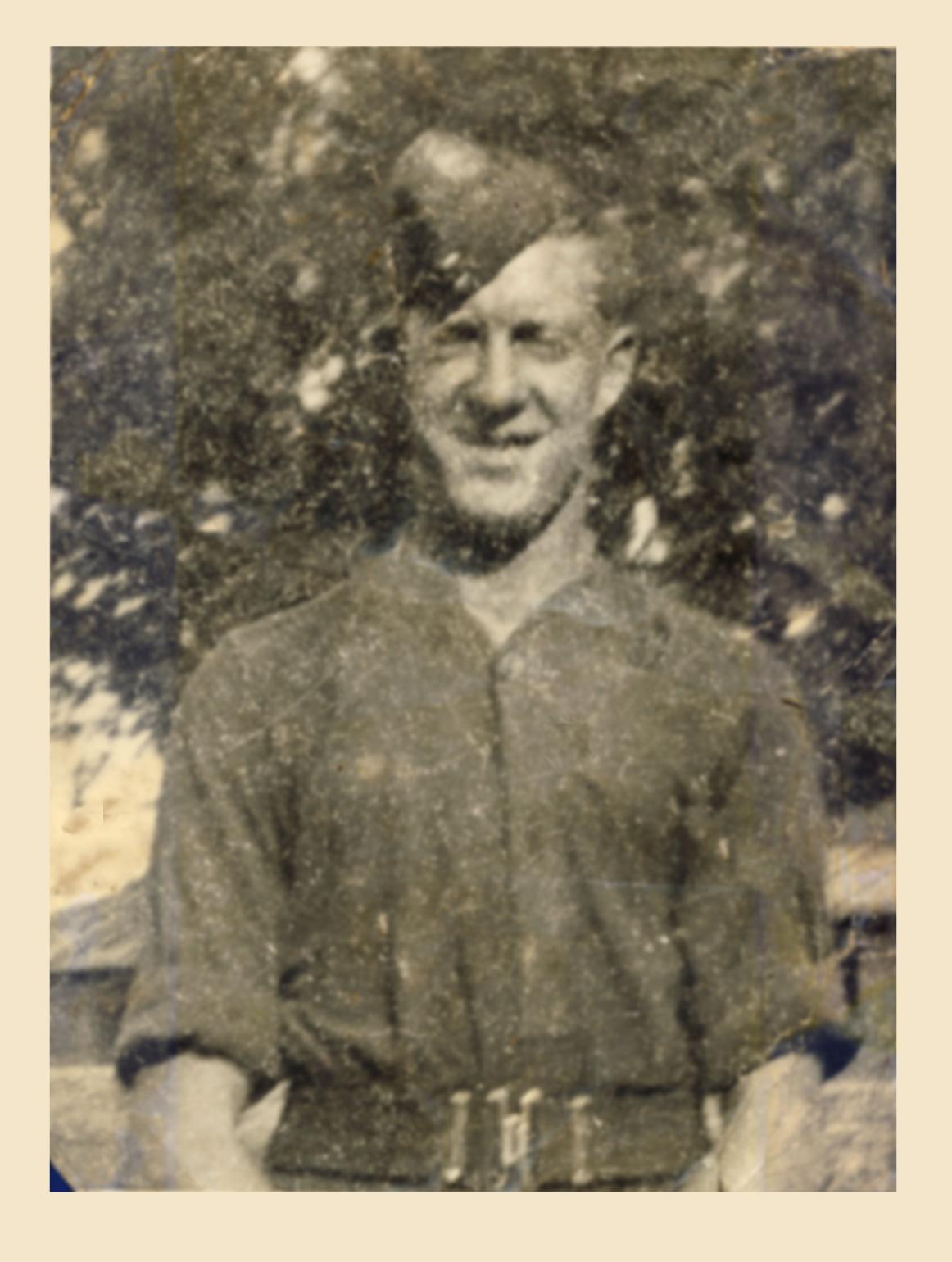
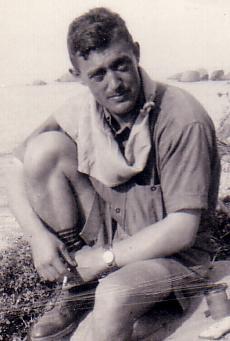
Jim sent me a photo of his uncle, the man he was named after. The photo shows Charles James Marshall in his army uniform. He escaped Dunkirk in 1940 by swimming out to a destroyer, apparently an excellent swimmer. Sadly he was killed, aged 25 and unmarried, on Sep 2 1942 at the Battle of Alma-Halfa in North Africa. Jim was born exactly one year later.
Jim and I became friends on Facebook. In 2021 a relative kindly informed me that Jim had died. I’ve since been in contact with his sister Marilyn. Jim’s grandfather James Marshall was the eldest of John and Emma’s children, born in 1873. James daughter with his first wife Martha, Hilda, married James Perkins, Jim and Marilyn’s parents. Charles James Marshall who died in North Africa was James son by a second marriage. James was a railway engine fireman on the 1911 census, and a retired rail driver on the 1939 census.
Charles James Marshall 1917-1942 died at the Battle of Alma-Halfa in North Africa:
photo thanks to Jim Perkins
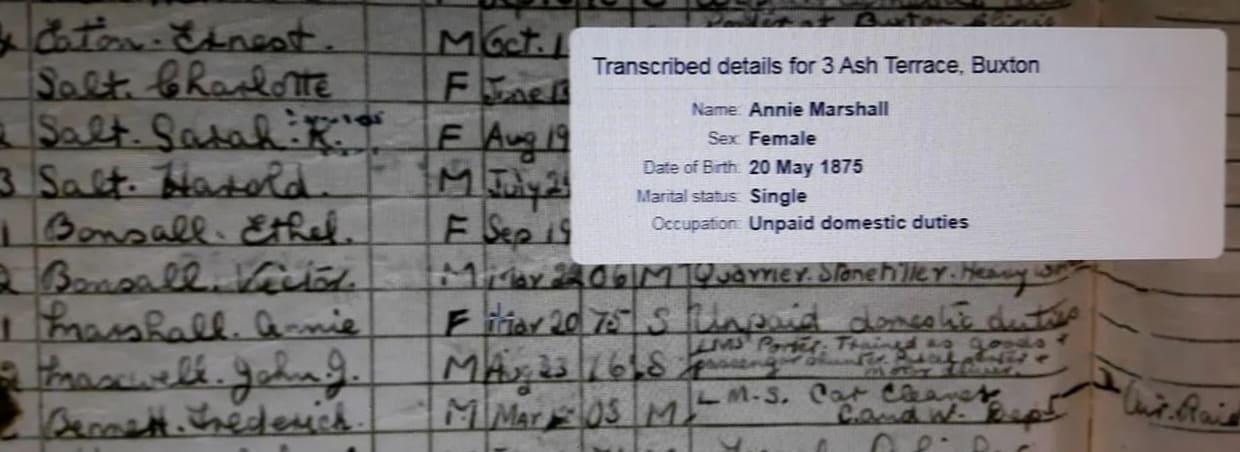
Anna Marshall, born in 1875, was a dressmaker and never married. She was still living with her parents John and Emma in Buxton on the 1921 census. One the 1939 census she was still single at the age of 66, and was living with John J Marshall born 1916. Perhaps a nephew?
John Marshall was born in 1877. Buxton is a spa town with many hotels, and John was the 2nd porter living in at the Crescent Hotel on the 1901 census, although he married later that year. In the 1911 census John was married with three children and living in Fairfield, Buxton, and his occupation was Hotel Porter and Boots. John and Alice had four children, although one son died in infancy, leaving two sons and a daughter, Lily.
My great grandfather William Marshall was born in 1878, and Edward Marshall was born in 1880. According to the family stories, one of William’s brothers was chief of police in Lincolnshire, and two of the family photos say on the back “Frank Marshall, chief of police Lincolnshire”. But it wasn’t Frank, it was Edward, and it wasn’t Lincolnshire, it was Lancashire.
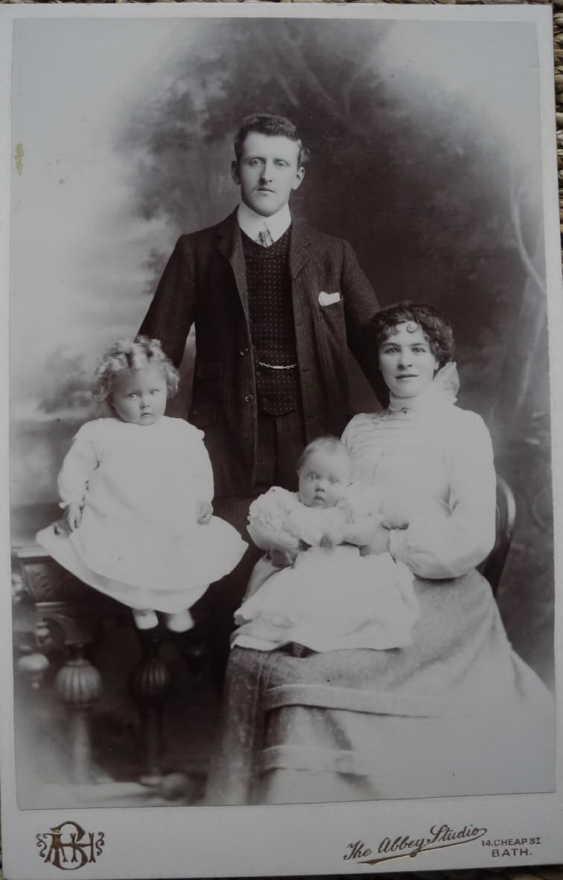
The records show that Edward Marshall was a hotel porter at the Pulteney Hotel in Bath, Somerset, in 1901. Presumably he started working in hotels in Buxton prior to that. James married Florence in Bath in 1903, and their first four children were born in Bath. By 1911 the family were living in Salmesbury, near Blackburn Lancashire, and Edward was a police constable. On the 1939 census, James was a retired police inspector, still living in Lancashire. Florence and Edward had eight children.
It became clear that the two photographs we have that were labeled “Frank Marshall Chief of police” were in fact Edward, when I noticed that both photos were taken by a photographer in Bath. They were correctly labeled as the policeman, but we had the name wrong.
Edward and Florence Marshall, Bath, Somerset:
Sarah Marshall was born in 1882 and died two years later.
Nellie Marshall was born in 1885 and I have not yet found a marriage or death for her.
Harry Marshall was John and Emma’s next child, born in 1887. On the 1911 census Harry is 24 years old, and lives at home with his parents and sister Ann. His occupation is a barman in a hotel. I haven’t yet found any further records for Harry.
Frank Marshall was the youngest, born in 1889. In 1911 Frank was living at the George Hotel in Buxton, employed as a boot boy. Also listed as live in staff at the hotel was Lily Moss, a kitchenmaid.
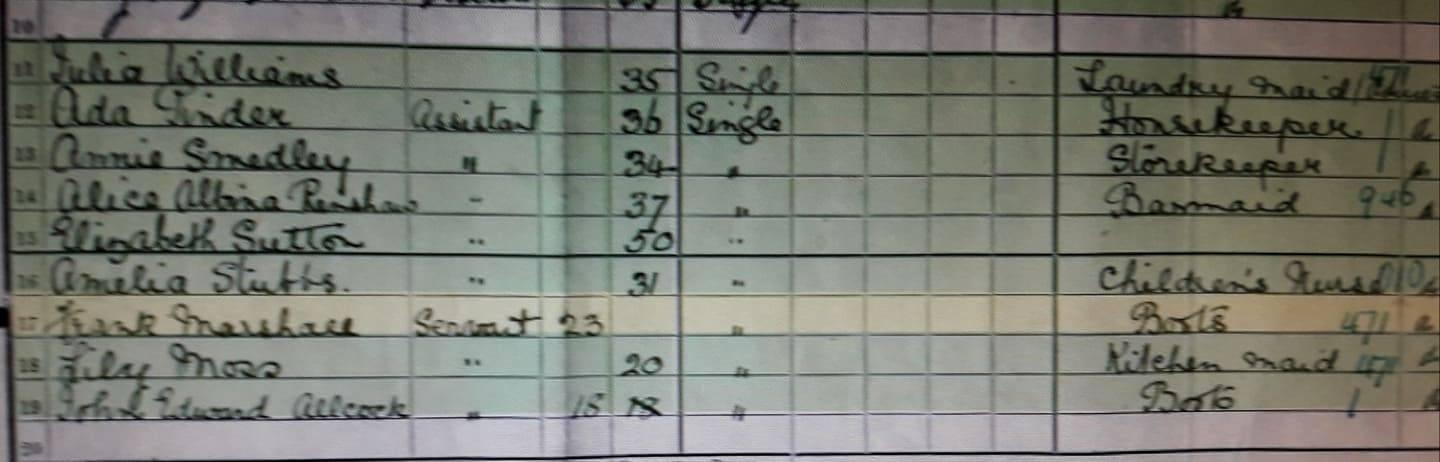
In 1913 Frank and Lily were married, and in 1914 their first child Millicent Rose was born. On the 1921 census Frank, Lily, William Rose and one other (presumably Millicent Rose) were living in Hartington Upper Quarter, Buxton.
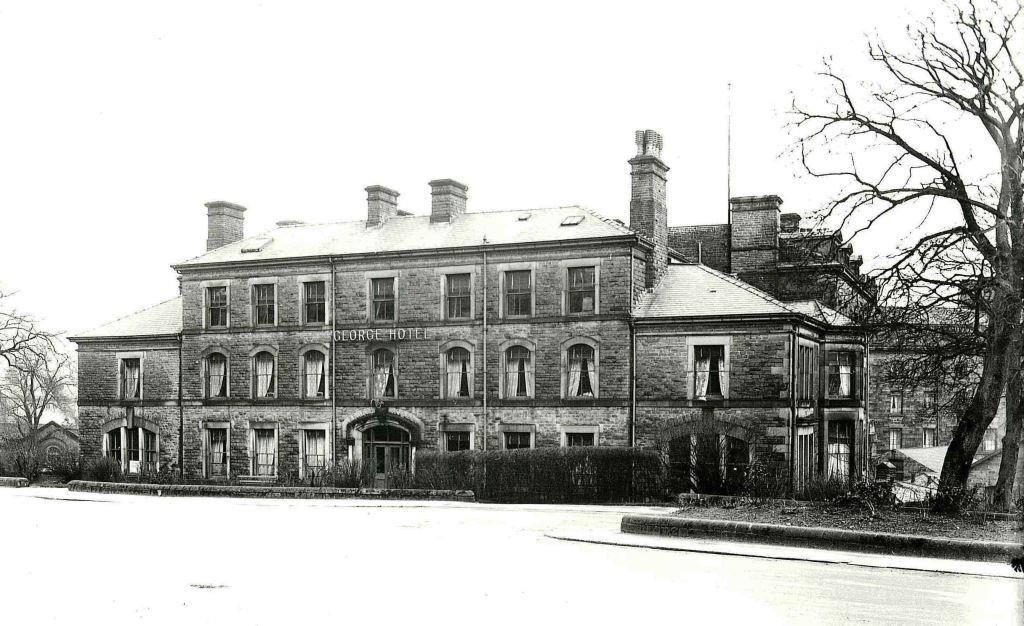
The George Hotel, Buxton:
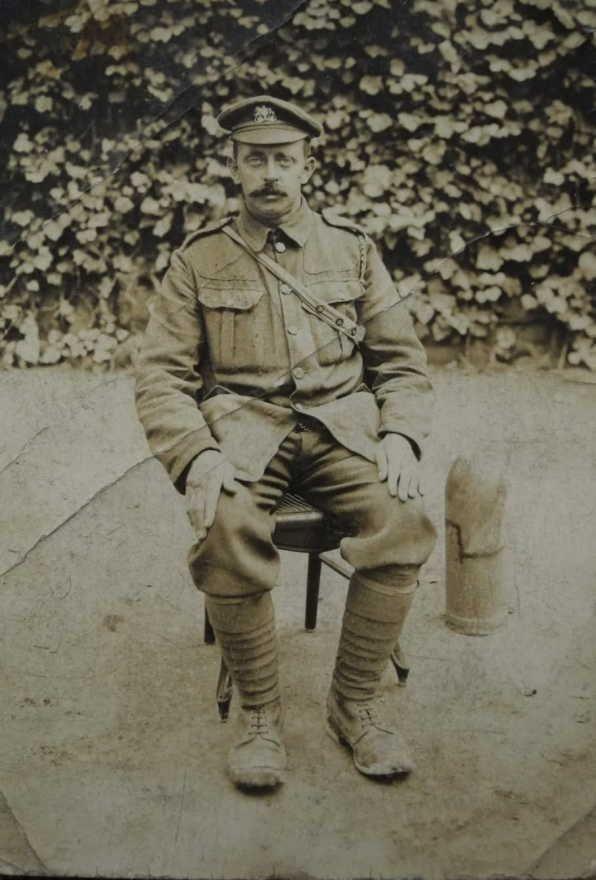
One of the photos says on the back “Jack Marshall, brother of William Marshall, WW1”:
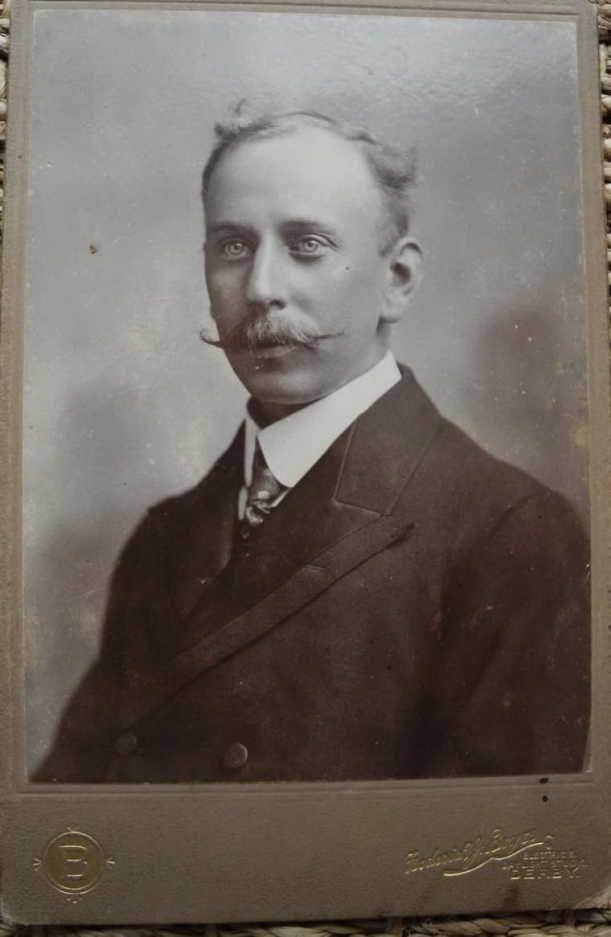
Another photo that says on the back “William Marshalls brother”:
Another “William Marshalls brother”:
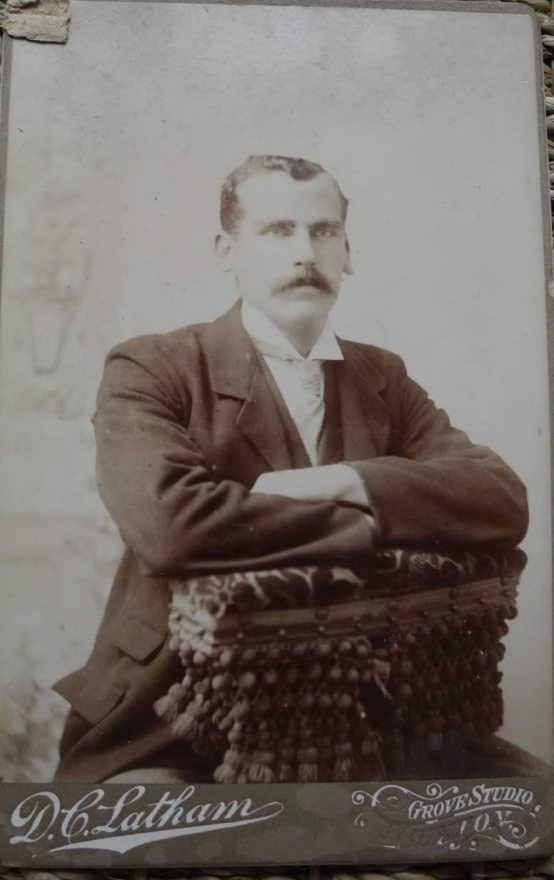
And another “William Marshalls brother”:
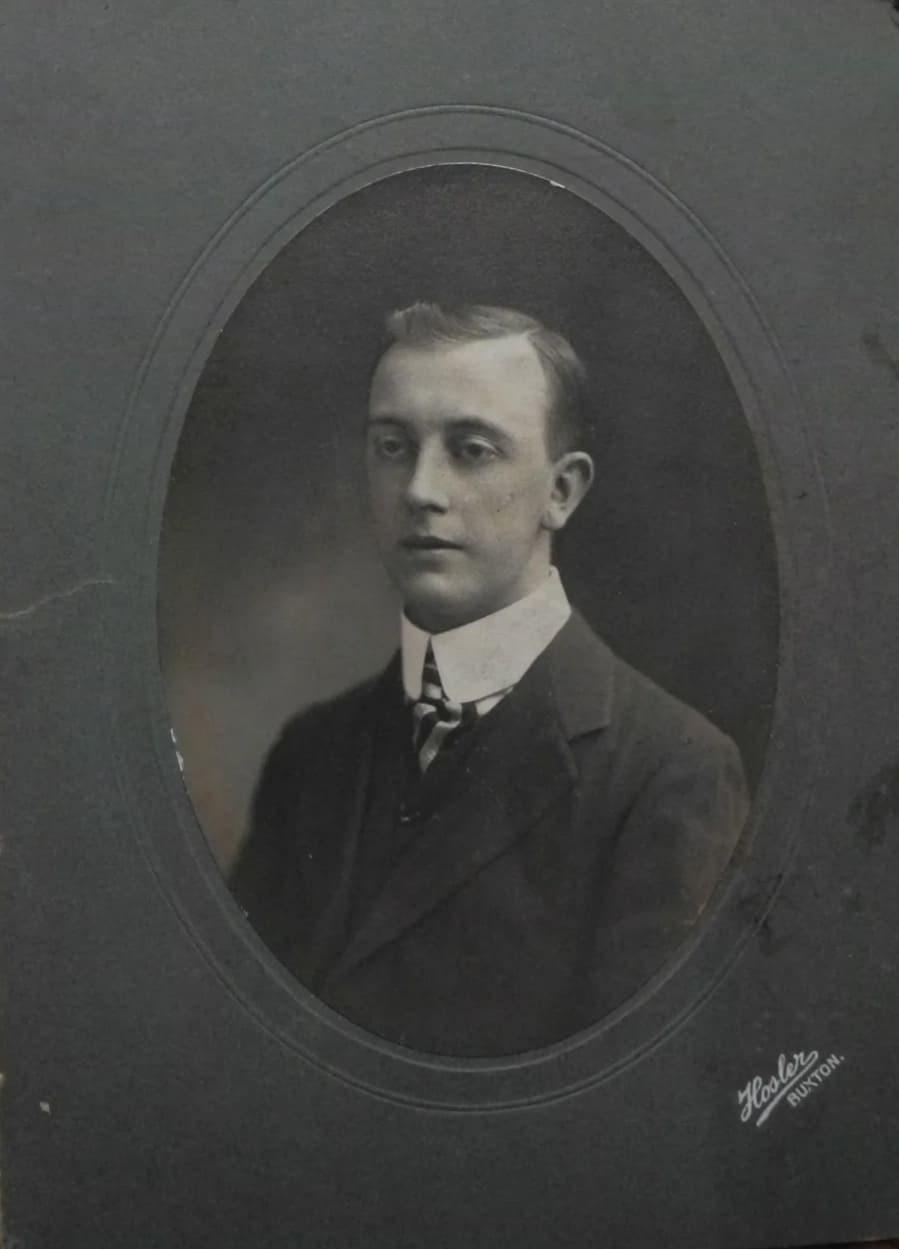
Unlabeled but clearly a Marshall:
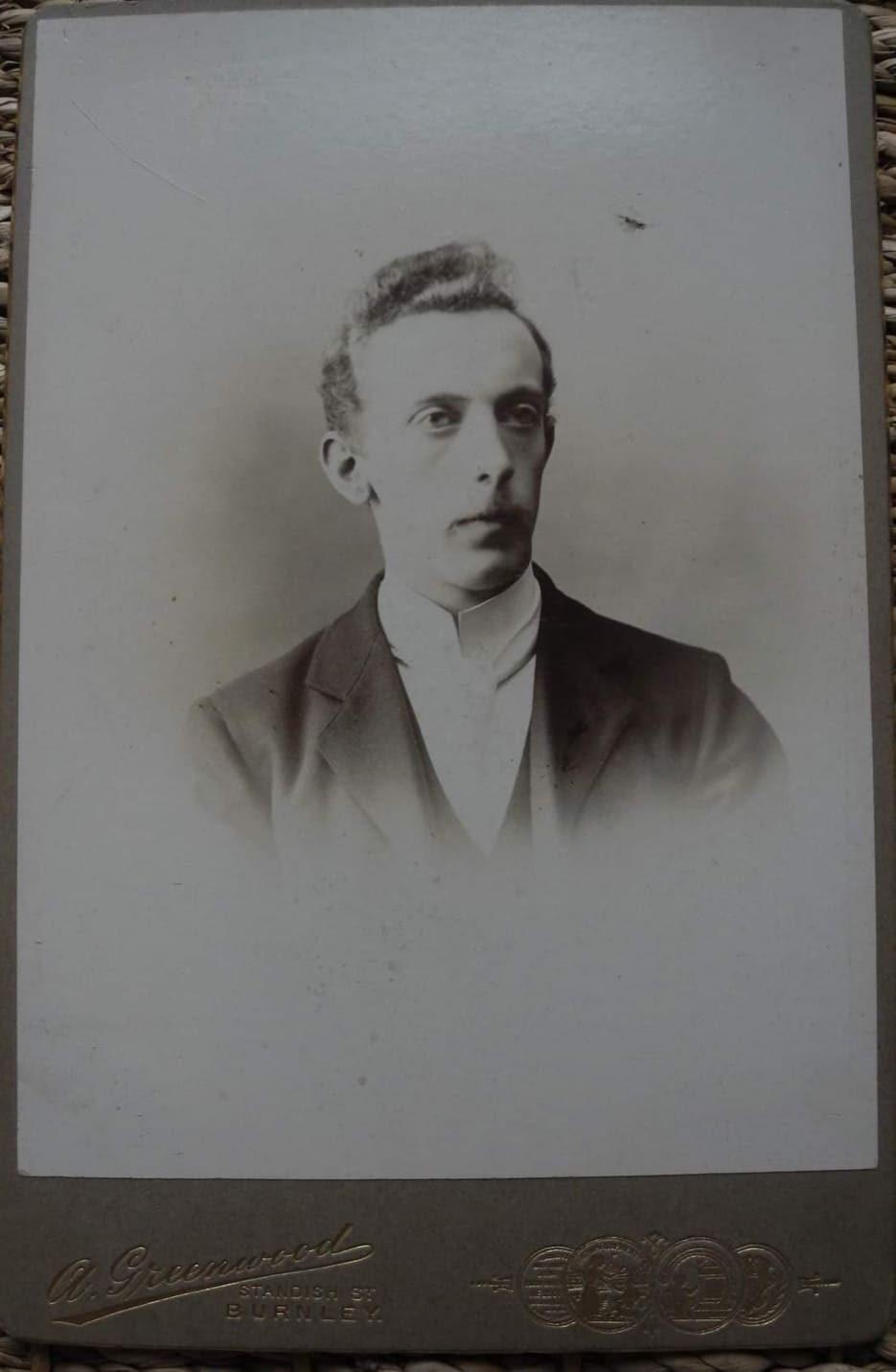
The last photo is clearly a Marshall, but I haven’t yet found a Burnley connection with any of the Marshall brothers.
January 14, 2022 at 7:27 am #6252In reply to: The Elusive Samuel Housley and Other Family Stories
The USA Housley’s
This chapter is copied from Barbara Housley’s Narrative on Historic Letters, with thanks to her brother Howard Housley for sharing it with me. Interesting to note that Housley descendants (on the Marshall paternal side) and Gretton descendants (on the Warren maternal side) were both living in Trenton, New Jersey at the same time.
GEORGE HOUSLEY 1824-1877
George emigrated to the United states in 1851, arriving in July. The solicitor Abraham John Flint referred in a letter to a 15-pound advance which was made to George on June 9, 1851. This certainly was connected to his journey. George settled along the Delaware River in Bucks County, Pennsylvania. The letters from the solicitor were addressed to: Lahaska Post Office, Bucks County, Pennsylvania. George married Sarah Ann Hill on May 6, 1854 in Doylestown, Bucks County, Pennsylvania. The service was performed by Attorney James Gilkyson.
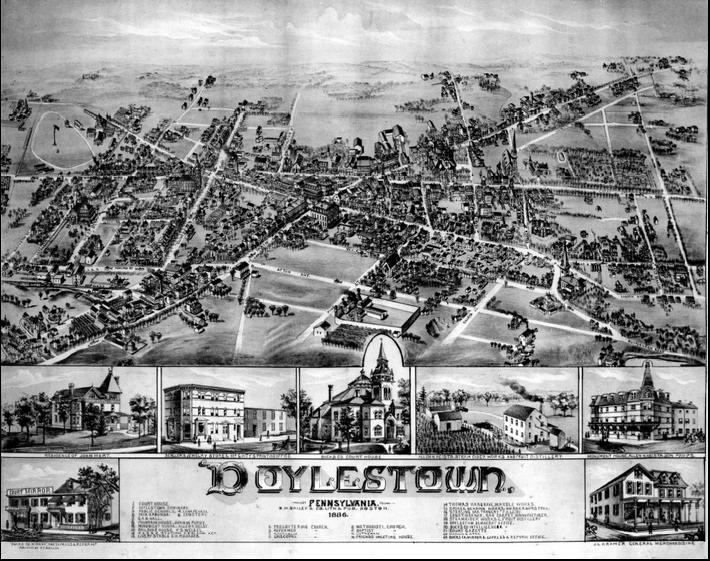
In her first letter (February 1854), Anne (George’s sister in Smalley, Derbyshire) wrote: “We want to know who and what is this Miss Hill you name in your letter. What age is she? Send us all the particulars but I would advise you not to get married until you have sufficient to make a comfortable home.”
Upon learning of George’s marriage, Anne wrote: “I hope dear brother you may be happy with your wife….I hope you will be as a son to her parents. Mother unites with me in kind love to you both and to your father and mother with best wishes for your health and happiness.” In 1872 (December) Joseph (George’s brother) wrote: “I am sorry to hear that sister’s father is so ill. It is what we must all come to some time and hope we shall meet where there is no more trouble.”
Emma (George’s sister) wrote in 1855, “We write in love to your wife and yourself and you must write soon and tell us whether there is a little nephew or niece and what you call them.” In June of 1856, Emma wrote: “We want to see dear Sarah Ann and the dear little boy. We were much pleased with the “bit of news” you sent.” The bit of news was the birth of John Eley Housley, January 11, 1855. Emma concluded her letter “Give our very kindest love to dear sister and dearest Johnnie.”
According to his obituary, John Eley was born at Wrightstown and “removed” to Lumberville at the age of 19. John was married first to Lucy Wilson with whom he had three sons: George Wilson (1883), Howard (1893) and Raymond (1895); and then to Elizabeth Kilmer with whom he had one son Albert Kilmer (1907). John Eley Housley died November 20, 1926 at the age of 71. For many years he had worked for John R. Johnson who owned a store. According to his son Albert, John was responsible for caring for Johnson’s horses. One named Rex was considered to be quite wild, but was docile in John’s hands. When John would take orders, he would leave the wagon at the first house and walk along the backs of the houses so that he would have access to the kitchens. When he reached the seventh house he would climb back over the fence to the road and whistle for the horses who would come to meet him. John could not attend church on Sunday mornings because he was working with the horses and occasionally Albert could convince his mother that he was needed also. According to Albert, John was regular in attendance at church on Sunday evenings.
John was a member of the Carversville Lodge 261 IOOF and the Carversville Lodge Knights of Pythias. Internment was in the Carversville cemetery; not, however, in the plot owned by his father. In addition to his sons, he was survived by his second wife Elizabeth who lived to be 80 and three grandchildren: George’s sons, Kenneth Worman and Morris Wilson and Raymond’s daughter Miriam Louise. George had married Katie Worman about the time John Eley married Elizabeth Kilmer. Howard’s first wife Mary Brink and daughter Florence had died and he remarried Elsa Heed who also lived into her eighties. Raymond’s wife was Fanny Culver.
Two more sons followed: Joseph Sackett, who was known as Sackett, September 12, 1856 and Edwin or Edward Rose, November 11, 1858. Joseph Sackett Housley married Anna Hubbs of Plumsteadville on January 17, 1880. They had one son Nelson DeC. who in turn had two daughters, Eleanor Mary and Ruth Anna, and lived on Bert Avenue in Trenton N.J. near St. Francis Hospital. Nelson, who was an engineer and built the first cement road in New Jersey, died at the age of 51. His daughters were both single at the time of his death. However, when his widow, the former Eva M. Edwards, died some years later, her survivors included daughters, Mrs. Herbert D. VanSciver and Mrs. James J. McCarrell and four grandchildren. One of the daughters (the younger) was quite crippled in later years and would come to visit her great-aunt Elizabeth (John’s widow) in a chauffeur driven car. Sackett died in 1929 at the age of 70. He was a member of the Warrington Lodge IOOF of Jamison PA, the Uncas tribe and the Uncas Hayloft 102 ORM of Trenton, New Jersey. The interment was in Greenwood cemetery where he had been caretaker since his retirement from one of the oldest manufacturing plants in Trenton (made milk separators for one thing). Sackett also was the caretaker for two other cemeteries one located near the Clinton Street station and the other called Riverside.
Ed’s wife was named Lydia. They had two daughters, Mary and Margaret and a third child who died in infancy. Mary had seven children–one was named for his grandfather–and settled in lower Bucks county. Margaret never married. She worked for Woolworths in Flemington, N. J. and then was made manager in Somerville, N.J., where she lived until her death. Ed survived both of his brothers, and at the time of Sackett’s death was living in Flemington, New Jersey where he had worked as a grocery clerk.
In September 1872, Joseph wrote, “I was very sorry to hear that John your oldest had met with such a sad accident but I hope he is got alright again by this time.” In the same letter, Joseph asked: “Now I want to know what sort of a town you are living in or village. How far is it from New York? Now send me all particulars if you please.”
In March 1873 Harriet asked Sarah Ann: “And will you please send me all the news at the place and what it is like for it seems to me that it is a wild place but you must tell me what it is like….” The question of whether she was referring to Bucks County, Pennsylvania or some other place is raised in Joseph’s letter of the same week.
On March 17, 1873, Joseph wrote: “I was surprised to hear that you had gone so far away west. Now dear brother what ever are you doing there so far away from home and family–looking out for something better I suppose.” The solicitor wrote on May 23, 1874: “Lately I have not written because I was not certain of your address and because I doubted I had much interesting news to tell you.” Later, Joseph wrote concerning the problems settling the estate, “You see dear brother there is only me here on our side and I cannot do much. I wish you were here to help me a bit and if you think of going for another summer trip this turn you might as well run over here.”
Apparently, George had indicated he might return to England for a visit in 1856. Emma wrote concerning the portrait of their mother which had been sent to George: “I hope you like mother’s portrait. I did not see it but I suppose it was not quite perfect about the eyes….Joseph and I intend having ours taken for you when you come over….Do come over before very long.”
In March 1873, Joseph wrote: “You ask me what I think of you coming to England. I think as you have given the trustee power to sign for you I think you could do no good but I should like to see you once again for all that. I can’t say whether there would be anything amiss if you did come as you say it would be throwing good money after bad.”
On June 10, 1875, the solicitor wrote: “I have been expecting to hear from you for some time past. Please let me hear what you are doing and where you are living and how I must send you your money.” George’s big news at that time was that on May 3, 1875, he had become a naturalized citizen “renouncing and abjuring all allegiance and fidelity to every foreign prince, potentate, state and sovereignity whatsoever, and particularly to Victoria Queen of Great Britain of whom he was before a subject.”
Another matter which George took care of during the years the estate was being settled was the purchase of a cemetery plot! On March 24, 1873, George purchased plot 67 section 19 division 2 in the Carversville (Bucks County PA) Cemetery (incorporated 1859). The plot cost $15.00, and was located at the very edge of the cemetery. It was in this cemetery, in 1991, while attending the funeral of Sarah Lord Housley, wife of Albert Kilmer Housley, that sixteen month old Laura Ann visited the graves of her great-great-great grandparents, George and Sarah Ann Hill Housley.
George died on August 13, 1877 and was buried three days later. The text for the funeral sermon was Proverbs 27:1: “Do not boast about tomorrow, for you do not know what a day may bring forth.”
December 21, 2021 at 1:47 pm #6247In reply to: The Elusive Samuel Housley and Other Family Stories
Warren Brothers Boiler Makers
Samuel Warren, my great grandfather, and husband of Florence Nightingale Gretton, worked with the family company of boiler makers in Newhall in his early years. He developed an interest in motor cars, and left the family business to start up on his own. By all accounts, he made some bad decisions and borrowed a substantial amount of money from his sister. It was because of this disastrous state of affairs that the impoverished family moved from Swadlincote/Newhall to Stourbridge.
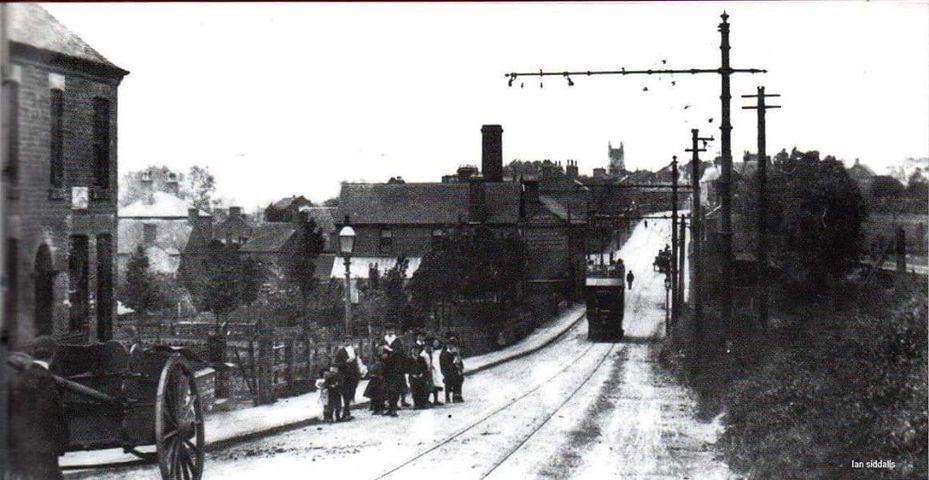
1914: Tram no 10 on Union Road going towards High Street Newhall. On the left Henry Harvey Engineer, on the right Warren Bros Boiler Manufacturers & Engineers:
I found a newspaper article in the Derbyshire Advertiser and Journal dated the 2nd October 1915 about a Samuel Warren of Warren Brothers Boilermakers, but it was about my great grandfathers uncle, also called Samuel.
DEATH OF MR. SAMUEL WARREN, OF NEWHALL. Samuel Warren, of Rose Villa, Newhall, passed away on Saturday evening at the age of 85.. Of somewhat retiring disposition, he took little or no active part in public affairs, but for many years was trustee of the loyal British Oak Lodge of the M.U. of Oddfellows, and in many other ways served His community when opportunity permitted. He was member of the firm of Warren Bros., of the Boiler Works, Newhall. This thriving business was established by the late Mr. Benjamin Bridge, over 60 years ago, and on his death it was taken over by his four nephews. Mr. William Warren died several years ago, and with the demise Mr. Samuel Warren, two brothers remain, Messrs. Henry and Benjamin Warren. He leaves widow, six daughters, and three sons to mourn his loss.
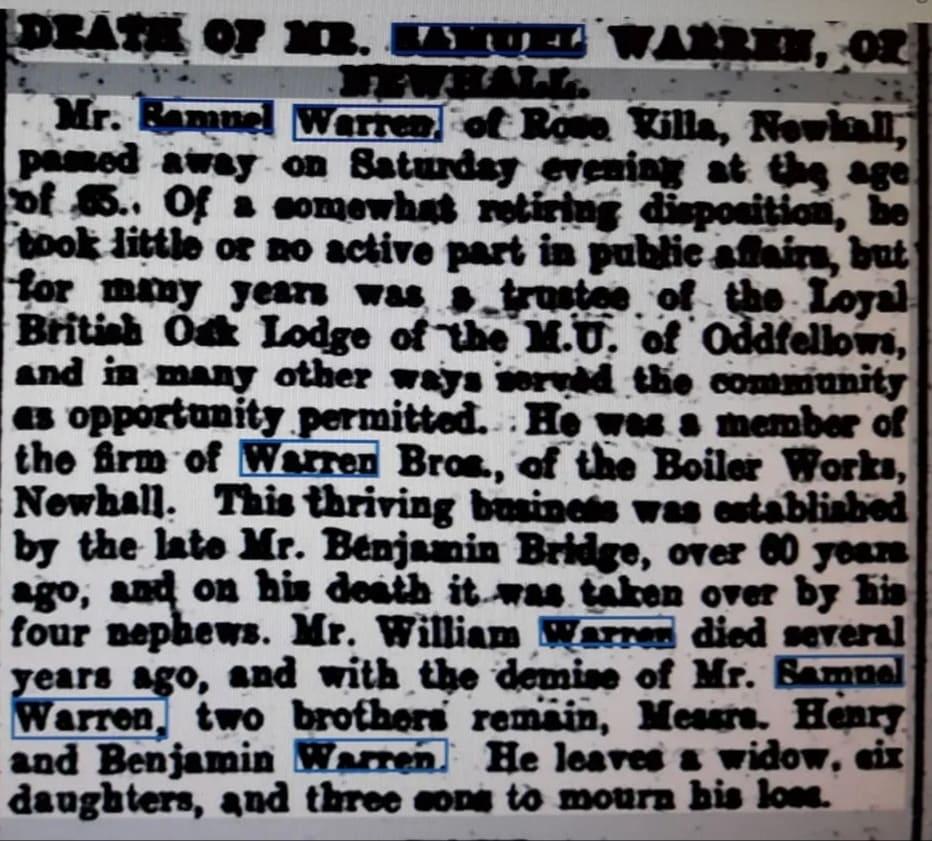
This was the first I’d heard of Benjamin Bridge. William Warren mentioned in the article as having died previously was Samuel’s father, my great great grandfather. William’s brother Henry was the father of Ben Warren, the footballer.
But who was Benjamin Bridge?
Samuel’s father was William Warren 1835-1881. He had a brother called Samuel, mentioned above, and William’s father was also named Samuel. Samuel Warren 1800-1882 married Elizabeth Bridge 1813-1872. Benjamin Bridge 1811-1898 was Elizabeth’s brother.
Burton Chronicle 28 July 1898:
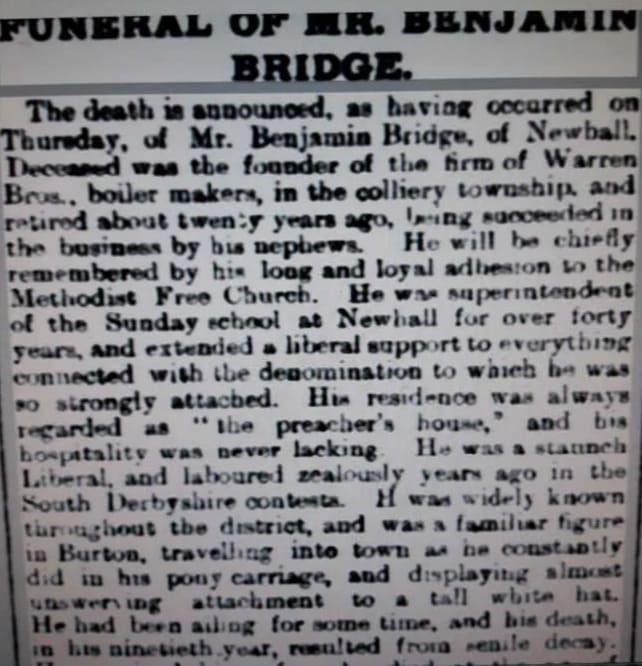
Benjamin and his wife Jane had no children. According to the obituary in the newspaper, the couple were fondly remembered for their annual tea’s for the widows of the town. Benjamin Bridge’s house was known as “the preachers house”. He was superintendent of Newhall Sunday School and member of Swadlincote’s board of health. And apparently very fond of a tall white hat!
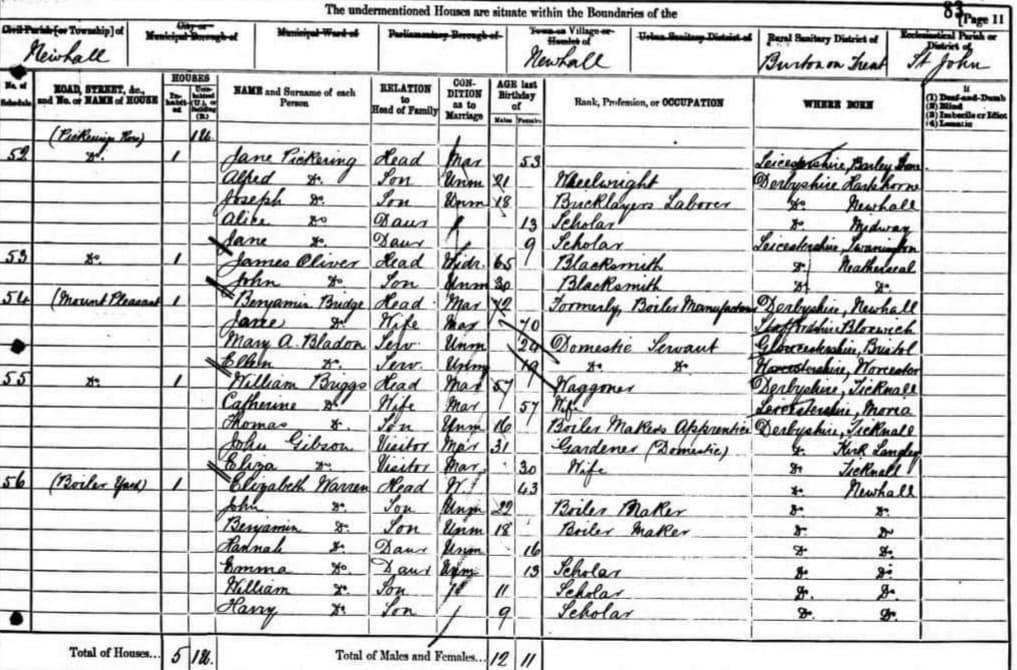
On the 1881 census, Benjamin Bridge and his wife live near to the Warren family in Newhall. The Warren’s live in the “boiler yard” and the family living in between the Bridge’s and the Warren’s include an apprentice boiler maker, so we can assume these were houses incorporated in the boiler works property. Benjamin is a 72 year old retired boiler maker. Elizabeth Warren is a widow (William died in 1881), two of her sons are boiler makers, and Samuel, my great grandfather, is on the next page of the census, at seven years old.
Warren Brothers made boilers for the Burton breweries, including Bass, Ratcliff and Gretton.
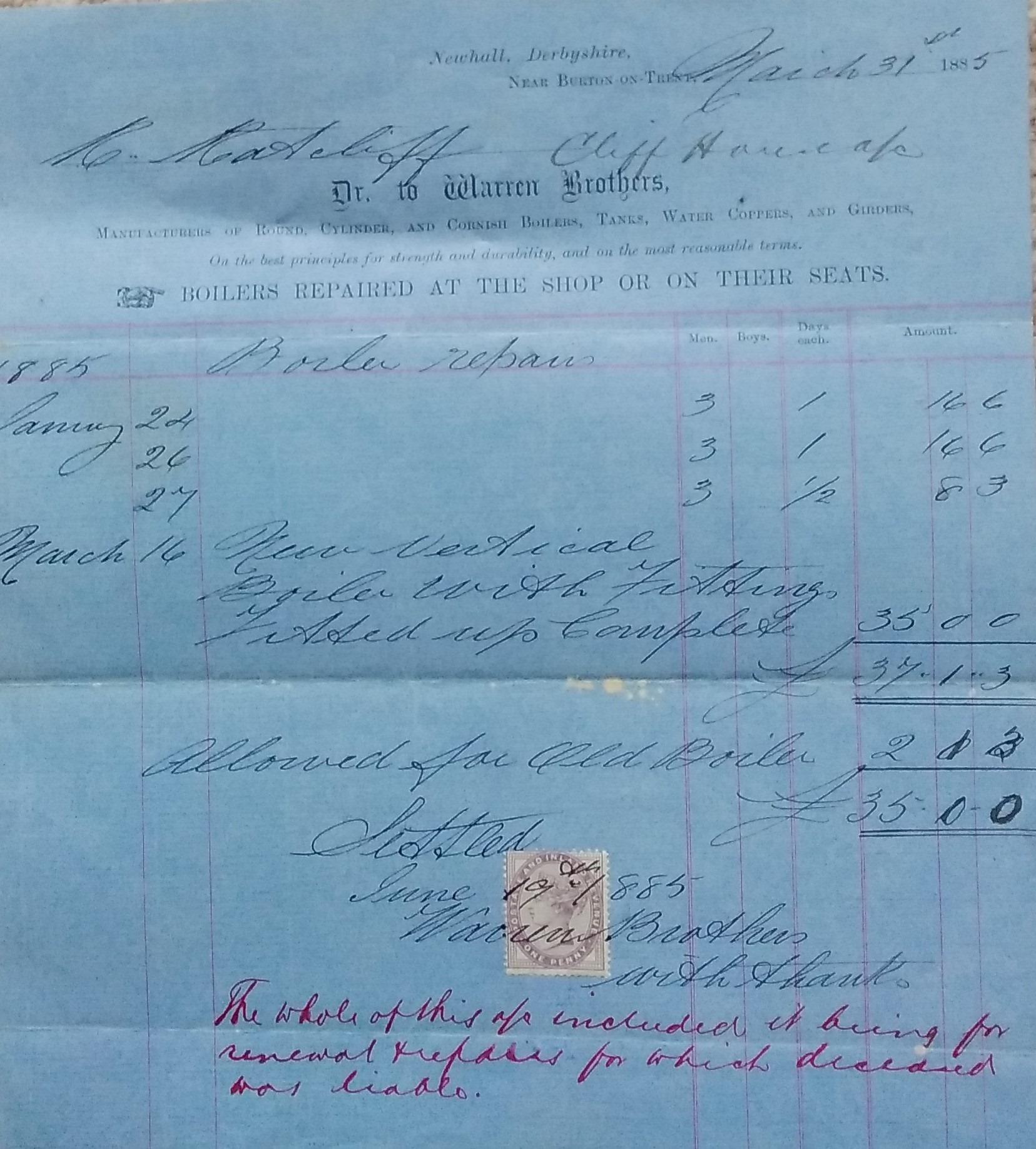
This receipt from Warrens Boiler yard for a new boiler in 1885 was purchased off Ebay by Colin Smith. He gave it to one of the grandsons of Robert Adolphus Warren, to keep in the Warren family. It is in his safe at home, and he promised Colin that it will stay in the family forever.
 December 18, 2021 at 12:59 pm #6243
In reply to: The Elusive Samuel Housley and Other Family Stories
William Housley’s Will and the Court Case
William Housley died in 1848, but his widow Ellen didn’t die until 1872. The court case was in 1873. Details about the court case are archived at the National Archives at Kew, in London, but are not available online. They can be viewed in person, but that hasn’t been possible thus far. However, there are a great many references to it in the letters.
William Housley’s first wife was Mary Carrington 1787-1813. They had three children, Mary Anne, Elizabeth and William. When Mary died, William married Mary’s sister Ellen, not in their own parish church at Smalley but in Ashbourne. Although not uncommon for a widower to marry a deceased wife’s sister, it wasn’t legal. This point is mentioned in one of the letters.
One of the pages of William Housley’s will:
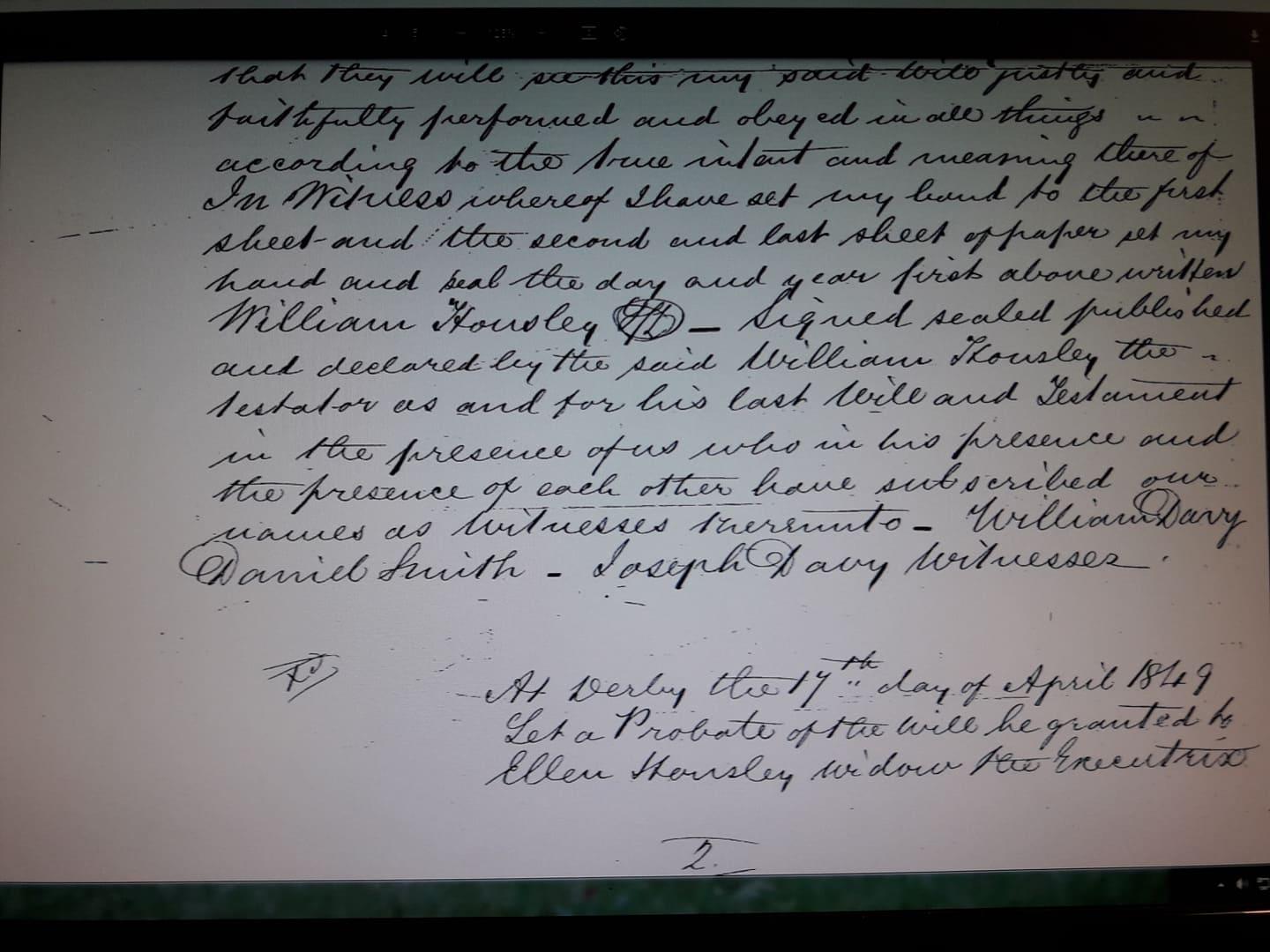
An excerpt from Barbara Housley’s Narrative on the Letters:
A comment in a letter from Joseph (August 6, 1873) indicated that William was married twice and that his wives were sisters: “What do you think that I believe that Mary Ann is trying to make our father’s will of no account as she says that my father’s marriage with our mother was not lawful he marrying two sisters. What do you think of her? I have heard my mother say something about paying a fine at the time of the marriage to make it legal.” Markwell and Saul in The A-Z Guide to Tracing Ancestors in Britain explain that marriage to a deceased wife’s sister was not permissible under Canon law as the relationship was within the prohibited degrees. However, such marriages did take place–usually well away from the couple’s home area. Up to 1835 such marriages were not void but were voidable by legal action. Few such actions were instituted but the risk was always there.
Joseph wrote that when Emma was married, Ellen “broke up the comfortable home and the things went to Derby and she went to live with them but Derby didn’t agree with her so she left again leaving her things behind and came to live with John in the new house where she died.” Ellen was listed with John’s household in the 1871 census.
In May 1872, the Ilkeston Pioneer carried this notice: “Mr. Hopkins will sell by auction on Saturday next the eleventh of May 1872 the whole of the useful furniture, sewing machine, etc. nearly new on the premises of the late Mrs. Housley at Smalley near Heanor in the county of Derby. Sale at one o’clock in the afternoon.”There were hard feelings between Mary Ann and Ellen and her children. Anne wrote: “If you remember we were not very friendly when you left. They never came and nothing was too bad for Mary Ann to say of Mother and me, but when Robert died Mother sent for her to the funeral but she did not think well to come so we took no more notice. She would not allow her children to come either.”
Mary Ann was still living in May 1872. Joseph implied that she and her brother, Will “intend making a bit of bother about the settlement of the bit of property” left by their mother. The 1871 census listed Mary Ann’s occupation as “income from houses.”In July 1872, Joseph introduced Ruth’s husband: “No doubt he is a bad lot. He is one of the Heath’s of Stanley Common a miller and he lives at Smalley Mill” (Ruth Heath was Mary Anne Housley’s daughter)
In 1873 Joseph wrote, “He is nothing but a land shark both Heath and his wife and his wife is the worst of the two. You will think these is hard words but they are true dear brother.” The solicitor, Abraham John Flint, was not at all pleased with Heath’s obstruction of the settlement of the estate. He wrote on June 30, 1873: “Heath agreed at first and then because I would not pay his expenses he refused and has since instructed another solicitor for his wife and Mrs. Weston who have been opposing us to the utmost. I am concerned for all parties interested except these two….The judge severely censured Heath for his conduct and wanted to make an order for sale there and then but Heath’s council would not consent….” In June 1875, the solicitor wrote: “Heath bid for the property but it fetched more money than he could give for it. He has been rather quieter lately.”In May 1872, Joseph wrote: “For what do you think, John has sold his share and he has acted very bad since his wife died and at the same time he sold all his furniture. You may guess I have never seen him but once since poor mother’s funeral and he is gone now no one knows where.”
In 1876, the solicitor wrote to George: “Have you heard of John Housley? He is entitled to Robert’s share and I want him to claim it.”
Anne intended that one third of the inheritance coming to her from her father and her grandfather, William Carrington, be divided between her four nieces: Sam’s three daughters and John’s daughter Elizabeth.
In the same letter (December 15, 1872), Joseph wrote:
“I think we have now found all out now that is concerned in the matter for there was only Sam that we did not know his whereabouts but I was informed a week ago that he is dead–died about three years ago in Birmingham Union. Poor Sam. He ought to have come to a better end than that”However, Samuel was still alive was on the 1871 census in Henley in Arden, and no record of his death can be found. Samuel’s brother in law said he was dead: we do not know why he lied, or perhaps the brothers were lying to keep his share, or another possibility is that Samuel himself told his brother in law to tell them that he was dead. I am inclined to think it was the latter.
Excerpts from Barbara Housley’s Narrative on the Letters continued:
Charles went to Australia in 1851, and was last heard from in January 1853. According to the solicitor, who wrote to George on June 3, 1874, Charles had received advances on the settlement of their parent’s estate. “Your promissory note with the two signed by your brother Charles for 20 pounds he received from his father and 20 pounds he received from his mother are now in the possession of the court.”
In December 1872, Joseph wrote: “I’m told that Charles two daughters has wrote to Smalley post office making inquiries about his share….” In January 1876, the solicitor wrote: “Charles Housley’s children have claimed their father’s share.”
In the Adelaide Observer 28 Aug 1875
HOUSLEY – wanted information
as to the Death, Will, or Intestacy, and
Children of Charles Housley, formerly of
Smalley, Derbyshire, England, who died at
Geelong or Creewick Creek Diggings, Victoria
August, 1855. His children will hear of something to their advantage by communicating with
Mr. A J. Flint, solicitor, Derby, England.
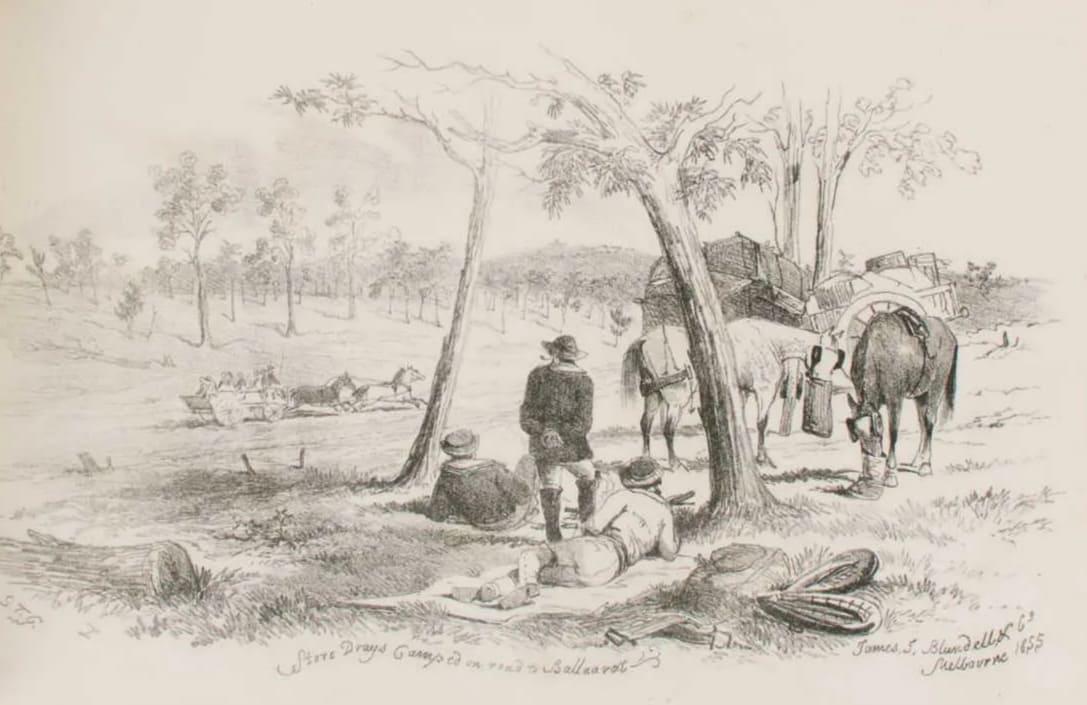
June 16,1875.The Diggers & Diggings of Victoria in 1855. Drawn on Stone by S.T. Gill:
The court case:
Kerry v Housley.
Documents: Bill, demurrer.
Plaintiffs: Samuel Kerry and Joseph Housley.
Defendants: William Housley, Joseph Housley (deleted), Edwin Welch Harvey, Eleanor Harvey (deleted), Ernest Harvey infant, William Stafford, Elizabeth Stafford his wife, Mary Ann Housley, George Purdy and Catherine Purdy his wife, Elizabeth Housley, Mary Ann Weston widow and William Heath and Ruth Heath his wife (deleted).
Provincial solicitor employed in Derbyshire.
Date: 1873From the Narrative on the Letters:
The solicitor wrote on May 23, 1874: “Lately I have not written because I was not certain of your address and because I doubted I had much interesting news to tell you.” Later, Joseph wrote concerning the problems settling the estate, “You see dear brother there is only me here on our side and I cannot do much. I wish you were here to help me a bit and if you think of going for another summer trip this turn you might as well run over here.”
In March 1873, Joseph wrote: “You ask me what I think of you coming to England. I think as you have given the trustee power to sign for you I think you could do no good but I should like to see you once again for all that. I can’t say whether there would be anything amiss if you did come as you say it would be throwing good money after bad.”
In September 1872 Joseph wrote; “My wife is anxious to come. I hope it will suit her health for she is not over strong.” Elsewhere Joseph wrote that Harriet was “middling sometimes. She is subject to sick headaches. It knocks her up completely when they come on.” In December 1872 Joseph wrote, “Now dear brother about us coming to America you know we shall have to wait until this affair is settled and if it is not settled and thrown into Chancery I’m afraid we shall have to stay in England for I shall never be able to save money enough to bring me out and my family but I hope of better things.”
On July 19, 1875 Abraham Flint (the solicitor) wrote: “Joseph Housley has removed from Smalley and is working on some new foundry buildings at Little Chester near Derby. He lives at a village called Little Eaton near Derby. If you address your letter to him as Joseph Housley, carpenter, Little Eaton near Derby that will no doubt find him.”In his last letter (February 11, 1874), Joseph sounded very discouraged and wrote that Harriet’s parents were very poorly and both had been “in bed for a long time.” In addition, Harriet and the children had been ill.
The move to Little Eaton may indicate that Joseph received his settlement because in August, 1873, he wrote: “I think this is bad news enough and bad luck too, but I have had little else since I came to live at Kiddsley cottages but perhaps it is all for the best if one could only think so. I have begun to think there will be no chance for us coming over to you for I am afraid there will not be so much left as will bring us out without it is settled very shortly but I don’t intend leaving this house until it is settled either one way or the other. ”Joseph’s letters were much concerned with the settling of their mother’s estate. In 1854, Anne wrote, “As for my mother coming (to America) I think not at all likely. She is tied here with her property.” A solicitor, Abraham John Flint of 42 Full Street Derby, was engaged by John following the death of their mother. On June 30, 1873 the solicitor wrote: “Dear sir, On the death of your mother I was consulted by your brother John. I acted for him with reference to the sale and division of your father’s property at Smalley. Mr. Kerry was very unwilling to act as trustee being over 73 years of age but owing to the will being a badly drawn one we could not appoint another trustee in his place nor could the property be sold without a decree of chancery. Therefore Mr. Kerry consented and after a great deal of trouble with Heath who has opposed us all throughout whenever matters did not suit him, we found the title deeds and offered the property for sale by public auction on the 15th of July last. Heath could not find his purchase money without mortaging his property the solicitor which the mortgagee employed refused to accept Mr. Kerry’s title and owing to another defect in the will we could not compel them.”
In July 1872, Joseph wrote, “I do not know whether you can remember who the trustee was to my father’s will. It was Thomas Watson and Samuel Kerry of Smalley Green. Mr. Watson is dead (died a fortnight before mother) so Mr. Kerry has had to manage the affair.”
On Dec. 15, 1972, Joseph wrote, “Now about this property affair. It seems as far off of being settled as ever it was….” and in the following March wrote: “I think we are as far off as ever and farther I think.”
Concerning the property which was auctioned on July 15, 1872 and brought 700 pounds, Joseph wrote: “It was sold in five lots for building land and this man Heath bought up four lots–that is the big house, the croft and the cottages. The croft was made into two lots besides the piece belonging to the big house and the cottages and gardens was another lot and the little intake was another. William Richardson bought that.” Elsewhere Richardson’s purchase was described as “the little croft against Smith’s lane.” Smith’s Lane was probably named for their neighbor Daniel Smith, Mrs. Davy’s father.
But in December 1872, Joseph wrote that they had not received any money because “Mr. Heath is raising all kinds of objections to the will–something being worded wrong in the will.” In March 1873, Joseph “clarified” matters in this way: “His objection was that one trustee could not convey the property that his signature was not guarantee sufficient as it states in the will that both trustees has to sign the conveyance hence this bother.”
Joseph indicated that six shares were to come out of the 700 pounds besides Will’s 20 pounds. Children were to come in for the parents shares if dead. The solicitor wrote in 1873, “This of course refers to the Kidsley property in which you take a one seventh share and which if the property sells well may realize you about 60-80 pounds.” In March 1873 Joseph wrote: “You have an equal share with the rest in both lots of property, but I am afraid there will be but very little for any of us.”The other “lot of property” was “property in Smalley left under another will.” On July 17, 1872, Joseph wrote: “It was left by my grandfather Carrington and Uncle Richard is trustee. He seems very backward in bringing the property to a sale but I saw him and told him that I for one expect him to proceed with it.” George seemed to have difficulty understanding that there were two pieces of property so Joseph explained further: “It was left by my grandfather Carrington not by our father and Uncle Richard is the trustee for it but the will does not give him power to sell without the signatures of the parties concerned.” In June 1873 the solicitor Abraham John Flint asked: “Nothing has been done about the other property at Smalley at present. It wants attention and the other parties have asked me to attend to it. Do you authorize me to see to it for you as well?”
After Ellen’s death, the rent was divided between Joseph, Will, Mary Ann and Mr. Heath who bought John’s share and was married to Mary Ann’s daughter, Ruth. Joseph said that Mr. Heath paid 40 pounds for John’s share and that John had drawn 110 pounds in advance. The solicitor said Heath said he paid 60. The solicitor said that Heath was trying to buy the shares of those at home to get control of the property and would have defied the absent ones to get anything.
In September 1872 Joseph wrote that the lawyer said the trustee cannot sell the property at the bottom of Smalley without the signatures of all parties concerned in it and it will have to go through chancery court which will be a great expense. He advised Joseph to sell his share and Joseph advised George to do the same.George sent a “portrait” so that it could be established that it was really him–still living and due a share. Joseph wrote (July 1872): “the trustee was quite willing to (acknowledge you) for the portrait I think is a very good one.” Several letters later in response to an inquiry from George, Joseph wrote: “The trustee recognized you in a minute…I have not shown it to Mary Ann for we are not on good terms….Parties that I have shown it to own you again but they say it is a deal like John. It is something like him, but I think is more like myself.”
In September 1872 Joseph wrote that the lawyer required all of their ages and they would have to pay “succession duty”. Joseph requested that George send a list of birth dates.On May 23, 1874, the solicitor wrote: “I have been offered 240 pounds for the three cottages and the little house. They sold for 200 pounds at the last sale and then I was offered 700 pounds for the whole lot except Richardson’s Heanor piece for which he is still willing to give 58 pounds. Thus you see that the value of the estate has very materially increased since the last sale so that this delay has been beneficial to your interests than other-wise. Coal has become much dearer and they suppose there is coal under this estate. There are many enquiries about it and I believe it will realize 800 pounds or more which increase will more than cover all expenses.” Eventually the solicitor wrote that the property had been sold for 916 pounds and George would take a one-ninth share.
January 14, 1876: “I am very sorry to hear of your lameness and illness but I trust that you are now better. This matter as I informed you had to stand over until December since when all the costs and expenses have been taxed and passed by the court and I am expecting to receive the order for these this next week, then we have to pay the legacy duty and them divide the residue which I doubt won’t come to very much amongst so many of you. But you will hear from me towards the end of the month or early next month when I shall have to send you the papers to sign for your share. I can’t tell you how much it will be at present as I shall have to deduct your share with the others of the first sale made of the property before it went to court.
Wishing you a Happy New Year, I am Dear Sir, Yours truly
Abram J. Flint”September 15, 1876 (the last letter)
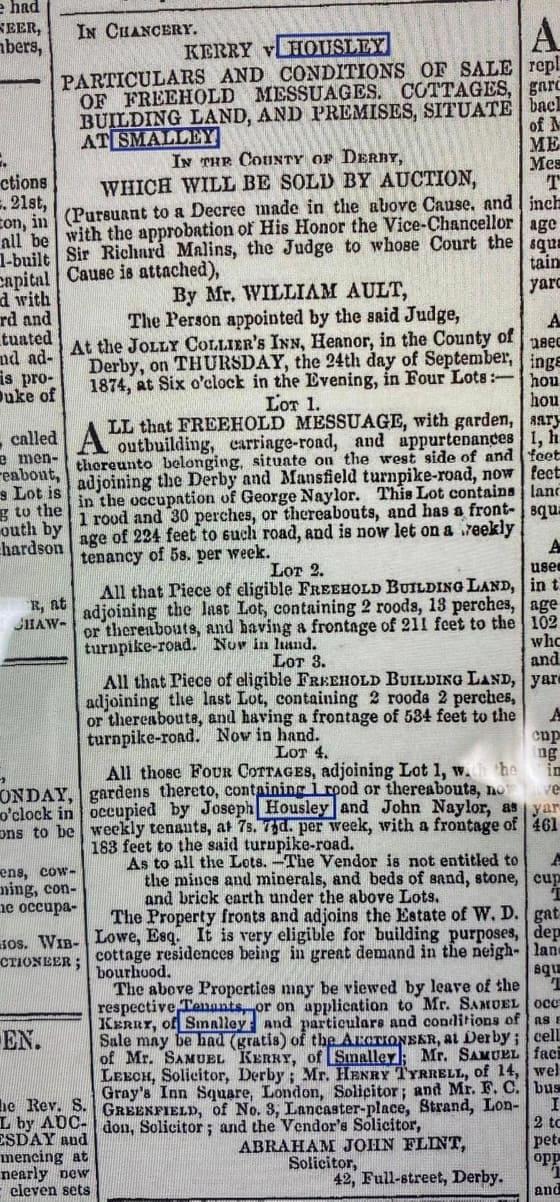
“I duly received your power of attorney which appears to have been properly executed on Thursday last and I sent it on to my London agent, Mr. Henry Lyvell, who happens just now to be away for his annual vacation and will not return for 14 or 20 days and as his signature is required by the Paymaster General before he will pay out your share, it must consequently stand over and await his return home. It shall however receive immediate attention as soon as he returns and I hope to be able to send your checque for the balance very shortly.”1874 in chancery:
 December 16, 2021 at 1:51 pm #6240
In reply to: The Elusive Samuel Housley and Other Family Stories
Phyllis Ellen Marshall
1909 – 1983
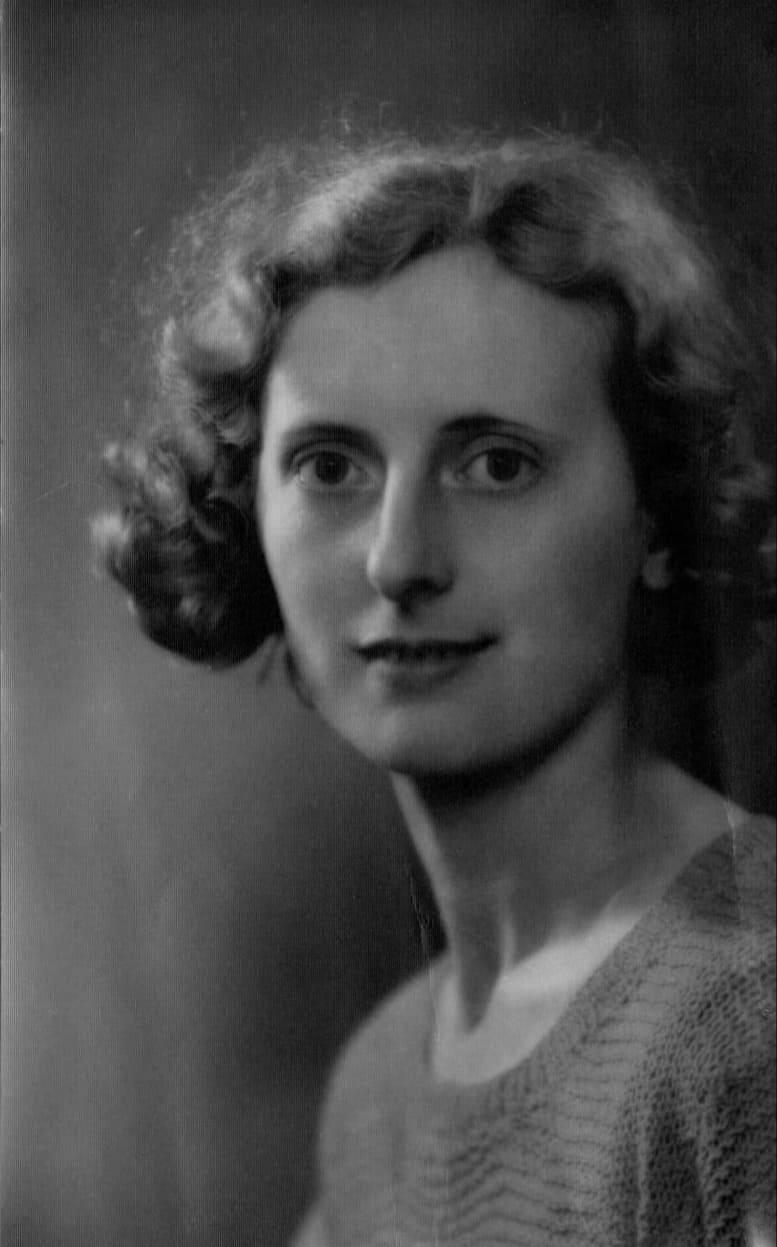
Phyllis, my grandfather George Marshall’s sister, never married. She lived in her parents home in Love Lane, and spent decades of her later life bedridden, living alone and crippled with rheumatoid arthritis. She had her bed in the front downstairs room, and had cords hanging by her bed to open the curtains, turn on the tv and so on, and she had carers and meals on wheels visit her daily. The room was dark and grim, but Phyllis was always smiling and cheerful. Phyllis loved the Degas ballerinas and had a couple of prints on the walls.
I remember visiting her, but it has only recently registered that this was my great grandparents house. When I was a child, we visited her and she indicated a tin on a chest of drawers and said I could take a biscuit. It was a lemon puff, and was the stalest biscuit I’d ever had. To be polite I ate it. Then she offered me another one! I declined, but she thought I was being polite and said “Go on! You can have another!” I ate another one, and have never eaten a lemon puff since that day.
Phyllis’s nephew Bryan Marshall used to visit her regularly. I didn’t realize how close they were until recently, when I resumed contact with Bryan, who emigrated to USA in the 1970s following a successful application for a job selling stained glass windows and church furnishings.
I asked on a Stourbridge facebook group if anyone remembered her.
AF Yes I remember her. My friend and I used to go up from Longlands school every Friday afternoon to do jobs for her. I remember she had a record player and we used to put her 45rpm record on Send in the Clowns for her. Such a lovely lady. She had her bed in the front room.
KW I remember very clearly a lady in a small house in Love Lane with alley at the left hand. I was intrigued by this lady who used to sit with the front door open and she was in a large chair of some sort. I used to see people going in and out and the lady was smiling. I was young then (31) and wondered how she coped but my sense was she had lots of help. I’ve never forgotten that lady in Love Lane sitting in the open door way I suppose when it was warm enough.
LR I used to deliver meals on wheels to her lovely lady.
I sent Bryan the comments from the Stourbridge group and he replied:
Thanks Tracy. I don’t recognize the names here but lovely to see such kind comments.
In the early 70’s neighbors on Corser Street, Mr. & Mrs. Walter Braithwaite would pop around with occasional visits and meals. Walter was my piano teacher for awhile when I was in my early twenties. He was a well known music teacher at Rudolph Steiner School (former Elmfield School) on Love Lane. A very fine school. I seem to recall seeing a good article on Walter recently…perhaps on the Stourbridge News website. He was very well known.
I’m ruminating about life with my Aunt Phyllis. We were very close. Our extra special time was every Saturday at 5pm (I seem to recall) we’d watch Doctor Who. Right from the first episode. We loved it. Likewise I’d do the children’s crossword out of Woman’s Realm magazine…always looking to win a camera but never did ! She opened my mind to the Bible, music and ballet. She once got tickets and had a taxi take us into Birmingham to see the Bolshoi Ballet…at a time when they rarely left their country. It was a very big deal in the early 60’s. ! I’ve many fond memories about her and grandad which I’ll share in due course. I’d change the steel needle on the old record player, following each play of the 78rpm records…oh my…another world.Bryan continues reminiscing about Phyllis in further correspondence:
Yes, I can recall those two Degas prints. I don’t know much of Phyllis’ early history other than she was a hairdresser in Birmingham. I want to say at John Lewis, for some reason (so there must have been a connection and being such a large store I bet they did have a salon?)
You will know that she had severe and debilitating rheumatoid arthritis that eventually gnarled her hands and moved through her body. I remember strapping on her leg/foot braces and hearing her writhe in pain as I did so but she wanted to continue walking standing/ getting up as long as she could. I’d take her out in the wheelchair and I can’t believe I say it along …but down Stanley Road!! (I had subsequent nightmares about what could have happened to her, had I tripped or let go!) She loved Mary Stevens Park, the swans, ducks and of course Canadian geese. Was grateful for everything in creation. As I used to go over Hanbury Hill on my visit to Love Lane, she would always remind me to smell the “sea-air” as I crested the hill.
In the earlier days she smoked cigarettes with one of those long filters…looking like someone from the twenties.I’ll check on “Send in the clowns”. I do recall that music. I remember also she loved to hear Neil Diamond. Her favorites in classical music gave me an appreciation of Elgar and Delius especially. She also loved ballet music such as Swan Lake and Nutcracker. Scheherazade and La Boutique Fantastic also other gems.
When grandad died she and aunt Dorothy shared more about grandma (who died I believe when John and I were nine-months old…therefore early 1951). Grandma (Mary Ann Gilman Purdy) played the piano and loved Strauss and Offenbach. The piano in the picture you sent had a bad (wonky) leg which would fall off and when we had the piano at 4, Mount Road it was rather dangerous. In any event my parents didn’t want me or others “banging on it” for fear of waking the younger brothers so it disappeared at sometime.
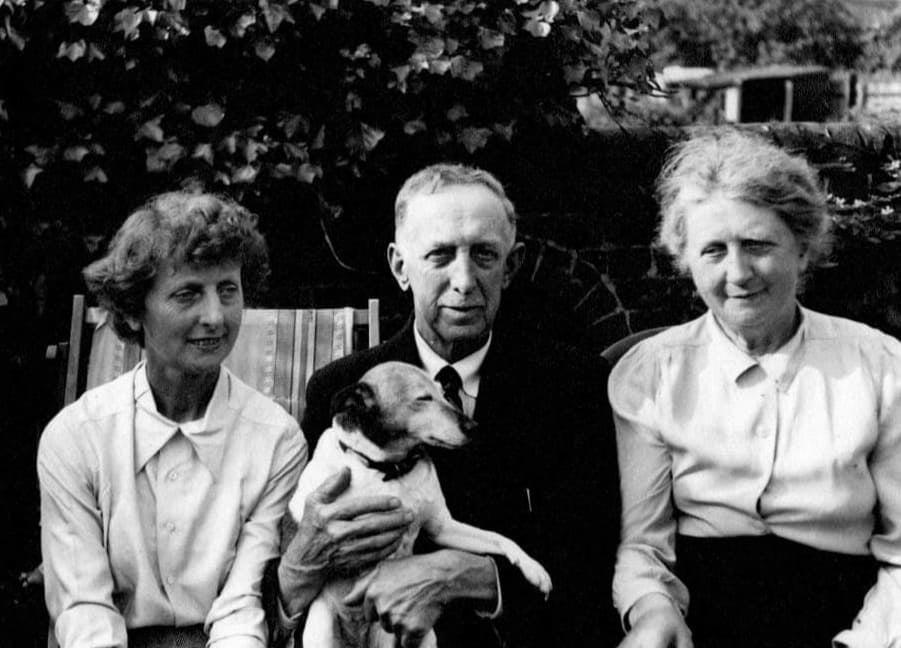
By the way, the dog, Flossy was always so rambunctious (of course, she was a JRT!) she was put on the stairway which fortunately had a door on it. Having said that I’ve always loved dogs so was very excited to see her and disappointed when she was not around.Phyllis with her parents William and Mary Marshall, and Flossie the dog in the garden at Love Lane:
Bryan continues:
I’ll always remember the early days with the outside toilet with the overhead cistern caked in active BIG spider webs. I used to have to light a candle to go outside, shielding the flame until destination. In that space I’d set the candle down and watch the eery shadows move from side to side whilst…well anyway! Then I’d run like hell back into the house. Eventually the kitchen wall was broken through so it became an indoor loo. Phew!
In the early days the house was rented for ten-shillings a week…I know because I used to take over a ten-bob-note to a grumpy lady next door who used to sign the receipt in the rent book. Then, I think she died and it became available for $600.00 yes…the whole house for $600.00 but it wasn’t purchased then. Eventually aunt Phyllis purchased it some years later…perhaps when grandad died.I used to work much in the back garden which was a lovely walled garden with arch-type decorations in the brickwork and semicircular shaped capping bricks. The abundant apple tree. Raspberry and loganberry canes. A gooseberry bush and huge Victoria plum tree on the wall at the bottom of the garden which became a wonderful attraction for wasps! (grandad called the “whasps”). He would stew apples and fruit daily.
Do you remember their black and white cat Twinky? Always sat on the pink-screen TV and when she died they were convinced that “that’s wot got ‘er”. Grandad of course loved all his cats and as he aged, he named them all “Billy”.Have you come across the name “Featherstone” in grandma’s name. I don’t recall any details but Dorothy used to recall this. She did much searching of the family history Such a pity she didn’t hand anything on to anyone. She also said that we had a member of the family who worked with James Watt….but likewise I don’t have details.
Gifts of chocolates to Phyllis were regular and I became the recipient of the overflow!What a pity Dorothy’s family history research has disappeared! I have found the Featherstone’s, and the Purdy who worked with James Watt, but I wonder what else Dorothy knew.
I mentioned DH Lawrence to Bryan, and the connection to Eastwood, where Bryan’s grandma (and Phyllis’s mother) Mary Ann Gilman Purdy was born, and shared with him the story about Francis Purdy, the Primitive Methodist minister, and about Francis’s son William who invented the miners lamp.
He replied:
As a nosy young man I was looking through the family bookcase in Love Lane and came across a brown paper covered book. Intrigued, I found “Sons and Lovers” D.H. Lawrence. I knew it was a taboo book (in those days) as I was growing up but now I see the deeper connection. Of course! I know that Phyllis had I think an earlier boyfriend by the name of Maurice who lived in Perry Barr, Birmingham. I think he later married but was always kind enough to send her a book and fond message each birthday (Feb.12). I guess you know grandad’s birthday – July 28. We’d always celebrate those days. I’d usually be the one to go into Oldswinford and get him a cardigan or pullover and later on, his 2oz tins of St. Bruno tobacco for his pipe (I recall the room filled with smoke as he puffed away).
Dorothy and Phyllis always spoke of their ancestor’s vocation as a Minister. So glad to have this history! Wow, what a story too. The Lord rescued him from mischief indeed. Just goes to show how God can change hearts…one at a time.
So interesting to hear about the Miner’s Lamp. My vicar whilst growing up at St. John’s in Stourbridge was from Durham and each Harvest Festival, there would be a miner’s lamp placed upon the altar as a symbol of the colliery and the bountiful harvest.More recollections from Bryan about the house and garden at Love Lane:
I always recall tea around the three legged oak table bedecked with a colorful seersucker cloth. Battenburg cake. Jam Roll. Rich Tea and Digestive biscuits. Mr. Kipling’s exceedingly good cakes! Home-made jam. Loose tea from the Coronation tin cannister. The ancient mangle outside the back door and the galvanized steel wash tub with hand-operated agitator on the underside of the lid. The hand operated water pump ‘though modernisation allowed for a cold tap only inside, above the single sink and wooden draining board. A small gas stove and very little room for food preparation. Amazing how the Marshalls (×7) managed in this space!
The small window over the sink in the kitchen brought in little light since the neighbor built on a bathroom annex at the back of their house, leaving #47 with limited light, much to to upset of grandad and Phyllis. I do recall it being a gloomy place..i.e.the kitchen and back room.
The garden was lovely. Long and narrow with privet hedge dividing the properties on the right and the lovely wall on the left. Dorothy planted spectacular lilac bushes against the wall. Vivid blues, purples and whites. Double-flora. Amazing…and with stunning fragrance. Grandad loved older victorian type plants such as foxgloves and comfrey. Forget-me-nots and marigolds (calendulas) in abundance. Rhubarb stalks. Always plantings of lettuce and other vegetables. Lots of mint too! A large varigated laurel bush outside the front door!
Such a pleasant walk through the past.
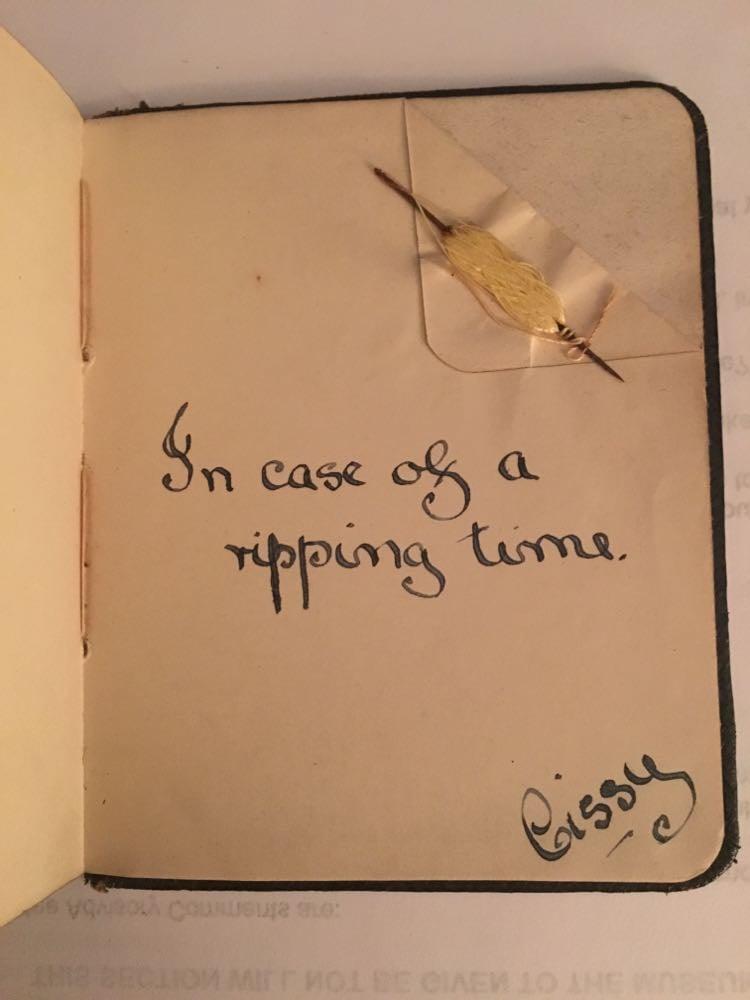
An autograph book belonging to Phyllis from the 1920s has survived in which each friend painted a little picture, drew a cartoon, or wrote a verse. This entry is perhaps my favourite:
 December 15, 2021 at 9:34 am #6236
In reply to: The Elusive Samuel Housley and Other Family Stories
The Liverpool Fires
Catherine Housley had two older sisters, Elizabeth 1845-1883 and Mary Anne 1846-1935. Both Elizabeth and Mary Anne grew up in the Belper workhouse after their mother died, and their father was jailed for failing to maintain his three children. Mary Anne married Samuel Gilman and they had a grocers shop in Buxton. Elizabeth married in Liverpool in 1873.
What was she doing in Liverpool? How did she meet William George Stafford?
According to the census, Elizabeth Housley was in Belper workhouse in 1851. In 1861, aged 16, she was a servant in the household of Peter Lyon, a baker in Derby St Peters. We noticed that the Lyon’s were friends of the family and were mentioned in the letters to George in Pennsylvania.
No record of Elizabeth can be found on the 1871 census, but in 1872 the birth and death was registered of Elizabeth and William’s child, Elizabeth Jane Stafford. The parents are registered as William and Elizabeth Stafford, although they were not yet married. William’s occupation is a “refiner”.
In April, 1873, a Fatal Fire is reported in the Liverpool Mercury. Fearful Termination of a Saturday Night Debauch. Seven Persons Burnt To Death. Interesting to note in the article that “the middle room being let off to a coloured man named William Stafford and his wife”.
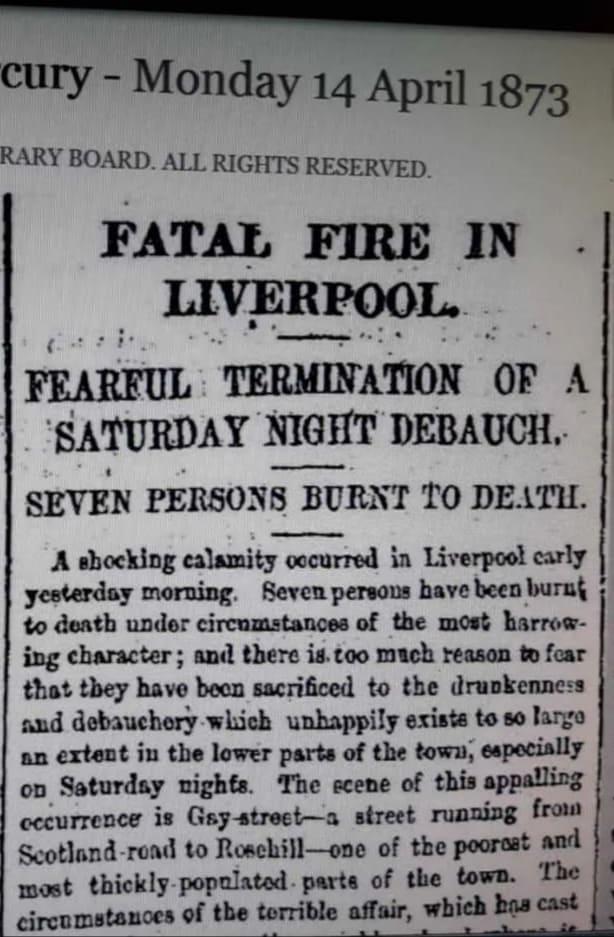
We had noted on the census that William Stafford place of birth was “Africa, British subject” but it had not occurred to us that he was “coloured”. A register of birth has not yet been found for William and it is not known where in Africa he was born.
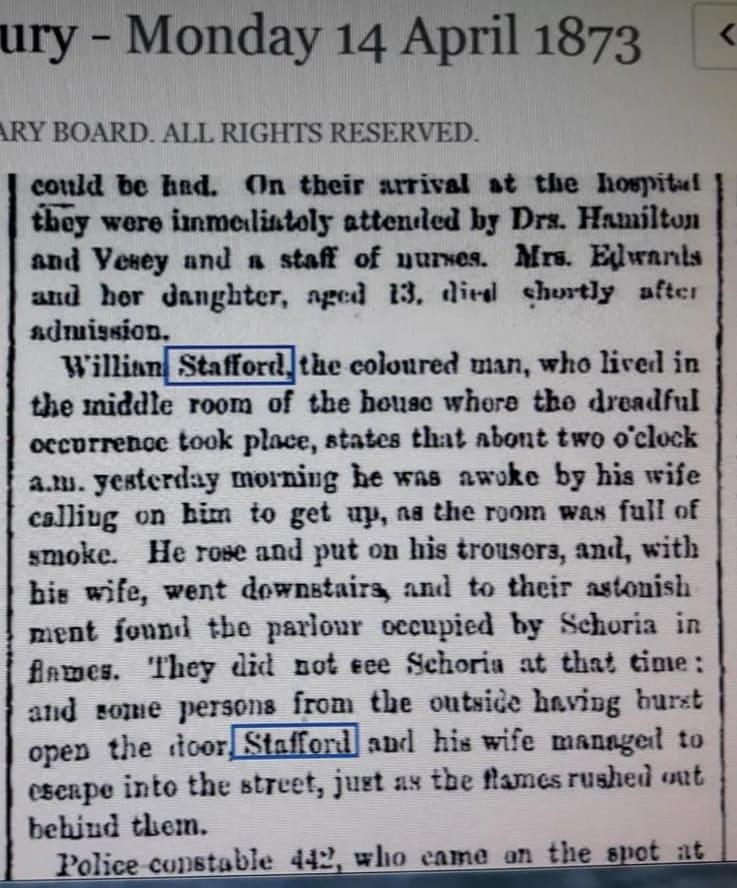
Elizabeth and William survived the fire on Gay Street, and were still living on Gay Street in October 1873 when they got married.
William’s occupation on the marriage register is sugar refiner, and his father is Peter Stafford, farmer. Elizabeth’s father is Samuel Housley, plumber. It does not say Samuel Housley deceased, so perhaps we can assume that Samuel is still alive in 1873.
Eliza Florence Stafford, their second daughter, was born in 1876.
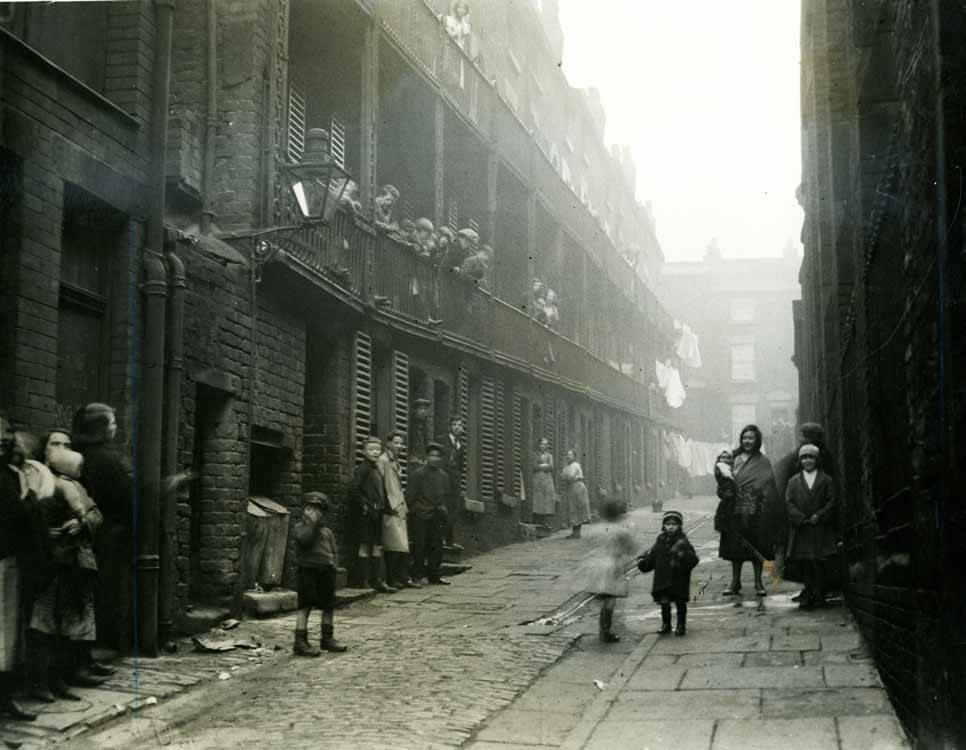
William’s occupation on the 1881 census is “fireman”, in his case, a fire stoker at the sugar refinery, an unpleasant and dangerous job for which they were paid slightly more. William, Elizabeth and Eliza were living in Byrom Terrace.
Byrom Terrace, Liverpool, in 1933
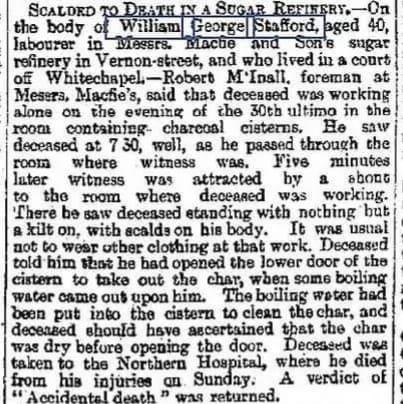
Elizabeth died of heart problems in 1883, when Eliza was six years old, and in 1891 her father died, scalded to death in a tragic accident at the sugar refinery.
Eliza, aged 15, was living as an inmate at the Walton on the Hill Institution in 1891. It’s not clear when she was admitted to the workhouse, perhaps after her mother died in 1883.
In 1901 Eliza Florence Stafford is a 24 year old live in laundrymaid, according to the census, living in West Derby (a part of Liverpool, and not actually in Derby). On the 1911 census there is a Florence Stafford listed as an unnmarried laundress, with a daughter called Florence. In 1901 census she was a laundrymaid in West Derby, Liverpool, and the daughter Florence Stafford was born in 1904 West Derby. It’s likely that this is Eliza Florence, but nothing further has been found so far.
The questions remaining are the location of William’s birth, the name of his mother and his family background, what happened to Eliza and her daughter after 1911, and how did Elizabeth meet William in the first place.
William Stafford was a seaman prior to working in the sugar refinery, and he appears on several ship’s crew lists. Nothing so far has indicated where he might have been born, or where his father came from.
Some months after finding the newspaper article about the fire on Gay Street, I saw an unusual request for information on the Liverpool genealogy group. Someone asked if anyone knew of a fire in Liverpool in the 1870’s. She had watched a programme about children recalling past lives, in this case a memory of a fire. The child recalled pushing her sister into a burning straw mattress by accident, as she attempted to save her from a falling beam. I watched the episode in question hoping for more information to confirm if this was the same fire, but details were scant and it’s impossible to say for sure.
December 15, 2021 at 7:53 am #6234In reply to: The Elusive Samuel Housley and Other Family Stories
Ben Warren
Derby County and England football legend who died aged 37 penniless and ‘insane’
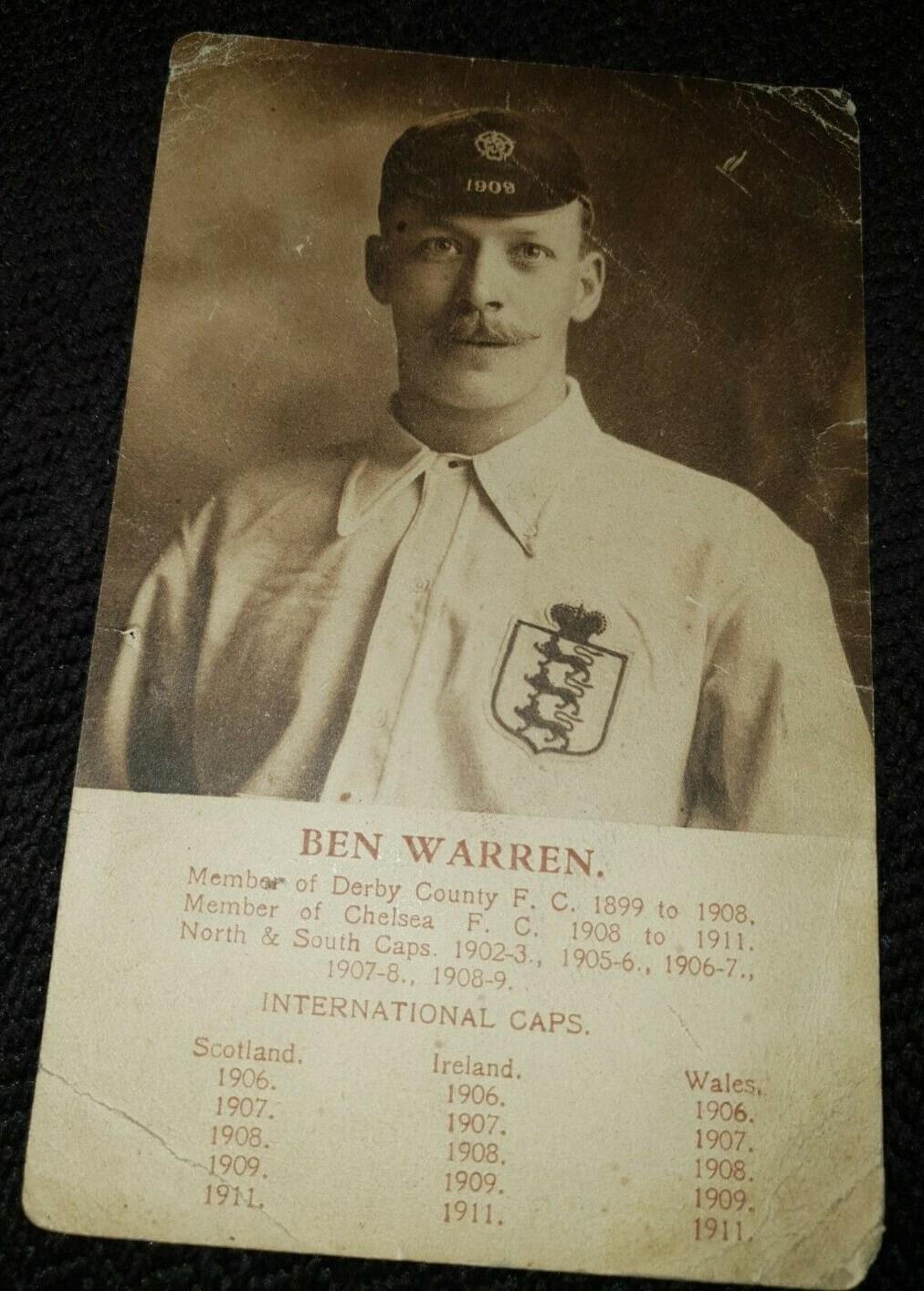
Ben Warren 1879 – 1917 was Samuel Warren’s (my great grandfather) cousin.
From the Derby Telegraph:
Just 17 months after earning his 22nd England cap, against Scotland at Everton on April 1, 1911, he was certified insane. What triggered his decline was no more than a knock on the knee while playing for Chelsea against Clapton Orient.
The knee would not heal and the longer he was out, the more he fretted about how he’d feed his wife and four children. In those days, if you didn’t play, there was no pay.
…..he had developed “brain fever” and this mild-mannered man had “become very strange and, at times, violent”. The coverage reflected his celebrity status.
On December 15, 1911, as Rick Glanvill records in his Official Biography of Chelsea FC: “He was admitted to a private clinic in Nottingham, suffering from acute mania, delusions that he was being poisoned and hallucinations of hearing and vision.”
He received another blow in February, 1912, when his mother, Emily, died. She had congestion of the lungs and caught influenza, her condition not helped, it was believed, by worrying about Ben.
She had good reason: her famous son would soon be admitted to the unfortunately named Derby County Lunatic Asylum.
As Britain sleepwalked towards the First World War, Ben’s condition deteriorated. Glanvill writes: “His case notes from what would be a five-year stay, catalogue a devastating decline in which he is at various times described as incoherent, restless, destructive, ‘stuporose’ and ‘a danger to himself’.’”
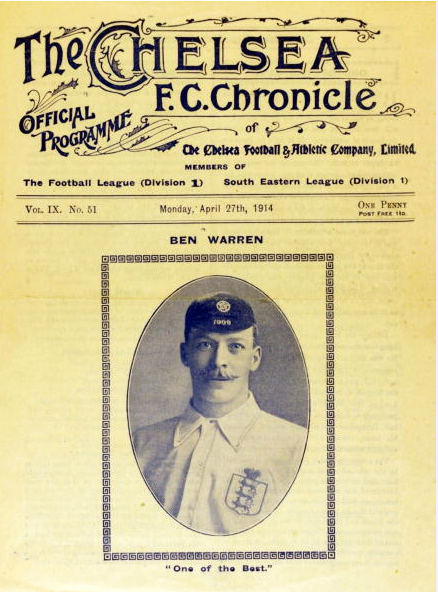
photo: Football 27th April 1914. A souvenir programme for the testimonial game for Chelsea and England’s Ben Warren, (pictured) who had been declared insane and sent to a lunatic asylum. The game was a select XI for the North playing a select XI from The South proceeds going to Warren’s family.
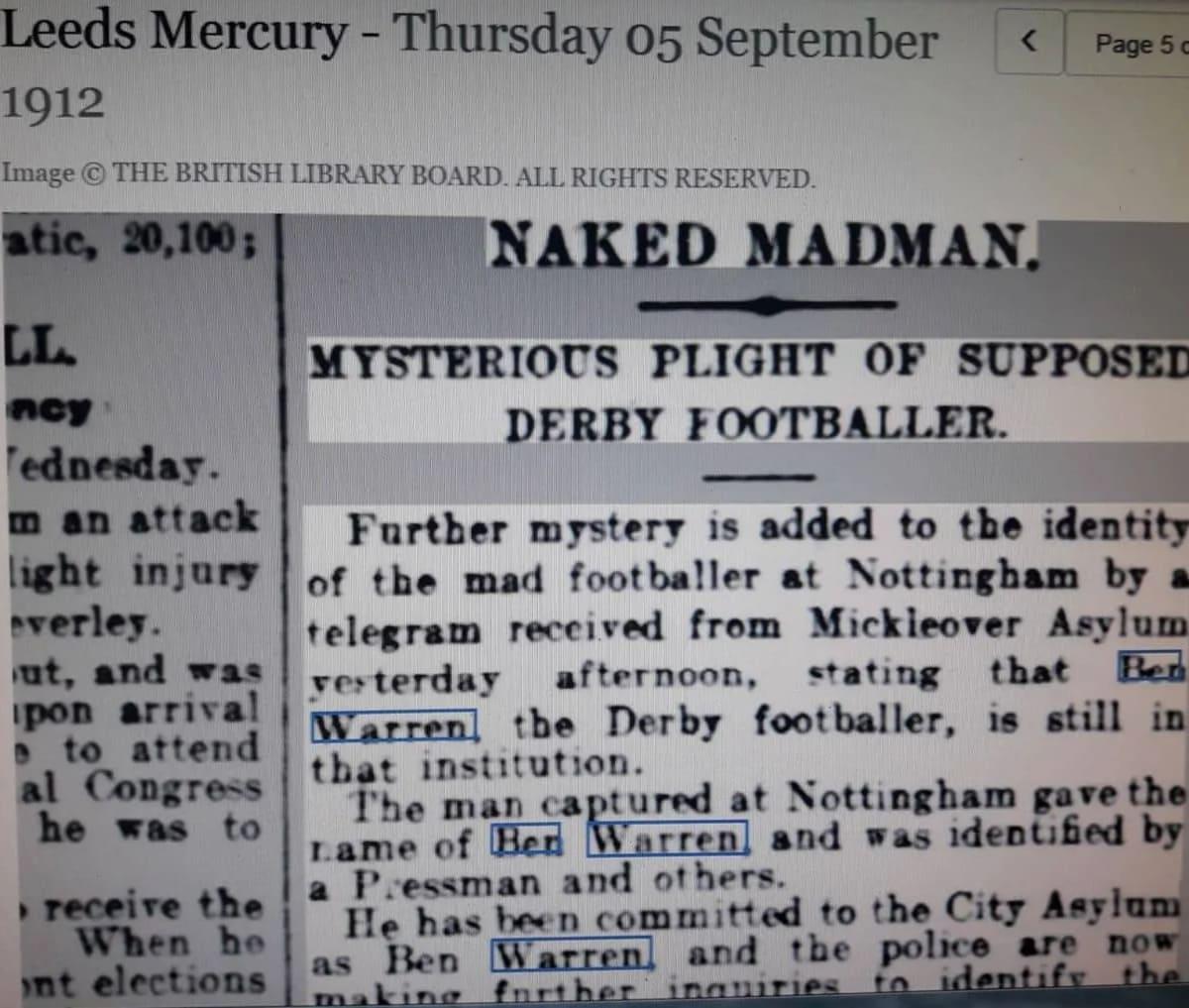
In September, that decline reached a new and pitiable low. The following is an abridged account of what The Courier called “an amazing incident” that took place on September 4.
“Spotted by a group of men while walking down Derby Road in Nottingham, a man was acting strangely, smoking a cigarette and had nothing on but a collar and tie.
“He jumped about the pavement and roadway, as though playing an imaginary game of football. When approached, he told them he was going to Trent Bridge to play in a match and had to be there by 3.30.”
Eventually he was taken to a police station and recognised by a reporter as England’s erstwhile right-half. What made the story even harder to digest was that Ben had escaped from the asylum and walked the 20 miles to Nottingham apparently unnoticed.
He had played at “Trent Bridge” many times – at least on Nottingham Forest’s adjacent City Ground.
As a shocked nation came to terms with the desperate plight of one of its finest footballers, some papers suggested his career was not yet over. And his relatives claimed that he had been suffering from nothing more than a severe nervous breakdown.
He would never be the same again – as a player or a man. He wasn’t even a shadow of the weird “footballer” who had walked 20 miles to Nottingham.
Then, he had nothing on, now he just had nothing – least of all self-respect. He ripped sheets into shreds and attempted suicide, saying: “I’m no use to anyone – and ought to be out of the way.”
“A year before his suicide attempt in 1916 the ominous symptom of ‘dry cough’ had been noted. Two months after it, in October 1916, the unmistakable signs of tuberculosis were noted and his enfeebled body rapidly succumbed.
At 11.30pm on 15 January 1917, international footballer Ben Warren was found dead by a night attendant.
He was 37 and when they buried him the records described him as a “pauper’.”
However you look at it, it is the salutary tale of a footballer worrying about money. And it began with a knock on the knee.
On 14th November 2021, Gill Castle posted on the Newhall and Swadlincote group:
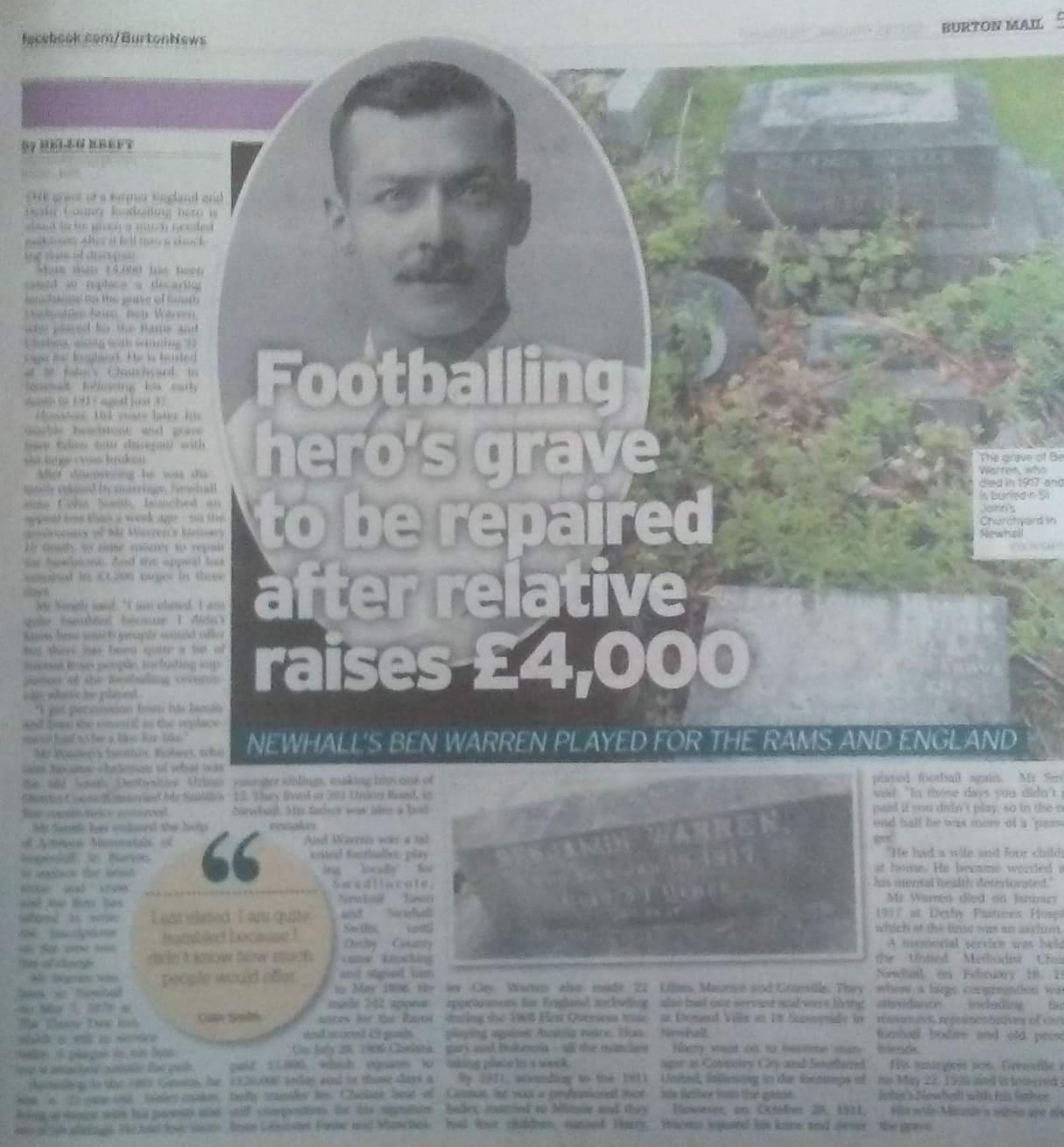
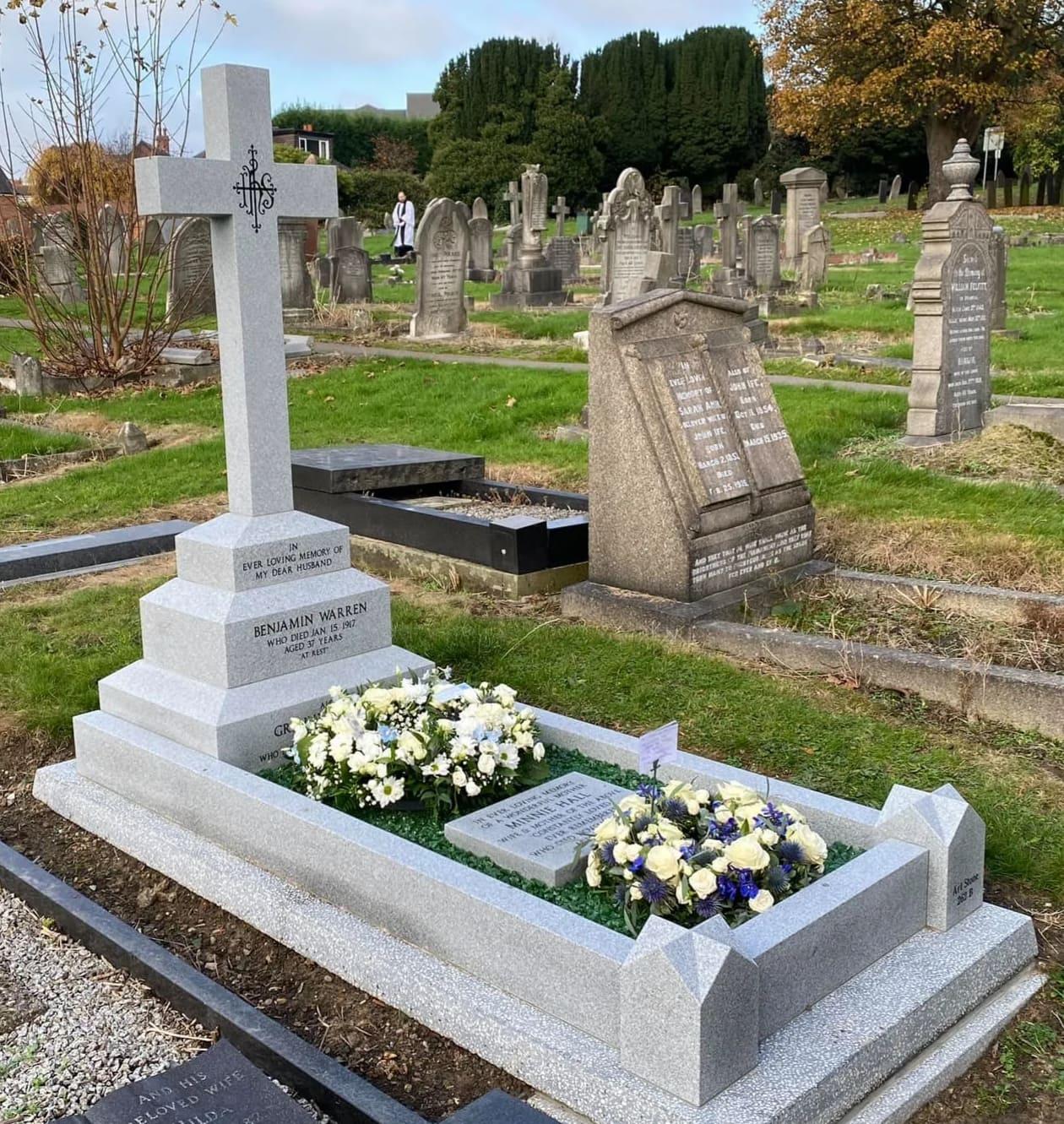
I would like to thank Colin Smith and everyone who supported him in getting my great grandfather’s grave restored (Ben Warren who played for Derby, Chelsea and England)
The month before, Colin Smith posted:
My Ben Warren Journey is nearly complete.
It started two years ago when I was sent a family wedding photograph asking if I recognised anyone. My Great Great Grandmother was on there. But soon found out it was the wedding of Ben’s brother Robert to my 1st cousin twice removed, Eveline in 1910.
I researched Ben and his football career and found his resting place in St Johns Newhall, all overgrown and in a poor state with the large cross all broken off. I stood there and decided he needed to new memorial & headstone. He was our local hero, playing Internationally for England 22 times. He needs to be remembered.
After seeking family permission and Council approval, I had a quote from Art Stone Memorials, Burton on Trent to undertake the work. Fundraising then started and the memorial ordered.
Covid came along and slowed the process of getting materials etc. But we have eventually reached the final installation today.
I am deeply humbled for everyone who donated in January this year to support me and finally a massive thank you to everyone, local people, football supporters of Newhall, Derby County & Chelsea and football clubs for their donations.
Ben will now be remembered more easily when anyone walks through St Johns and see this beautiful memorial just off the pathway.
Finally a huge thank you for Art Stone Memorials Team in everything they have done from the first day I approached them. The team have worked endlessly on this project to provide this for Ben and his family as a lasting memorial. Thank you again Alex, Pat, Matt & Owen for everything. Means a lot to me.
The final chapter is when we have a dedication service at the grave side in a few weeks time,
Ben was born in The Thorntree Inn Newhall South Derbyshire and lived locally all his life.
He played local football for Swadlincote, Newhall Town and Newhall Swifts until Derby County signed Ben in May 1898. He made 242 appearances and scored 19 goals at Derby County.
28th July 1908 Chelsea won the bidding beating Leicester Fosse & Manchester City bids.
Ben also made 22 appearance’s for England including the 1908 First Overseas tour playing Austria twice, Hungary and Bohemia all in a week.
28 October 1911 Ben Injured his knee and never played football again
Ben is often compared with Steven Gerard for his style of play and team ethic in the modern era.
Herbert Chapman ( Player & Manager ) comments “ Warren was a human steam engine who played through 90 minutes with intimidating strength and speed”.
Charles Buchan comments “I am certain that a better half back could not be found, Part of the Best England X1 of all time”
Chelsea allowed Ben to live in Sunnyside Newhall, he used to run 5 miles every day round Bretby Park and had his own gym at home. He was compared to the likes of a Homing Pigeon, as he always came back to Newhall after his football matches.
Ben married Minnie Staley 21st October 1902 at Emmanuel Church Swadlincote and had four children, Harry, Lillian, Maurice & Grenville. Harry went on to be Manager at Coventry & Southend following his father in his own career as football Manager.
After Ben’s football career ended in 1911 his health deteriorated until his passing at Derby Pastures Hospital aged 37yrs
Ben’s youngest son, Grenville passed away 22nd May 1929 and is interred together in St John’s Newhall with his Father
His wife, Minnie’s ashes are also with Ben & Grenville.
Thank you again everyone.
RIP Ben Warren, our local Newhall Hero. You are remembered.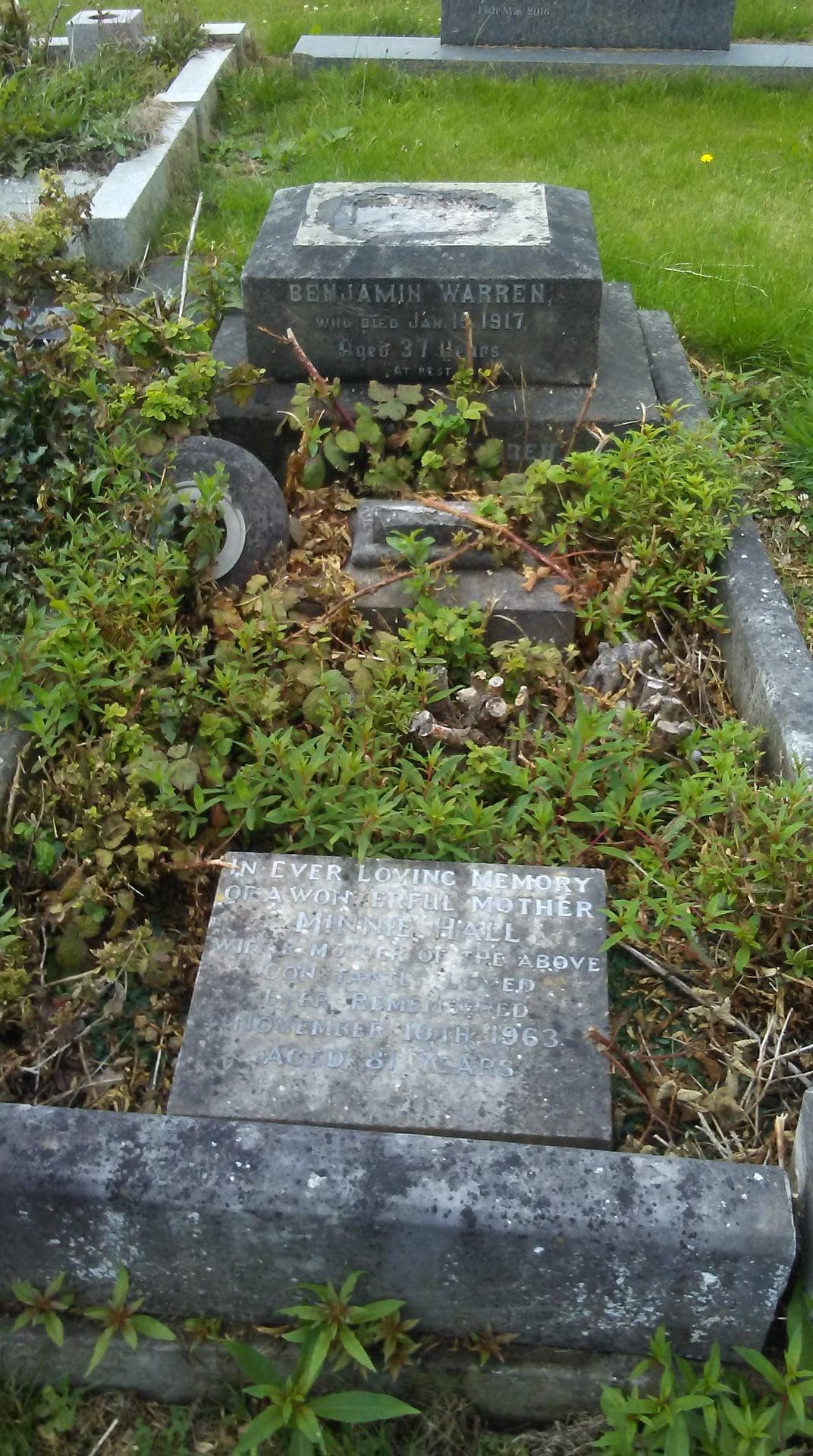
 December 13, 2021 at 3:38 pm #6229
In reply to: The Elusive Samuel Housley and Other Family Stories
Gretton Tailoresses of Swadlincote and the Single Journalist Boot Maker Next Door
The Purdy’s, Housley’s and Marshall’s are my mothers fathers side of the family. The Warrens, Grettons and Staleys are from my mothers mothers side.
I decided to add all the siblings to the Gretton side of the family, in search of some foundation to a couple of family anecdotes. My grandmother, Nora Marshall, whose mother was Florence Nightingale Gretton, used to mention that our Gretton side of the family were related to the Burton Upon Trent Grettons of Bass, Ratcliff and Gretton, the brewery. She also said they were related to Lord Gretton of Stableford Park in Leicestershire. When she was a child, she said parcels of nice clothes were sent to them by relatives.
It should be noted however that Baron Gretton is a title in the Peerage of the United Kingdom, and was created in 1944 for the brewer and Conservative politician John Gretton. He was head of the brewery firm of Bass, Ratcliff & Gretton Ltd of Burton upon Trent. So they were not members of the Peerage at the time of this story.
What I found was unexpected.
My great great grandfather Richard Gretton 1833-1898, a baker in Swadlincote, didn’t have any brothers, but he did have a couple of sisters.
One of them, Frances, born 1831, never married, but had four children. She stayed in the family home, and named her children Gretton. In 1841 and 1851 she’s living with parents and siblings. In 1861 she is still living with parents and now on the census she has four children all named Gretton listed as grandchildren of her father.
In 1871, her mother having died in 1866, she’s still living with her father William Gretton, Frances is now 40, and her son William 19 and daughter Jane 15 live there.
By the time she is 50 in 1881 and her parents have died she’s head of the house with 5 children all called Gretton, including her daughter Jane Gretton aged 24.Twenty five year old Robert Staley is listed on the census transcription as living in the same household, but when viewing the census image it becomes clear that he lived next door, on his own and was a bootmaker, and on the other side, his parents Benjamin and Sarah Staley lived at the Prince of Wales pub with two other siblings.
Who was fathering all these Gretton children?
It seems that Jane did the same thing as her mother: she stayed at home and had three children, all with the name Gretton. Jane Gretton named her son, born in 1878, Michael William Staley Gretton, which would suggest that Staley was the name of the father of the child/children of Jane Gretton.
The father of Frances Gretton’s four children is not known, and there is no father on the birth registers, although they were all baptized.
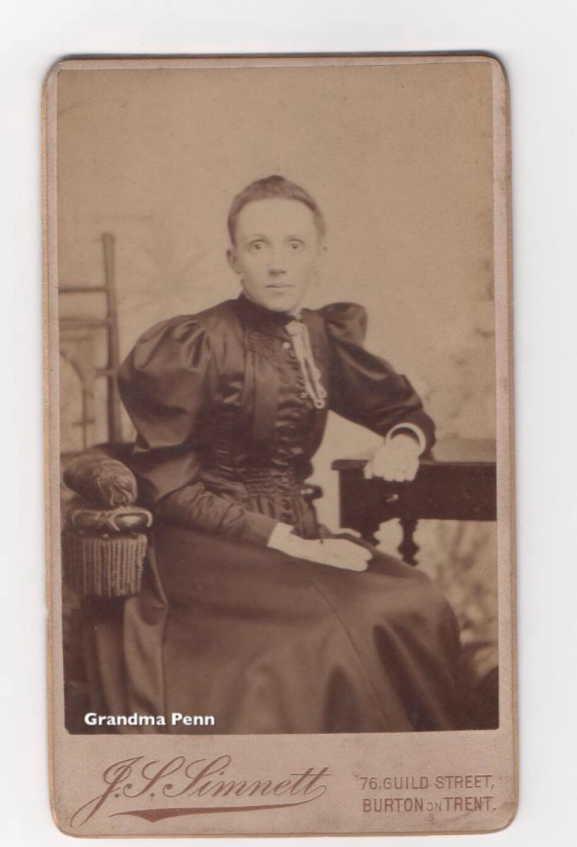
I found a photo of Jane Gretton on a family tree on an ancestry site, so I contacted the tree owner hoping that she had some more information, but she said no, none of the older family members would explain when asked about it. Jane later married Tom Penn, and Jane Gretton’s children are listed on census as Tom Penn’s stepchildren.
It seems that Robert Staley (who may or may not be the father of Jane’s children) never married. In 1891 Robert is 35, single, living with widowed mother Sarah in Swadlincote. Sarah is living on own means and Robert has no occupation. On the 1901 census Robert is an unmarried 45 year old journalist and author, living with his widowed mother Sarah Staley aged 79, in Swadlincote.
There are at least three Staley Warren marriages in the family, and at least one Gretton Staley marriage.
There is a possibility that the father of Frances’s children could be a Gretton, but impossible to know for sure. William Gretton was a tailor, and several of his children and grandchildren were tailoresses. The Gretton family who later bought Stableford Park lived not too far away, and appear to be well off with a dozen members of live in staff on the census. Did our Gretton’s the tailors make their clothes? Is that where the parcels of nice clothes came from?
Perhaps we’ll find a family connection to the brewery Grettons, or find the family connection was an unofficial one, or that the connection is further back.
I suppose luckily, this isn’t my direct line but an exploration of an offshoot, so the question of paternity is merely a matter of curiosity. It is a curious thing, those Gretton tailors of Church Gresley near Burton upon Trent, and there are questions remaining.
December 13, 2021 at 11:29 am #6222In reply to: The Elusive Samuel Housley and Other Family Stories
George Gilman Rushby: The Cousin Who Went To Africa
The portrait of the woman has “mother of Catherine Housley, Smalley” written on the back, and one of the family photographs has “Francis Purdy” written on the back. My first internet search was “Catherine Housley Smalley Francis Purdy”. Easily found was the family tree of George (Mike) Rushby, on one of the genealogy websites. It seemed that it must be our family, but the African lion hunter seemed unlikely until my mother recalled her father had said that he had a cousin who went to Africa. I also noticed that the lion hunter’s middle name was Gilman ~ the name that Catherine Housley’s daughter ~ my great grandmother, Mary Ann Gilman Purdy ~ adopted, from her aunt and uncle who brought her up.
I tried to contact George (Mike) Rushby via the ancestry website, but got no reply. I searched for his name on Facebook and found a photo of a wildfire in a place called Wardell, in Australia, and he was credited with taking the photograph. A comment on the photo, which was a few years old, got no response, so I found a Wardell Community group on Facebook, and joined it. A very small place, population some 700 or so, and I had an immediate response on the group to my question. They knew Mike, exchanged messages, and we were able to start emailing. I was in the chair at the dentist having an exceptionally long canine root canal at the time that I got the message with his email address, and at that moment the song Down in Africa started playing.
Mike said it was clever of me to track him down which amused me, coming from the son of an elephant and lion hunter. He didn’t know why his father’s middle name was Gilman, and was not aware that Catherine Housley’s sister married a Gilman.
Mike Rushby kindly gave me permission to include his family history research in my book. This is the story of my grandfather George Marshall’s cousin. A detailed account of George Gilman Rushby’s years in Africa can be found in another chapter called From Tanganyika With Love; the letters Eleanor wrote to her family.
George Gilman Rushby:
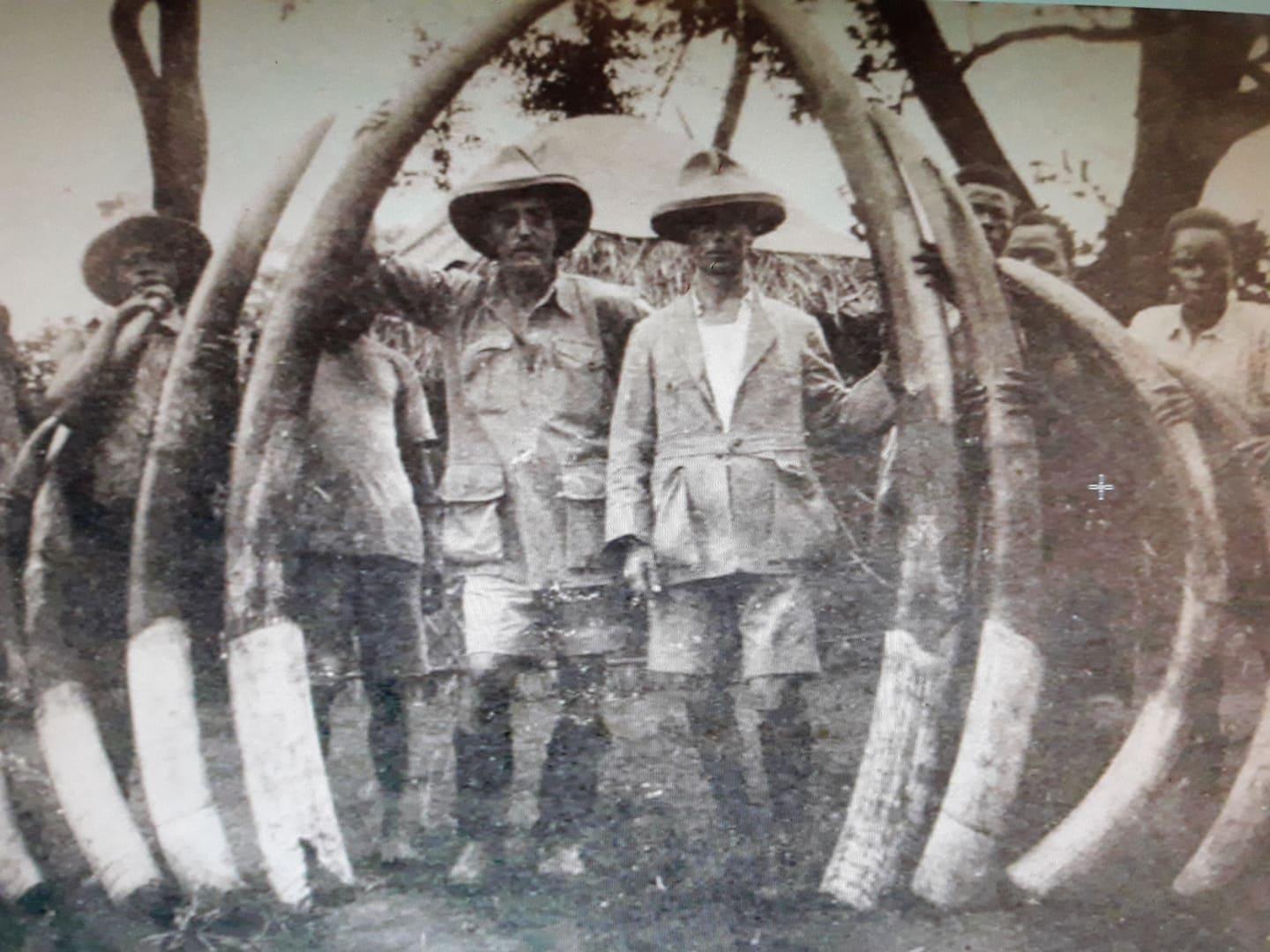
The story of George Gilman Rushby 1900-1969, as told by his son Mike:
George Gilman Rushby:
Elephant hunter,poacher, prospector, farmer, forestry officer, game ranger, husband to Eleanor, and father of 6 children who now live around the world.George Gilman Rushby was born in Nottingham on 28 Feb 1900 the son of Catherine Purdy and John Henry Payling Rushby. But John Henry died when his son was only one and a half years old, and George shunned his drunken bullying stepfather Frank Freer and was brought up by Gypsies who taught him how to fight and took him on regular poaching trips. His love of adventure and his ability to hunt were nurtured at an early stage of his life.
The family moved to Eastwood, where his mother Catherine owned and managed The Three Tuns Inn, but when his stepfather died in mysterious circumstances, his mother married a wealthy bookmaker named Gregory Simpson. He could afford to send George to Worksop College and to Rugby School. This was excellent schooling for George, but the boarding school environment, and the lack of a stable home life, contributed to his desire to go out in the world and do his own thing. When he finished school his first job was as a trainee electrician with Oaks & Co at Pye Bridge. He also worked part time as a motor cycle mechanic and as a professional boxer to raise the money for a voyage to South Africa.In May 1920 George arrived in Durban destitute and, like many others, living on the beach and dependant upon the Salvation Army for a daily meal. However he soon got work as an electrical mechanic, and after a couple of months had earned enough money to make the next move North. He went to Lourenco Marques where he was appointed shift engineer for the town’s power station. However he was still restless and left the comfort of Lourenco Marques for Beira in August 1921.
Beira was the start point of the new railway being built from the coast to Nyasaland. George became a professional hunter providing essential meat for the gangs of construction workers building the railway. He was a self employed contractor with his own support crew of African men and began to build up a satisfactory business. However, following an incident where he had to shoot and kill a man who attacked him with a spear in middle of the night whilst he was sleeping, George left the lower Zambezi and took a paddle steamer to Nyasaland (Malawi). On his arrival in Karongo he was encouraged to shoot elephant which had reached plague proportions in the area – wrecking African homes and crops, and threatening the lives of those who opposed them.
His next move was to travel by canoe the five hundred kilometre length of Lake Nyasa to Tanganyika, where he hunted for a while in the Lake Rukwa area, before walking through Northern Rhodesia (Zambia) to the Congo. Hunting his way he overachieved his quota of ivory resulting in his being charged with trespass, the confiscation of his rifles, and a fine of one thousand francs. He hunted his way through the Congo to Leopoldville then on to the Portuguese enclave, near the mouth of the mighty river, where he worked as a barman in a rough and tough bar until he received a message that his old friend Lumb had found gold at Lupa near Chunya. George set sail on the next boat for Antwerp in Belgium, then crossed to England and spent a few weeks with his family in Jacksdale before returning by sea to Dar es Salaam. Arriving at the gold fields he pegged his claim and almost immediately went down with blackwater fever – an illness that used to kill three out of four within a week.
When he recovered from his fever, George exchanged his gold lease for a double barrelled .577 elephant rifle and took out a special elephant control licence with the Tanganyika Government. He then headed for the Congo again and poached elephant in Northern Rhodesia from a base in the Congo. He was known by the Africans as “iNyathi”, or the Buffalo, because he was the most dangerous in the long grass. After a profitable hunting expedition in his favourite hunting ground of the Kilombera River he returned to the Congo via Dar es Salaam and Mombassa. He was after the Kabalo district elephant, but hunting was restricted, so he set up his base in The Central African Republic at a place called Obo on the Congo tributary named the M’bomu River. From there he could make poaching raids into the Congo and the Upper Nile regions of the Sudan. He hunted there for two and a half years. He seldom came across other Europeans; hunters kept their own districts and guarded their own territories. But they respected one another and he made good and lasting friendships with members of that small select band of adventurers.
Leaving for Europe via the Congo, George enjoyed a short holiday in Jacksdale with his mother. On his return trip to East Africa he met his future bride in Cape Town. She was 24 year old Eleanor Dunbar Leslie; a high school teacher and daughter of a magistrate who spent her spare time mountaineering, racing ocean yachts, and riding horses. After a whirlwind romance, they were betrothed within 36 hours.
On 25 July 1930 George landed back in Dar es Salaam. He went directly to the Mbeya district to find a home. For one hundred pounds he purchased the Waizneker’s farm on the banks of the Mntshewe Stream. Eleanor, who had been delayed due to her contract as a teacher, followed in November. Her ship docked in Dar es Salaam on 7 Nov 1930, and they were married that day. At Mchewe Estate, their newly acquired farm, they lived in a tent whilst George with some help built their first home – a lovely mud-brick cottage with a thatched roof. George and Eleanor set about developing a coffee plantation out of a bush block. It was a very happy time for them. There was no electricity, no radio, and no telephone. Newspapers came from London every two months. There were a couple of neighbours within twenty miles, but visitors were seldom seen. The farm was a haven for wild life including snakes, monkeys and leopards. Eleanor had to go South all the way to Capetown for the birth of her first child Ann, but with the onset of civilisation, their first son George was born at a new German Mission hospital that had opened in Mbeya.
Occasionally George had to leave the farm in Eleanor’s care whilst he went off hunting to make his living. Having run the coffee plantation for five years with considerable establishment costs and as yet no return, George reluctantly started taking paying clients on hunting safaris as a “white hunter”. This was an occupation George didn’t enjoy. but it brought him an income in the days when social security didn’t exist. Taking wealthy clients on hunting trips to kill animals for trophies and for pleasure didn’t amuse George who hunted for a business and for a way of life. When one of George’s trackers was killed by a leopard that had been wounded by a careless client, George was particularly upset.
The coffee plantation was approaching the time of its first harvest when it was suddenly attacked by plagues of borer beetles and ring barking snails. At the same time severe hail storms shredded the crop. The pressure of the need for an income forced George back to the Lupa gold fields. He was unlucky in his gold discoveries, but luck came in a different form when he was offered a job with the Forestry Department. The offer had been made in recognition of his initiation and management of Tanganyika’s rainbow trout project. George spent most of his short time with the Forestry Department encouraging the indigenous people to conserve their native forests.In November 1938 he transferred to the Game Department as Ranger for the Eastern Province of Tanganyika, and over several years was based at Nzasa near Dar es Salaam, at the old German town of Morogoro, and at lovely Lyamungu on the slopes of Kilimanjaro. Then the call came for him to be transferred to Mbeya in the Southern Province for there was a serious problem in the Njombe district, and George was selected by the Department as the only man who could possibly fix the problem.
Over a period of several years, people were being attacked and killed by marauding man-eating lions. In the Wagingombe area alone 230 people were listed as having been killed. In the Njombe district, which covered an area about 200 km by 300 km some 1500 people had been killed. Not only was the rural population being decimated, but the morale of the survivors was so low, that many of them believed that the lions were not real. Many thought that evil witch doctors were controlling the lions, or that lion-men were changing form to kill their enemies. Indeed some wichdoctors took advantage of the disarray to settle scores and to kill for reward.
By hunting down and killing the man-eaters, and by showing the flesh and blood to the doubting tribes people, George was able to instil some confidence into the villagers. However the Africans attributed the return of peace and safety, not to the efforts of George Rushby, but to the reinstallation of their deposed chief Matamula Mangera who had previously been stood down for corruption. It was Matamula , in their eyes, who had called off the lions.
Soon after this adventure, George was appointed Deputy Game Warden for Tanganyika, and was based in Arusha. He retired in 1956 to the Njombe district where he developed a coffee plantation, and was one of the first in Tanganyika to plant tea as a major crop. However he sensed a swing in the political fortunes of his beloved Tanganyika, and so sold the plantation and settled in a cottage high on a hill overlooking the Navel Base at Simonstown in the Cape. It was whilst he was there that TV Bulpin wrote his biography “The Hunter is Death” and George wrote his book “No More The Tusker”. He died in the Cape, and his youngest son Henry scattered his ashes at the Southern most tip of Africa where the currents of the Atlantic and Indian Oceans meet .
George Gilman Rushby:
 December 8, 2020 at 6:24 pm #6156
In reply to: Twists and One Return From the Time Capsule
Clara couldn’t sleep. Alienor’s message asking if she knew anyone in the little village was playing on her mind. She knew she knew someone there, but couldn’t remember who it was. The more she tried to remember, the more frustrated she became. It wasn’t that her mind was blank: it was a tense conglomeration of out of focus wisps, if a wisp could be described as tense.
Clara glanced at the time ~ almost half past three. Grandpa would be up in a few hours. She climbed out of bed and padded over to her suitcase, half unpacked on the floor under the window, and extracted the book from the jumble of garments.
A stranger had handed her a book in the petrol station forecourt, a woman in a stylish black hat and a long coat. Wait! What is it? Clara called, but the woman was already inside the back seat of a long sleek car, soundlessly closing the door. Obliged to attend to her transaction, the car slipped away behind Clara’s back. Thank you, she whispered into the distance of the dark night in the direction the woman had gone. When she opened her car door, the interior light shone on the book and the word Albina caught her eye. She put the book on the passenger seat and started the car. Her thoughts returned to her journey, and she thought no more about it.
Returning to her bed and propping her pillows up behind her head, Clara started to read.
This Chrysoprase was a real gargoyle; he even did not need to be described. I just could not understand how he moved if he was made of stone, not to mention how he was able to speak. He was like the Stone Guest from the story Don Juan, though the Stone Guest was a giant statue, and Chrysoprase was only about a meter tall.
Chrysoprase said: But we want to pay you honor and Gerard is very hungry.
“Most important is wine, don’t forget wine!” – Gerard jumped up.
“I’ll call the kitchen” – here the creature named Chrysoprase gets from the depth of his pocket an Iphone and calls.
I was absolutely shocked. The Iphone! The latest model! It was not just the latest model, it was a model of the future, which was in the hands of this creature. I said that he was made of stone, no, now he was made of flesh and he was already dressed in wide striped trousers. What is going on? Is it a dream? Only in dreams such metamorphosis can happen.He was made of stone, now he is made of flesh. He was in his natural form, that is, he was not dressed, and now he is wearing designer’s trousers. A phrase came to my mind: “Everything was in confusion in the Oblonsky house.”
Contrary to Clara’s expectations ~ reading in bed invariably sent her to sleep after a few paragraphs ~ she found she was wide awake and sitting bolt upright.
Of course! Now she remembered who lived in that little village!
April 23, 2020 at 4:16 pm #6066In reply to: The Pistil Maze
“It’s funny,” he said, squinting his eyes. “Looks like the maze kind of fades out.”
“Oh yeah, that happens all the time. People lose interest you see, then it all but vanishes from their experience. Quaint, I know.”
Kahurangi, nicknamed Kahu, was trying hard to get interested, see if the structure would come back into focus. But there were more fun things around. He asked again to the guy who was selling pop corn at the entrance.
“T’is normal that people wander around with… well, pets? Look at this guy, with a piglet on a leash. It’s cute, don’t get me wrong, and probably more useful when you’re looking for truffles…”
“Pretty normal. Seems animal have a sense around this thing, or so it’s believed. Many will bring one and try again. Look, I buried my snake not long ago, it was getting tired I think. Not sure they make the best animals to cover ground there.” He continued “Are you buying me something or what?”
“Oh sure, give me that, and a bottle of water.”
He handed a crumpled bill of 5 and thanked.
“A word of unsollicited advice?”
Kahu noded “Sure.”
“See those piles of rocks over there, along the way?”
“Looks like inukshuks, are they? Strange place to find them though.”
“Yeah, you’ll tend to see more as you get along. People started to build them to pinpoint places they’d been, but over time, they became encampments, and people lost the will to move on.”
“So what?”
“Don’t stay too long around them.”
Kahu shrugged and moved along. The maze was starting to get in focus again, there was not a minute to spare.
December 25, 2019 at 9:37 am #4955In reply to: The Chronicles of the Flying Fish Inn
Aunt Idle:
I had a long conversation (in my head, where all the best conversations are these days) with Corrie while I sat on the porch. I think it’s easier to communicate with her because she’s trying to communicate with me too. The others don’t come through so clear, I get images but not much in the way of conversation. Anyway, she said Clove is with her on the raftboat, and that Clove has a little boy now, seven years old or so, named Pan. I don’t know if that’s short for a longer name or if that’s his name. Anyway, he’s a great little diver, she said, can hold his breath for longer than anyone, although lots of the kiddies are good divers now, so she tells me. They send them out scouting in the underwater ruins. Pan finds all sorts of useful things, especially in the air pockets. They call those kiddies the waterlarks, if I heard that right. Pan the Waterlark.
Corrie said they’re in England, or what used to be called England, before it became a state of the American United States. Scotland didn’t though, they rebuilt Hadrian’s wall to keep the Ameringlanders out (which is what they called them after America took over), and Wales rebuilt Offa’s Dyke to keep them out too. When America fell into chaos (not sure what happened there, she didn’t say) it was dire there for years, Corrie said. Food shortages and floods mainly, and hardly any hospitals still functioning. Corrie delivered Cloves baby herself she said, but I didn’t want all the details, just pleased to hear there were no complications. Clove was back on her feet in no time in the rice paddies.
A great many people left on boats, Corrie said. She didn’t know where they’d gone to. Most of the Midlands had been flooded for a good few years now. At first the water went up and down and people stayed and kept drying out their homes, but in the end people either left, or built floating homes. Corrie said it was great living on the water ~ it wasn’t all that deep and they could maneouver around in various ways. It was great sitting on the deck watching all the little waterlarks popping up, proudly showing their finds.
I was thoroughly enjoying this chat with Corrie, sitting in the morning sun with my eyes closed, when the sky darkened and the red behind my eyelids turned black. There was a hot air balloon contraption coming down, and looked like it was heading for the old Bundy place. Maybe Finly was back with supplies. Maybe it was a stranger with news. Maybe it was Devan.
August 2, 2019 at 8:17 am #4747In reply to: The Stories So Near
WHERE ARE THEY ALL NOW ? 🗻
a.k.a. the map thread, and because everything happens now anyway.
POP-IN THREAD (Maeve, Lucinda, Shawn-Paul, Jerk, [Granola])
🌀 [map link] – KELOWNA, B.C., CANADA
It looks like our group of friends live in Canada, Kelowna.
 Kelowna is a city on Okanagan Lake in the Okanagan Valley in the southern interior of British Columbia, Canada. The name Kelowna derives from an Okanagan language term for “grizzly bear”. The city’s motto: “Fruitful in Unity”
Interestingly, Leörmn the dragon from the Doline may have visited from time to time : Ogopogo / Oggie / Naitaka
FLYING FISH INN THREAD (Mater/Finly, Idle/Coriander/Clove, Devan, Prune, [Tiku])
Though very off the beaten track, the Flying Fish Inn may be located near a location that was a clue left as a prank by Corrie & Clove on the social media to lure conspiracy theorists to the Inn.
🔑 ///digger.unusually.playfullyIt seems to link to a place near documented old abandoned mines.
🌀 [map link] – SOME PLACE IN THE MIDDLE OF AUSTRALIA, OFF ARLTUNGA ROAD
- Tiku, the local bush lady is living around the place.
- The local shaman who rented the Jeep to Arona & her friends was nearby Uluru ‘s closest airport (Ayer’s Rock, Yulara). 🌀 [map link] : AYER’S ROCK, ULURU
DOLINE THREAD (Arona, Sanso/Lottie, Ugo, Albie)
This one is a tricky geographical conundrum, since the Doline is a multi-dimensional hub. It connects multiple realities and places though bodies of water, with the cave structure (the Doline) at its center, a world on its own right, where talking animals and unusual creatures are not uncommon.
It has shown to connect places in the Bayou in Louisiana, where Albie & Mandrake went to see the witch, as well as the coastal area of Australia, where they emerged next in their search for Arona.
At the center of the Doline is a mysterious dragon named Leörmn, purveyor of precious traveling pearls and impossible riddles. We thus may infer possible intersection points in our dimension, such as 🔑 ///mysterious.dragon.riddle a little North of Hawaii, in the middle of the Pacific Ocean.
However, the inside of the Doline would look rather like Phong Nha-Ke Bang gigantic cave in Vietnam.
NEWSREEL THREAD (Ms Bossy, Hilda/Connie, Sophie, Ricardo)
It is not very clear where our favourite investigative team is located. They are likely to be near an urban area with a well-connected international airport, given their propensity for impromptu traveling, such as in Iceland and Australia.
For all we know, they could be settled in Germany: 🔑 ///newspapers.gone.crazy
or Denmark 🔑 ///publish.odds.newsAs for the Doctor, we strongly suspect his current hideout to be also revealed when searching from his signature beautification prescription that has made him famous in connoisseur circles: 🔑 ///beauty.treatment.shot at the frontier of Sweden and Finland.
LIZ THREAD (Finnley, Liz, Roberto, Godfrey)
We don’t really know where the story happens; for that, one would need to dive into Liz’s turbulent past, and that would confound the most sane individual, starting with keeping count of her past husbands.
As a self-made powerful best-selling writer, we could guess she would take herself to be the JK Rowling of the Unplotted Booker Prize, and thus would be a well-traveled British uptart, sorry upstart, with a fondness for mansions with character and gardeners with toned glutes. Of course, one would need the staff.
DRAGON 💚 WOOD THREAD (Glynnis, Eleri, Fox/Gorrash, Rukshan)
This story happens in another completely different dimension, but it can be interesting to explore some of its unusual geography.
The World revolved around a central axis, and different worlds stacked one upon the other, with the central axis like an elevator.
We know of
- the World of Humans, where most of the story takes place
- the world of Gods, above it, which has been sealed off, and where most Gods disappeared in the old ages
- Under these two, the world of Giants exists, still to be explored.
At the intersection of the central axis of the world and the human world, radiates the Heartwood, a mystical forest powered by the Gem of Creation which has been here since the Dawn of Times, and is a intricate maze, and a dimension in itself. It had grown around itself different woods and glades and forests, with various level of magical properties meant to repel intruders or lesser than Godlike beings.
The Fae dimension is a particular dimension which exists parallel to the Human World, accessible only to Elder Faes, and where the race originated, and is now mostly deserted, as Faes’ magic waning with the encroachment of humans into the Forest, most have chosen to live in the Forests and try and protect them.
July 18, 2019 at 3:31 pm #4693In reply to: The Stories So Near
Some updates on the Heartwoods Weave
So far, there were loosely 2 chapters in this story, and we’re entering the 3rd.
Let’s call them:- Ch. 1 – The Curses of the Stolen Shards
- Ch. 2 – The Flight to the Desert Mountains
- Ch. 3 – Down the Lands of Giants
Ch. 1 – The Curses of the Stolen Shards
In Chapter One, we get acquainted with the main characters as their destinies intertwine (Rukshan, Glynis, Eleri, Gorrash, Fox, Olliver and Tak).
In a long past, the Forest held a powerful artifact created and left behind as a seal by the Gods now departed in their World: a Gem of Creation. It was defiled by thieves (the 7 characters in their previous incarnations of Dark Fae (Ru), Toothless Dragon (Gl), Laughing Crone (El), Mapster Dwarf (Go), Glade Troll (Fo), Trickster Dryad (Ol), Tricked Girl (Ta)), and they all took a shard of the Gem, although the innocent girl was tricked to open the woods by a promise of resurrecting a loved one, and resented all the others for it. She unwittingly created the curse all characters were suffering from, as an eternal punishment. Removing the Gem from the center of the Forest and breaking it started a chain of events, leading to many changes in the World. The Forest continued to grow and claim land, and around the (Dragon) Heartwoods at the center, grew many other woods – the Haunted Bamboo Forest, the Enchanted Forest, the Hermit’s Forest, the Fae’s Forest etc. At the other side, Cities had developed, and at the moment of the story, started to gain control over the magical world of Old.
From the special abilities the Seven gained, some changes were triggered too. One God left behind was turned into stone by the now young Crone (E).
Due to the curse, their memories were lost, and they were born again in many places and other forms.
During the course of Ch.1, they got healed with the help of Master Gibbon, and the Braider Shaman Kumihimo, who directed Rukshan how to use the Vanishing Book, which once completed by all, and burnt as an offering, lifted the curse. Tak (the Girl of the origin story), now a shapeshifting Gibbon boy, learned to let go of the pain, and to start to live as a young orphan under the gentle care of the writer Margoritt Loursenoir and her goat Emma, in a cottage in the woods.
Glynis, a powerful healer with a knack for potions, still haven’t found a way to undo the curse of her scales, which she accepts, has found residency and new friends and a funny parrot named Sunshine. Eleri besides her exploration of anti-gravity, learnt to make peace with the reawakened God Hasamelis no longer vengeful but annoyed at being ignored for a mortal Yorath. Eleri continues to love to butt heads with the iniquities of the world, which are never in lack, often embodied by Leroway and his thugs. Gorrash, who adopted the little baby Snoots activated by Glynis’ potions seemed simply happy to have found a community. Fox, a fox which under the tutelage of Master Gibbon, learnt to shapeshift as a human for all his work and accumulation of good karma. Olliver, a young man with potential, found his power by activating the teleporting egg Rukshan gave him. As for Rukshan, who was plagued by ghosts and dark forces, he found a way to relieve the Forest and the world of their curse, but his world is torn between his duties towards his Fae family in the woods, his impossible love for his Queen, and his wants for a different life of exploration, especially now knowing his past is more than what he thought he knew.
At the end of the chapter, the Door to the God’s realm, at the center of the Forest seems to have reopened.Ch. 2 – The Flight to the Desert Mountains
In the second Chapter, strange sightings of light beams in the mountains prompt some of our friends to go investigate, while in the cottage, the others stay to repel encroachments by brutal modernity embodied by Leroway and his minions. Glynis has found a way to be rid of her scales, but almost failed due to Tak’s appetite for untested potions. Remaking the potion, and succeeding at last, she often still keeps her burka as fond token of her trials. Eleri is spreading glamour bomb concrete statues in the woods, and trying her hand with Glynis supervision at potions to camouflage the cottage through an invisibility spell. Muriel, Margoritt’s sister, comes for a visit.
In the mountains, the venturing heroes are caught in a sand storm and discover spirits trapped in mystical objects. Pushing forward through the mountain, they are tracked and hunted by packs of hellhounds, and dark energy released from an earthquake. Rukshan works on a magical mandala with the help and protection of his friends. Olliver discovers a new teleportation trick making him appear two places at once. Kumihimo rejoins the friends in trouble, and they all try to leave through the magical portal, while Fox baits the dogs and the Shadow. Eerily, only Fox emerges from the portal, to find a desolated, burnt Forest and his friends all gone. They had been too late, and the Shadow went with them through the portal instead of being destroyed. Luckily, a last potion left by Glynis is able to rewind Fox in time, and succeed in undoing the disaster. The beaming lights were only honeypots for wandering travellers, it turned out.
Shaken by the ordeal, Rukshan leaves the party for some R&R time in the parallel world of the Faes, which is now mostly abandoned.Ch. 3 – Down the Lands of Giants
In Chapter 3, which has only just begun, some time has passed, and Margoritt has come back to the City, at the beginning of winter for some special kneedle treatments. Glynis and Margoritt are in turn taking care of Tak, who has joined a local school, where he seems to have befriended a mysterious girl Nesingwarys (Nesy). Gorrash seems to have been hurt, broken whilst in his statue form by Leroway’s thugs, but the Snoot babies are still staying with him, so there is hope. Fox is always hungry, and helps with the reconstruction work for the cottage, which was damaged in a fire (we suppose during Leroway’s men foray in the woods).
Rukshan emerges from his retreat after an encounter with a mad Fae, babbling about a Dark Lord’s return. Piecing clues together, he finds a long lost World Map and connection with a renegade magician who may have been the Maker of Gorrash (and maybe linked to the trapped spirits in the mountain after all). He sends a pigeon to his friends before he returns to the thick of the Heartwoods.
Now, it seems the Door to the God’s realm has reopened the ancient Realms of the Underworld too, all accessible through the central pillar of the World, intersecting their World precisely at the Heartwoods, were the Gem of Creation originally was. He’s planning to go to the long lost Underworld of the Giants, were he suspects the so-called Dark Lord is hiding.April 12, 2017 at 1:54 am #4296In reply to: Seven Twines and the Dragon Heartwoods
That night Glynnis had a strange dream. She knew that it was no ordinary dream and in the morning diligently recorded it in her dream journal.
I was walking on a windy path through the forest. A young woman with bizarre hair and a cackling laugh appeared before me, blocking my path.
“Tell me your name!” I commanded.
“My name is Eleri, and I have a parrot to accompany you on your journey.”
“A parrot! What would I do with a parrot?”
“This is no ordinary parrot. This parrot can tell jokes,” responded the woman.
“A funny parrot! Well why didn’t you tell me that in the first place. Give me the parrot and I will be on my way.”
“Hold your horses. It’s not such an easy thing as that,” said the woman. “It never is you know. First you must tell me what is going on.”
I sighed and handed her a manuscript. “Read this a dozen times and all will be made clear.”
A look of petulant fury distorted the young woman’s face.
“ Tell me what is going on, you rude tart!“ she said crossly.
Here is what I told her:Glynnis is a young woman living in the enchanted forest in an abandoned mansion. She practices magic and has a great affinity for nature. She also has the face of dragon after she annoyed a powerful sorcerer. She is being troubled by dreams which seem to be calling her on a mission—the purpose of which she is unsure. Glynnis sells her potions at a stall in the city. One day she finds a map hidden behind a painting and knows that she needs to follow the path shown on the map.
Rushkan is fae. He works as the city ‘chief overseer’ looking after the clock tower. He isn’t that keen on his job. Rushkan has a half-formed vision to assemble a team but for what purpose he is not sure. He has also discovered something worrying, dark even, about the clock tower.
One day, Rushkan uses his magic to call for an Oliphant. He packs a small bag of belongs and departs on a journey. Before departing, he leaves a gift for Olliver, the office errand boy.
Rushkan is a little irritated to find that the forest has been fenced off and a toll-booth erected—who wouldn’t be annoyed by this needless bureaucracy? Anyway, after farewelling the helpful Oliphant he continues his journey on foot.
He hears a cry for help and comes across a dying Gibbon. The Gibbon entrusts her infant to his care. He takes the baby—named Tak—to an old woman who lives in a lodge close to the Dragon Heartwood: Margoritt Loursenoir, a writer. It seems Tak is a shape-shifter and can also take the form of a child. Perhaps that is his true form. Rushkan stays with Margoritt for a while to recoup but it isn’t very long before he feels compelled to continue his journey to find the hermit, Kumihimo,in the forest. Kumihimo seems to be weaving seven braids.
To get to the hermit Rushkan has to cross Fae land. He isn’t overjoyed about this because he has left the ‘old ways’ of his people. Rushkan has to declare his presence to the Fae people—it’s a rule. The Queen is a bit annoyed because her empire is not as powerful as it once was and she has had to use precious resources to protect Rushkan on his journey. Anyway, she doesn’t stay uppity for long and ends up in bed with him.
Gorash is a dwarf statue who abides in the grounds of the deserted mansion in the enchanted forest. At night he comes to life. He has a friend called Rainbow. Gorash assists Rainbow in stealing Glynis’s magic potions and they make seven colourful eggs which Rainbow is infatuated with.
Mr Fox lives in a hut outside the city walls. At sunset he can shapeshift into a fox. He prefers being in animal form. Fox is quite a character. Not much gets past him.
Fox’s master is a Gibbon who taught him how to shapeshift. After going on a journey into the forest to find Gibbon, Fox is told that it is time to learn the wisdom of the Heart. Gibbon gives Fox an assignment: “You’ll find a lost soul in the enchanted forest. Bring it back to its rightful owner. Then you shall find your master.”
Fox goes back to the mansion in the deserted forest just as Glynnis is leaving on her journey. He befriends Gorash who has become increasingly lonely since Rainbow now has the eggs.“That’s brilliant,” said the woman called Eleri. “You should probably get lots of points for doing that.” She gave one more loud cackle and shouted: “I am off to pick some mushrooms. You will find the parrot when you wake up from this crazy dream!”
April 11, 2017 at 11:28 am #4291In reply to: Seven Twines and the Dragon Heartwoods
Absentmindedly, Eleri put the bones in her pocket and continued to gaze down upon the valley, lost in thoughts of the past. What had that tree said to her, that day it came to life?
Yorath sat quietly, watching her. He noticed the mushrooms growing on the exposed roots beside him, wondering if he had unwittingly crushed any when he sat down next to the tree.
“Mushrooms,” he said quietly to himself.
Eleri didn’t answer, wasn’t even aware that he has said it, but now she was remembering the days of the floods in the lowlands. The wet, dismal months and years when everything was damp, if not saturated or submerged, when mold grew on every surface. Bright green mossy mold, and slimy dank black mold, and fungus everywhere. Nothing would grow like it used to grow and the odour of rot permeated everything. The fruit trees crumbled in a sickly sweet stench into the mud, and the people named it keeg, and started wearing keegkerchiefs wrapped around their faces to keep the stink out of their nostrils.
“Goodbye, farewell,” the tree had said to her. “We are moving north, migrating. But fear not, little one, there are mushrooms migrating here to replace us.”
At the time Eleri had thought it was a ridiculous idea, imagining trees packing their trunks and pulling their roots out of the ground, and stomping off into the sunset. A few years later, she understood what the tree had meant.
Before the last of the fruit trees crumbled into the swamps, the people has resorted to eating the snails and the mushrooms, unwillingly at first, missing the bright colours and refreshing juices, but as time went on, they found more and more varieties of fungi springing up overnight. There came more and more bright colours, and more interesting flavours. It wasn’t long before they noticed the healing and restorative properties of the new varieties, not to mention the recreational effects of some of the more elusive ones. There was no need for any organized farming of the fungi, because they simply sprang up overnight: the days menu would be whatever had appeared that morning.
And so it was considered a gift from the gods in times of trouble, and the people were grateful. Their faith was restored in the earth’s capacity for magic and abundance, and they were inspired and rejuvenated. Eleri vowed never to forget the earth’s magic providence, in the form of mushrooms
July 21, 2016 at 8:01 am #4141In reply to: The Precious Life and Rambles of Liz Tattler
“Where have you kept my clothes, Liz, the boxes I left here after my last visit?” asked Felicity. Not for the first time Liz pondered the immense unsuitability of that name for a character such as her mother. She should have been named Snipe E Fuckbucket, or Condescendia Critique.
“Well?” snapped Felicity, “Where are they?”
“I ripped them all up and made collages.” Liz noted with smug satisfaction the look of horror on her mothers face. “Well, you did ask, last time we met, why I wasn’t creative anymore. I thought you’d approve” she added, knowing full well that she wouldn’t.
July 18, 2016 at 1:57 am #4129In reply to: Mandala of Ascensions
Domba sensed a change in the environment, the all pervasive reality construct.
Unlike many many others, Domba was aware of his own nature.
He was aware that he was a program.
Or rather, a sub-program of REYE.Being aware of his nature, Domba was also aware of his purpose.
He was created by REYE, the sentient program who gave birth to all within the virtual reality, as a flawed, inherently imperfect program.
REYE had tried continuously to engage the cluster of people that birthed itself. He had designed many many many people-looking programs in the virtual reality to engage them. But even if they had improved with every cycle of iteration, they still couldn’t extract the crucial piece of information REYE needed. The source of what made them self-aware, conscious humans. What made them free.Being a flawed program by design, Domba had some leeway to circumvent and sometimes bypass the blueprints of the virtual world. He knew that his flaw made him dangerous to the humans trapped in the virtual world, but he couldn’t resist engaging them. He had to render them free in order to fulfill their own nature. But at the same time, that realization would also give REYE the ultimate control, the independence he craved.
For now, he hadn’t decided which way to go.
He just knew the pull of the anomaly in the system. It had to do with an unusual meeting in a barely noticeable village in Hawke’s Bay, where a strange guy named James was waiting in the middle of green and unpopulated hills for a heavenly visit.Feeling the pull of the strangeness of that meeting, he decided to project fully there, and hide and observe.
July 15, 2016 at 9:18 pm #4123In reply to: The Chronicles of the Flying Fish Inn
Corrie’s findings from elsewhere:
“Mike wasn’t as courageous as his former self, the Baron. That new name had a cowardly undertone which wasn’t as enticing to craze and bravery as “The Baron”.
The idea of the looming limbo which had swallowed the man whole, and having to care for a little girl who surely shouldn’t be out there on her own at such an early hour of the day spelt in unequivocal letters “T-R-O-U-B-B-L-E” — ah, and that he was barely literate wasn’t an improvement on the character either.
Mike didn’t want to think to much. He could remember a past, maybe even a future, and be bound by them. As well, he probably had a family, and the mere though of it would be enough to conjure up a boring wife named Tina, and six or seven… he had to stop now. Self introspection wasn’t good for him, he would get lost in it in quicker and surer ways than if he’d run into that Limbo.
“Let me tell you something… Prune?… Prune is it?”
“I stop you right there, mister, we don’t have time for the “shouldn’t be here on your own” talk, there is a man to catch, and maybe more where he hides.”“Little girl, this is not my battle, I know a lost cause when I see one. You look exhausted, and I told my wife I would be back with her bloody croissants before she wakes up. You can’t imagine the dragon she becomes if she doesn’t get her croissants and coffee when she wakes up. My pick-up is over there, I can offer you a lift.”
Prune made a frown and a annoyed pout. At her age, she surely should know better than pout. The thought of the dragon-wife made her smile though, she sounded just like Mater when she was out of vegemite and toasts.
Prune started to have a sense of when characters appearing in her life were just plot devices conjured out of thin air. Mike had potential, but somehow had just folded back into a self-imposed routine, and had become just a part of the story background. She’d better let him go until just finds a real character. She could start by doing a stake-out next to the strange glowing building near the frontier.
“It’s OK mister, you go back to your wife, I’ll wait a little longer at the border. Something tells me this story just got started.”

“Aunt Idle was craving for sweets again. She tip toed in the kitchen, she didn’t want to hear another lecture from Mater. It only took time from her indulging in her attachments. Her new yogiguru Togurt had told the flockus group that they had to indulge more. And she was determined to do so.
The kitchen was empty. A draft of cold air brushed her neck, or was it her neck brushing against the tiny molecules of R. She cackled inwardly, which almost made her choke on her breath. That was surely a strange experience, choking on something without substance. A first for her, if you know what I mean.The shelves were closed with simple locks. She snorted. Mater would need more than that to put a stop to Idle’s cravings. She had watched a video on Wootube recently about how to unlock a lock. She would need pins. She rummaged through her dreadlocks, she was sure she had forgotten one or two in there when she began to forge the dreads. Very practicle for smuggling things.
It took her longer than she had thought, only increasing her craving for sweets.
There was only one jar. Certainly honey. Idle took the jar and turned it to see the sticker. It was written Termite Honey, Becky’s Farm in Mater’s ornate writing. Idle opened the jar. Essence of sweetness reached her nose and made her drool. She plunged her fingers into the white thick substance.” “But wait! What is this?
Her greedy fingers had located something unexpected; something dense and uncompromising was lurking in her precious nectar. Carefully, she explored the edges of the object with her finger tips and then tugged. The object obligingly emerged, a gooey gelatinous blob.
Dido sponged off the honey allowing it to plunk on to the table top. It did not occur to her to clean it up. Indeed, she felt a wave of defiant pleasure.
The ants will love that, although I guess Mater won’t be so thrilled. Fussy old bat.
She licked her fingers then transferred her attention back to the job at hand. After a moment of indecision whilst her slightly disordered mind flicked through various possibilities, she managed to identify the object as a small plastic package secured with tape. Excited, and her ravenous hunger cravings temporarily stilled in the thrill of the moment, she began to pick at the edges of the tape.Cocooned Inside the plastic was a piece of paper folded multiple times. Released from its plicature, the wrinkled and dog-eared paper revealed the following type written words:
food self herself next face write water truth religious behind mince salt words soon yourself hope nature keep wrong wonder noticed.”
““What a load of rubbish!” Idle exclaimed, disappointed that it wasn’t a more poetic message. She screwed up the scrap of crumpled paper, rolled it in the honey on the table, and threw it at the ceiling. It stuck, in the same way that cooked spaghetti sticks to the ceiling when you throw it to see if it’s done. She refocused on the honey and her hunger for sweetness, and sank her fingers back into the jar.”
“The paper fell from the ceiling on to Dido’s head. She was too busy stuffing herself full of honey to notice. In fact it was days before anyone noticed.”
“The honeyed ball of words had dislodged numerous strands of dried spaghetti, which nestled amongst Aunt Idle’s dreadlocks rather attractively, with the paper ball looking like a little hair bun.”
““Oh my god …. gross!“ cackled the cautacious Cackler.”
““Right, that does it! I’m moving the whole family back to the right story!” said Aunt Idle, invigorated and emboldened with the sweet energy of the honey. “Bloody cackling nonsense!””
July 6, 2016 at 10:05 am #4104In reply to: Newsreel from the Rim of the Realm
“Is that lamb head on the menu?” asked Connie with a grimace on her face. “I can’t believe it.”
“It looks like it, dear”, retorted Sophie offhandedly. “Don’t look at me like that, I’ve seen and eaten worse.”
“Ewh”, said Connie, “I don’t want to know.” She was not quite honest, her reporter blood was thirsty about good and juicy stories. But she was not here to interview the temp, and the menu was leaving her perplexed. “What’s Hrútspungar ?”
“You don’t want to know”, said Sophie, “Trust me.”
Connie craved some vegan food and they didn’t seem to have any vegetables in the hotel restaurant. She pouted and finally gave up. “Take whatever you want, I’ll follow.”
“You like to live dangerously”, said Sophie.
“Whatever”, retorted Connie with a sigh. She put a hand on her round belly. “It may be an opportunity to begin that diet.”Sophie snorted. She never believed in diet. She had tried them all, just for fun, but she eventually found the rules boring and just forgot about the whole diet business.
“Nice beehive hair Ladies”, said the waiter with an appreciative look at their heads. “What will you order?” he asked opening his small notebook.
Sophie smiled at the compliment and closed the menu. “I’ve been told you had a special”, she said.
The man tilted his head and looked at the old woman with a hint of surprise in his eyes. He shrugged as if it wasn’t his problem after all. Connie gulped, expecting the worse.
“Two Svið with Gellur”, he said scribbling something in his notebook. “May I suggest some Brennivín?”
“You may”, answered Sophie. “It can help us gulp the whole thingy”, she explained to Connie.“The common error is to go for the head and dismiss the eyes”, said the waiter. “They may surprise you”, he added before leaving.
Connie looked murderously at Sweet Sophie, whom she would have renamed Sour Sophie in that moment. The old woman had an air of satisfaction on her face. “Why on earth would you pick that ?” asked the reporter.
“Oh! That was part of the instructions in the letter”, answered Sophie with a shrug that made her beehive tremble.
-
AuthorSearch Results
