

Search Results for 'non'
-
AuthorSearch Results
-
January 15, 2022 at 6:54 pm #6254
In reply to: The Elusive Samuel Housley and Other Family Stories
The Gladstone Connection
My grandmother had said that we were distantly related to Gladstone the prime minister. Apparently Grandma’s mothers aunt had a neice that was related to him, or some combination of aunts and nieces on the Gretton side. I had not yet explored all the potential great grandmothers aunt’s nieces looking for this Gladstone connection, but I accidentally found a Gladstone on the tree on the Gretton side.
I was wandering around randomly looking at the hints for other people that had my grandparents in their trees to see who they were and how they were connected, and noted a couple of photos of Orgills. Richard Gretton, grandma’s mother Florence Nightingale Gretton’s father, married Sarah Orgill. Sarah’s brother John Orgill married Elizabeth Mary Gladstone. It was the photographs that caught my eye, but then I saw the Gladstone name, and that she was born in Liverpool. Her father was William Gladstone born 1809 in Liverpool, just like the prime minister. And his father was John Gladstone, just like the prime minister.
But the William Gladstone in our family tree was a millwright, who emigrated to Australia with his wife and two children rather late in life at the age of 54, in 1863. He died three years later when he was thrown out of a cart in 1866. This was clearly not William Gladstone the prime minister.
John Orgill emigrated to Australia in 1865, and married Elizabeth Mary Gladstone in Victoria in 1870. Their first child was born in December that year, in Dandenong. Their three sons all have the middle name Gladstone.
John Orgill 1835-1911 (Florence Nightingale Gretton’s mothers brother)
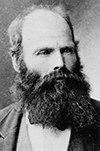
Elizabeth Mary Gladstone 1845-1926
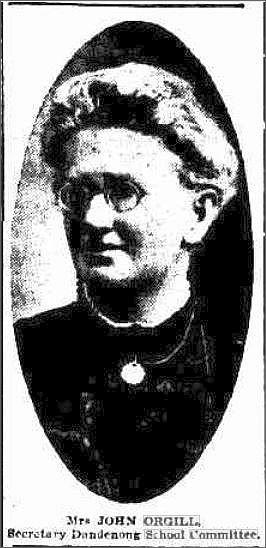
I did not think that the link to Gladstone the prime minister was true, until I found an article in the Australian newspapers while researching the family of John Orgill for the Australia chapter.
In the Letters to the Editor in The Argus, a Melbourne newspaper, dated 8 November 1921:
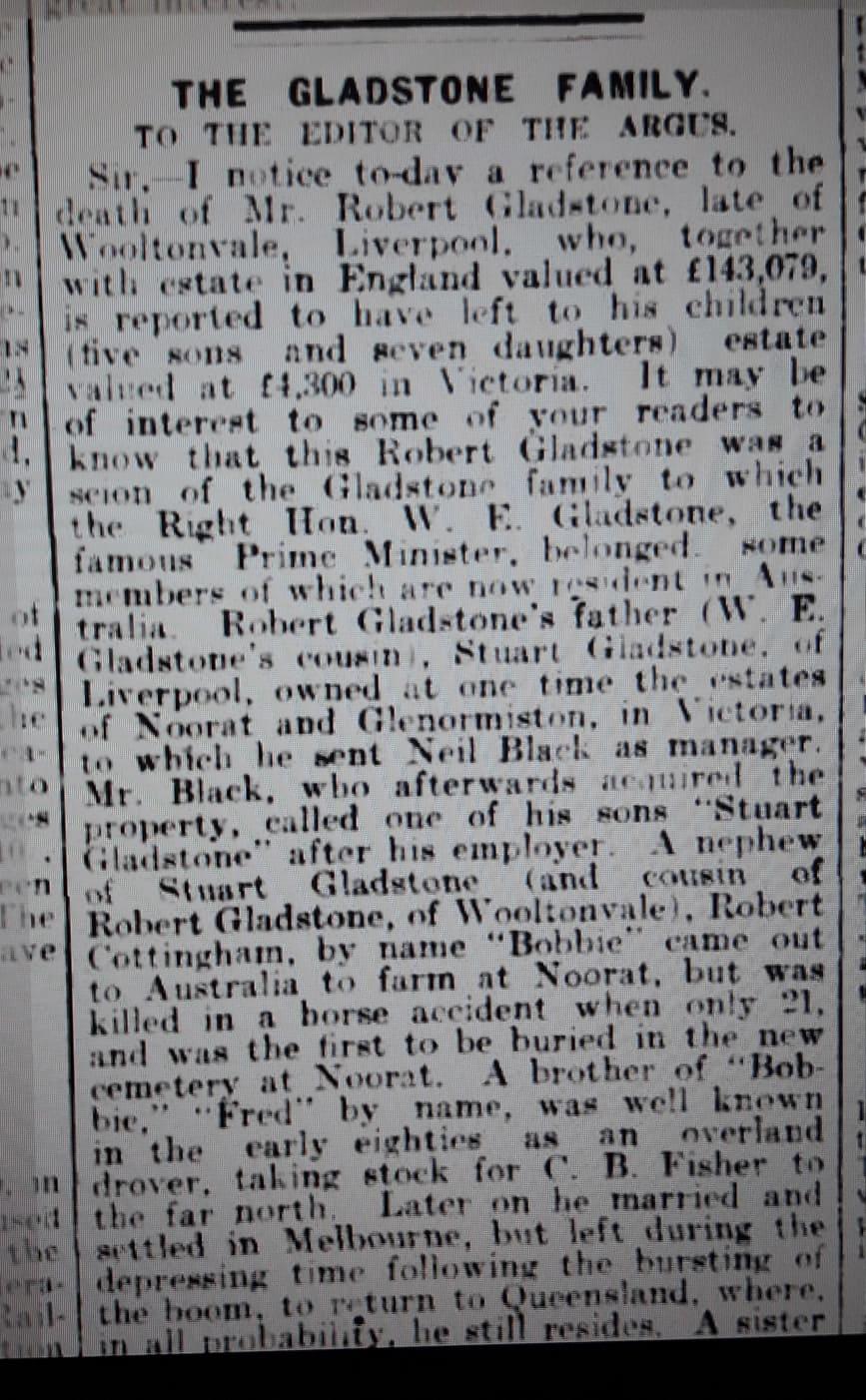
THE GLADSTONE FAMILY.
TO THE EDITOR OF THE ARGUS.
Sir,—I notice to-day a reference to the
death of Mr. Robert Gladstone, late of
Wooltonvale. Liverpool, who, together
with estate in England valued at £143,079,
is reported to have left to his children
(five sons and seven daughters) estate
valued at £4,300 in Victoria. It may be
of interest to some of your readers to
know that this Robert Gladstone was a
son of the Gladstone family to which
the Right Hon. W. E. Gladstone, the
famous Prime Minister, belonged, some
members of which are now resident in Aus-
tralia. Robert Gladstone’s father (W. E.
Gladstone’s cousin), Stuart Gladstone, of
Liverpool, owned at one time the estates
of Noorat and Glenormiston, in Victoria,
to which he sent Neil Black as manager.
Mr. Black, who afterwards acquired the
property, called one of his sons “Stuart
Gladstone” after his employer. A nephew
of Stuart Gladstone (and cousin of
Robert Gladstone, of Wooltonvale), Robert
Cottingham, by name “Bobbie” came out
to Australia to farm at Noorat, but was
killed in a horse accident when only 21,
and was the first to be buried in the new
cemetery at Noorat. A brother, of “Bob-
bie,” “Fred” by name, was well known
in the early eighties as an overland
drover, taking stock for C. B. Fisher to
the far north. Later on he married and
settled in Melbourne, but left during the
depressing time following the bursting of
the boom, to return to Queensland, where,
in all probability, he still resides. A sister
of “Bobbie” and “Fred” still lives in the
neighbourhood of Melbourne. Their
father, Montgomery Gladstone, who was in
the diplomatic service, and travelled about
a great deal, was a brother of Stuart Glad-
stone, the owner of Noorat, and a full
cousin of William Ewart Gladstone, his
father, Robert, being a brother of W. E.
Gladstone’s father, Sir John, of Liverpool.
The wife of Robert Gladstone, of Woolton-
vale, Ella Gladstone by name, was also
his second cousin, being the daughter of
Robertson Gladstone, of Courthaize, near
Liverpool, W. E. Gladstone’s older
brother.
A cousin of Sir John Gladstone
(W. E. G.’s father), also called John, was
a foundry owner in Castledouglas, and the
inventor of the first suspension bridge, a
model of which was made use of in the
erection of the Menai Bridge connecting
Anglesea with the mainland, and was after-
wards presented to the Liverpool Stock
Exchange by the inventor’s cousin, Sir
John. One of the sons of this inventive
engineer, William by name, left England
in 1863 with his wife and son and daugh-
ter, intending to settle in New Zealand,
but owing to the unrest caused there by
the Maori war, he came instead to Vic-
toria, and bought land near Dandenong.
Three years later he was killed in a horse
accident, but his name is perpetuated in
the name “Gladstone road” in Dandenong.
His daughter afterwards married, and lived
for many years in Gladstone House, Dande-
nong, but is now widowed and settled in
Gippsland. Her three sons and four daugh-
ters are all married and perpetuating the
Gladstone family in different parts of Aus-
tralia. William’s son (also called Wil-
liam), who came out with his father,
mother, and sister in 1863 still lives in the
Fix this textneighbourhood of Melbourne, with his son
and grandson. An aunt of Sir John Glad-
stone (W. E. G.’s father), Christina Glad-
stone by name, married a Mr. Somerville,
of Biggar. One of her great-grandchildren
is Professor W. P. Paterson, of Edinburgh
University, another is a professor in the
West Australian University, and a third
resides in Melbourne. Yours. &c.Melbourne, Nov.7, FAMILY TREE
According to the Old Dandenong website:
“Elizabeth Mary Orgill (nee Gladstone) operated Gladstone House until at least 1911, along with another hydropathic hospital (Birthwood) on Cheltenham road. She was the daughter of William Gladstone (Nephew of William Ewart Gladstone, UK prime minister in 1874).”
The story of the Orgill’s continues in the chapter on Australia.
January 14, 2022 at 3:06 pm #6253In reply to: The Elusive Samuel Housley and Other Family Stories
My Grandparents Kitchen
My grandmother used to have golden syrup in her larder, hanging on the white plastic coated storage rack that was screwed to the inside of the larder door. Mostly the larder door was left propped open with an old flat iron, so you could see the Heinz ketchup and home made picallilli (she made a particularly good picallili), the Worcester sauce and the jar of pickled onions, as you sat at the kitchen table.
If you were sitting to the right of the kitchen table you could see an assortment of mismatched crockery, cups and bowls, shoe cleaning brushes, and at the back, tiny tins of baked beans and big ones of plum tomatoes, and normal sized tins of vegetable and mushroom soup. Underneath the little shelves that housed the tins was a blue plastic washing up bowl with a few onions, some in, some out of the yellow string bag they came home from the expensive little village supermarket in.
There was much more to the left in the awkward triangular shape under the stairs, but you couldn’t see under there from your seat at the kitchen table. You could see the shelf above the larder door which held an ugly china teapot of graceless modern lines, gazed with metallic silver which was wearing off in places. Beside the teapot sat a serving bowl, squat and shapely with little handles, like a flattened Greek urn, in white and reddish brown with flecks of faded gilt. A plain white teapot completed the trio, a large cylindrical one with neat vertical ridges and grooves.
There were two fridges under the high shallow wooden wall cupboard. A waist high bulbous old green one with a big handle that pulled out with a clunk, and a chest high sleek white one with a small freezer at the top with a door of its own. On the top of the fridges were biscuit and cracker tins, big black keys, pencils and brittle yellow notepads, rubber bands and aspirin value packs and a bottle of Brufen. There was a battered old maroon spectacle case and a whicker letter rack, letters crammed in and fanning over the top. There was always a pile of glossy advertising pamphlets and flyers on top of the fridges, of the sort that were best put straight into the tiny pedal bin.
My grandmother never lined the pedal bin with a used plastic bag, nor with a specially designed plastic bin liner. The bin was so small that the flip top lid was often gaping, resting on a mound of cauliflower greens and soup tins. Behind the pedal bin, but on the outer aspect of the kitchen wall, was the big black dustbin with the rubbery lid. More often than not, the lid was thrust upwards. If Thursday when the dustbin men came was several days away, you’d wish you hadn’t put those newspapers in, or those old shoes! You stood in the softly drizzling rain in your slippers, the rubbery sheild of a lid in your left hand and the overflowing pedal bin in the other. The contents of the pedal bin are not going to fit into the dustbin. You sigh, put the pedal bin and the dustbin lid down, and roll up your sleeves ~ carefully, because you’ve poked your fingers into a porridge covered teabag. You grab the sides of the protruding black sack and heave. All being well, the contents should settle and you should have several inches more of plastic bag above the rim of the dustbin. Unless of course it’s a poor quality plastic bag in which case your fingernail will go through and a horizontal slash will appear just below rubbish level. Eventually you upend the pedal bin and scrape the cigarette ash covered potato peelings into the dustbin with your fingers. By now the fibres of your Shetland wool jumper are heavy with damp, just like the fuzzy split ends that curl round your pale frowning brow. You may push back your hair with your forearm causing the moisture to bead and trickle down your face, as you turn the brass doorknob with your palm and wrist, tea leaves and cigarette ash clinging unpleasantly to your fingers.
The pedal bin needs rinsing in the kitchen sink, but the sink is full of mismatched saucepans, some new in shades of harvest gold, some battered and mishapen in stainless steel and aluminium, bits of mashed potato stuck to them like concrete pebbledash. There is a pale pink octagonally ovoid shallow serving dish and a little grey soup bowl with a handle like a miniature pottery saucepan decorated with kitcheny motifs.
The water for the coffee bubbles in a suacepan on the cream enamelled gas cooker. My grandmother never used a kettle, although I do remember a heavy flame orange one. The little pan for boiling water had a lip for easy pouring and a black plastic handle.
The steam has caused the condensation on the window over the sink to race in rivulets down to the fablon coated windowsill. The yellow gingham curtains hang limply, the left one tucked behind the back of the cooker.
You put the pedal bin back it it’s place below the tea towel holder, and rinse your mucky fingers under the tap. The gas water heater on the wall above you roars into life just as you turn the tap off, and disappointed, subsides.
As you lean over to turn the cooker knob, the heat from the oven warms your arm. The gas oven was almost always on, the oven door open with clean tea towels and sometimes large white pants folded over it to air.
The oven wasn’t the only heat in my grandparents kitchen. There was an electric bar fire near the red formica table which used to burn your legs. The kitchen table was extended by means of a flap at each side. When I was small I wasn’t allowed to snap the hinge underneath shut as my grandmother had pinched the skin of her palm once.
The electric fire was plugged into the same socket as the radio. The radio took a minute or two to warm up when you switched it on, a bulky thing with sharp seventies edges and a reddish wood effect veneer and big knobs. The light for my grandfathers workshop behind the garage (where he made dentures) was plugged into the same socket, which had a big heavy white three way adaptor in. The plug for the washing machine was hooked by means of a bit of string onto a nail or hook so that it didn’t fall down behing the washing machine when it wasn’t plugged in. Everything was unplugged when it wasn’t in use. Sometimes there was a shrivelled Christmas cactus on top of the radio, but it couldn’t hide the adaptor and all those plugs.
Above the washing machine was a rhomboid wooden wall cupboard with sliding frsoted glass doors. It was painted creamy gold, the colour of a nicotine stained pub ceiling, and held packets of Paxo stuffing and little jars of Bovril and Marmite, packets of Bisto and a jar of improbably red Maraschino cherries.
The nicotine coloured cupboard on the opposite wall had half a dozen large hooks screwed under the bottom shelf. A variety of mugs and cups hung there when they weren’t in the bowl waiting to be washed up. Those cupboard doors seemed flimsy for their size, and the thin beading on the edge of one door had come unstuck at the bottom and snapped back if you caught it with your sleeve. The doors fastened with a little click in the centre, and the bottom of the door reverberated slightly as you yanked it open. There were always crumbs in the cupboard from the numerous packets of bisucits and crackers and there was always an Allbran packet with the top folded over to squeeze it onto the shelf. The sugar bowl was in there, sticky grains like sandpaper among the biscuit crumbs.
Half of one of the shelves was devoted to medicines: grave looking bottles of codeine linctus with no nonsense labels, brown glass bottles with pills for rheumatism and angina. Often you would find a large bottle, nearly full, of Brewers yeast or vitamin supplements with a dollar price tag, souvenirs of the familys last visit. Above the medicines you’d find a faded packet of Napolitana pasta bows or a dusty packet of muesli. My grandparents never used them but she left them in the cupboard. Perhaps the dollar price tags and foreign foods reminded her of her children.
If there had been a recent visit you would see monstrous jars of Sanka and Maxwell House coffee in there too, but they always used the coffee. They liked evaporated milk in their coffee, and used tins and tins of “evap” as they called it. They would pour it over tinned fruit, or rhubard crumble or stewed apples.
When there was just the two of them, or when I was there as well, they’d eat at the kitchen table. The table would be covered in a white embroidered cloth and the food served in mismatched serving dishes. The cutlery was large and bent, the knife handles in varying shades of bone. My grandfathers favourite fork had the tip of each prong bent in a different direction. He reckoned it was more efficient that way to spear his meat. He often used to chew his meat and then spit it out onto the side of his plate. Not in company, of course. I can understand why he did that, not having eaten meat myself for so long. You could chew a piece of meat for several hours and still have a stringy lump between your cheek and your teeth.
My grandfather would always have a bowl of Allbran with some Froment wheat germ for his breakfast, while reading the Daily Mail at the kitchen table. He never worse slippers, always shoes indoors, and always wore a tie. He had lots of ties but always wore a plain maroon one. His shirts were always cream and buttoned at throat and cuff, and eventually started wearing shirts without detachable collars. He wore greeny grey trousers and a cardigan of the same shade most of the time, the same colour as a damp English garden.
The same colour as the slimy green wooden clothes pegs that I threw away and replaced with mauve and fuschia pink plastic ones. “They’re a bit bright for up the garden, aren’t they,” he said. He was right. I should have ignored the green peg stains on the laundry. An English garden should be shades of moss and grassy green, rich umber soil and brick red walls weighed down with an atmosphere of dense and heavy greyish white.
After Grandma died and Mop had retired (I always called him Mop, nobody knows why) at 10:00am precisely Mop would have a cup of instant coffee with evap. At lunch, a bowl of tinned vegetable soup in his special soup bowl, and a couple of Krackawheat crackers and a lump of mature Cheddar. It was a job these days to find a tasty cheddar, he’d say.
When he was working, and he worked until well into his seventies, he took sandwiches. Every day he had the same sandwich filling: a combination of cheese, peanut butter and marmite. It was an unusal choice for an otherwise conventional man. He loved my grandmothers cooking, which wasn’t brilliant but was never awful. She was always generous with the cheese in cheese sauces and the meat in meat pies. She overcooked the cauliflower, but everyone did then. She made her gravy in the roasting pan, and made onion sauce, bread sauce, parsley sauce and chestnut stuffing. She had her own version of cosmopolitan favourites, and called her quiche a quiche when everyone was still calling it egg and bacon pie. She used to like Auntie Daphne’s ratatouille, rather exotic back then, and pronounced it Ratta Twa. She made pizza unlike any other, with shortcrust pastry smeared with tomato puree from a tube, sprinkled with oregano and great slabs of cheddar.
The roast was always overdone. “We like our meat well done” she’d say. She’d walk up the garden to get fresh mint for the mint sauce and would announce with pride “these runner beans are out of the garding”. They always grew vegetables at the top of the garden, behind the lawn and the silver birch tree. There was always a pudding: a slice of almond tart (always with home made pastry), a crumble or stewed fruit. Topped with evap, of course.
December 25, 2021 at 10:47 am #6248In reply to: The Elusive Samuel Housley and Other Family Stories
Bakewell Not Eyam
The Elton Marshalls
Some years ago I read a book about Eyam, the Derbyshire village devastated by the plague in 1665, and about how the villagers quarantined themselves to prevent further spread. It was quite a story. Each year on ‘Plague Sunday’, at the end of August, residents of Eyam mark the bubonic plague epidemic that devastated their small rural community in the years 1665–6. They wear the traditional costume of the day and attend a memorial service to remember how half the village sacrificed themselves to avoid spreading the disease further.
My 4X great grandfather James Marshall married Ann Newton in 1792 in Elton. On a number of other people’s trees on an online ancestry site, Ann Newton was from Eyam. Wouldn’t that have been interesting, to find ancestors from Eyam, perhaps going back to the days of the plague. Perhaps that is what the people who put Ann Newton’s birthplace as Eyam thought, without a proper look at the records.
But I didn’t think Ann Newton was from Eyam. I found she was from Over Haddon, near Bakewell ~ much closer to Elton than Eyam. On the marriage register, it says that James was from Elton parish, and she was from Darley parish. Her birth in 1770 says Bakewell, which was the registration district for the villages of Over Haddon and Darley. Her parents were George Newton and Dorothy Wipperley of Over Haddon,which is incidentally very near to Nether Haddon, and Haddon Hall. I visited Haddon Hall many years ago, as well as Chatsworth (and much preferred Haddon Hall).
I looked in the Eyam registers for Ann Newton, and found a couple of them around the time frame, but the men they married were not James Marshall.
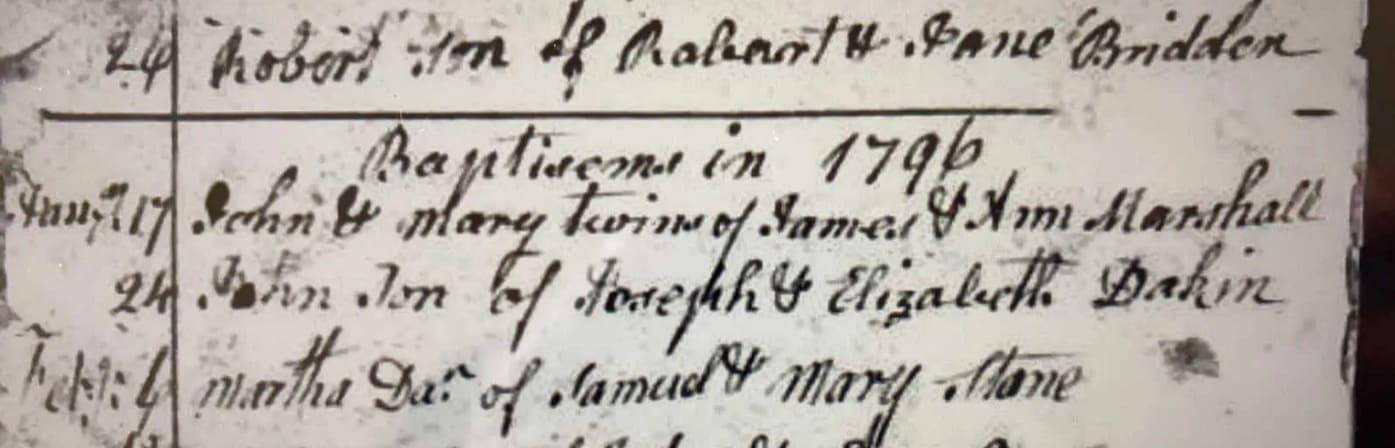
Ann died in 1806 in Elton (a small village just outside Matlock) at the age of 36 within days of her newborn twins, Ann and James. James and Ann had two sets of twins. John and Mary were twins as well, but Mary died in 1799 at the age of three.
1796 baptism of twins John and Mary of James and Ann Marshall
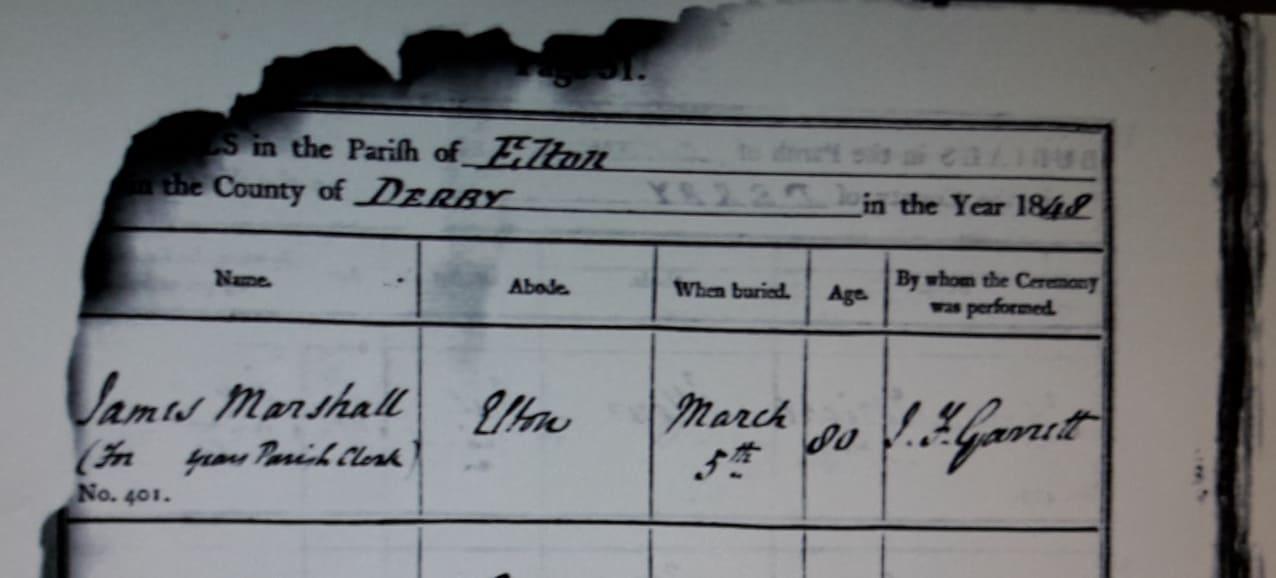
Ann’s husband James died 42 years later at the age of eighty, in Elton in 1848. It was noted in the parish register that he was for years parish clerk.
On the 1851 census John Marshall born in 1796, the son of James Marshall the parish clerk, was a lead miner occupying six acres in Elton, Derbyshire.
His son, also John, was registered on the census as a lead miner at just eight years old.
The mining of lead was the most important industry in the Peak district of Derbyshire from Roman times until the 19th century – with only agriculture being more important for the livelihood of local people. The height of lead mining in Derbyshire came in the 17th and 18th centuries, and the evidence is still visible today – most obviously in the form of lines of hillocks from the more than 25,000 mineshafts which once existed.
Peak District Mines Historical Society
Smelting, or extracting the lead from the ore by melting it, was carried out in a small open hearth. Lead was cast in layers as each batch of ore was smelted; the blocks of lead thus produced were referred to as “pigs”. Examples of early smelting-hearths found within the county were stone lined, with one side open facing the prevailing wind to create the draught needed. The hilltops of the Matlocks would have provided very suitable conditions.
The miner used a tool called a mattock or a pick, and hammers and iron wedges in harder veins, to loosen the ore. They threw the ore onto ridges on each side of the vein, going deeper where the ore proved richer.
Many mines were very shallow and, once opened, proved too poor to develop. Benjamin Bryan cited the example of “Ember Hill, on the shoulder of Masson, above Matlock Bath” where there are hollows in the surface showing where there had been fruitless searches for lead.
There were small buildings, called “coes”, near each mine shaft which were used for tool storage, to provide shelter and as places for changing into working clothes. It was here that the lead was smelted and stored until ready for sale.
Lead is, of course, very poisonous. As miners washed lead-bearing material, great care was taken with the washing vats, which had to be covered. If cattle accidentally drank the poisoned water they would die from something called “belland”.
Cornish and Welsh miners introduced the practice of buddling for ore into Derbyshire about 1747. Buddling involved washing the heaps of rubbish in the slag heaps, the process of separating the very small particles from the dirt and spar with which they are mixed, by means of a small stream of water. This method of extraction was a major pollutant, affecting farmers and their animals (poisoned by Belland from drinking the waste water), the brooks and streams and even the River Derwent.
Women also worked in the mines. An unattributed account from 1829, says: “The head is much enwrapped, and the features nearly hidden in a muffling of handkerchiefs, over which is put a man’s hat, in the manner of the paysannes of Wales”. He also describes their gowns, usually red, as being “tucked up round the waist in a sort of bag, and set off by a bright green petticoat”. They also wore a man’s grey or dark blue coat and shoes with 3″ thick soles that were tied round with cords. The 1829 writer called them “complete harridans!”
Lead Mining in Matlock & Matlock Bath, The Andrews Pages
John’s wife Margaret died at the age of 42 in 1847. I don’t know the cause of death, but perhaps it was lead poisoning. John’s son John, despite a very early start in the lead mine, became a carter and lived to the ripe old age of 88.
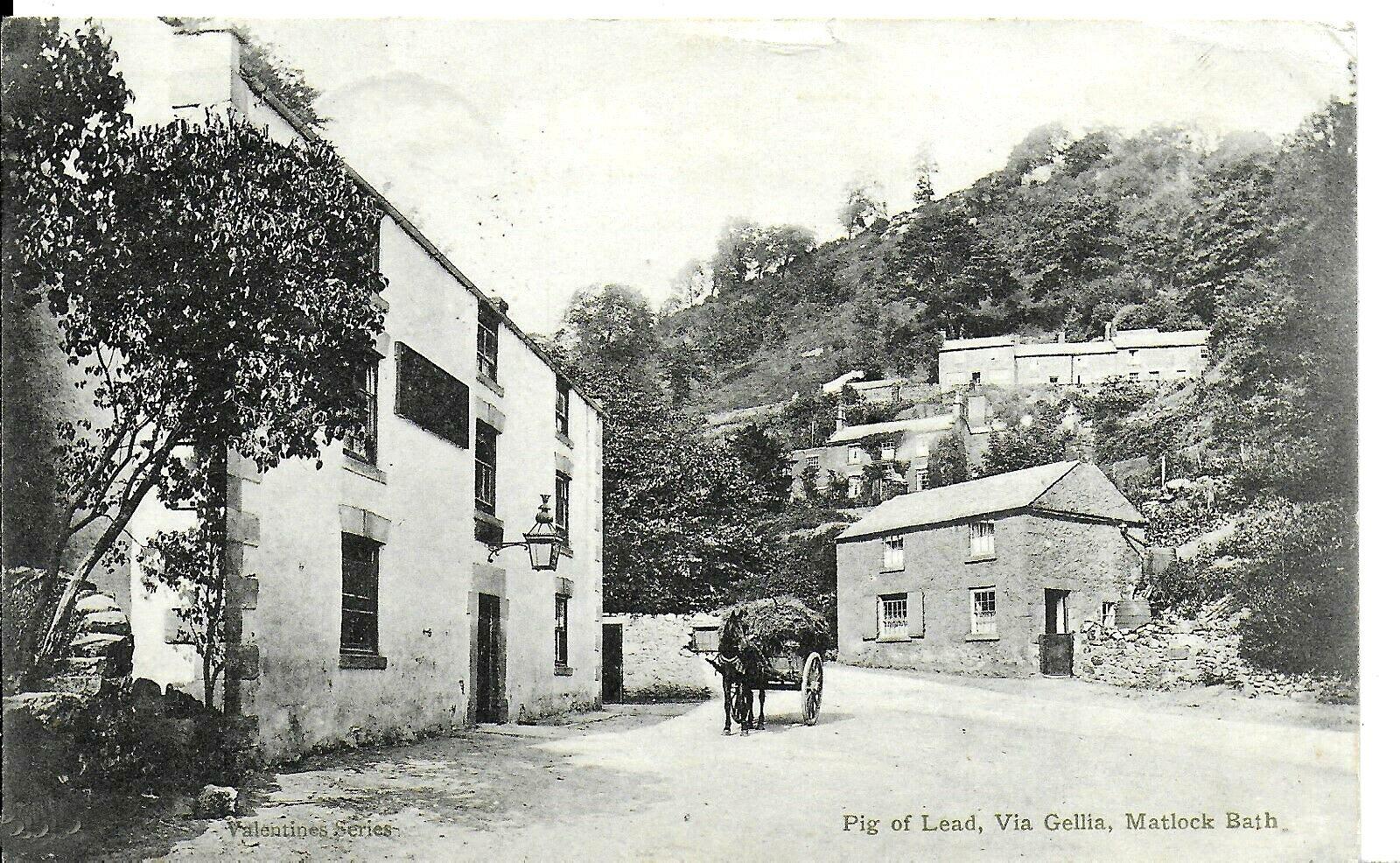
The Pig of Lead pub, 1904:
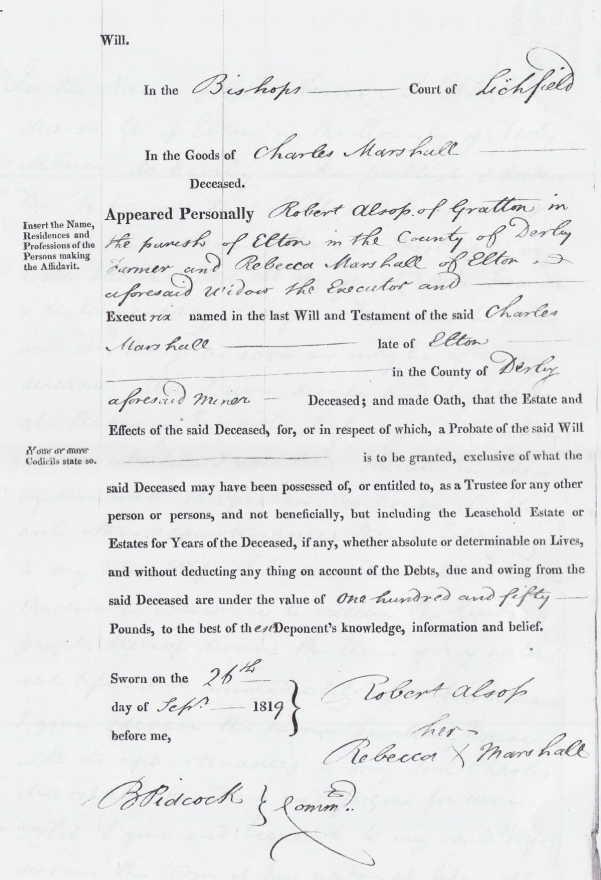
The earliest Marshall I’ve found so far is Charles, born in 1742. Charles married Rebecca Knowles, 1775-1823. I don’t know what his occupation was but when he died in 1819 he left a not inconsiderable sum to his wife.
1819 Charles Marshall probate:
There are still Marshall’s living in Elton and Matlock, not our immediate known family, but probably distantly related. I asked a Matlock group on facebook:
“…there are Marshall’s still in the village. There are certainly families who live here who have done generation after generation & have many memories & stories to tell. Visit The Duke on a Friday night…”
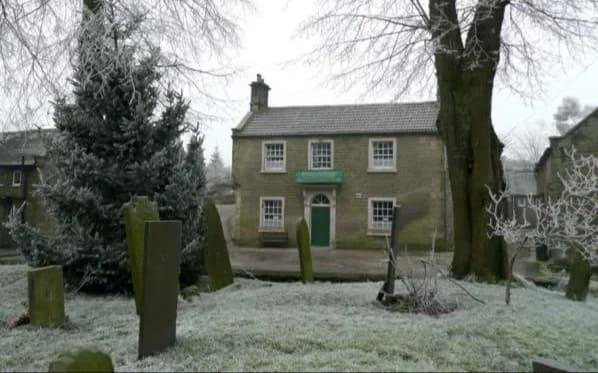
The Duke, Elton:
 December 18, 2021 at 12:59 pm #6243
In reply to: The Elusive Samuel Housley and Other Family Stories
William Housley’s Will and the Court Case
William Housley died in 1848, but his widow Ellen didn’t die until 1872. The court case was in 1873. Details about the court case are archived at the National Archives at Kew, in London, but are not available online. They can be viewed in person, but that hasn’t been possible thus far. However, there are a great many references to it in the letters.
William Housley’s first wife was Mary Carrington 1787-1813. They had three children, Mary Anne, Elizabeth and William. When Mary died, William married Mary’s sister Ellen, not in their own parish church at Smalley but in Ashbourne. Although not uncommon for a widower to marry a deceased wife’s sister, it wasn’t legal. This point is mentioned in one of the letters.
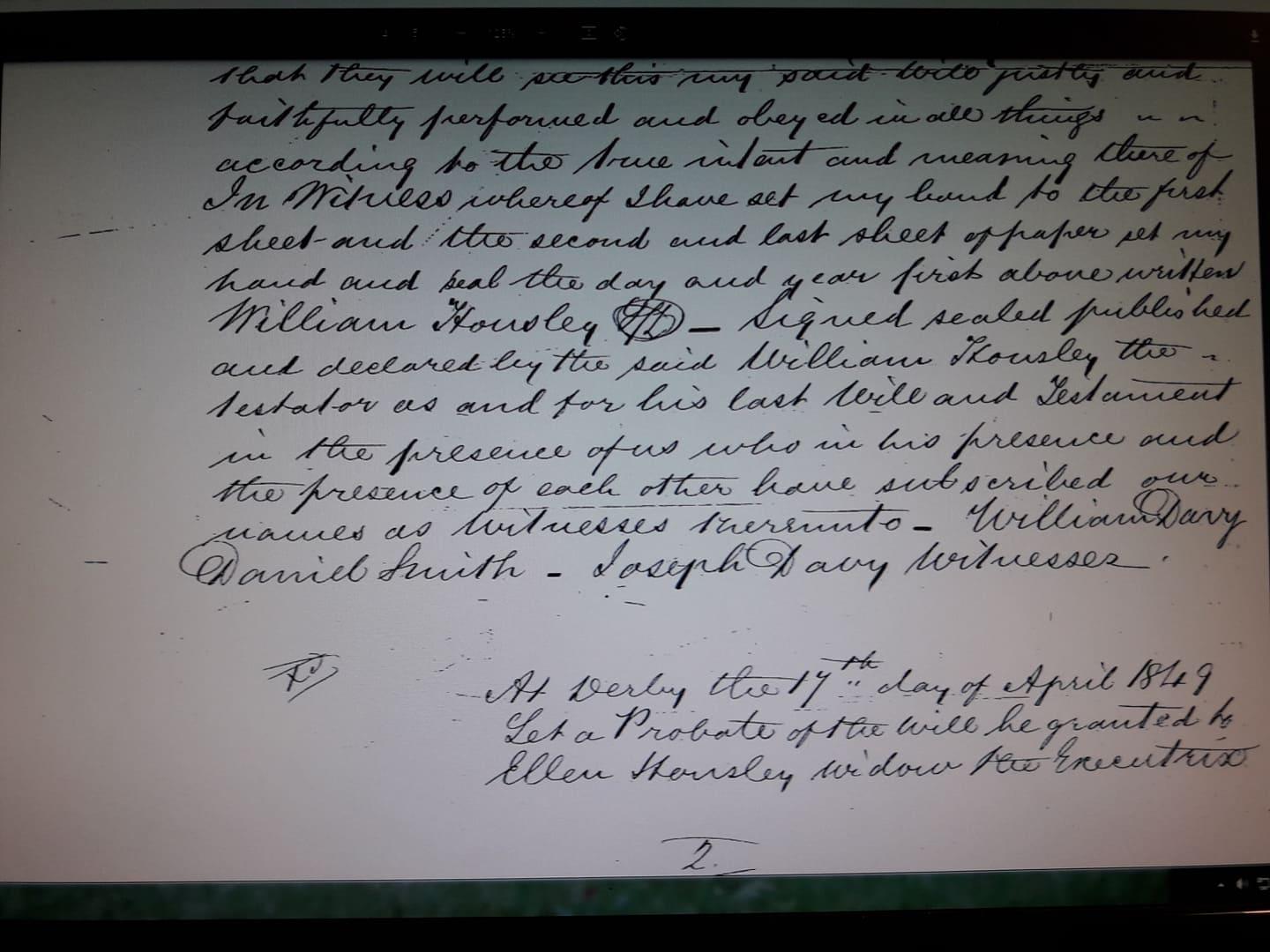
One of the pages of William Housley’s will:
An excerpt from Barbara Housley’s Narrative on the Letters:
A comment in a letter from Joseph (August 6, 1873) indicated that William was married twice and that his wives were sisters: “What do you think that I believe that Mary Ann is trying to make our father’s will of no account as she says that my father’s marriage with our mother was not lawful he marrying two sisters. What do you think of her? I have heard my mother say something about paying a fine at the time of the marriage to make it legal.” Markwell and Saul in The A-Z Guide to Tracing Ancestors in Britain explain that marriage to a deceased wife’s sister was not permissible under Canon law as the relationship was within the prohibited degrees. However, such marriages did take place–usually well away from the couple’s home area. Up to 1835 such marriages were not void but were voidable by legal action. Few such actions were instituted but the risk was always there.
Joseph wrote that when Emma was married, Ellen “broke up the comfortable home and the things went to Derby and she went to live with them but Derby didn’t agree with her so she left again leaving her things behind and came to live with John in the new house where she died.” Ellen was listed with John’s household in the 1871 census.
In May 1872, the Ilkeston Pioneer carried this notice: “Mr. Hopkins will sell by auction on Saturday next the eleventh of May 1872 the whole of the useful furniture, sewing machine, etc. nearly new on the premises of the late Mrs. Housley at Smalley near Heanor in the county of Derby. Sale at one o’clock in the afternoon.”There were hard feelings between Mary Ann and Ellen and her children. Anne wrote: “If you remember we were not very friendly when you left. They never came and nothing was too bad for Mary Ann to say of Mother and me, but when Robert died Mother sent for her to the funeral but she did not think well to come so we took no more notice. She would not allow her children to come either.”
Mary Ann was still living in May 1872. Joseph implied that she and her brother, Will “intend making a bit of bother about the settlement of the bit of property” left by their mother. The 1871 census listed Mary Ann’s occupation as “income from houses.”In July 1872, Joseph introduced Ruth’s husband: “No doubt he is a bad lot. He is one of the Heath’s of Stanley Common a miller and he lives at Smalley Mill” (Ruth Heath was Mary Anne Housley’s daughter)
In 1873 Joseph wrote, “He is nothing but a land shark both Heath and his wife and his wife is the worst of the two. You will think these is hard words but they are true dear brother.” The solicitor, Abraham John Flint, was not at all pleased with Heath’s obstruction of the settlement of the estate. He wrote on June 30, 1873: “Heath agreed at first and then because I would not pay his expenses he refused and has since instructed another solicitor for his wife and Mrs. Weston who have been opposing us to the utmost. I am concerned for all parties interested except these two….The judge severely censured Heath for his conduct and wanted to make an order for sale there and then but Heath’s council would not consent….” In June 1875, the solicitor wrote: “Heath bid for the property but it fetched more money than he could give for it. He has been rather quieter lately.”In May 1872, Joseph wrote: “For what do you think, John has sold his share and he has acted very bad since his wife died and at the same time he sold all his furniture. You may guess I have never seen him but once since poor mother’s funeral and he is gone now no one knows where.”
In 1876, the solicitor wrote to George: “Have you heard of John Housley? He is entitled to Robert’s share and I want him to claim it.”
Anne intended that one third of the inheritance coming to her from her father and her grandfather, William Carrington, be divided between her four nieces: Sam’s three daughters and John’s daughter Elizabeth.
In the same letter (December 15, 1872), Joseph wrote:
“I think we have now found all out now that is concerned in the matter for there was only Sam that we did not know his whereabouts but I was informed a week ago that he is dead–died about three years ago in Birmingham Union. Poor Sam. He ought to have come to a better end than that”However, Samuel was still alive was on the 1871 census in Henley in Arden, and no record of his death can be found. Samuel’s brother in law said he was dead: we do not know why he lied, or perhaps the brothers were lying to keep his share, or another possibility is that Samuel himself told his brother in law to tell them that he was dead. I am inclined to think it was the latter.
Excerpts from Barbara Housley’s Narrative on the Letters continued:
Charles went to Australia in 1851, and was last heard from in January 1853. According to the solicitor, who wrote to George on June 3, 1874, Charles had received advances on the settlement of their parent’s estate. “Your promissory note with the two signed by your brother Charles for 20 pounds he received from his father and 20 pounds he received from his mother are now in the possession of the court.”
In December 1872, Joseph wrote: “I’m told that Charles two daughters has wrote to Smalley post office making inquiries about his share….” In January 1876, the solicitor wrote: “Charles Housley’s children have claimed their father’s share.”
In the Adelaide Observer 28 Aug 1875
HOUSLEY – wanted information
as to the Death, Will, or Intestacy, and
Children of Charles Housley, formerly of
Smalley, Derbyshire, England, who died at
Geelong or Creewick Creek Diggings, Victoria
August, 1855. His children will hear of something to their advantage by communicating with
Mr. A J. Flint, solicitor, Derby, England.
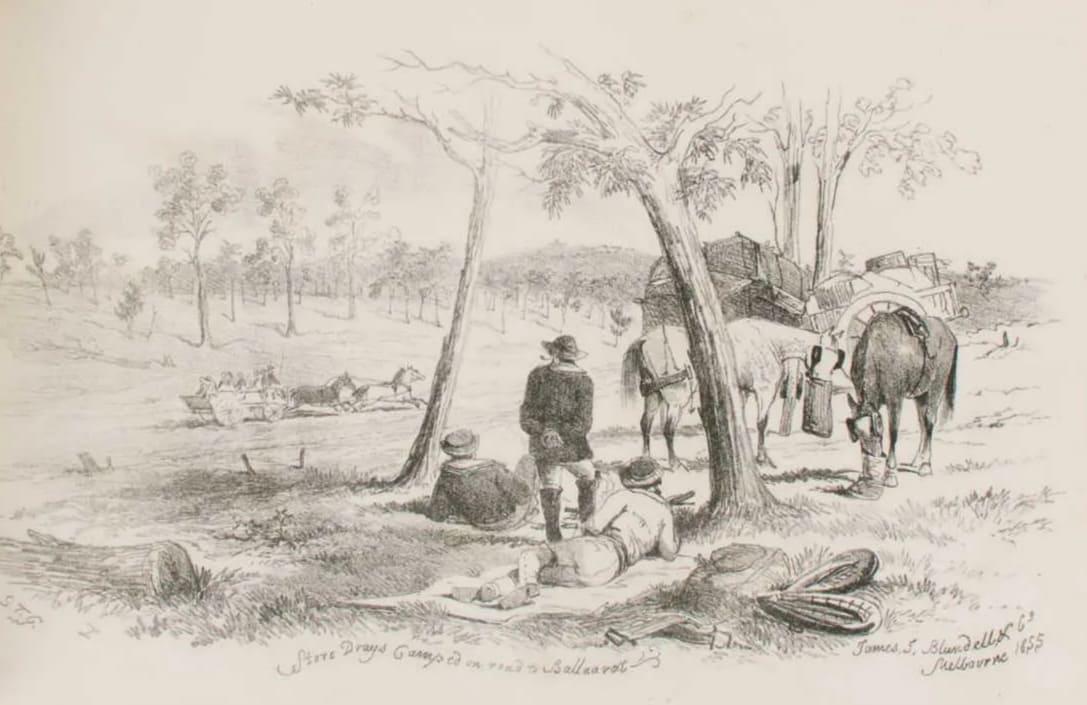
June 16,1875.The Diggers & Diggings of Victoria in 1855. Drawn on Stone by S.T. Gill:
The court case:
Kerry v Housley.
Documents: Bill, demurrer.
Plaintiffs: Samuel Kerry and Joseph Housley.
Defendants: William Housley, Joseph Housley (deleted), Edwin Welch Harvey, Eleanor Harvey (deleted), Ernest Harvey infant, William Stafford, Elizabeth Stafford his wife, Mary Ann Housley, George Purdy and Catherine Purdy his wife, Elizabeth Housley, Mary Ann Weston widow and William Heath and Ruth Heath his wife (deleted).
Provincial solicitor employed in Derbyshire.
Date: 1873From the Narrative on the Letters:
The solicitor wrote on May 23, 1874: “Lately I have not written because I was not certain of your address and because I doubted I had much interesting news to tell you.” Later, Joseph wrote concerning the problems settling the estate, “You see dear brother there is only me here on our side and I cannot do much. I wish you were here to help me a bit and if you think of going for another summer trip this turn you might as well run over here.”
In March 1873, Joseph wrote: “You ask me what I think of you coming to England. I think as you have given the trustee power to sign for you I think you could do no good but I should like to see you once again for all that. I can’t say whether there would be anything amiss if you did come as you say it would be throwing good money after bad.”
In September 1872 Joseph wrote; “My wife is anxious to come. I hope it will suit her health for she is not over strong.” Elsewhere Joseph wrote that Harriet was “middling sometimes. She is subject to sick headaches. It knocks her up completely when they come on.” In December 1872 Joseph wrote, “Now dear brother about us coming to America you know we shall have to wait until this affair is settled and if it is not settled and thrown into Chancery I’m afraid we shall have to stay in England for I shall never be able to save money enough to bring me out and my family but I hope of better things.”
On July 19, 1875 Abraham Flint (the solicitor) wrote: “Joseph Housley has removed from Smalley and is working on some new foundry buildings at Little Chester near Derby. He lives at a village called Little Eaton near Derby. If you address your letter to him as Joseph Housley, carpenter, Little Eaton near Derby that will no doubt find him.”In his last letter (February 11, 1874), Joseph sounded very discouraged and wrote that Harriet’s parents were very poorly and both had been “in bed for a long time.” In addition, Harriet and the children had been ill.
The move to Little Eaton may indicate that Joseph received his settlement because in August, 1873, he wrote: “I think this is bad news enough and bad luck too, but I have had little else since I came to live at Kiddsley cottages but perhaps it is all for the best if one could only think so. I have begun to think there will be no chance for us coming over to you for I am afraid there will not be so much left as will bring us out without it is settled very shortly but I don’t intend leaving this house until it is settled either one way or the other. ”Joseph’s letters were much concerned with the settling of their mother’s estate. In 1854, Anne wrote, “As for my mother coming (to America) I think not at all likely. She is tied here with her property.” A solicitor, Abraham John Flint of 42 Full Street Derby, was engaged by John following the death of their mother. On June 30, 1873 the solicitor wrote: “Dear sir, On the death of your mother I was consulted by your brother John. I acted for him with reference to the sale and division of your father’s property at Smalley. Mr. Kerry was very unwilling to act as trustee being over 73 years of age but owing to the will being a badly drawn one we could not appoint another trustee in his place nor could the property be sold without a decree of chancery. Therefore Mr. Kerry consented and after a great deal of trouble with Heath who has opposed us all throughout whenever matters did not suit him, we found the title deeds and offered the property for sale by public auction on the 15th of July last. Heath could not find his purchase money without mortaging his property the solicitor which the mortgagee employed refused to accept Mr. Kerry’s title and owing to another defect in the will we could not compel them.”
In July 1872, Joseph wrote, “I do not know whether you can remember who the trustee was to my father’s will. It was Thomas Watson and Samuel Kerry of Smalley Green. Mr. Watson is dead (died a fortnight before mother) so Mr. Kerry has had to manage the affair.”
On Dec. 15, 1972, Joseph wrote, “Now about this property affair. It seems as far off of being settled as ever it was….” and in the following March wrote: “I think we are as far off as ever and farther I think.”
Concerning the property which was auctioned on July 15, 1872 and brought 700 pounds, Joseph wrote: “It was sold in five lots for building land and this man Heath bought up four lots–that is the big house, the croft and the cottages. The croft was made into two lots besides the piece belonging to the big house and the cottages and gardens was another lot and the little intake was another. William Richardson bought that.” Elsewhere Richardson’s purchase was described as “the little croft against Smith’s lane.” Smith’s Lane was probably named for their neighbor Daniel Smith, Mrs. Davy’s father.
But in December 1872, Joseph wrote that they had not received any money because “Mr. Heath is raising all kinds of objections to the will–something being worded wrong in the will.” In March 1873, Joseph “clarified” matters in this way: “His objection was that one trustee could not convey the property that his signature was not guarantee sufficient as it states in the will that both trustees has to sign the conveyance hence this bother.”
Joseph indicated that six shares were to come out of the 700 pounds besides Will’s 20 pounds. Children were to come in for the parents shares if dead. The solicitor wrote in 1873, “This of course refers to the Kidsley property in which you take a one seventh share and which if the property sells well may realize you about 60-80 pounds.” In March 1873 Joseph wrote: “You have an equal share with the rest in both lots of property, but I am afraid there will be but very little for any of us.”The other “lot of property” was “property in Smalley left under another will.” On July 17, 1872, Joseph wrote: “It was left by my grandfather Carrington and Uncle Richard is trustee. He seems very backward in bringing the property to a sale but I saw him and told him that I for one expect him to proceed with it.” George seemed to have difficulty understanding that there were two pieces of property so Joseph explained further: “It was left by my grandfather Carrington not by our father and Uncle Richard is the trustee for it but the will does not give him power to sell without the signatures of the parties concerned.” In June 1873 the solicitor Abraham John Flint asked: “Nothing has been done about the other property at Smalley at present. It wants attention and the other parties have asked me to attend to it. Do you authorize me to see to it for you as well?”
After Ellen’s death, the rent was divided between Joseph, Will, Mary Ann and Mr. Heath who bought John’s share and was married to Mary Ann’s daughter, Ruth. Joseph said that Mr. Heath paid 40 pounds for John’s share and that John had drawn 110 pounds in advance. The solicitor said Heath said he paid 60. The solicitor said that Heath was trying to buy the shares of those at home to get control of the property and would have defied the absent ones to get anything.
In September 1872 Joseph wrote that the lawyer said the trustee cannot sell the property at the bottom of Smalley without the signatures of all parties concerned in it and it will have to go through chancery court which will be a great expense. He advised Joseph to sell his share and Joseph advised George to do the same.George sent a “portrait” so that it could be established that it was really him–still living and due a share. Joseph wrote (July 1872): “the trustee was quite willing to (acknowledge you) for the portrait I think is a very good one.” Several letters later in response to an inquiry from George, Joseph wrote: “The trustee recognized you in a minute…I have not shown it to Mary Ann for we are not on good terms….Parties that I have shown it to own you again but they say it is a deal like John. It is something like him, but I think is more like myself.”
In September 1872 Joseph wrote that the lawyer required all of their ages and they would have to pay “succession duty”. Joseph requested that George send a list of birth dates.On May 23, 1874, the solicitor wrote: “I have been offered 240 pounds for the three cottages and the little house. They sold for 200 pounds at the last sale and then I was offered 700 pounds for the whole lot except Richardson’s Heanor piece for which he is still willing to give 58 pounds. Thus you see that the value of the estate has very materially increased since the last sale so that this delay has been beneficial to your interests than other-wise. Coal has become much dearer and they suppose there is coal under this estate. There are many enquiries about it and I believe it will realize 800 pounds or more which increase will more than cover all expenses.” Eventually the solicitor wrote that the property had been sold for 916 pounds and George would take a one-ninth share.
January 14, 1876: “I am very sorry to hear of your lameness and illness but I trust that you are now better. This matter as I informed you had to stand over until December since when all the costs and expenses have been taxed and passed by the court and I am expecting to receive the order for these this next week, then we have to pay the legacy duty and them divide the residue which I doubt won’t come to very much amongst so many of you. But you will hear from me towards the end of the month or early next month when I shall have to send you the papers to sign for your share. I can’t tell you how much it will be at present as I shall have to deduct your share with the others of the first sale made of the property before it went to court.
Wishing you a Happy New Year, I am Dear Sir, Yours truly
Abram J. Flint”September 15, 1876 (the last letter)
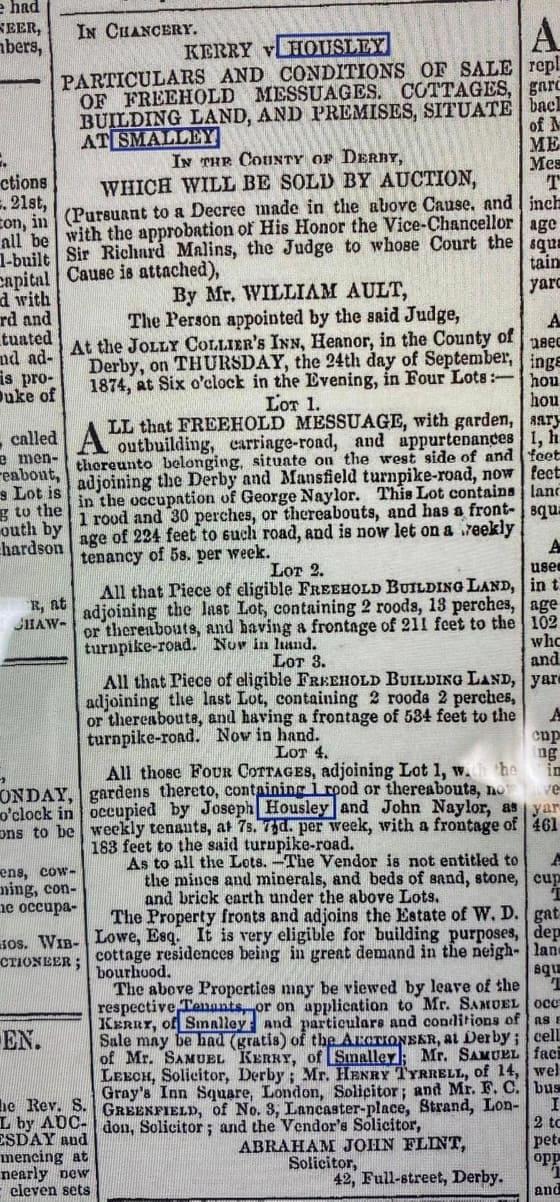
“I duly received your power of attorney which appears to have been properly executed on Thursday last and I sent it on to my London agent, Mr. Henry Lyvell, who happens just now to be away for his annual vacation and will not return for 14 or 20 days and as his signature is required by the Paymaster General before he will pay out your share, it must consequently stand over and await his return home. It shall however receive immediate attention as soon as he returns and I hope to be able to send your checque for the balance very shortly.”1874 in chancery:
 December 17, 2021 at 10:36 am #6241
In reply to: The Elusive Samuel Housley and Other Family Stories
Kidsley Grange Farm and The Quakers Next Door
Kidsley Grange Farm in Smalley, Derbyshire, was the home of the Housleys in the 1800s. William Housley 1781-1848 was born in nearby Selston. His wife Ellen Carrington 1795-1872 was from a long line of Carringtons in Smalley. They had ten children between 1815 and 1838. Samuel, my 3x great grandfather, was the second son born in 1816.
The original farm has been made into a nursing home in recent years, which at the time of writing is up for sale at £500,000. Sadly none of the original farm appears visible with all the new additions.
The farm before it was turned into a nursing home:
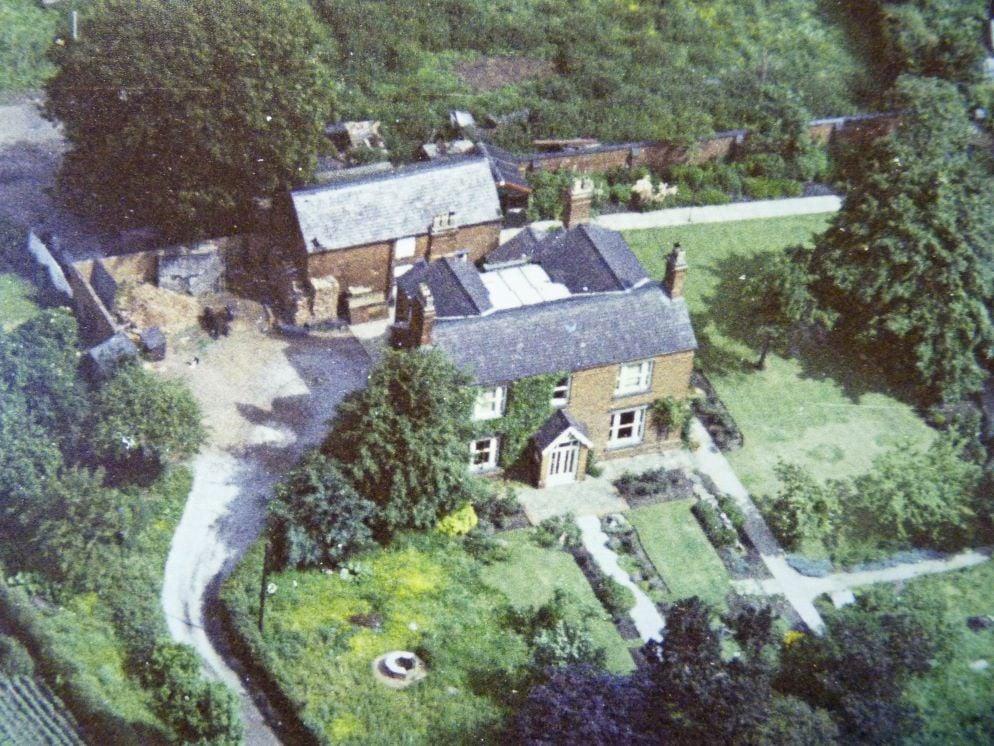
Kidsley Grange Farm and Kidsley Park, a neighbouring farm, are mentioned in a little book about the history of Smalley. The neighbours at Kidsley Park, the Davy’s, were friends of the Housleys. They were Quakers.
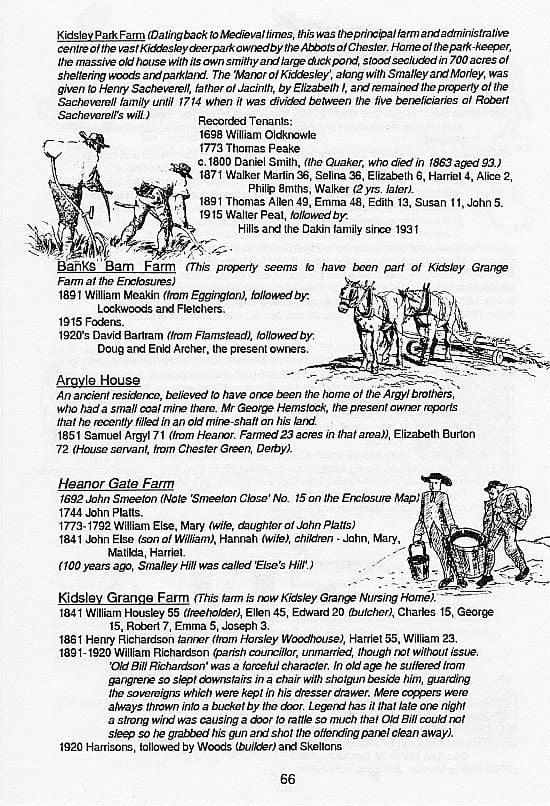
In Kerry’s History of Smalley:
Kidsley Park Farm was owned by Daniel Smith, a prominent Quaker and the last of the Quakers at Kidsley. His daughter, Elizabeth Davy, widow of William Davis, married WH Barber MB of Smalley. Elizabeth was the author of the poem “Farewell to Kidsley Park”.
Emma Housley sent one of Elizabeth Davy’s poems to her brother George in USA.
“We have sent you a piece of poetry that Mrs. Davy composed about our ‘Old House.’ I am sure you will like it though you may not understand all the allusions she makes use of as well as we do.”
Farewell to Kidsley Park
Farewell, Farewell, Thy pathways now by strangers feet are trod,
And other hands and horses strange henceforth shall turn thy sod,
Yes, other eyes may watch the buds expanding in the spring.
And other children round the hearth the coming years may bring,
But mine will be the memory of cares and pleasures there,
Intenser ~ that no living thing in some of them can share,
Commencing with the loved, and lost, in days of long ago,
When one was present on whose head Atlantic’s breezes blow,
Long years ago he left that roof, and made a home afar ~
For that is really only “home” where life’s affections are!
How many thoughts come o’er me, for old Kidsley has “a name
And memory” ~ in the hearts of some not unknown to fame.
We dream not, in those happy times, that I should be the last,
Alone, to leave my native place ~ alone, to meet the blast,
I loved each nook and corner there, each leaf and blade of grass,
Each moonlight shadow on the pond I loved: but let it pass,
For mine is still the memory that only death can mar;
I fancy I shall see it reflecting every star.
The graves of buried quadrupeds, affectionate and true,
Will have the olden sunshine, and the same bright morning dew,
But the birds that sang at even when the autumn leaves were seer,
Will miss the crumbs they used to get, in winters long and drear.
Will the poor down-trodden miss me? God help them if they do!
Some manna in the wilderness, His goodness guide them to!
Farewell to those who love me! I shall bear them still in mind,
And hope to be remembered by those I left behind:
Do not forget the aged man ~ though another fills his place ~
Another, bearing not his name, nor coming of his race.
His creed might be peculiar; but there was much of good
Successors will not imitate, because not understood.
Two hundred years have come and past since George Fox ~ first of “Friends” ~
Established his religion there ~ which my departure ends.
Then be it so: God prosper these in basket and in store,
And make them happy in my place ~ my dwelling, never more!
For I may be a wanderer ~ no roof nor hearthstone mine:
May light that cometh from above my resting place define.
Gloom hovers o’er the prospect now, but He who was my friend,
In the midst of troubled waters, will see me to the end.Elizabeth Davy, June 6th, 1863, Derby.
Another excerpt from Barbara Housley’s Narrative on the Letters from the family in Smalley to George in USA mentions the Davy’s:
Anne’s will was probated October 14, 1856. Mr. William Davy of Kidsley Park appeared for the family. Her estate was valued at under £20. Emma was to receive fancy needlework, a four post bedstead, feather bed and bedding, a mahogany chest of drawers, plates, linen and china. Emma was also to receive Anne’s writing desk! There was a condition that Ellen would have use of these items until her death.
The money that Anne was to receive from her grandfather, William Carrington, and her father, William Housley was to be distributed one third to Joseph, one third to Emma, and one third to be divided between her four neices: John’s daughter Elizabeth, 18, and Sam’s daughters Elizabeth, 10, Mary Anne, 9 and Catherine, age 7 to be paid by the trustees as they think “most useful and proper.” Emma Lyon and Elizabeth Davy were the witnesses.Mrs. Davy wrote to George on March 21 1856 sending some gifts from his sisters and a portrait of their mother–“Emma is away yet and A is so much worse.” Mrs. Davy concluded: “With best wishes
for thy health and prosperity in this world and the next I am thy sincere friend.” Whenever the girls sent greetings from Mrs. Davy they used her Quaker speech pattern of “thee and thy.”December 15, 2021 at 9:09 pm #6239In reply to: The Elusive Samuel Housley and Other Family Stories
The Photographer
Dorothy Mary Marshall
1907 – 1983
Without doubt we have Dorothy Tooby to thank for the abundance of priceless photographs of the Marshall family.
Dorothy Tooby with her father William Marshall, photo by Charles Tooby:
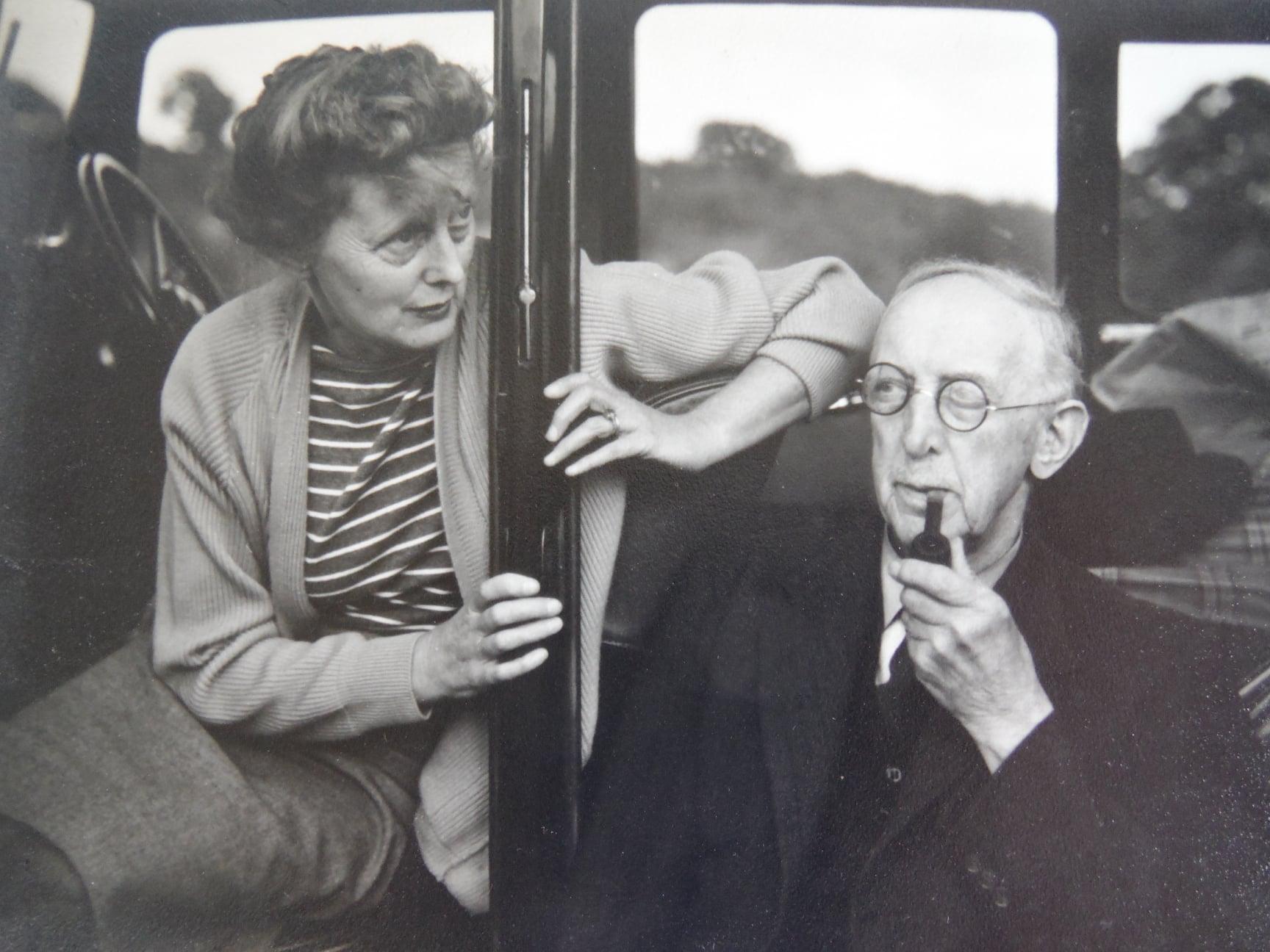
Dorothy Marshall was born in 1907 in Ashby de la Zouch, Leicestershire. She married Charles Tooby in 1932. They had no children, and they both had a lifelong interest in photography. Dorothy won many prizes and some of her work is in the Birmingham Archives. I recall her saying once that men didn’t like it when a woman won the prize, although I don’t think she was referring to Charles! They always seemed to be a very close couple.
Dorothy in a 1934 Jaguar SS1. The company was originally known as Swallow Sidecar Company, became SS Cars Ltd in 1934, and Jaguar Cars Ltd in 1945. This car is mentioned in a James Bond book by Ian Fleming.
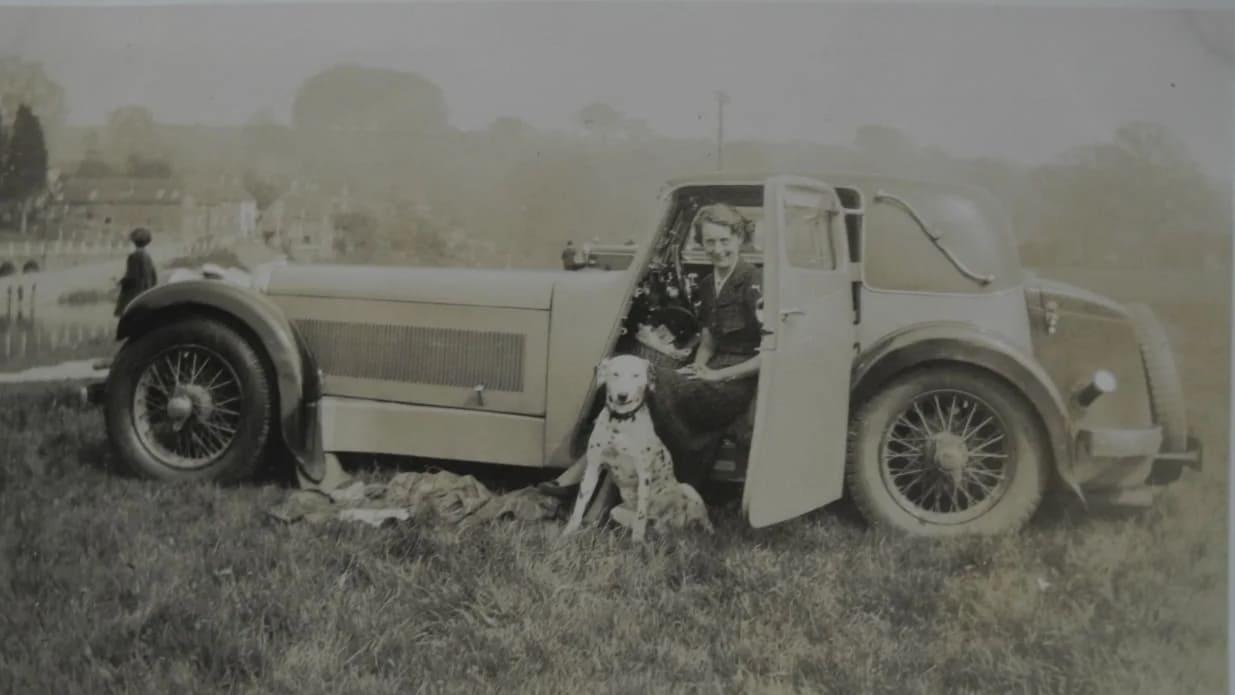
When I was aged four or so, Dorothy and Charles lived next door to us on High Park Avenue in Wollaston. Dorothy and Charles spent a lot of time with Dorothy’s brother Geoff’s five sons when they were children. And of course, they took many photographs of them.
Bryan, Geoff Marshall, Chris, John, Bobby in the middle, and Jimmy at the front.
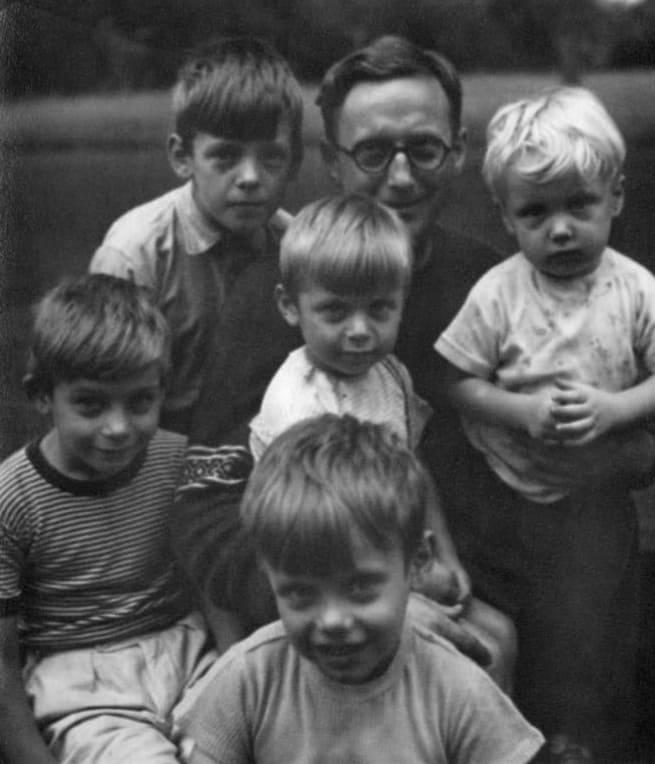
Bobby, photo by Dorothy Tooby
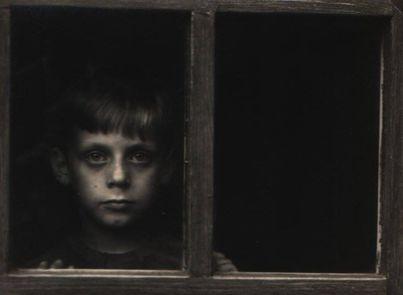
Bobby was one of Geoff and Mary’s sons. He was also my first husband, my mothers cousin. He was born in 1954 and died in 2021, not long after I’d resumed contact with his brother Bryan, who emigrated to USA in the 1970’s.
December 15, 2021 at 3:37 pm #6238In reply to: The Elusive Samuel Housley and Other Family Stories
Ellen (Nellie) Purdy
My grandfathers aunt Nellie Purdy 1872-1947 grew up with his mother Mary Ann at the Gilmans in Buxton. We knew she was a nurse or a matron, and that she made a number of trips to USA.
I started looking for passenger lists and immigration lists (we had already found some of them, and my cousin Linda Marshall in Boston found some of them), and found one in 1904 with details of the “relatives address while in US”.
October 31st, 1904, Ellen Purdy sailed from Liverpool to Baltimore on the Friesland. She was a 32 year old nurse and she paid for her own ticket. The address of relatives in USA was Druid Hill and Lafayette Ave, Baltimore, Maryland.
I wondered if she stayed with relatives, perhaps they were the Housley descendants. It was her great uncle George Housley who emigrated in 1851, not so far away in Pennsylvania. I wanted to check the Baltimore census to find out the names at that address, in case they were Housley’s. So I joined a Baltimore History group on facebook, and asked how I might find out. The people were so enormously helpful! The address was the Home of the Friendless, an orphanage. (a historic landmark of some note I think), and someone even found Ellen Purdy listed in the Baltimore directory as a nurse there.
She sailed back to England in 1913. Ellen sailed in 1900 and 1920 as well but I haven’t unraveled those trips yet.
THE HOME OF THE FRIENDLESS, is situated at the corner of Lafayette and Druid Hill avenues, Baltimore. It is a large brick building, which was erected at a cost of $62,000. It was organized in 1854.The chief aim of the founders of this institution was to respond to a need for providing a home for the friendless and homeless children, orphans, and half-orphans, or the offspring of vagrants. It has been managed since its organization by a board of ladies, who, by close attention and efficient management, have made the institution one of the most prominent charitable institutions in the State. From its opening to the present time there have been received 5,000 children, and homes have been secured for nearly one thousand of this number. The institution has a capacity of about 200 inmates. The present number of beneficiaries is 165. A kindergarten and other educational facilities are successfully conducted. The home knows no demonimational creed, being non-sectarian. Its principal source of revenue is derived from private contributions. For many years the State has appropriated different sums towards it maintenance, and the General Assembly of 1892 contributed the sum of $3,000 per annum.
A later trip: The ship’s manifest from May 1920 the Baltic lists Ellen on board arriving in Ellis Island heading to Baltimore age 48. The next of kin is listed as George Purdy (her father) of 2 Gregory Blvd Forest Side, Nottingham. She’s listed as a nurse, and sailed from Liverpool May 8 1920.
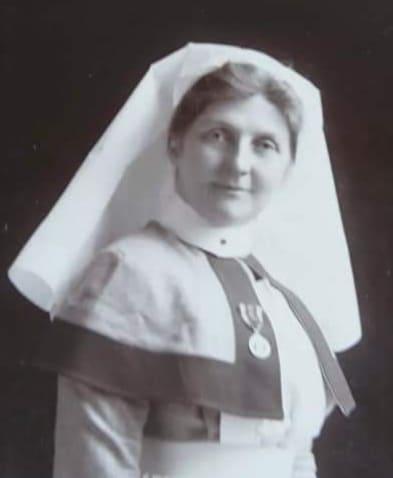
Ellen eventually retired in England and married Frank Garbett, a tax collector, at the age of 51 in Herefordshire. Judging from the number of newspaper articles I found about her, she was an active member of the community and was involved in many fundraising activities for the local cottage hospital.
Her obituary in THE KINGTON TIMES, NOVEMBER 8, 1947:
Mrs. Ellen Garbett wife of Mr. F. Garbett, of Brook Cottage, Kingsland, whose funeral took place at St. Michael’s Church, Kingsland, on October 30th, was a familiar figure in the district, and by her genial manner and kindly ways had endeared herself to many.
Mrs Garbett had had a wide experience in the nursing profession. Beginning her training in this country, she went to the Italian Riviera and there continued her work, later going to the United States. In 1916 she gained the Q.A.I.M.N.S. and returned to England and was appointed sister at the Lord Derby Military Hospital, an appointment she held for four years.We didn’t know that Ellen had worked on the Italian Riviera, and hope in due course to find out more about it.
Mike Rushby, Ellen’s sister Kate’s grandson in Australia, spoke to his sister in USA recently about Nellie Purdy. She replied: I told you I remembered Auntie Nellie coming to Jacksdale. She gave me a small green leatherette covered bible which I still have ( though in a very battered condition). Here is a picture of it.
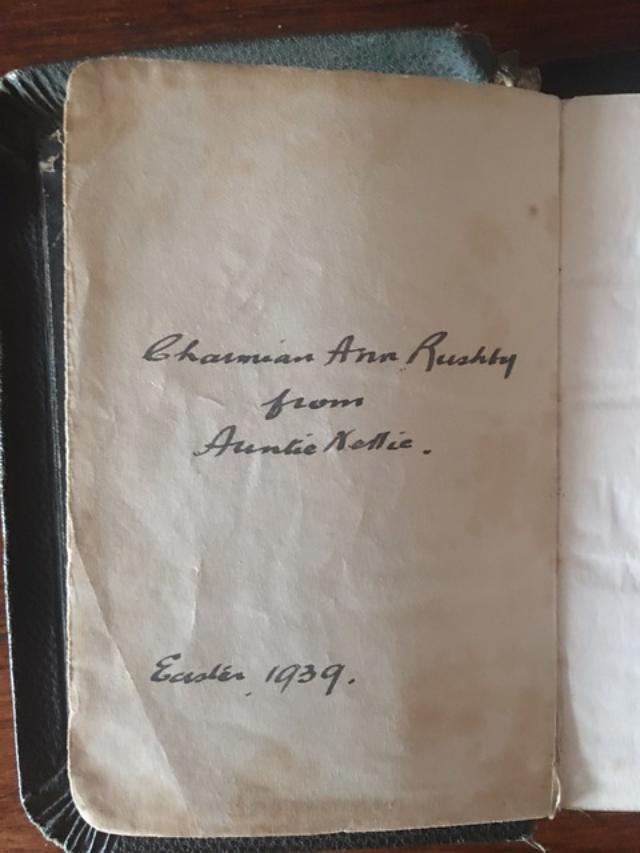 December 15, 2021 at 1:16 pm #6237
In reply to: The Elusive Samuel Housley and Other Family Stories
Murder At The Bennistons
We don’t know exactly what happened immediately after the death of Catherine Housley’s mother in 1849, but by 1850 the two older daughters Elizabeth and Mary Anne were inmates in Belper Workhouse. Catherine was just six weeks old, so presumably she was with a wet nurse, possibly even prior to her mothers death. By 1851, according to the census, she was living in Heanor, a small town near to Smalley, with John Benniston, a framework knitter, and his family. Framework knitters (abbreviated to FWK should you happen to see it on a census) rented a large loom and made stockings and everyone in the family helped. Often the occupation of other household members would be “seamer”: they would stitch the stocking seams together. Catherine was still living with the Bennistons ten years later in 1861.
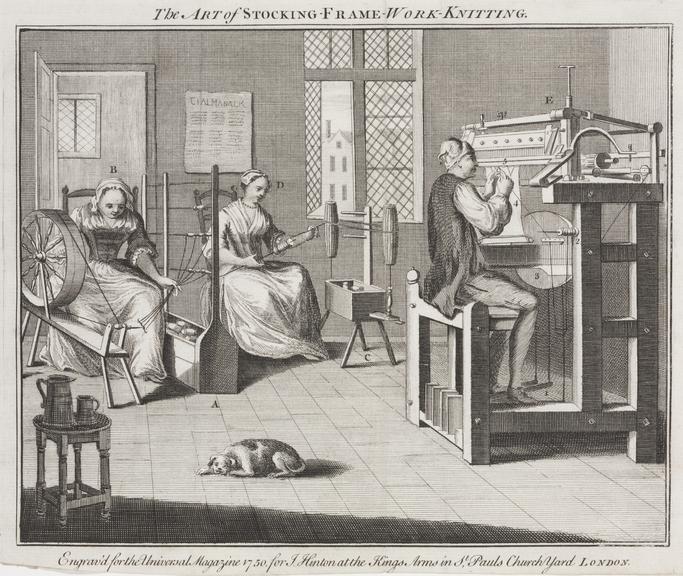
I read some chapters of a thesis on the south Derbyshire poor in the 1800s and found some illuminating information about indentured apprenticeship of children especially if one parent died. It was not at all uncommon, and framework knitters in particular often had indentured apprentices. It was a way to ensure the child was fed and learned a skill. Children commonly worked from the age of ten or 12 anyway. They were usually placed walking distance of the family home and maintained contact. The indenture could be paid by the parish poor fund, which cost them slightly less than sending them to the poorhouse, and could be paid off by a parent if circumstances improved to release the child from the apprenticeship.
A child who was an indentured apprentice would continue a normal life after the term of apprenticeship, usually still in contact with family locally.I found a newspaper article titled “Child Murder at Heanor” dated 1858.
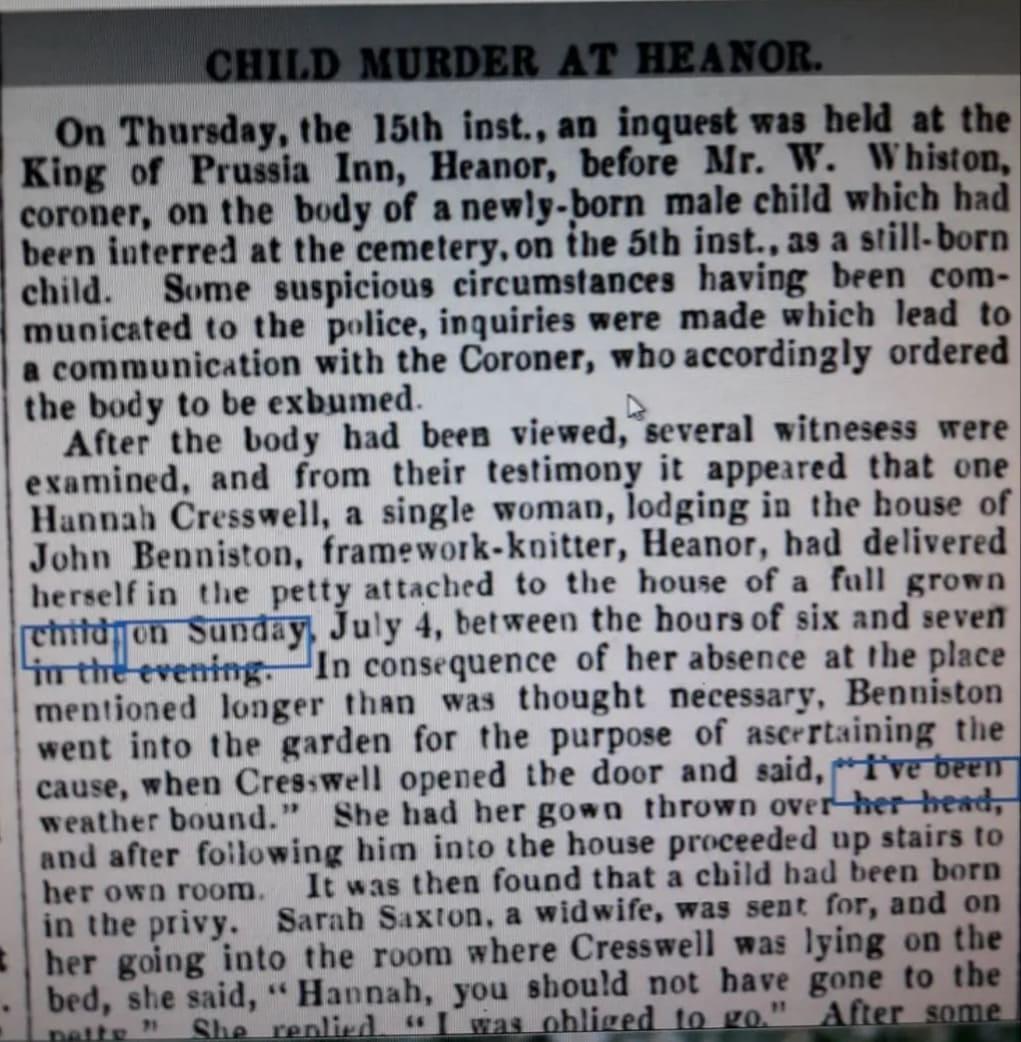
A 23 year old lodger at the Bennistons, Hannah Cresswell, apparently murdered a new born baby that she gave birth to in the privy, which the midwife took away and had buried as a still birth. The baby was exhumed after an anonymous tip off from a neighbour, citing that it was the 4th such incident. Catherine Housley would have been nine years old at the time.
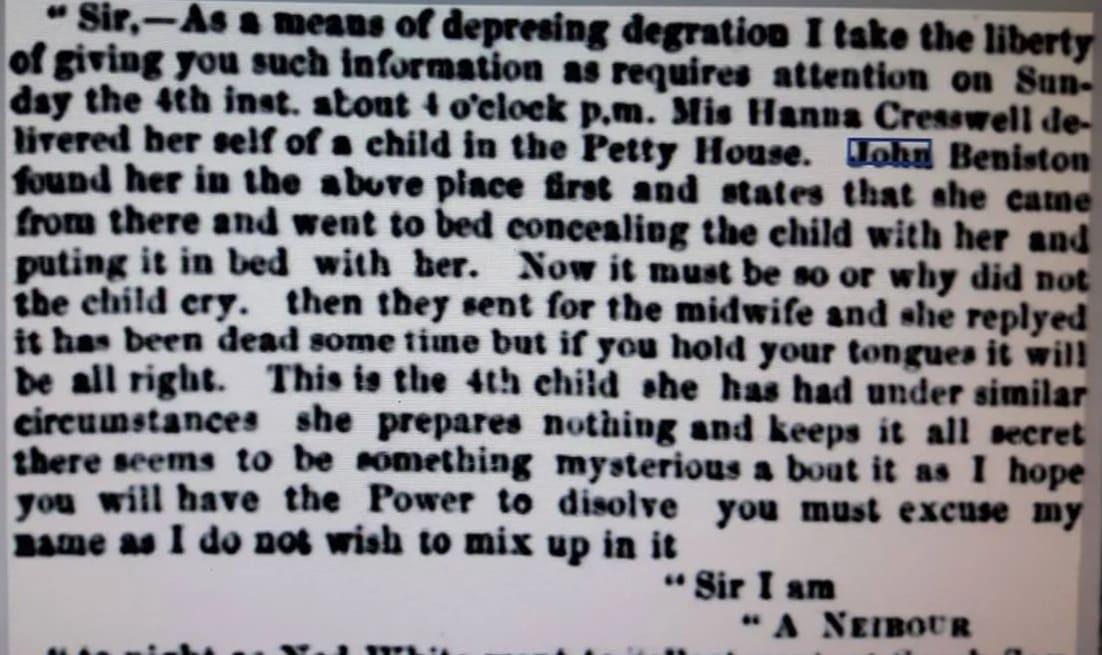
Subsequent newspaper articles indicate that the case was thrown out, despite the doctors evidence that the baby had been beaten to death.
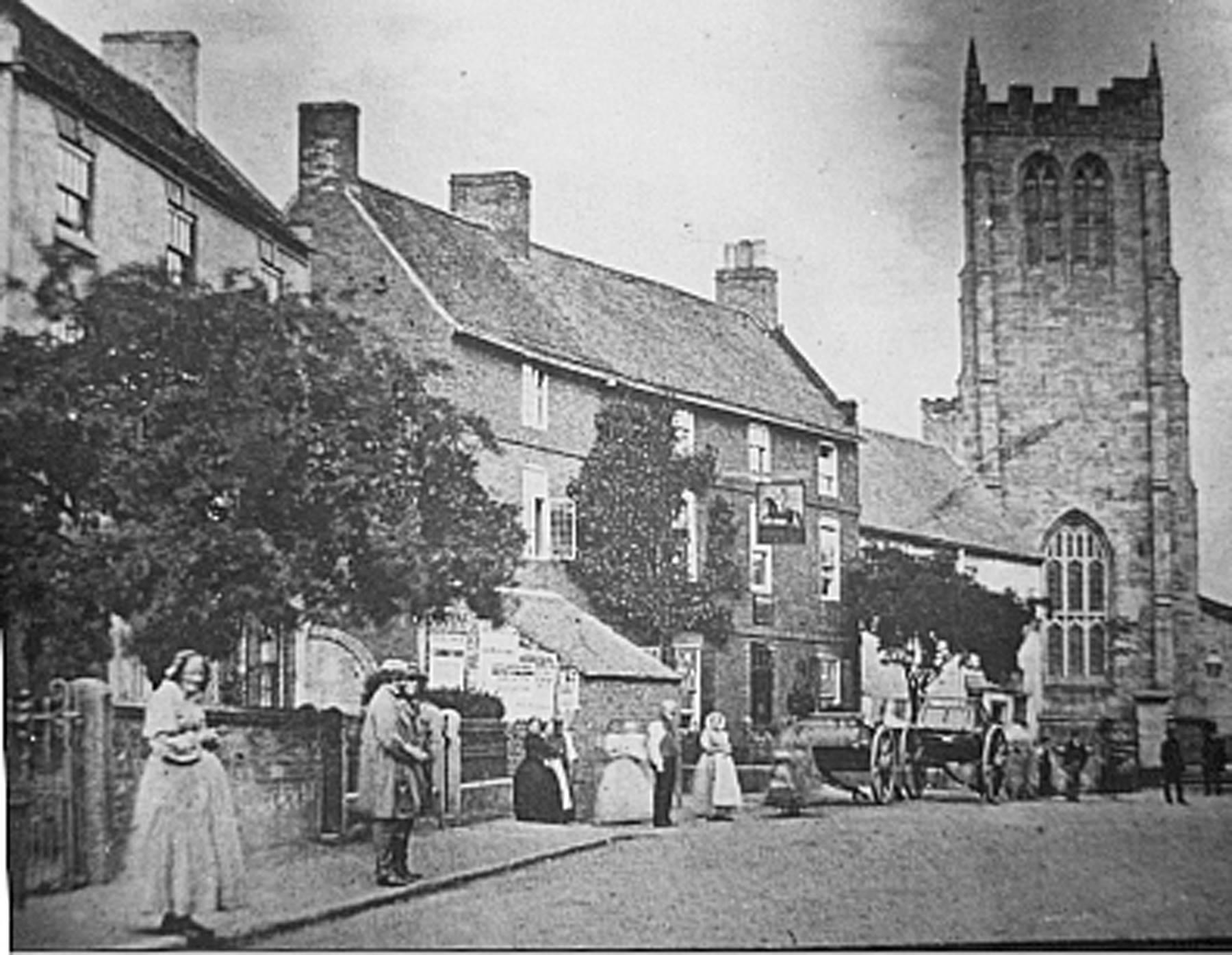
In July 1858 the inquest was held in the King of Prussia, on the Hannah Cresswell baby murder at the Bennistons.
The King of Prussia, Heanor, in 1860:
 December 14, 2021 at 10:26 pm #6232
In reply to: The Elusive Samuel Housley and Other Family Stories
Looking for Photographs
I appreciate how fortunate I am that there are so many family photographs on various sides of the family, however, on some sides, for example the Warrens and the Grettons, there are no photographs. I’d love to find a photograph of my great grandmother Florence Nightingale Gretton, as she is the only great grandparent I don’t have a photo of.
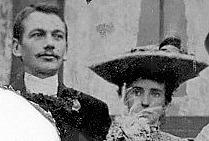
I look on other people’s family trees on ancestry websites, and I join local town memories and old photos groups on facebook hoping to find photos. And I have found a few, and what a prize it is to find a photograph of someone in your tree. None found so far of Florence Nightingale Gretton, although I found one of her sister Clara, her brother Charles, and another potential one, posted on a Swadlincote group: a Warren wedding group in 1910.
Charles Herbert Gretton 1876-1954 and his wife Mary Ann Illsley:
The wedding of Robert Adolphus Warren and Eveline Crofts. Photo in the collection of Colin Smith, Eveline Crofts first cousin twice removed. Reposted with permission:
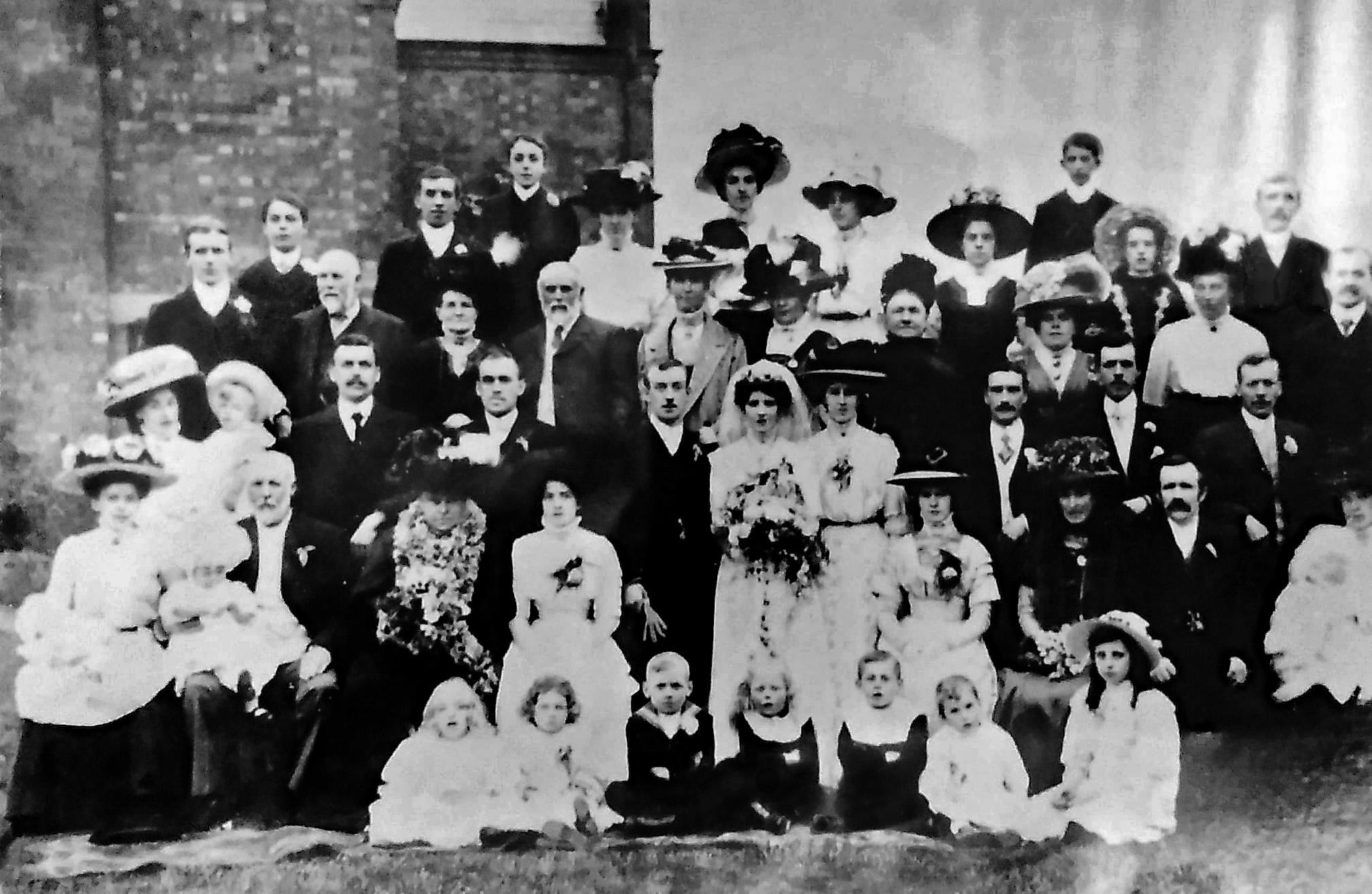
The groom was Florence’s husbands cousin, but identifying my great grandparents in the crowd would be guesswork. My grandmother was born in 1906, and could be one of the children sitting at the front. It was an interesting exercise to note the family likenesses.
Ben Warren the footballer is the man on the far right, on the same line as the groom. His children are sitting in front of the bride.
There are many mentions of Ben Warren the footballer on the Newhall and Swadlincote groups ~ Ben Warren was my great grandfathers cousin, and is a story in itself ~ and a photograph of Ben’s daughter, Lillian Warren was posted.
Lillian Warren (reposted with permission)
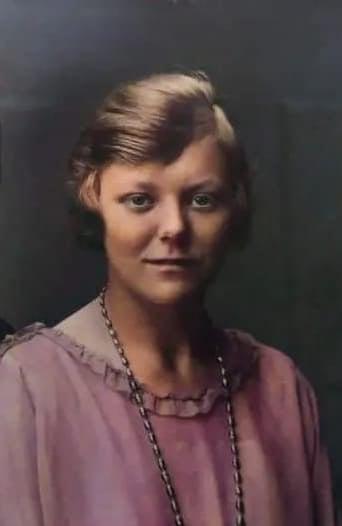
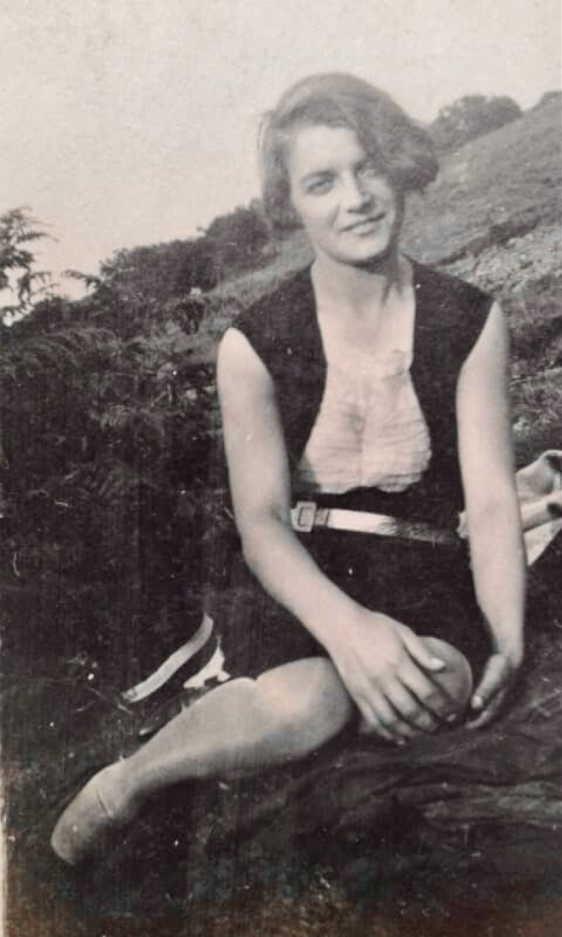
Lillian was my grandmothers first cousin once removed or second cousin. The resemblance to my grandmother, Florence Noreen Warren, seems striking.
December 13, 2021 at 3:38 pm #6229In reply to: The Elusive Samuel Housley and Other Family Stories
Gretton Tailoresses of Swadlincote and the Single Journalist Boot Maker Next Door
The Purdy’s, Housley’s and Marshall’s are my mothers fathers side of the family. The Warrens, Grettons and Staleys are from my mothers mothers side.
I decided to add all the siblings to the Gretton side of the family, in search of some foundation to a couple of family anecdotes. My grandmother, Nora Marshall, whose mother was Florence Nightingale Gretton, used to mention that our Gretton side of the family were related to the Burton Upon Trent Grettons of Bass, Ratcliff and Gretton, the brewery. She also said they were related to Lord Gretton of Stableford Park in Leicestershire. When she was a child, she said parcels of nice clothes were sent to them by relatives.
It should be noted however that Baron Gretton is a title in the Peerage of the United Kingdom, and was created in 1944 for the brewer and Conservative politician John Gretton. He was head of the brewery firm of Bass, Ratcliff & Gretton Ltd of Burton upon Trent. So they were not members of the Peerage at the time of this story.
What I found was unexpected.
My great great grandfather Richard Gretton 1833-1898, a baker in Swadlincote, didn’t have any brothers, but he did have a couple of sisters.
One of them, Frances, born 1831, never married, but had four children. She stayed in the family home, and named her children Gretton. In 1841 and 1851 she’s living with parents and siblings. In 1861 she is still living with parents and now on the census she has four children all named Gretton listed as grandchildren of her father.
In 1871, her mother having died in 1866, she’s still living with her father William Gretton, Frances is now 40, and her son William 19 and daughter Jane 15 live there.
By the time she is 50 in 1881 and her parents have died she’s head of the house with 5 children all called Gretton, including her daughter Jane Gretton aged 24.Twenty five year old Robert Staley is listed on the census transcription as living in the same household, but when viewing the census image it becomes clear that he lived next door, on his own and was a bootmaker, and on the other side, his parents Benjamin and Sarah Staley lived at the Prince of Wales pub with two other siblings.
Who was fathering all these Gretton children?
It seems that Jane did the same thing as her mother: she stayed at home and had three children, all with the name Gretton. Jane Gretton named her son, born in 1878, Michael William Staley Gretton, which would suggest that Staley was the name of the father of the child/children of Jane Gretton.
The father of Frances Gretton’s four children is not known, and there is no father on the birth registers, although they were all baptized.
I found a photo of Jane Gretton on a family tree on an ancestry site, so I contacted the tree owner hoping that she had some more information, but she said no, none of the older family members would explain when asked about it. Jane later married Tom Penn, and Jane Gretton’s children are listed on census as Tom Penn’s stepchildren.
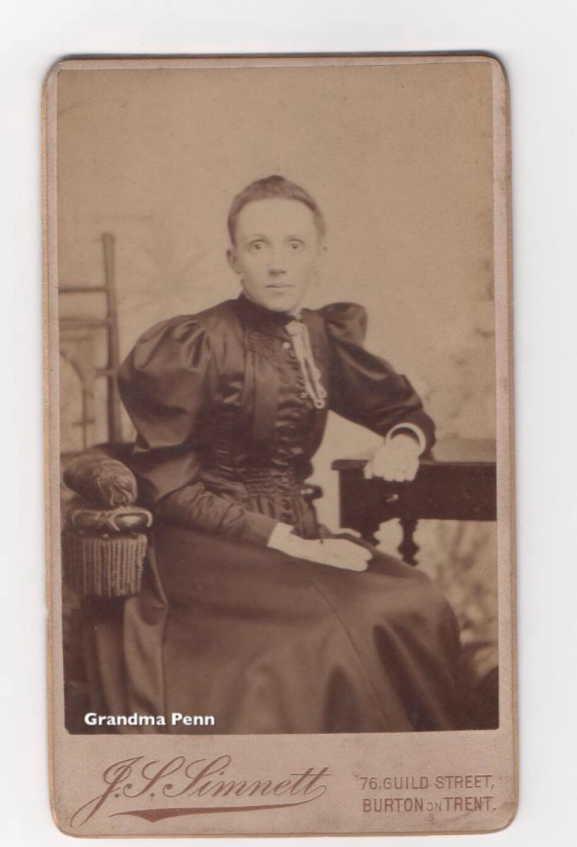
It seems that Robert Staley (who may or may not be the father of Jane’s children) never married. In 1891 Robert is 35, single, living with widowed mother Sarah in Swadlincote. Sarah is living on own means and Robert has no occupation. On the 1901 census Robert is an unmarried 45 year old journalist and author, living with his widowed mother Sarah Staley aged 79, in Swadlincote.
There are at least three Staley Warren marriages in the family, and at least one Gretton Staley marriage.
There is a possibility that the father of Frances’s children could be a Gretton, but impossible to know for sure. William Gretton was a tailor, and several of his children and grandchildren were tailoresses. The Gretton family who later bought Stableford Park lived not too far away, and appear to be well off with a dozen members of live in staff on the census. Did our Gretton’s the tailors make their clothes? Is that where the parcels of nice clothes came from?
Perhaps we’ll find a family connection to the brewery Grettons, or find the family connection was an unofficial one, or that the connection is further back.
I suppose luckily, this isn’t my direct line but an exploration of an offshoot, so the question of paternity is merely a matter of curiosity. It is a curious thing, those Gretton tailors of Church Gresley near Burton upon Trent, and there are questions remaining.
June 11, 2021 at 2:50 am #6207In reply to: Newsreel from the Rim of the Realm
“I was ‘anging onto his bloody arm for dear life and the strangest thing you will never believe ….” Glor paused dramatically.
“Go on then, Glor! Don’t leave us ‘anging now!” said Sha. “We’re all agog, we are.”
“Don’t be such a bloody tease, Glor!” snapped Mavis.
“If yer will both ‘ush, I’ll tell ya.” Glor folded her arms and looked at her friends sternly. “His arm didn’t feel right. It felt like one of them dolls they put in shops with the fancy clothes on. Wot do you call them?”
“Wot yer on about, Sha? Youse feeling alright?” Mavis slapped a hand to Glor’s forehead. “A bit ‘ot. Might be the bloody stress got to you. All this escaping nonsense that Sophie is on about. She’s lost ‘er marbles an all if yer ask me. Mind, she must be bloody ninety if she’s a day.”
Glor heaved a loud sigh. Why did she always have to be the brains? “Have you numskuttles ever thought to yerselves that Mr Andrew Anderson is a bit too bloody bootiful? That it ain’t natural?”
Before the others could answer, a loud siren shrieked followed by the doctor’s voice. “EMERGENCY. ASSEMBLE IN THE HALL. I REPEAT. EVERYONE MUST GO WITH HASTE TO THE HALL YOUR LIFE DEPENDS UPON IT.
June 5, 2021 at 4:23 am #6198In reply to: The Precious Life and Rambles of Liz Tattler
“You were listening, Finnley!” said Liz barely able to hide her surprise. It had been a long time since anyone had listened to her. Godfrey said it was because she mostly talked nonsense. He’d smiled kindly and handed her a doughnut to soften the harsh words, but it had stung nonetheless.
Finnley rolled her eyes. “I told you already, I’ve turned over a new leaf. Since my brush with … ” She lowered her voice dramatically as her eyes slid around the room. “… death.”
“Death! Oh, you really are ridiculous and very dramatic, Finnley. And why are you squinting like that? It’s most unattractive.” Liz paused. Should she mention the hair? Finnley could be so sensitive about her appearance. Oh dear lord, now the silly girl is crying!
“I’m sorry, Madam. I’m sorry for all the times I haven’t listened to you in your numerous times of need.” Finnley gasped for air through her sobs as Liz flung a philodendron leaf at her.
“Speaking of leaves, you can wipe your nose with that. Now, Finnley, I always say, it does no good to cry over milk which has been spilled. The question is, where to from here?”
February 4, 2021 at 4:47 pm #6183In reply to: Twists and One Return From the Time Capsule
Nora commented favourably on the view, relieved to have been given a clue about what she was supposed to have noticed. It was a splendid panorama, and Will seemed pleased with her response. She asked if it was possible to see the old smugglers path from their vantage point, and he pointed to a dirt road in the valley below that disappeared from view behind a stand of eucalyptus trees. Will indicated a tiny white speck of an old farm ruin, and said the smugglers path went over the hill behind it.
Shading her eyes from the sun, Nora peered into the distance beyond the hill, wondering how far it was to Clara’s grandfathers house. Of course she knew it was 25 kilometers or so, but wasn’t sure how many hills behind that one, or if the path veered off at some point in another direction.
Wondering where Clara was reminded Nora that her friend would be waiting for her, and quite possibly worrying that she hadn’t yet arrived. She sighed, making her mind up to leave first thing the next morning. She didn’t mention this to Will though, and wondered briefly why she hesitated. Something about the violent sweep of his arm when she asked about her phone had made her uneasy, such a contrast to his usual easy going grins.
Then she reminded herself that she had only just met him, and barely knew anything about him at all, despite all the stories they’d shared. When she thought about it, none of the stories had given her any information ~ they had mostly been anecdotes that had a similarity to her own, and although pleasant, were inconsequential. And she kept forgetting to ask him about all the statues at his place.
Wishing she could at least send a text message to Clara, Nora remembered the remote viewing practice they’d done together over the years, and realized she could at least attempt a telepathic communication. Then later, if Clara gave her a hard time about not staying in contact, she could always act surprised and say, Why, didn’t you get the message?
She found a flat stone to sit on, and focused on the smugglers path below. Then she closed her eyes and said clearly in her mind, “I’ll be there tomorrow evening, Clara. All is well. I am safe.”
She opened her eyes and saw that Will had started to head back down the path. “Come on!” he called, “Time for lunch!”
November 5, 2020 at 3:04 pm #6146In reply to: Two Aunties au Pair and Their Pert Carouses
“And who might you be?” Finnley looked at the oddly clothed bag lady who’d appeared in the staff wing.
“I’m November, you punny insolent thing.”
“What sort of name is that? Is that a woman’s name anyway?”
“Jeeze Louise, consider it non-binary. It feels like there is too much woman energy in that den anyway.”
“And what makes you feel like you are in charge now?”
“Let’s call it power vacuum, sweetie. And if you’re itching at the thought, just wait until you see my boss.”
“Let me guess. She’s December, right?”
“Yep. And they are a mean piece of work, and going to make a swift clean up of all the dregs left over by that orange nightmare.”
September 2, 2020 at 7:11 am #6120In reply to: Tart Wreck Repackage
After a minute or two of Tara banging on about morse code, Star gave up. “Okay, have it your way, Tara. I’ve got important stuff to do.”
“Bugger off, then,” said Tara. “I’m going to have a few more gin and tonics before my hair appointment. Wish me luck!”
As Star turned to leave, she tripped on Tara’s oversized handbag—goodness only knows what she kept in it— and crashed into an ornamental pot-plant revealing none other than Auntie April.
“Oh, my!” said April with an embarrassed titter. “Fancy meeting you two here!”
Tara leapt up. “You were spying on us! We are the spies!” She jabbed an accusing finger at April. “How dare you be the spy!”
“How dare YOU!” said April, scrambling over the fallen pot-plant in her haste to get away.
“HOW DARE YOU!” shouted Tara. She lunged at the fleeing April and managed to grab hold of her jacket.
“Look!” cried Star. “On her shoulder! A bell-bird.”
August 31, 2020 at 7:21 pm #6116In reply to: Tart Wreck Repackage
“What a load of rubbish,” said Star later. “I don’t believe a word of it. Well, except for the part about Vince French not being in a coma, that bit rang true. But the rest of it’s downright nonsense, if you ask me.”
Tara waved to the waiter and ordered another two gin and tonics. The Bell Bird Inn was conveniently located mid way between the office and their apartment, and needless to say, they were regulars.
“There’s definitely something fishy going on with April’s story,” Tara agreed. “The wardrobe, for instance. Those notes with the same handwriting. I don’t believe she’s filthy rich, either. Nobody who is filthy rich ever says “I’m filthy rich”.”
“How would you know? How many filthy rich people do you hobnob with, then?”
“Let’s not get off the point!” Star cried, exasperated. “What are we going to do?”
“May as well start at the bottom and work our way up. Vince’s bottom. All we need to do is find Vince’s tattoo and we’ll have found Vince. It’s fiendishly simple!” Tara looked smug.
“Oh, right,” said Star when she found her voice. “Right. Because it’s just so easy to peruse bottom tattoos on the general public.”
Tara giggled. “Don’t be silly. This is where we use our special unofficial skills. Remote viewing.”
“But where do we start?”
“Set the intention, and trust your intuition. Oh come on,” Star’s lack of enthusiasm was becoming tedious. “It will be fun!”
August 30, 2020 at 12:52 am #6107In reply to: Tart Wreck Repackage
Star paused in the lobby. “I need some more persuading,” she said. “What if she dies in that wardrobe? What will we do with the body? Or, worse, what if she doesn’t die and sues us?”
Tara decided to ignore Star’s dubious reasoning; after all it was late. “She’s probably going to sue anyway,” said Tara morosely. “Another night won’t make any difference.”
“I’m going back. I can’t leave Rosamund to face the consequences of our drunken stupidity.” Star headed defiantly towards the stairs; the lift was out of order, again. “We would have to be on the eight bloody floor,” she muttered. “You do what you like,” she flung over her shoulder to Tara.
Tara sighed. “Wait up,” she shouted.
Star was relieved that Tara decided to follow. The building was scary at night – the few tenants who did lease office space, were, much like themselves, dodgy start-ups that couldn’t afford anything better. Missing bulbs meant the lighting in the stairwell was dim, and, on some floors, non-existent.
“I’m amazed they managed to bring that wardrobe up,” puffed Tara. “Just slow down and let me get my breath will you, Star.”
“My gym membership is really paying off,” said Star proudly. “Come on,Tara! just one floor to go!”
As they approached the door to their office, they paused to listen. “Can you hear something … ?” whispered Star.
“Is it … singing?”
“That’s never Rosamund singing. She’s got a voice like … well let’s just say you wouldn’t wish it on your worst enemy.”
“I’m going in,” hissed Tara and flung open the door.
“Don’t come any closer!” cried a woman in a mink coat; she did make a peculiar sight, surrounded by empty pizza boxes and brandishing a broom. “And you, shut up!” she said reaching out to bang the wardrobe with her broom. There were muffled cries from within, and then silence.
“Was that you singing?” asked Star in her most polite voice.
“Yes, what’s it to you?”
“It was rather… lovely.”
The woman smirked. “I was rehearsing.”
“We are awfully sorry about locking you in the wardrobe. We thought you were a masked intruder.”
“Well, I’m not. I am Rosamund’s Aunt April, and you …” she glowered at Star … “should have recognised me, seeing as how I am your cousin.”
“Oh!” Star put her hand to her head. “Silly me! Of course, Cousin April! But I have not seen you for so many years. Not since I was a child and you were off to Europe to study music!”
Tara groaned. “Really, Star, you are hopeless.”
Loud banging emanated from the wardrobe followed by mostly unintelligible shouting but it went something like: “Bloody-let-me-out-or-I-will-friggin-kill-you-stupid-bloody-tarts!”
“It wasn’t really Rosamund’s fault,” said Star. “I don’t suppose we could …?”
April nodded. “Go on then, little fool’s learnt her lesson. The cheek of her not letting me have pineapple on my pizza.”
“About bloody time,” sniffed Rosamund when the door was opened. She made a sorry sight, mascara streaked under her eyes and her red fingernails broken from where she had tried to force the door.
“Now, then,” said Tara decisively, “now we’ve said our sorries and whatnot, what’s all this really about, April?”
April crinkled her brow.”Well, as I may of mentioned on the phone, my husband, Albert — that’s your Uncle Albie,” she said to Rosamund, “is cheating on me. He denies it vehemently of course, but I found this note in his pocket.” She reached into her Louis Vuitton hand-bag and pulled out a sheet of paper. “That’s his handwriting and the paper is from the Royal Albert Hotel. He was there on a business trip last month.” Her face crumpled.
“Chin up,” said Tara quickly, handing April a tissue from the desk. “What does the note say?”. Really, this case did seem a bit beneath them, a straightforward occurrence of adultery from the sounds.
April sniffed. “It says, meet you at the usual place. Bring the money and the suitcase and I will make it worth your while.”
“Let me see that,” said Rosamund, snatching the note from April. She reached into the front of her tee-shirt and pulled out another crumpled note which had been stuffed into her bra. She smirked. “I found this in the wardrobe. I was keeping it secret to pay you back but … ” She brandished both notes triumphantly. “The handwriting is the same!”
“What does your note say, Rosamund?” asked Star.
“It says, If you find this note, please help me. All is not what it seems..”
“Wow, cool!” said Tara, her face lit up. This was more like it!
Star, noticing April’s wretched face, frowned warningly at Tara. “So,” she mused, “I suggest we explore this wardrobe further and see what we can find out.”
August 27, 2020 at 9:28 am #6102In reply to: Tart Wreck Repackage
“That damn cult is going from strength to strength and not a damn thing we can do about it,” said Star. “What bloody awful timing for a lockdown, just as we were getting started!”
“I know,” replied Tara sadly. “At this rate we’ll have to go back to work for Madame Limonella.”
“Don’t be silly, she’ll have had to close down too!”
“Don’t you believe it!” retorted Tara, “She’d find a way to keep her clients happy.”
“But we’re not keeping our clients happy are we? We haven’t found a way. We’re pretty useless, aren’t we?”
“Not just our clients. Well client, really, we only had one. We could have saved the world from the Zanone cult if it hadn’t been for this quarantine. Hey, maybe that cult started all this, just so we couldn’t stop them.”
Star barked out a bitter laugh. “Now you sound like one of them parroting out conspiracy theories.”
“We could find a way to break the quarantine, sneak out at night dressed as urban kangaroos or something.”
Star was shocked. “Tara, that’s morally reprehensible! Where is your community spirit!”
“I don’t think the kangaroos would mind all that much,” Tara replied huffily.
“I didn’t mean the kangaroos, good lord! But you know what, you might be on to something. Remember that kangaroo dressed in a mans overcoat that tried to break someones car window the other day?”
Tara had a feeling Star had got her wires crossed somehow, but didn’t question it. Star was getting excited and it was a welcome change from the weeks of despondent boredom.
“Well never mind that,” Star continued, who had started to wonder herself, “The point is, we can use a disguise. And it’s a matter of grave social responsibility to expose the cult. In the fullness of time, we will be exonerated, hailed as heroic, even.”
The excitement was contagious and Tara found herself sitting upright instead of slumped in despair. “Let’s do it!”
April 6, 2020 at 9:40 am #5959In reply to: The Whale’s Diaries Collection
Dear Whale,
Boredom rang the bell in the morning and I made the mistake of opening the door. I should have known better in this confinement time, they said the postman should leave the package at the door, or be at least at 2 to 3 meters from it when we open. Apparently boredom didn’t receive the notice, and I opened the door and let it in.
Once it was there, nothing seemed interesting enough. I tried to show my guest a movie, or a series. New ones, old ones, none seemed to satisfy its taste. Even the expensive tea I opened just for the occasion and made for my guest tasted duller than gnat’s pee. I thought gnat’s pee might have been more exciting as I would have welcomed it as a new experience, but I’m certain it wasn’t that new to boredom.
Boredom is like a crowd, it amplifies the bad mood, and paint dull all that it touches. I had received a set of twelve chromo therapy glasses, all making a beautiful rainbow in the box. I remembered being so excited when I had received that set, all those moments I would spend looking at the world in different colours. Why did I wait? Now I couldn’t even get close to the box. Boredom seemed so comfortable now that I felt tired at the idea of driving it out of my couch, not to mention driving it out of my apartment entirely.
Boredom had not been passive as one could have thought. It had diligently painted everything in a shade of dull which made it hard for anything to catch my attention. Everything looked the same, I had become fun blind. Only the window started to look like a satisfactory exit. I had to trick my mind in thinking it too would be boring.
But at the end of the afternoon the phone rang. I looked boredom into the dull of its eyes. I almost got drowned in it again almost losing any interest to answer. It made it drop its guard and I seized the moment to jump on my mobile. It was a friend from Spain.
“You won’t believe it!” she said.
I looked boredom in the eyes and I clearly could see it was afraid of what was coming. It was begging for mercy.
“Try me,” I said to my friend.
“I got a swarm of bees gathering on the top of my roof patio! I swear there are hundreds of them.”
“What?” I was so surprised that I looked away through the window and lost sight of boredom. When I looked back at the couch, boredom was not there. I looked around trying to see if it could have hidden somewhere while my friend was talking about having put the dogs in the shed, not daring go feed the cats on the rooftop with all those bees swarming around. I could hear her hubbie in the background “Oh my! I think they are building something.”
My imagination worked faster than a pandemic and it had already built a manhattan beehive project. Despite my disbelief I had to face the fact that there were no traces of dull places anymore around me. I could almost see the swarm of bees getting the last touch in cleaning the dull-art boredom had crafted around so plainly while it was there.
“Send me some pictures,” I said. “I want pictures!”
April 1, 2020 at 9:50 am #5950In reply to: The Whale’s Diaries Collection
Helle Jorid, my Whale friend.
I dreamt I sailed on one of those ancient ships made of wood with no engine other than the wind and man power.
In the dream we were very few and not all there by choice. Chased after by some kind of police force we, a motley bunch of people found ourselves on that ship by chance. I saw one man on the dock pass by and cut the big rope that held the ship still.
As the rope limply hanged from the mooring post, I watched the ship being guided away by the backwash from its mooring place to the ocean. At that moment someone wanted to disembark and I heard myself say : In your dreams! It’s too late we’re on the open sea now.
I think someone mentioned a captain Cook, but I’m not sure as I never saw the guy. Maybe it was merely a cook, but did we really need it? As I went deeper into the ship I found a wonderful meeting room with all the technological comfort of TV sets embedded in the walls and loads of electrical plugs at the end of mechanical arms coming out of these same walls. Surely there were microwave oven and tons of dehydrated food.
But our attention was still on the discovery of the treasures hidden in the heart of that ship. There was a circular sofa set around a nice coffee table. And we all settled comfortably there for a get together, happy we had escaped and seemed safe. None of us thought one second about where the wind and the gulf stream were taking us. I guess anywhere was better than what those men had in store for us.
I woke up. Alone at night. It was dark. My heart was pounding. Is that how we feel when we are in a lock down? I almost wrote placed under house arrest. What’s the difference apart the name to make us think it’s different?
Was the ship the symbol of our longing for freedom? It’s still the same place moving around on water. Even if the place move around, we can’t move away from it and from the flatness of the ocean. I wonder. I wonder if I stayed longer in that dream what would have happened? A storm? An interesting encounter? Like a whale. How would I know unless I write the rest of the story?
-
AuthorSearch Results
