

Search Results for 'nor'
-
AuthorSearch Results
-
January 14, 2022 at 7:27 am #6252
In reply to: The Elusive Samuel Housley and Other Family Stories
The USA Housley’s
This chapter is copied from Barbara Housley’s Narrative on Historic Letters, with thanks to her brother Howard Housley for sharing it with me. Interesting to note that Housley descendants (on the Marshall paternal side) and Gretton descendants (on the Warren maternal side) were both living in Trenton, New Jersey at the same time.
GEORGE HOUSLEY 1824-1877
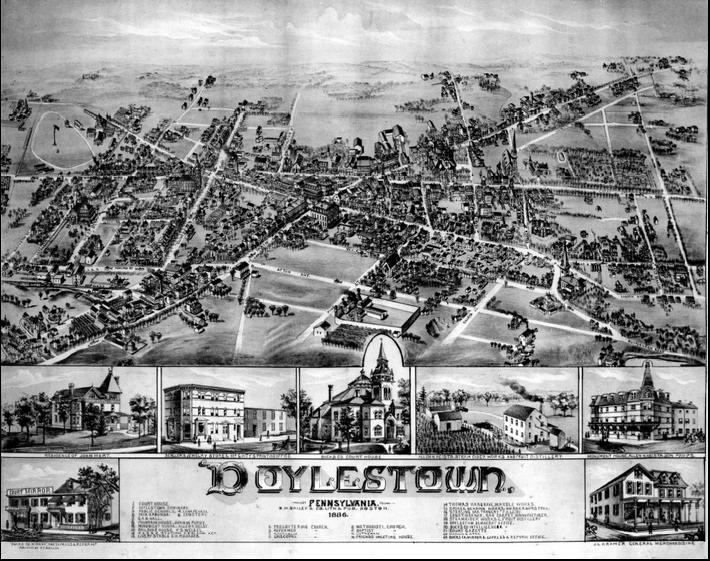
George emigrated to the United states in 1851, arriving in July. The solicitor Abraham John Flint referred in a letter to a 15-pound advance which was made to George on June 9, 1851. This certainly was connected to his journey. George settled along the Delaware River in Bucks County, Pennsylvania. The letters from the solicitor were addressed to: Lahaska Post Office, Bucks County, Pennsylvania. George married Sarah Ann Hill on May 6, 1854 in Doylestown, Bucks County, Pennsylvania. The service was performed by Attorney James Gilkyson.
In her first letter (February 1854), Anne (George’s sister in Smalley, Derbyshire) wrote: “We want to know who and what is this Miss Hill you name in your letter. What age is she? Send us all the particulars but I would advise you not to get married until you have sufficient to make a comfortable home.”
Upon learning of George’s marriage, Anne wrote: “I hope dear brother you may be happy with your wife….I hope you will be as a son to her parents. Mother unites with me in kind love to you both and to your father and mother with best wishes for your health and happiness.” In 1872 (December) Joseph (George’s brother) wrote: “I am sorry to hear that sister’s father is so ill. It is what we must all come to some time and hope we shall meet where there is no more trouble.”
Emma (George’s sister) wrote in 1855, “We write in love to your wife and yourself and you must write soon and tell us whether there is a little nephew or niece and what you call them.” In June of 1856, Emma wrote: “We want to see dear Sarah Ann and the dear little boy. We were much pleased with the “bit of news” you sent.” The bit of news was the birth of John Eley Housley, January 11, 1855. Emma concluded her letter “Give our very kindest love to dear sister and dearest Johnnie.”
According to his obituary, John Eley was born at Wrightstown and “removed” to Lumberville at the age of 19. John was married first to Lucy Wilson with whom he had three sons: George Wilson (1883), Howard (1893) and Raymond (1895); and then to Elizabeth Kilmer with whom he had one son Albert Kilmer (1907). John Eley Housley died November 20, 1926 at the age of 71. For many years he had worked for John R. Johnson who owned a store. According to his son Albert, John was responsible for caring for Johnson’s horses. One named Rex was considered to be quite wild, but was docile in John’s hands. When John would take orders, he would leave the wagon at the first house and walk along the backs of the houses so that he would have access to the kitchens. When he reached the seventh house he would climb back over the fence to the road and whistle for the horses who would come to meet him. John could not attend church on Sunday mornings because he was working with the horses and occasionally Albert could convince his mother that he was needed also. According to Albert, John was regular in attendance at church on Sunday evenings.
John was a member of the Carversville Lodge 261 IOOF and the Carversville Lodge Knights of Pythias. Internment was in the Carversville cemetery; not, however, in the plot owned by his father. In addition to his sons, he was survived by his second wife Elizabeth who lived to be 80 and three grandchildren: George’s sons, Kenneth Worman and Morris Wilson and Raymond’s daughter Miriam Louise. George had married Katie Worman about the time John Eley married Elizabeth Kilmer. Howard’s first wife Mary Brink and daughter Florence had died and he remarried Elsa Heed who also lived into her eighties. Raymond’s wife was Fanny Culver.
Two more sons followed: Joseph Sackett, who was known as Sackett, September 12, 1856 and Edwin or Edward Rose, November 11, 1858. Joseph Sackett Housley married Anna Hubbs of Plumsteadville on January 17, 1880. They had one son Nelson DeC. who in turn had two daughters, Eleanor Mary and Ruth Anna, and lived on Bert Avenue in Trenton N.J. near St. Francis Hospital. Nelson, who was an engineer and built the first cement road in New Jersey, died at the age of 51. His daughters were both single at the time of his death. However, when his widow, the former Eva M. Edwards, died some years later, her survivors included daughters, Mrs. Herbert D. VanSciver and Mrs. James J. McCarrell and four grandchildren. One of the daughters (the younger) was quite crippled in later years and would come to visit her great-aunt Elizabeth (John’s widow) in a chauffeur driven car. Sackett died in 1929 at the age of 70. He was a member of the Warrington Lodge IOOF of Jamison PA, the Uncas tribe and the Uncas Hayloft 102 ORM of Trenton, New Jersey. The interment was in Greenwood cemetery where he had been caretaker since his retirement from one of the oldest manufacturing plants in Trenton (made milk separators for one thing). Sackett also was the caretaker for two other cemeteries one located near the Clinton Street station and the other called Riverside.
Ed’s wife was named Lydia. They had two daughters, Mary and Margaret and a third child who died in infancy. Mary had seven children–one was named for his grandfather–and settled in lower Bucks county. Margaret never married. She worked for Woolworths in Flemington, N. J. and then was made manager in Somerville, N.J., where she lived until her death. Ed survived both of his brothers, and at the time of Sackett’s death was living in Flemington, New Jersey where he had worked as a grocery clerk.
In September 1872, Joseph wrote, “I was very sorry to hear that John your oldest had met with such a sad accident but I hope he is got alright again by this time.” In the same letter, Joseph asked: “Now I want to know what sort of a town you are living in or village. How far is it from New York? Now send me all particulars if you please.”
In March 1873 Harriet asked Sarah Ann: “And will you please send me all the news at the place and what it is like for it seems to me that it is a wild place but you must tell me what it is like….” The question of whether she was referring to Bucks County, Pennsylvania or some other place is raised in Joseph’s letter of the same week.
On March 17, 1873, Joseph wrote: “I was surprised to hear that you had gone so far away west. Now dear brother what ever are you doing there so far away from home and family–looking out for something better I suppose.” The solicitor wrote on May 23, 1874: “Lately I have not written because I was not certain of your address and because I doubted I had much interesting news to tell you.” Later, Joseph wrote concerning the problems settling the estate, “You see dear brother there is only me here on our side and I cannot do much. I wish you were here to help me a bit and if you think of going for another summer trip this turn you might as well run over here.”
Apparently, George had indicated he might return to England for a visit in 1856. Emma wrote concerning the portrait of their mother which had been sent to George: “I hope you like mother’s portrait. I did not see it but I suppose it was not quite perfect about the eyes….Joseph and I intend having ours taken for you when you come over….Do come over before very long.”
In March 1873, Joseph wrote: “You ask me what I think of you coming to England. I think as you have given the trustee power to sign for you I think you could do no good but I should like to see you once again for all that. I can’t say whether there would be anything amiss if you did come as you say it would be throwing good money after bad.”
On June 10, 1875, the solicitor wrote: “I have been expecting to hear from you for some time past. Please let me hear what you are doing and where you are living and how I must send you your money.” George’s big news at that time was that on May 3, 1875, he had become a naturalized citizen “renouncing and abjuring all allegiance and fidelity to every foreign prince, potentate, state and sovereignity whatsoever, and particularly to Victoria Queen of Great Britain of whom he was before a subject.”
Another matter which George took care of during the years the estate was being settled was the purchase of a cemetery plot! On March 24, 1873, George purchased plot 67 section 19 division 2 in the Carversville (Bucks County PA) Cemetery (incorporated 1859). The plot cost $15.00, and was located at the very edge of the cemetery. It was in this cemetery, in 1991, while attending the funeral of Sarah Lord Housley, wife of Albert Kilmer Housley, that sixteen month old Laura Ann visited the graves of her great-great-great grandparents, George and Sarah Ann Hill Housley.
George died on August 13, 1877 and was buried three days later. The text for the funeral sermon was Proverbs 27:1: “Do not boast about tomorrow, for you do not know what a day may bring forth.”
December 18, 2021 at 7:05 pm #6246In reply to: The Elusive Samuel Housley and Other Family Stories
Florence Nightingale Gretton
1881-1927
Florence’s father was Richard Gretton, a baker in Swadlincote, Derbyshire. When Richard married Sarah Orgill in 1861, they lived with her mother, a widow, in Measham, Ashby de la Zouch in Leicestershire. On the 1861 census Sarah’s mother, Elizabeth, is a farmer of two acres.
(Swadlincote and Ashby de la Zouch are on the Derbyshire Leicestershire border and not far from each other. Swadlincote is near to Burton upon Trent which is sometimes in Staffordshire, sometimes in Derbyshire. Newhall, Church Gresley, and Swadlincote are all very close to each other or districts in the same town.)
Ten years later in 1871 Richard and Sarah have their own place in Swadlincote, he is a baker, and they have four children. A fourteen year old apprentice or servant is living with them.
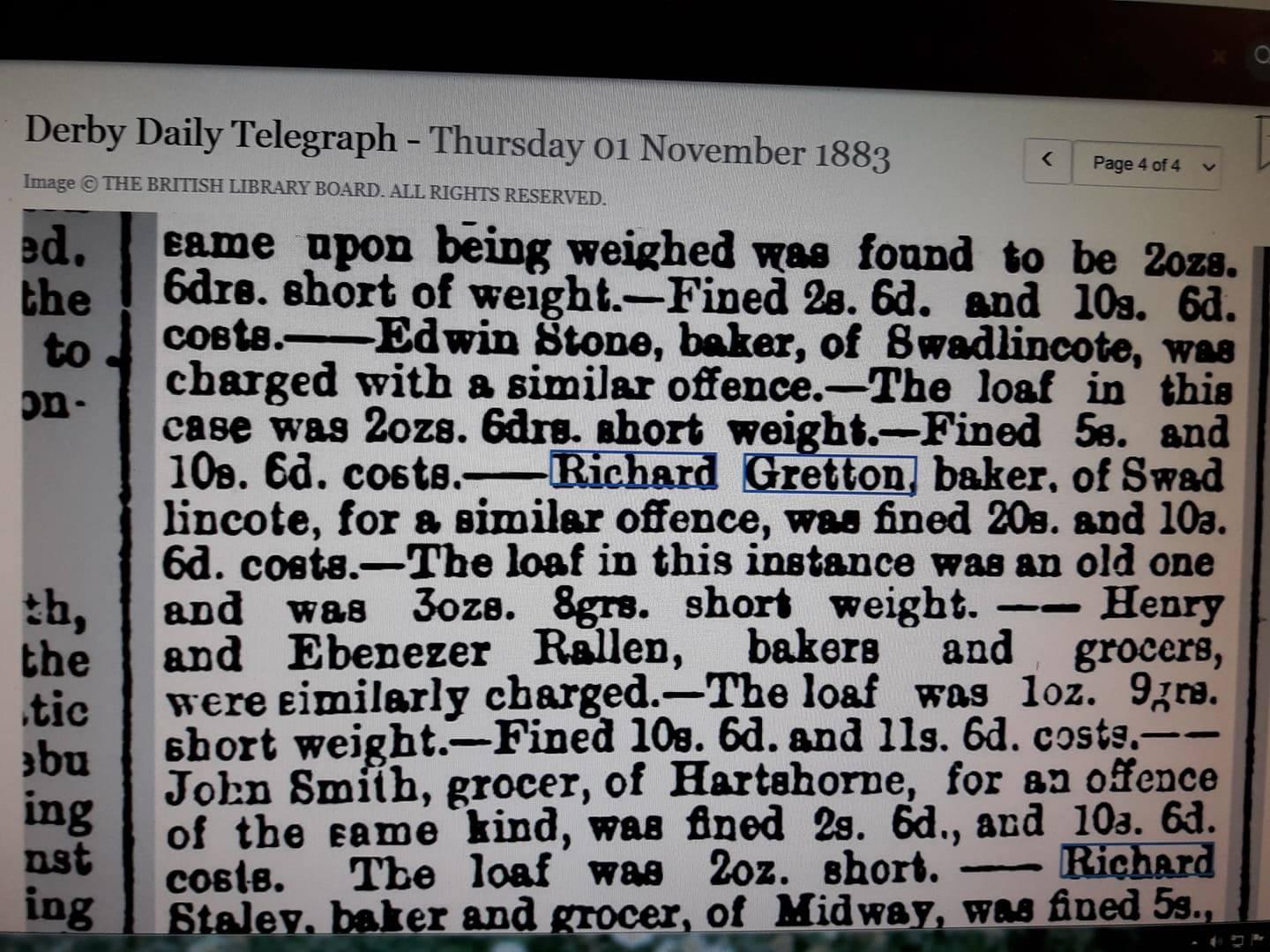
In the Ashby-de-la-Zouch Gazette on 28 February 1880, it was reported that Richard Gretton, baker, of Swadlincote, was charged by Captain Bandys with carrying bread in a cart for sale, the said cart not being provided with scales and weights, according to the requirements of the Act, on the 17th January last.—Defendant pleaded guilty, but urged in extenuation of the offence that in the hurry he had forgotten to put the scales in the cart before his son started.—The Bench took this view of the case, regarding it as an oversight, and fined him one shilling only and costs. This was not his only offence.
In 1883, he was fined twenty shillings, and ten shillings and sixpence costs.
By 1881 they have 4 more children, and Florence Nightingale is the youngest at four months. Richard is 48 by now, and Sarah is 44. Florence’s older brother William is a blacksmith.
Interestingly on the same census page, two doors down Thomas and Selina Warren live at the Stanhope Arms. Richards son John Gretton lives at the pub, a 13 year old servant. Incidentally, I noticed on Thomas and Selena’s marriage register that Richard and Sarah Gretton were the witnesses at the wedding.
Ten years later in 1891, Florence Nightingale and her sister Clara are living with Selina Warren, widow, retired innkeeper, one door down from the Stanhope Arms. Florence is ten, Clara twelve and they are scholars.
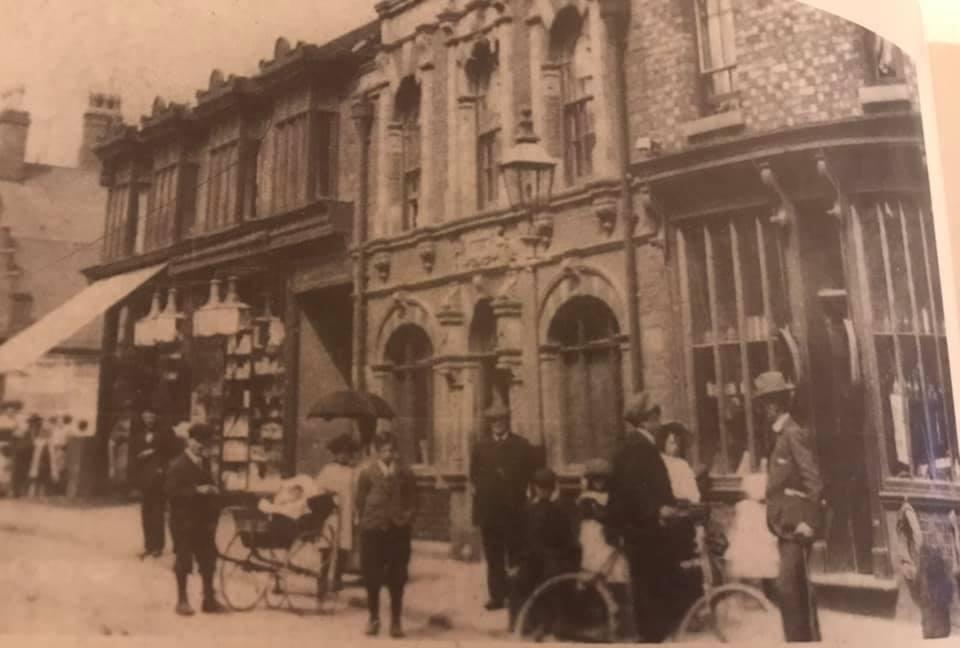
Richard and Sarah are still living three doors up on the other side of the Stanhope Arms, with three of their sons. But the two girls lived up the road with the Warren widow!The Stanhope Arms, Swadlincote: it’s possible that the shop with the awning was Richard Gretton’s bakers shop (although not at the time of this later photo).
Richard died in 1898, a year before Florence married Samuel Warren.
Sarah is a widowed 60 year old baker on the 1901 census. Her son 26 year old son Alf, also a baker, lives at the same address, as does her 22 year old daughter Clara who is a district nurse.
Clara Gretton and family, photo found online:
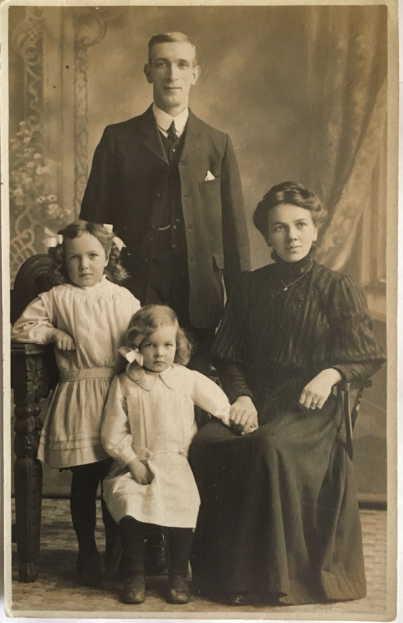
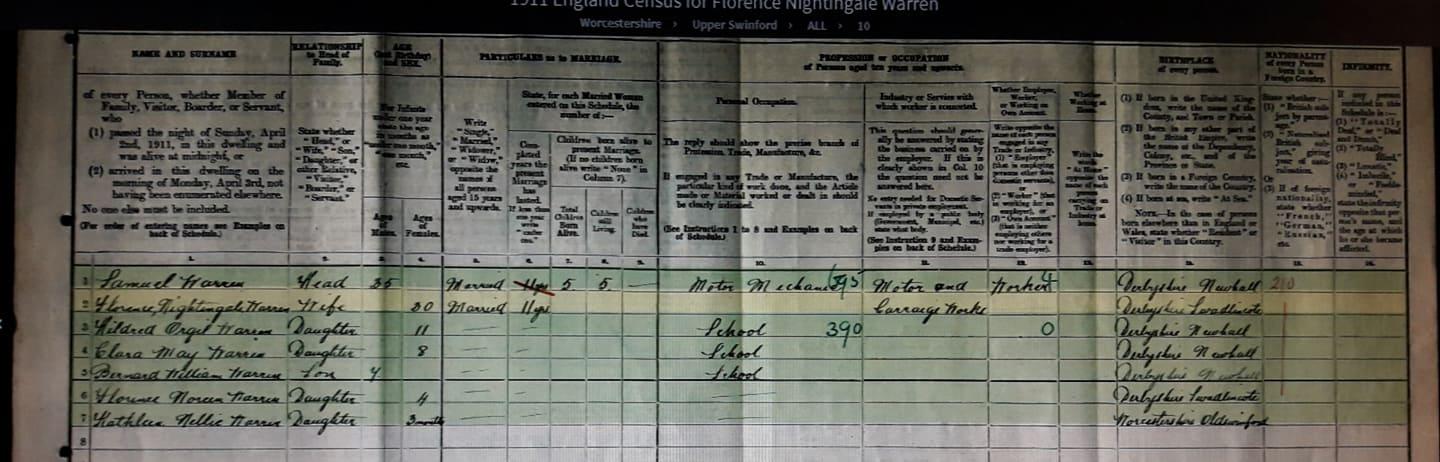
In 1901 Florence Nightingale (who we don’t have a photograph of!) is now married and is Florrie Warren on the census, and she, her husband Samuel, and their one year old daughter Hildred are visitors at the address of Elizabeth (Staley)Warren, 60 year old widow and Samuel’s mother, and Samuel’s 36 year old brother William. Samuel and William are engineers.
Samuel and Florrie had ten children between 1900 and 1925 (and all but two of them used their middle name and not first name: my mother and I had no idea until I found all the records. My grandmother Florence Noreen was known as Nora, which we knew of course, uncle Jack was actually Douglas John, and so on).
Hildred, Clara, Billy, and Nora were born in Swadlincote. Sometime between my grandmother’s birth in 1907 and Kay’s birth in 1911, the family moved to Oldswinford, in Stourbridge. Later they moved to Market Street.
1911 census, Oldswinford, Stourbridge:
Oddly, nobody knew when Florrie Warren died. My mothers cousin Ian Warren researched the Warren family some years ago, while my grandmother was still alive. She contributed family stories and information, but couldn’t remember if her mother died in 1929 or 1927. A recent search of records confirmed that it was the 12th November 1927.
She was 46 years old. We were curious to know how she died, so my mother ordered a paper copy of her death certificate. It said she died at 31 Market Street, Stourbridge at the age of 47. Clara May Warren, her daughter, was in attendance. Her husband Samuel Warren was a motor mechanic. The Post mortem was by Percival Evans, coroner for Worcestershire, who clarified the cause of death as vascular disease of the heart. There was no inquest. The death was registered on 15 Nov 1927.
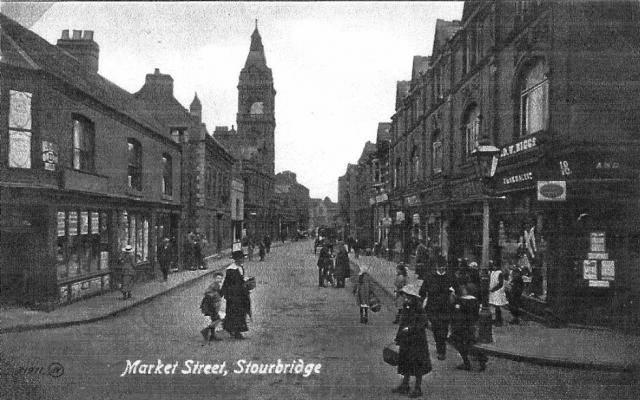
I looked for a photo of 31 Market Street in Stourbridge, and was astonished to see that it was the house next door to one I lived in breifly in the 1980s. We didn’t know that the Warren’s lived in Market Street until we started searching the records.
Market Street, Stourbridge. I lived in the one on the corner on the far right, my great grandmother died in the one next door.
I found some hitherto unknown emigrants in the family. Florence Nightingale Grettons eldest brother William 1861-1940 stayed in Swadlincote. John Orgill Gretton born in 1868 moved to Trenton New Jersey USA in 1888, married in 1892 and died in 1949 in USA. Michael Thomas born in 1870 married in New York in 1893 and died in Trenton in 1940. Alfred born 1875 stayed in Swadlincote. Charles Herbert born 1876 married locally and then moved to Australia in 1912, and died in Victoria in 1954. Clara Elizabeth was a district nurse, married locally and died at the age of 99.
December 18, 2021 at 12:59 pm #6243In reply to: The Elusive Samuel Housley and Other Family Stories
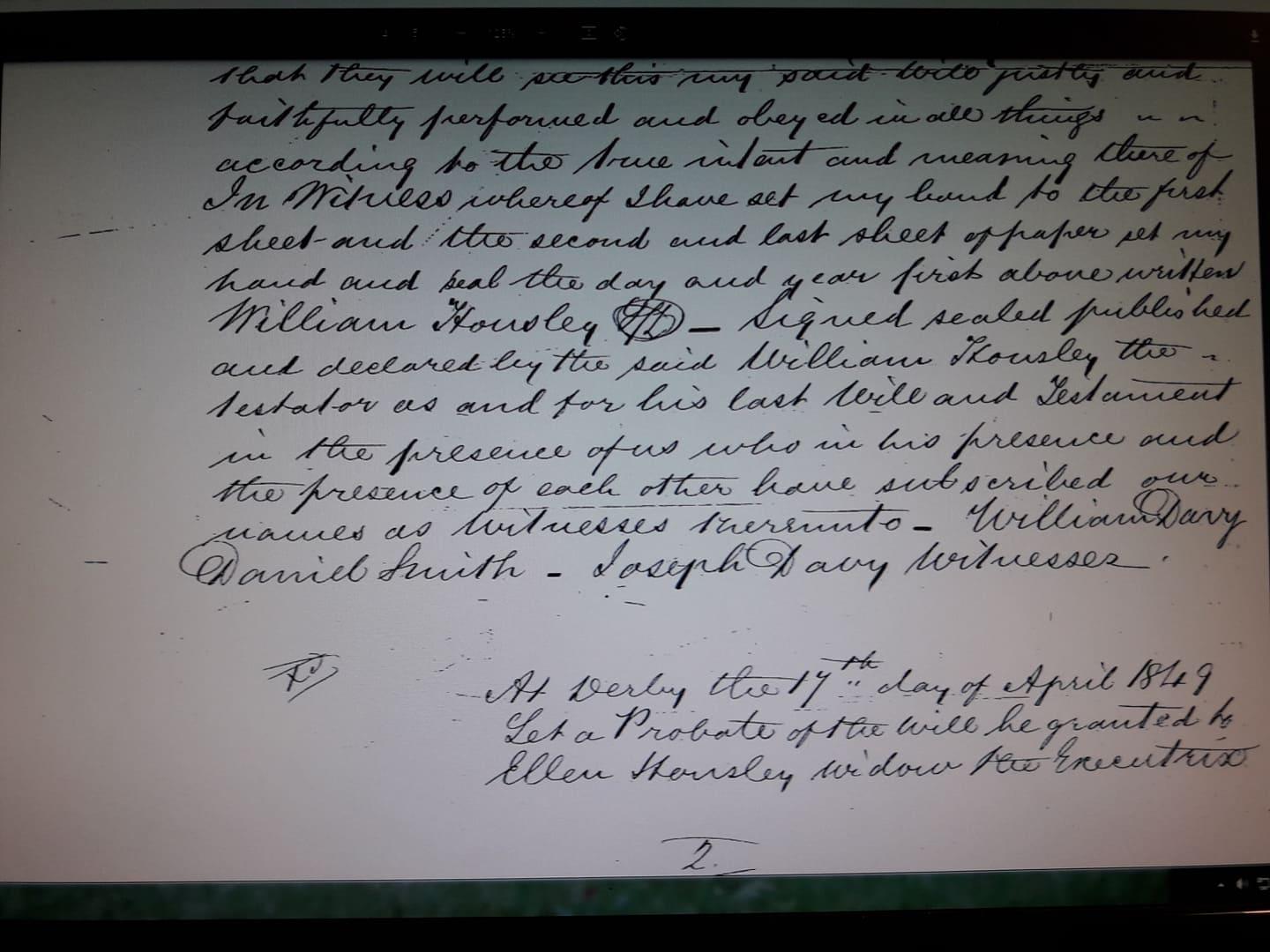
William Housley’s Will and the Court Case
William Housley died in 1848, but his widow Ellen didn’t die until 1872. The court case was in 1873. Details about the court case are archived at the National Archives at Kew, in London, but are not available online. They can be viewed in person, but that hasn’t been possible thus far. However, there are a great many references to it in the letters.
William Housley’s first wife was Mary Carrington 1787-1813. They had three children, Mary Anne, Elizabeth and William. When Mary died, William married Mary’s sister Ellen, not in their own parish church at Smalley but in Ashbourne. Although not uncommon for a widower to marry a deceased wife’s sister, it wasn’t legal. This point is mentioned in one of the letters.
One of the pages of William Housley’s will:
An excerpt from Barbara Housley’s Narrative on the Letters:
A comment in a letter from Joseph (August 6, 1873) indicated that William was married twice and that his wives were sisters: “What do you think that I believe that Mary Ann is trying to make our father’s will of no account as she says that my father’s marriage with our mother was not lawful he marrying two sisters. What do you think of her? I have heard my mother say something about paying a fine at the time of the marriage to make it legal.” Markwell and Saul in The A-Z Guide to Tracing Ancestors in Britain explain that marriage to a deceased wife’s sister was not permissible under Canon law as the relationship was within the prohibited degrees. However, such marriages did take place–usually well away from the couple’s home area. Up to 1835 such marriages were not void but were voidable by legal action. Few such actions were instituted but the risk was always there.
Joseph wrote that when Emma was married, Ellen “broke up the comfortable home and the things went to Derby and she went to live with them but Derby didn’t agree with her so she left again leaving her things behind and came to live with John in the new house where she died.” Ellen was listed with John’s household in the 1871 census.
In May 1872, the Ilkeston Pioneer carried this notice: “Mr. Hopkins will sell by auction on Saturday next the eleventh of May 1872 the whole of the useful furniture, sewing machine, etc. nearly new on the premises of the late Mrs. Housley at Smalley near Heanor in the county of Derby. Sale at one o’clock in the afternoon.”There were hard feelings between Mary Ann and Ellen and her children. Anne wrote: “If you remember we were not very friendly when you left. They never came and nothing was too bad for Mary Ann to say of Mother and me, but when Robert died Mother sent for her to the funeral but she did not think well to come so we took no more notice. She would not allow her children to come either.”
Mary Ann was still living in May 1872. Joseph implied that she and her brother, Will “intend making a bit of bother about the settlement of the bit of property” left by their mother. The 1871 census listed Mary Ann’s occupation as “income from houses.”In July 1872, Joseph introduced Ruth’s husband: “No doubt he is a bad lot. He is one of the Heath’s of Stanley Common a miller and he lives at Smalley Mill” (Ruth Heath was Mary Anne Housley’s daughter)
In 1873 Joseph wrote, “He is nothing but a land shark both Heath and his wife and his wife is the worst of the two. You will think these is hard words but they are true dear brother.” The solicitor, Abraham John Flint, was not at all pleased with Heath’s obstruction of the settlement of the estate. He wrote on June 30, 1873: “Heath agreed at first and then because I would not pay his expenses he refused and has since instructed another solicitor for his wife and Mrs. Weston who have been opposing us to the utmost. I am concerned for all parties interested except these two….The judge severely censured Heath for his conduct and wanted to make an order for sale there and then but Heath’s council would not consent….” In June 1875, the solicitor wrote: “Heath bid for the property but it fetched more money than he could give for it. He has been rather quieter lately.”In May 1872, Joseph wrote: “For what do you think, John has sold his share and he has acted very bad since his wife died and at the same time he sold all his furniture. You may guess I have never seen him but once since poor mother’s funeral and he is gone now no one knows where.”
In 1876, the solicitor wrote to George: “Have you heard of John Housley? He is entitled to Robert’s share and I want him to claim it.”
Anne intended that one third of the inheritance coming to her from her father and her grandfather, William Carrington, be divided between her four nieces: Sam’s three daughters and John’s daughter Elizabeth.
In the same letter (December 15, 1872), Joseph wrote:
“I think we have now found all out now that is concerned in the matter for there was only Sam that we did not know his whereabouts but I was informed a week ago that he is dead–died about three years ago in Birmingham Union. Poor Sam. He ought to have come to a better end than that”However, Samuel was still alive was on the 1871 census in Henley in Arden, and no record of his death can be found. Samuel’s brother in law said he was dead: we do not know why he lied, or perhaps the brothers were lying to keep his share, or another possibility is that Samuel himself told his brother in law to tell them that he was dead. I am inclined to think it was the latter.
Excerpts from Barbara Housley’s Narrative on the Letters continued:
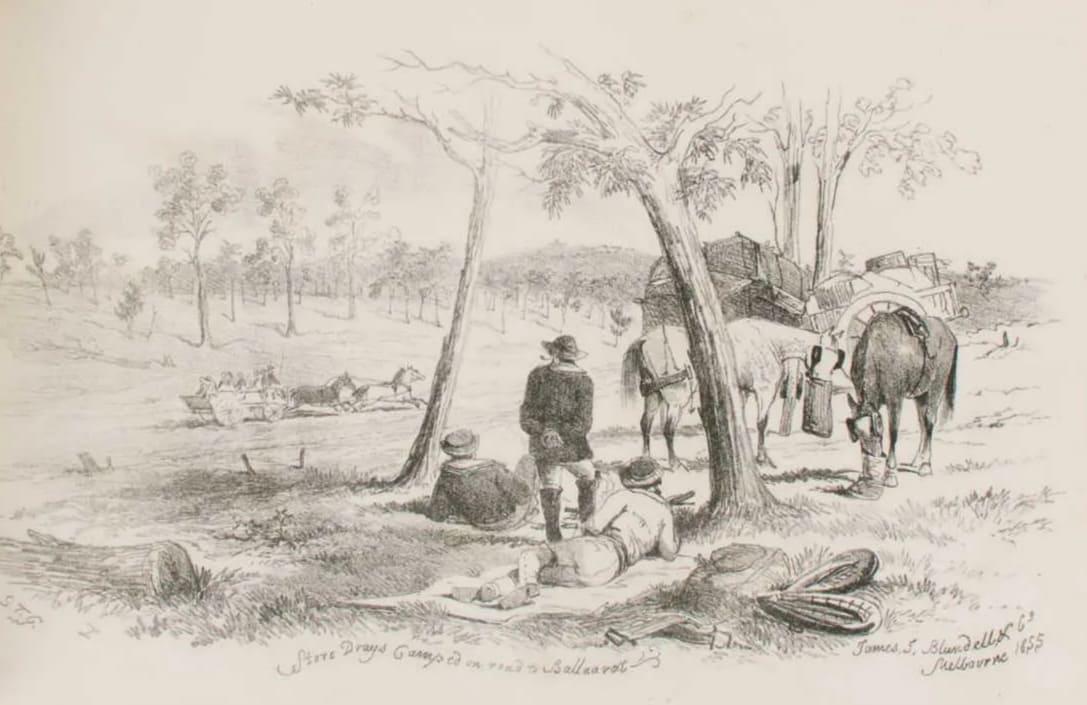
Charles went to Australia in 1851, and was last heard from in January 1853. According to the solicitor, who wrote to George on June 3, 1874, Charles had received advances on the settlement of their parent’s estate. “Your promissory note with the two signed by your brother Charles for 20 pounds he received from his father and 20 pounds he received from his mother are now in the possession of the court.”
In December 1872, Joseph wrote: “I’m told that Charles two daughters has wrote to Smalley post office making inquiries about his share….” In January 1876, the solicitor wrote: “Charles Housley’s children have claimed their father’s share.”
In the Adelaide Observer 28 Aug 1875
HOUSLEY – wanted information
as to the Death, Will, or Intestacy, and
Children of Charles Housley, formerly of
Smalley, Derbyshire, England, who died at
Geelong or Creewick Creek Diggings, Victoria
August, 1855. His children will hear of something to their advantage by communicating with
Mr. A J. Flint, solicitor, Derby, England.
June 16,1875.The Diggers & Diggings of Victoria in 1855. Drawn on Stone by S.T. Gill:
The court case:
Kerry v Housley.
Documents: Bill, demurrer.
Plaintiffs: Samuel Kerry and Joseph Housley.
Defendants: William Housley, Joseph Housley (deleted), Edwin Welch Harvey, Eleanor Harvey (deleted), Ernest Harvey infant, William Stafford, Elizabeth Stafford his wife, Mary Ann Housley, George Purdy and Catherine Purdy his wife, Elizabeth Housley, Mary Ann Weston widow and William Heath and Ruth Heath his wife (deleted).
Provincial solicitor employed in Derbyshire.
Date: 1873From the Narrative on the Letters:
The solicitor wrote on May 23, 1874: “Lately I have not written because I was not certain of your address and because I doubted I had much interesting news to tell you.” Later, Joseph wrote concerning the problems settling the estate, “You see dear brother there is only me here on our side and I cannot do much. I wish you were here to help me a bit and if you think of going for another summer trip this turn you might as well run over here.”
In March 1873, Joseph wrote: “You ask me what I think of you coming to England. I think as you have given the trustee power to sign for you I think you could do no good but I should like to see you once again for all that. I can’t say whether there would be anything amiss if you did come as you say it would be throwing good money after bad.”
In September 1872 Joseph wrote; “My wife is anxious to come. I hope it will suit her health for she is not over strong.” Elsewhere Joseph wrote that Harriet was “middling sometimes. She is subject to sick headaches. It knocks her up completely when they come on.” In December 1872 Joseph wrote, “Now dear brother about us coming to America you know we shall have to wait until this affair is settled and if it is not settled and thrown into Chancery I’m afraid we shall have to stay in England for I shall never be able to save money enough to bring me out and my family but I hope of better things.”
On July 19, 1875 Abraham Flint (the solicitor) wrote: “Joseph Housley has removed from Smalley and is working on some new foundry buildings at Little Chester near Derby. He lives at a village called Little Eaton near Derby. If you address your letter to him as Joseph Housley, carpenter, Little Eaton near Derby that will no doubt find him.”In his last letter (February 11, 1874), Joseph sounded very discouraged and wrote that Harriet’s parents were very poorly and both had been “in bed for a long time.” In addition, Harriet and the children had been ill.
The move to Little Eaton may indicate that Joseph received his settlement because in August, 1873, he wrote: “I think this is bad news enough and bad luck too, but I have had little else since I came to live at Kiddsley cottages but perhaps it is all for the best if one could only think so. I have begun to think there will be no chance for us coming over to you for I am afraid there will not be so much left as will bring us out without it is settled very shortly but I don’t intend leaving this house until it is settled either one way or the other. ”Joseph’s letters were much concerned with the settling of their mother’s estate. In 1854, Anne wrote, “As for my mother coming (to America) I think not at all likely. She is tied here with her property.” A solicitor, Abraham John Flint of 42 Full Street Derby, was engaged by John following the death of their mother. On June 30, 1873 the solicitor wrote: “Dear sir, On the death of your mother I was consulted by your brother John. I acted for him with reference to the sale and division of your father’s property at Smalley. Mr. Kerry was very unwilling to act as trustee being over 73 years of age but owing to the will being a badly drawn one we could not appoint another trustee in his place nor could the property be sold without a decree of chancery. Therefore Mr. Kerry consented and after a great deal of trouble with Heath who has opposed us all throughout whenever matters did not suit him, we found the title deeds and offered the property for sale by public auction on the 15th of July last. Heath could not find his purchase money without mortaging his property the solicitor which the mortgagee employed refused to accept Mr. Kerry’s title and owing to another defect in the will we could not compel them.”
In July 1872, Joseph wrote, “I do not know whether you can remember who the trustee was to my father’s will. It was Thomas Watson and Samuel Kerry of Smalley Green. Mr. Watson is dead (died a fortnight before mother) so Mr. Kerry has had to manage the affair.”
On Dec. 15, 1972, Joseph wrote, “Now about this property affair. It seems as far off of being settled as ever it was….” and in the following March wrote: “I think we are as far off as ever and farther I think.”
Concerning the property which was auctioned on July 15, 1872 and brought 700 pounds, Joseph wrote: “It was sold in five lots for building land and this man Heath bought up four lots–that is the big house, the croft and the cottages. The croft was made into two lots besides the piece belonging to the big house and the cottages and gardens was another lot and the little intake was another. William Richardson bought that.” Elsewhere Richardson’s purchase was described as “the little croft against Smith’s lane.” Smith’s Lane was probably named for their neighbor Daniel Smith, Mrs. Davy’s father.
But in December 1872, Joseph wrote that they had not received any money because “Mr. Heath is raising all kinds of objections to the will–something being worded wrong in the will.” In March 1873, Joseph “clarified” matters in this way: “His objection was that one trustee could not convey the property that his signature was not guarantee sufficient as it states in the will that both trustees has to sign the conveyance hence this bother.”
Joseph indicated that six shares were to come out of the 700 pounds besides Will’s 20 pounds. Children were to come in for the parents shares if dead. The solicitor wrote in 1873, “This of course refers to the Kidsley property in which you take a one seventh share and which if the property sells well may realize you about 60-80 pounds.” In March 1873 Joseph wrote: “You have an equal share with the rest in both lots of property, but I am afraid there will be but very little for any of us.”The other “lot of property” was “property in Smalley left under another will.” On July 17, 1872, Joseph wrote: “It was left by my grandfather Carrington and Uncle Richard is trustee. He seems very backward in bringing the property to a sale but I saw him and told him that I for one expect him to proceed with it.” George seemed to have difficulty understanding that there were two pieces of property so Joseph explained further: “It was left by my grandfather Carrington not by our father and Uncle Richard is the trustee for it but the will does not give him power to sell without the signatures of the parties concerned.” In June 1873 the solicitor Abraham John Flint asked: “Nothing has been done about the other property at Smalley at present. It wants attention and the other parties have asked me to attend to it. Do you authorize me to see to it for you as well?”
After Ellen’s death, the rent was divided between Joseph, Will, Mary Ann and Mr. Heath who bought John’s share and was married to Mary Ann’s daughter, Ruth. Joseph said that Mr. Heath paid 40 pounds for John’s share and that John had drawn 110 pounds in advance. The solicitor said Heath said he paid 60. The solicitor said that Heath was trying to buy the shares of those at home to get control of the property and would have defied the absent ones to get anything.
In September 1872 Joseph wrote that the lawyer said the trustee cannot sell the property at the bottom of Smalley without the signatures of all parties concerned in it and it will have to go through chancery court which will be a great expense. He advised Joseph to sell his share and Joseph advised George to do the same.George sent a “portrait” so that it could be established that it was really him–still living and due a share. Joseph wrote (July 1872): “the trustee was quite willing to (acknowledge you) for the portrait I think is a very good one.” Several letters later in response to an inquiry from George, Joseph wrote: “The trustee recognized you in a minute…I have not shown it to Mary Ann for we are not on good terms….Parties that I have shown it to own you again but they say it is a deal like John. It is something like him, but I think is more like myself.”
In September 1872 Joseph wrote that the lawyer required all of their ages and they would have to pay “succession duty”. Joseph requested that George send a list of birth dates.On May 23, 1874, the solicitor wrote: “I have been offered 240 pounds for the three cottages and the little house. They sold for 200 pounds at the last sale and then I was offered 700 pounds for the whole lot except Richardson’s Heanor piece for which he is still willing to give 58 pounds. Thus you see that the value of the estate has very materially increased since the last sale so that this delay has been beneficial to your interests than other-wise. Coal has become much dearer and they suppose there is coal under this estate. There are many enquiries about it and I believe it will realize 800 pounds or more which increase will more than cover all expenses.” Eventually the solicitor wrote that the property had been sold for 916 pounds and George would take a one-ninth share.
January 14, 1876: “I am very sorry to hear of your lameness and illness but I trust that you are now better. This matter as I informed you had to stand over until December since when all the costs and expenses have been taxed and passed by the court and I am expecting to receive the order for these this next week, then we have to pay the legacy duty and them divide the residue which I doubt won’t come to very much amongst so many of you. But you will hear from me towards the end of the month or early next month when I shall have to send you the papers to sign for your share. I can’t tell you how much it will be at present as I shall have to deduct your share with the others of the first sale made of the property before it went to court.
Wishing you a Happy New Year, I am Dear Sir, Yours truly
Abram J. Flint”September 15, 1876 (the last letter)
“I duly received your power of attorney which appears to have been properly executed on Thursday last and I sent it on to my London agent, Mr. Henry Lyvell, who happens just now to be away for his annual vacation and will not return for 14 or 20 days and as his signature is required by the Paymaster General before he will pay out your share, it must consequently stand over and await his return home. It shall however receive immediate attention as soon as he returns and I hope to be able to send your checque for the balance very shortly.”1874 in chancery:
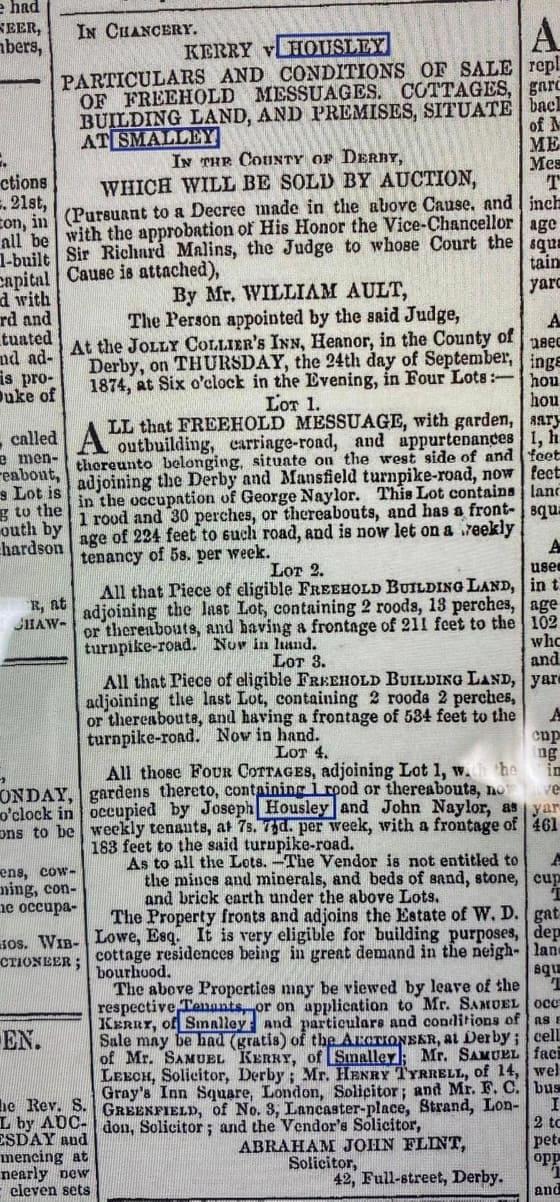 December 18, 2021 at 10:02 am #6242
In reply to: The Elusive Samuel Housley and Other Family Stories
The Housley Letters
We discovered that one of Samuel’s brothers, George Housley 1826-1877, emigrated to America in 1851, to Solebury, in Pennsylvania. Another brother, Charles 1823-1856, emigrated to Australia at the same time.
I wrote to the Solebury Historical Society to ask them if they had any information on the Housleys there. About a month later I had a very helpful and detailed reply from them.
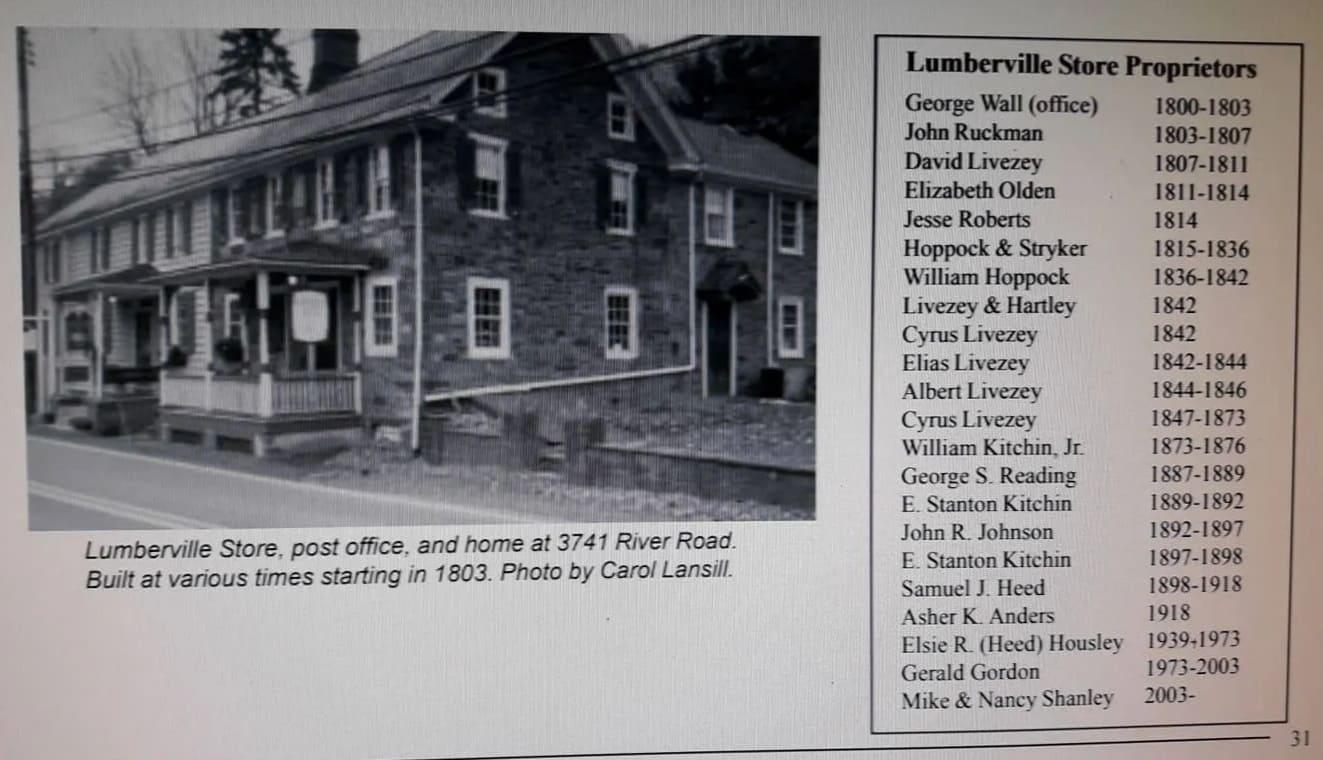
There were Housley people in Solebury Township and nearby communities from 1854 to at least 1973, perhaps 1985. George Housley immigrated in 1851, arriving in New York from London in July 1851 on the ship “Senator”. George was in Solebury by 1854, when he is listed on the tax roles for the Township He didn’t own land at that time. Housley family members mostly lived in the Lumberville area, a village in Solebury, or in nearby Buckingham or Wrightstown. The second wife of Howard (aka Harry) Housley was Elsa (aka Elsie) R. Heed, the daughter of the Lumberville Postmaster. Elsie was the proprietor of the Lumberville General Store from 1939 to 1973, and may have continued to live in Lumberville until her death in 1985. The Lumberville General Store was, and still is, a focal point of the community. The store was also the official Post Office at one time, hence the connection between Elsie’s father as Postmaster, and Elsie herself as the proprietor of the store. The Post Office function at Lumberville has been reduced now to a bank of cluster mailboxes, and official U.S. Postal functions are now in Point Pleasant, PA a few miles north of Lumberville.
We’ve attached a pdf of the Housley people buried in Carversville Cemetery, which is in the town next to Lumberville, and is still in Solebury Township. We hope this list will confirm that these are your relatives.It doesn’t seem that any Housley people still live in the area. Some of George’s descendents moved to Wilkes-Barre, PA and Flemington, NJ. One descendent, Barbara Housley, lived in nearby Doylestown, PA, which is the county seat for Bucks County. She actually visited Solebury Township Historical Society looking for Housley relatives, and it would have been nice to connect you with her. Unfortunately she died in 2018. Her obituary is attached in case you want to follow up with the nieces and great nieces who are listed.
Lumberville General Store, Pennsylvania, Elsie Housley:
I noticed the name of Barbara’s brother Howard Housley in her obituary, and found him on facebook. I knew it was the right Howard Housley as I recognized Barbara’s photograph in his friends list as the same photo in the obituary. Howard didn’t reply initially to a friend request from a stranger, so I found his daughter Laura on facebook and sent her a message. She replied, spoke to her father, and we exchanged email addresses and were able to start a correspondence. I simply could not believe my luck when Howard sent me a 17 page file of Barbara’s Narrative on the Letters with numerous letter excerpts interspersed with her own research compiled on a six month trip to England.
The letters were written to George between 1851 and the 1870s, from the Housley family in Smalley.
Narrative of Historic Letters ~ Barbara Housley.
AND BELIEVE ME EVER MY DEAR BROTHER, YOUR AFFECTIONATE FAMILY
In February 1991, I took a picture of my 16 month old niece Laura Ann Housley standing near the tombstones of her great-great-great-grandparents, George and Sarah Ann Hill Housley. The occassion was the funeral of another Sarah Housley, Sarah Lord Housley, wife of Albert Kilmer Housley, youngest son of John Eley Housley (George and Sarah Ann’s first born). Laura Ann’s great-grandfather (my grandfather) was another George, John Eley’s first born. It was Aunt Sarah who brought my mother, Lois, a packet of papers which she had found in the attic. Mom spent hours transcribing the letters which had been written first horizontally and then vertically to save paper. What began to emerge was a priceless glimpse into the lives and concerns of Housleys who lived and died over a century ago. All of the letters ended with the phrase “And believe me ever my dear brother, your affectionate….”
The greeting and opening remarks of each of the letters are included in a list below. The sentence structure and speech patterns have not been altered however spelling and some punctuation has been corrected. Some typical idiosyncrasies were: as for has, were for where and vice versa, no capitals at the beginnings of sentences, occasional commas and dashes but almost no periods. Emma appears to be the best educated of the three Housley letter-writers. Sister-in-law Harriet does not appear to be as well educated as any of the others. Since their mother did not write but apparently was in good health, it must be assumed that she could not.
The people discussed and described in the following pages are for the most part known to be the family and friends of the Housleys of Smalley, Derbyshire, England. However, practically every page brings conjectures about the significance of persons who are mentioned in the letters and information about persons whose names seem to be significant but who have not yet been established as actual members of the family.To say this was a priceless addition to the family research is an understatement. I have since, with Howard’s permission, sent the file to the Derby Records Office for their family history section. We are hoping that Howard will find the actual letters in among the boxes he has of his sisters belongings. Some of the letters mention photographs that were sent. Perhaps some will be found.
December 17, 2021 at 10:36 am #6241In reply to: The Elusive Samuel Housley and Other Family Stories
Kidsley Grange Farm and The Quakers Next Door
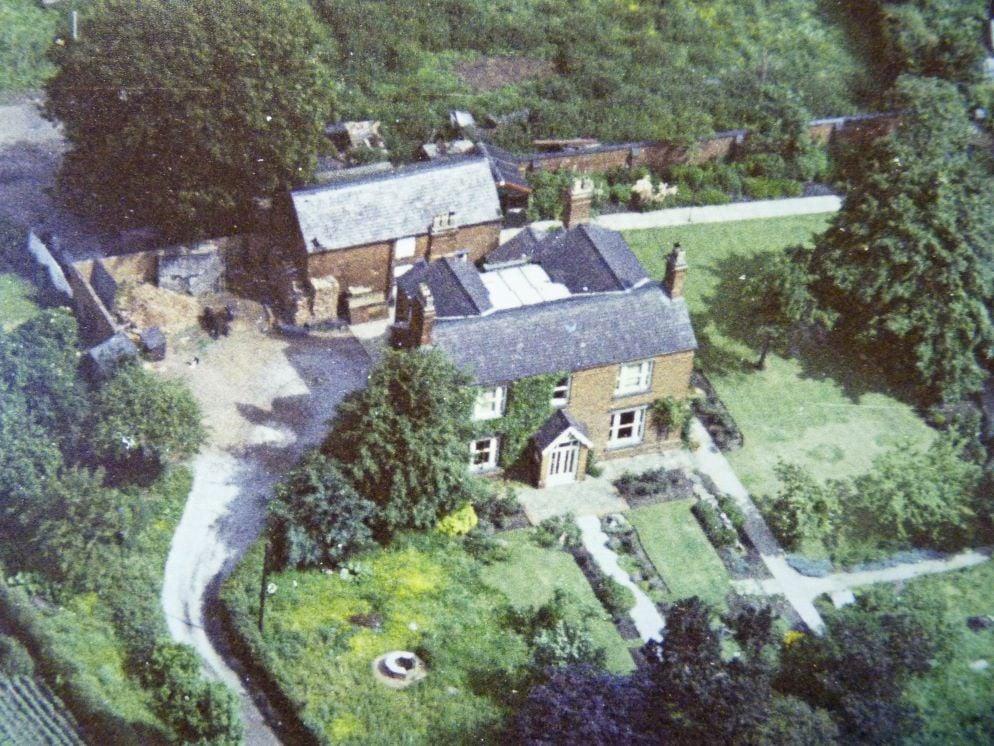
Kidsley Grange Farm in Smalley, Derbyshire, was the home of the Housleys in the 1800s. William Housley 1781-1848 was born in nearby Selston. His wife Ellen Carrington 1795-1872 was from a long line of Carringtons in Smalley. They had ten children between 1815 and 1838. Samuel, my 3x great grandfather, was the second son born in 1816.
The original farm has been made into a nursing home in recent years, which at the time of writing is up for sale at £500,000. Sadly none of the original farm appears visible with all the new additions.
The farm before it was turned into a nursing home:
Kidsley Grange Farm and Kidsley Park, a neighbouring farm, are mentioned in a little book about the history of Smalley. The neighbours at Kidsley Park, the Davy’s, were friends of the Housleys. They were Quakers.
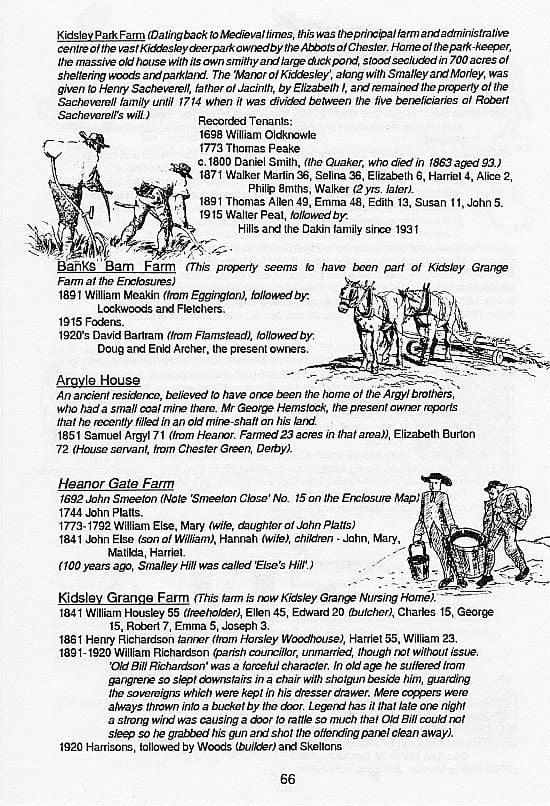
In Kerry’s History of Smalley:
Kidsley Park Farm was owned by Daniel Smith, a prominent Quaker and the last of the Quakers at Kidsley. His daughter, Elizabeth Davy, widow of William Davis, married WH Barber MB of Smalley. Elizabeth was the author of the poem “Farewell to Kidsley Park”.
Emma Housley sent one of Elizabeth Davy’s poems to her brother George in USA.
“We have sent you a piece of poetry that Mrs. Davy composed about our ‘Old House.’ I am sure you will like it though you may not understand all the allusions she makes use of as well as we do.”
Farewell to Kidsley Park
Farewell, Farewell, Thy pathways now by strangers feet are trod,
And other hands and horses strange henceforth shall turn thy sod,
Yes, other eyes may watch the buds expanding in the spring.
And other children round the hearth the coming years may bring,
But mine will be the memory of cares and pleasures there,
Intenser ~ that no living thing in some of them can share,
Commencing with the loved, and lost, in days of long ago,
When one was present on whose head Atlantic’s breezes blow,
Long years ago he left that roof, and made a home afar ~
For that is really only “home” where life’s affections are!
How many thoughts come o’er me, for old Kidsley has “a name
And memory” ~ in the hearts of some not unknown to fame.
We dream not, in those happy times, that I should be the last,
Alone, to leave my native place ~ alone, to meet the blast,
I loved each nook and corner there, each leaf and blade of grass,
Each moonlight shadow on the pond I loved: but let it pass,
For mine is still the memory that only death can mar;
I fancy I shall see it reflecting every star.
The graves of buried quadrupeds, affectionate and true,
Will have the olden sunshine, and the same bright morning dew,
But the birds that sang at even when the autumn leaves were seer,
Will miss the crumbs they used to get, in winters long and drear.
Will the poor down-trodden miss me? God help them if they do!
Some manna in the wilderness, His goodness guide them to!
Farewell to those who love me! I shall bear them still in mind,
And hope to be remembered by those I left behind:
Do not forget the aged man ~ though another fills his place ~
Another, bearing not his name, nor coming of his race.
His creed might be peculiar; but there was much of good
Successors will not imitate, because not understood.
Two hundred years have come and past since George Fox ~ first of “Friends” ~
Established his religion there ~ which my departure ends.
Then be it so: God prosper these in basket and in store,
And make them happy in my place ~ my dwelling, never more!
For I may be a wanderer ~ no roof nor hearthstone mine:
May light that cometh from above my resting place define.
Gloom hovers o’er the prospect now, but He who was my friend,
In the midst of troubled waters, will see me to the end.Elizabeth Davy, June 6th, 1863, Derby.
Another excerpt from Barbara Housley’s Narrative on the Letters from the family in Smalley to George in USA mentions the Davy’s:
Anne’s will was probated October 14, 1856. Mr. William Davy of Kidsley Park appeared for the family. Her estate was valued at under £20. Emma was to receive fancy needlework, a four post bedstead, feather bed and bedding, a mahogany chest of drawers, plates, linen and china. Emma was also to receive Anne’s writing desk! There was a condition that Ellen would have use of these items until her death.
The money that Anne was to receive from her grandfather, William Carrington, and her father, William Housley was to be distributed one third to Joseph, one third to Emma, and one third to be divided between her four neices: John’s daughter Elizabeth, 18, and Sam’s daughters Elizabeth, 10, Mary Anne, 9 and Catherine, age 7 to be paid by the trustees as they think “most useful and proper.” Emma Lyon and Elizabeth Davy were the witnesses.Mrs. Davy wrote to George on March 21 1856 sending some gifts from his sisters and a portrait of their mother–“Emma is away yet and A is so much worse.” Mrs. Davy concluded: “With best wishes
for thy health and prosperity in this world and the next I am thy sincere friend.” Whenever the girls sent greetings from Mrs. Davy they used her Quaker speech pattern of “thee and thy.”December 15, 2021 at 3:37 pm #6238In reply to: The Elusive Samuel Housley and Other Family Stories
Ellen (Nellie) Purdy
My grandfathers aunt Nellie Purdy 1872-1947 grew up with his mother Mary Ann at the Gilmans in Buxton. We knew she was a nurse or a matron, and that she made a number of trips to USA.
I started looking for passenger lists and immigration lists (we had already found some of them, and my cousin Linda Marshall in Boston found some of them), and found one in 1904 with details of the “relatives address while in US”.
October 31st, 1904, Ellen Purdy sailed from Liverpool to Baltimore on the Friesland. She was a 32 year old nurse and she paid for her own ticket. The address of relatives in USA was Druid Hill and Lafayette Ave, Baltimore, Maryland.
I wondered if she stayed with relatives, perhaps they were the Housley descendants. It was her great uncle George Housley who emigrated in 1851, not so far away in Pennsylvania. I wanted to check the Baltimore census to find out the names at that address, in case they were Housley’s. So I joined a Baltimore History group on facebook, and asked how I might find out. The people were so enormously helpful! The address was the Home of the Friendless, an orphanage. (a historic landmark of some note I think), and someone even found Ellen Purdy listed in the Baltimore directory as a nurse there.
She sailed back to England in 1913. Ellen sailed in 1900 and 1920 as well but I haven’t unraveled those trips yet.
THE HOME OF THE FRIENDLESS, is situated at the corner of Lafayette and Druid Hill avenues, Baltimore. It is a large brick building, which was erected at a cost of $62,000. It was organized in 1854.The chief aim of the founders of this institution was to respond to a need for providing a home for the friendless and homeless children, orphans, and half-orphans, or the offspring of vagrants. It has been managed since its organization by a board of ladies, who, by close attention and efficient management, have made the institution one of the most prominent charitable institutions in the State. From its opening to the present time there have been received 5,000 children, and homes have been secured for nearly one thousand of this number. The institution has a capacity of about 200 inmates. The present number of beneficiaries is 165. A kindergarten and other educational facilities are successfully conducted. The home knows no demonimational creed, being non-sectarian. Its principal source of revenue is derived from private contributions. For many years the State has appropriated different sums towards it maintenance, and the General Assembly of 1892 contributed the sum of $3,000 per annum.
A later trip: The ship’s manifest from May 1920 the Baltic lists Ellen on board arriving in Ellis Island heading to Baltimore age 48. The next of kin is listed as George Purdy (her father) of 2 Gregory Blvd Forest Side, Nottingham. She’s listed as a nurse, and sailed from Liverpool May 8 1920.
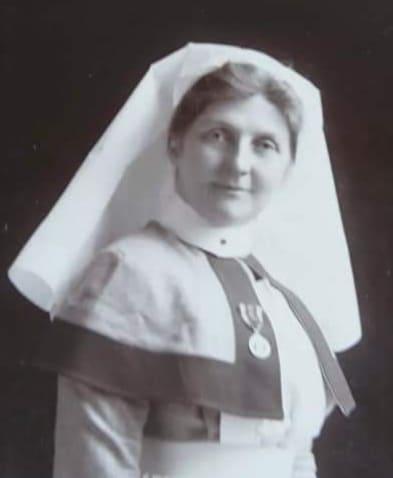
Ellen eventually retired in England and married Frank Garbett, a tax collector, at the age of 51 in Herefordshire. Judging from the number of newspaper articles I found about her, she was an active member of the community and was involved in many fundraising activities for the local cottage hospital.
Her obituary in THE KINGTON TIMES, NOVEMBER 8, 1947:
Mrs. Ellen Garbett wife of Mr. F. Garbett, of Brook Cottage, Kingsland, whose funeral took place at St. Michael’s Church, Kingsland, on October 30th, was a familiar figure in the district, and by her genial manner and kindly ways had endeared herself to many.
Mrs Garbett had had a wide experience in the nursing profession. Beginning her training in this country, she went to the Italian Riviera and there continued her work, later going to the United States. In 1916 she gained the Q.A.I.M.N.S. and returned to England and was appointed sister at the Lord Derby Military Hospital, an appointment she held for four years.We didn’t know that Ellen had worked on the Italian Riviera, and hope in due course to find out more about it.
Mike Rushby, Ellen’s sister Kate’s grandson in Australia, spoke to his sister in USA recently about Nellie Purdy. She replied: I told you I remembered Auntie Nellie coming to Jacksdale. She gave me a small green leatherette covered bible which I still have ( though in a very battered condition). Here is a picture of it.
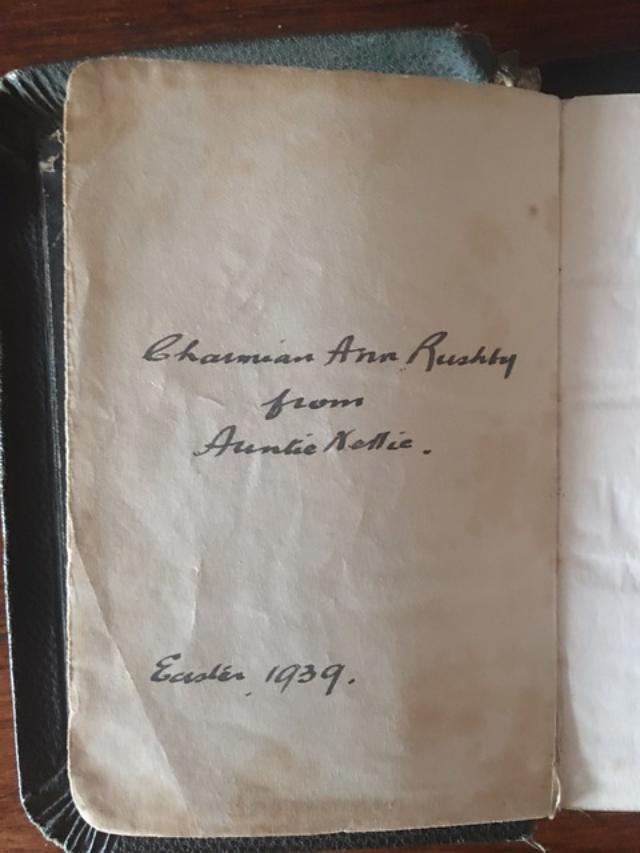 December 15, 2021 at 1:16 pm #6237
In reply to: The Elusive Samuel Housley and Other Family Stories
Murder At The Bennistons
We don’t know exactly what happened immediately after the death of Catherine Housley’s mother in 1849, but by 1850 the two older daughters Elizabeth and Mary Anne were inmates in Belper Workhouse. Catherine was just six weeks old, so presumably she was with a wet nurse, possibly even prior to her mothers death. By 1851, according to the census, she was living in Heanor, a small town near to Smalley, with John Benniston, a framework knitter, and his family. Framework knitters (abbreviated to FWK should you happen to see it on a census) rented a large loom and made stockings and everyone in the family helped. Often the occupation of other household members would be “seamer”: they would stitch the stocking seams together. Catherine was still living with the Bennistons ten years later in 1861.
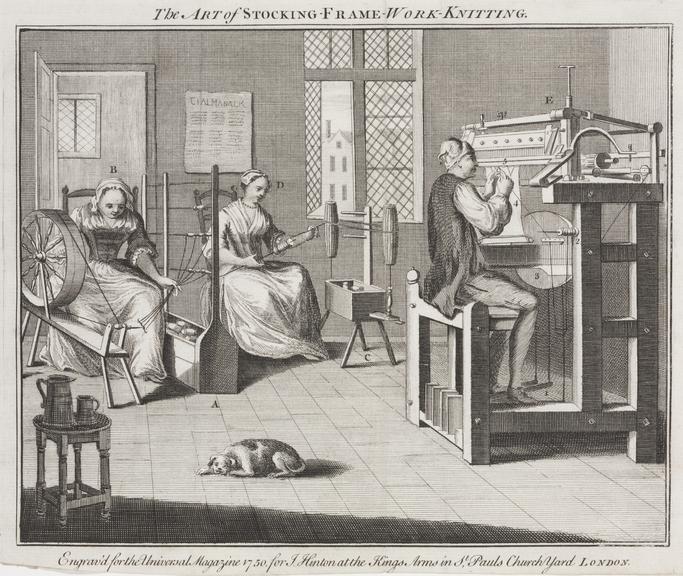
I read some chapters of a thesis on the south Derbyshire poor in the 1800s and found some illuminating information about indentured apprenticeship of children especially if one parent died. It was not at all uncommon, and framework knitters in particular often had indentured apprentices. It was a way to ensure the child was fed and learned a skill. Children commonly worked from the age of ten or 12 anyway. They were usually placed walking distance of the family home and maintained contact. The indenture could be paid by the parish poor fund, which cost them slightly less than sending them to the poorhouse, and could be paid off by a parent if circumstances improved to release the child from the apprenticeship.
A child who was an indentured apprentice would continue a normal life after the term of apprenticeship, usually still in contact with family locally.I found a newspaper article titled “Child Murder at Heanor” dated 1858.
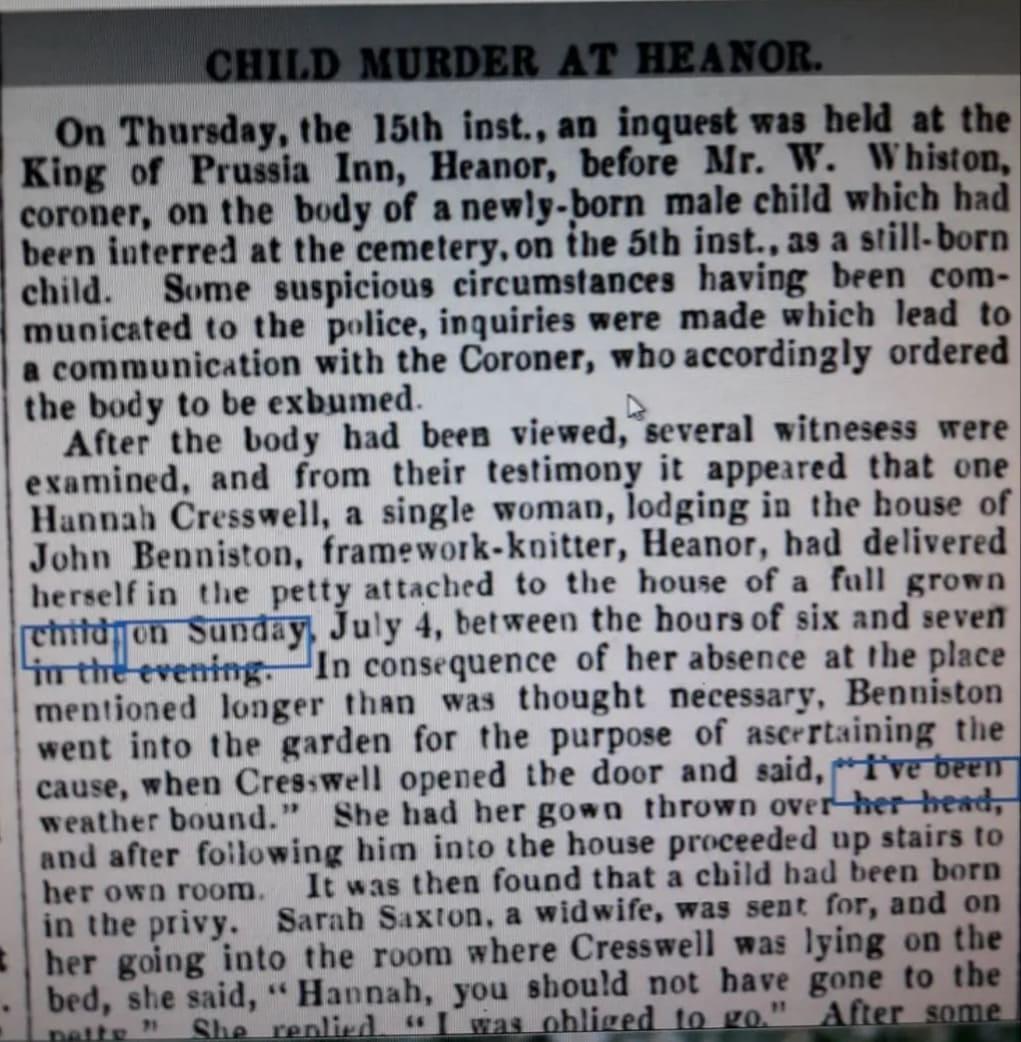
A 23 year old lodger at the Bennistons, Hannah Cresswell, apparently murdered a new born baby that she gave birth to in the privy, which the midwife took away and had buried as a still birth. The baby was exhumed after an anonymous tip off from a neighbour, citing that it was the 4th such incident. Catherine Housley would have been nine years old at the time.
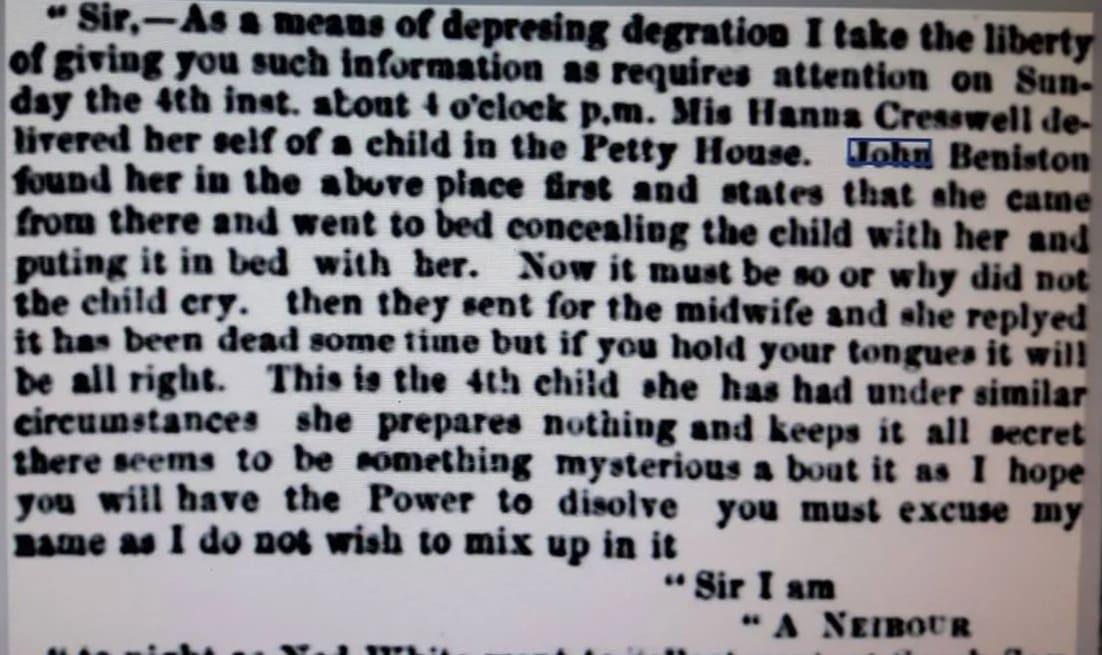
Subsequent newspaper articles indicate that the case was thrown out, despite the doctors evidence that the baby had been beaten to death.
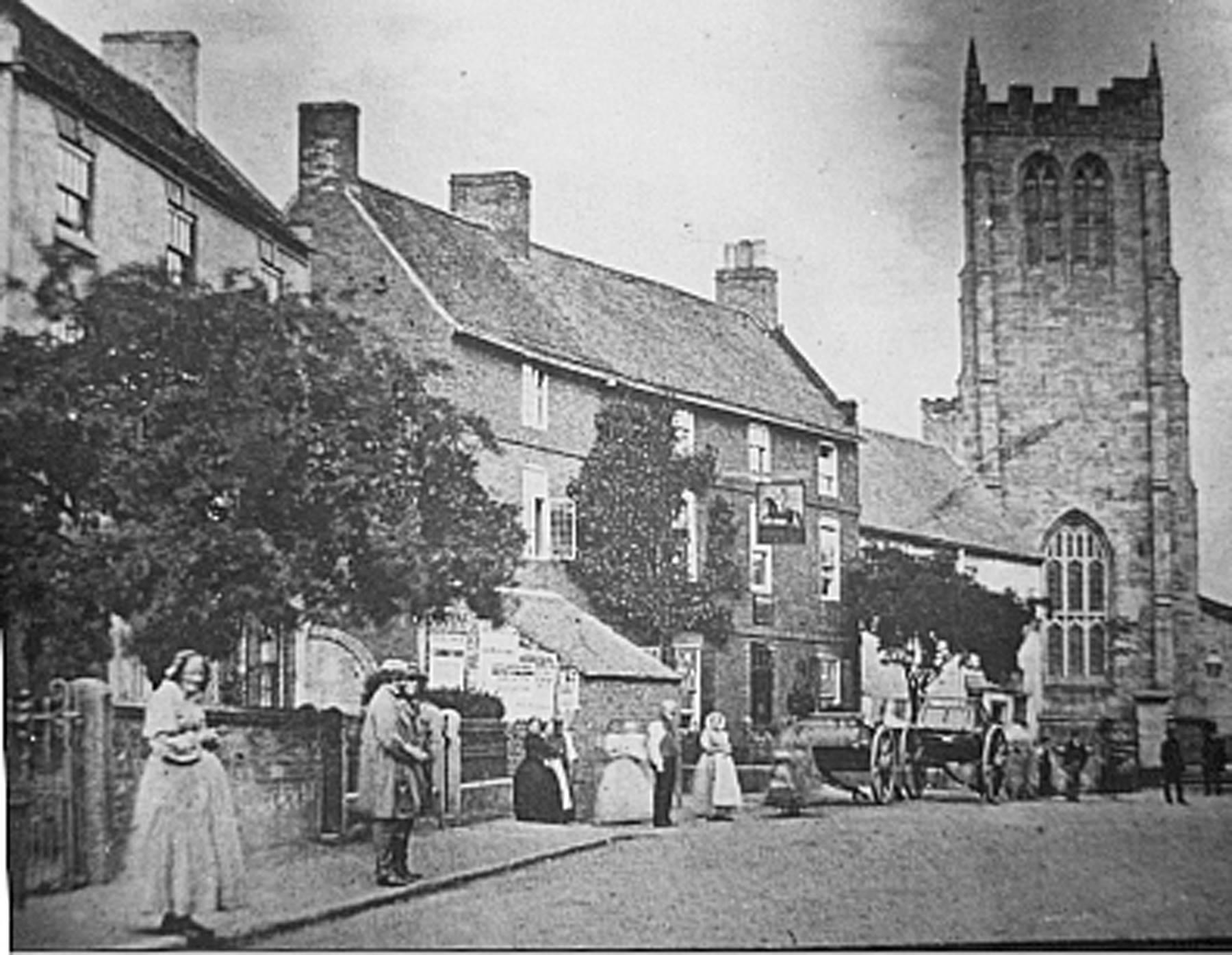
In July 1858 the inquest was held in the King of Prussia, on the Hannah Cresswell baby murder at the Bennistons.
The King of Prussia, Heanor, in 1860:
 December 15, 2021 at 7:53 am #6234
In reply to: The Elusive Samuel Housley and Other Family Stories
Ben Warren
Derby County and England football legend who died aged 37 penniless and ‘insane’
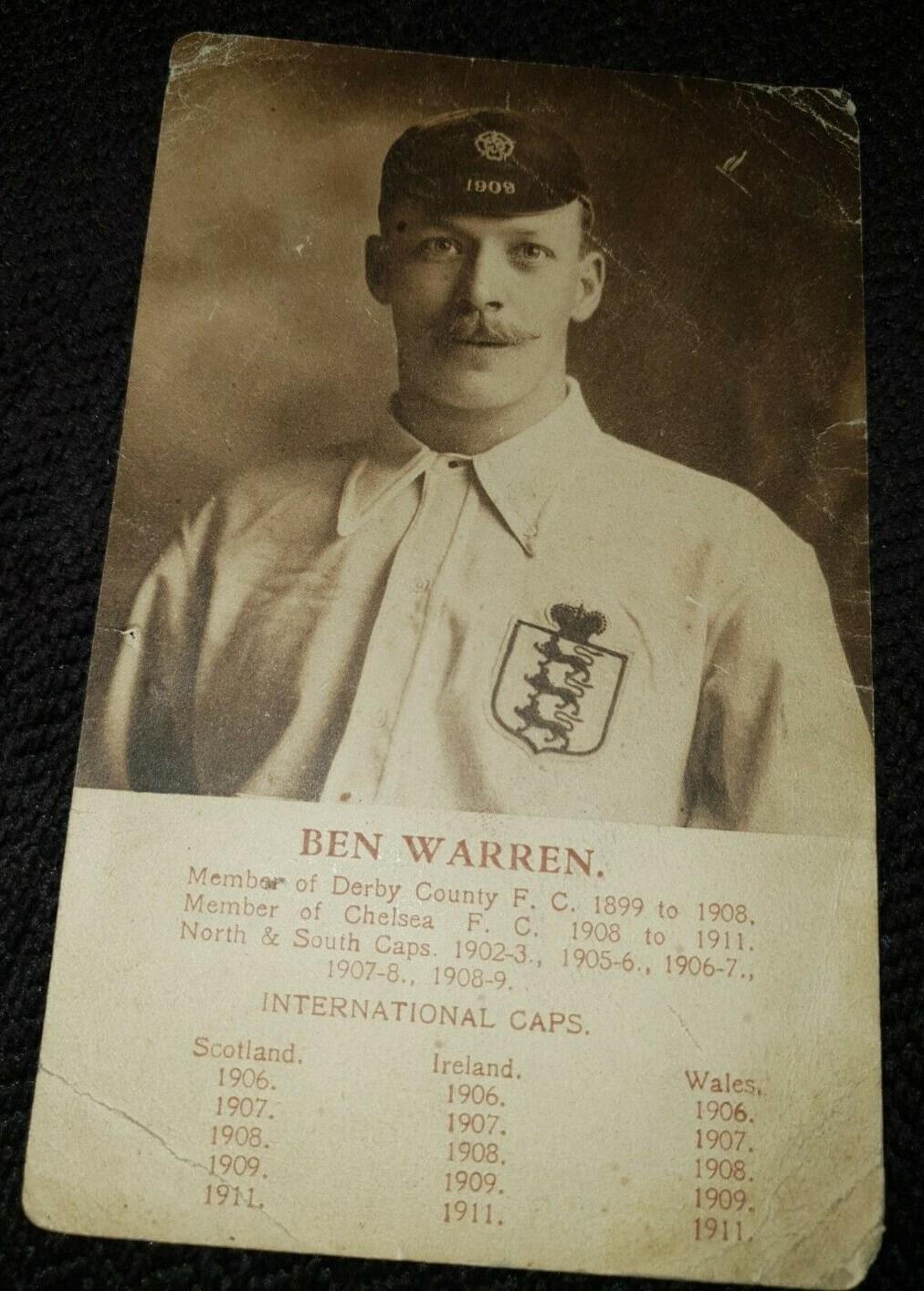
Ben Warren 1879 – 1917 was Samuel Warren’s (my great grandfather) cousin.
From the Derby Telegraph:
Just 17 months after earning his 22nd England cap, against Scotland at Everton on April 1, 1911, he was certified insane. What triggered his decline was no more than a knock on the knee while playing for Chelsea against Clapton Orient.
The knee would not heal and the longer he was out, the more he fretted about how he’d feed his wife and four children. In those days, if you didn’t play, there was no pay.
…..he had developed “brain fever” and this mild-mannered man had “become very strange and, at times, violent”. The coverage reflected his celebrity status.
On December 15, 1911, as Rick Glanvill records in his Official Biography of Chelsea FC: “He was admitted to a private clinic in Nottingham, suffering from acute mania, delusions that he was being poisoned and hallucinations of hearing and vision.”
He received another blow in February, 1912, when his mother, Emily, died. She had congestion of the lungs and caught influenza, her condition not helped, it was believed, by worrying about Ben.
She had good reason: her famous son would soon be admitted to the unfortunately named Derby County Lunatic Asylum.
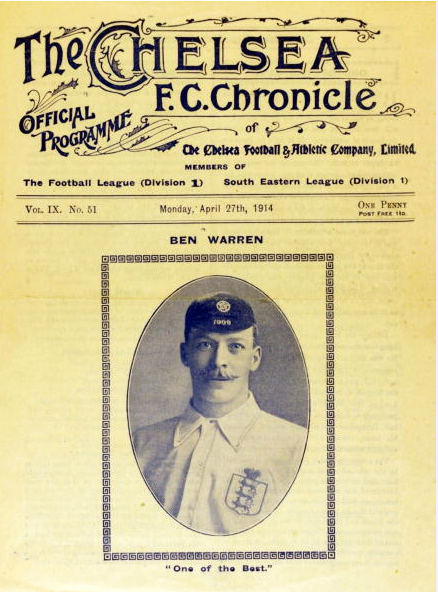
As Britain sleepwalked towards the First World War, Ben’s condition deteriorated. Glanvill writes: “His case notes from what would be a five-year stay, catalogue a devastating decline in which he is at various times described as incoherent, restless, destructive, ‘stuporose’ and ‘a danger to himself’.’”
photo: Football 27th April 1914. A souvenir programme for the testimonial game for Chelsea and England’s Ben Warren, (pictured) who had been declared insane and sent to a lunatic asylum. The game was a select XI for the North playing a select XI from The South proceeds going to Warren’s family.
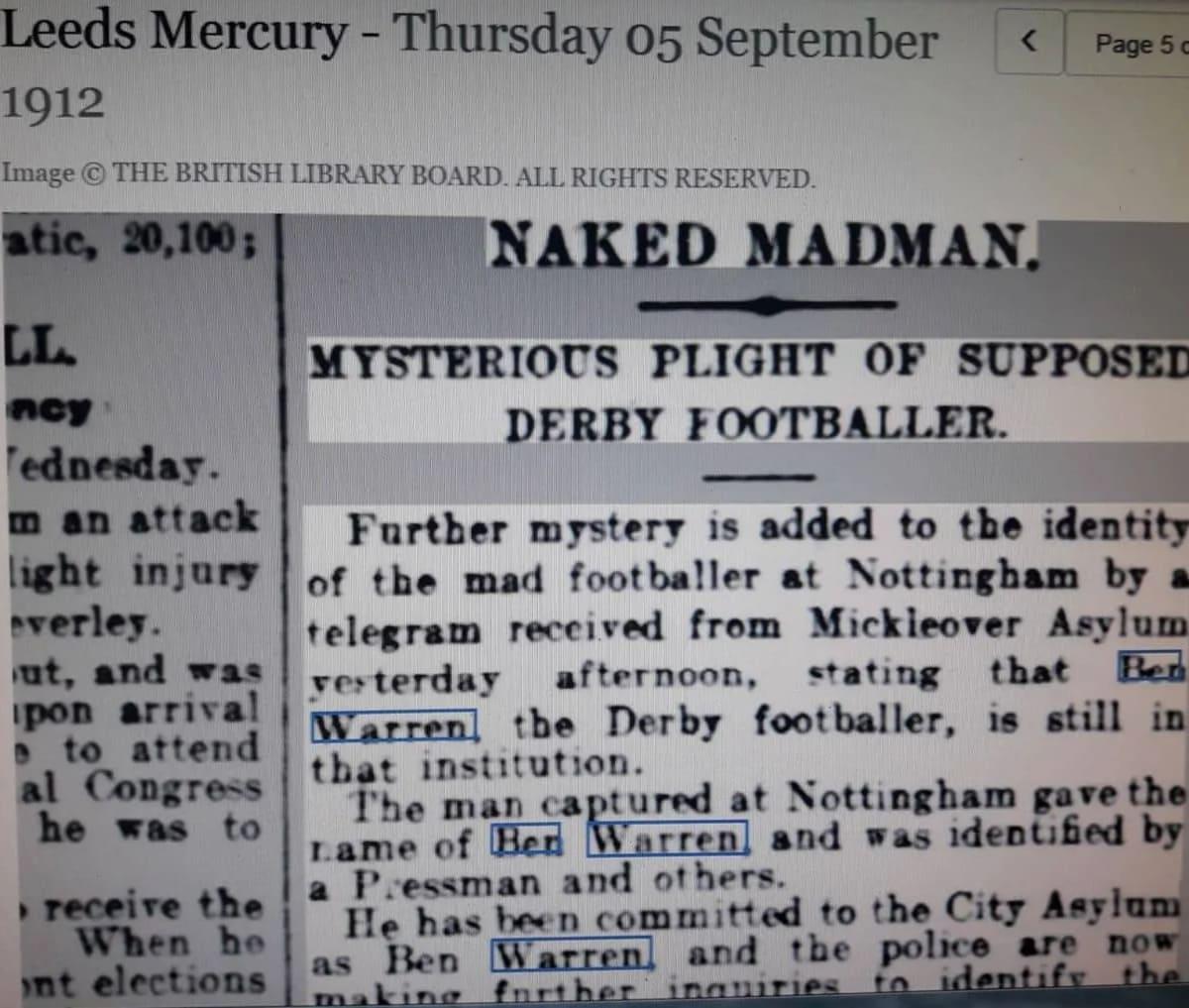
In September, that decline reached a new and pitiable low. The following is an abridged account of what The Courier called “an amazing incident” that took place on September 4.
“Spotted by a group of men while walking down Derby Road in Nottingham, a man was acting strangely, smoking a cigarette and had nothing on but a collar and tie.
“He jumped about the pavement and roadway, as though playing an imaginary game of football. When approached, he told them he was going to Trent Bridge to play in a match and had to be there by 3.30.”
Eventually he was taken to a police station and recognised by a reporter as England’s erstwhile right-half. What made the story even harder to digest was that Ben had escaped from the asylum and walked the 20 miles to Nottingham apparently unnoticed.
He had played at “Trent Bridge” many times – at least on Nottingham Forest’s adjacent City Ground.
As a shocked nation came to terms with the desperate plight of one of its finest footballers, some papers suggested his career was not yet over. And his relatives claimed that he had been suffering from nothing more than a severe nervous breakdown.
He would never be the same again – as a player or a man. He wasn’t even a shadow of the weird “footballer” who had walked 20 miles to Nottingham.
Then, he had nothing on, now he just had nothing – least of all self-respect. He ripped sheets into shreds and attempted suicide, saying: “I’m no use to anyone – and ought to be out of the way.”
“A year before his suicide attempt in 1916 the ominous symptom of ‘dry cough’ had been noted. Two months after it, in October 1916, the unmistakable signs of tuberculosis were noted and his enfeebled body rapidly succumbed.
At 11.30pm on 15 January 1917, international footballer Ben Warren was found dead by a night attendant.
He was 37 and when they buried him the records described him as a “pauper’.”
However you look at it, it is the salutary tale of a footballer worrying about money. And it began with a knock on the knee.
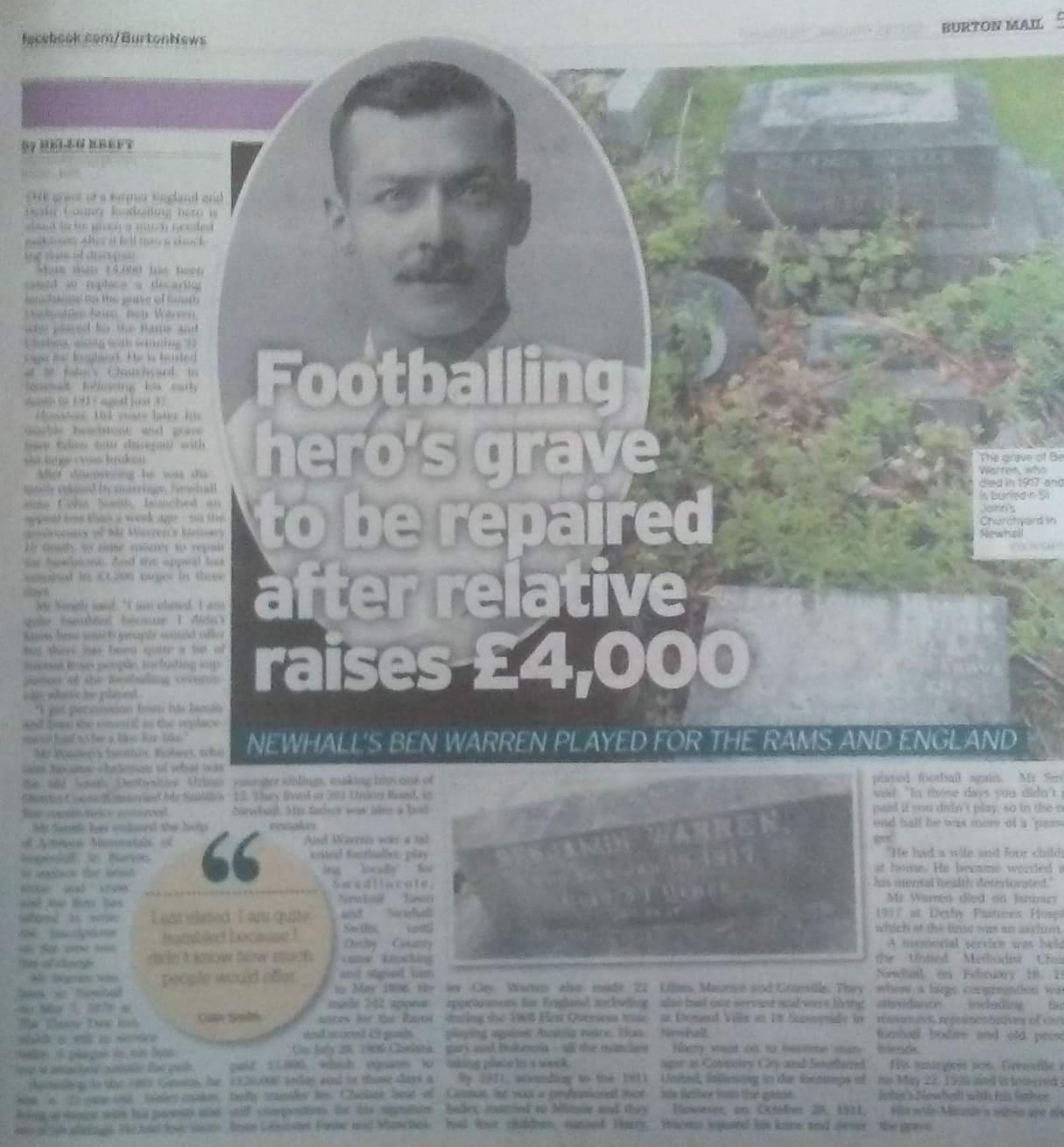
On 14th November 2021, Gill Castle posted on the Newhall and Swadlincote group:
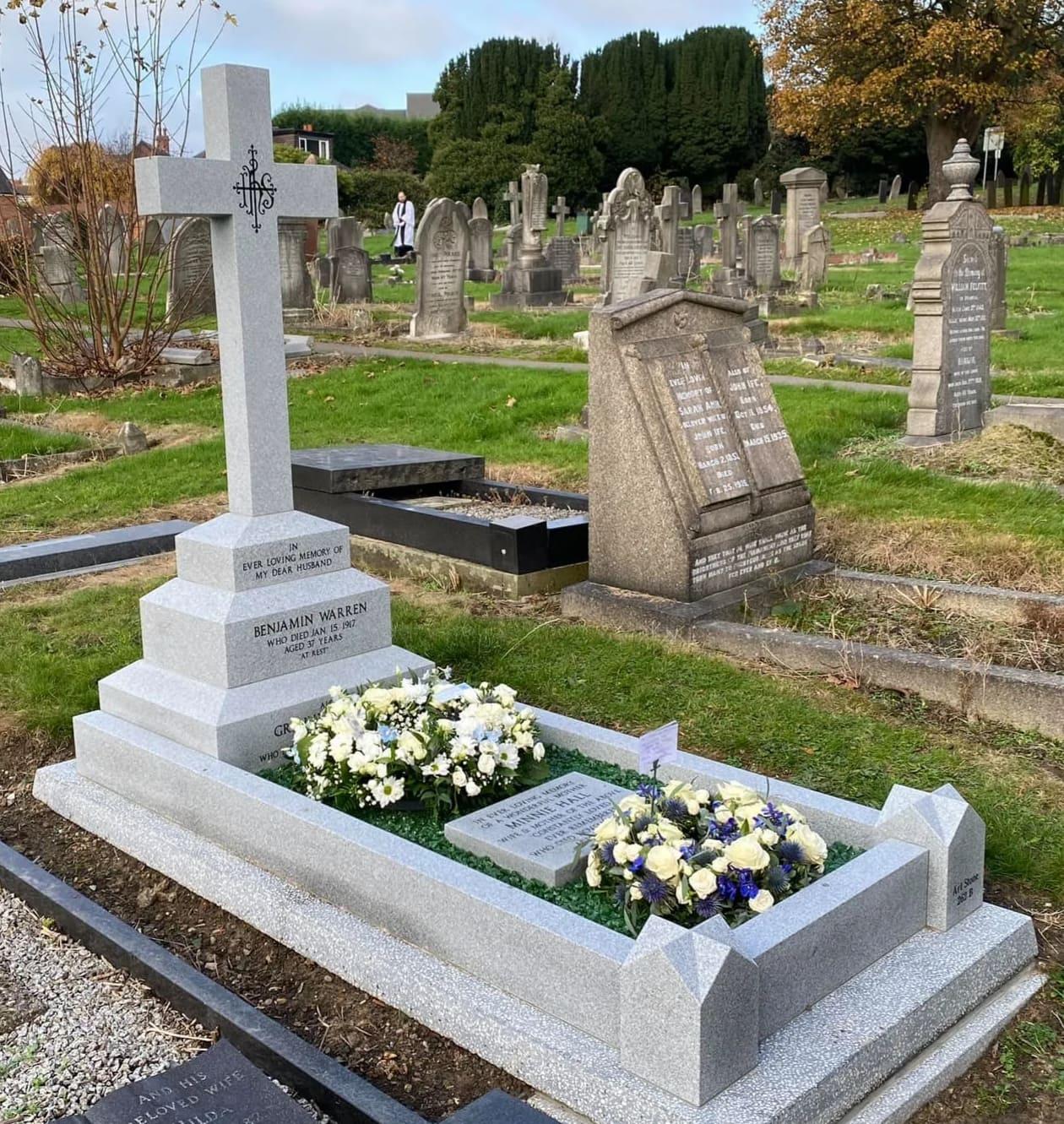
I would like to thank Colin Smith and everyone who supported him in getting my great grandfather’s grave restored (Ben Warren who played for Derby, Chelsea and England)
The month before, Colin Smith posted:
My Ben Warren Journey is nearly complete.
It started two years ago when I was sent a family wedding photograph asking if I recognised anyone. My Great Great Grandmother was on there. But soon found out it was the wedding of Ben’s brother Robert to my 1st cousin twice removed, Eveline in 1910.
I researched Ben and his football career and found his resting place in St Johns Newhall, all overgrown and in a poor state with the large cross all broken off. I stood there and decided he needed to new memorial & headstone. He was our local hero, playing Internationally for England 22 times. He needs to be remembered.
After seeking family permission and Council approval, I had a quote from Art Stone Memorials, Burton on Trent to undertake the work. Fundraising then started and the memorial ordered.
Covid came along and slowed the process of getting materials etc. But we have eventually reached the final installation today.
I am deeply humbled for everyone who donated in January this year to support me and finally a massive thank you to everyone, local people, football supporters of Newhall, Derby County & Chelsea and football clubs for their donations.
Ben will now be remembered more easily when anyone walks through St Johns and see this beautiful memorial just off the pathway.
Finally a huge thank you for Art Stone Memorials Team in everything they have done from the first day I approached them. The team have worked endlessly on this project to provide this for Ben and his family as a lasting memorial. Thank you again Alex, Pat, Matt & Owen for everything. Means a lot to me.
The final chapter is when we have a dedication service at the grave side in a few weeks time,
Ben was born in The Thorntree Inn Newhall South Derbyshire and lived locally all his life.
He played local football for Swadlincote, Newhall Town and Newhall Swifts until Derby County signed Ben in May 1898. He made 242 appearances and scored 19 goals at Derby County.
28th July 1908 Chelsea won the bidding beating Leicester Fosse & Manchester City bids.
Ben also made 22 appearance’s for England including the 1908 First Overseas tour playing Austria twice, Hungary and Bohemia all in a week.
28 October 1911 Ben Injured his knee and never played football again
Ben is often compared with Steven Gerard for his style of play and team ethic in the modern era.
Herbert Chapman ( Player & Manager ) comments “ Warren was a human steam engine who played through 90 minutes with intimidating strength and speed”.
Charles Buchan comments “I am certain that a better half back could not be found, Part of the Best England X1 of all time”
Chelsea allowed Ben to live in Sunnyside Newhall, he used to run 5 miles every day round Bretby Park and had his own gym at home. He was compared to the likes of a Homing Pigeon, as he always came back to Newhall after his football matches.
Ben married Minnie Staley 21st October 1902 at Emmanuel Church Swadlincote and had four children, Harry, Lillian, Maurice & Grenville. Harry went on to be Manager at Coventry & Southend following his father in his own career as football Manager.
After Ben’s football career ended in 1911 his health deteriorated until his passing at Derby Pastures Hospital aged 37yrs
Ben’s youngest son, Grenville passed away 22nd May 1929 and is interred together in St John’s Newhall with his Father
His wife, Minnie’s ashes are also with Ben & Grenville.
Thank you again everyone.
RIP Ben Warren, our local Newhall Hero. You are remembered.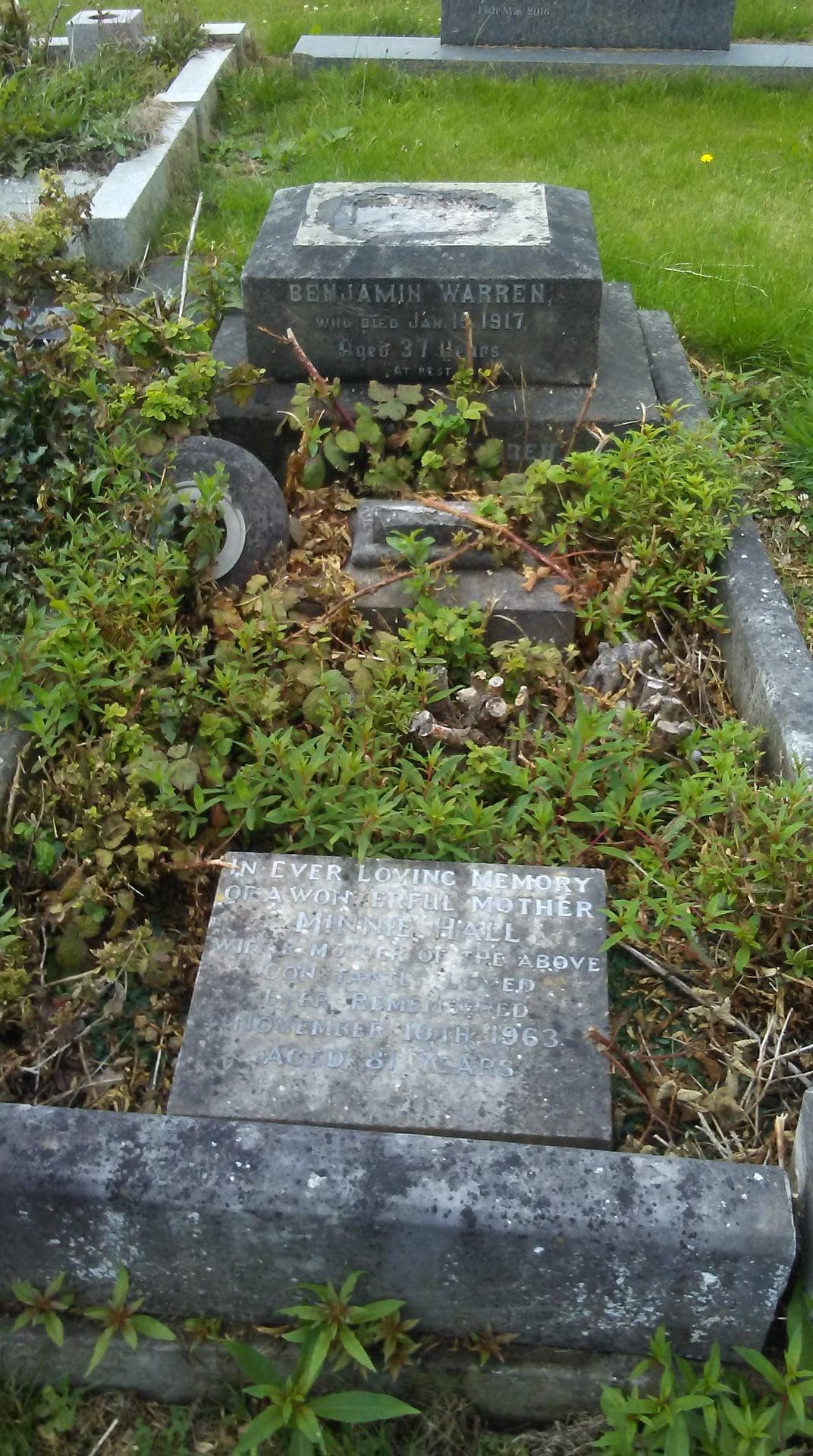
 December 14, 2021 at 10:26 pm #6232
In reply to: The Elusive Samuel Housley and Other Family Stories
Looking for Photographs
I appreciate how fortunate I am that there are so many family photographs on various sides of the family, however, on some sides, for example the Warrens and the Grettons, there are no photographs. I’d love to find a photograph of my great grandmother Florence Nightingale Gretton, as she is the only great grandparent I don’t have a photo of.
I look on other people’s family trees on ancestry websites, and I join local town memories and old photos groups on facebook hoping to find photos. And I have found a few, and what a prize it is to find a photograph of someone in your tree. None found so far of Florence Nightingale Gretton, although I found one of her sister Clara, her brother Charles, and another potential one, posted on a Swadlincote group: a Warren wedding group in 1910.
Charles Herbert Gretton 1876-1954 and his wife Mary Ann Illsley:
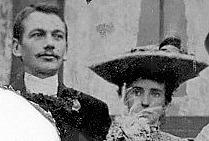
The wedding of Robert Adolphus Warren and Eveline Crofts. Photo in the collection of Colin Smith, Eveline Crofts first cousin twice removed. Reposted with permission:
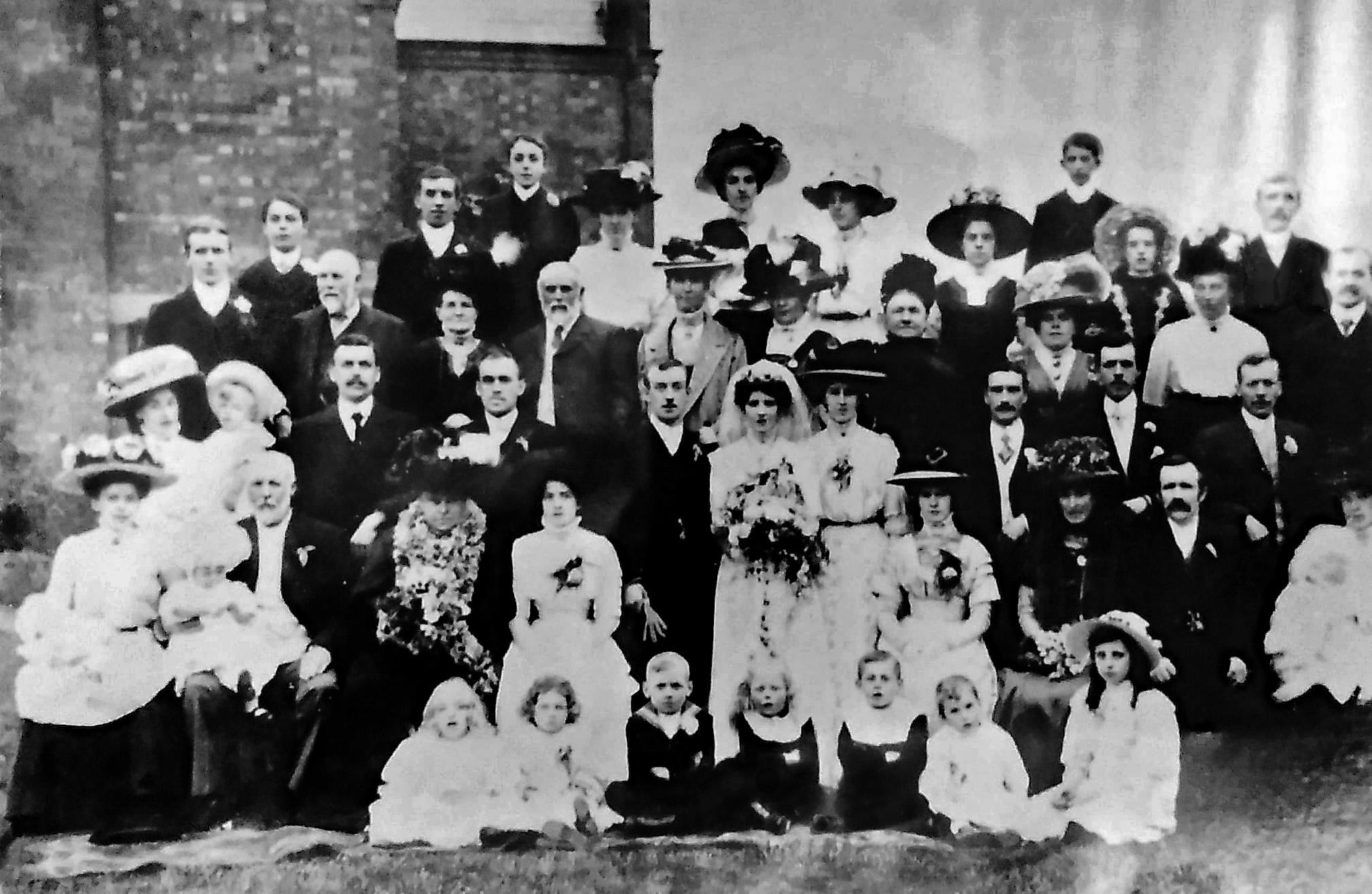
The groom was Florence’s husbands cousin, but identifying my great grandparents in the crowd would be guesswork. My grandmother was born in 1906, and could be one of the children sitting at the front. It was an interesting exercise to note the family likenesses.
Ben Warren the footballer is the man on the far right, on the same line as the groom. His children are sitting in front of the bride.
There are many mentions of Ben Warren the footballer on the Newhall and Swadlincote groups ~ Ben Warren was my great grandfathers cousin, and is a story in itself ~ and a photograph of Ben’s daughter, Lillian Warren was posted.
Lillian Warren (reposted with permission)
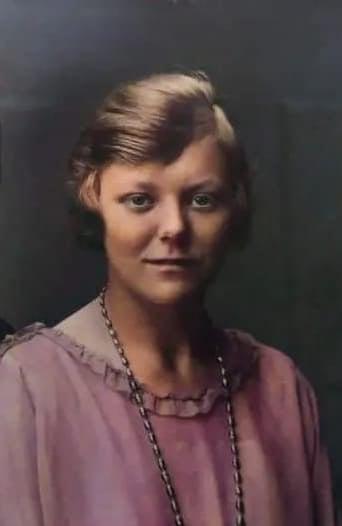
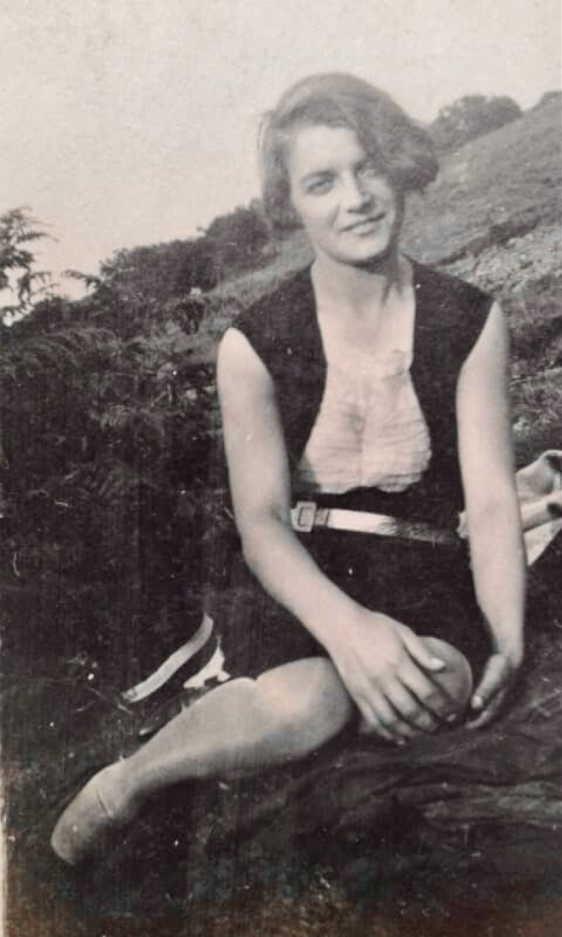
Lillian was my grandmothers first cousin once removed or second cousin. The resemblance to my grandmother, Florence Noreen Warren, seems striking.
December 13, 2021 at 3:38 pm #6229In reply to: The Elusive Samuel Housley and Other Family Stories
Gretton Tailoresses of Swadlincote and the Single Journalist Boot Maker Next Door
The Purdy’s, Housley’s and Marshall’s are my mothers fathers side of the family. The Warrens, Grettons and Staleys are from my mothers mothers side.
I decided to add all the siblings to the Gretton side of the family, in search of some foundation to a couple of family anecdotes. My grandmother, Nora Marshall, whose mother was Florence Nightingale Gretton, used to mention that our Gretton side of the family were related to the Burton Upon Trent Grettons of Bass, Ratcliff and Gretton, the brewery. She also said they were related to Lord Gretton of Stableford Park in Leicestershire. When she was a child, she said parcels of nice clothes were sent to them by relatives.
It should be noted however that Baron Gretton is a title in the Peerage of the United Kingdom, and was created in 1944 for the brewer and Conservative politician John Gretton. He was head of the brewery firm of Bass, Ratcliff & Gretton Ltd of Burton upon Trent. So they were not members of the Peerage at the time of this story.
What I found was unexpected.
My great great grandfather Richard Gretton 1833-1898, a baker in Swadlincote, didn’t have any brothers, but he did have a couple of sisters.
One of them, Frances, born 1831, never married, but had four children. She stayed in the family home, and named her children Gretton. In 1841 and 1851 she’s living with parents and siblings. In 1861 she is still living with parents and now on the census she has four children all named Gretton listed as grandchildren of her father.
In 1871, her mother having died in 1866, she’s still living with her father William Gretton, Frances is now 40, and her son William 19 and daughter Jane 15 live there.
By the time she is 50 in 1881 and her parents have died she’s head of the house with 5 children all called Gretton, including her daughter Jane Gretton aged 24.Twenty five year old Robert Staley is listed on the census transcription as living in the same household, but when viewing the census image it becomes clear that he lived next door, on his own and was a bootmaker, and on the other side, his parents Benjamin and Sarah Staley lived at the Prince of Wales pub with two other siblings.
Who was fathering all these Gretton children?
It seems that Jane did the same thing as her mother: she stayed at home and had three children, all with the name Gretton. Jane Gretton named her son, born in 1878, Michael William Staley Gretton, which would suggest that Staley was the name of the father of the child/children of Jane Gretton.
The father of Frances Gretton’s four children is not known, and there is no father on the birth registers, although they were all baptized.
I found a photo of Jane Gretton on a family tree on an ancestry site, so I contacted the tree owner hoping that she had some more information, but she said no, none of the older family members would explain when asked about it. Jane later married Tom Penn, and Jane Gretton’s children are listed on census as Tom Penn’s stepchildren.
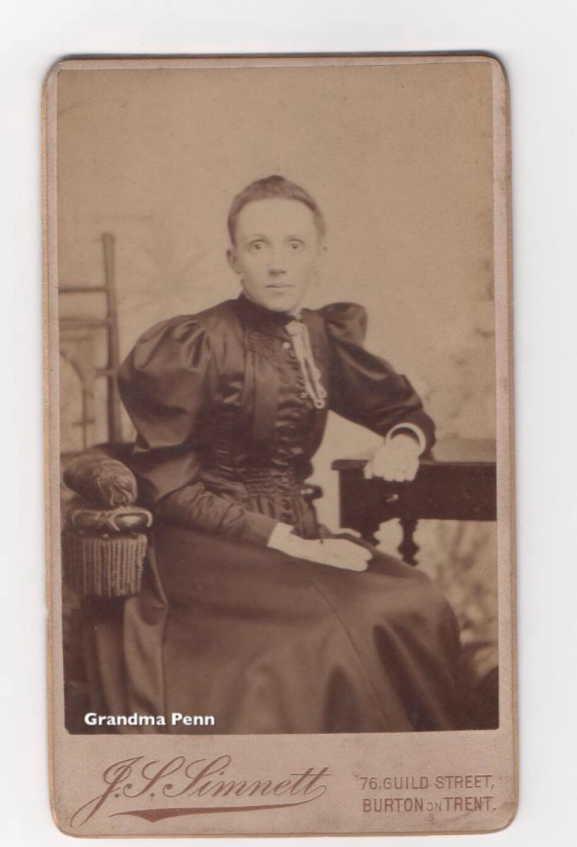
It seems that Robert Staley (who may or may not be the father of Jane’s children) never married. In 1891 Robert is 35, single, living with widowed mother Sarah in Swadlincote. Sarah is living on own means and Robert has no occupation. On the 1901 census Robert is an unmarried 45 year old journalist and author, living with his widowed mother Sarah Staley aged 79, in Swadlincote.
There are at least three Staley Warren marriages in the family, and at least one Gretton Staley marriage.
There is a possibility that the father of Frances’s children could be a Gretton, but impossible to know for sure. William Gretton was a tailor, and several of his children and grandchildren were tailoresses. The Gretton family who later bought Stableford Park lived not too far away, and appear to be well off with a dozen members of live in staff on the census. Did our Gretton’s the tailors make their clothes? Is that where the parcels of nice clothes came from?
Perhaps we’ll find a family connection to the brewery Grettons, or find the family connection was an unofficial one, or that the connection is further back.
I suppose luckily, this isn’t my direct line but an exploration of an offshoot, so the question of paternity is merely a matter of curiosity. It is a curious thing, those Gretton tailors of Church Gresley near Burton upon Trent, and there are questions remaining.
December 13, 2021 at 3:06 pm #6228In reply to: The Elusive Samuel Housley and Other Family Stories
Francis Purdy: The Beggarlea Bulldog and Primitive Methodist Preacher
Francis Purdy was my great great grandfather. We did not know anything about the Primitive Methodists prior to this family research project, but my mother had another look through the family souvenirs and photographs and found a little book dated 1913, by William Purdy called: The History of The Primitive Methodists of Langley, Heanor, Derbyshire and District. Practical remarks on Sunday school work and a biography of the late Francis Purdy, an early local preacher. Printed by GC Brittain and sons. William Purdy was Francis son, and George’s brother.
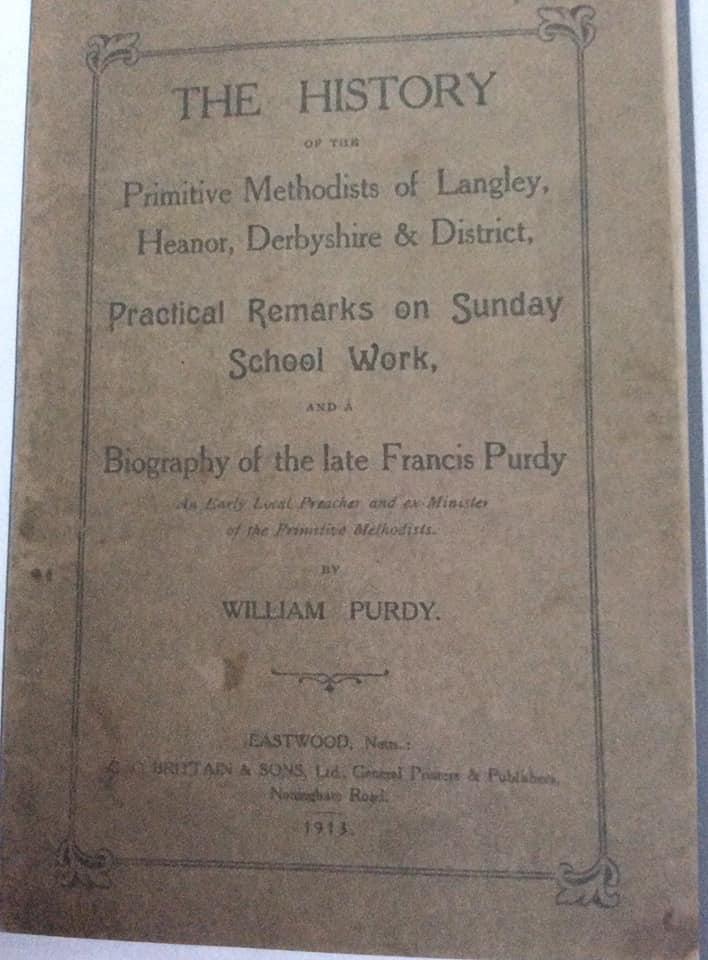
Francis Purdy:
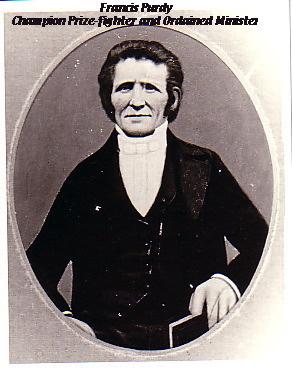
The following can be found online from various sources but I am unable to find the original source to credit with this information:
“In spite of having pious parents, Francis was a great prize-fighter and owner of champion dogs. He was known as the Beggarlee Bulldog, and fought many pitched battles. It was in 1823 that he fought on Nottingham Forest for the championship of three counties. After the fight going eleven rounds, which continued one hour and twenty minutes, he was declared victorious.”
The Primitive Methodists under the Rev Richard Whitechurch began a regular mission in Beggarlee. The locals tried to dismiss the Methodist “Ranters” by the use of intimidating tactics. Francis was prepared to release his fighting dogs during their prayer meeting, but became so interested in their faith that he instead joined them. The Methodist Church wrote: ”A strong feeling came over him, while his mates incited him to slip his dogs from the leads. He refused, and decided to return home. After concealing himself in a dyke, to listen to the Missioners on the following Sunday, he stole into the house of a Mrs Church, where a service was being held. Shortly after this, a society was formed with Francis Purdy as leader, and he was also the superintendent of the first Sunday School. After a short spell as local preacher at Beauvale, Tag Hill, Awsworth, Kimberly, Brinsley, etc., Mr Francis Purdy was ordained a minister by the Rev. Thomas King, of Nottingham, on the 17th December, 1827.”
December 13, 2021 at 2:34 pm #6227In reply to: The Elusive Samuel Housley and Other Family Stories
The Scottish Connection
My grandfather always used to say we had some Scottish blood because his “mother was a Purdy”, and that they were from the low counties of Scotland near to the English border.
My mother had a Scottish hat in among the boxes of souvenirs and old photographs. In one of her recent house moves, she finally threw it away, not knowing why we had it or where it came from, and of course has since regretted it! It probably came from one of her aunts, either Phyllis or Dorothy. Neither of them had children, and they both died in 1983. My grandfather was executor of the estate in both cases, and it’s assumed that the portraits, the many photographs, the booklet on Primitive Methodists, and the Scottish hat, all relating to his mother’s side of the family, came into his possession then. His sister Phyllis never married and was living in her parents home until she died, and is the likeliest candidate for the keeper of the family souvenirs.
Catherine Housley married George Purdy, and his father was Francis Purdy, the Primitive Methodist preacher. William Purdy was the father of Francis.
Record searches find William Purdy was born on 16 July 1767 in Carluke, Lanarkshire, near Glasgow in Scotland. He worked for James Watt, the inventor of the steam engine, and moved to Derbyshire for the purpose of installing steam driven pumps to remove the water from the collieries in the area.
Another descendant of Francis Purdy found the following in a book in a library in Eastwood:
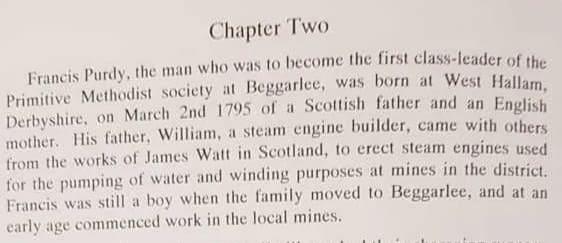
William married a local girl, Ruth Clarke, in Duffield in Derbyshire in 1786. William and Ruth had nine children, and the seventh was Francis who was born at West Hallam in 1795.
Perhaps the Scottish hat came from William Purdy, but there is another story of Scottish connections in Smalley: Bonnie Prince Charlie and the Jacobite Rebellion of 1745. Although the Purdy’s were not from Smalley, Catherine Housley was.
From an article on the Heanor and District Local History Society website:
The Jacobites in Smalley
Few people would readily associate the village of Smalley, situated about two miles west of Heanor, with Bonnie Prince Charlie and the Jacobite Rebellion of 1745 – but there is a clear link.
During the winter of 1745, Charles Edward Stuart, the “Bonnie Prince” or “The Young Pretender”, marched south from Scotland. His troops reached Derby on 4 December, and looted the town, staying for two days before they commenced a fateful retreat as the Duke of Cumberland’s army approached.
While staying in Derby, or during the retreat, some of the Jacobites are said to have visited some of the nearby villages, including Smalley.
A history of the local aspects of this escapade was written in 1933 by L. Eardley-Simpson, entitled “Derby and the ‘45,” from which the following is an extract:
“The presence of a party at Smalley is attested by several local traditions and relics. Not long ago there were people living who remember to have seen at least a dozen old pikes in a room adjoining the stables at Smalley Hall, and these were stated to have been left by a party of Highlanders who came to exchange their ponies for horses belonging to the then owner, Mrs Richardson; in 1907, one of these pikes still remained. Another resident of Smalley had a claymore which was alleged to have been found on Drumhill, Breadsall Moor, while the writer of the History of Smalley himself (Reverend C. Kerry) had a magnificent Andrew Ferrara, with a guard of finely wrought iron, engraved with two heads in Tudor helmets, of the same style, he states, as the one left at Wingfield Manor, though why the outlying bands of Army should have gone so far afield, he omits to mention. Smalley is also mentioned in another strange story as to the origin of the family of Woolley of Collingham who attained more wealth and a better position in the world than some of their relatives. The story is to the effect that when the Scots who had visited Mrs Richardson’s stables were returning to Derby, they fell in with one Woolley of Smalley, a coal carrier, and impressed him with horse and cart for the conveyance of certain heavy baggage. On the retreat, the party with Woolley was surprised by some of the Elector’s troopers (the Royal army) who pursued the Scots, leaving Woolley to shift for himself. This he did, and, his suspicion that the baggage he was carrying was part of the Prince’s treasure turning out to be correct, he retired to Collingham, and spent the rest of his life there in the enjoyment of his luckily acquired gains. Another story of a similar sort was designed to explain the rise of the well-known Derbyshire family of Cox of Brailsford, but the dates by no means agree with the family pedigree, and in any event the suggestion – for it is little more – is entirely at variance with the views as to the rights of the Royal House of Stuart which were expressed by certain members of the Cox family who were alive not many years ago.”
A letter from Charles Kerry, dated 30 July 1903, narrates another strange twist to the tale. When the Highlanders turned up in Smalley, a large crowd, mainly women, gathered. “On a command in Gaelic, the regiment stooped, and throwing their kilts over their backs revealed to the astonished ladies and all what modesty is careful to conceal. Father, who told me, said they were not any more troubled with crowds of women.”
Folklore or fact? We are unlikely to know, but the Scottish artefacts in the Smalley area certainly suggest that some of the story is based on fact.
We are unlikely to know where that Scottish hat came from, but we did find the Scottish connection. William Purdy’s mother was Grizel Gibson, and her mother was Grizel Murray, both of Lanarkshire in Scotland. The name Grizel is a Scottish form of the name Griselda, and means “grey battle maiden”. But with the exception of the name Murray, The Purdy and Gibson names are not traditionally Scottish, so there is not much of a Scottish connection after all. But the mystery of the Scottish hat remains unsolved.
December 13, 2021 at 12:33 pm #6225In reply to: The Elusive Samuel Housley and Other Family Stories
William Marshall’s Parents
William Marshall 1876-1968, my great grandfather, married Mary Ann Gilman Purdy in Buxton. We assumed that both their families came from Buxton, but this was not the case. The Marshall’s came from Elton, near Matlock; the Purdy’s from Eastwood, Nottinghamshire.
William Marshall, seated in centre, with colleagues from the insurance company:
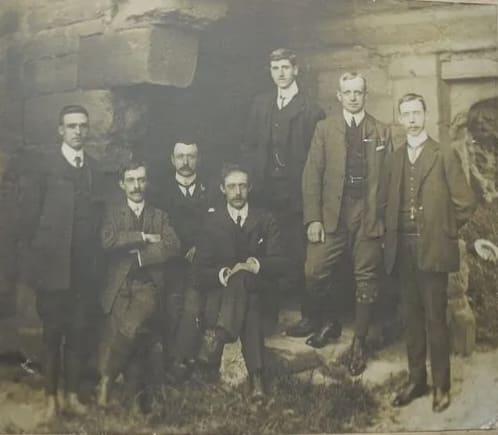
William and all his siblings were born in Fairfield in Buxton. But both Emma Featherstone 1847-1928, his mother, and John Marshall 1842-1930, his father, came from rural Derbyshire. Emma from Ashbourne (or Biggin, Newhaven, or Hartington, depending on what she chose to put on the census, which are all tiny rural places in the same area).
Emma and John Marshall in the middle, photo says “William Marshall’s parents” on the back:
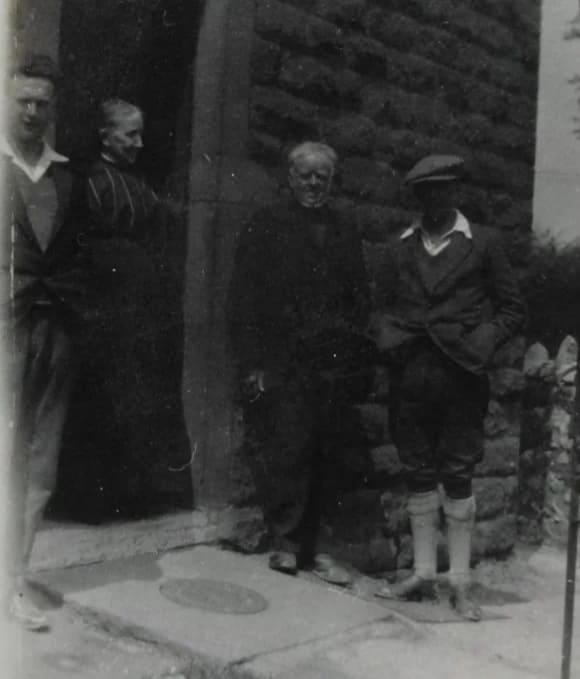
John Marshall was a carter, later a coal carter, and was born in Elton, Derbyshire. Elton is a rural village near to Matlock. He was unable to write (at least at the time of his wedding) but Emma signed her own name.
In 1851 Emma is 3 or 4 years old living with family at the Jug and Glass Inn, Hartington. In 1861 Emma was a 14 year old servant at a 112 acre farm, Heathcote, but her parents were still living at the Jug and Glass. Emma Featherstone’s parents both died when she was 18, in 1865.
In 1871 she was a servant at Old House Farm, Nether Hartington Quarter, Ashborne.On the census, a female apprentice was listed as a servant, a boy as an apprentice. It seems to have been quite normal, at least that’s what I’ve found so far, for all teenagers to go and live in another household to learn a trade, to be independent from the parents, and so doesn’t necessarily mean a servant as we would think of it. Often they stayed with family friends, and usually married in their early twenties and had their own household ~ often with a “servant” or teenager from someone else’s family.
The only marriage I could find for Emma and John was in Manchester in 1873, which didn’t make much sense. If Emma was single on the 1871 census, and her first child James was born in 1873, her marriage had to be between those dates. But the marriage register in Manchester appears to be correct, John was a carter, Emma’s father was Francis Featherstone. But why Manchester?
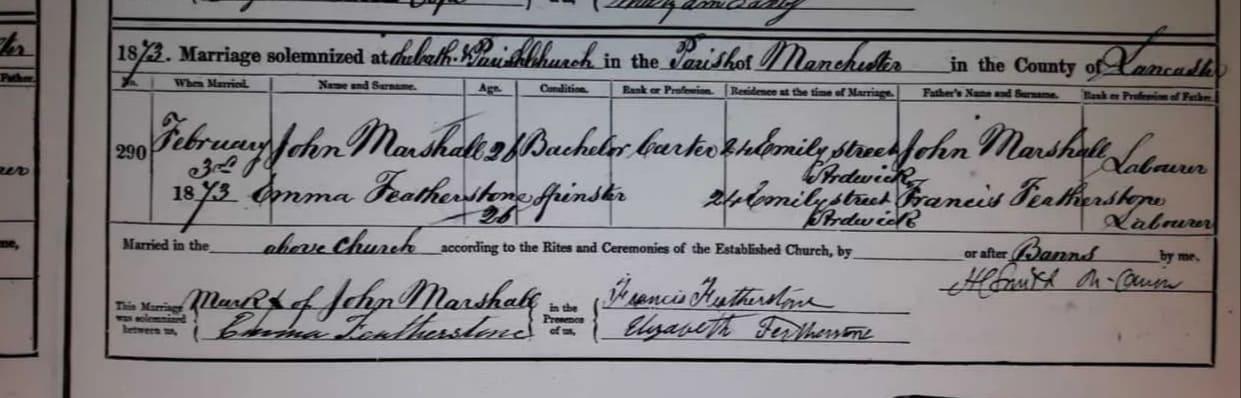
I noticed that the witnesses to the marriage were Francis and Elizabeth Featherstone. He father was Francis, but who was Elizabeth? Emma’s mother was Sarah. Then I found that Emma’s brother Francis married Elizabeth, and they lived in Manchester on the 1871 census. Henry Street, Ardwick. Emma and John’s address on the marriage register is Emily Street, Ardwick. Both of them at the same address.
The marriage was in February 1873, and James, the first child was born in July, 1873, in Buxton.
It would seem that Emma and John had to get married, hence the move to Manchester where her brother was, and then quickly moved to Buxton for the birth of the child. It was far from uncommon, I’ve found while making notes of dates in registers, for a first child to be born six or 7 months after the wedding.
Emma died in 1928 at the age of 80, two years before her husband John. She left him a little money in her will! This seems unusual so perhaps she had her own money, possibly from the death of her parents before she married, and perhaps from the sale of the Jug and Glass.
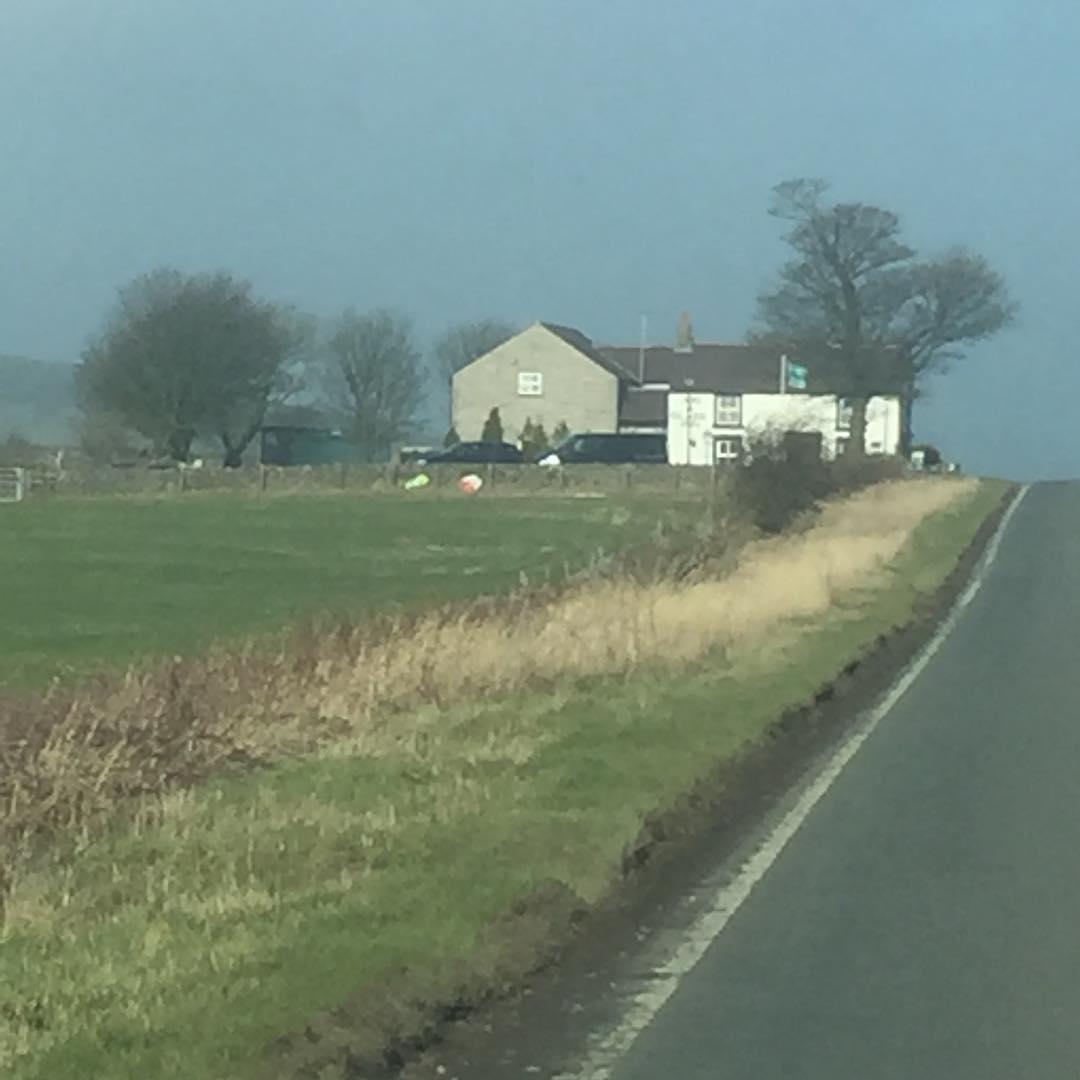
I found a photo of the Jug and Glass online. It looks just like the pub I’d seen in my family history meditations on a number of occasions:
 December 13, 2021 at 11:29 am #6222
In reply to: The Elusive Samuel Housley and Other Family Stories
George Gilman Rushby: The Cousin Who Went To Africa
The portrait of the woman has “mother of Catherine Housley, Smalley” written on the back, and one of the family photographs has “Francis Purdy” written on the back. My first internet search was “Catherine Housley Smalley Francis Purdy”. Easily found was the family tree of George (Mike) Rushby, on one of the genealogy websites. It seemed that it must be our family, but the African lion hunter seemed unlikely until my mother recalled her father had said that he had a cousin who went to Africa. I also noticed that the lion hunter’s middle name was Gilman ~ the name that Catherine Housley’s daughter ~ my great grandmother, Mary Ann Gilman Purdy ~ adopted, from her aunt and uncle who brought her up.
I tried to contact George (Mike) Rushby via the ancestry website, but got no reply. I searched for his name on Facebook and found a photo of a wildfire in a place called Wardell, in Australia, and he was credited with taking the photograph. A comment on the photo, which was a few years old, got no response, so I found a Wardell Community group on Facebook, and joined it. A very small place, population some 700 or so, and I had an immediate response on the group to my question. They knew Mike, exchanged messages, and we were able to start emailing. I was in the chair at the dentist having an exceptionally long canine root canal at the time that I got the message with his email address, and at that moment the song Down in Africa started playing.
Mike said it was clever of me to track him down which amused me, coming from the son of an elephant and lion hunter. He didn’t know why his father’s middle name was Gilman, and was not aware that Catherine Housley’s sister married a Gilman.
Mike Rushby kindly gave me permission to include his family history research in my book. This is the story of my grandfather George Marshall’s cousin. A detailed account of George Gilman Rushby’s years in Africa can be found in another chapter called From Tanganyika With Love; the letters Eleanor wrote to her family.
George Gilman Rushby:
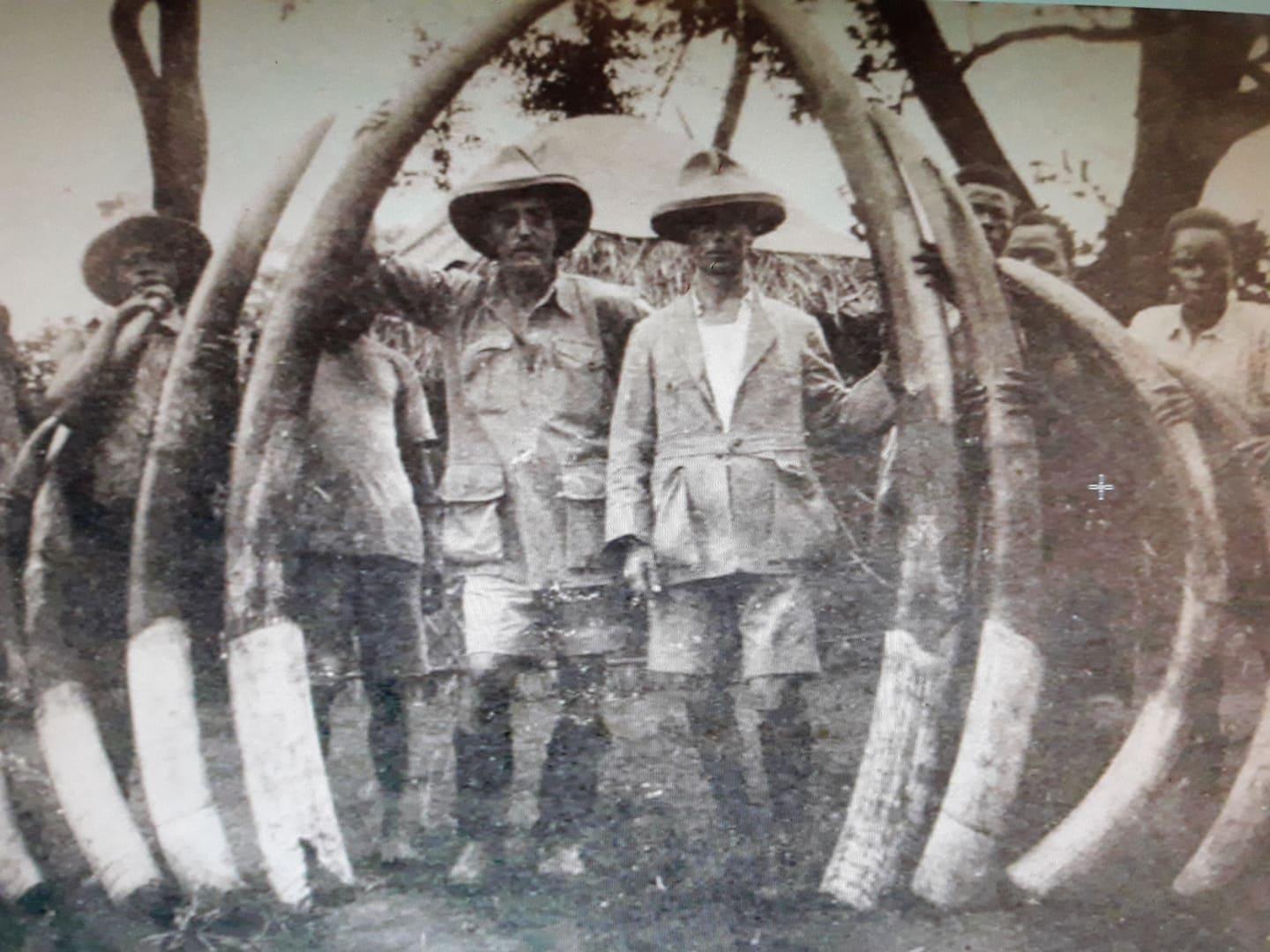
The story of George Gilman Rushby 1900-1969, as told by his son Mike:
George Gilman Rushby:
Elephant hunter,poacher, prospector, farmer, forestry officer, game ranger, husband to Eleanor, and father of 6 children who now live around the world.George Gilman Rushby was born in Nottingham on 28 Feb 1900 the son of Catherine Purdy and John Henry Payling Rushby. But John Henry died when his son was only one and a half years old, and George shunned his drunken bullying stepfather Frank Freer and was brought up by Gypsies who taught him how to fight and took him on regular poaching trips. His love of adventure and his ability to hunt were nurtured at an early stage of his life.
The family moved to Eastwood, where his mother Catherine owned and managed The Three Tuns Inn, but when his stepfather died in mysterious circumstances, his mother married a wealthy bookmaker named Gregory Simpson. He could afford to send George to Worksop College and to Rugby School. This was excellent schooling for George, but the boarding school environment, and the lack of a stable home life, contributed to his desire to go out in the world and do his own thing. When he finished school his first job was as a trainee electrician with Oaks & Co at Pye Bridge. He also worked part time as a motor cycle mechanic and as a professional boxer to raise the money for a voyage to South Africa.In May 1920 George arrived in Durban destitute and, like many others, living on the beach and dependant upon the Salvation Army for a daily meal. However he soon got work as an electrical mechanic, and after a couple of months had earned enough money to make the next move North. He went to Lourenco Marques where he was appointed shift engineer for the town’s power station. However he was still restless and left the comfort of Lourenco Marques for Beira in August 1921.
Beira was the start point of the new railway being built from the coast to Nyasaland. George became a professional hunter providing essential meat for the gangs of construction workers building the railway. He was a self employed contractor with his own support crew of African men and began to build up a satisfactory business. However, following an incident where he had to shoot and kill a man who attacked him with a spear in middle of the night whilst he was sleeping, George left the lower Zambezi and took a paddle steamer to Nyasaland (Malawi). On his arrival in Karongo he was encouraged to shoot elephant which had reached plague proportions in the area – wrecking African homes and crops, and threatening the lives of those who opposed them.
His next move was to travel by canoe the five hundred kilometre length of Lake Nyasa to Tanganyika, where he hunted for a while in the Lake Rukwa area, before walking through Northern Rhodesia (Zambia) to the Congo. Hunting his way he overachieved his quota of ivory resulting in his being charged with trespass, the confiscation of his rifles, and a fine of one thousand francs. He hunted his way through the Congo to Leopoldville then on to the Portuguese enclave, near the mouth of the mighty river, where he worked as a barman in a rough and tough bar until he received a message that his old friend Lumb had found gold at Lupa near Chunya. George set sail on the next boat for Antwerp in Belgium, then crossed to England and spent a few weeks with his family in Jacksdale before returning by sea to Dar es Salaam. Arriving at the gold fields he pegged his claim and almost immediately went down with blackwater fever – an illness that used to kill three out of four within a week.
When he recovered from his fever, George exchanged his gold lease for a double barrelled .577 elephant rifle and took out a special elephant control licence with the Tanganyika Government. He then headed for the Congo again and poached elephant in Northern Rhodesia from a base in the Congo. He was known by the Africans as “iNyathi”, or the Buffalo, because he was the most dangerous in the long grass. After a profitable hunting expedition in his favourite hunting ground of the Kilombera River he returned to the Congo via Dar es Salaam and Mombassa. He was after the Kabalo district elephant, but hunting was restricted, so he set up his base in The Central African Republic at a place called Obo on the Congo tributary named the M’bomu River. From there he could make poaching raids into the Congo and the Upper Nile regions of the Sudan. He hunted there for two and a half years. He seldom came across other Europeans; hunters kept their own districts and guarded their own territories. But they respected one another and he made good and lasting friendships with members of that small select band of adventurers.
Leaving for Europe via the Congo, George enjoyed a short holiday in Jacksdale with his mother. On his return trip to East Africa he met his future bride in Cape Town. She was 24 year old Eleanor Dunbar Leslie; a high school teacher and daughter of a magistrate who spent her spare time mountaineering, racing ocean yachts, and riding horses. After a whirlwind romance, they were betrothed within 36 hours.
On 25 July 1930 George landed back in Dar es Salaam. He went directly to the Mbeya district to find a home. For one hundred pounds he purchased the Waizneker’s farm on the banks of the Mntshewe Stream. Eleanor, who had been delayed due to her contract as a teacher, followed in November. Her ship docked in Dar es Salaam on 7 Nov 1930, and they were married that day. At Mchewe Estate, their newly acquired farm, they lived in a tent whilst George with some help built their first home – a lovely mud-brick cottage with a thatched roof. George and Eleanor set about developing a coffee plantation out of a bush block. It was a very happy time for them. There was no electricity, no radio, and no telephone. Newspapers came from London every two months. There were a couple of neighbours within twenty miles, but visitors were seldom seen. The farm was a haven for wild life including snakes, monkeys and leopards. Eleanor had to go South all the way to Capetown for the birth of her first child Ann, but with the onset of civilisation, their first son George was born at a new German Mission hospital that had opened in Mbeya.
Occasionally George had to leave the farm in Eleanor’s care whilst he went off hunting to make his living. Having run the coffee plantation for five years with considerable establishment costs and as yet no return, George reluctantly started taking paying clients on hunting safaris as a “white hunter”. This was an occupation George didn’t enjoy. but it brought him an income in the days when social security didn’t exist. Taking wealthy clients on hunting trips to kill animals for trophies and for pleasure didn’t amuse George who hunted for a business and for a way of life. When one of George’s trackers was killed by a leopard that had been wounded by a careless client, George was particularly upset.
The coffee plantation was approaching the time of its first harvest when it was suddenly attacked by plagues of borer beetles and ring barking snails. At the same time severe hail storms shredded the crop. The pressure of the need for an income forced George back to the Lupa gold fields. He was unlucky in his gold discoveries, but luck came in a different form when he was offered a job with the Forestry Department. The offer had been made in recognition of his initiation and management of Tanganyika’s rainbow trout project. George spent most of his short time with the Forestry Department encouraging the indigenous people to conserve their native forests.In November 1938 he transferred to the Game Department as Ranger for the Eastern Province of Tanganyika, and over several years was based at Nzasa near Dar es Salaam, at the old German town of Morogoro, and at lovely Lyamungu on the slopes of Kilimanjaro. Then the call came for him to be transferred to Mbeya in the Southern Province for there was a serious problem in the Njombe district, and George was selected by the Department as the only man who could possibly fix the problem.
Over a period of several years, people were being attacked and killed by marauding man-eating lions. In the Wagingombe area alone 230 people were listed as having been killed. In the Njombe district, which covered an area about 200 km by 300 km some 1500 people had been killed. Not only was the rural population being decimated, but the morale of the survivors was so low, that many of them believed that the lions were not real. Many thought that evil witch doctors were controlling the lions, or that lion-men were changing form to kill their enemies. Indeed some wichdoctors took advantage of the disarray to settle scores and to kill for reward.
By hunting down and killing the man-eaters, and by showing the flesh and blood to the doubting tribes people, George was able to instil some confidence into the villagers. However the Africans attributed the return of peace and safety, not to the efforts of George Rushby, but to the reinstallation of their deposed chief Matamula Mangera who had previously been stood down for corruption. It was Matamula , in their eyes, who had called off the lions.
Soon after this adventure, George was appointed Deputy Game Warden for Tanganyika, and was based in Arusha. He retired in 1956 to the Njombe district where he developed a coffee plantation, and was one of the first in Tanganyika to plant tea as a major crop. However he sensed a swing in the political fortunes of his beloved Tanganyika, and so sold the plantation and settled in a cottage high on a hill overlooking the Navel Base at Simonstown in the Cape. It was whilst he was there that TV Bulpin wrote his biography “The Hunter is Death” and George wrote his book “No More The Tusker”. He died in the Cape, and his youngest son Henry scattered his ashes at the Southern most tip of Africa where the currents of the Atlantic and Indian Oceans meet .
George Gilman Rushby:
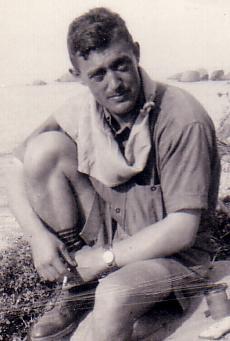 December 13, 2021 at 10:39 am #6220
In reply to: The Elusive Samuel Housley and Other Family Stories
Helper Belper: “Let’s start at the beginning.”
When I found a huge free genealogy tree website with lots of our family already on it, I couldn’t believe my luck. Quite soon after a perusal, I found I had a number of questions. Was it really possible that our Warren family tree had been traced back to 500AD? I asked on a genealogy forum: only if you can latch onto an aristocratic line somewhere, in which case that lineage will be already documented, as normally parish records only go back to the 1600s, if you are lucky. It is very hard to prove and the validity of it met with some not inconsiderable skepticism among the long term hard core genealogists. This is not to say that it isn’t possible, but is more likely a response to the obvious desire of many to be able to trace their lineage back to some kind of royalty, regardless of the documentation and proof.
Another question I had on this particular website was about the entries attached to Catherine Housley that made no sense. The immense public family tree there that anyone can add to had Catherine Housley’s mother as Catherine Marriot. But Catherine Marriot had another daughter called Catherine, two years before our Catherine was born, who didn’t die beforehand. It wasn’t unusual to name another child the same name if an earlier one had died in infancy, but this wasn’t the case.
I asked this question on a British Genealogy forum, and learned that other people’s family trees are never to be trusted. One should always start with oneself, and trace back with documentation every step of the way. Fortified with all kinds of helpful information, I still couldn’t find out who Catherine Housley’s mother was, so I posted her portrait on the forum and asked for help to find her. Among the many helpful replies, one of the members asked if she could send me a private message. She had never had the urge to help someone find a person before, but felt a compulsion to find Catherine Housley’s mother. Eight months later and counting at time of writing, and she is still my most amazing Helper. The first thing she said in the message was “Right. Let’s start at the beginning. What do you know for sure.” I said Mary Ann Gilman Purdy, my great grandmother, and we started from there.
Fran found all the documentation and proof, a perfect and necessary compliment to my own haphazard meanderings. She taught me how to find the proof, how to spot inconsistencies, and what to look for and where. I still continue my own haphazard wanderings as well, which also bear fruit.
It was decided to order the birth certificate, a paper copy that could be stuck onto the back of the portrait, so my mother in Wales ordered it as she has the portrait. When it arrived, she read the names of Catherine’s parents to me over the phone. We were expecting it to be John Housley and Sarah Baggaley. But it wasn’t! It was his brother Samuel Housley and Elizabeth Brookes! I had been looking at the photograph of the portrait thinking it was Catherine Marriot, then looking at it thinking her name was Sarah Baggaley, and now the woman in the portrait was Elizabeth Brookes. And she was from Wolverhampton. My helper, unknown to me, had ordered a digital copy, which arrived the same day.
Months later, Fran, visiting friends in Derby, made a special trip to Smalley, a tiny village not far from Derby, to look for Housley gravestones in the two churchyards. There are numerous Housley burials registered in the Smalley parish records, but she could only find one Housley grave, that of Sarah Baggaley. Unfortunately the documentation had already proved that Sarah was not the woman in the portrait, Catherine Housley’s mother, but Catherine’s aunt.
Sarah Housley nee Baggaley’s grave stone in Smalley:
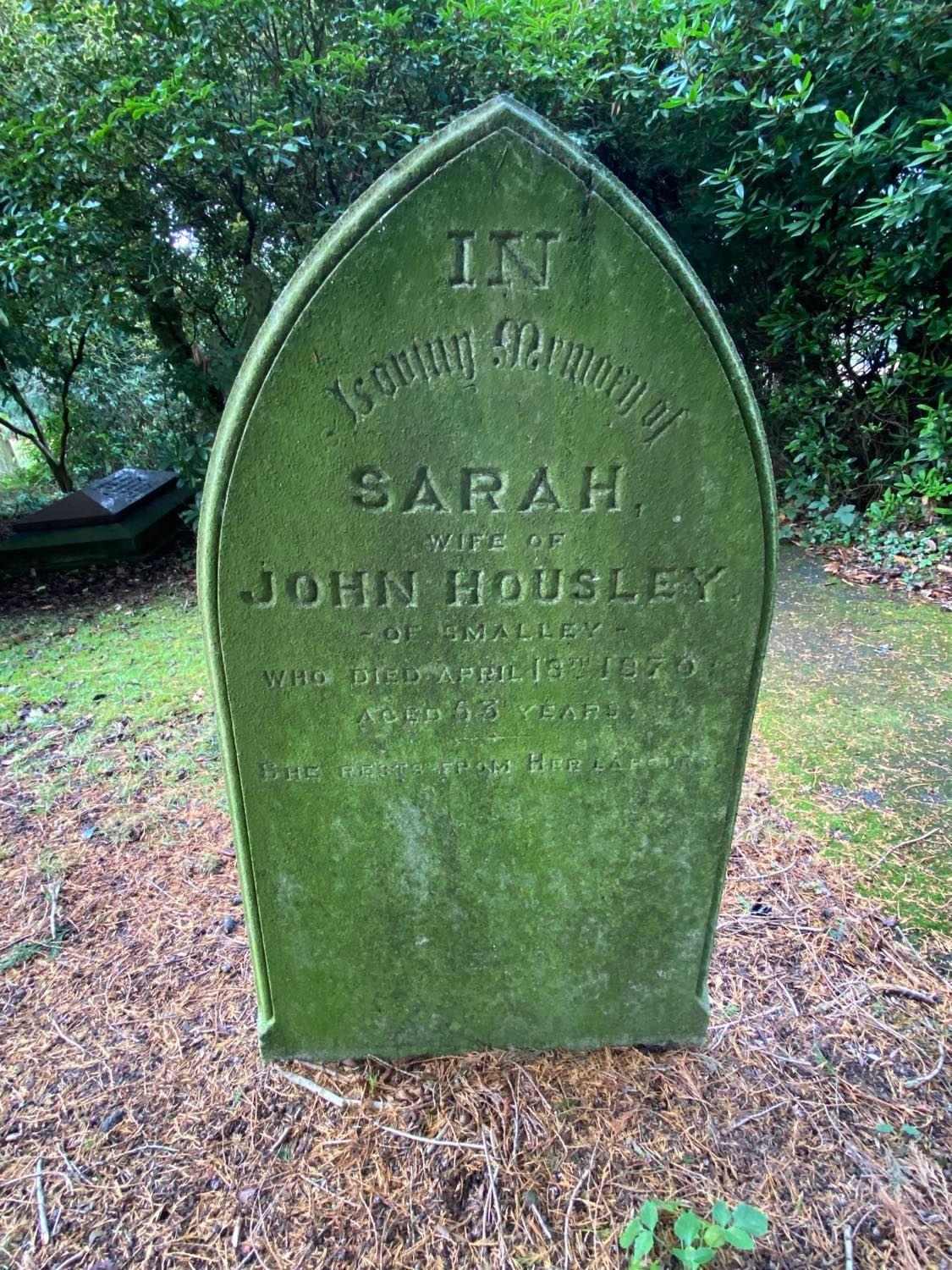 December 13, 2021 at 10:09 am #6219
Topic: The Elusive Samuel Housley and Other Family Stories
in forum TP’s Family BooksThe following stories started with a single question.
Who was Catherine Housley’s mother?
But one question leads to another, and another, and so this book will never be finished. This is the first in a collection of stories of a family history research project, not a complete family history. There will always be more questions and more searches, and each new find presents more questions.
A list of names and dates is only moderately interesting, and doesn’t mean much unless you get to know the characters along the way. For example, a cousin on my fathers side has already done a great deal of thorough and accurate family research. I copied one branch of the family onto my tree, going back to the 1500’s, but lost interest in it after about an hour or so, because I didn’t feel I knew any of the individuals.
Parish registers, the census every ten years, birth, death and marriage certificates can tell you so much, but they can’t tell you why. They don’t tell you why parents chose the names they did for their children, or why they moved, or why they married in another town. They don’t tell you why a person lived in another household, or for how long. The census every ten years doesn’t tell you what people were doing in the intervening years, and in the case of the UK and the hundred year privacy rule, we can’t even use those for the past century. The first census was in 1831 in England, prior to that all we have are parish registers. An astonishing amount of them have survived and have been transcribed and are one way or another available to see, both transcriptions and microfiche images. Not all of them survived, however. Sometimes the writing has faded to white, sometimes pages are missing, and in some case the entire register is lost or damaged.
Sometimes if you are lucky, you may find mention of an ancestor in an obscure little local history book or a journal or diary. Wills, court cases, and newspaper archives often provide interesting information. Town memories and history groups on social media are another excellent source of information, from old photographs of the area, old maps, local history, and of course, distantly related relatives still living in the area. Local history societies can be useful, and some if not all are very helpful.
If you’re very lucky indeed, you might find a distant relative in another country whose grandparents saved and transcribed bundles of old letters found in the attic, from the family in England to the brother who emigrated, written in the 1800s. More on this later, as it merits its own chapter as the most exciting find so far.
The social history of the time and place is important and provides many clues as to why people moved and why the family professions and occupations changed over generations. The Enclosures Act and the Industrial Revolution in England created difficulties for rural farmers, factories replaced cottage industries, and the sons of land owning farmers became shop keepers and miners in the local towns. For the most part (at least in my own research) people didn’t move around much unless there was a reason. There are no reasons mentioned in the various registers, records and documents, but with a little reading of social history you can sometimes make a good guess. Samuel Housley, for example, a plumber, probably moved from rural Derbyshire to urban Wolverhampton, when there was a big project to install indoor plumbing to areas of the city in the early 1800s. Derbyshire nailmakers were offered a job and a house if they moved to Wolverhampton a generation earlier.
Occasionally a couple would marry in another parish, although usually they married in their own. Again, there was often a reason. William Housley and Ellen Carrington married in Ashbourne, not in Smalley. In this case, William’s first wife was Mary Carrington, Ellen’s sister. It was not uncommon for a man to marry a deceased wife’s sister, but it wasn’t strictly speaking legal. This caused some problems later when William died, as the children of the first wife contested the will, on the grounds of the second marriage being illegal.
Needless to say, there are always questions remaining, and often a fresh pair of eyes can help find a vital piece of information that has escaped you. In one case, I’d been looking for the death of a widow, Mary Anne Gilman, and had failed to notice that she remarried at a late age. Her death was easy to find, once I searched for it with her second husbands name.
This brings me to the topic of maternal family lines. One tends to think of their lineage with the focus on paternal surnames, but very quickly the number of surnames increases, and all of the maternal lines are directly related as much as the paternal name. This is of course obvious, if you start from the beginning with yourself and work back. In other words, there is not much point in simply looking for your fathers name hundreds of years ago because there are hundreds of other names that are equally your own family ancestors. And in my case, although not intentionally, I’ve investigated far more maternal lines than paternal.
This book, which I hope will be the first of several, will concentrate on my mothers family: The story so far that started with the portrait of Catherine Housley’s mother.
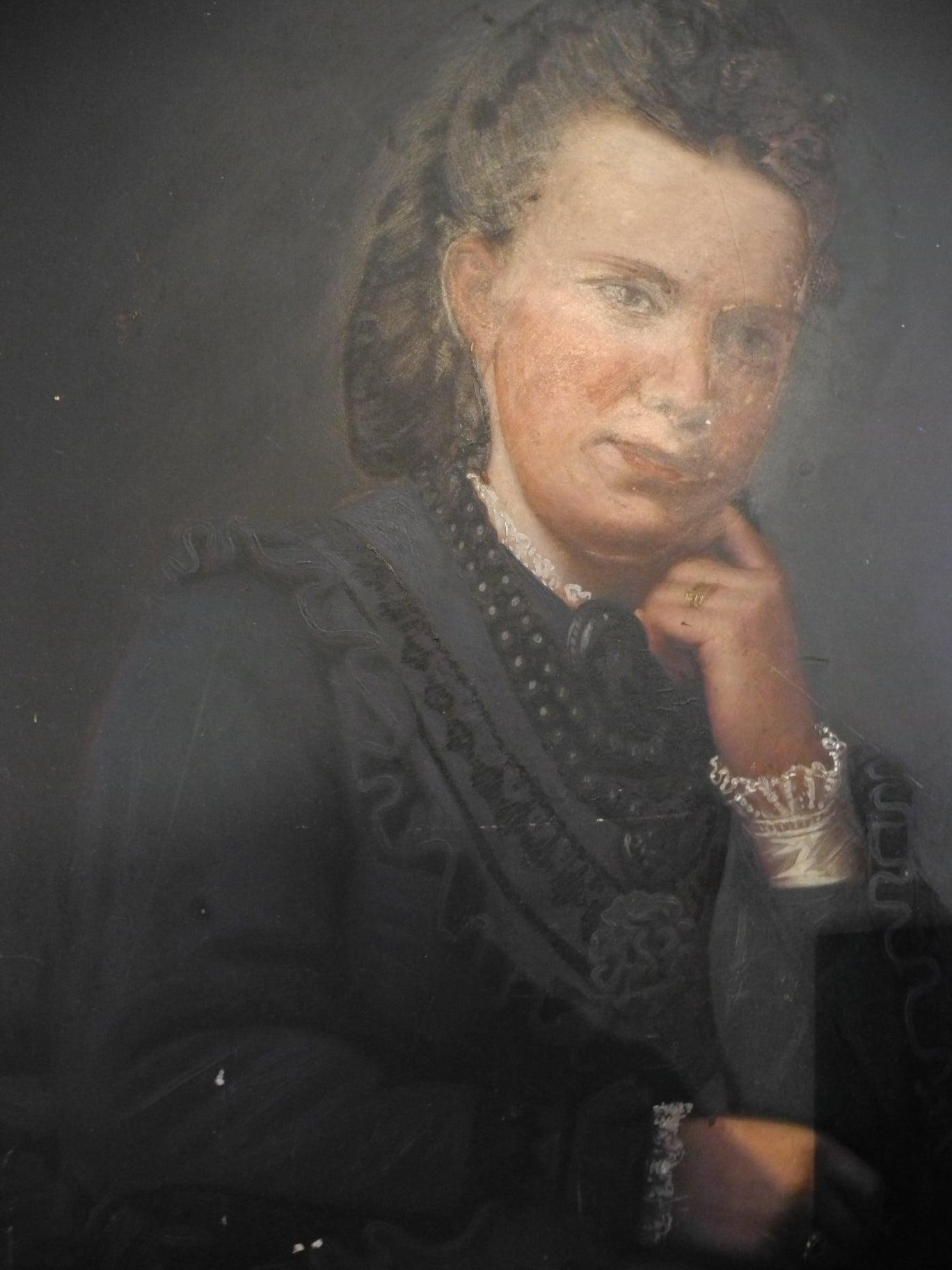
This painting, now in my mothers house, used to hang over the piano in the home of her grandparents. It says on the back “Catherine Housley’s mother, Smalley”.
The portrait of Catherine Housley’s mother can be seen above the piano. Back row Ronald Marshall, my grandfathers brother, William Marshall, my great grandfather, Mary Ann Gilman Purdy Marshall in the middle, my great grandmother, with her daughters Dorothy on the left and Phyllis on the right, at the Marshall’s house on Love Lane in Stourbridge.
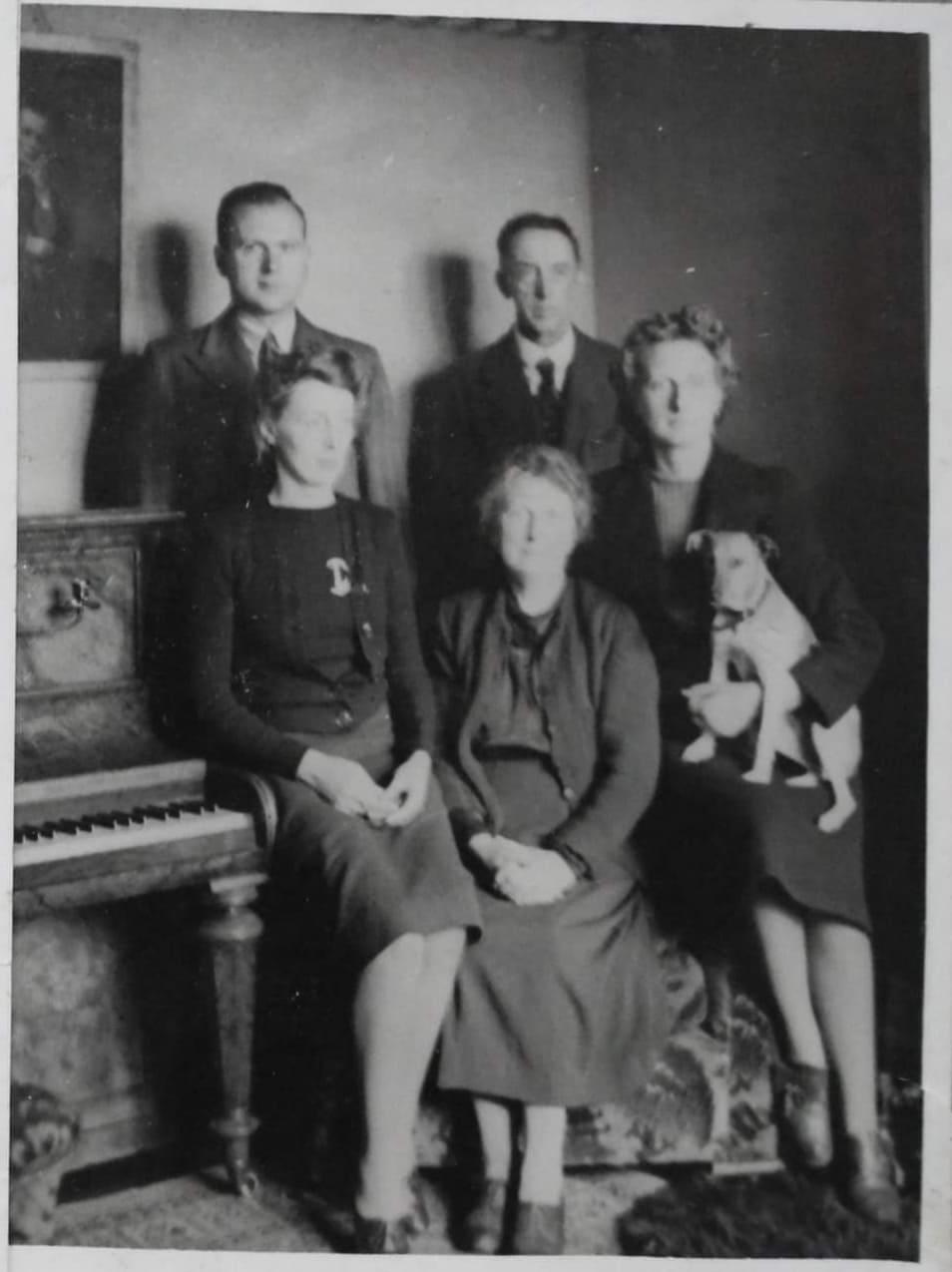
The Search for Samuel Housley
As soon as the search for Catherine Housley’s mother was resolved, achieved by ordering a paper copy of her birth certificate, the search for Catherine Housley’s father commenced. We know he was born in Smalley in 1816, son of William Housley and Ellen Carrington, and that he married Elizabeth Brookes in Wolverhampton in 1844. He was a plumber and glazier. His three daughters born between 1845 and 1849 were born in Smalley. Elizabeth died in 1849 of consumption, but Samuel didn’t register her death. A 20 year old neighbour called Aaron Wadkinson did.
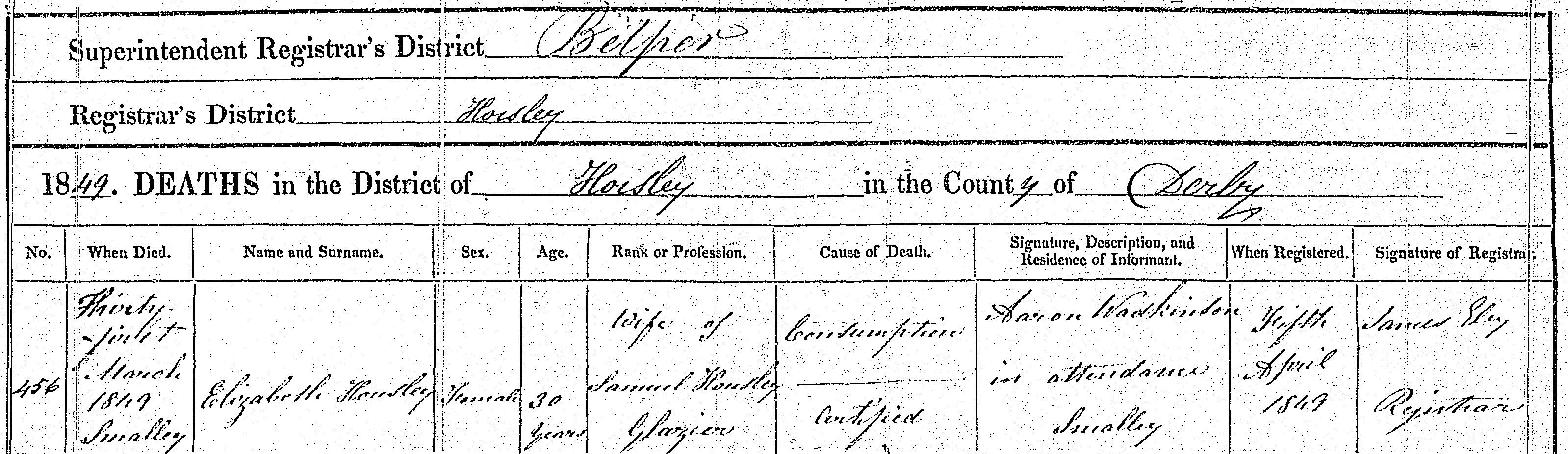
Where was Samuel?
On the 1851 census, two of Samuel’s daughters were listed as inmates in the Belper Workhouse, and the third, 2 year old Catherine, was listed as living with John Benniston and his family in nearby Heanor. Benniston was a framework knitter.
Where was Samuel?
A long search through the microfiche workhouse registers provided an answer. The reason for Elizabeth and Mary Anne’s admission in June 1850 was given as “father in prison”. In May 1850, Samuel Housley was sentenced to one month hard labour at Derby Gaol for failing to maintain his three children. What happened to those little girls in the year after their mothers death, before their father was sentenced, and they entered the workhouse? Where did Catherine go, a six week old baby? We have yet to find out.
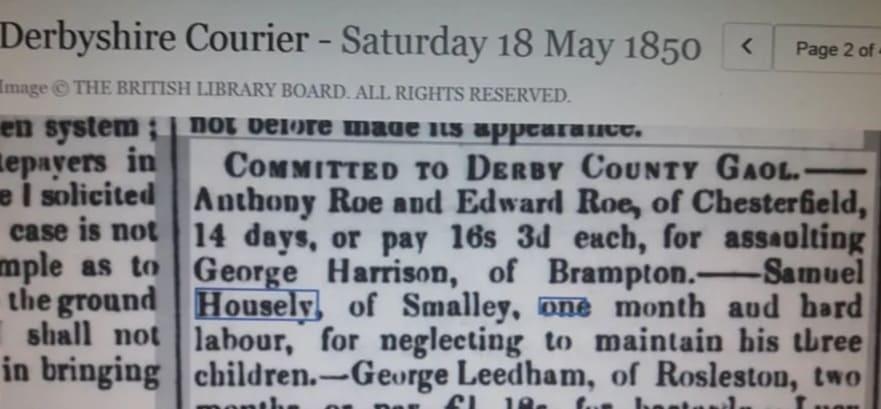
And where was Samuel Housley in 1851? He hasn’t appeared on any census.
According to the Belper workhouse registers, Mary Anne was discharged on trial as a servant February 1860. She was readmitted a month later in March 1860, the reason given: unwell.
Belper Workhouse:
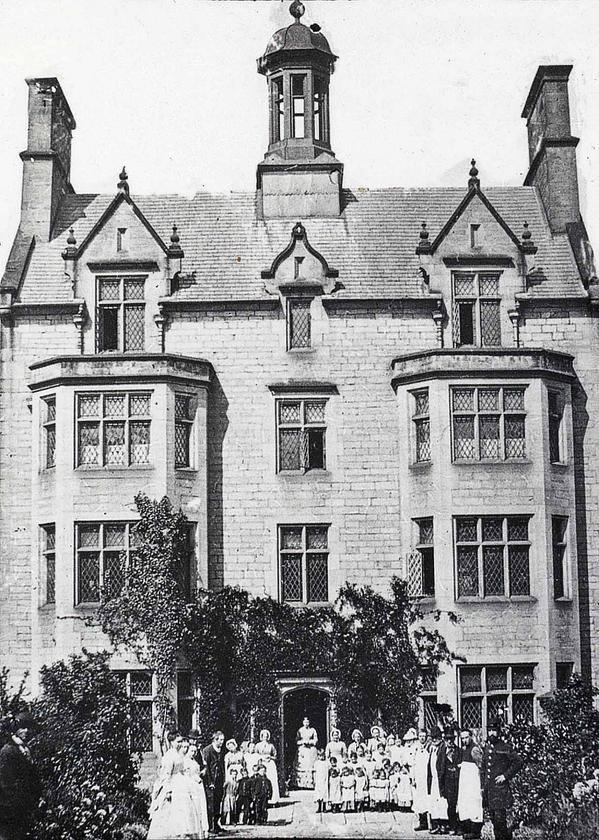
Eventually, Mary Anne and Elizabeth were discharged, in April 1860, with an aunt and uncle. The workhouse register doesn’t name the aunt and uncle. One can only wonder why it took them so long.
On the 1861 census, Elizabeth, 16 years old, is a servant in St Peters, Derby, and Mary Anne, 15 years old, is a servant in St Werburghs, Derby.But where was Samuel?
After some considerable searching, we found him, despite a mistranscription of his name, on the 1861 census, living as a lodger and plumber in Darlaston, Walsall.
Eventually we found him on a 1871 census living as a lodger at the George and Dragon in Henley in Arden. The age is not exactly right, but close enough, he is listed as an unmarried painter, also close enough, and his birth is listed as Kidsley, Derbyshire. He was born at Kidsley Grange Farm. We can assume that he was probably alive in 1872, the year his mother died, and the following year, 1873, during the Kerry vs Housley court case.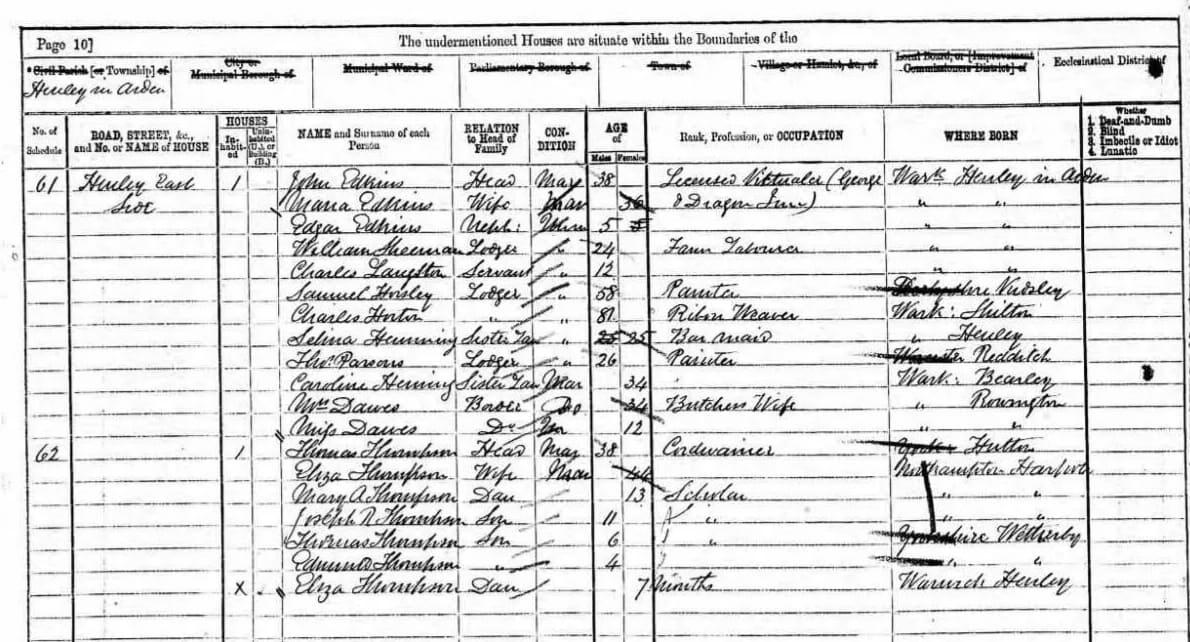
I found some living Housley descendants in USA. Samuel Housley’s brother George emigrated there in 1851. The Housley’s in USA found letters in the attic, from the family in Smalley ~ written between 1851 and 1870s. They sent me a “Narrative on the Letters” with many letter excerpts.
The Housley family were embroiled in a complicated will and court case in the early 1870s. In December 15, 1872, Joseph (Samuel’s brother) wrote to George:
“I think we have now found all out now that is concerned in the matter for there was only Sam that we did not know his whereabouts but I was informed a week ago that he is dead–died about three years ago in Birmingham Union. Poor Sam. He ought to have come to a better end than that….His daughter and her husband went to Birmingham and also to Sutton Coldfield that is where he married his wife from and found out his wife’s brother. It appears he has been there and at Birmingham ever since he went away but ever fond of drink.”
No record of Samuel Housley’s death can be found for the Birmingham Union in 1869 or thereabouts.
But if he was alive in 1871 in Henley In Arden…..
Did Samuel tell his wife’s brother to tell them he was dead? Or did the brothers say he was dead so they could have his share?We still haven’t found a death for Samuel Housley.
September 14, 2021 at 3:38 pm #6211In reply to: The Precious Life and Rambles of Liz Tattler
Today the planets are aligned, thought Liz as she looked at the blue sky out the French door. The frills of her glitter pink Charnel bathing suit wiggled with excitement.
It was one of those rare days of this summer where rain wasn’t pouring somewhere in the garden. Every single day: clouds, clouds, clouds. If they weren’t above the mansion, they were above the pool. If they weren’t above the pool, they were flooding the lawn in between the mansion and the pool.
But today, the sun had risen in a sky free of clouds and Liz was determined to have that dip in the newly repaired swimming pool with a watermelon mojito served by Roberto in his shiny leather speedo. The pool had been half frozen half boiling for so long that they had forgotten the swimming part. Once fixed, the summer had turned into a mid season rainy weather.
‘I don’t want to get wet before I get into the pool’, Liz had said to Finnley.
Liz looked at her pink notebook lying on the coffee table. Resisting the temptation to fill in the empty pages with gripping stories, she hopped on the patio, flounces bouncing and her goocci flip-flops clacking. With a sparkling foot, Liz tested the grass. It was dry enough, which meant she would not inadvertently walk on a slug or a snail. She particularly hated the cracking noise and the wetness afterward under her feet.
Roberto was bent forward. Liz frowned. He was not wearing his leather speedo. And his hands and pants were covered in green goo.
‘What happened?’ she asked in front of the disaster.
Roberto shrugged, obviously overwhelmed by the goo.
‘Green algae’, said Godfrey popping up out of nowhere with a handful of cashews. ‘The ice and fire had kept it at bay for some time. But once it was back to normal the pool was a perfect environment for their development. I already called the maintenance company. They come next week.’
‘What? Next week?’
‘Yes. That’s sad. It’s the season. We are not the only ones to have that problem.’
That said he threw a cashew in his mouth and popped back to nowhere he came from.
June 12, 2021 at 9:37 pm #6208In reply to: Newsreel from the Rim of the Realm
“Not so fast!” Glor muttered grimly, grabbing a flapping retreating arm of each of her friends, and yanking them to her sides. “Now’s our chance. It’s a trap, dontcha see? They got the wind up, and they’re gonna round us all up, it don’t bear thinking about what they’ll do next!”
With her free hand Mavis felt Gloria’s forehead, her palm slipping unpleasantly over the feverish salty slick. “Her’s deplirious, Sha, not right in the ‘ead, the ‘eat’s got to her. Solar over dose or whatever they call it nowadays.”
“My life depends on going to the bloody assembly hall, Glor, let go of my arm before I give yer a Glasgow kiss,” Sharon hissed, ignoring Mavis.
“I’m trying to save you!” screeched Gloria, her head exploding in exasperation. She took a deep breath. Told herself to stop screeching like that, wasn’t helping her cause. Should she just let go of Sharon’s arm?
Mavis started trying to take the pulse on Glor’s restraining wrists, provoking Gloria beyond endurance, and she lashed out and slapped Mavis’s free hand away, unintentionally freeing Sharon from her grasp. This further upset the balance and Gloria tumbled into Mavis at the moment of slapping her hand, causing a considerably more forceful manoeuvre than was intended.
Sharon didn’t hesitate to defend Mavis from the apparently deranged attack, and dived on to Gloria, pinning her arms behind her back.
Mavis scrambled to her feet and backed away slowly, nursing her hand, wide eyed and slack jawed in astonishment.
Where was this going?
June 6, 2021 at 9:18 pm #6202In reply to: The Precious Life and Rambles of Liz Tattler
While Finnley was making the tea, Liz consulted the Possibe L’Oracle for a reading. It said:
“We are the collective of the Ancient Draigh’Ones, we greet you and your queries, Liz.
Well, well. Looking at the concepts you brought up in your last offering to this story thread, we couldn’t really pick up what your energy was trying to express.
Forgive us, humans still elude us at times.We must withhold points for continuity {audible snort} though, as it feels it needs to gather more support from your fellow companions {snort} for now. But who knows, you may just be a pioneer. Go on trailblazing Liz!
Psst. We’ll give you a hint, here are some trending concepts here you may want to check out for yourself.”
Perplexa the robot provided her typically superfluous additional information, with baffling lists of numbers, but Liz noted the many mentions of cleanliness and cleaning implements, and wondered why that hadn’t manifested into a marvelously clean house.
Leaf (1 ), with mentions by Flove (1) — last seen in #6198, 2 days ago
Cleanliness (1 ), with mentions by Flove (1) — last seen in #6200, 22 hours ago
The Glow (1 ), with mentions by Flove (1) — last seen in #6200, 22 hours ago
The Edge (1 ), with mentions by Tracy (1) — last seen in #6199, 2 days ago
Cleaning tools (1 ), with mentions by Tracy (1) — last seen in #6199, 2 days ago
Brush (1 ), with mentions by Tracy (1) — last seen in #6199, 2 days ago
Jeffrey Combs (1 ), with mentions by Flove (1) — last seen in #6198, 2 days ago
The Times (1 ), with mentions by Flove (1) — last seen in #6198, 2 days ago
Drama (1 ), with mentions by Flove (1) — last seen in #6198, 2 days ago
Fern (1 ), with mentions by Flove (1) — last seen in #6198, 2 days ago
Time (1 ), with mentions by Flove (1) — last seen in #6198, 2 days agoApril 25, 2021 at 7:21 am #6196In reply to: The Whale’s Diaries Collection
Ay, the framework knittin’ were ‘ard work, but it were our own, and better by a mile than what come next. We ‘ad the frame in our home and all the family helped, the girls’d be the seamers and the spool threaders and many a fine stocking we made in our cottages, until those industrialists and capitalists came to our fair dales with their factories and such and took our livelihoods from under our noses.
We ‘ad a needle maker in our village, a miller and a baker, and a dressmaker. We ‘ad farms and a dairy and a butcher, and all the old families in our parish ‘ad their place. There’s always those that find work hard, and those that find it rewarding, but even them as found the framework knittin’ ‘ard soon changed their tune about the framework knittin’ being hard when they was doubled over under gods green earth all the day long in the coal mines.
Ay, the changes wrought upon our fair parish wreaked an unholy disruption upon the face of village life. It were the inclosures act what started our downfall, when our common land was took from us, that were indeed the beginning of the end of our fine community of largely honest souls, and even the good nature of the gent from the hall and the Parish poor fund couldn’t halt the downfall.
Ay and I’ve traveled to the future and seen the ungoldy sight of it now. The old farm on the turnpike road surrounded now by house upon house and not an onion nor a carrot to be seen growing in their gardens, and the fronts all hardened floors for those contraptions they move around in, and empty all day long with not a sign of life until nightfall when they all come home and go inside and shut the doors, and never a one passing the time of day with their neighbours over the garden fence, and not a chicken or a cow in sight.
There’s no needlemaker now, and the mill’s been knocked down, and there are painted lines on all the hard roads, although I will say that ugly as they are they don’t get near so rutted and muddy when the weather’s bad.
I can’t stay long when I visit the future with that woman who comes to call upon us asking questions. I can’t stay long at all.
-
AuthorSearch Results
