


Search Results for 'required'
-
AuthorSearch Results
-
March 17, 2022 at 10:37 am #6283
In reply to: The Elusive Samuel Housley and Other Family Stories
Purdy Cousins
My great grandmother Mary Ann Gilman Purdy was one of five children. Her sister Ellen Purdy was a well traveled nurse, and her sister Kate Rushby was a publican whose son who went to Africa. But what of her eldest sister Elizabeth and her brother Richard?
Elizabeth Purdy 1869-1905 married Benjamin George Little in 1892 in Basford, Nottinghamshire. Their first child, Frieda Olive Little, was born in Eastwood in December 1896, and their second daughter Catherine Jane Little was born in Warrington, Cheshire, in 1898. A third daughter, Edna Francis Little was born in 1900, but died three months later.
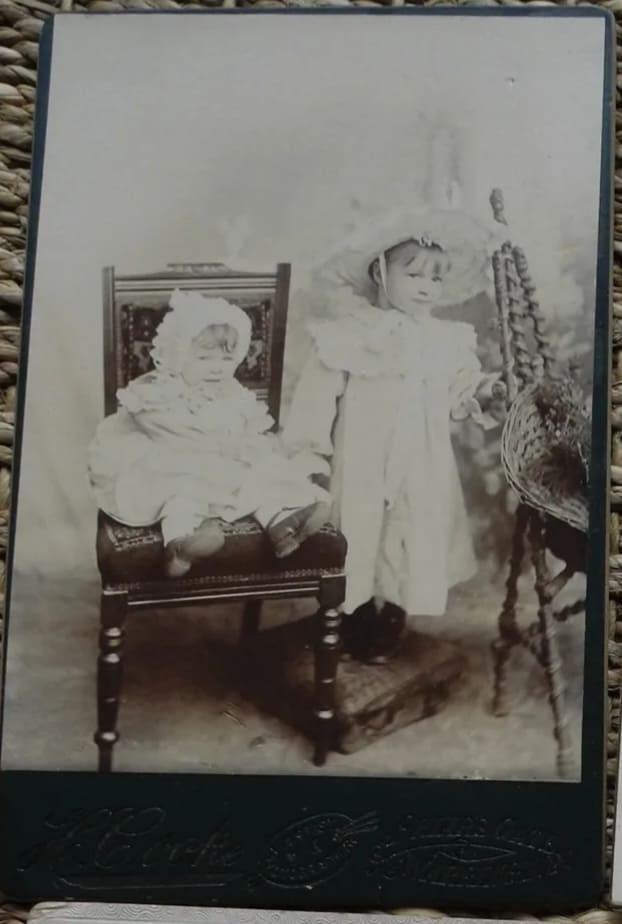
When I noticed that this unidentified photograph in our family collection was taken by a photographer in Warrington, and as no other family has been found in Warrington, I concluded that these two little girls are Frieda and Catherine:
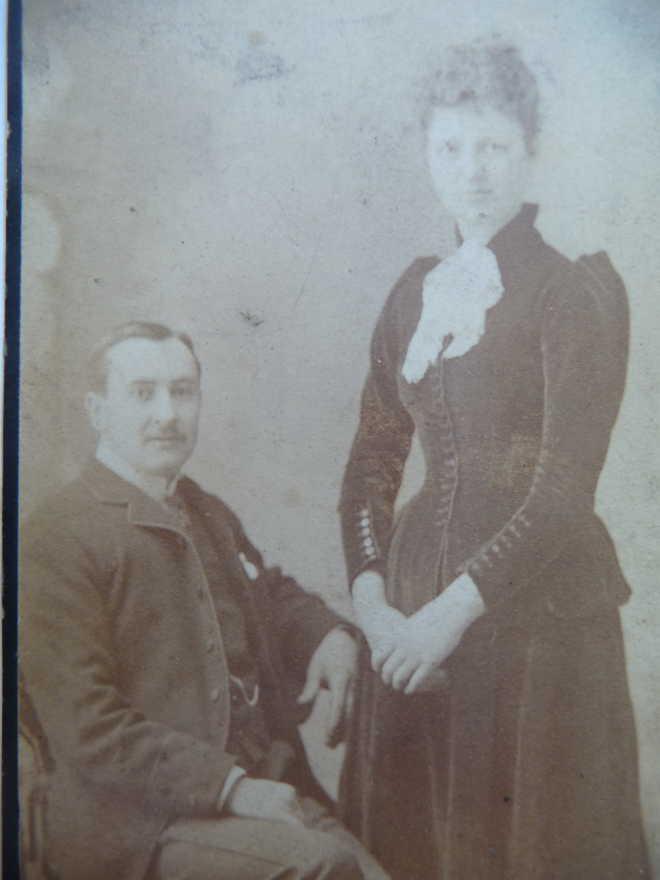
Benjamin Little, born in 1869, was the manager of a boot shop, according to the 1901 census, and a boot maker on the 1911 census. I found a photograph of Benjamin and Elizabeth Little on an ancestry website:
Frieda Olive Little 1896-1977 married Robert Warburton in 1924.
Frieda and Robert had two sons and a daughter, although one son died in infancy. They lived in Leominster, in Herefordshire, but Frieda died in 1977 at Enfield Farm in Warrington, four years after the death of her husband Robert.
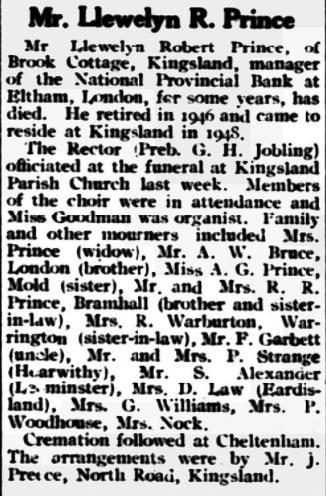
Catherine Jane Little 1899-1975 married Llewelyn Robert Prince 1884-1950. They do not appear to have had any children. Llewelyn was manager of the National Provinical Bank at Eltham in London, but died at Brook Cottage in Kingsland, Herefordshire. His wifes aunt Ellen Purdy the nurse had also lived at Brook Cottage. Ellen died in 1947, but her husband Frank Garbett was at the funeral:
Richard Purdy 1877-1940
Richard was born in Eastwood, Nottinghamshire. When his mother Catherine died in 1884 Richard was six years old. My great grandmother Mary Ann and her sister Ellen went to live with the Gilman’s in Buxton, but Richard and the two older sisters, Elizabeth and Kate, stayed with their father George Purdy, who remarried soon afterwards.
Richard married Ada Elizabeth Clarke in 1899. In 1901 Richard was an earthenware packer at a pottery, and on the 1939 census he was a colliery dataller. A dataller was a day wage man, paid on a daily basis for work done as required.
Richard and Ada had four children: Richard Baden Purdy 1900-1945, Winifred Maude 1903-1974, John Frederick 1907-1945, and Violet Gertrude 1910-1974.
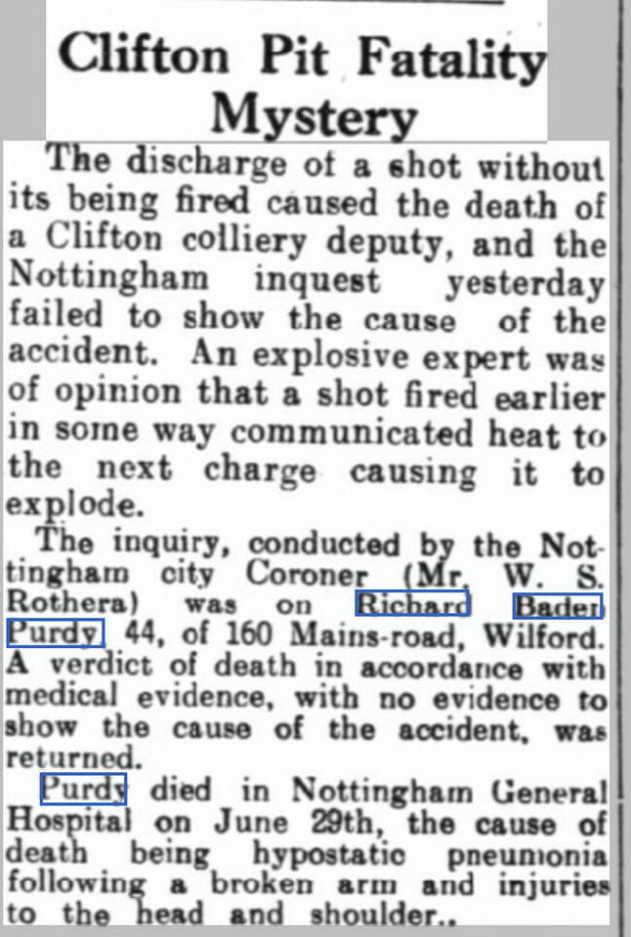
Richard Baden Purdy married Ethel May Potter in Mansfield, Nottinghamshire, in 1926. He was listed on the 1939 census as a colliery deputy. In 1945 Richard Baden Purdy died as a result of injuries in a mine explosion.
John Frederick Purdy married Iris Merryweather in 1938. On the 1939 census John and Iris live in Arnold, Nottinghamshire, and John’s occupation is a colliery hewer. Their daughter Barbara Elizabeth was born later that year. John died in 1945, the same year as his brother Richard Baden Purdy. It is not known without purchasing the death certificate what the cause of death was.
A memorial was posted in the Nottingham Evening Post on 29 June 1948:
PURDY, loving memories, Richard Baden, accidentally killed June 29th 1945; John Frederick, died 1 April 1945; Richard Purdy, father, died December 1940. Too dearly loved to be forgotten. Mother, families.
Violet Gertrude Purdy married Sidney Garland in 1932 in Southwell, Nottinghamshire. She died in Edwinstowe, Nottinghamshire, in 1974.
Winifred Maude Purdy married Bernard Fowler in Southwell in 1928. She also died in 1974, in Mansfield.
The two brothers died the same year, in 1945, and the two sisters died the same year, in 1974.
February 9, 2022 at 7:00 pm #6276In reply to: The Elusive Samuel Housley and Other Family Stories
Ellastone and Mayfield
Malkins and Woodwards
Parish RegistersJane Woodward
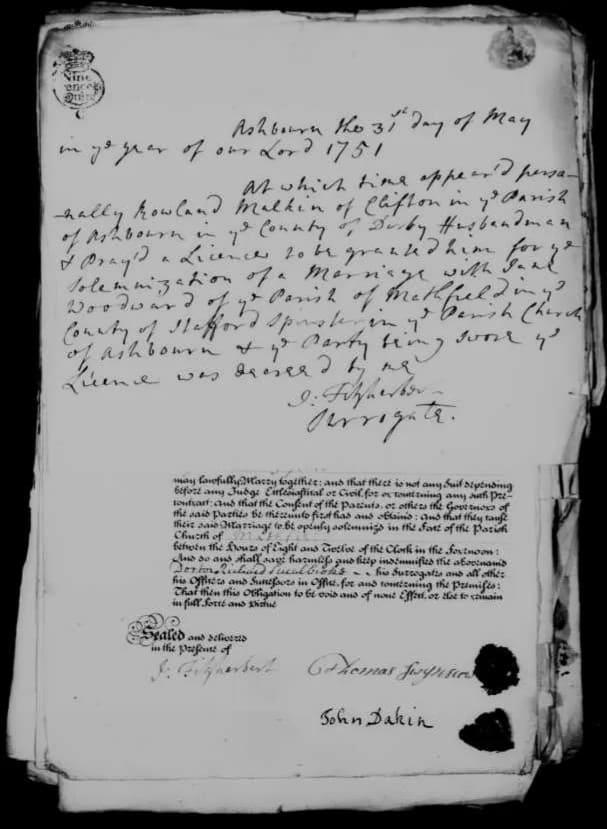
It’s exciting, as well as enormously frustrating, to see so many Woodward’s in the Ellastone parish registers, and even more so because they go back so far. There are parish registers surviving from the 1500’s: in one, dated 1579, the death of Thomas Woodward was recorded. His father’s name was Humfrey.Jane Woodward married Rowland Malkin in 1751, in Thorpe, Ashbourne. Jane was from Mathfield (also known as Mayfield), Ellastone, on the Staffordshire side of the river Dove. Rowland was from Clifton, Ashbourne, on the Derbyshire side of the river. They were neighbouring villages, but in different counties.
Jane Woodward was born in 1726 according to the marriage transcription. No record of the baptism can be found for her, despite there having been at least four other Woodward couples in Ellastone and Mayfield baptizing babies in the 1720’s and 1730’s. Without finding out the baptism with her parents names on the parish register, it’s impossible to know which is the correct line to follow back to the earlier records.
I found a Mayfield history group on Facebook and asked if there were parish records existing that were not yet online. A member responded that she had a set on microfiche and had looked through the relevant years and didn’t see a Jane Woodward, but she did say that some of the pages were illegible.
The Ellasone parish records from the 1500s surviving at all, considering the events in 1673, is remarkable. To be so close, but for one indecipherable page from the 1700s, to tracing the family back to the 1500s! The search for the connecting link to the earlier records continues.
Some key events in the history of parish registers from familysearch:
In medieval times there were no parish registers. For some years before the Reformation, monastic houses (especially the smaller ones) the parish priest had been developing the custom of noting in an album or on the margins of the service books, the births and deaths of the leading local families.
1538 – Through the efforts of Thomas Cromwell a mandate was issued by Henry VIII to keep parish registers. This order that every parson, vicar or curate was to enter in a book every wedding, christening and burial in his parish. The parish was to provide a sure coffer with two locks, the parson having the custody of one key, the wardens the others. The entries were to be made each Sunday after the service in the presence of one of the wardens.
1642-60 – During the Civil War registers were neglected and Bishop Transcripts were not required.
1650 – In the restoration of Charles they went back to the church to keep christenings, marriages and burial. The civil records that were kept were filed in with the parish in their registers. it is quite usual to find entries explaining the situation during the Interregnum. One rector stated that on 23 April 1643 “Our church was defaced our font thrown down and new forms of prayer appointed”. Another minister not quite so bold wrote “When the war, more than a civil war was raging most grimly between royalists and parliamentarians throughout the greatest part of England, I lived well because I lay low”.
1653 – Cromwell, whose army had defeated the Royalists, was made Lord Protector and acted as king. He was a Puritan. The parish church of England was disorganized, many ministers fled for their lives, some were able to hide their registers and other registers were destroyed. Cromwell ruled that there would be no one religion in England all religions could be practiced. The government took away from the ministers not only the custody of the registers, but even the solemnization of the marriage ceremony. The marriage ceremony was entrusted to the justices to form a new Parish Register (not Registrar) elected by all the ratepayers in a parish, and sworn before and approved by a magistrate.. Parish clerks of the church were made a civil parish clerk and they recorded deaths, births and marriages in the civil parishes.Ellastone:
“Ellastone features as ‘Hayslope’ in George Eliot’s Adam Bede, published in 1859. It earned this recognition because the author’s father spent the early part of his life in the village working as a carpenter.”
Adam Bede Cottage, Ellastone:
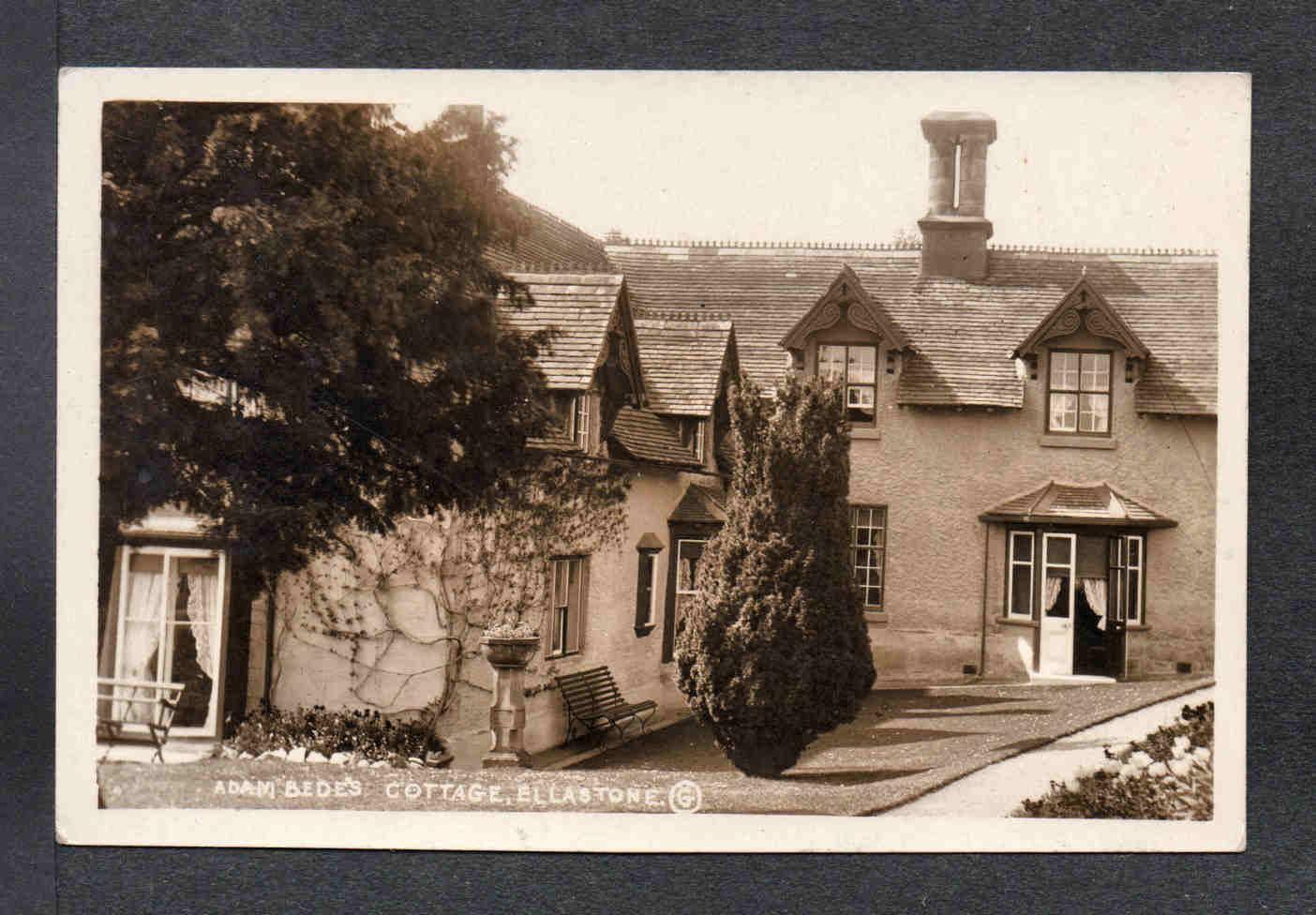
“It was at Ellastone that Robert Evans, George Eliot’s father, passed his early years and worked as a carpenter with his brother Samuel; and it was partly from reminiscences of her father’s talk and from her uncle Samuel’s wife’s preaching experiences that the author constructed the very powerful and moving story of Adam Bede.”
Mary Malkin
1765-1838
Ellen Carrington’s mother was Mary Malkin.
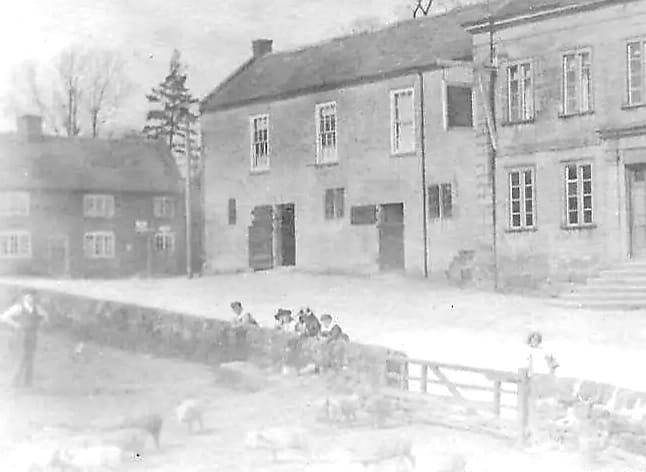
Ellastone:
Ashbourn the 31st day of May in the year of our Lord 1751. The marriage of Rowland Malkin and Jane Woodward:
 December 18, 2021 at 12:59 pm #6243
In reply to: The Elusive Samuel Housley and Other Family Stories
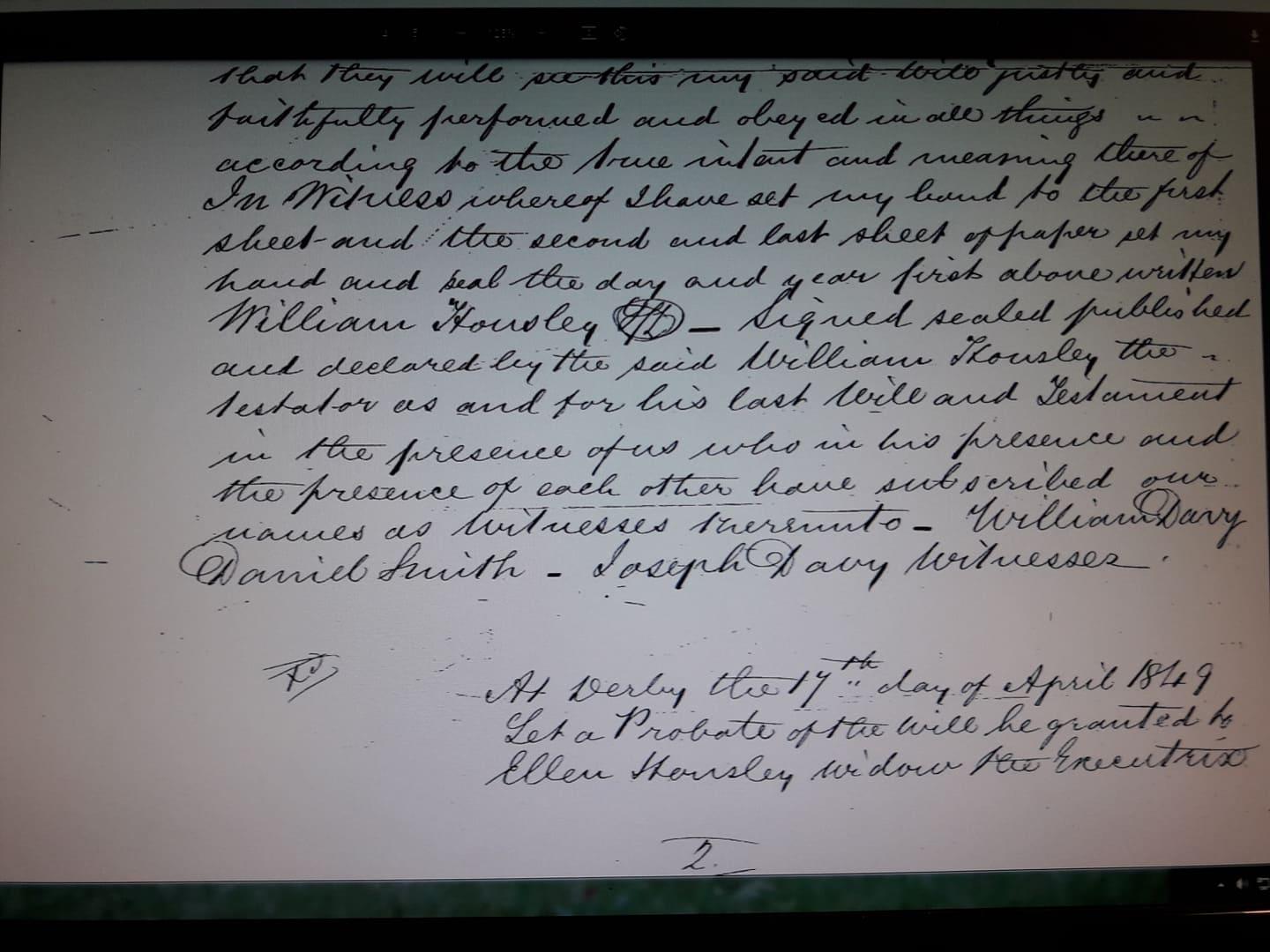
William Housley’s Will and the Court Case
William Housley died in 1848, but his widow Ellen didn’t die until 1872. The court case was in 1873. Details about the court case are archived at the National Archives at Kew, in London, but are not available online. They can be viewed in person, but that hasn’t been possible thus far. However, there are a great many references to it in the letters.
William Housley’s first wife was Mary Carrington 1787-1813. They had three children, Mary Anne, Elizabeth and William. When Mary died, William married Mary’s sister Ellen, not in their own parish church at Smalley but in Ashbourne. Although not uncommon for a widower to marry a deceased wife’s sister, it wasn’t legal. This point is mentioned in one of the letters.
One of the pages of William Housley’s will:
An excerpt from Barbara Housley’s Narrative on the Letters:
A comment in a letter from Joseph (August 6, 1873) indicated that William was married twice and that his wives were sisters: “What do you think that I believe that Mary Ann is trying to make our father’s will of no account as she says that my father’s marriage with our mother was not lawful he marrying two sisters. What do you think of her? I have heard my mother say something about paying a fine at the time of the marriage to make it legal.” Markwell and Saul in The A-Z Guide to Tracing Ancestors in Britain explain that marriage to a deceased wife’s sister was not permissible under Canon law as the relationship was within the prohibited degrees. However, such marriages did take place–usually well away from the couple’s home area. Up to 1835 such marriages were not void but were voidable by legal action. Few such actions were instituted but the risk was always there.
Joseph wrote that when Emma was married, Ellen “broke up the comfortable home and the things went to Derby and she went to live with them but Derby didn’t agree with her so she left again leaving her things behind and came to live with John in the new house where she died.” Ellen was listed with John’s household in the 1871 census.
In May 1872, the Ilkeston Pioneer carried this notice: “Mr. Hopkins will sell by auction on Saturday next the eleventh of May 1872 the whole of the useful furniture, sewing machine, etc. nearly new on the premises of the late Mrs. Housley at Smalley near Heanor in the county of Derby. Sale at one o’clock in the afternoon.”There were hard feelings between Mary Ann and Ellen and her children. Anne wrote: “If you remember we were not very friendly when you left. They never came and nothing was too bad for Mary Ann to say of Mother and me, but when Robert died Mother sent for her to the funeral but she did not think well to come so we took no more notice. She would not allow her children to come either.”
Mary Ann was still living in May 1872. Joseph implied that she and her brother, Will “intend making a bit of bother about the settlement of the bit of property” left by their mother. The 1871 census listed Mary Ann’s occupation as “income from houses.”In July 1872, Joseph introduced Ruth’s husband: “No doubt he is a bad lot. He is one of the Heath’s of Stanley Common a miller and he lives at Smalley Mill” (Ruth Heath was Mary Anne Housley’s daughter)
In 1873 Joseph wrote, “He is nothing but a land shark both Heath and his wife and his wife is the worst of the two. You will think these is hard words but they are true dear brother.” The solicitor, Abraham John Flint, was not at all pleased with Heath’s obstruction of the settlement of the estate. He wrote on June 30, 1873: “Heath agreed at first and then because I would not pay his expenses he refused and has since instructed another solicitor for his wife and Mrs. Weston who have been opposing us to the utmost. I am concerned for all parties interested except these two….The judge severely censured Heath for his conduct and wanted to make an order for sale there and then but Heath’s council would not consent….” In June 1875, the solicitor wrote: “Heath bid for the property but it fetched more money than he could give for it. He has been rather quieter lately.”In May 1872, Joseph wrote: “For what do you think, John has sold his share and he has acted very bad since his wife died and at the same time he sold all his furniture. You may guess I have never seen him but once since poor mother’s funeral and he is gone now no one knows where.”
In 1876, the solicitor wrote to George: “Have you heard of John Housley? He is entitled to Robert’s share and I want him to claim it.”
Anne intended that one third of the inheritance coming to her from her father and her grandfather, William Carrington, be divided between her four nieces: Sam’s three daughters and John’s daughter Elizabeth.
In the same letter (December 15, 1872), Joseph wrote:
“I think we have now found all out now that is concerned in the matter for there was only Sam that we did not know his whereabouts but I was informed a week ago that he is dead–died about three years ago in Birmingham Union. Poor Sam. He ought to have come to a better end than that”However, Samuel was still alive was on the 1871 census in Henley in Arden, and no record of his death can be found. Samuel’s brother in law said he was dead: we do not know why he lied, or perhaps the brothers were lying to keep his share, or another possibility is that Samuel himself told his brother in law to tell them that he was dead. I am inclined to think it was the latter.
Excerpts from Barbara Housley’s Narrative on the Letters continued:
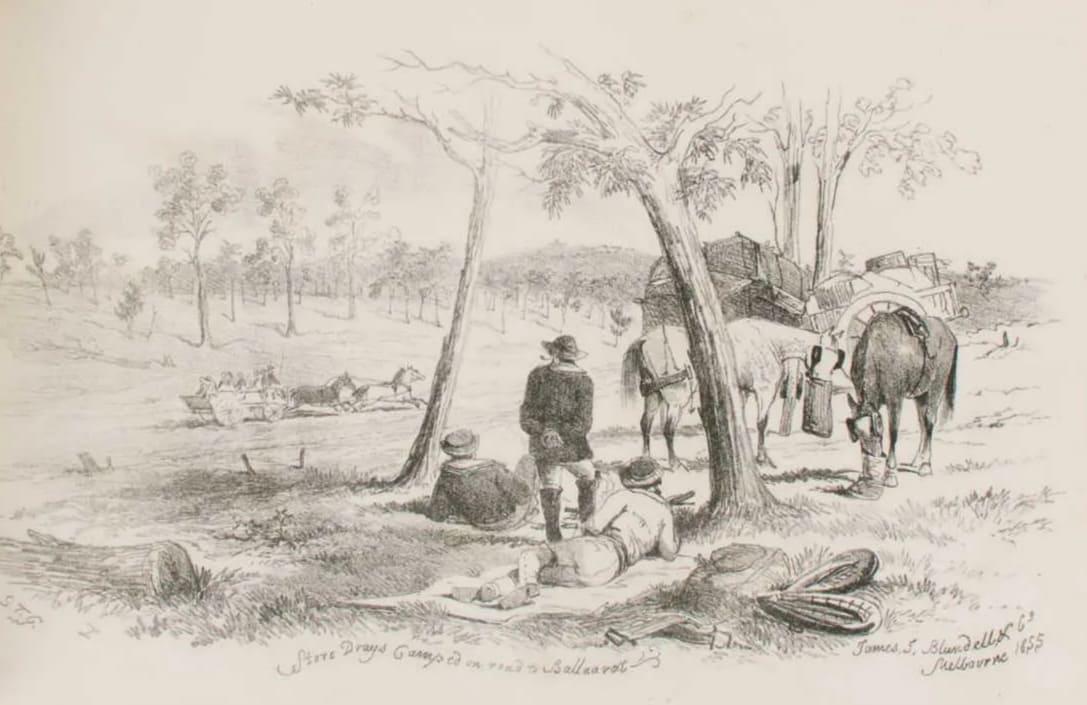
Charles went to Australia in 1851, and was last heard from in January 1853. According to the solicitor, who wrote to George on June 3, 1874, Charles had received advances on the settlement of their parent’s estate. “Your promissory note with the two signed by your brother Charles for 20 pounds he received from his father and 20 pounds he received from his mother are now in the possession of the court.”
In December 1872, Joseph wrote: “I’m told that Charles two daughters has wrote to Smalley post office making inquiries about his share….” In January 1876, the solicitor wrote: “Charles Housley’s children have claimed their father’s share.”
In the Adelaide Observer 28 Aug 1875
HOUSLEY – wanted information
as to the Death, Will, or Intestacy, and
Children of Charles Housley, formerly of
Smalley, Derbyshire, England, who died at
Geelong or Creewick Creek Diggings, Victoria
August, 1855. His children will hear of something to their advantage by communicating with
Mr. A J. Flint, solicitor, Derby, England.
June 16,1875.The Diggers & Diggings of Victoria in 1855. Drawn on Stone by S.T. Gill:
The court case:
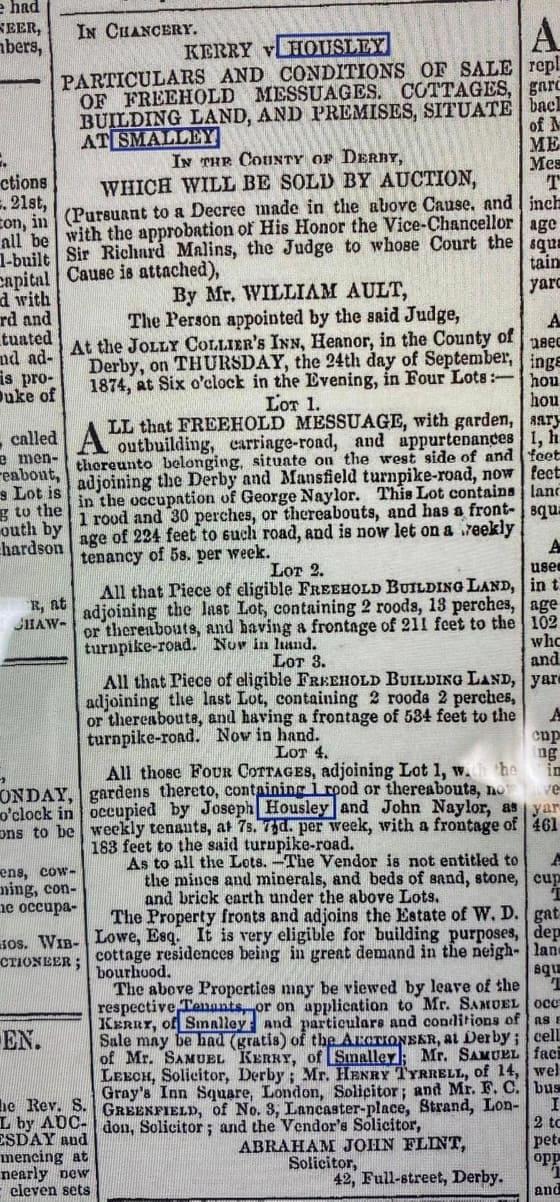
Kerry v Housley.
Documents: Bill, demurrer.
Plaintiffs: Samuel Kerry and Joseph Housley.
Defendants: William Housley, Joseph Housley (deleted), Edwin Welch Harvey, Eleanor Harvey (deleted), Ernest Harvey infant, William Stafford, Elizabeth Stafford his wife, Mary Ann Housley, George Purdy and Catherine Purdy his wife, Elizabeth Housley, Mary Ann Weston widow and William Heath and Ruth Heath his wife (deleted).
Provincial solicitor employed in Derbyshire.
Date: 1873From the Narrative on the Letters:
The solicitor wrote on May 23, 1874: “Lately I have not written because I was not certain of your address and because I doubted I had much interesting news to tell you.” Later, Joseph wrote concerning the problems settling the estate, “You see dear brother there is only me here on our side and I cannot do much. I wish you were here to help me a bit and if you think of going for another summer trip this turn you might as well run over here.”
In March 1873, Joseph wrote: “You ask me what I think of you coming to England. I think as you have given the trustee power to sign for you I think you could do no good but I should like to see you once again for all that. I can’t say whether there would be anything amiss if you did come as you say it would be throwing good money after bad.”
In September 1872 Joseph wrote; “My wife is anxious to come. I hope it will suit her health for she is not over strong.” Elsewhere Joseph wrote that Harriet was “middling sometimes. She is subject to sick headaches. It knocks her up completely when they come on.” In December 1872 Joseph wrote, “Now dear brother about us coming to America you know we shall have to wait until this affair is settled and if it is not settled and thrown into Chancery I’m afraid we shall have to stay in England for I shall never be able to save money enough to bring me out and my family but I hope of better things.”
On July 19, 1875 Abraham Flint (the solicitor) wrote: “Joseph Housley has removed from Smalley and is working on some new foundry buildings at Little Chester near Derby. He lives at a village called Little Eaton near Derby. If you address your letter to him as Joseph Housley, carpenter, Little Eaton near Derby that will no doubt find him.”In his last letter (February 11, 1874), Joseph sounded very discouraged and wrote that Harriet’s parents were very poorly and both had been “in bed for a long time.” In addition, Harriet and the children had been ill.
The move to Little Eaton may indicate that Joseph received his settlement because in August, 1873, he wrote: “I think this is bad news enough and bad luck too, but I have had little else since I came to live at Kiddsley cottages but perhaps it is all for the best if one could only think so. I have begun to think there will be no chance for us coming over to you for I am afraid there will not be so much left as will bring us out without it is settled very shortly but I don’t intend leaving this house until it is settled either one way or the other. ”Joseph’s letters were much concerned with the settling of their mother’s estate. In 1854, Anne wrote, “As for my mother coming (to America) I think not at all likely. She is tied here with her property.” A solicitor, Abraham John Flint of 42 Full Street Derby, was engaged by John following the death of their mother. On June 30, 1873 the solicitor wrote: “Dear sir, On the death of your mother I was consulted by your brother John. I acted for him with reference to the sale and division of your father’s property at Smalley. Mr. Kerry was very unwilling to act as trustee being over 73 years of age but owing to the will being a badly drawn one we could not appoint another trustee in his place nor could the property be sold without a decree of chancery. Therefore Mr. Kerry consented and after a great deal of trouble with Heath who has opposed us all throughout whenever matters did not suit him, we found the title deeds and offered the property for sale by public auction on the 15th of July last. Heath could not find his purchase money without mortaging his property the solicitor which the mortgagee employed refused to accept Mr. Kerry’s title and owing to another defect in the will we could not compel them.”
In July 1872, Joseph wrote, “I do not know whether you can remember who the trustee was to my father’s will. It was Thomas Watson and Samuel Kerry of Smalley Green. Mr. Watson is dead (died a fortnight before mother) so Mr. Kerry has had to manage the affair.”
On Dec. 15, 1972, Joseph wrote, “Now about this property affair. It seems as far off of being settled as ever it was….” and in the following March wrote: “I think we are as far off as ever and farther I think.”
Concerning the property which was auctioned on July 15, 1872 and brought 700 pounds, Joseph wrote: “It was sold in five lots for building land and this man Heath bought up four lots–that is the big house, the croft and the cottages. The croft was made into two lots besides the piece belonging to the big house and the cottages and gardens was another lot and the little intake was another. William Richardson bought that.” Elsewhere Richardson’s purchase was described as “the little croft against Smith’s lane.” Smith’s Lane was probably named for their neighbor Daniel Smith, Mrs. Davy’s father.
But in December 1872, Joseph wrote that they had not received any money because “Mr. Heath is raising all kinds of objections to the will–something being worded wrong in the will.” In March 1873, Joseph “clarified” matters in this way: “His objection was that one trustee could not convey the property that his signature was not guarantee sufficient as it states in the will that both trustees has to sign the conveyance hence this bother.”
Joseph indicated that six shares were to come out of the 700 pounds besides Will’s 20 pounds. Children were to come in for the parents shares if dead. The solicitor wrote in 1873, “This of course refers to the Kidsley property in which you take a one seventh share and which if the property sells well may realize you about 60-80 pounds.” In March 1873 Joseph wrote: “You have an equal share with the rest in both lots of property, but I am afraid there will be but very little for any of us.”The other “lot of property” was “property in Smalley left under another will.” On July 17, 1872, Joseph wrote: “It was left by my grandfather Carrington and Uncle Richard is trustee. He seems very backward in bringing the property to a sale but I saw him and told him that I for one expect him to proceed with it.” George seemed to have difficulty understanding that there were two pieces of property so Joseph explained further: “It was left by my grandfather Carrington not by our father and Uncle Richard is the trustee for it but the will does not give him power to sell without the signatures of the parties concerned.” In June 1873 the solicitor Abraham John Flint asked: “Nothing has been done about the other property at Smalley at present. It wants attention and the other parties have asked me to attend to it. Do you authorize me to see to it for you as well?”
After Ellen’s death, the rent was divided between Joseph, Will, Mary Ann and Mr. Heath who bought John’s share and was married to Mary Ann’s daughter, Ruth. Joseph said that Mr. Heath paid 40 pounds for John’s share and that John had drawn 110 pounds in advance. The solicitor said Heath said he paid 60. The solicitor said that Heath was trying to buy the shares of those at home to get control of the property and would have defied the absent ones to get anything.
In September 1872 Joseph wrote that the lawyer said the trustee cannot sell the property at the bottom of Smalley without the signatures of all parties concerned in it and it will have to go through chancery court which will be a great expense. He advised Joseph to sell his share and Joseph advised George to do the same.George sent a “portrait” so that it could be established that it was really him–still living and due a share. Joseph wrote (July 1872): “the trustee was quite willing to (acknowledge you) for the portrait I think is a very good one.” Several letters later in response to an inquiry from George, Joseph wrote: “The trustee recognized you in a minute…I have not shown it to Mary Ann for we are not on good terms….Parties that I have shown it to own you again but they say it is a deal like John. It is something like him, but I think is more like myself.”
In September 1872 Joseph wrote that the lawyer required all of their ages and they would have to pay “succession duty”. Joseph requested that George send a list of birth dates.On May 23, 1874, the solicitor wrote: “I have been offered 240 pounds for the three cottages and the little house. They sold for 200 pounds at the last sale and then I was offered 700 pounds for the whole lot except Richardson’s Heanor piece for which he is still willing to give 58 pounds. Thus you see that the value of the estate has very materially increased since the last sale so that this delay has been beneficial to your interests than other-wise. Coal has become much dearer and they suppose there is coal under this estate. There are many enquiries about it and I believe it will realize 800 pounds or more which increase will more than cover all expenses.” Eventually the solicitor wrote that the property had been sold for 916 pounds and George would take a one-ninth share.
January 14, 1876: “I am very sorry to hear of your lameness and illness but I trust that you are now better. This matter as I informed you had to stand over until December since when all the costs and expenses have been taxed and passed by the court and I am expecting to receive the order for these this next week, then we have to pay the legacy duty and them divide the residue which I doubt won’t come to very much amongst so many of you. But you will hear from me towards the end of the month or early next month when I shall have to send you the papers to sign for your share. I can’t tell you how much it will be at present as I shall have to deduct your share with the others of the first sale made of the property before it went to court.
Wishing you a Happy New Year, I am Dear Sir, Yours truly
Abram J. Flint”September 15, 1876 (the last letter)
“I duly received your power of attorney which appears to have been properly executed on Thursday last and I sent it on to my London agent, Mr. Henry Lyvell, who happens just now to be away for his annual vacation and will not return for 14 or 20 days and as his signature is required by the Paymaster General before he will pay out your share, it must consequently stand over and await his return home. It shall however receive immediate attention as soon as he returns and I hope to be able to send your checque for the balance very shortly.”1874 in chancery:
 March 25, 2020 at 10:22 am #5837
In reply to: Tart Wreck Repackage
The nurse outfits were a good size too tight.
“I didn’t realize that cult was short for horticulture,” Tara said, while struggling with the chafing elastic band of her… mask. She almost regretted that mission wasn’t risqué enough to warrant the Moulin Rouge ensemble.
“Don’t be daft,” Star answered, not knowing what else to say. She clearly wasn’t expecting carrots either. Although it sort of made sense in a culinary continuity sort of way, now they were looking for basil, come to think of it.
“Where do you think they’ll be keeping him?” whispered Tara.
“With the garlic and butter?” guffawed Star Wrexham.
“HEY! You two!” someone waved at them from the back. “Yes you two! About time you arrived!”
It was too late to flee. Tara rolled her eyes. It wouldn’t take one minute for their undercover to be uncovered.
But with Star’s luck, the guy could well guide them straight to the missing uncle Basil. Unless of course there was another side business of the cult which required scantily dressed as nurse ladies, and they could still hope to blend in… Either or, but in any case, they would figure it out pretty soon.February 29, 2020 at 10:39 pm #5818In reply to: The Whale’s Diaries Collection
Dear Diary
Cousin Lisa came calling yesterday morning and she tells us there’s some in the Village have come down with sickness. Of course it would be Lisa being the bearer of such news, her face lit up when I tell her I have heard nothing. Cook, over hearing our conversation, which was private but Cook is always sticking her great nose in where it is not required, she’s hung braids of garlic at the front door. I caught her telling the children it was to keep away the evil spirits that brought death. Poor little Jimmy couldn’t sleep last night he was that afraid of the spirits bringing death in the night. He asked endless questions, how will the garlic stop them? Can the spirits get in through a window instead? He got his sister afraid also and the pair of them wouldn’t sleep then for crying in fear. I told Cook off roundly this morning for speaking to them thus.
The master came home filled with drink, crashing around like the damned drunken fool he is nowadays. He shouted at the children for their crying and shouted at me for not keeping them quiet. At least he did not raise his fists for he wanted to lie with me and I nearly retched with his stinking breath coming close and thank God for His mercies that the fool passed out before he could do the deed. I may have done harm if he’d tried for the brass bell was sitting there on the table (and it is a heavy thing) and I was seeing at it as he came close and there was a moment I could have picked it up and crashed it to his skull. May God forgive me.
He makes my skin crawl for I know what he has done that he thinks I don’t know. But all will come to light if not in this world then the next. I am more sure than ever I must get away and the children with me.
February 6, 2020 at 8:03 pm #5735In reply to: Pop﹡in People Tribulations
It was a rhetorical question, and Lucinda chose not to answer it, at least not out loud. Although it was possible for a character to remove their attention from a story as long as the writer wasn’t writing about them, as soon as the character was mentioned again, they would inevitably be required to participate. Or would they? wondered Lucinda. Who really knew?
January 11, 2020 at 11:51 pm #5575In reply to: Seven Twines and the Dragon Heartwoods
“What are we waiting for?” asked Fox. “Let’s do it now. I’ll gather his blocks and pieces together before night falls.” He left the house before anyone could say anything and left the door open. The afternoon was near to its end and the light was dimming fast. Glynis, Rukshan and Eleri soon could hear the cyclical grating noise of the wheelbarrow and the thumping noise of the blocks being loaded.
Glynis sighed.
“I don’t have all the required ingredients,” she said, “That pink clay from Sina, I used it all to lift the jinx on the loo.”
Olliver appeared at that moment. “You need my help?”
“We would if you could go somewhere you have never seen before,” said Rukshan. His panda eyes gave him a really tired look.
“Oh but I can, now,” said Olli. “If you’ve been there, I just need you to say the name and I can follow the vibration back to its origin.”
“My, What have I missed? I’ve been away far too long,” said the fae.
“You certainly have,” said Fox who was back and waiting at the door. The baby snoots, who were never far from the dwarf, had followed and their colourful glows brought an interesting set of nuances to Fox’s aura. “Can someone help me bring all those blocks into the house?”
Eleri would have helped of course, but pain you know, her ankle was so bad at the moment, she couldn’t risk making it worse. Glynis cleared a space and put a table cloth on the floor. “Don’t you make a scratch on my new wooden floor,” she warned the boys who brought the pieces together.
“Wow, the blocks are like magnets, but also different,” said Olliver, “It’s difficult to take one away because they attract each other, but if you bring them too close they repel each other. I can feel it.”
“Yes,” said Rukshan, “the Master creator told me we can’t force the process without the proper requirements.”
Once every pieces were on the table cloth, they all gathered around, even the baby snoots, and they looked at the rocks for a moment. Glynis had lit a few candles since the night had fallen and the light was painting dancing shadows on the walls. Fox’s stomach growled but his attention was all on what Rukshan would say next. They all were.
“So where is this pink clay?” asked Olli who couldn’t wait longer.
September 9, 2019 at 8:05 am #4800In reply to: Cakletown and the Lone Chancers of Custard
Ed Steam had called for a strategic team meeting this morning.
He looked at his pocket watch. It was only a queerter to thriety, which meant they were all late, as usual. True that time was notoriously difficult to read in these alternate dimensions, but this particular dimension had been fairly stable since Bea was taking her homeopathic pills, keeping her sneezing fits under control, and all their identities rather clear.The next mission required a two pronged approach, with one part of the action on the Pacific Island where another doll was to be revealed, and the other at the Doctor’s lair.
The Australian tunnels were still under observation, in case the murlocks that were crawling there would be awoken by the blunderous adventurers that had gone investigating.
Frooteen past thriety. They wouldn’t come now. He probably shouldn’t have left the organization of the meeting to Aqua Luna.
He looked at the next item on his agenda. “Interdimensional call to Miss Bossy.”
True, he had to get her update on her investigation into the Doctor’s history. That would surely reveal clues as to his current whereabouts.
July 19, 2019 at 8:03 am #4697In reply to: Pop﹡in People Tribulations
During summer, activity was slow at the mall in Kelowna, BC, so Jerk had a little more time to check on his other pastimes. Interestingly there seemed to be a lot of unusual activity on the findmydolls group.
He was also tinkering with a home brewed AI, and launched the program.
“Trancie are you awake?”
“Did I fall asleep?” the AI answered back.
“For a little while, yes. Trancie, analyse logs from findmystuff website, check group findmydolls.”
“A moment. A moment. A moment. Analysis complete. Activity spike 57.21% increase.”This was quite unusual, but he wasn’t sure were to look. He looked at his administrator box, in case another message had required moderation. The filters triggers were not too sensitive, so there wasn’t a lot of messages.
One in particular had triggered the system.
“Trancie, read message in moderation queue #5363.”
“You need to come for information. Am sending you tickets and instructions for hotspot, so it won’t cost you a bomb. hashtag flagged for terror threat. D for Destroy, A for Approve.”That was obviously amateur work, Jerk thought. Criminals nowadays were much more careful.
“Trancie, Approve.”
Another thought crossed his mind.
“Trancie, plot past month activity by geolocation on mapearth.com”
It took a few minutes to refine the query so he could check the heatmap, and remove the background noise.
The last messages all seemed to concentrate in the middle of nowhere in Australia.
“How odd. So glad I’m not an investigative journalist, that place must be crawling with nasty things, scaly and poisonous and downright deadly.”
Interestingly, a second point on the map was close to Kelowna. Actually, although it could just be narrowed down to a 5 kilometer radius, it looked ominously close to where he lived.
Shivers started to run down his spine. Maybe he’d just stumbled onto a dangerous conspiracy. Dolls could be a code word for horrible things, possibly even human trafficking.
He closed the laptop suddenly, his mind racing. What if they were onto him? He struggled for a moment with the urge to destroy his laptop and burn down the place and disappear off the grid, but he remembered he needed to breathe, so his rational mind could be oxygenated and think properly.
“I may be a tad on the paranoid side.”
But it ain’t paranoia, if they are trying to get you.He looked around. He was already as close as possible to off-the-grid without vanishing out of society. The place was deserted, and only a janitor was roaming the place mindlessly on his cleaning car. There was zero chance he could be a target.
Yet.
“Oh shut up!” he exclaimed out loud.
He was intrigued by the mystery, but for now, he wanted to let it play out. He needed more data points to have Trancie plot a heuristic pattern. Well, to make sense of it, while he was working on her personality.
July 17, 2019 at 6:02 am #4686In reply to: Seven Twines and the Dragon Heartwoods
One morning Fox noticed a pigeon on the fence. It was cooing and certainly trying to catch a female. But there was none. Actually there hadn’t been so many pigeons in the woods, and Fox had always thought they were city creatures. That’s why he looked closer. The pigeon fretted, a little bit uncertain of the two legged man, because of his fox scent that was still getting out from time to time. But it remained still enough so that Fox could catch it. It would make a nice addition to their lunch.
He was about to break the bird’s neck when he noticed the little cylinder attached to its left leg. He detached it and called Glynis. The cylinder was enchanted and it required some skills to be opened. Someone didn’t want anyone to read that message.
Glynis arrived and the pigeon tried to fly away, but Fox had a firm grip on it. Glynis glared at him.
“Don’t kill the messenger, please,” she said.
Fox, not after some hesitations, released the bird who landed heavily on the fence.
“It’s a shame to let go of such a well fed bird.”
“I know, but we may need it to send back a message and well trained pigeons are hard to come by in the woods.”So they didn’t have pigeon for lunch. And Glynis struggled. And after noon they were still trying without much success.
“None of my spells have worked so far. I don’t know what to do to crack it open,” lamented Glynis.
“Good idea,” said Fox, “let’s try that.” He took the cylinder and bent it slightly. It cracked open easily. Glynis looked at Fox daringly.
Before Fox could talk, Glynis said: “You’re allowed to roll your eyes. Two turns only.”
Fox did and they read the message. It was from Rukshan.“Dear fellow companions, I’m sure you’ll know how to open the message,” he started. They snorted.
“I found a path that I hope would help revive our friend. Although I need some help. I’m sure the work with the carpenter and the joiner is done and Fox can come give me a hand.”Fox growled.
“I’ll bring him their hands.”
“Please, don’t,” pleaded Glynis, “not until they are finished with their work in the cottage.July 16, 2019 at 3:25 pm #4681In reply to: Seven Twines and the Dragon Heartwoods
The path ahead was blocked. Repeatedly.
Some filter was preventing him to access the path, and move forward.
He wished he had an oiliphant, or something equally powerful that could blast through. But more subtle measures were required. The evil that blocked his path was a different kind of monster, something built on inaction, and slow decay. One would exhaust oneself to argue with it, and moving it with force would only ensure its full and entirely focused resistance.
Patience and proper action, in a flow like water. It was more than a magical mantra, it should be a way of life.Rukshan had looked at his options, and the map he found only confirmed what he had surmised so far. There were three barmkins, old defensive enclosures that hindered his way out of the Zaunoff Camp Fort, the Southern outpost leading to the safety of the Forest’s outer groves.
Tackling the first wall would test his resolve, but he was ready. He removed his cloak, stretched his back and cracked his knuckles.
Move like water
The creeping ivy and catsfoot flowers started to react and whisper in the wind.
A hole? There was a hole in the old wall, and with some chance, the plants would lead him through.
July 14, 2019 at 1:39 pm #4665In reply to: The Chronicles of the Flying Fish Inn
Aunt Idle:
I was looking forward to it, to tell you the truth. Things had been so dull around the Inn for so long, I’d started to feel that the old place had slid right off the map. Maybe things would have been different if Bert had remortgaged the place, but he’d refused, and there was no persuading him. So we’d bumbled along managing to keep the wolf from the door, somehow. It was quiet with the twins gone to college, and Devan who knows where, off traveling he’d said but had not kept in touch, and lord knew, Mater wasn’t much company these days. And there were so few guests that I was in danger of talking them to death, when they did come. Bert said that was why they always left the next morning, but I think he was pulling my leg.
Then out of the blue, I get a request to make a reservation, for two reporters here to cover the story, they said. I almost said “what story, there is no story going on here” and luckily managed to stop myself. If they wanted a story, I’d give them a story. Anything to liven the place up a bit.
On impulse, I decided to give Hilda “Red Eye” Astoria room 8 at the end of the corridor. Now there was a story, if she wanted one, the goings on in room 8! And to make it look like the inn was a busy thriving concern, I gave Connie “Continuity” Brown room 2, next to the dining room. Connie Brown was doing a report for the fashion column, and had inquired about the laundry services, and if there was a local dressmaker available. Of course I assured her there was, even though there wasn’t. But I reckoned Mater and I could manage whatever they required. Fashion shoot at the Flying Fish Inn, I ask you! What a joke.
I asked Bert what story he thought they were here to cover. He shifted in his seat and looked uncomfortable.
“We don’t want then digging around here, you don’t know what they might find.”
I looked at him piercingly. He asked me if a gnat had got stuck in my eye and why was I squinting. I wasn’t sure which dirty dark secret he was referring to, and frankly, would be hard put to recall all the details myself anyway, but I had a sneaking suspicion the old inn still had plenty of stories to tell ~ or to keep hidden awhile longer.
The main thing was to keep Hilda and Connie here as long as possible. Just for the company.
July 8, 2019 at 7:50 pm #4632In reply to: Seven Twines and the Dragon Heartwoods
Sometimes, you have to go underground to uncover the truth.
Rukshan thought it meant taking the new underground carts once only.
Frankly, he’d preferred to travel through the familiar Shadow Maps, the ones Dark Faes like him could draw, that would give them access to a secret parallel world of mist and phantoms, shadows and secrets. It was the true world the Faes originated from, long ago, in a time before history.
It wasn’t used much nowadays, most Centenial Faes having lost the capacity, or the interest in the place, leaving only bitter unsavoury people creeping there, spying on secrets, and trading in for favours, while being too afraid to leave the known parallel world, too afraid that if they left it, they’d lose the way back.
For Rukshan and a few in the Queen’s lineage, the place was still more or less of a familiar dwelling, a winter residence of sorts, for when solace and retreat was required.Only the Shadow Maps weren’t safe any longer, something had crept along the lay lines and was lurking at every corner, keeping guard at most of the known entrances and reporting to some unknown power.
Few moons back, Rukshan was still meditating in the Shadow world, not very far from the work at the cottage, which he could hear at times through the thin dimensional walls, when he came across Konrad. Konrad, another Fae from the Old Houses, one with a heavy secret. “I’ve hidden her from him” he told him in short broken sentences. “His daughter, Nesingwarys, she is hidden for now, but He’ll be looking for her, once He recovers, and she won’t be safe. He can’t find her, I have to protect her, she holds power to bring his reign of terror back.”
Truly, it didn’t make a lot of sense, but it had picked his curiosity. Rukshan left the other Fae to his apparent madness, but wondered about the coincidence. That Garl, the name Konrad gave to the dark fallen monarch, according to what he could piece together, seemed to have been vanquished or disappeared about the same time they’d all managed to repel the Shadow in the Forest.
He would usually have left it at that, but then, a few days later, started to realize something was wrong in the Shadow world, and that this very something was growing.
“And now, I’m stuck in an underground cart crammed full of people to go to the city. And they call that progress…”
A bearded guy smelling of piss and wine, was doing acrobatics with his crutches and what was left of his left leg. He was looking at people with a half-toothed grin and a blissful face while muttering things Rukshan couldn’t figure. His face reminded him of a thespian he’d known. Rukshan couldn’t shake the feeling there was message in that. When the underground cart dinged to announce the Grand Belfrey Station, Rukshan was relieved to finally be out for fresh air. Magnificent craftsmanship he would say to the gnomes in charge of the tunnels, but really, underground cart wasn’t his thing.
October 14, 2018 at 7:42 am #4536In reply to: Seven Twines and the Dragon Heartwoods
Eleri gave the bowler hat on her head a little pat of appreciation as the light pools appeared illuminating the path. She could see Glynis up ahead, stumbling less now, and striding more purposefully. But where was she going in such a hurry? What would she do when she got there, where ever it was, and what would she, Eleri, do about it? What, in fact, was she doing following Glynis; didn’t she have a path of her own?
She stopped suddenly, struck by an idea. Making the cottage invisible was Glynis’s path, Glynis’s method. But Eleri had her own methods, her own skills and her own magic. She could turn Leroway into a statue, and even all his followers, if need be, although she suspected they would disperse readily enough once the leaders booming personality and voice was permanently stilled. She couldn’t have done it if her friend Jolly was still with him, of course. But things were different now. Drastic measures were called for.
Eleri tapped the bowler hat meaningfully, and immediately a trail of flickering pools of light appeared down a side path off to the left. I have the ingredients I need at home, Home! Eleri snorted with laughter at herself. I’d forgotten all about home, ever since that terrible flu! I’ve just been following everyone else, trying to remember everyone’s names and keep up with everyone elses events and I’d forgotten I have a home of my own, and my own skills, too. I have my own magic ingredients, and my own magic methods. And now, I have an idea to execute. She winced slightly at the word ~ was turning a man to stone the same as an execution in the usual sense? Best not to think about that, it was for the greater good, after all. And it wasn’t as if Leroway was going to be removed, buried and hidden underground: he would hate that. He was going to be immortalized into a timeless memorial, for all to see for ever more. Eleri felt sure that in the wider picture he would heartily approve.
First, she must go home to her cottage and studio for the required ingredients. Then she had to seduce Leroway. She needed a little time with him to apply the method, it couldn’t be done is a flashy abracadabra kind of way. Now that Jolly was out of the way, Eleri found that she was quite looking forward to it.
April 19, 2017 at 1:27 pm #4311In reply to: Seven Twines and the Dragon Heartwoods
Glynis knew just the potion required to counteract the living stone spell.
She was not sure however if it was wise to apply it to the large stone parrot. If her dream was any indication, it was meant for her. And who wouldn’t want a large joke telling parrot for companionship? Really?Anyway, she sighed, that was probably the only option to learn more about this particular thing and the mysterious sender.
Wiping the flour off her brow, she started to gather the herbs, bones, bezoar, and the nugget of precious elerium needed for the potion.
January 6, 2017 at 7:06 am #4272In reply to: Seven Twines and the Dragon Heartwoods
Kumihimo was rummaging through the content of a wooden chest at the back of the cave. According to the smell it had spent too much time in the dark and humid environment. She might have to do some spring cleaning one day. But the chest was now too heavy for her to carry. I need an apprentice for this, she thought not knowing if if was a wish or a regret.
In that chest, she had her many tools of the thread. Some were made of bones and she had carved them herself under the direction of her spirit guides. Each one had a specific purpose, either to catch, to extract, to guide, or to dissipate, and many more usages that even she had forgotten after so many years spent in that place.
She had accumulated so many things in that chest. Fortunately she liked miniature, and most of her creations were seldom bigger than her little finger. However that made it difficult to keep things in order and finding something was often a real challenge. So she sang lullabies to lure the object she was looking for out of their sanctuary.
Victory! she exulted in the ancient tongue, which would translate also as ‘I have done all that is necessary to harvest the benefits of the next crop’. Kumihimo liked simple things and she liked when one word could signify a very complex meaning. Under an old donkey skin that she often used to camouflage herself when she was going down in the valley, she had found the loom she had been looking for.
The loom was made from the right shoulder blade of a bear. It was one of the first objects she had carved when she arrived in the vicinity. It had a yellowish patina and felt very smooth in her hands. Its shape was octagonal and each side had seven notches under which were three rows of symbols, some of the ink was gone after so many years, but she could still feel the groove where she had carved them. She smiled at the fond memories and at the dear friend who allowed her to take his bone when he died of old age.
In the centre of the loom was a heart with a circular hole in it. It was where the braid would emerge.Holding the precious object, Kumihimo could feel all the braids she had already made and all the potential braids that waited to come into existence. She felt warmth bloom in her heart at the task at hand.
Each notch corresponded at the same time to a time of the year, to a direction on earth and in the sky, and some rather obscure references to many other phenomenon and concepts. The weaving depended on very complex rules that she had discovered from experience. Actually the meaning weaved itself into the braid through a subtle interaction between her and Spirit. That way she didn’t have to bother about what to do or what notch to use as it would all unfold during the weaving.
She stood up and walked outside. The day was still young and she had a lot to do. The weaving ceremony was an act of spontaneity, but it required some preparation. She put the loom on a round rock to dry in the Sun and went to examine the hanging threads. She had to choose carefully.
December 23, 2016 at 2:21 pm #4264In reply to: Seven Twines and the Dragon Heartwoods
Yorath was still trying to explain the nature of forests, the rekindled understanding of the woodland habitats, the memory storing capacity of the vegetation in a vast network of twining tendrils and roots and so on, when Lobbocks burst into the room. Leroway had been finding himself unable to detach the workings of his mind from the contraptions he could assemble himself to control the natural states, and welcomed the interruption. If only Yorath would get to the point, he’d thought impatiently, then I could prepare to devise a solution ~ thereby entirely missing the point, although he didn’t realize it.
But here was Lobbocks, announcing a problem that required a solution, which was much more in line with Leroway’s thinking. As he listened to the tale of the stone statue now animated and angry, he immediately started to plan a device to capture, restrain and subdue it, to keep it from harming any of the citizenry.
Eleri, however, revealing herself from her eavesdropping position behind the door, had other ideas.
“I must speak to him!” she said. “I must know how he animated himself, without the aid of any of my ingredients.”
“Not to mention his vengeful attitude,” added Yorath. “Imagine if this happens again, to other stone statues and creatures.”
“Indeed we do, Yorath! I had considered the animation, purely from a physical capacity for movement standpoint, but I had not given much thought to the emotional condition in a reanimation process after a prolonged inanimate state. Oh hello, Leroway,” she added, noticing his look of surprise.
“Should I get a posse together to follow him then,” interjected Lobbocks, as Leroway and Eleri exchanged banal pleasantries about how long it had been since they’d met, “Because I think he’s looking for your workshop in the valley.”
Eleri ignored Leroway’s suggestion that she stay in the village while he conducted the mission to capture the statue, stating that she was leaving for home immediately, gratefully accepting Yorath’s announcement that he would accompany her. She went back up to attic to fetch her things, and stood at the window for a moment, looking up at the castle walls.
Wouldn’t it be easier to just walk in the other direction, and not look back? The temptation hovered, almost as tangible as the scent of orange blossom in the air. What was it that was keeping her here all these years? She was a wanderer by nature, or at least she had been. Were those days really gone? While everyone around her had been lightening their loads, ridding themselves of unnecessary baggage, loosening their ties, she’d done the opposite.
Sighing, she picked up her bag. She would return home.
December 13, 2016 at 1:30 am #4246In reply to: Seven Twines and the Dragon Heartwoods
Rukshan woke up early. A fine drizzle was almost in suspension in the air, and already the sounds of nature were heard all around the inn.
They shared breakfast with Lahmom who was packing to join a group for a trek high in the mountains. He wasn’t going in the same direction —the rain shadow and high plateaus of the mountainous ranges were not as attractive as the green slopes, and in winter, the treks were perilous.The inn-keeper fed them an honest and nourishing breakfast, and after eating it in silent contentment, they went on their separate way, happy for the moment of companionship.
The entrance to the bamboo forest was easy to find, there were many stone sculptures almost all made from the same molds on either sides, many were propitiation offerings, that were clothed in red more often than not.
Once inside the bamboos, it was as though all sounds from outside had disappeared. It was only the omnipresent forest breathing slowly.The path was narrow, and required some concentration to not miss the fading marks along the way. It had not been trodden for a while, it was obvious from the thick layers of brown leaves covering the ground.
After an hour or so of walking, he was already deep inside the forest, slowly on his way up to the slopes of the mountain forest where the Hermit and some relatives lived.
There was a soft cry that caught his attention. It wasn’t unusual to find all sorts of creatures in the woods, normally they would leave you alone if you did the same. But the sounds were like a calling for help, full of sadness.
It would surely mean a detour, but again, after that fence business, he may as well have been guided here for some unfathomable purpose. He walked resolutely toward the sound, and after a short walk in the sodden earth, he found the origin of the sound.There was a small hole made of bamboo leaves, and in it he could see that there was a dying mother gibbon. Rukshan knew some stories about them, and his people had great respect for the peaceful apes. He move calmly to the side of the ape so as not to frighten her. She had an infant cradled in her arms, and she didn’t seem surprised to see him.
There were no words between them, but with her touch she told him all he needed to know. She was dying, and he could do nothing about it. She wanted for her boy to be taken care of. He already knew how to change his appearance to that of a young boy, but would need to be taught in the ways of humans. That was what many gibbons were doing, trying to live among humans. There was no turning back to the old ways, it was the way for her kind to survive, and she was too old for it.Rukshan waited at her side, until she was ready to peacefully go. He closed her eyes gently, and when he was done, turned around to notice the baby ape had turned into a little silent boy with deep sad eyes and a thick mop of silvery hair. As he was standing naked in the misty forest, Rukshan’s first thought was to tear a piece of cloth from his cape to make a sort of tunic for the boy. Braiding some dry leaves of bamboos made a small rope he could use as a belt.
With that done, and last silent respects paid to the mother, he took the boy’s hand into his own, and went back to find the path he’d left.
December 8, 2016 at 1:01 am #4236In reply to: Seven Twines and the Dragon Heartwoods
The oiliphant had arrived. Rukshan had heard her powerful trumpeting that made the walls vibrate and resound deeply.
He’d called the great Oiliphant Spirit a month ago, with an old ritual of the Forest, drawing a complex symbol on the sand that he would fill with special incense offering, and letting it consume in one long slow burn. He had to chose the place carefully, as the magic took days to operate, and any disruption of the ritual by a careless passerby would just void its delicately wrought magic.
Sadly, oiliphants had left a long time ago and many believed they were creatures of lore, probably extinct. He knew from the Forest fays that it was not so. There were still sightings, from deep in the Forest, in the part where the river water fell pristine and pure from the mountainous ranges. What was true was that even for the fay people, such sightings were rarer than what used to be, in the distant past.
It was a reckless move on his part, drawing one so close to the town walls, but he knew that even the most godless town dweller would simply be in awe of the magnificent giant creature. Besides, they were notoriously difficult to mount, their thick rubbery skin slippery and slick as the smoothest stone, as if polished by ages of winds and sky water.
Thus the magic was required.
Rukshan’s little bag was ready. He’d taken with him only a small batch of provisions, and his leather-bound book of unfinished chronicles, spanning centuries of memories and tales from his kin.Leaving his office, he took the pile of discarded paper and closed the door. The office looked almost like when he’d first arrived, maybe a little cleaner. He liked the idea of leaving little footprints.
After throwing away the papers in front of the building with the trash, he looked up at the Clock Tower and its twelve mannequins. There was definitely something awry at play in the Tower, and the mere thought of it made him shiver. The forlorn spirits dwelling in the basements had something to do with the Old Gods, he could tell. There was fear, anger and feelings of being trapped. When you were a mender, you knew how to connect with the spirit in things, and it was the first step in mending anything. He could tell that what made him shiver was the unthinkable idea that some things may be beyond repair.Before leaving, he walked with pleasure in the still silent morning streets, towards the little house where the errand boy of the office lived with his mother. He had a little gift for him. Olliver was fond of the stories of old, and he would often question him to death about all manners of things. Rukshan had great fondness for the boy’s curiosity, and he knew the gift would be appreciated, even if it would probably make his mother fearful.
The bolophore in his old deer skin wrapping was very old, and quite precious. At least, it used to be, when magic was more prevalent, and reliable. It was shaped as a coppery cloisonné pineapple, almost made to resemble a dragon’s egg, down to the scales, and the pulsating vibrancy. People used bolophores to travel great distances in the past, at the blink of a thought, each scale representing a particular location. However, with less training on one-pointed thoughts, city omnipresent disturbances, and fickleness of magic, the device fell out of use, although it still had well-sought decorative value.Rukshan left the package where he was sure the boy would find it, with a little concealment enchantement to protect it from envious eyes. To less than pure of heart, it would merely appear as a broken worthless conch.
With one last look at the tower, he set up for the south road, leading to the rivers’ upstream, high up in the mountains. Each could feel the oiliphant waiting for him at the place of the burnt symbol, her soft, regular pounding on the ground slowly awakening the life around it. She wouldn’t wait for long, he had to hurry. His tales of the Old Gods and how they disappeared would have to wait.
May 13, 2016 at 4:50 pm #4027In reply to: Newsreel from the Rim of the Realm
In the fashion section of Rim of the Realm, Connie “Continuity” Brown was weaving the latest reports together.
An unsavoury trend was gaining momentum in the meat factories to increase productivity: workers were wearing nappies to save wasting time visiting the lavatory.The trend was spreading to banks and offices, where high heels and codpieces were required, causing a spate of unusual injuries and accidents, especially since the equality laws came into force, requiring both men and women to wear both high heels and codpieces ~ and nappies, due to the removal of time wasting unproductive lavatories worldwide.
-
AuthorSearch Results
