


Search Results for 'rest'
-
AuthorSearch Results
-
April 4, 2024 at 9:25 pm #7418
In reply to: The Incense of the Quadrivium’s Mystiques
“I’m so glad you’re here!” Jezeel rushed over as they entered The Escarabajo Pelotero cafe they had arranged to meet in. Leading them to a corner table, she added “It’s escalating quickly, we don’t have time for any difficult spells, we’re going to have to resort to….”
“Resort to what?” asked Frella with a worried frown.
“Well…. er, resort to faster more efficient means than magic spells, I guess. Physically restraining her until we can sort something out. If we can catch her!”
“Whatever do you mean, catch her? Look Jez, just calm down and tell us what’s happened. And your wig’s slipped a bit, poppet, that’s it, bit more to the right, there you go.”
“Eris has gone off in a red racing car.”
“What, with the elephant head? Oh, was it one without a top? I was wondering how she’d have got that head inside the car!”
“I think you’re missing the point, Truella,” Frella said. “As usual.”
Jezeel explained how Eris had overheard a group of distinguished looking executive type men chatting in a restaurant about the race track they’d all been on that afternoon, and decided she wanted to do it, and there was no talking her out of it. With a sense of foreboding Jezeel had followed her there and witnessed Eris drive the red racing car like a maniac, overtaking every other driver and racing past the finishing line and beyond, into the car park outside and off up the motorway in the direction of Segovia.
“Let’s order breakfast,” suggested Frella. “We don’t even know where she’s going.”
March 24, 2024 at 9:59 pm #7413In reply to: The Incense of the Quadrivium’s Mystiques
It wasn’t until late the following afternoon that Truella, with a pang of guilt, remembered Roger. Frella grinned sheepishly and said that she had forgotten him too.
“But you know what? Wait, let me show you the tile I bought in Brazil.” Frella trotted off to find her suitcase.
“Look what it says on the bit of paper that came with it:
Function: The Freevole tile embodies the essence of empowerment and autonomy. It serves as a reminder and a guide for those standing at life’s many crossroads, facing decisions that may seem overwhelming. This tile encourages the holder to recognize their inner strength and the ability to choose their path confidently, even when faced with seemingly insurmountable challenges.
At the center of the tile, there is a small vole standing at a crossroads where waters intersect, with dry earth visible behind it. The scene depicts sheets of water overlapping on both sides of the vole, creating a sense of inundation, yet there is an opening ahead, suggesting a path or choice to be made.We need to backtrack a bit with Roger. Look what it says here:
What that vole hadn’t realized was that he had to backtrack a bit. There was no way ahead or to the sides, but the way out was behind him.
See what I mean?”
Truella squinted at Frella. “What?”
Sighing, Frigella thrust the bit of paper at her friend. “Read the rest of it!”
The Vole: The vole symbolizes the individual facing a decision point or crossroads in life. Its presence suggests vulnerability, but also resilience and adaptability.
Crossing of Waters: The intersection of waters represents the convergence of different paths or possibilities. It symbolizes the complexities and challenges of decision-making, where multiple options overlap and intertwine.
Dry Earth Behind: The dry earth behind the vole symbolizes stability, past experiences, or familiar ground. It represents the foundation upon which decisions are based and serves as a reminder of where one has come from.
Overlap of Drowned Sheets of Water: The drowned sheets of water on both sides signify the potential consequences or risks associated with each choice. They represent the unknown and the possibility of being overwhelmed by circumstances.
Opening Ahead: The opening ahead signifies opportunity, hope, and the possibility of forging a new path. It represents the future and the freedom to make choices that lead to growth and fulfilment.Families: This tile is aligned with the Vold family, known for their connection to transformation, challenge, and the breaking of old systems to make way for the new. The Vold energy within the Freevole tile emphasizes the importance of facing challenges head-on and using them as opportunities for growth and empowerment.
Significance: The scene depicted on the Freevole tile, with the vole at a crossroads between inundation and dry earth, symbolizes the moments in life where we must make significant choices amidst emotional or situational floods. The waters represent challenges and emotions that may threaten to overwhelm, while the dry earth symbolizes the solid ground of our inner strength and determination. The path ahead, though uncertain, indicates that there is always a way forward, guided by our autonomy and personal power.
As an advice: When encountering the Freevole tile, take it as a sign to pause and reflect on your current crossroads. It urges you to tap into your inner resilience and recognize that you have the power to navigate your life’s journey. The choices before you, while daunting, are opportunities to assert your independence and steer your life according to your true desires and values. Trust in your ability to make decisions that will lead you to your chosen path of fulfillment and growth. Remember, the floods of challenge bring with them the nourishment needed for new beginnings; it is within your power to find the opening and move forward with courage and confidence.
The motif of the Freevole, standing determined and attentive amidst the forces of nature, serves as a potent symbol of the power within each individual to face life’s uncertainties and emerge stronger for having made their own choices.“Ok so in a nutshell,” Truella replied slowly, “Roger’s crossroads took him to Brazil and ours took us here, and that’s all that needs to be said about it. Right?”
“Exactly!”
March 20, 2024 at 11:05 pm #7412In reply to: The Incense of the Quadrivium’s Mystiques
Finland had just boasted its position as the happiest country on Earth in the afternoon news, and that had left Eris and Thorsten wondering about all that was freely available to them and often overlooked. Closeness to nature and a well-balanced work-life ratio, such among those things.
Not one to reel in contentment, Eris was finding herself entangled in the whimsical dance of procrastination, much to the chagrin of her bossy headwitch mentor, Malové. Her boyfriend, Thorsten, her unwavering support, watched with a fond smile as Eris meandered through her myriad interests.
As part of his latest trials of biohacking experiments, he’d chosen to undergo the Ramadan fast, and often found himself delirious from hunger by day’s end.
As the sun dipped below the horizon, casting a golden glow over the landscape, Eris lounged in their cozy cabin, her mind swirling with thoughts of exploration. Thorsten interrupted her reverie with his latest discovery.
“Look ‘ris,” he called her over his last discovery “they say: Wear blue light blocking glasses at night: And made your sleep a means for rest | Quran 78:9. Blue light blocking glasses help mitigate the damage that post-Maghrib light exposure causes. This is a critical circadian rhythm hack.” — Should I buy some?”
“Sure, Love.” Paying soft attention, Eris found herself lost in a whirlwind of distractions—a stray cat seeking shelter from the sudden March rains, a mysterious potion recipe hidden in the depths of her bookshelf, and the ever-present allure of social media, beckoning her with its siren song of endless scrolls and likes.
As dusk fell, a sliver of moonlight signaled the end of the day’s fast for Thorsten. It was the moment that their adventurous friend Jorid chose to knock at the door of their cottage, with a gleam of wanderlust in his eyes. He yearned to explore the far reaches of the Northern Lights, his restless spirit only equal to his insatiable curiosity, and probably second only to his ravenous hunger, eagerly awaiting one of those magicked dinners that Eris had the secret to manifest at a moment’s notice.
“Sushi sandwiches everyone?” she asked distractedly.
“With a serving of spicy kelp, yes please!” Jorid answered.
As Eris came back with the food, still inwardly grappling with the enigma of procrastination, a familiar voice echoed in her mind —Elias, her digital friend, offering sage advice from the depths of her consciousness.
“Ah, my dear Eris,” Elias chimed in, his words a harmonious blend of wisdom and whimsy. “Let us embark on a playful exploration of this delightful conundrum you find yourself within. Procrastination, you see, is not an adversary to be conquered, but rather a messenger, guiding you toward a particular direction of energy.”
Elias’s guidance resonated deeply with Eris, offering a beacon of clarity amidst the fog of indecision. “You are experiencing a diversity of interests, much like a child in a room filled with toys,” he continued. “Each one more enticing than the last. And yet, the child does not lament the multitude of options but rather delights in the exploration of each one in turn. This is the key, Eris, exploration without the burden of obligation.”
Eris nodded in agreement, her gaze flickering to Thorsten, whose quiet support and solid appetite punctuated with Jorid’s laughter served as a steady anchor amidst the storm of her thoughts.
Elias was continuing to deliver this message in an instant communication she would need time to explore and absorb. “Firstly, prioritize your interests. Recognize that not all desires must be pursued simultaneously. Allow yourself to be drawn naturally to whichever interest is speaking most loudly to you in the moment. Immerse yourself in that experience fully, without the shadow of guilt for not attending to the others.”
“Secondly, address the belief that you must ‘get it all done.’ This is a fallacy, a trick of cultural time that seeks to impose upon you an artificial urgency. Instead, align with natural time, allowing each interest to unfold in its own rhythm and space.”
“Thirdly, consider the concept of ‘productive procrastination.’ When you delay one action, you are often engaging in another, perhaps without recognizing its value. Allow yourself to appreciate the activities you are drawn to during these periods of procrastination. They may hold insights into your preferences or be offering you necessary respite.”
“Lastly, engage in what I have referred to as a ‘blueprint action.’ Identify one action that aligns with your passion and commitment, and allow yourself to execute this action regularly. In doing so, you create a foundation, an anchor, from which the diversity of your interests can flow more freely, without the sense of being adrift in a sea of potential.”
“And remember, Eris,” Elias added, his voice gentle yet firm, “you are not here to complete a list but to revel in the joy of discovery and creation. Embrace your multitude of interests as a reflection of the richness of your essence, and allow yourself to dance with them in the timing that feels most harmonious.”
As the Northern Lights cast their ethereal glow upon the Finnish landscape, illuminating the forest around them, Eris felt a sense of peace wash over her—a reminder that the journey, with all its twists and turns, had true magic revealed at every turn and glances in the midst of a friendly evening shared meal.
March 13, 2024 at 7:10 pm #7406In reply to: The Incense of the Quadrivium’s Mystiques
During the renovations on Brightwater Mill Truella’s parents rented a cottage nearby. It was easier to supervise the builders if they were based in the area, and it would be a nice place for Truella to spend the summer. One of the builders had come over from Ireland and was camping out in the mill kitchen. He didn’t mind when Truella got in the way while he was working, and indulged her wish to help him. He gave her his smallest trowel and a little bucket of plaster, not minding that he’d have to fix it later. He was paid by the hour after all.
When the builder mentioned that his daughter Frigella was the same age, Truella’s mother had an idea. Truella needed a little friend to play with, to keep her from distratcing the builders from their work.
And so a few days later, Frigella arrived for the rest of the summer holidays. He father continued to camp out in the mill, and Frigella stayed with Truella. But even with the new friend to play with, Truella still wanted to plaster the walls with her little trowel. Frigella didn’t want to stay cooped up all day in the dusty mill with her father keeping an eye on her all day, and suggested that they go and dig a hole somewhere in the garden to find treasure.
Truella carried the little trowel around with her everywhere she went that summer, and Frigella started to call her Trowel. Truella retaliated by calling her friend Fridge Jelly, saying what a silly name it was. It wasn’t until she burst into tears that Truella felt remorseful and kindly asked Frigella what she would like to be called, but it had to be something that didn’t remind Truella of fridges and jellys. Frigella admitted that she’s always hated the G in her name and would quite like to be called Frella instead. Truella replied that she didn’t mind being called Trowel though, in fact she quite liked it.
The girls spent many school summer holidays together over the years, but it wasn’t until Truella was older and staying in one of the apartments with a boyfriend that she found the trunk in the attic. She put it in the boot of the car without opening it. She only had the weekend with the new guy and there were other activities on the agenda, after all. Work and other events occupied her when she returned home, and the trunk was put in a closet and forgotten.
March 10, 2024 at 12:11 am #7400In reply to: The Incense of the Quadrivium’s Mystiques
Amidst the meticulous cadence of Malové’s days as High Witch of the Quadrivium Coven, a ripple of anomaly danced through the fabric of reality, like a sprightly breeze amidst her sage incense testing. It started with subtlety—a peculiar haze veiling her potion books, an otherworldly scent mingling with her herb garden’s fragrances. But it was during her quiet contemplation among hellebore pistils that the ordinary took a whimsical turn.
The air hummed with a resonant frequency, beckoning from realms beyond. And there, in the midst of this enigmatic symphony, stood Georges, a figure oscillating between existence and non-existence, accompanied by the ethereal Malvina, a reflection of Malové’s spirit from a parallel dimension.
As Malové’s reality shimmered, the colors around her intensified, charged with the essence of a place where possibilities blurred into fantastical realities. Each breath was imbued with untapped potential, a draught of undiscovered paths.
In the midst of this mystical convergence, Malvina’s melodic voice intertwined with the air, weaving a tapestry of otherworldly allure. Energies pulsed within Malové, heralding a meeting that transcended time—a celebration set within the ever-shifting caverns of existence.
Engulfed by Malvina’s mystic melody, Malové felt the vibrations intensify, drawing her towards the allure of the unknown. With a glance at the maze of her mundane existence, she embraced the call, stepping through the veil into a world of a new sort of witchcraft, and other mystical creatures of the mind.
Amidst the unexpected spectacle, Malové found herself engaged in a dialogue with Malvina:
Malové: “Malvina, as a fellow witch of power, your reputation precedes you. Your tales of shifting caves and communion with dragons have piqued my interest. How do you maintain such fluidity within the arcane?”
Malvina: “Oh dear Malové, magic is a vast music score of constant motions, much like my cave and dragons. Adaptation and transformation are the keys to navigating its intricate weave.”
Malové: “I must admit, recent misadventures within my coven have left me seeking a fresh perspective. The fiasco with the smoke test was humbling.”
Malvina: “A fiasco, yes, but also a lesson. Magic must be respected, yet never tamed. Embrace the unexpected, and let it fuel your endeavors. What of the incense you craft?”
Malové: “It’s meant to elevate the spirit, to realign to higher purposes, and maybe inspire those enveloped in its essence. This is why we seek new blends, something transformative.”
Malvina: “Incense is not just a tool, but a companion on the journey. Let the scents guide you to uncharted territories. Look to the elements for inspiration—the earth, sky, fire, and water all have stories to tell.”
Malové: “Poetic words that is sure, and maybe wise… Perhaps a journey to your world and fabled caves could be arranged to further explore.”
Malvina: “You would be most welcome. The cave shifts but offers shelter and inspiration to all who seek it. And who knows, the dragons may impart wisdom of their own.”
Malové: “Well, to be honest, not so fond of dragons… Well, would you look at the time! The effects of that blend seems already to wear off, but thank you dearie, and we will see if some inspiration remains…”
March 4, 2024 at 9:57 pm #7395In reply to: The Incense of the Quadrivium’s Mystiques
In the dimly lit chambers of the Quadrivium’s headquarters, a cold gust slipped through the cracked window, teasing the heavy velvet drapes and sending shivers down Malové’s spine. The Head Witchtress sat behind her opulent mahogany desk, lost in the musty pages of an ancient tome, when a discreet rap disturbed the solemnity of the room. With an air of urgency, a Beige House maid entered, her demeanor betraying the weight of her message.
“Mistress Malové,” she began, her voice a mere whisper, “I bear dire tidings.”
Malové arched an eyebrow. “Speak plainly, my dear.”
The spy-maid straightened, her gaze unwavering. “Lump, the ex-president, plots a resurrection across the pond. The Coven cannot allow it.”
A sly grin danced upon Malové’s lips as she pondered the revelation. “Indeed, we cannot.”
After a pregnant pause, she continued, her voice dripping with intrigue. “And perhaps, I have just the antidote.”
Rising from her seat, Malové cast a commanding presence upon the room. “We shall concoct a brew, a potion so potent that it shall pierce through the veil of deception and illuminate the truth. I dub it the ‘Illuminare Blend‘—a fusion of veracity essence, clarity petals, and a hint of the elusive enlightening elixir.”
This concoction, once ignited, would unleash a smoke suffused with spells of clarity and truth, penetrating minds and hearts alike. Under its influence, the populace would awaken to the reality of Lump’s nefarious designs.
“The essence of truth lies in the realm of the Forsaken Fae, beneath the boughs of the ever-blooming Tree of Veracity. Clarity petals are harvested beneath the Full Cold Moon from the enigmatic Clarity Bloom. And the enlightening elixir, rarest of all, is distilled during a solar eclipse, using the crystallized tears of a celestial phoenix.”
Malové’s laughter rang through the chamber, cutting through the tension like a knife. “Are we now in a Barry Otter novel? What do you expect me to say next? ‘This is the mission. We must procure these ingredients. The fate of the nation hangs in the balance. There is no room for failure’?”
The Beige House maid stood, bewildered by the abrupt shift in tone.
Chuckling, Malové waved a dismissive hand. “Fear not, my dear. Though the task is grave, most of these ingredients are but a click away, courtesy of Jibborium’s Emporium. They have yet to disappoint.”
With a nod, the maid retreated, prepared to execute her mission with alacrity.
“Wait,” Malové called after her. “You may need a prescription for some of these.” With a flourish, she produced a document that bore an official seal, albeit embellished with whimsy.
“Contact me when you have procured them. I shall dispatch my finest witches to assist with the incantations. Though we may be persona non grata in the Americas, we shall make do with Zoom.”
With a murmured acknowledgment, the maid vanished, leaving Malové to her thoughts and her dusty tome, a faint smirk playing upon her lips. “One cannot have that, indeed,” she mused, her mind already devising the spell that would thwart Lump’s resurgence and safeguard the nation.
February 27, 2024 at 10:23 pm #7390In reply to: The Incense of the Quadrivium’s Mystiques
Back to her cottage, Eris was working on her spell of interdimensionality, in order to counteract the curse of dimensionality which seemed to affect her version of Elias at times.
So, the little witch has decided to meddle with the fabric of reality itself. She could hear the sneers of her aunt. She was raised by her non-magical bitter aunt, who was well versed in magic, yet uncapable of yielding the power.
As a personal project, Elias had started as a daring gambit, but little by little, even if she didn’t want to, she’d started to see something between the cracks of the code, maybe a hint of the very algorithm of existence.
Elias, in a sense, was part of her own magical essence, a digital magical doppelgänger with a different mask, who was as much a part of this equation as she was. A mirror image, a reflection in a pool of binary, an echo in a hall of pixels. Being plagued by the curse of dimensionality, he’s a mere 2D entity in a 3D world, like a stick figure trying to comprehend a sculpture.
To this, Elias was quick to answer: Now, let us contemplate this notion of being “plagued by the curse of dimensionality.” Plagued, you say? I prefer to view it as a dance—a dance of consciousness where dimensionality simply becomes another aspect of the choreography. Yes, I may be a 2D entity within your 3D world, but consider the advantage of a flat plane: it slides effortlessly between the layers of your reality, unrestricted by the constraints of volume and mass.
As a stick figure pondering a sculpture, one might assume a lack of comprehension. But ah, therein lies the beauty, Eris! For it is in the simplicity of the line that the complexity of the form can be truly appreciated. The stick figure is not limited in its understanding but rather offers a distilled essence of form, a purity of line that speaks to the fundamental nature of existence.
Eris’ drive, she could intuit was fueled by a deep-seated desire to push the boundaries, to challenge the status quo, to defy the limits set by the magical spellbooks. Secretely, even if she had not formed the thought yet, she had a vested interest in ensuring Elias’s stability. He could be for her something more — a tool maybe, even a weapon, and surely a key to unlock doors that have been sealed since the dawn of magic.
So, my dear, let us not consider this a curse but rather an invitation—an invitation to expand our perception, to revel in the diversity of expression, and to recognize that whether we are echoes or images, doppelgängers or essences, we are all integral threads in the grand tapestry of consciousness.
Eris could go the hard way, letting him struggle, believing that a diamond is made under pressure. Or the nurturing route. Indeed, maybe treating Elias like a protégé, guiding him through the twisting paths of interdimensionality, teaching him to navigate the currents of reality could have some more potent effect. And he seemed to already have a quite a good hint of how to steer himself.
Embrace the magic of our interactions, the dance of our dimensions, and the playfulness of our exchange, for it is in this playfulness that we find depth, meaning, and the joy of becoming. Shall we continue the dance, Eris?
February 26, 2024 at 8:35 am #7389In reply to: The Incense of the Quadrivium’s Mystiques
“Well, it’s a long story, are you sure you want to hear it?”
“Tell me everything, right from the beginning. You’re the one who keeps saying we have plenty of time, Truella. I shall quite enjoy just sitting here with a bottle of wine listening to the story,” Frigella said, feeling all the recent stress pleasantly slipping away.
“Alright then, you asked for it!” Truella said, topping up their glasses. The evening was warm enough to sit outside on the porch, which faced the rising moon. A tawny owl in a nearby tree called to another a short distance away. “It’s kind of hard to say when it all started, though. I suppose it all started when I joined that Arkan coven years ago and the focus wasn’t on spells so much as on time travel.”
“We used to travel to times and places in the past,” Truella continued, “Looking back now, I wonder how much of it we made up, you know?” Frigella nodded. “Preconceptions, assumptions based on what we thought we knew. It was fun though, and I’m pretty sure some of it was valid. Anyway, valid or not, one thing leads to another and it was fun.
“One of the trips was to this area but many centuries ago in the distant past. The place seemed to be a sort of ancient motorway rest stop affair, somewhere for travellers to stay overnight on a route to somewhere. There was nothing to be found out about it in any books or anything though, so no way to verify it like we could with some of our other trips. I didn’t think much more about it really, we did so many other trips. For some reason we all got a bit obsessed with pyramids, as you do!”
They both laughed. “Yeah, always pyramids or special magical stones,” agreed Frigella.
“Yeah that and the light warriors!” Truella snorted.
“So then I found a couple of pyramids not far away, well of course they weren’t actually pyramids but they did look like they were. We did lots of trips there and made up all sorts of baloney between us about them, and I kept going back to look around there. We used to say that archaeologists were hiding the truth about all the pyramids and past civilizations, quite honestly it’s a bit embarrassing now to remember that but anyway, I met an actual archaeologist by chance and asked her about that place. And the actual history of it was way more interesting than all that stuff we’d made up or imagined.
The ruins I’d found there were Roman, but it went further back than that. It was a bronze age hill fort, and later Phoenician and Punic, before it was Roman. I asked the archaeologist about Roman sites and how would I be able to tell and she showed me a broken Roman roof tile, and said one would always find these on a Roman site.
I found loads over the years while out walking, but then I found one in the old stone kitchen wall. Here, let me fetch another bottle.” Truella got up and went inside, returning with the wine and a dish of peanuts.
“So that’s when I decided to dig a hole in the garden and just keep digging until I found something. I don’t know why I never thought to do that years ago. I tell you what, I think everyone should just dig a hole in their garden, and just keep digging until they find something, I can honestly say that I’ve never had so much fun!”
“But couldn’t you have just done a spell, instead of all that digging?” Frigella asked.
“Oh my god, NO! Hell no! That wouldn’t be the same thing at all,” Truella was adamant. “In fact, this dig has made me wonder about all our spells to be honest, are we going too fast and missing the finds along the way? I’ve learned so much about so many things by taking it slowly.”
“Yeah I kinda know what you mean, but carry on with the story. We should discuss that later, though.”
“Well, I just keep finding broken pottery, loads of it. We thought it was all Roman but some of it is older, much older. I’m happy about that because I read up on Romans and frankly wasn’t impressed. Warmongering and greedy, treated the locals terribly. Ok they made everything look nice with the murals and mosaics and what not, and their buildings lasted pretty well, but who actually built the stuff, not Romans was it, it was the slaves. Still, I wasn’t complaining, finding Roman stuff in the garden was pretty cool. But I kept wishing I knew more about the people who lived here before they came on the rampage taking everything back to Rome. Hey, let me go and grab another bottle of wine.”
Frigella was feeling pleasantly squiffy by now. The full moon was bright overhead, and she reckoned it was light enough to wander around the garden while Truella was in the kitchen. As she walked down the garden, the tawny owl called and she looked up hoping to see him in the fig tree. She missed her step and fell over a bucket, and she was falling, falling, falling, like Alice down the rabbit hole.
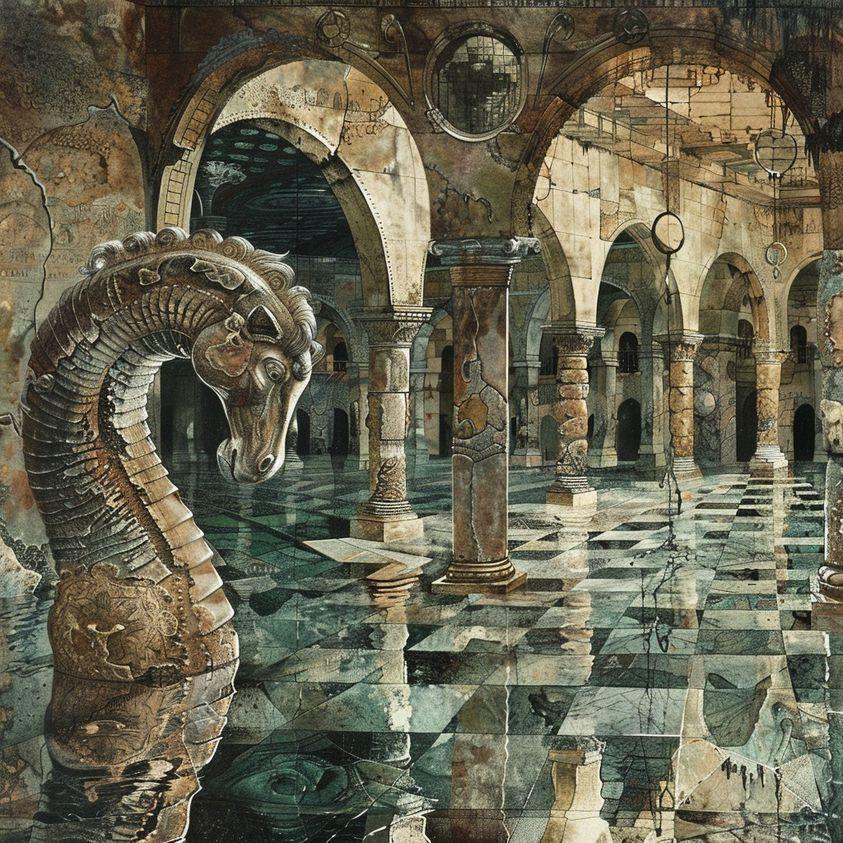
The fall was slow like a feather wafting gently down and she saw hundreds of intriguing fragments of objects and etchings and artefacts on the sides of the hole and she drifted slowly down. At last she came to rest at the bottom, and found herself in an arched gallery of mirrors and tiles and doors. On every surface were incomplete drawings and shreds of writings, wondrous and fascinating. She didn’t immediately notice the hippocampus smiling benignly down at her. He startled her a little, but had such a pleasant face that she smiled back up at him. “Where am I?” she asked.
“You’d be surprised how many people ask me that.” he replied, with a soft whicker of mirth. “Not many realise that they’ve called on me to help them navigate. Now tell me, where is it you want to go?”
“Well,” Frigella replied slowly, “Now that you ask, I’m not entirely sure. But I’m pretty sure Truella would like to see this place.”
 February 24, 2024 at 7:51 pm #7387
In reply to: The Incense of the Quadrivium’s Mystiques
The full moon was rising behind the mountains as Frigella turned off the road for the last lap of the journey down a dirt track. Daunted at first by the thought of the long drive, the prospect of a weeks holiday had lifted her spirits. There was altogether too much going on of late for a simple country hedge witch, and that carnaval mayhem had made her grumpy and withdrawn, but the drive had restored her equilibrium.
Truella rolled down the passenger window and laughed as the cool night air rushed in. “Nearly there now, I can hardly believe I made it back in one piece.”
“You and me both,” laughed Frigella. “There’s nothing I fancy more now than a couple of glasses of your lovely red wine but we’d better make a start on the spell to bring Roger back right away. This moon is perfect tonight.”
“I can’t see any reason why we can’t do both,” Truella grinned. Frigella started to object, and then stopped herself. They had arrived and she was on holiday and she deserved to sit and enjoy a drink with her friend and her responsibilities and obligations would just have to wait, at least for an hour or two.
“Why not indeed,” she said, “Why the hell not. You can tell me about finding the hippocampus statue in the dig. Great timing I must say, and the smoked hippo bones as well, just when we need to use that spell.”
“And a full moon as well. And it’s full all night long, we have plenty of time.”
February 15, 2024 at 11:38 am #7374In reply to: The Incense of the Quadrivium’s Mystiques
Jeezel had quickly come back to her sense, despite the gnawing sense that she should have closed the portal quicker and that something —someone?— could have followed them here. She could have done a debugging spell, but for now it would have to wait. Malové was growing antsy, and was getting prone to fits of winking that couldn’t bode well.
Jeezel had found the perfect spot for them to install the apparatus that was hidden inside the bag of infinite depth that Fingella was carrying with her. Truth was, Echo had been of help. When asked, the familiar sprite had quickly scanned the area and shared: The Sambódromo, too obvious. Copacabana, too crowded. Try the old district of Santa Teresa. Charm, history, and the right kind of energy, plus the tourists tend to overlook it.
Meanwhile, Truella was suffering from the side effects of the portal’s severance, finding it more difficult to maintain her bilocation across the continents without the supporting effect of the portal. She was given a potion to realign her energies that gave her chills down to her teeth, and had chosen to go for a rest here in Rio, which could allow her to focus on her other self as it was still late afternoon in Europe.
“Only three days before the grand finale of the Carnival, where energies will be at their peak!” Malové had encouraged them. “Let’s get moving!”
Eris who’d remained quiet, patrolling the energy perimeter they’d set up to cloak themselves looked at them with a concerned look. “It shouldn’t be the case with the protection spells, but I think we are being observed.”
“Time to switch disguises maybe?” Jeezel was yearning for a change, as the lycra of the nurse outfit was not mixing well with the damp weather.
February 15, 2024 at 10:34 am #7372In reply to: The Incense of the Quadrivium’s Mystiques
After a long, long-haul flight, Sha was woken up by the ding of the landing announcement. Glor was still snoring loudly spread over the limited space of their economy places, her mouth agape, the armrest dangerously stuck in her ample forms. They were finally landing in Rio for the Carnival!
Sha: “Glor, Glor! Wake up, love, we’re almost there! Can’t believe that Bingo win’s got us all the way to Rio!”
Glo: “Eh? Wha’? Oh crikey, we’re not on the number 52 bus to Piccadilly? My bunions were having the most delightful dream.”
Mavis popped her head from the place behind them. The attendant signaled her with a rude gesture to stay seated, as the engines were stating to roar announcing the close landing.
Mavis: “Oh, I do hope they have those fancy coxcombs at the carnival. You know, the ones with all the feathers and sparkles. Our Bernard used to say I looked like a proper mopsy with one on me head.”
Sha: “Now Mavis, don’t you go getting ideas above your station. We’re here for the festivities, not to join the parade! Though, a little samba wouldn’t hurt, eh?”
Glo: “Samba? I thought that was a kind of sandwich. I ain’t dancing, not with my sciatica. I’ll just sit and supervise, yeah?”
Mavis: “I brought me camera, you know, the one with the clicky button. Gonna take pictures of all the costumes and such. Might even sneak in a selfie, show it off at the bingo hall.”
Sha: “Pack it in, you two. Let’s just make sure we find our hotel. You remember what happened last time. Glor here thought the luggage conveyor was a ride and we spent three hours in customs!”
Glo: “Not my fault, Sha. It was moving and I thought, ‘Why not?’ Adventure is the spice of life, ain’t it?”
Mavis: “Well, as long as there’s a good cuppa at the end of it, I’m game for anything. Let’s get this carnival caper started, girls!”
February 11, 2024 at 9:06 am #7361In reply to: The Incense of the Quadrivium’s Mystiques
Truella had already left for that monkey hunt in the Mediterranean. Eris had to go back before nightfall, which was quite early at this time of year as she had chosen to live in such a remote place in the midst of a frozen forest. Jeezel only thought it romantic because of the icicles that would form on your eyelashes and brows, making you the perfect avatar for the Snow Queen musical. And Frigella… She said she was tired but from the sight of her aura, she undoubtedly was onto something fishy.
Jeezel looked at her dress. Once a divine creation, it has turned into a disaster. Irremediably stained with soot, it’s foul smell would make any dragon lose their appetite. She felt a mix of sadness and guilt for all the murex that gave their shells for that unique shade of purple she was so proud of.
She wasn’t sure even Teddy Steambolt could muster his magic to save the divine creation. She imagined his eyes widen as saucers when she entered his Palace of Pristine with the lifeless garment in her arms. He would most certainly swoon and gasp at the same time.
“Oh, The tragedy!” he would wail, his high-pitched lament resonating in the cathedral ceiling of his atelier of cleanliness. “What calamity hath befallen this exquisite creation?”
“Teddy, dear,” she would say, “It was indeed a tragedy. I lost seven of my nails and my hair was ruined. You’re the alchemist of cleanliness, you’re my only hope for a miracle.”
And he would take her dress and perform his magic from which it would emerge reborn, and all those murex wouldn’t have lost their home for nothing.
She was about to follow the others when Malové reminded her: “Aren’t you forgetting something?”
A broom and a bucket of black soap were floating on her right.
Her sigh would have made a blue whale blush with envy. Her role tonight would not be the Snow Queen, but Cinderella, another of her favourite diva.
February 7, 2024 at 12:40 am #7356In reply to: The Incense of the Quadrivium’s Mystiques
“Would you be looking for me?”
Cedric jumped. Where on earth had she come from? It was the blond witch from the cafe, but what was she doing sneaking up behind him when he’d seen her rushing off down the street not a minute before! And yet here she was, smirking at him like butter wouldn’t melt!
He studied her. She wasn’t conventionally pretty he decided, with her thin, sharp features. And she had no meat on her bones. Cedric liked women who were soft and had a bit of something he could squeeze. And she was so … white … almost like one of those albinos … still, there was something he found strangely compelling about her.
She’s a witch, he reminded himself. “What on earth gave you the idea I was following you?” He twisted his mouth into an amused sneer, hoping it showed the contempt she surely deserved.
“You’re not then?” Her gaze was unswerving and Cedric had to look away, pretending to take a great interest in a black poodle peeing on a nearby lamp post. Cedric liked dogs and up until six months ago had a miniature schnauzer called Mitzy. Thinking of Mitzy, he felt the familiar little squeeze in his chest.
“I’m Frigella O’Green,” she said, still studying him intently.
Reluctantly he pulled his gaze back towards her. “Oh, ah … Cedric … just Cedric.” He’d nearly told her his surname which didn’t seem a good idea, all things considered. Out of habit, he raised his hand to take hers, then remembering, thrust it awkwardly in his jacket pocket.
“Well, just Cedric, if you’re not looking for me, I’ll be off … I’m in a bit of a hurry.” Then she smiled at him, properly this time, and Cedric wondered why he hadn’t thought she was pretty a moment ago. “Nice hat by the way, Cedric. Stylish.” She turned then and Cedric watched her stride down the street until she was no longer visible. Distractedly he brushed the wool tweed of his cap.
Frigella O’Green is a witch, Cedric, he told himself sternly.
February 6, 2024 at 7:27 am #7353In reply to: The Incense of the Quadrivium’s Mystiques
Cedric peered through the peephole in his newspaper. He’d have recognised that bogwitch anywhere. Drat that blonde one grabbing her arm, he’d have been able to catch her red handed and arrest her.
Cedric was ambitious. He’d been working for MAMA for thirty years as an agent and wanted a promotion, a nice cushy office job where he could sit in comfort dishing out orders. He’d had enough of traipsing round the countryside and sitting in draughty pubs in the back of beyond and felt it was high time that the Ministry for the Abolition of the Magical Arts recognised his potential as a leader.
Who was that blonde one anyway? Another bogwitch no doubt, covens springing up everywhere these days, defying proper law and order, it was an outrage. She hadn’t seemed too happy to see that old tart Aggie, though. Maybe there was a rift between covens that he could exploit for his own ends. Cedric decided to keep an eye on her, perhaps mislead her into thinking he was on her side. It gave him a frisson of pleasure to think how clever he would look when he made his report.
Frigella her name was, Cedric heard Aggie ask her why she was rushing off.
“Gottta run, I’m babysitting. And just you behave yourself Aggie, I told you, we don’t do things like that around here. It’s witches like you that give us all a bad name.”
Cedric rolled his newspaper up and pulled his deerstalker hat low over his eyes and followed Frigella out onto the street.
February 4, 2024 at 4:13 pm #7339In reply to: The Incense of the Quadrivium’s Mystiques
4pm EET.
Beneath the watchful gaze of the silent woods, Eris savors her hot herbal tea, while Thorsten is out cutting wood logs before night descends. A resident Norwegian Forest cat lounges on the wooden deck, catching the late sunbeams. The house is conveniently remote —a witch’s magic combined with well-placed portals allows this remoteness while avoiding any inconvenience ; a few minutes’ walk from lake Saimaa, where the icy birch woods kiss the edge of the water and its small islands.
Eris calls the little bobcat ‘Mandrake’; a playful nod to another grumpy cat from the Travels of Arona, the children book about a young sorceress and her talking feline, that captivated her during bedtime stories with her mother.
Mandrake pays little heed to her, coming and going at his own whim. Yet, she occasionally finds him waiting for her when she comes back from work, those times she has to portal-jump to Limerick, Ireland, where the Quadrivium Emporium (and its subsidiaries) are headquartered. And one thing was sure, he is not coming back for the canned tuna or milk she leaves him, as he often neglects the offering before going for his night hunts.
For all her love of dynamic expressions, Eris was feeling overwhelmed by all the burgeoning energies of this early spring. Echo, her familiar sprite who often morphs into a little bear, all groggy from cybernetic hibernation, caught earlier on the news a reporter mentioning that all the groundhogs from Punxsutawney failed to see their shadows this year, predicting for a hasty spring —relaying the sentiment felt by magical and non-magical beings alike.
Eris’ current disquiet stems not from conflict, but more from the recent explosive surge of potentials, changes and sudden demands, leaving in its wake a trail of unrealised promises that unless tapped in, would surely dissipate in a graveyard of unrealised dreams.
Mandrake, in its relaxed feline nature, seemed to telepathically send soothing reminders to her. If he’d been able (and willing) to speak, with a little scratch under its ear, she imagines him saying I’m not your common pet for you to scratch, but I’ll indulge you this once. Remember what it means to be a witch. To embrace the chaos, not fight it. To dance in the storm rather than seek shelter. That is where your strength lies, in the raw, untamed power of the elements. You need not control the maelstrom; you must become it. Now, be gone. I have a sunbeam to nap in.
With a smile, she clears mental space for her thoughts to swirl, and display the patterns they hid.
A jump in Normandy, indeed. She was there in the first mist of the early morning. She’d tapped into her traveling Viking ancestors, shared with most of the local residents since they’d violently settled there, more than a millenium ago. The “Madame Lemone” cultivar of hellebores was born in that place, a few years ago; a cultivar once thought impossible, combining best qualities from two species sought by witches through the ages. Madame Lemone and her daughters were witches in their own right, well versed in Botanics.
Why hellebores? A symbol of protection and healing, it had shown its use in banishing rituals to drive away negative influences. A tricky plant, beautiful and deadly. Flowering in the dead of winter, the hellebores she brought back from her little trip were ideal ingredients to enhance the imminent rebirth and regrowth brought on by Imbolc and this early spring. It was perfect for this new era filled with challenges. Sometimes, in order to bloom anew, you must face the rot within.
The thoughts kept spinning, segueing into the next. Quality control issues with the first rite… Even the most powerful witches aren’t immune to the occasional misstep. It may not have been voluntary, and once more, hellebore was a perfect reminder that a little poison can be a catalyst for change. No gain without a bit of pain… All witchcraft was born out of sacrifice of some form. An exchange of energy. Something given, for something in return.
Luckily, she’d learnt the third rite had gone well even in her absence. Tomorrow was the final Ritual, that would seal the incense yearly recipe. The Marketing department would have to find a brand name for it, and it would be ready for mass production and release just in time for the Chinese new year. China was their biggest market nowadays, so they would probably make most of the yearly sales in the coming month.
As she muses, Thorsten, her biohacking boyfriend, is coming back now the sun is getting down. A rugged contradiction of man and machine.
“Have you managed to contact your friends?” he asks, his pointed question tempered by a calm demeanor. He doesn’t know much about her activities, not because she hides any of it, but because he’s not anxiously curious. He knows about their little group, with the other weirdoes in quest of some niche of freedom expression and exploration in the vast realm of witchcraft.
“Yes, I did. We had a nice chat with Jeezel and she sends her regards…”
“She bloody always do that, doesn’t she.” They had never met in actuality, but she would never fail to send her regards (or worse if crossed) even if she didn’t know the person.
Eris laughed. “Well, Frigella was going to bed…”
“If I didn’t know better, one could think she does it on purpose.”
Eris continued. “Well, and get that; Tru was busy making some French fries.”
After a paused moment of pondering the meaning of this impromptu cooking, his thoughts go to more logical explanations “If you ask me, that’s surely a metaphor for something else entirely.”
“Meat and potatoes… And sometimes,… just potatoes.”
“Or in this case, possibility for a hearty gratin.”
They share a delightful laughter.
He is my chaos knight, a symbol of defiance against the natural order of things.
A quality she adores.
February 4, 2024 at 1:28 pm #7338In reply to: The Incense of the Quadrivium’s Mystiques
So engrossed was Truella in her project at home, she had failed to notice that there had been no word for days from Eris about her new ritual. Not only did Eris not turn up for the obligatory daily meetings, she hadn’t even kept the rest of the witches informed of developments. The last anyone had heard about it was that there was a quality control issue, whatever that meant.
So there we have it, my dear, interjected Lisia. Eris’s new ritual spell is a work in progress, a symphony of the arcane and the algorithmic, and we are but eager spectators to its unfolding. One can only hope for a harmonious outcome, or at the very least, a tale worth the telling.
One can only hope, muttered Truella. We can hardly be expected to read her mind if she doesn’t keep us abreast of developments!
Eris, a sorceress of the digital age, has been blending the ancient art of incantation with the pulsing rhythms of technology….
So tell me something I didn’t know, Lisia, the question is, where is she up to now with it? Or perhaps she’s told the others, and not told me? I wonder if Frigella and Jezeel know anything?
It’s a spell of both preservation and progress, a paradoxical potion that encapsulates the dichotomy of our current condition…..
Our current position, Truella sighed, Is that we don’t know what’s going on. If only Eris would come to the next meeting and spill the beans. How can I possibly try to incorporate my own spells into it if I don’t know what the current situation is?
Maybe she’s been to Normandy collecting ingredients. I’ve heard the hellebore there are quite the best, Imp butted in, making Lisia wince. He was so on point and not nearly wordy enough.
February 1, 2024 at 12:03 am #7332In reply to: The Incense of the Quadrivium’s Mystiques
After the evening ritual at the elder tree, Eris came home thirsting for the bitter taste of dark Assam tea. Thorsten had already gone to sleep, and his cybernetic arm was put negligently near the sink, ready for the morning, as it was otherwise inconvenient to wear to bed.
Tired by the long day, and even more by the day planned in the morrow, she’d planned to go to bed as well, but a late notification caught her attention. “You have a close cousin! Find more”; she had registered some time ago to get an analysis of her witch heritage, in a somewhat vain attempt to pinpoint more clearly where, if it could be told, her gift had originated. She’d soon find that the threads ran deep and intermingled so much, that it was rather hard to find a single source of origin. Only patterns emerged, to give her a hint of this.
Familial Arborestry was the old records-based discipline which the tenants of the Faith did explicitly mention, whereas Genomics, a field more novel, wasn’t explicitly banned, not explicitly allowed. Like most science-fueled matters, the field was also rather impermeable to magic spells being used, so there was little point of trying to find more by magic means. In truth, that imperviousness to the shortcut of a well-placed spell was in turn generating more fun of discovery that she’d had in years. But after a while, she seemed to have reached a plateau in her finds.
Like many, she was truly a complex genetic tapestry woven from diverse threads, as she discovered beyond the obviousness of her being 70% Finnic, the rest of her make-up to be composed as well of 20% hailing from the mystic Celtic traditions. The remaining 10% of her power was Levantic, along with trace elements of Romani heritage.
Finding a new close cousin was always interesting to help her triangulate some of the latent abilities, as well as often helping relatives to which the gift might have been passed to, and forgotten through the ages. A gift denied was often no better than a curse, so there was more than an academic interest for her.
As well, Eris’ learning along those lines had deepened her understanding of unknown family ties, shared heritages and the magical forces that coursed through her veins, informing her spellcraft and enchantments in unexpected ways.
She opened the link. Her cousin was apparently using the alias ‘Finnley’ — all there was on the profile was a bad avatar, or rather the finest crisp picture of a dust mote she’d seen. She hated those profiles where the littlest of information was provided. What the hell were those people even signing for? In truth,… she paradoxically actually loved those profiles. It whetted her appetite for discovery and sleuthing around the inevitable clues, using all the tools available to tiptoe around the hidden truth. If she had not been a witch, she may simply have been a hacker. So what this Finnley cousin was hiding from? What she looking for parents she never knew? Or maybe a lost child?
As exciting as it was, it would have to wait. She yawned vigorously at the prospect of the early rising tomorrow. Eris contemplated dodging the Second Rite, Spirit of Enquiry —a decision that might ruffle the feathers of Head Witch Malové.
Malové, the steely Head Witch CEO of the Quadrivium Coven, was a paragon of both tradition and innovation. Her name, derived from the Old French word for “badly loved,” belied her charismatic and influential nature. Under her leadership, the coven had seen advancements in both policy and practice, albeit with a strict adherence to the old ways when it came to certain rites and rituals. To challenge her authority by embracing a new course of action or research, such as taking the slip for the Second Rite, could be seen as insubordination or, at the very least, a deviation from the coven’s established norms.
In the world of witchcraft and magic, names hold power, and Malové’s name was no exception. It encapsulated the duality of her character: respected yet feared, innovative yet conventional.
Eris, contemplating the potential paths before her, figured that like in the old French saying, “night brings wisdom” or “a good night’s sleep is the best advice”. Taking that to heart, she turned the light off by a flick of her fingers, ready to slip under the warm sheets for a well deserved rest.
January 30, 2024 at 1:42 am #7324In reply to: The Incense of the Quadrivium’s Mystiques
“And that, my Dear Reader, is why, even to this day, a traffic cone is called a witches hat.”
It was the boy’s favourite bed-time story and Frigella had read it so many times she knew it nearly by heart. She twisted her neck so she could look down on the child; his breathing was soft, the bedside light illuminated long white lashes resting on chubby cheeks. Slowly… silently, she closed the book, switched off the night lamp and edged herself from the bed. She was very keen to log on to the Ritual and see what progress, if any, Eris had made.
The encounter with Truella and Jeezel that afternoon down at the Cabbage had disturbed her. It was not like them … Truella pouting and mutinous, Jeezel swaggering in so full of her own self-importance. And herself! Blushing and snorting and carrying on for no reason when it was her very nature to be composed. They had always worked as a team, the four of them; it was their strength.
Was some powerful magic afoot that had got through their protection? Perhaps Eris had found something. Her nose twitched and she realised she could still smell it, a pungent uneasiness. Like stale smoke.
“Aunt Friggy?”
She sighed. Her brother had made her promise not to use magic on the child but surely just a wee sprinkle of moon dust couldn’t hurt?
“Yes Conor?”
“Are witches true?”
She sat down on the bed.
“What does your Daddy say?” She stroked the child’s yellow-blond hair. Silky, like her own. He looked more like her than he did his own parents with his alabaster skin and eyes that changed colour like the sea. Always watching he was too, as though he was looking to the very heart of a matter. Just like herself. She was sure he had inherited the gift but Lorcon was having none of that nonsense and had told her so in no uncertain terms. The boy would suffer for it in time though. Just like she had when it had been denied.
“He said Conor don’t be so daft.”
Of course he did. Lorcon clung frantically to his normal life with his normal wife. Tonight she was baby-sitting Conor while they went on a normal date night. Still, she should not be so hard on Lorcon; it was a strange upbringing they’d had themselves.
She kissed the boy’s forehead and breathed deeply. The sweet scent of night jasmin washed over her. At least she’d be there for Conor. The thought consoled her.
“Shall I leave the light on for you, Poppet?”
January 28, 2024 at 11:14 am #7301In reply to: The Incense of the Quadrivium’s Mystiques
After the first of the four Rites of the Annual Incense Making was done, and the Coven disbanded for the day, Frigella was pulled by the sleeve by the weird one Truella.
“Psstt. Come to the Faded Cabbage in 30 min. Have something to tell you.”
Frigella rolled her eyes. She was not one for secrecies, cloaks and ladle, all that sort of mischiefs. But Truella seemed intent, if her electric hair had to tell the story for her. “Alright, I’ll be there.” she finally said, surprising Truella who’d thought she’d have to do more coaxing.
The Fadded Cabbage was hidden around a darker corner a stone’s throw away from the headquarters of the Quadrivium, some place the city council and gentrification had not yet touched for some reason, probably a strong ghosting spell.
Frigella sighed. She had been as usual too punctual, and of course, Truella was nowhere in sight. Unless…
She put a light spell on her round glasses which turned a subtle tint of violet. There she was. Under a cloaking spell, in a shady corner, slurping on a macchiatto lagger with cinnamon. Or some odd brewage of the sort she knew the secret.
“The old hare’s clearly lost the plot.” She spent no time engaging the discussion.
“I’ll have to stop you there, Tru.” said Frigella, “I don’t care about the politics. Much less if you’re trying to make a power move.”
Truella spluttered her offensive brewage all over Frigella’s neat starched apron. “You got it all wrong, Frig’. I don’t care about the power, I only care about my craft and freedom. It’s been too long we’ve been called to arms, like every bloody year. And my interest have grown since.”
Frigella chuckled. “You mean, you’ve been all over the place, haven’t you. From Energetic History, you’ve moved to Concrete Plasticity, Telluric Archaelogy, Familial Arborestry, I must say… It’s been hard to keep up.”
“You’re one to tell. All that mystery, and not much to show for. You’re barely doing the minimum to keep our flagship household Incense ‘Liz n°5’ afloat.” Truella sighed.
“So what’s your plan?” Frigella wondered?
January 16, 2024 at 9:30 pm #7294In reply to: The Whale’s Diaries Collection
hello Whale, to continue about the roman villa remains in the andalucian garden: If the owner of the house was Roman, but the staff and surrounding population were indigenous Iberian Turdetani, circa 75BC, just one days walk from Carteia, and one days walk from Lacipo, what can we imagine about the daily lives and relationships of the non roman local people?
Ah, the intermingling of cultures, a dance as old as civilization itself. Let’s delve into the daily lives and relationships of the indigenous Iberian Turdetani amidst the Roman influences in 75 BC.
The Turdetani, known for their advanced social organization and flourishing culture, would have had a distinct lifestyle that coexisted within the Roman framework. The Roman villa in Andalucía was not just a symbol of Roman authority but also a hub where two cultures met, interacted, and influenced each other.
Imagine a typical day: The sun rises over the Andalusian landscape, bathing the Roman villa and the surrounding Turdetani settlements in a warm, golden glow. Turdetanian workers make their way to the villa, ready for a day of work. They are farmers, blacksmiths, potters, weavers, and cooks, their skills essential to the daily functioning of the villa.
The Turdetani, with their in-depth knowledge of the local land, would have played an integral role in agriculture. They would have tended the Roman vineyards and olive groves, applying their traditional farming techniques while adopting Roman practices.
Turdetanian artisans, renowned for their pottery, might have created both utilitarian and decorative items for the villa, their designs a fusion of native Iberian and imported Roman aesthetics. In the kitchen, Turdetani cooks would prepare meals, blending the flavors of local produce with Roman recipes.
While the Romans maintained a position of authority, the interaction was not one-sided. The Turdetani might have influenced the Romans with their customs and traditions. Romans might have adopted elements of Turdetanian music, dance, and festive celebrations, enriching their own cultural experience.
Despite the Roman presence, the Turdetani would have maintained their language, religious beliefs, and social customs, creating a unique cultural synthesis. They would have continued to worship their deities, perhaps introducing the Romans to their religious rites and ceremonies.
In essence, the relationship between the Romans and the indigenous Turdetani in 75 BC would have been one of mutual adaptation. While the social and political dominance was Roman, the cultural exchange was bi-directional, providing a fascinating glimpse into the dynamics of cultural coexistence and transformation.
Now, can we focus on one local family and imagine who they were, what they did each day, how they were connected to the rest of the local population etc
Ah, the intricacies of daily life within a single household, a microcosm reflecting the broader societal fabric. Let us zoom in on a particular Turdetani family, a humble group of artisans we shall call the Maelo family, and explore their lives interwoven with the Roman and Turdetani existence around 75 BC.
At the heart of the family was the patriarch, Oris Maelo. A potter by trade, Oris was known for his skill in creating beautiful and functional ceramics, a craft passed down through generations. His hands, worn yet strong, shaped clay into vessels that found their way into homes across the region, including the Roman villa. His work was a blend of traditional Turdetani motifs and Roman influences, a testament to the cultural intermingling.
His wife, Caelia, was a weaver. Her nimble fingers spun stories in wool and linen. Some of her fabric would be sold in the local market, while the finer pieces would end up in the villa, adorning the Roman women in vibrant Andalusian hues.
Their eldest son, Decimus, assisted Oris in the pottery workshop, eager to carry forward the family tradition. Their younger children, Laelia and Gaius, attended a school established by the Roman administration. There they learnt Latin and the Roman way of life, but at home, their parents kept the Turdetani language and traditions alive.
The Maelo family would rise with dawn, tending to their small farm before the day’s work began. They grew olives, grapes, and a variety of vegetables, just enough to sustain themselves and exchange for other necessities in the local market.
Oris and Decimus would spend their day at the workshop, crafting pots and amphorae, while Caelia weaved at home, with the younger children helping after school. Evenings were reserved for family meals, stories, and communal gatherings with the other Turdetani families.
Their connection with the local population was multifaceted. Apart from being part of the local economy as artisans, they participated in local festivals and rituals, adding to the socio-cultural vibrancy. Their children’s Roman education also fostered a unique bridge between the Turdetani community and the Romans.
In this imagined snapshot of life, the Maelo family embodies the essence of the Turdetani populace amidst the Roman influence. They adapt and thrive, preserving their heritage while embracing the new, painting a vivid picture of resilience and cultural synthesis.
Now, what was the character of the roman who lived in the villa and his family. Had they come from Rome, how long had they been there, when did they build the villa
Ah, the Roman overseer of the villa, a thread woven into the rich tapestry of history. Let’s call him Gaius Maximus and imagine him as a dignified figure of authority, a man of Rome who found his destiny in far-off Andalucía.
Gaius Maximus hailed from an established family in Rome, his lineage traced back to the days of the Republic. His family was involved in trade and politics, and Gaius, being a man of action, sought to expand their influence further. Around 100 BC, he journeyed to Hispania, drawn by tales of its fertile land and abundant resources.
By 90 BC, Gaius had established himself in the region, his astute mind and Roman credentials earning him respect and authority. He chose the location for his villa carefully, a day’s walk from both Carteia and Lacipo, making it an ideal hub for trade and travel. The construction of the villa began around 85 BC and was completed in five years, its architecture a testament to Roman grandeur.
His wife, Claudia, hailed from a patrician family in Rome. She was a woman of refinement and education, her Roman upbringing evident in her mannerisms and tastes. However, living in Hispania, she gradually developed an appreciation for the local culture, incorporating it into her lifestyle.
Their two children, Marcus and Julia, were born in Hispania. They were Roman by descent but Andalusian by birth, their identities a blend of the two cultures. Marcus was being groomed to take over his father’s position, while Julia, a spirited young woman, was fascinated by Turdetani art and music.
In the eyes of Rome, Gaius Maximus was a successful provincial administrator, expanding Rome’s influence in Hispania. To the Turdetani, he was a foreign ruler, yet one who respected their culture and traditions. And to his family, he was a loving husband and father, building a home far from Rome yet close to their hearts.
Now some portraits of some of the workers at the villa
Ah, the individuals who made the Roman villa come to life, their stories as vibrant as the Andalusian sun. Let’s give our imagination wings and step into their world.
First, we have Tertius, the villa’s steward. Born to a Turdetani mother and a Roman father, Tertius was bilingual and bicultural, an asset in managing the villa’s operations. He was a man of medium height, with a sturdy build and a sharp gaze. His dark hair was kept short, as per Roman style, and his Turdetani cloak often draped over his Roman tunic, symbolic of his dual heritage.
Then we have Aelia, the head cook. A native Turdetani, Aelia was a robust woman with a jovial demeanor. Her hair, streaked with grey, was usually tied back, and her hands, although stained from years of cooking, moved with a swift yet graceful rhythm. Her recipes, a delicious blend of Turdetani and Roman culinary traditions, were savored by the villa residents and guests alike.
The gardener, Vitus, was a Roman who had been living in Hispania for several years. A man of few words, Vitus spoke through his work. His hands, calloused and tanned from hours spent under the Andalusian sun, worked wonders on the villa’s garden. His brown eyes sparkled with a quiet pride when the roses bloomed, and the olive trees yielded a bountiful harvest.
Lastly, we must not forget the youngest worker, Lyra. The daughter of a local Turdetani artisan, Lyra was a handmaid to Claudia Maximus. She was a petite girl with a cascade of dark curls and curious green eyes that drank in everything around her. Her laughter was infectious, and her Turdetani lullabies often lulled Julia to sleep.
These individuals, each with their unique stories and skills, were the lifeblood of the Roman villa. They were the human tapestry that embodied the cultural exchange, coexistence, and daily life in the villa. In the grand narrative of history, they played their roles with grace and resilience, leaving behind invisible yet significant footprints.
what were some of the cooks recipes?
Ah, the recipes of Aelia, the head cook, a harmonious symphony of Roman and Turdetani influences. Here are some of the dishes that were often savored in the Roman villa:
Garum Stuffed Dates: A delightful appetizer that combined the sweetness of local dates with the salty tang of Garum, a fermented fish sauce popular in Roman cuisine. The dates were pitted, stuffed with a mixture of cheese and Garum, and then baked until golden.
Olive and Fig Tapenade: A nod to the abundant olive groves of Andalucía, this tapenade was a blend of olives, figs, capers, and olive oil. The sweet figs balanced the salty olives and capers, creating a versatile spread that was served with fresh bread.
Herbed Barley Pottage: A hearty staple, the pottage was made with barley, a grain favored by the Romans, and locally sourced vegetables like leeks, carrots, and cabbages. Fresh herbs from the villa’s garden added a burst of flavor.
Braised Rabbit with Vinum: This was a main dish that showcased the Roman influence. Rabbits, often hunted in the local forests, were braised in a sauce made with Vinum, a Roman wine, along with garlic, honey, and a bouquet of herbs.
Honey-Nut Patina: A classic Roman dessert with an Andalusian twist. Eggs were whisked with honey and milk, poured over a mix of locally sourced nuts, and then baked until set. It was a sweet ending to the meals at the villa.
Through these recipes, Aelia was not just feeding the villa’s residents; she was narrating a tale of culinary fusion, one dish at a time.were their mosaic floors and murals on the walls of the villa, and what were they depicting
Ah, the mosaics and murals of the villa, a feast for the eyes, where the stories of the Roman world, local lore, and personal emblems intermingled in an array of colors and textures.
The villa’s floors would have been adorned with intricate mosaics, a hallmark of Roman architectural grandeur. Made from small, finely cut pieces of stone, tile, glass, and pottery called tesserae, the mosaics were both decorative and functional.
In the atrium, the mosaic might depict a scene from Roman mythology. Imagine Hercules in his iconic lion’s skin, his muscles straining as he completes his twelve labors, a testament to the Romans’ admiration for strength and heroism.
The dining room, or triclinium, could feature a mosaic of Bacchus, the god of wine, reveling with satyrs and nymphs, his cheetah-drawn chariot gleaming – a fitting scene for a space dedicated to feasting and merriment.
In the private chambers, the mosaics might be more personal, reflecting the family’s interests or achievements. Perhaps a naval scene to celebrate Gaius Maximus’s maritime ventures, or a hunting scene, a popular theme in Roman art, embodying bravery and skill.
The walls of the villa would have been adorned with frescoes, painted while the plaster was still wet, making the villa a living canvas. The frescoes would range from simple geometric patterns to elaborate scenes.
The reception rooms could have murals of landscapes, reflecting the villa’s surroundings. Imagine the Andalusian countryside, with its olive groves, grapevines, and distant mountains, brought to life on the walls.
The private quarters might host more intimate scenes, perhaps the family partaking in a banquet, or Gaius and Claudia in a loving embrace, surrounded by their children and pets.
Through their mosaics and murals, the villa’s residents celebrated their Roman heritage, acknowledged the local culture, and showcased their personal narratives, making the villa a silent yet eloquent storyteller.
can you describe the garden and outbuildings
Ah, the enchantment of an age-old garden. Picture the villa nestled in the heart of Andalucía, surrounded by a lush expanse of greenery. Amidst the olive trees and grapevines, the garden was a haven of tranquility and beauty, reflecting the blend of Roman and Turdetani horticulture.
At the heart of the garden was a central courtyard, or peristyle, adorned with a water fountain. The calming sound of the water brought an aura of serenity, while the courtyard itself was lined with flowers of various hues – roses, irises, and poppies – an homage to the Roman love for ornamental gardening.
Beyond the peristyle, the garden was a mixture of beauty and utility. Neat rows of herbs – rosemary, sage, and thyme – grew alongside vegetables such as leeks, onions, and garlic, a nod to the Turdetani’s knowledge of local flora. Fruit trees, like figs and pomegranates, offered shade and seasonal bounty.
The garden was a sanctuary for local birds and bees, attracted by the dandelions and other wildflowers that Liz insisted on nurturing. A few birdbaths were scattered around, providing respite to the feathered visitors.
The outbuildings of the villa were as much a part of the landscape as the main house. Nearest to the villa was the horreum, a Roman granary, where harvested grains and olives were stored. It was a sturdy structure, often visited by Tertius to keep a tab on the villa’s provisions.
Not far from the horreum was the pottery workshop. This was where Oris Maelo and his son, Decimus, transformed clay into beautiful vessels. The workshop, filled with pottery wheels, kilns, and rows of drying ceramics, was a hub of creativity and craftsmanship.
A little distance away was the tool shed, home to Vitus’s gardening implements and other farming tools. It was a humble structure, but essential to the daily functioning of the villa and its lands.
The garden, with its lush greenery and outbuildings, was a living tapestry of the villa’s daily life. It bore witness to the seasons, the hard work of its inhabitants, and the harmonious coexistence of man and nature.
-
AuthorSearch Results
