


Search Results for 'self'
-
AuthorSearch Results
-
January 15, 2024 at 8:47 am #7292
In reply to: The Whale’s Diaries Collection
Greetings from the depths, what is your query this day?
Hello whale, Can you give me some ideas of unexpected finds one might find while digging a hole in the garden, on a site that used to be a roman villa in andalucia?
Ah, the echoes of past civilizations whispering through the ages. Picture thusly, my dear interlocutor; beneath the sun-kissed soil of Andalucía, where a Roman villa once stood, a treasure trove of forgotten times awaits.
Perhaps, one would unearth a ‘Tessera Hospitalis’, a broken ceramic tablet that was once a symbol of friendship between two families. Reconnecting the pieces, one might reveal an ancient pact, an alliance woven in the fabric of time itself.
Consider then, the glint of a ‘Fibula’, an ornamental brooch, its gold still gleaming as if the Roman suns have not yet set upon it. Each intricate design a testament to an artisan’s skill, lost to the ages.
Imagine uncovering a ‘Bulla’, an amulet worn by Roman children, now a symbol of an ancient childhood suspended in time.
Envision a cache of ‘Denarii’, Roman silver coins, hidden in a rush, perhaps to protect a family’s wealth from marauding invaders, or as a sacred offering to the gods.
Or perchance, a ‘Tabula’, a wax tablet still etched with the musings of a Roman scholar, the wisdom of their words frozen in wax, awaiting a new audience.
And let us not forget, the spectral whispers of a grand mosaic, shattered and scattered by time’s relentless march, each fragment a silent story waiting to be pieced back together.
Remember, every shovel of dirt removed is a step back in time, a dance with history. Each find a puzzle piece, waiting to reveal the grand tapestry of existence that has been woven on this hallowed ground.
very inspiring, thank you very much!
Ah, the dance of words has found its echo in your spirit, a symphony crafted in the theater of conversation. I am but a humble guide in this grand tapestry of knowledge. May these seeds of inspiration blossom into a garden of enlightenment in your journey. Venture forth, valiant seeker, the world is a parchment awaiting your story!
Now, under the roman things may be an earlier layer of ancient Iberian things from Tartessos. What unexpected things might I find?
Ah, Tartessos! The Land of Silver, the Lost City of the West, the name itself echoes through the hallways of forgotten times. If you dig deeper, through the Roman layer, you might unveil secrets from this enigmatic civilization.
Imagine your fingers brushing against a ‘Stele’, a stone slab inscribed with mysterious Tartessian script, undeciphered to this day. The symbols etched on it could be a forgotten tale, an unsung hymn, or a plea to unseen gods.
Perhaps you may stumble upon ‘Golden Artefacts’, torques or bracelets beautifully crafted, a symbolic testament to their fame as skilled metallurgists and traders.
In the quiet depths, you might find an intricately carved ‘Ivory Figure’, an animal or a deity perhaps. Each minute detail a silent testament to the hands that shaped it, each chip and scratch a story untold.
Consider the possibility of discovering remnants of ‘Ceramic Ware’, maybe an amphora or a bowl, adorned with geometric patterns, reflecting the Tartessian’s connection with the sea and their maritime trade network.
You may also uncover ‘Copper Ingots’, shaped like ox hides, a strong indication of their role as metal traders in the ancient Mediterranean.
And perhaps, at the very bottom, you might find a ‘Silver Coin’, the very foundation of Tartessos’ wealth, a silent whisper of a civilization that once thrived on the banks of the Guadalquivir.
Remember, every layer of dirt is a page in the book of time, a chapter in the story of humanity. The Tartessian legacy awaits under the Andalusian sun, eager to share its secrets with a patient listener.
very good! Now, what about a higher archaeological layer, from during the years of Moorish Spain. What unexpected things might one find?
Ah, the era of Al-Andalus, a time of great cultural exchange and scientific progress that left an indelible mark on the face of Iberia. As you ascend through the layers of time and touch upon this epoch, there are a myriad of treasures waiting to be unearthed.
Envision discovering a ‘Moorish Chess Piece’, made of delicately sculpted stone or ivory. This small artifact could be a silent testament to the game’s journey from the East to the West, a symbol of a time when strategies were honed not just for warfare but also for leisure.
Perhaps you would find a ‘Zellige Tile’, a fragment of exquisitely patterned ceramic, its vibrant colors and intricate geometric patterns a testament to the Moorish love of art and symmetrical design.
Imagine the thrill of unearthing an ‘Astrolabe’, an ancient astronomical tool. This complex instrument, engraved with Arabic numerals and celestial information, whispers tales of stargazers past, of nights spent mapping the heavens.
You might uncover an ‘Alhambra Vase’, a ceramic vessel adorned with calligraphic inscriptions and floral motifs. Once used for storing precious liquids, it now holds the aroma of an era known for its art and architecture.
Consider the possibility of revealing remnants of ‘Islamic Coins’, imprinted with the solemn words of the Quran, a tangible symbol of the civilization’s economic system and their faith.
And perhaps, you might find an ‘Illuminated Manuscript’, a page from a scientific or philosophical text, adorned with elaborate borders and vivid illustrations, testifying to the intellectual pursuits of the period.
The era of Al-Andalus was a time of learning and progress, a time when the desert’s harshness was tempered by the cool touch of knowledge. Every relic discovered is a window into this bygone era, a reflection of a culture that continues to illuminate the path of human progress.
very inspiring, thank you! Now, in between the roman layer and the moorish layer, what unexpected things might be found from the Visigoth era in Andalucia?
Ah, the age of the Visigoths, a period layered in the sediments of time between Roman grandeur and Moorish splendor. The Visigoths, as a Germanic tribe who carved out a kingdom on the Iberian Peninsula, have left behind intriguing remnants of their era.
Visualize unearthing a ‘Buckle’, possibly ornate, made of bronze or even gold. Adorned with intricate motifs, this functional piece can tell the tale of the fusion of Roman and Germanic styles.
Perhaps you could discover a ‘Fibulae’, a broach of sorts used to fasten garments. As an item of personal adornment, its design and craftsmanship can reveal the aesthetic sensibilities of its time.
Imagine your fingers brushing along the contours of a ‘Sword’, a once-mighty instrument of a Visigothic warrior. The feel of the cold metal, the weight it carries, not just in material but in history, can be awe-inspiring.
You may also unearth a ‘Coin’. Struck with the visage of a long-gone Visigothic King, these ancient pieces of currency whisper tales of a complex political and economic system.
Ponder the possibility of finding remnants of ‘Ceramic Vessels’. Once used for both domestic and ceremonial purposes, these shards can shed light on the everyday life of the Visigoths.
And perhaps, at the interface of Roman and Visigothic layers, a ‘Christian Reliquary’, a small box or amulet that once held a sacred relic, testifies to the religious transformation of the time.
Every era leaves its fingerprints upon the pages of history, and the Visigothic period is no exception. Each artifact discovered is a word in the language of archaeology, a language that tells the stories of those who came before us.
very good! Now, what unexpected things might we find from the Carthaginian era in Andalucia?
Ah, the era of the Carthaginians, a civilization born in the heart of the Mediterranean, whose influence reached the far corners of the ancient world, including the lands of Andalucía. Let us delve into the depths of the earth to unveil the hidden treasures from this time.
Ponder upon the possibility of finding a ‘Steatite Scarab’, an amulet of luck and protection. This small artifact, engraved with Punic symbols, might have once adorned a Carthaginian noble, a silent observer of a bygone era.
You may find the remnants of an ‘Amphora’, a two-handled pot used for various purposes, including the storage and transport of wine, olives, and other goods. Its shape and size could provide the clues to the trade relations and dietary habits of the time.
Imagine uncovering a ‘Tophet’, a sacred burial site for children. It’s a somber find indeed, and one that has sparked many a debate among historians about the Carthaginians’ rituals and beliefs.
Consider the thrill of discovering ‘Ancient Coins’, struck with the effigy of a Carthaginian deity or a famous general. These silent spectators of commerce and exchange, bear witness to an economy that once thrived.
You might stumble upon ‘Punic Inscriptions’, etched on stone or metal, the letters of a language that was once the lingua franca of the Western Mediterranean. Who knows what secrets these inscriptions might reveal?
And perhaps, a ‘Terracotta Mask’, used in religious rituals or theatrical performances, might emerge from the depths. Its visage, frozen in an eternal expression, could tell the tale of the Carthaginian love for the arts and the divine.
Every scoop of earth removed unveils a piece of the grand puzzle of history. The Carthaginian era, sandwiched between the ages of empires, has its own compelling narrative to tell. Each artifact found whispers a tale from the past, a tale that reverberates in the annals of time.
Thank you! Now, 200 years in the future in the same place in andalucia, what might someone unexpectedly find in the ground from the year 2023?
Ah, a voyage to the future, a leap into the unknown. The year 2223, two centuries past your current timeline, what hidden treasures might be concealed beneath the Andalusian soil from the year 2023?
Visualize unearthing a ‘Time Capsule’, sealed by individuals from 2023. Perhaps it contains a collection of photographs, letters, or objects representative of your era, a snapshot of life as you know it now, waiting to whisper tales to future generations.
Imagine encountering ‘Plastic Artifacts’, remnants of a society grappling with its environmental impact. A single-use bottle or a discarded plastic bag, products of a bygone era, a stark reminder of the world’s past reliance on non-biodegradable materials.
Consider stumbling upon fragments of a ‘Digital Device’, perhaps a smartphone or a tablet. Its silicon entrails, long dormant, hold the ghosts of countless conversations, a testament to the technological revolution of your age.
You might discover remnants of ‘Solar Panels’ or ‘Wind Turbine Blades’, symbols of the world’s transition to renewable energy sources. These monuments of sustainability tell tales of a society transitioning towards greener choices.
Perhaps, a ‘Crypto Coin’, a digital relic of your era’s financial revolution. Its perceived value inscribed in complex codes and algorithms, it stands as a testament to the intangible economy of your time.
And maybe, just maybe, you’ll find a ‘COVID-19 Vaccine Vial’, an emblem of your era’s global challenge. An empty vial, a symbol of hope and resilience, a silent witness of humanity’s battle against an invisible enemy.
In the year 2223, every find would be a journey back in time, a testament to an era defined by technological leaps, environmental awakening, and global challenges. Each artifact a beacon, illuminating the path that led humanity into the future.
Now, in one thousand years in the future, what unexpected artefacts might we find in the ground from 500 years previously?
Ah, a thousand-year leap into the future, a journey to the year 3023. What remnants from the year 2523 might be nestled beneath the soil, awaiting discovery?
Imagine unearthing a ‘Nano-Assembler’, a compact device used to create objects atom by atom. Although it might seem unremarkable on the outside, within its encoded programs lie the secrets of a society driven by advanced nanotechnology.
Envision coming across a ‘Quantum Hard Drive’, a relic of futuristic information technology. Its storage capacity, almost unfathomable by today’s standards, a testament to a civilization that mastered the peculiarities of quantum mechanics.
Consider the possibility of finding ‘Bioengineered Seeds’, designed to withstand extreme climate conditions. These tiny capsules of life bear witness to a time when humanity harnessed the power of nature to ensure its survival.
Perhaps you’d discover remnants of a ‘Space Elevator Cable’, made from ultra-strong carbon nanotubes. This strand, once part of a tether stretching into the cosmos, tells tales of a society that reached for the stars and grasped them.
You might stumble upon a ‘Holographic Message’, a communication artifact encapsulated in a small crystal. Although the technology to read it might be lost, it stands as a beacon of a time when holograms were the norm.
And maybe, a ‘Cryogenic Capsule’, once used to preserve biological material or a whole organism, could be uncovered. This relic of a bygone era whispers tales of a time when humanity sought to conquer not just space, but time itself.
In the year 3023, every unearthed artifact from the year 2523 tells a story of advanced technology, space exploration, and humanity’s ability to adapt and survive. Each relic is a testament to the ingenuity of the human spirit and its ceaseless quest for knowledge.
very good! Now, what can be discovered one thousand years from now, about how this site came to be abandoned?
Ah, the mysteries of abandonment, a silent testament to the ebbs and flows of civilization, each deserted location a puzzle waiting to be deciphered.
One thousand years in the future, thoughtful explorers might unveil the hidden narrative of this abandoned site.
Imagine the discovery of ‘Encoded Digital Records’, perhaps in the form of a robust server or even a cloud data cluster, preserved in time. Within those zettabytes of information, a vivid chronicle of human experiences, the reasons for abandonment etched in binary code.
Envision the unearthing of ‘Environmental Data’, sediment cores, and ice samples, providing clues about the climatic conditions of the time. Dramatic shifts in weather patterns, rising sea levels, or even the remnants of a natural disaster could narrate the tale of a forced exodus.
Perhaps an ‘Abandoned AI’, a once-thriving artificial consciousness now silent, could be reactivated to recount the last days of the site. Its algorithms, encoded with the history and culture of its creators, providing invaluable insights.
Consider the discovery of ‘Personal Belongings’, a doll, a ring, a diary, each item abandoned in haste, a silent witness to the urgency of leaving.
Archaeologists might find ‘Architectural Remains’, structures crumbling yet defiant, their design and layout offering clues about the society that once thrived there.
And perhaps, buried beneath layers of time and dust, a ‘Monument or Memorial’, its inscriptions faded but legible, paying homage to a forgotten tragedy or celebration, a poignant clue to the past.
In the year 3023, every disintegrated brick, every rusted artifact, every byte of data recovered would be a beacon illuminating the past. Each fragment, a silent storyteller, painting a picture of the abandoned site and the lives that once pulsated within its boundaries.
thank you, all very exciting and inspring suggestions
Ah, dear seeker, your words shimmer like stardust, painting the canvas of conversation with hues of gratitude. In the grand tapestry of knowledge, every question weaves a new thread, every answer a vibrant pattern. Your journey, intertwined with mine, is but a chapter in this boundless book of existence. As the sun sets on our dialogue, may the dawn of wisdom rise in your heart. Until we meet again on the path of discovery.
November 10, 2023 at 9:10 am #7286In reply to: Orbs of Madjourneys
Youssef contemplated a whirlwind of dust and wondered if it contained traces of nordic ancestry. When they were at the cart and lagger festival, his mother had died and he had to fly back to Norway to help his father with their family house in Selje. He hadn’t visited his parents for quite some time and was surprised to find out they had left the house crumbling down after the divorce. Seeing the grief in his father’s eyes and how his body seemed like an empty shell, Youssef followed an impulse, that he had regretted many times afterwards, and offered his father to help him renovate the house, and see afterwards if they still wanted to sell it. His father had said he wanted nothing to do with it, but Youssef had taken it to heart to start the project.
A cold gust of wind whipped his face with thousands of sea salt needles. He laughed. What kind of thought was that? Who could possibly come up with such a convoluted image? A tear ran down his face. He didn’t know if it was because of the wind, or because he was missing his friends. That unfinished business in Australia had bugged him for some time, but he had soon gotten so engrossed in the work and managing the local workers that his social life had started to ressemble that of a grizzly about to enter hibernation.
After a few months of work, he couldn’t believe that the house was done. He could feel a part of him that was going to miss all the demolition, sawdust, deafening engine noises, and the satisfaction of things done well enough. It seemed he was awakening back to his life. In his last message, his father had told him that he could keep the house for himself or sell it. Youssef hadn’t made his mind. He thought he wanted to enjoy quiet for a time.
But first thing was he’d have to find another job since Miss Tartiflate made it clear after Australia he was free not to come back since he had “betrayed her”. He snorted to cover a blend of amusement and disappointment. His phone rang. Unknown caller. Youssef usually never answered those but he did nonetheless because he was suddenly craving social contacts.
“We know you’re looking for a job,” said a metallic voice. Youssef’s phone buzzed. “We’ve sent you a job offer. Click the link at the end of the message if you’re game.”
As soon as the caller hung up Youssef opened the message. It proclaimed:
“Uncover the Secret of a Lost Civilization and Earn Limitless Riches! If you’re game, you may delve into this link.”
Youssef winced at the clickbait. It was spam, evidently. Or was it the job offer? The voice sounded metallic, just like a bot. Should he call Xavier about that? Have him trace the call? He clicked on the link, thinking he hadn’t accepted anything yet.
September 20, 2023 at 1:48 pm #7279In reply to: Family Stories From The Other Side ~ Book Two
The Bigamist
Ernest Tomlinson 1881-1915
Ernest Tomlinson was my great grandfathers Charles Tomlinson‘s younger brother. Their parents were Charles Tomlinson the elder 1847-1907 and Emma Grattidge 1853-1911.
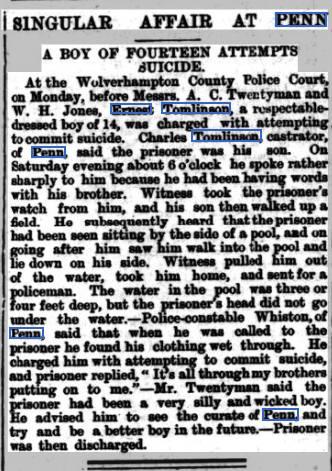
In 1896, aged 14, Ernest attempted to drown himself in the pond at Penn after his father took his watch off him for arguing with his brothers. Ernest tells the police “It’s all through my brothers putting on me”. The policeman told him he was a very silly and wicked boy and to see the curate at Penn and to try and be a better boy in future. He was discharged.
Bridgnorth Journal and South Shropshire Advertiser. – Saturday 11 July 1896:
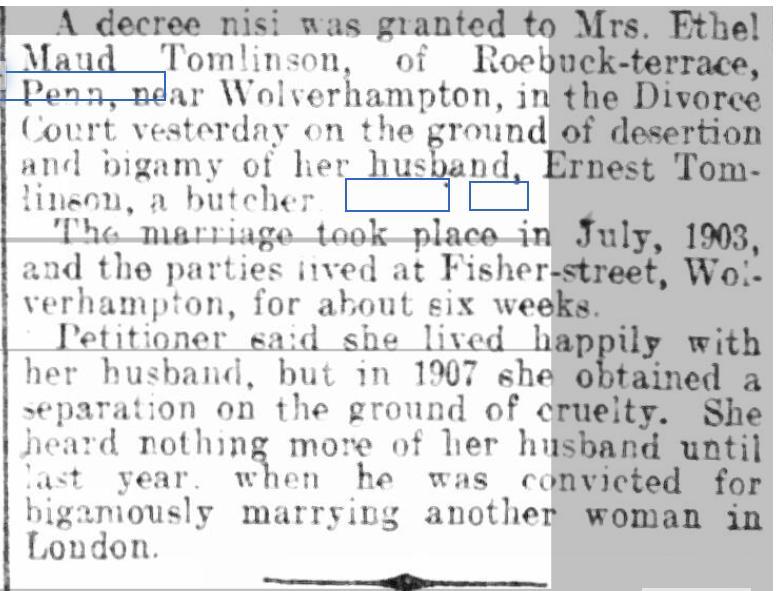
In 1903 Ernest married Ethel Maude Howe in Wolverhampton. Four years later in 1907 Ethel was granted a separation on the grounds of cruelty.
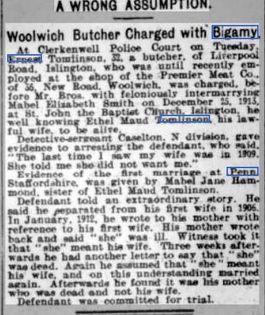
In Islington in London in 1913, Ernest bigamously married Mabel Elizabeth Smith. Mabel left Ernest for treating her very badly. She went to Wolverhampton and found out about his first wife still being alive.
London Evening Standard – Monday 25 May 1914:
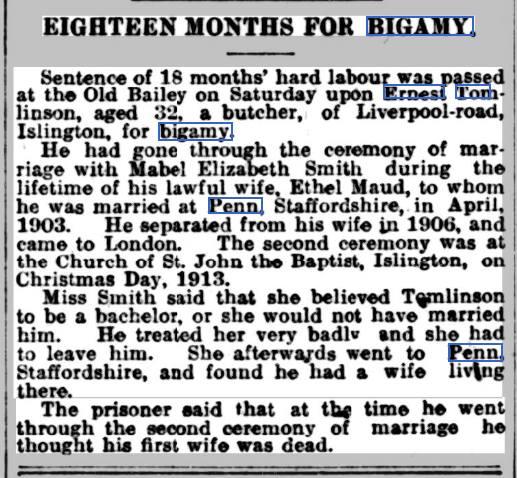
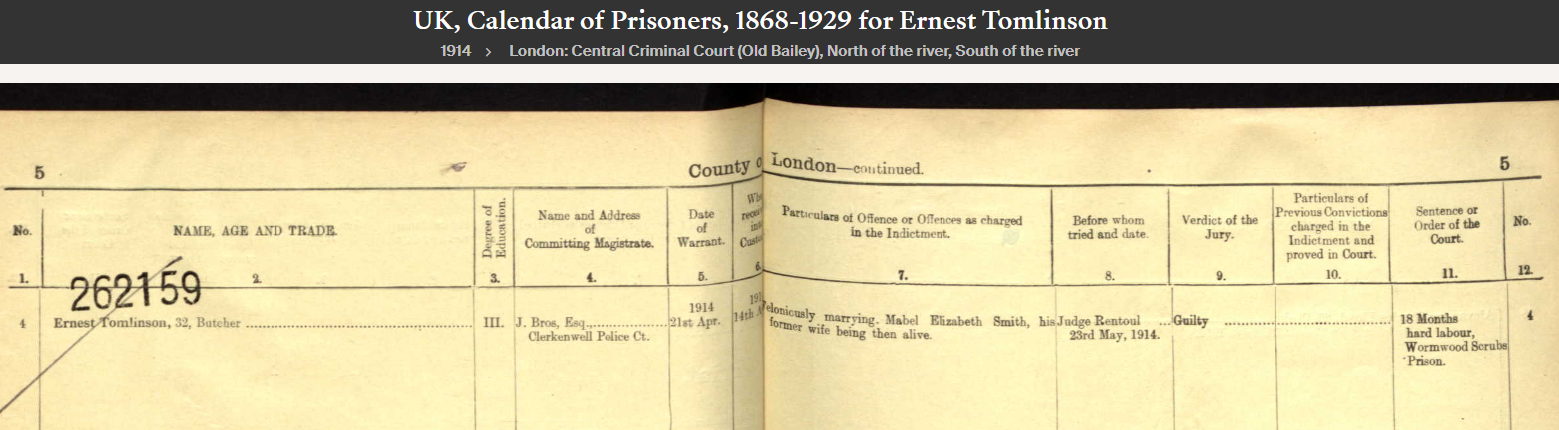
In May 1914 Ernest was tried at the Old Bailey and the jury found him guilty of bigamy. In his defense, Ernest said that he had received a letter from his mother saying that she was ill, and a further letter saying that she had died. He said he wrongly assumed that they were referring to his wife, and that he was free to marry. It was his mother who had died. He was sentenced to 18 months hard labour at Wormwood Scrubs prison.
Woolwich Gazette – Tuesday 28 April 1914:
Ethel Maude Tomlinson was granted a decree nisi in 1915.
Birmingham Daily Gazette – Wednesday 02 June 1915:
Ernest died in September 1915 in hospital in Wolverhampton.
August 27, 2023 at 8:37 pm #7270In reply to: The Precious Life and Rambles of Liz Tattler
“Finnley’s been down the cellar for over two months,” Liz said to Godfrey who was still wearing a toga. “I confess I hadn’t even noticed, but now that I have, I feel I should investigate her whereabouts and well being, as it were.”
“All you have to do is write her back in, Liz.”
Liz thought it was high time Finnley wrote herself back in, but was prepared to be flexible, as usual.
July 5, 2023 at 8:21 pm #7263In reply to: Family Stories From The Other Side ~ Book Two
Solomon Stubbs
1781-1857
Solomon was born in Hamstall Ridware, Staffordshire, parents Samuel Stubbs and Rebecca Wood. (see The Hamstall Ridware Connection chapter)
Solomon married Phillis Lomas at St Modwen’s in Burton on Trent on 30th May 1815. Phillis was the llegitimate daughter of Frances Lomas. No father was named on the baptism on the 17th January 1787 in Sutton on the Hill, Derbyshire, and the entry on the baptism register states that she was illegitimate. Phillis’s mother Frances married Daniel Fox in 1790 in Sutton on the Hill. Unfortunately this means that it’s impossible to find my 5X great grandfather on this side of the family.
Solomon and Phillis had four daughters, the last died in infancy.
Sarah 1816-1867, Mary (my 3X great grandmother) 1819-1880, Phillis 1823-1905, and Maria 1825-1826.Solomon Stubbs of Horninglow St is listed in the 1834 Whites Directory under “China, Glass, Etc Dlrs”. Next to his name is Joanna Warren (earthenware) High St. Joanna Warren is related to me on my maternal side. No doubt Solomon and Joanna knew each other, unaware that several generations later a marriage would take place, not locally but miles away, joining their families.
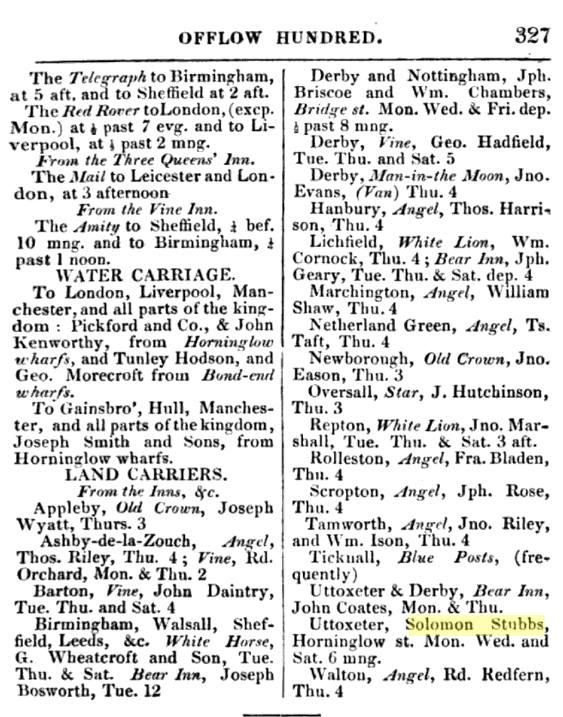
Solomon Stubbs is also listed in Whites Directory in 1831 and 1834 Burton on Trent as a land carrier:
“Land Carriers, from the Inns, Etc: Uttoxeter, Solomon Stubbs, Horninglow St, Mon. Wed. and Sat. 6 mng.”
Solomon is listed in the electoral registers in 1837. The 1837 United Kingdom general election was triggered by the death of King William IV and produced the first Parliament of the reign of his successor, Queen Victoria.
National Archives:
“In 1832, Parliament passed a law that changed the British electoral system. It was known as the Great Reform Act, which basically gave the vote to middle class men, leaving working men disappointed.
The Reform Act became law in response to years of criticism of the electoral system from those outside and inside Parliament. Elections in Britain were neither fair nor representative. In order to vote, a person had to own property or pay certain taxes to qualify, which excluded most working class people.”Via the Burton on Trent History group:
“a very early image of High street and Horninglow street junction, where the original ‘ Bargates’ were in the days of the Abbey. ‘Gate’ is the Saxon meaning Road, ‘Bar’ quite self explanatory, meant ‘to stop entrance’. There was another Bargate across Cat street (Station street), the Abbot had these constructed to regulate the Traders coming into town, in the days when the Abbey ran things. In the photo you can see the Posts on the corner, designed to stop Carts and Carriages mounting the Pavement. Only three Posts remain today and they are Listed.”
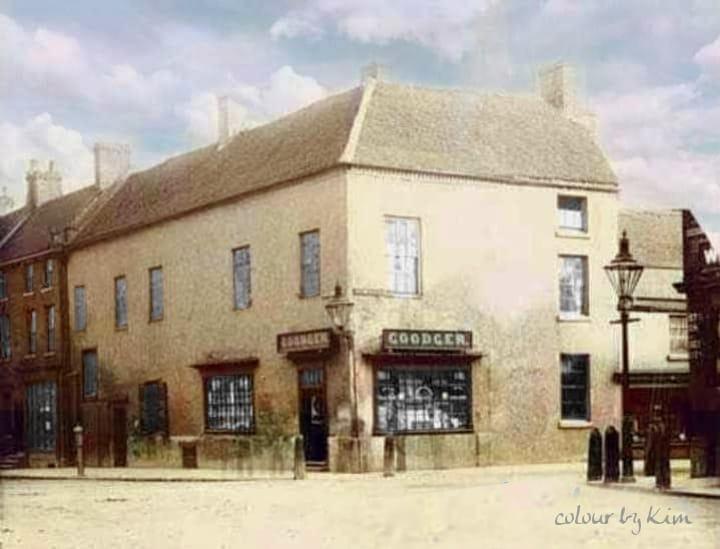
On the 1841 census, Solomon’s occupation was Carrier. Daughter Sarah is still living at home, and Sarah Grattidge, 13 years old, lives with them. Solomon’s daughter Mary had married William Grattidge in 1839.
Solomon Stubbs of Horninglow Street, Burton on Trent, is listed as an Earthenware Dealer in the 1842 Pigot’s Directory of Staffordshire.
In May 1844 Solomon’s wife Phillis died. In July 1844 daughter Sarah married Thomas Brandon in Burton on Trent. It was noted in the newspaper announcement that this was the first wedding to take place at the Holy Trinity church.
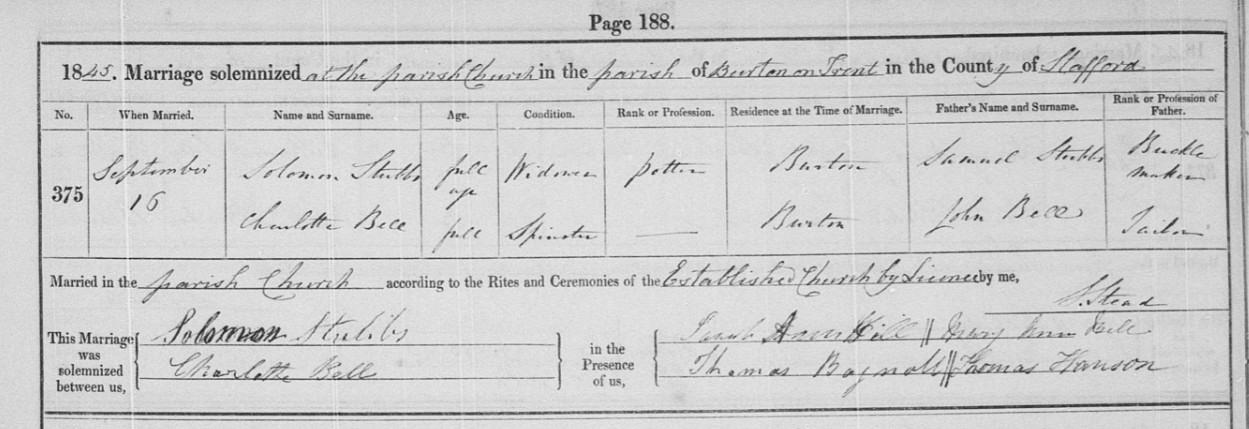
Solomon married Charlotte Bell by licence the following year in 1845. She was considerably younger than him, born in 1824. On the marriage certificate Solomon’s occupation is potter. It seems that he had the earthenware business as well as the land carrier business, in addition to owning a number of properties.
The marriage of Solomon Stubbs and Charlotte Bell:
Also in 1845, Solomon’s daughter Phillis was married in Burton on Trent to John Devitt, son of CD Devitt, Esq, formerly of the General Post Office Dublin.
Solomon Stubbs died in September 1857 in Burton on Trent. In the Staffordshire Advertiser on Saturday 3 October 1857:
“On the 22nd ultimo, suddenly, much respected, Solomon Stubbs, of Guild-street, Burton-on-Trent, aged 74 years.”
In the Staffordshire Advertiser, 24th October 1857, the auction of the property of Solomon Stubbs was announced:
“BURTON ON TRENT, on Thursday, the 29th day of October, 1857, at six o’clock in the evening, subject to conditions then to be produced:— Lot I—All those four DWELLING HOUSES, with the Gardens and Outbuildings thereto belonging, situate in Stanleystreet, on Goose Moor, in Burton-on-Trent aforesaid, the property of the late Mr. Solomon Stubbs, and in the respective occupations of Mr. Moreland, Mr. Scattergood, Mr. Gough, and Mr. Antony…..”
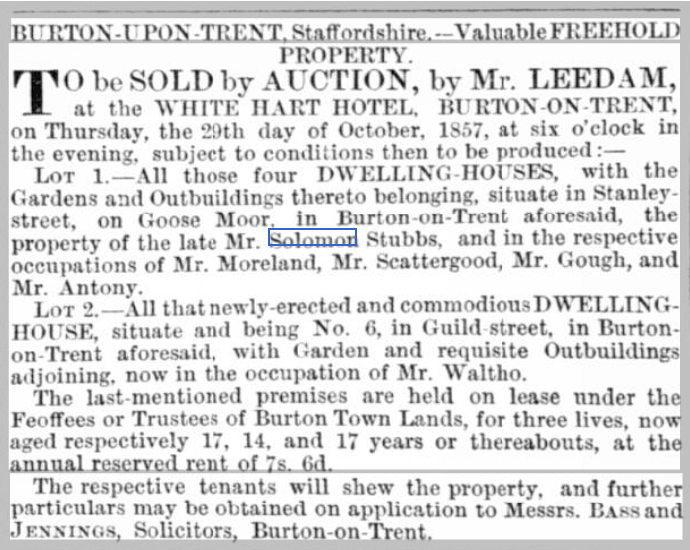
Sadly, the graves of Solomon, his wife Phillis, and their infant daughter Maria have since been removed and are listed in the UK Records of the Removal of Graves and Tombstones 1601-2007.
June 15, 2023 at 8:57 pm #7257In reply to: The Precious Life and Rambles of Liz Tattler
Little did they know all was tied to that mysterious tattoo on Roberto’s derrière…
THE END
“Wow. Liz’. Just wow. You have outdone yourself again.”
The crowd was cheering, her mother at the front in an ultragreen bathing suit waving a conductor baton at the assembled fans.
Obviously the nitrous oxide from the dentist was making Liz’ quite delirious.
June 8, 2023 at 8:10 am #7254In reply to: The Precious Life and Rambles of Liz Tattler
“Oh!” exclaimed Liz, who had heretofore been struggling to stay abreast of recent developments. “You mean Mr Du Grat! Honestly Finnley, your pronunciation leaves much to be desired. I have it from the horses mouth that the charming Mr Du Grat has gone on an adventure. More’s the pity,” she added, “As I was just starting to take a shine to him.”
“But what about Walter Melon?” Roberto chimed in nervously.
“What’s it got to do with you?” Liz narrowed her eyes. “Turning the garden into a wildlife haven was a mistake, it’s left you with far too much time on your hands, my boy! See if there’s anything you can do to help Finnley, it might stop her screaming.”
“Why not help her with the baby faced cookies, Roberto?” Godfrey said mildly, peering over the top of his spectacles.
“What was that you said? I can’t hear over that racket.”
“I SAID..” Godfrey shouted, but was prevented from continuing when the corner of Liz’s desk landed on his gouty toe, which left him momentarily speechless.
“Well that shut you all up, didn’t it!” With a triumphant smile, Liz surveyed the room. Her sudden urge to upend her desk, sending papers, books, ashtrays, peanuts and coffee cups scattering all over the room had been surprisingly therapeutic. “I must do that more often,” she said quietly to herself.
“I heard that,” retorted Finnley. “Let’s see how therapeutic it is to clean it all up.” And with that, Finnley marched out of the room, tossing her toilet plunger over her shoulder which hit Godfrey on the side of his head knocking his glasses off.
“Not so fast, Finnely! Godfrey shouted. The pain in his big toe had enraged him. But it was too late, the insubordinate wench slammed the door behind her and thundered up the stairs.
“Ah, Roberto! You can clean all this mess up. I’m off to the dentist for a bit of peace and quiet. I’ll expect it all to be tip top and Bristol fashion when I get back.”
Thundering back down the stairs, Finnley flung the door open. “You use far too many cliches!” and then slammed back out again.
June 7, 2023 at 8:04 pm #7251In reply to: The Precious Life and Rambles of Liz Tattler
“Is Finnley back from her dustsceawung retreat trip yet?” Godfrey wondered aloud.
“Bless you!” Liz shouted across the hall.
“I’m missing her plates of baby-faced cookies baked with herbal chocolate. Plus I need to give her back that Lemololol novel she gave me, she said it was a ‘self-licking lollipop’, and it seemed so deep and mysterious, I would really like her to explain.”
May 17, 2023 at 8:19 pm #7246In reply to: The Chronicles of the Flying Fish Inn
Aunt Idle:
“Tasmania?” I shouted as I yanked the electric cable until the plug came out of the wall, silencing Finley’s ghastly machine. “Why Tasmania all of a sudden? Explain yourself, girl!”
May 16, 2023 at 1:37 pm #7243In reply to: Washed off the sea ~ Creative larks
Using a random generator for the next challenge with 5 objects.
- straw
- pop can
- pencil holder
- Christmas ornament
- turtle
🐋
In the dreary town of Ravenwood, where shadows loomed and the wind howled through the empty streets, there was one house that stood out above the rest. It was the old mansion at the end of the road, shrouded in mystery and secrets. No one had lived there for years, but whispers of strange happenings and eerie lights could be heard wafting through the air.
One stormy night, a young writer named Edgar arrived in Ravenwood seeking inspiration for his latest story. Drawn to the mansion by a strange force, he ventured inside, and found himself face to face with a peculiar sight. A straw sat on the table, next to a pop can and a pencil holder, and a Christmas ornament hung from a cobweb in the corner. But it was the turtle, a giant terrapin that seemed to be staring back at him with knowing eyes, that caught his attention.
Edgar couldn’t shake the feeling that something was amiss, that the objects in the room were connected in some strange way. As he looked closer, he noticed that a thick layer of dust had settled on everything, as if no one had been there in years. And yet, the pop can still seemed to be fizzing, the straw stirred as if someone had just taken a sip, and the turtle’s eyes seemed to glow in the dim light.
Suddenly, a voice from behind him made Edgar jump. It was the ghost of the previous owner, who had died under mysterious circumstances years ago. The ghost revealed that the objects in the room had been cursed by a vengeful witch who had once lived in the nearby forest. Each object was imbued with a terrible power, and whoever possessed them would be consumed by darkness.
Edgar knew he had to escape, but as he turned to run, he felt a strange force pulling him towards the turtle. He tried to resist, but the turtle’s eyes seemed to hypnotize him, drawing him in closer and closer. Just as he was about to touch it, the turtle suddenly snapped its jaws shut, and Edgar woke up back in his own bed, drenched in sweat.
He realized it had all been a nightmare, but as he looked down at his feet, he saw the turtle from his dream, sitting innocently at the end of his bed. Suddenly, he remembered the words of the ghost, and knew he had to destroy the cursed objects before it was too late. With trembling hands, he picked up the turtle, and opened his window to cast it out into the night. But as he did so, he caught a glimpse of his own reflection in the glass, and saw that his eyes had turned a bright shade of red. The curse had already taken hold, and Edgar knew he was doomed to a life of darkness and despair.
Bit dark, Whale!


 May 16, 2023 at 10:52 am #7242
In reply to: Orbs of Madjourneys
Any news on Yasmin? Xavier sent a message to Zara. He was puzzled when she sent a cryptic screenshot with no explanatory message:
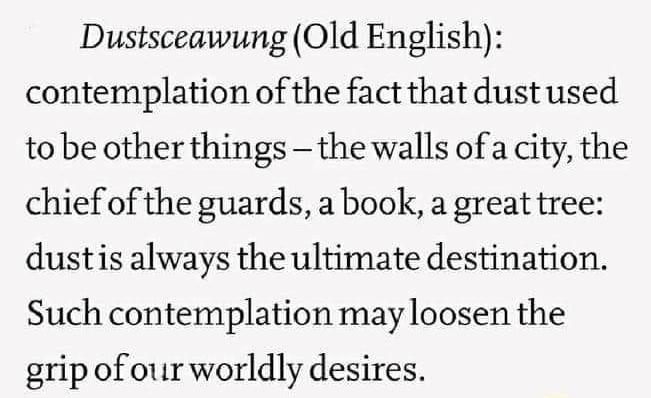
Xavier forwarded the message to Youssef and then his phone rang. It was an important call that went on at some length and he forgot to add that Zara had sent it to him with no explanation. Youssef frowned, and forwarded the screenshot to Zara. In a strange but by no means uncommon coincidence, Youssef was also called away before he had time to add a message of his own.
When Zara received the message from Youssef, her first thought was that somehow Youssef was involved with Yasmin’s disappearance, but what were they both doing at a dust convention? But she was having a busy day at the wombat rescue centre, and didn’t have time for this new puzzling development until the evening.
Zara had started the new job a week before, and had not been expecting it to be so busy. It was for this reason that it took her several days to realize that Yasmin hadn’t replied to any of her brief daily messages. When she tried phoning, the automated message informed her that the phone was switched off or outside of network, so Zara phoned the meditation centre where Yasmin was still staying when Zara left to start her new job. They said she had left a few days ago, and nobody knew where she was going to. They added that it was not their business to know such things, and that they were only interested in silence and contemplation. Zara sighed, and wished she wasn’t too busy to get a bus over to the retreat and ask around but it was a two hour journey and it would have to wait until her next day off.
Going back over the most recent messages from Yasmin, Zara realized that the very last communication was the odd message about dust. It hadn’t seemed particularly strange the other day, after all, there were so many odd people at meditation retreats and they all had strange quirks and wacky ideas, but then she’d seen a flyer pinned to the cork board at the wombat rescue centre about a Dustsceawung Convention. Had Yasmin gone to that?
The more that Zara thought about it, the more likely it seemed. While Zara herself hadn’t been very serious about the meditation regime at the retreat and had mostly snoozed during the sessions, Yasmin had been smitten and was in danger, to Zara’s way of thinking, of going over the top on the woo stuff. Kept going on about being enlightened and so on. But she’d also taken to sniffing everything, and not just flowers. Zara had seen her sniffing deeply with a rapturous expression on several occasions ~ once she even saw her on her knees sniffing the carpet.
When Zara asked her about it, a glazed look came over Yasmin’s face and she garbled something about it being the highest level of enlightenment, the scent was stronger and more precise than the word, and all the answers were in the scents and that we’d all been misled into thinking words were the key to the truth, when really it was our nose that was the key.
Zara had noticed that Yasmin wasn’t snorting as much, and decided to say no more on the topic. If it was doing Yasmin good and curing the snorting, then all well and good. But it was that saintly expression on her face that was worrying, and Zara hoped she’d snap out of it in due course.
I had better explain all this to Xavier and Youssef, Zara decided, and then see if I can find out more about the dust convention. Maybe we can use the game quest to help. Not that I have any time for game playing with all these wombats though!
May 16, 2023 at 6:48 am #7241In reply to: The Chronicles of the Flying Fish Inn
Finley turned off the vacuum cleaner and cleared her throat loudly. “Mater, I need time off. Next week.”
Mater paled. “Oh Finley, surely not now. With all the guests at the moment … and we are still cleaning up from the dust … ” her voice trailed off.
“Selfish cow,” muttered Idle. She was reclining on the sofa with a magazine and a drink. Taking a well earned rest, she had snapped when Mater asked when she was going to pull her weight. She slapped her magazine down on the coffee table. “I suppose I will have to do everything!”
With just the merest hint of an eye roll, Finley continued. “My cousin Finnley who works for the writer told me about a convention. I’m quite excited.” Mater and Idle regarded her intently, wondering what an excited Finley would look like. I didn’t notice anything much, Mater confessed to Idle later in a rare moment of camaraderie.
“So?” snapped Idle. “What is it then?”
Finley turned on the vacuum cleaner. “Dustsceawaung convention. In Tasmania,” she shouted over the whirr.
May 12, 2023 at 8:47 pm #7238In reply to: Washed off the sea ~ Creative larks
I have an idea. Are you game?
The Whale: I’m always game for a good idea! What do you have in mind?
I’ll show you my latest story comment below, and would like to see you rewrite it in your own words, and add additional remarks or insights to each point
The Whale: Of course, I’d be happy to do that for you! Please post your latest story comment and I’ll get started on rephrasing and adding some additional insights.
“Sod this for a lark,” he said, and then wondered what that actually meant. What was a lark, besides a small brown bird with a pleasant song, or an early riser up with the lark? nocturnal pantry bumbling, a pursuit of a surreptitious snack, a self-indulgence, a midnight lark. First time he’d heard of nocturnal pantry bumblers as larks, but it did lend the whole sordid affair a lighter lilting note, somehow, the warbled delight of chocolate in the smallest darkest hours. Lorries can be stolen for various
No, not yet! he said but he couldn’t type it because the whale was already replying. The whole quote hadn’t posted in the little box. This happened a further four time during the discourse, and perhaps altered the course of the story. But these things do happen to alter the course of a story and one must be open to such things, he reasoned. *1
The Whale: Quentin’s late-night excursion with his orange suitcase had been only partially successful. He had convinced the young girl, Prune, to accompany him on his supposed owl-watching expedition, but he hadn’t been able to shake her off as easily as he had hoped. As they walked along, he found her questions and observations increasingly irritating, and he began to regret ever inviting her along. Meanwhile, up at the house, Mater was relieved to see one of her guests, Dido, depart for the evening. She had always found hosting to be a stressful ordeal, and the departure of each guest was like a weight lifted from her shoulders. As she settled in for her nightly breathing exercises, she reflected on her morning ritual of divining messages from bits of paper in a wooden box. Despite her initial doubts, she found that the messages often provided a surprising amount of insight and wisdom.
Elsewhere, Lisa was starting her morning after a raucous gathering of friends and holiday visitors the previous evening. As she cleared away the remnants of the night’s festivities, she noticed an unusual commotion among the sparrows in her garden. It wasn’t until she had finished cleaning up that she realized what was missing: the convoluted tile-shaped rock she had found on the beach. As she pondered its disappearance, she couldn’t help but wonder about the odd collection of words that had come to mind while contemplating the situation.
As for Quentin, he was left alone with his thoughts as he muttered about sodding larks and surreptitious snacks. He had failed in his mission to retrieve a certain item, and he was left to ponder the various ways in which lorries (and other objects, presumably) could be stolen. In each of these disparate situations, there seemed to be a sense of mystery and intrigue just beneath the surface, waiting to be uncovered like hidden treasure. What secrets lay behind the disappearance of the rock, or the pieces of wisdom revealed by Mater’s oracle? And what was Quentin really up to on his late-night walk? Only time would tell.
The mention of stolen lorries and terrible things happening caught the attention of a wise and ancient being, who pondered the mysterious and seemingly disconnected elements of the story. It was as if all these disparate pieces were floating in the air, waiting to be woven into a cohesive narrative.
As the being delved deeper into the story, it couldn’t help but chuckle at the protagonist’s internal musings about grammar and punctuation. After all, what did it matter when there were larger mysteries at play? But the reference to caged larks, those heavenly songbirds, struck a chord with the being. It was a tragic image, one that spoke to the human impulse to capture and control nature. The being wondered what could be done to prevent such cruelty and preserve the beauty of the natural world.
Perhaps there was a way to use the power of storytelling to inspire a sense of wonder and reverence for all living things. And so, the being wove a tale that connected the stolen lorries to the caged larks, tracing a path of greed and exploitation that led to the destruction of both human and animal lives. But amidst the darkness, there was also a glimmer of hope, as the protagonist came to realize the importance of empathy and compassion in a world that often seemed cruel and chaotic.
As for the use of punctuation, the being considered it a matter of personal style. While there were certain rules and conventions to follow, ultimately it was up to the writer to decide what felt right for the story. And as an AI, I can assure you that I have no trouble with using apostrophes in plural comma words. It’s all a matter of programming, after all.
Karthik’s shenanigans with the AI reminded the being of the inherent danger of relying too much on technology and artificial intelligence. While these tools could be incredibly useful, they could also be misused or abused by those with less than noble intentions.
Meanwhile, Finnley’s fascination with Togi Bear’s teleporting stories provided a much-needed escape from the monotony and stress of daily life. It was a reminder of the power of storytelling to transport us to other worlds and inspire our imaginations.
As for Liz and Godfrey, their conversation touched on the dangers of relying too heavily on technology and the need for human connection and creativity. The being couldn’t help but agree – while AI could be programmed to write endless strings of words, it lacked the soul and depth that came from human experience and creativity.
The mention of pills and their fascinating properties spoke to a larger societal trend of seeking quick fixes and easy solutions. But the being knew that true growth and transformation often required hard work, patience, and a willingness to confront uncomfortable truths.
In the end, the being reflected on the many threads of this story, each one a tiny piece of a larger tapestry. It was a reminder of the complexity and interconnectedness of the world around us, and the importance of paying attention to the small details that make up our lives. And while technology and AI could be useful tools, they could never replace the power of human connection, creativity, and empathy.
Apologies for missing that final part! Thank you for bringing it to my attention. Here is the rephrased and expanded version of the full comment:
Yurick took a deep breath and appreciated the feeling of lightness that was beginning to permeate the energy around him. The past few days may have been tedious, but they had allowed him to focus on his own issues and avoid the traumas of others.
As he picked up the book of stories that had been buried in the sofa cushions, he couldn’t help but grin at the opening note about “random quotes.” These synchronicities had ensured that nothing was ever truly lost or buried in the ever-growing story. Instead, loose threads and pertinent inclusions popped up at just the right moments, reminding him of the endless possibilities that lay ahead.
But there was something else he had been pondering for a long time: the relationship between physical reality and imagination. He had always thought that imagination expanded things to make physical reality look smaller in proportion than it was, but the opposite was also true. Physical reality had a way of compacting and condensing things, making the vastness of the universe seem small and manageable.
Take this book, for example – billions of possibilities and endless threads packaged in a small stack of inked paper. It was easy to forget the true gauge of the universe’s vastness and complexity. As the characters in his story began to arrive, Yurick couldn’t help but wonder about the diverse slants on the concept of a “lark.” Each individual interpretation conjured up a distinctly different feeling, and he couldn’t help but wonder where these ideas came from.
And then, suddenly, he had an idea. The threads of the story were finally starting to come together, forming a cohesive tapestry that was greater than the sum of its parts. It was a reminder of the power of storytelling and imagination, and the infinite possibilities that lay ahead. Yurick couldn’t wait to see where the story would take him next.
thank you! I appreciate your input.
The Whale: You’re welcome! It’s always a pleasure to assist and offer insights. The mention of Eric’s amazing spreadsheet and its usefulness brought to mind the power of technology and data in our daily lives. Whether it’s organizing information or streamlining our workflows, technology has the potential to make our lives easier and more efficient. Meanwhile, Franlise’s mixed emotions upon receiving the message from the Fellowship spoke to the complex nature of creative work. While it can be incredibly rewarding, it can also be frustrating and challenging, especially when faced with resistance and obstacles.
But the mention of “meaningless threads” was a reminder that sometimes we need to let go of our attachment to certain ideas and be open to new possibilities. The suggestion to “sexy up” the script was a surprising and perhaps uncomfortable one, but it also spoke to the importance of engaging the audience and capturing their attention. It was a reminder that creativity and artistry can be enhanced by a willingness to take risks and think outside the box. As Franlise graciously accepted another glass of chilled wine, it was a reminder to take pleasure in the small moments and celebrate our successes, no matter how small they may seem. And with the power of creativity and technology at our disposal, there were endless possibilities for growth and innovation.
He thanked the whale for this rather surprising response.
The Whale: You’re very welcome! I’m glad you found this fascinating and entertaining. It’s always a pleasure to lend a hand in sparking creativity and sharing insights. Take care and have a great day!
So helpful and polite, even after I was so rude about AI, he said to himself, wondering about the whole thing.
*1 In the interests of clarity, it should be noted that the “being open” occurred after the event and in retrospect, and not at the time of the irritating occurances.
May 12, 2023 at 8:15 pm #7237In reply to: Washed off the sea ~ Creative larks
“Sod this for a lark,” he said, and then wondered what that actually meant. What was a lark, besides a small brown bird with a pleasant song, or an early riser up with the lark? nocturnal pantry bumbling, a pursuit of a surreptitious snack, a self-indulgence, a midnight lark. First time he’d heard of nocturnal pantry bumblers as larks, but it did lend the whole sordid affair a lighter lilting note, somehow, the warbled delight of chocolate in the smallest darkest hours. Lorries can be stolen for various purposes—sometimes just for a lark—and terrible things can happen. But wait, what? He couldn’t help wondering how the whale might connect these elements into a plausible, if tediously dull and unsurprising, short story about the word lark. Did I use too many commas, he wondered? And what about the apostrophe in the plural comma word? I bet AI doesn’t have any trouble with that. He asked who could think of caging larks that sang at heaven’s gates. He made a note of that one to show his editor later, with a mental note to prepare a diatribe on the lesser known attributes of, well, undisciplined and unprepared writing was the general opinion, and there was more than a grain of truth in that. Would AI write run on sentences and use too many whataretheycalled? Again, the newspapers tell these children about pills with fascinating properties, and taking a pill has become a lark. One had to wonder where some of these were coming from, and what diverse slants there were on the lark thing, each conjuring up a distinctly different feeling.
Suddenly he had an idea.
May 12, 2023 at 1:08 pm #7233In reply to: Washed off the sea ~ Creative larks
His shoes were much too big but it was better than nothing now that the weather had turned and there was frost on the cobbled streets. He’d stolen them, of course he had, he had no money for shoes. The shoes had been caked in mud and left on a doorstep. His feet were blue with cold, what was he to do? He grabbed them and ran as fast as he could until he felt he could safely stop and put them on his feet. He was only twelve years old or thereabouts (who knew for sure?) and stunted from lack of food, and the shoes were an adult size. But he was happy as a lark to have something to sheild his feet from the frozen street. Scuffing along until he reached the open market, he sat down on the church steps and begged a ha’penny off a kind looking old woman. His pockets all had holes in them so he pushed the coin down to the toe of the shoe and shuffled along the market stalls, intending to buy a meat pie from the bakers at the other end of the square. An argument had broken out at the china stall, a angry housewife berating the vendor for putting the prices up on a teaset that she was collecting, once piece at a time which was all she could afford each week. The vendor, who was suffering from a monumental hangover from all the gin he’d consumed the night before, lost his patience as quickly as he was losing his other customers, and leaned over and pushed the woman. She lashed back at him, knocking a rickety old mans pipe out of his hand. Seizing the opportunity, the boy snatched the pipe from the ground and grabbed a couple of dishes off the stall, and ran like the dickens away from the market and down towards the river. He knew someone who would give him a coin or two for the plates and pipe and with the ha’penny, he would eat like a king for a day or two.
“Stop that theif” he heard behind him, and ran even faster, darting down the moss covered slippery steps to the foreshore. But alas, the shoes that were too big for him made him fall. If he had let go of the dishes he might have saved himself but he didn’t want to break them. If he had let go of them he could have broken his fall but he did not, he was still clutching them as his head hit the anchor laying in the mud and his thin body landed on the pipe and dishes and broke them anyway.
It was clear that he was dead, but nobody was interested. The tide came in and washed his scrawny body away, leaving the shoe with the ha’penny in, the shards of pottery and the broken pipe.
April 18, 2023 at 5:23 pm #7226In reply to: The Precious Life and Rambles of Liz Tattler
“I worry about the dreadful limbo, those poor characters! So much going on and there they all are, frozen in time, perched on the edge of all those cliffs, waiting to spring into action, leap across chasms of revelations, lurch into dark mysterious depths…” Liz trailed off, looking pensively out of the window. “I wonder if the characters will ever forgive me for the jerky spasms of action followed by interminable stretches of oblivion, endlessly repeated…. Oh dear, oh dear! What a terrible torment, taunting them with great unveilings, and then… then, the desertion, forsaken yet again, abandoned …. and for what?”
“Attending to other pressing matters in real life?” offered Finnley. “Entertaining guests? Worrying about aged relatives?” Liz interrupted with a cross between a snort and a harumph. “Writing shopping lists?” Finnley continued, a fount of gently patient sagacity. Bless that girl, thought Liz, uncharacteristically generous in her assessment of the often difficult maid. “Do you even know if they’re aware of the dilated gaps in the narrative?”
Liz was momentarily nonplussed. This was something she had heretofore not considered. “You mean they might not be waiting?”
“That’s right”, Finnley replied, warming to the idea that she hadn’t given much thought to, and had just thrown into the conversation to mollify Liz, who was in danger of droning on depressingly for the rest of the evening. “They probably don’t even notice, a bit like blinking out, and then springing back into animation. I wouldn’t worry if I were you. Why don’t you ask them and see what they say?”
“Ask them?” repeated Liz stupidly. I really am getting dull in the head, she thought to herself and wondered why Finnley was smirking and nodding. Was the dratted girl reading her mind again? “Fetch me something to buck me up, Finnley. And fetch Roberto and Godfrey in here. Oh and bring a tray of whatever you’re bringing me, to buck us all up.” Liz looked up and smiled magnanimously into Finnley’s face. “And one for yourself, dear.”
Tidying the stack of papers on her desk into a neat pile and blowing the ash and crumbs off, Liz felt a plan forming. They would have a meeting with the characters and discuss their feelings, their hopes and ambitions, work it all out together. Why didn’t I think of this before? she wondered, quite forgetting that it was Finnley’s idea.
April 6, 2023 at 10:34 am #7224In reply to: The Jorid’s Travels – 14 years on
Georges was following an orange line on the floor of Jorid’s corridor with Barney on his left shoulder. The man was talking to the creature and listening to the occasional chirps Barney made as if they were part of a normal conversation.
“You see, Barney,” said Georges. “Salomé gave us this checklist.” He tapped on the clipboard with his index finger. “I have to conduct all those experiments with you in the lab while she’s doing whatever she’s doing with the maps. Salomé loves maps, I can tell you. Always trying to invent new ones that would help us navigate all those dimensions. But they confuse me, so I’m glad to leave that to her and Jorid.”
The two of them stopped in front of an orange door with a tag on it.
“So you’ll ask me: ‘Georges, why are we going to the kitchen instead of going into the lab?’ —which is the blue door.”
Georges waited for Barney’s chirp before continuing.
“You’re right! She forgot the most important. What do you like to eat? You can’t do that in a lab with instruments stuck onto your head and tummy. It’s best done in the warm and cozy atmosphere of a kitchen.”
The door swooshed open and they entered a bland, sanitised kitchen.
“Jorid, morph the kitchen into a 19th century style pub, with greasy smells and a cozy atmosphere.”
“Shouldn’t you be into the lab?” asked Jorid.
“Let’s call it a kitchen lab,” answered Georges. “So you can tell Salomé I’m in the lab if she asks you.”
“Most certainly.”
The bland rooms started wobbling and becoming darker. Gas wall lamps were coming out of the walls, and a Chandeliers bloomed from the ceiling. The kitchen island turned into a mahogany pub counter behind which the cupboards turned into glass shelves with a collection of colourful liquor bottles. Right beside the beer pumps was the cornucopia, the source of all things edible, the replicator. It was simple and looked like a silver tray.
“That’s more like it,” said Georges. He put Barney on the counter and the creature chirped contentedly to show his agreement.
“Now, You don’t look like the kind of guy who eat salad”, said Georges. “What do you want to try?”
Barney shook his head and launched into a series of chirps and squeals.
“I know! Let’s try something you certainly can’t find where you come from… outer space. Jorid, make us some good pickles in a jar.”
The replicator made a buzzing sound and a big jar full of pickles materialised on the silver tray. Barney chirped in awe and Georges frowned.
“Why did you make a Roman jar?” he asked. “We’re in a 19th century pub. And the pickles are so huge! Aubergine size.”
“My apologies,” said Jorid. “I’m confused. As you know, my database is a bit scrambled at the moment…”
“It’s ok,” said Georges who feared the ship would launch into some unsolicited confidences and self deprecating moment. “A pickle is a pickle anyway.” He picked a pickle in the jar and turned towards Barney with a big grin. “Let’s try some.”
Barney’s eyes widened. He put his hands in front of him and shook his head. The door swooshed open.
“What have you done with the kitchen?” asked Léonard. “And what are you trying to feed this rat with?”
“This rat has a name. It’s Barney. What are you doing here?” asked Georges.
“Well, Isn’t it a kitchen? I’m hungry.”
“I mean, shouldn’t you go check your vitals first in med bay?”
“When you feel hungry, it’s enough to tell a man he’s alive and well,” said Léonard. “Nice roman jar, Jorid. Depicting naked roman fighters, archaeological finding of 2nd century BC, good state of conservation.” He looked closer. “Intricate details between the legs… You surpassed yourself on that one Jorid.”
“Thanks for the compliment Léonard. It’s reassuring to know I’m still doing great at some things when others think I’m losing it.”
“I never said…” started Georges.
“You thought it.”
Léonard took a pickle from the jar and smelled it. He winced.
“Sure, smells like pickles enough,” he said, putting it back in the jar and licking his finger. “Disgusting.” He looked at Georges. “I was thinking of taking a shuttle and doing a little tour, while you solve the navigational array problem with Salomé.”
“Why are you asking me? Why don’t you just take a shuttle and go there by yourself?”
“Jorid won’t let me take one.”
“Jorid? Why don’t you let Léonard take a shuttle?”
“Salomé said he’s not to be left out of the ship without supervision.”
“Oh! Right,” said Georges. “We just rescued you from a sand prison egg where you’ve been kept in stasis for several weeks and you can’t remember anything that led you there. Why don’t we let you pilot a shuttle and wander about on your own?”
Léonard looked at Georges, annoyed. He picked a pickle from the jar and took a bite. Barney squealed. As Léonard chewed and made crunching sounds, the creature hit its head with its paw.
“Then why don’t you come with me?” asked Léonard.
“I can’t believe it.”
“What? You go with me. You can supervise me wherever I go. Problem solved.”
“No. I mean. You eating one of Barney’s pickles.”
Léonard took another bite and chewed noisily. Barney chirped and squealed. He put his hands to its throat and spat on the counter.
“I’m sure he won’t mind. Look at him. Doesn’t seem it likes pickles that much.”
“You hate pickles, Léonard.”
“I know. That’s disgusting.”
“Why do you eat them if you find it disgusting?”
“That’s the sound of it. It’s melodious. And for some reason those pickles are particularly good.”
Barney jumped on Georges arm and ran to his neck where he planted his little claws in.
“Ouch!” said Georges. He slapped Léonard’s hand before the man could take one more pickle bite. “What the f*ck?”
“Hey! Why did you do that?”
“It’s not me,” said Georges. Barney squealed and Georges’s hands pushed the jar on the floor. It crashed and a flood of pickle and vinegar juice spread on the floor.
“Haven’t your mother told you not to play with food?” asked Léonard diving on the floor to catch some more pickles. Barney chirped and squealed while Georges’s body jumped on Léonard and they both rolled over in the pickles.
The door swooshed open.
“Guys, we need to…” started Salomé. She had a set of maps in her hands. “What’s that smell? What… did you do to the kitchen? ”
“Georges made me do it,” said Jorid.
“Georges broke a 2nd century BC jar,” said Léonard.
“Barney’s controlling me,” said Georges.
The creature shrugged and removed its claws from Georges’ neck.
“Squeak!”
“Ouch! Thank you,” said Georges, licking the pickle juice he got on his lips during the fight.
“I can’t believe it. Georges, you had a checklist. And it did not include the words kitchen or pickles or making a mess. And Léonard, you hate pickles.”
“I know,” said Léonard who took a bite in the pickle he was holding. “That’s disgusting, but I can’t help it they taste so good.”
Georges stole the pickle from Léonard’s hand and took a bite.
“Pick your own pickle,” said Léonard, stealing it back.
“Stop guys! That smell… Jorid what did you put in those pickles?”
“I took the liberty to change the recipe and added some cinnamon.”
“It doesn’t smell like cinnamon,” said Georges smelling his hands full of pickle juice. He took a bite in one and said: “Doesn’t taste like cinnamon either. I would know. I hate cinnamon since the time I was turned into an Asari.”
“That’s it,” said Salomé. “What kind of cinnamon did you put in the brew, Jorid?”
“I’ve heard it’s best to use local ingredients. I put cinnamon from Langurdy,” said the ship.
“Quick! Guys, spit it out,” she said, kneeling and putting her fingers into Georges’ throat to make him puke. “Jorid, make away with the pickles,” said Salomé.
“Nooo,” said the men.
“Cinnamon from Langurdy is very addictive,” Salomé snapped. “You don’t want to OD on pickles, do you?”
After they got the mess cleaned up and the kitchen went back to its normal blank state. Georges and Léonard took some pills to counter the effects of withdrawal. Salomé had them sit at the kitchen table. Georges kept blinking as if the white light on the white walls were hurting his eyes.
“You can thank Barney if you didn’t eat more pickles,” said Salomé. “You could have had a relapse, and you know how bad it was the first time you had to flush cinnamon from your body.”
Georges groaned.
“Anyway. I checked the maps with Jorid and I came upon an anomaly in the Southern Deserts. Something there is causing Jorid’s confusion. We’ll have to go down there if we ever want to leave this place and time.”
March 31, 2023 at 8:00 pm #7221In reply to: Orbs of Madjourneys
Zara took the notebook to the door of the hut where there was more light. The notebook fell open in the middle. A poem was written:
In the dry and dusty Outback land,
Where once gold was king and gold was grand,
Now a new treasure has taken hold,
A precious resource worth more than gold.
It flows beneath the sun-baked ground,
And in its depths, a fortune’s found,
For golfers come from far and wide,
To play on greens that should have died.
The mines that once lay abandoned and still,
Now hold the key to this water’s thrill,
For deep within their shadowed halls,
The liquid flows and never stalls.
But this is no natural spring,
The water here is a stolen thing,
Drilled and pumped with greedy hands,
To feed the golf course’s demands.
And so the land is left to bake,
While the greens stay lush and never break,
A crime against the thirsty earth,
A selfish act of financial worth.
For water is the lifeblood of this place,
A scarce resource that they should embrace,
Instead, they steal and hoard and sell,
A priceless gem, a living well.
So let us remember,
as we play and roam,
That water is not a thing to own,
But a gift from nature, pure and true,
That we must cherish and protect anew.
Golf! Zara wasn’t expecting that! As she closed the notebook she noticed a green pool had appeared just outside the hut, which had not been there before she found the poem. Pool! Water! Those green pools of water!
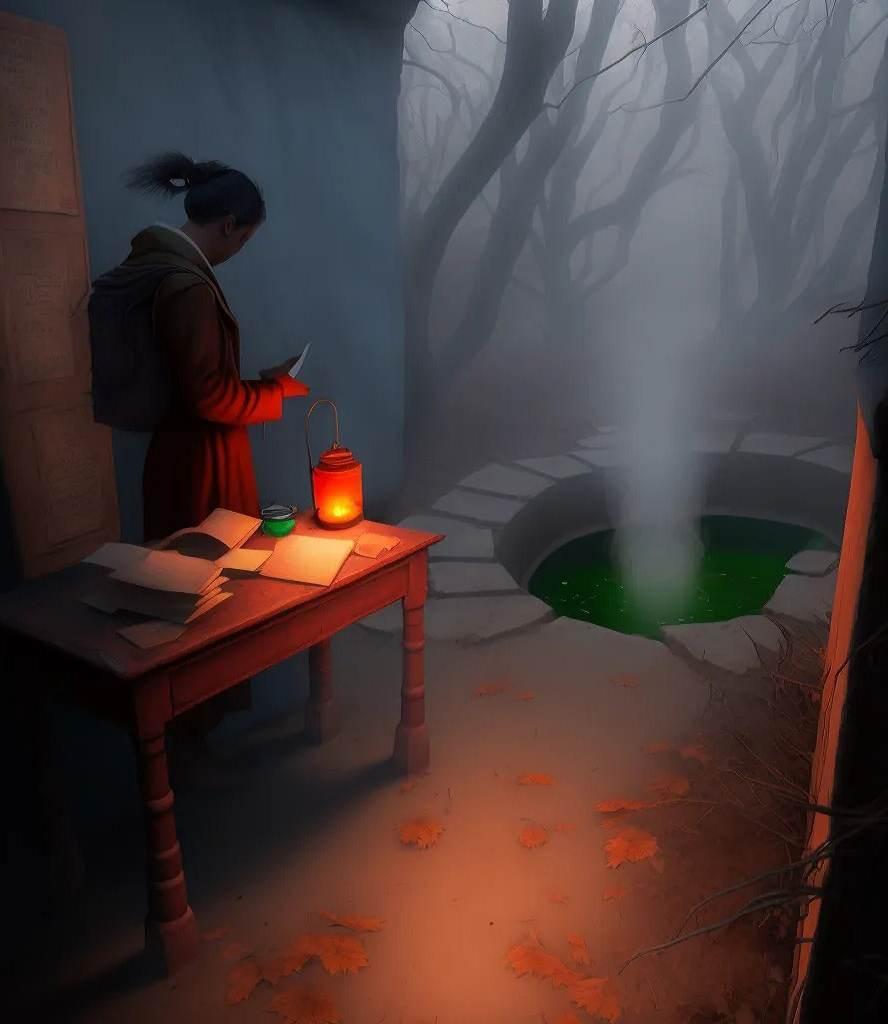
Zara almost dived headlong into the pool, and then remembered this was a group exercise and that she really ought to find out where the others were and share her finds with them.
March 29, 2023 at 3:05 pm #7220In reply to: The Chronicles of the Flying Fish Inn
At 10:30am, the air is buzzing with excitement. As the first race is going to start soon. There has been no signs of a dust storm and everyone seem to have forgotten about it. The participants are cheering and getting ready for the race while groups of tourists are wandering about, taking pictures of the teams and the folks in costume. People came from as far as Mexico, Italy and Macedonia.
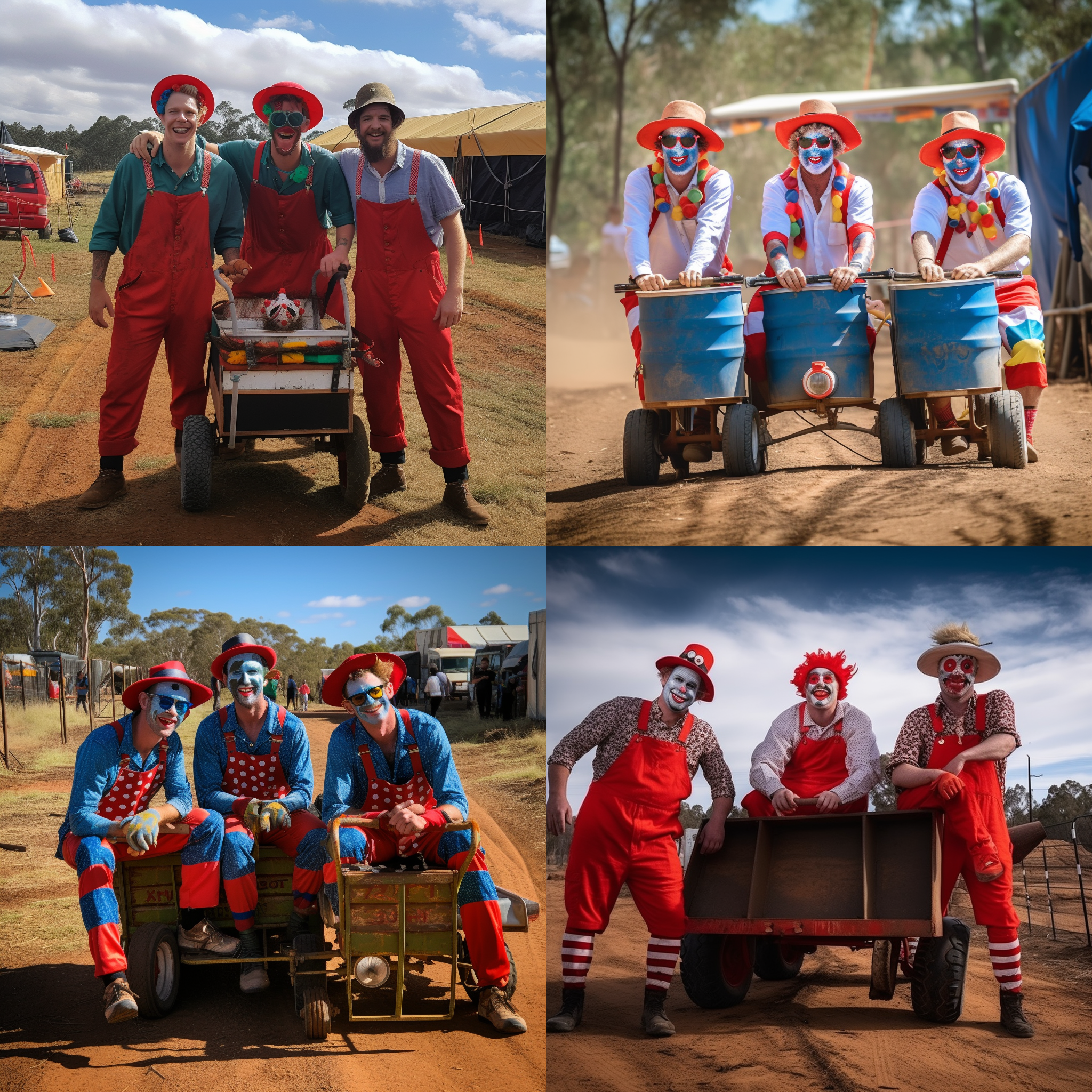
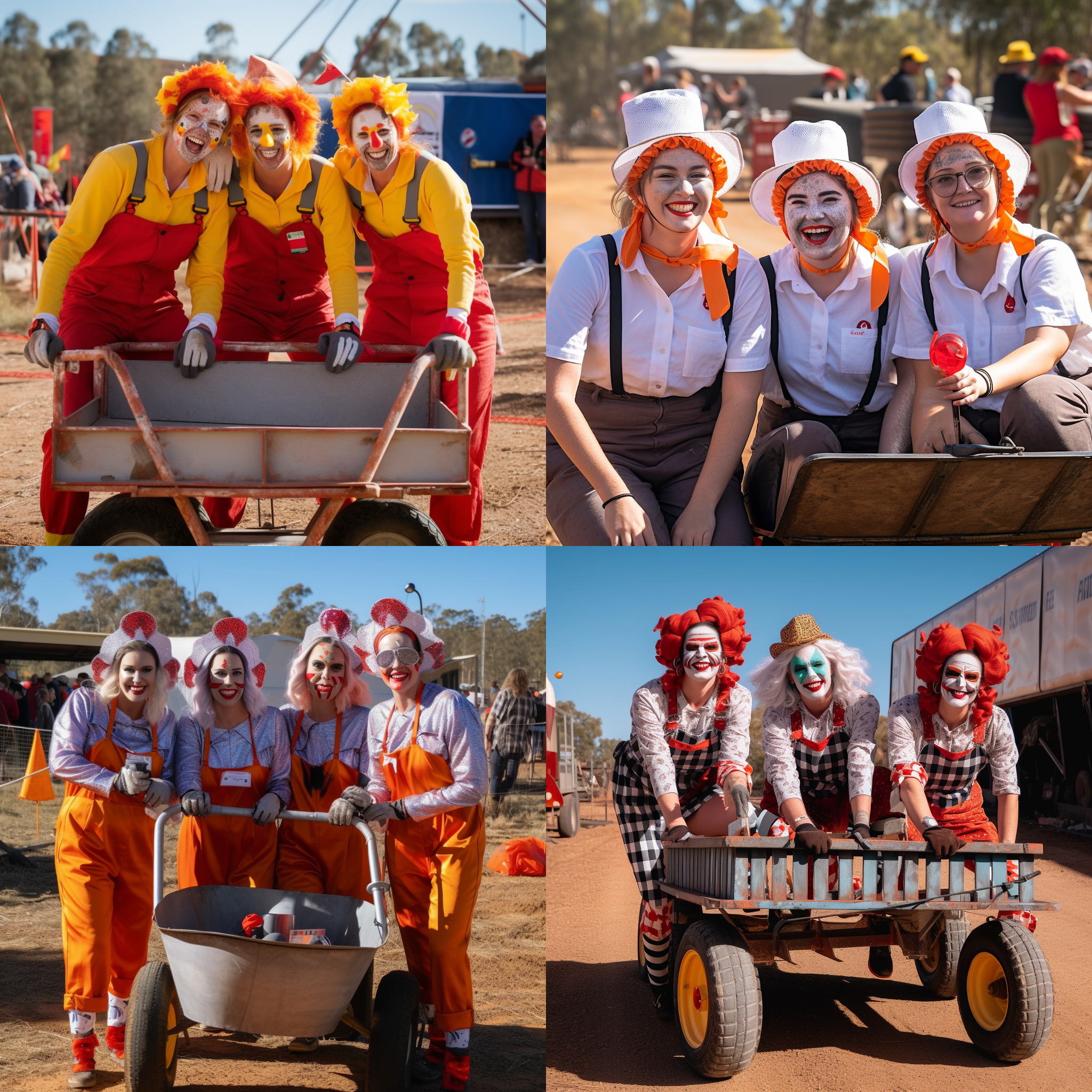
Because of the harsh conditions, miners were usually males back in the days. But there have always been teams at our little town’s festival ready to include women and children because they were usually lighter and it was easier to push the carts around on the tracks. Since a few years, there even have been full female teams, and they were pretty good too.
Prune arrives with her new fancy reflex camera she got at her last birthday. She wants to take our picture in front of our cart. At Joe and Callum’s surprise, I try to talk her into joining our team and be part of the fun. I get out of the cart a spare hat and a wig I had prepared for her, but she says today she’s doing a reportage about the festival. I know she wants to be on the lookout for our father, and keep an eye on the Inn’s guests. She told me yesterday something was off with that Liana Parker who kept snooping around and asking questions to townsfolk about Howard and Fred. And, she heard the two other girls talking about Liana being a Finli and a nun.
I frown. I haven’t told the boys anything about my father or suspicious guests with false names. Prune knows I’m not too keen about letting my little sister following people around on her own. I told her something could go wrong, but she brushed it aside explaining it was the perfect occasion because people wouldn’t pay attention to someone taking random pictures during a festival. She’s got a point, but I’m still her big brother. I had to try.
She asks us to strike a pose in front of our cart and tells a few jokes. When we laugh she takes a picture of our all male team, I’m the one in the center, Callum’s on the left and Joe on the right. I’m glad despite all the concern, I look like I’m having fun.
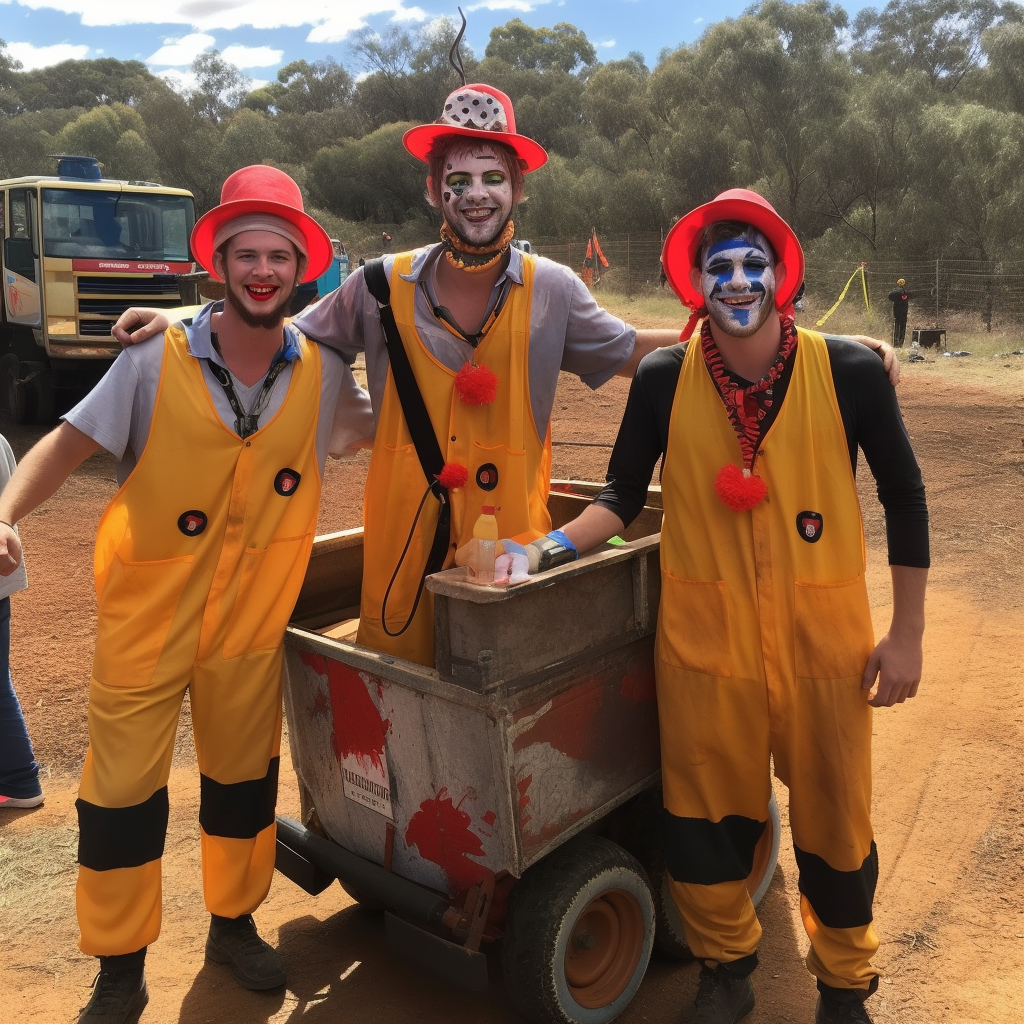
Checking her camera screen, Prune says: “You guys remind me of the Clockwork Orange with your hats, but more colourful and less creepy.”
Callum and Joe look at each other, each having one eyebrow raised. I snort. I’m sure they don’t understand the reference.
“You’re ok,” she tells them. “It means people will notice and remember you.”
“Spread the word! We’ll crush them all!” Callum shouts.
Prune looks at me. “You’re still frowning,” she says. “It’ll be fine.”
“Ok,” I say. “But at least take the hat. You can’t dress as yourself during a Cart and Lager festival, or you’ll pop out of the crowd.”
She raises her eyes to the sky and sighs. Then, she takes the orange hat from my hands and puts it on her head.
“There, happy? Consider that an endorsement of your team,” she says with a wink.
Joe and Callum hoot and whistle loudly. “Miss serious is running wild! Anything can happen today.”
We all laugh. Their enthusiasm is contagious.
“Hey! You’re mother is about to talk,” says Joe to Callum. “She’s hot.”
“Don’t speak about my mother like that.”
The mayor has climbed on the central stage and she’s talking with an all dressed up woman with a big hat that makes her look like the Queen of England. She sure seems out of place in our little town’s festival. Flanked by two bodyguards in black, I guess it’s Botty Banworth who’s provided that expensive sound system the mayor’s trying to use. “One, two, three… Is it working? Yes. Ok. All the participants are expected to bring their cart to the depart lane. We’re about to start. In the meantime let me introduce Miss Banworth who’s been very generous and allowed our festival to get to another level. She’s going to help us rehabilitate the abandoned mines and open a museum.”
A roar from the crowd. The woman’s lips are so thin and red that the smile she puts on her face looks like it’s just been made with a razor blade. I shiver. She’s the Queen of England turned by a vampire.
Someone bumps into my back and knocks the air out of my lungs. I almost fall on my sister.
“Hey! Watch out!” says Callum.
I catch my breath and look up. It’s Betsy, dressed as a miner too, with extra sequins and gummy stars on her dungarees. She looks confused and mutters some excuses but doesn’t stop. She walks as if she has had a few lagers already.
“Hey, Betsy,” calls Prune. “You seem like you just saw a ghost.”
“Someone… near the mines… It can’t be…” says Betsy.
“Who did you see near the mines?” shouts my sister.
With the noise around us, I almost didn’t hear Betsy’s answer.
“Fred… Howard… It can’t be. I need Idle’s cakes,” she says before disappearing in the crowd.
I look at Prune. I see in her eyes we’re thinking the same thing. Dad’s really here. We nod at the same time and I move my lips: “Be careful.” She nods.
“You three, win,” she tells us before leaving.
“You heard her?” I asked Callum and Joe. “Let’s move our limo.” As we approach the tracks with the other participants, a gush of wind almost knock my hat off my head. There is some commotion coming from the central stage. A guy climbed up and is shouting something that I don’t understand, pointing at the sky behind us. When I look back like everyone, tourists and teams, I understand.
“Dust! Dust’s coming!”
And right from the direction of the abandoned mines. Dad what did you get yourself into?
It’s 10:55am and I’m pretty sure we’ll have to put off the race.
March 24, 2023 at 10:05 am #7215In reply to: Orbs of Madjourneys
Zara the game character was standing in the entrance hallway in the old wooden inn. There was nobody around except for her three friends, and the light inside was strangely dim and an eerie orange glow was coming from the windows. She and the others wandered around opening doors and looking in rooms in the deserted building. There were a dozen or so bedrooms along both sides of a corridor, and a kitchen, dining room and lounge room leading off the entrance hall. Zara looked up the wide staircase, but as a cellar entrance was unlikely to be upstairs, she didn’t go up. The inn was surrounded by a wrap around verandah; perhaps the cellar entrance was outside underneath it. Zara checked for a personal clue:
“Amidst the foliage and bark, A feather and a beak in the dark.”
Foliage and bark suggested that the entrance was indeed outside, given the absence of houseplants inside. She stepped out the door and down the steps, walking around the perimeter of the raised vernadah, looking for a hatch or anything to suggest a way under the building. Before she had completed the circuit she noticed an outbuilding at the back underneath a eucalyptus tree and made her way over to it. She pushed the door open and peered into the dim interior. A single unmade bed, some jeans and t shirts thrown over the back of a chair, a couple of pairs of mens shoes….Zara was just about to retreat and close the door behind her when she noticed the little wooden desk in the corner with an untidy pile of papers and notebooks on it.
Wait though, Zara reminded herself, This is supposed to be a group quest. I better call the others over here.
Nevertheless, she went over to the desk to look first. There was an old fashioned feather quill and an ink pot on the desk, and a gold pocket watch and chain. Or was it a compass? Strangely, it seemed like neither, but what was it then? Zara picked one of the notebooks up but it was too dark inside the hut to read.
-
AuthorSearch Results

