

Search Results for 'six'
-
AuthorSearch Results
-
January 4, 2026 at 6:59 pm #8029
In reply to: The Hoards of Sanctorum AD26
“While you’re off to another wild dragon chase, I’m calling the plumber,” Yvoise announced. She’d found one who accepted payment in Roman denarii. She began tapping furiously on her smartphone to recover the phone number, incensed at having been blocked again from Faceterest for sharing potentially unchecked facts (ignorants! she wanted to shout at the screen).
 After a bit of struggle, the appointment was set. She adjusted her blazer; she had a ‘Health and Safety in the Workplace’ seminar to lead at Sanctus Training in twenty minutes, and she couldn’t smell like wet dog.
“Make sure you bill it to the company account…!” Helier shouted over the noise Spirius was making huffing and struggling to load the antique musket.
“…under ‘Facility Maintenance’!”
“Obviously,” Yvoise scoffed. “We are a legitimate enterprise. Sanctus House has a reputation to uphold. Even if the landlord at Olympus Park keeps asking why our water consumption rivals a small water park.”
Spirius shuddered at the name. “Olympus Park. Pagan nonsense. I told you we should have bought the unit in St. Peter’s Industrial Estate.”
“The zoning laws were restrictive, Spirius,” Yvoise sighed. “Besides, ‘Sanctus Training Ltd’ looks excellent on a letterhead. Now, if you’ll excuse me, I have six junior executives coming in for a workshop on ‘Conflict Resolution.’ I plan to read them the entirety of the Treaty of Arras until they submit.”
“And dear old Boothroyd and I have a sewer dragon to exterminate in the name of all that’s Holy. Care to join, Helier?”
“Not really, had my share of those back in the day. I’ll help Yvoise with the plumbing. That’s more pressing. And might I remind you the dragon messing with the plumbing is only the first of the three tasks that Austreberthe placed in her will to be accomplished in the month following her demise…”
“Not now, Helier, I really need to get going!” Yvoise was feeling overwhelmed. “And where’s Cerenise? She could help with the second task. Finding the living descendants of the last named Austreberthe, was it? It’s all behind-desk type of stuff and doesn’t require her to get rid of anything…” she knew well Cerenise and her buttons.
“Yet.” Helier cut. “The third task may well be the toughest.”
“Don’t say it!” They all recoiled in horror.
“The No-ve-na of Cleans-ing” he said in a lugubrious voice.
“Damn it, Helier. You’re such a mood killer. Maybe better to look for a loophole for that one. We can’t just throw stuff away to make place for hers, as nice her tastes for floor tiling were.” Yvoise was in a rush to get to her appointment and couldn’t be bothered to enter a debate. She rushed to the front door.
“See you later… Helier-gator” snickered Laddie under her breath, as she was pretending to clean the unkempt cupboards.
December 30, 2025 at 6:42 pm #8003In reply to: The Elusive Samuel Housley and Other Family Stories
JOHN BROOKS ALIAS PRIESTLAND
1766-1846John Brooks, my 5x great grandfather, was born in 1766, according to the 1841 census and the burial register in 1846 which stated his age at death as 80 years, but no baptism has been found thus far.
On his first son’s baptism in 1790 the parish register states “John son of John and Elizabeth Brooks Priestnal was baptised”. The name Priestnal was not mentioned in any further sibling baptism, and he was John Brooks on his marriage, on the 1841 census and on his burial in the Netherseal parish register. The name Priestnal was a mystery.
I wondered why there was a nine year gap between the first son John, and the further six siblings, and found that his first wife Elizabeth Wilson died in 1791, and in 1798 John married Elizabeth Cowper, a widow.
John was a farmer of Netherseal on both marriage licences, and of independent means on the 1841 census.
Without finding a baptism it was impossible to go further back, and I was curious to find another tree on the ancestry website with many specific dates but no sources attached, that had Thomas Brooks as his father and his mother as Mary Priestland. I couldn’t find a marriage for John and Mary Priestland, so I sent a message to the owner of the tree, and before receiving a reply, did a bit more searching.
I found an article in the newspaper archives dated 9 August 1839 about a dispute over a right of way, and John Brooks, 73 years of age and a witness for the complainant, said that he had lived in Netherseal all his life (and had always know that public right of way and so on).
I found three lists of documents held by the Derby Records Office about property deeds and transfers, naming a John Brooks alias Priestland, one in 1794, one in 1814, and one in 1824. One of them stated that his father was Thomas Brooks. I was beginning to wonder if Thomas Brooks and Mary Priestland had never married, and this proved to be the case.
The Australian owner of the other tree replied, and said that they had paid a researcher in England many years ago, and that she would look through a box of papers. She sent me a transcribed summary of the main ponts of Thomas Brooks 1784 will:
Thomas Brooks, husbandman of Netherseal
To daughter Ann husband of George Oakden, £20.
To grandson William Brooks, £20.
To son William Brooks and his wife Ann, one shilling each.
To his servant Mary Priestland, £20 and certain household effects and certain property.
To his natural son John Priestland alias Brooks, various properties and the residue of his estate.
John Priestland alias Brooks appointed sole executor.It would appear that Thomas Brooks left the bulk of his estate to his illegitimate son, and more to his servant Mary Priestland than to his legitimate children.
THOMAS BROOKS
1706-1784
Thomas Brooks, my 6x great grandfather, had three wives. He had four children with his first wife, Elizabeth, between 1732 and 1737. Elizabeth died in 1737. He then married Mary Bath, who died in 1763. Thomas had no children with Mary Bath. In 1765 Thomas married Mary Beck. In 1766 his son John Brooks alias Priestland was born to his servant Mary Priestland.
Thomas Brooks parents were John Brooks 1671-1741, and his wife Anne Speare 1674-1718, both of Netherseal, Leicestershire.
April 21, 2025 at 12:51 am #7898In reply to: Cofficionados Bandits (vs Lucid Dreamers)
“Sorry I’m late,” said Carob as she crouched down to fuss over Fanella. “I have excuses, but they’re not interesting. I’m feeling a little underdeveloped as a character, so I’m not sure what to say yet.”
“That’s okay,” said Amy. “Just remember … if you don’t tell us who you are early on…” She squinted and glanced around suspiciously. “Others will create you.”
“I’d rather just slowly percolate.” Carob screwed up her face. “Get it? Percolate?”
She stood up and slapped a hand to her head as Amy rolled her eyes. “Sorry … ” She patted her head curiously. “Oh wait—do I have curls?”
“I’d say more like frizzes than curls,” answered Amy.
Thiram nodded. “Totally frizzled.”
“Cool … must be the damp weather,” said Carob. She brushed a twig from her coat. The coat was blue-green and only reached her thighs. Many things were too small when you were six foot two.
“Oh—and I’ve been lucid dreaming in reverse,” she added. “Last night I watched myself un-make and un-drink a cup of coffee.” She gave a quick snort-laugh. “Weirdo”.
“Was it raining in the dream?” asked Thiram.
Carob frowned. “Probably… You know how in scary movies they always leave the curtains open, like they want the bad guys to see in? It felt like that.” She shuddered and then smiled brightly. “Anyway, just a dream. Also, I bumped into your father, Amy. He said to tell you: Remember what happened last time.”
She regarded Amy intently. “What did happen last time?”
“He worries too much,” said Amy, waving a hand dismissively. “Also, I didn’t even write that in, so how should I know?” She looked out toward the trees. “Where’s Chico?”
March 23, 2025 at 10:50 am #7880In reply to: The Precious Life and Rambles of Liz Tattler
“Nice arse,” said Idle non too quietly, admiring Roberto as he stacked firewood beside the hearth. The gardener glanced round and gave her a cheeky wink. He’d noticed her leaning out of an upstairs window watching him weeding the herbacious border.
“Now, now, Idle, no molesting the staff. I’ll write some men into the story for you later,” Liz said, “But first let’s talk about my new book. I’m wondering what to name the six spinsters. Some kind of a theme. Cerise, Fuschia, Scarlett, Coral, Rose and Magenta?”
“What about Cobalt, Lapis, Cerulean, Indigo, Sapphire and Capri?” offered Idle, topping up their wine glasses. “Chartreuse, Emerald, Jade, Fern, Pistachio and Malachite? Marigold, Saffron, Citron, Amber, Maize and Apricot?”
“How about Bratwurst, Chorizo, Salami, Knackwurst, Bologna and Frankfurter?” suggested Godfrey who was still miffed about all the spare parts being disposed of. “Lasagne, Macaroni, Canneloni, Farfali, Linguini and Ravioli?”
Roberto lit the fire and stood up. “I have an idea, you can call them Trowel, Rake, Hoe, Wheelbarrow, Spade and Secateur.”
“Marvelous Roberto, I love it!” gushed Aunt Idle.
“You’re all mad as a box of frogs, madder than Almad,” Finnley said. “How about Duster, Mop, Bleach, Broom, Dustpan and Cloth?”
“I think this incessant rain is driving us all mad,” Liz said, glancing out of the French windows with a sigh.
March 23, 2025 at 7:37 am #7878In reply to: The Precious Life and Rambles of Liz Tattler
Liz threw another pen into the tin wastepaper basket with a clatter and called loudly for Finnley while giving her writing hand a shake to relieve the cramp.
Finnley appeared sporting her habitual scowl clearly visible above her paper mask. “I hope this is important because this red dust is going to take days to clean up as it is without you keep interrupting me.”
“Oh is that what you’ve been doing, I wondered where you were. Well, let’s thank our lucky stars THAT’S all over!”
“Might be over for you,” muttered Finnley, “But that hare brained scheme of Godfrey’s has caused a very great deal of work for me. He’s made more of a mess this time than even you could have, red dust everywhere and all these obsolete parts all over the place. Roberto’s on his sixth trip to the recycling depot, and he’s barely scratched the surface.”
“Good old Roberto, at least he doesn’t keep complaining. You should take a leaf out of his book, Finnley, you’d get more work done. And speaking of books, I need another packet of pens. I’m writing my books with a pen in future. On paper. Oh and get me another pack of paper.”
Mildly curious, despite her irritation, Finnely asked her why she was writing with a pen on paper. “Is it some sort of historical re enactment? Would you prefer parchment and a quill? Or perhaps a slab of clay and some etching tools? Shall we find you a nice cave,” Finnley was warming to the theme, “And some red ochre and charcoal?”
“It may come to that,” Liz replied grimly. “But some pens and paper will do for now. Godfrey can’t interfere in my stories if I write them on paper. Robots writing my stories, honestly, who would ever have believed such a thing was possible back when I started writing all my best sellers! How times have changed!”
“Yet some things never change, ” Finnley said darkly, running her duster across the parts of Liz’s desk that weren’t covered with stacks of blue scrawled papers.
“Thank you for asking,” Liz said sarcastically, as Finnley hadn’t asked, “It’s a story about six spinsters in the early 19th century.”
“Sounds gripping,” muttered Finnley.
“And a blind uncle who never married and lived to 102. He was so good at being blind that he knew all his sheep individually.”
“Perhaps that’s why he never needed to marry,” Finnley said with a lewd titter.
“The steamy scenes I had in mind won’t be in the sheep dip,” Liz replied, “Honestly, what a low degraded mind you must have.”
“Yeah, from proof reading your trashy novels,” Finnley replied as she flounced out in search of pens and paper.
March 22, 2025 at 3:38 pm #7877In reply to: The Last Cruise of Helix 25
Helix 25 — The Six Spinster Sisters’ Will
Evie keyed in her login credentials for the sixth time that afternoon, stifling a yawn. Ever since the murder case had wrapped, she had drifted into a lulling routine—one that made her pregnancy drag on with excruciating slowness. Riven was rarely around; he’d been commandeered by the newly awakened Veranassessee for “urgent duties” that somehow never needed Evie’s help. And though she couldn’t complain about the ship’s overall calm, she felt herself itching for something—anything—to break the monotony.
So she’d come to one of the less-frequented data terminals on Helix25, in a dim corner off the main library deck. She had told herself she was looking up baby name etymologies (her mother would have pressed her about it), but she’d quickly meandered into clinically sterile subfolders of genealogical records.
It was exactly the kind of aimless rummaging that had once led her to uncover critical leads during the murder investigation. And if there was something Helix25 had in abundance besides well-recycled air, it was obscure digital archives.
She settled into the creaking seat, adjusting the small pillow behind her back. The screen glowed, lines of text scrolling by in neat greenish typeface. Most references were unremarkable: old Earth deeds, ledgers for farmland, family names she didn’t recognize. Had she not known that data storage was near infinite, due to the excess demands of data from the central AIs, she would have wondered why they’d bothered stocking the ship with so much information. Then her gaze snagged on a curious subfolder titled “Alstonefield Will—Gibbs Sisters.”
“Gibbs Sisters…?” she murmured under her breath, tapping it open.
The file contained scans of a handwritten will dated early 1800s, from Staffordshire, England. Each page was peppered with archaic legalese (“whereupon the rightful property of Misses Mary, Ellen, Ann, Sarah, Margaret and Malové Gibbs bequeathed…”), listing items that ranged from modest farmland acreage to improbable references of “spiritual confidences.”
Evie frowned, leaning closer. Spiritual confidences? The text was surprisingly explicit about the sisters’ lives—how six women jointly farmed 146 acres, remained unmarried, and according to a marginal note, “were rumored to share an uncanny attunement of thought.”
A telepathic link? she thought, half-intrigued, half-smirking. That smacked of the same kind of rumor-laden gossip that had swirled around the old Earth families. Still, the note was written in an official hand.
She scrolled further, expecting the record to fizzle out. Instead, it abruptly jumped to an addendum dated decades later:
“By 1834, the Gibbs sisters departed for the Australian continent. Certain seeds and rootstocks—believed essential for their ‘ancestral devotions’—did accompany them. No further official records on them remain in Staffordshire….”
Seeds and rootstocks. Evie’s curiosity piqued further—some old detail about hush-hush crops that the sisters apparently treasured enough to haul across the world.
A flicker of movement caught her eye. Trevor Pee “TP” Marshall, her faithful investigative hologram, materialized at the edge of her console. He adjusted his little pixelated bow tie, voice brimming with delight.
“Ah, I see you’re poking around genealogical conundrums, dear Evie. Dare I hope we’ve found ourselves another puzzle?”
Evie snorted softly. “Don’t get too excited, TP. It’s just a random will. But it does mention unusual circumstances… something about telepathy, special seeds, and these six spinster sisters traveling to the outback. It’s bizarre. And I’m bored.”
TP’s mustache twitched in faux indignation. “Bizarre is my lifeblood, my dear. Let’s see: six sisters of reputed synergy… farmland… seeds with rumored ‘power’… Honestly, that’s more suspicious than the standard genealogical yawn.”
Evie tapped a fingertip on the screen, highlighting the references. “Agreed. And for some reason, the file is cross-referenced with older Helix25 ‘implied passenger diaries.’ I can’t open them—some access restriction. Maybe Dr. Arorangi tagged them?”
TP’s eyes gleamed. “Interesting, indeed. You recall Dr. Arorangi’s rumored fascination with nonstandard genetic lines—”
“Right,” Evie said thoughtfully, sitting back. “So is that the link? Maybe this Alstonefield Hall story or the seeds the sisters carried has some significance to the architectural codes Arorangi left behind. We never did figure out why the AI has so many subroutines locked.”
She paused, glancing down at her growing belly with a wry smile. “I know it might be nothing, but… it’s a better pastime than waiting for Riven to show up from another Veranassessee briefing. If these old records are tied to Dr. Arorangi’s restricted logs, that alone is reason enough to dig deeper.”
TP beamed. “Spoken like a true detective. Ready to run with a half-thread of clue and see where it leads?”
Evie nodded, tapping the old text to copy it into her personal device. “I am. Let’s see who these Gibbs sisters really were… and why Helix25’s archives bothered to keep them in the system.”
Her heart thumped pleasantly at the prospect of unraveling some long-lost secret. It wasn’t exactly the adrenaline rush of a murder investigation, but in these humdrum days—six months after the last major crisis—it might be the spark she needed.
She rose from the console, smartphone in hand, and beckoned to the flickering detective avatar. “Come on, TP. Let’s find out if six mysterious spinsters from 1800s Staffordshire can liven things up for us.”
February 3, 2025 at 5:18 am #7730In reply to: The Last Cruise of Helix 25
The Asylum 2050
They had been talking about leaving for a long time.
Not in any urgent way, not in a we must leave now kind of way, but in the slow, circling conversations of people who had too much time and not enough answers.
Those who had left before them had never returned. Perhaps they had found something better, though that seemed unlikely. Perhaps they had found nothing at all. The first group left over twenty years ago—just for supplies. They never came back. Others drifted off over the years. They never came back either.
The core group had stayed because—what else was there? The asylum had been safe, for the most part. It had become home. Overgrown now, with only a fraction of its former inhabitants. The walls had once kept them in; now, they were what kept the rest of the world out.
But the crops were failing. The soil was thinning. The last winter had been long and cruel. Summer was harsh. Water was harder to find.
And so the reasons to stay had been replaced with reasons to go.
She was about forty now—or near enough, though time had softened the numbers. Natalia. A name from a past life; now they called her Tala.
Her family had left her here years ago. Paid well for it, as if they were settling an expensive inconvenience. She had been young then—too young to know how final it would be. They had called her difficult, willful, unable to conform. She wasn’t mad, but they had paid to have her called mad so they could get rid of her. And in the world before, that had been enough.
She had been furious at first. She tried to run away even though the asylum was many miles from anywhere. The drugs they made her take put an end to that. The drugs stopped many years ago, but she no longer wanted to run.
She sat at the edge of the vegetable garden, turning soil between her fingers. It was dry, thinning. No matter how deep she dug, the color stayed the same—pale, lifeless.
“Nothing wants to grow anymore,” said Anya, standing over her. Older—mid-sixties. Once a nurse, before everything had fallen apart. She had been one of the staff members who stayed behind when the first group left for supplies, but now she was the only one remaining. The others had abandoned the asylum years ago. At first, her authority had meant something. Now, it was just a memory, but she still carried it like an old habit. She was practical, sharp-eyed, and had a way of making decisions that others followed without question.
Tala wiped her hands on her skirt and looked up. “We probably should have left last year.”
Anya sighed. She dropped a brittle stalk of something dead into the compost pile. “Doesn’t matter now. We must go soon, or we don’t go at all.”
There was no arguing with that.
Later, in the old communal hall, the last of them gathered. Eleven of them.
Mikhail leaned against the window, his arms crossed. He was a little older than Tala. He thought a long time before he spoke.
“How many weapons do we have?”
Anya shrugged. “A couple of old rifles with half a dozen bullets. A handful of knives. And whatever rocks and sticks we pick up on the way.”
“It’s not enough to defend ourselves,” Tala said. Petro, an older resident who couldn’t remember life before the asylum, moaned and rocked. “But we’ll have our wits about us,” she added, offering a small reassurance.
Mikhail glanced at her. “We don’t know what’s out there.”
Before communication went silent, there had been stories of plagues, wars, starvation, entire cities turning against themselves. People had come through the asylum’s doors shortly before the collapse, mad with what they had seen.
But then, nobody came. The fences had grown thick with vines. And the world had gone quiet.
Over time, they had become a kind of family, bound by necessity rather than blood. They were people who had been left behind for reasons that no longer mattered. In this world, sanity had become a relative thing. They looked after one another, oddities and all.
Mikhail exhaled and pushed off the window. “Tomorrow, then.”
December 7, 2024 at 2:56 am #7649In reply to: Quintessence: Reversing the Fifth
The bell above the shop door tinkled softly as Amei stepped inside. The scent of beeswax and aged wood greeted her, mingling with the faintly spiced aroma of dried herbs from the apothecary corner. She’d stopped in to pick up candles for the dinner party tomorrow night with a few work friends—a last-minute impulse. The plain white table looked too bare without a little light. It would be the first time in months she’d hosted anyone—and the last in this house.
The shopkeeper, a man in his sixties with kind eyes and a wool cardigan, greeted her with a warm smile. “Good morning. Let me know if you need any help.”
“Thanks,” Amei replied, wandering toward the back of the shop, scanning the shelves.
A few minutes later, she placed a bundle of plain white candles on the counter. Simple and unadorned. Just enough to soften the edges of the evening. The shopkeeper struck up a conversation as he slid the candles into a paper bag.
“These are always popular,” he said. “Simple, but they hold a certain purity, don’t you think?”
Amei nodded politely. “They do,” she said.
He looked at her, his expression thoughtful. “Candles have been used for centuries—rituals, meditation, prayer. Such a beautiful tradition.”
“They’re just for light on this occasion,” she said, her tone sharper than she intended.
“Of course. Still, I think there’s a certain peace in those practices. Seeking something greater than ourselves—it’s a natural longing, don’t you think?”
Amei hesitated, adjusting the strap of her bag. “I suppose,” she replied, more gently. “But I think people’s ‘seeking’ sometimes gets tangled up with other things.”
The shopkeeper met her gaze, tilting his head slightly as if weighing her words. “That’s true. But the seeking itself—it’s still important.”
Amei nodded absently, her mind flickering to past conversations. She paid with her card, avoiding his eyes. “Maybe,” she said. “But not for everyone.”
The bell tinkled again as the door opened behind her. A sudden draft swept through the shop, lifting the scent of beeswax and herbs into the air. Amei took the opportunity to collect her purchase and slip out.
December 5, 2024 at 11:01 pm #7647In reply to: Quintessence: Reversing the Fifth
Darius: A Map of People
June 2023 – Capesterre-Belle-Eau, Guadeloupe
The air in Capesterre-Belle-Eau was thick with humidity, the kind that clung to your skin and made every movement slow and deliberate. Darius leaned against the railing of the veranda, his gaze fixed on the horizon where the sky blends into the sea. The scent of wet earth and banana leaves filling the air. He was home.
It had been nearly a year since hurricane Fiona swept through Guadeloupe, its winds blowing a trail of destruction across homes, plantations, and lives. Capesterre-Belle-Eau had been among the hardest hit, its banana plantations reduced to ruin and its roads washed away in torrents of mud.
Darius hadn’t been here when it happened. He’d read about it from across the Atlantic, the news filtering through headlines and phone calls from his aunt, her voice brittle with worry.
“Darius, you should come back,” she’d said. “The land remembers everyone who’s left it.”
It was an unusual thing for her to say, but the words lingered. By the time he arrived in early 2023 to join the relief efforts, the worst of the crisis had passed, but the scars remained—on the land, on the people, and somewhere deep inside himself.
Home, and Not — Now, passing days having turned into quick six months, Darius was still here, though he couldn’t say why. He had thrown himself into the work, helped to rebuild homes, clear debris, and replant crops. But it wasn’t just the physical labor that kept him—it was the strange sensation of being rooted in a place he’d once fled.
Capesterre-Belle-Eau wasn’t just home; it was bones-deep memories of childhood. The long walks under the towering banana trees, the smell of frying codfish and steaming rice from his aunt’s kitchen, the rhythm of gwoka drums carrying through the evening air.
“Tu reviens pour rester cette fois ?” Come back to stay? a neighbor had asked the day he returned, her eyes sharp with curiosity.
He had laughed, brushing off the question. “On verra,” he’d replied. We’ll see.
But deep down, he knew the answer. He wasn’t back for good. He was here to make amends—not just to the land that had raised him but to himself.
A Map of Travels — On the veranda that afternoon, Darius opened his phone and scrolled through his photo gallery. Each image was pinned to a digital map, marking all the places he’d been since he got the phone. Of all places, it was Budapest which popped out, a poor snapshot of Buda Castle.
He found it a funny thought — just like where he was now, he hadn’t planned to stay so long there. He remembered the date: 2020, in the midst of the pandemic. He’d spent in Budapest most of it, sketching the empty streets.
Five years ago, their little group of four had all been reconnecting in Paris, full of plans that never came to fruition. By late 2019, the group had scattered, each of them drawn into their own orbits, until the first whispers of the pandemic began to ripple across the world.
Funding his travels had never been straightforward. He’d tried his hand at dozens of odd jobs over the years—bartending in Lisbon, teaching English in Marrakech, sketching portraits in tourist squares across Europe. He lived frugally, keeping his possessions light and his plans loose. Yet, his confidence had a way of opening doors; people trusted him without knowing why, offering him opportunities that always seemed to arrive at just the right time.
Even during the pandemic, when the world seemed to fold in on itself, he had found a way.
Darius had already arrived in Budapest by then, living cheaply in a rented studio above a bakery. The city had remained open longer than most in Europe or the world, its streets still alive with muted activity even as the rest of Europe closed down. He’d wandered freely for months, sketching graffiti-covered bridges, quiet cafes, and the crumbling facades of buildings that seemed to echo his own restlessness.
When the lockdowns finally came like everywhere else, it was just before winter, he’d stayed, uncertain of where else to go. His days became a rhythm of sketching, reading, and sending postcards. Amei was one of the few who replied—but never ostentatiously. It was enough to know she was still there, even if the distance between them felt greater than ever.
But the map didn’t tell the whole story. It didn’t show the faces, the laughter, the fleeting connections that had made those places matter.
Swatting at a buzzing mosquito, he reached for the small leather-bound folio on the table beside him. Inside was a collection of fragments: ticket stubs, pressed flowers, a frayed string bracelet gifted by a child in Guatemala, and a handful of postcards he’d sent to Amei but had never been sure she received.
One of them, yellowed at the edges, showed a labyrinth carved into stone. He turned it over, his own handwriting staring back at him.
“Amei,” it read. “I thought of you today. Of maps and paths and the people who make them worth walking. Wherever you are, I hope you’re well. —D.”
He hadn’t sent it. Amei’s responses had always been brief—a quick WhatsApp message, a thumbs-up on his photos, or a blue tick showing she’d read his posts. But they’d never quite managed to find their way back to the conversations they used to have.
The Market — The next morning, Darius wandered through the market in Trois-Rivières, a smaller town nestled between the sea and the mountains. The vendors called out their wares—bunches of golden bananas, pyramids of vibrant mangoes, bags of freshly ground cassava flour.
“Tiens, Darius!” called a woman selling baskets woven from dried palm fronds. “You’re not at work today?”
“Day off,” he said, smiling as he leaned against her stall. “Figured I’d treat myself.”
She handed him a small woven bracelet, her eyes twinkling. “A gift. For luck, wherever you go next.”
Darius accepted it with a quiet laugh. “Merci, tatie.”
As he turned to leave, he noticed a couple at the next stall—tourists, by the look of them, their backpacks and wide-eyed curiosity marking them as outsiders. They made him suddenly realise how much he missed the lifestyle.
The woman wore an orange scarf, its boldness standing out as if the color orange itself had disappeared from the spectrum, and only a single precious dash could be seen into all the tones of the market. Something else about them caught his attention. Maybe it was the way they moved together, or the way the man gestured as he spoke, as if every word carried weight.
“Nice scarf,” Darius said casually as he passed.
The woman smiled, adjusting the fabric. “Thanks. Picked it up in Rajasthan. It’s been with me everywhere since.”
Her partner added, “It’s funny, isn’t it? The things we carry. Sometimes it feels like they know more about where we’ve been than we do.”
Darius tilted his head, intrigued. “Do you ever think about maps? Not the ones that lead to places, but the ones that lead to people. Paths crossing because they’re meant to.”
The man grinned. “Maybe it’s not about the map itself,” he said. “Maybe it’s about being open to seeing the connections.”
A Letter to Amei — That evening, as the sun dipped below the horizon, Darius sat at the edge of the bay, his feet dangling above the water. The leather-bound folio sat open beside him, its contents spread out in the fading light.
He picked up the labyrinth postcard again, tracing its worn edges with his thumb.
“Amei,” he wrote on the back just under the previous message a second one —the words flowing easily this time. “Guadeloupe feels like a map of its own, its paths crossing mine in ways I can’t explain. It made me think of you. I hope you’re well. —D.”
He folded the card into an envelope and tucked it into his bag, resolving to send it the next day.
As he watched the waves lap against the rocks, he felt a sense of motion rolling like waves asking to be surfed. He didn’t know where the next path would lead next, but he felt it was time to move on again.
December 4, 2024 at 11:58 pm #7644In reply to: Quintessence: Reversing the Fifth
From Decay to Birth: a Map of Paths and Connections
7. Darius’s Encounter (November 2024)
Moments before the reunion with Lucien and his friends, Darius was wandering the bouquinistes along the Seine when he spotted this particular map among a stack of old prints. The design struck him immediately—the spirals, the loops, the faint shimmer of indigo against yellowed paper.
He purchased it without hesitation. As he would examine it more closely, he would notice faint marks along the edges—creases that had come from a vineyard pin, and a smudge of red dust, from Catalonia.
When the bouquiniste had mentioned that the map had come from a traveler passing through, Darius had felt a strange familiarity. It wasn’t the map itself but the echoes of its journey— quiet connections he couldn’t yet place.
6. Matteo’s Discovery (near Avignon, Spring 2024)
The office at the edge of the vineyard was a ruin, its beams sagging and its walls cracked. Matteo had wandered in during a quiet afternoon, drawn by the promise of shade and a moment of solitude.
His eyes scanned the room—a rusted typewriter, ledgers crumbling into dust, and a paper pinned to the wall, its edges curling with age. Matteo stepped closer, pulling the pin free and unfolding what turned out to be a map.
Its lines twisted and looped in ways that seemed deliberate yet impossible to follow. Matteo traced one path with his finger, feeling the faint grooves where the ink had sunk into the paper. Something about it unsettled him, though he couldn’t say why.
Days later, while sharing a drink with a traveler at the local inn, Matteo showed him the map.
“It’s beautiful,” the traveler said, running his hand over the faded indigo lines. “But it doesn’t belong here.”
Matteo nodded. “Take it, then. Maybe you’ll figure it out.”
The traveler left with the map that night, and Matteo returned to the vineyard, feeling lighter somehow.
5. From Hand to Hand (1995–2024)
By the time Matteo found it in the spring of 2024, the map had long been forgotten, its intricate lines dulled by dust and time.
2012: A vineyard owner near Avignon purchased it at an estate sale, pinning it to the wall of his office without much thought.
2001: A collector in Marseille framed it in her study, claiming it was a lost artifact of a secret cartographer society, though she later sold it when funds ran low.
1997: A scholar in Barcelona traded an old atlas for it, drawn to its artistry but unable to decipher its purpose.
The map had passed through many hands over the previous three decades and each owner puzzling over, and finally adding their own meaning to its lines.
4. The Artist (1995)
The mapmaker was a recluse, known only as Almadora to the handful of people who bought her work. Living in a sunlit attic in Girona, she spent her days tracing intricate patterns onto paper, claiming to chart not geography but connections.
“I don’t map what is,” she once told a curious buyer. “I map what could be.”
In 1995, Almadora began work on the labyrinthine map. She used a pale paper from Girona and indigo ink from India, layering lines that seemed to twist and spiral outward endlessly. The map wasn’t signed, nor did it bear any explanations. When it was finished, Almadora sold it to a passing merchant for a handful of coins, its journey into the world beginning quietly, without ceremony.
3. The Ink (1990s)
The ink came from a different path altogether. Indigo plants, or aviri, grown on Kongarapattu, were harvested, fermented, and dried into cakes of pigment. The process was ancient, perfected over centuries, and the resulting hue was so rich it seemed to vibrate with unexplored depth.
From the harbour of Pondicherry, this particular batch of indigo made its way to an artisan in Girona, who mixed it with oils and resins to create a striking ink. Its journey intersected with Amei’s much later, when remnants of the same batch were used to dye textiles she would work with as a designer. But in the mid-1990s, it served a singular purpose: to bring a recluse artist’s vision to life.
2. The Paper (1980)
The tree bore laughter and countless other sounds of nature and passer-by’s arguments for years, a sturdy presence, unwavering in a sea of shifting lives. Even after the farmhouse was sold, long after the sisters had grown apart, the tree remained. But time is merciless, even to the strongest roots.
By 1979, battered by storms and neglect, the great tree cracked and fell, its once-proud form reduced to timber for a nearby mill.
The tree’s journey didn’t end in the mill; it transformed. Its wood was stripped, pulped, and pressed into paper. Some sheets were coarse and rough, destined for everyday use. But a few, including one particularly smooth and pale sheet, were set aside as high-quality stock for specialized buyers.
This sheet traveled south to Catalonia, where it sat in a shop in Girona for years, its surface untouched but full of potential. By the time the artist found it in the mid-1990s, it had already begun to yellow at the edges, carrying the faint scent of age.
1. The Seed (1950s)
It began in a forgotten corner of Kent, where a seed took root beneath a patch of open sky. The tree grew tall and sprawling over decades, its branches a canopy for birds and children alike. By 1961, it had become the centerpiece of the small farmhouse where two young sisters, Vanessa and Elara, played beneath its shade.
“Elara, you’re too slow!” Vanessa called, her voice sharp with mock impatience. Elara, only six years old, trailed behind, clutching a wooden stick she used to scratch shapes into the dirt. “I’m making a map!” she announced, her curls bouncing as she ran to catch up.
Vanessa rolled her eyes, already halfway up the tree’s lowest branch. “You and your maps. You think you’re going somewhere?”
December 4, 2024 at 6:22 am #7638In reply to: Quintessence: Reversing the Fifth
The Bell’s Moment: Paris, Summer 2024 – Olympic Games
The bell was dangling unassumingly from the side pocket of a sports bag, its small brass frame swinging lightly with the jostle of the crowd. The bag belonged to an American tourist, a middle-aged man in a rumpled USA Basketball T-shirt, hustling through the Olympic complex with his family in tow. They were here to cheer for his niece, a rising star on the team, and the bell—a strange little heirloom from his grandmother—had been an afterthought, clipped to the bag for luck. It seemed to fit right in with the bright chaos of the Games, blending into the swirl of flags, chants, and the hum of summer excitement.
1st Ring of the Bell: Matteo
The vineyard was quiet except for the hum of cicadas and the soft rustle of leaves. Matteo leaned against the tractor, wiping sweat from his brow with the back of his hand.
“You’ve done good work,” the supervisor said, clapping Matteo on the shoulder. “We’ll be finishing this batch by Friday.”
Matteo nodded. “And after that?”
The older man shrugged. “Some go north, some go south. You? You’ve got that look—like you already know where you’re headed.”
Matteo offered a half-smile, but he couldn’t deny it. He’d felt the tug for days, like a thread pulling him toward something undefined. The idea of returning to Paris had slipped into his thoughts quietly, as if it had been waiting for the right moment.
When his phone buzzed later that evening with a job offer to do renovation work in Paris, it wasn’t a surprise. He poured himself a small glass of wine, toasting the stars overhead.
Somewhere, miles away, the bell rang its first note.
2nd Ring of the Bell: Darius
In a shaded square in Barcelona, the air was thick with the scent of jasmine and the echo of a street performer’s flamenco guitar. Darius sprawled on a wrought-iron bench, his leather-bound journal open on his lap. He sketched absentmindedly, the lines of a temple taking shape on the page.
A man wearing a scarf of brilliant orange sat down beside him, his energy magnetic. “You’re an artist,” the man said without preamble, his voice carrying the cadence of Kolkata.
“Sometimes,” Darius replied, his pen still moving.
“Then you should come to India,” the man said, grinning. “There’s art everywhere. In the streets, in the temples, even in the food.”
Darius chuckled. “You recruiting me?”
“India doesn’t need recruiters,” the man replied. “It calls people when it’s time.”
The bell rang again in Paris, its chime faint and melodic, as Darius scribbled the words “India, autumn” in the corner of his page.
3rd Ring of the Bell: Elara
The crowd at CERN’s conference hall buzzed as physicists exchanged ideas, voices overlapping like equations scribbled on whiteboards. Elara sat at a corner table, sipping lukewarm coffee and scrolling through her messages.
The voicemail notification glared at her, and she tapped it reluctantly.
“Elara, it’s Florian. I… I’m sorry to tell you this over a message, but your mother passed away last night.”
Her coffee cup trembled slightly as she set it down.
Her relationship with her mother had been fraught, full of alternating period of silences and angry reunions, and had settled lately into careful politeness that masked deeper fractures. Years of therapy had softened the edges of her resentment but hadn’t erased it. She had come to accept that they would never truly understand each other, but the finality of death still struck her with a peculiar weight.
Her mother had been living alone in Montrouge, France, refusing to leave the little house Elara had begged her to sell for years. They had drifted apart, their conversations perfunctory and strained, like the ritual of winding a clock that no longer worked.
She would have to travel to Montrouge for the funeral arrangements.
In that moment, the bell in Les Reliques rang a third time.
4th Ring of the Bell: Lucien
The train to Lausanne glided through fields of dried up sunflowers, too early for the season, but the heat had been relentless. He could imagine the golden blooms swaying with a cracking sound in the summer breeze. Lucien stared out the window, the strap of his duffel bag wrapped tightly around his wrist.
Paris had been suffocating. The tourists swarmed the city like ants, turning every café into a photo opportunity and every quiet street into a backdrop. He hadn’t needed much convincing to take his friend up on the offer of a temporary studio in Lausanne.
He reached into his bag and pulled out a sketchbook. The pages were filled with half-finished drawings, but one in particular caught his eye: a simple doorway with an ornate bell hanging above it.
He didn’t remember drawing it, but the image felt familiar, like a memory from a dream.
The bell rang again in Paris, its resonance threading through the quiet hum of the train.
5th Ring of the Bell: …. Tabitha
In the courtyard of her university residence, Tabitha swung lazily in a hammock, her phone propped precariously on her chest.
“Goa, huh?” one of her friends asked, leaning against the tree holding up the hammock. “Think your mum will freak out?”
“She’ll probably worry herself into knots,” Tabitha replied, laughing. “But she won’t say no. She’s good at the whole supportive parent thing. Or at least pretending to be.”
Her friend raised an eyebrow. “Pretending?”
“Don’t get me wrong, I love her,” Tabitha said. “But she’s got her own stuff. You know, things she never really talks about. I think it’s why she works so much. Keeps her distracted.”
The bell rang faintly in Paris, though neither of them could hear it.
“Maybe you should tell her to come with you,” the friend suggested.
Tabitha grinned. “Now that would be a trip.”
Last Ring: The Pawn
It was now sitting on the counter at Les Reliques. Its brass surface gleamed faintly in the dim shop light, polished by the waves of time. Small and unassuming, its ring held something inexplicably magnetic.
Time seemed to settle heavily around it. In the heat of the Olympic summer, it rang six times. Each chime marked a moment that mattered, though none of the characters whose lives it touched understood why. Not yet.
“Where’d you get this?” the shopkeeper asked as the American tourist placed it down.
“It was my grandma’s,” he said, shrugging. “She said it was lucky. I just think it’s old.”
The shopkeeper ran her fingers over the brass surface, her expression unreadable. “And you’re selling it?”
“Need cash to get tickets for the USA basketball game tomorrow,” the man replied. “Quarterfinals. You follow basketball?”
“Not anymore,” the shopkeeper murmured, handing him a stack of bills.
The bell rang softly as she placed it on the velvet cloth, its sound settling into the space like a secret waiting to be uncovered.
And so it sat, quiet but full of presence, waiting for someone to claim it maybe months later, drawn by invisible threads woven through the magnetic field of lives, indifferent to the heat and chaos of the Parisian streets.
October 24, 2024 at 7:56 am #7568In reply to: The Incense of the Quadrivium’s Mystiques
The year 480 AD. It was there hovering in her mind the moment she woke up the morning after Eris had mentioned the DNA spell idea. 480 AD. But why? And it seemed strangely familiar, as if she’d dreamed of that date before. Mumbling the date over and over, Truella pushed the bed covers back, noted the welcome slight chill of the October morning, and made her way blindly to the kitchen to make coffee. 480 AD. Why, though?
Eris’s change of tune yesterday about the paperwork had given her a slight inward chuckle, but it was a good sign. And Eris had been right: Truella did like the DNA idea. At first she’d wondered if she would find something containing DNA. Then she reminded herself that she herself contained DNA available to use. But what was the year 480 AD to do with it?
Taking her steaming mug of coffee outside, Truella sat down under the porch and lit a cigarette. Too late for Romans but then what was next after Romans? It would have made more sense if it was 1480 AD, when Cromwell was born.
Oh, but what an idea! Yes! The DNA of Cromwell! She was reminded of the pieces of Hannibals tunic, and the efficacy of that spell. If they could find a bit of that old tunic, they could surely time travel back to gather some DNA from old Thomas. Truella giggled, imagining herself appearing in Cromwell’s chamber, armed with a cotton swab. “If you please, my Lord, open wide, this will only take a moment.”
He would rub his eyes, wondering if the fever had returned. What was this unseemly wench doing in here, bearing an uncanny resemblance to Lizzie, his dead wife. “Open wide,” she would say, for all the world as if she was the one giving the orders. “My lady, if you please to explain your purpose?” he would replied calmly, rather amused at the incomprehensible interlude.
“Well if you must know, we need some of your DNA. Yes, yes, I know you don’t know what that is yet, I’ve come from the future you see, and we know a lot more. Well, that’s not strictly true or I wouldn’t be here now. We know more about some things, but other things haven’t changed much. It’s the sea of paperwork we’re drowning in. Nobody could have more paperwork than you, my Lord Cromwell, but you have a particularly efficient way of dealing with it.”
“Are you referring to the Tower and the …”
“Gosh, no! No, we don’t plan to execute anyone. We just need a bit, a tiny bit, of your DNA to use in a spell…”
Suddenly Cromwell understood who this woman was. He didn’t need to call for the man who dealt with postcards from the future: everyone knows that Cromwell never forgets any paperwork he’s ever seen. In the future they called it photographic memory, but of course it wasn’t called that in his time.
“You, my lady, are one of those witches from the future, are you not? And why, pray, would I be willing to assist with witchcraft?”
“Well, why not?” retorted Truella. “You won’t be around to be executed for heresy, you were already..” She clapped her hand to her mouth. He didn’t know about that yet, obviously.
Cromwell merely raised a sardonic eyebrow. “I don’t want to know when,” he said calmly. He knew his days were numbered.
“Now, there a number of ways we can collect a bit of your DNA, sir, any bodily fluid will do,” Truella said, and then blushed deeply. Well, why not? she asked herself, and then wondered, What if he hasn’t had a bath for six months?
June 22, 2024 at 6:44 am #7519In reply to: The Incense of the Quadrivium’s Mystiques
Audrey came to herself rather unexpectedly in the middle of the Choir ritual with all the witches and nuns finishing the Canticle from the Psalms of Saint Frogustus.

Luckily for the coven, her sudden gasp for air could have easily passed as a croak or one of the ribbit amens that went with the background aaah and oohs.
“I think something wrong happened to your friend.” she whispered to Jeezel who had been enjoying the unlikely singing. It was already the third ritual done in six, and it had been mostly enjoyable.
Eris whispered in turn as the grand croaking finale started with loud gong banging by Mother Lorena chanting “leaps of faithe, ye, leaps of faithe”.
“What do you mean? Is Frella alright?”
“Something came in the background, but when our minds disconnected, she felt more annoyed than anything… and to be honest maybe a bit… flustered, how to say…” she became red as Saint Frogustus’ hand tips. “Randy is the word you say?”
“Damn it Jeezel, have you done anything?”
“Why you ask me?” Jeezel felt offended. “You haven’t taken into account the strawberry full moon, that’s all.”
 “There’s only one potent counter-spell to this situation…” Audrey said. “We should pray to Saint Frigdona saint patroness of unwavering commitment to upholding the sanctity of boundaries and the virtues of righteousness, even in the face of the most enticing temptations!”
“Jeeze, don’t go all religious like this.” a glowing Truella finally said. “I was for one, quite enjoying all that croaking. Dear Rufus told me there is a reason to this ritual! Get that: giant dragon-eating frogs! Dra-gon-frig-ging-eat-ing-frogs! That’s why the famous nuns were revered!”
Eris and Jeezel looked at each other with that puzzled look unequivocally meaning “she’s lost her marbles”.
In the silent moment of the last gong sound droning out, they sighed in unison, turning to Audrey. “How is this Frigdona prayer going already?”
June 20, 2024 at 9:52 am #7510In reply to: The Incense of the Quadrivium’s Mystiques
After everyone got the program for the six rituals, they dispersed. Jeezel observed groups reform and the whereabouts of people. Eris walked alone toward the dark corridors. Truella, Sandra and Sassafras went to the gardens. Rufus followed shortly after, his dark moody eyes showing intense reflections. Jeezel noticed that Bartolo from the convent had been observing the mortician and hurried to catch up with him. Mother Lorena stood as stern as ever in the center of the lobby. She kept cupping her hands around her ears to check if her earpieces were working. Which they weren’t from the irritated look on her face. Silas was in an animated discussion with Austreberthe and the remaining nuns were laughing heartily and running around as if they had overindulged in Sister Sassafras’ hallucinogenic mushroom canapés.
Jeezel decided to go back to the lounge and explore the antiques, maybe see if there were hidden passageways behind those tapestries. She found Garrett waiting for her in the corridor as if he knew what she intended to do. His deep blue eyes seemed to embrace her whole silhouette in a myriad of unspoken emotions, and when they settle on her emerald green eyes, a subtle grin showed his appreciation.
“Don’t look back,” he said, his voice a deep velvet baritone. “Old Silas and Austreberthe are looking at us with a very disapproving look.”
Jeezel couldn’t help but chuckle softly. “And what if they do? We’re not doing anything wrong.”
Garrett’s grin widened. He took a step closer, the scent of his cologne– a tantalizing mix of cedarwood and bergamot– mingling with the faint aroma of her own enchanting perfume.
“You intrigue me, Jeezel. More than the rituals, more than any relic or spell.”
Jeezel laughed heartily. Don’t they say keep your enemy close? I have questions for him. And I wouldn’t mind the company while I’m exploring the area? she thought.
“I was about to check for secret passages in the old lounge,” she said. “Would you join me?”
She let him take her hand and guide her toward the lounge. As they entered the heavy scent of aged wood and old books greeted them. Jeezel’s eyes darted to the tapestries lining the walls, each depicting scenes of ancient rituals and forgotten histories.
“Where do you think we should start?” Garrett asked, his deep voice barely above a whisper, adding to the mysterious ambiance of the room.
Jeezel tilted her head, considering the possibilities. “That one,” she said, pointing to a particularly intricate tapestry depicting a moonlit garden. “It looks like it could hide something.” She reached out to the fabric and pulled it aside, revealing a wooden door. She tensed when she noticed lingering traces of cedarwood and bergamot. “Or someone,” she added, turning toward him. “You’ve been here recently, have you not?”
“Direct as ever. Very well. I’m here to protect and help you. You need to be careful with Silas. He has hidden motives.”
Jeezel narrowed her eyes. “And why should I trust you?”
Garrett pulled out his crimson handkerchief from his pocket, revealing a symbol embroidered in gold. Her eyes widened as identical to the one on the key Malové had given her.
“How did you get that?” she asked.
“Malové entrusted me with this,” Garret explained, “to show her chosen allies. I was told to seek you out and offer you my assistance. This symbol matches the one on your key, doesn’t it?”
Jeezel felt the weight of the key in her purse. She hadn’t shown it to anyone, not even to her friends. She felt even more confused than before. It was possible that Silas would try to divert her attention from him if he was against the merger. And what better way to do than alert her to unknown enemies. The fact that Garrett knew about the key just added a layer of complexity to the situation, but also a layer of excitement. She wondered what game was being played here, and who were the true players.
“Alright, Garrett,” she said, her voice steadying as she added, “I’ll hear you out. But if you’re lying, you’ll regret it.”
He nodded. “Faire enough. Silas isn’t just interested in the failure of the merger; he’s got his own agenda. Something to do with ancient punic artifacts and power that could rival even the Crimson Opus. And he’s not the only one. There are some ancient Punic families that are looking for the same things.”
Jeezel’s heart skipped a beat. If Silas was after the same kind of power, it could jeopardize everything—the merger, her mission, and possibly the balance of power in their world. Jeezle felt she was in way over her head. She had to breathe and connect to her inner Queen’s innate knowledge in order to slide into her role of leader.
“Then, I accept your assistance,” she conceded with a slight node. “But this doesn’t mean I trust you, Garrett. You’ll have to prove your loyalty.”
Garrett folded the handkerchief back into his pocket. “I wouldn’t expect anything less. For now, let’s just say our interests align. And if we work together, we might just come out of this with everything we need—and more.”
“Then show me where this hidden door lead!”
June 19, 2024 at 12:19 pm #7505In reply to: The Incense of the Quadrivium’s Mystiques
It was a good thing that Mother Lorena, who was notoriously hard of hearing was not within earshot.
She would have been horrified at the mention of conduction of “six rituals” in those hallowed grounds.
Luckily, she was busy reviewing and stoking fireplaces around the convent, due to the unexpected cold snap due to the Sahara sands painting the skies in a somber reddish darkly dark.

Meanwhile, Eris who has followed Echo’s instructions after the sprite had LiDAR’d the underground spaces, had quickly found herself in the underground ways thanks to its instructions, close to the telluric surges origins. She could see there were pockets of magma softly bubbling underground. The upstairs agitation seemed to have stirred the currents.
A little spell, used wisely, would do just fine – as an omen, or as a threat, all sorts of motivations tactics which had the best of intentions in order to dispel tensions, with just the right alignment of energies… as touching the earth’s core, needed summoning of both respect and precision.
Ignis Draconis, come to form, Through the earth, through the storm, Guided by my whispered call, Rise, smoke dragons, one and all.
June 19, 2024 at 8:33 am #7504In reply to: The Incense of the Quadrivium’s Mystiques
After the meeting, Jeezel and Silas agreed on what the six rituals would be. The integration rituals were designed to unite the groups symbolically and spiritually. They were multifaceted ceremonies that combine elements from each group’s traditions to forge a shared sense of purpose and harmony, mediated by the mortician’s guild. Given the diverse nature of the witches, nuns, and morticians, these rituals needed to be both inclusive and meaningful, drawing on the unique strengths and spiritual practices of each faction.
The program they distributed to each participant was as follow:
Under the guidance of the Ancient Telluric Forces of the Dragons
1. The Invocation of Unity
Purpose: To call upon the spiritual and magical forces that guide each group and seek their blessings for the union.
Components:- Witches: Incantations and invocations to elemental spirits and deities.
- Nuns: Hymns and prayers invoking divine blessings.
- Morticians: Rituals honoring the spirits of the departed, seeking their guidance and protection.
Symbolism: This ritual emphasizes the shared respect for higher powers and the mutual desire for harmonious collaboration.
2. The Weaving of Fate

Purpose: To create a physical symbol of their intertwined destinies.
Components:- Witches: Magical threads imbued with protective charms and blessings.
- Nuns: Sacred textiles woven with prayers and religious symbols.
- Morticians: Ribbons representing life, death, and the transition between them.
Symbolism: By weaving these threads together into a single tapestry, the groups create a tangible manifestation of their unified path forward.
3. The Concordia Cauldron
Purpose: To brew a potion that represents their collective energy and intent.
Components:
- Witches: Magical herbs, crystals, and other mystical ingredients.
- Nuns: Holy water and sacred relics.
- Morticians: Ashes from ritual fires and symbols of purification.
Symbolism: The potion, once blessed and distributed, serves as a means of internalizing the collective spirit and shared goals of the unified group.
4. The Harmonious Choir
Purpose: To blend their voices and energies in a powerful, resonant harmony.
Components:
- Witches: Chants and spells sung in unison.
- Nuns: Choir hymns and sacred music.
- Morticians: Melodic recitations of ancient rites.
Symbolism: The act of creating music together represents the harmony they strive to achieve in their collaboration, with each voice contributing to a greater whole.
5. The Altar of Convergence
Purpose: To create a shared sacred space where offerings and symbols from each group are placed.
Components:
- Witches: Ritual objects, such as wands, crystals, and candles.
- Nuns: Holy relics, icons, and prayer books.
- Morticians: Mementos of the deceased, symbolizing the continuity of life and death.
Symbolism: The combined altar serves as a focal point for their united efforts, a place where they can come together to seek guidance and reaffirm their commitment to the union.
6. The Ceremony of Reflection and Projection
Purpose: To reflect on the past, acknowledge individual and collective strengths, and set intentions for the future.
Components:
- Witches: Scrying mirrors and crystal balls for reflection and foresight.
- Nuns: Candles representing illumination and enlightenment.
- Morticians: Artifacts representing the cyclical nature of life and death.
Symbolism: This ceremony encourages each member to contemplate their role within the new union and visualize the path ahead, fostering a sense of shared vision and purpose.
Supervision by Jeezel and Silas
Jeezel: With her deep connection to magical energies and her knack for emotional resonance, she will ensure that each ritual maintains its mystical integrity and spiritual depth. She will guide the participants in channeling their energies harmoniously and with clear intent.
Silas: His analytical mind and authoritative presence will bring structure and order to the rituals. He will ensure that each component is meticulously planned and executed, maintaining the balance between tradition and innovation.
Together, Jeezel and Silas will oversee the integration rituals, blending their unique approaches to create a unified and cohesive experience that honors the diverse traditions of the witches, nuns, and morticians. Their combined leadership will ensure that the rituals not only symbolize but also spiritually solidify the union of these distinct groups.
Now, all that remained was to ask for volunteers or to assign the roles in the rituals to everyone. And for Jeezel to reveal the hidden mission to her three friends.
June 19, 2024 at 8:10 am #7503In reply to: The Incense of the Quadrivium’s Mystiques
Silas led Jeezel into a secluded lounge, a hidden gem within the ancient cloister that seemed to be frozen in time. The atmosphere was thick with the scent of sandalwood and myrrh, mingling with a musty, earthy fragrance with undertones of aged woods.
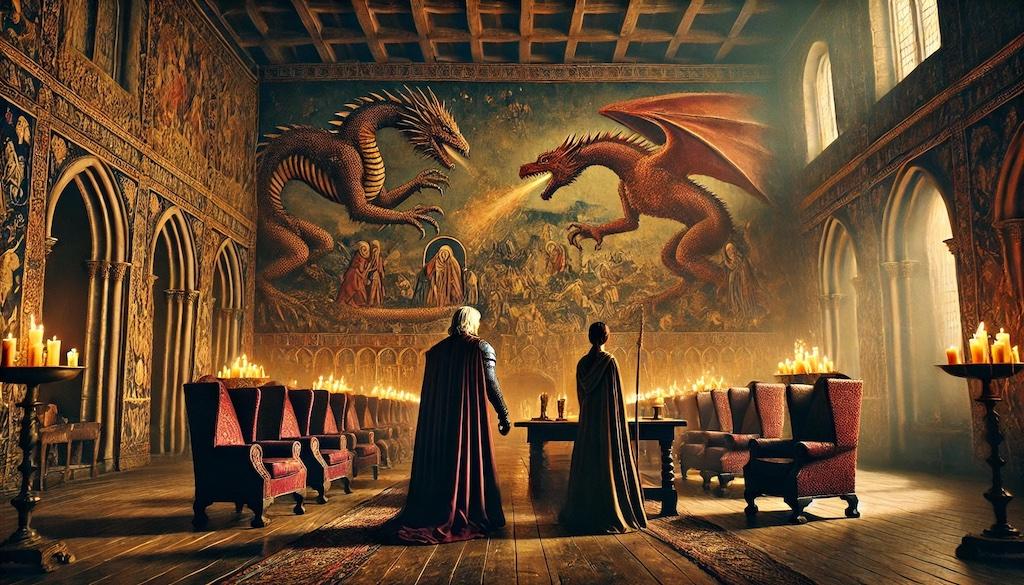
Jeezel stopped a moment, in awe at the grand tapestries adorning the walls. They depicted scenes of epic battles between dragons and saints, the vibrant threads weaving tales of heroism and divine intervention. The dragons, captured in mid-roar with scales that seemed to shimmer with a life of their own, contrasted starkly agains the faces of the saints, their halo glowing softly in the dim light. Always the sensitive nose, Jeezel detected hints of incense and aged spices absorbed over centuries by the fabric, with a faint trace of mildew lingering on old stones and the faint sweetness of preserved herbs. She shivered.
Silas invited her to seat on one of the high-backed chairs upholstered in deep burgundy velvet that surrounded a massive oak table, carved with runes and symbols of protection. Jeezel frowned at the oddity to find pagan magic in a convent. As she sat the fabric of her gown brushed agains the plush velvet with a delicate sliding sound, like a faint sigh. The flickering flames of candelabras cast dancing shadows across the room, around which an array of curious relics and artifacts were scattered–an astrolabe here, a crystal ball there, and various objects of mystical significance.
Despite being an aficionado of pageants and grand performances, Jeezel couldn’t say she wasn’t impressed. Silas, ever the pillar of calm and wisdom, took a seat at the table, his fingers tracing the runes carved into the wood.
“Jeezel,” he began, his voice a soothing balm against the room’s charged energy, “I know I can trust you. Before we delve into the heart of these rituals, I must tell you something.”
Man! Here we are, she thought. She tensed on her chair.
“There are some people who would rather see the merger fail. They are doing anything in their power to foster such an outcome. We cannot let them win.”
Jeezel’s face tightened and she struggled to maintain her composure. She tapped with her fingers on the table to distract the head mortician’s attention and help her regain a stoic demeanor. Her mind raced weighing the implications. Malové had said that the Crimson Opus wasn’t just any artifact, it was key to immense power and knowledge, something that could tip the scales in their favour. How she regretted at that moment she had not paid enough attention at the merger meeting. Now, Malové was gone, somewhere, and Jeezel wasn’t even sure the postcard she had sent the coven was real. All she knew was that Malové counted on her to find that relic. And for that, she had to step in what appears to be a nest of vipers. She reminded herself she had survived worse competition in the past and still won her trophies with pride.
“Silas,” she said, her voice measured but with an edge of tension, “this complicates things more than I anticipated. We have enough on our hands ensuring the rituals go smoothly without sabotage.” She paused, taking a deep breath to steady herself. “But we cannot allow these factions to succeed. The merger is crucial for our mutual survival advancement. We’ll need to be vigilant, Silas. Every step we take, every ritual we perform, must be meticulously guarded. And we must identify who these adversaries are, and what they are planning.” She wished Malové would see her in that instant. She craved support from anyone. She looked at Silas, her eyes full of hope he could help. “I have a task from Malové that is of paramount importance,” she started and almost jumped from the chair when her hedgehog amulet almost tased her. A warning. Her mind suddenly found a new clarity. She realized she has been about to tell him about the Crimson Opus. Jeezel noticed the man’s finger was still caressing the runes on the table. Had he been casting a spell on her? She shook her head.
“Those six rituals cannot be compromised. I’ll need your help to ensure that we succeed. We must be prepared to act swiftly and decisively.”
Silas’ hand froze. He nodded. She wasn’t sure there wasn’t some irritation in his voice when he said: “You have my full support, Jeezel. We’ll strengthen our defenses and keep a close watch on any suspicious activities. The stakes are too high for failure.”
Did he mean that he would keep a close eye on her next moves? She’d have to be careful in her search of the Crimson Opus. She realized she needed some help. Malové, you entrusted me with that mission. Then, you’d have to trust me with whom I choose to trust.
February 7, 2024 at 12:40 am #7356In reply to: The Incense of the Quadrivium’s Mystiques
“Would you be looking for me?”
Cedric jumped. Where on earth had she come from? It was the blond witch from the cafe, but what was she doing sneaking up behind him when he’d seen her rushing off down the street not a minute before! And yet here she was, smirking at him like butter wouldn’t melt!
He studied her. She wasn’t conventionally pretty he decided, with her thin, sharp features. And she had no meat on her bones. Cedric liked women who were soft and had a bit of something he could squeeze. And she was so … white … almost like one of those albinos … still, there was something he found strangely compelling about her.
She’s a witch, he reminded himself. “What on earth gave you the idea I was following you?” He twisted his mouth into an amused sneer, hoping it showed the contempt she surely deserved.
“You’re not then?” Her gaze was unswerving and Cedric had to look away, pretending to take a great interest in a black poodle peeing on a nearby lamp post. Cedric liked dogs and up until six months ago had a miniature schnauzer called Mitzy. Thinking of Mitzy, he felt the familiar little squeeze in his chest.
“I’m Frigella O’Green,” she said, still studying him intently.
Reluctantly he pulled his gaze back towards her. “Oh, ah … Cedric … just Cedric.” He’d nearly told her his surname which didn’t seem a good idea, all things considered. Out of habit, he raised his hand to take hers, then remembering, thrust it awkwardly in his jacket pocket.
“Well, just Cedric, if you’re not looking for me, I’ll be off … I’m in a bit of a hurry.” Then she smiled at him, properly this time, and Cedric wondered why he hadn’t thought she was pretty a moment ago. “Nice hat by the way, Cedric. Stylish.” She turned then and Cedric watched her stride down the street until she was no longer visible. Distractedly he brushed the wool tweed of his cap.
Frigella O’Green is a witch, Cedric, he told himself sternly.
September 5, 2023 at 1:35 pm #7276In reply to: Family Stories From The Other Side ~ Book Two
Wood Screw Manufacturers
The Fishers of West Bromwich.
My great grandmother, Nellie Fisher, was born in 1877 in Wolverhampton. Her father William 1834-1916 was a whitesmith, and his father William 1792-1873 was a whitesmith and master screw maker. William’s father was Abel Fisher, wood screw maker, victualler, and according to his 1849 will, a “gentleman”.
Nellie Fisher 1877-1956 :
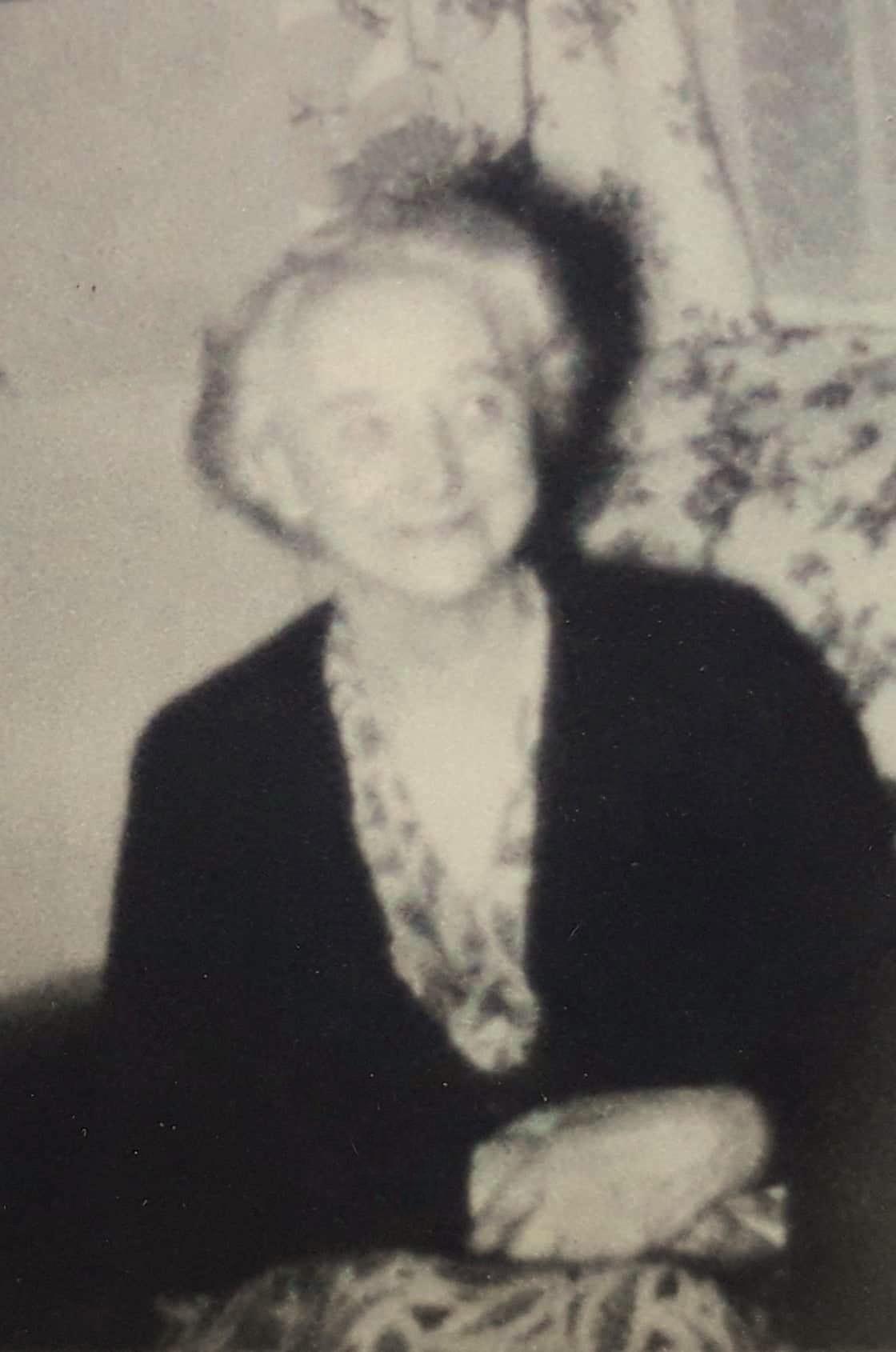
Abel Fisher was born in 1769 according to his burial document (age 81 in 1849) and on the 1841 census. Abel was a wood screw manufacturer in Wolverhampton.
As no baptism record can be found for Abel Fisher, I read every Fisher will I could find in a 30 year period hoping to find his fathers will. I found three other Fishers who were wood screw manufacurers in neighbouring West Bromwich, which led me to assume that Abel was born in West Bromwich and related to these other Fishers.
The wood screw making industry was a relatively new thing when Abel was born.
“The screw was used in furniture but did not become a common woodworking fastener until efficient machine tools were developed near the end of the 18th century. The earliest record of lathe made wood screws dates to an English patent of 1760. The development of wood screws progressed from a small cottage industry in the late 18th century to a highly mechanized industry by the mid-19th century. This rapid transformation is marked by several technical innovations that help identify the time that a screw was produced. The earliest, handmade wood screws were made from hand-forged blanks. These screws were originally produced in homes and shops in and around the manufacturing centers of 18th century Europe. Individuals, families or small groups participated in the production of screw blanks and the cutting of the threads. These small operations produced screws individually, using a series of files, chisels and cutting tools to form the threads and slot the head. Screws produced by this technique can vary significantly in their shape and the thread pitch. They are most easily identified by the profusion of file marks (in many directions) over the surface. The first record regarding the industrial manufacture of wood screws is an English patent registered to Job and William Wyatt of Staffordshire in 1760.”
Wood Screw Makers of West Bromwich:
Edward Fisher, wood screw maker of West Bromwich, died in 1796. He mentions his wife Pheney and two underage sons in his will. Edward (whose baptism has not been found) married Pheney Mallin on 13 April 1793. Pheney was 17 years old, born in 1776. Her parents were Isaac Mallin and Sarah Firme, who were married in West Bromwich in 1768.
Edward and Pheney’s son Edward was born on 21 October 1793, and their son Isaac in 1795. The executors of Edwards 1796 will are Daniel Fisher the Younger, Isaac Mallin, and Joseph Fisher.There is a marriage allegations and bonds document in 1774 for an Edward Fisher, bachelor and wood screw maker of West Bromwich, aged 25 years and upwards, and Mary Mallin of the same age, father Isaac Mallin. Isaac Mallin and Sarah didn’t marry until 1768 and Mary Mallin would have been born circa 1749. Perhaps Isaac Mallin’s father was the father of Mary Mallin. It’s possible that Edward Fisher was born in 1749 and first married Mary Mallin, and then later Pheney, but it’s also possible that the Edward Fisher who married Mary Mallin in 1774 was Edward Fishers uncle, Daniel’s brother. (I do not know if Daniel had a brother Edward, as I haven’t found a baptism, or marriage, for Daniel Fisher the elder.)
There are two difficulties with finding the records for these West Bromwich families. One is that the West Bromwich registers are not available online in their entirety, and are held by the Sandwell Archives, and even so, they are incomplete. Not only that, the Fishers were non conformist. There is no surviving register prior to 1787. The chapel opened in 1788, and any registers that existed before this date, taken in a meeting houses for example, appear not to have survived.
Daniel Fisher the younger died intestate in 1818. Daniel was a wood screw maker of West Bromwich. He was born in 1751 according to his age stated as 67 on his death in 1818. Daniel’s wife Mary, and his son William Fisher, also a wood screw maker, claimed the estate.
Daniel Fisher the elder was a farmer of West Bromwich, who died in 1806. He was 81 when he died, which makes a birth date of 1725, although no baptism has been found. No marriage has been found either, but he was probably married not earlier than 1746.
Daniel’s sons Daniel and Joseph were the main inheritors, and he also mentions his other children and grandchildren namely William Fisher, Thomas Fisher, Hannah wife of William Hadley, two grandchildren Edward and Isaac Fisher sons of Edward Fisher his son deceased. Daniel the elder presumably refers to the wood screw manufacturing when he says “to my son Daniel Fisher the good will and advantage which may arise from his manufacture or trade now carried on by me.” Daniel does not mention a son called Abel unfortunately, but neither does he mention his other grandchildren. Abel may be Daniel’s son, or he may be a nephew.
The Staffordshire Record Office holds the documents of a Testamentary Case in 1817. The principal people are Isaac Fisher, a legatee; Daniel and Joseph Fisher, executors. Principal place, West Bromwich, and deceased person, Daniel Fisher the elder, farmer.
William and Sarah Fisher baptised six children in the Mares Green Non Conformist registers in West Bromwich between 1786 and 1798. William Fisher and Sarah Birch were married in West Bromwich in 1777. This William was probably born circa 1753 and was probably the son of Daniel Fisher the elder, farmer.
Daniel Fisher the younger and his wife Mary had a son William, as mentioned in the intestacy papers, although I have not found a baptism for William. I did find a baptism for another son, Eutychus Fisher in 1792.
In White’s Directory of Staffordshire in 1834, there are three Fishers who are wood screw makers in Wolverhampton: Eutychus Fisher, Oxford Street; Stephen Fisher, Bloomsbury; and William Fisher, Oxford Street.
Abel’s son William Fisher 1792-1873 was living on Oxford Street on the 1841 census, with his wife Mary and their son William Fisher 1834-1916.
In The European Magazine, and London Review of 1820 (Volume 77 – Page 564) under List of Patents, W Fisher and H Fisher of West Bromwich, wood screw manufacturers, are listed. Also in 1820 in the Birmingham Chronicle, the partnership of William and Hannah Fisher, wood screw manufacturers of West Bromwich, was dissolved.
In the Staffordshire General & Commercial Directory 1818, by W. Parson, three Fisher’s are listed as wood screw makers. Abel Fisher victualler and wood screw maker, Red Lion, Walsal Road; Stephen Fisher wood screw maker, Buggans Lane; and Daniel Fisher wood screw manufacturer, Brickiln Lane.
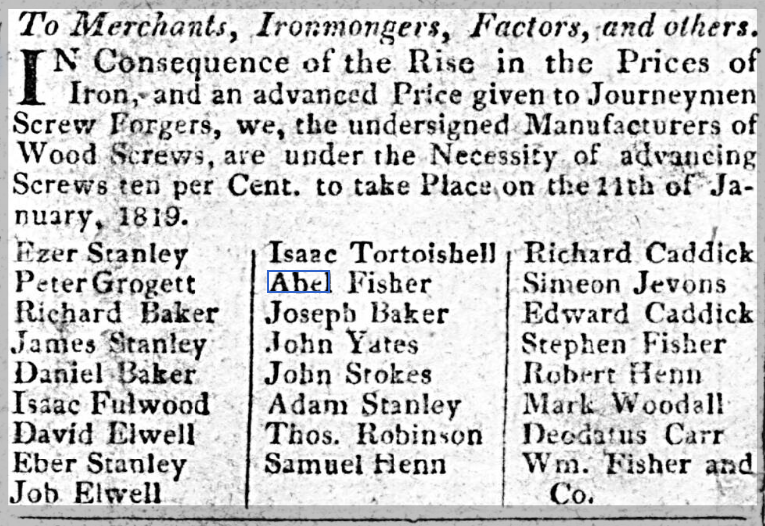
In Aris’s Birmingham Gazette on 4 January 1819 Abel Fisher is listed with 23 other wood screw manufacturers (Stephen Fisher and William Fisher included) stating that “In consequence of the rise in prices of iron and the advanced price given to journeymen screw forgers, we the undersigned manufacturers of wood screws are under the necessity of advancing screws 10 percent, to take place on the 11th january 1819.”
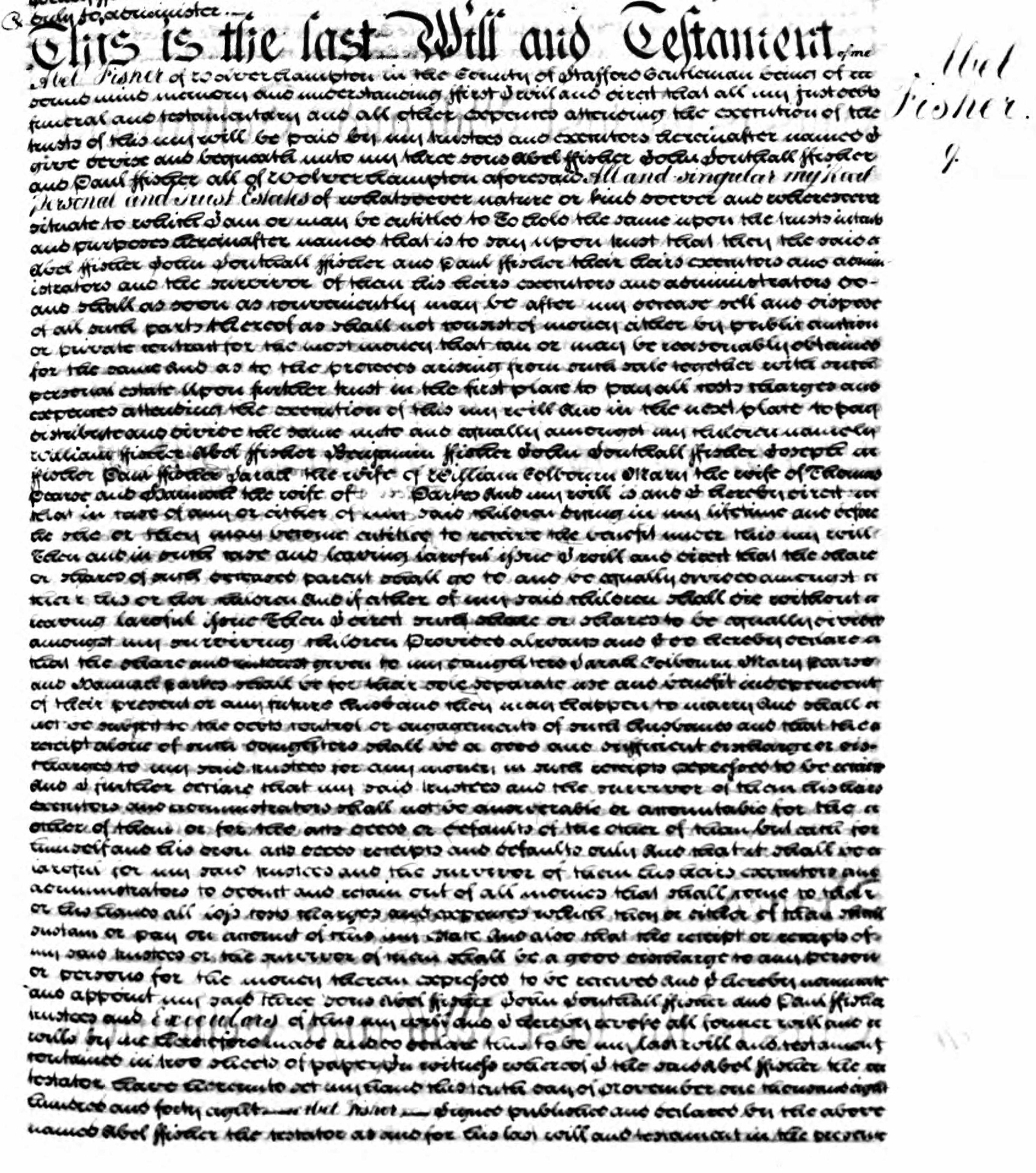
In Abel Fisher’s 1849 will, he names his three sons Abel Fisher 1796-1869, Paul Fisher 1811-1900 and John Southall Fisher 1801-1871 as the executors. He also mentions his other three sons, William Fisher 1792-1873, Benjamin Fisher 1798-1870, and Joseph Fisher 1803-1876, and daughters Sarah Fisher 1794- wife of William Colbourne, Mary Fisher 1804- wife of Thomas Pearce, and Susannah (Hannah) Fisher 1813- wife of Parkes. His son Silas Fisher 1809-1837 wasn’t mentioned as he died before Abel, nor his sons John Fisher 1799-1800, and Edward Southall Fisher 1806-1843. Abel’s wife Susannah Southall born in 1771 died in 1824. They were married in 1791.
The 1849 will of Abel Fisher:
 July 5, 2023 at 8:21 pm #7263
In reply to: Family Stories From The Other Side ~ Book Two
Solomon Stubbs
1781-1857
Solomon was born in Hamstall Ridware, Staffordshire, parents Samuel Stubbs and Rebecca Wood. (see The Hamstall Ridware Connection chapter)
Solomon married Phillis Lomas at St Modwen’s in Burton on Trent on 30th May 1815. Phillis was the llegitimate daughter of Frances Lomas. No father was named on the baptism on the 17th January 1787 in Sutton on the Hill, Derbyshire, and the entry on the baptism register states that she was illegitimate. Phillis’s mother Frances married Daniel Fox in 1790 in Sutton on the Hill. Unfortunately this means that it’s impossible to find my 5X great grandfather on this side of the family.
Solomon and Phillis had four daughters, the last died in infancy.
Sarah 1816-1867, Mary (my 3X great grandmother) 1819-1880, Phillis 1823-1905, and Maria 1825-1826.Solomon Stubbs of Horninglow St is listed in the 1834 Whites Directory under “China, Glass, Etc Dlrs”. Next to his name is Joanna Warren (earthenware) High St. Joanna Warren is related to me on my maternal side. No doubt Solomon and Joanna knew each other, unaware that several generations later a marriage would take place, not locally but miles away, joining their families.
Solomon Stubbs is also listed in Whites Directory in 1831 and 1834 Burton on Trent as a land carrier:
“Land Carriers, from the Inns, Etc: Uttoxeter, Solomon Stubbs, Horninglow St, Mon. Wed. and Sat. 6 mng.”
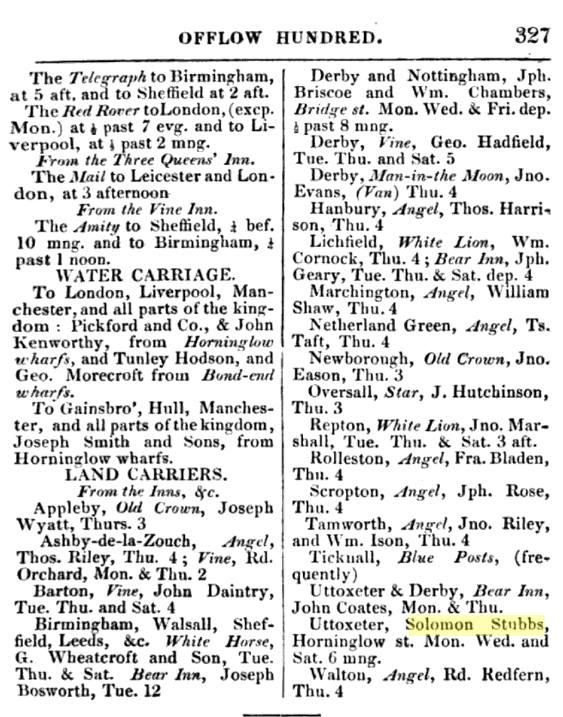
Solomon is listed in the electoral registers in 1837. The 1837 United Kingdom general election was triggered by the death of King William IV and produced the first Parliament of the reign of his successor, Queen Victoria.
National Archives:
“In 1832, Parliament passed a law that changed the British electoral system. It was known as the Great Reform Act, which basically gave the vote to middle class men, leaving working men disappointed.
The Reform Act became law in response to years of criticism of the electoral system from those outside and inside Parliament. Elections in Britain were neither fair nor representative. In order to vote, a person had to own property or pay certain taxes to qualify, which excluded most working class people.”Via the Burton on Trent History group:
“a very early image of High street and Horninglow street junction, where the original ‘ Bargates’ were in the days of the Abbey. ‘Gate’ is the Saxon meaning Road, ‘Bar’ quite self explanatory, meant ‘to stop entrance’. There was another Bargate across Cat street (Station street), the Abbot had these constructed to regulate the Traders coming into town, in the days when the Abbey ran things. In the photo you can see the Posts on the corner, designed to stop Carts and Carriages mounting the Pavement. Only three Posts remain today and they are Listed.”
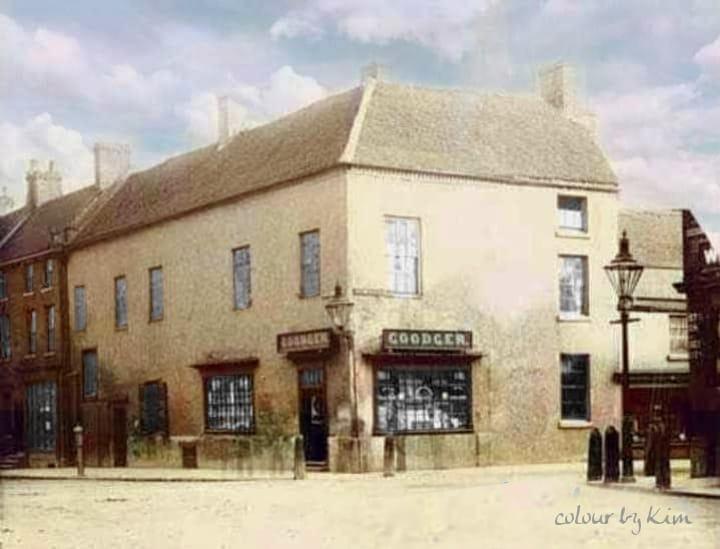
On the 1841 census, Solomon’s occupation was Carrier. Daughter Sarah is still living at home, and Sarah Grattidge, 13 years old, lives with them. Solomon’s daughter Mary had married William Grattidge in 1839.
Solomon Stubbs of Horninglow Street, Burton on Trent, is listed as an Earthenware Dealer in the 1842 Pigot’s Directory of Staffordshire.
In May 1844 Solomon’s wife Phillis died. In July 1844 daughter Sarah married Thomas Brandon in Burton on Trent. It was noted in the newspaper announcement that this was the first wedding to take place at the Holy Trinity church.
Solomon married Charlotte Bell by licence the following year in 1845. She was considerably younger than him, born in 1824. On the marriage certificate Solomon’s occupation is potter. It seems that he had the earthenware business as well as the land carrier business, in addition to owning a number of properties.
The marriage of Solomon Stubbs and Charlotte Bell:
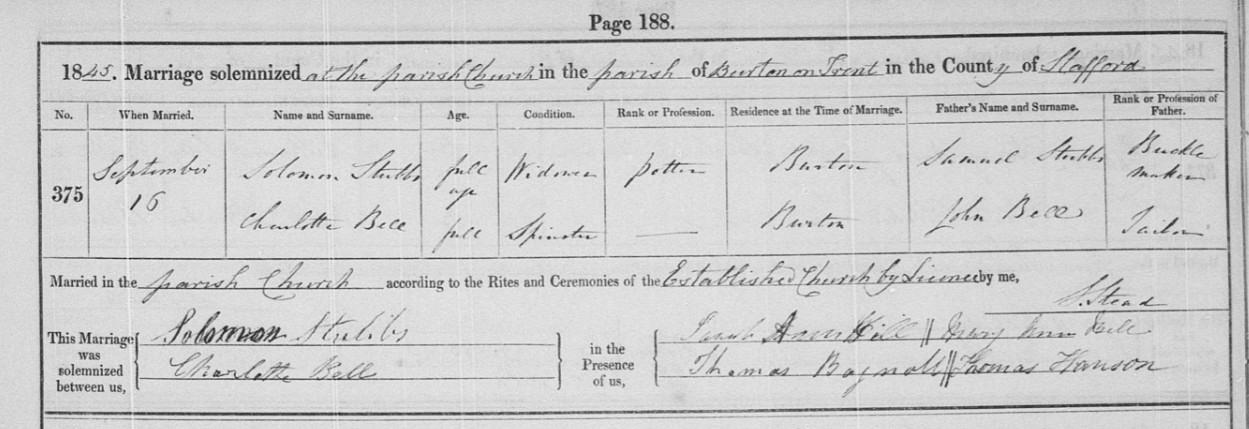
Also in 1845, Solomon’s daughter Phillis was married in Burton on Trent to John Devitt, son of CD Devitt, Esq, formerly of the General Post Office Dublin.
Solomon Stubbs died in September 1857 in Burton on Trent. In the Staffordshire Advertiser on Saturday 3 October 1857:
“On the 22nd ultimo, suddenly, much respected, Solomon Stubbs, of Guild-street, Burton-on-Trent, aged 74 years.”
In the Staffordshire Advertiser, 24th October 1857, the auction of the property of Solomon Stubbs was announced:
“BURTON ON TRENT, on Thursday, the 29th day of October, 1857, at six o’clock in the evening, subject to conditions then to be produced:— Lot I—All those four DWELLING HOUSES, with the Gardens and Outbuildings thereto belonging, situate in Stanleystreet, on Goose Moor, in Burton-on-Trent aforesaid, the property of the late Mr. Solomon Stubbs, and in the respective occupations of Mr. Moreland, Mr. Scattergood, Mr. Gough, and Mr. Antony…..”
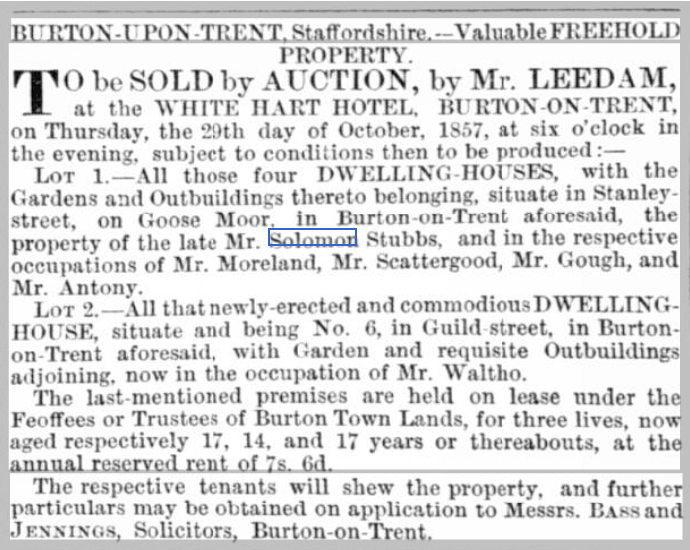
Sadly, the graves of Solomon, his wife Phillis, and their infant daughter Maria have since been removed and are listed in the UK Records of the Removal of Graves and Tombstones 1601-2007.
-
AuthorSearch Results