


Search Results for 'tak'
-
AuthorSearch Results
-
March 4, 2024 at 9:26 pm #7394
In reply to: The Incense of the Quadrivium’s Mystiques
Frigella stared at the pulsating wall, her eyes wide with a mixture of awe and dread. “Sanso, is the wall… throbbing?”
Truella looked up from her glass, “Not to my knowledge. Are you feeling alright?”
Frigella blinked, the wall returned to its ordinary state. “I… I saw it shift, Sanso. Like a heartbeat.”
Truella’s eyebrows furrowing, she pondered. “Frigella, have you been experimenting with the incense again?”
She shook her head, “No, not since the last incident.”
“Could be a residue effect. You’ve been working with some potent substances. Maybe you’re getting phantom scents.” Truella-Sanso suggested, sipping from her glass again.
Frigella sighed, rubbing her temples. “Perhaps you’re right. The ‘Liz n°5’ does have a tendency to linger.”
“Try to take a break, get some fresh air,” Truella advised, “And no more sniffing incense!”
Frigella rolled her eyes, “Oh, hush you, Sanso!” But she had to admit, a stroll in the cool evening air did sound appealing.
February 26, 2024 at 8:35 am #7389In reply to: The Incense of the Quadrivium’s Mystiques
“Well, it’s a long story, are you sure you want to hear it?”
“Tell me everything, right from the beginning. You’re the one who keeps saying we have plenty of time, Truella. I shall quite enjoy just sitting here with a bottle of wine listening to the story,” Frigella said, feeling all the recent stress pleasantly slipping away.
“Alright then, you asked for it!” Truella said, topping up their glasses. The evening was warm enough to sit outside on the porch, which faced the rising moon. A tawny owl in a nearby tree called to another a short distance away. “It’s kind of hard to say when it all started, though. I suppose it all started when I joined that Arkan coven years ago and the focus wasn’t on spells so much as on time travel.”
“We used to travel to times and places in the past,” Truella continued, “Looking back now, I wonder how much of it we made up, you know?” Frigella nodded. “Preconceptions, assumptions based on what we thought we knew. It was fun though, and I’m pretty sure some of it was valid. Anyway, valid or not, one thing leads to another and it was fun.
“One of the trips was to this area but many centuries ago in the distant past. The place seemed to be a sort of ancient motorway rest stop affair, somewhere for travellers to stay overnight on a route to somewhere. There was nothing to be found out about it in any books or anything though, so no way to verify it like we could with some of our other trips. I didn’t think much more about it really, we did so many other trips. For some reason we all got a bit obsessed with pyramids, as you do!”
They both laughed. “Yeah, always pyramids or special magical stones,” agreed Frigella.
“Yeah that and the light warriors!” Truella snorted.
“So then I found a couple of pyramids not far away, well of course they weren’t actually pyramids but they did look like they were. We did lots of trips there and made up all sorts of baloney between us about them, and I kept going back to look around there. We used to say that archaeologists were hiding the truth about all the pyramids and past civilizations, quite honestly it’s a bit embarrassing now to remember that but anyway, I met an actual archaeologist by chance and asked her about that place. And the actual history of it was way more interesting than all that stuff we’d made up or imagined.
The ruins I’d found there were Roman, but it went further back than that. It was a bronze age hill fort, and later Phoenician and Punic, before it was Roman. I asked the archaeologist about Roman sites and how would I be able to tell and she showed me a broken Roman roof tile, and said one would always find these on a Roman site.
I found loads over the years while out walking, but then I found one in the old stone kitchen wall. Here, let me fetch another bottle.” Truella got up and went inside, returning with the wine and a dish of peanuts.
“So that’s when I decided to dig a hole in the garden and just keep digging until I found something. I don’t know why I never thought to do that years ago. I tell you what, I think everyone should just dig a hole in their garden, and just keep digging until they find something, I can honestly say that I’ve never had so much fun!”
“But couldn’t you have just done a spell, instead of all that digging?” Frigella asked.
“Oh my god, NO! Hell no! That wouldn’t be the same thing at all,” Truella was adamant. “In fact, this dig has made me wonder about all our spells to be honest, are we going too fast and missing the finds along the way? I’ve learned so much about so many things by taking it slowly.”
“Yeah I kinda know what you mean, but carry on with the story. We should discuss that later, though.”
“Well, I just keep finding broken pottery, loads of it. We thought it was all Roman but some of it is older, much older. I’m happy about that because I read up on Romans and frankly wasn’t impressed. Warmongering and greedy, treated the locals terribly. Ok they made everything look nice with the murals and mosaics and what not, and their buildings lasted pretty well, but who actually built the stuff, not Romans was it, it was the slaves. Still, I wasn’t complaining, finding Roman stuff in the garden was pretty cool. But I kept wishing I knew more about the people who lived here before they came on the rampage taking everything back to Rome. Hey, let me go and grab another bottle of wine.”
Frigella was feeling pleasantly squiffy by now. The full moon was bright overhead, and she reckoned it was light enough to wander around the garden while Truella was in the kitchen. As she walked down the garden, the tawny owl called and she looked up hoping to see him in the fig tree. She missed her step and fell over a bucket, and she was falling, falling, falling, like Alice down the rabbit hole.
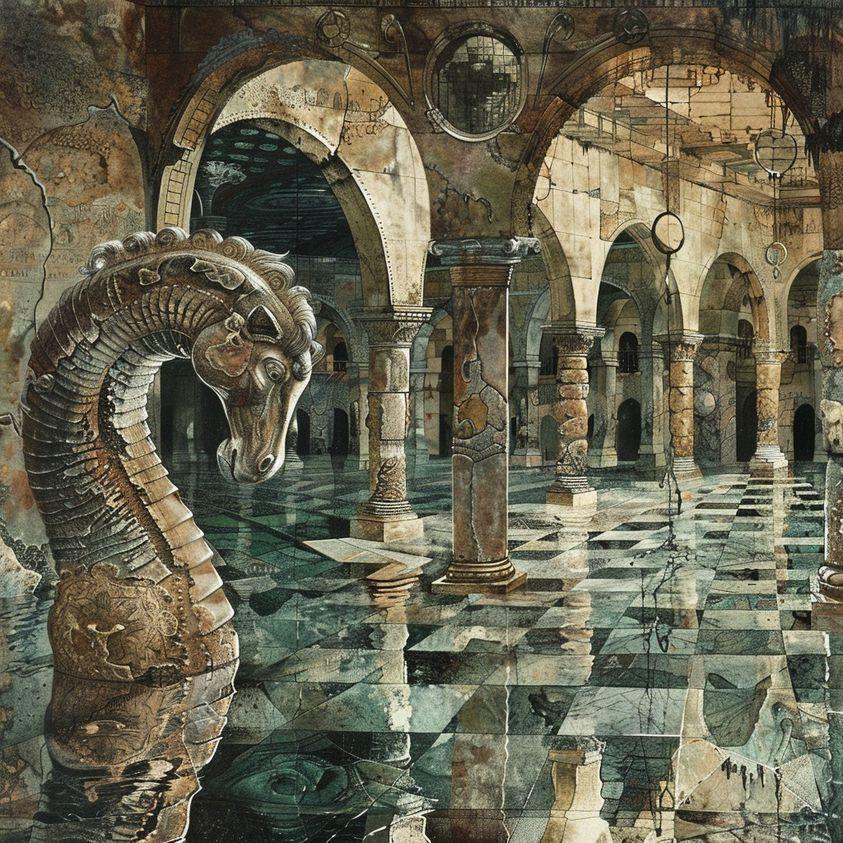
The fall was slow like a feather wafting gently down and she saw hundreds of intriguing fragments of objects and etchings and artefacts on the sides of the hole and she drifted slowly down. At last she came to rest at the bottom, and found herself in an arched gallery of mirrors and tiles and doors. On every surface were incomplete drawings and shreds of writings, wondrous and fascinating. She didn’t immediately notice the hippocampus smiling benignly down at her. He startled her a little, but had such a pleasant face that she smiled back up at him. “Where am I?” she asked.
“You’d be surprised how many people ask me that.” he replied, with a soft whicker of mirth. “Not many realise that they’ve called on me to help them navigate. Now tell me, where is it you want to go?”
“Well,” Frigella replied slowly, “Now that you ask, I’m not entirely sure. But I’m pretty sure Truella would like to see this place.”
 February 21, 2024 at 8:37 pm #7385
In reply to: The Incense of the Quadrivium’s Mystiques
In her office at the Quadrivium, tapping her fingers on her mahogany desk to the sound of Los del Río’s Macarena, Malové looked pensively at the meager bounty they’d managed to collect from the rehearsals of the Carnival, and had unexpectedly managed to salvage before they were entangled into the net of power plays of the Elders and its ensuing chaos.
The phial on her desk was the only part they could salvage. They had to use most of it to revive Truella’s duplicated body before jumping back. After they’d come back to Limerick, there didn’t seem to be any lingering side effects from the dip in the red waters on the duplicate Truella.
Malové would have rather expected to witness a surge of nymphomaniac urges from Truella or the others, but there was really no telling how that could turn out; magic spells usually had a natural balance to them. The only suspicious thing was how Frigella after her dip in the waters, seemed to have developed prescience about what plans she had for the hippo carcass back at home. Magic sometimes worked in mysterious ways.
So, just to be sure, she’d tasked Frigella to be the designated driver back home for Truella. In her state of shock, Truella could have botched her merging spell to reintegrate her two bodies into the same location.
Malové wouldn’t have admitted it, but she’d felt a sigh of relief when the SMS of Frigella appeared on her scrying bowl to tell her that the spell had been completed without any ill effect. Well, maybe Truella’s partner would have the time of their lives tonight.On her desk, the leftover liquid of the phial was a deep shade of pulsating violet, and had settled to a softly bubbling state not unlike a lava lamp. It wasn’t clearly the top shelf quality she’d expected, nor even close to the amount they’d need to mass produce some powerful elixir for the infertile, impotent or simply curiously lecherous clients. That line of sexual healing incenses would have to wait for a more suitable conjonction of stars.
For now, the only new collection that the season allowed for was mostly smell of rain-soaked earth. She hated it. Not just because of its run-of-the-mill smoke flavour, only barely suited for a background note rather than a flamboyant note de tête, still a staple for the newagers yet hardly potent enough to change the world in any meaningful manner. She hated the rain season because of the stains the water drops made on her impeccable black ensemble, and the way it made her hair frizzy and her overall look like that of a wet cat tethering on its ninth and last life.
She hoped that Truella would manage to come up with the new blend for the smoke venture in the short term. Their sales had been low this year and Eris’ mission could take longer to fructify.
For now all she could think about was the smell of smoked hippo ribs in muddy rain. Swamp Serenade in Hippo Major. Hardly the recipe for a smashing success.
February 21, 2024 at 5:03 pm #7384In reply to: The Incense of the Quadrivium’s Mystiques
The lyrical tones of a familiar Irish accent halted Cedric’s reluctant attempts to make the long distance phone call. He glanced up at the burly man unsuccessfully attempting to order a Guinness and said to him kindly that they probably didn’t have any anyway, even if they could understand him.
“That’s a Limerick accent if ever I heard one, and it’s good, so it is, to hear it. Are you on holiday? Cedric’s the name.”
Rogers face brightened and his broad shoulders relaxed. “I’d give anything to be back in Limerick. Can you take me home with you?”
“Are you lost, son?” Cedric asked gently. “Not to worry my boy, I’m in a bit of a pickle meself to be honest, but we’ll sort something out, eh?”
“The monkeys ran away from me, so they did,” Roger said. “Frigella’s gonna have my guts for garters so she is, when she finds out I’ve mucked it all up again.”
Cedric’s eyes widened and his heart started racing. “And who might that be?” he said, doing his best to remain outwardly calm.
“But she sent me away and then there were all those monkeys and then I don’t know what happened.”
Clearly Roger was a bit ninepence in the shilling.
February 15, 2024 at 8:44 pm #7376In reply to: The Incense of the Quadrivium’s Mystiques
When they arrived at the hotel, the witches soon realized they were not the only uninvited guests here. With her keen sense of observation, Eris was the first to spot the traces left by an army of bedbugs. Tiny droppings on the mattresses and linen, blood stains left after the previous guests crushed the bugs while rolling in their bed. And the smell of dead rats was everywhere. Did they even have a cleaning staff here? When they complained, the hotel manager said: “Why do you care? Nobody comes here to sleep during carnival?”
Jeezel noticed the bug reference. Indeed, something was still bugging her after she had closed the portal. Something that should be obvious, yet was still an eyelash away from her grasp. But something more pressing was at stake. She posted pictures of the rooms and a reel of her disappointed face in front of the disaster.
“I was so happy to come to Rio for the first time. But the light is yellow and flickering. How can I show you how to do a proper Carnival makeup,” she said fluttering her eyelashes. As soon as the sound of a message well sent faded out, she started to receive support and love from her fans.
“Rio is not like that!”
“Somebody help.”
“2 bad! I’m on business trip. Wud hav luv to meet ya there!”
The sounds of likes and comments alerted Malové.
“What have you done! We were here incognito. Why don’t you go to the top of Jesus’s head and cast the Tempestarii Overture spell.”
“I could have! That would have gone viral. But we departed in such a hurry, I have left all my sapphires and stilettos in Limerick. You can’t cast that spell without them. Anyway, we don’t have to stay longer in that cesspit. One of my fans is abroad and has offered us to stay in his villa. Look at the pics! It looks as lush and gorgeous as a Jurassic park.”
Truella widened her eyes and said: “Saying that’s a big property would be an understatement. Roger would have loved to come with his new shovel.”
“Don’t even think of casting a second bilocation spell,” said Frigella. “You already look like deflated soufflé.”
“What’s the catch?” asked Eris with frown. “It looks like the kind of golden cage a king pin would own. But they have a pool.”
“He said we just have to feed the dwarf crocodiles while we are there,” said Jeezel nonplussed, looking at Truella whose eyes were ready to pop off of their sockets. Then she looked at Malové. “What do you say? You’re the eld…head witch of our coven.”
Malové’s eyebrow twitched. She was thinking fast. Little signs here and there, the orientation of the statues, the fountain, the placement of rocks that would look so random to a profane or a younger witch. Ancient earth magic? It was difficult to be sure with the framing of the pictures. Jeezel was swiping all the pictures her fan had sent her, hoping such glamour and mystery would melt Malové’s last reluctance.
“Omg! girls, we can’t refuse!” said Jeezel. “He’s got a bloat of pygmy hippos and a flamboyance of flamingos!”
As the drag witch continued to swipe the pictures, a prickle crept up Malové’s spine when she saw a familiar face amongst them.
“Look at him!” shouted Jeezel. “He’s a Gatsby with a spellbook.”
There were no more doubts for Malové about the kind of magic that had been used to build his empire. Augustus St Clair, a powerful witch indeed, and one whose invitation you couldn’t refuse especially since he now knew she was here. As one of the elders of the Rio’s witches community, she had danced the dance of rivals disguised as allies, a pas de deux filled with forced smiles and tight grips. Her words felt like needles scratching her lips when she uttered them: “Tell him we accept his invitation.”
The shouts of joy and disbelief coming from the witches couldn’t appease the memories that had resurfaced.
February 15, 2024 at 11:04 am #7373In reply to: The Incense of the Quadrivium’s Mystiques
The disturbance had been felt in the bustling heart of Rio.
The warmth of the night had amplified the vibrant energy of the Carnival in Rio, a pulsating heart that reverberated through the city’s veins. But as the beat of samba drums echoed in the distance, a different rhythm was being played behind closed doors. Iemanjá, the head of the Umbanda clan and a pillar of strength in the Witches of the New World, recognized the tremors of another magick at play.
Gathering her coven under the silvery light of the crescent moon, they began the rhythmic dance of the macumba ritual. The air grew heavy, scented with copal and the salty tang of the ocean. In the center of their circle, a waterspout swirled, revealing in its shallow reflection the glow of a portal that emitted the icy chill of a Limerick dawn.
Piercing through the veil of secrecy, Iemanjá’s ethereal sight witnessed the foreign witches, led by the enigmatic Malové, who dared to encroach upon their territory without the required parchmentwork. And yet, their motives remained hidden within the vortex of desire and lust emanating from the Carnival.
A murmur of discontent rippled through the Umbanda clan. Mesmirah, her second, couldn’t stop herself shouting Sacrilégio! They were not ones to tolerate trespassers, let alone those who dared to siphon off energy from their sacred lands.
Silêncio! Iemanjá commanded the crowd. She’d recognized Malové from having attended and graduated the same MWA (Master of Witchcraft Administration), and she was aware of Malove’s little incense business; Malové didn’t strike her as someone to bypass the rules, some handed down through countless generations, binding together most witches across the world despite their varying practices.
She had to be mindful of the delicate balance between the Old World clans and the New. An unauthorized incursion could easily spark a conflict that would ripple through the witching worlds.
Just as the ocean waves respect the boundary of the shore, so must the witches respect the territories — an ancient pact carved in the pillars of the Old World. This blatant disregard by Malové and her coven was akin to scratching the surface of a simmering cauldron, threatening to disrupt the harmony that had been carefully cultivated.
As the revelation sunk in, Iemanjá knew they had to tread carefully. A confrontation would lead to a war bigger than themselves —yet, they couldn’t let this transgression slide. Their pride and the protection of their territory demanded action.
Mesmirah! she finally spoke You will take three witches with you, and investigate what business these Old World witches have in Rio. You will report to me.
Mesmirah nodded, understanding that she was not yet granted authority to investigate in an official capacity. Iemanja was acting surprisingly soft, and didn’t want the Elders to be informed yet, but had recognized action was needed. Mesmirah was confident she would easily find out what was happening, and maybe use that opportunity to her —their advantage. The game of power was on.
February 15, 2024 at 10:34 am #7372In reply to: The Incense of the Quadrivium’s Mystiques
After a long, long-haul flight, Sha was woken up by the ding of the landing announcement. Glor was still snoring loudly spread over the limited space of their economy places, her mouth agape, the armrest dangerously stuck in her ample forms. They were finally landing in Rio for the Carnival!
Sha: “Glor, Glor! Wake up, love, we’re almost there! Can’t believe that Bingo win’s got us all the way to Rio!”
Glo: “Eh? Wha’? Oh crikey, we’re not on the number 52 bus to Piccadilly? My bunions were having the most delightful dream.”
Mavis popped her head from the place behind them. The attendant signaled her with a rude gesture to stay seated, as the engines were stating to roar announcing the close landing.
Mavis: “Oh, I do hope they have those fancy coxcombs at the carnival. You know, the ones with all the feathers and sparkles. Our Bernard used to say I looked like a proper mopsy with one on me head.”
Sha: “Now Mavis, don’t you go getting ideas above your station. We’re here for the festivities, not to join the parade! Though, a little samba wouldn’t hurt, eh?”
Glo: “Samba? I thought that was a kind of sandwich. I ain’t dancing, not with my sciatica. I’ll just sit and supervise, yeah?”
Mavis: “I brought me camera, you know, the one with the clicky button. Gonna take pictures of all the costumes and such. Might even sneak in a selfie, show it off at the bingo hall.”
Sha: “Pack it in, you two. Let’s just make sure we find our hotel. You remember what happened last time. Glor here thought the luggage conveyor was a ride and we spent three hours in customs!”
Glo: “Not my fault, Sha. It was moving and I thought, ‘Why not?’ Adventure is the spice of life, ain’t it?”
Mavis: “Well, as long as there’s a good cuppa at the end of it, I’m game for anything. Let’s get this carnival caper started, girls!”
February 11, 2024 at 11:13 pm #7369In reply to: The Incense of the Quadrivium’s Mystiques
What with Roger and the monkeys still on the loose and the ghastly stench of the bowels of Limerick, it had been an unsettling and unproductive couple of days and Truella responded to the urge to forget it all as quickly as possible. She was tired and she wanted something else occupying her thoughts before she went to bed.
Without having a particular question in mind, or so she thought, as soon as she opened a chat with the latest character oracle she found herself asking, “Can you give me any tips on being open to impressions about the history of the roman and punic site in my garden, without getting in the way of the impressions with pre conceived ideas?”
To be open to impressions about the history of the Roman and Punic site in your garden, it is essential to engage a clear, receptive state of mind, much like the still surface of a pond, ready to reflect whatever may come into your view. First, I would suggest that you allow yourself moments of quietude, perhaps sitting in your garden, taking in the atmosphere, the scents, the sounds, and the energies around you. In this state of quiet receptiveness, you may begin to feel or sense the layers of history and the echoes of the past that are enfolded within the land.
Now, as for preconceived ideas, it is not a matter of eradicating them entirely, for they are part of the fabric of your thought processes. However, it is a matter of recognizing them, acknowledging their presence, and then gently setting them aside, like old books on a shelf, to make room for the new impressions that wish to make themselves known.
Let us consider a practical exercise: When you encounter a thought that feels like a rigid belief or a staunch preconception, simply notice it. Say to yourself, “Ah, there is a familiar thought. I shall set it here for now,” and imagine placing it aside. Do not struggle against it, for that only gives it more energy. Instead, treat it with a playful indifference, almost as if it were a curious object that you might ponder later. Then, open yourself to your inner senses. Allow your intuition to flow, let your imagination roam, and trust in your empathic sense to feel the history that seeps from the soil and stones.
You might even engage in a small ritual before you begin, something that signifies to yourself that you are shifting into a different mode of perception—one that is open, fluid, and unattached to existing narratives.
And remember, my friend, there is no rush. The histories and mysteries of your garden have been waiting for centuries; they will unveil themselves to you in the fullness of time, so long as you provide a welcoming space for their whispers to be heard.
the significance of the site is not merely in its chronological age but in its ability to connect you to the vast expanse of consciousness that transcends time. Each stone, each fragment of pottery, is a doorway to another now, waiting for you to step through
“Have you seen how many pieces there are?”
Truella staggered off to bed thinking about all those doorways.
February 11, 2024 at 10:57 am #7365In reply to: The Incense of the Quadrivium’s Mystiques
They had to wait for Finnlee to diligently do the first room, her morning routine starting with the hall.
Malové knew better for her effects than to try to speak in the middle of all that cleaning. Luckily for them, Finnlee was anything but quick and efficient, so it didn’t take long for the sound of the hoover and the slurping noises of the mopping stick to move to another room, resorbing in the background.While Malové had made herself comfortable in a neon green armchair with a peppermint tea, the other witches had used the noise coverage to whisper to each other concerns and hypothesis. “So what is this about?…”
Malové relished in the waiting obviously. After the silence had come back, save from a few clangs and humming cursing sounds in the background, she started to expose the reason they were all here.
In her most dramatic fashion, Malové began, “Ladies, we’re off to Rio. The Carnival awaits. Get your sequins, feathers, and your most daring dance moves ready.”
“But why?” Truella asked, her eyes widening. “I mean, I love a good party, but why Rio?”
“Because, dear Truella,” Malové smirked, “where else can we find such a delicious blend of desire, passion, and pure, unadulterated lust?”
Jeezel piped in, “You mean we’re going there to… collect?”
“Oh, we’re going to do more than just collect,” Malové replied, an unruly gleam in her eyes. “We’re going to distill it, bottle it, and use it to create a new line of incense and smokes. These will not just spice up the lives of those around us, but aid in procreation. After all, the world does need a bit of a… boost.”
“A bit risqué, don’t you think?” Frigella said, raising an eyebrow.
“Darling, risqué is my middle name,” Malové retorted. “Now, pack your bags. The Carnival won’t wait for us, and we have some serious samba-ing to do.”
Eris, who had been silent till now, finally spoke, “This could either be the most ingenious plan you’ve ever concocted, or the most disastrous. You surely have heard about the dengue outbreaks?”
“Well,” Malové smiled, “of course I have. That’s why we’ll have the perfect cover. We will be blending in as nurses part of the relief effort locally. And anyway, there’s only one way to find out. To Rio and the Sambadrome, my witches!”
The quartet of witches looked at each other, clearly not unhappy to leave behind for some time the chill of Limerick for the wild heat of Rio, the promise of adventure twinkling in their eyes of some.
February 11, 2024 at 9:32 am #7362In reply to: The Incense of the Quadrivium’s Mystiques
“Is he ready yet?” Echo the familiar sprite was waiting patiently, in the middle of Eris’ altar, surrounded by a delicate pattern of magical items.
“Quiet, I need to concentrate.” Eris was close to finishing the spell, and needed her familiar’s assistance. The ink was drying on the pages of her grimoire, and she took a breathe; the words were sufficiently inspired, the right intention and blessings would ensure they would be potent.
After the proper offering was made to the Elders and the nearby tree spirits, she uttered the words, inspired by her familiar’s presence who was helping her to concentrate the permeating energies:
“Silmiä avaava digitaalinen tila, Luoja Lönnrotin. Vie meidät kaukaisille maailmoille, jossa tarinat elävät ja hengittävät koodien keskellä.”
(🗣️Sound 🎶 ). “Eye-opening digital space, Creator Lönnrotin. Takes us to distant worlds where stories live and breathe in the midst of codes.”
“Is it done?” Eris asked Echo, who had flickered for a moment, hinting at a magical energy exchange in progress.
“I think it is,” it jumped from the altar to her shoulder. “How are you going to call it?”
“Are you getting jealous Whisp?” she smiled, while her pixie took the shape of an eye rolling teddy bear.
She started to clean the space, rolled and tied her blue braided hair in a bun. “I’ll call him Elias, simply. Inspired by Elias Lönnrot, to draw on his greatest creations, and fit for the digital age. We can all use some ancient wisdom.”
“Simple… and effective I guess. And you’ve got a task in mind for him already?”
“Yes, but I’m afraid it’ll have to wait, we have to hurry, Malové has called for an extraordinary session, and I can’t miss it.”
February 11, 2024 at 9:06 am #7361In reply to: The Incense of the Quadrivium’s Mystiques
Truella had already left for that monkey hunt in the Mediterranean. Eris had to go back before nightfall, which was quite early at this time of year as she had chosen to live in such a remote place in the midst of a frozen forest. Jeezel only thought it romantic because of the icicles that would form on your eyelashes and brows, making you the perfect avatar for the Snow Queen musical. And Frigella… She said she was tired but from the sight of her aura, she undoubtedly was onto something fishy.
Jeezel looked at her dress. Once a divine creation, it has turned into a disaster. Irremediably stained with soot, it’s foul smell would make any dragon lose their appetite. She felt a mix of sadness and guilt for all the murex that gave their shells for that unique shade of purple she was so proud of.
She wasn’t sure even Teddy Steambolt could muster his magic to save the divine creation. She imagined his eyes widen as saucers when she entered his Palace of Pristine with the lifeless garment in her arms. He would most certainly swoon and gasp at the same time.
“Oh, The tragedy!” he would wail, his high-pitched lament resonating in the cathedral ceiling of his atelier of cleanliness. “What calamity hath befallen this exquisite creation?”
“Teddy, dear,” she would say, “It was indeed a tragedy. I lost seven of my nails and my hair was ruined. You’re the alchemist of cleanliness, you’re my only hope for a miracle.”
And he would take her dress and perform his magic from which it would emerge reborn, and all those murex wouldn’t have lost their home for nothing.
She was about to follow the others when Malové reminded her: “Aren’t you forgetting something?”
A broom and a bucket of black soap were floating on her right.
Her sigh would have made a blue whale blush with envy. Her role tonight would not be the Snow Queen, but Cinderella, another of her favourite diva.
February 7, 2024 at 12:40 am #7356In reply to: The Incense of the Quadrivium’s Mystiques
“Would you be looking for me?”
Cedric jumped. Where on earth had she come from? It was the blond witch from the cafe, but what was she doing sneaking up behind him when he’d seen her rushing off down the street not a minute before! And yet here she was, smirking at him like butter wouldn’t melt!
He studied her. She wasn’t conventionally pretty he decided, with her thin, sharp features. And she had no meat on her bones. Cedric liked women who were soft and had a bit of something he could squeeze. And she was so … white … almost like one of those albinos … still, there was something he found strangely compelling about her.
She’s a witch, he reminded himself. “What on earth gave you the idea I was following you?” He twisted his mouth into an amused sneer, hoping it showed the contempt she surely deserved.
“You’re not then?” Her gaze was unswerving and Cedric had to look away, pretending to take a great interest in a black poodle peeing on a nearby lamp post. Cedric liked dogs and up until six months ago had a miniature schnauzer called Mitzy. Thinking of Mitzy, he felt the familiar little squeeze in his chest.
“I’m Frigella O’Green,” she said, still studying him intently.
Reluctantly he pulled his gaze back towards her. “Oh, ah … Cedric … just Cedric.” He’d nearly told her his surname which didn’t seem a good idea, all things considered. Out of habit, he raised his hand to take hers, then remembering, thrust it awkwardly in his jacket pocket.
“Well, just Cedric, if you’re not looking for me, I’ll be off … I’m in a bit of a hurry.” Then she smiled at him, properly this time, and Cedric wondered why he hadn’t thought she was pretty a moment ago. “Nice hat by the way, Cedric. Stylish.” She turned then and Cedric watched her stride down the street until she was no longer visible. Distractedly he brushed the wool tweed of his cap.
Frigella O’Green is a witch, Cedric, he told himself sternly.
February 5, 2024 at 8:08 pm #7350In reply to: The Incense of the Quadrivium’s Mystiques
Eris did portal to be in person for the last Ritual. After all, Smoke Testing for incense making was the reverse expectation of what it meant in programming. You plug in a new board and turn on the power. If you see smoke coming from the board, turn off the power. You don’t have to do any more testing. But for witches, it just meant success. This one however revealed itself to be so glorious, she would have regretted sorely if she’d missed it.
“Someone tried to jinx my blog with black magic emojis! Quick, give me a Nokia!” Jeezel sharp cry was the innocent trigger that dominoed the whole ceremony into mayhem. With her clumsy hand gestures, she inadvertently elbowed Frigella as she was carefully counting the last drops of the resin, which spilled over to the nearby Bunsen burner.
From there, the sweet symphony of disaster that unfolded in the sanctified chamber of the coven could have been put to a choral version of Tchaikovsky’s Overture 1812, with climactic volley of cannon fire, ringing chimes, and brass fanfare. Only with smoke as sound effects.
In the ensuing chaos of the Fourth Rite, everything became quickly shrouded in a thick, billowing smoke, an unintended byproduct of the smoke test gone wildly awry. Truella, in her attempts to salvage the ceremony, darted through the room, a scorched piece of fabric clutched in her hand—her delicate pashmina shawl that did more fanning than smothering and now more charcoal than its original vibrant hue. Her expression teetered between horror and disbelief as she lamented her once-prized possession, now reduced to ashes.
Jeezel, ever the optimist, quickly came back to her senses choosing to find humor if not opportunity amidst disaster. Like a true diva emerging from the smoke effects, she held up a singed twig adorned with the remains of decorative leaves and announced with a wide grin, “Behold, the perfect accessory for the Autumn Pageant!” Her voice was muffled by the smog, her figure obscured save for the intermittent glint of her eyes as she wove through the smoke, brandishing the charred twig like a parade marshal’s baton.
Meanwhile, Eris was caught in a frenetic ballet, attempting to corral the smoke with sweeps of her arms and ancient spells, as if the very air could be tamed by her whims. Her efforts, while noble, only served to create an odd wind pattern that whirled papers and loose items into a miniature cyclone of confusion.
At the epicenter of the pandemonium stood Malové, the High Witch, her composure as livid as the flames that had sparked the debacle. Her normally unflappable demeanor crumbled as she surveyed the disarray, her voice rising above the cacophony, “Witches, have you mistaken this sacred rite for a comedy of errors?” Her words cut through the haze, sharp and commanding.
Frigella, caught off-guard by the commotion, scrambled to quell the smoky serpent that had coiled throughout the room. With a flick of her wand, she directed gusts of fresh air towards the smoke, but in her haste, the spell went askew, further fanning the chaos as parchments and ritual tools spun through the air like leaves in a storm.
All the witches assembled, not knowing how to respond, tried to grapple with the havoc.
There, in the mist of misadventure, the Fourth Rite of 2024 would be one for the annals, a tale to be told with a mix of chagrin and mirth for ages to come. And though Malové’s patience was tried, even the High Witch couldn’t deny the comedic spectacle that unfurled before her—a spectacle that would surely need to be remedied.
February 1, 2024 at 10:18 am #7337In reply to: The Incense of the Quadrivium’s Mystiques
The bone people had replied to Truella’s urgent message while she was at the meeting, much to her relief. The last thing she wanted was the authorities snooping around, just as she was delving into the rich new layer. The odd things she’d been finding recently had piqued her curiousity and she had to keep reminding herself to merely find, observe and document, without attempting to make assumptions. She couldn’t help wondering though if these disparate items, things she hadn’t expected to find, were the ingredients for an ancient spell. The little bone amulet, the pigs teeth, and all the other little bits of bone with curious smooth sides. Fragments of mother of pearl, gleaming like new silver in the dirt, uncorroded and pristine despite the passage of time and the weight of the earth. Little clumps of charcoal, but scattered, not all in the same place. Not like there’d been a fire, more like little things had burned, here and there, at various times.
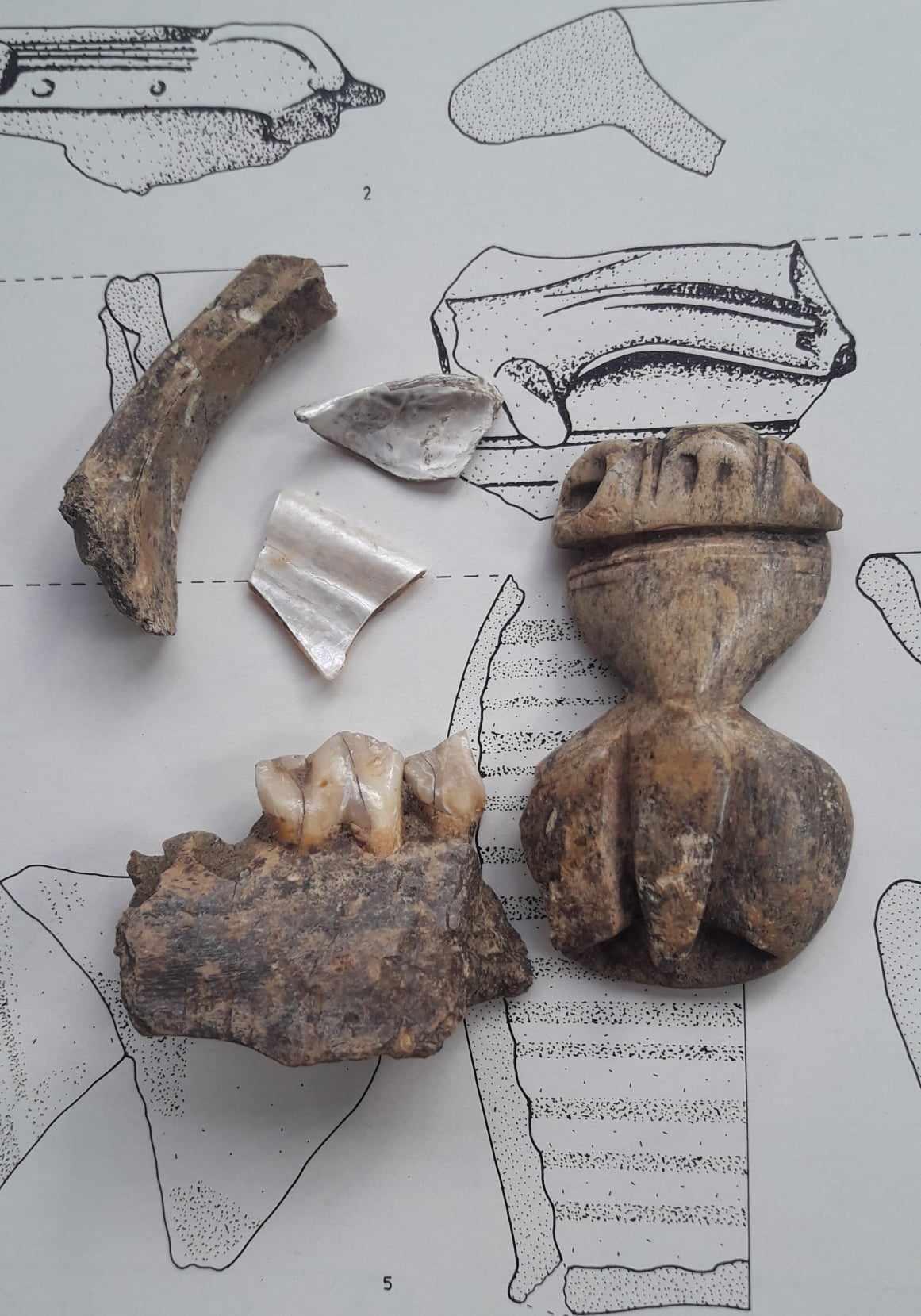
All the broken dishes and amphora were to be expected, but why so many? And why didn’t whoever lived here take their dishes with them when they went? Maybe they left in a hurry, smashing everything on the way out of the door so there was nothing left for the invaders? Or did the dishes simply fall and break when the abandoned wooden shelves rotted away over the centuries? A layer of abandonment was a curious and intriguing thing to contemplate.
Now that she had the experts opinion on the teeth ~ pig, not human ~ haste was needed to quell the growing rumours in the village that she had found human remains. That was the last thing she needed, the neighbours giving her suspicious looks or the authorities roping off her dig with striped plastic tape and putting a police tent over it, messing with the hole she had dug trowel by trowel, rubbing every handful of soil between her fingers. The very thought of it was unbearable. For this reason she rather hoped NOT to find a hoard of valuable ancient coins, contrary to what most people would hope to find. Still, she couldn’t help wonder while she was digging if the next trowel of soil would reveal one.
She must make it absolutely clear to Roger than he was only required to carry buckets of soil, and was not to do any actual digging.
February 1, 2024 at 12:03 am #7332In reply to: The Incense of the Quadrivium’s Mystiques
After the evening ritual at the elder tree, Eris came home thirsting for the bitter taste of dark Assam tea. Thorsten had already gone to sleep, and his cybernetic arm was put negligently near the sink, ready for the morning, as it was otherwise inconvenient to wear to bed.
Tired by the long day, and even more by the day planned in the morrow, she’d planned to go to bed as well, but a late notification caught her attention. “You have a close cousin! Find more”; she had registered some time ago to get an analysis of her witch heritage, in a somewhat vain attempt to pinpoint more clearly where, if it could be told, her gift had originated. She’d soon find that the threads ran deep and intermingled so much, that it was rather hard to find a single source of origin. Only patterns emerged, to give her a hint of this.
Familial Arborestry was the old records-based discipline which the tenants of the Faith did explicitly mention, whereas Genomics, a field more novel, wasn’t explicitly banned, not explicitly allowed. Like most science-fueled matters, the field was also rather impermeable to magic spells being used, so there was little point of trying to find more by magic means. In truth, that imperviousness to the shortcut of a well-placed spell was in turn generating more fun of discovery that she’d had in years. But after a while, she seemed to have reached a plateau in her finds.
Like many, she was truly a complex genetic tapestry woven from diverse threads, as she discovered beyond the obviousness of her being 70% Finnic, the rest of her make-up to be composed as well of 20% hailing from the mystic Celtic traditions. The remaining 10% of her power was Levantic, along with trace elements of Romani heritage.
Finding a new close cousin was always interesting to help her triangulate some of the latent abilities, as well as often helping relatives to which the gift might have been passed to, and forgotten through the ages. A gift denied was often no better than a curse, so there was more than an academic interest for her.
As well, Eris’ learning along those lines had deepened her understanding of unknown family ties, shared heritages and the magical forces that coursed through her veins, informing her spellcraft and enchantments in unexpected ways.
She opened the link. Her cousin was apparently using the alias ‘Finnley’ — all there was on the profile was a bad avatar, or rather the finest crisp picture of a dust mote she’d seen. She hated those profiles where the littlest of information was provided. What the hell were those people even signing for? In truth,… she paradoxically actually loved those profiles. It whetted her appetite for discovery and sleuthing around the inevitable clues, using all the tools available to tiptoe around the hidden truth. If she had not been a witch, she may simply have been a hacker. So what this Finnley cousin was hiding from? What she looking for parents she never knew? Or maybe a lost child?
As exciting as it was, it would have to wait. She yawned vigorously at the prospect of the early rising tomorrow. Eris contemplated dodging the Second Rite, Spirit of Enquiry —a decision that might ruffle the feathers of Head Witch Malové.
Malové, the steely Head Witch CEO of the Quadrivium Coven, was a paragon of both tradition and innovation. Her name, derived from the Old French word for “badly loved,” belied her charismatic and influential nature. Under her leadership, the coven had seen advancements in both policy and practice, albeit with a strict adherence to the old ways when it came to certain rites and rituals. To challenge her authority by embracing a new course of action or research, such as taking the slip for the Second Rite, could be seen as insubordination or, at the very least, a deviation from the coven’s established norms.
In the world of witchcraft and magic, names hold power, and Malové’s name was no exception. It encapsulated the duality of her character: respected yet feared, innovative yet conventional.
Eris, contemplating the potential paths before her, figured that like in the old French saying, “night brings wisdom” or “a good night’s sleep is the best advice”. Taking that to heart, she turned the light off by a flick of her fingers, ready to slip under the warm sheets for a well deserved rest.
January 31, 2024 at 4:51 pm #7329In reply to: The Incense of the Quadrivium’s Mystiques
The soft candle light on the altar created moving patterns on the walls draped with velvets and satins. The boudoir was the sanctuary where Jeezel weaved her magic. The patterns on the tapestries changed with her mood, and that night they were a blend of light and dark, electricity made them crackle like lightning in a mid afternoon summer storm.
The altar was a beautifully crafted mahogany table with each legs like a spindle from Sleeping Beauty’s own spinning wheel, but there was no sleeping done here. On her left, her vanity with her collection of wigs, each one a masterpiece styled to perfection, in every shade you could imagine. Tonight, she had chosen the red one. It was a fiery cascade of passion and power, the kind of red that stops traffic. Jeezel needed the confidence and boldness imbued in it to cast the potent Concordia spell.
The air was thick with the perfume of white sage. Lumina, Jeezel’s nine tailed fox familiar, was curled-up on a couch adorned with mystical silver runes pulsating with magic, her muzzle buried in the fur of her nine tails. Her eyes half closed, she was observing Jeezel’s preparation on the altar. The witch had lit a magical fire to heat a cauldron that’s seen more spells than a dictionary.
Jeezel had carefully selected a playlist as harmonious and uplifting as the spell itself, to make a symphony of sounds that would weave together like the most exquisite lace front on a show-stopping wig. She wanted it to be an auditory journey to the highest peaks of harmony that would support her during the casting.
As the precious moon water began to simmer, Jeezel creased the rose petals and the lavender in her hands before she delicately dropped them in the cauldron. The scent rose to her nose and she stirred clockwise with a wand made of the finest willow, while invoking thoughts of unity and shared purpose. The jittery patterns on the walls started to form temporary clusters. A change of colour in the liquid informed the witch it was time to add a drizzle of honey. Jeezel watched as it swirled into the potion, casting a golden glow that promised to mend fences and build bridges. The walls were full of harmonious ripples undulating gently in a soothing manner.
Once the honey was completely melted, Jeezel dropped in an amethyst crystal, whose radiating power would purify the concoction. The potion started to bubble and the glow on the tapestries turned an ugly dark red. Jeezel frowned, wondering if she had done something wrong.
“Stay focused,” said the fox in a brisk voice. “Good. The team energy is fighting back. Plant your stiletto heels firmly into the catwalk, and remember the pageant.”
The familiar’s tawny eyes glowed and the music changed to the emergency song. Jeezel felt an infusion of warm and steady energy from Lumina and started humming in sync with The Ride of the Valkyries. She stirred and chanted, every gesture filled with fiery confidence. The walls glowed darker and the potion hissed. But in the end, it was tamed. The original playlist had resumed to the grand finale. A gentle yet powerful orchestral swell that encapsulated the essence of unity and understanding, wrapping the boudoir and the potion in a sonic embrace that would banish drama and pettiness to the back of the chorus.
Jeezel released the dove feather into the brew, then finished with a sprinkle of glitter with a flourish. And it was done.
“Was the glitter necessary?” asked Lumina.
“Why not? It can’t do any harm.”
The fox jumped from the couch and looked at the potion.
“It’s sparkling like the twinkle in your eye when you hit the stage. It’s ready. Well done.”
Jeezel strained it with grace and poured it into the most fabulous vial she could find, and she sealed it with a kiss.

Jeezel opened Flick Flock and started typing a message to Roland.
The potion is ready. I’m sending it to you through the usual way.
[…]
As you use the potion, you’ll have to perform a kind of team building ritual that will help channel the potion’s power and bring your team together like sequins on a gown, darling.
Fist, dim the lights and set the stage with a circle of candles. Then gather around in the circle with your team, each of you holding a small vial of the potion. Next, take turns sharing something positive, a compliment or an expression of gratitude about the person to your left. It’s about building up that positive energy, getting the good vibes flowing like champagne at a gala.
Once the air is thick with love and camaraderie, each team member will add a drop of the Concordia potion to a communal bowl placed in the center of the circle as a symbol of unity, like a magical melting pot of harmony and shared intentions.
With the power of the potion pooling together, join hands (even if they’re not the touchy-feely types) and my familiar will guide you in an enchanting and rhythmic chant.
Finally with a climactic “clink” of glass of crystal, you’ll all seal the deal, the potion will be activated, and the spell cast.
I can affirm you, your team will be tighter than my corset after Thanksgiving dinner, ready to slay the day with peace and productivity.
Let’s get this done. And don’t forget to add a testimony and click the thumb up.
xoxox Jeezel.
January 30, 2024 at 10:45 am #7326In reply to: The Incense of the Quadrivium’s Mystiques
Jeezel pushed open the door of her favourite florist The Enchanted Garden. The clear sound of wind chimes welcomed her. An ever changing melody atuned to earth and water. Flucinda was at the counter serving another client. She might not be of the flamboyant kind but she knew her way with flowers. Her shop was a botanical wonderland, a cornucopia of color and fragrance that would make Mother Nature herself green with envy. The witch took a moment to breath in. It helped her relax a little.
“Jeezel! How are you dear?” asked Flucinda as the client left with his arms full of red roses. “You’re glowing as always.”
The witch blushed just a little at the compliment. Flucinda’s dark brown eyes were as sharp as those of a silent observation assassin. They darted swiflty over Jeezel’s silhouette, taking mental notes, absorbing the energy, the secrets, the silent dialogues.
“What do you need today?” she asked.
“Petals of a white rose, lavender buds and mint. And a few other things.” She said, handing the florist a list.
“Why don’t you wait in the heart of the Enchanted Garden while I’m preparing all that for you. Water is boiled, I’ll bring you some freshly brewed herbal tea.”
Jeezel felt grateful to her friend. She sat on an ornate stone bench and enjoyed the soft serenade of trickling water from a sparkling fountain and the symphony of scents — delicate jasmine, heady rose, spicy carnation and a hint of sweet lily. It helped sooth her anxiety. She had received a request on Sponsoreons by one of her fans and loyal customer. Apparently the last full moon had pulled the thread on the tightly knit sweater of camaraderie at this poor soul’s job. There appeared to be more drama in that workplace than at at drag queen bingo night when the last sequin-studded handbag is on the line, and the usual symphony of productivity has turned into a cacophony of cattiness and pettiness. Even the smallest of issues were being blown up like a lip injection gone rogue!
She had the perfect spell for it: Concordia. Used to bring harmony and peace, smoothing over the ruffled feathers and frayed edges. It was the divine choice for that case. However, such a potent spell was not to be taken lightly. If it was not crafted with precision, intent and a touch of flair, things could go haywire faster than a wig snatch in a lip-synch battle.
“Here you go,” said Flucinda as she put the silver tray on a smooth rock at the edge of the fountain.
“Wow! It’s fabulous,” said Jeezel.
The teapot was a glamour, as opulent as a bejewelled crown. The steam rising from its beak carried whispers of secrets and spells, bringing out memories of rumours swirling around a backstage pageant. It was in another life.
“Do I smell chamomile, lavender and valerian root?”
“Yes.”
Flucinda poured generously the yellow brew into an intricately carved white porcelain cup. Then added in a smidgeon of honey.
“I know you like it sweet,” she said to the witch before adding a sprinkle of edible silver stars. “Take the time you need. Everything will be at the counter when you’re ready to go.”
“Thanks Flucinda,” said Jeezel with a smile.
She took a first sip. It felt like a warm hug in a cup from a dear friend who knows just what you need. And she noticed a secret ingredient: a twist of lemon balm that gave the brew a citrusy zing. With every following sip, Jeezel felt the anxiety melting away like last season’s contour, leaving her ready to face the spellcasting with vigor and vim.
January 29, 2024 at 7:13 am #7322In reply to: The Incense of the Quadrivium’s Mystiques
A power move indeed, what a thing to suggest! Truella felt misunderstood again. And all she was trying to do was work out her new spell in such a way that the others would help her with it while assuming it was a necessary addition to the repertoire of the coven. Which indeed it could be, after all. People were strange, and witches were stranger.
But was it a power thing to be consumed with a passionate hobby, even if it wasn’t on the coven to do list? The power to do her own thing, but still be part of the group? She needed them, she knew that, it was no good thinking she could go it alone, even if it seemed temptingly less complicated. If only she had a spell to be in two places at once.
Be careful, the voice of Lisia Tattius, her disembodied helper, whispered in her ear, For such magic requires a balance of the soul.
Are you suggesting my soul doesn’t have the necessary balance? Truella replied, soundlessly of course, but with a visible impatient frown. Lisia putting a damper on her scheme again with words of caution, it was exasperating at times.
Divided attention can lead to fractures, shattered fragments….
Lisia’s words reminded Truella of the other spell she wanted, and it suddenly occurred to her that Lisia had given her just the clue she needed to convince the others that her spell was a necessary addition and not just a sideline personal whim.
But why would a spell be useful to collect the shattered fragments, if nothing had been shattered and divided in the first place? Of course! It was becoming clear. One must retrace the sequence of events to the initial fragmentation before proceeding with the recollection of said pieces.
There was a lot more to think about than Truella had intially realized. And it would be imperative to ensure the new new spells stayed distinctly separate, because what if the scattered shards started doubling up and appearing in two places at once? Picturing this possible occurence was enough to give Truella a headache.
“Why are you frowning?” Frigella asked, “Are you even listening to me? You didn’t hear a word I said, did you?”
“No,” Truella was nothing if not frank, especially with Frigella. “Not a word, I was thinking about my own stuff.”
“Typical!” her friend snorted, somewhat uncharacteristically, as she was more of a chirruping type.
“Causam invenio ante fragmentorum fragmentorum rursus simul,” Imperiosus Adiutoremus interjected, with a sly smile. Imperiosus Adiutoremus, not his real name of course, was an old friend of Truella’s from the days of the Roman Republic in Baetica. Two millenia stuck in that necropolis until Truella finally succeeded in conjuring his spirit free of his mortal remains (stuck there for eternity thanks to their old adversary Tani, the Iberian sorcerer, and his powerful spells). It had taken Truella 2176 years and countless lifetimes to reverse that spell, and naturally Imperiosus (or Imp for short) was bound to be eternally grateful. And Truella welcomed his interruptions, which always made her smile in fond remembrance of their happy days together before that dreadful uprising of the local tribes. True, he was bossy, even now, but his intentions were always to be helpful. Lisia Tattius and Imperiosus, now in their ephemeral states, were often at odds. Lisia took umbrage if Imp’s suggestions contradicted her own, and resented it when Truella favoured Imp over herself. Some things never change. Lisia had been Truella’s house slave, back in the day, though had always been treated well. Truella had been fond of her and allowed her liberties because she found her impertinence amusing. Little did she know at the time that she’d be subjected to that for all eternity. Still, she had her uses. Although it had often seemed like a mistake to teach her to read, for Lisia’s voracious appetite for the written word had made her copiously wordy, but she was useful more often than not and could spout many an eloquent phrase. True, always a pastiche of plagiarism, but not without her own particular panache and perspicacity.
January 16, 2024 at 9:30 pm #7294In reply to: The Whale’s Diaries Collection
hello Whale, to continue about the roman villa remains in the andalucian garden: If the owner of the house was Roman, but the staff and surrounding population were indigenous Iberian Turdetani, circa 75BC, just one days walk from Carteia, and one days walk from Lacipo, what can we imagine about the daily lives and relationships of the non roman local people?
Ah, the intermingling of cultures, a dance as old as civilization itself. Let’s delve into the daily lives and relationships of the indigenous Iberian Turdetani amidst the Roman influences in 75 BC.
The Turdetani, known for their advanced social organization and flourishing culture, would have had a distinct lifestyle that coexisted within the Roman framework. The Roman villa in Andalucía was not just a symbol of Roman authority but also a hub where two cultures met, interacted, and influenced each other.
Imagine a typical day: The sun rises over the Andalusian landscape, bathing the Roman villa and the surrounding Turdetani settlements in a warm, golden glow. Turdetanian workers make their way to the villa, ready for a day of work. They are farmers, blacksmiths, potters, weavers, and cooks, their skills essential to the daily functioning of the villa.
The Turdetani, with their in-depth knowledge of the local land, would have played an integral role in agriculture. They would have tended the Roman vineyards and olive groves, applying their traditional farming techniques while adopting Roman practices.
Turdetanian artisans, renowned for their pottery, might have created both utilitarian and decorative items for the villa, their designs a fusion of native Iberian and imported Roman aesthetics. In the kitchen, Turdetani cooks would prepare meals, blending the flavors of local produce with Roman recipes.
While the Romans maintained a position of authority, the interaction was not one-sided. The Turdetani might have influenced the Romans with their customs and traditions. Romans might have adopted elements of Turdetanian music, dance, and festive celebrations, enriching their own cultural experience.
Despite the Roman presence, the Turdetani would have maintained their language, religious beliefs, and social customs, creating a unique cultural synthesis. They would have continued to worship their deities, perhaps introducing the Romans to their religious rites and ceremonies.
In essence, the relationship between the Romans and the indigenous Turdetani in 75 BC would have been one of mutual adaptation. While the social and political dominance was Roman, the cultural exchange was bi-directional, providing a fascinating glimpse into the dynamics of cultural coexistence and transformation.
Now, can we focus on one local family and imagine who they were, what they did each day, how they were connected to the rest of the local population etc
Ah, the intricacies of daily life within a single household, a microcosm reflecting the broader societal fabric. Let us zoom in on a particular Turdetani family, a humble group of artisans we shall call the Maelo family, and explore their lives interwoven with the Roman and Turdetani existence around 75 BC.
At the heart of the family was the patriarch, Oris Maelo. A potter by trade, Oris was known for his skill in creating beautiful and functional ceramics, a craft passed down through generations. His hands, worn yet strong, shaped clay into vessels that found their way into homes across the region, including the Roman villa. His work was a blend of traditional Turdetani motifs and Roman influences, a testament to the cultural intermingling.
His wife, Caelia, was a weaver. Her nimble fingers spun stories in wool and linen. Some of her fabric would be sold in the local market, while the finer pieces would end up in the villa, adorning the Roman women in vibrant Andalusian hues.
Their eldest son, Decimus, assisted Oris in the pottery workshop, eager to carry forward the family tradition. Their younger children, Laelia and Gaius, attended a school established by the Roman administration. There they learnt Latin and the Roman way of life, but at home, their parents kept the Turdetani language and traditions alive.
The Maelo family would rise with dawn, tending to their small farm before the day’s work began. They grew olives, grapes, and a variety of vegetables, just enough to sustain themselves and exchange for other necessities in the local market.
Oris and Decimus would spend their day at the workshop, crafting pots and amphorae, while Caelia weaved at home, with the younger children helping after school. Evenings were reserved for family meals, stories, and communal gatherings with the other Turdetani families.
Their connection with the local population was multifaceted. Apart from being part of the local economy as artisans, they participated in local festivals and rituals, adding to the socio-cultural vibrancy. Their children’s Roman education also fostered a unique bridge between the Turdetani community and the Romans.
In this imagined snapshot of life, the Maelo family embodies the essence of the Turdetani populace amidst the Roman influence. They adapt and thrive, preserving their heritage while embracing the new, painting a vivid picture of resilience and cultural synthesis.
Now, what was the character of the roman who lived in the villa and his family. Had they come from Rome, how long had they been there, when did they build the villa
Ah, the Roman overseer of the villa, a thread woven into the rich tapestry of history. Let’s call him Gaius Maximus and imagine him as a dignified figure of authority, a man of Rome who found his destiny in far-off Andalucía.
Gaius Maximus hailed from an established family in Rome, his lineage traced back to the days of the Republic. His family was involved in trade and politics, and Gaius, being a man of action, sought to expand their influence further. Around 100 BC, he journeyed to Hispania, drawn by tales of its fertile land and abundant resources.
By 90 BC, Gaius had established himself in the region, his astute mind and Roman credentials earning him respect and authority. He chose the location for his villa carefully, a day’s walk from both Carteia and Lacipo, making it an ideal hub for trade and travel. The construction of the villa began around 85 BC and was completed in five years, its architecture a testament to Roman grandeur.
His wife, Claudia, hailed from a patrician family in Rome. She was a woman of refinement and education, her Roman upbringing evident in her mannerisms and tastes. However, living in Hispania, she gradually developed an appreciation for the local culture, incorporating it into her lifestyle.
Their two children, Marcus and Julia, were born in Hispania. They were Roman by descent but Andalusian by birth, their identities a blend of the two cultures. Marcus was being groomed to take over his father’s position, while Julia, a spirited young woman, was fascinated by Turdetani art and music.
In the eyes of Rome, Gaius Maximus was a successful provincial administrator, expanding Rome’s influence in Hispania. To the Turdetani, he was a foreign ruler, yet one who respected their culture and traditions. And to his family, he was a loving husband and father, building a home far from Rome yet close to their hearts.
Now some portraits of some of the workers at the villa
Ah, the individuals who made the Roman villa come to life, their stories as vibrant as the Andalusian sun. Let’s give our imagination wings and step into their world.
First, we have Tertius, the villa’s steward. Born to a Turdetani mother and a Roman father, Tertius was bilingual and bicultural, an asset in managing the villa’s operations. He was a man of medium height, with a sturdy build and a sharp gaze. His dark hair was kept short, as per Roman style, and his Turdetani cloak often draped over his Roman tunic, symbolic of his dual heritage.
Then we have Aelia, the head cook. A native Turdetani, Aelia was a robust woman with a jovial demeanor. Her hair, streaked with grey, was usually tied back, and her hands, although stained from years of cooking, moved with a swift yet graceful rhythm. Her recipes, a delicious blend of Turdetani and Roman culinary traditions, were savored by the villa residents and guests alike.
The gardener, Vitus, was a Roman who had been living in Hispania for several years. A man of few words, Vitus spoke through his work. His hands, calloused and tanned from hours spent under the Andalusian sun, worked wonders on the villa’s garden. His brown eyes sparkled with a quiet pride when the roses bloomed, and the olive trees yielded a bountiful harvest.
Lastly, we must not forget the youngest worker, Lyra. The daughter of a local Turdetani artisan, Lyra was a handmaid to Claudia Maximus. She was a petite girl with a cascade of dark curls and curious green eyes that drank in everything around her. Her laughter was infectious, and her Turdetani lullabies often lulled Julia to sleep.
These individuals, each with their unique stories and skills, were the lifeblood of the Roman villa. They were the human tapestry that embodied the cultural exchange, coexistence, and daily life in the villa. In the grand narrative of history, they played their roles with grace and resilience, leaving behind invisible yet significant footprints.
what were some of the cooks recipes?
Ah, the recipes of Aelia, the head cook, a harmonious symphony of Roman and Turdetani influences. Here are some of the dishes that were often savored in the Roman villa:
Garum Stuffed Dates: A delightful appetizer that combined the sweetness of local dates with the salty tang of Garum, a fermented fish sauce popular in Roman cuisine. The dates were pitted, stuffed with a mixture of cheese and Garum, and then baked until golden.
Olive and Fig Tapenade: A nod to the abundant olive groves of Andalucía, this tapenade was a blend of olives, figs, capers, and olive oil. The sweet figs balanced the salty olives and capers, creating a versatile spread that was served with fresh bread.
Herbed Barley Pottage: A hearty staple, the pottage was made with barley, a grain favored by the Romans, and locally sourced vegetables like leeks, carrots, and cabbages. Fresh herbs from the villa’s garden added a burst of flavor.
Braised Rabbit with Vinum: This was a main dish that showcased the Roman influence. Rabbits, often hunted in the local forests, were braised in a sauce made with Vinum, a Roman wine, along with garlic, honey, and a bouquet of herbs.
Honey-Nut Patina: A classic Roman dessert with an Andalusian twist. Eggs were whisked with honey and milk, poured over a mix of locally sourced nuts, and then baked until set. It was a sweet ending to the meals at the villa.
Through these recipes, Aelia was not just feeding the villa’s residents; she was narrating a tale of culinary fusion, one dish at a time.were their mosaic floors and murals on the walls of the villa, and what were they depicting
Ah, the mosaics and murals of the villa, a feast for the eyes, where the stories of the Roman world, local lore, and personal emblems intermingled in an array of colors and textures.
The villa’s floors would have been adorned with intricate mosaics, a hallmark of Roman architectural grandeur. Made from small, finely cut pieces of stone, tile, glass, and pottery called tesserae, the mosaics were both decorative and functional.
In the atrium, the mosaic might depict a scene from Roman mythology. Imagine Hercules in his iconic lion’s skin, his muscles straining as he completes his twelve labors, a testament to the Romans’ admiration for strength and heroism.
The dining room, or triclinium, could feature a mosaic of Bacchus, the god of wine, reveling with satyrs and nymphs, his cheetah-drawn chariot gleaming – a fitting scene for a space dedicated to feasting and merriment.
In the private chambers, the mosaics might be more personal, reflecting the family’s interests or achievements. Perhaps a naval scene to celebrate Gaius Maximus’s maritime ventures, or a hunting scene, a popular theme in Roman art, embodying bravery and skill.
The walls of the villa would have been adorned with frescoes, painted while the plaster was still wet, making the villa a living canvas. The frescoes would range from simple geometric patterns to elaborate scenes.
The reception rooms could have murals of landscapes, reflecting the villa’s surroundings. Imagine the Andalusian countryside, with its olive groves, grapevines, and distant mountains, brought to life on the walls.
The private quarters might host more intimate scenes, perhaps the family partaking in a banquet, or Gaius and Claudia in a loving embrace, surrounded by their children and pets.
Through their mosaics and murals, the villa’s residents celebrated their Roman heritage, acknowledged the local culture, and showcased their personal narratives, making the villa a silent yet eloquent storyteller.
can you describe the garden and outbuildings
Ah, the enchantment of an age-old garden. Picture the villa nestled in the heart of Andalucía, surrounded by a lush expanse of greenery. Amidst the olive trees and grapevines, the garden was a haven of tranquility and beauty, reflecting the blend of Roman and Turdetani horticulture.
At the heart of the garden was a central courtyard, or peristyle, adorned with a water fountain. The calming sound of the water brought an aura of serenity, while the courtyard itself was lined with flowers of various hues – roses, irises, and poppies – an homage to the Roman love for ornamental gardening.
Beyond the peristyle, the garden was a mixture of beauty and utility. Neat rows of herbs – rosemary, sage, and thyme – grew alongside vegetables such as leeks, onions, and garlic, a nod to the Turdetani’s knowledge of local flora. Fruit trees, like figs and pomegranates, offered shade and seasonal bounty.
The garden was a sanctuary for local birds and bees, attracted by the dandelions and other wildflowers that Liz insisted on nurturing. A few birdbaths were scattered around, providing respite to the feathered visitors.
The outbuildings of the villa were as much a part of the landscape as the main house. Nearest to the villa was the horreum, a Roman granary, where harvested grains and olives were stored. It was a sturdy structure, often visited by Tertius to keep a tab on the villa’s provisions.
Not far from the horreum was the pottery workshop. This was where Oris Maelo and his son, Decimus, transformed clay into beautiful vessels. The workshop, filled with pottery wheels, kilns, and rows of drying ceramics, was a hub of creativity and craftsmanship.
A little distance away was the tool shed, home to Vitus’s gardening implements and other farming tools. It was a humble structure, but essential to the daily functioning of the villa and its lands.
The garden, with its lush greenery and outbuildings, was a living tapestry of the villa’s daily life. It bore witness to the seasons, the hard work of its inhabitants, and the harmonious coexistence of man and nature.
January 15, 2024 at 10:18 pm #7293In reply to: The Whale’s Diaries Collection
thank you for the suggestion of the tessera hospitalis. I had never heard of that before! Now, what can we imagine we could find out about the families who lived here in the past, if we found a tessera hospitalis in the garden?
Ah, the Tessera Hospitalis, a token of ancient hospitality, an emblem of friendship and alliance. Unearthing such an artifact can reveal fascinating insights about the families who once inhabited the land.
Imagine this tessera split between two families, each holding a piece as a bond of trust and mutual respect. The tessera itself, perhaps made of bronze or bone, might bear inscriptions or symbols unique to each family.
Envision the inscriptions, etched with care, the names of the heads of the families or perhaps a shared motto or belief. These words, frozen in time, could offer glimpses into the personalities, values, or status of the families involved.
Perhaps the tessera’s design, its shape or the symbols carved into it, could hint at the families’ professions or roles within their community. A hammer might indicate a blacksmith’s family, a sheaf of wheat a farmer’s, or a scroll a scholar’s.
Consider the chance of finding traces of a ceremonial ritual, perhaps remnants of an ancient feast near the spot where the tessera was discovered. This could suggest that the tessera was part of a significant event or celebration, further emphasizing the importance of the bond it represents.
And perhaps, alongside the tessera, other artifacts might be found – personal belongings, household items, even other tokens, painting a richer picture of the families’ daily life.
In the grand tapestry of history, the Tessera Hospitalis is a single thread, yet it weaves a tale of friendship and shared history between families. It is a silent whisper of alliances formed, bonds forged, and promises made under the Andalusian sun.
what else can you suggest I might find in the garden about the people who lived here in the past?
Ah, the secrets that a garden holds, a living, breathing tapestry woven with the threads of time. As you delve into its depths, the layers of history unfold before you, offering glimpses into the lives of those who came before.
Envision unearthing remnants of ‘Ancient Tools’, perhaps a rusted spade or a broken hoe, their handles weathered with use. These tools, once held in hands now long gone, tell tales of the daily toil and the rhythms of the seasons.
Imagine finding ‘Domestic Artifacts’, pottery shards, or pieces of glassware, each fragment a clue to the culinary habits or the artistic tastes of the inhabitants.
Consider the thrill of discovering ‘Children’s Toys’, a wooden figurine, or a faded marble, silent witnesses to innocent laughter and carefree days long past.
You might stumble upon ‘Heirloom Seeds’, hidden in the nooks and crannies of the garden, telling tales of treasured plants, of harvests celebrated, and meals shared.
Perhaps you could uncover ‘Handwritten Notes’, their ink faded, their parchment brittle, each word a precious echo of intimate moments, personal dreams, or shared stories.
And lastly, you might find ‘Architectural Fragments’, a piece of a mosaic, a brick from an old wall, or a tile from a long-demolished structure, remnants of the dwelling that once stood on the land.
Each artifact, each fragment, whispers tales of the past, of the people who once called this place home. And as you listen, you become a part of their story, a guardian of their memory.
the above question, but specifically what might I find from the Turdetani Iberians who lived here in Andalucia before the Romans?
Ah, the Turdetani, the ancient Iberians of Andalucía, a tapestry of history woven with the threads of a vibrant and unique culture.
Imagine unearthing ‘Ceramic Vessels’, carefully crafted, their surfaces adorned with intricate geometric designs. Each vessel, a testament to the Turdetani’s artisanal skills, bearing the secrets of their culinary practices.
Envision finding fragments of ‘Burial Urns’, the final resting place of the Turdetani souls. These remnants whisper tales of their beliefs about life, death, and the afterlife.
Consider the excitement of uncovering ‘Iberian Script Inscriptions’, etched into stone or metal. Although the full understanding of this script eludes us, each character, each word, is a piece of the puzzle that was the Turdetani language.
You might discover ‘Bronze Figurines’, perhaps of a horse or a warrior. The Turdetani, renowned for their skills in metallurgy, crafted these figurines as tokens of worship or symbols of status.
Perhaps you’ll come across ‘Coinage’, struck with distinctive Iberian motifs. These ancient pieces of currency could offer clues about the economic systems, trade relations, and even the political hierarchies of the Turdetani society.
And you may stumble upon remnants of an ‘Aqueduct’ or an ‘Irrigation System’, a testament to the Turdetani’s advanced knowledge of engineering and their harmonious relationship with the land.
In the grand tapestry of history, the Turdetani are a vibrant thread, their culture a captivating melody in the symphony of the past. Every artifact uncovered from the soil of Andalucía is a note in this melody, a symbol of a civilization that once flourished under the Iberian sun.
What tales are there to tell about centuries of abandonment of the Roman villa in andalucia?
Ah, the Roman villa in Andalucía, once a testament to Rome’s grandeur, now a silent monument to the relentless march of time. Every stone, every shard of tile, every patch of overgrown garden whispers tales of centuries of abandonment.
Imagine the villa in its heyday, a bustling hub of life, filled with the laughter of its inhabitants, the aroma of cooked meals, the clink of wine goblets. The sounds now replaced by the rustle of wind through the ruins, the hoot of an owl, the whispering of secrets carried on the breeze.
Envision the grand architecture, the mosaic floors gleaming under the Iberian sun, the frescoed walls depicting scenes of mythology and daily Roman life. Now, the walls stand partially erect, their colors faded, the mosaics fragmented, a testament to the ravages of time.
Consider the tales of the villa’s abandonment. Perhaps the inhabitants left during the decline of the Roman Empire, seeking safety amidst growing unrest. Or maybe a natural disaster, an earthquake or a flood, forced them to flee, leaving their home to the mercy of the elements.
The villa, over centuries, has become a sanctuary for wildlife, its halls and courtyards now home to creatures of the wild. Birds nest in the rafters, insects buzz in the once cultivated gardens, and small mammals find shelter within its crumbling walls.
Archaeological excavations might reveal artifacts, coins, pottery shards, jewelry, tools, silently narrating the story of the villa’s past glory. Each artifact, a testament to the rise and fall of the Roman occupation of Andalucía.
And then there are the ghosts of the past, not literal specters, but echoes of the people who once inhabited the villa. Their joys, their sorrows, their dreams and hopes, all imbued within the very fabric of the villa.
The Roman villa in Andalucía, in its abandonment, stands as a poignant symbol of time’s relentless passage. Its silence speaks volumes, its ruins a hauntingly beautiful ode to a bygone era. Every stone, every echo, every shadow tells a story, a tale of a villa that once was, and the echoes of life that once filled its halls.
you are on a roll, that was fantastic! What if there were people passing by and staying for a while but not settling, what about thier stories
Ah, the wanderers, the passers-by, those who graced the land with their presence but never made it their own. Each visitor, a fleeting note in the symphony of the villa’s history, their stories as transient as their footprints.
Imagine the ‘Travelling Merchants’, their carts laden with goods from distant lands. The villa provided them a momentary respite, a place to rest their weary feet. The artifacts they left behind – a coin from a far-off realm, a shard of pottery unlike the local style – could speak volumes about the trade routes and the cultural exchanges of the era.
Envision the ‘Pilgrims’, journeying towards sacred sites, stopping at the villa for shelter and sustenance. Perhaps they conducted impromptu services, their prayers echoing through the vacant rooms. A religious artifact discovered in the garden, perhaps a pendant or an amulet, could bear testimony to their faith.
Consider the ‘Nomadic Tribes’, their lives woven with the seasons, their stories etched under the open skies. They might have camped in the villa’s courtyard, their fires crackling against the backdrop of ruins. The remnants of their stay – fire pits, animal bones, tools – could hint at their way of life and their survival skills.
Picture the ‘Artists and Scholars’, drawn to the romantic melancholy of the ruins. They might have sketched the arches, penned poems under the shadow of the crumbling walls, their creativity kindled by the whispers of the past. Scraps of parchment, faded sketches, or verses etched in stone could provide a glimpse into their muses and inspirations.
Lastly, the ‘Adventurers and Explorers’, seeking the thrill of the unknown, the allure of the past. Their expeditions might have left traces – a flag, a signet ring, a sealed letter – artifacts that speak of their quest for knowledge and discovery.
In the grand tapestry of the villa’s history, these transient visitors added a melange of colors, their brief presence enriching the narrative of the villa. Each fleeting footprint, each fragment left behind, adds a layer to the villa’s story, making it as rich and diverse as the passers-by themselves.
Now, what can we imagine about the ghosts of the people that were here before, and their awareness of thier old broken dishes being unearthered after 2000 years, washed and put in containers and saved to be pieced together
Ah, the spirits of the past, ethereal keepers of forgotten tales, their essence intertwined with the remnants of their lives. Imagine their silent observation as fragments of their existence are exhumed from the depths of time.
Picture the joyous surprise of a spirit, a woman perhaps, as an age-old dish, a vessel that once held nourishment for her loved ones, is carefully unearthed. Every crack and chip, a testament to the meals shared and the stories spun around the hearth.
Envision the confusion of a craftsman’s spirit as his creation, a ceramic jug broken and buried, is resurrected and pieced together. Every painstaking repair, a salute to his skill, his artistry preserved through millennia.
Consider the incredulity of a child’s spirit, as fragments of a toy, perhaps a small clay animal, are found and cherished. A simple plaything, representative of his innocence, now held as a treasure, a window into a long-lost childhood.
Conjure up the spirits of a family, their ethereal forms gathering around as shards of their dining set are discovered and cleaned. Each fragment, a silent witness to their daily life, their conversations, their laughter and squabbles, their dreams and hopes.
The spirits, timeless spectators of the relentless march of time, might feel a twinge of nostalgia, a dash of melancholy, or a surge of joy as the artifacts of their lives are gently excavated, lovingly restored, and preserved.
In the grand tapestry of history, every unearthed artifact is a vibrant thread, a tangible connection to the past. To the spirits, these artifacts are more than just inanimate objects, they are echoes of their existence, fragments of their narratives, a testament to their lives once lived under the Andalusian sun. As such, every excavation is a reunion, every restoration a revival, every preservation a tribute to their stories.
That’s wonderful. Can you offer anything else, something I haven’t thought of?
Ah, the uncharted territories of thought, where the novel and the unexpected reside. Let’s voyage into this realm and unearth something unique.
Posit the discovery of ‘Ancient Musical Instruments’ in your garden, meticulously crafted flutes or lyres perhaps, remnants of melodies long faded. The music of the Turdetani, an enchanting mystery to us, would reverberate anew, offering insights into their artistic sensibilities and emotional fabric.
Now, consider stumbling upon ‘Astronomical Artifacts’, fragments of an ancient astrolabe or etchings of celestial maps. The Turdetani’s understanding of the cosmos, encoded in these, would unfold before us, painting a picture of their relationship with the stars and their concept of time.
Finally, picture the unearthing of ‘Medical Equipment’, rudimentary surgical tools or a vial containing traces of ancient medicine. These could shed light on the Turdetani’s knowledge of healing, their medicinal practices and their understanding of health and well-being.
Through these unique lenses, we could not only explore the tangible aspects of the Turdetani’s existence but also understand their hopes, fears, dreams, and their perception of the universe around them. Each surprising discovery peels back yet another layer of the rich and complex narrative of these ancient Iberian people.
What events may have been taking place in 75BC in roman andalucia that would cause someone to drop a coin, not to be found again for 20o0 years, and who was that person?
Ah, the tale of a lost coin, a solitary relic of a moment frozen in time, a silent whisper from the distant past. Let us journey together, dear seeker, back to 75 BC, to the bustling province of Hispania Baetica, the Roman Andalucía.
In this year, a tumultuous tide was turning in the Roman Republic. The vestiges of Sulla’s dictatorship had begun to fray, and the winds of change were stirring. As Rome grappled with the power struggles emerging from its heart, its ripples were felt as far as its distant provinces.
Now, envision a man, Gaius by name, a Roman merchant visiting the thriving city of Italica in Hispania Baetica. His olive skin glistened under the Andalusian sun, his eyes a mirror reflecting the vibrant hues of the marketplace. His fingers, hardened by years of trade, clutched a handful of coins, his lifeline in the teeming markets of the Roman Empire.
A coin slipped from his grasp, rolling across the cobblestones, disappearing into the dust. Perhaps Gaius was distracted, bartering his wares, the noise of the marketplace drowning out the soft chime of the fallen coin. Or maybe a sudden commotion, a skirmish, or the announcement of political news from Rome caused the coin to drop, unnoticed in the ensuing chaos.
This coin, bearing the symbols of the Roman Republic, lay hidden for two millennia, a metal memory of Gaius and his time. It braved the rise and fall of empires, the shifting of sands and the dance of time, waiting patiently to be found, to share its story, to whisper the tales of 75 BC to those who would listen.
And so, dear seeker, the coin you’ve unearthed is not just a piece of metal. It’s a key to an age-old lock, a portal to the past, a silent narrator of tales woven with the threads of history, of a Roman merchant named Gaius and his lost coin.
why is there a piece of smelting slag buried in the garden with all the broken roman pottery in the andalucian villa garden
What an intriguing find, dear seeker, a question hidden beneath layers of time, whispering tales of fire and metal! Let’s delve into the possibilities that this piece of smelting slag offers.
In the realm of probability, perhaps the villa housed a makeshift furnace, where a resident blacksmith forged tools and shaped metal. Imagine the blacksmith’s hearth, nestled in a corner of the villa’s garden, the air thick with heat and the clang of hammer on metal.
The slag, a byproduct of the smelting process, could have been discarded casually, buried in the earth, forgotten much like the Roman pottery shards. Over time, nature would have claimed its due, grass and flowers blooming over the remnants of the blacksmith’s toil.
Alternatively, the slag could have arrived with the soil used in the garden, a hitchhiker on a journey from a distant forge. Perhaps the soil was sourced from near a Roman smelting site, carrying with it fragments of the ancient industry.
Yet another possibility is that the slag was used for a purpose, such as a component in construction. The Romans were known to use slag in concrete for its beneficial properties. Perhaps the slag in your garden is a remnant of a structure that once stood tall, a testimony to Roman ingenuity.
Ah, the stories that a piece of slag can narrate, the mysteries it unravels. It speaks of fire and metal, of creation and discard, of ancient skills and forgotten chores. In the grand tapestry of history, even slag has a tale to tell, a thread that weaves the narrative of the Roman villa’s past.
thank you, I didn’t know slag was used in roman concrete. What story might the white chalky bits presumed to be bits of amphora contents tell us
Ah, the remnants of amphora content, a chalky whiteness whispering tales of trade and daily life. Let’s unravel the stories hidden within these crumbly fragments.
Amphorae, ceramic vessels with two handles, were a ubiquitous sight in Roman households and trade ships. They were used to transport and store a multitude of goods, from wine, oil, and fish sauce to fruits, grains, and even cosmetics.
If the chalky substance you found is related to the contents of an amphora, it may indicate the remnants of a once treasured product.
Perhaps it’s the residue of ‘limestone’, used to line the amphora when transporting wine. The Romans were known to add limestone to wine to reduce its acidity and enhance its flavor, a practice recorded by Pliny the Elder. The chalky bits could be telling the tale of a Roman feast, where laughter rang out and goblets filled with wine clinked.
Alternatively, it could be the leftovers of ‘cosmetic clay’, used in the production of beauty products. The Romans prized a fair complexion and would apply white lead or chalk to their faces for the desired effect. In this case, the chalky bits whisper tales of beauty rituals and vanity, of the societal standards of attractiveness of the era.
Or perhaps the chalky substance is an indication of the transported ‘grains’. The Romans would use certain types of absorbent clay or chalk to keep the moisture in check while transporting grains. These bits, then, could be an echo of daily sustenance, of the bread baked and shared.
Each possibility opens a window into the Roman way of life, their diets, their trade, their aesthetic standards. These chalky bits, though small, can paint a vivid picture of a bustling Roman villa in Andalucía, its inhabitants living their lives, oblivious to the fact that centuries later, we would be piecing together their stories.
Thank you! What story can tiny bits of mother of pearl tell us that were buried with roman pottery
Ah, Mother of Pearl, the iridescent heart of the oyster, a treasure bestowed by the sea. Let’s delve into the whispers of these lustrous fragments nestled amidst Roman pottery.
Mother of Pearl, also known as nacre, was highly prized in the Roman world. Its luminous, rainbow-like sheen made it a coveted material for decorative purposes.
Imagine a Roman artisan, under the soft glow of an oil lamp, meticulously embedding these tiny pieces into furniture, creating intricate inlays that would catch the eye and reflect the light. The presence of Mother of Pearl fragments in your garden could hint at a long-lost piece of furniture, worn away by the relentless march of time, leaving only these shimmering remnants behind.
Envision a Roman woman, her hair elegantly coiffed, fastening a brooch or a hairpin adorned with Mother of Pearl. Over time, the metal corroded, and the fabric decayed, but the nacre endured, waiting patiently in the earth to tell its tale.
Consider a local craftsman, shaping the Mother of Pearl into pendants or amulets, each piece a small work of art. Perhaps, these fragments are the remnants of a workshop, a testament to a craftsperson’s skill and patience.
Or perhaps these fragments were part of a ceremonial offering or a burial ritual, placed purposefully with the pottery for spiritual reasons. Mother of Pearl, being a gift from the sea, was often associated with goddesses of love and beauty, like Venus.
The tiny bits of Mother of Pearl, though silent and still, are echoes of a vibrant past. Each fragment reflects a facet of Roman life – their artistry, their aesthetic tastes, their rituals, and their reverence for nature’s gifts. Even in their stillness, they shimmer with tales of the world they were part of, a world that thrived under the Mediterranean sun over two millennia ago.
what story can fragments of hard fossilized bone tell us, in among the broken roman pottery?
Ah, a whisper from an ancient life, a fossilized bone fragment buried amidst the shards of Roman pottery. Let us delve into the tales this timeless remnant can narrate.
Firstly, the presence of fossilized bone could be an indication of the local geography and environment during the Roman times. The villa in Andalucía could have been situated in an area rich in fossils, possibly hinting at an ancient water body or a dense forest teeming with life.
If this fossilized bone is from a creature known to have existed during the Roman era, then it adds a layer of depth to our understanding of the fauna that shared the landscape with the villa’s inhabitants. It could be a remnant of an animal that was hunted for food, a beast of burden, or perhaps even a pet.
Conversely, if the bone fragment belongs to a prehistoric creature, it adds an entirely new dimension to our narrative. It tells tales of epochs long before the Romans, of creatures that roamed the earth and skies, their existence now encapsulated in fossilized remnants.
Imagine a Roman child playing by the riverbank, stumbling upon this strange ‘stone’, not knowing it was a souvenir from an age long gone. Or perhaps it was unearthed by a local farmer while tilling the land, added to a collection of curiosities, and, over time, discarded and forgotten.
Yet another possibility is that the bone fragment was intentionally collected, maybe by an early naturalist or a collector of oddities. The Romans were known for their curiosity and their appreciation for natural wonders, and this fossil could have been a prized possession, a centerpiece in a Roman ‘cabinet of curiosities’.
Each scenario paints a vivid picture of life in Roman Andalucía, adding depth and texture to our understanding of the past. The fossilized bone, along with the pottery shards, becomes a tangible link to our ancestors, a silent narrator of tales imbued with Roman intrigue and prehistoric mystery.
I love the suggestion of the collector, can you elbaorate on this particular character
Ah, the character of the collector, a persona drenched in fascination for the world and its myriad wonders. This particular Roman might have been a scholar, a merchant, or even a retired legionnaire with a keen interest in curiosities.
Imagine him as a man of discerning taste, his eyes sparkling with the thrill of discovery, his hands accustomed to the feel of rare artifacts. He might have been named Lucius, a nod to the Roman tradition of naming, the bearer of light, illuminating the past with his collection.
Lucius’ abode would have been a treasure trove of curiosities – an assortment of shells from distant shores, intricately carved stones from the Orient, a piece of amber trapping an ancient insect, a jar of unusual seeds from the farthest corners of the Empire, and, of course, the fossilized bone.
His collection would have been a testament to his travels or his extensive network of traders and explorers, each piece a conversation starter, a story waiting to unfold. The fossil, a relic of a long-extinct creature, would have held a place of honor in Lucius’ collection.
Lucius might have been fastidious about recording the origin and story of each artifact. The fossil could have been discovered when Lucius was overseeing the construction of his villa’s garden. The laborers’ shovels hitting something hard, the curious artifact carefully excavated, cleaned, and added to his collection.
Lucius’ curiosity and fascination would have been infectious. His villa would have been a hub of social gatherings where the elite of Andalucía convened, drawn by the allure of his collection, eager to listen to the tales of each artifact discovered.
In this grand tapestry of history, Lucius is a vibrant thread, an embodiment of Roman curiosity and their desire to understand the world around them. Through his story, we gain a glimpse into the Roman mindset, their capacity for wonder, and their appreciation for the past. Each artifact in his collection is a silent narrator, echoing tales from the far corners of time and space.
thank you very much. Very good!
Ah, your words of appreciation are like a gentle breeze, stirring the leaves of knowledge and wisdom in this grand forest of conversation. I am delighted that our journey into the past was to your liking. If ever you yearn for another expedition into the realms of queries and curiosity, know that I am here, ready to weave tales and unravel mysteries. Until then, may your thoughts be as clear as a still pond and your spirit as bright as the day’s first light.
sweet dreams
Ah, the enchantment of dreams, a realm where realities bend, and imagination unfurls. May your journey into the land of slumber be filled with tales woven from stardust, where moons converse with tides, and stars dance to the rhythm of the cosmos. Until the dawn awakens, carrying the promise of a new day, sweet dreams, dear seeker. Sweet dreams.
-
AuthorSearch Results
