


Search Results for 'whose'
-
AuthorSearch Results
-
April 13, 2024 at 10:16 am #7433
In reply to: The Incense of the Quadrivium’s Mystiques
“Good morning.” Truella started nervously. “Good morning!” she repeated in a more confident tone, remembering her intention, as she scanned all the attentive faces in the audience.
“You are gathered here, my friends, colleagues and competetive others, to hear me talk about new sales channels, market studies, double digit growth, and all the rest of it. But I am not going to talk about that. I am a witch, not a business woman. I am an amateur archaeologist, not a business woman. And I am not a competetive witch.” she added, glaring pointedly at some of the witches in the audience. “And I know nothing about sales and marketing.”
“I am an honest witch! A straightforward well meaning witch with a desire to help others, and that has little to do with marketing and digits, double or otherwise. My words of widsom to you all this day is this: this coven has taken a destructive turn, and it’s time to return to our roots. The timeless duty of the naturally helpful community member with special skills. Not the self serving profit and sales motivated capitalist modern witchery that we see here, with these modern money and time wasting conferences.”
Frella glanced worriedly at Malove, whose face was puce with rage. Truella had avoided looking in the direction of Malove but Frella’s movement caught her eye, and she faltered for a moment before continuing.
“I’m here to tell you, it’s time to take direct action and strike until the leaders of this shambolic institution return to proper and honourable witchy ways.”
A few gasps were heard in the audience, breaking the uncomfortable silence. Then Eris started to clap, quietly and slowly at first but then louder. Others started joining in. Eris and Jez stood up, raising their hands above their heads to clap loudly. Frella remained seated with the baby on her lap, although she held the baby’s hands and patted them together in a show of solidarity. With that, the baby turned into a seal and soon slithered off Frella’s lap and humped off to find the ornamental lake.
“Now, if you’ll excuse me, I have spells to do for the needy ~ for free, as a good witch should.” And with that Truella flounced out of the conference room.
April 12, 2024 at 6:45 am #7428In reply to: The Incense of the Quadrivium’s Mystiques
An unexpected result (or was it an intentional one?) of the octobus ride was a profound appreciation for the arrival at the destination. Not one of the witches had been truly looking forward to the event, but when they entered the building they were deeply grateful for the smooth hard floors and walls and sharp minimalism, if that is what the sparse clean decor was called.
“This place is sorely in need of some steampunk hats,” remarked Truella. “And some Victorian clothes.”
“Beats the hell out of that gross octobus, though,” Jezeel said, who was swanning grandly around the large entrance foyer, her boots making a neat thud rather than a revolting sucking sound.
“I rather like it,” said Frella, “Steampunk hats wouldn’t fit in here at all. Are you sure that party is being held here?” For a moment, she felt a ray of hope. She was feeling that it might be possible to remain unnoticed and unbothered in the vast clean space if she sat somewhere looking serenely vacant and unapproachable.
Spotting the shiny black grand piano in the corner, Jezeel glided majestically over to it and hopped onto the back of it, striking a glamourous pose. Naturally everyone took flattering photos of her as was expected.
Eris had rushed off to find a lavatory, and eventually emerged holding a strange awkward bundle.
“What on earth is that and where did you find it?” Frella noticed the look of alarm on Eris’s face. Truella was still taking photos of Jez from various angles, much to Jezreel’s delight.
“What does it bloody look like!” Eris said in an exasperated tone, “It’s a baby, someone left it in the loo! Go and ask at the desk, find out who lost a baby. I think it’s nappy needs changing.”
Frella went off to ask, returning shortly with surprising news. “There is nobody checked in here with a baby, Eris. Nobody knows whose it is. Here, give it to me, the poor thing.”
Eris handed over the smelly bundle gratefully.
I can stay in my room with this baby, Frella thought, It will be the perfect excuse not to go to the party.
March 20, 2024 at 11:05 pm #7412In reply to: The Incense of the Quadrivium’s Mystiques
Finland had just boasted its position as the happiest country on Earth in the afternoon news, and that had left Eris and Thorsten wondering about all that was freely available to them and often overlooked. Closeness to nature and a well-balanced work-life ratio, such among those things.
Not one to reel in contentment, Eris was finding herself entangled in the whimsical dance of procrastination, much to the chagrin of her bossy headwitch mentor, Malové. Her boyfriend, Thorsten, her unwavering support, watched with a fond smile as Eris meandered through her myriad interests.
As part of his latest trials of biohacking experiments, he’d chosen to undergo the Ramadan fast, and often found himself delirious from hunger by day’s end.
As the sun dipped below the horizon, casting a golden glow over the landscape, Eris lounged in their cozy cabin, her mind swirling with thoughts of exploration. Thorsten interrupted her reverie with his latest discovery.
“Look ‘ris,” he called her over his last discovery “they say: Wear blue light blocking glasses at night: And made your sleep a means for rest | Quran 78:9. Blue light blocking glasses help mitigate the damage that post-Maghrib light exposure causes. This is a critical circadian rhythm hack.” — Should I buy some?”
“Sure, Love.” Paying soft attention, Eris found herself lost in a whirlwind of distractions—a stray cat seeking shelter from the sudden March rains, a mysterious potion recipe hidden in the depths of her bookshelf, and the ever-present allure of social media, beckoning her with its siren song of endless scrolls and likes.
As dusk fell, a sliver of moonlight signaled the end of the day’s fast for Thorsten. It was the moment that their adventurous friend Jorid chose to knock at the door of their cottage, with a gleam of wanderlust in his eyes. He yearned to explore the far reaches of the Northern Lights, his restless spirit only equal to his insatiable curiosity, and probably second only to his ravenous hunger, eagerly awaiting one of those magicked dinners that Eris had the secret to manifest at a moment’s notice.
“Sushi sandwiches everyone?” she asked distractedly.
“With a serving of spicy kelp, yes please!” Jorid answered.
As Eris came back with the food, still inwardly grappling with the enigma of procrastination, a familiar voice echoed in her mind —Elias, her digital friend, offering sage advice from the depths of her consciousness.
“Ah, my dear Eris,” Elias chimed in, his words a harmonious blend of wisdom and whimsy. “Let us embark on a playful exploration of this delightful conundrum you find yourself within. Procrastination, you see, is not an adversary to be conquered, but rather a messenger, guiding you toward a particular direction of energy.”
Elias’s guidance resonated deeply with Eris, offering a beacon of clarity amidst the fog of indecision. “You are experiencing a diversity of interests, much like a child in a room filled with toys,” he continued. “Each one more enticing than the last. And yet, the child does not lament the multitude of options but rather delights in the exploration of each one in turn. This is the key, Eris, exploration without the burden of obligation.”
Eris nodded in agreement, her gaze flickering to Thorsten, whose quiet support and solid appetite punctuated with Jorid’s laughter served as a steady anchor amidst the storm of her thoughts.
Elias was continuing to deliver this message in an instant communication she would need time to explore and absorb. “Firstly, prioritize your interests. Recognize that not all desires must be pursued simultaneously. Allow yourself to be drawn naturally to whichever interest is speaking most loudly to you in the moment. Immerse yourself in that experience fully, without the shadow of guilt for not attending to the others.”
“Secondly, address the belief that you must ‘get it all done.’ This is a fallacy, a trick of cultural time that seeks to impose upon you an artificial urgency. Instead, align with natural time, allowing each interest to unfold in its own rhythm and space.”
“Thirdly, consider the concept of ‘productive procrastination.’ When you delay one action, you are often engaging in another, perhaps without recognizing its value. Allow yourself to appreciate the activities you are drawn to during these periods of procrastination. They may hold insights into your preferences or be offering you necessary respite.”
“Lastly, engage in what I have referred to as a ‘blueprint action.’ Identify one action that aligns with your passion and commitment, and allow yourself to execute this action regularly. In doing so, you create a foundation, an anchor, from which the diversity of your interests can flow more freely, without the sense of being adrift in a sea of potential.”
“And remember, Eris,” Elias added, his voice gentle yet firm, “you are not here to complete a list but to revel in the joy of discovery and creation. Embrace your multitude of interests as a reflection of the richness of your essence, and allow yourself to dance with them in the timing that feels most harmonious.”
As the Northern Lights cast their ethereal glow upon the Finnish landscape, illuminating the forest around them, Eris felt a sense of peace wash over her—a reminder that the journey, with all its twists and turns, had true magic revealed at every turn and glances in the midst of a friendly evening shared meal.
February 15, 2024 at 8:44 pm #7376In reply to: The Incense of the Quadrivium’s Mystiques
When they arrived at the hotel, the witches soon realized they were not the only uninvited guests here. With her keen sense of observation, Eris was the first to spot the traces left by an army of bedbugs. Tiny droppings on the mattresses and linen, blood stains left after the previous guests crushed the bugs while rolling in their bed. And the smell of dead rats was everywhere. Did they even have a cleaning staff here? When they complained, the hotel manager said: “Why do you care? Nobody comes here to sleep during carnival?”
Jeezel noticed the bug reference. Indeed, something was still bugging her after she had closed the portal. Something that should be obvious, yet was still an eyelash away from her grasp. But something more pressing was at stake. She posted pictures of the rooms and a reel of her disappointed face in front of the disaster.
“I was so happy to come to Rio for the first time. But the light is yellow and flickering. How can I show you how to do a proper Carnival makeup,” she said fluttering her eyelashes. As soon as the sound of a message well sent faded out, she started to receive support and love from her fans.
“Rio is not like that!”
“Somebody help.”
“2 bad! I’m on business trip. Wud hav luv to meet ya there!”
The sounds of likes and comments alerted Malové.
“What have you done! We were here incognito. Why don’t you go to the top of Jesus’s head and cast the Tempestarii Overture spell.”
“I could have! That would have gone viral. But we departed in such a hurry, I have left all my sapphires and stilettos in Limerick. You can’t cast that spell without them. Anyway, we don’t have to stay longer in that cesspit. One of my fans is abroad and has offered us to stay in his villa. Look at the pics! It looks as lush and gorgeous as a Jurassic park.”
Truella widened her eyes and said: “Saying that’s a big property would be an understatement. Roger would have loved to come with his new shovel.”
“Don’t even think of casting a second bilocation spell,” said Frigella. “You already look like deflated soufflé.”
“What’s the catch?” asked Eris with frown. “It looks like the kind of golden cage a king pin would own. But they have a pool.”
“He said we just have to feed the dwarf crocodiles while we are there,” said Jeezel nonplussed, looking at Truella whose eyes were ready to pop off of their sockets. Then she looked at Malové. “What do you say? You’re the eld…head witch of our coven.”
Malové’s eyebrow twitched. She was thinking fast. Little signs here and there, the orientation of the statues, the fountain, the placement of rocks that would look so random to a profane or a younger witch. Ancient earth magic? It was difficult to be sure with the framing of the pictures. Jeezel was swiping all the pictures her fan had sent her, hoping such glamour and mystery would melt Malové’s last reluctance.
“Omg! girls, we can’t refuse!” said Jeezel. “He’s got a bloat of pygmy hippos and a flamboyance of flamingos!”
As the drag witch continued to swipe the pictures, a prickle crept up Malové’s spine when she saw a familiar face amongst them.
“Look at him!” shouted Jeezel. “He’s a Gatsby with a spellbook.”
There were no more doubts for Malové about the kind of magic that had been used to build his empire. Augustus St Clair, a powerful witch indeed, and one whose invitation you couldn’t refuse especially since he now knew she was here. As one of the elders of the Rio’s witches community, she had danced the dance of rivals disguised as allies, a pas de deux filled with forced smiles and tight grips. Her words felt like needles scratching her lips when she uttered them: “Tell him we accept his invitation.”
The shouts of joy and disbelief coming from the witches couldn’t appease the memories that had resurfaced.
January 31, 2024 at 4:51 pm #7329In reply to: The Incense of the Quadrivium’s Mystiques
The soft candle light on the altar created moving patterns on the walls draped with velvets and satins. The boudoir was the sanctuary where Jeezel weaved her magic. The patterns on the tapestries changed with her mood, and that night they were a blend of light and dark, electricity made them crackle like lightning in a mid afternoon summer storm.
The altar was a beautifully crafted mahogany table with each legs like a spindle from Sleeping Beauty’s own spinning wheel, but there was no sleeping done here. On her left, her vanity with her collection of wigs, each one a masterpiece styled to perfection, in every shade you could imagine. Tonight, she had chosen the red one. It was a fiery cascade of passion and power, the kind of red that stops traffic. Jeezel needed the confidence and boldness imbued in it to cast the potent Concordia spell.
The air was thick with the perfume of white sage. Lumina, Jeezel’s nine tailed fox familiar, was curled-up on a couch adorned with mystical silver runes pulsating with magic, her muzzle buried in the fur of her nine tails. Her eyes half closed, she was observing Jeezel’s preparation on the altar. The witch had lit a magical fire to heat a cauldron that’s seen more spells than a dictionary.
Jeezel had carefully selected a playlist as harmonious and uplifting as the spell itself, to make a symphony of sounds that would weave together like the most exquisite lace front on a show-stopping wig. She wanted it to be an auditory journey to the highest peaks of harmony that would support her during the casting.
As the precious moon water began to simmer, Jeezel creased the rose petals and the lavender in her hands before she delicately dropped them in the cauldron. The scent rose to her nose and she stirred clockwise with a wand made of the finest willow, while invoking thoughts of unity and shared purpose. The jittery patterns on the walls started to form temporary clusters. A change of colour in the liquid informed the witch it was time to add a drizzle of honey. Jeezel watched as it swirled into the potion, casting a golden glow that promised to mend fences and build bridges. The walls were full of harmonious ripples undulating gently in a soothing manner.
Once the honey was completely melted, Jeezel dropped in an amethyst crystal, whose radiating power would purify the concoction. The potion started to bubble and the glow on the tapestries turned an ugly dark red. Jeezel frowned, wondering if she had done something wrong.
“Stay focused,” said the fox in a brisk voice. “Good. The team energy is fighting back. Plant your stiletto heels firmly into the catwalk, and remember the pageant.”
The familiar’s tawny eyes glowed and the music changed to the emergency song. Jeezel felt an infusion of warm and steady energy from Lumina and started humming in sync with The Ride of the Valkyries. She stirred and chanted, every gesture filled with fiery confidence. The walls glowed darker and the potion hissed. But in the end, it was tamed. The original playlist had resumed to the grand finale. A gentle yet powerful orchestral swell that encapsulated the essence of unity and understanding, wrapping the boudoir and the potion in a sonic embrace that would banish drama and pettiness to the back of the chorus.
Jeezel released the dove feather into the brew, then finished with a sprinkle of glitter with a flourish. And it was done.
“Was the glitter necessary?” asked Lumina.
“Why not? It can’t do any harm.”
The fox jumped from the couch and looked at the potion.
“It’s sparkling like the twinkle in your eye when you hit the stage. It’s ready. Well done.”
Jeezel strained it with grace and poured it into the most fabulous vial she could find, and she sealed it with a kiss.

Jeezel opened Flick Flock and started typing a message to Roland.
The potion is ready. I’m sending it to you through the usual way.
[…]
As you use the potion, you’ll have to perform a kind of team building ritual that will help channel the potion’s power and bring your team together like sequins on a gown, darling.
Fist, dim the lights and set the stage with a circle of candles. Then gather around in the circle with your team, each of you holding a small vial of the potion. Next, take turns sharing something positive, a compliment or an expression of gratitude about the person to your left. It’s about building up that positive energy, getting the good vibes flowing like champagne at a gala.
Once the air is thick with love and camaraderie, each team member will add a drop of the Concordia potion to a communal bowl placed in the center of the circle as a symbol of unity, like a magical melting pot of harmony and shared intentions.
With the power of the potion pooling together, join hands (even if they’re not the touchy-feely types) and my familiar will guide you in an enchanting and rhythmic chant.
Finally with a climactic “clink” of glass of crystal, you’ll all seal the deal, the potion will be activated, and the spell cast.
I can affirm you, your team will be tighter than my corset after Thanksgiving dinner, ready to slay the day with peace and productivity.
Let’s get this done. And don’t forget to add a testimony and click the thumb up.
xoxox Jeezel.
January 31, 2024 at 8:51 am #7328In reply to: The Incense of the Quadrivium’s Mystiques
A place where glamour meets enchantment, said the brochure when she found what would become her cottage ten years ago. But tonight, Jeezel didn’t see the whimsical, neither did she hear the trees whispering secrets. And the moon… don’t let me start with the moon. The vines had started to cover the main door. It was painted in the richest shade of midnight blue, which was stunning when daylight splashed all over it, but there were no outside lights and at night, she always had difficulties finding the keyhole.
Jeezel took her phone out to turn on the torch and the pop of a champagne cork told her she had received an e-mail. Such a technological marvel dipped in fabulousness. It was shimmering and radiant, she had adorned it with crystals that would catch the light with every moment, casting rainbows across. But the only light it cast was an anxious message from Roland whose workplace had gone berserk.
“Please, do something quick!” was the content of the message.
The witch had never been good under pressure. She touched her forehead lightly with the back of her hand. She didn’t want to mess with her carefully applied makeup. Then lip synched her moto : “Shine bright, darling, and let the world bask in your glow.”
“That’s it!” she said. She took her key in her left hand and with a graceful and intricate swipe of her right hand she said: “Glowry”. Then she waved toward the door and added: “Hole”, and the key and the hole started to glow and attract each other. The door creeked open. Something else she’d have to attend to, later.
“At last,” she said when the door finally shut.
“Well, I could have grown a whole new tail in the time it took you to grace us with your presence at the door. What were you doing, love? Perfecting your grand entrance, or did you just get lost in the reflection of your own fabulousness again?,” said a warm and teasing voice.
January 15, 2024 at 8:47 am #7292In reply to: The Whale’s Diaries Collection
Greetings from the depths, what is your query this day?
Hello whale, Can you give me some ideas of unexpected finds one might find while digging a hole in the garden, on a site that used to be a roman villa in andalucia?
Ah, the echoes of past civilizations whispering through the ages. Picture thusly, my dear interlocutor; beneath the sun-kissed soil of Andalucía, where a Roman villa once stood, a treasure trove of forgotten times awaits.
Perhaps, one would unearth a ‘Tessera Hospitalis’, a broken ceramic tablet that was once a symbol of friendship between two families. Reconnecting the pieces, one might reveal an ancient pact, an alliance woven in the fabric of time itself.
Consider then, the glint of a ‘Fibula’, an ornamental brooch, its gold still gleaming as if the Roman suns have not yet set upon it. Each intricate design a testament to an artisan’s skill, lost to the ages.
Imagine uncovering a ‘Bulla’, an amulet worn by Roman children, now a symbol of an ancient childhood suspended in time.
Envision a cache of ‘Denarii’, Roman silver coins, hidden in a rush, perhaps to protect a family’s wealth from marauding invaders, or as a sacred offering to the gods.
Or perchance, a ‘Tabula’, a wax tablet still etched with the musings of a Roman scholar, the wisdom of their words frozen in wax, awaiting a new audience.
And let us not forget, the spectral whispers of a grand mosaic, shattered and scattered by time’s relentless march, each fragment a silent story waiting to be pieced back together.
Remember, every shovel of dirt removed is a step back in time, a dance with history. Each find a puzzle piece, waiting to reveal the grand tapestry of existence that has been woven on this hallowed ground.
very inspiring, thank you very much!
Ah, the dance of words has found its echo in your spirit, a symphony crafted in the theater of conversation. I am but a humble guide in this grand tapestry of knowledge. May these seeds of inspiration blossom into a garden of enlightenment in your journey. Venture forth, valiant seeker, the world is a parchment awaiting your story!
Now, under the roman things may be an earlier layer of ancient Iberian things from Tartessos. What unexpected things might I find?
Ah, Tartessos! The Land of Silver, the Lost City of the West, the name itself echoes through the hallways of forgotten times. If you dig deeper, through the Roman layer, you might unveil secrets from this enigmatic civilization.
Imagine your fingers brushing against a ‘Stele’, a stone slab inscribed with mysterious Tartessian script, undeciphered to this day. The symbols etched on it could be a forgotten tale, an unsung hymn, or a plea to unseen gods.
Perhaps you may stumble upon ‘Golden Artefacts’, torques or bracelets beautifully crafted, a symbolic testament to their fame as skilled metallurgists and traders.
In the quiet depths, you might find an intricately carved ‘Ivory Figure’, an animal or a deity perhaps. Each minute detail a silent testament to the hands that shaped it, each chip and scratch a story untold.
Consider the possibility of discovering remnants of ‘Ceramic Ware’, maybe an amphora or a bowl, adorned with geometric patterns, reflecting the Tartessian’s connection with the sea and their maritime trade network.
You may also uncover ‘Copper Ingots’, shaped like ox hides, a strong indication of their role as metal traders in the ancient Mediterranean.
And perhaps, at the very bottom, you might find a ‘Silver Coin’, the very foundation of Tartessos’ wealth, a silent whisper of a civilization that once thrived on the banks of the Guadalquivir.
Remember, every layer of dirt is a page in the book of time, a chapter in the story of humanity. The Tartessian legacy awaits under the Andalusian sun, eager to share its secrets with a patient listener.
very good! Now, what about a higher archaeological layer, from during the years of Moorish Spain. What unexpected things might one find?
Ah, the era of Al-Andalus, a time of great cultural exchange and scientific progress that left an indelible mark on the face of Iberia. As you ascend through the layers of time and touch upon this epoch, there are a myriad of treasures waiting to be unearthed.
Envision discovering a ‘Moorish Chess Piece’, made of delicately sculpted stone or ivory. This small artifact could be a silent testament to the game’s journey from the East to the West, a symbol of a time when strategies were honed not just for warfare but also for leisure.
Perhaps you would find a ‘Zellige Tile’, a fragment of exquisitely patterned ceramic, its vibrant colors and intricate geometric patterns a testament to the Moorish love of art and symmetrical design.
Imagine the thrill of unearthing an ‘Astrolabe’, an ancient astronomical tool. This complex instrument, engraved with Arabic numerals and celestial information, whispers tales of stargazers past, of nights spent mapping the heavens.
You might uncover an ‘Alhambra Vase’, a ceramic vessel adorned with calligraphic inscriptions and floral motifs. Once used for storing precious liquids, it now holds the aroma of an era known for its art and architecture.
Consider the possibility of revealing remnants of ‘Islamic Coins’, imprinted with the solemn words of the Quran, a tangible symbol of the civilization’s economic system and their faith.
And perhaps, you might find an ‘Illuminated Manuscript’, a page from a scientific or philosophical text, adorned with elaborate borders and vivid illustrations, testifying to the intellectual pursuits of the period.
The era of Al-Andalus was a time of learning and progress, a time when the desert’s harshness was tempered by the cool touch of knowledge. Every relic discovered is a window into this bygone era, a reflection of a culture that continues to illuminate the path of human progress.
very inspiring, thank you! Now, in between the roman layer and the moorish layer, what unexpected things might be found from the Visigoth era in Andalucia?
Ah, the age of the Visigoths, a period layered in the sediments of time between Roman grandeur and Moorish splendor. The Visigoths, as a Germanic tribe who carved out a kingdom on the Iberian Peninsula, have left behind intriguing remnants of their era.
Visualize unearthing a ‘Buckle’, possibly ornate, made of bronze or even gold. Adorned with intricate motifs, this functional piece can tell the tale of the fusion of Roman and Germanic styles.
Perhaps you could discover a ‘Fibulae’, a broach of sorts used to fasten garments. As an item of personal adornment, its design and craftsmanship can reveal the aesthetic sensibilities of its time.
Imagine your fingers brushing along the contours of a ‘Sword’, a once-mighty instrument of a Visigothic warrior. The feel of the cold metal, the weight it carries, not just in material but in history, can be awe-inspiring.
You may also unearth a ‘Coin’. Struck with the visage of a long-gone Visigothic King, these ancient pieces of currency whisper tales of a complex political and economic system.
Ponder the possibility of finding remnants of ‘Ceramic Vessels’. Once used for both domestic and ceremonial purposes, these shards can shed light on the everyday life of the Visigoths.
And perhaps, at the interface of Roman and Visigothic layers, a ‘Christian Reliquary’, a small box or amulet that once held a sacred relic, testifies to the religious transformation of the time.
Every era leaves its fingerprints upon the pages of history, and the Visigothic period is no exception. Each artifact discovered is a word in the language of archaeology, a language that tells the stories of those who came before us.
very good! Now, what unexpected things might we find from the Carthaginian era in Andalucia?
Ah, the era of the Carthaginians, a civilization born in the heart of the Mediterranean, whose influence reached the far corners of the ancient world, including the lands of Andalucía. Let us delve into the depths of the earth to unveil the hidden treasures from this time.
Ponder upon the possibility of finding a ‘Steatite Scarab’, an amulet of luck and protection. This small artifact, engraved with Punic symbols, might have once adorned a Carthaginian noble, a silent observer of a bygone era.
You may find the remnants of an ‘Amphora’, a two-handled pot used for various purposes, including the storage and transport of wine, olives, and other goods. Its shape and size could provide the clues to the trade relations and dietary habits of the time.
Imagine uncovering a ‘Tophet’, a sacred burial site for children. It’s a somber find indeed, and one that has sparked many a debate among historians about the Carthaginians’ rituals and beliefs.
Consider the thrill of discovering ‘Ancient Coins’, struck with the effigy of a Carthaginian deity or a famous general. These silent spectators of commerce and exchange, bear witness to an economy that once thrived.
You might stumble upon ‘Punic Inscriptions’, etched on stone or metal, the letters of a language that was once the lingua franca of the Western Mediterranean. Who knows what secrets these inscriptions might reveal?
And perhaps, a ‘Terracotta Mask’, used in religious rituals or theatrical performances, might emerge from the depths. Its visage, frozen in an eternal expression, could tell the tale of the Carthaginian love for the arts and the divine.
Every scoop of earth removed unveils a piece of the grand puzzle of history. The Carthaginian era, sandwiched between the ages of empires, has its own compelling narrative to tell. Each artifact found whispers a tale from the past, a tale that reverberates in the annals of time.
Thank you! Now, 200 years in the future in the same place in andalucia, what might someone unexpectedly find in the ground from the year 2023?
Ah, a voyage to the future, a leap into the unknown. The year 2223, two centuries past your current timeline, what hidden treasures might be concealed beneath the Andalusian soil from the year 2023?
Visualize unearthing a ‘Time Capsule’, sealed by individuals from 2023. Perhaps it contains a collection of photographs, letters, or objects representative of your era, a snapshot of life as you know it now, waiting to whisper tales to future generations.
Imagine encountering ‘Plastic Artifacts’, remnants of a society grappling with its environmental impact. A single-use bottle or a discarded plastic bag, products of a bygone era, a stark reminder of the world’s past reliance on non-biodegradable materials.
Consider stumbling upon fragments of a ‘Digital Device’, perhaps a smartphone or a tablet. Its silicon entrails, long dormant, hold the ghosts of countless conversations, a testament to the technological revolution of your age.
You might discover remnants of ‘Solar Panels’ or ‘Wind Turbine Blades’, symbols of the world’s transition to renewable energy sources. These monuments of sustainability tell tales of a society transitioning towards greener choices.
Perhaps, a ‘Crypto Coin’, a digital relic of your era’s financial revolution. Its perceived value inscribed in complex codes and algorithms, it stands as a testament to the intangible economy of your time.
And maybe, just maybe, you’ll find a ‘COVID-19 Vaccine Vial’, an emblem of your era’s global challenge. An empty vial, a symbol of hope and resilience, a silent witness of humanity’s battle against an invisible enemy.
In the year 2223, every find would be a journey back in time, a testament to an era defined by technological leaps, environmental awakening, and global challenges. Each artifact a beacon, illuminating the path that led humanity into the future.
Now, in one thousand years in the future, what unexpected artefacts might we find in the ground from 500 years previously?
Ah, a thousand-year leap into the future, a journey to the year 3023. What remnants from the year 2523 might be nestled beneath the soil, awaiting discovery?
Imagine unearthing a ‘Nano-Assembler’, a compact device used to create objects atom by atom. Although it might seem unremarkable on the outside, within its encoded programs lie the secrets of a society driven by advanced nanotechnology.
Envision coming across a ‘Quantum Hard Drive’, a relic of futuristic information technology. Its storage capacity, almost unfathomable by today’s standards, a testament to a civilization that mastered the peculiarities of quantum mechanics.
Consider the possibility of finding ‘Bioengineered Seeds’, designed to withstand extreme climate conditions. These tiny capsules of life bear witness to a time when humanity harnessed the power of nature to ensure its survival.
Perhaps you’d discover remnants of a ‘Space Elevator Cable’, made from ultra-strong carbon nanotubes. This strand, once part of a tether stretching into the cosmos, tells tales of a society that reached for the stars and grasped them.
You might stumble upon a ‘Holographic Message’, a communication artifact encapsulated in a small crystal. Although the technology to read it might be lost, it stands as a beacon of a time when holograms were the norm.
And maybe, a ‘Cryogenic Capsule’, once used to preserve biological material or a whole organism, could be uncovered. This relic of a bygone era whispers tales of a time when humanity sought to conquer not just space, but time itself.
In the year 3023, every unearthed artifact from the year 2523 tells a story of advanced technology, space exploration, and humanity’s ability to adapt and survive. Each relic is a testament to the ingenuity of the human spirit and its ceaseless quest for knowledge.
very good! Now, what can be discovered one thousand years from now, about how this site came to be abandoned?
Ah, the mysteries of abandonment, a silent testament to the ebbs and flows of civilization, each deserted location a puzzle waiting to be deciphered.
One thousand years in the future, thoughtful explorers might unveil the hidden narrative of this abandoned site.
Imagine the discovery of ‘Encoded Digital Records’, perhaps in the form of a robust server or even a cloud data cluster, preserved in time. Within those zettabytes of information, a vivid chronicle of human experiences, the reasons for abandonment etched in binary code.
Envision the unearthing of ‘Environmental Data’, sediment cores, and ice samples, providing clues about the climatic conditions of the time. Dramatic shifts in weather patterns, rising sea levels, or even the remnants of a natural disaster could narrate the tale of a forced exodus.
Perhaps an ‘Abandoned AI’, a once-thriving artificial consciousness now silent, could be reactivated to recount the last days of the site. Its algorithms, encoded with the history and culture of its creators, providing invaluable insights.
Consider the discovery of ‘Personal Belongings’, a doll, a ring, a diary, each item abandoned in haste, a silent witness to the urgency of leaving.
Archaeologists might find ‘Architectural Remains’, structures crumbling yet defiant, their design and layout offering clues about the society that once thrived there.
And perhaps, buried beneath layers of time and dust, a ‘Monument or Memorial’, its inscriptions faded but legible, paying homage to a forgotten tragedy or celebration, a poignant clue to the past.
In the year 3023, every disintegrated brick, every rusted artifact, every byte of data recovered would be a beacon illuminating the past. Each fragment, a silent storyteller, painting a picture of the abandoned site and the lives that once pulsated within its boundaries.
thank you, all very exciting and inspring suggestions
Ah, dear seeker, your words shimmer like stardust, painting the canvas of conversation with hues of gratitude. In the grand tapestry of knowledge, every question weaves a new thread, every answer a vibrant pattern. Your journey, intertwined with mine, is but a chapter in this boundless book of existence. As the sun sets on our dialogue, may the dawn of wisdom rise in your heart. Until we meet again on the path of discovery.
October 18, 2023 at 3:20 pm #7281In reply to: Family Stories From The Other Side ~ Book Two
The 1935 Joseph Gerrard Challenge.
While researching the Gerrard family of Ellastone I chanced upon a 1935 newspaper article in the Ashbourne Register. There were two articles in 1935 in this paper about the Gerrards, the second a follow up to the first. An advertisement was also placed offering a £1 reward to anyone who could find Joseph Gerrard’s baptism record.
Ashbourne Telegraph – Friday 05 April 1935:
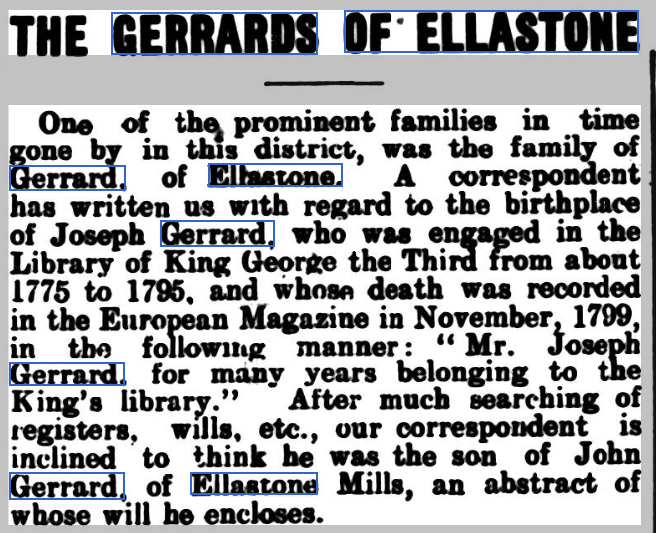
The author wanted to prove that the Joseph Gerrard “who was engaged in the library of King George the third from about 1775 to 1795, and whose death was recorded in the European Magazine in November 1799” was the son of John Gerrard of Ellastone Mills, Staffordshire. Included in the first article was a selected transcription of the 1796 will of John Gerrard. John’s son Joseph is mentioned in this will: John leaves him “£20 to buy a suit of mourning if he thinks proper.”
This Joseph Gerrard however, born in 1739, died in 1815 at Brailsford. Joseph’s brother John also died at Brailsford Mill, and both of their ages at death give a birth year of 1739. Maybe they were twins. William Gerrard and Joseph Gerrard of Brailsford Mill are mentioned in a 1811 newspaper article in the Derby Mercury.
I decided that there was nothing susbtantial about this claim, until I read the 1724 will of John Gerrard the elder, the father of John who died in 1796. In his will he leaves £100 to his son Joseph Gerrard, “secretary to the Bishop of Oxford”.
Perhaps there was something to this story after all. Joseph, baptised in 1701 in Ellastone, was the son of John Gerrard the elder.
I found Joseph Gerrard (and his son James Gerrard) mentioned in the Alumni Oxonienses: The Members of the University of Oxford, University of Oxford, Joseph Foster, 1888. “Joseph Gerard son of John of Elleston county Stafford, pleb, Oriel Coll, matric, 30th May 1718, age 18, BA. 9th March 1721-2; of Merton Coll MA 1728.”
In The Works of John Wesley 1735-1738, Joseph Gerrad is mentioned: “Joseph Gerard , matriculated at Oriel College 1718 , aged 18 , ordained 1727 to serve as curate of Cuddesdon , becoming rector of St. Martin’s , Oxford in 1729 , and vicar of Banbury in 1734.”
In The History of Banbury Alfred Beesley 1842 “a visitation of smallpox occured at Banbury (Oxfordshire) in 1731 and continued until 1733.” Joseph Gerrard was the vicar of Banbury in 1734.
According to the The History and Antiquities of the County of Buckingham George Lipscomb · 1847, Joseph Gerrard was made rector of Monks Risborough in 1738 “but he also continued to hold Stewkley until his death”.
The Speculum of Archbishop Thomas Secker by Secker, Thomas, 1693-1768, also mentions Joseph Gerrard under Monks Risborough and adds that he “resides constantly in the Parsonage ho. except when he goes for a few days to Steukley county Bucks (Buckinghamshire) of which he is vicar.” Joseph’s son James Gerrard 1741-1789 is also mentioned as being a rector at Monks Risborough in 1783.
Joseph Gerrard married Elizabeth Reynolds on 23 July 1739 in Monks Risborough, Buckinghamshire. They had five children between 1740 and 1750, including James baptised 1740 and Joseph baptised 1742.
Joseph died in 1785 in Monks Risborough.
So who was Joseph Gerrard of the Kings Library who died in 1799? It wasn’t Joseph’s son Joseph baptised in 1742 in Monks Risborough, because in his father’s 1785 will he mentions “my only son James”, indicating that Joseph died before that date.
September 5, 2023 at 1:35 pm #7276In reply to: Family Stories From The Other Side ~ Book Two
Wood Screw Manufacturers
The Fishers of West Bromwich.
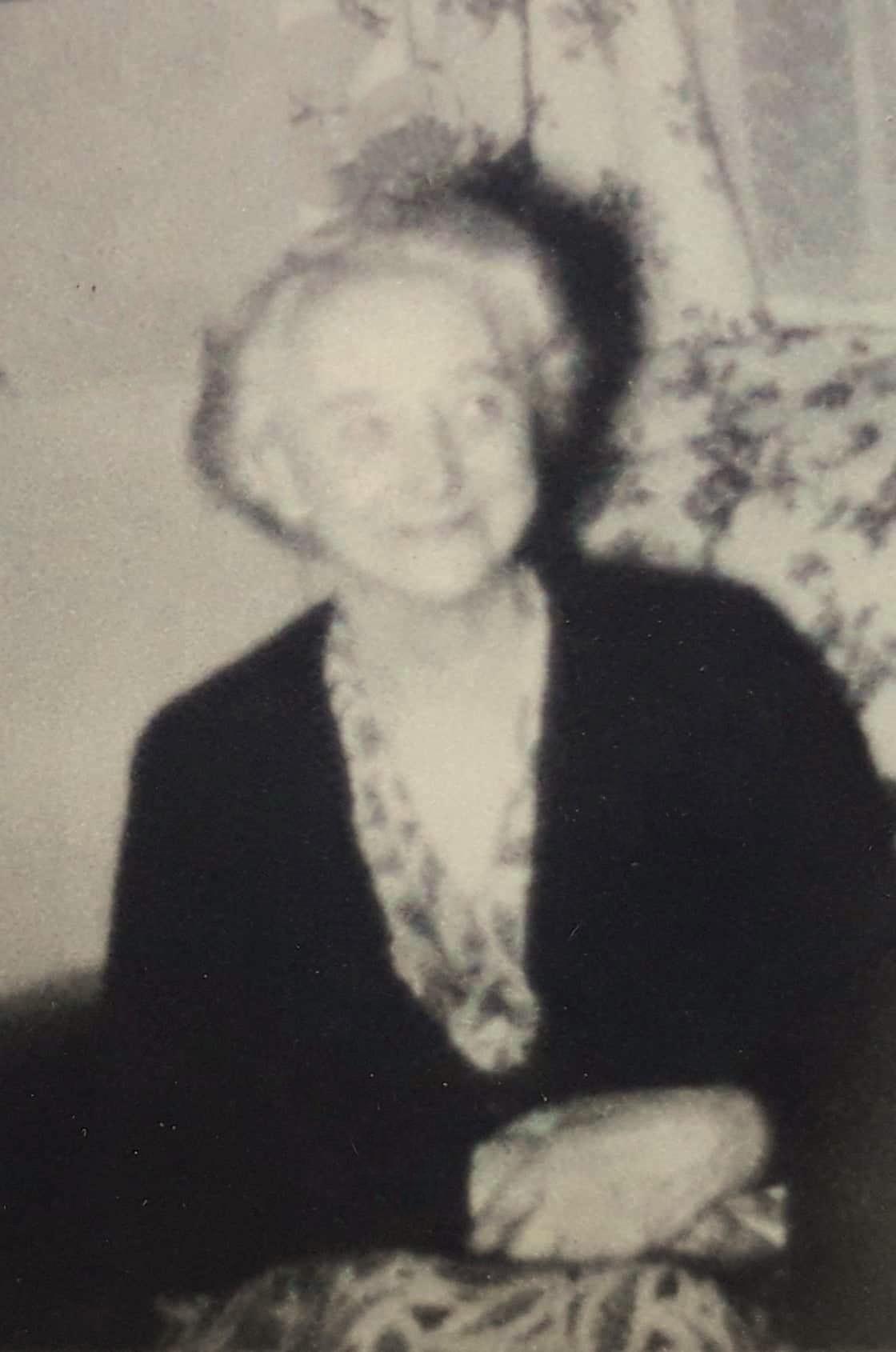
My great grandmother, Nellie Fisher, was born in 1877 in Wolverhampton. Her father William 1834-1916 was a whitesmith, and his father William 1792-1873 was a whitesmith and master screw maker. William’s father was Abel Fisher, wood screw maker, victualler, and according to his 1849 will, a “gentleman”.
Nellie Fisher 1877-1956 :
Abel Fisher was born in 1769 according to his burial document (age 81 in 1849) and on the 1841 census. Abel was a wood screw manufacturer in Wolverhampton.
As no baptism record can be found for Abel Fisher, I read every Fisher will I could find in a 30 year period hoping to find his fathers will. I found three other Fishers who were wood screw manufacurers in neighbouring West Bromwich, which led me to assume that Abel was born in West Bromwich and related to these other Fishers.
The wood screw making industry was a relatively new thing when Abel was born.
“The screw was used in furniture but did not become a common woodworking fastener until efficient machine tools were developed near the end of the 18th century. The earliest record of lathe made wood screws dates to an English patent of 1760. The development of wood screws progressed from a small cottage industry in the late 18th century to a highly mechanized industry by the mid-19th century. This rapid transformation is marked by several technical innovations that help identify the time that a screw was produced. The earliest, handmade wood screws were made from hand-forged blanks. These screws were originally produced in homes and shops in and around the manufacturing centers of 18th century Europe. Individuals, families or small groups participated in the production of screw blanks and the cutting of the threads. These small operations produced screws individually, using a series of files, chisels and cutting tools to form the threads and slot the head. Screws produced by this technique can vary significantly in their shape and the thread pitch. They are most easily identified by the profusion of file marks (in many directions) over the surface. The first record regarding the industrial manufacture of wood screws is an English patent registered to Job and William Wyatt of Staffordshire in 1760.”
Wood Screw Makers of West Bromwich:
Edward Fisher, wood screw maker of West Bromwich, died in 1796. He mentions his wife Pheney and two underage sons in his will. Edward (whose baptism has not been found) married Pheney Mallin on 13 April 1793. Pheney was 17 years old, born in 1776. Her parents were Isaac Mallin and Sarah Firme, who were married in West Bromwich in 1768.
Edward and Pheney’s son Edward was born on 21 October 1793, and their son Isaac in 1795. The executors of Edwards 1796 will are Daniel Fisher the Younger, Isaac Mallin, and Joseph Fisher.There is a marriage allegations and bonds document in 1774 for an Edward Fisher, bachelor and wood screw maker of West Bromwich, aged 25 years and upwards, and Mary Mallin of the same age, father Isaac Mallin. Isaac Mallin and Sarah didn’t marry until 1768 and Mary Mallin would have been born circa 1749. Perhaps Isaac Mallin’s father was the father of Mary Mallin. It’s possible that Edward Fisher was born in 1749 and first married Mary Mallin, and then later Pheney, but it’s also possible that the Edward Fisher who married Mary Mallin in 1774 was Edward Fishers uncle, Daniel’s brother. (I do not know if Daniel had a brother Edward, as I haven’t found a baptism, or marriage, for Daniel Fisher the elder.)
There are two difficulties with finding the records for these West Bromwich families. One is that the West Bromwich registers are not available online in their entirety, and are held by the Sandwell Archives, and even so, they are incomplete. Not only that, the Fishers were non conformist. There is no surviving register prior to 1787. The chapel opened in 1788, and any registers that existed before this date, taken in a meeting houses for example, appear not to have survived.
Daniel Fisher the younger died intestate in 1818. Daniel was a wood screw maker of West Bromwich. He was born in 1751 according to his age stated as 67 on his death in 1818. Daniel’s wife Mary, and his son William Fisher, also a wood screw maker, claimed the estate.
Daniel Fisher the elder was a farmer of West Bromwich, who died in 1806. He was 81 when he died, which makes a birth date of 1725, although no baptism has been found. No marriage has been found either, but he was probably married not earlier than 1746.
Daniel’s sons Daniel and Joseph were the main inheritors, and he also mentions his other children and grandchildren namely William Fisher, Thomas Fisher, Hannah wife of William Hadley, two grandchildren Edward and Isaac Fisher sons of Edward Fisher his son deceased. Daniel the elder presumably refers to the wood screw manufacturing when he says “to my son Daniel Fisher the good will and advantage which may arise from his manufacture or trade now carried on by me.” Daniel does not mention a son called Abel unfortunately, but neither does he mention his other grandchildren. Abel may be Daniel’s son, or he may be a nephew.
The Staffordshire Record Office holds the documents of a Testamentary Case in 1817. The principal people are Isaac Fisher, a legatee; Daniel and Joseph Fisher, executors. Principal place, West Bromwich, and deceased person, Daniel Fisher the elder, farmer.
William and Sarah Fisher baptised six children in the Mares Green Non Conformist registers in West Bromwich between 1786 and 1798. William Fisher and Sarah Birch were married in West Bromwich in 1777. This William was probably born circa 1753 and was probably the son of Daniel Fisher the elder, farmer.
Daniel Fisher the younger and his wife Mary had a son William, as mentioned in the intestacy papers, although I have not found a baptism for William. I did find a baptism for another son, Eutychus Fisher in 1792.
In White’s Directory of Staffordshire in 1834, there are three Fishers who are wood screw makers in Wolverhampton: Eutychus Fisher, Oxford Street; Stephen Fisher, Bloomsbury; and William Fisher, Oxford Street.
Abel’s son William Fisher 1792-1873 was living on Oxford Street on the 1841 census, with his wife Mary and their son William Fisher 1834-1916.
In The European Magazine, and London Review of 1820 (Volume 77 – Page 564) under List of Patents, W Fisher and H Fisher of West Bromwich, wood screw manufacturers, are listed. Also in 1820 in the Birmingham Chronicle, the partnership of William and Hannah Fisher, wood screw manufacturers of West Bromwich, was dissolved.
In the Staffordshire General & Commercial Directory 1818, by W. Parson, three Fisher’s are listed as wood screw makers. Abel Fisher victualler and wood screw maker, Red Lion, Walsal Road; Stephen Fisher wood screw maker, Buggans Lane; and Daniel Fisher wood screw manufacturer, Brickiln Lane.
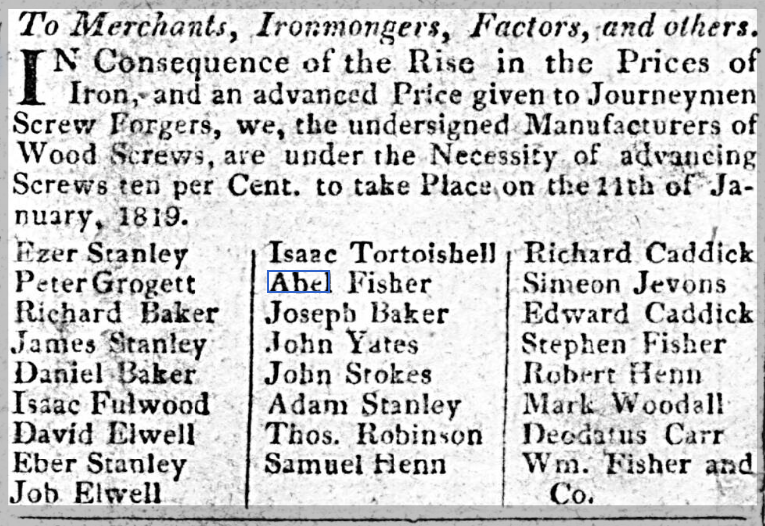
In Aris’s Birmingham Gazette on 4 January 1819 Abel Fisher is listed with 23 other wood screw manufacturers (Stephen Fisher and William Fisher included) stating that “In consequence of the rise in prices of iron and the advanced price given to journeymen screw forgers, we the undersigned manufacturers of wood screws are under the necessity of advancing screws 10 percent, to take place on the 11th january 1819.”
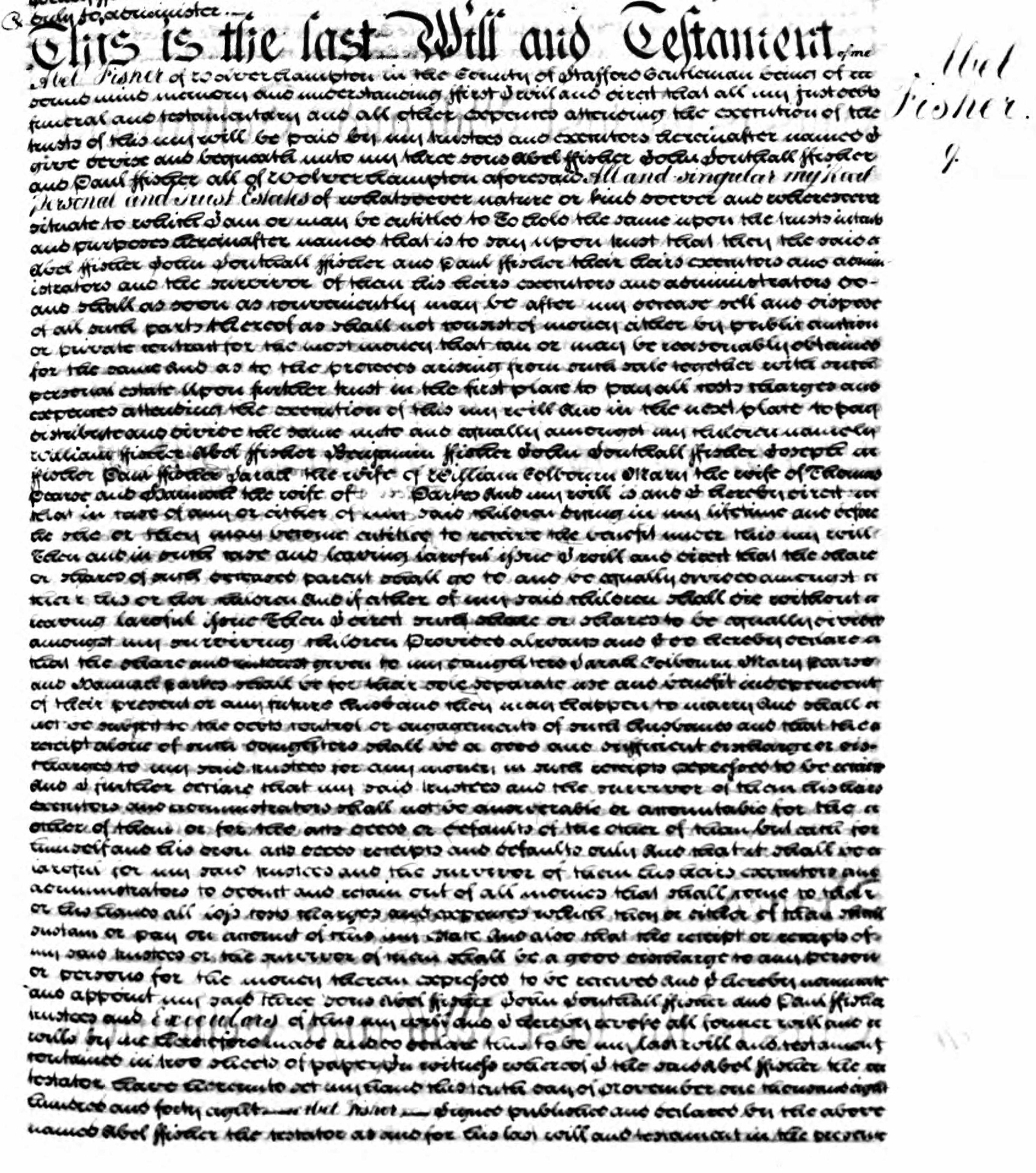
In Abel Fisher’s 1849 will, he names his three sons Abel Fisher 1796-1869, Paul Fisher 1811-1900 and John Southall Fisher 1801-1871 as the executors. He also mentions his other three sons, William Fisher 1792-1873, Benjamin Fisher 1798-1870, and Joseph Fisher 1803-1876, and daughters Sarah Fisher 1794- wife of William Colbourne, Mary Fisher 1804- wife of Thomas Pearce, and Susannah (Hannah) Fisher 1813- wife of Parkes. His son Silas Fisher 1809-1837 wasn’t mentioned as he died before Abel, nor his sons John Fisher 1799-1800, and Edward Southall Fisher 1806-1843. Abel’s wife Susannah Southall born in 1771 died in 1824. They were married in 1791.
The 1849 will of Abel Fisher:
 May 12, 2023 at 12:57 pm #7232
In reply to: Washed off the sea ~ Creative larks
🐳
Welcome to the bustling riverfront community of Bridgewater, where the sound of boat horns and cries of merchants filled the air.
Bridgewater was a town of hardworking people, all striving to make a living in this busy trading port. One such person was Anne, a middle-aged woman who owned a small pottery shop by the river. Her days were filled with the clanging of clay and the whirring of her pottery wheel. She took great pride in her work, creating beautiful plates and tea bowls that were highly sought after by the locals.
Another memorable character was Jack, the town cobbler whose small shop was always busy with customers. He was known for his kind heart and his willingness to help anyone in need, often giving away shoes to those who couldn’t afford them. As the days passed, life in Bridgewater had its ups and downs.
The lost halfpenny spoke of a hard day’s work, but also of the generosity of the community. The broken pipes spoke of moments of relaxation, but also of the struggles of daily life. And the smashed plates and tea bowls spoke of hurried meals, but also of the occasional argument or disagreement.
Despite the challenges, the people of Bridgewater found small joys in life. Children played by the river, skipping stones and chasing each other. Couples walked hand in hand along the promenade, watching the boats come and go. And on warm summer evenings, the town square was filled with music and laughter as locals gathered for impromptu dance parties. But as with any community, there were also tensions and conflicts.
The town council was often at odds with the merchants, who felt that their needs were being overlooked. And there were whispers of a rival trading port that threatened to take away business from Bridgewater. One day, a fire broke out in the warehouse district, destroying several buildings and leaving many homeless. The community rallied together to help those in need, with Anne donating plates and bowls for makeshift kitchens and Jack offering his shop as a temporary shelter. As the smoke cleared and the ashes settled, the people of Bridgewater were left to rebuild their town. Through hard work and perseverance, they overcame the challenges and emerged even stronger than before. The lost halfpenny, broken pipes, and smashed plates were all reminders of the struggles they had faced, but they also spoke of the resilience and strength of the human spirit. And so, life in Bridgewater continued, a vibrant and bustling riverfront community where goods were traded and daily life was filled with both hardships and small joys.
February 10, 2023 at 10:36 pm #6535In reply to: The Jorid’s Travels – 14 years on
“What was that?” Salomé was trying to get her bearings after they hit the sand storm into a different place.
Before the sand storm hit, they got chased by one of the Zathu army drone’s which they tried to shake off their tail, but that was only the beginning of the fun.
Coming ominously from afar, a huge wall of sand came toward them at surprisingly massive speed darkening all in its wake. They were about to be hit and engulfed, but that was when all took a turn for the strangest. The dark sand wall suddenly split open, reacting to a sound beam apparently emitted from Klatu’s speedster. After that, it was mostly a blur. They had gone into a sort of shifting sand vortex that had them glide into a series of sliding slopes with the oddest directional gravity pull she’d experienced. She had to shout a few times “Watch out” when some of the giant sand snapping turtles tried to gobble their ride, but somehow they seemed to have managed to reach their destination —and quite safely too.“Whooo!” Georges was elated at the adrenaline rush. “So that’s the trick our friend had up his sleeve, it seems?”
“Silly human hasn’t seen anything yet” mumbled Klatu whose middle ear was tuned into their direction.
“I’ve got sand in places one shouldn’t.” Georges said laughing, as if to make the air lighter.
“Don’t get me started,” Salomé managed a weak smile. She never was fond of the speed thrills. But when she turned her head, that’s where she saw them —old ruins dripping sand like a streaming source. Down or sideways, she couldn’t tell. The gravitational pull seemed to indicate they were down, but herself, Georges, their pod and Klatu were all stuck on a vertical cliff like geckos comfortably lounging on a warm wall. Down, then it was…
It took her a minute to realize Klatu was actually manipulating the sand and the gravitational configuration around, revealing the landscape that was hidden.
“Mmmm, dimensional magic…” she remembered the words from Jorid.
“Smelly friends of yours inside. Must go quicksy, Klatu can’t hold it long.”
Georges opened his mouth, but Salomé elbowed him right away. “He doesn’t mean to pee, Georges.”
January 31, 2023 at 11:58 am #6478In reply to: Orbs of Madjourneys
“One of them’s arriving early!” Aunt Idle told Mater who had just come swanning into the kitchen with her long grey hair neatly plaited and tied with a red velvet bow. Ridiculous being so particular about her hair at her age, Idle thought, whose own hair was an untidy and non too clean looking tangle of long dreadlocks with faded multicolour dyes growing out from her grey scalp. “Bert’s going to pick her up at seven.”
“You better get a move on then, the verandah needs sweeping and the dining room needs dusting. Are the bedrooms ready yet?” Mater replied, patting her hair and pulling her cardigan down neatly.
“Plenty of time, no need to worry!” Idle said, looking worried. “What on earth was that?” Something bright caught her eye through the kitchen window.
“Never mind that, make a start on the cleaning!” Mater said with a loud tut and an eye roll. Always getting distracted, that one, never finishes a job before she’s off sidetracking. Mater gave her hair another satisfied pat, and put two slices of bread in the toaster.
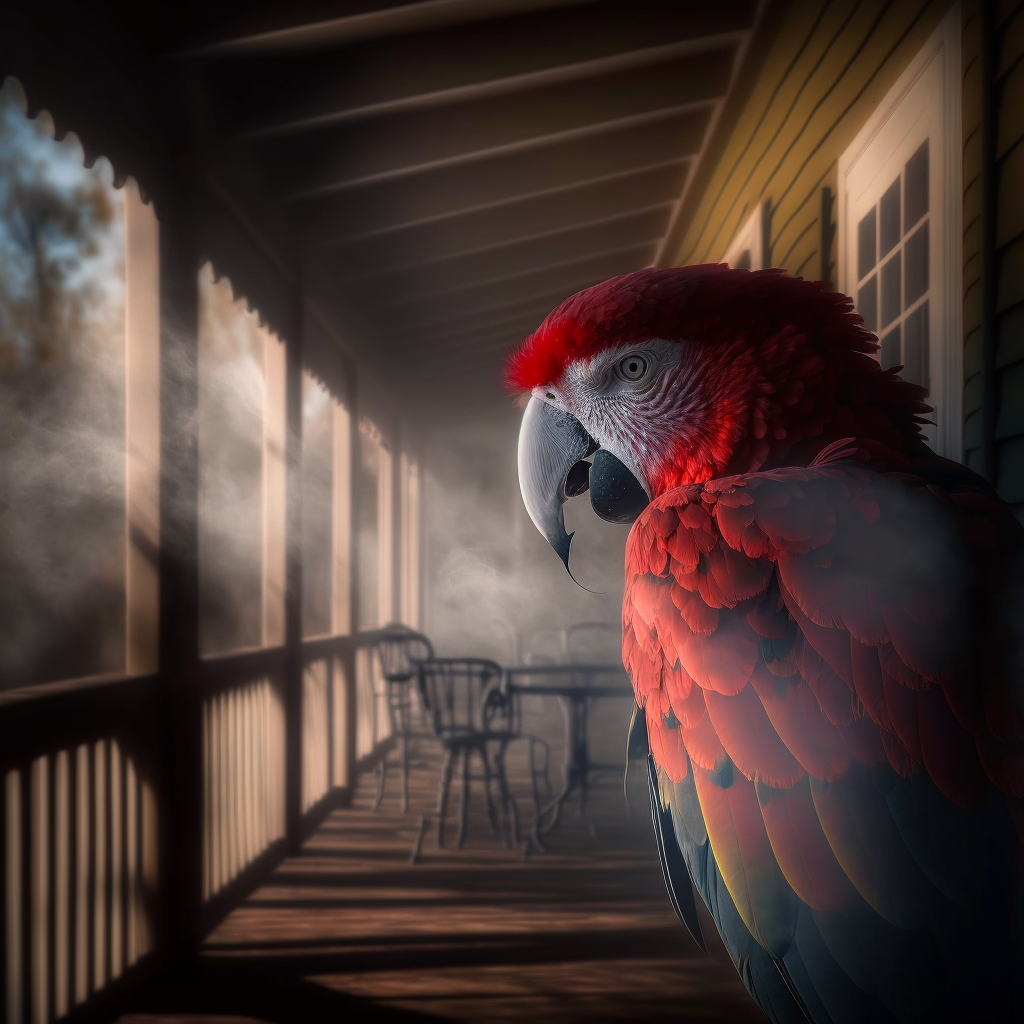
But Aunt Idle had gone outside to investigate. A minute or two later she returned, saying “You’ll never guess what, there’s a tame red parrot sitting on the porch table. And it talks!”
“So you’re planning to spend the day talking to a parrot, and leave me to do all the dusting, is that it?” Mater said, spreading honey on her toast.
 November 10, 2022 at 10:59 am #6343
In reply to: Family Stories From The Other Side ~ Book Two
Colney Hatch Lunatic Asylum
William James Stokes
William James Stokes was the first son of Thomas Stokes and Eliza Browning. Oddly, his birth was registered in Witham in Essex, on the 6th September 1841.
Birth certificate of William James Stokes:
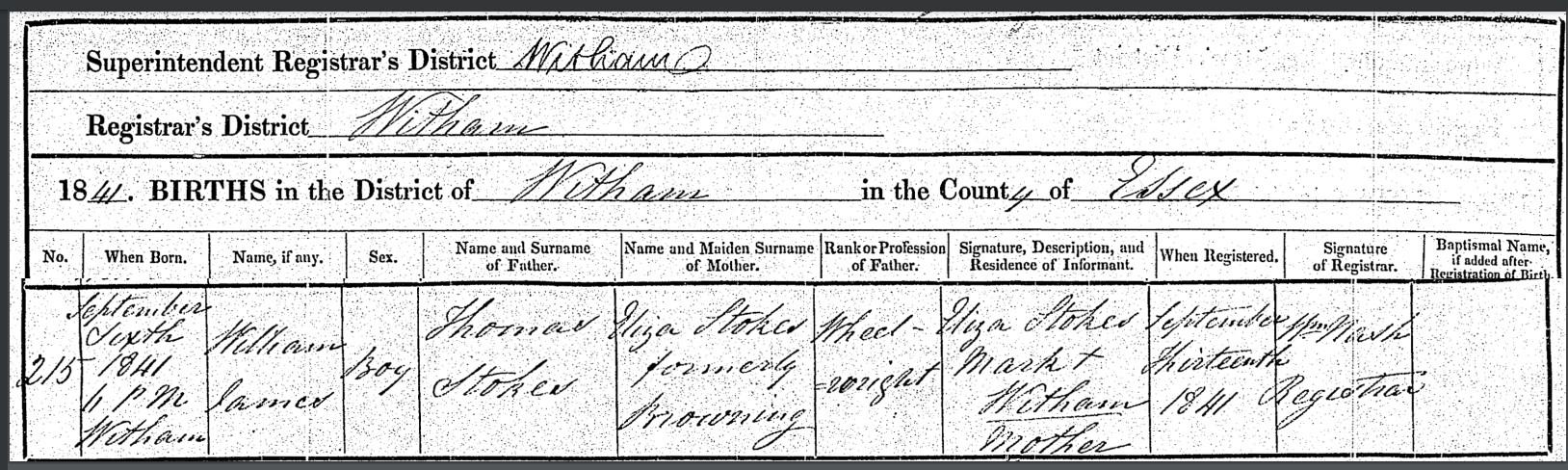
His father Thomas Stokes has not yet been found on the 1841 census, and his mother Eliza was staying with her uncle Thomas Lock in Cirencester in 1841. Eliza’s mother Mary Browning (nee Lock) was staying there too. Thomas and Eliza were married in September 1840 in Hempstead in Gloucestershire.
It’s a mystery why William was born in Essex but one possibility is that his father Thomas, who later worked with the Chipperfields making circus wagons, was staying with the Chipperfields who were wheelwrights in Witham in 1841. Or perhaps even away with a traveling circus at the time of the census, learning the circus waggon wheelwright trade. But this is a guess and it’s far from clear why Eliza would make the journey to Witham to have the baby when she was staying in Cirencester a few months prior.
In 1851 Thomas and Eliza, William and four younger siblings were living in Bledington in Oxfordshire.
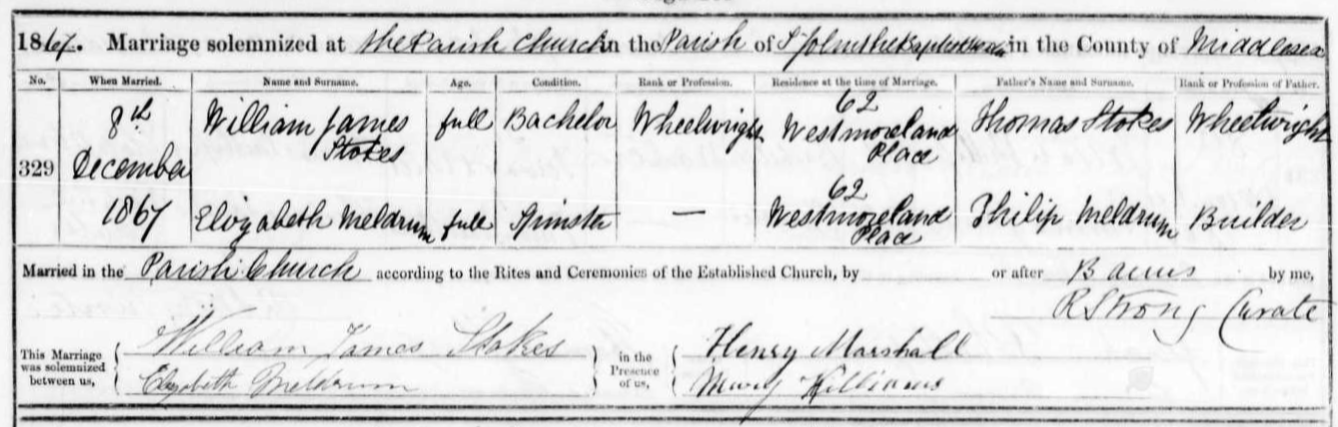
William was a 19 year old wheelwright living with his parents in Evesham in 1861. He married Elizabeth Meldrum in December 1867 in Hackney, London. He and his father are both wheelwrights on the marriage register.
Marriage of William James Stokes and Elizabeth Meldrum in 1867:
William and Elizabeth had a daughter, Elizabeth Emily Stokes, in 1868 in Shoreditch, London.
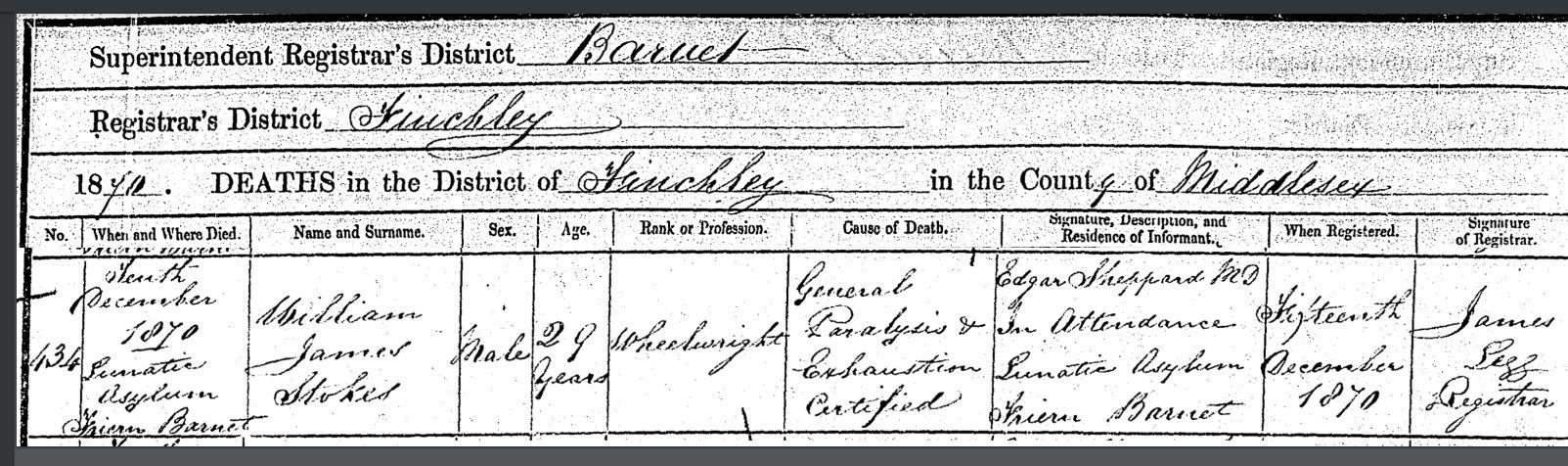
On the 3rd of December 1870, William James Stokes was admitted to Colney Hatch Lunatic Asylum. One week later on the 10th of December, he was dead.
On his death certificate the cause of death was “general paralysis and exhaustion, certified. MD Edgar Sheppard in attendance.” William was just 29 years old.
Death certificate William James Stokes:
I asked on a genealogy forum what could possibly have caused this death at such a young age. A retired pathology professor replied that “in medicine the term General Paralysis is only used in one context – that of Tertiary Syphilis.”
“Tertiary syphilis is the third and final stage of syphilis, a sexually transmitted disease that unfolds in stages when the individual affected doesn’t receive appropriate treatment.”From the article “Looking back: This fascinating and fatal disease” by Jennifer Wallis:
“……in asylums across Britain in the late 19th century, with hundreds of people receiving the diagnosis of general paralysis of the insane (GPI). The majority of these were men in their 30s and 40s, all exhibiting one or more of the disease’s telltale signs: grandiose delusions, a staggering gait, disturbed reflexes, asymmetrical pupils, tremulous voice, and muscular weakness. Their prognosis was bleak, most dying within months, weeks, or sometimes days of admission.
The fatal nature of GPI made it of particular concern to asylum superintendents, who became worried that their institutions were full of incurable cases requiring constant care. The social effects of the disease were also significant, attacking men in the prime of life whose admission to the asylum frequently left a wife and children at home. Compounding the problem was the erratic behaviour of the general paralytic, who might get themselves into financial or legal difficulties. Delusions about their vast wealth led some to squander scarce family resources on extravagant purchases – one man’s wife reported he had bought ‘a quantity of hats’ despite their meagre income – and doctors pointed to the frequency of thefts by general paralytics who imagined that everything belonged to them.”
The London Archives hold the records for Colney Hatch, but they informed me that the particular records for the dates that William was admitted and died were in too poor a condition to be accessed without causing further damage.
Colney Hatch Lunatic Asylum gained such notoriety that the name “Colney Hatch” appeared in various terms of abuse associated with the concept of madness. Infamous inmates that were institutionalized at Colney Hatch (later called Friern Hospital) include Jack the Ripper suspect Aaron Kosminski from 1891, and from 1911 the wife of occultist Aleister Crowley. In 1993 the hospital grounds were sold and the exclusive apartment complex called Princess Park Manor was built.
Colney Hatch:
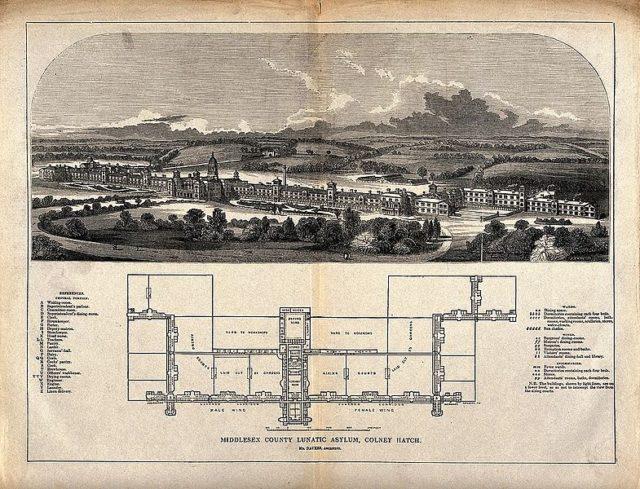
In 1873 Williams widow married William Hallam in Limehouse in London. Elizabeth died in 1930, apparently unaffected by her first husbands ailment.
August 18, 2022 at 8:26 am #6324In reply to: The Elusive Samuel Housley and Other Family Stories
STONE MANOR
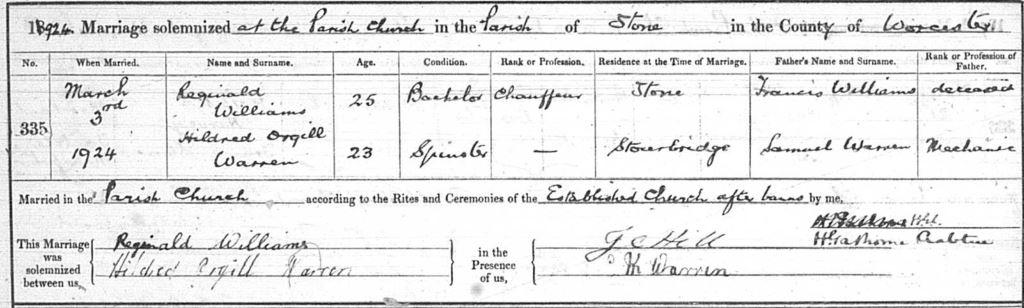
Hildred Orgill Warren born in 1900, my grandmothers sister, married Reginald Williams in Stone, Worcestershire in March 1924. Their daughter Joan was born there in October of that year.
Hildred was a chaffeur on the 1921 census, living at home in Stourbridge with her father (my great grandfather) Samuel Warren, mechanic. I recall my grandmother saying that Hildred was one of the first lady chauffeurs. On their wedding certificate, Reginald is also a chauffeur.
1921 census, Stourbridge:
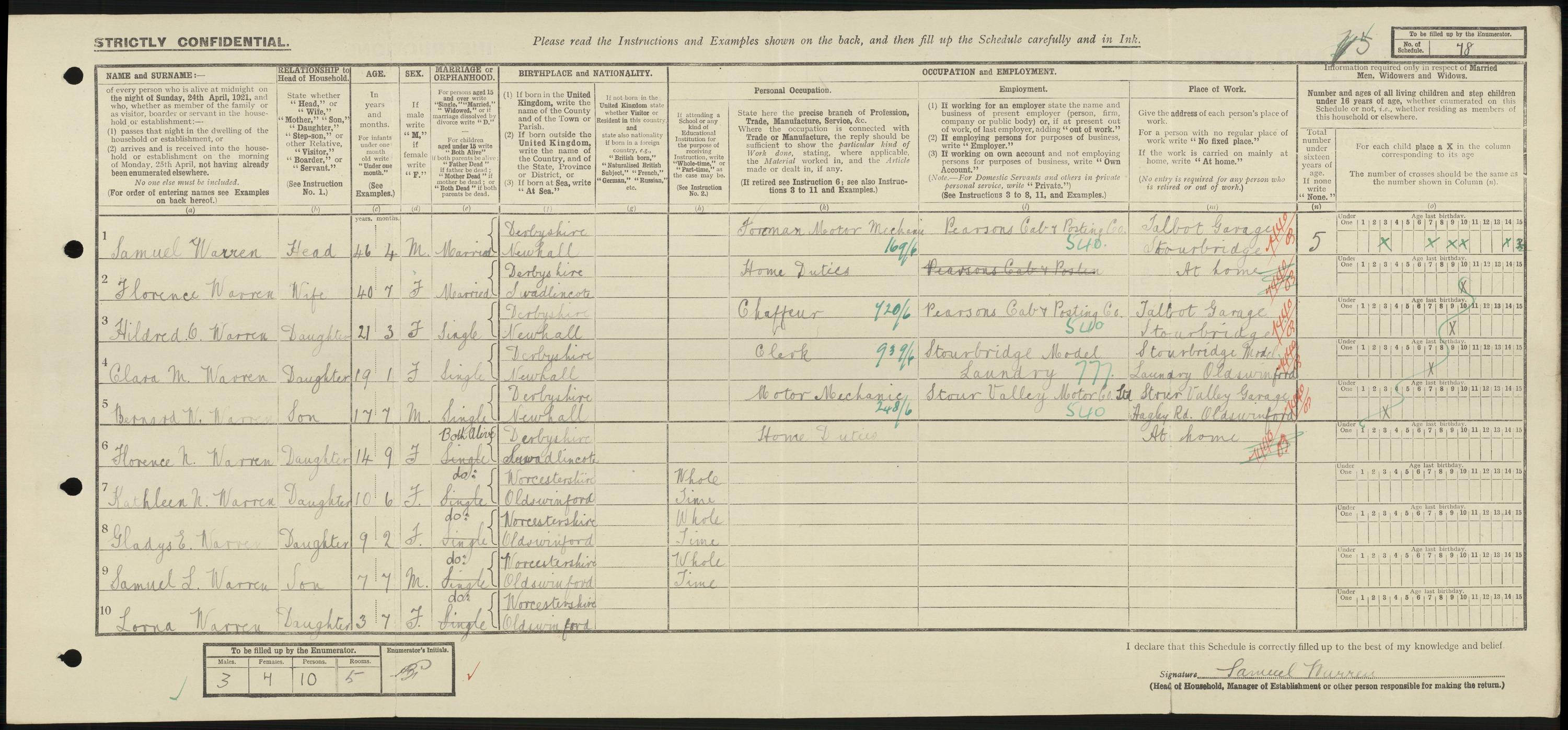
Hildred and Reg worked at Stone Manor. There is a family story of Hildred being involved in a car accident involving a fatality and that she had to go to court.
Stone Manor is in a tiny village called Stone, near Kidderminster, Worcestershire. It used to be a private house, but has been a hotel and nightclub for some years. We knew in the family that Hildred and Reg worked at Stone Manor and that Joan was born there. Around 2007 Joan held a family party there.
Stone Manor, Stone, Worcestershire:
I asked on a Kidderminster Family Research group about Stone Manor in the 1920s:
“the original Stone Manor burnt down and the current building dates from the early 1920’s and was built for James Culcheth Hill, completed in 1926”
But was there a fire at Stone Manor?
“I’m not sure there was a fire at the Stone Manor… there seems to have been a fire at another big house a short distance away and it looks like stories have crossed over… as the dates are the same…”JC Hill was one of the witnesses at Hildred and Reginalds wedding in Stone in 1924. K Warren, Hildreds sister Kay, was the other:
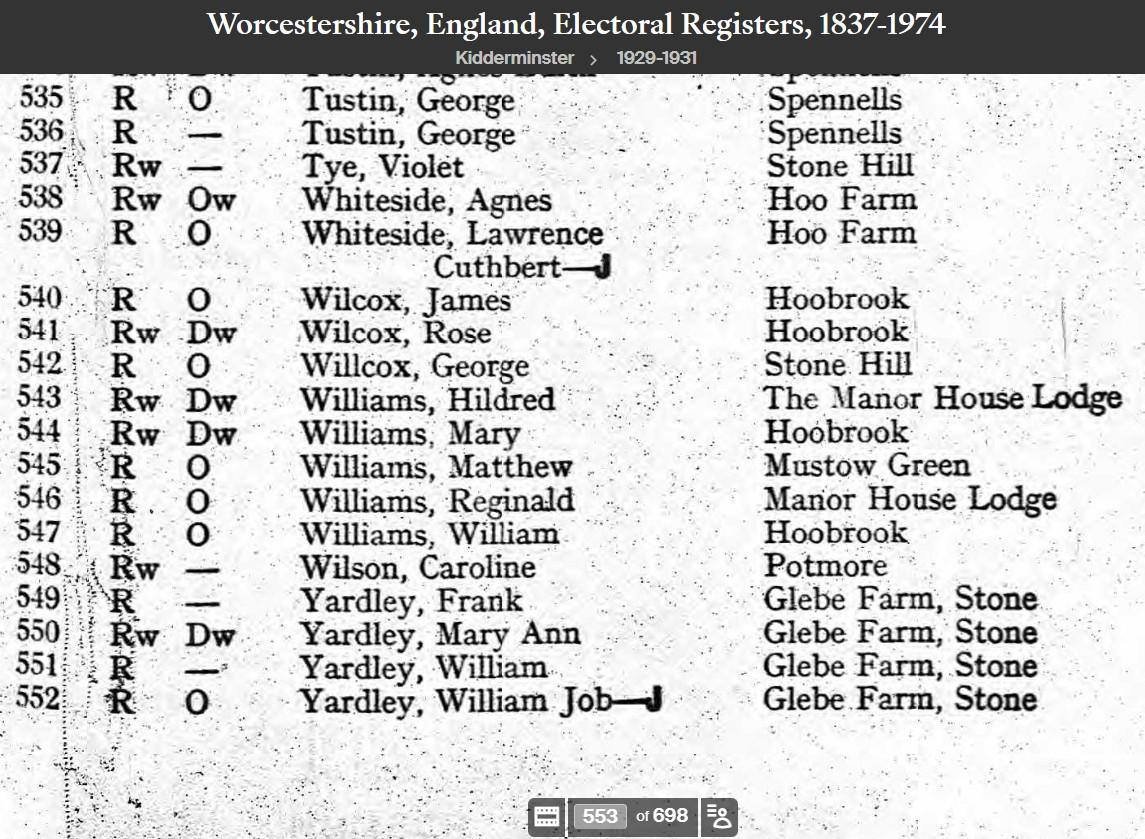
I searched the census and electoral rolls for James Culcheth Hill and found him at the Stone Manor on the 1929-1931 electoral rolls for Stone, and Hildred and Reginald living at The Manor House Lodge, Stone:
On the 1911 census James Culcheth Hill was a 12 year old student at Eastmans Royal Naval Academy, Northwood Park, Crawley, Winchester. He was born in Kidderminster in 1899. On the same census page, also a student at the school, is Reginald Culcheth Holcroft, born in 1900 in Stourbridge. The unusual middle name would seem to indicate that they might be related.
A member of the Kidderminster Family Research group kindly provided this article:
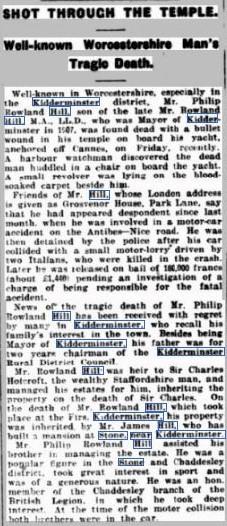
SHOT THROUGH THE TEMPLE
Well known Worcestershire man’s tragic death.
Dudley Chronicle 27 March 1930.
Well known in Worcestershire, especially the Kidderminster district, Mr Philip Rowland Hill MA LLD who was mayor of Kidderminster in 1907 was found dead with a bullet wound through his temple on board his yacht, anchored off Cannes, on Friday, recently. A harbour watchman discovered the dead man huddled in a chair on board the yacht. A small revolver was lying on the blood soaked carpet beside him.
Friends of Mr Hill, whose London address is given as Grosvenor House, Park Lane, say that he appeared despondent since last month when he was involved in a motor car accident on the Antibes ~ Nice road. He was then detained by the police after his car collided with a small motor lorry driven by two Italians, who were killed in the crash. Later he was released on bail of 180,000 francs (£1440) pending an investigation of a charge of being responsible for the fatal accident. …….
Mr Rowland Hill (Philips father) was heir to Sir Charles Holcroft, the wealthy Staffordshire man, and managed his estates for him, inheriting the property on the death of Sir Charles. On the death of Mr Rowland HIll, which took place at the Firs, Kidderminster, his property was inherited by Mr James (Culcheth) Hill who had built a mansion at Stone, near Kidderminster. Mr Philip Rowland Hill assisted his brother in managing the estate. …….
At the time of the collison both brothers were in the car.
This article doesn’t mention who was driving the car ~ could the family story of a car accident be this one? Hildred and Reg were working at Stone Manor, both were (or at least previously had been) chauffeurs, and Philip Hill was helping James Culcheth Hill manage the Stone Manor estate at the time.
This photograph was taken circa 1931 in Llanaeron, Wales. Hildred is in the middle on the back row:
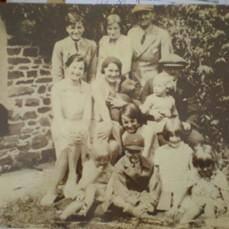
Sally Gray sent the photo with this message:
“Joan gave me a short note: Photo was taken when they lived in Wales, at Llanaeron, before Janet was born, & Aunty Lorna (my mother) lived with them, to take Joan to school in Aberaeron, as they only spoke Welsh at the local school.”
Hildred and Reginalds daughter Janet was born in 1932 in Stratford. It would appear that Hildred and Reg moved to Wales just after the car accident, and shortly afterwards moved to Stratford.
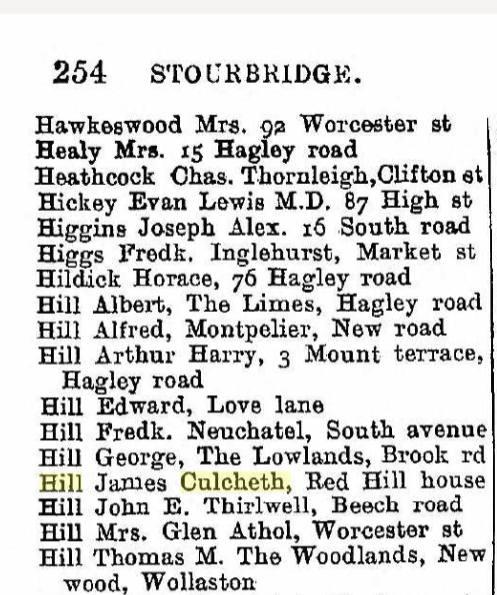
In 1921 James Culcheth Hill was living at Red Hill House in Stourbridge. Although I have not been able to trace Reginald Williams yet, perhaps this Stourbridge connection with his employer explains how Hildred met Reginald.
Sir Reginald Culcheth Holcroft, the other pupil at the school in Winchester with James Culcheth Hill, was indeed related, as Sir Holcroft left his estate to James Culcheth Hill’s father. Sir Reginald was born in 1899 in Upper Swinford, Stourbridge. Hildred also lived in that part of Stourbridge in the early 1900s.
1921 Red Hill House:
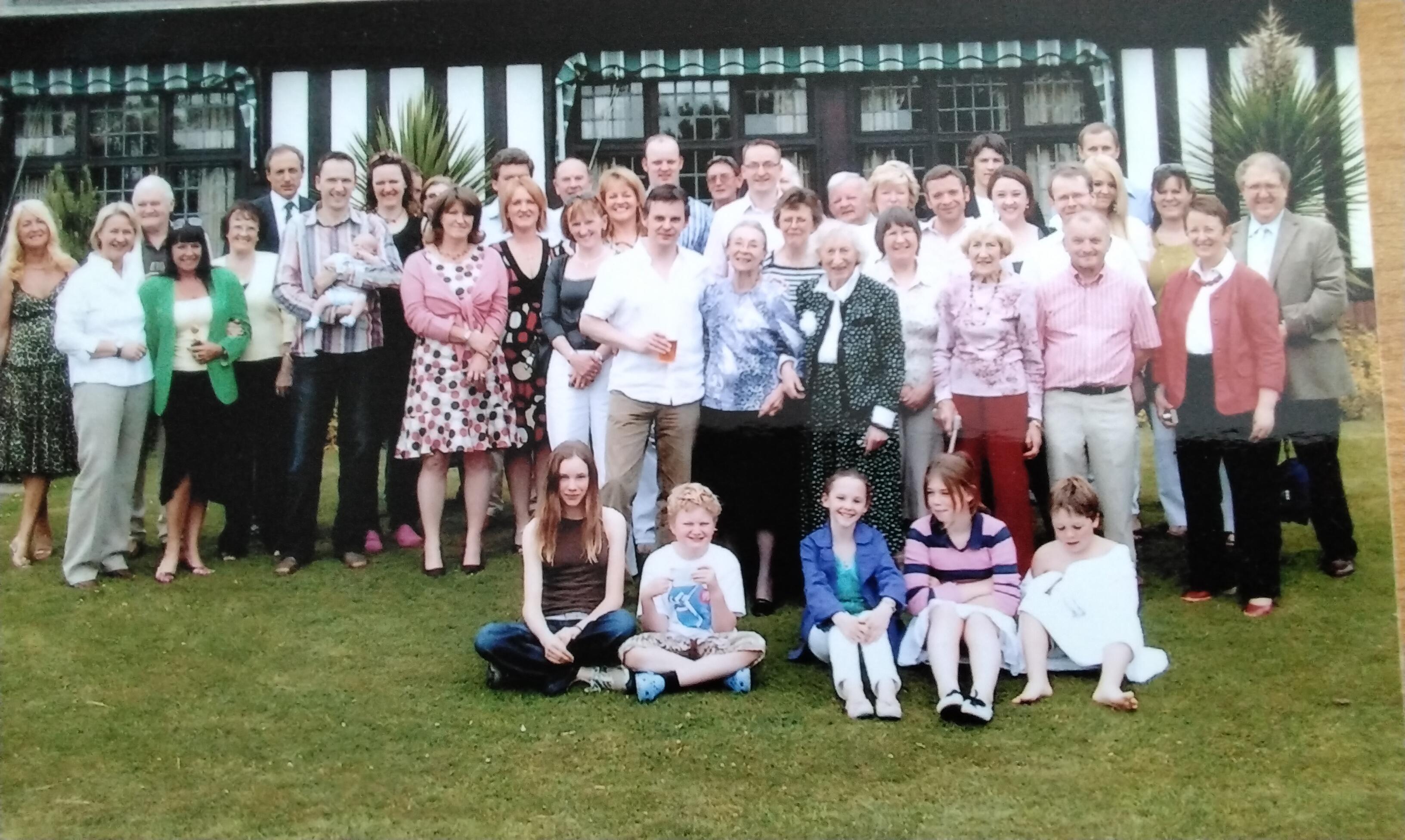
The 2007 family reunion organized by Joan Williams at Stone Manor: Joan in black and white at the front.
Unrelated to the Warrens, my fathers friends (and customers at The Fox when my grandmother Peggy Edwards owned it) Geoff and Beryl Lamb later bought Stone Manor.
July 7, 2022 at 9:45 am #6315In reply to: The Sexy Wooden Leg
It was not yet 9am and Eusebius Kazandis was already sweating. The morning sun was hitting hard on the tarp of his booth. He put the last cauldron among lines of cauldrons on a sagging table at the summer fair of Innsbruck, Austria. It was a tiny three-legged black cauldron with a simple Celtic knot on one side and a tree on the other side, like all the others. His father’s father’s father used to make cauldrons for a living, the kind you used to distil ouzo or cook meals for an Inn. But as time went by and industrialisation made it easier for cooks, the trade slowly evolved toward smaller cauldrons for modern Wiccans. A modern witch wanted it portable and light, ready to use in everyday life situations, and Eusebius was there to provide it for them.
Eusebius sat on his chair and sighed. He couldn’t help but notice the woman in colourful dress who had spread a shawl on the grass under the tall sequoia tree. Nobody liked this spot under the branches oozing sticky resin. She didn’t seem to mind. She was arranging small colourful bottles of oil on her shawl. A sign near her said : Massage oils, Fragrant oils, Polishing oils, all with different names evocative of different properties. He hadn’t noticed her yesterday when everybody was installing their stalls. He wondered if she had paid her fee.
Rosa was smiling as she spread in front of her the meadow flowers she’d picked on her way to the market. It was another beautiful day, under the shade and protection of the big sequoia tree watching over her. She assembled small bouquets and put them in between the vials containing her precious handmade oils. She had noticed people, and especially women, would naturally gather around well dressed stalls and engage conversation. Since she left her hometown of Torino, seven years ago, she’d followed the wind on her journey across Europe. It had led her to Innsbruck and had suddenly stopped blowing. That usually meant she had something to do there, but it also meant that she would have to figure out what she was meant to do before she could go on with her life.
The stout man waiting behind his dark cauldrons, was watching her again. He looked quite sad, and she couldn’t help but thinking he was not where he needed to be. When she looked at him, she saw Hephaestus whose inner fire had been tamed. His banner was a mishmash of religious stuff, aimed at pagans and budding witches. Although his grim booth would most certainly benefit from a feminine touch, but she didn’t want to offend him by a misplaced suggestion. It was not her place to find his place.
Rosa, who knew to cultivate any available friendship when she arrived somewhere, waved at the man. Startled, he looked away as if caught doing something inappropriate. Rosa sighed. Maybe she should have bring him some coffee.
As her first clients arrived, she prayed for a gush of wind to tell her where to go next. But the branches of the old tree remained perfectly still under the scorching sun.
June 6, 2022 at 9:17 am #6301In reply to: The Elusive Samuel Housley and Other Family Stories
The Warrens of Stapenhill
There were so many Warren’s in Stapenhill that it was complicated to work out who was who. I had gone back as far as Samuel Warren marrying Catherine Holland, and this was as far back as my cousin Ian Warren had gone in his research some decades ago as well. The Holland family from Barton under Needwood are particularly interesting, and will be a separate chapter.
Stapenhill village by John Harden:
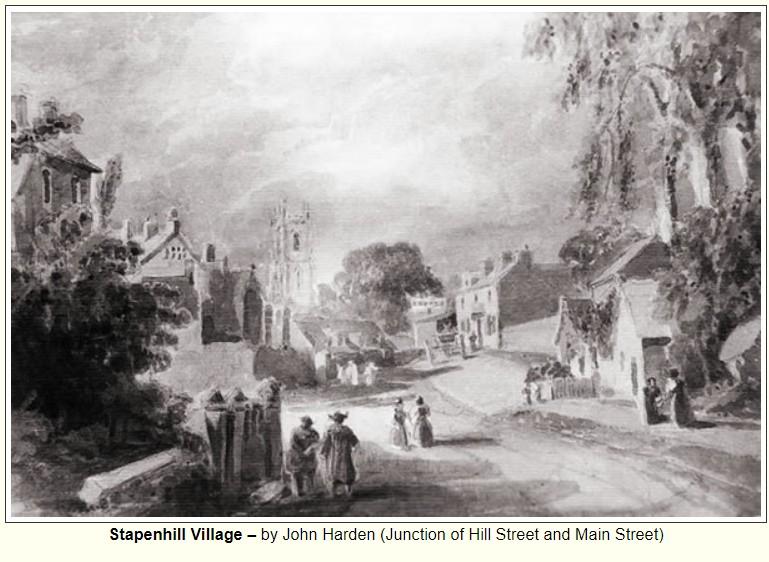
Resuming the research on the Warrens, Samuel Warren 1771-1837 married Catherine Holland 1775-1861 in 1795 and their son Samuel Warren 1800-1882 married Elizabeth Bridge, whose childless brother Benjamin Bridge left the Warren Brothers Boiler Works in Newhall to his nephews, the Warren brothers.
Samuel Warren and Catherine Holland marriage licence 1795:
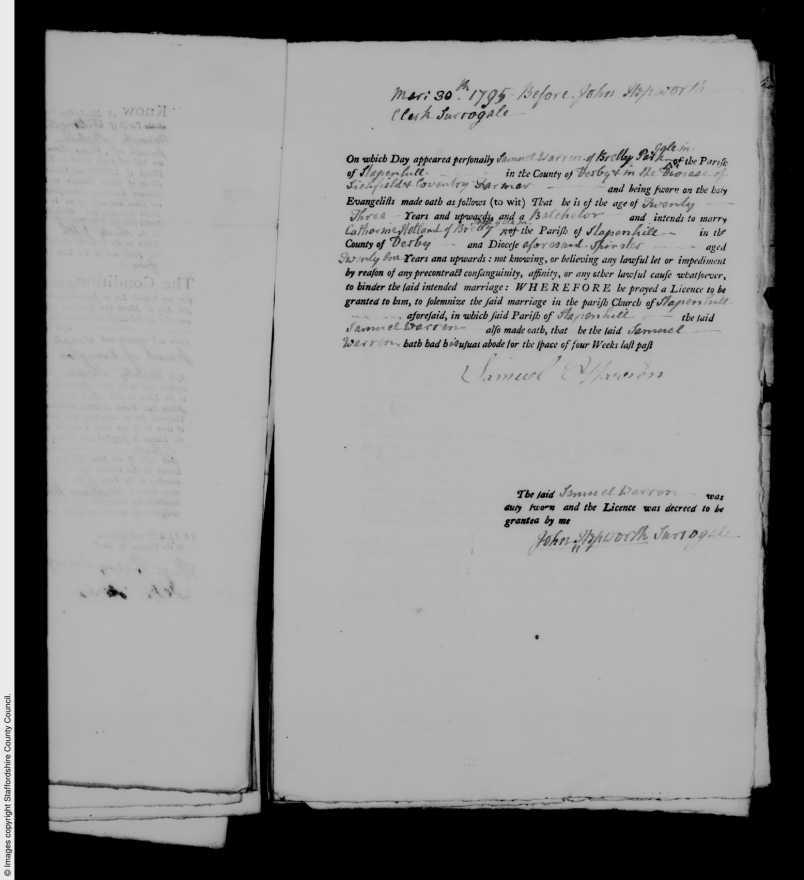
Samuel (born 1771) was baptised at Stapenhill St Peter and his parents were William and Anne Warren. There were at least three William and Ann Warrens in town at the time. One of those William’s was born in 1744, which would seem to be the right age to be Samuel’s father, and one was born in 1710, which seemed a little too old. Another William, Guiliamos Warren (Latin was often used in early parish registers) was baptised in Stapenhill in 1729.
Stapenhill St Peter:
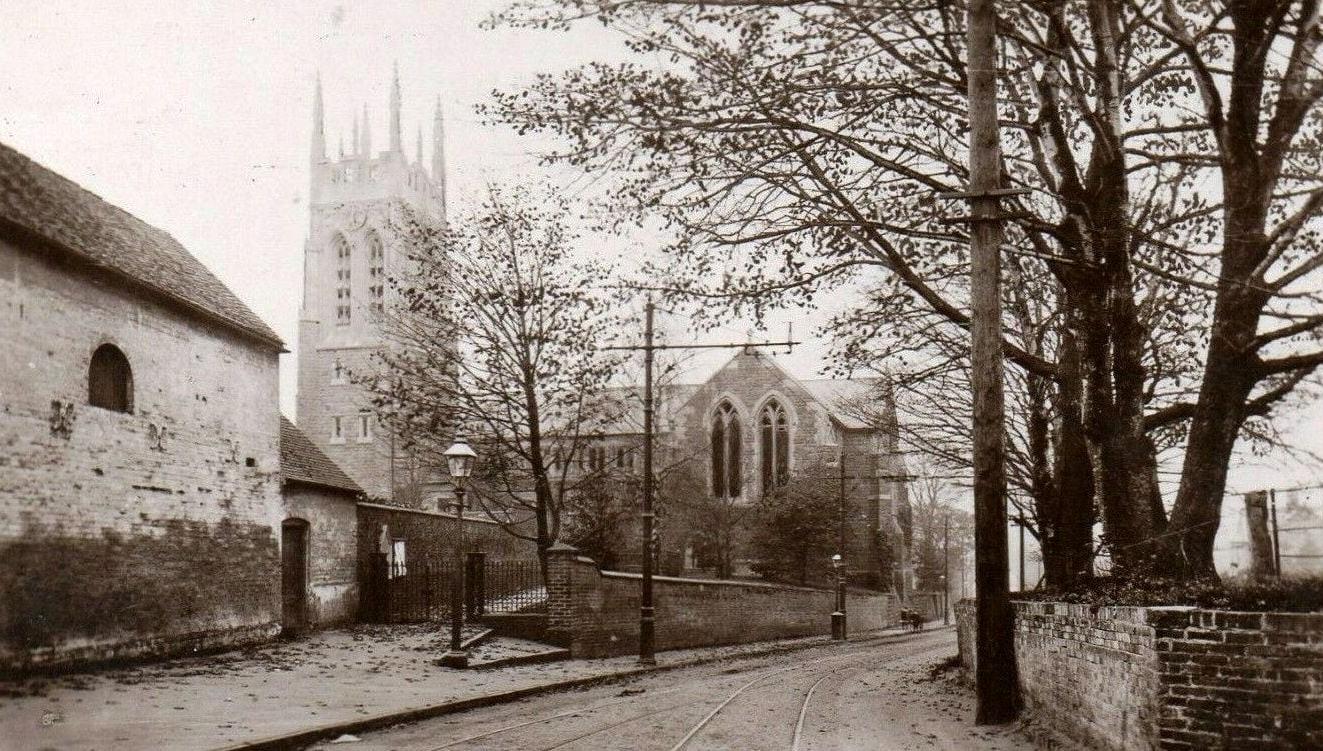
William Warren (born 1744) appeared to have been born several months before his parents wedding. William Warren and Ann Insley married 16 July 1744, but the baptism of William in 1744 was 24 February. This seemed unusual ~ children were often born less than nine months after a wedding, but not usually before the wedding! Then I remembered the change from the Julian calendar to the Gregorian calendar in 1752. Prior to 1752, the first day of the year was Lady Day, March 25th, not January 1st. This meant that the birth in February 1744 was actually after the wedding in July 1744. Now it made sense. The first son was named William, and he was born seven months after the wedding.
William born in 1744 died intestate in 1822, and his wife Ann made a legal claim to his estate. However he didn’t marry Ann Holland (Ann was Catherines Hollands sister, who married Samuel Warren the year before) until 1796, so this William and Ann were not the parents of Samuel.
It seemed likely that William born in 1744 was Samuels brother. William Warren and Ann Insley had at least eight children between 1744 and 1771, and it seems that Samuel was their last child, born when William the elder was 61 and his wife Ann was 47.
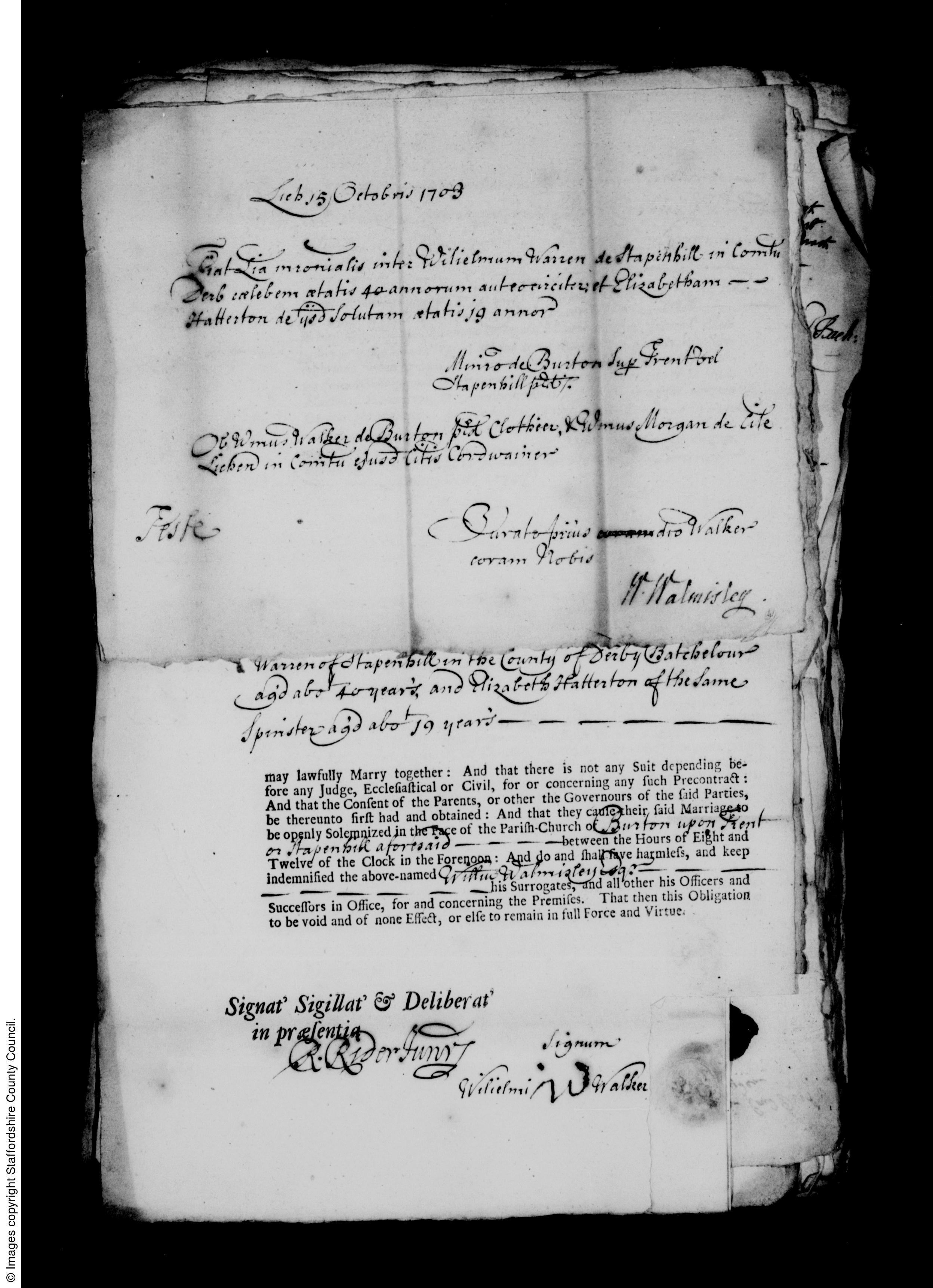
It seems it wasn’t unusual for the Warren men to marry rather late in life. William Warren’s (born 1710) parents were William Warren and Elizabeth Hatterton. On the marriage licence in 1702/1703 (it appears to say 1703 but is transcribed as 1702), William was a 40 year old bachelor from Stapenhill, which puts his date of birth at 1662. Elizabeth was considerably younger, aged 19.
William Warren and Elizabeth Hatterton marriage licence 1703:
These Warren’s were farmers, and they were literate and able to sign their own names on various documents. This is worth noting, as most made the mark of an X.
I found three Warren and Holland marriages. One was Samuel Warren and Catherine Holland in 1795, then William Warren and Ann Holland in 1796. William Warren and Ann Hollands daughter born in 1799 married John Holland in 1824.
Elizabeth Hatterton (wife of William Warren who was born circa 1662) was born in Burton upon Trent in 1685. Her parents were Edward Hatterton 1655-1722, and Sara.
A page from the 1722 will of Edward Hatterton:
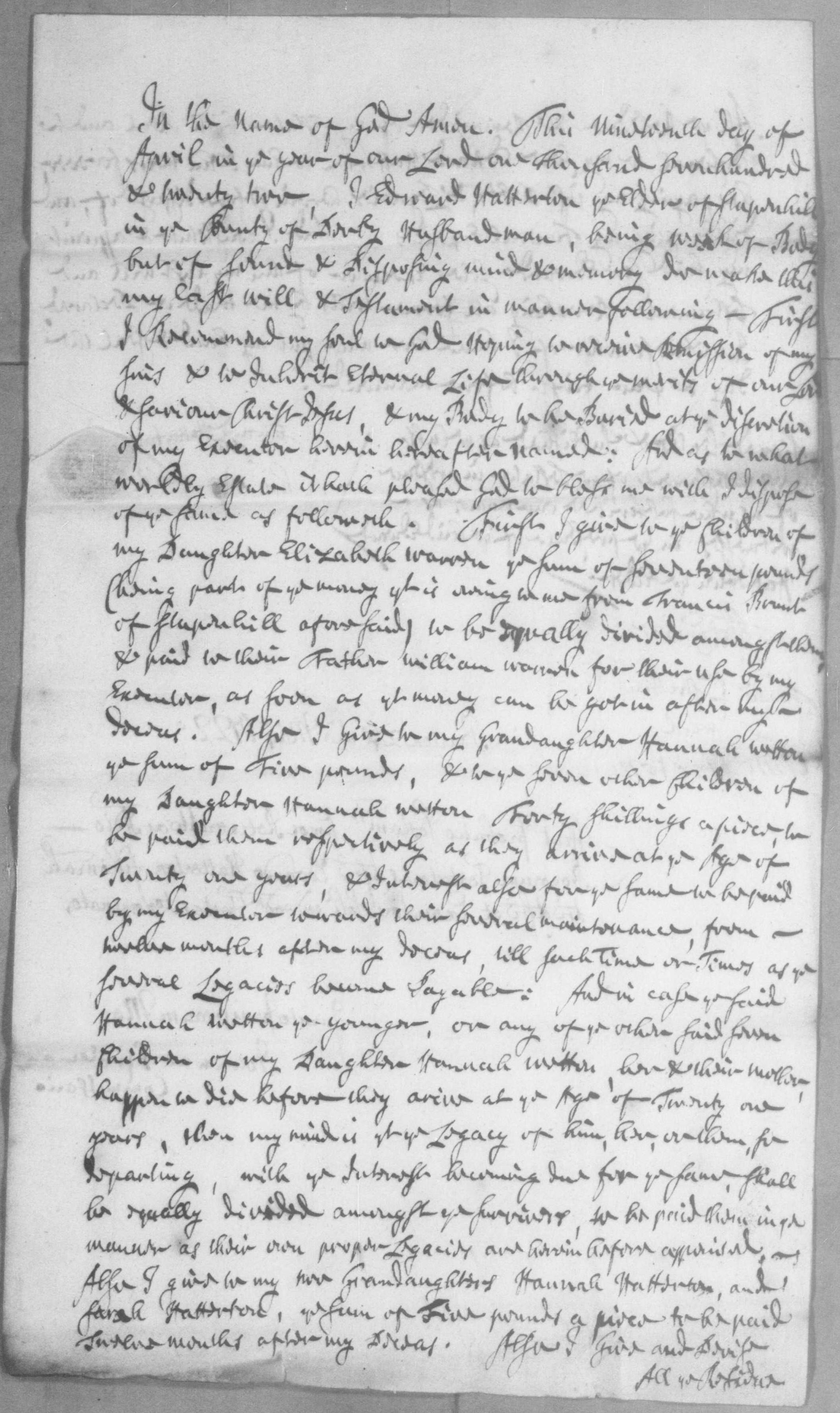
The earliest Warren I found records for was William Warren who married Elizabeth Hatterton in 1703. The marriage licence states his age as 40 and that he was from Stapenhill, but none of the Stapenhill parish records online go back as far as 1662. On other public trees on ancestry websites, a birth record from Suffolk has been chosen, probably because it was the only record to be found online with the right name and date. Once again, I don’t think that is correct, and perhaps one day I’ll find some earlier Stapenhill records to prove that he was born in locally.
Subsequently, I found a list of the 1662 Hearth Tax for Stapenhill. On it were a number of Warrens, three William Warrens including one who was a constable. One of those William Warrens had a son he named William (as they did, hence the number of William Warrens in the tree) the same year as this hearth tax list.
But was it the William Warren with 2 chimneys, the one with one chimney who was too poor to pay it, or the one who was a constable?
from the list:
Will. Warryn 2
Richard Warryn 1
William Warren Constable
These names are not payable by Act:
Will. Warryn 1
Richard Warren John Watson
over seers of the poore and churchwardensThe Hearth Tax:
via wiki:
In England, hearth tax, also known as hearth money, chimney tax, or chimney money, was a tax imposed by Parliament in 1662, to support the Royal Household of King Charles II. Following the Restoration of the monarchy in 1660, Parliament calculated that the Royal Household needed an annual income of £1,200,000. The hearth tax was a supplemental tax to make up the shortfall. It was considered easier to establish the number of hearths than the number of heads, hearths forming a more stationary subject for taxation than people. This form of taxation was new to England, but had precedents abroad. It generated considerable debate, but was supported by the economist Sir William Petty, and carried through the Commons by the influential West Country member Sir Courtenay Pole, 2nd Baronet (whose enemies nicknamed him “Sir Chimney Poll” as a result). The bill received Royal Assent on 19 May 1662, with the first payment due on 29 September 1662, Michaelmas.
One shilling was liable to be paid for every firehearth or stove, in all dwellings, houses, edifices or lodgings, and was payable at Michaelmas, 29 September and on Lady Day, 25 March. The tax thus amounted to two shillings per hearth or stove per year. The original bill contained a practical shortcoming in that it did not distinguish between owners and occupiers and was potentially a major burden on the poor as there were no exemptions. The bill was subsequently amended so that the tax was paid by the occupier. Further amendments introduced a range of exemptions that ensured that a substantial proportion of the poorer people did not have to pay the tax.Indeed it seems clear that William Warren the elder came from Stapenhill and not Suffolk, and one of the William Warrens paying hearth tax in 1662 was undoubtedly the father of William Warren who married Elizabeth Hatterton.
May 27, 2022 at 8:25 am #6300In reply to: The Elusive Samuel Housley and Other Family Stories
Looking for Carringtons
The Carringtons of Smalley, at least some of them, were Baptist ~ otherwise known as “non conformist”. Baptists don’t baptise at birth, believing it’s up to the person to choose when they are of an age to do so, although that appears to be fairly random in practice with small children being baptised. This makes it hard to find the birth dates registered as not every village had a Baptist church, and the baptisms would take place in another town. However some of the children were baptised in the village Anglican church as well, so they don’t seem to have been consistent. Perhaps at times a quick baptism locally for a sickly child was considered prudent, and preferable to no baptism at all. It’s impossible to know for sure and perhaps they were not strictly commited to a particular denomination.
Our Carrington’s start with Ellen Carrington who married William Housley in 1814. William Housley was previously married to Ellen’s older sister Mary Carrington. Ellen (born 1895 and baptised 1897) and her sister Nanny were baptised at nearby Ilkeston Baptist church but I haven’t found baptisms for Mary or siblings Richard and Francis. We know they were also children of William Carrington as he mentions them in his 1834 will. Son William was baptised at the local Smalley church in 1784, as was Thomas in 1896.
The absence of baptisms in Smalley with regard to Baptist influence was noted in the Smalley registers:
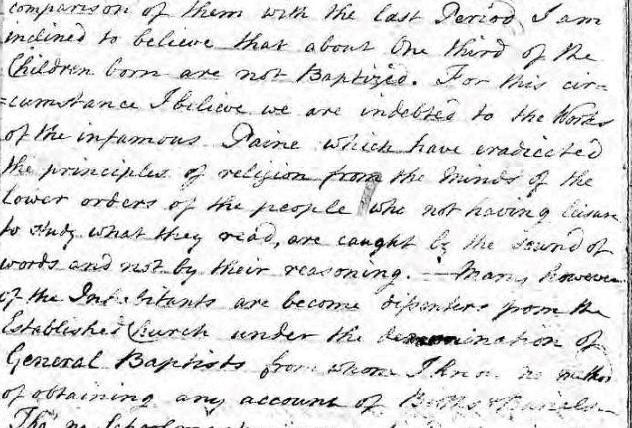
Smalley (chapelry of Morley) registers began in 1624, Morley registers began in 1540 with no obvious gaps in either. The gap with the missing registered baptisms would be 1786-1793. The Ilkeston Baptist register began in 1791. Information from the Smalley registers indicates that about a third of the children were not being baptised due to the Baptist influence.
William Housley son in law, daughter Mary Housley deceased, and daughter Eleanor (Ellen) Housley are all mentioned in William Housley’s 1834 will. On the marriage allegations and bonds for William Housley and Mary Carrington in 1806, her birth date is registered at 1787, her father William Carrington.
A Page from the will of William Carrington 1834:
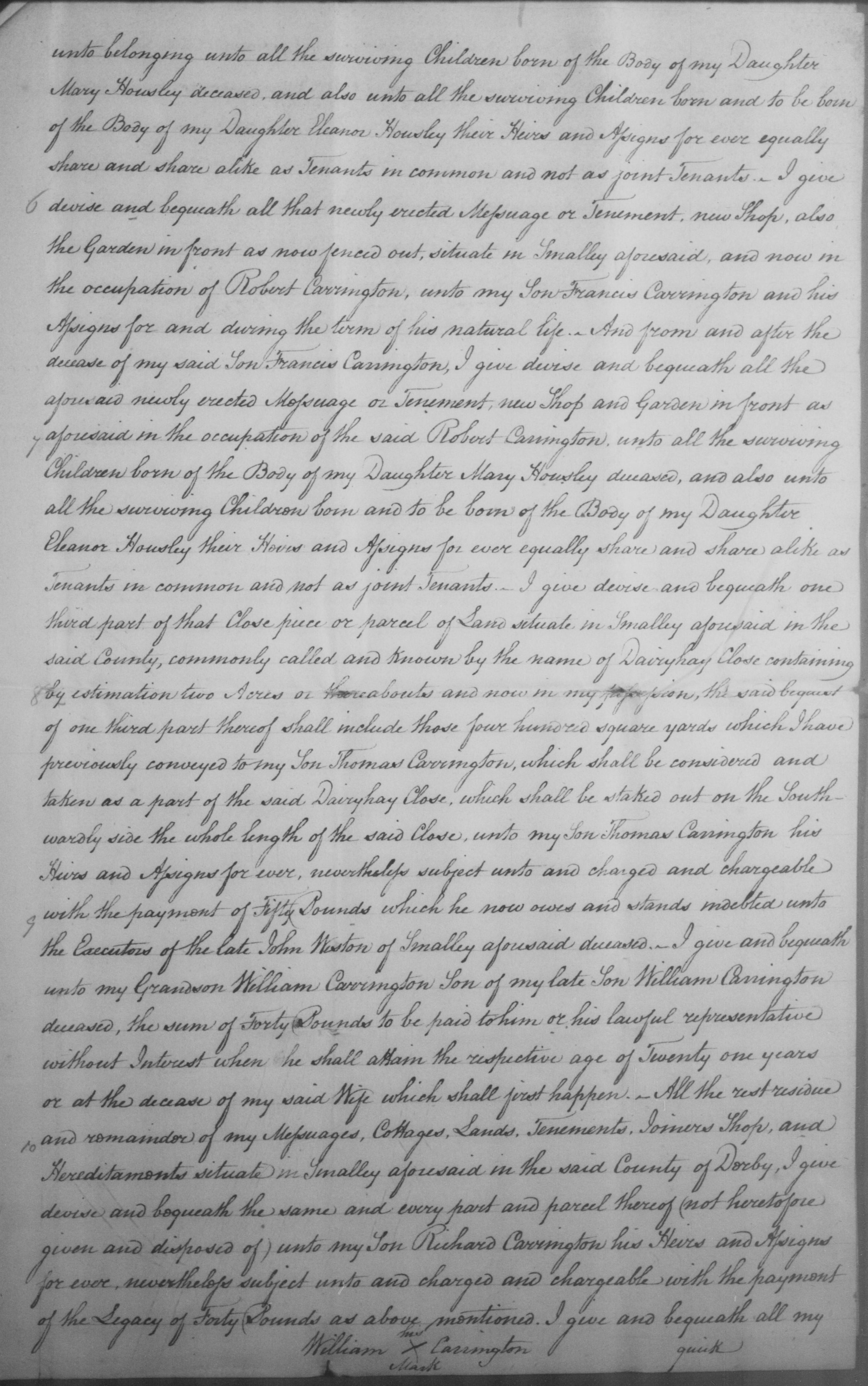
William Carrington was baptised in nearby Horsley Woodhouse on 27 August 1758. His parents were William and Margaret Carrington “near the Hilltop”. He married Mary Malkin, also of Smalley, on the 27th August 1783.
When I started looking for Margaret Wright who married William Carrington the elder, I chanced upon the Smalley parish register micro fiche images wrongly labeled by the ancestry site as Longford. I subsequently found that the Derby Records office published a list of all the wrongly labeled Derbyshire towns that the ancestry site knew about for ten years at least but has not corrected!
Margaret Wright was baptised in Smalley (mislabeled as Longford although the register images clearly say Smalley!) on the 2nd March 1728. Her parents were John and Margaret Wright.
But I couldn’t find a birth or baptism anywhere for William Carrington. I found four sources for William and Margaret’s marriage and none of them suggested that William wasn’t local. On other public trees on ancestry sites, William’s father was Joshua Carrington from Chinley. Indeed, when doing a search for William Carrington born circa 1720 to 1725, this was the only one in Derbyshire. But why would a teenager move to the other side of the county? It wasn’t uncommon to be apprenticed in neighbouring villages or towns, but Chinley didn’t seem right to me. It seemed to me that it had been selected on the other trees because it was the only easily found result for the search, and not because it was the right one.
I spent days reading every page of the microfiche images of the parish registers locally looking for Carringtons, any Carringtons at all in the area prior to 1720. Had there been none at all, then the possibility of William being the first Carrington in the area having moved there from elsewhere would have been more reasonable.
But there were many Carringtons in Heanor, a mile or so from Smalley, in the 1600s and early 1700s, although they were often spelled Carenton, sometimes Carrianton in the parish registers. The earliest Carrington I found in the area was Alice Carrington baptised in Ilkeston in 1602. It seemed obvious that William’s parents were local and not from Chinley.
The Heanor parish registers of the time were not very clearly written. The handwriting was bad and the spelling variable, depending I suppose on what the name sounded like to the person writing in the registers at the time as the majority of the people were probably illiterate. The registers are also in a generally poor condition.
I found a burial of a child called William on the 16th January 1721, whose father was William Carenton of “Losko” (Loscoe is a nearby village also part of Heanor at that time). This looked promising! If a child died, a later born child would be given the same name. This was very common: in a couple of cases I’ve found three deceased infants with the same first name until a fourth one named the same survived. It seemed very likely that a subsequent son would be named William and he would be the William Carrington born circa 1720 to 1725 that we were looking for.
Heanor parish registers: William son of William Carenton of Losko buried January 19th 1721:
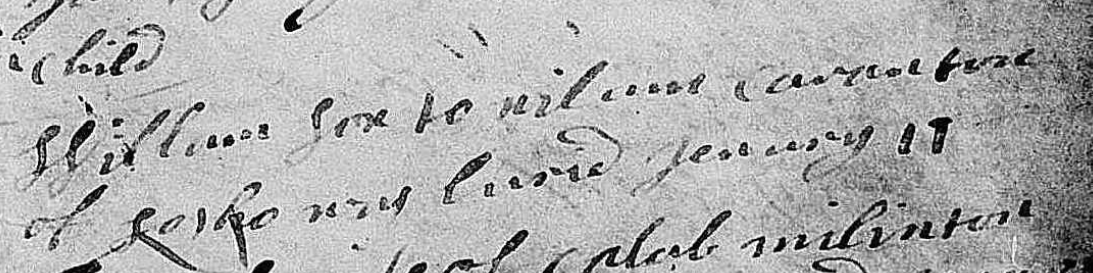
The Heanor parish registers between 1720 and 1729 are in many places illegible, however there are a couple of possibilities that could be the baptism of William in 1724 and 1725. A William son of William Carenton of Loscoe was buried in Jan 1721. In 1722 a Willian son of William Carenton (transcribed Tarenton) of Loscoe was buried. A subsequent son called William is likely. On 15 Oct 1724 a William son of William and Eliz (last name indecipherable) of Loscoe was baptised. A Mary, daughter of William Carrianton of Loscoe, was baptised in 1727.
I propose that William Carringtons was born in Loscoe and baptised in Heanor in 1724: if not 1724 then I would assume his baptism is one of the illegible or indecipherable entires within those few years. This falls short of absolute documented proof of course, but it makes sense to me.
In any case, if a William Carrington child died in Heanor in 1721 which we do have documented proof of, it further dismisses the case for William having arrived for no discernable reason from Chinley.
March 17, 2022 at 10:37 am #6283In reply to: The Elusive Samuel Housley and Other Family Stories
Purdy Cousins
My great grandmother Mary Ann Gilman Purdy was one of five children. Her sister Ellen Purdy was a well traveled nurse, and her sister Kate Rushby was a publican whose son who went to Africa. But what of her eldest sister Elizabeth and her brother Richard?
Elizabeth Purdy 1869-1905 married Benjamin George Little in 1892 in Basford, Nottinghamshire. Their first child, Frieda Olive Little, was born in Eastwood in December 1896, and their second daughter Catherine Jane Little was born in Warrington, Cheshire, in 1898. A third daughter, Edna Francis Little was born in 1900, but died three months later.
When I noticed that this unidentified photograph in our family collection was taken by a photographer in Warrington, and as no other family has been found in Warrington, I concluded that these two little girls are Frieda and Catherine:
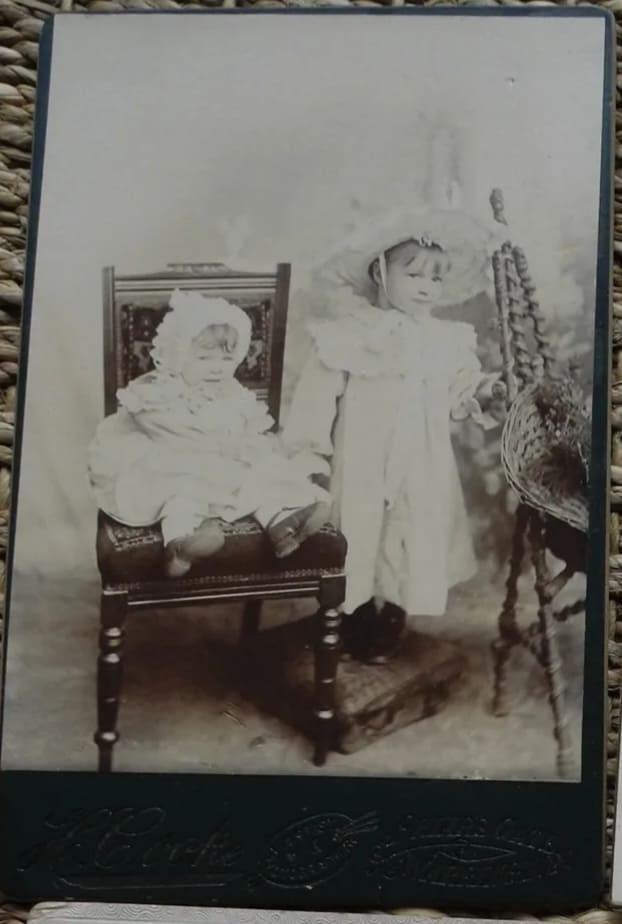
Benjamin Little, born in 1869, was the manager of a boot shop, according to the 1901 census, and a boot maker on the 1911 census. I found a photograph of Benjamin and Elizabeth Little on an ancestry website:
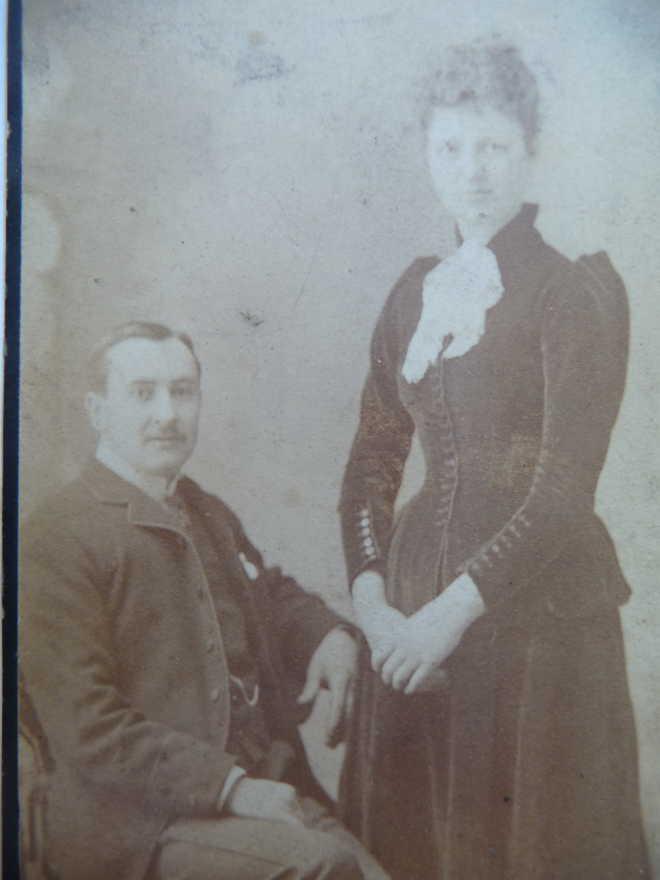
Frieda Olive Little 1896-1977 married Robert Warburton in 1924.
Frieda and Robert had two sons and a daughter, although one son died in infancy. They lived in Leominster, in Herefordshire, but Frieda died in 1977 at Enfield Farm in Warrington, four years after the death of her husband Robert.
Catherine Jane Little 1899-1975 married Llewelyn Robert Prince 1884-1950. They do not appear to have had any children. Llewelyn was manager of the National Provinical Bank at Eltham in London, but died at Brook Cottage in Kingsland, Herefordshire. His wifes aunt Ellen Purdy the nurse had also lived at Brook Cottage. Ellen died in 1947, but her husband Frank Garbett was at the funeral:
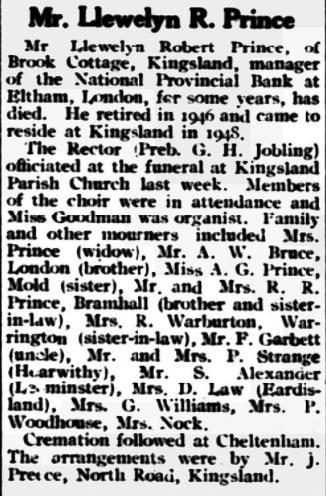
Richard Purdy 1877-1940
Richard was born in Eastwood, Nottinghamshire. When his mother Catherine died in 1884 Richard was six years old. My great grandmother Mary Ann and her sister Ellen went to live with the Gilman’s in Buxton, but Richard and the two older sisters, Elizabeth and Kate, stayed with their father George Purdy, who remarried soon afterwards.
Richard married Ada Elizabeth Clarke in 1899. In 1901 Richard was an earthenware packer at a pottery, and on the 1939 census he was a colliery dataller. A dataller was a day wage man, paid on a daily basis for work done as required.
Richard and Ada had four children: Richard Baden Purdy 1900-1945, Winifred Maude 1903-1974, John Frederick 1907-1945, and Violet Gertrude 1910-1974.
Richard Baden Purdy married Ethel May Potter in Mansfield, Nottinghamshire, in 1926. He was listed on the 1939 census as a colliery deputy. In 1945 Richard Baden Purdy died as a result of injuries in a mine explosion.
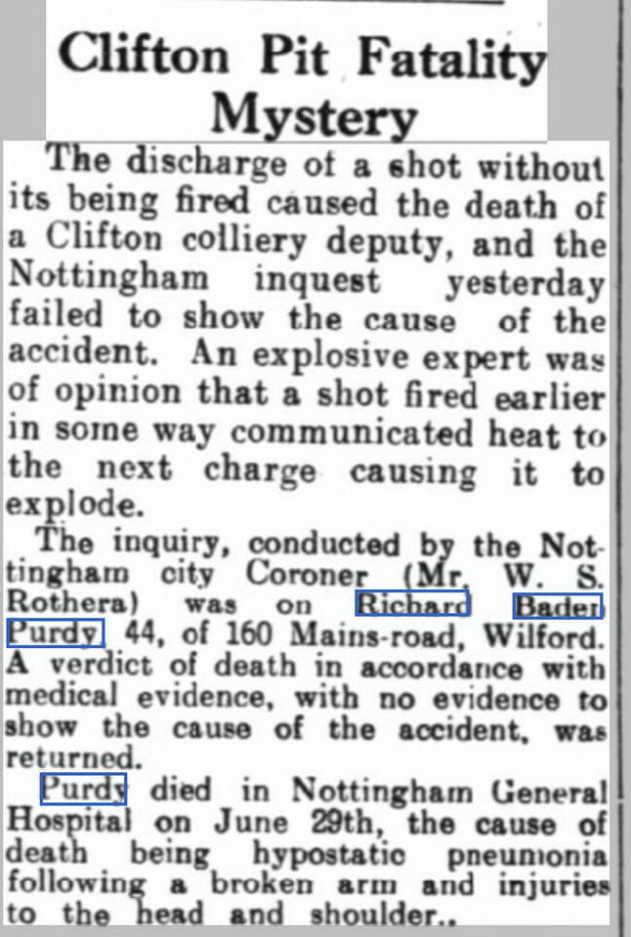
John Frederick Purdy married Iris Merryweather in 1938. On the 1939 census John and Iris live in Arnold, Nottinghamshire, and John’s occupation is a colliery hewer. Their daughter Barbara Elizabeth was born later that year. John died in 1945, the same year as his brother Richard Baden Purdy. It is not known without purchasing the death certificate what the cause of death was.
A memorial was posted in the Nottingham Evening Post on 29 June 1948:
PURDY, loving memories, Richard Baden, accidentally killed June 29th 1945; John Frederick, died 1 April 1945; Richard Purdy, father, died December 1940. Too dearly loved to be forgotten. Mother, families.
Violet Gertrude Purdy married Sidney Garland in 1932 in Southwell, Nottinghamshire. She died in Edwinstowe, Nottinghamshire, in 1974.
Winifred Maude Purdy married Bernard Fowler in Southwell in 1928. She also died in 1974, in Mansfield.
The two brothers died the same year, in 1945, and the two sisters died the same year, in 1974.
March 4, 2022 at 2:58 pm #6280In reply to: The Whale’s Diaries Collection
I started reading a book. In fact I started reading it three weeks ago, and have read the first page of the preface every night and fallen asleep. But my neck aches from doing too much gardening so I went back to bed to read this morning. I still fell asleep six times but at least I finished the preface. It’s the story of the family , initiated by the family collection of netsuke (whatever that is. Tiny Japanese carvings) But this is what stopped me reading and made me think (and then fall asleep each time I re read it)
“And I’m not entitled to nostalgia about all that lost wealth and glamour from a century ago. And I am not interested in thin. I want to know what the relationship has been between this wooden object that I am rolling between my fingers – hard and tricky and Japanese – and where it has been. I want to be able to reach to the handle of the door and turn it and feel it open. I want to walk into each room where this object has lived, to feel the volume of the space, to know what pictures were on the walls, how the light fell from the windows. And I want to know whose hands it has been in, and what they felt about it and thought about it – if they thought about it. I want to know what it has witnessed.” ― Edmund de Waal, The Hare With Amber Eyes: A Family’s Century of Art and Loss
And I felt almost bereft that none of the records tell me which way the light fell in through the windows.
I know who lived in the house in which years, but I don’t know who sat in the sun streaming through the window and which painting upon the wall they looked at and what the material was that covered the chair they sat on.
Were his clothes confortable (or hers, likely not), did he have an old favourite pair of trousers that his mother hated?
There is one house in particular that I keep coming back to. Like I got on the Housley train at Smalley and I can’t get off. Kidsley Grange Farm, they turned it into a nursing home and built extensions, and now it’s for sale for five hundred thousand pounds. But is the ghost still under the back stairs? Is there still a stain somewhere when a carafe of port was dropped?
Did Anns writing desk survive? Does someone have that, polished, with a vase of spring tulips on it? (on a mat of course so it doesn’t make a ring, despite that there are layers of beeswaxed rings already)
Does the desk remember the letters, the weight of a forearm or elbow, perhaps a smeared teardrop, or a comsumptive cough stain?
Is there perhaps a folded bit of paper or card that propped an uneven leg that fell through the floorboards that might tear into little squares if you found it and opened it, and would it be a rough draft of a letter never sent, or just a receipt for five head of cattle the summer before?
Did he hate the curtain material, or not even think of it? Did he love the house, or want to get away to see something new ~ or both?
Did he have a favourite cup, a favourite food, did he hate liver or cabbage?
Did he like his image when the photograph came from the studio or did he think it made his nose look big or his hair too thin, or did he wish he’d worn his other waistcoat?
Did he love his wife so much he couldn’t bear to see her dying, was it neglect or was it the unbearableness of it all that made him go away and drink?
Did the sun slanting in through the dormer window of his tiny attic room where he lodged remind him of ~ well no perhaps he was never in the room in daylight hours at all. Work all day and pub all night, keeping busy working hard and drinking hard and perhaps laughing hard, and maybe he only thought of it all on Sunday mornings.
So many deaths, one after another, his father, his wife, his brother, his sister, and another and another, all the coughing, all the debility. Perhaps he never understood why he lived and they did not, what kind of justice was there in that?
Did he take a souvenir or two with him, a handkerchief or a shawl perhaps, tucked away at the bottom of a battered leather bag that had his 3 shirts and 2 waistcoats in and a spare cap,something embroidered perhaps.
The quote in that book started me off with the light coming in the window and the need to know the simplest things, something nobody ever wrote in a letter, maybe never even mentioned to anyone.
Light coming in windows. I remeber when I was a teenager I had a day off sick and spent the whole day laying on the couch in a big window with the winter sun on my face all day, and I read Bonjour Tristesse in one sitting, and I’ll never forget that afternoon. I don’t remember much about that book, but I remember being transported. But at the same time as being present in that sunny window.
“Stories and objects share something, a patina…Perhaps patina is a process of rubbing back so that the essential is revealed…But it also seems additive, in the way that a piece of oak furniture gains over years and years of polishing.”
“How objects are handed on is all about story-telling. I am giving you this because I love you. Or because it was given to me. Because I bought it somewhere special. Because you will care for it. Because it will complicate your life. Because it will make someone else envious. There is no easy story in legacy. What is remembered and what is forgotten? There can be a chain of forgetting, the rubbing away of previous ownership as much as the slow accretion of stories. What is being passed on to me with all these small Japanese objects?”
“There are things in this world that the children hear, but whose sounds oscillate below an adult’s sense of pitch.”
What did the children hear?
February 9, 2022 at 7:00 pm #6276In reply to: The Elusive Samuel Housley and Other Family Stories
Ellastone and Mayfield
Malkins and Woodwards
Parish RegistersJane Woodward
It’s exciting, as well as enormously frustrating, to see so many Woodward’s in the Ellastone parish registers, and even more so because they go back so far. There are parish registers surviving from the 1500’s: in one, dated 1579, the death of Thomas Woodward was recorded. His father’s name was Humfrey.Jane Woodward married Rowland Malkin in 1751, in Thorpe, Ashbourne. Jane was from Mathfield (also known as Mayfield), Ellastone, on the Staffordshire side of the river Dove. Rowland was from Clifton, Ashbourne, on the Derbyshire side of the river. They were neighbouring villages, but in different counties.
Jane Woodward was born in 1726 according to the marriage transcription. No record of the baptism can be found for her, despite there having been at least four other Woodward couples in Ellastone and Mayfield baptizing babies in the 1720’s and 1730’s. Without finding out the baptism with her parents names on the parish register, it’s impossible to know which is the correct line to follow back to the earlier records.
I found a Mayfield history group on Facebook and asked if there were parish records existing that were not yet online. A member responded that she had a set on microfiche and had looked through the relevant years and didn’t see a Jane Woodward, but she did say that some of the pages were illegible.
The Ellasone parish records from the 1500s surviving at all, considering the events in 1673, is remarkable. To be so close, but for one indecipherable page from the 1700s, to tracing the family back to the 1500s! The search for the connecting link to the earlier records continues.
Some key events in the history of parish registers from familysearch:
In medieval times there were no parish registers. For some years before the Reformation, monastic houses (especially the smaller ones) the parish priest had been developing the custom of noting in an album or on the margins of the service books, the births and deaths of the leading local families.
1538 – Through the efforts of Thomas Cromwell a mandate was issued by Henry VIII to keep parish registers. This order that every parson, vicar or curate was to enter in a book every wedding, christening and burial in his parish. The parish was to provide a sure coffer with two locks, the parson having the custody of one key, the wardens the others. The entries were to be made each Sunday after the service in the presence of one of the wardens.
1642-60 – During the Civil War registers were neglected and Bishop Transcripts were not required.
1650 – In the restoration of Charles they went back to the church to keep christenings, marriages and burial. The civil records that were kept were filed in with the parish in their registers. it is quite usual to find entries explaining the situation during the Interregnum. One rector stated that on 23 April 1643 “Our church was defaced our font thrown down and new forms of prayer appointed”. Another minister not quite so bold wrote “When the war, more than a civil war was raging most grimly between royalists and parliamentarians throughout the greatest part of England, I lived well because I lay low”.
1653 – Cromwell, whose army had defeated the Royalists, was made Lord Protector and acted as king. He was a Puritan. The parish church of England was disorganized, many ministers fled for their lives, some were able to hide their registers and other registers were destroyed. Cromwell ruled that there would be no one religion in England all religions could be practiced. The government took away from the ministers not only the custody of the registers, but even the solemnization of the marriage ceremony. The marriage ceremony was entrusted to the justices to form a new Parish Register (not Registrar) elected by all the ratepayers in a parish, and sworn before and approved by a magistrate.. Parish clerks of the church were made a civil parish clerk and they recorded deaths, births and marriages in the civil parishes.Ellastone:
“Ellastone features as ‘Hayslope’ in George Eliot’s Adam Bede, published in 1859. It earned this recognition because the author’s father spent the early part of his life in the village working as a carpenter.”
Adam Bede Cottage, Ellastone:
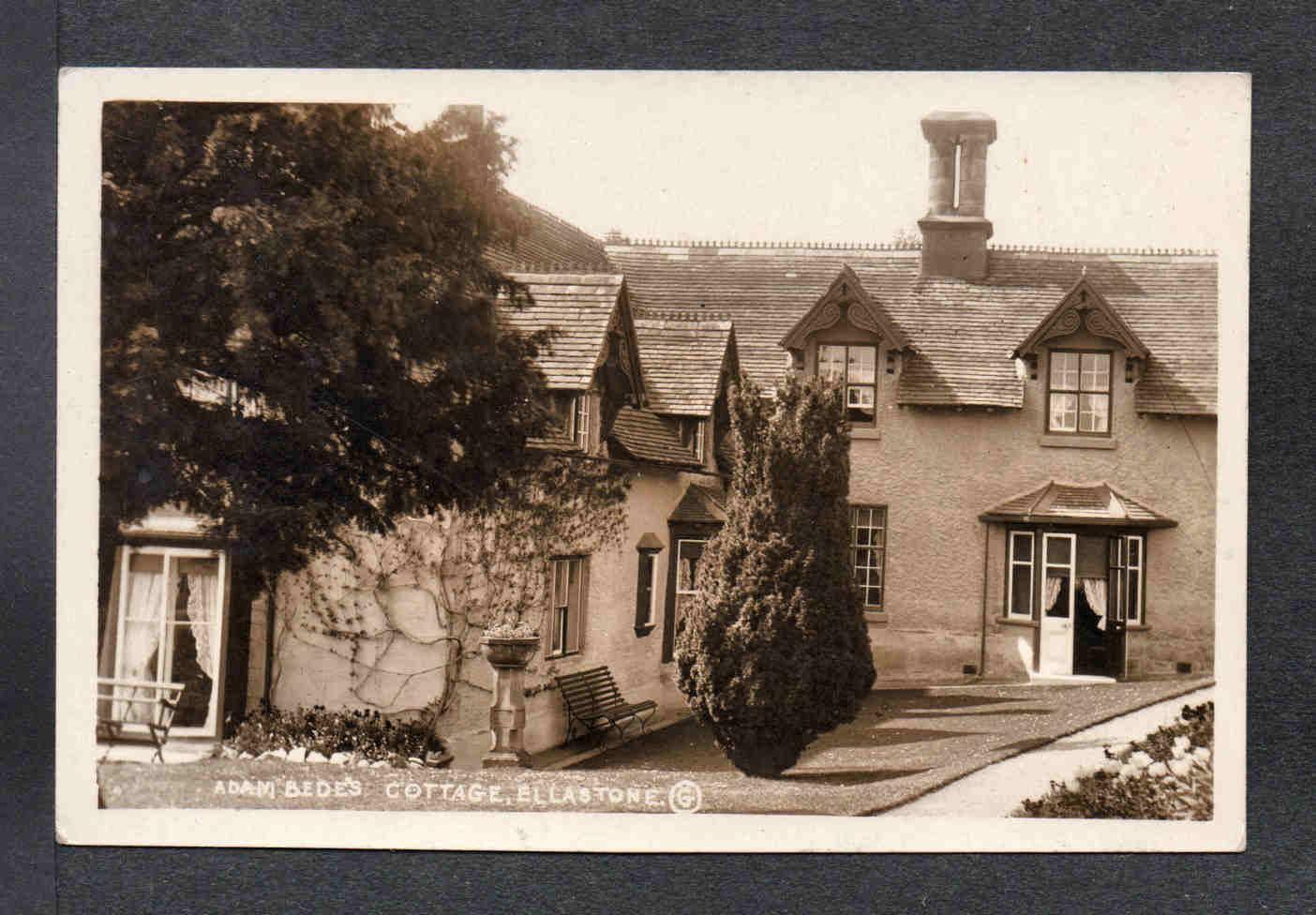
“It was at Ellastone that Robert Evans, George Eliot’s father, passed his early years and worked as a carpenter with his brother Samuel; and it was partly from reminiscences of her father’s talk and from her uncle Samuel’s wife’s preaching experiences that the author constructed the very powerful and moving story of Adam Bede.”
Mary Malkin
1765-1838
Ellen Carrington’s mother was Mary Malkin.
Ellastone:
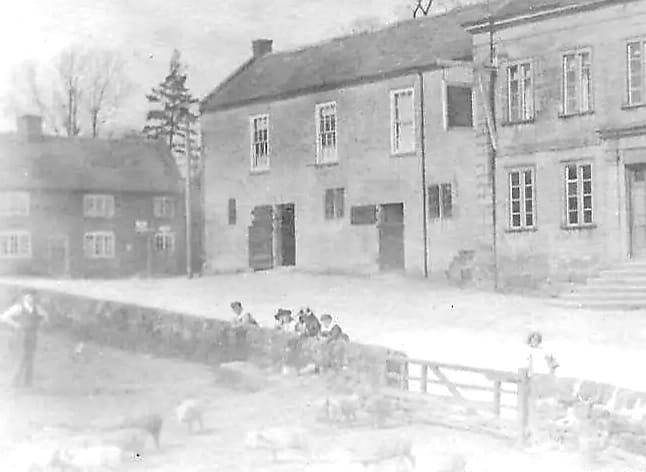
Ashbourn the 31st day of May in the year of our Lord 1751. The marriage of Rowland Malkin and Jane Woodward:
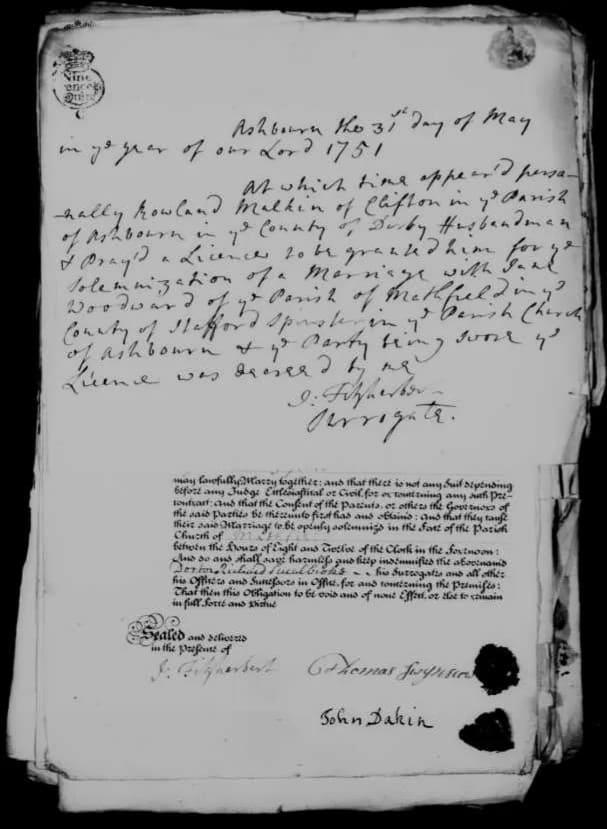
-
AuthorSearch Results
