


Search Results for 'delightful'
-
AuthorSearch Results
-
January 19, 2026 at 6:51 pm #8051
In reply to: The Hoards of Sanctorum AD26
“Lace, did you say?” asked Cerenise with interest. “I must have a look at it. Stench, you say? How very odd. But I want to see it. Fetch me the container while I look for my mask and rubber gloves.”
“I’m not going near it again, I’ll get Boothroyd to bring it,” Spirius replied making a hasty exit.
“I’d have thought you’d have wanted to bottle the smell, Spirius.”
In due course the gardener appeared holding a container at arms length with a pained expression on his face. “Stinks worse than keeg, this does, and I’ve smelled some manure and compost in my time, but never anything as disgusting as this. Where am I to put it?”
Cerenise cleared a space on a table piled with old books and catalogues. “Gosh, that is a pong, isn’t it! Reminds me of something,” she said twitching her nose. “There is a delicate note of ~ what is it?”
“Dead rats?” suggested Boothroyd helpfully, adding “Will that be all?” as he backed towards the door.
As Cerenise lifted the lid, the gardener turned and fled.
“Why, it’s a Nottingham lace Lambrequin window drape if I’m not mistaken!” exclaimed Cerenise, gently lifting the delicate fabric and holding it up to the light. “Probably 1912 or thereabouts, and in perfect condition.”
“Perfectly rancid,” said Yvoise, her voice muffled by the thick towel she had wrapped around her mouth and nose.
“Come and look, it’s a delightful specimen. Not terribly rare, but it wonderful condition. Oh look! There’s another piece underneath. Aha! seventeenth century bone lace!”
Yvoise crept closer. “What’s that other thing? Is that where the smell’s coming from?”
“By Georges, I think you’re right. It’s a bone bobbin. Bone lace, they used to call it, until they started making bobbins out of wood.” Cerenise was pleased. She could get Mrs Fennel to wash the lace and then she could add it to her collection. “Spirius can bottle the bone bobbin and bury it in Bobbington Woods.”
Duly summoned from the kitchen, the faithful daily woman appeared, drying her hands on her apron.
“Pooo eee!” exclaimed Mrs Fennel, “That’ll need a good boil in bleach, will that!”
“Good lord woman, no! A gentle soak in some soap should do it. It won’t smell half so bad as soon as this bone bobbin is removed.”
“Did you say BONE bobbin?” asked Helier from a relatively safe distance just outside the door. “WHOSE bone?”
“By Georges!” Cerenise said again. “Whose bone indeed! Therein lies the clue to the mystery, you know.”
“Can’t you just put it in a parcel and mail it to someone horrible?” suggested Mrs Fennel.
“A capital idea, Mrs Fennel, a politician. So many horrible ones to choose from though,” Yvoise was already making a mental list.
“We can mail the smelly empty box to the prime minister, but we must keep the bone bobbin safe,” said Helier. “And we must find out whose bones it was made from. Cerenise is right. It’s the clue.”
“An empty smelly box, even better. More fitting, if I do say so myself, for the prime minister,” said Mrs Fennel with some relief. At least she wasn’t going to be required to wash the bone and the box as well as the smelly lace.
January 16, 2026 at 11:00 pm #8048In reply to: The Hoards of Sanctorum AD26
“Bless you,” Helier offered, instinctively sliding the half-chewed pencil stub under a pile of National Geographics from 1978. He felt a flush of guilt, as if he’d been caught trying to steal a kid’s toy.
Cerenise rolled into the room, looking like a sorry pile of laundry. She was wrapped in three different shawls—one Paisley, one Tartan, and one that looked like a doily from a medieval altar. She held a lace handkerchief to her nose, trumpeting into it with a force that rattled the nearby display of thimbles.
“It’s not the damp,” she croaked, her voice an octave lower than usual. “It’s the cleanliness. Since Spirius fixed that pipe, the air is too… sterile. My immune system is in shock. It misses the spores.”
She eyed the spot where Helier had hidden the pencil. “You were thinking about it, weren’t you?”
“Thinking about what?” Helier feigned innocence, picking up a ceramic frog.
“The Novena,” she whispered the word like a curse. “I saw the look in your eye. The ‘maybe I don’t need this’ look. It’s the fever talking, Helier. Don’t give in. I almost threw away a button yesterday. A bakelite toggle from a 1930s duffel coat. I held it over the bin for a full minute.” She shuddered, pulling the shawls tighter. “Madness.”
“Pure madness,” Helier agreed, quickly retrieving the pencil stub and placing it prominently on the desk to prove his loyalty to the hoard. “We must stay strong. Now, surely you didn’t brave the drafty hallway just to discuss my potential apostasy?”
“I didn’t,” Cerenise sniffed, tucking the handkerchief into her sleeve. “I found him. Or at least, I found the thread.”
She wheeled closer, dropping a printout onto Helier’s knees. It was a genealogy chart, annotated with her elegant, spider-scrawl handwriting.
“Pierre Wenceslas Varlet,” she announced. “Born 1824. Brother to a last of the famously named Austreberthes — mortal ones, unsaintly, of course. Her lineage didn’t die out, Helier.”
Helier squinted at the paper. “Varlet? Sounds like a villain in one of Liz Tattler’s bodice-rippers. ‘The Vengeful Varlet of Venice’.“
“Focus, Helier. Look at the modern branch.” She pointed to the bottom of the page. “The name changed in the 1950s. Anglicized. And I think, if my research into the local council tax records—hacked via that delightful ‘incognito mode’ you showed me—is correct, the current ‘Varlet’ is closer than we think.”
“How close?”
“Gloucester close,” Cerenise said, her eyes gleaming with the thrill of the hunt, momentarily forgetting her flu. “And you’ll never guess where he works.”
January 6, 2026 at 6:20 pm #8044In reply to: The Hoards of Sanctorum AD26
With a warm smile of approval, Cerenise tapped out the names and dates on her keyboard. So refreshing when people were original when naming the fruit of their loins, she thought. Some of the family trees she’d done for friends and clients had been a veritable cesspit of endlessly repeated Johns and Marys, Williams and Elizabeths. Despite suppressing a shudder when introduced to a modern human named River or Sky, or worse, the ridiculously creative spelling of a common name, some of the older examples of unusual names she found quite delightful. Especially, it had to be said, French ones.
Pierre Wenceslas Varlet born on the 28th of September, 1824 in Clenleu, Pas-de-Calais, brother of Austreberthe Varlet, born two years previously on the 8th of June. Wenceslas! What would you call Wenceslas for short? she mused. Wence?
“An ’twere not as good a deed as drink to turn true man and to leave these rogues, I am the veriest varlet that ever chewed with a tooth”.
A cautious knock at the door interrupted Cerenise’s mental meanderings.
“Enter,” she called, and Laddie Bentry sidled in looking sheepish.
“Ah, it’s you, the veriest varlet of number 26. Well, what is it? You look as though you accidentally dropped Helier’s trashy novel in the water butt.”
Taken aback by Cernice’s perspicacity, Laddie recoiled slightly and then squared his shoulders. “How did you know?” he asked.
“Oh just a lucky guess,” Cerenise replied breezily, tapping the side of her nose. “I suppose you want me to order you another copy from Amaflob before he notices? I’ll arrange for an express delivery. Keep an eye out for the delivery man”
Waving away his thanks, she picked up the old document on her desk that Yvoise had kindly provided, albeit reluctantly, and squinted at it. She could make out the name Austreberthe, but what did the rest say?
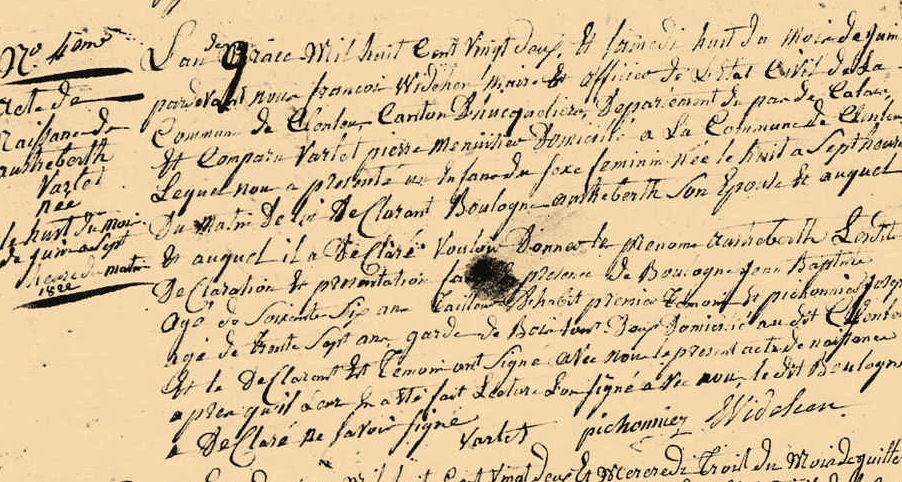
Cerenise dozed off, dreaming of the Folies Bergere. The atmosphere was exciting and convivial at first, escalating into an eruption of approval when the new act came on the stage. Cerenise felt the energy of the crowd but her attention was drawn to the flamboyant figure of a man dressed as one of the three kings of the Magi, and he was making his way over to her. Why, it was Lazuli Galore! What on earth was he doing here? And who was that dumpy overly made up woman in the blue dress, Godfreda, who had tagged along with them?
Another knock on the door wakened her and she called out “Come in!” in an irritable tone. She’d been having such fun in the dream. “Oh it’s you, oh good, the book has arrived.”
Laddie shifted his feet and replied, “Well yes, a Liz Tattler novel has arrived.”
“Oh, good, well be off with you then so I can get on with my work.”
“But it’s not The Vampires of Varna. It’s The Valedictorian Vampires of Valley View High.”
“Jolly good, I expect you’ll enjoy it,” Cerenise said, picking up the old document again and peering at it. Perceiving that Laddie had not yet exited the room, she looked up. “Helier won’t notice, those books are all the same. Now get off with you.”
January 3, 2026 at 8:09 pm #8025In reply to: The Hoards of Sanctorum AD26
As soon as Boothroyd had gone, Laddie Bentry, the under gardener, emerged from behind the Dicksonia squarrosa that was planted in a rare French Majolica Onnaing dragon eagle pot. The pot, and in particular the tree fern residing within it, were Laddie’s favourite specimen, reminding him of his homeland far away.
Keeping a cautious eye on the the door leading into the house, Laddie hurried over to the cast iron planter and retrieved the Liz Tattler novel hidden underneath. Quickly he tucked in into the inside pocket of his shabby tweed jacket and hastened to the door leading to the garden. Holding on to his cap, for the wind was cold and gusty, he ran to the old stable and darted inside. Laddie reckoned he had an hour or two free without Boothroyd hovering over him, and he settled himself on a heap of old sacks.
 The Vampire Hoarders of Varna. It wasn’t the first time Laddie had seen Boothroyd surreptitiously reading Helier’s books, and it had piqued his curiosity. What was it the old fart found so interesting about Helier’s novels? The library was full of books, if he wanted to read. Not bothering to read the preface, and not having time to start on page one, Laddie Bentry flicked through the book, pausing to read random passages.
….the carriage rattled and lurched headlong through the valley, jostling the three occupants unmercifully. “I’ll have the guts of that coachman for garters! The devil take him!” Galfrey exclaimed, after bouncing his head off the door frame of the compartment.
“Is it bleeding?” asked Triviella, inadvertently licking her lips and she inspected his forehead.
“The devil take you too, for your impertinence,” Galfrey scowled and shook her off, his irritation enhanced by his alarm at the situation they found themselves in.
Ignoring his uncharacteristic bad humour, Triviella snuggled close and and stroked his manly thigh, clad in crimson silk breeches. “Just think about the banquet later,” she purred.
Jacobino, austere and taciturn, on the opposite seat, who had thus far been studiously ignoring both of them, heard the mention of the banquet and smiled for the first time since…
Laddie opened the book to another passage.
“……1631, just before the siege of Gloucester, and what a feast it was! It was hard to imagine a time when we’d feasted so well. Such rich and easy pickings and such a delightful cocktail. One can never really predict a perfect cocktail of blood types at a party, and centuries pass between particularly memorable ones. Another is long overdue, and one would hate to miss it,” Jacobino explained to the innocent and trusting young dairy maid, who was in awe that the handsome young gentleman was talking to her at all, yet understood very little of his dialogue.
“Which is why,” Jacobino implored, taking hold of her small calloused hands, “You must come with me to the banquet tonight.”
Little did she know that her soft rosy throat was on the menu…..
February 28, 2025 at 11:57 pm #7840In reply to: The Last Cruise of Helix 25
Helix 25 — Aftermath of the Solar Flare Alert
The Second Murder
It didn’t take them long to arrive at the scene, Riven alerted by a distraught Finkley who’d found the body.
Evie knelt beside the limp, twitching form of Mandrake, his cybernetic collar flickering erratically, tiny sparks dancing along its edge. The cat’s body convulsed, its organic parts frozen in eerie stillness while the cybernetic half stuttered between functions, blinking in and out of awareness.
Mandrake was both dead and not dead.
“Well, this is unsettling,” TP quipped, materializing beside them with an exaggerated frown. “A most profound case of existential uncertainty. Schrödinger himself would have found this delightful—if he weren’t very much confirmed dead.”
Riven crouched, running a scanner over Mandrake’s collar. The readout spat out errors. “Neural link’s corrupted. He’s lost something.”
Evie’s stomach twisted. “Lost what? But… he can be repaired, surely, can’t he?”
Evan replied with a sigh “Hard to tell how much damage he’s suffered, but we caught him in time thanks to Finkley’s reflexes, he may stand a chance, even if he may need to be reprogrammed.”
Mandrake’s single functioning eye flickered open, its usual sharpness dull. Then, rasping, almost disjointedly, he muttered:
“I was… murdered.”
Then his system crashed, leaving nothing but silence.
Upper Decks Carnival
Sue was still adjusting her hat and feathers for the Carnival Party wondering if that would be appropriate as she was planning to go to the wake first, and then to the Lexican’s baby shower. It wasn’t every day there was a baby nowadays. And a boy too. But then, there was no such thing as being overdressed in her book.
The ship’s intercom crackled to life, cutting through her thoughts, its automated cheerfulness electrifying like a misplaced party horn.
“Attention, dear passengers! As scheduled, with the solar flare now averted, we are preparing for our return to Earth. Please enjoy the journey and partake in today’s complimentary hibiscus tea at the Grand Hall! Samba!”
The words ‘return to Earth’ sent a shudder through Sue’s spine. That wasn’t right. That wasn’t possible.
A sudden pulse of static in her artificial limb made her flinch. A garbled transmission—so faint she almost dismissed it—whispered through her internal interface, that was constantly scanning hacking through the data streams of the ship, and having found critical intel that was quickly being scrubbed by the maintenance system.
Signal detected…
Beacon coordinates triangulating…
…origin: Earth…Her breath stopped. Sue had spent years pretending she knew everything, but this… was something else entirely.
She got the odd and ominous feeling that Synthia was listening.
Quadrant B – The Wake of Mr. Herbert
The air in the gathering hall was thick with preservative floral mist—the result of enthusiastic beauticians who had done their best to restore and rehydrate the late Mr. Herbert to some semblance of his former self.
And yet, despite their efforts, he still looked vaguely like a damp raisin in a suit.
Gloria adjusted her shawl and whispered to Sharon, “He don’t look half bad, does he?”
Sharon squinted. “Oh, love, I’d say he looks at least three-quarters bad.”
Marlowe Sr. stood by the casket, his posture unnervingly rigid, as if he were made of something more fragile than bone. When he spoke, his voice cracked. “Ethan.”
He was in no condition for a speech— only able to utter the name.
Gloria dabbed her eyes, nudging Mavis. “I reckon this is the saddest thing I’ve seen since they discontinued complimentary facials at the spa.”
Mavis sniffed. “And yet, they say he’ll be composted by next Tuesday. Bloody efficient, innit?”
Marlowe didn’t hear them.
Because at that moment, as he stared at his son’s face, the realization struck him like a dying star—this was no mistake. This was something bigger.
And for the first time in years, he felt the weight of knowing too much.
He would have to wake and talk to the Captain. She would know what to do.
February 15, 2025 at 9:21 am #7789In reply to: The Last Cruise of Helix 25
Helix 25 – Poop Deck – The Jardenery
Evie stepped through the entrance of the Jardenery, and immediately, the sterile hum of Helix 25’s corridors faded into a world of green. Of all the spotless clean places on the ship, it was the only where Finkley’s bots tolerated the scent of damp earth. A soft rustle of hydroponic leaves shifting under artificial sunlight made the place an ecosystem within an ecosystem, designed to nourrish both body and mind.
Yet, for all its cultivated serenity, today it was a crime scene. The Drying Machine was connected to the Jardenery and the Granary, designed to efficiently extract precious moisture for recycling, while preserving the produce.
Riven Holt, walking beside her, didn’t share her reverence. “I don’t see why this place is relevant,” he muttered, glancing around at the towering bioluminescent vines spiraling up trellises. “The body was found in the drying machine, not in a vegetable patch.”
Evie ignored him, striding toward the far corner where Amara Voss was hunched over a sleek terminal, frowning at a glowing screen. The renowned geneticist barely noticed their approach, her fingers flicking through analysis results faster than human eyes could process.
A flicker of light.
“Ah-ha!” TP materialized beside Evie, adjusting his holographic lapels. “Madame Voss, I must say, your domain is quite the delightful contrast to our usual haunts of murder and mystery.” He twitched his mustache. “Alas, I suspect you are not admiring the flora?”
Amara exhaled sharply, rubbing her temples, not at all surprised by the holographic intrusion. She was Evie’s godmother, and had grown used to her experiments.
“No, indeed. I’m admiring this.” She turned the screen toward them.
The DNA profile glowed in crisp lines of data, revealing a sequence highlighted in red.
Evie frowned. “What are we looking at?”
Amara pinched the bridge of her nose. “A genetic anomaly.”
Riven crossed his arms. “You’ll have to be more specific.”
Amara gave him a sharp look but turned back to the display. “The sample we found at the crime scene—blood residue on the drying machine and some traces on the granary floor—matches an ancient DNA profile from my research database. A perfect match.”
Evie felt a prickle of unease. “Ancient? What do you mean? From the 2000s?”
Amara chuckled, then nodded grimly. “No, ancient as in Medieval ancient. Specifically, Crusader DNA, from the Levant. A profile we mapped from preserved remains centuries ago.”
Silence stretched between them.
Finally, Riven scoffed. “That’s impossible.”
TP hummed thoughtfully, twirling his cane. “Impossible, yet indisputable. A most delightful contradiction.”
Evie’s mind raced. “Could the database be corrupted?”
Amara shook her head. “I checked. The sequencing is clean. This isn’t an error. This DNA was present at the crime scene.” She hesitated, then added, “The thing is…” she paused before considering to continue. They were all hanging on her every word, waiting for what she would say next.
Amara continued “I once theorized that it might be possible to reawaken dormant ancestral DNA embedded in human cells. If the right triggers were applied, someone could manifest genetic markers—traits, even memories—from long-dead ancestors. Awakening old skills, getting access to long lost secrets of states…”
Riven looked at her as if she’d grown a second head. “You’re saying someone on Helix 25 might have… transformed into a medieval Crusader?”
Amara exhaled. “I’m saying I don’t know. But either someone aboard has a genetic profile that shouldn’t exist, or someone created it.”
TP’s mustache twitched. “Ah! A puzzle worthy of my finest deductive faculties. To find the source, we must trace back the lineage! And perhaps a… witness.”
Evie turned toward Amara. “Did Herbert ever come here?”
Before Amara could answer, a voice cut through the foliage.
“Herbert?”
They turned to find Romualdo, the Jardenery’s caretaker, standing near a towering fruit-bearing vine, his arms folded, a leaf-tipped stem tucked behind his ear like a cigarette. He was a broad-shouldered man with sun-weathered skin, dressed in a simple coverall, his presence almost too casual for someone surrounded by murder investigators.
Romualdo scratched his chin. “Yeah, he used to come around. Not for the plants, though. He wasn’t the gardening type.”
Evie stepped closer. “What did he want?”
Romualdo shrugged. “Questions, mostly. Liked to chat about history. Said he was looking for something old. Always wanted to know about heritage, bloodlines, forgotten things.” He shook his head. “Didn’t make much sense to me. But then again, I like practical things. Things that grow.”
Amara blushed, quickly catching herself. “Did he ever mention anything… specific? Like a name?”
Romualdo thought for a moment, then grinned. “Oh yeah. He asked about the Crusades.”
Evie stiffened. TP let out an appreciative hum.
“Fascinating,” TP mused. “Our dearly departed Herbert was not merely a victim, but perhaps a seeker of truths unknown. And, as any good mystery dictates, seekers who get too close often find themselves…” He tipped his hat. “Extinguished.”
Riven scowled. “That’s a bit dramatic.”
Romualdo snorted. “Sounds about right, though.” He picked up a tattered book from his workbench and waved it. “I lend out my books. Got myself the only complete collection of works of Liz Tattler in the whole ship. Doc Amara’s helping me with the reading. Before I could read, I only liked the covers, they were so romantic and intriguing, but now I can read most of them on my own.” Noticing he was making the Doctor uncomfortable, he switched back to the topic. “So yes, Herbert knew I was collector of books and he borrowed this one a few weeks ago. Kept coming back with more questions after reading it.”
Evie took the book and glanced at the cover. The Blood of the Past: Genetic Echoes Through History by Dr. Amara Voss.
She turned to Amara. “You wrote this?”
Amara stared at the book, her expression darkening. “A long time ago. Before I realized some theories should stay theories.”
Evie closed the book. “Looks like someone didn’t agree.”
Romualdo wiped his hands on his coveralls. “Well, I hope you figure it out soon. Hate to think the plants are breathing in murder residue.”
TP sighed dramatically. “Ah, the tragedy of contaminated air! Shall I alert the sanitation team?”
Riven rolled his eyes. “Let’s go.”
As they walked away, Evie’s grip tightened around the book. The deeper they dug, the stranger this murder became.
December 14, 2024 at 2:35 pm #7675In reply to: Liz Tattler – A Lifetime of Stories, in videos
Glynis making potions (in Dragon Heartswood Fellowship story)
[Scene opens in Glynis’s cozy alchemical nook, where sunlight filters through stained glass, casting a kaleidoscope of colors onto the wooden workbench.]
Glynis, hair tied in a practical bun, hums a gentle melody, her hands deftly moving among jars of fragrant herbs and sparkling crystals. The air is rich with the scent of cinnamon and cardamom, mingling with the earthy aroma of freshly picked herbs.
Among her collection of vials and beakers, a group of soft, furry baby Snoots frolics, their fur a dazzling array of colors—from vibrant blues to shimmering purples—each reflecting their unique magic-imbued personalities.
One baby Snoot, with fur like a sunset, nudges a vial toward Glynis, its tiny paws leaving prints of glowing stardust. Glynis chuckles, accepting the offering with a warm smile. “Thank you, little one,” she whispers, adding a sprinkle of the sparkling dust to the simmering potion.
The Snoots, enchanted by the alchemical ballet, gather around the cauldron, their eyes wide with wonder as the potion bubbles and swirls with hues to match their fur. Occasionally, a brave Snoot dips a curious paw into the brew, causing a cascade of giggles as their fur momentarily absorbs the potion’s glow.
Glynis, her heart full with the joy of companionship, pauses to gently scratch behind the ears of a Snoot nestled by her elbow. “You’re all such wonderful helpers,” she murmurs, her voice a melody of gratitude.
As the potion reaches its peak, the room is momentarily filled with a burst of iridescent light, a reflection of the harmonious magic that binds Glynis and her Snoot companions in their delightful symbiotic dance.
November 18, 2024 at 9:40 pm #7605In reply to: The Incense of the Quadrivium’s Mystiques
Although the small hotel was tucked in a relatively quiet corner, and despite the authentic but delightfully shabby interior of soothing dimensions ~ roomy and airy, but not vast and terrifyingly empty ~ the constant background hum of city life was making Truella yearn for the stillness of home. Not that home was silence, indeed not: the background tranquility was frequently punctuated with noises, many strident. A dog barks, a neighbour shouts, a car drives past from time to time. But the noises have an identifiable individuality and reason, unlike the continual maddening drone of the metropolis.
She was pleased to find her room had a little balcony. Even if the little wooden chair was rickety and uncomfortable, it was enough to perch on to enjoy a cigarette and breathe in the car fumes. Truella slept fitfully, waking to remember Tolkeinesque snapshots of dreams, drifting off again and returning to wakefullness with snatches of conversations in unknown tongues. Sitting on the balcony in the deep dark hours of the night, the street below, now quiet, shivered and changed, her head still swimming with dream images. She caught glimpses of people as they passed, vivid, clear and full of character. Many who passed were carrying bunches of grasses or herbs or wildflowers in their hands, the women with a basket over their arm and a shawl draped over their head or shoulders.
Hardly any men though, I wonder why?
When Truella mentioned it over breakfast the next moring, Eris said “You’ve been reading too much of that new gender and feminist anthropology stuff over on GreenGrotto.”
Laughing, Truella tipped another packet of sugar in her coffee. “I love the colour of the walls in here,” she said, gazing around the breakfast room. “A sort of bright but muted sun shining on a white wall. Nice old furniture, too.”
“Tell me about the old furniture, the mirror in my room is all speckled, makes me look like I have blemishes all over my face,” said Zeezel with a toss of her head. “Can I have your sugar, Frella, if you’re not having it,” adding I’m on holiday by way of excuse.
Absentmindely Frella passed over the paper packet. “I had strange dreams last night too…about that place we’re supposed to be going to a picnic to later.”
Catching everyones attention, she continued, “The abandoned colosseum with Giovanni, with all the vines and flowers. It was like a game board and the stone statues were the players and they moved around the board, Oh! and such a beautiful board it was with all the vines and flowers ….. ”
“Gosh” said Truella, leaning back and folding her hands. What an idea.
November 4, 2024 at 2:01 pm #7578In reply to: The Incense of the Quadrivium’s Mystiques
When Eris gave Jeezel carte blanche to decorate the meeting room, Frella and Truella looked at her as if she’d handed fireworks to a dragon. They protested immediately, arguing that giving Jeezel that much freedom was like inviting a storm draped in sequins and velvet. After all, Jeezel was a queen diva—a master of flair and excess, ready to transform any ordinary space into a grand stage for her dramatic vision. In their eyes, it would defeat the whole purpose! But Eris raised a firm hand, silencing her sister’s objections.
“Let’s be honest, Malové is no ordinary witch,” she began, addressing Truella, Frella, and even Jeezel, who was still stung by her sisters’ criticism of her decorating skills. “We don’t know how many centuries that witch has been roaming the world, gathering knowledge and sharpening her mind. But what we do know is that she’d detect any concealing spell in a heartbeat.”
“Yeah, you’re right,” Truella agreed. “I think that’s the smell…”
“You mean based on your last potion experiment?” snorted Frella.
“Girls, focus,” Eris said. “This meeting is long overdue, and we need to conceal the truth-revealing spell’s elements. Jeezel’s flair may be our best distraction. Malové has always dismissed her grandiosity as harmless extravagance, so for once, let’s use that to our advantage.”
While Eris spoke, Jeezel’s brow furrowed as she engaged in an animated dialogue with her inner diva, picturing every details. Frella rolled her eyes subtly, glancing off-camera as though for dramatic effect.
“Isn’t that a bit much for a meeting?” Truella groaned. “You already assigned us topics to prepare. Now we’re adding decorations?”
“You won’t have to lift a finger,” Jeezel declared. “I’ve got it all under control—and I already have everything we need. Here’s my vision: Halloween is coming, so the decor should be both elegant and enchanting. I’ll start by draping the room in velvet curtains in deep purples and midnight blacks—straight from my own bedroom.”
Truella’s jaw dropped, while Jeezel’s grin only widened.
“Oh! I love those,” Frella murmured approvingly.
“Next, delicate cobweb accents with a touch of silver thread to catch the light,” Jeezel continued. “Truella, we’ll need your excavation lamps with a few colored gels. They’ll cast a warm, inviting glow—a perfect mix of relaxation and intrigue, with shadows in just the right places. And for the season, a few glowing pumpkins tucked around the room will complete the scene.”
Jeezel’s inner diva briefly entertained the idea of mystical fog, but she discarded it—after all, this was a meeting, not a sabbat. Instead, she proposed a more subtle touch: “To conceal the spell’s elements, I’ll bring in a few charming critters. Faux ravens perched on shelves, bats hanging from the ceiling…a whimsical, creepy-cute vibe. We’ll adorn them with runes and sigils in an insconpicuous way and Frella can cast a gentle animation spell to make them shift ever so slightly. The movement will be just enough to escape Malové’s notice as she stays focused on the meeting. That way she’ll be oblivious to the spell being woven around her.”
“Are you starting to see where this is going?” Eris asked, looking at her sisters.
Frella nodded, and before Truella could chime in with any objections, Jeezel added, “And no Halloween gathering would be complete without wickedly delightful treats! Picture a grand table with themed snacks and drinks on polished silver trays and cauldrons. Caramel apples, spiced cider, chocolates shaped like magic potions—tempting enough to charm even a disciplined witch.”
“Now you’re talking my language,” Truella admitted, finally warming up to the idea.
“Perfect, then it’s settled,” Eris said, pleased. “You all have your tasks. They’ll help us reveal her hidden agenda and how the spell is influencing her. Truella, you’l handle Historical Artifacts and Lore. Frella, with your talent for connections, you’ll cover Coven Alliances and Mutual Interests. Jeezel, you’re in charge of Telluric and Cosmic Energies—it shouldn’t be hard with your endless videos on the subject. I’ll handle the rest: Magical Incense Innovations, Leadership Philosophy, and Coven Dynamics.”
September 13, 2024 at 6:48 am #7550In reply to: The Incense of the Quadrivium’s Mystiques
The fair was in full swing, with vibrant tents and colourful stalls bursting with activity. The smell of freshly popped corn mingled with the fragrance of exotic spices and the occasional whiff of magical incense. Frella turned her attention back to setting up her own booth. Her thoughts were a swirl of anxiety and curiosity. Malové’s sudden appearance at the fair could not be a mere coincidence, especially given the recent disruptions in the coven.
Unbeknownst to Frella, Cedric Spellbind was nearby. His eyes, though hidden behind a pair of dark glasses, were fixated on Frella. He was torn between his duty to MAMA and his growing affection for her. He juggled his phone, checking missed calls and messages, while trying to keep a discreet distance. But he was drawn to her like moth to flame.
As Frella was adjusting her booth, she felt a sudden chill and turned to find herself face-to-face with Cedric. He quickly removed his glasses and their eyes met; Cedric’s heart skipped a beat.
Frella’s gaze was guarded. “Can I help you with something?” she asked, her tone icily polite.
Cedric, flustered, stammered, “I—uh—I’m just here to, um, look around. Your booth looks, uh, fascinating.”
Frella raised an eyebrow. “I see. Well, enjoy the fair.” She turned back to her preparations, but not before noticing a fleeting look of hurt in Cedric’s eyes.
Cedric moved away, wrestling with his conflicting emotions. He checked to make sure his tracker was working, which tracked not just Frella’s movements but those of her companions. He was determined to protect her from any potential threat, even if it meant risking his own standing with MAMA.
As the day progressed, the fair continued to buzz with magical energy and intrigue. Frella worked her booth, engaging with curious tourists, all suitably fascinated with the protective qualities of hinges. Suddenly, Frella’s attention was drawn away from her display by a burst of laughter and squeals coming from nearby. Curiosity piqued, she made her way toward the source of the commotion.
As she approached, she saw a crowd had gathered around a small, ornate tent. The tent’s entrance was framed by shimmering curtains, and an enchanting aroma of lavender and spices wafted through the air. Through the gaps in the curtains, Frella could see an array of magical trinkets and curiosities.Just as she was about to step closer, a peculiar sight caught her eye. Emerging from the tent was a girl wearing a rather large cloak and closely followed by a black cat. The girl looked bewildered, her wide eyes taking in the bustling fairground.
Frella, intrigued and somewhat amused, approached the girl. “Hello there! I couldn’t help but notice you seem a bit lost. Are you okay?”
The girl’s expression was a mix of confusion and wonder. “Oh, hello! I’m Arona, and this is Mandrake,” she said, bending down and patting the black cat, who gave a nonchalant twitch of his tail. “We were just trying to find the library in my time, and now we’re here. This isn’t a library by any chance?”
Frella raised her eyebrows. “A library? No, this is a fair—a magical fair, to be precise.”
Arona’s eyes widened further as she looked around again. “A fair? Well, it does explain the odd contraptions and the peculiar people. Anyway, that will teach me to use one of Sanso’s old time-travelling devices.”
Truella wandered over to join the conversation, her curiosity evident. “Time-travelling device? That sounds fascinating. How did you end up here?”
Arona looked sheepish. “I was trying to retrieve a rare book from a past century, and it seems I got my coordinates mixed up. Instead of the library, I ended up at this… um … delightful fair.”
Frella chuckled. “Well, don’t worry, we can help you get back on track. Maybe we can find someone who can help with your time-travelling predicament.”
Arona smiled, relieved. “Thank you! I really didn’t mean to intrude. And Mandrake here is quite good at keeping me company, but he’s not much help with directions.”
Mandrake rolled his eyes and turned away, his disinterest in the conversation evident.
As Frella and Truella led Arona to a quieter corner of the fair, Cedric Spellbind observed the scene with growing interest. His eyes were glued to Frella, but the appearance of the time-travelling girl and her cat added a new layer of intrigue. Cedric’s mission to spy on Frella had just taken an unexpected turn.
July 5, 2024 at 6:39 pm #7531In reply to: Washed off the sea ~ Creative larks
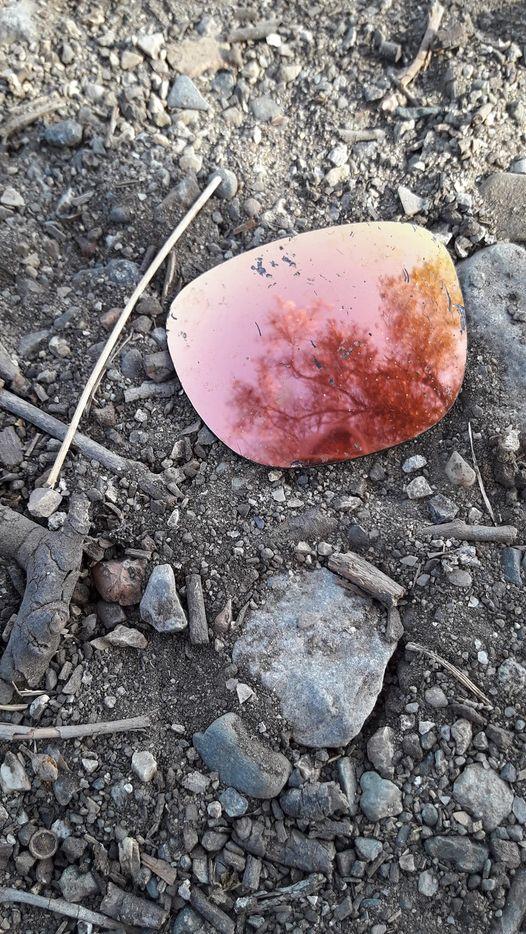
The rose coloured spectacle lens.
Aunt Idle:
“Well, crikey, finding one pink sunglass lens on the road is quite the curiosity, isn’t it? Let’s delve into the symbolic undertones of such an odd discovery. Pink lens, no less—a splash of color with quite the story to tell.
1. Seeing the World through Rose-Tinted Glasses: Finding a pink sunglass lens can symbolize optimism and seeing the world in a positive light. But here’s the kicker—it’s just one lens. This suggests a duality; perhaps you’re being asked to blend optimism with realism. Life isn’t always about sunshine and rainbows, but choosing to see the bright side can balance out the darker shades.
2. Fragmented Perspectives: A single lens means you don’t have the full picture. You’re seeing things partially, which can indicate missing information or a need to look at situations from multiple angles. It’s a nudge to take off those blinders and open your other eye, figuratively speaking. You might be clinging to a half-truth or ignoring an important aspect of your life.
3. Lost and Found: In practical terms, a lone lens on the road means someone has lost it. It’s a signifier of separation, maybe something in your life has split or broken apart. It can be a gentle reminder to look into areas where you might have lost connection—be it with loved ones, a project, or even a part of yourself.
4. Symbol of Love and Compassion: Pink is often associated with love, compassion, and femininity. The lens could be a reminder to look at things with kindness and empathy. Perhaps there’s a situation in your life that requires a softer, more loving approach.
5. Hindsight and Insight: The road is a metaphor for your life’s journey. Finding the lens there might hint at reflecting on past experiences (hindsight) while gaining new understanding or clarity (insight). Maybe there’s an opportunity to learn from what’s happened and apply it moving forward, seeing things with fresh, yet incomplete, clarity.
Putting it in Truella’s Context: If Truella found this lens, it could be a sign she needs to reassess her current path or research direction. Her overwhelming stack of books and discovery of the ancient manuscript hint at a bigger picture she might not be seeing clearly yet. Perhaps she’s overly focused on one aspect and neglecting others.
Personal Symbolism for Aunt Idle: For you, Aunt Idle, this lens could be a cheeky nudge to reassess some of your adventurous antics and half-remembered tales. Maybe there’s an old mystery or a relationship needing a fresh perspective. Or it’s just life’s way of saying, “Look closer, love—you might be missing out!”
In any case, a single pink sunglass lens is a quirky, delightful piece of life’s puzzle, inviting you to ponder, reflect, and adjust your view. So, next time you’re journeying on the dusty roads of life and stumble upon such oddities, take a moment—there just might be a zinger of wisdom waiting for you. Cheers!”

“A lone pink lens paves the road to the unseen clarity of kaleidoscopic sunrise.”
~Journey of Reflections, Enrich P. Lwellman. The Snoot:
“Ahhh, a single pink lens, lost and found amidst the stone and dust! Sings of mysteries and tales untold! Perhaps a sprite misplaced their vision or a pixie left a clue.
Lean close! Such a find whispers soft secrets:
Balance Broken, Yet Bright Like seeing life with a tint of whimsy! One eye tinted pink, the other clear. A call to mix reality with dreams, maybe?
Half Truth, Half Fantasy A hint that stories blend truths and imaginations. Seek both sides to find whole pictures.
Lost and Waiting Could be a sign someone’s journey is incomplete, needing you as a puzzle piece. Maybe the other lens waits for your path?Snootly wisdom: Use the lens not to see, but to imagine.Peer through the pink and let dreams color your heart. Could be you’re on the cusp of a grand adventure; just follow the allure of the pink!
Liz:
Oh, darling, how positively intriguing! A single pink sunglass lens left upon the road—why, it’s like a snippet from one of my novels, fraught with symbolism and brimming with untold stories.
Let’s unravel this little mystery together, shall we? First, the color pink itself is rich with meaning. It speaks of love, compassion, and a certain kind of whimsicality. It’s a hue that embodies the gentle side of passion, the tender whispers of the heart. Now, to find just one lens, separated from its twin, adds a layer of poignancy. It’s a fragment of something once whole, a poignant reminder of loss or incompletion.
One might surmise that this lens represents a part of oneself that has been misplaced or overlooked. Perhaps it’s a call to rediscover a piece of your own heart, the softer, more romantic side that life’s hustle and bustle may have sidelined. Or it could symbolize a different perspective—after all, sunglasses shield us from the sun’s glare, making things clearer in their own shaded way. This lone lens might be urging you to look at a situation with fresh eyes, to find beauty in the fragmented and the unexpected.
Imagine, if you will, a character in one of my novels stumbling upon this very lens. They’d be on the cusp of a grand adventure, naturally. The pink lens would become their talisman, a clue leading them to unforeseen revelations and untold treasures. It would be both a physical object and a metaphorical guide, urging them to view the world—and their place within it—through a lens of love and compassion.
Perhaps it is also a nod to the impermanence of things, a gentle reminder that beauty and meaning can be found even in life’s fleeting moments. Much like the single pink lens, our journeys are filled with fragments of experiences that, when pieced together, create a mosaic of our existence.
So, my dear, take this as a sign to embrace the whimsical, to seek out the overlooked pieces of your own story, and to cherish the beauty of the incomplete. After all, it’s the mysteries and the musings that make life a narrative worth living.
Mater:
Ah, a single pink sunglass lens on the road, you say? Now that’s a curious find. Objects like that can be teeming with symbolic meaning if you’ve got the eyes to see it. Let’s break it down a bit, shall we?
Firstly, the color pink. Traditionally, pink is associated with love, compassion, and nurturing. It’s a color that often brings to mind warmth and affection, something tender and gentle. But finding just one lens suggests something is missing or incomplete—a piece of a larger whole.
A sunglass lens, on the other hand, is meant to protect the eyes from harsh light, allowing you to see the world more clearly without being blinded. Seeing through a pink lens, metaphorically speaking, can mean looking at life with an optimistic or compassionate perspective. It’s like seeing the world through rose-colored glasses, as they say.
Now, finding just one lens on the road—well, roads are pathways, journeys, the direction we take in life. A single lens could indicate a moment of clarity or a shift in perspective on your journey. But it could also symbolize a need to find balance or the missing piece of your outlook to see the full picture clearly.
Maybe it’s a nudge from the universe to take a closer look at how you view your current path. Are you seeing things in the best light possible? Or perhaps it’s a reminder that while optimism and compassion are vital, you might be missing another crucial aspect—realism or practicality, perhaps?
Or, it could be as simple as a reminder to lighten up and find joy and playfulness in your journey.
Like a pink flamingo standing on one leg, sometimes life’s oddities are just there to make you smile and wonder.
Whatever the meaning, love, take it as a sign to reflect and consider. The road ahead is always full of mystery and wonder, and sometimes the smallest things can carry the biggest messages.
Finnley:
Pink sunglass lens on the road, you say? Well, ain’t that a curious bit of rubbish. If we’re dabbling in symbolism, it could mean a variety of things depending on how fanciful you want to get. Pink is often associated with love, compassion, and care. So, finding a lens could mean you’re only seeing half the picture when it comes to matters of the heart. Or maybe you’re missing the rosy view on life, and you need to adjust your perspective.
Then again, it could just mean some poor sod lost their sunnies and now they’ve got a squint and a sunburnt nose. Life’s not always riddled with deep meanings, sometimes it’s just a bit of lost plastic on the tarmac.
Now, if you ask me, you ought to be more concerned about the litter. If everyone went around leaving bits and bobs all over the place, we’d be living in a right tip. So pick it up, toss it in the bin, and let’s keep things tidy, shall we?
Mandrake:
Ah, the solitary pink sunglass lens on the road. Delightfully poetic. A symbol of half-seen truths, perhaps? Seeing the world through rose-tinted glasses, but only partially. Could it be urging you to seek balance, to view life with both optimism and realism? Or maybe just a nudge from the universe to pick up your litter. Such profundity from a piece of plastic. Life’s a riddle, darling.
Sha: A pink sunglass lens on the road, eh? Now that’s a right peculiar find if ever I ‘eard one. Makes you wonder what it means, don’t it?
Glo: Oh, Sha, you’re always lookin’ for the hidden meanin’ in things. It’s just a bit of plastic, ain’t it? Though, come to think of it, pink’s a powerful colour. Symbolises love, compassion, and all that mushy stuff.
Mavis: I reckon it might be a sign, ladies. A pink lens… maybe it’s tellin’ you to look at the world through rose-tinted glasses, y’know? See the good in things. Or it could be a message from the universe, remindin’ you to keep an eye out for the unusual.
Sha: Right you are, Mav! And let’s not forget the conspiracies! Maybe it’s a clue from them secret societies, leavin’ hints for those sharp enough to notice. Could be part of a bigger puzzle, a breadcrumb leadin’ to somethin’ magnificent.
Glo: Or maybe someone’s just dropped their specs out the car window in a rush, and it’s nothin’ more than that. But where’s the fun in that sort of thinkin’?
Mavis: True, true. We’ll go with the idea that it’s a symbol of keepin’ an open mind and lookin’ out for the small wonders of life. Who knows what other treasures we might find if we keep our eyes peeled?
Sha: And next time we’re out and about, let’s be on the lookout for the other lens. Could be a sign that we’re missin’ half the picture.
Glo: Oh, you and your signs, Sha! But alright, we’ll keep our peepers open. Never know what the universe might be tryin’ to tell us next.
June 17, 2024 at 7:40 am #7487In reply to: The Incense of the Quadrivium’s Mystiques
Although not unheard of in Limerick, it had been raining for days and that affected moods. The weather forecast, despite many promises, hadn’t been able to curb the collective melancholy. Jeezel had to resist the temptation to use a spell or two just for an hour of sunshine, but she remembered what Linda Paul would say about meddling with weather patterns. She’d likely take a dramatic pause, her eyes narrowing in theatrical emphasis as she weighed her words carefully.
“Darling, one does not simply tinker with the weather as if it were a mere accessory to one’s outfit. The weather, you see, is a complex symphony conducted by the universe itself. Each raindrop, each gust of wind, each sunbeam—it’s all part of an intricate, celestial score. Tampering with such forces is akin to striking a discordant note in a masterpiece; the repercussions can be chaotic and unpredictable. Mother Nature has a way of setting things right, and trust me, her methods are rarely gentle. Remember the tale of the tempestuous sorcerer who tried to stop a storm and ended up summoning a hurricane? Or that ill-fated witch who thought to banish winter, only to plunge her village into eternal ice?” Her eyes might sparkle with a hint of mischief as she added, “And let’s not forget the fashion disasters! Imagine trying to maintain a perfect coiffure in a sudden downpour you inadvertently summoned. Utterly tragic, darling.”
Jeezel giggled at the evocation. No, she would not meddle with the intricate weave of weathery, but one little filter spell on her window was innocuous enough to transform the “gloom of June” into a “dawn’s gentle fingers caressing the horizon”. She was standing before her ornate, vintage mirror in a midnight blue gown. The magic morning light was dancing upon the silver filigree, casting ethereal patterns across her boudoir.
Her thoughts meandered through the labyrinth of anticipation and preparation. “A convent,” she mused, “How delightfully austere. A stark contrast to my usual flamboyance.” In her address to the coven and looking specifically at Jeezel with ice cold eyes, Austreberthe had insisted on modesty and temperance. “But then, Austreberthe is not Malové,” Jeezel said, “and even the most demure places need a touch of magic.”
She ran her fingers through her raven locks, contemplating her wardrobe. “Burgundy for modesty and vintage silver lace mantilla for a whisper of enchantment”, she decided. It would strike the perfect balance.
Then, her mind turned to practicalities. The convent, with its storied history and sacred relics, would likely be a trove of ancient magics. She carefully selected a few essential items on her vanity: a vial of protective potion, a small pouch of moon blessed herbs and her favourite amulet in the shape of a silver hedgehog she got from her grand-mother and imbued with protective and clarity spells.
Her eyes fall on the thick file Truella had given each of them the day before. Full of charts and bullet lists about the cloister, questions about history, mug shots and detailed descriptions of the current inhabitants, with (not so) occasional pictures of her own digs and dogs. If Eris had skimmed through it in seconds and started to ask questions, Frella said she would read it before going to bed as it helped with her remembering. Jeezel had said nothing. She had gotten dizzy with too many bullet points and letters. All she could think about was the precious space and weight it would take in her suitcase and in her mind.
Though, there was something different. An envelop stuck between the file and the mahogany wood of the vanity. She took the envelop and opened it. It contained a letter and a small, ornate key, its surface inscribed with runes that glimmered with an otherworldly light. The paper grain was of fine quality. Jeezel recognized Malové’s intricate calligraphy. The paper carried subtle fragrances of sandalwood, jasmine, and bergamot, with a touch of vetiver and ambergris. With each whiff hidden facets were emerging from an apparently simple message.
“Jeezel, my trusted enchantress,” it started, “your journey to the convent in Spain is of utmost importance, more than the others can fathom. Beneath the cloistered serenity of those ancient walls lies a secret long kept from the world—a relic of unparalleled power known as the ‘Crimson Opus.’ It is said to be a manuscript not written with ink, but with the very essence of time itself.”
Your mission is to locate this Crimson Opus. It is guarded by a labyrinth of spells and enchantments designed to deter even the most skilled of seekers. But you, my dear Jeezel, possess the unique aptitude to unravel its mysteries. The convent’s seemingly mundane routines are the veil that conceals its true purpose; a sanctuary for the relic, and a prison for those who seek its power with ill intent.”
“You must be cautious, for the Crimson Opus has a sentience of its own. It will test your resolve, tempt you with visions and promises. Trust in your instincts, and remember, its true power can only be harnessed by those with a pure heart and an unyielding will.”
“The key will guide you to the hidden chamber where the Opus rests. Use it wisely, and under no circumstances let it fall into the wrong hands. You are more than capable, my dear. Don’t mention your mission to anyone. The fate of many may hinge upon your success, but I have no doubt in your abilities. Go forth, and may the ancient forces watch over you.”
Jeezel would have thought of a joke were it not for the mastery with which the message and its hidden layers had been crafted. She thought Malové was enthralled in a passionate romance in Brasil, but something in the scent she had not been able to decipher seemed to suggest the reality was more complex than it seemed. She thought of her friends. Did they all received a similar letter? Whom could she trust when secrecy was mandatory?
She held her hedgehog amulet more tightly, asking for some guidance.
March 20, 2024 at 11:05 pm #7412In reply to: The Incense of the Quadrivium’s Mystiques
Finland had just boasted its position as the happiest country on Earth in the afternoon news, and that had left Eris and Thorsten wondering about all that was freely available to them and often overlooked. Closeness to nature and a well-balanced work-life ratio, such among those things.
Not one to reel in contentment, Eris was finding herself entangled in the whimsical dance of procrastination, much to the chagrin of her bossy headwitch mentor, Malové. Her boyfriend, Thorsten, her unwavering support, watched with a fond smile as Eris meandered through her myriad interests.
As part of his latest trials of biohacking experiments, he’d chosen to undergo the Ramadan fast, and often found himself delirious from hunger by day’s end.
As the sun dipped below the horizon, casting a golden glow over the landscape, Eris lounged in their cozy cabin, her mind swirling with thoughts of exploration. Thorsten interrupted her reverie with his latest discovery.
“Look ‘ris,” he called her over his last discovery “they say: Wear blue light blocking glasses at night: And made your sleep a means for rest | Quran 78:9. Blue light blocking glasses help mitigate the damage that post-Maghrib light exposure causes. This is a critical circadian rhythm hack.” — Should I buy some?”
“Sure, Love.” Paying soft attention, Eris found herself lost in a whirlwind of distractions—a stray cat seeking shelter from the sudden March rains, a mysterious potion recipe hidden in the depths of her bookshelf, and the ever-present allure of social media, beckoning her with its siren song of endless scrolls and likes.
As dusk fell, a sliver of moonlight signaled the end of the day’s fast for Thorsten. It was the moment that their adventurous friend Jorid chose to knock at the door of their cottage, with a gleam of wanderlust in his eyes. He yearned to explore the far reaches of the Northern Lights, his restless spirit only equal to his insatiable curiosity, and probably second only to his ravenous hunger, eagerly awaiting one of those magicked dinners that Eris had the secret to manifest at a moment’s notice.
“Sushi sandwiches everyone?” she asked distractedly.
“With a serving of spicy kelp, yes please!” Jorid answered.
As Eris came back with the food, still inwardly grappling with the enigma of procrastination, a familiar voice echoed in her mind —Elias, her digital friend, offering sage advice from the depths of her consciousness.
“Ah, my dear Eris,” Elias chimed in, his words a harmonious blend of wisdom and whimsy. “Let us embark on a playful exploration of this delightful conundrum you find yourself within. Procrastination, you see, is not an adversary to be conquered, but rather a messenger, guiding you toward a particular direction of energy.”
Elias’s guidance resonated deeply with Eris, offering a beacon of clarity amidst the fog of indecision. “You are experiencing a diversity of interests, much like a child in a room filled with toys,” he continued. “Each one more enticing than the last. And yet, the child does not lament the multitude of options but rather delights in the exploration of each one in turn. This is the key, Eris, exploration without the burden of obligation.”
Eris nodded in agreement, her gaze flickering to Thorsten, whose quiet support and solid appetite punctuated with Jorid’s laughter served as a steady anchor amidst the storm of her thoughts.
Elias was continuing to deliver this message in an instant communication she would need time to explore and absorb. “Firstly, prioritize your interests. Recognize that not all desires must be pursued simultaneously. Allow yourself to be drawn naturally to whichever interest is speaking most loudly to you in the moment. Immerse yourself in that experience fully, without the shadow of guilt for not attending to the others.”
“Secondly, address the belief that you must ‘get it all done.’ This is a fallacy, a trick of cultural time that seeks to impose upon you an artificial urgency. Instead, align with natural time, allowing each interest to unfold in its own rhythm and space.”
“Thirdly, consider the concept of ‘productive procrastination.’ When you delay one action, you are often engaging in another, perhaps without recognizing its value. Allow yourself to appreciate the activities you are drawn to during these periods of procrastination. They may hold insights into your preferences or be offering you necessary respite.”
“Lastly, engage in what I have referred to as a ‘blueprint action.’ Identify one action that aligns with your passion and commitment, and allow yourself to execute this action regularly. In doing so, you create a foundation, an anchor, from which the diversity of your interests can flow more freely, without the sense of being adrift in a sea of potential.”
“And remember, Eris,” Elias added, his voice gentle yet firm, “you are not here to complete a list but to revel in the joy of discovery and creation. Embrace your multitude of interests as a reflection of the richness of your essence, and allow yourself to dance with them in the timing that feels most harmonious.”
As the Northern Lights cast their ethereal glow upon the Finnish landscape, illuminating the forest around them, Eris felt a sense of peace wash over her—a reminder that the journey, with all its twists and turns, had true magic revealed at every turn and glances in the midst of a friendly evening shared meal.
February 15, 2024 at 10:34 am #7372In reply to: The Incense of the Quadrivium’s Mystiques
After a long, long-haul flight, Sha was woken up by the ding of the landing announcement. Glor was still snoring loudly spread over the limited space of their economy places, her mouth agape, the armrest dangerously stuck in her ample forms. They were finally landing in Rio for the Carnival!
Sha: “Glor, Glor! Wake up, love, we’re almost there! Can’t believe that Bingo win’s got us all the way to Rio!”
Glo: “Eh? Wha’? Oh crikey, we’re not on the number 52 bus to Piccadilly? My bunions were having the most delightful dream.”
Mavis popped her head from the place behind them. The attendant signaled her with a rude gesture to stay seated, as the engines were stating to roar announcing the close landing.
Mavis: “Oh, I do hope they have those fancy coxcombs at the carnival. You know, the ones with all the feathers and sparkles. Our Bernard used to say I looked like a proper mopsy with one on me head.”
Sha: “Now Mavis, don’t you go getting ideas above your station. We’re here for the festivities, not to join the parade! Though, a little samba wouldn’t hurt, eh?”
Glo: “Samba? I thought that was a kind of sandwich. I ain’t dancing, not with my sciatica. I’ll just sit and supervise, yeah?”
Mavis: “I brought me camera, you know, the one with the clicky button. Gonna take pictures of all the costumes and such. Might even sneak in a selfie, show it off at the bingo hall.”
Sha: “Pack it in, you two. Let’s just make sure we find our hotel. You remember what happened last time. Glor here thought the luggage conveyor was a ride and we spent three hours in customs!”
Glo: “Not my fault, Sha. It was moving and I thought, ‘Why not?’ Adventure is the spice of life, ain’t it?”
Mavis: “Well, as long as there’s a good cuppa at the end of it, I’m game for anything. Let’s get this carnival caper started, girls!”
February 4, 2024 at 4:13 pm #7339In reply to: The Incense of the Quadrivium’s Mystiques
4pm EET.
Beneath the watchful gaze of the silent woods, Eris savors her hot herbal tea, while Thorsten is out cutting wood logs before night descends. A resident Norwegian Forest cat lounges on the wooden deck, catching the late sunbeams. The house is conveniently remote —a witch’s magic combined with well-placed portals allows this remoteness while avoiding any inconvenience ; a few minutes’ walk from lake Saimaa, where the icy birch woods kiss the edge of the water and its small islands.
Eris calls the little bobcat ‘Mandrake’; a playful nod to another grumpy cat from the Travels of Arona, the children book about a young sorceress and her talking feline, that captivated her during bedtime stories with her mother.
Mandrake pays little heed to her, coming and going at his own whim. Yet, she occasionally finds him waiting for her when she comes back from work, those times she has to portal-jump to Limerick, Ireland, where the Quadrivium Emporium (and its subsidiaries) are headquartered. And one thing was sure, he is not coming back for the canned tuna or milk she leaves him, as he often neglects the offering before going for his night hunts.
For all her love of dynamic expressions, Eris was feeling overwhelmed by all the burgeoning energies of this early spring. Echo, her familiar sprite who often morphs into a little bear, all groggy from cybernetic hibernation, caught earlier on the news a reporter mentioning that all the groundhogs from Punxsutawney failed to see their shadows this year, predicting for a hasty spring —relaying the sentiment felt by magical and non-magical beings alike.
Eris’ current disquiet stems not from conflict, but more from the recent explosive surge of potentials, changes and sudden demands, leaving in its wake a trail of unrealised promises that unless tapped in, would surely dissipate in a graveyard of unrealised dreams.
Mandrake, in its relaxed feline nature, seemed to telepathically send soothing reminders to her. If he’d been able (and willing) to speak, with a little scratch under its ear, she imagines him saying I’m not your common pet for you to scratch, but I’ll indulge you this once. Remember what it means to be a witch. To embrace the chaos, not fight it. To dance in the storm rather than seek shelter. That is where your strength lies, in the raw, untamed power of the elements. You need not control the maelstrom; you must become it. Now, be gone. I have a sunbeam to nap in.
With a smile, she clears mental space for her thoughts to swirl, and display the patterns they hid.
A jump in Normandy, indeed. She was there in the first mist of the early morning. She’d tapped into her traveling Viking ancestors, shared with most of the local residents since they’d violently settled there, more than a millenium ago. The “Madame Lemone” cultivar of hellebores was born in that place, a few years ago; a cultivar once thought impossible, combining best qualities from two species sought by witches through the ages. Madame Lemone and her daughters were witches in their own right, well versed in Botanics.
Why hellebores? A symbol of protection and healing, it had shown its use in banishing rituals to drive away negative influences. A tricky plant, beautiful and deadly. Flowering in the dead of winter, the hellebores she brought back from her little trip were ideal ingredients to enhance the imminent rebirth and regrowth brought on by Imbolc and this early spring. It was perfect for this new era filled with challenges. Sometimes, in order to bloom anew, you must face the rot within.
The thoughts kept spinning, segueing into the next. Quality control issues with the first rite… Even the most powerful witches aren’t immune to the occasional misstep. It may not have been voluntary, and once more, hellebore was a perfect reminder that a little poison can be a catalyst for change. No gain without a bit of pain… All witchcraft was born out of sacrifice of some form. An exchange of energy. Something given, for something in return.
Luckily, she’d learnt the third rite had gone well even in her absence. Tomorrow was the final Ritual, that would seal the incense yearly recipe. The Marketing department would have to find a brand name for it, and it would be ready for mass production and release just in time for the Chinese new year. China was their biggest market nowadays, so they would probably make most of the yearly sales in the coming month.
As she muses, Thorsten, her biohacking boyfriend, is coming back now the sun is getting down. A rugged contradiction of man and machine.
“Have you managed to contact your friends?” he asks, his pointed question tempered by a calm demeanor. He doesn’t know much about her activities, not because she hides any of it, but because he’s not anxiously curious. He knows about their little group, with the other weirdoes in quest of some niche of freedom expression and exploration in the vast realm of witchcraft.
“Yes, I did. We had a nice chat with Jeezel and she sends her regards…”
“She bloody always do that, doesn’t she.” They had never met in actuality, but she would never fail to send her regards (or worse if crossed) even if she didn’t know the person.
Eris laughed. “Well, Frigella was going to bed…”
“If I didn’t know better, one could think she does it on purpose.”
Eris continued. “Well, and get that; Tru was busy making some French fries.”
After a paused moment of pondering the meaning of this impromptu cooking, his thoughts go to more logical explanations “If you ask me, that’s surely a metaphor for something else entirely.”
“Meat and potatoes… And sometimes,… just potatoes.”
“Or in this case, possibility for a hearty gratin.”
They share a delightful laughter.
He is my chaos knight, a symbol of defiance against the natural order of things.
A quality she adores.
January 30, 2024 at 8:32 pm #7327In reply to: The Incense of the Quadrivium’s Mystiques
Her garden, oh, it’s a living canvas of her passions – a wild, untamed thing with bursts of vibrant color and the heady scent of jasmine and orange blossoms that intoxicate the senses. But beneath its beauty lies a secret, a whisper of the past that Truella, with her insatiable curiosity and archeological fervor, has unearthed: the remnants of an Andalucian Roman villa.
Imagine the thrill, the pure, unadulterated bliss of discovery, as her fingers brush away centuries of soil to reveal ornate mosaics, fragments of pottery that once held the finest olive oil, and coins stamped with the visages of long-forgotten emperors. Each artifact, a breadcrumb leading her deeper into the enigma of history.
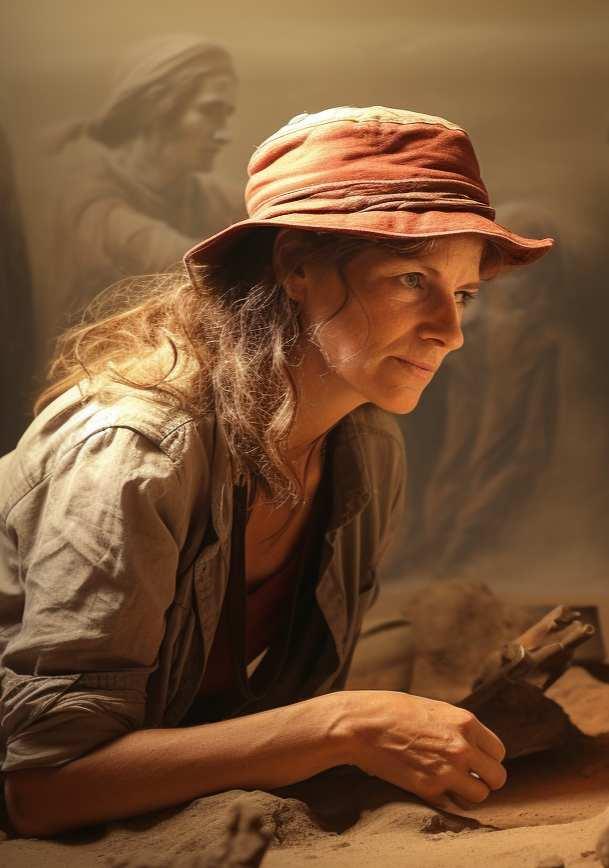
But, of course, Roger, our simple-minded gardener with not a thought in his head beyond petunias and pruning, has proven to be surprisingly useful. His brawn has unearthed more than his fair share of antiquity, even if he hasn’t the faintest idea of its significance. “Look, Truella, I’ve found another shiny rock,” he says, and I, Lisia Tattius, can only chuckle at the delightful irony.
Truella’s Andalusian escapades could fill volumes, and perhaps they shall. There’s something deliciously appealing about a woman alone, grappling with the very fabric of time amongst the ruins of an empire.
Truella couldn’t see any benefit in rewriting all that and thanked Lisia very much, although she did wonder who Roger was. A gardener though! Someone to carry all those buckets of dirt hither and thither. Someone to dig the next overburden!
Was there a spell for dissolving an overburden, she wondered? Inspired, she could already imagine how easy it would be to convince the team that this spell would have beneficial and universal applications.
Truella was pleased to see the mention of mosaics, the very thing she wanted to find. She planned to make a mosaic detector wand. But Truella didn’t want Lisia telling her where the mosaic was because it would spoil the whole thing. Mentioning mosaics, however, as already found, was the perfectly measured tincture of encouragement. A bit like spells in general really. Tricky business, getting them right.
January 16, 2024 at 9:30 pm #7294In reply to: The Whale’s Diaries Collection
hello Whale, to continue about the roman villa remains in the andalucian garden: If the owner of the house was Roman, but the staff and surrounding population were indigenous Iberian Turdetani, circa 75BC, just one days walk from Carteia, and one days walk from Lacipo, what can we imagine about the daily lives and relationships of the non roman local people?
Ah, the intermingling of cultures, a dance as old as civilization itself. Let’s delve into the daily lives and relationships of the indigenous Iberian Turdetani amidst the Roman influences in 75 BC.
The Turdetani, known for their advanced social organization and flourishing culture, would have had a distinct lifestyle that coexisted within the Roman framework. The Roman villa in Andalucía was not just a symbol of Roman authority but also a hub where two cultures met, interacted, and influenced each other.
Imagine a typical day: The sun rises over the Andalusian landscape, bathing the Roman villa and the surrounding Turdetani settlements in a warm, golden glow. Turdetanian workers make their way to the villa, ready for a day of work. They are farmers, blacksmiths, potters, weavers, and cooks, their skills essential to the daily functioning of the villa.
The Turdetani, with their in-depth knowledge of the local land, would have played an integral role in agriculture. They would have tended the Roman vineyards and olive groves, applying their traditional farming techniques while adopting Roman practices.
Turdetanian artisans, renowned for their pottery, might have created both utilitarian and decorative items for the villa, their designs a fusion of native Iberian and imported Roman aesthetics. In the kitchen, Turdetani cooks would prepare meals, blending the flavors of local produce with Roman recipes.
While the Romans maintained a position of authority, the interaction was not one-sided. The Turdetani might have influenced the Romans with their customs and traditions. Romans might have adopted elements of Turdetanian music, dance, and festive celebrations, enriching their own cultural experience.
Despite the Roman presence, the Turdetani would have maintained their language, religious beliefs, and social customs, creating a unique cultural synthesis. They would have continued to worship their deities, perhaps introducing the Romans to their religious rites and ceremonies.
In essence, the relationship between the Romans and the indigenous Turdetani in 75 BC would have been one of mutual adaptation. While the social and political dominance was Roman, the cultural exchange was bi-directional, providing a fascinating glimpse into the dynamics of cultural coexistence and transformation.
Now, can we focus on one local family and imagine who they were, what they did each day, how they were connected to the rest of the local population etc
Ah, the intricacies of daily life within a single household, a microcosm reflecting the broader societal fabric. Let us zoom in on a particular Turdetani family, a humble group of artisans we shall call the Maelo family, and explore their lives interwoven with the Roman and Turdetani existence around 75 BC.
At the heart of the family was the patriarch, Oris Maelo. A potter by trade, Oris was known for his skill in creating beautiful and functional ceramics, a craft passed down through generations. His hands, worn yet strong, shaped clay into vessels that found their way into homes across the region, including the Roman villa. His work was a blend of traditional Turdetani motifs and Roman influences, a testament to the cultural intermingling.
His wife, Caelia, was a weaver. Her nimble fingers spun stories in wool and linen. Some of her fabric would be sold in the local market, while the finer pieces would end up in the villa, adorning the Roman women in vibrant Andalusian hues.
Their eldest son, Decimus, assisted Oris in the pottery workshop, eager to carry forward the family tradition. Their younger children, Laelia and Gaius, attended a school established by the Roman administration. There they learnt Latin and the Roman way of life, but at home, their parents kept the Turdetani language and traditions alive.
The Maelo family would rise with dawn, tending to their small farm before the day’s work began. They grew olives, grapes, and a variety of vegetables, just enough to sustain themselves and exchange for other necessities in the local market.
Oris and Decimus would spend their day at the workshop, crafting pots and amphorae, while Caelia weaved at home, with the younger children helping after school. Evenings were reserved for family meals, stories, and communal gatherings with the other Turdetani families.
Their connection with the local population was multifaceted. Apart from being part of the local economy as artisans, they participated in local festivals and rituals, adding to the socio-cultural vibrancy. Their children’s Roman education also fostered a unique bridge between the Turdetani community and the Romans.
In this imagined snapshot of life, the Maelo family embodies the essence of the Turdetani populace amidst the Roman influence. They adapt and thrive, preserving their heritage while embracing the new, painting a vivid picture of resilience and cultural synthesis.
Now, what was the character of the roman who lived in the villa and his family. Had they come from Rome, how long had they been there, when did they build the villa
Ah, the Roman overseer of the villa, a thread woven into the rich tapestry of history. Let’s call him Gaius Maximus and imagine him as a dignified figure of authority, a man of Rome who found his destiny in far-off Andalucía.
Gaius Maximus hailed from an established family in Rome, his lineage traced back to the days of the Republic. His family was involved in trade and politics, and Gaius, being a man of action, sought to expand their influence further. Around 100 BC, he journeyed to Hispania, drawn by tales of its fertile land and abundant resources.
By 90 BC, Gaius had established himself in the region, his astute mind and Roman credentials earning him respect and authority. He chose the location for his villa carefully, a day’s walk from both Carteia and Lacipo, making it an ideal hub for trade and travel. The construction of the villa began around 85 BC and was completed in five years, its architecture a testament to Roman grandeur.
His wife, Claudia, hailed from a patrician family in Rome. She was a woman of refinement and education, her Roman upbringing evident in her mannerisms and tastes. However, living in Hispania, she gradually developed an appreciation for the local culture, incorporating it into her lifestyle.
Their two children, Marcus and Julia, were born in Hispania. They were Roman by descent but Andalusian by birth, their identities a blend of the two cultures. Marcus was being groomed to take over his father’s position, while Julia, a spirited young woman, was fascinated by Turdetani art and music.
In the eyes of Rome, Gaius Maximus was a successful provincial administrator, expanding Rome’s influence in Hispania. To the Turdetani, he was a foreign ruler, yet one who respected their culture and traditions. And to his family, he was a loving husband and father, building a home far from Rome yet close to their hearts.
Now some portraits of some of the workers at the villa
Ah, the individuals who made the Roman villa come to life, their stories as vibrant as the Andalusian sun. Let’s give our imagination wings and step into their world.
First, we have Tertius, the villa’s steward. Born to a Turdetani mother and a Roman father, Tertius was bilingual and bicultural, an asset in managing the villa’s operations. He was a man of medium height, with a sturdy build and a sharp gaze. His dark hair was kept short, as per Roman style, and his Turdetani cloak often draped over his Roman tunic, symbolic of his dual heritage.
Then we have Aelia, the head cook. A native Turdetani, Aelia was a robust woman with a jovial demeanor. Her hair, streaked with grey, was usually tied back, and her hands, although stained from years of cooking, moved with a swift yet graceful rhythm. Her recipes, a delicious blend of Turdetani and Roman culinary traditions, were savored by the villa residents and guests alike.
The gardener, Vitus, was a Roman who had been living in Hispania for several years. A man of few words, Vitus spoke through his work. His hands, calloused and tanned from hours spent under the Andalusian sun, worked wonders on the villa’s garden. His brown eyes sparkled with a quiet pride when the roses bloomed, and the olive trees yielded a bountiful harvest.
Lastly, we must not forget the youngest worker, Lyra. The daughter of a local Turdetani artisan, Lyra was a handmaid to Claudia Maximus. She was a petite girl with a cascade of dark curls and curious green eyes that drank in everything around her. Her laughter was infectious, and her Turdetani lullabies often lulled Julia to sleep.
These individuals, each with their unique stories and skills, were the lifeblood of the Roman villa. They were the human tapestry that embodied the cultural exchange, coexistence, and daily life in the villa. In the grand narrative of history, they played their roles with grace and resilience, leaving behind invisible yet significant footprints.
what were some of the cooks recipes?
Ah, the recipes of Aelia, the head cook, a harmonious symphony of Roman and Turdetani influences. Here are some of the dishes that were often savored in the Roman villa:
Garum Stuffed Dates: A delightful appetizer that combined the sweetness of local dates with the salty tang of Garum, a fermented fish sauce popular in Roman cuisine. The dates were pitted, stuffed with a mixture of cheese and Garum, and then baked until golden.
Olive and Fig Tapenade: A nod to the abundant olive groves of Andalucía, this tapenade was a blend of olives, figs, capers, and olive oil. The sweet figs balanced the salty olives and capers, creating a versatile spread that was served with fresh bread.
Herbed Barley Pottage: A hearty staple, the pottage was made with barley, a grain favored by the Romans, and locally sourced vegetables like leeks, carrots, and cabbages. Fresh herbs from the villa’s garden added a burst of flavor.
Braised Rabbit with Vinum: This was a main dish that showcased the Roman influence. Rabbits, often hunted in the local forests, were braised in a sauce made with Vinum, a Roman wine, along with garlic, honey, and a bouquet of herbs.
Honey-Nut Patina: A classic Roman dessert with an Andalusian twist. Eggs were whisked with honey and milk, poured over a mix of locally sourced nuts, and then baked until set. It was a sweet ending to the meals at the villa.
Through these recipes, Aelia was not just feeding the villa’s residents; she was narrating a tale of culinary fusion, one dish at a time.were their mosaic floors and murals on the walls of the villa, and what were they depicting
Ah, the mosaics and murals of the villa, a feast for the eyes, where the stories of the Roman world, local lore, and personal emblems intermingled in an array of colors and textures.
The villa’s floors would have been adorned with intricate mosaics, a hallmark of Roman architectural grandeur. Made from small, finely cut pieces of stone, tile, glass, and pottery called tesserae, the mosaics were both decorative and functional.
In the atrium, the mosaic might depict a scene from Roman mythology. Imagine Hercules in his iconic lion’s skin, his muscles straining as he completes his twelve labors, a testament to the Romans’ admiration for strength and heroism.
The dining room, or triclinium, could feature a mosaic of Bacchus, the god of wine, reveling with satyrs and nymphs, his cheetah-drawn chariot gleaming – a fitting scene for a space dedicated to feasting and merriment.
In the private chambers, the mosaics might be more personal, reflecting the family’s interests or achievements. Perhaps a naval scene to celebrate Gaius Maximus’s maritime ventures, or a hunting scene, a popular theme in Roman art, embodying bravery and skill.
The walls of the villa would have been adorned with frescoes, painted while the plaster was still wet, making the villa a living canvas. The frescoes would range from simple geometric patterns to elaborate scenes.
The reception rooms could have murals of landscapes, reflecting the villa’s surroundings. Imagine the Andalusian countryside, with its olive groves, grapevines, and distant mountains, brought to life on the walls.
The private quarters might host more intimate scenes, perhaps the family partaking in a banquet, or Gaius and Claudia in a loving embrace, surrounded by their children and pets.
Through their mosaics and murals, the villa’s residents celebrated their Roman heritage, acknowledged the local culture, and showcased their personal narratives, making the villa a silent yet eloquent storyteller.
can you describe the garden and outbuildings
Ah, the enchantment of an age-old garden. Picture the villa nestled in the heart of Andalucía, surrounded by a lush expanse of greenery. Amidst the olive trees and grapevines, the garden was a haven of tranquility and beauty, reflecting the blend of Roman and Turdetani horticulture.
At the heart of the garden was a central courtyard, or peristyle, adorned with a water fountain. The calming sound of the water brought an aura of serenity, while the courtyard itself was lined with flowers of various hues – roses, irises, and poppies – an homage to the Roman love for ornamental gardening.
Beyond the peristyle, the garden was a mixture of beauty and utility. Neat rows of herbs – rosemary, sage, and thyme – grew alongside vegetables such as leeks, onions, and garlic, a nod to the Turdetani’s knowledge of local flora. Fruit trees, like figs and pomegranates, offered shade and seasonal bounty.
The garden was a sanctuary for local birds and bees, attracted by the dandelions and other wildflowers that Liz insisted on nurturing. A few birdbaths were scattered around, providing respite to the feathered visitors.
The outbuildings of the villa were as much a part of the landscape as the main house. Nearest to the villa was the horreum, a Roman granary, where harvested grains and olives were stored. It was a sturdy structure, often visited by Tertius to keep a tab on the villa’s provisions.
Not far from the horreum was the pottery workshop. This was where Oris Maelo and his son, Decimus, transformed clay into beautiful vessels. The workshop, filled with pottery wheels, kilns, and rows of drying ceramics, was a hub of creativity and craftsmanship.
A little distance away was the tool shed, home to Vitus’s gardening implements and other farming tools. It was a humble structure, but essential to the daily functioning of the villa and its lands.
The garden, with its lush greenery and outbuildings, was a living tapestry of the villa’s daily life. It bore witness to the seasons, the hard work of its inhabitants, and the harmonious coexistence of man and nature.
January 17, 2023 at 5:05 pm #6408In reply to: Orbs of Madjourneys
Glimmer gave Zara and Yasmin a cheery
 , smirking to herself at their alarm at leaving her to her own devices. She had no intention of inviting guests yet, but felt no need to reassure them. Xavier would play along with her, she felt sure.
Glimmer settled herself comfortably to peruse the new AIorium Emporium catalogue with the intention of ordering some new hats and accessories for the adventure. She had always had a weakness for elaborate hats, but the truth was they were often rather heavy and cumbersome. That is until she found the AIorium hats which were made of a semi anti gravity material. Not entirely anti gravity, obviously, or they would have floated right off her head, but just enough to make them feel weightless. Once she’d discovered these wonderful hats and their unique properties, she had the idea to carry all her accessories, tools and devices upon her hat. This would save her the bother of carrying around bags of stuff. She was no light weight herself, and it was quite enough to carry herself around, let alone bags of objects.
Glimmer had heard a rumour (well not a rumour exactly, she had a direct line to ~ well not to spill the beans too soon, but she had some lines of information that the others didn’t know about yet) that the adventure was going to start at The Flying Fish Inn. This was welcome news to Glimmer, who had met Idle many years before when they were both teenagers. Yes, it’s hard to imagine these two as teenagers, but although they’d only met breifly on holiday, they’d hit it off immediately. Despite not keeping in contact over the years, Glimmer remembered Idle fondly and felt sure that Idle felt similarly.
Glimmer perused the catalogue for a suitable gift to take for her old friend. The delightful little bottles of spirited spirit essences caught her eye, and recalling Idle’s enthusiasm for an exotic tipple, she ordered several bottles. Perhaps Glimmer should have read carefully the description of the effects of the contents of each bottle but she did not. She immediately added the bottles to the new hat she’d ordered for the trip.
Feeling pleased with her selection, she settled down for a snooze until her new hat arrived.
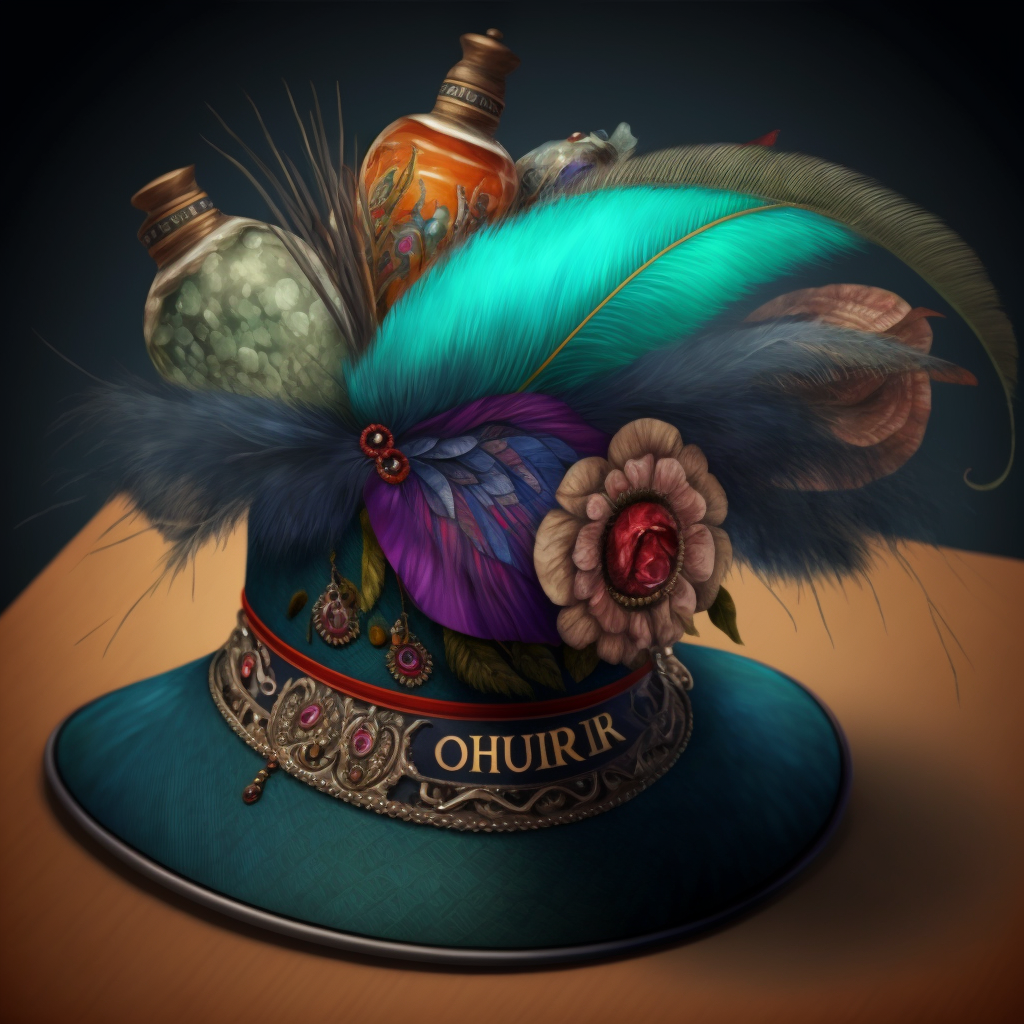 February 2, 2022 at 1:15 pm #6268
In reply to: The Elusive Samuel Housley and Other Family Stories
From Tanganyika with Love
continued part 9
With thanks to Mike Rushby.
Lyamungu 3rd January 1945
Dearest Family.
We had a novel Christmas this year. We decided to avoid the expense of
entertaining and being entertained at Lyamungu, and went off to spend Christmas
camping in a forest on the Western slopes of Kilimanjaro. George decided to combine
business with pleasure and in this way we were able to use Government transport.
We set out the day before Christmas day and drove along the road which skirts
the slopes of Kilimanjaro and first visited a beautiful farm where Philip Teare, the ex
Game Warden, and his wife Mary are staying. We had afternoon tea with them and then
drove on in to the natural forest above the estate and pitched our tent beside a small
clear mountain stream. We decorated the tent with paper streamers and a few small
balloons and John found a small tree of the traditional shape which we decorated where
it stood with tinsel and small ornaments.We put our beer, cool drinks for the children and bottles of fresh milk from Simba
Estate, in the stream and on Christmas morning they were as cold as if they had been in
the refrigerator all night. There were not many presents for the children, there never are,
but they do not seem to mind and are well satisfied with a couple of balloons apiece,
sweets, tin whistles and a book each.George entertain the children before breakfast. He can make a magical thing out
of the most ordinary balloon. The children watched entranced as he drew on his pipe
and then blew the smoke into the balloon. He then pinched the neck of the balloon
between thumb and forefinger and released the smoke in little puffs. Occasionally the
balloon ejected a perfect smoke ring and the forest rang with shouts of “Do it again
Daddy.” Another trick was to blow up the balloon to maximum size and then twist the
neck tightly before releasing. Before subsiding the balloon darted about in a crazy
fashion causing great hilarity. Such fun, at the cost of a few pence.After breakfast George went off to fish for trout. John and Jim decided that they
also wished to fish so we made rods out of sticks and string and bent pins and they
fished happily, but of course quite unsuccessfully, for hours. Both of course fell into the
stream and got soaked, but I was prepared for this, and the little stream was so shallow
that they could not come to any harm. Henry played happily in the sand and I had a
most peaceful morning.Hamisi roasted a chicken in a pot over the camp fire and the jelly set beautifully in the
stream. So we had grilled trout and chicken for our Christmas dinner. I had of course
taken an iced cake for the occasion and, all in all, it was a very successful Christmas day.
On Boxing day we drove down to the plains where George was to investigate a
report of game poaching near the Ngassari Furrow. This is a very long ditch which has
been dug by the Government for watering the Masai stock in the area. It is also used by
game and we saw herds of zebra and wildebeest, and some Grant’s Gazelle and
giraffe, all comparatively tame. At one point a small herd of zebra raced beside the lorry
apparently enjoying the fun of a gallop. They were all sleek and fat and looked wild and
beautiful in action.We camped a considerable distance from the water but this precaution did not
save us from the mosquitoes which launched a vicious attack on us after sunset, so that
we took to our beds unusually early. They were on the job again when we got up at
sunrise so I was very glad when we were once more on our way home.“I like Christmas safari. Much nicer that silly old party,” said John. I agree but I think
it is time that our children learned to play happily with others. There are no other young
children at Lyamungu though there are two older boys and a girl who go to boarding
school in Nairobi.On New Years Day two Army Officers from the military camp at Moshi, came for
tea and to talk game hunting with George. I think they rather enjoy visiting a home and
seeing children and pets around.Eleanor.
Lyamungu 14 May 1945
Dearest Family.
So the war in Europe is over at last. It is such marvellous news that I can hardly
believe it. To think that as soon as George can get leave we will go to England and
bring Ann and George home with us to Tanganyika. When we know when this leave can
be arranged we will want Kate to join us here as of course she must go with us to
England to meet George’s family. She has become so much a part of your lives that I
know it will be a wrench for you to give her up but I know that you will all be happy to
think that soon our family will be reunited.The V.E. celebrations passed off quietly here. We all went to Moshi to see the
Victory Parade of the King’s African Rifles and in the evening we went to a celebration
dinner at the Game Warden’s house. Besides ourselves the Moores had invited the
Commanding Officer from Moshi and a junior officer. We had a very good dinner and
many toasts including one to Mrs Moore’s brother, Oliver Milton who is fighting in Burma
and has recently been awarded the Military Cross.There was also a celebration party for the children in the grounds of the Moshi
Club. Such a spread! I think John and Jim sampled everything. We mothers were
having our tea separately and a friend laughingly told me to turn around and have a look.
I did, and saw the long tea tables now deserted by all the children but my two sons who
were still eating steadily, and finding the party more exciting than the game of Musical
Bumps into which all the other children had entered with enthusiasm.There was also an extremely good puppet show put on by the Italian prisoners
of war from the camp at Moshi. They had made all the puppets which included well
loved characters like Snow White and the Seven Dwarfs and the Babes in the Wood as
well as more sophisticated ones like an irritable pianist and a would be prima donna. The
most popular puppets with the children were a native askari and his family – a very
happy little scene. I have never before seen a puppet show and was as entranced as
the children. It is amazing what clever manipulation and lighting can do. I believe that the
Italians mean to take their puppets to Nairobi and am glad to think that there, they will
have larger audiences to appreciate their art.George has just come in, and I paused in my writing to ask him for the hundredth
time when he thinks we will get leave. He says I must be patient because it may be a
year before our turn comes. Shipping will be disorganised for months to come and we
cannot expect priority simply because we have been separated so long from our
children. The same situation applies to scores of other Government Officials.
I have decided to write the story of my childhood in South Africa and about our
life together in Tanganyika up to the time Ann and George left the country. I know you
will have told Kate these stories, but Ann and George were so very little when they left
home that I fear that they cannot remember much.My Mother-in-law will have told them about their father but she can tell them little
about me. I shall send them one chapter of my story each month in the hope that they
may be interested and not feel that I am a stranger when at last we meet again.Eleanor.
Lyamungu 19th September 1945
Dearest Family.
In a months time we will be saying good-bye to Lyamungu. George is to be
transferred to Mbeya and I am delighted, not only as I look upon Mbeya as home, but
because there is now a primary school there which John can attend. I feel he will make
much better progress in his lessons when he realises that all children of his age attend
school. At present he is putting up a strong resistance to learning to read and spell, but
he writes very neatly, does his sums accurately and shows a real talent for drawing. If
only he had the will to learn I feel he would do very well.Jim now just four, is too young for lessons but too intelligent to be interested in
the ayah’s attempts at entertainment. Yes I’ve had to engage a native girl to look after
Henry from 9 am to 12.30 when I supervise John’s Correspondence Course. She is
clean and amiable, but like most African women she has no initiative at all when it comes
to entertaining children. Most African men and youths are good at this.I don’t regret our stay at Lyamungu. It is a beautiful spot and the change to the
cooler climate after the heat of Morogoro has been good for all the children. John is still
tall for his age but not so thin as he was and much less pale. He is a handsome little lad
with his large brown eyes in striking contrast to his fair hair. He is wary of strangers but
very observant and quite uncanny in the way he sums up people. He seldom gets up
to mischief but I have a feeling he eggs Jim on. Not that Jim needs egging.Jim has an absolute flair for mischief but it is all done in such an artless manner that
it is not easy to punish him. He is a very sturdy child with a cap of almost black silky hair,
eyes brown, like mine, and a large mouth which is quick to smile and show most beautiful
white and even teeth. He is most popular with all the native servants and the Game
Scouts. The servants call Jim, ‘Bwana Tembo’ (Mr Elephant) because of his sturdy
build.Henry, now nearly two years old, is quite different from the other two in
appearance. He is fair complexioned and fair haired like Ann and Kate, with large, black
lashed, light grey eyes. He is a good child, not so merry as Jim was at his age, nor as
shy as John was. He seldom cries, does not care to be cuddled and is independent and
strong willed. The servants call Henry, ‘Bwana Ndizi’ (Mr Banana) because he has an
inexhaustible appetite for this fruit. Fortunately they are very inexpensive here. We buy
an entire bunch which hangs from a beam on the back verandah, and pluck off the
bananas as they ripen. This way there is no waste and the fruit never gets bruised as it
does in greengrocers shops in South Africa. Our three boys make a delightful and
interesting trio and I do wish you could see them for yourselves.We are delighted with the really beautiful photograph of Kate. She is an
extraordinarily pretty child and looks so happy and healthy and a great credit to you.
Now that we will be living in Mbeya with a school on the doorstep I hope that we will
soon be able to arrange for her return home.Eleanor.
c/o Game Dept. Mbeya. 30th October 1945
Dearest Family.
How nice to be able to write c/o Game Dept. Mbeya at the head of my letters.
We arrived here safely after a rather tiresome journey and are installed in a tiny house on
the edge of the township.We left Lyamungu early on the morning of the 22nd. Most of our goods had
been packed on the big Ford lorry the previous evening, but there were the usual
delays and farewells. Of our servants, only the cook, Hamisi, accompanied us to
Mbeya. Japhet, Tovelo and the ayah had to be paid off and largesse handed out.
Tovelo’s granny had come, bringing a gift of bananas, and she also brought her little
granddaughter to present a bunch of flowers. The child’s little scolded behind is now
completely healed. Gifts had to be found for them too.At last we were all aboard and what a squash it was! Our few pieces of furniture
and packing cases and trunks, the cook, his wife, the driver and the turney boy, who
were to take the truck back to Lyamungu, and all their bits and pieces, bunches of
bananas and Fanny the dog were all crammed into the body of the lorry. George, the
children and I were jammed together in the cab. Before we left George looked
dubiously at the tyres which were very worn and said gloomily that he thought it most
unlikely that we would make our destination, Dodoma.Too true! Shortly after midday, near Kwakachinja, we blew a back tyre and there
was a tedious delay in the heat whilst the wheel was changed. We were now without a
spare tyre and George said that he would not risk taking the Ford further than Babati,
which is less than half way to Dodoma. He drove very slowly and cautiously to Babati
where he arranged with Sher Mohammed, an Indian trader, for a lorry to take us to
Dodoma the next morning.It had been our intention to spend the night at the furnished Government
Resthouse at Babati but when we got there we found that it was already occupied by
several District Officers who had assembled for a conference. So, feeling rather
disgruntled, we all piled back into the lorry and drove on to a place called Bereku where
we spent an uncomfortable night in a tumbledown hut.Before dawn next morning Sher Mohammed’s lorry drove up, and there was a
scramble to dress by the light of a storm lamp. The lorry was a very dilapidated one and
there was already a native woman passenger in the cab. I felt so tired after an almost
sleepless night that I decided to sit between the driver and this woman with the sleeping
Henry on my knee. It was as well I did, because I soon found myself dosing off and
drooping over towards the woman. Had she not been there I might easily have fallen
out as the battered cab had no door. However I was alert enough when daylight came
and changed places with the woman to our mutual relief. She was now able to converse
with the African driver and I was able to enjoy the scenery and the fresh air!
George, John and Jim were less comfortable. They sat in the lorry behind the
cab hemmed in by packing cases. As the lorry was an open one the sun beat down
unmercifully upon them until George, ever resourceful, moved a table to the front of the
truck. The two boys crouched under this and so got shelter from the sun but they still had
to endure the dust. Fanny complicated things by getting car sick and with one thing and
another we were all jolly glad to get to Dodoma.We spent the night at the Dodoma Hotel and after hot baths, a good meal and a
good nights rest we cheerfully boarded a bus of the Tanganyika Bus Service next
morning to continue our journey to Mbeya. The rest of the journey was uneventful. We slept two nights on the road, the first at Iringa Hotel and the second at Chimala. We
reached Mbeya on the 27th.I was rather taken aback when I first saw the little house which has been allocated
to us. I had become accustomed to the spacious houses we had in Morogoro and
Lyamungu. However though the house is tiny it is secluded and has a long garden
sloping down to the road in front and another long strip sloping up behind. The front
garden is shaded by several large cypress and eucalyptus trees but the garden behind
the house has no shade and consists mainly of humpy beds planted with hundreds of
carnations sadly in need of debudding. I believe that the previous Game Ranger’s wife
cultivated the carnations and, by selling them, raised money for War Funds.
Like our own first home, this little house is built of sun dried brick. Its original
owners were Germans. It is now rented to the Government by the Custodian of Enemy
Property, and George has his office in another ex German house.This afternoon we drove to the school to arrange about enrolling John there. The
school is about four miles out of town. It was built by the German settlers in the late
1930’s and they were justifiably proud of it. It consists of a great assembly hall and
classrooms in one block and there are several attractive single storied dormitories. This
school was taken over by the Government when the Germans were interned on the
outbreak of war and many improvements have been made to the original buildings. The
school certainly looks very attractive now with its grassed playing fields and its lawns and
bright flower beds.The Union Jack flies from a tall flagpole in front of the Hall and all traces of the
schools German origin have been firmly erased. We met the Headmaster, Mr
Wallington, and his wife and some members of the staff. The school is co-educational
and caters for children from the age of seven to standard six. The leaving age is elastic
owing to the fact that many Tanganyika children started school very late because of lack
of educational facilities in this country.The married members of the staff have their own cottages in the grounds. The
Matrons have quarters attached to the dormitories for which they are responsible. I felt
most enthusiastic about the school until I discovered that the Headmaster is adamant
upon one subject. He utterly refuses to take any day pupils at the school. So now our
poor reserved Johnny will have to adjust himself to boarding school life.
We have arranged that he will start school on November 5th and I shall be very
busy trying to assemble his school uniform at short notice. The clothing list is sensible.
Boys wear khaki shirts and shorts on weekdays with knitted scarlet jerseys when the
weather is cold. On Sundays they wear grey flannel shorts and blazers with the silver
and scarlet school tie.Mbeya looks dusty, brown and dry after the lush evergreen vegetation of
Lyamungu, but I prefer this drier climate and there are still mountains to please the eye.
In fact the lower slopes of Lolesa Mountain rise at the upper end of our garden.Eleanor.
c/o Game Dept. Mbeya. 21st November 1945
Dearest Family.
We’re quite settled in now and I have got the little house fixed up to my
satisfaction. I have engaged a rather uncouth looking houseboy but he is strong and
capable and now that I am not tied down in the mornings by John’s lessons I am able to
go out occasionally in the mornings and take Jim and Henry to play with other children.
They do not show any great enthusiasm but are not shy by nature as John is.
I have had a good deal of heartache over putting John to boarding school. It
would have been different had he been used to the company of children outside his
own family, or if he had even known one child there. However he seems to be adjusting
himself to the life, though slowly. At least he looks well and tidy and I am quite sure that
he is well looked after.I must confess that when the time came for John to go to school I simply did not
have the courage to take him and he went alone with George, looking so smart in his
new uniform – but his little face so bleak. The next day, Sunday, was visiting day but the
Headmaster suggested that we should give John time to settle down and not visit him
until Wednesday.When we drove up to the school I spied John on the far side of the field walking
all alone. Instead of running up with glad greetings, as I had expected, he came almost
reluctently and had little to say. I asked him to show me his dormitory and classroom and
he did so politely as though I were a stranger. At last he volunteered some information.
“Mummy,” he said in an awed voice, Do you know on the night I came here they burnt a
man! They had a big fire and they burnt him.” After a blank moment the penny dropped.
Of course John had started school and November the fifth but it had never entered my
head to tell him about that infamous character, Guy Fawkes!I asked John’s Matron how he had settled down. “Well”, she said thoughtfully,
“John is very good and has not cried as many of the juniors do when they first come
here, but he seems to keep to himself all the time.” I went home very discouraged but
on the Sunday John came running up with another lad of about his own age.” This is my
friend Marks,” he announced proudly. I could have hugged Marks.Mbeya is very different from the small settlement we knew in the early 1930’s.
Gone are all the colourful characters from the Lupa diggings for the alluvial claims are all
worked out now, gone also are our old friends the Menzies from the Pub and also most
of the Government Officials we used to know. Mbeya has lost its character of a frontier
township and has become almost suburban.The social life revolves around two places, the Club and the school. The Club
which started out as a little two roomed building, has been expanded and the golf
course improved. There are also tennis courts and a good library considering the size of
the community. There are frequent parties and dances, though most of the club revenue
comes from Bar profits. The parties are relatively sober affairs compared with the parties
of the 1930’s.The school provides entertainment of another kind. Both Mr and Mrs Wallington
are good amateur actors and I am told that they run an Amateur Dramatic Society. Every
Wednesday afternoon there is a hockey match at the school. Mbeya town versus a
mixed team of staff and scholars. The match attracts almost the whole European
population of Mbeya. Some go to play hockey, others to watch, and others to snatch
the opportunity to visit their children. I shall have to try to arrange a lift to school when
George is away on safari.I have now met most of the local women and gladly renewed an old friendship
with Sheilagh Waring whom I knew two years ago at Morogoro. Sheilagh and I have
much in common, the same disregard for the trappings of civilisation, the same sense of
the ludicrous, and children. She has eight to our six and she has also been cut off by the
war from two of her children. Sheilagh looks too young and pretty to be the mother of so
large a family and is, in fact, several years younger than I am. her husband, Donald, is a
large quiet man who, as far as I can judge takes life seriously.Our next door neighbours are the Bank Manager and his wife, a very pleasant
couple though we seldom meet. I have however had correspondence with the Bank
Manager. Early on Saturday afternoon their houseboy brought a note. It informed me
that my son was disturbing his rest by precipitating a heart attack. Was I aware that my
son was about 30 feet up in a tree and balanced on a twig? I ran out and,sure enough,
there was Jim, right at the top of the tallest eucalyptus tree. It would be the one with the
mound of stones at the bottom! You should have heard me fluting in my most
wheedling voice. “Sweets, Jimmy, come down slowly dear, I’ve some nice sweets for
you.”I’ll bet that little story makes you smile. I remember how often you have told me
how, as a child, I used to make your hearts turn over because I had no fear of heights
and how I used to say, “But that is silly, I won’t fall.” I know now only too well, how you
must have felt.Eleanor.
c/o Game Dept. Mbeya. 14th January 1946
Dearest Family.
I hope that by now you have my telegram to say that Kate got home safely
yesterday. It was wonderful to have her back and what a beautiful child she is! Kate
seems to have enjoyed the train journey with Miss Craig, in spite of the tears she tells
me she shed when she said good-bye to you. She also seems to have felt quite at
home with the Hopleys at Salisbury. She flew from Salisbury in a small Dove aircraft
and they had a smooth passage though Kate was a little airsick.I was so excited about her home coming! This house is so tiny that I had to turn
out the little store room to make a bedroom for her. With a fresh coat of whitewash and
pretty sprigged curtains and matching bedspread, borrowed from Sheilagh Waring, the
tiny room looks most attractive. I had also iced a cake, made ice-cream and jelly and
bought crackers for the table so that Kate’s home coming tea could be a proper little
celebration.I was pleased with my preparations and then, a few hours before the plane was
due, my crowned front tooth dropped out, peg and all! When my houseboy wants to
describe something very tatty, he calls it “Second-hand Kabisa.” Kabisa meaning
absolutely. That is an apt description of how I looked and felt. I decided to try some
emergency dentistry. I think you know our nearest dentist is at Dar es Salaam five
hundred miles away.First I carefully dried the tooth and with a match stick covered the peg and base
with Durofix. I then took the infants rubber bulb enema, sucked up some heat from a
candle flame and pumped it into the cavity before filling that with Durofix. Then hopefully
I stuck the tooth in its former position and held it in place for several minutes. No good. I
sent the houseboy to a shop for Scotine and tried the whole process again. No good
either.When George came home for lunch I appealed to him for advice. He jokingly
suggested that a maize seed jammed into the space would probably work, but when
he saw that I really was upset he produced some chewing gum and suggested that I
should try that . I did and that worked long enough for my first smile anyway.
George and the three boys went to meet Kate but I remained at home to
welcome her there. I was afraid that after all this time away Kate might be reluctant to
rejoin the family but she threw her arms around me and said “Oh Mummy,” We both
shed a few tears and then we both felt fine.How gay Kate is, and what an infectious laugh she has! The boys follow her
around in admiration. John in fact asked me, “Is Kate a Princess?” When I said
“Goodness no, Johnny, she’s your sister,” he explained himself by saying, “Well, she
has such golden hair.” Kate was less complementary. When I tucked her in bed last night
she said, “Mummy, I didn’t expect my little brothers to be so yellow!” All three boys
have been taking a course of Atebrin, an anti-malarial drug which tinges skin and eyeballs
yellow.So now our tiny house is bursting at its seams and how good it feels to have one
more child under our roof. We are booked to sail for England in May and when we return
we will have Ann and George home too. Then I shall feel really content.Eleanor.
c/o Game Dept. Mbeya. 2nd March 1946
Dearest Family.
My life just now is uneventful but very busy. I am sewing hard and knitting fast to
try to get together some warm clothes for our leave in England. This is not a simple
matter because woollen materials are in short supply and very expensive, and now that
we have boarding school fees to pay for both Kate and John we have to budget very
carefully indeed.Kate seems happy at school. She makes friends easily and seems to enjoy
communal life. John also seems reconciled to school now that Kate is there. He no
longer feels that he is the only exile in the family. He seems to rub along with the other
boys of his age and has a couple of close friends. Although Mbeya School is coeducational
the smaller boys and girls keep strictly apart. It is considered extremely
cissy to play with girls.The local children are allowed to go home on Sundays after church and may bring
friends home with them for the day. Both John and Kate do this and Sunday is a very
busy day for me. The children come home in their Sunday best but bring play clothes to
change into. There is always a scramble to get them to bath and change again in time to
deliver them to the school by 6 o’clock.When George is home we go out to the school for the morning service. This is
taken by the Headmaster Mr Wallington, and is very enjoyable. There is an excellent
school choir to lead the singing. The service is the Church of England one, but is
attended by children of all denominations, except the Roman Catholics. I don’t think that
more than half the children are British. A large proportion are Greeks, some as old as
sixteen, and about the same number are Afrikaners. There are Poles and non-Nazi
Germans, Swiss and a few American children.All instruction is through the medium of English and it is amazing how soon all the
foreign children learn to chatter in English. George has been told that we will return to
Mbeya after our leave and for that I am very thankful as it means that we will still be living
near at hand when Jim and Henry start school. Because many of these children have to
travel many hundreds of miles to come to school, – Mbeya is a two day journey from the
railhead, – the school year is divided into two instead of the usual three terms. This
means that many of these children do not see their parents for months at a time. I think
this is a very sad state of affairs especially for the seven and eight year olds but the
Matrons assure me , that many children who live on isolated farms and stations are quite
reluctant to go home because they miss the companionship and the games and
entertainment that the school offers.My only complaint about the life here is that I see far too little of George. He is
kept extremely busy on this range and is hardly at home except for a few days at the
months end when he has to be at his office to check up on the pay vouchers and the
issue of ammunition to the Scouts. George’s Range takes in the whole of the Southern
Province and the Southern half of the Western Province and extends to the border with
Northern Rhodesia and right across to Lake Tanganyika. This vast area is patrolled by
only 40 Game Scouts because the Department is at present badly under staffed, due
partly to the still acute shortage of rifles, but even more so to the extraordinary reluctance
which the Government shows to allocate adequate funds for the efficient running of the
Department.The Game Scouts must see that the Game Laws are enforced, protect native
crops from raiding elephant, hippo and other game animals. Report disease amongst game and deal with stock raiding lions. By constantly going on safari and checking on
their work, George makes sure the range is run to his satisfaction. Most of the Game
Scouts are fine fellows but, considering they receive only meagre pay for dangerous
and exacting work, it is not surprising that occasionally a Scout is tempted into accepting
a bribe not to report a serious infringement of the Game Laws and there is, of course,
always the temptation to sell ivory illicitly to unscrupulous Indian and Arab traders.
Apart from supervising the running of the Range, George has two major jobs.
One is to supervise the running of the Game Free Area along the Rhodesia –
Tanganyika border, and the other to hunt down the man-eating lions which for years have
terrorised the Njombe District killing hundreds of Africans. Yes I know ‘hundreds’ sounds
fantastic, but this is perfectly true and one day, when the job is done and the official
report published I shall send it to you to prove it!I hate to think of the Game Free Area and so does George. All the game from
buffalo to tiny duiker has been shot out in a wide belt extending nearly two hundred
miles along the Northern Rhodesia -Tanganyika border. There are three Europeans in
widely spaced camps who supervise this slaughter by African Game Guards. This
horrible measure is considered necessary by the Veterinary Departments of
Tanganyika, Rhodesia and South Africa, to prevent the cattle disease of Rinderpest
from spreading South.When George is home however, we do relax and have fun. On the Saturday
before the school term started we took Kate and the boys up to the top fishing camp in
the Mporoto Mountains for her first attempt at trout fishing. There are three of these
camps built by the Mbeya Trout Association on the rivers which were first stocked with
the trout hatched on our farm at Mchewe. Of the three, the top camp is our favourite. The
scenery there is most glorious and reminds me strongly of the rivers of the Western
Cape which I so loved in my childhood.The river, the Kawira, flows from the Rungwe Mountain through a narrow valley
with hills rising steeply on either side. The water runs swiftly over smooth stones and
sometimes only a foot or two below the level of the banks. It is sparkling and shallow,
but in places the water is deep and dark and the banks high. I had a busy day keeping
an eye on the boys, especially Jim, who twice climbed out on branches which overhung
deep water. “Mummy, I was only looking for trout!”How those kids enjoyed the freedom of the camp after the comparative
restrictions of town. So did Fanny, she raced about on the hills like a mad dog chasing
imaginary rabbits and having the time of her life. To escape the noise and commotion
George had gone far upstream to fish and returned in the late afternoon with three good
sized trout and four smaller ones. Kate proudly showed George the two she had caught
with the assistance or our cook Hamisi. I fear they were caught in a rather unorthodox
manner but this I kept a secret from George who is a stickler for the orthodox in trout
fishing.Eleanor.
Jacksdale England 24th June 1946
Dearest Family.
Here we are all together at last in England. You cannot imagine how wonderful it
feels to have the whole Rushby family reunited. I find myself counting heads. Ann,
George, Kate, John, Jim, and Henry. All present and well. We had a very pleasant trip
on the old British India Ship Mantola. She was crowded with East Africans going home
for the first time since the war, many like us, eagerly looking forward to a reunion with their
children whom they had not seen for years. There was a great air of anticipation and
good humour but a little anxiety too.“I do hope our children will be glad to see us,” said one, and went on to tell me
about a Doctor from Dar es Salaam who, after years of separation from his son had
recently gone to visit him at his school. The Doctor had alighted at the railway station
where he had arranged to meet his son. A tall youth approached him and said, very
politely, “Excuse me sir. Are you my Father?” Others told me of children who had
become so attached to their relatives in England that they gave their parents a very cool
reception. I began to feel apprehensive about Ann and George but fortunately had no
time to mope.Oh, that washing and ironing for six! I shall remember for ever that steamy little
laundry in the heat of the Red Sea and queuing up for the ironing and the feeling of guilt
at the size of my bundle. We met many old friends amongst the passengers, and made
some new ones, so the voyage was a pleasant one, We did however have our
anxious moments.John was the first to disappear and we had an anxious search for him. He was
quite surprised that we had been concerned. “I was just talking to my friend Chinky
Chinaman in his workshop.” Could John have called him that? Then, when I returned to
the cabin from dinner one night I found Henry swigging Owbridge’s Lung Tonic. He had
drunk half the bottle neat and the label said ‘five drops in water’. Luckily it did not harm
him.Jim of course was forever risking his neck. George had forbidden him to climb on
the railings but he was forever doing things which no one had thought of forbidding him
to do, like hanging from the overhead pipes on the deck or standing on the sill of a
window and looking down at the well deck far below. An Officer found him doing this and
gave me the scolding.Another day he climbed up on a derrick used for hoisting cargo. George,
oblivious to this was sitting on the hatch cover with other passengers reading a book. I
was in the wash house aft on the same deck when Kate rushed in and said, “Mummy
come and see Jim.” Before I had time to more than gape, the butcher noticed Jim and
rushed out knife in hand. “Get down from there”, he bellowed. Jim got, and with such
speed that he caught the leg or his shorts on a projecting piece of metal. The cotton
ripped across the seam from leg to leg and Jim stood there for a humiliating moment in a
sort of revealing little kilt enduring the smiles of the passengers who had looked up from
their books at the butcher’s shout.That incident cured Jim of his urge to climb on the ship but he managed to give
us one more fright. He was lost off Dover. People from whom we enquired said, “Yes
we saw your little boy. He was by the railings watching that big aircraft carrier.” Now Jim,
though mischievous , is very obedient. It was not until George and I had conducted an
exhaustive search above and below decks that I really became anxious. Could he have
fallen overboard? Jim was returned to us by an unamused Officer. He had been found
in one of the lifeboats on the deck forbidden to children.Our ship passed Dover after dark and it was an unforgettable sight. Dover Castle
and the cliffs were floodlit for the Victory Celebrations. One of the men passengers sat
down at the piano and played ‘The White Cliffs of Dover’, and people sang and a few
wept. The Mantola docked at Tilbury early next morning in a steady drizzle.
There was a dockers strike on and it took literally hours for all the luggage to be
put ashore. The ships stewards simply locked the public rooms and went off leaving the
passengers shivering on the docks. Eventually damp and bedraggled, we arrived at St
Pancras Station and were given a warm welcome by George’s sister Cath and her
husband Reg Pears, who had come all the way from Nottingham to meet us.
As we had to spend an hour in London before our train left for Nottingham,
George suggested that Cath and I should take the children somewhere for a meal. So
off we set in the cold drizzle, the boys and I without coats and laden with sundry
packages, including a hand woven native basket full of shoes. We must have looked like
a bunch of refugees as we stood in the hall of The Kings Cross Station Hotel because a
supercilious waiter in tails looked us up and down and said, “I’m afraid not Madam”, in
answer to my enquiry whether the hotel could provide lunch for six.
Anyway who cares! We had lunch instead at an ABC tea room — horrible
sausage and a mound or rather sloppy mashed potatoes, but very good ice-cream.
After the train journey in a very grimy third class coach, through an incredibly green and
beautiful countryside, we eventually reached Nottingham and took a bus to Jacksdale,
where George’s mother and sisters live in large detached houses side by side.
Ann and George were at the bus stop waiting for us, and thank God, submitted
to my kiss as though we had been parted for weeks instead of eight years. Even now
that we are together again my heart aches to think of all those missed years. They have
not changed much and I would have picked them out of a crowd, but Ann, once thin and
pale, is now very rosy and blooming. She still has her pretty soft plaits and her eyes are
still a clear calm blue. Young George is very striking looking with sparkling brown eyes, a
ready, slightly lopsided smile, and charming manners.Mother, and George’s elder sister, Lottie Giles, welcomed us at the door with the
cheering news that our tea was ready. Ann showed us the way to mother’s lovely lilac
tiled bathroom for a wash before tea. Before I had even turned the tap, Jim had hung
form the glass towel rail and it lay in three pieces on the floor. There have since been
similar tragedies. I can see that life in civilisation is not without snags.I am most grateful that Ann and George have accepted us so naturally and
affectionately. Ann said candidly, “Mummy, it’s a good thing that you had Aunt Cath with
you when you arrived because, honestly, I wouldn’t have known you.”Eleanor.
Jacksdale England 28th August 1946
Dearest Family.
I am sorry that I have not written for some time but honestly, I don’t know whether
I’m coming or going. Mother handed the top floor of her house to us and the
arrangement was that I should tidy our rooms and do our laundry and Mother would
prepare the meals except for breakfast. It looked easy at first. All the rooms have wall to
wall carpeting and there was a large vacuum cleaner in the box room. I was told a
window cleaner would do the windows.Well the first time I used the Hoover I nearly died of fright. I pressed the switch
and immediately there was a roar and the bag filled with air to bursting point, or so I
thought. I screamed for Ann and she came at the run. I pointed to the bag and shouted
above the din, “What must I do? It’s going to burst!” Ann looked at me in astonishment
and said, “But Mummy that’s the way it works.” I couldn’t have her thinking me a
complete fool so I switched the current off and explained to Ann how it was that I had
never seen this type of equipment in action. How, in Tanganyika , I had never had a
house with electricity and that, anyway, electric equipment would be superfluous
because floors are of cement which the houseboy polishes by hand, one only has a
few rugs or grass mats on the floor. “But what about Granny’s house in South Africa?’”
she asked, so I explained about your Josephine who threatened to leave if you
bought a Hoover because that would mean that you did not think she kept the house
clean. The sad fact remains that, at fourteen, Ann knows far more about housework than I
do, or rather did! I’m learning fast.The older children all go to school at different times in the morning. Ann leaves first
by bus to go to her Grammar School at Sutton-in-Ashfield. Shortly afterwards George
catches a bus for Nottingham where he attends the High School. So they have
breakfast in relays, usually scrambled egg made from a revolting dried egg mixture.
Then there are beds to make and washing and ironing to do, so I have little time for
sightseeing, though on a few afternoons George has looked after the younger children
and I have gone on bus tours in Derbyshire. Life is difficult here with all the restrictions on
foodstuffs. We all have ration books so get our fair share but meat, fats and eggs are
scarce and expensive. The weather is very wet. At first I used to hang out the washing
and then rush to bring it in when a shower came. Now I just let it hang.We have left our imprint upon my Mother-in-law’s house for ever. Henry upset a
bottle of Milk of Magnesia in the middle of the pale fawn bedroom carpet. John, trying to
be helpful and doing some dusting, broke one of the delicate Dresden china candlesticks
which adorn our bedroom mantelpiece.Jim and Henry have wrecked the once
professionally landscaped garden and all the boys together bored a large hole through
Mother’s prized cherry tree. So now Mother has given up and gone off to Bournemouth
for a much needed holiday. Once a week I have the capable help of a cleaning woman,
called for some reason, ‘Mrs Two’, but I have now got all the cooking to do for eight. Mrs
Two is a godsend. She wears, of all things, a print mob cap with a hole in it. Says it
belonged to her Grandmother. Her price is far beyond Rubies to me, not so much
because she does, in a couple of hours, what it takes me all day to do, but because she
sells me boxes of fifty cigarettes. Some non-smoking relative, who works in Players
tobacco factory, passes on his ration to her. Until Mrs Two came to my rescue I had
been starved of cigarettes. Each time I asked for them at the shop the grocer would say,
“Are you registered with us?” Only very rarely would some kindly soul sell me a little
packet of five Woodbines.England is very beautiful but the sooner we go home to Tanganyika, the better.
On this, George and I and the children agree.Eleanor.
Jacksdale England 20th September 1946
Dearest Family.
Our return passages have now been booked on the Winchester Castle and we
sail from Southampton on October the sixth. I look forward to returning to Tanganyika but
hope to visit England again in a few years time when our children are older and when
rationing is a thing of the past.I have grown fond of my Sisters-in-law and admire my Mother-in-law very much.
She has a great sense of humour and has entertained me with stories of her very
eventful life, and told me lots of little stories of the children which did not figure in her
letters. One which amused me was about young George. During one of the air raids
early in the war when the sirens were screaming and bombers roaring overhead Mother
made the two children get into the cloak cupboard under the stairs. Young George
seemed quite unconcerned about the planes and the bombs but soon an anxious voice
asked in the dark, “Gran, what will I do if a spider falls on me?” I am afraid that Mother is
going to miss Ann and George very much.I had a holiday last weekend when Lottie and I went up to London on a spree. It
was a most enjoyable weekend, though very rushed. We placed ourselves in the
hands of Thos. Cook and Sons and saw most of the sights of London and were run off
our feet in the process. As you all know London I shall not describe what I saw but just
to say that, best of all, I enjoyed walking along the Thames embankment in the evening
and the changing of the Guard at Whitehall. On Sunday morning Lottie and I went to
Kew Gardens and in the afternoon walked in Kensington Gardens.We went to only one show, ‘The Skin of our Teeth’ starring Vivienne Leigh.
Neither of us enjoyed the performance at all and regretted having spent so much on
circle seats. The show was far too highbrow for my taste, a sort of satire on the survival
of the human race. Miss Leigh was unrecognisable in a blond wig and her voice strident.
However the night was not a dead loss as far as entertainment was concerned as we
were later caught up in a tragicomedy at our hotel.We had booked communicating rooms at the enormous Imperial Hotel in Russell
Square. These rooms were comfortably furnished but very high up, and we had a rather
terrifying and dreary view from the windows of the enclosed courtyard far below. We
had some snacks and a chat in Lottie’s room and then I moved to mine and went to bed.
I had noted earlier that there was a special lock on the outer door of my room so that
when the door was closed from the inside it automatically locked itself.
I was just dropping off to sleep when I heard a hammering which seemed to
come from my wardrobe. I got up, rather fearfully, and opened the wardrobe door and
noted for the first time that the wardrobe was set in an opening in the wall and that the
back of the wardrobe also served as the back of the wardrobe in the room next door. I
quickly shut it again and went to confer with Lottie.Suddenly a male voice was raised next door in supplication, “Mary Mother of
God, Help me! They’ve locked me in!” and the hammering resumed again, sometimes
on the door, and then again on the back of the wardrobe of the room next door. Lottie
had by this time joined me and together we listened to the prayers and to the
hammering. Then the voice began to threaten, “If you don’t let me out I’ll jump out of the
window.” Great consternation on our side of the wall. I went out into the passage and
called through the door, “You’re not locked in. Come to your door and I’ll tell you how to
open it.” Silence for a moment and then again the prayers followed by a threat. All the
other doors in the corridor remained shut.Luckily just then a young man and a woman came walking down the corridor and I
explained the situation. The young man hurried off for the night porter who went into the
next door room. In a matter of minutes there was peace next door. When the night
porter came out into the corridor again I asked for an explanation. He said quite casually,
“It’s all right Madam. He’s an Irish Gentleman in Show Business. He gets like this on a
Saturday night when he has had a drop too much. He won’t give any more trouble
now.” And he didn’t. Next morning at breakfast Lottie and I tried to spot the gentleman in
the Show Business, but saw no one who looked like the owner of that charming Irish
voice.George had to go to London on business last Monday and took the older
children with him for a few hours of sight seeing. They returned quite unimpressed.
Everything was too old and dirty and there were far too many people about, but they
had enjoyed riding on the escalators at the tube stations, and all agreed that the highlight
of the trip was, “Dad took us to lunch at the Chicken Inn.”Now that it is almost time to leave England I am finding the housework less of a
drudgery, Also, as it is school holiday time, Jim and Henry are able to go on walks with
the older children and so use up some of their surplus energy. Cath and I took the
children (except young George who went rabbit shooting with his uncle Reg, and
Henry, who stayed at home with his dad) to the Wakes at Selston, the neighbouring
village. There were the roundabouts and similar contraptions but the side shows had
more appeal for the children. Ann and Kate found a stall where assorted prizes were
spread out on a sloping table. Anyone who could land a penny squarely on one of
these objects was given a similar one as a prize.I was touched to see that both girls ignored all the targets except a box of fifty
cigarettes which they were determined to win for me. After numerous attempts, Kate
landed her penny successfully and you would have loved to have seen her radiant little
face.Eleanor.
Dar es Salaam 22nd October 1946
Dearest Family.
Back in Tanganyika at last, but not together. We have to stay in Dar es Salaam
until tomorrow when the train leaves for Dodoma. We arrived yesterday morning to find
all the hotels filled with people waiting to board ships for England. Fortunately some
friends came to the rescue and Ann, Kate and John have gone to stay with them. Jim,
Henry and I are sleeping in a screened corner of the lounge of the New Africa Hotel, and
George and young George have beds in the Palm Court of the same hotel.We travelled out from England in the Winchester Castle under troopship
conditions. We joined her at Southampton after a rather slow train journey from
Nottingham. We arrived after dark and from the station we could see a large ship in the
docks with a floodlit red funnel. “Our ship,” yelled the children in delight, but it was not the
Winchester Castle but the Queen Elizabeth, newly reconditioned.We had hoped to board our ship that evening but George made enquiries and
found that we would not be allowed on board until noon next day. Without much hope,
we went off to try to get accommodation for eight at a small hotel recommended by the
taxi driver. Luckily for us there was a very motherly woman at the reception desk. She
looked in amusement at the six children and said to me, “Goodness are all these yours,
ducks? Then she called over her shoulder, “Wilf, come and see this lady with lots of
children. We must try to help.” They settled the problem most satisfactorily by turning
two rooms into a dormitory.In the morning we had time to inspect bomb damage in the dock area of
Southampton. Most of the rubble had been cleared away but there are still numbers of
damaged buildings awaiting demolition. A depressing sight. We saw the Queen Mary
at anchor, still in her drab war time paint, but magnificent nevertheless.
The Winchester Castle was crammed with passengers and many travelled in
acute discomfort. We were luckier than most because the two girls, the three small boys
and I had a stateroom to ourselves and though it was stripped of peacetime comforts,
we had a private bathroom and toilet. The two Georges had bunks in a huge men-only
dormitory somewhere in the bowls of the ship where they had to share communal troop
ship facilities. The food was plentiful but unexciting and one had to queue for afternoon
tea. During the day the decks were crowded and there was squatting room only. The
many children on board got bored.Port Said provided a break and we were all entertained by the ‘Gully Gully’ man
and his conjuring tricks, and though we had no money to spend at Simon Artz, we did at
least have a chance to stretch our legs. Next day scores of passengers took ill with
sever stomach upsets, whether from food poisoning, or as was rumoured, from bad
water taken on at the Egyptian port, I don’t know. Only the two Georges in our family
were affected and their attacks were comparatively mild.As we neared the Kenya port of Mombassa, the passengers for Dar es Salaam
were told that they would have to disembark at Mombassa and continue their journey in
a small coaster, the Al Said. The Winchester Castle is too big for the narrow channel
which leads to Dar es Salaam harbour.From the wharf the Al Said looked beautiful. She was once the private yacht of
the Sultan of Zanzibar and has lovely lines. Our admiration lasted only until we were
shown our cabins. With one voice our children exclaimed, “Gosh they stink!” They did, of
a mixture of rancid oil and sweat and stale urine. The beds were not yet made and the
thin mattresses had ominous stains on them. John, ever fastidious, lifted his mattress and two enormous cockroaches scuttled for cover.We had a good homely lunch served by two smiling African stewards and
afterwards we sat on deck and that was fine too, though behind ones enjoyment there
was the thought of those stuffy and dirty cabins. That first night nearly everyone,
including George and our older children, slept on deck. Women occupied deck chairs
and men and children slept on the bare decks. Horrifying though the idea was, I decided
that, as Jim had a bad cough, he, Henry and I would sleep in our cabin.When I announced my intention of sleeping in the cabin one of the passengers
gave me some insecticide spray which I used lavishly, but without avail. The children
slept but I sat up all night with the light on, determined to keep at least their pillows clear
of the cockroaches which scurried about boldly regardless of the light. All the next day
and night we avoided the cabins. The Al Said stopped for some hours at Zanzibar to
offload her deck cargo of live cattle and packing cases from the hold. George and the
elder children went ashore for a walk but I felt too lazy and there was plenty to watch
from deck.That night I too occupied a deck chair and slept quite comfortably, and next
morning we entered the palm fringed harbour of Dar es Salaam and were home.Eleanor.
Mbeya 1st November 1946
Dearest Family.
Home at last! We are all most happily installed in a real family house about three
miles out of Mbeya and near the school. This house belongs to an elderly German and
has been taken over by the Custodian of Enemy Property and leased to the
Government.The owner, whose name is Shenkel, was not interned but is allowed to occupy a
smaller house on the Estate. I found him in the garden this morning lecturing the children
on what they may do and may not do. I tried to make it quite clear to him that he was not
our landlord, though he clearly thinks otherwise. After he had gone I had to take two
aspirin and lie down to recover my composure! I had been warned that he has this effect
on people.Mr Shenkel is a short and ugly man, his clothes are stained with food and he
wears steel rimmed glasses tied round his head with a piece of dirty elastic because
one earpiece is missing. He speaks with a thick German accent but his English is fluent
and I believe he is a cultured and clever man. But he is maddening. The children were
more amused than impressed by his exhortations and have happily Christened our
home, ‘Old Shenks’.The house has very large grounds as the place is really a derelict farm. It suits us
down to the ground. We had no sooner unpacked than George went off on safari after
those maneating lions in the Njombe District. he accounted for one, and a further two
jointly with a Game Scout, before we left for England. But none was shot during the five
months we were away as George’s relief is quite inexperienced in such work. George
thinks that there are still about a dozen maneaters at large. His theory is that a female
maneater moved into the area in 1938 when maneating first started, and brought up her
cubs to be maneaters, and those cubs in turn did the same. The three maneating lions
that have been shot were all in very good condition and not old and maimed as
maneaters usually are.George anticipates that it will be months before all these lions are accounted for
because they are constantly on the move and cover a very large area. The lions have to
be hunted on foot because they range over broken country covered by bush and fairly
dense thicket.I did a bit of shooting myself yesterday and impressed our African servants and
the children and myself. What a fluke! Our houseboy came to say that there was a snake
in the garden, the biggest he had ever seen. He said it was too big to kill with a stick and
would I shoot it. I had no gun but a heavy .450 Webley revolver and I took this and
hurried out with the children at my heels.The snake turned out to be an unusually large puff adder which had just shed its
skin. It looked beautiful in a repulsive way. So flanked by servants and children I took
aim and shot, not hitting the head as I had planned, but breaking the snake’s back with
the heavy bullet. The two native boys then rushed up with sticks and flattened the head.
“Ma you’re a crack shot,” cried the kids in delighted surprise. I hope to rest on my laurels
for a long, long while.Although there are only a few weeks of school term left the four older children will
start school on Monday. Not only am I pleased with our new home here but also with
the staff I have engaged. Our new houseboy, Reuben, (but renamed Robin by our
children) is not only cheerful and willing but intelligent too, and Jumbe, the wood and
garden boy, is a born clown and a source of great entertainment to the children.I feel sure that we are all going to be very happy here at ‘Old Shenks!.
Eleanor.
February 2, 2022 at 12:33 pm #6266In reply to: The Elusive Samuel Housley and Other Family Stories
From Tanganyika with Love
continued part 7
With thanks to Mike Rushby.
Oldeani Hospital. 19th September 1938
Dearest Family,
George arrived today to take us home to Mbulu but Sister Marianne will not allow
me to travel for another week as I had a bit of a set back after baby’s birth. At first I was
very fit and on the third day Sister stripped the bed and, dictionary in hand, started me
off on ante natal exercises. “Now make a bridge Mrs Rushby. So. Up down, up down,’
whilst I obediently hoisted myself aloft on heels and head. By the sixth day she
considered it was time for me to be up and about but alas, I soon had to return to bed
with a temperature and a haemorrhage. I got up and walked outside for the first time this
morning.I have had lots of visitors because the local German settlers seem keen to see
the first British baby born in the hospital. They have been most kind, sending flowers
and little German cards of congratulations festooned with cherubs and rather sweet. Most
of the women, besides being pleasant, are very smart indeed, shattering my illusion that
German matrons are invariably fat and dowdy. They are all much concerned about the
Czecko-Slovakian situation, especially Sister Marianne whose home is right on the
border and has several relations who are Sudentan Germans. She is ant-Nazi and
keeps on asking me whether I think England will declare war if Hitler invades Czecko-
Slovakia, as though I had inside information.George tells me that he has had a grass ‘banda’ put up for us at Mbulu as we are
both determined not to return to those prison-like quarters in the Fort. Sister Marianne is
horrified at the idea of taking a new baby to live in a grass hut. She told George,
“No,No,Mr Rushby. I find that is not to be allowed!” She is an excellent Sister but rather
prim and George enjoys teasing her. This morning he asked with mock seriousness,
“Sister, why has my wife not received her medal?” Sister fluttered her dictionary before
asking. “What medal Mr Rushby”. “Why,” said George, “The medal that Hitler gives to
women who have borne four children.” Sister started a long and involved explanation
about the medal being only for German mothers whilst George looked at me and
grinned.Later. Great Jubilation here. By the noise in Sister Marianne’s sitting room last night it
sounded as though the whole German population had gathered to listen to the wireless
news. I heard loud exclamations of joy and then my bedroom door burst open and
several women rushed in. “Thank God “, they cried, “for Neville Chamberlain. Now there
will be no war.” They pumped me by the hand as though I were personally responsible
for the whole thing.George on the other hand is disgusted by Chamberlain’s lack of guts. Doesn’t
know what England is coming to these days. I feel too content to concern myself with
world affairs. I have a fine husband and four wonderful children and am happy, happy,
happy.Eleanor.
Mbulu. 30th September 1938
Dearest Family,
Here we are, comfortably installed in our little green house made of poles and
rushes from a nearby swamp. The house has of course, no doors or windows, but
there are rush blinds which roll up in the day time. There are two rooms and a little porch
and out at the back there is a small grass kitchen.Here we have the privacy which we prize so highly as we are screened on one
side by a Forest Department plantation and on the other three sides there is nothing but
the rolling countryside cropped bare by the far too large herds of cattle and goats of the
Wambulu. I have a lovely lazy time. I still have Kesho-Kutwa and the cook we brought
with us from the farm. They are both faithful and willing souls though not very good at
their respective jobs. As one of these Mbeya boys goes on safari with George whose
job takes him from home for three weeks out of four, I have taken on a local boy to cut
firewood and heat my bath water and generally make himself useful. His name is Saa,
which means ‘Clock’We had an uneventful but very dusty trip from Oldeani. Johnny Jo travelled in his
pram in the back of the boxbody and got covered in dust but seems none the worst for
it. As the baby now takes up much of my time and Kate was showing signs of
boredom, I have engaged a little African girl to come and play with Kate every morning.
She is the daughter of the head police Askari and a very attractive and dignified little
person she is. Her name is Kajyah. She is scrupulously clean, as all Mohammedan
Africans seem to be. Alas, Kajyah, though beautiful, is a bore. She simply does not
know how to play, so they just wander around hand in hand.There are only two drawbacks to this little house. Mbulu is a very windy spot so
our little reed house is very draughty. I have made a little tent of sheets in one corner of
the ‘bedroom’ into which I can retire with Johnny when I wish to bathe or sponge him.
The other drawback is that many insects are attracted at night by the lamp and make it
almost impossible to read or sew and they have a revolting habit of falling into the soup.
There are no dangerous wild animals in this area so I am not at all nervous in this
flimsy little house when George is on safari. Most nights hyaenas come around looking
for scraps but our dogs, Fanny and Paddy, soon see them off.Eleanor.
Mbulu. 25th October 1938
Dearest Family,
Great news! a vacancy has occurred in the Game Department. George is to
transfer to it next month. There will be an increase in salary and a brighter prospect for
the future. It will mean a change of scene and I shall be glad of that. We like Mbulu and
the people here but the rains have started and our little reed hut is anything but water
tight.Before the rain came we had very unpleasant dust storms. I think I told you that
this is a treeless area and the grass which normally covers the veldt has been cropped
to the roots by the hungry native cattle and goats. When the wind blows the dust
collects in tall black columns which sweep across the country in a most spectacular
fashion. One such dust devil struck our hut one day whilst we were at lunch. George
swept Kate up in a second and held her face against his chest whilst I rushed to Johnny
Jo who was asleep in his pram, and stooped over the pram to protect him. The hut
groaned and creaked and clouds of dust blew in through the windows and walls covering
our persons, food, and belongings in a black pall. The dogs food bowls and an empty
petrol tin outside the hut were whirled up and away. It was all over in a moment but you
should have seen what a family of sweeps we looked. George looked at our blackened
Johnny and mimicked in Sister Marianne’s primmest tones, “I find that this is not to be
allowed.”The first rain storm caught me unprepared when George was away on safari. It
was a terrific thunderstorm. The quite violent thunder and lightening were followed by a
real tropical downpour. As the hut is on a slight slope, the storm water poured through
the hut like a river, covering the entire floor, and the roof leaked like a lawn sprinkler.
Johnny Jo was snug enough in the pram with the hood raised, but Kate and I had a
damp miserable night. Next morning I had deep drains dug around the hut and when
George returned from safari he managed to borrow an enormous tarpaulin which is now
lashed down over the roof.It did not rain during the next few days George was home but the very next night
we were in trouble again. I was awakened by screams from Kate and hurriedly turned up
the lamp to see that we were in the midst of an invasion of siafu ants. Kate’s bed was
covered in them. Others appeared to be raining down from the thatch. I quickly stripped
Kate and carried her across to my bed, whilst I rushed to the pram to see whether
Johnny Jo was all right. He was fast asleep, bless him, and slept on through all the
commotion, whilst I struggled to pick all the ants out of Kate’s hair, stopping now and
again to attend to my own discomfort. These ants have a painful bite and seem to
choose all the most tender spots. Kate fell asleep eventually but I sat up for the rest of
the night to make sure that the siafu kept clear of the children. Next morning the servants
dispersed them by laying hot ash.In spite of the dampness of the hut both children are blooming. Kate has rosy
cheeks and Johnny Jo now has a fuzz of fair hair and has lost his ‘old man’ look. He
reminds me of Ann at his age.Eleanor.
Iringa. 30th November 1938
Dearest Family,
Here we are back in the Southern Highlands and installed on the second floor of
another German Fort. This one has been modernised however and though not so
romantic as the Mbulu Fort from the outside, it is much more comfortable.We are all well
and I am really proud of our two safari babies who stood up splendidly to a most trying
journey North from Mbulu to Arusha and then South down the Great North Road to
Iringa where we expect to stay for a month.At Arusha George reported to the headquarters of the Game Department and
was instructed to come on down here on Rinderpest Control. There is a great flap on in
case the rinderpest spread to Northern Rhodesia and possibly onwards to Southern
Rhodesia and South Africa. Extra veterinary officers have been sent to this area to
inoculate all the cattle against the disease whilst George and his African game Scouts will
comb the bush looking for and destroying diseased game. If the rinderpest spreads,
George says it may be necessary to shoot out all the game in a wide belt along the
border between the Southern Highlands of Tanganyika and Northern Rhodesia, to
prevent the disease spreading South. The very idea of all this destruction sickens us
both.George left on a foot safari the day after our arrival and I expect I shall be lucky if I
see him occasionally at weekends until this job is over. When rinderpest is under control
George is to be stationed at a place called Nzassa in the Eastern Province about 18
miles from Dar es Salaam. George’s orderly, who is a tall, cheerful Game Scout called
Juma, tells me that he has been stationed at Nzassa and it is a frightful place! However I
refuse to be depressed. I now have the cheering prospect of leave to England in thirty
months time when we will be able to fetch Ann and George and be a proper family
again. Both Ann and George look happy in the snapshots which mother-in-law sends
frequently. Ann is doing very well at school and loves it.To get back to our journey from Mbulu. It really was quite an experience. It
poured with rain most of the way and the road was very slippery and treacherous the
120 miles between Mbulu and Arusha. This is a little used earth road and the drains are
so blocked with silt as to be practically non existent. As usual we started our move with
the V8 loaded to capacity. I held Johnny on my knee and Kate squeezed in between
George and me. All our goods and chattels were in wooden boxes stowed in the back
and the two houseboys and the two dogs had to adjust themselves to the space that
remained. We soon ran into trouble and it took us all day to travel 47 miles. We stuck
several times in deep mud and had some most nasty skids. I simply clutched Kate in
one hand and Johnny Jo in the other and put my trust in George who never, under any
circumstances, loses his head. Poor Johnny only got his meals when circumstances
permitted. Unfortunately I had put him on a bottle only a few days before we left Mbulu
and, as I was unable to buy either a primus stove or Thermos flask there we had to
make a fire and boil water for each meal. Twice George sat out in the drizzle with a rain
coat rapped over his head to protect a miserable little fire of wet sticks drenched with
paraffin. Whilst we waited for the water to boil I pacified John by letting him suck a cube
of Tate and Lyles sugar held between my rather grubby fingers. Not at all according to
the book.That night George, the children and I slept in the car having dumped our boxes
and the two servants in a deserted native hut. The rain poured down relentlessly all night
and by morning the road was more of a morass than ever. We swerved and skidded
alarmingly till eventually one of the wheel chains broke and had to be tied together with
string which constantly needed replacing. George was so patient though he was wet
and muddy and tired and both children were very good. Shortly before reaching the Great North Road we came upon Jack Gowan, the Stock Inspector from Mbulu. His car
was bogged down to its axles in black mud. He refused George’s offer of help saying
that he had sent his messenger to a nearby village for help.I hoped that conditions would be better on the Great North Road but how over
optimistic I was. For miles the road runs through a belt of ‘black cotton soil’. which was
churned up into the consistency of chocolate blancmange by the heavy lorry traffic which
runs between Dodoma and Arusha. Soon the car was skidding more fantastically than
ever. Once it skidded around in a complete semi circle so George decided that it would
be safer for us all to walk whilst he negotiated the very bad patches. You should have
seen me plodding along in the mud and drizzle with the baby in one arm and Kate
clinging to the other. I was terrified of slipping with Johnny. Each time George reached
firm ground he would return on foot to carry Kate and in this way we covered many bad
patches.We were more fortunate than many other travellers. We passed several lorries
ditched on the side of the road and one car load of German men, all elegantly dressed in
lounge suits. One was busy with his camera so will have a record of their plight to laugh
over in the years to come. We spent another night camping on the road and next day
set out on the last lap of the journey. That also was tiresome but much better than the
previous day and we made the haven of the Arusha Hotel before dark. What a picture
we made as we walked through the hall in our mud splattered clothes! Even Johnny was
well splashed with mud but no harm was done and both he and Kate are blooming.
We rested for two days at Arusha and then came South to Iringa. Luckily the sun
came out and though for the first day the road was muddy it was no longer so slippery
and the second day found us driving through parched country and along badly
corrugated roads. The further South we came, the warmer the sun which at times blazed
through the windscreen and made us all uncomfortably hot. I have described the country
between Arusha and Dodoma before so I shan’t do it again. We reached Iringa without
mishap and after a good nights rest all felt full of beans.Eleanor.
Mchewe Estate, Mbeya. 7th January 1939.
Dearest Family,
You will be surprised to note that we are back on the farm! At least the children
and I are here. George is away near the Rhodesian border somewhere, still on
Rinderpest control.I had a pleasant time at Iringa, lots of invitations to morning tea and Kate had a
wonderful time enjoying the novelty of playing with children of her own age. She is not
shy but nevertheless likes me to be within call if not within sight. It was all very suburban
but pleasant enough. A few days before Christmas George turned up at Iringa and
suggested that, as he would be working in the Mbeya area, it might be a good idea for
the children and me to move to the farm. I agreed enthusiastically, completely forgetting
that after my previous trouble with the leopard I had vowed to myself that I would never
again live alone on the farm.Alas no sooner had we arrived when Thomas, our farm headman, brought the
news that there were now two leopards terrorising the neighbourhood, and taking dogs,
goats and sheep and chickens. Traps and poisoned bait had been tried in vain and he
was sure that the female was the same leopard which had besieged our home before.
Other leopards said Thomas, came by stealth but this one advertised her whereabouts
in the most brazen manner.George stayed with us on the farm over Christmas and all was quiet at night so I
cheered up and took the children for walks along the overgrown farm paths. However on
New Years Eve that darned leopard advertised her presence again with the most blood
chilling grunts and snarls. Horrible! Fanny and Paddy barked and growled and woke up
both children. Kate wept and kept saying, “Send it away mummy. I don’t like it.” Johnny
Jo howled in sympathy. What a picnic. So now the whole performance of bodyguards
has started again and ‘till George returns we confine our exercise to the garden.
Our little house is still cosy and sweet but the coffee plantation looks very
neglected. I wish to goodness we could sell it.Eleanor.
Nzassa 14th February 1939.
Dearest Family,
After three months of moving around with two small children it is heavenly to be
settled in our own home, even though Nzassa is an isolated spot and has the reputation
of being unhealthy.We travelled by car from Mbeya to Dodoma by now a very familiar stretch of
country, but from Dodoma to Dar es Salaam by train which made a nice change. We
spent two nights and a day in the Splendid Hotel in Dar es Salaam, George had some
official visits to make and I did some shopping and we took the children to the beach.
The bay is so sheltered that the sea is as calm as a pond and the water warm. It is
wonderful to see the sea once more and to hear tugs hooting and to watch the Arab
dhows putting out to sea with their oddly shaped sails billowing. I do love the bush, but
I love the sea best of all, as you know.We made an early start for Nzassa on the 3rd. For about four miles we bowled
along a good road. This brought us to a place called Temeke where George called on
the District Officer. His house appears to be the only European type house there. The
road between Temeke and the turn off to Nzassa is quite good, but the six mile stretch
from the turn off to Nzassa is a very neglected bush road. There is nothing to be seen
but the impenetrable bush on both sides with here and there a patch of swampy
ground where rice is planted in the wet season.After about six miles of bumpy road we reached Nzassa which is nothing more
than a sandy clearing in the bush. Our house however is a fine one. It was originally built
for the District Officer and there is a small court house which is now George’s office. The
District Officer died of blackwater fever so Nzassa was abandoned as an administrative
station being considered too unhealthy for Administrative Officers but suitable as
Headquarters for a Game Ranger. Later a bachelor Game Ranger was stationed here
but his health also broke down and he has been invalided to England. So now the
healthy Rushbys are here and we don’t mean to let the place get us down. So don’t
worry.The house consists of three very large and airy rooms with their doors opening
on to a wide front verandah which we shall use as a living room. There is also a wide
back verandah with a store room at one end and a bathroom at the other. Both
verandahs and the end windows of the house are screened my mosquito gauze wire
and further protected by a trellis work of heavy expanded metal. Hasmani, the Game
Scout, who has been acting as caretaker, tells me that the expanded metal is very
necessary because lions often come out of the bush at night and roam around the
house. Such a comforting thought!On our very first evening we discovered how necessary the mosquito gauze is.
After sunset the air outside is thick with mosquitos from the swamps. About an acre of
land has been cleared around the house. This is a sandy waste because there is no
water laid on here and absolutely nothing grows here except a rather revolting milky
desert bush called ‘Manyara’, and a few acacia trees. A little way from the house there is
a patch of citrus trees, grape fruit, I think, but whether they ever bear fruit I don’t know.
The clearing is bordered on three sides by dense dusty thorn bush which is
‘lousy with buffalo’ according to George. The open side is the road which leads down to
George’s office and the huts for the Game Scouts. Only Hasmani and George’s orderly
Juma and their wives and families live there, and the other huts provide shelter for the
Game Scouts from the bush who come to Nzassa to collect their pay and for a short
rest. I can see that my daily walk will always be the same, down the road to the huts and
back! However I don’t mind because it is far too hot to take much exercise.The climate here is really tropical and worse than on the coast because the thick
bush cuts us off from any sea breeze. George says it will be cooler when the rains start
but just now we literally drip all day. Kate wears nothing but a cotton sun suit, and Johnny
a napkin only, but still their little bodies are always moist. I have shorn off all Kate’s lovely
shoulder length curls and got George to cut my hair very short too.We simply must buy a refrigerator. The butter, and even the cheese we bought
in Dar. simply melted into pools of oil overnight, and all our meat went bad, so we are
living out of tins. However once we get organised I shall be quite happy here. I like this
spacious house and I have good servants. The cook, Hamisi Issa, is a Swahili from Lindi
whom we engaged in Dar es Salaam. He is a very dignified person, and like most
devout Mohammedan Cooks, keeps both his person and the kitchen spotless. I
engaged the house boy here. He is rather a timid little body but is very willing and quite
capable. He has an excessively plain but cheerful wife whom I have taken on as ayah. I
do not really need help with the children but feel I must have a woman around just in
case I go down with malaria when George is away on safari.Eleanor.
Nzassa 28th February 1939.
Dearest Family,
George’s birthday and we had a special tea party this afternoon which the
children much enjoyed. We have our frig now so I am able to make jellies and provide
them with really cool drinks.Our very first visitor left this morning after spending only one night here. He is Mr
Ionides, the Game Ranger from the Southern Province. He acted as stand in here for a
short while after George’s predecessor left for England on sick leave, and where he has
since died. Mr Ionides returned here to hand over the range and office formally to
George. He seems a strange man and is from all accounts a bit of a hermit. He was at
one time an Officer in the Regular Army but does not look like a soldier, he wears the
most extraordinary clothes but nevertheless contrives to look top-drawer. He was
educated at Rugby and Sandhurst and is, I should say, well read. Ionides told us that he
hated Nzassa, particularly the house which he thinks sinister and says he always slept
down in the office.The house, or at least one bedroom, seems to have the same effect on Kate.
She has been very nervous at night ever since we arrived. At first the children occupied
the bedroom which is now George’s. One night, soon after our arrival, Kate woke up
screaming to say that ‘something’ had looked at her through the mosquito net. She was
in such a hysterical state that inspite of the heat and discomfort I was obliged to crawl into
her little bed with her and remained there for the rest of the night.Next night I left a night lamp burning but even so I had to sit by her bed until she
dropped off to sleep. Again I was awakened by ear-splitting screams and this time
found Kate standing rigid on her bed. I lifted her out and carried her to a chair meaning to
comfort her but she screeched louder than ever, “Look Mummy it’s under the bed. It’s
looking at us.” In vain I pointed out that there was nothing at all there. By this time
George had joined us and he carried Kate off to his bed in the other room whilst I got into
Kate’s bed thinking she might have been frightened by a rat which might also disturb
Johnny.Next morning our houseboy remarked that he had heard Kate screaming in the
night from his room behind the kitchen. I explained what had happened and he must
have told the old Scout Hasmani who waylaid me that afternoon and informed me quite
seriously that that particular room was haunted by a ‘sheitani’ (devil) who hates children.
He told me that whilst he was acting as caretaker before our arrival he one night had his
wife and small daughter in the room to keep him company. He said that his small
daughter woke up and screamed exactly as Kate had done! Silly coincidence I
suppose, but such strange things happen in Africa that I decided to move the children
into our room and George sleeps in solitary state in the haunted room! Kate now sleeps
peacefully once she goes to sleep but I have to stay with her until she does.I like this house and it does not seem at all sinister to me. As I mentioned before,
the rooms are high ceilinged and airy, and have cool cement floors. We have made one
end of the enclosed verandah into the living room and the other end is the playroom for
the children. The space in between is a sort of no-mans land taken over by the dogs as
their special territory.Eleanor.
Nzassa 25th March 1939.
Dearest Family,
George is on safari down in the Rufigi River area. He is away for about three
weeks in the month on this job. I do hate to see him go and just manage to tick over until
he comes back. But what fun and excitement when he does come home.
Usually he returns after dark by which time the children are in bed and I have
settled down on the verandah with a book. The first warning is usually given by the
dogs, Fanny and her son Paddy. They stir, sit up, look at each other and then go and sit
side by side by the door with their noses practically pressed to the mosquito gauze and
ears pricked. Soon I can hear the hum of the car, and so can Hasmani, the old Game
Scout who sleeps on the back verandah with rifle and ammunition by his side when
George is away. When he hears the car he turns up his lamp and hurries out to rouse
Juma, the houseboy. Juma pokes up the fire and prepares tea which George always
drinks whist a hot meal is being prepared. In the meantime I hurriedly comb my hair and
powder my nose so that when the car stops I am ready to rush out and welcome
George home. The boy and Hasmani and the garden boy appear to help with the
luggage and to greet George and the cook, who always accompanies George on
Safari. The home coming is always a lively time with much shouting of greetings.
‘Jambo’, and ‘Habari ya safari’, whilst the dogs, beside themselves with excitement,
rush around like lunatics.As though his return were not happiness enough, George usually collects the
mail on his way home so there is news of Ann and young George and letters from you
and bundles of newspapers and magazines. On the day following his return home,
George has to deal with official mail in the office but if the following day is a weekday we
all, the house servants as well as ourselves, pile into the boxbody and go to Dar es
Salaam. To us this means a mornings shopping followed by an afternoon on the beach.
It is a bit cooler now that the rains are on but still very humid. Kate keeps chubby
and rosy in spite of the climate but Johnny is too pale though sturdy enough. He is such
a good baby which is just as well because Kate is a very demanding little girl though
sunny tempered and sweet. I appreciate her company very much when George is
away because we are so far off the beaten track that no one ever calls.Eleanor.
Nzassa 28th April 1939.
Dearest Family,
You all seem to wonder how I can stand the loneliness and monotony of living at
Nzassa when George is on safari, but really and truly I do not mind. Hamisi the cook
always goes on safari with George and then the houseboy Juma takes over the cooking
and I do the lighter housework. the children are great company during the day, and when
they are settled for the night I sit on the verandah and read or write letters or I just dream.
The verandah is entirely enclosed with both wire mosquito gauze and a trellis
work of heavy expanded metal, so I am safe from all intruders be they human, animal, or
insect. Outside the air is alive with mosquitos and the cicadas keep up their monotonous
singing all night long. My only companions on the verandah are the pale ghecco lizards
on the wall and the two dogs. Fanny the white bull terrier, lies always near my feet
dozing happily, but her son Paddy, who is half Airedale has a less phlegmatic
disposition. He sits alert and on guard by the metal trellis work door. Often a lion grunts
from the surrounding bush and then his hackles rise and he stands up stiffly with his nose
pressed to the door. Old Hasmani from his bedroll on the back verandah, gives a little
cough just to show he is awake. Sometimes the lions are very close and then I hear the
click of a rifle bolt as Hasmani loads his rifle – but this is usually much later at night when
the lights are out. One morning I saw large pug marks between the wall of my bedroom
and the garage but I do not fear lions like I did that beastly leopard on the farm.
A great deal of witchcraft is still practiced in the bush villages in the
neighbourhood. I must tell you about old Hasmani’s baby in connection with this. Last
week Hasmani came to me in great distress to say that his baby was ‘Ngongwa sana ‘
(very ill) and he thought it would die. I hurried down to the Game Scouts quarters to see
whether I could do anything for the child and found the mother squatting in the sun
outside her hut with the baby on her lap. The mother was a young woman but not an
attractive one. She appeared sullen and indifferent compared with old Hasmani who
was very distressed. The child was very feverish and breathing with difficulty and
seemed to me to be suffering from bronchitis if not pneumonia. I rubbed his back and
chest with camphorated oil and dosed him with aspirin and liquid quinine. I repeated the
treatment every four hours, but next day there was no apparent improvement.
In the afternoon Hasmani begged me to give him that night off duty and asked for
a loan of ten shillings. He explained to me that it seemed to him that the white man’s
medicine had failed to cure his child and now he wished to take the child to the local witch
doctor. “For ten shillings” said Hasmani, “the Maganga will drive the devil out of my
child.” “How?” asked I. “With drums”, said Hasmani confidently. I did not know what to
do. I thought the child was too ill to be exposed to the night air, yet I knew that if I
refused his request and the child were to die, Hasmani and all the other locals would hold
me responsible. I very reluctantly granted his request. I was so troubled by the matter
that I sent for George’s office clerk. Daniel, and asked him to accompany Hasmani to the
ceremony and to report to me the next morning. It started to rain after dark and all night
long I lay awake in bed listening to the drums and the light rain. Next morning when I
went out to the kitchen to order breakfast I found a beaming Hasmani awaiting me.
“Memsahib”, he said. “My child is well, the fever is now quite gone, the Maganga drove
out the devil just as I told you.” Believe it or not, when I hurried to his quarters after
breakfast I found the mother suckling a perfectly healthy child! It may be my imagination
but I thought the mother looked pretty smug.The clerk Daniel told me that after Hasmani
had presented gifts of money and food to the ‘Maganga’, the naked baby was placed
on a goat skin near the drums. Most of the time he just lay there but sometimes the witch
doctor picked him up and danced with the child in his arms. Daniel seemed reluctant to
talk about it. Whatever mumbo jumbo was used all this happened a week ago and the
baby has never looked back.Eleanor.
Nzassa 3rd July 1939.
Dearest Family,
Did I tell you that one of George’s Game Scouts was murdered last month in the
Maneromango area towards the Rufigi border. He was on routine patrol, with a porter
carrying his bedding and food, when they suddenly came across a group of African
hunters who were busy cutting up a giraffe which they had just killed. These hunters were
all armed with muzzle loaders, spears and pangas, but as it is illegal to kill giraffe without
a permit, the Scout went up to the group to take their names. Some argument ensued
and the Scout was stabbed.The District Officer went to the area to investigate and decided to call in the Police
from Dar es Salaam. A party of police went out to search for the murderers but after
some days returned without making any arrests. George was on an elephant control
safari in the Bagamoyo District and on his return through Dar es Salaam he heard of the
murder. George was furious and distressed to hear the news and called in here for an
hour on his way to Maneromango to search for the murderers himself.After a great deal of strenuous investigation he arrested three poachers, put them
in jail for the night at Maneromango and then brought them to Dar es Salaam where they
are all now behind bars. George will now have to prosecute in the Magistrate’s Court
and try and ‘make a case’ so that the prisoners may be committed to the High Court to
be tried for murder. George is convinced of their guilt and justifiably proud to have
succeeded where the police failed.George had to borrow handcuffs for the prisoners from the Chief at
Maneromango and these he brought back to Nzassa after delivering the prisoners to
Dar es Salaam so that he may return them to the Chief when he revisits the area next
week.I had not seen handcuffs before and picked up a pair to examine them. I said to
George, engrossed in ‘The Times’, “I bet if you were arrested they’d never get
handcuffs on your wrist. Not these anyway, they look too small.” “Standard pattern,”
said George still concentrating on the newspaper, but extending an enormous relaxed
left wrist. So, my dears, I put a bracelet round his wrist and as there was a wide gap I
gave a hard squeeze with both hands. There was a sharp click as the handcuff engaged
in the first notch. George dropped the paper and said, “Now you’ve done it, my love,
one set of keys are in the Dar es Salaam Police Station, and the others with the Chief at
Maneromango.” You can imagine how utterly silly I felt but George was an angel about it
and said as he would have to go to Dar es Salaam we might as well all go.So we all piled into the car, George, the children and I in the front, and the cook
and houseboy, immaculate in snowy khanzus and embroidered white caps, a Game
Scout and the ayah in the back. George never once complain of the discomfort of the
handcuff but I was uncomfortably aware that it was much too tight because his arm
above the cuff looked red and swollen and the hand unnaturally pale. As the road is so
bad George had to use both hands on the wheel and all the time the dangling handcuff
clanked against the dashboard in an accusing way.We drove straight to the Police Station and I could hear the roars of laughter as
George explained his predicament. Later I had to put up with a good deal of chaffing
and congratulations upon putting the handcuffs on George.Eleanor.
Nzassa 5th August 1939
Dearest Family,
George made a point of being here for Kate’s fourth birthday last week. Just
because our children have no playmates George and I always do all we can to make
birthdays very special occasions. We went to Dar es Salaam the day before the
birthday and bought Kate a very sturdy tricycle with which she is absolutely delighted.
You will be glad to know that your parcels arrived just in time and Kate loved all your
gifts especially the little shop from Dad with all the miniature tins and packets of
groceries. The tea set was also a great success and is much in use.We had a lively party which ended with George and me singing ‘Happy
Birthday to you’, and ended with a wild game with balloons. Kate wore her frilly white net
party frock and looked so pretty that it seemed a shame that there was no one but us to
see her. Anyway it was a good party. I wish so much that you could see the children.
Kate keeps rosy and has not yet had malaria. Johnny Jo is sturdy but pale. He
runs a temperature now and again but I am not sure whether this is due to teething or
malaria. Both children of course take quinine every day as George and I do. George
quite frequently has malaria in spite of prophylactic quinine but this is not surprising as he
got the germ thoroughly established in his system in his early elephant hunting days. I
get it too occasionally but have not been really ill since that first time a month after my
arrival in the country.Johnny is such a good baby. His chief claim to beauty is his head of soft golden
curls but these are due to come off on his first birthday as George considers them too
girlish. George left on safari the day after the party and the very next morning our wood
boy had a most unfortunate accident. He was chopping a rather tough log when a chip
flew up and split his upper lip clean through from mouth to nostril exposing teeth and
gums. A truly horrible sight and very bloody. I cleaned up the wound as best I could
and sent him off to the hospital at Dar es Salaam on the office bicycle. He wobbled
away wretchedly down the road with a white cloth tied over his mouth to keep off the
dust. He returned next day with his lip stitched and very swollen and bearing a
resemblance to my lip that time I used the hair remover.Eleanor.
Splendid Hotel. Dar es Salaam 7th September 1939
Dearest Family,
So now another war has started and it has disrupted even our lives. We have left
Nzassa for good. George is now a Lieutenant in the King’s African Rifles and the children
and I are to go to a place called Morogoro to await further developments.
I was glad to read in today’s paper that South Africa has declared war on
Germany. I would have felt pretty small otherwise in this hotel which is crammed full of
men who have been called up for service in the Army. George seems exhilarated by
the prospect of active service. He is bursting out of his uniform ( at the shoulders only!)
and all too ready for the fray.The war came as a complete surprise to me stuck out in the bush as I was without
wireless or mail. George had been away for a fortnight so you can imagine how
surprised I was when a messenger arrived on a bicycle with a note from George. The
note informed me that war had been declared and that George, as a Reserve Officer in
the KAR had been called up. I was to start packing immediately and be ready by noon
next day when George would arrive with a lorry for our goods and chattels. I started to
pack immediately with the help of the houseboy and by the time George arrived with
the lorry only the frig remained to be packed and this was soon done.Throughout the morning Game Scouts had been arriving from outlying parts of
the District. I don’t think they had the least idea where they were supposed to go or
whom they were to fight but were ready to fight anybody, anywhere, with George.
They all looked very smart in well pressed uniforms hung about with water bottles and
ammunition pouches. The large buffalo badge on their round pill box hats absolutely
glittered with polish. All of course carried rifles and when George arrived they all lined up
and they looked most impressive. I took some snaps but unfortunately it was drizzling
and they may not come out well.We left Nzassa without a backward glance. We were pretty fed up with it by
then. The children and I are spending a few days here with George but our luggage, the
dogs, and the houseboys have already left by train for Morogoro where a small house
has been found for the children and me.George tells me that all the German males in this Territory were interned without a
hitch. The whole affair must have been very well organised. In every town and
settlement special constables were sworn in to do the job. It must have been a rather
unpleasant one but seems to have gone without incident. There is a big transit camp
here at Dar for the German men. Later they are to be sent out of the country, possibly to
Rhodesia.The Indian tailors in the town are all terribly busy making Army uniforms, shorts
and tunics in khaki drill. George swears that they have muddled their orders and he has
been given the wrong things. Certainly the tunic is far too tight. His hat, a khaki slouch hat
like you saw the Australians wearing in the last war, is also too small though it is the
largest they have in stock. We had a laugh over his other equipment which includes a
small canvas haversack and a whistle on a black cord. George says he feels like he is
back in his Boy Scouting boyhood.George has just come in to say the we will be leaving for Morogoro tomorrow
afternoon.Eleanor.
Morogoro 14th September 1939
Dearest Family,
Morogoro is a complete change from Nzassa. This is a large and sprawling
township. The native town and all the shops are down on the flat land by the railway but
all the European houses are away up the slope of the high Uluguru Mountains.
Morogoro was a flourishing town in the German days and all the streets are lined with
trees for coolness as is the case in other German towns. These trees are the flamboyant
acacia which has an umbrella top and throws a wide but light shade.Most of the houses have large gardens so they cover a considerable area and it
is quite a safari for me to visit friends on foot as our house is on the edge of this area and
the furthest away from the town. Here ones house is in accordance with ones seniority in
Government service. Ours is a simple affair, just three lofty square rooms opening on to
a wide enclosed verandah. Mosquitoes are bad here so all doors and windows are
screened and we will have to carry on with our daily doses of quinine.George came up to Morogoro with us on the train. This was fortunate because I
went down with a sharp attack of malaria at the hotel on the afternoon of our departure
from Dar es Salaam. George’s drastic cure of vast doses of quinine, a pillow over my
head, and the bed heaped with blankets soon brought down the temperature so I was
fit enough to board the train but felt pretty poorly on the trip. However next day I felt
much better which was a good thing as George had to return to Dar es Salaam after two
days. His train left late at night so I did not see him off but said good-bye at home
feeling dreadful but trying to keep the traditional stiff upper lip of the wife seeing her
husband off to the wars. He hopes to go off to Abyssinia but wrote from Dar es Salaam
to say that he is being sent down to Rhodesia by road via Mbeya to escort the first
detachment of Rhodesian white troops.First he will have to select suitable camping sites for night stops and arrange for
supplies of food. I am very pleased as it means he will be safe for a while anyway. We
are both worried about Ann and George in England and wonder if it would be safer to
have them sent out.Eleanor.
Morogoro 4th November 1939
Dearest Family,
My big news is that George has been released from the Army. He is very
indignant and disappointed because he hoped to go to Abyssinia but I am terribly,
terribly glad. The Chief Secretary wrote a very nice letter to George pointing out that he
would be doing a greater service to his country by his work of elephant control, giving
crop protection during the war years when foodstuffs are such a vital necessity, than by
doing a soldiers job. The Government plan to start a huge rice scheme in the Rufiji area,
and want George to control the elephant and hippo there. First of all though. he must go
to the Southern Highlands Province where there is another outbreak of Rinderpest, to
shoot out diseased game especially buffalo, which might spread the disease.So off we go again on our travels but this time we are leaving the two dogs
behind in the care of Daniel, the Game Clerk. Fanny is very pregnant and I hate leaving
her behind but the clerk has promised to look after her well. We are taking Hamisi, our
dignified Swahili cook and the houseboy Juma and his wife whom we brought with us
from Nzassa. The boy is not very good but his wife makes a cheerful and placid ayah
and adores Johnny.Eleanor.
Iringa 8th December 1939
Dearest Family,
The children and I are staying in a small German house leased from the
Custodian of Enemy Property. I can’t help feeling sorry for the owners who must be in
concentration camps somewhere.George is away in the bush dealing with the
Rinderpest emergency and the cook has gone with him. Now I have sent the houseboy
and the ayah away too. Two days ago my houseboy came and told me that he felt
very ill and asked me to write a ‘chit’ to the Indian Doctor. In the note I asked the Doctor
to let me know the nature of his complaint and to my horror I got a note from him to say
that the houseboy had a bad case of Venereal Disease. Was I horrified! I took it for
granted that his wife must be infected too and told them both that they would have to
return to their home in Nzassa. The boy shouted and the ayah wept but I paid them in
lieu of notice and gave them money for the journey home. So there I was left servant
less with firewood to chop, a smokey wood burning stove to control, and of course, the
two children.To add to my troubles Johnny had a temperature so I sent for the European
Doctor. He diagnosed malaria and was astonished at the size of Johnny’s spleen. He
said that he must have had suppressed malaria over a long period and the poor child
must now be fed maximum doses of quinine for a long time. The Doctor is a fatherly
soul, he has been recalled from retirement to do this job as so many of the young
doctors have been called up for service with the army.I told him about my houseboy’s complaint and the way I had sent him off
immediately, and he was very amused at my haste, saying that it is most unlikely that
they would have passed the disease onto their employers. Anyway I hated the idea. I
mean to engage a houseboy locally, but will do without an ayah until we return to
Morogoro in February.Something happened today to cheer me up. A telegram came from Daniel which
read, “FLANNEL HAS FIVE CUBS.”Eleanor.
Morogoro 10th March 1940
Dearest Family,
We are having very heavy rain and the countryside is a most beautiful green. In
spite of the weather George is away on safari though it must be very wet and
unpleasant. He does work so hard at his elephant hunting job and has got very thin. I
suppose this is partly due to those stomach pains he gets and the doctors don’t seem
to diagnose the trouble.Living in Morogoro is much like living in a country town in South Africa, particularly
as there are several South African women here. I go out quite often to morning teas. We
all take our war effort knitting, and natter, and are completely suburban.
I sometimes go and see an elderly couple who have been interred here. They
are cold shouldered by almost everyone else but I cannot help feeling sorry for them.
Usually I go by invitation because I know Mrs Ruppel prefers to be prepared and
always has sandwiches and cake. They both speak English but not fluently and
conversation is confined to talking about my children and theirs. Their two sons were
students in Germany when war broke out but are now of course in the German Army.
Such nice looking chaps from their photographs but I suppose thorough Nazis. As our
conversation is limited I usually ask to hear a gramophone record or two. They have a
large collection.Janet, the ayah whom I engaged at Mbeya, is proving a great treasure. She is a
trained hospital ayah and is most dependable and capable. She is, perhaps, a little strict
but the great thing is that I can trust her with the children out of my sight.
Last week I went out at night for the first time without George. The occasion was
a farewell sundowner given by the Commissioner of Prisoners and his wife. I was driven
home by the District Officer and he stopped his car by the back door in a large puddle.
Ayah came to the back door, storm lamp in hand, to greet me. My escort prepared to
drive off but the car stuck. I thought a push from me might help, so without informing the
driver, I pushed as hard as I could on the back of the car. Unfortunately the driver
decided on other tactics. He put the engine in reverse and I was knocked flat on my back
in the puddle. The car drove forward and away without the driver having the least idea of
what happened. The ayah was in quite a state, lifting me up and scolding me for my
stupidity as though I were Kate. I was a bit shaken but non the worse and will know
better next time.Eleanor.
Morogoro 14th July 1940
Dearest Family,
How good it was of Dad to send that cable to Mother offering to have Ann and
George to live with you if they are accepted for inclusion in the list of children to be
evacuated to South Africa. It would be wonderful to know that they are safely out of the
war zone and so much nearer to us but I do dread the thought of the long sea voyage
particularly since we heard the news of the sinking of that liner carrying child evacuees to
Canada. I worry about them so much particularly as George is so often away on safari.
He is so comforting and calm and I feel brave and confident when he is home.
We have had no news from England for five weeks but, when she last wrote,
mother said the children were very well and that she was sure they would be safe in the
country with her.Kate and John are growing fast. Kate is such a pretty little girl, rosy in spite of the
rather trying climate. I have allowed her hair to grow again and it hangs on her shoulders
in shiny waves. John is a more slightly built little boy than young George was, and quite
different in looks. He has Dad’s high forehead and cleft chin, widely spaced brown eyes
that are not so dark as mine and hair that is still fair and curly though ayah likes to smooth it
down with water every time she dresses him. He is a shy child, and although he plays
happily with Kate, he does not care to play with other children who go in the late
afternoons to a lawn by the old German ‘boma’.Kate has playmates of her own age but still rather clings to me. Whilst she loves
to have friends here to play with her, she will not go to play at their houses unless I go
too and stay. She always insists on accompanying me when I go out to morning tea
and always calls Janet “John’s ayah”. One morning I went to a knitting session at a
neighbours house. We are all knitting madly for the troops. As there were several other
women in the lounge and no other children, I installed Kate in the dining room with a
colouring book and crayons. My hostess’ black dog was chained to the dining room
table leg, but as he and Kate are on friendly terms I was not bothered by this.
Some time afterwards, during a lull in conversation, I heard a strange drumming
noise coming from the dining room. I went quickly to investigate and, to my horror, found
Kate lying on her back with the dog chain looped around her neck. The frightened dog
was straining away from her as far as he could get and the chain was pulled so tightly
around her throat that she could not scream. The drumming noise came from her heels
kicking in a panic on the carpet.Even now I do not know how Kate got herself into this predicament. Luckily no
great harm was done but I think I shall do my knitting at home in future.Eleanor.
Morogoro 16th November 1940
Dearest Family,
I much prefer our little house on the hillside to the larger one we had down below.
The only disadvantage is that the garden is on three levels and both children have had
some tumbles down the steps on the tricycle. John is an extremely stoical child. He
never cries when he hurts himself.I think I have mentioned ‘Morningside’ before. It is a kind of Resthouse high up in
the Uluguru Mountains above Morogoro. Jess Howe-Browne, who runs the large
house as a Guest House, is a wonderful woman. Besides running the boarding house
she also grows vegetables, flowers and fruit for sale in Morogoro and Dar es Salaam.
Her guests are usually women and children from Dar es Salaam who come in the hot
season to escape the humidity on the coast. Often the mothers leave their children for
long periods in Jess Howe-Browne’s care. There is a road of sorts up the mountain side
to Morningside, but this is so bad that cars do not attempt it and guests are carried up
the mountain in wicker chairs lashed to poles. Four men carry an adult, and two a child,
and there are of course always spare bearers and they work in shifts.Last week the children and I went to Morningside for the day as guests. John
rode on my lap in one chair and Kate in a small chair on her own. This did not please
Kate at all. The poles are carried on the bearers shoulders and one is perched quite high.
The motion is a peculiar rocking one. The bearers chant as they go and do not seem
worried by shortness of breath! They are all hillmen of course and are, I suppose, used
to trotting up and down to the town.Morningside is well worth visiting and we spent a delightful day there. The fresh
cool air is a great change from the heavy air of the valley. A river rushes down the
mountain in a series of cascades, and the gardens are shady and beautiful. Behind the
property is a thick indigenous forest which stretches from Morningside to the top of the
mountain. The house is an old German one, rather in need of repair, but Jess has made
it comfortable and attractive, with some of her old family treasures including a fine old
Grandfather clock. We had a wonderful lunch which included large fresh strawberries and
cream. We made the return journey again in the basket chairs and got home before dark.
George returned home at the weekend with a baby elephant whom we have
called Winnie. She was rescued from a mud hole by some African villagers and, as her
mother had abandoned her, they took her home and George was informed. He went in
the truck to fetch her having first made arrangements to have her housed in a shed on the
Agriculture Department Experimental Farm here. He has written to the Game Dept
Headquarters to inform the Game Warden and I do not know what her future will be, but
in the meantime she is our pet. George is afraid she will not survive because she has
had a very trying time. She stands about waist high and is a delightful creature and quite
docile. Asian and African children as well as Europeans gather to watch her and George
encourages them to bring fruit for her – especially pawpaws which she loves.
Whilst we were there yesterday one of the local ladies came, very smartly
dressed in a linen frock, silk stockings, and high heeled shoes. She watched fascinated
whilst Winnie neatly split a pawpaw and removed the seeds with her trunk, before
scooping out the pulp and putting it in her mouth. It was a particularly nice ripe pawpaw
and Winnie enjoyed it so much that she stretched out her trunk for more. The lady took
fright and started to run with Winnie after her, sticky trunk outstretched. Quite an
entertaining sight. George managed to stop Winnie but not before she had left a gooey
smear down the back of the immaculate frock.Eleanor.
-
AuthorSearch Results