

Search Results for 'al'
-
AuthorSearch Results
-
February 9, 2026 at 10:51 pm #8057
In reply to: The Hoards of Sanctorum AD26
Perspicacious as she undoubtedly was, Mrs Fennel decisively turned on her heel and marched (as well as she could with her arthritic hip) out of the room with the tray of tea and Karstic Rock Cakes, and limped off in the direction of the kitchen. If they want tea and cakes, they can come to the kitchen. Mars F always kept her kitchen streamlined, orderly and uncluttered for maximum efficiency.
The retreating aroma of freshy baked muffins animated Spirius sufficiently for him to hasten after the refreshment laden maid of all work, and take the tray off her.
Mrs Fennel smirked, rubbing her hands on her apron as if to remove the jumbled derangement from her capable hands.
When Yvoise was perusing the transcription of the security and posterity camera recording later, prior to filing it, she noticed Mars F, and wondered. What could it mean?
February 7, 2026 at 11:31 pm #8056In reply to: The Hoards of Sanctorum AD26
“Karstic Rock Cakes and a nice pot of Early Grey,” Mrs Fennel announced, having recovered her equilibrium and usefulness. “I’m sure everone could do with a nice cuppa after all the excitement,” she added, looking around for a surface upon which to play the tray.
“Put plenty of butter on mine, Mrs F,” said Cerenise, “You’re always too stingy with the butter.”
Had Mrs Fennel been easily able to bend down and place the laden tray on the floor in front of Cernise’s bath chair, she would have done, and with a degree of relish. It irked her to no mean degree that she was quite unable, due to an arthritic hip and the dastardly damp downpours and drenching deluges devastating her dersirable domain, to make such an otherwise ordinary human movement. Thus, she continued to survey the room for a potential surface, or a person attentive to her plight, being herself helplessly unable to proceed.
February 5, 2026 at 11:51 pm #8055In reply to: The Hoards of Sanctorum AD26
Helier watched Yvoise squinting at the bone through her screen, trying to decipher the “map” amidst the noxious fumes. He observed the scene with a detachment that surprised him.
The room was vibrating with tension, but for once, it wasn’t coming from Yvoise —it was directed at her. She was standing by the window, phone pressed to her ear, nodding furiously at some invisible bureaucrat on the other end.
“I am violently in agreement with you, Mr. Prufrock,” she was saying, her voice tight but diplomatic. “The olfactory output of Unit 26 is indeed non-compliant with the Olympus Park Clean Air protocols. We are… rectifying the asset.”
It was the “Kyber-Auditor” from the Business Park Administration. The new management had been cracking down lately, restricting their “unauthorized usage” of miracles and enforcing standard operating procedures.
It was all too much noise. Above the smell, which was screaming of decay rather than play, there was the frantic energy of it all. Mrs. Fennel’s panic, Yvoise’s spreadsheets, the looming threat of this “Varlet” from the Council. It was pure Negotium, the active denial of peace, waging war on the idle time of the Romans: Otium. The world was demanding relentlessly that they justify their existence with hygiene certificates, clean surfaces, and significantly fewer piled-up treasures, branding their sacred collections as mere “trip hazards.”
Helier gripped the bamboo handle of his umbrella —a sturdy, shepherd-style thing he had almost tossed into the ‘Charity Pile’ yesterday. He felt a sudden, fierce longing for Otium, a sacred pause where one simply is.
Earlier that morning, a delivery guy had held the elevator door for him with a foot, balancing a mountain of cardboard boxes. A simple, clumsy gesture of kindness amidst the clutter. It had stayed with Helier. It reminded him that you could be overloaded and still have grace. That moment of suspension, of courteous stillness in the middle of the rush, had been a tiny bubble of Otium.
They needed that bubble now. They needed to stop the clock.
Spirius, who had been hovering in the doorway, seemed to hear Helier’s thought.
“A map is useless if you pass out before you can follow it,” Spirius muttered. He stepped fully into the room, brandishing a heavy glass jar like a weapon. “We need a Containment of the Sins.”
“A what?” asked Cerenise, holding her nose.
“Of WHAT?!” asked Yvoise, raising an eyebrow while covering her mouthpiece.
“Sins…” Spirius said doubtfully, “…that should bring back some memories.”
He marched to the table. “Hold on to your halos…”
Yvoise pulled back, shielding her phone. “Wait! I haven’t finished cataloging the striations—”
“The bone will be visible through the glass, Yvoise. But the miasma must be paused.”
Spirius didn’t wait for a vote. He scooped the yellowed bone—and its mysterious map—into the jar. He didn’t recite a Latin prayer. He didn’t summon a lightning bolt. The Administration wouldn’t allow that kind of energy spike anyway. He just screwed the lid on tight, with one word.
“Oïton,” Spirius incanted.
To Helier’s ears, attuned to the drift of languages over centuries, it didn’t sound like a name anymore. It sounded like a desperate, corrupted invocation of the old Latin. Otium. The right to be left alone, fierce as a dragon guarding its sleep.
Psshitt.
It was the sound of a pressure valve releasing. Soft, pneumatic.
Instantly, the stench was cut off. Deleted. The air was neutral again, smelling only of old paper and the faint, metallic tang of Yvoise’s anxiety.
“It is done,” Spirius announced, holding up the jar. The bone rattled inside, harmless now, an archived file. The faint lines of the map were still visible against the glass, safe in their bubble of silence.
“Mr. Prufrock?” Yvoise said into the phone, her voice smooth as silk. “I think you’ll find the sensors are returning to normal parameters. Yes. Have a productive day.”
She hung up and slumped against the curtains, letting out a breath she seemed to have been holding since New Year’s Eve.
“Well,” Helier said, tapping his umbrella on the floorboards, feeling the tension drain from his shoulders. “That felt… cleansing.”
“If we could do that with the auditor, it would be a marvelous idea,” Cerenise agreed, eyeing the jar with renewed interest. “A spiritual purification. Now, Yvoise, hand me a magnifying glass. If we have restored our Otium, we might as well use it to see where this bone wants to take us.”
“A Novena, even,” Yvoise added, a mischievous glint returning to her eye. “Technically, we have ‘cleansed’ the house of the impurity. The Will didn’t explicitly say we had to throw away the good stuff. Just the… bad air.”
Helier smiled. It was a loophole, of course. A massive, gaping loophole. The threat of the Novena still hung over them like a storm cloud that hadn’t quite burst, and the mystery of the Varlet descendant was still unresolved. But for today, the audit was over. The hoard was safe.
“Oïton,” Helier repeated softly, testing the weight of the word. He looked at his umbrella. He wouldn’t need to open it. The storm had passed.
February 5, 2026 at 2:14 am #8054In reply to: The Hoards of Sanctorum AD26
Mrs. Fennel was beating the dust out of a rug with more violence than was strictly necessary. “Another bloody rug,” she moaned. “If I had a penny for every rug in this place, Boothroyd!”
She shook her head, then cursed, as a cascade of dust floated from her hair. “No idea which of them four picked this one up from god-knows-where, but they’re each as bad as the other.”
She paused to wipe her brow with a corner of her apron, wheezing slightly. “I’m telling you,” she whispered, peering at him conspiratorially, “it’s not just clutter anymore. It’s … REMAINS.”
Boothroyd looked up from a tray of seedlings, his brow furrowing. “Remains, Mrs. F?”
“Human remains!” she hissed, leaning in so close he could smell the peppermint gum on her breath. “A stinking, ancient bone in a plastic box, and Miss Cerenise acting like it’s a piece of the Crown Jewels. Then there’s Miss Yvoise, snapping photos on her fancy phone like she’s … I dunno … Sherlock Holmes or something. And the smell… dear lord, I couldn’t get out of there fast enough.”
Boothroyd grunted, his gaze drifting toward the cellar door. “They do seem particularly out of control lately. My boots are still damp from that ridiculous boat business. I’m not sure they know which century they’re living in.”
“Anyway bone or no,” Mrs. Fennel huffed, “if that gentleman from the Council shows up, that Varlet fellow they’re on about, we’ll all be out on the street, mark my words!”
February 5, 2026 at 1:31 am #8053In reply to: The Hoards of Sanctorum AD26
“Not so fast, Mrs. Fennel,” said Yvoise, blocking the woman’s path as she tried to make a hasty exit. “You don’t happen to have a clean tea towel on you, do you?”
Gratefully, Yvoise took the proffered tea towel Mrs. Fennel threw at her as she all but ran through the door. She wrapped it over her nose as she watched Cerenise poke delightedly at the yellow lace.
“Honestly, Cerenise, we need to make haste getting rid of it. That thing stinks.” Yvoise liked order; she had learned to arrange her own space around neat piles of files, records, and lists. To her, most of the house wasn’t just a mess — it was an abject failure of hoarding protocols. But she had also learned that in order to live in harmony with others, she had to hold her tongue. She sighed and opened the Relics and Records spreadsheet on her phone. Item 2753, she typed. One bone bobbin. She ventured as near as she could and, reaching out with her phone, snapped a photo of it. Admittedly it wasn’t much, but it did give her some feeling of control.
Helier hovered by the wall, leaning as far as possible away from the stench. “But whose bone is it?” he repeated.
“It’s not just about whose bone it is,” said Spirius, popping his head around the door. “It’s about why it’s here. Austreberthe was a great hoarder, a first-rate hoarder, but,” he paused dramatically, “she always had a reason. She wouldn’t just put it in a Tupperware container for fun.”
“True,” said Cerenise. “She really had a gift for squeezing the joy out of life.” She looked pointedly at Yvoise as she said this.
Fortunately, Yvoise was peering at her phone and didn’t notice. Enlarging the image, she looked puzzled. “There seem to be faint lines scratched into it,” she said. “Like a map.“
January 19, 2026 at 6:51 pm #8051In reply to: The Hoards of Sanctorum AD26
“Lace, did you say?” asked Cerenise with interest. “I must have a look at it. Stench, you say? How very odd. But I want to see it. Fetch me the container while I look for my mask and rubber gloves.”
“I’m not going near it again, I’ll get Boothroyd to bring it,” Spirius replied making a hasty exit.
“I’d have thought you’d have wanted to bottle the smell, Spirius.”
In due course the gardener appeared holding a container at arms length with a pained expression on his face. “Stinks worse than keeg, this does, and I’ve smelled some manure and compost in my time, but never anything as disgusting as this. Where am I to put it?”
Cerenise cleared a space on a table piled with old books and catalogues. “Gosh, that is a pong, isn’t it! Reminds me of something,” she said twitching her nose. “There is a delicate note of ~ what is it?”
“Dead rats?” suggested Boothroyd helpfully, adding “Will that be all?” as he backed towards the door.
As Cerenise lifted the lid, the gardener turned and fled.
“Why, it’s a Nottingham lace Lambrequin window drape if I’m not mistaken!” exclaimed Cerenise, gently lifting the delicate fabric and holding it up to the light. “Probably 1912 or thereabouts, and in perfect condition.”
“Perfectly rancid,” said Yvoise, her voice muffled by the thick towel she had wrapped around her mouth and nose.
“Come and look, it’s a delightful specimen. Not terribly rare, but it wonderful condition. Oh look! There’s another piece underneath. Aha! seventeenth century bone lace!”
Yvoise crept closer. “What’s that other thing? Is that where the smell’s coming from?”
“By Georges, I think you’re right. It’s a bone bobbin. Bone lace, they used to call it, until they started making bobbins out of wood.” Cerenise was pleased. She could get Mrs Fennel to wash the lace and then she could add it to her collection. “Spirius can bottle the bone bobbin and bury it in Bobbington Woods.”
Duly summoned from the kitchen, the faithful daily woman appeared, drying her hands on her apron.
“Pooo eee!” exclaimed Mrs Fennel, “That’ll need a good boil in bleach, will that!”
“Good lord woman, no! A gentle soak in some soap should do it. It won’t smell half so bad as soon as this bone bobbin is removed.”
“Did you say BONE bobbin?” asked Helier from a relatively safe distance just outside the door. “WHOSE bone?”
“By Georges!” Cerenise said again. “Whose bone indeed! Therein lies the clue to the mystery, you know.”
“Can’t you just put it in a parcel and mail it to someone horrible?” suggested Mrs Fennel.
“A capital idea, Mrs Fennel, a politician. So many horrible ones to choose from though,” Yvoise was already making a mental list.
“We can mail the smelly empty box to the prime minister, but we must keep the bone bobbin safe,” said Helier. “And we must find out whose bones it was made from. Cerenise is right. It’s the clue.”
“An empty smelly box, even better. More fitting, if I do say so myself, for the prime minister,” said Mrs Fennel with some relief. At least she wasn’t going to be required to wash the bone and the box as well as the smelly lace.
January 19, 2026 at 4:22 am #8050In reply to: The Hoards of Sanctorum AD26
The reek hit her with the force of a physical blow. Yvoise was sensitive to smell; for hundreds of years, Yvoise had cultivated the scent of library dust and dried wildflowers, a fragrance she believed to be the height of sophistication.
“Spirius,” she said at last. “The spiders are a symptom. This dreadful smell must surely be the manifestation of Austreberthe’s lingering ego. She always was a bit… pungent.”
Yvoise immediately felt guilty for speaking ill of the departed. “I’m so sorry,” she said, “that was not kind of me.” She was mostly annoyed at herself for not being able to comprehend Austreberthe’s choice to leave. She checked her smartwatch. Her ‘Conflict Resolution’ seminar was a lost cause; the group would have to resolve their own, dare she think it, rather petty tensions today. Of course, having the wisdom of hundreds of years’ experience does tend to give one a unique perspective.
“I think I overheard Cerenise say the Varlet descendant works in Gloucester?” Yvoise continued, her fingers tapping her phone. ”I’ve done a cross-reference on the municipal database and have found a Varlet who works for the Environmental Health Department.” She snorted. “Of course, the irony is, if that stench reaches the street… he won’t be coming for a family reunion; he’ll be coming with a condemnation order and a dumpster.”
The colour drained from Spirius’s face. Yvoise knew that the only thing a fellow hoarder feared more than fire was a man with a dumpster. “Don’t worry,” she said, kindly patting Spirius on the arm, “I was joking… I’m mostly, or nearly sure it won’t come to that.”
She pointed a manicured finger at the Topperware tower. “Be brave and open that top box. If there is a relic in there causing this stench, we need to neutralize it with vinegar immediately.”
Spirius reached out, his hand trembling as he gripped the lid of the highest container. As the lid clicked open, the frightful smell erupted into the room, a thick, dank smell of wet wool and lye soap. Spirius hastily set the container down and his hand flew to his nose.
“I believe it is her laundry,” he wheezed eventually. “I’m sure I saw a lace thingammy before I was overcome. Cerenise will surely want to know.”
“It’s a biohazard,” said Yvoise, as she quickly snapped some photos of it for her ‘Relics and Records’ files.
January 18, 2026 at 8:18 am #8049In reply to: The Hoards of Sanctorum AD26
Phurt was starting to think something fishy was a play, each time he thought his short spider life had ended he was pulled back from Spiderheaven by some unknown force. Not that he minded this time, there were plenty of places to hide and cast his strong silk cables. He had developed a sense of adventure and the sheer height of some of the mounds made him dizzy. It also made him want to be the first spider in the history of this thread to climb on top of that Mount Wobbly of the Topperware Chain.
Phurt had also noticed a strange and strong smell that seemed to come from the top of Mount Wobbly. Not that he minded the hygiene of the place; it was, to the contrary, a rather promising smell. It was the smell that said swarms of flies would gather there like an endless supply of blessed food.
Seeing that other spiders were gathering at the bottom of Mount Wobbly, he contorted his butt and secured his first cable.

Spirius had been investigating the origin of a strong smell that had started not long after Austreberthe puffed out of existence and became part of the dust she had spent her life chasing away. Which gave him one more proof that his theory of the holy body influence upon the physical world was true. He looked for a pen but they were behind two piles of unopened parcels he had started collecting when he had noticed that the postmen were leaving the boxes unattended and unprotected from the elements on the front porch of houses. His intentions were pure, as any saintly intentions are, but when he saw what good addition to the other boxes they made, he felt a pang of regret each time he thought of giving back those boxes to their rightful recipients.
Alas, most of them were dead by now, so he felt his duty was to keep those boxes intact to honour the memory of the dead.
Yvoise came in just as Spirius saw an odd and colourful australian jumping spider cast a delicate silk thread to one of the bottom row of his Tupperware collection.
“You should really do something about that smell,” she said. “I remember a time when decorum required holy people to exude only fragrance and essential oils.”
“Well, you know, it’s Austreberthe,” he said as wobbly as his heaps of plastic boxes. He had them all. You could even say he started the whole trend of pyramid schemes when his friend Pearl Topper saw him buy boxes from antiques shops. She invented the first plastic box as…
“Well, I asked you a question,” said Yvoise, interrupting his wandering thoughts.
“Have you noticed the spiders,” said Spirius.
“What spiders?”
“I think they’re trying to go up there,” Spirius said. “Look!”
He pointed a proud finger at the top of the highest Topperware tower in the Guyness book of records. A swarm of flies was circling around one of the boxes.
“And that means the smell comes from there.”
January 16, 2026 at 11:00 pm #8048In reply to: The Hoards of Sanctorum AD26
“Bless you,” Helier offered, instinctively sliding the half-chewed pencil stub under a pile of National Geographics from 1978. He felt a flush of guilt, as if he’d been caught trying to steal a kid’s toy.
Cerenise rolled into the room, looking like a sorry pile of laundry. She was wrapped in three different shawls—one Paisley, one Tartan, and one that looked like a doily from a medieval altar. She held a lace handkerchief to her nose, trumpeting into it with a force that rattled the nearby display of thimbles.
“It’s not the damp,” she croaked, her voice an octave lower than usual. “It’s the cleanliness. Since Spirius fixed that pipe, the air is too… sterile. My immune system is in shock. It misses the spores.”
She eyed the spot where Helier had hidden the pencil. “You were thinking about it, weren’t you?”
“Thinking about what?” Helier feigned innocence, picking up a ceramic frog.
“The Novena,” she whispered the word like a curse. “I saw the look in your eye. The ‘maybe I don’t need this’ look. It’s the fever talking, Helier. Don’t give in. I almost threw away a button yesterday. A bakelite toggle from a 1930s duffel coat. I held it over the bin for a full minute.” She shuddered, pulling the shawls tighter. “Madness.”
“Pure madness,” Helier agreed, quickly retrieving the pencil stub and placing it prominently on the desk to prove his loyalty to the hoard. “We must stay strong. Now, surely you didn’t brave the drafty hallway just to discuss my potential apostasy?”
“I didn’t,” Cerenise sniffed, tucking the handkerchief into her sleeve. “I found him. Or at least, I found the thread.”
She wheeled closer, dropping a printout onto Helier’s knees. It was a genealogy chart, annotated with her elegant, spider-scrawl handwriting.
“Pierre Wenceslas Varlet,” she announced. “Born 1824. Brother to a last of the famously named Austreberthes — mortal ones, unsaintly, of course. Her lineage didn’t die out, Helier.”
Helier squinted at the paper. “Varlet? Sounds like a villain in one of Liz Tattler’s bodice-rippers. ‘The Vengeful Varlet of Venice’.“
“Focus, Helier. Look at the modern branch.” She pointed to the bottom of the page. “The name changed in the 1950s. Anglicized. And I think, if my research into the local council tax records—hacked via that delightful ‘incognito mode’ you showed me—is correct, the current ‘Varlet’ is closer than we think.”
“How close?”
“Gloucester close,” Cerenise said, her eyes gleaming with the thrill of the hunt, momentarily forgetting her flu. “And you’ll never guess where he works.”
January 16, 2026 at 10:55 pm #8047In reply to: The Hoards of Sanctorum AD26
That last flu had been a sorry affliction. It must have come through the vents from the depths of the sewers, no doubt—like those permafrost organisms scientists find caught in time.
It had taken down the whole lot of them in sequence after Spirius had come back victorious from his chthonian feats. Or so he said; Boothroyd was suspiciously mum about what they did with the beast’s hide. In any case, the others gave them both the benefit of the doubt. Whatever had happened during that beast chase on the inflatable dinghy had managed to clear the clogged pipes, almost miraculously. It had also gifted them this pesky flu.
Austreberthe’s requests had become an afterthought, even for the most pig-headed of them. It wasn’t a contest, or they would all have won a prize anyway. After two days of cold, fever, and fog-headed manic ideations, Helier’s head had finally cleared.
He was left with a fond familiarity for all the stuff accumulated in his search for knowledge, yet, surprisingly, a sense of disconnection from what had made them so precious all that time. He wasn’t so far gone as to want to clear everything away—Lord forbid—but he was mildly tempted to make space somewhere. He almost shuddered at the thought.
What would he move to make space? A few precious stamps? Surely not.
They had all sorts of value: sentimental, historical, artistic—you name it.
What else? Vinyl records? They would fetch a small fortune now in some circles, but to part with them?…
A book? Most sacred!… A Liz Tattler book?… He paused… nah.There was a half-chewed pencil stub on the table. It could still have a good hundred pages worth of scribbles left in it. His heart started to race at the thought of getting rid of it. A voice in his head whispered, “Give it away! Give it away! You’ll be lighter for it.”
He didn’t want to feel lighter. But he was interested in the racing heart. It was a sign of getting back some action.
He heard the squeaking roll of Cerenise’s chair before he heard her copious sneezing.
January 6, 2026 at 6:20 pm #8044In reply to: The Hoards of Sanctorum AD26
With a warm smile of approval, Cerenise tapped out the names and dates on her keyboard. So refreshing when people were original when naming the fruit of their loins, she thought. Some of the family trees she’d done for friends and clients had been a veritable cesspit of endlessly repeated Johns and Marys, Williams and Elizabeths. Despite suppressing a shudder when introduced to a modern human named River or Sky, or worse, the ridiculously creative spelling of a common name, some of the older examples of unusual names she found quite delightful. Especially, it had to be said, French ones.
Pierre Wenceslas Varlet born on the 28th of September, 1824 in Clenleu, Pas-de-Calais, brother of Austreberthe Varlet, born two years previously on the 8th of June. Wenceslas! What would you call Wenceslas for short? she mused. Wence?
“An ’twere not as good a deed as drink to turn true man and to leave these rogues, I am the veriest varlet that ever chewed with a tooth”.
A cautious knock at the door interrupted Cerenise’s mental meanderings.
“Enter,” she called, and Laddie Bentry sidled in looking sheepish.
“Ah, it’s you, the veriest varlet of number 26. Well, what is it? You look as though you accidentally dropped Helier’s trashy novel in the water butt.”
Taken aback by Cernice’s perspicacity, Laddie recoiled slightly and then squared his shoulders. “How did you know?” he asked.
“Oh just a lucky guess,” Cerenise replied breezily, tapping the side of her nose. “I suppose you want me to order you another copy from Amaflob before he notices? I’ll arrange for an express delivery. Keep an eye out for the delivery man”
Waving away his thanks, she picked up the old document on her desk that Yvoise had kindly provided, albeit reluctantly, and squinted at it. She could make out the name Austreberthe, but what did the rest say?
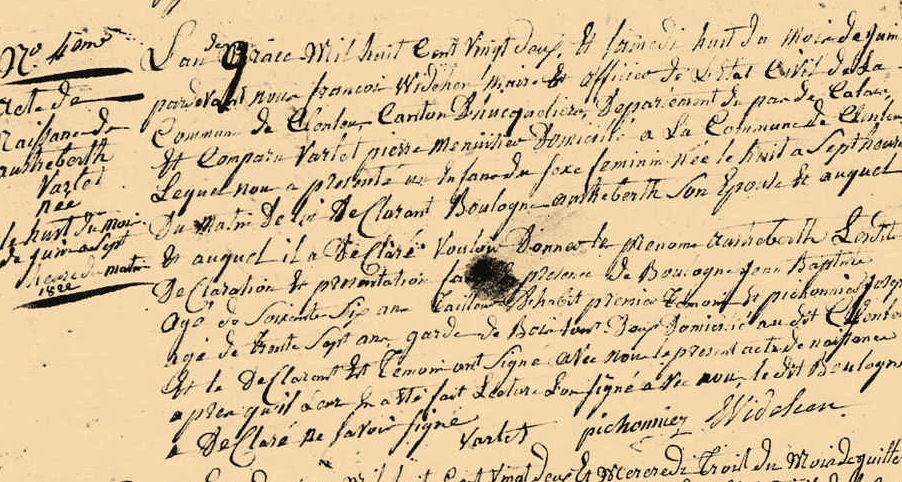
Cerenise dozed off, dreaming of the Folies Bergere. The atmosphere was exciting and convivial at first, escalating into an eruption of approval when the new act came on the stage. Cerenise felt the energy of the crowd but her attention was drawn to the flamboyant figure of a man dressed as one of the three kings of the Magi, and he was making his way over to her. Why, it was Lazuli Galore! What on earth was he doing here? And who was that dumpy overly made up woman in the blue dress, Godfreda, who had tagged along with them?
Another knock on the door wakened her and she called out “Come in!” in an irritable tone. She’d been having such fun in the dream. “Oh it’s you, oh good, the book has arrived.”
Laddie shifted his feet and replied, “Well yes, a Liz Tattler novel has arrived.”
“Oh, good, well be off with you then so I can get on with my work.”
“But it’s not The Vampires of Varna. It’s The Valedictorian Vampires of Valley View High.”
“Jolly good, I expect you’ll enjoy it,” Cerenise said, picking up the old document again and peering at it. Perceiving that Laddie had not yet exited the room, she looked up. “Helier won’t notice, those books are all the same. Now get off with you.”
January 4, 2026 at 10:01 pm #8043In reply to: Finder’s Keepers of the Hoard
A cinematic, low-angle shot inside a flooded, ancient brick sewer tunnel that looks like a mix of Roman catacombs and Victorian industrial plumbing. The water is dark and murky, reflecting the light of a flickering lantern.
In the center of the frame, floating precariously, is a bright yellow, cheap inflatable dinghy.
Inside the dinghy are two men:
-
Spirius: An elderly man with a nervous expression, wearing a high-vis vest over ancient saintly robes. He is clutching an antique musket that is clearly too heavy for him. A faint, golden neon halo flickers erratically behind his head like a faulty streetlamp.
-
Boothroyd: A grumpy, weather-beaten gardener in a tweed cap. He looks completely resigned to his fate, lazily paddling with a plastic oar in one hand and holding a sharp garden spear in the other.
Action: The dinghy squeaks as it bumps against the wet brick walls. Spirius jumps at a drip of water falling from the ceiling. Something large ripples the water in the foreground—a menacing shadow moving beneath the surface.
Atmosphere:
-
Lighting: Chiaroscuro—deep shadows and warm lantern light, contrasting with the synthetic yellow of the boat.
-
Mood: Tense but ridiculous. High-stakes fantasy meets low-budget reality.
Movement:
-
The camera tracks slowly backward as the boat drifts forward.
-
The water ripples ominously.
-
Spirius’s halo buzzes and dims when he gets scared.
January 4, 2026 at 9:59 pm #8042In reply to: Finder’s Keepers of the Hoard
A continuous, fast-moving FPV drone shot.
The Start: The camera zips through a sterile, white modern reception area with a sign reading ‘Sanctus Training Ltd.’ It flies over a bored receptionist’s desk and straight through a pair of unassuming double doors.
The Reveal: The moment the doors pass, the world expands impossible. We are now inside a massive, cathedral-like Grand Townhouse built of glowing golden Cotswold stone.
The Hoard: The drone dives into a ‘canyon’ of hoarded objects. It weaves perilously between towering stacks of yellowed newspapers, piles of 17th-century furniture, and a mountain of washing machines.
The Architecture: As the drone speeds up, we pass tall, elegant Georgian windows on the left (showing a blur of an overgrown orchard and stables outside). On the right, the architecture shifts to heavy, rough stone arches—the Medieval Norman wing.
The Details: The camera narrowly misses a hanging chandelier made of plastic coat hangers and crystal, zooms over a grand dining table buried in Roman pottery and taxidermy, and finally flies up towards the vaulted ceiling of a Norman Chapel, where a beam of purple stained-glass light catches dust motes dancing in the air.”
January 4, 2026 at 6:59 pm #8029In reply to: The Hoards of Sanctorum AD26
“While you’re off to another wild dragon chase, I’m calling the plumber,” Yvoise announced. She’d found one who accepted payment in Roman denarii. She began tapping furiously on her smartphone to recover the phone number, incensed at having been blocked again from Faceterest for sharing potentially unchecked facts (ignorants! she wanted to shout at the screen).
 After a bit of struggle, the appointment was set. She adjusted her blazer; she had a ‘Health and Safety in the Workplace’ seminar to lead at Sanctus Training in twenty minutes, and she couldn’t smell like wet dog.
“Make sure you bill it to the company account…!” Helier shouted over the noise Spirius was making huffing and struggling to load the antique musket.
“…under ‘Facility Maintenance’!”
“Obviously,” Yvoise scoffed. “We are a legitimate enterprise. Sanctus House has a reputation to uphold. Even if the landlord at Olympus Park keeps asking why our water consumption rivals a small water park.”
Spirius shuddered at the name. “Olympus Park. Pagan nonsense. I told you we should have bought the unit in St. Peter’s Industrial Estate.”
“The zoning laws were restrictive, Spirius,” Yvoise sighed. “Besides, ‘Sanctus Training Ltd’ looks excellent on a letterhead. Now, if you’ll excuse me, I have six junior executives coming in for a workshop on ‘Conflict Resolution.’ I plan to read them the entirety of the Treaty of Arras until they submit.”
“And dear old Boothroyd and I have a sewer dragon to exterminate in the name of all that’s Holy. Care to join, Helier?”
“Not really, had my share of those back in the day. I’ll help Yvoise with the plumbing. That’s more pressing. And might I remind you the dragon messing with the plumbing is only the first of the three tasks that Austreberthe placed in her will to be accomplished in the month following her demise…”
“Not now, Helier, I really need to get going!” Yvoise was feeling overwhelmed. “And where’s Cerenise? She could help with the second task. Finding the living descendants of the last named Austreberthe, was it? It’s all behind-desk type of stuff and doesn’t require her to get rid of anything…” she knew well Cerenise and her buttons.
“Yet.” Helier cut. “The third task may well be the toughest.”
“Don’t say it!” They all recoiled in horror.
“The No-ve-na of Cleans-ing” he said in a lugubrious voice.
“Damn it, Helier. You’re such a mood killer. Maybe better to look for a loophole for that one. We can’t just throw stuff away to make place for hers, as nice her tastes for floor tiling were.” Yvoise was in a rush to get to her appointment and couldn’t be bothered to enter a debate. She rushed to the front door.
“See you later… Helier-gator” snickered Laddie under her breath, as she was pretending to clean the unkempt cupboards.
January 3, 2026 at 8:09 pm #8025In reply to: The Hoards of Sanctorum AD26
As soon as Boothroyd had gone, Laddie Bentry, the under gardener, emerged from behind the Dicksonia squarrosa that was planted in a rare French Majolica Onnaing dragon eagle pot. The pot, and in particular the tree fern residing within it, were Laddie’s favourite specimen, reminding him of his homeland far away.
Keeping a cautious eye on the the door leading into the house, Laddie hurried over to the cast iron planter and retrieved the Liz Tattler novel hidden underneath. Quickly he tucked in into the inside pocket of his shabby tweed jacket and hastened to the door leading to the garden. Holding on to his cap, for the wind was cold and gusty, he ran to the old stable and darted inside. Laddie reckoned he had an hour or two free without Boothroyd hovering over him, and he settled himself on a heap of old sacks.
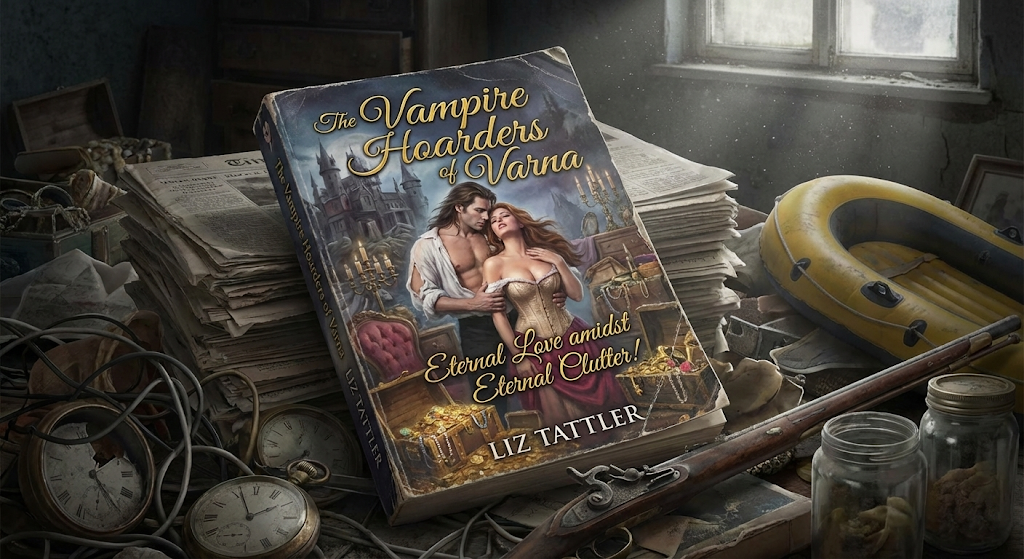
 The Vampire Hoarders of Varna. It wasn’t the first time Laddie had seen Boothroyd surreptitiously reading Helier’s books, and it had piqued his curiosity. What was it the old fart found so interesting about Helier’s novels? The library was full of books, if he wanted to read. Not bothering to read the preface, and not having time to start on page one, Laddie Bentry flicked through the book, pausing to read random passages.
….the carriage rattled and lurched headlong through the valley, jostling the three occupants unmercifully. “I’ll have the guts of that coachman for garters! The devil take him!” Galfrey exclaimed, after bouncing his head off the door frame of the compartment.
“Is it bleeding?” asked Triviella, inadvertently licking her lips and she inspected his forehead.
“The devil take you too, for your impertinence,” Galfrey scowled and shook her off, his irritation enhanced by his alarm at the situation they found themselves in.
Ignoring his uncharacteristic bad humour, Triviella snuggled close and and stroked his manly thigh, clad in crimson silk breeches. “Just think about the banquet later,” she purred.
Jacobino, austere and taciturn, on the opposite seat, who had thus far been studiously ignoring both of them, heard the mention of the banquet and smiled for the first time since…
Laddie opened the book to another passage.
“……1631, just before the siege of Gloucester, and what a feast it was! It was hard to imagine a time when we’d feasted so well. Such rich and easy pickings and such a delightful cocktail. One can never really predict a perfect cocktail of blood types at a party, and centuries pass between particularly memorable ones. Another is long overdue, and one would hate to miss it,” Jacobino explained to the innocent and trusting young dairy maid, who was in awe that the handsome young gentleman was talking to her at all, yet understood very little of his dialogue.
“Which is why,” Jacobino implored, taking hold of her small calloused hands, “You must come with me to the banquet tonight.”
Little did she know that her soft rosy throat was on the menu…..
January 3, 2026 at 11:55 am #8024In reply to: The Hoards of Sanctorum AD26
Floviana sunk her yellowed fangs into the milky white throat of the village wench and slurped the revitalising iron rich nectar, relishing the immediate surge of strength. The buxom peasant girl swooned, faint with shock and loss of vital fluids, and Floviana struggled to hold her upright as she drank her fill. Sated at last, Floviana unceremoniously dropped the girl on the leaf covered mulch of the forest floor, carelessly leaving her body in a shameful disarray with her coarse woollen stockings and plump white thighs exposed.
Boothroyd grunted with pleasure as he imagined the scene and then quickly snapped Helier’s book closed when he heard the door to the conservatory open. Dropping the book and kicking it under a cast iron jardiniere, he rose as Spirius entered the room.
“Ah, there you are Boothroyd. If you’re not too busy,” Spirius cast his eyes around in a fruitless manner attempting to discover what exactly the gardener had been busy with, “I’d like you to accompany me down the cellar. Bring some weapons.”
“Weapons, sire?” Boothroyd scratched his head.
“Yes, Yes, weapons! Are you deaf? A long spear and perhaps a musket. And a small inflatable dinghy.”
“A dinghy, sire?”
Spirius sighed. “Yes, a dinghy. And a big net. Meet me at the top of the cellar steps in an hour. I’ll go and get the bottles.”
Boothroyd sighed and glanced wistfully at the cast iron planter, haunted by the vision of plump white thighs.
January 3, 2026 at 9:04 am #8023In reply to: The Hoards of Sanctorum AD26
“Quite fitting that I should get her sleeves,” Cerenise said with satisfaction. “And what a relief that she left the wolf to you, Spirius. I’d not have been able to manage a wolf.” Cerenise popped another cashew nut into her mouth.
Spirius looked at her with a raised eyebrow. “My guess is you’d have managed just fine,” he replied drily. He’d heard all the noise she made behind those locked doors. He’d seen her prancing around the orchard in the moonlight when she thought nobody was watching, naked as the day she was born all those centuries ago. He hadn’t lingered at the window, but he had put two and two together years ago, many years ago, just after the seige of Gloucester. If truth be told, Cerenise’s secret was known to them all, but they hadn’t interfered with her delusion.
“There’s going to come a point, and very soon, when we will have to deal with the water leak, you know,” Yvoise interrupted the inconsequential chatter. “Holy and healing as it may be, it will be the ruin of my collection if it reaches the upper floors.”
“And what do you propose?” asked Helier.
“I suggest we call a plumber!” snapped Yvoise. “This is the 21st century is it not? I know tradesmen are in short supply, and I know this isn’t an ordinary leak, but we should start with the obvious, and then adapt accordingly.”
“I must bottle as much of the holy water as possible before we stop the leak,” Spirius said, standing up abruptly in agitation.
Helier put a calming hand on the old boy’s shoulder. “There’s no rush, Spirius, there’s plenty of water in the cellars, it’s already waist deep down there.”
“And the saints only know what has floated into the cellars by now from the tunnels. Be careful down there, Spirius. Take Boothroyd the gardener with you,” Yvoise advised.
January 2, 2026 at 6:03 pm #8022In reply to: The Hoards of Sanctorum AD26
“You know,” Helier broke the silence, his mouth half-full of the buffet’s assortments of nuts and crackers, “this was bound to happen… People tend to forget you after a while. I mean, how many new babies named after dear Austreberthe nowadays. None of course. I think our records mention 1907 was the last baby Austreberthe, and a decade ago the last mass in their memory… oh this is too heartbreaking…”
“Why so gloomy?” Cerenise was eyeing the speckled and stained silverware and the chipped Rouen faience in which the potato salad was served. “Your name is still moderately in fashion, you shouldn’t die of forgetfulness any time soon. Enjoy the food while it’s free.”
Yvoise couldn’t help but tut at her. She was half-distracted by the calligraphy on those placeholders which she found exquisite. People in this age… it was a rare find now, some pretty calligraphy. The only ‘calli-‘anything this age does well enough is callipygian, and even then, it’s mostly the Kashtardians… She said to the others “Don’t throw yours away, I must have the full set.”
Spirius was inspecting the candleholders. None had lids, a fact that frustrated him to no end. “I miss the good old time we could just slay dragons and get a good sainthood concession for a nice half-millenium.”
Yvoise tittered “simple people we were back then. Everything funny-looking was a dragon I seem to recall.”
Spirius, his plate full of charcuteries, helped himself of a few appetizing gherkins, holding one large up to contemplate. “Yeah, but those few we slew in that period were still some darn tough-skinned gators I would have you know. Those crazy Roman buggers and their games and old false gods —they couldn’t help but bring those strange beasts from Africa to Gaul, leaving us to clean up after them…”
“Indeed, much harder now. It’s like fifteen minutes of sainthood on Instatok and Faceterest and you’re already has-been.” Yvoise had started to pocket some of the paper menus. “Luckily, we still have those relics spread around to fan the flames of remembrance, don’t we.”
“I guess the young ones must look at us funny…” Cerenise chuckled amused at the thought, almost spilling her truffle brouillade.
“Oh well, apparently our youngest geeks aren’t above dealing in relics.” Helier said. “Speaking of Novena and the coming nine days,… you’ve surely noticed as I did what was mentioned in the will, have you not?”
December 31, 2025 at 10:00 pm #8021In reply to: The Hoards of Sanctorum AD26
Helier was the only one paying attention to Bartholomew, Cerenise noticed in a rare moment of focus on the proceedings at hand. A unique human (albeit an exceedingly long lived version of human) story was being revealed for the first time in near unprecedented circumstances, and he was relishing every moment of the revelations. That much was clear in a flash of understanding to Cerenise. Notwithstanding her propensity to jump to consclusions prematurely, she felt a moment of satisfaction and pleasure at the unexpected unfolding tale. Helier was as intrigued as she was, that much she knew.
December 31, 2025 at 9:45 pm #8020In reply to: The Hoards of Sanctorum AD26
Spirius was looking decidedly ill at ease, which struck Cerenise as far from unusual, and as such, struck her not at all at the time. It wasn’t until later that she became aware of the cause of the discomfiture of her centuries old companion. Spirius had always been a bit of a dark horse, although that wasn’t really the right expression. A character of hidden depths and mysteries, perhaps with a penchant for bottling things up and labeling them,and then shelving them. Nobody knew for sure. A good kind well meaning saint, as saints go. She smiled at him fondly.
I hope they’re recording this will reading, Cerenise thought again, not having been listening to the seemingly endless drone of items.
-
-
AuthorSearch Results