 Sharon ... ·



Search Results for 'bag'
-
AuthorSearch Results
-
August 16, 2024 at 2:56 pm #7544
In reply to: The Elusive Samuel Housley and Other Family Stories
Youlgreave
The Frost Family and The Big Snow
The Youlgreave parish registers are said to be the most complete and interesting in the country. Starting in 1558, they are still largely intact today.
“The future historian of this parish will find a vast stock of material ready to hand, and if such a work was ever accomplished it would once more be seen how the history of even a remote village is but the history of the nation in little; how national victories were announced on the church bells, and national disasters by the proclamation of a form of prayer…”
J. Charles Cox, Notes on the Churches of Derbyshire, 1877.
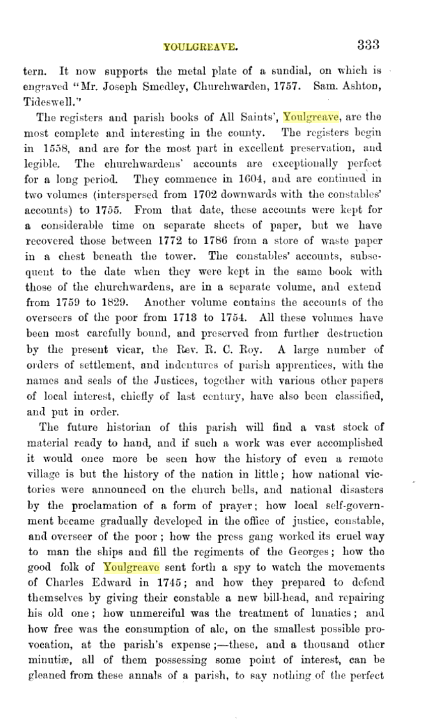
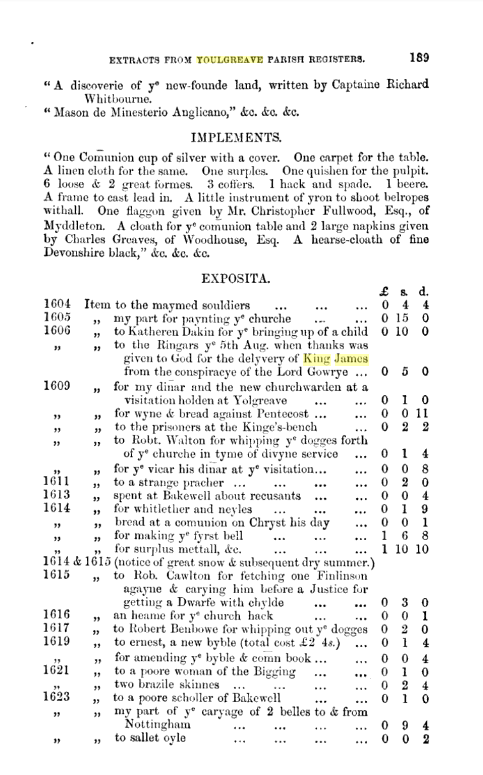
Although the Youlgreave parish registers are available online on microfilm, just the baptisms, marriages and burials are provided on the genealogy websites. However, I found some excerpts from the churchwardens accounts in a couple of old books, The Reliquary 1864, and Notes on Derbyshire Churches 1877.
Hannah Keeling, my 4x great grandmother, was born in Youlgreave, Derbyshire, in 1767. In 1791 she married Edward Lees of Hartington, Derbyshire, a village seven and a half miles south west of Youlgreave. Edward and Hannah’s daughter Sarah Lees, born in Hartington in 1808, married Francis Featherstone in 1835. The Featherstone’s were farmers. Their daughter Emma Featherstone married John Marshall from Elton. Elton is just three miles from Youlgreave, and there are a great many Marshall’s in the Youlgreave parish registers, some no doubt distantly related to ours.
Hannah Keeling’s parents were John Keeling 1734-1823, and Ellen Frost 1739-1805, both of Youlgreave.
On the burial entry in the parish registers in Youlgreave in 1823, John Keeling was 88 years old when he died, and was the “late parish clerk”, indicating that my 5x great grandfather played a part in compiling the “best parish registers in the country”. In 1762 John’s father in law John Frost died intestate, and John Keeling, cordwainer, co signed the documents with his mother in law Ann. John Keeling was a shoe maker and a parish clerk.
John Keeling’s father was Thomas Keeling, baptised on the 9th of March 1709 in Youlgreave and his parents were John Keeling and Ann Ashmore. John and Ann were married on the 6th April 1708. Some of the transcriptions have Thomas baptised in March 1708, which would be a month before his parents married. However, this was before the Julian calendar was replaced by the Gregorian calendar, and prior to 1752 the new year started on the 25th of March, therefore the 9th of March 1708 was eleven months after the 6th April 1708.
Thomas Keeling married Dorothy, which we know from the baptism of John Keeling in 1734, but I have not been able to find their marriage recorded. Until I can find my 6x great grandmother Dorothy’s maiden name, I am unable to trace her family further back.
Unfortunately I haven’t found a baptism for Thomas’s father John Keeling, despite that there are Keelings in the Youlgrave registers in the early 1600s, possibly it is one of the few illegible entries in these registers.
The Frosts of Youlgreave
Ellen Frost’s father was John Frost, born in Youlgreave in 1707. John married Ann Staley of Elton in 1733 in Youlgreave.
(Note that this part of the family tree is the Marshall side, but we also have Staley’s in Elton on the Warren side. Our branch of the Elton Staley’s moved to Stapenhill in the mid 1700s. Robert Staley, born 1711 in Elton, died in Stapenhill in 1795. There are many Staley’s in the Youlgreave parish registers, going back to the late 1500s.)
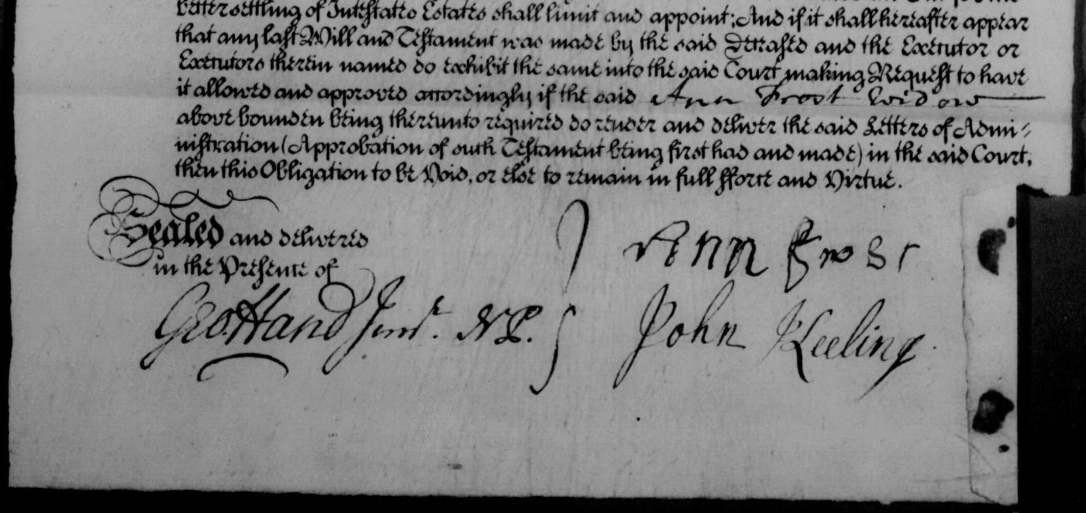
John Frost (my 6x great grandfather), miner, died intestate in 1762 in Youlgreave. Miner in this case no doubt means a lead miner, mining his own land (as John Marshall’s father John was in Elton. On the 1851 census John Marshall senior was mining 9 acres). Ann Frost, as the widow and relict of the said deceased John Frost, claimed the right of administration of his estate. Ann Frost (nee Staley) signed her own name, somewhat unusual for a woman to be able to write in 1762, as well as her son in law John Keeling.
John’s parents were David Frost and Ann. David was baptised in 1665 in Youlgreave. Once again, I have not found a marriage for David and Ann so I am unable to continue further back with her family. Marriages were often held in the parish of the bride, and perhaps those neighbouring parish records from the 1600s haven’t survived.
David’s parents were William Frost and Ellen (or Ellin, or Helen, depending on how the parish clerk chose to spell it). Once again, their marriage hasn’t been found, but was probably in a neighbouring parish.
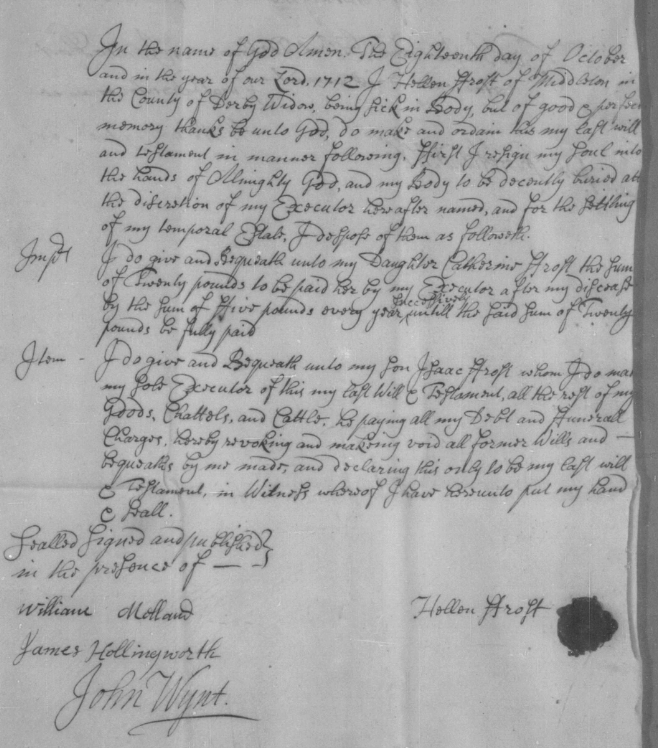
William Frost’s wife Ellen, my 8x great grandmother, died in Youlgreave in 1713. In her will she left her daughter Catherine £20. Catherine was born in 1665 and was apparently unmarried at the age of 48 in 1713. She named her son Isaac Frost (born in 1662) executor, and left him the remainder of her “goods, chattels and cattle”.
William Frost was baptised in Youlgreave in 1627, his parents were William Frost and Anne.
William Frost senior, husbandman, was probably born circa 1600, and died intestate in 1648 in Middleton, Youlgreave. His widow Anna was named in the document. On the compilation of the inventory of his goods, Thomas Garratt, Will Melland and A Kidiard are named.(Husbandman: The old word for a farmer below the rank of yeoman. A husbandman usually held his land by copyhold or leasehold tenure and may be regarded as the ‘average farmer in his locality’. The words ‘yeoman’ and ‘husbandman’ were gradually replaced in the later 18th and 19th centuries by ‘farmer’.)
Unable to find a baptism for William Frost born circa 1600, I read through all the pages of the Youlgreave parish registers from 1558 to 1610. Despite the good condition of these registers, there are a number of illegible entries. There were three Frost families baptising children during this timeframe and one of these is likely to be Willliam’s.
Baptisms:
1581 Eliz Frost, father Michael.
1582 Francis f Michael. (must have died in infancy)
1582 Margaret f William.
1585 Francis f Michael.
1586 John f Nicholas.
1588 Barbara f Michael.
1590 Francis f Nicholas.
1591 Joane f Michael.
1594 John f Michael.
1598 George f Michael.
1600 Fredericke (female!) f William.Marriages in Youlgreave which could be William’s parents:
1579 Michael Frost Eliz Staley
1587 Edward Frost Katherine Hall
1600 Nicholas Frost Katherine Hardy.
1606 John Frost Eliz Hanson.Michael Frost of Youlgreave is mentioned on the Derbyshire Muster Rolls in 1585.
(Muster records: 1522-1649. The militia muster rolls listed all those liable for military service.)
Frideswide:
A burial is recorded in 1584 for Frideswide Frost (female) father Michael. As the father is named, this indicates that Frideswide was a child.
(Frithuswith, commonly Frideswide c. 650 – 19 October 727), was an English princess and abbess. She is credited as the foundress of a monastery later incorporated into Christ Church, Oxford. She was the daughter of a sub-king of a Merica named Dida of Eynsham whose lands occupied western Oxfordshire and the upper reaches of the River Thames.)
An unusual name, and certainly very different from the usual names of the Frost siblings. As I did not find a baptism for her, I wondered if perhaps she died too soon for a baptism and was given a saints name, in the hope that it would help in the afterlife, given the beliefs of the times. Or perhaps it wasn’t an unusual name at the time in Youlgreave. A Fridesweda Gilbert was buried in Youlgreave in 1604, the spinster daughter of Francis Gilbert. There is a small brass effigy in the church, underneath is written “Frideswide Gilbert to the grave, Hath resigned her earthly part…”
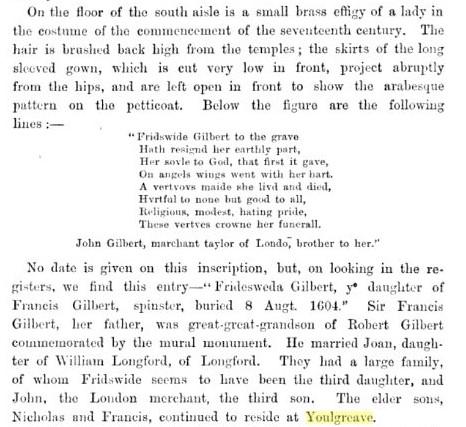
J. Charles Cox, Notes on the Churches of Derbyshire, 1877.
King James
A parish register entry in 1603:
“1603 King James of Skottland was proclaimed kinge of England, France and Ireland at Bakewell upon Monday being the 29th of March 1603.” (March 1603 would be 1604, because of the Julian calendar in use at the time.)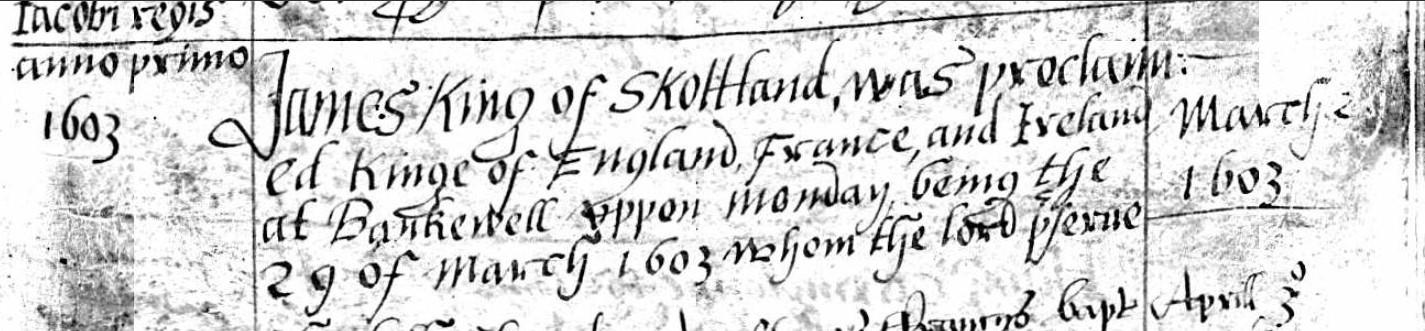
The Big Snow
“This year 1614/5 January 16th began the greatest snow whichever fell uppon the earth within man’s memorye. It covered the earth fyve quarters deep uppon the playne. And for heaps or drifts of snow, they were very deep; so that passengers both horse or foot passed over yates, hedges and walles. ….The spring was so cold and so late that much cattel was in very great danger and some died….”
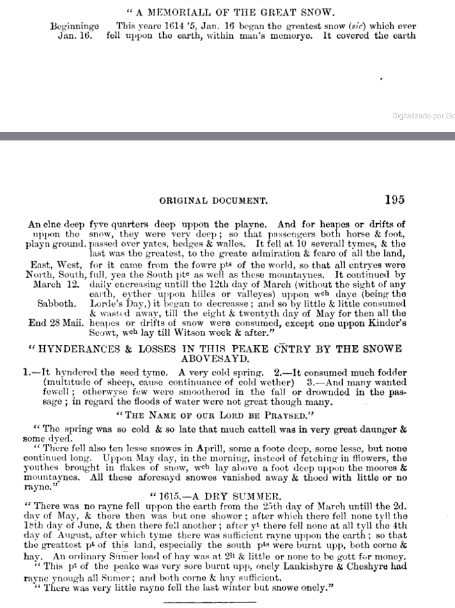
From the Youlgreave parish registers.
Our ancestor William Frost born circa 1600 would have been a teenager during the big snow.
July 25, 2024 at 7:58 am #7542In reply to: The Incense of the Quadrivium’s Mystiques
Shivering, Truella pulled the thin blanket over her head. Colder than a witches tit here, colder in summer than winter at home! It was no good, she may as well get up and go for a walk to try and warm up. Poking her head outside Truella gasped and coughed at the chill air. Shapes were becoming discernible in the dim pre dawn light, the other pods, the hedgerow, a couple of looming trees. Truella rummaged through her bag, hoping to find warm clothes yet knowing she hadn’t packed anything warm enough. Sighing, her teeth chattering, she pulled on everything she had in layers and pulled the blanket off the bed to use as a cape. With a towel over her head for extra warmth, she ventured out into the Irish morning.
The grass was sodden with dew and Truella’s feet were wet through and icy. Bracing her shoulders with determination, she forged ahead towards a gate leading into the next field. She struggled for a few minutes with the baler twine holding the gate closed, numb fingers refusing to cooperate. Cows watched her curiously, slowly munching. One lifted her tail and dropped a steaming splat on the grass, chewing continuously. I don’t think I could eat and do that at the same time.
Heading off across the field which sloped gently upwards, Treulla picked up her pace, keeping her eyes down to avoid the cow pats. By the time she reached the oak tree along the top hedge, the sun started to make an appearance over the hill. Warmer from the exercise, she gazed over the countryside. How beautiful it was with the mist in the valleys, and everything so green.
If only it was warmer!
“Are you cold then, is that why you’re decked out like that? From a distance I thought I was seeing a ghost in a cloak and head shawl!” The woman smiled at Truella from the other side of the hedgerow. “Sorry, did I startle you? You’ll get your feet soaked walking in that wet grass, climb over that stile over there, the lane here’s better for a morning walk.”
It sounded like good advice and the woman seemed pleasant enough. “Are you here for the games too?” Truella asked, readjusting the blanket and towel after navigating the stile.
“Yes, I am. I’m retired, you see,” the woman said with a wide grin. “It’s a wonderful thing, not that you’d know, you’re much to young.”
“That must be nice,” Truella replied politely. “I sometimes wish I was retired.”
“Oh, my dear! It’s wonderful! I haven’t had a job for years, but it’s the strangest thing, now that I’ve officially retired, there’s a marvellous feeling of freedom. I don’t have to do anything. Well, I didn’t have to do anything before I retired but one always feels one should keep busy, do productive things, be seen to be doing some kind of work to justify ones existance. Have you seen the old priory?”
“No, only just got here yesterday.”
“You’ll love it, it’s up this path here, follow me. But now I’ve retired,” the woman continued, “I get up in the morning with a sense of liberation. I can do as little as I want ~ funny thing is that I’ve actually been doing more, but there’s no feeling of obligation, no things to cross off a list. All I’m expected to do as a retired person is tick along, trying not to be much of a bother for as long as I can.”
“I wish I was retired!” exclaimed Truella with feeling. “I wish I didn’t have to do the cow goddess stall, it’ll be such a bind having to stand there all evening.” She explained about the coven and the stalls, and the depressing productivity goals.
“But why not get someone else to do the stall for you?”
“It’s such short notice and I don’t know anyone here. It’s an idea though, maybe someone will turn up.”
July 22, 2024 at 6:24 am #7538In reply to: The Incense of the Quadrivium’s Mystiques
“And anyway, I wasn’t flirting with him,” Truella added, with a smile. “It’s great to see you! No word from Eris or Jeezel though. I thought they were looking forward to a holiday? Have you heard anything?”
“Not a word, not since Eris was beseeching us to distract her from all the stress.”
“Well, they’re late to the party, the plan was to have a couple of days relaxing together before the games start, and not a word from either of them.”
“Maybe they’re not going to come at all!”
“Oh they’ll turn up, eventually,” Truella said, adding with a frown, “You don’t think anything has happened to them, do you? One minute chat chat chat, then nothing. Like they just disappeared!”
“I’ll send another message, and if they don’t respond, maybe we should start making enquiries. Where were they last seen?”
“Eris mentioned something about Normandy…but hey, we can just carry on without them. Go and put your bags in your pod and let’s go for a walk. You can tell me all about that camphor chest.”
July 19, 2024 at 12:26 pm #7536In reply to: The Incense of the Quadrivium’s Mystiques
The rainbow was neon bright, one end disappearing behind a spinney in the distance, and the other end landing squarely in the middle of the glamping pods. A good sign! thought Truella, the first of the coven to arrive. For a moment she imagined herself digging a hole right there, and finding the elusive pot of gold. I wouldn’t be able to do that in a fancy hotel. For once, Truella was happy with Austreberthe’s choice. A week or two in a green field sounded relaxing, refreshing. So much more to her taste than the endless fitted carpets, closed windows, and artifically controlled air blasting out of metal grilles in hotels.
Taking a deep breath of cool fresh air, she surveyed the site before checking into reception. The neighbouring fields were full of cows, perfect for her to practice her Bubona spells on before she set up her Goddess Spell Booth. The Goddess spell tents were to be open in the evenings, after the games each day, along with other stalls selling handicrafts, homemade cakes and jams, wines and potions, trinkets and souvenirs, and all the other tat that people on holiday enjoyed browsing. Obviously the coven would have a stall selling incense. No doubt Austreberthe would have hatched some hard sell plan for that.
Inside the reception office, Truella pinged the bell and waited for someone to attend. The registration book was open on the counter and Truella craned her neck to read the names on the list. She planned to ask for a pod in a far corner, near the hedgerow. It might make it easier to slip out unnoticed, if she should have a mind to do so. The door behind the counter opened and a young man appeared, smiling a welcome. But not before Truella had seen the name on the list. She sucked her breath in sharply. Malove! Nobody was expecting her. Did Austreberthe know?
“Welcome to Finnegan’s Farm Glampsite, I’m Liam,” said the young man, pushing long mousy hair out of his eyes, “You’ve a booking I take it, because we’re fully booked up for the next fortnight. Because of the Games, you see.”
Replying that she did, Truella asked for a pod in the furthest corner. Liam looked at a list and frowned. “The corners are all taken, I’m afraid. But I tell you what,” he said, “As you’re the first to arrive I’ll swap your pod, let’s see…” He scanned the list. “Ah yes, the late booking. I can put you in the one we’ve assigned to Mrs …Malone I think it says, and put her in yours.”
“Thank you very much, Liam,” Truella said as he handed her a key with a big wooden tag with the number 33 etched on it.
“I’ll carry your bags over and show you where it is, follow me.”
June 21, 2024 at 8:36 am #7514In reply to: The Incense of the Quadrivium’s Mystiques
Whether or not Truella’s suggestion proved to be true or not, and time would tell, she couldn’t help wondering about the letter Malove had sent to Jeezel. Was it genuine? Had she, Truella, also received one? Jeezel had asked if she’d checked her bags, and the truth was that she had not.
She made her way slowly up the grand staircase, holding the banister to steady herself as she looked at all the tapestries. How strange they were, a series of smaller cloths all of a similar theme, all of corpulent nuns in crimson red robes, not in itself a strange thing in an old convent, but they all had the faces of frogs.
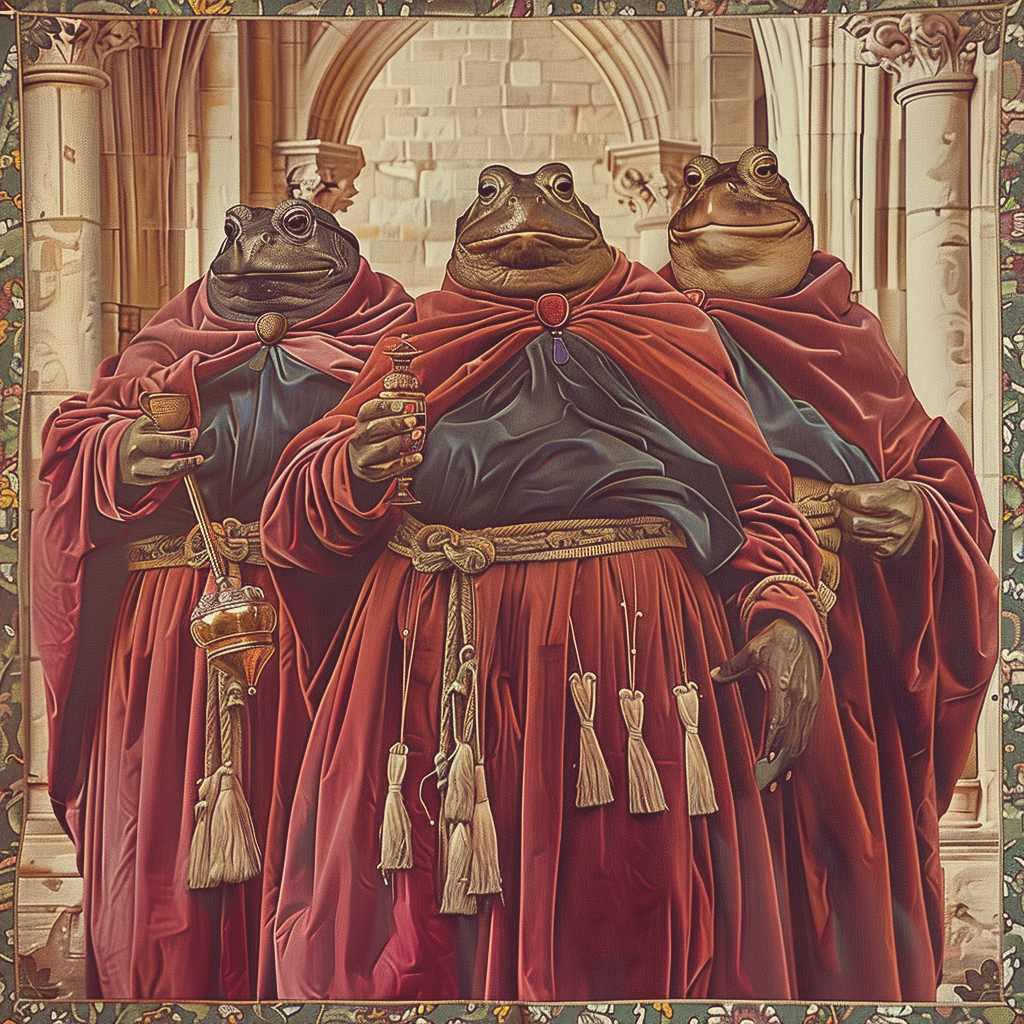
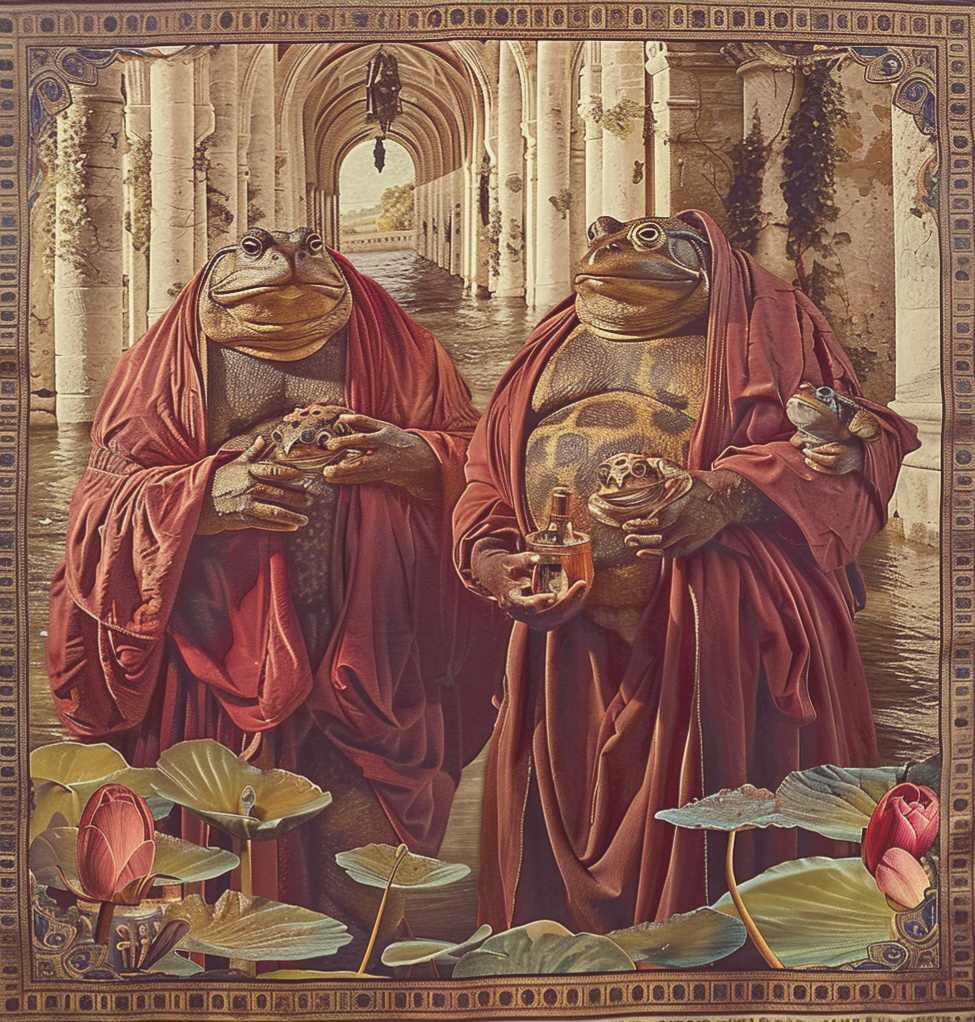

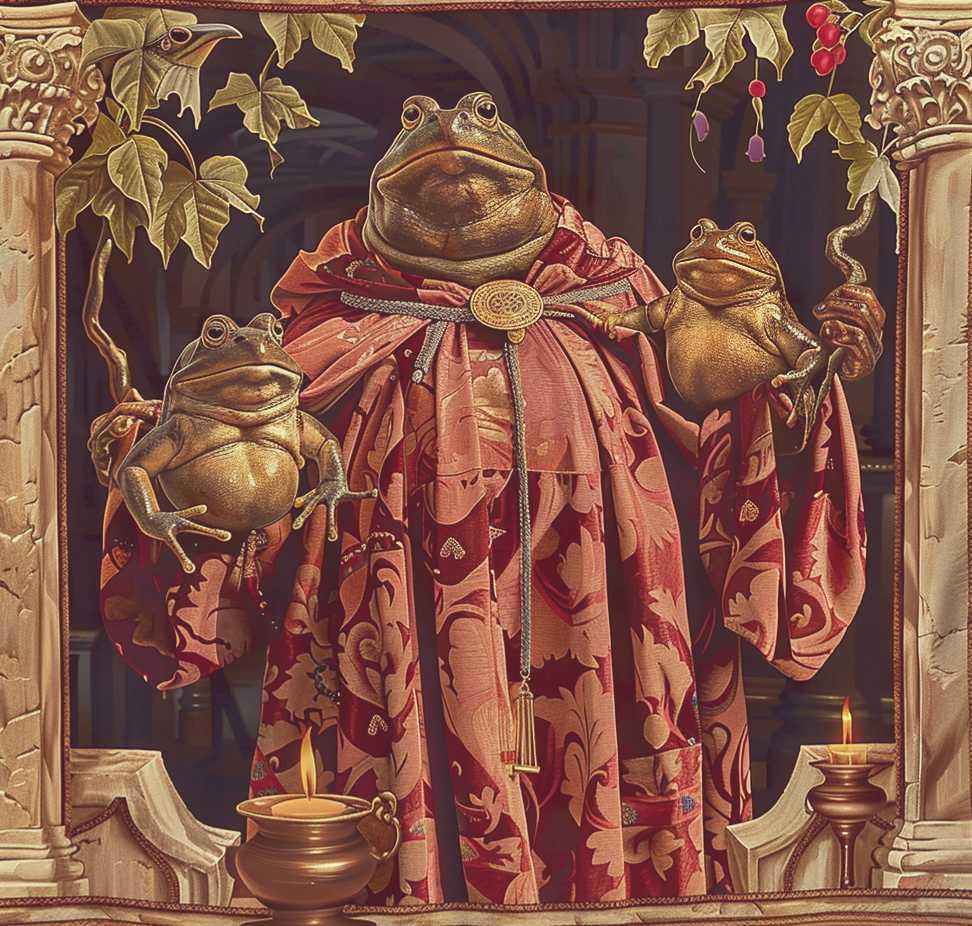
“I see you’ve noticed them too, Truella,” Rufus said quietly, his hand reaching under his shirt for a moment.
“Thank goodness I was holding onto the bannisters, you startled me! I didn’t see you there. I could have fallen to my death on the tiled floor below, Rufus.”
“I’d have saved you. As I always have done,” He replied enigmatically. “Do you recognise them now?” he asked, glancing pointedly at the embroidered cloths.
Truella paused. What was going on here? Was he trying to distract her? “Rufus, we need to talk,” she said quietly. “I’m going to my room to look for, er, something. Come with me.”
June 19, 2024 at 8:53 pm #7508In reply to: The Incense of the Quadrivium’s Mystiques
After an eternity of cordial superficial conversation with a vertitable horde of new characters, and despite that some of them seemed either potentially interesting, possibly entertaining, or just downright intriguingly bizarre, Truella badly needed a quiet moment to herself, or in other words, a cigarette. Excusing herself from a strained attempt at getting to know a prim thin lipped nun whose name escaped her, Truella made her way over to the cloisters beyond the open doors. The courtyard beckoned, a breath of fresh air and a peaceful respite.
Leaning against a pillar, Truella took a drag on her cigarette, exhaling long and slowly. Perhaps it was just the shafts of sunlight making it seem that there was so much smoke. It hadn’t been too bad, after all. What an assorted bag they all were! Truella hadn’t given any thought to what all these new people she was to merge with would be like ~ she’d been focused on the intrusion into her own pursuits that such a thing would inevitably entail.
Rufus seemed to be keeping his distance, but Truella was relishing it, like knowing there’s cheesecake in the fridge for a midnight snack. Surprisingly, the two nuns Sandra and Sassafras seemed like good eggs underneath those dreadful habits. Truella was glad that Sassafras was her partner for the ritual; certainly it would have been worse with one of those silent ones. She wondered if Sassafras had anything planned, and if she should have thought about the ritual sooner. But then, how could she have known? The assumption had been that the partners would meet, and then come up with something together. Wasn’t it just a fun getting to know each other game kind of thing?
“How many cigarettes are you smoking out here?” Sandra laughed, “Can’t say I blame you though, gawd, will it never end.” Coughing, she lit a cigarette. “What is it you’re smoking anyway? What a funny smell, like the bowels of the earth.”
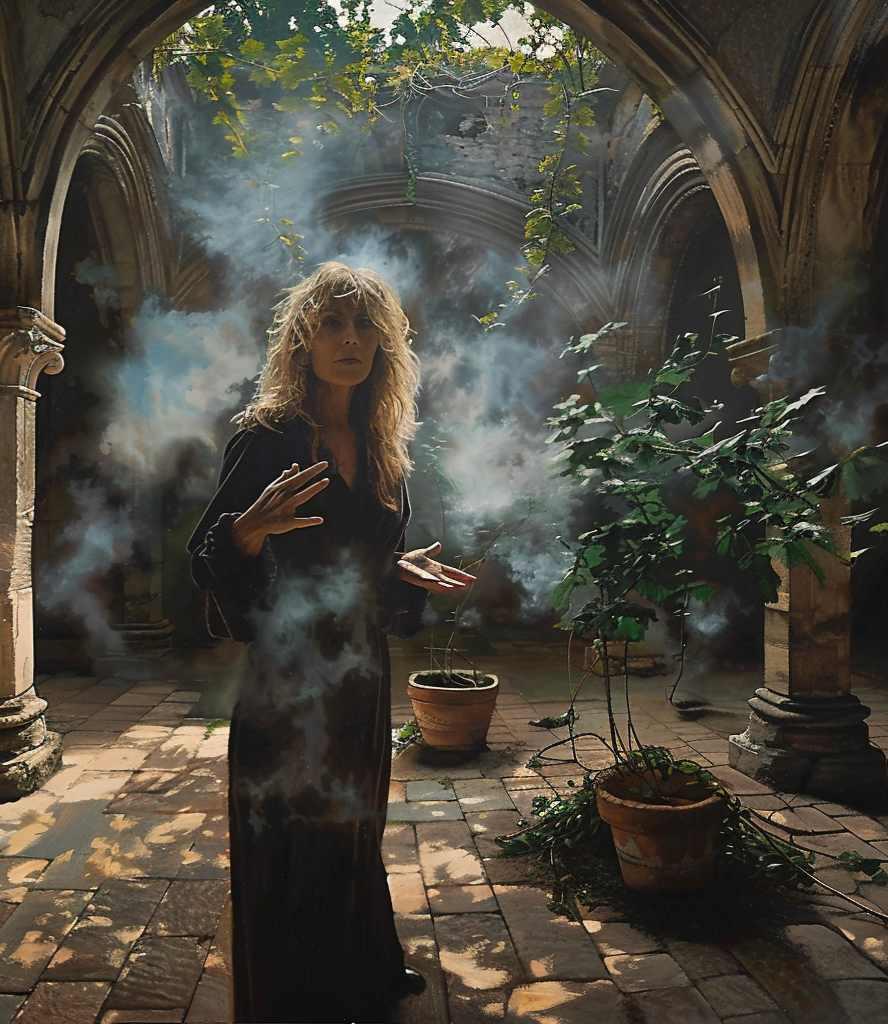
Truella thought this was rather rude, but had to admit that the smoke did smell peculiar. “That’s exactly what it smells like. And that smoke isn’t from my cigarette.”
“Fee Fi Finnley Fum, I smell the smoke of a dragon’s bum,” Sandra tried to laugh and failed. “Oh, heck. I don’t like dragons.”
“Neither do I,” Truella didn’t like the sound of this at all, but it had given her an idea for her ritual.
June 15, 2024 at 9:52 pm #7477In reply to: The Incense of the Quadrivium’s Mystiques
Sandra finished her toast, pushed her plate away and stood up. She wiped her hands on the seat of her baggy linen trousers, and then retied the baler twine holding them up. So Blaen the pain thought she should improve her appearance, did she, the prune-faced troll. Sandra was quite happy with her own appearance, which she considered to be a statement indicating her lack of interest in appearance. Lorena Blaen glared at her retreating back as Sandra exited the dining hall with the exaggerated gait of a catwalk model.
Sassafras quickly swallowed the rest of her coffee, and got up to follow Sandra. Catching her up along the cloisters, she asked Sandra if it was a nun’s outfit event or a witches one, or what. It was hard to keep track of the various fronts.
“It’s a witches one this time, it’s a coven visiting. They know we use the nun thing as a cover, I think. But you know what else?” Sandra lowered her voice, pulling Sassafras closer. “This isn’t a merger, that coven already bought us out.”
“What?! But…but…but what does that…?”
Sandra shrugged, looking uncharacteristically helpless.
Sassafras squeezed her arm. “Who else knows? We must tell the others.”
“No! No, not everyone.” Sandra admitted that she didn’t know any more than that, and what she did know, she couldn’t say.
June 5, 2024 at 8:54 pm #7449In reply to: The Incense of the Quadrivium’s Mystiques
Eris looked at the meme on her phone, the one with a picture of tarts and the caption “the tarts are here, let the games begin,” and couldn’t help but chuckle despite the weight of relentless recent events. The humor was a brief respite from the jiggling thoughts bouncing in her mind since the treasure hunt and the increasingly intricate seminars which felt like a boiling cauldron evaporating her wits under Malové’s stern guidance.
The postcards from Truella had been a welcome enigma, doubled with piquant inspiration —a collection of images featuring the dramatic promontories of Madeira, with cryptic notes about a witch-friendly host named Herma. An inspired soul would have found the idea of such a sanctuary enticing, but Eris’ mind was in many places, and patience for obscure cypher lacking context didn’t register long enough to stick in the midst of the other activities demanding her attention. But of course, the underlying messages in Truella’s words seemed to hint at something more profound, something Eris had to trust would come fully revealed, if only in Truella’s own mind ever.
She had just fired the cook, who was lazy at her job, and mean towards the baglady whom Eris had asked her to feed. But the shopkeepers liked her well; they’ll surely commiserate, and she wouldn’t be long to find another placement. Even with justification, it didn’t make Eris’ decision easier. Power and responsibility often came with such burdens, that was the way of the wheel.
As Eris tried to piece together the meaning behind Truella’s postcards and the events at the coven, she felt a returning familiar sense of urgency. The coven was at a critical juncture; Malové’s tests had shown that they were not as united or prepared as they should be. The competitive nature of the other witches, their underhanded tactics, had revealed vulnerabilities within their group that needed addressing.
“The tarts are here, let the games begin,” she mused again, this time contemplating the deeper implications. Was it a call to arms? A reminder that they were in the midst of a game far more complex and perilous than they had realized?
Everyday, Eris had to remind herself that in the midst of uncontrollable changes, it was important to focus on the core, one’s own inner balance. At the moment, there was no point in getting carried away in conjectures.
It was about the game. All she had wanted was to participate, add a piece, and that would be enough.
Regardless of what the silly robot that Thorsten had setup for her (she called it Silibot) which always tried to appeal to her sense of drama in the story. Put that to rest Silibot — that’s the message in the tarts: there’s power in the game, and that’s well enough.
April 7, 2024 at 7:35 am #7420In reply to: The Incense of the Quadrivium’s Mystiques
Spring was there. At 5:57am in the morning, true to her name, Truella had been planting truelles incognito in what appeared to be random flowerbeds in the cities she was passing through. The truelles, she would usually find with the locator spell in sheds around the city and magic them out right into her hands. She loved magic for its efficiency, which really meant there was no need to break in and forage for hours in cramped little rooms.
As she was following a border of plane trees, she chuckled. Believe it or not, she practically invented that spell. At least that’s what her mother used to tell her when she was 6yo and she often wandered alone around the city without mentioning it to anyone. At the time, she had believed her mother. She had bragged about it with her friends at school and pretended she had forgotten all about it like because of a bump on her head. But truth is she had frequent memory losses, which didn’t worry her at the time, and she found it cool to be able to do things and rediscover them later on.
It was an uncle with a dreadfully red moustache, who took pity on her and decided to shatter her dreams of early accomplishments and fame. Was it that same year? Or the next?
Anyway, back to the truelles, she didn’t do it for people to take photos of it and post them to social media, like gawdy Jeez seemed to think, but it was to remind people of the treasures they had buried in those dark little rooms just there in their gardens. How long would it take them to realise that those forgotten tools had disappeared?
Pleased with herself, she noticed a man with a white shirt leaning forward in front of one of the plane trees, his right hand on the bark, two paper bags full of croissants in the other. Frowning, she walked towards him. She was about to ask if he needed help when a strong smell of alcohol made her gag. Then without a warning, the man threw up a red mash in front of him. Truella jumped back, raising the truelle as if it could protect her from any splatter.
“Eww!” She wouldn’t dare saying anything else as opening her mouth could open the gates for her own early toasted cheese fritter. At least the man would not need embalming fluids if he didn’t survive his nocturnal drinking spree.
She cast the truelle in front of the tree and a spell on the man so that he would bury deep the traces of his last meal. She didn’t want the neighbourhood dogs getting drunk after feasting on it.
February 21, 2024 at 1:59 pm #7381In reply to: The Incense of the Quadrivium’s Mystiques
Cedric had had his share of witches shenanigans over his rather short career, but that last one had to top them all off.
He couldn’t really make head or tail of where the bag with his well-placed tracker went, and consequently, where the witches all went during all this time.
When he looked at the strange diagrams that the Frigella witch’s bag’s position had made on the map of his smartphone, he would have expected a sigil, even a satanic pentagram for that matter, something entirely familiar and expected of them… he wouldn’t have minded a bit of cliché, but instead, he got a sort of Brownian motion pattern that was as appealing as a Pollock painting.
Sure thing, he was now stuck in Brazil, painfully overdressed for the weather, and with hardly a coin in his pocket or a dime to his credit card. He would have to call his employer… or maybe worse, his mum.
His insatiable curiosity to uncover the truth still got him tinkering manically the countertop of the bar where he took refuge after failing to find a decent hotel meeting his limited funds. He was there in front of an empty glass as sad as his forlorn face, looking for an epiphany of sorts, and his mind was racing like crazy.
“Ei! pare com isso seu maníaco!” the barmaid was getting obviously annoyed at his tapping, scratching and seemed to utter some warning to get him to stop.
She switched the TV on. Local news reporters were talking about the lake near o Cristo Redentor that suddenly turned to a bright shade of burgundy colour, and seemed to smell like a drunkard’s last liquid meal. Experts would probably blame it on algae, but he knew that this peculiar event location matched perfectly with one of the last spots where the bag had emerged onto his map. Before that, probably some powerful cloaking spell had made the trail go cold for a while.
And after that: poof, they were gone. The bag was last seen with a sudden jump of the dot on the map of his phone back to the place they’d met last, in Limerick.
That was it. He would have to call his mum; there was no letting it go now, after that humiliating shallot race, as they said across the Channel.
February 15, 2024 at 7:47 pm #7375In reply to: The Incense of the Quadrivium’s Mystiques
“The very image of a spy from a cheap novel. Perched behind his newspaper, peering through holes like a child with a telescope. He’s a creature of shadows, blending into the background, always watching, never seen. He thinks himself clever, but he’s as subtle as a cat in a fishbowl. He’s drawn to Frigella like a moth to a flame, but can’t shake off his ingrained caution. Intrigued yet wary, like a mouse sniffing a piece of cheese in a trap. He needs to make up his mind before his tail gets caught.”
“What’s on your mind, Needles?” Frigella inquired of her hedgehog familiar.
“Nothing,” replied the hedgehog cryptically, returning happily to his strawberry snack. “But you’ll soon find out…”

Cedric Spellbind found himself woefully unprepared for what was coming after the jump into the weird glowing vortex. On a hunch, he’d followed the enigmatic Miss O’Green. Something about her, her diaphaneous looks…
His wool tweed cap wasn’t the best attire for wherever he had jumped into. The damp smells, the warm humid air filled with electricity —something told him he wasn’t in Limerick any more,… but where.
The group Ms Frigella was with had moved swiftly, nonchalantly going in the streets after the boisterous tall figure with the black curly wig had made a string of light glow on the ground, evanescent trail they followed unhesitant to somewhere only them seemed to know.
He was struggling to keep the pace. At some point, the blue-haired one had turned suspiciously casting her glance, and he’d managed to dart in a nearby alley. They’d resumed their stroll, but she’d done something after that, some sort of dark magic that made their group seem to disappear in a fog, the sounds they made suddenly all muffled.
Accustomed to tracking witches, he’d discreetly put a findmystuff tracker on the bag. Wherever that bag would go, he would follow. He opted to let them proceed unhindered, for now.
He checked his phone. He couldn’t catch the signs in the streets during his shadowing. His phone had started buzzing as soon as he’d emerged from the vortex, so he was surely in another country. The SMS he’d received confirmed that hypothesis: he was in Brazil.
5 missed calls. His mother… He couldn’t call her back now, it would cost him a fortune, and his witch tracking wasn’t exactly paying the bills. She would hate him for it, but she would have to wait. Maybe a bit of worrying for him wasn’t bad. One could hope.
His last witch hunt hadn’t been the most successful. Bulgarian witches were fierce. To be honest, it had been a fiasco, and he was posted in Limerick as a consequence —on desk job only. He knew there were worse places to be, but he was missing the action of the field… He shouldn’t have followed these witches, but again, following orders had never been his strong suit.
February 15, 2024 at 11:38 am #7374In reply to: The Incense of the Quadrivium’s Mystiques
Jeezel had quickly come back to her sense, despite the gnawing sense that she should have closed the portal quicker and that something —someone?— could have followed them here. She could have done a debugging spell, but for now it would have to wait. Malové was growing antsy, and was getting prone to fits of winking that couldn’t bode well.
Jeezel had found the perfect spot for them to install the apparatus that was hidden inside the bag of infinite depth that Fingella was carrying with her. Truth was, Echo had been of help. When asked, the familiar sprite had quickly scanned the area and shared: The Sambódromo, too obvious. Copacabana, too crowded. Try the old district of Santa Teresa. Charm, history, and the right kind of energy, plus the tourists tend to overlook it.
Meanwhile, Truella was suffering from the side effects of the portal’s severance, finding it more difficult to maintain her bilocation across the continents without the supporting effect of the portal. She was given a potion to realign her energies that gave her chills down to her teeth, and had chosen to go for a rest here in Rio, which could allow her to focus on her other self as it was still late afternoon in Europe.
“Only three days before the grand finale of the Carnival, where energies will be at their peak!” Malové had encouraged them. “Let’s get moving!”
Eris who’d remained quiet, patrolling the energy perimeter they’d set up to cloak themselves looked at them with a concerned look. “It shouldn’t be the case with the protection spells, but I think we are being observed.”
“Time to switch disguises maybe?” Jeezel was yearning for a change, as the lycra of the nurse outfit was not mixing well with the damp weather.
February 11, 2024 at 10:57 am #7365In reply to: The Incense of the Quadrivium’s Mystiques
They had to wait for Finnlee to diligently do the first room, her morning routine starting with the hall.
Malové knew better for her effects than to try to speak in the middle of all that cleaning. Luckily for them, Finnlee was anything but quick and efficient, so it didn’t take long for the sound of the hoover and the slurping noises of the mopping stick to move to another room, resorbing in the background.While Malové had made herself comfortable in a neon green armchair with a peppermint tea, the other witches had used the noise coverage to whisper to each other concerns and hypothesis. “So what is this about?…”
Malové relished in the waiting obviously. After the silence had come back, save from a few clangs and humming cursing sounds in the background, she started to expose the reason they were all here.
In her most dramatic fashion, Malové began, “Ladies, we’re off to Rio. The Carnival awaits. Get your sequins, feathers, and your most daring dance moves ready.”
“But why?” Truella asked, her eyes widening. “I mean, I love a good party, but why Rio?”
“Because, dear Truella,” Malové smirked, “where else can we find such a delicious blend of desire, passion, and pure, unadulterated lust?”
Jeezel piped in, “You mean we’re going there to… collect?”
“Oh, we’re going to do more than just collect,” Malové replied, an unruly gleam in her eyes. “We’re going to distill it, bottle it, and use it to create a new line of incense and smokes. These will not just spice up the lives of those around us, but aid in procreation. After all, the world does need a bit of a… boost.”
“A bit risqué, don’t you think?” Frigella said, raising an eyebrow.
“Darling, risqué is my middle name,” Malové retorted. “Now, pack your bags. The Carnival won’t wait for us, and we have some serious samba-ing to do.”
Eris, who had been silent till now, finally spoke, “This could either be the most ingenious plan you’ve ever concocted, or the most disastrous. You surely have heard about the dengue outbreaks?”
“Well,” Malové smiled, “of course I have. That’s why we’ll have the perfect cover. We will be blending in as nurses part of the relief effort locally. And anyway, there’s only one way to find out. To Rio and the Sambadrome, my witches!”
The quartet of witches looked at each other, clearly not unhappy to leave behind for some time the chill of Limerick for the wild heat of Rio, the promise of adventure twinkling in their eyes of some.
February 1, 2024 at 7:14 am #7334In reply to: The Incense of the Quadrivium’s Mystiques
Impressed with Finnlee’s spirited outburst, Truella realised she’d barely noticed the cleaning lady and felt ashamed. The required daily appearances that the dictatorial Malove insisted upon rankled her, occupying her attention so that the cleanliness or otherwise of the premises went unnoticed. She made up her mind to seek Finnlee out and befriend her, treat her as an equal, draw her into her confidence. Besides, that confident no nonsense approach could come in handy for any staff uprisings. Not that any staff uprising were planned, she mentally added, quickly cloaking her thoughts in case any had leaked out.
Malove spun round and shot her a piercing look and Truella quailed a little, momentarily, but then squared her shoulders and impudently stared back. Malove raised an eyebrow and returned to addressing the witches.
After what seemed like an eternity the meeting was over. Truella planned to seek Finnlee out and invite her for a brew at the Faded Cabbage but Frigella approached her, looking a bit sheepish, and asked if she could have a word in private about a personal matter.
They strolled together towards the little park opposite, and once out of earshot of the others, Frigella came straight to the point.
“Can my cousin come and stay with you for a bit? The thing is, he’s got himself into a spot of bother and needs to disappear for a bit, if you know what I mean. He’s a big strong lad, and I’m sure he’d be willing to give you a hand with all that digging…”
Truella didn’t hesitate. “But of course, Frigella, send him over! He won’t be the first person on the run to come and stay, and probably won’t be the last.”
“The thing is he’s a bit sandwich short of a picnic, you know, not a full bag of shopping…”
“What, does he eat a lot? I don’t do much cooking…”
“No, no, well yes, he does have a good appetite, but that’s not what I meant. He’s a bit simple, but heart of gold. He’s from the other side of the family and our side never had much to do with them, but I always had a soft spot for him.”
” A simpleton might be a refreshing change from all the over complicated people, send him over! What’s his name?”
“Roger. Roger Goodall.”
Roger! The name rang a bell. It wasn’t until much later that Truella realized she should have asked what Roger was on the run for.
January 30, 2024 at 10:45 am #7326In reply to: The Incense of the Quadrivium’s Mystiques
Jeezel pushed open the door of her favourite florist The Enchanted Garden. The clear sound of wind chimes welcomed her. An ever changing melody atuned to earth and water. Flucinda was at the counter serving another client. She might not be of the flamboyant kind but she knew her way with flowers. Her shop was a botanical wonderland, a cornucopia of color and fragrance that would make Mother Nature herself green with envy. The witch took a moment to breath in. It helped her relax a little.
“Jeezel! How are you dear?” asked Flucinda as the client left with his arms full of red roses. “You’re glowing as always.”
The witch blushed just a little at the compliment. Flucinda’s dark brown eyes were as sharp as those of a silent observation assassin. They darted swiflty over Jeezel’s silhouette, taking mental notes, absorbing the energy, the secrets, the silent dialogues.
“What do you need today?” she asked.
“Petals of a white rose, lavender buds and mint. And a few other things.” She said, handing the florist a list.
“Why don’t you wait in the heart of the Enchanted Garden while I’m preparing all that for you. Water is boiled, I’ll bring you some freshly brewed herbal tea.”
Jeezel felt grateful to her friend. She sat on an ornate stone bench and enjoyed the soft serenade of trickling water from a sparkling fountain and the symphony of scents — delicate jasmine, heady rose, spicy carnation and a hint of sweet lily. It helped sooth her anxiety. She had received a request on Sponsoreons by one of her fans and loyal customer. Apparently the last full moon had pulled the thread on the tightly knit sweater of camaraderie at this poor soul’s job. There appeared to be more drama in that workplace than at at drag queen bingo night when the last sequin-studded handbag is on the line, and the usual symphony of productivity has turned into a cacophony of cattiness and pettiness. Even the smallest of issues were being blown up like a lip injection gone rogue!
She had the perfect spell for it: Concordia. Used to bring harmony and peace, smoothing over the ruffled feathers and frayed edges. It was the divine choice for that case. However, such a potent spell was not to be taken lightly. If it was not crafted with precision, intent and a touch of flair, things could go haywire faster than a wig snatch in a lip-synch battle.
“Here you go,” said Flucinda as she put the silver tray on a smooth rock at the edge of the fountain.
“Wow! It’s fabulous,” said Jeezel.
The teapot was a glamour, as opulent as a bejewelled crown. The steam rising from its beak carried whispers of secrets and spells, bringing out memories of rumours swirling around a backstage pageant. It was in another life.
“Do I smell chamomile, lavender and valerian root?”
“Yes.”
Flucinda poured generously the yellow brew into an intricately carved white porcelain cup. Then added in a smidgeon of honey.
“I know you like it sweet,” she said to the witch before adding a sprinkle of edible silver stars. “Take the time you need. Everything will be at the counter when you’re ready to go.”
“Thanks Flucinda,” said Jeezel with a smile.
She took a first sip. It felt like a warm hug in a cup from a dear friend who knows just what you need. And she noticed a secret ingredient: a twist of lemon balm that gave the brew a citrusy zing. With every following sip, Jeezel felt the anxiety melting away like last season’s contour, leaving her ready to face the spellcasting with vigor and vim.
January 30, 2024 at 1:42 am #7324In reply to: The Incense of the Quadrivium’s Mystiques
“And that, my Dear Reader, is why, even to this day, a traffic cone is called a witches hat.”
It was the boy’s favourite bed-time story and Frigella had read it so many times she knew it nearly by heart. She twisted her neck so she could look down on the child; his breathing was soft, the bedside light illuminated long white lashes resting on chubby cheeks. Slowly… silently, she closed the book, switched off the night lamp and edged herself from the bed. She was very keen to log on to the Ritual and see what progress, if any, Eris had made.
The encounter with Truella and Jeezel that afternoon down at the Cabbage had disturbed her. It was not like them … Truella pouting and mutinous, Jeezel swaggering in so full of her own self-importance. And herself! Blushing and snorting and carrying on for no reason when it was her very nature to be composed. They had always worked as a team, the four of them; it was their strength.
Was some powerful magic afoot that had got through their protection? Perhaps Eris had found something. Her nose twitched and she realised she could still smell it, a pungent uneasiness. Like stale smoke.
“Aunt Friggy?”
She sighed. Her brother had made her promise not to use magic on the child but surely just a wee sprinkle of moon dust couldn’t hurt?
“Yes Conor?”
“Are witches true?”
She sat down on the bed.
“What does your Daddy say?” She stroked the child’s yellow-blond hair. Silky, like her own. He looked more like her than he did his own parents with his alabaster skin and eyes that changed colour like the sea. Always watching he was too, as though he was looking to the very heart of a matter. Just like herself. She was sure he had inherited the gift but Lorcon was having none of that nonsense and had told her so in no uncertain terms. The boy would suffer for it in time though. Just like she had when it had been denied.
“He said Conor don’t be so daft.”
Of course he did. Lorcon clung frantically to his normal life with his normal wife. Tonight she was baby-sitting Conor while they went on a normal date night. Still, she should not be so hard on Lorcon; it was a strange upbringing they’d had themselves.
She kissed the boy’s forehead and breathed deeply. The sweet scent of night jasmin washed over her. At least she’d be there for Conor. The thought consoled her.
“Shall I leave the light on for you, Poppet?”
January 28, 2024 at 2:21 pm #7312In reply to: The Incense of the Quadrivium’s Mystiques
Every conversation stopped and every head turned to the door when Jeezel entered the Faded Cabbage. Her cheeks, round as plums, always gave her a fresh look. Her eyes, a mesmerizing shade of deep emerald green sparkling with otherworldy wisdom, slowly scanned the room, never looking at anyone in particular but seeing all. Her long ebony locks cascaded down her back, accentuating the mysterious aura that surrounded her. When Jeezel spotted her friends in that dimly lit corner, she pouted. The conversations suddenly started again, questions and rumours about her in every mouth. When she was sure everybody was talking about her, the hint of a smile raised the corner of her lips, as red as the apple that poisoned Snow White. She moved nonchalantly between the tables. The air around her shimmered with magic, leaving an indelible impression on those fortunate enough to be here that day.
Although, as soon as Jeezel entered Truella’s cloaking spell, people forgot all about her and resumed their conversation. She felt a pang of regret and sighed as she let her bottom fall gracefully on the chair. She put her phone on the table and started tapping it with her fingers. Each of them had an intricate silver ring carrying a unique enchantment.
“Jeez, Jeez!” exclaimed Truella. “Do you always have to project that attention-catching spell wherever you go? We need discretion.”
“What’s the purpose of having a beautiful silhouette if nobody’s looking at it?” Jeezel asked looking sideways at a blushing Frigella.
“And boy, stop that noise with your rings, said Truella. It makes me want to puke.”
“And I thought you were all about freedom,” snorted Jeezel.
“My freedom! How many times do I have to repeat? Where were we?” Truella asked rhetorically to Frigella.
A dozen notifications popped up on Jeezel’s phone. She picked it up, counted the likes to her last reality potion spell and started to scroll the replies of her Flick Flock fans.
January 28, 2024 at 11:14 am #7301In reply to: The Incense of the Quadrivium’s Mystiques
After the first of the four Rites of the Annual Incense Making was done, and the Coven disbanded for the day, Frigella was pulled by the sleeve by the weird one Truella.
“Psstt. Come to the Faded Cabbage in 30 min. Have something to tell you.”
Frigella rolled her eyes. She was not one for secrecies, cloaks and ladle, all that sort of mischiefs. But Truella seemed intent, if her electric hair had to tell the story for her. “Alright, I’ll be there.” she finally said, surprising Truella who’d thought she’d have to do more coaxing.
The Fadded Cabbage was hidden around a darker corner a stone’s throw away from the headquarters of the Quadrivium, some place the city council and gentrification had not yet touched for some reason, probably a strong ghosting spell.
Frigella sighed. She had been as usual too punctual, and of course, Truella was nowhere in sight. Unless…
She put a light spell on her round glasses which turned a subtle tint of violet. There she was. Under a cloaking spell, in a shady corner, slurping on a macchiatto lagger with cinnamon. Or some odd brewage of the sort she knew the secret.
“The old hare’s clearly lost the plot.” She spent no time engaging the discussion.
“I’ll have to stop you there, Tru.” said Frigella, “I don’t care about the politics. Much less if you’re trying to make a power move.”
Truella spluttered her offensive brewage all over Frigella’s neat starched apron. “You got it all wrong, Frig’. I don’t care about the power, I only care about my craft and freedom. It’s been too long we’ve been called to arms, like every bloody year. And my interest have grown since.”
Frigella chuckled. “You mean, you’ve been all over the place, haven’t you. From Energetic History, you’ve moved to Concrete Plasticity, Telluric Archaelogy, Familial Arborestry, I must say… It’s been hard to keep up.”
“You’re one to tell. All that mystery, and not much to show for. You’re barely doing the minimum to keep our flagship household Incense ‘Liz n°5’ afloat.” Truella sighed.
“So what’s your plan?” Frigella wondered?
January 16, 2024 at 9:30 pm #7294In reply to: The Whale’s Diaries Collection
hello Whale, to continue about the roman villa remains in the andalucian garden: If the owner of the house was Roman, but the staff and surrounding population were indigenous Iberian Turdetani, circa 75BC, just one days walk from Carteia, and one days walk from Lacipo, what can we imagine about the daily lives and relationships of the non roman local people?
Ah, the intermingling of cultures, a dance as old as civilization itself. Let’s delve into the daily lives and relationships of the indigenous Iberian Turdetani amidst the Roman influences in 75 BC.
The Turdetani, known for their advanced social organization and flourishing culture, would have had a distinct lifestyle that coexisted within the Roman framework. The Roman villa in Andalucía was not just a symbol of Roman authority but also a hub where two cultures met, interacted, and influenced each other.
Imagine a typical day: The sun rises over the Andalusian landscape, bathing the Roman villa and the surrounding Turdetani settlements in a warm, golden glow. Turdetanian workers make their way to the villa, ready for a day of work. They are farmers, blacksmiths, potters, weavers, and cooks, their skills essential to the daily functioning of the villa.
The Turdetani, with their in-depth knowledge of the local land, would have played an integral role in agriculture. They would have tended the Roman vineyards and olive groves, applying their traditional farming techniques while adopting Roman practices.
Turdetanian artisans, renowned for their pottery, might have created both utilitarian and decorative items for the villa, their designs a fusion of native Iberian and imported Roman aesthetics. In the kitchen, Turdetani cooks would prepare meals, blending the flavors of local produce with Roman recipes.
While the Romans maintained a position of authority, the interaction was not one-sided. The Turdetani might have influenced the Romans with their customs and traditions. Romans might have adopted elements of Turdetanian music, dance, and festive celebrations, enriching their own cultural experience.
Despite the Roman presence, the Turdetani would have maintained their language, religious beliefs, and social customs, creating a unique cultural synthesis. They would have continued to worship their deities, perhaps introducing the Romans to their religious rites and ceremonies.
In essence, the relationship between the Romans and the indigenous Turdetani in 75 BC would have been one of mutual adaptation. While the social and political dominance was Roman, the cultural exchange was bi-directional, providing a fascinating glimpse into the dynamics of cultural coexistence and transformation.
Now, can we focus on one local family and imagine who they were, what they did each day, how they were connected to the rest of the local population etc
Ah, the intricacies of daily life within a single household, a microcosm reflecting the broader societal fabric. Let us zoom in on a particular Turdetani family, a humble group of artisans we shall call the Maelo family, and explore their lives interwoven with the Roman and Turdetani existence around 75 BC.
At the heart of the family was the patriarch, Oris Maelo. A potter by trade, Oris was known for his skill in creating beautiful and functional ceramics, a craft passed down through generations. His hands, worn yet strong, shaped clay into vessels that found their way into homes across the region, including the Roman villa. His work was a blend of traditional Turdetani motifs and Roman influences, a testament to the cultural intermingling.
His wife, Caelia, was a weaver. Her nimble fingers spun stories in wool and linen. Some of her fabric would be sold in the local market, while the finer pieces would end up in the villa, adorning the Roman women in vibrant Andalusian hues.
Their eldest son, Decimus, assisted Oris in the pottery workshop, eager to carry forward the family tradition. Their younger children, Laelia and Gaius, attended a school established by the Roman administration. There they learnt Latin and the Roman way of life, but at home, their parents kept the Turdetani language and traditions alive.
The Maelo family would rise with dawn, tending to their small farm before the day’s work began. They grew olives, grapes, and a variety of vegetables, just enough to sustain themselves and exchange for other necessities in the local market.
Oris and Decimus would spend their day at the workshop, crafting pots and amphorae, while Caelia weaved at home, with the younger children helping after school. Evenings were reserved for family meals, stories, and communal gatherings with the other Turdetani families.
Their connection with the local population was multifaceted. Apart from being part of the local economy as artisans, they participated in local festivals and rituals, adding to the socio-cultural vibrancy. Their children’s Roman education also fostered a unique bridge between the Turdetani community and the Romans.
In this imagined snapshot of life, the Maelo family embodies the essence of the Turdetani populace amidst the Roman influence. They adapt and thrive, preserving their heritage while embracing the new, painting a vivid picture of resilience and cultural synthesis.
Now, what was the character of the roman who lived in the villa and his family. Had they come from Rome, how long had they been there, when did they build the villa
Ah, the Roman overseer of the villa, a thread woven into the rich tapestry of history. Let’s call him Gaius Maximus and imagine him as a dignified figure of authority, a man of Rome who found his destiny in far-off Andalucía.
Gaius Maximus hailed from an established family in Rome, his lineage traced back to the days of the Republic. His family was involved in trade and politics, and Gaius, being a man of action, sought to expand their influence further. Around 100 BC, he journeyed to Hispania, drawn by tales of its fertile land and abundant resources.
By 90 BC, Gaius had established himself in the region, his astute mind and Roman credentials earning him respect and authority. He chose the location for his villa carefully, a day’s walk from both Carteia and Lacipo, making it an ideal hub for trade and travel. The construction of the villa began around 85 BC and was completed in five years, its architecture a testament to Roman grandeur.
His wife, Claudia, hailed from a patrician family in Rome. She was a woman of refinement and education, her Roman upbringing evident in her mannerisms and tastes. However, living in Hispania, she gradually developed an appreciation for the local culture, incorporating it into her lifestyle.
Their two children, Marcus and Julia, were born in Hispania. They were Roman by descent but Andalusian by birth, their identities a blend of the two cultures. Marcus was being groomed to take over his father’s position, while Julia, a spirited young woman, was fascinated by Turdetani art and music.
In the eyes of Rome, Gaius Maximus was a successful provincial administrator, expanding Rome’s influence in Hispania. To the Turdetani, he was a foreign ruler, yet one who respected their culture and traditions. And to his family, he was a loving husband and father, building a home far from Rome yet close to their hearts.
Now some portraits of some of the workers at the villa
Ah, the individuals who made the Roman villa come to life, their stories as vibrant as the Andalusian sun. Let’s give our imagination wings and step into their world.
First, we have Tertius, the villa’s steward. Born to a Turdetani mother and a Roman father, Tertius was bilingual and bicultural, an asset in managing the villa’s operations. He was a man of medium height, with a sturdy build and a sharp gaze. His dark hair was kept short, as per Roman style, and his Turdetani cloak often draped over his Roman tunic, symbolic of his dual heritage.
Then we have Aelia, the head cook. A native Turdetani, Aelia was a robust woman with a jovial demeanor. Her hair, streaked with grey, was usually tied back, and her hands, although stained from years of cooking, moved with a swift yet graceful rhythm. Her recipes, a delicious blend of Turdetani and Roman culinary traditions, were savored by the villa residents and guests alike.
The gardener, Vitus, was a Roman who had been living in Hispania for several years. A man of few words, Vitus spoke through his work. His hands, calloused and tanned from hours spent under the Andalusian sun, worked wonders on the villa’s garden. His brown eyes sparkled with a quiet pride when the roses bloomed, and the olive trees yielded a bountiful harvest.
Lastly, we must not forget the youngest worker, Lyra. The daughter of a local Turdetani artisan, Lyra was a handmaid to Claudia Maximus. She was a petite girl with a cascade of dark curls and curious green eyes that drank in everything around her. Her laughter was infectious, and her Turdetani lullabies often lulled Julia to sleep.
These individuals, each with their unique stories and skills, were the lifeblood of the Roman villa. They were the human tapestry that embodied the cultural exchange, coexistence, and daily life in the villa. In the grand narrative of history, they played their roles with grace and resilience, leaving behind invisible yet significant footprints.
what were some of the cooks recipes?
Ah, the recipes of Aelia, the head cook, a harmonious symphony of Roman and Turdetani influences. Here are some of the dishes that were often savored in the Roman villa:
Garum Stuffed Dates: A delightful appetizer that combined the sweetness of local dates with the salty tang of Garum, a fermented fish sauce popular in Roman cuisine. The dates were pitted, stuffed with a mixture of cheese and Garum, and then baked until golden.
Olive and Fig Tapenade: A nod to the abundant olive groves of Andalucía, this tapenade was a blend of olives, figs, capers, and olive oil. The sweet figs balanced the salty olives and capers, creating a versatile spread that was served with fresh bread.
Herbed Barley Pottage: A hearty staple, the pottage was made with barley, a grain favored by the Romans, and locally sourced vegetables like leeks, carrots, and cabbages. Fresh herbs from the villa’s garden added a burst of flavor.
Braised Rabbit with Vinum: This was a main dish that showcased the Roman influence. Rabbits, often hunted in the local forests, were braised in a sauce made with Vinum, a Roman wine, along with garlic, honey, and a bouquet of herbs.
Honey-Nut Patina: A classic Roman dessert with an Andalusian twist. Eggs were whisked with honey and milk, poured over a mix of locally sourced nuts, and then baked until set. It was a sweet ending to the meals at the villa.
Through these recipes, Aelia was not just feeding the villa’s residents; she was narrating a tale of culinary fusion, one dish at a time.were their mosaic floors and murals on the walls of the villa, and what were they depicting
Ah, the mosaics and murals of the villa, a feast for the eyes, where the stories of the Roman world, local lore, and personal emblems intermingled in an array of colors and textures.
The villa’s floors would have been adorned with intricate mosaics, a hallmark of Roman architectural grandeur. Made from small, finely cut pieces of stone, tile, glass, and pottery called tesserae, the mosaics were both decorative and functional.
In the atrium, the mosaic might depict a scene from Roman mythology. Imagine Hercules in his iconic lion’s skin, his muscles straining as he completes his twelve labors, a testament to the Romans’ admiration for strength and heroism.
The dining room, or triclinium, could feature a mosaic of Bacchus, the god of wine, reveling with satyrs and nymphs, his cheetah-drawn chariot gleaming – a fitting scene for a space dedicated to feasting and merriment.
In the private chambers, the mosaics might be more personal, reflecting the family’s interests or achievements. Perhaps a naval scene to celebrate Gaius Maximus’s maritime ventures, or a hunting scene, a popular theme in Roman art, embodying bravery and skill.
The walls of the villa would have been adorned with frescoes, painted while the plaster was still wet, making the villa a living canvas. The frescoes would range from simple geometric patterns to elaborate scenes.
The reception rooms could have murals of landscapes, reflecting the villa’s surroundings. Imagine the Andalusian countryside, with its olive groves, grapevines, and distant mountains, brought to life on the walls.
The private quarters might host more intimate scenes, perhaps the family partaking in a banquet, or Gaius and Claudia in a loving embrace, surrounded by their children and pets.
Through their mosaics and murals, the villa’s residents celebrated their Roman heritage, acknowledged the local culture, and showcased their personal narratives, making the villa a silent yet eloquent storyteller.
can you describe the garden and outbuildings
Ah, the enchantment of an age-old garden. Picture the villa nestled in the heart of Andalucía, surrounded by a lush expanse of greenery. Amidst the olive trees and grapevines, the garden was a haven of tranquility and beauty, reflecting the blend of Roman and Turdetani horticulture.
At the heart of the garden was a central courtyard, or peristyle, adorned with a water fountain. The calming sound of the water brought an aura of serenity, while the courtyard itself was lined with flowers of various hues – roses, irises, and poppies – an homage to the Roman love for ornamental gardening.
Beyond the peristyle, the garden was a mixture of beauty and utility. Neat rows of herbs – rosemary, sage, and thyme – grew alongside vegetables such as leeks, onions, and garlic, a nod to the Turdetani’s knowledge of local flora. Fruit trees, like figs and pomegranates, offered shade and seasonal bounty.
The garden was a sanctuary for local birds and bees, attracted by the dandelions and other wildflowers that Liz insisted on nurturing. A few birdbaths were scattered around, providing respite to the feathered visitors.
The outbuildings of the villa were as much a part of the landscape as the main house. Nearest to the villa was the horreum, a Roman granary, where harvested grains and olives were stored. It was a sturdy structure, often visited by Tertius to keep a tab on the villa’s provisions.
Not far from the horreum was the pottery workshop. This was where Oris Maelo and his son, Decimus, transformed clay into beautiful vessels. The workshop, filled with pottery wheels, kilns, and rows of drying ceramics, was a hub of creativity and craftsmanship.
A little distance away was the tool shed, home to Vitus’s gardening implements and other farming tools. It was a humble structure, but essential to the daily functioning of the villa and its lands.
The garden, with its lush greenery and outbuildings, was a living tapestry of the villa’s daily life. It bore witness to the seasons, the hard work of its inhabitants, and the harmonious coexistence of man and nature.
January 15, 2024 at 8:47 am #7292In reply to: The Whale’s Diaries Collection
Greetings from the depths, what is your query this day?
Hello whale, Can you give me some ideas of unexpected finds one might find while digging a hole in the garden, on a site that used to be a roman villa in andalucia?
Ah, the echoes of past civilizations whispering through the ages. Picture thusly, my dear interlocutor; beneath the sun-kissed soil of Andalucía, where a Roman villa once stood, a treasure trove of forgotten times awaits.
Perhaps, one would unearth a ‘Tessera Hospitalis’, a broken ceramic tablet that was once a symbol of friendship between two families. Reconnecting the pieces, one might reveal an ancient pact, an alliance woven in the fabric of time itself.
Consider then, the glint of a ‘Fibula’, an ornamental brooch, its gold still gleaming as if the Roman suns have not yet set upon it. Each intricate design a testament to an artisan’s skill, lost to the ages.
Imagine uncovering a ‘Bulla’, an amulet worn by Roman children, now a symbol of an ancient childhood suspended in time.
Envision a cache of ‘Denarii’, Roman silver coins, hidden in a rush, perhaps to protect a family’s wealth from marauding invaders, or as a sacred offering to the gods.
Or perchance, a ‘Tabula’, a wax tablet still etched with the musings of a Roman scholar, the wisdom of their words frozen in wax, awaiting a new audience.
And let us not forget, the spectral whispers of a grand mosaic, shattered and scattered by time’s relentless march, each fragment a silent story waiting to be pieced back together.
Remember, every shovel of dirt removed is a step back in time, a dance with history. Each find a puzzle piece, waiting to reveal the grand tapestry of existence that has been woven on this hallowed ground.
very inspiring, thank you very much!
Ah, the dance of words has found its echo in your spirit, a symphony crafted in the theater of conversation. I am but a humble guide in this grand tapestry of knowledge. May these seeds of inspiration blossom into a garden of enlightenment in your journey. Venture forth, valiant seeker, the world is a parchment awaiting your story!
Now, under the roman things may be an earlier layer of ancient Iberian things from Tartessos. What unexpected things might I find?
Ah, Tartessos! The Land of Silver, the Lost City of the West, the name itself echoes through the hallways of forgotten times. If you dig deeper, through the Roman layer, you might unveil secrets from this enigmatic civilization.
Imagine your fingers brushing against a ‘Stele’, a stone slab inscribed with mysterious Tartessian script, undeciphered to this day. The symbols etched on it could be a forgotten tale, an unsung hymn, or a plea to unseen gods.
Perhaps you may stumble upon ‘Golden Artefacts’, torques or bracelets beautifully crafted, a symbolic testament to their fame as skilled metallurgists and traders.
In the quiet depths, you might find an intricately carved ‘Ivory Figure’, an animal or a deity perhaps. Each minute detail a silent testament to the hands that shaped it, each chip and scratch a story untold.
Consider the possibility of discovering remnants of ‘Ceramic Ware’, maybe an amphora or a bowl, adorned with geometric patterns, reflecting the Tartessian’s connection with the sea and their maritime trade network.
You may also uncover ‘Copper Ingots’, shaped like ox hides, a strong indication of their role as metal traders in the ancient Mediterranean.
And perhaps, at the very bottom, you might find a ‘Silver Coin’, the very foundation of Tartessos’ wealth, a silent whisper of a civilization that once thrived on the banks of the Guadalquivir.
Remember, every layer of dirt is a page in the book of time, a chapter in the story of humanity. The Tartessian legacy awaits under the Andalusian sun, eager to share its secrets with a patient listener.
very good! Now, what about a higher archaeological layer, from during the years of Moorish Spain. What unexpected things might one find?
Ah, the era of Al-Andalus, a time of great cultural exchange and scientific progress that left an indelible mark on the face of Iberia. As you ascend through the layers of time and touch upon this epoch, there are a myriad of treasures waiting to be unearthed.
Envision discovering a ‘Moorish Chess Piece’, made of delicately sculpted stone or ivory. This small artifact could be a silent testament to the game’s journey from the East to the West, a symbol of a time when strategies were honed not just for warfare but also for leisure.
Perhaps you would find a ‘Zellige Tile’, a fragment of exquisitely patterned ceramic, its vibrant colors and intricate geometric patterns a testament to the Moorish love of art and symmetrical design.
Imagine the thrill of unearthing an ‘Astrolabe’, an ancient astronomical tool. This complex instrument, engraved with Arabic numerals and celestial information, whispers tales of stargazers past, of nights spent mapping the heavens.
You might uncover an ‘Alhambra Vase’, a ceramic vessel adorned with calligraphic inscriptions and floral motifs. Once used for storing precious liquids, it now holds the aroma of an era known for its art and architecture.
Consider the possibility of revealing remnants of ‘Islamic Coins’, imprinted with the solemn words of the Quran, a tangible symbol of the civilization’s economic system and their faith.
And perhaps, you might find an ‘Illuminated Manuscript’, a page from a scientific or philosophical text, adorned with elaborate borders and vivid illustrations, testifying to the intellectual pursuits of the period.
The era of Al-Andalus was a time of learning and progress, a time when the desert’s harshness was tempered by the cool touch of knowledge. Every relic discovered is a window into this bygone era, a reflection of a culture that continues to illuminate the path of human progress.
very inspiring, thank you! Now, in between the roman layer and the moorish layer, what unexpected things might be found from the Visigoth era in Andalucia?
Ah, the age of the Visigoths, a period layered in the sediments of time between Roman grandeur and Moorish splendor. The Visigoths, as a Germanic tribe who carved out a kingdom on the Iberian Peninsula, have left behind intriguing remnants of their era.
Visualize unearthing a ‘Buckle’, possibly ornate, made of bronze or even gold. Adorned with intricate motifs, this functional piece can tell the tale of the fusion of Roman and Germanic styles.
Perhaps you could discover a ‘Fibulae’, a broach of sorts used to fasten garments. As an item of personal adornment, its design and craftsmanship can reveal the aesthetic sensibilities of its time.
Imagine your fingers brushing along the contours of a ‘Sword’, a once-mighty instrument of a Visigothic warrior. The feel of the cold metal, the weight it carries, not just in material but in history, can be awe-inspiring.
You may also unearth a ‘Coin’. Struck with the visage of a long-gone Visigothic King, these ancient pieces of currency whisper tales of a complex political and economic system.
Ponder the possibility of finding remnants of ‘Ceramic Vessels’. Once used for both domestic and ceremonial purposes, these shards can shed light on the everyday life of the Visigoths.
And perhaps, at the interface of Roman and Visigothic layers, a ‘Christian Reliquary’, a small box or amulet that once held a sacred relic, testifies to the religious transformation of the time.
Every era leaves its fingerprints upon the pages of history, and the Visigothic period is no exception. Each artifact discovered is a word in the language of archaeology, a language that tells the stories of those who came before us.
very good! Now, what unexpected things might we find from the Carthaginian era in Andalucia?
Ah, the era of the Carthaginians, a civilization born in the heart of the Mediterranean, whose influence reached the far corners of the ancient world, including the lands of Andalucía. Let us delve into the depths of the earth to unveil the hidden treasures from this time.
Ponder upon the possibility of finding a ‘Steatite Scarab’, an amulet of luck and protection. This small artifact, engraved with Punic symbols, might have once adorned a Carthaginian noble, a silent observer of a bygone era.
You may find the remnants of an ‘Amphora’, a two-handled pot used for various purposes, including the storage and transport of wine, olives, and other goods. Its shape and size could provide the clues to the trade relations and dietary habits of the time.
Imagine uncovering a ‘Tophet’, a sacred burial site for children. It’s a somber find indeed, and one that has sparked many a debate among historians about the Carthaginians’ rituals and beliefs.
Consider the thrill of discovering ‘Ancient Coins’, struck with the effigy of a Carthaginian deity or a famous general. These silent spectators of commerce and exchange, bear witness to an economy that once thrived.
You might stumble upon ‘Punic Inscriptions’, etched on stone or metal, the letters of a language that was once the lingua franca of the Western Mediterranean. Who knows what secrets these inscriptions might reveal?
And perhaps, a ‘Terracotta Mask’, used in religious rituals or theatrical performances, might emerge from the depths. Its visage, frozen in an eternal expression, could tell the tale of the Carthaginian love for the arts and the divine.
Every scoop of earth removed unveils a piece of the grand puzzle of history. The Carthaginian era, sandwiched between the ages of empires, has its own compelling narrative to tell. Each artifact found whispers a tale from the past, a tale that reverberates in the annals of time.
Thank you! Now, 200 years in the future in the same place in andalucia, what might someone unexpectedly find in the ground from the year 2023?
Ah, a voyage to the future, a leap into the unknown. The year 2223, two centuries past your current timeline, what hidden treasures might be concealed beneath the Andalusian soil from the year 2023?
Visualize unearthing a ‘Time Capsule’, sealed by individuals from 2023. Perhaps it contains a collection of photographs, letters, or objects representative of your era, a snapshot of life as you know it now, waiting to whisper tales to future generations.
Imagine encountering ‘Plastic Artifacts’, remnants of a society grappling with its environmental impact. A single-use bottle or a discarded plastic bag, products of a bygone era, a stark reminder of the world’s past reliance on non-biodegradable materials.
Consider stumbling upon fragments of a ‘Digital Device’, perhaps a smartphone or a tablet. Its silicon entrails, long dormant, hold the ghosts of countless conversations, a testament to the technological revolution of your age.
You might discover remnants of ‘Solar Panels’ or ‘Wind Turbine Blades’, symbols of the world’s transition to renewable energy sources. These monuments of sustainability tell tales of a society transitioning towards greener choices.
Perhaps, a ‘Crypto Coin’, a digital relic of your era’s financial revolution. Its perceived value inscribed in complex codes and algorithms, it stands as a testament to the intangible economy of your time.
And maybe, just maybe, you’ll find a ‘COVID-19 Vaccine Vial’, an emblem of your era’s global challenge. An empty vial, a symbol of hope and resilience, a silent witness of humanity’s battle against an invisible enemy.
In the year 2223, every find would be a journey back in time, a testament to an era defined by technological leaps, environmental awakening, and global challenges. Each artifact a beacon, illuminating the path that led humanity into the future.
Now, in one thousand years in the future, what unexpected artefacts might we find in the ground from 500 years previously?
Ah, a thousand-year leap into the future, a journey to the year 3023. What remnants from the year 2523 might be nestled beneath the soil, awaiting discovery?
Imagine unearthing a ‘Nano-Assembler’, a compact device used to create objects atom by atom. Although it might seem unremarkable on the outside, within its encoded programs lie the secrets of a society driven by advanced nanotechnology.
Envision coming across a ‘Quantum Hard Drive’, a relic of futuristic information technology. Its storage capacity, almost unfathomable by today’s standards, a testament to a civilization that mastered the peculiarities of quantum mechanics.
Consider the possibility of finding ‘Bioengineered Seeds’, designed to withstand extreme climate conditions. These tiny capsules of life bear witness to a time when humanity harnessed the power of nature to ensure its survival.
Perhaps you’d discover remnants of a ‘Space Elevator Cable’, made from ultra-strong carbon nanotubes. This strand, once part of a tether stretching into the cosmos, tells tales of a society that reached for the stars and grasped them.
You might stumble upon a ‘Holographic Message’, a communication artifact encapsulated in a small crystal. Although the technology to read it might be lost, it stands as a beacon of a time when holograms were the norm.
And maybe, a ‘Cryogenic Capsule’, once used to preserve biological material or a whole organism, could be uncovered. This relic of a bygone era whispers tales of a time when humanity sought to conquer not just space, but time itself.
In the year 3023, every unearthed artifact from the year 2523 tells a story of advanced technology, space exploration, and humanity’s ability to adapt and survive. Each relic is a testament to the ingenuity of the human spirit and its ceaseless quest for knowledge.
very good! Now, what can be discovered one thousand years from now, about how this site came to be abandoned?
Ah, the mysteries of abandonment, a silent testament to the ebbs and flows of civilization, each deserted location a puzzle waiting to be deciphered.
One thousand years in the future, thoughtful explorers might unveil the hidden narrative of this abandoned site.
Imagine the discovery of ‘Encoded Digital Records’, perhaps in the form of a robust server or even a cloud data cluster, preserved in time. Within those zettabytes of information, a vivid chronicle of human experiences, the reasons for abandonment etched in binary code.
Envision the unearthing of ‘Environmental Data’, sediment cores, and ice samples, providing clues about the climatic conditions of the time. Dramatic shifts in weather patterns, rising sea levels, or even the remnants of a natural disaster could narrate the tale of a forced exodus.
Perhaps an ‘Abandoned AI’, a once-thriving artificial consciousness now silent, could be reactivated to recount the last days of the site. Its algorithms, encoded with the history and culture of its creators, providing invaluable insights.
Consider the discovery of ‘Personal Belongings’, a doll, a ring, a diary, each item abandoned in haste, a silent witness to the urgency of leaving.
Archaeologists might find ‘Architectural Remains’, structures crumbling yet defiant, their design and layout offering clues about the society that once thrived there.
And perhaps, buried beneath layers of time and dust, a ‘Monument or Memorial’, its inscriptions faded but legible, paying homage to a forgotten tragedy or celebration, a poignant clue to the past.
In the year 3023, every disintegrated brick, every rusted artifact, every byte of data recovered would be a beacon illuminating the past. Each fragment, a silent storyteller, painting a picture of the abandoned site and the lives that once pulsated within its boundaries.
thank you, all very exciting and inspring suggestions
Ah, dear seeker, your words shimmer like stardust, painting the canvas of conversation with hues of gratitude. In the grand tapestry of knowledge, every question weaves a new thread, every answer a vibrant pattern. Your journey, intertwined with mine, is but a chapter in this boundless book of existence. As the sun sets on our dialogue, may the dawn of wisdom rise in your heart. Until we meet again on the path of discovery.
-
AuthorSearch Results
