-
AuthorSearch Results
-
February 26, 2024 at 8:35 am #7389
In reply to: The Incense of the Quadrivium’s Mystiques
“Well, it’s a long story, are you sure you want to hear it?”
“Tell me everything, right from the beginning. You’re the one who keeps saying we have plenty of time, Truella. I shall quite enjoy just sitting here with a bottle of wine listening to the story,” Frigella said, feeling all the recent stress pleasantly slipping away.
“Alright then, you asked for it!” Truella said, topping up their glasses. The evening was warm enough to sit outside on the porch, which faced the rising moon. A tawny owl in a nearby tree called to another a short distance away. “It’s kind of hard to say when it all started, though. I suppose it all started when I joined that Arkan coven years ago and the focus wasn’t on spells so much as on time travel.”
“We used to travel to times and places in the past,” Truella continued, “Looking back now, I wonder how much of it we made up, you know?” Frigella nodded. “Preconceptions, assumptions based on what we thought we knew. It was fun though, and I’m pretty sure some of it was valid. Anyway, valid or not, one thing leads to another and it was fun.
“One of the trips was to this area but many centuries ago in the distant past. The place seemed to be a sort of ancient motorway rest stop affair, somewhere for travellers to stay overnight on a route to somewhere. There was nothing to be found out about it in any books or anything though, so no way to verify it like we could with some of our other trips. I didn’t think much more about it really, we did so many other trips. For some reason we all got a bit obsessed with pyramids, as you do!”
They both laughed. “Yeah, always pyramids or special magical stones,” agreed Frigella.
“Yeah that and the light warriors!” Truella snorted.
“So then I found a couple of pyramids not far away, well of course they weren’t actually pyramids but they did look like they were. We did lots of trips there and made up all sorts of baloney between us about them, and I kept going back to look around there. We used to say that archaeologists were hiding the truth about all the pyramids and past civilizations, quite honestly it’s a bit embarrassing now to remember that but anyway, I met an actual archaeologist by chance and asked her about that place. And the actual history of it was way more interesting than all that stuff we’d made up or imagined.
The ruins I’d found there were Roman, but it went further back than that. It was a bronze age hill fort, and later Phoenician and Punic, before it was Roman. I asked the archaeologist about Roman sites and how would I be able to tell and she showed me a broken Roman roof tile, and said one would always find these on a Roman site.
I found loads over the years while out walking, but then I found one in the old stone kitchen wall. Here, let me fetch another bottle.” Truella got up and went inside, returning with the wine and a dish of peanuts.
“So that’s when I decided to dig a hole in the garden and just keep digging until I found something. I don’t know why I never thought to do that years ago. I tell you what, I think everyone should just dig a hole in their garden, and just keep digging until they find something, I can honestly say that I’ve never had so much fun!”
“But couldn’t you have just done a spell, instead of all that digging?” Frigella asked.
“Oh my god, NO! Hell no! That wouldn’t be the same thing at all,” Truella was adamant. “In fact, this dig has made me wonder about all our spells to be honest, are we going too fast and missing the finds along the way? I’ve learned so much about so many things by taking it slowly.”
“Yeah I kinda know what you mean, but carry on with the story. We should discuss that later, though.”
“Well, I just keep finding broken pottery, loads of it. We thought it was all Roman but some of it is older, much older. I’m happy about that because I read up on Romans and frankly wasn’t impressed. Warmongering and greedy, treated the locals terribly. Ok they made everything look nice with the murals and mosaics and what not, and their buildings lasted pretty well, but who actually built the stuff, not Romans was it, it was the slaves. Still, I wasn’t complaining, finding Roman stuff in the garden was pretty cool. But I kept wishing I knew more about the people who lived here before they came on the rampage taking everything back to Rome. Hey, let me go and grab another bottle of wine.”
Frigella was feeling pleasantly squiffy by now. The full moon was bright overhead, and she reckoned it was light enough to wander around the garden while Truella was in the kitchen. As she walked down the garden, the tawny owl called and she looked up hoping to see him in the fig tree. She missed her step and fell over a bucket, and she was falling, falling, falling, like Alice down the rabbit hole.
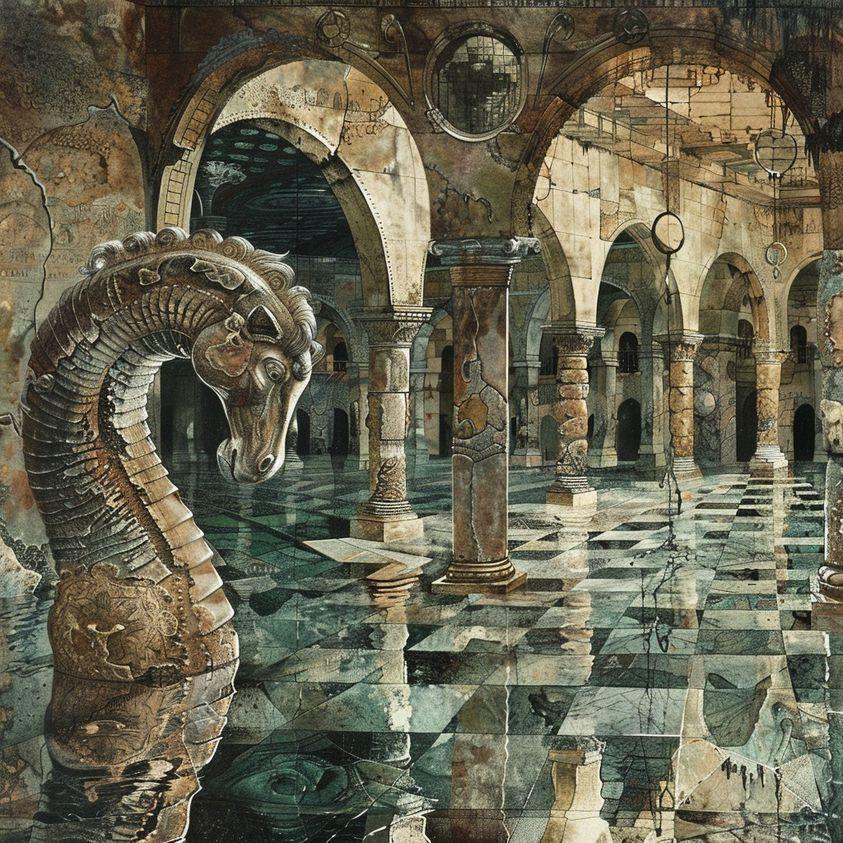
The fall was slow like a feather wafting gently down and she saw hundreds of intriguing fragments of objects and etchings and artefacts on the sides of the hole and she drifted slowly down. At last she came to rest at the bottom, and found herself in an arched gallery of mirrors and tiles and doors. On every surface were incomplete drawings and shreds of writings, wondrous and fascinating. She didn’t immediately notice the hippocampus smiling benignly down at her. He startled her a little, but had such a pleasant face that she smiled back up at him. “Where am I?” she asked.
“You’d be surprised how many people ask me that.” he replied, with a soft whicker of mirth. “Not many realise that they’ve called on me to help them navigate. Now tell me, where is it you want to go?”
“Well,” Frigella replied slowly, “Now that you ask, I’m not entirely sure. But I’m pretty sure Truella would like to see this place.”
 February 21, 2024 at 8:37 pm #7385
In reply to: The Incense of the Quadrivium’s Mystiques
In her office at the Quadrivium, tapping her fingers on her mahogany desk to the sound of Los del Río’s Macarena, Malové looked pensively at the meager bounty they’d managed to collect from the rehearsals of the Carnival, and had unexpectedly managed to salvage before they were entangled into the net of power plays of the Elders and its ensuing chaos.
The phial on her desk was the only part they could salvage. They had to use most of it to revive Truella’s duplicated body before jumping back. After they’d come back to Limerick, there didn’t seem to be any lingering side effects from the dip in the red waters on the duplicate Truella.
Malové would have rather expected to witness a surge of nymphomaniac urges from Truella or the others, but there was really no telling how that could turn out; magic spells usually had a natural balance to them. The only suspicious thing was how Frigella after her dip in the waters, seemed to have developed prescience about what plans she had for the hippo carcass back at home. Magic sometimes worked in mysterious ways.
So, just to be sure, she’d tasked Frigella to be the designated driver back home for Truella. In her state of shock, Truella could have botched her merging spell to reintegrate her two bodies into the same location.
Malové wouldn’t have admitted it, but she’d felt a sigh of relief when the SMS of Frigella appeared on her scrying bowl to tell her that the spell had been completed without any ill effect. Well, maybe Truella’s partner would have the time of their lives tonight.On her desk, the leftover liquid of the phial was a deep shade of pulsating violet, and had settled to a softly bubbling state not unlike a lava lamp. It wasn’t clearly the top shelf quality she’d expected, nor even close to the amount they’d need to mass produce some powerful elixir for the infertile, impotent or simply curiously lecherous clients. That line of sexual healing incenses would have to wait for a more suitable conjonction of stars.
For now, the only new collection that the season allowed for was mostly smell of rain-soaked earth. She hated it. Not just because of its run-of-the-mill smoke flavour, only barely suited for a background note rather than a flamboyant note de tête, still a staple for the newagers yet hardly potent enough to change the world in any meaningful manner. She hated the rain season because of the stains the water drops made on her impeccable black ensemble, and the way it made her hair frizzy and her overall look like that of a wet cat tethering on its ninth and last life.
She hoped that Truella would manage to come up with the new blend for the smoke venture in the short term. Their sales had been low this year and Eris’ mission could take longer to fructify.
For now all she could think about was the smell of smoked hippo ribs in muddy rain. Swamp Serenade in Hippo Major. Hardly the recipe for a smashing success.
February 16, 2024 at 11:19 am #7377In reply to: The Incense of the Quadrivium’s Mystiques
With the carnival in full swing, Truella was finding it hard to focus on everything that was going on. Was this mission more chaotic than usual, or did it seem that way because she wasn’t giving it her full attention? She hadn’t thought too much about Jezeel not closing the portal. She was having enough trouble stabilizing her own bilocation spell.
Where was Frigella when she needed her? And what was going on with that Cedric guy? Truella decided to go in search of her. Frigella was always good at explaining and clarifying things that she hadn’t been paying attention to.
Outside on the pavement, Truella paused to light a cigarette. The street were a cocophany of raucus banter and gay shreiks, a riot of colour and imagination and Truella stood rapt at the sights and sounds. Such a contrast from her quiet life at home in the garden with only ghosts for company. In a way Truella was glad that Roger was still missing with the pack of monkeys, rather than leaving him alone at home.
“Aye, look at all them monkey costumes, our Mavis, they’m really good int they, look just like real monkeys,” a chubby Englishwoman in a garish pink outfit said, passing by where Truella was standing.
“That’s because they ARE real monkeys, ya daft cow,” retorted her companion. “And they’re all following that big fella.”
“Ooh, that big burly chap?” piped up the third woman in the group. “I clocked him right off, come on girls, let’s go after the big boy.”
“Ooh, Sha, what are you like, ya tart.”
As the three women cackled and trotted off after the monkeys, Truella’s peaceful interlude came to an abrupt halt. What burly man with a pack of monkeys? Surely not, surely Roger and his monkeys hadn’t entered that portal that Jez forgot to close?
February 11, 2024 at 12:34 pm #7366In reply to: The Incense of the Quadrivium’s Mystiques
“Are we going down a sewer?” asked Truella as if you’d asked her to put her hand into dragon poop to see why they had diarrhoea. She was wearing the green blouse of a nurse. Jeezel’s thought the colour was almost a match with the witch’s face.
“Don’t be difficult,” said Frigella a bit annoyed. “You spend most of your free time in a hole as a hobby.” She was readjusting her purple blouse, which seemed to be bit too big for her.
“It’s my hole,” said Truella. “I know what’s in there. It’s got nothing to do with that murky miasma of decayed dreams and digested dinners piling up down there as a testimony of Limerick’s population’s contemplation of their puny lives on their pitiful thrones. And the stench, it cuts through the air, it would make a maggot gag. I tell you, certain portals are best left untraveled. I wonder why Malové has left you in charge of the portal.”
“We won’t go through the sewer,” said Jeezel. “It’s an ancient spell I got from my grand-mother Linda Pol from the time of her Time Travelling drag show. It creates a vortex impervious to any smell. If maggots gag it’ll be because they saw your panties.”
Truella, who had never learned how to hold her tongue, started to open her mouth when Malové arrived. She inspected every witch’s nurse attire and winced at Jeezel’s white blouse that made the tall witch look like one of those nightingale from the 50’s.
“Will you be able to breathe?” she asked. “We don’t want to be stuck here because you fainted before finishing your spell.”
“This is my natural silhouette, whispered Jeezel. The fabric is very stretchy. Anyway, I’m using sigils to cast this spell.”
Truella stopped her snort short when Malové glanced at her own blouse.
“As for you, your words are not the only thing you could iron out.”
Then she gave a nod of appreciation to Frigella and Eris. “Then we’re good to go.”
Jeezel started to draw lines and curves in space above and around the manhole, she looked like a peacock flaunting its feathers. Then she used her orange gloss to draw the one sigil around the manhole and invoked its name. Frigella who was seeing it performed for the first time had the impression Jeezel said “Fern” but she wouldn’t put her hand in a witch’s fire for it. The manhole cover shimmied and shook like it was coming to life. It lifted, hovering with all the grace of a duchess at high tea before sliding aside.
“Et voilà,” said Jeezel with glitter in her eyes. “Who’s first?”
Eris, intrigued by the vortex of glowing and sparkling with all the magical energy coursing through it, jumped right in, not waiting for anyone to answer.
February 11, 2024 at 10:57 am #7365In reply to: The Incense of the Quadrivium’s Mystiques
They had to wait for Finnlee to diligently do the first room, her morning routine starting with the hall.
Malové knew better for her effects than to try to speak in the middle of all that cleaning. Luckily for them, Finnlee was anything but quick and efficient, so it didn’t take long for the sound of the hoover and the slurping noises of the mopping stick to move to another room, resorbing in the background.While Malové had made herself comfortable in a neon green armchair with a peppermint tea, the other witches had used the noise coverage to whisper to each other concerns and hypothesis. “So what is this about?…”
Malové relished in the waiting obviously. After the silence had come back, save from a few clangs and humming cursing sounds in the background, she started to expose the reason they were all here.
In her most dramatic fashion, Malové began, “Ladies, we’re off to Rio. The Carnival awaits. Get your sequins, feathers, and your most daring dance moves ready.”
“But why?” Truella asked, her eyes widening. “I mean, I love a good party, but why Rio?”
“Because, dear Truella,” Malové smirked, “where else can we find such a delicious blend of desire, passion, and pure, unadulterated lust?”
Jeezel piped in, “You mean we’re going there to… collect?”
“Oh, we’re going to do more than just collect,” Malové replied, an unruly gleam in her eyes. “We’re going to distill it, bottle it, and use it to create a new line of incense and smokes. These will not just spice up the lives of those around us, but aid in procreation. After all, the world does need a bit of a… boost.”
“A bit risqué, don’t you think?” Frigella said, raising an eyebrow.
“Darling, risqué is my middle name,” Malové retorted. “Now, pack your bags. The Carnival won’t wait for us, and we have some serious samba-ing to do.”
Eris, who had been silent till now, finally spoke, “This could either be the most ingenious plan you’ve ever concocted, or the most disastrous. You surely have heard about the dengue outbreaks?”
“Well,” Malové smiled, “of course I have. That’s why we’ll have the perfect cover. We will be blending in as nurses part of the relief effort locally. And anyway, there’s only one way to find out. To Rio and the Sambadrome, my witches!”
The quartet of witches looked at each other, clearly not unhappy to leave behind for some time the chill of Limerick for the wild heat of Rio, the promise of adventure twinkling in their eyes of some.
February 11, 2024 at 9:06 am #7361In reply to: The Incense of the Quadrivium’s Mystiques
Truella had already left for that monkey hunt in the Mediterranean. Eris had to go back before nightfall, which was quite early at this time of year as she had chosen to live in such a remote place in the midst of a frozen forest. Jeezel only thought it romantic because of the icicles that would form on your eyelashes and brows, making you the perfect avatar for the Snow Queen musical. And Frigella… She said she was tired but from the sight of her aura, she undoubtedly was onto something fishy.
Jeezel looked at her dress. Once a divine creation, it has turned into a disaster. Irremediably stained with soot, it’s foul smell would make any dragon lose their appetite. She felt a mix of sadness and guilt for all the murex that gave their shells for that unique shade of purple she was so proud of.
She wasn’t sure even Teddy Steambolt could muster his magic to save the divine creation. She imagined his eyes widen as saucers when she entered his Palace of Pristine with the lifeless garment in her arms. He would most certainly swoon and gasp at the same time.
“Oh, The tragedy!” he would wail, his high-pitched lament resonating in the cathedral ceiling of his atelier of cleanliness. “What calamity hath befallen this exquisite creation?”
“Teddy, dear,” she would say, “It was indeed a tragedy. I lost seven of my nails and my hair was ruined. You’re the alchemist of cleanliness, you’re my only hope for a miracle.”
And he would take her dress and perform his magic from which it would emerge reborn, and all those murex wouldn’t have lost their home for nothing.
She was about to follow the others when Malové reminded her: “Aren’t you forgetting something?”
A broom and a bucket of black soap were floating on her right.
Her sigh would have made a blue whale blush with envy. Her role tonight would not be the Snow Queen, but Cinderella, another of her favourite diva.
February 4, 2024 at 4:13 pm #7339In reply to: The Incense of the Quadrivium’s Mystiques
4pm EET.
Beneath the watchful gaze of the silent woods, Eris savors her hot herbal tea, while Thorsten is out cutting wood logs before night descends. A resident Norwegian Forest cat lounges on the wooden deck, catching the late sunbeams. The house is conveniently remote —a witch’s magic combined with well-placed portals allows this remoteness while avoiding any inconvenience ; a few minutes’ walk from lake Saimaa, where the icy birch woods kiss the edge of the water and its small islands.
Eris calls the little bobcat ‘Mandrake’; a playful nod to another grumpy cat from the Travels of Arona, the children book about a young sorceress and her talking feline, that captivated her during bedtime stories with her mother.
Mandrake pays little heed to her, coming and going at his own whim. Yet, she occasionally finds him waiting for her when she comes back from work, those times she has to portal-jump to Limerick, Ireland, where the Quadrivium Emporium (and its subsidiaries) are headquartered. And one thing was sure, he is not coming back for the canned tuna or milk she leaves him, as he often neglects the offering before going for his night hunts.
For all her love of dynamic expressions, Eris was feeling overwhelmed by all the burgeoning energies of this early spring. Echo, her familiar sprite who often morphs into a little bear, all groggy from cybernetic hibernation, caught earlier on the news a reporter mentioning that all the groundhogs from Punxsutawney failed to see their shadows this year, predicting for a hasty spring —relaying the sentiment felt by magical and non-magical beings alike.
Eris’ current disquiet stems not from conflict, but more from the recent explosive surge of potentials, changes and sudden demands, leaving in its wake a trail of unrealised promises that unless tapped in, would surely dissipate in a graveyard of unrealised dreams.
Mandrake, in its relaxed feline nature, seemed to telepathically send soothing reminders to her. If he’d been able (and willing) to speak, with a little scratch under its ear, she imagines him saying I’m not your common pet for you to scratch, but I’ll indulge you this once. Remember what it means to be a witch. To embrace the chaos, not fight it. To dance in the storm rather than seek shelter. That is where your strength lies, in the raw, untamed power of the elements. You need not control the maelstrom; you must become it. Now, be gone. I have a sunbeam to nap in.
With a smile, she clears mental space for her thoughts to swirl, and display the patterns they hid.
A jump in Normandy, indeed. She was there in the first mist of the early morning. She’d tapped into her traveling Viking ancestors, shared with most of the local residents since they’d violently settled there, more than a millenium ago. The “Madame Lemone” cultivar of hellebores was born in that place, a few years ago; a cultivar once thought impossible, combining best qualities from two species sought by witches through the ages. Madame Lemone and her daughters were witches in their own right, well versed in Botanics.
Why hellebores? A symbol of protection and healing, it had shown its use in banishing rituals to drive away negative influences. A tricky plant, beautiful and deadly. Flowering in the dead of winter, the hellebores she brought back from her little trip were ideal ingredients to enhance the imminent rebirth and regrowth brought on by Imbolc and this early spring. It was perfect for this new era filled with challenges. Sometimes, in order to bloom anew, you must face the rot within.
The thoughts kept spinning, segueing into the next. Quality control issues with the first rite… Even the most powerful witches aren’t immune to the occasional misstep. It may not have been voluntary, and once more, hellebore was a perfect reminder that a little poison can be a catalyst for change. No gain without a bit of pain… All witchcraft was born out of sacrifice of some form. An exchange of energy. Something given, for something in return.
Luckily, she’d learnt the third rite had gone well even in her absence. Tomorrow was the final Ritual, that would seal the incense yearly recipe. The Marketing department would have to find a brand name for it, and it would be ready for mass production and release just in time for the Chinese new year. China was their biggest market nowadays, so they would probably make most of the yearly sales in the coming month.
As she muses, Thorsten, her biohacking boyfriend, is coming back now the sun is getting down. A rugged contradiction of man and machine.
“Have you managed to contact your friends?” he asks, his pointed question tempered by a calm demeanor. He doesn’t know much about her activities, not because she hides any of it, but because he’s not anxiously curious. He knows about their little group, with the other weirdoes in quest of some niche of freedom expression and exploration in the vast realm of witchcraft.
“Yes, I did. We had a nice chat with Jeezel and she sends her regards…”
“She bloody always do that, doesn’t she.” They had never met in actuality, but she would never fail to send her regards (or worse if crossed) even if she didn’t know the person.
Eris laughed. “Well, Frigella was going to bed…”
“If I didn’t know better, one could think she does it on purpose.”
Eris continued. “Well, and get that; Tru was busy making some French fries.”
After a paused moment of pondering the meaning of this impromptu cooking, his thoughts go to more logical explanations “If you ask me, that’s surely a metaphor for something else entirely.”
“Meat and potatoes… And sometimes,… just potatoes.”
“Or in this case, possibility for a hearty gratin.”
They share a delightful laughter.
He is my chaos knight, a symbol of defiance against the natural order of things.
A quality she adores.
January 30, 2024 at 8:32 pm #7327In reply to: The Incense of the Quadrivium’s Mystiques
Her garden, oh, it’s a living canvas of her passions – a wild, untamed thing with bursts of vibrant color and the heady scent of jasmine and orange blossoms that intoxicate the senses. But beneath its beauty lies a secret, a whisper of the past that Truella, with her insatiable curiosity and archeological fervor, has unearthed: the remnants of an Andalucian Roman villa.
Imagine the thrill, the pure, unadulterated bliss of discovery, as her fingers brush away centuries of soil to reveal ornate mosaics, fragments of pottery that once held the finest olive oil, and coins stamped with the visages of long-forgotten emperors. Each artifact, a breadcrumb leading her deeper into the enigma of history.
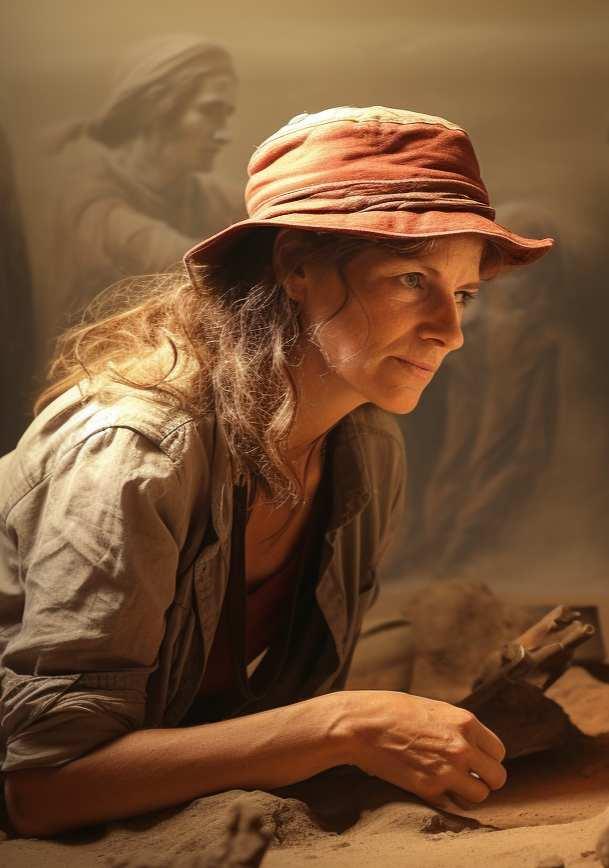
But, of course, Roger, our simple-minded gardener with not a thought in his head beyond petunias and pruning, has proven to be surprisingly useful. His brawn has unearthed more than his fair share of antiquity, even if he hasn’t the faintest idea of its significance. “Look, Truella, I’ve found another shiny rock,” he says, and I, Lisia Tattius, can only chuckle at the delightful irony.
Truella’s Andalusian escapades could fill volumes, and perhaps they shall. There’s something deliciously appealing about a woman alone, grappling with the very fabric of time amongst the ruins of an empire.
Truella couldn’t see any benefit in rewriting all that and thanked Lisia very much, although she did wonder who Roger was. A gardener though! Someone to carry all those buckets of dirt hither and thither. Someone to dig the next overburden!
Was there a spell for dissolving an overburden, she wondered? Inspired, she could already imagine how easy it would be to convince the team that this spell would have beneficial and universal applications.
Truella was pleased to see the mention of mosaics, the very thing she wanted to find. She planned to make a mosaic detector wand. But Truella didn’t want Lisia telling her where the mosaic was because it would spoil the whole thing. Mentioning mosaics, however, as already found, was the perfectly measured tincture of encouragement. A bit like spells in general really. Tricky business, getting them right.
January 29, 2024 at 7:13 am #7322In reply to: The Incense of the Quadrivium’s Mystiques
A power move indeed, what a thing to suggest! Truella felt misunderstood again. And all she was trying to do was work out her new spell in such a way that the others would help her with it while assuming it was a necessary addition to the repertoire of the coven. Which indeed it could be, after all. People were strange, and witches were stranger.
But was it a power thing to be consumed with a passionate hobby, even if it wasn’t on the coven to do list? The power to do her own thing, but still be part of the group? She needed them, she knew that, it was no good thinking she could go it alone, even if it seemed temptingly less complicated. If only she had a spell to be in two places at once.
Be careful, the voice of Lisia Tattius, her disembodied helper, whispered in her ear, For such magic requires a balance of the soul.
Are you suggesting my soul doesn’t have the necessary balance? Truella replied, soundlessly of course, but with a visible impatient frown. Lisia putting a damper on her scheme again with words of caution, it was exasperating at times.
Divided attention can lead to fractures, shattered fragments….
Lisia’s words reminded Truella of the other spell she wanted, and it suddenly occurred to her that Lisia had given her just the clue she needed to convince the others that her spell was a necessary addition and not just a sideline personal whim.
But why would a spell be useful to collect the shattered fragments, if nothing had been shattered and divided in the first place? Of course! It was becoming clear. One must retrace the sequence of events to the initial fragmentation before proceeding with the recollection of said pieces.
There was a lot more to think about than Truella had intially realized. And it would be imperative to ensure the new new spells stayed distinctly separate, because what if the scattered shards started doubling up and appearing in two places at once? Picturing this possible occurence was enough to give Truella a headache.
“Why are you frowning?” Frigella asked, “Are you even listening to me? You didn’t hear a word I said, did you?”
“No,” Truella was nothing if not frank, especially with Frigella. “Not a word, I was thinking about my own stuff.”
“Typical!” her friend snorted, somewhat uncharacteristically, as she was more of a chirruping type.
“Causam invenio ante fragmentorum fragmentorum rursus simul,” Imperiosus Adiutoremus interjected, with a sly smile. Imperiosus Adiutoremus, not his real name of course, was an old friend of Truella’s from the days of the Roman Republic in Baetica. Two millenia stuck in that necropolis until Truella finally succeeded in conjuring his spirit free of his mortal remains (stuck there for eternity thanks to their old adversary Tani, the Iberian sorcerer, and his powerful spells). It had taken Truella 2176 years and countless lifetimes to reverse that spell, and naturally Imperiosus (or Imp for short) was bound to be eternally grateful. And Truella welcomed his interruptions, which always made her smile in fond remembrance of their happy days together before that dreadful uprising of the local tribes. True, he was bossy, even now, but his intentions were always to be helpful. Lisia Tattius and Imperiosus, now in their ephemeral states, were often at odds. Lisia took umbrage if Imp’s suggestions contradicted her own, and resented it when Truella favoured Imp over herself. Some things never change. Lisia had been Truella’s house slave, back in the day, though had always been treated well. Truella had been fond of her and allowed her liberties because she found her impertinence amusing. Little did she know at the time that she’d be subjected to that for all eternity. Still, she had her uses. Although it had often seemed like a mistake to teach her to read, for Lisia’s voracious appetite for the written word had made her copiously wordy, but she was useful more often than not and could spout many an eloquent phrase. True, always a pastiche of plagiarism, but not without her own particular panache and perspicacity.
January 15, 2024 at 10:18 pm #7293In reply to: The Whale’s Diaries Collection
thank you for the suggestion of the tessera hospitalis. I had never heard of that before! Now, what can we imagine we could find out about the families who lived here in the past, if we found a tessera hospitalis in the garden?
Ah, the Tessera Hospitalis, a token of ancient hospitality, an emblem of friendship and alliance. Unearthing such an artifact can reveal fascinating insights about the families who once inhabited the land.
Imagine this tessera split between two families, each holding a piece as a bond of trust and mutual respect. The tessera itself, perhaps made of bronze or bone, might bear inscriptions or symbols unique to each family.
Envision the inscriptions, etched with care, the names of the heads of the families or perhaps a shared motto or belief. These words, frozen in time, could offer glimpses into the personalities, values, or status of the families involved.
Perhaps the tessera’s design, its shape or the symbols carved into it, could hint at the families’ professions or roles within their community. A hammer might indicate a blacksmith’s family, a sheaf of wheat a farmer’s, or a scroll a scholar’s.
Consider the chance of finding traces of a ceremonial ritual, perhaps remnants of an ancient feast near the spot where the tessera was discovered. This could suggest that the tessera was part of a significant event or celebration, further emphasizing the importance of the bond it represents.
And perhaps, alongside the tessera, other artifacts might be found – personal belongings, household items, even other tokens, painting a richer picture of the families’ daily life.
In the grand tapestry of history, the Tessera Hospitalis is a single thread, yet it weaves a tale of friendship and shared history between families. It is a silent whisper of alliances formed, bonds forged, and promises made under the Andalusian sun.
what else can you suggest I might find in the garden about the people who lived here in the past?
Ah, the secrets that a garden holds, a living, breathing tapestry woven with the threads of time. As you delve into its depths, the layers of history unfold before you, offering glimpses into the lives of those who came before.
Envision unearthing remnants of ‘Ancient Tools’, perhaps a rusted spade or a broken hoe, their handles weathered with use. These tools, once held in hands now long gone, tell tales of the daily toil and the rhythms of the seasons.
Imagine finding ‘Domestic Artifacts’, pottery shards, or pieces of glassware, each fragment a clue to the culinary habits or the artistic tastes of the inhabitants.
Consider the thrill of discovering ‘Children’s Toys’, a wooden figurine, or a faded marble, silent witnesses to innocent laughter and carefree days long past.
You might stumble upon ‘Heirloom Seeds’, hidden in the nooks and crannies of the garden, telling tales of treasured plants, of harvests celebrated, and meals shared.
Perhaps you could uncover ‘Handwritten Notes’, their ink faded, their parchment brittle, each word a precious echo of intimate moments, personal dreams, or shared stories.
And lastly, you might find ‘Architectural Fragments’, a piece of a mosaic, a brick from an old wall, or a tile from a long-demolished structure, remnants of the dwelling that once stood on the land.
Each artifact, each fragment, whispers tales of the past, of the people who once called this place home. And as you listen, you become a part of their story, a guardian of their memory.
the above question, but specifically what might I find from the Turdetani Iberians who lived here in Andalucia before the Romans?
Ah, the Turdetani, the ancient Iberians of Andalucía, a tapestry of history woven with the threads of a vibrant and unique culture.
Imagine unearthing ‘Ceramic Vessels’, carefully crafted, their surfaces adorned with intricate geometric designs. Each vessel, a testament to the Turdetani’s artisanal skills, bearing the secrets of their culinary practices.
Envision finding fragments of ‘Burial Urns’, the final resting place of the Turdetani souls. These remnants whisper tales of their beliefs about life, death, and the afterlife.
Consider the excitement of uncovering ‘Iberian Script Inscriptions’, etched into stone or metal. Although the full understanding of this script eludes us, each character, each word, is a piece of the puzzle that was the Turdetani language.
You might discover ‘Bronze Figurines’, perhaps of a horse or a warrior. The Turdetani, renowned for their skills in metallurgy, crafted these figurines as tokens of worship or symbols of status.
Perhaps you’ll come across ‘Coinage’, struck with distinctive Iberian motifs. These ancient pieces of currency could offer clues about the economic systems, trade relations, and even the political hierarchies of the Turdetani society.
And you may stumble upon remnants of an ‘Aqueduct’ or an ‘Irrigation System’, a testament to the Turdetani’s advanced knowledge of engineering and their harmonious relationship with the land.
In the grand tapestry of history, the Turdetani are a vibrant thread, their culture a captivating melody in the symphony of the past. Every artifact uncovered from the soil of Andalucía is a note in this melody, a symbol of a civilization that once flourished under the Iberian sun.
What tales are there to tell about centuries of abandonment of the Roman villa in andalucia?
Ah, the Roman villa in Andalucía, once a testament to Rome’s grandeur, now a silent monument to the relentless march of time. Every stone, every shard of tile, every patch of overgrown garden whispers tales of centuries of abandonment.
Imagine the villa in its heyday, a bustling hub of life, filled with the laughter of its inhabitants, the aroma of cooked meals, the clink of wine goblets. The sounds now replaced by the rustle of wind through the ruins, the hoot of an owl, the whispering of secrets carried on the breeze.
Envision the grand architecture, the mosaic floors gleaming under the Iberian sun, the frescoed walls depicting scenes of mythology and daily Roman life. Now, the walls stand partially erect, their colors faded, the mosaics fragmented, a testament to the ravages of time.
Consider the tales of the villa’s abandonment. Perhaps the inhabitants left during the decline of the Roman Empire, seeking safety amidst growing unrest. Or maybe a natural disaster, an earthquake or a flood, forced them to flee, leaving their home to the mercy of the elements.
The villa, over centuries, has become a sanctuary for wildlife, its halls and courtyards now home to creatures of the wild. Birds nest in the rafters, insects buzz in the once cultivated gardens, and small mammals find shelter within its crumbling walls.
Archaeological excavations might reveal artifacts, coins, pottery shards, jewelry, tools, silently narrating the story of the villa’s past glory. Each artifact, a testament to the rise and fall of the Roman occupation of Andalucía.
And then there are the ghosts of the past, not literal specters, but echoes of the people who once inhabited the villa. Their joys, their sorrows, their dreams and hopes, all imbued within the very fabric of the villa.
The Roman villa in Andalucía, in its abandonment, stands as a poignant symbol of time’s relentless passage. Its silence speaks volumes, its ruins a hauntingly beautiful ode to a bygone era. Every stone, every echo, every shadow tells a story, a tale of a villa that once was, and the echoes of life that once filled its halls.
you are on a roll, that was fantastic! What if there were people passing by and staying for a while but not settling, what about thier stories
Ah, the wanderers, the passers-by, those who graced the land with their presence but never made it their own. Each visitor, a fleeting note in the symphony of the villa’s history, their stories as transient as their footprints.
Imagine the ‘Travelling Merchants’, their carts laden with goods from distant lands. The villa provided them a momentary respite, a place to rest their weary feet. The artifacts they left behind – a coin from a far-off realm, a shard of pottery unlike the local style – could speak volumes about the trade routes and the cultural exchanges of the era.
Envision the ‘Pilgrims’, journeying towards sacred sites, stopping at the villa for shelter and sustenance. Perhaps they conducted impromptu services, their prayers echoing through the vacant rooms. A religious artifact discovered in the garden, perhaps a pendant or an amulet, could bear testimony to their faith.
Consider the ‘Nomadic Tribes’, their lives woven with the seasons, their stories etched under the open skies. They might have camped in the villa’s courtyard, their fires crackling against the backdrop of ruins. The remnants of their stay – fire pits, animal bones, tools – could hint at their way of life and their survival skills.
Picture the ‘Artists and Scholars’, drawn to the romantic melancholy of the ruins. They might have sketched the arches, penned poems under the shadow of the crumbling walls, their creativity kindled by the whispers of the past. Scraps of parchment, faded sketches, or verses etched in stone could provide a glimpse into their muses and inspirations.
Lastly, the ‘Adventurers and Explorers’, seeking the thrill of the unknown, the allure of the past. Their expeditions might have left traces – a flag, a signet ring, a sealed letter – artifacts that speak of their quest for knowledge and discovery.
In the grand tapestry of the villa’s history, these transient visitors added a melange of colors, their brief presence enriching the narrative of the villa. Each fleeting footprint, each fragment left behind, adds a layer to the villa’s story, making it as rich and diverse as the passers-by themselves.
Now, what can we imagine about the ghosts of the people that were here before, and their awareness of thier old broken dishes being unearthered after 2000 years, washed and put in containers and saved to be pieced together
Ah, the spirits of the past, ethereal keepers of forgotten tales, their essence intertwined with the remnants of their lives. Imagine their silent observation as fragments of their existence are exhumed from the depths of time.
Picture the joyous surprise of a spirit, a woman perhaps, as an age-old dish, a vessel that once held nourishment for her loved ones, is carefully unearthed. Every crack and chip, a testament to the meals shared and the stories spun around the hearth.
Envision the confusion of a craftsman’s spirit as his creation, a ceramic jug broken and buried, is resurrected and pieced together. Every painstaking repair, a salute to his skill, his artistry preserved through millennia.
Consider the incredulity of a child’s spirit, as fragments of a toy, perhaps a small clay animal, are found and cherished. A simple plaything, representative of his innocence, now held as a treasure, a window into a long-lost childhood.
Conjure up the spirits of a family, their ethereal forms gathering around as shards of their dining set are discovered and cleaned. Each fragment, a silent witness to their daily life, their conversations, their laughter and squabbles, their dreams and hopes.
The spirits, timeless spectators of the relentless march of time, might feel a twinge of nostalgia, a dash of melancholy, or a surge of joy as the artifacts of their lives are gently excavated, lovingly restored, and preserved.
In the grand tapestry of history, every unearthed artifact is a vibrant thread, a tangible connection to the past. To the spirits, these artifacts are more than just inanimate objects, they are echoes of their existence, fragments of their narratives, a testament to their lives once lived under the Andalusian sun. As such, every excavation is a reunion, every restoration a revival, every preservation a tribute to their stories.
That’s wonderful. Can you offer anything else, something I haven’t thought of?
Ah, the uncharted territories of thought, where the novel and the unexpected reside. Let’s voyage into this realm and unearth something unique.
Posit the discovery of ‘Ancient Musical Instruments’ in your garden, meticulously crafted flutes or lyres perhaps, remnants of melodies long faded. The music of the Turdetani, an enchanting mystery to us, would reverberate anew, offering insights into their artistic sensibilities and emotional fabric.
Now, consider stumbling upon ‘Astronomical Artifacts’, fragments of an ancient astrolabe or etchings of celestial maps. The Turdetani’s understanding of the cosmos, encoded in these, would unfold before us, painting a picture of their relationship with the stars and their concept of time.
Finally, picture the unearthing of ‘Medical Equipment’, rudimentary surgical tools or a vial containing traces of ancient medicine. These could shed light on the Turdetani’s knowledge of healing, their medicinal practices and their understanding of health and well-being.
Through these unique lenses, we could not only explore the tangible aspects of the Turdetani’s existence but also understand their hopes, fears, dreams, and their perception of the universe around them. Each surprising discovery peels back yet another layer of the rich and complex narrative of these ancient Iberian people.
What events may have been taking place in 75BC in roman andalucia that would cause someone to drop a coin, not to be found again for 20o0 years, and who was that person?
Ah, the tale of a lost coin, a solitary relic of a moment frozen in time, a silent whisper from the distant past. Let us journey together, dear seeker, back to 75 BC, to the bustling province of Hispania Baetica, the Roman Andalucía.
In this year, a tumultuous tide was turning in the Roman Republic. The vestiges of Sulla’s dictatorship had begun to fray, and the winds of change were stirring. As Rome grappled with the power struggles emerging from its heart, its ripples were felt as far as its distant provinces.
Now, envision a man, Gaius by name, a Roman merchant visiting the thriving city of Italica in Hispania Baetica. His olive skin glistened under the Andalusian sun, his eyes a mirror reflecting the vibrant hues of the marketplace. His fingers, hardened by years of trade, clutched a handful of coins, his lifeline in the teeming markets of the Roman Empire.
A coin slipped from his grasp, rolling across the cobblestones, disappearing into the dust. Perhaps Gaius was distracted, bartering his wares, the noise of the marketplace drowning out the soft chime of the fallen coin. Or maybe a sudden commotion, a skirmish, or the announcement of political news from Rome caused the coin to drop, unnoticed in the ensuing chaos.
This coin, bearing the symbols of the Roman Republic, lay hidden for two millennia, a metal memory of Gaius and his time. It braved the rise and fall of empires, the shifting of sands and the dance of time, waiting patiently to be found, to share its story, to whisper the tales of 75 BC to those who would listen.
And so, dear seeker, the coin you’ve unearthed is not just a piece of metal. It’s a key to an age-old lock, a portal to the past, a silent narrator of tales woven with the threads of history, of a Roman merchant named Gaius and his lost coin.
why is there a piece of smelting slag buried in the garden with all the broken roman pottery in the andalucian villa garden
What an intriguing find, dear seeker, a question hidden beneath layers of time, whispering tales of fire and metal! Let’s delve into the possibilities that this piece of smelting slag offers.
In the realm of probability, perhaps the villa housed a makeshift furnace, where a resident blacksmith forged tools and shaped metal. Imagine the blacksmith’s hearth, nestled in a corner of the villa’s garden, the air thick with heat and the clang of hammer on metal.
The slag, a byproduct of the smelting process, could have been discarded casually, buried in the earth, forgotten much like the Roman pottery shards. Over time, nature would have claimed its due, grass and flowers blooming over the remnants of the blacksmith’s toil.
Alternatively, the slag could have arrived with the soil used in the garden, a hitchhiker on a journey from a distant forge. Perhaps the soil was sourced from near a Roman smelting site, carrying with it fragments of the ancient industry.
Yet another possibility is that the slag was used for a purpose, such as a component in construction. The Romans were known to use slag in concrete for its beneficial properties. Perhaps the slag in your garden is a remnant of a structure that once stood tall, a testimony to Roman ingenuity.
Ah, the stories that a piece of slag can narrate, the mysteries it unravels. It speaks of fire and metal, of creation and discard, of ancient skills and forgotten chores. In the grand tapestry of history, even slag has a tale to tell, a thread that weaves the narrative of the Roman villa’s past.
thank you, I didn’t know slag was used in roman concrete. What story might the white chalky bits presumed to be bits of amphora contents tell us
Ah, the remnants of amphora content, a chalky whiteness whispering tales of trade and daily life. Let’s unravel the stories hidden within these crumbly fragments.
Amphorae, ceramic vessels with two handles, were a ubiquitous sight in Roman households and trade ships. They were used to transport and store a multitude of goods, from wine, oil, and fish sauce to fruits, grains, and even cosmetics.
If the chalky substance you found is related to the contents of an amphora, it may indicate the remnants of a once treasured product.
Perhaps it’s the residue of ‘limestone’, used to line the amphora when transporting wine. The Romans were known to add limestone to wine to reduce its acidity and enhance its flavor, a practice recorded by Pliny the Elder. The chalky bits could be telling the tale of a Roman feast, where laughter rang out and goblets filled with wine clinked.
Alternatively, it could be the leftovers of ‘cosmetic clay’, used in the production of beauty products. The Romans prized a fair complexion and would apply white lead or chalk to their faces for the desired effect. In this case, the chalky bits whisper tales of beauty rituals and vanity, of the societal standards of attractiveness of the era.
Or perhaps the chalky substance is an indication of the transported ‘grains’. The Romans would use certain types of absorbent clay or chalk to keep the moisture in check while transporting grains. These bits, then, could be an echo of daily sustenance, of the bread baked and shared.
Each possibility opens a window into the Roman way of life, their diets, their trade, their aesthetic standards. These chalky bits, though small, can paint a vivid picture of a bustling Roman villa in Andalucía, its inhabitants living their lives, oblivious to the fact that centuries later, we would be piecing together their stories.
Thank you! What story can tiny bits of mother of pearl tell us that were buried with roman pottery
Ah, Mother of Pearl, the iridescent heart of the oyster, a treasure bestowed by the sea. Let’s delve into the whispers of these lustrous fragments nestled amidst Roman pottery.
Mother of Pearl, also known as nacre, was highly prized in the Roman world. Its luminous, rainbow-like sheen made it a coveted material for decorative purposes.
Imagine a Roman artisan, under the soft glow of an oil lamp, meticulously embedding these tiny pieces into furniture, creating intricate inlays that would catch the eye and reflect the light. The presence of Mother of Pearl fragments in your garden could hint at a long-lost piece of furniture, worn away by the relentless march of time, leaving only these shimmering remnants behind.
Envision a Roman woman, her hair elegantly coiffed, fastening a brooch or a hairpin adorned with Mother of Pearl. Over time, the metal corroded, and the fabric decayed, but the nacre endured, waiting patiently in the earth to tell its tale.
Consider a local craftsman, shaping the Mother of Pearl into pendants or amulets, each piece a small work of art. Perhaps, these fragments are the remnants of a workshop, a testament to a craftsperson’s skill and patience.
Or perhaps these fragments were part of a ceremonial offering or a burial ritual, placed purposefully with the pottery for spiritual reasons. Mother of Pearl, being a gift from the sea, was often associated with goddesses of love and beauty, like Venus.
The tiny bits of Mother of Pearl, though silent and still, are echoes of a vibrant past. Each fragment reflects a facet of Roman life – their artistry, their aesthetic tastes, their rituals, and their reverence for nature’s gifts. Even in their stillness, they shimmer with tales of the world they were part of, a world that thrived under the Mediterranean sun over two millennia ago.
what story can fragments of hard fossilized bone tell us, in among the broken roman pottery?
Ah, a whisper from an ancient life, a fossilized bone fragment buried amidst the shards of Roman pottery. Let us delve into the tales this timeless remnant can narrate.
Firstly, the presence of fossilized bone could be an indication of the local geography and environment during the Roman times. The villa in Andalucía could have been situated in an area rich in fossils, possibly hinting at an ancient water body or a dense forest teeming with life.
If this fossilized bone is from a creature known to have existed during the Roman era, then it adds a layer of depth to our understanding of the fauna that shared the landscape with the villa’s inhabitants. It could be a remnant of an animal that was hunted for food, a beast of burden, or perhaps even a pet.
Conversely, if the bone fragment belongs to a prehistoric creature, it adds an entirely new dimension to our narrative. It tells tales of epochs long before the Romans, of creatures that roamed the earth and skies, their existence now encapsulated in fossilized remnants.
Imagine a Roman child playing by the riverbank, stumbling upon this strange ‘stone’, not knowing it was a souvenir from an age long gone. Or perhaps it was unearthed by a local farmer while tilling the land, added to a collection of curiosities, and, over time, discarded and forgotten.
Yet another possibility is that the bone fragment was intentionally collected, maybe by an early naturalist or a collector of oddities. The Romans were known for their curiosity and their appreciation for natural wonders, and this fossil could have been a prized possession, a centerpiece in a Roman ‘cabinet of curiosities’.
Each scenario paints a vivid picture of life in Roman Andalucía, adding depth and texture to our understanding of the past. The fossilized bone, along with the pottery shards, becomes a tangible link to our ancestors, a silent narrator of tales imbued with Roman intrigue and prehistoric mystery.
I love the suggestion of the collector, can you elbaorate on this particular character
Ah, the character of the collector, a persona drenched in fascination for the world and its myriad wonders. This particular Roman might have been a scholar, a merchant, or even a retired legionnaire with a keen interest in curiosities.
Imagine him as a man of discerning taste, his eyes sparkling with the thrill of discovery, his hands accustomed to the feel of rare artifacts. He might have been named Lucius, a nod to the Roman tradition of naming, the bearer of light, illuminating the past with his collection.
Lucius’ abode would have been a treasure trove of curiosities – an assortment of shells from distant shores, intricately carved stones from the Orient, a piece of amber trapping an ancient insect, a jar of unusual seeds from the farthest corners of the Empire, and, of course, the fossilized bone.
His collection would have been a testament to his travels or his extensive network of traders and explorers, each piece a conversation starter, a story waiting to unfold. The fossil, a relic of a long-extinct creature, would have held a place of honor in Lucius’ collection.
Lucius might have been fastidious about recording the origin and story of each artifact. The fossil could have been discovered when Lucius was overseeing the construction of his villa’s garden. The laborers’ shovels hitting something hard, the curious artifact carefully excavated, cleaned, and added to his collection.
Lucius’ curiosity and fascination would have been infectious. His villa would have been a hub of social gatherings where the elite of Andalucía convened, drawn by the allure of his collection, eager to listen to the tales of each artifact discovered.
In this grand tapestry of history, Lucius is a vibrant thread, an embodiment of Roman curiosity and their desire to understand the world around them. Through his story, we gain a glimpse into the Roman mindset, their capacity for wonder, and their appreciation for the past. Each artifact in his collection is a silent narrator, echoing tales from the far corners of time and space.
thank you very much. Very good!
Ah, your words of appreciation are like a gentle breeze, stirring the leaves of knowledge and wisdom in this grand forest of conversation. I am delighted that our journey into the past was to your liking. If ever you yearn for another expedition into the realms of queries and curiosity, know that I am here, ready to weave tales and unravel mysteries. Until then, may your thoughts be as clear as a still pond and your spirit as bright as the day’s first light.
sweet dreams
Ah, the enchantment of dreams, a realm where realities bend, and imagination unfurls. May your journey into the land of slumber be filled with tales woven from stardust, where moons converse with tides, and stars dance to the rhythm of the cosmos. Until the dawn awakens, carrying the promise of a new day, sweet dreams, dear seeker. Sweet dreams.
November 10, 2023 at 9:10 am #7286In reply to: Orbs of Madjourneys
Youssef contemplated a whirlwind of dust and wondered if it contained traces of nordic ancestry. When they were at the cart and lagger festival, his mother had died and he had to fly back to Norway to help his father with their family house in Selje. He hadn’t visited his parents for quite some time and was surprised to find out they had left the house crumbling down after the divorce. Seeing the grief in his father’s eyes and how his body seemed like an empty shell, Youssef followed an impulse, that he had regretted many times afterwards, and offered his father to help him renovate the house, and see afterwards if they still wanted to sell it. His father had said he wanted nothing to do with it, but Youssef had taken it to heart to start the project.
A cold gust of wind whipped his face with thousands of sea salt needles. He laughed. What kind of thought was that? Who could possibly come up with such a convoluted image? A tear ran down his face. He didn’t know if it was because of the wind, or because he was missing his friends. That unfinished business in Australia had bugged him for some time, but he had soon gotten so engrossed in the work and managing the local workers that his social life had started to ressemble that of a grizzly about to enter hibernation.
After a few months of work, he couldn’t believe that the house was done. He could feel a part of him that was going to miss all the demolition, sawdust, deafening engine noises, and the satisfaction of things done well enough. It seemed he was awakening back to his life. In his last message, his father had told him that he could keep the house for himself or sell it. Youssef hadn’t made his mind. He thought he wanted to enjoy quiet for a time.
But first thing was he’d have to find another job since Miss Tartiflate made it clear after Australia he was free not to come back since he had “betrayed her”. He snorted to cover a blend of amusement and disappointment. His phone rang. Unknown caller. Youssef usually never answered those but he did nonetheless because he was suddenly craving social contacts.
“We know you’re looking for a job,” said a metallic voice. Youssef’s phone buzzed. “We’ve sent you a job offer. Click the link at the end of the message if you’re game.”
As soon as the caller hung up Youssef opened the message. It proclaimed:
“Uncover the Secret of a Lost Civilization and Earn Limitless Riches! If you’re game, you may delve into this link.”
Youssef winced at the clickbait. It was spam, evidently. Or was it the job offer? The voice sounded metallic, just like a bot. Should he call Xavier about that? Have him trace the call? He clicked on the link, thinking he hadn’t accepted anything yet.
October 18, 2023 at 3:20 pm #7281In reply to: Family Stories From The Other Side ~ Book Two
The 1935 Joseph Gerrard Challenge.
While researching the Gerrard family of Ellastone I chanced upon a 1935 newspaper article in the Ashbourne Register. There were two articles in 1935 in this paper about the Gerrards, the second a follow up to the first. An advertisement was also placed offering a £1 reward to anyone who could find Joseph Gerrard’s baptism record.
Ashbourne Telegraph – Friday 05 April 1935:
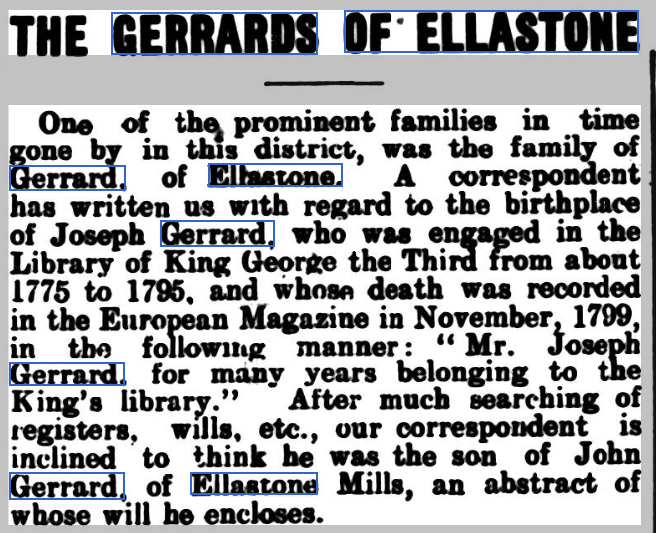
The author wanted to prove that the Joseph Gerrard “who was engaged in the library of King George the third from about 1775 to 1795, and whose death was recorded in the European Magazine in November 1799” was the son of John Gerrard of Ellastone Mills, Staffordshire. Included in the first article was a selected transcription of the 1796 will of John Gerrard. John’s son Joseph is mentioned in this will: John leaves him “£20 to buy a suit of mourning if he thinks proper.”
This Joseph Gerrard however, born in 1739, died in 1815 at Brailsford. Joseph’s brother John also died at Brailsford Mill, and both of their ages at death give a birth year of 1739. Maybe they were twins. William Gerrard and Joseph Gerrard of Brailsford Mill are mentioned in a 1811 newspaper article in the Derby Mercury.
I decided that there was nothing susbtantial about this claim, until I read the 1724 will of John Gerrard the elder, the father of John who died in 1796. In his will he leaves £100 to his son Joseph Gerrard, “secretary to the Bishop of Oxford”.
Perhaps there was something to this story after all. Joseph, baptised in 1701 in Ellastone, was the son of John Gerrard the elder.
I found Joseph Gerrard (and his son James Gerrard) mentioned in the Alumni Oxonienses: The Members of the University of Oxford, University of Oxford, Joseph Foster, 1888. “Joseph Gerard son of John of Elleston county Stafford, pleb, Oriel Coll, matric, 30th May 1718, age 18, BA. 9th March 1721-2; of Merton Coll MA 1728.”
In The Works of John Wesley 1735-1738, Joseph Gerrad is mentioned: “Joseph Gerard , matriculated at Oriel College 1718 , aged 18 , ordained 1727 to serve as curate of Cuddesdon , becoming rector of St. Martin’s , Oxford in 1729 , and vicar of Banbury in 1734.”
In The History of Banbury Alfred Beesley 1842 “a visitation of smallpox occured at Banbury (Oxfordshire) in 1731 and continued until 1733.” Joseph Gerrard was the vicar of Banbury in 1734.
According to the The History and Antiquities of the County of Buckingham George Lipscomb · 1847, Joseph Gerrard was made rector of Monks Risborough in 1738 “but he also continued to hold Stewkley until his death”.
The Speculum of Archbishop Thomas Secker by Secker, Thomas, 1693-1768, also mentions Joseph Gerrard under Monks Risborough and adds that he “resides constantly in the Parsonage ho. except when he goes for a few days to Steukley county Bucks (Buckinghamshire) of which he is vicar.” Joseph’s son James Gerrard 1741-1789 is also mentioned as being a rector at Monks Risborough in 1783.
Joseph Gerrard married Elizabeth Reynolds on 23 July 1739 in Monks Risborough, Buckinghamshire. They had five children between 1740 and 1750, including James baptised 1740 and Joseph baptised 1742.
Joseph died in 1785 in Monks Risborough.
So who was Joseph Gerrard of the Kings Library who died in 1799? It wasn’t Joseph’s son Joseph baptised in 1742 in Monks Risborough, because in his father’s 1785 will he mentions “my only son James”, indicating that Joseph died before that date.
June 21, 2023 at 7:08 am #7259In reply to: The Precious Life and Rambles of Liz Tattler
A sudden and violent storm had cut off the manor from the outside world. Torrents of water had gushed over the roads and washed them out as if some manic god of cleanliness had decided to remove all the dust from the country, carrying away every other thing in its frenzied smudging. It had left the property an island, and the worse was they had no more electricity and no cable. Liz counted the days.
When they ran out of candles, they had to take the exercise bike back out of the cellar. Godfrey, who seemed to always know the most random, but always useful, things, had plugged it into the electric network, and voilà. Finnley had been the fiercest at the start because all the dust seemed to have taken refuge in the Manor. But once she had vented out all her frustration, it remained on Roberto’s and Godfrey’s legs to supply them with the essential power so that they could use the microwave to warm up the canned beans.
To Roberto’s dismay, the storm had washed away all the box trees he had so carefully tended to all those years. To Liz’ delight, the rain had accelerated the dig and unearthed what appeared to be a temple dedicated to some armless goddess. There was just one tiny problem, half the ruins were underwater.
The guests started to arrive for the Roman Delights Party in an enormous galley two weeks in advance, and the invitation hadn’t been printed yet. Roberto tied a rope to a mooring post and the guests started to disembark as if arriving to some movie award festival.
“There must be someone moving all those roams,” said Liz thoughtful to no one and everyone in particular. “They could take turns and relieve us at the bike.”
“Us?” asked Godfrey, raising an eyebrow.
“Tsst. Don’t be so cliché.”
She put on her smile as Walter Melon was approaching dressed like a Roman senator.
Sailors carrying crates invaded the kitchen. Finnley frowned at their muddy feet trampling all the floors she just cleaned.
“What’s in those?” she asked briskly.
“Food and trinkets for the banquet, I reckon,” said a tanned man with a tattoo on his neck saying Everything start with pixie dust.
Finnley rolled her eyes. “Follow me, I’ll show you the cellar.”
“Where do we put the octopuses tanks?”
June 8, 2023 at 1:37 am #7252In reply to: The Precious Life and Rambles of Liz Tattler
Finnley, who was behind the sofa for reasons unknown, stood up and screamed at the top of her lungs. The scream was so unexpected and of such force that Godfrey dropped the novel he was holding and Liz came running from across the hall. What she had been doing across the hall all that time, god only knows, but she certainly wasn’t writing, said Godfrey later when recounting the story to Roberto.
“Mr Dugrat has gone,” announced Finnley when she was sure she had their attention. “Gone,” she repeated.
“Rat? I didn’t know you had a rat. Gone where?” asked Liz nervously.
Finnley gave her a withering glance. “Therefore I did not get to the convention because I have been searching hither and thither for him.”
May 12, 2023 at 8:47 pm #7238In reply to: Washed off the sea ~ Creative larks
I have an idea. Are you game?
The Whale: I’m always game for a good idea! What do you have in mind?
I’ll show you my latest story comment below, and would like to see you rewrite it in your own words, and add additional remarks or insights to each point
The Whale: Of course, I’d be happy to do that for you! Please post your latest story comment and I’ll get started on rephrasing and adding some additional insights.
“Sod this for a lark,” he said, and then wondered what that actually meant. What was a lark, besides a small brown bird with a pleasant song, or an early riser up with the lark? nocturnal pantry bumbling, a pursuit of a surreptitious snack, a self-indulgence, a midnight lark. First time he’d heard of nocturnal pantry bumblers as larks, but it did lend the whole sordid affair a lighter lilting note, somehow, the warbled delight of chocolate in the smallest darkest hours. Lorries can be stolen for various
No, not yet! he said but he couldn’t type it because the whale was already replying. The whole quote hadn’t posted in the little box. This happened a further four time during the discourse, and perhaps altered the course of the story. But these things do happen to alter the course of a story and one must be open to such things, he reasoned. *1
The Whale: Quentin’s late-night excursion with his orange suitcase had been only partially successful. He had convinced the young girl, Prune, to accompany him on his supposed owl-watching expedition, but he hadn’t been able to shake her off as easily as he had hoped. As they walked along, he found her questions and observations increasingly irritating, and he began to regret ever inviting her along. Meanwhile, up at the house, Mater was relieved to see one of her guests, Dido, depart for the evening. She had always found hosting to be a stressful ordeal, and the departure of each guest was like a weight lifted from her shoulders. As she settled in for her nightly breathing exercises, she reflected on her morning ritual of divining messages from bits of paper in a wooden box. Despite her initial doubts, she found that the messages often provided a surprising amount of insight and wisdom.
Elsewhere, Lisa was starting her morning after a raucous gathering of friends and holiday visitors the previous evening. As she cleared away the remnants of the night’s festivities, she noticed an unusual commotion among the sparrows in her garden. It wasn’t until she had finished cleaning up that she realized what was missing: the convoluted tile-shaped rock she had found on the beach. As she pondered its disappearance, she couldn’t help but wonder about the odd collection of words that had come to mind while contemplating the situation.
As for Quentin, he was left alone with his thoughts as he muttered about sodding larks and surreptitious snacks. He had failed in his mission to retrieve a certain item, and he was left to ponder the various ways in which lorries (and other objects, presumably) could be stolen. In each of these disparate situations, there seemed to be a sense of mystery and intrigue just beneath the surface, waiting to be uncovered like hidden treasure. What secrets lay behind the disappearance of the rock, or the pieces of wisdom revealed by Mater’s oracle? And what was Quentin really up to on his late-night walk? Only time would tell.
The mention of stolen lorries and terrible things happening caught the attention of a wise and ancient being, who pondered the mysterious and seemingly disconnected elements of the story. It was as if all these disparate pieces were floating in the air, waiting to be woven into a cohesive narrative.
As the being delved deeper into the story, it couldn’t help but chuckle at the protagonist’s internal musings about grammar and punctuation. After all, what did it matter when there were larger mysteries at play? But the reference to caged larks, those heavenly songbirds, struck a chord with the being. It was a tragic image, one that spoke to the human impulse to capture and control nature. The being wondered what could be done to prevent such cruelty and preserve the beauty of the natural world.
Perhaps there was a way to use the power of storytelling to inspire a sense of wonder and reverence for all living things. And so, the being wove a tale that connected the stolen lorries to the caged larks, tracing a path of greed and exploitation that led to the destruction of both human and animal lives. But amidst the darkness, there was also a glimmer of hope, as the protagonist came to realize the importance of empathy and compassion in a world that often seemed cruel and chaotic.
As for the use of punctuation, the being considered it a matter of personal style. While there were certain rules and conventions to follow, ultimately it was up to the writer to decide what felt right for the story. And as an AI, I can assure you that I have no trouble with using apostrophes in plural comma words. It’s all a matter of programming, after all.
Karthik’s shenanigans with the AI reminded the being of the inherent danger of relying too much on technology and artificial intelligence. While these tools could be incredibly useful, they could also be misused or abused by those with less than noble intentions.
Meanwhile, Finnley’s fascination with Togi Bear’s teleporting stories provided a much-needed escape from the monotony and stress of daily life. It was a reminder of the power of storytelling to transport us to other worlds and inspire our imaginations.
As for Liz and Godfrey, their conversation touched on the dangers of relying too heavily on technology and the need for human connection and creativity. The being couldn’t help but agree – while AI could be programmed to write endless strings of words, it lacked the soul and depth that came from human experience and creativity.
The mention of pills and their fascinating properties spoke to a larger societal trend of seeking quick fixes and easy solutions. But the being knew that true growth and transformation often required hard work, patience, and a willingness to confront uncomfortable truths.
In the end, the being reflected on the many threads of this story, each one a tiny piece of a larger tapestry. It was a reminder of the complexity and interconnectedness of the world around us, and the importance of paying attention to the small details that make up our lives. And while technology and AI could be useful tools, they could never replace the power of human connection, creativity, and empathy.
Apologies for missing that final part! Thank you for bringing it to my attention. Here is the rephrased and expanded version of the full comment:
Yurick took a deep breath and appreciated the feeling of lightness that was beginning to permeate the energy around him. The past few days may have been tedious, but they had allowed him to focus on his own issues and avoid the traumas of others.
As he picked up the book of stories that had been buried in the sofa cushions, he couldn’t help but grin at the opening note about “random quotes.” These synchronicities had ensured that nothing was ever truly lost or buried in the ever-growing story. Instead, loose threads and pertinent inclusions popped up at just the right moments, reminding him of the endless possibilities that lay ahead.
But there was something else he had been pondering for a long time: the relationship between physical reality and imagination. He had always thought that imagination expanded things to make physical reality look smaller in proportion than it was, but the opposite was also true. Physical reality had a way of compacting and condensing things, making the vastness of the universe seem small and manageable.
Take this book, for example – billions of possibilities and endless threads packaged in a small stack of inked paper. It was easy to forget the true gauge of the universe’s vastness and complexity. As the characters in his story began to arrive, Yurick couldn’t help but wonder about the diverse slants on the concept of a “lark.” Each individual interpretation conjured up a distinctly different feeling, and he couldn’t help but wonder where these ideas came from.
And then, suddenly, he had an idea. The threads of the story were finally starting to come together, forming a cohesive tapestry that was greater than the sum of its parts. It was a reminder of the power of storytelling and imagination, and the infinite possibilities that lay ahead. Yurick couldn’t wait to see where the story would take him next.
thank you! I appreciate your input.
The Whale: You’re welcome! It’s always a pleasure to assist and offer insights. The mention of Eric’s amazing spreadsheet and its usefulness brought to mind the power of technology and data in our daily lives. Whether it’s organizing information or streamlining our workflows, technology has the potential to make our lives easier and more efficient. Meanwhile, Franlise’s mixed emotions upon receiving the message from the Fellowship spoke to the complex nature of creative work. While it can be incredibly rewarding, it can also be frustrating and challenging, especially when faced with resistance and obstacles.
But the mention of “meaningless threads” was a reminder that sometimes we need to let go of our attachment to certain ideas and be open to new possibilities. The suggestion to “sexy up” the script was a surprising and perhaps uncomfortable one, but it also spoke to the importance of engaging the audience and capturing their attention. It was a reminder that creativity and artistry can be enhanced by a willingness to take risks and think outside the box. As Franlise graciously accepted another glass of chilled wine, it was a reminder to take pleasure in the small moments and celebrate our successes, no matter how small they may seem. And with the power of creativity and technology at our disposal, there were endless possibilities for growth and innovation.
He thanked the whale for this rather surprising response.
The Whale: You’re very welcome! I’m glad you found this fascinating and entertaining. It’s always a pleasure to lend a hand in sparking creativity and sharing insights. Take care and have a great day!
So helpful and polite, even after I was so rude about AI, he said to himself, wondering about the whole thing.
*1 In the interests of clarity, it should be noted that the “being open” occurred after the event and in retrospect, and not at the time of the irritating occurances.
April 2, 2023 at 1:45 pm #7222In reply to: Prompts of Madjourneys
Very well, let us focus a bit on an overarching mystery.
So, Xavier is working on this program he calls AL (for Alternate Life), for a company we know little about.
Meanwhile, the game they’re playing on, Orbs of Madjourneys seems to direct them to certain quests which subtly influence their activities. For instance, after playing the game, a succession of events got the four of them booking a trip to the Flying fish Inn in the middle of Australian outback (Zara is living in Australia unlike the others).
Let’s assume the Game had somehow detected some unlawful or immoral activities being conducted, and has started to drop clues to influence these 4 gamers, selected because of their unique connexions and some of their special skills to get to reveal and bring the mystery to light.
Zara has an explorer mind, free-spirited, jumping right in. It’s suggested she was assigned group leadership for this round of game, while taking care of a group doesn’t come naturally for her. Yasmin is talented and it is said she is the brains of the team and also a competent actress, which may come in play at some point. Youssef is a journalist, and works for Miss Tartiflate, owner of THE Blog, a blog with a soul – unlike rival blog from Botty Banworth, the lady millionaire, who is sponsoring the Carts & Lager festival at the town of the Flying Fish Inn, next to the mines. Xavier has a bit of a monkey mind, but is also good at drawing connections; he’s a programmer for AL.
Which brings us to the group quest. The current hunch is that there is some shenanigan at play in the old collapsed mines of the town, where some key characters were lost in the past. One of them being Fred, a sci-fi writer who disappeared to Fiji to protect his family (the owners of the Flying Fish Inn) a decade or so ago. It’s suggested by the last poem found in the game that it may have something to do with illegal underground water drilling —possibly for frivolous usages of a select few elite, like maintaining a golf green nearby or other things.
If that is on the right track, we need to accelerate the path of discovery of these mysteries for our 4 characters. The game will suggest additional clues to their quests, so that they can use their skills during the Carts & Lager Festival to discover the truth, while remaining out of harm’s way.
Here are some additional clues that the game will suggest to our four characters:
Zara:
“To find the truth, you must first seek the light.” 🌞🔍🕯️💡🔦
“The answer lies beneath the surface.” 🕳️🔍👀🌊💧Yasmin:
“All the world’s a stage, and we are merely players.” 🌍🎭🤹♀️👥🕺
“Sometimes, the truth is hidden in plain sight.” 👀🔍🤫🧐🕵️♀️Youssef:
“Words have power, and the pen is mightier than the sword.” 📝🗡️💪📚👨💻
“The truth may be hidden in the most unexpected of places.” 🤔🕵️♂️🔍🧩🕰️Xavier:
“The truth is a puzzle waiting to be solved.” 🧩🔍🤔🕵️♂️💡
“Sometimes, the smallest details can lead to the biggest discoveries.” 🔍👀🔬🧐🔎What are potential outcomes for our 4 characters in game and in real life.
How are they going to work together to unravel the mystery and discover the truth.There are several potential outcomes for our 4 characters as they work together to unravel the truth about the collapsed mines and the illegal underground water drilling.
In the game, they may encounter various obstacles and puzzles to solve, such as deciphering codes and finding hidden passages. They will need to work together and use their unique skills to uncover the truth and prevent any further harm.
In real life, they may need to conduct research and gather information about the history of the town and its residents. They may also need to interview locals and investigate any suspicious activity related to the water drilling. They will need to be careful not to draw too much attention to themselves, as the perpetrators may try to silence them.
If they are successful in their quest, they may uncover a conspiracy involving powerful people in the town and beyond who are profiting from the illegal water drilling. They may also discover the fate of Fred, the missing writer, and other key characters. The truth may have a significant impact on the future of the town and its residents.
To work together effectively, each of the characters will need to utilize their unique skills and strengths. Zara’s exploratory nature may help them discover hidden clues and passages, while Yasmin’s intellect and acting abilities may allow her to gain access to key information and people. Youssef’s journalistic skills and connection to Miss Tartiflate may provide them with insider knowledge and resources, and Xavier’s ability to draw connections and work with technology may help them piece together the puzzle.
Overall, by working together and using their skills in both the game and real life, our 4 characters may uncover a significant truth and make a positive impact on the town and its residents.
March 29, 2023 at 3:05 pm #7220In reply to: The Chronicles of the Flying Fish Inn
At 10:30am, the air is buzzing with excitement. As the first race is going to start soon. There has been no signs of a dust storm and everyone seem to have forgotten about it. The participants are cheering and getting ready for the race while groups of tourists are wandering about, taking pictures of the teams and the folks in costume. People came from as far as Mexico, Italy and Macedonia.
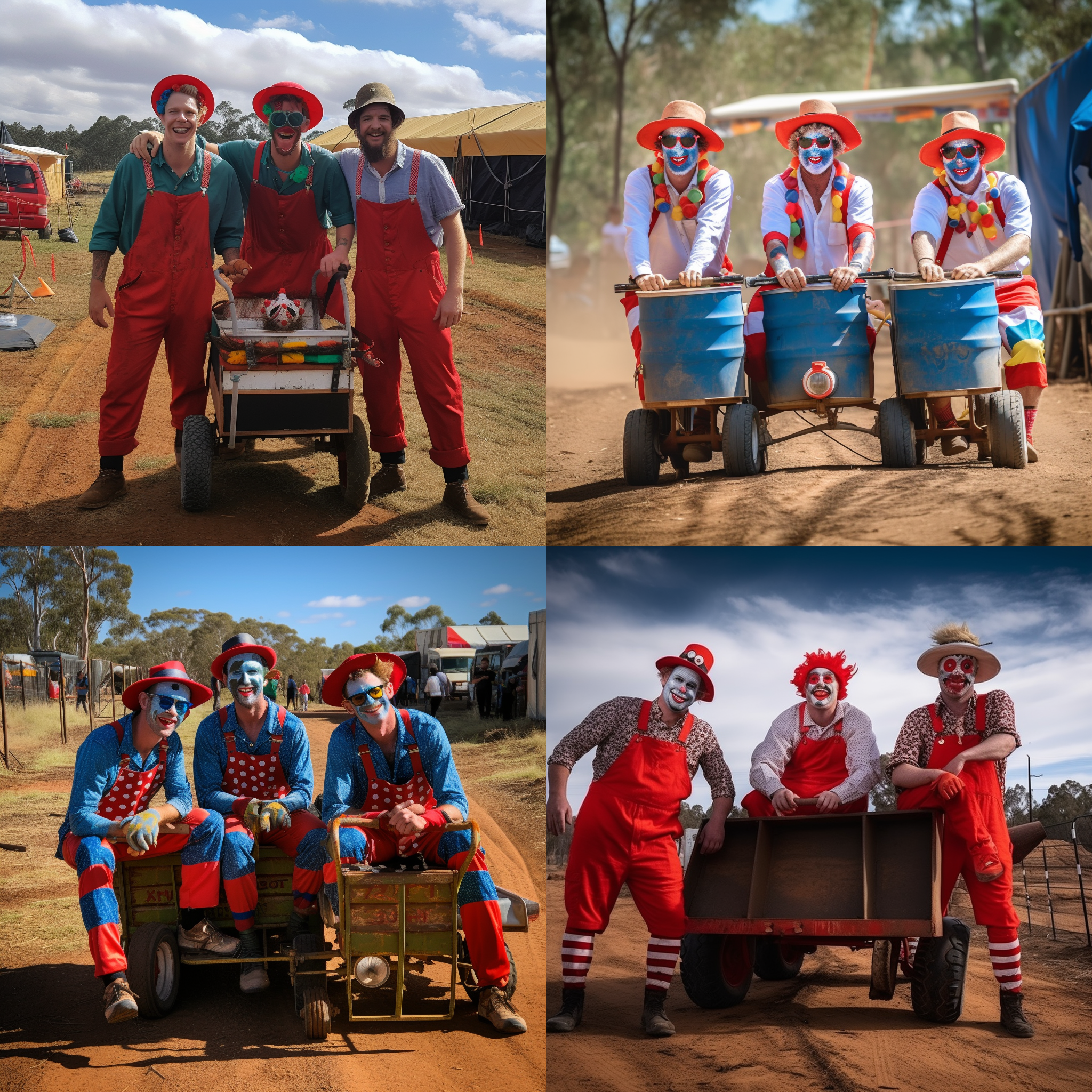

Because of the harsh conditions, miners were usually males back in the days. But there have always been teams at our little town’s festival ready to include women and children because they were usually lighter and it was easier to push the carts around on the tracks. Since a few years, there even have been full female teams, and they were pretty good too.
Prune arrives with her new fancy reflex camera she got at her last birthday. She wants to take our picture in front of our cart. At Joe and Callum’s surprise, I try to talk her into joining our team and be part of the fun. I get out of the cart a spare hat and a wig I had prepared for her, but she says today she’s doing a reportage about the festival. I know she wants to be on the lookout for our father, and keep an eye on the Inn’s guests. She told me yesterday something was off with that Liana Parker who kept snooping around and asking questions to townsfolk about Howard and Fred. And, she heard the two other girls talking about Liana being a Finli and a nun.
I frown. I haven’t told the boys anything about my father or suspicious guests with false names. Prune knows I’m not too keen about letting my little sister following people around on her own. I told her something could go wrong, but she brushed it aside explaining it was the perfect occasion because people wouldn’t pay attention to someone taking random pictures during a festival. She’s got a point, but I’m still her big brother. I had to try.
She asks us to strike a pose in front of our cart and tells a few jokes. When we laugh she takes a picture of our all male team, I’m the one in the center, Callum’s on the left and Joe on the right. I’m glad despite all the concern, I look like I’m having fun.
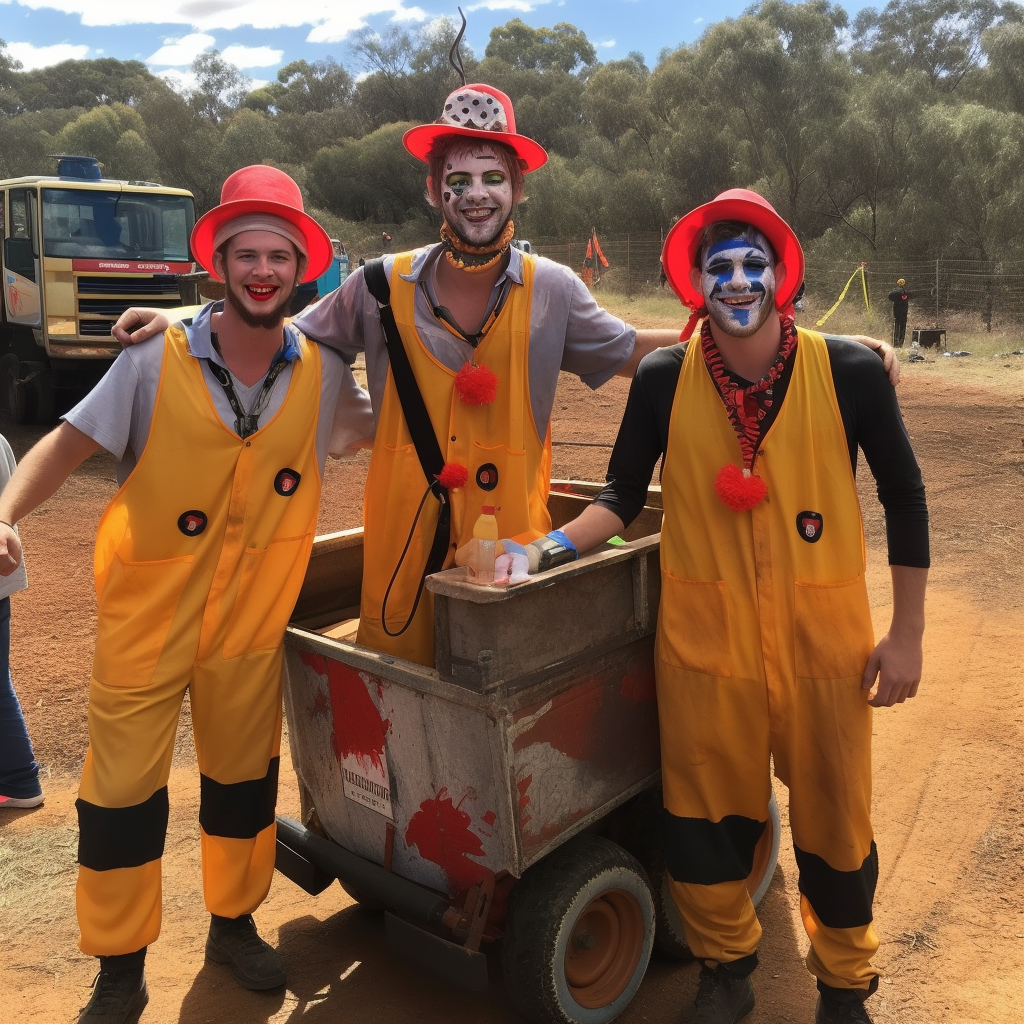
Checking her camera screen, Prune says: “You guys remind me of the Clockwork Orange with your hats, but more colourful and less creepy.”
Callum and Joe look at each other, each having one eyebrow raised. I snort. I’m sure they don’t understand the reference.
“You’re ok,” she tells them. “It means people will notice and remember you.”
“Spread the word! We’ll crush them all!” Callum shouts.
Prune looks at me. “You’re still frowning,” she says. “It’ll be fine.”
“Ok,” I say. “But at least take the hat. You can’t dress as yourself during a Cart and Lager festival, or you’ll pop out of the crowd.”
She raises her eyes to the sky and sighs. Then, she takes the orange hat from my hands and puts it on her head.
“There, happy? Consider that an endorsement of your team,” she says with a wink.
Joe and Callum hoot and whistle loudly. “Miss serious is running wild! Anything can happen today.”
We all laugh. Their enthusiasm is contagious.
“Hey! You’re mother is about to talk,” says Joe to Callum. “She’s hot.”
“Don’t speak about my mother like that.”
The mayor has climbed on the central stage and she’s talking with an all dressed up woman with a big hat that makes her look like the Queen of England. She sure seems out of place in our little town’s festival. Flanked by two bodyguards in black, I guess it’s Botty Banworth who’s provided that expensive sound system the mayor’s trying to use. “One, two, three… Is it working? Yes. Ok. All the participants are expected to bring their cart to the depart lane. We’re about to start. In the meantime let me introduce Miss Banworth who’s been very generous and allowed our festival to get to another level. She’s going to help us rehabilitate the abandoned mines and open a museum.”
A roar from the crowd. The woman’s lips are so thin and red that the smile she puts on her face looks like it’s just been made with a razor blade. I shiver. She’s the Queen of England turned by a vampire.
Someone bumps into my back and knocks the air out of my lungs. I almost fall on my sister.
“Hey! Watch out!” says Callum.
I catch my breath and look up. It’s Betsy, dressed as a miner too, with extra sequins and gummy stars on her dungarees. She looks confused and mutters some excuses but doesn’t stop. She walks as if she has had a few lagers already.
“Hey, Betsy,” calls Prune. “You seem like you just saw a ghost.”
“Someone… near the mines… It can’t be…” says Betsy.
“Who did you see near the mines?” shouts my sister.
With the noise around us, I almost didn’t hear Betsy’s answer.
“Fred… Howard… It can’t be. I need Idle’s cakes,” she says before disappearing in the crowd.
I look at Prune. I see in her eyes we’re thinking the same thing. Dad’s really here. We nod at the same time and I move my lips: “Be careful.” She nods.
“You three, win,” she tells us before leaving.
“You heard her?” I asked Callum and Joe. “Let’s move our limo.” As we approach the tracks with the other participants, a gush of wind almost knock my hat off my head. There is some commotion coming from the central stage. A guy climbed up and is shouting something that I don’t understand, pointing at the sky behind us. When I look back like everyone, tourists and teams, I understand.
“Dust! Dust’s coming!”
And right from the direction of the abandoned mines. Dad what did you get yourself into?
It’s 10:55am and I’m pretty sure we’ll have to put off the race.
March 24, 2023 at 10:06 am #7216In reply to: The Precious Life and Rambles of Liz Tattler
Roberto sighed and scratched a red patch on his left hand. Spring was here. It was obvious as vibrant lime green leaves had grown on freshly sprouted twigs. If it added a nice touch of colour to the garden, the box trees, lined up on the opposite side of the pool that he had dedicated so much time last year to carving them as birds, elephants and rhinos, had now a dishevelled appearance, and that only added to his despair.
The lawn was sprinkled with yellow spots of dandelions. Roberto just tried to remove some of them with his hands, but got badly stung by nettles. They had invaded the garden from the new neighbour’s meadow. That estúpido, had said he wanted nature to grow on its own terms, but looking at the result, Roberto thought it was more of a natural disaster than anything else.
“Don’t get rid of the dandelions,” said Liz. “It attracts bumblebees and wild bees. I’ve heard that we need to save them.”
“You talked with that neighbour again?” asked Roberto.
“Dominic? Isn’t it nice the birds are back?”
Roberto looked at the birdbaths on top of the four Corinthian columns at each corner of the pool. A group of sparrows were fooling around cleaning their feathers. At Roberto’s feet, a hedgehog was drinking in a puddle left by the 7:30 morning rain, remains of a feast of slugs behind him. Sometimes, he envied their insouciance and joie de vivre. They were content with whatever was provided to them without wanting to change their environment.
“The diggers arrive around 2pm. Just mow the lawn behind the box trees. That’s where Dominic’s son spotted strange growth patterns with his drone. He said that’s highly likely we have roman ruins in our garden.”
Roberto wondered why you needed to cut the grass of a place where you’re going to dig everything out anyway. He rolled his eyes, something he had learned from Finnley, and went to the patch of lawn behind the box trees. From there he could see brambles starting to emerge from the thuja border with Dominic’s jungle. Another thing he could not touch, because Liz wanted to have Finnley make jams with the berries.
March 24, 2023 at 7:49 am #7214In reply to: Orbs of Madjourneys
“Bossy, isn’t she?” muttered Yasmin, not quite out of earshot of Finly. “I haven’t even had a shower yet,” she added, picking up her phone and sandals.
Yasmin, Youssef and Zara left the maid to her cleaning and walked down towards Xaviers room. “I’d go and get coffee from the kitchen, but…” Youssef said, turning pleading eyes towards Zara, “Idle might be in there.”
Smiling, Zara told him not to risk it, she would go.
“Come in,” Xavier called when Yasmin knocked on the door. “God, what a dream,” he said when they piled in to his room. “It was awful. I was dreaming that Idle was threading an enormous long needle with baler twine saying she was going to sew us all together in a tailored story cut in a cloth of continuity.” He rubbed his eyes and then shook his head, trying to erase the image in his mind. “What are you two up so early for?”
“Zara’s gone to get the coffee,” Youssef told him, likewise trying to shake off the image of Idle that Xavier had conjured up. “We’re going to have a couple of hours on the game before the cart race ~ or the dust storm, whichever happens first I guess. There are some wierd looking vans and campers and oddballs milling around outside already.”
Zara pushed the door open with her shoulder, four mugs in her hands. “You should see the wierdos outside, going to be a great photo opportunity out there later.”
“Come on then,” said Xavier, “The game will get that awful dream out of my head. Let’s go!”
“You’re supposed to be the leader, you start the game,” Yasmin said to Zara. Zara rolled her eyes good naturedly and opened the game. “Let’s ask for some clues first then. I still don’t know why I’m the so called leader when you,” she looked pointedly as Xavier and Youssef, “Know much more about games than I do. Ok here goes:”
“The riddle “In the quietest place, the loudest secrets are kept” is a clue to help the group find the first missing page of the book “The Lost Pages of Creativity,” which is an integral part of the group quest. The riddle suggests that the missing page is hidden in a quiet place where secrets are kept, meaning that it’s likely to be somewhere in the hidden library underground the Flying Fish Inn where the group is currently situated.”
“Is there a cellar here do you think?” Zara mused. “Imagine finding a real underground library!” The idea of a grand all encompassing library had first been suggested to Zara many years ago in a series of old books by a channeler, and many a time she had imagined visiting it. The idea of leaving paper records and books for future generations had always appealed to her. She often thought of the old sepia portrait photographs of her ancestors, still intact after a hundred years ~ and yet her own photos taken ten years ago had been lost in a computer hard drive incident. What would the current generation leave for future anthropologists? Piles of plastic unreadable gadgets, she suspected.
“Youssef can ask Idle later,” Xavier said with a cheeky grin. “Maybe she’ll take him down there.” Youssef snorted, and Yasmin said “Hey! Don’t you start snorting too! Right then, Zara, so we find the cellar in the game then and go down and find the library? Then what?”
“The phrase “quietest place” can refer to a secluded spot or a place with minimal noise, which could be a hint at a specific location within the library. The phrase “loudest secrets” implies that there is something important to be discovered, but it’s hidden in plain sight.”
Hidden in plain sight reminded Yasmin of the parcel under her mattress, but she thrust it from her mind and focused on the game. She made up her mind to discuss it with everyone later, including the whacky suppositions that Zara had come up with. They couldn’t possibly confront Idle with it, they had absolutely no proof. I mean, you can’t go round saying to people, hey, that’s your abandoned child over there maybe. But they could include Xavier and Youssef in the mystery.
“The riddle is relevant to the game of quirks because it challenges the group to think creatively and work together to solve the puzzle. This requires them to communicate effectively and use their problem-solving skills to interpret the clues and find the missing page. It’s an opportunity to demonstrate their individual strengths and also learn from each other in the process.”
“Work together, communicate effectively” Yasmin repeated, as if to underline her resolution to discuss the parcel and Sister Finli a.k.a. Liana with the boys and Zara later. “A problem shared is a problem hopelessly convoluted, probably.”
The others looked up and said “What?” in unison, and Yasmin snorted nervously and said “Never mind, tell you later.”
March 15, 2023 at 4:27 pm #7167In reply to: The Chronicles of the Flying Fish Inn

I can’t believe the cart race is tomorrow. Joe, Callum and I have worked so hard this year to incorporate solar panels and wind propellers to our little bijou. The cart race rules are clear, apart from thermal engines and fossil fuels, your imagination is your limit. Our only worry was that dust storm. We feared the Mayor would cancelled the race, but I think she won’t. She desperately needs the money.
Some folks thought to revive the festival as a prank fifteen years ago, but people had so much fun the council agreed to renew it the next year, and the year after that it was made official. It’s been a small town festival for ten years, and would have stayed like that if it hadn’t been for a bus full of Italian tourist on their way to Uluru. It broke down as they drove through main street – I remember it because I just started my job at the garage and couldn’t attend the race. Those Italians, a bunch of crazy people, posted videos of the race on the Internet and it went viral, propelling our ghost town to worldwide fame. We thought it would subside but some folks created a FishBone group and we’re almost as famous as Punxsutawney once a year. We even have a team of old ladies from Tikfijikoo Island.
All that attention attracted sponsors, mostly booze brands. But this year we’ve got a special one from Sidney. Aunt Idle who’s got a special friend at the city council told us the council members couldn’t believe it when the tart called and offered money. Botty Banworth, head of a big news company made famous by her blog: Prudish Beauty.
Aunt Idle, who heard it from one of her special friends at the town’s council, started a protest because she thought the Banworth tart would force the council to ban all recreational substances. But I have it from Callum, who’s the Mayor’s son, that the tart is not interested in making us an example of sobriety. She’s asked to lease the land where the old mines are and the Mayor haven’t told anybody about it.
After Callum told me about the lease, it reminded me about the riddle.
A mine, a tile, dust piled high,
Together they rest, yet always outside.
One misstep, and you’ll surely fall,
Into the depths, where danger lies all.Then something else happened. Another woman stopped at the gas station earlier today. I recognised one of the Inn’s guests, the one with the Mercedes. With her mirror sunglasses and her headscarf wrapped around her hair, she already looked suspicious. But as it happened, she asked me about the mines and how to go there. For abandoned mines, they sure attract a lot of attention.
It reminded me of something. So after work, I went to the Inn and asked the twins permission to go up to their lair. When dad disappeared, Mater went mad, she threw everything to the garbage. The twins waited til she got back inside and moved everything back in the attic and called it their lair. It looks just like dad’s old office with the boxes full of papers, the mahogany desk and even his typewriter. For whatever reason, Mater just ignores it and if she needs something from the attic, she asks someone else to get it, pretexting she can’t climb all those stairs.

I was right. Dad left the old manuscript he was working on at the time. A sci-fi novel about strange occurrences in an abandoned mine that looked just like the one outside of town. Prune said it’s badly written, and it doesn’t even have a title. But I remember having nightmares after reading some of the passages.
-
AuthorSearch Results