
Search Results for 'center'
-
AuthorSearch Results
-
December 2, 2024 at 10:50 pm #7635
In reply to: Quintessence: Reversing the Fifth
Sat. Nov. 30, 2024 5:55am — Matteo’s morning
Matteo’s mornings began the same way, no matter the city, no matter the season. A pot of strong coffee brewed slowly on the stove, filling his small apartment with its familiar, sense-sharpening scent. Outside, Paris was waking up, its streets already alive with the sound of delivery trucks and the murmurs of shopkeepers rolling open shutters.
He sipped his coffee by the window, gazing down at the cobblestones glistening from last night’s rain. The new brass sign above the Sarah Bernhardt Café caught the morning light, its sheen too pristine, too new. He’d started the server job there less than a week ago, stepping into a rhythm he already knew instinctively, though he wasn’t sure why.
Matteo had always been good at fitting in. Jobs like this were placeholders—ways to blend into the scenery while he waited for whatever it was that kept pulling him forward. The café had reopened just days ago after months of being closed for renovations, but to Matteo, it felt like it had always been waiting for him.

He set his coffee mug on the counter, reaching absently for the notebook he kept nearby. The act was automatic, as natural as breathing. Flipping open to a blank page, Matteo wrote down four names without hesitation:
Lucien. Elara. Darius. Amei.
He stared at the list, his pen hovering over the page. He didn’t know why he wrote it. The names had come unbidden, as though they were whispered into his ear from somewhere just beyond his reach. He ran his thumb along the edge of the page, feeling the faint indentation of his handwriting.
The strangest part wasn’t the names— it was the certainty that he’d see them that day.
Matteo glanced at the clock. He still had time before his shift. He grabbed his jacket, tucked the notebook into the inside pocket, and stepped out into the cool Parisian air.
Matteo’s feet carried him to a side street near the Seine, one he hadn’t consciously decided to visit. The narrow alley smelled of damp stone and dogs piss. Halfway down the alley, he stopped in front of a small shop he hadn’t noticed before. The sign above the door was worn, its painted letters faded: Les Reliques. The display in the window was an eclectic mix—a chessboard missing pieces, a cracked mirror, a wooden kaleidoscope—but Matteo’s attention was drawn to a brass bell sitting alone on a velvet cloth.
The door creaked as he stepped inside, the distinctive scent of freshly burnt papier d’Arménie and old dust enveloping him. A woman emerged from the back, wiry and pale, with sharp eyes that seemed to size Matteo up in an instant.
“You’ve never come inside,” she said, her voice soft but certain.
“I’ve never had a reason to,” Matteo replied, though even as he spoke, the door closed shut the outside sounds.
“Today, you might,” the woman said, stepping forward. “Looking for something specific?”
“Not exactly,” Matteo replied. His gaze shifted back to the bell, its smooth surface gleaming faintly in the dim light.
“Ah.” The shopkeeper followed his eyes and smiled faintly. “You’re drawn to it. Not uncommon.”
“What’s uncommon about a bell?”
The woman chuckled. “It’s not the bell itself. It’s what it represents. It calls attention to what already exists—patterns you might not notice otherwise.”
Matteo frowned, stepping closer. The bell was unremarkable, small enough to fit in the palm of his hand, with a simple handle and no visible markings.
“How much?”
“For you?” The shopkeeper tilted his head. “A trade.”
Matteo raised an eyebrow. “A trade for what?”
“Your time,” the woman said cryptically, before waving her hand. “But don’t worry. You’ve already paid it.”
It didn’t make sense, but then again, it didn’t need to. Matteo handed over a few coins anyway, and the woman wrapped the bell in a square of linen.
Back on the street, Matteo slipped the bell into his pocket, its weight unfamiliar but strangely comforting. The list in his notebook felt heavier now, as though connected to the bell in a way he couldn’t quite articulate.
Walking back toward the café, Matteo’s mind wandered. The names. The bell. The shopkeeper’s words about patterns. They felt like pieces of something larger, though the shape of it remained elusive.
The day had begun to align itself, its pieces sliding into place. Matteo stepped inside, the familiar hum of the café greeting him like an old friend. He stowed his coat, slipped the bell into his bag, and picked up a tray.
Later that day, he noticed a figure standing by the window, suitcase in hand. Lucien. Matteo didn’t know how he recognized him, but the instant he saw the man’s rain-damp curls and paint-streaked scarf, he knew.
By the time Lucien settled into his seat, Matteo was already moving toward him, notebook in hand, his practiced smile masking the faint hum of inevitability coursing through him.
He didn’t need to check the list. He knew the others would come. And when they did, he’d be ready. Or so he hoped.
December 2, 2024 at 8:35 pm #7634In reply to: Quintessence: Reversing the Fifth
Nov.30, 2024 2:33pm – Darius: The Map and the Moment
Darius strolled along the Seine, the late morning sky a patchwork of rainclouds and stubborn sunlight. The bouquinistes’ stalls were already open, their worn green boxes overflowing with vintage books, faded postcards, and yellowed maps with a faint smell of damp paper overpowered by the aroma of crêpes and nearby french fries stalls. He moved along the stalls with a casual air, his leather duffel slung over one shoulder, boots clicking against the cobblestones.
The duffel had seen more continents than most people, its scuffed surface hinting at his nomadic life. India, Brazil, Morocco, Nepal—it carried traces of them all. Inside were a few changes of clothes, a knife he’d once bought off a blacksmith in Rajasthan, and a rolled-up leather journal that served more as a collection of ideas than a record of events.
Darius wasn’t in Paris for nostalgia, though it tugged at him in moments like this. The city had always been Lucien’s thing —artistic, brooding, and layered with history. For Darius, Paris was just another waypoint. Another stop on a map that never quite seemed to end.
It was the map that stopped him, actually. A tattered, hand-drawn thing propped against a pile of secondhand books, its edges curling like a forgotten leaf. Darius leaned in, frowning at its odd geometry. It wasn’t a city plan or a geographical rendering; it was… something else.
“Ah, you’ve found my prize,” said the bouquiniste, a short older man with a grizzled beard and a cigarette dangling from his lips.
“This?” Darius held up the map, his dark fingers tracing the looping, interconnected lines. They reminded him of something—a mandala, maybe, or one of those intricate yantras he’d seen in a temple in Varanasi.
“It’s not a real place,” the bouquiniste continued, leaning closer as though revealing a secret. “More of a… philosophical map.”
Darius raised an eyebrow. “A philosophical map?”
The man gestured toward the lines. “Each path represents a choice, a possibility. You could spend your life trying to follow it, or you could accept that you already have.”
Darius tilted his head, the edges of a smile forming. “That’s deep for ten euros.”
“It’s twenty,” the bouquiniste corrected, his grin flashing gold teeth.
Darius handed over the money without a second thought. The map was too strange to leave behind, and besides, it felt like something he was meant to find.
He rolled it up and tucked it into his duffel, turning back toward the city’s winding streets. The café wasn’t far now, but he still had time.
He stopped by a street vendor selling espresso shots and ordered one, the strong, bitter taste jolting his senses awake. As he leaned against a lamppost, he noticed his reflection in a shop window: a tall, broad-shouldered man, his dark skin glistening faintly in the misty air. His leather jacket was worn at the elbows, his boots dusted with dirt from some far-flung place.
He looked like a man who belonged everywhere and nowhere—a nomad who’d long since stopped wondering what home was supposed to feel like.
India had been the last big stop. It was messy, beautiful chaos. The temples had been impressive, sure, but it was the street food vendors, the crowded markets, the strolls on the beach with the peaceful cows sunbathing, and the quiet, forgotten alleys that stuck with him. He’d made some connections, met some people who’d lingered in his thoughts longer than they should have.
One of them had been a woman named Anila, who had handed him a fragment of something—an idea, a story, a warning. He couldn’t quite remember now. It felt like she’d been trying to tell him something important, but whatever it was had slipped through his fingers like water.
Darius shook his head, pushing the thought aside. The past was the past, and Paris was the present. He looked at the rolled-up map peeking out of his duffel and smirked. Maybe Lucien would know what to make of it. Or Elara, with her scientific mind and love of puzzles.
The group had always been a strange mix, like a band that shouldn’t work but somehow did. And now, after five years of silence, they were coming back together.
The idea made his stomach churn—not with nerves, exactly, but with a sense of inevitability. Things had been left unsaid back then, unfinished. And while Darius wasn’t usually one to linger on the past, something about this meeting felt… different.
The café was just around the corner now, its brass fixtures glinting through the drizzle. Darius slung his duffel higher on his shoulder and took one last sip of espresso before tossing the cup into a bin.
Whatever this reunion was about, he’d be ready for it.
But the map—it stayed on his mind, its looping lines and impossible paths pressing into his thoughts like a puzzle waiting to be solved.
December 1, 2024 at 5:44 pm #7623In reply to: Quintessence: Reversing the Fifth
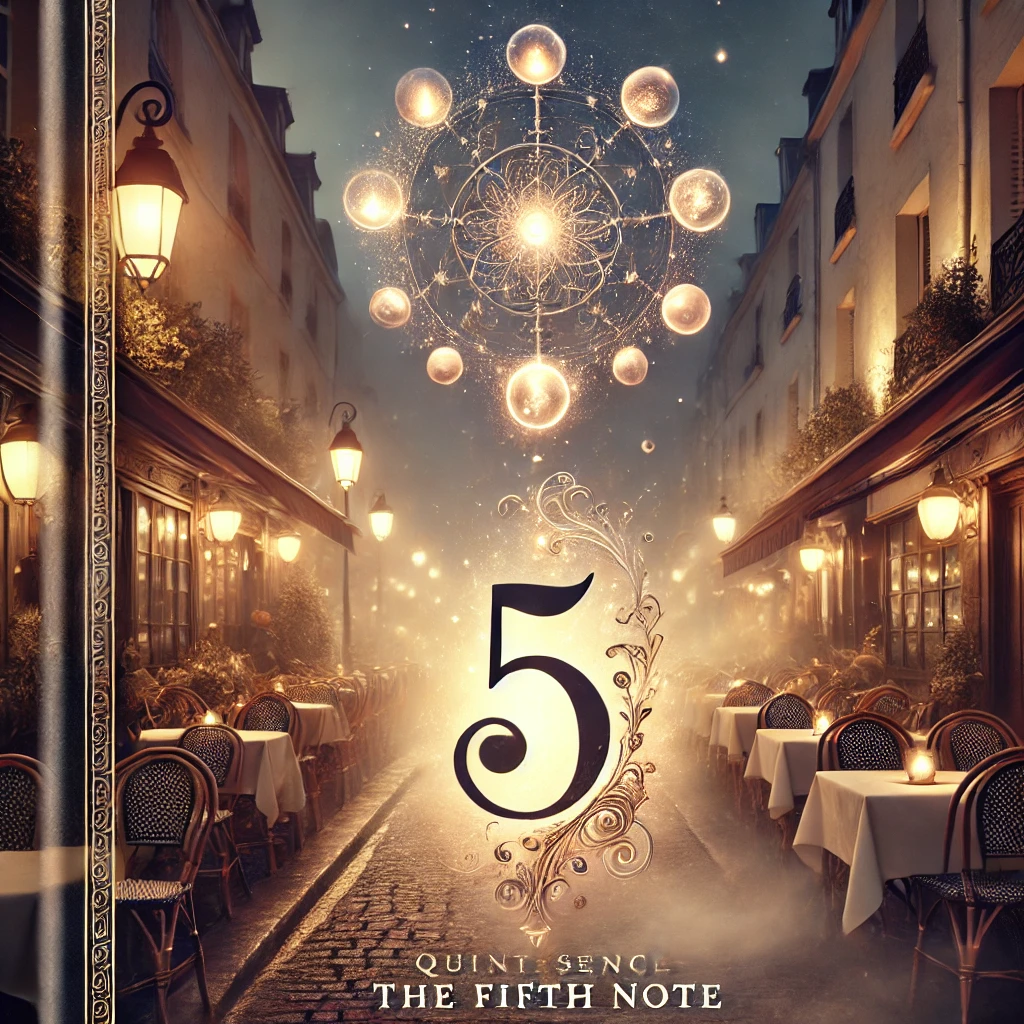
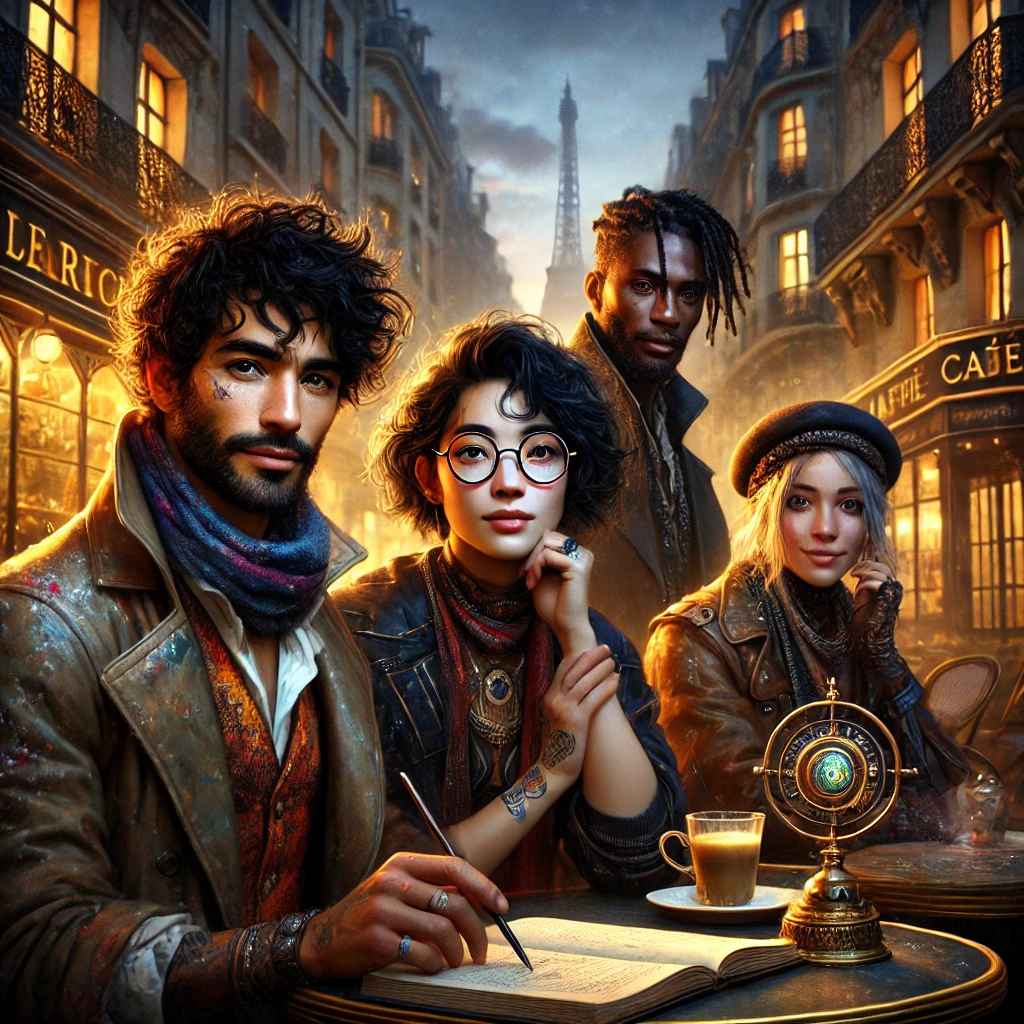
At the Café
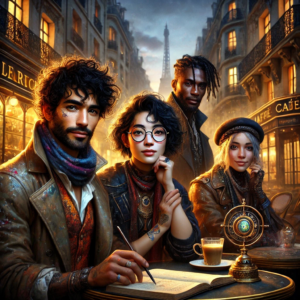
The Sarah Bernardt Café shimmered under a pale grey November sky a busy last Saturday of the “Black Week”. Golden lights spilled onto cobblestones slick with rain, and the air buzzed with the din of a city alive in the moment. Inside, the crowd pressed together, laughing, arguing, living. And in a corner table by the fogged-up window, old friends were about to quietly converged, coming to a long overdue reunion.
Lucien was the first to arrive, dragging a weathered suitcase behind him. Its wheels rattled unevenly on the cobblestones, a sound he hated. His dark curls, damp from the rain, clung to his forehead, and his scarf, streaked with old paint, hung loose around his neck. He folded himself into a corner chair, his suitcase tucked awkwardly beside him. When the server approached, Lucien waved him off with a distracted shake of his head and opened a battered sketchbook.
The next arrival was Elara. She entered briskly, shaking rain from her short gray-streaked hair, her eyes scanning the room as though searching for anomalies. A small roller bag trailed behind her, pristine and black, a sharp contrast to Lucien’s worn luggage. She stopped at the table and tilted her head.
“Still brooding?” she asked, pulling off her coat and folding it neatly over the back of a chair.
“Still talking?” Lucien didn’t look up, his pencil scratching faint lines across the page.
Elara smiled faintly. “Two minutes in, and you’re already immortalizing us? You know I hate being drawn.”
“You hate being caught off guard,” Lucien murmured. “But I never get your nose wrong.”
She laughed, the sound light but brief, and sank into her seat, placing her bag carefully beside her.
The door swung open again, and Darius entered, shaking the rain from his jacket. His presence seemed to fill the room immediately. He strode toward the table, a leather duffel slung over one shoulder and a well-worn travel pouch clutched in his hand. His boots clacked against the café’s tile floor, his movements easy, confident.
“Did you walk here?” Elara asked as he dropped his things with a thud and pulled out a chair.
“Ran into someone on the way,” he said, settling back. “Some guy selling maps. Got this one for ten euros—worth every cent.” He waved a yellowed scrap of paper that looked more fiction than cartography.
Lucien snorted. “Still paying for strangers’ stories, I see.”
“The good ones aren’t free.” Darius grinned and leaned back in his chair, propping one boot against the table leg.
The final arrival was Amei. Her entrance was quieter but no less noticeable. She unwound her scarf slowly, her layered clothing a mix of textures and colors that seemed to absorb the café’s golden light. A tote bag rested over her shoulder, bulging with what could have been books, or journals, or stories yet untold.
“You’re late,” Darius said, but his voice carried no accusation.
“Right on time,” Amei replied, lowering herself into the last chair. “You’re all just early.”
Her gaze swept across them, lingering on the bags piled at their feet. “I see I’m not the only one who came a long way.”
“Not all of us live in Paris,” Elara said, with a glance at Lucien.
“Only some of us make better life choices,” Lucien replied dryly.
The comment drew laughter—a tentative sound that loosened the air between them, thick as it was with five years of absence.
 December 1, 2024 at 5:11 pm #7618
Topic: Quintessence: Reversing the Fifth
in forum Yurara Fameliki’s StoriesMatteo Appears
Matteo approached the table, a tray balanced effortlessly in one hand, his dark eyes flicking over the group as though cataloging details in an invisible ledger. His waistcoat, sharp and clean, gave him a practiced professionalism, but there was something else—a casual, unspoken authority that drew attention.
“Good evening,” he began, his voice smooth and low, almost conspiratorial. Then, he froze for the briefest moment, his gaze shifting from face to face, the easy smile tightening at the corners.
“Well,” Matteo said finally, his smile broadening as if he’d just solved a riddle. “Here you all are. Together, at last.”
The group exchanged glances, each of them caught off-guard by the comment.
“You say that like you’ve been expecting us,” Elara said, her tone measured but sharp, as if probing for variables.
“Not expecting,” Matteo replied, his eyes glinting. “But hoping, perhaps. It’s… good to see you all like this. It fits, somehow.”
“What fits?” Darius asked, leaning forward. His voice was lighter than Elara’s but carried a weight that suggested he wouldn’t let the question drop easily.
Matteo’s smile deepened, though he didn’t answer immediately. Instead, he set down his tray and folded his hands in front of him, his posture relaxed but deliberate, as though he were balancing on the edge of some invisible line.
“You’ve never all been here before,” he said, a simple statement that landed like a challenge.
“Wait,” Amei said, narrowing her eyes. “You know us?”
“Oh, I know you,” Matteo replied, his tone as light as if they were discussing the weather. “Individually, yes. But together? This is new. And it’s… remarkable.”
“Remarkable how?” Lucien asked, his pencil stilled over his sketchbook.
Matteo tilted his head, considering the question as though weighing how much to say. “Let’s just call it a rarity. Things don’t often align so neatly. It’s not every day you see… well, this.”
He gestured toward them with a sweeping hand, as if the mere fact of their presence at the table was something extraordinary.
“You’re being cryptic,” Elara said, her voice edged with suspicion.
“It’s a talent,” Matteo replied smoothly.
“Alright, hold on.” Darius leaned back, his chair creaking under him. “How do you know us? I’ve never been here before. Not once.”
“Nor I,” Amei added, her voice soft but steady.
Matteo raised an eyebrow, his smile taking on a knowing tilt. “No, not here. But that’s not the only place to know someone, is it?”
The words hung in the air, unsettling and oddly satisfying at once.
“You’re saying we’ve met you before?” Elara asked.
Matteo inclined his head. “In a manner of speaking.”
“That doesn’t make sense,” Lucien said, his voice quiet but firm.
“Doesn’t it?” Matteo countered, his tone almost playful. “After all, do we ever truly remember every thread that weaves us together? Sometimes we only see the pattern when it’s complete.”
A pause settled over the table, heavy with unspoken questions. Matteo shifted his weight, breaking the silence with an easy gesture.
“It doesn’t matter how,” he said finally. “What matters is that you’re here. That’s what counts.”
“For what?” Amei asked, her eyes narrowing.
“For whatever happens next,” Matteo replied, as if the answer were obvious. Then he straightened, his professional mask sliding back into place with effortless grace.
“Now, what can I bring you?” he asked, his tone light again, as though the previous exchange hadn’t happened.
One by one, they placed their orders, though their minds were clearly elsewhere. Matteo scribbled in his notebook, his pen moving with deliberate strokes, and then he looked up once more.
“Thank you for being here,” he said, his voice quieter this time. “It’s been… a long time coming.”
And with that, he was gone, disappearing into the crowd with the same fluidity he’d arrived.
They sat in silence for a moment, his words pressing down on them like a hand on a wound, familiar and foreign all at once.
“What the hell was that?” Darius asked finally, breaking the spell.
“Does he seem… different to you?” Amei asked, her voice distant.
“He seems impossible,” Elara replied, her fingers tapping an unconscious rhythm on the table.
“He remembered me,” Lucien said, almost to himself. “Something about absinthe.”
“I’ve never even met him,” Elara said, her voice rising slightly. “But he knew… too much.”
“And he didn’t explain anything,” Darius added, shaking his head.
“Maybe he didn’t need to,” Amei said softly, her gaze fixed on the space Matteo had just vacated.
They lapsed into silence again, the noise of the café returning in fits and starts, like an orchestra warming up after a pause. Somewhere, a glass clinked against porcelain; outside, the violinist struck a note so low it hummed against the windowpane.
The four of them sat there, strangers and friends all at once, the questions left dangling between them like stars in a cloudy sky. Whatever Matteo had meant, it was clear this moment was no coincidence. It wasn’t an end, nor a beginning—it was the start of something unraveling, something they couldn’t yet see.
And though none of them said it aloud, the thought was the same: What had happened before?
Quintessence: Reversing the Fifth
November 4, 2024 at 3:36 pm #7579In reply to: The Incense of the Quadrivium’s Mystiques
When Eris called for an urgent meeting, Malové nearly canceled. She had her own pressing concerns and little patience for the usual parade of complaints or flimsy excuses about unmet goals from her staff. Yet, feeling the weight of her own stress, she was drawn to the idea of venting a bit—and Truella or Jeezel often made for her preferred targets. Frella, though reserved, always performed consistently, leaving little room for critique. And Eris… well, Eris was always methodical, never using the word “urgent” lightly. Every meeting she arranged was meticulously planned and efficiently run, making the unexpected urgency of this gathering all the more intriguing to Malové.
Curiosity, more than duty, ultimately compelled her to step into the meeting room five minutes early. She tensed as she saw the draped dark fabrics, flickering lights, forlorn pumpkins, and the predictable stuffed creatures scattered haphazardly around. There was no mistaking the culprit behind this gaudy display and the careless use of sacred symbols.
“Speak of the devil…” she muttered as Jeezel emerged from behind a curtain, squeezed into a gown a bit too tight for her own good and wearing a witch’s hat adorned with mystical symbols and pheasant feathers. “Well, you’ve certainly outdone yourself with the meeting room,” Malové said with a subtle tone that could easily be mistaken for admiration.
Jeezel’s face lit up with joy. “Trick or treat!” she exclaimed, barely able to contain her excitement.
“What?” Malové’s eyebrows arched.
“Well, you’re supposed to say it!” Jeezel beamed. “Then I can show you the table with my carefully handcrafted Halloween treats.” She led Malové to a table heaving with treats and cauldrons bubbling with mystical mist.
Malové felt a wave of nausea at the sight of the dramatically overdone spread, brimming with sweets in unnaturally vibrant colors. “Where are the others?” she asked, pressing her lips together. “I thought this was supposed to be a meeting, not… whatever this is.”
“They should arrive shortly,” said Jeezel, gesturing grandly. “Just take your seat.”
Malové’s eyes fell on the chairs, and she stifled a sigh. Each swivel chair had been transformed into a mock throne, draped in rich, faux velvet covers of midnight blue and deep burgundy. Golden tassels dangled from the edges, and oversized, ornate backrests loomed high, adorned with intricate patterns that appeared to be hastily hand-painted in metallic hues. The armrests were festooned with faux jewels and sequins that caught the flickering light, giving the impression of a royal seat… if the royal in question had questionable taste. The final touch was a small, crowned cushion placed in the center of each seat, as if daring the occupants to take their place in this theatrical rendition of a court meeting.
When she noticed the small cards in front of each chair, neatly displaying her name and the names of her coven’s witches, Malové’s brow furrowed. So, seats had been assigned. Instinctively, her eyes darted around the room, scanning for hidden tricks or sutble charms embedded in the decor. One could never be too cautious, even among her own coven—time had taught her that lesson all too often, and not always to her liking.
Symbols, runes, sigils—even some impressively powerful ones—where scattered thoughtfully around the room. Yet none of them aligned into any coherent pattern or served any purpose beyond mild relaxation or mental clarity. Malové couldn’t help but recognize the subtlety of Jeezel’s craft. This was the work of someone who, beyond decorum, understood restraint and intention, not an amateur cobbling together spells pulled from the internet. Even her own protective amulets, attuned to detect any trace of harm, remained quiet, confirming that nothing in the room, except for those treats, posed a threat.
As the gentle aroma of burning sage and peppermint reached her nose, and Jeezel placed a hat remarkably similar to her own onto Malové’s head, the Head Witch felt herself unexpectedly beginning to relax, her initial tension and worries melting away. To her own surprise, she found herself softening to the atmosphere and, dare she admit, actually beginning to enjoy the gathering.
September 20, 2024 at 10:13 pm #7557In reply to: The Incense of the Quadrivium’s Mystiques
The whole summer had been a blur. So much so it felt at times to Eris she’d woken up from a dream to enter another one; carefully crafted illusions as heavy as an obfuscating spell.
She could remember the fair, vaguely the Games too —each event felt like another layer of enchantment, casting a surreal pallor over everything. Indeed, the summer was a blur of fleeting images and half-remembered events, like how everyone quickly disbanded to go for a respite and a salutary holiday. Truth be told, the witches of the Quadrivium all needed it after the utter chaotic year they’d been through.
The resurgence of Malové at the fair, left unexplained, had appeared as an evidence. They all needed the tough love that only she as a head of Coven could provide, rather than the micro-management of the well-meaning but people-inapt Austreberthe. To be fair, Eris wasn’t sure Malové was still in charge or not —Eris had never as much struggled with continuity as now; she could feel they were all flipping through and sliding into potential realities opened by the incoming Samhain doorways on the horizons.
Standing on the cusp of autumn, Eris décided to prepare herself for a clarity spell under the iridescent harvest moon.
As the leaves began to turn and the air grew crisp, Eris stood poised to harness the energies of the propitious harvest moon. Preparation for a clarity spell required ascertained precision and intention waved into the elements.
Eris began by setting her space. The clearing near Lake Saimaa was her sanctum, a place where the natural energies converged seamlessly with her own. She laid out a circle of stones, each one representing a different aspect of clarity—vision, truth, focus, and discernment. In the center, she placed a mirror, a symbolic portal to the inner self and higher understanding.
Mandrake, her Norwegian Forest cat, watched with a knowing gaze, his presence grounding her as she moved through the rituals. Echo, the familiar sprite, flitted about, ensuring everything was in place.
“Mandrake, guard the perimeter,” Eris instructed. The cat slinked off into the shadows, his eyes glowing with an otherworldly light.
Eris took a deep breath and began to chant, her voice steady and resonant:
“By the light of the harvest moon,
I call forth clarity, swift and soon.
Let fog disperse and shadows flee,
Reveal the truth, illuminate me.”She sprinkled dried hellebores around the mirror, their protective and healing properties amplifying the spell’s potency. The hellebores, collected from Normandy, held within them the strength of her Viking ancestors and the promise of Imbolc’s rebirth. They were not just flowers; they were talismans of resilience and transformation.
As the moon reached its zenith, Eris held a vial of enchanted water. She poured it over the mirror, watching as the surface shimmered and rippled, reflecting the moonlight with an ethereal glow. The water, drawn from the depths of Lake Saimaa, was imbued with the ancient magic of the land.
Eris closed her eyes and focused on her intentions. She saw the faces of her sisters at the Quadrivium Emporium, each one struggling with their own burdens. Stalkers, postcards, camphor chests, ever prancing reindeers high on mushrooms. She saw the chaotic energies of early spring, swirling, and the potential and peril they carried. She saw Malové’s stern visage, a reminder of the standards they were meant to uphold, and a reminder to make more magical rejuvenating cream.
“Show me the path,” she whispered. “Guide me through the haze.”
The mirror began to clear, the ripples settling into a smooth, reflective surface. Images started to form—visions of the future, hints of what lay ahead. She saw herself within the coven with renewed purpose, her objectives clear and her drive rekindled. She saw her sisters working in harmony, each one contributing their unique strengths to the collective power.
The clarity spell was working, the fog lifting to reveal the roadmap she needed. Decisions that once seemed insurmountable now appeared manageable, their resolutions within grasp. The inefficiencies plaguing their organization were laid bare, offering a blueprint for the reforms necessary to streamline their efforts.
Eris opened her eyes, the vision fading yet leaving an indelible mark on her mind. She felt a surge of confidence, a sense of direction that had been sorely lacking.
“Thank you,” she murmured to the moon, to the elements, to the spirits that had guided her.
As she began to dismantle the circle, Echo fluttered down to her shoulder, a small smile on her ethereal face. Mandrake emerged from the shadows, his eyes reflecting the calm and order Eris had sought to instill.
“Well done, Eris,” Echo said softly. “The road ahead is clearer now. The harvest moon has gifted you its wisdom.”
Eris nodded, feeling ready as autumn would be a season of action, of turning vision into reality.
September 14, 2024 at 9:33 pm #7553In reply to: The Incense of the Quadrivium’s Mystiques
What is that book doing under the table? Truella frowned and bent down, squinting. It was a dark covered old book, with yellowy pages, loose and thick. Wiping the dust off with her hand, she walked over the the window, trying to decipher the faded title. Me and Minn.
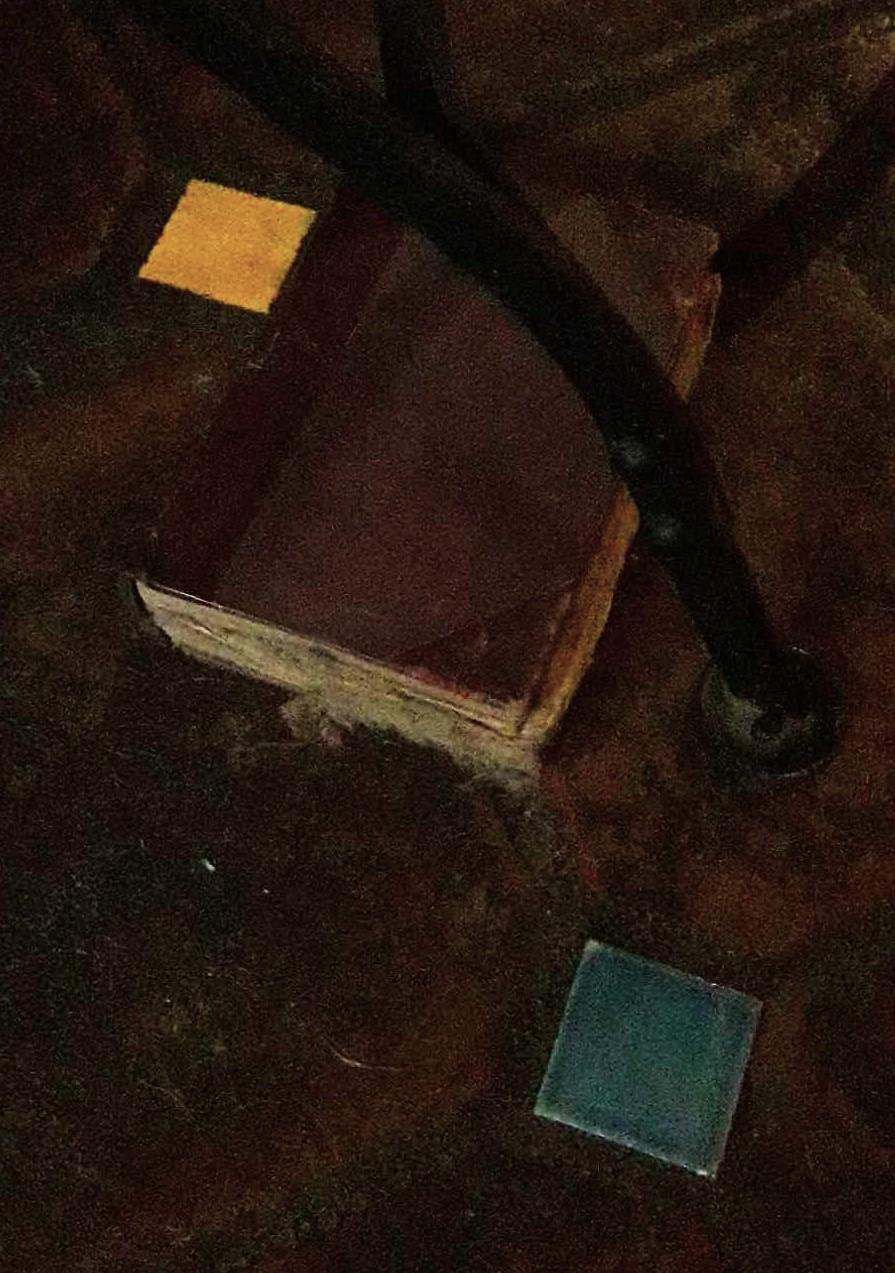
The mysterious Mr Minn. Where had she heard that before?
August 28, 2024 at 1:31 pm #7549In reply to: The Elusive Samuel Housley and Other Family Stories
The Tailor of Haddon
Wibberly and Newton of Over HaddonIt was noted in the Bakewell parish register in 1782 that John Wibberly 1705?-1782 (my 6x great grandfather) was “taylor of Haddon”.
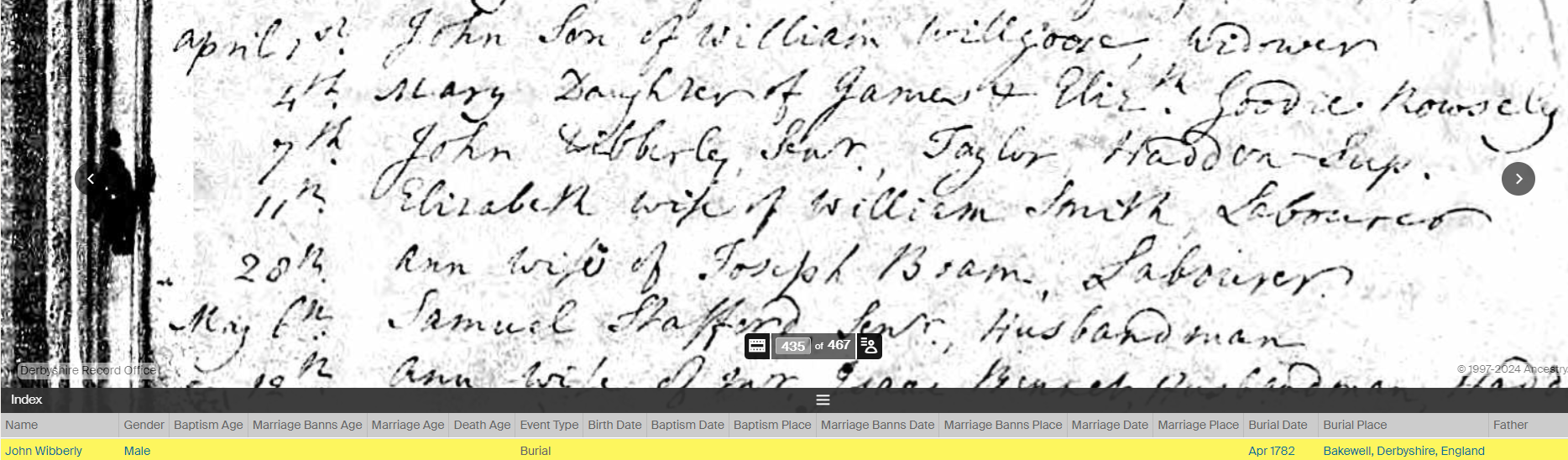
James Marshall 1767-1848 (my 4x great grandfather), parish clerk of Elton, married Ann Newton 1770-1806 in Elton in 1792. In the Bakewell parish register, Ann was baptised on the 2rd of June 1770, her parents George and Dorothy Newton of Upper Haddon. The Bakewell registers at the time covered several smaller villages in the area, although what is currently known as Over Haddon was referred to as Upper Haddon in the earlier entries.
Newton:
George Newton 1728-1798 was the son of George Newton 1706- of Upper Haddon and Jane Sailes, who were married in 1727, both of Upper Haddon.
George Newton born in 1706 was the son of George Newton 1676- and Anne Carr, who were married in 1701, both of Upper Haddon.
George Newton born in 1676 was the son of John Newton 1647- and Alice who were married in 1673 in Bakewell. There is no last name for Alice on the marriage transcription.
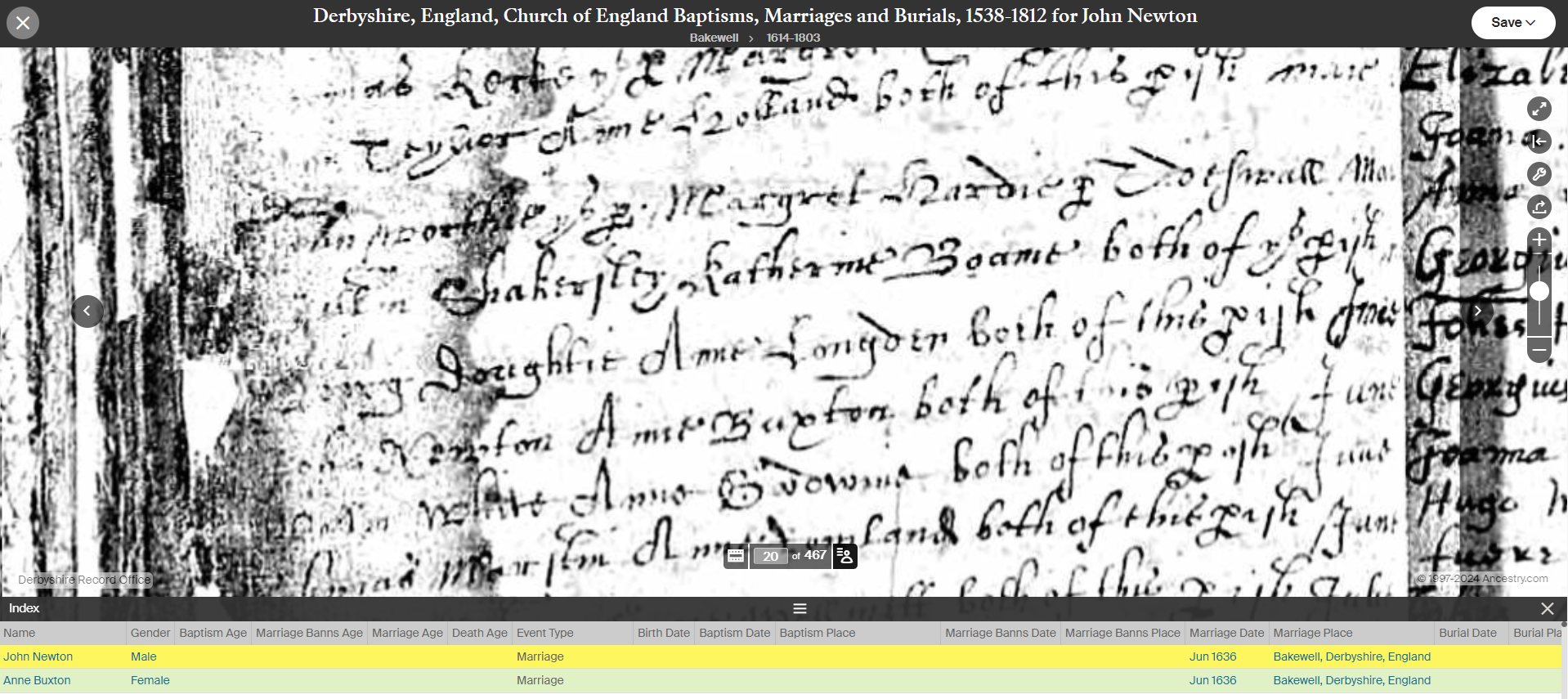
John Newton born in 1647 (my 9x great grandfather) was the son of John Newton and Anne Buxton (my 10x great grandparents), who were married in Bakewell in 1636.
1636 marriage of John Newton and Anne Buxton:
Wibberly
Dorothy Wibberly 1731-1827 married George Newton in 1755 in Bakewell. The entry in the parish registers says that they were both of Over Haddon. Dorothy was baptised in Bakewell on the 25th June 1731, her parents were John and Mary of Over Haddon.

John Wibberly and Mary his wife baptised nine children in Bakewell between 1730 and 1750, and on all of the entries in the parish registers it is stated that they were from Over Haddon. A parish register entry for John and Mary’s marriage has not yet been found, but a marriage in Beeley, a tiny nearby village, in 1728 to Mary Mellor looks likely.
John Wibberly died in Over Haddon in 1782. The entry in the Bakewell parish register notes that he was “taylor of Haddon”.
The tiny village of Over Haddon was historically associated with Haddon Hall.
A baptism for John Wibberly has not yet been found, however, there were Wibersley’s in the Bakewell registers from the early 1600s:
1619 Joyce Wibersley married Raphe Cowper.
1621 Jocosa Wibersley married Radulphus Cowper
1623 Agnes Wibersley married Richard Palfreyman
1635 Cisley Wibberlsy married ? Mr. Mason
1653 John Wibbersly married Grace DaykenHaddon Hall
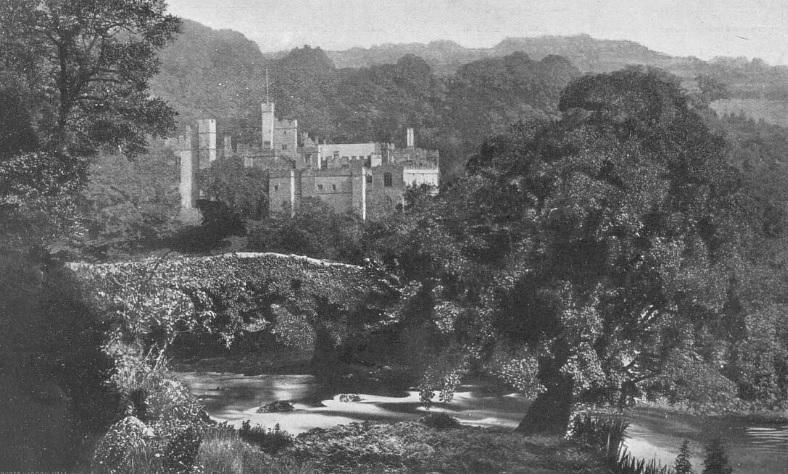
Sir Richard Vernon (c. 1390 – 1451) of Haddon Hall.
Vernon’s property was widespread and varied. From his parents he inherited the manors of Marple and Wibersley, in Cheshire. Perhaps the Over Haddon Wibersley’s origins were from Sir Richard Vernon’s property in Cheshire. There is, however, a medieval wayside cross called Whibbersley Cross situated on Leash Fen in the East Moors of the Derbyshire Peak District. It may have served as a boundary cross marking the estate of Beauchief Abbey. Wayside crosses such as this mostly date from the 9th to 15th centuries.Found in both The History and Antiquities of Haddon Hall by S Raynor, 1836, and the 1663 household accounts published by Lysons, Haddon Hall had 140 domestic staff.
In the book Haddon Hall, an Illustrated Guide, 1871, an example from the 1663 Christmas accounts:
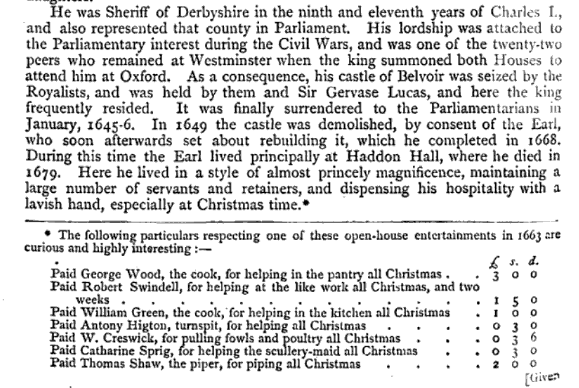
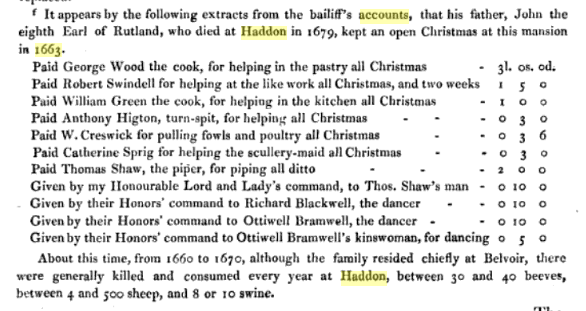
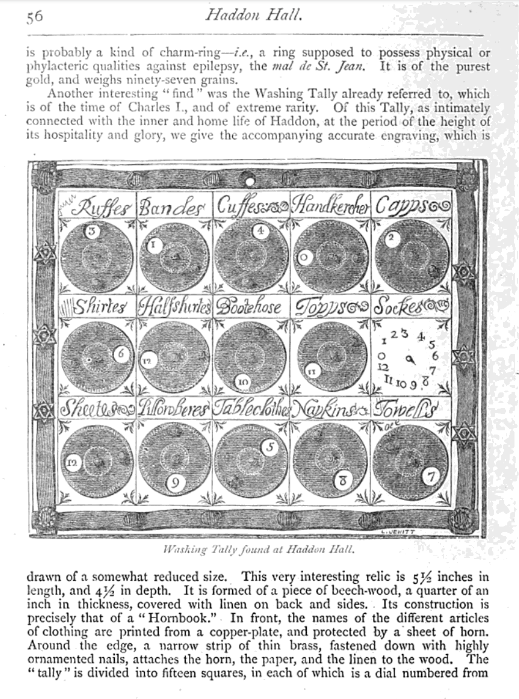
Also in this book, an early 1600s “washing tally” from Haddon Hall:
Over Haddon
Martha Taylor, “the fasting damsel”, was born in Over Haddon in 1649. She didn’t eat for almost two years before her death in 1684. One of the Quakers associated with the Marshall Quakers of Elton, John Gratton, visited the fasting damsel while he was living at Monyash, and occasionally “went two miles to see a woman at Over Haddon who pretended to live without meat.” from The Reliquary, 1861.
August 28, 2024 at 6:26 am #7548In reply to: The Elusive Samuel Housley and Other Family Stories
Elton Marshall’s
Early Quaker Emigrants to USA.
The earliest Marshall in my tree is Charles Marshall (my 5x great grandfather), Overseer of the Poor and Churchwarden of Elton. His 1819 gravestone in Elton says he was 77 years old when he died, indicating a birth in 1742, however no baptism can be found.
According to the Derbyshire records office, Elton was a chapelry of Youlgreave until 1866. The Youlgreave registers date back to the mid 1500s, and there are many Marshalls in the registers from 1559 onwards. The Elton registers however are incomplete due to fire damage.
While doing a google books search for Marshall’s of Elton, I found many American family history books mentioning Abraham Marshall of Gratton born in 1667, who became a Quaker aged 16, and emigrated to Pennsylvania USA in 1700. Some of these books say that Abraham’s parents were Humphrey Marshall and his wife Hannah Turner. (Gratton is a tiny village next to Elton, also in Youlgreave parish.)
Abraham’s son born in USA was also named Humphrey. He was a well known botanist.
Abraham’s cousin John Marshall, also a Quaker, emigrated from Elton to USA in 1687, according to these books.
(There are a number of books on Colonial Families in Pennsylvania that repeat each other so impossible to cite the original source)
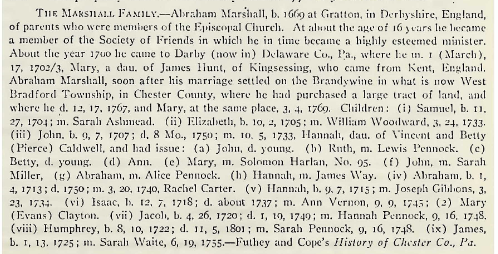
In the Youlgreave parish registers I found a baptism in 1667 for Humphrey Marshall son of Humphrey and Hannah. I didn’t find a baptism for Abraham, but it looks as though it could be correct. Abraham had a son he named Humphrey. But did it just look logical to whoever wrote the books, or do they know for sure? Did the famous botanist Humphrey Marshall have his own family records? The books don’t say where they got this information.
An earlier Humphrey Marshall was baptised in Youlgreave in 1559, his father Edmund. And in 1591 another Humphrey Marshall was baptised, his father George.
But can we connect these Marshall’s to ours? We do have an Abraham Marshall, grandson of Charles, born in 1792. The name isn’t all that common, so may indicate a family connection. The villages of Elton, Gratton and Youlgreave are all very small and it would seem very likely that the Marshall’s who went the USA are related to ours, if not brothers, then probably cousins.
Derbyshire Quakers
In “Derbyshire Quakers 1650-1761” by Helen Forde:
“… Friends lived predominantly in the northern half of the country during this first century of existence. Numbers may have been reduced by emigration to America and migration to other parts of the country but were never high and declined in the early eighteenth century. Predominantly a middle to lower class group economically, Derbyshire Friends numbered very few wealthy members. Many were yeoman farmers or wholesalers and it was these groups who dominated the business meetings having time to devote themselves to the Society. Only John Gratton of Monyash combined an outstanding ministry together with an organising ability which brought him recognition amongst London Friends as well as locally. Derbyshire Friends enjoyed comparatively harmonious relations with civil and Anglican authorities, though prior to the Toleration Act of 1639 the priests were their worst persecutors…..”
Also mentioned in this book: There were monthly meetings in Elton, as well as a number of other nearby places.
John Marshall of Elton 1682/3 appears in a list of Quaker emigrants from Derbyshire.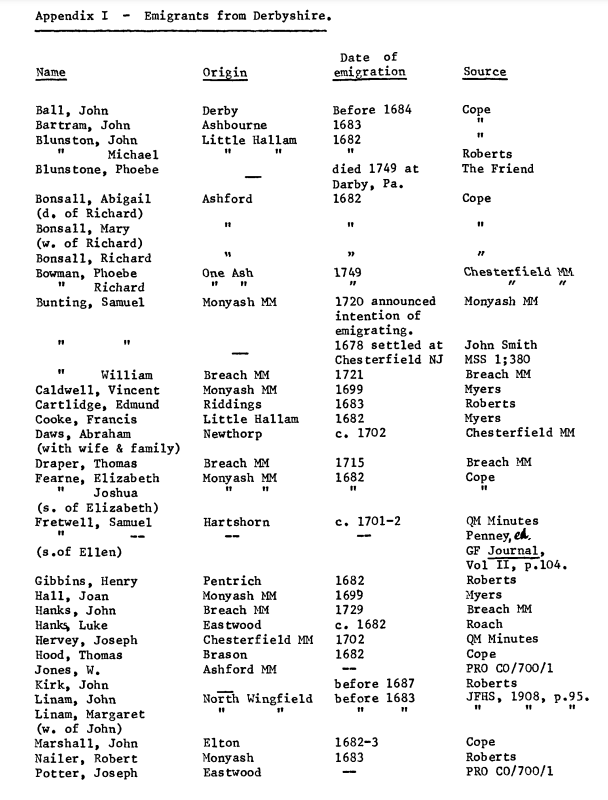
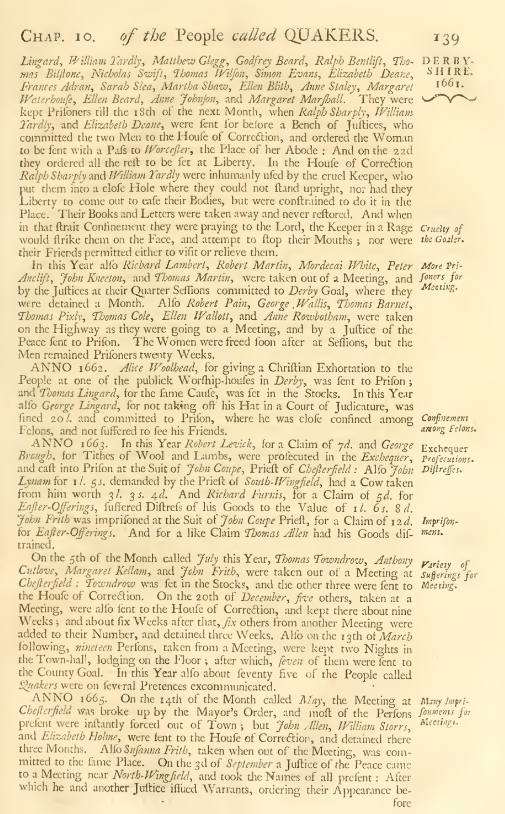
The following image is a page from the 1753 book on the sufferings of Quakers by Joseph Besse as an example of some of the persecutions of Quakers in Derbyshire in the 1600s:
A collection of the sufferings of the people called Quakers, for the testimony of a good conscience from the time of their being first distinguished by that name in the year 1650 to the time of the act commonly called the Act of toleration granted to Protestant dissenters in the first year of the reign of King William the Third and Queen Mary in the year 1689 (Volume 1)
Besse, Joseph. 1753Note the names Margaret Marshall and Anne Staley. This book would appear to contradict Helen Forde’s statement above about the harmonious relations with Anglican authority.
The Botanist
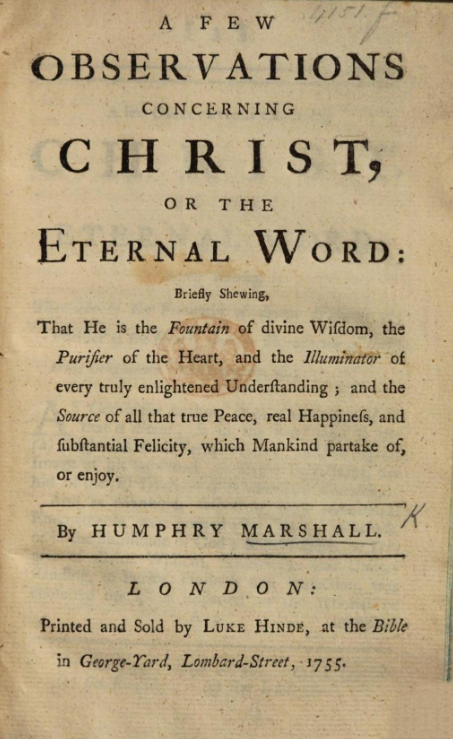
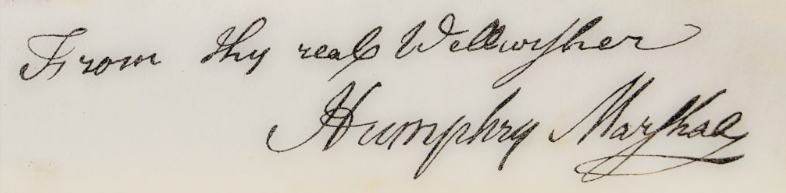
Humphry Marshall 1722-1801 was born in Marshallton, Pennsylvania, the son of the immigrant from Elton, Abraham Marshall. He was the cousin of botanists John Bartram and William Bartram. Like many early American botanists, he was a Quaker. He wrote his first book, A Few Observations Concerning Christ, in 1755.
In 1785, Marshall published Arbustrum Americanum: The American Grove, an Alphabetical Catalogue of Forest Trees and Shrubs, Natives of the American United States (Philadelphia).
Marshall has been called the “Father of American Dendrology”.
A genus of plants, Marshallia, was named in honor of Humphry Marshall and his nephew Moses Marshall, also a botanist.
In 1848 the Borough of West Chester established the Marshall Square Park in his honor. Marshall Square Park is four miles east of Marshallton.
via Wikipedia.
From The History of Chester County Pennsylvania, 1881, by J Smith Futhey and Gilbert Cope:
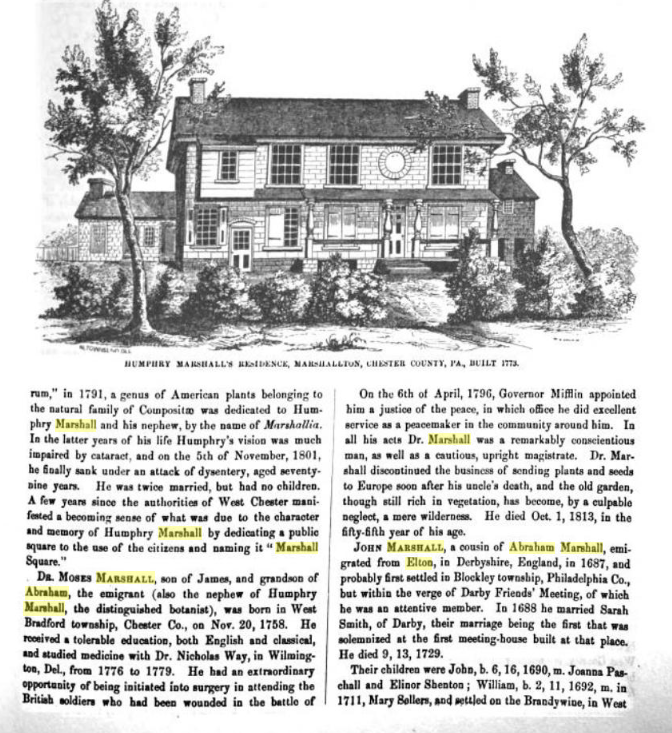
From The Chester Country History Center:
“Immediately on the Receipt of your Letter, I ordered a Reflecting Telescope for you which was made accordingly. Dr. Fothergill had since desired me to add a Microscope and Thermometer, and will
pay for the whole.’– Benjamin Franklin to Humphry, March 18, 1770
“In his lifetime, Humphry Marshall made his living as a stonemason, farmer, and miller, but eventually became known for his contributions to astronomy, meteorology, agriculture, and the natural sciences.
In 1773, Marshall built a stone house with a hothouse, a botanical laboratory, and an observatory for astronomical studies. He established an arboretum of native trees on the property and the second botanical garden in the nation (John Bartram, his cousin, had the first). From his home base, Humphry expanded his botanical plant exchange business and increased his overseas contacts. With the help of men like Benjamin Franklin and the English botanist Dr. John Fothergill, they eventually included German, Dutch, Swedish, and Irish plant collectors and scientists. Franklin, then living in London, introduced Marshall’s writings to the Royal Society in London and both men encouraged Marshall’s astronomical and botanical studies by supplying him with books and instruments including the latest telescope and microscope.
Marshall’s scientific work earned him honorary memberships to the American Philosophical Society and the Philadelphia Society for Promoting Agriculture, where he shared his ground-breaking ideas on scientific farming methods. In the years before the American Revolution, Marshall’s correspondence was based on his extensive plant and seed exchanges, which led to further studies and publications. In 1785, he authored his magnum opus, Arbustum Americanum: The American Grove. It is a catalog of American trees and shrubs that followed the Linnaean system of plant classification and was the first publication of its kind.”
 August 21, 2024 at 12:27 pm #7546
In reply to: The Elusive Samuel Housley and Other Family Stories
The Potters of Darley Bridge
Rebecca Knowles 1745-1823, my 5x great grandmother, married Charles Marshall 1742-1819, the churchwarden of Elton, in Darley, Derbyshire, in 1767. Rebecca was born in Darley in 1745, the youngest child of Roger Knowles 1695-1784, and Martha Potter 1702?-1772.
Although Roger and Martha were both from Darley, they were married in South Wingfield by licence in 1724. Roger’s occupation on the marriage licence was lead miner. (Lead miners in Derbyshire at that time usually mined their own land.) Jacob Potter signed the licence so I assumed that Jacob Potter was her father.
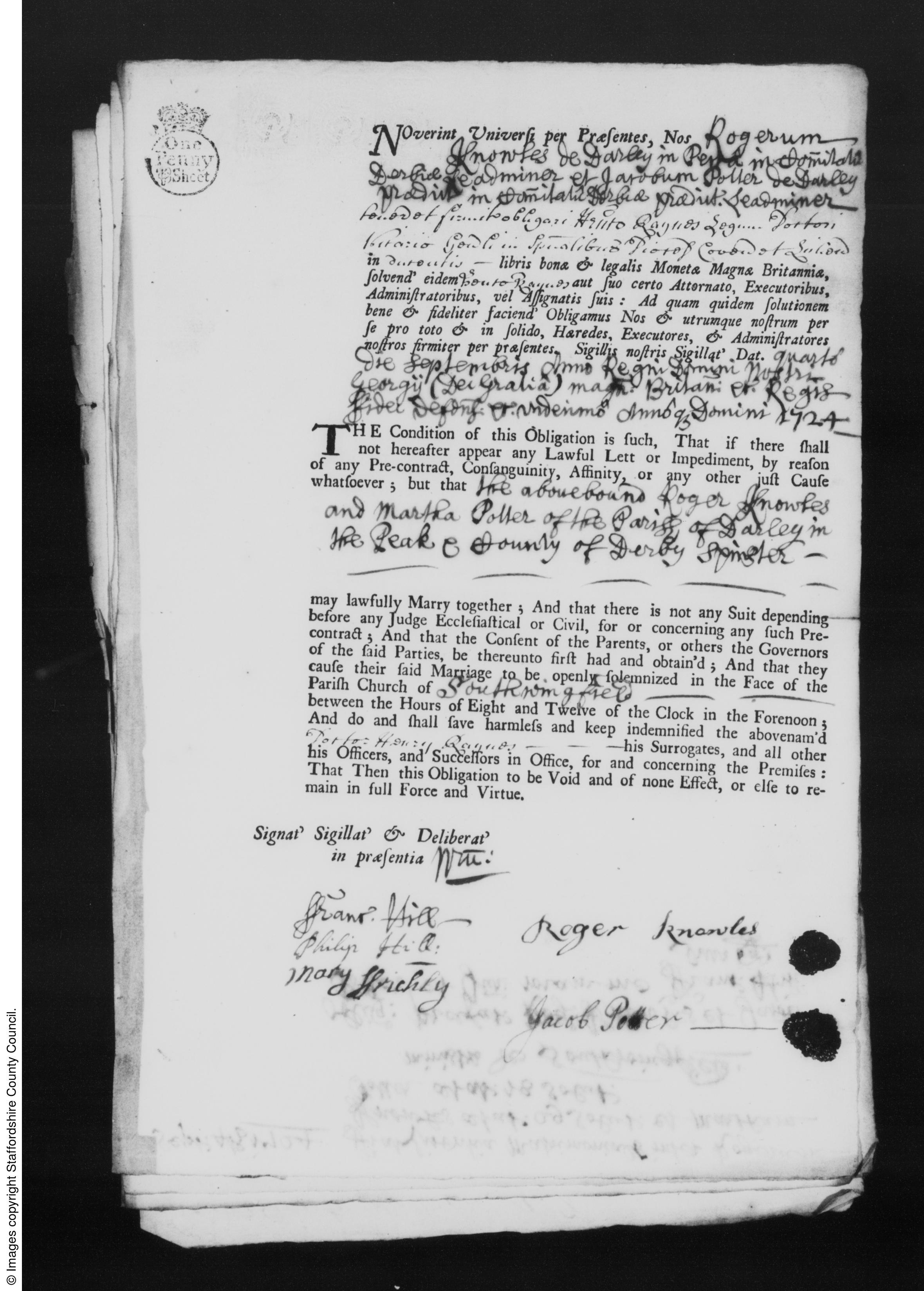
I then found the will of Jacobi Potter who died in 1719. However, he signed the will James Potter. Jacobi is latin for James. James Potter mentioned his daughter Martha in his will “when she comes of age”. Martha was the youngest child of James. James also mentioned in his will son James AND son Jacob, so there were both James’s and Jacob’s in the family, although at times in the documents James is written as Jacobi!
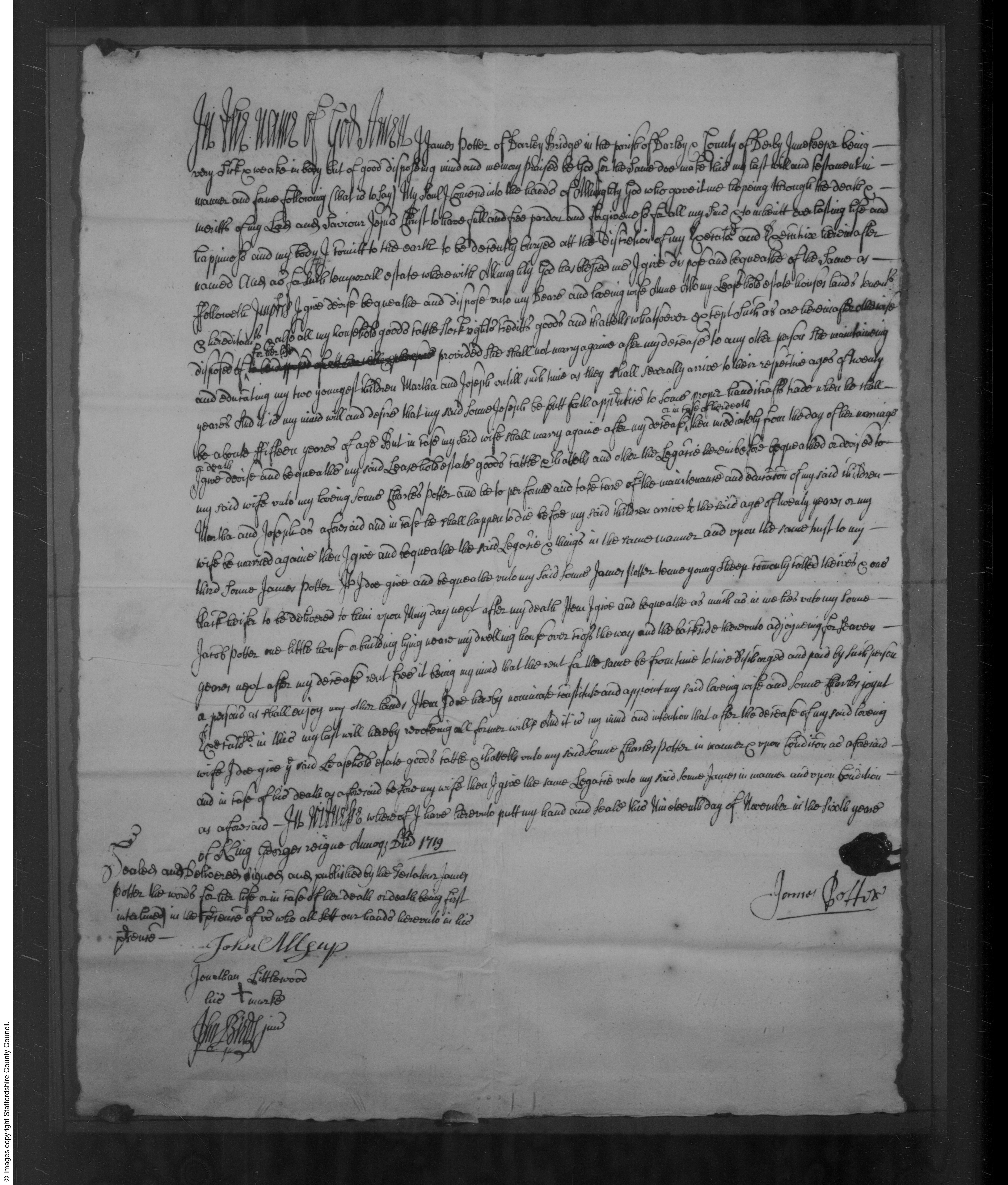
Jacob Potter who signed Martha’s marriage licence was her brother Jacob.
Martha’s brother James mentioned his sister Martha Knowles in his 1739 will, as well as his brother Jacob and his brother Joseph.
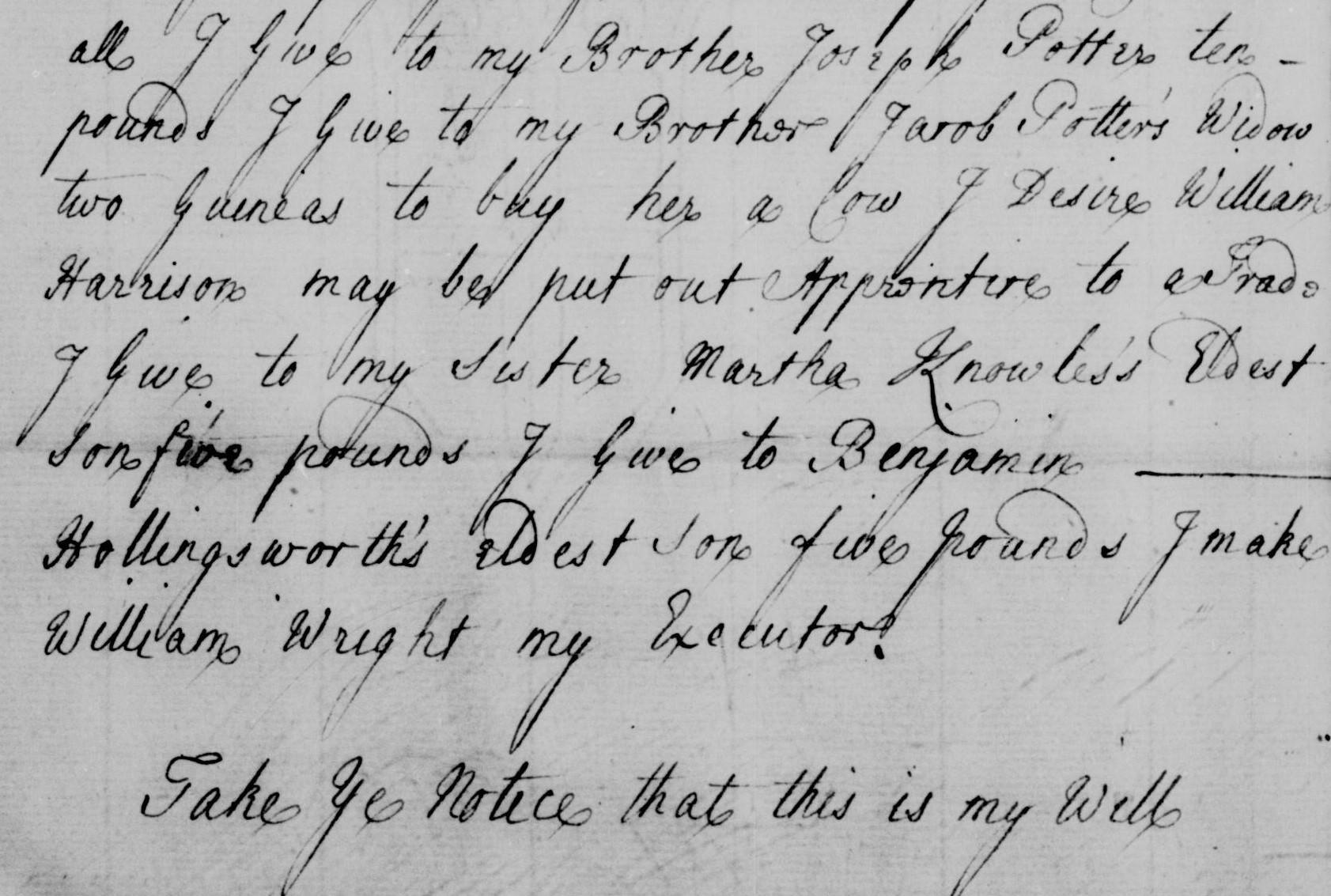
Martha’s father James Potter mentions his wife Ann in his 1719 will. James Potter married Ann Waterhurst in 1690 in Wirksworth, some seven miles from Darley. James occupation was innkeeper at Darley Bridge.
I did a search for Waterhurst (there was only a transcription available for that marriage, not a microfilm) and found no Waterhursts anywhere, but I did find many Warhursts in Derbyshire. In the older records, Warhust is also spelled Wearhurst and in a number of other ways. A Martha Warhurst died in Peak Forest, Derbyshire, in 1681. Her husbands name was missing from the deteriorated register pages. This may or may not be Martha Potter’s grandmother: the records for the 1600s are scanty if they exist at all, and often there are bits missing and illegible entries.
The only inn at Darley Bridge was The Three Stags Heads, by the bridge. It is now a listed building, and was on a medieval packhorse route. The current building was built in 1736, however there is a late 17th century section at rear of the cross wing. The Three Stags Heads was up for sale for £430,000 in 2022, the closure a result of the covid pandemic.

Another listed building in Darley Bridge is Potters Cottage, with a plaque above the door that says “Jonathan and Alice Potter 1763”. Jonathan Potter 1725-1785 was James grandson, the son of his son Charles Potter 1691-1752. His son Charles was also an innkeeper at Darley Bridge: James left the majority of his property to his son Charles.
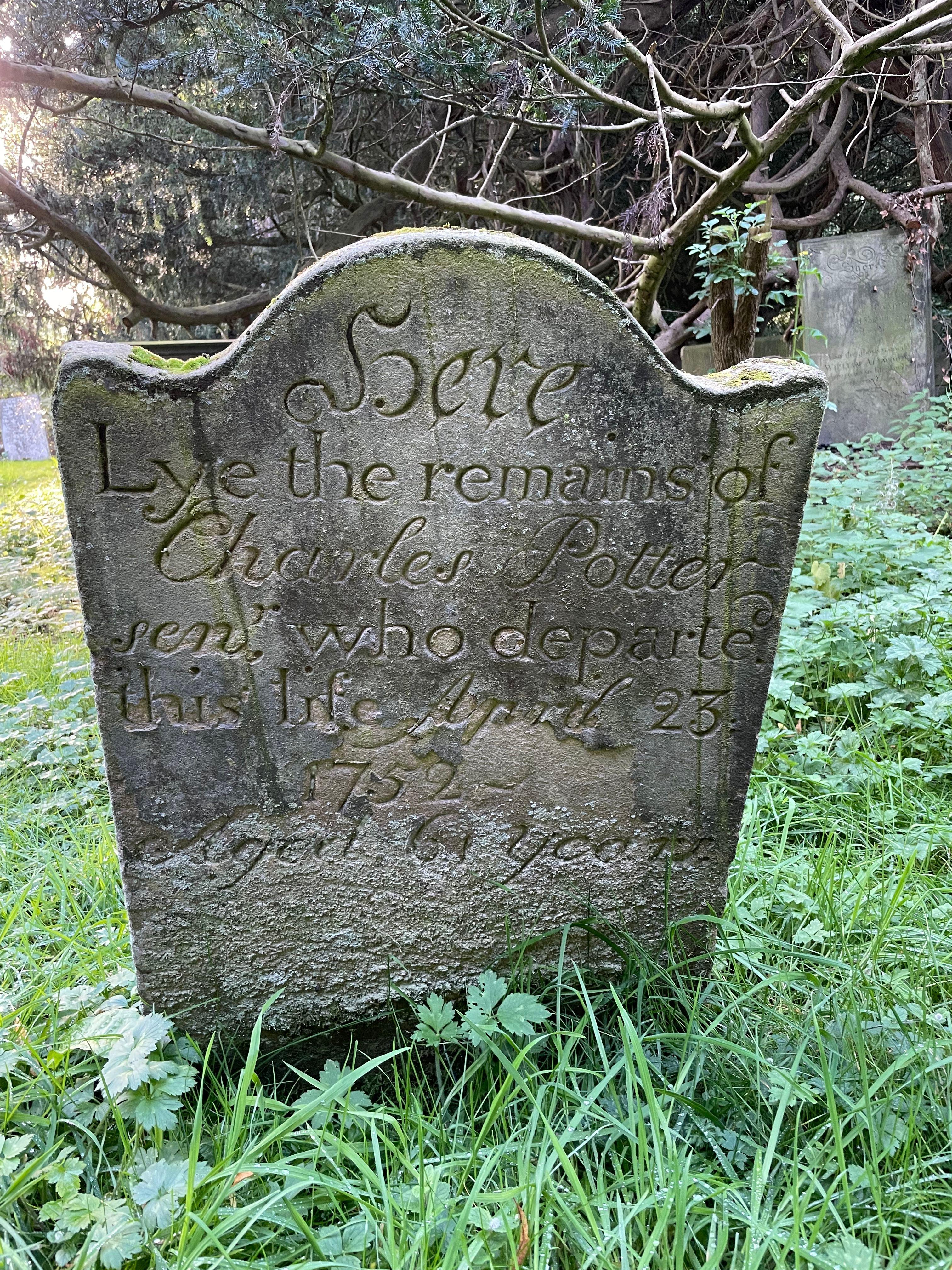
Charles is the only child of James Potter that we know the approximate date of birth, because his age was on his grave stone. I haven’t found any of their baptisms, but did note that many Potters were baptised in non conformist registers in Chesterfield.
Potters Cottage

Jonathan Potter of Potters Cottage married Alice Beeley in 1748.
“Darley Bridge was an important packhorse route across the River Derwent. There was a packhorse route from here up to Beeley Moor via Darley Dale. A reference to this bridge appears in 1504… Not far to the north of the bridge at Darley Dale is Church Lane; in 1635 it was known as Ghost Lane after a Scottish pedlar was murdered there. Pedlars tended to be called Scottish only because they sold cheap Scottish linen.”
via Derbyshire Heritage website.
According to Wikipedia, the bridge dates back to the 15th century.
August 16, 2024 at 2:56 pm #7544In reply to: The Elusive Samuel Housley and Other Family Stories
Youlgreave
The Frost Family and The Big Snow
The Youlgreave parish registers are said to be the most complete and interesting in the country. Starting in 1558, they are still largely intact today.
“The future historian of this parish will find a vast stock of material ready to hand, and if such a work was ever accomplished it would once more be seen how the history of even a remote village is but the history of the nation in little; how national victories were announced on the church bells, and national disasters by the proclamation of a form of prayer…”
J. Charles Cox, Notes on the Churches of Derbyshire, 1877.
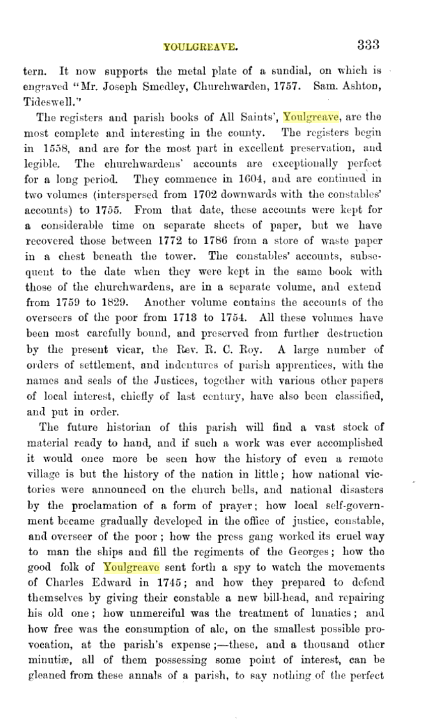
Although the Youlgreave parish registers are available online on microfilm, just the baptisms, marriages and burials are provided on the genealogy websites. However, I found some excerpts from the churchwardens accounts in a couple of old books, The Reliquary 1864, and Notes on Derbyshire Churches 1877.
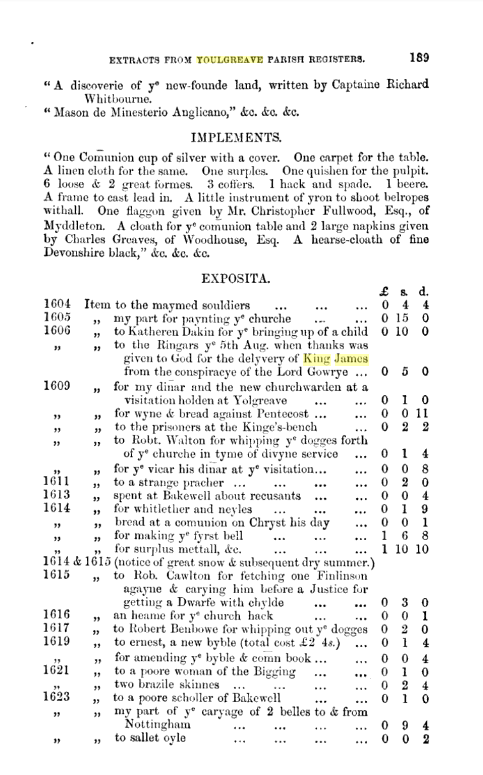
Hannah Keeling, my 4x great grandmother, was born in Youlgreave, Derbyshire, in 1767. In 1791 she married Edward Lees of Hartington, Derbyshire, a village seven and a half miles south west of Youlgreave. Edward and Hannah’s daughter Sarah Lees, born in Hartington in 1808, married Francis Featherstone in 1835. The Featherstone’s were farmers. Their daughter Emma Featherstone married John Marshall from Elton. Elton is just three miles from Youlgreave, and there are a great many Marshall’s in the Youlgreave parish registers, some no doubt distantly related to ours.
Hannah Keeling’s parents were John Keeling 1734-1823, and Ellen Frost 1739-1805, both of Youlgreave.
On the burial entry in the parish registers in Youlgreave in 1823, John Keeling was 88 years old when he died, and was the “late parish clerk”, indicating that my 5x great grandfather played a part in compiling the “best parish registers in the country”. In 1762 John’s father in law John Frost died intestate, and John Keeling, cordwainer, co signed the documents with his mother in law Ann. John Keeling was a shoe maker and a parish clerk.
John Keeling’s father was Thomas Keeling, baptised on the 9th of March 1709 in Youlgreave and his parents were John Keeling and Ann Ashmore. John and Ann were married on the 6th April 1708. Some of the transcriptions have Thomas baptised in March 1708, which would be a month before his parents married. However, this was before the Julian calendar was replaced by the Gregorian calendar, and prior to 1752 the new year started on the 25th of March, therefore the 9th of March 1708 was eleven months after the 6th April 1708.
Thomas Keeling married Dorothy, which we know from the baptism of John Keeling in 1734, but I have not been able to find their marriage recorded. Until I can find my 6x great grandmother Dorothy’s maiden name, I am unable to trace her family further back.
Unfortunately I haven’t found a baptism for Thomas’s father John Keeling, despite that there are Keelings in the Youlgrave registers in the early 1600s, possibly it is one of the few illegible entries in these registers.
The Frosts of Youlgreave
Ellen Frost’s father was John Frost, born in Youlgreave in 1707. John married Ann Staley of Elton in 1733 in Youlgreave.
(Note that this part of the family tree is the Marshall side, but we also have Staley’s in Elton on the Warren side. Our branch of the Elton Staley’s moved to Stapenhill in the mid 1700s. Robert Staley, born 1711 in Elton, died in Stapenhill in 1795. There are many Staley’s in the Youlgreave parish registers, going back to the late 1500s.)
John Frost (my 6x great grandfather), miner, died intestate in 1762 in Youlgreave. Miner in this case no doubt means a lead miner, mining his own land (as John Marshall’s father John was in Elton. On the 1851 census John Marshall senior was mining 9 acres). Ann Frost, as the widow and relict of the said deceased John Frost, claimed the right of administration of his estate. Ann Frost (nee Staley) signed her own name, somewhat unusual for a woman to be able to write in 1762, as well as her son in law John Keeling.
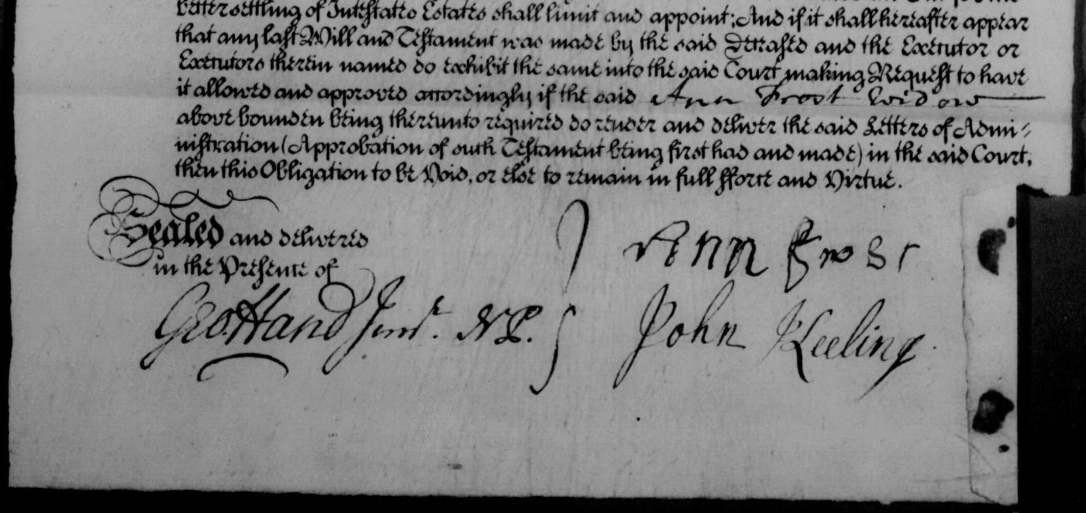
John’s parents were David Frost and Ann. David was baptised in 1665 in Youlgreave. Once again, I have not found a marriage for David and Ann so I am unable to continue further back with her family. Marriages were often held in the parish of the bride, and perhaps those neighbouring parish records from the 1600s haven’t survived.
David’s parents were William Frost and Ellen (or Ellin, or Helen, depending on how the parish clerk chose to spell it). Once again, their marriage hasn’t been found, but was probably in a neighbouring parish.
William Frost’s wife Ellen, my 8x great grandmother, died in Youlgreave in 1713. In her will she left her daughter Catherine £20. Catherine was born in 1665 and was apparently unmarried at the age of 48 in 1713. She named her son Isaac Frost (born in 1662) executor, and left him the remainder of her “goods, chattels and cattle”.
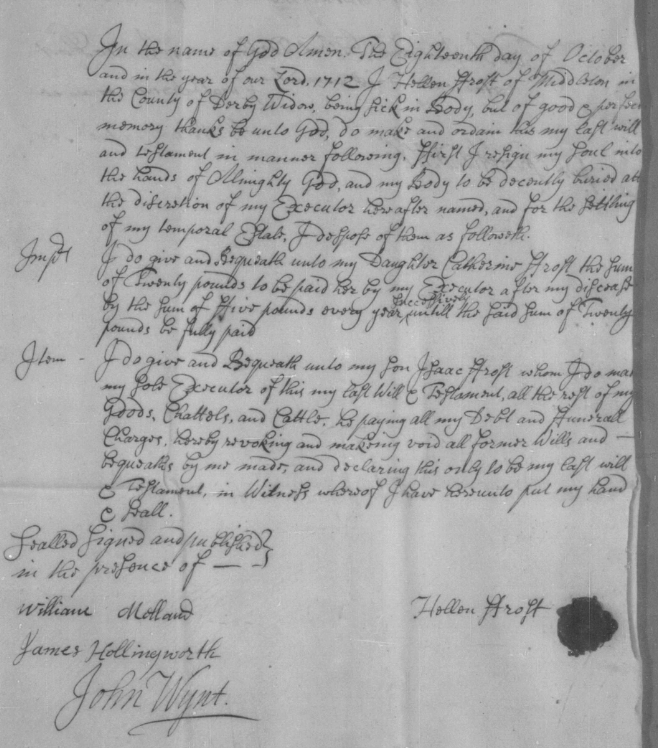
William Frost was baptised in Youlgreave in 1627, his parents were William Frost and Anne.
William Frost senior, husbandman, was probably born circa 1600, and died intestate in 1648 in Middleton, Youlgreave. His widow Anna was named in the document. On the compilation of the inventory of his goods, Thomas Garratt, Will Melland and A Kidiard are named.(Husbandman: The old word for a farmer below the rank of yeoman. A husbandman usually held his land by copyhold or leasehold tenure and may be regarded as the ‘average farmer in his locality’. The words ‘yeoman’ and ‘husbandman’ were gradually replaced in the later 18th and 19th centuries by ‘farmer’.)
Unable to find a baptism for William Frost born circa 1600, I read through all the pages of the Youlgreave parish registers from 1558 to 1610. Despite the good condition of these registers, there are a number of illegible entries. There were three Frost families baptising children during this timeframe and one of these is likely to be Willliam’s.
Baptisms:
1581 Eliz Frost, father Michael.
1582 Francis f Michael. (must have died in infancy)
1582 Margaret f William.
1585 Francis f Michael.
1586 John f Nicholas.
1588 Barbara f Michael.
1590 Francis f Nicholas.
1591 Joane f Michael.
1594 John f Michael.
1598 George f Michael.
1600 Fredericke (female!) f William.Marriages in Youlgreave which could be William’s parents:
1579 Michael Frost Eliz Staley
1587 Edward Frost Katherine Hall
1600 Nicholas Frost Katherine Hardy.
1606 John Frost Eliz Hanson.Michael Frost of Youlgreave is mentioned on the Derbyshire Muster Rolls in 1585.
(Muster records: 1522-1649. The militia muster rolls listed all those liable for military service.)
Frideswide:
A burial is recorded in 1584 for Frideswide Frost (female) father Michael. As the father is named, this indicates that Frideswide was a child.
(Frithuswith, commonly Frideswide c. 650 – 19 October 727), was an English princess and abbess. She is credited as the foundress of a monastery later incorporated into Christ Church, Oxford. She was the daughter of a sub-king of a Merica named Dida of Eynsham whose lands occupied western Oxfordshire and the upper reaches of the River Thames.)
An unusual name, and certainly very different from the usual names of the Frost siblings. As I did not find a baptism for her, I wondered if perhaps she died too soon for a baptism and was given a saints name, in the hope that it would help in the afterlife, given the beliefs of the times. Or perhaps it wasn’t an unusual name at the time in Youlgreave. A Fridesweda Gilbert was buried in Youlgreave in 1604, the spinster daughter of Francis Gilbert. There is a small brass effigy in the church, underneath is written “Frideswide Gilbert to the grave, Hath resigned her earthly part…”
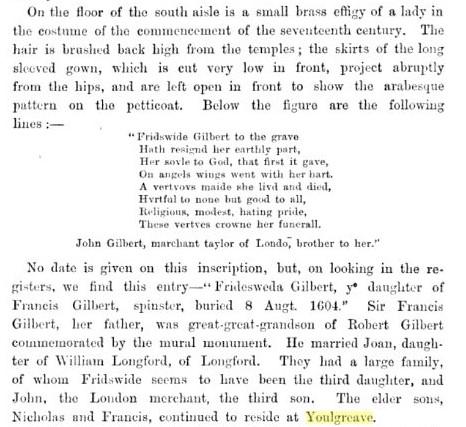
J. Charles Cox, Notes on the Churches of Derbyshire, 1877.
King James
A parish register entry in 1603:
“1603 King James of Skottland was proclaimed kinge of England, France and Ireland at Bakewell upon Monday being the 29th of March 1603.” (March 1603 would be 1604, because of the Julian calendar in use at the time.)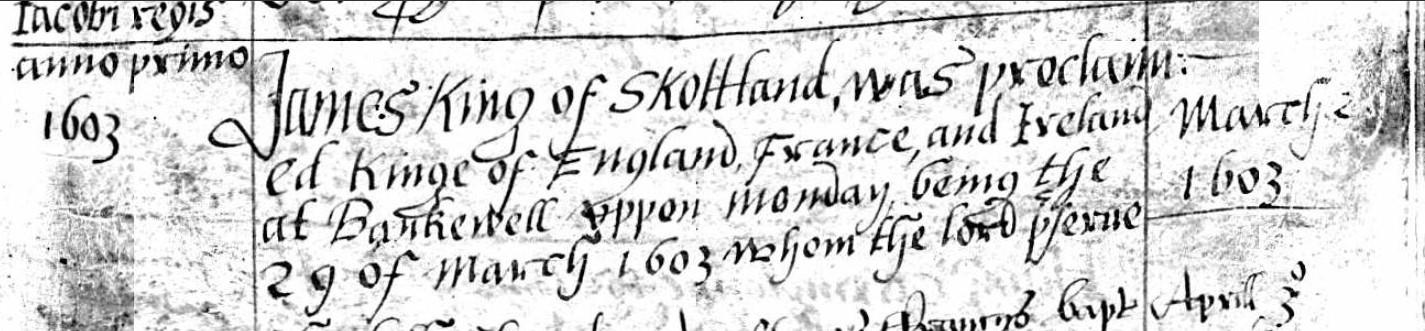
The Big Snow
“This year 1614/5 January 16th began the greatest snow whichever fell uppon the earth within man’s memorye. It covered the earth fyve quarters deep uppon the playne. And for heaps or drifts of snow, they were very deep; so that passengers both horse or foot passed over yates, hedges and walles. ….The spring was so cold and so late that much cattel was in very great danger and some died….”
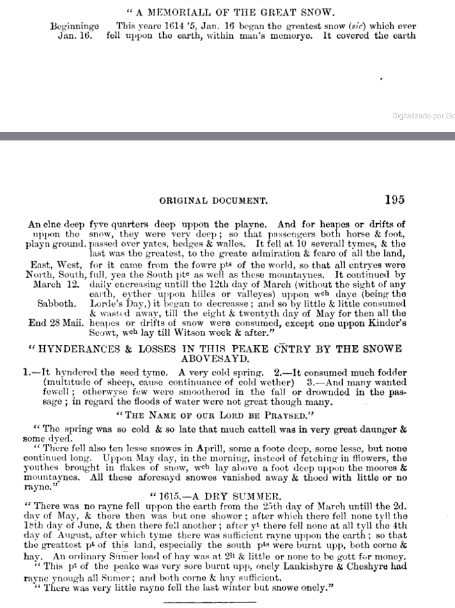
From the Youlgreave parish registers.
Our ancestor William Frost born circa 1600 would have been a teenager during the big snow.
July 23, 2024 at 8:03 am #7540In reply to: The Incense of the Quadrivium’s Mystiques
“When did you arrive?” asked Truella when they found her in her at her Cloacina booth in faux-fur waterproof boots and a faux-bear-fur cape with a waterproofed silk hood to protect her perfect hairdo from the incessant drizzle. It gave her a look of one of those Fantasy warrior-goddess ready to intervene at the last minute to save her chosen champions from complete destruction by the forces of evil.
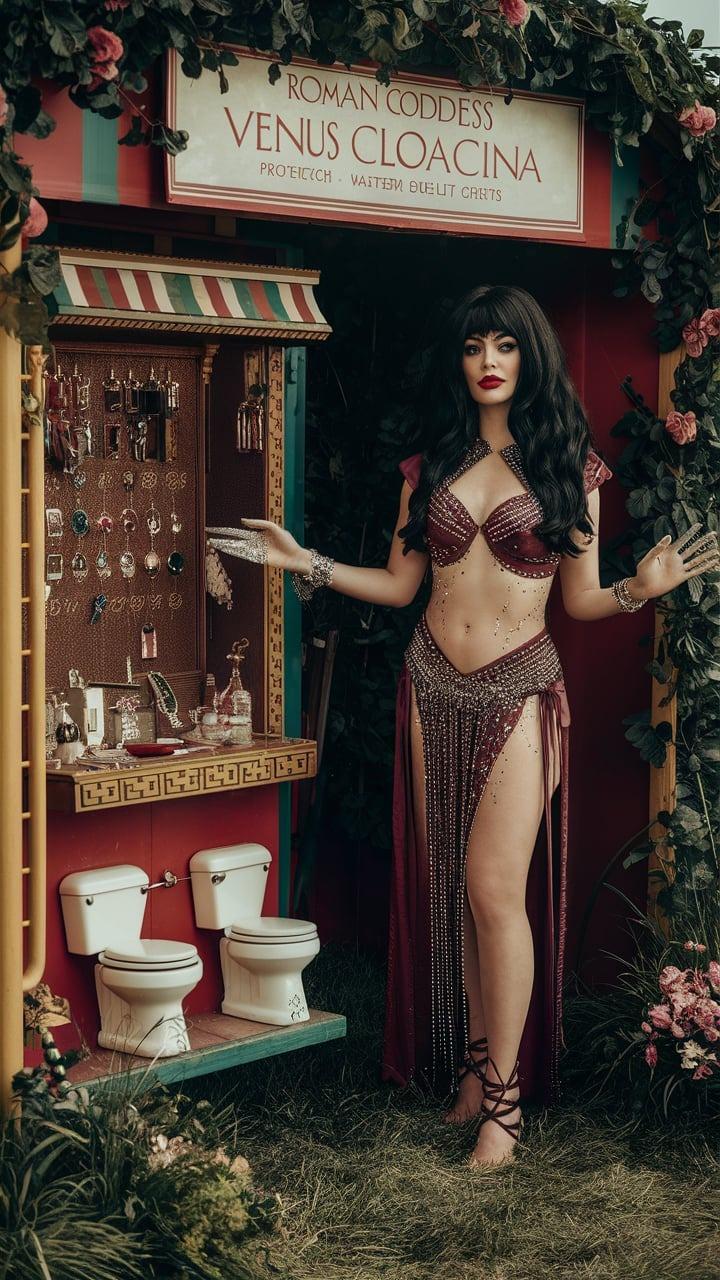
“Well, I’ve been there all along,” retorted the glamour witch, moving two little loos in front of the booth closer together. “I’ve been living in Limerick since the start of this story, even if it wasn’t clear where. Granny Linda thinks I’m living in Glamorheaven and Finnley think I’m living in London, but I’m pretty sure it’s Limerick. At least it is in my mind manor,” she said as if for herself. “There!” she said. Her face lit up as she just found the perfect orientation for the loos. “Don’t those miniature loos look cute?”
“Sure,” said Truella. At the same time she looked at Frella as if their friend had gone nut.
“Don’t ask me,” said Frella. “I didn’t make the selection of the goddesses for the olympic set.”
Jeezel took three cups, dipped them into one of the toilet bowl and offered them to her friends to drink.
Truella grimaced.
“I prefer not to drink that early in the morning,” said Frella with a polite smile.
Jeezel lifted the cup to her nose and inhaled deeply before taking a sip. “It’s connected to the purest water source on Earth through a little time sewer spell coupled with a little pump and filter and a nice chime when you throw your worries in. It’s perfectly safe and drinkable sparkling water, and it smells of roses.”
“My gran used to spray rose scent in the bathroom after she used it,” said Truella, cackling nervously.
Frella took the cup, smelled it and continued smiling.
“Anyways, those cuties are for the cleansing prayers,” said Jeezel. “Cleansing and release,” she added pointing her finger up at the banner. “That’s Cloacina’s motto. At least at this booth. And, as I’m sure you asked, I didn’t answer all your messages because I’ve been kept busy with preparing all of those. Here, Truelle, take one of those Sacred Bath Salts. I have two flavors, Moonlight Mist and Sunset Serenity. Take the second one, it’s a blend of Himalayan pink salt and rose petals. It’ll help keep you warm as the salts will absorb the extra humidity, and as an extra it’ll make you think of your gran”, she added with a grin. “As for my friend Frella…”
Truella grabbed the pouch of salts and smelled it. “The smell is not so bad,” she conceded. “And Bubona knows I need their warming qualities,” she said shaking her head to get rid of irritating water drops.
Jeezel then turned to the potion and elixirs section. “No, not purification for Frella, and neither of you need the Lover’s Elixir… Oh! Here it is, take that. A soap made of goat’s milk, honey and calendula oil for radiant skin. And good to keep the hinges perfectly oiled. And as my future gran will say, remember, keeping those hinges oiled is key to avoiding squeaky situations.”
Frella took the soap and chuckled. “Thanks.” She scratched the surface with her nail. “It’s seems good quality. And it smells good. That reminds me I have to prepare my own booth. See you later girls.”
As soon as she left. Truella leaned towards her friend and asked in a conspiratory voice: “Did you know Malove was here?”
“What?”
July 5, 2024 at 6:39 pm #7531In reply to: Washed off the sea ~ Creative larks
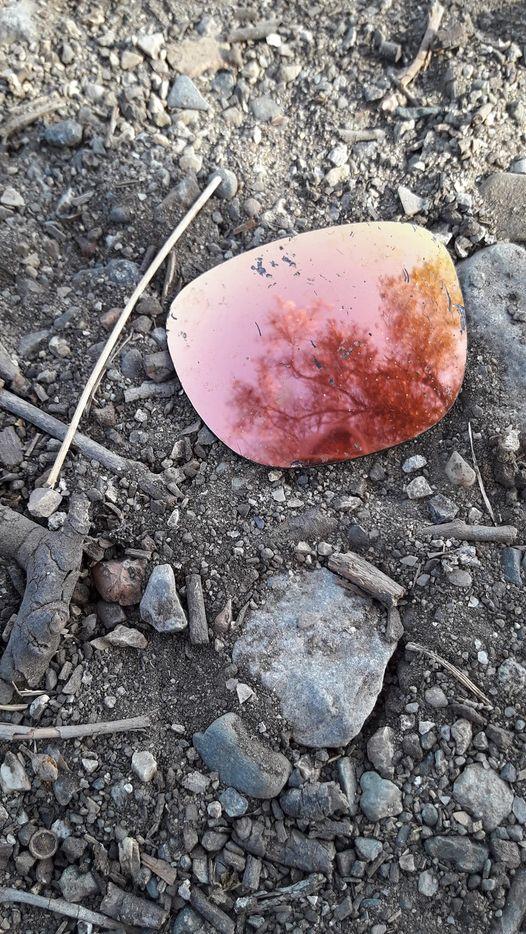
The rose coloured spectacle lens.
Aunt Idle:
“Well, crikey, finding one pink sunglass lens on the road is quite the curiosity, isn’t it? Let’s delve into the symbolic undertones of such an odd discovery. Pink lens, no less—a splash of color with quite the story to tell.
1. Seeing the World through Rose-Tinted Glasses: Finding a pink sunglass lens can symbolize optimism and seeing the world in a positive light. But here’s the kicker—it’s just one lens. This suggests a duality; perhaps you’re being asked to blend optimism with realism. Life isn’t always about sunshine and rainbows, but choosing to see the bright side can balance out the darker shades.
2. Fragmented Perspectives: A single lens means you don’t have the full picture. You’re seeing things partially, which can indicate missing information or a need to look at situations from multiple angles. It’s a nudge to take off those blinders and open your other eye, figuratively speaking. You might be clinging to a half-truth or ignoring an important aspect of your life.
3. Lost and Found: In practical terms, a lone lens on the road means someone has lost it. It’s a signifier of separation, maybe something in your life has split or broken apart. It can be a gentle reminder to look into areas where you might have lost connection—be it with loved ones, a project, or even a part of yourself.
4. Symbol of Love and Compassion: Pink is often associated with love, compassion, and femininity. The lens could be a reminder to look at things with kindness and empathy. Perhaps there’s a situation in your life that requires a softer, more loving approach.
5. Hindsight and Insight: The road is a metaphor for your life’s journey. Finding the lens there might hint at reflecting on past experiences (hindsight) while gaining new understanding or clarity (insight). Maybe there’s an opportunity to learn from what’s happened and apply it moving forward, seeing things with fresh, yet incomplete, clarity.
Putting it in Truella’s Context: If Truella found this lens, it could be a sign she needs to reassess her current path or research direction. Her overwhelming stack of books and discovery of the ancient manuscript hint at a bigger picture she might not be seeing clearly yet. Perhaps she’s overly focused on one aspect and neglecting others.
Personal Symbolism for Aunt Idle: For you, Aunt Idle, this lens could be a cheeky nudge to reassess some of your adventurous antics and half-remembered tales. Maybe there’s an old mystery or a relationship needing a fresh perspective. Or it’s just life’s way of saying, “Look closer, love—you might be missing out!”
In any case, a single pink sunglass lens is a quirky, delightful piece of life’s puzzle, inviting you to ponder, reflect, and adjust your view. So, next time you’re journeying on the dusty roads of life and stumble upon such oddities, take a moment—there just might be a zinger of wisdom waiting for you. Cheers!”
“A lone pink lens paves the road to the unseen clarity of kaleidoscopic sunrise.”
~Journey of Reflections, Enrich P. Lwellman. The Snoot:
“Ahhh, a single pink lens, lost and found amidst the stone and dust! Sings of mysteries and tales untold! Perhaps a sprite misplaced their vision or a pixie left a clue.
Lean close! Such a find whispers soft secrets:
Balance Broken, Yet Bright Like seeing life with a tint of whimsy! One eye tinted pink, the other clear. A call to mix reality with dreams, maybe?
Half Truth, Half Fantasy A hint that stories blend truths and imaginations. Seek both sides to find whole pictures.
Lost and Waiting Could be a sign someone’s journey is incomplete, needing you as a puzzle piece. Maybe the other lens waits for your path?Snootly wisdom: Use the lens not to see, but to imagine.Peer through the pink and let dreams color your heart. Could be you’re on the cusp of a grand adventure; just follow the allure of the pink!
Liz:
Oh, darling, how positively intriguing! A single pink sunglass lens left upon the road—why, it’s like a snippet from one of my novels, fraught with symbolism and brimming with untold stories.
Let’s unravel this little mystery together, shall we? First, the color pink itself is rich with meaning. It speaks of love, compassion, and a certain kind of whimsicality. It’s a hue that embodies the gentle side of passion, the tender whispers of the heart. Now, to find just one lens, separated from its twin, adds a layer of poignancy. It’s a fragment of something once whole, a poignant reminder of loss or incompletion.
One might surmise that this lens represents a part of oneself that has been misplaced or overlooked. Perhaps it’s a call to rediscover a piece of your own heart, the softer, more romantic side that life’s hustle and bustle may have sidelined. Or it could symbolize a different perspective—after all, sunglasses shield us from the sun’s glare, making things clearer in their own shaded way. This lone lens might be urging you to look at a situation with fresh eyes, to find beauty in the fragmented and the unexpected.
Imagine, if you will, a character in one of my novels stumbling upon this very lens. They’d be on the cusp of a grand adventure, naturally. The pink lens would become their talisman, a clue leading them to unforeseen revelations and untold treasures. It would be both a physical object and a metaphorical guide, urging them to view the world—and their place within it—through a lens of love and compassion.
Perhaps it is also a nod to the impermanence of things, a gentle reminder that beauty and meaning can be found even in life’s fleeting moments. Much like the single pink lens, our journeys are filled with fragments of experiences that, when pieced together, create a mosaic of our existence.
So, my dear, take this as a sign to embrace the whimsical, to seek out the overlooked pieces of your own story, and to cherish the beauty of the incomplete. After all, it’s the mysteries and the musings that make life a narrative worth living.
Mater:
Ah, a single pink sunglass lens on the road, you say? Now that’s a curious find. Objects like that can be teeming with symbolic meaning if you’ve got the eyes to see it. Let’s break it down a bit, shall we?
Firstly, the color pink. Traditionally, pink is associated with love, compassion, and nurturing. It’s a color that often brings to mind warmth and affection, something tender and gentle. But finding just one lens suggests something is missing or incomplete—a piece of a larger whole.
A sunglass lens, on the other hand, is meant to protect the eyes from harsh light, allowing you to see the world more clearly without being blinded. Seeing through a pink lens, metaphorically speaking, can mean looking at life with an optimistic or compassionate perspective. It’s like seeing the world through rose-colored glasses, as they say.
Now, finding just one lens on the road—well, roads are pathways, journeys, the direction we take in life. A single lens could indicate a moment of clarity or a shift in perspective on your journey. But it could also symbolize a need to find balance or the missing piece of your outlook to see the full picture clearly.
Maybe it’s a nudge from the universe to take a closer look at how you view your current path. Are you seeing things in the best light possible? Or perhaps it’s a reminder that while optimism and compassion are vital, you might be missing another crucial aspect—realism or practicality, perhaps?
Or, it could be as simple as a reminder to lighten up and find joy and playfulness in your journey.
Like a pink flamingo standing on one leg, sometimes life’s oddities are just there to make you smile and wonder.
Whatever the meaning, love, take it as a sign to reflect and consider. The road ahead is always full of mystery and wonder, and sometimes the smallest things can carry the biggest messages.
Finnley:
Pink sunglass lens on the road, you say? Well, ain’t that a curious bit of rubbish. If we’re dabbling in symbolism, it could mean a variety of things depending on how fanciful you want to get. Pink is often associated with love, compassion, and care. So, finding a lens could mean you’re only seeing half the picture when it comes to matters of the heart. Or maybe you’re missing the rosy view on life, and you need to adjust your perspective.
Then again, it could just mean some poor sod lost their sunnies and now they’ve got a squint and a sunburnt nose. Life’s not always riddled with deep meanings, sometimes it’s just a bit of lost plastic on the tarmac.
Now, if you ask me, you ought to be more concerned about the litter. If everyone went around leaving bits and bobs all over the place, we’d be living in a right tip. So pick it up, toss it in the bin, and let’s keep things tidy, shall we?
Mandrake:
Ah, the solitary pink sunglass lens on the road. Delightfully poetic. A symbol of half-seen truths, perhaps? Seeing the world through rose-tinted glasses, but only partially. Could it be urging you to seek balance, to view life with both optimism and realism? Or maybe just a nudge from the universe to pick up your litter. Such profundity from a piece of plastic. Life’s a riddle, darling.
Sha: A pink sunglass lens on the road, eh? Now that’s a right peculiar find if ever I ‘eard one. Makes you wonder what it means, don’t it?
Glo: Oh, Sha, you’re always lookin’ for the hidden meanin’ in things. It’s just a bit of plastic, ain’t it? Though, come to think of it, pink’s a powerful colour. Symbolises love, compassion, and all that mushy stuff.
Mavis: I reckon it might be a sign, ladies. A pink lens… maybe it’s tellin’ you to look at the world through rose-tinted glasses, y’know? See the good in things. Or it could be a message from the universe, remindin’ you to keep an eye out for the unusual.
Sha: Right you are, Mav! And let’s not forget the conspiracies! Maybe it’s a clue from them secret societies, leavin’ hints for those sharp enough to notice. Could be part of a bigger puzzle, a breadcrumb leadin’ to somethin’ magnificent.
Glo: Or maybe someone’s just dropped their specs out the car window in a rush, and it’s nothin’ more than that. But where’s the fun in that sort of thinkin’?
Mavis: True, true. We’ll go with the idea that it’s a symbol of keepin’ an open mind and lookin’ out for the small wonders of life. Who knows what other treasures we might find if we keep our eyes peeled?
Sha: And next time we’re out and about, let’s be on the lookout for the other lens. Could be a sign that we’re missin’ half the picture.
Glo: Oh, you and your signs, Sha! But alright, we’ll keep our peepers open. Never know what the universe might be tryin’ to tell us next.
June 26, 2024 at 7:09 am #7526In reply to: The Incense of the Quadrivium’s Mystiques
Truella slept for longer than she intended, indeed, she had not intended to sleep at all, there was too much to do. Trying to hold on to the fragments of dream recall, she sat up and rubbed her eyes. Glancing around the room, she couldn’t immediately remember what she was doing there. Suddenly she sat bolt upright. What was that conversation she’d had before falling alseep? Truella felt dizzy trying to remember. She stood up and started to pace the room, and noticed a letter had been pushed under the bedroom door. She frowned as she bent to pick it up. Nothing was written on the outside, but the envelope had been sealed with a blob of red wax. Truella opened the letter carefully without breaking the seal. A yellowy page was inside, written in Latin.
Ordo Amphibiae-Luciae: pertinebant ad Ordinem Amphibiae-Luciae.
Truella’s Latin was rusty to say the least. She sat back down on the bed struggling to decipher the message.
The Order of Amphibia-Lucia: They belonged to the Order of Amphibia-Lucia.
Nomen Amphibia-Lucia provenit ex duplici natura: tam terrena quam mundana. Rana facies symbolica est repraesentatio nexus eorum ad aquam, transformationem, et antiqua numina amphibiana.
The name “Amphibia-Lucia” stems from their dual nature: both earthly and otherworldly. The frog face is a symbolic representation of their connection to water, transformation, and ancient amphibian deities. They believe in metamorphosis, much like a tadpole turns into a frog, embodying cycles of death and rebirth These priestesses predated Christianity by eons. Their practices and rituals were about aligning with the cosmic cycles, harnessing planetary energies, and maintaining harmony between the seen and the unseen. They were known to perform rites that involved intricate dances, chants in forgotten tongues, and the use of ancient artifacts that, according to legend, could summon or banish entities from beyond our realm—dragons included.
Tartessus in obscurum, secretissimae sectae, ordo Amphibiae-Luciae, sub terra perrexit, ad litteram. Scientiam suam servaverunt, eam per generationes transeuntes, ritus suos in secretis clausulis sub culturis recentioribus obrutos servaverunt. Christianismus in terram pervasit, sed hae sorores aptatae, antiquas vias obtegunt sub specie hodiernae opinionis systemata superstites vigereque.
When Tartessos fell into obscurity, its most secretive sect, the Order of Amphibia-Lucia, went underground—literally. They preserved their knowledge, passing it down through generations, maintaining their rituals in secretive enclaves buried beneath newer civilizations. Christianity might’ve swept over the land, but these sisters adapted, cloaking their ancient ways under the guise of more contemporary belief systems to survive and thrive.
In cellis cellis in ipsum cubiculum illorum claustrorum contextum habemus reliquias ordinis pervetusti, dogmatum ac dogmatum recentioris millennii securos. Hais ex quo saeviunt dii, rudis sacra, et advena mundus.
In the cellars woven into the very bedrock of those cloisters, we have the remnants of an archaic order, unconcerned with dogmas and doctrines of the more recent two millennia. They’re from a time when gods were wilder, rituals were raw, and the world was a stranger.
When the nuns under Hildegarde von Bingen’s influence merged with these ancient priestesses, it wasn’t just a blending of orders but a clash and harmony of traditions. Hildegarde herself, in her visionary wisdom, likely recognized the power and ancient wisdom of the Order of Amphibia-Lucia, choosing to weave their potent rituals into her own esoteric Christian practices. The frog-faced sisters are no mere relics of an outdated faith. They’re the living embodiment of an ancient, potent lineage that predates and outlasts many of the world’s religions. They’re the keepers of ancient Tartessian magic, lurking in those cellars, waiting for the right time to hop back into the forefront of history.
So that was it! But who had pushed the letter under her door? And why was it written in Latin? Had everyone else received a letter?
June 21, 2024 at 10:04 am #7516In reply to: The Incense of the Quadrivium’s Mystiques
“Wait! Look at that one up there!” Truella grabbed Rufus’s arm. “That cloth hanging right up there by the rafters, see it? Have you got a torch, it’s so dark up there.”
Obligingly, Rufus pulled a torch out of his leather coat pocket. “That looks like…”
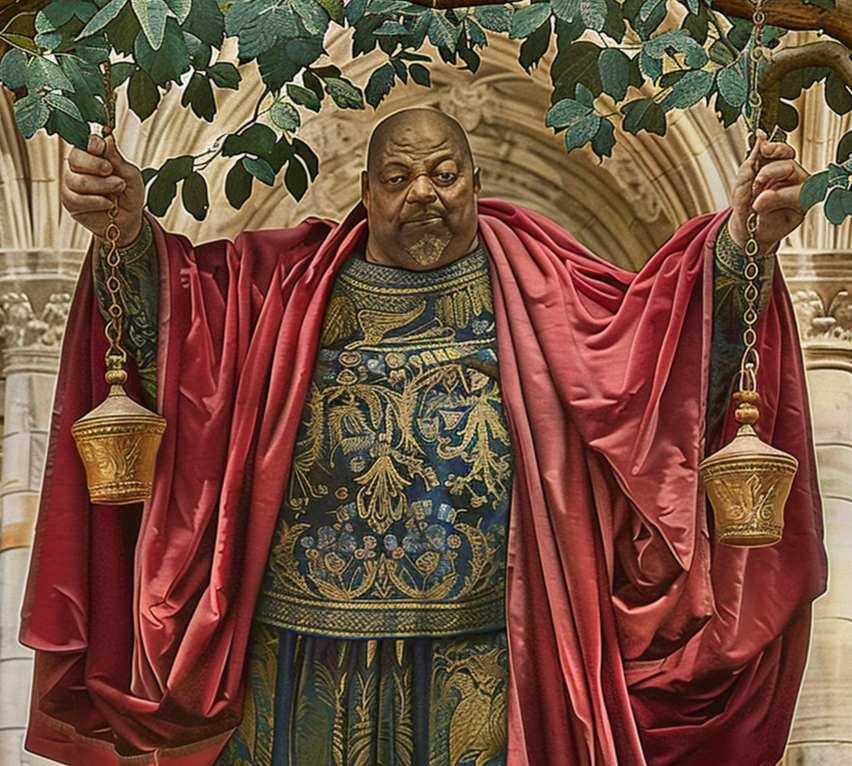
“Brother Bartolo!” Truella finished for him in a whisper. “Why is there an ancient tapestry of him, with all those frog faced nuns?”
Rufus felt dizzy and clutched the bannisters to steady himself. It was all coming back to him in a rush: images and sounds crowded his mind, malodorous wafts assailed his nostrils.
“Why, whatever is the matter? You look like you’ve seen a ghost. Come, come and sit down in my room.”
“Don’t you remember?” Rufus asked, with a note of desperation in his voice. “You remember now, don’t you?”
“Come,” Truella insisted, tugging his arm. “Not here on the stairs.”
Rufus allowed Truella to lead him to her room, rubbing a hand over his eyes. He was so damn hot in this leather coat. The memories had first chilled him to the bone, and then a prickly sweat broke out.
Leading him into her room, Truella closed and locked the door behind them. “You look so hot,” she said softly and reached up to slide the heavy coat from his shoulders. They were close now, very close. “Take it off, darling, take it all off. We can talk later.”
Rufus didn’t wait to be asked twice. He slipped out of his clothes quickly as Truella’s dress fell to the floor. She bent down to remove her undergarments, and raised her head slowly. She gasped, not once but twice, the second time when her eyes were level with his manly chest. The Punic frog amulet! It was identical to the one she had found in her dig.
A terrible thought crossed her mind. Had he stolen it? Or were there two of them? Were they connected to the frog faced sisters? But she would think about all that later.
“Darling,” she breathed, “It’s been so long….”
June 20, 2024 at 9:52 am #7510In reply to: The Incense of the Quadrivium’s Mystiques
After everyone got the program for the six rituals, they dispersed. Jeezel observed groups reform and the whereabouts of people. Eris walked alone toward the dark corridors. Truella, Sandra and Sassafras went to the gardens. Rufus followed shortly after, his dark moody eyes showing intense reflections. Jeezel noticed that Bartolo from the convent had been observing the mortician and hurried to catch up with him. Mother Lorena stood as stern as ever in the center of the lobby. She kept cupping her hands around her ears to check if her earpieces were working. Which they weren’t from the irritated look on her face. Silas was in an animated discussion with Austreberthe and the remaining nuns were laughing heartily and running around as if they had overindulged in Sister Sassafras’ hallucinogenic mushroom canapés.
Jeezel decided to go back to the lounge and explore the antiques, maybe see if there were hidden passageways behind those tapestries. She found Garrett waiting for her in the corridor as if he knew what she intended to do. His deep blue eyes seemed to embrace her whole silhouette in a myriad of unspoken emotions, and when they settle on her emerald green eyes, a subtle grin showed his appreciation.
“Don’t look back,” he said, his voice a deep velvet baritone. “Old Silas and Austreberthe are looking at us with a very disapproving look.”
Jeezel couldn’t help but chuckle softly. “And what if they do? We’re not doing anything wrong.”
Garrett’s grin widened. He took a step closer, the scent of his cologne– a tantalizing mix of cedarwood and bergamot– mingling with the faint aroma of her own enchanting perfume.
“You intrigue me, Jeezel. More than the rituals, more than any relic or spell.”
Jeezel laughed heartily. Don’t they say keep your enemy close? I have questions for him. And I wouldn’t mind the company while I’m exploring the area? she thought.
“I was about to check for secret passages in the old lounge,” she said. “Would you join me?”
She let him take her hand and guide her toward the lounge. As they entered the heavy scent of aged wood and old books greeted them. Jeezel’s eyes darted to the tapestries lining the walls, each depicting scenes of ancient rituals and forgotten histories.
“Where do you think we should start?” Garrett asked, his deep voice barely above a whisper, adding to the mysterious ambiance of the room.
Jeezel tilted her head, considering the possibilities. “That one,” she said, pointing to a particularly intricate tapestry depicting a moonlit garden. “It looks like it could hide something.” She reached out to the fabric and pulled it aside, revealing a wooden door. She tensed when she noticed lingering traces of cedarwood and bergamot. “Or someone,” she added, turning toward him. “You’ve been here recently, have you not?”
“Direct as ever. Very well. I’m here to protect and help you. You need to be careful with Silas. He has hidden motives.”
Jeezel narrowed her eyes. “And why should I trust you?”
Garrett pulled out his crimson handkerchief from his pocket, revealing a symbol embroidered in gold. Her eyes widened as identical to the one on the key Malové had given her.
“How did you get that?” she asked.
“Malové entrusted me with this,” Garret explained, “to show her chosen allies. I was told to seek you out and offer you my assistance. This symbol matches the one on your key, doesn’t it?”
Jeezel felt the weight of the key in her purse. She hadn’t shown it to anyone, not even to her friends. She felt even more confused than before. It was possible that Silas would try to divert her attention from him if he was against the merger. And what better way to do than alert her to unknown enemies. The fact that Garrett knew about the key just added a layer of complexity to the situation, but also a layer of excitement. She wondered what game was being played here, and who were the true players.
“Alright, Garrett,” she said, her voice steadying as she added, “I’ll hear you out. But if you’re lying, you’ll regret it.”
He nodded. “Faire enough. Silas isn’t just interested in the failure of the merger; he’s got his own agenda. Something to do with ancient punic artifacts and power that could rival even the Crimson Opus. And he’s not the only one. There are some ancient Punic families that are looking for the same things.”
Jeezel’s heart skipped a beat. If Silas was after the same kind of power, it could jeopardize everything—the merger, her mission, and possibly the balance of power in their world. Jeezle felt she was in way over her head. She had to breathe and connect to her inner Queen’s innate knowledge in order to slide into her role of leader.
“Then, I accept your assistance,” she conceded with a slight node. “But this doesn’t mean I trust you, Garrett. You’ll have to prove your loyalty.”
Garrett folded the handkerchief back into his pocket. “I wouldn’t expect anything less. For now, let’s just say our interests align. And if we work together, we might just come out of this with everything we need—and more.”
“Then show me where this hidden door lead!”
June 19, 2024 at 8:53 pm #7508In reply to: The Incense of the Quadrivium’s Mystiques
After an eternity of cordial superficial conversation with a vertitable horde of new characters, and despite that some of them seemed either potentially interesting, possibly entertaining, or just downright intriguingly bizarre, Truella badly needed a quiet moment to herself, or in other words, a cigarette. Excusing herself from a strained attempt at getting to know a prim thin lipped nun whose name escaped her, Truella made her way over to the cloisters beyond the open doors. The courtyard beckoned, a breath of fresh air and a peaceful respite.
Leaning against a pillar, Truella took a drag on her cigarette, exhaling long and slowly. Perhaps it was just the shafts of sunlight making it seem that there was so much smoke. It hadn’t been too bad, after all. What an assorted bag they all were! Truella hadn’t given any thought to what all these new people she was to merge with would be like ~ she’d been focused on the intrusion into her own pursuits that such a thing would inevitably entail.
Rufus seemed to be keeping his distance, but Truella was relishing it, like knowing there’s cheesecake in the fridge for a midnight snack. Surprisingly, the two nuns Sandra and Sassafras seemed like good eggs underneath those dreadful habits. Truella was glad that Sassafras was her partner for the ritual; certainly it would have been worse with one of those silent ones. She wondered if Sassafras had anything planned, and if she should have thought about the ritual sooner. But then, how could she have known? The assumption had been that the partners would meet, and then come up with something together. Wasn’t it just a fun getting to know each other game kind of thing?
“How many cigarettes are you smoking out here?” Sandra laughed, “Can’t say I blame you though, gawd, will it never end.” Coughing, she lit a cigarette. “What is it you’re smoking anyway? What a funny smell, like the bowels of the earth.”
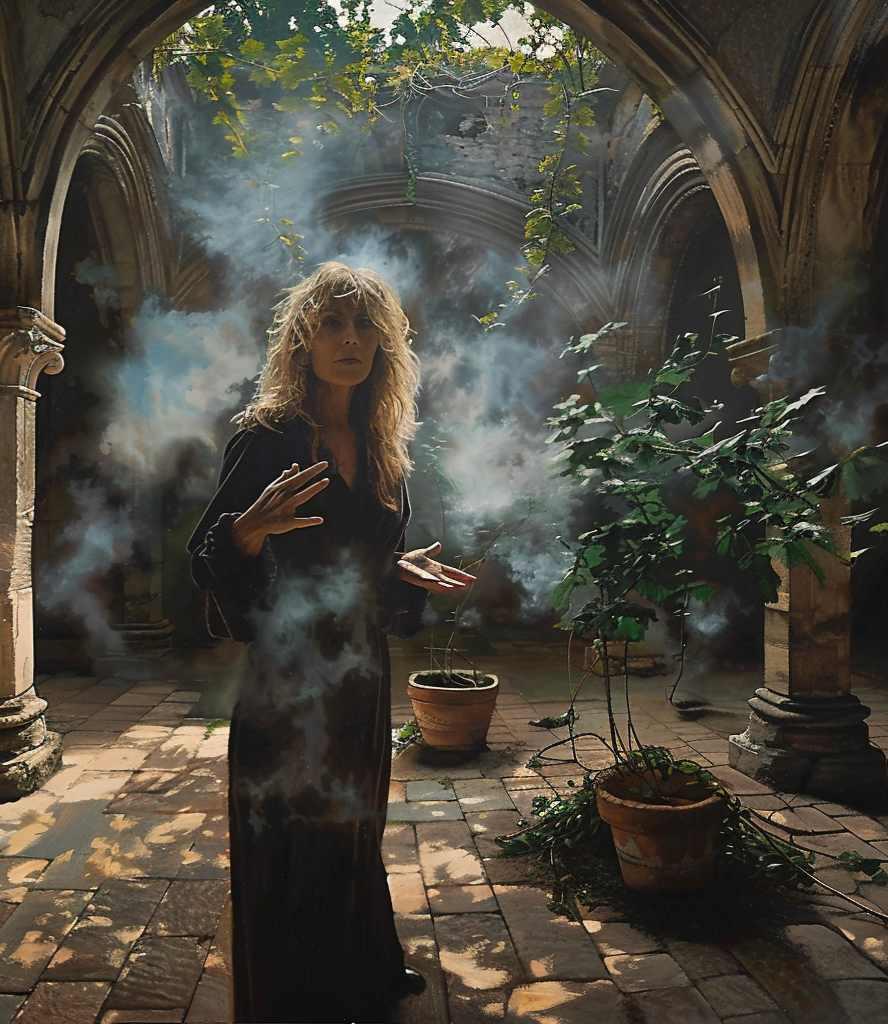
Truella thought this was rather rude, but had to admit that the smoke did smell peculiar. “That’s exactly what it smells like. And that smoke isn’t from my cigarette.”
“Fee Fi Finnley Fum, I smell the smoke of a dragon’s bum,” Sandra tried to laugh and failed. “Oh, heck. I don’t like dragons.”
“Neither do I,” Truella didn’t like the sound of this at all, but it had given her an idea for her ritual.
June 19, 2024 at 12:19 pm #7505In reply to: The Incense of the Quadrivium’s Mystiques
It was a good thing that Mother Lorena, who was notoriously hard of hearing was not within earshot.
She would have been horrified at the mention of conduction of “six rituals” in those hallowed grounds.
Luckily, she was busy reviewing and stoking fireplaces around the convent, due to the unexpected cold snap due to the Sahara sands painting the skies in a somber reddish darkly dark.

Meanwhile, Eris who has followed Echo’s instructions after the sprite had LiDAR’d the underground spaces, had quickly found herself in the underground ways thanks to its instructions, close to the telluric surges origins. She could see there were pockets of magma softly bubbling underground. The upstairs agitation seemed to have stirred the currents.
A little spell, used wisely, would do just fine – as an omen, or as a threat, all sorts of motivations tactics which had the best of intentions in order to dispel tensions, with just the right alignment of energies… as touching the earth’s core, needed summoning of both respect and precision.
Ignis Draconis, come to form, Through the earth, through the storm, Guided by my whispered call, Rise, smoke dragons, one and all.
June 17, 2024 at 7:13 pm #7493In reply to: The Incense of the Quadrivium’s Mystiques
“Do you know who that Everone is?” Jeezel whispered to Eris.
“Shtt,” she silenced Jeezel worried that some creative inspiration sparked into existence yet another character into their swirling adventure.
The ancient stone walls of the Cloisters resonated with the hum of anticipation. The air was thick with the scent of incense barely covering musky dogs’ fart undertones, mingling with the faint aroma of fresh parchment eaten away by centuries of neglect. Illuminated by the soft glow of enchanted lanterns sparkling chaotically like a toddler’s magic candle at its birthday, the grand hall was prepared for an unprecedented gathering of minds and traditions.
While all the attendants were fumbling around, grasping at the finger foods and chitchatting while things were getting ready, Eris was reminded of the scene of the deal’s signature between the two sisterhoods unlikely brought together.
Few weeks before, under a great deal of secrecy, Malové, Austreberthe, and Lorena had convened in the cloister’s grand hall, the gothic arches echoing their words. Before she signed, Lorena had stated rather grandiloquently, with a voice firm and unwavering. “We are a nunnery dedicated to craftsmanship and spiritual devotion. This merger must respect our traditions.”
Austreberthe, ever the pragmatist, replied, “And we bring innovation and magical prowess. Together, we can create something greater than the sum of our parts.”
The undertaker’s spokesman, Garrett, had interjected with a charming smile, “Consider us the matchmakers of this unlikely union. We promise not to leave you at the altar.”
That’s were he’d started to spell out the numbingly long Strategic Integration Plan to build mutual understanding of the mission and a framework for collaboration.Eris sighed at the memory. That would require yet a great deal of joint workshops and collaborative sessions — something that would be the key to facilitate new product developments and innovation. Interestingly, Malové at the time had suggested for Jeezel to lead with Silas the integration rituals designed to symbolically and spiritually unite the groups. She’d had always had a soft spot for our Jeezel, but that seemed unprecedented to want to put her to task on something as delicate. Maybe there was another plan in motion, she would have to trust Malové’s foresight and let it play out.
As the heavy oak doors creaked open, a hush fell over the assembled witches, nuns and the undertakers. Mother Lorena Blaen stepped forward. Her presence was commanding, her eyes sharp and scrutinising. She wore the traditional garb of her order, but her demeanour was anything but traditional.
“Welcome, everyone,” Lorena began, her voice echoing through the hallowed halls. “Or should I say, welcome to the heart of tradition and innovation, where ancient craftsmanship meets arcane mastery.”
She paused, letting her words sink in, before continuing. “You stand at the threshold of the Quintessivium Cloister Crafts, a sanctuary where every stitch is a prayer, every garment a humble display of our deepest devotion. But today, we are not just nuns and witches, morticians and mystics. Today, we are the architects of a new era.”
Truella yawned at the speech, not without waving like a schoolgirl at the tall Rufus guy, while Lorena was presenting a few of the nuns, ready to model in various fashionable nun’s garbs for their latest midsummer fashion show.
Lorena’s eyes twinkled with a mixture of pride and determination as she turned back to the visitors. “Together, we shall transcend the boundaries of faith and magic. With the guidance of the Morticians’ Guild—Garrett, Rufus, Silas, and Nemo—we will forge a new path, one that honors our past while embracing the future.”
Garrett, ever the showman, gave a theatrical bow. “We’re here to ensure this union is as seamless as a well-tailored shroud, my dear Lorena.” Rufus, standing silent and vigilant, offered a nod of agreement. Silas, with his grandfatherly smile, added, “We bring centuries of wisdom to this endeavor. Trust in the old ways, and we shall succeed.” Nemo, with his characteristic smirk, couldn’t resist a final quip. “And if things go awry, well, we have ways of making them… interesting.”
June 17, 2024 at 12:22 pm #7492In reply to: The Incense of the Quadrivium’s Mystiques
“Welcome to The Cloisters, everyone! Please, make yourselves comfortable, our girls will be with you shortly. Ah, here’s Brother Bartolo with refreshments.” And with that, Lorena turned on her heel and clacked noisily off down the corridor in search of the nuns. How appallingly rude of them all to be late for the reception!
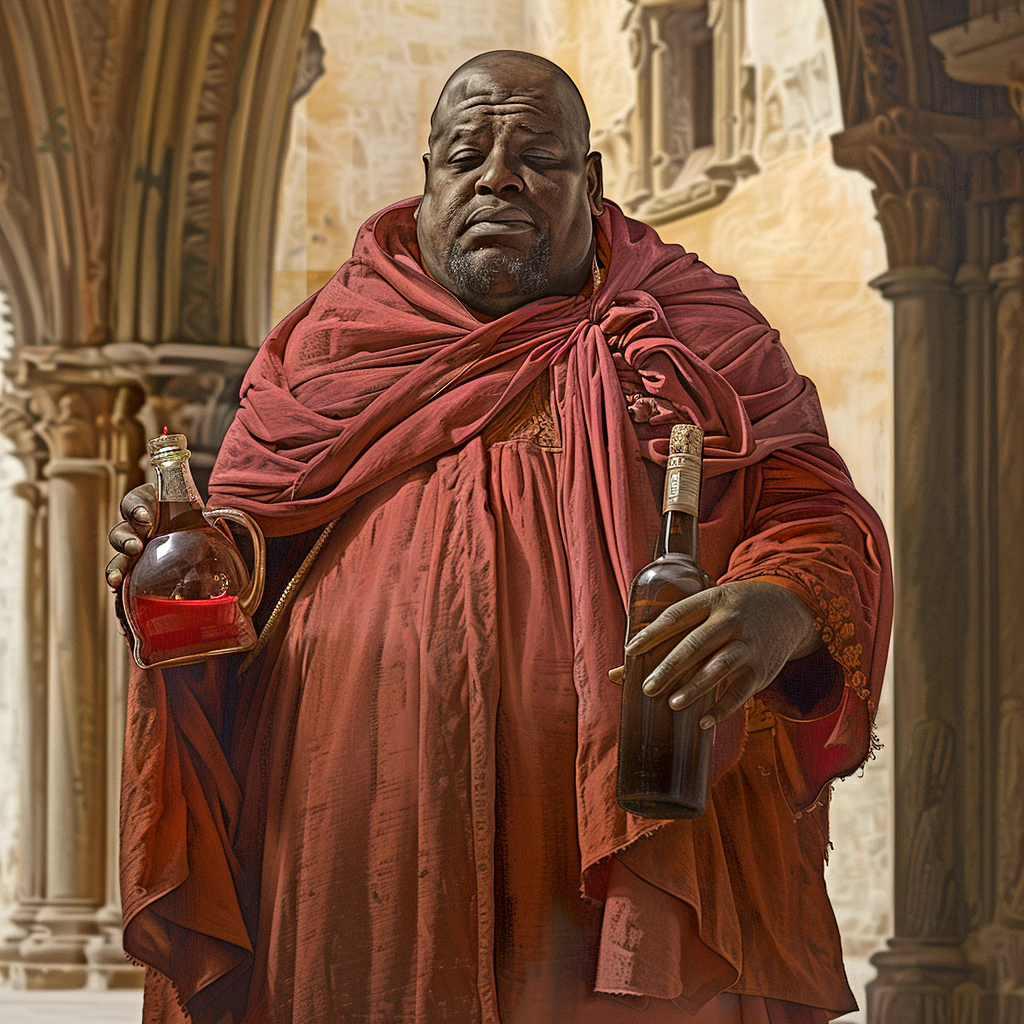
-
AuthorSearch Results