
Daily Random Quote

Latest Activity

Search Results for 'children'

Forums Search Search Results for 'children'

Viewing 20 results - 101 through 120 (of 218 total)
  • Author
    Search Results
  • #6223
    TracyTracy
    Participant

      Kate Purdy and the DH Lawrence Connection

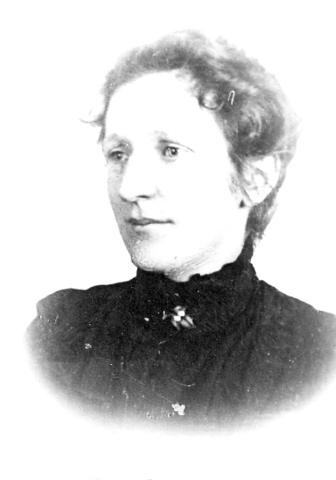
      Catherine (Kate) Purdy 1874-1950  was my grandfather George Marshall’s aunt, and the mother of George Rushby who went to Africa.  The photo is one of our family photos, and we knew that the woman at the back third from the right was an aunt of my grandfather’s. We didn’t know that it was Kate until we saw other photos of her in Mike’s collection.

      DH Lawrence was born in Eastwood at roughly the same time as my great grandmother Mary Ann Gilman Purdy. Apparently his books are based on actual people living in the area at the time, so I read as many of his books as I could find, to help paint the picture of the time and place.  I also found out via an Eastwood facebook group, that he was not well liked there, and still isn’t. They say he was a wife beater, a groper and was cruel to animals, and they did not want a statue of him in their town!

      Kate Rushby third from right back row:

      Kate Rushby

      Kate Rushby’s story as told by her grandson Mike:

      George’s daughter Catherine (Kate) Purdy grew up in Eastwood and was living at Walnut Tree Lane when, at the age of 21, and on the 24 Sep 1894, she married John Henry Payling Rushby who was a policeman in the Grimsby Police. John Henry left the Police and together they bought a public house “The Three Tuns Inn” at Beggarlee. The establishment was frequented by amongst others, the writer D.H.Lawrence who wrote much of his book “Sons and Lovers” in the Inn. In his book he calls the Inn “The Moon and Stars” and mentions Kate. though not by name.

      John Henry Rushby had two children, Charlotte and George Gilman Rushby. But a year after the birth of George on 28 Feb 1900, John Henry died at the age of thirty on 13 Sep 1901. He liked to show off his strength to his friends by lifting above his head an oak barrel full of beer. This would have weighed almost 200 kilograms. “He bust his gut” Kate said. He died of peritonitis following a hernia.

      Following the death of John Henry, Kate managed the Three Tuns Inn on her own. But a regular visitor to the Inn was Frank Freer who was a singer and used to entertain the patrons with his fine baritone voice and by playing the cornet. He and Kate got married, but he turned out to be a drunk who beat his wife and was cruel to her son. They separated and he died from alcoholism, though he may also have been struck on the head with a beer bottle by a person unknown. She then married Mr Gregory Simpson who fathered a daughter Catherine, and then died from gas injuries he suffered on the battlefield in the first world war.

      Despite her lack of men able to stay the course, Catherine became a very successful business woman. She ran the Three Tuns Inn and later moved to Jacksdale where she owned ”ThePortland Arms Hotel”. She travelled extensively to Europe in times of peace, to Africa several times, and around England frequently. She settled in Selston Lane Jacksdale in a large house bracketed by the homes of her daughters Lottie and Cath. She was a strong and tenacious woman who became the surrogate mother of her grandchildren Ann and George when they were separated from their parents by the second world war.

      Mike Rushby’s photo of Kate:

      Kate Purdy Rushby


      #6222
      TracyTracy
      Participant

        George Gilman Rushby: The Cousin Who Went To Africa

        The portrait of the woman has “mother of Catherine Housley, Smalley” written on the back, and one of the family photographs has “Francis Purdy” written on the back. My first internet search was “Catherine Housley Smalley Francis Purdy”. Easily found was the family tree of George (Mike) Rushby, on one of the genealogy websites. It seemed that it must be our family, but the African lion hunter seemed unlikely until my mother recalled her father had said that he had a cousin who went to Africa. I also noticed that the lion hunter’s middle name was Gilman ~ the name that Catherine Housley’s daughter ~ my great grandmother, Mary Ann Gilman Purdy ~ adopted, from her aunt and uncle who brought her up.

        I tried to contact George (Mike) Rushby via the ancestry website, but got no reply. I searched for his name on Facebook and found a photo of a wildfire in a place called Wardell, in Australia, and he was credited with taking the photograph. A comment on the photo, which was a few years old, got no response, so I found a Wardell Community group on Facebook, and joined it. A very small place, population some 700 or so, and I had an immediate response on the group to my question. They knew Mike, exchanged messages, and we were able to start emailing. I was in the chair at the dentist having an exceptionally long canine root canal at the time that I got the message with his email address, and at that moment the song Down in Africa started playing.

        Mike said it was clever of me to track him down which amused me, coming from the son of an elephant and lion hunter.  He didn’t know why his father’s middle name was Gilman, and was not aware that Catherine Housley’s sister married a Gilman.

        Mike Rushby kindly gave me permission to include his family history research in my book.  This is the story of my grandfather George Marshall’s cousin.  A detailed account of George Gilman Rushby’s years in Africa can be found in another chapter called From Tanganyika With Love; the letters Eleanor wrote to her family.

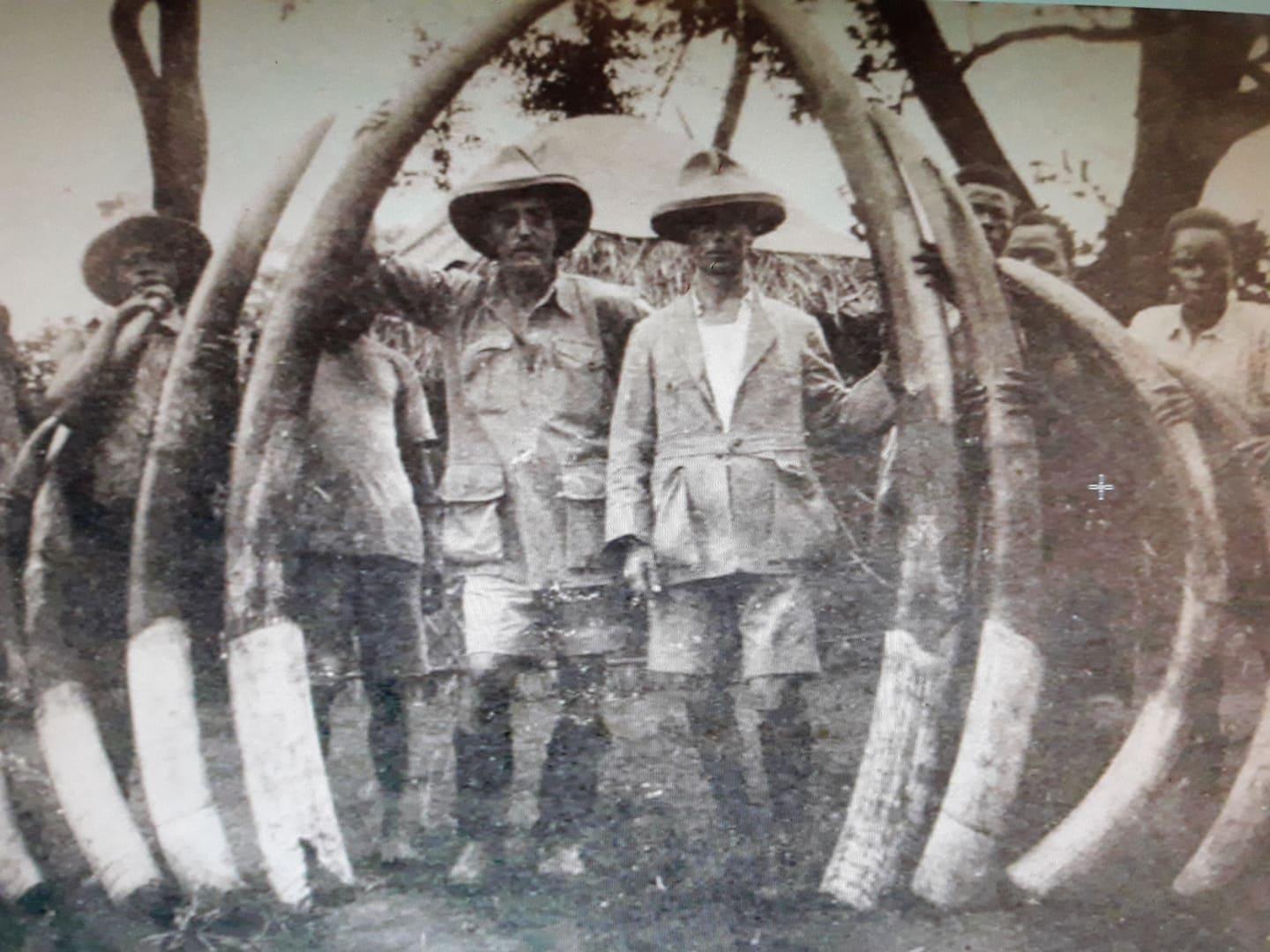
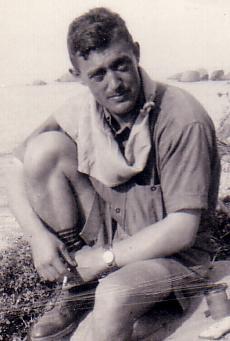
        George Gilman Rushby:

        George Gilman Rushby


        The story of George Gilman Rushby 1900-1969, as told by his son Mike:

        George Gilman Rushby:
        Elephant hunter,poacher, prospector, farmer, forestry officer, game ranger, husband to Eleanor, and father of 6 children who now live around the world.

        George Gilman Rushby was born in Nottingham on 28 Feb 1900 the son of Catherine Purdy and John Henry Payling Rushby. But John Henry died when his son was only one and a half years old, and George shunned his drunken bullying stepfather Frank Freer and was brought up by Gypsies who taught him how to fight and took him on regular poaching trips. His love of adventure and his ability to hunt were nurtured at an early stage of his life.
        The family moved to Eastwood, where his mother Catherine owned and managed The Three Tuns Inn, but when his stepfather died in mysterious circumstances, his mother married a wealthy bookmaker named Gregory Simpson. He could afford to send George to Worksop College and to Rugby School. This was excellent schooling for George, but the boarding school environment, and the lack of a stable home life, contributed to his desire to go out in the world and do his own thing. When he finished school his first job was as a trainee electrician with Oaks & Co at Pye Bridge. He also worked part time as a motor cycle mechanic and as a professional boxer to raise the money for a voyage to South Africa.

        In May 1920 George arrived in Durban destitute and, like many others, living on the beach and dependant upon the Salvation Army for a daily meal. However he soon got work as an electrical mechanic, and after a couple of months had earned enough money to make the next move North. He went to Lourenco Marques where he was appointed shift engineer for the town’s power station. However he was still restless and left the comfort of Lourenco Marques for Beira in August 1921.

        Beira was the start point of the new railway being built from the coast to Nyasaland. George became a professional hunter providing essential meat for the gangs of construction workers building the railway. He was a self employed contractor with his own support crew of African men and began to build up a satisfactory business. However, following an incident where he had to shoot and kill a man who attacked him with a spear in middle of the night whilst he was sleeping, George left the lower Zambezi and took a paddle steamer to Nyasaland (Malawi). On his arrival in Karongo he was encouraged to shoot elephant which had reached plague proportions in the area – wrecking African homes and crops, and threatening the lives of those who opposed them.

        His next move was to travel by canoe the five hundred kilometre length of Lake Nyasa to Tanganyika, where he hunted for a while in the Lake Rukwa area, before walking through Northern Rhodesia (Zambia) to the Congo. Hunting his way he overachieved his quota of ivory resulting in his being charged with trespass, the confiscation of his rifles, and a fine of one thousand francs. He hunted his way through the Congo to Leopoldville then on to the Portuguese enclave, near the mouth of the mighty river, where he worked as a barman in a rough and tough bar until he received a message that his old friend Lumb had found gold at Lupa near Chunya. George set sail on the next boat for Antwerp in Belgium, then crossed to England and spent a few weeks with his family in Jacksdale before returning by sea to Dar es Salaam. Arriving at the gold fields he pegged his claim and almost immediately went down with blackwater fever – an illness that used to kill three out of four within a week.

        When he recovered from his fever, George exchanged his gold lease for a double barrelled .577 elephant rifle and took out a special elephant control licence with the Tanganyika Government. He then headed for the Congo again and poached elephant in Northern Rhodesia from a base in the Congo. He was known by the Africans as “iNyathi”, or the Buffalo, because he was the most dangerous in the long grass. After a profitable hunting expedition in his favourite hunting ground of the Kilombera River he returned to the Congo via Dar es Salaam and Mombassa. He was after the Kabalo district elephant, but hunting was restricted, so he set up his base in The Central African Republic at a place called Obo on the Congo tributary named the M’bomu River. From there he could make poaching raids into the Congo and the Upper Nile regions of the Sudan. He hunted there for two and a half years. He seldom came across other Europeans; hunters kept their own districts and guarded their own territories. But they respected one another and he made good and lasting friendships with members of that small select band of adventurers.

        Leaving for Europe via the Congo, George enjoyed a short holiday in Jacksdale with his mother. On his return trip to East Africa he met his future bride in Cape Town. She was 24 year old Eleanor Dunbar Leslie; a high school teacher and daughter of a magistrate who spent her spare time mountaineering, racing ocean yachts, and riding horses. After a whirlwind romance, they were betrothed within 36 hours.

        On 25 July 1930 George landed back in Dar es Salaam. He went directly to the Mbeya district to find a home. For one hundred pounds he purchased the Waizneker’s farm on the banks of the Mntshewe Stream. Eleanor, who had been delayed due to her contract as a teacher, followed in November. Her ship docked in Dar es Salaam on 7 Nov 1930, and they were married that day. At Mchewe Estate, their newly acquired farm, they lived in a tent whilst George with some help built their first home – a lovely mud-brick cottage with a thatched roof. George and Eleanor set about developing a coffee plantation out of a bush block. It was a very happy time for them. There was no electricity, no radio, and no telephone. Newspapers came from London every two months. There were a couple of neighbours within twenty miles, but visitors were seldom seen. The farm was a haven for wild life including snakes, monkeys and leopards. Eleanor had to go South all the way to Capetown for the birth of her first child Ann, but with the onset of civilisation, their first son George was born at a new German Mission hospital that had opened in Mbeya.

        Occasionally George had to leave the farm in Eleanor’s care whilst he went off hunting to make his living. Having run the coffee plantation for five years with considerable establishment costs and as yet no return, George reluctantly started taking paying clients on hunting safaris as a “white hunter”. This was an occupation George didn’t enjoy. but it brought him an income in the days when social security didn’t exist. Taking wealthy clients on hunting trips to kill animals for trophies and for pleasure didn’t amuse George who hunted for a business and for a way of life. When one of George’s trackers was killed by a leopard that had been wounded by a careless client, George was particularly upset.
        The coffee plantation was approaching the time of its first harvest when it was suddenly attacked by plagues of borer beetles and ring barking snails. At the same time severe hail storms shredded the crop. The pressure of the need for an income forced George back to the Lupa gold fields. He was unlucky in his gold discoveries, but luck came in a different form when he was offered a job with the Forestry Department. The offer had been made in recognition of his initiation and management of Tanganyika’s rainbow trout project. George spent most of his short time with the Forestry Department encouraging the indigenous people to conserve their native forests.

        In November 1938 he transferred to the Game Department as Ranger for the Eastern Province of Tanganyika, and over several years was based at Nzasa near Dar es Salaam, at the old German town of Morogoro, and at lovely Lyamungu on the slopes of Kilimanjaro. Then the call came for him to be transferred to Mbeya in the Southern Province for there was a serious problem in the Njombe district, and George was selected by the Department as the only man who could possibly fix the problem.

        Over a period of several years, people were being attacked and killed by marauding man-eating lions. In the Wagingombe area alone 230 people were listed as having been killed. In the Njombe district, which covered an area about 200 km by 300 km some 1500 people had been killed. Not only was the rural population being decimated, but the morale of the survivors was so low, that many of them believed that the lions were not real. Many thought that evil witch doctors were controlling the lions, or that lion-men were changing form to kill their enemies. Indeed some wichdoctors took advantage of the disarray to settle scores and to kill for reward.

        By hunting down and killing the man-eaters, and by showing the flesh and blood to the doubting tribes people, George was able to instil some confidence into the villagers. However the Africans attributed the return of peace and safety, not to the efforts of George Rushby, but to the reinstallation of their deposed chief Matamula Mangera who had previously been stood down for corruption. It was Matamula , in their eyes, who had called off the lions.

        Soon after this adventure, George was appointed Deputy Game Warden for Tanganyika, and was based in Arusha. He retired in 1956 to the Njombe district where he developed a coffee plantation, and was one of the first in Tanganyika to plant tea as a major crop. However he sensed a swing in the political fortunes of his beloved Tanganyika, and so sold the plantation and settled in a cottage high on a hill overlooking the Navel Base at Simonstown in the Cape. It was whilst he was there that TV Bulpin wrote his biography “The Hunter is Death” and George wrote his book “No More The Tusker”. He died in the Cape, and his youngest son Henry scattered his ashes at the Southern most tip of Africa where the currents of the Atlantic and Indian Oceans meet .

        George Gilman Rushby:

        #6221
        TracyTracy
        Participant

          Mary Ann Gilman Purdy

          1880-1950

          Mary Ann Gilman Purdy Marshall

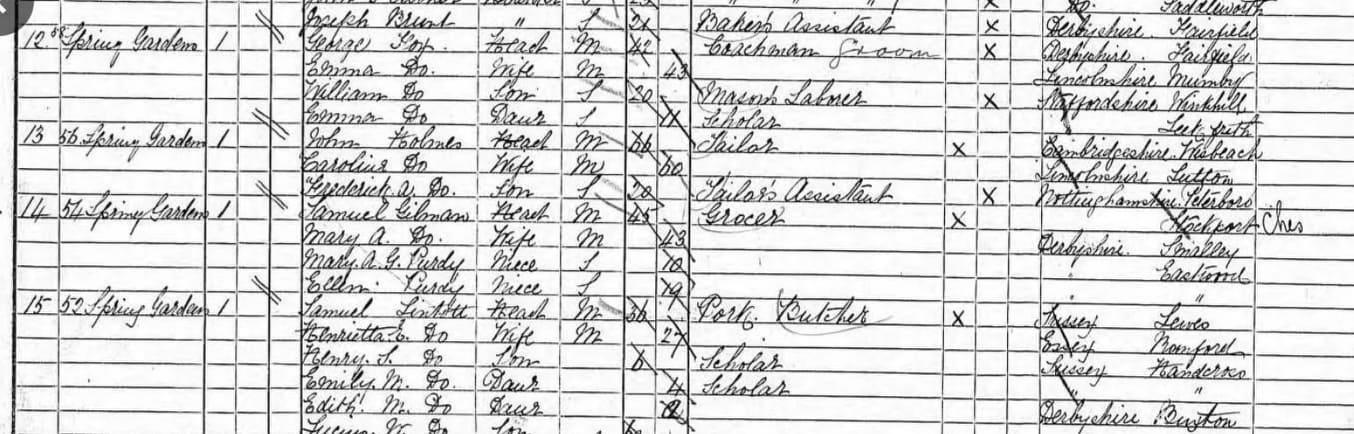
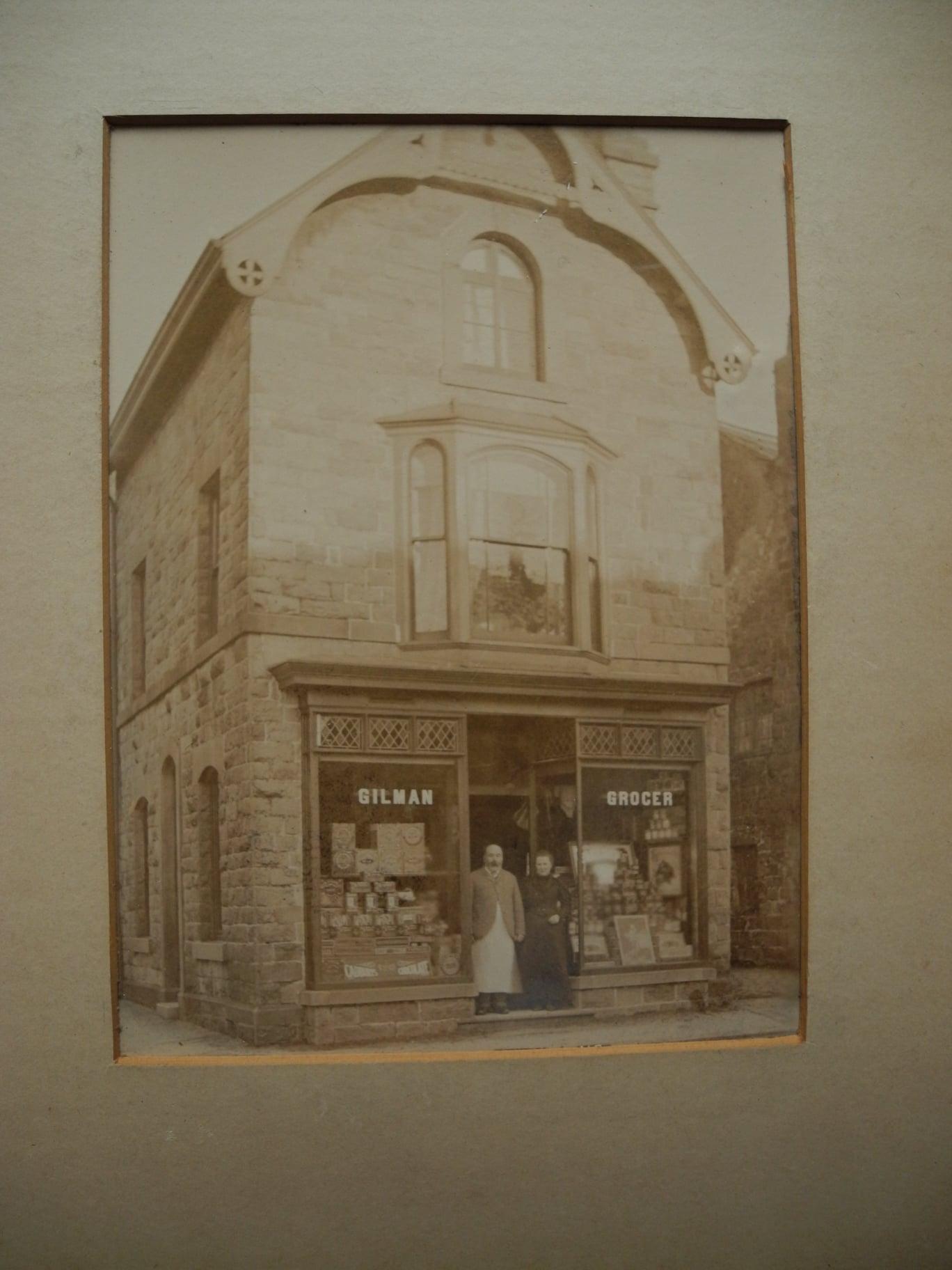
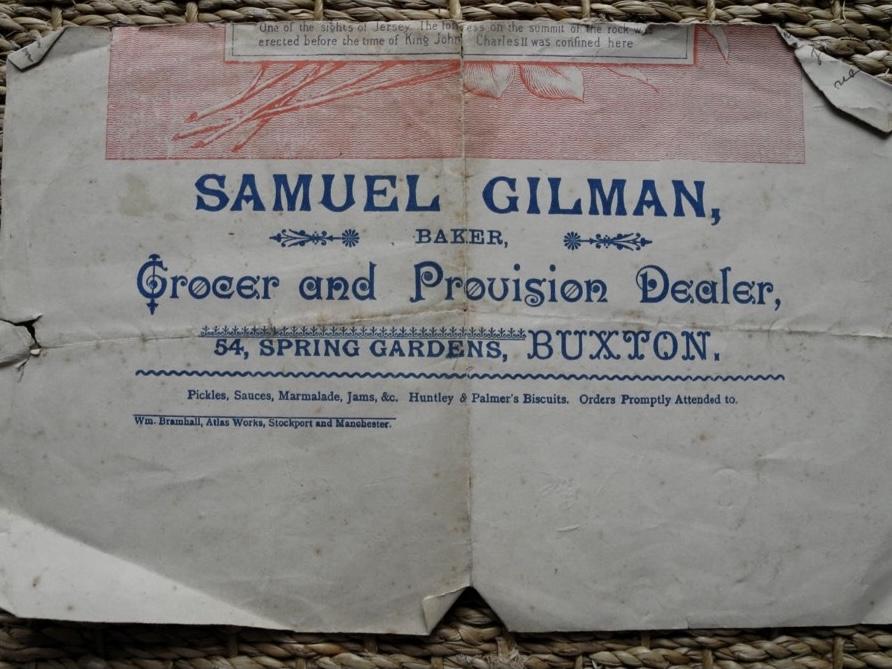
          Mary Ann was my grandfather George Marshall’s mother. She died in 1950, seven years before I was born. She has been referred to more often than not, since her death, as Mary Ann Gilman Purdy, rather than Mary Marshall. She was from Buxton, so we believed, as was her husband William Marshall. There are family photos of the Gilmans, grocers in Buxton, and we knew that Mary Ann was brought up by them. My grandfather, her son, said that she thought very highly of the Gilman’s, and added the Gilman name to her birth name of Purdy.


          The 1891 census in Buxton:

          1891 census Buxton


          (Mary Ann’s aunt, Mrs Gilman, was also called Mary Anne, but spelled with an E.)

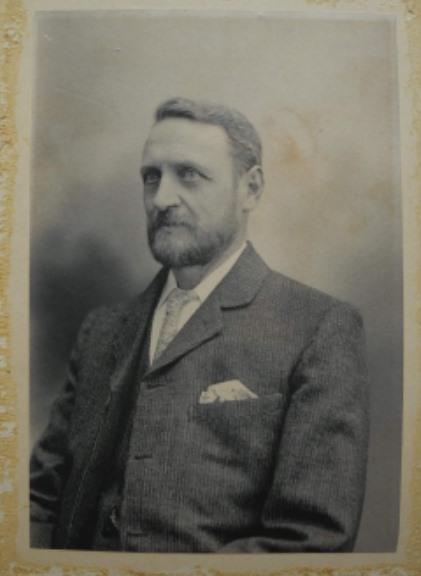
          Samuel Gilman 1846-1909, and Mary Anne (Housley) Gilman  1846-1935,  in Buxton:

          Gilmans Grocers

          Samuel Gilman


          What we didn’t know was why Mary Ann (and her sister Ellen/Nellie, we later found) grew up with the Gilman’s. But Mary Ann wasn’t born in Buxton, Derbyshire, she was born in Eastwood, Nottinghamshire. When the search moved to Nottingham, we found the Purdy’s.

          George Purdy 1848-1935, Mary Ann’s father:

          George Purdy


          Mary Ann’s parents were George Purdy of Eastwood, and Catherine Housley of Smalley.

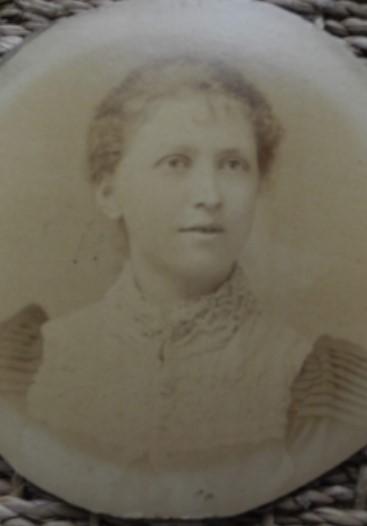
          Catherine Housley 1849-1884, Mary Ann’s mother:

          Catherine Housley


          Mary Ann was four years old when her mother died. She had three sisters and one brother. George Purdy remarried and kept the two older daughters, and the young son with him. The two younger daughters, Mary Ann and Nellie, went to live with Catherine’s sister, also called Mary Anne, and her husband Samuel Gilman. They had no children of their own. One of the older daughters who stayed with their father was Kate , whose son George Gilman Rushby, went to Africa. But that is another chapter.

          George was the son of Francis Purdy and his second wife Jane Eaton. Francis had some twenty children, and is believed in Eastwood to be the reason why there are so many Purdy’s.

          The woman who was a mother to Mary Ann and who she thought very highly of, her mothers sister, spent her childhood in the Belper Workhouse. She and her older sister Elizabeth were admitted in June, 1850, the reason: father in prison. Their mother had died the previous year. Mary Anne Housley, Catherine’s sister, married Samuel Gilman, and looked after her dead sisters children.

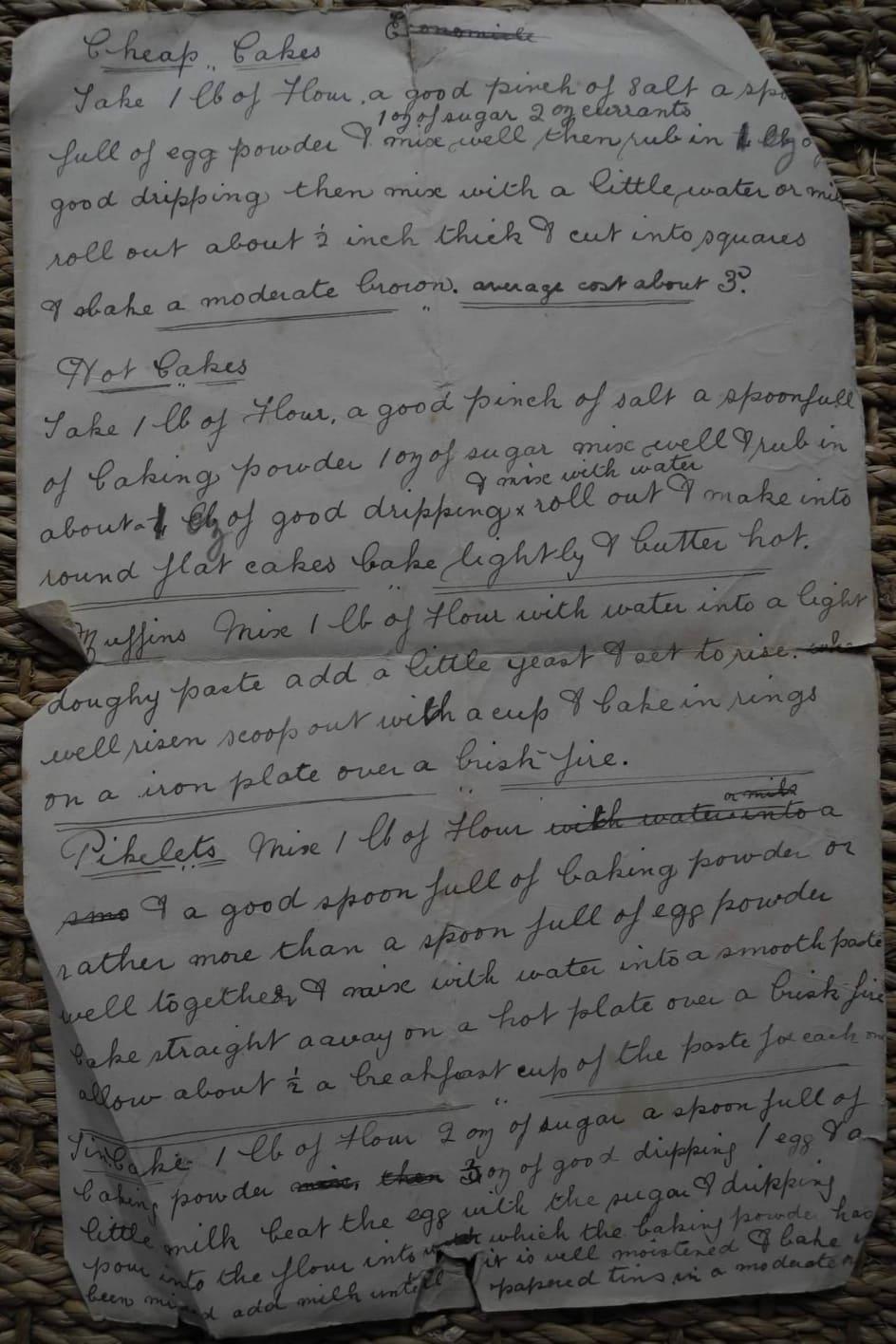
          Mary Ann Gilman Purdy Marshalls recipes written on the back of the Gilmans Grocers paper:

          recipes

          #6219
          TracyTracy
          Participant

            The following stories started with a single question.

            Who was Catherine Housley’s mother?

            But one question leads to another, and another, and so this book will never be finished.  This is the first in a collection of stories of a family history research project, not a complete family history.  There will always be more questions and more searches, and each new find presents more questions.

            A list of names and dates is only moderately interesting, and doesn’t mean much unless you get to know the characters along the way.   For example, a cousin on my fathers side has already done a great deal of thorough and accurate family research. I copied one branch of the family onto my tree, going back to the 1500’s, but lost interest in it after about an hour or so, because I didn’t feel I knew any of the individuals.

            Parish registers, the census every ten years, birth, death and marriage certificates can tell you so much, but they can’t tell you why.  They don’t tell you why parents chose the names they did for their children, or why they moved, or why they married in another town.  They don’t tell you why a person lived in another household, or for how long. The census every ten years doesn’t tell you what people were doing in the intervening years, and in the case of the UK and the hundred year privacy rule, we can’t even use those for the past century.  The first census was in 1831 in England, prior to that all we have are parish registers. An astonishing amount of them have survived and have been transcribed and are one way or another available to see, both transcriptions and microfiche images.  Not all of them survived, however. Sometimes the writing has faded to white, sometimes pages are missing, and in some case the entire register is lost or damaged.

            Sometimes if you are lucky, you may find mention of an ancestor in an obscure little local history book or a journal or diary.  Wills, court cases, and newspaper archives often provide interesting information. Town memories and history groups on social media are another excellent source of information, from old photographs of the area, old maps, local history, and of course, distantly related relatives still living in the area.  Local history societies can be useful, and some if not all are very helpful.

            If you’re very lucky indeed, you might find a distant relative in another country whose grandparents saved and transcribed bundles of old letters found in the attic, from the family in England to the brother who emigrated, written in the 1800s.  More on this later, as it merits its own chapter as the most exciting find so far.

            The social history of the time and place is important and provides many clues as to why people moved and why the family professions and occupations changed over generations.  The Enclosures Act and the Industrial Revolution in England created difficulties for rural farmers, factories replaced cottage industries, and the sons of land owning farmers became shop keepers and miners in the local towns.  For the most part (at least in my own research) people didn’t move around much unless there was a reason.  There are no reasons mentioned in the various registers, records and documents, but with a little reading of social history you can sometimes make a good guess.  Samuel Housley, for example, a plumber, probably moved from rural Derbyshire to urban Wolverhampton, when there was a big project to install indoor plumbing to areas of the city in the early 1800s.  Derbyshire nailmakers were offered a job and a house if they moved to Wolverhampton a generation earlier.

            Occasionally a couple would marry in another parish, although usually they married in their own. Again, there was often a reason.  William Housley and Ellen Carrington married in Ashbourne, not in Smalley.  In this case, William’s first wife was Mary Carrington, Ellen’s sister.  It was not uncommon for a man to marry a deceased wife’s sister, but it wasn’t strictly speaking legal.  This caused some problems later when William died, as the children of the first wife contested the will, on the grounds of the second marriage being illegal.

            Needless to say, there are always questions remaining, and often a fresh pair of eyes can help find a vital piece of information that has escaped you.  In one case, I’d been looking for the death of a widow, Mary Anne Gilman, and had failed to notice that she remarried at a late age. Her death was easy to find, once I searched for it with her second husbands name.

            This brings me to the topic of maternal family lines. One tends to think of their lineage with the focus on paternal surnames, but very quickly the number of surnames increases, and all of the maternal lines are directly related as much as the paternal name.  This is of course obvious, if you start from the beginning with yourself and work back.  In other words, there is not much point in simply looking for your fathers name hundreds of years ago because there are hundreds of other names that are equally your own family ancestors. And in my case, although not intentionally, I’ve investigated far more maternal lines than paternal.

            This book, which I hope will be the first of several, will concentrate on my mothers family: The story so far that started with the portrait of Catherine Housley’s mother.
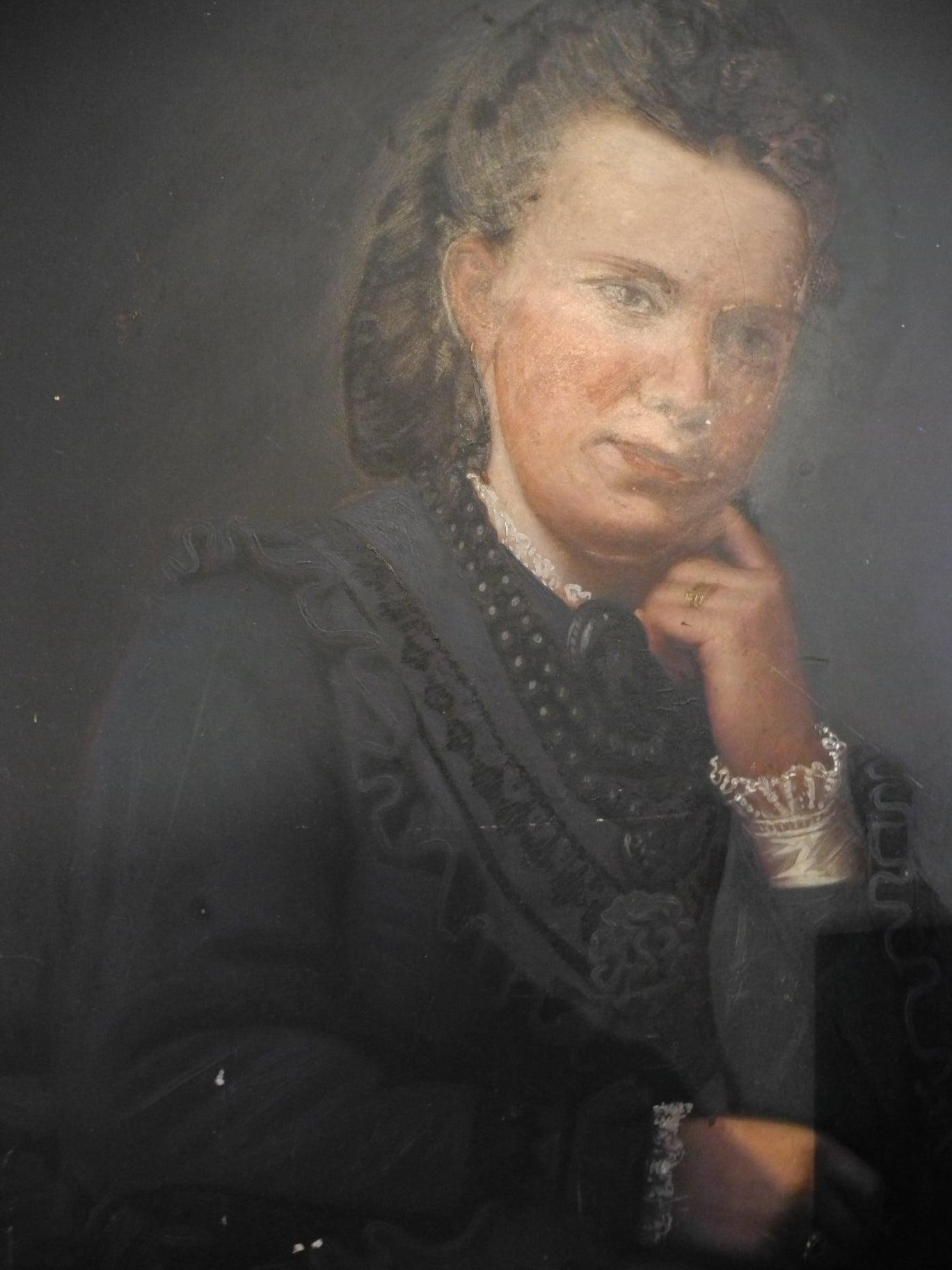
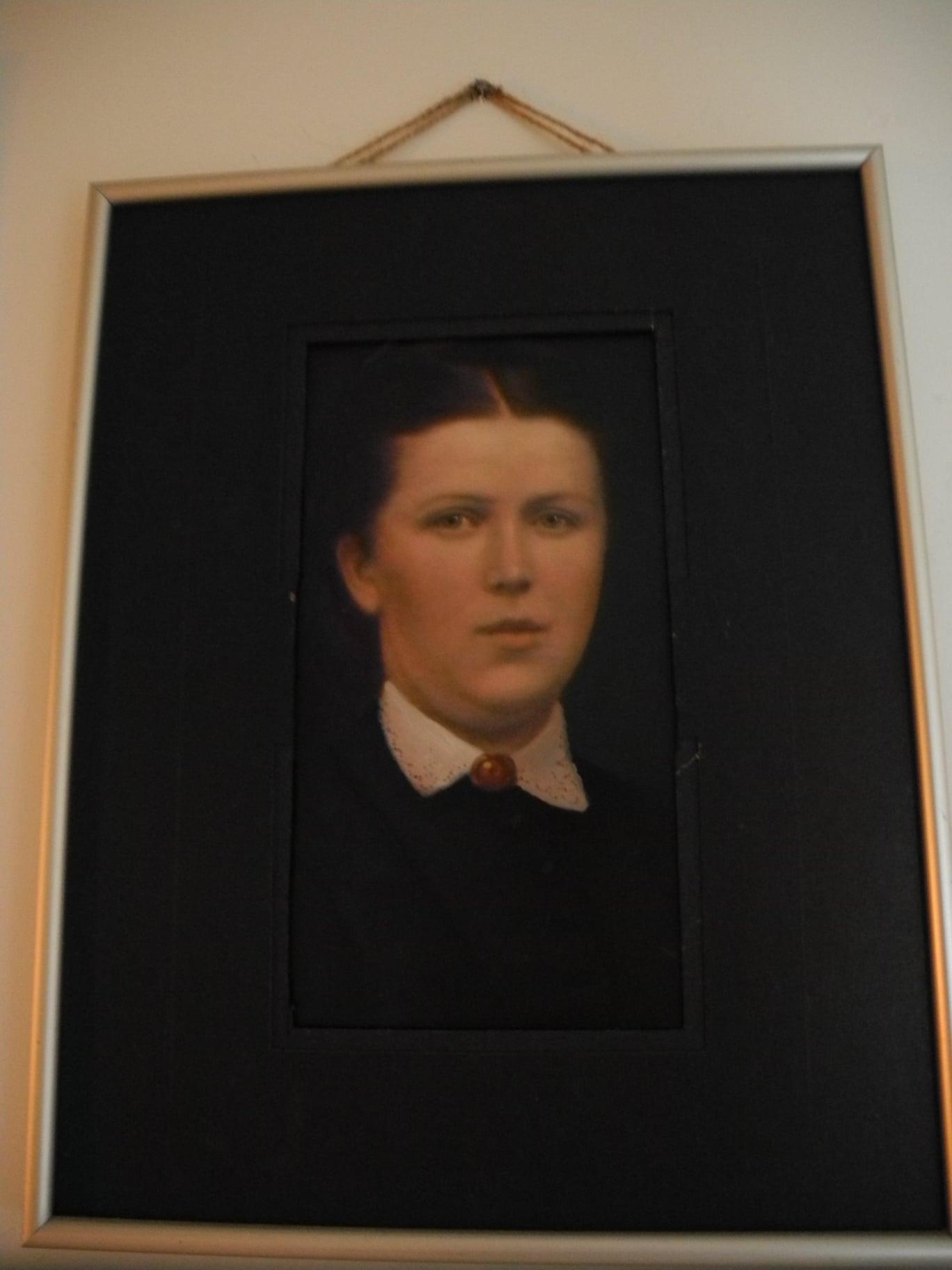
            Elizabeth Brookes


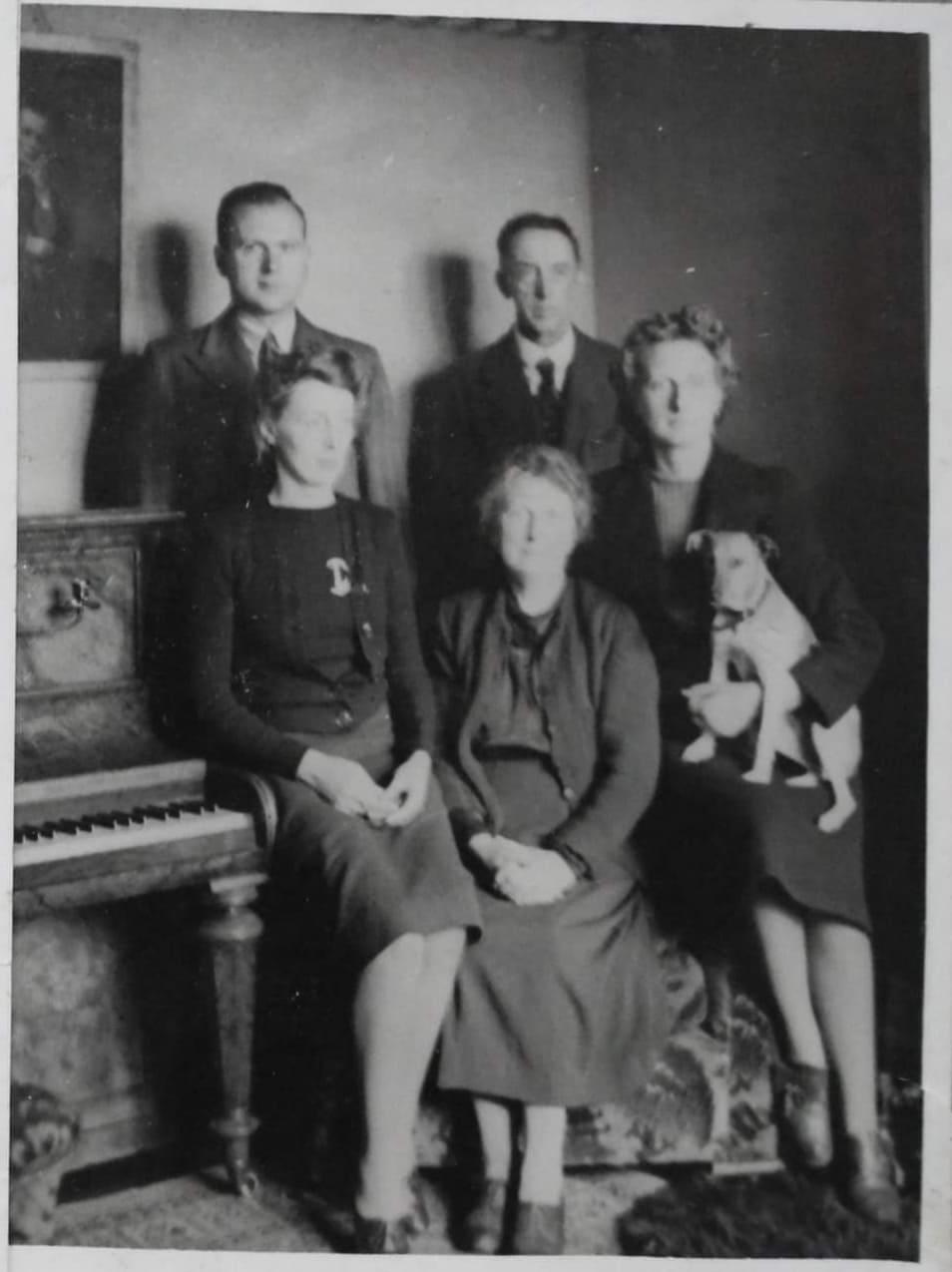
            This painting, now in my mothers house, used to hang over the piano in the home of her grandparents.   It says on the back “Catherine Housley’s mother, Smalley”.

            The portrait of Catherine Housley’s mother can be seen above the piano. Back row Ronald Marshall, my grandfathers brother, William Marshall, my great grandfather, Mary Ann Gilman Purdy Marshall in the middle, my great grandmother, with her daughters Dorothy on the left and Phyllis on the right, at the Marshall’s house on Love Lane in Stourbridge.
            Marshalls


            The Search for Samuel Housley

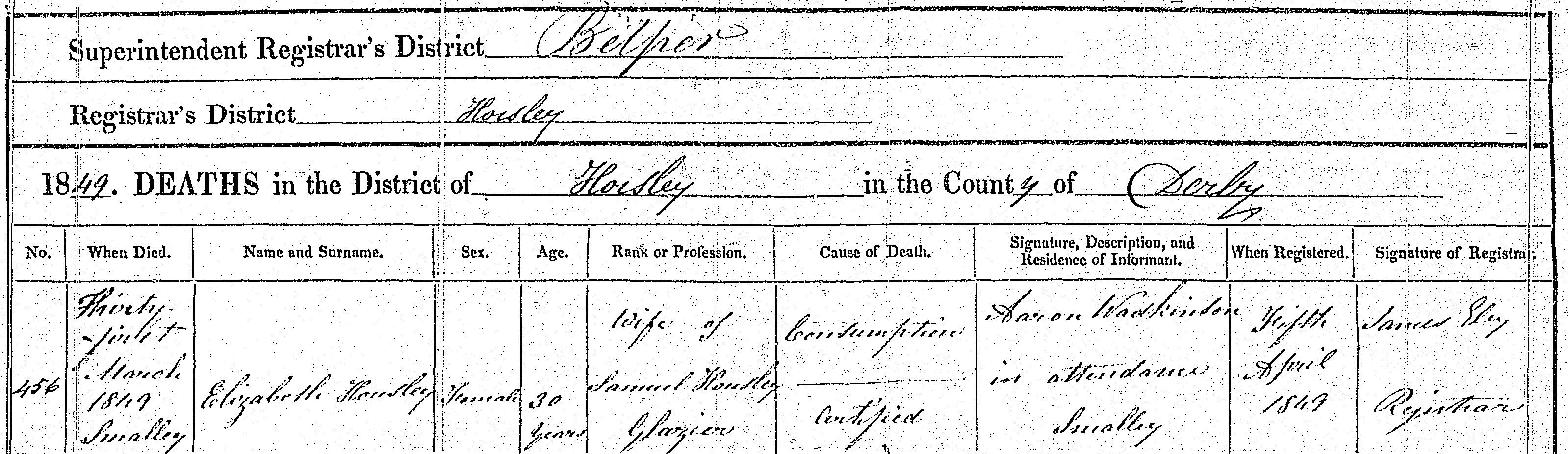
            As soon as the search for Catherine Housley’s mother was resolved, achieved by ordering a paper copy of her birth certificate, the search for Catherine Housley’s father commenced. We know he was born in Smalley in 1816, son of William Housley and Ellen Carrington, and that he married Elizabeth Brookes in Wolverhampton in 1844. He was a plumber and glazier. His three daughters born between 1845 and 1849 were born in Smalley. Elizabeth died in 1849 of consumption, but Samuel didn’t register her death. A 20 year old neighbour called Aaron Wadkinson did.
            Elizabeth death


            Where was Samuel?

            On the 1851 census, two of Samuel’s daughters were listed as inmates in the Belper Workhouse, and the third, 2 year old Catherine, was listed as living with John Benniston and his family in nearby Heanor.  Benniston was a framework knitter.

            Where was Samuel?

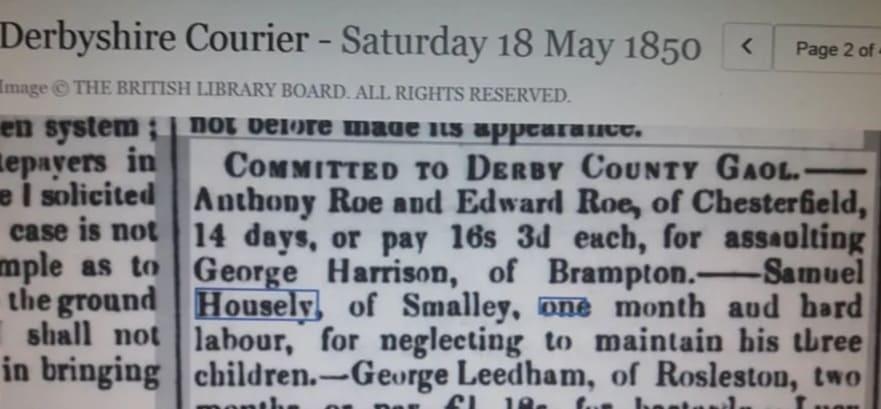
            A long search through the microfiche workhouse registers provided an answer. The reason for Elizabeth and Mary Anne’s admission in June 1850 was given as “father in prison”. In May 1850, Samuel Housley was sentenced to one month hard labour at Derby Gaol for failing to maintain his three children. What happened to those little girls in the year after their mothers death, before their father was sentenced, and they entered the workhouse? Where did Catherine go, a six week old baby? We have yet to find out.
            Samuel Housley 1850


            And where was Samuel Housley in 1851? He hasn’t appeared on any census.

            According to the Belper workhouse registers, Mary Anne was discharged on trial as a servant February 1860. She was readmitted a month later in March 1860, the reason given: unwell.

            Belper Workhouse:
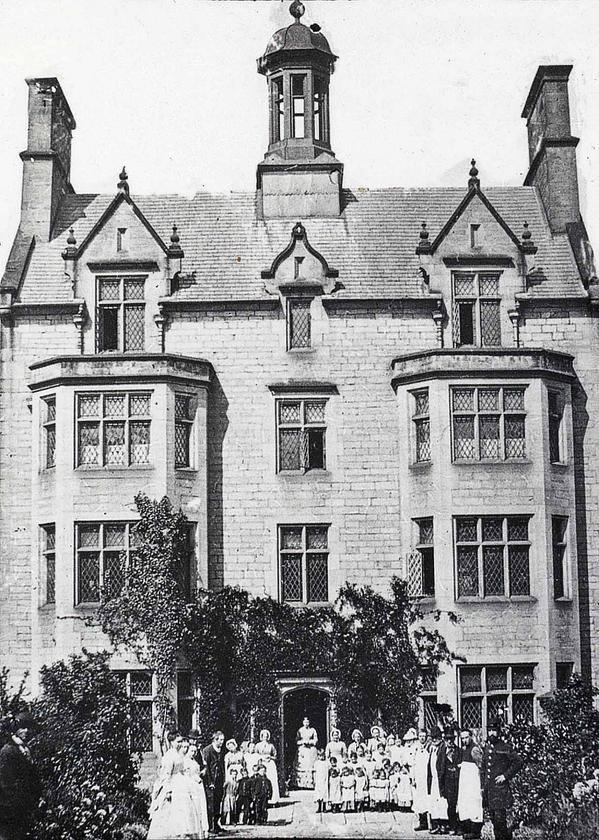
            Belper Workhouse

            Eventually, Mary Anne and Elizabeth were discharged, in April 1860, with an aunt and uncle. The workhouse register doesn’t name the aunt and uncle. One can only wonder why it took them so long.
            On the 1861 census, Elizabeth, 16 years old, is a servant in St Peters, Derby, and Mary Anne, 15 years old, is a servant in St Werburghs, Derby.

            But where was Samuel?

            After some considerable searching, we found him, despite a mistranscription of his name, on the 1861 census, living as a lodger and plumber in Darlaston, Walsall.
            Eventually we found him on a 1871 census living as a lodger at the George and Dragon in Henley in Arden. The age is not exactly right, but close enough, he is listed as an unmarried painter, also close enough, and his birth is listed as Kidsley, Derbyshire. He was born at Kidsley Grange Farm. We can assume that he was probably alive in 1872, the year his mother died, and the following year, 1873, during the Kerry vs Housley court case.
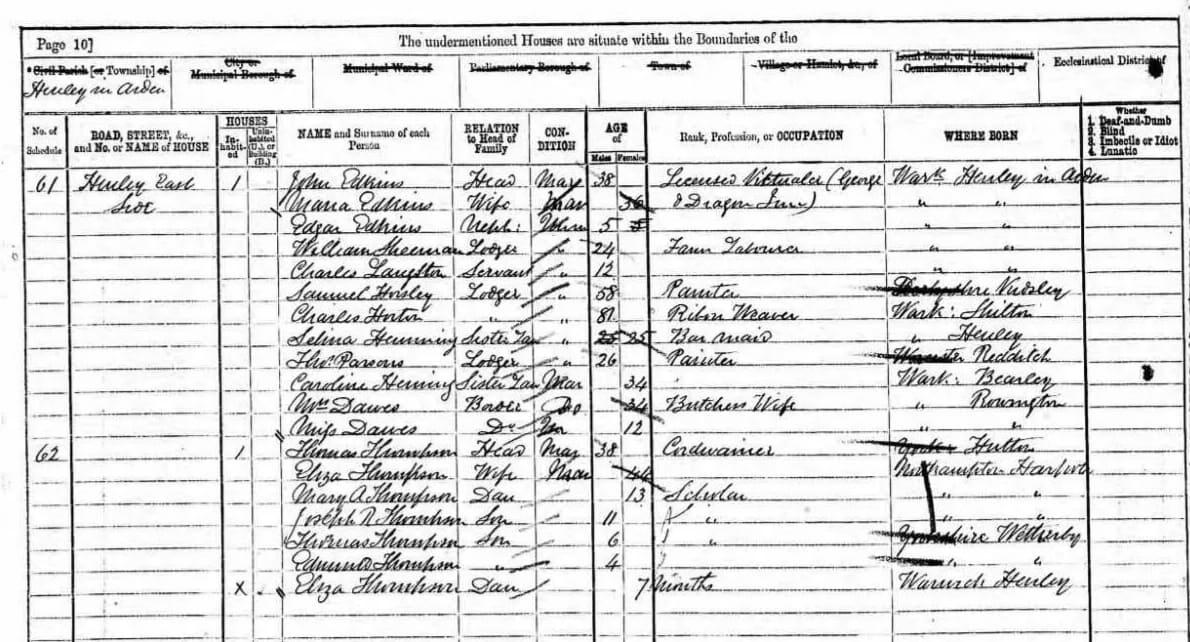
            Samuel Housley 1871


            I found some living Housley descendants in USA. Samuel Housley’s brother George emigrated there in 1851. The Housley’s in USA found letters in the attic, from the family in Smalley ~ written between 1851 and 1870s. They sent me a “Narrative on the Letters” with many letter excerpts.

            The Housley family were embroiled in a complicated will and court case in the early 1870s. In December 15, 1872, Joseph (Samuel’s brother) wrote to George:

            “I think we have now found all out now that is concerned in the matter for there was only Sam that we did not know his whereabouts but I was informed a week ago that he is dead–died about three years ago in Birmingham Union. Poor Sam. He ought to have come to a better end than that….His daughter and her husband went to Birmingham and also to Sutton Coldfield that is where he married his wife from and found out his wife’s brother. It appears he has been there and at Birmingham ever since he went away but ever fond of drink.”

            No record of Samuel Housley’s death can be found for the Birmingham Union in 1869 or thereabouts.

            But if he was alive in 1871 in Henley In Arden…..
            Did Samuel tell his wife’s brother to tell them he was dead? Or did the brothers say he was dead so they could have his share?

            We still haven’t found a death for Samuel Housley.


            #6192

            They found me and locked me up again but I suppose it was going to happen sooner or later. I don’t mind though, I can always plot an escape when I’m ready but the fact is, I was tired after awhile. I needed a rest and so here I am. The weather’s awful so I may as well rest up here for a bit longer. They gave me a shot, too, so I don’t have to wear a mask anymore. Unless I want to wear it as a disguise of course, so I’ll keep a couple for when I escape again.

            They gave me a computer to keep me amused and showed me how to do the daftest things I’d never want to do and I thought, what a load of rubbish, just give me a good book, but then this charming little angel of a helper appeared as if by magic and showed me how to do a family tree on this machine.  Well! I had no idea such pursuits could be so engrossing, it’s like being the heroine in a detective novel, like writing your own book in a way.

            I got off on a sidetrack with the search for one woman in particular and got I tell you I got so sucked inside the story I spent a fortnight in a small village in the north midlands two centuries ago that I had to shake me head to get back to the present for the necessary daily functions. I feel like I could write a book about that fortnight. Two hundred years explored in a fortnight in the search for CH’s mother.

            I could write a book on the maternal line and how patriarchy has failed us in the search for our ancestry and blood lines. The changing names, the census status, lack of individual occupation but a mother knows for sure who her children are. And yet we follow paternal lines because the names are easier, but mothers know for sure which child is theirs whereas men can not be as sure as that.  Barking up the wrong tree is easy done.

            I can’t start writing any of these books at the moment because I’m still trying to find out who won the SK&JH vs ALL the rest of the H family court case in 1873.  It seems the youngest son (who was an overseer with questionable accounts) was left out of the will. The executor of the will was his co plaintiff in the court case, a neighbouring land owner, and the whole rest of the family were the defendants.  It’s gripping, there are so many twists and turns. This might give us a clue why CH grew up in the B’s house instead of her own. Why did CH’s mothers keep the boys and send two girls to live with another family? How did we end up with the oil painting of CH’s mother? It’s a mystery and I’m having a whale of a time.

            Another good thing about my little adventure and then this new hobby is how, as you may have noticed, I’m not half as daft as I was when I was withering away in that place with nothing to do. I mean I know I’m withering away and not going anywhere again now,  but on the other hand I’ve just had a fortnights holiday in the nineteenth century, which is more than many can say, even if they’ve been allowed out.

            #6078

            “You really know your trade, Fuyi,” said Rukshan. “You’ve built the most exquisite and comfortable place. And I think the empty dishes speak aplenty about the quality of the food and the pleasure we took in this shared meal. Now, let us help you with the dishes,” said Rukshan.

            “Ach! Don’t be so polite,” said Fuyi. “I’ll have plenty of time after yar departure tomorrow. It’s not like the inn is full. Just enjoy an evening together, discuss yar plans, and have some rest. I know that life. Take the chance when it presents itself!”

            Rushan nodded and looked at Kumihimo. Fox sighed with relief. His belly was full and round, and he didn’t want to disturbed his digestion with some chore.

            The Sinese food made by the innkeeper had been delicious and quite a first for most of them. Tak had particularly enjoyed the crunchy texture of the stir fried vegetables flavoured with the famous five spices sauce. Nesy had preferred the algae and chili dishes while Fox, who ate a red hot pepper thinking it was bell pepper, had stuffed himself with juicy pork buns to put out the fire in his mouth.

            Gorrash, befuddled by the novelty, had been at a loss of labels, good or bad. He simply chose to welcome the new experiences and body reactions to flavours and textures. As for Olliver, he gave up the chopsticks when he saw how fast Fox made the food disappear from the dishes.

            Now that the dishes were empty, the children and Gorrash had left the table and were playing near the fireplace. Olliver was looking at the trio with envy, split between the desire to play and enjoy the simplicity of the moment, and the desire to be taken more seriously which meant participate in the conversation with the adults.

            “We have plenty to discuss, Fae,” said Kumihimo.

            Fuyi looked at Olliver, recognising the conundrum. “That’s settled, then,” he said to the group. Then turning toward Olliver: “Boy! I’m sure the start of the conversation will be boring for a young mind. Let’s join the others for a story of my own. You can still come back later and they’ll fill you in on the details.”

            Fuyi and Olliver moved to the fireplace. The innkeeper threw cushions on the floor and sat on a wooden rocking chair. At the mention of a story, Tak, Nesy and Gorrash couldn’t contain their exuberant joy and gathered all ears around Admirable Fuyi. As he rocked, the chair creaked. He waited until they all calmed down. And when he was satisfied he started.

            “I was young and still a fresh recruit in the Sinese army,” started Fuyi. “We were stationed at the western frontier just below the high plateaus and I hadn’t participated in any battle yet. With the folly of youth I thought that our weapons and the bond we shared with my fellow soldiers were enough to defeat anything.”

            #6077
            Jib
            Participant

              “Finnley, stop pacing like that with that concerned look of yours, you make me dizzy. Is that too difficult a task to hire a secretary?”

              Finnley rolled her eyes. “Not at all, Madam. I already found you a pearl.”

              “You mean the perfect one for me?”

              “No I mean, she’s called Pearl. She’ll start tomorrow. What concerns me is something else entirely. Something strange, if you ask me. But you never ask, so I’m telling you.”

              “Well, this whole conversation started because I asked you.”

              “You asked me because you thought it was related to your previous request.”

              “Then tell me and stop brooding. It’s killing the mood.”

              Finnley snorted. “If you want to know, someone is throwing things on the balcony. Children things. The other day I found that cheap toy to make soap bubbles. And then it was a small blue children’s plastic sand shovel. And today they dropped a red bucket.”

              Liz tried to laugh, but it was more of a cackle. “Isn’t that Godfrey or Roberto playing with you?” she asked.

              “I’ve asked Godfrey and I’m positive it’s not him because it’s driving him nut too. We asked Roberto because he’s been attempting to teach tricks to the dogs. A waste of time if you ask me, letting the garden going to the dogs,” she smirked.

              “Then, was it Roberto and the dogs?”

              “Not at all! We kept an eye on him while he was training the dogs. Nothing. But the objects keep coming. I’m telling you either we have a ghost or a portal to another dimension in this mansion.”

              “That sounds like a nice idea,” said Liz, pouting at the possibilities.

              “You wouldn’t say that if another you came into this thread.”

              #6044

              They had to stop to get some rest. Rukshan knew the signs, the song of a black swan, a nesting bear in the forest, cubic clouds… All strange omens not to be taken lightly. He told the others they’d better find shelter somewhere and not spend the night outside.

              As soon had he make the announcement that he saw the relief on their faces. They’d been enthusiastic for half a day, but the monotony of walking got the better of their motivation, especially the kids who were not used to such long journeys out of the cottage’s safety.

              Fortunately they were not far from the Sooricat Inn, a place lost in the woods, it still had four walls, warm food and almost certainly a hot bath. Let’s just hope they’re open, thought the Fae.

              When they arrived, the owner, an old man from Sina, looked at them suspiciously.

              “Ya’ll have your attestation? I can’t believe ya’re all family. Don’t think I’m a fool, ya’re a Fae, and this little fella there, he’s smaller than the children but has a beard. Never saw anything like him,” he said with rumbling r’s pointing at the children and Gorrash with his chin. The dwarf seemed offended but a stern look from Rukshan prevented him from speaking.

              “Anyway,” continued the innkeeper, “I can just sell ya food. Not’ing parsonal. That’s rooles, ya’know with the all stayin’at home thing from Gavernor Leraway, I can not even let ya’in. Ya can buy food and eat it outside if ya want.”

              “Look, it’s almost twilight,” said Rukshan. “We’ve walked the whole day, the children are exhausted.”

              Tak and Nesy showed their best puppy face, risking to make Fox burst into laughter. That seemed to soften the man a little.

              “Oh! I really shouldn’t. I don’t like breaking rooles.”

              “I knew you more daring, Admirable Fuyi,” said a booming voice coming from behind them. They all turned around to see Kumihimo. She was wearing a cloak made of green and yellow gingko leaves, her silvery white hair, almost glowing in the dark, cascading beautifully on her shoulders. A grey cat strode alongside her.

              “Oh! that’s just the donkey, Ronaldo. It got transformed into a cat after walking directly into a trap to get one of those darn carrots. He knew better, don’t pity him. He got what he deserved.” Kumihimo’s rant got a indignant meow, close to a heehaw, from Ronaldo.

              “Kumi! I can’t believe it’s ya!” said the innkeeper.

              “You two know each others?” asked Rukshan.

              “It’s a long story,” said the innkeeper, “From when I was serving in Sina’s army, we had conquered the high plateaus. I gave up the title of Admirable when I left the army. After Kumi opened my eyes.” Fuyi’s eyes got wet. “Ah! I’m sure I’ll regret it, but come on in, ya’ll. Let me hear yar story after you taste the soup.”

              #6026

              Dear Jorid Whale,

              My hands are shaking while I type this on the keyboard.

              I’m not sure which of last night’s dreams is the bizarrest. Bizarre in a fantastic way, although for certain people it might be called grotesque. I’m certain it has something to do with that book I ordered online last week. I don’t usually read books and certainly not like this one. But the confinement, it makes you consider making things out of your ordinary.

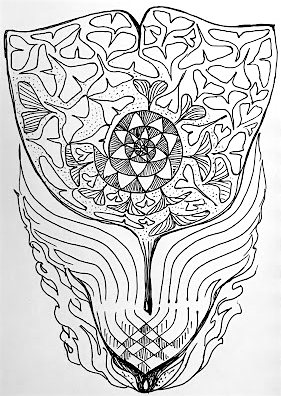
              It’s called The Enchanted Forest of Changes, by a Chinese artist Níngméng (柠檬). They say his artist name means lemon, but that some of his friends call him Níng mèng 凝梦 (curdle dreams), which to my ears sound exactly the same except a little bit angrier. I found out about him on a forum about creepy dolls abandoned in forests all around the world. Yeah exactly, the confinement effect again. Apparently it started with a few dolls in a forest in Michigan, and then suddenly people started to find them everywhere. I wonder if some people are really into the confinement thing or if it’s just me using that as a reason to stay home.

              Anyway, someone on that forum posted one of the picture of that book and it caught my eye. So much so that I dreamt of it the following night. So I bought the book and it’s mostly ink drawings, but they seem to speak directly to some part of you that you were not even aware you had. I almost hear whispers when I look at the drawings. And then I have those dreams.

              Last night I dreamt of a cat that had been raised as a boy. He even had the shape of one, but shorter maybe. He had learned to talk and use his paws as hands, his claws had grown into fingers, had lost most of his fur and he was wearing clothes. If I was amazed by such a feat, it kinda seemed normal for the people I met in that dream. It just took a lot of efforts, love and dedication to raise this kind of children.

              And Whale, I feel tingling in my arms. This morning you showed me the picture of a kitten! That’s not a mere coincidence. I’m feeling so excited, my hands are too slow to type what I want to write. I fear I’m going to forget an important detail.

              About the second dream. The world was in shock, there was this giant… thing that looked like a pistil and that had grown during the night in some arid area. It was taller than the tallest human made tower. Its extremity was cone shaped, and I confess that the whole thing looked like some kind of dick to me.

              Plants and trees had followed in the following days as if the pistil had changed the climatic conditions (autocorrect wanted to write climactic, is that you playing around?).

              The pistil was protected by some kind of field and it couldn’t be approached by everyone. Governments had tried, pharmaceutical companies had tried. People who wanted to make gold out of it, they were all rejected. But for some reason some people could approach. Anyone, not just the pure of hearts or the noble ones. Actually a whole bunch of weirdoes started to take their chances. Some were allowed in and some where not. Nobody knew what was the deciding factor.

              A friend of mine that I have not seen in years during my waking life, she came back and asked me to come with her. So we went and were allowed in. My recall of the events after that is fuzzy. But I get the strange impression that I will spend more time in there later on.

              [Edited in the afternoon]

              I don’t believe it! It’s on the news everywhere. It has even replaced the news about the virus and the confinement.

              Giant pistils have appeared around the world, but it seems only people who had been infected can see them.

              Crazy rumours run on the internet. Giant mass hallucination caused by the virus. Some people say it’s alien technology, spores engineered to control our brains.

              There is one not so far from where I live. Should I wait for Kady to call me?

              #5953

              Bubbling and turning from orange to green to duck blue, the potion was perfect and smelled of good work, a strong blend of cinnamon, cardamom and crushed cloves. She smiled broadly and poured the potion into five vials, which she gave to Rukshan. They were all gathered around her in the kitchen looking rather fascinated by the whole operation.

              “One for you, and one for each of the children,” Glynis said with a grin.

              “I’m not a kid,” said Fox.

              “Why only five?” asked Gorrash who suspected something was off. “We are Six. There’s Tak, Nessy, Olliver, Fox, Rukshan and I,” he said counting on his chubby fleshy fingers.

              “I don’t need a potion to go wherever I want,” said Olli with a grin.

              “Well,” started Glynis, “Despite your unique skill, Olliver, you still need the potion in order to thwart the control spells Leroway’s saucerers had scattered around the country,” Glynis said. “You all remember what happened to aunt Eleri last time she went out. You know how skilled she is when she need to sneak out. She barely escaped and Rukshan and I had a hard time turning off that dancing spell, which I’m sure is the least damaging one.”

              She looked at Gorrash with compassion but the light dimmed as a cloud passed in front of the sun outside. She pointed her finger at him. “Your immune system is still like one of a newborn. And I’d prefer you’d stay home and not go around during a beaver fever pandemic. There are plenty of things you can help me with!” Glynis showed the cauldron, vials and other utensils she used to make the potion, and the cake earlier, and yesterday’s dinner.

              “Well, if I have not to challenge my immune system…” Gorrash started.

              “You know better than to argue with me,” she said.

              Gorrash opened his mouth to say something but decided otherwise and ran away into the garden.

              Fox started to follow him.

              “Don’t said Rukshan. There’s nothing you can do.”

              “He’s my friend!” said Fox.

              #5952

              Today was a good day.

              It didn’t matter the state of the world, it was all about internal conditions. Those were the ones you could control, and do magic with.

              Rukshan was amazed at how quickly the beaver fever had turned the world in loops and strange curves.

              Amazingly, magic that was impossible to do for months had suddenly unlocked today. He could suddenly gain again access to his Fae Bank account, despite months of unsuccessful attempts. Other streams of untapped energy had started to reappear. That could only mean one thing.

              Maybe it was the time that the Elders had foretold, the time of the Graetaceans also known as the Titanic Ancient Ones. It was said they would come back at a time of great crisis, through networks of tunnels, and emerge in the Great Lakes at the End of the World.

              When he’d talked about them to the children, they had jumped in joy and immediately wanted to go and visit them.

              Leroway’s decrees were a bit tricky to work around, but he knew of magical carrots and asprotegus crop that would help Glynis make them the perfect recipe for this quest: a protective imperius needs potion to cloak them from the controls.

              #5824

              Dear Diary

              Young Jimmy says to me this morning, “I dreamed we were travelling far away from here, Mama. It was only you and me and Bella.” I nearly choked on my grits. I am thankful Cook did not hear. She is as superstitious as the day is long and takes great store in dreams and the like. “Funny things, dreams,” I says to Jimmy. “Hard to know what they mean.” I longed to question him more on the dream, same time, don’t want him talking about it in front of Cook. Best he forgets it.

              I’ve heard no more of the sickness. Methinks perhaps it has come to naught. And I’m fit as a fiddle and the children too. I’ve decided Thursday next. On Thursdays, Master goes to the meeting in the Village and Cook has her night off when she goes to see her brother in Thombeen.

              I think how pleased they will be to see me. How astonished they will be. When I think about it like that, stops me from fearing. Ten years it has been. I would send a letter ahead but cannot risk it falling in the wrong hands.

              #5822

              The evening helper said she was very sorry to tell me that my niece wouldn’t be able to make it this week, as she’d been on holiday and got quarantined.  You needn’t be sorry about that, I told her, I don’t know who she is anyway.  Not that I’m ungrateful, it’s very kind of her to come and visit me.  She tells me all about people I’ve never heard of, and I pretend to take an interest. I’m polite you see, brought up that way.

              Then she said, you’ll have to go easy on the toilet paper, it’s all sold out. Panic buying, she said.

              That’s what happens when people start shitting themselves with fear, I said, and she tutted at me as if I was a seven year old, the cheeky young whippersnapper.  And how shall I go easy on it, shall I crap outside behind the flat topped bushes under my window? Wipe my arse on a leaf?

              Don’t be daft, you’d fall over, she replied crisply. She had a point.  My hip’s still playing me up, so my plans to escape are on hold. Not much point in it with all this quarantine nonsense going on anyway.   I might get rounded up and put in a tent by a faceless moron in a hazmat suit.  I must say the plague doctors outfits were much more stylish.  And there was no panic buying of loo rolls in those days either.

              I don’t know what the world’s coming to. A handful of people with a cough and everyone loses their minds.  Then again, when the plague came, everyone lost their minds too. Not over toilet paper though.  We didn’t start losing our minds until the carts started rolling past every night full of the bodies.  No paper masks in those days either, we wound scarves around our faces because of the stench.

              The worst thing was being locked in the house when the kitchen maid came down with it.  All of us, all of the nine children, my wife and her mother, the cook and the maids, all of us untouched, all but that one kitchen maid.  If only they’d taken her away, the rest of us might not have perished.  Not having enough food did us in, we were weakened with starvation. Shut in the house for weeks, with no escape.  Nothing to do but feast on the fears, like a smothering cloud. Like as not, we just gave up, and said, plague, carry me off, I can bear no more. I know after the youngest 6 children and the oldest boy died, I had no will to live.  I died before the wife did and felt a bit guilty about that, leaving her to face the rest of it alone.  She wasn’t happy about that, and who can blame her.

              One thing for sure, it wasn’t running out of blasted toilet paper that was worrying me.

              #5818

              Dear Diary

              Cousin Lisa came calling yesterday morning and she tells us there’s some in the Village have come down with sickness. Of course it would be Lisa being the bearer of such news, her face lit up when I tell her I have heard nothing. Cook, over hearing our conversation, which was private but Cook is always sticking her great nose in where it is not required, she’s hung braids of garlic at the front door. I caught her telling the children it was to keep away the evil spirits that brought death. Poor little Jimmy couldn’t sleep last night he was that afraid of the spirits bringing death in the night. He asked endless questions,  how will the garlic stop them? Can the spirits get in through a window instead? He got his sister afraid also and the pair of them wouldn’t sleep then for crying in fear. I told Cook off roundly this morning for speaking to them thus.

              The master came home filled with drink, crashing around like the damned drunken fool he is nowadays. He shouted at the children for their crying and shouted at me for not keeping them quiet. At least he did not raise his fists for he wanted to lie with me and I nearly retched with his stinking breath coming close and thank God for His mercies that the fool passed out before he could do the deed. I may have done harm if he’d tried for the brass bell was sitting there on the table (and it is a heavy thing) and I was seeing at it as he came close and there was a moment I could have picked it up and crashed it to his skull. May God forgive me. 

              He makes my skin crawl for I know what he has done that he thinks I don’t know. But all will come to light if not in this world then the next. I am more sure than ever I must get away and the children with me.

              #5805

              Dear Diary

              I fear to write. The little lock that keeps thee shut won’t keep out none that have set their mind upon knowing my secrets. But I must tell someone or I will go truly mad.

              There is none other I can trust. Dear Lisa’s brain is no bigger than the brain of a sparrow but her mouth is the size of a whale. And perhaps I insult the sparrows to compare thusly. The children must not know, though hard it is to keep secrets when their gentle eyes watch my every move, afraid to let me from their sights. It’s for them I must leave. For my own sake, I care not.

              Since the past two days I have been making preparations. When the time is come, I will be ready.

              #5637

              “Och aye, now that’s intriguing,” remarked Jacqui, looking up from her phone. “Well I’ll be darned.”

              “What’s that, honey?” asked her friend Ella Marie, looking up from her needlepoint. She was working on a cushion cover with an Egyptian theme.

              “How far away is Chickasaw?”

              “Why, that’s not far away at all,” Arthur said, and then went into some detail involving road numbers that neither of the ladies paid attention to.

              “What all is a happening over there in Chickasaw anyway?” asked Ella Marie.

              “Can you drive me over there? I have to kidnap a baby,” said Jacqui.

              Noticing the astonished looks on her friends faces she hastened to add, “Oh it had already been kidnapped. I just have to kidnap it back, the mother misses it.”

              Arthur and his wife said “Ah” in unison, recalling the time when the divorced father had snatched the neighbours children, causing poor Mary Lou no end of grief.

              “Of course we’ll help you, that child needs his mother,” Arthur said. “Where in Chickasaw are they holding him?”

              “That’s the tricky part, Art. The exact location isn’t known. In fact, ” Jacqui said, “In all honestly I don’t quite know where to go from here.”

              #4811

              A red leaf fell on the nose of the biggest gargoyle and Fox stopped his rehearsal. It had been exhausting and he didn’t remember why on earth he was doing that. He also didn’t remember how long he had been speaking in front of the Gargoyles, maybe he drank the wrong potion in the morning. Glynis had given him a potion especially made for him to calm his anxiety and help him solve a few energy blockages from childhood, or in his case, cubhood.

              One of the baby snoots giggled behind the back of the shrieking gargoyle.
              “You don’t mess with me, little…” He found himself lacking the creativity to find any insult the could understand. It was no use cursing the little rainbow creatures, they didn’t seem to care. Fox suspected it was not because of a lack of intelligence but simply because they didn’t view life, or anything, as a problem. He took note that he should get some inspiration from that.

              “What were you doing, uncle Fox?” asked Olliver.
              Fox opened his eyes wide. The boy seemed taller everyday and Fox had to look up to actually meet his eyes.
              “Will you never stop to grow?” he asked with a little resentment.
              “Well…” the boy started with his breaking voice.
              “Where were you,” asked Fox. “I thought you had left with Rukshan.” In a way Fox was relieved that it was not the case and it soothed a little the pain caused by the sudden departure of the Fae.

              “Oh! Teleporting here and there,” said the boy, considering adding some semi-truth about going to school.
              An idea sprouted in Fox’s mind. It was too tiny for him to know what it was but his unconscious mind was already working about a plan to catch up with Rukshan, connecting the bits and pieces left by the Fae in his tales to the children and his innocuous comments.
              “What do you think about… having some dinner,” he said not yet able to formulate in his imagination that he could even go on an adventure with Olliver.

              #4775

              The wind swooshed in the garden, making fallen apples roll on the ground. The air had a lively smell of earth and decaying fruit, and the grass was still moist from the morning dew.
              The statue of Gorrash was facing East, and the rising sun was bringing golden hues to his petrified face. Little snoots were curled in glowing colourful balls of liquid fur around the statue, making it pulsate with a quieting purr. Around Gorrash, the slope was peppered with some of the gargoyles rejects that Eleri had made and couldn’t sell at the market. Still, instead of discarding them, she’d arranged a little forest of painted gargoyles as a sort of silent watchful army guarding Gorrash’s sleep.
              Rukshan liked to meditate at the place, it helped with the stress he’d felt at coming back from the last ordeals. He wouldn’t have thought, but his identity had felt more shaken than he knew. He wasn’t feeling at home with the Faes any longer, and there were few people who could relate to his adventures in the villages nearby, where he was nothing more than an ominous stranger. Retreating in the Fae’s dimension, hidden from all and mostly abandoned was a tempting thought, but he’d found it was a lure with empty promises. He still had work to do.

              Tak and Nesy were already awake and were coming back for the rest of the story.
              He’d started to tell them about the Giants, the old forgotten story which he’d learnt many years ago in his previous life as a Dark Fae. Both were captivated at the prowess displayed by the Master Craftsmen, the old Rings of Stones that they built, the Cairns of the Fallen, and the Fields of Chanting Boulders where magic rituals where performed.

              “Tell us more Rukshan!” they said. “Tell us more about the Three Giant Kings.”
              “Do you remember their names?” he smiled back at the children.
              “Yes! There was Ceazar…” Tak started
              “Caesar, yes” he corrected gently
              “… and Archimedes,” Tak continued hesitantly
              “Yes, and who was the third one?”
              “He had a long and strange name! Nesy, help me!”
              The girl tried to help him “It starts with a V”
              “Vergincetorix!” the answer came from behind a bush.

              “Fox!” Nesy cried reproachfully. “It’s not even right! It’s Vercingetorix!”
              “Correct Nesy! And Fox, no need to lurk in the shadows, stories are not only for children you know.”

              Fox took a place near the gargoyle army garden, and a baby snoot jumped into his lap, cooing in vibrating mruii.

              “So what about these Kings do you want to know?” Rukshan asked.
              “Everything!” they all said in unison.
              “Oh well, in this case, let me retell you the story of the Golden Age of the Three Giant Kings, and how they saved their people from a terrible catastrophe.”

              #4704
              F LoveF Love
              Participant

                Mater:

                The vegetable garden has provided a dismal crop this year. And what the heat hasn’t shrivelled, the insects have put paid to. Most weeks, I’ve had to send Bert to Willamonga to buy us veges from the Saturday markets. Or I will send him in to town to buy some of the bush food the Aboriginals sell from the store. “Yeah, yeah, Mater,” he says. “Don’t worry about food. There’s plenty.”

                Of course I worry about food! We’ve all got to eat, don’t we? And look at my poor excuse of a garden; that won’t be feeding us!

                There’s been some rain, not much, not enough to do more than dampen the surface of the ground. It’s down deep the soil needs water. There are secrets down deep.

                “Bert,” I say. “You remembered there’s folk coming to stay? We’ll need extra food for them. Better go to the market on Saturday, eh?”

                “It’s okay, Mater,” he says. “Don’t you worry about food. Dodo has it under control.”


                “Dodo!” I shake my head. Dodo has it under control! That can’t be right.

                “You make sure there’s enough food for them all, Bert. We’ve not had this many booked for a long while. And Dodo can’t organise herself to get up in the morning, let alone look after others. Is she still drinking?”

                “Don’t fuss, Mater,” he says with a smile. “All under control.” And he speaks so loud, like I’m hard of hearing or something.

                People are always telling me not to worry, nowadays. Telling me to sit down and rest. Do I want a nice cup of tea? they ask. Telling me I’ve earned it. Treating me like I’m halfway in the grave already.

                Except for that Finly. She turned out to be a godsend when I hired her all those years ago. Smart as a tack, that one. Not much she doesn’t see. Makes me laugh with her little sideways remarks. Works like a horse and honest as the day is long.

                And my god, the days feel long.

                Anyway, I won’t be going to the grave any time soon. There’s things need doing first. Wrongs which need putting right. Things the children need to know.

                The grounds so dry. The worms have all gone down deep to find water. Better remember to put out food and water for the birds. And does Bert know to buy food? There are secrets down deep. The earth’s held them close long enough.

                #4692

                BERT:

                The old secrets are going to get me in the end. But you know what, it’s still better than choking on the goddamn lizard’s stew.

                I tried to protect the family from all the bloody secrets, but they’re working against me, Dodo for one, who doesn’t like secrets, the sweet twat. Time is against me too.

                Of course I didn’t want to sell the Inn, even if it wasn’t for what’s hidden there, and all the secret entrances to the old mines, it was still Abby’s legacy. Her mother had to endure that sorry abusive husband of hers for years, it’s only fair she got something in return. The bastard didn’t know it, but the best thing in his life, his daughter Abscynthia wasn’t even his, she was mine. In the end, I’m glad she buggered off this town, her so-called “disparition” that made everyone run in circles for months. For her own sake, wherever she is now, she was better off.
                Only probably Mater knows now about our crazy ties, and she’ll take this secret to her grave I’m sure. But I still want to take care of my grand children, the little buggers. Even had founded that smartass Prune for her dreams of university. Good for her.

                All those sudden booking at the Inn? Don’t trust ‘em. Be here for the spiritual voodoo is one thing, but me, can’t fool me with that. The package, it never arrived. I’m sure it’s no coincidence, they’re onto us.

                And they’re here for one thing.

                The chests of gold.

              Viewing 20 results - 101 through 120 (of 218 total)

              Daily Random Quote

              Recent Replies

              WordCloud says