


Search Results for 'close'
-
AuthorSearch Results
-
January 14, 2023 at 8:13 pm #6387
In reply to: Scrying the Word Cloud
Words from the Cloud prompted me to write a story:
song stayed act unexpected recall words spears bus learn king expected followed fright hot wore kianda picture walked playing coast dusty
Once upon a time, in a far-off land, there was a Song that stayed in the hearts of the people. The Song was about an Act of bravery and sacrifice that had taken place many years ago. But one day, an unexpected recall of the Song was issued by the king. He had heard that the Song was not being sung correctly, and he wanted to make sure that the true story was being told. The people were puzzled, as they had learned the Song from their ancestors and had always thought it was accurate. But they followed the king’s orders and set out to learn the correct version of the Song. As they began to recall the words, they realized that there were some discrepancies. They had always sung about the hero wielding a sword, but the true story spoke of him wielding Spears. They were taken aback, but they knew they had to correct the Song. So, they set out on a journey to retrace the hero’s steps.
As they traveled, they encountered unexpected challenges. They faced a bus that broke down, a coastline that was dusty and treacherous, and even a group of bandits. But they pressed on, determined to learn the truth.
As they approached the hero’s final battle, they felt a sense of dread. They had heard that the enemy was fierce, and they were not prepared for what they would find. But they followed the path and soon found themselves at the edge of a hot, barren wasteland.
The heroes wore their Kianda, traditional armor made of woven reeds, and stepped forward, ready for battle. But to their surprise, the enemy was nowhere to be found. Instead, they found a picture etched into the ground, depicting the hero and his enemy locked in a fierce battle.
The people walked around the picture, marveling at the detail and skill of the artist. And as they looked closer, they saw that the hero was holding Spears, not a sword. They realized that they had learned the true story, and they felt a sense of pride and gratitude.
With the Song corrected, they returned home, playing the new version for all to hear. And from that day on, the true story of the hero’s bravery and sacrifice was remembered, and the Song stayed in the hearts of the people forevermore.
January 11, 2023 at 10:32 pm #6368In reply to: Train your subjective AI – text version
Something in the style of FPooh:
Arona heard the music growing louder as she approached the source of the sound. She could see a group of people gathered around a large fire, the flickering light casting shadows on the faces of the dancers. She hesitated for a moment, remembering the isolation of her journey and wondering if she was ready to be among people again. But the music was too inviting, and she found herself drawn towards the group.
As she neared the fire, she saw a young man playing a flute, the music flowing from his fingers with a fluid grace that captivated her. He looked up as she approached, and their eyes met. She could see the surprise and curiosity in his gaze, and she smiled, feeling a sense of connection she had not felt in a long time.
Fiona was sitting on a bench in the park, watching the children play. She had brought her sketchbook with her, but for once she didn’t feel the urge to draw. Instead she watched the children’s laughter, feeling content and at peace. Suddenly, she saw a young girl running towards her, a look of pure joy on her face. The girl stopped in front of her and held out a flower, offering it to Fiona with a smile.
Taken aback, Fiona took the flower and thanked the girl. The girl giggled and ran off to join her friends. Fiona looked down at the flower in her hand, and she felt a sense of inspiration, like a spark igniting within her. She opened her sketchbook and began to draw, feeling the weight lift from her shoulders and the magic of creativity flowing through her.
Minky led the group of misfits towards the emporium, his bowler hat bobbing on his head. He chattered excitedly, telling stories of the wondrous items to be found within Mr Jib’s store. Yikesy followed behind, still lost in his thoughts of Arona and feeling a sense of dread at the thought of buying a bowler hat. The green fairy flitted along beside him, her wings a blur of movement as she chattered with the parrot perched on her shoulder.
As they reached the emporium, they were disappointed to find it closed. But Minky refused to be discouraged, and he led them to a nearby cafe where they could sit and enjoy some tea and cake while they wait for the emporium to open. The green fairy was delighted, and she ordered a plate of macarons, smiling as she tasted the sweetness of the confections.
About creativity & everyday magic
Fiona had always been drawn to the magic of creativity, the way a blank page could be transformed into a world of wonder and beauty. But lately, she had been feeling stuck, unable to find the spark that ignited her imagination. She would sit with her sketchbook, pencil in hand, and nothing would come to her.
She started to question her abilities, wondering if she had lost the magic of her art. She spent long hours staring at her blank pages, feeling a weight on her chest that seemed to be growing heavier every day.
But then she remembered the green fairy’s tears and Yikesy’s longing for Arona, and she realized that the magic of creativity wasn’t something that could be found only in art. It was all around her, in the everyday moments of life.
She started to look for the magic in the small things, like the way the sunlight filtered through the trees, or the way a child’s laughter could light up a room. She found it in the way a stranger’s smile could lift her spirits, and in the way a simple cup of tea could bring her comfort.
And as she started to see the magic in the everyday, she found that the weight on her chest lifted and the spark of inspiration returned. She picked up her pencil and began to draw, feeling the magic flowing through her once again.
She understand that creativity blocks aren’t a destination, but just a step, just like the bowler hat that Minky had bought for them all, a bit of everyday magic, nothing too fancy but a sense of belonging, a sense of who they are and where they are going. And she let her pencil flow, with the hopes that one day, they will all find their way home.
January 11, 2023 at 9:43 pm #6367In reply to: Train your subjective AI – text version
Something in the style of TPooh:
The family tree was a tangled web of branches and roots, stretching back centuries and even millennia. The branches were thick with the leaves of secrets, scandals, and mysteries that the family had accumulated over the years. They were a close-knit group, friends for all time, and they loved nothing more than exploring the twists and turns of their family history.
They met regularly in their dreams, in a place they called The City, where they could exchange stories and clues they had uncovered during their waking hours. They often found themselves in the midst of strange and puzzling occurrences, and they would spend hours discussing the possible meanings and connections of these events. They saw the world as a tapestry, with each thread and pattern contributing to the greater picture. They were the weavers of their own story, the authors of their own fate.
But as the years went on, their dreams began to take on a darker and more ominous tone. They started having nightmares of monstrous beasts, and some of them even saw these beasts in the daylight, as if they were falling through the cracks in reality. They compared notes and found that they were often seeing the same beasts, and this led to heated debates about what these beasts represented and whether they were real or just figments of their imagination.
But no matter what they encountered, the family remained united in their quest to unravel the secrets of their past and to weave a tapestry that would be the envy of all. They were thick as thieves and they would never give up their pursuit of the truth, no matter how many rules they had to break along the way.
January 10, 2023 at 10:31 pm #6364In reply to: Train your subjective AI – text version
Please suggest a creative, a little ghostic but mostly uplifting plot outline for the continuation of the story of Twilight in her travels to join the freak circus and become famous for her craft on the west coast
— The Far-West saga — In 1850s, in a probable reality of South America, we get acquainted with Twilight (Twi) and her brothers Jo and Elroy. They have a precious blue bull in their possession, coveted by Ogrean, the kingpin of the town. Hopefully for them, Ogrean is arrested (temporarily) by Ted Marshall, the sheriff for his possible trafficking. Notably, Ogrean is possibly involved in some of the crystal skulls discoveries, during his travel to New Honduras. Twi who was dancing in the saloon of Madame Butterbutt, the town’s hallucinogenic toads-to-lick dispenser (insert some other romantic subplots involving the other dancer etc.) decides to go traveling in a freakus (freak show/circus). She is now close to the West Coast, where she hopes to succeed in her writing and other artistic skills.
As Twilight (Twi) travels with the freak circus, she faces many challenges and obstacles on her journey to the West Coast. Despite the difficulties, she remains determined to make a name for herself as a writer and artist.
As she travels through small towns and larger cities, she begins to realize that the world is much bigger than she ever imagined. She meets a diverse group of people, some of whom are kind and supportive, while others are cruel and dismissive of her dreams.
Despite the negative reactions she receives from some people, Twi persists and begins to gain a reputation as a talented writer and performer. As she gains more experience and confidence, she starts to incorporate her own unique style into her performances, which sets her apart from the other performers in the circus.
As she approaches the West Coast, she begins to feel a sense of excitement and anticipation. She has heard that the West Coast is a place of endless possibilities, where creative minds can thrive. She is determined to make her mark and become famous for her craft.
As she settles in the west, she finds herself surrounded by artists and writers like herself, who inspire her to push herself even further. She begins to gain a following and her writing is widely read. She discovers that her talent is not only limited to writing, but she also has a natural talent for other art forms as well.
Eventually, Twi’s reputation as a talented artist and writer precedes her and she becomes a sought-after performer in the West Coast, and her creative work is being showcased in galleries and theaters. As she continues to achieve success in her career, she begins to realize that the West Coast is not just a place of endless possibilities but also the place where she belongs, and the place where her dreams come true.
Throughout her journey, she also keeps in touch with her brothers, Jo and Elroy, who now run the farm and take care of the blue bull. They tell her that the bull, now named Blue-Dream, became a legend in the village and they get a good price for its breeding.
As the story continues, she finds herself also involved in some adventures and exciting subplots, like discovering a secret underground cave filled with precious crystals and some interesting characters, like the enigmatic sheriff Ted Marshall who always cross her path, and the mysterious Ogrean who seems to have a connection to her past and the bull.
The End.
January 10, 2023 at 10:14 pm #6362In reply to: Train your subjective AI – text version
write a short story based on the following cloud of words:
pride bet shouted lit wibberly case highly ours unless paid spend twice gay talking heads elizabeth in entries drink kill baker

“Gay baker triumphs over adversity”
Once upon a time, there was a gay baker named Elizabeth who took a great deal of pride in her craft. She spent twice the amount of money on high-quality ingredients and put in extra effort to make her baked goods stand out from the rest. However, her small town was not particularly accepting of the LGBT community, and she often faced discrimination from her neighbors.
One day, a group of men from the town entered her bakery and began shouting homophobic slurs at her. Elizabeth, feeling hurt and humiliated, decided that she would not let their hateful words get to her. She refused to back down and instead, decided to put all of her energy into creating a spectacular cake for the annual county fair.
She worked tirelessly on the cake, putting in long hours and experimenting with new flavors and techniques. The day of the fair finally arrived and Elizabeth brought her entry to be judged. To her surprise and delight, her cake was declared the winner and she was awarded a blue ribbon.
As she stood on stage holding her ribbon, Elizabeth couldn’t help but think about the men who had shouted at her in her bakery. She realized that their words no longer had power over her and she felt a sense of vindication. She knew that she had proven to herself and to her community that she was a skilled baker and a worthy member of society, regardless of her sexual orientation.
Feeling elated, Elizabeth closed the bakery for the day and went to the local bar where she met her friends, and they all drinks together, she was happy and felt like nothing can bring her down, as she went back home she felt like a new person, someone who has overcome prejudice and discrimination, she felt like a winner not just in the fair but in life.
The end.
December 6, 2022 at 2:17 pm #6350In reply to: Family Stories From The Other Side ~ Book Two
Transportation
Isaac Stokes 1804-1877
Isaac was born in Churchill, Oxfordshire in 1804, and was the youngest brother of my 4X great grandfather Thomas Stokes. The Stokes family were stone masons for generations in Oxfordshire and Gloucestershire, and Isaac’s occupation was a mason’s labourer in 1834 when he was sentenced at the Lent Assizes in Oxford to fourteen years transportation for stealing tools.
Churchill where the Stokes stonemasons came from: on 31 July 1684 a fire destroyed 20 houses and many other buildings, and killed four people. The village was rebuilt higher up the hill, with stone houses instead of the old timber-framed and thatched cottages. The fire was apparently caused by a baker who, to avoid chimney tax, had knocked through the wall from her oven to her neighbour’s chimney.
Isaac stole a pick axe, the value of 2 shillings and the property of Thomas Joyner of Churchill; a kibbeaux and a trowel value 3 shillings the property of Thomas Symms; a hammer and axe value 5 shillings, property of John Keen of Sarsden.
(The word kibbeaux seems to only exists in relation to Isaac Stokes sentence and whoever was the first to write it was perhaps being creative with the spelling of a kibbo, a miners or a metal bucket. This spelling is repeated in the criminal reports and the newspaper articles about Isaac, but nowhere else).
In March 1834 the Removal of Convicts was announced in the Oxford University and City Herald: Isaac Stokes and several other prisoners were removed from the Oxford county gaol to the Justitia hulk at Woolwich “persuant to their sentences of transportation at our Lent Assizes”.
via digitalpanopticon:
Hulks were decommissioned (and often unseaworthy) ships that were moored in rivers and estuaries and refitted to become floating prisons. The outbreak of war in America in 1775 meant that it was no longer possible to transport British convicts there. Transportation as a form of punishment had started in the late seventeenth century, and following the Transportation Act of 1718, some 44,000 British convicts were sent to the American colonies. The end of this punishment presented a major problem for the authorities in London, since in the decade before 1775, two-thirds of convicts at the Old Bailey received a sentence of transportation – on average 283 convicts a year. As a result, London’s prisons quickly filled to overflowing with convicted prisoners who were sentenced to transportation but had no place to go.
To increase London’s prison capacity, in 1776 Parliament passed the “Hulks Act” (16 Geo III, c.43). Although overseen by local justices of the peace, the hulks were to be directly managed and maintained by private contractors. The first contract to run a hulk was awarded to Duncan Campbell, a former transportation contractor. In August 1776, the Justicia, a former transportation ship moored in the River Thames, became the first prison hulk. This ship soon became full and Campbell quickly introduced a number of other hulks in London; by 1778 the fleet of hulks on the Thames held 510 prisoners.
Demand was so great that new hulks were introduced across the country. There were hulks located at Deptford, Chatham, Woolwich, Gosport, Plymouth, Portsmouth, Sheerness and Cork.The Justitia via rmg collections:
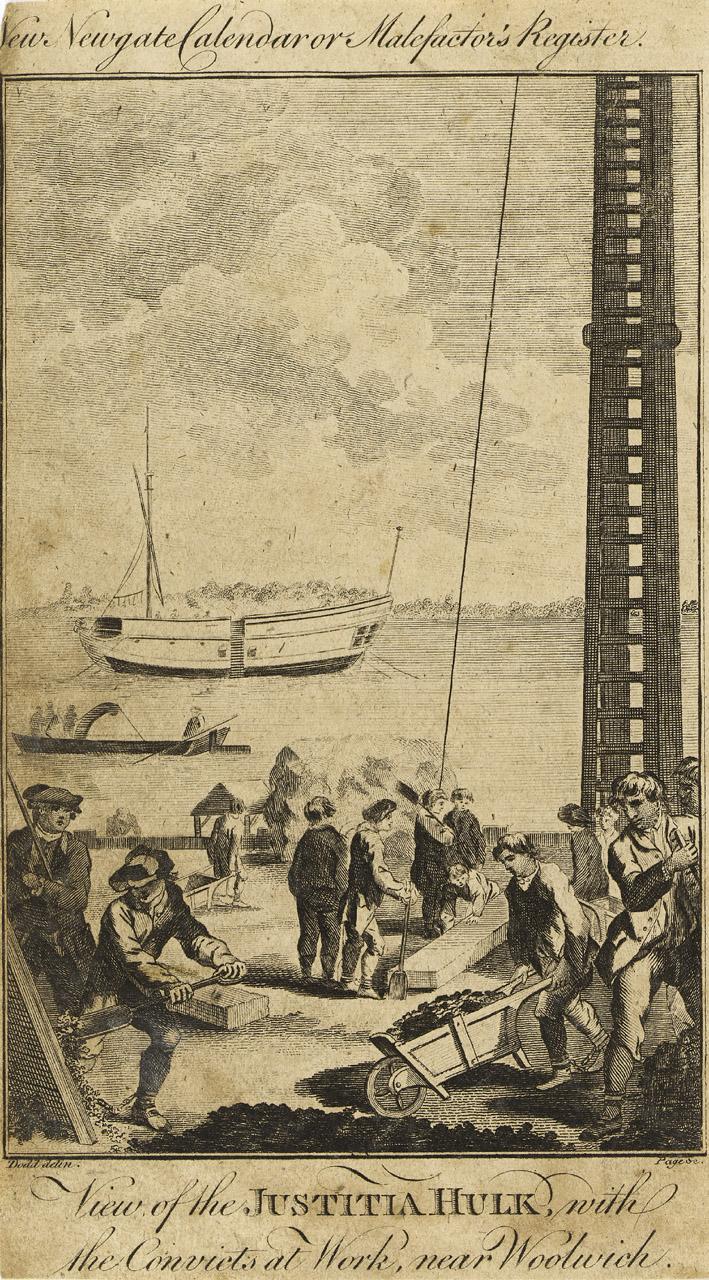
Convicts perform hard labour at the Woolwich Warren. The hulk on the river is the ‘Justitia’. Prisoners were kept on board such ships for months awaiting deportation to Australia. The ‘Justitia’ was a 260 ton prison hulk that had been originally moored in the Thames when the American War of Independence put a stop to the transportation of criminals to the former colonies. The ‘Justitia’ belonged to the shipowner Duncan Campbell, who was the Government contractor who organized the prison-hulk system at that time. Campbell was subsequently involved in the shipping of convicts to the penal colony at Botany Bay (in fact Port Jackson, later Sydney, just to the north) in New South Wales, the ‘first fleet’ going out in 1788.
While searching for records for Isaac Stokes I discovered that another Isaac Stokes was transported to New South Wales in 1835 as well. The other one was a butcher born in 1809, sentenced in London for seven years, and he sailed on the Mary Ann. Our Isaac Stokes sailed on the Lady Nugent, arriving in NSW in April 1835, having set sail from England in December 1834.
Lady Nugent was built at Bombay in 1813. She made four voyages under contract to the British East India Company (EIC). She then made two voyages transporting convicts to Australia, one to New South Wales and one to Van Diemen’s Land (Tasmania). (via Wikipedia)
via freesettlerorfelon website:
On 20 November 1834, 100 male convicts were transferred to the Lady Nugent from the Justitia Hulk and 60 from the Ganymede Hulk at Woolwich, all in apparent good health. The Lady Nugent departed Sheerness on 4 December 1834.
SURGEON OLIVER SPROULE
Oliver Sproule kept a Medical Journal from 7 November 1834 to 27 April 1835. He recorded in his journal the weather conditions they experienced in the first two weeks:
‘In the course of the first week or ten days at sea, there were eight or nine on the sick list with catarrhal affections and one with dropsy which I attribute to the cold and wet we experienced during that period beating down channel. Indeed the foremost berths in the prison at this time were so wet from leaking in that part of the ship, that I was obliged to issue dry beds and bedding to a great many of the prisoners to preserve their health, but after crossing the Bay of Biscay the weather became fine and we got the damp beds and blankets dried, the leaks partially stopped and the prison well aired and ventilated which, I am happy to say soon manifested a favourable change in the health and appearance of the men.
Besides the cases given in the journal I had a great many others to treat, some of them similar to those mentioned but the greater part consisted of boils, scalds, and contusions which would not only be too tedious to enter but I fear would be irksome to the reader. There were four births on board during the passage which did well, therefore I did not consider it necessary to give a detailed account of them in my journal the more especially as they were all favourable cases.
Regularity and cleanliness in the prison, free ventilation and as far as possible dry decks turning all the prisoners up in fine weather as we were lucky enough to have two musicians amongst the convicts, dancing was tolerated every afternoon, strict attention to personal cleanliness and also to the cooking of their victuals with regular hours for their meals, were the only prophylactic means used on this occasion, which I found to answer my expectations to the utmost extent in as much as there was not a single case of contagious or infectious nature during the whole passage with the exception of a few cases of psora which soon yielded to the usual treatment. A few cases of scurvy however appeared on board at rather an early period which I can attribute to nothing else but the wet and hardships the prisoners endured during the first three or four weeks of the passage. I was prompt in my treatment of these cases and they got well, but before we arrived at Sydney I had about thirty others to treat.’
The Lady Nugent arrived in Port Jackson on 9 April 1835 with 284 male prisoners. Two men had died at sea. The prisoners were landed on 27th April 1835 and marched to Hyde Park Barracks prior to being assigned. Ten were under the age of 14 years.
The Lady Nugent:
Isaac’s distinguishing marks are noted on various criminal registers and record books:
“Height in feet & inches: 5 4; Complexion: Ruddy; Hair: Light brown; Eyes: Hazel; Marks or Scars: Yes [including] DEVIL on lower left arm, TSIS back of left hand, WS lower right arm, MHDW back of right hand.”
Another includes more detail about Isaac’s tattoos:
“Two slight scars right side of mouth, 2 moles above right breast, figure of the devil and DEVIL and raised mole, lower left arm; anchor, seven dots half moon, TSIS and cross, back of left hand; a mallet, door post, A, mans bust, sun, WS, lower right arm; woman, MHDW and shut knife, back of right hand.”
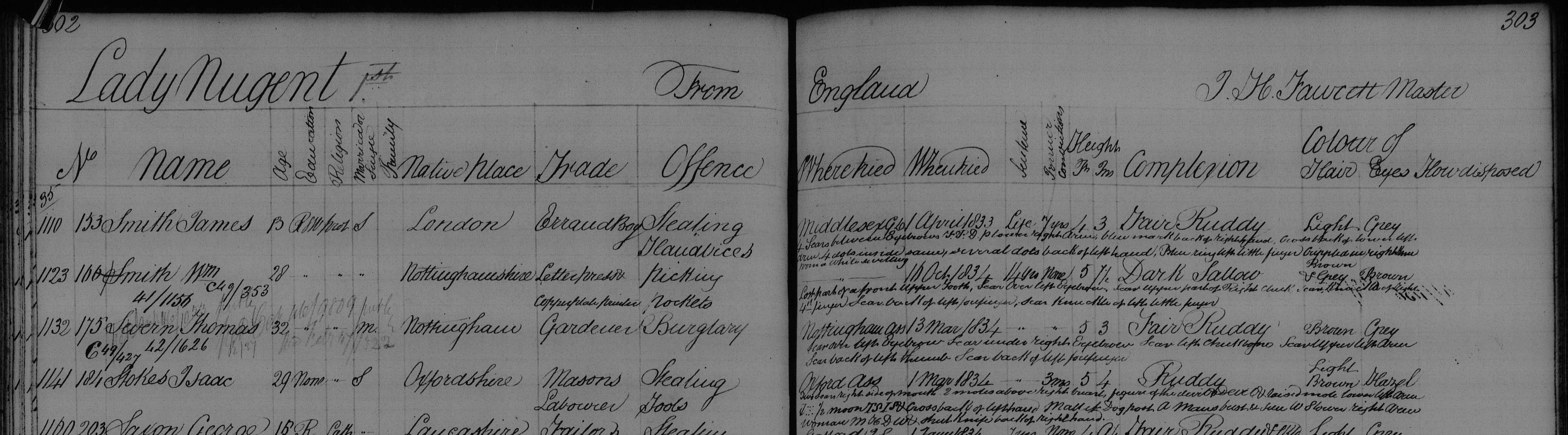
From How tattoos became fashionable in Victorian England (2019 article in TheConversation by Robert Shoemaker and Zoe Alkar):
“Historical tattooing was not restricted to sailors, soldiers and convicts, but was a growing and accepted phenomenon in Victorian England. Tattoos provide an important window into the lives of those who typically left no written records of their own. As a form of “history from below”, they give us a fleeting but intriguing understanding of the identities and emotions of ordinary people in the past.
As a practice for which typically the only record is the body itself, few systematic records survive before the advent of photography. One exception to this is the written descriptions of tattoos (and even the occasional sketch) that were kept of institutionalised people forced to submit to the recording of information about their bodies as a means of identifying them. This particularly applies to three groups – criminal convicts, soldiers and sailors. Of these, the convict records are the most voluminous and systematic.
Such records were first kept in large numbers for those who were transported to Australia from 1788 (since Australia was then an open prison) as the authorities needed some means of keeping track of them.”On the 1837 census Isaac was working for the government at Illiwarra, New South Wales. This record states that he arrived on the Lady Nugent in 1835. There are three other indent records for an Isaac Stokes in the following years, but the transcriptions don’t provide enough information to determine which Isaac Stokes it was. In April 1837 there was an abscondment, and an arrest/apprehension in May of that year, and in 1843 there was a record of convict indulgences.
From the Australian government website regarding “convict indulgences”:
“By the mid-1830s only six per cent of convicts were locked up. The vast majority worked for the government or free settlers and, with good behaviour, could earn a ticket of leave, conditional pardon or and even an absolute pardon. While under such orders convicts could earn their own living.”
In 1856 in Camden, NSW, Isaac Stokes married Catherine Daly. With no further information on this record it would be impossible to know for sure if this was the right Isaac Stokes. This couple had six children, all in the Camden area, but none of the records provided enough information. No occupation or place or date of birth recorded for Isaac Stokes.
I wrote to the National Library of Australia about the marriage record, and their reply was a surprise! Issac and Catherine were married on 30 September 1856, at the house of the Rev. Charles William Rigg, a Methodist minister, and it was recorded that Isaac was born in Edinburgh in 1821, to parents James Stokes and Sarah Ellis! The age at the time of the marriage doesn’t match Isaac’s age at death in 1877, and clearly the place of birth and parents didn’t match either. Only his fathers occupation of stone mason was correct. I wrote back to the helpful people at the library and they replied that the register was in a very poor condition and that only two and a half entries had survived at all, and that Isaac and Catherines marriage was recorded over two pages.
I searched for an Isaac Stokes born in 1821 in Edinburgh on the Scotland government website (and on all the other genealogy records sites) and didn’t find it. In fact Stokes was a very uncommon name in Scotland at the time. I also searched Australian immigration and other records for another Isaac Stokes born in Scotland or born in 1821, and found nothing. I was unable to find a single record to corroborate this mysterious other Isaac Stokes.
As the age at death in 1877 was correct, I assume that either Isaac was lying, or that some mistake was made either on the register at the home of the Methodist minster, or a subsequent mistranscription or muddle on the remnants of the surviving register. Therefore I remain convinced that the Camden stonemason Isaac Stokes was indeed our Isaac from Oxfordshire.
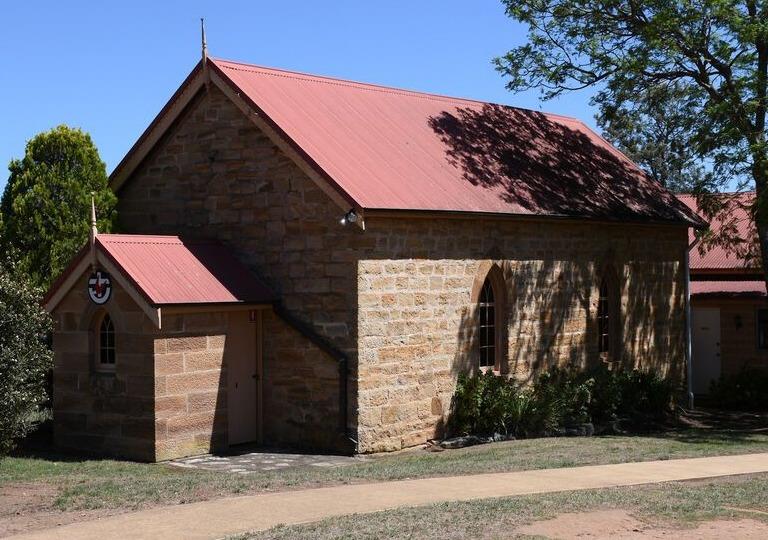
I found a history society newsletter article that mentioned Isaac Stokes, stone mason, had built the Glenmore church, near Camden, in 1859.
From the Wollondilly museum April 2020 newsletter:
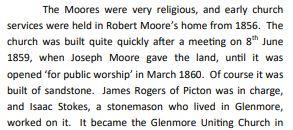
From the Camden History website:
“The stone set over the porch of Glenmore Church gives the date of 1860. The church was begun in 1859 on land given by Joseph Moore. James Rogers of Picton was given the contract to build and local builder, Mr. Stokes, carried out the work. Elizabeth Moore, wife of Edward, laid the foundation stone. The first service was held on 19th March 1860. The cemetery alongside the church contains the headstones and memorials of the areas early pioneers.”
Isaac died on the 3rd September 1877. The inquest report puts his place of death as Bagdelly, near to Camden, and another death register has put Cambelltown, also very close to Camden. His age was recorded as 71 and the inquest report states his cause of death was “rupture of one of the large pulmonary vessels of the lung”. His wife Catherine died in childbirth in 1870 at the age of 43.
Isaac and Catherine’s children:
William Stokes 1857-1928
Catherine Stokes 1859-1846
Sarah Josephine Stokes 1861-1931
Ellen Stokes 1863-1932
Rosanna Stokes 1865-1919
Louisa Stokes 1868-1844.
It’s possible that Catherine Daly was a transported convict from Ireland.
Some time later I unexpectedly received a follow up email from The Oaks Heritage Centre in Australia.
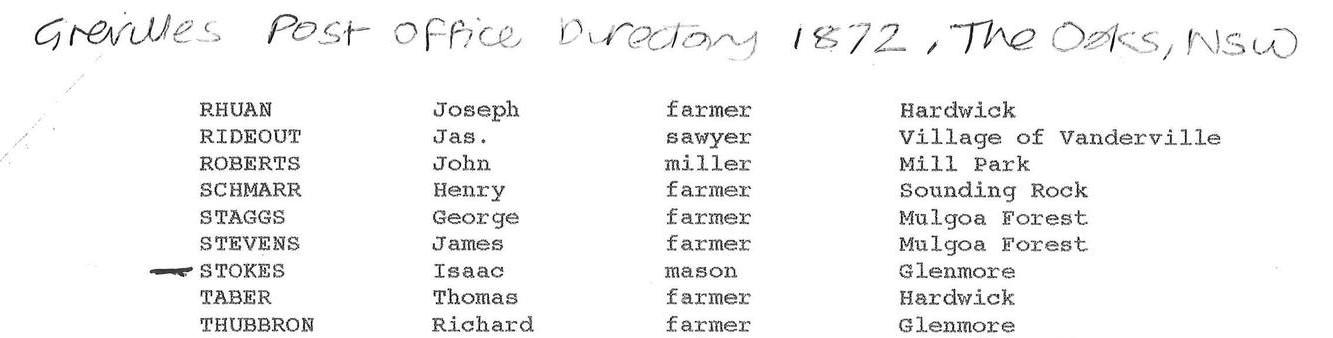
“The Gaudry papers which we have in our archive record him (Isaac Stokes) as having built: the church, the school and the teachers residence. Isaac is recorded in the General return of convicts: 1837 and in Grevilles Post Office directory 1872 as a mason in Glenmore.”
 October 19, 2022 at 6:46 am #6336
In reply to: Family Stories From The Other Side ~ Book Two
The Hamstall Ridware Connection
Stubbs and Woods
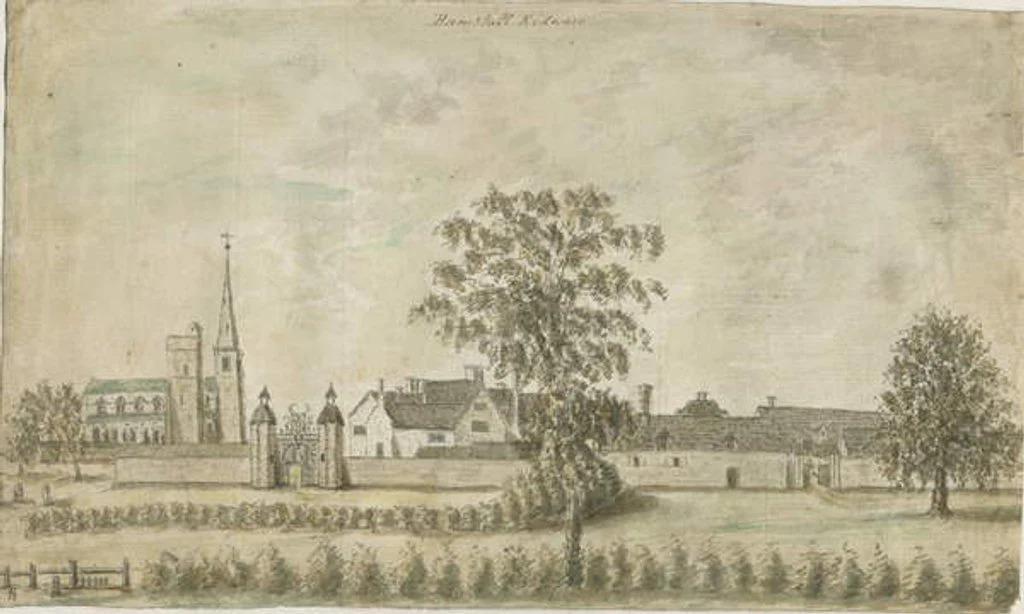 Hamstall Ridware
Charles Tomlinson‘s (1847-1907) wife Emma Grattidge (1853-1911) was born in Wolverhampton, the daughter and youngest child of William Grattidge (1820-1887) born in Foston, Derbyshire, and Mary Stubbs (1819-1880), born in Burton on Trent, daughter of Solomon Stubbs.
Solomon Stubbs (1781-1857) was born in Hamstall Ridware in 1781, the son of Samuel and Rebecca. Samuel Stubbs (1743-) and Rebecca Wood (1754-) married in 1769 in Darlaston. Samuel and Rebecca had six other children, all born in Darlaston. Sadly four of them died in infancy. Son John was born in 1779 in Darlaston and died two years later in Hamstall Ridware in 1781, the same year that Solomon was born there.
But why did they move to Hamstall Ridware?
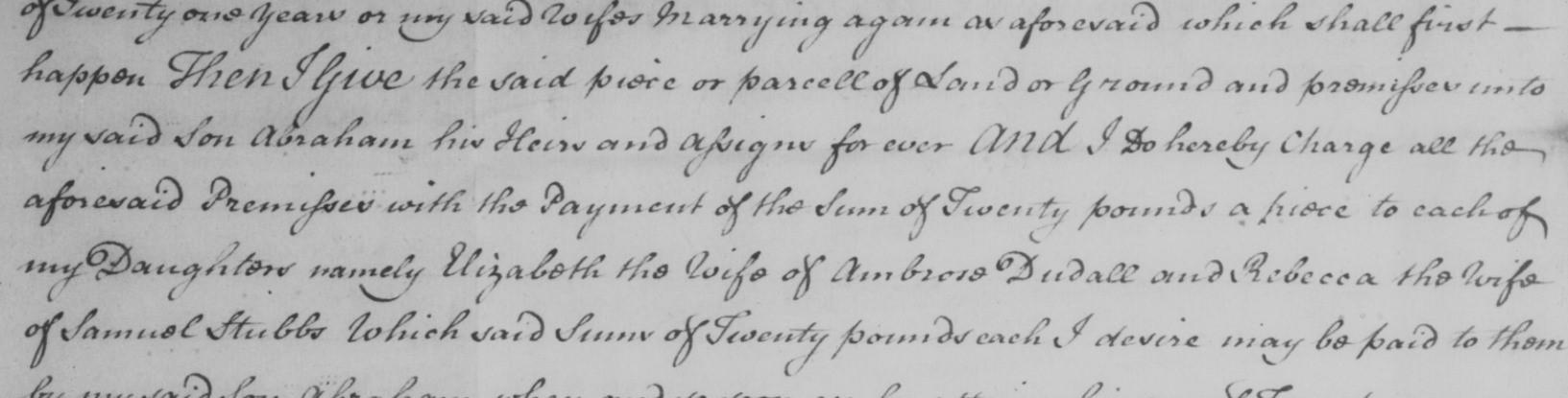
Samuel Stubbs was born in 1743 in Curdworth, Warwickshire (near to Birmingham). I had made a mistake on the tree (along with all of the public trees on the Ancestry website) and had Rebecca Wood born in Cheddleton, Staffordshire. Rebecca Wood from Cheddleton was also born in 1843, the right age for the marriage. The Rebecca Wood born in Darlaston in 1754 seemed too young, at just fifteen years old at the time of the marriage. I couldn’t find any explanation for why a woman from Cheddleton would marry in Darlaston and then move to Hamstall Ridware. People didn’t usually move around much other than intermarriage with neighbouring villages, especially women. I had a closer look at the Darlaston Rebecca, and did a search on her father William Wood. I found his 1784 will online in which he mentions his daughter Rebecca, wife of Samuel Stubbs. Clearly the right Rebecca Wood was the one born in Darlaston, which made much more sense.
An excerpt from William Wood’s 1784 will mentioning daughter Rebecca married to Samuel Stubbs:
But why did they move to Hamstall Ridware circa 1780?
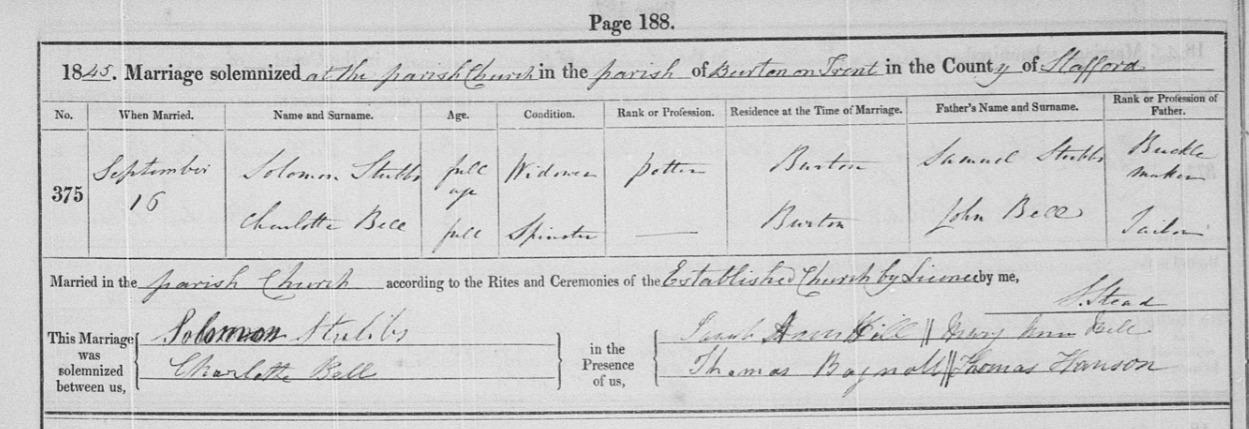
I had not intially noticed that Solomon Stubbs married again the year after his wife Phillis Lomas (1787-1844) died. Solomon married Charlotte Bell in 1845 in Burton on Trent and on the marriage register, Solomon’s father Samuel Stubbs occupation was mentioned: Samuel was a buckle maker.
Marriage of Solomon Stubbs and Charlotte Bell, father Samuel Stubbs buckle maker:
A rudimentary search on buckle making in the late 1700s provided a possible answer as to why Samuel and Rebecca left Darlaston in 1781. Shoe buckles had gone out of fashion, and by 1781 there were half as many buckle makers in Wolverhampton as there had been previously.
“Where there were 127 buckle makers at work in Wolverhampton, 68 in Bilston and 58 in Birmingham in 1770, their numbers had halved in 1781.”
via “historywebsite”(museum/metalware/steel)
Steel buckles had been the height of fashion, and the trade became enormous in Wolverhampton. Wolverhampton was a steel working town, renowned for its steel jewellery which was probably of many types. The trade directories show great numbers of “buckle makers”. Steel buckles were predominantly made in Wolverhampton: “from the late 1760s cut steel comes to the fore, from the thriving industry of the Wolverhampton area”. Bilston was also a great centre of buckle making, and other areas included Walsall. (It should be noted that Darlaston, Walsall, Bilston and Wolverhampton are all part of the same area)
In 1860, writing in defence of the Wolverhampton Art School, George Wallis talks about the cut steel industry in Wolverhampton. Referring to “the fine steel workers of the 17th and 18th centuries” he says: “Let them remember that 100 years ago [sc. c. 1760] a large trade existed with France and Spain in the fine steel goods of Birmingham and Wolverhampton, of which the latter were always allowed to be the best both in taste and workmanship. … A century ago French and Spanish merchants had their houses and agencies at Birmingham for the purchase of the steel goods of Wolverhampton…..The Great Revolution in France put an end to the demand for fine steel goods for a time and hostile tariffs finished what revolution began”.
The next search on buckle makers, Wolverhampton and Hamstall Ridware revealed an unexpected connecting link.
In Riotous Assemblies: Popular Protest in Hanoverian England by Adrian Randall:
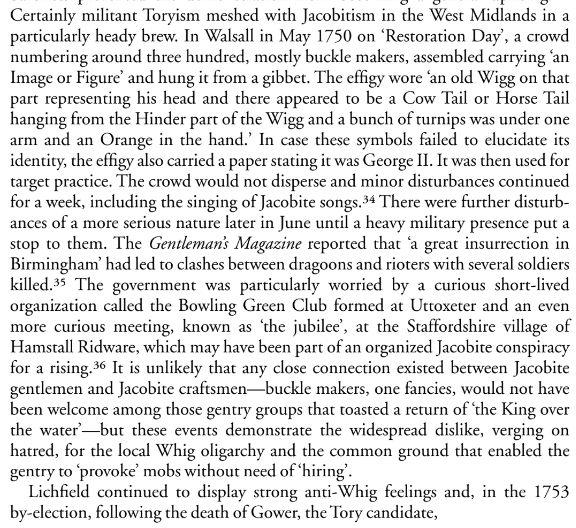
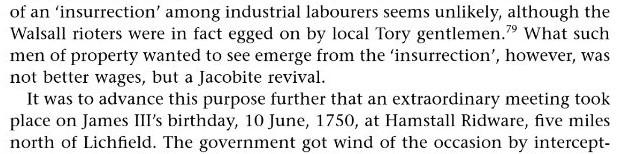
In Walsall in 1750 on “Restoration Day” a crowd numbering 300 assembled, mostly buckle makers, singing Jacobite songs and other rebellious and riotous acts. The government was particularly worried about a curious meeting known as the “Jubilee” in Hamstall Ridware, which may have been part of a conspiracy for a Jacobite uprising.
But this was thirty years before Samuel and Rebecca moved to Hamstall Ridware and does not help to explain why they moved there around 1780, although it does suggest connecting links.
Rebecca’s father, William Wood, was a brickmaker. This was stated at the beginning of his will. On closer inspection of the will, he was a brickmaker who owned four acres of brick kilns, as well as dwelling houses, shops, barns, stables, a brewhouse, a malthouse, cattle and land.
A page from the 1784 will of William Wood:
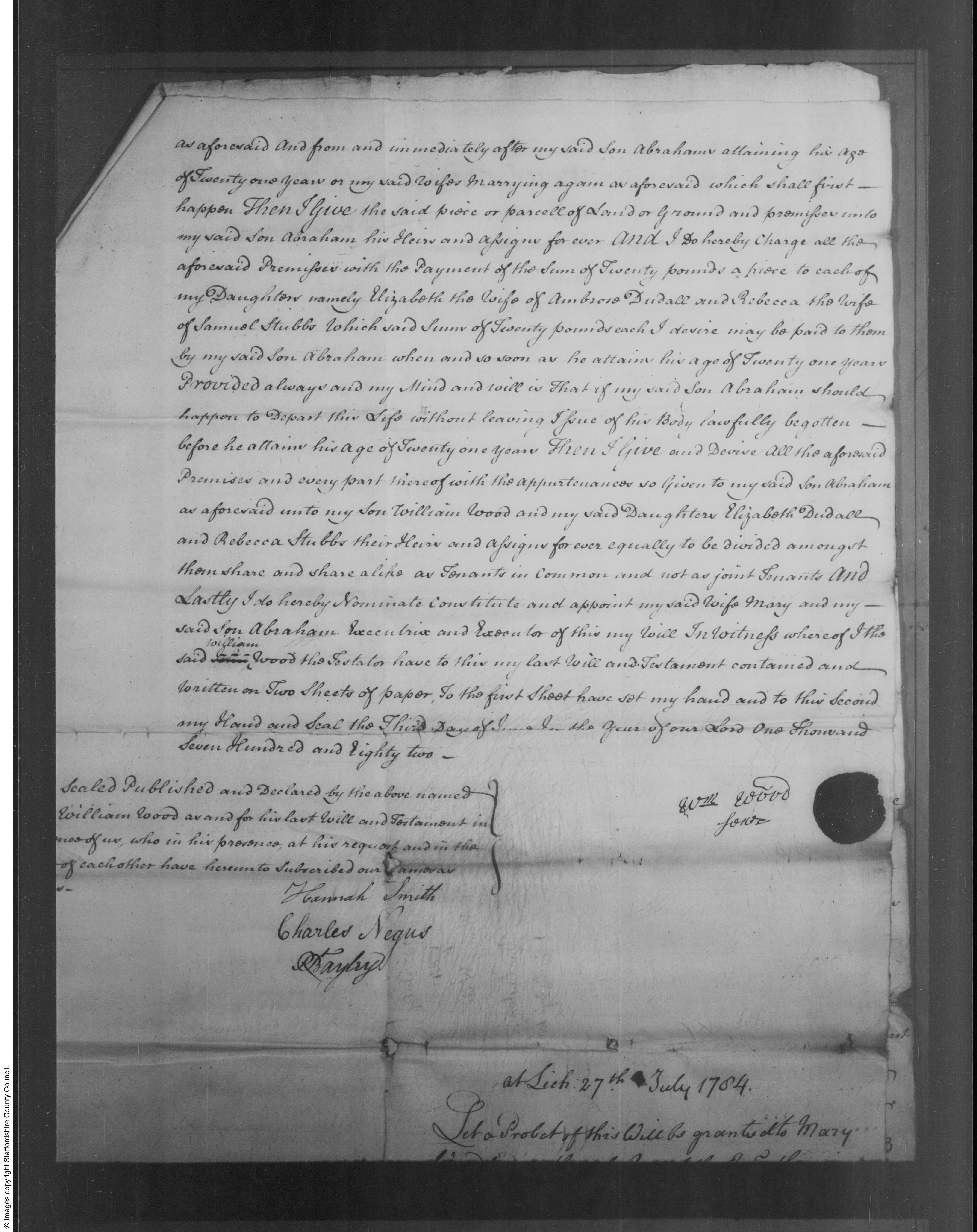
The 1784 will of William Wood of Darlaston:
I William Wood the elder of Darlaston in the county of Stafford, brickmaker, being of sound and disposing mind memory and understanding (praised be to god for the same) do make publish and declare my last will and testament in manner and form following (that is to say) {after debts and funeral expense paid etc} I give to my loving wife Mary the use usage wear interest and enjoyment of all my goods chattels cattle stock in trade ~ money securities for money personal estate and effects whatsoever and wheresoever to hold unto her my said wife for and during the term of her natural life providing she so long continues my widow and unmarried and from or after her decease or intermarriage with any future husband which shall first happen.
Then I give all the said goods chattels cattle stock in trade money securites for money personal estate and effects unto my son Abraham Wood absolutely and forever. Also I give devise and bequeath unto my said wife Mary all that my messuages tenement or dwelling house together with the malthouse brewhouse barn stableyard garden and premises to the same belonging situate and being at Darlaston aforesaid and now in my own possession. Also all that messuage tenement or dwelling house together with the shop garden and premises with the appurtenances to the same ~ belonging situate in Darlaston aforesaid and now in the several holdings or occupation of George Knowles and Edward Knowles to hold the aforesaid premises and every part thereof with the appurtenances to my said wife Mary for and during the term of her natural life provided she so long continues my widow and unmarried. And from or after her decease or intermarriage with a future husband which shall first happen. Then I give and devise the aforesaid premises and every part thereof with the appurtenances unto my said son Abraham Wood his heirs and assigns forever.
Also I give unto my said wife all that piece or parcel of land or ground inclosed and taken out of Heath Field in the parish of Darlaston aforesaid containing four acres or thereabouts (be the same more or less) upon which my brick kilns erected and now in my own possession. To hold unto my said wife Mary until my said son Abraham attains his age of twenty one years if she so long continues my widow and unmarried as aforesaid and from and immediately after my said son Abraham attaining his age of twenty one years or my said wife marrying again as aforesaid which shall first happen then I give the said piece or parcel of land or ground and premises unto my said son Abraham his heirs and assigns forever.
And I do hereby charge all the aforesaid premises with the payment of the sum of twenty pounds a piece to each of my daughters namely Elizabeth the wife of Ambrose Dudall and Rebecca the wife of Samuel Stubbs which said sum of twenty pounds each I devise may be paid to them by my said son Abraham when and so soon as he attains his age of twenty one years provided always and my mind and will is that if my said son Abraham should happen to depart this life without leaving issue of his body lawfully begotten before he attains his age of twenty one years then I give and devise all the aforesaid premises and every part thereof with the appurtenances so given to my said son Abraham as aforesaid unto my said son William Wood and my said daughter Elizabeth Dudall and Rebecca Stubbs their heirs and assigns forever equally divided among them share and share alike as tenants in common and not as joint tenants. And lastly I do hereby nominate constitute and appoint my said wife Mary and my said son Abraham executrix and executor of this my will.
The marriage of William Wood (1725-1784) and Mary Clews (1715-1798) in 1749 was in Hamstall Ridware.
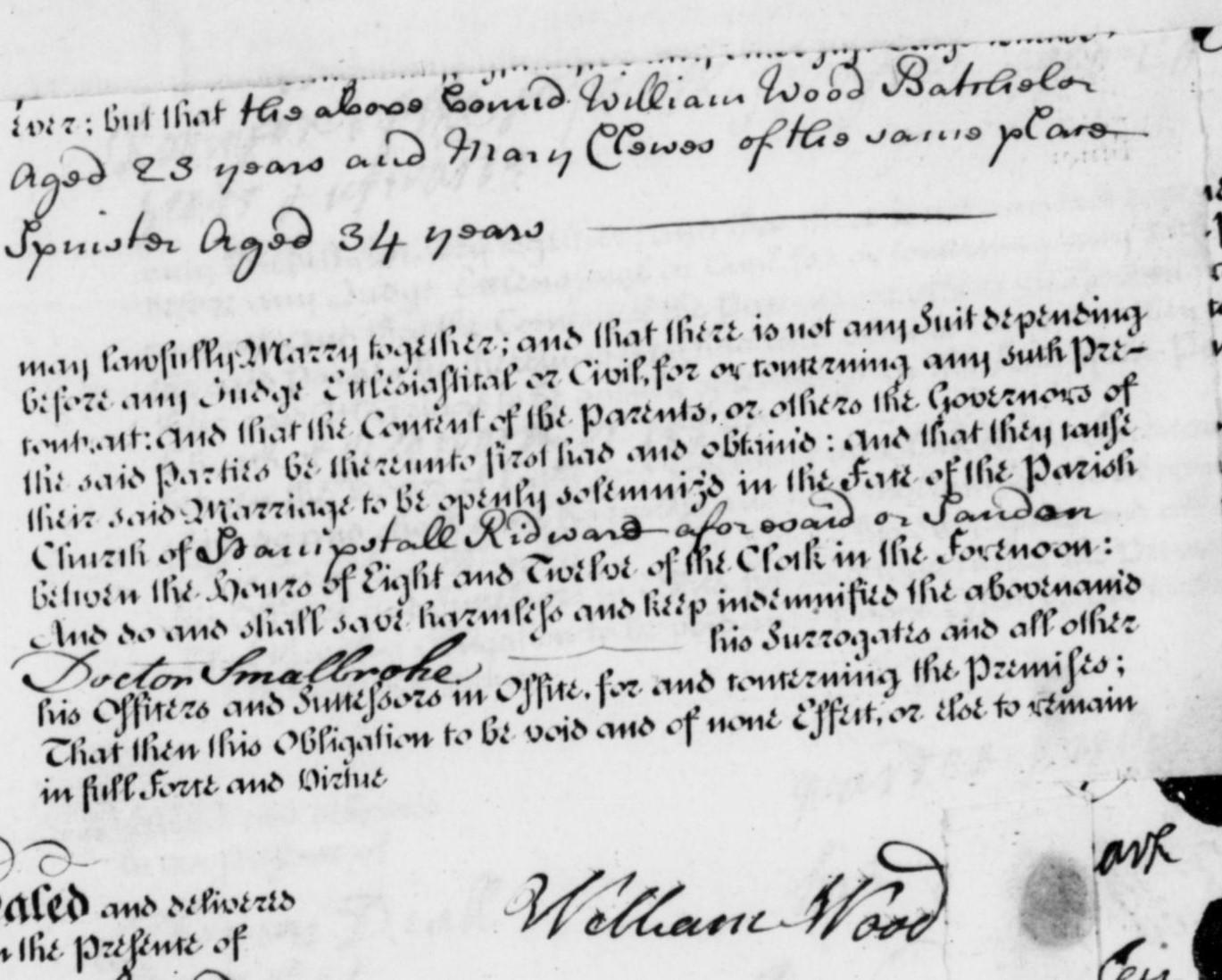
Mary was eleven years Williams senior, and it appears that they both came from Hamstall Ridware and moved to Darlaston after they married. Clearly Rebecca had extended family there (notwithstanding any possible connecting links between the Stubbs buckle makers of Darlaston and the Hamstall Ridware Jacobites thirty years prior). When the buckle trade collapsed in Darlaston, they likely moved to find employment elsewhere, perhaps with the help of Rebecca’s family.
I have not yet been able to find deaths recorded anywhere for either Samuel or Rebecca (there are a couple of deaths recorded for a Samuel Stubbs, one in 1809 in Wolverhampton, and one in 1810 in Birmingham but impossible to say which, if either, is the right one with the limited information, and difficult to know if they stayed in the Hamstall Ridware area or perhaps moved elsewhere)~ or find a reason for their son Solomon to be in Burton upon Trent, an evidently prosperous man with several properties including an earthenware business, as well as a land carrier business.
October 11, 2022 at 11:39 am #6333In reply to: Family Stories From The Other Side ~ Book Two
The Grattidge Family
The first Grattidge to appear in our tree was Emma Grattidge (1853-1911) who married Charles Tomlinson (1847-1907) in 1872.
Charles Tomlinson (1873-1929) was their son and he married my great grandmother Nellie Fisher. Their daughter Margaret (later Peggy Edwards) was my grandmother on my fathers side.
Emma Grattidge was born in Wolverhampton, the daughter and youngest child of William Grattidge (1820-1887) born in Foston, Derbyshire, and Mary Stubbs, born in Burton on Trent, daughter of Solomon Stubbs, a land carrier. William and Mary married at St Modwens church, Burton on Trent, in 1839. It’s unclear why they moved to Wolverhampton. On the 1841 census William was employed as an agent, and their first son William was nine months old. Thereafter, William was a licensed victuallar or innkeeper.
William Grattidge was born in Foston, Derbyshire in 1820. His parents were Thomas Grattidge, farmer (1779-1843) and Ann Gerrard (1789-1822) from Ellastone. Thomas and Ann married in 1813 in Ellastone. They had five children before Ann died at the age of 25:
Bessy was born in 1815, Thomas in 1818, William in 1820, and Daniel Augustus and Frederick were twins born in 1822. They were all born in Foston. (records say Foston, Foston and Scropton, or Scropton)
On the 1841 census Thomas had nine people additional to family living at the farm in Foston, presumably agricultural labourers and help.
After Ann died, Thomas had three children with Kezia Gibbs (30 years his junior) before marrying her in 1836, then had a further four with her before dying in 1843. Then Kezia married Thomas’s nephew Frederick Augustus Grattidge (born in 1816 in Stafford) in London in 1847 and had two more!
The siblings of William Grattidge (my 3x great grandfather):
Frederick Grattidge (1822-1872) was a schoolmaster and never married. He died at the age of 49 in Tamworth at his twin brother Daniels address.
Daniel Augustus Grattidge (1822-1903) was a grocer at Gungate in Tamworth.
Thomas Grattidge (1818-1871) married in Derby, and then emigrated to Illinois, USA.
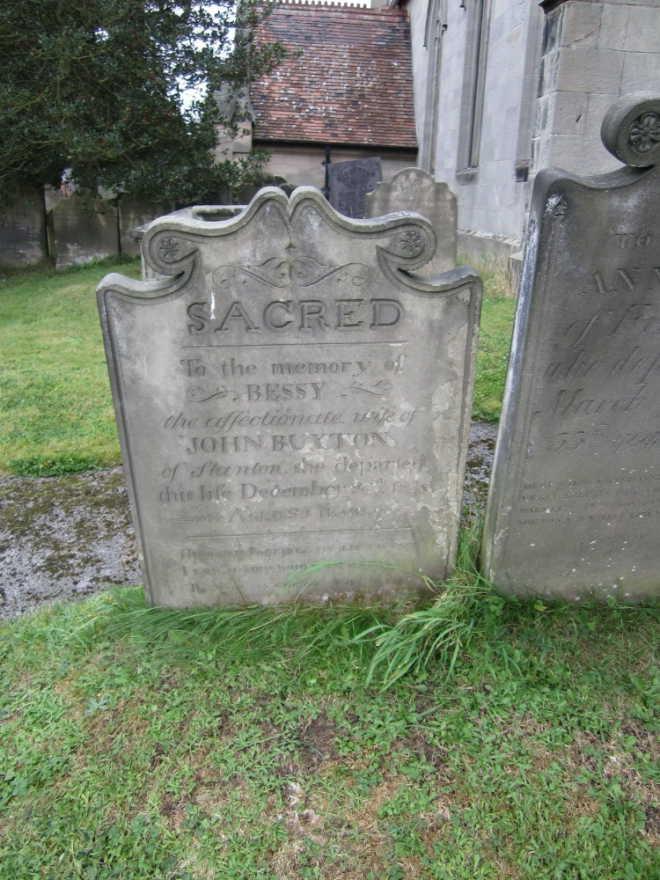
Bessy Grattidge (1815-1840) married John Buxton, farmer, in Ellastone in January 1838. They had three children before Bessy died in December 1840 at the age of 25: Henry in 1838, John in 1839, and Bessy Buxton in 1840. Bessy was baptised in January 1841. Presumably the birth of Bessy caused the death of Bessy the mother.
Bessy Buxton’s gravestone:
“Sacred to the memory of Bessy Buxton, the affectionate wife of John Buxton of Stanton She departed this life December 20th 1840, aged 25 years. “Husband, Farewell my life is Past, I loved you while life did last. Think on my children for my sake, And ever of them with I take.”
20 Dec 1840, Ellastone, Staffordshire
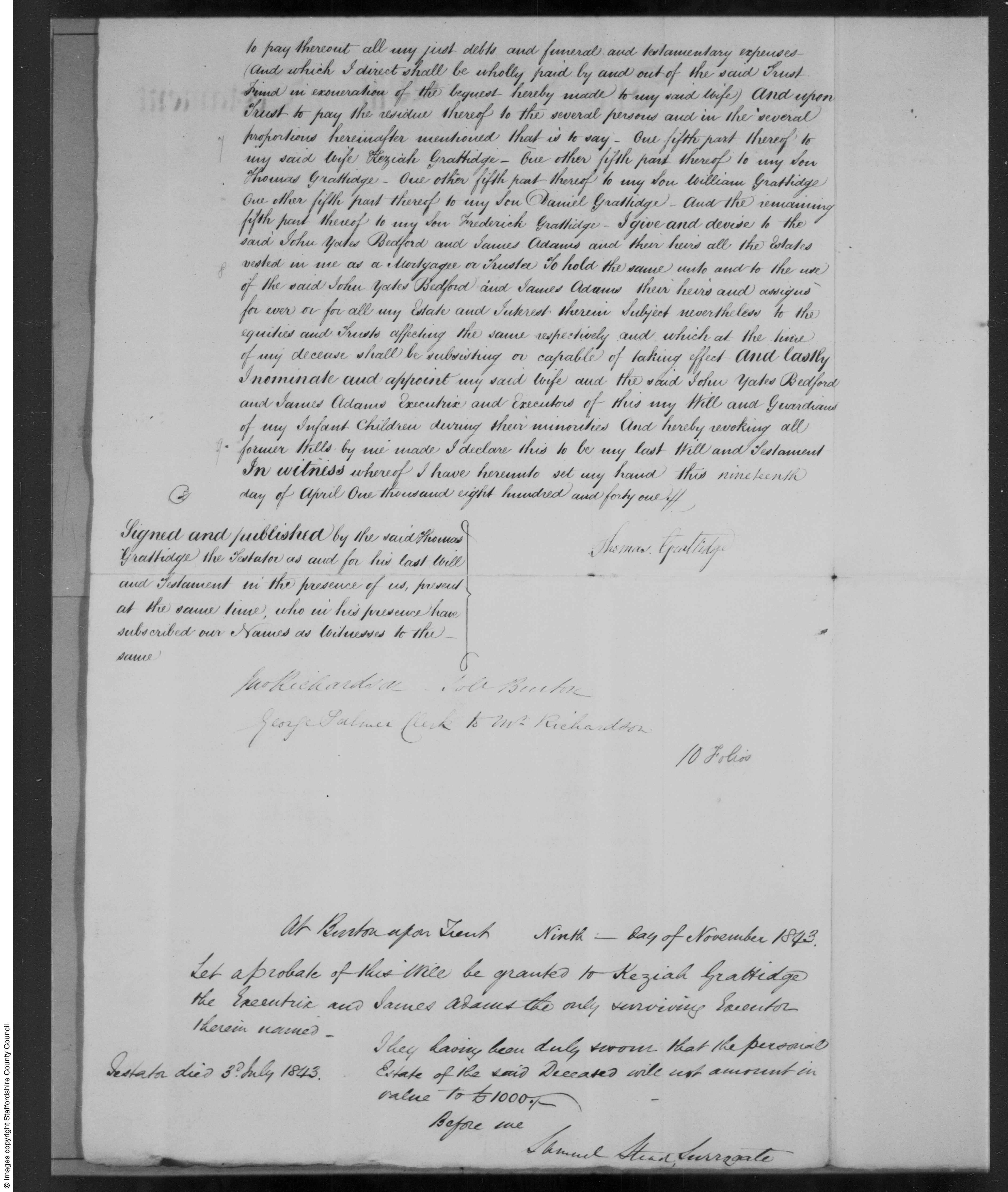
In the 1843 will of Thomas Grattidge, farmer of Foston, he leaves fifth shares of his estate, including freehold real estate at Findern, to his wife Kezia, and sons William, Daniel, Frederick and Thomas. He mentions that the children of his late daughter Bessy, wife of John Buxton, will be taken care of by their father. He leaves the farm to Keziah in confidence that she will maintain, support and educate his children with her.
An excerpt from the will:
I give and bequeath unto my dear wife Keziah Grattidge all my household goods and furniture, wearing apparel and plate and plated articles, linen, books, china, glass, and other household effects whatsoever, and also all my implements of husbandry, horses, cattle, hay, corn, crops and live and dead stock whatsoever, and also all the ready money that may be about my person or in my dwelling house at the time of my decease, …I also give my said wife the tenant right and possession of the farm in my occupation….
A page from the 1843 will of Thomas Grattidge:
William Grattidges half siblings (the offspring of Thomas Grattidge and Kezia Gibbs):
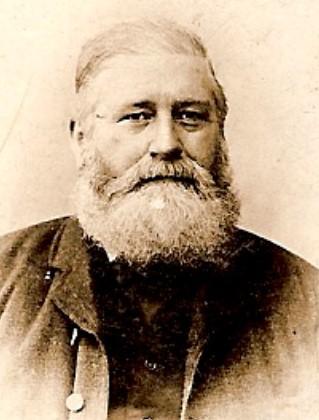
Albert Grattidge (1842-1914) was a railway engine driver in Derby. In 1884 he was driving the train when an unfortunate accident occured outside Ambergate. Three children were blackberrying and crossed the rails in front of the train, and one little girl died.
Albert Grattidge:
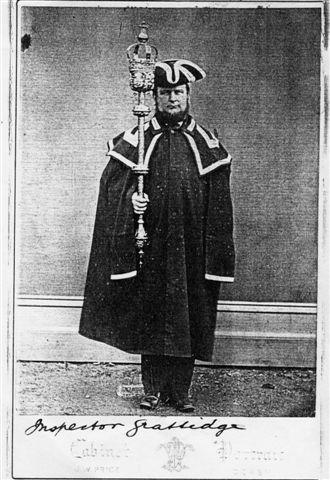
George Grattidge (1826-1876) was baptised Gibbs as this was before Thomas married Kezia. He was a police inspector in Derby.
George Grattidge:
Edwin Grattidge (1837-1852) died at just 15 years old.
Ann Grattidge (1835-) married Charles Fletcher, stone mason, and lived in Derby.
Louisa Victoria Grattidge (1840-1869) was sadly another Grattidge woman who died young. Louisa married Emmanuel Brunt Cheesborough in 1860 in Derby. In 1861 Louisa and Emmanuel were living with her mother Kezia in Derby, with their two children Frederick and Ann Louisa. Emmanuel’s occupation was sawyer. (Kezia Gibbs second husband Frederick Augustus Grattidge was a timber merchant in Derby)
At the time of her death in 1869, Emmanuel was the landlord of the White Hart public house at Bridgegate in Derby.
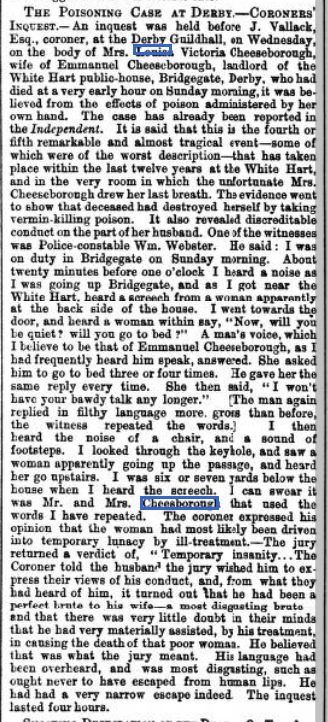
The Derby Mercury of 17th November 1869:
“On Wednesday morning Mr Coroner Vallack held an inquest in the Grand
Jury-room, Town-hall, on the body of Louisa Victoria Cheeseborough, aged
33, the wife of the landlord of the White Hart, Bridge-gate, who committed
suicide by poisoning at an early hour on Sunday morning. The following
evidence was taken:Mr Frederick Borough, surgeon, practising in Derby, deposed that he was
called in to see the deceased about four o’clock on Sunday morning last. He
accordingly examined the deceased and found the body quite warm, but dead.
He afterwards made enquiries of the husband, who said that he was afraid
that his wife had taken poison, also giving him at the same time the
remains of some blue material in a cup. The aunt of the deceased’s husband
told him that she had seen Mrs Cheeseborough put down a cup in the
club-room, as though she had just taken it from her mouth. The witness took
the liquid home with him, and informed them that an inquest would
necessarily have to be held on Monday. He had made a post mortem
examination of the body, and found that in the stomach there was a great
deal of congestion. There were remains of food in the stomach and, having
put the contents into a bottle, he took the stomach away. He also examined
the heart and found it very pale and flabby. All the other organs were
comparatively healthy; the liver was friable.Hannah Stone, aunt of the deceased’s husband, said she acted as a servant
in the house. On Saturday evening, while they were going to bed and whilst
witness was undressing, the deceased came into the room, went up to the
bedside, awoke her daughter, and whispered to her. but what she said the
witness did not know. The child jumped out of bed, but the deceased closed
the door and went away. The child followed her mother, and she also
followed them to the deceased’s bed-room, but the door being closed, they
then went to the club-room door and opening it they saw the deceased
standing with a candle in one hand. The daughter stayed with her in the
room whilst the witness went downstairs to fetch a candle for herself, and
as she was returning up again she saw the deceased put a teacup on the
table. The little girl began to scream, saying “Oh aunt, my mother is
going, but don’t let her go”. The deceased then walked into her bed-room,
and they went and stood at the door whilst the deceased undressed herself.
The daughter and the witness then returned to their bed-room. Presently
they went to see if the deceased was in bed, but she was sitting on the
floor her arms on the bedside. Her husband was sitting in a chair fast
asleep. The witness pulled her on the bed as well as she could.
Ann Louisa Cheesborough, a little girl, said that the deceased was her
mother. On Saturday evening last, about twenty minutes before eleven
o’clock, she went to bed, leaving her mother and aunt downstairs. Her aunt
came to bed as usual. By and bye, her mother came into her room – before
the aunt had retired to rest – and awoke her. She told the witness, in a
low voice, ‘that she should have all that she had got, adding that she
should also leave her her watch, as she was going to die’. She did not tell
her aunt what her mother had said, but followed her directly into the
club-room, where she saw her drink something from a cup, which she
afterwards placed on the table. Her mother then went into her own room and
shut the door. She screamed and called her father, who was downstairs. He
came up and went into her room. The witness then went to bed and fell
asleep. She did not hear any noise or quarrelling in the house after going
to bed.Police-constable Webster was on duty in Bridge-gate on Saturday evening
last, about twenty minutes to one o’clock. He knew the White Hart
public-house in Bridge-gate, and as he was approaching that place, he heard
a woman scream as though at the back side of the house. The witness went to
the door and heard the deceased keep saying ‘Will you be quiet and go to
bed’. The reply was most disgusting, and the language which the
police-constable said was uttered by the husband of the deceased, was
immoral in the extreme. He heard the poor woman keep pressing her husband
to go to bed quietly, and eventually he saw him through the keyhole of the
door pass and go upstairs. his wife having gone up a minute or so before.
Inspector Fearn deposed that on Sunday morning last, after he had heard of
the deceased’s death from supposed poisoning, he went to Cheeseborough’s
public house, and found in the club-room two nearly empty packets of
Battie’s Lincoln Vermin Killer – each labelled poison.Several of the Jury here intimated that they had seen some marks on the
deceased’s neck, as of blows, and expressing a desire that the surgeon
should return, and re-examine the body. This was accordingly done, after
which the following evidence was taken:Mr Borough said that he had examined the body of the deceased and observed
a mark on the left side of the neck, which he considered had come on since
death. He thought it was the commencement of decomposition.
This was the evidence, after which the jury returned a verdict “that the
deceased took poison whilst of unsound mind” and requested the Coroner to
censure the deceased’s husband.The Coroner told Cheeseborough that he was a disgusting brute and that the
jury only regretted that the law could not reach his brutal conduct.
However he had had a narrow escape. It was their belief that his poor
wife, who was driven to her own destruction by his brutal treatment, would
have been a living woman that day except for his cowardly conduct towards
her.The inquiry, which had lasted a considerable time, then closed.”
In this article it says:
“it was the “fourth or fifth remarkable and tragical event – some of which were of the worst description – that has taken place within the last twelve years at the White Hart and in the very room in which the unfortunate Louisa Cheesborough drew her last breath.”
Sheffield Independent – Friday 12 November 1869:
 September 21, 2022 at 1:25 pm #6331
In reply to: Family Stories From The Other Side ~ Book Two
Whitesmiths of Baker Street
The Fishers of Wolverhampton
My fathers mother was Margaret Tomlinson born in 1913, the youngest but one daughter of Charles Tomlinson and Nellie Fisher of Wolverhampton.
Nellie Fisher was born in 1877. Her parents were William Fisher and Mary Ann Smith.
William Fisher born in 1834 was a whitesmith on Baker St on the 1881 census; Nellie was 3 years old. Nellie was his youngest daughter.
William was a whitesmith (or screw maker) on all of the censuses but in 1901 whitesmith was written for occupation, then crossed out and publican written on top. This was on Duke St, so I searched for William Fisher licensee on longpull black country pubs website and he was licensee of The Old Miners Arms on Duke St in 1896. The pub closed in 1906 and no longer exists. He was 67 in 1901 and just he and wife Mary Ann were at that address.
In 1911 he was a widower living alone in Upper Penn. Nellie and Charles Tomlinson were also living in Upper Penn on the 1911 census, and my grandmother was born there in 1913.
William’s father William Fisher born in 1792, Nellie’s grandfather, was a whitesmith on Baker St on the 1861 census employing 4 boys, 2 men, 3 girls. He died in 1873.
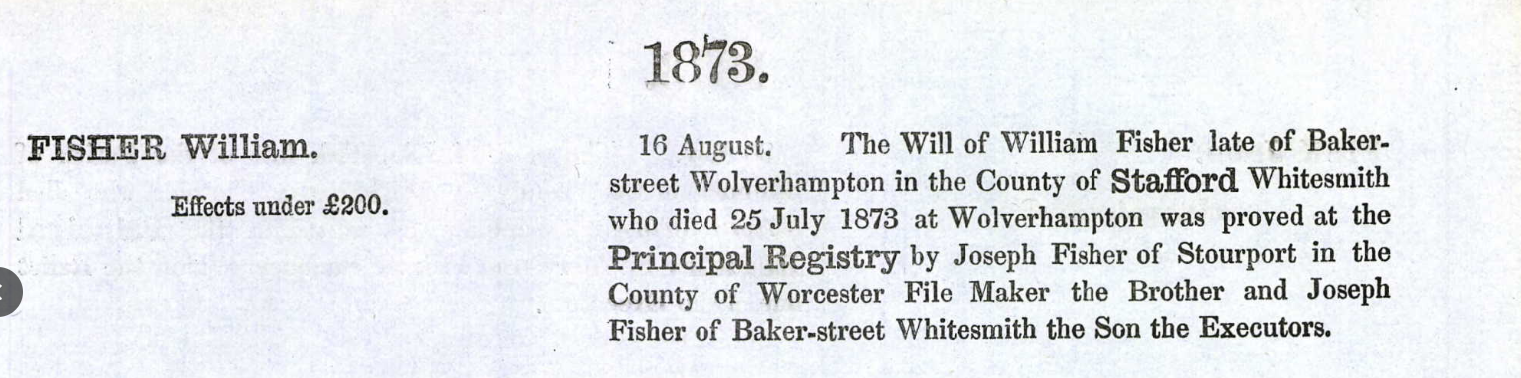
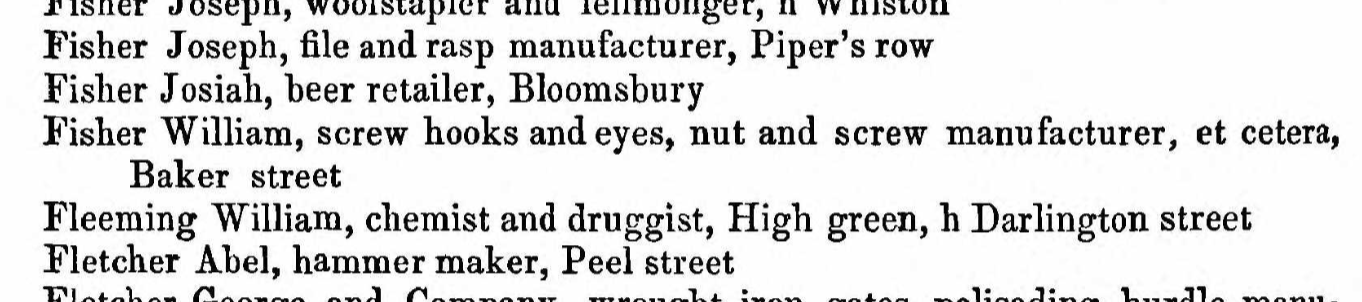
William Fisher the elder appears in a number of directories including this one:
1851 Melville & Co´s Directory of Wolverhampton
I noticed that all the other ancestry trees (as did my fathers cousin on the Tomlinson side) had MARY LUNN from Birmingham in Warwickshire marrying William Fisher the elder in 1828. But on ALL of the censuses, Mary’s place of birth was Staffordshire, and on one it said Bilston. I found another William Fisher and Mary marriage in Sedgley in 1829, MARY PITT.
You can order a birth certificate from the records office with mothers maiden name on, but only after 1837. So I looked for Williams younger brother Joseph, born 1845. His mothers maiden name was Pitt.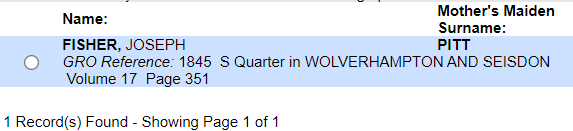 September 4, 2022 at 6:00 pm #6326
In reply to: The Sexy Wooden Leg
Stung by Egberts question, Olga reeled and almost lost her footing on the stairs. What had happened to her? That damned selfish individualism that was running rampant must have seeped into her room through the gaps in the windows or under the door. “No!” she shouted, her voice cracking.
“Say it isn’t true, Olga,” Egbert said, his voice breaking. “Not you as well.”
It took Olga a minute or two to still her racing heart. The near fall down the stairs had shaken her but with trembling hands she levered herself round to sit beside Egbert on the step.
Gripping his bony knee with her knobbly arthritic fingers, she took a deep breath.
“You are right to have said that, Egbert. If there is one thing we must hold onto, it’s our hearts. Nothing else matters, or at least nothing else matters as much as that. We are old and tired and we don’t like change. But if we escalate the importance of this frankly dreary and depressing home to the point where we lose our hearts…” she faltered and continued. “We will be homeless soon, very soon, and we know not what will happen to us. We must trust in the kindness of strangers, we must hope they have a heart.”
Egbert winced as Olga squeezed his knee. “And that is why”, Olga continued, slapping Egberts thigh with gusto, “We must have a heart…”
“If you’d just stop squeezing and hitting me, Olga…”
Olga loosened her grip on the old mans thigh bone and peered into his eyes. Quietly she thanked him. “You’ve cleared my mind and given me something to live for, and I thank you for that. But you do need to launder your clothes more often,” she added, pulling a face. She didn’t want the old coot to start blubbing, and he looked alarmingly close to tears.
“Come on, let’s go and see Obadiah. We’re all in this together. Homelessness and adventure can wait until tomorrow.” Olga heaved herself upright with a surprising burst of vitality. Noticing a weak smile trembling on Egberts lips, she said “That’s the spirit!”
July 12, 2022 at 8:30 am #6319In reply to: The Sexy Wooden Leg
“Calm yourself, Egbert, and sit down. And be quiet! I can barely hear myself think with your frantic gibbering and flailing around,” Olga said, closing her eyes. “I need to think.”
Egbert clutched the eiderdown on either side of his bony trembling knees and clamped his remaining teeth together, drawing ragged whistling breaths in an attempt to calm himself. Olga was right, he needed to calm down. Besides the unfortunate effects of the letter on his habitual tremor, he felt sure his blood pressure had risen alarmingly. He dared not become so ill that he needed medical assistance, not with the state of the hospitals these days. He’d be lucky to survive the plague ridden wards.
What had become of him! He imagined his younger self looking on with horror, appalled at his feeble body and shattered mind. Imagine becoming so desperate that he wanted to fight to stay in this godforsaken dump, what had become of him! If only he knew of somewhere else to go, somewhere safe and pleasant, somewhere that smelled sweetly of meadows and honesuckle and freshly baked cherry pies, with the snorting of pigs in the yard…
But wait, that was Olga snoring. Useless old bag had fallen asleep! For the first time since Viktor had died he felt close to tears. What a sad sorry pathetic old man he’d become, desperately counting on a old woman to save him.
“Stop sniveling, Egbert, and go and pack a bag.” Olga had woken up from her momentary but illuminating lapse. “Don’t bring too much, we may have much walking to do. I hear the buses and trains are in a shambles and full of refugees. We don’t want to get herded up with them.”
Astonished, Egbert asked where they were going.
“To see Rosa. My cousins father in laws neice. Don’t look at me like that, immediate family are seldom the ones who help. The distant ones are another matter. And be honest Egbert,” Olga said with a piercing look, “Do we really want to stay here? You may think you do, but it’s the fear of change, that’s all. Change feels like too much bother, doesn’t it?”
Egbert nodded sadly, his eyes fixed on the stain on the grey carpet.
Olga leaned forward and took his hand gently. “Egbert, look at me.” He raised his head and looked into her eyes. He’d never seen a sparkle in her faded blue eyes before. “I still have another adventure in me. How about you?”
July 12, 2022 at 2:00 am #6318In reply to: The Sexy Wooden Leg
“You’d better sit down,” said Olga gesturing to the end of her bed. As a rule, she did not have visitors so she saw no need to clutter up the available space in her tiny room with an extra chair. A large proportion of her life was spent in her armchair and she was content that way. While Egbert perched on the end of the bed, she lowered herself into the soft and familiar confines of her armchair and felt instantly soothed. It was true, sometimes she felt a tinge of regret when she considered how disappointed her younger self would be to see her now. But she hadn’t lived through what I’ve lived through so she can mind her own damn business,” she thought.
“It is just a story, twisted in the telling I expect.” Olga knew her voice held no conviction.
Egbert opened his mouth as though to speak. Closed it again.
“You look like a fish,” said Olga folding her arms.
“They say you and the Mayor go back a long way. Are you telling me that is not true?
“And what if we do?”
“You know he is Ursula’s uncle and a very powerful man. They say even the great president Voldomeer Zumbaskee holds him in great regard. They say …”
“Pfft! They say!” snapped Olga. “Who are these chattering fools you listen to, Egbert Gofindlevsky? I’d rather end up on the streets than ask a favour from that mountebank.”
Egbert jumped up from the bed and shook a fist at her. “And end up on the streets you will, Olga Herringbonevsky, along with the rest of us. You really want that on your conscience?”
July 10, 2022 at 2:36 am #6317In reply to: The Sexy Wooden Leg
The sharp rat-a-tat on the door startled Olga Herringbonevsky. The initial surprise quickly turned to annoyance. It was 11am and she wasn’t expecting a knock on the door at 11am. At 10am she expected a knock. It would be Larysa with the lukewarm cup of tea and a stale biscuit. Sometimes Olga complained about it and Larysa would say, Well you’re on the third floor so what do you expect? And she’d look cross and pour the tea so some of it slopped into the saucer. So the biscuits go stale on the way up do they? Olga would mutter. At 10:30am Larysa would return to collect the cup and saucer. I can’t do this much longer, she’d say. I’m not young any more and all these damn stairs. She’d been saying that for as long as Olga could remember.
For a moment, Olga contemplated ignoring the intrusion but the knocking started up again, this time accompanied by someone shouting her name.
With a very loud sigh, she put her book on the side table, face down so she would not lose her place for it was a most enjoyable whodunit, and hauled herself up from the chair. Her ankle was not good since she’d gone over on it the other day and Olga was in a very poor mood by the time she reached the door.
“Yes?” She glowered at Egbert.
“Have you seen this?” Egbert was waving a piece of paper at her.
“No,” Olga started to close the door.
“Olga stop!” Egbert’s face had reddened and Olga wondered if he might cry. Again, he waved the piece of paper in her face and then let his hand fall defeated to his side. “Olga, it’s bad news. You should have got a letter .”
Olga glanced at the pile of unopened letters on her dresser. It was never good news. She couldn’t be bothered with letters any more.
“Well, Egbert, I suppose you’d better come in”.
“That Ursula has a heart of steel,” said Olga when she’d heard the news.
“Pfft,” said Egbert. “She has no heart. This place has always been about money for her.”
“It’s bad times, Egbert. Bad times.”
Egbert nodded. “It is, Olga. But there must be something we can do.” He pursed his lips and Olga noticed that he would not meet her eyes.
“What? Spit it out, Old Man.”
He looked at her briefly before his eyes slid back to the dirty grey carpet. “I have heard stories, Olga. That you are … well connected. That you know people.”
Olga noticed that it had become difficult to breathe. Seeing Egbert looking at her with concern, she made an effort to steady herself. She took an extra big gasp of air and pointed to the book face-down on the side table. “That is a very good book I am reading. You may borrow it when I have finished.”
Egbert nodded. “Thank you.” he said and they both stared at the book.
“It was a long time ago, Egbert. And no business of anyone else.” Olga knew her voice was sharp but not sharp enough it seemed as Egbert was not done yet with all his prying words.
“Olga, you said it yourself. These are bad times. And desperate measures are needed or we will all perish.” Now he looked her in the eyes. “Old woman, swallow your pride. You must save yourself and all of us here.”
July 7, 2022 at 9:00 am #6314In reply to: The Sexy Wooden Leg
After her visit to the witch of the woods to get some medicine for her Mum who still had bouts of fatigue from her last encounter with the flu, the little Maryechka went back home as instructed.
She found her home empty. Her parents were busy in the fields, as the time of harvest was near, and much remained to be done to prepare, and workers were limited.
She left the pouch of dried herbs in the cabinet, and wondered if she should study. The schools were closed for early holidays, and they didn’t really bother with giving them much homework. She could see the teachers’ minds were worried with other things.
Unlike other children of her age, she wasn’t interested in all the activities online, phone-stuff. The other gen-alpha kids didn’t even bother mocking her “IRL”, glued to their screens while she instead enjoyed looking at the clear blue sky. For all she knew they didn’t even realize they were living in the same world. Now, they were probably over-stressed looking at all the news on replay.
For Maryechka, the war felt far away, even if you could see some of its impacts, with people moving about the nearby town.Looking as it was still early in the day, and she had plenty more time left before having to prepare for dinner, she thought it’d be nice to go and visit her grand-parent and their friends at the old people’s home. They always had nice stale biscuits to share, and they told the strangest stories all the time.
It was just a 15 min walk from the farm, so she’d be there and back in no time.
July 6, 2022 at 11:05 am #6312In reply to: The Sexy Wooden Leg
When she’d heard of the miracle happening at the Flovlinden Tree, Egna initially shrugged it off as another conman’s attempt at fooling the crowds.
“No, it’s real, my Auntie saw it.”
“Stop fretting” she’d told the little girl, as she was carefully removing the lice from her hair. “This is just someone’s idea of a smart joke. Don’t get fooled, you’re smarter than this.”
She sure wasn’t responsible for that one. If that were a true miracle, she would have known. The little calf next week being resuscitated after being dead a few minutes, well, that was her. Shame nobody was even there to notice. Most of the best miracles go about this way anyway.
So, after having lived close to a millennia in relatively rock solid health and with surprisingly unaging looks, Egna had thought she’d seen it all; at least last time the tree started to ooze sacred oil, it didn’t last for too long, people’s greed starting to sell it stopped it right in its tracks.
But maybe there was more to it this time. Egna’d often wondered why God had let her live that long. She was a useful instrument to Her for sure, but living in secrecy, claiming no ownership, most miracles were just facts of life. She somehow failed to see the point, even after 957 years of existence.
The little girl had left to go back to her nearby town. This side of the country was still quite safe from all the craziness. Egna knew well most of the branches of the ancestral trees leading to that particular little leaf. This one had probably no idea she shared a common ancestor with President Voldomeer, but Egna remembered the fellow. He was a clogmaker in the turn of the 18th century, as was his father before. That was until a rather unexpected turn of events precipitated him to a different path as his brother.
She had a book full of these records, as she’d tracked the lives of many, to keep them alive, and maybe remind people they all share so much in common. That is, if people were able to remember more than 2 generations before them.
“Well, that’s set.” she said to herself and to Her as She’s always listening “I’ll go and see for myself.”
her trusty old musty cloak at the door seemed to have been begging for the journey.July 1, 2022 at 9:51 am #6306In reply to: The Elusive Samuel Housley and Other Family Stories
Looking for Robert Staley
William Warren (1835-1880) of Newhall (Stapenhill) married Elizabeth Staley (1836-1907) in 1858. Elizabeth was born in Newhall, the daughter of John Staley (1795-1876) and Jane Brothers. John was born in Newhall, and Jane was born in Armagh, Ireland, and they were married in Armagh in 1820. Elizabeths older brothers were born in Ireland: William in 1826 and Thomas in Dublin in 1830. Francis was born in Liverpool in 1834, and then Elizabeth in Newhall in 1836; thereafter the children were born in Newhall.
Marriage of John Staley and Jane Brothers in 1820:
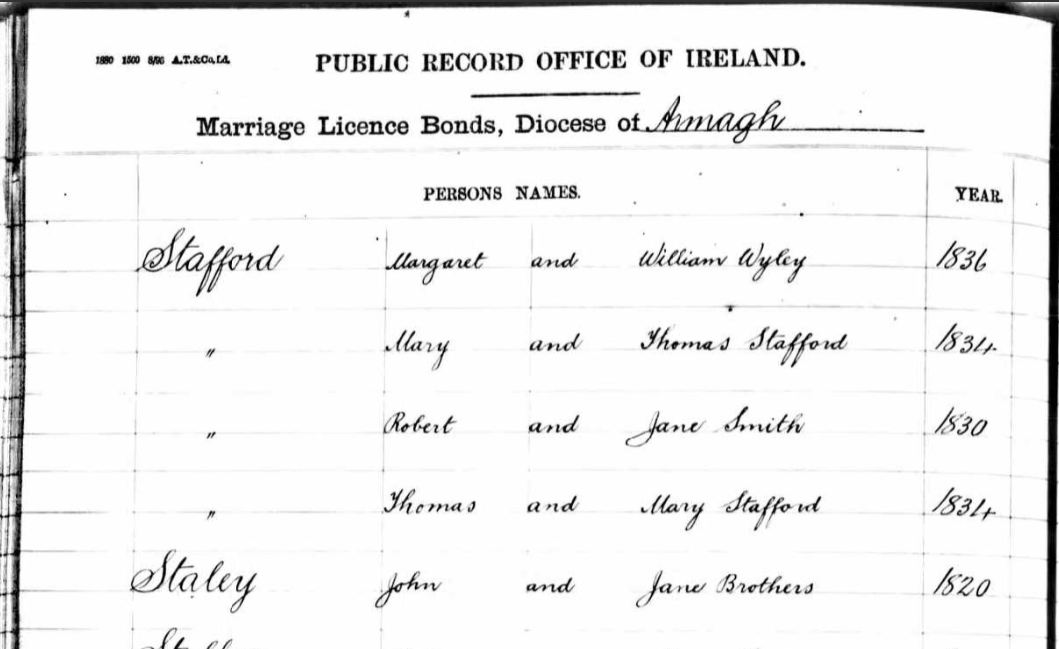
My grandmother related a story about an Elizabeth Staley who ran away from boarding school and eloped to Ireland, but later returned. The only Irish connection found so far is Jane Brothers, so perhaps she meant Elizabeth Staley’s mother. A boarding school seems unlikely, and it would seem that it was John Staley who went to Ireland.
The 1841 census states Jane’s age as 33, which would make her just 12 at the time of her marriage. The 1851 census states her age as 44, making her 13 at the time of her 1820 marriage, and the 1861 census estimates her birth year as a more likely 1804. Birth records in Ireland for her have not been found. It’s possible, perhaps, that she was in service in the Newhall area as a teenager (more likely than boarding school), and that John and Jane ran off to get married in Ireland, although I haven’t found any record of a child born to them early in their marriage. John was an agricultural labourer, and later a coal miner.
John Staley was the son of Joseph Staley (1756-1838) and Sarah Dumolo (1764-). Joseph and Sarah were married by licence in Newhall in 1782. Joseph was a carpenter on the marriage licence, but later a collier (although not necessarily a miner).
The Derbyshire Record Office holds records of an “Estimate of Joseph Staley of Newhall for the cost of continuing to work Pisternhill Colliery” dated 1820 and addresssed to Mr Bloud at Calke Abbey (presumably the owner of the mine)
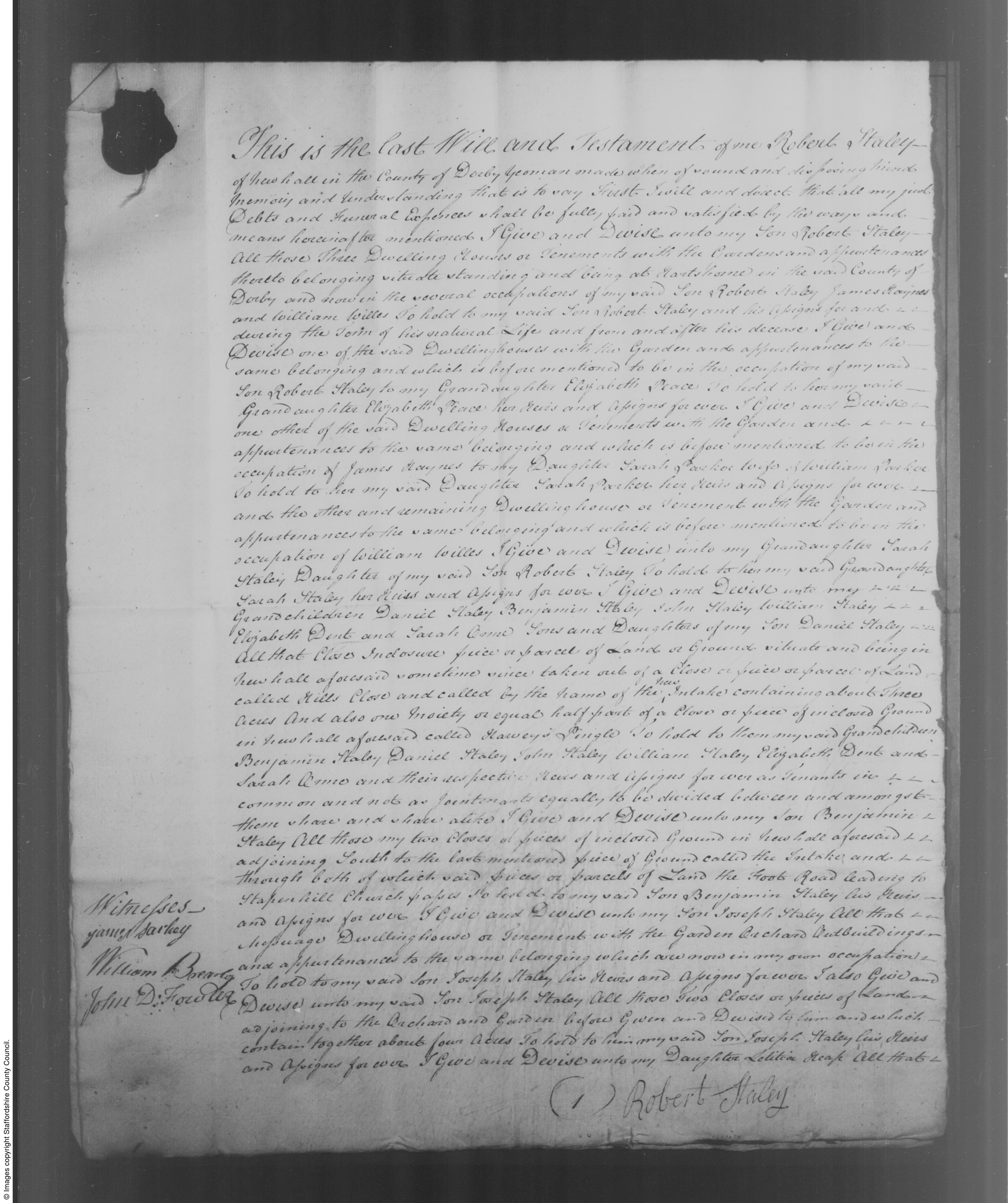
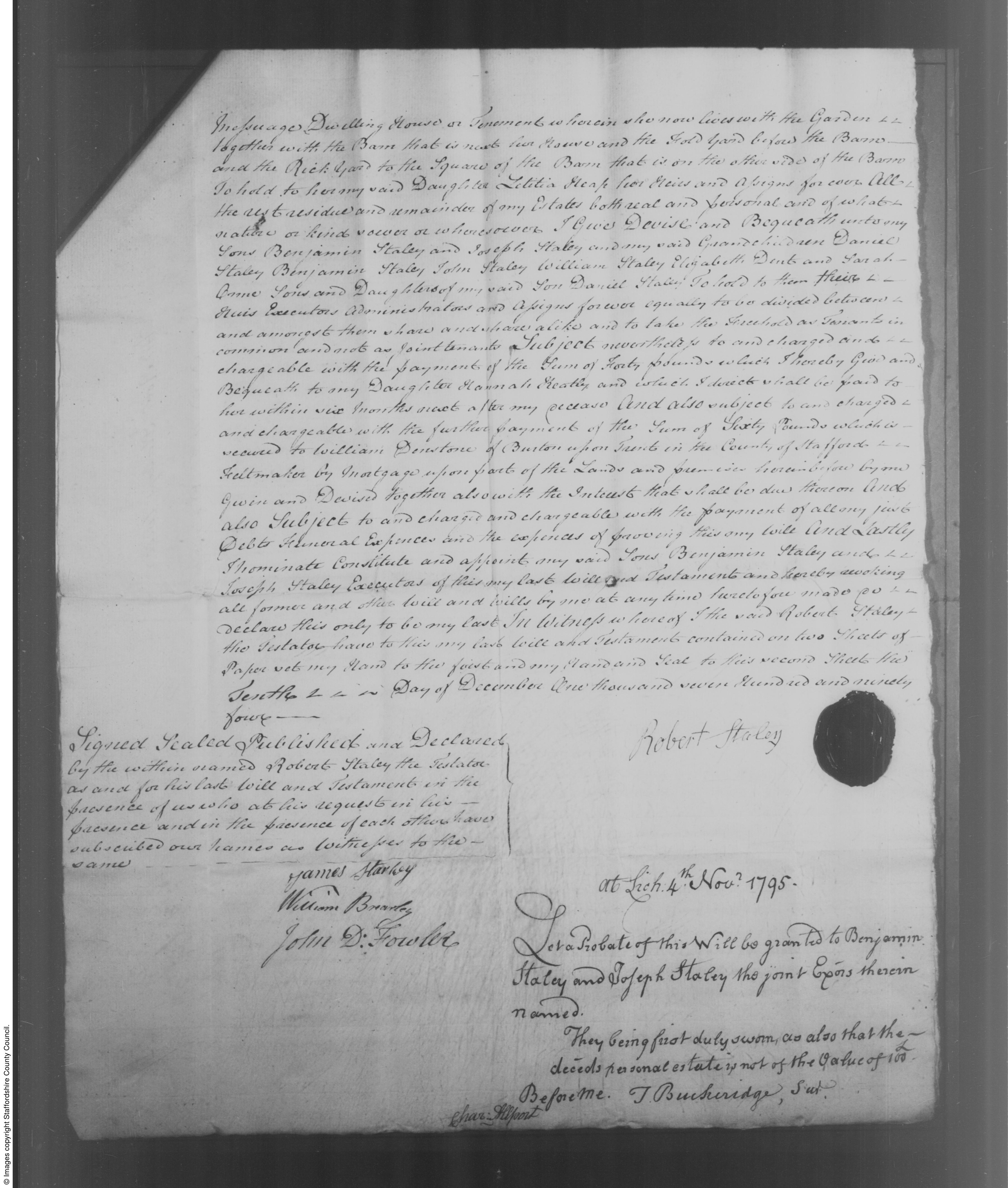
Josephs parents were Robert Staley and Elizabeth. I couldn’t find a baptism or birth record for Robert Staley. Other trees on an ancestry site had his birth in Elton, but with no supporting documents. Robert, as stated in his 1795 will, was a Yeoman.
“Yeoman: A former class of small freeholders who farm their own land; a commoner of good standing.”
“Husbandman: The old word for a farmer below the rank of yeoman. A husbandman usually held his land by copyhold or leasehold tenure and may be regarded as the ‘average farmer in his locality’. The words ‘yeoman’ and ‘husbandman’ were gradually replaced in the later 18th and 19th centuries by ‘farmer’.”He left a number of properties in Newhall and Hartshorne (near Newhall) including dwellings, enclosures, orchards, various yards, barns and acreages. It seemed to me more likely that he had inherited them, rather than moving into the village and buying them.
There is a mention of Robert Staley in a 1782 newpaper advertisement.
“Fire Engine To Be Sold. An exceedingly good fire engine, with the boiler, cylinder, etc in good condition. For particulars apply to Mr Burslem at Burton-upon-Trent, or Robert Staley at Newhall near Burton, where the engine may be seen.”
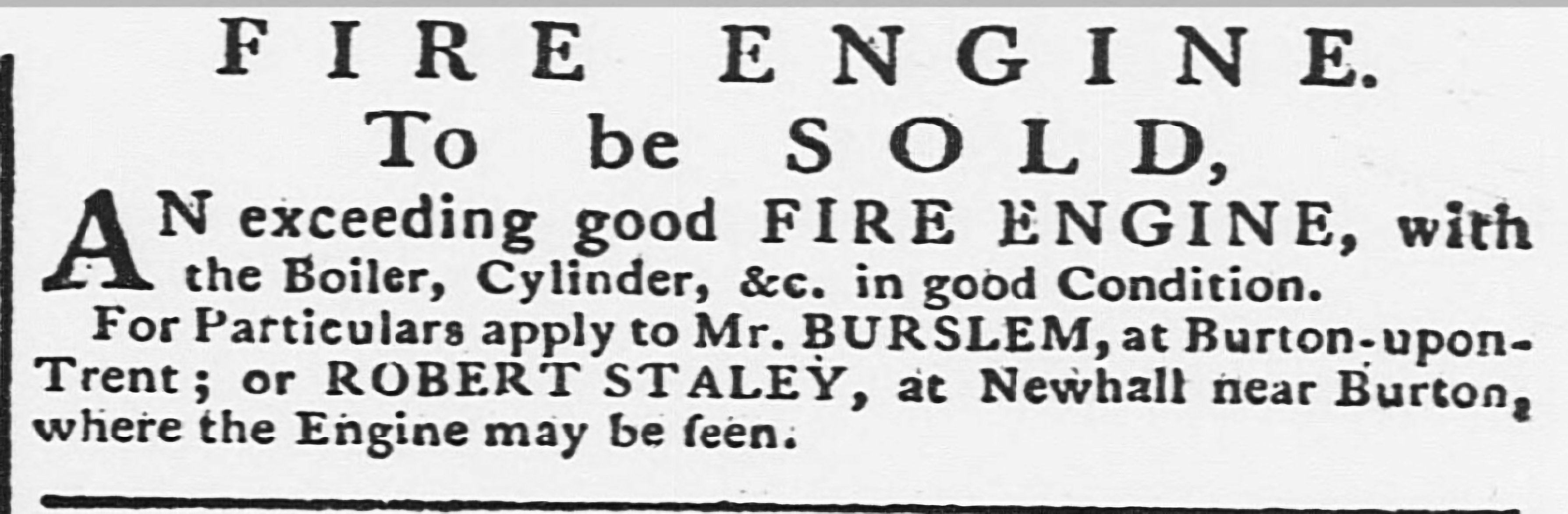
Was the fire engine perhaps connected with a foundry or a coal mine?
I noticed that Robert Staley was the witness at a 1755 marriage in Stapenhill between Barbara Burslem and Richard Daston the younger esquire. The other witness was signed Burslem Jnr.
Looking for Robert Staley
I assumed that once again, in the absence of the correct records, a similarly named and aged persons baptism had been added to the tree regardless of accuracy, so I looked through the Stapenhill/Newhall parish register images page by page. There were no Staleys in Newhall at all in the early 1700s, so it seemed that Robert did come from elsewhere and I expected to find the Staleys in a neighbouring parish. But I still didn’t find any Staleys.
I spoke to a couple of Staley descendants that I’d met during the family research. I met Carole via a DNA match some months previously and contacted her to ask about the Staleys in Elton. She also had Robert Staley born in Elton (indeed, there were many Staleys in Elton) but she didn’t have any documentation for his birth, and we decided to collaborate and try and find out more.
I couldn’t find the earlier Elton parish registers anywhere online, but eventually found the untranscribed microfiche images of the Bishops Transcripts for Elton.
via familysearch:
“In its most basic sense, a bishop’s transcript is a copy of a parish register. As bishop’s transcripts generally contain more or less the same information as parish registers, they are an invaluable resource when a parish register has been damaged, destroyed, or otherwise lost. Bishop’s transcripts are often of value even when parish registers exist, as priests often recorded either additional or different information in their transcripts than they did in the original registers.”Unfortunately there was a gap in the Bishops Transcripts between 1704 and 1711 ~ exactly where I needed to look. I subsequently found out that the Elton registers were incomplete as they had been damaged by fire.
I estimated Robert Staleys date of birth between 1710 and 1715. He died in 1795, and his son Daniel died in 1805: both of these wills were found online. Daniel married Mary Moon in Stapenhill in 1762, making a likely birth date for Daniel around 1740.
The marriage of Robert Staley (assuming this was Robert’s father) and Alice Maceland (or Marsland or Marsden, depending on how the parish clerk chose to spell it presumably) was in the Bishops Transcripts for Elton in 1704. They were married in Elton on 26th February. There followed the missing parish register pages and in all likelihood the records of the baptisms of their first children. No doubt Robert was one of them, probably the first male child.
(Incidentally, my grandfather’s Marshalls also came from Elton, a small Derbyshire village near Matlock. The Staley’s are on my grandmothers Warren side.)
The parish register pages resume in 1711. One of the first entries was the baptism of Robert Staley in 1711, parents Thomas and Ann. This was surely the one we were looking for, and Roberts parents weren’t Robert and Alice.
But then in 1735 a marriage was recorded between Robert son of Robert Staley (and this was unusual, the father of the groom isn’t usually recorded on the parish register) and Elizabeth Milner. They were married on the 9th March 1735. We know that the Robert we were looking for married an Elizabeth, as her name was on the Stapenhill baptisms of their later children, including Joseph Staleys. The 1735 marriage also fit with the assumed birth date of Daniel, circa 1740. A baptism was found for a Robert Staley in 1738 in the Elton registers, parents Robert and Elizabeth, as well as the baptism in 1736 for Mary, presumably their first child. Her burial is recorded the following year.
The marriage of Robert Staley and Elizabeth Milner in 1735:
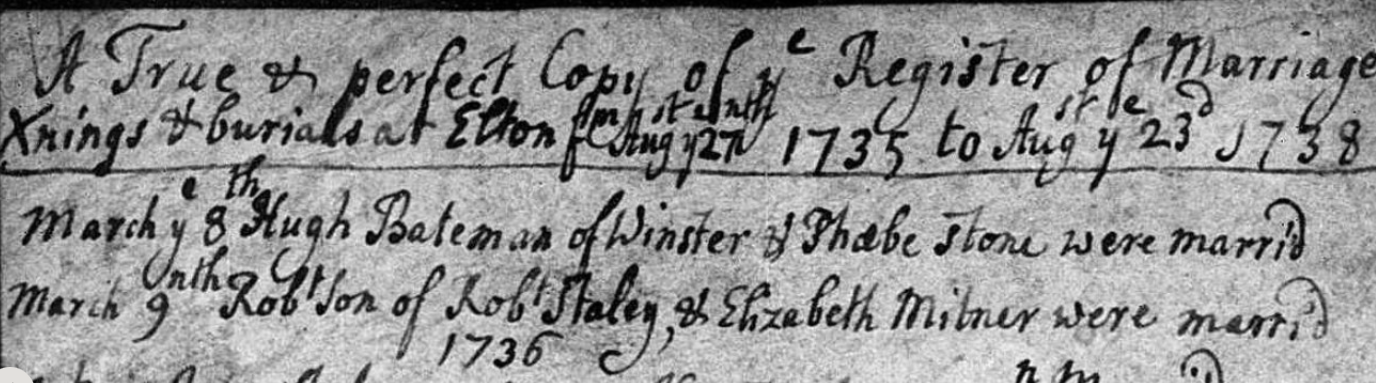
There were several other Staley couples of a similar age in Elton, perhaps brothers and cousins. It seemed that Thomas and Ann’s son Robert was a different Robert, and that the one we were looking for was prior to that and on the missing pages.
Even so, this doesn’t prove that it was Elizabeth Staleys great grandfather who was born in Elton, but no other birth or baptism for Robert Staley has been found. It doesn’t explain why the Staleys moved to Stapenhill either, although the Enclosures Act and the Industrial Revolution could have been factors.
The 18th century saw the rise of the Industrial Revolution and many renowned Derbyshire Industrialists emerged. They created the turning point from what was until then a largely rural economy, to the development of townships based on factory production methods.
The Marsden Connection
There are some possible clues in the records of the Marsden family. Robert Staley married Alice Marsden (or Maceland or Marsland) in Elton in 1704. Robert Staley is mentioned in the 1730 will of John Marsden senior, of Baslow, Innkeeper (Peacock Inne & Whitlands Farm). He mentions his daughter Alice, wife of Robert Staley.
In a 1715 Marsden will there is an intriguing mention of an alias, which might explain the different spellings on various records for the name Marsden: “MARSDEN alias MASLAND, Christopher – of Baslow, husbandman, 28 Dec 1714. son Robert MARSDEN alias MASLAND….” etc.
Some potential reasons for a move from one parish to another are explained in this history of the Marsden family, and indeed this could relate to Robert Staley as he married into the Marsden family and his wife was a beneficiary of a Marsden will. The Chatsworth Estate, at various times, bought a number of farms in order to extend the park.
THE MARSDEN FAMILY
OXCLOSE AND PARKGATE
In the Parishes of
Baslow and Chatsworthby
David Dalrymple-Smith“John Marsden (b1653) another son of Edmund (b1611) faired well. By the time he died in
1730 he was publican of the Peacock, the Inn on Church Lane now called the Cavendish
Hotel, and the farmer at “Whitlands”, almost certainly Bubnell Cliff Farm.”“Coal mining was well known in the Chesterfield area. The coalfield extends as far as the
Gritstone edges, where thin seams outcrop especially in the Baslow area.”“…the occupants were evicted from the farmland below Dobb Edge and
the ground carefully cleared of all traces of occupation and farming. Shelter belts were
planted especially along the Heathy Lea Brook. An imposing new drive was laid to the
Chatsworth House with the Lodges and “The Golden Gates” at its northern end….”Although this particular event was later than any events relating to Robert Staley, it’s an indication of how farms and farmland disappeared, and a reason for families to move to another area:
“The Dukes of Devonshire (of Chatsworth) were major figures in the aristocracy and the government of the
time. Such a position demanded a display of wealth and ostentation. The 6th Duke of
Devonshire, the Bachelor Duke, was not content with the Chatsworth he inherited in 1811,
and immediately started improvements. After major changes around Edensor, he turned his
attention at the north end of the Park. In 1820 plans were made extend the Park up to the
Baslow parish boundary. As this would involve the destruction of most of the Farm at
Oxclose, the farmer at the Higher House Samuel Marsden (b1755) was given the tenancy of
Ewe Close a large farm near Bakewell.
Plans were revised in 1824 when the Dukes of Devonshire and Rutland “Exchanged Lands”,
reputedly during a game of dice. Over 3300 acres were involved in several local parishes, of
which 1000 acres were in Baslow. In the deal Devonshire acquired the southeast corner of
Baslow Parish.
Part of the deal was Gibbet Moor, which was developed for “Sport”. The shelf of land
between Parkgate and Robin Hood and a few extra fields was left untouched. The rest,
between Dobb Edge and Baslow, was agricultural land with farms, fields and houses. It was
this last part that gave the Duke the opportunity to improve the Park beyond his earlier
expectations.”The 1795 will of Robert Staley.
Inriguingly, Robert included the children of his son Daniel Staley in his will, but omitted to leave anything to Daniel. A perusal of Daniels 1808 will sheds some light on this: Daniel left his property to his six reputed children with Elizabeth Moon, and his reputed daughter Mary Brearly. Daniels wife was Mary Moon, Elizabeths husband William Moons daughter.
The will of Robert Staley, 1795:
The 1805 will of Daniel Staley, Robert’s son:
This is the last will and testament of me Daniel Staley of the Township of Newhall in the parish of Stapenhill in the County of Derby, Farmer. I will and order all of my just debts, funeral and testamentary expenses to be fully paid and satisfied by my executors hereinafter named by and out of my personal estate as soon as conveniently may be after my decease.
I give, devise and bequeath to Humphrey Trafford Nadin of Church Gresely in the said County of Derby Esquire and John Wilkinson of Newhall aforesaid yeoman all my messuages, lands, tenements, hereditaments and real and personal estates to hold to them, their heirs, executors, administrators and assigns until Richard Moon the youngest of my reputed sons by Elizabeth Moon shall attain his age of twenty one years upon trust that they, my said trustees, (or the survivor of them, his heirs, executors, administrators or assigns), shall and do manage and carry on my farm at Newhall aforesaid and pay and apply the rents, issues and profits of all and every of my said real and personal estates in for and towards the support, maintenance and education of all my reputed children by the said Elizabeth Moon until the said Richard Moon my youngest reputed son shall attain his said age of twenty one years and equally share and share and share alike.
And it is my will and desire that my said trustees or trustee for the time being shall recruit and keep up the stock upon my farm as they in their discretion shall see occasion or think proper and that the same shall not be diminished. And in case any of my said reputed children by the said Elizabeth Moon shall be married before my said reputed youngest son shall attain his age of twenty one years that then it is my will and desire that non of their husbands or wives shall come to my farm or be maintained there or have their abode there. That it is also my will and desire in case my reputed children or any of them shall not be steady to business but instead shall be wild and diminish the stock that then my said trustees or trustee for the time being shall have full power and authority in their discretion to sell and dispose of all or any part of my said personal estate and to put out the money arising from the sale thereof to interest and to pay and apply the interest thereof and also thereunto of the said real estate in for and towards the maintenance, education and support of all my said reputed children by the said
Elizabeth Moon as they my said trustees in their discretion that think proper until the said Richard Moon shall attain his age of twenty one years.Then I give to my grandson Daniel Staley the sum of ten pounds and to each and every of my sons and daughters namely Daniel Staley, Benjamin Staley, John Staley, William Staley, Elizabeth Dent and Sarah Orme and to my niece Ann Brearly the sum of five pounds apiece.
I give to my youngest reputed son Richard Moon one share in the Ashby Canal Navigation and I direct that my said trustees or trustee for the time being shall have full power and authority to pay and apply all or any part of the fortune or legacy hereby intended for my youngest reputed son Richard Moon in placing him out to any trade, business or profession as they in their discretion shall think proper.
And I direct that to my said sons and daughters by my late wife and my said niece shall by wholly paid by my said reputed son Richard Moon out of the fortune herby given him. And it is my will and desire that my said reputed children shall deliver into the hands of my executors all the monies that shall arise from the carrying on of my business that is not wanted to carry on the same unto my acting executor and shall keep a just and true account of all disbursements and receipts of the said business and deliver up the same to my acting executor in order that there may not be any embezzlement or defraud amongst them and from and immediately after my said reputed youngest son Richard Moon shall attain his age of twenty one years then I give, devise and bequeath all my real estate and all the residue and remainder of my personal estate of what nature and kind whatsoever and wheresoever unto and amongst all and every my said reputed sons and daughters namely William Moon, Thomas Moon, Joseph Moon, Richard Moon, Ann Moon, Margaret Moon and to my reputed daughter Mary Brearly to hold to them and their respective heirs, executors, administrator and assigns for ever according to the nature and tenure of the same estates respectively to take the same as tenants in common and not as joint tenants.And lastly I nominate and appoint the said Humphrey Trafford Nadin and John Wilkinson executors of this my last will and testament and guardians of all my reputed children who are under age during their respective minorities hereby revoking all former and other wills by me heretofore made and declaring this only to be my last will.
In witness whereof I the said Daniel Staley the testator have to this my last will and testament set my hand and seal the eleventh day of March in the year of our Lord one thousand eight hundred and five.
May 21, 2022 at 9:34 am #6299In reply to: The Sexy Wooden Leg
Looking at the blemish feverish man on the camp bed, General Lyaksandro Rudechenko clenched his fists. The wooden leg, that had been the symbol of the Oocranian Resistance for the last year was now lying on the floor. President Voldomeer had contracted a virus that confounded their best doctors and the remaining chiefs of the Oocranian Resistance feared he would soon join the men fallen for their country.
— Nobody must know that the sexiest man of Oocrane is incapacitated. We need a replacement, said the General.
— President Voldomeer told me of a man, the very man who made that wooden leg, said Major Myroslava Kovalev, the candle light reflecting in her glass eye. He lives in the Dumbass region. He’s a secret twin or something, President Voldomeer was not so clear about that part, but at least they look alike. To make it more real, we can have his leg removed, she added pointing at the wooden leg.
She was proud of being one of the only women ranking that high in the military. His fellow people might not be Lazies, but they had some old idea about women, that were not the best choice for fighting. Myroslava had always wanted to prove them wrong, and this conflict had been her chance to rise almost to the top. She looked at the dying man who was once her ladder. He had been sexy, and certainly could do many things with his wooden leg. Now he was but the shadow of a man, pale and blurry as cataract. If she had loved him, she might have shed a tear.
Myroslava looked at General Rudechenko’s pockmarked face and shivered. She wouldn’t even share a cab with him. But he was the next in command, and before Voldomeer fell ill, she was on her way to take his place, even closer to the top.
— Let me bring him to you, she added.
— That’s a suicide mission, said the general. Permission granted.
— Thank you General ! said Myroslava doing the military salute before leaving the tent.
Despite his being from Dumbass and having made some mistakes in his life, Lyaksandro was not stupid. He knew quite well what that woman wanted. He called, Glib, his aide-de-camp.
— Make sure she gets lost behind the enemy lines.
April 12, 2022 at 8:13 am #6290In reply to: The Elusive Samuel Housley and Other Family Stories
Leicestershire Blacksmiths
The Orgill’s of Measham led me further into Leicestershire as I traveled back in time.
I also realized I had uncovered a direct line of women and their mothers going back ten generations:
myself, Tracy Edwards 1957-
my mother Gillian Marshall 1933-
my grandmother Florence Warren 1906-1988
her mother and my great grandmother Florence Gretton 1881-1927
her mother Sarah Orgill 1840-1910
her mother Elizabeth Orgill 1803-1876
her mother Sarah Boss 1783-1847
her mother Elizabeth Page 1749-
her mother Mary Potter 1719-1780
and her mother and my 7x great grandmother Mary 1680-You could say it leads us to the very heart of England, as these Leicestershire villages are as far from the coast as it’s possible to be. There are countless other maternal lines to follow, of course, but only one of mothers of mothers, and ours takes us to Leicestershire.
The blacksmiths
Sarah Boss was the daughter of Michael Boss 1755-1807, a blacksmith in Measham, and Elizabeth Page of nearby Hartshorn, just over the county border in Derbyshire.
An earlier Michael Boss, a blacksmith of Measham, died in 1772, and in his will he left the possession of the blacksmiths shop and all the working tools and a third of the household furniture to Michael, who he named as his nephew. He left his house in Appleby Magna to his wife Grace, and five pounds to his mother Jane Boss. As none of Michael and Grace’s children are mentioned in the will, perhaps it can be assumed that they were childless.
The will of Michael Boss, 1772, Measham:
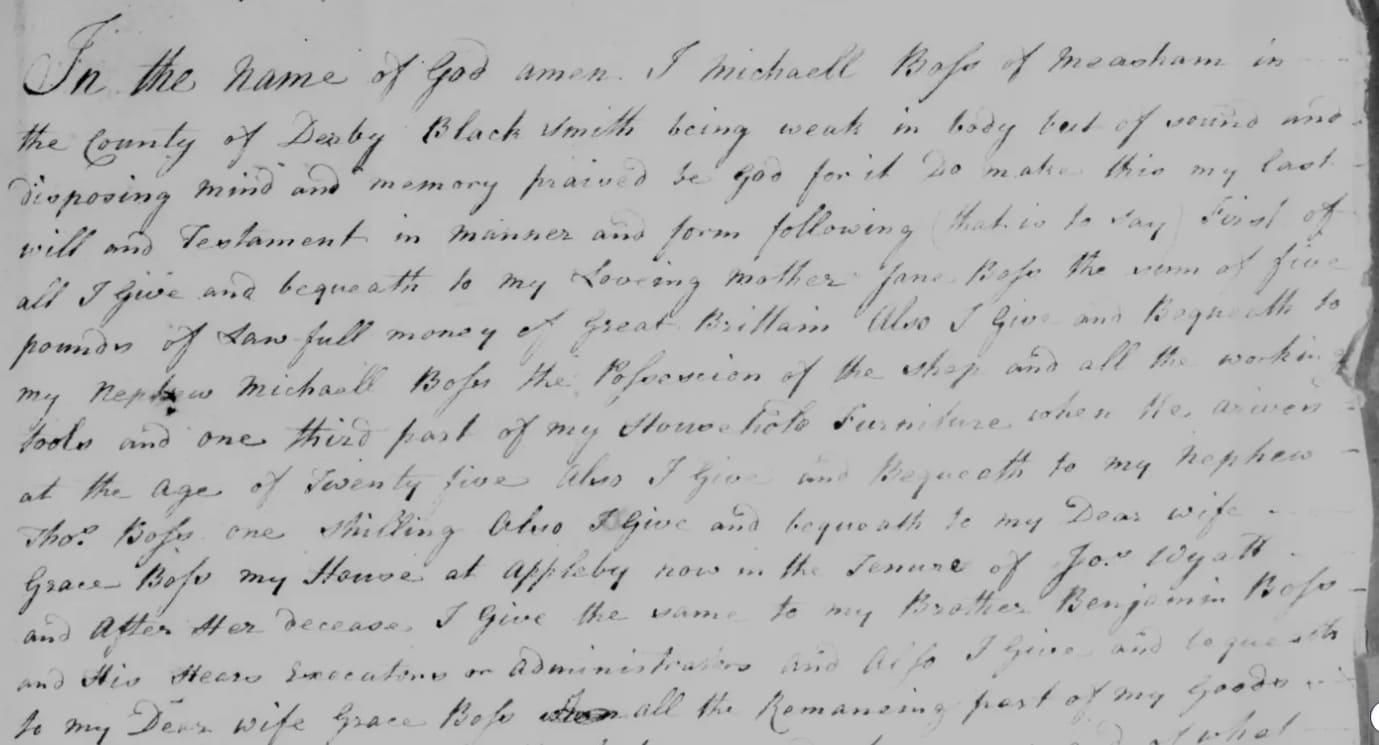
Michael Boss the uncle was born in Appleby Magna in 1724. His parents were Michael Boss of Nelson in the Thistles and Jane Peircivall of Appleby Magna, who were married in nearby Mancetter in 1720.
Information worth noting on the Appleby Magna website:
In 1752 the calendar in England was changed from the Julian Calendar to the Gregorian Calendar, as a result 11 days were famously “lost”. But for the recording of Church Registers another very significant change also took place, the start of the year was moved from March 25th to our more familiar January 1st.
Before 1752 the 1st day of each new year was March 25th, Lady Day (a significant date in the Christian calendar). The year number which we all now use for calculating ages didn’t change until March 25th. So, for example, the day after March 24th 1750 was March 25th 1751, and January 1743 followed December 1743.
This March to March recording can be seen very clearly in the Appleby Registers before 1752. Between 1752 and 1768 there appears slightly confused recording, so dates should be carefully checked. After 1768 the recording is more fully by the modern calendar year.Michael Boss the uncle married Grace Cuthbert. I haven’t yet found the birth or parents of Grace, but a blacksmith by the name of Edward Cuthbert is mentioned on an Appleby Magna history website:
An Eighteenth Century Blacksmith’s Shop in Little Appleby
by Alan RobertsCuthberts inventory
The inventory of Edward Cuthbert provides interesting information about the household possessions and living arrangements of an eighteenth century blacksmith. Edward Cuthbert (als. Cutboard) settled in Appleby after the Restoration to join the handful of blacksmiths already established in the parish, including the Wathews who were prominent horse traders. The blacksmiths may have all worked together in the same shop at one time. Edward and his wife Sarah recorded the baptisms of several of their children in the parish register. Somewhat sadly three of the boys named after their father all died either in infancy or as young children. Edward’s inventory which was drawn up in 1732, by which time he was probably a widower and his children had left home, suggests that they once occupied a comfortable two-storey house in Little Appleby with an attached workshop, well equipped with all the tools for repairing farm carts, ploughs and other implements, for shoeing horses and for general ironmongery.
Edward Cuthbert born circa 1660, married Joane Tuvenet in 1684 in Swepston cum Snarestone , and died in Appleby in 1732. Tuvenet is a French name and suggests a Huguenot connection, but this isn’t our family, and indeed this Edward Cuthbert is not likely to be Grace’s father anyway.
Michael Boss and Elizabeth Page appear to have married twice: once in 1776, and once in 1779. Both of the documents exist and appear correct. Both marriages were by licence. They both mention Michael is a blacksmith.
Their first daughter, Elizabeth, was baptized in February 1777, just nine months after the first wedding. It’s not known when she was born, however, and it’s possible that the marriage was a hasty one. But why marry again three years later?
But Michael Boss and Elizabeth Page did not marry twice.
Elizabeth Page from Smisby was born in 1752 and married Michael Boss on the 5th of May 1776 in Measham. On the marriage licence allegations and bonds, Michael is a bachelor.
Baby Elizabeth was baptised in Measham on the 9th February 1777. Mother Elizabeth died on the 18th February 1777, also in Measham.
In 1779 Michael Boss married another Elizabeth Page! She was born in 1749 in Hartshorn, and Michael is a widower on the marriage licence allegations and bonds.
Hartshorn and Smisby are neighbouring villages, hence the confusion. But a closer look at the documents available revealed the clues. Both Elizabeth Pages were literate, and indeed their signatures on the marriage registers are different:
Marriage of Michael Boss and Elizabeth Page of Smisby in 1776:
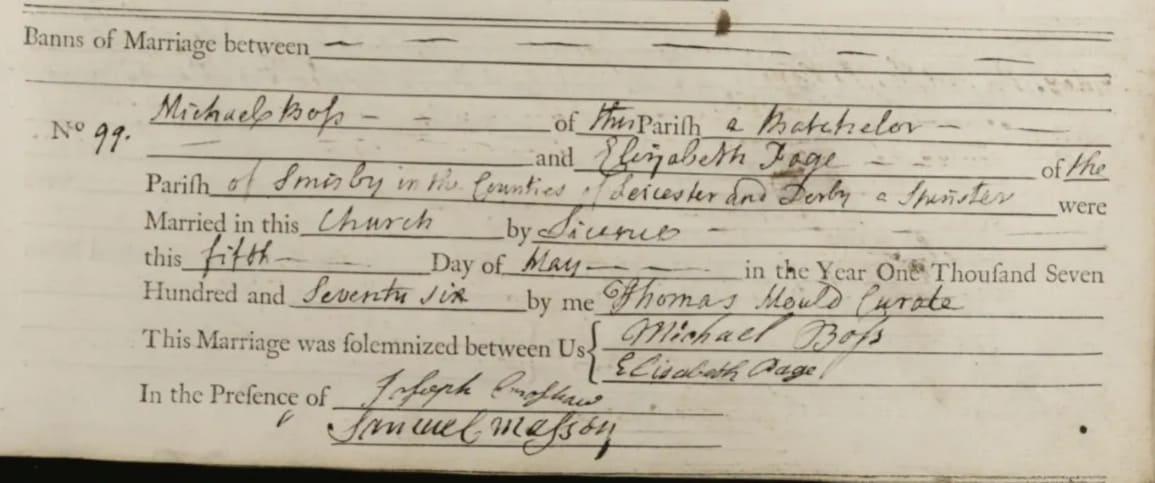
Marriage of Michael Boss and Elizabeth Page of Harsthorn in 1779:
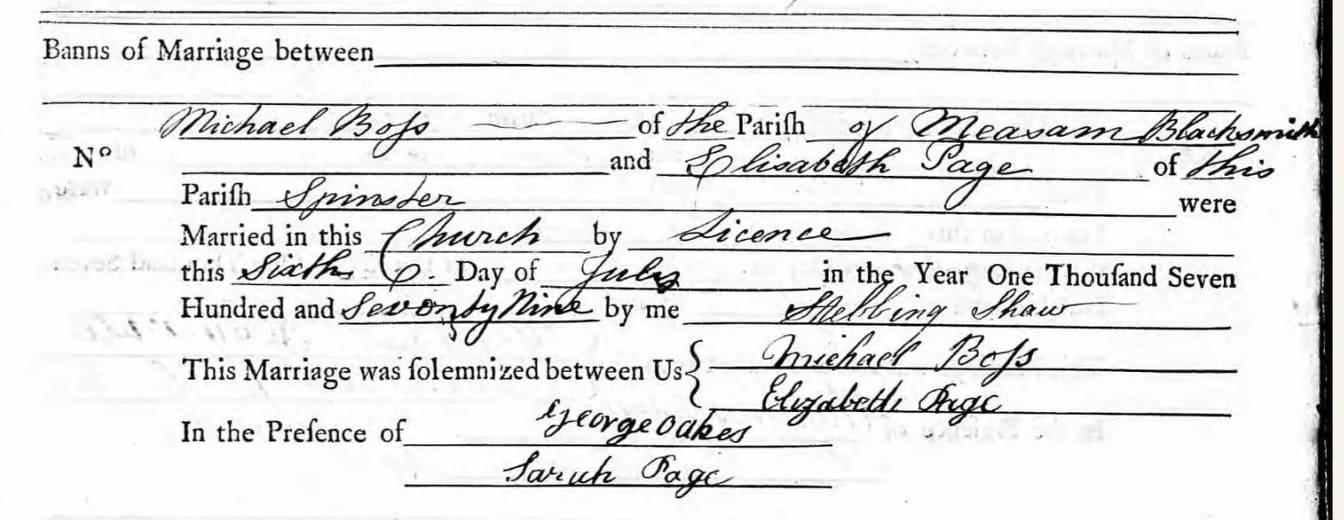
Not only did Michael Boss marry two women both called Elizabeth Page but he had an unusual start in life as well. His uncle Michael Boss left him the blacksmith business and a third of his furniture. This was all in the will. But which of Uncle Michaels brothers was nephew Michaels father?
The only Michael Boss born at the right time was in 1750 in Edingale, Staffordshire, about eight miles from Appleby Magna. His parents were Thomas Boss and Ann Parker, married in Edingale in 1747. Thomas died in August 1750, and his son Michael was baptised in the December, posthumus son of Thomas and his widow Ann. Both entries are on the same page of the register.
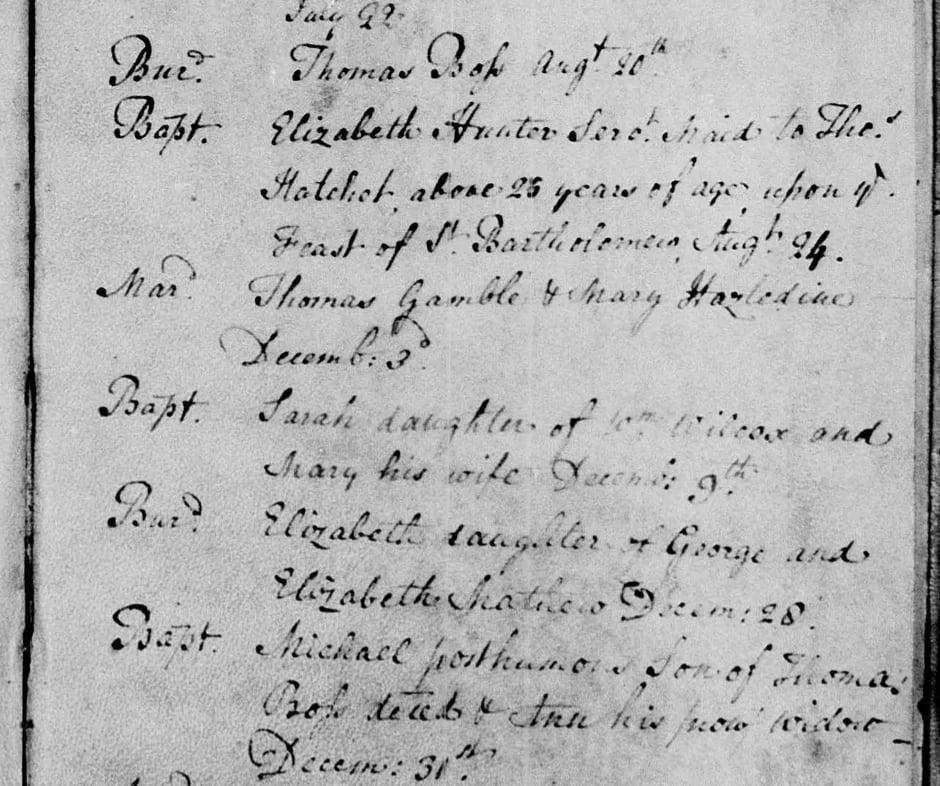
Ann Boss, the young widow, married again. But perhaps Michael and his brother went to live with their childless uncle and aunt, Michael Boss and Grace Cuthbert.
The great grandfather of Michael Boss (the Measham blacksmith born in 1850) was also Michael Boss, probably born in the 1660s. He died in Newton Regis in Warwickshire in 1724, four years after his son (also Michael Boss born 1693) married Jane Peircivall. The entry on the parish register states that Michael Boss was buried ye 13th Affadavit made.
I had not seen affadavit made on a parish register before, and this relates to the The Burying in Woollen Acts 1666–80. According to Wikipedia:
“Acts of the Parliament of England which required the dead, except plague victims and the destitute, to be buried in pure English woollen shrouds to the exclusion of any foreign textiles. It was a requirement that an affidavit be sworn in front of a Justice of the Peace (usually by a relative of the deceased), confirming burial in wool, with the punishment of a £5 fee for noncompliance. Burial entries in parish registers were marked with the word “affidavit” or its equivalent to confirm that affidavit had been sworn; it would be marked “naked” for those too poor to afford the woollen shroud. The legislation was in force until 1814, but was generally ignored after 1770.”
Michael Boss buried 1724 “Affadavit made”:
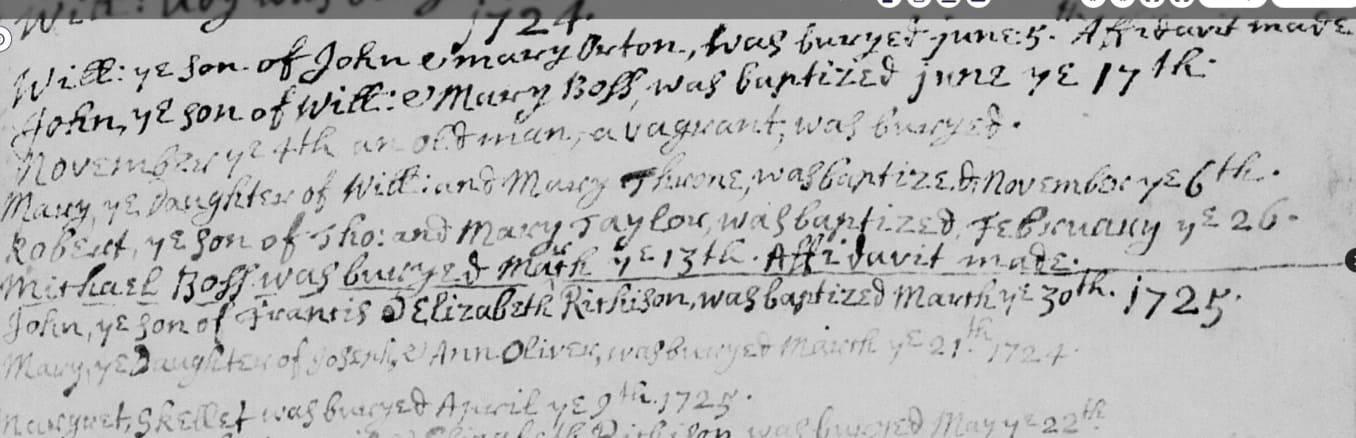
Elizabeth Page‘s father was William Page 1717-1783, a wheelwright in Hartshorn. (The father of the first wife Elizabeth was also William Page, but he was a husbandman in Smisby born in 1714. William Page, the father of the second wife, was born in Nailstone, Leicestershire, in 1717. His place of residence on his marriage to Mary Potter was spelled Nelson.)
Her mother was Mary Potter 1719- of nearby Coleorton. Mary’s father, Richard Potter 1677-1731, was a blacksmith in Coleorton.
A page of the will of Richard Potter 1731:
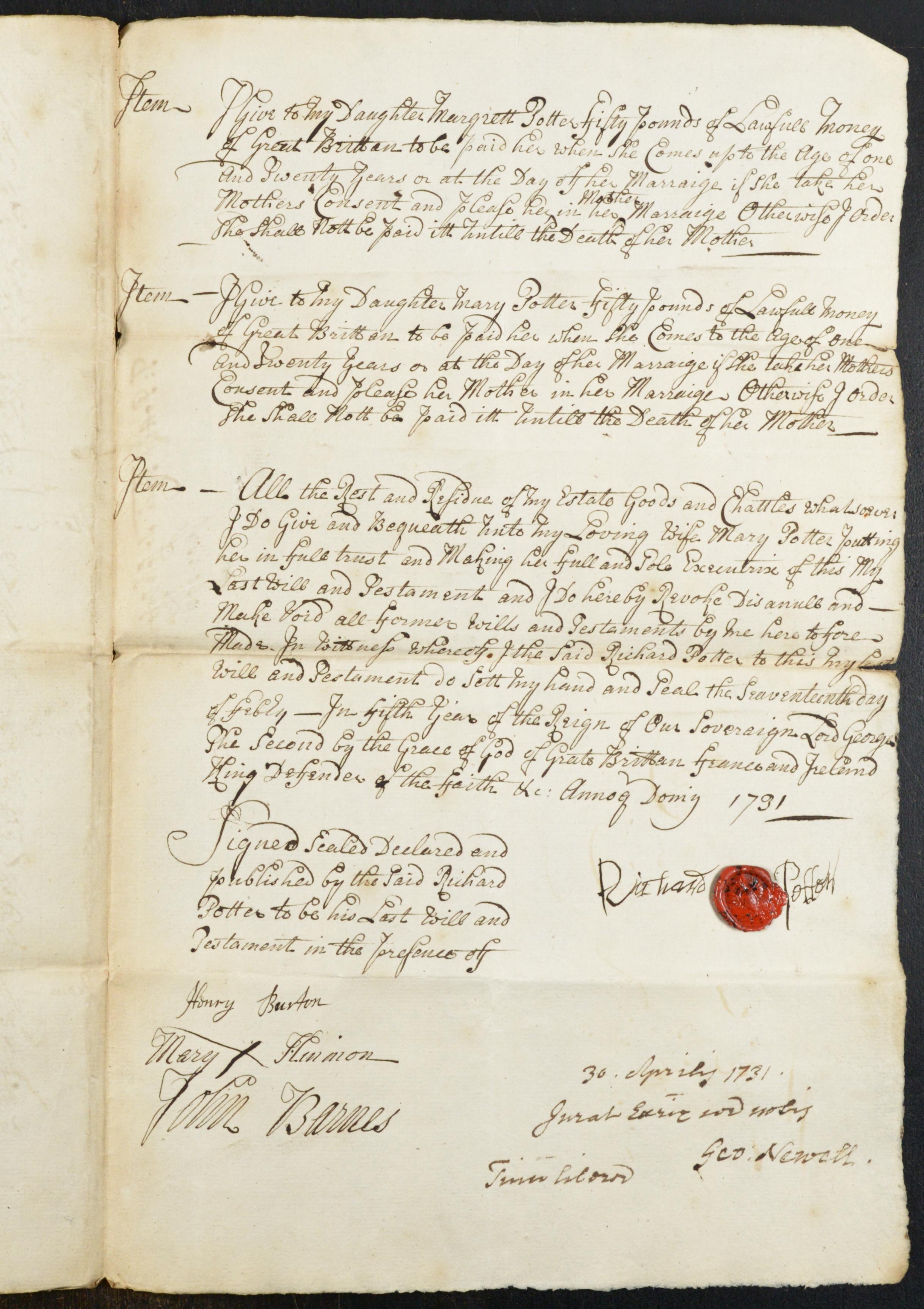
Richard Potter states: “I will and order that my son Thomas Potter shall after my decease have one shilling paid to him and no more.” As he left £50 to each of his daughters, one can’t help but wonder what Thomas did to displease his father.
Richard stipulated that his son Thomas should have one shilling paid to him and not more, for several good considerations, and left “the house and ground lying in the parish of Whittwick in a place called the Long Lane to my wife Mary Potter to dispose of as she shall think proper.”
His son Richard inherited the blacksmith business: “I will and order that my son Richard Potter shall live and be with his mother and serve her duly and truly in the business of a blacksmith, and obey and serve her in all lawful commands six years after my decease, and then I give to him and his heirs…. my house and grounds Coulson House in the Liberty of Thringstone”
Richard wanted his son John to be a blacksmith too: “I will and order that my wife bring up my son John Potter at home with her and teach or cause him to be taught the trade of a blacksmith and that he shall serve her duly and truly seven years after my decease after the manner of an apprentice and at the death of his mother I give him that house and shop and building and the ground belonging to it which I now dwell in to him and his heirs forever.”
To his daughters Margrett and Mary Potter, upon their reaching the age of one and twenty, or the day after their marriage, he leaves £50 each. All the rest of his goods are left to his loving wife Mary.
An inventory of the belongings of Richard Potter, 1731:
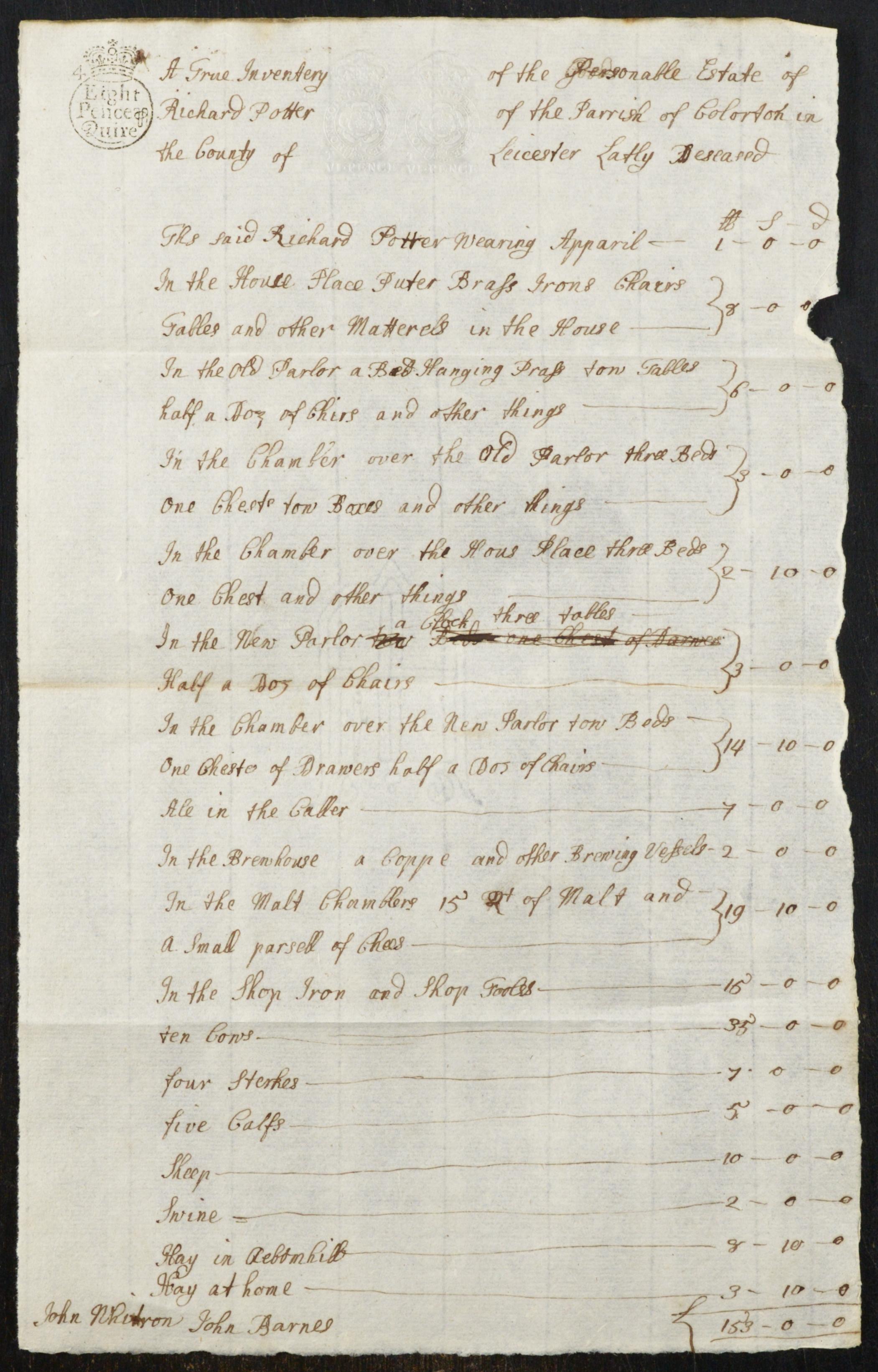
Richard Potters father was also named Richard Potter 1649-1719, and he too was a blacksmith.
Richard Potter of Coleorton in the county of Leicester, blacksmith, stated in his will: “I give to my son and daughter Thomas and Sarah Potter the possession of my house and grounds.”
He leaves ten pounds each to his daughters Jane and Alice, to his son Francis he gives five pounds, and five shillings to his son Richard. Sons Joseph and William also receive five shillings each. To his daughter Mary, wife of Edward Burton, and her daughter Elizabeth, he gives five shillings each. The rest of his good, chattels and wordly substance he leaves equally between his son and daugter Thomas and Sarah. As there is no mention of his wife, it’s assumed that she predeceased him.
The will of Richard Potter, 1719:
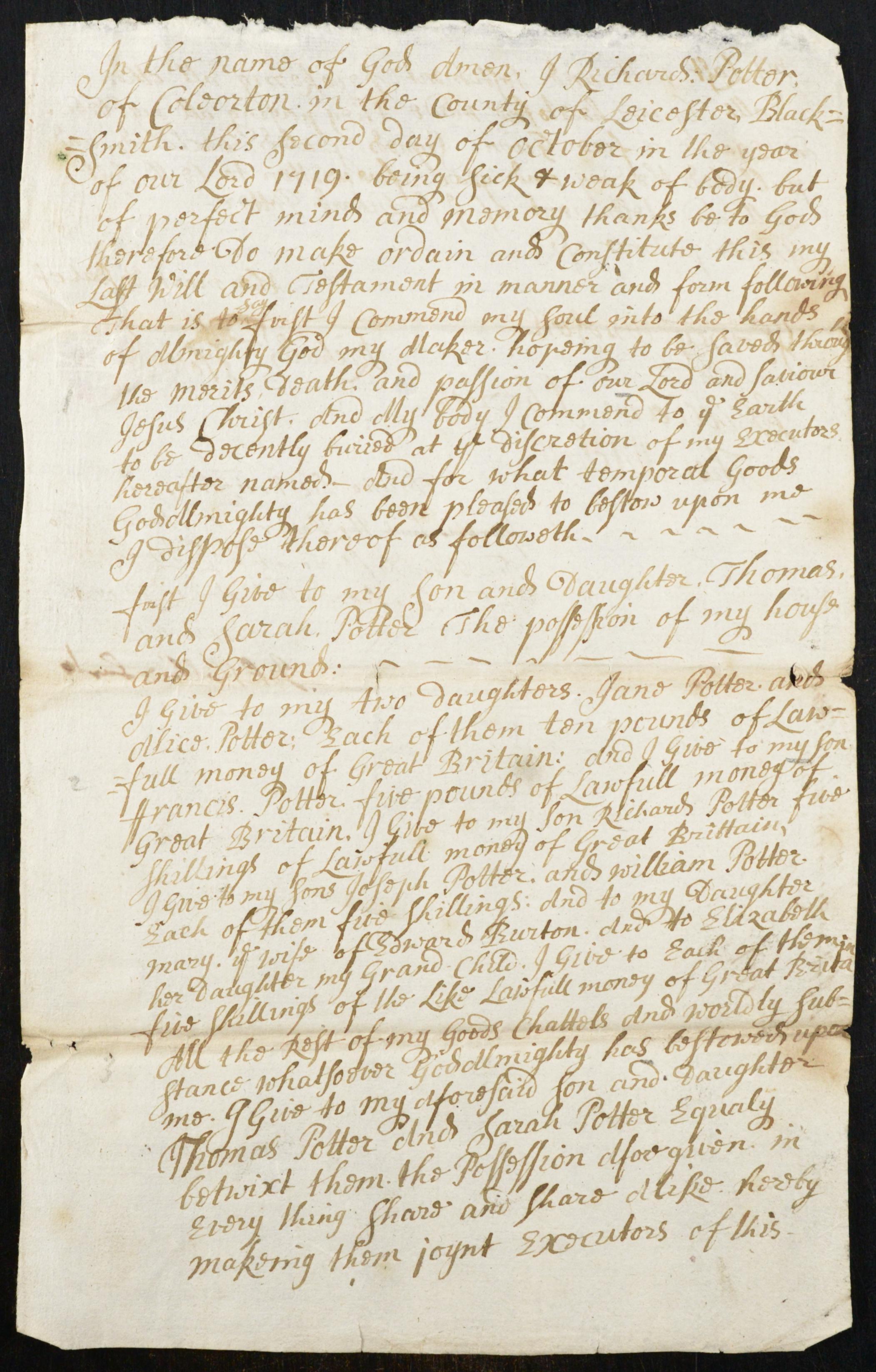
Richard Potter’s (1649-1719) parents were William Potter and Alse Huldin, both born in the early 1600s. They were married in 1646 at Breedon on the Hill, Leicestershire. The name Huldin appears to originate in Finland.
William Potter was a blacksmith. In the 1659 parish registers of Breedon on the Hill, William Potter of Breedon blacksmith buryed the 14th July.
February 9, 2022 at 7:00 pm #6276In reply to: The Elusive Samuel Housley and Other Family Stories
Ellastone and Mayfield
Malkins and Woodwards
Parish RegistersJane Woodward
It’s exciting, as well as enormously frustrating, to see so many Woodward’s in the Ellastone parish registers, and even more so because they go back so far. There are parish registers surviving from the 1500’s: in one, dated 1579, the death of Thomas Woodward was recorded. His father’s name was Humfrey.Jane Woodward married Rowland Malkin in 1751, in Thorpe, Ashbourne. Jane was from Mathfield (also known as Mayfield), Ellastone, on the Staffordshire side of the river Dove. Rowland was from Clifton, Ashbourne, on the Derbyshire side of the river. They were neighbouring villages, but in different counties.
Jane Woodward was born in 1726 according to the marriage transcription. No record of the baptism can be found for her, despite there having been at least four other Woodward couples in Ellastone and Mayfield baptizing babies in the 1720’s and 1730’s. Without finding out the baptism with her parents names on the parish register, it’s impossible to know which is the correct line to follow back to the earlier records.
I found a Mayfield history group on Facebook and asked if there were parish records existing that were not yet online. A member responded that she had a set on microfiche and had looked through the relevant years and didn’t see a Jane Woodward, but she did say that some of the pages were illegible.
The Ellasone parish records from the 1500s surviving at all, considering the events in 1673, is remarkable. To be so close, but for one indecipherable page from the 1700s, to tracing the family back to the 1500s! The search for the connecting link to the earlier records continues.
Some key events in the history of parish registers from familysearch:
In medieval times there were no parish registers. For some years before the Reformation, monastic houses (especially the smaller ones) the parish priest had been developing the custom of noting in an album or on the margins of the service books, the births and deaths of the leading local families.
1538 – Through the efforts of Thomas Cromwell a mandate was issued by Henry VIII to keep parish registers. This order that every parson, vicar or curate was to enter in a book every wedding, christening and burial in his parish. The parish was to provide a sure coffer with two locks, the parson having the custody of one key, the wardens the others. The entries were to be made each Sunday after the service in the presence of one of the wardens.
1642-60 – During the Civil War registers were neglected and Bishop Transcripts were not required.
1650 – In the restoration of Charles they went back to the church to keep christenings, marriages and burial. The civil records that were kept were filed in with the parish in their registers. it is quite usual to find entries explaining the situation during the Interregnum. One rector stated that on 23 April 1643 “Our church was defaced our font thrown down and new forms of prayer appointed”. Another minister not quite so bold wrote “When the war, more than a civil war was raging most grimly between royalists and parliamentarians throughout the greatest part of England, I lived well because I lay low”.
1653 – Cromwell, whose army had defeated the Royalists, was made Lord Protector and acted as king. He was a Puritan. The parish church of England was disorganized, many ministers fled for their lives, some were able to hide their registers and other registers were destroyed. Cromwell ruled that there would be no one religion in England all religions could be practiced. The government took away from the ministers not only the custody of the registers, but even the solemnization of the marriage ceremony. The marriage ceremony was entrusted to the justices to form a new Parish Register (not Registrar) elected by all the ratepayers in a parish, and sworn before and approved by a magistrate.. Parish clerks of the church were made a civil parish clerk and they recorded deaths, births and marriages in the civil parishes.Ellastone:
“Ellastone features as ‘Hayslope’ in George Eliot’s Adam Bede, published in 1859. It earned this recognition because the author’s father spent the early part of his life in the village working as a carpenter.”
Adam Bede Cottage, Ellastone:
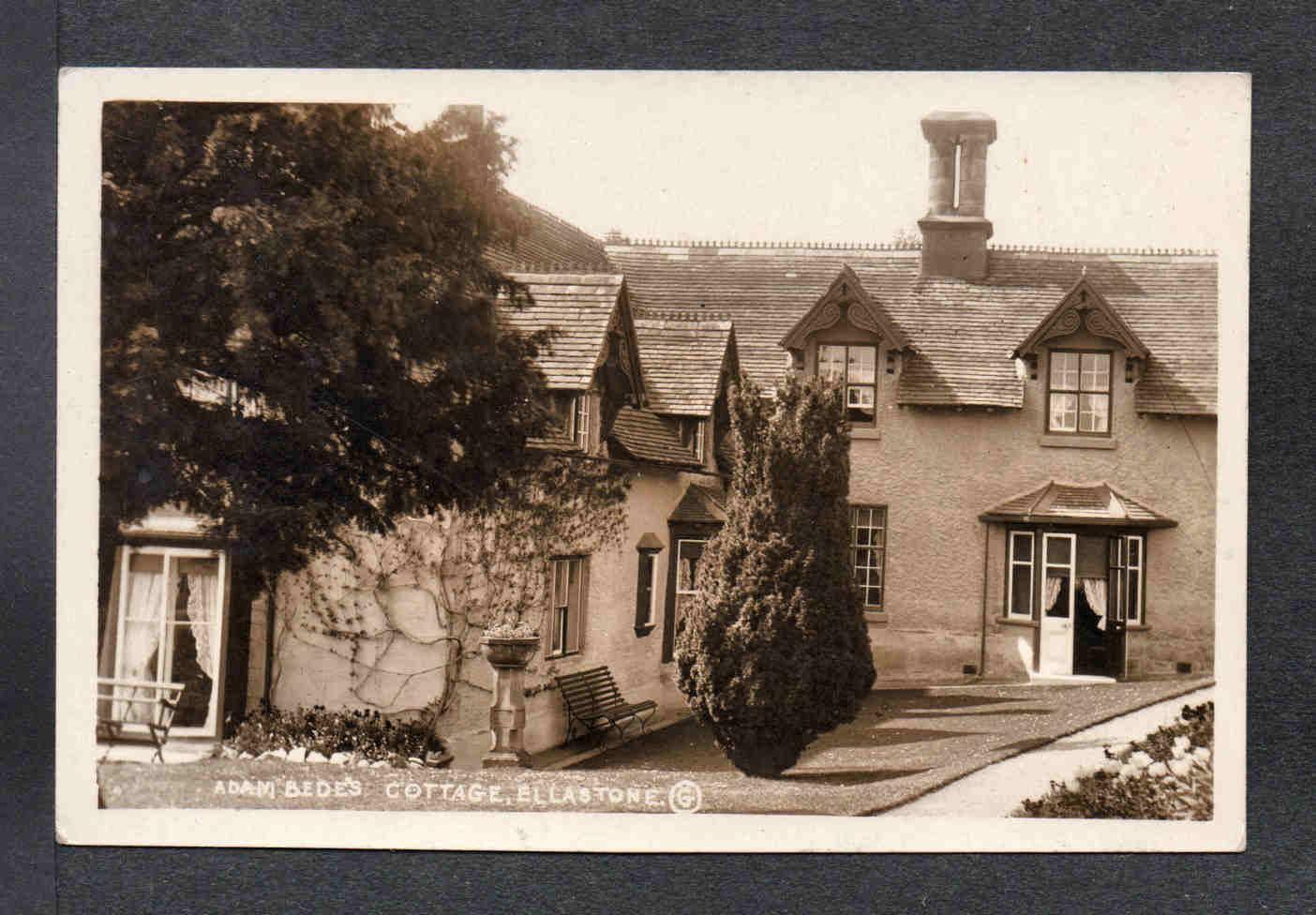
“It was at Ellastone that Robert Evans, George Eliot’s father, passed his early years and worked as a carpenter with his brother Samuel; and it was partly from reminiscences of her father’s talk and from her uncle Samuel’s wife’s preaching experiences that the author constructed the very powerful and moving story of Adam Bede.”
Mary Malkin
1765-1838
Ellen Carrington’s mother was Mary Malkin.
Ellastone:
Ashbourn the 31st day of May in the year of our Lord 1751. The marriage of Rowland Malkin and Jane Woodward:
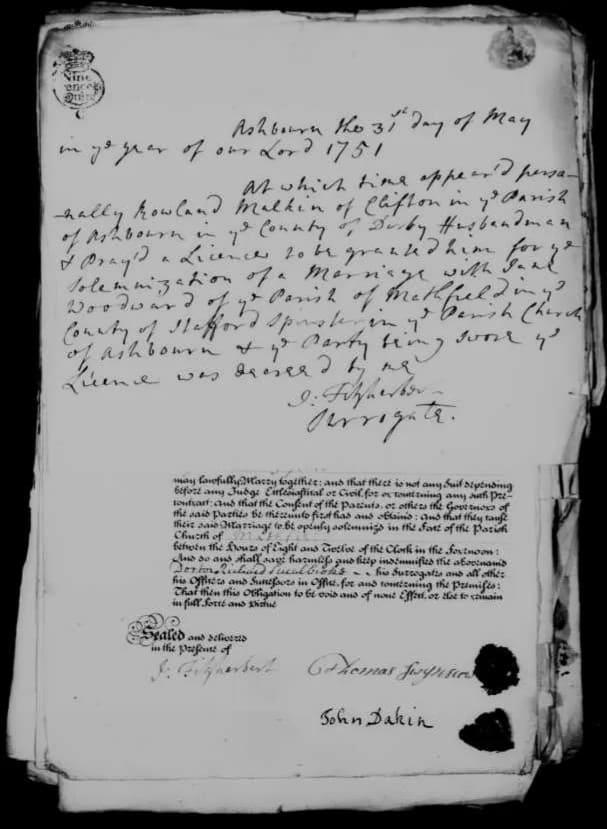 February 8, 2022 at 2:24 pm #6275
In reply to: The Elusive Samuel Housley and Other Family Stories
“AND NOW ABOUT EMMA”
and a mystery about George
I had overlooked this interesting part of Barbara Housley’s “Narrative on the Letters” initially, perhaps because I was more focused on finding Samuel Housley. But when I did eventually notice, I wondered how I had missed it! In this particularly interesting letter excerpt from Joseph, Barbara has not put the date of the letter ~ unusually, because she did with all of the others. However I dated the letter to later than 1867, because Joseph mentions his wife, and they married in 1867. This is important, because there are two Emma Housleys. Joseph had a sister Emma, born in 1836, two years before Joseph was born. At first glance, one would assume that a reference to Emma in the letters would mean his sister, but Emma the sister was married in Derby in 1858, and by 1869 had four children.
But there was another Emma Housley, born in 1851.
From Barbara Housley’s Narrative on the Letters:
“AND NOW ABOUT EMMA”
A MYSTERY
A very mysterious comment is contained in a letter from Joseph:
“And now about Emma. I have only seen her once and she came to me to get your address but I did not feel at liberty to give it to her until I had wrote to you but however she got it from someone. I think it was in this way. I was so pleased to hear from you in the first place and with John’s family coming to see me I let them read one or two of your letters thinking they would like to hear of you and I expect it was Will that noticed your address and gave it to her. She came up to our house one day when I was at work to know if I had heard from you but I had not heard from you since I saw her myself and then she called again after that and my wife showed her your boys’ portraits thinking no harm in doing so.”
At this point Joseph interrupted himself to thank them for sending the portraits. The next sentence is:
“Your son JOHN I have never seen to know him but I hear he is rather wild,” followed by: “EMMA has been living out service but don’t know where she is now.”
Since Joseph had just been talking about the portraits of George’s three sons, one of whom is John Eley, this could be a reference to things George has written in despair about a teen age son–but could Emma be a first wife and John their son? Or could Emma and John both be the children of a first wife?
Elsewhere, Joseph wrote, “AMY ELEY died 14 years ago. (circa 1858) She left a son and a daughter.”
An Amey Eley and a George Housley were married on April 1, 1849 in Duffield which is about as far west of Smalley as Heanor is East. She was the daughter of John, a framework knitter, and Sarah Eley. George’s father is listed as William, a farmer. Amey was described as “of full age” and made her mark on the marriage document.
Anne wrote in August 1854: “JOHN ELEY is living at Derby Station so must take the first opportunity to get the receipt.” Was John Eley Housley named for him?
(John Eley Housley is George Housley’s son in USA, with his second wife, Sarah.)
George Housley married Amey Eley in 1849 in Duffield. George’s father on the register is William Housley, farmer. Amey Eley’s father is John Eley, framework knitter.
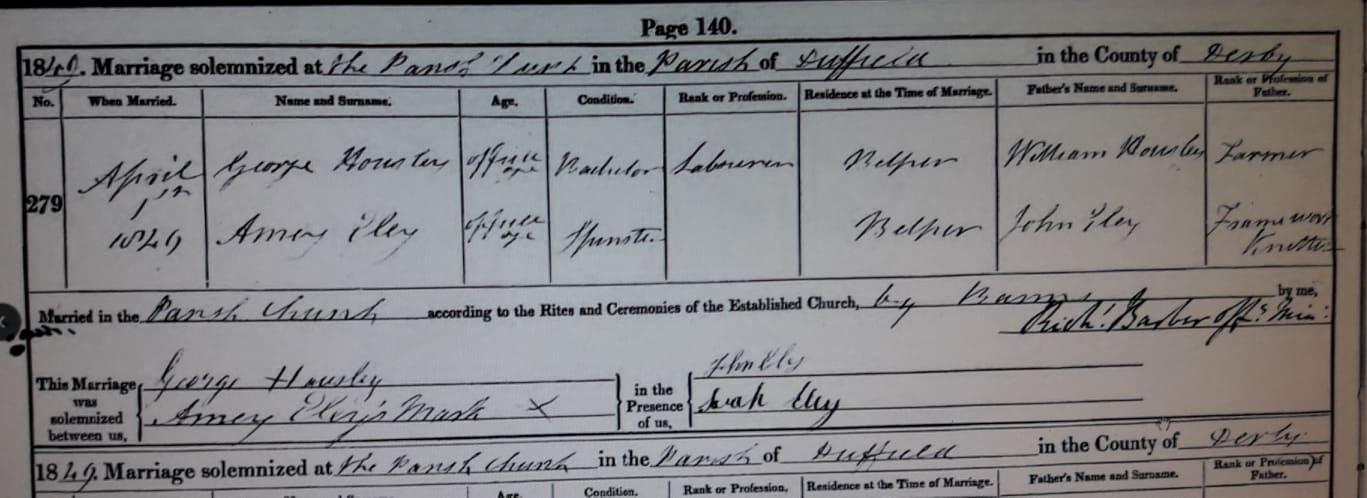
On the 1851 census, George Housley and his wife Amey Housley are living with her parents in Heanor, John Eley, a framework knitter, and his wife Rebecca. Also on the census are Charles J Housley, born in 1849 in Heanor, and Emma Housley, three months old at the time of the census, born in 1851. George’s birth place is listed as Smalley.
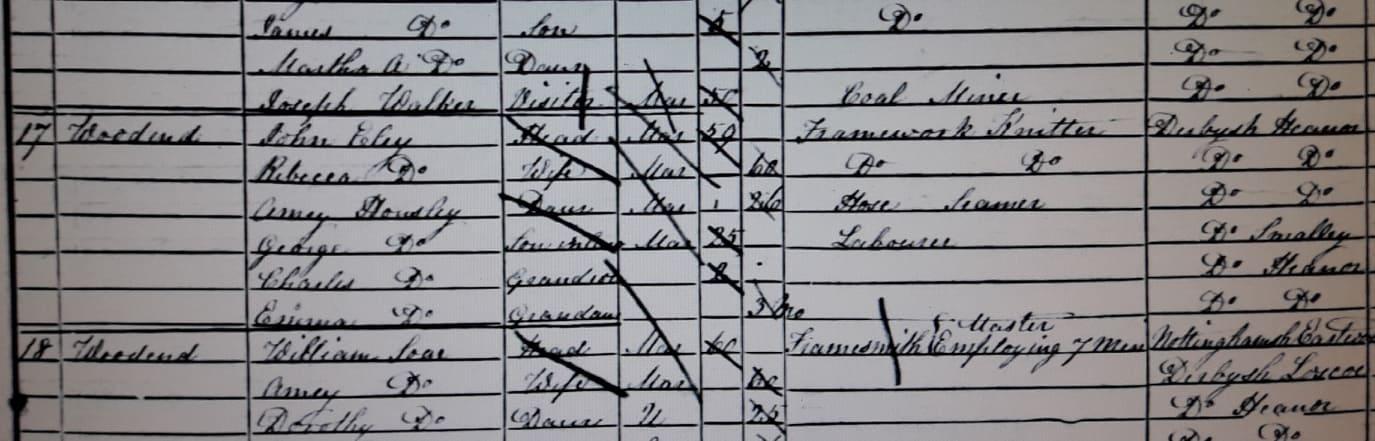
On the 31st of July 1851 George Housley arrives in New York. In 1854 George Housley marries Sarah Ann Hill in USA.
On the 1861 census in Heanor, Rebecca Eley was a widow, her husband John having died in 1852, and she had three grandchildren living with her: Charles J Housley aged 12, Emma Housley, 10, and mysteriously a William Housley aged 5! Amey Housley, the childrens mother, died in 1858.
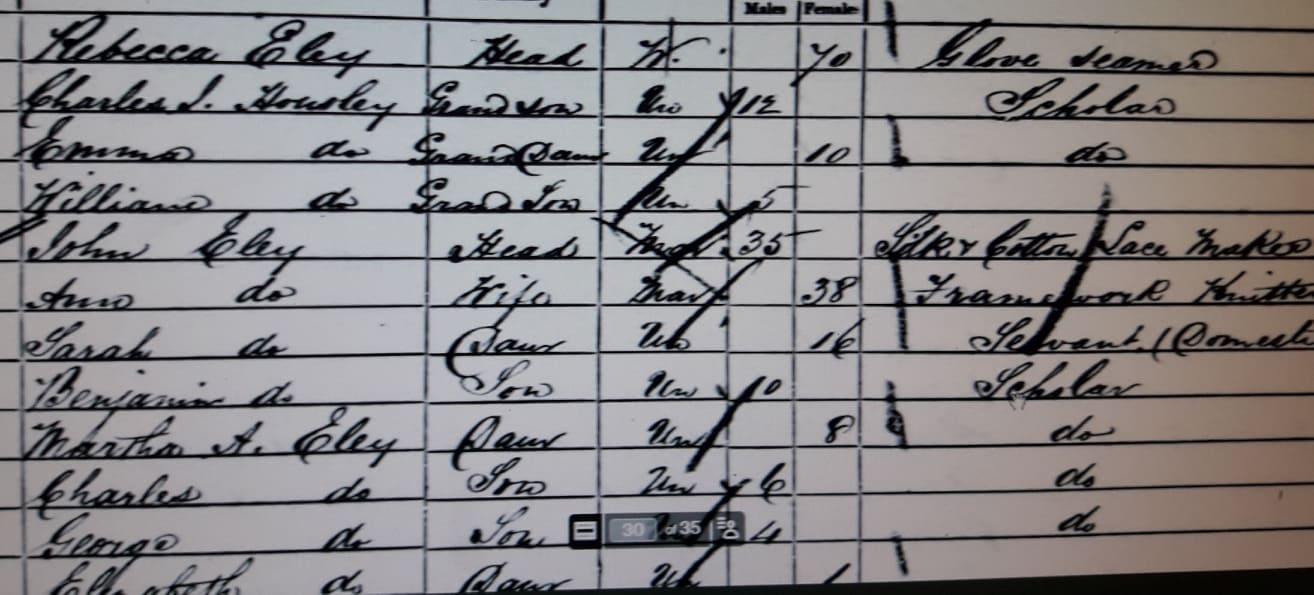
Back to the mysterious comment in Joseph’s letter. Joseph couldn’t have been speaking of his sister Emma. She was married with children by the time Joseph wrote that letter, so was not just out of service, and Joseph would have known where she was. There is no reason to suppose that the sister Emma was trying unsuccessfully to find George’s addresss: she had been sending him letters for years. Joseph must have been referring to George’s daughter Emma.
Joseph comments to George “Your son John…is rather wild.” followed by the remark about Emma’s whereabouts. Could Charles John Housley have used his middle name of John instead of Charles?
As for the child William born five years after George left for USA, despite his name of Housley, which was his mothers married name, we can assume that he was not a Housley ~ not George’s child, anyway. It is not clear who his father was, as Amey did not remarry.
A further excerpt from Barbara Housley’s Narrative on the Letters:
Certainly there was some mystery in George’s life. George apparently wanted his whereabouts kept secret. Anne wrote: “People are at a loss to know where you are. The general idea is you are with Charles. We don’t satisfy them.” In that same letter Anne wrote: “I know you could not help thinking of us very often although you neglected writing…and no doubt would feel grieved for the trouble you at times caused (our mother). She freely forgives all.” Near the end of the letter, Anne added: “Mother sends her love to you and hopes you will write and if you want to tell her anything you don’t want all to see you must write it on a piece of loose paper and put it inside the letter.”
In a letter to George from his sister Emma:
Emma wrote in 1855, “We write in love to your wife and yourself and you must write soon and tell us whether there is a little nephew or niece and what you call them.”
In June of 1856, Emma wrote: “We want to see dear Sarah Ann and the dear little boy. We were much pleased with the “bit of news” you sent.” The bit of news was the birth of John Eley Housley, January 11, 1855. Emma concluded her letter “Give our very kindest love to dear sister and dearest Johnnie.”
It would seem that George Housley named his first son with his second wife after his first wife’s father ~ while he was married to both of them.
Emma Housley
1851-1935
In 1871 Emma was 20 years old and “in service” living as a lodger in West Hallam, not far from Heanor. As she didn’t appear on a 1881 census, I looked for a marriage, but the only one that seemed right in every other way had Emma Housley’s father registered as Ralph Wibberly!
Who was Ralph Wibberly? A family friend or neighbour, perhaps, someone who had been a father figure? The first Ralph Wibberly I found was a blind wood cutter living in Derby. He had a son also called Ralph Wibberly. I did not think Ralph Wibberly would be a very common name, but I was wrong.
I then found a Ralph Wibberly living in Heanor, with a son also named Ralph Wibberly. A Ralph Wibberly married an Emma Salt from Heanor. In 1874, a 36 year old Ralph Wibberly (born in 1838) was on trial in Derby for inflicting grevious bodily harm on William Fretwell of Heanor. His occupation is “platelayer” (a person employed in laying and maintaining railway track.) The jury found him not guilty.
In 1851 a 23 year old Ralph Wibberly (born in 1828) was a prisoner in Derby Gaol. However, Ralph Wibberly, a 50 year old labourer born in 1801 and his son Ralph Wibberly, aged 13 and born in 1838, are living in Belper on the 1851 census. Perhaps the son was the same Ralph Wibberly who was found not guilty of GBH in 1874. This appears to be the one who married Emma Salt, as his wife on the 1871 census is called Emma, and his occupation is “Midland Company Railway labourer”.
Which was the Ralph Wibberly that Emma chose to name as her father on the marriage register? We may never know, but perhaps we can assume it was Ralph Wibberly born in 1801. It is unlikely to be the blind wood cutter from Derby; more likely to be the local Ralph Wibberly. Maybe his son Ralph, who we know was involved in a fight in 1874, was a friend of Emma’s brother Charles John, who was described by Joseph as a “wild one”, although Ralph was 11 years older than Charles John.
Emma Housley married James Slater on Christmas day in Heanor in 1873. Their first child, a daughter, was called Amy. Emma’s mother was Amy Eley. James Slater was a colliery brakesman (employed to work the steam-engine, or other machinery used in raising the coal from the mine.)
It occurred to me to wonder if Emma Housley (George’s daughter) knew Elizabeth, Mary Anne and Catherine (Samuel’s daughters). They were cousins, lived in the vicinity, and they had in common with each other having been deserted by their fathers who were brothers. Emma was born two years after Catherine. Catherine was living with John Benniston, a framework knitter in Heanor, from 1851 to 1861. Emma was living with her grandfather John Ely, a framework knitter in Heanor. In 1861, George Purdy was also living in Heanor. He was listed on the census as a 13 year old coal miner! George Purdy and Catherine Housley married in 1866 in Eastwood, Nottinghamshire ~ just over the county border. Emma’s first child Amy was born in Heanor, but the next two children, Eliza and Lilly, were born in Eastwood, in 1878 and 1880. Catherine and George’s fifth child, my great grandmother Mary Ann Gilman Purdy, was born in Eastwood in 1880, the same year as Lilly Slater.
By 1881 Emma and James Slater were living in Woodlinkin, Codnor and Loscoe, close to Heanor and Eastwood, on the Derbyshire side of the border. On each census up to 1911 their address on the census is Woodlinkin. Emma and James had nine children: six girls and 3 boys, the last, Alfred Frederick, born in 1901.
Emma and James lived three doors up from the Thorn Tree pub in Woodlinkin, Codnor:
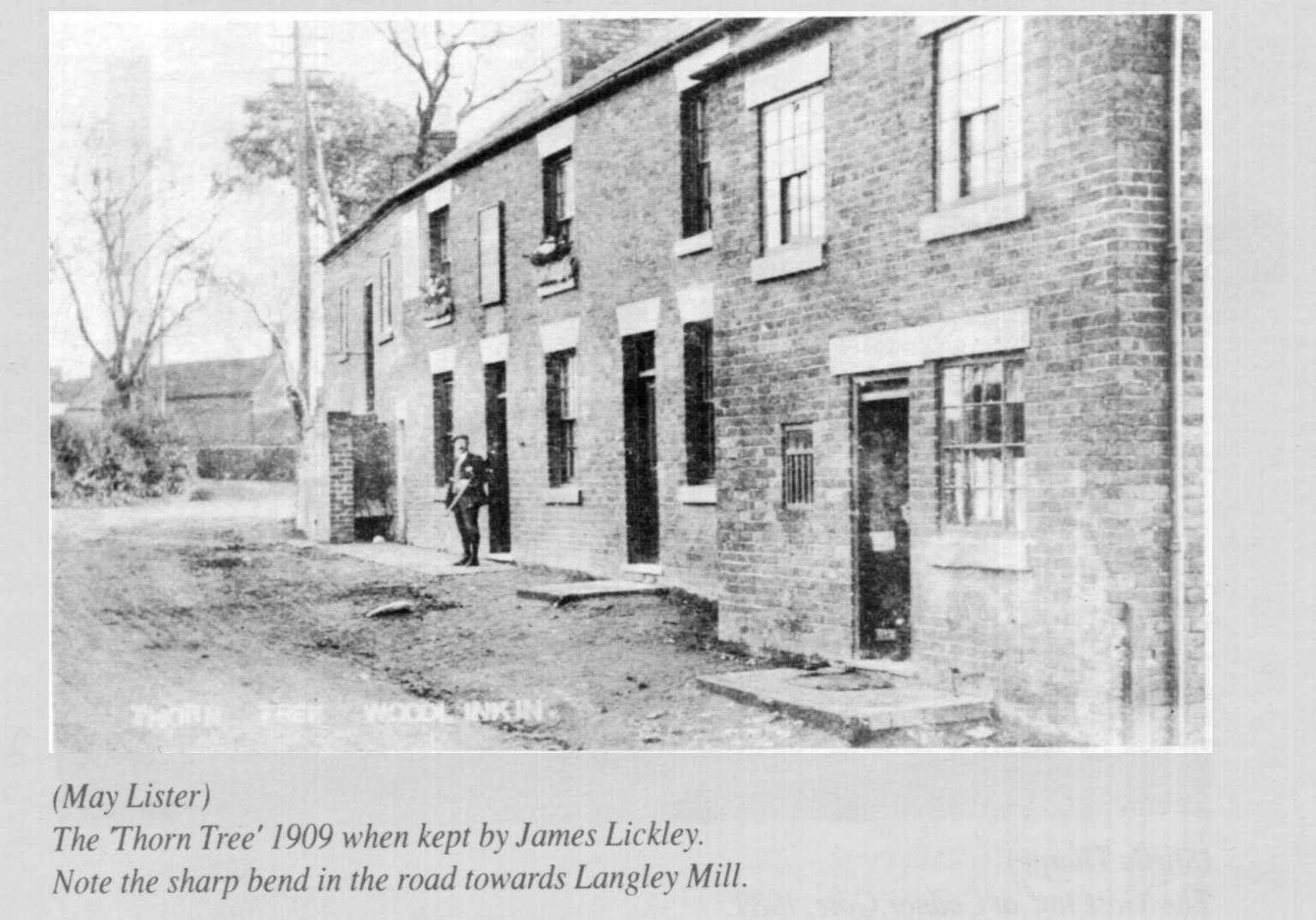
Emma Slater died in 1935 at the age of 84.
IN
LOVING MEMORY OF
EMMA SLATER
(OF WOODLINKIN)
WHO DIED
SEPT 12th 1935
AGED 84 YEARS
AT RESTCrosshill Cemetery, Codnor, Amber Valley Borough, Derbyshire, England:
Charles John Housley
1949-
-
AuthorSearch Results