

Search Results for 'dates'
-
AuthorSearch Results
-
April 12, 2022 at 8:13 am #6290
In reply to: The Elusive Samuel Housley and Other Family Stories
Leicestershire Blacksmiths
The Orgill’s of Measham led me further into Leicestershire as I traveled back in time.
I also realized I had uncovered a direct line of women and their mothers going back ten generations:
myself, Tracy Edwards 1957-
my mother Gillian Marshall 1933-
my grandmother Florence Warren 1906-1988
her mother and my great grandmother Florence Gretton 1881-1927
her mother Sarah Orgill 1840-1910
her mother Elizabeth Orgill 1803-1876
her mother Sarah Boss 1783-1847
her mother Elizabeth Page 1749-
her mother Mary Potter 1719-1780
and her mother and my 7x great grandmother Mary 1680-You could say it leads us to the very heart of England, as these Leicestershire villages are as far from the coast as it’s possible to be. There are countless other maternal lines to follow, of course, but only one of mothers of mothers, and ours takes us to Leicestershire.
The blacksmiths
Sarah Boss was the daughter of Michael Boss 1755-1807, a blacksmith in Measham, and Elizabeth Page of nearby Hartshorn, just over the county border in Derbyshire.
An earlier Michael Boss, a blacksmith of Measham, died in 1772, and in his will he left the possession of the blacksmiths shop and all the working tools and a third of the household furniture to Michael, who he named as his nephew. He left his house in Appleby Magna to his wife Grace, and five pounds to his mother Jane Boss. As none of Michael and Grace’s children are mentioned in the will, perhaps it can be assumed that they were childless.
The will of Michael Boss, 1772, Measham:
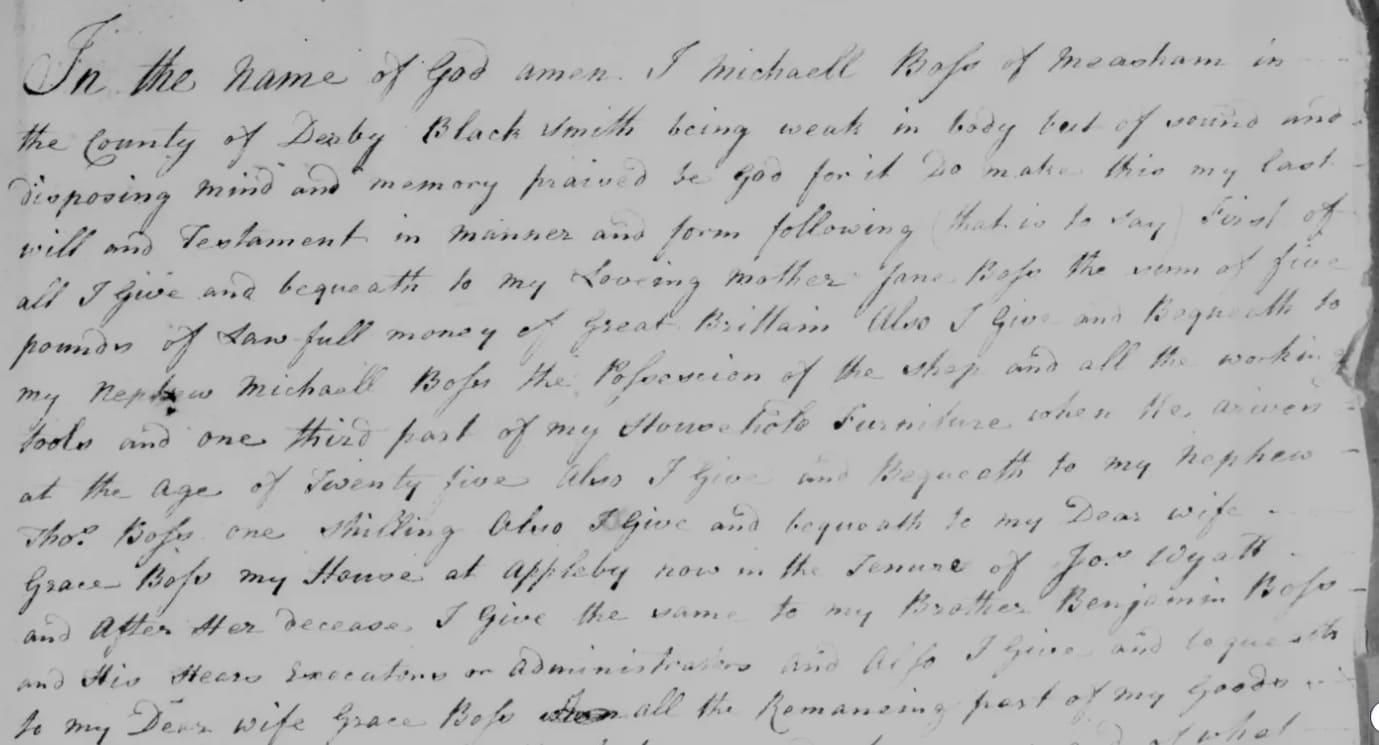
Michael Boss the uncle was born in Appleby Magna in 1724. His parents were Michael Boss of Nelson in the Thistles and Jane Peircivall of Appleby Magna, who were married in nearby Mancetter in 1720.
Information worth noting on the Appleby Magna website:
In 1752 the calendar in England was changed from the Julian Calendar to the Gregorian Calendar, as a result 11 days were famously “lost”. But for the recording of Church Registers another very significant change also took place, the start of the year was moved from March 25th to our more familiar January 1st.
Before 1752 the 1st day of each new year was March 25th, Lady Day (a significant date in the Christian calendar). The year number which we all now use for calculating ages didn’t change until March 25th. So, for example, the day after March 24th 1750 was March 25th 1751, and January 1743 followed December 1743.
This March to March recording can be seen very clearly in the Appleby Registers before 1752. Between 1752 and 1768 there appears slightly confused recording, so dates should be carefully checked. After 1768 the recording is more fully by the modern calendar year.Michael Boss the uncle married Grace Cuthbert. I haven’t yet found the birth or parents of Grace, but a blacksmith by the name of Edward Cuthbert is mentioned on an Appleby Magna history website:
An Eighteenth Century Blacksmith’s Shop in Little Appleby
by Alan RobertsCuthberts inventory
The inventory of Edward Cuthbert provides interesting information about the household possessions and living arrangements of an eighteenth century blacksmith. Edward Cuthbert (als. Cutboard) settled in Appleby after the Restoration to join the handful of blacksmiths already established in the parish, including the Wathews who were prominent horse traders. The blacksmiths may have all worked together in the same shop at one time. Edward and his wife Sarah recorded the baptisms of several of their children in the parish register. Somewhat sadly three of the boys named after their father all died either in infancy or as young children. Edward’s inventory which was drawn up in 1732, by which time he was probably a widower and his children had left home, suggests that they once occupied a comfortable two-storey house in Little Appleby with an attached workshop, well equipped with all the tools for repairing farm carts, ploughs and other implements, for shoeing horses and for general ironmongery.
Edward Cuthbert born circa 1660, married Joane Tuvenet in 1684 in Swepston cum Snarestone , and died in Appleby in 1732. Tuvenet is a French name and suggests a Huguenot connection, but this isn’t our family, and indeed this Edward Cuthbert is not likely to be Grace’s father anyway.
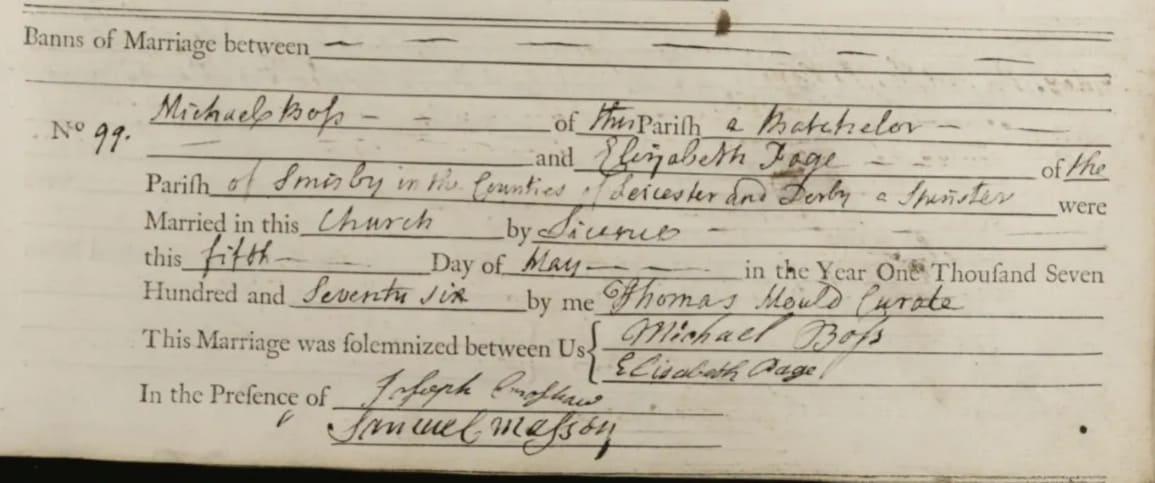
Michael Boss and Elizabeth Page appear to have married twice: once in 1776, and once in 1779. Both of the documents exist and appear correct. Both marriages were by licence. They both mention Michael is a blacksmith.
Their first daughter, Elizabeth, was baptized in February 1777, just nine months after the first wedding. It’s not known when she was born, however, and it’s possible that the marriage was a hasty one. But why marry again three years later?
But Michael Boss and Elizabeth Page did not marry twice.
Elizabeth Page from Smisby was born in 1752 and married Michael Boss on the 5th of May 1776 in Measham. On the marriage licence allegations and bonds, Michael is a bachelor.
Baby Elizabeth was baptised in Measham on the 9th February 1777. Mother Elizabeth died on the 18th February 1777, also in Measham.
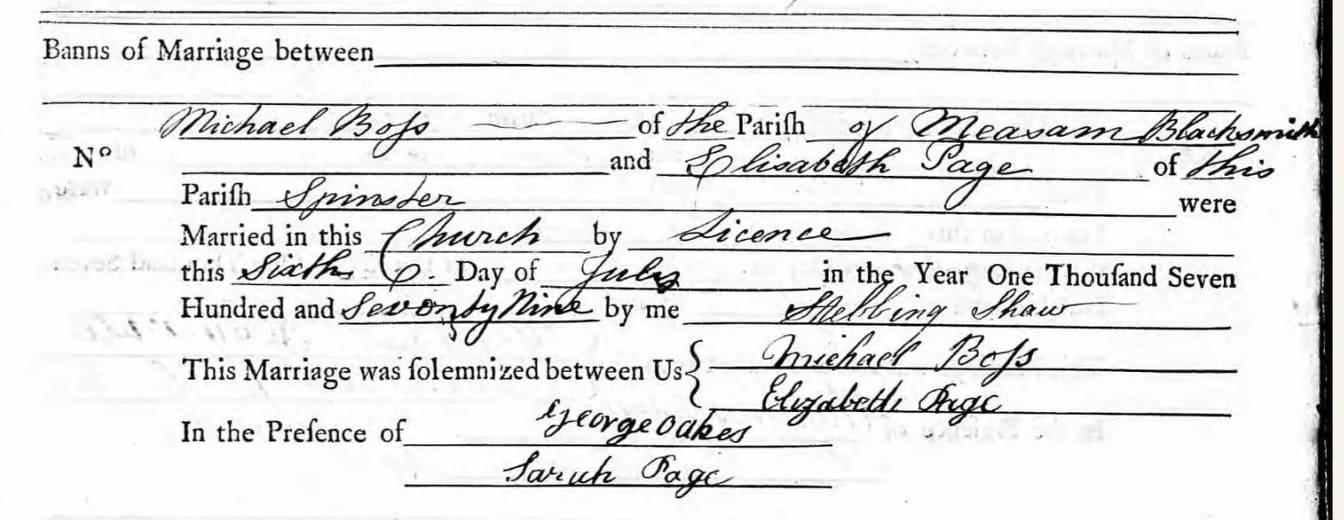
In 1779 Michael Boss married another Elizabeth Page! She was born in 1749 in Hartshorn, and Michael is a widower on the marriage licence allegations and bonds.
Hartshorn and Smisby are neighbouring villages, hence the confusion. But a closer look at the documents available revealed the clues. Both Elizabeth Pages were literate, and indeed their signatures on the marriage registers are different:
Marriage of Michael Boss and Elizabeth Page of Smisby in 1776:
Marriage of Michael Boss and Elizabeth Page of Harsthorn in 1779:
Not only did Michael Boss marry two women both called Elizabeth Page but he had an unusual start in life as well. His uncle Michael Boss left him the blacksmith business and a third of his furniture. This was all in the will. But which of Uncle Michaels brothers was nephew Michaels father?
The only Michael Boss born at the right time was in 1750 in Edingale, Staffordshire, about eight miles from Appleby Magna. His parents were Thomas Boss and Ann Parker, married in Edingale in 1747. Thomas died in August 1750, and his son Michael was baptised in the December, posthumus son of Thomas and his widow Ann. Both entries are on the same page of the register.
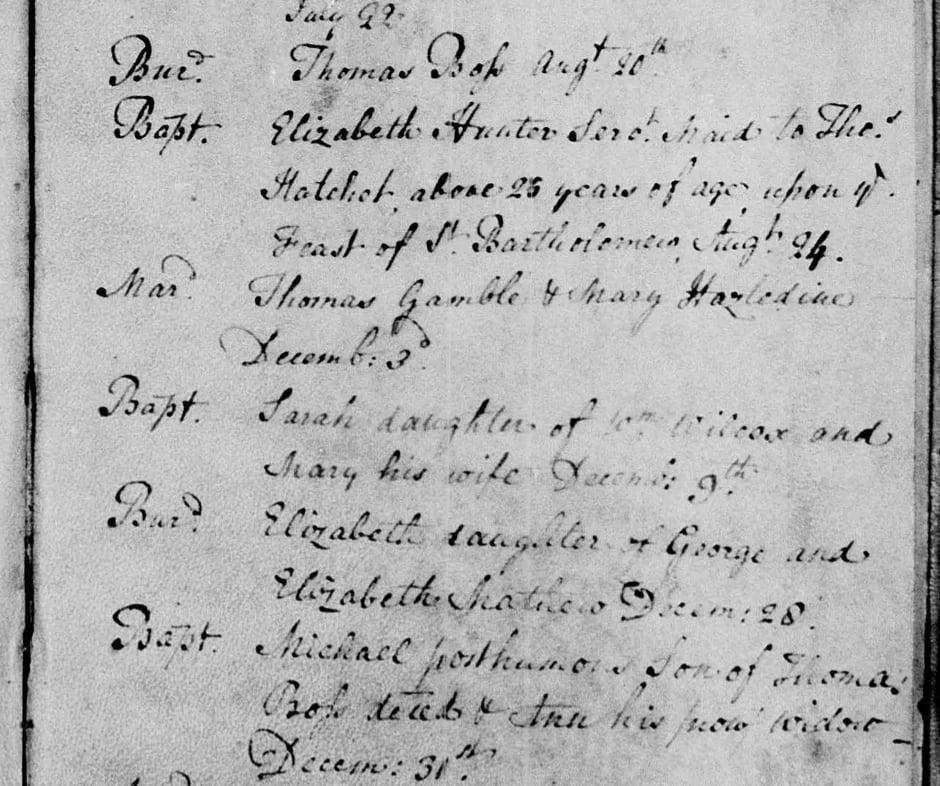
Ann Boss, the young widow, married again. But perhaps Michael and his brother went to live with their childless uncle and aunt, Michael Boss and Grace Cuthbert.
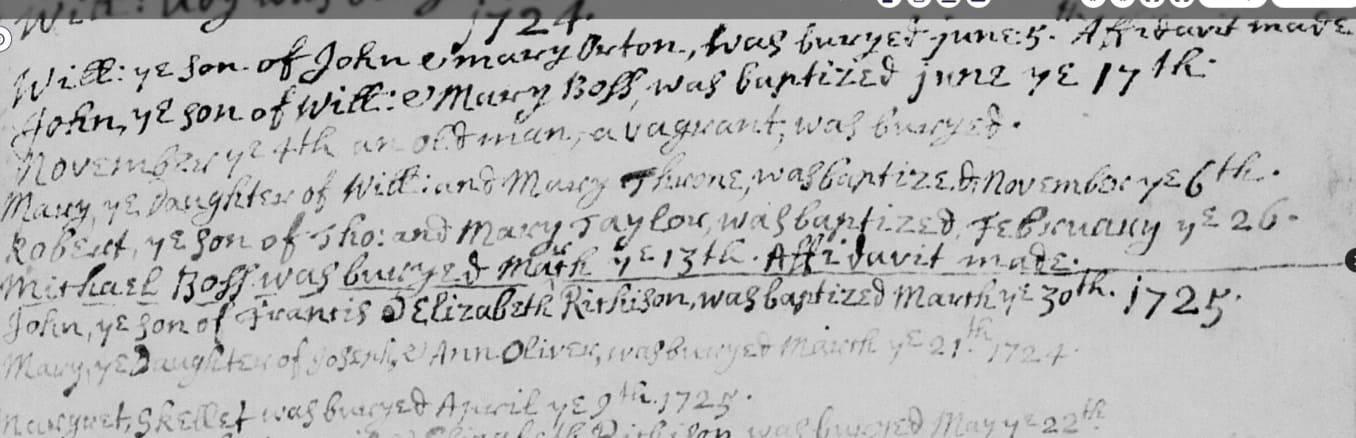
The great grandfather of Michael Boss (the Measham blacksmith born in 1850) was also Michael Boss, probably born in the 1660s. He died in Newton Regis in Warwickshire in 1724, four years after his son (also Michael Boss born 1693) married Jane Peircivall. The entry on the parish register states that Michael Boss was buried ye 13th Affadavit made.
I had not seen affadavit made on a parish register before, and this relates to the The Burying in Woollen Acts 1666–80. According to Wikipedia:
“Acts of the Parliament of England which required the dead, except plague victims and the destitute, to be buried in pure English woollen shrouds to the exclusion of any foreign textiles. It was a requirement that an affidavit be sworn in front of a Justice of the Peace (usually by a relative of the deceased), confirming burial in wool, with the punishment of a £5 fee for noncompliance. Burial entries in parish registers were marked with the word “affidavit” or its equivalent to confirm that affidavit had been sworn; it would be marked “naked” for those too poor to afford the woollen shroud. The legislation was in force until 1814, but was generally ignored after 1770.”
Michael Boss buried 1724 “Affadavit made”:
Elizabeth Page‘s father was William Page 1717-1783, a wheelwright in Hartshorn. (The father of the first wife Elizabeth was also William Page, but he was a husbandman in Smisby born in 1714. William Page, the father of the second wife, was born in Nailstone, Leicestershire, in 1717. His place of residence on his marriage to Mary Potter was spelled Nelson.)
Her mother was Mary Potter 1719- of nearby Coleorton. Mary’s father, Richard Potter 1677-1731, was a blacksmith in Coleorton.
A page of the will of Richard Potter 1731:
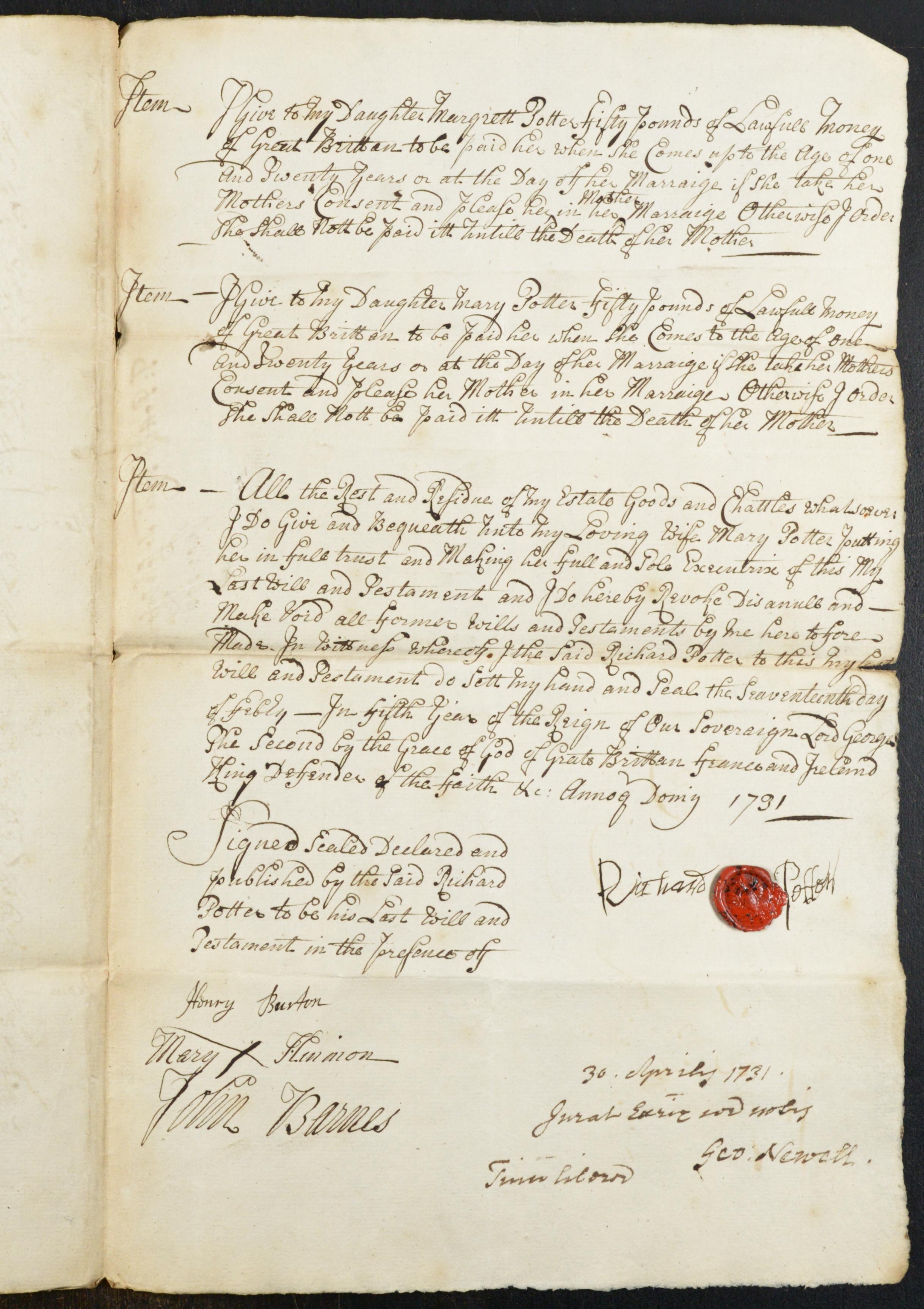
Richard Potter states: “I will and order that my son Thomas Potter shall after my decease have one shilling paid to him and no more.” As he left £50 to each of his daughters, one can’t help but wonder what Thomas did to displease his father.
Richard stipulated that his son Thomas should have one shilling paid to him and not more, for several good considerations, and left “the house and ground lying in the parish of Whittwick in a place called the Long Lane to my wife Mary Potter to dispose of as she shall think proper.”
His son Richard inherited the blacksmith business: “I will and order that my son Richard Potter shall live and be with his mother and serve her duly and truly in the business of a blacksmith, and obey and serve her in all lawful commands six years after my decease, and then I give to him and his heirs…. my house and grounds Coulson House in the Liberty of Thringstone”
Richard wanted his son John to be a blacksmith too: “I will and order that my wife bring up my son John Potter at home with her and teach or cause him to be taught the trade of a blacksmith and that he shall serve her duly and truly seven years after my decease after the manner of an apprentice and at the death of his mother I give him that house and shop and building and the ground belonging to it which I now dwell in to him and his heirs forever.”
To his daughters Margrett and Mary Potter, upon their reaching the age of one and twenty, or the day after their marriage, he leaves £50 each. All the rest of his goods are left to his loving wife Mary.
An inventory of the belongings of Richard Potter, 1731:
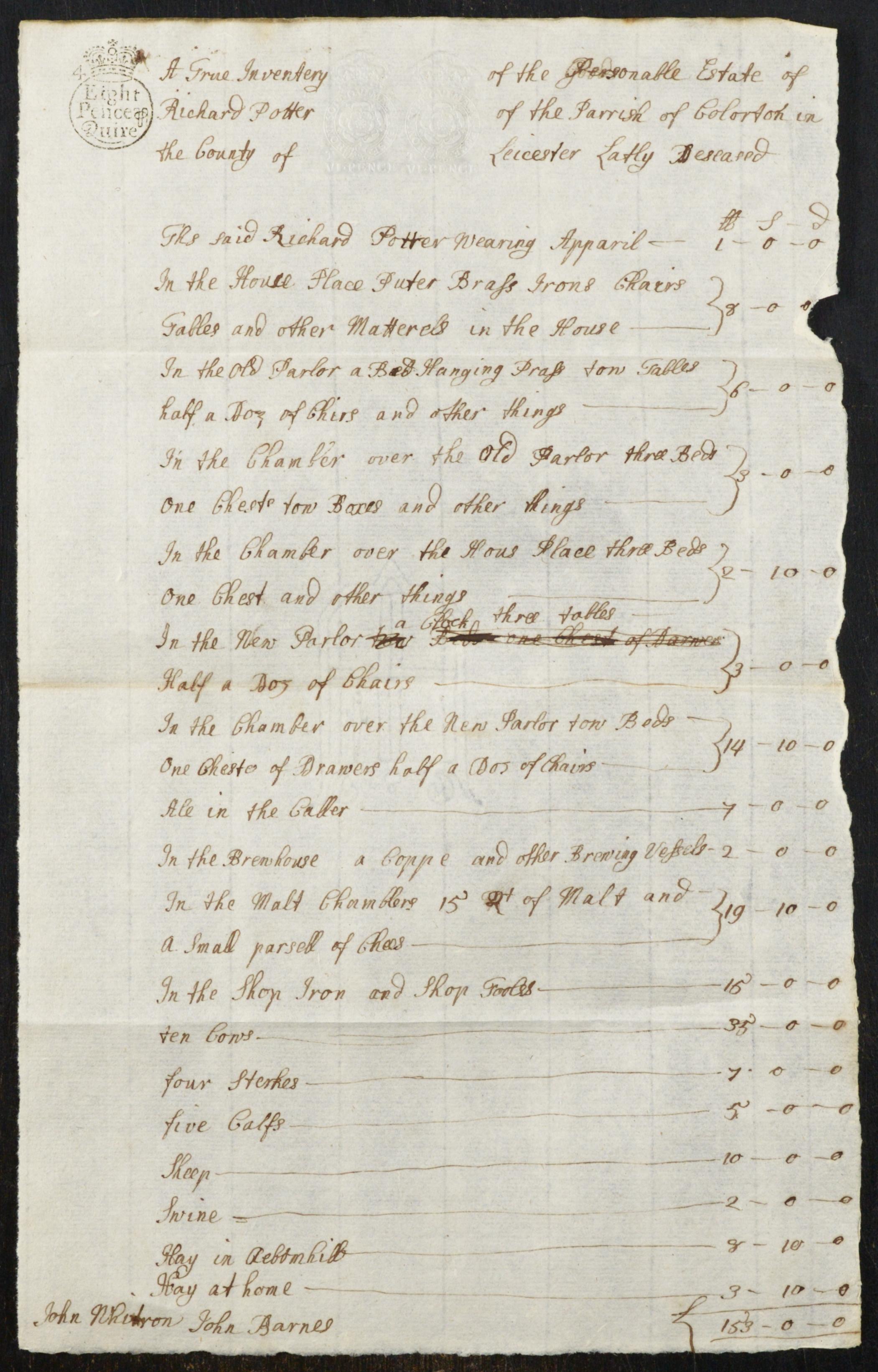
Richard Potters father was also named Richard Potter 1649-1719, and he too was a blacksmith.
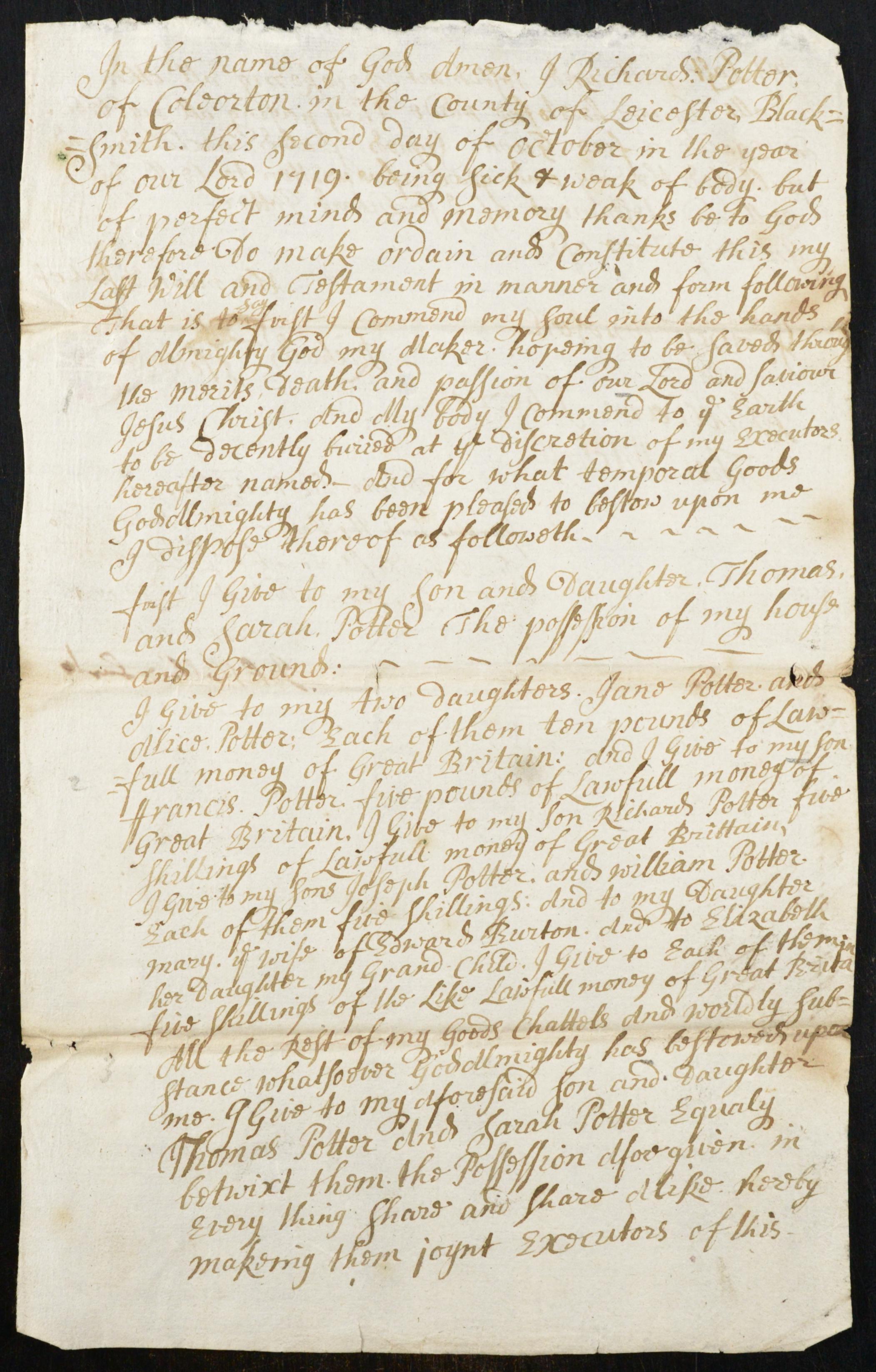
Richard Potter of Coleorton in the county of Leicester, blacksmith, stated in his will: “I give to my son and daughter Thomas and Sarah Potter the possession of my house and grounds.”
He leaves ten pounds each to his daughters Jane and Alice, to his son Francis he gives five pounds, and five shillings to his son Richard. Sons Joseph and William also receive five shillings each. To his daughter Mary, wife of Edward Burton, and her daughter Elizabeth, he gives five shillings each. The rest of his good, chattels and wordly substance he leaves equally between his son and daugter Thomas and Sarah. As there is no mention of his wife, it’s assumed that she predeceased him.
The will of Richard Potter, 1719:
Richard Potter’s (1649-1719) parents were William Potter and Alse Huldin, both born in the early 1600s. They were married in 1646 at Breedon on the Hill, Leicestershire. The name Huldin appears to originate in Finland.
William Potter was a blacksmith. In the 1659 parish registers of Breedon on the Hill, William Potter of Breedon blacksmith buryed the 14th July.
December 18, 2021 at 12:59 pm #6243In reply to: The Elusive Samuel Housley and Other Family Stories
William Housley’s Will and the Court Case
William Housley died in 1848, but his widow Ellen didn’t die until 1872. The court case was in 1873. Details about the court case are archived at the National Archives at Kew, in London, but are not available online. They can be viewed in person, but that hasn’t been possible thus far. However, there are a great many references to it in the letters.
William Housley’s first wife was Mary Carrington 1787-1813. They had three children, Mary Anne, Elizabeth and William. When Mary died, William married Mary’s sister Ellen, not in their own parish church at Smalley but in Ashbourne. Although not uncommon for a widower to marry a deceased wife’s sister, it wasn’t legal. This point is mentioned in one of the letters.
One of the pages of William Housley’s will:
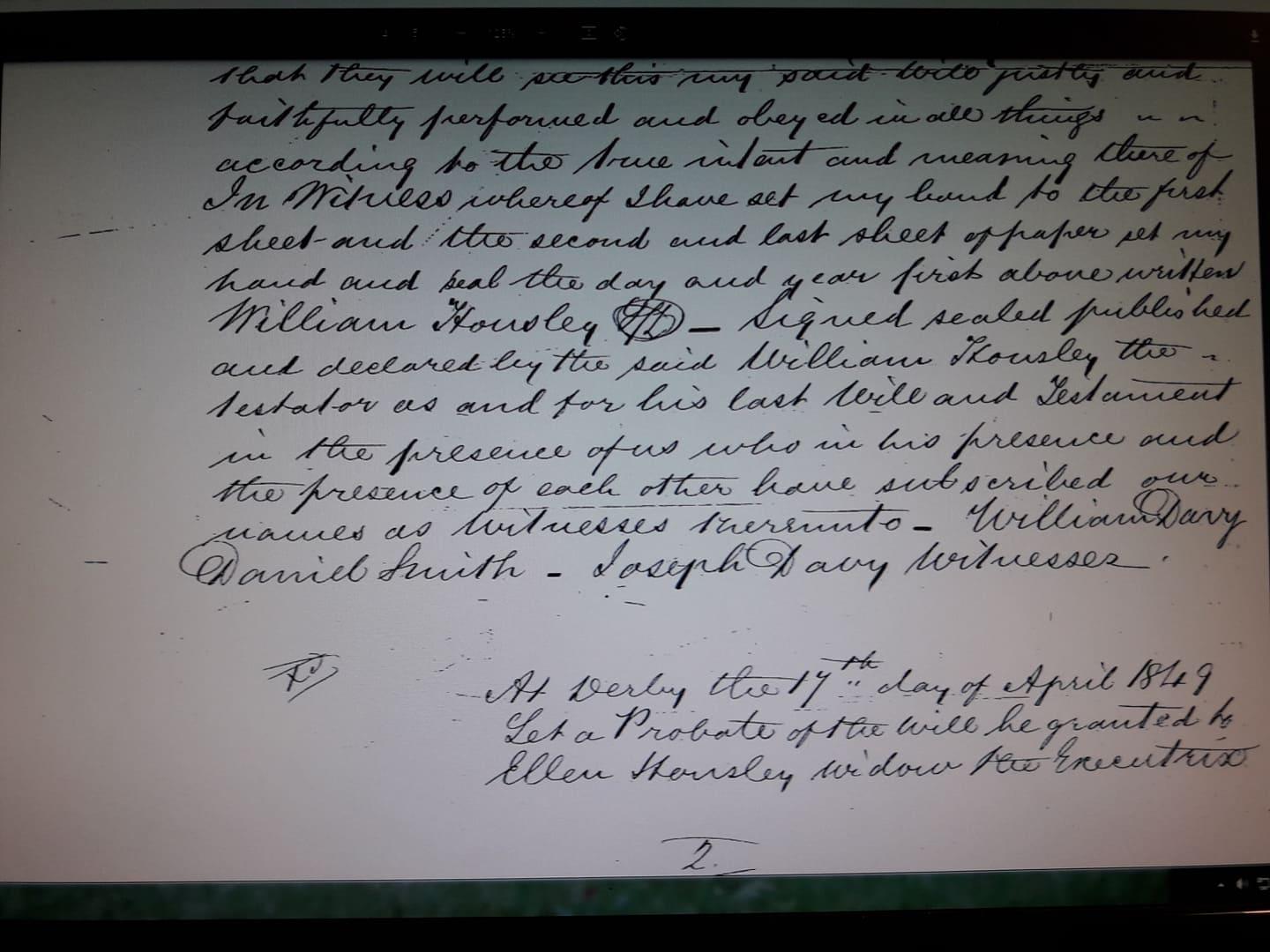
An excerpt from Barbara Housley’s Narrative on the Letters:
A comment in a letter from Joseph (August 6, 1873) indicated that William was married twice and that his wives were sisters: “What do you think that I believe that Mary Ann is trying to make our father’s will of no account as she says that my father’s marriage with our mother was not lawful he marrying two sisters. What do you think of her? I have heard my mother say something about paying a fine at the time of the marriage to make it legal.” Markwell and Saul in The A-Z Guide to Tracing Ancestors in Britain explain that marriage to a deceased wife’s sister was not permissible under Canon law as the relationship was within the prohibited degrees. However, such marriages did take place–usually well away from the couple’s home area. Up to 1835 such marriages were not void but were voidable by legal action. Few such actions were instituted but the risk was always there.
Joseph wrote that when Emma was married, Ellen “broke up the comfortable home and the things went to Derby and she went to live with them but Derby didn’t agree with her so she left again leaving her things behind and came to live with John in the new house where she died.” Ellen was listed with John’s household in the 1871 census.
In May 1872, the Ilkeston Pioneer carried this notice: “Mr. Hopkins will sell by auction on Saturday next the eleventh of May 1872 the whole of the useful furniture, sewing machine, etc. nearly new on the premises of the late Mrs. Housley at Smalley near Heanor in the county of Derby. Sale at one o’clock in the afternoon.”There were hard feelings between Mary Ann and Ellen and her children. Anne wrote: “If you remember we were not very friendly when you left. They never came and nothing was too bad for Mary Ann to say of Mother and me, but when Robert died Mother sent for her to the funeral but she did not think well to come so we took no more notice. She would not allow her children to come either.”
Mary Ann was still living in May 1872. Joseph implied that she and her brother, Will “intend making a bit of bother about the settlement of the bit of property” left by their mother. The 1871 census listed Mary Ann’s occupation as “income from houses.”In July 1872, Joseph introduced Ruth’s husband: “No doubt he is a bad lot. He is one of the Heath’s of Stanley Common a miller and he lives at Smalley Mill” (Ruth Heath was Mary Anne Housley’s daughter)
In 1873 Joseph wrote, “He is nothing but a land shark both Heath and his wife and his wife is the worst of the two. You will think these is hard words but they are true dear brother.” The solicitor, Abraham John Flint, was not at all pleased with Heath’s obstruction of the settlement of the estate. He wrote on June 30, 1873: “Heath agreed at first and then because I would not pay his expenses he refused and has since instructed another solicitor for his wife and Mrs. Weston who have been opposing us to the utmost. I am concerned for all parties interested except these two….The judge severely censured Heath for his conduct and wanted to make an order for sale there and then but Heath’s council would not consent….” In June 1875, the solicitor wrote: “Heath bid for the property but it fetched more money than he could give for it. He has been rather quieter lately.”In May 1872, Joseph wrote: “For what do you think, John has sold his share and he has acted very bad since his wife died and at the same time he sold all his furniture. You may guess I have never seen him but once since poor mother’s funeral and he is gone now no one knows where.”
In 1876, the solicitor wrote to George: “Have you heard of John Housley? He is entitled to Robert’s share and I want him to claim it.”
Anne intended that one third of the inheritance coming to her from her father and her grandfather, William Carrington, be divided between her four nieces: Sam’s three daughters and John’s daughter Elizabeth.
In the same letter (December 15, 1872), Joseph wrote:
“I think we have now found all out now that is concerned in the matter for there was only Sam that we did not know his whereabouts but I was informed a week ago that he is dead–died about three years ago in Birmingham Union. Poor Sam. He ought to have come to a better end than that”However, Samuel was still alive was on the 1871 census in Henley in Arden, and no record of his death can be found. Samuel’s brother in law said he was dead: we do not know why he lied, or perhaps the brothers were lying to keep his share, or another possibility is that Samuel himself told his brother in law to tell them that he was dead. I am inclined to think it was the latter.
Excerpts from Barbara Housley’s Narrative on the Letters continued:
Charles went to Australia in 1851, and was last heard from in January 1853. According to the solicitor, who wrote to George on June 3, 1874, Charles had received advances on the settlement of their parent’s estate. “Your promissory note with the two signed by your brother Charles for 20 pounds he received from his father and 20 pounds he received from his mother are now in the possession of the court.”
In December 1872, Joseph wrote: “I’m told that Charles two daughters has wrote to Smalley post office making inquiries about his share….” In January 1876, the solicitor wrote: “Charles Housley’s children have claimed their father’s share.”
In the Adelaide Observer 28 Aug 1875
HOUSLEY – wanted information
as to the Death, Will, or Intestacy, and
Children of Charles Housley, formerly of
Smalley, Derbyshire, England, who died at
Geelong or Creewick Creek Diggings, Victoria
August, 1855. His children will hear of something to their advantage by communicating with
Mr. A J. Flint, solicitor, Derby, England.
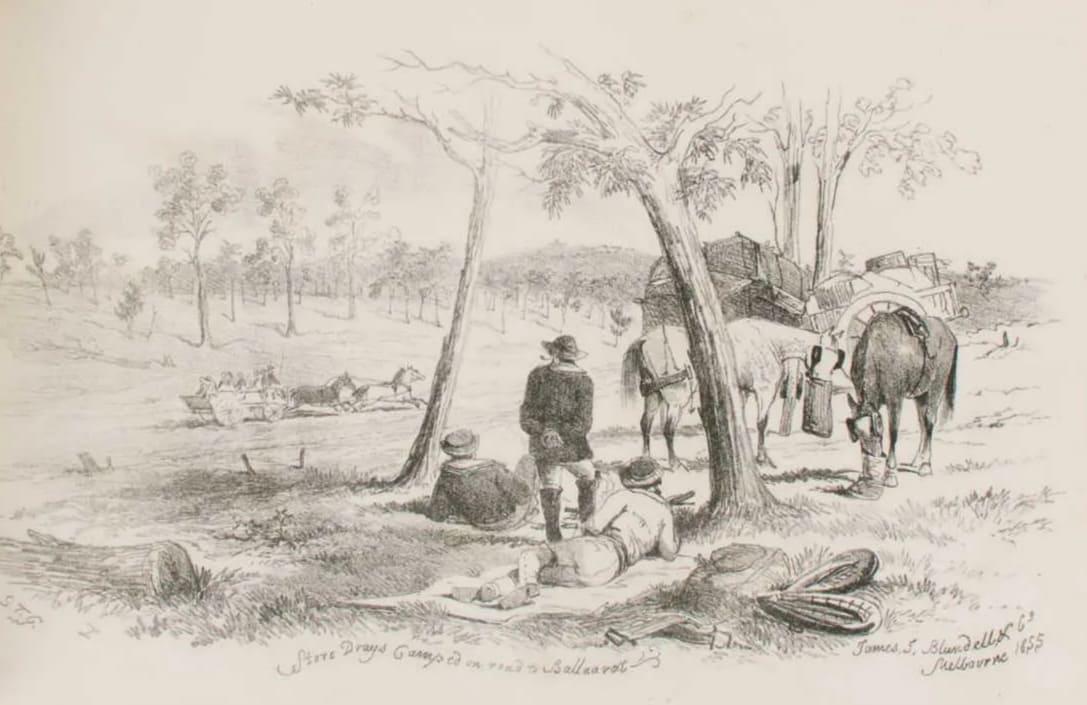
June 16,1875.The Diggers & Diggings of Victoria in 1855. Drawn on Stone by S.T. Gill:
The court case:
Kerry v Housley.
Documents: Bill, demurrer.
Plaintiffs: Samuel Kerry and Joseph Housley.
Defendants: William Housley, Joseph Housley (deleted), Edwin Welch Harvey, Eleanor Harvey (deleted), Ernest Harvey infant, William Stafford, Elizabeth Stafford his wife, Mary Ann Housley, George Purdy and Catherine Purdy his wife, Elizabeth Housley, Mary Ann Weston widow and William Heath and Ruth Heath his wife (deleted).
Provincial solicitor employed in Derbyshire.
Date: 1873From the Narrative on the Letters:
The solicitor wrote on May 23, 1874: “Lately I have not written because I was not certain of your address and because I doubted I had much interesting news to tell you.” Later, Joseph wrote concerning the problems settling the estate, “You see dear brother there is only me here on our side and I cannot do much. I wish you were here to help me a bit and if you think of going for another summer trip this turn you might as well run over here.”
In March 1873, Joseph wrote: “You ask me what I think of you coming to England. I think as you have given the trustee power to sign for you I think you could do no good but I should like to see you once again for all that. I can’t say whether there would be anything amiss if you did come as you say it would be throwing good money after bad.”
In September 1872 Joseph wrote; “My wife is anxious to come. I hope it will suit her health for she is not over strong.” Elsewhere Joseph wrote that Harriet was “middling sometimes. She is subject to sick headaches. It knocks her up completely when they come on.” In December 1872 Joseph wrote, “Now dear brother about us coming to America you know we shall have to wait until this affair is settled and if it is not settled and thrown into Chancery I’m afraid we shall have to stay in England for I shall never be able to save money enough to bring me out and my family but I hope of better things.”
On July 19, 1875 Abraham Flint (the solicitor) wrote: “Joseph Housley has removed from Smalley and is working on some new foundry buildings at Little Chester near Derby. He lives at a village called Little Eaton near Derby. If you address your letter to him as Joseph Housley, carpenter, Little Eaton near Derby that will no doubt find him.”In his last letter (February 11, 1874), Joseph sounded very discouraged and wrote that Harriet’s parents were very poorly and both had been “in bed for a long time.” In addition, Harriet and the children had been ill.
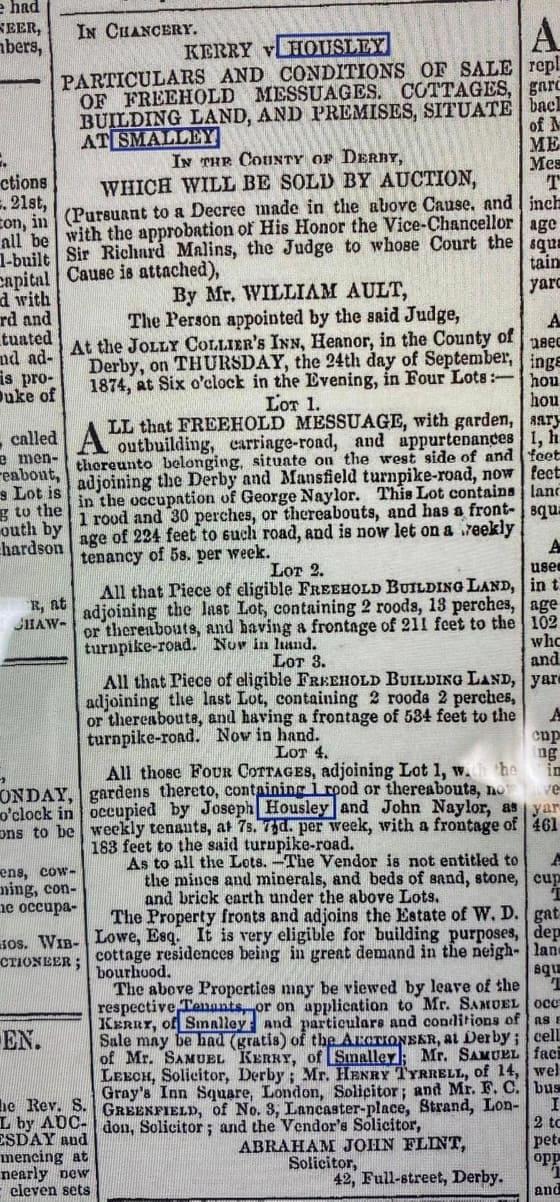
The move to Little Eaton may indicate that Joseph received his settlement because in August, 1873, he wrote: “I think this is bad news enough and bad luck too, but I have had little else since I came to live at Kiddsley cottages but perhaps it is all for the best if one could only think so. I have begun to think there will be no chance for us coming over to you for I am afraid there will not be so much left as will bring us out without it is settled very shortly but I don’t intend leaving this house until it is settled either one way or the other. ”Joseph’s letters were much concerned with the settling of their mother’s estate. In 1854, Anne wrote, “As for my mother coming (to America) I think not at all likely. She is tied here with her property.” A solicitor, Abraham John Flint of 42 Full Street Derby, was engaged by John following the death of their mother. On June 30, 1873 the solicitor wrote: “Dear sir, On the death of your mother I was consulted by your brother John. I acted for him with reference to the sale and division of your father’s property at Smalley. Mr. Kerry was very unwilling to act as trustee being over 73 years of age but owing to the will being a badly drawn one we could not appoint another trustee in his place nor could the property be sold without a decree of chancery. Therefore Mr. Kerry consented and after a great deal of trouble with Heath who has opposed us all throughout whenever matters did not suit him, we found the title deeds and offered the property for sale by public auction on the 15th of July last. Heath could not find his purchase money without mortaging his property the solicitor which the mortgagee employed refused to accept Mr. Kerry’s title and owing to another defect in the will we could not compel them.”
In July 1872, Joseph wrote, “I do not know whether you can remember who the trustee was to my father’s will. It was Thomas Watson and Samuel Kerry of Smalley Green. Mr. Watson is dead (died a fortnight before mother) so Mr. Kerry has had to manage the affair.”
On Dec. 15, 1972, Joseph wrote, “Now about this property affair. It seems as far off of being settled as ever it was….” and in the following March wrote: “I think we are as far off as ever and farther I think.”
Concerning the property which was auctioned on July 15, 1872 and brought 700 pounds, Joseph wrote: “It was sold in five lots for building land and this man Heath bought up four lots–that is the big house, the croft and the cottages. The croft was made into two lots besides the piece belonging to the big house and the cottages and gardens was another lot and the little intake was another. William Richardson bought that.” Elsewhere Richardson’s purchase was described as “the little croft against Smith’s lane.” Smith’s Lane was probably named for their neighbor Daniel Smith, Mrs. Davy’s father.
But in December 1872, Joseph wrote that they had not received any money because “Mr. Heath is raising all kinds of objections to the will–something being worded wrong in the will.” In March 1873, Joseph “clarified” matters in this way: “His objection was that one trustee could not convey the property that his signature was not guarantee sufficient as it states in the will that both trustees has to sign the conveyance hence this bother.”
Joseph indicated that six shares were to come out of the 700 pounds besides Will’s 20 pounds. Children were to come in for the parents shares if dead. The solicitor wrote in 1873, “This of course refers to the Kidsley property in which you take a one seventh share and which if the property sells well may realize you about 60-80 pounds.” In March 1873 Joseph wrote: “You have an equal share with the rest in both lots of property, but I am afraid there will be but very little for any of us.”The other “lot of property” was “property in Smalley left under another will.” On July 17, 1872, Joseph wrote: “It was left by my grandfather Carrington and Uncle Richard is trustee. He seems very backward in bringing the property to a sale but I saw him and told him that I for one expect him to proceed with it.” George seemed to have difficulty understanding that there were two pieces of property so Joseph explained further: “It was left by my grandfather Carrington not by our father and Uncle Richard is the trustee for it but the will does not give him power to sell without the signatures of the parties concerned.” In June 1873 the solicitor Abraham John Flint asked: “Nothing has been done about the other property at Smalley at present. It wants attention and the other parties have asked me to attend to it. Do you authorize me to see to it for you as well?”
After Ellen’s death, the rent was divided between Joseph, Will, Mary Ann and Mr. Heath who bought John’s share and was married to Mary Ann’s daughter, Ruth. Joseph said that Mr. Heath paid 40 pounds for John’s share and that John had drawn 110 pounds in advance. The solicitor said Heath said he paid 60. The solicitor said that Heath was trying to buy the shares of those at home to get control of the property and would have defied the absent ones to get anything.
In September 1872 Joseph wrote that the lawyer said the trustee cannot sell the property at the bottom of Smalley without the signatures of all parties concerned in it and it will have to go through chancery court which will be a great expense. He advised Joseph to sell his share and Joseph advised George to do the same.George sent a “portrait” so that it could be established that it was really him–still living and due a share. Joseph wrote (July 1872): “the trustee was quite willing to (acknowledge you) for the portrait I think is a very good one.” Several letters later in response to an inquiry from George, Joseph wrote: “The trustee recognized you in a minute…I have not shown it to Mary Ann for we are not on good terms….Parties that I have shown it to own you again but they say it is a deal like John. It is something like him, but I think is more like myself.”
In September 1872 Joseph wrote that the lawyer required all of their ages and they would have to pay “succession duty”. Joseph requested that George send a list of birth dates.On May 23, 1874, the solicitor wrote: “I have been offered 240 pounds for the three cottages and the little house. They sold for 200 pounds at the last sale and then I was offered 700 pounds for the whole lot except Richardson’s Heanor piece for which he is still willing to give 58 pounds. Thus you see that the value of the estate has very materially increased since the last sale so that this delay has been beneficial to your interests than other-wise. Coal has become much dearer and they suppose there is coal under this estate. There are many enquiries about it and I believe it will realize 800 pounds or more which increase will more than cover all expenses.” Eventually the solicitor wrote that the property had been sold for 916 pounds and George would take a one-ninth share.
January 14, 1876: “I am very sorry to hear of your lameness and illness but I trust that you are now better. This matter as I informed you had to stand over until December since when all the costs and expenses have been taxed and passed by the court and I am expecting to receive the order for these this next week, then we have to pay the legacy duty and them divide the residue which I doubt won’t come to very much amongst so many of you. But you will hear from me towards the end of the month or early next month when I shall have to send you the papers to sign for your share. I can’t tell you how much it will be at present as I shall have to deduct your share with the others of the first sale made of the property before it went to court.
Wishing you a Happy New Year, I am Dear Sir, Yours truly
Abram J. Flint”September 15, 1876 (the last letter)
“I duly received your power of attorney which appears to have been properly executed on Thursday last and I sent it on to my London agent, Mr. Henry Lyvell, who happens just now to be away for his annual vacation and will not return for 14 or 20 days and as his signature is required by the Paymaster General before he will pay out your share, it must consequently stand over and await his return home. It shall however receive immediate attention as soon as he returns and I hope to be able to send your checque for the balance very shortly.”1874 in chancery:
 December 13, 2021 at 2:34 pm #6227
In reply to: The Elusive Samuel Housley and Other Family Stories
The Scottish Connection
My grandfather always used to say we had some Scottish blood because his “mother was a Purdy”, and that they were from the low counties of Scotland near to the English border.
My mother had a Scottish hat in among the boxes of souvenirs and old photographs. In one of her recent house moves, she finally threw it away, not knowing why we had it or where it came from, and of course has since regretted it! It probably came from one of her aunts, either Phyllis or Dorothy. Neither of them had children, and they both died in 1983. My grandfather was executor of the estate in both cases, and it’s assumed that the portraits, the many photographs, the booklet on Primitive Methodists, and the Scottish hat, all relating to his mother’s side of the family, came into his possession then. His sister Phyllis never married and was living in her parents home until she died, and is the likeliest candidate for the keeper of the family souvenirs.
Catherine Housley married George Purdy, and his father was Francis Purdy, the Primitive Methodist preacher. William Purdy was the father of Francis.
Record searches find William Purdy was born on 16 July 1767 in Carluke, Lanarkshire, near Glasgow in Scotland. He worked for James Watt, the inventor of the steam engine, and moved to Derbyshire for the purpose of installing steam driven pumps to remove the water from the collieries in the area.
Another descendant of Francis Purdy found the following in a book in a library in Eastwood:
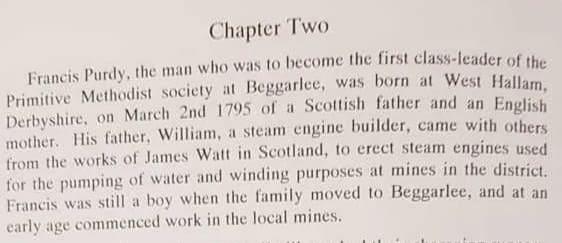
William married a local girl, Ruth Clarke, in Duffield in Derbyshire in 1786. William and Ruth had nine children, and the seventh was Francis who was born at West Hallam in 1795.
Perhaps the Scottish hat came from William Purdy, but there is another story of Scottish connections in Smalley: Bonnie Prince Charlie and the Jacobite Rebellion of 1745. Although the Purdy’s were not from Smalley, Catherine Housley was.
From an article on the Heanor and District Local History Society website:
The Jacobites in Smalley
Few people would readily associate the village of Smalley, situated about two miles west of Heanor, with Bonnie Prince Charlie and the Jacobite Rebellion of 1745 – but there is a clear link.
During the winter of 1745, Charles Edward Stuart, the “Bonnie Prince” or “The Young Pretender”, marched south from Scotland. His troops reached Derby on 4 December, and looted the town, staying for two days before they commenced a fateful retreat as the Duke of Cumberland’s army approached.
While staying in Derby, or during the retreat, some of the Jacobites are said to have visited some of the nearby villages, including Smalley.
A history of the local aspects of this escapade was written in 1933 by L. Eardley-Simpson, entitled “Derby and the ‘45,” from which the following is an extract:
“The presence of a party at Smalley is attested by several local traditions and relics. Not long ago there were people living who remember to have seen at least a dozen old pikes in a room adjoining the stables at Smalley Hall, and these were stated to have been left by a party of Highlanders who came to exchange their ponies for horses belonging to the then owner, Mrs Richardson; in 1907, one of these pikes still remained. Another resident of Smalley had a claymore which was alleged to have been found on Drumhill, Breadsall Moor, while the writer of the History of Smalley himself (Reverend C. Kerry) had a magnificent Andrew Ferrara, with a guard of finely wrought iron, engraved with two heads in Tudor helmets, of the same style, he states, as the one left at Wingfield Manor, though why the outlying bands of Army should have gone so far afield, he omits to mention. Smalley is also mentioned in another strange story as to the origin of the family of Woolley of Collingham who attained more wealth and a better position in the world than some of their relatives. The story is to the effect that when the Scots who had visited Mrs Richardson’s stables were returning to Derby, they fell in with one Woolley of Smalley, a coal carrier, and impressed him with horse and cart for the conveyance of certain heavy baggage. On the retreat, the party with Woolley was surprised by some of the Elector’s troopers (the Royal army) who pursued the Scots, leaving Woolley to shift for himself. This he did, and, his suspicion that the baggage he was carrying was part of the Prince’s treasure turning out to be correct, he retired to Collingham, and spent the rest of his life there in the enjoyment of his luckily acquired gains. Another story of a similar sort was designed to explain the rise of the well-known Derbyshire family of Cox of Brailsford, but the dates by no means agree with the family pedigree, and in any event the suggestion – for it is little more – is entirely at variance with the views as to the rights of the Royal House of Stuart which were expressed by certain members of the Cox family who were alive not many years ago.”
A letter from Charles Kerry, dated 30 July 1903, narrates another strange twist to the tale. When the Highlanders turned up in Smalley, a large crowd, mainly women, gathered. “On a command in Gaelic, the regiment stooped, and throwing their kilts over their backs revealed to the astonished ladies and all what modesty is careful to conceal. Father, who told me, said they were not any more troubled with crowds of women.”
Folklore or fact? We are unlikely to know, but the Scottish artefacts in the Smalley area certainly suggest that some of the story is based on fact.
We are unlikely to know where that Scottish hat came from, but we did find the Scottish connection. William Purdy’s mother was Grizel Gibson, and her mother was Grizel Murray, both of Lanarkshire in Scotland. The name Grizel is a Scottish form of the name Griselda, and means “grey battle maiden”. But with the exception of the name Murray, The Purdy and Gibson names are not traditionally Scottish, so there is not much of a Scottish connection after all. But the mystery of the Scottish hat remains unsolved.
December 13, 2021 at 12:33 pm #6225In reply to: The Elusive Samuel Housley and Other Family Stories
William Marshall’s Parents
William Marshall 1876-1968, my great grandfather, married Mary Ann Gilman Purdy in Buxton. We assumed that both their families came from Buxton, but this was not the case. The Marshall’s came from Elton, near Matlock; the Purdy’s from Eastwood, Nottinghamshire.
William Marshall, seated in centre, with colleagues from the insurance company:
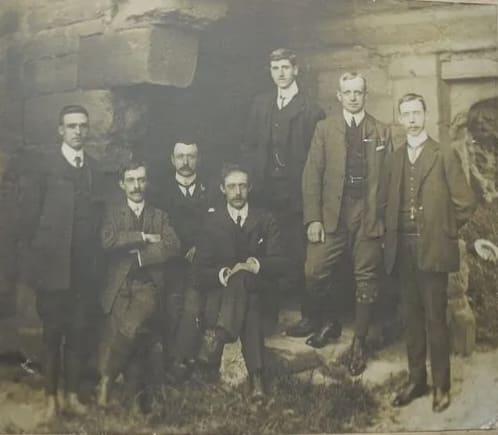
William and all his siblings were born in Fairfield in Buxton. But both Emma Featherstone 1847-1928, his mother, and John Marshall 1842-1930, his father, came from rural Derbyshire. Emma from Ashbourne (or Biggin, Newhaven, or Hartington, depending on what she chose to put on the census, which are all tiny rural places in the same area).
Emma and John Marshall in the middle, photo says “William Marshall’s parents” on the back:
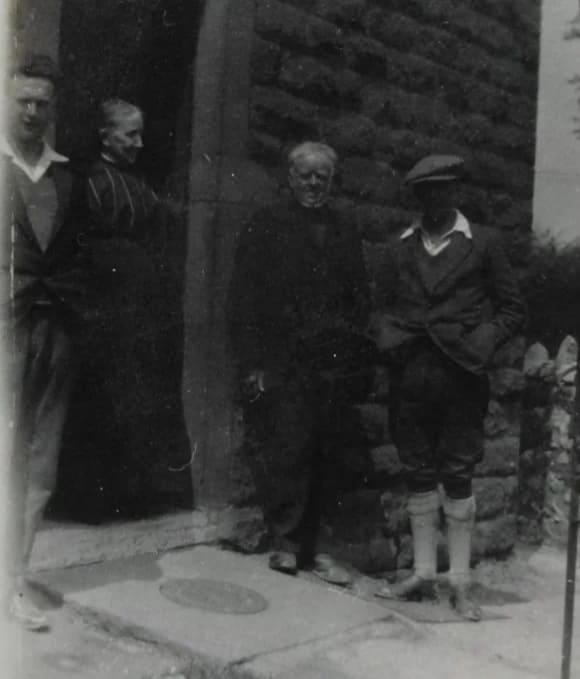
John Marshall was a carter, later a coal carter, and was born in Elton, Derbyshire. Elton is a rural village near to Matlock. He was unable to write (at least at the time of his wedding) but Emma signed her own name.
In 1851 Emma is 3 or 4 years old living with family at the Jug and Glass Inn, Hartington. In 1861 Emma was a 14 year old servant at a 112 acre farm, Heathcote, but her parents were still living at the Jug and Glass. Emma Featherstone’s parents both died when she was 18, in 1865.
In 1871 she was a servant at Old House Farm, Nether Hartington Quarter, Ashborne.On the census, a female apprentice was listed as a servant, a boy as an apprentice. It seems to have been quite normal, at least that’s what I’ve found so far, for all teenagers to go and live in another household to learn a trade, to be independent from the parents, and so doesn’t necessarily mean a servant as we would think of it. Often they stayed with family friends, and usually married in their early twenties and had their own household ~ often with a “servant” or teenager from someone else’s family.
The only marriage I could find for Emma and John was in Manchester in 1873, which didn’t make much sense. If Emma was single on the 1871 census, and her first child James was born in 1873, her marriage had to be between those dates. But the marriage register in Manchester appears to be correct, John was a carter, Emma’s father was Francis Featherstone. But why Manchester?
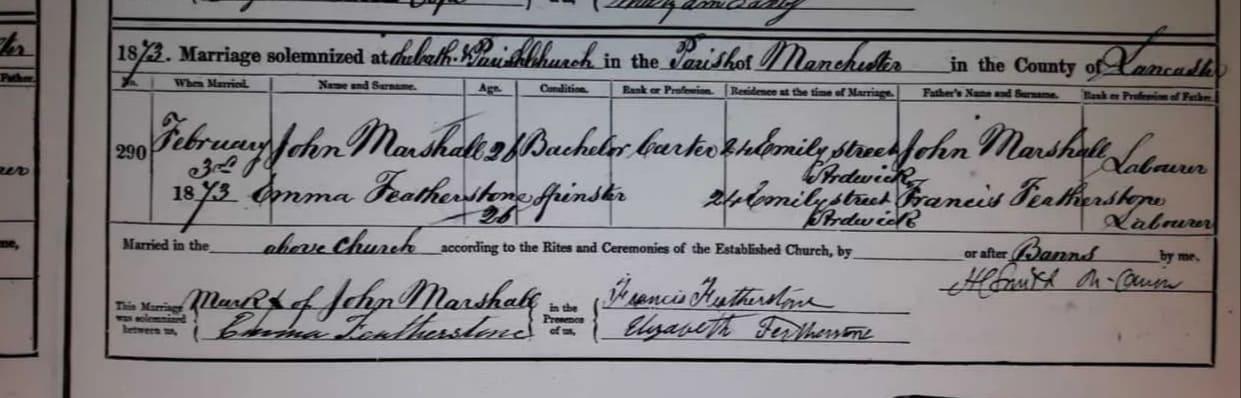
I noticed that the witnesses to the marriage were Francis and Elizabeth Featherstone. He father was Francis, but who was Elizabeth? Emma’s mother was Sarah. Then I found that Emma’s brother Francis married Elizabeth, and they lived in Manchester on the 1871 census. Henry Street, Ardwick. Emma and John’s address on the marriage register is Emily Street, Ardwick. Both of them at the same address.
The marriage was in February 1873, and James, the first child was born in July, 1873, in Buxton.
It would seem that Emma and John had to get married, hence the move to Manchester where her brother was, and then quickly moved to Buxton for the birth of the child. It was far from uncommon, I’ve found while making notes of dates in registers, for a first child to be born six or 7 months after the wedding.
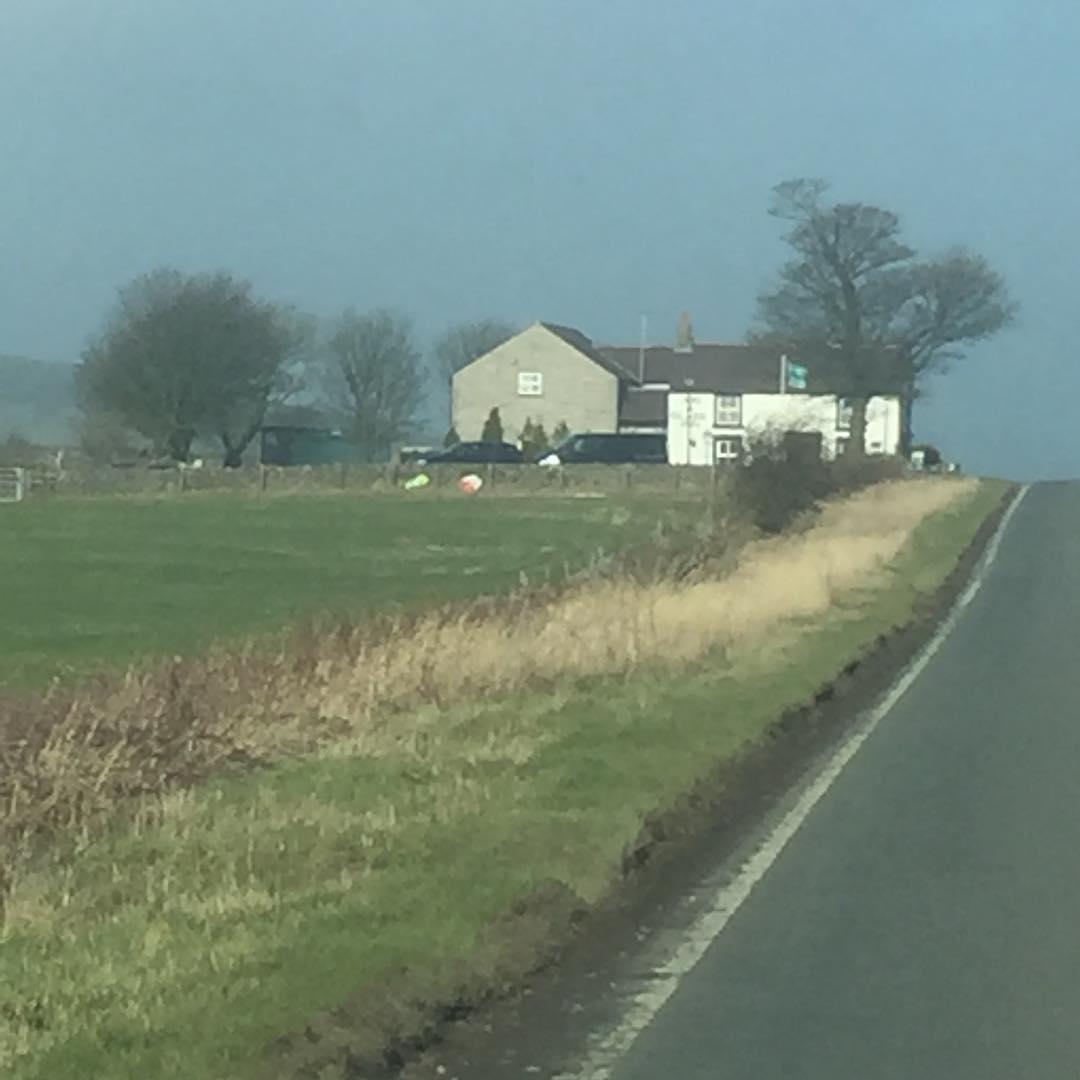
Emma died in 1928 at the age of 80, two years before her husband John. She left him a little money in her will! This seems unusual so perhaps she had her own money, possibly from the death of her parents before she married, and perhaps from the sale of the Jug and Glass.
I found a photo of the Jug and Glass online. It looks just like the pub I’d seen in my family history meditations on a number of occasions:
 December 13, 2021 at 10:09 am #6219
Topic: The Elusive Samuel Housley and Other Family Stories
in forum TP’s Family BooksThe following stories started with a single question.
Who was Catherine Housley’s mother?
But one question leads to another, and another, and so this book will never be finished. This is the first in a collection of stories of a family history research project, not a complete family history. There will always be more questions and more searches, and each new find presents more questions.
A list of names and dates is only moderately interesting, and doesn’t mean much unless you get to know the characters along the way. For example, a cousin on my fathers side has already done a great deal of thorough and accurate family research. I copied one branch of the family onto my tree, going back to the 1500’s, but lost interest in it after about an hour or so, because I didn’t feel I knew any of the individuals.
Parish registers, the census every ten years, birth, death and marriage certificates can tell you so much, but they can’t tell you why. They don’t tell you why parents chose the names they did for their children, or why they moved, or why they married in another town. They don’t tell you why a person lived in another household, or for how long. The census every ten years doesn’t tell you what people were doing in the intervening years, and in the case of the UK and the hundred year privacy rule, we can’t even use those for the past century. The first census was in 1831 in England, prior to that all we have are parish registers. An astonishing amount of them have survived and have been transcribed and are one way or another available to see, both transcriptions and microfiche images. Not all of them survived, however. Sometimes the writing has faded to white, sometimes pages are missing, and in some case the entire register is lost or damaged.
Sometimes if you are lucky, you may find mention of an ancestor in an obscure little local history book or a journal or diary. Wills, court cases, and newspaper archives often provide interesting information. Town memories and history groups on social media are another excellent source of information, from old photographs of the area, old maps, local history, and of course, distantly related relatives still living in the area. Local history societies can be useful, and some if not all are very helpful.
If you’re very lucky indeed, you might find a distant relative in another country whose grandparents saved and transcribed bundles of old letters found in the attic, from the family in England to the brother who emigrated, written in the 1800s. More on this later, as it merits its own chapter as the most exciting find so far.
The social history of the time and place is important and provides many clues as to why people moved and why the family professions and occupations changed over generations. The Enclosures Act and the Industrial Revolution in England created difficulties for rural farmers, factories replaced cottage industries, and the sons of land owning farmers became shop keepers and miners in the local towns. For the most part (at least in my own research) people didn’t move around much unless there was a reason. There are no reasons mentioned in the various registers, records and documents, but with a little reading of social history you can sometimes make a good guess. Samuel Housley, for example, a plumber, probably moved from rural Derbyshire to urban Wolverhampton, when there was a big project to install indoor plumbing to areas of the city in the early 1800s. Derbyshire nailmakers were offered a job and a house if they moved to Wolverhampton a generation earlier.
Occasionally a couple would marry in another parish, although usually they married in their own. Again, there was often a reason. William Housley and Ellen Carrington married in Ashbourne, not in Smalley. In this case, William’s first wife was Mary Carrington, Ellen’s sister. It was not uncommon for a man to marry a deceased wife’s sister, but it wasn’t strictly speaking legal. This caused some problems later when William died, as the children of the first wife contested the will, on the grounds of the second marriage being illegal.
Needless to say, there are always questions remaining, and often a fresh pair of eyes can help find a vital piece of information that has escaped you. In one case, I’d been looking for the death of a widow, Mary Anne Gilman, and had failed to notice that she remarried at a late age. Her death was easy to find, once I searched for it with her second husbands name.
This brings me to the topic of maternal family lines. One tends to think of their lineage with the focus on paternal surnames, but very quickly the number of surnames increases, and all of the maternal lines are directly related as much as the paternal name. This is of course obvious, if you start from the beginning with yourself and work back. In other words, there is not much point in simply looking for your fathers name hundreds of years ago because there are hundreds of other names that are equally your own family ancestors. And in my case, although not intentionally, I’ve investigated far more maternal lines than paternal.
This book, which I hope will be the first of several, will concentrate on my mothers family: The story so far that started with the portrait of Catherine Housley’s mother.
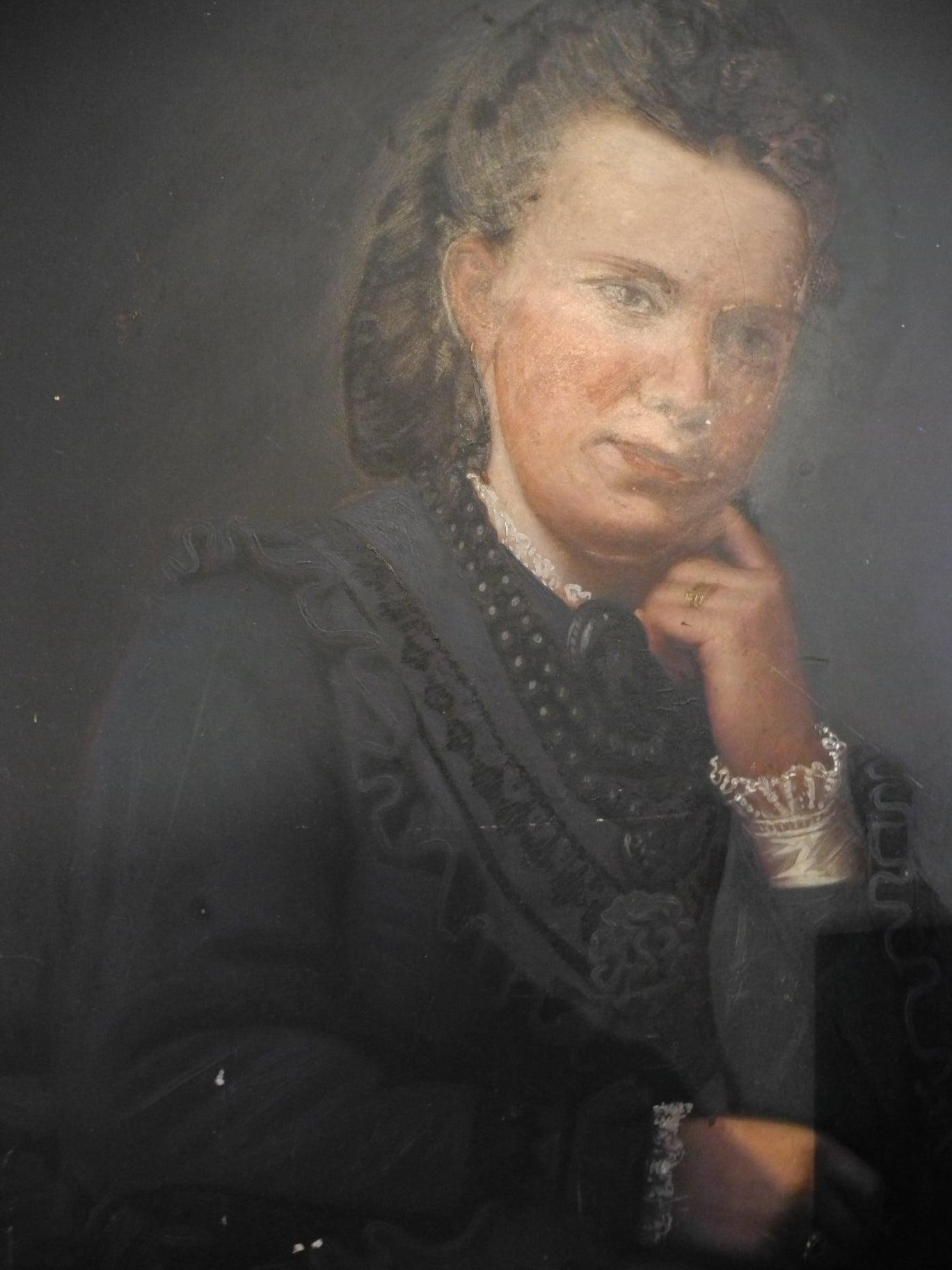
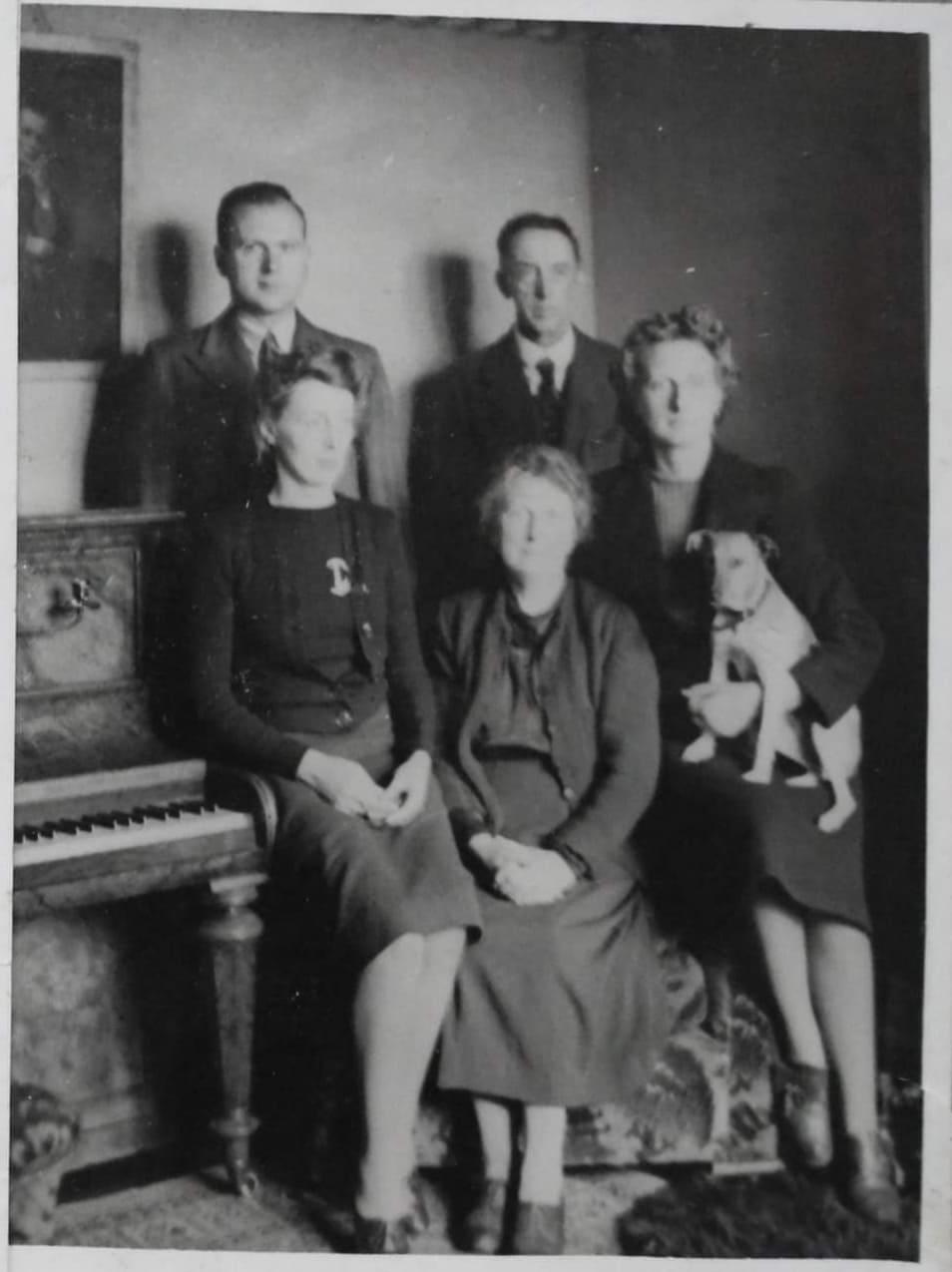
This painting, now in my mothers house, used to hang over the piano in the home of her grandparents. It says on the back “Catherine Housley’s mother, Smalley”.
The portrait of Catherine Housley’s mother can be seen above the piano. Back row Ronald Marshall, my grandfathers brother, William Marshall, my great grandfather, Mary Ann Gilman Purdy Marshall in the middle, my great grandmother, with her daughters Dorothy on the left and Phyllis on the right, at the Marshall’s house on Love Lane in Stourbridge.
The Search for Samuel Housley
As soon as the search for Catherine Housley’s mother was resolved, achieved by ordering a paper copy of her birth certificate, the search for Catherine Housley’s father commenced. We know he was born in Smalley in 1816, son of William Housley and Ellen Carrington, and that he married Elizabeth Brookes in Wolverhampton in 1844. He was a plumber and glazier. His three daughters born between 1845 and 1849 were born in Smalley. Elizabeth died in 1849 of consumption, but Samuel didn’t register her death. A 20 year old neighbour called Aaron Wadkinson did.
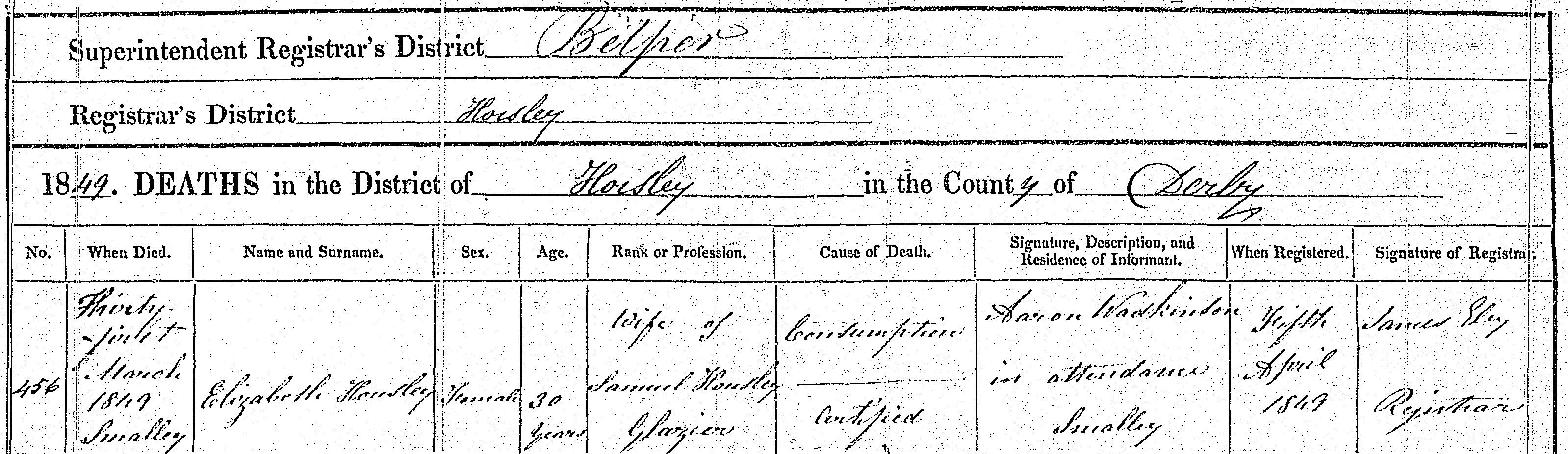
Where was Samuel?
On the 1851 census, two of Samuel’s daughters were listed as inmates in the Belper Workhouse, and the third, 2 year old Catherine, was listed as living with John Benniston and his family in nearby Heanor. Benniston was a framework knitter.
Where was Samuel?
A long search through the microfiche workhouse registers provided an answer. The reason for Elizabeth and Mary Anne’s admission in June 1850 was given as “father in prison”. In May 1850, Samuel Housley was sentenced to one month hard labour at Derby Gaol for failing to maintain his three children. What happened to those little girls in the year after their mothers death, before their father was sentenced, and they entered the workhouse? Where did Catherine go, a six week old baby? We have yet to find out.
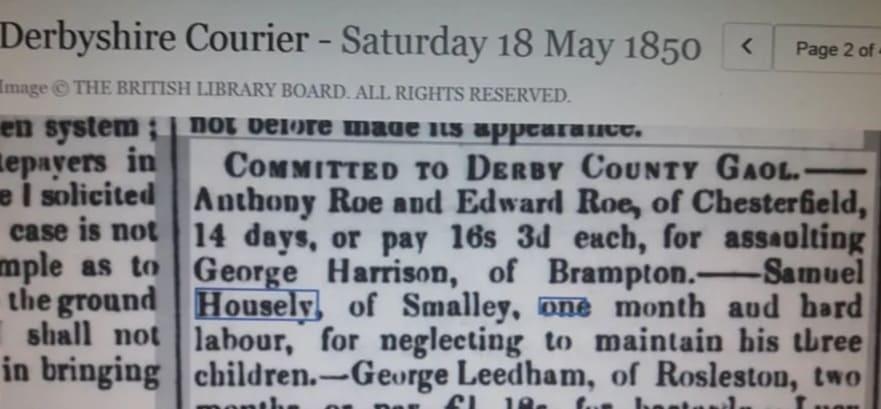
And where was Samuel Housley in 1851? He hasn’t appeared on any census.
According to the Belper workhouse registers, Mary Anne was discharged on trial as a servant February 1860. She was readmitted a month later in March 1860, the reason given: unwell.
Belper Workhouse:
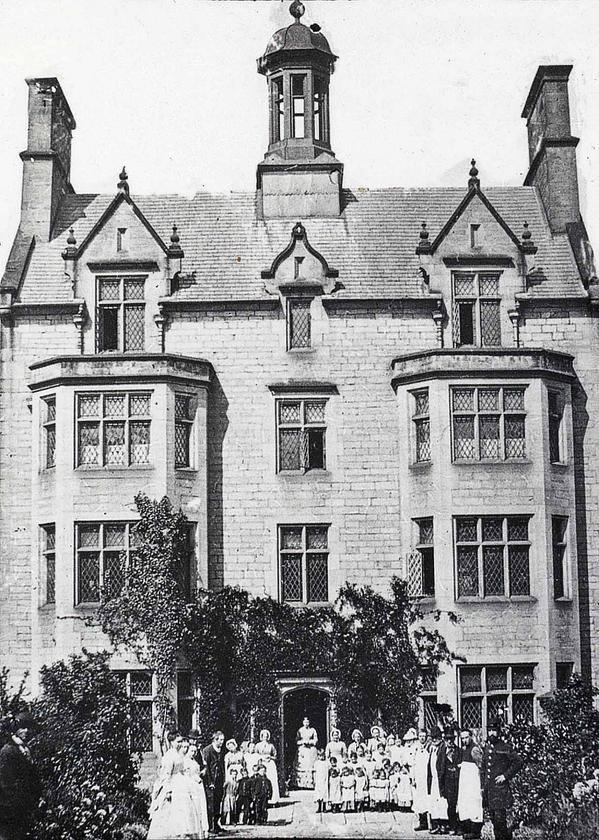
Eventually, Mary Anne and Elizabeth were discharged, in April 1860, with an aunt and uncle. The workhouse register doesn’t name the aunt and uncle. One can only wonder why it took them so long.
On the 1861 census, Elizabeth, 16 years old, is a servant in St Peters, Derby, and Mary Anne, 15 years old, is a servant in St Werburghs, Derby.But where was Samuel?
After some considerable searching, we found him, despite a mistranscription of his name, on the 1861 census, living as a lodger and plumber in Darlaston, Walsall.
Eventually we found him on a 1871 census living as a lodger at the George and Dragon in Henley in Arden. The age is not exactly right, but close enough, he is listed as an unmarried painter, also close enough, and his birth is listed as Kidsley, Derbyshire. He was born at Kidsley Grange Farm. We can assume that he was probably alive in 1872, the year his mother died, and the following year, 1873, during the Kerry vs Housley court case.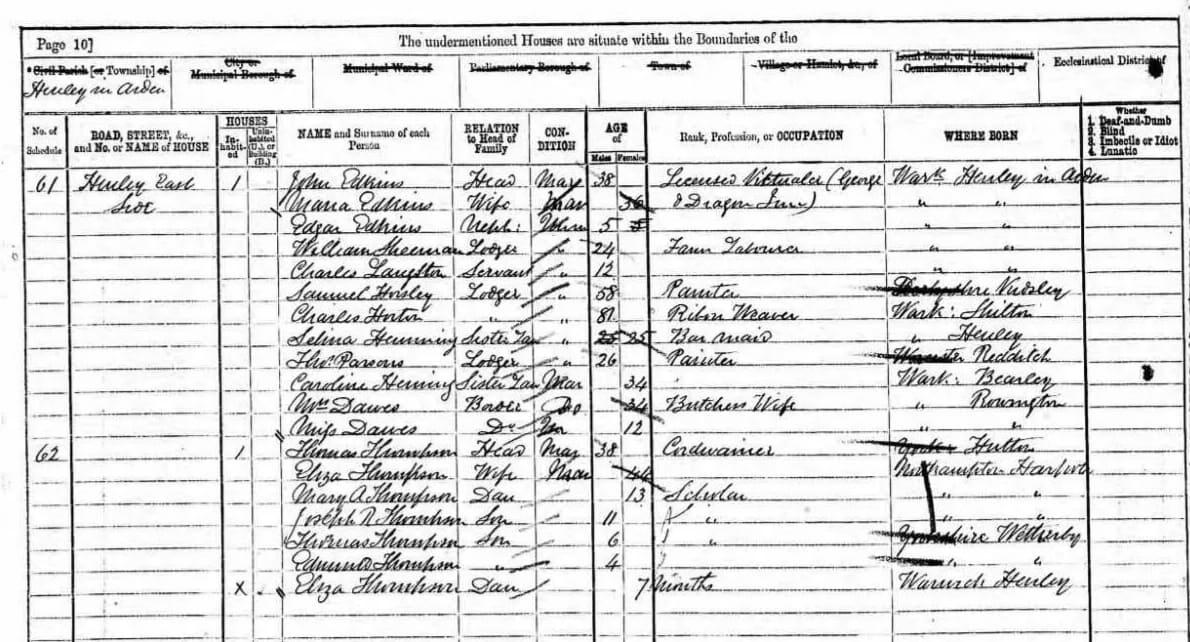
I found some living Housley descendants in USA. Samuel Housley’s brother George emigrated there in 1851. The Housley’s in USA found letters in the attic, from the family in Smalley ~ written between 1851 and 1870s. They sent me a “Narrative on the Letters” with many letter excerpts.
The Housley family were embroiled in a complicated will and court case in the early 1870s. In December 15, 1872, Joseph (Samuel’s brother) wrote to George:
“I think we have now found all out now that is concerned in the matter for there was only Sam that we did not know his whereabouts but I was informed a week ago that he is dead–died about three years ago in Birmingham Union. Poor Sam. He ought to have come to a better end than that….His daughter and her husband went to Birmingham and also to Sutton Coldfield that is where he married his wife from and found out his wife’s brother. It appears he has been there and at Birmingham ever since he went away but ever fond of drink.”
No record of Samuel Housley’s death can be found for the Birmingham Union in 1869 or thereabouts.
But if he was alive in 1871 in Henley In Arden…..
Did Samuel tell his wife’s brother to tell them he was dead? Or did the brothers say he was dead so they could have his share?We still haven’t found a death for Samuel Housley.
February 19, 2021 at 11:49 am #6187In reply to: The Chronicles of the Flying Fish Inn
Aunt Idle:
You can’t blame me for not updating my diary because bugger all has happened all year. Borders closed, no tourists allowed in. How are bespoke bijou boutique establishments like ours supposed to survive? But we’re still here. Somehow we’ve managed to keep the wolf from the door, but only just barely. I get a bit muddled up these days and can’t remember the dates. Sometimes I find myself living in the past for weeks on end: things change so little around her that it’s easy to do. But what does it matter anyway?
Mater went into a sulk the likes of which I hope never to see again, when her 100th birthday party was cancelled. I thought she might give up the will to live, but oh no. She’s determined now to have a 110th birthday party now. She says the bloody pandemic ought to be over by then. I hope she’s right. She changes her health food and exercise regimes as often as she changes her knickers. Well more often than that, probably, she doesn’t bother much with personal hygiene. She says the germs keep her immune system in good shape. I think the smell of her would keep any plague ridden body well away from her, but whatever works, I always say. At least she isn’t sulking anymore, she’s grimly stoic now and tediously determined to outlive me.
I had some worrying news through the telepathic grapevine about the twins and Pan, they’d gotten into the clutches of a strange cult over there. I’ve got a feeling they weren’t really sucked into it though, I think they needed to use it as a cover, or to keep themselves safe. I say cult but it was huge, took over the entire country and even started spreading to other countries. As if the pandemic wasn’t enough to deal with. I knew they shouldn’t have gone there. There’s been a peculiar blockage with the telepathic messages for ages now. It’s a worry, but what can I do. I keep sending them messages, but get nothing in return.
Ah, well. We carry on as best we can. What I wouldn’t give for an unexpected visitor to brighten things up a bit. Fat chance of that.
April 24, 2020 at 9:27 am #6067In reply to: Two Aunties au Pair and Their Pert Carouses
Since the sudden disappearance of the two au pair maids, a lot had happened. But for August Finest it has been a lot of the same routine going on.
He wakes up in the early, early morning, his eyelids rubs on his eyeballs as if they are made of sandpaper. He seizes his belly with his hands, feels a little guilty about the nice meals prepared by Noor Mary especially for him since the start of the confinement. His six packs have started to fade away under a layer of fatty insulation and he tries to compensate by a daily routine in white T-shirt and underwear.
The coffee machine has detected his movements and starts to make what it does. It’s always cleaned and replenished by the discrete Mary. The noise and the smell creates an ambiance and when it rings he eats breakfast before taking his shower.
When he’s dressed up, his real work starts. It had not been easy for a man of his origins to appear as the best choice for the job under the Lump administration. President Lump was known to make bad jokes about his tan and him having spent too much time at the beach, and other worse things. But his worth was in the network he could connect the president with, his high discretion, which Lump was in dire need to compensate his innate tendency to boasting, and a strong adaptability to fix the president’s frequent messing around.
If August Finest had once admired the man and accepted the job for him, it soon changed when he realised there was nothing more underneath the boasting than more boasting and unpredictability. At the moment the only thing that make him continue was his ability to go stealth when the president had a fit of nerves, and the imposed confinement that made it impossible to leave the Beige House.
After the morning meeting during which the president asked him to fire a few members of the staff, August had to prepare a press conference. President Lump said he had thought about a few remarks about China and making a connection with the Mexican immigrants threatening the country by stealing the masks of the American People. After which, he had to plan a charity with first Lady Mellie Noma and redefine what a Masquerade meant. He had been asked to invite nurses and medical personnel, meaning republican and good looking in a blouse with a medical mask to make the promotion of the new mask industry Made in America. One of Mr Lump’s friend had just started a brand and was in need of some media promotion.
August reread the memo to be addressed to the director of the FBI, a good friend of his. A special cell at the FBI had been created especially since Lump came to power. For this particular occasion, agents posing as patients victims of the virus would be sent in the best ranked hospitals in the country with the task to look for the best nurse and doctor candidates and send them an invitation printed by Lump’s nephew’s printing company.
As Lump always said: “America Fist! And don’t forget people, I am America.”
August hit the enter button and closed the window of his professional mail account, leaving the draft of a personal mail on screen. He wasn’t sure if he could send this one. It was addressed to Noor Mary and he feared she would misunderstand the meaning of it.
January 7, 2020 at 2:10 pm #5357In reply to: Seven Twines and the Dragon Heartwoods
“Isn’t it a pretty loo?” Glynis was marveling at the marble work, and the exquisite boiseries. “Master Guilbert really outdid himself.” Fox opined.
The jinx on the cottage loo was finally lifted, and not before the hiemal cold had settled in, right before the Sol Invictus festivities.
Meanwhile, they’ve had occasional updates from Rukshan, who was exploring the Land of the Giants. He’d mentioned in his last telebat echoing that he’d found the elusive Master creator of Gorrash, and had hope for the dwarf. The magic binding the stones was strong he’s said, although some additional magic would help speed up the recovery process which otherwise would take probably centuries if not millennia.
Glynis had looked at the requirements; it only said
‘strong magic, born from pain, hardened in gems
– dissolve in pink clay, mix well and apply generously’.None of her magic had seemed to fit. Pain, she’d had plenty, but her magic was born from the water element, emotions, plants and potions. She went to the nearby Library, their restricted section of applied magic was scarce, nothing really applicable there. Honestly, if she’d known her whereabouts, it would have been a task better suited to Eleri. Her kind of area of expertise with concrete and iron work and stone paints was a bit more unpredictable though; it could end up do more damage to Gorrash’s continuity than else; she’d quickly put that impetuous idea to rest.
Glynis was still mulling over, thinking about finding a solution when she noticed a gaunt figure was at the door. It took her a few seconds to realize it wasn’t a stranger, but a familiar friend. Rukshan had returned, although verily worn down by his travails, with a full grown beard that gave him a seriouser look. Without thinking, she went to hug him. Such unusual display of affection did surprise the Fae who was beeming.
He smiled widely at Glynis and showed her an unusually large ampoule: “I’ve found the kind of magic our friend needs. These three Giant’s gallstones weren’t a picnic to obtain, I can tell you.”
“I can’t wait to hear all about this exciting story.” interrupted Eleri.
September 4, 2019 at 3:43 pm #4789In reply to: Newsreel from the Rim of the Realm
“How far is it?” Gloria was starting to complain, after the blue powder’s effects started to wane and give her a fit of anxiety mixed with intense boredom.
“Oh quiet!” snapped Sha, “it’s not enough we had to drag you along, don’t you start to complain. I need to concentrate.”
Gloria turned to Mavis quizzically. The bus took a bump in the road, and she giggled madly as if under the influence of laughing gas. “Look at her!” she said pointing at the vibrating cellulite around Sharon’s ankles.
“She’s got to have a brainwave, and you’ll know what next!”Sharon started to shout “STOP! Now! Bus 57 express to Glasgow airport, then we Brexit to Norway!”
“Wot?! No bloody way! It’s going to be cold ‘ere!” Glo whined.
“Of bloody course it is!” Mavis giggled hysterically, drawing glances from the other seats “it’s going to be a cold beauty treatment I read all about it on the Gloogle!”
“The article said: a party will meet you in Bodø, Norway! It’s clear, no?”
“I have no idea ‘ow you managed to mouth that ø, but we better catch the blimin’ bus express; got a feeling diabolical nurse Trassie is goin’ to catches up on us trail!”
August 2, 2019 at 6:00 am #4744In reply to: The Stories So Near
Newer developments
POP-IN THREAD (Maeve, Lucinda, Shawn-Paul, Jerk, [Granola])
Granola is popping in and out of the stories, exploring interacting more physically with her friends through Tiku, a bush lady focus of hers.
Luckily (not so coincidentally) Maeve and Shawn-Paul were given coupons to travel from their rural Canada town to the middle of Australia. Maeve is suspicious of being followed by a strange man, and tags along with Shawn-Paul to keep a cover of a young couple. Maeve is trying to find the key to the doll that she made in her secret mission for Uncle Fergus, which has suddenly reappeared at her friend Lucinda’s place. She’ll probably is going to have to check on the other dolls that she made as well.
Jerk continues to administrate some forum where among other things, special dolls are found and exchanged, and he moderates some strange messages.
Lucinda is enjoying Fabio’s company, Maeve’s dog, that she has in her care while Maeve is travelling.FLYING FISH INN THREAD (Mater/Finly, Idle/Coriander/Clove, Devan, Prune, [Tiku])
The mysteries of the Flying Fish Inn seem to unravel slowly, like Idle’s wits.
Long time family member are being drawn inexplicably, such as Prune and brother Devan. The local bush lady Tiku is helping Finly with the catering, although Finly would rather do everything by herself. The totemic Fish was revealed to be a talisman placed here against bad luck – “for all the good it did” (Mater).
Bert, thought to be an old flame of Mater, who’s acted for the longest time as gardener, handyman and the likes, is revealed to be the father of Prune, Devan, Coriander and Clove’s mother. Mater knew of course and kept him around. He was trained in codes during his time with the military, and has a stash of potentially dangerous books. He may be the key to the mystery of the underground tunnels leading to the mines, and hidden chests of gold. Devan is onto a mystery that a guy on a motorbike (thought to be Uncle Fergus of Maeve’s story) told him about.DOLINE THREAD (Arona, Sanso/Lottie, Ugo, Albie)
Mandrake & Albie after a trip in the bayou, and looking for the dragon Leormn’s pearls and the sabulmantium, have finally found Arona after they have emerged from the interdimentional water network from the Doline, to the coast of Australia in our reality, where cats don’t usually talk.
Albie is expecting a quest, while the others are just following Arona’s lead, as she is in possession of a mysterious key with 3 words engraved.
After some traveling in hot air balloon, and with a local jeep, they have arrived at a local Inn in the bush, with a rather peculiar family of owners, and quite colorful roster of guests. That’s not even counting the all-you-can-eat lizard meat buffet. What joy.NEWSREEL THREAD (Ms Bossy, Hilda/Connie, Sophie, Ricardo)
Ms Bossy is looking to uncover the Doctor’s surely nefarious plans while her newspaper business isn’t doing so well. She’s got some help from Ricardo the intern. They have found out that the elderly temp worker who’s fascinated by the future, Sophie (aka Sweet Sophie) had been the first subject of the Doctor’s experiments. Sophie has been trying to uncover clues in the dreams, but it’s just likely she is still a sleeper agent of the Doctor.
Despite all common sense and SMS threats, Hilda & Connie have gone in Australia to chase a trail (from a flimsy tip-off from Superjerk that may have gone to Lucinda to her friend journalist). They are in touch with Lucinda, and post their updates on social media, flirting with the risk of being uncovered and having trouble come at their door.
Sha, Glo and Mavis are considering reaching out for a vacation of the nursing home to get new free beauty treatments.
In his secret lair, the Doctor is reviving his team of brazen teafing operatives: the magpies.LIZ THREAD (Finnley, Liz, Roberto, Godfrey)
Not much happened as usual, mostly an entertaining night with Inspector Melon who is quizzing Liz’ about her last novel about mysterious messages hidden in dolls with secret keys, which may be her best novel yet…
DRAGON 💚 WOOD THREAD (Glynnis, Eleri, Fox/Gorrash, Rukshan)
Before Rukshan goes to the underworld land of Giants, he’s going to the cottage to gather some of his team of friends, Fox, Ollie etc. Glynis is taking care of Tak during Margoritt’s winter time in the city. Margoritt’s sister, Muriel is an uninvited and unpleasant guest at the cottage.
Tak is making friends with a young girl who may have special powers (Nesy).
The biggest mystery now is… is the loo going to get fixed in time?July 18, 2019 at 3:31 pm #4693In reply to: The Stories So Near
Some updates on the Heartwoods Weave
So far, there were loosely 2 chapters in this story, and we’re entering the 3rd.
Let’s call them:- Ch. 1 – The Curses of the Stolen Shards
- Ch. 2 – The Flight to the Desert Mountains
- Ch. 3 – Down the Lands of Giants
Ch. 1 – The Curses of the Stolen Shards
In Chapter One, we get acquainted with the main characters as their destinies intertwine (Rukshan, Glynis, Eleri, Gorrash, Fox, Olliver and Tak).
In a long past, the Forest held a powerful artifact created and left behind as a seal by the Gods now departed in their World: a Gem of Creation. It was defiled by thieves (the 7 characters in their previous incarnations of Dark Fae (Ru), Toothless Dragon (Gl), Laughing Crone (El), Mapster Dwarf (Go), Glade Troll (Fo), Trickster Dryad (Ol), Tricked Girl (Ta)), and they all took a shard of the Gem, although the innocent girl was tricked to open the woods by a promise of resurrecting a loved one, and resented all the others for it. She unwittingly created the curse all characters were suffering from, as an eternal punishment. Removing the Gem from the center of the Forest and breaking it started a chain of events, leading to many changes in the World. The Forest continued to grow and claim land, and around the (Dragon) Heartwoods at the center, grew many other woods – the Haunted Bamboo Forest, the Enchanted Forest, the Hermit’s Forest, the Fae’s Forest etc. At the other side, Cities had developed, and at the moment of the story, started to gain control over the magical world of Old.
From the special abilities the Seven gained, some changes were triggered too. One God left behind was turned into stone by the now young Crone (E).
Due to the curse, their memories were lost, and they were born again in many places and other forms.
During the course of Ch.1, they got healed with the help of Master Gibbon, and the Braider Shaman Kumihimo, who directed Rukshan how to use the Vanishing Book, which once completed by all, and burnt as an offering, lifted the curse. Tak (the Girl of the origin story), now a shapeshifting Gibbon boy, learned to let go of the pain, and to start to live as a young orphan under the gentle care of the writer Margoritt Loursenoir and her goat Emma, in a cottage in the woods.
Glynis, a powerful healer with a knack for potions, still haven’t found a way to undo the curse of her scales, which she accepts, has found residency and new friends and a funny parrot named Sunshine. Eleri besides her exploration of anti-gravity, learnt to make peace with the reawakened God Hasamelis no longer vengeful but annoyed at being ignored for a mortal Yorath. Eleri continues to love to butt heads with the iniquities of the world, which are never in lack, often embodied by Leroway and his thugs. Gorrash, who adopted the little baby Snoots activated by Glynis’ potions seemed simply happy to have found a community. Fox, a fox which under the tutelage of Master Gibbon, learnt to shapeshift as a human for all his work and accumulation of good karma. Olliver, a young man with potential, found his power by activating the teleporting egg Rukshan gave him. As for Rukshan, who was plagued by ghosts and dark forces, he found a way to relieve the Forest and the world of their curse, but his world is torn between his duties towards his Fae family in the woods, his impossible love for his Queen, and his wants for a different life of exploration, especially now knowing his past is more than what he thought he knew.
At the end of the chapter, the Door to the God’s realm, at the center of the Forest seems to have reopened.Ch. 2 – The Flight to the Desert Mountains
In the second Chapter, strange sightings of light beams in the mountains prompt some of our friends to go investigate, while in the cottage, the others stay to repel encroachments by brutal modernity embodied by Leroway and his minions. Glynis has found a way to be rid of her scales, but almost failed due to Tak’s appetite for untested potions. Remaking the potion, and succeeding at last, she often still keeps her burka as fond token of her trials. Eleri is spreading glamour bomb concrete statues in the woods, and trying her hand with Glynis supervision at potions to camouflage the cottage through an invisibility spell. Muriel, Margoritt’s sister, comes for a visit.
In the mountains, the venturing heroes are caught in a sand storm and discover spirits trapped in mystical objects. Pushing forward through the mountain, they are tracked and hunted by packs of hellhounds, and dark energy released from an earthquake. Rukshan works on a magical mandala with the help and protection of his friends. Olliver discovers a new teleportation trick making him appear two places at once. Kumihimo rejoins the friends in trouble, and they all try to leave through the magical portal, while Fox baits the dogs and the Shadow. Eerily, only Fox emerges from the portal, to find a desolated, burnt Forest and his friends all gone. They had been too late, and the Shadow went with them through the portal instead of being destroyed. Luckily, a last potion left by Glynis is able to rewind Fox in time, and succeed in undoing the disaster. The beaming lights were only honeypots for wandering travellers, it turned out.
Shaken by the ordeal, Rukshan leaves the party for some R&R time in the parallel world of the Faes, which is now mostly abandoned.Ch. 3 – Down the Lands of Giants
In Chapter 3, which has only just begun, some time has passed, and Margoritt has come back to the City, at the beginning of winter for some special kneedle treatments. Glynis and Margoritt are in turn taking care of Tak, who has joined a local school, where he seems to have befriended a mysterious girl Nesingwarys (Nesy). Gorrash seems to have been hurt, broken whilst in his statue form by Leroway’s thugs, but the Snoot babies are still staying with him, so there is hope. Fox is always hungry, and helps with the reconstruction work for the cottage, which was damaged in a fire (we suppose during Leroway’s men foray in the woods).
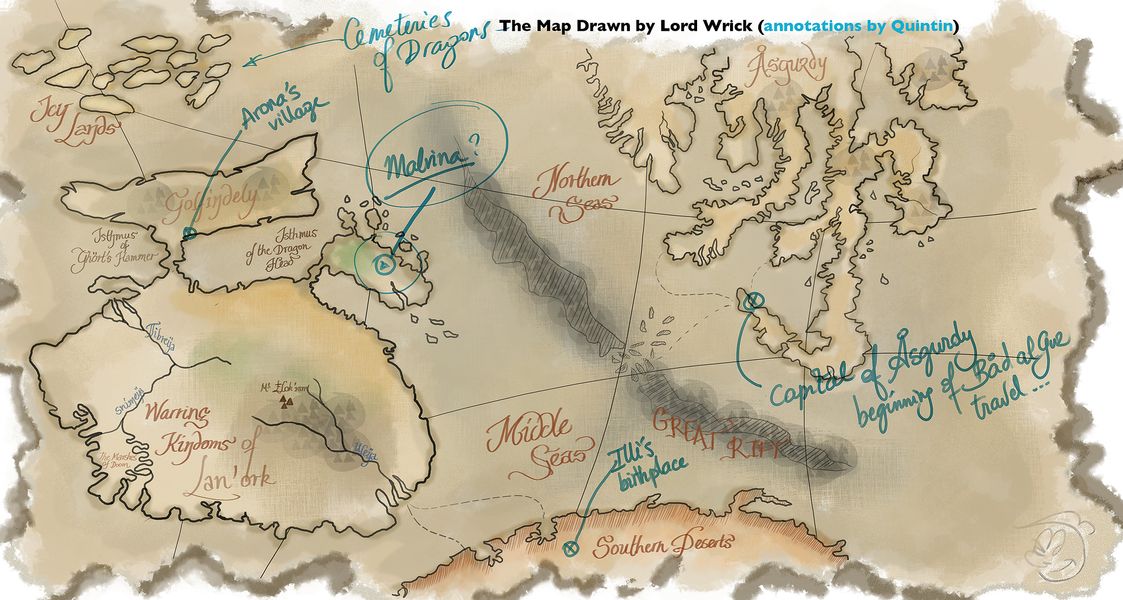
Rukshan emerges from his retreat after an encounter with a mad Fae, babbling about a Dark Lord’s return. Piecing clues together, he finds a long lost World Map and connection with a renegade magician who may have been the Maker of Gorrash (and maybe linked to the trapped spirits in the mountain after all). He sends a pigeon to his friends before he returns to the thick of the Heartwoods.
Now, it seems the Door to the God’s realm has reopened the ancient Realms of the Underworld too, all accessible through the central pillar of the World, intersecting their World precisely at the Heartwoods, were the Gem of Creation originally was. He’s planning to go to the long lost Underworld of the Giants, were he suspects the so-called Dark Lord is hiding.September 17, 2015 at 2:14 am #3778In reply to: The Hosts of Mars
It was a quiet day in the mines.
Godfrey’s teams were operating at less than 10% of the usual. Most of the Indian guys who worked there had taken unpaid leaves for the observance of the Ganesh festival.It was all a bit silly, come to think about it, for so many reasons.
One obviously, was that the dates were aligned on Earth’s calendar, for supposedly practical reasons, but which had nothing to do with the environment they were living in now. What good was a lunar calendar when Mars had two main moons, the lovely named Fear (Phobos) and Dread (Deimos), and of course completely different day times and years.
Anyhow, that wasn’t the least of the incoherences. You’d normally have to find a natural body of water to immerse the elephant clay statues. Good luck with that on Mars. But there was no stopping the rituals to find ways to survive. He’d heard an artificial pool would be temporarily erected at the Matrimandir to allow for the ritual to be performed.
A waste of good water, if you asked him.The only good thing about it was that there was more calm than usual, mostly robots diligently carving the walls, and harvesting the yellow stones.
The day before, there had been an unusual ruckus after a heated speech by the Head Nutter of the Religious Nuts, the old wrinkled as a prune Mother Shirley. She spoke of dread and doom, and having to repent and all. Gosh, did she put on a show.
He smirked. All that was missing was a human sacrifice, and they would be irrevocably back to the good old ways of the religious fanatics…Even his Hindu friends seemed to have been affected and shown a renewed fervour at their own rituals. After all, their Lord Ganesh was supposed to remove obstacles. Or well, truth is, He was also supposed to create obstacles for the demons. But you’d never know whether you were on his good side or not.
Maybe the unusualness of that day gave him some heightened attention, but Godfrey started to notice some other strange patterns.
The Finnleys on duty were acting glitchy this morning. Looking through the console, he’d noticed there were some logs for the past days’ activity missing, and an unusual activity around some of the old tunnels which were used for temporary storage of the sulphur’s crates.An irrational doubt started to creep on him, enhanced by the feeling of unusually low activity inside the dusty bowels of the red planet.
There was really no reason to worry, he tried to reassure himself, but as he’d liked to repeat, better be safe than sorry.He pushed the intercall button and called for an emergency evacuation drill.
August 23, 2014 at 1:29 pm #3476In reply to: The Time-Dragglers’ Extravaganzas
The layer of clouds that had been covering Abalone for so many years had cleared up in no time. So much had changed since they went through the labyrinth of time in the old temple three weeks ago. Karmalott and Gazalbion were no more. The giant beanstalk had simply disintegrated after the mass beliefs that kept it standing were reconfigured, and Karmalott had fallen on its land counterpart. It was hard to tell one from the other when they first came back to the place.
Gwinnie looked at the giant storks nesting on the cliffs of the sea of beliefs. Her heart bloomed, she felt appreciation and gratitude over Abalone’s Nature. She had spent so many years in the bog that it had infused her with the wisdom of the island. She had been able to go unharmed through the corridors of time, because she simply knew whenre to go.
As soon as they entered the Lion mouthed door, she had taken George’s hand and whispered : follow me and you’ll be safe. That man was so trusting in life and he had such a pure heart that he did as she said. He’d told her afterward that despite all the images and illusions, his mind was focused on the green light in his heart.
When they arrived in the central room of the pyramid, she had changed. Her skin was still green, but she had found in the corridors the years she had lost in the bog.
They had decided to stay and make a fresh start. The former King of Karmalott was now helping with the reconstruction of the entire island. With his natural leader talent, he’d been creating pooling teams of magi and non-magi for different tasks : clearing the ground of the fallen cities, regrouping the lost souls, soothing the injured and building the new transitional Spas. With Gwinnie’s innate knowledge of Abalone and his innate trust, they could do marvels at bending beliefs and reality.
Actually, the transitional spa was Rene and Fanella’s idea. The two of them had been very helpful, especially since Gwinnie had repaired the sphinx. He was created to guard the temple and warn people who wanted to enter the labyrinth of time with an enigma. The corridors of time were not for the faint of heart, but to help people contact their inner knowledge to grow past their fears and blockages. What his creators had not foreseen was their own departure of the island. Rene was attached to the temple and left behind as they took no material possessions with them.
His flaw was that he needed people, and as no one was coming anymore, with time he became obsessed with the idea of making new friends. Forgetting his other duties and his connection to the timeline of Abalone, his obsession leaked and the island was thrust through time and space, intersecting with earth reality at specific dates and places. It was becoming more and more difficult to control it and the bogs anomalies were becoming harder to contain.
Fanella simply recognized Rene as the tall ebony man in her vision. She told them the yellow man, that had saved her from drowning, had disappeared quickly as soon as they entered the labyrinth, but the hook-legged man had seized her and they were caught in the most horrid nightmares. She was saved because his hook got stuck in a tiger slug pit. Rene swore he had nothing to do with it, although it was clear he had a soft spot for the young maid.
A week after they got out of the labyrinth, the girl had come to Gwinnie in the Garden of El Refugio. The green woman was helping with the introduction of new species of plants to Abalone’s circle of life.
“What is this plant ? “, asked Fanella.
“It is an okra. I’ve found it in the memories of one of the recently disengaged person from Earth.”
“The fruit has such an unusual shape.”
The silence that followed lasted for a few minutes. Gwinnie was focused on establishing a fulfilling symbiotic relationship between the plant and the island ecosystem, transforming one to acclimate the other and vice versa.
“How are your friends ?” asked the green woman.
“My friends ? Oh! They are good. Enjoying the spa and the new attractions.”
It was clear the young person had something in mind. Her loving glances to the sphinx during the last week had made it clear to everyone. The girl finally blurted it out.
“You know, Rene,” Fanella blushed as she said the name, “with the recent arrivals of transitioners, he’s got a lot of work for just one sphinx.”
“Oh! I’m sure he’s going to be just fine with that.”
“Yes, but, you know he’s been alone for such a long time.”
“Yes, Fanella?” Gwinnie stopped to look at the girl. She seemed frail, but she had this inner strength that helped her cross time and space before she ever came to Abalone.
“I want you to make me a sphinx so that I can be with Rene.” She said that without blushing, but pink colored her cheeks at the mention of the name.
If Gwinnie ever had a doubt of being in transition, it was dissipated. Her surprise almost broke the delicate connection of the okra with the island.
Becoming a sphinx wasn’t a trivial request. They still had to discuss about it, of course, and when it was obvious it wasn’t just a passing fancy, Fanella was granted her wish.
As a sphinx-wedding gift, George gave her his wings.
“They are robust and will serve you well”, he told her.July 25, 2014 at 8:35 am #3305In reply to: Get your Drag Team Queer
Oh great, updates!
Wait… a… minute…
 June 10, 2014 at 6:51 am #3203
In reply to: The Time-Dragglers’ Extravaganzas
Whale time travel reached an unprecedented level of popularity in the 2020s. Whales were quicker to learn the skills needed than their human counterparts, less constrained by belief constructs and generally more relaxed and fun loving, less hidebound with responsibilities and worries. There were accidents of course ~ some accidentally teleported onto land, as in the case of the many “beached” cetaceans, humans mistakenly assuming that their swimming techniques had been faulty. Another common misconception was that whales spotted in waters that they normally did not frequent had been swimming off course, for reasons unknown but generally assumed to be because of pollution, radiation or underwater sonic disturbances related to the military. It was true that sometimes these factors were a motivating aspect, but primarily whales teleported and time traveled for the sheer fun of it. Time traveling back to times and places where whaling ships dominated the oceans was considered to be a sport for the dare devils and thrill seekers; time travelling to the future for those more interested in a relaxing holiday. Some whales had a particular interest in archeology ~ shipwrecks and underwater cities and so on, but the dates of arrival had to be timed correctly, as underwater cities were not always under water and a miscalculation could result in a stranding on land in the middle of a town square or atop a pyramid. Many an ancient legend of monstrous other worldly beings had arisen from such a faux pas.
Whale teleport practice portals had sprung up all over the seas in response to the increasing demand from young up and coming whales eager to try their fins at the new pursuit. Most of them were static, and related to land mass locations, such as the waters between the Pillars of Hercules at the western mouth of the Mediterranean, or the area offshore from the Hercules Tower on the Galician coast. In fact, the whales surrounding the shores of Spain had been at the forefront of the explorations, and these two portals were well established.April 30, 2009 at 10:13 am #2564In reply to: Strings of Nines
Yoland woke up feeling lighter somehow. The sun was shining, the young puppy, Phunn, scampered about without a care in the world as she perused the morning mail. The random daily Circle of Eight’s quote once again delighted her, synchronizing with her recent meditation.
“Fiona woke suddenly from a dream. In her dream she had been communicating with her online friends, through drawings and messages. She had been trying so hard to convey something, and the more she tried to say it, the more distant they felt to her.
She had woken feeling saddened. Her energy was greatly disturbed, and, unable to get back to sleep straight away, she meditated. She felt herself connect with the energy of a Snowy Owl, who invited her wordlessly to ask her questions. The Owl’s eyes seemed to have such a depth of wisdom and kindness, and no sooner had her thoughts begun to ask their questions, than she would feel the Owl’s answer merge with her own knowing.
She felt herself being able to say without words what she had tried so hard in her dream to convey, and understanding there was no need for any effort, she felt greatly comforted, and peaceful sleep swept over her again.”
Yoland had sent an email to her freind KX about her meditation, as her freind had unexpectedly popped up in it, in a wonderful pastel watercolour world:
The elevator stopped with a shudder and the doors slammed open. The landscape looked a bit too airy fairy for me (not real enough, haha!) and I nearly got back in the elevator. It was all aqua blue and pastel and floaty, like a watercolour world. Then I saw you, waving your arms around, painting the air with trails of pastel colours with your fingertips. You were smiling and wearing a pale blue shirt. You wrapped me round with spirals of colours from your fingertips and then I flew upwards into the dark blue. You tossed me a paper toilet roll to use as a silver cord, which I tossed back to you after a bit cos it felt a bit silly, and then you sent a burst of colours as an acknowledgement
KX had responded:
“Yoland!!That is very very cool! I’ve been “out there”! I’ll bet you I was changing the toilet paper roll at the moment you were in the Watercolor World ! Meanwhile so many things are coming together for me in how to create and how to hold my attention where I want it… Imagination is a key ~ Love you! I will beam over in a minute. KX”
Smiling, Yoland checked the latest blog updates. Sahila had posted some Possum photos, and the first thing that Yoland saw was the white owl in the fork of the tree behind the possum.
 March 1, 2008 at 10:35 pm #779
In reply to: Circle of Eights, Stories
When Leonora finished writing her blog posts and reading the latest Yurara Fameliki story updates, she strolled out onto the patio. Bea was talking in her sleep again, sprawled out on the sunbed.
One hundred and eighty years hence,
They sat and conversed on the fence.
“We searched far and wide
For what was inside.
I am forced to admit we are dense.”Blimey, she’s connecting to that laughing monk again, Leonora noted, rolling her eyes. She sat down in an old wicker chair, and sipped her Rioja wine.
November 20, 2007 at 10:15 am #450In reply to: Circle of Eights, Stories
Al must have had insomnia, thought Becky, as she reviewed the Reality Play Updates in her emailbox. I wonder what he was doing up at 5:00am? Becky had done nothing but sleep for days. She had woken up in the night a few times, once dreaming of Roswell, and once of Galicia. Hhhmm, she wondered, I don’t know why, and boy do I wish I had better dream recall!
October 23, 2007 at 3:19 pm #1485In reply to: The Room of Requirements
Well
 another question about some style stuff… in Yuki’s Diary how are you doing these big font dates?
 October 17, 2007 at 3:36 pm #298
In reply to: Circle of Eights, Stories
The City, year 2257
Janice had just awoken from a strange dream, where she was watching big round cabbages being harvested in what looked like Quintin’s father garden. They were all firmly rooted on a black irrigation pole across the garden, and people were using strange devices to turn them all delicately and pick them afterwards. In the dream, there were black puppies too, sleeping in the straw of a kind of hut nearby. And she had seen another creature, and had been surprised first because it was unlike anything she had ever met, even in dreams. It was hairless and brown as soft mud, and was hiding in the neighbour’s garden. Then it had crossed and came to play with her…
Janice was lost in her thoughts strolling on the way to the common dome, when she met Rodney, her father’s friend.
They had been recently trying with her father Jacob, and also Qixi to connect with their shifting focuses of the Ancients, two centuries and half before their time.
Some of them, they had found, had been playing a sort of game of story-telling and clue-sowing… (Janice was laughing as her father’s friend, the scientist Arkandin, always insisted on seesawing instead)Perhaps her dream was telling her that the crop was ripe, and it was time to harvest some from it. She told her dream to Rodney. All at once, he was quite excited and they started to feel they wanted to chat more freely. So they went into one of the Medraw Caps that was available and soon imagined a comfortable environment for themselves to explore more.
Janice could hear Al or Quintin complain about how things were getting confusing.
She tried to convey to both of them that they could be excited about it, as it was expanding their understanding, but they weren’t very receptive.
Somewhere Al was saying to Becky
— The more you try to fix it, the more confused I am
— Hahahahah yes! Becky was answering, I guess so! Ahahahah! Al, what a fabulous dance of confusion we do… The Confundo Tango
— Ahahah, yes!Al started again to moan:
— So who’s dead, who’s the shapeshifter? Who’s the human, who’s the cat?
(Rodney was laughing, as for him, he could accept the confusion as much easier, letting him free to wander around!)
— Illi was a woman, a shapeshifter who shape-shifted into a cat, then, she died. Becky was saying (Rodney added mentally “Now, she is disengaged” as he knew that “death” was a confusing word.) She was an archaeologist
— Okay, that’s cool, that’s what I thought, Al acquiesced. Then thought back of what was said of her and wondered… Anyway, it will probably find a perfect answer …
Becky nodded
— I got lost myself when two Illis appeared, and a grip-thing as well
— Because I didn’t want the grip-thing to be dead! Al couldn’t help but laugh. That would have been too easy, like wiggling out. Not using your imagination within the context of objective imagery to sort out “things”… While Rodney and Janice were seeing that their other focuses were kind of stuck in their explanation, they had time freeze and both decided to come back to their “now” to start from their understanding.
A funny thought had come to Janice, that she shared with Rodney.
— Oh, the funny thing you know, about Becky having written to Sean…
Rodney nodded. Janice continued:
— It just appeared in my mind just moments ago, at the same time you (well, Rafaela) inserted into the story of Malvina. That Becky would have been asking Sean something, and that perhaps it would have helped him talk to his father in the future.— Well, that Sean is SUCH AN ENIGMA! bumped Rodney a bit excited by the implications.
— What do you mean? asked Janice, who just remembered that Sean Doran has a cousin named Dorean.
— Who is he? Where is he? was asking Rodney now.
Rodney was having a hard time remembering what had been inserted yet in the story about him.So Janice manifested the Wrick family tree in front of them, so that he could see better. She started by manifesting an acorn, then threw in on the grass, and it sprung forth in a little sapling with signs hanging from its branches.
— Well, it’s all in the script, answered Janice, he’s Lord Wrick’s son.
— Oh boy, I am in trouble again for not keeping up with the facts! Rodney sighed, and laughed…
Janice laughed “So that you can surprise yourself again!”Rodney felt thankful for the sumafiness of Janice who was always prompt to display helpful hallucinations and reminders.
Janice stopped the growth of the family tree for a moment and started to comment it.
— See, in Becky’s time of the reality play, Sean is Lord’s Wrick son, and has just lost his wife Margaret, and got his two young children around their 10s.
— When is Becky’s time then? Rodney wondered, I hadn’t though of that…
— Becky’s time for the reality play is around 2033…
Then Janice had the tree grow again, and sprout more branches from Sean’s children:
— …Now, Sean is the grand-father of the twins, except than the twin’s time is around 2057 if it had not changed yet. It’s so carefully woven, but it’s fun how it effortlessly came to fit in.
— TRUST AND ALLOWING AND GOING WITH THE FLOW cried Rodney and Janice in unison, in the realisation of how well all this was.Rodney was beginning to remember it all.
— I just remember the part about Sean, so he is still a bit of a mystery
— Yes, absolutely
— We don’t really know do we why Hilarion didn’t mention him
— Oh, there’s also the Margaret newspaper thing… Janice fumbled in her memory to find the proper link that would display the image of the newspaper cut just at the right of the family tree. Adding with a wink “with more dates to get bearings”
— Ahahah, I’d love to have pocketfuls of ball bearings said Rodney who manifested a pocketful to distract him from the load of information. OH YES! he cried, I had forgetten about this! What an incredibly HUGE story this is…Rodney was squinting his dream eyes
— So, Sean was into humanitarian effort after 2001…
— His father actually I think, said Janice. He was a bit too young.
— Oh OK, I misread, that’s hard to read!Then, all of a second, Rodney erupted in an uproarious laugh
— AHAHAHA, I had just forgotten to de-hallucinate these pince-nez spectacles! Now, it is much easier to read!
Janice was laughing so hard, she thought she would shatter the hallucination with the wobbles of the soundless sounds.
Then she added:— Sean is born around 2000, a bit before.
— OK, maybe he went to help the Tuaregs, Rodney was accessing some information now. Maybe he was the one who put the mummy in the locked room that India found.
— You know I had something funny in store for the mummy mystery, Janice couldn’t help but laugh again. I imagined we could have inserted Old Manon, coming down to secretly drink from her old malt whiskey’s flask, and finding them messing up with her old dear stuffed cat…
— Maybe the mummy was the same one that Dory saw in the oblong hole in the ground outside the cave, Rodney was still accessing flickering images swirling around his head. And Sean was there helping the Tuaregs and moved it to safety.
Of course, years previously, Illi Fergusson, the archeologist had buried the mummy there too for safe keeping.Now, Janice was hooked:
— Was it where Illi learned about shapeshifting tricks from the old tribe?
Rodney noticed Janice’s funny remark and laughed before continuing:
— The Tuaregs were conducting secret coleslaw experiments in the desert. In combination with sound and irrigation techniques, they were going to run the entire Sahara into a broccoli field.Janice was amazed at the cabbage “coincidence” and irrigation stuff with her dream of that morning. Of course she knew there where probably mis-interpretation of the imagery coming from Rodney’s visions, but something made sense.
— Around which year? she asked
— Arrggh I don’t know!… Then, taking a breath of dream air, Rodney said “1923”. When Illi learned shape-shifting trick, 1923.
— It makes sense, said Janice who was now thinking of other dispersed informations about Illi Fergusson.
— Yes, she learned from Dashine Ashara… Although who that is, I don’t yet know.
— Wow, said Janice. She had felt a connection with the “da’sheen” sound. She continued: somewhere, Illi Fergusson has said: “my parents were aristocrats”
— Yes, answered Rodney who was accessing again, they were, and they knew the Wildes .
— And it was said too: “[…] a nurturing presence that reminded Illi of the maid she and her parents had in their cottage in South Africa”… like her parents were traveling a lot.
— Ah, South Africa! Illi’s parents emigrated to South Africa with Sir Abingdon Portfellow, an elderly scholar on ancient artifacts and embalming.
— Seems she knew John Lubbock too, said Janice again, reviving old data banks of information. Dates seem okay, so if she was around 30 in the Tuareg adventure, she could have met him.
— Wow, said Rodney, this is even more interesting…“But we may sit at home and yet be in all quarters of the earth.” Janice had just summoned the voice of the naturalist and archaeologist. Rodney applauded “Lubbock said that? cool quote!”.
— Yes, like Illi’s quote, which was from him “What we see depends mainly on what we look for”. I wonder if that’s one of your (Illi’s) overlapping focuses, said Janice…— Well, Illi didnt stay long in South Africa with boring old whatever his name was, Rodney pursued
— Yes, she was young with her parents. They were traveling…They were both amazed at the magical cooperation they were doing at that moment. Janice would have loved to share all of that with Qixi and Jacob, but probably their energies were present at the moment too, though not focused here.
She then remembered something else:
— Oh, and there is something else! Quintin’s dream of the woman detective. Let me fetch it she said, summoning now Quintin’s memory to talk to them.
… by night, near a museum in London, in the 1920s. She was investigating a case of a strange disappearance near a small replicate of an Egyptian pyramid that had been put here for display. There had been an exposition of ancient artifacts in the museum, which had been recently unearthed by a team of archaeologists and graciously lent by Egypt’s officials. Strangely enough, the woman detective feels linked to the story, and is probably Dory…
Date fits again, she said in awe.
— Perfect! said Rodney. She was of course Dory too, but in that focus she was Illi Fergusson… he slowed down, then said No! wait! The detective was another one of my focuses. The archeologist who stole the mummy for safekeeping was Illi.
— Hmmm
— Hmmm
— So you are both the thief and the detective, the one who creates mystery for yourself, how interesting, giggled Janice.
— Yes, and not only that Janice! Rodney was taking a mysterious air… I am the mummy too!Janice bust out laughing imagining Rodney in bandages. Yes, of course!
Then, she had a name come with that: Apsh’un Shet she said, very self-absorbed.
Now, that was Rodney’s turn to burst out laughing.
— “I am not sure about that!”
— Doubting my insights… mmm, how rude… Janice frowned then laughed again.
— If you call me that, I may have to make you out to have a speech impediment
— Sounds a good Egyptian name for me though, seems it means “Light of the Dawn”
— Does it? Oh that sounds nice…
— Well, in some Egyptian dialect, yes. She was a Princess…
— Hahaha! Reminds me of Aspen Shit. Rodney doubted Janice could be serious about that name, but Janice was now the one to be accessing some information.
— Bit bossy Princess
— Which dynasty?
— III rd, answered Janice, who fumbled in links of consciousness to find some timeline to project for them.
— What year?
Janice projected the timeline below then said
— I’d say around 2657 B.C., in Ancients way of telling time.They both marveled at the splendid team work they had been doing, and hoped that the other focuses involved would be able to get some parts of their insights too.
Rodney was seeing something else
— There is also, a very fascinating link between Tassili in the Sahara and Egypt which is a mystery AND there is a connection with Egypt and Scotland too…
— Illi the gripshawk comes from the mysterious land of the Sands, south of the map fragment
— We may unravel more than we think… Illi is an other dimensional focus of the Illi essence…
— Yes she is. She is a connection too, being “lost” in the land of dragons after hopping through traveling portals…
— Exactly
— And they communicated because they are helping each other
— Which is why she doesn’t always ‘fit’ into this reality’s energy configuration
— And they have some difficulties at times with translations of other dimensional stuff
— Yes! resulting in confusion!And they both laughed again, looking at the great tapestry of clues that was woven before their dream eyes.
-
AuthorSearch Results