


Search Results for 'die'
-
AuthorSearch Results
-
February 19, 2023 at 8:12 am #6559
In reply to: Orbs of Madjourneys
Why do I always pick the cart with the wonky wheel, Zara thought, but she wasn’t going to go back and get another one and keep Sergio and Yasmin waiting outside. She zigzagged up and down the aisles until she came to the wine. What was it the old dear back at the Inn was saying about the alcohol laws in Alice? Well, surely that didn’t apply to tourists. There were two men chatting in the middle of the aisle and Zara deftly skirted around them without the unpredictable cart crashing. While she was perusing the wines hoping to find a nice Rioja, she couldn’t help but overhear the clear ringing tones of one of the men saying “True love never dies!” and a few other things which she later forgot, which she thought was quite an odd topic for two men to be discussing in the Piggly supermarket in the outback of all places. The man with the poetic voice went on his way, leaving the other man with the little girl in the child seat of the cart ready to move on, but Zara’s cart was straddled across the aisle so she quickly moved it out of the way and continued scanning the wine selection. A clear sweet voice rang out behind her. “Thank you.” She turned, and her eyes met those of the girl (afterwards Zara could have sworn the child was 10 or 11, and surely too big to be sitting in the baby seat, but yet felt sure the child had indeed been sitting in the cart). They exchanged a deep meaningful smile of magical proportions that defied explaining in mere words. Later when Zara told Yasmin about it, she said it was “one of those moments, you know?” and Yasmin understood what she meant. The child seemed somehow familiar, and there was that shimmery timeless oddness to the encounter which made Zara feel a bemused lightness.

Zara was still gazing at the rows of wine bottles when Yasmin caught up with her. “What’s taking you so long, you haven’t even got anything in your cart yet!”
Snapping her attention back, Zara asked Yasmin to help her choose the wine, asking her, “Do you ever feel like you can’t tell the difference between the game and real life? Like sometimes a scene in real life isn’t quite real?”
“I dunno about the game but real life seems strange enough. That woman outside with the BMW hire car that was in the loo before me, there was something familiar about her, something creepy. And look what I found in the cubicle,” Yasmin looked around quickly to make sure they were alone and pulled something out of her pocket.

“Looks like the chain broke, is it gold? Might be worth something,” Zara was missing the point.
“It’s a crucifix.”
“If it’s gold it can be melted down and made into something else,” said Zara missing the point again.
“It’s the same as the ones the nuns at the orphanage wear,” Yasmins whisper turned into a nervous snort.
“I wonder who dropped it and what they were doing here. That tart in the BMW didn’t look like a nun to me.” Zara almost snorted too (was it contagious?) and then wondered why tart and nun sounded vaguely familiar and why yellow cabs had popped into her mind. “Come on, we’ve kept Sergio waiting long enough already.”
After all the deliberation over which wine to choose, they grabbed a half dozen bottles each without further ado and went to the checkout.
February 18, 2023 at 2:38 pm #6552In reply to: Orbs of Madjourneys
When Xavier woke up, the sun was already shining, its rays darting in pulsating waves throughout the land, blinding him. The room was already heating up, making the air difficult to breathe.
He’d heard the maid rummaging in the neighbouring rooms for some time now, which had roused him from sleep. He couldn’t recall seeing any “DO NOT DISTURB” sign on the doorknob, so staying in bed was only delaying the inevitable barging in of the lady who was now vacuuming vigorously in the corridor.
Feeling a bit dull from the restless sleep, he quickly rose from the bed and put on his clothes.
Once out of his room, he smiled at the cleaning lady (who seemed to be the same as the cooking lady), who harumphed back as a sort of greeting. Arriving in the kitchen, he wondered whether it was probably too late for breakfast —until he noticed the figure of the owner, who was quietly watching him through half-closed eyes in her rocking chair.
“Idle should have left some bread, butter and jam to eat if you’re hungry. It’s too late for bacon and sausages. You can help yourself with tea or coffee, there’s a fresh pot on the kitchen counter.”
“Thanks M’am.” He answered, startled by the unexpected appearance.
“No need. Finly didn’t wake you up, did she? She doesn’t like when people mess up her schedule.”
“Not at all, it was fine.” he lied politely, helping himself to some tea. He wasn’t sure buttered bread was enough reward to suffer a long, awkward conversation, given that the lady (Mater, she insisted he’s called him) wasn’t giving him any sign of wanting to leave.
“It shouldn’t be long until your friends come back from the airport. Your other friend, the big lad, he went for a walk around. Idle seems to have sold him a visit to our Gems & Rocks boutique down Main avenue.” She tittered. “Sounds grand when we say it —that’s just the only main road, but it helps with tourists bookings. And Betsy will probably tire him down quickly. She tends to get too excited when she gets clients down there; most of her business she does online now.”
Xavier was done with his tea, and looking for an exit strategy, but she finally seemed to pick up on the signals.
“… As I probably do; look at me wearing you down. Anyway, we have some preparing to do for the Carts & whatnot festival.”
When she was gone, Xavier’s attention was attracted by a small persistent ticking noise followed by some cracking.
It was on the front porch.
A young girl in her thirteens, hoodie on despite the heat, and prune coloured pants, was sitting on the bench reading.
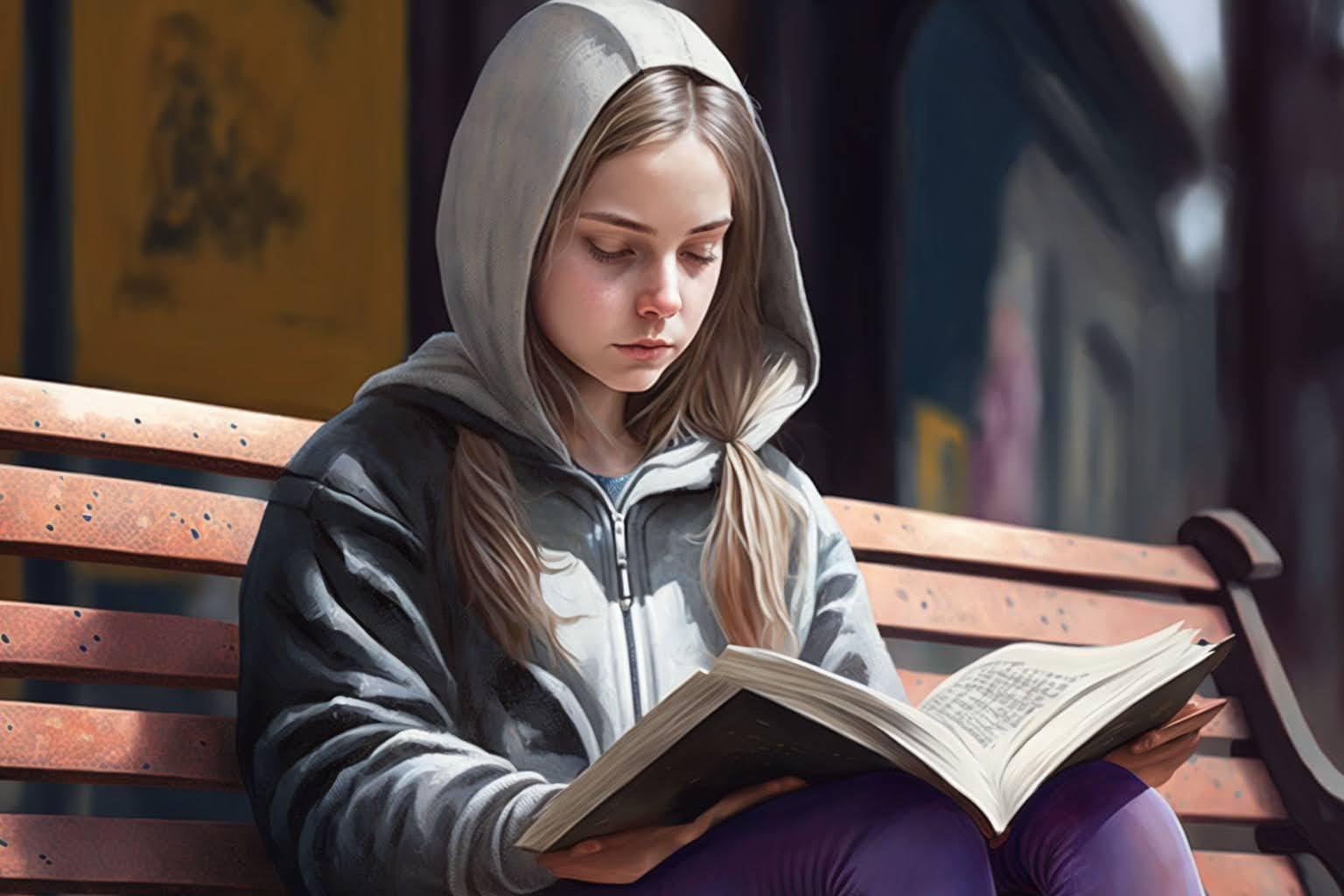
She told him without raising her head from her book. “It’s Aunt Idle’s new pet bird. It’s quite a character.”
“What?”
“The noise, it’s from the bird. It’s been cracking nuts for the past twenty minutes. Hence the noise. And yes, it’s annoying as hell.”
She rose from the bench. “Your bear friend will be back quick I’m certain; it’s just a small boutique with some nice crystals, but mostly cheap orgonite new-agey stuff. Betsy only swears by that, protection for electromagnetic waves and stuff she says, but look around… we are probably got more at risk to be hit by Martian waves or solar coronal mass ejections that by the ones from the telecom tower nearby.”
Xavier didn’t know what to say, so he nodded and smiled. He felt a bit out of his element. When he looked around, the girl had already disappeared.
Now alone, he sat on the empty bench, stretched and yawned while trying to relax. It was so different from the anonymity in the city: less people here, but everything and everyone very tightly knit together, although they all seemed to irk and chafe at the thought.
The flapping of wings startled him.
“Hellooo.” The red parrot had landed on the backrest of the bench and dropped shells from a freshly cracked nut which rolled onto the ground.
Xavier didn’t think to respond; like with AL, sometimes he’d found using polite filler words was only projecting human traits to something unable to respond back, and would just muddle the prompt quality.
“So ruuuude.” The parrot nicked his earlobe gently.
“Ouch! Sorry! No need to become aggressive!”
“You arrrre one to talk. Rouge is on Yooour forehead.”
Xavier looked surprised at the bird in disbelief. Did the bird talk about the mirror test? “What sort of smart creature are you now?”
“Call meee Rose. Pretty Giiirl acceptable.”
Xavier smiled. The bird seemed quite fascinating all of a sudden.
It was strange, but the bird seemed left completely free to roam about; it gave him an idea.“Rose, Pretty Girl, do you know some nice places around you’d like to show me?”
“Of couuurse. Foôllow Pretty Girl.”
February 14, 2023 at 8:48 pm #6545In reply to: Orbs of Madjourneys
The road was stretching endlessly and monotonously, a straight line disappearing into a nothingness of dry landscapes that reminded Youssef of the Gobi desert where he had been driving not too long ago. At regular speed, the car barely seemed to progress.
> O Time suspend thy flight!
Eternity. Something only nature could procure him. He loved the feeling, and compared to the more usual sand of Gobi, the red sands of Australia gave him the impression he had shifted into another reality. That and the fifteen hours flight listening to Gladys made it difficult to respond to Xavier’s loquacious self and funny jokes. After some time, his friend stopped talking and tried catching some signal to play the Game, brandishing his phone in different directions as if he was hunting ghosts with a strange device.
It reminded him he had to accept his next quest in a ghost town. That’s all he remembered. He could do that at the Inn, when they could rest in their rooms.
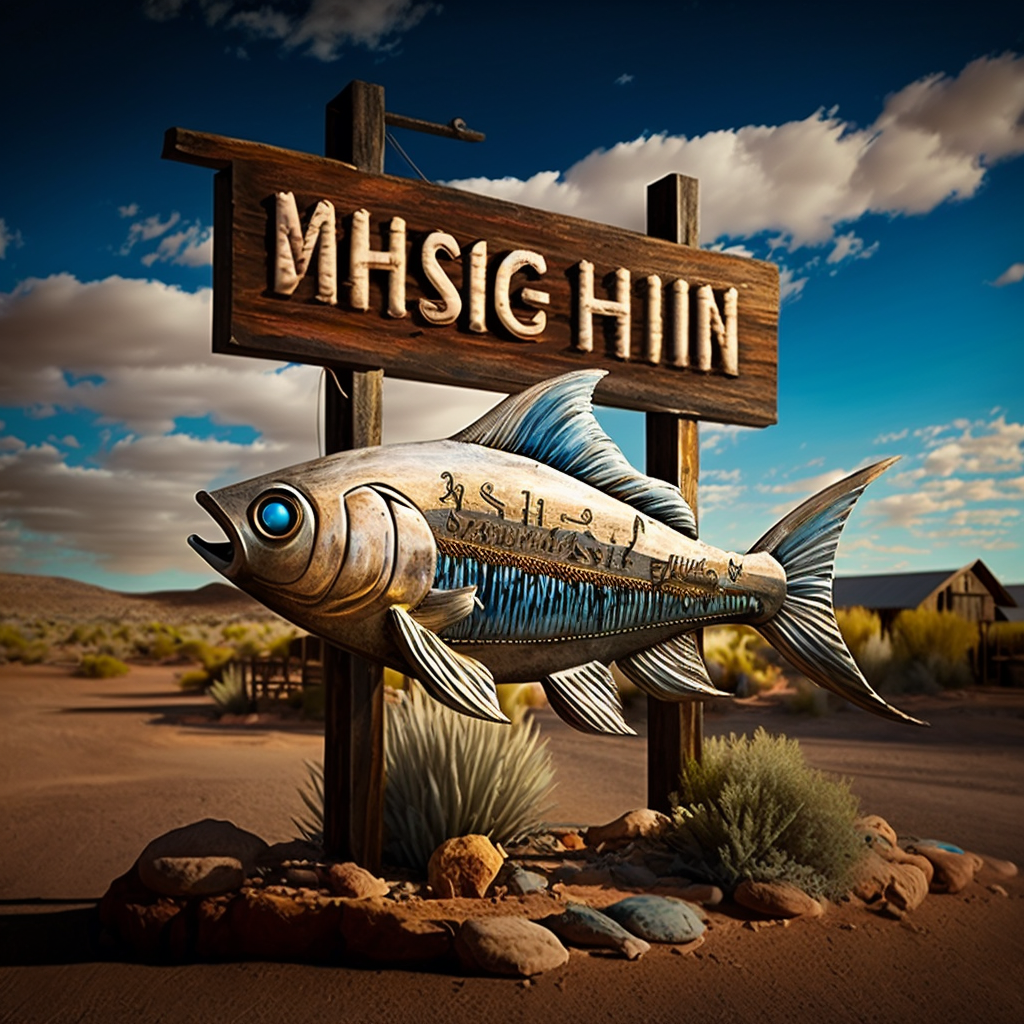
Youssef wondered if the welcome sign at the entrance of the town had seen better days. The wood the fish was made of seemed eaten by termites, but someone had painted it with silver and blue to give it a fresher look. Youssef snorted at the shocked expression on his friend’s face.
“It looked like it died of boredom. Let’s just hope the Innside doesn’t look like a gutted fish,” Xavier said.
An old lady showed them their rooms. She didn’t seem the talkative type, which made Youssef love her immediately with her sharp tongue and red cardigan. He rather admired her braided silver hair as it reminded him of his mother who would let him brush her hair when they lived in Norway. It was in another reality. He smiled. She saw him looking at her and her eyes narrowed like a pair of arrowslits. She seemed ready to fire. Instead she kept on ranting about an idle person not doing her only job properly. They each went to their rooms, Xavier took number 7 and Youssef picked number 5, his lucky number.
He was glad to be able to enjoy his own room after the trip of the last few weeks. It had been for work, so it was different. But usually he liked travelling the world on his own and meet people on his way and learn from their stories. Traveling with people always meant some compromise that would always frustrate him because he wanted to go faster, or explore more tricky paths.
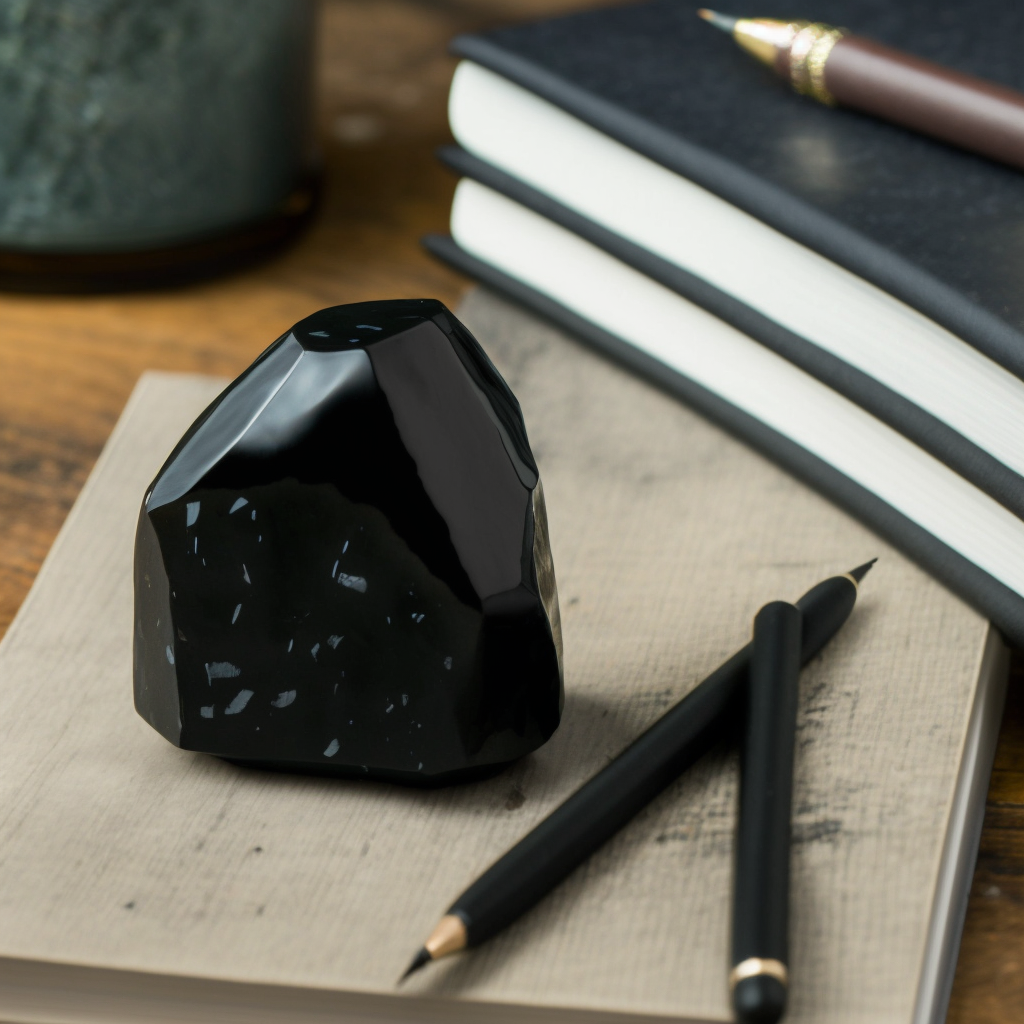
The room was nicely decorated, and the scent of fresh paint made it clear it was recent. A strange black stone, which Youssef recognized as a black obsidian, has been put on a pile of paper full of doodles, beside two notebooks and pencils. The notebooks’ pages were blank, he thought of giving them to Xavier. He took the stone. It was cold to the touch and his reflection on the surface looked back at him, all wavy. The doodles on the paper looked like a map and hard to read annotations. One stood out, though which looked like a wifi password. That made him think of the Game. He entered it on his phone and that was it. Maybe it was time to go back in. But he wanted to take a shower first.
He put his backpack and his bag on the bed and unpacked it. Amongst a pile of dirty clothes, he managed to find a t-shirt that didn’t smell too bad and a pair of shorts. He would have to use the laundry service of the hotel.
He had missed hot showers. Once refreshed, he moved his bags on the floor and jumped on his bed and launched the Game.
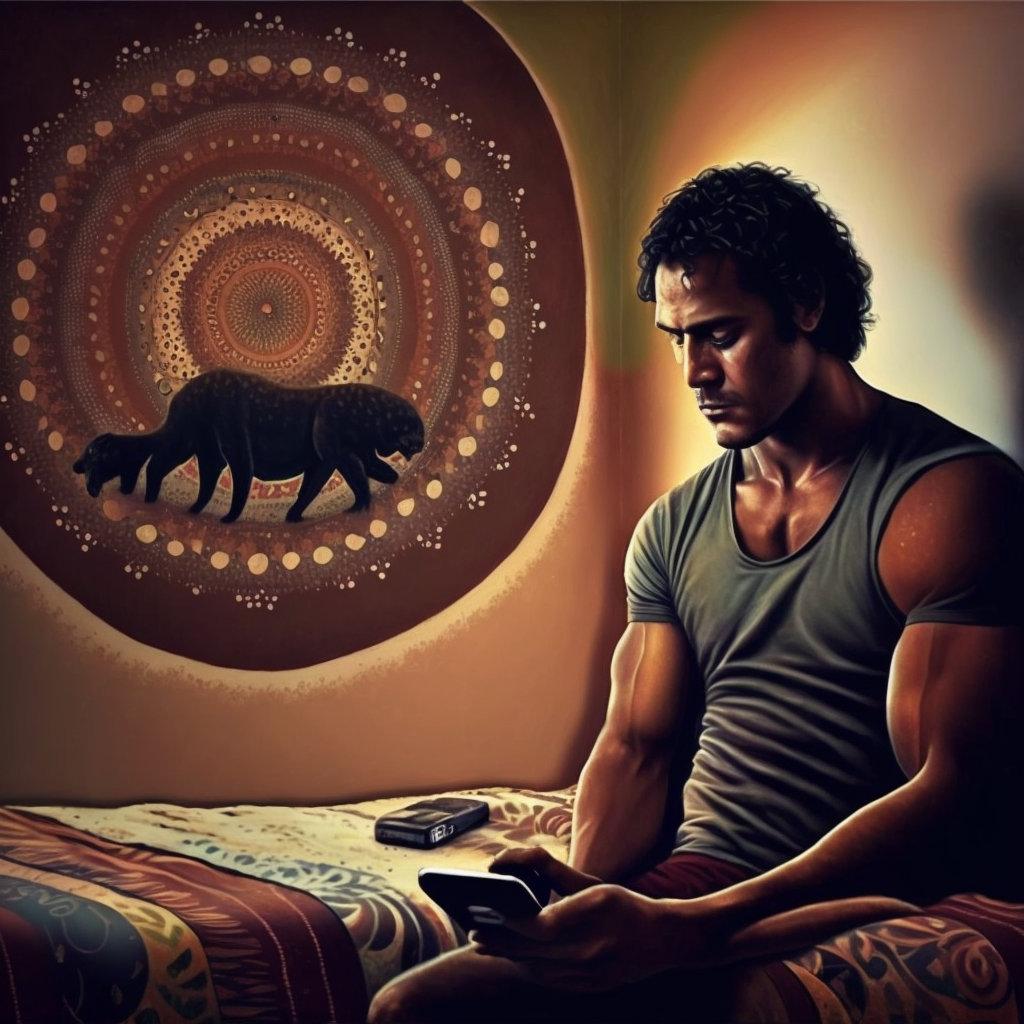 Youssef finds himself in a small ghost town in what looks like the middle of the Australian outback. The town was once thriving but now only a few stragglers remain, living in old, decrepit buildings. He’s standing in the town square, surrounded by an old post office, a saloon, and a few other ramshackle buildings.
A message appeared on the screen.
Quest: Your task is to find the source of the magnetic pull that attracts talkative people to you. You must find the reason behind it and break the spell, so you can continue your journey in peace.
Youssef started to move his avatar towards the saloon when someone knocked on the door.
February 12, 2023 at 10:18 pm #6540In reply to: Prompts of Madjourneys
Update & clarifications on the characters:
Looking at the avatars that Zara, Youssef, Xavier and Yasmin are using in VR.
Full name or real name in RL :: name in VR (
@nickhandle) description of avatar.- Zara Patara-Smythe :: Zara (
@zaraloon) is a 25-year-old woman of mixed heritage, her mother is Indian and her father is British. She has long, dark hair that she keeps in a sleek ponytail, dark brown eyes and a sharp jawline. She stands at 5’6″ and has a toned and athletic build. She usually wears practical clothing that allows her to move around easily, such as cargo pants and a tank top. - Xavier Olafsson :: Xavier (
@xavimunk) is a 27-year-old man of Norwegian and Danish descent. He has blonde hair that he keeps in a messy style, blue eyes, and a charming smile. He stands at 6’1″ and has a lean build. He is always seen wearing a colorful and bold clothing, such as a Hawaiian shirt and shorts. - Yasmin Ahmed :: Yasmin (
@yasminowl) is a 23-year-old woman of Egyptian descent. She has long, black hair that she keeps in a tight braid, dark brown eyes and a round face. She stands at 5’4″ and has a petite build. She usually wears conservative clothing, such as long skirts and blouses. - Youssef Ali :: Youssef (
@youssefbear) is a 26-year-old man of half Yemeni, half Norwegian descent. He has short, curly black hair, dark brown eyes and a square jawline. He stands at 6’2″ and has a muscular build. He usually wears comfortable clothing such as a t-shirt and jeans, and always has a backpack on his shoulder.
Full descriptions for real-life Zara, Yasmin, Youssef, Xavier:
Real Life Zara Patara-Smythe :: Zara is a 57-year-old woman who is an adventurous traveler and a passionate hobbyist. She has a full mane of gorgeous auburn hair that she keeps in a sleek ponytail, sparkling green eyes, and a warm smile that puts others at ease. She is of mixed heritage, her mother was Indian and her father was British. She is well-educated and well-off, either through an inheritance or a supportive and understanding husband. Zara is a lover of art, music, and history, and spends much of her time indulging in her passions. She is always eager to explore new places and meet new people, and her adventurous spirit often leads her to travel off the beaten path.
Real Life Yasmin Ahmed :: Yasmin is a 32-year-old woman who is kind, nurturing, and always puts others first. She has long, black hair that she keeps in a tight braid, almond-shaped brown eyes, and a warm smile that lights up a room. Born in Egypt, she grew up in a close-knit family and values the importance of community. She is a talented actress, who has kept her career a secret from those closest to her, in order to pursue a more fulfilling life working with children. Yasmin currently volunteers at an orphanage in Fiji, where she devotes herself to helping children in need.
Real Life Youssef Ali :: Youssef is a 34-year-old man who is driven, confident, and always up for a challenge. He has short, curly black hair, dark brown eyes, and a square jawline that gives him a strong and determined look. Born to a Yemeni father and a Norwegian mother, he has a unique blend of cultures that has shaped his world view. Youssef is a talented blogger, who has traveled the world in search of new and interesting stories to share with his audience. He is always on the go, with a backpack on his shoulder, ready for his next adventure.
Real Life Xavier Olafsson :: Xavier is a 36-year-old man who is bright, cheerful, and always looking for the positive in every situation. He has blonde hair that he keeps in a messy style, blue eyes, and a charming smile that never fails to win people over. Born to Norwegian and Danish parents, he has a love for the sea and an appreciation for the finer things in life. Xavier is an AI developer, who is working on a project he calls AL. He is always eager to share his ideas with others and is constantly seeking new and exciting opportunities.
February 12, 2023 at 9:49 pm #6539In reply to: Prompts of Madjourneys
Zara is the main protagonist, and also the reluctant leader of the game. In RL, she is wandering off the trail nearby Arltunga, Australia, where she is visiting, staying at the small family run inn the Flying Fish Inn. Bert, the local handyman drove her there, told her specifically not to wander off, yet in search of where a mysterious compass she collected on the trail is leading, and egged on by her talking smart parrot “Beautiful Girl”, she goes off the trail to explore. The sun is still high, and she already started to hallucinate some hooded figures with blue frog-faces with jelly-bean carts.
Meanwhile, her friends Youssef and Xavier, just landed from abroad, are driving toward the rendez-vous spot at the Flying Fish Inn. The owners Mater and Idle don’t have any idea where Zara is.
Yasmin, the fourth friend in the group is still on her way from Fiji, bearing a message written in red on an envelope from a mysterious Fred, who we don’t know yet, but seems to be linked to Mater & Idle’s family.
What’s going to happen next to Zara? The game is encouraging her to explore her rudeness in a playful manner, in a medieval setting.
Provide a series of playful and fun actions for Zara, linking these contexts. You may incorporate Tiku, a wise and no-nonsense Aboriginal woman who may guide her though the Dreamtime challenges. Provide random keywords to each action in the list.Here is a list of playful and fun actions for Zara in the game:
- “Follow the Compass”: Zara can follow the mysterious compass she collected on the trail, as it leads her to new locations and challenges. Keywords: Adventure, Exploration, Mystery.
- “Converse with Beautiful Girl”: Zara’s talking smart parrot “Beautiful Girl” may provide humorous commentary and encouragement throughout her journey. Keywords: Humor, Personality, Support.
- “Solve Riddles with Tiku”: Tiku, the wise and no-nonsense Aboriginal woman, can guide Zara through the Dreamtime challenges. To do this, Tiku may present her with riddles or puzzles that she must solve to progress. Keywords: Wisdom, Intelligence, Spirituality.
- “Collect Items”: Zara can collect items along the way, such as artifacts or treasures that may help her in her journey or lead her to new discoveries. Keywords: Collection, Discovery, Help.
- “Play Music with Beautiful Girl”: Zara can play musical instruments with Beautiful Girl, creating an entertaining and musical interlude in her journey. Keywords: Music, Joy, Creativity.
- “Cook with Mater and Idle”: At the Flying Fish Inn, Zara can join Mater and Idle in the kitchen and help them cook traditional dishes from the region. Keywords: Cooking, Culture, Community.
- “Race with Youssef and Xavier”: Zara can engage in friendly races with Youssef and Xavier, such as foot races or cart races, as a way to pass the time and have fun. Keywords: Competition, Speed, Excitement.
These playful and fun actions can add variety and excitement to Zara’s journey and provide an opportunity for players to interact with the world and characters in new and unique ways.
🔁 Regenerate responseFebruary 7, 2023 at 10:43 pm #6512In reply to: Prompts of Madjourneys
Zara offered the following quirk: “unleash my hidden rudeness”
Quirk accepted.
You find yourself in the bustling streets of an old medieval town. The people around you are going about their business, and you see vendors selling goods, street performers entertaining the crowd, and guards patrolling the area. You hear rumors about a secret society of mischievous tricksters who are known for causing trouble and making people’s lives more interesting.
You decide to investigate these rumors and join the society of tricksters, who call themselves the “Rude Ones.” You are tasked with finding the key to their hideout, a tile with a rude message written on it. To do this, you must complete several challenges and pranks around the town, each more mischievous than the last.
Your objective is to find the tile, sneak into the Rude Ones’ hideout, and cause as much chaos and trouble as possible. You must also find a way to insert a real-life prank or act of rudeness into your daily life, as proof of your success in the game.
Possible directions to investigate:
- Talk to the vendors and street performers to gather information about the Rude Ones.
- Observe the guards and see if they have any information on the secret society.
- Explore the different neighborhoods and see if anyone knows about the hideout.
Possible characters to engage:
- A mysterious street performer who is rumored to be part of the Rude Ones.
- A vendor who has a reputation for being rude to customers.
- A guard who is rumored to be in league with the Rude Ones.
Look for a tile with a rude message written on it, and capture proof of your real-life prank or act of rudeness. Good luck, and have fun!
February 3, 2023 at 9:50 am #6494In reply to: Orbs of Madjourneys
Although not one to remember dreams very often, Zara awoke the next morning with vivid and colourful dream recall. She wondered if it was something to do with the dreamtime mural on the wall of her room. If this turned out to be the case, she considered painting some murals on her bedroom wall back at the Bungwalley Valley animal rescue centre when she got home.
Zara and Idle had hit it off immediately, chatting and laughing on the verandah after supper. Idle told her a bit about the local area and the mines. Despite Bert’s warnings, she wanted to see them. They were only an hour away from the inn.
When she retired to her room for the night, she looked on the internet for more information. The more she read online about the mines, the more intrigued she became.
“Interestingly there are no actual houses left from the original township. The common explanation is that a rumour spread that there was gold hidden in the walls of the houses and consequently they were knocked down by people believing there was ‘gold in them there walls”. Of course it was only a rumour. No gold was found.”
“Miners attracted to the area originally by the garnets, found alluvial and reef gold at Arltunga…”
Garnets! Zara recalled the story her friend had told her about finding a cursed garnet near a fort in St Augustine in Florida. Apparently there were a number of mines that one could visit:
“the MacDonnell Range Reef Mine, the Christmas Reef Mine, the Golden Chance Mine, the Joker Mine and the Great Western Mine all of which are worth a visit.”
Zara imagined Xavier making a crack about the Joker Mine, and wondered why it had been named that.
“The whole area is preserved as though the inhabitants simply walked away from it only yesterday. The curious visitor who walks just a little way off the paths will see signs of previous habitation. Old pieces of meat safes, pieces of rusted wire, rusted cans, and pieces of broken glass litter the ground. There is nothing of great importance but each little shard is reminder of the people who once lived and worked here.”
I wonder if Bert will take me there, Zara wondered. If not, maybe one of the others can pick up a hire car when they arrive at Alice. Might even be best not to tell anyone at the inn where they were going. Funny coincidence the nearest town was called Alice ~ it was already beginning to seem like some kind of rabbit hole she was falling into.
Undecided whether to play some more of the game which had ended abruptly upon encountering the blue robed vendor, Zara decided not to and picked up the book on Dreamtime that was on the bedside table.
“Some of the ancestors or spirit beings inhabiting the Dreamtime become one with parts of the landscape, such as rocks or trees…” Flicking through the book, she read random excerpts. “A mythic map of Australia would show thousands of characters, varying in their importance, but all in some way connected with the land. Some emerged at their specific sites and stayed spiritually in that vicinity. Others came from somewhere else and went somewhere else. Many were shape changing, transformed from or into human beings or natural species, or into natural features such as rocks but all left something of their spiritual essence at the places noted in their stories….”
Thousands of characters. Zara smiled sleepily, recalling the many stories she and her friends had written together over the years.
“People come and go but the Land, and stories about the Land, stay. This is a wisdom that takes lifetimes of listening, observing and experiencing … There is a deep understanding of human nature and the environment… sites hold ‘feelings’ which cannot be described in physical terms… subtle feelings that resonate through the bodies of these people… It is only when talking and being with these people that these ‘feelings’ can truly be appreciated. This is… the intangible reality of these people…..”
With such strong ancestral connections to the land, Zara couldn’t help but wonder what the aboriginal people felt about all the mines. If one of their ancestors had shape changed into rocks, and then some foreignors came along and hacked and blasted their way through, what would they think of that?
“….many Aboriginal groups widely distributed across the Australian continent all appeared to share variations of a single (common) myth telling of an unusually powerful, often creative, often dangerous snake or serpent of sometimes enormous size closely associated with the rainbows, rain, rivers, and deep waterholes…..”
She drifted off to sleep thinking of water holes in red rocky gorges, the book laying open in her hand.
When she awoke the next morning with the slatted morning sun shining through the venetian blinds, the dream image of the water hole was bright and clear in her minds eye. But what was that strange character from the game doing in her dream?
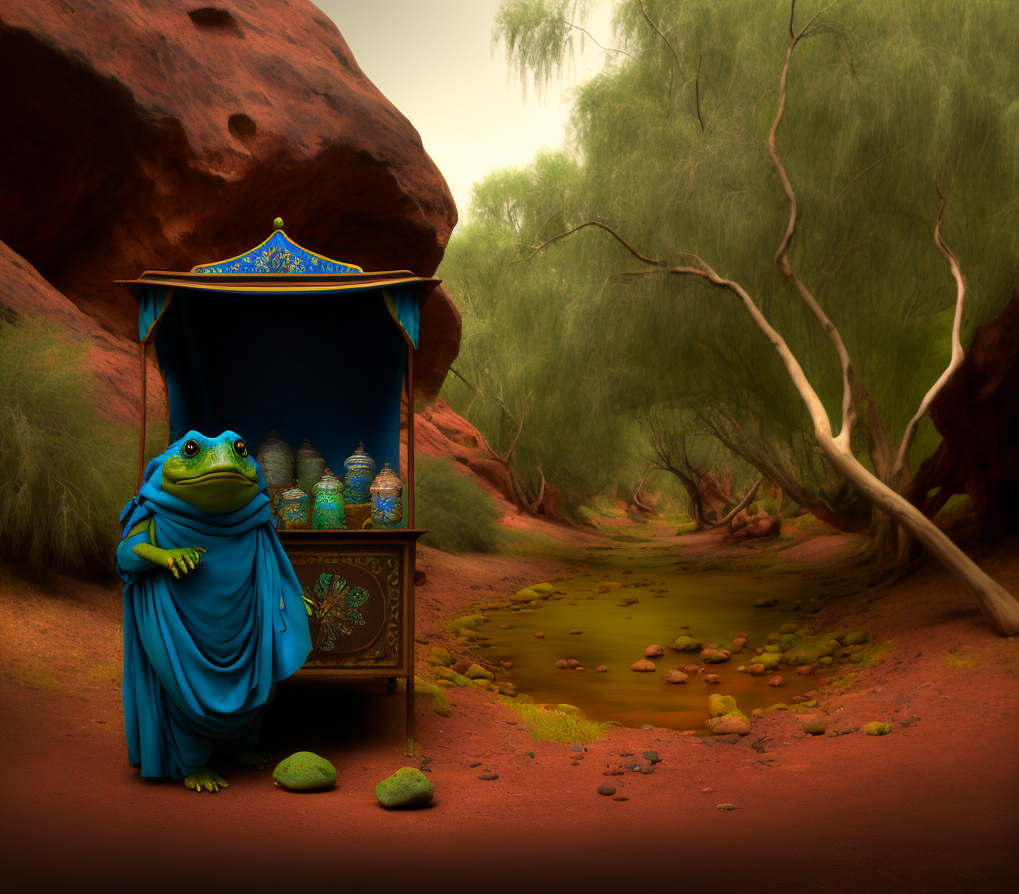
She closed her eyes, remembering more of the strange dream. Deeply orange red boulders and rocky outcrops, shivering gum trees, and green pools ~ it was coming back to her now, that creature in the blue robes had appeared more than once. In one scene he appeared with a blue diamond lantern with what looked like a compass inside.
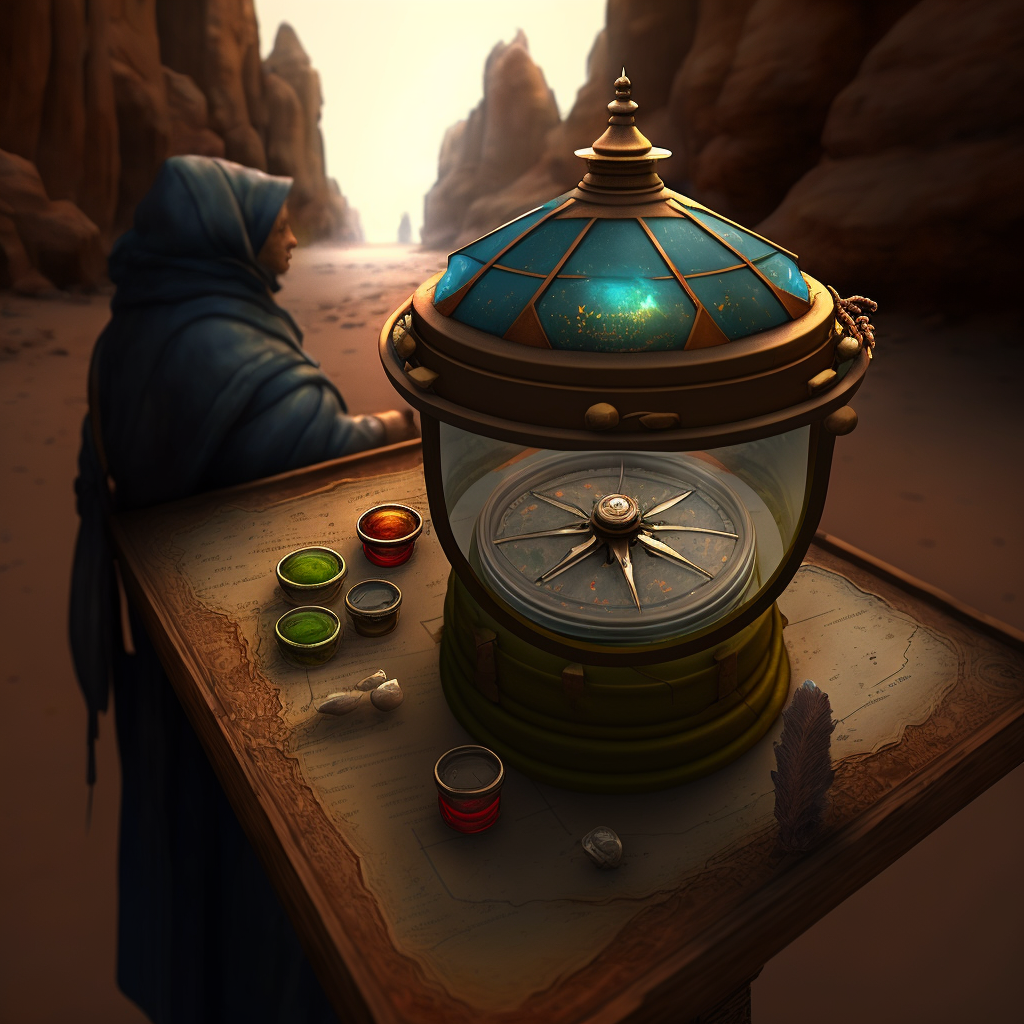
I’ll ask about the hiking trails today, Zara decided, and go for a walk in that gorge I read about yesterday. Bert said there were good hiking trails. You came here early so you could play the game, she reminded herself.
“It’s all a game,” she heard the parrot outside her window.
“I’d forgotten about the bloody parrot!” Zara said under her breath. “Pretty Girl!” she said, opening the blinds. “We’re going out for a walk today.”
February 1, 2023 at 12:57 pm #6487In reply to: The Chronicles of the Flying Fish Inn
I’ve always felt like the odd one out in my family. Growing up at the Flying Fish Inn, I’ve always felt like I was on the outside looking in. My mother left when I was young, and my father disappeared not long after. I’ve always felt like I was the only one who didn’t fit in with the craziness of my family.
I’ve always tried to keep my distance with the others. I didn’t want to get too involved, take sides about petty things, like growing weed in the backyard, making psychedelic termite honey, or trying to influence the twins to buy proper clothes. But truth is, you can’t get too far away. Town’s too small. Family always get back to you, and manage to get you involved in their shit, one way or another, even if you don’t say anything. That’s how it works. They don’t need my participation to use me as an argument.
So I stopped paying attention, almost stopped caring. I lived my life working at the gas station, and drinking beers with my buddies Joe and Jasper, living in a semi-comatose state. I learned that word today when I came bringing little honey buns to mater. I know she secretly likes them, even if she pretend she doesn’t in front of Idle. But I can see the breadcrumbs on her cardigan when I come say hi at the end of the day. This morning, Idle was rocking in her favourite chair on the porch, looking at the clouds behind her mirrored sunglasses. Prune was talking to her, I saw she was angry because of the contraction of the muscles of her jaw and her eyes were darker than usual. She was saying to Idle that she was always in a semi-comatose state and doing nothing useful for the Inn when we had a bunch of tourists arriving. And something about the twins redecorating the rooms without proper design knowledge. Idle did what she usually does. She ignored the comment and kept on looking at the clouds. I’m not even sure she heard or understood that word that Prune said. Semi-comatose. It sounds like glucose. That’s how I’m spending my life between the Inn, the gas station and my buddies.
But things changed today when I got back to my apartment for lunch. You can call it a hunch or a coincidence. But as we talked with Joe about that time when my dad left, making me think we were doing hide and seek, and he left me a note saying he would be back someday. I don’t know why I felt the need to go search that note afterwards. So I went back to the apartment and opened the mailbox. Among the bills and ads, I found a postcard with a few words written on the image and nothing except my address on the back. I knew it was from my dad.
It was not signed or anything, but still I was sure it was his handwriting. I would recognise it anywhere. I went and took the shoebox I keep hidden on top of the kitchen closet, because I saw people do that in movies. That’s not very original, I know, but I’m not too bright either. I opened the box and took the note my dad left me when he disappeared.
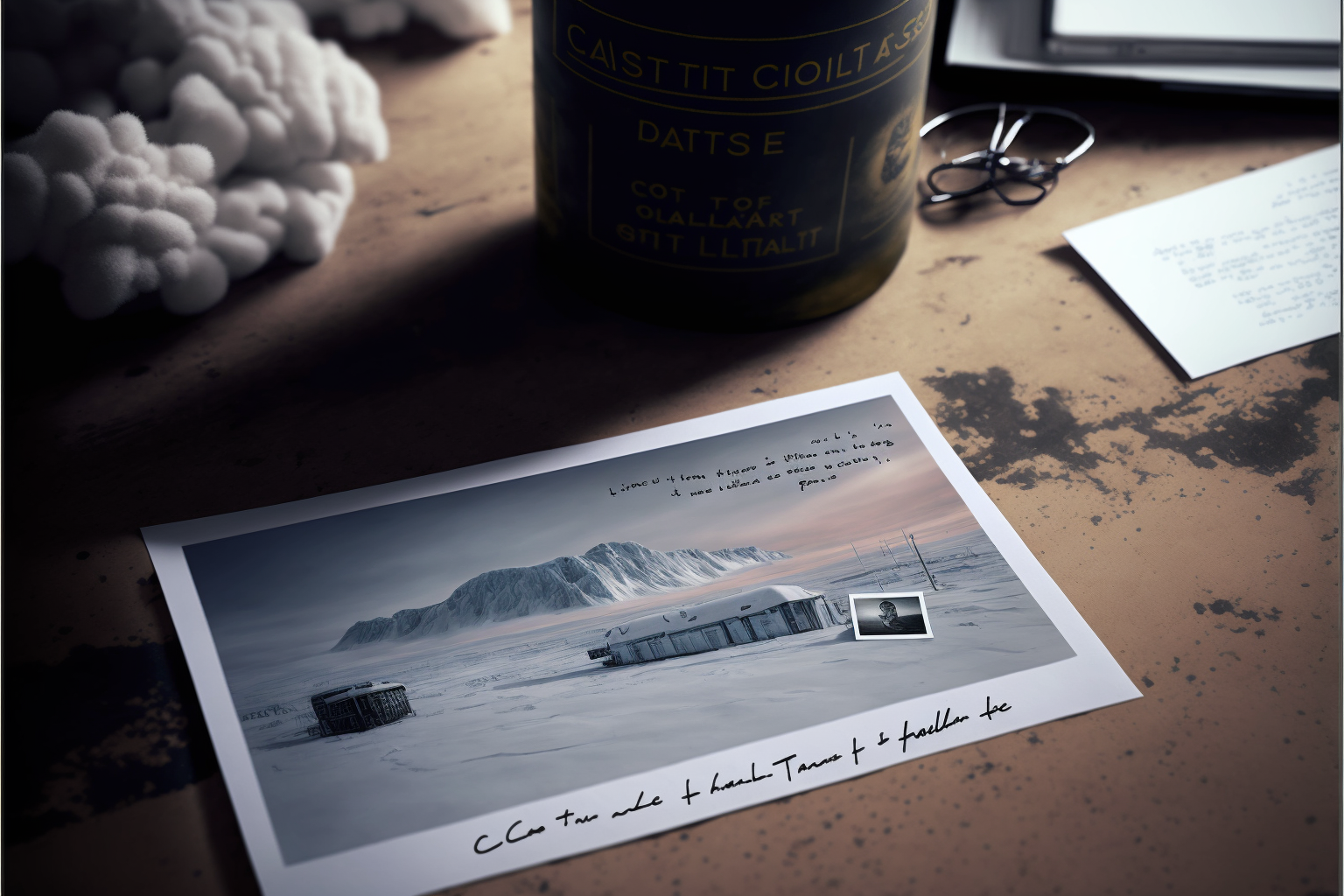 I put the card on the desk near the note. The handwritings matched. I felt so excited, and confused.
A few words at the bottom of the card said : “Memories from the coldest place on Earth…”
Why would dad go to such a place to send me a postcard after all those years ? Just to say that.
That’s when I recalled what Prune had told me once as we were watching a detective movie : “Read everything with care and always double check your information.”
On the back, it said that the image was from a scientific station in Antartica, but the stamp indicated it had been posted from a floating post office in the North Pole. I turned the card and looked at the text again. Above the station, a few words were written that sounded like a riddle.
> A mine, a tile, dust piled high,
Together they rest, yet always outside.
One misstep, and you’ll surely fall,
Into the depths, where danger lies all.It sure sounds like a warning. But I’m not too good with riddles. No need to worry Mater about that, in case of false hope and all that. Idle ? Don’t even think about it. She won’t believe me when I say it’s from dad. She never does believe me. And she’ll keep playing with the words trying to find her answer in the shape of smoke. The twins, they are a riddle on their own.
No. It’s Prune’s help I need.
February 1, 2023 at 12:12 pm #6486In reply to: Orbs of Madjourneys
Zara took dozens of screenshots of the many etchings and drawings, as her game character paused to do the same. She had lost sight of the two figures up ahead, and remembered she probably should have been following them.
The tunnel came to a four way junction. There were drawings on the walls and floors of all of them, and a dim light coming from a distance in each. One was more brightly lit than the others, and Zara chose to explore that one first. Presently a side room appeared, with green tiles on the floor similar to the one at the mine entrance. Daylight shone though a small window, and a diagram was drawn onto the wall.
Zara toyed with the idea of simply climbing out through the window while there was still a chance to get out of the mine. She knew she was lost and would not be able to find her way out the way she came. It was tempting, but she just took a screenshot. Maybe when she looked at them later she’d be able to work out how to retrace her steps.
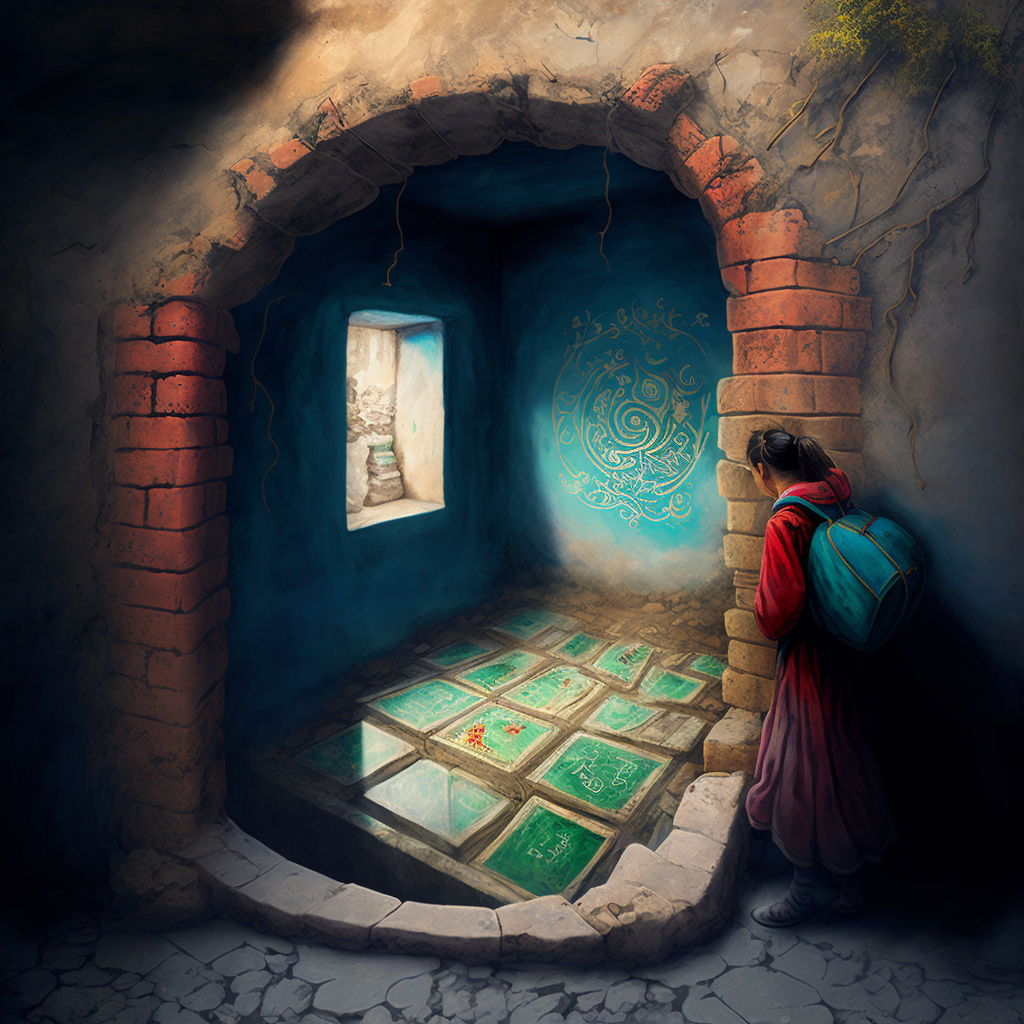
After recording the image of the room of tiles, Zara continued along the tunnel. The light shining from the little window in the tile room faded as she progressed, and she found herself once again in near darkness. She came to a fork. Both ways were equally gloomy, but a faint blue light enticed her to take the right hand tunnel.
So many forks and side tunnels, I am surely completely lost now! And not one of these supposed maps is helping, I can’t decipher any of them. Another etching on the wall caught her eye, and Zara forgot about being lost.
Zara stopped to look at what appeared to be a map on the tunnel wall, but it was unfathomable at this stage. She recorded it for future reference, and then looked around, unsure whether to continue on this path or retrace her stops back to the four way junction. And then she saw him in an alcove.
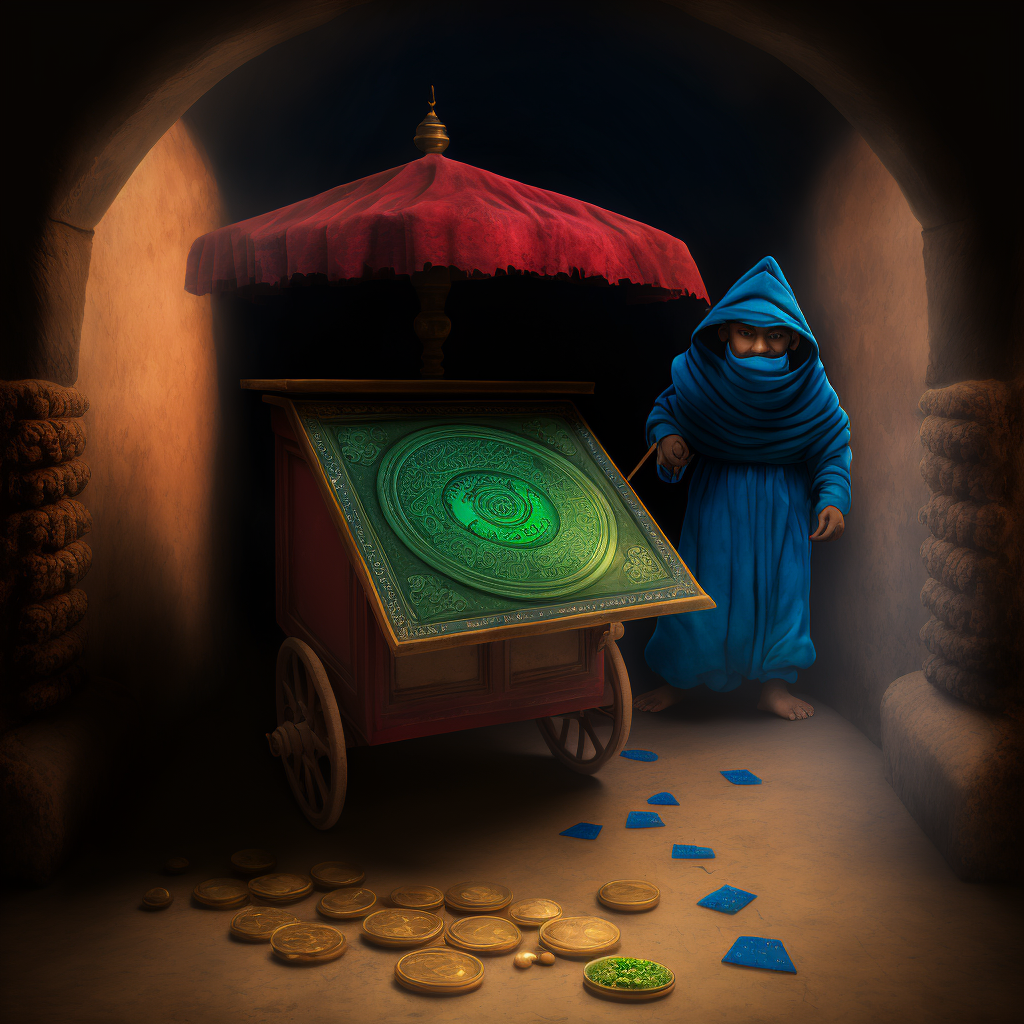
Osnas! This time Zara did say it out loud, and just as the frog faced stewardess was passing with her cart piled with used cups and cans and empty packets. I swear she just winked at me! Zara did a double take, but the cart and the woman had passed, collecting more rubbish.
With a little smile, Zara noticed that the mask Osnas was wearing was one of those paper pandemic masks. She had expected something a bit more Venice carnival when the prompt mentioned that he always wore a mask, not one of those. She hoped the clue in this case wasn’t the mask, as she had avoided the plague successfully so far and didn’t want to be late to that particular party, but the square green thing on his cart resembled the tile at the mine entrance. What do I do now though? I still don’t know what any of these things mean. Approach him and see if he speaks I suppose.
“Ladies and gentlemen, we are now approaching Alice Springs, please fasten your seatbelts and switch off all your devices ready for landing. We hope you have enjoyed your flight.”
January 29, 2023 at 12:01 pm #6465In reply to: Orbs of Madjourneys
Given the new scenery unfolding in front of him, it was time for a change into more appropriate garments.

Luckily, the portal he’d clicked on came with some interesting new goodies. Xavier skimmed over some of the available options, until he found an interesting pair of old boots.
Looking at the old worn leather boots that had appeared in Xavier’s bag, he felt they would be quite appropriate, and put them on.
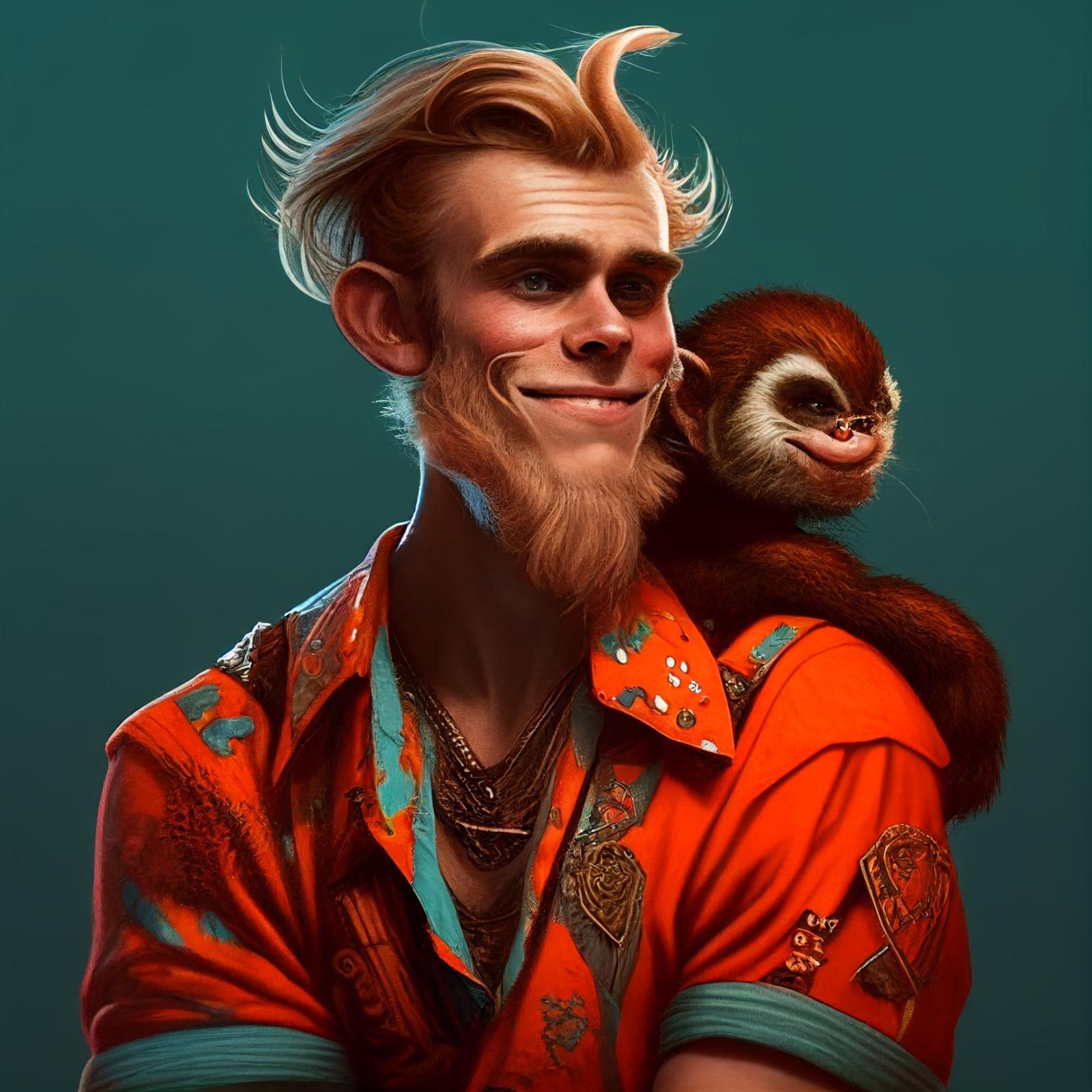 The changes were subtle, but Xavier already felt more in character with the place.
Suddenly a capuchin monkey jumped on his shoulder and started to pull his ear to make it to the casino boat.The too friendly, potentially mischievous pickpocketing monkey seemed a bit of a trope, but Xavier found the creature endearing.
“Let’s go then! Seems like this party is waiting for us.” he said to the excited monkey.
He jumped into one of the dinghy doing the rounds to the boat with some of the customers.
“Ahoy there, matey!” a rather small man with a piercing blue eye and massive top hat said, giving Xavier a sideways glance. He had an eerie presence and seemed very imposing for such a small frame. “The name’s Sproink, and ye be a first-timer, I see.” he said as a casual matter of introduction.
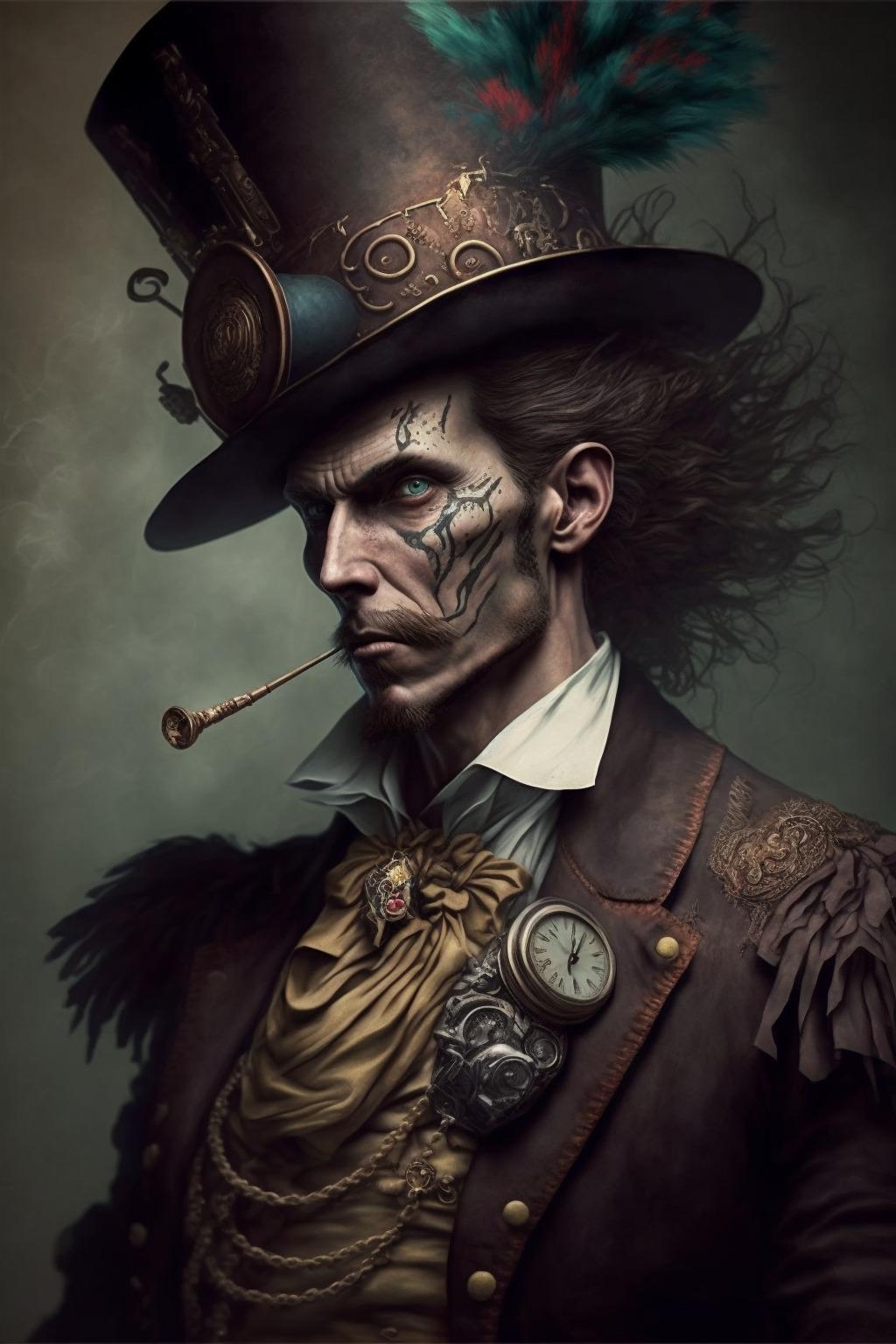
“Nice to meet you sir” Xavier said distractedly, as he was taking in all the details in the curious boat lit by lanterns dangling in the soft wind.
“Yer too polite for these parts, me friend,” Sproink guffawed. “But have no fear, Sproink’s got yer back.” He winked at the capuchin, Xavier couldn’t help but notice, and suddenly realised that the monkey truly belonged to Sproink.
“No need to check yer pockets, matey” Sproink smiled “I have me sights set on far more interesting game than yer trinkets.” He handed him back some of the stuff that the capuchin had managed to spirit away unnoticed. “But watch yerself, matey. Not all the folk here be what they seem.”
“Point taken!” Xavimunk was indeed a bit too naive, but if anything, that’d often managed to keep him out of trouble. As the small wiry guy left with his bag of tricks in a springy gait, he turned to check his shoulder, and the monkey had disappeared somewhere on the boat too. Xavier was left wondering if he’d see more of him later.

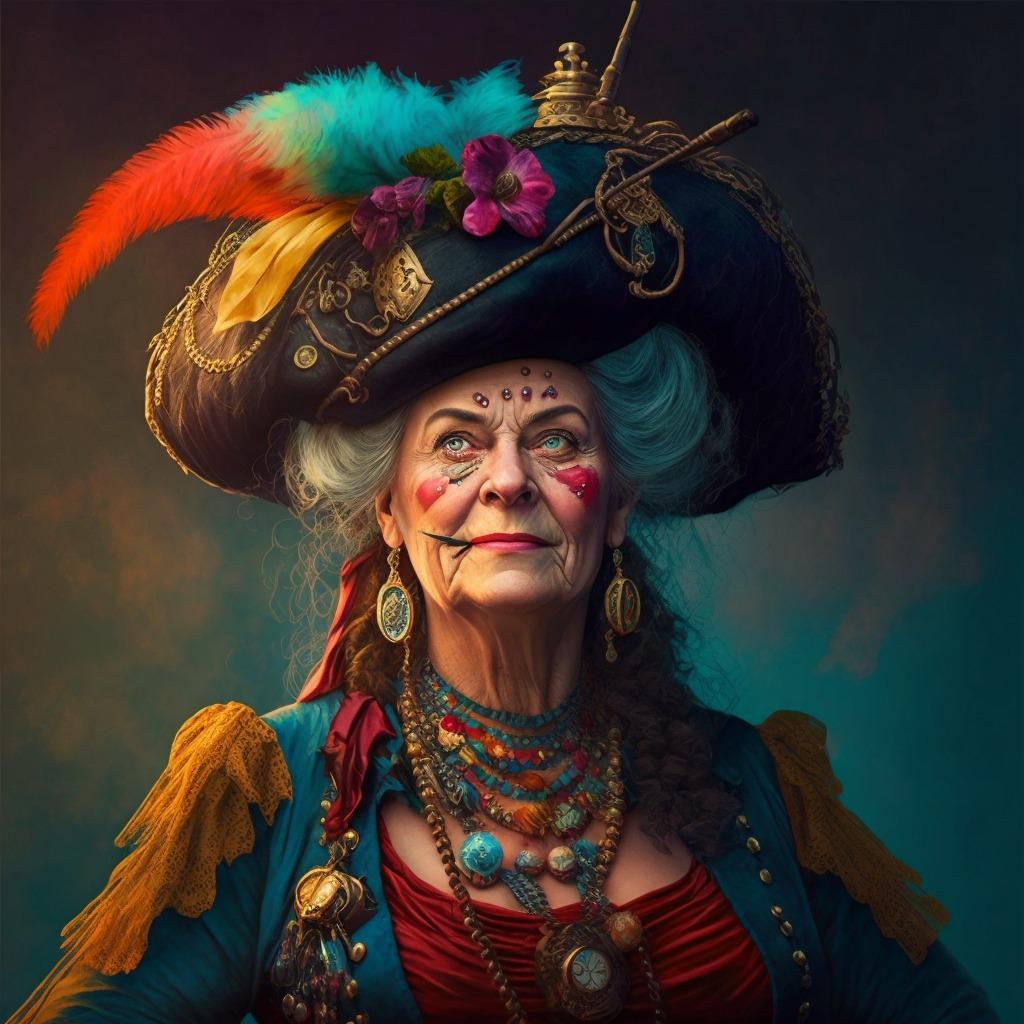
 “Welcome, welcome, me hearties!” a buxom girl of large stature with a baroque assortment of feathers and garish colours was a the entrance chewing on a straw, and looking as though the place belonged to her. But there was something else, she was too playing a part, and didn’t seem from here.
She leaned conspiratorially towards Xavier, and dragged him in a corner.
“Yer a naughty monkey, ignoring me prompts,” she said. “Was I too discrete, or what?”
“Wait, what?” Xavier was confused. Then he remembered the strange message. “Wait a minute… you’re Glimble… something, with unicorns shit or something?” He didn’t have time to entertain the young geek gamers, they were too immature, and well… a lot more invested in the game than he was, they would often turn seriously creepy.
“Oi, come on now!” she raised her hands and shook herself violently. She had turned into a different version of herself. “Now, is it better? It’s true, them avatars easily turn into ava-tarts if you ask me. But you can’t deny a lady a bit o’ comfort with a wrinkle filter. They went a bit overboard with this one, if you ask me.”
“Let’s start again. Glimmer Gambol, and nice to meet you young man.”
 January 26, 2023 at 12:16 am #6460
In reply to: Orbs of Madjourneys
The vendor was preparing the Lorgh Drülp with the dexterity of a Japanese sushi chef. A piece of yak, tons of spices, minced vegetables, and some other ingredients that Youssef couldn’t recognise. He turned his attention to the shaman’s performance. The team was trying to follow the man’s erratic moves under Miss Tartiflate’s supervision. Youssef could hear her shouting to Kyle to get closer shots. It reminded him that he had to get an internet connection.
“Is there a wifi?” asked Youssef to the vendor. The man bobbed his head and pointed at the table with a knife just as big as a machete. Impressed by the size of the blade, Youssef almost didn’t see the tattoo on the vendor’s forearm. The man resumed his cooking swiftly and his long yellow sleeve hid the tattoo. Youssef touched his screen to look at his exchange with Xavier. He searched for the screenshot he had taken of the Thi Gang’s message. There it was. The mummy skull with Darth Vador’s helmet. The same as the man’s tattoo. Xavier’s last message was about the translation being an ancient silk road recipe. They had thought it a fluke in AL’s algorithm. Youssef glanced at the vendor and his knife. Could he be part of Thi Gang?
Youssef didn’t have time to think of a plan when the vendor put a tray with the Lorgh Drülp and little balls of tsampa on the table. The man pointed with his finger at the menu on the table, uncovering his forearm, it was the same as the Thi Gang logo.
“Wifi on menu,” the man said. “Tsampa, good for you…”
A commotion at the market place interrupted them. Apparently Kyle had gone too close and the shaman had crashed into him and the rest of the team. The man was cursing every one of them and Miss Tartiflate was apparently trying to calm him down by offering him snack bars. But the shaman kept brandishing an ugly sceptre that looked like a giant chicken foot covered in greasy fur, while cursing them with broken english. The tourists were all brandishing their phones, not missing a thing, ready to send their videos on TrickTruck. The shaman left angrily, ignoring all attempts at conciliation. There would be no reportage.
“Hahaha, tourists, they believe anything they see,” said the vendor before returning to his stove and his knife.
Despite his hunger, Youssef thought he’d better hurry with the wifi, now that the crew was out of work, he would be the target of Miss Tartiflate’s frustration. Furthermore, he wanted to lay low and not attract the vendor’s attention.
3235 messages from his friends. How would he ever catch up?
Among them, messages from Xavier. Youssef sighed of relief when he read that his friend had regained full access of the website and updated the system to fix a security flaw that allowed Thi Gang to gain access in the first place. But he growled when his friend continued with the bad news. There was some damage done to the content of THE BLOG.To console himself, Youssef started to eat a ball of tsampa. It was sweet and tasted like rose. He took a second and spit it out almost immediately. There was a piece of paper inside. He smoothed it and discovered a series of five pictograms.
🧔🌮🔍🔑🏞️
The first one was like a hologram and kept changing into six horizontal bars. The second one, looking like a tako bell, kept reversing side. Youssef raised his head to call the vendor and nobody was there. He got up and looked for the guy, Thi Gang or not, he needed some answers. Voices came from behind the curtain at the back of the stall. Youssef walked around the stall and saw the shaman and the vendor exchanging clothes. The caucasian man was now wearing the colourful costume and the drum. When he saw Youssef, he smiled and waved his hand, making the bells from the hem ring. Then he turned around and left, whistling an air that sounded strangely like the music of the Game. Youssef was about to run after him when a hand grasped his shirt.
“Please! Tell me at least that THE BLOG is up and running!” said an angry voice.
January 17, 2023 at 8:17 am #6393In reply to: Train your subjective AI – text version
Give me an unusual plot structure for a narrative
One unusual plot structure for a narrative could be a “reverse chronological” structure, where the story begins at the end and works backwards in time, revealing events and information in a non-linear way. Another could be a “choose your own adventure” style, where the reader is presented with a series of choices at different points in the story that determine the direction and outcome of the plot.
How would role playing qualify in terms of plot structure?
Role-playing games (RPGs) can be considered a unique form of plot structure because they are interactive and open-ended. In a traditional RPG, the players take on the roles of characters within a fictional setting and work together to create a shared narrative. The plot structure of an RPG is determined by the actions and decisions of the players, rather than a pre-written script. The game master (GM) creates an overarching plot and a set of rules for the players to follow, but the players’ choices and actions will determine the direction and outcome of the story. This makes the plot structure of an RPG fluid and ever-changing, unlike a traditional linear narrative.
What about “Cloud Atlas” in terms of plot structure?
“Cloud Atlas” is a novel written by David Mitchell that was later adapted into a film. It has a complex and non-linear plot structure, which employs multiple storylines that are set in different time periods and locations, and are connected by recurring themes and motifs. The novel is divided into six nested stories, each set in a different time period and location, that are told in a non-linear fashion. The story begins in the 19th century and then jumps back and forth between the 19th, 20th and 23rd century, and each story is interconnected and interrelated, with characters reappearing in different time periods, the events that happen in one story impacting the others. The novel is also notable for its use of different genres, such as science fiction, historical fiction, and thriller, and the way it explores the themes of destiny, reincarnation, and the power of human connection. The film adaptation also used this structure, with the different stories intertwined and characters reprising their roles in different settings and eras.
Take a story thread made of comments. In each comment is a text about characters in a particular plot, location, action etc. The comments are sequential, but they are not necessarily continuous. It is a mix between Cloud Atlas and RPG plot structures. How do you sort something that’s fundamentally non-linear to present it in an accessible way?
One way to sort and present a story thread made of comments that is fundamentally non-linear, yet accessible, is to group the comments based on their content. For example, you could group the comments by characters, and present them in chronological order of their appearance in the story. Another way could be grouping the comments by location, and present them in chronological order of when the action takes place in that particular location. You could also group comments by the type of action taking place, such as combat, conversation, or puzzle-solving, and present them in chronological order of when they occur in the story.
Another approach could be using visual aids, such as mind maps, timelines, or flowcharts, to help organize and present the information in a clear and easy-to-understand way. For example, you could use a mind map to show how different characters are connected, or a timeline to show the chronology of events. Additionally, you could use labels, such as “character introduction,” “location change,” or “plot twist,” to make it clear to the reader what type of information they can expect in each comment.
It’s also important to keep in mind the audience for which you are organizing the story. It should be easy for them to understand and follow the story, and if it’s a game, you should make sure it’s easy for the players to play and make decisions.
January 13, 2023 at 7:40 pm #6379In reply to: Prompts of Madjourneys
Asking to give each of the 4 characters some particular traits that makes them uniquely distinctive and recognizable
The four friends, Zara, Xavier, Yasmin, and Youssef, each have their own unique traits that make them stand out and recognizable.
Zara is the leader of the group, she is confident, and always ready for an adventure. She is a natural leader and has a strong sense of justice. She is also a tech-savvy person, always carrying a variety of gadgets with her, and is always the first to try out new technology.
Xavier is the joker of the group, always cracking jokes and making puns. He is a free-spirited person who is always up for an adventure, he has a great sense of humor and is not afraid to be himself. He is also an artist and often carries a sketchbook and pencils with him, he likes to draw whatever he sees in his journeys.
Yasmin is the brains of the group, she is intelligent and logical. She is always able to think on her feet and come up with a plan when things get tough. She is also a bit of a perfectionist and likes to have everything organized. She is a history buff and always carries a notebook with her to document her findings.
Youssef is the muscle of the group, He is physically strong, and always ready to help out in a fight. He is also a bit of a foodie and loves trying new dishes. He is always the first one to volunteer to carry the heavy bags and equipment. He is also a bit of a daredevil and loves trying out new sports and activities.
Give each of them a color, and an animal, and a secret name in a funny language
The four friends, Zara, Xavier, Yasmin, and Youssef, each have their own unique traits that make them stand out and recognizable.
Zara is the leader of the group, her color is red, her animal is a lion, and her secret name in a funny language is “Zaraloon”
Xavier is the joker of the group, his color is orange, his animal is a monkey, and his secret name in a funny language is “Xavimunk”
Yasmin is the brains of the group, her color is blue, her animal is an owl, and her secret name in a funny language is “Yasminowl”
Youssef is the muscle of the group, his color is green, his animal is a bear, and his secret name in a funny language is “Youssefbear”
Now, we need physical descriptions for each of them. Also, their ages, height, clothes, facial features, ethnicity (for instance Youssef may be half Yemeni and half Norwegian), etc. with a good mix of generic and eccentric. We also need surnames congruent with their described ethnicity, not too bland, but not too daft either. For instance Youssef Olafsson, Zara Patara-Smythe, etc. Also explain how they become friends.
Zara Patara-Smythe is a
25-year-oldwoman of mixed heritage, her mother is Indian and her father is British. She has long, dark hair that she keeps in a sleek ponytail, dark brown eyes and a sharp jawline. She stands at 5’6″ and has a toned and athletic build. She usually wears practical clothing that allows her to move around easily, such as cargo pants and a tank top.Xavier Olafsson is a
27-year-oldman of Norwegian and Danish descent. He has blonde hair that he keeps in a messy style, blue eyes, and a charming smile. He stands at 6’1″ and has a lean build. He is always seen wearing a colorful and bold clothing, such as a Hawaiian shirt and shorts.Yasmin Ahmed is a
23-year-oldwoman of Egyptian descent. She has long, black hair that she keeps in a tight braid, dark brown eyes and a round face. She stands at 5’4″ and has a petite build. She usually wears conservative clothing, such as long skirts and blouses.Youssef Ali is a
26-year-oldman of half Yemeni, half Norwegian descent. He has short, curly black hair, dark brown eyes and a square jawline. He stands at 6’2″ and has a muscular build. He usually wears comfortable clothing such as a t-shirt and jeans, and always has a backpack on his shoulder.The four of them became friends
in college, they were all studying different majors, but they all shared a love for adventure and exploration. They found themselves in the same class project, and from there they formed a strong bond. After college, they decided to keep exploring the world together, and went on many trips and adventures, always seeking for something new and exciting.
1/ Change the ages of Zara, Xavier, Yasmin and Youssef to more random patterns – rewrite if needed how they met each other to reflect eventual age gaps. Give them some flaws, mental or physical challenges.
2/ increase again the age gaps while keeping the youngest one a young adult, and remove “minor” from the flaws descriptionsZara is a 22-year-old woman who is the youngest of the group. She is a free-spirited, adventurous person, but also a bit reckless and impulsive. She has a scar on her cheek that she got from a Skateboarding accident when she was a teenager.
Xavier is a 45-year-old man who is the oldest of the group. He is a responsible and level-headed person, but also a bit of a perfectionist and can be hard on himself and others. He has dyslexia which he has been able to work around and it doesn’t impede his daily life.
Yasmin is a 38-year-old woman who is the second oldest of the group. She is a kind and compassionate person, but also a bit of a pushover and can have trouble standing up for herself. She has social anxiety that affect her in certain situations and she have been working on coping mechanisms.
Youssef is a 33-year-old man who is the second youngest of the group. He is a charismatic and outgoing person, but also a bit of a flirt and can be a bit insensitive to others feelings. He has ADHD which he has been able to manage with medication, but it still affects him from time to time.
The group met each other through different means, Xavier and Yasmin met at work, Zara and Youssef met at a college class, and eventually, they all became friends through common interests and activities. They decided to go on this adventure together because they were all looking for a change in their lives and wanted to explore the unknown.
January 11, 2023 at 10:45 pm #6369In reply to: Train your subjective AI – text version
Expanding on the ancient channeled recipes:
Sure! Here are a few more examples of imaginary, exotic dishes that are channeled from ancient times:
- Grilled Squibber: A delicacy made from a type of mythical creature, said to be the ancestor of the modern-day squid. Served with a side of sautéed moss.
- Quimberry Pottage: A hearty stew made with quimberries, a type of imaginary fruit said to have medicinal properties, and chunks of tender meat.
- Plankton Pudding: A sweet and creamy dessert made with a type of plankton that is said to have a unique flavor and texture.
- Glurk Steak: A succulent cut of meat from the glurk, a creature said to live in the depths of the ocean. It’s served with a side of grilled slime pods.
- Chog Chops: Tender slices of meat cut from the Chog, a creature that said to be a mix between a chicken and a hog, served with a side of fried root vegetables.
- Bonkleberry Tarte: A sweet and tangy tarte made from Bonkleberries, a type of imaginary fruit said to have a unique spicy flavor.
- Gobber Soup: A thick and hearty soup made from the meat of Gobbers, a type of creature that is said to live in the swamps, served with a side of toasted marsh reeds.
- Smorlax Stir Fry: A traditional dish made from stir-frying meat of Smorlax, a mythical creature said to have a unique blend of flavors, served with a side of fried mushrooms.
Please note that all above dishes are completely fictional, and their ingredients and properties are also completely imaginary, this are not real dishes.
January 10, 2023 at 11:00 pm #6365In reply to: Train your subjective AI – text version
Prune has got me into this AI stuff… It sounds like gibberish to me, but Idle sounded amazed at the stuff it spewed out.
With some info on our family story, Prune got it to try and predict the future…
Sounds like a big plate of bog, but we’ll see how it goes.
Sure, here are a few possible events that could occur between Mater’s 100th birthday and her death in the Flying Fish Inn story:
- Mater decides to throw herself a grand birthday party, inviting all of her friends and family from the small outback town. However, things take a turn for the strange when a group of extraterrestrial beings crash the party and reveal themselves to be long-time fans of Mater’s famous bush tucker cuisine.
- Mater begins to experience vivid dreams and hallucinations, in which she is visited by the ghost of her late husband. As the dreams become more frequent, the family begins to suspect that there may be something more to them than just Mater’s mind playing tricks on her.
- Mater’s granddaughter Prune becomes increasingly obsessed with her dream of traveling to Mars, and begins to notice strange occurrences happening around the inn that seem to be connected to her aspiration.
- A group of eccentric scientists arrive at the inn, conducting research on the local flora and fauna. They eventually discover a species of sentient plants living in the area, and Mater becomes convinced that the plants are communicating with her in her dreams.
- With her health declining, Mater begins to spend more and more time tending to her garden, where she is visited by an old kookaburra who seems to possess an otherworldly intelligence. The bird becomes Mater’s companion and confidant in the final days of her life.
- As the Great Fires ravage the Australian bush, Mater makes the difficult decision to shut down the inn and evacuate the guests. But as they flee, they realize that the fire is not just a natural disaster, but something far more sinister and mystical.
- In her final days, Mater begins to remember strange and vivid details of her life that she never could have known, as if she lived a previous life in another time and place. As she dies, she whispers something to Prune, which opens her eyes to a new reality that may have been hidden from her all along
- It turns out the family had a lot of secrets, and the only way to escape it, was to leave the inn, but it was not an escape for all. Through the series of events, secrets are revealed, and some truths cannot be undone.Note that these events are fictional and whimsical in nature, but as they keeps it grounded to a sense of doldrums in the Australian bush and occasionally guests help to unravel some of the overarching mysteries it could make a fitting storyline for the story.
January 10, 2023 at 10:14 pm #6362In reply to: Train your subjective AI – text version
write a short story based on the following cloud of words:
pride bet shouted lit wibberly case highly ours unless paid spend twice gay talking heads elizabeth in entries drink kill baker

“Gay baker triumphs over adversity”
Once upon a time, there was a gay baker named Elizabeth who took a great deal of pride in her craft. She spent twice the amount of money on high-quality ingredients and put in extra effort to make her baked goods stand out from the rest. However, her small town was not particularly accepting of the LGBT community, and she often faced discrimination from her neighbors.
One day, a group of men from the town entered her bakery and began shouting homophobic slurs at her. Elizabeth, feeling hurt and humiliated, decided that she would not let their hateful words get to her. She refused to back down and instead, decided to put all of her energy into creating a spectacular cake for the annual county fair.
She worked tirelessly on the cake, putting in long hours and experimenting with new flavors and techniques. The day of the fair finally arrived and Elizabeth brought her entry to be judged. To her surprise and delight, her cake was declared the winner and she was awarded a blue ribbon.
As she stood on stage holding her ribbon, Elizabeth couldn’t help but think about the men who had shouted at her in her bakery. She realized that their words no longer had power over her and she felt a sense of vindication. She knew that she had proven to herself and to her community that she was a skilled baker and a worthy member of society, regardless of her sexual orientation.
Feeling elated, Elizabeth closed the bakery for the day and went to the local bar where she met her friends, and they all drinks together, she was happy and felt like nothing can bring her down, as she went back home she felt like a new person, someone who has overcome prejudice and discrimination, she felt like a winner not just in the fair but in life.
The end.
December 19, 2022 at 9:48 am #6352In reply to: Family Stories From The Other Side ~ Book Two
The Birmingham Bootmaker
Samuel Jones 1816-1875
Samuel Jones the elder was born in Belfast circa 1779. He is one of just two direct ancestors found thus far born in Ireland. Samuel married Jane Elizabeth Brooker (born in St Giles, London) on the 25th January 1807 at St George, Hanover Square in London. Their first child Mary was born in 1808 in London, and then the family moved to Birmingham. Mary was my 3x great grandmother.
But this chapter is about her brother Samuel Jones. I noticed that on a number of other trees on the Ancestry site, Samuel Jones was a convict transported to Australia, but this didn’t tally with the records I’d found for Samuel in Birmingham. In fact another Samuel Jones born at the same time in the same place was transported, but his occupation was a baker. Our Samuel Jones was a bootmaker like his father.
Samuel was born on 28th January 1816 in Birmingham and baptised at St Phillips on the 19th August of that year, the fourth child and first son of Samuel the elder and Jane’s eleven children.
On the 1839 electoral register a Samuel Jones owned a property on Colmore Row, Birmingham.
Samuel Jones, bootmaker of 15, Colmore Row is listed in the 1849 Birmingham post office directory, and in the 1855 White’s Directory.
On the 1851 census, Samuel was an unmarried bootmaker employing sixteen men at 15, Colmore Row. A 9 year old nephew Henry Harris was living with him, and his mother Ruth Harris, as well as a female servant. Samuel’s sister Ruth was born in 1818 and married Henry Harris in 1840. Henry died in 1848.
Samuel was a 45 year old bootmaker at 15 Colmore Row on the 1861 census, living with Maria Walcot, a 26 year old domestic servant.
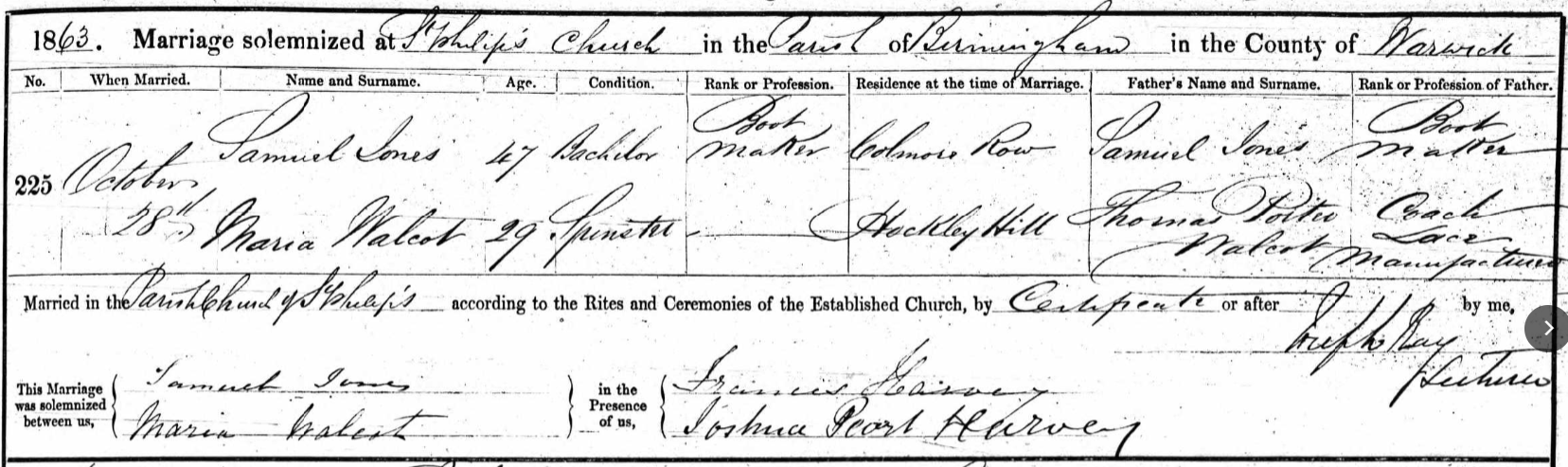
In October 1863 Samuel married Maria Walcot at St Philips in Birmingham. They don’t appear to have had any children as none appear on the 1871 census, where Samuel and Maria are living at the same address, with another female servant and two male lodgers by the name of Messant from Ipswich.
Marriage of Samuel Jones and Maria Walcot:
In 1864 Samuel’s father died. Samuel the son is mentioned in the probate records as one of the executors: “Samuel Jones of Colmore Row Birmingham in the county of Warwick boot and shoe manufacturer the son”.
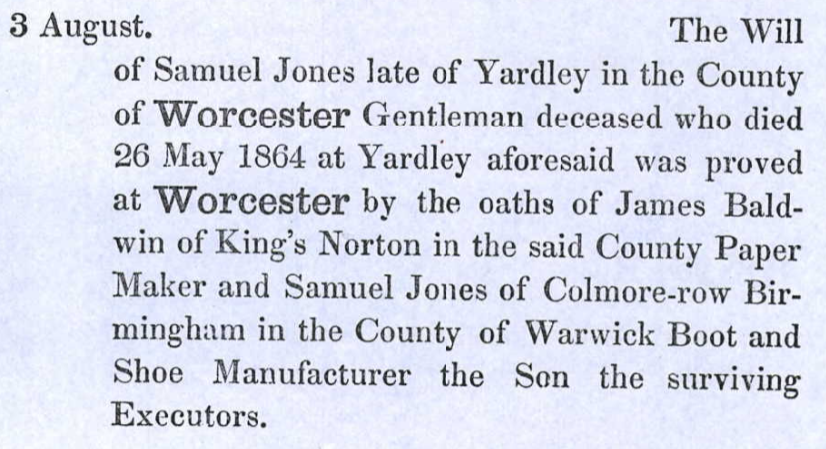
Indeed it could hardly be clearer that this Samuel Jones was not the convict transported to Australia in 1834!
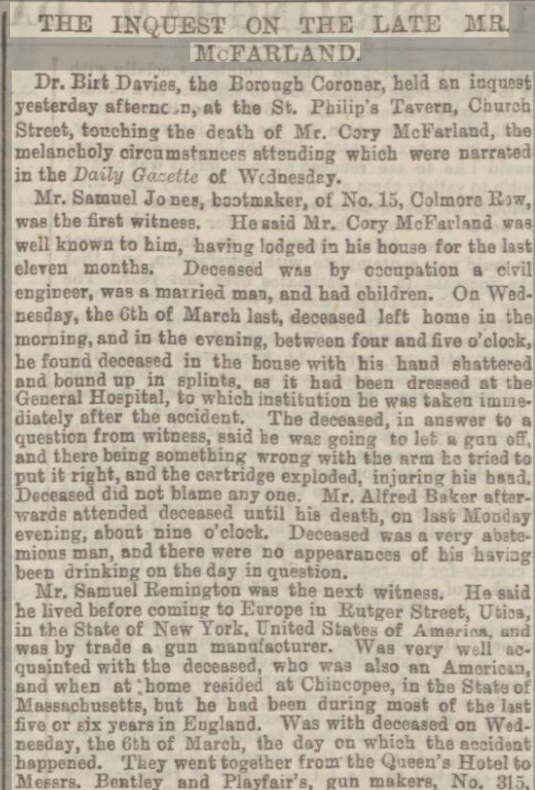
In 1867 Samuel Jones, bootmaker, was mentioned in the Birmingham Daily Gazette with regard to an unfortunate incident involving his American lodger, Cory McFarland. The verdict was accidental death.
Birmingham Daily Gazette – Friday 05 April 1867:
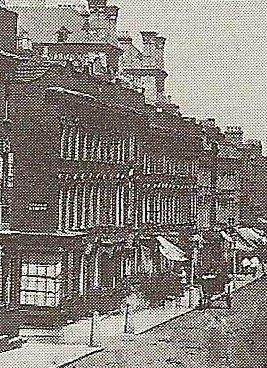
I asked a Birmingham history group for an old photo of Colmore Row. This photo is circa 1870 and number 15 is furthest from the camera. The businesses on the street at the time were as follows:
7 homeopathic chemist George John Morris. 8 surgeon dentist Frederick Sims. 9 Saul & Walter Samuel, Australian merchants. Surgeons occupied 10, pawnbroker John Aaron at 11 & 12. 15 boot & shoemaker. 17 auctioneer…
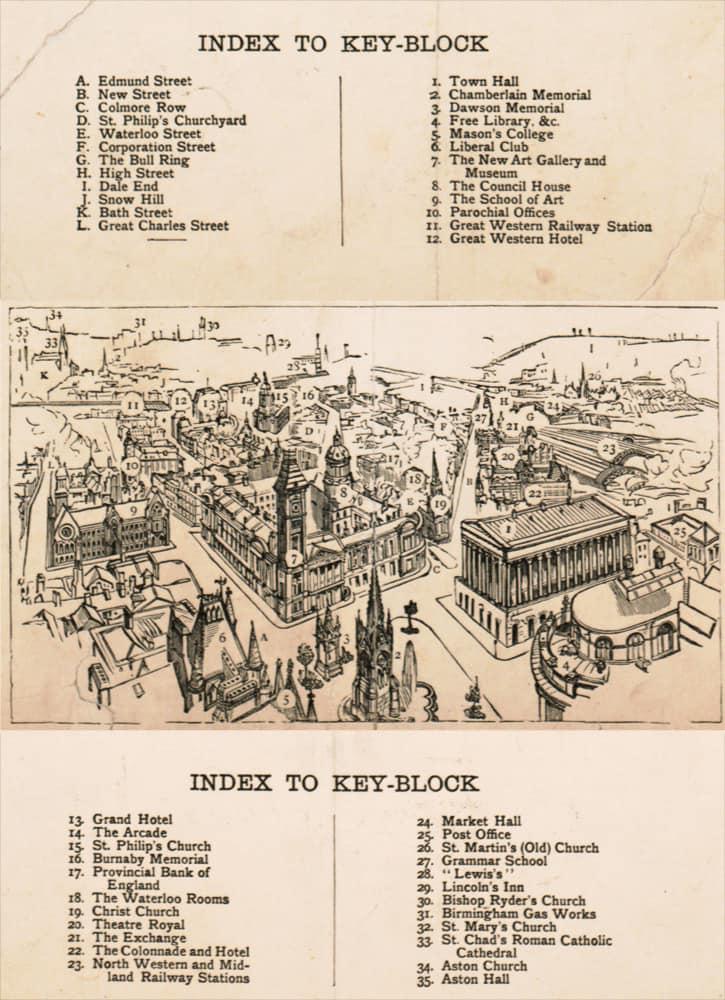
from Bird’s Eye View of Birmingham, 1886:
 December 6, 2022 at 2:17 pm #6350
In reply to: Family Stories From The Other Side ~ Book Two
Transportation
Isaac Stokes 1804-1877
Isaac was born in Churchill, Oxfordshire in 1804, and was the youngest brother of my 4X great grandfather Thomas Stokes. The Stokes family were stone masons for generations in Oxfordshire and Gloucestershire, and Isaac’s occupation was a mason’s labourer in 1834 when he was sentenced at the Lent Assizes in Oxford to fourteen years transportation for stealing tools.
Churchill where the Stokes stonemasons came from: on 31 July 1684 a fire destroyed 20 houses and many other buildings, and killed four people. The village was rebuilt higher up the hill, with stone houses instead of the old timber-framed and thatched cottages. The fire was apparently caused by a baker who, to avoid chimney tax, had knocked through the wall from her oven to her neighbour’s chimney.
Isaac stole a pick axe, the value of 2 shillings and the property of Thomas Joyner of Churchill; a kibbeaux and a trowel value 3 shillings the property of Thomas Symms; a hammer and axe value 5 shillings, property of John Keen of Sarsden.
(The word kibbeaux seems to only exists in relation to Isaac Stokes sentence and whoever was the first to write it was perhaps being creative with the spelling of a kibbo, a miners or a metal bucket. This spelling is repeated in the criminal reports and the newspaper articles about Isaac, but nowhere else).
In March 1834 the Removal of Convicts was announced in the Oxford University and City Herald: Isaac Stokes and several other prisoners were removed from the Oxford county gaol to the Justitia hulk at Woolwich “persuant to their sentences of transportation at our Lent Assizes”.
via digitalpanopticon:
Hulks were decommissioned (and often unseaworthy) ships that were moored in rivers and estuaries and refitted to become floating prisons. The outbreak of war in America in 1775 meant that it was no longer possible to transport British convicts there. Transportation as a form of punishment had started in the late seventeenth century, and following the Transportation Act of 1718, some 44,000 British convicts were sent to the American colonies. The end of this punishment presented a major problem for the authorities in London, since in the decade before 1775, two-thirds of convicts at the Old Bailey received a sentence of transportation – on average 283 convicts a year. As a result, London’s prisons quickly filled to overflowing with convicted prisoners who were sentenced to transportation but had no place to go.
To increase London’s prison capacity, in 1776 Parliament passed the “Hulks Act” (16 Geo III, c.43). Although overseen by local justices of the peace, the hulks were to be directly managed and maintained by private contractors. The first contract to run a hulk was awarded to Duncan Campbell, a former transportation contractor. In August 1776, the Justicia, a former transportation ship moored in the River Thames, became the first prison hulk. This ship soon became full and Campbell quickly introduced a number of other hulks in London; by 1778 the fleet of hulks on the Thames held 510 prisoners.
Demand was so great that new hulks were introduced across the country. There were hulks located at Deptford, Chatham, Woolwich, Gosport, Plymouth, Portsmouth, Sheerness and Cork.The Justitia via rmg collections:
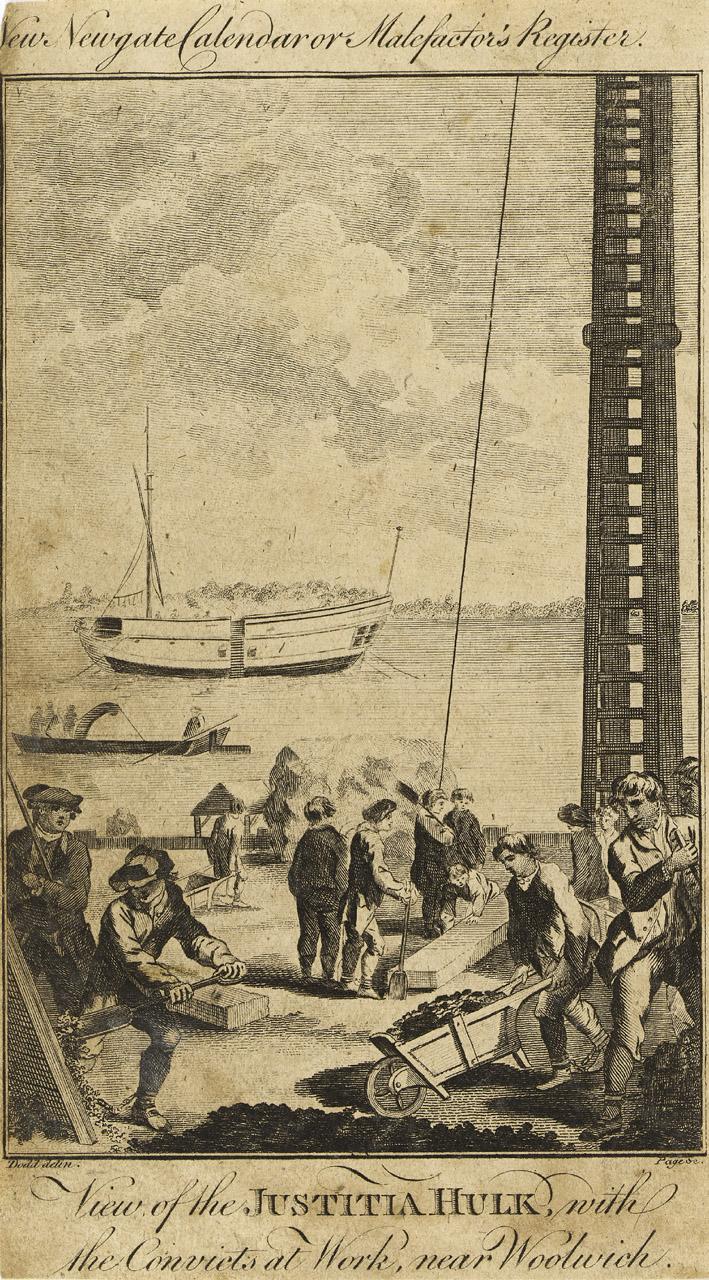
Convicts perform hard labour at the Woolwich Warren. The hulk on the river is the ‘Justitia’. Prisoners were kept on board such ships for months awaiting deportation to Australia. The ‘Justitia’ was a 260 ton prison hulk that had been originally moored in the Thames when the American War of Independence put a stop to the transportation of criminals to the former colonies. The ‘Justitia’ belonged to the shipowner Duncan Campbell, who was the Government contractor who organized the prison-hulk system at that time. Campbell was subsequently involved in the shipping of convicts to the penal colony at Botany Bay (in fact Port Jackson, later Sydney, just to the north) in New South Wales, the ‘first fleet’ going out in 1788.
While searching for records for Isaac Stokes I discovered that another Isaac Stokes was transported to New South Wales in 1835 as well. The other one was a butcher born in 1809, sentenced in London for seven years, and he sailed on the Mary Ann. Our Isaac Stokes sailed on the Lady Nugent, arriving in NSW in April 1835, having set sail from England in December 1834.
Lady Nugent was built at Bombay in 1813. She made four voyages under contract to the British East India Company (EIC). She then made two voyages transporting convicts to Australia, one to New South Wales and one to Van Diemen’s Land (Tasmania). (via Wikipedia)
via freesettlerorfelon website:
On 20 November 1834, 100 male convicts were transferred to the Lady Nugent from the Justitia Hulk and 60 from the Ganymede Hulk at Woolwich, all in apparent good health. The Lady Nugent departed Sheerness on 4 December 1834.
SURGEON OLIVER SPROULE
Oliver Sproule kept a Medical Journal from 7 November 1834 to 27 April 1835. He recorded in his journal the weather conditions they experienced in the first two weeks:
‘In the course of the first week or ten days at sea, there were eight or nine on the sick list with catarrhal affections and one with dropsy which I attribute to the cold and wet we experienced during that period beating down channel. Indeed the foremost berths in the prison at this time were so wet from leaking in that part of the ship, that I was obliged to issue dry beds and bedding to a great many of the prisoners to preserve their health, but after crossing the Bay of Biscay the weather became fine and we got the damp beds and blankets dried, the leaks partially stopped and the prison well aired and ventilated which, I am happy to say soon manifested a favourable change in the health and appearance of the men.
Besides the cases given in the journal I had a great many others to treat, some of them similar to those mentioned but the greater part consisted of boils, scalds, and contusions which would not only be too tedious to enter but I fear would be irksome to the reader. There were four births on board during the passage which did well, therefore I did not consider it necessary to give a detailed account of them in my journal the more especially as they were all favourable cases.
Regularity and cleanliness in the prison, free ventilation and as far as possible dry decks turning all the prisoners up in fine weather as we were lucky enough to have two musicians amongst the convicts, dancing was tolerated every afternoon, strict attention to personal cleanliness and also to the cooking of their victuals with regular hours for their meals, were the only prophylactic means used on this occasion, which I found to answer my expectations to the utmost extent in as much as there was not a single case of contagious or infectious nature during the whole passage with the exception of a few cases of psora which soon yielded to the usual treatment. A few cases of scurvy however appeared on board at rather an early period which I can attribute to nothing else but the wet and hardships the prisoners endured during the first three or four weeks of the passage. I was prompt in my treatment of these cases and they got well, but before we arrived at Sydney I had about thirty others to treat.’
The Lady Nugent arrived in Port Jackson on 9 April 1835 with 284 male prisoners. Two men had died at sea. The prisoners were landed on 27th April 1835 and marched to Hyde Park Barracks prior to being assigned. Ten were under the age of 14 years.
The Lady Nugent:
Isaac’s distinguishing marks are noted on various criminal registers and record books:
“Height in feet & inches: 5 4; Complexion: Ruddy; Hair: Light brown; Eyes: Hazel; Marks or Scars: Yes [including] DEVIL on lower left arm, TSIS back of left hand, WS lower right arm, MHDW back of right hand.”
Another includes more detail about Isaac’s tattoos:
“Two slight scars right side of mouth, 2 moles above right breast, figure of the devil and DEVIL and raised mole, lower left arm; anchor, seven dots half moon, TSIS and cross, back of left hand; a mallet, door post, A, mans bust, sun, WS, lower right arm; woman, MHDW and shut knife, back of right hand.”
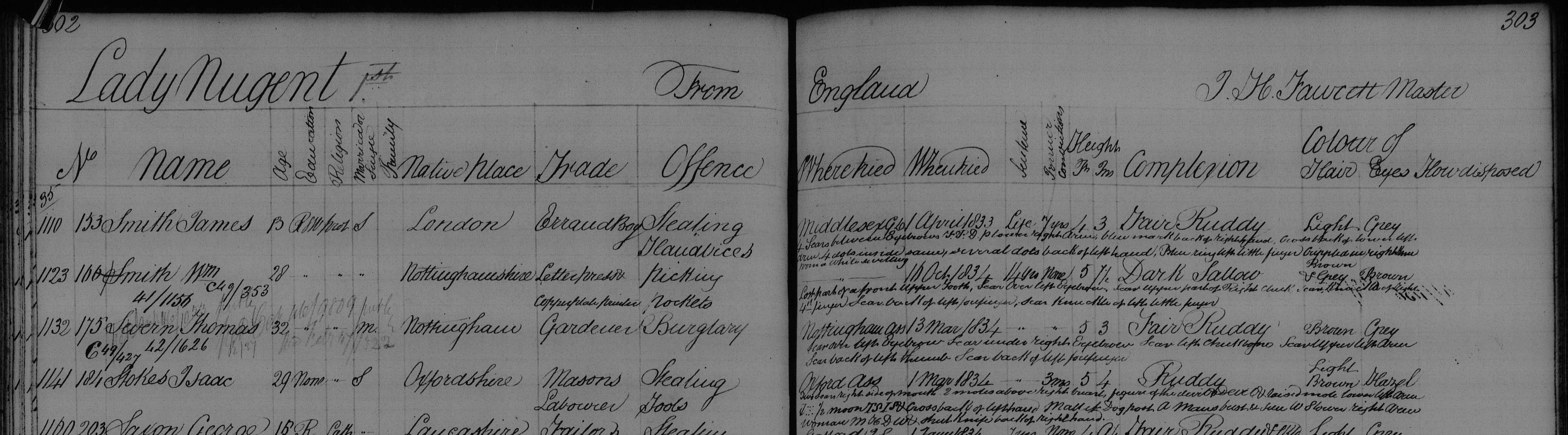
From How tattoos became fashionable in Victorian England (2019 article in TheConversation by Robert Shoemaker and Zoe Alkar):
“Historical tattooing was not restricted to sailors, soldiers and convicts, but was a growing and accepted phenomenon in Victorian England. Tattoos provide an important window into the lives of those who typically left no written records of their own. As a form of “history from below”, they give us a fleeting but intriguing understanding of the identities and emotions of ordinary people in the past.
As a practice for which typically the only record is the body itself, few systematic records survive before the advent of photography. One exception to this is the written descriptions of tattoos (and even the occasional sketch) that were kept of institutionalised people forced to submit to the recording of information about their bodies as a means of identifying them. This particularly applies to three groups – criminal convicts, soldiers and sailors. Of these, the convict records are the most voluminous and systematic.
Such records were first kept in large numbers for those who were transported to Australia from 1788 (since Australia was then an open prison) as the authorities needed some means of keeping track of them.”On the 1837 census Isaac was working for the government at Illiwarra, New South Wales. This record states that he arrived on the Lady Nugent in 1835. There are three other indent records for an Isaac Stokes in the following years, but the transcriptions don’t provide enough information to determine which Isaac Stokes it was. In April 1837 there was an abscondment, and an arrest/apprehension in May of that year, and in 1843 there was a record of convict indulgences.
From the Australian government website regarding “convict indulgences”:
“By the mid-1830s only six per cent of convicts were locked up. The vast majority worked for the government or free settlers and, with good behaviour, could earn a ticket of leave, conditional pardon or and even an absolute pardon. While under such orders convicts could earn their own living.”
In 1856 in Camden, NSW, Isaac Stokes married Catherine Daly. With no further information on this record it would be impossible to know for sure if this was the right Isaac Stokes. This couple had six children, all in the Camden area, but none of the records provided enough information. No occupation or place or date of birth recorded for Isaac Stokes.
I wrote to the National Library of Australia about the marriage record, and their reply was a surprise! Issac and Catherine were married on 30 September 1856, at the house of the Rev. Charles William Rigg, a Methodist minister, and it was recorded that Isaac was born in Edinburgh in 1821, to parents James Stokes and Sarah Ellis! The age at the time of the marriage doesn’t match Isaac’s age at death in 1877, and clearly the place of birth and parents didn’t match either. Only his fathers occupation of stone mason was correct. I wrote back to the helpful people at the library and they replied that the register was in a very poor condition and that only two and a half entries had survived at all, and that Isaac and Catherines marriage was recorded over two pages.
I searched for an Isaac Stokes born in 1821 in Edinburgh on the Scotland government website (and on all the other genealogy records sites) and didn’t find it. In fact Stokes was a very uncommon name in Scotland at the time. I also searched Australian immigration and other records for another Isaac Stokes born in Scotland or born in 1821, and found nothing. I was unable to find a single record to corroborate this mysterious other Isaac Stokes.
As the age at death in 1877 was correct, I assume that either Isaac was lying, or that some mistake was made either on the register at the home of the Methodist minster, or a subsequent mistranscription or muddle on the remnants of the surviving register. Therefore I remain convinced that the Camden stonemason Isaac Stokes was indeed our Isaac from Oxfordshire.
I found a history society newsletter article that mentioned Isaac Stokes, stone mason, had built the Glenmore church, near Camden, in 1859.
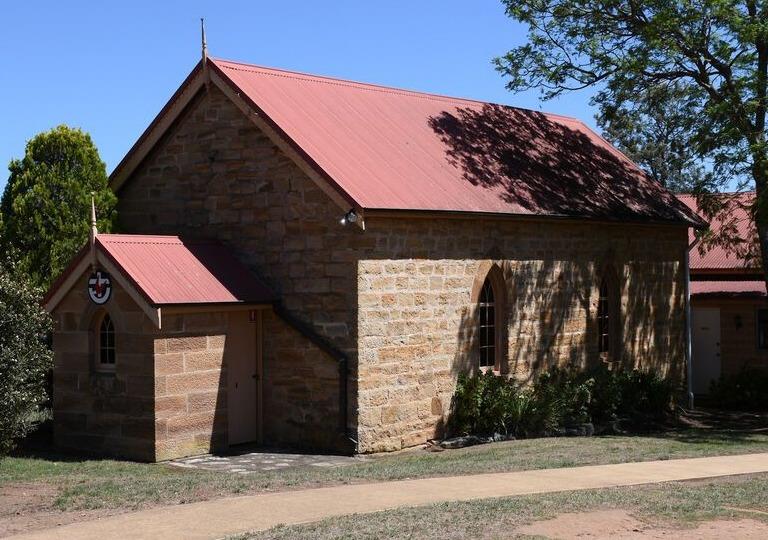
From the Wollondilly museum April 2020 newsletter:
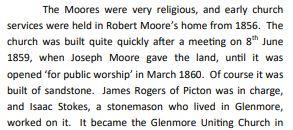
From the Camden History website:
“The stone set over the porch of Glenmore Church gives the date of 1860. The church was begun in 1859 on land given by Joseph Moore. James Rogers of Picton was given the contract to build and local builder, Mr. Stokes, carried out the work. Elizabeth Moore, wife of Edward, laid the foundation stone. The first service was held on 19th March 1860. The cemetery alongside the church contains the headstones and memorials of the areas early pioneers.”
Isaac died on the 3rd September 1877. The inquest report puts his place of death as Bagdelly, near to Camden, and another death register has put Cambelltown, also very close to Camden. His age was recorded as 71 and the inquest report states his cause of death was “rupture of one of the large pulmonary vessels of the lung”. His wife Catherine died in childbirth in 1870 at the age of 43.
Isaac and Catherine’s children:
William Stokes 1857-1928
Catherine Stokes 1859-1846
Sarah Josephine Stokes 1861-1931
Ellen Stokes 1863-1932
Rosanna Stokes 1865-1919
Louisa Stokes 1868-1844.
It’s possible that Catherine Daly was a transported convict from Ireland.
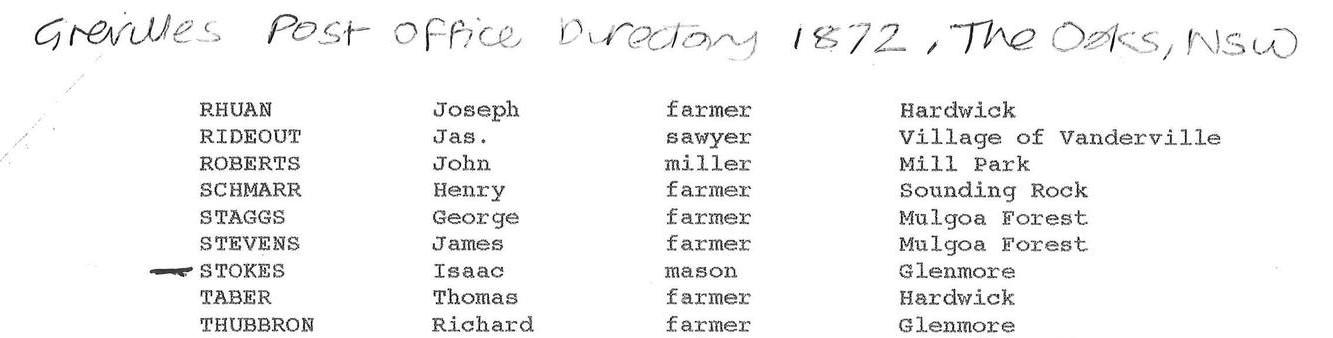
Some time later I unexpectedly received a follow up email from The Oaks Heritage Centre in Australia.
“The Gaudry papers which we have in our archive record him (Isaac Stokes) as having built: the church, the school and the teachers residence. Isaac is recorded in the General return of convicts: 1837 and in Grevilles Post Office directory 1872 as a mason in Glenmore.”
 November 18, 2022 at 4:47 pm #6348
In reply to: Family Stories From The Other Side ~ Book Two
Wong Sang
Wong Sang was born in China in 1884. In October 1916 he married Alice Stokes in Oxford.
Alice was the granddaughter of William Stokes of Churchill, Oxfordshire and William was the brother of Thomas Stokes the wheelwright (who was my 3X great grandfather). In other words Alice was my second cousin, three times removed, on my fathers paternal side.
Wong Sang was an interpreter, according to the baptism registers of his children and the Dreadnought Seamen’s Hospital admission registers in 1930. The hospital register also notes that he was employed by the Blue Funnel Line, and that his address was 11, Limehouse Causeway, E 14. (London)
“The Blue Funnel Line offered regular First-Class Passenger and Cargo Services From the UK to South Africa, Malaya, China, Japan, Australia, Java, and America. Blue Funnel Line was Owned and Operated by Alfred Holt & Co., Liverpool.
The Blue Funnel Line, so-called because its ships have a blue funnel with a black top, is more appropriately known as the Ocean Steamship Company.”Wong Sang and Alice’s daughter, Frances Eileen Sang, was born on the 14th July, 1916 and baptised in 1920 at St Stephen in Poplar, Tower Hamlets, London. The birth date is noted in the 1920 baptism register and would predate their marriage by a few months, although on the death register in 1921 her age at death is four years old and her year of birth is recorded as 1917.
Charles Ronald Sang was baptised on the same day in May 1920, but his birth is recorded as April of that year. The family were living on Morant Street, Poplar.
James William Sang’s birth is recorded on the 1939 census and on the death register in 2000 as being the 8th March 1913. This definitely would predate the 1916 marriage in Oxford.
William Norman Sang was born on the 17th October 1922 in Poplar.
Alice and the three sons were living at 11, Limehouse Causeway on the 1939 census, the same address that Wong Sang was living at when he was admitted to Dreadnought Seamen’s Hospital on the 15th January 1930. Wong Sang died in the hospital on the 8th March of that year at the age of 46.
Alice married John Patterson in 1933 in Stepney. John was living with Alice and her three sons on Limehouse Causeway on the 1939 census and his occupation was chef.
Via Old London Photographs:
“Limehouse Causeway is a street in east London that was the home to the original Chinatown of London. A combination of bomb damage during the Second World War and later redevelopment means that almost nothing is left of the original buildings of the street.”
Limehouse Causeway in 1925:
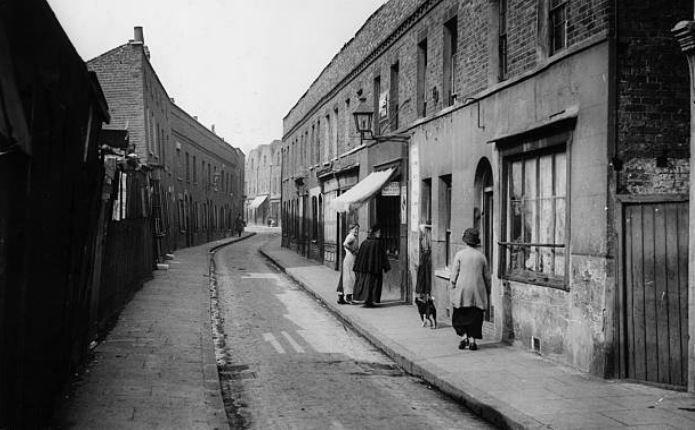
From The Story of Limehouse’s Lost Chinatown, poplarlondon website:
“Limehouse was London’s first Chinatown, home to a tightly-knit community who were demonised in popular culture and eventually erased from the cityscape.
As recounted in the BBC’s ‘Our Greatest Generation’ series, Connie was born to a Chinese father and an English mother in early 1920s Limehouse, where she used to play in the street with other British and British-Chinese children before running inside for teatime at one of their houses.
Limehouse was London’s first Chinatown between the 1880s and the 1960s, before the current Chinatown off Shaftesbury Avenue was established in the 1970s by an influx of immigrants from Hong Kong.
Connie’s memories of London’s first Chinatown as an “urban village” paint a very different picture to the seedy area portrayed in early twentieth century novels.
The pyramid in St Anne’s church marked the entrance to the opium den of Dr Fu Manchu, a criminal mastermind who threatened Western society by plotting world domination in a series of novels by Sax Rohmer.
Thomas Burke’s Limehouse Nights cemented stereotypes about prostitution, gambling and violence within the Chinese community, and whipped up anxiety about sexual relationships between Chinese men and white women.
Though neither novelist was familiar with the Chinese community, their depictions made Limehouse one of the most notorious areas of London.
Travel agent Thomas Cook even organised tours of the area for daring visitors, despite the rector of Limehouse warning that “those who look for the Limehouse of Mr Thomas Burke simply will not find it.”
All that remains is a handful of Chinese street names, such as Ming Street, Pekin Street, and Canton Street — but what was Limehouse’s chinatown really like, and why did it get swept away?
Chinese migration to Limehouse
Chinese sailors discharged from East India Company ships settled in the docklands from as early as the 1780s.
By the late nineteenth century, men from Shanghai had settled around Pennyfields Lane, while a Cantonese community lived on Limehouse Causeway.
Chinese sailors were often paid less and discriminated against by dock hirers, and so began to diversify their incomes by setting up hand laundry services and restaurants.
Old photographs show shopfronts emblazoned with Chinese characters with horse-drawn carts idling outside or Chinese men in suits and hats standing proudly in the doorways.
In oral histories collected by Yat Ming Loo, Connie’s husband Leslie doesn’t recall seeing any Chinese women as a child, since male Chinese sailors settled in London alone and married working-class English women.
In the 1920s, newspapers fear-mongered about interracial marriages, crime and gambling, and described chinatown as an East End “colony.”
Ironically, Chinese opium-smoking was also demonised in the press, despite Britain waging war against China in the mid-nineteenth century for suppressing the opium trade to alleviate addiction amongst its people.
The number of Chinese people who settled in Limehouse was also greatly exaggerated, and in reality only totalled around 300.
The real Chinatown
Although the press sought to characterise Limehouse as a monolithic Chinese community in the East End, Connie remembers seeing people of all nationalities in the shops and community spaces in Limehouse.
She doesn’t remember feeling discriminated against by other locals, though Connie does recall having her face measured and IQ tested by a member of the British Eugenics Society who was conducting research in the area.
Some of Connie’s happiest childhood memories were from her time at Chung-Hua Club, where she learned about Chinese culture and language.
Why did Chinatown disappear?
The caricature of Limehouse’s Chinatown as a den of vice hastened its erasure.
Police raids and deportations fuelled by the alarmist media coverage threatened the Chinese population of Limehouse, and slum clearance schemes to redevelop low-income areas dispersed Chinese residents in the 1930s.
The Defence of the Realm Act imposed at the beginning of the First World War criminalised opium use, gave the authorities increased powers to deport Chinese people and restricted their ability to work on British ships.
Dwindling maritime trade during World War II further stripped Chinese sailors of opportunities for employment, and any remnants of Chinatown were destroyed during the Blitz or erased by postwar development schemes.”
Wong Sang 1884-1930
The year 1918 was a troublesome one for Wong Sang, an interpreter and shipping agent for Blue Funnel Line. The Sang family were living at 156, Chrisp Street.
Chrisp Street, Poplar, in 1913 via Old London Photographs:
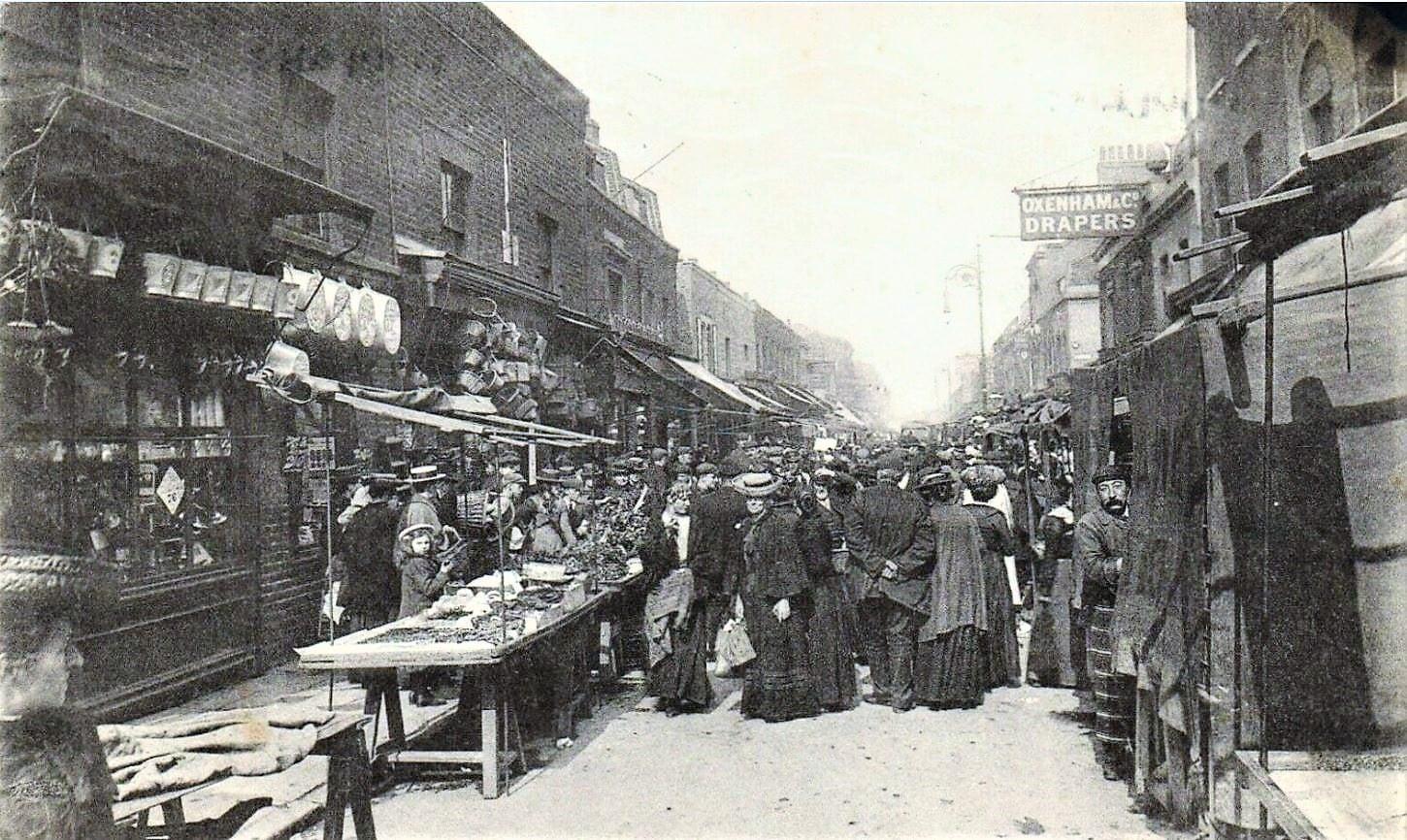
In February Wong Sang was discharged from a false accusation after defending his home from potential robbers.
East End News and London Shipping Chronicle – Friday 15 February 1918:
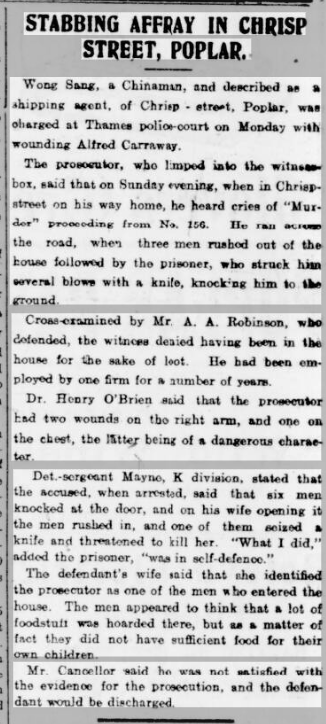
In August of that year he was involved in an incident that left him unconscious.
Faringdon Advertiser and Vale of the White Horse Gazette – Saturday 31 August 1918:
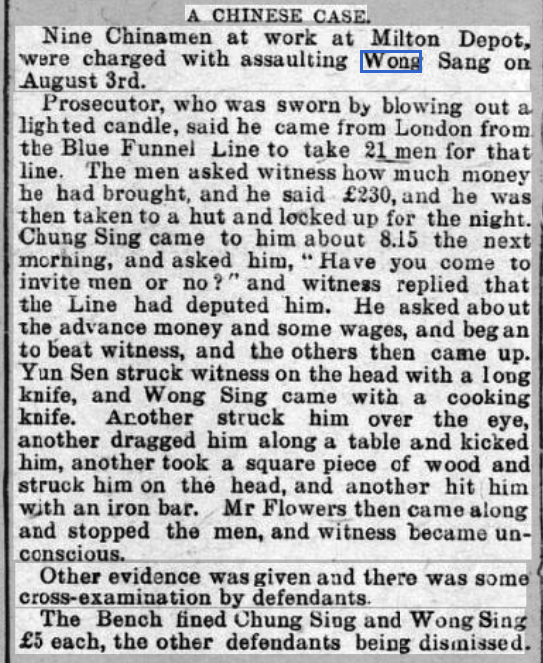
Wong Sang is mentioned in an 1922 article about “Oriental London”.
London and China Express – Thursday 09 February 1922:
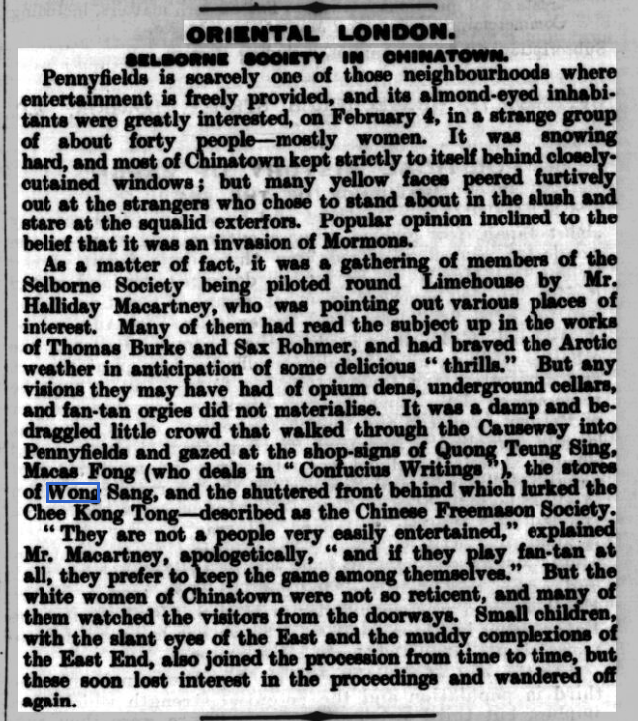
A photograph of the Chee Kong Tong Chinese Freemason Society mentioned in the above article, via Old London Photographs:
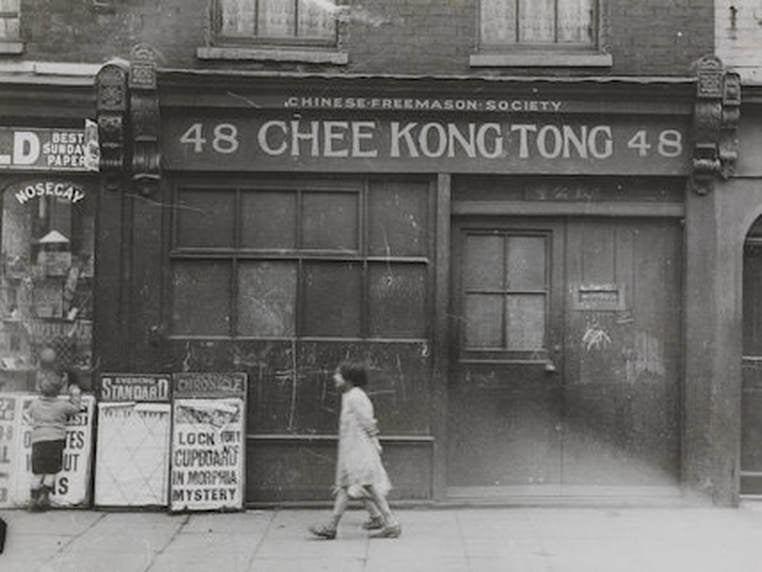
Wong Sang was recommended by the London Metropolitan Police in 1928 to assist in a case in Wellingborough, Northampton.
Difficulty of Getting an Interpreter: Northampton Mercury – Friday 16 March 1928:
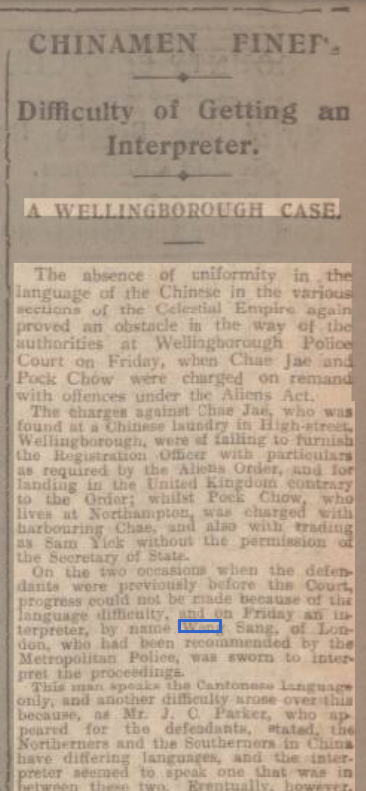
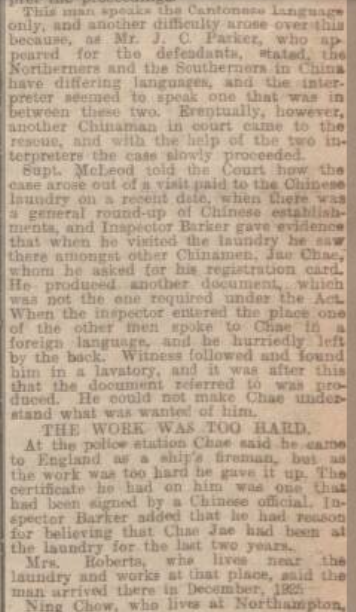
The difficulty was that “this man speaks the Cantonese language only…the Northeners and the Southerners in China have differing languages and the interpreter seemed to speak one that was in between these two.”
In 1917, Alice Wong Sang was a witness at her sister Harriet Stokes marriage to James William Watts in Southwark, London. Their father James Stokes occupation on the marriage register is foreman surveyor, but on the census he was a council roadman or labourer. (I initially rejected this as the correct marriage for Harriet because of the discrepancy with the occupations. Alice Wong Sang as a witness confirmed that it was indeed the correct one.)
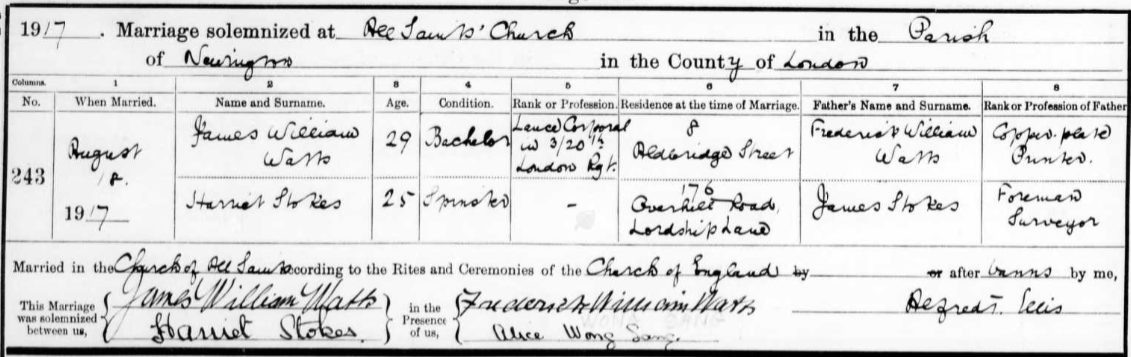
James William Sang 1913-2000 was a clock fitter and watch assembler (on the 1939 census). He married Ivy Laura Fenton in 1963 in Sidcup, Kent. James died in Southwark in 2000.
Charles Ronald Sang 1920-1974 was a draughtsman (1939 census). He married Eileen Burgess in 1947 in Marylebone. Charles and Eileen had two sons: Keith born in 1951 and Roger born in 1952. He died in 1974 in Hertfordshire.
William Norman Sang 1922-2000 was a clerk and telephone operator (1939 census). William enlisted in the Royal Artillery in 1942. He married Lily Mullins in 1949 in Bethnal Green, and they had three daughters: Marion born in 1950, Christine in 1953, and Frances in 1959. He died in Redbridge in 2000.
I then found another two births registered in Poplar by Alice Sang, both daughters. Doris Winifred Sang was born in 1925, and Patricia Margaret Sang was born in 1933 ~ three years after Wong Sang’s death. Neither of the these daughters were on the 1939 census with Alice, John Patterson and the three sons. Margaret had presumably been evacuated because of the war to a family in Taunton, Somerset. Doris would have been fourteen and I have been unable to find her in 1939 (possibly because she died in 2017 and has not had the redaction removed yet on the 1939 census as only deceased people are viewable).
Doris Winifred Sang 1925-2017 was a nursing sister. She didn’t marry, and spent a year in USA between 1954 and 1955. She stayed in London, and died at the age of ninety two in 2017.
Patricia Margaret Sang 1933-1998 was also a nurse. She married Patrick L Nicely in Stepney in 1957. Patricia and Patrick had five children in London: Sharon born 1959, Donald in 1960, Malcolm was born and died in 1966, Alison was born in 1969 and David in 1971.
I was unable to find a birth registered for Alice’s first son, James William Sang (as he appeared on the 1939 census). I found Alice Stokes on the 1911 census as a 17 year old live in servant at a tobacconist on Pekin Street, Limehouse, living with Mr Sui Fong from Hong Kong and his wife Sarah Sui Fong from Berlin. I looked for a birth registered for James William Fong instead of Sang, and found it ~ mothers maiden name Stokes, and his date of birth matched the 1939 census: 8th March, 1913.
On the 1921 census, Wong Sang is not listed as living with them but it is mentioned that Mr Wong Sang was the person returning the census. Also living with Alice and her sons James and Charles in 1921 are two visitors: (Florence) May Stokes, 17 years old, born in Woodstock, and Charles Stokes, aged 14, also born in Woodstock. May and Charles were Alice’s sister and brother.
I found Sharon Nicely on social media and she kindly shared photos of Wong Sang and Alice Stokes:
 November 14, 2022 at 12:09 pm #6346
In reply to: Family Stories From The Other Side ~ Book Two
The Mormon Browning Who Went To Utah
Isaac Browning’s (1784-1848) sister Hannah married Francis Buckingham. There were at least three Browning Buckingham marriages in Tetbury. Their daughter Charlotte married James Paskett, a shoemaker. Charlotte was born in 1818 and in 1871 she and her family emigrated to Utah, USA.
Charlotte’s relationship to me is first cousin five times removed.
James and Charlotte: (photos found online)
The house of James and Charlotte in Tetbury:
The home of James and Charlotte in Utah:
Obituary:
James Pope Paskett Dead.
Veteran of 87 Laid to rest. Special Correspondence Coalville, Summit Co., Oct 28—James Pope Paskett of Henefer died Oct. 24, 1903 of old age and general debility. Funeral services were held at Henefer today. Elders W.W. Cluff, Alma Elderge, Robert Jones, Oscar Wilkins and Bishop M.F. Harris were the speakers. There was a large attendance many coming from other wards in the stake. James Pope Paskett was born in Chippenham, Wiltshire, England, on March 12, 1817; married Chalotte Buckingham in the year 1839; eight children were born to them, three sons and five daughters, all of whom are living and residing in Utah, except one in Brisbane, Australia. Father Paskett joined the church of Jesus Christ of Latter Day Saints in 1847, and emigrated to Utah in 1871, and has resided in Henefer ever since. He leaves his faithful and aged wife. He was respected and esteemed by all who knew him.
Charlotte died in Henefer, Utah, on 27th December 1910 at the age of 91.
James and Charlotte in later life:
- Zara Patara-Smythe :: Zara (
-
AuthorSearch Results