


Search Results for 'eight'
-
AuthorSearch Results
-
January 28, 2022 at 7:57 am #6259
In reply to: The Elusive Samuel Housley and Other Family Stories
George “Mike” Rushby
A short autobiography of George Gilman Rushby’s son, published in the Blackwall Bugle, Australia.
Early in 2009, Ballina Shire Council Strategic and
Community Services Group Manager, Steve Barnier,
suggested that it would be a good idea for the Wardell
and District community to put out a bi-monthly
newsletter. I put my hand up to edit the publication and
since then, over 50 issues of “The Blackwall Bugle”
have been produced, encouraged by Ballina Shire
Council who host the newsletter on their website.
Because I usually write the stories that other people
generously share with me, I have been asked by several
community members to let them know who I am. Here is
my attempt to let you know!My father, George Gilman Rushby was born in England
in 1900. An Electrician, he migrated to Africa as a young
man to hunt and to prospect for gold. He met Eleanor
Dunbar Leslie who was a high school teacher in Cape
Town. They later married in Dar es Salaam, Tanganyika.
I was the second child and first son and was born in a
mud hut in Tanganyika in 1933. I spent my first years on
a coffee plantation. When four years old, and with
parents and elder sister on a remote goldfield, I caught
typhoid fever. I was seriously ill and had no access to
proper medical facilities. My paternal grandmother
sailed out to Africa from England on a steam ship and
took me back to England for medical treatment. My
sister Ann came too. Then Adolf Hitler started WWII and
Ann and I were separated from our parents for 9 years.Sister Ann and I were not to see him or our mother for
nine years because of the war. Dad served as a Captain in
the King’s African Rifles operating in the North African
desert, while our Mum managed the coffee plantation at
home in Tanganyika.Ann and I lived with our Grandmother and went to
school in Nottingham England. In 1946 the family was
reunited. We lived in Mbeya in Southern Tanganyika
where my father was then the District Manager of the
National Parks and Wildlife Authority. There was no
high school in Tanganyika so I had to go to school in
Nairobi, Kenya. It took five days travelling each way by
train and bus including two days on a steamer crossing
Lake Victoria.However, the school year was only two terms with long
holidays in between.When I was seventeen, I left high school. There was
then no university in East Africa. There was no work
around as Tanganyika was about to become
independent of the British Empire and become
Tanzania. Consequently jobs were reserved for
Africans.A war had broken out in Korea. I took a day off from
high school and visited the British Army headquarters
in Nairobi. I signed up for military service intending to
go to Korea. The army flew me to England. During
Army basic training I was nicknamed ‘Mike’ and have
been called Mike ever since. I never got to Korea!
After my basic training I volunteered for the Parachute
Regiment and the army sent me to Egypt where the
Suez Canal was under threat. I carried out parachute
operations in the Sinai Desert and in Cyprus and
Jordan. I was then selected for officer training and was
sent to England to the Eaton Hall Officer Cadet School
in Cheshire. Whilst in Cheshire, I met my future wife
Jeanette. I graduated as a Second Lieutenant in the
Royal Lincolnshire Regiment and was posted to West
Berlin, which was then one hundred miles behind the
Iron Curtain. My duties included patrolling the
demarcation line that separated the allies from the
Russian forces. The Berlin Wall was yet to be built. I
also did occasional duty as guard commander of the
guard at Spandau Prison where Adolf Hitler’s deputy
Rudolf Hess was the only prisoner.From Berlin, my Regiment was sent to Malaya to
undertake deep jungle operations against communist
terrorists that were attempting to overthrow the
Malayan Government. I was then a Lieutenant in
command of a platoon of about 40 men which would go
into the jungle for three weeks to a month with only air
re-supply to keep us going. On completion of my jungle
service, I returned to England and married Jeanette. I
had to stand up throughout the church wedding
ceremony because I had damaged my right knee in a
competitive cross-country motorcycle race and wore a
splint and restrictive bandage for the occasion!
At this point I took a career change and transferred
from the infantry to the Royal Military Police. I was in
charge of the security of British, French and American
troops using the autobahn link from West Germany to
the isolated Berlin. Whilst in Germany and Austria I
took up snow skiing as a sport.Jeanette and I seemed to attract unusual little
adventures along the way — each adventure trivial in
itself but adding up to give us a ‘different’ path through
life. Having climbed Mount Snowdon up the ‘easy way’
we were witness to a serious climbing accident where a
member of the staff of a Cunard Shipping Line
expedition fell and suffered serious injury. It was
Sunday a long time ago. The funicular railway was
closed. There was no telephone. So I ran all the way
down Mount Snowdon to raise the alarm.On a road trip from Verden in Germany to Berlin with
our old Opel Kapitan motor car stacked to the roof with
all our worldly possessions, we broke down on the ice and snow covered autobahn. We still had a hundred kilometres to go.A motorcycle patrolman flagged down a B-Double
tanker. He hooked us to the tanker with a very short tow
cable and off we went. The truck driver couldn’t see us
because we were too close and his truck threw up a
constant deluge of ice and snow so we couldn’t see
anyway. We survived the hundred kilometre ‘sleigh
ride!’I then went back to the other side of the world where I
carried out military police duties in Singapore and
Malaya for three years. I took up scuba diving and
loved the ocean. Jeanette and I, with our two little
daughters, took a holiday to South Africa to see my
parents. We sailed on a ship of the Holland-Afrika Line.
It broke down for four days and drifted uncontrollably
in dangerous waters off the Skeleton Coast of Namibia
until the crew could get the ship’s motor running again.
Then, in Cape Town, we were walking the beach near
Hermanus with my youngest brother and my parents,
when we found the dead body of a man who had thrown
himself off a cliff. The police came and secured the site.
Back with the army, I was promoted to Major and
appointed Provost Marshal of the ACE Mobile Force
(Allied Command Europe) with dual headquarters in
Salisbury, England and Heidelberg, Germany. The cold
war was at its height and I was on operations in Greece,
Denmark and Norway including the Arctic. I had
Norwegian, Danish, Italian and American troops in my
unit and I was then also the Winter Warfare Instructor
for the British contingent to the Allied Command
Europe Mobile Force that operated north of the Arctic
Circle.The reason for being in the Arctic Circle? From there
our special forces could look down into northern
Russia.I was not seeing much of my two young daughters. A
desk job was looming my way and I decided to leave
the army and migrate to Australia. Why Australia?
Well, I didn’t want to go back to Africa, which
seemed politically unstable and the people I most
liked working with in the army, were the Australian
troops I had met in Malaya.I migrated to Brisbane, Australia in 1970 and started
working for Woolworths. After management training,
I worked at Garden City and Brookside then became
the manager in turn of Woolworths stores at
Paddington, George Street and Redcliff. I was also the
first Director of FAUI Queensland (The Federation of
Underwater Diving Instructors) and spent my spare
time on the Great Barrier Reef. After 8 years with
Woollies, I opted for a sea change.I moved with my family to Evans Head where I
converted a convenience store into a mini
supermarket. When IGA moved into town, I decided
to take up beef cattle farming and bought a cattle
property at Collins Creek Kyogle in 1990. I loved
everything about the farm — the Charolais cattle, my
horses, my kelpie dogs, the open air, fresh water
creek, the freedom, the lifestyle. I also became a
volunteer fire fighter with the Green Pigeon Brigade.
In 2004 I sold our farm and moved to Wardell.
My wife Jeanette and I have been married for 60 years
and are now retired. We have two lovely married
daughters and three fine grandchildren. We live in the
greatest part of the world where we have been warmly
welcomed by the Wardell community and by the
Wardell Brigade of the Rural Fire Service. We are
very happy here.Mike Rushby
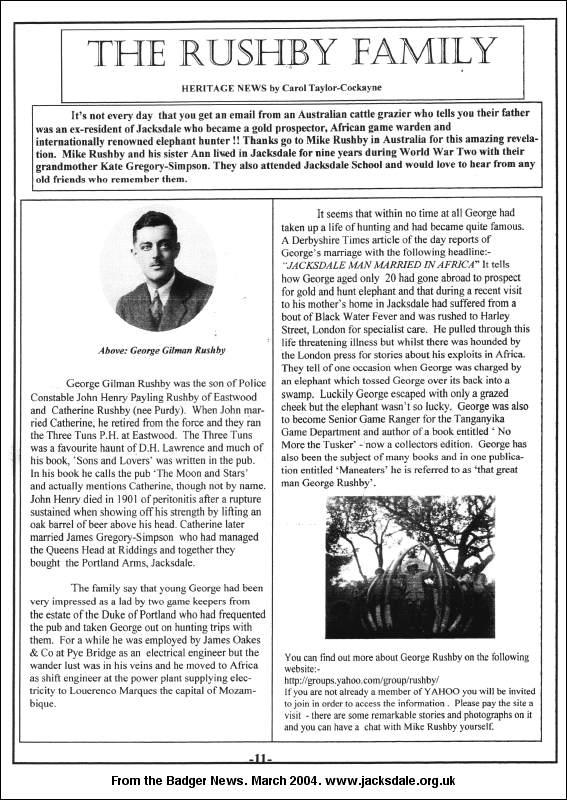
A short article sent to Jacksdale in England from Mike Rushby in Australia:
 January 23, 2022 at 6:59 pm #6258
In reply to: The Elusive Samuel Housley and Other Family Stories
The Buxton Marshalls
and the DNA Match
Several years before I started researching the family tree, a friend treated me to a DNA test just for fun. The ethnicity estimates were surprising (and still don’t make much sense): I am apparently 58% Scandinavian, 37% English, and a little Iberian, North African, and even a bit Nigerian! My ancestry according to genealogical research is almost 100% Midlands English for the past three hundred years.
Not long after doing the DNA test, I was contacted via the website by Jim Perkins, who had noticed my Marshall name on the DNA match. Jim’s grandfather was James Marshall, my great grandfather William Marshall’s brother. Jim told me he had done his family tree years before the advent of online genealogy. Jim didn’t have a photo of James, but we had several photos with “William Marshall’s brother” written on the back.
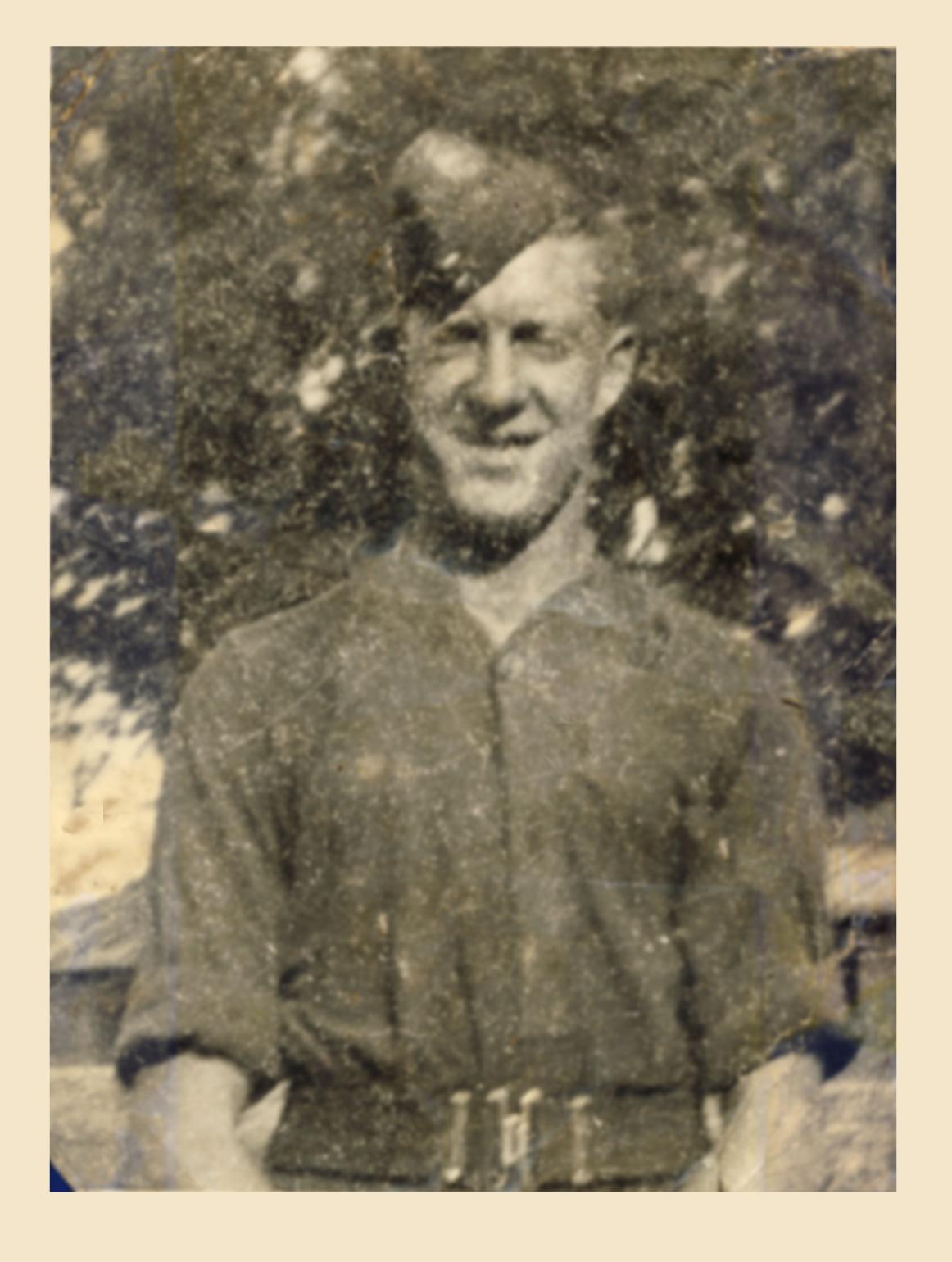
Jim sent me a photo of his uncle, the man he was named after. The photo shows Charles James Marshall in his army uniform. He escaped Dunkirk in 1940 by swimming out to a destroyer, apparently an excellent swimmer. Sadly he was killed, aged 25 and unmarried, on Sep 2 1942 at the Battle of Alma-Halfa in North Africa. Jim was born exactly one year later.
Jim and I became friends on Facebook. In 2021 a relative kindly informed me that Jim had died. I’ve since been in contact with his sister Marilyn. Jim’s grandfather James Marshall was the eldest of John and Emma’s children, born in 1873. James daughter with his first wife Martha, Hilda, married James Perkins, Jim and Marilyn’s parents. Charles James Marshall who died in North Africa was James son by a second marriage. James was a railway engine fireman on the 1911 census, and a retired rail driver on the 1939 census.
Charles James Marshall 1917-1942 died at the Battle of Alma-Halfa in North Africa:
photo thanks to Jim Perkins
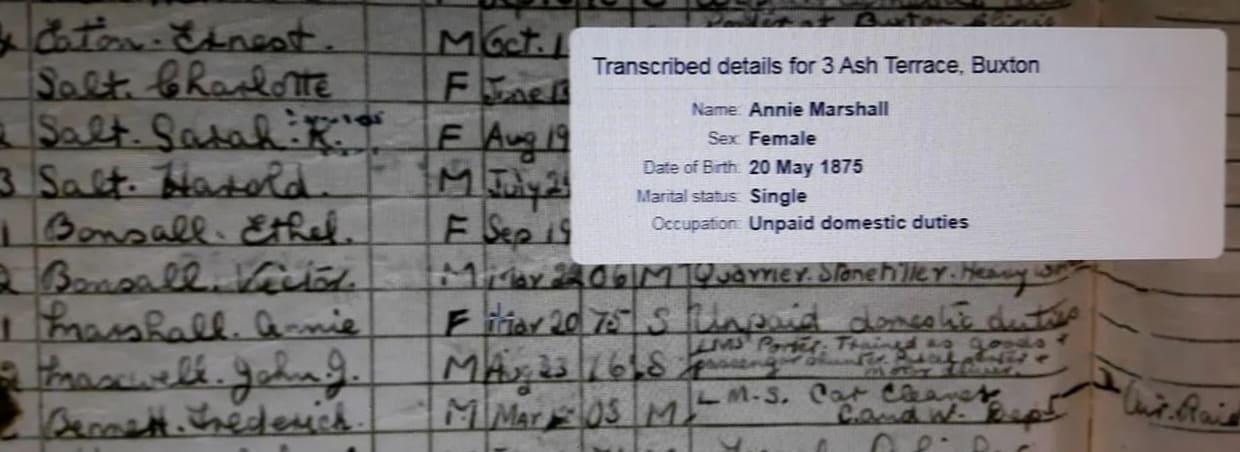
Anna Marshall, born in 1875, was a dressmaker and never married. She was still living with her parents John and Emma in Buxton on the 1921 census. One the 1939 census she was still single at the age of 66, and was living with John J Marshall born 1916. Perhaps a nephew?
John Marshall was born in 1877. Buxton is a spa town with many hotels, and John was the 2nd porter living in at the Crescent Hotel on the 1901 census, although he married later that year. In the 1911 census John was married with three children and living in Fairfield, Buxton, and his occupation was Hotel Porter and Boots. John and Alice had four children, although one son died in infancy, leaving two sons and a daughter, Lily.
My great grandfather William Marshall was born in 1878, and Edward Marshall was born in 1880. According to the family stories, one of William’s brothers was chief of police in Lincolnshire, and two of the family photos say on the back “Frank Marshall, chief of police Lincolnshire”. But it wasn’t Frank, it was Edward, and it wasn’t Lincolnshire, it was Lancashire.
The records show that Edward Marshall was a hotel porter at the Pulteney Hotel in Bath, Somerset, in 1901. Presumably he started working in hotels in Buxton prior to that. James married Florence in Bath in 1903, and their first four children were born in Bath. By 1911 the family were living in Salmesbury, near Blackburn Lancashire, and Edward was a police constable. On the 1939 census, James was a retired police inspector, still living in Lancashire. Florence and Edward had eight children.
It became clear that the two photographs we have that were labeled “Frank Marshall Chief of police” were in fact Edward, when I noticed that both photos were taken by a photographer in Bath. They were correctly labeled as the policeman, but we had the name wrong.
Edward and Florence Marshall, Bath, Somerset:
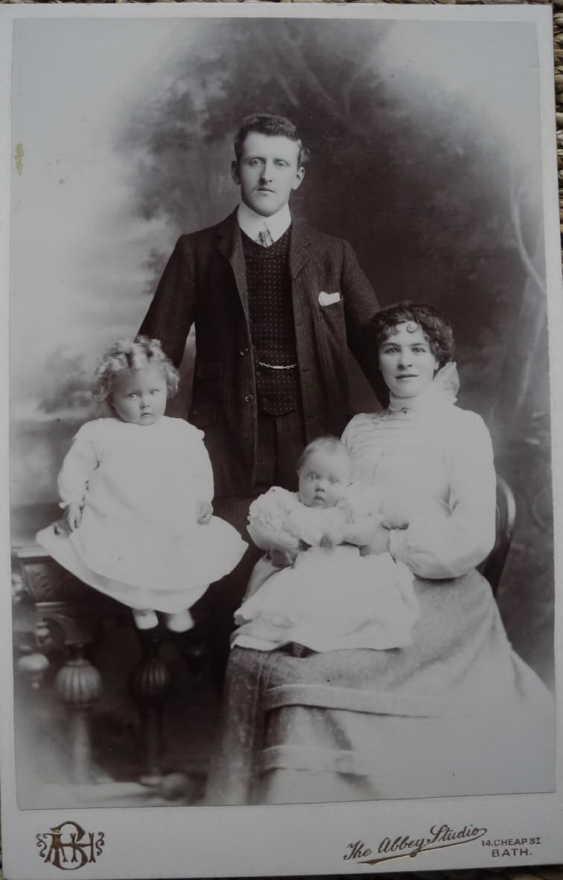
Sarah Marshall was born in 1882 and died two years later.
Nellie Marshall was born in 1885 and I have not yet found a marriage or death for her.
Harry Marshall was John and Emma’s next child, born in 1887. On the 1911 census Harry is 24 years old, and lives at home with his parents and sister Ann. His occupation is a barman in a hotel. I haven’t yet found any further records for Harry.
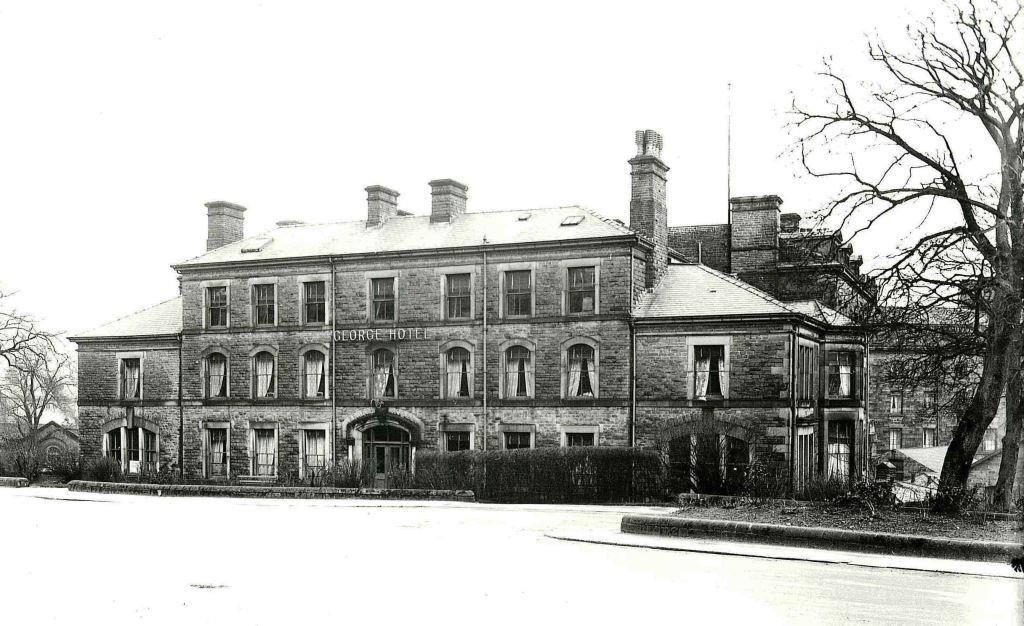
Frank Marshall was the youngest, born in 1889. In 1911 Frank was living at the George Hotel in Buxton, employed as a boot boy. Also listed as live in staff at the hotel was Lily Moss, a kitchenmaid.
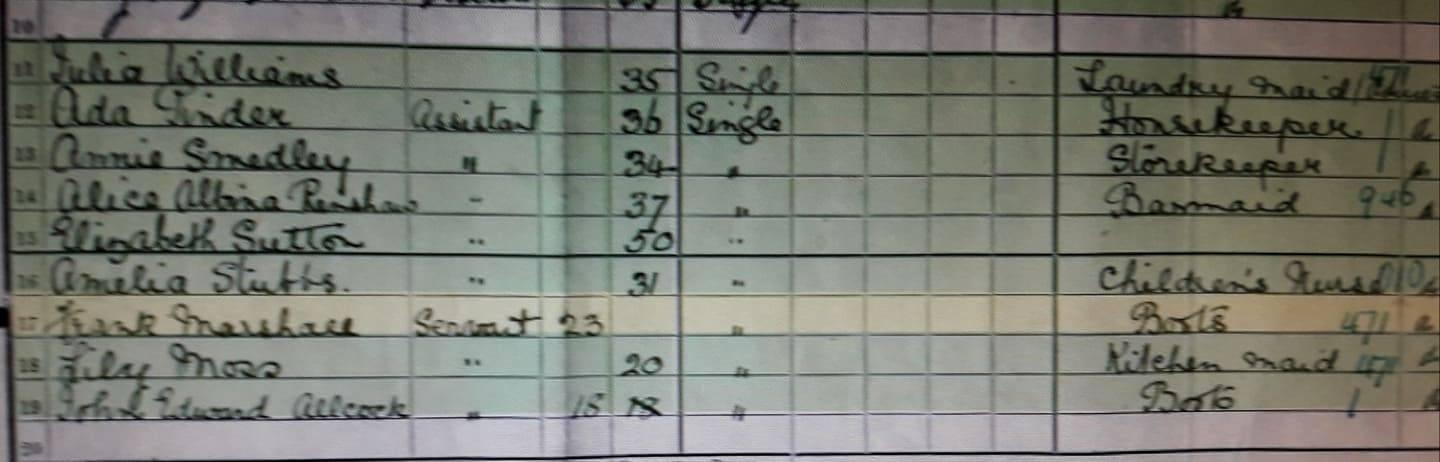
In 1913 Frank and Lily were married, and in 1914 their first child Millicent Rose was born. On the 1921 census Frank, Lily, William Rose and one other (presumably Millicent Rose) were living in Hartington Upper Quarter, Buxton.
The George Hotel, Buxton:
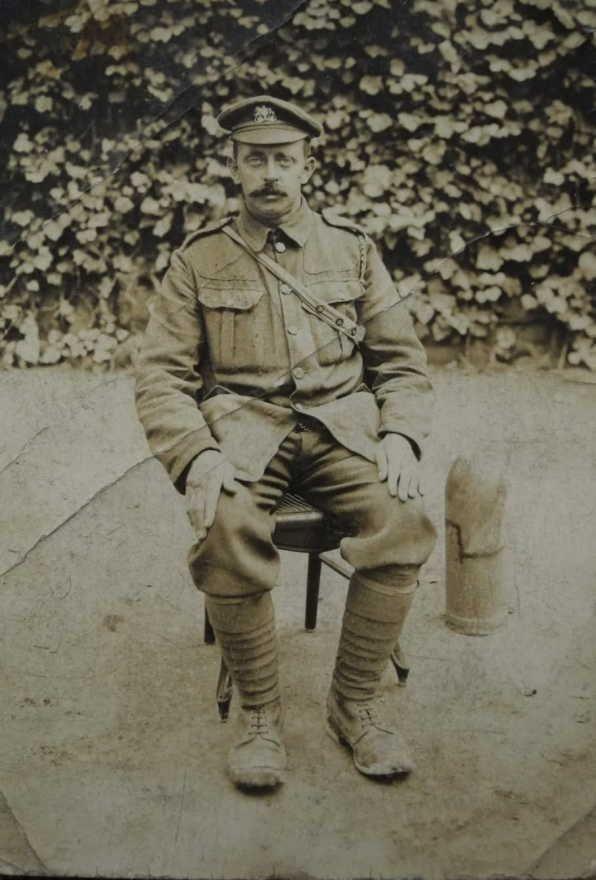
One of the photos says on the back “Jack Marshall, brother of William Marshall, WW1”:
Another photo that says on the back “William Marshalls brother”:
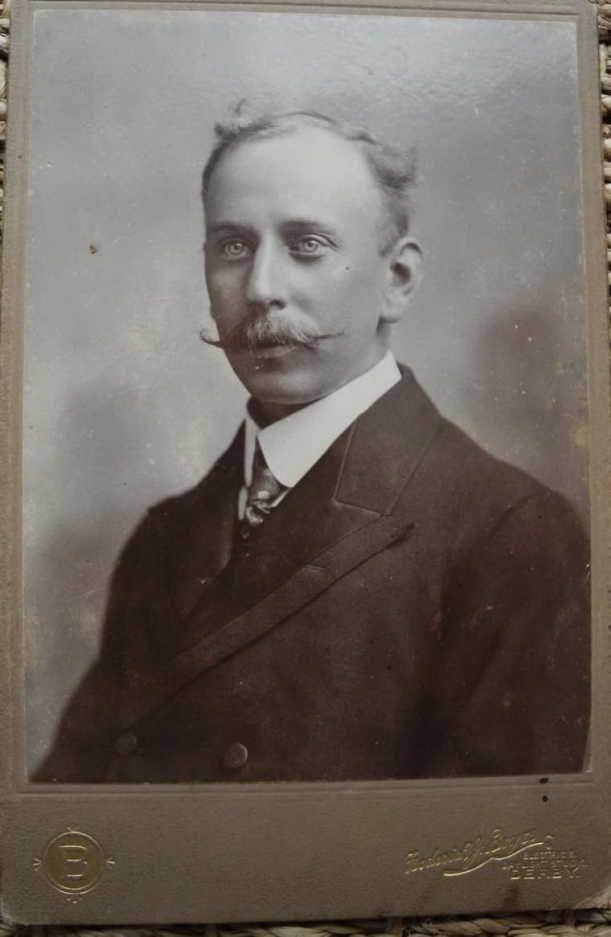
Another “William Marshalls brother”:
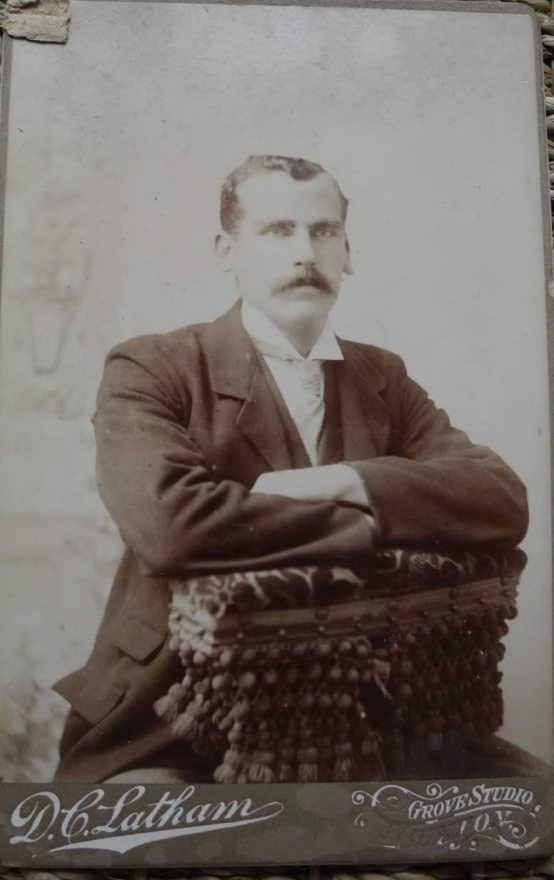
And another “William Marshalls brother”:
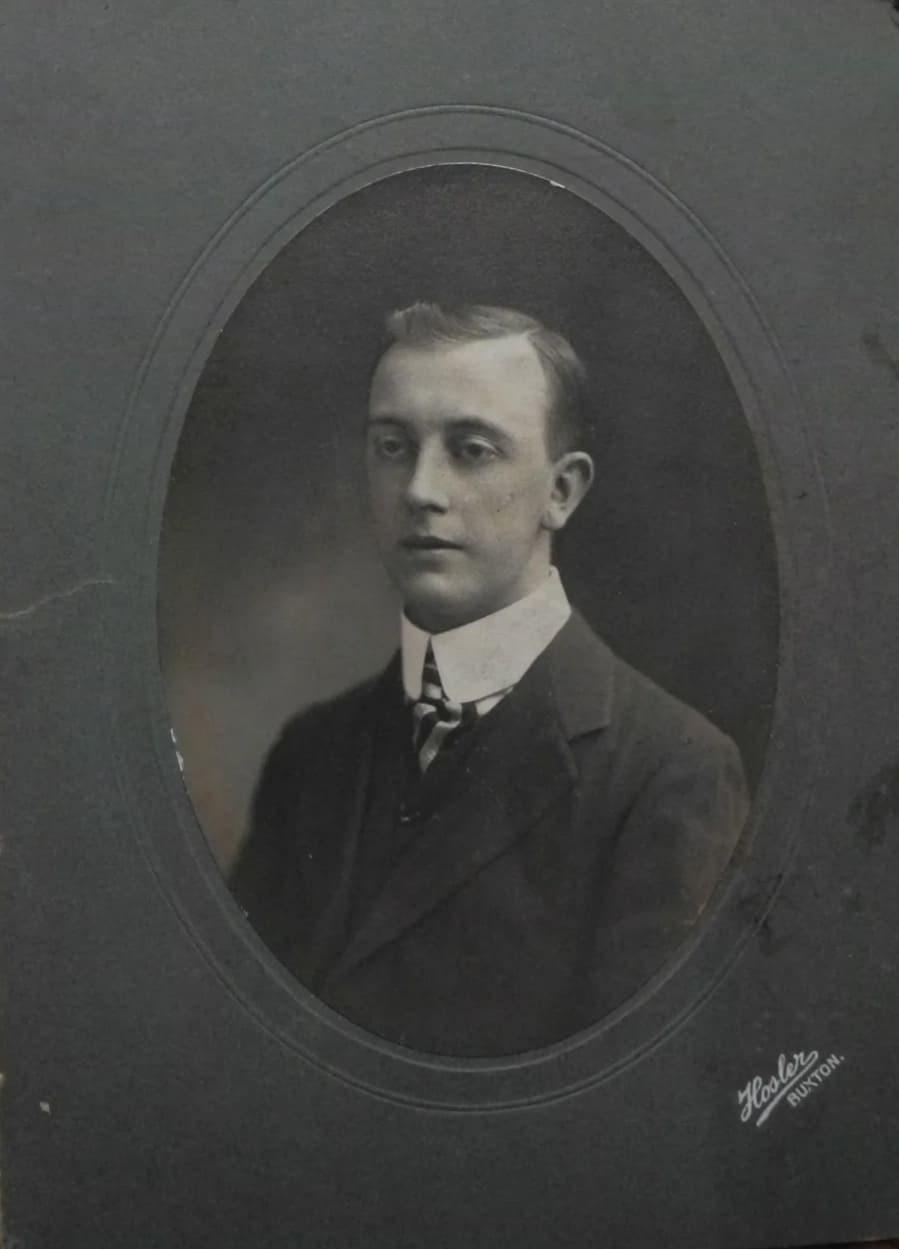
Unlabeled but clearly a Marshall:
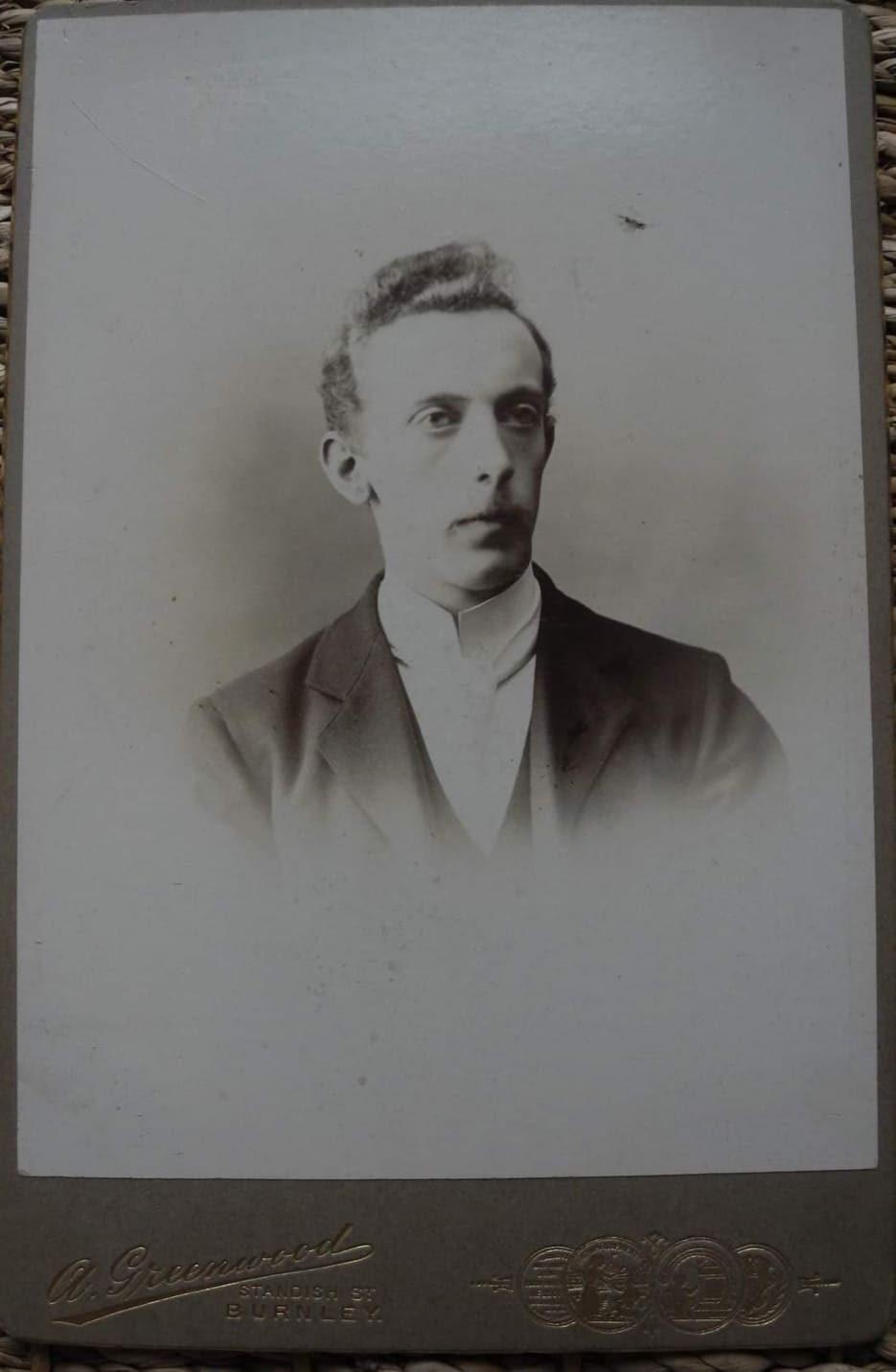
The last photo is clearly a Marshall, but I haven’t yet found a Burnley connection with any of the Marshall brothers.
January 15, 2022 at 6:54 pm #6254In reply to: The Elusive Samuel Housley and Other Family Stories
The Gladstone Connection
My grandmother had said that we were distantly related to Gladstone the prime minister. Apparently Grandma’s mothers aunt had a neice that was related to him, or some combination of aunts and nieces on the Gretton side. I had not yet explored all the potential great grandmothers aunt’s nieces looking for this Gladstone connection, but I accidentally found a Gladstone on the tree on the Gretton side.
I was wandering around randomly looking at the hints for other people that had my grandparents in their trees to see who they were and how they were connected, and noted a couple of photos of Orgills. Richard Gretton, grandma’s mother Florence Nightingale Gretton’s father, married Sarah Orgill. Sarah’s brother John Orgill married Elizabeth Mary Gladstone. It was the photographs that caught my eye, but then I saw the Gladstone name, and that she was born in Liverpool. Her father was William Gladstone born 1809 in Liverpool, just like the prime minister. And his father was John Gladstone, just like the prime minister.
But the William Gladstone in our family tree was a millwright, who emigrated to Australia with his wife and two children rather late in life at the age of 54, in 1863. He died three years later when he was thrown out of a cart in 1866. This was clearly not William Gladstone the prime minister.
John Orgill emigrated to Australia in 1865, and married Elizabeth Mary Gladstone in Victoria in 1870. Their first child was born in December that year, in Dandenong. Their three sons all have the middle name Gladstone.
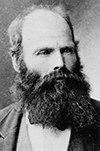
John Orgill 1835-1911 (Florence Nightingale Gretton’s mothers brother)
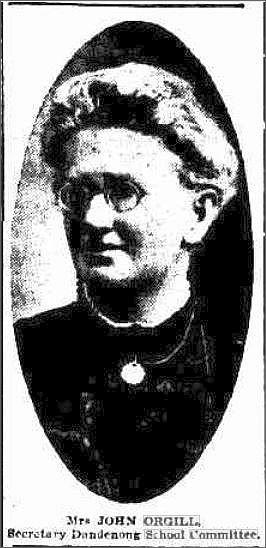
Elizabeth Mary Gladstone 1845-1926
I did not think that the link to Gladstone the prime minister was true, until I found an article in the Australian newspapers while researching the family of John Orgill for the Australia chapter.
In the Letters to the Editor in The Argus, a Melbourne newspaper, dated 8 November 1921:
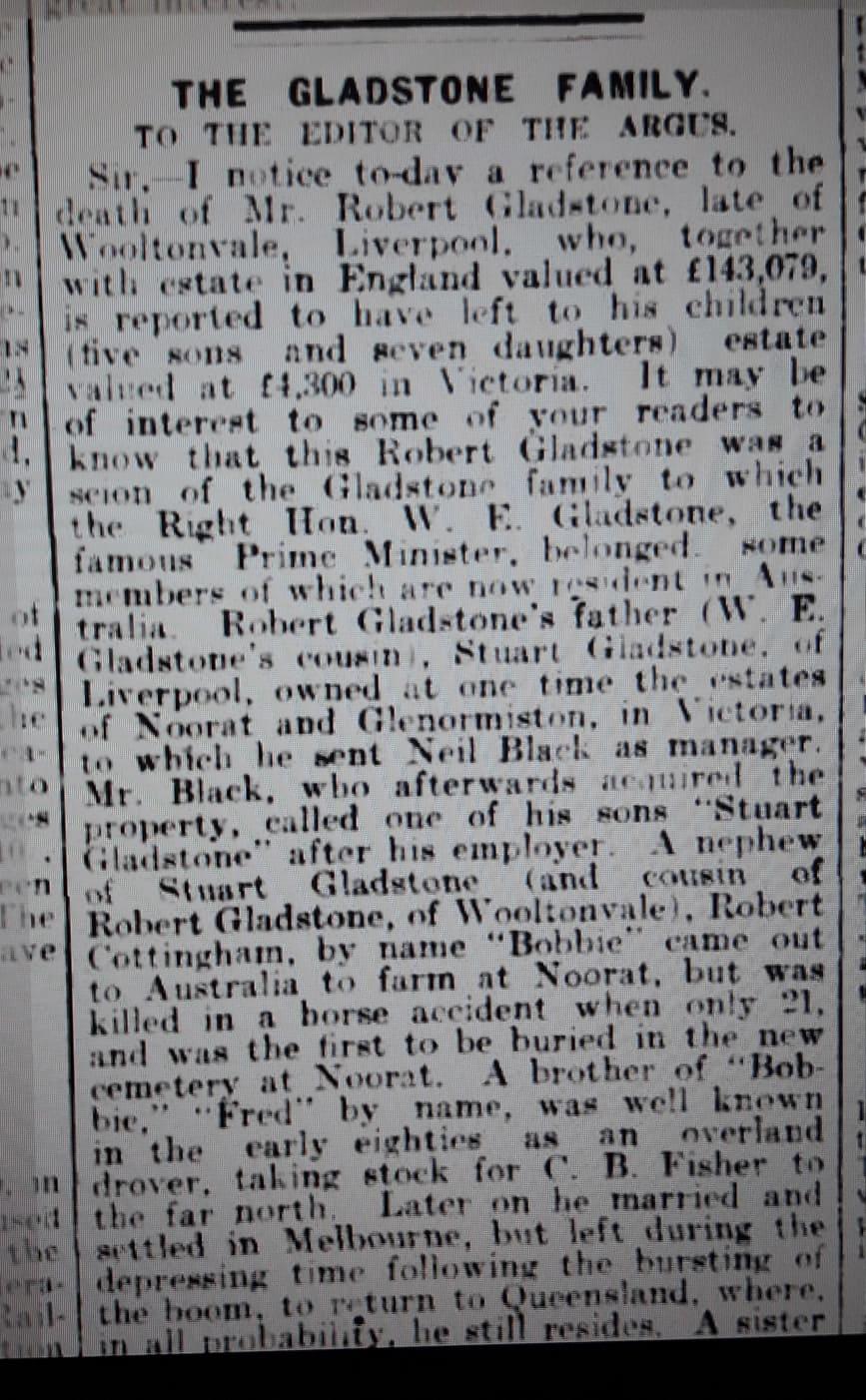
THE GLADSTONE FAMILY.
TO THE EDITOR OF THE ARGUS.
Sir,—I notice to-day a reference to the
death of Mr. Robert Gladstone, late of
Wooltonvale. Liverpool, who, together
with estate in England valued at £143,079,
is reported to have left to his children
(five sons and seven daughters) estate
valued at £4,300 in Victoria. It may be
of interest to some of your readers to
know that this Robert Gladstone was a
son of the Gladstone family to which
the Right Hon. W. E. Gladstone, the
famous Prime Minister, belonged, some
members of which are now resident in Aus-
tralia. Robert Gladstone’s father (W. E.
Gladstone’s cousin), Stuart Gladstone, of
Liverpool, owned at one time the estates
of Noorat and Glenormiston, in Victoria,
to which he sent Neil Black as manager.
Mr. Black, who afterwards acquired the
property, called one of his sons “Stuart
Gladstone” after his employer. A nephew
of Stuart Gladstone (and cousin of
Robert Gladstone, of Wooltonvale), Robert
Cottingham, by name “Bobbie” came out
to Australia to farm at Noorat, but was
killed in a horse accident when only 21,
and was the first to be buried in the new
cemetery at Noorat. A brother, of “Bob-
bie,” “Fred” by name, was well known
in the early eighties as an overland
drover, taking stock for C. B. Fisher to
the far north. Later on he married and
settled in Melbourne, but left during the
depressing time following the bursting of
the boom, to return to Queensland, where,
in all probability, he still resides. A sister
of “Bobbie” and “Fred” still lives in the
neighbourhood of Melbourne. Their
father, Montgomery Gladstone, who was in
the diplomatic service, and travelled about
a great deal, was a brother of Stuart Glad-
stone, the owner of Noorat, and a full
cousin of William Ewart Gladstone, his
father, Robert, being a brother of W. E.
Gladstone’s father, Sir John, of Liverpool.
The wife of Robert Gladstone, of Woolton-
vale, Ella Gladstone by name, was also
his second cousin, being the daughter of
Robertson Gladstone, of Courthaize, near
Liverpool, W. E. Gladstone’s older
brother.
A cousin of Sir John Gladstone
(W. E. G.’s father), also called John, was
a foundry owner in Castledouglas, and the
inventor of the first suspension bridge, a
model of which was made use of in the
erection of the Menai Bridge connecting
Anglesea with the mainland, and was after-
wards presented to the Liverpool Stock
Exchange by the inventor’s cousin, Sir
John. One of the sons of this inventive
engineer, William by name, left England
in 1863 with his wife and son and daugh-
ter, intending to settle in New Zealand,
but owing to the unrest caused there by
the Maori war, he came instead to Vic-
toria, and bought land near Dandenong.
Three years later he was killed in a horse
accident, but his name is perpetuated in
the name “Gladstone road” in Dandenong.
His daughter afterwards married, and lived
for many years in Gladstone House, Dande-
nong, but is now widowed and settled in
Gippsland. Her three sons and four daugh-
ters are all married and perpetuating the
Gladstone family in different parts of Aus-
tralia. William’s son (also called Wil-
liam), who came out with his father,
mother, and sister in 1863 still lives in the
Fix this textneighbourhood of Melbourne, with his son
and grandson. An aunt of Sir John Glad-
stone (W. E. G.’s father), Christina Glad-
stone by name, married a Mr. Somerville,
of Biggar. One of her great-grandchildren
is Professor W. P. Paterson, of Edinburgh
University, another is a professor in the
West Australian University, and a third
resides in Melbourne. Yours. &c.Melbourne, Nov.7, FAMILY TREE
According to the Old Dandenong website:
“Elizabeth Mary Orgill (nee Gladstone) operated Gladstone House until at least 1911, along with another hydropathic hospital (Birthwood) on Cheltenham road. She was the daughter of William Gladstone (Nephew of William Ewart Gladstone, UK prime minister in 1874).”
The story of the Orgill’s continues in the chapter on Australia.
January 14, 2022 at 7:27 am #6252In reply to: The Elusive Samuel Housley and Other Family Stories
The USA Housley’s
This chapter is copied from Barbara Housley’s Narrative on Historic Letters, with thanks to her brother Howard Housley for sharing it with me. Interesting to note that Housley descendants (on the Marshall paternal side) and Gretton descendants (on the Warren maternal side) were both living in Trenton, New Jersey at the same time.
GEORGE HOUSLEY 1824-1877
George emigrated to the United states in 1851, arriving in July. The solicitor Abraham John Flint referred in a letter to a 15-pound advance which was made to George on June 9, 1851. This certainly was connected to his journey. George settled along the Delaware River in Bucks County, Pennsylvania. The letters from the solicitor were addressed to: Lahaska Post Office, Bucks County, Pennsylvania. George married Sarah Ann Hill on May 6, 1854 in Doylestown, Bucks County, Pennsylvania. The service was performed by Attorney James Gilkyson.
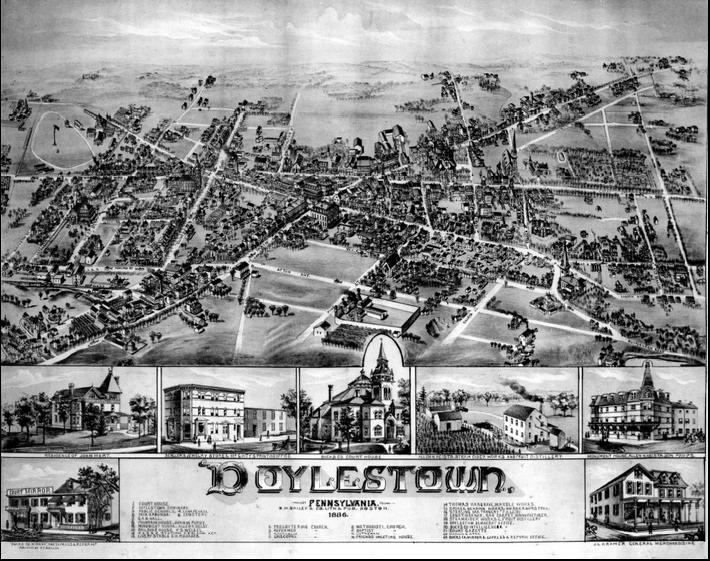
In her first letter (February 1854), Anne (George’s sister in Smalley, Derbyshire) wrote: “We want to know who and what is this Miss Hill you name in your letter. What age is she? Send us all the particulars but I would advise you not to get married until you have sufficient to make a comfortable home.”
Upon learning of George’s marriage, Anne wrote: “I hope dear brother you may be happy with your wife….I hope you will be as a son to her parents. Mother unites with me in kind love to you both and to your father and mother with best wishes for your health and happiness.” In 1872 (December) Joseph (George’s brother) wrote: “I am sorry to hear that sister’s father is so ill. It is what we must all come to some time and hope we shall meet where there is no more trouble.”
Emma (George’s sister) wrote in 1855, “We write in love to your wife and yourself and you must write soon and tell us whether there is a little nephew or niece and what you call them.” In June of 1856, Emma wrote: “We want to see dear Sarah Ann and the dear little boy. We were much pleased with the “bit of news” you sent.” The bit of news was the birth of John Eley Housley, January 11, 1855. Emma concluded her letter “Give our very kindest love to dear sister and dearest Johnnie.”
According to his obituary, John Eley was born at Wrightstown and “removed” to Lumberville at the age of 19. John was married first to Lucy Wilson with whom he had three sons: George Wilson (1883), Howard (1893) and Raymond (1895); and then to Elizabeth Kilmer with whom he had one son Albert Kilmer (1907). John Eley Housley died November 20, 1926 at the age of 71. For many years he had worked for John R. Johnson who owned a store. According to his son Albert, John was responsible for caring for Johnson’s horses. One named Rex was considered to be quite wild, but was docile in John’s hands. When John would take orders, he would leave the wagon at the first house and walk along the backs of the houses so that he would have access to the kitchens. When he reached the seventh house he would climb back over the fence to the road and whistle for the horses who would come to meet him. John could not attend church on Sunday mornings because he was working with the horses and occasionally Albert could convince his mother that he was needed also. According to Albert, John was regular in attendance at church on Sunday evenings.
John was a member of the Carversville Lodge 261 IOOF and the Carversville Lodge Knights of Pythias. Internment was in the Carversville cemetery; not, however, in the plot owned by his father. In addition to his sons, he was survived by his second wife Elizabeth who lived to be 80 and three grandchildren: George’s sons, Kenneth Worman and Morris Wilson and Raymond’s daughter Miriam Louise. George had married Katie Worman about the time John Eley married Elizabeth Kilmer. Howard’s first wife Mary Brink and daughter Florence had died and he remarried Elsa Heed who also lived into her eighties. Raymond’s wife was Fanny Culver.
Two more sons followed: Joseph Sackett, who was known as Sackett, September 12, 1856 and Edwin or Edward Rose, November 11, 1858. Joseph Sackett Housley married Anna Hubbs of Plumsteadville on January 17, 1880. They had one son Nelson DeC. who in turn had two daughters, Eleanor Mary and Ruth Anna, and lived on Bert Avenue in Trenton N.J. near St. Francis Hospital. Nelson, who was an engineer and built the first cement road in New Jersey, died at the age of 51. His daughters were both single at the time of his death. However, when his widow, the former Eva M. Edwards, died some years later, her survivors included daughters, Mrs. Herbert D. VanSciver and Mrs. James J. McCarrell and four grandchildren. One of the daughters (the younger) was quite crippled in later years and would come to visit her great-aunt Elizabeth (John’s widow) in a chauffeur driven car. Sackett died in 1929 at the age of 70. He was a member of the Warrington Lodge IOOF of Jamison PA, the Uncas tribe and the Uncas Hayloft 102 ORM of Trenton, New Jersey. The interment was in Greenwood cemetery where he had been caretaker since his retirement from one of the oldest manufacturing plants in Trenton (made milk separators for one thing). Sackett also was the caretaker for two other cemeteries one located near the Clinton Street station and the other called Riverside.
Ed’s wife was named Lydia. They had two daughters, Mary and Margaret and a third child who died in infancy. Mary had seven children–one was named for his grandfather–and settled in lower Bucks county. Margaret never married. She worked for Woolworths in Flemington, N. J. and then was made manager in Somerville, N.J., where she lived until her death. Ed survived both of his brothers, and at the time of Sackett’s death was living in Flemington, New Jersey where he had worked as a grocery clerk.
In September 1872, Joseph wrote, “I was very sorry to hear that John your oldest had met with such a sad accident but I hope he is got alright again by this time.” In the same letter, Joseph asked: “Now I want to know what sort of a town you are living in or village. How far is it from New York? Now send me all particulars if you please.”
In March 1873 Harriet asked Sarah Ann: “And will you please send me all the news at the place and what it is like for it seems to me that it is a wild place but you must tell me what it is like….” The question of whether she was referring to Bucks County, Pennsylvania or some other place is raised in Joseph’s letter of the same week.
On March 17, 1873, Joseph wrote: “I was surprised to hear that you had gone so far away west. Now dear brother what ever are you doing there so far away from home and family–looking out for something better I suppose.” The solicitor wrote on May 23, 1874: “Lately I have not written because I was not certain of your address and because I doubted I had much interesting news to tell you.” Later, Joseph wrote concerning the problems settling the estate, “You see dear brother there is only me here on our side and I cannot do much. I wish you were here to help me a bit and if you think of going for another summer trip this turn you might as well run over here.”
Apparently, George had indicated he might return to England for a visit in 1856. Emma wrote concerning the portrait of their mother which had been sent to George: “I hope you like mother’s portrait. I did not see it but I suppose it was not quite perfect about the eyes….Joseph and I intend having ours taken for you when you come over….Do come over before very long.”
In March 1873, Joseph wrote: “You ask me what I think of you coming to England. I think as you have given the trustee power to sign for you I think you could do no good but I should like to see you once again for all that. I can’t say whether there would be anything amiss if you did come as you say it would be throwing good money after bad.”
On June 10, 1875, the solicitor wrote: “I have been expecting to hear from you for some time past. Please let me hear what you are doing and where you are living and how I must send you your money.” George’s big news at that time was that on May 3, 1875, he had become a naturalized citizen “renouncing and abjuring all allegiance and fidelity to every foreign prince, potentate, state and sovereignity whatsoever, and particularly to Victoria Queen of Great Britain of whom he was before a subject.”
Another matter which George took care of during the years the estate was being settled was the purchase of a cemetery plot! On March 24, 1873, George purchased plot 67 section 19 division 2 in the Carversville (Bucks County PA) Cemetery (incorporated 1859). The plot cost $15.00, and was located at the very edge of the cemetery. It was in this cemetery, in 1991, while attending the funeral of Sarah Lord Housley, wife of Albert Kilmer Housley, that sixteen month old Laura Ann visited the graves of her great-great-great grandparents, George and Sarah Ann Hill Housley.
George died on August 13, 1877 and was buried three days later. The text for the funeral sermon was Proverbs 27:1: “Do not boast about tomorrow, for you do not know what a day may bring forth.”
January 1, 2022 at 10:21 am #6249In reply to: The Elusive Samuel Housley and Other Family Stories
Grettons in USA and The Lusitania Survivor
Two of my grandmothers uncles emigrated to New Jersey, USA, John Orgill Gretton in 1888, and Michael Thomas Gretton in 1889. My grandmothers mother Florence Nightingale Gretton, born in 1881 and the youngest of eight, was still a child when they left. This is perhaps why we knew nothing of them until the family research started.
Michael Thomas Gretton
1870-1940
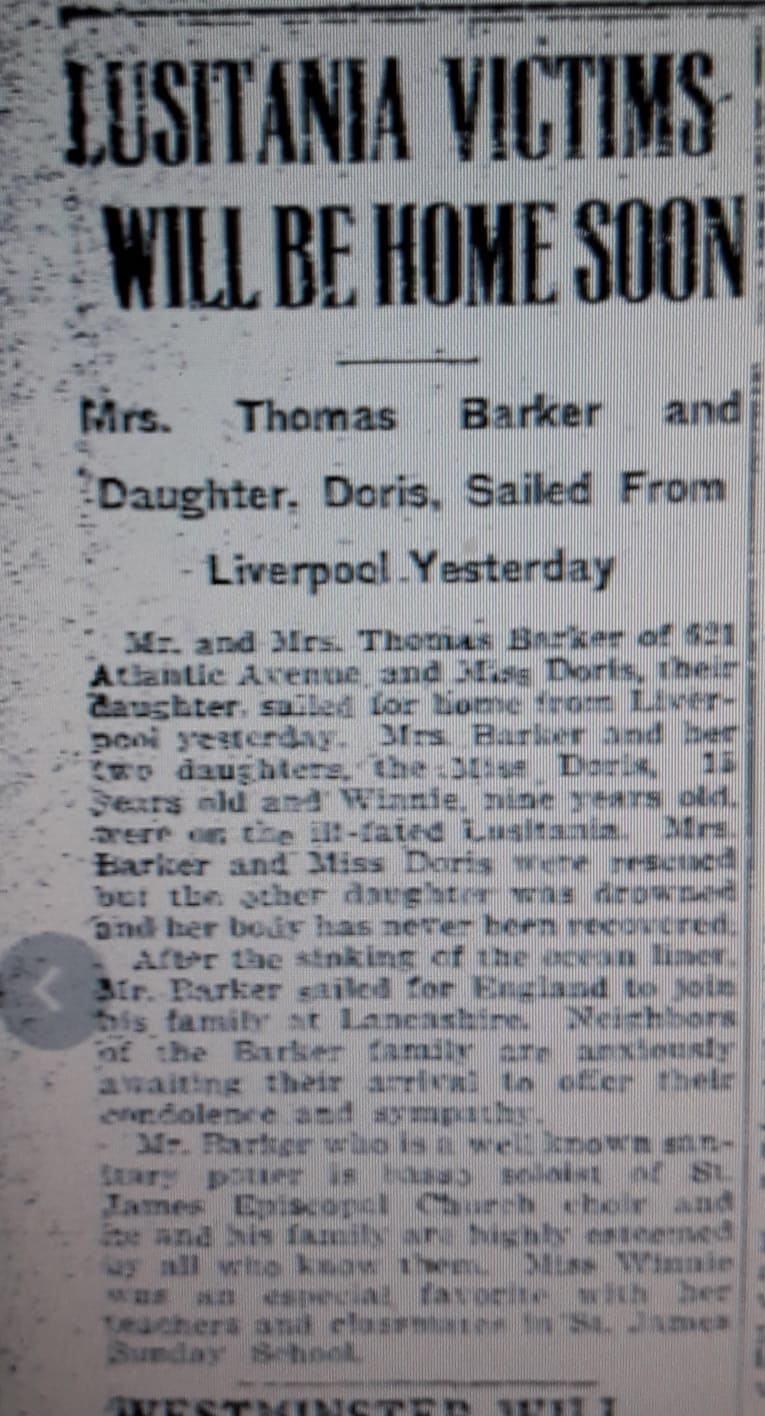
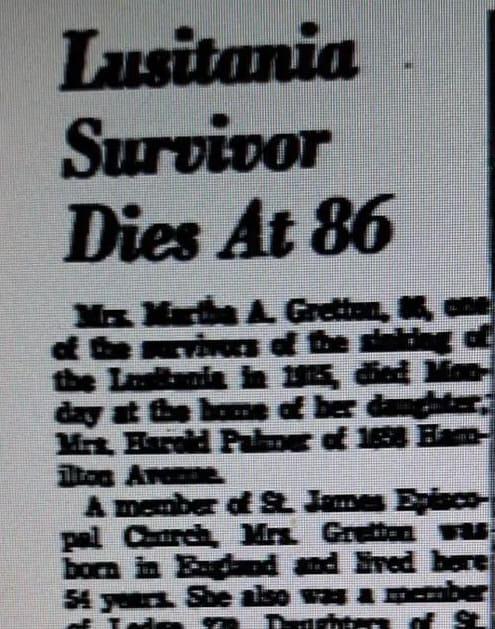
Michael, known by his middle name of Thomas, married twice. His occupation was a potter in the sanitary ware industry. He and his first wife Edith Wise had three children, William R Gretton 1894-1961, Charles Thomas Gretton 1897-1960, and Clara P Gretton 1895-1997. Edith died in 1922, and Thomas married again. His second wife Martha Ann Barker was born in Stoke on Trent in England, but had emigrated to USA in 1909. She had two children with her first husband Thomas Barker, Doris and Winifred. Thomas Barker died in 1921.
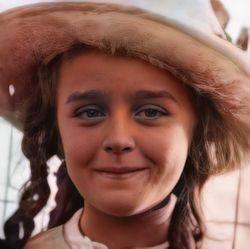
Martha Ann Barker and her daughter Doris, born in 1900, were Lusitania survivors. The Lusitania was a British ocean liner that was sunk on 7 May 1915 by a German U-boat 11 miles (18 km) off the southern coast of Ireland, killing 1,198 passengers and crew. Martha and Doris survived, but sadly nine year old Winifred did not. Her remains were lost at sea.
Winifred Barker:
Thomas Barker sailed to England after the disaster to accompany Martha and Doris on the trip home to USA:
Thomas Gretton, Martha’s second husband, died in 1940. She survived him by 23 years and died in 1963 in New Jersey:
John Orgill Gretton
1868-1949
John Orgill Gretton was a “Freeholder” in New Jersey for 24 years. New Jersey alone of all the United States has the distinction of retaining the title of “FREEHOLDER” to denote the elected members of the county governing bodies. This descriptive name, which commemorates the origin of home rule, is used by only 21 of the nation’s 3,047 counties. In other states, these county officials are known as commissioners, supervisors, probate judges, police jurors, councilors and a variety of other names.
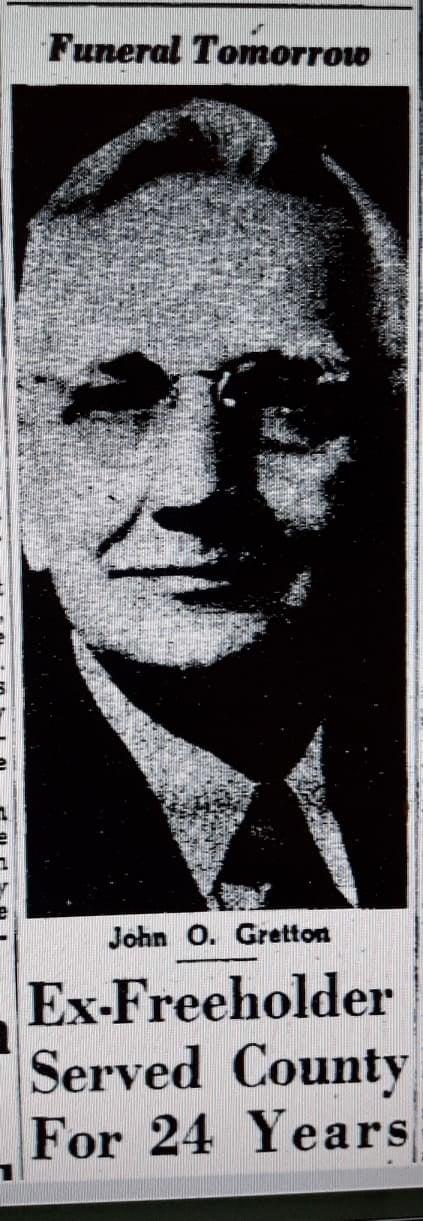
John and his wife Caroline Thum had four children, Florence J Gretton 1893-1965, George Thum Gretton 1895-1951, Wilhelmina F Gretton 1899-1931, and Nathalie A Gretton 1904-1947.
Their engagements and weddings appear on the society pages of the Trenton Newspapers. For example the article headline on the wedding in 1919 of George Thum Gretton and his wife Elizabeth Stokes announces “Charming Society Girl Becomes Bride Today”.
December 25, 2021 at 10:47 am #6248In reply to: The Elusive Samuel Housley and Other Family Stories
Bakewell Not Eyam
The Elton Marshalls
Some years ago I read a book about Eyam, the Derbyshire village devastated by the plague in 1665, and about how the villagers quarantined themselves to prevent further spread. It was quite a story. Each year on ‘Plague Sunday’, at the end of August, residents of Eyam mark the bubonic plague epidemic that devastated their small rural community in the years 1665–6. They wear the traditional costume of the day and attend a memorial service to remember how half the village sacrificed themselves to avoid spreading the disease further.
My 4X great grandfather James Marshall married Ann Newton in 1792 in Elton. On a number of other people’s trees on an online ancestry site, Ann Newton was from Eyam. Wouldn’t that have been interesting, to find ancestors from Eyam, perhaps going back to the days of the plague. Perhaps that is what the people who put Ann Newton’s birthplace as Eyam thought, without a proper look at the records.
But I didn’t think Ann Newton was from Eyam. I found she was from Over Haddon, near Bakewell ~ much closer to Elton than Eyam. On the marriage register, it says that James was from Elton parish, and she was from Darley parish. Her birth in 1770 says Bakewell, which was the registration district for the villages of Over Haddon and Darley. Her parents were George Newton and Dorothy Wipperley of Over Haddon,which is incidentally very near to Nether Haddon, and Haddon Hall. I visited Haddon Hall many years ago, as well as Chatsworth (and much preferred Haddon Hall).
I looked in the Eyam registers for Ann Newton, and found a couple of them around the time frame, but the men they married were not James Marshall.
Ann died in 1806 in Elton (a small village just outside Matlock) at the age of 36 within days of her newborn twins, Ann and James. James and Ann had two sets of twins. John and Mary were twins as well, but Mary died in 1799 at the age of three.
1796 baptism of twins John and Mary of James and Ann Marshall
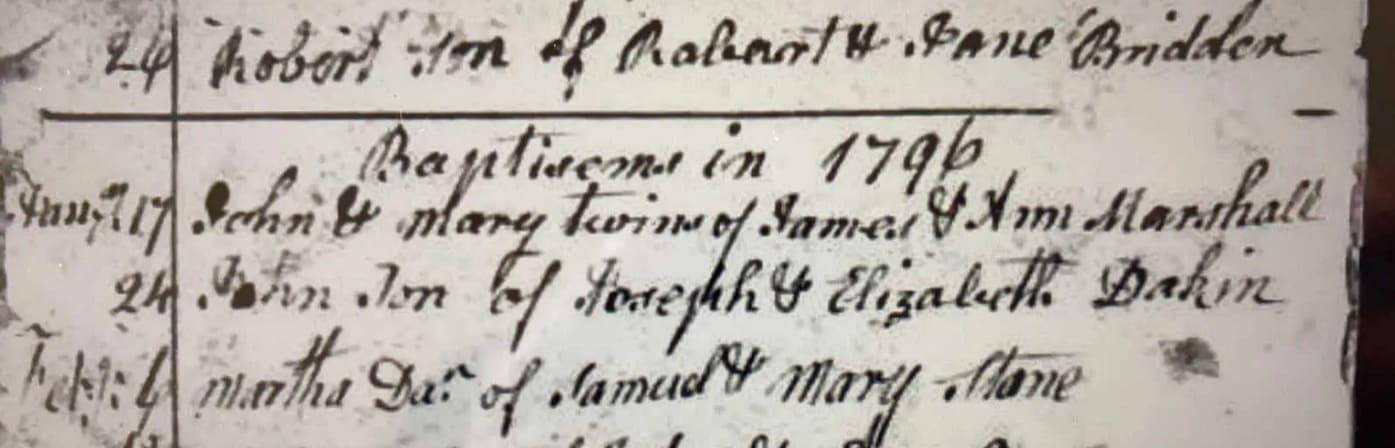
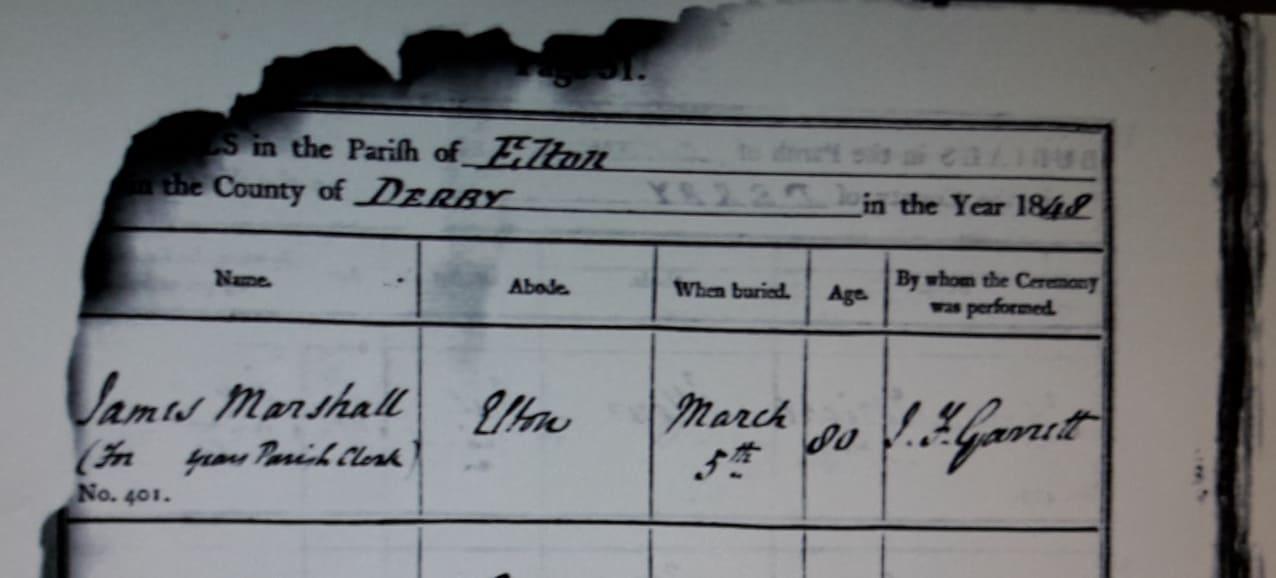
Ann’s husband James died 42 years later at the age of eighty, in Elton in 1848. It was noted in the parish register that he was for years parish clerk.
On the 1851 census John Marshall born in 1796, the son of James Marshall the parish clerk, was a lead miner occupying six acres in Elton, Derbyshire.
His son, also John, was registered on the census as a lead miner at just eight years old.
The mining of lead was the most important industry in the Peak district of Derbyshire from Roman times until the 19th century – with only agriculture being more important for the livelihood of local people. The height of lead mining in Derbyshire came in the 17th and 18th centuries, and the evidence is still visible today – most obviously in the form of lines of hillocks from the more than 25,000 mineshafts which once existed.
Peak District Mines Historical Society
Smelting, or extracting the lead from the ore by melting it, was carried out in a small open hearth. Lead was cast in layers as each batch of ore was smelted; the blocks of lead thus produced were referred to as “pigs”. Examples of early smelting-hearths found within the county were stone lined, with one side open facing the prevailing wind to create the draught needed. The hilltops of the Matlocks would have provided very suitable conditions.
The miner used a tool called a mattock or a pick, and hammers and iron wedges in harder veins, to loosen the ore. They threw the ore onto ridges on each side of the vein, going deeper where the ore proved richer.
Many mines were very shallow and, once opened, proved too poor to develop. Benjamin Bryan cited the example of “Ember Hill, on the shoulder of Masson, above Matlock Bath” where there are hollows in the surface showing where there had been fruitless searches for lead.
There were small buildings, called “coes”, near each mine shaft which were used for tool storage, to provide shelter and as places for changing into working clothes. It was here that the lead was smelted and stored until ready for sale.
Lead is, of course, very poisonous. As miners washed lead-bearing material, great care was taken with the washing vats, which had to be covered. If cattle accidentally drank the poisoned water they would die from something called “belland”.
Cornish and Welsh miners introduced the practice of buddling for ore into Derbyshire about 1747. Buddling involved washing the heaps of rubbish in the slag heaps, the process of separating the very small particles from the dirt and spar with which they are mixed, by means of a small stream of water. This method of extraction was a major pollutant, affecting farmers and their animals (poisoned by Belland from drinking the waste water), the brooks and streams and even the River Derwent.
Women also worked in the mines. An unattributed account from 1829, says: “The head is much enwrapped, and the features nearly hidden in a muffling of handkerchiefs, over which is put a man’s hat, in the manner of the paysannes of Wales”. He also describes their gowns, usually red, as being “tucked up round the waist in a sort of bag, and set off by a bright green petticoat”. They also wore a man’s grey or dark blue coat and shoes with 3″ thick soles that were tied round with cords. The 1829 writer called them “complete harridans!”
Lead Mining in Matlock & Matlock Bath, The Andrews Pages
John’s wife Margaret died at the age of 42 in 1847. I don’t know the cause of death, but perhaps it was lead poisoning. John’s son John, despite a very early start in the lead mine, became a carter and lived to the ripe old age of 88.
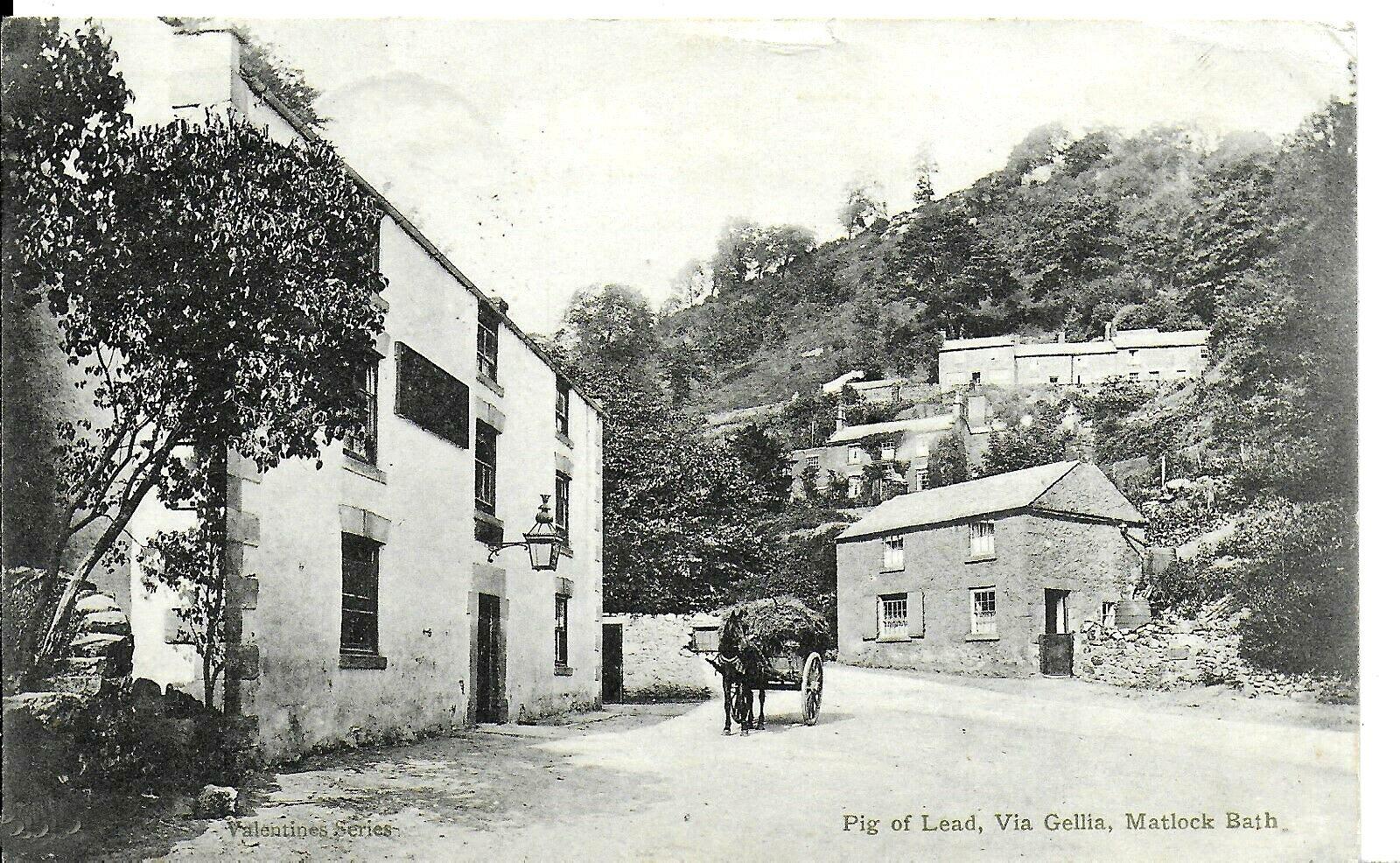
The Pig of Lead pub, 1904:
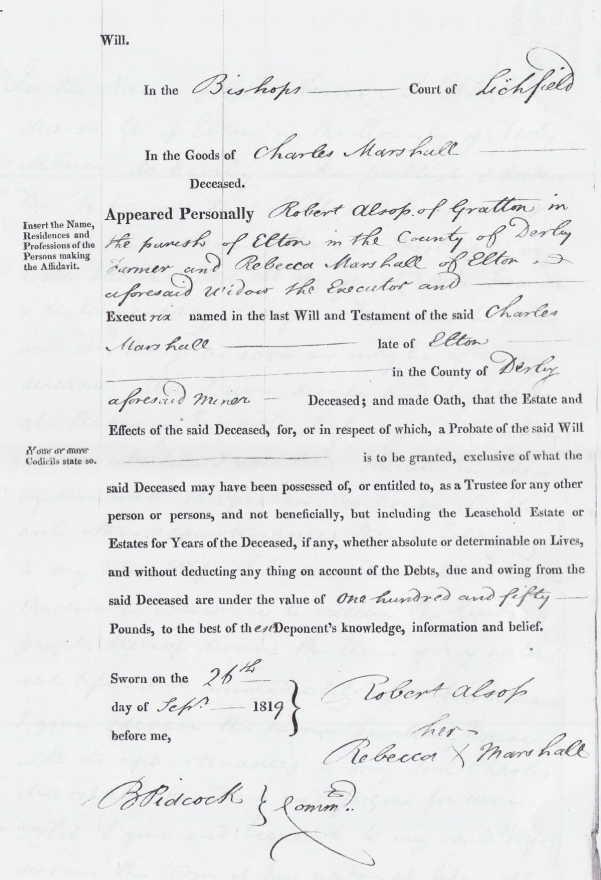
The earliest Marshall I’ve found so far is Charles, born in 1742. Charles married Rebecca Knowles, 1775-1823. I don’t know what his occupation was but when he died in 1819 he left a not inconsiderable sum to his wife.
1819 Charles Marshall probate:
There are still Marshall’s living in Elton and Matlock, not our immediate known family, but probably distantly related. I asked a Matlock group on facebook:
“…there are Marshall’s still in the village. There are certainly families who live here who have done generation after generation & have many memories & stories to tell. Visit The Duke on a Friday night…”
The Duke, Elton:
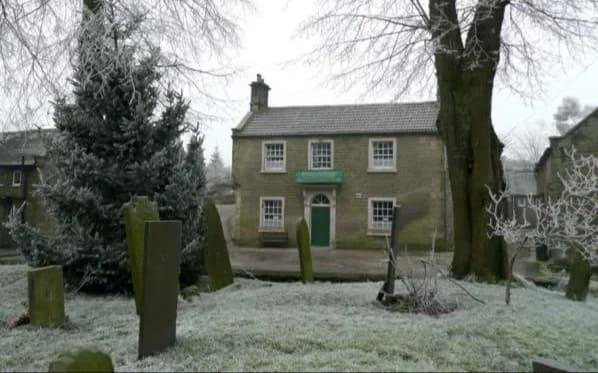 December 18, 2021 at 7:05 pm #6246
In reply to: The Elusive Samuel Housley and Other Family Stories
Florence Nightingale Gretton
1881-1927
Florence’s father was Richard Gretton, a baker in Swadlincote, Derbyshire. When Richard married Sarah Orgill in 1861, they lived with her mother, a widow, in Measham, Ashby de la Zouch in Leicestershire. On the 1861 census Sarah’s mother, Elizabeth, is a farmer of two acres.
(Swadlincote and Ashby de la Zouch are on the Derbyshire Leicestershire border and not far from each other. Swadlincote is near to Burton upon Trent which is sometimes in Staffordshire, sometimes in Derbyshire. Newhall, Church Gresley, and Swadlincote are all very close to each other or districts in the same town.)
Ten years later in 1871 Richard and Sarah have their own place in Swadlincote, he is a baker, and they have four children. A fourteen year old apprentice or servant is living with them.
In the Ashby-de-la-Zouch Gazette on 28 February 1880, it was reported that Richard Gretton, baker, of Swadlincote, was charged by Captain Bandys with carrying bread in a cart for sale, the said cart not being provided with scales and weights, according to the requirements of the Act, on the 17th January last.—Defendant pleaded guilty, but urged in extenuation of the offence that in the hurry he had forgotten to put the scales in the cart before his son started.—The Bench took this view of the case, regarding it as an oversight, and fined him one shilling only and costs. This was not his only offence.
In 1883, he was fined twenty shillings, and ten shillings and sixpence costs.
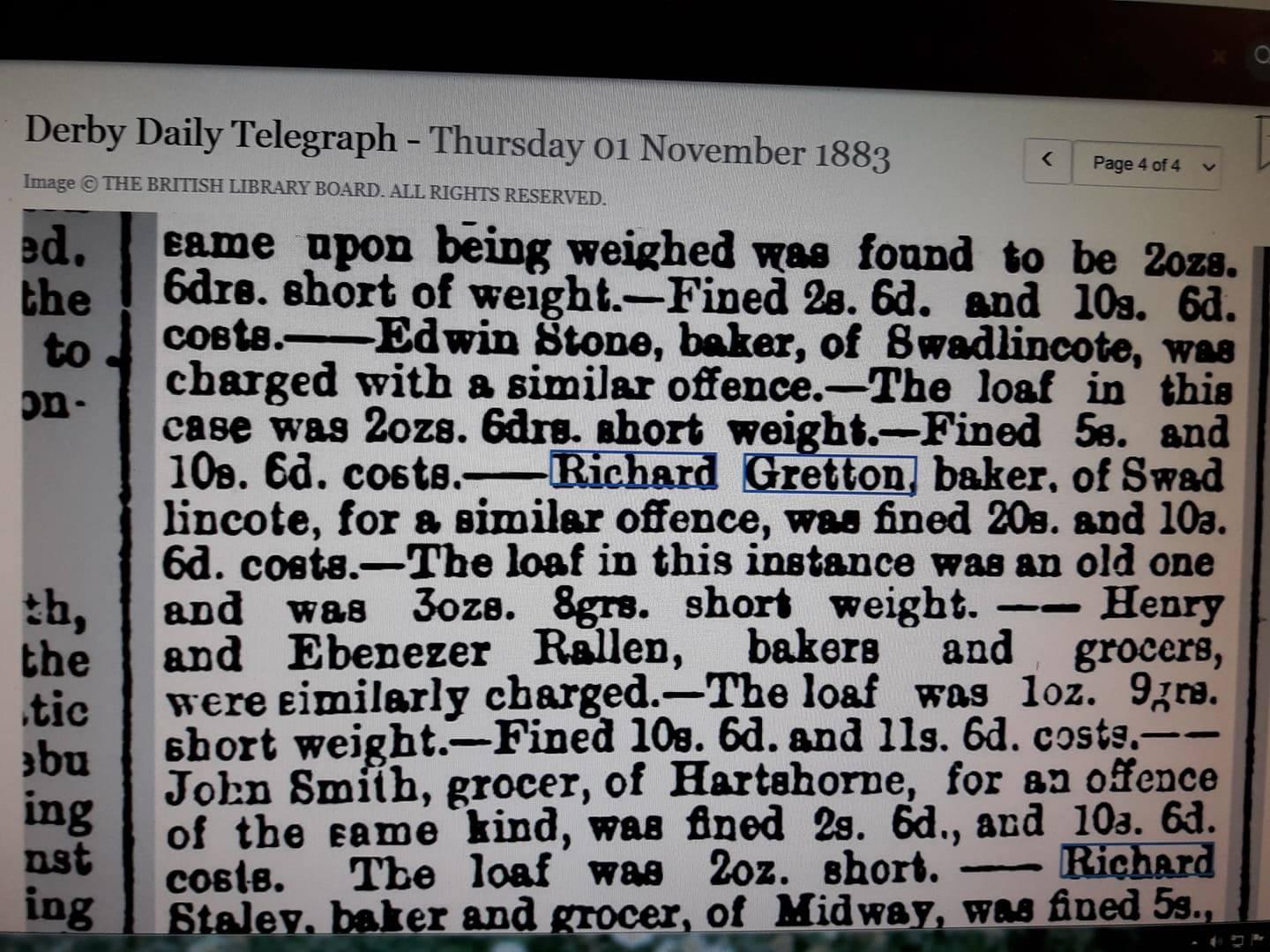
By 1881 they have 4 more children, and Florence Nightingale is the youngest at four months. Richard is 48 by now, and Sarah is 44. Florence’s older brother William is a blacksmith.
Interestingly on the same census page, two doors down Thomas and Selina Warren live at the Stanhope Arms. Richards son John Gretton lives at the pub, a 13 year old servant. Incidentally, I noticed on Thomas and Selena’s marriage register that Richard and Sarah Gretton were the witnesses at the wedding.
Ten years later in 1891, Florence Nightingale and her sister Clara are living with Selina Warren, widow, retired innkeeper, one door down from the Stanhope Arms. Florence is ten, Clara twelve and they are scholars.
Richard and Sarah are still living three doors up on the other side of the Stanhope Arms, with three of their sons. But the two girls lived up the road with the Warren widow!The Stanhope Arms, Swadlincote: it’s possible that the shop with the awning was Richard Gretton’s bakers shop (although not at the time of this later photo).
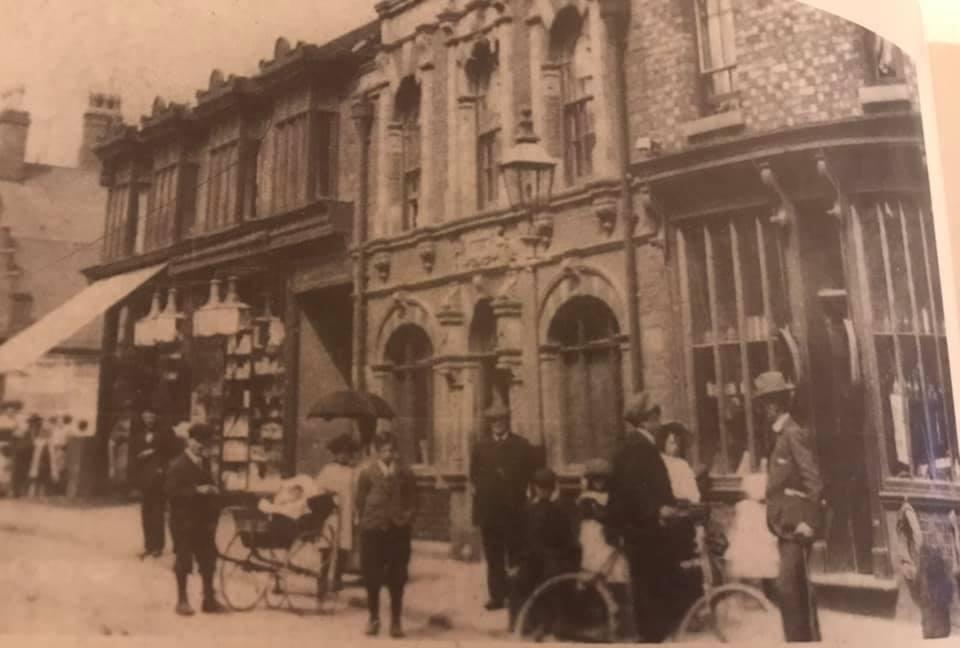
Richard died in 1898, a year before Florence married Samuel Warren.
Sarah is a widowed 60 year old baker on the 1901 census. Her son 26 year old son Alf, also a baker, lives at the same address, as does her 22 year old daughter Clara who is a district nurse.
Clara Gretton and family, photo found online:
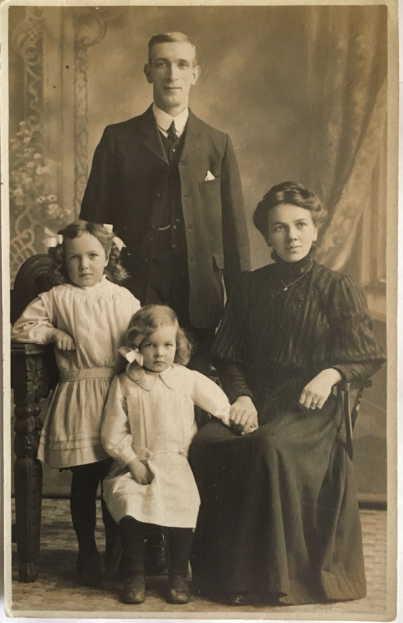
In 1901 Florence Nightingale (who we don’t have a photograph of!) is now married and is Florrie Warren on the census, and she, her husband Samuel, and their one year old daughter Hildred are visitors at the address of Elizabeth (Staley)Warren, 60 year old widow and Samuel’s mother, and Samuel’s 36 year old brother William. Samuel and William are engineers.
Samuel and Florrie had ten children between 1900 and 1925 (and all but two of them used their middle name and not first name: my mother and I had no idea until I found all the records. My grandmother Florence Noreen was known as Nora, which we knew of course, uncle Jack was actually Douglas John, and so on).
Hildred, Clara, Billy, and Nora were born in Swadlincote. Sometime between my grandmother’s birth in 1907 and Kay’s birth in 1911, the family moved to Oldswinford, in Stourbridge. Later they moved to Market Street.
1911 census, Oldswinford, Stourbridge:
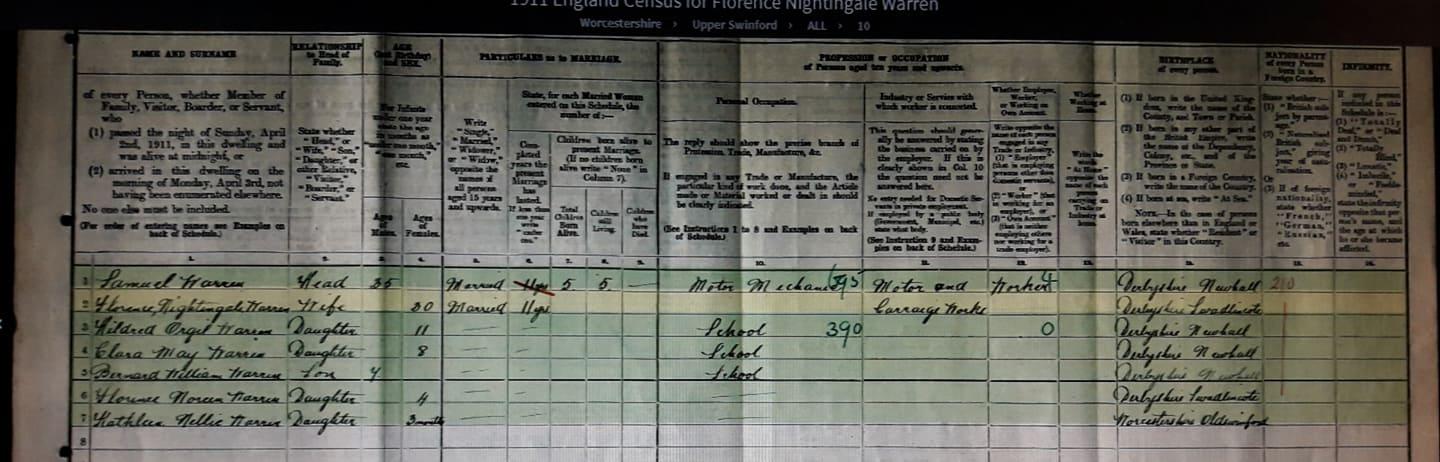
Oddly, nobody knew when Florrie Warren died. My mothers cousin Ian Warren researched the Warren family some years ago, while my grandmother was still alive. She contributed family stories and information, but couldn’t remember if her mother died in 1929 or 1927. A recent search of records confirmed that it was the 12th November 1927.
She was 46 years old. We were curious to know how she died, so my mother ordered a paper copy of her death certificate. It said she died at 31 Market Street, Stourbridge at the age of 47. Clara May Warren, her daughter, was in attendance. Her husband Samuel Warren was a motor mechanic. The Post mortem was by Percival Evans, coroner for Worcestershire, who clarified the cause of death as vascular disease of the heart. There was no inquest. The death was registered on 15 Nov 1927.
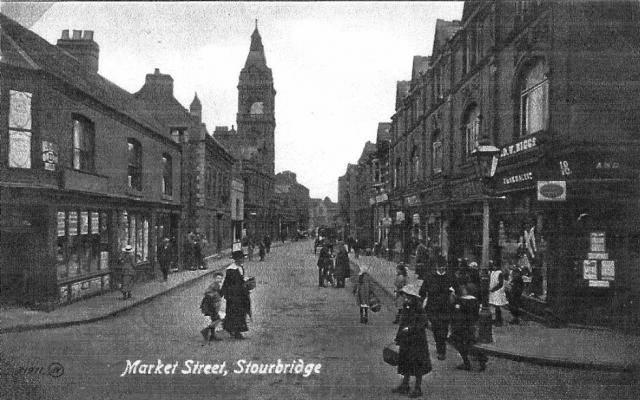
I looked for a photo of 31 Market Street in Stourbridge, and was astonished to see that it was the house next door to one I lived in breifly in the 1980s. We didn’t know that the Warren’s lived in Market Street until we started searching the records.
Market Street, Stourbridge. I lived in the one on the corner on the far right, my great grandmother died in the one next door.
I found some hitherto unknown emigrants in the family. Florence Nightingale Grettons eldest brother William 1861-1940 stayed in Swadlincote. John Orgill Gretton born in 1868 moved to Trenton New Jersey USA in 1888, married in 1892 and died in 1949 in USA. Michael Thomas born in 1870 married in New York in 1893 and died in Trenton in 1940. Alfred born 1875 stayed in Swadlincote. Charles Herbert born 1876 married locally and then moved to Australia in 1912, and died in Victoria in 1954. Clara Elizabeth was a district nurse, married locally and died at the age of 99.
December 14, 2021 at 10:26 pm #6232In reply to: The Elusive Samuel Housley and Other Family Stories
Looking for Photographs
I appreciate how fortunate I am that there are so many family photographs on various sides of the family, however, on some sides, for example the Warrens and the Grettons, there are no photographs. I’d love to find a photograph of my great grandmother Florence Nightingale Gretton, as she is the only great grandparent I don’t have a photo of.
I look on other people’s family trees on ancestry websites, and I join local town memories and old photos groups on facebook hoping to find photos. And I have found a few, and what a prize it is to find a photograph of someone in your tree. None found so far of Florence Nightingale Gretton, although I found one of her sister Clara, her brother Charles, and another potential one, posted on a Swadlincote group: a Warren wedding group in 1910.
Charles Herbert Gretton 1876-1954 and his wife Mary Ann Illsley:
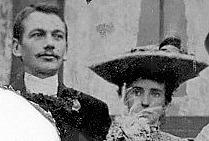
The wedding of Robert Adolphus Warren and Eveline Crofts. Photo in the collection of Colin Smith, Eveline Crofts first cousin twice removed. Reposted with permission:
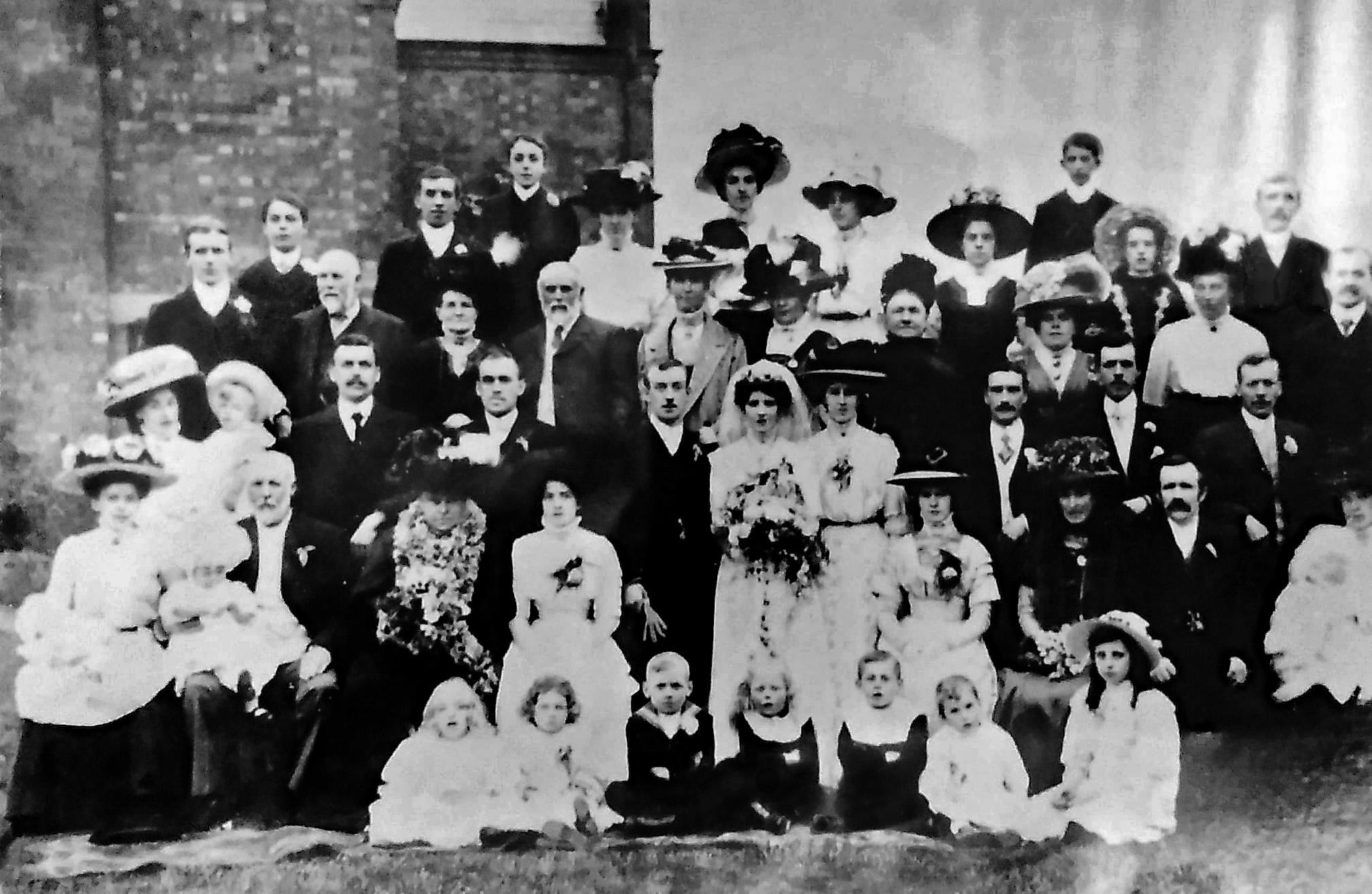
The groom was Florence’s husbands cousin, but identifying my great grandparents in the crowd would be guesswork. My grandmother was born in 1906, and could be one of the children sitting at the front. It was an interesting exercise to note the family likenesses.
Ben Warren the footballer is the man on the far right, on the same line as the groom. His children are sitting in front of the bride.
There are many mentions of Ben Warren the footballer on the Newhall and Swadlincote groups ~ Ben Warren was my great grandfathers cousin, and is a story in itself ~ and a photograph of Ben’s daughter, Lillian Warren was posted.
Lillian Warren (reposted with permission)
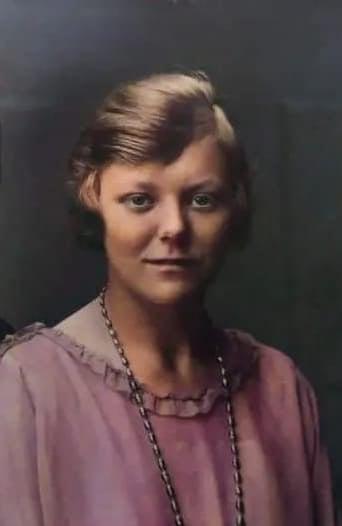
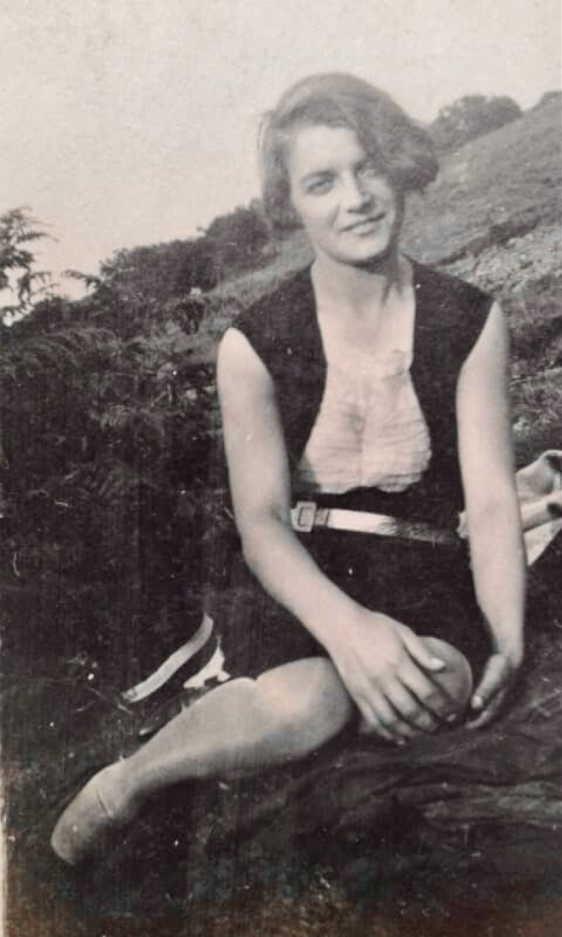
Lillian was my grandmothers first cousin once removed or second cousin. The resemblance to my grandmother, Florence Noreen Warren, seems striking.
December 13, 2021 at 10:39 am #6220In reply to: The Elusive Samuel Housley and Other Family Stories
Helper Belper: “Let’s start at the beginning.”
When I found a huge free genealogy tree website with lots of our family already on it, I couldn’t believe my luck. Quite soon after a perusal, I found I had a number of questions. Was it really possible that our Warren family tree had been traced back to 500AD? I asked on a genealogy forum: only if you can latch onto an aristocratic line somewhere, in which case that lineage will be already documented, as normally parish records only go back to the 1600s, if you are lucky. It is very hard to prove and the validity of it met with some not inconsiderable skepticism among the long term hard core genealogists. This is not to say that it isn’t possible, but is more likely a response to the obvious desire of many to be able to trace their lineage back to some kind of royalty, regardless of the documentation and proof.
Another question I had on this particular website was about the entries attached to Catherine Housley that made no sense. The immense public family tree there that anyone can add to had Catherine Housley’s mother as Catherine Marriot. But Catherine Marriot had another daughter called Catherine, two years before our Catherine was born, who didn’t die beforehand. It wasn’t unusual to name another child the same name if an earlier one had died in infancy, but this wasn’t the case.
I asked this question on a British Genealogy forum, and learned that other people’s family trees are never to be trusted. One should always start with oneself, and trace back with documentation every step of the way. Fortified with all kinds of helpful information, I still couldn’t find out who Catherine Housley’s mother was, so I posted her portrait on the forum and asked for help to find her. Among the many helpful replies, one of the members asked if she could send me a private message. She had never had the urge to help someone find a person before, but felt a compulsion to find Catherine Housley’s mother. Eight months later and counting at time of writing, and she is still my most amazing Helper. The first thing she said in the message was “Right. Let’s start at the beginning. What do you know for sure.” I said Mary Ann Gilman Purdy, my great grandmother, and we started from there.
Fran found all the documentation and proof, a perfect and necessary compliment to my own haphazard meanderings. She taught me how to find the proof, how to spot inconsistencies, and what to look for and where. I still continue my own haphazard wanderings as well, which also bear fruit.
It was decided to order the birth certificate, a paper copy that could be stuck onto the back of the portrait, so my mother in Wales ordered it as she has the portrait. When it arrived, she read the names of Catherine’s parents to me over the phone. We were expecting it to be John Housley and Sarah Baggaley. But it wasn’t! It was his brother Samuel Housley and Elizabeth Brookes! I had been looking at the photograph of the portrait thinking it was Catherine Marriot, then looking at it thinking her name was Sarah Baggaley, and now the woman in the portrait was Elizabeth Brookes. And she was from Wolverhampton. My helper, unknown to me, had ordered a digital copy, which arrived the same day.
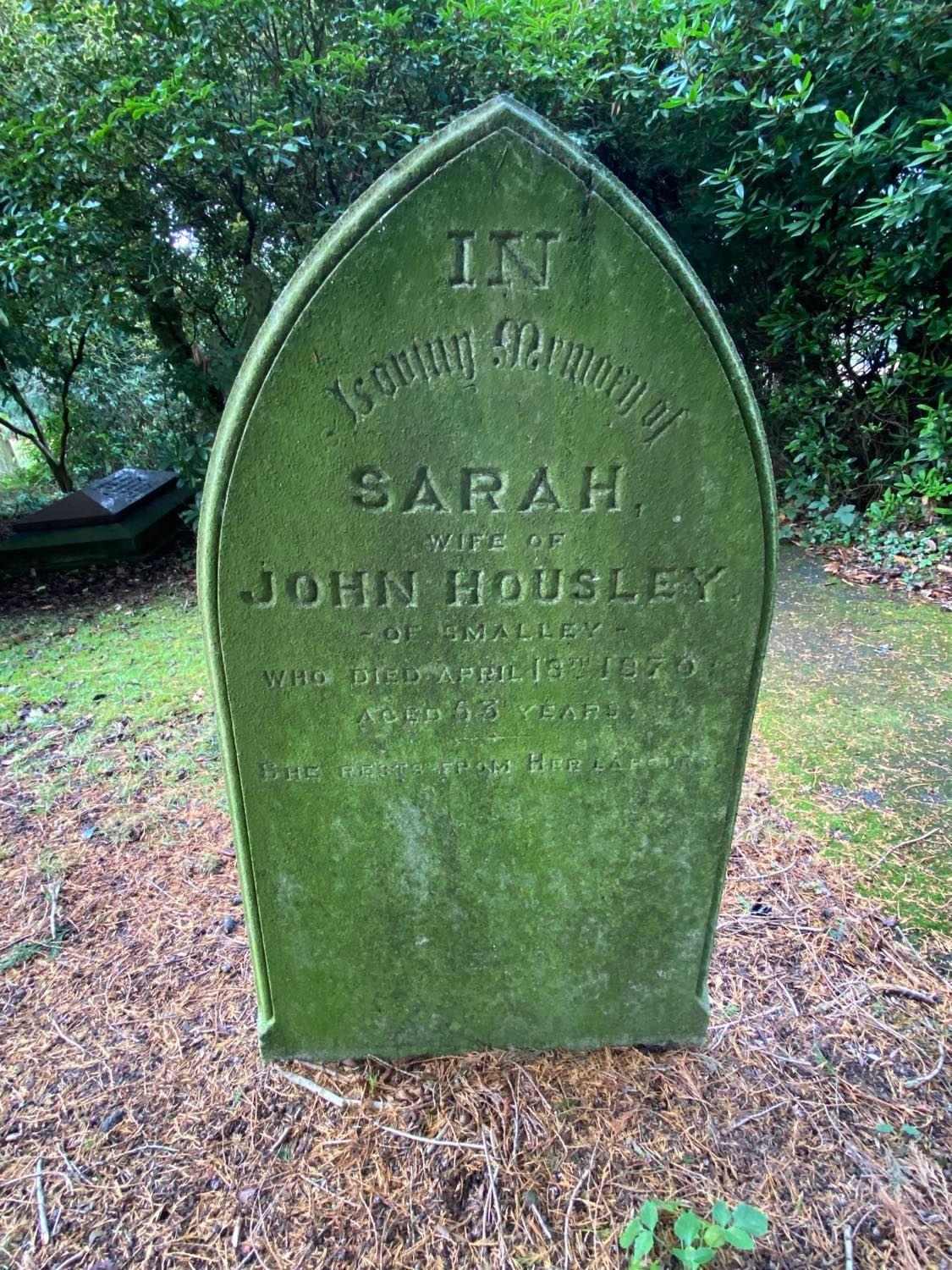
Months later, Fran, visiting friends in Derby, made a special trip to Smalley, a tiny village not far from Derby, to look for Housley gravestones in the two churchyards. There are numerous Housley burials registered in the Smalley parish records, but she could only find one Housley grave, that of Sarah Baggaley. Unfortunately the documentation had already proved that Sarah was not the woman in the portrait, Catherine Housley’s mother, but Catherine’s aunt.
Sarah Housley nee Baggaley’s grave stone in Smalley:
 December 13, 2020 at 8:14 am #6159
In reply to: Twists and One Return From the Time Capsule
Nora moves silently along the path, placing her feet with care. It is more overgrown in the wood than she remembers, but then it is such a long time since she came this way. She can see in the distance something small and pale. A gentle gust of wind and It seems to stir, as if shivering, as if caught.
Nora feels strange, there is a strong sense of deja vu now that she has entered the forest.
She comes to a halt. The trees are still now, not a leaf stirs. She can hear nothing other than the sound of her own breathing. She can’t see the clearing yet either, but she remembers it’s further on, beyond the next winding of the path. She can see it in her mind’s eye though, a rough circle of random stones, with a greenish liquid light filtering through. The air smells of leaf mould and it is spongy underfoot. There’s a wooden bench, a grassy bank, and a circular area of emerald green moss. Finn thinks of it as place of enchantment, a fairy ring.
Wait! Who is Finn? Where is this story coming from that whispers in her ear as she makes her way through the woods to her destination, the halfway point of her clandestine journey? Who is Finn?
She reaches the tiny shivering thing and sees that it is a scrap of paper, impaled on a broken branch. She reaches out gently and touches it, then eases if off the branch, taking care not to rip it further. There is a message scribbled on the paper, incomplete. meet me, is all it says now
The crumpled up paper among the dead leaves beside the path catches her eye. No, not impaled on a branch but still, a bit of paper catches her eye as the mysterious ~ ephemeral, invisible ~ story teller continues softly telling her tale
Finn feels dreamy and floaty. She smiles to herself, thinking of the purpose of her mission, feeling as though it is a message to her from the past. She is overwhelmed for a moment with a sense of love and acceptance towards her younger self. Yes, she whispers softly to the younger Finn, I will meet you at the fairy ring. We will talk a bit. Maybe I can help
But wait, there is no meaningful message on the crumpled paper that Nora picks up and opens out. It’s nothing but a shopping receipt. Disappointed, she screws it back up and aims to toss it into the undergrowth, but she hesitates. Surely it can’t have no meaning at all, she thinks, not after the strange whispered story and the synchronicity of finding it just at that moment. She opens it back up again, and reads the list of items.
Olive oil, wine, wheat, garum…. wait, what? Garum? She looks at the date on the receipt ~ a common enough looking till roll receipt, the kind you find in any supermarket ~ but what is this date? 57BC? How can that be? Even if she had mistranslated BC ~ perhaps it means British Cooperative, or Better Compare or some such supermarket name ~ the year of 57 makes little sense anyway. And garum, how to explain that! Nora only knows of garum in relation to Romans, there is no garum on the shelves between the mayonaisse and the ketchup these days, after all.
Nora smooths the receipt and folds it neatly in half and puts it in her pocket. The shadows are long now and she still has some distance to walk before the halfway village. As she resumes her journey, she hears whispered in her ear: You unlocked the blue diamond mode. You’re on a quest now!
Smiling now, she accelerates her pace. The lowering sun is casting a golden light, and she feels fortified.
December 6, 2020 at 9:00 am #6155In reply to: Twists and One Return From the Time Capsule
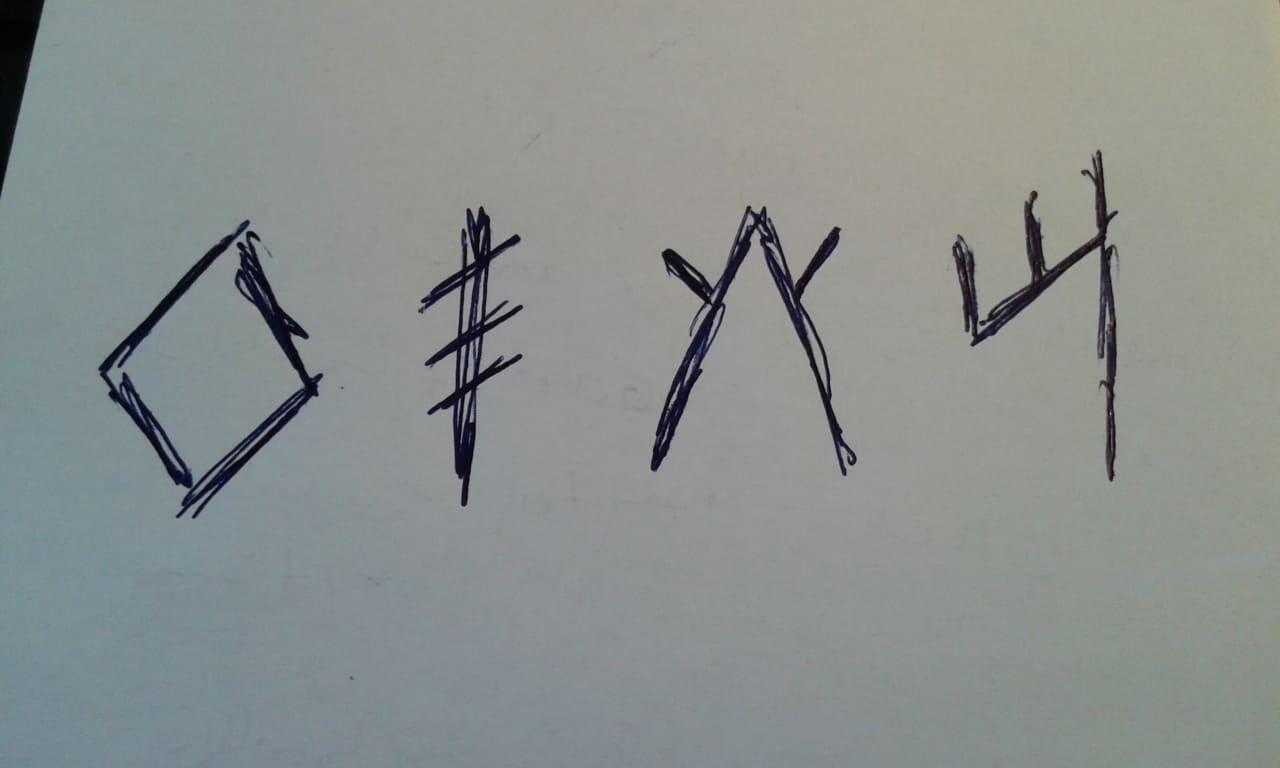 Damn these municipal restrictions! Frustrated, Nora looked again at the photo of the inscriptions on the mysterious pear shaped box that Clara had found. She picked up a pen and copied the symbols onto a piece of paper. Glancing back over the message her friend had sent, her face softened at Clara’s pet name for her, Alienor. Clara had started called her that years ago, when she found out about the ouija board incident and the aliens Nora had been talking to. Was it really an alien, or….? Clara had asked, and Nora had laughed and said Of course it was an alien or! and the name had stuck.
Nora’s mood had changed with the reminiscence, and she had an idea. She was working from home, but all that really meant was that she had to have internet access. Nobody would have to know which home she was working from, if she could just make it past the town barriers. But she didn’t have to go by road: the barriers were only on the roads. There was nothing stopping her walking cross country.
Putting aside the paper with the symbols on, she perused a map. She had to cross three town boundaries, and by road it was quite a distance. But as the crow flies, not that far. And if she took the old smugglers track, it was surprisingly direct. Nora calculated the distance: forty nine kilometers. Frowning, she wondered if she could walk that distance in a single day and thought it unlikely. Three days more like, but maybe she could do it in two, at a push. That would mean one overnight stay somewhere. What a pity it was so cold! It would mean carrying a warm sleeping bag, and she hated carrying things.
Nora looked at the map again, and found the halfway point: it was a tiny hamlet. A perfect place to spend the night. If only she knew someone who lived there, somebody who wouldn’t object to her breaking the restrictions.
Nora yawned. It was late. She would finalize the plan tomorrow, but first she sent a message to Clara, asking her if she knew anyone in the little village.
November 5, 2020 at 1:46 pm #6145In reply to: Two Aunties au Pair and Their Pert Carouses
The moving lorry had been parked outside the Beige House for hours.
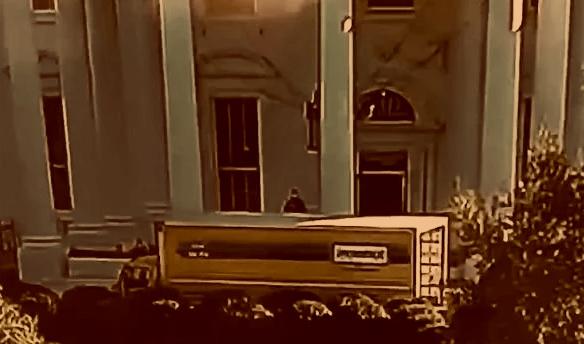
The driver was furious, as nobody has been able to answer their calls or guide them. At least the manager had let them park in front of the entrance, but it might have been based on a misunderstanding. “That’s for the removal of the Lady’s stuff, is it?” He’d nodded, it was only half a lie, his client was a lady, except she wasn’t moving out. She was moving in.
He shouted to his partner who was smoking outside.
“George! Bloody hell, if this Ms June isn’t picking up the phone or showing up, I’m going to dump all her stuff here, I don’t care how precious is her cargo!”
“Come on, Fred! Don’t get mad, you’ve seen how particular she was when we loaded the boat’s content, so full of her sentimental knick-knacks!”
“What do you expect? Us keeping all these stone statues that weigh a ton! I don’t care. I tell you, she better show up in the next minutes, or else…”
August 30, 2020 at 12:52 am #6107In reply to: Tart Wreck Repackage
Star paused in the lobby. “I need some more persuading,” she said. “What if she dies in that wardrobe? What will we do with the body? Or, worse, what if she doesn’t die and sues us?”
Tara decided to ignore Star’s dubious reasoning; after all it was late. “She’s probably going to sue anyway,” said Tara morosely. “Another night won’t make any difference.”
“I’m going back. I can’t leave Rosamund to face the consequences of our drunken stupidity.” Star headed defiantly towards the stairs; the lift was out of order, again. “We would have to be on the eight bloody floor,” she muttered. “You do what you like,” she flung over her shoulder to Tara.
Tara sighed. “Wait up,” she shouted.
Star was relieved that Tara decided to follow. The building was scary at night – the few tenants who did lease office space, were, much like themselves, dodgy start-ups that couldn’t afford anything better. Missing bulbs meant the lighting in the stairwell was dim, and, on some floors, non-existent.
“I’m amazed they managed to bring that wardrobe up,” puffed Tara. “Just slow down and let me get my breath will you, Star.”
“My gym membership is really paying off,” said Star proudly. “Come on,Tara! just one floor to go!”
As they approached the door to their office, they paused to listen. “Can you hear something … ?” whispered Star.
“Is it … singing?”
“That’s never Rosamund singing. She’s got a voice like … well let’s just say you wouldn’t wish it on your worst enemy.”
“I’m going in,” hissed Tara and flung open the door.
“Don’t come any closer!” cried a woman in a mink coat; she did make a peculiar sight, surrounded by empty pizza boxes and brandishing a broom. “And you, shut up!” she said reaching out to bang the wardrobe with her broom. There were muffled cries from within, and then silence.
“Was that you singing?” asked Star in her most polite voice.
“Yes, what’s it to you?”
“It was rather… lovely.”
The woman smirked. “I was rehearsing.”
“We are awfully sorry about locking you in the wardrobe. We thought you were a masked intruder.”
“Well, I’m not. I am Rosamund’s Aunt April, and you …” she glowered at Star … “should have recognised me, seeing as how I am your cousin.”
“Oh!” Star put her hand to her head. “Silly me! Of course, Cousin April! But I have not seen you for so many years. Not since I was a child and you were off to Europe to study music!”
Tara groaned. “Really, Star, you are hopeless.”
Loud banging emanated from the wardrobe followed by mostly unintelligible shouting but it went something like: “Bloody-let-me-out-or-I-will-friggin-kill-you-stupid-bloody-tarts!”
“It wasn’t really Rosamund’s fault,” said Star. “I don’t suppose we could …?”
April nodded. “Go on then, little fool’s learnt her lesson. The cheek of her not letting me have pineapple on my pizza.”
“About bloody time,” sniffed Rosamund when the door was opened. She made a sorry sight, mascara streaked under her eyes and her red fingernails broken from where she had tried to force the door.
“Now, then,” said Tara decisively, “now we’ve said our sorries and whatnot, what’s all this really about, April?”
April crinkled her brow.”Well, as I may of mentioned on the phone, my husband, Albert — that’s your Uncle Albie,” she said to Rosamund, “is cheating on me. He denies it vehemently of course, but I found this note in his pocket.” She reached into her Louis Vuitton hand-bag and pulled out a sheet of paper. “That’s his handwriting and the paper is from the Royal Albert Hotel. He was there on a business trip last month.” Her face crumpled.
“Chin up,” said Tara quickly, handing April a tissue from the desk. “What does the note say?”. Really, this case did seem a bit beneath them, a straightforward occurrence of adultery from the sounds.
April sniffed. “It says, meet you at the usual place. Bring the money and the suitcase and I will make it worth your while.”
“Let me see that,” said Rosamund, snatching the note from April. She reached into the front of her tee-shirt and pulled out another crumpled note which had been stuffed into her bra. She smirked. “I found this in the wardrobe. I was keeping it secret to pay you back but … ” She brandished both notes triumphantly. “The handwriting is the same!”
“What does your note say, Rosamund?” asked Star.
“It says, If you find this note, please help me. All is not what it seems..”
“Wow, cool!” said Tara, her face lit up. This was more like it!
Star, noticing April’s wretched face, frowned warningly at Tara. “So,” she mused, “I suggest we explore this wardrobe further and see what we can find out.”
April 26, 2020 at 10:25 am #6071In reply to: Tart Wreck Repackage
“Listen” said Gabe, the cult leader. “How long have you been Gourd level? One year?”
The other nodded.
“See Gavin, I think you’re ready to go Operating Tomathetan.”
Gavin gulped. “But, but… are you sure about such a leap? And… what about…”
“Oh, don’t worry about him, the yielding of his crops has been written, and it’s not good. Better look toward the future Gavin. And let me ask you something, don’t you think about the future?”
When the Great Leader Undisputed Gabe had spoken, it was customary to bow and continue listen, in case he wasn’t finished.
“Is there anything more I can do you for, oh GLUG?”
“Sure. Get me your proposal for the new organization of the crops. No rush. Tomorrow will be fine.”
“Your great leaderness is too bountiful.”
“Of course. Now scram, I have rituals to attend to.” And with that, Great Leader Undisputed Gabe made a hasty retreat into the inner sanctum with his favourite vestal priestess of the moment.

Gavin was flummoxed. It had all been foretold by the heretic Basil. He wondered, should he consult him? The weight of this sudden assignment felt heavy on his shoulders. He wondered how he could solve the mountain of problems that had accumulated like horse shit on a pile of manure.
“You’ll see, it’s all connected.” Star signaled Tara when they were ushered into the inner sanctum. “I’m sure all the trail of clues have led to this for a reason. Have I told you about my theories about multiple timelines and probable selves? Maybe the Vince who called us called us from a different probability…”
“You probably right, but that nurse outfit is really too tight.” Tara wiggled impatiently on her chair.
“AH! There you are!” a manly voice behind them. “Welcome, welcome, young fresh divine sprouts.”
“Did he call us prouts?” Tara almost tittered. “Sshtt” Star elbowed her.
Gabe took a while to observe them, then made a face. “Not the freshest batch I had, I must admit, but that should do.”
He clapped his hands, and a woman entered. “Get those two well anointed, and prepared in the art of leafing.”
Tara and Star looked at each other with an air of utter incomprehension on their faces, but decided unanimously to just go with the flow. Who knows, if all was indeed connected, it would probably bring them one step closer to Uncle Basil and the solving of mysterious comatose Vince.
April 12, 2020 at 8:41 pm #5992In reply to: Pop﹡in People Tribulations
 April 7, 2020 at 2:04 pm #5964
In reply to: Newsreel from the Rim of the Realm
They walked through a labyrinth of tunnels which seemed to have been carved into a rocky mountain. The clicks and clacks of their high heels echoed in the cold silence meeting all of Sophie’s questions, leaving her wondering where they could be. Tightly held by her rompers she felt her fat mass wobbling like jelly around her skeleton. It didn’t help clear her mind which was still confused by the environment and the apparent memory loss concerning how she arrived there.
Sophie couldn’t tell how many turns they took before Barbara put her six fingers hand on a flat rock at shoulders height. The rock around the hand turned green and glowed for two seconds; then a big chunk of rock slid to the side revealing a well designed modern style room.
“Doctor, Sophie is here,” said Barbara when they entered.
A little man was working at his desk. At least Sophie assumed it was his desk and that he was working. He was wearing a Hawaiian shirt and bermudas. The computer screen he was looking at projected a greenish tint onto his face, and it made him look just like the green man icon. Sophie cackled, a little at first.
The Doctor’s hand tensed on the mouse and his eyebrows gathered like angry caterpillars ready to fight. He must have made a wrong move because a cascade of sound ending in a flop indicated he just died a death, most certainly on one of those facegoat addictive games.
That certainly didn’t help muffle Sophie’s cackle until she felt Barbara’s six fingers seizing her shoulders as if for a Vulcan nerve pinch. Sophie expected to lose consciousness, but the hand was mostly warm, except for that extra finger which was cold and buzzing. The contact of the hand upon the latex gave off little squeaky sounds that made Sophie feel uncomfortable. She swallowed her anxiety and wished for the woman to remove her hand. But as she had noticed more than once, wishes could take time and twists before they could be fulfilled.
“Why do you have to ruin everything every time?” asked the Doctor. His face was now red and distorted.
“Every time?” said Sophie confused.
“Yes! You took your sleeper agent role too seriously. We couldn’t get any valuable intel and the whole doll operation was a fiasco. We almost lost the magpies. And now, your taste for uncharted drugs, which as a parenthesis I confess I admire your dedication to explore unknown territories for science… Anyway, you were all day locked up into your boudoir trying to contact me while I just needed you to look at computer screens and attend to meetings.”
Sophie was too shocked to believe it. How could the man be so misinformed. She never liked computers and meetings, except maybe while looking online for conspiracy theories and aliens and going to comiccons. But…
“Now you’re so addict to the drugs that you’re useless until you follow our rehab program.”
“A rehab program?” asked Sophie, her voice shaking. “But…” That certainly was the spookiest thing she had heard since she had arrived to this place, and this made her speechless, but certainly not optionless. Without thinking she tried a move she had seen in movies. She turned and threw her mass into Barbara. The two women fell on the cold floor. Sophie heard a crack before she felt the pain in her right arm. She thought she ought to have persevered in her combat training course after the first week. But life is never perfect.
“Suffice!” said the Doctor from above. “You’ll like it with the other guests, you’ll see. All you have to do is follow the protocol we’ll give you each day and read the documentation that Barbara will give you.”
Sophie tried a witty answer but the pain was too much and it ended in a desperate moan.
April 3, 2020 at 9:56 am #5955In reply to: Seven Twines and the Dragon Heartwoods
It wasn’t such a bad day, thought Olliver, and it might even be a good day. The birds are singing, we saw a boar and a few deers already. Animals are getting back and they don’t seem to fear the humans so much.
Rukshan was walking first and Fox was following him with a heavy backpack. Tak and Nesy were mostly playing around and marvelling at everything their path crossed. Olliver envied their innocence, the innocence he had lost not so long ago.
Except the animals and the two guards they had to hide from, the day had mostly been uneventful and Olliver’s mind was wandering off into the mountain where he could feel useful and strong. He felt strangely blissed and suddenly had the impulse to walk toward a patch of yellow flowers.
“STOP! Pay attention where you walk,” said Rukshan. “Come back to your left two feet and walk straight. I told you to follow my every steps.”
“Okay, uncle Ruk!” said Olliver a bit ashamed to have been caught not paying attention.
“I don’t understand,” said the Fae. “Glynis’s potion doesn’t seem to work for you. The aetherical tentacles around the traps don’t seem to detect us but only you, and you also seem susceptible to their power to attract you. It’s not the first time I had to warn you.”
The Fae could see the etherical traps and especially the free flowing tentacles or the tension lines attached to trees, stones, wooden posts, anything that would cross a trail at different heights. With the potions they should be impervious to detection and affections by the traps. Olliver hadn’t thought that far. He had thought that by following them he could manage not to be caught. Right now, he feared more Rukshan’s piercing eyes than the traps. He looked at Fox involuntarily.
“It’s my fault,” said Fox looking a bit contrite. Sweat was pearling on his face. “It’s becoming too dangerous for Olli so I must confess something.” He put his heavy bag on the floor and opened it and a dwarf’s head peered timidly out.
“Ohh!” said Tak and Nesy together. They looked rather happily surprised but looked at Rukshan’s waiting for the storm.
“Are we already there?” asked Gorrash, his face rendered a bit red by the lack of breathable air in the bag. When he saw the anger on Rukshan’s face he stopped talking.
“By the fat belly of the giants! What made you do such a stupid thing?”
“We thought that it would be enough to follow you for Olli to avoid the traps,” said Fox.
“You didn’t think at all!” said the Fae. “The potions were not just for the fun of drinking something pungent and bitter with the taste and texture of yak wool.”
“Please! Don’t make me and Gorrash teleport back to the cottage,” said Olliver.
“Leave me out of this teleportation stuff!” said Gorrash.
“What an idea! But I already thought of that my little friend. You two are going to to back.”
“No we’re not! If you make us go back we’ll follow you from a distance.”
“You know the boys,” said Fox putting a hand on Rukshan’s arm.
“Oh You, I’m sure it’s your idea,” started Rukshan.
“No, it’s mine,” said Olliver. “Uncle Fox had almost convinced Gorrash it was better to stay, but I couldn’t let him be stay behind after just being reborn. You said it once, we don’t leave our friends behind.”
“I’m sure it was under another set of circumstances,” countered the Fae.
“Anyway you see the traps, I can follow your instructions. And if there is any fever problem I can teleport Gorrash back to the cottage.”
“I do not totally agree with you but I see you have learned to make an argumentation.”
Fox felt the Fae relax. “Agreed, you come with us to the Great Lakes to meet the Graetaceans and you’ll follow what I tell you to do from now on. I’ll treat you as a responsible adult.”
“Yay! We’ll meet the Graetaceans!” said Nesy.
“Olli and Gorrash will stay with us,” said Tak jumping around his friends with such a broad smile. Rukshan thought he was growing too soft on them all, with the new generation growing he started to feel his own age.
January 27, 2020 at 11:02 pm #5656In reply to: Seven Twines and the Dragon Heartwoods
“You’ve lost weight” Rukshan said, not knowing where to start. The shaman thinner look was besuiting.
“So have you, my friend.” They both laughed.
“So what have been up to, in these parts of the woods?”
“It just happens that I was a bit ahead of you, and have just come back from the Great Austral Dry Lands.”
They all became somber. The Fires had devastated the place, and the news which came were not good. There was little chance they could put an expedition in place to gather the pink clay, with all this devastation… unless… He smiled.
“You’ve brought some back, haven’t you?”
Kumihimo smiled back. “Indeed. Not easy to come by, pink clay, isn’t it?”
Fox who had been turning his head right and left, and right and left following the conversation marked a moment, and the realization came.
“Does it mean we can revive Gorrash?”
“It may well be my dear Fox, with this last ingredient now gathered, it may well be.”
January 20, 2020 at 9:09 pm #5617Topic: Tart Wreck Repackage
in forum Yurara Fameliki’s Stories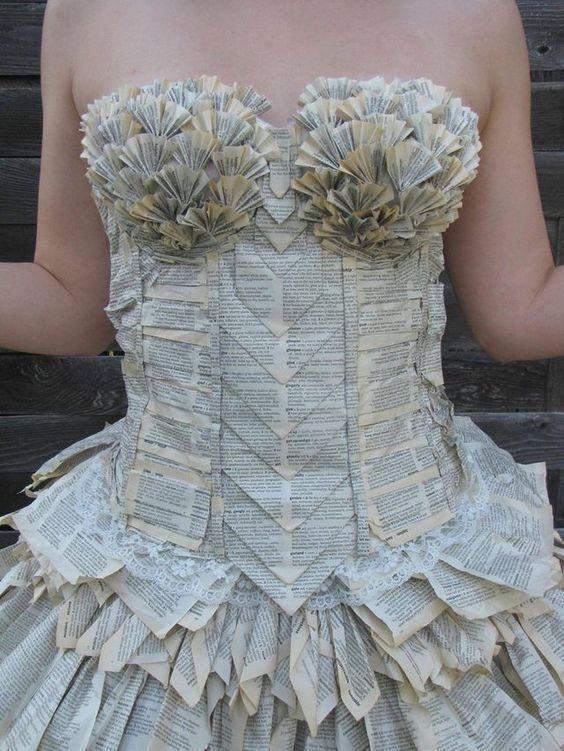 💫to be sTarted…… 🌟🌟October 30, 2019 at 7:40 pm #4865
In reply to: The Chronicles of the Flying Fish Inn
Aunt Idle:
So whatever did happen to those two women who went down the mine? Good question!
I can tell you one thing, they hadn’t had the Etruscan flu like the rest of us, and when they finally resurfaced, they had a bit of a shock. They haven’t really recovered yet, they look dazed all the time. They were in good shape when they came out of the mines, don’t ask me how. A bit pale. I don’t know what they’d been eating but they hadn’t lost any weight, and oddly enough all tidy and spanking clean, considering they’d spent months down an old mine. I’d have expected them to be ragged and filthy and emaciated, but they looked better than we did. We were still too sluggish from the flu to ask them what had happened. -
AuthorSearch Results
