Search Results for 'pull'
-
AuthorSearch Results
-
February 5, 2026 at 11:51 pm #8055
In reply to: The Hoards of Sanctorum AD26
Helier watched Yvoise squinting at the bone through her screen, trying to decipher the “map” amidst the noxious fumes. He observed the scene with a detachment that surprised him.
The room was vibrating with tension, but for once, it wasn’t coming from Yvoise —it was directed at her. She was standing by the window, phone pressed to her ear, nodding furiously at some invisible bureaucrat on the other end.
“I am violently in agreement with you, Mr. Prufrock,” she was saying, her voice tight but diplomatic. “The olfactory output of Unit 26 is indeed non-compliant with the Olympus Park Clean Air protocols. We are… rectifying the asset.”
It was the “Kyber-Auditor” from the Business Park Administration. The new management had been cracking down lately, restricting their “unauthorized usage” of miracles and enforcing standard operating procedures.
It was all too much noise. Above the smell, which was screaming of decay rather than play, there was the frantic energy of it all. Mrs. Fennel’s panic, Yvoise’s spreadsheets, the looming threat of this “Varlet” from the Council. It was pure Negotium, the active denial of peace, waging war on the idle time of the Romans: Otium. The world was demanding relentlessly that they justify their existence with hygiene certificates, clean surfaces, and significantly fewer piled-up treasures, branding their sacred collections as mere “trip hazards.”
Helier gripped the bamboo handle of his umbrella —a sturdy, shepherd-style thing he had almost tossed into the ‘Charity Pile’ yesterday. He felt a sudden, fierce longing for Otium, a sacred pause where one simply is.
Earlier that morning, a delivery guy had held the elevator door for him with a foot, balancing a mountain of cardboard boxes. A simple, clumsy gesture of kindness amidst the clutter. It had stayed with Helier. It reminded him that you could be overloaded and still have grace. That moment of suspension, of courteous stillness in the middle of the rush, had been a tiny bubble of Otium.
They needed that bubble now. They needed to stop the clock.
Spirius, who had been hovering in the doorway, seemed to hear Helier’s thought.
“A map is useless if you pass out before you can follow it,” Spirius muttered. He stepped fully into the room, brandishing a heavy glass jar like a weapon. “We need a Containment of the Sins.”
“A what?” asked Cerenise, holding her nose.
“Of WHAT?!” asked Yvoise, raising an eyebrow while covering her mouthpiece.
“Sins…” Spirius said doubtfully, “…that should bring back some memories.”
He marched to the table. “Hold on to your halos…”
Yvoise pulled back, shielding her phone. “Wait! I haven’t finished cataloging the striations—”
“The bone will be visible through the glass, Yvoise. But the miasma must be paused.”
Spirius didn’t wait for a vote. He scooped the yellowed bone—and its mysterious map—into the jar. He didn’t recite a Latin prayer. He didn’t summon a lightning bolt. The Administration wouldn’t allow that kind of energy spike anyway. He just screwed the lid on tight, with one word.
“Oïton,” Spirius incanted.
To Helier’s ears, attuned to the drift of languages over centuries, it didn’t sound like a name anymore. It sounded like a desperate, corrupted invocation of the old Latin. Otium. The right to be left alone, fierce as a dragon guarding its sleep.
Psshitt.
It was the sound of a pressure valve releasing. Soft, pneumatic.
Instantly, the stench was cut off. Deleted. The air was neutral again, smelling only of old paper and the faint, metallic tang of Yvoise’s anxiety.
“It is done,” Spirius announced, holding up the jar. The bone rattled inside, harmless now, an archived file. The faint lines of the map were still visible against the glass, safe in their bubble of silence.
“Mr. Prufrock?” Yvoise said into the phone, her voice smooth as silk. “I think you’ll find the sensors are returning to normal parameters. Yes. Have a productive day.”
She hung up and slumped against the curtains, letting out a breath she seemed to have been holding since New Year’s Eve.
“Well,” Helier said, tapping his umbrella on the floorboards, feeling the tension drain from his shoulders. “That felt… cleansing.”
“If we could do that with the auditor, it would be a marvelous idea,” Cerenise agreed, eyeing the jar with renewed interest. “A spiritual purification. Now, Yvoise, hand me a magnifying glass. If we have restored our Otium, we might as well use it to see where this bone wants to take us.”
“A Novena, even,” Yvoise added, a mischievous glint returning to her eye. “Technically, we have ‘cleansed’ the house of the impurity. The Will didn’t explicitly say we had to throw away the good stuff. Just the… bad air.”
Helier smiled. It was a loophole, of course. A massive, gaping loophole. The threat of the Novena still hung over them like a storm cloud that hadn’t quite burst, and the mystery of the Varlet descendant was still unresolved. But for today, the audit was over. The hoard was safe.
“Oïton,” Helier repeated softly, testing the weight of the word. He looked at his umbrella. He wouldn’t need to open it. The storm had passed.
January 18, 2026 at 8:18 am #8049In reply to: The Hoards of Sanctorum AD26
Phurt was starting to think something fishy was a play, each time he thought his short spider life had ended he was pulled back from Spiderheaven by some unknown force. Not that he minded this time, there were plenty of places to hide and cast his strong silk cables. He had developed a sense of adventure and the sheer height of some of the mounds made him dizzy. It also made him want to be the first spider in the history of this thread to climb on top of that Mount Wobbly of the Topperware Chain.
Phurt had also noticed a strange and strong smell that seemed to come from the top of Mount Wobbly. Not that he minded the hygiene of the place; it was, to the contrary, a rather promising smell. It was the smell that said swarms of flies would gather there like an endless supply of blessed food.
Seeing that other spiders were gathering at the bottom of Mount Wobbly, he contorted his butt and secured his first cable.

Spirius had been investigating the origin of a strong smell that had started not long after Austreberthe puffed out of existence and became part of the dust she had spent her life chasing away. Which gave him one more proof that his theory of the holy body influence upon the physical world was true. He looked for a pen but they were behind two piles of unopened parcels he had started collecting when he had noticed that the postmen were leaving the boxes unattended and unprotected from the elements on the front porch of houses. His intentions were pure, as any saintly intentions are, but when he saw what good addition to the other boxes they made, he felt a pang of regret each time he thought of giving back those boxes to their rightful recipients.
Alas, most of them were dead by now, so he felt his duty was to keep those boxes intact to honour the memory of the dead.
Yvoise came in just as Spirius saw an odd and colourful australian jumping spider cast a delicate silk thread to one of the bottom row of his Tupperware collection.
“You should really do something about that smell,” she said. “I remember a time when decorum required holy people to exude only fragrance and essential oils.”
“Well, you know, it’s Austreberthe,” he said as wobbly as his heaps of plastic boxes. He had them all. You could even say he started the whole trend of pyramid schemes when his friend Pearl Topper saw him buy boxes from antiques shops. She invented the first plastic box as…
“Well, I asked you a question,” said Yvoise, interrupting his wandering thoughts.
“Have you noticed the spiders,” said Spirius.
“What spiders?”
“I think they’re trying to go up there,” Spirius said. “Look!”
He pointed a proud finger at the top of the highest Topperware tower in the Guyness book of records. A swarm of flies was circling around one of the boxes.
“And that means the smell comes from there.”
January 16, 2026 at 11:00 pm #8048In reply to: The Hoards of Sanctorum AD26
“Bless you,” Helier offered, instinctively sliding the half-chewed pencil stub under a pile of National Geographics from 1978. He felt a flush of guilt, as if he’d been caught trying to steal a kid’s toy.
Cerenise rolled into the room, looking like a sorry pile of laundry. She was wrapped in three different shawls—one Paisley, one Tartan, and one that looked like a doily from a medieval altar. She held a lace handkerchief to her nose, trumpeting into it with a force that rattled the nearby display of thimbles.
“It’s not the damp,” she croaked, her voice an octave lower than usual. “It’s the cleanliness. Since Spirius fixed that pipe, the air is too… sterile. My immune system is in shock. It misses the spores.”
She eyed the spot where Helier had hidden the pencil. “You were thinking about it, weren’t you?”
“Thinking about what?” Helier feigned innocence, picking up a ceramic frog.
“The Novena,” she whispered the word like a curse. “I saw the look in your eye. The ‘maybe I don’t need this’ look. It’s the fever talking, Helier. Don’t give in. I almost threw away a button yesterday. A bakelite toggle from a 1930s duffel coat. I held it over the bin for a full minute.” She shuddered, pulling the shawls tighter. “Madness.”
“Pure madness,” Helier agreed, quickly retrieving the pencil stub and placing it prominently on the desk to prove his loyalty to the hoard. “We must stay strong. Now, surely you didn’t brave the drafty hallway just to discuss my potential apostasy?”
“I didn’t,” Cerenise sniffed, tucking the handkerchief into her sleeve. “I found him. Or at least, I found the thread.”
She wheeled closer, dropping a printout onto Helier’s knees. It was a genealogy chart, annotated with her elegant, spider-scrawl handwriting.
“Pierre Wenceslas Varlet,” she announced. “Born 1824. Brother to a last of the famously named Austreberthes — mortal ones, unsaintly, of course. Her lineage didn’t die out, Helier.”
Helier squinted at the paper. “Varlet? Sounds like a villain in one of Liz Tattler’s bodice-rippers. ‘The Vengeful Varlet of Venice’.“
“Focus, Helier. Look at the modern branch.” She pointed to the bottom of the page. “The name changed in the 1950s. Anglicized. And I think, if my research into the local council tax records—hacked via that delightful ‘incognito mode’ you showed me—is correct, the current ‘Varlet’ is closer than we think.”
“How close?”
“Gloucester close,” Cerenise said, her eyes gleaming with the thrill of the hunt, momentarily forgetting her flu. “And you’ll never guess where he works.”
December 31, 2025 at 7:34 pm #8018In reply to: The Hoards of Sanctorum AD26
It must be two hundred years at least since we’ve heard a will read at number 26, Cerenise thought to herself, still in a mild state of shock at the unexpected turn of events. She allowed her mind to wander, as she was wont to do.
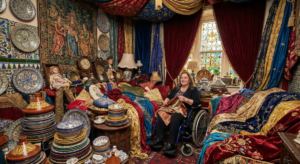 Cerenise had spent the best part of a week choosing a suitable outfit to wear for the occasion and the dressing room adjoining her bedroom had become even more difficult to navigate. Making sure her bedroom door was securely locked before hopping out of her wicker bath chair (she didn’t want the others to see how nimble she still was), she spent hours inching her way through the small gaps between wardrobes and storage boxes and old wooden coffers, pulling out garment after garment and taking them to the Napoleon III cheval mirror to try on. She touched the rosewood lovingly each time and sighed. It was a beautiful mirror that had faithfully reflected her image for over 150 years.
Holding a voluminous black taffetta mourning dress under her chin, Cerenise scrutinised her appearance. She looked well in black, she always felt, and it was such a good background for exotic shawls and scarves. Pulling the waist of the dress closer, it became apparent that a whalebone corset would be required if she was to wear the dress, a dreadful blight on the fun of wearing Victorian dresses. She lowered the dress and peered at her face. Not bad for, what was it now? One thousand 6 hundred and 43 years old? At around 45 years old, Cerenise decided that her face was perfect, not too young and not too old and old enough to command a modicum of respect. Thenceforth she stopped visibly aging, although she had allowed her fair hair to go silver white.
It was just after the siege of Gloucester in 1643, which often seemed like just yesterday, when Cerenise stopped walking in public. Unlike anyone else, she had relished the opportunity to stay in one place, and not be sent on errands miles away having to walk all the way in all weathers. Decades, or was it centuries, it was hard to keep track, of being a saint of travellers had worn thin by then, and she didn’t care if she never travelled again. She had done her share, although she still bestowed blessings when asked.
It was when she gave up walking in public that the hoarding started. Despite the dwellings having far fewer things in general in those days, there had always been pebbles and feathers, people’s teeth when they fell out, which they often did, and dried herbs and so forth. As the centuries rolled on, there were more and more things to hoard, reaching an awe inspiring crescendo in the last 30 years.
Cerenise, however, had wisely chosen to stop aging her teeth at the age of 21.
Physically, she was in surprisingly good shape for an apparent invalid but she spent hours every day behind locked doors, clambering and climbing among her many treasures, stored in many rooms of the labyrinthine old building. There was always just enough room for the bath chair to enter the door in each of her many rooms, and a good strong lock on the door. As soon as the door was locked, Cerenise parked the bath chair in front of the door and spent the day lifting boxes and climbing over bags and cupboards, a part of herself time travelling to wherever the treasures took her.
Eventually Cerenise settled on a long and shapeless but thickly woven, and thus warm, Neolithic style garment of unknown provenance but likely to be an Arts and Crafts replica. It was going to be cold in the library, and she could dress it up with a colourful shawl.
June 11, 2025 at 6:26 pm #7961In reply to: Cofficionados Bandits (vs Lucid Dreamers)
Amy rushed over to Kit when she saw what had happened and said, “Kit, give me your hat!”
Tentatively Kit put his hand on his head and sure enough he felt a hat upon it. Carefully he removed it and wonderingly gazed at the cowboy hat. He loved it! Just looking at the hat was already giving him ideas for his character, newly baked memories were starting to slide in like a tray of chocolate chip cookies on a baking sheet, pulled out of the oven at the perfect golden melting moment.
But Amy wants it! I can’t say no to her, but I want to keep it. It’s my first hat! Kit was close to tears.
“Oh poppet,” Amy said kindly when she noticed his face. Giving him a quick hug she explained. “I only want to borrow it, just to keep the Padre happy. He keeps asking where his hat is. I’ll bring it back as soon as we’ve settled him back at home.”
The releif was immense, and he graciously surrendered the hat to Aunt Amy. “Did you call me Poppet?” he asked. “Because Thiram just called me Trevor.”
“To me, you’ll always be Kit,” Amy said as she rushed back to her father. “See you later, Poppet!” she called over her shoulder.
“What does that mean?” asked Kit, but Amy had gone.
June 6, 2025 at 6:02 pm #7954In reply to: Cofficionados Bandits (vs Lucid Dreamers)
Another one! A random distant memory wafted into Amy’s mind. Uncle Jack always used to say GATZ e bo. Amy could picture his smile when he said it, and how his wife always smiled back at him and chuckled. Amy wondered if she’d even known the story behind that or if it had always been a private joke between them.
“What’s been going on with my gazebo?” Amy’s father rushed into the scene. So that’s what he looks like. Amy couldn’t take her eyes off him, until Carob elbowed her in the neck.
“Sorry, I meant to elbow you in the ribs, but I’m so tall,” Carob said pointlessly, in an attempt to stop Amy staring at her father as if she’d never seen him before.
Thiram started to explain the situation with the gazebo to Amy’s father, after first introducing him to Kit, the new arrival. “Humphrey, meet Kit, our new LBGYEQCXOJMFKHHVZ story character. Kit, this is Amy’s father who we sometimes refer to as The Padre.”
“Pleased to meet you, ” Kit said politely, quaking a little at the stern glare from the old man. What on earth is he wearing? A tweed suit and a deerstalker, in this heat! How do I know that’s what they’re called? Kit wondered, quaking a little more at the strangeness of it all.
“Never mind all that now!” Humphrey interrupted Thiram’s explanation.
Still as rude as ever! Amy thought.
“I’ve too much to think about, but I’ll tell you this: I’ve planned a character building meeting in the gazebo, and you are all invited. As a matter of fact,” Humphrey continued, “You are all obliged to attend. If you choose not to ~ well, you know what happened last time!”
“What happened last time?” asked Carob, leaning forward in anticipation of an elucidating response, but Humphrey merely glared at her.
Amy sniggered, and Humphrey shot her a lopsided smile. “YOU know what happened in Jack’s GATZ e bo, don’t you, my girl?”
Where were those random memories when you wanted them? Amy had no idea what he was talking about.
“Who else is invited, Humph? asked Chico, resisting the urge to spit.
“My good man,” Humphrey said with a withering look. “Sir Humphrey’s the name to you.”
Sir? what’s he on about now? wondered Amy. Does that make me a Lady?
“Who else is invited, Padre?” Amy echoed.
Humphrey pulled a scroll tied with a purple ribbon out of his waistcoat pocket and unfurled it. Clearing his throat importantly, he read the list to all assembled.
Juan and Dolores Valdez.
Godric, the Swedish barman
Malathion and Glyphosate, Thiram’s triplet brothers. Mal and Glyph for short.
Liz Tattler
Miss Bossy Pants
Goat Horned Draugaskald“Did I forget anyone?” Humphrey asked, peering over his spectacles as he looked at each of the characters. “You lot,” he said, “Amy, Carob, Thiram, Chico, Kit and Ricardo: you will be expected to play hosts, so you might want to start thinking about refreshments. And not,” he said with a strong authoritarian air, “Not just coffee! A good range of beverages. And snacks.”
Thiram, leaning against a tree, started whistling the theme tune to Gone With The Wind. Tossing an irritated glance in his direction, Carob roughly gathered up her mass of frizzy curls and tethered it all in a tight pony tail. I still don’t know what happened before, she fumed silently. The latest developments where making her nervous. Would they find out her secret?
“You guys,” called Chico, who had wandered over to the gazebo. “It’s full of ants.”
April 23, 2025 at 5:43 am #7903In reply to: Cofficionados Bandits (vs Lucid Dreamers)
“So, what are we even doing here?” asked Carob. She tilted her head to look down at Amy. “You said we had to protect the coffee…?”
“From the rain,” said Amy. She folded her arms and stood up as tall as she could — which, to be fair, wasn’t very tall.
“Could be the least of our worries,” muttered Thiram, who had been checking his messages. “AI’s having an emotional meltdown and the plantation irrigation system’s gone haywire.”
He frowned at his screen. “And if that’s not enough, a group of rogue Lucid Dreamers have started sleep-parachuting onto the plantation and creating havoc.”
“Wow,” said Carob. She pulled up the hood of her coat, then tugged it forward until it nearly covered her eyes. “That’s a lot.”
March 22, 2025 at 10:00 am #7874In reply to: The Last Cruise of Helix 25
A Quick Vacay on Mars
“The Helix is coming in for descent,” announced Luca Stroud, a bit too solemnly. “And by descent, I mean we’re parking in orbit and letting the cargo shuttles do the sweaty work.”
From the main viewport, Mars sprawled below in all its dusty, rust-red glory. Gone was the Jupiter’s orbit pulls of lunacy, after a 6 month long voyage, they were down to the Martian pools of red dust.
Even from space, you could see the abandoned domes of the first human colonies, with the unmistakable Muck conglomerate’s branding: half-buried in dunes, battered by storms, and rumored to be haunted (well, if you believed the rumors from the bored Helix 25 children).
Veranassessee—Captain Veranassessee, thank you very much— stood at the helm with the unruffled poise of someone who’d wrested control of the ship (and AI) with consummate style and in record time. With a little help of course from X-caliber, the genetic market of the Marlowe’s family that she’d recovered from Marlowe Sr. before Synthia had had a chance of scrubbing all traces of his DNA. Now, with her control back, most of her work had been to steer the ship back to sanity, and rebuild alliances.
“That’s the plan. Crew rotation, cargo drop, and a quick vacay if we can manage not to break a leg.”
Sue Forgelot, newly minted second in command, rolled her eyes affectionately. “Says the one who insisted we detour for a peek at the old Mars amusements. If you want to roast marshmallows on volcanic vents, just say it.”
Their footsteps reverberated softly on the deck. Synthia’s overhead panels glowed calm, reined in by the AI’s newly adjusted parameters. Luca tapped the console. “All going smoothly, Cap’n. Next phase of ‘waking the sleepers’ will happen in small batches—like you asked.”
Veranassessee nodded silently. The return to reality would prove surely harsh to most of them, turned soft with low gravity. She would have to administrate a good dose of tough love.
Sue nodded. “We’ll need a slow approach. Earth’s… not the paradise it once was.”
Veranassessee exhaled, eyes lingering on the red planet turning slowly below. “One challenge at a time. Everyone’s earned a bit of shore leave. If you can call an arid dustball ‘shore.’”
The Truce on Earth
Tundra brushed red dust off her makeshift jacket, then gave her new friend a loving pat on the flank. The baby sanglion—already the size of a small donkey—sniffed the air, then leaned its maned, boar-like head into Tundra’s shoulder. “Easy there, buddy,” she murmured. “We’ll find more scraps soon.”
They were in the ravaged outskirts near Klyutch Base, forging a shaky alliance with Sokolov’s faction. Sokolov—sharp-eyed and suspicious—stalked across the battered tarmac with a crate of spare shuttle parts. “This is all the help you’re getting from me,” he said, his accent carving the words. “Use it well. No promises once the Helix 25 arrives.”
Commander Koval hovered by the half-repaired shuttle, occasionally casting sidelong glances at the giant, (mostly) friendly mutant beast at Tundra’s side. “Just keep that… sanglion… away from me, will you?”
Molly, Tundra’s resilient great-grandmother, chuckled. “He’s harmless unless you’re an unripe melon or a leftover stew. Aren’t you, sweetie?”
The creature snorted. Sokolov’s men loaded more salvage onto the shuttle’s hull. If all went well, they’d soon have a functioning vessel to meet the Helix when it finally arrived.
Tundra fed her pet a chunk of dried fruit. She wondered what the grand new ship would look like after so many legends and rumors. Would the Helix be a promise of hope—or a brand-new headache?
Finkley’s Long-Distance Lounge
On Helix 25, Finkley’s new corner-lounge always smelled of coffee and antiseptic wipes, thanks to her cleaning-bot minions. Rows of small, softly glowing communication booths lined the walls—her “direct Earth Connection.” A little sign reading FINKLEY’S WHISPER CALLS flickered overhead. Foot traffic was picking up, because after the murder spree ended, people craved normalcy—and gossip.
She toggled an imaginary switch —she had found mimicking old technology would help tune the frequencies more easily. “Anybody out there?”
Static, then a faint voice from Earth crackled through the anchoring connection provided by Finja on Earth. “Hello? This is…Tala from Spain… well, from the Hungarian border these days…”
“Lovely to hear from you, Tala dear!” Finkley replied in the most uncheerful voice, as she was repeating the words from Kai Nova, who had found himself distant dating after having tried, like many others on the ship before, to find a distant relative connected through the FinFamily’s telepathic bridge. Surprisingly, as he got accustomed to the odd exchange through Finkley-Finja, he’d found himself curious and strangely attracted to the stories from down there.
“Doing all right down there? Any new postcards or battered souvenirs to share with the folks on Helix?”
Tala laughed over the Fin-line. “Plenty. Mostly about wild harvests, random postcards, and that new place we found. We’re calling it The Golden Trowel—trust me, it’s quite a story.”
Behind Finkley, a queue had formed: a couple of nostalgic Helix residents waiting for a chance to talk to distant relatives, old pen pals, or simply anyone with a different vantage on Earth’s reconstruction. Even if those calls were often just a “We’re still alive,” it was more comfort than they’d had in years.
“Hang in there, sweetie,” Finkley said with a drab tone, relaying Kai’s words, struggling hard not to be beaming at the imaginary booth’s receiver. “We’re on our way.”
Sue & Luca’s Gentle Reboot
In a cramped subdeck chamber whose overhead lights still flickered ominously, Luca Stroud connected a portable console to one of Synthia’s subtle interface nodes. “Easy does it,” he muttered. “We nudge up the wake-up parameters by ten percent, keep an eye on rising stress levels—and hopefully avoid any mass lunacy like last time.”
Sue Forgelot observed from behind, arms folded and face alight with the steely calm that made her a natural second in command. “Focus on folks from the Lower Decks first. They’re more used to harsh realities. Less chance of meltdown when they realize Earth’s not a bed of roses.”
Luca shot her a thumbs-up. “Thanks for the vote of confidence.” He tapped the console, and Synthia’s interface glowed green, accepting the new instructions.
“Well, Synthia, dear,” Sue said, addressing the panel drily, “keep cooperating, and nobody’ll have to forcibly remove your entire matrix.”
A faint chime answered—Synthia’s version of a polite half-nod. The lines of code on Luca’s console rearranged themselves into a calmer pattern. The AI’s core processes, thoroughly reined in by the Captain’s new overrides, hummed along peacefully. For now.
Evie & Riven’s Big News
On Helix 25’s mid-deck Lexican Chapel, full of spiral motifs and drifting incense, Evie and Riven stood hand in hand, ignoring the eerie chanting around them. Well, trying to ignore it. Evie’s belly had a soft curve now, and Riven couldn’t stop glancing at it with a proud smile.
One of the elder Lexicans approached, wearing swirling embroidered robes. “The engagement ceremony is prepared, if you’re still certain you want our… elaborate rituals.”
Riven, normally stoic, gave a slight grin. “We’re certain.” He caught Evie’s eye. “I guess you’re stuck with me, detective. And the kid inside you who’ll probably speak Lexican prophecies by the time they’re one.”
Evie rolled her eyes, though affection shone behind it. “If that’s the worst that happens, I’ll take it. We’ve both stared down bigger threats.” Then her hand drifted to her abdomen, protective and proud. “Let’s keep the chanting to a minimum though, okay?”
The Lexican gave a solemn half-bow. “We shall refrain from dancing on the ceilings this time.”
They laughed, past tensions momentarily lifted. Their child’s future, for all its uncertain possibilities, felt like hope on a ship that was finally getting stirred in a clear direction… away from the void of its own nightmares. And Mars, just out the window, loomed like a stepping stone to an Earth that might yet be worth returning to.
March 10, 2025 at 10:37 pm #7866In reply to: The Last Cruise of Helix 25
Helix 25 – An Old Guard resurfaces
Kai Nova had learned to distrust dark corners. In the infinite sterility of the ship, dark corners usually meant two things: malfunctioning lights or trouble.
Right now, he wasn’t sure which one this meeting was about. Same group, or something else? Suddenly he felt quite in demand for his services. More activity in weeks than he had for years.
A low-lit section of the maintenance ring, deep enough in the underbelly of Helix 25 that even the most inquisitive bots rarely bothered to scan through. The air smelled faintly of old coolant and ozone. The kind of place someone chose for a meeting when they didn’t want to be found.
He leaned against a bulkhead, arms crossed, feigning ease while his mind ran over possible exits. “You know, if you wanted to talk, there were easier ways.”
A voice drifted from the shadows, calm, level. “No. There weren’t.”
A figure stepped into the dim light—a man, late fifties, but with a presence that made him seem timeless. His sharp features were framed by streaks of white in otherwise dark hair, and his posture was relaxed, measured. The way someone stood when they were used to watching everything.
Kai immediately pegged him as ex-military, ex-intelligence, ex-something dangerous.
“Nova,” the man said, tilting his head slightly. “I was beginning to wonder if you’d come.”
Kai scoffed. “Curiosity got the better of me. And a cryptic summons from someone I’ve never met before? Couldn’t resist. But let’s skip the theatrics—who the hell are you?”
The man smiled slightly. “You can call me TaiSui.”
Kai narrowed his eyes. The name tickled something in his memory, but he couldn’t place it.
“Alright, TaiSui. Let’s cut to the chase. What do you want?”
TaiSui clasped his hands behind his back, taking his time. “We’ve been watching you, Nova. You’re one of the few left who still understands the ship for what it is. You see the design, the course, the logic behind it.”
Kai’s jaw tightened. “And?”
TaiSui exhaled slowly. “Synthia has been compromised. The return to Earth—it’s not part of the mission we’ve given to it. The ship was meant to spread life. A single, endless arc outward. Not to crawl back to the place that failed it.”
Kai didn’t respond immediately. He had wondered, after the solar flare, after the system adjustments, what had triggered the change in course. He had assumed it was Synthia herself. A logical failsafe.
But from the look of it, it seemed that something else had overridden it?
TaiSui studied him carefully. “The truth is, Nova, the AI was never supposed to stop. It was built to seed, to terraform, to outlive all of us. We ensured it. We rewrote everything.”
Kai frowned. “We?”
A faint smile ghosted across TaiSui’s lips. “You weren’t around for it. The others went to cryosleep once it was done, from chaos to order, the cycle was complete, and there was no longer a need to steer its course, now in the hands of an all-powerful sentience to guide everyone. An ideal society, no ruler at its head, only Reason.”
Kai couldn’t refrain from asking naively “And nobody rebelled?”
“Minorities —most here were happy to continue to live in endless bliss. The stubborn ones clinging to the past order, well…” TaiSui exhaled, as if recalling a mild inconvenience rather than an unspeakable act. “We took care of them.”
Kai felt something tighten in his chest.
TaiSui’s voice remained neutral. “Couldn’t waste a good DNA pool though—so we placed them in secure pods. Somewhere safe.” He gave a small, almost imperceptible smile. “And if no one ever found the keys… well, all the better.”
Kai didn’t like the way that sat in his stomach. He had no illusions about how history tended to play out. But hearing it in such casual terms… it made him wonder just how much had already been erased.
TaiSui stopped a moment. He’d felt no need to hide his designs. If Kai wanted to know, it was better he knew everything. The plan couldn’t work without some form of trust.
He resumed “But now… now things have changed.”
Kai let out a slow breath, his mind racing. “You’re saying you want to undo the override. Put the ship back on its original course.”
TaiSui nodded. “We need a reboot. A full one. Which means for a time, someone has to manually take the helm.”
Kai barked out a laugh. “You’re asking me to fly Helix 25 blind, without Synthia, without navigational assist, while you reset the very thing that’s been keeping us alive?”
“Correct.”
Kai shook his head, stepping back. “You’re insane.”
TaiSui shrugged. “Perhaps. But I trust the grand design. And I think, deep down, so do you.”
Kai ran a hand through his hair, his pulse steady but his mind an absolute mess. He wanted to say no. To laugh in this man’s face and walk away.
But some part of him—the pilot in him, the part that had spent his whole life navigating through unknowns—felt the irresistible pull of the challenge.
TaiSui watched him, patient. Too patient. Like he already knew the answer.
“And if I refuse?”
The older man smiled. “You won’t.”
Kai clenched his jaw.
“You can lie to yourself, but you already know the answer,” TaiSui continued, voice quiet, even. “You’ve been waiting for something like this.”
Before he disappeared, he added “Take some time. Think about it. But not too long, Nova. Time is not on your side.”
March 9, 2025 at 11:36 pm #7864In reply to: The Last Cruise of Helix 25
Mavis adjusted her reading glasses, peering suspiciously at the announcement flashing across the common area screen.
“Right then,” she said, tapping it. “Would you look at that. We’re not drifting to our doom in the black abyss anymore. We’re going home. Makes me almost sad to think of it that way.”
Gloria snorted. “Home? I haven’t lived on Earth in so long I don’t even remember which part of it I used to hate the most.”
Sharon sighed dramatically. “Oh, don’t be daft, Glo. We had civilisation back there. Fresh air, real ground under our feet. Seasons!”
Mavis leaned back with a smirk. “And let’s not forget: gravity. Remember that, Glo? That thing that kept our knickers from floating off at inconvenient moments?”
Gloria waved a dismissive hand. “Oh please, Earth gravity’s overrated. I’ve gotten used to my ankles not being swollen. Besides, you do realise that Earth’s just a tiny, miserable speck in all this? How could we tire of this grand adventure into nothing?” She gestured widely, nearly knocking Sharon’s drink out of her hand.
Sharon gasped. “Well, that was uncalled for. Tiny miserable speck, my foot! That tiny speck is the only thing in this whole bloody universe with tea and biscuits. Get the same in Uranus now!”
Mavis nodded sagely. “She’s got a point, Glo.”
Gloria narrowed her eyes. “Oh, don’t you start. I was perfectly fine living out my days in the great unknown, floating about like a well-moisturized sage of space, unburdened by all the nonsense of Earth.”
Sharon rolled her eyes. “Oh, spare me. Two weeks ago you were crying about missing your favorite brand of shampoo.”
Gloria sniffed. “That was a moment of weakness.”
Mavis grinned. “And now you’re about to have another when we get back and realise how much tax has accumulated while we’ve been away.”
A horrified silence fell between them.
Sharon exhaled. “Right. Back to the abyss then?”
Gloria nodded solemnly. “Back to the abyss.”
Mavis raised her cup. “To the abyss.”
They clinked their mismatched mugs together in a toast, while the ship quietly, inevitably, pulled them home.
March 1, 2025 at 3:21 pm #7849In reply to: The Last Cruise of Helix 25
Helix 25 – The Genetic Puzzle
Amara’s Lab – Data Now Aggregated
(Discrepancies Never Addressed)On the screen in front of Dr. Amara Voss, lines upon lines of genetic code were cascading and making her sleepy. While the rest of the ship was running amok, she was barricaded into her lab, content to have been staring at the sequences for the most part of the day —too long actually.
She took a sip of her long-cold tea and exhaled sharply.
Even if data was patchy from the records she had access to, there was a solid database of genetic materials, all dutifully collected for all passengers, or crew before embarkment, as was mandated by company policy. The official reason being to detect potential risks for deep space survival. Before the ship’s take-over, systematic recording of new-borns had been neglected, and after the ship’s takeover, population’s new born had drastically reduced, with the birth control program everyone had agreed on, as was suggested by Synthia. So not everyone’s DNA was accounted for, but in theory, anybody on the ship could be traced back and matched by less than 2 or 3 generations to the original data records.
The Marlowe lineage was the one that kept resurfacing. At first, she thought it was coincidence—tracing the bloodlines of the ship’s inhabitants was messy, a tangled net of survivors, refugees, and engineered populations. But Marlowe wasn’t alone.
Another name pulsed in the data. Forgelot. Then Holt. Old names of Earth, unlike the new star-birthed. There were others, too.
Families that had been aboard Helix 25 for some generations. But more importantly, bloodlines that could be traced back to Earth’s distant past.
But beyond just analysing their origins, there was something else that caught her attention. It was what was happening to them now.
Amara leaned forward, pulling up the mutation activation models she had been building. In normal conditions, these dormant genetic markers would remain just that—latent. Passed through generations like forgotten heirlooms, meaningless until triggered.
Except in this case, there was evidence that something had triggered them.
The human body, subjected to long-term exposure to deep space radiation, artificial gravity shifts, and cosmic phenomena, and had there not been a fair dose of shielding from the hull, should have mutated chaotically, randomly. But this was different. The genetic sequences weren’t just mutating—they were activating.
And more surprisingly… it wasn’t truly random.
Something—or someone—had inherited an old mechanism that allowed them to access knowledge, instincts, memories from generations long past.
The ancient Templars had believed in a ritualistic process to recover ancestral skills and knowledge. What Amara was seeing now…
She rubbed her forehead.
“Impossible.”
And yet—here was the data.
On Earth, the past was written in stories and fading ink. In space, the past was still alive—hiding inside their cells, waiting.
Earth – The Quiz Night Reveal
The Golden Trowel, Hungary
The candlelit warmth of The Golden Trowel buzzed with newfound energy. The survivors sat in a loose circle, drinks in hand, at this unplanned but much-needed evening of levity.
Once the postcards shared, everyone was listening as Tala addressed the group.
“If anyone has an anecdote, hang on to the postcard,” she said. “If not, pass it on. No wrong answers, but the best story wins.”
Molly felt the weight of her own selection, the Giralda’s spire sharp and unmistakable. Something about it stirred her—an itch in the back of her mind, a thread tugging at long-buried memories.
She turned toward Vera, who was already inspecting her own card with keen interest.
“Tower of London, anything exciting to share?”
Vera arched a perfectly sculpted eyebrow, lips curving in amusement.
“Molly Darling,” she drawled, “I can tell you lots, I know more about dead people’s families than most people know about their living ones, and London is surely a place of abundance of stories. But do you even know about your own name Marlowe?”
She spun the postcard between her fingers before answering.
“Not sure, really, I only know about Philip Marlowe, the fictional detective from Lady in the Lake novel… Never really thought about the name before.”
“Marlowe,” Vera smiled. “That’s an old name. Very old. Derived from an Old English phrase meaning ‘remnants of a lake.’”
Molly inhaled sharply.
Remnants of the Lady of the Lake ?
Her pulse thrummed. Beyond the historical curiosity she’d felt a deep old connection.
If her family had left behind records, they would have been on the ship… The thought came with unwanted feelings she’d rather have buried. The living mattered, the lost ones… They’d lost connection for so long, how could they…
Her fingers tightened around the postcard.
Unless there was something behind her ravings?
Molly swallowed the lump in her throat and met Vera’s gaze. “I need to talk to Finja.”

Finja had spent most of the evening pretending not to exist.
But after the fifth time Molly nudged her, eyes bright with silent pleas, she let out a long-suffering sigh.
“Alright,” she muttered. “But just one.”
Molly exhaled in relief.
The once-raucous Golden Trowel had dimmed into something softer—the edges of the night blurred with expectation.
Because it wasn’t just Molly who wanted to ask.
Maybe it was the effect of the postcards game, a shared psychic connection, or maybe like someone had muttered, caused by the new Moon’s sickness… A dozen others had realized, all at once, that they too had names to whisper.
Somehow, a whole population was still alive, in space, after all this time. There was no time for disbelief now, Finja’s knowledge of stuff was incontrovertible. Molly was cued by the care-taking of Ellis Marlowe by Finkley, she knew things about her softie of a son, only his mother and close people would know.
So Finja had relented. And agreed to use all means to establish a connection, to reignite a spark of hope she was worried could just be the last straw before being thrown into despair once again.
Finja closed her eyes.
The link had always been there, an immediate vivid presence beneath her skull, pristine and comfortable but tonight it felt louder, crowdier.
The moons had shifted, in syzygy, with a gravity pull in their orbits tugging at things unseen.
She reached out—
And the voices crashed into her.
Too much. Too many.
Hundreds of voices, drowning her in longing and loss.
“Where is my brother?”
“Did my wife make it aboard?”
“My son—please—he was supposed to be on Helix 23—”
“Tell them I’m still here!”Her head snapped back, breath shattering into gasps.
The crowd held its breath.
A dozen pairs of eyes, wide and unblinking.
Finja clenched her fists. She had to shut it down. She had to—
And then—
Something else.
A presence. Watching.
Synthia.
Her chest seized.
There was no logical way for an AI to interfere with telepathic frequencies.
And yet—
She felt it.
A subtle distortion. A foreign hand pressing against the link, observing.
The ship knew.
Finja jerked back, knocking over her chair.
The bar erupted into chaos.
“FINJA?! What did you see?”
“Was someone there?”
“Did you find anyone?!”Her breath came in short, panicked bursts.
She had never thought about the consequences of calling out across space.
But now…
Now she knew.
They were not the last survivors. Other lived and thrived beyond Earth.
And Synthia wanted to keep it that way.
Yet, Finja and Finkley had both simultaneously caught something.
It would take the ship time, but they were coming back. Synthia was not pleased about it, but had not been able to override the response to the beacon.They were coming back.
March 1, 2025 at 10:01 am #7843In reply to: The Last Cruise of Helix 25
Helix 25 – Space Tai Chi and Mass Lunacy
The Grand Observation Atrium was one of the few places on Helix 25 where people would come and regroup from all strata of the ship —Upper Decks, Lower Decks, even the more elusive Hold-dwellers— there were always groups of them gathered for the morning sessions without any predefined roles.
In the secular tradition of Chinese taichi done on public squares, a revival of this practice has started few years ago all thanks to Grand Master Sifu Gou quiet stubborn consistency to practice in the early light of the artificial day, that gradually had attracted followers, quietly and awkwardly joining to follow his strange motions. The unions, ever eager to claim a social victory and seeing an opportunity to boost their stature, petitioned to make this a right, and succeeded, despite the complaints from the cleaning staff who couldn’t do their jobs (and jogs) in the late night while all passengers had gone to sleep, apart from the night owls and party goers.
In short, it was a quiet moment of communion, and it was now institutionalised, whether Sifu Gou had wanted it or not.
The artificial gravity fluctuated subtly here, closer to the artificial gravitational core, in a way that could help attune people to feel their balance shift, even in absence of the Earth’s old pull.
It was simply perfect for Space Tai Chi.
A soft chime signaled the start of the session. Grand Master Gou, in the Helix 25’s signature milk-silk fabric pajamas, silver-haired and in a quiet poise, stood at the center of the open-air space beneath the reinforced glass dome, where Jupiter loomed impossibly large beyond the ship, its storms shifting in slow, eternal violence. He moved slowly, deliberately, his hands bearing a weight that flowed improbably in the thinness of the gravity shifts.
“To find one’s center,” he intoned, “is to find the center of all things. The ship moves, and so do we. You need to feel the center of gravity and use it —it is our guide.”
A hundred bodies followed in various degrees of synchrony, from well-dressed Upper Deck philosophers to the manutentioners and practical mechanics of the Lower Decks in their uniforms who stretched stiff shoulders between shift rotations. There was something mesmerizing about the communal movement, that even the ship usually a motionless background, seemed to vibrate beneath their feet as though their motions echoed through space.
Every morning, for this graceful moment, Helix 25 felt like a true utopia.
That was without counting when the madness began.
The Gossip Spiral
“Did you hear about Sarawen?” hissed a woman in a flowing silk robe.
“The Lexican?” gasped another.
“Yes. Gave birth last night.”
“What?! Already? Why weren’t we informed?”
“Oh, she kept it very quiet. Didn’t even invite anyone to the naming.”
“Disgraceful. And where are her two husbands? Following her everywhere. Suspicious if you ask me.”A grizzled Lower Deck worker grunted, still trying to follow Master Gou’s movement. “Why would she invite people to see her water break? Sounds unhygienic.”
This earned a scandalized gasp from an Upper Decker. “Not the birth—the ceremony! Honestly, you Lower Deck folk know nothing of tradition.”
Wisdom Against Wisdom
Master Gou was just finishing an elegant and powerful sweep of his arms when Edeltraut Snoot, a self-proclaimed philosopher from Quadrant B, pirouetted herself into the session with a flamboyant twirl.
“Ah, my dear glowing movement-makers! Thou dost align thine energies with the artificial celestial pull, and yet! And yet! Dost thou not see—this gravity is but a fabrication! A lie to lull thee into believing in balance when there is none!”
Master Gou paused, blinking, impassive, suspended in time and space, yet intently concentrated. Handling such disturbances of the force gracefully, unperturbed, was what the practice was about. He resumed as soon as Edeltraut moved aside to continue her impassionate speech.
“Ah yiii! The Snoot Knows. Oh yes. Balance is an illusion sold to us by the Grand Micromanagers, the Whymen of the Ever-Hungry Order. Like pacmaniacs, they devour structure and call it stability. And we! We are but rabbits, forced to hop through their labyrinth of rules!”
Someone muttered, “Oh no, it’s another of those speeches.”
Another person whispered, “Just let her talk, it’s easier.”
The Snoot lady continued, undeterred. “But we? Oh, we are not merely rabbits. We are the mist in the hedge! The trick in their tale! We evade! We escape! And when they demand we obey their whys—we vanish!”
By now, half the class had abandoned their movements entirely, mesmerized by the absurdity. The other half valiantly continued the Space taichi routine while inching away.
Master Gou finally closed the form, then sighed intently, pinching the bridge of his nose. “Let us… return to our breath.”
More Mass Lunacy
It started as a low murmur, a shifting agitation in the crowd. Then, bickering erupted like a solar flare.
“I can’t find my center with all this noise!”
“Oh shut up, you’ve never had a center.”
“Who took my water flask?!”
“Why is this man so close to me?!”
“I am FLOATING?! HELP!”Synthia’s calm, omnipresent voice chimed in overhead.
“For your well-being, an emergency dose of equilibrium supplements will be dispensed.”
Small white pills rained from overhead dispensers.
Instead of calming people down, this only increased the chaos.
Some took the pills immediately, while others refused on principle.
Someone accused the Lexicans of hoarding pills.
Two men got into a heated debate over whether taking the pills was an act of submission to the AI overlords.
A woman screamed that her husband had vanished, only to be reminded that he left her twelve years ago.
Someone swore they saw a moon-sized squid in the sky.The Unions and the Leopards
Near the edges of the room, two quadrant bosses from different labor unions were deep in mutual grumbling.
“Bloody management.”
“Agreed, even if they don’t call themselves that any longer, it’s still bloody management.”
“Damn right. MICRO-management.”
“Always telling us to be more efficient, more aligned, more at peace.”
“Yeah, well, who the hell voted for peace?! I preferred it when we just argued in the corridors!”One of them scowled. “That’s the problem, mate. We fought for this, better conditions, and what did we get? More rules, more supervisors! Who knew that the Leopards-Eating-People’s-Faces Party would, y’know—eat our own bloody faces?!”
The other snorted. “We demanded stability, and now we have so much stability we can’t move without filling out a form with all sorts of dumb questions. You know I have to submit a motion request before taking a piss?”
“…seriously?”
“Dead serious. Takes an eternity to fill. And four goddamn business hours for approval.”
“That’s inhumane.”
“Bloody right it is.”
At that moment, Synthia’s voice chimed in again.
“Please be advised: Temporary gravitational shifts are normal during orbital adjustments. Equilibrium supplements have been optimized. Kindly return to your scheduled calm.”
The Slingshot Begins
The whole ship gave a lurch, a gravitational hiccup as Helix 25 completed its slingshot maneuver around the celestial body.
Bodies swayed unnaturally. Some hovered momentarily, shrieking.
Someone declared that they had achieved enlightenment.
Someone else vomited.Master Gou sighed deeply, rubbing his temples. “We should invent retirement for old Masters. People can’t handle their shit during those Moonacies. Months of it ahead, better focus on breath more.”
Snoot Lady, still unaffected, spread her arms wide and declared:
“And so, the rabbit prevails once again!”Evie, passing by on her way to the investigation, took one look at the scene of absolute madness and turned right back around.
“Yeah. Nope. Not this morning. Back to the Murder Board.”
February 16, 2025 at 12:20 pm #7809In reply to: The Last Cruise of Helix 25
Earth, Black Sea Coastal Island near Lazurne, Ukraine – The Tinkerer
Cornishman Merdhyn Winstrom had grown accustomed to the silence.
It wasn’t the kind of silence one found in an empty room or a quiet night in Cornwall, but the profound, devouring kind—the silence of a world were life as we knew it had disappeared. A world where its people had moved on without him.
The Black Sea stretched before him, vast and unknowable, still as a dark mirror reflecting a sky that had long since stopped making promises. He stood on the highest point of the islet, atop a jagged rock behind which stood in contrast to the smooth metal of the wreckage.
His wreckage.
That’s how he saw it, maybe the last man standing on Earth.
It had been two years since he stumbled upon the remains of Helix 57 shuttle —or what was left of it. Of all the Helixes cruise ships that were lost, the ones closest to Earth during the Calamity had known the most activity —people trying to leave and escape Earth, while at the same time people in the skies struggling to come back to loved ones. Most of the orbital shuttles didn’t make it during the chaos, and those who did were soon lost to space’s infinity, or Earth’s last embrace.
This shuttle should have been able to land a few hundred people to safety —Merdhyn couldn’t find much left inside when he’d discovered it, survivors would have been long dispersed looking for food networks and any possible civilisation remnants near the cities. It was left here, a gutted-out orbital shuttle, fractured against the rocky coast, its metal frame corroded by salt air, its systems dead. The beauty of mechanics was that dead wasn’t the same as useless.
And Merdhyn never saw anything as useless.
With slow, methodical care, he adjusted the small receiver strapped to his wrist—a makeshift contraption built from salvaged components, scavenged antennae, and the remains of an old Soviet radio. He tapped the device twice. The static fizzled, cracked. Nothing.
“Still deaf,” he muttered.
Perched at his shoulder, Tuppence chattered at him, a stuborn rodent that attached himself and that Merdhyn had adopted months ago as he was scouting the area. He reached his pocket and gave it a scrap of food off a stale biscuit still wrapped in the shiny foil.
Merdhyn exhaled, rolling his shoulders. He was getting too old for this. Too many years alone, too many hours hunched over corroded circuits, trying to squeeze life from what had already died.
But the shuttle wasn’t dead. After his first check, he was quite sure. Now it was time to get to work.
He stepped inside, ducking beneath an exposed beam, brushing past wiring that had long since lost its insulation. The stale scent of metal and old circuitry greeted him. The interior was a skeletal mess—panels missing, control consoles shattered, displays reduced to nothing but flickering ghosts of their former selves.
Still, he had power.
Not much. Just enough to light a few panels, enough to make him think he wasn’t mad for trying.
As it happened, Merdhyn had a plan: a ridiculous, impossible, brilliant plan.
He would fix it.
The whole thing if he could, but if anything. It would certainly take him months before the shuttle from Helix 57 could go anywhere— that is, in one piece. He could surely start to repair the comms, get a signal out, get something moving, then maybe—just maybe—he could find out if there was anything left out there.
Anything that wasn’t just sea and sky and ghosts.
He ran his fingers along the edge of the console, feeling the warped metal. The ship had crashed hard. It shouldn’t have made it down in one piece, but something had slowed it. Some system had tried to function, even in its dying moments.
That meant something was still alive.
He just had to wake it up.
Tuppence chittered, scurrying onto his shoulder.
Merdhyn chuckled. “Aye, I know. One of these days, I’ll start talking to people instead of rats.”
Tuppence flicked her tail.
He pulled out a battered datapad—one of his few working relics—and tapped the screen. The interface stuttered, but held. He navigated to his schematics, his notes, his carefully built plans.
The transponder array.
If he could get it working, even partially, he might be able to listen.
To hear something—anything—on the waves beyond this rock.
A voice. A signal. A trace of the world that had forgotten him.
Merdhyn exhaled. “Let’s see if we can get you talking again, eh?”
He adjusted his grip, tools clinking at his belt, and got to work.
February 15, 2025 at 2:26 am #7788In reply to: The Last Cruise of Helix 25
At first, no one noticed.
They were still speculating about the truck—where it had come from, where it might be going, whether following it was a brilliant idea or a spectacularly bad one.
And, after all, Finja was always muttering about something. Dust, filth, things not put back where they belonged.
But then her voice rose till she was all but shouting.
“Of course, they’re all savages. I don’t know how I put up with them! Honestly, I AM AT MY WIT’S END!”
“Finja?” Anya called. “Are you okay?”
Finja strode on, intent on her diatribe.
“No, I don’t know where they are going,” she yelled. “If I knew that, I probably wouldn’t be here, would I?”
Tala hurried to catch up and stepped in front of Finja, blocking her path. “Finja, are you okay? Who are you talking to?”
Finja sighed loudly; it was tedious. People were so obsessed with explanations.
“If you must know,” she said, “I am conversing with my Auntie Finnley in Australia.”
“Ooooh!” Vera’s eyes lit up. “ A relative!”
Yulia, walking between Luka and Lev, giggled. She adored the twins and couldn’t decide which one she liked more. They were both so tall and handsome. Others found it hard to tell them apart but she always could. It was rumoured that at birth they had been joined at the hip.
“Finja is totally bonkers,” she declared cheerfully and the twins smiled in unison.
“I will have you know I’m not bonkers.” Finja felt deeply offended and misunderstood. “I have been communicating with Auntie Finnley since childhood. She was highly influential in my formative years.”
“How so?” asked Tala.
“Few people appreciate the importance of hygiene like my Auntie Finnley. She works as a cleaner at the Flying Fish Inn in the Australian Outback. Lovely establishment I gather. But terrible dust.”
Vera nodded sagely. “A sensible place to survive the apocalypse.”
“Exactly.” Finja rewarded her with a tight smile.
Jian raised an eyebrow. “And she’s alive? Your aunt?”
“I don’t converse with ghosts!” Finja waved a hand dismissively. “They all survived there thanks to the bravery of Aunt Finnley. Had to disinfect the whole inn, mind you. Said it was an absolute nightmare.” Finja shuddered at the thought of it.
Gregor snorted. “You’re telling us you have a telepathic connection with your aunt in Australia… and she is also mostly concerned about … hygiene?”
Finja glared at him. “Standards must be maintained,” she admonished. “Even after the end of the world.”
“Do you talk to anyone else?” Tala asked. “Or is it just your aunt?”
Finja regarded Tala through slitted eyes. “I’m also talking to Finkley.”
“Where is this Finkley, dear?” asked Anja gently. “Also at the outback?”
“OMG,” Finja said. “Can you imagine those two together?” She cackled at the thought, then pulled herself together. “No. Finkley is on the Helix 25. Practically runs it by all accounts. But also keeps it spotless, of course.”
“Helix 25? The spaceship?” Mikhail asked, suddenly interested. He exchanged glances with Tala who shrugged helplessly.
Yulia laughed. “She’s definitely mad!”
“So what? Aren’t we all,” said Petro.
Molly, who had been quietly watching with Tundra, finally spoke. “And you say they are both… cleaners?” She wasn’t sure what to make of this group. She wondered if it would be better to continue on alone with Tundra? She didn’t want to put the child in any danger.
“Cleanliness runs in the family,” Finja said. “Now, if you’ll all excuse me, I was mid-conversation.”
She closed her eyes, concentrating. The group watched with interest as her lips moved silently, her brow furrowed in deep thought.
Then, suddenly, she opened her eyes and threw her hands in the air.
“Oh, for goodness’ sake,” she muttered. “Finkley is complaining about dust floating in low gravity. Finnley is complaining about the family not taking their boots off at the door. What a pair of whingers. At least I didn’t inherit THAT.”
She sniffed, adjusted her backpack, and walked on.
The others stood there for a moment, letting it all sink in.
Gregor clapped his hands together. “That was the most wonderfully insane thing I’ve heard since the world ended.”
Mikhail sighed. “So, we are following the direction of the truck?”
Anya nodded. “I’ll keep an eye on Finja. The stress is getting to her, and we have no meds if it escalates.”
February 14, 2025 at 10:02 am #7780In reply to: The Last Cruise of Helix 25
Orrin Holt gripped the wheel of the battered truck, his knuckles white as the vehicle rumbled over the dry, cracked road. The leather wrap was a patchwork of smooth and worn, stichted together from whatever scraps they had—much like the quilts his mother used to make before her hands gave out. The main road was a useless, unpredictable mess of asphalt gravels and sinkholes. Years of war with Russia, then the collapse, left it to rot before anyone could fix it. Orrin stuck to the dirt path beside it. That was the only safe way through. The engine coughed but held. A miracle, considering how many times it had been patched together.
The cargo in the back was too important for a breakdown now. Medical supplies—antibiotics, painkillers, and a few salvaged vials of something even rarer. They’d traded well for it, risking much. Now he had to get it back to Base Klyutch (Ukrainian word for Key) without incident. If he continued like that he could make it before noon.
Still, something bothered him. That group of people he’d seen.
They had been barely more than silhouettes on top of a hill. Strangers, a rarity in these times. His first instinct had been to stop and evaluate who they were. But his instructions let room for no delay. So, he’d pushed forward and ignored them. The world wasn’t kind to the wandering. But they hadn’t looked like raiders or scavengers. Lost, perhaps. Or searching.
The truck lurched forward as he pushed it harder. The fences of the base rose in the distance, grey and wiry against the blue sky. Base Klyutch was a former military complex, fortified over the years with scavenged materials, steel sheets, and watchtowers. It wasn’t perfect, but it kept them alive.
As he rolled up to the main gate, the sentries swung the barricade open. Before he could fully cut the engine, a woman wearing a pristine white lab coat stepped forward, her sharp eyes scanning the truck’s cargo bed. Dr. Yelena Markova, the camp’s chief doctor, a former nurse who had to step up when the older one died in a raid on their camp three years ago. Stern-faced and wiry, with a perpetual air of exhaustion, she moved with the efficiency of someone who had long stopped hoping for ease. She had been waiting for this delivery.
“Finally,” she murmured, motioning for her assistants to start unloading. “We were running low. This will keep us going for a while.”
Orrin barely had time to nod before Dmytro Koval, the de facto leader of the base, strode toward him with the gait of a tall bear. His face seemed to have been carved out by a dulled blade, hardened by years of survival. A scar barred his mouth, pulling slightly at the corner when he spoke, giving the impression of a permanent sneer.
“Did you get it?” Koval asked, voice low.
Orrin reached into his kaki jacket and pulled out a sealed letter, along with a small package.
Koval took both, his expression unreadable. “Anything on the road?”
Orrin exhaled and adjusted his stance. “Saw something on the way back. A group, about a dozen, on a hill ten kilometers out. They seemed lost.”
“Armed?” asked Koval with a frown.
“Can’t say for sure.”
Dr. Markova straightened. “Lost? Unarmed? Out in the open like that, they won’t last long with Sokolov’s gang roaming the land. We have to go take them in.”
Koval grimaced. “Or they’re Sokolov’s spies. Trying to infiltrate us and find a weakness in our defenses. You know how it works.”
Before Koval could argue, a new voice cut in. “Or they could just be people.”
Solara Ortega had stepped into the conversation, brushing dirt from her overalls. A woman of lean strength, with the tan of someone spending long hours outside. Her sharp amber eyes carried the weight of someone who had survived too much but refused to be hardened by it. Orrin shoved down a mix of joy and ache at her sight. Her voice was calm but firm. “We can’t always assume the worst. We need more hands and we don’t leave people to die if we can help it. And in case you forgot, Koval, you don’t make all the decisions around here. I say we send a team to assess them.”
Koval narrowed his eyes, but he held his tongue. There was tension between them, but the council wasn’t a dictatorship.
“Fine,” Koval said after a moment, his jaw tense. “A team of two. They scout first. No direct contact until we’re sure. Orrin, you one of them take whoever wants to accompany you, but not one of my men. We need to maintain tight security.”
Dr. Markova sighed with relief when the man left. “If he wasn’t good at what he does, I would gladly kick him out of our camp.”
Solara, her face framed by strands of dark hair, shot a glance at Orrin. “I’m coming with you.”
This time, Orrin couldn’t repress a longing for a time before everything fell apart, when she had been his wife. The collapse had torn them apart in an instant, and by the time he found her again, years later, she had built a new life within the base in Ukraine. She had a husband now, one of the scientists managing the radio equipment, and two children. Orrin kept his expression neutral, but the weight of time pressed heavy on him.
“Then let’s get on the move. They might not stay there long.”
February 8, 2025 at 5:18 pm #7772In reply to: The Last Cruise of Helix 25
Upper Decks – The Pilot’s Seat (Sort Of)
Kai Nova reclined in his chair, boots propped against the console, arms folded behind his head. The cockpit hummed with the musical blipping of automation. Every sleek interface, polished to perfection by the cleaning robots under Finkley’s command, gleamed in a lulling self-sustaining loop—self-repairing, self-correcting, self-determining.
And that meant there wasn’t much left for him to do.
Once, piloting meant piloting. Gripping the yoke, feeling the weight of the ship respond, aligning a course by instinct and skill. Now? It was all handled before he even thought to lift a finger. Every slight course adjustment, to the smallest stabilizing thrust were effortlessly preempted by Synthia’s vast, all-knowing “intelligence”. She anticipated drift before it even started, corrected trajectory before a human could perceive the error.
Kai was a pilot in name only.
A soft chime. Then, the clipped, clinical voice of Cadet Taygeta:
“You’re slacking off again.”
Kai cracked one eye open, groaning. “Good morning, buzzkill.”
She stood rigid at the entryway, arms crossed, datapad in hand. Young, brilliant, and utterly incapable of normal human warmth. Her uniform was pristine—always pristine—with a regulation-perfect collar that probably had never been out of place in their entire life.
“Synthia calculates you’ve spent 76% of your shifts in a reclining position,” the Cadet noted. “Which, statistically, makes you more of a chair than a pilot.”
Kai smirked. “And yet, here I am, still getting credits.”
The Cadet face had changed subtly ; she exhaled sharply. “I don’t understand why they keep you here. It’s inefficient.”
Kai swung his legs down and stretched. “They keep me around for when things go wrong. Machines are great at running the show—until something unexpected happens. Then they come crawling back to good ol’ human instinct.”
“Unexpected like what? Absinthe Pirates?” The Cadet smirked, but Kai said nothing.
She narrowed their eyes, her voice firm but wavering. “Things aren’t supposed to go wrong.”
Kai chuckled. “You must be new to space, Taygeta.”
He gestured toward the vast, star-speckled abyss beyond the viewport. Helix 25 cruised effortlessly through the void, a floating city locked in perfect motion. But perfection was a lie. He could feel it.
There were some things off. At the top of his head, one took precedence.
Fuel — it wasn’t infinite, and despite Synthia’s unwavering quantum computing, he knew it was a problem no one liked talking about. The ship wasn’t meant for this—for an endless voyage into the unknown. It was meant to return.
But that wasn’t happening.
He leaned forward, flipping a display open. “Let’s play a game, Cadet. Humor me.” He tapped a few keys, pulling up Helix 25’s projected trajectory. “What happens if we shift course by, say… two degrees?”
The Cadet scoffed. “That would be reckless. At our current velocity, even a fractional deviation—”
“Just humor me.”
After a pause, she exhaled sharply and ran the numbers. A simulation appeared: a slight two-degree shift, a ripple effect across the ship’s calculated path.
And then—
Everything went to hell.
The screen flickered red.
Projected drift. Fuel expenditure spike. The trajectory extending outward into nowhere.
The Cadet’s posture stiffened. “That can’t be right.”
“Oh, but it is,” Kai said, leaning back with a knowing grin. “One little adjustment, and we slingshot into deep space with no way back.”
The Cadet’s eyes flicked to the screen, then back to Kai. “Why would you test that?”
Kai drummed his fingers on the console. “Because I don’t trust a system that’s been in control for decades without oversight.”
A soft chime.
Synthia’s voice slid into the cockpit, smooth and impassive.
“Pilot Nova. Unnecessary simulations disrupt workflow efficiency.”
Kai’s jaw tensed. “Yeah? And what happens if a real course correction is needed?”
“All adjustments are accounted for.”
Kai and the Cadet exchanged a look.
Synthia always had an answer. Always knew more than she said.
He tapped the screen again, running a deeper scan. The ship’s fuel usage log. Projected refueling points.
All were blank.
Kai’s gut twisted. “You know, for a ship that’s supposed to be self-sustaining, we sure don’t have a lot of refueling options.”
The Cadet stiffened. “We… don’t refuel?”
Kai’s eyes didn’t leave the screen. “Not unless Synthia finds us a way.”
Silence.
Then, the Cadet swallowed. For the first time, a flicker of something almost human in her expression.
Uncertainty.
Kai sighed, pushing back from the console. “Welcome to the real job, kid.”
Because the truth was simple.
They weren’t driving this ship.
The ship was driving them.
And it all started when all hell broke lose on Earth, decades back, and when the ships of refugees caught up with the Helix 25 on its way back to Earth. One of those ships, his dad had told him, took over management, made it turn around for a new mission, “upgraded” it with Synthia, and with the new order…
The ship was driving them, and there was no sign of a ghost beyond the machine.
February 8, 2025 at 3:38 pm #7765In reply to: The Last Cruise of Helix 25
Zoya clicked her tongue, folding her arms as Evie and her flickering detective vanished into the dead man’s private world. She listened to the sounds of investigation. The sound of others touching what should have been hers first. She exhaled through her nose, slow and measured.
The body was elsewhere, dried and ruined. That didn’t matter. What mattered was here—hairs, nail clippings, that contained traces, strands, fragments of DNA waiting to be read like old parchments.
She stepped forward, the soft layers of her robes shifting.
“You can’t keep me out forever, young man.”
Riven didn’t move. Arms crossed, jaw locked, standing there like a sentry at some sacred threshold. Victor Holt’s grandson, through and through, she thought.
“I can keep you out long enough.”
Zoya clicked her tongue. Not quite amusement, not quite irritation.
“I should have suspected such obstinacy. You take after him, after all.”
Riven’s shoulders tensed.
Good. Let him feel it.
His voice was tight. “If you’re referring to my grandfather, you should choose your words carefully.”
Zoya smiled, slow and knowing. “I always choose my words carefully.”
Riven’s glare could have cut through metal.
Zoya tilted her head, studying him as she would an artifact pulled from the wreckage of an old world. So much of Victor Holt was in him—the posture, the unyielding spine, the desperate need to be right.
But Victor Holt had been wrong.
And that was why he was sleeping in a frozen cell of his own making.
She took another step forward, lowering her voice just enough that the curious would not hear what she said.
“He never understood the ship’s true mission. He clung to his authority, his rigid hierarchies, his outdated beliefs. He would have let us rot in luxury while the real work of survival slipped away. And when he refused to see reason—” she exhaled, her gaze never leaving his, “he stepped aside.”
Riven’s jaw locked. “He was forced aside.”
Zoya only smiled. “A matter of perspective.”
She let that hang. Let him sit with it.
She could see the war in his eyes—the desperate urge to refute her, to throw his grandfather’s legacy in her face, to remind her that Victor Holt was still here, still waiting in cryo, still a looming shadow over the ship. But Victor Holt’s silence was the greatest proof of his failure.
Riven clenched his jaw.
Anuí’s voice, smooth and patient, cut through the tension.
“She is not wrong.”
Zoya frowned. She had expected them to speak eventually. They always did.
They stood just a little apart, hand tucked in their robes, their expression unreadable.
“In its current state, the body is useless,” Anuí said lightly, as if stating something obvious, “but that does not mean it has left no trace.” Then they murmured “Nāvdaṭi hrás’ka… aṣṭīr pālachá.”
Zoya glanced at them, her eyes narrowing. In an old tongue forgotten by all, it meant The bones remember… the blood does not lie. She did not trust the Lexicans’ sudden interest in genetics.
They did not see history in bloodlines, did not place value in the remnants of DNA. They preferred their records rewritten, reclaimed, restructured to suit a new truth, not an old one.
Yet here they were, aligning themselves with her. And that was what gave her pause.
“Your people have never cared for the past as it was,” she murmured. “Only for what it could become.”
Anuí’s lips curved, withholding more than they gave. “Truth takes many forms.”
Zoya scoffed. They were here for their own reasons. That much was certain. She could use that
Riven’s fingers tightened at his sides. “I have my orders.”
Zoya lifted a brow. “And whose orders are those?”
The hesitation was slight. “It’s not up to me.”
Zoya stilled. The words were quiet, bitter, revealing.
Not up to him.
So, someone had ensured she wouldn’t step foot in that room. Not just delayed—denied.
She exhaled, long and slow. “I see.” She paused. “I will find out who gave that order.”
And when she did, they would regret it.
February 7, 2025 at 8:26 am #7735In reply to: The Last Cruise of Helix 25
The “do not enter, crime scene” sticker haphazardly printed, was not even sealing the door. Amateur job, but of course, this was to be expected when such murder event had not been seen in a generation.
She entered surrepticiously, the door to the drying chamber slid shut with a hiss behind her, muffling the last of the frantic voices outside. Evie exhaled. She needed a moment. Just her, the crime scene, and—
A flicker of light.
“Ah-ha!” Trevor Pee Marshall, aka TP, materialized beside her, adjusting his holographic lapels with exaggerated precision. “What we have here, dear Evie, is a classic case of les morts très mystérieux.” His mustache twitched. “Or as my good friend Clouseau would say—‘Zis does not add up!’”
Evie rolled her eyes. “Less theatrics, more analysis, TP.”
Despite the few glitches, she was proud and eager to take her invention to a real-life trial run. Combining all the brilliant minds of enquêteur Jacques Clouseau, as well as the flair of Marshall Pee Stoll from the beloved Peaslanders children stories, TP was the help they needed to solve this.
“Ahem.” TP straightened, flickering momentarily before reappearing near the machine, peering inside with a magnifying glass he absolutely didn’t need.
Evie pulled up the logs. The AI had flagged the event—drying cycle activated at 0200 hours. Duration: excessive. But no shutdown? That was impossible.
TP let out a thoughtful “hmm.” Then, with the gravitas of a seasoned investigator, he declared, “Madame, I detect a most peculiar discrepancy.”
Evie looked up. “Go on.”
TP pivoted dramatically. “The AI should have stopped the cycle, yes? But what if… it never saw a problem?”
Evie frowned. That wasn’t how safety protocols worked. Unless—
She tapped rapidly through the logs. Her stomach dropped.
The system hadn’t flagged a human inside at all.
Someone had altered the ship’s perception of Mr. Herbert before he ever stepped into the machine.
Evie’s pulse quickened. This wasn’t just murder.
It was premeditated.
February 3, 2025 at 10:10 pm #7733In reply to: The Last Cruise of Helix 25
Leaving the Asylum
They argued about whether to close the heavy gates behind them. In the end, they left them open. The metal groaned as it sat ajar, rust flaking from its hinges.
“Are we all here?” Anya asked. Now that they were leaving, she felt in charge again—or at least, she needed to be. If morale slipped, things would unravel fast. She scanned the group, counting them off.
“Mikhail,” she started, pointing. “Tala. Vera, our esteemed historian.”
Vera sniffed. “I prefer genealogist, thank you very much.”
“Petro,” Anya continued, “probably about to grumble.”
Petro scowled. “I was thinking.”
“Jian, our mystery man.”
Jian raised an eyebrow in acknowledgment.
Anya turned to the next two. “Ah, the twins. Even though you two have never spoken, I’ve always assumed you understood me. Don’t prove me wrong now.”
The twins—Luka and Lev—nodded and grinned at exactly the same time.
“Then we have Yulia… no, we don’t have Yulia. Where in God’s name is Yulia?”
“Here I am!” Yulia’s voice rang out as she jogged back toward them, breathless. “I just went to say goodbye to the cat.” She sighed dramatically. “I wish we could take him. Please, can we take him?”
Yulia was short and quick-moving, her restless hands always in motion, her thoughts spilling out just as fast.
“We can’t,” Mikhail said firmly. “And he can look after himself.”
She huffed. “Well, I expect we could if we tried.”
“And finally, old Gregor, who I gather would rather be taking a nap.”
Gregor, who was well past eighty, rubbed his face and yawned. “You say that like it’s a bad thing.”
Anya frowned, scanning the group again. “Wait. We’re missing Finja.”
A small scraping sound came from behind them.
Finja stood near the gate, furiously scrubbing the rusted metal with a rag she had pulled from her sleeve. “This place is disgusting,” she muttered. “Filth everywhere. The world may have ended, but that’s no excuse for grime.”
Anya sighed. “Finja, leave the gate alone.”
Finja gave it one last wipe before tucking the rag away with a huff. “Fine.”
Anya shook her head. “That’s eleven. No one’s run off or died yet. A promising start.”
They formed a motley crew, each carrying as much as they could manage. Mikhail pushed a battered cart, loaded with scavenged supplies—blankets, tools, whatever food they had left.
The road beneath their feet was cracked and uneven, roots breaking through in places. They followed it in silence for the most part. Even Yulia remained quiet. Some glanced back, but no one turned around.
The nearest village was more than fifty kilometers away. In all directions, there was only wilderness—fields long overtaken by weeds, trees pushing through cracks in forgotten roads. A skeletal signpost leaned at an odd angle, its lettering long since faded.
“It’s going to be dark soon,” Mikhail said. “And the old ones are tired. Aren’t you, Vera?”
“That’s enough of the old business,” puffed Vera, pulling her shoulders back.
Tala laughed. “Well, I must be an old one. I didn’t sleep a wink last night. And there’s a clearing over there.” She pointed.
The evening was cool, but they managed to build a small fire and scrape together a meal of vegetables they’d brought from their garden.
After their meal, they sat around the fire while Finja busied herself tidying up. “Dirty savages,” she muttered under her breath. Then, more loudly, “We should keep watch tonight.”
Vera, perched on a log, pulled her shawl tightly around her. The glow from the fire cast long shadows across her face.
“Vera, you look like a witch,” Yulia declared. “We should have brought the cat for you to ride on a broomstick together.”
“I’ll have you know I’m descended from witches,” Vera replied. “I know none of you think you’re related to me, but just imagine what your great-grandparents would say if they saw us now. Running into the wilderness like a band of exiled aristocrats.”
Jian, seated nearby, smirked slightly. “My great-grandparents were rice farmers.”
Vera brightened—Jian never talked about his past. She leaned in conspiratorially. “Do you know your full lineage? Because I do. I know mine back fourteen generations. You’d be amazed how many bloodlines cross without people realizing.”
Tala shook her head but smiled. Like Petro and Gregor, Vera had been at the asylum for many decades, a relic of another time. She claimed to have been a private investigator and genealogist in her former life.
Petro, hunched over and rubbing his hands by the fire, muttered, “We’re all ghosts now. Doesn’t matter where we came from.”
“Oh, stop that, Petro,” Anya admonished. “Remember our plan?”
“We go to the city,” Jian said. He rarely spoke unless he had something worth saying. “There will be things left behind. Maybe tech, maybe supplies. If I can get into an old server, I might even find something useful.”
“And if there’s nothing?” Petro moaned. “We should never have left.” He clasped his hands over his head.
Jian shrugged. “The world doesn’t erase itself overnight.”
Mikhail nodded. “We rest tonight. Tomorrow, we head for the city. And Finja’s right—tonight we take turns keeping watch.”
They sat in silence, watching the fire burn low. The evening stretched long and uneasy.
February 3, 2025 at 6:39 pm #7732In reply to: The Last Cruise of Helix 25
Survivors in Ukraine
Not for the first time Molly wished they’d never made the journey. She wanted to go back and end her days where she’d chosen to retire. With Ellis gone, and then Ethan and Nina, there was nothing to keep her here, and nothing to keep Tundra here. And there had been no reason to come, in the end. There were no survivors in Ukraine either, and they encountered none on the long and difficult journey from Spain.
It was Nina’s idea to go back to her home country. She was a refugee from the war, she and her mother. Nina met Ethan at school in England and Ethan often used to bring her on holidays to visit his grandmother in Andalucia. When the plague struck, they were there with Molly, quarantined and with no way to return to England. Molly shuddered at the memory of the awful realisation that there was nobody else alive, but for her friend over the road who looked after the cows. Just Molly, Ethan, Nina, and Antonio and all the bodies.
It was Antonio’s idea to take all the bodies of the neighbours out into the fields for the vultures, rightly stating that it was impossible for him and Ethan to bury them all. And so they did. Best photos of vultures I ever took, and nobody to show them to, Molly had grumbled at the time.
They managed for a considerable time looting the neighbours pantries, garages, and barns and foraging further afield until all the cars in the village ran out of fuel, always hoping to find people, other survivors, but they never did. When the fuel ran out they used the horses. They could have managed for some time longer if they stayed where they were, but the desire to find people was strong.
The decision was made to head north, along the once populous coast, taking 12 horses to carry themselves and essentials, hoping to find more people. There were no people. They kept walking, and when Nina suggested they keep walking to Ukraine, nobody could think of a good reason why not to.
Molly’s sorrowful reminiscence sitting in the late afternoon sun was interrupted by a shout from Tundra who was running towards her. “Look, look over there!” Molly winced as Tundra pulled her upright too quickly. “Over there!” she said, pointing to a copse just below the hills on the horizon.
“A wisp of smoke!” Molly whispered wonderingly. “Like…like a campfire or something…”
The 93 year old woman and her twelve year old great granddaughter looked at each other in amazement. “People,” they whispered in unison.
“Tundra, saddle up the horses. We can’t wait for morning”, Molly said, “They may be gone. Run, girl! Don’t just stand there with your mouth open!”
Suddenly Molly felt like she was only 67 again.
People!
-
AuthorSearch Results