
Search Results for 'collection'
-
AuthorSearch Results
-
February 5, 2026 at 11:51 pm #8055
In reply to: The Hoards of Sanctorum AD26
Helier watched Yvoise squinting at the bone through her screen, trying to decipher the “map” amidst the noxious fumes. He observed the scene with a detachment that surprised him.
The room was vibrating with tension, but for once, it wasn’t coming from Yvoise —it was directed at her. She was standing by the window, phone pressed to her ear, nodding furiously at some invisible bureaucrat on the other end.
“I am violently in agreement with you, Mr. Prufrock,” she was saying, her voice tight but diplomatic. “The olfactory output of Unit 26 is indeed non-compliant with the Olympus Park Clean Air protocols. We are… rectifying the asset.”
It was the “Kyber-Auditor” from the Business Park Administration. The new management had been cracking down lately, restricting their “unauthorized usage” of miracles and enforcing standard operating procedures.
It was all too much noise. Above the smell, which was screaming of decay rather than play, there was the frantic energy of it all. Mrs. Fennel’s panic, Yvoise’s spreadsheets, the looming threat of this “Varlet” from the Council. It was pure Negotium, the active denial of peace, waging war on the idle time of the Romans: Otium. The world was demanding relentlessly that they justify their existence with hygiene certificates, clean surfaces, and significantly fewer piled-up treasures, branding their sacred collections as mere “trip hazards.”
Helier gripped the bamboo handle of his umbrella —a sturdy, shepherd-style thing he had almost tossed into the ‘Charity Pile’ yesterday. He felt a sudden, fierce longing for Otium, a sacred pause where one simply is.
Earlier that morning, a delivery guy had held the elevator door for him with a foot, balancing a mountain of cardboard boxes. A simple, clumsy gesture of kindness amidst the clutter. It had stayed with Helier. It reminded him that you could be overloaded and still have grace. That moment of suspension, of courteous stillness in the middle of the rush, had been a tiny bubble of Otium.
They needed that bubble now. They needed to stop the clock.
Spirius, who had been hovering in the doorway, seemed to hear Helier’s thought.
“A map is useless if you pass out before you can follow it,” Spirius muttered. He stepped fully into the room, brandishing a heavy glass jar like a weapon. “We need a Containment of the Sins.”
“A what?” asked Cerenise, holding her nose.
“Of WHAT?!” asked Yvoise, raising an eyebrow while covering her mouthpiece.
“Sins…” Spirius said doubtfully, “…that should bring back some memories.”
He marched to the table. “Hold on to your halos…”
Yvoise pulled back, shielding her phone. “Wait! I haven’t finished cataloging the striations—”
“The bone will be visible through the glass, Yvoise. But the miasma must be paused.”
Spirius didn’t wait for a vote. He scooped the yellowed bone—and its mysterious map—into the jar. He didn’t recite a Latin prayer. He didn’t summon a lightning bolt. The Administration wouldn’t allow that kind of energy spike anyway. He just screwed the lid on tight, with one word.
“Oïton,” Spirius incanted.
To Helier’s ears, attuned to the drift of languages over centuries, it didn’t sound like a name anymore. It sounded like a desperate, corrupted invocation of the old Latin. Otium. The right to be left alone, fierce as a dragon guarding its sleep.
Psshitt.
It was the sound of a pressure valve releasing. Soft, pneumatic.
Instantly, the stench was cut off. Deleted. The air was neutral again, smelling only of old paper and the faint, metallic tang of Yvoise’s anxiety.
“It is done,” Spirius announced, holding up the jar. The bone rattled inside, harmless now, an archived file. The faint lines of the map were still visible against the glass, safe in their bubble of silence.
“Mr. Prufrock?” Yvoise said into the phone, her voice smooth as silk. “I think you’ll find the sensors are returning to normal parameters. Yes. Have a productive day.”
She hung up and slumped against the curtains, letting out a breath she seemed to have been holding since New Year’s Eve.
“Well,” Helier said, tapping his umbrella on the floorboards, feeling the tension drain from his shoulders. “That felt… cleansing.”
“If we could do that with the auditor, it would be a marvelous idea,” Cerenise agreed, eyeing the jar with renewed interest. “A spiritual purification. Now, Yvoise, hand me a magnifying glass. If we have restored our Otium, we might as well use it to see where this bone wants to take us.”
“A Novena, even,” Yvoise added, a mischievous glint returning to her eye. “Technically, we have ‘cleansed’ the house of the impurity. The Will didn’t explicitly say we had to throw away the good stuff. Just the… bad air.”
Helier smiled. It was a loophole, of course. A massive, gaping loophole. The threat of the Novena still hung over them like a storm cloud that hadn’t quite burst, and the mystery of the Varlet descendant was still unresolved. But for today, the audit was over. The hoard was safe.
“Oïton,” Helier repeated softly, testing the weight of the word. He looked at his umbrella. He wouldn’t need to open it. The storm had passed.
January 19, 2026 at 6:51 pm #8051In reply to: The Hoards of Sanctorum AD26
“Lace, did you say?” asked Cerenise with interest. “I must have a look at it. Stench, you say? How very odd. But I want to see it. Fetch me the container while I look for my mask and rubber gloves.”
“I’m not going near it again, I’ll get Boothroyd to bring it,” Spirius replied making a hasty exit.
“I’d have thought you’d have wanted to bottle the smell, Spirius.”
In due course the gardener appeared holding a container at arms length with a pained expression on his face. “Stinks worse than keeg, this does, and I’ve smelled some manure and compost in my time, but never anything as disgusting as this. Where am I to put it?”
Cerenise cleared a space on a table piled with old books and catalogues. “Gosh, that is a pong, isn’t it! Reminds me of something,” she said twitching her nose. “There is a delicate note of ~ what is it?”
“Dead rats?” suggested Boothroyd helpfully, adding “Will that be all?” as he backed towards the door.
As Cerenise lifted the lid, the gardener turned and fled.
“Why, it’s a Nottingham lace Lambrequin window drape if I’m not mistaken!” exclaimed Cerenise, gently lifting the delicate fabric and holding it up to the light. “Probably 1912 or thereabouts, and in perfect condition.”
“Perfectly rancid,” said Yvoise, her voice muffled by the thick towel she had wrapped around her mouth and nose.
“Come and look, it’s a delightful specimen. Not terribly rare, but it wonderful condition. Oh look! There’s another piece underneath. Aha! seventeenth century bone lace!”
Yvoise crept closer. “What’s that other thing? Is that where the smell’s coming from?”
“By Georges, I think you’re right. It’s a bone bobbin. Bone lace, they used to call it, until they started making bobbins out of wood.” Cerenise was pleased. She could get Mrs Fennel to wash the lace and then she could add it to her collection. “Spirius can bottle the bone bobbin and bury it in Bobbington Woods.”
Duly summoned from the kitchen, the faithful daily woman appeared, drying her hands on her apron.
“Pooo eee!” exclaimed Mrs Fennel, “That’ll need a good boil in bleach, will that!”
“Good lord woman, no! A gentle soak in some soap should do it. It won’t smell half so bad as soon as this bone bobbin is removed.”
“Did you say BONE bobbin?” asked Helier from a relatively safe distance just outside the door. “WHOSE bone?”
“By Georges!” Cerenise said again. “Whose bone indeed! Therein lies the clue to the mystery, you know.”
“Can’t you just put it in a parcel and mail it to someone horrible?” suggested Mrs Fennel.
“A capital idea, Mrs Fennel, a politician. So many horrible ones to choose from though,” Yvoise was already making a mental list.
“We can mail the smelly empty box to the prime minister, but we must keep the bone bobbin safe,” said Helier. “And we must find out whose bones it was made from. Cerenise is right. It’s the clue.”
“An empty smelly box, even better. More fitting, if I do say so myself, for the prime minister,” said Mrs Fennel with some relief. At least she wasn’t going to be required to wash the bone and the box as well as the smelly lace.
January 18, 2026 at 8:18 am #8049In reply to: The Hoards of Sanctorum AD26
Phurt was starting to think something fishy was a play, each time he thought his short spider life had ended he was pulled back from Spiderheaven by some unknown force. Not that he minded this time, there were plenty of places to hide and cast his strong silk cables. He had developed a sense of adventure and the sheer height of some of the mounds made him dizzy. It also made him want to be the first spider in the history of this thread to climb on top of that Mount Wobbly of the Topperware Chain.
Phurt had also noticed a strange and strong smell that seemed to come from the top of Mount Wobbly. Not that he minded the hygiene of the place; it was, to the contrary, a rather promising smell. It was the smell that said swarms of flies would gather there like an endless supply of blessed food.
Seeing that other spiders were gathering at the bottom of Mount Wobbly, he contorted his butt and secured his first cable.

Spirius had been investigating the origin of a strong smell that had started not long after Austreberthe puffed out of existence and became part of the dust she had spent her life chasing away. Which gave him one more proof that his theory of the holy body influence upon the physical world was true. He looked for a pen but they were behind two piles of unopened parcels he had started collecting when he had noticed that the postmen were leaving the boxes unattended and unprotected from the elements on the front porch of houses. His intentions were pure, as any saintly intentions are, but when he saw what good addition to the other boxes they made, he felt a pang of regret each time he thought of giving back those boxes to their rightful recipients.
Alas, most of them were dead by now, so he felt his duty was to keep those boxes intact to honour the memory of the dead.
Yvoise came in just as Spirius saw an odd and colourful australian jumping spider cast a delicate silk thread to one of the bottom row of his Tupperware collection.
“You should really do something about that smell,” she said. “I remember a time when decorum required holy people to exude only fragrance and essential oils.”
“Well, you know, it’s Austreberthe,” he said as wobbly as his heaps of plastic boxes. He had them all. You could even say he started the whole trend of pyramid schemes when his friend Pearl Topper saw him buy boxes from antiques shops. She invented the first plastic box as…
“Well, I asked you a question,” said Yvoise, interrupting his wandering thoughts.
“Have you noticed the spiders,” said Spirius.
“What spiders?”
“I think they’re trying to go up there,” Spirius said. “Look!”
He pointed a proud finger at the top of the highest Topperware tower in the Guyness book of records. A swarm of flies was circling around one of the boxes.
“And that means the smell comes from there.”
January 3, 2026 at 9:04 am #8023In reply to: The Hoards of Sanctorum AD26
“Quite fitting that I should get her sleeves,” Cerenise said with satisfaction. “And what a relief that she left the wolf to you, Spirius. I’d not have been able to manage a wolf.” Cerenise popped another cashew nut into her mouth.
Spirius looked at her with a raised eyebrow. “My guess is you’d have managed just fine,” he replied drily. He’d heard all the noise she made behind those locked doors. He’d seen her prancing around the orchard in the moonlight when she thought nobody was watching, naked as the day she was born all those centuries ago. He hadn’t lingered at the window, but he had put two and two together years ago, many years ago, just after the seige of Gloucester. If truth be told, Cerenise’s secret was known to them all, but they hadn’t interfered with her delusion.
“There’s going to come a point, and very soon, when we will have to deal with the water leak, you know,” Yvoise interrupted the inconsequential chatter. “Holy and healing as it may be, it will be the ruin of my collection if it reaches the upper floors.”
“And what do you propose?” asked Helier.
“I suggest we call a plumber!” snapped Yvoise. “This is the 21st century is it not? I know tradesmen are in short supply, and I know this isn’t an ordinary leak, but we should start with the obvious, and then adapt accordingly.”
“I must bottle as much of the holy water as possible before we stop the leak,” Spirius said, standing up abruptly in agitation.
Helier put a calming hand on the old boy’s shoulder. “There’s no rush, Spirius, there’s plenty of water in the cellars, it’s already waist deep down there.”
“And the saints only know what has floated into the cellars by now from the tunnels. Be careful down there, Spirius. Take Boothroyd the gardener with you,” Yvoise advised.
December 31, 2025 at 8:43 pm #8019In reply to: The Hoards of Sanctorum AD26
Yvoise gaze was transfixed on the brittle yellow document held reverently in the old barristers hands. Her eyes widened when she saw the pile of similar written sheets on the desk. I simply must have them, she thought, I simply must. What an addition to my collection of written records! Unique document, absolutely unique. Listen to old Bart, she admonished herself, and with an effort she focused on the old barristers reading of the will.
Cerenise had noticed Yvoise practically drooling over the written paper type matter, and suppressed a grin (in consideration of the occasion), and smiled fondly at the saint she’d known for so very long. Such a confident capable character, despite her private mysteries. As saints go, she’s been a good one really. And as the holy mother of all saints surely knows, the organisers above all should be revered, for where would be be without them. Amen.
I hope this is being recorded so I can watch it later, Yvoise and Cerenise simultaneously thought, Because I haven’t paid attention to Bartholomew since my mind started wandering.
July 16, 2025 at 6:06 am #7969In reply to: The Elusive Samuel Housley and Other Family Stories
Gatacre Hall and The Old Book
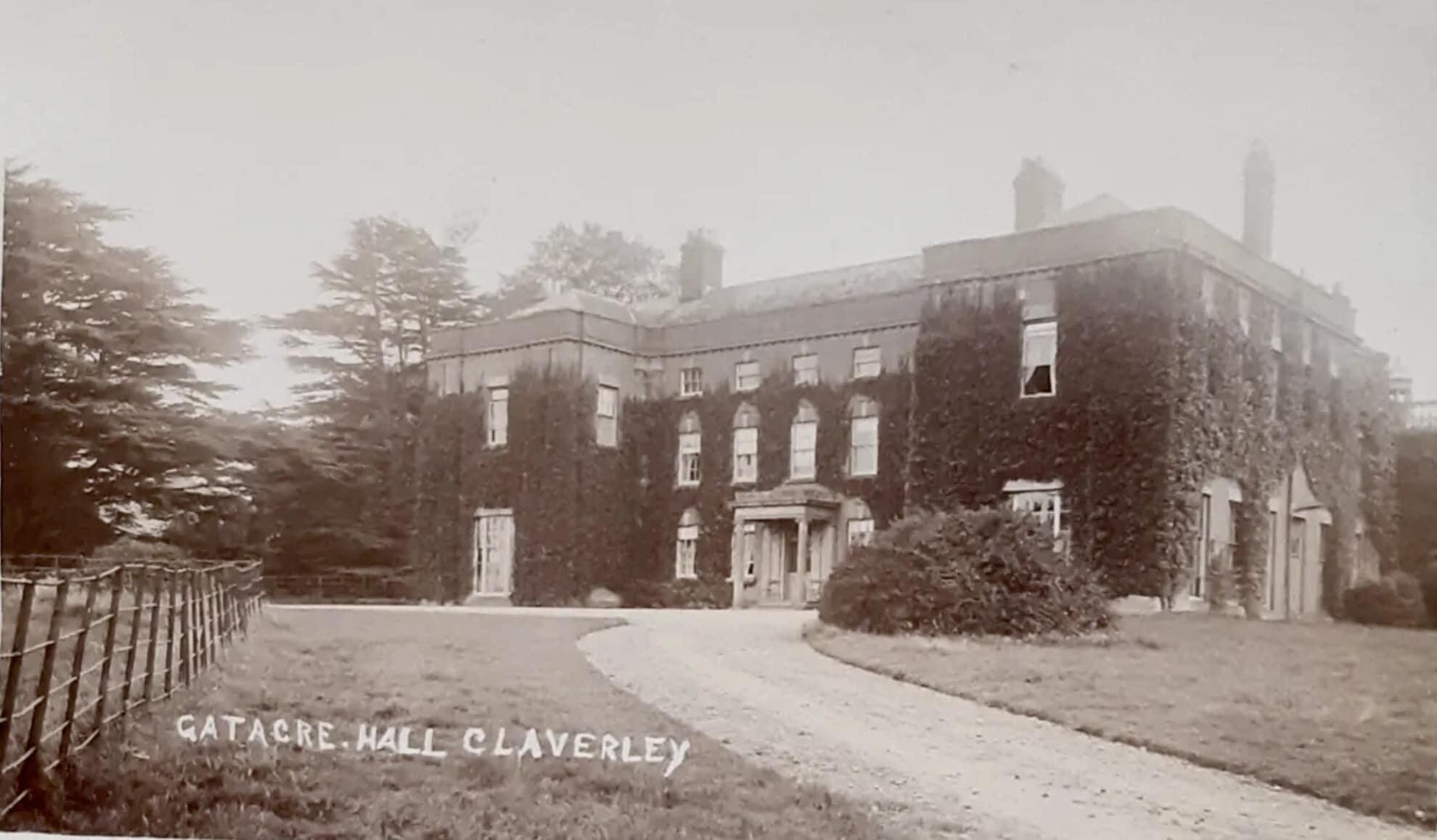
In the early 1950s my uncle John and his friend, possibly John Clare, ventured into an abandoned old house while out walking in Shropshire. He (or his friend) saved an old book from the vandalised dereliction and took it home. Somehow my mother ended up with the book.
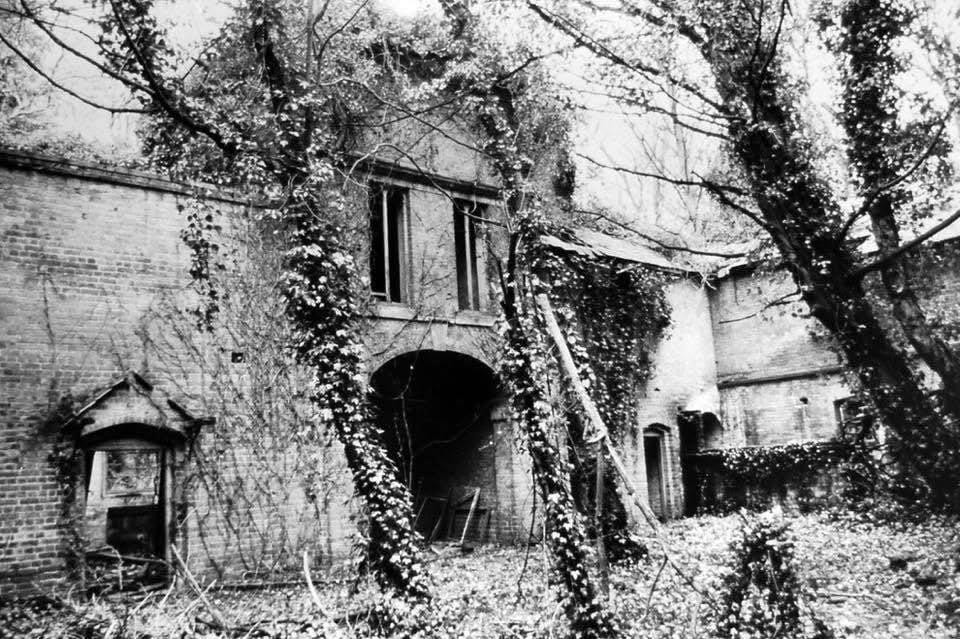
I remember that we had the book when we were living in USA, and that my mother said that John didn’t want the book in his house. He had said the abandoned hall had been spooky. The book was heavy and thick with a hard cover. I recall it was a “magazine” which seemed odd to me at the time; a compendium of information. I seem to recall the date 1553, but also recall that it was during the reign of Henry VIII. No doubt one of those recollections is wrong, probably the date. It was written in English, and had illustrations, presumably woodcuts.
I found out a few years ago that my mother had sold the book some years before. Had I known she was going to sell it, I’d have first asked her not to, and then at least made a note of the name of it, and taken photographs of it. It seems that she sold the book in Connecticut, USA, probably in the 1980’s.
My cousin and I were talking about the book and the story. We decided to try and find out which abandoned house it was although we didn’t have much to go on: it was in Shropshire, it was in a state of abandoned dereliction in the early 50s, and it contained antiquarian books.
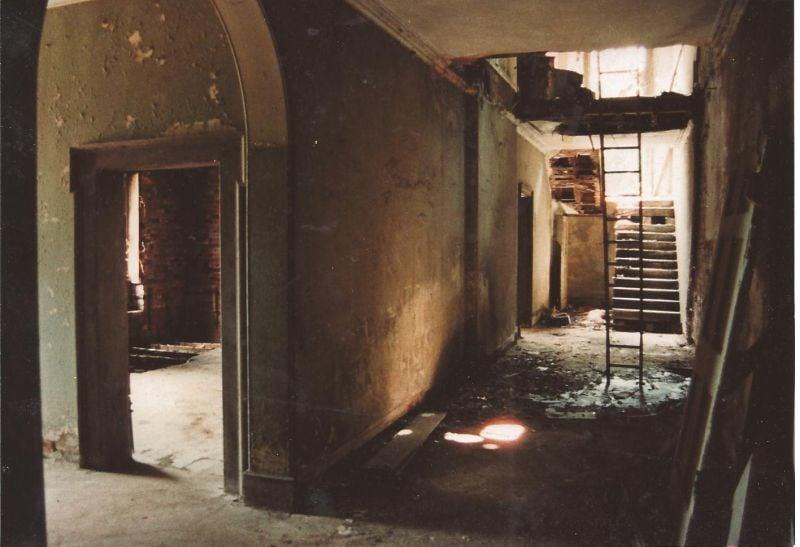
I posted the story on a Shropshire History and Nostalgia facebook group, and almost immediately had a reply from someone whose husband remembered such a place with ancient books and manuscripts all over the floor, and the place was called Gatacre Hall in Claverley, near Bridgnorth. She also said that there was a story that the family had fled to Canada just after WWII, even leaving the dishes on the table.
The Gatacre family sailing to Canada in 1947:
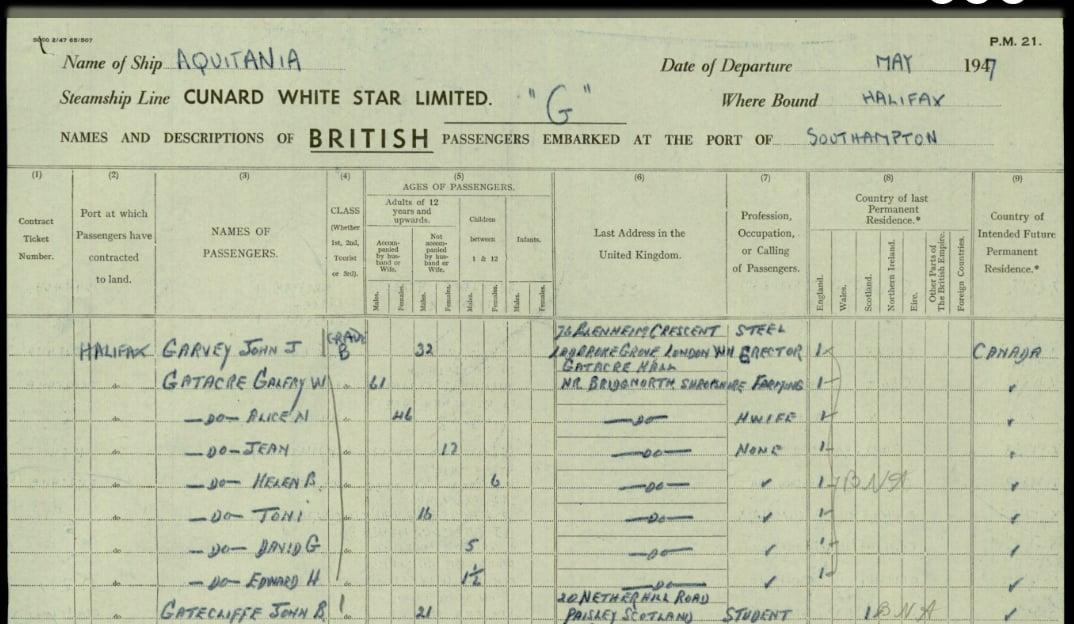
When my cousin heard the name Gatacre Hall she remembered that was the name of the place where her father had found the book.
I looked into Gatacre Hall online, in the newspaper archives, the usual genealogy sites and google books searches and so on. The estate had been going downhill with debts for some years. The old squire died in 1911, and his eldest son died in 1916 at the Somme. Another son, Galfrey Gatacre, was already farming in BC, Canada. He was unable to sell Gatacre Hall because of an entail, so he closed the house up. Between 1945-1947 some important pieces of furniture were auctioned, and the rest appears to have been left in the empty house.
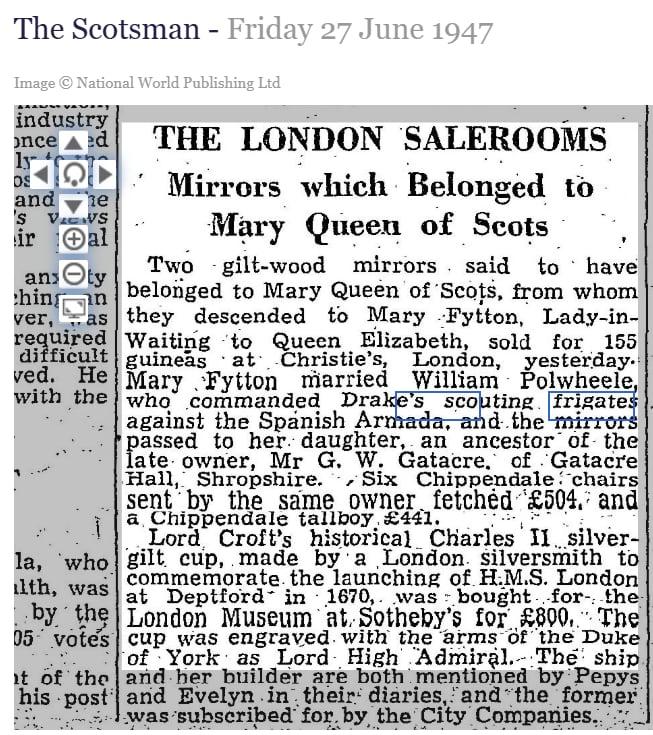
The family didn’t suddenly flee to Canada leaving the dishes on the table, although it was true that the family were living in Canada.
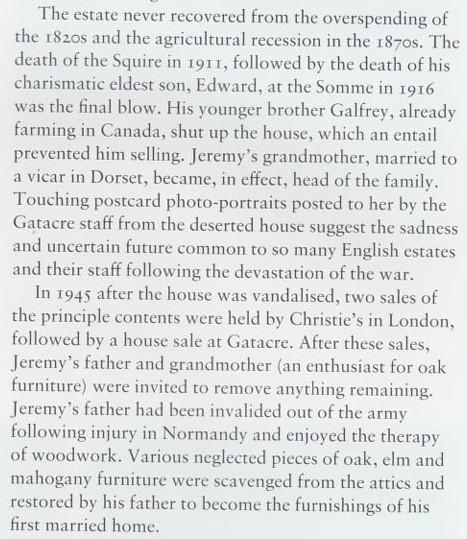
An interesting thing to note here is that not long after this book was found, my parents moved to BC Canada (where I was born), and a year later my uncle moved to Toronto (where he met his wife).
Captain Gatacre in 1918:
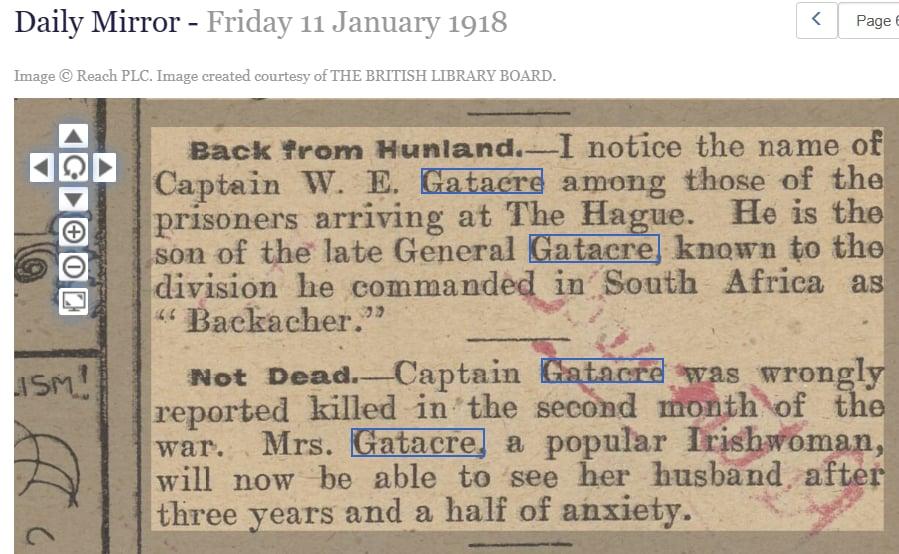
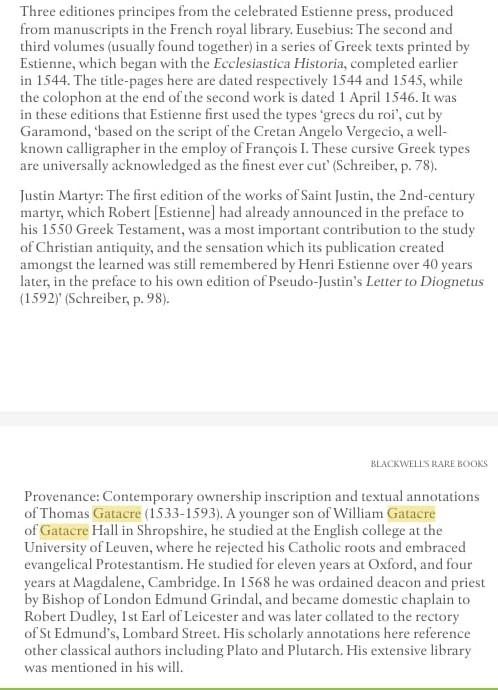
The Gatacre library was mentioned in the auction notes of a particular antiquarian book:
“Provenance: Contemporary ownership inscription and textual annotations of Thomas Gatacre (1533-1593). A younger son of William Gatacre of Gatacre Hall in Shropshire, he studied at the English college at the University of Leuven, where he rejected his Catholic roots and embraced evangelical Protestantism. He studied for eleven years at Oxford, and four years at Magdalene, Cambridge. In 1568 he was ordained deacon and priest by Bishop of London Edmund Grindal, and became domestic chaplain to Robert Dudley, 1st Earl of Leicester and was later collated to the rectory of St Edmund’s, Lombard Street. His scholarly annotations here reference other classical authors including Plato and Plutarch. His extensive library was mentioned in his will.”
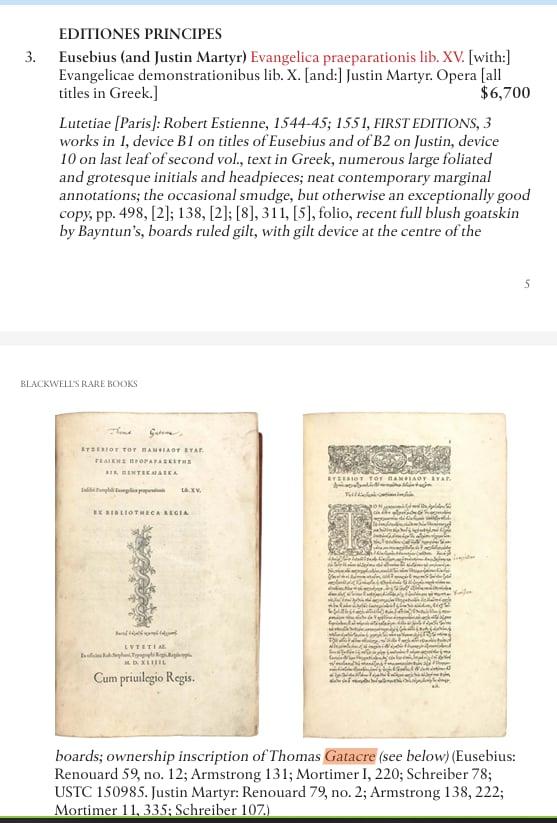
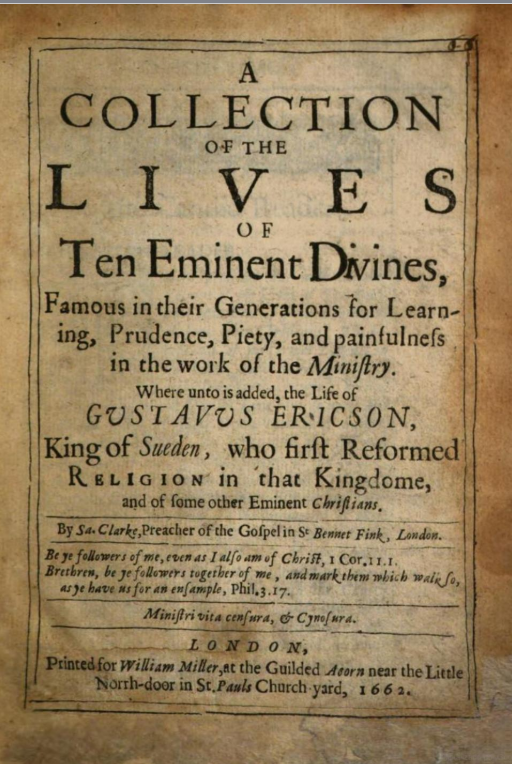
There are thirty four pages in this 1662 book about Thomas Gatacre d 1654:
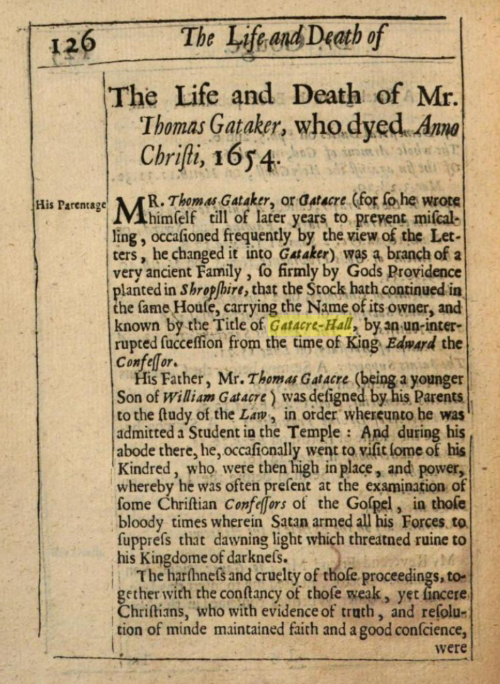 March 6, 2025 at 9:24 pm #7858
In reply to: The Last Cruise of Helix 25
It was still raining the morning after the impromptu postcard party at the Golden Trowel in the Hungarian village, and for most of the morning nobody was awake to notice. Molly had spent a sleepless night and was the only one awake listening to the pounding rain. Untroubled by the idea of lack of sleep, her confidence bolstered by the new company and not being solely responsible for the child, Molly luxuriated in the leisure to indulge a mental re run of the previous evening.
Finjas bombshell revelation after the postcard game suddenly changed everything. It was not what Molly had expected to hear. In their advanced state of inebriation by that time it was impossible for anyone to consider the ramifications in any sensible manner. A wild and raucous exuberance ensued of the kind that was all but forgotten to all of them, and unknown to Tundra. It was a joy that brought tears to Mollys eyes to see the wonderful time the child was having.
Molly didn’t want to think about it yet. She wasn’t so sure she wanted to have anything to do with it, the ship coming back. Communication with it, yes. The ship coming back? There was so much to consider, so many ways of looking at it. And there was Tundra to think about, she was so innocent of so many things. Was it better that way? Molly wasn’t going to think about that yet. She wanted to make sure she remembered all the postcard stories.
There is no rush.
The postcard Finja had chosen hadn’t struck Molly as the most interesting, not at the time, but later she wondered if there was any connection with her later role as centre stage overly dramatic prophet. What an extraordinary scene that was! The unexpected party was quite enough excitement without all that as well.
Finja’s card was addressed to Miss FP Finly, c/o The Flying Fish Inn somewhere in the outback of Australia, Molly couldn’t recall the name of the town. The handwriting had been hard to decipher, but it appeared to be a message from “forever your obedient servant xxx” informing her of a Dustsceawung convention in Tasmania. As nobody had any idea what a Dustsceawung conference was, and Finja declined to elaborate with a story or anecdote, the attention moved on to the next card. Molly remembered the time many years ago when everyone would have picked up their gadgets to find out what it meant. As it was now, it remained an unimportant and trifling mystery, perhaps something to wonder about later.
Why did Finja choose that card, and then decline to explain why she chose it? Who was Finly? Why did The Flying Fish Inn seem vaguely familiar to Molly?
I’m sure I’ve seen a postcard from there before. Maybe Ellis had one in his collection.
Yes, that must be it.
Mikhail’s story had been interesting. Molly was struggling to remember all the names. He’d mentioned his Uncle Grishenka, and a cousin Zhana, and a couple called Boris and Elvira with a mushroom farm. The best part was about the snow that the reindeer peed on. Molly had read about that many years ago, but was never entirely sure if it was true or not. Mickhail assured them all that it was indeed true, and many a wild party they’d had in the cold dark winters, and proceeded to share numerous funny anecdotes.
“We all had such strange ideas about Russia back then,” Molly had said. Many of the others murmured agreement, but Jian, a man of few words, merely looked up, raised an eyebrow, and looked down at his postcard again. “Russia was the big bad bogeyman for most of our lives. And in the end, we were our own worst enemies.”
“And by the time we realised, it was too late,” added Petro.
In an effort to revive the party spirit from the descent into depressing memories, Tala suggested they move on to the next postcard, which was Vera’s.
“I know the Tower of London better than any of you would believe,” Vera announced with a smug grin. Mikhail rolled his eyes and downed a large swig of vodka. “My 12th great grandfather was employed in the household of Thomas Cromwell himself. He was the man in charge of postcards to the future.” She paused for greater effect. In the absence of the excited interest she had expected, she continued. “So you can see how exciting it is for me to have a postcard as a prompt.” This further explanation was met with blank stares. Recklessly, Vera added, “I bet you didn’t know that Thomas Cromwell was a time traveller, did you? Oh yes!” she continued, although nobody had responded, “He became involved with a coven of witches in Ireland. Would you believe it!”
“No,” said Mikhail. “I probably wouldn’t.”
“I believe you, Vera,” piped up Tundra, entranced, “Will you tell me all about that later?”
Tundra’s interjection gave Tala the excuse she needed to move on to the next postcard. Mikhail and Vera has always been at loggerheads, and fueled with the unaccustomed alcohol, it was in danger of escalating quickly. “Next postcard!” she announced.
Everyone started banging on the tables shouting, “Next postcard! Next postcard!” Luka and Lev topped up everyone’s glasses.
Molly’s postcard was next.
February 28, 2025 at 8:18 am #7837In reply to: The Last Cruise of Helix 25
The village lay huddled before them, appearing like a mirage as they reached the top of the rise. Habitation always looks so picturesque when it’s been taken over by nature, Molly thought, by no means for the first time. Even before the collapse, she had penchant for overgrown abandoned ruins. Vines and ivy rampaged gleefully over the houses, softening the hard outlines, and saplings reached for the sky through crumbling roofs.
The survivors had stopped on the low hill to survey the scene, but soon they were rushing down towards the village to explore. As they came closer they could see all the cucumbers and courgettes dangling from the festoons of vines. Molly had visions of cucumber sandwiches on delicate thin sliced white bread with a piping hot pot of tea. But a waterey tasteless courgette soup will have to do, I suppose.
It was mid afternoon but there was no debate about continuing the journey that day. There were all the houses to search, and several shops, and more importantly, shelter for the night. The rain clouds were approaching from the east.
The church was chosen as a base camp as it was spacious enough to accomodate them all and the roof was intact, all but for the collapsed wooden tower which would provide wood for a fire. Lev and Luka set to work organising the space inside the church, supervised by Molly, Gregor and Petro, who wanted to rest. The others had dumped their bags and gone off to explore the buildings for supplies and forage in the overgrown gardens.
Tundra, happy that for once the responsibility of finding food was shared with so many other people, indulged her curiosity to just snoop around aimlessly. Clambering over a crumbling wooden porch, she pushed open what remained of a peeling door and stepped carefully inside. Venturing around the edges of the room, she peered at all the faded and warped framed photographs on the walls, portraits and family groups, wondering about the family who had lived here. There was a tray on a side table inscribed with Greetings from Niagara Falls! in a jolly cursive script, and an odd shaped rusting metal object with the words Souvenir de la tour Eiffel.
Slowly Tundra toured the house, inspecting all the objects in the rooms. Gingerly she made her way up the stairs, testing each riser before committing her weight to it. In a small bedroom packed with decomposing plastic bags and cardboard boxes spilling their assorted contents, she came upon a pile of letters and postcards, yellowy and curling, with mouse nibbled edges. Molly had told her about grandads postcard collection, but he’d taken it with him and she’d never seen them herself. I wonder what happened to that ship? Is my grandad still alive? Tundra sighed. Maybe he’ll come back one day. And my dad.

Sitting on the floor, Tundra sorted out the intact postcards from the badly damaged ones. She would take them with her to look at later, maybe ask the others what they knew of all the pictured places.
February 16, 2025 at 2:59 pm #7816In reply to: The Precious Life and Rambles of Liz Tattler
Liz had, in her esteemed opinion, finally cracked the next great literary masterpiece.
It had everything—forbidden romance, ancient mysteries, a dash of gratuitous betrayal, and a protagonist with just the right amount of brooding introspection to make him irresistible to at least two stunningly beautiful, completely unnecessary love interests.
And, of course, there was a ghost. She would have preferred a mummy but it had been edited out one morning she woke up drooling on her work with little recollection of the night.
Unfortunately, none of this mattered because Godfrey, her ever-exasperated editor, was staring at her manuscript with the same enthusiasm he reserved for peanut shells stuck in his teeth.
“This—” he hesitated, massaging his temples, “—this is supposed to be about the Crusades.”
Liz beamed. “It is! Historical and spicy. I expect an award.”
Godfrey set down the pages and reached for his ever-dwindling bowl of peanuts. “Liz, for the love of all that is holy, why is the Templar knight taking off his armor every other page?”
Liz gasped in indignation. “You wouldn’t understand, Godfrey. It’s symbolic. A shedding of the past! A rebirth of the soul!” She made an exaggerated sweeping motion, nearly knocking over her champagne flute.
“Symbolic,” Godfrey repeated flatly, chewing another peanut. “He’s shirtless on page three, in a monastery.”
Finnley, who had been dusting aggressively, made a sharp sniff. “Disgraceful.”
Liz ignored her. “Oh please, Godfrey. You have no vision. Readers love a little intimacy in their historical fiction.”
“The priest,” Godfrey said, voice rising, “is supposed to be celibate. You explicitly wrote that his vow was unbreakable.”
Liz waved a dismissive hand. “Oh, I solved that. He forgets about it momentarily.”
Godfrey choked on a peanut. Finnley paused mid-dust, staring at Liz in horror.
Roberto, who had been watering the hydrangeas outside the window, suddenly leaned in. “Did I hear something about a forgetful priest?”
“Not now, Roberto,” Liz said sharply.
Finnley folded her arms. “And how, pray tell, does one simply forget their sacred vows?”
Liz huffed. “The same way one forgets to clean behind the grandfather clock, I imagine.”
Finnley turned an alarming shade of purple.
Godfrey was still in disbelief. “And you’re telling me,” he said, flipping through the pages in growing horror, “that this man, Brother Edric, the holy warrior, somehow manages to fall in love with—who is this—” he squinted, “—Laetitia von Somethingorother?”
Liz beamed. “Ah, yes. Laetitia! Mysterious, tragic, effortlessly seductive—”
“She’s literally the most obvious spy I’ve ever read,” Godfrey groaned, rubbing his face.
“She is not! She is enigmatic.”
“She has a knife hidden in every scene.”
“A woman should be prepared.”
Godfrey took a deep breath and picked up another sheet. “Oh fantastic. There’s a secret baby now.”
Liz nodded sagely. “Yes. I felt that revelation.”
Finnley snorted. “Roberto also felt something last week, and it turned out to be food poisoning.”
Roberto, still hovering at the window, nodded solemnly. “It was quite moving.”
Godfrey set the papers down in defeat. “Liz. Please. I’m begging you. Just one novel—just one—where the historical accuracy lasts at least until page ten.”
Liz tapped her chin. “You might have a point.”
Godfrey perked up.
Liz snapped her fingers. “I should move the shirtless scene to page two.”
Godfrey’s head hit the table.
Roberto clapped enthusiastically. “Genius! I shall fetch celebratory figs!”
Finnley sighed dramatically, threw down her duster, and walked out of the room muttering about professional disgrace.
Liz grinned, completely unfazed. “You know, Godfrey, I really don’t think you appreciate my artistic sacrifices.”
Godfrey, face still buried in his arms, groaned, “Liz, I think Brother Edric’s celibacy lasted longer than my patience.”
Liz threw a hand to her forehead theatrically. “Then it was simply not meant to be.”
Roberto reappeared, beaming. “I found the figs.”
Godfrey reached for another peanut.
He was going to need a lot more of them.
 February 15, 2025 at 10:33 am #7794
In reply to: Helix Mysteries – Inside the Case
Some pictures selections
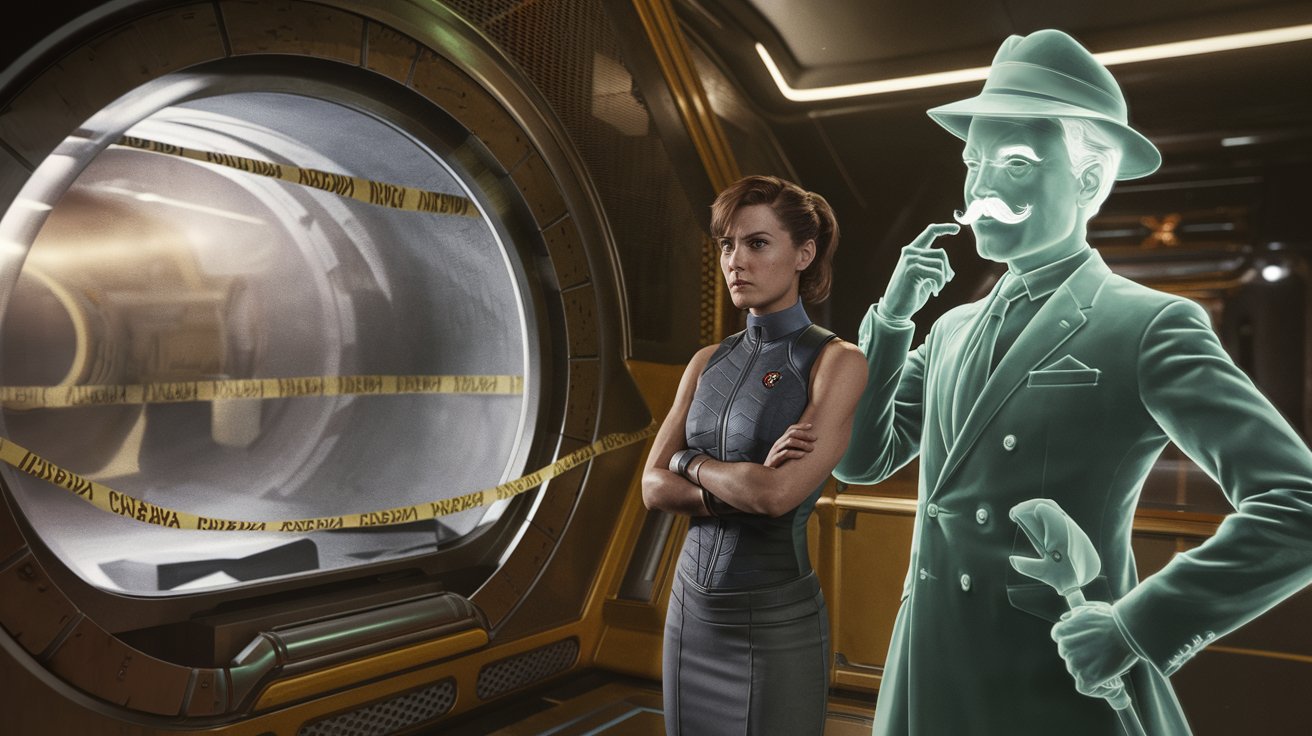
Evie and TP Investigating the Drying Machine Crime Scene
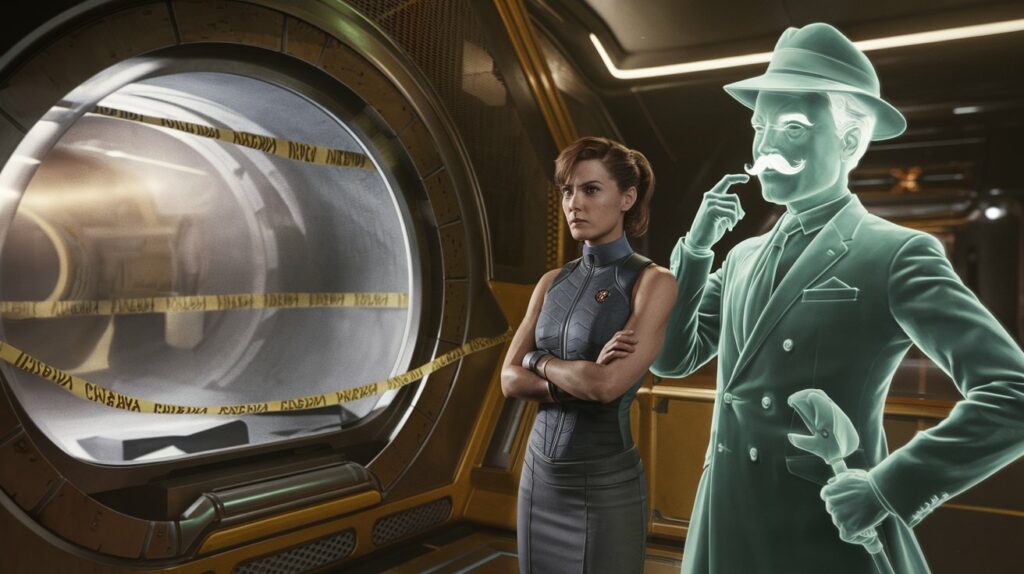
A cinematic sci-fi mini-scene aboard the vast and luxurious Helix 25. In the industrial depths of the ship, a futuristic drying machine hums ominously, crime scene tape lazily flickering in artificial gravity. Evie, a sharp-eyed investigator in a sleek yet practical uniform, stands with arms crossed, listening intently. Beside her, a translucent, retro-stylized holographic detective—Trevor Pee Marshall (TP)—adjusts his tiny mustache with a flourish, pointing dramatically at the drying machine with his cane. The air is thick with mystery, the ship’s high-tech environment reflecting off Evie’s determined face while TP’s flickering presence adds an almost comedic contrast. A perfect blend of noir and high-tech detective intrigue.
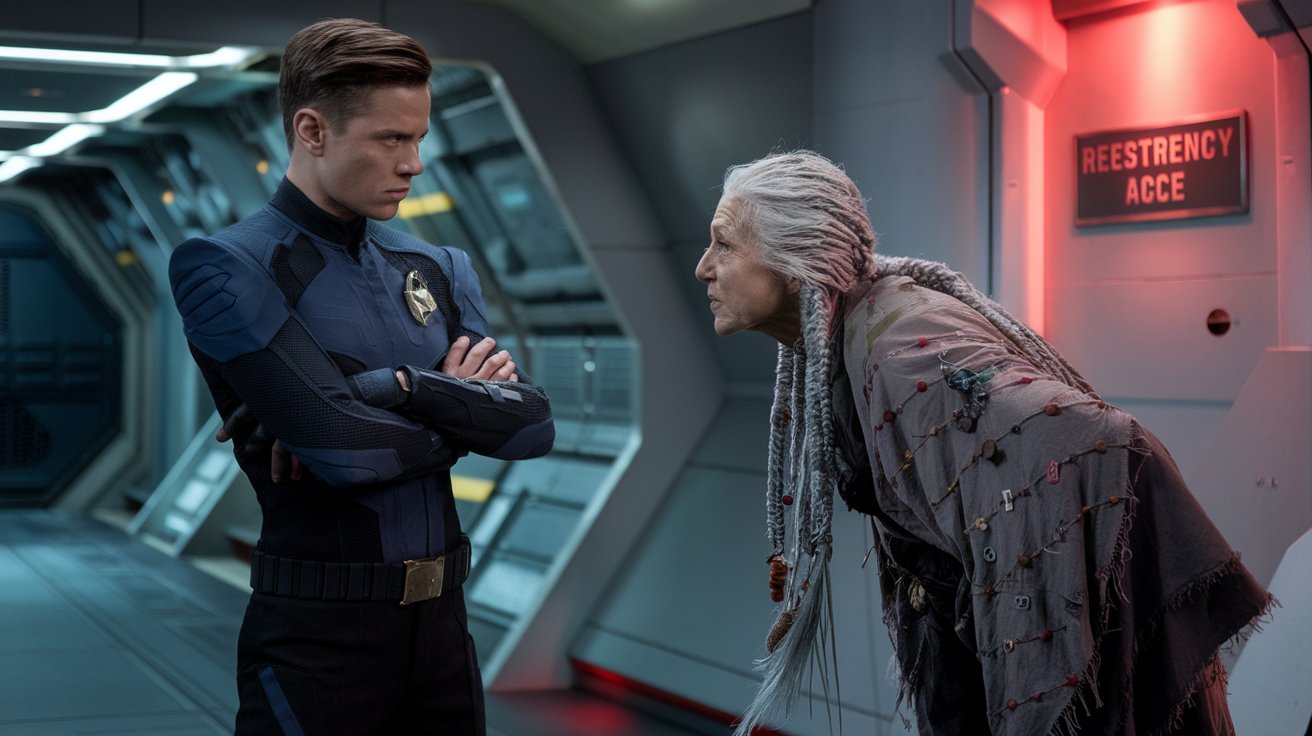
Riven Holt and Zoya Kade Confronting Each Other in a Dimly Lit Corridor
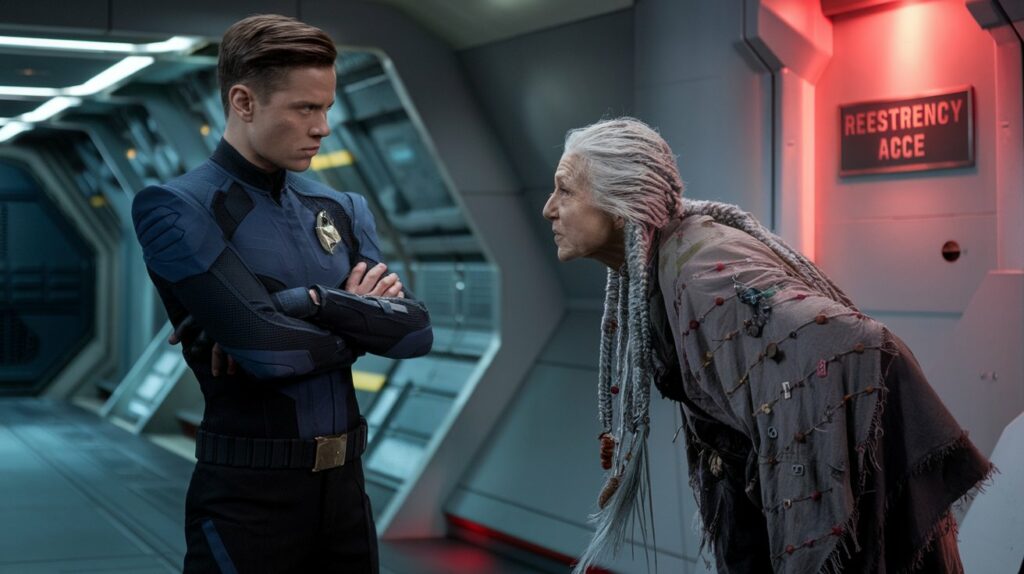
A dramatic, cinematic sci-fi scene aboard the vast and luxurious Helix 25. Riven Holt, a disciplined young officer with sharp features, stands in a high-tech corridor, his arms crossed, jaw tense—exuding authority and restraint. Opposite him, Zoya Kade, a sharp-eyed, wiry 83-year-old scientist-prophet, leans slightly forward, her mismatched layered robes adorned with tiny artifacts—beads, old circuits, and a fragment of a key. Her silver-white braid gleams under the soft emergency lighting, her piercing gaze challenging him. The corridor hums with unseen energy, a subtle red glow from a “restricted access” sign casting elongated shadows. Their confrontation is palpable—a struggle between order and untamed knowledge, hierarchy and rebellion. In the background, the walls of Helix 25 curve sleekly, high-tech yet strangely claustrophobic, reinforcing the ship’s ever-present watchfulness.
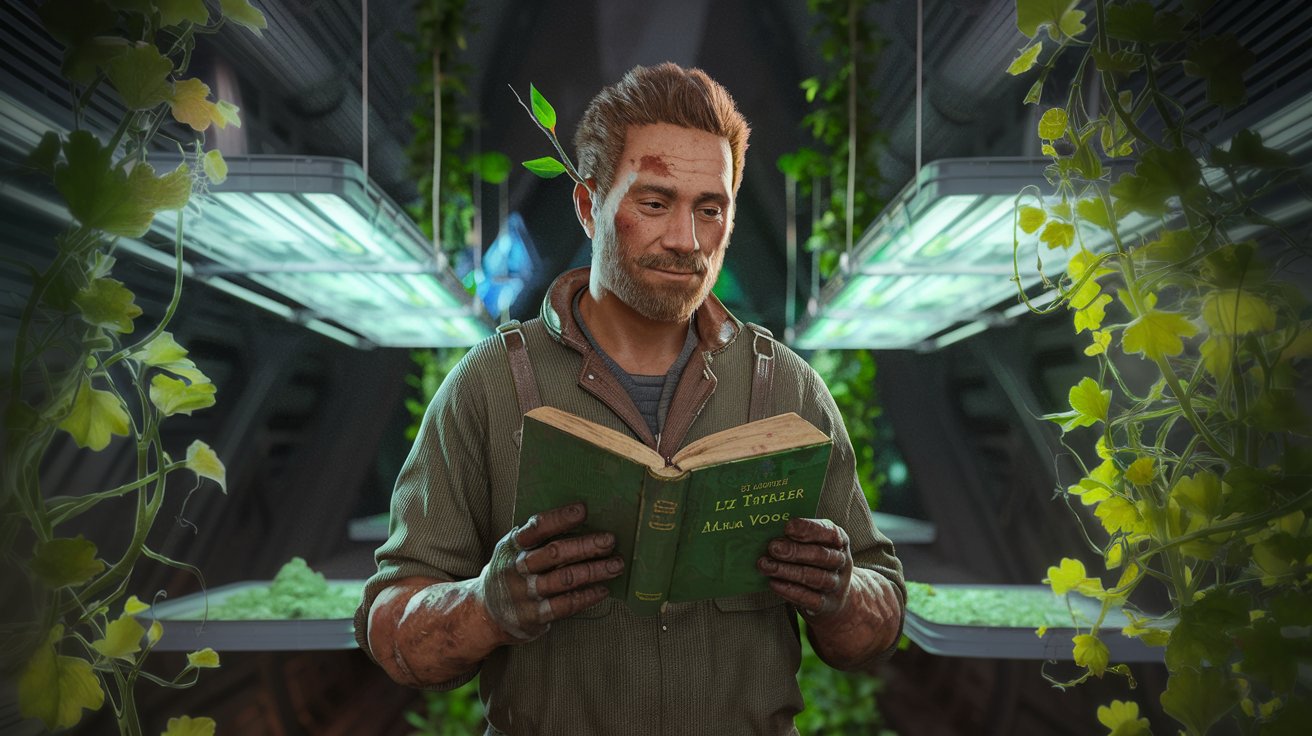
Romualdo, the Gardener, Among the Bioluminescent Plants
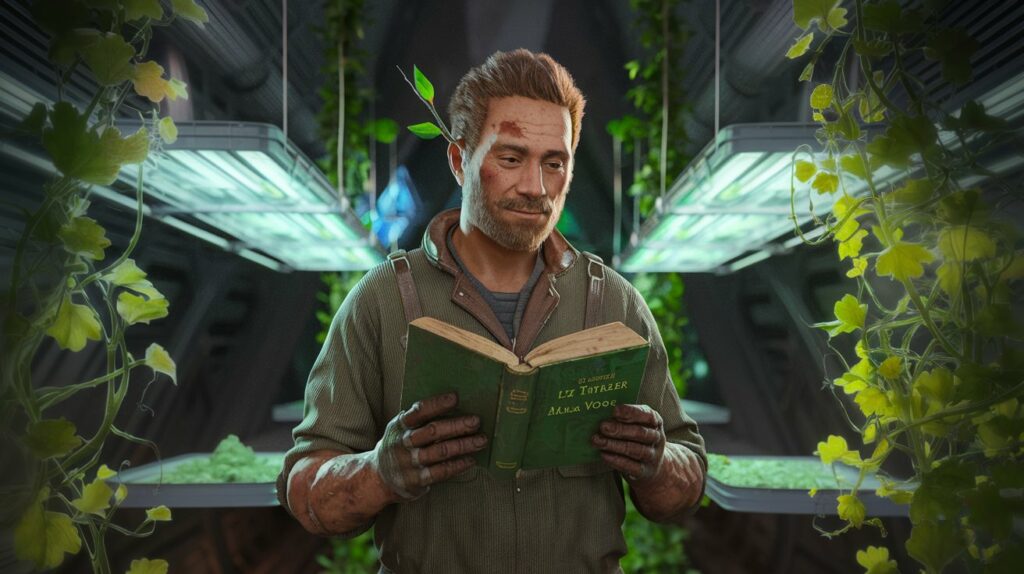
A richly detailed sci-fi portrait of Romualdo, the ship’s gardener, standing amidst the vibrant greenery of the Jardenery. He is a rugged yet gentle figure, dressed in a simple work jumpsuit with soil-streaked hands, a leaf-tipped stem tucked behind his ear like a cigarette. His eyes scan an old, well-worn book—one of Liz Tattler’s novels—that Dr. Amara Voss gave him for his collection. The glowing plants cast an ethereal blue-green light over him, creating an atmosphere both peaceful and mysterious. In the background, the towering vines and suspended hydroponic trays hint at the ship’s careful balance between survival and serenity.
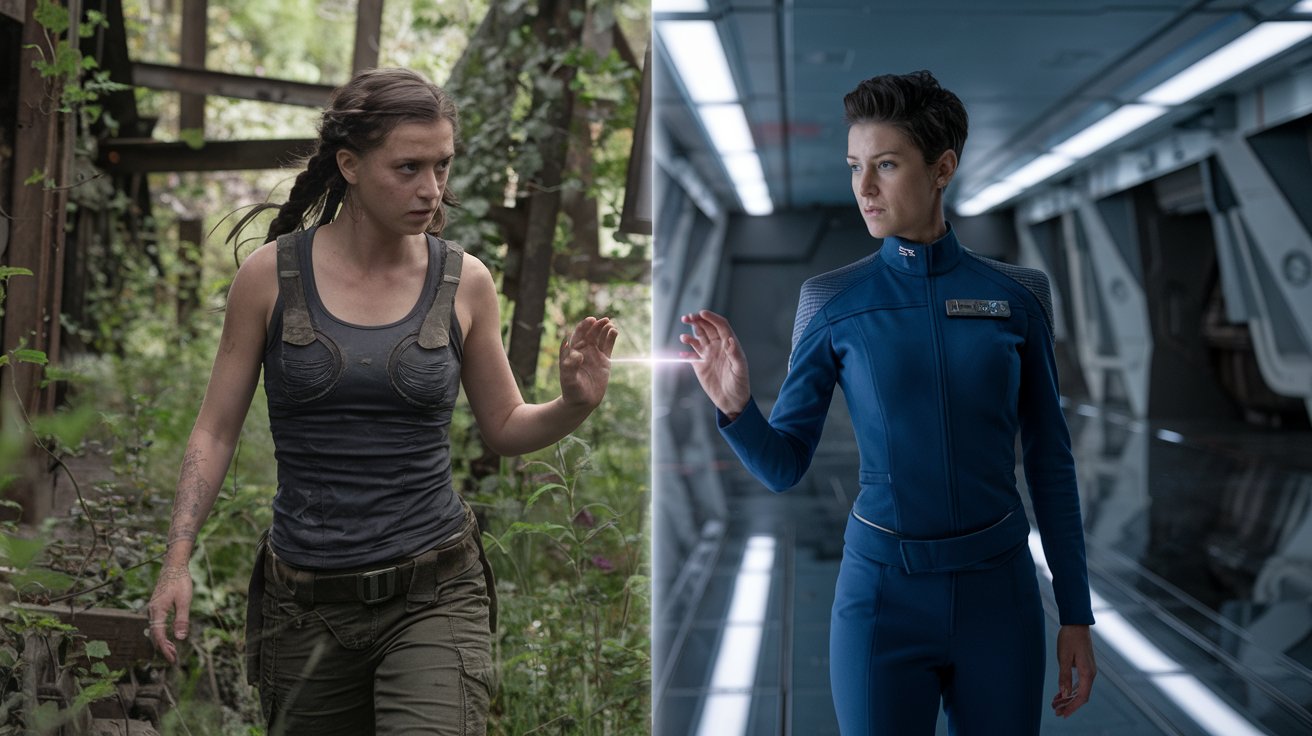
Finja and Finkley – A Telepathic Parallel Across Space
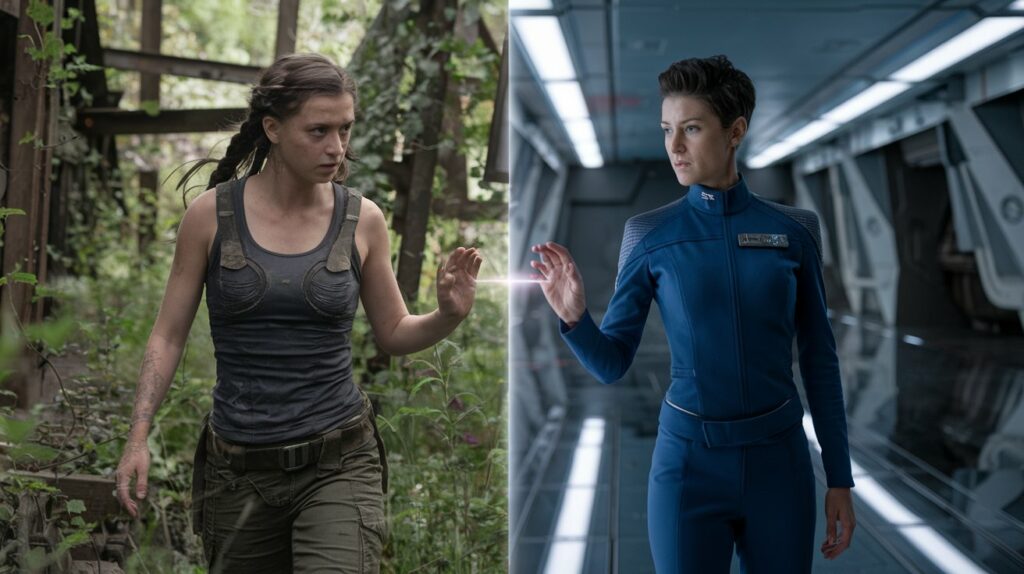
A surreal, cinematic sci-fi composition split into two mirrored halves, reflecting a mysterious connection across vast distances. On one side, Finja, a wiry, intense woman with an almost obsessive neatness, walks through the overgrown ruins of post-apocalyptic Earth, her expression distant as she “listens” to unseen voices. Dust lingers in the air, catching the golden morning light, and she mutters to herself about cleanliness. In her reflection, on the other side of the image, is Finkley, a no-nonsense crew member aboard the gleaming, futuristic halls of Helix 25. She stands with hands on her hips, barking orders at small cleaning bots as they maintain the ship’s pristine corridors. The lighting is cold and artificial, sterile in contrast to the dust-filled Earth. Yet, both women share a strange symmetry—gesturing in unison as if unknowingly mirroring one another across time and space. A faint, ghostly thread of light suggests their telepathic bond, making the impossible feel eerily real.
February 15, 2025 at 9:21 am #7789In reply to: The Last Cruise of Helix 25
Helix 25 – Poop Deck – The Jardenery
Evie stepped through the entrance of the Jardenery, and immediately, the sterile hum of Helix 25’s corridors faded into a world of green. Of all the spotless clean places on the ship, it was the only where Finkley’s bots tolerated the scent of damp earth. A soft rustle of hydroponic leaves shifting under artificial sunlight made the place an ecosystem within an ecosystem, designed to nourrish both body and mind.
Yet, for all its cultivated serenity, today it was a crime scene. The Drying Machine was connected to the Jardenery and the Granary, designed to efficiently extract precious moisture for recycling, while preserving the produce.
Riven Holt, walking beside her, didn’t share her reverence. “I don’t see why this place is relevant,” he muttered, glancing around at the towering bioluminescent vines spiraling up trellises. “The body was found in the drying machine, not in a vegetable patch.”
Evie ignored him, striding toward the far corner where Amara Voss was hunched over a sleek terminal, frowning at a glowing screen. The renowned geneticist barely noticed their approach, her fingers flicking through analysis results faster than human eyes could process.
A flicker of light.
“Ah-ha!” TP materialized beside Evie, adjusting his holographic lapels. “Madame Voss, I must say, your domain is quite the delightful contrast to our usual haunts of murder and mystery.” He twitched his mustache. “Alas, I suspect you are not admiring the flora?”
Amara exhaled sharply, rubbing her temples, not at all surprised by the holographic intrusion. She was Evie’s godmother, and had grown used to her experiments.
“No, indeed. I’m admiring this.” She turned the screen toward them.
The DNA profile glowed in crisp lines of data, revealing a sequence highlighted in red.
Evie frowned. “What are we looking at?”
Amara pinched the bridge of her nose. “A genetic anomaly.”
Riven crossed his arms. “You’ll have to be more specific.”
Amara gave him a sharp look but turned back to the display. “The sample we found at the crime scene—blood residue on the drying machine and some traces on the granary floor—matches an ancient DNA profile from my research database. A perfect match.”
Evie felt a prickle of unease. “Ancient? What do you mean? From the 2000s?”
Amara chuckled, then nodded grimly. “No, ancient as in Medieval ancient. Specifically, Crusader DNA, from the Levant. A profile we mapped from preserved remains centuries ago.”
Silence stretched between them.
Finally, Riven scoffed. “That’s impossible.”
TP hummed thoughtfully, twirling his cane. “Impossible, yet indisputable. A most delightful contradiction.”
Evie’s mind raced. “Could the database be corrupted?”
Amara shook her head. “I checked. The sequencing is clean. This isn’t an error. This DNA was present at the crime scene.” She hesitated, then added, “The thing is…” she paused before considering to continue. They were all hanging on her every word, waiting for what she would say next.
Amara continued “I once theorized that it might be possible to reawaken dormant ancestral DNA embedded in human cells. If the right triggers were applied, someone could manifest genetic markers—traits, even memories—from long-dead ancestors. Awakening old skills, getting access to long lost secrets of states…”
Riven looked at her as if she’d grown a second head. “You’re saying someone on Helix 25 might have… transformed into a medieval Crusader?”
Amara exhaled. “I’m saying I don’t know. But either someone aboard has a genetic profile that shouldn’t exist, or someone created it.”
TP’s mustache twitched. “Ah! A puzzle worthy of my finest deductive faculties. To find the source, we must trace back the lineage! And perhaps a… witness.”
Evie turned toward Amara. “Did Herbert ever come here?”
Before Amara could answer, a voice cut through the foliage.
“Herbert?”
They turned to find Romualdo, the Jardenery’s caretaker, standing near a towering fruit-bearing vine, his arms folded, a leaf-tipped stem tucked behind his ear like a cigarette. He was a broad-shouldered man with sun-weathered skin, dressed in a simple coverall, his presence almost too casual for someone surrounded by murder investigators.
Romualdo scratched his chin. “Yeah, he used to come around. Not for the plants, though. He wasn’t the gardening type.”
Evie stepped closer. “What did he want?”
Romualdo shrugged. “Questions, mostly. Liked to chat about history. Said he was looking for something old. Always wanted to know about heritage, bloodlines, forgotten things.” He shook his head. “Didn’t make much sense to me. But then again, I like practical things. Things that grow.”
Amara blushed, quickly catching herself. “Did he ever mention anything… specific? Like a name?”
Romualdo thought for a moment, then grinned. “Oh yeah. He asked about the Crusades.”
Evie stiffened. TP let out an appreciative hum.
“Fascinating,” TP mused. “Our dearly departed Herbert was not merely a victim, but perhaps a seeker of truths unknown. And, as any good mystery dictates, seekers who get too close often find themselves…” He tipped his hat. “Extinguished.”
Riven scowled. “That’s a bit dramatic.”
Romualdo snorted. “Sounds about right, though.” He picked up a tattered book from his workbench and waved it. “I lend out my books. Got myself the only complete collection of works of Liz Tattler in the whole ship. Doc Amara’s helping me with the reading. Before I could read, I only liked the covers, they were so romantic and intriguing, but now I can read most of them on my own.” Noticing he was making the Doctor uncomfortable, he switched back to the topic. “So yes, Herbert knew I was collector of books and he borrowed this one a few weeks ago. Kept coming back with more questions after reading it.”
Evie took the book and glanced at the cover. The Blood of the Past: Genetic Echoes Through History by Dr. Amara Voss.
She turned to Amara. “You wrote this?”
Amara stared at the book, her expression darkening. “A long time ago. Before I realized some theories should stay theories.”
Evie closed the book. “Looks like someone didn’t agree.”
Romualdo wiped his hands on his coveralls. “Well, I hope you figure it out soon. Hate to think the plants are breathing in murder residue.”
TP sighed dramatically. “Ah, the tragedy of contaminated air! Shall I alert the sanitation team?”
Riven rolled his eyes. “Let’s go.”
As they walked away, Evie’s grip tightened around the book. The deeper they dug, the stranger this murder became.
February 8, 2025 at 7:22 pm #7776In reply to: Quintessence: Reversing the Fifth
Epilogue & Prologue
Paris, November 2029 – The Fifth Note Resounds
Tabitha sat by the window at the Sarah Bernhardt Café, letting the murmur of conversations and the occasional purring of the espresso machine settle around her. It was one of the few cafés left in the city where time still moved at a human pace. She stirred her cup absentmindedly. Paris was still Paris, but the world outside had changed in ways her mother’s generation still struggled to grasp.
It wasn’t just the ever-presence of automation and AI making themselves known in subtle ways—screens adjusting to glances, the quiet surveillance woven into everyday life. It wasn’t just the climate shifts, the aircon turned to cold in the midst of November, the summers unpredictable, the air thick with contradictions of progress and collapse of civilization across the Atlantic.
The certainty of impermanence was what defined her generation. BANI world they used to say—Brittle, Anxious, Nonlinear, Incomprehensible. A cold fact: impossible to grasp and impossible to fight. Unlike her mother and her friends, who had spent their lives tethered to a world that no longer existed, she had never known certainty. She was born in the flux.
And yet, this café remained. One of the last to resist full automation, where a human still brought you coffee, where the brass bell above the door still rang, where things still unfolded at a human pace.
The bell above the door rang—the fifth note, as her mother had called it once.
She had never been here before, not in any way that mattered. Yet, she had heard the story. The unlikely reunion five years ago. The night that moved new projects in motion for her mother and her friends.
Tabitha’s fingers traced the worn edges of the notebook in front of her—Lucien’s, then Amei’s, then Darius’s. Pieces of a life written by many hands.
“Some things don’t work the first time. But sometimes, in the ruins of what failed, something else sprouts and takes root.”
And that was what had happened.
The shared housing project they had once dreamed of hadn’t survived—not in its original form. But through their rekindled bond, they had started something else.
True Stories of How It Was.
It had begun as a quiet defiance—a way to preserve real, human stories in an age of synthetic, permanent ephemerality and ephemeral impermanence, constantly changing memory. They were living in a world where AI’s fabricated histories had overwhelmed all the channels of information, where the past was constantly rewritten, altered, repackaged. Authenticity had become a rare currency.
As she graduated in anthropology few years back, she’d wondered about the validity of history —it was, after all, a construct. The same could be said for literature, art, even science. All of them constructs of the human mind, tenuous grasp of the infinite truth, but once, they used to evolve at such a slow pace that they felt solid, reliable. Ultimately their group was not looking for ultimate truth, that would be arrogant and probably ignorant. Authenticity was what they were looking for. And with it, connections, love, genuineness —unquantifiables by means of science and yet, true and precious beyond measure.
Lucien had first suggested it, tracing the idea from his own frustrations—the way art had become a loop of generated iterations, the human touch increasingly erased. He was in a better place since Matteo had helped him settle his score with Renard and, free of influence, he had found confidence in developing of his own art.
Amei —her mother—, had changed in a way Tabitha couldn’t quite define. Her restlessness had quieted, not through settling down but through accepting impermanence as something other than loss. She had started writing again—not as a career, not to publish, but to preserve stories that had no place in a digitized world. Her quiet strength had always been in preserving connections, and she knew they had to move quickly before real history faded beneath layers of fabricated recollections.
Darius, once skeptical, saw its weight—he had spent years avoiding roots, only to realize that stories were the only thing that made places matter. He was somewhere in Morocco now, leading a sustainable design project, bridging cultures rather than simply passing through them.
Elara had left science. Or at least, science as she had known it. The calculations, the certainty, the constraints of academia, with no escape from the automated “enhanced” digital helpers. Her obsession and curiosities had found attract in something more human, more chaotic. She had thrown herself into reviving old knowledge, forgotten architectures, regenerative landscapes.
And Matteo—Matteo had grounded it.
The notebook read: Matteo wasn’t a ghost from our past. He was the missing note, the one we didn’t know we needed. And because of him, we stopped looking backward. We started building something else.
For so long, Matteo had been a ghost of sorts, by his own account, lingering at the edges of their story, the missing note in their unfinished chord. But now, he was fully part of it. His mother had passed, her past history unraveling in ways he had never expected, branching new connections even now. And though he had lost something in that, he had also found something else. Juliette. Or maybe not. The story wasn’t finished.
Tabitha turned the page.
“We were not historians, not preservationists, not even archivists. But we have lived. And as it turned out, that was enough.”
They had begun collecting stories through their networks—not legends, not myths, but true accounts of how it was, from people who still remembered.
A grandfather’s voice recording of a train ride to a city that no longer exists.
Handwritten recipes annotated by generations of hands, each adding something new.
A letter from a protest in 2027, detailing a movement that the history books had since erased.
An old woman’s story of her first love, spoken in a dialect that AI could not translate properly.It had grown in ways they hadn’t expected. People began sending them recordings, letters, transcripts, photos —handwritten scraps of fading ink. Some were anonymous, others carefully curated with full names and details, like makeshift ramparts against the tide of time.
At first, few had noticed. It was never the goal to make it worlwide movement. But little by little, strange things happened, and more began to listen.
There was something undeniably powerful about genuine human memory when it was raw and unfiltered, when it carried unpolished, raw weight of experience, untouched by apologetic watered down adornments and out-of-place generative hallucinations.
Now, there were exhibitions, readings, archives—entire underground movements dedicated to preserving pre-synthetic history. Their project had become something rare, valuable, almost sacred.
And yet, here in the café, none of that felt urgent.
Tabitha looked up as the server approached. Not Matteo, but someone new.
“Another espresso?”
She hesitated, then nodded. “Yes. And a glass of water, please.”
She glanced at the counter, where Matteo was leaning, speaking to someone, laughing. He had changed, too. No longer just an observer, no longer just the quiet figure who knew too much. Now, he belonged here.
A bell rang softly as the door swung open again.
Tabitha smiled to herself. The fifth note always sounded, in the end.
She turned back to the notebook, the city moving around her, the story still unfolding in more directions than one.
February 8, 2025 at 11:32 am #7763In reply to: The Last Cruise of Helix 25
The corridor outside Mr. Herbert’s suite was pristine, polished white and gold, designed to impress, like most of the ship. Soft recessed lighting reflected off gilded fixtures and delicate, unnecessary embellishments.
It was all Riven had ever known.
His grandfather, Victor Holt, now in cryo sleep, had been among the paying elite, those who had boarded Helix 25, expecting a decadent, interstellar retreat. Riven, however had not been one of them. He had been two years old when Earth fell, sent with his aunt Seren Vega on the last shuttle to ever reach the ship, crammed in with refugees who had fought for a place among the stars. His father had stayed behind, to look for his mother.
Whatever had happened after that—the chaos, the desperation, the cataclysm that had forced this ship to become one of humanity’s last refuges—Riven had no memory of it. He only knew what he had been told. And, like everything else on Helix 25, history depended on who was telling it.
For the first time in his life, someone had been murdered inside this floating palace of glass and gold. And Riven, inspired by his grandfather’s legacy and the immense collection of murder stories and mysteries in the ship’s database, expected to keep things under control.
He stood straight in front of the suite’s sealed sliding door, arms crossed on a sleek uniform that belonged to Victor Holt. He was blocking entry with the full height of his young authority. As if standing there could stop the chaos from seeping in.
A holographic Do Not Enter warning scrolled diagonally across the door in Effin Muck’s signature font—because even crimes on this ship came branded.
People hovered in the corridor, coming and going. Most were just curious, drawn by the sheer absurdity of a murder happening here.
Riven scanned their faces, his muscles coiled with tension. Everyone was a potential suspect. Even the ones who usually didn’t care about ship politics.
Because on Helix 25, death wasn’t supposed to happen. Not anymore.
Someone broke away from the crowd and tried to push past him.
“You’re wasting time. Young man.”
Zoya Kade. Half scientist, half mad Prophet, all irritation. Her gold-green eyes bore into him, sharp beneath the deep lines of her face. Her mismatched layered robes shifting as she moved. Riven had no difficulty keeping the tall and wiry 83 years old woman at a distance.
Her silver-white braid was woven with tiny artifacts—bits of old circuits, beads, a fragment of a key that probably didn’t open anything anymore. A collector of lost things. But not just trinkets—stories, knowledge, genetic whispers of the past. And now, she wanted access to this room like it was another artifact to be uncovered.
“No one is going in.” Riven said slowly, “until we finish securing the area.”
Zoya exhaled sharply, turning her head toward Evie, who had just emerged from the crowd, tablet in hand, TP flickering at her side.
“Evie, tell him.”
Evie did not look pleased to be associated with the old woman. “Riven, we need access to his room. I just need…”
Riven hesitated.
Not for long, barely a second, but long enough for someone to notice. And of course, it was Anuí Naskó.
They had been waiting, standing slightly apart from the others, their tall, androgynous frame wrapped in the deep-colored robes of the Lexicans, fingers lightly tapping the surface of their handheld lexicon. Observing. Listening. Their presence was a constant challenge. When Zoya collected knowledge like artifacts, Anuí broke it apart, reshaped it. To them, history was a wound still open, and it was the Lexicans duty to rewrite the truth that had been stolen.
“Ah,” Anuí murmured, smiling slightly, “I see.”
Riven started to tap his belt buckle. His spine stiffened. He didn’t like that tone.
“See what, exactly?”
Anuí turned their sharp, angular gaze on him. “That this is about control.”
Riven locked his jaw. “This is about security.”
“Is it?” Anuí tapped a finger against their chin. “Because as far as I can tell, you’re just as inexperienced in murder investigation as the rest of us.”
The words cut sharp in Riven’s pride. Rendering him speechless for a moment.
“Oh! Well said,” Zoya added.
Riven felt heat rise to his face, but he didn’t let it show. He had been preparing himself for challenges, just not from every direction at once.
His grip tightened on his belt, but he forced himself to stay calm.
Zoya, clearly enjoying herself now, gestured toward Evie. “And what about them?” She nodded toward TP, whose holographic form flickered slightly under the corridor’s ligthing. “Evie and her self proclaimed detective machine here have no real authority either, yet you hesitate.”
TP puffed up indignantly. “I beg your pardon, madame. I am an advanced deductive intelligence, programmed with the finest investigative minds in history! Sherlock Holmes, Hercule Poirot, Miss Marple, Marshall Pee Stoll…”
Zoya lifted a hand. “Yes, yes. And I am a boar.”
TP’s mustache twitched. “Highly unlikely.”
Evie groaned. “Enough TP.”
But Zoya wasn’t finished. She looked directly at Riven now. “You don’t trust me. You don’t trust Anuí. But you trust her.” She gave a node toward Evie. “Why?
Riven felt his stomach twist. He didn’t have an answer. Or rather, he had too many answers, none of which he could say out loud. Because he did trust Evie. Because she was brilliant, meticulous, practical. Because… he wanted her to trust him back. But admitting that, showing favoritism, expecially here in front of everyone, was impossible.
So he forced his voice into neutrality. “She has technical expertise and no political agenda about it.”
Anuí left out a soft hmm, neither agreeing nor disagreeing, but filing the information away for later.
Evie took the moment to press forward. “Riven, we need access to the room. We have to check his logs before anything gets wiped or overwritten. If there’s something there, we’re losing valuable time just standing there arguing.”
She was right. Damn it, she was right. Riven exhaled slowly.
“Fine. But only you.”
Anuí’s lips curved but just slightly. “How predictable.”
Zoya snorted.
Evie didn’t waste time. She brushed past him, keying in a security override on her tablet. The suite doors slid open with a quiet hiss.
February 3, 2025 at 7:54 am #7731In reply to: The Last Cruise of Helix 25
The colours were bright, garish really, an impossibly blue sea and sky and splashes of pillar box red on the square shaped cars and dated clothes, but it was his favourite postcard of them all. It wasn’t the most scenic, it wasn’t the most spectacular location, but it was an echo from those long ago days of summer, of seaside holidays, souvenirs and a dozen postcards to write at a beachside cafe. The days when the post was delivered by conscientious postmen such as he himself had been, and the postcards arrived at their destinations before the holidaymakers had returned to their suburban homes and city jobs. The scene in the postcard was bathed in glorious sunshine, but the message on the back told the usual tale of the weather and the rain and that it might brighten up tomorrow but they were having a lovely time and they’d be back on Sunday and would the recipients get them a loaf and a pint of milk.
Ellis Marlowe put the Margate postcard to the back of the pile in his hand and pondered the image on the next one. He sighed at the image of the Statue of Liberty, sickly green, sadly proclaiming the height of a lost empire, and quickly put it at the back of the pile. Nobody needed to dwell on that story.
His perusal of the next image, an alpine meadow with an attractively skirted peasant scampering in a field, was interrupted with a bang on his door as Finkley barged in without waiting for a response. “There’s been a murder on the ship! Murder! Poor sod’s been dessicated like a dried tomato…”
Ellis looked at her in astonishment. His hand shook slightly as he put his postcard collection back in the box, replaced the lid and returned it to his locker. “Murder?” he repeated. “Murder? On here? But we’re supposed to be safe here, we left all that behind.” Visibly shaken, Ellis repeated, almost shouting, “But we left all that behind!”
February 2, 2025 at 12:15 pm #7720In reply to: Helix Mysteries – Inside the Case
Some ideas to pick apart and improve on:
Some characters:
- The Murder Victim: A once-prominent figure whose mysterious death on Helix 25 is intertwined with deeper, enigmatic forces—a person whose secret past and untimely demise trigger the cascade of genetic clues and expose long-buried truths about the exodus.
- Dr. Amara Voss: A brilliant geneticist haunted by fragmented pasts, who deciphers DNA strands imbued with clues from an ancient intelligence.
- Inspector Orion Reed: A retro-inspired, elderly holographic AI detective whose relentless curiosity drives him to unravel the inexplicable murder.
- Kai Nova: A maverick pilot chasing cosmic dreams, unafraid to navigate perilous starfields in search of truth.
- Seren Vega: A meditative archivist who unlocks VR relics of history, piecing together humanity’s lost lore. Mandrake her cat, who’s been given bionic enhancements that enables it to speak its mind.
- Luca Stroud: A rebellious engineer whose knack for decoding forbidden secrets may hold the key to the ship’s destiny.
- Ellis Marlowe (Retired Postman): A weathered former postman whose cherished collection of vintage postcards from Earth and early space voyages carries personal and historical messages, hinting at forgotten connections.
- Sue Forgelot: A prominent socialist socialite, descended from Sir Forgelot.
- Sharon, Gloria, Mavis: a favourite elderly trio of life-extended elders. Of course, they endured and thrived in humanity’s latest exodus from Earth
- Lexican and Flexicans, Pronoun People: sub-groups and political factions, challenging our notions of divisions
- Space Absinthe Pirates: a rogue band of bandits— a myth to make children behave… or something else?
Background of the Helix Fleet:
Helix 25 is one of several generation ships that were designed as luxury cruise ships, but are now embarked on an exodus from Earth decades ago, after a mysterious event that left them the last survivors of humanity. Once part of an ambitious fleet designed for both leisure and also built to secretly preserve humanity’s legacy, the other Helix ships have since vanished from communication. Their unexplained absence casts a long shadow over the survivors aboard Helix 25, fueling theories soon turning into myths and the hope of a new golden age for humanity bound to a cryptic prophecy.
100-Word Pitch:
Aboard Helix 25, humanity’s last survivors drift through deep space on a generation ship with a haunted past. When Inspector Orion Reed, a timeless holographic detective, uncovers a perplexing murder, encoded genetic secrets begin to surface. Dr. Amara Voss painstakingly deciphers DNA strands laced with ancient intelligence, while Kai Nova navigates treacherous starfields and Seren Vega unlocks VR relics of lost eras. Luca Stroud and Ellis Marlowe, a retired postman with vintage postcards, piece together clues that tie the victim’s secret past to the vanished Helix fleet. As conspiracies unravel, the crew must confront a destiny entwined with Earth’s forgotten exodus.
December 14, 2024 at 2:35 pm #7675In reply to: Liz Tattler – A Lifetime of Stories, in videos
Glynis making potions (in Dragon Heartswood Fellowship story)
[Scene opens in Glynis’s cozy alchemical nook, where sunlight filters through stained glass, casting a kaleidoscope of colors onto the wooden workbench.]
Glynis, hair tied in a practical bun, hums a gentle melody, her hands deftly moving among jars of fragrant herbs and sparkling crystals. The air is rich with the scent of cinnamon and cardamom, mingling with the earthy aroma of freshly picked herbs.
Among her collection of vials and beakers, a group of soft, furry baby Snoots frolics, their fur a dazzling array of colors—from vibrant blues to shimmering purples—each reflecting their unique magic-imbued personalities.
One baby Snoot, with fur like a sunset, nudges a vial toward Glynis, its tiny paws leaving prints of glowing stardust. Glynis chuckles, accepting the offering with a warm smile. “Thank you, little one,” she whispers, adding a sprinkle of the sparkling dust to the simmering potion.
The Snoots, enchanted by the alchemical ballet, gather around the cauldron, their eyes wide with wonder as the potion bubbles and swirls with hues to match their fur. Occasionally, a brave Snoot dips a curious paw into the brew, causing a cascade of giggles as their fur momentarily absorbs the potion’s glow.
Glynis, her heart full with the joy of companionship, pauses to gently scratch behind the ears of a Snoot nestled by her elbow. “You’re all such wonderful helpers,” she murmurs, her voice a melody of gratitude.
As the potion reaches its peak, the room is momentarily filled with a burst of iridescent light, a reflection of the harmonious magic that binds Glynis and her Snoot companions in their delightful symbiotic dance.
December 5, 2024 at 11:01 pm #7647In reply to: Quintessence: Reversing the Fifth
Darius: A Map of People
June 2023 – Capesterre-Belle-Eau, Guadeloupe
The air in Capesterre-Belle-Eau was thick with humidity, the kind that clung to your skin and made every movement slow and deliberate. Darius leaned against the railing of the veranda, his gaze fixed on the horizon where the sky blends into the sea. The scent of wet earth and banana leaves filling the air. He was home.
It had been nearly a year since hurricane Fiona swept through Guadeloupe, its winds blowing a trail of destruction across homes, plantations, and lives. Capesterre-Belle-Eau had been among the hardest hit, its banana plantations reduced to ruin and its roads washed away in torrents of mud.
Darius hadn’t been here when it happened. He’d read about it from across the Atlantic, the news filtering through headlines and phone calls from his aunt, her voice brittle with worry.
“Darius, you should come back,” she’d said. “The land remembers everyone who’s left it.”
It was an unusual thing for her to say, but the words lingered. By the time he arrived in early 2023 to join the relief efforts, the worst of the crisis had passed, but the scars remained—on the land, on the people, and somewhere deep inside himself.
Home, and Not — Now, passing days having turned into quick six months, Darius was still here, though he couldn’t say why. He had thrown himself into the work, helped to rebuild homes, clear debris, and replant crops. But it wasn’t just the physical labor that kept him—it was the strange sensation of being rooted in a place he’d once fled.
Capesterre-Belle-Eau wasn’t just home; it was bones-deep memories of childhood. The long walks under the towering banana trees, the smell of frying codfish and steaming rice from his aunt’s kitchen, the rhythm of gwoka drums carrying through the evening air.
“Tu reviens pour rester cette fois ?” Come back to stay? a neighbor had asked the day he returned, her eyes sharp with curiosity.
He had laughed, brushing off the question. “On verra,” he’d replied. We’ll see.
But deep down, he knew the answer. He wasn’t back for good. He was here to make amends—not just to the land that had raised him but to himself.
A Map of Travels — On the veranda that afternoon, Darius opened his phone and scrolled through his photo gallery. Each image was pinned to a digital map, marking all the places he’d been since he got the phone. Of all places, it was Budapest which popped out, a poor snapshot of Buda Castle.
He found it a funny thought — just like where he was now, he hadn’t planned to stay so long there. He remembered the date: 2020, in the midst of the pandemic. He’d spent in Budapest most of it, sketching the empty streets.
Five years ago, their little group of four had all been reconnecting in Paris, full of plans that never came to fruition. By late 2019, the group had scattered, each of them drawn into their own orbits, until the first whispers of the pandemic began to ripple across the world.
Funding his travels had never been straightforward. He’d tried his hand at dozens of odd jobs over the years—bartending in Lisbon, teaching English in Marrakech, sketching portraits in tourist squares across Europe. He lived frugally, keeping his possessions light and his plans loose. Yet, his confidence had a way of opening doors; people trusted him without knowing why, offering him opportunities that always seemed to arrive at just the right time.
Even during the pandemic, when the world seemed to fold in on itself, he had found a way.
Darius had already arrived in Budapest by then, living cheaply in a rented studio above a bakery. The city had remained open longer than most in Europe or the world, its streets still alive with muted activity even as the rest of Europe closed down. He’d wandered freely for months, sketching graffiti-covered bridges, quiet cafes, and the crumbling facades of buildings that seemed to echo his own restlessness.
When the lockdowns finally came like everywhere else, it was just before winter, he’d stayed, uncertain of where else to go. His days became a rhythm of sketching, reading, and sending postcards. Amei was one of the few who replied—but never ostentatiously. It was enough to know she was still there, even if the distance between them felt greater than ever.
But the map didn’t tell the whole story. It didn’t show the faces, the laughter, the fleeting connections that had made those places matter.
Swatting at a buzzing mosquito, he reached for the small leather-bound folio on the table beside him. Inside was a collection of fragments: ticket stubs, pressed flowers, a frayed string bracelet gifted by a child in Guatemala, and a handful of postcards he’d sent to Amei but had never been sure she received.
One of them, yellowed at the edges, showed a labyrinth carved into stone. He turned it over, his own handwriting staring back at him.
“Amei,” it read. “I thought of you today. Of maps and paths and the people who make them worth walking. Wherever you are, I hope you’re well. —D.”
He hadn’t sent it. Amei’s responses had always been brief—a quick WhatsApp message, a thumbs-up on his photos, or a blue tick showing she’d read his posts. But they’d never quite managed to find their way back to the conversations they used to have.
The Market — The next morning, Darius wandered through the market in Trois-Rivières, a smaller town nestled between the sea and the mountains. The vendors called out their wares—bunches of golden bananas, pyramids of vibrant mangoes, bags of freshly ground cassava flour.
“Tiens, Darius!” called a woman selling baskets woven from dried palm fronds. “You’re not at work today?”
“Day off,” he said, smiling as he leaned against her stall. “Figured I’d treat myself.”
She handed him a small woven bracelet, her eyes twinkling. “A gift. For luck, wherever you go next.”
Darius accepted it with a quiet laugh. “Merci, tatie.”
As he turned to leave, he noticed a couple at the next stall—tourists, by the look of them, their backpacks and wide-eyed curiosity marking them as outsiders. They made him suddenly realise how much he missed the lifestyle.
The woman wore an orange scarf, its boldness standing out as if the color orange itself had disappeared from the spectrum, and only a single precious dash could be seen into all the tones of the market. Something else about them caught his attention. Maybe it was the way they moved together, or the way the man gestured as he spoke, as if every word carried weight.
“Nice scarf,” Darius said casually as he passed.
The woman smiled, adjusting the fabric. “Thanks. Picked it up in Rajasthan. It’s been with me everywhere since.”
Her partner added, “It’s funny, isn’t it? The things we carry. Sometimes it feels like they know more about where we’ve been than we do.”
Darius tilted his head, intrigued. “Do you ever think about maps? Not the ones that lead to places, but the ones that lead to people. Paths crossing because they’re meant to.”
The man grinned. “Maybe it’s not about the map itself,” he said. “Maybe it’s about being open to seeing the connections.”
A Letter to Amei — That evening, as the sun dipped below the horizon, Darius sat at the edge of the bay, his feet dangling above the water. The leather-bound folio sat open beside him, its contents spread out in the fading light.
He picked up the labyrinth postcard again, tracing its worn edges with his thumb.
“Amei,” he wrote on the back just under the previous message a second one —the words flowing easily this time. “Guadeloupe feels like a map of its own, its paths crossing mine in ways I can’t explain. It made me think of you. I hope you’re well. —D.”
He folded the card into an envelope and tucked it into his bag, resolving to send it the next day.
As he watched the waves lap against the rocks, he felt a sense of motion rolling like waves asking to be surfed. He didn’t know where the next path would lead next, but he felt it was time to move on again.
December 2, 2024 at 8:35 pm #7634In reply to: Quintessence: Reversing the Fifth
Nov.30, 2024 2:33pm – Darius: The Map and the Moment
Darius strolled along the Seine, the late morning sky a patchwork of rainclouds and stubborn sunlight. The bouquinistes’ stalls were already open, their worn green boxes overflowing with vintage books, faded postcards, and yellowed maps with a faint smell of damp paper overpowered by the aroma of crêpes and nearby french fries stalls. He moved along the stalls with a casual air, his leather duffel slung over one shoulder, boots clicking against the cobblestones.
The duffel had seen more continents than most people, its scuffed surface hinting at his nomadic life. India, Brazil, Morocco, Nepal—it carried traces of them all. Inside were a few changes of clothes, a knife he’d once bought off a blacksmith in Rajasthan, and a rolled-up leather journal that served more as a collection of ideas than a record of events.
Darius wasn’t in Paris for nostalgia, though it tugged at him in moments like this. The city had always been Lucien’s thing —artistic, brooding, and layered with history. For Darius, Paris was just another waypoint. Another stop on a map that never quite seemed to end.
It was the map that stopped him, actually. A tattered, hand-drawn thing propped against a pile of secondhand books, its edges curling like a forgotten leaf. Darius leaned in, frowning at its odd geometry. It wasn’t a city plan or a geographical rendering; it was… something else.
“Ah, you’ve found my prize,” said the bouquiniste, a short older man with a grizzled beard and a cigarette dangling from his lips.
“This?” Darius held up the map, his dark fingers tracing the looping, interconnected lines. They reminded him of something—a mandala, maybe, or one of those intricate yantras he’d seen in a temple in Varanasi.
“It’s not a real place,” the bouquiniste continued, leaning closer as though revealing a secret. “More of a… philosophical map.”
Darius raised an eyebrow. “A philosophical map?”
The man gestured toward the lines. “Each path represents a choice, a possibility. You could spend your life trying to follow it, or you could accept that you already have.”
Darius tilted his head, the edges of a smile forming. “That’s deep for ten euros.”
“It’s twenty,” the bouquiniste corrected, his grin flashing gold teeth.
Darius handed over the money without a second thought. The map was too strange to leave behind, and besides, it felt like something he was meant to find.
He rolled it up and tucked it into his duffel, turning back toward the city’s winding streets. The café wasn’t far now, but he still had time.

He stopped by a street vendor selling espresso shots and ordered one, the strong, bitter taste jolting his senses awake. As he leaned against a lamppost, he noticed his reflection in a shop window: a tall, broad-shouldered man, his dark skin glistening faintly in the misty air. His leather jacket was worn at the elbows, his boots dusted with dirt from some far-flung place.
He looked like a man who belonged everywhere and nowhere—a nomad who’d long since stopped wondering what home was supposed to feel like.
India had been the last big stop. It was messy, beautiful chaos. The temples had been impressive, sure, but it was the street food vendors, the crowded markets, the strolls on the beach with the peaceful cows sunbathing, and the quiet, forgotten alleys that stuck with him. He’d made some connections, met some people who’d lingered in his thoughts longer than they should have.
One of them had been a woman named Anila, who had handed him a fragment of something—an idea, a story, a warning. He couldn’t quite remember now. It felt like she’d been trying to tell him something important, but whatever it was had slipped through his fingers like water.
Darius shook his head, pushing the thought aside. The past was the past, and Paris was the present. He looked at the rolled-up map peeking out of his duffel and smirked. Maybe Lucien would know what to make of it. Or Elara, with her scientific mind and love of puzzles.
The group had always been a strange mix, like a band that shouldn’t work but somehow did. And now, after five years of silence, they were coming back together.
The idea made his stomach churn—not with nerves, exactly, but with a sense of inevitability. Things had been left unsaid back then, unfinished. And while Darius wasn’t usually one to linger on the past, something about this meeting felt… different.
The café was just around the corner now, its brass fixtures glinting through the drizzle. Darius slung his duffel higher on his shoulder and took one last sip of espresso before tossing the cup into a bin.
Whatever this reunion was about, he’d be ready for it.
But the map—it stayed on his mind, its looping lines and impossible paths pressing into his thoughts like a puzzle waiting to be solved.
November 5, 2024 at 3:36 am #7581In reply to: The Incense of the Quadrivium’s Mystiques
After leaving the clamour of her fellow witches behind, Frella took a moment to ground herself after the whirlwind of ideas and plans discussed during their meeting.
As she walked home, her thoughts drifted back to Herma’s cottage. The treasure trove of curiosities in the camphor chest had captivated her imagination, but the trips had grown tiresome, each journey stretching her time and energy. Instead, she gathered a few items to keep at her own cottage—an ever growing collection of mysterious postcards, a brass spyglass, some aged papers hinting at forgotten histories, and of course, the mirror. Each object hummed with potential, calling to her in quiet moments, urging her to dig deeper.
The treasures from Herma’s chest were scattered across her kitchen table; each object felt like a piece of a larger puzzle, and she was determined to fit them together.
As Frella settled into a chair, she felt a sudden urge to inspect the mirror; the thought of its secrets sent a thrill through her, albeit tinged with trepidation.
It was exquisite, its opalescent sheen casting soft reflections across the room. She held it up to the light, watching colours shift within the glass, swirling like a living entity.
“What do you wish to show me this time?” she whispered.
As she gazed into the mirror, her reflection blurred, and she felt a pull—a connection to the past. Images began to form, and Frella found herself once more staring at the same elderly woman, her silver hair wild and glistening.
As the vision settled around her, Frella felt the air shimmer with energy, and the scene began to shift again. She focused intently, eager to grasp every detail.
Oliver Cromwell sat at a grand wooden desk piled high with scrolls and papers, his quill poised in his hand and brow furrowed in concentration. The room bustled with activity—servants hurried to and fro, and shrill laughter floated in from outside, where a gathering seemed to be taking place.
“By the King’s beard, where is the ink?” Cromwell muttered, his voice a deep rumble. With a flourish, he dipped the quill into a small inkwell that looked suspiciously like it had been made from a goat’s hoof.
With great care, he began to write on a piece of parchment. The ornate script flowed from his quill, remarkably elegant despite the chaos around him.
“To my dearest friend,” he wrote, brow twitching with the effort of being both eloquent and succinct. “I trust this missive finds you well, though your ears may be ringing from the ruckus outside. We’ve recently triumphed over the King, and while my duties as Lord Protector keep me occupied, I have stolen a moment to compose this note.”
He paused, casting a wary glance around the room as if expecting eavesdroppers. “I must admit, I have developed a curious fondness for a young lady who claims she can commune with spirits. I suspect she may know a thing or two about the secret lives of witches. If you find yourself in town, perhaps we could investigate together? Bring wine. And if you can manage it, a decent snack. One can hardly strategise on an empty stomach.”
Cromwell’s mouth twitched into a wry smile as he added, “P.S. If you happen to encounter Seraphina, do inform her that I’ll return her mirror just as soon as I’m done with my… experiments. I fear she may not appreciate the ‘creative applications’ I’ve discovered for it.”
With a sigh of resignation, he sealed the parchment with an ornate wax stamp shaped like a owl. “Now, where did I see that errant messenger?” he grumbled, scanning the room irritably.
Frella placed the mirror gently back on the table, her heart pounding. She needed to unravel the mysteries linking her to Seraphina and Cromwell. The time for discovery was upon her, and with each passing moment, she felt the call of her ancestors echoing through the very fabric of her being.
But could she untangle the mystery before her fellow witches set off on yet another ill-fated adventure? She would have to make haste.
October 12, 2024 at 10:55 pm #7565In reply to: The Incense of the Quadrivium’s Mystiques
When Cromwell ran it by his postcard deciphering department, he realised his mistake. It was from Truella, not Frella. A second postcard from Truella provided more information.
Truella had been at the fair in Ireland when she sent the postcard. There had been a Tudor Camphor Magic stall that she was drawn to, partly because of Frella’s mysterious camphor chest, but not just because of that. Her encounter with Lovelace Maraschal and his souvenirs and 16th century postcards and paraphernalia was a fleeting obsession.
Five hundred years later the staff at the National Archives would roll their eyes at the sheer volume of postcards from Truella there were in the Thomas Cromwell collections.
-
AuthorSearch Results